EP4249611B1 - Verfahren zur herstellung eines zier- und/oder verkleidungselements aus leder oder dergleichen, zur befestigung an einem träger zur bildung eines artikels, insbesondere eines möbelstücks, eines lederstücks, eines schmuckstücks - Google Patents
Verfahren zur herstellung eines zier- und/oder verkleidungselements aus leder oder dergleichen, zur befestigung an einem träger zur bildung eines artikels, insbesondere eines möbelstücks, eines lederstücks, eines schmuckstücks Download PDFInfo
- Publication number
- EP4249611B1 EP4249611B1 EP23305373.5A EP23305373A EP4249611B1 EP 4249611 B1 EP4249611 B1 EP 4249611B1 EP 23305373 A EP23305373 A EP 23305373A EP 4249611 B1 EP4249611 B1 EP 4249611B1
- Authority
- EP
- European Patent Office
- Prior art keywords
- strips
- leather
- thickness
- ornamental
- strip
- Prior art date
- Legal status (The legal status is an assumption and is not a legal conclusion. Google has not performed a legal analysis and makes no representation as to the accuracy of the status listed.)
- Active
Links
Images



Classifications
-
- B—PERFORMING OPERATIONS; TRANSPORTING
- B44—DECORATIVE ARTS
- B44C—PRODUCING DECORATIVE EFFECTS; MOSAICS; TARSIA WORK; PAPERHANGING
- B44C3/00—Processes, not specifically provided for elsewhere, for producing ornamental structures
- B44C3/02—Superimposing layers
-
- C—CHEMISTRY; METALLURGY
- C14—SKINS; HIDES; PELTS; LEATHER
- C14B—MECHANICAL TREATMENT OR PROCESSING OF SKINS, HIDES OR LEATHER IN GENERAL; PELT-SHEARING MACHINES; INTESTINE-SPLITTING MACHINES
- C14B1/00—Manufacture of leather; Machines or devices therefor
- C14B1/44—Mechanical treatment of leather surfaces
- C14B1/56—Ornamenting, producing designs, embossing
-
- B—PERFORMING OPERATIONS; TRANSPORTING
- B32—LAYERED PRODUCTS
- B32B—LAYERED PRODUCTS, i.e. PRODUCTS BUILT-UP OF STRATA OF FLAT OR NON-FLAT, e.g. CELLULAR OR HONEYCOMB, FORM
- B32B3/00—Layered products comprising a layer with external or internal discontinuities or unevennesses, or a layer of non-planar shape; Layered products comprising a layer having particular features of form
- B32B3/10—Layered products comprising a layer with external or internal discontinuities or unevennesses, or a layer of non-planar shape; Layered products comprising a layer having particular features of form characterised by a discontinuous layer, i.e. formed of separate pieces of material
- B32B3/14—Layered products comprising a layer with external or internal discontinuities or unevennesses, or a layer of non-planar shape; Layered products comprising a layer having particular features of form characterised by a discontinuous layer, i.e. formed of separate pieces of material characterised by a face layer formed of separate pieces of material which are juxtaposed side-by-side
- B32B3/16—Layered products comprising a layer with external or internal discontinuities or unevennesses, or a layer of non-planar shape; Layered products comprising a layer having particular features of form characterised by a discontinuous layer, i.e. formed of separate pieces of material characterised by a face layer formed of separate pieces of material which are juxtaposed side-by-side secured to a flexible backing
-
- B—PERFORMING OPERATIONS; TRANSPORTING
- B32—LAYERED PRODUCTS
- B32B—LAYERED PRODUCTS, i.e. PRODUCTS BUILT-UP OF STRATA OF FLAT OR NON-FLAT, e.g. CELLULAR OR HONEYCOMB, FORM
- B32B7/00—Layered products characterised by the relation between layers; Layered products characterised by the relative orientation of features between layers, or by the relative values of a measurable parameter between layers, i.e. products comprising layers having different physical, chemical or physicochemical properties; Layered products characterised by the interconnection of layers
- B32B7/04—Interconnection of layers
- B32B7/12—Interconnection of layers using interposed adhesives or interposed materials with bonding properties
-
- B—PERFORMING OPERATIONS; TRANSPORTING
- B32—LAYERED PRODUCTS
- B32B—LAYERED PRODUCTS, i.e. PRODUCTS BUILT-UP OF STRATA OF FLAT OR NON-FLAT, e.g. CELLULAR OR HONEYCOMB, FORM
- B32B9/00—Layered products comprising a layer of a particular substance not covered by groups B32B11/00 - B32B29/00
- B32B9/02—Layered products comprising a layer of a particular substance not covered by groups B32B11/00 - B32B29/00 comprising animal or vegetable substances, e.g. cork, bamboo, starch
- B32B9/025—Layered products comprising a layer of a particular substance not covered by groups B32B11/00 - B32B29/00 comprising animal or vegetable substances, e.g. cork, bamboo, starch comprising leather
-
- B—PERFORMING OPERATIONS; TRANSPORTING
- B32—LAYERED PRODUCTS
- B32B—LAYERED PRODUCTS, i.e. PRODUCTS BUILT-UP OF STRATA OF FLAT OR NON-FLAT, e.g. CELLULAR OR HONEYCOMB, FORM
- B32B9/00—Layered products comprising a layer of a particular substance not covered by groups B32B11/00 - B32B29/00
- B32B9/04—Layered products comprising a layer of a particular substance not covered by groups B32B11/00 - B32B29/00 comprising such particular substance as the main or only constituent of a layer, which is next to another layer of the same or of a different material
-
- B—PERFORMING OPERATIONS; TRANSPORTING
- B32—LAYERED PRODUCTS
- B32B—LAYERED PRODUCTS, i.e. PRODUCTS BUILT-UP OF STRATA OF FLAT OR NON-FLAT, e.g. CELLULAR OR HONEYCOMB, FORM
- B32B9/00—Layered products comprising a layer of a particular substance not covered by groups B32B11/00 - B32B29/00
- B32B9/04—Layered products comprising a layer of a particular substance not covered by groups B32B11/00 - B32B29/00 comprising such particular substance as the main or only constituent of a layer, which is next to another layer of the same or of a different material
- B32B9/045—Layered products comprising a layer of a particular substance not covered by groups B32B11/00 - B32B29/00 comprising such particular substance as the main or only constituent of a layer, which is next to another layer of the same or of a different material of synthetic resin
-
- B—PERFORMING OPERATIONS; TRANSPORTING
- B44—DECORATIVE ARTS
- B44C—PRODUCING DECORATIVE EFFECTS; MOSAICS; TARSIA WORK; PAPERHANGING
- B44C5/00—Processes for producing special ornamental bodies
-
- C—CHEMISTRY; METALLURGY
- C14—SKINS; HIDES; PELTS; LEATHER
- C14B—MECHANICAL TREATMENT OR PROCESSING OF SKINS, HIDES OR LEATHER IN GENERAL; PELT-SHEARING MACHINES; INTESTINE-SPLITTING MACHINES
- C14B7/00—Special leathers and their manufacture
- C14B7/02—Composite leathers
- C14B7/04—Composite leathers by cementing or pressing together leather pieces, strips or layers, Reinforcing or stiffening leather by means of reinforcing layers
-
- B—PERFORMING OPERATIONS; TRANSPORTING
- B32—LAYERED PRODUCTS
- B32B—LAYERED PRODUCTS, i.e. PRODUCTS BUILT-UP OF STRATA OF FLAT OR NON-FLAT, e.g. CELLULAR OR HONEYCOMB, FORM
- B32B2439/00—Containers; Receptacles
- B32B2439/40—Closed containers
- B32B2439/46—Bags
-
- B—PERFORMING OPERATIONS; TRANSPORTING
- B32—LAYERED PRODUCTS
- B32B—LAYERED PRODUCTS, i.e. PRODUCTS BUILT-UP OF STRATA OF FLAT OR NON-FLAT, e.g. CELLULAR OR HONEYCOMB, FORM
- B32B2451/00—Decorative or ornamental articles
Definitions
- the present invention relates to a method for manufacturing an ornamental and/or covering element made of leather or a leather substitute or the like, to be fixed to a support so as to form an article, for example of furniture, leather goods, luggage, or jewelry.
- Articles are known, for example leather goods, luggage, jewelry, leather or leather substitute or similar articles, etc., which are provided with a support on which at least one decorative or covering element is attached.
- the request for patent FR 2 362 725 describes a composite sheet material, usable in particular as wall covering, furnishing element, seat covering and any decorative element, as well as in leather goods and clothing.
- this material comprises a plurality of pre-cut elements assembled by fixing on a common sheet support made of rot-proof material.
- the method for manufacturing this composite sheet material consists of carrying out a pre-assembly of the pre-cut elements, on their reverse side, using adhesive tapes and then carrying out their fixing on the common support by gluing, and preferably by heat-sealing using a heat-activatable glue such as a synthetic resin.
- patent EP 1 333 104 describes a method for manufacturing a composite material in sheets, which is intended for the production of leather goods, luggage, jewelry, leather goods or leather substitutes or the like.
- a first and a second essentially continuous sheets and an essentially discontinuous insert having a certain local rigidity it is described that it is necessary to start with a first and a second essentially continuous sheets and an essentially discontinuous insert having a certain local rigidity, to interpose the insert between the first and the second sheets, to ensure the joining of the sandwich comprising the first and the second sheets and the insert placed between them, to press the sandwich so as to produce the composite material of which at least one of the sheets has on its external face reliefs corresponding to the discontinuities of the insert.
- the request for patent FR 2 913 028 describes a method for producing leather, leather substitute or similar covering pieces, which are used, for example, for making parquet floors, partitions or for covering walls, doors or various objects.
- the pieces are made from a plurality of strips of leather, leather substitute or similar which are arranged in the same longitudinal direction, superimposed and associated with each other so as to form a compact block of superimposed strips, then the block is cut in a transverse direction substantially perpendicular to the longitudinal direction and/or in the longitudinal direction so as to form pieces of leather covering of chosen thickness.
- THE US patent 1,862,878 describes a method of manufacturing a shoe heel and in particular the manufacture of a covering to be affixed to such a heel, which covering is formed from a plurality of thin strips secured together edge-to-edge and extending around the back and sides of a heel body, with the thin strips being of a constant or variable width depending on where they are secured on the heel body.
- the invention aims to provide a method for manufacturing an ornamental and/or covering element made of leather or a leather substitute or the like, to be fixed to a support so as to form an article, for example of furniture, leather goods, luggage, jewelry, which is particularly simple and convenient.
- the method may comprise the steps of providing a slitting mold, providing strips of generally constant thickness, positioning each of the strips on the mold, and slitting each strip so positioned to obtain the strips of varying thickness from the first end of thinner thickness toward the second end.
- the method may include a step of gluing the plurality of strips by superposition to form the block of strips.
- the method may comprise a step of providing at least one pattern, a step of arranging each slice on the pattern and a step of cutting the slice to the size of the pattern to obtain a respective slice portion.
- the method may comprise a step of edge-to-edge bonding of the plurality of slices and/or portions of slices forming ornamental and/or covering sub-elements.
- the method may comprise a step of providing a film and a step of bonding the plurality of slices and/or portions of slices forming ornamental and/or covering sub-elements assembled on the film.
- the method may include a step of providing a support, for example rigid or semi-rigid, and a step of mechanically securing one or more decorative elements to this support according to a defined pattern, the assembly being able to equip an article, for example of furniture, leather goods, luggage, or jewelry.
- At least one strip has a variable thickness defined by a predetermined thickness profile from the first end to the second end.
- At least one strip has a variable thickness defined by a continuously progressive thickness profile from the first end to the second end.
- At least one strip has a variable thickness defined by a non-continuously progressive thickness profile from the first end to the second end.
- Each of the plurality of bands has generally the same predetermined thickness profile.
- the bands of the plurality of bands generally have at least partially different thickness profiles.
- the decorative and/or covering element obtained according to the method as described above is formed of a plurality of slices and/or portions of slices, forming decorative and/or covering sub-elements, which are assembled integrally, which slices or portions of slices are of predetermined thickness and sliced from a block of strips in a direction transverse to the longitudinal direction of extension of a plurality of strips of leather or leather substitute or the like which extend generally longitudinally and which have a variable thickness from a first end of the thinnest thickness to a second end opposite the first end, which block of strips is formed by an assembly by superposition of the plurality of strips and has a variable thickness formed by the sum of variable thicknesses of the plurality of strips, with a first thinned end formed by the thinnest first ends of the plurality of strips and a second end opposite the first thinned end and formed by the second ends of the plurality of strips.
- FIG. 1 is a block diagram representing different stages of a manufacturing process for an ornamental element and/or covering made of leather or leather substitute or the like.
- the manufacturing method comprises the step 100 of providing a plurality of strips of leather or leather substitute or the like, each extending generally longitudinally and having a determined width and a generally constant thickness.
- the manufacturing method comprises the step 110 of providing a splitting mold and the step 120 of positioning each of the strips on the mold, splitting each strip thus positioned to obtain and provide strips of variable thickness from a first end of thinner thickness to a second end opposite the first end.
- the manufacturing method comprises step 130 of assembling, in particular by gluing, the plurality of strips thus split by superposition to form a block of strips having a first thinned end formed by the thinnest first ends of the plurality of split strips and a second end opposite the first thinned end and formed by the second ends of the plurality of split strips.
- the block thus has a variable thickness formed by the sum of the variable thicknesses of the plurality of split strips.
- the manufacturing method comprises the step 140 of slicing the block of strips in a direction transverse to the longitudinal direction of extension of the plurality of strips to obtain slices of predetermined thickness.
- the manufacturing method comprises the step 150 of providing at least one pattern having a predetermined format.
- the manufacturing method comprises step 160 of arranging each slice on the pattern and cutting the slice to the size of the pattern to obtain a respective slice portion.
- the manufacturing method comprises step 170 of securely assembling, in particular by edge-to-edge gluing, the slice portions forming ornamental and/or covering sub-elements so as to obtain an ornamental and/or covering element having a defined pattern.
- the manufacturing method comprises the step 180 of providing a film and the step 190 of bonding to the film the plurality of slices and/or portions of slices forming assembled ornamental and/or covering sub-elements.
- the manufacturing method comprises step 200 of providing a support and a step 210 of mechanically securing to the support, for example rigid or semi-rigid, one or more decorative elements according to a defined pattern, the assembly thus manufactured being able to equip an article for example of furniture, leather goods, luggage, jewelry.
- THE figures 2 to 5 schematically represent in perspective steps 100 to 120 of the process illustrated in the Figure 1 , with a view to obtaining a plurality of split strips 1.
- Each strip 1 of leather or leather substitute or the like extends generally longitudinally and has a contour 3 defining a determined width and a generally constant thickness, an upper external face 4 and a lower external face 5.
- the upper external face 4 and the lower external face 5 can be formed respectively by the epidermis and the flesh of the dermis if it is leather.
- the splitting mold 2 extends generally longitudinally and is provided with a contour 6 here larger than that of the strips 1, a flat upper reference face 7 and a cavity 8 formed as a recess in the flat upper reference face 7.
- the cavity 8 has a longitudinal ramp profile, that is to say that it is deeper at a first end 9 of the cavity 8 than at a second end 10 opposite the first end 9.
- Each strip 1 is adapted to be positioned on the mold 2 and partially introduced into the cavity 8.
- a splitting tool (not shown) is used to split the strip 1 along the reference flat upper face 7, so that the strip 1 thus split has a split outer face 11 which lies in a plane substantially identical to that of a reference flat upper face 7.
- the strip 1 thus split has a split external face 11, the lower external face and sides 14 which are formed by the dermis of the leather, including the grain and/or the flesh, as well as a variable thickness defined here between a first thin end 12 and a second end 13 of the split strip 1.
- the strip 1 thus split has a variable thickness and is defined by a predetermined thickness profile from the first end 12 to the second end 13.
- the thickness profile of the strip 1 is continuously progressive from the first end 12 towards the second end 13.
- the thickness profile of the strip 1 may be non-continuously progressive from the first end to the second end.
- Each of the plurality of bands may have generally the same thickness profile, as in the illustrated example, or the bands of the plurality of bands may have generally at least partially different thickness profiles.
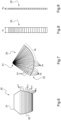
- FIGS. 6 and 7 show a block 20 of split strips obtained by implementing the assembly step 130 of the method illustrated in the Figure 1 .
- the block 20 is here obtained by gluing the plurality of split strips 1 superimposed on each other.
- the block 20 has a first thinned end 21 formed by the thinnest first ends 12 of the plurality of split strips 1 and a second end 22 opposite the first thinned end 21 and formed by the second ends 13 of the plurality of split strips 1.
- the block 20 thus has a variable thickness formed by the sum of the variable thicknesses of the plurality of split strips 1.
- the strips 1 are arranged so that the thickness of the block 20 is continuously progressive from its first thinned end 21 towards its second end 22 which is therefore widened.
- Block 20 is formed, on the sides, by the sides 14 of the split strips 1.
- THE figures 8 and 9 show slices 25 respectively of a first predetermined thickness e1 and of a second predetermined thickness e2 less than the first predetermined thickness e1, obtained by implementing step 140 of cutting the block 20 of split strips 1.
- the slices 25 are cut from the block 20 in a direction transverse to the longitudinal direction of extension of the plurality of strips 1.
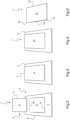
- FIG. 10 shows steps 150 and 160 of the process illustrated in the Figure 1 , with a view to obtaining an ornamental and/or covering sub-element 32.
- Each slice is arranged on a template 30, for example made of plastic or metal and having a predetermined format defined by a contour 31, then cut to the format of the template 30 so as to form a slice portion corresponding to an ornamental and/or covering sub-element 32 having a contour 33 corresponding to that of the template 30.
- pattern 30 has a rectangular and in particular square outline 31.
- the pattern can have a different shape, for example circular, round, oval, diamond, triangle, etc.
- a film 34 may be provided and each set formed of several ornamental and/or covering sub-elements 32 glued together may be glued onto the film 34 in order to reinforce the holding of the ornamental and/or covering sub-elements 32 together.
- the assembly formed of the ornamental and/or covering sub-elements 32 glued to each other and optionally glued to the film forms an ornamental and/or covering element presenting the determined pattern.
- FIG. 13 schematically represents in perspective steps 200 and 210 of the process illustrated in the Figure 1 .
- a support 36 is provided and a plurality of ornamental and/or covering elements are arranged and mechanically secured, for example by gluing, on the support to form an article 35.
- the support 36 is formed from one or more wooden plates, so that the article 35 can form a piece of furniture.
- the support may be made of leather or equivalent, plastic, metal so that the item may be an item of, for example, leather goods, luggage, jewelry.
Landscapes
- Engineering & Computer Science (AREA)
- Chemical & Material Sciences (AREA)
- Ceramic Engineering (AREA)
- Manufacturing & Machinery (AREA)
- Mechanical Engineering (AREA)
- Organic Chemistry (AREA)
- Composite Materials (AREA)
- Laminated Bodies (AREA)
- Treatment And Processing Of Natural Fur Or Leather (AREA)
Claims (12)
- Verfahren zur Herstellung von mindestens einem Ornament- und/oder Bezugselement aus Leder oder Lederersatzmaterial oder Ähnlichem, das auf einem Träger (36) zu befestigen ist, so dass ein Artikel (35) beispielsweise aus Möbeln, Lederwaren, Gepäck und/oder Schmuck entsteht, das folgende Schritte umfasst:- Bereitstellung (120) einer Vielzahl von Bändern aus Leder oder Lederersatzmaterial oder Ähnlichem (1), wobei sich jedes Band insgesamt längs erstreckt;- Zusammenfügen (130) der Vielzahl von Bändern durch Überlagerung zu einem Bandblock (20);- Schneiden (140) des Bandblocks in einer Richtung quer zur Längsrichtung der Ausdehnung der Vielzahl von Bändern, um Scheiben (25) mit einer vorbestimmten Dicke zu erhalten;wobei das Verfahren dadurch gekennzeichnet ist, dass jedes Band eine variable Dicke von einem ersten Ende (12) mit der dünnsten Dicke zu einem zweiten Ende (13) aufweist, das dem ersten Ende gegenüberliegt, wobei der Bandblock (20) ein erstes verdünntes Ende (21) aufweist, das von den ersten dünnsten Enden der Vielzahl von Bändern gebildet wird, und ein zweites Ende (22), das dem ersten verdünnten Ende gegenüberliegt und von den zweiten Enden der Vielzahl von Bändern gebildet wird, wobei der Block mit einer variablen Dicke durch die Summe der variablen Dicke der Vielzahl von Bändern gebildet wird und, dass das Verfahren folgenden Schritt umfasst:- integrales Zusammenfügen (170) eine Vielzahl von Scheiben und/oder Abschnitten von Scheiben, die Unterelemente von Ornament- und/oder Bezugselementen (32) bilden, um ein Ornament- und/oder Bezugselement mit einem definierten Muster zu erhalten.
- Verfahren nach Anspruch 1, dadurch gekennzeichnet, dass es die Schritte des Bereitstellens (110) einer Spaltform (2), des Bereitstellens (100) von Bändern (1) mit im Wesentlichen konstanter Dicke, des Positionierens jedes der Bänder auf der Form und des Spaltens jedes so positionierten Bandes umfasst, um die Bänder mit variabler Dicke vom ersten Ende (12) mit der dünnsten Dicke zum zweiten Ende (13) zu erhalten.
- Verfahren nach einem der Ansprüche 1 und 2, dadurch gekennzeichnet, dass es einen Schritt zum Kleben der Vielzahl von Bändern (1) durch Überlagerung zur Bildung des Bandblocks (20) umfasst.
- Verfahren nach einem der Ansprüche 1 bis 3, dadurch gekennzeichnet, dass es einen Schritt zum Bereitstellen (150) mindestens eines Musters (30), einen Schritt zum Anordnen jeder Scheibe (25) auf dem Muster und einen Schritt zum Zuschneiden der Scheibe in das Musterformat umfasst, um einen entsprechenden Scheibenabschnitt zu erhalten.
- Verfahren nach einem der Ansprüche 1 bis 4, dadurch gekennzeichnet, dass es einen Schritt des Klebens von Kante zu Kante der Vielzahl von Scheiben und/oder Abschnitten von Scheiben umfasst, die Unterelemente von Ornament- und/oder Bezugselementen (32) bilden.
- Verfahren nach einem der Ansprüche 1 bis 5, dadurch gekennzeichnet, dass es einen Schritt (180) des Bereitstellens einer Folie (34) und einen Schritt (190) des Klebens der Vielzahl von auf der Folie montierten Scheiben und/oder Abschnitten von Scheiben, die Unterelemente von Ornament- und/oder Bezugselementen (32) bilden, umfasst.
- Verfahren nach einem der Ansprüche 1 bis 6, dadurch gekennzeichnet, dass es einen Schritt des Bereitstellens (220) eines Trägers (36) und einen Schritt der mechanischen Befestigung (210) eines oder mehrerer Ornamentelemente auf dem Träger nach einem definierten Muster umfasst, wobei die Baugruppe einen Artikel (35) beispielsweise mit Möbeln, Lederwaren, Gepäckstücken, Schmuck ausstatten kann.
- Verfahren nach einem der Ansprüche 1 bis 7, dadurch gekennzeichnet, dass mindestens ein Band (1) eine variable Dicke aufweist, die durch ein vorbestimmtes Dickenprofil vom ersten Ende (12) zum zweiten Ende (13) definiert ist.
- Verfahren nach Anspruch 8, dadurch gekennzeichnet, dass mindestens ein Band (1) eine variable Dicke aufweist, die durch ein kontinuierlich fortschreitendes Dickenprofil vom ersten Ende (12) zum zweiten Ende (13) definiert ist.
- Verfahren nach einem der Ansprüche 8 und 9, dadurch gekennzeichnet, dass mindestens ein Band (1) eine variable Dicke aufweist, die durch ein nicht kontinuierlich fortschreitendes Dickenprofil vom ersten Ende zum zweiten Ende definiert ist.
- Verfahren nach einem der Ansprüche 8 bis 10, dadurch gekennzeichnet, dass jedes Band (1) der Vielzahl von Bändern insgesamt das gleiche vorbestimmte Dickenprofil aufweist.
- Verfahren nach einem der Ansprüche 8 bis 10, dadurch gekennzeichnet, dass die Bänder (1) der Vielzahl von Bändern insgesamt mindestens teilweise unterschiedliche Dickenprofile aufweisen.
Applications Claiming Priority (1)
| Application Number | Priority Date | Filing Date | Title |
|---|---|---|---|
| FR2202468A FR3133621B1 (fr) | 2022-03-21 | 2022-03-21 | Procédé de fabrication d’un élément d’ornement et/ou de revêtement en cuir ou en succédané du cuir ou analogue, à fixer sur un support de sorte à former un article par exemple d’ameublement, de maroquinerie, de bagagerie, de bijouterie |
Publications (2)
| Publication Number | Publication Date |
|---|---|
| EP4249611A1 EP4249611A1 (de) | 2023-09-27 |
| EP4249611B1 true EP4249611B1 (de) | 2025-04-30 |
Family
ID=81581206
Family Applications (1)
| Application Number | Title | Priority Date | Filing Date |
|---|---|---|---|
| EP23305373.5A Active EP4249611B1 (de) | 2022-03-21 | 2023-03-20 | Verfahren zur herstellung eines zier- und/oder verkleidungselements aus leder oder dergleichen, zur befestigung an einem träger zur bildung eines artikels, insbesondere eines möbelstücks, eines lederstücks, eines schmuckstücks |
Country Status (3)
| Country | Link |
|---|---|
| EP (1) | EP4249611B1 (de) |
| CN (1) | CN116787958A (de) |
| FR (1) | FR3133621B1 (de) |
Family Cites Families (6)
| Publication number | Priority date | Publication date | Assignee | Title |
|---|---|---|---|---|
| US1862878A (en) | 1929-12-11 | 1932-06-14 | United Shoe Machinery Corp | Heel and heel covering and method of making the same |
| US3034161A (en) * | 1961-10-24 | 1962-05-15 | Charles L Hoffman | Method of making laminated leather heel coverings |
| JPS4949173U (de) * | 1972-08-08 | 1974-04-30 | ||
| FR2362725A1 (fr) | 1976-08-23 | 1978-03-24 | Vanderpool Germaine | Materiau composite en feuille |
| FR2835532B1 (fr) | 2002-02-04 | 2004-04-02 | Hermes Sellier | Procede de fabrication d'un materiau composite, materiau composite, articles de maroquinerie, bagagerie comportant ledit materiau |
| FR2913028B1 (fr) | 2007-02-23 | 2012-06-08 | Hermes Sellier | Procede de realisation de pieces de revetemenent en cuir, simili cuir ou similaire |
-
2022
- 2022-03-21 FR FR2202468A patent/FR3133621B1/fr active Active
-
2023
- 2023-03-20 EP EP23305373.5A patent/EP4249611B1/de active Active
- 2023-03-21 CN CN202310272935.4A patent/CN116787958A/zh active Pending
Also Published As
| Publication number | Publication date |
|---|---|
| FR3133621B1 (fr) | 2025-05-23 |
| CN116787958A (zh) | 2023-09-22 |
| EP4249611A1 (de) | 2023-09-27 |
| FR3133621A1 (fr) | 2023-09-22 |
Similar Documents
| Publication | Publication Date | Title |
|---|---|---|
| EP3369334B1 (de) | Tragbares zierelement, das einen unter eine starre durchbrochene struktur plattierten beschlag umfasst | |
| EP4249611B1 (de) | Verfahren zur herstellung eines zier- und/oder verkleidungselements aus leder oder dergleichen, zur befestigung an einem träger zur bildung eines artikels, insbesondere eines möbelstücks, eines lederstücks, eines schmuckstücks | |
| EP1762669A1 (de) | Satz von Profilen | |
| US6875300B1 (en) | Fabrication of veneer faced panels | |
| US7594306B2 (en) | Casket lid | |
| JPS5912283B2 (ja) | 収納具用化粧戸およびその製造方法 | |
| JP4946808B2 (ja) | 化粧材の製造方法,及び化粧材 | |
| FR2744342A1 (fr) | Procede de fabrication de mocassins et mocassins obtenus par la mise en oeuvre de ce procede | |
| FR2964837A1 (fr) | Bonnet de soutien-gorge a support ameliore. | |
| FR2921608A1 (fr) | Panneau de recouvrement ou de revetement interieur d'un vehicule automobile et procede de fabrication d'un tel panneau | |
| JP2010100330A (ja) | 板材による箱の製造法 | |
| FR2872388A1 (fr) | Article chaussant a premiere integree a la tige et procede et dispositif pour sa fabrication | |
| EP4212433A1 (de) | Verkleidungselement für eine rumpfkante eines aeronautischen sitzes, herstellungsverfahren und verfahren zum verlegen eines solchen elements | |
| EP2303765B1 (de) | Verfahren zum herstellen von dreidimensionalformen aus zusammengesetzten teilen mit verschiedenen elastizitätseigenschaften, und lederwarenartikel | |
| EP0474077B1 (de) | Verfahren zur Herstellung einer, insbesondere zum Verpacken und/oder zur Präsentation von Gegenständen bestimmten Schachtel | |
| JPH0380616B2 (de) | ||
| FR3107072A1 (fr) | Système de revêtement en bois et son procédé de fabrication, système comprenant un tel système de revêtement en bois, et ses procédés de fabrication et de rénovation | |
| BE1016764A6 (fr) | Ensemble de profiles. | |
| FR2579509A1 (fr) | Panneau pour la realisation d'un panneau a plates-bandes, son procede de fabrication et les panneaux a plates-bandes obtenus | |
| FR2794061A3 (fr) | Applique pour chaussures, sacs a main et autres articles similaires | |
| FR2555025A1 (fr) | Procede de fabrication d'articles chaussants tels que des mules ainsi que les articles chaussants obtenus par la mise en oeuvre du procede | |
| WO2004039662A1 (fr) | Procede de fabrication de pieces assemblables de couverture d’une surface | |
| EP1333104A1 (de) | Verfahren zur Herstellung eines Verbundwerkstoffs, Verbundwerkstoff, Lederwaren und Gepäckwaren aus diesem Werkstoff | |
| FR2853819A1 (fr) | Procede de fabrication de tiges d'articles chaussants et articles chaussants ainsi obtenus | |
| FR2548330A1 (fr) | Element plan de construction ou de revetement dont les bords presentent des organes pour l'assemblage avec des elements identiques |
Legal Events
| Date | Code | Title | Description |
|---|---|---|---|
| PUAI | Public reference made under article 153(3) epc to a published international application that has entered the european phase |
Free format text: ORIGINAL CODE: 0009012 |
|
| STAA | Information on the status of an ep patent application or granted ep patent |
Free format text: STATUS: THE APPLICATION HAS BEEN PUBLISHED |
|
| AK | Designated contracting states |
Kind code of ref document: A1 Designated state(s): AL AT BE BG CH CY CZ DE DK EE ES FI FR GB GR HR HU IE IS IT LI LT LU LV MC ME MK MT NL NO PL PT RO RS SE SI SK SM TR |
|
| STAA | Information on the status of an ep patent application or granted ep patent |
Free format text: STATUS: REQUEST FOR EXAMINATION WAS MADE |
|
| 17P | Request for examination filed |
Effective date: 20240116 |
|
| RBV | Designated contracting states (corrected) |
Designated state(s): AL AT BE BG CH CY CZ DE DK EE ES FI FR GB GR HR HU IE IS IT LI LT LU LV MC ME MK MT NL NO PL PT RO RS SE SI SK SM TR |
|
| STAA | Information on the status of an ep patent application or granted ep patent |
Free format text: STATUS: EXAMINATION IS IN PROGRESS |
|
| 17Q | First examination report despatched |
Effective date: 20240521 |
|
| GRAP | Despatch of communication of intention to grant a patent |
Free format text: ORIGINAL CODE: EPIDOSNIGR1 |
|
| STAA | Information on the status of an ep patent application or granted ep patent |
Free format text: STATUS: GRANT OF PATENT IS INTENDED |
|
| INTG | Intention to grant announced |
Effective date: 20250129 |
|
| GRAS | Grant fee paid |
Free format text: ORIGINAL CODE: EPIDOSNIGR3 |
|
| GRAA | (expected) grant |
Free format text: ORIGINAL CODE: 0009210 |
|
| STAA | Information on the status of an ep patent application or granted ep patent |
Free format text: STATUS: THE PATENT HAS BEEN GRANTED |
|
| AK | Designated contracting states |
Kind code of ref document: B1 Designated state(s): AL AT BE BG CH CY CZ DE DK EE ES FI FR GB GR HR HU IE IS IT LI LT LU LV MC ME MK MT NL NO PL PT RO RS SE SI SK SM TR |
|
| REG | Reference to a national code |
Ref country code: CH Ref legal event code: EP Ref country code: GB Ref legal event code: FG4D Free format text: NOT ENGLISH |
|
| P01 | Opt-out of the competence of the unified patent court (upc) registered |
Free format text: CASE NUMBER: APP_15362/2025 Effective date: 20250328 |
|
| REG | Reference to a national code |
Ref country code: DE Ref legal event code: R096 Ref document number: 602023003219 Country of ref document: DE |
|
| REG | Reference to a national code |
Ref country code: IE Ref legal event code: FG4D Free format text: LANGUAGE OF EP DOCUMENT: FRENCH |
|
| REG | Reference to a national code |
Ref country code: NL Ref legal event code: MP Effective date: 20250430 |
|
| REG | Reference to a national code |
Ref country code: AT Ref legal event code: MK05 Ref document number: 1790068 Country of ref document: AT Kind code of ref document: T Effective date: 20250430 |
|
| PG25 | Lapsed in a contracting state [announced via postgrant information from national office to epo] |
Ref country code: PT Free format text: LAPSE BECAUSE OF FAILURE TO SUBMIT A TRANSLATION OF THE DESCRIPTION OR TO PAY THE FEE WITHIN THE PRESCRIBED TIME-LIMIT Effective date: 20250901 Ref country code: FI Free format text: LAPSE BECAUSE OF FAILURE TO SUBMIT A TRANSLATION OF THE DESCRIPTION OR TO PAY THE FEE WITHIN THE PRESCRIBED TIME-LIMIT Effective date: 20250430 Ref country code: ES Free format text: LAPSE BECAUSE OF FAILURE TO SUBMIT A TRANSLATION OF THE DESCRIPTION OR TO PAY THE FEE WITHIN THE PRESCRIBED TIME-LIMIT Effective date: 20250430 |
|
| REG | Reference to a national code |
Ref country code: LT Ref legal event code: MG9D |
|
| PG25 | Lapsed in a contracting state [announced via postgrant information from national office to epo] |
Ref country code: NO Free format text: LAPSE BECAUSE OF FAILURE TO SUBMIT A TRANSLATION OF THE DESCRIPTION OR TO PAY THE FEE WITHIN THE PRESCRIBED TIME-LIMIT Effective date: 20250730 Ref country code: GR Free format text: LAPSE BECAUSE OF FAILURE TO SUBMIT A TRANSLATION OF THE DESCRIPTION OR TO PAY THE FEE WITHIN THE PRESCRIBED TIME-LIMIT Effective date: 20250731 |
|
| PG25 | Lapsed in a contracting state [announced via postgrant information from national office to epo] |
Ref country code: NL Free format text: LAPSE BECAUSE OF FAILURE TO SUBMIT A TRANSLATION OF THE DESCRIPTION OR TO PAY THE FEE WITHIN THE PRESCRIBED TIME-LIMIT Effective date: 20250430 Ref country code: PL Free format text: LAPSE BECAUSE OF FAILURE TO SUBMIT A TRANSLATION OF THE DESCRIPTION OR TO PAY THE FEE WITHIN THE PRESCRIBED TIME-LIMIT Effective date: 20250430 |
|
| PG25 | Lapsed in a contracting state [announced via postgrant information from national office to epo] |
Ref country code: BG Free format text: LAPSE BECAUSE OF FAILURE TO SUBMIT A TRANSLATION OF THE DESCRIPTION OR TO PAY THE FEE WITHIN THE PRESCRIBED TIME-LIMIT Effective date: 20250430 |
|
| PG25 | Lapsed in a contracting state [announced via postgrant information from national office to epo] |
Ref country code: HR Free format text: LAPSE BECAUSE OF FAILURE TO SUBMIT A TRANSLATION OF THE DESCRIPTION OR TO PAY THE FEE WITHIN THE PRESCRIBED TIME-LIMIT Effective date: 20250430 |
|
| PG25 | Lapsed in a contracting state [announced via postgrant information from national office to epo] |
Ref country code: AT Free format text: LAPSE BECAUSE OF FAILURE TO SUBMIT A TRANSLATION OF THE DESCRIPTION OR TO PAY THE FEE WITHIN THE PRESCRIBED TIME-LIMIT Effective date: 20250430 |
|
| PG25 | Lapsed in a contracting state [announced via postgrant information from national office to epo] |
Ref country code: RS Free format text: LAPSE BECAUSE OF FAILURE TO SUBMIT A TRANSLATION OF THE DESCRIPTION OR TO PAY THE FEE WITHIN THE PRESCRIBED TIME-LIMIT Effective date: 20250731 |
|
| PG25 | Lapsed in a contracting state [announced via postgrant information from national office to epo] |
Ref country code: IS Free format text: LAPSE BECAUSE OF FAILURE TO SUBMIT A TRANSLATION OF THE DESCRIPTION OR TO PAY THE FEE WITHIN THE PRESCRIBED TIME-LIMIT Effective date: 20250830 |
|
| PG25 | Lapsed in a contracting state [announced via postgrant information from national office to epo] |
Ref country code: LV Free format text: LAPSE BECAUSE OF FAILURE TO SUBMIT A TRANSLATION OF THE DESCRIPTION OR TO PAY THE FEE WITHIN THE PRESCRIBED TIME-LIMIT Effective date: 20250430 |
|
| PG25 | Lapsed in a contracting state [announced via postgrant information from national office to epo] |
Ref country code: DK Free format text: LAPSE BECAUSE OF FAILURE TO SUBMIT A TRANSLATION OF THE DESCRIPTION OR TO PAY THE FEE WITHIN THE PRESCRIBED TIME-LIMIT Effective date: 20250430 Ref country code: SM Free format text: LAPSE BECAUSE OF FAILURE TO SUBMIT A TRANSLATION OF THE DESCRIPTION OR TO PAY THE FEE WITHIN THE PRESCRIBED TIME-LIMIT Effective date: 20250430 |
|
| PG25 | Lapsed in a contracting state [announced via postgrant information from national office to epo] |
Ref country code: CZ Free format text: LAPSE BECAUSE OF FAILURE TO SUBMIT A TRANSLATION OF THE DESCRIPTION OR TO PAY THE FEE WITHIN THE PRESCRIBED TIME-LIMIT Effective date: 20250430 |
|
| PG25 | Lapsed in a contracting state [announced via postgrant information from national office to epo] |
Ref country code: EE Free format text: LAPSE BECAUSE OF FAILURE TO SUBMIT A TRANSLATION OF THE DESCRIPTION OR TO PAY THE FEE WITHIN THE PRESCRIBED TIME-LIMIT Effective date: 20250430 |
|
| PG25 | Lapsed in a contracting state [announced via postgrant information from national office to epo] |
Ref country code: SK Free format text: LAPSE BECAUSE OF FAILURE TO SUBMIT A TRANSLATION OF THE DESCRIPTION OR TO PAY THE FEE WITHIN THE PRESCRIBED TIME-LIMIT Effective date: 20250430 |
|
| PG25 | Lapsed in a contracting state [announced via postgrant information from national office to epo] |
Ref country code: IT Free format text: LAPSE BECAUSE OF FAILURE TO SUBMIT A TRANSLATION OF THE DESCRIPTION OR TO PAY THE FEE WITHIN THE PRESCRIBED TIME-LIMIT Effective date: 20250430 |
|
| REG | Reference to a national code |
Ref country code: DE Ref legal event code: R097 Ref document number: 602023003219 Country of ref document: DE |
|
| PLBE | No opposition filed within time limit |
Free format text: ORIGINAL CODE: 0009261 |
|
| STAA | Information on the status of an ep patent application or granted ep patent |
Free format text: STATUS: NO OPPOSITION FILED WITHIN TIME LIMIT |
|
| REG | Reference to a national code |
Ref country code: CH Ref legal event code: L10 Free format text: ST27 STATUS EVENT CODE: U-0-0-L10-L00 (AS PROVIDED BY THE NATIONAL OFFICE) Effective date: 20260311 |