EP4248462B1 - Brütermantel für fusionsreaktor und verfahren zum betrieb eines fusionsreaktors mit einem solchen brütermantel - Google Patents
Brütermantel für fusionsreaktor und verfahren zum betrieb eines fusionsreaktors mit einem solchen brütermantel Download PDFInfo
- Publication number
- EP4248462B1 EP4248462B1 EP21819077.5A EP21819077A EP4248462B1 EP 4248462 B1 EP4248462 B1 EP 4248462B1 EP 21819077 A EP21819077 A EP 21819077A EP 4248462 B1 EP4248462 B1 EP 4248462B1
- Authority
- EP
- European Patent Office
- Prior art keywords
- breeder
- layer
- neutron moderator
- lithium
- neutron
- Prior art date
- Legal status (The legal status is an assumption and is not a legal conclusion. Google has not performed a legal analysis and makes no representation as to the accuracy of the status listed.)
- Active
Links
Images


Classifications
-
- G—PHYSICS
- G21—NUCLEAR PHYSICS; NUCLEAR ENGINEERING
- G21B—FUSION REACTORS
- G21B1/00—Thermonuclear fusion reactors
- G21B1/11—Details
- G21B1/13—First wall; Blanket; Divertor
-
- G—PHYSICS
- G21—NUCLEAR PHYSICS; NUCLEAR ENGINEERING
- G21B—FUSION REACTORS
- G21B1/00—Thermonuclear fusion reactors
- G21B1/11—Details
- G21B1/19—Targets for producing thermonuclear fusion reactions, e.g. pellets for irradiation by laser or charged particle beams
-
- G—PHYSICS
- G21—NUCLEAR PHYSICS; NUCLEAR ENGINEERING
- G21G—CONVERSION OF CHEMICAL ELEMENTS; RADIOACTIVE SOURCES
- G21G1/00—Arrangements for converting chemical elements by electromagnetic radiation, corpuscular radiation or particle bombardment, e.g. producing radioactive isotopes
- G21G1/001—Recovery of specific isotopes from irradiated targets
-
- G—PHYSICS
- G21—NUCLEAR PHYSICS; NUCLEAR ENGINEERING
- G21G—CONVERSION OF CHEMICAL ELEMENTS; RADIOACTIVE SOURCES
- G21G1/00—Arrangements for converting chemical elements by electromagnetic radiation, corpuscular radiation or particle bombardment, e.g. producing radioactive isotopes
- G21G1/02—Arrangements for converting chemical elements by electromagnetic radiation, corpuscular radiation or particle bombardment, e.g. producing radioactive isotopes in nuclear reactors
-
- G—PHYSICS
- G21—NUCLEAR PHYSICS; NUCLEAR ENGINEERING
- G21G—CONVERSION OF CHEMICAL ELEMENTS; RADIOACTIVE SOURCES
- G21G1/00—Arrangements for converting chemical elements by electromagnetic radiation, corpuscular radiation or particle bombardment, e.g. producing radioactive isotopes
- G21G1/001—Recovery of specific isotopes from irradiated targets
- G21G2001/0094—Other isotopes not provided for in the groups listed above
-
- Y—GENERAL TAGGING OF NEW TECHNOLOGICAL DEVELOPMENTS; GENERAL TAGGING OF CROSS-SECTIONAL TECHNOLOGIES SPANNING OVER SEVERAL SECTIONS OF THE IPC; TECHNICAL SUBJECTS COVERED BY FORMER USPC CROSS-REFERENCE ART COLLECTIONS [XRACs] AND DIGESTS
- Y02—TECHNOLOGIES OR APPLICATIONS FOR MITIGATION OR ADAPTATION AGAINST CLIMATE CHANGE
- Y02E—REDUCTION OF GREENHOUSE GAS [GHG] EMISSIONS, RELATED TO ENERGY GENERATION, TRANSMISSION OR DISTRIBUTION
- Y02E30/00—Energy generation of nuclear origin
- Y02E30/10—Nuclear fusion reactors
Definitions
- the present invention relates to breeder blankets for generating tritium in fusion reactors, e.g. tokamak fusion reactors.
- Fusion neutrons are produced when a deuterium-tritium (D-T) or deuterium-deuterium (D-D) plasma becomes very hot so that the nuclei fuse together, releasing highly energetic neutrons.
- D-T deuterium-tritium
- D-D deuterium-deuterium
- This reaction is summarised in the following equation: D 1 2 + T 1 3 ⁇ H 2 4 e 3.52 MeV + n 0 14.06 MeV .
- the lithium is generally contained within a so-called "breeder blanket" installed on an inner wall of the reactor.
- the lithium may be provided as a metal (or alloy) or as lithium containing compounds, e.g. lithium-bearing ceramic materials, such as Li 2 O, LiAlO 2 , Li 2 ZrO 3 , Li 4 SiO 4 etc.
- a neutron multiplier material is generally added (e.g. lead alloyed with the lithium) to provide extra neutron population to counter the neutron leakage from the system and to improve the tritium breeding ratio (TBR) of the blanket (i.e. the mean number of tritium nuclei generated per fusion neutron produced by the reactor).
- TBR tritium breeding ratio
- Metals such as beryllium, lead, and tin have been proposed as neutron multiplier materials via the (n, 2n) reaction.
- Molten salt materials have been proposed as tritium breeding materials, such as Li 2 F-BeF 2 .
- a tokamak features a combination of strong toroidal magnetic field B T , high plasma current I p and usually a large plasma volume and significant auxiliary heating, to provide a hot stable plasma so that fusion can occur.
- the auxiliary heating (for example via tens of megawatts of neutral beam injection of high energy H, D or T) is necessary to increase the temperature to the sufficiently high values required for nuclear fusion to occur, and/or to maintain the plasma current.
- the tokamak reactor is as compact as possible allows greater efficiency, particularly for "spherical tokamaks" in which the inner radius of the torus is minimised. For example, minimising the distance between the plasma and the field coils allows a higher magnetic field in the plasma with a lower current in the coils.
- compact tokamaks present a number of additional challenges compared to larger designs that need to be overcome in order to achieve a working fusion reactor. For example, the surface area to volume ratio of smaller (e.g. spherical) tokamaks is generally much smaller than the surface area to volume ratio of larger tokamaks.
- TBR tritium breeding ratio
- US3969631 describes solid lithium is irradiated by neutrons inside low activity means containing a positive pressure gas stream for removing and separating the tritium from the solid lithium, and these means are contained in a low activity shell containing a thermal insulator and a neutron moderator.
- US3969631 does not disclose a breeder layer comprising lithium-containing material in the form of liquid lithium metal or alloy, or a molten salt in combination with a neutron moderator material comprising a yttrium hydride and/or a yttrium deuteride.
- JPS6344198 describes using a solid-state lithium compound such as lithium oxide for the production of tritium in nuclear fusion reactors.
- GB908020 describes using a blanket containing lithium 6 and lithium 7 to breed tritium from the neutrons emitted from a reaction space of a fusion reactor.
- a breeder blanket for generating tritium using neutrons produced by nuclear fusion of deuterium and/or tritium within a plasma confined within a fusion reactor.
- the breeder blanket comprises: a plasma-facing first wall; a breeder layer comprising lithium-containing material for generating tritium from the neutrons, the lithium-containing material being provided in the form of lithium metal or alloy, or a molten salt, wherein, when in use, the lithium metal or alloy being liquid or the salt being molten; and neutron moderator material comprising yttrium hydride and/or yttrium deuteride arranged between the first wall and the lithium-containing material.
- the neutron moderator material may be provided as a neutron moderator layer arranged between the first wall and the breeder layer.
- the neutron moderator material reduces the energy of the neutrons produced from the plasma to facilitate neutron capture by lithium-6 nuclei within the lithium-containing material.
- the neutron moderator layer may be configured to transmit more than 60%, preferably more than 80%, or more preferably more than 95%, of the neutrons having an energy of 14 MeV prior to entering the neutron moderator layer.
- the neutron moderator layer may be configured to reduce the energy of at least a proportion of the transmitted neutrons by more than 95%, preferably by more than 99%, the neutrons having an energy of 14 MeV prior to entering the neutron moderator layer.
- the proportion may be greater than 10%, preferably greater than 50%, and more preferably greater than 70%.
- the thickness of the neutron moderator layer may be from 0.5 cm to 25 cm, preferably from 2 cm to 15 cm.
- the thickness of the breeder layer may be from 1 cm to 200 cm, preferably from 5 cm to 150 cm.
- no other breeder layer is provided between the first wall and the neutron moderator layer.
- the breeder blanket may further comprise another neutron moderator layer comprising ytrrium hydride and/or a yttrium deuteride, the breeder layer being arranged between the neutron moderator layers.
- the other neutron moderator layer may be configured to reflect a greater proportion of neutrons than the neutron moderator layer between the first wall and the breeder layer.
- the other neutron moderator layer may be thicker than the neutron moderator layer.
- the breeder blanket may comprise another breeder layer comprising lithium containing material for generating tritium from the neutrons, the other neutron moderator layer being arranged between the breeder layers.
- the breeder layer(s) and the neutron moderator layer(s) may be separated from one another by one or more metal layers.
- the neutron moderator material may be provided within the breeder layer, the neutron moderator material being separated from the lithium containing material in the breeder layer by one or more layers of metal.
- the breeder layer may comprise a plurality of pellets comprising the neutron moderator material, the pellets being dispersed within the lithium containing material.
- the breeder layer may comprise a plurality of rods comprising the neutron moderator material, each rod preferably having a longitudinal axis arranged substantially parallel to the first wall.
- the longitudinal axis is preferably arranged vertically.
- the breeder blanket may comprise fixings for holding each of the rods in a fixed position within the breeder layer, the fixings being configured to allow the rods to be removed from and replaced within the breeder layer.
- the breeder layer may comprise a first region located closer to the first wall than a second region, the rods in the first region being more closely spaced from one another than the rods in the second region.
- the ratio of metal atoms to hydrogen and/or deuterium atoms in the yttrium hydride and/or ytrrium deuteride may be from 1.0 to 2.0, preferably from 1.50 to 1.92.
- the percentage of lithium in the lithium-containing material that is lithium-6 may be greater than 7.6%, preferably greater than 20%, and more preferably greater than 50%.
- the breeder blanket may comprise a neutron multiplier material such as beryllium lead, tin and/or uranium.
- the breeder blanket may comprise a molten salt that contains both the lithium and neutron multiplier together such as a molten salt comprising lithium fluoride and beryllium fluoride, Li 2 F-BeF 2 .
- a fusion reactor comprising one or more breeder blankets according to the first aspect of the invention.
- the fusion reactor may be a tokamak fusion reactor.
- the tokamak may be a spherical tokamak, preferably a spherical tokamak having an aspect ratio of less than or equal to 2.5, the aspect ratio being defined as the ratio of the major and minor radii of a toroidal plasma-confining region of the tokamak.
- a method of operating a fusion reactor comprises generating tritium using the one or more breeder blankets and neutrons produced by nuclear fusion of deuterium and/or tritium within the fusion reactor and introducing the generated tritium into a plasma confined within the fusion reactor.
- the method may further comprise using neutrons moderated by the neutron moderator material to irradiate one or more specimens provided within the breeder blanket in order to carry out one or more of: isotope production (e.g. medical radioisotope production), materials testing, transmutation of nuclear waste; and surveillance of the neutron flux produced by the fusion reactor.
- isotope production e.g. medical radioisotope production
- materials testing e.g. medical radioisotope production
- transmutation of nuclear waste e.g.
- the method may comprise: inserting a specimen into the breeder blanket, irradiating the specimen using neutrons moderated by the neutron breeder blanket; and removing the specimen from the breeder blanket.
- the specimen may be analysed during and/or after irradiation (and preferably before irradiation as well) to determine the effect of the neutrons on the specimen. These steps may be repeated a number of times to allow changes in the specimen resulting from repeated irradiation to be measured.
- the tritium ( 3 T) breeding ratio of a breeder blanket containing lithium depends strongly on the energy of the neutrons entering the breeder blanket as a result of the energy dependence of the neutron absorption cross sections for the different isotopes of lithium.
- the neutron absorption cross section is (predominantly) inversely dependent of the neutron energy, i.e. the lower the neutron energy, the higher probability of neutron activation of 6 Li and hence tritium production.
- the neutron absorption cross section of 6 Li is of the order of 100 barns and 1000 barns for neutron energies of around 10 -5 MeV and 10 -6 MeV, respectively, but about 0.05 barns for neutron energies around 10 MeV.
- the neutron absorption cross-section of 7 Li is approximately 2.5 times larger than that of 6 Li for neutron energies greater than around 10 MeV, but negligible for neutron energies below 1 MeV.
- the tritium breeding ratio of a breeder blanket therefore depends on the ratio of lithium-6 and lithium-7 in the lithium-containing material as well as the energy of the incident neutrons, the neutron flux and the volume of lithium containing material.
- Naturally occurring lithium comprises 92.5% 7 Li and only 7.5% 6 Li. Therefore, in many cases, fusion reactors that produce "fast" (i.e. an energy greater than 1 MeV) neutrons may require relatively large amounts of lithium-containing material in order to obtain viable tritium breeding ratios predominantly through neutron activation of 7 Li.
- the present disclosure proposes the use of a breeder blanket having a neutron moderator layer comprising a metal hydride and/or deuteride, such as yttrium hydride and/or yttrium deuteride, to reduce the energy of neutrons produced by fusion reactions of tritium and/or deuterium and thereby obtain more favourable tritium breeding ratios by increasing the rate of tritium production from 6 Li provided after the moderator layer.
- metal hydrides and deuterides are very effective neutron moderators (i.e. they have a high moderation power per unit volume), the thickness of the moderator layer can be kept small.
- the high cross section for tritium production from 6 Li at very low neutron energies ensures that the thickness of the lithium-containing layer can also be kept small without reducing the tritium breeding ratio substantially. Accordingly, the breeder blanket can be used effectively in compact (e.g. spherical) fusion reactors to achieve TBR > 1.05.
- Figure 1 shows a vertical cross section through of a spherical tokamak 100 comprising a toroidal field magnet (TF) 102 formed from a plurality of D-shaped TF coils 103A,B (only two of which are shown in Figure 1 ) arranged around a central column 104 orientated along an axis A-A', and a plurality of poloidal field (PF) magnets 105A-F, each encircling the central column 104.
- Electrical current applied to the TF and PF magnets 103A,B, 105A-F generates a closed magnetic field that, when the tokamak is in use, confines, shapes and controls a hot plasma 107 inside a toroidal vacuum vessel 108.
- blanket formed from plasma-facing segments or tiles (not shown).
- the blanket segments are generally configured so as to follow the curvature of the interior surface and may be arranged in a honey-comb structure, for example.
- FIG. 2 shows a cross section view through an exemplary multi-layered blanket tile 200 used to form the blanket 109.
- the blanket tile 200 comprises a plasma-facing first wall 201, a neutron moderator layer 202, an intermediate metal (e.g. steel) layer 203, a lithium-containing "breeder" layer 204 (which may include a neutron multiplier, such as lead, tin or beryllium, e.g. in the form of a molten salt) and neutron shielding 205.
- the blanket tile 200 typically also includes cooling channels or pipes, or heat sink layers, (not shown) in order to allow heat to be extracted from it.
- the various layers of the blanket tile 200 are shown as being provided in a single tile, separate tiles including one or more of the layers may also be used, with the tiles stacked on top of each other in the order shown for the blanket tile 100. In some examples there may be separate tiles for each of the layers, with the tiles being provided in a stacked arrangement to provide the multi-layered arrangement shown in Figure 2 .
- the neutron moderator layer 202, the intermediate metal layer 203 and the lithium-containing layer 204 may be provided together as a multi-layered tile, with the first wall 201 and neutron shielding 205 being provided separately.
- the first wall 201 provides a physical boundary between the high-temperature plasma 107 and the rest of the tokamak 100 that acts as thermal and nuclear shielding for the toroidal vacuum vessel 109.
- the first wall 201 comprises a layer of tungsten metal bonded to a copper heat sink, but other first wall materials can be used, either in addition to or as alternatives to tungsten such as beryllium or molybdenum, as known in the art.
- the neutron moderator layer 202 may reduce (i.e. attenuate, either by absorption or reflection) the number of neutrons passing through the moderator layer 202 by less than 20%, preferably less than 40%.
- the neutron moderator layer 202 comprises a neutron moderator material in the form of a metal hydride and/or deuteride, which in this case is yttrium hydride.
- Metal hydrides are particularly effective neutron moderator materials because they provide high densities of protons (hydrogen nuclei), which are able to remove kinetic energy efficiently from neutrons by elastic scattering because the masses of proton and neutrons are nearly identical.
- the neutron moderator layer 202 can be made relatively thin whilst still allowing a large proportion of the neutrons to be scattered.
- the moderator layer 202 is configured to maximise the moderation-to-reflection and moderation-to-absorption ratios per unit volume. In this example, the neutron moderator layer 202 is 10 cm thick.
- the thickness of the neutron moderator layer 202 may be from 0.5 cm to 25 cm, or from 2 cm to 15 cm, whilst still moderating the neutrons 206 passing through the first wall 201 effectively (thereby increasing the rate of tritium breeding in the lithium-containing layer 204) and without reflecting too great a proportion of the neutrons back towards the plasma 107.
- the neutron moderator layer 202 inevitably reflects some of the neutrons 206 incident on the blanket tile 200, the majority of the neutrons 206 are transmitted, i.e. the moderator layer 202 is configured to operate in a transmission mode in which the neutrons are transmitted (with a moderated energy spectrum) rather than a reflection mode.
- the thickness of the neutron moderator layer 202 may be increased to increase the proportion of the neutrons 206 that are moderated and/or the extent of the moderation on the energy spectrum of the neutrons 206, as characterised by, for example, a reduction in the mean energy of the neutrons 206 exiting the moderator layer 206.
- the composition of the metal hydride and/or deuteride may also be varied to provide adjust the moderation. For example, the stoichiometry of the metal hydride and/or deuteride may be varied, as discussed below, to increase or decrease the proton density of the material.
- the neutron moderator layer 202 decreases the energy of neutrons passing through it by more than 95%, by more than 99%, or even by more than 99.9% or 99.99%.
- the fraction of neutrons 206 that are moderated by this amount can exceed 10%, or 50% or 70% depending on the thickness and/or composition of the neutron moderator layer 202.
- the neutrons may be substantially thermalized to the temperature of the neutron moderator, such that the neutron energies are about 0.025 eV.
- Yttrium hydride and/or deuteride is particularly suitable for the neutron moderator layer 202 because yttrium is largely neutron transparent for both fast and slow neutrons.
- the neutron capture cross section of yttrium-89 (the only naturally occurring isotope of yttrium) is less than 1 to 2 barns for neutron energies between 0.025 eV and 40 MeV.
- the lithium-containing layer 204 in this example comprises liquid lithium metal (or alloy) that is enriched to have a high proportion of Lithium-6, i.e. a proportion of lithium-6 in excess of the proportion of lithium-6 in naturally occurring lithium.
- the slowed neutrons exiting the neutron moderator layer 202 impinge on the lithium-containing layer and generate tritium within it in accordance with the reaction(s) described above for Lithium-6.
- Lithium may alternatively (or additionally) be provided in the form of a lithium-lead liquid alloy, or a lithium-tin alloy, or a lithium containing alloy, in which the lead or tin is acts as neutron multiplier to increase the number of neutrons within the lithium-containing layer 204 for generating tritium and balancing the neutron leakage within the system.
- the lithium containing breeder material may also contain the neutron multiplier, e.g. in the form of a molten salt comprising Li 2 F and BeF 2 .
- the blanket tile 200 preferably comprises one or more inlets and outlets connected to the breeder layer 204 to allow the liquid lithium (or lithium-lead eutectic) to flow into and out of the breeder layer 204 and the generated tritium to be extracted from the blanket tile 200.
- the inlet and outlet of the blanket tile 200 may be arranged so that the outlet of one blanket tile 200 may be connected to the inlet of another like blanket tile 200 to allow the lithium to flow through the blanket tiles 200 in succession.
- the thicknesses of the neutron moderator layer 202 and the lithium-containing layer 204 can be varied to optimise the tritium breeding ratio according to the size, geometry, materials and/or operating conditions of the fusion reactor. Such optimisations can be performed by "neutronics" computer simulations that calculate the neutron fluxes transmitted and reflected by the various materials in the reactor and the rates of nuclear reactions, such as tritium breeding reactions within the lithium-containing layer 204.
- Metal hydrides or deuterides other than yttrium hydride or deuteride can also be used as the neutron moderator material, e.g. lithium hydride, titanium hydride and/or zirconium hydride (and/or the corresponding deuterides), in combination with the yttrium hydride and/or deuteride.
- the stoichiometry of the metal hydrides or deuterides may vary depending on the amount of moderation required and the required structural properties of the moderator layer 202.
- x is between 0.5 to 5.5, or between 1.0 to 2.0.
- yttrium hydride i.e. YH x
- x is in a range from around 1.50 to around 1.92. This range has been found to provide a suitable hydrogen content for effective neutron moderation whilst avoiding the lower decomposition temperatures associated with higher hydrogen contents (i.e. with higher x).
- FIG 3 shows an alternative blanket tile 300 which is similar to the blanket tile 200 shown in Figure 2 , except that it has an additional neutron moderator layer 302 positioned after the lithium-containing layer 204, i.e. positioned so that the lithium-containing layer 204 is between the two neutron moderator layers 202, 302.
- additional neutron moderator layer 302 positioned after the lithium-containing layer 204, i.e. positioned so that the lithium-containing layer 204 is between the two neutron moderator layers 202, 302.
- neutrons reflected by the additional neutron moderator layer 302 contribute to the tritium breeding in the lithium-containing layer 204 to increase the tritium breeding ratio further.
- the thickness of the additional neutron moderator layer 302 may be greater than the thickness of the first neutron moderator layer 202 (i.e.
- the additional neutron moderator layer 302 may comprise metal hydride and/or deuteride as described above for the first neutron moderator layer 202, e.g. yttrium hydride and/or deuteride. Alternatively, or in addition, the additional neutron moderator layer 302 may comprise another moderator material, such as graphite or titanium carbide.
- the additional neutron moderator layer 302 is preferably separated from the lithium-containing layer 204 by a metal (e.g. steel) layer, as discussed above for the blanket tile 200 of Figure 2 .
- blanket tiles can be derived from blanket tile 300 by adding one or more further lithium-containing breeder layers after (i.e. in a direction away from the first wall 201) the additional neutron moderator layer 302, with an extra neutron moderating layer provided after each of the further lithium-containing breeder layers, forming an alternating sequence of neutron moderator layers 202, 302 and lithium-containing breeder layers 204.
- the sequence starts with a neutron moderator layer 202 (adjacent to the first wall 201) and may terminate with either a neutron moderator layer 302 or a lithium-containing layer 204 depending on the design.
- the sequence may comprise two neutron moderator layers 202, 302 (as in the blanket tile 300 shown in Figure 3 ) or it may comprise more than two moderator layers, such as 3, 4 or 5 (and so on) neutron moderator layers 202, 302.
- each of the neutron moderator layers 202, 303 and lithium-containing layers are separated from one another by layers of steel 203, but it will be appreciated that materials other than steel (e.g. other metals) can be used for this purpose.
- Figure 4 shows another blanket tile 400 comprising a first wall 201, a breeder layer 204 comprising lithium containing material, an intermediate metal (e.g. steel) sheet 203 and a reflector layer 401.
- the breeder layer comprises pellets 402 of neutron moderator material comprising a metal hydride and/or deuteride (e.g. YH x and/or YD x ), which is encased in metal (e.g. steel) to separate it from the lithium containing material.
- the pellets 402 are in general dispersed randomly within the breeder layer 402.
- the reflector layer comprises a neutron reflector material such as C (e.g. graphite), TiC, Be and/or YH.
- the lithium containing material may be in the form of a lithium containing liquid metal alloy (such as a Pb-Li alloy or Sn-Li alloy) or a molten salt, such as Li 2 F-BeF 2 , for example.
- the lithium containing material may alternatively be provided as ceramic pellets of lithium containing material (e.g. pellets of lithium metal).
- the breeder layer 204 may also comprise pellets of a neutron multiplier material (e.g. beryllium or plumbides (LaPb 3 or YPb 2 , for example)). The use of pellets allows the breeder layer 204 to be cooled by passing a cooling fluid (e.g. a gas, for example, He) in the gaps between the pellets.
- a cooling fluid e.g. a gas, for example, He
- Including the neutron moderator material within the breeder layer may allow a greater TBR because a greater proportion of neutrons reflected by the neutron moderator material pellets 204 may be absorbed by the lithium containing material.
- the pellets 204 may also be easily removed from/reintroduced into the breeder layer 204 for maintenance or replacement, or to vary the amount of neutron moderating material within the breeder layer 204.
- the pellets 204 may, in general, be any size or shape, e.g. spherical, cylindrical or ellipsoidal.
- the pellets 204 may be spherical pellets with a core containing the neutron moderator material having a diameter of around 2.5 to 10 mm and an outer steel casing that is about 0.5 mm to about 1 mm thick.
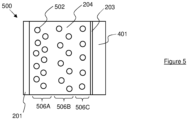
- Figure 5 shows another blanket tile 500 in which the pellets 402 are replaced by cylinders or rods 502 of the neutron moderator material, i.e. elements of the neutron moderator material having a longitudinal axis that is substantially larger than the other two axes.
- the rods 502 may be oriented within the breeder layer 204 so that their longitudinal axis is vertical to minimise bending strain.
- the cross section of the rods 502 may have any shape, e.g. circular, hexagonal.
- the rods 502 are surrounded by a metal (e.g. steel) layer.
- the rods 502 may be regularly spaced apart from one another or they may have a spacing that varies within the breeder layer 204.
- the rods 502 may be more closely spaced nearer to the first wall 201 to create a first region 506A which has a relatively high moderating ability, and there may be one or more subsequent (i.e. further from the first wall 201) regions 506B, C in which the spacing of the rods is increased relative to the first region 506A (or equivalently, in which the density of the rods is lower).
- the rods 502 in each of the regions 506A-C may have different diameters (i.e. thickness) to vary the amount of moderation.
- the diameter of the rods may range from 0.5 cm to 5 cm.
- the rods 502 are preferably supported by fixings that allow the rods 502 to be removed from the blanket tile 500 for maintenance and/or replacement.
- each rod is inserted into a metal tube that passes through the breeder layer 204 and supports the rod 502 in place.
- the metal tube is sealed to ensure no contact between its contents and the breeder material.
- the fixings releasably clamp the metal tubes or the rods 502 in position, e.g. so that they can be removed from the fixing by sliding, without first requiring human intervention, without requiring bolts to be loosened or removed, for example. This avoids workers being exposed to high levels of radioactivity during maintenance.
- the rods 502 are preferably inserted from the top of the metal tube so that they are held in place by gravity, thereby allowing them to be removed easily.
- the bottom of the metal tubes is preferably sealed with steel to ensure that there are no leaks.
- the neutron moderator material including the metal hydride/deuteride may additionally be sealed within another to avoid potential problems with outgassing at temperatures greater than about 650 degrees Celsius (which is the temperature at which yttrium hydride/deuteride material starts to decompose).
- the breeder blanket may be water cooled.
- the breeder blanket may be connected to a cooling system configured to circulate water through channels within (or that are adjacent to) the breeder blanket.
- the proportion of deuterium i.e.
- the number of deuterium nuclei divided by the total number of hydrogen and deuterium nuclei) in the metal hydride/deuteride neutron moderator material may be greater than 20% or greater than 40%, for example. In some cases, the proportion of deuterium in the neutron moderator material may even be 100%. In other implementations, in which the breeder blanket is cooled by a mechanism other than water cooling (e.g. gas cooling, molten metal or molten salt cooling), or in which the water coolant does not moderate the neutrons in the breeder blanket appreciably, then a different proportion of deuterium may be preferred. For example, the deuterium proportion may between 2% and 38%, preferably between 10% and 30%, and more preferably around 20%.
- water cooling e.g. gas cooling, molten metal or molten salt cooling
- the metal hydride/deuteride used as the moderator material in such cases may be zirconium hydride/deuteride (e.g. ZrH 2 /ZrD 2 ) or yttrium hydride/deuteride, for example.
- the choice of breeder material and/or the presence of a neutron multiplier material within the breeder material should be considered.
- a neutron multiplier material within the breeder material
- higher TBR may be achieved by increasing the amount of metal deuteride (relative to the metal hydride) in the neutron moderator material.
- the neutron moderator material may comprise more than 10%, more than 30%, or even more than 50% metal deuteride, e.g. yttrium deuteride, with any remaining neutron moderator material being metal hydride.
- the lower moderating power of the metal deuteride may allow more neutrons to be generated by the neutron multiplier material.
- the resulting "soft" spectrum of the neutrons generated by the neutron multiplier material i.e., a spectrum dominated by ⁇ 5 MeV neutrons
- the breeder blanket lacks a dedicated neutron multiplier (e.g., implementations in which the breeder material is liquid lithium or lithium hydride) then it may be preferable to use non-enriched (i.e. natural) lithium in the breeder material in combination with a metal hydride (as opposed to metal deuteride) neutron moderator material.
- the TBR is enhanced in such cases by the (n, T) reaction occurring in the more abundant lithium-7.
- One or more of the rods 502 may be replaced with a rod comprising a surveillance specimen and/or experimental device for measuring the neutron flux through the blanket tile 500, e.g. for qualification and safety case substantiation.
- One or more of the rods 502 may also comprise a specimen for materials testing, e.g. to determine the behaviour of a particular material under neutron irradiation.
- the specimen may also be used in some cases to produce isotopes of one or more elements, e.g. for medical imaging and/or treatment.
- the specimen may be an isotope production alloy (e.g.
- molybdenum-99 and iodine-131) comprising one or more metals from which a particular isotope may be produced following exposure of the alloy to neutrons produced by the fusion reactor.
- the locations of such rods within the blanket tile 502 may be optimised according to the neutron energy spectrum required for efficient isotope production. For example, isotope production alloys requiring a low energy neutron spectrum may be preferentially located at the rear of the tile 500 (i.e. away from the centre of the fusion reactor) so to maximise the transmutation rate of the isotope of interest.
- One or more of the rods 502 may be replaced with a rod comprising a sealed tube of fission waste stream material, such as Pu, Np, Am, and Cm, and a plethora of fission products (Cs, Sr).
- fission waste stream material such as Pu, Np, Am, and Cm
- Cs, Sr fission products
- the neutron flux produced by the fusion reactor transmutes these isotopes to daughter isotopes that have significantly shorter half-lives and reduces waste heat generation, which could allow for increased packing factor of geological disposed high level waste.
- These rods could be considered as transmutation rods for nuclear waste.
- these tubes are sealed to contain fission gas (if generated) and are preferably adapted be cooled externally.
- Including the moderator material within the breeder layer 204 may in some cases allow the overall thickness of the blanket tile 400, 500 to be reduced whilst nevertheless retaining a high TBR. Inclusion of the moderating material could also tailor the type of isotopes produced by altering the neutron energy spectrum.
Landscapes
- Physics & Mathematics (AREA)
- Engineering & Computer Science (AREA)
- General Engineering & Computer Science (AREA)
- High Energy & Nuclear Physics (AREA)
- Plasma & Fusion (AREA)
- Chemical & Material Sciences (AREA)
- Chemical Kinetics & Catalysis (AREA)
- General Chemical & Material Sciences (AREA)
- Particle Accelerators (AREA)
- Plasma Technology (AREA)
- Superconductors And Manufacturing Methods Therefor (AREA)
- Machines For Manufacturing Corrugated Board In Mechanical Paper-Making Processes (AREA)
Claims (15)
- Brütermantel (200, 300, 400, 500) zur Erzeugung von Tritium unter Verwendung von Neutronen (206), die durch Kernfusion von Deuterium und/oder Tritium in einem Plasma (107) erzeugt werden, das in einem Fusionsreaktor (100) eingeschlossen ist, wobei der Brütermantel Folgendes umfasst:eine dem Plasma zugewandte erste Wand (201);eine Brüterschicht (204), die lithiumhaltiges Material zur Erzeugung von Tritium aus den Neutronen umfasst, wobei das lithiumhaltige Material in Form von Lithiummetall oder Lithiumlegierung oder eines Salzes bereitgestellt wird, wobei das Lithiummetall oder die Lithiumlegierung im Gebrauch flüssig ist oder das Salz geschmolzen ist, undein Neutronenmoderatormaterial (202, 402, 502), das ein Yttriumhydrid und/oder ein Yttriumdeuterid umfasst und zwischen der ersten Wand (201) und dem lithiumhaltigen Material angeordnet ist.
- Brütermantel nach Anspruch 1, wobei das Neutronenmoderatormaterial als Neutronenmoderatorschicht (202, 302, 402) bereitgestellt wird, die zwischen der ersten Wand (201) und der Brüterschicht (204) angeordnet ist.
- Brütermantel nach Anspruch 2, wobei die Neutronenmoderatorschicht (202, 402) konfiguriert ist, um mehr als 60 %, vorzugsweise mehr als 80 % oder bevorzugter mehr als 95 %, der Neutronen mit einer Energie von 14 MeV vor dem Eintritt in die Neutronenmoderatorschicht durchzulassen.
- Brütermantel nach Anspruch 2 oder 3, wobei die Neutronenmoderatorschicht (202, 302, 402) konfiguriert ist, um die Energie von mindestens einem Anteil der durchgelassenen Neutronen (206) um mehr als 95 %, vorzugsweise um mehr als 99 % zu reduzieren, wobei die Neutronen eine Energie von 14 MeV vor dem Eintritt in die Neutronenmoderatorschicht aufweisen.
- Brütermantel nach Anspruch 4, wobei der Anteil größer als 25 %, vorzugsweise größer als 50 % und bevorzugter größer als 75 % ist.
- Brütermantel nach einem der Ansprüche 2 bis 5, wobei:die Dicke der Neutronenmoderatorschicht (202, 302, 402) von 0,5 cm bis 25 cm, vorzugsweise von 5 cm bis 15 cm, beträgt; und/oderdie Dicke der Brüterschicht (204) von 1 cm bis 200 cm, vorzugsweise von 5 cm bis 150 cm, beträgt; und/oderzwischen der ersten Wand (201) und der Neutronenmoderatorschicht (202, 402) keine andere Brüterschicht bereitgestellt ist.
- Brütermantel nach einem der Ansprüche 2 bis 6 und umfassend eine andere Neutronenmoderatorschicht (302), die ein Yttriumhydrid und/oder ein Yttriumdeuterid umfasst, wobei die Brüterschicht (204) zwischen den Neutronenmoderatorschichten (202, 302) angeordnet ist, und wobei vorzugsweise die andere Neutronenmoderatorschicht (302) konfiguriert ist, um einen größeren Anteil an Neutronen (206) als den der Neutronenmoderatorschicht zwischen der ersten Wand (201) und der Brüterschicht (204) zu reflektieren.
- Brütermantel nach Anspruch 7, wobei die andere Neutronenmoderatorschicht (302) dicker ist als die Neutronenmoderatorschicht (202).
- Brütermantel nach Anspruch 7 oder 8 und umfassend eine andere Brüterschicht (204), die lithiumhaltiges Material zur Erzeugung von Tritium aus den Neutronen umfasst, wobei die andere Neutronenmoderatorschicht zwischen den Brüterschichten angeordnet ist.
- Brütermantel nach einem der Ansprüche 2 bis 9, wobei die Brüterschicht(en) und die Neutronenmoderatorschicht(en) durch eine oder mehrere Metallschichten (203) voneinander getrennt sind.
- Brütermantel nach Anspruch 1, wobei das Neutronenmoderatormaterial (402) innerhalb der Brüterschicht (204) bereitgestellt ist, wobei das Neutronenmoderatormaterial (402) von dem lithiumhaltigen Material in der Brüterschicht (204) durch eine oder mehrere Metallschichten getrennt ist, und wahlweise wobei:die Brüterschicht (204) eine Vielzahl von Pellets umfasst, die das Neutronenmoderatormaterial (402) umfassen, wobei die Pellets in dem lithiumhaltigen Material dispergiert sind, oderdie Brüterschicht (204) eine Vielzahl von Stäben umfasst, die das Neutronenmoderatormaterial umfassen, wobei jeder Stab vorzugsweise eine Längsachse aufweist, die im Wesentlichen parallel zu der ersten Wand (201) angeordnet ist, und wobei die Längsachse bevorzugter vertikal angeordnet ist, wobei der Brütermantel vorzugsweise lösbare Befestigungen zum Halten jedes der Stäbe in einer festen Position innerhalb der Brüterschicht (204) umfasst, wobei die Befestigungen konfiguriert sind, um zu ermöglichen, dass die Stäbe aus der Brüterschicht (204) entfernt und innerhalb dieser ausgetauscht werden können, und bevorzugter, wobei die Brüterschicht (204) einen ersten Bereich umfasst, der näher an der ersten Wand als ein zweiter Bereich angeordnet ist, wobei die Stäbe in dem ersten Bereich enger voneinander beabstandet sind als die Stäbe in dem zweiten Bereich.
- Brütermantel nach einem der vorhergehenden Ansprüche, wobei:das Verhältnis von Yttriumatomen zu Wasserstoff- oder Deuteriumatomen in dem Yttriumhydrid und/oder Yttriumdeuterid 1,0 bis 2,0, vorzugsweise 1,50 bis 1,92 beträgt; und/oderder prozentuale Anteil an Lithium in dem lithiumhaltigen Material, das Lithium-6 ist, mehr als 7,6 %, vorzugsweise mehr als 20 % und bevorzugter mehr als 50 % beträgt; und/oderder Brütermantel ferner ein Neutronenmultiplikatormaterial wie z. B. Beryllium, Zinn, Blei und/oder Uran umfasst.
- Fusionsreaktor (100), umfassend einen oder mehrere Brütermäntel (200, 300, 400, 500) nach einem der Ansprüche 1 bis 12, wobei der Fusionsreaktor vorzugsweise ein Tokamak ist, bevorzugter ein kugelförmiger Tokamak, wobei der kugelförmige Tokamak wahlweise ein Seitenverhältnis von weniger als oder gleich 2,5 aufweist, wobei das Seitenverhältnis als das Verhältnis der Haupt- und Nebenradien eines toroidalen Plasmaeinschließungsbereichs des Tokamaks definiert ist.
- Verfahren zum Betreiben eines Fusionsreaktors (100) nach Anspruch 13, umfassend Erzeugen von Tritium unter Verwendung des einen oder der mehreren Brütermäntel (200, 300, 400, 500) und Neutronen (206), die durch Kernfusion von Deuterium und/oder Tritium innerhalb des Fusionsreaktors (100) erzeugt werden, und Einleiten des erzeugten Tritiums in ein Plasma (107), das innerhalb des Fusionsreaktors (100) eingeschlossen ist.
- Verfahren nach Anspruch 14, ferner umfassend die Verwendung von Neutronen (106), die durch das Neutronenmoderatormaterial (202, 402, 502) moderiert werden, um eine oder mehrere Proben zu bestrahlen, die innerhalb des Brütermantels (200, 300, 400, 500) bereitgestellt werden, um eine oder mehrere der folgenden Tätigkeiten auszuführen: Isotopenproduktion, Werkstoffprüfung, Transmutation von nuklearem Abfall und Überwachung des vom Fusionsreaktor (100) erzeugten Neutronenflusses.
Applications Claiming Priority (2)
| Application Number | Priority Date | Filing Date | Title |
|---|---|---|---|
| GBGB2018198.8A GB202018198D0 (en) | 2020-11-19 | 2020-11-19 | Breeder blanket |
| PCT/EP2021/082283 WO2022106609A1 (en) | 2020-11-19 | 2021-11-19 | Breeder blanket |
Publications (2)
| Publication Number | Publication Date |
|---|---|
| EP4248462A1 EP4248462A1 (de) | 2023-09-27 |
| EP4248462B1 true EP4248462B1 (de) | 2025-01-01 |
Family
ID=74046900
Family Applications (1)
| Application Number | Title | Priority Date | Filing Date |
|---|---|---|---|
| EP21819077.5A Active EP4248462B1 (de) | 2020-11-19 | 2021-11-19 | Brütermantel für fusionsreaktor und verfahren zum betrieb eines fusionsreaktors mit einem solchen brütermantel |
Country Status (9)
| Country | Link |
|---|---|
| US (1) | US11869677B2 (de) |
| EP (1) | EP4248462B1 (de) |
| JP (1) | JP7432800B2 (de) |
| KR (1) | KR102652443B1 (de) |
| CN (1) | CN116457895B (de) |
| AU (1) | AU2021380945B2 (de) |
| CA (1) | CA3199186C (de) |
| GB (1) | GB202018198D0 (de) |
| WO (1) | WO2022106609A1 (de) |
Families Citing this family (6)
| Publication number | Priority date | Publication date | Assignee | Title |
|---|---|---|---|---|
| CN113593730B (zh) * | 2021-07-12 | 2023-08-29 | 西南科技大学 | 一种用于快中子堆的非均匀ma嬗变棒 |
| EP4258286B1 (de) * | 2022-04-04 | 2024-10-30 | Renaissance Fusion | Lithiumhydrid-erstwand |
| CN115305442B (zh) * | 2022-08-26 | 2023-09-19 | 核工业西南物理研究院 | 一种表面改性型氚增殖剂及其制备方法 |
| CN116525148B (zh) * | 2023-04-21 | 2025-10-17 | 中国科学院合肥物质科学研究院 | 一种固态增殖剂辐照产氚及释氚样品容器系统和实验方法 |
| US12254994B1 (en) | 2024-03-08 | 2025-03-18 | Ut-Battelle, Llc | Fusion reactor having nested pebble bed blanket |
| WO2026067957A1 (en) * | 2024-09-24 | 2026-04-02 | Kuehner Clemens Hermann | Radioisotope production in a nuclear fusion tokamak |
Family Cites Families (24)
| Publication number | Priority date | Publication date | Assignee | Title |
|---|---|---|---|---|
| GB908020A (en) * | 1957-09-02 | 1962-10-10 | Atomic Energy Authority Uk | Improvements in nuclear fusion reactors |
| CA931738A (en) | 1969-09-17 | 1973-08-14 | M. Stanton Richard | Fission-fusion type nuclear fuel material |
| US3969631A (en) * | 1975-03-20 | 1976-07-13 | The United States Of America As Represented By The United States Energy Research And Development Administration | Gas production apparatus |
| US4199402A (en) | 1976-02-23 | 1980-04-22 | Ahmed Abul A M | Plasma energy production |
| JPS548295A (en) * | 1977-06-20 | 1979-01-22 | Hitachi Ltd | Nuclear fusion reactor |
| US4217171A (en) | 1977-08-15 | 1980-08-12 | General Atomic Company | Blanket design for imploding liner systems |
| US4436695A (en) | 1979-05-21 | 1984-03-13 | Marwick Edward F | Larger contained nuclear explosion breeder reactor systems |
| JPH0750178B2 (ja) * | 1984-10-26 | 1995-05-31 | 株式会社日立製作所 | 核融合装置のブランケツト |
| JPH06100676B2 (ja) * | 1986-08-11 | 1994-12-12 | 川崎重工業株式会社 | トリチウム生産用ペブル及びトリチウム生産装置 |
| JP2858191B2 (ja) * | 1992-09-10 | 1999-02-17 | 株式会社日立製作所 | 核融合炉のブランケット |
| JPH06123788A (ja) * | 1992-10-09 | 1994-05-06 | Hitachi Ltd | 核融合炉ブランケット |
| JPH06242272A (ja) | 1993-02-15 | 1994-09-02 | Hitachi Ltd | 核融合装置のブランケット |
| US6411666B1 (en) * | 1998-10-21 | 2002-06-25 | The United States Of America As Represented By The United States Department Of Energy | Method and apparatus to produce and maintain a thick, flowing, liquid lithium first wall for toroidal magnetic confinement DT fusion reactors |
| RU2231140C1 (ru) | 2002-11-18 | 2004-06-20 | Федеральное государственное унитарное предприятие "Научно-исследовательский и конструкторский институт энерготехники им. Н.А. Доллежаля" | Бланкет термоядерного реактора |
| AT8485U1 (de) | 2005-03-22 | 2006-08-15 | Plansee Se | Erste-wand-komponente für fusionsreaktor |
| US9589678B2 (en) * | 2011-04-01 | 2017-03-07 | The Boeing Company | Complex shape structure for liquid lithium first walls of fusion power reactor environments |
| CN203552710U (zh) * | 2013-09-29 | 2014-04-16 | 罗天勇 | 氚增殖包层系统中的氚增殖包层本体 |
| CN103578574A (zh) * | 2013-10-16 | 2014-02-12 | 中国核电工程有限公司 | 一种先进的聚变-裂变次临界能源堆堆芯产氚包层 |
| JP2017181445A (ja) | 2016-03-31 | 2017-10-05 | 株式会社東芝 | 可搬式原子炉およびその炉心 |
| JP6715428B2 (ja) | 2016-11-01 | 2020-07-01 | 三菱重工業株式会社 | ブランケットモジュールおよび核融合装置 |
| JP6732670B2 (ja) | 2017-02-01 | 2020-07-29 | 株式会社東芝 | 核融合炉用ブランケット、ブランケット支持構造、筐体壁内冷却水流路の形成方法、ブランケットモジュール組み立て方法およびブランケット支持構造組み立て方法 |
| RU2649854C1 (ru) | 2017-09-15 | 2018-04-05 | Российская Федерация, от имени которой выступает Государственная корпорация по атомной энергии "Росатом" | Модуль бланкета гибридного термоядерного реактора |
| WO2019067819A1 (en) * | 2017-09-28 | 2019-04-04 | Westinghouse Electric Company Llc | PLATE-TYPE NUCLEAR MICRO REACTOR |
| CN108320816A (zh) | 2018-01-25 | 2018-07-24 | 中国科学院合肥物质科学研究院 | 一种耐高热负荷的钨基底镍包碳化硼涂层冷却结构 |
-
2020
- 2020-11-19 GB GBGB2018198.8A patent/GB202018198D0/en not_active Ceased
-
2021
- 2021-11-19 JP JP2023529968A patent/JP7432800B2/ja active Active
- 2021-11-19 CA CA3199186A patent/CA3199186C/en active Active
- 2021-11-19 WO PCT/EP2021/082283 patent/WO2022106609A1/en not_active Ceased
- 2021-11-19 EP EP21819077.5A patent/EP4248462B1/de active Active
- 2021-11-19 KR KR1020237019950A patent/KR102652443B1/ko active Active
- 2021-11-19 US US18/253,536 patent/US11869677B2/en active Active
- 2021-11-19 CN CN202180077474.4A patent/CN116457895B/zh active Active
- 2021-11-19 AU AU2021380945A patent/AU2021380945B2/en active Active
Also Published As
| Publication number | Publication date |
|---|---|
| CA3199186C (en) | 2024-04-23 |
| CA3199186A1 (en) | 2022-05-27 |
| EP4248462A1 (de) | 2023-09-27 |
| KR102652443B1 (ko) | 2024-03-29 |
| GB202018198D0 (en) | 2021-01-06 |
| JP7432800B2 (ja) | 2024-02-16 |
| AU2021380945A1 (en) | 2023-06-15 |
| AU2021380945B2 (en) | 2024-05-02 |
| CN116457895B (zh) | 2024-07-30 |
| KR20230104281A (ko) | 2023-07-07 |
| US11869677B2 (en) | 2024-01-09 |
| WO2022106609A1 (en) | 2022-05-27 |
| CN116457895A (zh) | 2023-07-18 |
| US20230326616A1 (en) | 2023-10-12 |
| JP2023545866A (ja) | 2023-10-31 |
Similar Documents
| Publication | Publication Date | Title |
|---|---|---|
| EP4248462B1 (de) | Brütermantel für fusionsreaktor und verfahren zum betrieb eines fusionsreaktors mit einem solchen brütermantel | |
| JP5947484B2 (ja) | 核分裂点火部 | |
| CN104145309B (zh) | 核反应堆及相关方法和装置 | |
| US20090274258A1 (en) | Compound isotope target assembly for production of medical and commercial isotopes by means of spectrum shaping alloys | |
| CN106537512B (zh) | 多普勒反应性增强装置 | |
| US5082617A (en) | Thulium-170 heat source | |
| Zhang et al. | Liquid metals power advanced nuclear energy systems | |
| Pereslavtsev et al. | Analyses of the shielding options for HCPB DEMO blanket | |
| Li et al. | Optimized core design and shield analysis of a medium temperature heat pipe cooled reactor | |
| Proust et al. | Solid breeder blanket design and tritium breeding | |
| Şarer et al. | Three-dimensional neutronic calculations for the fusion breeder Apex reactor | |
| van Rooijen | Improving fuel cycle design and safety characteristics of a gas cooled fast reactor | |
| Shmatov | Igniting a microexplosion by a microexplosion and some other controlled thermonuclear fusion scenarios with neutronless reactions | |
| RU2804452C1 (ru) | Бланкет-размножитель | |
| KR20250038622A (ko) | 혼합 스펙트럼 용융염 원자로 | |
| CN113178276B (zh) | 一种基于Th-U自持循环的99Mo次临界生产装置及方法 | |
| Tong | Role of materials to advanced nuclear energy | |
| Gudowski | Nuclear waste management. Status, prospects and hopes | |
| JP2000321390A (ja) | 未臨界炉 | |
| Dolan et al. | First Wall, Blanket, and Shield | |
| CN112599259A (zh) | 一种聚变-裂变混合堆嬗变燃料组件 | |
| Şahіn | Investigation of lanthanides as neutron multipliers for hybrid and fusion reactor blankets | |
| Merk et al. | Analysis of the influence of different arrangements for ZrH moderator material on the performance of a SFR core | |
| EP4704113A1 (de) | Plasmagefäss mit nichthomogenem schild | |
| Wu | Neutronics Design Principles of Fusion-Fission Hybrid Reactors |
Legal Events
| Date | Code | Title | Description |
|---|---|---|---|
| STAA | Information on the status of an ep patent application or granted ep patent |
Free format text: STATUS: UNKNOWN |
|
| STAA | Information on the status of an ep patent application or granted ep patent |
Free format text: STATUS: THE INTERNATIONAL PUBLICATION HAS BEEN MADE |
|
| PUAI | Public reference made under article 153(3) epc to a published international application that has entered the european phase |
Free format text: ORIGINAL CODE: 0009012 |
|
| STAA | Information on the status of an ep patent application or granted ep patent |
Free format text: STATUS: REQUEST FOR EXAMINATION WAS MADE |
|
| 17P | Request for examination filed |
Effective date: 20230616 |
|
| AK | Designated contracting states |
Kind code of ref document: A1 Designated state(s): AL AT BE BG CH CY CZ DE DK EE ES FI FR GB GR HR HU IE IS IT LI LT LU LV MC MK MT NL NO PL PT RO RS SE SI SK SM TR |
|
| DAV | Request for validation of the european patent (deleted) | ||
| DAX | Request for extension of the european patent (deleted) | ||
| GRAP | Despatch of communication of intention to grant a patent |
Free format text: ORIGINAL CODE: EPIDOSNIGR1 |
|
| STAA | Information on the status of an ep patent application or granted ep patent |
Free format text: STATUS: GRANT OF PATENT IS INTENDED |
|
| P01 | Opt-out of the competence of the unified patent court (upc) registered |
Effective date: 20240520 |
|
| INTG | Intention to grant announced |
Effective date: 20240624 |
|
| GRAS | Grant fee paid |
Free format text: ORIGINAL CODE: EPIDOSNIGR3 |
|
| GRAA | (expected) grant |
Free format text: ORIGINAL CODE: 0009210 |
|
| STAA | Information on the status of an ep patent application or granted ep patent |
Free format text: STATUS: THE PATENT HAS BEEN GRANTED |
|
| AK | Designated contracting states |
Kind code of ref document: B1 Designated state(s): AL AT BE BG CH CY CZ DE DK EE ES FI FR GB GR HR HU IE IS IT LI LT LU LV MC MK MT NL NO PL PT RO RS SE SI SK SM TR |
|
| REG | Reference to a national code |
Ref country code: GB Ref legal event code: FG4D |
|
| REG | Reference to a national code |
Ref country code: DE Ref legal event code: R096 Ref document number: 602021024400 Country of ref document: DE |
|
| REG | Reference to a national code |
Ref country code: CH Ref legal event code: EP |
|
| REG | Reference to a national code |
Ref country code: IE Ref legal event code: FG4D |
|
| REG | Reference to a national code |
Ref country code: LT Ref legal event code: MG9D |
|
| REG | Reference to a national code |
Ref country code: NL Ref legal event code: MP Effective date: 20250101 |
|
| REG | Reference to a national code |
Ref country code: AT Ref legal event code: MK05 Ref document number: 1757165 Country of ref document: AT Kind code of ref document: T Effective date: 20250101 |
|
| PG25 | Lapsed in a contracting state [announced via postgrant information from national office to epo] |
Ref country code: NL Free format text: LAPSE BECAUSE OF FAILURE TO SUBMIT A TRANSLATION OF THE DESCRIPTION OR TO PAY THE FEE WITHIN THE PRESCRIBED TIME-LIMIT Effective date: 20250101 |
|
| PG25 | Lapsed in a contracting state [announced via postgrant information from national office to epo] |
Ref country code: FI Free format text: LAPSE BECAUSE OF FAILURE TO SUBMIT A TRANSLATION OF THE DESCRIPTION OR TO PAY THE FEE WITHIN THE PRESCRIBED TIME-LIMIT Effective date: 20250101 |
|
| PG25 | Lapsed in a contracting state [announced via postgrant information from national office to epo] |
Ref country code: PL Free format text: LAPSE BECAUSE OF FAILURE TO SUBMIT A TRANSLATION OF THE DESCRIPTION OR TO PAY THE FEE WITHIN THE PRESCRIBED TIME-LIMIT Effective date: 20250101 |
|
| PG25 | Lapsed in a contracting state [announced via postgrant information from national office to epo] |
Ref country code: ES Free format text: LAPSE BECAUSE OF FAILURE TO SUBMIT A TRANSLATION OF THE DESCRIPTION OR TO PAY THE FEE WITHIN THE PRESCRIBED TIME-LIMIT Effective date: 20250101 |
|
| PG25 | Lapsed in a contracting state [announced via postgrant information from national office to epo] |
Ref country code: IS Free format text: LAPSE BECAUSE OF FAILURE TO SUBMIT A TRANSLATION OF THE DESCRIPTION OR TO PAY THE FEE WITHIN THE PRESCRIBED TIME-LIMIT Effective date: 20250501 Ref country code: NO Free format text: LAPSE BECAUSE OF FAILURE TO SUBMIT A TRANSLATION OF THE DESCRIPTION OR TO PAY THE FEE WITHIN THE PRESCRIBED TIME-LIMIT Effective date: 20250401 |
|
| PG25 | Lapsed in a contracting state [announced via postgrant information from national office to epo] |
Ref country code: HR Free format text: LAPSE BECAUSE OF FAILURE TO SUBMIT A TRANSLATION OF THE DESCRIPTION OR TO PAY THE FEE WITHIN THE PRESCRIBED TIME-LIMIT Effective date: 20250101 |
|
| PG25 | Lapsed in a contracting state [announced via postgrant information from national office to epo] |
Ref country code: PT Free format text: LAPSE BECAUSE OF FAILURE TO SUBMIT A TRANSLATION OF THE DESCRIPTION OR TO PAY THE FEE WITHIN THE PRESCRIBED TIME-LIMIT Effective date: 20250502 Ref country code: LV Free format text: LAPSE BECAUSE OF FAILURE TO SUBMIT A TRANSLATION OF THE DESCRIPTION OR TO PAY THE FEE WITHIN THE PRESCRIBED TIME-LIMIT Effective date: 20250101 |
|
| PG25 | Lapsed in a contracting state [announced via postgrant information from national office to epo] |
Ref country code: BG Free format text: LAPSE BECAUSE OF FAILURE TO SUBMIT A TRANSLATION OF THE DESCRIPTION OR TO PAY THE FEE WITHIN THE PRESCRIBED TIME-LIMIT Effective date: 20250101 Ref country code: GR Free format text: LAPSE BECAUSE OF FAILURE TO SUBMIT A TRANSLATION OF THE DESCRIPTION OR TO PAY THE FEE WITHIN THE PRESCRIBED TIME-LIMIT Effective date: 20250402 |
|
| PG25 | Lapsed in a contracting state [announced via postgrant information from national office to epo] |
Ref country code: AT Free format text: LAPSE BECAUSE OF FAILURE TO SUBMIT A TRANSLATION OF THE DESCRIPTION OR TO PAY THE FEE WITHIN THE PRESCRIBED TIME-LIMIT Effective date: 20250101 |
|
| PG25 | Lapsed in a contracting state [announced via postgrant information from national office to epo] |
Ref country code: CZ Free format text: LAPSE BECAUSE OF FAILURE TO SUBMIT A TRANSLATION OF THE DESCRIPTION OR TO PAY THE FEE WITHIN THE PRESCRIBED TIME-LIMIT Effective date: 20250101 |
|
| PG25 | Lapsed in a contracting state [announced via postgrant information from national office to epo] |
Ref country code: SE Free format text: LAPSE BECAUSE OF FAILURE TO SUBMIT A TRANSLATION OF THE DESCRIPTION OR TO PAY THE FEE WITHIN THE PRESCRIBED TIME-LIMIT Effective date: 20250101 |
|
| REG | Reference to a national code |
Ref country code: DE Ref legal event code: R097 Ref document number: 602021024400 Country of ref document: DE |
|
| PG25 | Lapsed in a contracting state [announced via postgrant information from national office to epo] |
Ref country code: SM Free format text: LAPSE BECAUSE OF FAILURE TO SUBMIT A TRANSLATION OF THE DESCRIPTION OR TO PAY THE FEE WITHIN THE PRESCRIBED TIME-LIMIT Effective date: 20250101 |
|
| PG25 | Lapsed in a contracting state [announced via postgrant information from national office to epo] |
Ref country code: DK Free format text: LAPSE BECAUSE OF FAILURE TO SUBMIT A TRANSLATION OF THE DESCRIPTION OR TO PAY THE FEE WITHIN THE PRESCRIBED TIME-LIMIT Effective date: 20250101 |
|
| PG25 | Lapsed in a contracting state [announced via postgrant information from national office to epo] |
Ref country code: EE Free format text: LAPSE BECAUSE OF FAILURE TO SUBMIT A TRANSLATION OF THE DESCRIPTION OR TO PAY THE FEE WITHIN THE PRESCRIBED TIME-LIMIT Effective date: 20250101 |
|
| PG25 | Lapsed in a contracting state [announced via postgrant information from national office to epo] |
Ref country code: RO Free format text: LAPSE BECAUSE OF FAILURE TO SUBMIT A TRANSLATION OF THE DESCRIPTION OR TO PAY THE FEE WITHIN THE PRESCRIBED TIME-LIMIT Effective date: 20250101 |
|
| PG25 | Lapsed in a contracting state [announced via postgrant information from national office to epo] |
Ref country code: SK Free format text: LAPSE BECAUSE OF FAILURE TO SUBMIT A TRANSLATION OF THE DESCRIPTION OR TO PAY THE FEE WITHIN THE PRESCRIBED TIME-LIMIT Effective date: 20250101 |
|
| PLBE | No opposition filed within time limit |
Free format text: ORIGINAL CODE: 0009261 |
|
| STAA | Information on the status of an ep patent application or granted ep patent |
Free format text: STATUS: NO OPPOSITION FILED WITHIN TIME LIMIT |
|
| 26N | No opposition filed |
Effective date: 20251002 |
|
| PGFP | Annual fee paid to national office [announced via postgrant information from national office to epo] |
Ref country code: DE Payment date: 20251119 Year of fee payment: 5 |
|
| PGFP | Annual fee paid to national office [announced via postgrant information from national office to epo] |
Ref country code: GB Payment date: 20251121 Year of fee payment: 5 |
|
| PGFP | Annual fee paid to national office [announced via postgrant information from national office to epo] |
Ref country code: FR Payment date: 20251126 Year of fee payment: 5 |