EP4245877A1 - Chromhaltiges stahlblech für stromkollektoren für sekundärbatterien mit wasserfreiem elektrolyt - Google Patents
Chromhaltiges stahlblech für stromkollektoren für sekundärbatterien mit wasserfreiem elektrolyt Download PDFInfo
- Publication number
- EP4245877A1 EP4245877A1 EP21906551.3A EP21906551A EP4245877A1 EP 4245877 A1 EP4245877 A1 EP 4245877A1 EP 21906551 A EP21906551 A EP 21906551A EP 4245877 A1 EP4245877 A1 EP 4245877A1
- Authority
- EP
- European Patent Office
- Prior art keywords
- steel sheet
- chromium
- treatment
- containing steel
- less
- Prior art date
- Legal status (The legal status is an assumption and is not a legal conclusion. Google has not performed a legal analysis and makes no representation as to the accuracy of the status listed.)
- Pending
Links
Images
Classifications
-
- C—CHEMISTRY; METALLURGY
- C22—METALLURGY; FERROUS OR NON-FERROUS ALLOYS; TREATMENT OF ALLOYS OR NON-FERROUS METALS
- C22C—ALLOYS
- C22C38/00—Ferrous alloys, e.g. steel alloys
- C22C38/02—Ferrous alloys, e.g. steel alloys containing silicon
-
- H—ELECTRICITY
- H01—ELECTRIC ELEMENTS
- H01M—PROCESSES OR MEANS, e.g. BATTERIES, FOR THE DIRECT CONVERSION OF CHEMICAL ENERGY INTO ELECTRICAL ENERGY
- H01M4/00—Electrodes
- H01M4/02—Electrodes composed of, or comprising, active material
- H01M4/64—Carriers or collectors
- H01M4/66—Selection of materials
- H01M4/669—Steels
-
- C—CHEMISTRY; METALLURGY
- C22—METALLURGY; FERROUS OR NON-FERROUS ALLOYS; TREATMENT OF ALLOYS OR NON-FERROUS METALS
- C22C—ALLOYS
- C22C38/00—Ferrous alloys, e.g. steel alloys
- C22C38/18—Ferrous alloys, e.g. steel alloys containing chromium
- C22C38/40—Ferrous alloys, e.g. steel alloys containing chromium with nickel
-
- C—CHEMISTRY; METALLURGY
- C22—METALLURGY; FERROUS OR NON-FERROUS ALLOYS; TREATMENT OF ALLOYS OR NON-FERROUS METALS
- C22C—ALLOYS
- C22C38/00—Ferrous alloys, e.g. steel alloys
- C22C38/001—Ferrous alloys, e.g. steel alloys containing N
-
- C—CHEMISTRY; METALLURGY
- C22—METALLURGY; FERROUS OR NON-FERROUS ALLOYS; TREATMENT OF ALLOYS OR NON-FERROUS METALS
- C22C—ALLOYS
- C22C38/00—Ferrous alloys, e.g. steel alloys
- C22C38/002—Ferrous alloys, e.g. steel alloys containing In, Mg, or other elements not provided for in one single group C22C38/001 - C22C38/60
-
- C—CHEMISTRY; METALLURGY
- C22—METALLURGY; FERROUS OR NON-FERROUS ALLOYS; TREATMENT OF ALLOYS OR NON-FERROUS METALS
- C22C—ALLOYS
- C22C38/00—Ferrous alloys, e.g. steel alloys
- C22C38/004—Very low carbon steels, i.e. having a carbon content of less than 0,01%
-
- C—CHEMISTRY; METALLURGY
- C22—METALLURGY; FERROUS OR NON-FERROUS ALLOYS; TREATMENT OF ALLOYS OR NON-FERROUS METALS
- C22C—ALLOYS
- C22C38/00—Ferrous alloys, e.g. steel alloys
- C22C38/04—Ferrous alloys, e.g. steel alloys containing manganese
-
- C—CHEMISTRY; METALLURGY
- C22—METALLURGY; FERROUS OR NON-FERROUS ALLOYS; TREATMENT OF ALLOYS OR NON-FERROUS METALS
- C22C—ALLOYS
- C22C38/00—Ferrous alloys, e.g. steel alloys
- C22C38/06—Ferrous alloys, e.g. steel alloys containing aluminium
-
- C—CHEMISTRY; METALLURGY
- C22—METALLURGY; FERROUS OR NON-FERROUS ALLOYS; TREATMENT OF ALLOYS OR NON-FERROUS METALS
- C22C—ALLOYS
- C22C38/00—Ferrous alloys, e.g. steel alloys
- C22C38/18—Ferrous alloys, e.g. steel alloys containing chromium
- C22C38/20—Ferrous alloys, e.g. steel alloys containing chromium with copper
-
- C—CHEMISTRY; METALLURGY
- C22—METALLURGY; FERROUS OR NON-FERROUS ALLOYS; TREATMENT OF ALLOYS OR NON-FERROUS METALS
- C22C—ALLOYS
- C22C38/00—Ferrous alloys, e.g. steel alloys
- C22C38/18—Ferrous alloys, e.g. steel alloys containing chromium
- C22C38/24—Ferrous alloys, e.g. steel alloys containing chromium with vanadium
-
- C—CHEMISTRY; METALLURGY
- C22—METALLURGY; FERROUS OR NON-FERROUS ALLOYS; TREATMENT OF ALLOYS OR NON-FERROUS METALS
- C22C—ALLOYS
- C22C38/00—Ferrous alloys, e.g. steel alloys
- C22C38/18—Ferrous alloys, e.g. steel alloys containing chromium
- C22C38/28—Ferrous alloys, e.g. steel alloys containing chromium with titanium or zirconium
-
- C—CHEMISTRY; METALLURGY
- C22—METALLURGY; FERROUS OR NON-FERROUS ALLOYS; TREATMENT OF ALLOYS OR NON-FERROUS METALS
- C22C—ALLOYS
- C22C38/00—Ferrous alloys, e.g. steel alloys
- C22C38/18—Ferrous alloys, e.g. steel alloys containing chromium
- C22C38/40—Ferrous alloys, e.g. steel alloys containing chromium with nickel
- C22C38/42—Ferrous alloys, e.g. steel alloys containing chromium with nickel with copper
-
- C—CHEMISTRY; METALLURGY
- C22—METALLURGY; FERROUS OR NON-FERROUS ALLOYS; TREATMENT OF ALLOYS OR NON-FERROUS METALS
- C22C—ALLOYS
- C22C38/00—Ferrous alloys, e.g. steel alloys
- C22C38/18—Ferrous alloys, e.g. steel alloys containing chromium
- C22C38/40—Ferrous alloys, e.g. steel alloys containing chromium with nickel
- C22C38/44—Ferrous alloys, e.g. steel alloys containing chromium with nickel with molybdenum or tungsten
-
- C—CHEMISTRY; METALLURGY
- C22—METALLURGY; FERROUS OR NON-FERROUS ALLOYS; TREATMENT OF ALLOYS OR NON-FERROUS METALS
- C22C—ALLOYS
- C22C38/00—Ferrous alloys, e.g. steel alloys
- C22C38/18—Ferrous alloys, e.g. steel alloys containing chromium
- C22C38/40—Ferrous alloys, e.g. steel alloys containing chromium with nickel
- C22C38/46—Ferrous alloys, e.g. steel alloys containing chromium with nickel with vanadium
-
- C—CHEMISTRY; METALLURGY
- C22—METALLURGY; FERROUS OR NON-FERROUS ALLOYS; TREATMENT OF ALLOYS OR NON-FERROUS METALS
- C22C—ALLOYS
- C22C38/00—Ferrous alloys, e.g. steel alloys
- C22C38/18—Ferrous alloys, e.g. steel alloys containing chromium
- C22C38/40—Ferrous alloys, e.g. steel alloys containing chromium with nickel
- C22C38/48—Ferrous alloys, e.g. steel alloys containing chromium with nickel with niobium or tantalum
-
- C—CHEMISTRY; METALLURGY
- C22—METALLURGY; FERROUS OR NON-FERROUS ALLOYS; TREATMENT OF ALLOYS OR NON-FERROUS METALS
- C22C—ALLOYS
- C22C38/00—Ferrous alloys, e.g. steel alloys
- C22C38/18—Ferrous alloys, e.g. steel alloys containing chromium
- C22C38/40—Ferrous alloys, e.g. steel alloys containing chromium with nickel
- C22C38/50—Ferrous alloys, e.g. steel alloys containing chromium with nickel with titanium or zirconium
-
- C—CHEMISTRY; METALLURGY
- C22—METALLURGY; FERROUS OR NON-FERROUS ALLOYS; TREATMENT OF ALLOYS OR NON-FERROUS METALS
- C22C—ALLOYS
- C22C38/00—Ferrous alloys, e.g. steel alloys
- C22C38/18—Ferrous alloys, e.g. steel alloys containing chromium
- C22C38/40—Ferrous alloys, e.g. steel alloys containing chromium with nickel
- C22C38/58—Ferrous alloys, e.g. steel alloys containing chromium with nickel with more than 1.5% by weight of manganese
-
- C—CHEMISTRY; METALLURGY
- C23—COATING METALLIC MATERIAL; COATING MATERIAL WITH METALLIC MATERIAL; CHEMICAL SURFACE TREATMENT; DIFFUSION TREATMENT OF METALLIC MATERIAL; COATING BY VACUUM EVAPORATION, BY SPUTTERING, BY ION IMPLANTATION OR BY CHEMICAL VAPOUR DEPOSITION, IN GENERAL; INHIBITING CORROSION OF METALLIC MATERIAL OR INCRUSTATION IN GENERAL
- C23F—NON-MECHANICAL REMOVAL OF METALLIC MATERIAL FROM SURFACE; INHIBITING CORROSION OF METALLIC MATERIAL OR INCRUSTATION IN GENERAL; MULTI-STEP PROCESSES FOR SURFACE TREATMENT OF METALLIC MATERIAL INVOLVING AT LEAST ONE PROCESS PROVIDED FOR IN CLASS C23 AND AT LEAST ONE PROCESS COVERED BY SUBCLASS C21D OR C22F OR CLASS C25
- C23F1/00—Etching metallic material by chemical means
- C23F1/10—Etching compositions
- C23F1/14—Aqueous compositions
- C23F1/16—Acidic compositions
- C23F1/28—Acidic compositions for etching iron group metals
-
- H—ELECTRICITY
- H01—ELECTRIC ELEMENTS
- H01M—PROCESSES OR MEANS, e.g. BATTERIES, FOR THE DIRECT CONVERSION OF CHEMICAL ENERGY INTO ELECTRICAL ENERGY
- H01M4/00—Electrodes
- H01M4/02—Electrodes composed of, or comprising, active material
- H01M4/64—Carriers or collectors
- H01M4/66—Selection of materials
-
- H—ELECTRICITY
- H01—ELECTRIC ELEMENTS
- H01M—PROCESSES OR MEANS, e.g. BATTERIES, FOR THE DIRECT CONVERSION OF CHEMICAL ENERGY INTO ELECTRICAL ENERGY
- H01M4/00—Electrodes
- H01M4/02—Electrodes composed of, or comprising, active material
- H01M4/64—Carriers or collectors
- H01M4/66—Selection of materials
- H01M4/661—Metal or alloys, e.g. alloy coatings
-
- H—ELECTRICITY
- H01—ELECTRIC ELEMENTS
- H01M—PROCESSES OR MEANS, e.g. BATTERIES, FOR THE DIRECT CONVERSION OF CHEMICAL ENERGY INTO ELECTRICAL ENERGY
- H01M4/00—Electrodes
- H01M4/02—Electrodes composed of, or comprising, active material
- H01M4/64—Carriers or collectors
- H01M4/66—Selection of materials
- H01M4/661—Metal or alloys, e.g. alloy coatings
- H01M4/662—Alloys
-
- H—ELECTRICITY
- H01—ELECTRIC ELEMENTS
- H01M—PROCESSES OR MEANS, e.g. BATTERIES, FOR THE DIRECT CONVERSION OF CHEMICAL ENERGY INTO ELECTRICAL ENERGY
- H01M4/00—Electrodes
- H01M4/02—Electrodes composed of, or comprising, active material
- H01M4/64—Carriers or collectors
- H01M4/66—Selection of materials
- H01M4/665—Composites
- H01M4/667—Composites in the form of layers, e.g. coatings
-
- Y—GENERAL TAGGING OF NEW TECHNOLOGICAL DEVELOPMENTS; GENERAL TAGGING OF CROSS-SECTIONAL TECHNOLOGIES SPANNING OVER SEVERAL SECTIONS OF THE IPC; TECHNICAL SUBJECTS COVERED BY FORMER USPC CROSS-REFERENCE ART COLLECTIONS [XRACs] AND DIGESTS
- Y02—TECHNOLOGIES OR APPLICATIONS FOR MITIGATION OR ADAPTATION AGAINST CLIMATE CHANGE
- Y02E—REDUCTION OF GREENHOUSE GAS [GHG] EMISSIONS, RELATED TO ENERGY GENERATION, TRANSMISSION OR DISTRIBUTION
- Y02E60/00—Enabling technologies; Technologies with a potential or indirect contribution to GHG emissions mitigation
- Y02E60/10—Energy storage using batteries
Definitions
- the present invention relates to a chromium-containing steel sheet for a current collector of a nonaqueous electrolyte secondary battery and, in particular, to a chromium-containing steel sheet for a current collector of a nonaqueous electrolyte lithium ion secondary battery.
- an Al foil is mainly used for a positive electrode current collector, and a Cu foil is mainly used for a negative electrode current collector.
- a stainless steel foil having higher strength and higher corrosion resistance to current collectors of the LIBs.
- Patent Literature 1 discloses a bipolar battery in which stainless steel containing 16 to 26% by mass of Cr and 0.5 to 7% by mass of Mo is used for a current collector foil.
- this bipolar battery even when the current collector foil is used at a high potential (about 4.2 V) for a long time, corrosion and dissolution of the current collector foil do not occur, and the battery characteristics are unlikely to deteriorate.
- Patent Literature 2 discloses ferritic stainless steel for a battery component member that contains Cr: 16.0 to 32.0%, C: 0.015% or less, Si: 0.5% or less, and Mn: 2.0% or less and that has, as a surface layer, a passive film having a composition ratio Cr/(Cr + Fe) > 0.2 and a thickness of 4 nm or less. In this ferritic stainless steel, even when a high voltage is applied to the battery, high corrosion resistance is maintained, and sparking is unlikely to occur.
- Patent Literature 1 and the stainless steel described in Patent Literature 2 were actually used for current collectors of lithium ion secondary batteries, and their battery performance was evaluated. The results showed that, in some cases, the battery capacity was more likely to decrease when the discharge rate was high or the batteries were repeatedly charged and discharged, as compared to the case where Al foils or Cu foils were used for the current collectors.
- the electrical resistance at the interface between the current collector and a battery active material layer formed on the current collector (this electrical resistance is hereinafter referred to as the "interface resistance") tends to be higher than that when the Al or Cu foil is used, and this may cause deterioration in rate characteristics and cycle characteristics.
- the interface resistance tends to be higher than that when the Al or Cu foil is used, and this may cause deterioration in rate characteristics and cycle characteristics.
- a film having high electrical resistance may be formed on the surface of the stainless steel sheet. This may cause an increase in the interface resistance and deterioration in cycle characteristics.
- a steel sheet for a current collector of a nonaqueous electrolyte lithium ion secondary battery is required to have corrosion resistance in a battery environment. Specifically, it is necessary to prevent deterioration in battery characteristics that can occur when the steel sheet is corroded in a nonaqueous electrolyte lithium ion secondary battery environment.
- corrosion products may be formed on the surface of the current collector, or corrosion pits may be formed on the surface.
- the inventors have thought that the battery characteristics deteriorate because the corrosion products or the corrosion pits inhibit electron transfer between the surface of the current collector and the active material.
- the environment to which the current collector of the nonaqueous electrolyte lithium ion secondary battery is exposed is a special environment which is in a nonaqueous electrolyte containing a Li salt such as LiPF 6 , LiBF 4 , or LiClO 4 dissolved in an organic solvent such as dimethyl carbonate, diethyl carbonate, ethylene carbonate, or ethyl methyl carbonate and to which a potential in the range of 0.0 to 5.0 V (vs. Li/Li + ) is applied (this environment is hereinafter referred to as the "battery environment").
- a Li salt such as LiPF 6 , LiBF 4 , or LiClO 4 dissolved in an organic solvent such as dimethyl carbonate, diethyl carbonate, ethylene carbonate, or ethyl methyl carbonate
- an organic solvent such as dimethyl carbonate, diethyl carbonate, ethylene carbonate, or ethyl methyl carbonate
- the inventors have conceived that, when the content of Cr in the chromium-containing steel sheet is more than or equal to a certain value, the Cr oxide film formed on the surface of the steel sheet in the battery environment described above is stabilized, so that sufficient corrosion resistance can be obtained in the battery environment.
- the present invention has been made in view of the circumstances described above, and it is an object to provide a chromium-containing steel sheet for a current collector of a nonaqueous electrolyte secondary battery.
- the chromium-containing steel sheet has excellent corrosion resistance in the battery environment and allows the nonaqueous electrolyte secondary battery to have excellent rate characteristics and excellent cycle characteristics, when used as a current collector of a nonaqueous electrolyte secondary battery.
- the inventors have conducted extensive studies in order to solve the problem described above.
- the inventors have conceived that the deterioration in the rate characteristics and cycle characteristics of a battery is due to an increase in the interface resistance between the current collector and the battery active material layer formed thereon.
- Patent Literature 3 discloses a current collector for a lithium ion secondary battery that is formed from a ferritic stainless steel sheet having a composition containing, in mass %, Cr: 12 to 32%, C: 0.015% or less, Si: 0.5% or less, and Mn: 2% or less, with the balance being Fe and incidental impurities and that has a roughened surface having a surface roughness SPa of 0.1 um or more.
- Patent Literature 3 it is also stated in Patent Literature 3 that, by roughening the surface of the stainless steel sheet so that part of an active material layer enters pits on the roughened surface, the adhesion between the current collector and the active material layer is improved and that the area of contact therebetween is increased, so that the contact resistance between the stainless steel sheet and the active material layer can be significantly reduced.
- the results of inventors' studies on the roughening of the steel sheet surface have shown that, to improve the rate characteristics and cycle characteristics of the battery, it is insufficient to increase only the surface roughness SPa to 0.1 um or more.
- the inventors have conducted detailed studies on the influence of the surface profile of the chromium-containing steel sheet on the battery characteristics in order to reduce the increase in interface resistance. Then the inventors have thought that the rate characteristics and cycle characteristics of the battery can be improved when a specific surface profile parameter can be controlled appropriately.
- An irregular structure including protruding portions having a sharp top shape is formed on the surface of the chromium-containing steel sheet such that the protruding portions stick into the electrode active material and the area of contact between the steel sheet surface and the electrode active material increases, and thereby, the interface resistance may be reduced.
- the inventors have conducted further studies on the basis of the above idea and found that, by forming a prescribed irregular structure on the surface of a chromium-containing steel sheet, the rate characteristics and cycle characteristics can be improved even when the chromium-containing steel sheet is used for a current collector of a nonaqueous electrolyte secondary battery.
- a chromium-containing steel sheet used as a raw material (a raw material chromium-containing steel sheet) is subjected to first immersion treatment, i.e., immersion treatment in which an acidic aqueous solution containing hydrogen peroxide, copper ions, and halide ions is used with the treatment temperature and the treatment time set to 30 to 50°C and 40 to 90 seconds, respectively.
- first immersion treatment i.e., immersion treatment in which an acidic aqueous solution containing hydrogen peroxide, copper ions, and halide ions is used with the treatment temperature and the treatment time set to 30 to 50°C and 40 to 90 seconds, respectively.
- second immersion treatment is performed.
- the second immersion treatment is (A) immersion treatment in which an acidic aqueous solution containing hydrogen peroxide is used with the treatment temperature and the treatment time set to 30 to 60°C and 5 to 120 seconds, respectively, (B) immersion treatment in which an aqueous solution containing nitric acid is used with the treatment temperature and the treatment time set to 30 to 60°C and 5 to 120 seconds, respectively, or (C) immersion treatment that is a combination of (A) and (B).
- the second immersion treatment is performed using the aqueous solution containing nitric acid such that the ratio of the total atomic concentration of Cr and Fe present in non-metallic form on the surface of the chromium-containing steel sheet to the total atomic concentration of Cr and Fe present in metallic form on the surface of the chromium-containing steel sheet, i.e., [(Cr + Fe) in non-metallic form] / [(Cr + Fe) in metallic form], is controlled to 8.0 or less, the interface resistance reducing effect obtained can be higher.
- the smut may cause an increase in interface resistance, although the desired irregular structure is obtained.
- the smut is removed, and the interface resistance reducing effect can be obtained stably.
- the interface resistance reducing effect obtained can be higher.
- the amount of the smut on the steel sheet surface is correlated with [(Cr + Fe) in non-metallic form] / [(Cr + Fe) in metallic form].
- [(Cr + Fe) in non-metallic form] / [(Cr + Fe) in metallic form] is small, it can be said that the smut has been removed sufficiently. Therefore, the inventors have thought that, by controlling [(Cr + Fe) in non-metallic form] / [(Cr + Fe) in metallic form] to 8.0 or less, the interface resistance is further reduced and that, even when the chromium-containing steel sheet is used for a current collector of a nonaqueous electrolyte secondary battery, its rate characteristics and cycle characteristics can be further improved.
- a chromium-containing steel sheet can be obtained, which has excellent corrosion resistance in the battery environment and which, when used as a current collector of a nonaqueous electrolyte secondary battery, allows the battery to have excellent rate characteristics and excellent cycle characteristics.
- the rate characteristics and cycle characteristics of the battery can be improved.
- the chromium-containing steel sheet of the invention is particularly suitable for a current collector of a nonaqueous electrolyte lithium ion secondary battery.
- a chromium-containing steel sheet for a current collector of a nonaqueous electrolyte secondary battery according to an embodiment of the present invention will be described.
- the chromium-containing steel sheet for a current collector of a nonaqueous electrolyte secondary battery according to the present invention is also referred to simply as the chromium-containing steel sheet.
- the parameter Sa of the prescribed irregular structure that is defined in ISO 25178 be from 0.15 um to 0.50 um inclusive.
- the Sa is a surface roughness parameter defined in ISO 25178 and indicates an arithmetic mean height.
- the arithmetic mean height is the average of the absolute values of differences in height between the average plane of the surface and measured points on the surface and is a parameter generally used to evaluate the surface roughness.
- Sa is less than 0.15 um
- the height of the protruding portions (mountain portions) is excessively small.
- the protruding portions on the surface of the chromium-containing steel sheet do not sufficiently stick into the electrode active material, or the area of contact with the electrode active material is not sufficiently increased, so that the interface resistance is not reduced.
- the rate characteristics and the cycle characteristics deteriorate.
- Sa is more than 0.50 um
- the amount of dissolution during the etching treatment and thus the etching time increase, and this is disadvantageous in terms of productivity.
- the etching treatment is performed such that Sa is more than 0.50 um, the thickness of the current collector becomes uneven. In this case, the etching proceeds locally, and thin portions are formed, so that the current collector can easily break. Therefore, Sa is from 0.15 um to 0.50 um inclusive. Sa is preferably 0.20 um or more.
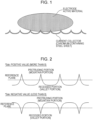
- Ssk is a surface roughness parameter defined in ISO 25178 and indicates the symmetricalness of the height distribution. As shown in Fig. 2 , when the value of Ssk (skewness) is positive (more than 0), the top end (upper end portion) of each protruding portion (mountain portion) is sharp, and the bottom end (lower end portion) of each recessed portion (valley portion) is wide (close to flat). If the value of Ssk is negative (less than 0), the top end of each protruding portion (mountain portion) is wide, and the bottom end (lower end portion) of each recessed portion (valley portion) is sharp.
- Ssk when Ssk is more than 0, the top ends of the protruding portions (mountain portions) on the surface of the steel sheet are sharp, and the protruding portions on the steel sheet surface that have a sharp top shape can easily stick into the electrode active material, and the interface resistance is reduced.
- Ssk if Ssk is less than 0, the top ends of the protruding portions (mountain portions) on the surface of the steel sheet are flat. Therefore, the protruding portions on the steel sheet surface do not easily stick into the electrode active material, and the interface resistance does not tend to decrease.
- Ssk is 0.10 or more. No particular limitation is imposed on the upper limit of Ssk.
- Ssk is preferably 1.00 or less and more preferably 0.50 or less.
- Sa and Ssk may be measured according to ISO 25178. A laser microscope may be used as the measurement device.
- the surfaces it is only necessary that at least one of the surfaces (the surface to be in contact with the electrode active material) have an Sa of from 0.15 um to 0.50 um inclusive and an Ssk of more than 0.
- both surfaces In a chromium-containing steel sheet produced through etching treatment described later, both surfaces generally have an Sa of from 0.15 um to 0.50 um inclusive and an Ssk of more than 0.
- the chromium-containing steel sheet of the present invention has a chemical composition containing Cr in an amount of 10% by mass or more. Cr is effective in improving corrosion resistance in the battery environment. When the Cr content is 10% by mass or more, sufficient corrosion resistance can be obtained in the battery environment even when the chromium-containing steel sheet is used for a current collector of a nonaqueous electrolyte secondary battery, particularly for a current collector of a nonaqueous electrolyte lithium ion secondary battery.
- the chromium-containing steel sheet of the present invention no particular limitation is imposed on the components other than Cr.
- a preferred chemical composition is as follows.
- the chromium-containing steel sheet of the invention has a chemical composition containing, in mass %, C: 0.001 to 0.100%, Si: 0.01 to 2.00%, Mn: 0.01 to 2.00%, P: 0.050% or less, S: 0.010% or less, Cr: 10.00 to 32.00%, Ni: 0.01 to 30.00%, Al: 0.001 to 0.500%, and N: 0.100% or less, with the balance being Fe and incidental impurities.
- the chemical composition may optionally contain, in mass %, one or two or more selected from the group consisting of Mo: 0.01 to 2.50%, Cu: 0.01 to 0.80%, Ti: 0.01 to 0.45%, Nb: 0.01 to 0.60%, and V: 0.01 to 0.30%.
- the C content is preferably 0.100% or less.
- the C content is more preferably 0.030% or less and still more preferably 0.020% or less. No particular limitation is imposed on the lower limit of the C content, but the lower limit is preferably 0.001%.
- Si is an element effective for deoxidization and is added in the steelmaking stage.
- the effect of Si is obtained when its content is 0.01% or more. Therefore, the Si content is preferably 0.01% or more. If the Si content is excessively large, the steel becomes hard, and manufacturability deteriorates. Therefore, the Si content is preferably 2.00% or less.
- the Si content is more preferably 1.00% or less and still more preferably 0.60% or less.
- Mn is an element effective for deoxidization and is added in the steelmaking stage.
- the effect of Mn is obtained when its content is 0.01% or more. Therefore, the Mn content is preferably 0.01% or more. If the Mn content exceeds 2.00%, corrosion resistance tends to deteriorate. Therefore, the Mn content is preferably 2.00% or less.
- the Mn content is more preferably 0.60% or less.
- the P content causes deterioration in ductility. Therefore, the smaller the P content, the better. However, when the P content is 0.050% or less, no significant deterioration in ductility occurs. Therefore, the P content is preferably 0.050% or less. The P content is more preferably 0.040% or less. No particular limitation is imposed on the lower limit of the P content. However, excessive dephosphorization results in an increase in manufacturing cost. Therefore, the P content is preferably 0.010% or more.
- S is an element that combines with Mn to form MnS that serves as starting points of corrosion, and this causes deterioration in corrosion resistance.
- the S content is preferably 0.010% or less.
- the S content is preferably 0.001% or more.
- the Cr content is 10% or more.
- the Cr content is preferably 10.00% or more and more preferably 16.00% or more. If the Cr content exceeds 32.00%, precipitation of the ⁇ phase may occurs, and this may cause deterioration in toughness. Therefore, the Cr content is preferably 32.00% or less. The Cr content is more preferably 25.00% or less.
- Ni is an element effective in improving the corrosion resistance of the stainless steel.
- Ni is generally contained in a certain amount in austenitic stainless steel and ferrite-austenite duplex stainless steel. If the Ni content exceeds 30.00%, hot workability deteriorates. Therefore, when Ni is contained, the Ni content is set to 30.00% or less.
- the Ni content is more preferably 20.00% or less.
- the Ni content is preferably 0.01% or more.
- a preferred lower limit of the Ni content in austenitic stainless steel and ferrite-austenite duplex stainless steel is 2.00%.
- the Ni content is preferably 2.00% or less and more preferably 1.00% or less.
- a preferred lower limit of the Ni content in the ferritic stainless steel is 0.01%.
- Al is an element used for deoxidization. The effect of Al is obtained when its content is 0.001% or more. Therefore, the Al content is preferably 0.001% or more. If the Al content exceeds 0.500%, ductility deteriorates. Therefore, the Al content is preferably 0.500% or less. The Al content is more preferably 0.150% or less and still more preferably 0.100% or less.
- the N content is preferably 0.100% or less.
- the N content is more preferably 0.030% or less. No particular limitation is imposed on the lower limit of the N content, but excessive denitrification causes an increase in cost. Therefore, the N content is preferably 0.002% or more.
- the elements described above are used as basic components.
- elements described below may be optionally contained.
- Mo is an element effective in improving corrosion resistance.
- the effect of Mo is preferably obtained when its content is 0.01% or more. However, if the Mo content exceeds 2.50%, embrittlement of the steel occurs. Therefore, when Mo is contained, the Mo content is preferably 0.01 to 2.50%.
- Cu is an element effective in improving corrosion resistance.
- the effect of Cu is preferably obtained when its content is 0.01% or more.
- the Cu content is preferably 0.01 to 0.80%.
- Ti is an element that combines with C and N and thereby prevents excessive precipitation of Cr carbonitrides in the steel, so that deterioration in corrosion resistance (sensitization) is prevented. These effects are obtained when the Ti content is 0.01% or more. However, if the Ti content exceeds 0.45%, workability deteriorates. Therefore, when Ti is contained, the Ti content is preferably in the range of 0.01 to 0.45%. The Ti content is more preferably 0.10% or more. The Ti content is more preferably 0.40% or less.
- Nb is an element that combines with C and N and thereby prevents sensitization, as is Ti. These effects are obtained when the Nb content is 0.01% or more. However, if the Nb content exceeds 0.60%, workability deteriorates. Therefore, when Nb is contained, the Nb content is preferably in the range of 0.01 to 0.60%. The Nb content is more preferably 0.10% or more. The Nb content is more preferably 0.40% or less.
- V is an element that combines with C and N contained in the steel and thereby prevents deterioration in corrosion resistance (sensitization), as are Nb and Ti. This effect is obtained when the V content is 0.01% or more. However, if the V content exceeds 0.30%, workability deteriorates. Therefore, when V is contained, the V content is preferably in the range of 0.01 to 0.30%. The V content is more preferably 0.20% or less, still more preferably 0.15% or less, and yet more preferably 0.10% or less.
- Components other than the above components are Fe and incidental impurities.
- [(Cr + Fe) in non-metallic form] / [(Cr + Fe) in metallic form] on the surface of the chromium-containing steel sheet is controlled in the range of 8.0 or less, smut is removed sufficiently, and the interface resistance reducing effect obtained is higher. Therefore, [(Cr + Fe) in non-metallic form] / [(Cr + Fe) in metallic form] is preferably 8.0 or less. [(Cr + Fe) in non-metallic form] / [(Cr + Fe) in metallic form] is more preferably 7.0 or less and still more preferably 6.0 or less.
- [(Cr + Fe) in non-metallic form] / [(Cr + Fe) in metallic form] is the ratio of the total of Cr and Fe present in non-metallic form on the surface of the chromium-containing steel sheet to the total of Cr and Fe present in metallic form on the surface of the chromium-containing steel sheet.
- [(Cr + Fe) in metallic form] and [(Cr + Fe) in non-metallic form] are the total atomic concentration of Cr and Fe present in metallic form and the total atomic concentration of Cr and Fe present in non-metallic form, respectively, that are measured by X-ray photoelectron spectroscopy analysis on the surface of the chromium-containing steel sheet.
- the non-metallic form means the form of oxides and hydroxides.
- examples of the non-metallic form of Cr include CrO 2 , Cr 2 O 3 , CrOOH, Cr(OH) 3 , and CrOs.
- Example of the non-metallic form of Fe include FeO, Fe 3 O 4 , Fe 2 O 3 , and FeOOH.
- No particular limitation is imposed on the lower limit of [(Cr + Fe) in non-metallic form] / [(Cr + Fe) in metallic form]. If the ratio is excessively reduced, the thickness of the chromium-containing steel sheet becomes uneven. Specifically, etching proceeds locally, and thin portions are formed, so that the steel sheet can easily break.
- [(Cr + Fe) in non-metallic form] / [(Cr + Fe) in metallic form] is 2.0 or more.
- [(Cr + Fe) in non-metallic form] / [(Cr + Fe) in metallic form] is determined as follows. Specifically, X-ray electron spectroscopy (hereinafter referred to as XPS) measurement is performed on the surface of the steel sheet, and obtained peaks of Cr are separated into peaks of Cr present in metallic form and peaks of Cr present in non-metallic form. Similarly, obtained peaks of Fe are separated into peaks of Fe present in metallic form and peaks of Fe present in non-metallic form. Then the total atomic concentration of Cr present in non-metallic form and Fe present in non-metallic form is computed and divided by the total atomic concentration of Cr present in metallic form and Fe present in metallic form which is also computed to thereby determine the above ratio.
- XPS X-ray electron spectroscopy
- a 10 mm square specimen is cut from the steel sheet.
- the specimen is subjected to measurement using an X-ray photoelectron spectrometer (X-tool manufactured by ULVAC-PHI, Inc.) with an Al-K ⁇ monochromatic X-ray source under the condition of an extraction angle of 45 degrees.
- the peaks of Cr and Fe are separated into peaks of Cr and Fe present in metallic form and peaks of Cr and Fe present in non-metallic form.
- the total atomic concentration of Cr present in non-metallic form and Fe present in non-metallic form is computed and divided by the total atomic concentration of Cr present in metallic form and Fe present in metallic form which is also computed to thereby determine the ratio.
- the peaks are separated by removing the background of the spectrum using the Shirley method and using a Gauss-Lorentz complex function (the ratio of the Lorentz function: 30%).
- the thickness of the chromium-containing steel sheet is preferably 50 um or less. When the thickness is 50 um or less, an increase in the weight of the battery can be easily prevented. The thickness is more preferably 30 um or less. The thickness of the chromium-containing steel sheet is preferably 5 um or more. When the thickness is 5 um or more, a significant reduction in the efficiency of production of the chromium-containing steel sheet can be prevented, and an increase in manufacturing cost can also be prevented.
- the method for manufacturing the chromium-containing steel sheet for a current collector of a nonaqueous electrolyte secondary battery according to the embodiment of the present invention includes the step of preparing a chromium-containing steel sheet used as a raw material (raw material chromium-containing steel sheet), a first immersion treatment step, and a second immersion treatment step.
- the step of preparing the raw material chromium-containing steel sheet is the step of preparing the chromium-containing steel sheet used as the raw material.
- No particular limitation is imposed on the raw material chromium-containing steel sheet.
- a raw material chromium-containing steel sheet having the chemical composition described above may be produced as follows.
- a steel slab having the chemical composition described above is hot rolled to obtain a hot rolled steel sheet, and the hot rolled steel sheet is optionally subjected to hot rolled steel sheet annealing and pickling. Then the resulting hot rolled steel sheet is subjected to cold rolling to obtain a cold rolled steel sheet with a desired thickness. For example, when a chromium-containing steel sheet with a final thickness of 10 um is manufactured, cold rolled steel sheet annealing is optionally performed in the cold rolling process, and the resulting steel sheet is further subjected to cold rolling to obtain the final thickness.
- the hot rolling, the cold rolling, the hot rolled steel sheet annealing, the cold rolled steel sheet annealing, etc. may be performed according to routine methods. After the cold rolled steel sheet annealing, pickling may be performed. The cold rolled steel sheet annealing may be performed as bright annealing.
- the steel sheet manufactured as described above is prepared as the raw material chromium-containing steel sheet.
- the raw material chromium-containing steel sheet prepared as described above is subjected to the first immersion treatment (etching treatment).
- immersion treatment immersion treatment
- immersion treatment is performed as follows.
- An acidic aqueous solution containing hydrogen peroxide: 0.1 to 5.0% by mass, copper ions: 1.0 to 10.0% by mass, and halide ions: 5.0 to 20.0% by mass and having a pH of 1.0 or less is used as a treatment liquid.
- the treatment temperature is 30 to 50°C, and the treatment time is 40 to 90 seconds.
- the amount of dissolution of the raw material chromium-containing steel sheet can be precisely controlled, and therefore the profile of the irregular structure formed on the surface of the steel sheet can be controlled.
- the amount of dissolution of the raw material chromium-containing steel sheet in the etching treatment can be controlled by adjusting the type of treatment liquid used for the etching treatment, the temperature of the treatment liquid, and the treatment time.
- the steel sheet surface dissolves nonuniformly because the steel sheet surface includes easily dissolvable portions and non-easily dissolvable portions. If the amount of dissolution during the etching treatment is insufficient, the dissolution does not proceed over the entire surface, so that Sa cannot be increased sufficiently.
- the amount of dissolution during the etching treatment is in an optimal range, the etching proceeds in the easily dissolvable portions, and Sa can be increased sufficiently.
- the top ends of the protruding portions can be sharpened, and therefore the value of Ssk can be positive (more than 0). If the amount of dissolution during the etching treatment is excessively large, Sa can be increased. However, since the etching proceeds also in the non-easily dissolvable portions, the top ends of the protruding portions (mountain portions) are flattened, so that the value of Ssk becomes negative (less than 0).
- the concentration of hydrogen peroxide in the treatment liquid is less than 0.1% by mass, the ability to remove copper-containing products precipitated on the steel sheet surface is low, so that the etching treatment cannot be performed continuously. If the concentration of hydrogen peroxide exceeds 5.0% by mass, its effect is saturated. Therefore, the concentration of hydrogen peroxide is preferably 0.1 to 5.0% by mass.
- the concentration of copper ions in the treatment liquid is less than 1.0% by mass, the etching ability of the treatment liquid is low, so that the desired irregular profile is not obtained. If the concentration of copper ions exceeds 10.0% by mass, the amount of products adhering to the steel sheet surface is large. In this case, even when the second immersion treatment in the next step is performed, smut etc. cannot be removed sufficiently. Therefore, the concentration of copper ions is preferably 1.0 to 10.0% by mass. The concentration of copper ions is more preferably 2.0% by mass or more and still more preferably 5.0% by mass or more.
- Halide ions 5.0 to 20.0% by mass
- the concentration of halide ions in the treatment liquid is less than 5.0% by mass, a passive film present on the steel sheet surface cannot be broken sufficiently, so that the etching cannot proceed sufficiently. If the concentration of halide ions exceeds 20.0% by mass, local pitting corrosion is accelerated, and it is feared that holes may be formed in the steel sheet. Therefore, the concentration of halide ions is preferably 5.0 to 20.0% by mass. The concentration of halide ions is more preferably 10.0% by mass or more. The concentration of halide ions is still more preferably 15% by mass or less.
- the halide ion source is preferably halogenated hydrogen or a halide of an alkali metal and more preferably hydrochloric acid or sodium chloride. The halide ions are preferably chloride ions.
- the pH of the treatment liquid is 1.0 or less.
- the pH is more preferably 0.1 or less.
- the treatment liquid (aqueous solution) described above can be prepared by mixing an aqueous hydrogen peroxide solution, a copper compound capable of supplying copper ions, a halide component capable of supplying halide ions, and water and stirring the mixture until uniform.
- Treatment temperature (temperature of treatment liquid): 30 to 50°C
- the treatment temperature is lower than 30°C, the etching ability deteriorates, and this causes an increase in the treatment time. If the treatment temperature exceeds 50°C, the stability of the treatment liquid deteriorates. Therefore, the treatment temperature is set to 30 to 50°C.
- Treatment time 40 to 90 seconds
- the treatment time is set to 40 to 90 seconds.
- the amount of etching varies depending on the type of chromium-containing steel. It is therefore more preferable that the treatment time is adjusted within the range of 40 to 90 seconds according to the steel type.
- the raw material chromium-containing steel sheet is immersed in the aqueous solution used as the treatment liquid.
- the aqueous solution used as the treatment liquid may be dropped or sprayed onto the raw material chromium-containing steel sheet so long as the steel sheet and the aqueous solution come into contact with each other.
- the treatment time is the time of contact between the raw material chromium-containing steel sheet and the aqueous solution.
- the raw material chromium-containing steel sheet is further subjected to the second immersion treatment.
- the second immersion treatment is
- smut a mixture containing C, N, S, O, Fe, Cr, Ni, and Cu as main components and having high electrical resistance
- these may cause an increase in interface resistance, although the desired irregular structure is obtained on the steel sheet surface.
- the smut is removed, and the interface resistance reducing effect can be obtained stably.
- the acidic aqueous solution containing hydrogen peroxide include an aqueous solution mixture of hydrogen peroxide and sulfuric acid.
- aqueous solution containing nitric acid include an aqueous nitric acid solution.
- the concentration of hydrogen peroxide is 0.5 to 10.0% by mass and that the concentration of sulfuric acid is 1.0 to 10.0% by mass.
- the concentration of nitric acid is 1.0 to 40.0% by mass.
- a component of the aqueous solution mixture of hydrogen peroxide and sulfuric acid other than the hydrogen peroxide and the sulfuric acid is basically water, and a component of the aqueous nitric acid solution other than the nitric acid is basically water.
- the treatment temperature in the second immersion treatment (the temperature of the treatment liquid) is preferably 30 to 60°C for both (A) and (B).
- the treatment time is preferably 5 to 120 seconds for both (A) and (B).
- the treatment time is more preferably 30 seconds or longer.
- the treatment time is more preferably 90 seconds or shorter.
- the treatment (C) no particular limitation is imposed on the order of the treatment (A) and the treatment (B).
- the treatment (A) is performed, and then the treatment (B) is performed.
- the surface of the chromium-containing steel sheet under the treatment may be optionally rubbed with, for example, a nonwoven fabric wiper.
- smut etc. can be easily removed, and the interface resistance reducing effect can be more stably obtained.
- the raw material chromium-containing steel sheet is immersed in the aqueous solution used as the treatment liquid.
- the aqueous solution used as the treatment liquid may be dropped or sprayed onto the raw material chromium-containing steel sheet so long as the steel sheet and the aqueous solution come into contact with each other.
- the treatment time is the time of contact between the raw material chromium-containing steel sheet and the aqueous solution.
- the steel strip may be formed into a current collector shape and then subjected to the second immersion treatment.
- Raw material chromium-containing steel sheets having chemical compositions shown in Table 1 (with the balance being Fe and incidental impurities) and a thickness of 10 um were prepared. Then the prepared raw material chromium-containing steel sheets were subjected to the first immersion treatment (etching treatment) and the second immersion treatment (smut removing treatment) under conditions shown in Tables 2 and 3 to thereby obtain chromium-containing steel sheets for current collectors of nonaqueous electrolyte secondary batteries (samples Nos. 1, 3 to 8, 11 to 17).
- One of the raw material steel sheets as prepared, which is not subjected to the treatments described above, was used as sample No. 2 ("-" in the manufacturing conditions in Tables 2 and 3 indicates that the corresponding treatment was not performed).
- the compositions of treatment liquids (etching treatment liquids A1 to A4) used in the first immersion treatment and the compositions of aqueous solutions (smut removing treatment liquids B1 to B2 and E) used in the second immersion treatment are as follows.
- the copper ions and the chloride ions are derived from copper sulfate pentahydrate and hydrochloric acid, respectively.
- the copper ions and the chloride ions are derived from copper sulfate pentahydrate and hydrochloric acid, respectively.
- the copper ions and the chloride ions are derived from copper sulfate pentahydrate and hydrochloric acid, respectively.
- the copper ions and the chloride ions are derived from copper sulfate pentahydrate and hydrochloric acid, respectively.
- Sa and Ssk were measured according to ISO 25178.
- a laser microscope VK-X250/X260 manufactured by KEYENCE CORPORATION
- a test specimen was cut from the manufactured chromium-containing steel sheet, and the surface profile in a 50 um ⁇ 50 um region on each of the opposite surfaces of the test specimen was measured to obtain the data thereabout using the laser microscope with an objective lens with a magnification of 150X.
- the data obtained was analyzed using analysis software "Multi-file Analysis Application" attached to the device to determine Sa and Ssk on each of the opposite surfaces of the test specimen. Before the analysis of Sa and Ssk, image processing was performed.
- chromium-containing steel sheets manufactured as described above were used to evaluate their corrosion resistance, electrode resistance, rate characteristics, and cycle characteristics as follows.
- One of the chromium-containing steel sheets manufactured as described above was used as a working electrode, and Li metal foils were used as a counter electrode and a reference electrode.
- Li metal foils were used as a counter electrode and a reference electrode.
- the current density of the chromium-containing steel sheet was observed during potential scanning in the potential range described below to thereby evaluate corrosion resistance in the battery environment.
- the potential was increased from the initial immersion potential (immersion potential at the start of the test) to 5.0 V, then the potential was lowered to 0.0 V, and next, the potential was increased to the initial immersion potential. The evaluation was performed until the potential reached the initial immersion potential.
- the potential is the potential V (vs. Li/Li + ) with respect to the Li metal foil used as the counter electrode.
- a coin-shaped cell of a nonaqueous electrolyte lithium ion secondary battery having the following battery structure was produced, and its electrode resistance, rate characteristics, and cycle characteristics were evaluated under the following conditions.
- the negative electrode produced by coating the surface of the negative electrode current collector with a mixture of the negative electrode active material, the negative electrode thickener, and the negative electrode binder
- the four-probe method low resistivity meter Loresta EP manufactured by Mitsubishi Chemical Corporation, probes used: BSP probes (four probes)
- the evaluation area was 5 cm 2 , and the average of three measurements was used.
- the evaluation criteria for the electrode resistance are as follows. The evaluation results are shown in Tables 2 and 3.
- the evaluation criteria for the rate characteristics are as follows. The evaluation results are shown in Tables 2 and 3.
- the ratio (%) of the discharge capacity at 5C to the discharge capacity at 1C was computed as 100 ⁇ (the discharge capacity at 5C / the discharge capacity at 1C).
- the evaluation criteria for the cycle characteristics are as follows. The evaluation results are shown in Tables 2 and 3.
- the discharge capacity retention (%) at the 300th cycle was computed as 100 ⁇ (the discharge capacity at the 300th cycle / the discharge capacity at the first cycle).
- [Table 1] Steel No. Chemical composition (% by mass) C Si Mn P S Cr Ni Al N Other components A 0.006 0.26 0.42 0.027 0.001 10.95 0.14 0.045 0.006 Ti: 0.24, V: 0.05 B 0.034 0.24 0.51 0.026 0.005 16.17 0.15 0.002 0.041 - C 0.009 0.15 0.17 0.027 0.002 20.70 0.15 0.032 0.009 Ti: 0.29, Cu: 0.43 D 0.005 0.31 0.16 0.026 0.001 19.19 0.26 0.008 0.007 Mo: 1.83, Nb: 0.35 E 0.041 0.54 0.92 0.033 0.004 18.19 8.06 0.001 0.041 Cu: 0.19, Mo: 0.17 [Table 2] Sample No.
Landscapes
- Chemical & Material Sciences (AREA)
- Engineering & Computer Science (AREA)
- Materials Engineering (AREA)
- Mechanical Engineering (AREA)
- Metallurgy (AREA)
- Organic Chemistry (AREA)
- Chemical Kinetics & Catalysis (AREA)
- General Chemical & Material Sciences (AREA)
- Electrochemistry (AREA)
- Composite Materials (AREA)
- Cell Electrode Carriers And Collectors (AREA)
- Heat Treatment Of Sheet Steel (AREA)
Applications Claiming Priority (2)
| Application Number | Priority Date | Filing Date | Title |
|---|---|---|---|
| JP2020207194 | 2020-12-15 | ||
| PCT/JP2021/045740 WO2022131189A1 (ja) | 2020-12-15 | 2021-12-13 | 非水電解質二次電池の集電体用のクロム含有鋼板 |
Publications (2)
| Publication Number | Publication Date |
|---|---|
| EP4245877A1 true EP4245877A1 (de) | 2023-09-20 |
| EP4245877A4 EP4245877A4 (de) | 2024-04-17 |
Family
ID=82057722
Family Applications (1)
| Application Number | Title | Priority Date | Filing Date |
|---|---|---|---|
| EP21906551.3A Pending EP4245877A4 (de) | 2020-12-15 | 2021-12-13 | Chromhaltiges stahlblech für stromkollektoren für sekundärbatterien mit wasserfreiem elektrolyt |
Country Status (6)
| Country | Link |
|---|---|
| US (1) | US20240063399A1 (de) |
| EP (1) | EP4245877A4 (de) |
| JP (1) | JP7103551B1 (de) |
| KR (1) | KR102889517B1 (de) |
| CN (1) | CN116568842A (de) |
| WO (1) | WO2022131189A1 (de) |
Cited By (1)
| Publication number | Priority date | Publication date | Assignee | Title |
|---|---|---|---|---|
| EP4265761A4 (de) * | 2020-12-15 | 2024-05-29 | JFE Steel Corporation | Rostfreies stahlblech für brennstoffzellenseparator |
Families Citing this family (2)
| Publication number | Priority date | Publication date | Assignee | Title |
|---|---|---|---|---|
| WO2025205949A1 (ja) * | 2024-03-28 | 2025-10-02 | 日鉄ケミカル&マテリアル株式会社 | ステンレス鋼箔、電極、及び、電池 |
| WO2025229981A1 (ja) * | 2024-04-30 | 2025-11-06 | 日鉄ケミカル&マテリアル株式会社 | ステンレス鋼箔、電極、及び、電池 |
Family Cites Families (13)
| Publication number | Priority date | Publication date | Assignee | Title |
|---|---|---|---|---|
| JPS5819950B2 (ja) * | 1980-11-06 | 1983-04-20 | 新日本製鐵株式会社 | 太陽熱選択吸収板の製造法 |
| JP4173376B2 (ja) * | 2003-01-14 | 2008-10-29 | 新日鉄マテリアルズ株式会社 | 拡散接合性の良好な排気ガス浄化用メタル担体用耐熱ステンレス鋼箔およびメタル担体 |
| JP2007242424A (ja) | 2006-03-08 | 2007-09-20 | Nissan Motor Co Ltd | バイポーラ電池 |
| JP2009167486A (ja) | 2008-01-18 | 2009-07-30 | Nisshin Steel Co Ltd | 電池構成部材用フェライト系ステンレス鋼 |
| JP5334485B2 (ja) | 2008-07-25 | 2013-11-06 | 日新製鋼株式会社 | リチウムイオン二次電池用集電体および負極材料 |
| KR100993412B1 (ko) * | 2008-12-29 | 2010-11-09 | 주식회사 포스코 | 고분자 연료전지 분리판용 스테인리스강 및 그 제조방법 |
| JP2011038166A (ja) * | 2009-08-13 | 2011-02-24 | Nisshin Steel Co Ltd | 燃料電池用通電部材およびその製造方法 |
| JP2016036829A (ja) * | 2014-08-07 | 2016-03-22 | Jx日鉱日石金属株式会社 | 圧延銅箔及びそれを用いた二次電池用集電体 |
| WO2016129599A1 (ja) * | 2015-02-13 | 2016-08-18 | 新日鐵住金株式会社 | 固体高分子形燃料電池用セパレータおよびその製造方法 |
| CN111033837A (zh) * | 2017-08-23 | 2020-04-17 | 富士胶片株式会社 | 金属箔、金属箔的制造方法、二次电池用负极及二次电池用正极 |
| JP7057766B2 (ja) * | 2019-07-09 | 2022-04-20 | Jfeスチール株式会社 | 硫化物系固体電池の集電体用のフェライト系ステンレス鋼板およびその製造方法 |
| WO2021005919A1 (ja) * | 2019-07-09 | 2021-01-14 | Jfeスチール株式会社 | 非水電解質二次電池の集電体用のクロム含有鋼板およびその製造方法 |
| WO2022131204A1 (ja) * | 2020-12-15 | 2022-06-23 | Jfeスチール株式会社 | 燃料電池のセパレータ用のステンレス鋼板 |
-
2021
- 2021-12-13 CN CN202180083233.0A patent/CN116568842A/zh active Pending
- 2021-12-13 WO PCT/JP2021/045740 patent/WO2022131189A1/ja not_active Ceased
- 2021-12-13 US US18/265,798 patent/US20240063399A1/en active Pending
- 2021-12-13 KR KR1020237019182A patent/KR102889517B1/ko active Active
- 2021-12-13 EP EP21906551.3A patent/EP4245877A4/de active Pending
- 2021-12-13 JP JP2022523560A patent/JP7103551B1/ja active Active
Cited By (1)
| Publication number | Priority date | Publication date | Assignee | Title |
|---|---|---|---|---|
| EP4265761A4 (de) * | 2020-12-15 | 2024-05-29 | JFE Steel Corporation | Rostfreies stahlblech für brennstoffzellenseparator |
Also Published As
| Publication number | Publication date |
|---|---|
| JPWO2022131189A1 (de) | 2022-06-23 |
| WO2022131189A1 (ja) | 2022-06-23 |
| CN116568842A (zh) | 2023-08-08 |
| JP7103551B1 (ja) | 2022-07-20 |
| KR20230098873A (ko) | 2023-07-04 |
| KR102889517B1 (ko) | 2025-11-20 |
| US20240063399A1 (en) | 2024-02-22 |
| EP4245877A4 (de) | 2024-04-17 |
Similar Documents
| Publication | Publication Date | Title |
|---|---|---|
| US20240063399A1 (en) | Chromium-containing steel sheet for current collector of nonaqueous electrolyte secondary battery | |
| RU2528520C2 (ru) | Нержавеющая сталь с хорошей коррозионной стойкостью для топливного элемента и способ ее получения | |
| EP3121885B1 (de) | Elektrolytische kupferfolie und sammler, negativelektrode und lithiumbatterie damit | |
| Hoppe et al. | XPS and UPS examinations of the formation of passive layers on Ni in 1 M sodium hydroxide and 0.5 M sulphuric acid | |
| EP3998362A1 (de) | Ferritisches rostfreies stahlblech für stromabnehmer für sulfidbasierte festkörperbatterien und verfahren zu seiner herstellung | |
| CN113348273B (zh) | 燃料电池的隔离件用的奥氏体系不锈钢板及其制造方法 | |
| EP3121884B1 (de) | Elektrolytische kupferfolie und sammler, negativelektrode und lithiumbatterie damit | |
| EP2626440A1 (de) | Ferritischer edelstahl mit hervorragender korrosionsbeständigkeit und elektrischer leitfähigkeit, verfahren zu seiner herstellung, festpolymerbrennstoffzellenseparator und festpolymerbrennstoffzelle | |
| EP3576199A1 (de) | Edelstahlblech für brennstoffzellenseparator und verfahren zur herstellung davon | |
| TWI711212B (zh) | 燃料電池之分隔件用之不鏽鋼鋼板之製造方法 | |
| KR102772704B1 (ko) | 비수 전해질 2차 전지의 집전체용의 크롬 함유 강판 및 그의 제조 방법 | |
| KR20140033058A (ko) | 전지 용기용 표면 처리 강판, 전지 용기 및 전지 | |
| Sha et al. | Improving the electrochemical behaviors and discharge performance of as-rolled Mg-4Li alloys through multicomponent alloying | |
| EP4321653A1 (de) | Oberflächenbehandeltes stahlblech | |
| EP4265761A1 (de) | Rostfreies stahlblech für brennstoffzellenseparator | |
| CN102713004B (zh) | 接触电阻低的通电部件用不锈钢及其制造方法 | |
| Mori et al. | Effect of surface composition on contact resistivity and corrosion resistance of 316L stainless steel |
Legal Events
| Date | Code | Title | Description |
|---|---|---|---|
| STAA | Information on the status of an ep patent application or granted ep patent |
Free format text: STATUS: THE INTERNATIONAL PUBLICATION HAS BEEN MADE |
|
| PUAI | Public reference made under article 153(3) epc to a published international application that has entered the european phase |
Free format text: ORIGINAL CODE: 0009012 |
|
| STAA | Information on the status of an ep patent application or granted ep patent |
Free format text: STATUS: REQUEST FOR EXAMINATION WAS MADE |
|
| 17P | Request for examination filed |
Effective date: 20230612 |
|
| AK | Designated contracting states |
Kind code of ref document: A1 Designated state(s): AL AT BE BG CH CY CZ DE DK EE ES FI FR GB GR HR HU IE IS IT LI LT LU LV MC MK MT NL NO PL PT RO RS SE SI SK SM TR |
|
| DAV | Request for validation of the european patent (deleted) | ||
| DAX | Request for extension of the european patent (deleted) | ||
| A4 | Supplementary search report drawn up and despatched |
Effective date: 20240318 |
|
| RIC1 | Information provided on ipc code assigned before grant |
Ipc: C23F 1/10 20060101ALN20240312BHEP Ipc: C23F 1/02 20060101ALN20240312BHEP Ipc: C23F 1/28 20060101ALI20240312BHEP Ipc: C23F 1/16 20060101ALI20240312BHEP Ipc: H01M 4/66 20060101ALI20240312BHEP Ipc: C22C 38/58 20060101ALI20240312BHEP Ipc: C22C 38/50 20060101ALI20240312BHEP Ipc: C22C 38/48 20060101ALI20240312BHEP Ipc: C22C 38/46 20060101ALI20240312BHEP Ipc: C22C 38/44 20060101ALI20240312BHEP Ipc: C22C 38/42 20060101ALI20240312BHEP Ipc: C22C 38/40 20060101ALI20240312BHEP Ipc: C22C 38/28 20060101ALI20240312BHEP Ipc: C22C 38/24 20060101ALI20240312BHEP Ipc: C22C 38/20 20060101ALI20240312BHEP Ipc: C22C 38/04 20060101ALI20240312BHEP Ipc: C22C 38/02 20060101ALI20240312BHEP Ipc: C22C 38/00 20060101AFI20240312BHEP |
|
| STAA | Information on the status of an ep patent application or granted ep patent |
Free format text: STATUS: EXAMINATION IS IN PROGRESS |
|
| 17Q | First examination report despatched |
Effective date: 20251110 |