EP4235838A1 - Elektrolytzusammensetzung und primärzelle enthaltend die elektrolytzusammensetzung und insbesondere nano-partikuläre silizium-partikel - Google Patents

Elektrolytzusammensetzung und primärzelle enthaltend die elektrolytzusammensetzung und insbesondere nano-partikuläre silizium-partikel Download PDF

Info

Publication number
EP4235838A1
EP4235838A1 EP22158293.5A EP22158293A EP4235838A1 EP 4235838 A1 EP4235838 A1 EP 4235838A1 EP 22158293 A EP22158293 A EP 22158293A EP 4235838 A1 EP4235838 A1 EP 4235838A1
Authority
EP
European Patent Office
Prior art keywords
groups
primary cell
silicon
oxide groups
weight
Prior art date
Legal status (The legal status is an assumption and is not a legal conclusion. Google has not performed a legal analysis and makes no representation as to the accuracy of the status listed.)
Ceased
Application number
EP22158293.5A
Other languages
English (en)
French (fr)
Inventor
Erfindernennung liegt noch nicht vor Die
Current Assignee (The listed assignees may be inaccurate. Google has not performed a legal analysis and makes no representation or warranty as to the accuracy of the list.)
Forschungszentrum Juelich GmbH
Evonik Operations GmbH
Original Assignee
Forschungszentrum Juelich GmbH
Evonik Operations GmbH
Priority date (The priority date is an assumption and is not a legal conclusion. Google has not performed a legal analysis and makes no representation as to the accuracy of the date listed.)
Filing date
Publication date
Application filed by Forschungszentrum Juelich GmbH, Evonik Operations GmbH filed Critical Forschungszentrum Juelich GmbH
Priority to EP22158293.5A priority Critical patent/EP4235838A1/de
Publication of EP4235838A1 publication Critical patent/EP4235838A1/de
Ceased legal-status Critical Current

Links

Images

Classifications

    • HELECTRICITY
    • H01ELECTRIC ELEMENTS
    • H01MPROCESSES OR MEANS, e.g. BATTERIES, FOR THE DIRECT CONVERSION OF CHEMICAL ENERGY INTO ELECTRICAL ENERGY
    • H01M4/00Electrodes
    • H01M4/02Electrodes composed of, or comprising, active material
    • H01M4/06Electrodes for primary cells
    • HELECTRICITY
    • H01ELECTRIC ELEMENTS
    • H01MPROCESSES OR MEANS, e.g. BATTERIES, FOR THE DIRECT CONVERSION OF CHEMICAL ENERGY INTO ELECTRICAL ENERGY
    • H01M12/00Hybrid cells; Manufacture thereof
    • H01M12/04Hybrid cells; Manufacture thereof composed of a half-cell of the fuel-cell type and of a half-cell of the primary-cell type
    • H01M12/06Hybrid cells; Manufacture thereof composed of a half-cell of the fuel-cell type and of a half-cell of the primary-cell type with one metallic and one gaseous electrode
    • HELECTRICITY
    • H01ELECTRIC ELEMENTS
    • H01MPROCESSES OR MEANS, e.g. BATTERIES, FOR THE DIRECT CONVERSION OF CHEMICAL ENERGY INTO ELECTRICAL ENERGY
    • H01M4/00Electrodes
    • H01M4/02Electrodes composed of, or comprising, active material
    • H01M4/24Electrodes for alkaline accumulators
    • HELECTRICITY
    • H01ELECTRIC ELEMENTS
    • H01MPROCESSES OR MEANS, e.g. BATTERIES, FOR THE DIRECT CONVERSION OF CHEMICAL ENERGY INTO ELECTRICAL ENERGY
    • H01M4/00Electrodes
    • H01M4/02Electrodes composed of, or comprising, active material
    • H01M4/36Selection of substances as active materials, active masses, active liquids
    • H01M4/38Selection of substances as active materials, active masses, active liquids of elements or alloys
    • H01M4/386Silicon or alloys based on silicon
    • HELECTRICITY
    • H01ELECTRIC ELEMENTS
    • H01MPROCESSES OR MEANS, e.g. BATTERIES, FOR THE DIRECT CONVERSION OF CHEMICAL ENERGY INTO ELECTRICAL ENERGY
    • H01M4/00Electrodes
    • H01M4/02Electrodes composed of, or comprising, active material
    • H01M4/36Selection of substances as active materials, active masses, active liquids
    • H01M4/48Selection of substances as active materials, active masses, active liquids of inorganic oxides or hydroxides
    • H01M4/50Selection of substances as active materials, active masses, active liquids of inorganic oxides or hydroxides of manganese
    • HELECTRICITY
    • H01ELECTRIC ELEMENTS
    • H01MPROCESSES OR MEANS, e.g. BATTERIES, FOR THE DIRECT CONVERSION OF CHEMICAL ENERGY INTO ELECTRICAL ENERGY
    • H01M4/00Electrodes
    • H01M4/02Electrodes composed of, or comprising, active material
    • H01M4/62Selection of inactive substances as ingredients for active masses, e.g. binders, fillers
    • H01M4/624Electric conductive fillers
    • H01M4/625Carbon or graphite
    • HELECTRICITY
    • H01ELECTRIC ELEMENTS
    • H01MPROCESSES OR MEANS, e.g. BATTERIES, FOR THE DIRECT CONVERSION OF CHEMICAL ENERGY INTO ELECTRICAL ENERGY
    • H01M4/00Electrodes
    • H01M4/86Inert electrodes with catalytic activity, e.g. for fuel cells
    • H01M4/90Selection of catalytic material
    • H01M4/9016Oxides, hydroxides or oxygenated metallic salts
    • HELECTRICITY
    • H01ELECTRIC ELEMENTS
    • H01MPROCESSES OR MEANS, e.g. BATTERIES, FOR THE DIRECT CONVERSION OF CHEMICAL ENERGY INTO ELECTRICAL ENERGY
    • H01M6/00Primary cells; Manufacture thereof
    • H01M6/14Cells with non-aqueous electrolyte

Definitions

  • the invention relates to a primary cell with silicon as the anode material in the form of silicon particles with a particle size in the range from 0.1 ⁇ m to 20 ⁇ m.
  • the invention also relates to a multi-cell battery and a system comprising such a battery.
  • the object of the invention was to improve the performance and service life of a galvanic cell containing silicon, in particular an alkaline galvanic cell. Furthermore, the power density of such a silicon-containing galvanic cell should be improved and a high initial voltage should be adjustable.
  • the task was to provide a silicon-containing galvanic cell that is preferably free of lithium, wherein preferably free of lithium means that the lithium content in the charged state is less than 0.1% by weight in the overall composition of the primary cell, in particular comprising the anode, the cathode and the electrolyte, the lithium content in the electrode material of the anode in the charged state is preferably less than 0.1% by weight.
  • the galvanic cell should preferably have educts and reaction products that come from recycling processes in silicon wafer production, are by-products and/or can be used further in recycling processes.
  • the invention relates to an electrochemical primary cell having an anode, a cathode and at least one separator, the separator separating the cathode and the anode from one another, the primary cell containing an electrolyte solution, the cathode material, in particular the cathode material, manganese dioxide and optionally carbon containing conductivity mediator, and the anode comprises silicon as the anode material, and in particular a proportion of the silicon, preferably the silicon partially to completely, particularly preferably a proportion of 0.1 to 100% by weight in relation to the silicon content in the anode material 100 wt . Silicon particles with a particle size of 5 to 20 ⁇ m are preferably present.
  • the silicon particles can contain carbon and silicon, and the particles can optionally include at least one allotropic carbon modification.
  • the anode material can have an iron content of greater than or equal to 0.02 mg/kg, in particular an iron content of greater than or equal to 0.02 mg/kg of silicon in the anode material.
  • the silicon particles are preferably present as crystalline silicon particles, which comprise monocrystalline and/or polycrystalline silicon particles and/or silicon particles which comprise agglomerates and/or aggregates of essentially amorphous silicon primary particles with a primary particle size of 1 nm to 3000 nm or mixtures of these, in particular the agglomerates and/or aggregates having a size of 100 to 3000 nm.
  • the electrolyte solution is an aqueous, alkaline electrolyte composition which comprises at least one compound having linear or branched polyalkylene oxide groups and at least three alkylene oxide groups in the compound or mixtures of at least two of these compounds, the alkylene oxide groups in the compound containing polyalkylene oxide groups is selected from alkylene oxide groups having 2 to 6 carbon atoms per alkylene oxide group.
  • the compound containing polyalkylene oxide groups has at least one terminal group selected from hydroxyl groups, alkyl groups, alkoxy groups, alkenyl groups, alkenyl oxide groups, carboxylic acid groups, carboxylic acid ester groups, carboxamide groups , Aromatic groups and/or groups containing cyclic ethers.
  • Preferred compounds having polyalkylene oxide groups, in particular comprising polyalkylene oxide groups can preferably have a molecular weight of 200 g/mol to 35,000 g/mol, preferably 200 to 1500 g/mol. It is further preferred if the average molecular weight is from 200 g/mol to 1500 g/mol.
  • the electrolyte composition preferably comprises at least one alkali metal hydroxide selected from NaOH and KOH and optionally further alkaline soluble salts such as, for example, alkaline earth metal hydroxides, basic metal oxides or organic bases.
  • the electrolyte composition preferably comprises an alkali hydroxide selected from potassium hydroxide (KOH) and sodium hydroxide (NaOH).
  • the electrolyte does not contain any compounds containing linear polyalkylene oxide groups and having at least two terminal carboxylic acid groups.
  • Alkyl, alkoxy, alkenyl, alkenyl oxide and aromatic groups optionally alkyl-substituted preferably each independently comprise 1 to 18 carbon atoms.
  • Carboxylic acid esters are preferably selected from natural fatty acids having 4 to 20 carbon atoms.
  • the alkylene oxide groups in the compound containing polyalkylene oxide groups can preferably be selected from alkylene oxide groups having 2 to 4 carbon atoms per alkylene oxide group. Furthermore, it is preferred if the compounds containing polyalkylene oxide groups contain at least five alkylene oxide groups, in particular up to one hundred alkylene oxide groups, with 2 to 4 carbon atoms per alkylene oxide group in the compound.
  • Alkylene is particularly preferably divalent ethylene (-CH 2 CH 2 -), especially as an ethylene oxide group, or divalent propylene, especially in propylene oxide groups (-CH 2 (CH 3 CH)- and -(CH 2 ) 3 -).
  • the terminal groups of the compound containing polyalkylene oxide groups are preferably selected from hydroxyl groups, alkyl groups, alkoxy groups, alkylene groups, alkylene oxide groups, carboxylic acid ester groups, in particular olefinic carboxylic acid ester groups, aromatic groups and/or groups containing cyclic ethers.
  • a preferred compound comprises polyalkylene oxides of rapeseed oil amide, particularly preferred is PEG-4 rapeseed oil amide.
  • the at least one terminal group of the compound containing polyalkylene oxide groups is selected from the hydroxyl group, carboxylic acid group, carboxylic acid ester group, carboxamide group, in particular from the hydroxyl and carboxamide group, and the at least one other terminal group is selected from hydroxy groups, alkyl groups, alkoxy groups, alkenyl groups, alkenyl oxide groups, carboxylic acid ester groups, aromatic groups, in particular alkyl-substituted aromatic groups, and/or groups containing cyclic ethers. It is further preferred if the linear compounds have a first terminal and a further terminal group and branched compounds have a first, a further terminal group and at least one additional terminal group.
  • the electrolyte compositions can comprise at least one compound containing polyalkylene oxide groups with at least one cyclic ether group having 5 to 8 carbon atoms and optionally as at least one terminal group a carboxylic acid ester, in particular a carboxylic acid ester of a fatty acid, and, where the at least one or more further terminal groups are selected from hydroxy groups, alkyl groups, alkoxy groups, alkenyl groups, alkenyl oxide groups, carboxylic acid groups, carboxylic acid ester groups, carboxamide groups, aromatic groups and/or containing groups cyclic ethers with 5 to 8 carbon atoms.
  • Particularly preferred is a compound having branched polyalkylene oxide groups, having one to six polyalkylene oxide groups on the cyclic ether group, and at least one alkylene oxide-functionalized fatty acid ester.
  • Typical fatty acids include oleic acid, lauric acid, stearic acid, isostearic acid and/or palmitic acid.
  • Particularly preferred compounds include ethoxylated sorbitan fatty acid esters, especially mono- to triesters. Preferably with 2 to 200 ethoxy groups, in particular with 2 to 50 ethoxy groups, and optionally with propoxy group(s) as polyalkylene oxide groups.
  • an aqueous, alkaline electrolyte composition can have compounds containing branched polyalkylene oxide groups, which include ethers of carbohydrates, in particular ethers of furanoses or pyranoses, which optionally have carboxylic acid esters of fatty acids.
  • ethers of carbohydrates in particular ethers of furanoses or pyranoses, which optionally have carboxylic acid esters of fatty acids.
  • Compounds of sorbitan fatty acid esters containing polyalkylene oxide groups such as polyoxyethylene (20) sorbitan monooleate (Tween 80), are particularly preferred.
  • polysorbate 20 polyoxyethylene (20) sorbitan monolaurate) (E 432), polysorbate 21 (polyoxyethylene (4) sorbitan monolaurate), polysorbate 40 (polyoxyethylene (20 )-sorbitan monopalmitate) (E 434), polysorbate 60 (polyoxyethylene (20) sorbitan monostearate) (E 435), polysorbate 61 (polyoxyethylene (4) sorbitan monostearate), polysorbate 65 (polyoxyethylene (20) sorbitan tristearate) (E 436), polysorbate 80 (polyoxyethylene (20) sorbitan monooleate) (E 433), polysorbate 81 (polyoxyethylene (5) sorbitan monooleate), polysorbate 85 (polyoxyethylene (20) sorbitan trioleate), polysorbate 120 (polyoxyethylene (20 )-sorbitan monoisostearate).
  • Particularly preferred electrolyte compositions may comprise compounds containing polyalkylene oxide groups selected from polyethylene glycol, polypropylene glycol, propylene oxide and compounds containing ethylene oxide containing polyalkylene oxide groups, the terminal groups, in particular the at least one or more further terminal groups, being selected from hydroxy groups , alkoxy groups, alkyl groups, alkenyl groups, alkenyl oxide groups, alkyl functional carboxylic acid ester groups, alkylene functional carboxylic acid groups, wherein the alkoxy, alkyl and alkylene groups each independently have 1 to 24 carbon atoms.
  • compounds containing polyalkylene oxide groups can be selected from compounds containing furanoses containing polyalkylene oxide groups and/or pyranoses containing polyalkylene oxide groups, in particular compounds of furanose fatty acid esters containing polyalkylene oxide groups and/or compounds of pyranose groups containing polyalkylene oxide groups. fatty acid esters.
  • the terminal groups of the compound containing polyalkylene oxide groups are selected from hydroxyl groups, alkyl groups, alkoxy groups, alkylene groups, alkylene oxide groups, carboxylic acid ester groups, aromatic groups and/or groups containing cyclic ethers.
  • compounds of sorbitan fatty acid esters containing polyalkylene oxide groups comprising compounds of a sorbitan monostearate, sorbitan tristearate, sorbitan monolaurate, sorbitan monooleate, sorbitan trioleate and/or sorbitan monopalmitate.
  • the compound containing polyalkylene oxide groups comprises at least one cyclic ether group having 5 to 8 carbon atoms and optionally a carboxylic acid ester, in particular a fatty acid or a fruit acid, preferably a fatty acid, as at least one terminal group. and, wherein the further terminal groups are selected from hydroxy groups, alkyl groups, alkoxy groups, alkenyl groups, alkenyl oxide groups, carboxylic acid ester groups, aromatic groups, in particular alkyl-functionalized phenyl groups, each independently with 2 up to 30 carbon atoms.
  • the electrolyte preferably comprises a compound containing linear or branched polyalkylene oxide groups and comprising at least one carboxylic acid ester group of a fatty acid, glyceryl fatty acids, in particular glyceryl oleate, glyceryl caprylate, glyceryl linoleate, glyceryl stearate, glyceryl palmitate, oil Amides, such as polyalkylene oxides of a rapeseed oil amide, ethers of carbohydrates, in particular ethers of furanoses or pyranoses, the optional carboxylic acid esters of fatty acids and mixtures comprising at least two of the compounds mentioned, particularly preferred compounds containing polyalkylene oxide groups include at least one carboxylic acid ester group of a fatty acid, glyceryl Fatty acids, in particular glyceryl oleate, glyceryl caprylate, glyceryl linoleate, glyceryl
  • Rapeseed oil includes an oil for the production of the compound containing polyalkylene oxide groups based on oleic acid, linoleic acid, linolenic acid, palmitic acid and optionally stearic acid, erucic acid, gadoleic acid, gondoic acid, gadoleic acid and/or nervonic acid and mixtures comprising at least two of the fatty acids.
  • the invention also relates to an electrolyte composition
  • an electrolyte composition comprising 2.0 to 99.0% by weight of water and 0.0001 to 15% by weight of compounds or mixtures of these containing polyalkylene oxide groups, preferably rapeseed oil amide, in particular 0.01 to 10% by weight.
  • -% preferably 0.01 to 5 wt .-%, particularly preferably 0.05 to 2 wt .-% and a content of 0.001 to 40 wt .-% alkali metal hydroxide, in particular 10 to 40 wt .-%, in relation to the total composition of 100% by weight.
  • the electrolyte composition can contain alkali silicate, with the content preferably below 4 mol/liter alkali metal silicate, preferably from 0.001 to 3.5 mol/liter alkali metal silicate, in particular in the total composition of 100% by weight.
  • Distilled water is preferably used to produce the aqueous electrolyte composition.
  • the water for producing the electrolyte composition preferably has a conductivity at 25° C. of greater than or equal to 0.055 ⁇ S/cm, more preferably greater than or equal to 0.5 ⁇ S/cm.
  • the conductivity is significantly higher, preferably greater than or equal to 1 mS/cm at 25°C, preferably greater than or equal to 0.5 S/cm at 25°C.
  • the electrolyte composition is an aqueous, alkaline composition comprising alkali metal hydroxide, in particular potassium hydroxide, and at least one compound containing linear or branched polyalkylene oxide groups and having at least three alkylene oxide groups in the compound, or mixtures of at least two of these compounds.
  • alkali metal hydroxide in particular potassium hydroxide
  • the content of the alkali metal hydroxide is from 0.001 to 6 mol/liter, preferably from 1 to 5.5 mol/liter in the aqueous, alkaline electrolytic composition.
  • the content of compound containing polyalkylene oxide groups can depend on the selected electrode surface and other process conditions such as temperature, flow rate in the cell, pore size of the electrode surface, etc. Therefore, the content of compound containing polyalkylene oxide groups can be from 0.000001 to 50,000 ppm by weight, in particular from 0.01 to 20,000 ppm by weight, preferably from 0.01 ppm by weight. to 10,000 ppm wt., in the electrolyte composition, particularly with a total composition of 100 wt.%.
  • the content of compound containing polyalkylene oxide groups in the electrolyte composition is preferably 100 ppm by weight. to 8000 ppm by weight, particularly preferred are 200 ppm by weight. to 6000 ppm wt., preferably 400 ppm wt. up to 4000 ppm wt.
  • the electrolyte composition has a molar concentration of 1 to 6 mol/liter alkali metal hydroxide, in particular potassium hydroxide, and 10 ppm wt. up to 50,000 ppm wt. linear or branched compounds containing polyalkylene oxide groups with at least three alkylene oxide groups in the compound or mixtures of at least two of these compounds in water, the total composition of the electrolyte composition being in particular 100% by weight.
  • the compound containing polyalkylene oxide groups is preferably selected from compounds containing polyethylene oxide groups, polypropylene oxide groups, polypropylene oxide groups and polyethylene oxide groups. In an alternative, the compound containing polyalkylene oxide groups contains at least one cyclic ether.
  • the invention also relates to a primary chemical cell having an anode, a cathode, an electrolyte and at least one separator, the separator separating the cathode and the anode from one another, and the cathode comprises manganese oxide as a material, preferably comprising manganese dioxide and optionally carbon-containing conductivity mediators, where the anode comprises silicon as the anode material, and the silicon is present in the form of silicon particles.
  • the silicon primary particles preferably have a particle size of between 1 nm and 3000 nm.
  • the silicon particles are crystalline, in particular the silicon particles are polycrystalline.
  • the silicon particles are essentially X-ray amorphous.
  • mixtures of silicon particles, including amorphous and crystalline silicon particles can be used as anode material.
  • Preferred cathodes include cathodes in which i) the material of the cathode of the primary cell comprises manganese dioxide and optionally a carbon-containing conductivity mediator, the primary cell being present in a hermetically sealed housing, or ii) the cathode of the primary cell is an air cathode and the material of the cathode of the Primary cell comprises manganese oxide, in particular manganese oxide and/or manganese dioxide, platinum, platinum-based, silver individually or together as a catalyst and optionally has a carbon-containing conductivity mediator, in particular the air cathode has a membrane impermeable to carbon dioxide.
  • the primary cell can be present with a hermetically sealed housing, i) the material of the cathode of the primary cell having manganese dioxide and optionally a conductivity agent containing carbon.
  • a hermetically sealed housing is generally understood to be a housing that is made from a material that is inert to alkaline electrolytes and is hermetically sealed, in particular fluid-tight (gas-tight and liquid-tight).
  • Polyether ether ketones, polyaryl ether ketones, polyphenylene sulfide (PPS), polyoxymethylene copolymers (POM-C), polyamide, cycloolefins or other high-performance plastics or metal alloys can be considered as materials for the housing or for the separator.
  • the components of the housing can be laser welded or welded using plasma processes.
  • the cathode can be embodied as carbon-supported MnO 2 .
  • the separator can be designed with a shut-down function in order to prevent access of the electrolyte from the anode and/or the cathode in the event of undesired process conditions.
  • the primary cell can have a bursting plate to prevent an undesired increase in pressure to avoid an explosion of the primary cell and to control the targeted exit of the components from the primary cell when the pressure rises.
  • the primary cell can have an air cathode as the cathode ii).
  • the material of the cathode in this primary cell preferably comprises manganese dioxide and optionally a carbon-containing conductivity mediator, in particular the air cathode has a carbon dioxide-impermeable membrane, which is preferably arranged in the primary cell in such a way that it prevents the access of carbon dioxide from the ambient air to the cathode prevented.
  • the subject matter of the invention is also a primary cell in which the anode comprises silicon as the anode material, in particular the silicon being present in the form of silicon particles, and the silicon primary particles preferably having a particle size of between 1 nm and 3000 nm.
  • the silicon particles can be selected from crystalline, in particular polycrystalline, and/or amorphous silicon particles.
  • saw residues from silicon wafer production such as wafers for the production of semiconductors, or also residues from the production of solar silicon wafers can be used.
  • XRD analyzes of the polycrystalline silicon particles using the Scherrer equation reveal crystallite sizes of greater than or equal to 12 nm.
  • the silicon primary particles are essentially amorphous.
  • the silicon particles can preferably be in the form of agglomerates of silicon primary particles, aggregates of silicon primary particles or mixtures of these agglomerates and aggregates, the agglomerates and/or aggregates having a size of 100 to 3000 nm.
  • the primary particles can have particles with a primary particle size of 10 to 90 nm.
  • the invention also relates to a multi-cell battery, the battery comprising at least two to 15,000 primary cells connected to one another, preferably the two to 15,000 primary cells connected to one another are connected in series.
  • the invention also relates to a multi-cell battery and a system comprising at least one multi-cell battery, the multi-cell battery comprising at least two to 15,000 primary cells connected to one another, preferably the two to 15,000 primary cells connected to one another are connected in series.
  • a system for data processing comprising means for executing a method for operating a primary cell or a system or a multi-cell battery.
  • the method of the system for data processing preferably includes a method for operating the system, the method including at least one method step in which electrolyte management takes place, which includes i) supplying and/or removing the electrolyte in at least one primary cell, and/or ii) Adjusting the temperature of the electrolyte in at least one primary cell, in particular the electrolyte in the primary cells (the battery) to a defined temperature, in particular to a temperature greater than or equal to 26 °C, in particular the method is a computer-implemented method (a method executed by a computer) .
  • the method preferably also comprises iii) a step of supplying and/or removing the electrolyte, in which, after removing the electrolyte, an aqueous composition is supplied for operating the primary cell at no-load voltage, in particular the aqueous composition comprises compounds having polyalkylene oxide groups.
  • the method can also include: a) discharging step with i) supplying or the presence of electrolyte in the at least one primary cell, the supplying taking place from a first reservoir by means of an electrolyte supply unit, ii) discharging the at least one primary cell, b) operating the at least one primary cell in open circuit voltage, i) removing the electrolyte from the at least one primary cell, and ii) feeding the aqueous composition from a second reservoir into the at least one primary cell, iii) removing the aqueous composition from the primary cell, in particular into the second reservoir, wherein steps b) ii) and iii) occur cumulatively or are omitted, and optionally in b) ii) the temperature of the aqueous composition is adjusted, wherein the Steps a) discharging step and b) operation at open circuit voltage are carried out alternately one after the other and are preferably carried out repeatedly one after the other.
  • the invention also relates to a computer program product, comprising instructions which, when the program is executed by a computer, cause the computer to execute the method for operating a primary cell or for operating a system.
  • the invention also relates to a computer-readable medium comprising instructions which, when executed by a computer, cause the computer to execute the method and/or the method according to any one of the claims for operating a multi-cell battery or a system comprising a multi-cell battery.
  • the inventors have found that specific silicon particles can be used as an active component in a galvanic cell and that significant power densities to unexpectedly high power densities of greater than or equal to 0.5 mW/cm 2 can be achieved in a single specific electrochemical primary cell.
  • the best power densities for silicon-containing primary cells of more than 3 mW/cm 2 could be obtained with electric soot or electrochemically treated or produced soot and conductive soot.
  • Silicon ingots are produced from solar silicon, from which thin silicon disks, the so-called wafers, are then sawn.
  • the wafers which are around 200 ⁇ m thick, are manufactured using a special wire sawing process (MWS: multi-wire slurry sawing). During this manufacturing step, around 45% of the high-purity silicon is lost as the finest sawdust (particle size ⁇ 5 ⁇ m).
  • the silicon particles of the anode material can thus include silicon particles, in particular polycrystalline silicon particles and/or amorphous silicon particles, with a particle size in the range from 0.1 ⁇ m to 20 ⁇ m, in particular in the range from 0.1 ⁇ m to less than 5 ⁇ m, and particles containing carbon and silicon, which in particular have a particle size in the range from 0.1 ⁇ m to 20 ⁇ m, in particular in the range from 0.1 ⁇ m to less than 5 ⁇ m, and optionally particles of at least one allotropic carbon modification, which in particular have a particle size in the range from 0.1 ⁇ m to 20 ⁇ m, in particular in the range from 0.1 ⁇ m to less than 5 ⁇ m, and optionally iron-containing particles, such as stainless steel particles, the anode material having an iron content of greater than or equal to 0.02 mg/kg, in particular greater than or equal to 0.05 mg/kg.
  • the anode material particularly preferably has an overall composition of particulate solids, comprising silicon-containing particles, carbon and silicon-containing particles, particles of at least one allotropic carbon modification and iron-containing particles, the iron content in the overall composition of particulate solids being greater than or equal to 0.05 mg /kg.
  • a silicon-containing anode material comprising silicon particles with a particle size in the range from 0.1 ⁇ m to less than 5 ⁇ m, and carbon and silicon-containing particles with a particle size in the range from 0.1 ⁇ m to less than 5 ⁇ m optionally particles of at least one allotropic carbon modification, in particular diamond, with a particle size in the range from 0.1 ⁇ m to less than 5 ⁇ m, the anode material, in particular with regard to the particulate solids, having an iron content of greater than or equal to 0.02 mg/kg, preferably greater than or equal to 0.05 mg/kg.
  • the silicon particles have an iron content of greater than or equal to 0.02 mg/kg, in particular greater than or equal to 0.05 mg/kg, and/or the anode material has iron-containing particles with a content of greater than or equal to 80 wt. -% iron in relation to the total composition of the iron-containing particles of 100% by weight, the iron-containing particles preferably being stainless steel particles.
  • the silicon particles have an iron content of greater than or equal to 0.02 mg/kg, preferably greater than or equal to 0.05 mg/kg, and/or the anode material comprises ii) iron-containing particles with a content of iron equal to or greater than 90% by weight with respect to the iron-containing particles with a content of 100% by weight, the iron-containing particles preferably comprising a stainless steel alloy.
  • suitable stainless steel alloys include: WNr. 1.4301 (X5CrNi18-10), AISI 304, (V2A), SUS304; WNo. 1.4306 (X2CrNi19-11), AISI 304L; WNo.
  • the stainless steel alloys can include the elements molybdenum (Mo), vanadium (V), cobalt (Co), chromium (Cr), titanium (Ti), nickel (Ni) and/or aluminum (Al).
  • the high-grade steel alloy therefore preferably has a content of at least one of the following metals selected from Mo, V, Co, Cr, Ti, Ni and Al of greater than or equal to 0.0001 mg/kg, in particular greater than or equal to 0.01 mg/kg.
  • the metals include i) Mo, V and Co, ii) Cr, Mo and V or iii) Ti, Cr, Ni and Al.
  • an anode material is preferred that has an iron content greater than or equal to 0.05 mg/kg, aluminum greater than or equal to 0.01 mg/kg, carbon greater than or equal to 0.01 mg/kg, calcium greater than or equal to 0.01 mg/kg, and optionally titanium equal to or greater than 0.001 mg/kg, and optionally copper equal to or greater than 0.001 mg/kg.
  • an anode material is preferred that has a content of iron greater than or equal to 5 mg/kg, aluminum greater than or equal to 0.5 mg/kg, calcium greater than or equal to 5 mg/kg, and optionally titanium greater than or equal to 0.01 mg/kg, and optionally copper equal to or greater than 0.05 mg/kg.
  • the anode material in the overall composition comprises silicon particles and particles containing carbon and silicon, in particular particles containing silicon carbide, and optionally particles containing at least one allotropic carbon modification, preferably diamond, and optionally particles containing iron, in particular particles containing stainless steel, and optionally silicon dioxide containing particles, an iron content of greater than or equal to 50 mg / kg, in particular from 50 to 85 mg / kg anode material. More preferably, particles substantially containing diamond and iron are partially present as a unit.
  • a silicon-containing anode material comprising silicon particles with a particle size in the range from 0.1 ⁇ m to less than 5 ⁇ m, and carbon and silicon-containing particles with a particle size in the range from 0.1 ⁇ m to less than 5 ⁇ m optionally particles of at least one allotropic carbon modification, in particular diamond, with a particle size in the range from 0.1 ⁇ m to less than 5 ⁇ m, the silicon particles having an iron content of greater than or equal to 0.02 mg/kg, preferably greater than or equal to 0.05 mg/kg exhibit.
  • the silicon particles can also comprise aggregated and/or agglomerated primary silicon particles, alone or in a mixture with monocrystalline or polycrystalline silicon particles.
  • agglomerates of silicon are understood to mean primary silicon particles which essentially touch at the corners and edges and not at the surfaces. When dispersed, agglomerates can be broken down into aggregates and the primary silicon particles.
  • aggregates are understood to mean primary particles that have grown together, melted together or agglomerated and that can only be separated from one another under the action of mechanical force.
  • a cathode material which preferably comprises a physical mixture of manganese dioxide (MnO 2 ) and a conductivity promoter.
  • the optional content of the conductivity mediator in the electrodes of the primary cell can be different in the cathode and in the anode.
  • a conductivity mediator content in the material of the cathode of approximately 5 to 65% by weight, preferably 5 to 15% by weight, is customary.
  • the content of the conductivity promoter can be from 5 to 60% by weight in the material of the cathode.
  • contents in the range of 15 to 20% by weight can be preferred for a lower resistance or also as an upper limit 30 to 60% by weight.
  • the total material of the cathode is always 100% by weight.
  • a powder that is X-ray amorphous is considered to be essentially amorphous.
  • a powder with a crystallinity of less than 20%, preferably less than 12%, particularly preferably less than or equal to 2% is considered to be X-ray amorphous.
  • Battery separators in an alkaline battery cell are used to separate a negative electrode from a positive electrode when placed in a suitable electrolyte.
  • the separator exhibits a relatively low resistance to electrolyte ion transfer, but a significantly high resistance to electrode ion transfer, during cell operation when the normal chemical reactions are occurring.
  • the separator is formed, for example, by applying an improved coating.
  • the separator is typically a flexible, fibrous, and porous substrate that is resistant to strong alkali and oxidation.
  • the separator can be a composite and can preferably be based on at least one polymer such as polyethylene, polypropylene, polyacrylate, PEEK (polyetheretherketone), PEAK (polyetheraryletherketone), PEEK/PEDEK (polyetheretherketone, polyetherdiphenyletherketone), lingnocellulose, cellulose and/or microcellulose.
  • the anode material comprises silicon particles and conductivity mediators, in particular the conductivity mediator comprises carbon-containing particles or a carbon-containing paste, such as electrically conductive organic polymers.
  • a particularly preferred anode material of the anode comprises from 10 to 100.00% by weight, in particular from 5 to 90% by weight, preferably from 10 to 95% by weight, of silicon particles and a conductivity agent containing carbon, in particular from 5 to 90% by weight and optionally further additives to 100% by weight of the anode material.
  • the conductivity mediator preferably comprises carbon-containing particles, in particular with a particle size of 20 to 100 nm, in particular 25 to 80 nm.
  • an anode material of the anode containing 20 to 75% by weight, preferably 20 to 60% by weight, silicon particles and a carbon-containing material
  • Conductivity promoter in particular from 25 to 80% by weight, preferably from 40 to 80% by weight, and optionally further additives to 100% by weight of the anode material.
  • the conductivity promoter preferably comprises carbon-containing particles, in particular with a particle size of 20 to 100 nm, in particular 25 to 80 nm.
  • a particularly preferred anode material of the anode comprises 45 to 55% by weight silicon particles and 55 to 45% by weight a conductivity agent containing carbon, the total composition of the anode material being 100% by weight, ie without electrolyte and/or dried.
  • the cathode of the primary cell comprises a) manganese dioxide as the cathode material, or b) the cathode of the primary cell is an air cathode and the cathode comprises manganese oxide, in particular manganese oxide and manganese dioxide, platinum, platinum-based, nickel-cobalt Cyanides, or silver as a catalyst in the cathode material.
  • a particularly preferred cathode material of the cathode in a hermetically sealed primary cell comprises 75 to 85% by weight of manganese dioxide and 15 to 25% by weight of a conductivity agent containing carbon, the overall composition of the cathode material being 100% by weight (cathode material without electrolyte and /or dried).
  • the carbon-containing conductivity mediator preferably comprises carbon-containing particles, particularly preferably graphene-containing particles.
  • the carbon particles preferably have a particle size distribution in the range from 0.1 nm to 5 micrometers, preferably from 5 nm to 5 micrometers. It is further preferred if the carbon particles have a particle size in the range from 5 nm to 300 nm, in particular from 10 nm to 150 nm, particularly preferably from 20 to 100 nm and optionally as agglomerates with a size of 100 nm to 3 micrometers, preferably a size of 300 nm to 2 micrometers.
  • the silicon particles of the anode material comprise dopants, the dopants being selected from elements of main group 13, in particular including boron, indium, aluminum and/or gallium, and from elements of main group 15, in particular including phosphorus and arsenic and/or antimony and elements of the iron group, boron, aluminum, phosphorus and/or iron being particularly preferred.
  • the elements of the 13th main group are electron acceptors of the new nomenclature.
  • Elements of main group 15 (new nomenclature: group 15 of the periodic table) are used as electron donors.
  • the silicon in particular the silicon particles of the anode material, comprises dopants, the dopants being greater than or equal to 1 element of main group 15 per 10 6 silicon atoms and/or greater than or equal to 1 element of main group 13 per 10 6 Silicon atoms are present, in particular greater than or equal to 1 element of main group 15 per 10 4 silicon atoms and/or greater than or equal to 1 element of main group 13 per 10 4 silicon atoms, determined by means of ICP-MS analysis known to those skilled in the art (inductive plasma Discharge mass spectroscopy, which is described in detail at Wikipedia: https://de.wikipedia.org/wiki/Massenspektrometrie_mit_induktiv_kupplungem_Plasma).
  • the analysis can also be carried out by GD-MS (GDMS/GD-MS glow discharge mass spectroscopy with secondary electron multiplier (SEM) and/or Faraday detector according to source: https://assets.thermofisher.com/TFS-Assets /CMD/brochures/BR-30066-GD-MS-ELEMENT-GD-PLUS-BR30066-EN.pdf).
  • SEM secondary electron multiplier
  • the Farady detector preferably for measuring trace concentrations in the % range.
  • the silicon particles, in particular the polycrystalline particles, of the anode material comprise dopants, the dopants being greater than or equal to 10 4 atoms (approx. 100 ppm by weight, depending on the atomic weight of the dopant) of main group 15 to 10 6 Silicon atoms and/or greater than or equal to 10 4 atoms of main group 13 are present for 10 6 silicon atoms.
  • the silicon, in particular the amorphous silicon particles, of the anode material comprises dopants, the dopants being greater than or equal to 2 ⁇ 10 4 atoms of the 15th main group to 10 6 silicon atoms greater than or equal to 2 ⁇ 10 4 atoms of the 13th Main group to 10 6 silicon atoms.
  • the above levels of dopants in the silicon of the anode material can be distributed inhomogeneously in the silicon, and the levels can be integral over the total amount of silicon in the anode material on average.
  • a test quantity of 1 g test quantity is measured using GD-MS or ICPMS, with certain deviations being able to be determined between the two methods; an average value is preferably determined.
  • the silicon, in particular the amorphous silicon particles, of the anode material comprises dopants, the dopants being greater than or equal to 10 5 atoms of main group 15 to 10 6 silicon atoms and/or greater than or equal to 10 5 atoms of group 13.
  • Main group amount to 10 6 silicon atoms.
  • the silicon particles can have an alloy of silicon with at least one element of main group 13 or 15, wherein the at least one element of main group 13 or 15 with greater than or equal to 10 19 atoms/cm 3 is selected from at least one electron donor and electron acceptor is present.
  • the alloy of silicon at the atomic level with at least one element of main group 13 or 15 is present as an amorphous or crystalline phase.
  • the silicon particles particularly preferably have a boron content of 10 ppm by weight to 2.5% by weight in relation to the total content of 100% by weight of the silicon particle; a content of 10 ppm by weight to 1.8 is preferred , particularly preferably 1.8% by weight plus or minus 0.2% by weight.
  • the silicon foil can have a boron content of 10 ppm by weight to 1.8% by weight in relation to the total content of 100% by weight of the silicon foil.
  • the invention relates to a primary cell comprising silicon particles which have a boron content of 10 ppm by weight to 1.8% by weight.
  • the primary cell has an air inlet at the air cathode, which can be a gas-permeable membrane.
  • a membrane made from an inert polymer is preferred, preferably from a polyfluoropolyethylene, polyfluoropolypropylene or copolymers thereof.
  • the structure of the air cathode is usually a sandwich structure comprising a gas-permeable membrane, a metallic mesh for conducting electricity and at least one catalyst, in particular a porous catalyst.
  • the gas permeable membrane is preferably impermeable to carbon dioxide and permeable to oxygen and optionally nitrogen.
  • Amorphous silicon is isotropically dissolved in the electrolyte, so amorphous silicon can provide higher energy density.
  • the etch rate for the (111) directions of a silicon crystal is about two orders of magnitude smaller than that of any other direction.
  • the (100) oriented faces of the silicon crystal are etched one and a half times as fast as the (110) oriented faces.
  • doped, amorphous silicon particles can be used. If the doping of p-type silicon particles is greater than >10 19 per cm 3 , the etch rate is reduced since the higher the doping rate, the lower the etch rate. In this respect, the power density can also be adjusted via the etching rate via the doping in amorphous silicon particles.
  • Amorphous primary silicon particles are primary silicon particles, usually in the form of a powder or in a solid composition, which (primary silicon particles) are X-ray amorphous and can optionally be embedded in particulate form in an auxiliary matrix, e.g. carbon black.
  • X-ray amorphous means that the X-ray signal" according to the main peaks: 28.5° (111) 47.4° (220) 56.0° (311) 69.4° (400) maximum less than 10% of the signal amplitudes related to the fcc structure of the silicon (JCPDS card: 00-027-1402).
  • Anode material according to the invention does not include any silicides.
  • Silicides are understood to be intermetallic compounds with a stoichiometric proportion of at least one second metal. Silicides feature a homogeneous chemical combination of two or more metals with lattice structures distinct from those of the constituent metals.
  • the anode material does not have a classic alloy of at least two elements which together have the metal-typical feature of the crystalline structure with metal bonding, since the silicon particles are preferably essentially amorphous (X-ray amorphous).
  • the primary electrochemical cell according to the invention is not a lithium-ion battery.
  • the anode material does not include a lithium intercalation compound.
  • the cathode material does not include lithium metal oxide.
  • the primary cell does not include any lithium salts.
  • the silicon particles according to the invention preferably have a surface area of 0.001 to 800 m 2 /g, preferably 0.1 to 300 m 2 /g, preferably 0.1 to 100 m 2 /g, in particular 10-100 m 2 /g, preferably with a primary particle size of about 10 nm on average plus/minus 9 nm. Furthermore, the surface area of the agglomerates and/or aggregates is preferably from 10 to 80 m 2 /g.
  • the packing density of the silicon particles as bulk powder is preferably 10 to 50 g/l, in particular around 100 g/l when deaerated. deaerates approx. 100g/l. If the silicon particles are sintered as a 3D shaped body, the packing density can be from 700 g/l to 1500 g/l. In the case of densely sintered silicon particles, the packing density can be from 2 to 2.3 kg/l.
  • silicon is present in the form of foils with a layer thickness of more than 0.1 micrometers, it is further preferred if the silicon foil is present, for example, as a strip material based on technically available material from printing processes.
  • the strip material of the film can be cut to target formats such as A5.
  • the cathode and/or the anode preferably have a porosity that is determined by density measurement.
  • the porosity of the cathode and/or the anode is preferably from 18 to 28% by volume in relation to the total volume of the cathode of 100% by volume, preferably from 24 to 28% by volume, particularly preferably from 25% by volume. % to 27% by volume.
  • the porosity is the space in the anode and/or the cathode that is available for the fluid electrolyte.
  • the porosity is expressed as a percentage of the volume of the total free geometric volume of the cathode or the anode.
  • the gaps formed across the porosity can be partially or fully filled with electrolyte.
  • the volume density of the silicon anode material is between 0.1 and 2.3 g/cm 3 .
  • the weight ratio of manganese dioxide in the cathode material to the electrolyte can be from 2.2 to 2.9.
  • the weight ratio of the silicon particles in the anode material to the electrolyte can be from 0.6 to 1.7.
  • a particularly preferred cathode material of the cathode comprises 70 to 95 wt. % conductivity mediator, and optionally other additives to 100 % by weight of the cathode material.
  • the conductivity mediator is preferably a carbon-containing particle, a mixture of these, or a carbon-containing paste.
  • carbon black is more effective than graphite powder as a conductivity imparter.
  • the sufficient proportion of electronic soot in the anode material is preferably in the range of 50 to 90% by weight with respect to the total composition.
  • a two-cell battery with an active electrode area of 16 cm 2 could already provide enough power to operate a small fan.
  • the cathode and/or anode is preferably at a pressure of 0.01 to 10 MPa, preferably 0.5 to 5.0 MPa, in order to compress the powder material and reduce the internal resistance of the electrodes 10 ohms/cm.
  • the invention also relates to a multi-cell battery, the battery comprising at least two to 15,000, in particular 3 to 500, preferably 4 to 100, primary cells connected to one another, preferably 4 to 100 of the two to 15,000 primary cells connected to one another are in series further correspondingly connected in parallel.
  • the battery is defined according to the DIN standard 40729.
  • Hearing aid batteries can also be used as battery types.
  • the geometry of the anode and/or cathode is then preferably dimensioned to fit within the standard cylinder size for A675, A13, A312 and/or A10.
  • FIG. 1a A basic structure of the primary cell is shown in Figure 1a shown.
  • the primary cell has a silicon anode and an air cathode.
  • a reservoir for holding an electrolyte of 0.6 ml is provided between the anode and the cathode.
  • FIG. 12 represents another cell arrangement of a primary cell, which will be discussed later.
  • Figure 1.c shows a real structure of the test cell: 20: Anode in the form of a disc comprising silicon particles as powder in a separator or as a sintered disc made of silicon particles with a contact surface of 4.4 cm 2 to the electrolyte.
  • a silicon-carbon paste can be used as an anode in the form of a disc, 21: air cathode, 22: electrolyte reservoir 6 ml; 23: Electrolyte fluid inlet/outlet; 24: inlet/outlet of inert gas (argon and/or N 2 ); 25: current collector cathode, 26: current collector anode.
  • a cell voltage (V) of the primary cell can be determined with an aqueous electrolyte with 5M KOH and the additions of compounds according to the invention mentioned below. Measurements were made by taking the open cell voltage (OCV: open circuit V) for 4 hours followed by 116 hours of discharging at 50 ⁇ A/cm 2 (25° C., 50% RH). The cell voltage is reduced in comparison to an electrolyte with pure KOH with a compound containing polyalkylene oxide groups. In all tests, the corrosion mass of the silicon particles could be reduced and the conversion efficiency increased with the polyalkylene oxide compound. The measured electrolyte flow, which was exchanged for 5 minutes at a flow rate of 0.1 mL/min, was measured every 4 hours.
  • Electrode pastes were produced with the silicon particles and the carbon particles, which can alternatively be pressed with a binder added.
  • Cathode material for example 90% MnO 2 +10% graphite +electrolyte solution
  • a silicon disk 6 on a graphite foil 5 on the contact electrode 3 was introduced into the bore 10 of a silicon disk 6 on a graphite foil 5 on the contact electrode 3 and the separator 7 was placed.
  • the separator 7 protrudes on one side so that excess electrolyte solution can escape when it is pressed together.
  • the upper silicone disc 6 is placed and the respective anode material (as anode paste) is filled into the hole, and the graphite foil 4 and contact electrode 2 are placed and pressed together with 900 N (corresponding to 20 bar at 4.5 cm 2 ). The force is distributed over the electrode pastes and silicone discs.
  • a voltage U can be measured at the electrodes.
  • the current load (I) is increased every 30 seconds.
  • the voltage of a test cell with silicon and carbon particles as anode material according to Tables 1 and 2 with silicon particles B 80% by weight and 20% by weight graphite and a cathode consisting of 90 mol% MnO 2 and 10 mol% graphite was initially around 400 mV with an aqueous, 20 mol % ammonium chloride solution (NH 4 Cl) as the electrolyte. If the anode material silicon is exchanged for zinc powder (battery grade), the result is a powerful battery with an initial voltage of around 1200 mV and a power density of some 10 mW/cm 2 with the test setup otherwise being the same.
  • the current load of the anode material with silicon particles B 20% by weight and 80% by weight graphite was 100 ⁇ A/cm 2 at a maximum power density of approximately 0.01 mW/cm 2 .
  • the anode material was measured wet with aqueous electrolyte.
  • Example 2 suggests that a further increase in performance can be achieved by means of more homogeneous mixing and with smaller silicon particles and smaller particles of the conductivity agent.
  • a coordinated, preferably bimodal distribution of the particle sizes is preferred.
  • test batteries were assembled using an assembly vise specially designed for battery tests.
  • the anode and cathode materials were each thoroughly ground in a dry state in order to ensure good contact between the active material and the conductivity promoter, and then each by adding a suitable amount of electrolyte liquid and a linear polyalkylene oxide group according to the invention containing compound, here PEG-4 rapeseed oil amide, ground in a mortar to a spreadable paste. These pastes were spread into the respective electrode space.
  • a wetted piece of filter paper was used as a separator and regulator for the electrolyte liquid.
  • the paste in the anode compartment was smoothed out so that there was a slight bulge to ensure that the contact pressure then generated with the assembly vice primarily compressed the electrode paste so that there was good contact between the active material and the conductivity mediator.
  • the fact that the electrode pastes had sufficient conductivity could be shown by changing the contact pressure during some power measurements. In no case was a significant change in performance observed.
  • the Si density in the anode paste made from 30% by weight silicon particles D and 70% by weight Vulcan-XC72R was determined to be 0.104 g/cm 3 on the basis of weighing. Based on this value, the theoretical capacity was calculated for the demo battery. It was about 1000 As. In contrast, the current consumption during the load measurements carried out was 20 As, which is 2% of the theoretical capacity. The real end of the capacity of the battery was not reached even after two weeks of alternating operation.
  • the samples were pressed together with a defined force in a plastic ring between two stainless steel pistons (area 5.0 cm 2 ), each of which had a copper sheet underneath or on top for the current supply and voltage tap. Current, voltage and the distance between the copper sheets were measured for each force level. The same values were also obtained with the sample-free Experimental arrangement measured and the relevant ohmic resistances and sheet distances subtracted from the corresponding values that were measured with filled samples.
  • the conductivity was measured. With a layer thickness of 0.2 cm in the test batteries and a current density of 10 mA/cm 2 , a specific resistance of 1 ⁇ *cm corresponds to a voltage drop of 2 mV in the worst case, caused by the ohmic resistance of the relevant electrode paste.
  • silicon particles B [% by weight], silicon particles D [% by weight], Mn 2 O [% by weight] silicon particles B [% by weight]
  • the conductivity of both depends on the contact pressure.
  • the specific resistance values given for 0.9 MPa were measured during the measuring phase with stepwise pressure increase. When the pressure is reduced, the course of the specific resistance, like the course of the layer thickness, shows a pronounced hysteresis.
  • the resistance of the silicon material B to different aqueous electrolyte solutions was tested in order to then select the additive or additives.
  • the tests show that the silicon particles B are resistant to water and concentrated solutions of NH 4 Cl, NaCl or citric acid (no gas development detectable), limited resistance to diluted solutions of Na 2 CO 3 (gas development detectable; sample after a few days not fully converted), and unstable to concentrated solutions of KOH or Na 2 CO 3 (strong or considerable evolution of gas; sample dissolves completely within a few minutes or several days).
  • a mixture of 90% by weight MnO 2 and 10% by weight graphite powder was used as the cathode material. Good performance was achieved with zinc-based comparison cells both with the initially used MnO 2 (pa) and with the subsequently used MnO 2 (precipitated, activated) and MnO 2 (battery grade), so that none of these MnO 2 qualities as possible cause of poor performance.
  • the source of the HH-P type MnO 2 used is Tosoh Hyuga Corporation, JP.
  • Example 3 now describes the test cell with silicon particles B and NH 4 Cl solution modified with Na 2 CO 3 additives (electrolyte).

Landscapes

  • Chemical & Material Sciences (AREA)
  • Chemical Kinetics & Catalysis (AREA)
  • Electrochemistry (AREA)
  • General Chemical & Material Sciences (AREA)
  • Engineering & Computer Science (AREA)
  • Manufacturing & Machinery (AREA)
  • Inorganic Chemistry (AREA)
  • Materials Engineering (AREA)
  • Battery Electrode And Active Subsutance (AREA)

Abstract

Gegenstand der Erfindung ist eine Primärzelle mit Silizium als Anodenmaterial in Form von Silizium-Partikeln mit einer Partikelgröße im Bereich von 0,1 µm bis 20 µm. Gleichfalls ist Gegenstand der Erfindung eine mehrzellige Batterie sowie ein System umfassend eine solche Batterie.

Description

  • Gegenstand der Erfindung ist eine Primärzelle mit Silizium als Anodenmaterial in Form von Silizium-Partikeln mit einer Partikelgröße im Bereich von 0,1 µm bis 20 µm. Gleichfalls ist Gegenstand der Erfindung eine mehrzellige Batterie sowie ein System umfassend eine solche Batterie.
  • Aufgrund des zunehmenden Bedarfes an E-Mobility im Personennahverkehr durch Elektroautos, Elektrofahrräder sowie elektrisch betriebene Busse etc. als auch bei zunehmender dezentraler Stromgewinnung besteht ein enormer Bedarf an umweltverträglichen Batterien, deren Komponenten einerseits unbeschränkt verfügbar und andererseits unbeschränkt recyclebar, umweltverträglich und/oder weiter verwendbar sein sollen. Silizium ist ein auf der Erde unbegrenzt verfügbarer Rohstoff. Darüber hinaus müssen die Komponenten einer Batterie kostengünstig verfügbar sein.
  • Des Weiteren ist es bekannt, durch ständige Zufuhr eines Brennstoffes in Brennstoffzellen, die eine galvanische Zelle aufweisen, in Gegenwart eines Oxidationsmittels elektrische Energie zu erzeugen. Grundsätzlich ist dieses Prinzip auch für Silizium-Luft-Batterien denkbar. Zudem sind übliche Silizium enthaltende Lithium-Ionen-Sekundärbatterien täglich weltweit im Einsatz.
  • Aufgabe der Erfindung war es die Leistungsfähigkeit und Lebensdauer einer Silizium enthaltenden galvanischen Zelle, insbesondere alkalischen galvanischen Zelle, zu verbessern. Ferner soll die Leistungsdichte einer solchen Silizium enthaltenden galvanischen Zelle verbessert werden und eine hohe Anfangsspannung einstellbar sein.
  • Des Weiteren bestand die Aufgabe eine Silizium enthaltende galvanische Zelle bereitzustellen, die vorzugsweise frei von Lithium ist, wobei vorzugsweise bedeutet frei von Lithium, dass der Gehalt an Lithium im geladenen Zustand unter 0,1 Gew.-% in der Gesamtzusammensetzung der Primärzelle beträgt, insbesondere umfassend die Anode, die Kathode und den Elektrolyten, vorzugsweise beträgt der Gehalt an Lithium im Elektrodenmaterial der Anode im geladenen Zustand unter 0,1 Gew.-%. Vorzugsweise soll die galvanische Zelle Edukte und Reaktionsprodukte aufweisen, die aus Recyclingprozessen der Silizium-Waferherstellung stammen, Nebenprodukte sind und/oder in Recyclingprozessen weiterverwendet werden können.
  • Gelöst werden die Aufgaben mit dem Gegenstand des Anspruchs 1 sowie mit einer mehrzelligen Batterie oder einem System zur Datenverarbeitung nach Anspruch 11 und der Verwendung nach Anspruch 15. In den Unteransprüchen sowie in der Beschreibung sind bevorzugte Ausführungsformen detaillierter dargestellt.
  • Gegenstand der Erfindung ist eine elektrochemische Primärzelle aufweisend eine Anode, eine Kathode sowie mindestens einen Separator, wobei der Separator die Kathode und die Anode voneinander separiert, wobei die Primärzelle eine Elektrolytlösung enthält, wobei die Kathode als Material, insbesondere das Kathodenmaterial, Mangandioxid und optional Kohlenstoff enthaltende Leitfähigkeitsvermittler umfasst, und die Anode als Anodenmaterial Silizium umfasst, und insbesondere ein Anteil des Siliziums, vorzugsweise das Silizium teilweise bis vollständig, besonders bevorzugt ein Anteil von 0,1 bis 100 Gew.-% in Bezug auf den Gehalt an Silizium im Anodenmaterial von 100 Gew.-%, in Form von Silizium-Partikeln umfassend Silizium-Partikel mit einer Partikelgröße im Bereich von 0,1 µm bis 20 µm oder als Folie mit einer Schichtdicke von größer gleich 0,1 µm vorliegt, insbesondere von 50 bis 100 µm. Bevorzugt liegen Silizium-Partikel mit einer Partikelgröße von 5 bis 20 µm vor.
  • Ebenso können die Silizium-Partikel Kohlenstoff und Silizium enthalten und optional können die Partikel mindestens eine allotrope Kohlenstoffmodifikation umfassen. Ferner kann das Anodenmaterial einen Gehalt an Eisen von größer gleich 0,02 mg/kg aufweisen, insbesondere einen Eisengehalt von größer gleich 0,02 mg/kg Silizium im Anodenmaterial aufweisen.
  • Bevorzugt liegen die Silizium-Partikel als kristalline Silizium-Partikel vor, die umfassen monokristalline und/oder polykristalline Silizium-Partikel und/oder Silizium-Partikel, die umfassen Agglomerate und/oder Aggregate von im wesentlichen amorphen Silizium-Primärpartikeln mit einer Primärpartikelgröße von 1 nm bis 3000 nm oder Gemische dieser, wobei insbesondere die Agglomerate und/oder Aggregate eine Größe von 100 bis 3000 nm aufweisen.
  • Ferner ist es bevorzugt, wenn die Elektrolytlösung eine wässrige, alkalische Elektrolytzusammensetzung ist, die umfasst mindestens eine lineare oder verzweigte Polyalkylenoxid-Gruppen aufweisende Verbindung mit mindestens drei Alkylenoxid-Gruppen in der Verbindung oder Gemische von mindestens zwei dieser Verbindungen, wobei die Alkylenoxid-Gruppen in der Polyalkylenoxid-Gruppen aufweisende Verbindung ausgewählt sind aus Alkylenoxid-Gruppen mit 2 bis 6 C-Atomen je Alkylenoxid-Gruppe.
  • Dabei ist es besonders bevorzugt, wenn die Polyalkylenoxid-Gruppen aufweisende Verbindung mindestens eine terminale Gruppe ausgewählt aus Hydroxy-Gruppen, Alkyl-Gruppen, Alkoxy-Gruppen, Alkenyl-Gruppen, Alkenyloxid-Gruppen, Carbonsäure-Gruppen, Carbonsäureester-Gruppen, Carbonsäureamid-Gruppen, aromatischen-Gruppen und/oder Gruppen enthaltend cyclische-Ether aufweist.
  • Bevorzugte Polyaklylenoxid-Gruppen, insbesondere umfassend Polyalkylenoxid-Gruppen, aufweisende Verbindungen können vorzugsweise ein Molekulargewicht von 200 g/mol bis 35.000 g/mol, bevorzugt 200 bis 1500 g/mol aufweisen. Dabei ist es weiter bevorzugt, wenn das mittlere Molekulargewicht von 200 g/mol bis 1500 g/mol beträgt.
  • Besonders bevorzugt sind lineare oder verzweigte Polyalkylenoxid-Gruppen aufweisende Verbindung mit mindestens drei bis 200 Alkylenoxid-Gruppen in der Verbindung oder Gemische von mindestens zwei dieser Verbindungen, insbesondere mit 3 bis 100 Alkylenoxid-Gruppen, besonders bevorzugt mit drei bis 100 Alkylenoxid-Gruppen, weiter bevorzugt mit 3 bis 50 Alkylenoxid-Gruppen, vorzugsweise mit 3 bis 25 Alkylenoxid-Gruppen. Dabei ist es weiter bevorzugt, wenn die Alkylenoxid-Gruppen aus Ethylenoxid und Propylenoxid ausgewählt sind.
  • Bevorzugt umfasst die Elektrolytzusammensetzung mindestens ein Alkalihydroxid ausgewählt aus NaOH und KOH und optional weitere alkalische lösliche Salze, wie beispielsweise Erdalkalihydroxide, basische Metalloxide oder organische Basen. Bevorzugt umfasst die Elektrolytzusammensetzung ein Alkalihydroxid ausgewählt aus Kaliumhydroxid (KOH) und Natriumhydroxid (NaOH).
  • Dabei kann es in einer Alternative bevorzugt sein, wenn der Elektrolyt keine linearen Polyalkylenoxid-Gruppen aufweisende Verbindungen mit mindestens zwei terminalen Carbonsäure-Gruppen aufweist.
  • Dabei können die Alkyl-Gruppen, Alkoxy-Gruppen, Alkenyl-Gruppen, Alkenyloxid-Gruppen, Carbonsäureester-Gruppen, insbesondere olefinischen Carbonsäureester-Gruppen, bevorzugt Fettsäuren, aromatischen-Gruppen, insbesondere Alkyl-substituierten aromatischen Gruppen, und/oder Gruppen enthaltend cyclische-Ether als mindestens eine terminale Gruppe und als mindestens eine weitere terminale Gruppe jeweils unabhängig umfassen 1 bis 35 C-Atome, insbesondere 2 bis 25 C-Atome. Alkyl-, Alkoxy-, Alkenyl-, Alkenyloxid und aromatische Gruppen optional Alkyl-substituiert umfassen vorzugsweise jeweils unabhängig 1 bis 18 C-Atome. Carbonsäureester sind vorzugsweise ausgewählt aus natürlichen Fettsäuren mit 4 bis 20 C-Atomen.
  • Nach einer Ausführungsform können die Alkylenoxid-Gruppen in der Polyalkylenoxid-Gruppen aufweisenden Verbindung bevorzugt ausgewählt sein aus Alkylenoxid-Gruppen mit 2 bis 4 C-Atomen je Alkylenoxid-Gruppe. Des Weiteren ist es bevorzugt, wenn die Polyalkylenoxid-Gruppen aufweisenden Verbindungen mindestens fünf Alkylenoxid-Gruppen, insbesondere bis einhundert Alkylenoxid-Gruppen, mit 2 bis 4 C-Atomen je Alkylenoxid-Gruppe in der Verbindung aufweist.
  • Alkylen ist besonders bevorzugt bivalentes Ethylen (-CH2CH2-), insbesondere als Ethylenoxid-Gruppe, oder bivalentes Propylen, insbesondere in Propylenoxid-Gruppen (-CH2(CH3CH)- und -(CH2)3-).
  • Bevorzugte Beispiele von Polyalkylenoxid-Gruppen aufweisenden Verbindungen können symmetrische Verbindungen umfassen. Sie sind jedoch nicht beschränkt auf die nachfolgend genannten Polyalkylenoxid-Gruppen aufweisenden Verbindungen: H-(O-Alkylen)n-OH, Alkyl-(O-Alkylen)n-O-Alkyl, Alkenyl-(O-Alkylen)n-O-Alkenyl, Alkyl-(C=O)-(O-Alkylen)n-O-(C=O)-Alkyl, HO-(C=O)-(Alkylen-O-Alkylen)n-(C=O)-OH, Alkyl-O-(C=O)-(-Alkylen-O-Alkylen)n-(C=O)-O-Alkyl, Alkenyl-(C=O)-(O-Alkylen)n-O-(C=O)-Alkenyl, Alkyl-Aromat-(O-Alkylen)n-O-(C=O)-Aromat-Alkyl, wobei n wie vorstehend definiert ist, vorzugsweise ist n größer gleich 2, bevorzugt ist n = 5 bis 50, insbesondere n = 5 bis 25, wobei jedes Alkylen jeweils unabhängig 2 bis 6 C-Atome umfasst und Alkyl und/oder Alkenyl jeweils unabhängig 1 bis 24 C-Atome umfassen, insbesondere 1 bis 20 C-Atome.
  • Bevorzugt sind die terminalen Gruppen der Polyalkylenoxid-Gruppen aufweisenden Verbindung ausgewählt aus Hydroxy-Gruppen, Alkyl-Gruppen, Alkoxy-Gruppen, Alkylen-Gruppen, Alkylenoxid-Gruppen, Carbonsäureester-Gruppen, insbesondere olefinische Carbonsäureester-Gruppen, aromatischen-Gruppen und/oder Gruppen enthaltend cyclische-Ether. Eine bevorzugte Verbindung umfasst Polyalkylenoxide von Rapsölamid, besonders bevorzugt ist PEG-4-Rapsölamid.
  • Nach einer bevorzugten Ausführungsform ist die mindestens eine terminale Gruppe der Polyalkylenoxid-Gruppen aufweisenden Verbindung ausgewählt aus Hydroxy-Gruppe, Carbonsäure-Gruppe, Carbonsäureester-Gruppe, Carbonsäureamid-Gruppe, insbesondere aus Hydroxy- und Carbonsäureamid-Gruppe, und die mindestens eine weitere terminale Gruppe ist ausgewählt aus Hydroxy-Gruppen, Alkyl-Gruppen, Alkoxy-Gruppen, Alkenyl-Gruppen, Alkenyloxid-Gruppen, Carbonsäureester-Gruppen, aromatischen-Gruppen, insbesondere Alkyl-substituierten aromatischen Gruppen, und/oder Gruppen enthaltend cyclische-Ether. Dabei ist es weiter bevorzugt, wenn die linearen Verbindungen eine erste terminale und eine weitere terminale Gruppe aufweisen und verzweigte Verbindungen eine erste, eine weitere terminale Gruppe und mindestens eine zusätzliche terminale Gruppe aufweisen.
  • Nach einer besonders bevorzugten Ausführungsform können die Elektrolytzusammensetzungen umfassen mindestens eine Polyalkylenoxid-Gruppen aufweisende Verbindung mit mindestens einer cyclischen Ether-Gruppe mit 5 bis 8 C-Atomen und optional als mindestens eine terminale Gruppe einen Carbonsäureester, insbesondere einen Carbonsäureester einer Fettsäure, und, wobei die mindestens eine oder mehrere weiteren terminalen Gruppen ausgewählt sind aus Hydroxy-Gruppen, Alkyl-Gruppen, Alkoxy-Gruppen, Alkenyl-Gruppen, Alkenyloxid-Gruppen, Carbonsäure-Gruppe, Carbonsäureester-Gruppen, Carbonsäureamid-Gruppen, aromatischen-Gruppen und/oder Gruppen enthaltend cyclische-Ether mit 5 bis 8 C-Atomen. Besonders bevorzugt ist eine verzweigte Polyalkylenoxid-Gruppen aufweisende Verbindung mit ein bis sechs Polyalkylenoxid-Gruppen an der cyclischen Ether-Gruppe, und mindestens einem Alkylenoxid-funktionalisierten Fettsäureester. Typische Fettsäuren umfassen Ölsäure, Laurinsäure, Stearinsäure, Isostearinsäure und/oder Palmitinsäure. Besonders bevorzugte Verbindungen umfassen ethoxylierste Sorbitanfettsäureester, insbesondere Mono- bis Triester. Bevorzugt mit 2 bis 200 Ethoxy-Gruppen, insbesondere mit 2 bis 50 Ethoxy-Gruppen, und optional mit Propoxy-Gruppe(n) als Polyalkylenoxid-Gruppen.
  • Nach einer weiteren bevorzugten Ausführungsform kann eine wässrige, alkalische Elektrolytzusammensetzung verzweigte Polyalkylenoxid-Gruppen aufweisende Verbindungen aufweisen, die umfassen Ether von Kohlenhydraten, insbesondere Ether von Furanosen oder Pyranosen, die optional Carbonsäureester von Fettsäure aufweisen. Besonders bevorzugt sind Polyalkylenoxid-Gruppen enthaltende Verbindungen von Sorbitan-Fettsäureester, wie Polyoxyethylen(20)sorbitanmonooleat (Tween 80). Gleichfalls geeignet können eine oder mehrere der folgenden Polysorbate in der Elektrolytzusammensetzung eingesetzt werden: Polysorbat 20 (Polyoxyethylen-(20)-sorbitanmonolaurat) (E 432), Polysorbat 21 (Polyoxyethylen-(4)-sorbitanmonolaurat), Polysorbat 40 (Polyoxyethylen-(20)-sorbitanmonopalmitat) (E 434), Polysorbat 60 (Polyoxyethylen-(20)-sorbitanmonostearat) (E 435), Polysorbat 61 (Polyoxyethylen-(4)-sorbitanmonostearat), Polysorbat 65 (Polyoxyethylen-(20)-sorbitantristearat) (E 436), Polysorbat 80 (Polyoxyethylen-(20)-sorbitanmonooleat) (E 433), Polysorbat 81 (Polyoxyethylen-(5)-sorbitanmonooleat), Polysorbat 85 (Polyoxyethylen-(20)-sorbitantrioleat), Polysorbat 120 (Polyoxyethylen-(20)-sorbitanmonoisostearat).
  • Besonders bevorzugte Elektrolytzusammensetzungen können umfassen Polyalkylenoxid-Gruppen aufweisende Verbindungen, die ausgewählt sind aus Polyethylenglycol, Polypropylenglycol, Propylenoxid und Ethylenoxid aufweisenden Polyalkylenoxid-Gruppen enthaltenden Verbindungen, wobei die terminalen Gruppen, insbesondere die mindestens eine oder mehrere weiteren terminalen Gruppen, ausgewählt sind aus Hydroxy-Gruppen, Alkoxy-Gruppen, Alkyl-Gruppen, Alkenyl-Gruppen, Alkenyloxid-Gruppen, Alkyl-funktionellen Carbonsäureester-Gruppen, Alkylenfunktionellen Carbonsäure-Gruppen, wobei die Alkoxy, Alkyl und Alkylen-Gruppen jeweils unabhängig 1 bis 24 C-Atome aufweisen.
  • Weitere besonders bevorzugte Polyalkylenoxid-Gruppen aufweisende Verbindungen können ausgewählt sein aus Verbindungen enthaltend Polyalkylenoxid-Gruppen aufweisende Furanosen, und/oder Polyalkylenoxid-Gruppen aufweisende Pyranosen, insbesondere Polyalkylenoxid-Gruppen aufweisende Verbindungen von Furanose-Fettsäureestern und/oder Polyalkylenoxid-Gruppen aufweisende Verbindungen von Pyranose-Fettsäureestern. Insbesondere sind die terminalen Gruppen der Polyalkylenoxid-Gruppen aufweisenden Verbindung ausgewählt aus Hydroxy-Gruppen, Alkyl-Gruppen, Alkoxy-Gruppen, Alkylen-Gruppen, Alkylenoxid-Gruppen, Carbonsäureester-Gruppen, aromatischen-Gruppen und/oder Gruppen enthaltend cyclische-Ether.
  • Weiter bevorzugt sind Polyalkylenoxid-Gruppen aufweisende Verbindungen von Sorbitan-Fettsäureester umfassend Polyalkylenoxid-Gruppen aufweisende Verbindungen eines Sorbitanmonostearats, Sorbitantristearats, Sorbitanmonolaurats, Sorbitanmonooleats, Sorbitantrioleats und/oder Sorbitanmonopalmitats.
  • Entsprechend einer weiteren Ausführungsform ist es bevorzugt, wenn die Polyalkylenoxid-Gruppen aufweisende Verbindung umfasst mindestens eine cyclische Ether-Gruppe mit 5 bis 8 C-Atomen und optional als mindestens eine terminale Gruppe einen Carbonsäureester, insbesondere einer Fettsäure oder einer Fruchtsäure, bevorzugt einer Fettsäure, und, wobei die weiteren terminalen Gruppen ausgewählt sind aus Hydroxy-Gruppen, Alkyl-Gruppen, Alkoxy-Gruppen, Alkenyl-Gruppen, Alkenyloxid-Gruppen, Carbonsäureester-Gruppen, aromatischen-Gruppen, insbesondere Alkyl-funktionalisierte Phenyl-Gruppen, jeweils unabhängig mit 2 bis 30 C-Atomen.
  • Eine besonders bevorzugte Verbindung ist ausgewählt aus Polyalkylenoxid-Gruppen aufweisende Verbindungen eines Rapsölamid,insbesondere PEG-4-Rapsöl, 4-(1,1,3,3-Tetramethyl-butyl)phenyl-polyethylen glycolen, bevorzugt 4-(1,1,3,3-Tetramethylbutyl)phenyl-polyethylene glycol, t-Octylphenoxypolyethoxyethanol, Polyethylene glycol tert-octylphenyl ether, mit n gleich 5 bis 100, bevorzugt mit n = 9 bis 10 (Triton X-100) oder n = 7 bis 8 (Triton X-114).
  • Somit umfasst der Elektrolyt bevorzugt eine lineare oder verzweigten Polyalkylenoxid-Gruppen aufweisende Verbindung umfassend mindestens eine Carbonsäureester-Gruppe einer Fettsäure, Glyceryl-Fettsäuren, insbesondere Glyceryl-Oleate, Glyceryl-Caprylate, Glyceryl-Linoleate, Glyceryl-Stearate, Glyceryl-Palmitate, Öl-Amide, wie Polyalkylenoxide eines Rapsölamids, Ether von Kohlenhydraten, insbesondere Ether von Furanosen oder Pyranosen, die optional Carbonsäureester von Fettsäure und Gemische umfassend mindestens zwei der genannten Verbindungen, besonders bevorzugt sind Polyalkylenoxid-Gruppen aufweisende Verbindung umfassen mindestens eine Carbonsäureester-Gruppe einer Fettsäure, Glyceryl-Fettsäuren, insbesondere Glyceryl-Oleate, Glyceryl-Caprylate, Glyceryl-Linoleate, Glyceryl-Stearate, Glyceryl-Palmitate, Polyalkylenoxid-Gruppen aufweisende Verbindung umfassend Aminde von Glyceryl-Fettsäuren, insbesondere Rapsölamid, und Gemische umfassend mindestens zwei davon. Als Rapsöl gilt u.a. ein Öl zur Herstellung der Polyalkylenoxid-Gruppen enthaltenden Verbindung basierend auf Ölsäure, Linolsäure, Linolensäure, Palmitinsäure und optional Stearinsäure, Erucansäure, Gadoleinsäure, Gondosäure, Gadoleinsäure, und/oder Nervonsäure sowie Gemische umfassend mindestens zwei der Fettsäuren.
  • Ebenso Gegenstand der Erfindung ist eine Elektrolytzusammensetzung umfassend 2,0 bis 99,0 Gew.-% Wasser und 0,0001 bis 15 Gew.-% Polyalkylenoxid-Gruppen aufweisende Verbindungen oder Gemische dieser, vorzugsweise Rapsölamid, insbesondere 0,01 bis 10 Gew.-%, bevorzugt 0,01 bis 5 Gew.-%, besonders bevorzugt 0,05 bis 2 Gew.-% und einen Gehalt von 0,001 bis 40 Gew.-% Alkalihydroxid, insbesondere 10 bis 40 Gew.-%, in Bezug auf die Gesamtzusammensetzung von 100 Gew.-%. Optional kann die Elektrolytzusammensetzung Alkalisilikat enthalten, wobei der Gehalt vorzugsweise unter 4 Mol/Liter Alkalisilikat, bevorzugt von 0,001 bis 3,5 Mol/Liter Alkalisilikat beträgt, insbesondere in der Gesamtzusammensetzung von 100 Gew.-%.
  • Zur Herstellung der wässrigen Elektrolytzusammensetzung wird vorzugsweise destilliertes Wasser eingesetzt. Das Wasser zur Herstellung der Elektrolytzusammensetzung weist vorzugsweise bei 25 °C, eine Leitfähigkeit von größer gleich 0,055 µS/cm, weiter bevorzugt von größer gleich 0,5 µS/cm auf. In der Elektrolytzusammensetzung ist die Leitfähigkeit erheblich höher und liegt vorzugsweise bei größer gleich 1 mS/cm bei 25 °C, bevorzugt bei größer gleich 0,5 S/cm bei 25 °C.
  • Nach einer besonders bevorzugten Ausführungsform ist die Elektrolytzusammensetzung eine wässrige, alkalische Zusammensetzung umfassend Alkalihydroxid, insbesondere Kaliumhydroxid, und
    mindestens eine lineare oder verzweigte Polyalkylenoxid-Gruppen aufweisende Verbindung mit mindestens drei Alkylenoxid-Gruppen in der Verbindung oder Gemische von mindestens zwei dieser Verbindungen. Dabei ist es bevorzugt, wenn der Gehalt des Alkalihydroxids von 0,001 bis 6 Mol/Liter, vorzugsweise von 1 bis 5,5 Mol/Liter in der wässrigen, alkalischen Elektrolytzusammensetzung beträgt.
  • Der Gehalt an Polyalkylenoxid-Gruppen aufweisenden Verbindung kann von der gewählten Elektrodenoberfläche sowie weiteren Verfahrensbedingungen wie Temperatur, Durchflussmenge in der Zelle, Porengröße der Elektrodenoberfläche etc. abhängen. Daher kann der Gehalt an Polyalkylenoxid-Gruppen aufweisende Verbindung von 0,000001 bis 50.000 ppm-Gew., insbesondere von 0,01 bis 20.000 ppm-Gew., bevorzugt von 0,01 ppm-Gew. bis 10.000 ppm-Gew., in der Elektrolytzusammensetzung, insbesondere mit einer Gesamtzusammensetzung von 100 Gew.-% betragen. Bevorzugt ist der Gehalt an Polyalkylenoxid-Gruppen aufweisende Verbindung in der Elektrolytzusammensetzung von 100 ppm-Gew. bis 8000 ppm-Gew., besonders bevorzugt sind 200 ppm.-Gew. bis 6000 ppm-Gew., vorzugsweise 400 ppm-Gew. bis 4000 ppm-Gew.
  • Weiter ist es bevorzugt, wenn die Elektrolytzusammensetzung eine Stoffmengenkonzentration von 1 bis 6 Mol/Liter Alkalihydroxid, insbesondere Kaliumhydroxid, und 10 ppm-Gew. bis 50.000 ppm-Gew. lineare oder verzweigte Polyalkylenoxid-Gruppen aufweisende Verbindungen mit mindestens drei Alkylenoxid-Gruppen in der Verbindung oder Gemische von mindestens zwei dieser Verbindungen in Wasser aufweist, wobei insbesondere die Gesamtzusammensetzung der Elektrolytzusammensetzung 100 Gew.-% beträgt. Bevorzugt ist die Polyalkylenoxid-Gruppen enthaltende Verbindung ausgewählt aus Polyethylenoxid-Gruppen, Polypropylenoxid-Gruppen, Polypropylenoxid- und Polyethylenoxid-Gruppen enthaltenden Verbindungen. In einer Alternative weist die Polyalkylenoxid-Gruppen aufweisende Verbindung mindestens einen cyclischen Ether auf.
  • Gleichfalls Gegenstand der Erfindung ist eine chemische Primärzelle aufweisend eine Anode, eine Kathode, einen Elektrolyten sowie mindestens einen Separator, wobei der Separator die Kathode und die Anode voneinander separiert, und die Kathode umfasst als Material Manganoxid vorzugsweise umfassend Mangandioxid und optional Kohlenstoff enthaltenden Leitfähigkeitsvermittler, wobei die Anode als Anodenmaterial Silizium umfasst, und wobei das Silizium in Form von Silizium-Partikeln vorliegt. Die Silizium-Primärpartikel weisen vorzugsweise eine Partikelgröße zwischen 1 nm bis 3000 nm auf. Nach einer Alternative sind die Siliziumpartikel kristallin, insbesondere sind die Siliziumpartikel polykristallin. Nach einer weiteren Alternative sind die Siliziumpartikel im Wesentlichen röntgenamorph. Ferner können Gemische von Siliziumpartikeln umfassend amorphe und kristalline Siliziumpartikel als Anodenmaterial eingesetzt werden.
  • Bevorzugte Kathoden umfassen Kathoden, bei denen i) das Material der Kathode der Primärzelle Mangandioxid und optional einen Kohlenstoff enthaltenden Leitfähigkeitsvermittler aufweist, wobei die Primärzelle in einem hermetisch abgeschlossen Gehäuse vorliegt, oder ii) die Kathode der Primärzelle eine Luftkathode ist und das Material der Kathode der Primärzelle Manganoxid, insbesondere Manganoxid und/oder Mangandioxid, Platin, Platin-Basis, Silber einzeln oder gemeinsam als Katalysator umfasst und optional einen Kohlenstoff enthaltenden Leitfähigkeitsvermittler aufweist, insbesondere weist die Luftkathode eine für Kohlendioxid undurchlässige Membran auf.
  • Nach einer bevorzugten Ausführungsform kann die Primärzelle mit einem hermetisch abgeschlossenen Gehäuse vorliegen, wobei i) das Material der Kathode der Primärzelle Mangandioxid und optional einen Kohlenstoff enthaltenden Leitfähigkeitsvermittler aufweist. Als ein hermetisch abgeschlossenes Gehäuse wird in der Regel ein Gehäuse verstanden, dass aus einem gegenüber alkalischen Elektrolyten inertem Material hergestellt ist und hermetisch, insbesondere fluiddicht (gas- und flüssigkeitsdicht) abgeschlossen ist. Als Material für das Gehäuse oder auch für den Separator kommen beispielsweise Polyetheretherketone, Polyaryletherketone, Polyphenylensulfid (PPS), Polyoxymethylen-Copolymere(POM-C), Polyamid, Cycloolefine oder andere High-performance Kunststoffe oder auch metallische Legierungen in Frage. Die Komponenten des Gehäuses können mittels Laser verschweißt oder mittels Plasmaverfahren verschweißt sein.
  • Die Kathode kann als Kohlenstoff geträgertes MnO2 ausgeführt sein.
  • Der Separator kann mit einer Shut-down-Funktion ausgelegt sein, um einen Zutritt des Elektrolyten bei unerwünschten Verfahrensbedingungen von der Anode und/oder der Kathode zu unterbinden. Gleichfalls kann die Primärzelle eine Berstplatte aufweisen, um bei unerwünschtem Druckanstieg eine Explosion der Primärzelle zu vermeiden und den gezielten Austritt der Komponeten aus der Primärzelle bei Druckanstieg zu steuern.
  • Nach einer zweiten Alternative kann die Primärzelle als die Kathode ii) eine Luftkathode aufweisen. Das Material der Kathode in dieser Primärzelle umfasst vorzugsweise Mangandioxid und optional einen Kohlenstoff enthaltenden Leitfähigkeitsvermittler, insbesondere weist die Luftkathode eine für Kohlendioxid-undurchlässige Membran auf, die vorzugsweise in der Primärzelle so angeordnet ist, dass sie den Zutritt von Kohlendioxid aus der Umgebungsluft an die Kathode verhindert.
  • Ferner ist Gegenstand der Erfindung eine Primärzelle in der die Anode als Anodenmaterial Silizium umfasst, insbesondere wobei das Silizium in Form von Silizium-Partikeln vorliegt, und bevorzugt die Silizium-Primärpartikel eine Partikelgröße zwischen 1 nm bis 3000 nm aufweisen. Die Siliziumpartikel können ausgewählt sein aus kristallinen, insbesondere polykristallin, und/oder amorphen Siliziumpartikeln. Nach einer bevorzugten Ausführungsform können Sägereste aus der Silizium-Waferherstellung, wie Wafern zur Herstellung von Halbleiter oder auch Reste aus der Herstellung von Solarsilizium-Wafern eingesetzt werden. XRD-Analysen der polykristallinen Siliziumpartikel unter Verwendung der Scherrer-Gleichung ergeben sich Kristallitgrößen größer gleich von 12 nm. Alternativ sind die Silizium-Primärpartikel im Wesentlichen amorph.
  • Vorzugsweise können die Silizium-Partikel in Form von Agglomeraten von Silizium-Primärpartikeln, Aggregaten von Silizium-Primärpartikeln oder Gemischen dieser Agglomerate und Aggregate, wobei die Agglomerate und/oder Aggregate eine Größe von 100 bis 3000 nm aufweisen. Die Primärpartikel können Partikel mit einer Primärpartikelgröße von 10 bis 90 nm aufweisen.
  • Ferner ist Gegenstand der Erfindung eine mehrzellige Batterie, wobei die Batterie mindestens zwei bis 15.000 mit einander verbundene Primärzellen umfasst, vorzugsweise sind die zwei bis 15.000 miteinander verbundenen Primärzellen in Serie geschaltet.
  • Gleichfalls Gegenstand der Erfindung ist eine mehrzellige Batterie und ein System umfassend mindestens eine mehrzellige Batterie, wobei die mehrzellige Batterie mindestens zwei bis 15.000 mit einander verbundene Primärzellen umfasst, vorzugsweise sind die zwei bis 15.000 mit einander verbundenen Primärzellen in Serie geschaltet.
  • Ferner wird ein System zur Datenverarbeitung umfassend Mittel zur Ausführung eines Verfahrens für den Betrieb einer Primärzelle oder eines Systems oder einer mehrzelligen Batterie beansprucht. Vorzugsweise umfasst das Verfahren des Systems zur Datenverarbeitung ein Verfahren für den Betrieb des Systems, wobei das Verfahren umfasst mindestens einen Verfahrensschritt in dem ein Elektrolytmanagement erfolgt, das umfasst i) Zuführung und/oder Entfernung des Elektrolyten in mindestens einer Primärzelle, und/oder ii) Einstellen der Temperatur des Elektrolyten in mindestens einer Primärzelle, insbesondere des Elektrolyten in den Primärzellen (der Batterie) auf eine definierte Temperatur, insbesondere auf eine Temperatur größer gleich 26 °C, insbesondere ist das Verfahren ein computerimplementiertes Verfahren (ein von einem Computer ausgeführtes Verfahren). Bevorzugt umfasst das Verfahren zudem iii) einen Schritt des Zuführens und/oder Entfernens des Elektrolyten, indem nach dem Entfernen des Elektrolyten ein Zuführen einer wässrigen Zusammensetzung für einen Betrieb in Leerlaufspannung der Primärzelle erfolgt, insbesondere umfasst die wässrige Zusammensetzung Polyalkylenoxid-Gruppen aufweisende Verbindungen.
  • Ferner kann das Verfahren umfassen: a) Entladeschritt mit i) Zuführen oder Vorhandensein von Elektrolyt in der mindestens einen Primärzelle, wobei das Zuführen erfolgt aus einem ersten Reservoir mittels Elektrolytzuführeinheit, ii) Entladen der mindestens einen Primärzelle, b) Betrieb der mindestens einen Primärzelle in Leerlaufspannung, i) Entfernen des Elektrolyten aus der mindestens einen Primärzelle, und ii) Zuführen der wässrigen Zusammensetzung aus einem zweiten Reservoir in die mindestens eine Primärzelle,
    iii) Entfernen der wässrigen Zusammensetzung aus der Primärzelle, insbesondere in das zweite Reservoir, wobei die Schritte b) ii) und iii) kumulativ erfolgen oder ausgelassen werden, und optional erfolgt in b) ii) ein Einstellen der Temperatur der wässrigen Zusammensetzung, wobei die Schritte a) Entladeschritt und b) Betrieb in Leerlaufspannung abwechselnd nacheinander durchgeführt werden und vorzugsweise wiederholt nacheinander durchgeführt werden.
  • Gleichfalls Gegenstand der Erfindung ist eine Computerprogrammprodukt, umfassend Befehle, die bei der Ausführung des Programms durch einen Computer diesen veranlasst, das Verfahren für den Betrieb einer Primärzelle oder für den Betrieb eines Systems auszuführen.
  • Ferner ist Gegenstand der Erfindung ein Computer lesbares Medium, umfassend Befehle, die bei der Ausführung durch einen Computer diesen veranlassen, das Verfahren auszuführen und/oder das Verfahren nach einem der Ansprüche für den Betrieb einer mehrzelligen Batterie oder eines Systems umfassend eine mehrzellige Batterie auszuführen.
  • Überraschenderweise haben die Erfinder gefunden, dass spezifische Silizium-Partikel als aktive Komponente in einer galvanischen Zelle verwendet werden können und in einer einzelnen spezifischen elektrochemischen Primärzelle nennenswerte Leistungsdichten bis unerwartet hohe Leistungsdichten von größer gleich 0,5 mW/cm2 erzielt werden können. In allen Versuchen konnte mit Elektroruß oder elektrochemisch behandeltem bzw. hergestelltem Ruß und Leitruß die besten Leistungsdichten für Silizium enthaltende Primärzellen mit größer 3 mW/cm2 erhalten werden.
  • Ein wichtiger Schlüsselprozess bei der Herstellung der Siliziumscheiben für die Halbleiterindustrie und für die Photovoltaik-Industrie ist das Drahtsägen, in dem Bricks als Ausgangsmaterial genutzt werden. Beim Drahtsägeverfahren wird dabei zum überwiegenden Teil mit Metalldrähten und einer Siliziumcarbid-Suspension (Slurry), typischerweise basierend auf Siliziumcarbid (eg. SiC F600) und Polyethylenglykol (PEG200), gesägt.
  • Aus Solarsilizium werden Silizium-Ingots produziert, aus denen nachfolgend dünne Siliziumscheiben, die sogenannten Wafer, gesägt werden. Die Herstellung der Wafer mit Dicken von ca. 200 µm erfolgt mit einem speziellen Drahtsägeverfahren (MWS: multi-wire slurry sawing). Während dieses Fertigungsschrittes gehen ca. 45 % des hochreinen Siliziums als feinste Sägespäne (Partikelgröße < 5 µm) verloren.
  • Die Silizium-Partikel des Anodenmaterial können somit umfassen Siliziumpartikel, insbesondere polykristalline Silizium-Partikel und/oder amorphe Silizium-Partikel, einer Partikelgröße im Bereich von 0,1 µm bis 20 µm, insbesondere im Bereich von 0,1 µm bis kleiner 5 µm, sowie Kohlenstoff und Silizium enthaltende Partikel, die insbesondere eine Partikelgröße im Bereich von 0,1 µm bis 20 µm, insbesondere im Bereich von 0,1 µm bis kleiner 5 µm aufweisen, und optional Partikel mindestens einer allotropen Kohlenstoffmodifikation, die insbesondere eine Partikelgröße im Bereich von 0,1 µm bis 20 µm, insbesondere im Bereich von 0,1 µm bis kleiner 5 µm, aufweisen, und optional Eisen enthaltende Partikel, wie Edelstahlpartikel, wobei das Anodenmaterial einen Gehalt an Eisen von größer gleich 0,02 mg/kg, insbesondere größer gleich 0,05 mg/kg, aufweist. Besonders bevorzugt weist das Anodenmaterial eine Gesamtzusammensetzung an partikulären Feststoffen auf, umfassend Silizium enthaltende Partikel, Kohlenstoff und Silizium enthaltende Partikel, Partikel mindestens einer allotropen Kohlenstoffmodifikation und Eisen enthaltenden Partikel, wobei der Gehalt an Eisen in der Gesamtzusammensetzung an partikulären Feststoffen größer gleich 0,05 mg/kg beträgt.
  • Entsprechend einer besonders bevorzugten Ausführungsform der Erfindung wird ein Silizium enthaltendes Anodenmaterial beansprucht, umfassend Siliziumpartikel einer Partikelgröße im Bereich von 0,1 µm bis kleiner 5 µm, sowie Kohlenstoff und Silizium enthaltende Partikel einer Partikelgröße im Bereich von 0,1 µm bis kleiner 5 µm und optional Partikel mindestens einer allotropen Kohlenstoffmodifikation, insbesondere Diamant, einer Partikelgröße im Bereich von 0,1 µm bis kleiner 5 µm, wobei das Anodenmaterial, insbesondere in Bezug auf die partikulären Feststoffe, einen Gehalt an Eisen von größer gleich 0,02 mg/kg, bevorzugt größer gleich 0,05 mg/kg aufweist.
  • Nach einer bevorzugten Alternative weisen die Siliziumpartikel einen Gehalt an Eisen von größer gleich 0,02 mg/kg, insbesondere größer gleich 0,05 mg/kg, auf und/oder das Anodenmaterial weist Eisen enthaltende Partikel mit einem Gehalt von größer gleich 80 Gew.-% Eisen in Bezug auf die Gesamtzusammensetzung der Eisen enthaltenden Partikel von 100 Gew.% auf, wobei die Eisen enthaltenden Partikel vorzugsweise Edelstahlpartikel sind.
  • Nach einer bevorzugten Ausführungsform weisen im Anodenmaterial i) die Siliziumpartikel einen Gehalt an Eisen von größer gleich 0,02 mg/kg auf, bevorzugt größer gleich 0,05 mg/kg, und/oder das Anodenmaterial umfasst ii) Eisen enthaltende Partikel mit einem Gehalt an Eisen von größer gleich 90 Gew.-% in Bezug auf die Eisen enthaltenden Partikel mit einem Gehalt von 100 Gew.-%, wobei die Eisen enthaltenden Partikel vorzugsweise eine Edelstahllegierung umfassen. Typische geeignete Edelstahllegierungen umfassen: WNr. 1.4301 (X5CrNi18-10), AISI 304, (V2A), SUS304; WNr. 1.4306 (X2CrNi19-11), AISI 304L; WNr. 1.4307 (X2CrNi18-9), AISI 304L, (V2A); WNr. 1.4429 (X2CrNiMoN17-13-3), AISI 316LN; WNr. 1.4541 (X6CrNiTi18-10), AISI 321, (V2A); WNr. 1.4562 (X1NiCrMoCu32-28-7). Die Korrosionsbeständigkeit wird durch das Elektropolieren wesentlich erhöht. So können die Edelstahllegierungen die Elemente umfassen Molybdän (Mo), Vanadium (V), Kobalt (Co), Chrom (Cr), Titan (Ti), Nickel (Ni) und/oder Aluminium (AI). Daher weist die Edelstahllegierung vorzugsweise einen Gehalt von größer gleich 0,0001 mg/kg, insbesondere größer gleich 0,01 mg/kg mindestens eines der nachfolgenden genannten Metalle ausgewählt aus Mo, V, Co, Cr, Ti, Ni und Al auf. Bevorzugt umfassen die Metalle i) Mo, V und Co, ii) Cr, Mo und V oder iii) Ti, Cr, Ni und Al.
  • Nach einer weiteren Ausführungsform ist ein Anodenmaterial bevorzugt, dass einen Gehalt aufweist an Eisen größer gleich 0,05 mg/kg, Aluminium größer gleich 0,01 mg/kg, Kohlenstoff größer gleich 0,01 mg/kg, Calcium größer gleich 0,01 mg/kg, und optional Titan größer gleich 0,001 mg/kg, und optional Kupfer größer gleich 0,001 mg/kg. Ferner ist ein Anodenmaterial bevorzugt, dass einen Gehalt aufweist an Eisen größer gleich 5 mg/kg, Aluminium größer gleich 0,5 mg/kg, Calcium größer gleich 5 mg/kg, und optional Titan größer gleich 0,01 mg/kg, und optional Kupfer größer gleich 0,05 mg/kg.
  • Dabei ist es bevorzugt, wenn das Anodenmaterial in der Gesamtzusammensetzung umfassend Siliziumpartikel sowie Kohlenstoff und Silizium enthaltende Partikel, insbesondere Siliciumcarbid enthaltende Partikel, und optional Partikel mindestens einer allotropen Kohlenstoffmodifikation, vorzugsweise Diamant, und optional Eisen enthaltende Partikel, insbesondere Edelstahl enthaltende Partikel, und optional Siliziumdioxid enthaltende Partikel, einen Eisengehalt von größer gleich 50 mg/kg, insbesondere von 50 bis 85 mg/kg Anodenmaterial, aufweist. Besonders bevorzugt liegen im Wesentlichen Diamant und Eisen enthaltende Partikel teilweise als eine Einheit vor.
  • Ferner ist ein Anodenmaterial bevorzugt, das in der Gesamtzusammensetzung umfasst
    • 30 bis 93,5 Gew.-% Siliziumpartikel,
    • 1 bis 65 Gew.-% Kohlenstoff und Silizium enthaltende Partikel, insbesondere Siliciumcarbid,
    • 0 bis 10 Gew.-% Partikel mindestens einer allotropen Kohlenstoffmodifikation, insbesondere Diamant,
    • 1 bis 10 Gew.-% Siliziumdioxid, insbesondere Siliziumdioxidpartikel oder Siliziumdioxid als Bestandteil der Siliziumpartikel,
    • und der Gehalt an Eisen im Anodenmaterial beträgt größer gleich 50 mg/kg, bevorzugt beträgt der Gehalt an Eisen von 50 bis 85 mg/kg und optional weist das Anodenmaterial einen Gehalt an Kupfer von größer gleich 0,1 mg/kg und/oder einen Gehalt an Zink von größer gleich 0,01 mg/kg auf, und wobei die Gesamtzusammensetzung des Anodenmaterials 100 Gew.-% beträgt.
  • Entsprechend einer besonders bevorzugten Ausführungsform der Erfindung wird ein Silizium enthaltendes Anodenmaterial beansprucht, umfassend Siliziumpartikel einer Partikelgröße im Bereich von 0,1 µm bis kleiner 5 µm, sowie Kohlenstoff und Silizium enthaltende Partikel einer Partikelgröße im Bereich von 0,1 µm bis kleiner 5 µm und optional Partikel mindestens einer allotropen Kohlenstoffmodifikation, insbesondere Diamant, einer Partikelgröße im Bereich von 0,1 µm bis kleiner 5 µm, wobei die Siliziumpartikel einen Gehalt an Eisen von größer gleich 0,02 mg/kg, bevorzugt größer gleich 0,05 mg/kg aufweisen.
  • Gleichfalls können die Silizium-Partikel umfassen alleine oder im Gemisch mit mono- oder polykristallinen Silizium-Partikeln auch aggregierte und/oder agglomerierte Silizium-Primärpartikeln. Unter Agglomeraten von Silizium werden erfindungsgemäß Silizium-Primärpartikel verstanden, die sich im Wesentlichen an Ecken und Kanten berühren und nicht an den Flächen. Agglomerate können beim Dispergieren in Aggregate und die Silizium-Primärpartikel zerkleinert werden. Des Weiteren werden unter Aggregaten zusammengewachsene, aneinander geschmolzene oder zusammengelagerte Primärpartikel verstanden, die nur unter mechanischer Krafteinwirkung voneinander getrennt werden können.
  • Des Weiteren soll ein Kathodenmaterial bereitgestellt werden, das vorzugsweise eine physikalische Mischung von Mangandioxid (MnO2) und einem Leitfähigkeitsvermittler umfasst. Der optionale Gehalt des Leitfähigkeitsvermittlers in den Elektroden der Primärzelle kann in der Kathode und in der Anode unterschiedlich hoch sein. Für Mangandioxid ist ein Gehalt an Leitfähigkeitsvermittler im Material der Kathode von circa 5 bis 65 Gew.-%, bevorzugt 5 bis 15 Gew.-% üblich. Generell kann der Gehalt des Leitfähigkeitsvermittlers von 5 bis 60 Gew.-% im Material der Kathode betragen. Alternativ bevorzugt können Gehalte im Bereich von 15 bis 20 Gew.-% für einen geringeren Widerstand oder auch als Obergrenze 30 bis 60 Gew.-% sein. Dabei beträgt das Material der Kathode in Summe immer 100 Gew.-%.
  • Als im Wesentlichen amorph gilt ein Pulver, das röntgenamorph ist. Als röntgenamorph gilt vorzugsweise ein Pulver mit einer Kristallinität kleiner 20 %, bevorzugt kleiner 12 %, besonders bevorzugt kleiner gleich 2 %. Der Kristallinitätsgrad kann nach folgender Methode mittels XRPD ermittelt werden über die Formel % Kristallinität = (100 × A)/(A + B -C) mit A = gesamte Peakfläche der Reflexe der kristallinen Bestandteile des Diffraktogramms; B = gesamte Fläche unterhalb der Peakfläche A; C = luftstreuend-, fluoreszierend- und gerätebedingte Untergrundfläche. Gesamte Peakfläche A mit Untergrund genau unterhalb der schmalen Reflexe der Si-Phase. Die Untergrundfläche C wurde anhand der XRD-Diagramme des Si-Referenzstandards NIST 640 (Si-Standard = 100 % Kristallinität) ermittelt. Fläche B entspricht einem eingelegten Untergrundverlauf sowie dem konstanten Untergrund C. Berechnung (HighScore Plus Software). Si-Standard (Standard Reference Material 640d for X-Ray Metrology, David R. Black, Donald Windover, Albert Henins, David Gil, James Filliben and James P. Cline; National Institute of Standards and Technology, Gaithersburg, MD, 20899). In röntgenamorphen Pulvern gibt es im XRPD keine scharfen, sondern nur wenige diffuse Interferenzen bei kleinen Beugungswinkeln. Stoffe mit einem derartigen Röntgenbeugungsdiagramm bezeichnet man als röntgenamorph. Kristallin: Kristall ist ein anisotroper, homogener Körper, der eine dreidimensional periodische Anordnung der Bausteine besitzt und ein XRPD mit klar definierten auflösbaren Reflexen besitzt.
  • Batterieseparatoren in einer Alkali-Batteriezelle werden zum Trennen einer negativen Elektrode von einer positiven Elektrode verwendet, wenn sie in einem geeigneten Elektrolyten angeordnet sind. Neben der Trennung der Elektroden weist der Separator während des Betriebs der Zelle, wenn die normalen chemischen Reaktionen ablaufen, einen verhältnismäßig niedrigen Widerstand gegenüber der Elektrolytionenübertragung, jedoch einen beträchtlich hohen Widerstand gegenüber der Elektrodenionenübertragung auf.
  • Der Separator wird beispielsweise gebildet durch Aufbringen eines verbesserten Coatings. Bei dem Separator handelt es sich in der Regel um ein flexibles, faseriges und poröses Substrat, das gegen starkes Alkali und gegen Oxidation beständig ist. Der Separator kann ein Composite sein und kann vorzugsweise auf mindestens einem Polymer, wie Polyethylen, Polypropylen, Polyacrylat, PEEK (Polyetheretherketon), PEAK (Polyetheraryletherketon), PEEK/PEDEK (Polyetheretherketon, Polyetherdiphenyletherketon), Lingnocellulose, Cellulose und/oder Mikrozellulose basieren.
  • Ferner ist es bevorzugt, dass das Anodenmaterial Silizium-Partikel sowie Leitfähigkeits-vermittler umfasst, insbesondere umfasst der Leitfähigkeitsvermittler Kohlenstoff enthaltende Partikel oder eine Kohlenstoff enthaltende Paste, wie elektrisch leitfähige organische Polymere. Ein besonders bevorzugtes Anodenmaterial der Anode umfasst zu 10 bis 100,00 Gew.-%, insbesondere von 5 bis 90 Gew.-%, bevorzugt von 10 bis 95 Gew.-% Silizium-Partikel und einen Kohlenstoff enthaltenden Leitfähigkeitsvermittler, insbesondere von 5 bis 90 Gew.-%, und optional weitere Additive auf 100 Gew.-% des Anodenmaterials. Der Leitfähigkeitsvermittler umfasst vorzugsweise Kohlenstoff enthaltende Partikel, insbesondere einer Partikelgröße von 20 bis 100 nm, insbesondere 25 bis 80 nm.
  • Bevorzugt ist ebenfalls ein Anodenmaterial der Anode umfassend zu 20 bis 75 Gew.-%, vorzugsweise von 20 bis 60 Gew.-%, Silizium-Partikel und einen Kohlenstoff enthaltenden Leitfähigkeitsvermittler, insbesondere von 25 bis 80 Gew.-%, bevorzugt von 40 bis 80 Gew.-%, und optional weitere Additive auf 100 Gew.-% des Anodenmaterials. Der Leitfähigkeitsvermittler umfasst vorzugsweise Kohlenstoff enthaltende Partikel, insbesondere einer Partikelgröße von 20 bis 100 nm, insbesondere 25 bis 80 nm. Ein besonders bevorzugtes Anodenmaterial der Anode umfasst zu 45 bis 55 Gew.-% Silizium-Partikel und zu 55 bis 45 Gew.-% einen Kohlenstoff enthaltenden Leitfähigkeitsvermittler, wobei die Gesamtzusammensetzung des Anodenmaterials 100 Gew.-%, d.h. ohne Elektrolyt und/oder getrocknet, beträgt.
  • Entsprechend zwei alternativen besonders bevorzugten Ausführungsformen umfasst die Kathode der Primärzelle a) als Material Mangandioxid als Kathodenmaterial, oder b) die Kathode der Primärzelle ist eine Luftkathode und die Kathode umfasst Manganoxid, insbesondere Manganoxid und Mangandioxid, Platin, Platin-Basis, Nickel-Kobalt-Cyanide, oder Silber als Katalysator im Kathodenmaterial.
  • Ein besonders bevorzugtes Kathodenmaterial der Kathode in einer hermetisch geschlossenen Primärzelle umfasst zu 75 bis 85 Gew.-% Mangandioxid und zu 15 bis 25 Gew.-% einen Kohlenstoff enthaltenden Leitfähigkeitsvermittler, wobei die Gesamtzusammensetzung des Kathodenmaterials 100 Gew.-% (Kathodenmaterial ohne Elektrolyt und/oder getrocknet) beträgt.
  • Der Kohlenstoff enthaltende Leitfähigkeitsvermittler umfasst vorzugsweise Kohlenstoff enthaltende Partikel, besonders bevorzugt Graphen enthaltende Partikel. Die Kohlenstoffpartikel weisen vorzugsweise eine Partikelgrößenverteilung im Bereich von 0,1 nm bis 5 Mikrometer, bevorzugt von 5 nm bis 5 Mikrometer auf. Dabei ist es weiter bevorzugt, wenn die Kohlenstoffpartikel eine Partikelgröße im Bereich von 5 nm bis 300 nm, insbesondere von 10 nm bis 150 nm, besonders bevorzugt von 20 bis 100 nm aufweisen und optional als Agglomerate einer Größe von 100 nm bis 3 Mikrometer, vorzugsweise einer Größe von 300 nm bis 2 Mikrometer vorliegen.
  • Entsprechend einer bevorzugten Ausführungsvariante umfassen die Silizium-Partikel des Anodenmaterials Dotierstoffe, wobei die Dotierstoffe ausgewählt sind aus Elementen der 13. Hauptgruppe, insbesondere umfassend Bor, Indium, Aluminium und/oder Gallium, und aus Elementen der 15. Hauptgruppe, insbesondere umfassend Phosphor, Arsen und/oder Antimon sowie Elemente der Eisengruppe, besonders bevorzugt sind Bor, Aluminium, Phosphor und/oder Eisen. Die Elemente der 13. Hauptgruppe (neue Nomenklatur: Gruppe 13 des Periodensystems) sind Elektronen-Akzeptoren neuer Nomenklatur. Als Elektronen-Donatoren werden Elemente der 15. Hauptgruppe (neue Nomenklatur: Gruppe 15 des Periodensystems) eingesetzt.
  • Nach einer Ausführungsform umfasst das Silizium, insbesondere die Silizium-Partikel des Anodenmaterials, Dotierstoffe, wobei die Dotierstoffe zu größer gleich 1 Element der 15. Hauptgruppe auf 106 Silizium-Atome und/oder größer gleich 1 Element der 13. Hauptgruppe auf 106 Silizium-Atome vorliegen, insbesondere größer gleich 1 Element der 15. Hauptgruppe auf 104 Silizium-Atome und/oder größer gleich 1 Element der 13. Hauptgruppe auf 104 Silizium-Atome, bestimmt mittels dem Fachmann bekannter ICP-MS Analyse (Inductive Plasma Discharge-Massenspektroskopie, welche unter Wikipedia ausführlich beschrieben ist: https://de.wikipedia.org/wiki/Massenspektrometrie_mit_induktiv_gekoppeltem_Plasma). Alternativ kann die Analyse auch durch GD-MS erfolgen (GDMS/GD-MS-Glimmentladungs-Massenspektroskopie mit Secondary Electron Multiplier- (SEM) und/oder Faraday-Detector gemäß Quelle:https://assets.thermofisher.com/TFS-Assets/CMD/brochures/BR-30066-GD-MS-ELEMENT-GD-PLUS-BR30066-EN.pdf). Den Farady-Detektor vorzugsweise für die Messungen von Spuren-Konzentrationen im %-Bereich.
  • Nach einer alternativ bevorzugten Ausführungsform umfassen die Silizium-Partikel, insbesondere die polykristallinen Partikel, des Anodenmaterials Dotierstoffe, wobei die Dotierstoffe größer gleich 104 Atome (ca. 100 Gew.-ppm, abhängig vom Atomgewicht des Dotierstoffes) der 15. Hauptgruppe auf 106 Silizium-Atome und/oder größer gleich 104 Atome der 13. Hauptgruppe auf 106 Silizium-Atome vorliegen.
  • Nach weiteren bevorzugten, alternativen Ausführungsformen umfasst das Silizium, insbesondere die amorphen Silizium-Partikel, des Anodenmaterials Dotierstoffe, wobei die Dotierstoffe größer gleich 2 ·104 Atome der 15. Hauptgruppe auf 106 Silizium-Atome größer gleich 2 ·104 Atome der 13. Hauptgruppe auf 106 Silizium-Atome vorliegen. Die vorstehenden Gehalte an Dotierstoffen im Silizium des Anodenmaterials können inhomogen im Silizium verteilt sein, sowie die Gehalte integral über die Gesamtmenge des Siliziums im Anodenmaterial im Mittel vorliegen. Zur Bestimmung obiger Gehalte wird eine Prüfmenge von 1 g Prüfmenge mittels GD-MS oder ICPMS vermessen, wobei zwischen beiden Methoden gewisse Abweichungen bestimmt werden können, vorzugsweise wird ein Mittelwert bestimmt. Entsprechend weiteren bevorzugten, alternativen Ausführungsformen umfasst das Silizium, insbesondere die amorphen Silizium-Partikel, des Anodenmaterials Dotierstoffe, wobei die Dotierstoffe größer gleich 105 Atome der 15. Hauptgruppe auf 106 Silizium-Atome und/oder größer gleich 105 Atome der 13. Hauptgruppe auf 106 Silizium-Atome betragen.
  • Die Silizium-Partikel können auf atomarer Ebene eine Legierung von Silizium mit mindestens einem Element der 13. oder 15 Hauptgruppe aufweisen, wobei das mindestens eine Element der 13. oder 15. Hauptgruppe mit größer gleich 1019 Atomen/cm3 ausgewählt aus mindestens einem Elektronendonator und Elektronenakzeptor vorliegt. Dabei liegt die Legierung von Silizium auf atomarer Ebene mit mindestens einem Element der 13. oder 15. Hauptgruppe als eine amorphe oder kristalline Phase vor. Besonders bevorzugt weisen die Siliziumpartikel einen Gehalt an Bor von 10 ppm-Gew bis 2,5 Gew.-% in Bezug auf den Gesamtgehalt von 100 Gew.-% des Siliziumpartikels auf, bevorzugt ist ein Gehalt von 10 ppm-Gew bis 1,8, besonders bevorzugt von 1,8 Gew.-% plus/minus 0,2 Gew.-%. Analog kann die Siliziumfolie einen Gehalt an Bor von 10 ppm-Gew bis 1,8 Gew.-% in Bezug auf den Gesamtgehalt von 100 Gew.-% der Siliziumfolie aufweisen.
  • Gegenstand der Erfindung ist eine Primärzelle umfassend Silizium-Partikel, die einen Gehalt an Bor von 10 Gew.-ppm bis 1,8 Gew.-% aufweisen.
  • Nach einer weiteren Alternative weist die Primärzelle an der Luftkathode einen Lufteinlass auf, der eine Gas durchlässige Membran sein kann. Bevorzugt ist eine Membran aus einem inerten Polymer, bevorzugt aus einem Polyfluorpolyethylen, Polyfluorpolypropylen oder Co-Polymeren davon. Der Aufbau der Luftkathode ist in der Regel eine Sandwichbauweise umfassend eine Gas durchlässige Membran, ein metallisches Netz zur Stromleitung und mindestens einen Katalysator, insbesondere einen porösen Katalysator. Die gasdurchlässige Membran ist vorzugsweise für Kohlendioxid undurchlässig und für Sauerstoff und optional Stickstoff durchlässig.
  • Amorphes Silizium wird im Elektrolyten isotrop aufgelöst, so dass amorphes Silizium eine höhere Energiedichte liefern kann. Beispielsweise ist im erfindungsgemäßen Elektrolyten die Ätzrate für die (111)-Richtungen eines Siliziumkristalls ungefähr zwei Größenordnungen kleiner als die jeder anderen Richtung. Die (100)-orientierten Flächen des Siliziumkristalls werden anderthalb mal so schnell geätzt wie die (110)-orientierten Flächen. Gleichfalls können dotierte, amorphe Silizium-Partikel eingesetzt werden. Ist die Dotierung von p-Typ Silizium-Partikeln größer als > 1019 je cm3, wird die Ätzrate herabgesetzt, da gilt, je höher die Dotierrate desto geringer die Ätzrate. Insofern ist über die Dotierung in amorphen Silizium-Partikeln die Leistungsdichte auch über die Ätzrate einstellbar.
  • Unter amorphen Silizium-Primärpartikeln werden Silizium-Primärpartikel, in der Regel in Form eines Pulvers oder in einer festen Zusammensetzung verstanden, die (Silizium-Primärpartikel) röntgenamorph vorliegen und optional partikulärdispers in eine Hilfsstoffmatrix z.B. Ruß eingebettet sein können. Dabei bedeutet Röntgenamorph, dass dem Röntgensignal" entsprechend den Haupt-Peaks: 28.5° (111) 47.4°(220) 56.0° (311) 69.4° (400) maximal weniger als 10% der Signalamplituden bezogen auf die fcc Struktur des Siliziums (JCPDS card: 00-027-1402) erreichen.
  • Erfindungsgemäßes Anodenmaterial umfasst keine Silicide. Unter Siliciden werden intermetallische Verbindungen mit einem stöchiometrischen Anteil an mindestens einem zweiten Metall verstanden. Silicide weisen eine homogene chemische Verbindung aus zwei oder mehr Metallen mit Gitterstrukturen, die sich von denen der konstituierenden Metalle unterscheiden, auf. Des Weiteren weist das Anodenmaterial keine klassische Legierung aus mindestens zwei Elementen auf, die gemeinsam das metalltypische Merkmal des kristallinen Aufbaus mit Metallbindung aufweisen, da die Silizium-Partikel vorzugsweise im Wesentlichen amorph (röntgenamorph) sind. Die erfindungsgemäße elektrochemische Primärzelle ist keine Lithium-Ionen Batterie. Des Weiteren umfasst das Anodenmaterial keine Lithium-Interkalationsverbindung. Erfindungsgemäß umfasst das Kathodenmaterial kein Lithium-Metalloxid. Ebenso umfasst die Primärzelle keine Lithium-Salze.
  • Die erfindungsgemäßen Silizium-Partikel weisen vorzugsweise eine Oberfläche von 0,001 bis 800 m2/g, vorzugsweise von 0,1 bis 300 m2/g, bevorzugt von 0,1 bis 100 m2/g auf, insbesondere von 10 - 100 m2/g, vorzugsweise mit einer Primärpartikelgröße von etwa 10 nm im Mittel mit plus/minus 9 nm. Des Weiteren beträgt vorzugsweise die Oberfläche der Agglomerate und/oder Aggregate von 10 bis 80 m2/g.
  • Bevorzugt beträgt die Packungsdichte der Siliziumpartikel als Pulverschüttung 10 bis 50 g/l, insbesondere entlüftet um 100 g/l. entlüftet ca. 100g/l. Liegen die Siliziumpartikel als 3D-Formkörper gesintert vor, kann die Packungsdicht von 700 g/l bis 1500 g/l betragen. Bei dichtgesinterten Siliziumpartikeln kann die Packungsdichte von 2 bis 2,3 kg/l betragen.
  • Liegt Silizium in Form von Folien mit einer Schichtdicke von größer 0,1 Mikrometer vor, ist es weiter bevorzugt, wenn die Silizium-Folie beispielsweise als Bandmaterial angelehnt an technisch vorhandenes Material aus Druckprozessen vorliegt. Die Das Bandmaterial der Folie kann auf Zielformate, wie A5 zugeschnitten werden.
  • Die Kathode und/oder die Anode weisen vorzugsweise eine Porosität auf, die bestimmt wird über Dichtemessung. Vorzugsweise beträgt die Porosität der Kathode und/oder der Anode von 18 bis 28 Vol.-% in Bezug auf das Gesamtvolumen der Kathode von 100 Vol.-%, bevorzugt von 24 bis 28 Vol.-%, besonders bevorzugt von 25 Vol.-% bis 27 Vol.-%. Die Porosität ist der Zwischenraum in der Anode und/oder der Kathode, der für den fluiden Elektrolyten verfügbar ist. Die Porosität wird ausgedrückt als prozentuales Volumen des freien geometrischen Gesamtvolumens der Kathode oder der Anode. Somit können die über die Porosität gebildeten Zwischenräume teilweise oder vollständig mit Elektrolyt gefüllt sein.
  • Die Volumendichte des Silizium-Anodenmaterial beträgt zwischen 0,1 bis 2,3 g/cm3.
  • Nach gleichfalls bevorzugten Alternativen kann das Gewichtsverhältnis von Mangandioxid im Kathodenmaterial zum Elektrolyten von 2,2 bis 2,9 betragen. Alternativ oder gleichzeitig kann das Gewichtsverhältnis der Silizium-Partikel im Anodenmaterial zum Elektrolyt von 0,6 bis 1,7 betragen.
  • Ein besonders bevorzugtes Kathodenmaterial der Kathode umfasst zu 70 bis 95 Gew.-% als Kathodenmaterial Mangandioxid, insbesondere Battery Grade und bevorzugt einer Partikel-größe von kleiner gleich 10 Mikrometer, und einen Kohlenstoff enthaltenden Leitfähigkeits-vermittler, insbesondere von 5 bis 30 Gew.-% Leitfähigkeitsvermittler, und optional weitere Additive auf 100 Gew.-% des Kathodenmaterials. Der Leitfähigkeitsvermittler ist vorzugsweise ein Kohlenstoff enthaltender Partikel, Mischung dieser oder eine Kohlenstoff enthaltende Paste.
  • Der Kohlenstoff enthaltende Leitfähigkeitsvermittler umfasst besonders bevorzugt
    1. i) Kohlenstoff enthaltende Partikel, die umfassen Ruß, Leit-Ruß, elektrochemisch hergestellten Ruß, Elektroruß, Aktivkohle, Graphit, Graphen und/oder eine Mischung davon, und/oder
    2. ii) eine Kohlenstoff enthaltende Paste, die elektrisch leitfähige Polymere, die Heteroatome N, O und/oder S umfassen können, wie Polyanilin oder Graphen.
  • Es wurde gefunden, dass Elektroruß als Leitfähigkeitsvermittler wirksamer ist als Graphitpulver. Der hinreichende Anteil von Elektroruß im Anodenmaterial liegt vorzugsweise im Bereich von 50 bis 90 Gew.-% in Bezug auf die Gesamtzusammensetzung. Mit einer zwei Zellen umfassenden Batterie mit 16 cm2 aktiver Elektrodenfläche könnte bereits eine Leistung ausreichend für den Betrieb eines kleinen Lüfters bereitgestellt werden.
  • In einer besonderen Variante der elektrochemischen Primärzelle liegt an der Kathode und/oder Anode vorzugsweise ein Druck von 0,01 bis 10 MPa an, bevorzugt von 0,5 bis 5,0 MPa, um das Pulvermaterial zu verdichten und den Innenwiderstand der Elektroden auf weniger 10 Ohm/cm zu reduzieren.
  • Gleichfalls Gegenstand der Erfindung ist eine mehrzellige Batterie wobei die Batterie mindestens zwei bis 15.000, insbesondere 3 bis 500, bevorzugt 4 bis 100, mit einander verbundene Primärzellen umfasst, vorzugsweise sind von den zwei bis 15.000 mit einander verbundenen Primärzellen 4 bis 100 in Serie, die weiteren entsprechend parallel geschaltet. Die Batterie wird definiert nach der DIN-Norm 40729.
  • Als Batterietypen kommen beispielsweise auch Hörgerätebatterien in Frage. Die Geometrie der Anode und/oder Kathode weist dann vorzugsweise eine Dimensionierung auf, dass sie in die Standard-Zylindergröße für A675, A13, A312 und/oder A10 passt.
  • Ausführungsbeispiele:
  • Der Betrieb von Silizium enthaltenden Primärzellen mit alkalischen, wässrigen Elektrolyten hat den wesentlichen Nachteil der Korrosion des Siliziums. Einerseits wird durch die Korrosion Wasserstoff freigesetzt und andererseits beginnt der Elektrolyt ab etwa einer Konzentration von 4M an SiliziumGehalt zu gelieren.
  • Ein prinzipieller Aufbau der Primärzelle ist in Figur 1a dargestellt. Die Primärzelle weist eine Anode aus Silizium und eine Luftkathode auf. Zwischen Anode und Kathode ist ein Reservoir zur Aufnahme eines Elektrolyten von 0,6 ml vorgesehen. Fig. 1b stellt eine andere Zellanordnung einer Primärzelle dar auf die später eingegangen wird. Figur 1.c zeigt einen realen Aufbau der Versuchszelle: 20: Anode in Form einer Scheibe umfassend Siliziumpartikel als Pulver in einem Separator bzw. als gesinterte Scheibe aus Siliziumpartikeln mit einer Kontaktfläche zum Elektrolyten mit 4,4 cm2. Alternative kann eine Silizium-Kohlenstoffpaste als Anode in Form einer Scheibe eingesetzt werden, 21: Luftkathode, 22: Elektrolytreservoir 6 ml; 23: Zu-/Ableitung Elektrolytflüssigkeit; 24: Zu-/Ableitung Inertgas (Argon und/oder N2); 25: Stromabnehmer Kathode, 26: Stromabnehmer Anode.
  • Zur Vermeidung der Korrosion von Silizium wurden verschiedene Verbindungen auf ihre, die Korrosion von Silizium inhibierenden Eigenschaften in einem alkalischen Elektrolyten ohne und mit Entladung untersucht, deren Ergebnisse in den folgenden Figuren dargestellt sind.
  • Batterieversuche A: Wässriger Elektrolyt und Inhibitoren mit Silizium-Partikeln (Partikelgröße um 0,1 Mikrometer, nanokristallin) i) bis viii) als Pulver von Siliziumpartikeln und ix) als Pressling der Siliziumpartikel jeweils als Silizium Anoden:
    1. i) 5M KOH
    2. ii) 5M KOH + 4000 Gew.-ppm PEG 400 (polyethylene glycol 400), Mit einer Versuchszelle mit diesem Elektolyten und Bauart nach Figur 1c konnte bei 600 mV Zellspannung eine konstanter Stromfluss von etwa 120 mA über mehr als 10 Minuten entnommen werden. Das entspricht einer Leistungsabnahme von U*I = 0,6 Volt*120 mA = 72 mW.
    3. iii) 5M KOH + 4000 Gew.-ppm TWEEN 80 (polysorbate 80)
    4. iv) 5M KOH + 4000 Gew.-ppm PPG 725 (poly(propylene glycol) 725)
    5. v) 5M KOH + 4000 Gew.-ppm PPG DMC 560 (poly(propylene glycol)dimethacrylat 560)
    6. vi) 5M KOH + 4000 Gew.-ppm PEG-4-Rapsölamid,
    7. vii) 3M KOH + 1 Gew.-% PEG 400 (Silizium-Partikel gesintert, O2 11 nL/h, Elektrodenabstand ca. 2 cm, Innenwiderstand ca. 4,55 Ohm/cm2), s. Figur 2
    8. viii) V1 Ruß-Silizium-Pulver 1,8 Gew.-% Bor in Rundzelle, OCV=1,2 Volt, Belastung auf 0,8V Strom über der Zeit, s. Figur 3
    9. ix) Anode: Siliziumpartikel gesinterte Pressling/Tablette, Elektrodenabstand: 2 cm, KOH 3 mol/L, 1 Gew.-% PEG 400 in Rundzelle; Kathode: O2 mit Volumen 11nL/h, gemessen wurde mit 1 Hz bis 100 kHz der Wechselstromwiderstand (Impedanz). Die Impedanz bleibt von 1 Hz bis etwa 1kHz nahezu konstant bei 23 bis 20 Ohm. Bei höheren Wechselstromfrequenzen von 1 kHz bis 100kHz und zunehmender Phasenverschiebung nimmt der Widerstand deutlich ab, siehe Figur 4
  • In allen Versuchen kann eine Zellspannung (V) der Primärzelle mit einem wässrigen Elektrolyten mit 5M KOH und den nachfolgend genannten Zusätzen an erfindungsgemäßen Verbindungen bestimmt werden. Es wurden Messungen durchgeführt, indem die offene Zellspannung (OCV: open circuit V) für 4 Stunden gefolgt von 116 Stunden Entladung mit 50 µA/cm2 (25 °C, 50% rel. Luftfeuchtigkeit) erfolgten. Die Zellspannung ist im Vergleich zu einem Elektrolyten mit reinem KOH mit Polyalkylenoxid-Gruppen enthaltender Verbindung vermindert. In allen Versuchen konnte die Korrosionsmasse der Silizium-Partikel vermindert werden und die Konversionseffizienz mit Polyalkylenoxid-Verbindung erhöht werden. Gemessen wurde alle 4 Stunden der gemessene Elektrolytstrom, der für 5 Minuten mit einer Durchflussgeschwindigkeit von 0,1 mL/min ausgetauscht wurde.
  • Aus den gemessenen Elektrolytströmen wird deutlich, dass die linearsten Ströme mit PEG 400 und Tween 80 erhalten werden. Die Messungen zeigen, dass mit PPG 725 und PPG DMC für erfindungsgemäße Elektrolytzusammensetzungen die höchsten Zellspannungen im OCV Zustand und für PPG DMC bei Entladung die höchste Zellspannung erzielt wird. Demgegenüber zeigen Elektrolytzusammensetzungen mit Tween 80 sehr geringe Korrosionsmassen und die höchste Anoden Massenkonversionseffizienz. Auch mit PEG 400 kann die Korrosionsmasse reduziert werden und eine gute Anoden Massenkonversions-effizienz erzielt werden. Entsprechend bewirken Tween 80 und PEG 400 die beste Korrosionsschutzeffizienz aufgrund reduzierter Korrosionsmassen.
  • Die Messungen der Korrosion von Silizium-Partikeln aus von polykristallinen Wafern Si AS (100) durch Elektrolytlösungen (5 M KOH) und unterschiedlichem Siliziumgehalt im Bereich von 0,5 bis 3 molar, zeigt eine deutliche Inhibierung ab einen Gehalt von ca. 3 M Silizium im Elektrolyten. Durch Zugabe von PEG (4000 ppm-Gew.) kann eine kontinuierliche Steigerung der Inhibierung der Korrosion nachgewiesen werden. Die stärkste Inhibierung wird bei einem Gehalt von 3 mol Silizium und 4000 ppm-Gew. PEG beobachtet.
  • Batterieversuche B:
  • Die nachfolgenden Tabellen stellen ebenfalls verwendete Proben von Silizium-Partikeln und des dort verwendeten Leitfähigkeitsvermittlers dar. Tabelle 1: Röntgenamorphe Silizium-Partikel
    Silizium-Partikel Primärpartikel [nm] Agglomerate und/oder Aggregate [nm] Dotierung Si [Gew.-%]
    A 5-15 150-1000 < 0,1 Gew.-ppm Intrinsischer Halbleiter 99,99999 (electronic grade)
    B 100-300 200-2000 < 10 Gew-ppm Solar-grade 99,999
    C 100-300 400-1000 1 Gew.-% Intrinsischer p-Leiter 98,9
    D 100 - 300 400 - 1000 1,8 Gew.-% Bor (5.1019/cm3) 98,19
    Tabelle 2: Leitfähigkeitsvermittler enthaltend Kohlenstoff enthaltende Partikel
    Kohlenstoff enthaltende Partikel Kohlenstoff enthaltende Partikel Partikelgröße [nm] Agglomerate und/oder Aggregate [nm] Dotierung
    Vulcan-XC72R (Elektroruß) 20 bis 40 oder 25 bis 80 350 bis 1500 < 100 Gew.-ppm n-Donoren und p-Akzeptoren
    350 bis 1500
    Graphit (Naturgraphit vermalen) ca. 20% Fettanteil 16000-63000 Flocken, flockig < 1 Gew.-%
  • Mit den Siliziumpartikeln und den Kohlenstoffpartikeln wurden Elektrodenpasten hergestellt, die alternativ mit Bindemittel versetzt gepresst werden können.
  • Der Aufbau aller nach Batterieversuche B getesteten Primärzelle(n) 1 erfolgte gemäß Figur 1b Kontaktelektroden 2, 3; Graphitfolie 4, 5; Silikonscheibe 6 mit zentraler Bohrung Durchmesser 24 mm (4,5 cm2) für Anodenmaterial 8, Kathodenmaterial 9; Separator 7 (Filtrierpapier), Bohrung 10 in Silikonscheibe 6 zur Aufnahme des Elektrodenmaterials.
  • In die Bohrung 10 einer Silikonscheibe 6 auf einer Grafitfolie 5 auf der Kontaktelektrode 3 wurde Kathodenmaterial (beispielsweise 90 % MnO2 + 10 % Graphit + Elektrolytlösung) eingebracht und der Separator 7 aufgelegt. Auf einer Seite ragt der Separator 7 heraus, damit beim Zusammenpressen überschüssige Elektrolytlösung heraustreten kann. Die obere Silikonscheibe 6 wird aufgelegt und in die Bohrung das jeweilige Anodenmaterial (als Anodenpaste) eingefüllt, und die Graphitfolie 4 und Kontaktelektrode 2 aufgelegt und mit 900 N (entspr. 20 bar bei 4,5 cm2) zusammengepresst. Die Kraft verteilt sich über die Elektrodenpasten und Silikonscheiben.
  • Mit einer Primärzelle gemäß obigem Primärzellenaufbau kann an den Elektroden eine Spannung U gemessen werden. Im Zuge von Performancetests wird alle 30 Sekunden die Strombelastung (I) erhöht.
  • B Vergleichbeispiel 1:
  • Die Spannung einer Versuchszelle mit Silizium- und Kohlenstoff-Partikeln als Anodenmaterial gemäß Tabelle 1 und 2 mit Siliziumpartikel B 80 Gew.-% und 20 Gew.-% Graphit und einer Kathode bestehend aus 90 mol-% MnO2 und 10 mol-% Graphit lag mit wässriger, 20 mol-%iger Ammoniumchloridlösung (NH4Cl) als Elektrolyt zu Beginn bei rund 400 mV. Wird das Anodenmaterial Silizium gegen Zinkpulver (battery grade) getauscht ergibt sich eine leistungsstarke Batterie mit einer Anfangsspannung von rund 1200 mV und einigen 10 mW/cm2 Leistungsdichte bei ansonsten gleichem Versuchsaufbau.
  • Messungen des Innenwiderstandes der Anode und damit des Anodenmaterials mit Silizium-Partikeln B 80 Gew.-% und 20 Gew.-% hohe Werte im Bereich von 4 Kilo-Ohm je cm2. Die Strombelastung des Anodenmaterials mit Silizium-Partikeln B 20 Gew.-% und 80 Gew.-% Graphit lag bei 100 µA/cm2 bei einer Leistungsdichte von max. ca. 0,01 mW/cm2.
  • Das Anodenmaterial wurde dazu feucht mit wässrigem Elektrolyten vermessen.
  • B Beispiel 2:
  • Ein zu Beginn innig trocken vermischtes Anodenmaterial mit 20 Gew.-% Silizium-Partikel B und 80 Gew.-% Graphit und danach mit wässriger Elektrolytlösung versetzter Messaufbau einer erfindungsgemäßen Primärzelle zeigt eine Spannung U, die innerhalb von 75 min von ca. 150 mV auf ca. 400 mV anstieg. Bei der daran anschließenden Belastungsprobe [U(I)-Messung] konnten Leistungsdichten von bis zu 0,185 mW/cm2 erzielt werden. In der Erholungsphase stieg U innerhalb von 10 min wieder auf den Ausgangwert an und fiel dann nach ca. 90 min langsam wieder ab (ca. 250 mV).
  • Beispiel 2 legt nahe, dass eine weitere Leistungssteigerung mittels homogenerer Durchmischung sowie mit kleineren Silizium-Partikeln und kleineren Partikeln des Leitfähigkeitsvermittlers erzielt werden können. Bevorzugt ist dabei eine abgestimmte vorzugsweise bimodale Verteilung der Partikelgrößen.
  • Verbesserung des Zellenaufbaus:
  • Die Versuchsbatterien wurden mit Hilfe eines speziell für Batterieversuche konzipierten Montageschraubstockes zusammengesetzt. Zunächst wurden Anoden- und Kathoden-materialien jeweils gründlich im trockenen Zustand gemörsert, um einen guten Kontakt zwischen aktivem Material und Leitfähigkeitsvermittler zu gewährleisten und anschließend jeweils durch Zugabe einer geeigneten Menge Elektrolytflüssigkeit sowie von einer erfindungsgemäßen linearen Polyalkylenoxid-Gruppen enthaltenden Verbindung, hier PEG-4-Rapsölamid, im Mörser zu einer streichfähigen Paste verrieben. Diese Pasten wurden in den jeweiligen Elektrodenraum hineingestrichen. Als Separator und Regulativ für die Elektrolytflüssigkeit wurde ein benetztes Stück Filtrierpapier verwendet. Die Paste im Anodenraum wurde so glattgestrichen, dass eine leichte Wölbung vorhanden war, so dass sichergestellt war, dass der anschließend mit dem Montageschraubstock erzeugte Anpressdruck vor Allem die Elektrodenpasten komprimierte, so dass ein guter Kontakt zwischen aktivem Material und Leitfähigkeitsvermittler gegeben war. Dass eine hinreichende Leitfähigkeit in den Elektrodenpasten vorlag, konnte dadurch gezeigt werden, dass während einiger Leistungsmessungen der Anpressdruck verändert wurde. Hierbei wurde in keinem Fall eine nennenswerte Leistungsänderung beobachtet.
  • Bei den Versuchsbatterien wurden U(I)-Kurven aufgenommen. Da während jeder Belastungsstufe, insbesondere bei höherer Belastung, die Spannung sich entsprechend reduzierte, wurde die Messfrequenz erhöht (Messintervalle von 30 Sekunden), womit dann mit dieser Einstellung alle notwendigen Messaufzeichnungen erfolgten.
  • Für die Belastungsmessungen wurden je nach Leerlaufspannung der Zelle eine Diode, zwei in Serie geschaltete Dioden, eine einzelne Schottky-Diode oder eine Diode mit einer Schottky-Diode in Serie geschaltet als "Last" eingesetzt. Die auf diese Weise gewonnenen Belastungskurven über der Zeit lassen vor allem Rückschlüsse auf die Belastungsfähigkeit bzw. deren Rückgang über längere Zeitperioden zu. Andererseits sind diese Belastungskurven nur sehr eingeschränkt mit den U(I)-Kurven vergleichbar. Für ein tiefergehendes Verständnis sei auf die elektrotechnische Fachliteratur bzw. Empfehlung der Halbleiterhersteller zur Verwendung von Dioden in der Schaltungstechnik verwiesen.
  • Für eine ausgewählte Demobatterie wurde anhand von Wägungen die Si-Dichte in der Anodenpaste aus 30 Gew.-% Silizium-Partikel D und 70 m-% Vulcan-XC72R zu 0,104 g/cm3 bestimmt. Unter Zugrundelegung dieses Wertes wurde für die Demobatterie die theoretische Kapazität berechnet. Sie betrug ca. 1000 As. Demgegenüber betrug der Stromverbrauch während der durchgeführten Belastungsmessungen 20 As, das sind 2 % der theoretischen Kapazität. Das reelle Kapazitätsende der Batterie war hierbei auch nach zwei Wochen Wechselbetrieb noch nicht erreicht.
  • Spezifischer Widerstand und Leitfähigkeitsmessungen an Si-C-Anodenmaterialien und MnO2 -C-Kathodenmaterialien
  • Für die Messung des spezifischen elektrischen Widerstandes wurden die Proben in einem Kunststoffring zwischen zwei Edelstahlkolben (Fläche 5,0 cm2), denen jeweils ein Kupferblech für Stromzufuhr und Spannungsabgriff unter- bzw. aufgelegt war, mit definierter Kraft zusammengepresst. Für jede Kraftstufe wurden Stromstärke, Spannung und der Abstand zwischen den Kupferblechen gemessen. Dieselben Werte wurden auch mit der probenfreien Versuchsanordnung gemessen und die betreffenden ohmschen Widerstände und Blechabstände von den entsprechenden Werten, die mit eingefüllten Proben gemessen wurden, subtrahiert.
  • Gemessen wurde die Leitfähigkeit. Ein spezifischer Widerstand von 1 Ω*cm entspricht bei der Schichtdicke von 0,2 cm in den Versuchsbatterien und einer Stromdichte von 10 mA/cm2 einem durch den ohmschen Widerstand der betreffenden Elektrodenpaste verursachten Spannungsabfall von im ungünstigsten Fall 2 mV.
  • Für die Silizium-Partikel (Silizium-Partikel B [Gew.-%], Silizium-Partikel D [Gew.-%], Mn2O [Gew.-%]) wurde nachgewiesen, dass sowohl für das Anodenmaterial als auch für das Kathodenmaterial bei gleichem Massenanteil durch Verwendung von Vulcan-XC72R-Ruß eine erheblich größere Leitfähigkeit erzielt wird gegenüber Graphit als alternativer Leitfähigkeitsvermittler.
  • Die Leitfähigkeiten hängen bei Beiden vom Anpressdruck ab. Die für 0,9 MPa angegebenen Werte für den spezifischen Widerstand wurden während der Messphase mit schrittweiser Druckerhöhung gemessen. Bei Rücknahme des Drucks zeigt der Verlauf des spezifischen Widerstandes, wie auch der Verlauf der Schichtdicke, eine ausgeprägte Hysterese.
  • Die Leitfähigkeiten der reinen Si-Pulver sind bei Raumtemperatur sehr gering, bei Messungen mit höherer Spannung zeigt sich jedoch ein verändertes Verhalten, was einerseits auf nicht vermeidbare Oxidschichten auf der Silizium-Partikeloberfläche und andererseits auf die Reinheiten des Siliziums zurückzuführen ist. Tabelle 3: Si-Partikel Leitfähigkeiten und Druck
    Si-Partikel Leitfähigkeit 3,6 MPa Leitfähigkeit 0,9 MPa
    D < 0,5 nS/cm < 0,5 nS/cm
    B < 2 nS/cm < 0,5 nS/cm
    A < 0,5 nS/cm < 0,5 nS/cm
    C 1 mS/cm 0,03 mS/cm
  • Vorversuche zur Charakterisierung der Beispiel 3 Versuchszelle mit Silizium-Partikeln B und modifizierter NH4Cl-Lösung
  • Es wurde zuerst die Beständigkeit des Siliziummaterials B gegen unterschiedliche wässrige Elektrolytlösungen getestet um danach den Zusatz bzw. die Zusätze auszuwählen. Die Versuche zeigen, dass die Silizium-Partikel B beständig gegen Wasser und gegen konzentrierte Lösungen von NH4Cl, NaCl oder Zitronensäure (keine Gasentwicklung erkennbar) sind, eingeschränkt beständig gegen verdünnte Lösungen von Na2CO3 (Gasentwicklung feststellbar; Probe nach einigen Tagen nicht vollständig umgesetzt), und unbeständig gegen konzentrierte Lösungen von KOH oder Na2CO3 (starke bzw. erhebliche Gasentwicklung; Probe löst sich innerhalb weniger Minuten bzw. mehrerer Tage vollständig).
  • Als Kathodenmaterial wurde hier ein Gemisch aus 90 Gew.-% MnO2 und 10 Gew.-% Graphitpulver eingesetzt. Sowohl mit dem zunächst eingesetzten MnO2 (p.a.) als auch mit dem anschließend verwendeten MnO2 (gefällt, aktiviert) und MnO2, (battery grade) wurden mit Zink-basierten Vergleichszellen gute Leistungen erzielt, so dass keine dieser MnO2-Qualitäten als Ursache für eine geringe Leistungsfähigkeit in Frage kommen. Quelle für das verwendete MnO2 vom Typ HH-P ist die Firma Tosoh Hyuga Corporation, JP.
  • Aufgrund der Erwartung, dass mit Hilfe alkalischer Elektrolyte eine verbesserte Leistung erreichbar sein sollte, wurden Versuche mit Na2CO3-haltigen NH4Cl-Lösungen durchgeführt.
  • B Beispiel 3 beschreibt nun die Versuchszelle mit Silizium-Partikeln B und mit Na2CO3-Zusätzen modifizierter NH4Cl-Lösung (Elektrolyt).
  • U(I)- und P/A(I)-Kennlinien der Versuchszelle (Ref. 160118; Anodenmaterial: 20 Gew.-% Silizium-Partikel B + Graphit, Elektrolyt: 18 Gew.-% NH4Cl und 2 Gew.-% Na2CO3 in H2O, Kathodenmaterial: 90 Gew.-% MnO2, gefällt, aktiv + Graphit; y-Achse: U [mV] oder P/A [mW/cm2], x-Achse: I/A [mA/cm2] Definition: mV = Millivolt = 10-3 Volt; mW = Milliwatt = 10-3 Watt; mA = Milliampere = 10-3 Ampere) zeigen mit diesem schwach alkalisierten Elektrolyten eine deutlich verbesserte Leistungsfähigkeit. Dies ist im Wesentlichen auf eine entsprechend höhere Zellspannung (U0 = ca. 700 mV) zurückzuführen.
  • Gemessene Schüttdichten in g/mL
    • Silizium-Partikel B: 0,114; 0,110
    • Silizium-Partikel D: 0,027; 0,024
    • Silizium-Partikel A: 0,039; 0,039
    • Vulcan-XC72R: 0,080
    • Graphit: 0,30
    • 30 Gew.-% Silizium-Partikel D + Vulcan-XC72R 0,053; 0,053; 0,053
    • 30 Gew.-% Silizium-Partikel A + Vulcan-XC72R 0,064; 0,064
    • Zn-Staub "ZP001", battery grade 4,08
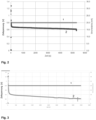
Claims (16)

  1. Elektrochemische Primärzelle aufweisend eine Anode, eine Kathode sowie mindestens einen Separator, wobei der Separator die Kathode und die Anode voneinander separiert, wobei die Primärzelle eine Elektrolytlösung enthält, wobei die Kathode als Material Mangandioxid und optional Kohlenstoff enthaltenden Leitfähigkeitsvermittler umfasst, dadurch gekennzeichnet, dass die Anode als Anodenmaterial Silizium umfasst, und zumindest ein Anteil des Siliziums in Form von Silizium-Partikeln umfassend Silizium-Partikel mit einer Partikelgröße im Bereich von 0,1 µm bis 20 µm oder als Folie mit einer Schichtdicke von größer gleich 0,1 µm vorliegt.
  2. Primärzelle nach Anspruch 1, dadurch gekennzeichnet, dass die Silizium-Partikel als i) kristalline Silizium-Partikel umfassend monokristalline und/oder polykristalline Silizium-Partikel und/oder ii) als Silizium-Partikel umfassend Agglomerate und/oder Aggregate von im wesentlichen amorphen Silizium-Primärpartikeln mit einer Primärpartikelgröße von 1 nm bis 3000 nm oder Gemische dieser vorliegen, wobei insbesondere die Agglomerate und/oder Aggregate eine Größe von 100 bis 3000 nm aufweisen.
  3. Primärzelle nach Anspruch 1 oder 2, dadurch gekennzeichnet, dass die Elektrolytlösung eine wässrige, alkalische Elektrolytzusammensetzung umfassend mindestens eine lineare oder verzweigte Polyalkylenoxid-Gruppen aufweisende Verbindung mit mindestens drei Alkylenoxid-Gruppen in der Verbindung oder Gemische von mindestens zwei dieser Verbindungen umfasst, wobei die Alkylenoxid-Gruppen in der Polyalkylenoxid-Gruppen aufweisenden Verbindung ausgewählt sind aus Alkylenoxid-Gruppen mit 2 bis 6 C-Atomen je Alkylenoxid-Gruppe.
  4. Primärzelle nach Anspruch 3, dadurch gekennzeichnet, dass die Polyalkylenoxid-Gruppen aufweisende Verbindung mindestens eine terminale Gruppe ausgewählt aus Hydroxy-Gruppen, Alkyl-Gruppen, Alkoxy-Gruppen, Alkenyl-Gruppen, Alkenyloxid-Gruppen, Carbonsäure-Gruppen, Carbonsäureester-Gruppen, Carbonsäureamid-Gruppen, aromatischen-Gruppen und/oder Gruppen enthaltend cyclische-Ether aufweist.
  5. Primärzelle nach Anspruch 1, dadurch gekennzeichnet, dass
    i) das Material der Kathode der Primärzelle Mangandioxid und optional einen Kohlenstoff enthaltenden Leitfähigkeitsvermittler aufweist, wobei die Primärzelle in einem hermetisch abgeschlossenen Gehäuse vorliegt, oder
    ii) die Kathode der Primärzelle eine Luftkathode ist und das Material der Kathode der Primärzelle Manganoxid, insbesondere Manganoxid und/oder Mangandioxid, Platin, Platin-Basis, Silber einzeln oder gemeinsam als Katalysator umfasst und optional einen Kohlenstoff enthaltenden Leitfähigkeitsvermittler aufweist, insbesondere weist die Luftkathode eine für Kohlendioxid undurchlässige Membran auf.
  6. Primärzelle nach einem der Ansprüche 1 bis 5, dadurch gekennzeichnet, dass in der Elektrolytzusammensetzung mindestens eine terminale Gruppe der Polyalkylenoxid-Gruppen aufweisenden Verbindung ausgewählt ist aus Hydroxy-Gruppe, Carbonsäure-Gruppe, Carbonsäureester-Gruppe, Carbonsäureamid-Gruppe und mindestens eine weitere terminale Gruppe ausgewählt ist aus Hydroxy-Gruppen, Alkyl-Gruppen, Alkoxy-Gruppen, Alkenyl-Gruppen, Alkenyloxid-Gruppen, Carbonsäureester-Gruppen, Carbonsäureamid-Gruppen, aromatischen-Gruppen, insbesondere Alkyl-funktionalisierte Phenyl-Gruppen, besonders bevorzugt Polyalkylenoxid-Gruppen aufweisende Verbindungen eines Rapsölamid, 4-(1,1,3,3-Tetramethylbutyl)-phenyl-polyethyleneglykol, bevorzugt 4-(1,1,3,3-Tetramethylbutyl)phenyl-polyethylene glycol, t-Octylphenoxypolyethoxyethanol, Polyethylene glycol tert-octylphenyl ether und/oder Gruppen enthaltend cyclische-Ether.
  7. Primärzelle nach einem der Ansprüche 3 bis 6, dadurch gekennzeichnet, dass die verzweigten Polyalkylenoxid-Gruppen aufweisende Verbindung umfassend mindestens eine Carbonsäureester-Gruppe einer Fettsäure, Glyceryl-Fettsäuren, insbesondere Glyceryl-Oleate, Glyceryl-Caprylate, Glyceryl-Linoleate, Glyceryl-Stearate, Glyceryl-Palmitate, Öl-Amiden, wie Polyalkylenoxide eines Rapsölamids, Ether von Kohlenhydraten, insbesondere Ether von Furanosen oder Pyranosen, die optional Carbonsäureester von Fettsäure und Gemische umfassend mindestens zwei der genannten Verbindungen, besonders bevorzugt sind Polyalkylenoxid-Gruppen aufweisende Verbindung umfassend mindestens eine Carbonsäureester-Gruppe einer Fettsäure, Glyceryl-Fettsäuren, insbesondere Glyceryl-Oleate, Glyceryl-Caprylate, Glyceryl-Linoleate, Glyceryl-Stearate, Glyceryl-Palmitate, Polyalkylenoxid-Gruppen aufweisende Verbindung umfassend Aminde von Glyceryl-Fettsäuren, insbesondere Rapsölamid, und Gemische umfassend mindestens zwei der vorgenannten Glyreyl-Fettsäure Amide davon.
  8. Primärzelle nach einem der Ansprüche 3 bis 7, dadurch gekennzeichnet, dass die Alkylenoxid-Gruppen in der Polyalkylenoxid-Gruppen aufweisenden Verbindung ausgewählt sind aus Alkylenoxid-Gruppen mit 2 bis 4 C-Atomen je Alkylenoxid-Gruppe.
  9. Primärzelle nach einem der Ansprüche 3 bis 8, dadurch gekennzeichnet, dass die Polyalkylenoxid-Gruppen aufweisende Verbindung mindestens fünf Alkylenoxid-Gruppen, insbesondere bis einhundert Alkylenoxid-Gruppen, mit 2 bis 4 C-Atomen je Alkylenoxid-Gruppe in der Verbindung aufweist.
  10. Primärzelle nach einem der Ansprüche 3 bis 9, dadurch gekennzeichnet, dass die Elektrolytzusammensetzung
    - 2,0 bis 99,0 Gew.-% Wasser und
    - 0,0001 bis 15 Gew.-% Polyalkylenoxid-Gruppen aufweisende Verbindungen oder Gemische dieser und
    - 0,001 bis 40 Gew.-% Alkalihydroxid insbesondere Kaliumhydroxid,
    in Bezug auf die Gesamtzusammensetzung von 100 Gew.-% enthält.
  11. Primärzelle nach einem der Ansprüche 1 bis 10, dadurch gekennzeichnet, dass die Silizium-Partikel einen Gehalt an Bor von 10 Gew.-ppm bis 1,8 Gew.-% in Bezug auf die Gesamtzusammensetzung der Silizium-Partikel von 100 Gew.-% aufweisen.
  12. Mehrzellige Batterie und System umfassend mindestens eine mehrzellige Batterie, dadurch gekennzeichnet, dass die mehrzellige Batterie mindestens zwei bis 15.000 mit einander verbundene Primärzellen nach einem der Ansprüche 1 bis 11 umfasst, vorzugsweise sind die zwei bis 15.000 mit einander verbundenen Primärzellen in Serie geschaltet.
  13. System zur Datenverarbeitung umfassend Mittel zur Ausführung eines Verfahrens für den Betrieb einer Primärzelle nach einem der Ansprüche 1 bis 11, oder eines Systems oder einer mehrzelligen Batterie nach Anspruch 11.
  14. System zur Datenverarbeitung nach Anspruch 13, wobei das Verfahren für den Betrieb umfasst mindestens einen Verfahrensschritt in dem ein Elektrolytmanagement erfolgt, das umfasst i) Zuführung und/oder Entfernung des Elektrolyten in mindestens einer Primärzelle, und/oder ii) Einstellen der Temperatur des Elektrolyten in mindestens einer Primärzelle, insbesondere des Elektrolyten in den Primärzellen (der Batterie) auf eine definierte Temperatur, insbesondere auf eine Temperatur größer gleich 26 °C, insbesondere ist das Verfahren ein computerimplementiertes Verfahren (ein von einem Computer ausgeführtes Verfahren).
  15. Computerprogrammprodukt, umfassend Befehle, die bei der Ausführung des Programms durch einen Computer diesen veranlasst, das Verfahren nach den Ansprüchen 13 oder 14 für den Betrieb einer Primärzelle nach einem der Ansprüche 1 bis 12 oder für den Betrieb eines Systems nach Anspruch 16 auszuführen.
  16. Computer lesbares Medium, umfassend Befehle, die bei der Ausführung durch einen Computer diesen veranlassen, das Verfahren nach einem der Ansprüche 1 bis 11 auszuführen und/oder das Verfahren nach einem der Ansprüche für den Betrieb einer mehrzelligen Batterie oder eines Systems umfassend eine mehrzellige Batterie nach Anspruch 12 auszuführen.
EP22158293.5A 2022-02-23 2022-02-23 Elektrolytzusammensetzung und primärzelle enthaltend die elektrolytzusammensetzung und insbesondere nano-partikuläre silizium-partikel Ceased EP4235838A1 (de)

Priority Applications (1)

Application Number Priority Date Filing Date Title
EP22158293.5A EP4235838A1 (de) 2022-02-23 2022-02-23 Elektrolytzusammensetzung und primärzelle enthaltend die elektrolytzusammensetzung und insbesondere nano-partikuläre silizium-partikel

Applications Claiming Priority (1)

Application Number Priority Date Filing Date Title
EP22158293.5A EP4235838A1 (de) 2022-02-23 2022-02-23 Elektrolytzusammensetzung und primärzelle enthaltend die elektrolytzusammensetzung und insbesondere nano-partikuläre silizium-partikel

Publications (1)

Publication Number Publication Date
EP4235838A1 true EP4235838A1 (de) 2023-08-30

Family

ID=80449187

Family Applications (1)

Application Number Title Priority Date Filing Date
EP22158293.5A Ceased EP4235838A1 (de) 2022-02-23 2022-02-23 Elektrolytzusammensetzung und primärzelle enthaltend die elektrolytzusammensetzung und insbesondere nano-partikuläre silizium-partikel

Country Status (1)

Country Link
EP (1) EP4235838A1 (de)

Citations (1)

* Cited by examiner, † Cited by third party
Publication number Priority date Publication date Assignee Title
WO2011061728A1 (en) * 2009-11-19 2011-05-26 Technion Research & Development Foundation Ltd. Silicon-air batteries

Patent Citations (1)

* Cited by examiner, † Cited by third party
Publication number Priority date Publication date Assignee Title
WO2011061728A1 (en) * 2009-11-19 2011-05-26 Technion Research & Development Foundation Ltd. Silicon-air batteries

Non-Patent Citations (7)

* Cited by examiner, † Cited by third party
Title
BANSAL RISHABH ET AL: "Silicon-air batteries: progress, applications and challenges", SN APPLIED SCIENCES, vol. 2, no. 6, 29 May 2020 (2020-05-29) - 29 May 2020 (2020-05-29), pages 1141, XP055964258, ISSN: 2523-3963, Retrieved from the Internet <URL:https://link.springer.com/content/pdf/10.1007/s42452-020-2925-7.pdf> DOI: 10.1007/s42452-020-2925-7 *
DURMUS YASIN EMRE ET AL: "Investigation of the corrosion behavior of highly As-doped crystalline Si in alkaline Si-air batteries", ELECTROCHIMICA ACTA, vol. 265, 31 January 2018 (2018-01-31) - 31 January 2018 (2018-01-31), AMSTERDAM, NL, pages 292 - 302, XP055965765, ISSN: 0013-4686, DOI: 10.1016/j.electacta.2018.01.145 *
DURMUS YASIN EMRE ET AL: "Long run discharge, performance and efficiency of primary Silicon-air cells with alkaline electrolyte", ELECTROCHIMICA ACTA, ELSEVIER, AMSTERDAM, NL, vol. 225, 21 December 2016 (2016-12-21) - 21 December 2016 (2016-12-21), pages 215 - 224, XP029911334, ISSN: 0013-4686, DOI: 10.1016/J.ELECTACTA.2016.12.120 *
PRAKOSO BAGAS ET AL: "Recent Progress in Extending the Cycle-Life of Secondary Zn-Air Batteries", CHEMNANOMAT, vol. 7, no. 4, 1 April 2021 (2021-04-01), pages 354 - 367, XP055965837, ISSN: 2199-692X, Retrieved from the Internet <URL:https://onlinelibrary.wiley.com/doi/full-xml/10.1002/cnma.202000672> DOI: 10.1002/cnma.202000672 *
SARWAR SAAD ET AL: "Transformation of Silicon Nanowire into Nanopyramid in Alkaline Solution and its Implication in Silicon-Air Battery : Transformation of Silicon Nanowire into Nanopyramid in Alkaline Solution", BULL. KOREAN CHEM. SOC., vol. 37, no. 7, 29 June 2016 (2016-06-29) - 29 June 2016 (2016-06-29), pages 997 - 1003, XP055964321, ISSN: 1229-5949, DOI: 10.1002/bkcs.10808 *
WANG YIFEI ET AL: "Solid-state Al-air battery with an ethanol gel electrolyte", GREEN ENERGY & ENVIRONMENT, 26 May 2021 (2021-05-26) - 26 May 2021 (2021-05-26), XP055965828, ISSN: 2468-0257, DOI: 10.1016/j.gee.2021.05.011 *
ZHONG XING ET AL: "High-Capacity Silicon-Air Battery in Alkaline Solution", CHEMSUSCHEM, vol. 5, no. 1, 9 January 2012 (2012-01-09) - 9 January 2012 (2012-01-09), DE, pages 177 - 180, XP055964441, ISSN: 1864-5631, DOI: 10.1002/cssc.201100426 *

Similar Documents

Publication Publication Date Title
DE3787000T2 (de) Elektrochemische Wasserstoffspeicherlegierungen mit erhöhter Ladungsspeicherung und elektrochemische Zelle mit erhöhter Ladungsspeicherung.
Zhang et al. Enhancement of electrochemical performance with Zn-Al-Bi layered hydrotalcites as anode material for Zn/Ni secondary battery
EP2534719B1 (de) Wiederaufladbare elektrochemische zelle
DE69432820T2 (de) Aus gestapelten Plattenzellen bestehende bipolare elektrochemische Batterie
DE2734879A1 (de) Elektrokatalytisch wirksame substanzen, verfahren zu ihrer herstellung und daraus hergestellte katalysatoren und elektroden
Paulraj et al. Core/shell structure nano-iron/iron carbide electrodes for rechargeable alkaline iron batteries
DE112006000326T5 (de) Elektrodenmaterial mit verbesserten Ionen-Transport-Eigenschaften
DE60204441T2 (de) Hochleitendes elektron-material, elektrode für eine elektrochemische zelle, verfahren zur herstellung dieser elektrode und elektrochemische zelle
Milikić et al. A Pt/MnV2O6 nanocomposite for the borohydride oxidation reaction
DE112022002372T5 (de) Bipolare elektrode für metallhydrid-batterie, metallhydrid-batterie, ausgestattet mit bipolarer elektrode, verfahren zum herstellen einer bipolaren elektrode für metallhydrid-batterie und verfahren zum herstellen einer metallhydrid-batterie
DE102022107900A1 (de) Verbund-zwischenschicht für festkörperbatterien auf lithiummetallbasis und verfahren zu deren herstellung
DE112011105599T5 (de) Brennstoffzellen-Katalysatorschicht und deren Verwendungen
DE102016111502A1 (de) Elektrolyt für Metall-Luft-Batterien und Metall-Luft-Batterie
EP3327824B1 (de) Separator für eine lithium-ionen-zelle und lithium-ionen-zelle aufweisend einen derartigen separator
DE69936447T2 (de) Prismatische elektrochemische zelle
KR102441961B1 (ko) 아연공기 이차전지용 음극활물질 및 이를 포함하는 아연공기 이차전지
DE102019134104A1 (de) Eliminierung von gasförmigen reaktanden in lithiumionenbatterien
Bui et al. Hydrothermal Preparation of Fe2O3 Nanoparticles for Fe-Air Battery Anodes: Bui and Vu
EP2602857A1 (de) Alkalibatterie und verfahren zur herstellung eines positivelektrodenmaterials für die alkalibatterie
EP4235838A1 (de) Elektrolytzusammensetzung und primärzelle enthaltend die elektrolytzusammensetzung und insbesondere nano-partikuläre silizium-partikel
KR20180066060A (ko) 3차원 전극 기재를 포함하는 전기화학 소자
DE2507774A1 (de) Metall-/luftzellen und darin verwendbare luftelektroden
DE2614934A1 (de) Gaselektrode mit wasseraufnehmender schicht
KR101930753B1 (ko) 가역성이 향상된 아연 음극 및 이를 포함한 아연공기전지
EP4235836A1 (de) Elektrolytzusammensetzung und primärzelle enthaltend die elektrolytzusammensetzung und insbesondere nano-partikuläre silizium-partikel

Legal Events

Date Code Title Description
PUAI Public reference made under article 153(3) epc to a published international application that has entered the european phase

Free format text: ORIGINAL CODE: 0009012

STAA Information on the status of an ep patent application or granted ep patent

Free format text: STATUS: THE APPLICATION HAS BEEN PUBLISHED

AK Designated contracting states

Kind code of ref document: A1

Designated state(s): AL AT BE BG CH CY CZ DE DK EE ES FI FR GB GR HR HU IE IS IT LI LT LU LV MC MK MT NL NO PL PT RO RS SE SI SK SM TR

STAA Information on the status of an ep patent application or granted ep patent

Free format text: STATUS: THE APPLICATION HAS BEEN REFUSED

18R Application refused

Effective date: 20230917