EP4235690B1 - Systems for skin analysis using electronic devices - Google Patents
Systems for skin analysis using electronic devices Download PDFInfo
- Publication number
- EP4235690B1 EP4235690B1 EP23176870.6A EP23176870A EP4235690B1 EP 4235690 B1 EP4235690 B1 EP 4235690B1 EP 23176870 A EP23176870 A EP 23176870A EP 4235690 B1 EP4235690 B1 EP 4235690B1
- Authority
- EP
- European Patent Office
- Prior art keywords
- skin
- user
- moisture sensor
- electronic device
- color
- Prior art date
- Legal status (The legal status is an assumption and is not a legal conclusion. Google has not performed a legal analysis and makes no representation as to the accuracy of the status listed.)
- Active
Links
Images













Classifications
-
- A—HUMAN NECESSITIES
- A61—MEDICAL OR VETERINARY SCIENCE; HYGIENE
- A61B—DIAGNOSIS; SURGERY; IDENTIFICATION
- A61B5/00—Measuring for diagnostic purposes; Identification of persons
- A61B5/0059—Measuring for diagnostic purposes; Identification of persons using light, e.g. diagnosis by transillumination, diascopy, fluorescence
- A61B5/0077—Devices for viewing the surface of the body, e.g. camera, magnifying lens
-
- A—HUMAN NECESSITIES
- A61—MEDICAL OR VETERINARY SCIENCE; HYGIENE
- A61B—DIAGNOSIS; SURGERY; IDENTIFICATION
- A61B5/00—Measuring for diagnostic purposes; Identification of persons
- A61B5/44—Detecting, measuring or recording for evaluating the integumentary system, e.g. skin, hair or nails
- A61B5/441—Skin evaluation, e.g. for skin disorder diagnosis
-
- A—HUMAN NECESSITIES
- A45—HAND OR TRAVELLING ARTICLES
- A45D—HAIRDRESSING OR SHAVING EQUIPMENT; EQUIPMENT FOR COSMETICS OR COSMETIC TREATMENTS, e.g. FOR MANICURING OR PEDICURING
- A45D44/00—Other cosmetic or toiletry articles, e.g. for hairdressers' rooms
- A45D44/005—Other cosmetic or toiletry articles, e.g. for hairdressers' rooms for selecting or displaying personal cosmetic colours or hairstyle
-
- A—HUMAN NECESSITIES
- A61—MEDICAL OR VETERINARY SCIENCE; HYGIENE
- A61B—DIAGNOSIS; SURGERY; IDENTIFICATION
- A61B5/00—Measuring for diagnostic purposes; Identification of persons
- A61B5/44—Detecting, measuring or recording for evaluating the integumentary system, e.g. skin, hair or nails
- A61B5/441—Skin evaluation, e.g. for skin disorder diagnosis
- A61B5/443—Evaluating skin constituents, e.g. elastin, melanin, water
-
- A—HUMAN NECESSITIES
- A61—MEDICAL OR VETERINARY SCIENCE; HYGIENE
- A61B—DIAGNOSIS; SURGERY; IDENTIFICATION
- A61B5/00—Measuring for diagnostic purposes; Identification of persons
- A61B5/68—Arrangements of detecting, measuring or recording means, e.g. sensors, in relation to patient
- A61B5/6801—Arrangements of detecting, measuring or recording means, e.g. sensors, in relation to patient specially adapted to be attached to or worn on the body surface
- A61B5/6843—Monitoring or controlling sensor contact pressure
-
- A—HUMAN NECESSITIES
- A61—MEDICAL OR VETERINARY SCIENCE; HYGIENE
- A61B—DIAGNOSIS; SURGERY; IDENTIFICATION
- A61B5/00—Measuring for diagnostic purposes; Identification of persons
- A61B5/68—Arrangements of detecting, measuring or recording means, e.g. sensors, in relation to patient
- A61B5/6887—Arrangements of detecting, measuring or recording means, e.g. sensors, in relation to patient mounted on external non-worn devices, e.g. non-medical devices
- A61B5/6898—Portable consumer electronic devices, e.g. music players, telephones, tablet computers
-
- A—HUMAN NECESSITIES
- A61—MEDICAL OR VETERINARY SCIENCE; HYGIENE
- A61B—DIAGNOSIS; SURGERY; IDENTIFICATION
- A61B5/00—Measuring for diagnostic purposes; Identification of persons
- A61B5/74—Details of notification to user or communication with user or patient; User input means
- A61B5/742—Details of notification to user or communication with user or patient; User input means using visual displays
- A61B5/743—Displaying an image simultaneously with additional graphical information, e.g. symbols, charts, function plots
-
- A—HUMAN NECESSITIES
- A61—MEDICAL OR VETERINARY SCIENCE; HYGIENE
- A61B—DIAGNOSIS; SURGERY; IDENTIFICATION
- A61B5/00—Measuring for diagnostic purposes; Identification of persons
- A61B5/74—Details of notification to user or communication with user or patient; User input means
- A61B5/742—Details of notification to user or communication with user or patient; User input means using visual displays
- A61B5/744—Displaying an avatar, e.g. an animated cartoon character
-
- G—PHYSICS
- G06—COMPUTING OR CALCULATING; COUNTING
- G06T—IMAGE DATA PROCESSING OR GENERATION, IN GENERAL
- G06T7/00—Image analysis
- G06T7/0002—Inspection of images, e.g. flaw detection
- G06T7/0012—Biomedical image inspection
-
- G—PHYSICS
- G06—COMPUTING OR CALCULATING; COUNTING
- G06T—IMAGE DATA PROCESSING OR GENERATION, IN GENERAL
- G06T7/00—Image analysis
- G06T7/90—Determination of colour characteristics
-
- G—PHYSICS
- G16—INFORMATION AND COMMUNICATION TECHNOLOGY [ICT] SPECIALLY ADAPTED FOR SPECIFIC APPLICATION FIELDS
- G16H—HEALTHCARE INFORMATICS, i.e. INFORMATION AND COMMUNICATION TECHNOLOGY [ICT] SPECIALLY ADAPTED FOR THE HANDLING OR PROCESSING OF MEDICAL OR HEALTHCARE DATA
- G16H40/00—ICT specially adapted for the management or administration of healthcare resources or facilities; ICT specially adapted for the management or operation of medical equipment or devices
- G16H40/60—ICT specially adapted for the management or administration of healthcare resources or facilities; ICT specially adapted for the management or operation of medical equipment or devices for the operation of medical equipment or devices
- G16H40/67—ICT specially adapted for the management or administration of healthcare resources or facilities; ICT specially adapted for the management or operation of medical equipment or devices for the operation of medical equipment or devices for remote operation
-
- A—HUMAN NECESSITIES
- A45—HAND OR TRAVELLING ARTICLES
- A45D—HAIRDRESSING OR SHAVING EQUIPMENT; EQUIPMENT FOR COSMETICS OR COSMETIC TREATMENTS, e.g. FOR MANICURING OR PEDICURING
- A45D44/00—Other cosmetic or toiletry articles, e.g. for hairdressers' rooms
- A45D2044/007—Devices for determining the condition of hair or skin or for selecting the appropriate cosmetic or hair treatment
-
- A—HUMAN NECESSITIES
- A61—MEDICAL OR VETERINARY SCIENCE; HYGIENE
- A61B—DIAGNOSIS; SURGERY; IDENTIFICATION
- A61B2560/00—Constructional details of operational features of apparatus; Accessories for medical measuring apparatus
- A61B2560/02—Operational features
- A61B2560/0223—Operational features of calibration, e.g. protocols for calibrating sensors
-
- A—HUMAN NECESSITIES
- A61—MEDICAL OR VETERINARY SCIENCE; HYGIENE
- A61B—DIAGNOSIS; SURGERY; IDENTIFICATION
- A61B2560/00—Constructional details of operational features of apparatus; Accessories for medical measuring apparatus
- A61B2560/04—Constructional details of apparatus
- A61B2560/0443—Modular apparatus
-
- A—HUMAN NECESSITIES
- A61—MEDICAL OR VETERINARY SCIENCE; HYGIENE
- A61B—DIAGNOSIS; SURGERY; IDENTIFICATION
- A61B5/00—Measuring for diagnostic purposes; Identification of persons
- A61B5/0002—Remote monitoring of patients using telemetry, e.g. transmission of vital signals via a communication network
- A61B5/0015—Remote monitoring of patients using telemetry, e.g. transmission of vital signals via a communication network characterised by features of the telemetry system
- A61B5/0022—Monitoring a patient using a global network, e.g. telephone networks, internet
-
- A—HUMAN NECESSITIES
- A61—MEDICAL OR VETERINARY SCIENCE; HYGIENE
- A61B—DIAGNOSIS; SURGERY; IDENTIFICATION
- A61B5/00—Measuring for diagnostic purposes; Identification of persons
- A61B5/44—Detecting, measuring or recording for evaluating the integumentary system, e.g. skin, hair or nails
- A61B5/441—Skin evaluation, e.g. for skin disorder diagnosis
- A61B5/442—Evaluating skin mechanical properties, e.g. elasticity, hardness, texture, wrinkle assessment
-
- A—HUMAN NECESSITIES
- A61—MEDICAL OR VETERINARY SCIENCE; HYGIENE
- A61B—DIAGNOSIS; SURGERY; IDENTIFICATION
- A61B5/00—Measuring for diagnostic purposes; Identification of persons
- A61B5/44—Detecting, measuring or recording for evaluating the integumentary system, e.g. skin, hair or nails
- A61B5/441—Skin evaluation, e.g. for skin disorder diagnosis
- A61B5/444—Evaluating skin marks, e.g. mole, nevi, tumour, scar
-
- A—HUMAN NECESSITIES
- A61—MEDICAL OR VETERINARY SCIENCE; HYGIENE
- A61B—DIAGNOSIS; SURGERY; IDENTIFICATION
- A61B5/00—Measuring for diagnostic purposes; Identification of persons
- A61B5/44—Detecting, measuring or recording for evaluating the integumentary system, e.g. skin, hair or nails
- A61B5/441—Skin evaluation, e.g. for skin disorder diagnosis
- A61B5/445—Evaluating skin irritation or skin trauma, e.g. rash, eczema, wound, bed sore
-
- G—PHYSICS
- G06—COMPUTING OR CALCULATING; COUNTING
- G06T—IMAGE DATA PROCESSING OR GENERATION, IN GENERAL
- G06T2207/00—Indexing scheme for image analysis or image enhancement
- G06T2207/10—Image acquisition modality
- G06T2207/10024—Color image
-
- G—PHYSICS
- G06—COMPUTING OR CALCULATING; COUNTING
- G06T—IMAGE DATA PROCESSING OR GENERATION, IN GENERAL
- G06T2207/00—Indexing scheme for image analysis or image enhancement
- G06T2207/30—Subject of image; Context of image processing
- G06T2207/30004—Biomedical image processing
- G06T2207/30088—Skin; Dermal
Definitions
- the present disclosure relates to measurement and analysis of skin characteristics and in particular to systems and methods of measuring skin characteristics using skin analysis devices that attach to smartphones, and sharing the measurements so as to provide recommended skin care and cosmetics products based on the skin analysis.
- Skin care product manufacturers create skin care products to assist users with maintaining healthy and beautiful skin.
- one of the biggest problems in the consumer skin care and cosmetics industries are the difficulties in assessing skin type, the inability to quantitatively and objectively demonstrate that a skin care product is effective, and the difficulty in matching cosmetics colors to a consumers' specific skin tones.
- EP 1 184 663 A2 discloses a method and apparatus for measuring skin moisture employing near infrared reflectance spectroscopy employing a halogen lamp and spectrometer.
- a system for calibrating a moisture sensor configured to be pressed into contact with a user's skin at an unknown pressure by a user when taking a moisture sensor reading, wherein pressure affects the moisture sensor reading.
- the system according to the invention comprises: a moisture sensor, configured to provide moisture sensor readings to a skin characteristic application, and an electronic device comprising a camera with a variable focus distance, that has a focus distance when taking an image; and a skin characteristic application configured to facilitate taking a first picture of a test subject at a forceful pressure and recording i) a first focus distance when the first picture was taken and ii) a first moisture sensor reading from the moisture sensor; implement taking a second picture of the test subject at a light pressure and recording i) a second focus distance when the second picture was taken and ii) a second moisture sensor reading from the moisture sensor; calculate a pressure-based moisture adjustment slope; apply a pressure-based moisture adjustment factor, obtained from said pressure-based moisture adjustment slope, to a future moisture sensor reading, taken
- the skin characteristic application is further configured to: determine the pressure-based moisture adjustment slope having a first (x/y) point at (the first focal length/the first moisture sensor reading) and a second (x/y) point at (the second focus distance/the second moisture sensor reading); and quantify an average focus distance from the first focus distance and the second focus distance.
- the skin characteristic application is further configured to: prompt a user to select a first focal point near a middle of a display of the electronic device that is previewing the first picture; and accept a user input selecting the focal point as a trigger to take a picture.
- the skin characteristic application is further configured to: ask a user to select a first focal point near a middle of a display of the electronic device that is previewing the first picture; and receive a user input selecting the focal point as a trigger to take a picture.
- the invention as herein described is a skin analysis device that attaches to a mobile device and performs one or more skin analysis actions such as capturing images of a human face to assess moisture, pores and the like. Images and other measurements are stored, compared to other samples and used to recommend products to assist with skin care.
- the present invention is defined by claim 1. Preferred embodiments are defined by the dependent claims.
- Fig. 1 illustrates aspects of a system 1 with an exemplary electronic device 10 and skin analysis device 20a that are able to communicate, via network 100, with skin analysis server 200 ("SAS"), one or more skin care product manufacturers/owners ("product owner”) 300 and one or more e-commerce vendors/sites (“vendor”) 400.
- SAS skin analysis server 200
- product owner skin care product manufacturers/owners
- vendor e-commerce vendors/sites
- System 1 may allow a user to measure and obtain/collect, store, disseminate, track and act on or use various skin characteristics and samples.
- Measuring and obtaining may mean collecting data at one or more times (each a skin characteristic sample) using one or more skin characteristic measurement devices, with or without aid from one or more skin characteristic assisters.
- Electronic device 10 may have one or more skin characteristic measurement devices (such as camera 12) and one or more skin characteristic assisters (such as vibration motor).
- Skin analysis device 20 may also have one or more skin characteristic measurement devices (such as moisture sensor 36) and one or more skin characteristic assisters (such as lens 34 or )
- Storing may mean local or remote storage of one more skin characteristic samples either for a particular user or for a larger group of users.
- Tracking may allow a user to compare themselves to their own prior skin characteristic samples (ie "is my skin more moist than it was a week ago") or to others' skin characteristics samples (ie "is my skin oilier than other people who may be comparable to me”).
- Acting may mean a user purchases a foundation that matches the color of their skin for the light they are going to be seen in, purchasing a recommended moisturizer and using it, or visiting a doctor to examine concerning spots on their skin.
- SAS 200 may be a server that stores and processes skin characteristic measurement or sample, as described herein.
- SAS 200 may be any combination of web servers, applications servers, and database servers, as would be known to those of skill in the art. Each of such servers may comprise typical server components including processors, volatile and non-volatile memory storage devices and software instructions executable thereon.
- SAS 200 may be central point of communication for app 18 to perform the functionality described herein, including exchanging skin analysis measurement samples, product recommendations, e-commerce capabilities, and the like. Of course skin characteristic application 18 may perform these, alone or in combination with SAS 200, as well.
- SAS 200 may include a database server that receives and stores all skin characteristic samples from all users into a user profile for each registered user and guest user. These may be received from one or more electronic devices 10, though app 18 may be configurable to store skin characteristic samples locally only (though that may preclude some of the results information based on population and demographic comparisons).
- SAS 200 may share user profiles (and any skin characteristic samples received therefrom) with the user referrer, for example when a user profile includes a user referrer. This may be via providing user profiles to a server of a product owner, for example.
- SAS 200 may provide various analysis functionality as described herein (such as computing histograms of comparisons with a user's historical scores or of comparisons with peers), and may provide various display functionality as described herein (such as providing websites that may present various analysis, provide links or functional links for other websites to access and display such results, and the like).
- Product owners 300 may be entities, as defined above with respect to interests in skin care products, and may also have one or more product owner servers including web servers, applications servers, and database servers, as would be known to those of skill in the art. Each of such servers may comprise typical server components including processors, volatile and non-volatile memory storage devices and software executable thereon.
- Product owner 300 may be a point of communication for app 18 (directly, or via SAS 200) for skin analysis measurement samples (such as those obtained via a user that was provided skin analysis device 20 by such product owner 300) and for storage and execution of product recommendation algorithms.
- one or more generic product recommendation algorithms may be stored and owned by SAS 200 for each product recommendation type, and product owners may own and implement their own proprietary product recommendation algorithms (for example with product owner 300 receiving the required data to perform the product recommendation algorithm, and returning the recommended product).
- Product owners 300 may also offer e-commerce services directly, may suggest vendors such as Amazon TM (separately or with the recommended products) or may be agnostic about how a user may purchase a recommended product.
- Vendors 400 may provide one or more e-commerce websites or screens (separate from or embedded in app 18, as screens on app 18, for example) that facilitate business or commercial transactions involving the transfer of information over network 100 (such as the Internet).
- Types of e-commerce sites include but are not limited to: retail sites, auctions sites, and business-to-business sites.
- Exemplary vendors 400 that may facilitate the purchase of skin care products may include Amazon TM , eBay TM , and Overstock TM .
- product owners 300 may have their own e-commerce sites as part of their general websites, or SAS 200 may be such a vendor.
- Electronic device 10 may be a mobile phone such as an iPhone TM , such as a 6 or 6s.
- Electronic device 10 may have one more components thereof, such as camera 12, and other components as are common for such devices, such as flash 8 for camera 12 power and volume buttons, a motor to cause vibration ("vibration motor", interior to electronic device 10), screens, processors, storage/memory, and the like.
- Some of such components may have visual or physical aspects thereto, that may be visible or present on the exterior surface of electronic device 10 ("visible components").
- Other components may be internal to electronic device 10, such as GPS transceivers ("internal components") but may have requirements for external surfaces of electronic device 10 to function properly (such as not blocking GPS or other wireless signals).
- Electronic device 10 may comprise expensive and powerful components (including but not limited to processors, storage/memory, camera 12 and the like). However such components may not be suited to be skin characteristic measurement devices, or skin characteristic measurement assisters, without other skin characteristic measurement devices or skin characteristic measurement assisters.
- camera 12 may have good resolution but may not have adequate traits (such as optical zoom or magnification) to enable capturing images that are suitable for skin characteristics and skin characteristic samples.
- skin characteristic measurement assisters on skin analysis device 20 and/or electronic device 10.
- other skin characteristic measurement devices may be employed).
- Electronic device 10 may have software located thereon (such as an 'app') as is known, that may be obtained and installed from an 'app store'.
- the app according to an embodiment of the present invention may be accessed on electronic device 10 to perform functionality as described herein.
- the app may also be able to access storage located on electronic device 10, such as to store data, as described herein.
- the app may also be able to perform communications between electronic device 10 and skin analysis device 20, and network 100 (and hence with SAS 200, product owners 300 and vendors 400.
- Electronic device 10 may also have an operating system that provides access to various application programming interfaces ("API").
- API application programming interfaces
- apps on electronic device 10 to 'call' the API and thus access various functionality of electronic device 10 (such as camera 12, controlling a vibration motor, turning on an electronic device light source such as flash 8 or controlling its operation when performing skin care actions, and the like).
- Electronic device 10 may have one or more apps 18 (also referred to as skin characteristic applications) installed thereon.
- App 18 may perform various functionality noted herein, and may be a human user's primary way to interact with electronic device 10 (in terms of accessing functions described herein) and skin analysis device 20.
- App 18 may be able to access various features and components of electronic device 10.
- app 18 may recive inputs from users, and provide activation signals to skin analysis device 20 (for example to take a moisture sensor reading, turn on light sources, and the like).
- Electronic device 10 may have an owner/user and may have one more guest users.
- Exemplary skin analysis device 20a may be one embodiment of skin analysis device 20.
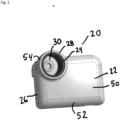
- Skin analysis device 20a may comprise exemplary enclosure 22a and sleeve 24a, both of which may comprise additional components as described herein.
- Sleeve 24a may be introduced and removably attached to enclosure 22a, such as by introducing them together by moving sleeve 24a along attachment line 6.
- Skin analysis device 20a may be introduced and removably attached to electronic device 10, such as by snapping skin analysis device 20a onto the back of electronic device 10, following securement lines 2/4. It is to be understood that the shape of skin analysis device 20, and in particular of enclosure 30, may be altered so as to allow attachment to various electronic devices 20 (such as iPhones TM , iPads TM , various Android TM phones, personal computers, and the like) in various manners (such as by snapping on as portions of enclosure 30 can snuggly attach to protrusions or edges of electronic device 10, allowing electronic device 10 to slide into an electronic device aperture 48).
- the shape of enclosure 22, or other aspects of skin analysis device 20 as necessary, can easily change to accommodate attachment to various electronic devices 10.
- Enclosure 22, and other aspects of skin analysis device 20 as necessary, can also be altered so as to not block or disrupt the functioning of electronic device 10.
- visible components may include volume controls, power on or wake up buttons, camera 12, flash 8, and the like, and may be exposed via component apertures 46 if such components would have been covered or affected by skin analysis device 20 when attached to electronic device 10.
- the shape of enclosure 22, and other aspects of skin analysis device 20 can easily change to accommodate exposing various visible components, or facilitating the operation of internal components, of various electronic devices 10.
- sleeve 24a may comprise several components of skin analysis device 20, such as lens, color calibrator, light source board, diffuser, moisture sensor, and the like (all largely as described herein but not visible in Fig 1 ) and may be removably detachable from enclosure 22a.
- various components of skin analysis device 20 may be separable from other components, such as to create a stand-alone color calibrator as described herein (for example, with one or more of sleeve 24, calibration ring 84, optionally one or more light sources 72/74, optionally with diffuser 38, and a contact ring 28 comprising the stand-alone color calibrator 80.
- skin analysis device 20 may be located at an upper end 16 of the back side 14 of electronic device 10 and may therefore cover a top portion of the back side of electronic device 10, such as no more than a third of the vertical height of electronic device 10 - though the size of such upper portion can be altered as required. Again as shown in Figure 1 , skin analysis device 20 may attach to electronic device 10 such that very little of the front side of the electronic device 10 is blocked.
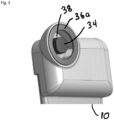
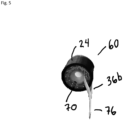
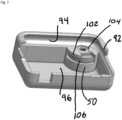
- Skin analysis device 20 generally comprises enclosure 50 comprising enclosure body 52, cylindrical sleeve assembly aperture 54, board housing 96 and electronic device housing 98 that further comprises top housing 94 and side edges 92, both board housing and electronic device housing 98 working in connection with lid 140 to house PCB 120 and electronic device 10 respectively, lens 34, cylindrical sleeve assembly 60 comprising cylindrical sleeve 24, moisture sensor 36a with moisture sensor leads 36b, light source board 70 comprising first light source 72, second light source 74 and light source leads 76, diffuser 38 comprising light source aperture 42 and camera lens aperture 40, and color calibration ring 80 comprising adhesive strip 86, calibration ring 84 having one or more color quadrants 82, skin analysis device circuit board (PCB) 120 comprising sleeve cutout 132, processor (which may also include a Bluetooth TM transceiver) 122, connector 126
- PCB skin analysis device circuit board
- Enclosure 50 comprises an enclosure body 52, configured to be removably connected to electronic device 10, and a cylindrical sleeve assembly aperture 54 configured to receive a cylindrical sleeve assembly 60 and be disposed in front of camera 12 of the electronic device 10 when the skin analysis device 20 is attached to electronic device 10.
- Enclosure 50 may cover flash 8 so that any light that is part of images of a user's skin come from light source 70.
- Cylindrical sleeve assembly aperture 54 may further comprise base plate 102, lens plate 104 and wire aperture 106.
- Base plate 102 may be a surface, proximate to electronic device 10 and optionally forming a portion of electronic device housing 98.
- Base plate 102 may be a surface to which lens 34 and/or sleeve assembly 60, are bonded and/or rests on when inserted in sleeve assembly aperture 50.
- Lens plate 104 may be a portion of base plate 102 that conforms to the shape of lens 34 to facilitate lens resting in the proper position when skin analysis device 20 is attached to electronic device 10.
- Wire aperture 106 may be an opening in sleeve housing 50 that is configured to allow electrical connections from one or more of moisture sensor 36a (such as moisture sensor leads 36b) and light source assembly (such as leads 76) to be attached to PCB 120.
- Sleeve housing 54 may further comprise a contact surface 28 that may be substantially in contact with the subject when skin analysis occurs.
- Contact surface 28 may be of a material that is comfortable for a user, such as plastic or rubber and may be integral with enclosure 50 or may be a separate component that is connectable thereto.
- Sleeve housing 54 may further comprise one or more lips or shelves 62.
- Shelf 62 may be a portion, optionally cylindrical, of sleeve housing 24 on which moisture sensor 36 and/or color calibrator are attached. Lips 62 may be radially interior from contact surface 28 such that contact surface largely envelopes lips 62.
- Electronic device 10 may be slide into electronic device housing 98 such that electronic device 10 is in contact with lid 140 and is kept in place by lid 140, top housing 94 and side edges 92. Such connection may be tight enough, for example as a result of the relative dimensions of electronic device housing 98 and/or material properties of enclosure 50 and electronic device 10, that removal of skin analysis device 20 from electronic device 10 is unlikely to occur with a user attempting to do so.
- Enclosure has a front surface 22 on which advertising or other information may be printed, stuck or otherwise located.
- Lid 140 may be slideably inserted, or placed, inside board housing 96 to protect PCB from the environment outside of skin analysis device 20.
- Lid 140 may be shaped to fit in board housing 96 and otherwise fit with the internal layout of PCB 120 (hence reset aperture 144 and charging aperture 142 that allow access to reset button 124, and charging button 128, respectively).
- Lid 140 when inserted, may form part of electronic device housing 98.
- Skin analysis device 20 further comprises lens 34, attachedly inserted in the cylindrical sleeve assembly aperture 54, radially closer to the camera than a first light source.
- Lens 34 may have a working distance to the skin/surface of 16mm and a working distance to camera 12 lens of 2mm.
- Lens 34 may be glass coated.
- There may also be one or more polarizers (which may be thin and tinted sheets that polarize one or more light sources that go through polarizer and window to assist with sensitivity analysis, and which may be located between lens 34 and the skin.
- Lens 34 may be a magnification lens that has a magnification factor as appropriate for the skin surface being imaged (for example a 30X lens 34 for skin analysis and a different magnification for hair analysis).
- Cylindrical sleeve assembly 60 may be attachedly inserted in cylindrical sleeve assembly aperture 50, and comprising a cylindrical sleeve 24, moisture sensor 36 disposed on or in the cylindrical sleeve assembly 60 and optionally located at a axially remote end of the sleeve from the camera, such that moisture sensor 36 can measure moisture qualities of a surface of the human user when the skin analysis device 20 is in a measuring mode, and a light diffuser assembly, that diffuses light from a first light source located thereon, disposed in front of the camera when the skin analysis device is attached to the electronic device, on an axially proximate end of the sleeve from camera 12.
- Sleeve 24 may be a cylinder that is sized so as to be insertable into housing 50. Sleeve 24 may rest on base plate 102 when attached to enclosure substantially black on the inside. Sleeve 24 may have an interior surface and an exterior surface. Interior surface of sleeve 24 may be light absorbing, such as a black color, so that the nature of the light that is directed at the subject (such as a user's skin) is known.
- Moisture sensor 36 may comprise sensor 36a and sensor leads 36b. Moisture sensor 36 may measure the moisture content of the skin and provide such measurement to skin analysis device processor 122. Moisture sensor 36 may be capacitive or resistive. In one embodiment moisture sensor 36 is capacitive and comprises two circular/cylindrical electrodes, having track thicknesses of .3-1mm, with a gap therebetween of .1-1.5mm. Moisture sensor 36 may be disposed on, and attached to, lips 62 of sleeve 24 and may be shaped such that they do not interfere with camera 12 (and thus may be located radially exterior to the inner/inside surface of sleeve 24 through which camera 12 may capture an image.
- Moisture sensor 36 may be in communication with a skin analysis device processor via moisture sensor leads 36b that may travel along sleeve aperture 54, through wire aperture 106 and be connected to PCB 120.
- skin analysis device 20, and in particular moisture sensor 36 and contact ring 28 may be touching a user's face or other surface.
- the amount of pressure applied to skin analysis device 20 to touch a user's face, or be pressed into contact therewith, can affect moisture sensor 36 readings, in a measurable and predictable way.
- a sensor focus distance calibration may be undertaken. This may involve asking a user to push the device hard, using forceful pressure, and allow the autofocus to determine a first lens travel distance as it takes a first moisture reading, and then asking the user to push the skin analysis device lightly, using light pressure, and allow the autofocus to determine a second lens travel distance as it takes a second moisture reading.
- App 18 may then conduct an interpolation between these values, and calculate the equation that best correlates to a range of focus distances and moisture readings, as described herein. Then each future time a moisture reading, likely using unknown pressure, is taken the future focus distance may be captured, compared to the first lens travel distance and second lens travel distance, to determine a moisture factoring value that can be applied to the moisture reading.
- a moisture reading likely using unknown pressure
- the future focus distance may be captured, compared to the first lens travel distance and second lens travel distance, to determine a moisture factoring value that can be applied to the moisture reading.
- camera 12 being a camera 12 with variable focus distance.
- Light source board 70 may comprise first light source 72, second light source 74 and light source leads 76. Light source board 70 may be in communication with the skin analysis device processor, such as via light source leads 76. Light source board 70 may, in combination with diffuser 38, be referred to as light source assembly.
- a first light source may be light emitting diode (LED) lights, such as via Vishay Semiconductors' TM VLMU3100 (Power SMD LED PLCC-2), which may have known light characteristics (such as luminous intensity, luminous intensity with angular displacement, chromaticity, and the like) which may be published in technical documentation related thereto.
- the first light source being LED light may mean that such light needs to be diffused so that white spots are not created on an image that is taken. As such, each LED light may be directly behind diffuser 38 and its light may not pass through light source aperture 42.
- Some LED lights may be configured, with one or more polarizers, to be polarized.
- a second light source may be ultraviolate (UV) lights, such as via Vishay Semiconductors TM VLMU1610-365-135, which may have known light characteristics (such as luminous intensity, luminous intensity with angular displacement, chromaticity, and the like) which may be published in technical documentation related thereto.
- the second light source being UV light may mean that such light does not need to be diffused when an image that is taken.
- each UV light may be directly behind a light source aperture 42, such that the UV light passes through such light source aperture 42.
- UV lights may be considered an adverse effect device, in that it can be dangerous if used improperly (such as directed into a user's eyes for long periods). As such extra care may be taken in the control of the activation of UV lights, as described herein.
- Light source board 70 may specifically feature multiple lights, from multiple light sources, that may be individually controllable and mounted so that the angle of light hitting the surface of the skin is varied.
- the varied angles may illuminate the skin to reveal specific textures in a 3D type of effect. This may assist in one or more skin analyses, such as by providing a measure of the depth of a line or wrinkle.
- flash 8 may be blocked or disabled (such as via app 18), contact ring 28 may be tight against a user's face (creating a a user contact point where at least a portion of skin analysis device 10 and/or electronic device 10 are proximate to or in contact with a user's skin) and sleeve 24 blocks out external light, the spectrum of light applied to a user's skin can be known.
- this may allow one or more color matching functionalities as described herein.
- light source board 70 in combination with other components noted herein to keep out other light sources
- flash 8 it may be desirable to use light source board 70 (in combination with other components noted herein to keep out other light sources) instead of flash 8, not only so the spectrum of light is known and is consistent (potentially more consistent than from flash 8) but also so that shadows and other anomalies may be eliminated - which could cause difficulty in various processings.
- light source board may have any number of light sources, and various other light sources may be used.
- infrared light may be used, which may be able to measure skin temperature and hence be used for different dermatological assessments.
- Diffuser 38 may be a component that is shaped and sized to fit inside sleeve 24, and thus may be a circle or cylinder. Diffuser may be made of any material of any color provided that such has the diffusing properties required based on the light source(s) that are to be diffused. In one example such diffuser 38 may be a white plastic. Diffuser may comprise one or more light source apertures 42, arranged to allow the desired light through from light source board, and camera lens aperture 40 to allow camera 12 to function with lens 34 to take images.
- Color calibrator 80 may be an exemplary passive skin characteristic measurement assister. Color calibrator 80 may be configured such that when camera 12 takes an image, color calibrator 80, or at least a portion of calibration ring 84, having at least one color quadrant 82, may be part of the image, for example a radial portion of the field of view of camera 12.
- Color calibrator 80 may comprise adhesive strip 86 that may assist in sticking color calibrator 80 to skin analysis device 20, such as by folding adhesive strip 86 so that it is inserted axially inside sleeve aperture 54 and calibration ring 84 is at least partially in the field of view of camera 12 (such as being the radially exterior portion of the field of view - thus creating both a human user portion and a color calibration portion when an image of a human user is taken).
- color calibrator 80 may have a center aperture 88 that is sized such that camera 12 can take a picture, through lens 34 as described herein, and still take a large enough sample of a user's skin to be effective.
- Color quadrants 82 may include any number of colors of known properties.
- a sole known color being gray with an RGB value of 122/122/121.
- color calibrator 80 When combined with other components, color calibrator 80 may form a color calibrator assembly. Color calibrator assembly may essentially keep all light, not coming from flash 8, out of an image taken by camera 12.
- Such color calibrator assembly may include color calibrator 80, sleeve 24, and skin contact ring 28. In such a configuration color calibrator assembly may remain a passive skin characteristic measurement assister. In another embodiment a color calibrator assembly may further comprise light source board and/or diffuser 38, which may make it a more effective and flexible color calibrator assembly and make it an active skin characteristic measurement assister. As an active characteristic measurement assister color calibrator assembly may require processor 24 or another way to control light source board 70.
- Configuration color calibrator assembly may be attached to electronic device 10 using skin analysis device 20, or portions thereof, or may have a simple attachment mechanism ("color calibrator assembly attachment") such as an adhesive ring on the end of sleeve 24, or a simple mechanical element that snaps or hooks onto electronic device 10 at an attachment point.
- Color calibrator assembly attachment may allow flash 8 to direct light into color calibrator assembly attachment, particularly when being used as a passive characteristic measurement assister.
- color calibrator may also be part of a stand-alone device that attaches to electronic device 10.
- PCB 120 may comprise comprising sleeve cutout 132, processor (which may also include a Bluetooth TM transceiver) 122, connector 126, charge indicator 128, reset button 124, battery 130 (not shown, on the reverse side of PCB 120) and one or more I/O connections 134.
- PCB 120 may be a typically constructed circuit board, with standard connections between components.
- PCB 120 may be shaped so as to be insertable into board housing 96, including having sleeve cutout 132 to fit around sleeve housing 50.
- Connector 126 may allow PCB to be connected to a charging and/or data transfer wire, such as micro or mini USB, as is known in the art.
- Charge indicator 128 may simply indicate that battery 130 is charging.
- Reset button 124 may allow PCB 120, and processor 122 in particular, to be reset.
- PCB further comprises battery 130 (on reverse of board 120), to provide power to PCB 120, and hence power attached components (such as moisture sensor 36 and light source board 70).
- Battery 130 may be charged by plugging into connector 126, which may be a micro or mini USB port.
- PCB 120 and more particularly processor 132, is in communication with electronic device 10 (for example using Bluetooth transceiver that may be part of processor 132 or via another wired or wireless connection), and moisture sensor 36 and light source board 70, for example via I/O connections 134.
- electronic device 10 for example using Bluetooth transceiver that may be part of processor 132 or via another wired or wireless connection
- moisture sensor 36 and light source board 70 for example via I/O connections 134.
- Processor 132 may be a microprocessor that is capable of varied and complex functioning - as described herein - including assisting in obtaining skin analysis samples (such as by controlling the functioning of moisture sensor 36 and light source board 120) and processing data (such as skin analysis samples), communicating (or controlling communications). Components of skin analysis device that communicate with or are capable of being controlled by processor 132 may be considered active components. Processor 132 may comprise a Bluetooth transceiver, to enable it to communicate with substantially any Bluetooth device, but preferably with at least electronic device 10 so as to facilitate the functionality described herein.
- Processor 132 may be a _Bluetooth integrated microprocessor from Silicon Labs TM (BGM111) microprocessor but may have custom firmware.
- Custom firmware may comprise largely off-the shelf software (OTSS) instructions to control typical features. However, custom software instructions may be written to enable the functionality described herein, and improve deficiencies in typical firmware. In one embodiment custom firmware may simply be written to remove unnecessary code that results in slower responsiveness of processor 132.
- OSS off-the shelf software
- Processor 132 may perform at least the following operations:
- Figure 9 is a method 900 for assembly of a skin analysis device 20 according to an aspect of the present invention.
- Method 900 begins at 902 where various components are produced, such as via a 3d printer.
- Such printed components may comprise enclosure 20, sleeve 24, and enclosure lid 140.
- As part of such producing/printing, such printed components may be trimmed, to remove support materials.
- lens 34 may be bonded in enclosure 24. This may be by gluing lens 34 onto base plate 102 and into lens plate 104.
- light source board 70 may be bonded on one end of sleeve 24.
- the end having light source board 70 may be the end that is proximate to electronic device 10 ("proximate end"). Bonding may involve gluing light source board 70 to sleeve 24 such that light sources are radially inside sleeve 24 and direct light through sleeve 24 towards the remote end of sleeve 24, as described herein.
- moisture sensor 36 may be bonded on one end of sleeve 24 (the opposite end from where light source board 70 may be bonded, which may be the end of sleeve 24 away from the electronic device ("remote end"). Bonding may involve gluing light source board 70 to sleeve 24.
- a battery may be attached to skin analysis device processor board 70 and leads (such as moisture sensor leads 36b and light source board leads 76) may be soldered to provide power thereto.
- processor 122 may be flashed with custom firmware, as described herein.
- sleeve 24 may be slid into enclosure 22 and bonded thereto, for example by applying glue to inner surfaces of sleeve housing 54.
- skin analysis device processor board may be inserted into enclosure 22 and wires for light source board 70 and moisture sensor 36 may be soldered to skin analysis device processor board 120.
- lid 140 may be inserted into enclosure lid aperture 96 and bonded thereto, for example by applying glue thereto.
- enclosure lid aperture may be designed such that the connection causes lid 140 to snap into place.
- tests may then be undertaken, with or without being attached to electronic device 10, to ensure proper functioning of skin analysis device 20, though is may be separate from assembly.
- Exemplary tests may include:
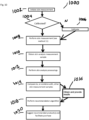
- Fig. 10 is a method 1000 for use of a skin analysis device 20 according to an aspect of the present invention.
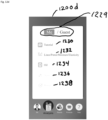
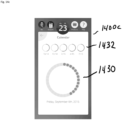
- Method 1000 may be implemented by various elements of system 1, alone or in combination. Parts of method 1000 may be implemented or performed separately, together and in various orders (even if depicted as part of method 1000 and in a particular order). Various portions of method 1000 may be depicted in screenshots 1200a-m, 1400a-d and 1500a-b.
- Method 1000 begins at 1002 where a skin measurement is initiated. This may be, for example, via selecting 1202, 1204, 1232 or 1234. Although possible for initiation to occur via skin analysis device 20 or other aspects of system 1, in a typical use initiation is via app 18 and a user thereof. As shown and described herein, initiation may be of one or more skin characteristic measurements, in largely any combination.
- a query is made whether skin analysis device 20 and electronic device 10 are calibrated.
- This query may be answered via app 18, for example that may store information or flags that indicate whether one or more calibrations have been done (for example an autofocus based moisture sensor calibration flag that indicates whether such calibration has occurred).
- Calibrations that are subject to the query may be any and all calibrations or may only be the calibrations that may be required for the skin characteristic measurements that have bene initiated.
- method 1000 proceeds to 1006 where such calibrations are performed.
- Exemplary calibrations include:
- method 1000 continues at 1008 where skin measurements occur.
- skin characteristic measurement devices For each skin characteristic measurement that is undertaken there may be one or more skin characteristic measurement devices and one or more skin characteristic assisters involved. These may all need to work in unison to properly perform such skin characteristic measurements.
- the skin characteristic measurements may be based on one or more of a moisture sensor reading and/or image(s) of the user.
- Step 1008 may be more fully described in Fig. 11 but but in one simple example the skin characteristic may be a pore analysis and step 1008 may involve:
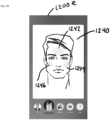
- Portions of 1008 and Figure 11 may be performed or initiated using screenshots 1200b/1200d/1200e, for example.
- Method 1000 then continues to 1010 where the skin analysis measurement sample is obtained.
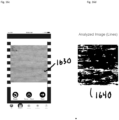
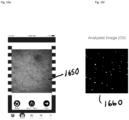
- This may involve app 18 receiving the image from camera 12 (such as images 1610, 1630, 1650), or receiving a moisture level from moisture sensor 36, which may be received by processor 122 and then communicated to app 18 via, for example, Bluetooth.
- step 1010 involves getting the captured data, generally unprocessed, from the skin characteristic measurement device(s) to app 18.
- Method 1000 then continues to 1012 where processing of the skin characteristic measurement sample may occur (ie one or more skin analysis processings).
- skin analysis processings will depend on what skin characteristic measurement(s) were taken.
- exemplary skin analysis processings may include various image processing techniques (as described herein and shown in Figs. 10 , 11 and 13 ) that may take raw images (from camera 12) and apply various techniques thereto.
- the following skin care processings may be performed:
- Steps 1010 and 1012 may largely be performed on or by electronic device 10 and/or skin analysis device 20. However, other aspects of system 1 may be involved, such as SAS 200, for example if greater processing power or storage space is required.
- method 1000 may have substantially completed processing of a skin analysis measurement sample for one or more skin analysis measurements. This may result in having a skin analysis sample.
- a skin analysis sample may have one or more raw images, one or more processed images, a user identifier, a date and time stamp, and other related information. Images may be uploaded to SAS 200 in real-time, being sent from electronic device 10. The user's sex, age, GPS coordinates, and other potentially non-personally identifying information can be stored (or personally identifying as required/desired, pursuant to applicable privacy requirements).
- Processing can occur on the device and/or on SAS 200 and/or on product owner 300 depending, for example on how intensive the processing is, what is to happen after the processing, and what entity/entities are to have a copy of the data when all is complete.
- the sample may include one or more of the following:
- Method 1000 then continues to 1014 to begin the calculations and processing required for analysis to be presented.
- the steps performed at 1014 will depend greatly on the analysis, however the collected sample may, at 1014, be compared to one or more collections or subsets of samples stored at SAS 200 that may relate to the current user (for comparison to themselves over time, such as in Fig. 14c ) or comparing the current user to all users in SAS 200 (or for product owner 300) in the user's demographic (such as in Fig. 12g , UI element 1260).
- Method 1000 then continues to 1016 where results may be shown to the user, for example on one or more screenshots of app 18 (for example as shown in Figs. 12g and 14a-d .
- Method 1000 then continues to 1018 where a recommendation algorithm is performed.
- 1018 may occur before 1014/1016 or simultaneous therewith.
- Recommendation algorithms may exist for each skin characteristic, and even for various combinations of skin characteristics.
- Recommendation algorithms may be substantially the generic recommendation algorithms described herein, which may be performed by app 18 and/or SAS 200. In such cases app 18 and/or SAS 200 have the required data and can simply apply the recommendation algorithm.
- the recommendation algorithms can be performed by product owner 300.
- app 18 and/or SAS 200 may provide data required for the recommendation algorithm ("recommendation required data") to product owner 300, and product owner 300 may communicate the recommended products (all the data required or a skin product identifier identifying a product whose information is stored in app 18) back to app 18.
- recommendation required data data required for the recommendation algorithm
- product owner 300 may communicate the recommended products (all the data required or a skin product identifier identifying a product whose information is stored in app 18) back to app 18.
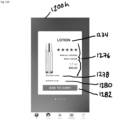
- Method 1000 then continues to 1020 where one or more recommended products are displayed for a user to review and consider purchasing, for example as shown in Fig. 12h .
- Steps 1018 and 1020 may be somewhat iterative, in that they may further involve prompting a user for additional information to better perform a recommendation algorithm. For example, a user may be doing a moisture analysis and they have dry skin. At 1018 a moisturizer may be recommended. However, after showing such recommended product, at 1020, or before, method 1000 may ask a user if they plan on using the product during the day and/or outside. If so the recommendation algorithm may change the moisturizer to a moisturizer with UV protection, particularly if skin care updates or external sources indicate high UV for where the user is located (as may be determined by a GPS location of electronic device 10).
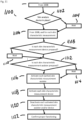
- Figs. 11 is a method 1100 for performing skin analysis measurements according to an aspect of the present invention.
- Method 1100 essentially addresses the methods for performing the recordation, or obtaining, the skin analysis measurements (with getting them into app 18, processing them, communicating them beyond app 18 being separate herefrom).
- Method 1100 begins at 1102, having arrived from 1008, for example.
- a query is made whether skin analysis device 20 (and/or electronic device 10) is in place. This may mean that skin analysis device 20 is being held on a user's face or body.
- one or more skin characteristics measurement devices and/or skin characteristic measurement assisters could be damaging (an adverse effect device - that may assist a skin characteristic measurement device take a skin characteristic sample of a user but may be dangerous to the user if used in an improper way), such a step may be desirable.
- second light source 74 may be UV and may be damaging to eyes, or other light sources that may be damaging (lasers, infrared, and the like).
- moisture sensor 36 in such an example a safe use indicator device
- moisture sensor 36 may be queried and if a reading from moisture sensor 36 indicates that the user has skin analysis device 20 in place (in such case such reading being a safe use indicator signal) then the method may proceed, and in particular before UV lights are turned on in a safe use.
- a reading from moisture sensor 36 indicates that the user has skin analysis device 20 in place (in such case such reading being a safe use indicator signal) then the method may proceed, and in particular before UV lights are turned on in a safe use.
- these queries may be performed just before the particularly problematic/dangerous skin characteristic measurement device is activated.
- method 1100 arrives at 1106, where a loop (of 1106-1120 or 1122) may begin for each skin characteristic measurement that is to occur.
- a loop (of 1106-1120 or 1122) may begin for each skin characteristic measurement that is to occur.
- imaging and moisture sensor reading may be slightly different performance of 1106-1120, for example for lines/wrinkles, oil, elasticity, etc, based on what devices and assisters may be used.
- a query is made whether, for the given skin characteristic measurement, if the required skin characteristic measurement device(s) are ready.
- camera 12 or moisture sensor 36 may need to be turned on, or warmed up, in particular if they have not been used recently (as known by app 18). If they are not ready then method 1100 waits at 1110 and prepares them.
- first light source 72 may preferably be warm before being used (making its light spectrum more consistent).
- each skin characteristic measurement assister may be activated (one or more for a given skin characteristic measurement). For passive skin characteristic measurement assisters this may not be required (ie lens 34 may already be in place). For active skin characteristic measurement assisters this may be:
- each skin characteristic measurement device may be activated (one or more for a given skin characteristic measurement), possibly after a delay to ensure assisters are sufficiently prepared (for example 1 second after a particular light source is activated). This may involve:
- skin characteristic measurement device and skin characteristic measurement assister that was activated may be deactivated (for example turning off first light source 72).
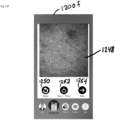
- method 1100 may confirm that proper functioning occurred. This may be via logic on app 18 and/or via inputs from a user (for example indicating acceptable image quality). This may be performed using screenshot 1200f, for example.
- Method 1100 may then return to 1010, as described herein.
- 1106-1122 are described "for each skin characteristic measurement" several may be combined in quick succession. For example one or more may be initiated at the same time, such that the above control (ie turning on and off various light sources in advance and in between taking various images) may be abstracted from a user.
- a user, or logic in app 18, may select one or more skin characteristic measurements and once a user places skin analysis device at a first skin location the required steps may be taken without further user input.
- lines, oiliness and moisture are the skin characteristic measurements. Assuming method 1100 had reached 1116 (ie camera 12, lens 34, first light source 72 and moisture sensor 36 were prepared), the following might occur:
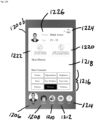
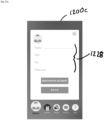
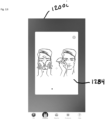
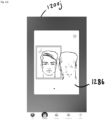
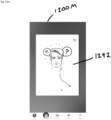
- Figs. 12a-m illustrate screenshots of app 18 for electronic device 10 according to an aspect of the present invention.
- Screenshots 1200a-m show various screens of app 18 that may be shown to a user to allow a user to access the functionality described herein.
- Each of such screens may include one or more user interface (UI) elements (buttons, text, widgets, icons, pictures, drop-down lists, tabs, infographics, and the like).
- UI user interface
- screenshots 1200a-m and the UI elements shown are exemplary only - many designs, layouts, orderings and styles of screens, UI elements, and features may be conceived to implement the functionality and aspects of the invention as described herein.
- buttons 1202 or 1204 may be presented with buttons 1202 or 1204 to select what they would like to do first. Of course all buttons herein may be accessed using user inputs (such as pushing the button on the screen or using a pointing device). If a user selects button 1202 they may begin a skin analysis, as described herein. If a user selects button 1204 they may begin finding a product, as described herein.
- UI elements At screenshot 1200b a user may be presented with the following UI elements:
- a user may be presented with the following UI elements:
- a user may be presented with a picture of a user 1240 and various sample locations 1242, 1244, 1246 that a user is to apply skin analysis device 20 to, in order to perform the intended analyses.
- a user may be presented with an image that was taken 1248 (noting such may be post-processing in Fig. 12f ), with buttons to redo 1250, save and take the next image 1252 (ie save a copy of the image on electronic device 10) and go to next 1254 (ie the image will be used but not saved in a photo album on electronic device 10).
- results may be described based on the type of result 1256 and aspects of the type of result 1258. In the present example the type is versus peers and the aspects are same sex, same age range and same country. Types may also be against myself, with an aspect being historical. Results may be shown in a results summary infographic 1260, which may include percentiles for results of lines 1262, pores 1264, moisture 1266, elasticity 1268, oil 1270 and acne 1272.
- percentiles may be assigned for each result (noting being in the 100% percentile is more desirable in Fig. 12g , though any nomenclature may be used). These percentiles may be generally calculated, for the various skin characteristics, as such:
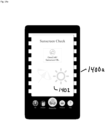
- screenshot 1200 is an exemplary screenshot that may show results. Another exemplar screenshot, showing results without a comparison, may be seen at screenshot 1400d in Fig. 14d .
- UI element 1446 may show various skin characteristics (1442) and the results/scores thereof (1444).
- a user may be presented with the recommended product 1274, along with information about the recommend product 1276 (such as a rating, reviews and links thereto, volume information, and price).
- information about the recommend product 1276 such as a rating, reviews and links thereto, volume information, and price.
- ratings and reviews from other users may be specific to users with similar skin types and/or skin tone - thus increasing the value of the ratings and reviews - for example by filtering ratings and reviewers.
- Information about the recommended product may further include how it works 1278 and instructions for use 1280.
- a user may select button 1282 to initiate the purchase of recommended product, for example by placing it in a cart (as known in the art) which may be a cart on app 18 and/or an app of vendor 400.
- a user may be presented with various images 1284, 1286, 1288, 1290 and 1292 that provide instructions. Of course these may be accompanied by text, if desired.
- a user will wash their face, ensure it appears 'normal' (ie no dirt or makeup abnormalities), position the skin analysis device appropriately and click a button on electronic device 10 (such as volume button) to initiate an image being taken by camera 12 (as in 1288), and wait for a response from app 18 to indicate they can move to another location or the image taking is complete (such as via an audible signal or a vibration).
- Figs. 13a-b are methods 1300a and an example thereof for color matching for different lighting according to an aspect of the present invention.
- the goal of method 1300a may be to determine, based on light other than ambient light (as may be specified by a user - for example outdoor, very bright for television, darker than indoor, etc), and potentially a mood or persona the user wants (such as rock and roll in 1502 - a "mood"), whether a color shade other than mindE may be preferable for the desired user, light conditions and persona.
- Method 1300a considers that images (and hence mindE) are based on ambient lighting at capture (optionally normalized to such lighting but referred to as "capture lighting") and then a user may want a recommended product/shade for outdoor or indoor lighting (each "alternative lighting” having "alternative lighting characteristics", such as in 1502).
- capture lightings and different alternative lightings can be used, and all of the configurable parameters can be adjusted to suit (parameters varying, for example on the nature of the differences between the capture lighting and the various alternative lightings).
- the goal is to alter mindE if a more suitable shade exists for the lighting/persona the user intends to use the skin care product in (such more suitable shade being a "contextual suggested product color").
- Method 1300a begins at 1302 where the minimum dE (minimum color difference) and resulting color (mindE color) is found, as described herein (for example of the candidate hue matches or the total color options).
- the dE values are found for color shades that are +1 and +2 shades darker than mindE color (ie mindE1C and mindE2C, or one shade darker and two shades darker). The dE values between shades are then found at 1306.
- a query is made whether mindE1 minus mindE is less than or equal to 1 (where one may be configured but is the dE between shades in the selection of color options. Of course if there are many shades in the color option there is a higher likelihood that the next shade darker is close to mindE (meaning that the query at 1308 is more likely to be "yes").
- a query is made if mindE2 minus mindE1 is less than or equal to a configurable parameter (6 as an example for shades 1-6, using the color shades from screenshot 1350) and mindE2 minus mindE1 is less than or equal to a further configurable parameter (3 as an example for shades 7-10, using the color shades from screenshot 1350). If so then at 1316 mindE2C becomes the recommended product for indoor lighting (if a user asks for such a product recommendation, or it may be stored in app 18). If not then mindE1C becomes the recommended product for indoor lighting.
- a configurable parameter 6 as an example for shades 1-6, using the color shades from screenshot 1350
- a further configurable parameter 3 as an example for shades 7-10, using the color shades from screenshot 1350.
- method 1300 continues to 1318 where mindE becomes the recommended product for outdoor lighting.
- a query is made if mindE1 minus mindE is less than or equal to a configurable parameter (6 as an example for shades 1-6, using the color shades from screenshot 1350) and mindE1 minus mindE is less than or equal to a further configurable parameter (3 as an example for shades 7-10, using the color shades from screenshot 1350). If so then at 1322 mindEC becomes the recommended product for indoor lighting (if a user asks for such a product recommendation, or it may be stored in app 18). If not then mindE1C becomes the recommended product for indoor lighting.
- a configurable parameter 6 as an example for shades 1-6, using the color shades from screenshot 1350
- a further configurable parameter 3 as an example for shades 7-10, using the color shades from screenshot 1350.
- screenshot 1350 may be an exemplary screenshot when "MyColor" tab 1356 is selected.
- Screenshot 1350 shows a measured skin color 1352 and one or more color options comprising the total color options for the particular color match, along with their color values.
- Tab 1358 may bring a user to a screenshot, which may be similar to screenshot 1200h, which has recommended products that may be color matched skin care products like foundation, blush, and the like.
- Tan and Tan Deep are mindE1C and mindE2C respectively, at 1304b.
- the subtractions occur and result in values (.925 and 3.197). Therefore Tan (mindE1C) becomes the outdoor recommended product or color match at 1318b and at 1322 Tan becomes the indoor recommended product or color match.
- the embodiments of the systems and methods described herein may be implemented in hardware or software, or a combination of both. These embodiments may be implemented in computer programs executing on programmable computers or electronic devices, each such device including at least one processor, a data storage system (including volatile memory or non-volatile memory or other data storage elements or a combination thereof), and at least one communication interface.
- the computer may be a digital or any analogue computer.
- Program code is applied to input data to perform the functions described herein and to generate output information.
- the output information is applied to one or more output devices, in known fashion. Such may be accomplished via applications that are operable on the electronic devices, for example.
- Each program may be implemented in a high level procedural or object oriented programming or scripting language, or both, to communicate with and/or between computer systems. However, alternatively the programs may be implemented in assembly or machine language, if desired and/or as required by the particular processor or device. The language may be a compiled or interpreted language.
- Each such computer program may be stored on a storage media or a device (e.g., read-only memory (ROM), magnetic disk, optical disc), readable by a general or special purpose programmable computer, for configuring and operating the computer when the storage media or device is read by the computer to perform the procedures described herein.
- ROM read-only memory
- Embodiments of the system may also be considered to be implemented as a non-transitory computer-readable storage medium, configured with a computer program, where the storage medium so configured causes a computer to operate in a specific and predefined manner to perform the functions described herein.
- Non-transitory computer-readable media comprise all computer-readable media, with the exception being a transitory, propagating signal.
- the term non-transitory is not intended to exclude computer readable media such as a volatile memory or random access memory (RAM), where the data stored thereon is only temporarily stored.
- the computer useable instructions may also be in various forms, including compiled and non-compiled code.
Landscapes
- Health & Medical Sciences (AREA)
- Life Sciences & Earth Sciences (AREA)
- Engineering & Computer Science (AREA)
- Biomedical Technology (AREA)
- General Health & Medical Sciences (AREA)
- Medical Informatics (AREA)
- Public Health (AREA)
- Physics & Mathematics (AREA)
- Molecular Biology (AREA)
- Biophysics (AREA)
- Pathology (AREA)
- Veterinary Medicine (AREA)
- Heart & Thoracic Surgery (AREA)
- Surgery (AREA)
- Animal Behavior & Ethology (AREA)
- Dermatology (AREA)
- Nuclear Medicine, Radiotherapy & Molecular Imaging (AREA)
- Radiology & Medical Imaging (AREA)
- Multimedia (AREA)
- Computer Networks & Wireless Communication (AREA)
- Primary Health Care (AREA)
- Business, Economics & Management (AREA)
- General Business, Economics & Management (AREA)
- Epidemiology (AREA)
- Theoretical Computer Science (AREA)
- Computer Vision & Pattern Recognition (AREA)
- General Physics & Mathematics (AREA)
- Quality & Reliability (AREA)
- Measuring And Recording Apparatus For Diagnosis (AREA)
- Measurement Of The Respiration, Hearing Ability, Form, And Blood Characteristics Of Living Organisms (AREA)
- Investigating Or Analyzing Materials By The Use Of Electric Means (AREA)
- Measurement And Recording Of Electrical Phenomena And Electrical Characteristics Of The Living Body (AREA)
- Investigating Or Analysing Biological Materials (AREA)
- Pharmaceuticals Containing Other Organic And Inorganic Compounds (AREA)
Priority Applications (1)
| Application Number | Priority Date | Filing Date | Title |
|---|---|---|---|
| EP25159367.9A EP4557306A3 (en) | 2016-04-22 | 2017-04-21 | Systems for skin analysis using electronic devices |
Applications Claiming Priority (5)
| Application Number | Priority Date | Filing Date | Title |
|---|---|---|---|
| US201662326558P | 2016-04-22 | 2016-04-22 | |
| US201662344287P | 2016-06-01 | 2016-06-01 | |
| US201662438835P | 2016-12-23 | 2016-12-23 | |
| EP17785215.9A EP3445228B1 (en) | 2016-04-22 | 2017-04-21 | Systems for skin analysis using electronic devices |
| PCT/CA2017/050503 WO2017181293A1 (en) | 2016-04-22 | 2017-04-21 | Systems and method for skin analysis using electronic devices |
Related Parent Applications (1)
| Application Number | Title | Priority Date | Filing Date |
|---|---|---|---|
| EP17785215.9A Division EP3445228B1 (en) | 2016-04-22 | 2017-04-21 | Systems for skin analysis using electronic devices |
Related Child Applications (2)
| Application Number | Title | Priority Date | Filing Date |
|---|---|---|---|
| EP25159367.9A Division-Into EP4557306A3 (en) | 2016-04-22 | 2017-04-21 | Systems for skin analysis using electronic devices |
| EP25159367.9A Division EP4557306A3 (en) | 2016-04-22 | 2017-04-21 | Systems for skin analysis using electronic devices |
Publications (4)
| Publication Number | Publication Date |
|---|---|
| EP4235690A2 EP4235690A2 (en) | 2023-08-30 |
| EP4235690A3 EP4235690A3 (en) | 2023-10-04 |
| EP4235690B1 true EP4235690B1 (en) | 2025-04-02 |
| EP4235690C0 EP4235690C0 (en) | 2025-04-02 |
Family
ID=60115705
Family Applications (3)
| Application Number | Title | Priority Date | Filing Date |
|---|---|---|---|
| EP25159367.9A Pending EP4557306A3 (en) | 2016-04-22 | 2017-04-21 | Systems for skin analysis using electronic devices |
| EP23176870.6A Active EP4235690B1 (en) | 2016-04-22 | 2017-04-21 | Systems for skin analysis using electronic devices |
| EP17785215.9A Active EP3445228B1 (en) | 2016-04-22 | 2017-04-21 | Systems for skin analysis using electronic devices |
Family Applications Before (1)
| Application Number | Title | Priority Date | Filing Date |
|---|---|---|---|
| EP25159367.9A Pending EP4557306A3 (en) | 2016-04-22 | 2017-04-21 | Systems for skin analysis using electronic devices |
Family Applications After (1)
| Application Number | Title | Priority Date | Filing Date |
|---|---|---|---|
| EP17785215.9A Active EP3445228B1 (en) | 2016-04-22 | 2017-04-21 | Systems for skin analysis using electronic devices |
Country Status (9)
| Country | Link |
|---|---|
| US (3) | US11751801B2 (enExample) |
| EP (3) | EP4557306A3 (enExample) |
| JP (4) | JP7025406B2 (enExample) |
| KR (5) | KR20240129234A (enExample) |
| CN (2) | CN109219389B (enExample) |
| CA (2) | CA3217885A1 (enExample) |
| ES (2) | ES3031452T3 (enExample) |
| SG (2) | SG10202100694SA (enExample) |
| WO (1) | WO2017181293A1 (enExample) |
Families Citing this family (66)
| Publication number | Priority date | Publication date | Assignee | Title |
|---|---|---|---|---|
| KR101803739B1 (ko) * | 2016-07-05 | 2017-12-01 | 주식회사 유니온커뮤니티 | 휴대 단말기를 이용한 자외선 미러 장치 및 그 방법 |
| US10801892B2 (en) | 2017-05-01 | 2020-10-13 | HallStar Beauty and Personal Care Innovations Company | Methods and systems for quantitatively measuring photoprotection |
| US10929722B2 (en) * | 2017-05-19 | 2021-02-23 | Nec Corporation | Anomaly detection in streaming networks |
| CN109199323B (zh) * | 2017-06-29 | 2021-01-26 | 京东方科技集团股份有限公司 | 皮肤检测装置、产品信息确定方法、装置及系统 |
| US10984559B2 (en) * | 2017-07-03 | 2021-04-20 | StyleRiser Inc. | Color engine |
| US12277735B2 (en) | 2017-07-03 | 2025-04-15 | StyleRiser Inc. | Style profile engine |
| US20190117497A1 (en) * | 2017-10-19 | 2019-04-25 | Filip Sedic | Skin cleansers and methods of use |
| KR102493028B1 (ko) * | 2018-02-23 | 2023-01-31 | 삼성전자주식회사 | 가시광선 대역의 빛을 흡수할 수 있는 렌즈를 포함하는 카메라 모듈을 이용하여 적외선에 대응하는 이미지를 획득하는 방법 및 이를 구현한 전자 장치 |
| EP3536223A1 (en) * | 2018-03-07 | 2019-09-11 | Koninklijke Philips N.V. | Device, system and method for measurement of a skin parameter |
| EP3768390A4 (en) * | 2018-03-20 | 2021-12-22 | Sunborn Outdoors LLC | PROCEDURE FOR THE AUTOMATIC SELECTION AND PROVISION OF SUN PROTECTION PRODUCTS FOR USERS |
| US10702160B2 (en) * | 2018-05-02 | 2020-07-07 | Canfield Scientific, Incorporated | Skin assessment using image fusion |
| KR102631708B1 (ko) * | 2018-06-19 | 2024-01-31 | 삼성전자주식회사 | 항산화 지수 측정 장치 및 방법 |
| CN108961589A (zh) * | 2018-07-17 | 2018-12-07 | 杨莹 | 一种自助肤质检测管理系统 |
| CN110740252A (zh) | 2018-07-20 | 2020-01-31 | 华为技术有限公司 | 一种图像获取的方法、装置及终端 |
| US20200100722A1 (en) * | 2018-10-02 | 2020-04-02 | Forward Science Technologies, LLC | Dermatological Examination |
| US10939025B2 (en) * | 2018-10-08 | 2021-03-02 | HallStar Beauty and Personal Care Innovations Company | Protection and skin damage detection devices and system |
| WO2020076731A1 (en) * | 2018-10-08 | 2020-04-16 | HallStar Beauty and Personal Care Innovations Company | Protection and skin damage detection devices and system |
| CN109793498B (zh) * | 2018-12-26 | 2020-10-27 | 华为终端有限公司 | 一种皮肤检测方法及电子设备 |
| JP7336094B2 (ja) * | 2019-02-08 | 2023-08-31 | タカノ株式会社 | 撮像装置 |
| WO2020168428A1 (en) * | 2019-02-19 | 2020-08-27 | Fitskin Inc. | Systems and methods for use and alignment of mobile device accessories for mobile devices |
| ES2984314T3 (es) * | 2019-02-27 | 2024-10-29 | Oreal | Dispositivo para inspeccionar una muestra de pelo |
| KR102267319B1 (ko) * | 2019-04-03 | 2021-06-21 | 강형진 | 피부 타입에 맞는 화장품을 추천하는 장치 및 방법 |
| WO2020219612A1 (en) * | 2019-04-23 | 2020-10-29 | The Procter & Gamble Company | Apparatus and method for visualizing cosmetic skin attributes |
| CN113711277B (zh) * | 2019-04-23 | 2025-04-11 | 宝洁公司 | 用于确定美容皮肤属性的设备和方法 |
| CN110312033B (zh) * | 2019-06-17 | 2021-02-02 | Oppo广东移动通信有限公司 | 电子装置、信息推送方法及相关产品 |
| KR102064971B1 (ko) * | 2019-07-15 | 2020-01-10 | 주식회사 메디벨바이오 | 이미지 획득 장치 |
| CN110399560A (zh) * | 2019-07-30 | 2019-11-01 | 厦门美图之家科技有限公司 | 护肤信息推荐方法、装置、设备及存储介质 |
| CN112333317A (zh) * | 2019-08-01 | 2021-02-05 | 美帕信息科技(上海)有限公司 | 一种可安装在手机载体上使用的光谱肌肤检测装置 |
| CN211749541U (zh) * | 2019-10-18 | 2020-10-27 | 励富创瑞士控股有限公司 | 皮肤检测系统 |
| KR102905733B1 (ko) * | 2019-10-21 | 2025-12-31 | 삼성디스플레이 주식회사 | 생체 감지 기능을 갖는 표시 장치 및 그것의 동작 방법 |
| US20210195713A1 (en) * | 2019-12-18 | 2021-06-24 | L'oreal | Location based lighting experience |
| DE102020203189A1 (de) * | 2020-03-12 | 2021-09-16 | Beiersdorf Aktiengesellschaft | Verfahren zur Produktempfehlung |
| CN115443095A (zh) * | 2020-06-15 | 2022-12-06 | 株式会社高丝 | 皮肤皱纹的评价方法 |
| CN111685737A (zh) * | 2020-07-03 | 2020-09-22 | 深圳德技创新实业有限公司 | 便携式面部皮肤检测仪 |
| CN111657872A (zh) * | 2020-07-03 | 2020-09-15 | 深圳德技创新实业有限公司 | 便携式面部皮肤检测仪 |
| US10991185B1 (en) | 2020-07-20 | 2021-04-27 | Abbott Laboratories | Digital pass verification systems and methods |
| CN111728592A (zh) * | 2020-07-27 | 2020-10-02 | 上海添音生物科技有限公司 | 人前臂皮肤成像系统 |
| US12079854B2 (en) * | 2020-09-30 | 2024-09-03 | Revieve Oy | System and method for determining a skin tone |
| CN112274110B (zh) * | 2020-10-10 | 2023-06-16 | 苏州万微光电科技有限公司 | 一种基于皮肤荧光图像的毛孔检测系统、装置及方法 |
| KR102378195B1 (ko) * | 2020-10-27 | 2022-03-28 | 주식회사 케이씨테크놀러지 | 피부 및 모발 측정 및 분석 시스템 |
| US12070194B2 (en) * | 2020-11-02 | 2024-08-27 | Presley M. Mock | Remote medical examination |
| US11683570B2 (en) | 2020-11-30 | 2023-06-20 | L'oreal | Cradle for creating a colorcloud |
| WO2022115738A1 (en) * | 2020-11-30 | 2022-06-02 | L'oreal | Cradle for creating a colorcloud |
| FR3120147B1 (fr) * | 2021-02-25 | 2024-02-16 | Oreal | Support pour creer un nuage de couleurs |
| KR20220087672A (ko) | 2020-12-17 | 2022-06-27 | 삼성디스플레이 주식회사 | 표시 장치 및 이의 구동 방법 |
| US20220193381A1 (en) * | 2020-12-21 | 2022-06-23 | Johnson & Johnson Consumer Inc. | Device and method for continuous even application of composition to skin |
| JP7610010B2 (ja) * | 2021-01-11 | 2025-01-07 | ザ プロクター アンド ギャンブル カンパニー | 三次元(3d)画像モデルを生成するための皮膚科学的撮像システム及び方法 |
| WO2023034877A1 (en) * | 2021-09-03 | 2023-03-09 | Emed Labs, Llc | Systems and methods for self-administered sample collection |
| US12257064B2 (en) | 2021-09-09 | 2025-03-25 | Sephora USA, Inc. | Personalized skin care from skin scanning |
| CN118215826A (zh) * | 2021-09-29 | 2024-06-18 | 菲特斯津公司 | 用于皮肤颜色确定的系统和方法 |
| WO2023063458A1 (ko) * | 2021-10-15 | 2023-04-20 | 주식회사 초위스컴퍼니 | 피부 진단 시스템 |
| KR102742932B1 (ko) * | 2021-10-15 | 2024-12-16 | (주)초위스컴퍼니 | 피부 진단 시스템 |
| KR102422772B1 (ko) * | 2022-01-05 | 2022-07-22 | 주식회사 룰루랩 | 사용자를 위한 케어 기기를 추천하는 방법 및 장치 |
| US20230309911A1 (en) * | 2022-03-31 | 2023-10-05 | L'oreal | Phone case with slidable lenses and related application for identifying skin conditions |
| KR102436130B1 (ko) * | 2022-04-25 | 2022-08-26 | 주식회사 룰루랩 | 피부 분석 영상에 대한 적합도를 판단하는 방법 및 장치 |
| CN114543692B (zh) * | 2022-04-27 | 2022-07-08 | 深圳市脉度科技有限公司 | 一种防晒霜检测仪、检测装置及方法 |
| US11638553B1 (en) * | 2022-04-29 | 2023-05-02 | Lululab Inc. | Skin condition analyzing and skin disease diagnosis device |
| EP4540800A1 (en) | 2022-06-17 | 2025-04-23 | InVue Security Products Inc. | Point-of-sale system |
| WO2023249145A1 (ko) * | 2022-06-23 | 2023-12-28 | ㈜인코돈바이오코스메틱 | 화장품 사용 및 피부 관리 비대면 컨설팅 시스템 |
| CN115414013A (zh) * | 2022-09-19 | 2022-12-02 | 中国人民解放军空军特色医学中心 | 一种压痛阈测量装置 |
| CN115287860A (zh) * | 2022-09-26 | 2022-11-04 | 江苏祥源纺织科技有限公司 | 基于自动熨烫设备的纺织物熨烫程度控制方法 |
| WO2024077379A1 (en) * | 2022-10-11 | 2024-04-18 | Fitskin Inc. | Systems and methods for improved skin tone rendering in digital images |
| US20250082260A1 (en) * | 2023-09-13 | 2025-03-13 | Whoop, Inc. | Tissue characterization |
| JPWO2025069340A1 (enExample) * | 2023-09-28 | 2025-04-03 | ||
| US20250371754A1 (en) * | 2024-05-31 | 2025-12-04 | L'oreal | Techniques for automatic identification of harmonious colors |
| CN118522055B (zh) * | 2024-07-19 | 2024-10-18 | 柏意慧心(杭州)网络科技有限公司 | 一种真实皱纹检测的实现方法、系统、设备及存储介质 |
Family Cites Families (59)
| Publication number | Priority date | Publication date | Assignee | Title |
|---|---|---|---|---|
| DE3447488A1 (de) * | 1984-10-19 | 1986-05-07 | Canon K.K., Tokio/Tokyo | Projektionseinrichtung |
| JPH07159310A (ja) * | 1993-12-07 | 1995-06-23 | Rikagaku Kenkyusho | 波長分離装置 |
| JP3710861B2 (ja) * | 1995-11-17 | 2005-10-26 | 株式会社東海理化電機製作所 | 体内挿入式医療器具用のセンサ及びそれを用いたセンシング方法 |
| GB9626825D0 (en) * | 1996-12-24 | 1997-02-12 | Crampton Stephen J | Avatar kiosk |
| CA2350056A1 (en) * | 1998-10-23 | 2000-05-04 | Nouvab Inc. | Solar radiation protection composition |
| US6993167B1 (en) * | 1999-11-12 | 2006-01-31 | Polartechnics Limited | System and method for examining, recording and analyzing dermatological conditions |
| KR100398362B1 (ko) * | 2000-09-01 | 2003-09-19 | 스펙트론 테크 주식회사 | 근적외선 분광 분석법에 의한 피부 수분 측정방법 및 장치 |
| AUPR418601A0 (en) * | 2001-04-03 | 2001-05-03 | Polartechnics Limited | Disposable calibrated camera for skin lesion examination |
| US20040125996A1 (en) * | 2002-12-27 | 2004-07-01 | Unilever Home & Personal Care Usa, Division Of Conopco, Inc. | Skin diagnostic imaging method and apparatus |
| US7233693B2 (en) * | 2003-04-29 | 2007-06-19 | Inforward, Inc. | Methods and systems for computer analysis of skin image |
| JP2006081846A (ja) * | 2004-09-17 | 2006-03-30 | Inforward Inc | 顔面溝の評価方法及び装置 |
| US8118740B2 (en) | 2004-12-20 | 2012-02-21 | Ipventure, Inc. | Moisture sensor for skin |
| US20060239547A1 (en) | 2005-04-20 | 2006-10-26 | Robinson M R | Use of optical skin measurements to determine cosmetic skin properties |
| ES2432515T3 (es) | 2005-04-28 | 2013-12-04 | Shiseido Company, Limited | Método de análisis del estado de la piel, aparato de análisis del estado de la piel y medio legible por ordenador que almacena un programa de análisis del estado de la piel |
| JP2007061307A (ja) | 2005-08-30 | 2007-03-15 | Shiseido Co Ltd | シミの分類方法 |
| US7522768B2 (en) * | 2005-09-09 | 2009-04-21 | Hewlett-Packard Development Company, L.P. | Capture and systematic use of expert color analysis |
| KR100781235B1 (ko) * | 2006-11-22 | 2007-11-30 | 김창환 | 피부측정기가 결합된 개인휴대단말기 및 이를 구성하는피부측정기와 개인휴대단말기 |
| US20100185064A1 (en) * | 2007-01-05 | 2010-07-22 | Jadran Bandic | Skin analysis methods |
| US8290257B2 (en) * | 2007-03-02 | 2012-10-16 | The Procter & Gamble Company | Method and apparatus for simulation of facial skin aging and de-aging |
| KR101140533B1 (ko) * | 2007-03-08 | 2012-05-02 | 휴렛-팩커드 디벨롭먼트 컴퍼니, 엘.피. | 이미지로부터 추정된 피부색에 기초해서 제품을 추천하는 컴퓨터 구현된 방법 |
| JP2009028275A (ja) * | 2007-07-26 | 2009-02-12 | Panasonic Electric Works Co Ltd | 光照射美容器具 |
| WO2012058641A2 (en) | 2010-10-29 | 2012-05-03 | The Regents Of The University Of California | Cellscope apparatus and methods for imaging |
| JP2010025622A (ja) * | 2008-07-16 | 2010-02-04 | Pola Chem Ind Inc | 皮膚水分量分布の鑑別法、その鑑別装置及びプログラム |
| CN101556699A (zh) * | 2008-11-07 | 2009-10-14 | 浙江大学 | 一种基于脸型的人脸衰老图像合成方法 |
| JP5167085B2 (ja) * | 2008-11-18 | 2013-03-21 | 紀伊産業株式会社 | 皮膚状態評価ツール |
| JP2010160286A (ja) | 2009-01-07 | 2010-07-22 | Softbank Mobile Corp | 携帯電話用拡張機器 |
| FR2944898B1 (fr) * | 2009-04-23 | 2018-03-16 | Lvmh Recherche | Procede et appareil de caracterisation des imperfections de la peau et procede d'appreciation de l'effet anti-vieillissement d'un produit cosmetique |
| WO2011022068A1 (en) | 2009-08-21 | 2011-02-24 | Rutkove Seward B | A hand-held device for electrical impedance myography |
| IT1399338B1 (it) * | 2010-03-29 | 2013-04-16 | Fond Istituto Italiano Di Tecnologia | Metodo e dispositivo per la misura del grado di umidità della pelle umana. |
| WO2011123861A2 (en) | 2010-04-02 | 2011-10-06 | Appbanc, Llc | A smartphone lens assembly |
| WO2012065037A1 (en) * | 2010-11-12 | 2012-05-18 | Colormodules Inc. | Method and system for color matching and color recommendation |
| FR2969915B1 (fr) | 2011-01-04 | 2014-01-03 | Ergylink | Systeme et procede pour analyser au moins une caracteristique de la peau |
| EP2498481A1 (en) * | 2011-03-09 | 2012-09-12 | Sensirion AG | Mobile phone with humidity sensor |
| KR20130057148A (ko) * | 2011-11-23 | 2013-05-31 | 차대성 | 사용자의 피부색에 따른 화장품 정보 제공 방법 및 장치 |
| JP5806106B2 (ja) * | 2011-12-27 | 2015-11-10 | 株式会社ファンケル | 日焼け止め化粧料 |
| JP5922457B2 (ja) | 2012-03-26 | 2016-05-24 | テルモ株式会社 | 褥瘡検出装置およびその作動方法 |
| US9219862B2 (en) | 2012-05-24 | 2015-12-22 | Panasonic Intellectual Property Corporation Of America | Imaging device |
| WO2013181361A2 (en) * | 2012-05-30 | 2013-12-05 | Scott Mcnulty | System, method and apparatus for electromagnetic detection and analysis of biometric information |
| US8891841B2 (en) | 2012-06-04 | 2014-11-18 | Verizon Patent And Licensing Inc. | Mobile dermatology collection and analysis system |
| JP2014014425A (ja) | 2012-07-06 | 2014-01-30 | Panasonic Corp | 携帯端末 |
| JP2014061057A (ja) * | 2012-09-20 | 2014-04-10 | Sony Corp | 情報処理装置、情報処理方法、プログラム、及び測定システム |
| KR101660323B1 (ko) * | 2012-11-09 | 2016-09-29 | 후지필름 가부시키가이샤 | 카메라 시스템, 이것에 사용되는 색변환 장치 및 방법 그리고 색변환 프로그램 |
| KR101318607B1 (ko) * | 2012-12-21 | 2013-10-30 | 에이엠씨주식회사 | 피부 상태 측정기를 이용한 모바일 서비스 제공 시스템 |
| KR101274303B1 (ko) * | 2012-12-21 | 2013-06-13 | 임재윤 | 스마트폰용 피부 상태 측정장치 |
| CN104919792B (zh) * | 2012-12-27 | 2018-05-01 | 麦克赛尔控股株式会社 | 镜头模块以及携带型拍摄装置 |
| JP2014131121A (ja) | 2012-12-28 | 2014-07-10 | Hitachi Maxell Ltd | 肌撮影システム |
| US10617305B2 (en) * | 2013-02-28 | 2020-04-14 | Canfield Scientific, Incorporated | Dermatoscope devices |
| WO2014152096A1 (en) * | 2013-03-15 | 2014-09-25 | Suncare Research Laboratories, Llc | In vitro determination of sunscreen protection based on image analysis of sunscreens applied to skin |
| US9122919B2 (en) * | 2013-03-15 | 2015-09-01 | Skin Republic, Inc. | Systems and methods for specifying and formulating customized topical agents |
| US9101320B2 (en) | 2013-04-09 | 2015-08-11 | Elc Management Llc | Skin diagnostic and image processing methods |
| US10182757B2 (en) * | 2013-07-22 | 2019-01-22 | The Rockefeller University | System and method for optical detection of skin disease |
| US9661200B2 (en) * | 2013-08-07 | 2017-05-23 | Olloclip, Llc | Auxiliary optical components for mobile devices |
| JP6289837B2 (ja) | 2013-08-23 | 2018-03-07 | マクセルホールディングス株式会社 | 肌状態測定分析情報管理システムおよび肌状態測定分析情報管理方法 |
| EP3047244B1 (en) | 2013-09-19 | 2024-04-03 | L'oreal | Systems and methods for measuring and categorizing colors and spectra of surfaces |
| JP6323097B2 (ja) * | 2014-03-18 | 2018-05-16 | 株式会社リコー | 色測定装置、色測定システム、色測定方法、および、プログラム |
| KR101618851B1 (ko) | 2014-05-12 | 2016-05-10 | 주식회사 두테크 | 모바일 기기 결합식 피부미용기기 |
| USD753308S1 (en) | 2014-07-16 | 2016-04-05 | Myskin, Inc. | Portable skin imaging device |
| TWI682763B (zh) * | 2015-04-13 | 2020-01-21 | 日商麥克賽爾控股股份有限公司 | 肌膚狀態測定分析系統及肌膚狀態測定分析方法 |
| CN105455781A (zh) * | 2015-11-17 | 2016-04-06 | 努比亚技术有限公司 | 信息处理方法及电子设备 |
-
2017
- 2017-04-21 CA CA3217885A patent/CA3217885A1/en active Pending
- 2017-04-21 EP EP25159367.9A patent/EP4557306A3/en active Pending
- 2017-04-21 SG SG10202100694SA patent/SG10202100694SA/en unknown
- 2017-04-21 KR KR1020247027569A patent/KR20240129234A/ko active Pending
- 2017-04-21 EP EP23176870.6A patent/EP4235690B1/en active Active
- 2017-04-21 CA CA3021761A patent/CA3021761C/en active Active
- 2017-04-21 JP JP2019506758A patent/JP7025406B2/ja active Active
- 2017-04-21 ES ES23176870T patent/ES3031452T3/es active Active
- 2017-04-21 KR KR1020237021332A patent/KR20230098373A/ko not_active Ceased
- 2017-04-21 KR KR1020187033511A patent/KR102317199B1/ko active Active
- 2017-04-21 ES ES17785215T patent/ES2950501T3/es active Active
- 2017-04-21 KR KR1020217033807A patent/KR102375177B1/ko active Active
- 2017-04-21 CN CN201780031091.7A patent/CN109219389B/zh active Active
- 2017-04-21 US US16/095,342 patent/US11751801B2/en active Active
- 2017-04-21 SG SG11201809233XA patent/SG11201809233XA/en unknown
- 2017-04-21 CN CN202210717439.0A patent/CN115568818B/zh active Active
- 2017-04-21 EP EP17785215.9A patent/EP3445228B1/en active Active
- 2017-04-21 KR KR1020227008216A patent/KR102548879B1/ko active Active
- 2017-04-21 WO PCT/CA2017/050503 patent/WO2017181293A1/en not_active Ceased
-
2022
- 2022-02-10 JP JP2022019361A patent/JP7232363B2/ja active Active
-
2023
- 2023-02-17 JP JP2023023332A patent/JP7418633B2/ja active Active
- 2023-07-07 US US18/348,984 patent/US12357229B2/en active Active
-
2024
- 2024-01-09 JP JP2024001299A patent/JP7756183B2/ja active Active
-
2025
- 2025-06-13 US US19/237,117 patent/US20250302372A1/en active Pending
Also Published As
Similar Documents
| Publication | Publication Date | Title |
|---|---|---|
| US12357229B2 (en) | Systems and method for skin analysis using electronic devices | |
| US12125245B1 (en) | Skin tone scanning tool for cosmetics products matching | |
| JP6289837B2 (ja) | 肌状態測定分析情報管理システムおよび肌状態測定分析情報管理方法 | |
| KR20210084102A (ko) | 전자 장치, 두피 케어 시스템 및 그들의 제어 방법 | |
| CN107645925A (zh) | 用于测量头发直径的系统和方法 | |
| CN115135232B (zh) | 皮肤和毛发测定及分析系统 | |
| JP2026010005A (ja) | 電子装置を用いた皮膚分析のためのシステムおよび方法 | |
| Cugmas et al. | Color constancy in dermatoscopy with smartphone |
Legal Events
| Date | Code | Title | Description |
|---|---|---|---|
| PUAI | Public reference made under article 153(3) epc to a published international application that has entered the european phase |
Free format text: ORIGINAL CODE: 0009012 |
|
| STAA | Information on the status of an ep patent application or granted ep patent |
Free format text: STATUS: REQUEST FOR EXAMINATION WAS MADE |
|
| 17P | Request for examination filed |
Effective date: 20230601 |
|
| AC | Divisional application: reference to earlier application |
Ref document number: 3445228 Country of ref document: EP Kind code of ref document: P |
|
| AK | Designated contracting states |
Kind code of ref document: A2 Designated state(s): AL AT BE BG CH CY CZ DE DK EE ES FI FR GB GR HR HU IE IS IT LI LT LU LV MC MK MT NL NO PL PT RO RS SE SI SK SM TR |
|
| REG | Reference to a national code |
Ipc: A61B0005000000 Ref country code: DE Ref legal event code: R079 Ref document number: 602017088770 Country of ref document: DE Free format text: PREVIOUS MAIN CLASS: G16H0040670000 |
|
| PUAL | Search report despatched |
Free format text: ORIGINAL CODE: 0009013 |
|
| AK | Designated contracting states |
Kind code of ref document: A3 Designated state(s): AL AT BE BG CH CY CZ DE DK EE ES FI FR GB GR HR HU IE IS IT LI LT LU LV MC MK MT NL NO PL PT RO RS SE SI SK SM TR |
|
| RIC1 | Information provided on ipc code assigned before grant |
Ipc: G16H 40/67 20180101ALI20230831BHEP Ipc: A61B 5/103 20060101ALI20230831BHEP Ipc: A61B 5/00 20060101AFI20230831BHEP |
|
| GRAP | Despatch of communication of intention to grant a patent |
Free format text: ORIGINAL CODE: EPIDOSNIGR1 |
|
| STAA | Information on the status of an ep patent application or granted ep patent |
Free format text: STATUS: GRANT OF PATENT IS INTENDED |
|
| GRAJ | Information related to disapproval of communication of intention to grant by the applicant or resumption of examination proceedings by the epo deleted |
Free format text: ORIGINAL CODE: EPIDOSDIGR1 |
|
| STAA | Information on the status of an ep patent application or granted ep patent |
Free format text: STATUS: REQUEST FOR EXAMINATION WAS MADE |
|
| INTG | Intention to grant announced |
Effective date: 20240924 |
|
| RIC1 | Information provided on ipc code assigned before grant |
Ipc: G16H 40/67 20180101ALI20240913BHEP Ipc: A61B 5/103 20060101ALI20240913BHEP Ipc: A61B 5/00 20060101AFI20240913BHEP |
|
| GRAP | Despatch of communication of intention to grant a patent |
Free format text: ORIGINAL CODE: EPIDOSNIGR1 |
|
| STAA | Information on the status of an ep patent application or granted ep patent |
Free format text: STATUS: GRANT OF PATENT IS INTENDED |
|
| INTG | Intention to grant announced |
Effective date: 20241028 |
|
| GRAS | Grant fee paid |
Free format text: ORIGINAL CODE: EPIDOSNIGR3 |
|
| GRAA | (expected) grant |
Free format text: ORIGINAL CODE: 0009210 |
|
| STAA | Information on the status of an ep patent application or granted ep patent |
Free format text: STATUS: THE PATENT HAS BEEN GRANTED |
|
| AC | Divisional application: reference to earlier application |
Ref document number: 3445228 Country of ref document: EP Kind code of ref document: P |
|
| AK | Designated contracting states |
Kind code of ref document: B1 Designated state(s): AL AT BE BG CH CY CZ DE DK EE ES FI FR GB GR HR HU IE IS IT LI LT LU LV MC MK MT NL NO PL PT RO RS SE SI SK SM TR |
|
| REG | Reference to a national code |
Ref country code: GB Ref legal event code: FG4D |
|
| REG | Reference to a national code |
Ref country code: CH Ref legal event code: EP |
|
| REG | Reference to a national code |
Ref country code: IE Ref legal event code: FG4D |
|
| REG | Reference to a national code |
Ref country code: DE Ref legal event code: R096 Ref document number: 602017088770 Country of ref document: DE |
|
| U01 | Request for unitary effect filed |
Effective date: 20250416 |
|
| U07 | Unitary effect registered |
Designated state(s): AT BE BG DE DK EE FI FR IT LT LU LV MT NL PT RO SE SI Effective date: 20250424 |
|
| U20 | Renewal fee for the european patent with unitary effect paid |
Year of fee payment: 9 Effective date: 20250424 |
|
| REG | Reference to a national code |
Ref country code: ES Ref legal event code: FG2A Ref document number: 3031452 Country of ref document: ES Kind code of ref document: T3 Effective date: 20250708 |
|
| PGFP | Annual fee paid to national office [announced via postgrant information from national office to epo] |
Ref country code: GB Payment date: 20250528 Year of fee payment: 9 Ref country code: ES Payment date: 20250627 Year of fee payment: 9 |
|
| PGFP | Annual fee paid to national office [announced via postgrant information from national office to epo] |
Ref country code: NO Payment date: 20250624 Year of fee payment: 9 |
|
| PGFP | Annual fee paid to national office [announced via postgrant information from national office to epo] |
Ref country code: CH Payment date: 20250626 Year of fee payment: 9 |
|
| PGFP | Annual fee paid to national office [announced via postgrant information from national office to epo] |
Ref country code: IE Payment date: 20250527 Year of fee payment: 9 |
|
| PG25 | Lapsed in a contracting state [announced via postgrant information from national office to epo] |
Ref country code: GR Free format text: LAPSE BECAUSE OF FAILURE TO SUBMIT A TRANSLATION OF THE DESCRIPTION OR TO PAY THE FEE WITHIN THE PRESCRIBED TIME-LIMIT Effective date: 20250703 |
|
| PG25 | Lapsed in a contracting state [announced via postgrant information from national office to epo] |
Ref country code: PL Free format text: LAPSE BECAUSE OF FAILURE TO SUBMIT A TRANSLATION OF THE DESCRIPTION OR TO PAY THE FEE WITHIN THE PRESCRIBED TIME-LIMIT Effective date: 20250402 |
|
| PG25 | Lapsed in a contracting state [announced via postgrant information from national office to epo] |
Ref country code: HR Free format text: LAPSE BECAUSE OF FAILURE TO SUBMIT A TRANSLATION OF THE DESCRIPTION OR TO PAY THE FEE WITHIN THE PRESCRIBED TIME-LIMIT Effective date: 20250402 |
|
| PG25 | Lapsed in a contracting state [announced via postgrant information from national office to epo] |
Ref country code: RS Free format text: LAPSE BECAUSE OF FAILURE TO SUBMIT A TRANSLATION OF THE DESCRIPTION OR TO PAY THE FEE WITHIN THE PRESCRIBED TIME-LIMIT Effective date: 20250702 |
|
| PG25 | Lapsed in a contracting state [announced via postgrant information from national office to epo] |
Ref country code: IS Free format text: LAPSE BECAUSE OF FAILURE TO SUBMIT A TRANSLATION OF THE DESCRIPTION OR TO PAY THE FEE WITHIN THE PRESCRIBED TIME-LIMIT Effective date: 20250802 |
|
| PG25 | Lapsed in a contracting state [announced via postgrant information from national office to epo] |
Ref country code: SM Free format text: LAPSE BECAUSE OF FAILURE TO SUBMIT A TRANSLATION OF THE DESCRIPTION OR TO PAY THE FEE WITHIN THE PRESCRIBED TIME-LIMIT Effective date: 20250402 |
|
| PG25 | Lapsed in a contracting state [announced via postgrant information from national office to epo] |
Ref country code: CZ Free format text: LAPSE BECAUSE OF FAILURE TO SUBMIT A TRANSLATION OF THE DESCRIPTION OR TO PAY THE FEE WITHIN THE PRESCRIBED TIME-LIMIT Effective date: 20250402 |