EP4232443B1 - 1-(pyridyl)-5-azinylpyrazol derivate und deren verwendung zur bekämpfung unerwünschten pflanzenwachstums - Google Patents
1-(pyridyl)-5-azinylpyrazol derivate und deren verwendung zur bekämpfung unerwünschten pflanzenwachstums Download PDFInfo
- Publication number
- EP4232443B1 EP4232443B1 EP21790929.0A EP21790929A EP4232443B1 EP 4232443 B1 EP4232443 B1 EP 4232443B1 EP 21790929 A EP21790929 A EP 21790929A EP 4232443 B1 EP4232443 B1 EP 4232443B1
- Authority
- EP
- European Patent Office
- Prior art keywords
- alkyl
- cycloalkyl
- methyl
- hydrogen
- haloalkyl
- Prior art date
- Legal status (The legal status is an assumption and is not a legal conclusion. Google has not performed a legal analysis and makes no representation as to the accuracy of the status listed.)
- Active
Links
Classifications
-
- C—CHEMISTRY; METALLURGY
- C07—ORGANIC CHEMISTRY
- C07D—HETEROCYCLIC COMPOUNDS
- C07D401/00—Heterocyclic compounds containing two or more hetero rings, having nitrogen atoms as the only ring hetero atoms, at least one ring being a six-membered ring with only one nitrogen atom
- C07D401/14—Heterocyclic compounds containing two or more hetero rings, having nitrogen atoms as the only ring hetero atoms, at least one ring being a six-membered ring with only one nitrogen atom containing three or more hetero rings
-
- A—HUMAN NECESSITIES
- A01—AGRICULTURE; FORESTRY; ANIMAL HUSBANDRY; HUNTING; TRAPPING; FISHING
- A01N—PRESERVATION OF BODIES OF HUMANS OR ANIMALS OR PLANTS OR PARTS THEREOF; BIOCIDES, e.g. AS DISINFECTANTS, AS PESTICIDES OR AS HERBICIDES; PEST REPELLANTS OR ATTRACTANTS; PLANT GROWTH REGULATORS
- A01N43/00—Biocides, pest repellants or attractants, or plant growth regulators containing heterocyclic compounds
- A01N43/48—Biocides, pest repellants or attractants, or plant growth regulators containing heterocyclic compounds having rings with two nitrogen atoms as the only ring hetero atoms
- A01N43/56—1,2-Diazoles; Hydrogenated 1,2-diazoles
-
- A—HUMAN NECESSITIES
- A01—AGRICULTURE; FORESTRY; ANIMAL HUSBANDRY; HUNTING; TRAPPING; FISHING
- A01N—PRESERVATION OF BODIES OF HUMANS OR ANIMALS OR PLANTS OR PARTS THEREOF; BIOCIDES, e.g. AS DISINFECTANTS, AS PESTICIDES OR AS HERBICIDES; PEST REPELLANTS OR ATTRACTANTS; PLANT GROWTH REGULATORS
- A01N43/00—Biocides, pest repellants or attractants, or plant growth regulators containing heterocyclic compounds
- A01N43/48—Biocides, pest repellants or attractants, or plant growth regulators containing heterocyclic compounds having rings with two nitrogen atoms as the only ring hetero atoms
- A01N43/54—1,3-Diazines; Hydrogenated 1,3-diazines
-
- A—HUMAN NECESSITIES
- A01—AGRICULTURE; FORESTRY; ANIMAL HUSBANDRY; HUNTING; TRAPPING; FISHING
- A01N—PRESERVATION OF BODIES OF HUMANS OR ANIMALS OR PLANTS OR PARTS THEREOF; BIOCIDES, e.g. AS DISINFECTANTS, AS PESTICIDES OR AS HERBICIDES; PEST REPELLANTS OR ATTRACTANTS; PLANT GROWTH REGULATORS
- A01N43/00—Biocides, pest repellants or attractants, or plant growth regulators containing heterocyclic compounds
- A01N43/48—Biocides, pest repellants or attractants, or plant growth regulators containing heterocyclic compounds having rings with two nitrogen atoms as the only ring hetero atoms
- A01N43/58—1,2-Diazines; Hydrogenated 1,2-diazines
-
- A—HUMAN NECESSITIES
- A01—AGRICULTURE; FORESTRY; ANIMAL HUSBANDRY; HUNTING; TRAPPING; FISHING
- A01N—PRESERVATION OF BODIES OF HUMANS OR ANIMALS OR PLANTS OR PARTS THEREOF; BIOCIDES, e.g. AS DISINFECTANTS, AS PESTICIDES OR AS HERBICIDES; PEST REPELLANTS OR ATTRACTANTS; PLANT GROWTH REGULATORS
- A01N43/00—Biocides, pest repellants or attractants, or plant growth regulators containing heterocyclic compounds
- A01N43/48—Biocides, pest repellants or attractants, or plant growth regulators containing heterocyclic compounds having rings with two nitrogen atoms as the only ring hetero atoms
- A01N43/60—1,4-Diazines; Hydrogenated 1,4-diazines
-
- A—HUMAN NECESSITIES
- A01—AGRICULTURE; FORESTRY; ANIMAL HUSBANDRY; HUNTING; TRAPPING; FISHING
- A01N—PRESERVATION OF BODIES OF HUMANS OR ANIMALS OR PLANTS OR PARTS THEREOF; BIOCIDES, e.g. AS DISINFECTANTS, AS PESTICIDES OR AS HERBICIDES; PEST REPELLANTS OR ATTRACTANTS; PLANT GROWTH REGULATORS
- A01N43/00—Biocides, pest repellants or attractants, or plant growth regulators containing heterocyclic compounds
- A01N43/64—Biocides, pest repellants or attractants, or plant growth regulators containing heterocyclic compounds having rings with three nitrogen atoms as the only ring hetero atoms
- A01N43/66—1,3,5-Triazines, not hydrogenated and not substituted at the ring nitrogen atoms
-
- C—CHEMISTRY; METALLURGY
- C07—ORGANIC CHEMISTRY
- C07D—HETEROCYCLIC COMPOUNDS
- C07D405/00—Heterocyclic compounds containing both one or more hetero rings having oxygen atoms as the only ring hetero atoms, and one or more rings having nitrogen as the only ring hetero atom
- C07D405/14—Heterocyclic compounds containing both one or more hetero rings having oxygen atoms as the only ring hetero atoms, and one or more rings having nitrogen as the only ring hetero atom containing three or more hetero rings
Definitions
- the invention relates to the technical field of plant protection agents, in particular that of herbicides for the selective control of weeds and grass weeds in crops and in ornamental gardens and for the general control of weeds and grass weeds in environmental areas in which plant growth is disruptive.
- the invention relates to substituted 1-pyridyl-5-azinylpyrazolyl-3-oxyalkyl acids, 1-pyridyl-5-azinylpyrazolyl-3-sulfanylalkyl acids, 1-pyridyl-5-azinylpyrazolyl-3-sulfinylalkyl acids and 1-pyridyl-5-azinylpyrazolyl-3-sulfonylalkyl acids and their derivatives, processes for their preparation and their use for controlling harmful plants.
- the derivatives of 1-pyridyl-5-azinylpyrazolyl-3-oxyalkyl acids, 1-pyridyl-5-azinylpyrazolyl-3-sulfanylalkyl acids, 1-pyridyl-5-azinylpyrazolyl-3-sulfinylalkyl acids and 1-pyridyl-5-azinylpyrazolyl-3-sulfonylalkyl acids include in particular their esters, salts and/or amides.
- the 1-pyridyl-5-azinylpyrazoles according to the invention are characterized in that they have a further substituent in the 4-position of the pyrazole ring.
- the 1-pyridyl-5-azinylpyrazolyl-3-oxyalkyl acids according to the invention and their derivatives differ from the already known 1,5-diphenylpyrazolyl-3-oxoacetic acids by a pyridyl radical (Q1-Q3) in the 1-position and a variable azinyl radical (A1-A15) in the 5-position of the pyrazole ring.
- Q1-Q3 pyridyl radical
- A1-A15 variable azinyl radical
- 1,5-diphenyl-pyrazolyl-3-oxoacetic acids are used in CN 101284815 revealed.
- Journal of Heterocyclic Chemistry (2012), 49(6), 1370-1375 Further syntheses and the fungicidal effect of 1,5-diphenylpyrazolyl-3-oxoacetic acids are described.
- EP 1 101 764 A1 discloses 2-aryloxy-4-methyl-6-pyrazol-1-yl-pyridines which are effective as herbicides.
- 1-pyridyl-5-azinylpyrazolyl-3-oxyacetic acids 1-pyridyl-5-azinylpyrazolyl-3-oxyalkyl acids
- 1-pyridyl-5-azinylpyrazolyl-3-sulfanylalkyl acids 1-pyridyl-5-azinylpyrazolyl-3-sulfinylalkyl acids
- 1-pyridyl-5-azinylpyrazolyl-3-sulfonylalkyl acids, as well as their derivatives, are currently unknown.
- the object of the present invention is to provide new pyrazole derivatives, namely 1-pyridyl-5-azinylpyrazolyl-3-oxyalkyl acids, 1-pyridyl-5-azinylpyrazolyl-3-sulfanylalkyl acids, 1-pyridyl-5-azinylpyrazolyl-3-sulfinylalkyl acids and 1-pyridyl-5-azinylpyrazolyl-3-sulfonylalkyl acids and their derivatives, which can be used as herbicides or plant growth regulators with a satisfactory herbicidal effect and a broad spectrum of activity against harmful plants and/or with a high selectivity in crops of useful plants.
- the problem is solved by substituted 1-pyridyl-5-azinylpyrazolyl-3-oxoalkyl acids, 1-pyridyl-5-azinylpyrazolyl-3-sulfanylalkyl acids, 1-pyridyl-5-azinylpyrazolyl-3-sulfinylalkyl acids and 1-pyridyl-5-azinylpyrazolyl-3-sulfonylalkyl acids, which are characterized by a pyridyl radical in the 1-position, an azinyl radical in the 5-position and a further substituent in the 4-position of the pyrazole ring and have a very good herbicidal effect and also very good selectivities.
- these compounds are highly effective against a wide range of economically important grass and weeds.
- the compounds also show good tolerance towards cultivated plants. This means that they can be used selectively in cultivated plants while being effective against harmful plants.
- A is selected from the group consisting of A1-A4, A6 and A8
- A is selected from the group consisting of A2, A3 and A6
- the present invention further relates to compounds of the formula ( Z ) where the definitions described above apply, including all preferred, particularly preferred and most particularly preferred definitions.
- the present invention further relates to compounds of the formula ( Y ) where the definitions described above apply, including all preferred, particularly preferred and most particularly preferred definitions.
- the present invention further relates to compounds of the formula ( W ) where the definitions described above apply, including all preferred, particularly preferred and most particularly preferred definitions.
- the present invention further relates to acids of the formula ( Ia ) where the definitions described above apply, including all preferred, particularly preferred and most particularly preferred definitions.
- the present invention further relates to compounds of formula ( V ) where the definitions described above apply, including all preferred, particularly preferred and most particularly preferred definitions.
- Another object of the present invention are compounds of formula ( VI ) where the definitions described above apply, including all preferred, particularly preferred and most particularly preferred definitions.
- Alkyl means saturated, straight-chain or branched hydrocarbon radicals with the specified number of carbon atoms, e.g. C 1 -C 6 -alkyl such as methyl, ethyl, propyl, 1-methylethyl, butyl, 1-methylpropyl, 2-methylpropyl, 1,1-dimethylethyl, pentyl, 1-methylbutyl, 2-methylbutyl, 3-methylbutyl, 2,2-dimethylpropyl, 1-ethylpropyl, hexyl, 1,1-dimethylpropyl, 1,2-dimethylpropyl,1-methylpentyl, 2-methylpentyl, 3-methylpentyl, 4-methylpentyl, 1,1-dimethylbutyl, 1,2-dimethylbutyl, 1,3-dimethylbutyl, 2,2-dimethylbutyl, 2,3-dimethylbutyl, 3,3-dimethylbutyl, 1-ethylbutyl,
- Halogen-substituted alkyl means straight-chain or branched alkyl groups, where in these groups the hydrogen atoms can be partially or completely replaced by halogen atoms, e.g. C 1 -C 2 -haloalkyl such as chloromethyl, bromomethyl, dichloromethyl, trichloromethyl, fluoromethyl, difluoromethyl, trifluoromethyl, chlorofluoromethyl, dichlorofluoromethyl, chlorodifluoromethyl, 1-chloroethyl, 1-bromoethyl, 1-fluoroethyl, 2-fluoroethyl, 2,2-difluoroethyl, 2,2,2-trifluoroethyl, 2-chloro-2-fluoroethyl, 2-chloro,2-difluoroethyl, 2,2-dichloro-2-fluoroethyl, 2,2,2-trichloroethyl, pentafluoroe
- Alkenyl means unsaturated, straight-chain or branched hydrocarbon radicals with the specified number of carbon atoms and a double bond in any position, e.g. C 2 -C 6 -alkenyl such as ethenyl, 1-propenyl, 2-propenyl, 1-methylethenyl, 1-butenyl, 2-butenyl, 3-butenyl, 1-methyl-1-propenyl, 2-methyl-1-propenyl, 1-methyl-2-propenyl, 2-methyl-2-propenyl, 1-pentenyl, 2-pentenyl, 3-pentenyl, 4-pentenyl, 1-methyl-1-butenyl, 2-methyl-1-butenyl, 3-methyl-1-butenyl, 1-methyl-2-butenyl, 2-Methyl-2-butenyl, 3-Methyl-2-butenyl, 1-Methyl-3-butenyl, 2-Methyl-3-butenyl, 3-Methyl-3-but
- Alkynyl means straight-chain or branched hydrocarbon radicals with the specified number of carbon atoms and a triple bond in any position, e.g. C 2 -C 6 -alkynyl such as ethynyl, 1-propynyl, 2-propynyl (or propargyl), 1-butynyl, 2-butynyl, 3-butynyl, 1-methyl-2-propynyl, 1-pentynyl, 2-pentynyl, 3-pentynyl, 4-pentynyl, 3-methyl-1-butynyl, 1-methyl-2-butynyl, 1-methyl-3-butynyl, 2-methyl-3-butynyl, 1,1-dimethyl-2-propynyl, 1-ethyl-2-propynyl, 1-hexynyl, 2-hexynyl, 3-hexynyl, 4-hexynyl, 5-hexynyl, 3-
- Cycloalkyl means a carbocyclic, saturated ring system with preferably 3 to 6 ring carbon atoms, e.g. cyclopropyl, cyclobutyl, cyclopentyl or cyclohexyl.
- cyclic systems with substituents are included, which also includes substituents with a double bond on the cycloalkyl radical, e.g. an alkylidene group such as methylidene.
- polycyclic aliphatic systems are also included, such as bicyclo[1.1.0]butan-1-yl, bicyclo[1.1.0]butan-2-yl, bicyclo[2.1.0]pentan-1-yl, bicyclo[2.1.0]pentan-2-yl, bicyclo[2.1.0]pentan-5-yl, bicyclo[2.2.1]hept-2-yl (norbornyl), adamantan-1-yl and adamantan-2-yl.
- spirocyclic aliphatic systems are also included, such as spiro[2.2]pent-1-yl, spiro[2.3]hex-1-yl, spiro[2.3]hex-4-yl, 3-spiro[2.3]hex-5-yl.
- Cycloalkenyl means a carbocyclic, non-aromatic, partially unsaturated ring system with preferably 4-8 C atoms, e.g. 1-cyclobutenyl, 2-cyclobutenyl, 1-cyclopentenyl, 2-cyclopentenyl, 3-cyclopentenyl, or 1-cyclohexenyl, 2-cyclohexenyl, 3-cyclohexenyl, 1,3-cyclohexadienyl or 1,4-cyclohexadienyl, which also includes substituents with a double bond on the cycloalkenyl radical, e.g. an alkylidene group such as methylidene.
- the explanations for substituted cycloalkyl apply accordingly.
- Alkoxy means saturated, straight-chain or branched alkoxy radicals with the specified number of carbon atoms, e.g. C 1 -C 6 -alkoxy such as methoxy, ethoxy, propoxy, 1-methylethoxy, butoxy, 1-methylpropoxy, 2-methylpropoxy, 1,1-dimethylethoxy, pentoxy, 1-methylbutoxy, 2-methylbutoxy, 3-methylbutoxy, 2,2-dimethylpropoxy, 1-ethylpropoxy, hexoxy, 1,1-dimethylpropoxy, 1,2-dimethylpropoxy,1-methylpentoxy, 2-methylpentoxy, 3-methylpentoxy, 4-methylpentoxy, 1,1-dimethylbutoxy, 1,2-dimethylbutoxy, 1,3-dimethylbutoxy, 2,2-dimethylbutoxy, 2,3-dimethylbutoxy, 3,3-Dimethylbutoxy, 1-Ethylbutoxy, 2-Ethylbutoxy, 1,1,2-Trimethylpropoxy, 1,2,2-Trimethylpropoxy, 1-
- Alkoxy substituted by halogen means straight-chain or branched alkoxy radicals with the respective number of carbon atoms stated, where in these groups the hydrogen atoms can be partially or completely replaced by halogen atoms as mentioned above, e.g.
- C 1 -C 2 -haloalkoxy such as chloromethoxy, bromomethoxy, dichlormethoxy, trichloromethoxy, fluoromethoxy, difluoromethoxy, trifluoromethoxy, chlorofluoromethoxy, dichlorofluoromethoxy, chlorodifluoromethoxy, 1-chloroethoxy, 1-bromoethoxy, 1-fluoroethoxy, 2-fluoroethoxy, 2,2-difluoroethoxy, 2,2,2-trifluoroethoxy, 2-chloro-2-fluoroethoxy, 2-chloro-1,2-difluoroethoxy, 2,2-dichloro-2-fluoroethoxy, 2,2,2-trichloroethoxy, pentafluoroethoxy and 1,1,1-trifluoroprop-2-oxy.
- Heterocyclyl means saturated or partially unsaturated mono-, bi- or tricyclic ring system group consisting of C atoms and at least one heteroatom, preferably selected from N, O and/or S.
- Heteroaryl unless defined otherwise elsewhere: mono-, bi- or tricyclic heterocyclic group of C atoms and at least one heteroatom, where at least one ring is aromatic.
- at least one heteroatom is N, O or S.
- all heteroatoms are selected from N, O or S.
- the ring system is a 5 to 10- or a 5 to 6-membered ring system.
- heteroaryl is an aromatic monocyclic ring system of 5 or 6 ring atoms.
- heteroaryl is an aromatic monocyclic ring system containing 1 to 4 heteroatoms from the group N, O or S.
- heteroaryl can represent a bicyclic ring system consisting of 8 to 14 ring atoms or a tricyclic ring system consisting of 13 to 14 ring atoms.
- aryl means an optionally substituted mono-, bi- or polycyclic aromatic system having preferably 6 to 14, in particular 6 to 10 ring carbon atoms, for example phenyl, naphthyl, anthryl, phenanthrenyl, and the like, preferably phenyl.
- aryl also includes multicyclic systems such as tetrahydronaphthyl, indenyl, indanyl, fluorenyl, biphenylyl, where the bonding site is on the aromatic system.
- aryl is generally also included in the term “optionally substituted phenyl”.
- aryls listed above are preferably independently one to fivefold, for example by hydrogen, halogen, alkyl, haloalkyl, hydroxy, alkoxy, cycloalkoxy, aryloxy, alkoxyalkyl, alkoxyalkoxy, cycloalkyl, halocycloalkyl, aryl, arylalkyl, heteroaryl, heterocyclyl, alkenyl, alkylcarbonyl, Cycloalkylcarbonyl, arylcarbonyl, Heteroarylcarbonyl, alkoxycarbonyl, hydroxycarbonyl, cycloalkoxycarbonyl, cycloalkylalkoxycarbonyl, alkoxycarbonylalkyl, arylalkoxycarbonyl, arylalkoxycarbonylalkyl, alkynyl, alkynylalkyl, alkylalkynyl, trisalkylsilylalkynyl, nitro, amino,
- halogen means fluorine, chlorine, bromine or iodine. If the term is used for a radical, then "halogen" means a fluorine, chlorine, bromine or iodine atom.
- the compounds of formula (I) have acidic properties and can form salts, optionally also internal salts or adducts, with inorganic or organic bases or with metal ions. If the compounds of formula (I) carry hydroxy, carboxy or other groups which induce acidic properties, these compounds can be reacted with Bases are converted into salts.
- Suitable bases are, for example, hydroxides, carbonates, hydrogen carbonates of alkali and alkaline earth metals, in particular those of sodium, potassium, magnesium and calcium, as well as ammonia, primary, secondary and tertiary amines with (C 1 -C 4 )-alkyl groups, mono-, di- and trialkanolamines of (C 1 -C 4 )-alkanols, choline and chlorocholine, as well as organic amines such as trialkylamines, morpholine, piperidine or pyridine.
- salts are compounds in which the acidic hydrogen is replaced by a cation suitable for agriculture, for example metal salts, in particular alkali metal salts or alkaline earth metal salts, in particular sodium and potassium salts, or also ammonium salts, salts with organic amines or quaternary ammonium salts, for example with cations of the formula [NRR'R"R′′′] + , in which R to R′′′ each independently represent an organic radical, in particular alkyl, aryl, aralkyl or alkylaryl.
- Alkylsulfonium and alkylsulfoxonium salts such as (C 1 -C 4 )-trialkylsulfonium and (C 1 -C 4 )-trialkylsulfoxonium salts, are also suitable.
- the compounds of formula (I) can form salts by addition of a suitable inorganic or organic acid, for example mineral acids such as HCl, HBr, H 2 SO 4 , H 3 PO 4 or HNO 3 , or organic acids, e.g. carboxylic acids such as formic acid, acetic acid, propionic acid, oxalic acid, lactic acid or salicylic acid or sulfonic acids such as p-toluenesulfonic acid, to a basic group such as amino, alkylamino, dialkylamino, piperidino, morpholino or pyridino.
- a suitable inorganic or organic acid for example mineral acids such as HCl, HBr, H 2 SO 4 , H 3 PO 4 or HNO 3
- organic acids e.g. carboxylic acids such as formic acid, acetic acid, propionic acid, oxalic acid, lactic acid or salicylic acid or sulfonic acids such as p-to
- Suitable substituents that are present in deprotonated form can form inner salts with protonatable groups, such as amino groups.
- the present compounds of general formula (I) have a chiral carbon atom on the second carbon of the alkyl acid structure, which is indicated in the structure shown below by the marking (*):
- this carbon atom can have both an (R) and an (S) configuration.
- the present invention relates in particular to compounds of the general formula (I*) in which the stereochemical configuration at the carbon atom marked with (*) is present with a stereochemical purity of 60 to 100% (R), preferably 80 to 100% (R), in particular 90 to 100% (R), very particularly 95 to 100% (R).
- a further aspect of the invention relates to the preparation of the compounds of the general formula (I) according to the invention.
- the compounds of the invention can be prepared in different ways.
- the synthesis of the compounds of the general formula ( Ib ) according to the invention is carried out via an amide coupling of an acid of the general formula ( Ia ) with an amine of the general formula ( II ) in the presence of an amide coupling reagent such as, for example, T3P, dicyclohexylcarbodiimide, N -(3-dimethylaminopropyl)- N' -ethylcarbodiimide, N , N' -carbonyldiimidazole, 2-chloro-1,3-dimethylimidazolium chloride or 2-chloro-1-methylpyridinium iodide (see Chemistry of Peptide Synthesis, Ed. N.
- Polymer-bound reagents such as polymer-bound dicyclohexylcarbodiimide are also suitable for this coupling reaction.
- the reaction preferably takes place in the temperature range between 0 °C and 80 °C, in an adequate solvent such as dichloromethane, acetonitrile, N , N -dimethylformamide or ethyl acetate and in the presence of a base such as triethylamine, N , N -diisopropylethylamine or 1,8-diazabicyclo[5.4.0]undec-7-cene (see Scheme 1).
- an adequate solvent such as dichloromethane, acetonitrile, N , N -dimethylformamide or ethyl acetate
- a base such as triethylamine, N , N -diisopropylethylamine or 1,8-diazabicyclo[5.4.0]undec-7-cene (see
- the synthesis of the acid of general formula (Ia) can be carried out by saponification of the compound of general formula (Ic) according to or can be prepared analogously to methods known to the person skilled in the art (Scheme 2).
- the saponification can be carried out in the presence of a base or a Lewis acid.
- the base can be a hydroxide salt of an alkali metal (such as lithium, sodium or potassium), and the saponification reaction preferably takes place in the temperature range between room temperature and 120 °C.
- Scheme 6 describes the synthesis of the compound of general formula (Ic) by reaction of a pyrazole of general formula (Ic) with a halogenosuccinimide of general formula (VIII) in an appropriate solvent such as N,N-dimethylformamide.
- a compound of the general formula (Ic) can be prepared, for example, by reacting a compound of the formula (Ic) in a suitable solvent with a metal cyanide M-CN (IX) with the addition of an adequate amount of a transition metal catalyst, in particular palladium catalysts such as palladium(0)tetrakis(triphenylphosphine) or palladium diacetate or bis(triphenylphosphine)palladium(II) dichloride or nickel catalysts such as nickel(II)acetylacetonate or bis(triphenylphosphine)nickel(II) chloride, preferably at elevated temperature in an organic solvent such as, for example, 1,2-dimethoxyethane or N,N-dimethylformamide (Scheme 6).
- a transition metal catalyst in particular palladium catalysts such as palladium(0)tetrakis(triphenylphosphine) or palladium diacetate or bis(triphenylphosphine)pal
- the 3-hydroxypyrazoles (V) can be prepared analogously to literature methods from substituted 3-azinylpropionic acid derivatives and phenylhydrazines (Scheme 7); e.g.: Adv. Synth. Catal. 2014, 356, 3135-3147 ) or from substituted azinylacrylic acid derivatives and phenylhydrazines (Scheme 3; e.g.: J. Heterocyclic Chem., 49, 130 (2012 )) can be produced.
- the synthesis of the compounds of the general formula (XII) is carried out via an amide coupling of an acid of the general formula (X) with an arylhydrazine or hetarylhydrazine of the general formula (XI) in the presence of an amide coupling reagent such as T3P, dicyclohexylcarbodiimide, N- (3-dimethylaminopropyl)-N'-ethylcarbodiimide, N , N '-carbonyldiimidazole, 2-chloro-1,3-dimethylimidazolium chloride or 2-chloro-1-methylpyridinium iodide (see Chemistry of Peptide Synthesis, Ed. N.
- Scheme 7 describes the synthesis of the compound of general formula (V) by reaction of a pyrazole of general formula (XIII) with an electrophile such as N-bromosuccinimide.
- the reaction preferably takes place in the temperature range between 0°C and 120°C in an appropriate solvent such as N,N-dimethylformamide, 1,2-dichloroethane or acetonitrile.
- the synthesis of the 3-hydroxypyrazoles of the general formula (XIII) is carried out by reacting the compounds of the general formula (XII) in the presence of a copper halide such as copper(I) iodide, copper(I) bromide or a base such as sodium methylate or an acid such as methanesulfonic acid to 3-hydroxypyrazoles of the general formula (XIII).
- a copper halide such as copper(I) iodide, copper(I) bromide or a base such as sodium methylate or an acid such as methanesulfonic acid
- the reaction preferably takes place in the temperature range between 0 °C and 120 °C, in an appropriate solvent such as 1,2-dichloroethane, acetonitrile, N , N -dimethylformamide, n-propanol or ethyl acetate.
- the reaction preferably takes place in N , N -dimethylformamide.
- Compounds of the general formula (XV) can be prepared by an amide coupling of a substituted propionic acid of the general formula (XIV) with an arylhydrazine or hetarylhydrazine of the general formula (XI) in the presence of an amide coupling reagent such as T3P, dicyclohexylcarbodiimide, N- (3-dimethylaminopropyl) -N' -ethylcarbodiimide, N , N' -carbonyldiimidazole, 2-chloro-1,3-dimethylimidazolium chloride or 2-chloro-1-methylpyridinium iodide.
- an amide coupling reagent such as T3P, dicyclohexylcarbodiimide, N- (3-dimethylaminopropyl) -N' -ethylcarbodiimide, N , N' -carbonyldiimidazole,
- the synthesis of the 3-hydroxypyrazoles of the general formula (XIII) is carried out by reacting the compounds of the general formula (XV) in the presence of an iron halide such as iron(III) chloride.
- the reaction preferably takes place in the temperature range between 0 °C and 120 °C, in an appropriate solvent such as 1,2-dichloroethane, acetonitrile, N , N -dimethylformamide or ethyl acetate.
- Compounds of the general formula (XVI) can be prepared by N-arylation of a 3-hydroxypyrazol of the general formula (XIV) with an aryl halide in the presence of a copper halide such as copper(I) iodide.
- the reaction preferably takes place in the temperature range between 0 °C and 120 °C, in an appropriate solvent such as acetonitrile or N , N -dimethylformamide and in the presence of a base such as triethylamine, cesium carbonate (see Scheme 9).
- the compounds of the general formula (XIV) can be prepared by methods known to those skilled in the art ( Chem. Med. Chem. 2015, 10, 1184-1199 ).
- the remainder "X"s stands for chlorine, bromine or iodine, for example.
- the synthesis of 5-iodopyrazoles of general formula (XIV) is carried out by reacting the compounds of general formula (XIII) in the presence of a base such as lithium diisopropylamide and iodine.
- the reaction (Scheme 7) preferably takes place in the temperature range between -78 °C and -60 °C, in an adequate solvent such as diethyl ether and tetrahydrofuran.
- a compound of formula (XIII) can be prepared, for example, by reacting a compound of formula (XVI) in a suitable solvent with an AM with the addition of an adequate amount of a transition metal catalyst, in particular palladium catalysts such as palladium diacetate or bis(triphenylphosphine)palladium(II) dichloride or nickel catalysts such as nickel(II) acetylacetonate or bis(triphenylphosphine)nickel(II) chloride, preferably at elevated temperature in an organic solvent such as 1,2-dimethoxyethane.
- a transition metal catalyst in particular palladium catalysts such as palladium diacetate or bis(triphenylphosphine)palladium(II) dichloride or nickel catalysts such as nickel(II) acetylacetonate or bis(triphenylphosphine)nickel(II) chloride, preferably at elevated temperature in an organic solvent such as 1,2-dimethoxyethane.
- the radical "M” stands, for example, for B(OR b )(OR c ), where the radicals R b and R c independently of one another are, for example, hydrogen, (C 1 -C 4 )-alkyl, or, when the radicals R b and R c are linked to one another, together are ethylene or propylene (Scheme 10).
- the synthesis of the compound of general formula (XX) can be carried out by alkylating the compound of general formula (XIX) with a halide of general formula (IV) in the presence of a base according to or analogously to methods known to those skilled in the art (see Scheme 11).
- the base can be a carbonate salt of an alkali metal (such as lithium, sodium, potassium or cesium) and the reaction preferably takes place in the temperature range between room temperature and 150 °C in an appropriate solvent such as dichloromethane, acetonitrile, N,N- dimethylformamide or ethyl acetate.
- a compound of formula (Ic) can be prepared, for example, by reacting a compound of formula (XXI) in a suitable solvent with an AM with the addition of an adequate amount of a transition metal catalyst, in particular palladium catalysts such as palladium diacetate or bis(triphenylphosphine)palladium(II) dichloride or nickel catalysts such as nickel(II) acetylacetonate or bis(triphenylphosphine)nickel(II) chloride, preferably at elevated temperature in an organic solvent such as 1,2-dimethoxyethane.
- a transition metal catalyst in particular palladium catalysts such as palladium diacetate or bis(triphenylphosphine)palladium(II) dichloride or nickel catalysts such as nickel(II) acetylacetonate or bis(triphenylphosphine)nickel(II) chloride, preferably at elevated temperature in an organic solvent such as 1,2-dimethoxyethane.
- the radical "M” stands, for example, for Mg-Hal, Zn-Hal, Sn((C 1 -C 4 )alkyl) 3 , lithium, copper or B(OR b )(OR c ), where the radicals R b and R c independently of one another are, for example, hydrogen, (C 1 -C 4 )alkyl, or, when the radicals R b and R c are linked to one another, together represent ethylene or propylene.
- Compounds of the general formula (XIX) can be prepared by diazotization or Sandmeyer reaction with the compound of the general formula (XVIII) with the usual organic and inorganic nitrites such as 1,1-dimethylethyl nitrite, tert-butyl nitrite or isoamyl nitrite in the presence of usable reagents such as mixtures of copper(I) and copper(II) bromides/chloride or iodine (Scheme 11).
- the reaction preferably takes place in the temperature range between room temperature and 0 and 120°C in an appropriate solvent such as dichloromethane, acetonitrile, N , N -dimethylformamide or diiodomethane.
- the radical "X” stands for chlorine, bromine or iodine, for example.
- the synthesis of the compound of general formula (Id) can be carried out by reacting a 3-aminopyrazol of general formula (XXIV) with a disulfide of general formula (XXV) in the presence of an organic nitrite such as 1,1-dimethylethyl nitrite, tert-butyl nitrite or isoamyl nitrite in the presence of a metal such as copper (see Scheme 13).
- the reaction preferably takes place in the temperature range between room temperature and 120°C in an appropriate solvent such as dichloromethane, acetonitrile, N,N- dimethylformamide or 1,2-dichloroethane.
- R 1a (C 1 -C 4 )-alkyl.
- the synthesis of the acid of the general formula (XXIV) can be carried out by reacting the compound of the general formula (XXVI) in the presence of a Lewis acid such as trifluoroacetic acid or can be prepared analogously to methods known to the person skilled in the art (Scheme 14).
- the reaction preferably takes place in the temperature range between room temperature and 140 °C.
- R' (C 1 -C 4 )-alkyl
- the synthesis of the compounds of general formula (XXVI) is carried out via a Curtius reaction of an acid of general formula (XXVII) with an azide of general formula (XXVIII).
- the reaction preferably takes place in the temperature range between 0 °C and 100 °C, in an adequate solvent such as tert-butanol and in the presence of a base such as triethylamine, N , N -diisopropylethylamine or 1,8-diazabicyclo[5.4.0]undec-7-cene (see Scheme 15).
- the synthesis of the acid of general formula (XXIX) can be carried out by saponification of the compound of general formula (XXVII) or can be prepared by methods known to the person skilled in the art (Scheme 16).
- the saponification can be carried out in the presence of a base or a Lewis acid.
- the synthesis of the compounds of the general formula (XXIX) is carried out via a condensation of a diketoester of the general formula (XXXI) with an arylhydrazine or hetarylhydrazine of the general formula (XI) in the presence of a Broensted acid such as acetic acid or hydrogen chloride in an appropriate solvent such as methanol, ethanol, isopropanol, n-butanol, tetrahydrofuran, dioxane, toluene or chlorobenzene (Scheme 18).
- the reaction preferably takes place in the temperature range between 0 °C and 150 °C.
- the compounds of the formula (I) according to the invention (and/or salts thereof), hereinafter referred to together as "compounds according to the invention", have excellent herbicidal activity against a broad spectrum of economically important monocotyledonous and dicotyledonous annual weeds.
- the present invention therefore also relates to a method for controlling undesirable plants or for regulating the growth of plants, preferably in plant crops, in which one or more compounds according to the invention are applied to the plants (e.g. weeds such as monocotyledonous or dicotyledonous weeds or undesirable crop plants), the seed (e.g. grains, seeds or vegetative propagation organs such as tubers or shoot parts with buds) or the area on which the plants grow (e.g. the cultivation area).
- the plants e.g. weeds such as monocotyledonous or dicotyledonous weeds or undesirable crop plants
- the seed e.g. grains, seeds or vegetative propagation organs such as tubers or shoot parts with buds
- the compounds according to the invention can be applied, for example, in the pre-sowing (optionally also by incorporation into the soil), pre-emergence or post-emergence method.
- some representatives of the monocotyledonous and dicotyledonous weed flora which can be controlled by the compounds according to the invention are mentioned by way of example, without the mention being intended to imply a restriction to certain species.
- Monocotyledonous harmful plants of the genera Aegilops, Agropyron, Agrostis, Alopecurus, Apera, Avena, Brachiaria, Bromus, Cenchrus, Commelina, Cynodon, Cyperus, Dactyloctenium, Digitaria, Echinochloa, Eleocharis, Eleusine, Eragrostis, Eriochloa, Festuca, Fimbristylis, Heteranthera, Imperata, Ischaemum, Leptochloa, Lolium, Monochoria, Panicum, Paspalum, Phalaris, Phleum, Poa, Rottboellia, Sagittaria, Scirpus, Setaria, Sorghum.
- the compounds according to the invention are applied to the soil surface before germination, either the emergence of weed seedlings is completely prevented or the weeds grow to the cotyledon stage but then stop growing.
- the compounds according to the invention can exhibit selectivities in crops and can also be used as non-selective herbicides.
- the active substances can also be used to control harmful plants in crops of known or yet to be developed genetically modified plants.
- the transgenic plants are generally characterized by particularly advantageous properties, for example resistance to certain active substances used in the agricultural industry, especially certain herbicides, resistance to plant diseases or pathogens of plant diseases such as certain insects or microorganisms such as fungi, bacteria or viruses.
- Other special properties concern, for example, the harvested product in terms of quantity, quality, storability, composition and special ingredients.
- Transgenic plants with increased starch content or altered starch quality or those with a different fatty acid composition of the harvested product are known.
- Other special properties lie in tolerance or resistance to abiotic stressors such as heat, cold, drought, salt and ultraviolet radiation.
- the compounds of formula (I) can be used as herbicides in crops which are resistant to the phytotoxic effects of the herbicides or have been made resistant by genetic engineering.
- nucleic acid molecules can be introduced into plasmids that allow mutagenesis or sequence changes through recombination of DNA sequences.
- base exchanges can be carried out, partial sequences can be removed, or natural or synthetic sequences can be added.
- adapters or linkers can be attached to the fragments, see e.g. Sambrook et al., 1989, Molecular Cloning, A Laboratory Manual, 2nd ed. Cold Spring Harbor Laboratory Press, Cold Spring Harbor, NY ; or Winnacker "Genes and Clones", VCH Weinheim 2nd edition 1996
- the production of plant cells with a reduced activity of a gene product can be achieved, for example, by expressing at least one corresponding antisense RNA, a sense RNA to achieve a cosuppression effect or the expression of at least one appropriately constructed ribozyme that specifically cleaves transcripts of the above-mentioned gene product.
- DNA molecules can be used that comprise the entire coding sequence of a gene product, including any flanking sequences that may be present, as well as DNA molecules that comprise only parts of the coding sequence, whereby these parts must be long enough to cause an antisense effect in the cells. It is also possible to use DNA sequences that have a high degree of homology to the coding sequences of a gene product, but are not completely identical.
- the synthesized protein When expressing nucleic acid molecules in plants, the synthesized protein can be localized in any compartment of the plant cell. However, in order to achieve localization in a specific compartment, the coding region can be linked to DNA sequences that ensure localization in a specific compartment. Such sequences are known to the person skilled in the art (see, for example, Braun et al., EMBO J. 11 (1992), 3219-3227 ; Wolter et al., Proc. Natl. Acad. Sci. USA 85 (1988), 846-850 ; Sonnewald et al., Plant J. 1 (1991), 95-106 ). The expression of nucleic acid molecules can also take place in the organelles of plant cells.
- the transgenic plant cells can be regenerated into whole plants using known techniques.
- the compounds (I) according to the invention can preferably be used in transgenic cultures which are resistant to growth factors such as 2,4-D, dicamba or to herbicides which inhibit essential plant enzymes, eg acetolactate synthases (ALS), EPSP synthases, glutamine synthases (GS) or Hydroxyphenylpyruvate dioxygenases (HPPD) inhibition, or are resistant to herbicides from the group of sulfonylureas, glyphosates, glufosinates or benzoylisoxazoles and analogous active substances, or to any combination of these active substances.
- ALS acetolactate synthases
- EPSP synthases glutamine synthases
- HPPD Hydroxyphenylpyruvate dioxygenases
- the compounds according to the invention can be used particularly preferably in transgenic crop plants which are resistant to a combination of glyphosates and glufosinates, glyphosates and sulfonylureas or imidazolinones.
- the compounds according to the invention can be used very particularly preferably in transgenic crop plants such as, for example, maize or soybeans with the trade name or designation OptimumTM GATTM (Glyphosate ALS Tolerant).
- the invention therefore also relates to the use of the compounds of the formula (I) according to the invention as herbicides for controlling weeds in transgenic crops.
- the compounds according to the invention can be used in the form of wettable powders, emulsifiable concentrates, sprayable solutions, dusts or granules in the usual preparations.
- the invention therefore also relates to herbicidal and plant growth regulating agents which contain the compounds according to the invention.
- the compounds according to the invention can be formulated in various ways, depending on which biological and/or chemical-physical parameters are specified.
- Possible formulation options include, for example: wettable powders (WP), water-soluble powders (SP), water-soluble concentrates, emulsifiable concentrates (EC), emulsions (EW), such as oil-in-water and water-in-oil emulsions, sprayable solutions, suspension concentrates (SC), oil- or water-based dispersions, oil-miscible solutions, capsule suspensions (CS), dusting agents (DP), dressing agents, granules for scattering and soil application, granules (GR) in the form of micro-, spray, coating and adsorption granules, water-dispersible granules (WG), water-soluble granules (SG), ULV formulations, microcapsules and waxes.
- WP wettable powders
- SP water-soluble powders
- EC emulsifiable concentrates
- herbicides or plant growth regulators that can be combined with the compounds according to the invention are given below, with these active ingredients being designated either by their "common name” in the English version according to the International Organization for Standardization (ISO) or by the chemical name or code number. This always includes all application forms such as acids, salts, esters and also all isomeric forms such as stereoisomers and optical isomers, even if these are not explicitly mentioned.
- herbicidal mixture partners are: Acetochlor, acifluorfen, acifluorfen-sodium, aclonifen, alachlor, allidochlor, alloxydim, alloxydimsodium, ametryn, amicarbazone, amidochlor, amidosulfuron, 4-amino-3-chloro-5-fluoro-6-(7-fluoro-1H-indol-6-yl)pyridine-2-carboxylic acid, aminocyclopyrachlor, aminocyclopyrachlor-potassium, aminocyclopyrachlor-methyl, aminopyralid, amitrole, ammonium sulfamates, anilofos, asulam, atrazine, azafenidine, azimsulfuron, beflubutamid, benazolin, benazolin-ethyl, benfluralin, benfuresate, bensulfuron, bensulfuron-methyl, ben
- plant growth regulators as possible mixing partners are: Acibenzolar, acibenzolar-S-methyl, 5-aminolevulinic acid, ancymidol, 6-benzylaminopurine, brassinolide, catechin, chlormequat chloride, cloprop, cyclanilide, 3-(cycloprop-1-enyl)propionic acid, daminozide, dazomet, n-decanol, dikegulac, dikegulac-sodium, endothal, endothal-dipotassium, -disodium, and mono(N,N-dimethylalkylammonium), ethephon, flumetraline, flurenol, flurenol-butyl, flurprimidol, forchlorfenuron, gibberellic acid, inabenfide, indole-3-acetic acid (IAA), 4-indol-3-ylbutyric acid, isoprothiolane, probenazole
- Particularly preferred safeners are mefenpyr-diethyl, cyprosulfamide, isoxadifen-ethyl, cloquintocetmexyl, dichlormid and metcamifen.
- Wettable powders are preparations that can be evenly dispersed in water and which, in addition to the active ingredient, contain a diluent or inert substance as well as ionic and/or non-ionic surfactants (wetting agents, Dispersants), e.g.
- the herbicidal active ingredients are finely ground in conventional equipment such as hammer mills, blower mills and air jet mills and mixed simultaneously or subsequently with the formulation aids.
- Emulsifiable concentrates are produced by dissolving the active ingredient in an organic solvent, e.g. butanol, cyclohexanone, dimethylformamide, xylene or higher-boiling aromatics or hydrocarbons or mixtures of organic solvents with the addition of one or more ionic and/or non-ionic surfactants (emulsifiers).
- organic solvent e.g. butanol, cyclohexanone, dimethylformamide, xylene or higher-boiling aromatics or hydrocarbons or mixtures of organic solvents.
- alkylarylsulfonic acid calcium salts such as Ca-dodecylbenzenesulfonate or non-ionic emulsifiers
- fatty acid polyglycol esters alkylaryl polyglycol ethers, fatty alcohol polyglycol ethers, propylene oxide-ethylene oxide condensation products, alkyl polyethers, sorbitan esters such as sorbitan fatty acid esters or polyoxyethylene sorbitan esters such as polyoxyethylene sorbitan fatty acid esters.
- Dusting agents are obtained by grinding the active ingredient with finely divided solid substances, e.g. talc, natural clays such as kaolin, bentonite and pyrophyllite, or diatomaceous earth.
- finely divided solid substances e.g. talc, natural clays such as kaolin, bentonite and pyrophyllite, or diatomaceous earth.
- Suspension concentrates can be water- or oil-based. They can be produced, for example, by wet grinding using commercially available bead mills and, if necessary, by adding surfactants, such as those listed above for the other formulation types.
- Emulsions e.g. oil-in-water emulsions (EW)
- EW oil-in-water emulsions
- Granules can be produced either by spraying the active ingredient onto adsorbable, granulated inert material or by applying active ingredient concentrates using adhesives, e.g. polyvinyl alcohol, polyacrylic acid sodium or mineral oils, to the surface of carrier materials such as sand, kaolinite or granulated inert material.
- adhesives e.g. polyvinyl alcohol, polyacrylic acid sodium or mineral oils
- Suitable active ingredients can also be granulated in the usual way for the production of fertilizer granules - if desired in a mixture with fertilizers.
- Water-dispersible granules are usually produced by conventional processes such as spray drying, fluid bed granulation, disc granulation, mixing with high-speed mixers and extrusion without solid inert material.
- the agrochemical preparations generally contain 0.1 to 99% by weight, in particular 0.1 to 95% by weight, of compounds according to the invention.
- the active ingredient concentration is, for example, about 10 to 90% by weight, the remainder to 100% by weight consists of conventional formulation components.
- the active ingredient concentration can be about 1 to 90, preferably 5 to 80% by weight.
- Dust-like formulations contain 1 to 30% by weight of active ingredient, preferably mostly 5 to 20% by weight of active ingredient
- sprayable solutions contain about 0.05 to 80, preferably 2 to 50% by weight of active ingredient.
- the active ingredient content depends in part on whether the active compound is liquid or solid and which granulation aids, fillers, etc.
- the active ingredient content is, for example, between 1 and 95% by weight, preferably between 10 and 80% by weight.
- the active ingredient formulations mentioned may contain the usual adhesives, wetting agents, dispersants, emulsifiers, penetration agents, preservatives, antifreeze agents and solvents, fillers, carriers and dyes, defoamers, evaporation inhibitors and agents which influence the pH value and viscosity.
- combinations with other pesticidally active substances such as insecticides, acaricides, herbicides, fungicides, as well as with safeners, fertilizers and/or growth regulators, e.g. in the form of a ready-made formulation or as a tank mix, can also be produced.
- the formulations in commercial form are diluted in the usual way if necessary, e.g. with water in the case of wettable powders, emulsifiable concentrates, dispersions and water-dispersible granules. Dust-like preparations, soil or spreading granules and sprayable solutions are usually not diluted with other inert substances before use.
- the required application rate of the compounds of formula (I) and their salts varies with external conditions such as temperature, humidity, the type of herbicide used, etc. It can vary within wide limits, e.g. between 0.001 and 10.0 kg/ha or more of active substance, but is preferably between 0.005 and 5 kg/ha, more preferably in the range from 0.01 to 1.5 kg/ha, particularly preferably in the range from 0.05 to 1 kg/ha g/ha. This applies both to pre-emergence and post-emergence applications.
- Carrier means a natural or synthetic, organic or inorganic substance with which the active ingredients are mixed or combined for better applicability, especially for application to plants or parts of plants or seeds.
- the carrier which can be solid or liquid, is in Generally inert and should be usable in agriculture.
- the following can be used as solid or liquid carriers: e.g. ammonium salts and natural mineral flours such as kaolins, clays, talc, chalk, quartz, attapulgite, montmorillonite or diatomaceous earth and synthetic mineral flours such as highly dispersed silica, aluminum oxide and natural or synthetic silicates, resins, waxes, solid fertilizers, water, alcohols, especially butanol, organic solvents, mineral and vegetable oils and derivatives thereof. Mixtures of such carriers can also be used.
- the following can be used as solid carriers for granules: e.g.
- broken and fractionated natural rocks such as calcite, marble, pumice, sepiolite, dolomite and synthetic granules made from inorganic and organic flours and granules made from organic material such as sawdust, coconut shells, corn cobs and tobacco stalks.
- Liquefied gaseous extenders or carriers are liquids that are gaseous at normal temperature and pressure, e.g. aerosol propellants such as halogenated hydrocarbons, as well as butane, propane, nitrogen and carbon dioxide.
- Adhesives such as carboxymethylcellulose, natural and synthetic powdered, granular or latex polymers such as gum arabic, polyvinyl alcohol, polyvinyl acetate, as well as natural phospholipids such as cephalins and lecithins and synthetic phospholipids can be used in the formulations.
- Other additives can be mineral and vegetable oils.
- organic solvents can also be used as auxiliary solvents.
- the following liquid solvents are essentially suitable: aromatics such as xylene, toluene or alkylnaphthalenes, chlorinated aromatics or chlorinated aliphatic hydrocarbons such as chlorobenzenes, chloroethylenes or dichloromethane, aliphatic hydrocarbons such as cyclohexane or paraffins, e.g.
- the agents according to the invention can additionally contain other components, such as surface-active substances.
- Suitable surface-active substances are emulsifying and/or foam-producing agents, dispersing agents or wetting agents with ionic or non-ionic properties or mixtures of these surface-active substances.
- salts of polyacrylic acid salts of lignosulphonic acid, salts of phenolsulphonic acid or naphthalenesulphonic acid, polycondensates of ethylene oxide with fatty alcohols or with fatty acids or with fatty amines, substituted phenols (preferably alkylphenols or arylphenols), salts of sulphosuccinic acid esters, taurine derivatives (preferably alkyl taurates), phosphoric acid esters of polyethoxylated alcohols or phenols, fatty acid esters of polyols, and derivatives of compounds containing sulphates, sulphonates and phosphates, e.g.
- alkylaryl polyglycol ethers alkylsulphonates, alkyl sulphates, arylsulphonates, protein hydrolysates, lignin sulphite waste liquors and methylcellulose.
- a surface-active substance is necessary if one of the active ingredients and/or one of the inert Carrier substances are not soluble in water and when the application takes place in water.
- the proportion of surface-active substances is between 5 and 40 percent by weight of the agent according to the invention.
- Dyes such as inorganic pigments, e.g.
- iron oxide, titanium oxide, ferrocyan blue and organic dyes such as alizarin, azo and metal phthalocyanine dyes and trace nutrients such as salts of iron, manganese, boron, copper, cobalt, molybdenum and zinc can be used.
- the active ingredients can be combined with any solid or liquid additive that is usually used for formulation purposes.
- the agents and formulations according to the invention contain between 0.05 and 99% by weight, 0.01 and 98% by weight, preferably between 0.1 and 95% by weight, particularly preferably between 0.5 and 90% active ingredient, very particularly preferably between 10 and 70% by weight.
- the active ingredients or agents according to the invention can be used as such or depending on their respective physical and/or chemical properties in the form of their formulations or the application forms prepared therefrom, such as aerosols, capsule suspensions, cold mist concentrates, hot mist concentrates, encapsulated granules, fine granules, flowable concentrates for the treatment of seed, ready-to-use solutions, dustable powders, emulsifiable concentrates, oil-in-water emulsions, water-in-oil emulsions, macrogranules, microgranules, oil-dispersible powders, oil-miscible flowable concentrates, oil-miscible liquids, foams, pastes, pesticide-coated seed, suspension concentrates, suspension-emulsion concentrates, soluble concentrates, suspensions, wettable powders, soluble powders, dusts and granules, water-soluble granules or tablets, water-soluble powders for seed treatment, wettable powders, Active
- the formulations mentioned can be prepared in a manner known per se, e.g. by mixing the active ingredients with at least one conventional extender, solvent or diluent, emulsifier, dispersant and/or binder or fixing agent, wetting agent, water repellent, optionally siccatives and UV stabilizers and optionally dyes and pigments, defoamers, preservatives, secondary thickeners, adhesives, gibberellins and other processing aids.
- the agents according to the invention include not only formulations which are already ready for use and can be applied to the plant or seed using suitable equipment, but also commercial concentrates which must be diluted with water before use.
- the active ingredients according to the invention can be used as such or in their (commercially available) formulations and in the application forms prepared from these formulations in a mixture with other (known) active ingredients, such as insecticides, attractants, sterilants, bactericides, acaricides, nematicides, fungicides, growth regulators, herbicides, fertilizers, safeners or semiochemicals. present.
- active ingredients such as insecticides, attractants, sterilants, bactericides, acaricides, nematicides, fungicides, growth regulators, herbicides, fertilizers, safeners or semiochemicals. present.
- the treatment of plants and plant parts with the active substances or agents according to the invention is carried out directly or by acting on their environment, habitat or storage space using the usual treatment methods, e.g. by dipping, spraying, atomizing, sprinkling, evaporating, atomizing, misting, scattering, foaming, coating, spreading, watering (drenching), drip irrigation and, in the case of propagation material, in particular seeds, by dry dressing, wet dressing, slurry dressing, encrustation, single- or multi-layer coating, etc. It is also possible to apply the active substances using the ultra-low-volume method or to inject the active substance preparation or the active substance itself into the soil.
- transgenic seed As also described below, the treatment of transgenic seed with the active ingredients or agents according to the invention is of particular importance.
- This relates to the seed of plants which contain at least one heterologous gene which enables the expression of a polypeptide or protein with insecticidal properties.
- the heterologous gene in transgenic seed can originate, for example, from microorganisms of the species Bacillus, Rhizobium, Pseudomonas, Serratia, Trichoderma, Clavibacter, Glomus or Gliocladium.
- this heterologous gene originates from Bacillus sp., the gene product having an effect against the European corn borer and/or Western corn rootworm.
- the heterologous gene originates from Bacillus thuringiensis.
- care when treating the seed, care must be taken to ensure that the amount of the agent according to the invention and/or other additives applied to the seed is selected so that the germination of the seed is not impaired or the resulting plant is not damaged. This is particularly important for active substances that can have phytotoxic effects at certain application rates.
- the agents according to the invention can be applied directly, i.e. without containing any further components and without being diluted.
- suitable formulations and methods for seed treatment are known to the person skilled in the art and are described, for example, in the following documents: US 4,272,417 A , US 4,245,432 A , US 4,808,430 , US 5,876,739 , US 2003/0176428 A1 , WO 2002/080675 A1 , WO 2002/028186 A2 .
- the active ingredients according to the invention can be converted into the usual seed dressing formulations, such as solutions, emulsions, suspensions, powders, foams, slurries or other coating masses for seeds, as well as ULV formulations.
- formulations are prepared in a known manner by mixing the active ingredients with conventional additives, such as conventional extenders as well as solvents or diluents, dyes, wetting agents, dispersants, emulsifiers, defoamers, preservatives, secondary thickeners, adhesives, gibberellins and also water.
- conventional additives such as conventional extenders as well as solvents or diluents, dyes, wetting agents, dispersants, emulsifiers, defoamers, preservatives, secondary thickeners, adhesives, gibberellins and also water.
- Wetting agents that can be contained in the seed dressing formulations that can be used according to the invention include all substances that promote wetting and are customary in the formulation of agrochemical active ingredients.
- Alkylnaphthalene sulfonates such as diisopropyl or diisobutyl naphthalene sulfonates, can preferably be used.
- non-ionic, anionic and cationic dispersants customary for the formulation of agrochemical active ingredients can be considered as dispersants and/or emulsifiers which can be contained in the seed dressing formulations which can be used according to the invention.
- Non-ionic or anionic dispersants or mixtures of non-ionic or anionic dispersants can preferably be used.
- Suitable non-ionic dispersants are in particular ethylene oxide-propylene oxide block polymers, alkylphenol polyglycol ethers and tristyrylphenol polyglycol ethers and their phosphated or sulfated derivatives.
- Suitable anionic dispersants are in particular lignin sulfonates, polyacrylic acid salts and arylsulfonate-formaldehyde condensates.
- the antifoaming agents used in the seed dressing formulations according to the invention can contain all foam-inhibiting substances that are customary for the formulation of agrochemical active ingredients. Silicone antifoams and magnesium stearate are preferably used.
- All substances that can be used for such purposes in agrochemical agents are suitable as secondary thickeners that can be contained in the seed dressing formulations that can be used according to the invention.
- Cellulose derivatives, acrylic acid derivatives, xanthan, modified clays and highly dispersed silica are preferred.
- All mixing devices that can usually be used for seed dressing can be used to treat seed with the seed dressing formulations that can be used according to the invention or with the preparations made from them by adding water.
- the seed dressing procedure involves placing the seed in a mixer, adding the desired amount of seed dressing formulations either as such or after diluting with water, and mixing until the formulation is evenly distributed over the seed. A drying process follows if necessary.
- the active ingredients according to the invention are suitable for protecting plants and plant organs, increasing crop yields and improving the quality of the harvested product, provided they are well tolerated by plants, have favorable toxicity to warm-blooded animals and are environmentally friendly. They can preferably be used as plant protection products. They are effective against normally sensitive and resistant species and against all or individual stages of development.
- plants which can be treated according to the invention corn, soybeans, cotton, Brassica oilseeds such as Brassica napus (e.g. canola), Brassica rapa, B. juncea (e.g. (field) mustard) and Brassica carinata, rice, wheat, sugar beet, sugar cane, oats, rye, barley, millet, triticale, flax, wine and various fruits and vegetables from various botanical taxa such as Rosaceae sp. (e.g.
- pome fruits such as apples and pears, but also stone fruits such as apricots, cherries, almonds and peaches and berries such as strawberries), Ribesioidae sp., Juglandaceae sp., Betulaceae sp., Anacardiaceae sp., Fagaceae sp., Moraceae sp., Oleaceae sp., Actinidaceae sp., Lauraceae sp., Musaceae sp. (e.g. banana trees and plantations), Rubiaceae sp. (e.g.
- Theaceae sp. Sterculiceae sp., Rutaceae sp. (e.g. lemons, oranges and grapefruit); Solanaceae sp. (e.g. tomatoes, potatoes, peppers, aubergines), Liliaceae sp., Compositae sp. (e.g. lettuce, artichoke and chicory - including chicory root, endive or common chicory), Umbelliferae sp. (e.g. carrot, parsley, celery and celeriac), Cucurbitaceae sp. (e.g. cucumber - including gherkin, pumpkin, watermelon, gourd and melons), Alliaceae sp.
- Solanaceae sp. e.g. tomatoes, potatoes, peppers, aubergines
- Liliaceae sp. Compositae sp.
- Umbelliferae sp. e.g. carrot, parsley,
- Cruciferae sp. e.g. white cabbage, red cabbage, broccoli, cauliflower, Brussels sprouts, pak choi, kohlrabi, radishes, horseradish, cress and Chinese cabbage
- Leguminosae sp. e.g. peanuts, peas, and beans - such as runner beans and field beans
- Chenopodiaceae sp. e.g. chard, fodder beet, spinach, beetroot
- Malvaceae e.g. okra
- Asparagaceae e.g. asparagus
- plants and their parts can be treated according to the invention.
- wild-occurring plants or plants obtained by conventional biological Plant species and plant varieties obtained by breeding methods such as crossing or protoplast fusion and parts thereof are treated.
- transgenic plants and plant varieties obtained by genetic engineering methods, optionally in combination with conventional methods (Genetically Modified Organisms) and parts thereof are treated.
- the term "parts” or “parts of plants” or “plant parts” was explained above.
- plants of the respective commercially available or in-use plant varieties are treated according to the invention.
- Plant varieties are understood to be plants with new properties (“traits”) that have been bred by conventional breeding, mutagenesis or recombinant DNA techniques. These can be varieties, races, biotypes and genotypes.
- the treatment method according to the invention can be used for the treatment of genetically modified organisms (GMOs), e.g. plants or seeds.
- GMOs genetically modified organisms
- Genetically modified plants are plants in which a heterologous gene has been stably integrated into the genome.
- heterologous gene essentially means a gene that is provided or assembled outside the plant and which, when introduced into the nuclear genome, the chloroplast genome or the mitochondrial genome of the transformed plant, confers new or improved agronomic or other properties by expressing a protein or polypeptide of interest or by downregulating or silencing another gene(s) present in the plant (for example by means of antisense technology, cosuppression technology or RNAi technology [RNA interference]).
- a heterologous gene that is present in the genome is also referred to as a transgene.
- a transgene that is defined by its specific presence in the plant genome is called a transformation or transgenic event.
- the treatment according to the invention can also lead to superadditive (“synergistic”) effects.
- the following effects are possible which go beyond the effects actually expected: reduced application rates and/or extended spectrum of action and/or increased effectiveness of the active substances and compositions which can be used according to the invention, better plant growth, increased tolerance to high or low temperatures, increased tolerance to drought or water or soil salinity, increased flowering performance, easier harvesting, accelerated ripening, higher yields, larger fruits, greater plant height, more intense green leaf color, earlier flowering, higher quality and/or higher nutritional value of the harvested products, higher sugar concentration in the fruits, better storability and/or processability of the harvested products.
- nematode-resistant plants are described in the following US patent applications: 11/765,491, 11/765,494, 10/926,819, 10/782,020, 12/032,479, 10/783,417, 10/782,096, 11/657,964, 12/192,904, 11/396,808, 12/166,253, 12/166,239, 12/166,124, 12/166,209, 11/762,886, 12/364,335, 11/763,947, 12/252,453, 12/209,354, 12/491,396 and 12/497,221.
- Plants that can be treated according to the invention are hybrid plants that already express the characteristics of heterosis or the hybrid effect, which generally result in higher yield, higher vigor, better health and better resistance to biotic and abiotic stresses. Such plants are typically produced by crossing an inbred male sterile parent line (the female crossing partner) with another inbred male fertile parent line (the male crossing partner). The hybrid seed is typically harvested from the male sterile plants and sold to propagators. Male sterile plants can sometimes (e.g. in maize) be produced by defatting (i.e. mechanical removal of the male reproductive organs or male flowers), but it is more common for male sterility to be due to genetic determinants in the plant genome.
- defatting i.e. mechanical removal of the male reproductive organs or male flowers
- pollen fertility is fully restored in hybrid plants containing the genetic determinants responsible for pollen sterility.
- This can be achieved by ensuring that the male crossing partners possess appropriate fertility restorer genes capable of restoring pollen fertility in hybrid plants containing the genetic determinants responsible for pollen sterility.
- Genetic determinants for pollen sterility can be localised in the cytoplasm. Examples of cytoplasmic pollen sterility (CMS) have been described for Brassica species, for example. However, genetic determinants for pollen sterility can also be localised in the nuclear genome. Pollen-sterile plants can also be obtained by plant biotechnology methods, such as genetic engineering.
- a particularly advantageous means of producing pollen-sterile plants is in WO 89/10396 described, for example, where a ribonuclease such as barnase is selectively expressed in the tapetum cells in the stamens. Fertility can then be restored by expressing a ribonuclease inhibitor such as barstar in the tapetum cells.
- Plants or plant varieties obtained by plant biotechnology techniques such as genetic engineering which can be treated according to the invention are herbicide-tolerant plants, i.e. plants which have been rendered tolerant to one or more given herbicides. Such plants can be obtained either by genetic transformation or by selection of plants containing a mutation conferring such herbicide tolerance.
- Herbicide-tolerant plants are, for example, glyphosate-tolerant plants, i.e. plants that have been made tolerant to the herbicide glyphosate or its salts. Plants can be made tolerant to glyphosate using various methods. For example, glyphosate-tolerant plants can be obtained by transforming the plant with a gene that encodes the enzyme 5-enolpyruvylshikimate-3-phosphate synthase (EPSPS). Examples of such EPSPS genes are the AroA gene (mutant CT7) of the bacterium Salmonella typhimurium ( Comai et al., 1983, Science 221, 370-371 ), the CP4 gene of the bacterium Agrobacterium sp.
- EPSPS 5-enolpyruvylshikimate-3-phosphate synthase
- Glyphosate-tolerant plants can also be obtained by expressing a gene encoding a glyphosate acetyltransferase enzyme. Glyphosate-tolerant plants can also be obtained by selecting plants containing naturally occurring mutations of the above-mentioned genes. Plants expressing EPSPS genes conferring glyphosate tolerance are described. Plants expressing other genes conferring glyphosate tolerance, e.g. decarboxylase genes, are described.
- herbicide-resistant plants are, for example, plants that have been made tolerant to herbicides that inhibit the enzyme glutamine synthase, such as bialaphos, phosphinotricin or glufosinate. Such plants can be obtained by expressing an enzyme that detoxifies the herbicide or a mutant of the enzyme glutamine synthase that is resistant to inhibition.
- an effective detoxifying enzyme is, for example, an enzyme that encodes a phosphinotricin acetyltransferase (such as the bar or pat protein from Streptomyces species). Plants that express an exogenous phosphinotricin acetyltransferase have been described.
- hydroxyphenylpyruvate dioxygenase HPPD
- Hydroxyphenylpyruvate dioxygenases are enzymes that catalyze the reaction that converts para-hydroxyphenylpyruvate (HPP) into homogentisate.
- Plants that are tolerant to HPPD inhibitors can be transformed with a gene encoding a naturally occurring resistant HPPD enzyme or a gene encoding a mutated or chimeric HPPD enzyme, as described in WO 96/38567 , WO 99/24585 , WO 99/24586 , WO 2009/144079 , WO 2002/046387 or US 6,768,044 Tolerance to HPPD inhibitors can also be achieved by transforming plants with genes encoding certain enzymes that enable the formation of homogentisate despite inhibition of the native HPPD enzyme by the HPPD inhibitor.
- plants are in WO 99/34008 and WO 02/36787
- the tolerance of plants to HPPD inhibitors can also be improved by transforming plants with a gene encoding a prephenate dehydrogenase enzyme in addition to a gene encoding a HPPD-tolerant enzyme, as described in WO 2004/024928
- plants can be made even more tolerant to HPPD inhibitors by inserting a gene into their genome that encodes an enzyme that metabolizes or degrades HPPD inhibitors, such as CYP450 enzymes (see WO 2007/103567 and WO 2008/150473 ).
- ALS inhibitors include sulfonylurea, Imidazolinone, triazolopyrimidines, pyrimidinyloxy(thio)benzoates and/or sulfonylaminocarbonyltriazolinone herbicides.
- ALS also known as acetohydroxyacid synthase, AHAS
- AHAS acetohydroxyacid synthase
- the production of sulfonylurea-tolerant plants and imidazolinone-tolerant plants is described.
- Other sulfonylurea- and imidazolinone-tolerant plants are also described.
- Plants or plant varieties which can be obtained by methods of plant biotechnology, such as genetic engineering
- plants which can also be treated according to the invention are plants such as potatoes which are virus-resistant, e.g. against potato virus Y (Event SY230 and SY233 from Tecnoplant, Argentina), or which are resistant to diseases such as potato late blight (e.g. RB gene), or which show reduced cold-induced sweetness (which carry the genes Nt-Inh, II-INV) or which show the dwarf phenotype (gene A-20 oxidase).
- viruses which are virus-resistant, e.g. against potato virus Y (Event SY230 and SY233 from Tecnoplant, Argentina), or which are resistant to diseases such as potato late blight (e.g. RB gene), or which show reduced cold-induced sweetness (which carry the genes Nt-Inh, II-INV) or which show the dwarf phenotype (gene A-20 oxidase).
- viruses which are virus-resistant, e.
- Plants or plant varieties obtained by methods of plant biotechnology, such as genetic engineering
- plants which can also be treated according to the invention are plants such as rapeseed or related Brassica plants with altered seed shattering characteristics.
- Such plants can be produced by genetic transformation or by selection of plants containing a mutation conferring such altered characteristics, and include plants such as oilseed rape with delayed or reduced seed shattering.
- transgenic plants which can be treated according to the invention are plants having one or more genes encoding one or more toxins, are the transgenic plants sold under the following trade names: YIELD GARD ® (for example maize, cotton, soybeans), KnockOut ® (for example maize), BiteGard ® (for example maize), BT-Xtra ® (for example maize), StarLink ® (for example maize), Bollgard ® (cotton), Nucotn ® (cotton), Nucotn 33B ® (cotton), NatureGard ® (for example maize), Protecta ® and NewLeaf ® (potato).
- YIELD GARD ® for example maize, cotton, soybeans
- KnockOut ® for example maize
- BiteGard ® for example maize
- BT-Xtra ® for example maize
- StarLink ® for example maize
- Bollgard ® cotton
- Nucotn ® cotton
- Nucotn 33B ® cotton
- Herbicide-tolerant crops that are worth mentioning include maize, cotton and soybean varieties sold under the following trade names: Roundup Ready ® (glyphosate tolerance, e.g. maize, cotton, soybean), Liberty Link ® (phosphinotricin tolerance, e.g. rapeseed), IMI ® (imidazolinone tolerance) and SCS ® (sulfonylurea tolerance), e.g. maize.
- Herbicide-resistant crops plants traditionally bred for herbicide tolerance
- Clearfield ® e.g. maize
- N'-(3-Fluoropyridin-2-yl)-3-(6-methylpyridin-3-yl)prop-2-ynehydrazide To a solution of 1.27 g (6.92 mmol) 3-(6-fluoropyridin-3-yl)prop-2-ic acid, 1.32 g (10.38 mmol) 2-fluoro-6-hydrazinopyridine and 3 6.6 g (10.38 mmol) of a 50% propanephosphonic anhydride solution in THF are added dropwise to 5 g (34.61 mmol) of triethylamine in 72 ml of THF and the mixture is stirred for one hour at room temperature.
- the mixture is evaporated with H 2 O, the organic phase is separated and the aqueous phase is extracted several times with CH 2 Cl 2. The combined organic phase is dried over Na 2 SO 4 and concentrated. 2.25 g (95%) of crude product is obtained, which is used without further purification for the next reaction stage is used.
- reaction mixture is then poured into H 2 O and extracted several times with CH 2 Cl 2 .
- the organic phase is dried over Na 2 SO 4 , concentrated and the crude product thus obtained is purified by column chromatography on silica gel with heptane/ethyl acetate (8:2). In this way, 0.45 g (95%) of product is obtained. as a solid.
- the vessel is degassed, blanketed with argon and the reaction mixture is stirred in the microwave for 40 minutes at 180°C.
- the reaction mixture is then concentrated, taken up in H 2 O and extracted several times with CH 2 Cl 2 .
- the organic phase is dried over Na 2 SO 4 , concentrated and the crude product thus obtained is purified by column chromatography Purified over silica gel with heptane/ethyl acetate (8:2). This gives 0.082 g (52%) of product as a solid.
- the reaction mixture is then added to a saturated aqueous NH 4 Cl solution and extracted several times with CH 2 Cl 2 .
- the organic phase is dried over Na 2 SO 4 and concentrated, and the crude product thus obtained is purified by column chromatography on silica gel with heptane/ethyl acetate (1:1). This gives 38 mg (21%) of the methyl ester.
- Concentration of the aqueous phase and subsequent column chromatography on silica gel with heptane/ethyl acetate (3:7) gives 67 mg (33%) of the carboxylic acid.
- a solution of 4.70 g (18.70 mmol) of 2-[3-(benzyloxy)-1H-pyrazol-1-yl]pyridine in 130 ml of THF is added dropwise to a solution of 31.80 mmol of LDA in 140 ml of THF at -78°C under argon, and the mixture is stirred for a further 1.5 hours at -78°C.
- a solution of 7.6 g (30.00 mmol) of iodine in 130 ml of THF is then added dropwise to the reaction mixture, and the reaction mixture is stirred for a further 2 hours at -78°C before being allowed to reach room temperature.
- the reaction mixture is then poured into H 2 O and extracted several times with CH 2 Cl 2 .
- the 1H-NMR data of selected examples are recorded in the form of 1H-NMR peak lists. For each signal peak, first the ⁇ value in ppm and then the signal intensity are listed in round brackets.
- the ⁇ -value - signal intensity number pairs of different signal peaks are listed separated by semicolons.
- the peak list of an example therefore has the form: ⁇ 1 (intensity 1 ) ; ⁇ 2 (intensity 2 );........; ⁇ i (intensity i ) ; whil; ⁇ n (intensity n )
- the intensity of sharp signals correlates with the height of the signals in a printed example of an NMR spectrum in cm and shows the true ratios of the signal intensities. For broad signals, multiple peaks or the center of the signal and their relative intensity compared to the most intense signal in the spectrum can be shown.
- tetramethylsilane and/or the chemical shift of the solvent, especially in the case of spectra measured in DMSO. Therefore, the tetramethylsilane peak may or may not appear in NMR peak lists.
- the peaks of stereoisomers of the target compounds and/or peaks of impurities usually have on average a lower intensity than the peaks of the target compounds (for example with a purity of >90%).
- Such stereoisomers and/or impurities may be typical for the respective manufacturing process. Their peaks can thus help to detect the reproduction of our manufacturing process by means of "by-product fingerprints".
- An expert who calculates the peaks of the target compounds using known methods can isolate the peaks of the target compounds as required, using additional intensity filters if necessary. This isolation would be similar to the peak picking in classical 1H NMR interpretation.
- Seeds of monocotyledonous and dicotyledonous weeds and cultivated plants are placed in plastic or organic plant pots and covered with soil.
- Tables 1 to 11 below show the effects of selected compounds of the general formula (I) on various weeds and an application rate corresponding to 320 g/ha, obtained according to the test procedure mentioned above.
- ALOMY Alopecurus myosuroides SETVI: Setaria viridis AVEFA: Avena fatua POLCO: Fallopia convolvulus AMARE: Amaranthus retroflexus ECHCG: Echinochloa crus-galli LOLRI: Lolium rigidum STEME: Stellaria media VERPE: Veronica persica MATIN: Tripleurospermum inodorum DIGSA: Digitaria sanguinalis ABUTH: Abutylon threophrasti
- compounds Nos. 1-03, 1-04 and 1-05 in Tables 1 to 11 show 90-100% activity against Alopecurus myrosoroides, Digitaria sanguinalis, Lolium rigidu and Setaria viridis at an application rate of 320 g/ha.
- the compounds according to the invention are therefore suitable for use in the pre-emergence process for controlling unwanted plant growth.
- Seeds of monocotyledonous or dicotyledonous weeds or cultivated plants are placed in plastic or organic plant pots in sandy loam soil, covered with soil and grown in the greenhouse under controlled growth conditions. 2 to 3 weeks after sowing, the test plants are treated at the single leaf stage.
- the compounds according to the invention formulated in the form of wettable powders (WP) or as emulsion concentrates (EC), are then applied as an aqueous suspension or emulsion with the addition of 0.5% additive with a
- the green parts of the plant are sprayed with a water application rate of 600 l/ha. After the test plants have been in the greenhouse for around 3 weeks under optimal growth conditions, the effect of the preparations is assessed visually in comparison to untreated controls. For example, 100% effect means plants have died, 0% effect means like control plants.
- Tables 12 to 23 below show the effects of selected compounds of the general formula (I) according to Tables I to III on various weeds and at an application rate corresponding to 320 g/ha, obtained according to the test procedure mentioned above.
Landscapes
- Life Sciences & Earth Sciences (AREA)
- Chemical & Material Sciences (AREA)
- Organic Chemistry (AREA)
- Health & Medical Sciences (AREA)
- Pest Control & Pesticides (AREA)
- Plant Pathology (AREA)
- Agronomy & Crop Science (AREA)
- Engineering & Computer Science (AREA)
- Dentistry (AREA)
- General Health & Medical Sciences (AREA)
- Wood Science & Technology (AREA)
- Zoology (AREA)
- Environmental Sciences (AREA)
- Plural Heterocyclic Compounds (AREA)
- Agricultural Chemicals And Associated Chemicals (AREA)
Description
- Die Erfindung betrifft das technische Gebiet der Pflanzenschutzmittel, insbesondere das der Herbizide zur selektiven Bekämpfung von Unkräutern und Ungräsern in Nutzpflanzenkulturen sowie im Ziergartenbereich und zur generellen Bekämpfung von Unkräutern und Ungräsern in Umweltbreich, in denen Pflanzenwuchs störend ist.
- Die Erfindung betrifft substituierte 1-Pyridyl-5-azinylpyrazolyl-3-oxyalkylsäuren, 1-Pyridyl-5-azinylpyrazolyl-3-sulfanylalkylsäuren, 1-Pyridyl-5-azinylpyrazolyl-3-sulfinylalkylsäuren und 1-Pyridyl-5-azinylpyrazolyl-3-sulfonylalkylsäuren sowie deren Derivate, Verfahren zu deren Herstellung und deren Verwendung zur Bekämpfung von Schadpflanzen.
- Die Derivate der 1-Pyridyl-5-azinylpyrazolyl-3-oxyalkylsäuren, 1-Pyridyl-5-azinylpyrazolyl-3-sulfanylalkylsäuren, 1-Pyridyl-5-azinylpyrazolyl-3-sulfinylalkylsäuren und 1-Pyridyl-5-azinylpyrazolyl-3-sulfonylalkylsäuren umfassen insbesondere deren Ester, Salze und/oder Amide.
- Die erfindungsgemäßen 1-Pyridyl-5-azinylpyrazole zeichnen sich dadurch aus, dass sie einen weiteren Substituenten in der 4-Position des Pyrazolrings aufweisen.
- Die erfindungsgemäßen 1-Pyridyl-5-azinylpyrazolyl-3-oxyalkylsäuren sowie deren Derivate unterscheiden sich von den bereits bekannten 1,5-Diphenyl-pyrazolyl-3-oxoessigsäuren durch einen Pyridylrest (Q1-Q3) in 1-Position und einem variablen Azinylrest (A1-A15) in 5-Position des Pyrazolrings.
- Aus dem Stand der Technik sind biologische Wirkungen von substituierten 1,5-Diphenyl-pyrazolyl-3-oxoessigsäuren sowie Verfahren zur Herstellung dieser Verbindungen bekannt. In
DE 2828529 A1 werden die Herstellung und die lipidsenkende Wirkung von 1,5-Diphenyl-pyrazolyl-3-oxoessigsäuren beschrieben. - Als bakterizid wirksame Agrochemikalien werden 1,5-Diphenyl-pyrazolyl-3-oxoessigsäuren in
CN 101284815 offenbart. In Journal of Heterocyclic Chemistry (2012), 49(6), 1370-1375 werden weitere Synthesen und die fungizide Wirkung von 1,5-Diphenyl-pyrazolyl-3-oxoessigsäuren beschrieben. - In
WO 2008083233 A2 werden in der 4 Position des Pyrazols substituierte 1,5-Diphenyl-pyrazolyl-3-oxyalkylsäuren sowie deren Derivate als Substanzen, die zum Aufbrechen von Zellaggregaten geeignet sind, beschrieben. Spezifisch offenbart wird Ethyl-(4-chlor-1,5-diphenyl-1H-pyrazol-3-yl)oxy]acetat. - Darüber hinaus ist die Synthese einiger 4-Chlor-1,5-diphenylpyrazolyl-3-oxyessigsäuren sowie deren Ethylester in European Journal of Organic Chemistry (2011), 2011 (27), 5323-5330 beschrieben.
-
EP 0 333 131 A1 werden pflanzenschützende Mittel auf Basis von Pyrazolcarbonsäurederivaten offenbart, welche sich zum Schutz vor den phototoxischen Effekten von Herbiziden eigenen. -
EP 1 101 764 A1 offenbart 2-Aryloxy-4-methyl-6-pyrazol-1-yl-Pyridine, welche wirksam als Herbizide sind. - Dagegen sind 1-Pyridyl-5-azinylpyrazolyl-3-oxyessigsäuren, 1-Pyridyl-5-azinylpyrazolyl-3-oxyalkylsäuren, 1-Pyridyl-5-azinylpyrazolyl-3-sulfanylalkylsäuren, 1-Pyridyl-5-azinylpyrazolyl-3-sulfinylalkylsäuren und 1-Pyridyl-5-azinylpyrazolyl-3-sulfonylalkylsäuren, sowie deren Derivate, bislang unbekannt.
- Die Aufgabe der vorliegenden Erfindung besteht in der Bereitstellung neuer Pyrazol-Derivate, nämlich von 1-Pyridyl-5-azinylpyrazolyl-3-oxyalkylsäuren, 1-Pyridyl-5-azinylpyrazolyl-3-sulfanylalkylsäuren, 1-Pyridyl-5 -azinylpyrazolyl-3 -sulfinylalkylsäuren und 1-Pyridyl-5 -azinylpyrazolyl-3 -sulfonylalkylsäuren und deren Derviaten, welche als Herbizide oder Pflanzenwachstumsregulatoren, mit einer zufriedenstellenden herbiziden Wirkung und einem breiten Wirkspektrum gegenüber Schadpflanzen und/oder mit einer hohen Selektivität in Nutzpflanzenkulturen, eingesetzt werden können.
- Gelöst wird die Aufgabe durch substituierte 1-Pyridyl-5-azinylpyrazolyl-3-oxoalkylsäuren, 1-Pyridyl-5-azinylpyrazolyl-3-sulfanylalkylsäuren, 1 -Pyridyl-5 -azinylpyrazolyl-3 -sulfinylalkylsäuren und 1-Pyridyl-5-azinylpyrazolyl-3-sulfonylalkylsäuren, die sich durch einen Pyridylrest in der 1-Position, einen Azinylrest in der 5-Position und einen weiteren Substituenten in der 4-Position des Pyrazolrings auszeichnen und eine sehr gute herbizide Wirkung und darüber hinaus auch sehr gute Selektivitäten aufweisen.
- Überraschenderweise sind diese Verbindungen gegen eine große Bandbreite wirtschaftlich wichtiger Ungräser und Unkräuter hochwirksam. Die Verbindungen zeigen zugleich eine gute Verträglichkeit gegenüber Kulturpflanzen. Somit können diese bei guter Wirksamkeit gegen Schadpflanzen selektiv in Kulturpflanzen eingesetzt werden.
- Gegenstand der vorliegenden Erfindung ist daher die Bereitstellung von substituierten 1-Pyridyl-5-azinylpyrazolyl-3-oxyalkylsäuren, 1-Pyridyl-5-azinylpyrazolyl-3-sulfanylalkylsäuren, 1-Pyridyl-5-azinylpyrazolyl-3-sulfinylalkylsäuren und 1-Pyridyl-5-azinylpyrazolyl-3-sulfonylalkylsäuren der allgemeinen Formel (I)
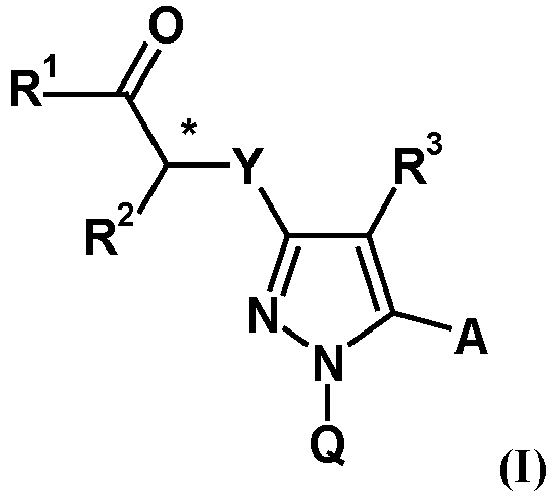
- A
- ausgewählt ist aus der Gruppe, bestehend aus A1-A15


- Q
- ausgewählt ist aus der Gruppe, bestehend aus Q1-Q3

- R1
- OR1a, NR9R10 oder O(CH2)xO(CH2)yO(CH2)z H bedeutet,
- R1a
- Wasserstoff bedeutet oder (C1-C6)-Alkyl, (C3-C6)-Cycloalkyl bedeutet, welches jeweils unsubstituiert oder substituiert ist durch einen oder mehrere Substituenten ausgewählt aus der Gruppe bestehend aus Halogen, (C1-C6)-Alkyl, (C1-C6)-Halogenalkyl, (C3-C6)-Cycloalkyl, (C1-C6)-Alkoxy, -N=R5, Cyano und Nitro oder (C2-C4)-Alkenyl, (C2-C4)-Alkinyl bedeutet oder (C1-C6)-Alkyl-SO-(C1-C6)-Alkyl-, (C1-C6)-Alkyl-SO2-(C1-C6)-Alkyl- bedeutet oder Heterocyclyl, Heteroaryl, Aryl bedeutet oder Heterocyclyl-(C1-C4)-Alkyl-, Heteroaryl-(C1-C4)-Alkyl-, Aryl-(C1-C4)-Alkyl- bedeutet, welches jeweils unsubstituiert oder substituiert ist durch einen oder mehrere Substituenten ausgewählt aus der Gruppe bestehend aus Halogen, (C1-C6)-Alkyl, (C1-C6)-Haloalkyl;
- R9
- Wasserstoff, (C1-C12)-Alkyl bedeutet;
- R10
- Wasserstoff, Aryl, Heteroaryl, Heterocyclyl, (C1-C12)-Alkyl, (C3-C8)-Cycloalkyl, (C3-C8)-Cycloalkyl-(C1-C7)-Alkyl-, (C2-C12)-Alkenyl, (C5-C7)-Cycloalkenyl, (C2-C12)-Alkinyl, S(O)nR5, Cyano, Nitro, OR5, SO2NR6R7, CO2R8, COR8, NR6R8, NR6COR8, NR6CO2R8, NR6SO2R8 bedeutet, wobei die oben genannten Alkyl, Cycloalkyl, Alkenyl, Cycloalkenyl und Alkinyl Reste unsubstituiert sind oder jeweils unabhängig voneinander substituiert sind durch "m" Reste ausgewählt aus der Gruppe bestehend aus Wasserstoff, gegebenenfalls einfach oder mehrfach substituiertes Aryl, Halogen, Cyano, Nitro, OR5, S(O)nR5, SO2NR6R7, CO2R8, CONR6R8, COR6, NR6R8, NR6COR8, NR6CONR8R8, NR6CO2R8, NR6SO2R8, NR6SO2NR6R8, C(R6)=NOR8;
- R9 und R10
- bilden mit dem Stickstoffatom, an das sie gebunden sind, einen gegebenenfalls ein- bis sechsfach durch Reste aus der Gruppe bestehend aus Halogen, (C1-C6)-Alkyl, (C1-C6)-Halogenalkyl, OR5, S(O)nR5, CO2R8, CONR6R8, COR6 und C(R6)=NOR8 substituierten, gesättigten, teilweise oder vollständig ungesättigten fünf-, sechs- oder siebengliedrigen Ring, der neben diesem Stickstoffatom "r" Kohlenstoffatome, "o" Sauerstoffatome, "p" Schwefelatome und "q" Elemente aus der Gruppe bestehend aus NR7, CO und NCOR7 als Ringatome enthält;
- R5
- (C1-C6)-Alkyl, (C3-C6)-Cycloalkyl, (C1-C6)-Halogenalkyl, Aryl bedeutet;
- R6
- Wasserstoff, (C1-C6)-Alkyl, (C3-C6)-Cycloalkyl, (C1-C6)-Halogenalkyl, Aryl bedeutet;
- R7
- Wasserstoff, (C1-C6)-Alkyl, (C3-C6)-Cycloalkyl, (C3-C4)-Alkenyl, (C3-C4)-Alkinyl bedeutet;
- R8
- Wasserstoff, (C1-C6)-Alkyl, (C3-C6)-Cycloalkyl, (C3-C4)-Alkenyl, (C1-C6)-Alkyl-COO(C1-C2)-Alkyl oder (C3-C4)-Alkinyl bedeutet;
- R2
- Wasserstoff, Cyano, (C1-C6)-Alkyl, (C1-C6)-Alkoxy-(C1-C6)-Alkyl-, (C1-C6)-Halogenalkyl, (C1-C6)-Alkoxy, (C2-C6)-Alkenyl, (C2-C6)-Halogenalkenyl, (C2-C6)-Alkinyl, (C2-C6)-Halogenalkinyl, (C3- C6)-Cycloalkyl bedeutet;
- R3
- Halogen, Cyano, Isocyano, NO2, (C3-C6)-Cycloalkyl, (C1-C6)-Alkyl, (C1-C6)-Halogenalkyl, (C1-C6)-Alkylcarbonyl-, (C1-C6)-Halogenalkylcarbonyl-, (C1-C6)-Alkyloxycarbonyl-, (C2- C3)-Alkenyl, (C2- C3)-Halogenalkenyl, (C2-C3)-Alkinyl, (C2- C3)-Halogenalkinyl, (C1-C6)-Alkyl-S(O)n und (C1-C6)-Halogenalkyl-S(O)n, CHO, NH2 bedeutet;
- R12
- Halogen, Cyano, Isocyano, NO2, (C1-C6)-Alkyl, (C1-C6)-Halogenalkyl, (C1-C6)-Alkylcarbonyl, (C1-C6)-Halogenalkylcarbonyl, (C1-C6)-Alkyloxycarbonyl, (C1-C6)-Alkoxy, (C1-C6)-Halogenalkoxy, (C1-C6)-Alkyl-, S(O)n, (C2- C3)-Alkenyl, (C2- C3)-Halogenalkenyl, (C2-C3)-Alkinyl, (C2- C3)-Halogenalkinyl, NH2 bedeutet;
- R13
- Halogen, Cyano, Isocyano, NO2, (C1-C6)-Alkyl, (C1-C6)-Halogenalkyl, (C1-C6)-Alkylcarbonyl, (C1-C6)-Halogenalkylcarbonyl, (C1-C6)-Alkyloxycarbonyl, (C1-C6)-Alkoxy, (C1-C6)-Halogenalkoxy, (C1-C6)-Alkyl- S(O)n, (C2- C3)-Alkenyl, (C2- C3)-Halogenalkenyl; (C2-C3)-Alkinyl, (C2- C3)-Halogenalkinyl, NH2 bedeutet;
- Y
- Sauerstoff, S(O)n bedeutet;
- m
- 0, 1 oder 2 bedeutet;
- n
- 0, 1 oder 2 bedeutet;
- o
- 0, 1 oder 2 bedeutet;
- p
- 0 oder 1 bedeutet;
- q
- 0 oder 1 bedeutet;
- r
- 3, 4, 5 oder 6 bedeutet;
- s
- 0, 1, 2, 3 oder 4 bedeutet;
- x
- 1,2,3,4 oder 5 bedeutet:
- y
- 1,2,3,4 oder 5 bedeutet;
- z
- 1,2,3,4 oder 5 bedeutet.
- Im Folgenden werden, jeweils für die einzelnen Substituenten, bevorzugte, besonders bevorzugte und ganz besonders bevorzugte Bedeutungen beschrieben. Die übrigen Substituenten der allgemeinen Formel (I), welche nachfolgend nicht genannt werden, weisen die oben genannte Bedeutung auf.
- Somit ergeben sich verschiedene Ausführungsformen für die Verbindung der allgemeinen Formel (I).
- Bevorzugt sind Verbindungen der allgemeinen Formel (I), in denen
- A
- ausgewählt ist aus der Gruppe, bestehend aus A1- A4, A6-A9, und A12-A15


- Q
- ausgewählt ist aus der Gruppe, bestehend aus Q1-Q3

- R1
- OR1a, NR9R10 oder O(CH2)xO(CH2)yO(CH2)z H bedeutet,
- R1a
- Wasserstoff bedeutet oder (C1-C6)-Alkyl, (C3-C6)-Cycloalkyl bedeutet welches jeweils unsubstituiert oder substituiert ist und durch einen oder mehrere Substituenten ausgewählt aus der Gruppe bestehend aus Halogen, (C1-C6)-Alkyl, (C1-C6)-Halogenalkyl, (C3-C6)-Cycloalkyl, (C1-C6)-Alkoxy, Cyano und Nitro oder (C2-C4)-Alkenyl, (C2-C4)- Alkinyl bedeutet oder (C1-C6)-Alkyl-SO-(C1-C6)-Alkyl-, (C 1-C6)-Alkyl-SO2-(C1-C6)-Alkyl-, Aryl-(C1-C4)-Alkyl-bedeutet, welches jeweils unsubstituiert oder substituiert ist durch einen oder mehrere Substituenten ausgewählt aus der Gruppe bestehend aus Halogen, (C1-C6)-Alkyl, (C1-C6)-Halogenalkyl;
- R9
- Wasserstoff, (C1-C6)-Alkyl bedeutet;
- R10
- Wasserstoff, Phenyl, (C1-C6)-Alkyl, (C3-C6)-Cycloalkyl, (C3-C6)-Cycloalkyl-(C1-C4)-Alkyl-, (C2-C4)-Alkenyl, (C5-C7)-Cycloalkenyl, (C2-C4)-Alkinyl, S(O)nR5, Cyano, Nitro, OR5, SO2NR6R7, CO2R8, COR8, NR6R8 bedeutet, wobei die oben genannten Alkyl, Cycloalkyl, Alkenyl, Cycloalkenyl und Alkinyl Reste unsubstituiert sind oder jeweils unabhängig voneinander substituiert sind durch "m" Reste ausgewählt aus der Gruppe bestehend aus gegebenenfalls einfach oder mehrfach substituiertes Phenyl, Halogen, Cyano, Nitro, OR5, S(O)nR5, SO2NR6R7, CO2R8, CONR6R8, COR6, NR6R8, NR6COR8, NR6CONR8R8, NR6CO2R8 oder
- R9 und R10
- bilden mit dem Stickstoffatom, an das sie gebunden sind, einen gegebenenfalls ein- bis sechsfach durch Reste aus der Gruppe bestehend aus Halogen, (C1-C6)-Alkyl, (C1-C6)-Halogenalkyl, OR5, S(O)nR5, CO2R8, CONR6R8, COR6 und C(R6)=NOR8 substituierten, gesättigten, teilweise oder vollständig ungesättigten fünf-, sechs- oder siebengliedrigen Ring, der neben diesem Stickstoffatom "r" Kohlenstoffatome, "o" Sauerstoffatome, "p" Schwefelatome und "q" Elemente aus der Gruppe bestehend aus NR7, CO und NCOR7 als Ringatome enthält;
- R5
- (C1-C6)-Alkyl, (C3-C6)-Cycloalkyl, (C1-C6)-Halogenalkyl oder Phenyl bedeutet;
- R6
- Wasserstoff, (C1-C6)-Alkyl, (C3-C6)-Cycloalkyl, (C1-C6)-Halogenalkyl oder Phenyl bedeutet;
- R7
- Wasserstoff, (C1-C6)-Alkyl, (C3-C6)-Cycloalkyl, (C3-C4)-Alkenyl oder (C3-C4)-Alkinyl bedeutet;
- R8
- Wasserstoff, (C1-C6)-Alkyl, (C3-C6)-Cycloalkyl, (C3-C4)-Alkenyl oder (C3-C4)-Alkinyl bedeutet;
- R2
- Wasserstoff, Cyano, (C1-C6)-Alkyl, (C1-C6)-Alkoxy-(C1-C6)-Alkyl, (C1-C6)-Halogenalkyl, (C1-C6)-Alkoxy, (C2-C4)-Alkenyl, (C2-C4)-Halogenalkenyl; (C2-C4)-Alkinyl, (C2-C4)-Halogenalkinyl; (C3-C6)-Cycloalkyl bedeutet;
- R3
- Halogen, Cyano, Isocyano, NO2, (C3-C6)-Cycloalkyl, (C1-C6)-Alkyl, (C1-C6)-Halogenalkyl, (C1-C6)-Alkylcarbonyl, (C1-C6)-Halogenalkylcarbonyl, (C1-C6)-Alkyloxycarbonyl, (C2-C3)-Alkenyl, (C2-C3)-Halogenalkenyl, (C2-C3)-Alkinyl, (C2- C3)-Halogenalkinyl, (C1-C6)-Alkyl-S(O)n-, (C1-C6)-Halogenalkyl-S(O)n-, CHO, NH2 bedeutet;
- R12
- Halogen, Cyano, Isocyano, NO2, (C1-C6)-Alkyl, (C1-C6)-Halogenalkyl, (C1-C6)-Alkylcarbonyl, (C1-C6)-Halogenalkylcarbonyl, (C1-C6)-Alkyloxycarbonyl, (C1-C6)-Alkoxy, (C1-C6)-Halogenalkoxy, (C1-C6)-Alkyl- S(O)n, (C2- C3)-Alkenyl, (C2- C3)-Halogenalkenyl, (C2-C3)-Alkinyl, (C2- C3)-Halogenalkinyl, NH2 bedeutet;
- R13
- Halogen, Cyano, Isocyano, NO2, (C1-C6)-Alkyl, (C1-C6)-Halogenalkyl, (C1-C6)-Alkylcarbonyl, (C1-C6)-Halogenalkylcarbonyl, (C1-C6)-Alkyloxycarbonyl, (C1-C6)-Alkoxy, (C1-C6)-Halogenalkoxy, (C1-C6)-Alkyl- S(O)n, (C2- C3)-Alkenyl, (C2- C3)-Halogenalkenyl, (C2-C3)-Alkinyl, (C2- C3)-Halogenalkinyl, NH2 bedeutet;
- Y
- Sauerstoff, S(O)n bedeutet;
- m
- 0, 1, 2 bedeutet;
- n
- 0, 1, 2 bedeutet;
- o
- 0, 1, 2 bedeutet;
- p
- 0 oder 1 bedeutet;
- q
- 0 oder 1 bedeutet;
- r
- 3, 4, 5 oder 6 bedeutet;
- s
- 0, 1, 2, 4 bedeutet;
- x
- 1,2,3,4 bedeutet;
- y
- 1,2,3,4 bedeutet;
- z
- 1,2,3,4 bedeutet.
-

- Q
- ausgewählt ist aus der Gruppe, bestehend aus Q1-Q3
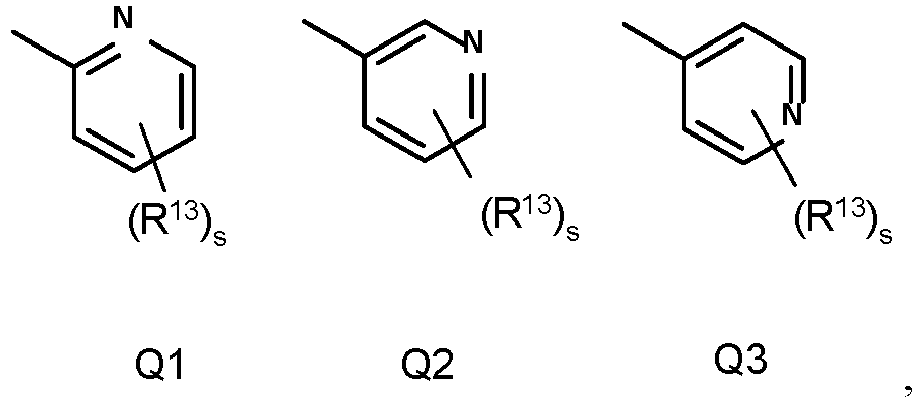
- R1
- OR1a, NR9R10 oder O(CH2)xO(CH2)yO(CH2)z H bedeutet,
- R1a
- Wasserstoff bedeutet oder (C1-C4)-Alkyl, (C3-C6)-Cycloalkyl bedeutet welches jeweils unsubstituiert oder substituiert ist durch einen oder mehrere Substituenten ausgewählt aus der Gruppe bestehend aus Halogen, (C1-C4)-Alkyl, (C1-C4)-Halogenalkyl oder Aryl-(C1-C4)-Alkyl- bedeutet, welches jeweils unsubstituiert oder substituiert ist durch einen oder mehrere Substituenten ausgewählt aus der Gruppe bestehend aus Halogen, (C1-C4)-Alkyl, (C1-C4)-Haloalkyl;
- R9
- Wasserstoff;
- R10
- (C1-C6)-Alkyl, S(O)nR5, SO2NR6R7, CO2R8 bedeutet, wobei die oben genannten Reste unsubstituiert sind oder jeweils unabhängig voneinander substituiert sind durch "m" Reste ausgewählt aus der Gruppe bestehend aus Aryl, S(O)nR5, SO2NR6R7, CO2R8, NR6CO2R8;
- R5
- Ethyl, Methyl, CF3 oder CH2CF3 bedeutet;
- R6
- Wasserstoff bedeutet;
- R7
- Wasserstoff, Methyl oder Ethyl bedeutet;
- R8
- Methyl oder Ethyl bedeutet;
- R2
- Wasserstoff, (C1-C6)-Alkyl, (C1-C6)-Halogenalkyl, (C1-C6)-Alkoxy bedeutet;
- R3
- Halogen, Cyano, NO2, (C3-C6)-Cycloalkyl, (C1-C6)-Alkyl, (C1-C6)-Halogenalkyl, (C1-C6)-Halogenalkoxy, (C1-C6)-Alkylthio bedeutet;
- R12
- Fluor, Chlor, Brom, Cyano, Methyl, Ethyl, CF3, OCF3 bedeutet;
- R13
- Fluor, Chlor, Brom, Cyano, Methyl, Ethyl, CF3, OCF3 bedeutet;
- Y
- Sauerstoff und S(O)n bedeutet;
- m
- 0, 1 2 bedeutet;
- n
- 0, 1, 2 bedeutet;
- s
- 0, 1, 2 bedeutet;
- x
- 1,2 bedeutet;
- y
- 1,2 bedeutet;
- z
- 1,2 bedeutet.
-

- Q
- ausgewählt ist aus der Gruppe, bestehend aus Q1-Q3

- R1
- OR1a;
- R1a
- Wasserstoff, Ethyl, Methyl, CF3CH2SO2NH-, Me2NSO2NH-, MeO2CCH2NH-
- R2
- Wasserstoff, Methyl oder Ethyl bedeutet;
- R3
- Fluor, Brom, Chlor, Cyano, NO2, Methyl, Cyclopropyl, CF3 und OCF bedeutet;
- R12
- Fluor, Chlor, Brom, Cyano, CF3 bedeutet;
- R13
- Fluor, Chlor, Brom, Cyano, CF3 bedeutet;
- Y
- Sauerstoff und S(O)n bedeutet;
- n
- 0, 1, 2 bedeutet;
- s
- 0, 1, 2 bedeutet.
- Ein weiterer Gegenstand der vorliegenden Erfindung sind Verbindungen der Formel (Z)

- Ein weiterer Gegenstand der vorliegenden Erfindung sind Verbindungen der Formel (Y)

- Ein weiterer Gegenstand der vorliegenden Erfindung sind Verbindungen der Formel (W)

- Ein weiterer Gegenstand der vorliegenden Erfindung sind Säuren der Formel (Ia)

- Ein weiterer Gegenstand der vorliegenden Erfindung sind Verbindungen der Formel (V)

- Ein weiterer Gegenstand der vorliegenden Erfindung sind Verbindungen der Formel (VI)

- In allen nachfolgend genannten Formeln haben die Substituenten und Symbole, sofern nicht anders definiert, dieselbe Bedeutung wie unter Formel (I) beschrieben.
- Nicht umfasst sind Kombinationen, die gegen Naturgesetze widersprechen und welche der Fachmann daher aufgrund seines Wissens ausschließen würde.
- Alkyl bedeutet gesättigte, geradkettige oder verzweigte Kohlenwasserstoffreste mit der jeweils angegebenen Anzahl von Kohlenstoffatomen, z.B. C1-C6-Alkyl wie Methyl, Ethyl, Propyl, 1-Methylethyl, Butyl, 1-Methyl-propyl, 2-Methylpropyl, 1,1-Dimethylethyl, Pentyl, 1-Methylbutyl, 2-Methylbutyl, 3-Methylbutyl, 2,2-Di-methylpropyl, 1-Ethylpropyl, Hexyl, 1,1-Dimethylpropyl, 1,2-Dimethylpropyl,1-Methylpentyl, 2-Methylpentyl, 3-Methylpentyl, 4-Methylpentyl, 1,1-Dimethylbutyl, 1,2-Dimethylbutyl, 1,3-Dimethylbutyl, 2,2-Dimethylbutyl, 2,3-Dimethylbutyl, 3,3-Dimethylbutyl, 1-Ethylbutyl, 2-Ethylbutyl, 1,1,2-Trimethylpropyl, 1,2,2-Trimethylpropyl, 1-Ethyl-1-methylpropyl und 1-Ethyl-2-methyl-propyl.
- Durch Halogen substitiertes Alkyl bedeutet geradkettige oder verzweigte Alkylgruppen, wobei in diesen Gruppen teilweise oder vollständig die Wasserstoffatome durch Halogenatome ersetzt sein können, z.B. C1-C2-Halogenalkyl wie Chlormethyl, Brommethyl, Dichlormethyl, Trichlormethyl, Fluormethyl, Difluormethyl, Trifluormethyl, Chlorfluormethyl, Dichlorfluormethyl, Chlordifluormethyl, 1-Chlorethyl, 1-Bromethyl, 1-Fluorethyl, 2-Fluorethyl, 2,2-Difluorethyl, 2,2,2-Trifluorethyl, 2-Chlor-2-fluorethyl, 2-Chlor,2-difluorethyl, 2,2-Dichlor-2-fluorethyl, 2,2,2-Trichlorethyl, Pentafluorethyl und 1,1,1-Trifluorprop-2-yl.
- Alkenyl bedeutet ungesättigte, geradkettige oder verzweigte Kohlenwasserstoffreste mit der jeweils angegebenen Anzahl von Kohlenstoffatomen und einer Doppelbindung in einer beliebigen Position, z.B. C2-C6-Alkenyl wie Ethenyl, 1-Propenyl, 2-Propenyl, 1-Methylethenyl, 1-Butenyl, 2-Butenyl, 3-Butenyl, 1-Methyl-1-propenyl, 2-Methyl-1-propenyl, 1-Methyl-2-propenyl, 2-Methyl-2-propenyl, 1-Pentenyl, 2-Pentenyl, 3-Pentenyl, 4-Pentenyl, 1-Methyl-1-butenyl, 2-Methyl-1-butenyl, 3-Methyl-1-butenyl, 1-Methyl-2-butenyl, 2-Methyl-2-butenyl, 3-Methyl-2-butenyl, 1-Methyl-3-butenyl, 2-Methyl-3-butenyl, 3-Methyl-3-butenyl, 1,1-Dimethyl-2-propenyl, 1,2-Dimethyl-1-propenyl, 1,2-Dimethyl-2-propenyl, 1-Ethyl-1-propenyl, 1-Ethyl-2-propenyl, 1-Hexenyl, 2-Hexenyl, 3-Hexenyl, 4-Hexenyl, 5-Hexenyl, 1-Methyl-1-pentenyl, 2-Methyl-1-pentenyl, 3-Methyl-1-pentenyl, 4-Methyl-1-pentenyl, 1-Methyl-2-pentenyl, 2-Methyl-2-pentenyl, 3-Methyl-2-pentenyl, 4-Methyl-2-pentenyl, 1-Methyl-3-pentenyl, 2-Methyl-3-pentenyl, 3-Methyl-3-pentenyl, 4-Methyl-3-pentenyl, 1-Methyl-4-pentenyl, 2-Methyl-4-pentenyl, 3-Methyl-4-pentenyl, 4-Methyl-4-pentenyl, 1,1-Dimethyl-2-butenyl, 1,1-Dimethyl-3-butenyl, 1,2-Dimethyl-1-butenyl, 1,2-Dimethyl-2-butenyl, 1,2-Dimethyl-3-butenyl, 1,3-Dimethyl-1-butenyl, 1,3-Dimethyl-2-butenyl, 1,3-Dimethyl-3-butenyl, 2,2-Dimethyl-3-butenyl, 2,3-Dimethyl-1-butenyl, 2,3-Dimethyl-2-butenyl, 2,3-Dimethyl-3-butenyl, 3,3-Dimethyl-1-butenyl, 3,3-Dimethyl-2-butenyl, 1-Ethyl-1-butenyl, 1-Ethyl-2-butenyl, 1-Ethyl-3-butenyl, 2-Ethyl-1-butenyl, 2-Ethyl-2-butenyl, 2-Ethyl-3-butenyl, 1,1,2-Trimethyl-2-propenyl, 1-Ethyl-1-methyl-2-propenyl, 1-Ethyl-2-methyl-1-propenyl und 1-Ethyl-2-methyl-2-propenyl.
- Alkinyl bedeutet geradkettige oder verzweigte Kohlenwasserstoffreste mit der jeweils angegebenen Anzahl von Kohlenstoffatomen und einer Dreifachbindung in einer beliebigen Position, z.B. C2-C6-Alkinyl wie Ethinyl, 1-Propinyl, 2-Propinyl (oder Propargyl), 1-Butinyl, 2-Butinyl, 3-Butinyl, 1-Methyl-2-propinyl, 1-Pentinyl, 2-Pentinyl, 3-Pentinyl, 4-Pentinyl, 3-Methyl-1-butinyl, 1-Methyl-2-butinyl, 1-Methyl-3-butinyl, 2-Methyl-3-butinyl, 1,1-Dimethyl-2-propinyl, 1-Ethyl-2-propinyl, 1-Hexinyl, 2-Hexinyl, 3-Hexinyl, 4-Hexinyl, 5-Hexinyl, 3-Methyl-1-pentinyl, 4-Methyl-1-pentinyl, 1-Methyl-2-pentinyl, 4-Methyl-2-pentinyl, 1-Methyl-3-pentinyl, 2-Methyl-3-pentinyl, 1-Methyl-4-pentinyl, 2-Methyl-4-pentinyl, 3-Methyl-4-pentinyl, 1,1-Dimethyl-2-butinyl, 1,1-Dimethyl-3-butinyl, 1,2-Dimethyl-3-butinyl, 2,2-Dimethyl-3-butinyl, 3,3-Dimethyl-1-butinyl, 1-Ethyl-2-butinyl, 1-Ethyl-3-butinyl, 2-Ethyl-3-butinyl und 1-Ethyl-1-methyl-2-propinyl.
- Cycloalkyl bedeutet ein carbocyclisches, gesättigtes Ringsystem mit vorzugsweise 3 bis 6 Ring-C-Atomen, z.B. Cyclopropyl, Cyclobutyl, Cyclopentyl oder Cyclohexyl. Im Falle von gegebenenfalls substituiertem Cycloalkyl werden cyclische Systeme mit Substituenten umfasst, wobei auch Substituenten mit einer Doppelbindung am Cycloalkylrest, z. B. eine Alkylidengruppe wie Methyliden, umfasst sind. Im Falle von gegebenenfalls substituiertem Cycloalkyl werden auch mehrcyclische aliphatische Systeme umfaßt, wie beispielsweise Bicyclo[1.1.0]butan-1-yl, Bicyclo[1.1.0]butan-2-yl, Bicyclo[2.1.0]pentan-1-yl, Bicyclo[2.1.0]pentan-2-yl, Bicyclo[2.1.0]pentan-5-yl, Bicyclo[2.2.1]hept-2-yl (Norbornyl), Adamantan-1-yl und Adamantan-2-yl.
- Im Falle von substituiertem Cycloalkyl werden auch spirocyclische aliphatische Systeme umfaßt, wie beispielsweise Spiro[2.2]pent-1-yl, Spiro[2.3]hex-1-yl, Spiro[2.3]hex-4-yl, 3-Spiro[2.3]hex-5-yl.
- Cycloalkenyl bedeutet ein carbocyclisches, nicht aromatisches, partiell ungesättigtes Ringsystem mit vorzugsweise 4-8 C-Atomen, z.B. 1-Cyclobutenyl, 2-Cyclobutenyl, 1-Cyclopentenyl, 2-Cyclopentenyl, 3-Cyclopentenyl, oder 1-Cyclohexenyl, 2-Cyclohexenyl, 3-Cyclohexenyl, 1,3-Cyclohexadienyl oder 1,4-Cyclohexadienyl, wobei auch Substituenten mit einer Doppelbindung am Cycloalkenylrest, z. B. eine Alkylidengruppe wie Methyliden, umfasst sind. Im Falle von gegebenenfalls substituiertem Cycloalkenyl gelten die Erläuterungen für substituiertes Cycloalkyl entsprechend.
- Alkoxy bedeutet gesättigte, geradkettige oder verzweigte Alkoxyreste mit der jeweils angegebenen Anzahl von Kohlenstoffatomen, z.B. C1-C6-Alkoxy wie Methoxy, Ethoxy, Propoxy, 1-Methylethoxy, Butoxy, 1-Methyl-propoxy, 2-Methylpropoxy, 1,1-Dimethylethoxy, Pentoxy, 1-Methylbutoxy, 2-Methylbutoxy, 3-Methylbutoxy, 2,2-Di-methylpropoxy, 1-Ethylpropoxy, Hexoxy, 1,1-Dimethylpropoxy, 1,2-Dimethylpropoxy,1-Methylpentoxy, 2-Methylpentoxy, 3-Methylpentoxy, 4-Methylpentoxy, 1,1-Dimethylbutoxy, 1,2-Dimethylbutoxy, 1,3-Dimethylbutoxy, 2,2-Dimethylbutoxy, 2,3-Dimethylbutoxy, 3,3-Dimethylbutoxy, 1-Ethylbutoxy, 2-Ethylbutoxy, 1,1,2-Trimethylpropoxy, 1,2,2-Trimethylpropoxy, 1-Ethyl-1-methylpropoxy und 1-Ethyl-2-methylpropoxy. Durch Halogen substitiertes Alkoxy bedeutet geradkettige oder verzweigte Alkoxyreste mit der jeweils angegebenen Anzahl von Kohlenstoffatomen, wobei in diesen Gruppen teilweise oder vollständig die Wasserstoffatome durch Halogenatome wie vorstehend genannt ersetzt sein können, z.B. C1-C2-Halogenalkoxy wie Chlormethoxy, Brommethoxy, Dichlormethoxy, Trichlormethoxy, Fluormethoxy, Difluormethoxy, Trifluormethoxy, Chlorfluormethoxy, Dichlor-fluormethoxy, Chlordifluormethoxy, 1-Chlorethoxy, 1-Bromethoxy, 1-Fluorethoxy, 2-Fluorethoxy, 2,2-Difluorethoxy, 2,2,2-Trifluorethoxy, 2-Chlor-2-fluorethoxy, 2-Chlor-1,2-difluorethoxy, 2,2-Dichlor-2-fluorethoxy, 2,2,2-Trichlorethoxy, Pentafluor-ethoxy und 1,1,1-Trifluorprop-2-oxy.
- Heterocyclyl, bedeutet gesättigte oder partiell ungesättigte mono-, bi- oder tricyclische Ringsystemgruppe, aus C-Atomen und mindestens einem Heteroatom, vorzugsweise ausgewählt aus N, O und/oder S.
- Heteroaryl, soweit nicht an anderer Stelle anders definiert: mono-, bi- oder tricyclische heterocyclische Gruppe aus C-Atomen und mindestens einem Hetero¬atom, wobei mindestens ein Zyklus aromatisch ist. In einer Ausführungsform ist mindestens ein Heteroatom N, O oder S. In einer Ausführungsform sind alle Heteroatome ausgewählt aus N, O oder S. In einer Ausführungsform ist das Ringsystem ein 5 bis 10- bzw. ein 5 bis 6-gliedriges Ringsystem. In einer Ausführungsform ist Heteroaryl ein aromatisches monocyclisches Ringsystem aus 5 oder 6 Ringatomen. In einer weiteren Ausführungsform ist Heteroaryl ein aromatisches monocyclisches Ringsystem, enthaltend 1 bis 4 Hetero¬atome aus der Gruppe N, O oder S. Weiterhin kann Heteroaryl ein bicyclisches Ringsystem darstellen, das aus 8 bis 14 Ringatomen besteht oder ein tricyclisches Ringsystem, das aus 13 bis 14 Ringatomen besteht. Beispiele: Furyl, Thienyl, Pyrazolyl, Imidazolyl, Triazolyl, Thiazolyl, Indolyl, Benzimidazolyl, Indazolyl, Benzofuranyl, Benzothiophenyl, Benzothiazolyl, Benzoxazolyl, Chinolinyl, Isochinolinyl.
- Der Begriff "Aryl" bedeutet ein gegebenenfalls substituiertes mono-, bi- oder polycyclisches aromatisches System mit vorzugsweise 6 bis 14, insbesondere 6 bis 10 Ring-C-Atomen, beispielsweise Phenyl, Naphthyl, Anthryl, Phenanthrenyl, und ähnliches, vorzugsweise Phenyl.
- Vom Begriff "gegebenenfalls substituiertes Aryl" sind auch mehrcyclische Systeme, wie Tetrahydronaphtyl, Indenyl, Indanyl, Fluorenyl, Biphenylyl, umfasst, wobei die Bindungsstelle am aromatischen System ist. Von der Systematik her ist "Aryl" in der Regel auch von dem Begriff "gegebenenfalls substituiertes Phenyl" umfasst.
- Die oben aufgeführten Aryle sind bevorzugt unabhängig voneinander ein- bis fünffach beispielsweise durch Wasserstoff, Halogen, Alkyl, Haloalkyl, Hydroxy, Alkoxy, Cycloalkoxy, Aryloxy, Alkoxyalkyl, Alkoxyalkoxy, Cycloalkyl, Halocycloalkyl, Aryl, Arylalkyl, Heteroaryl, Heterocyclyl, Alkenyl, Alkylcarbonyl, Cycloalkylcarbonyl, Arylcarbonyl, Heteroarylcarbonyl, Alkoxycarbonyl, Hydroxycarbonyl, Cycloalkoxycarbonyl, Cycloalkylalkoxycarbonyl, Alkoxycarbonylalkyl, Arylalkoxycarbonyl, Arylalkoxycarbonylalkyl, Alkinyl, Alkinylalkyl, Alkylalkinyl, Trisalkylsilylalkinyl, Nitro, Amino, Cyano, Haloalkoxy, Haloalkylthio, Alkylthio, Hydrothio, Hydroxyalkyl, Heteroarylalkoxy, Arylalkoxy, Heterocyclylalkoxy, Heterocyclylalkylthio, Heterocyclyloxy, Heterocyclylthio, Heteroaryloxy, Bis-alkylamino, Alkylamino, Cycloalkylamino, Hydroxycarbonylalkylamino, Alkoxycarbonylalkylamino, Arylalkoxycarbonylalkylamino, Alkoxycarbonylalkyl(alkyl)amino, Aminocarbonyl, Alkylaminocarbonyl, Bis-alkylaminocarbonyl, Cycloalkylaminocarbonyl, Hydroxycarbonylalkylaminocarbonyl, Alkoxycarbonylalkylaminocarbonyl, Arylalkoxycarbonylalkylaminocarbonyl substituiert.
- Wenn ein Grundkörper "durch einen oder mehrere Reste" aus einer Aufzählung von Resten (= Gruppe) oder einer generisch definierten Gruppe von Resten substituiert ist, so schließt dies jeweils die gleichzeitige Substitution durch mehrere gleiche und/oder strukturell unterschiedliche Reste ein.
- Die Bezeichnung "Halogen" bedeutet Fluor, Chlor, Brom oder Iod. Wird die Bezeichnung für einen Rest verwendet, dann bedeutet "Halogen" ein Fluor-, Chlor-, Brom- oder Iodatom.
- Je nach Art der oben definierten Substituenten weisen die Verbindungen der Formel (I) saure Eigenschaften auf und können mit anorganischen oder organischen Basen oder mit Metallionen Salze, gegebenenfalls auch innere Salze oder Addukte bilden. Tragen die Verbindungen der Formel (I) Hydroxy, Carboxy oder andere, saure Eigenschaften induzierende Gruppen, so können diese Verbindungen mit Basen zu Salzen umgesetzt werden.Geeignete Basen sind beispielsweise Hydroxide, Carbonate, Hydrogencarbonate der Alkali- und Erdalkalimetalle, insbesondere die von Natrium, Kalium, Magnesium und Calcium, weiterhin Ammoniak, primäre, sekundäre und teritäre Amine mit (C1-C4-)-Alkyl-Gruppen, Mono-, Di- und Trialkanolamine von (C1-C4)-Alkanolen, Cholin sowie Chlorcholin, sowie organische Amine, wie Trialkylamine, Morpholin, Piperidin oder Pyridin. Diese Salze sind Verbindungen, in denen der acide Wasserstoff durch ein für die Landwirtschaft geeignetes Kation ersetzt wird, beispielsweise Metallsalze, insbesondere Alkalimetallsalze oder Erdalkalimetallsalze, insbesondere Natrium- und Kaliumsalze, oder auch Ammoniumsalze, Salze mit organischen Aminen oder quartäre (quaternäre) Ammoniumsalze, zum Beispiel mit Kationen der Formel [NRR'R"R‴]+, worin R bis R‴ jeweils unabhängig voneinander einen organischen Rest, insbesondere Alkyl, Aryl, Aralkyl oder Alkylaryl darstellen. Infrage kommen auch Alkylsulfonium- und Alkylsulfoxoniumsalze, wie (C1-C4)-Trialkylsulfonium- und (C1-C4)-Trialkylsulfoxoniumsalze.
- Die Verbindungen der Formel (I) können durch Anlagerung einer geeigneten anorganischen oder organischen Säure, wie beispielsweise Mineralsäuren, wie beispielsweise HCl, HBr, H2SO4, H3PO4 oder HNO3, oder organische Säuren, z. B. Carbonsäuren, wie Ameisensäure, Essigsäure, Propionsäure, Oxalsäure, Milchsäure oder Salicylsäure oder Sulfonsäuren, wie zum Beispiel p-Toluolsulfonsäure, an eine basische Gruppe, wie z.B. Amino, Alkylamino, Dialkylamino, Piperidino, Morpholino oder Pyridino, Salze bilden. Diese Salze enthalten dann die konjugierte Base der Säure als Anion.
- Geeignete Substituenten, die in deprotonierter Form, wie z.B. Sulfonsäuren oder Carbonsäuren, vorliegen, können innere Salze mit ihrerseits protonierbaren Gruppen, wie Aminogruppen bilden.
- Ist eine Gruppe mehrfach durch Reste substituiert, so bedeutet dies, dass diese Gruppe durch einen oder mehrere gleiche oder verschiedene der genannten Reste substituiert ist.
- In allen nachfolgend genannten Formeln haben die Substituenten und Symbole, sofern nicht anders definiert, dieselbe Bedeutung wie unter Formel (I) beschrieben. Pfeile in einer chemischen Formel bedeuten die Verknüpfungsorte zum restlichen Molekül.
- Im Folgenden werden, jeweils für die einzelnen Substituenten, bevorzugte, besonders bevorzugte und ganz besonders bevorzugte Bedeutungen beschrieben. Die übrigen Substituenten der allgemeinen Formel (I), welche nachfolgend nicht genannt werden, weisen die oben genannte Bedeutung auf.
- Die vorliegenden Verbindungen der allgemeinen Formel (I) weisen am zweiten Kohlenstoff der Alkylsäurestruktur ein chirales Kohlenstoffatom auf, welches in der unten dargestellten Struktur durch die Kennzeichnung (*) verdeutlicht ist:

- Gemäß den Regeln nach Cahn, Ingold und Prelog (CIP-Regeln) kann dieses Kohlenstoffatom sowohl eine (R)- als auch eine (S)-Konfiguration aufweisen.
- Von der vorliegenden Erfindung werden Verbindungen der allgemeinen Formel (I) sowohl mit (S)- als auch mit (R)-Konfiguration erfasst, d.h., dass die vorliegende Erfindung die Verbindungen der allgemeinen Formel (I) erfasst, in welchen das betreffende Kohlenstoffatom
- (1) eine (R)-Konfiguration; oder
- (2) eine (S)-Konfiguration
aufweist.
Darüber hinaus werden im Rahmen der vorliegenden Erfindung auch - (3) beliebige Mischungen von Verbindungen der allgemeinen Formel (I), welche eine (R)-Konfiguration (Verbindungen der allgemeinen Formel (I-(R)) aufweisen, mit Verbindungen der allgemeinen Formel (I), welche eine (S)-Konfiguration (Verbindungen der allgemeinen Formel (I-S)) aufweisen, erfasst, wobei eine racemische Mischung der Verbindungen der allgemeinen Formel (I) mit (R)- und (S)-Konfiguration von der vorliegenden Erfindung ebenfalls umfasst ist.
- Allerdings sind im Rahmen der vorliegenden Erfindung insbesondere Verbindungen der allgemeinen Formel (I) mit (R)-Konfiguration mit einer Selektivität von 60 bis 100%, vorzugsweise 80 bis 100%, insbesondere 90 bis 100%, ganz besonders 95 bis 100%, bevorzugt, wobei die jeweilige (R)-Verbindung mit einer Enantioselektivität von jeweils mehr als 50% ee, vorzugsweise 60 bis 100% ee, insbesondere 80 bis 100% ee, ganz besonders 90 bis 100% ee, meist bevorzugt 95 bis 100% ee, bezogen auf den Gesamtgehalt an betreffender (R)-Verbindung vorliegt.
- Daher betrifft die vorliegende Erfindung insbesondere Verbindungen der allgemeinen Formel (I*), in welchen die stereochemische Konfiguration an dem mit (*) gekennzeichnet Kohlenstoffatom mit einer stereochemischen Reinheit von 60 bis 100 % (R), vorzugsweise 80 bis 100 % (R), insbesondere 90 bis 100 % (R), ganz besonders 95 bis 100 % (R), vorliegt.
- Darüber hinaus können, je nach Wahl der jeweiligen Reste, weitere Stereoelemente in den erfindungsgemäßen Verbindungen der allgemeinen Formel (I) vorliegen.
- Bevorzugt sind die in den folgenden Tabellen genannten Verbindungen. Die Verbindungen der allgemeinen Formel (I) mit (R)-Konfiguration sind in der Spalte, in welcher der Rest R2 genannt ist, entsprechend gekennzeichnet. Falls zum Beispiel gilt, dass R2 = Alkyl, so ist die bevorzugte stereochemische Konfiguration an dem mit (*) gekennzeichnet Kohlenstoffatom der allgemeinen Formel (I) die (R)-Konfiguration.
- Falls dagegen zum Beispiel gilt, dass R2 = Alkoxy, so ist die bevorzugte stereochemische Konfiguration an dem mit (*) gekennzeichnet Kohlenstoffatom der allgemeinen Formel (I) die (S)-Konfiguration.
Tabelle I: 2-Pyridyl 
Beispielnummer R1 R2 R3 A Y (R13)s I-01 OEt H Br (2-fluoropyridin-4-yl) O H I-02 OEt H Br (6-fluoropyridin-3-yl) O H I-03 OMe (R)-Me Br pyridin-3-yl O 3-F I-04 OMe (R)-Me CN pyridin-3-yl O 3-F I-05 OMe (R)-Me Br (6-fluoropyridin-3-yl) O 3-F I-06 OMe (R)-Me CN (6-fluoropyridin-3-yl) O 3-F I-07 OMe H Br (6-fluoropyridin-3-yl) O 3-F I-08 OH H Br (6-fluoropyridin-3-yl) O 3-F I-09 OMe H CN (6-fluoropyridin-3-yl) O 3-F I-10 OH (R)-Me Br (6-fluoropyridin-3-yl) O 3-F I-11 OMe (R)-Me Br (6-fluoropyridin-3-yl) O 5-F I-12 OMe H Br (6-fluoropyridin-3-yl) O 5-F I-13 OH (R)-Me Br (5 -fluoropyridin-3 -yl) O 5-F I-14 OH H Br (5 -fluoropyridin-3 -yl) O 5-F I-15 OMe (R)-Me Br (5 -fluoropyridin-3 -yl) O 3-F I-16 OMe H Br (5 -fluoropyridin-3 -yl) O 3-F I-17 OH H Br (6-fluoropyridin-3-yl) O 3-F I-18 OH (R)-Me Br (6-fluoropyridin-3-yl) O 3-F I-19 OMe (R)-Me Cl (2-fluoropyridin-4-yl) O H I-20 OH (R)-Me Cl pyrimidin-5-yl O H I-21 OH (R)-Me Cl (6-fluoropyridin-3-yl) O H I-22 OH (R)-Me Cl (6-fluoropyridin-3-yl) O H I-23 OEt H Br (6-fluoropyridin-3-yl) O 3-Cl I-24 OMe (R)-Me Br (6-fluoropyridin-3-yl) O 3-Cl I-25 OH (R)-Me Br (6-fluoropyridin-3-yl) O 3-Cl I-26 OH H Br (6-fluoropyridin-3-yl) O 3-Cl I-27 OEt (R)-Me Br (6-fluoropyridin-3-yl) O 3-Cl I-28 OMe H Br (6-fluoropyridin-3-yl) O 3-Cl I-29 -OCH2CH2OMe H Br (6-fluoropyridin-3-yl) O 3-F I-30 -OCH2CN H Br (6-fluoropyridin-3-yl) O 3-F I-31 -NH-allyl H Br (6-fluoropyridin-3-yl) O 3-F I-32 OEt (R)-Me Cl (6-fluoropyridin-3-yl) O 3-F I-33 OEt (R)-Me Br (6-fluoropyridin-3-yl) O 3-F I-34 -OCH2CH2O-CH2CH2OMe (R)-Me Br (6-fluoropyridin-3-yl) O 3-F I-35 -OCH2CH2OMe (R)-Me Br (6-fluoropyridin-3-yl) O 3-F I-36 -NHSO2N(Me)2 H Br (6-fluoropyridin-3-yl) O 3-F I-37 -OCH2CH2O-CH2CH2OMe H Br (6-fluoropyridin-3-yl) O 3-F I-38 OEt H Cl (6-fluoropyridin-3-yl) O 3-F I-39 OEt H Br (6-fluoropyridin-3-yl) O 3-F I-40 OEt H cyclopropyl (6-fluoropyridin-3-yl) O 3-F I-41 OMe (R)-Me Cl (6-fluoropyridin-3 -yl) O 3-F I-42 OMe H cyclopropyl (6-fluoropyridin-3-yl) O 3-F I-43 OH H cyclopropyl (6-fluoropyridin-3-yl) O 3-F I-44 -NHSO2Me H Br (6-fluoropyridin-3-yl) O 3-F I-45 -O-N=CH(CH3)2 H Br (6-fluoropyridin-3-yl) O 3-F I-46 -CH2-pyridin-2-yl H Br (6-fluoropyridin-3-yl) O 3-F I-47 
H Br (6-OMepyridin-3-yl) O 3-F I-48 
H Br (6-OMepyridin-3-yl) O 3-F I-49 OMe H Br (5 -fluoropyridin-3 -yl) O 3-F I-50 OH (R)-Me Br (6-fluoropyridin-3-yl) O 3-F I-51 OEt H Br (6-fluoropyridin-3-yl) O 3-F I-52 -CH2-pyridin-2-yl (R)-Me Br (6-fluoropyridin-3-yl) O 3-F I-53 
H Br (6-fluoropyridin-3-yl) O 3-F I-54 
H Br (6-fluoropyridin-3-yl) O 3-F I-55 OEt H I (6-fluoropyridin-3-yl) O 3-F I-56 OEt H CF3 (6-fluoropyridin-3-yl) O 3-F I-57 OEt H nitro (6-fluoropyridin-3-yl) O 3-F I-58 OEt Me Br (6-fluoropyridin-3-yl) O H I-59 
H Br (2-fluoropyridin-4-yl) O H I-60 
H Br (6-fluoropyridin-3-yl) O H I-61 
H Br (6-fluoropyridin-3-yl) O H I-62 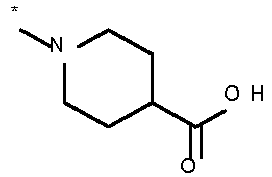
H Br (6-fluoropyridin-3-yl) O H I-63 
H Br (5 -fluoropyridin-3 -yl) O H I-64 
H Cl (6-fluoropyridin-3-yl) O H I-65 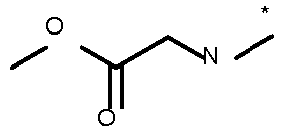
H Br pyrimidin-5-yl S H I-66 OH H Br pyrimidin-5-yl O H I-67 prop-2-ynoxy H Cl (5 -fluoropyridin-3 -yl) O H I-68 OEt H Br (6-fluoropyridin-3-yl) O H I-69 OH H Br (6-fluoropyridin-3-yl) S H I-70 
H cyclopropyl (6-fluoropyridin-3-yl) O H I-71 -OCH2CH2COOMe H cyclopropyl (5 -fluoropyridin-3 -yl) O H I-72 OH H cyclopropyl (5 -fluoropyridin-3 -yl) O H I-73 -OCH2CH2COOMe (R)-Me Br (5 -fluoropyridin-3 -yl) O H I-74 
H Cl (5 -fluoropyridin-3 -yl) O H I-75 -OCH2CH2COOMe H Cl (5 -fluoropyridin-3 -yl) O H I-76 
H Br (6-fluoropyridin-3-yl) O H I-77 -OCH2CH2COOMe H Br (5 -fluoropyridin-3 -yl) O H I-78 OEt H cyclopropyl (6-fluoropyridin-3-yl) O H I-79 OH (R)-Me Br (5 -fluoropyridin-3 -yl) O H I-80 
H Br (5 -fluoropyridin-3 -yl) O H I-81 OH H Cl (5 -fluoropyridin-3 -yl) O H I-82 
H Br (5 -fluoropyridin-3 -yl) S H I-83 OMe (R)-Me Br (5 -fluoropyridin-3 -yl) O H I-84 OH H Br (5 -fluoropyridin-3 -yl) O H I-85 OEt H Cl (6-fluoropyridin-3-yl) O H I-86 OEt H Br (6-fluoropyridin-3-yl) O H I-87 
H Cl (6-fluoropyridin-3-yl) O H I-88 -OCH2CH2COOMe H Cl (6-fluoropyridin-3-yl) O H I-89 
H Br (6-fluoropyridin-3-yl) O H I-90 
H Br (6-fluoropyridin-3-yl) O H I-91 OEt (R)-Me Br (6-fluoropyridin-3-yl) O H I-92 
H Br (6-fluoropyridin-3-yl) O H I-93 
H Br (6-fluoropyridin-3-yl) O H I-94 OH Me CF3 (6-fluoropyridin-3-yl) O H I-95 -OCH2CH2SMe H Br (6-fluoropyridin-3-yl) O H I-96 -OCH2CH2OMe H Br (6-fluoropyridin-3-yl) O H I-97 
H Br (6-fluoropyridin-3 -yl) O H I-98 OH H Cl (6-fluoropyridin-3-yl) O H I-99 OH H CF3 (6-fluoropyridin-3-yl) O H I-100 OEt H Cl (6-fluoropyridin-3-yl) O H I-101 OEt Me I (6-fluoropyridin-3-yl) O H I-102 OEt Me Br (6-fluoropyridin-3-yl) O H I-103 OH H I (6-fluoropyridin-3-yl) O H I-104 OEt H Br (5 -fluoropyridin-3 -yl) SO 2 H I-105 OEt H CF3 (6-fluoropyridin-3-yl) O H I-106 OEt H Br (5 -fluoropyridin-3 -yl) SO 2 H I-107 OEt Me CF3 (6-fluoropyridin-3-yl) O H I-108 
H Br (6-fluoropyridin-3-yl) O H I-109 
H Br (6-fluoropyridin-3-yl) O H I-110 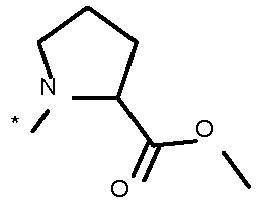
H Br (6-fluoropyridin-3-yl) O H I-111 
H Br (6-fluoropyridin-3-yl) O H I-112 
H Br (6-fluoropyridin-3-yl) O H I-113 OEt H Br (6-Clpyridin-3-yl) S H I-114 
H Br (6-fluoropyridin-3-yl) O H I-115 OEt H Br pyrimidin-5-yl S H I-116 -OCH2CH2COOMe H Br (6-fluoropyridin-3-yl) O H I-117 -NHCH2CH2COOMe H Br (6-fluoropyridin-3-yl) O H I-118 
H Cl (6-fluoropyridin-3-yl) O H I-119 
H Cl (6-fluoropyridin-3-yl) O H I-120 
H Br (6-fluoropyridin-3-yl) O H I-121 OEt H I (6-fluoropyridin-3-yl) O H I-122 OH H Br (2-fluoropyridin-4-yl) O H I-123 OEt H Br (5-chloropyridin-3-yl) S H I-124 OEt H Br (5-chloropyridin-3-yl) S H I-125 OEt H Br (5-fluoropyridin-3-yl) S H I-126 OH H Br (5-chloropyridin-3-yl) S H Tabelle II: 3-Pyridyl 
Beispielnummer R1 R2 R3 A (R12)s Y II-01 OEt H Br (6-fluoropyridin-3-yl) 2-F O II-03 OH H Br (6-fluoropyridin-3-yl) 2-F O II-04 OH R-(Me) Br (6-fluoropyridin-3-yl) 2-F O II-05 OEt R(-Me) Br (6-fluoropyridin-3-yl) 2-F O II-06 CF3CH2SO2NH- H Br (6-fluoropyridin-3-yl) 2-F O II-07 Me2NSO2NH- H Br (6-fluoropyridin-3-yl) 2-F O II-08 MeO2CCH2NH- H Br (6-fluoropyridin-3-yl) 2-F O II-09 OEt H Br (6-fluoropyridin-3-yl) H O II-10 OH H Br (6-fluoropyridin-3-yl) H O II-11 OH R-(Me) Br (6-fluoropyridin-3-yl) H O II-12 OEt R(-Me) Br (6-fluoropyridin-3-yl) H O II-13 CF3CH2SO2NH- H Br (6-fluoropyridin-3-yl) H O II-14 Me2NSO2NH- H Br (6-fluoropyridin-3-yl) H O II-15 MeO2CCH2NH- H Br (6-fluoropyridin-3-yl) 2-F O II-16 OEt H Br (pyrimidin-5-yl) 2-F O II-17 OH H Br (pyrimidin-5-yl) 2-F O II-18 OH R-(Me) Br (pyrimidin-5-yl) 2-F O II-19 OEt R(-Me) Br (pyrimdin-5-yl) 2-F O II-20 CF3CH2SO2NH- H Br (pyrimidin-5-yl) 2-F O II-21 Me2NSO2NH- H Br (pyrimidin-5-yl) 2-F O II-22 MeO2CCH2NH- H Br (pyrimidin-5-yl) 2-F O II-23 OEt H Br (pyrimidin-5-yl) H O II-24 OH H Br (pyrimidin-5-yl) H O II-25 OH R-(Me) Br (pyrimidin-5-yl) H O II-26 OEt R(-Me) Br (pyrimidin-5-yl) H O II-27 CF3CH2SO2NH- H Br (pyrimidin-5-yl) H O II-28 Me2NSO2NH- H Br (pyrimidin-5-yl) H O II-29 MeO2CCH2NH- H Br (pyridimin-5-yl) H O II-30 OH R-(Me) CF3 (6-fluoropyridin-3-yl) 2-F O II-31 OEt R-(Me) CF3 (6-fluoropyridin-3-yl) 2-F O II-32 CF3CH2SO2NH- H CF3 (6-fluoropyridin-3-yl) 2-F O II-33 Me2NSO2NH- H CF3 (6-fluoropyridin-3-yl) 2-F O II-34 MeO2CCH2NH- H CF3 (6-fluoropyridin-3-yl) 2-F O II-35 OEt H Br (6-fluoropyridin-3-yl) H S II-36 OMe (R)-Me Br (6-fluoropyridin-3-yl) 2-F O Tabelle III: 4-Pyridyl 
Beispielnummer R1 R2 R3 R4 (R12)s Y III-01 OEt H Br (6-fluoropyridin-3-yl) 2-F O III-02 OH H Br (6-fluoropyridin-3-yl) 2-F O III-03 OH R-(Me) Br (6-fluoropyridin-3-yl) 2-F O III-04 OEt R(-Me) Br (6-fluoropyridin-3-yl) 2-F O III-05 CF3CH2SO2NH- H Br (6-fluoropyridin-3-yl) 2-F O III-06 Me2NSO2NH- H Br (6-fluoropyridin-3-yl) 2-F O III-07 MeO2CCH2NH- H Br (6-fluoropyridin-3-yl) 2-F O III-08 OEt H Br (6-fluoropyridin-3-yl) H O Beispielnummer R1 R2 R3 R4 (R12)s Y III-09 OH H Br (6-fluoropyridin-3-yl) H O III-10 OH R-(Me) Br (6-fluoropyridin-3-yl) H O III-11 OEt R-(Me) Br (6-fluoropyridin-3-yl) H O III-12 CF3CH2SO2NH- H Br (6-fluoropyridin-3-yl) H O III-13 Me2NSO2NH- H Br (6-fluoropyridin-3-yl) H O III-14 MeO2CCH2NH- H Br (6-fluoropyridin-3-yl) 2-H O III-15 OEt H Br (pyrimidin-5-yl) 2-F O III-15 OEt H Br (pyrimidin-5-yl) 2-F S III-16 OH H Br (pyrimidin-5-yl) 2-F S III-17 
H Br (6-fluoropyridin-3-yl) 2-Cl O III-18 
H Br (6-fluoropyridin-3-yl) 2-Cl O III-19 -OCH2CH2COOMe H Br (6-fluoropyridin-3-yl) 2-Cl O III-20 CF3CH2SO2NH- H Br (6-fluoropyridin-3-yl) 2-Cl O III-21 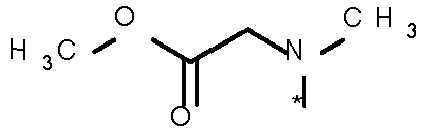
H Br (6-fluoropyridin-3-yl) 2-Cl O III-22 OMe (R)-Me Br (6-fluoropyridin-3-yl) 2-Cl O III-23 OH H Br (6-fluoropyridin-3-yl) 2-Cl O III-24 OEt H Br (6-fluoropyridin-3-yl) 2-Cl O III-25 
H Br (6-fluoropyridin-3-yl) 2-F O III-26 
H Br (6-fluoropyridin-3-yl) 2-F O III-27 -OCH2CH2COOMe H Br (6-fluoropyridin-3-yl) 2-F O III-28 
H Br (6-fluoropyridin-3-yl) 2-F O - Ein weiterer Aspekt der Erfindung betrifft die Herstellung der erfindungsgemäßen Verbindungen der allgemeinen Formel (I). Die erfindungsgemäßen Verbindungen können auf unterschiedliche Weise hergestellt werden.
- Erfindungsgemäße Verbindungen können beispielsweise nach den im nachfolgenden Schema 1 aufgeführten Syntheseverfahren aus substituierten 1-Phenyl-5-azinyl-1H-pyrazol-3-ols (II) hergestellt werden.
- Die Synthese der erfindungsgemäßen Verbindungen der allgemeinen Formel (Ib) erfolgt über eine Amidkupplung von einer Säure der allgemeinen Formel (Ia) mit einem Amin der allgemeinen Formel (II) in Gegenwart eines Amidkupplungsreagenzes wie zum Beispiel T3P, Dicyclohexylcarbodiimid, N-(3-Dimethylaminopropyl)-N'-ethylcarbodiimid, N,N'-Cabonyldiimidazol, 2-Chlor-1,3-dimethyl-imidazolium chlorid oder 2-Chlor-1-methylpyridinium iodid (siehe Chemistry of Peptide Synthsis, Ed. N. Leo Benoiton, Taylor & Francis, 2006, ISBN-10: 1-57444-454-9). Polymergebundene Reagenzien wie zum Beispiel polymergebundenes Dicyclohexylcarbodiimid sind auch für diese Kupplungs-reaktion geeignet. Die Reaktion findet bevorzugt in dem Temperaturbereich zwischen 0 °C und 80 °C, in einem adäquaten Lösungsmittel wie zum Beispiel Dichlormethan, Acetonitril, N,N-Dimethyl-formamid oder Ethylacetat und in Gegenwart eine Base wie zum Beispiel Triethylamin, N,N-Diisopropylethylamin oder 1,8-Diazabicyclo[5.4.0]undec-7-cen statt (siehe Schema 1). Für die T3P Peptidkupplungsbedingungen siehe Organic Process Research & Development 2009, 13, 900-906.
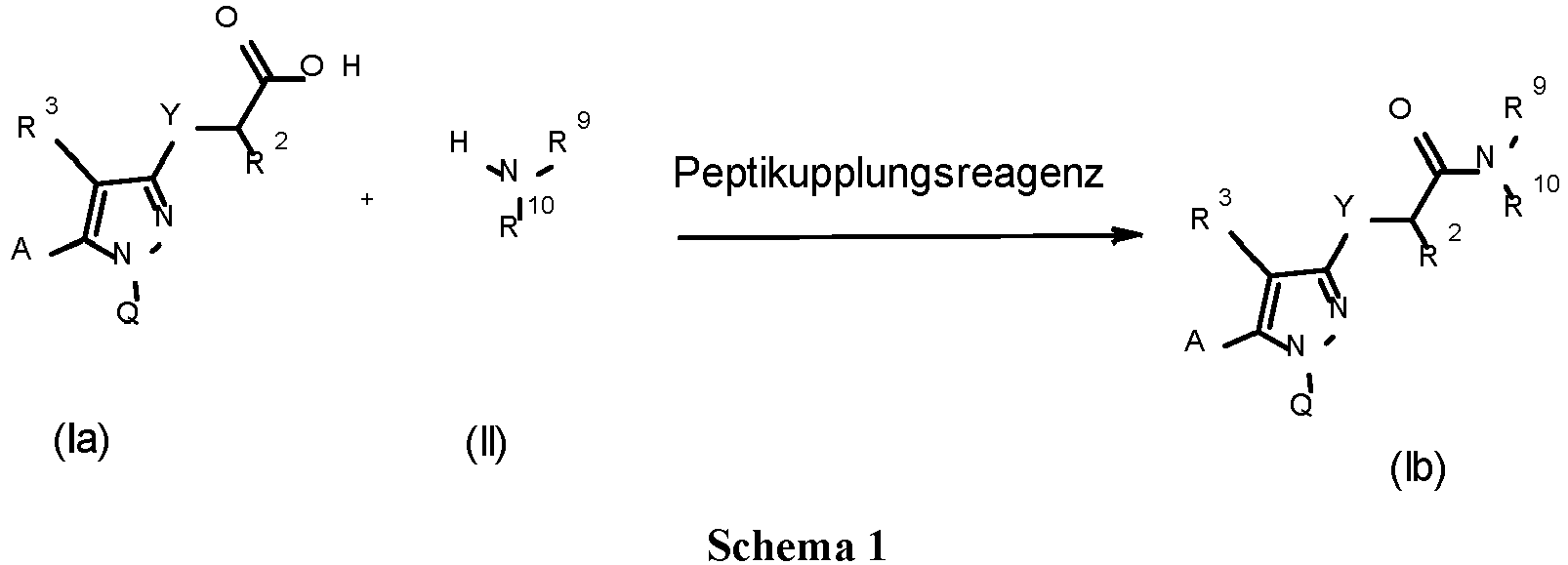
- Die Synthese der Säure der allgemeinen Formel (Ia) lässt sich durch Verseifung der Verbindung der allgemeinen Formel (Ic) nach oder lassen sich analog dem Fachmann bekannten Methoden herstellen (Schema 2). Die Verseifung lässt sich in Gegenwart einer Base oder einer Lewis-Säure durchführen. Die Base kann ein Hydroxid-Salz von einem Alkali-Metall (wie zum Beispiel Lithium, Natrium oder Kalium) sein, und die Verseifungsreaktion findet bevorzugt in dem Temperaturbereich zwischen Raumtemperatur und 120 °C statt.
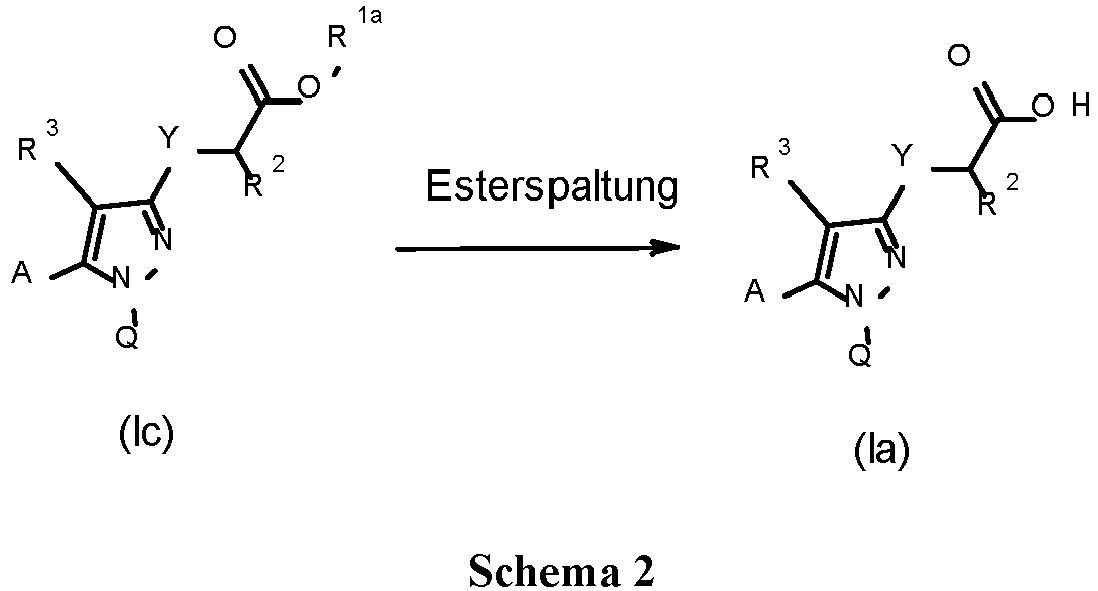
- Die Synthese der Verbindung der allgemeinen Formel (Ic) lässt sich durch Alkylierung der Verbindung der allgemeinen Formel (III) mit einem Halogenid der allgemeinen Formel (IV) in Gegenwart einer Base nach oder analog dem Fachmann bekannten Methoden herstellen (siehe Schema 3). Die Base kann ein Carbonat-Salz von einem Alkali-Metall sein. Bevorzugt ist die Base Carbonat-Salz von einem Alkali-Metall ausgewählt aus der Gruppe bestehend aus Lithium, Natrium, Kalium und Cäsium.
(wie zum Beispiel Lithium, Natrium, Kalium oder Cäsium) sein, und die Reaktion findet bevorzugt in dem Temperaturbereich zwischen Raumtemperatur und 150 °C in einem adäquaten Lösungsmittel wie zum Beispiel Dichlormethan, Acetonitril, N,N-Dimethylformamid oder Ethylacetat statt. Siehe J. Med. Chem. 2011, 54(16), 5820-5835 undWO2010/010154 . Der Rest "X" steht beispielsweise für Chlor, Brom oder lod.
- In wird die Synthese der Verbindung der allgemeinen Formel (VI) durch Reaktion eines Pyrazolones der allgemeinen Formel (V) in Gegenwart eines Schwefelungsreagenzes wie zum Beispiel Phosphorpentasulfid oder Lawesson-Reagenz in einem adäquaten Lösungsmittel wie zum Beispiel Toluol (Schema 4).

- In Schema 5 wird die Synthese der Verbindung der allgemeinen Formel (V, R3 =Cl, Br, I) durch Reaktion eines Pyrazoles der allgemeinen Formel (VII) mit einem elektrophilen Halogenierungsreagenz der allgemeinen Formel (VIII) wie zum Beispiel N-Chlorsuccinimid (VIII, X= Cl), N-Bromosuccinimid (VIII, X =Br), oder N-Iodsuccinimid (VIII, R3 = I), beschrieben. In analoger Weise können auch andere elektrophile Reagenzien, beispielsweise elektrophile Nitrierungsreagenzien wie Nitriersäure, Nitroniumtetrafluoroborat oder Ammoniumnitrat/Trifluoressigsäure (für R3 = NO2) oder elektrophile Fluorierungsreagenzien, wie DAST, Selectfluor oder N-Fluorbenzolsulfonimid (für R3 = F) zum Einsatz kommen. Die Reaktion findet bevorzugt in dem Temperaturbereich zwischen 0°C und 120 °C in einem adäquaten Lösungsmittel wie zum Beispiel N,N-Dimethylformamid, 1,2-Dichlorethan oder Acetonitril statt.

- In Schema 6 wird die Synthese der Verbindung der allgemeinen Formel (Ic) durch Reaktion eines Pyrazoles der allgemeinen Formel (Ic) mit einem Halogensuccinimid der allgemeinen Formel (VIII) in einem adäquaten Lösungsmittel wie zum Beispiel N,N-Dimethylformamid beschrieben.

- Eine Verbindung der allgemeinen Formel (Ic) lässt sich beispielsweise durch Reaktion von einer Verbindung der Formel (Ic) in einem geeigneten Lösungsmittel mit einem Metallcynid M-CN (IX) unter Zusatz einer adäquaten Menge eines Übergangsmetallkatalysators, insbesondere Palladium-Katalysatoren wie Palladium(0)tetrakis(triphenylphosphin) oder Palladiumdiacetat oder Bis(triphenylphosphin)-palladium(ll)dichlorid oder um Nickelkatalysatoren wie Nickel(ll)acetylacetonat oder Bis(triphenylphosphin)nickel(ll)chlorid vorzugsweise bei erhöhter Temperatur in einem organischen Lösungsmittel wie zum Beispiel 1,2-Dimethoxyethan oder N,N-Dimethylformamid darstellen (Schema 6). Der Rest "M" steht beispielsweise für Magnesium, Zink, Lithium oder Natrium. Allgemein eignen sich Methoden von Kreuzkupplungen, die in R. D. Larsen, Organometallics in Process Chemistry 2004 Springer Verlag, die in I. Tsuji, Palladium Reagents and Catalysts 2004 Wiley, die in M. Belier, C. Bolm, Transition Metals for Organic Synthesis 2004 VCH-Wiley beschrieben werden. Weitere geeignete Synthesemethoden sind in Chem. Rev. 2006, 106, 2651; Platinum Metals Review, 2009, 53, 183; Platinum Metals Review 2008, 52, 172 und Acc. Chem. Res. 2008, 41, 1486 beschrieben.
- Die 3-Hydroxypyrazole (V) können analog literaturbekannter Methoden aus substituierten 3-Azinylpropinsäurederivaten und Phenyhydrazinen (Schema 7); z. B.: Adv. Synth. Catal. 2014, 356, 3135-3147) oder aus substituierten Azinylacrylsäurederivaten und Phenylhydrazinen (Schema 3; z. B.: J. Heterocyclic Chem., 49, 130 (2012)) hergestellt werden.
- Die Synthese der Verbindungen der allgemeinen Formel (XII) erfolgt über eine Amidkupplung von einer Säure der allgemeinen Formel (X) mit einem Arylhydrazin oder Hetarylhydrazin der allgemeinen Formel (XI) in Gegenwart eines Amidkupplungsreagenzes wie zum Beispiel T3P, Dicyclohexylcarbodiimid, N-(3-Dimethylaminopropyl)-N'-ethylcarbodiimid, N,N'-Cabonyldiimidazol, 2-Chlor-1,3-dimethyl-imidazolium chlorid oder 2-Chlor-1-methylpyridinium iodid (siehe Chemistry of Peptide Synthesis, Ed. N. Leo Benoiton, Taylor & Francis, 2006, ISBN-10: 1-57444-454-9). Polymergebundene Reagenzien wie zum Beispiel polymergebundenes Dicyclohexylcarbodiimid sind auch für diese Kupplungsreaktion geeignet. Die Reaktion findet bevorzugt in dem Temperaturbereich zwischen 0 °C und 80 °C, in einem adäquaten Lösungsmittel wie zum Beispiel Dichlormethan, Tetrahydrofuran, Acetonitril, N,N-Dimethylformamid oder Ethylacetat und in Gegenwart eine Base wie zum Beispiel Triethylamin, N,N-Diisopropylethylamin oder 1,8-Diazabicyclo[5.4.0]undec-7-cen statt (siehe Schema 7). Für die T3P Peptidkupplungsbedingungen siehe Organic Process Research & Development 2009, 13, 900-906.

- In Schema 7 wird die Synthese der Verbindung der allgemeinen Formel (V) durch Reaktion eines Pyrazoles der allgemeinen Formel (XIII) mit einem Elektrophil wie zum Beispiel N-Bromsuccinimid beschrieben. Die Reaktion findet bevorzugt in dem Temperaturbereich zwischen 0°C und 120 °C in einem adäquaten Lösungsmittel wie zum Beispiel N,N-Dimethylformamid, 1,2-Dichlorethan oder Acetonitril statt.
- Die Synthese der 3-Hydroxypyrazole der allgemeinen Formel (XIII) erfolgt durch Reaktion der Verbindungen der allgemeinen Formel (XII) in Gegenwart eines Kupferhalogenides wie zum Beispiel Kupfer(I)iodid, Kupfer(I)bromid oder einer Base wie Natriummethylat oder einer Säure wie Methansulfonsäure zu 3-Hydroxypyrazolen der allgemeinen Formel (XIII) zyklysiert. Die Reaktion findet bevorzugt in dem Temperaturbereich zwischen 0 °C und 120 °C, in einem adäquaten Lösungsmittel wie zum Beispiel 1,2-Dichlorethan, Acetonitril, N,N-Dimethylformamid, n-Propanol oder Ethylacetat statt. Die Reaktion findet bevorzugt in N,N-Dimethylformamid statt.

- Verbindungen der allgemeinen Formel (XV) lassen sich durch eine eine Amidkupplung von einer substituiertem Propinsäure der allgemeinen Formel (XIV) mit einem Arylhydrazin oder Hetarylhydrazin der allgemeinen Formel (XI) in Gegenwart eines Amidkupplungsreagenzes wie zum Beispiel T3P, Dicyclohexylcarbodiimid, N-(3-Dimethylaminopropyl)-N'-ethylcarbodiimid, N,N'-Cabonyldiimidazol, 2-Chlor-1,3-dimethyl-imidazolium chlorid oder 2-Chlor-1-methylpyridinium iodid. Die Reaktion findet bevorzugt in dem Temperaturbereich zwischen 0 °C und 80 °C, in einem adäquaten Lösungsmittel wie zum Beispiel Dichlormethan, Acetonitril, N,N-Dimethylformamid oder Ethylacetat und in Gegenwart eine Base wie zum Beispiel Triethylamin, N,N-Diisopropylethylamin oder 1,8-Diazabicyclo[5.4.0]undec-7-cen statt (siehe Schema 8).
- Die Synthese der 3-Hydroxypyrazole der allgemeinen Formel (XIII) erfolgt durch Reaktion der Verbindungen der allgemeinen Formel (XV) in Gegenwart eines Eisenhalogenides wie zum Beispiel Eisen(III)chlorid. Die Reaktion findet bevorzugt in dem Temperaturbereich zwischen 0 °C und 120 °C, in einem adäquaten Lösungsmittel wie zum Beispiel 1,2-Dichlorethan, Acetonitril, N,N-Dimethylformamid oder Ethylacetat statt.
- Verbindungen der allgemeinen Formel (XVI) lassen sich durch eine N-Arylierung von einer 3-Hydroxypyrazole der allgemeinen Formel (XIV) mit einem Arylhalogenid in Gegegenwart eines Kupferhalogenides wie zum Beispiel Kupfer(I)iodid. Die Reaktion findet bevorzugt in dem Temperaturbereich zwischen 0 °C und 120 °C, in einem adäquaten Lösungsmittel wie zum Beispiel Acetonitril oder N,N-Dimethylformamid und in Gegenwart eine Base wie zum Beispiel Triethylamin, Cäsium Carbonat (siehe Schema 9). Die Verbindungen der allgemeinen Formeln (XIV) können nach analog dem Fachmann bekannten Methoden hergestellt werden (Chem. Med. Chem. 2015, 10, 1184-1199). Der Rest "X"s teht beispielsweise für Chlor, Brom oder lod.

- Die Synthese der 5-Iodpyrazole der allgemeinen Formel (XIV) erfolgt durch Reaktion der Verbindungen der allgemeinen Formel (XIII) in Gegenwart einer Base wie zum Beispiel Lithiumdiisopropylamid und Iod. Die Reaktion (Schema 7) findet bevorzugt in dem Temperaturbereich zwischen -78 °C und -60°C, in einem adäquaten Lösungsmittel wie zum Beispiel Diethylether und Tetrahydrofuran.
- Eine Verbindung der Formel (XIII) lasst sich beispielsweise durch Reaktion von einer Verbindung der Formel (XVI) in einem geeigneten Lösungsmittel mit einem A-M unter Zusatz einer adäquaten Menge eines Ubergangsmetallkatalysators, insbesondere Palladium-katalysatoren wie Palladiumdiacetat oder Bis(triphenylphosphin)palladium(ll)dichlorid oder um Nickelkatalysatoren wie Nickel(ll)acetylacetonat oder Bis(triphenylphosphin)nickel(ll) chlorid vorzugsweise bei erhöhter Temperatur in einem organischen Lösungsmittel wie 1,2-Dimethoxyethan darstellen. Der Rest "M" steht beispielsweise für B(ORb)(ORc), wobei die Reste Rb und Rc unabhängig voneinander beispielsweise Wasserstoff, (C1-C4)-Alkyl, oder, wenn die Reste Rb und Rc miteinander verbunden sind, gemeinsam Ethylen oder Propylen bedeuten (Schema 10).

- Die Synthese der Verbindung der allgemeinen Formel (XX) lässt sich durch Alkylierung der Verbindung der allgemeinen Formel (XIX) mit einem Halogenid der allgemeinen Formel (IV) in Gegenwart einer Base nach oder analog dem Fachmann bekannten Methoden herstellen (siehe Schema 11). Die Base kann ein Carbonat-Salz von einem Alkali-Metall (wie zum Beispiel Lithium, Natrium, Kalium oder Cäsium) sein, und die Reaktion findet bevorzugt in dem Temperaturbereich zwischen Raumtemperatur und 150 °C in einem adäquaten Lösungsmittel wie zum Beispiel Dichlormethan, Acetonitril, N,N-Dimethylformamid oder Ethylacetat statt.
- Eine Verbindung der Formel (Ic) lasst sich beispielsweise durch Reaktion von einer Verbindung der Formel (XXI) in einem geeigneten Lösungsmittel mit einem A-M unter Zusatz einer adäquaten Menge eines Ubergangsmetallkatalysators, insbesondere Palladium-katalysatoren wie Palladiumdiacetat oder Bis(triphenylphosphin)palladium(ll)dichlorid oder um Nickelkatalysatoren wie Nickel(ll)acetylacetonat oder Bis(triphenylphosphin)nickel(ll) chlorid vorzugsweise bei erhöhter Temperatur in einem organischen Lösungsmittel wie 1,2-Dimethoxyethan darstellen. Der Rest "M" steht beispielsweise für Mg-Hal, Zn-Hal, Sn((C1-C4)Alkyl)3, Lithium, Kupfer oder B(ORb)(ORc), wobei die Reste Rb und Rc unabhängig voneinander beispielsweise Wasserstoff, (C1-C4)-Alkyl, oder, wenn die Reste Rb und Rc miteinander verbunden sind, gemeinsam Ethylen oder Propylen bedeuten.

- Verbindungen der allgemeinen Formel (XIX) lassen sich durch eine Diazotierung oder Sandmeyer Reaktion mit der Verbindung der allgemeinen Formel (XVIII) mit den üblichen organischen und anorganischen Nitrite wie beispielsweise 1,1-Dimethylethylnitrit, tert-Butylnitrit oder Isoamylnitrit in Gegenwart verwendbare Reagenzien wie beispielsweise Gemische aus Kupfer(I)- und Kupfer(II)bromide/chlorid oder Iod (Schema 11). Die Reaktion findet bevorzugt in dem Temperaturbereich zwischen Raumtemperatur und 0 und 120°C in einem adäquaten Lösungsmittel wie zum Beispiel Dichlormethan, Acetonitril, N,N-Dimethylformamid oder Diiodmethan statt. Der Rest "X" steht beispielsweise für Chlor, Brom oder lod.
- In Schema 12 wird die Synthese der Verbindung der allgemeinen Formel (XXIII) durch Reaktion eines Pyrazolones der allgemeinen Formel (XXII) in Gegenwart eines Schwefelungsreagenzes wie zum Beispiel Phosphorpentasulfid oder Lawesson-Reagenz in einem adäquaten Lösungsmittel wie zum Beispiel Toluol. Die Verbindungen der allgemeinen Formeln (XXII) sind kommerziell erhältlich oder analog dem Fachmann bekannten Methoden herstellen.

- Die Synthese der Verbindung der allgemeinen Formel (Id) lässt sich durch Reaktion eines 3-Aminopyrazoles der allgemeinen Formel (XXIV) mit einem Disulfid der allgemeinen Formel (XXV) in Gegenwart eines organischen Nitrites wie beispielsweise 1,1-Dimethylethylnitrit, tert-Butylnitrit oder Isoamylnitrit in Gegenwart von einem Metall wie zum Beispiel Kupfer statt (siehe Schema 13 ). Die Reaktion findet bevorzugt in dem Temperaturbereich zwischen Raumtemperatur und 120°C in einem adäquaten Lösungsmittel wie zum Beispiel Dichlormethan, Acetonitril, N,N-Dimethylformamid oder 1,2-Dichlorethan statt.

- Die Synthese der Säure der allgemeinen Formel (XXIV) lässt sich durch Reaktion der Verbindung der allgemeinen Formel (XXVI) in Gegenwart einer Lewis-Säure wie zum Beispiel Trifluoressigsäure nach oder lassen sich analog dem Fachmann bekannten Methoden herstellen (Schema 14). Die Reaktion findet bevorzugt in dem Temperaturbereich zwischen Raumtemperatur und 140 °C statt.

- Die Synthese der Verbindungen der allgemeinen Formel (XXVI) erfolgt über eine Curtius-Reaktion von einer Säure der allgemeinen Formel (XXVII) mit einem Azid der allgemeinen Formel (XXVIII). Die Reaktion findet bevorzugt in dem Temperaturbereich zwischen 0 °C und 100 °C, in einem adäquaten Lösungsmittel wie zum Beispiel tert.-Butanol und in Gegenwart eine Base wie zum Beispiel Triethylamin, N,N-Diisopropylethylamin oder 1,8-Diazabicyclo[5.4.0]undec-7-cen statt (siehe Schema 15).

- Die Synthese der Säure der allgemeinen Formel (XXIX) lässt sich durch Verseifung der Verbindung der allgemeinen Formel (XXVII) nach oder lassen sich analog dem Fachmann bekannten Methoden herstellen (Schema 16). Die Verseifung lässt sich in Gegenwart einer Base oder einer Lewis-Säure durchführen. Die Base kann ein Hydroxid-Salz von einem Alkali-Metall (wie zum Beispiel Lithium, Natrium oder Kalium) sein, und die Verseifungsreaktion findet bevorzugt in dem Temperaturbereich zwischen Raumtemperatur und 120 °C statt.

- In Schema 17 wird die Synthese der Verbindung der allgemeinen Formel (XXX) durch Reaktion eines Pyrazoles der allgemeinen Formel (XXVII) mit einem Halogensuccinimid der allgemeinen Formel (VIII) in einem adäquaten Lösungsmittel wie zum Beispiel DMF beschrieben.

- Die Synthese der Verbindungen der allgemeinen Formel (XXIX) erfolgt über eine Kondensation von eines Diketoesters der allgemeinen Formel (XXXI) mit einem Arylhydrazin oder Hetarylhydrazin der allgemeinen Formel (XI) in Gegenwart einer Broensted-Säure wie zum Beispiel Essigsäure oder Chlorwasserstoff in einem adäquaten Lösungsmittel wie zum Beispiel Methanol, Ethanol, Isopropanol, n-Butanol, Tetrahydrofuran, Dioxan, Toluol oder Chlorbenzol (Schema 18). Die Reaktion findet bevorzugt in dem Temperaturbereich zwischen 0 °C und 150 °C statt. Die Verbindungen der allgemeinen Formeln (XI) und (XXXI) sind kommerziell erhältlich oder lassen sich analog dem Fachmann bekannten Methoden herstellen.

- Verbindungen der allgemeinen Formeln (XXXIV) und (XXXV) lassen sich durch Reaktion von einer Verbindung der Formel (XXXIII) in Gegenwart eines Oxidationsmittels wie zum Beispiel mCPBA (3-Chlorperbenzoesäure) in einem adäquaten Lösungsmittel wie zum Beispiel Dichlormethan oder 1,2-Dichlorethan herstellen (Schema 19). Die Reaktion findet bevorzugt in dem Temperaturbereich zwischen -30 °C und 100 °C statt.

- Die erfindungsgemäßen Verbindungen der Formel (I) (und/oder deren Salze), im folgenden zusammen als "erfindungsgemäße Verbindungen" bezeichnet, weisen eine ausgezeichnete herbizide Wirksamkeit gegen ein breites Spektrum wirtschaftlich wichtiger mono- und dikotyler annueller Schadpflanzen auf. Gegenstand der vorliegenden Erfindung ist daher auch ein Verfahren zur Bekämpfung von unerwünschten Pflanzen oder zur Wachstumsregulierung von Pflanzen, vorzugsweise in Pflanzenkulturen, worin eine oder mehrere erfindungsgemäße Verbindung(en) auf die Pflanzen (z.B. Schadpflanzen wie mono- oder dikotyle Unkräuter oder unerwünschte Kulturpflanzen), das Saatgut (z.B. Körner, Samen oder vegetative Vermehrungsorgane wie Knollen oder Sprossteile mit Knospen) oder die Fläche, auf der die Pflanzen wachsen (z.B. die Anbaufläche), ausgebracht werden. Dabei können die erfindungsgemäßen Verbindungen z.B. im Vorsaat- (ggf. auch durch Einarbeitung in den Boden), Vorauflauf- oder Nachauflaufverfahren ausgebracht werden. Im einzelnen seien beispielhaft einige Vertreter der mono- und dikotylen Unkrautflora genannt, die durch die erfindungsgemäßen Verbindungen kontrolliert werden können, ohne dass durch die Nennung eine Beschränkung auf bestimmte Arten erfolgen soll.
- Monokotyle Schadpflanzen der Gattungen: Aegilops, Agropyron, Agrostis, Alopecurus, Apera, Avena, Brachiaria, Bromus, Cenchrus, Commelina, Cynodon, Cyperus, Dactyloctenium, Digitaria, Echinochloa, Eleocharis, Eleusine, Eragrostis, Eriochloa, Festuca, Fimbristylis, Heteranthera, Imperata, Ischaemum, Leptochloa, Lolium, Monochoria, Panicum, Paspalum, Phalaris, Phleum, Poa, Rottboellia, Sagittaria, Scirpus, Setaria, Sorghum.
- Dikotyle Unkräuter der Gattungen: Abutilon, Amaranthus, Ambrosia, Anoda, Anthemis, Aphanes, Artemisia, Atriplex, Bellis, Bidens, Capsella, Carduus, Cassia, Centaurea, Chenopodium, Cirsium, Convolvulus, Datura, Desmodium, Emex, Erysimum, Euphorbia, Galeopsis, Galinsoga, Galium, Hibiscus, Ipomoea, Kochia, Lamium, Lepidium, Lindernia, Matricaria, Mentha, Mercurialis, Mullugo, Myosotis, Papaver, Pharbitis, Plantago, Polygonum, Portulaca, Ranunculus, Raphanus, Rorippa, Rotala, Rumex, Salsola, Senecio, Sesbania, Sida, Sinapis, Solanum, Sonchus, Sphenoclea, Stellaria, Taraxacum, Thlaspi, Trifolium, Urtica, Veronica, Viola, Xanthium.
- Werden die erfindungsgemäßen Verbindungen vor dem Keimen auf die Erdoberfläche appliziert, so wird entweder das Auflaufen der Unkrautkeimlinge vollständig verhindert oder die Unkräuter wachsen bis zum Keimblattstadium heran, stellen jedoch dann ihr Wachstum ein.
- Bei Applikation der Wirkstoffe auf die grünen Pflanzenteile im Nachauflaufverfahren tritt nach der Behandlung Wachstumsstop ein und die Schadpflanzen bleiben in dem zum Applikationszeitpunkt vorhandenen Wachstumsstadium stehen oder sterben nach einer gewissen Zeit ganz ab, so dass auf diese Weise eine für die Kulturpflanzen schädliche Unkrautkonkurrenz sehr früh und nachhaltig beseitigt wird.
- Die erfindungsgemäßen Verbindungen können in Nutzkulturen Selektivitäten aufweisen und können auch als nichtselektive Herbizide eingesetzt werden.
- Aufgrund ihrer herbiziden und pflanzenwachstumsregulatorischen Eigenschaften können die Wirkstoffe auch zur Bekämpfung von Schadpflanzen in Kulturen von bekannten oder noch zu entwickelnden gentechnisch veränderten Pflanzen eingesetzt werden. Die transgenen Pflanzen zeichnen sich in der Regel durch besondere vorteilhafte Eigenschaften aus, beispielsweise durch Resistenzen gegenüber bestimmten in der Agrarindustrie verwendeten Wirkstoff, vor allem bestimmten Herbiziden, Resistenzen gegenüber Pflanzenkrankheiten oder Erregern von Pflanzenkrankheiten wie bestimmten Insekten oder Mikroorganismen wie Pilzen, Bakterien oder Viren. Andere besondere Eigenschaften betreffen z.B. das Erntegut hinsichtlich Menge, Qualität, Lagerfähigkeit, Zusammensetzung und spezieller Inhaltsstoffe. So sind transgene Pflanzen mit erhöhtem Stärkegehalt oder veränderter Qualität der Stärke oder solche mit anderer Fettsäurezusammensetzung des Ernteguts bekannt. Weitere besondere Eigenschaften liegen in einer Toleranz oder Resistenz gegen abiotische Stressoren z.B. Hitze, Kälte, Trockenheit, Salz und ultraviolette Strahlung.
- Bevorzugt ist die Anwendung der erfindungsgemäßen Verbindungen der Formel (I) oder deren Salze in wirtschaftlich bedeutenden transgenen Kulturen von Nutz-und Zierpflanzen,
- Die Verbindungen der Formel (I) können als Herbizide in Nutzpflanzenkulturen eingesetzt werden, welche gegenüber den phytotoxischen Wirkungen der Herbizide resistent sind bzw. gentechnisch resistent gemacht wurden.
- Herkömmliche Wege zur Herstellung neuer Pflanzen, die im Vergleich zu bisher vorkommenden Pflanzen modifizierte Eigenschaften aufweisen, bestehen beispielsweise in klassischen Züchtungsverfahren und der Erzeugung von Mutanten. Alternativ können neue Pflanzen mit veränderten Eigenschaften mit Hilfe gentechnischer Verfahren erzeugt werden (siehe z.B.
EP 0221044 ,EP 0131624 ). Beschrieben wurden beispielsweise in mehreren Fällen gentechnische Veränderungen von Kulturpflanzen zwecks Modifikation der in den Pflanzen synthetisierten Stärke (z.B.WO 92/011376 A WO 92/014827 A WO 91/019806 A EP 0242236 A ,EP 0242246 A ) oder Glyphosate (WO 92/000377 A EP 0257993 A ,US 5,013,659 ) oder gegen Kombinationen oder Mischungen dieser Herbizide durch "gene stacking" resistent sind, wie transgenen Kulturpflanzen z. B. Mais oder Soja mit dem Handelsnamen oder der Bezeichnung Optimum™ GAT™ (Glyphosate ALS Tolerant). - transgene Kulturpflanzen, beispielsweise Baumwolle, mit der Fähigkeit Bacillus thuringiensis-Toxine (Bt-Toxine) zu produzieren, welche die Pflanzen gegen bestimmte Schädlinge resistent machen (
EP 0142924 A ,EP 0193259 A ). - transgene Kulturpflanzen mit modifizierter Fettsäurezusammensetzung (
WO 91/013972 A - gentechnisch veränderte Kulturpflanzen mit neuen Inhalts- oder Sekundärstoffen z.B. neuen Phytoalexinen, die eine erhöhte Krankheitsresistenz verursachen (
EP 0309862 A ,EP 0464461 A ) - gentechnisch veränderte Pflanzen mit reduzierter Photorespiration, die höhere Erträge und höhere Stresstoleranz aufweisen (
EP 0305398 A ) - transgene Kulturpflanzen, die pharmazeutisch oder diagnostisch wichtige Proteine produzieren ("molecular pharming")
- transgene Kulturpflanzen, die sich durch höhere Erträge oder bessere Qualität auszeichnen
- transgene Kulturpflanzen die sich durch eine Kombinationen z.B. der o. g. neuen Eigenschaften auszeichnen ("gene stacking")
- Zahlreiche molekularbiologische Techniken, mit denen neue transgene Pflanzen mit veränderten Eigenschaften hergestellt werden können, sind im Prinzip bekannt; siehe z.B. I. Potrykus und G. Spangenberg (eds.) Gene Transfer to Plants, Springer Lab Manual (1995), Springer Verlag Berlin, Heidelberg. oder Christou, "Trends in Plant Science" 1 (1996) 423-431).
- Für derartige gentechnische Manipulationen können Nucleinsäuremoleküle in Plasmide eingebracht werden, die eine Mutagenese oder eine Sequenzveränderung durch Rekombination von DNA-Sequenzen erlauben. Mit Hilfe von Standardverfahren können z.B. Basenaustausche vorgenommen, Teilsequenzen entfernt oder natürliche oder synthetische Sequenzen hinzugefügt werden. Für die Verbindung der DNA-Fragmente untereinander können an die Fragmente Adaptoren oder Linker angesetzt werden, siehe z.B. Sambrook et al., 1989, Molecular Cloning, A Laboratory Manual, 2. Aufl. Cold Spring Harbor Laboratory Press, Cold Spring Harbor, NY; oder Winnacker "Gene und Klone", VCH Weinheim 2. Auflage 1996
- Die Herstellung von Pflanzenzellen mit einer verringerten Aktivität eines Genprodukts kann beispielsweise erzielt werden durch die Expression mindestens einer entsprechenden antisense-RNA, einer sense-RNA zur Erzielung eines Cosuppressionseffektes oder die Expression mindestens eines entsprechend konstruierten Ribozyms, das spezifisch Transkripte des obengenannten Genprodukts spaltet. Hierzu können zum einen DNA-Moleküle verwendet werden, die die gesamte codierende Sequenz eines Genprodukts einschließlich eventuell vorhandener flankierender Sequenzen umfassen, als auch DNA-Moleküle, die nur Teile der codierenden Sequenz umfassen, wobei diese Teile lang genug sein müssen, um in den Zellen einen antisense-Effekt zu bewirken. Möglich ist auch die Verwendung von DNA-Sequenzen, die einen hohen Grad an Homologie zu den codiereden Sequenzen eines Genprodukts aufweisen, aber nicht vollkommen identisch sind.
- Bei der Expression von Nucleinsäuremolekülen in Pflanzen kann das synthetisierte Protein in jedem beliebigen Kompartiment der pflanzlichen Zelle lokalisiert sein. Um aber die Lokalisation in einem bestimmten Kompartiment zu erreichen, kann z.B. die codierende Region mit DNA-Sequenzen verknüpft werden, die die Lokalisierung in einem bestimmten Kompartiment gewährleisten. Derartige Sequenzen sind dem Fachmann bekannt (siehe beispielsweise Braun et al., EMBO J. 11 (1992), 3219-3227; Wolter et al., Proc. Natl. Acad. Sci. USA 85 (1988), 846-850; Sonnewald et al., Plant J. 1 (1991), 95-106). Die Expression der Nukleinsäuremoleküle kann auch in den Organellen der Pflanzenzellen stattfinden.
- Die transgenen Pflanzenzellen können nach bekannten Techniken zu ganzen Pflanzen regeneriert werden. Bei den transgenen Pflanzen kann es sich prinzipiell um Pflanzen jeder beliebigen Pflanzenspezies handeln, d.h., sowohl monokotyle als auch dikotyle Pflanzen. So sind transgene Pflanzen erhältlich, die veränderte Eigenschaften durch Überexpression, Suppression oder Inhibierung homologer (= natürlicher) Gene oder Gensequenzen oder Expression heterologer (= fremder) Gene oder Gensequenzen aufweisen. Vorzugsweise können die erfindungsgemäßen Verbindungen (I) in transgenen Kulturen eingesetzt werden, welche gegen Wuchsstoffe, wie z.B. 2,4-D, Dicamba oder gegen Herbizide, die essentielle Pflanzenenzyme, z.B. Acetolactatsynthasen (ALS), EPSP Synthasen, Glutaminsynthasen (GS) oder Hydoxyphenylpyruvat Dioxygenasen (HPPD) hemmen, respektive gegen Herbizide aus der Gruppe der Sulfonylharnstoffe, der Glyphosate, Glufosinate oder Benzoylisoxazole und analogen Wirkstoffe, oder gegen beliebige Kombinationen dieser Wirkstoffe, resistent sind.
- Besonders bevorzugt können die erfindungsgemäßen Verbindungen in transgenen Kulturpflanzen eingesetzt werden, die gegen eine Kombination von Glyphosaten und Glufosinaten, Glyphosaten und Sulfonylharnstoffen oder Imidazolinonen resistent sind. Ganz besonders bevorzugt können die erfindungsgemäßen Verbindungen in transgenen Kulturpflanzen wie z. B. Mais oder Soja mit dem Handelsnamen oder der Bezeichnung OptimumTM GATTM (Glyphosate ALS Tolerant) eingesetzt werden.
- Bei der Anwendung der erfindungsgemäßen Wirkstoffe in transgenen Kulturen treten neben den in anderen Kulturen zu beobachtenden Wirkungen gegenüber Schadpflanzen oftmals Wirkungen auf, die für die Applikation in der jeweiligen transgenen Kultur spezifisch sind, beispielsweise ein verändertes oder speziell erweitertes Unkrautspektrum, das bekämpft werden kann, veränderte Aufwandmengen, die für die Applikation eingesetzt werden können, vorzugsweise gute Kombinierbarkeit mit den Herbiziden, gegenüber denen die transgene Kultur resistent ist, sowie Beeinflussung von Wuchs und Ertrag der transgenen Kulturpflanzen.
- Gegenstand der Erfindung ist deshalb auch die Verwendung der erfindungsgemäßen Verbindungen der Formel (I) als Herbizide zur Bekämpfung von Schadpflanzen in transgenen Kulturpflanzen.
- Die erfindungsgemäßen Verbindungen können in Form von Spritzpulvern, emulgierbaren Konzentraten, versprühbaren Lösungen, Stäubemitteln oder Granulaten in den üblichen Zubereitungen angewendet werden. Gegenstand der Erfindung sind deshalb auch herbizide und pflanzenwachstumsregulierende Mittel, welche die erfindungsgemäßen Verbindungen enthalten.
- Die erfindungsgemäßen Verbindungen können auf verschiedene Art formuliert werden, je nachdem welche biologischen und/oder chemisch-physikalischen Parameter vorgegeben sind. Als Formulierungsmöglichkeiten kommen beispielsweise in Frage: Spritzpulver (WP), wasserlösliche Pulver (SP), wasserlösliche Konzentrate, emulgierbare Konzentrate (EC), Emulsionen (EW), wie Öl-in-Wasser- und Wasser-in-Öl-Emulsionen, versprühbare Lösungen, Suspensionskonzentrate (SC), Dispersionen auf Öl- oder Wasserbasis, ölmischbare Lösungen, Kapselsuspensionen (CS), Stäubemittel (DP), Beizmittel, Granulate für die Streu- und Bodenapplikation, Granulate (GR) in Form von Mikro-, Sprüh-, Aufzugs- und Adsorptionsgranulaten, wasserdispergierbare Granulate (WG), wasserlösliche Granulate (SG), ULV-Formulierungen, Mikrokapseln und Wachse. Diese einzelnen Formulierungstypen sind im Prinzip bekannt und werden beispielsweise beschrieben in: Winnacker-Küchler, "Chemische Technologie", Band 7, C. Hanser Verlag München, 4. Aufl. 1986, Wade van Valkenburg, "Pesticide Formulations", Marcel Dekker, N.Y., 1973, K. Martens, "Spray Drying" Handbook, 3rd Ed. 1979, G. Goodwin Ltd. London.
- Die notwendigen Formulierungshilfsmittel wie Inertmaterialien, Tenside, Lösungsmittel und weitere Zusatzstoffe sind ebenfalls bekannt und werden beispielsweise beschrieben in: Watkins, "Handbook of Insecticide Dust Diluents and Carriers", 2nd Ed., Darland Books, Caldwell N.J., H.v. Olphen, "Introduction to Clay Colloid Chemistry", 2nd Ed., J. Wiley & Sons, N.Y., C. Marsden, "Solvents Guide", 2nd Ed., Interscience, N.Y. 1963, McCutcheon's "Detergents and Emulsifiers Annual", MC Publ. Corp., Ridgewood N.J., Sisley and Wood, "Encyclopedia of Surface Active Agents", Chem. Publ. Co. Inc., N.Y. 1964, Schönfeldt, "Grenzflächenaktive Äthylenoxid-addukte", Wiss. Verlagsgesell., Stuttgart 1976, Winnacker-Küchler, "Chemische Technologie", Band 7, C. Hanser Verlag München, 4. Aufl. 1986. Auf der Basis dieser Formulierungen lassen sich auch Kombinationen mit anderen Wirkstoffen, wie z.B. Insektiziden, Akariziden, Herbiziden, Fungiziden, sowie mit Safenern, Düngemitteln und/oder Wachstumsregulatoren herstellen, z.B. in Form einer Fertigformulierung oder als Tankmix.
- Als Kombinationspartner für die erfindungsgemäßen Verbindungen in Mischungsformulierungen oder im Tank-Mix sind beispielsweise bekannte Wirkstoffe, die auf einer Inhibition von beispielsweise Acetolactat-Synthase, Acetyl-CoA-Carboxylase, Cellulose-Synthase, Enolpyruvylshikimat-3-phosphat-Synthase, Glutamin-Synthetase, p-Hydroxyphenylpyruvat-Dioxygenase, Phytoendesaturase, Photosystem I, Photosystem II oder Protoporphyrinogen-Oxidase beruhen, einsetzbar, wie sie z.B. aus Weed Research 26 (1986) 441-445 oder "The Pesticide Manual", 16th edition, The British Crop Protection Council und the Royal Soc. of Chemistry, 2006 und dort zitierter Literatur beschrieben sind. Nachfolgend werden beispielhaft bekannte Herbizide oder Pflanzenwachstumsregulatoren genannt, die mit den erfindungsgemäßen Verbindungen kombiniert werden können, wobei diese Wirkstoffe entweder mit ihrem "common name" in der englischsprachigen Variante gemäß International Organization for Standardization (ISO) oder mit dem chemischen Namen bzw. mit der Codenummer bezeichnet sind. Dabei sind stets sämtliche Anwendungsformen wie beispielsweise Säuren, Salze, Ester sowie auch alle isomeren Formen wie Stereoisomere und optische Isomere umfaßt, auch wenn diese nicht explizit erwähnt sind. Beispiele für solche herbiziden Mischungspartner sind:
Acetochlor, acifluorfen, acifluorfen-sodium, aclonifen, alachlor, allidochlor, alloxydim, alloxydimsodium, ametryn, amicarbazone, amidochlor, amidosulfuron, 4-amino-3-chloro-5-fluoro-6-(7-fluoro-1H-indol-6-yl)pyridine-2-carboxylic acid, aminocyclopyrachlor, aminocyclopyrachlor-potassium, aminocyclopyrachlor-methyl, aminopyralid, amitrole, ammoniumsulfamate, anilofos, asulam, atrazine, azafenidin, azimsulfuron, beflubutamid, benazolin, benazolin-ethyl, benfluralin, benfuresate, bensulfuron, bensulfuron-methyl, bensulide, bentazone, benzobicyclon, benzofenap, bicyclopyron, bifenox, bilanafos, bilanafos-sodium, bispyribac, bispyribac-sodium, bixlozone, bromacil, bromobutide, bromofenoxim, bromoxynil, bromoxynil-butyrate, -potassium, -heptanoate und -octanoate, busoxinone, butachlor, butafenacil, butamifos, butenachlor, butralin, butroxydim, butylate, cafenstrole, carbetamide, carfentrazone, carfentrazone-ethyl, chloramben, chlorbromuron, 1-{2-Chlor-3-[(3-cyclopropyl-5-hydroxy-1-methyl-1H-pyrazol-4-yl)carbonyl]-6-(trifluormethyl)phenyl}piperidin-2-on, 4-{2-Chlor-3-[(3,5-dimethyl-1H-pyrazol-1-yl)methyl]-4-(methylsulfonyl)benzoyl}-1,3-dimethyl-1H-pyrazol-5-yl-1,3-dimethyl-1H-pyrazol-4-carboxylat, chlorfenac, chlorfenac-sodium, chlorfenprop, chlorflurenol, chlorflurenol-methyl, chloridazon, chlorimuron, chlorimuron-ethyl, 2-[2-Chlor-4-(methylsulfonyl)-3-(morpholin-4-ylmethyl)benzoyl]-3-hydroxycyclohex-2-en-1-on, 4-{2-Chlor-4-(methylsulfonyl)-3-[(2,2,2-trifluorethoxy)methyl]benzoyl}-1-ethyl-1H-pyrazol-5-yl-1,3-dimethyl-1H-pyrazol-4-carboxylat, chlorophthalim, chlorotoluron, chlorthal-dimethyl, chlorsulfuron, 3-[5-Chlor-4-(trifluormethyl)pyridin-2-yl]-4-hydroxy-1-methylimidazolidin-2-on, cinidon, cinidon-ethyl, cinmethylin, cinosulfuron, clacyfos, clethodim, clodinafop, clodinafop-propargyl, clomazone, clomeprop, clopyralid, cloransulam, cloransulam-methyl, cumyluron, cyanamide, cyanazine, cycloate, cyclopyranil, cyclopyrimorate, cyclosulfamuron, cycloxydim, cyhalofop, cyhalofop-butyl, cyprazine, 2,4-D, 2,4-D-butotyl, -butyl, - dimethylammonium, -diolamin, -ethyl, 2-ethylhexyl, -isobutyl, -isooctyl, -isopropylammonium, - potassium, -triisopropanolammonium und -trolamine, 2,4-DB, 2,4-DB-butyl, -dimethylammonium, isooctyl, -potassium und -sodium, daimuron (dymron), dalapon, dazomet, n-decanol, desmedipham, detosyl-pyrazolate (DTP), dicamba, dichlobenil, dichlorprop, dichlorprop-P, diclofop, diclofop-methyl, diclofop-P-methyl, diclosulam, difenzoquat, diflufenican, diflufenzopyr, diflufenzopyr-sodium, dimefuron, dimepiperate, dimethachlor, dimethametryn, dimethenamid, dimethenamid-P, 3-(2,6-Dimethylphenyl)-6-[(2-hydroxy-6-oxocyclohex-1-en-1-yl)carbonyl]-1-methylchinazolin-2,4(1H,3H)-dion, 1,3-Dimethyl-4-[2-(methylsulfonyl)-4-(trifluormethyl)benzoyl]-1H-pyrazol-5-yl-1,3-dimethyl-1H-pyrazol-4-carboxylat, dimetrasulfuron, dinitramine, dinoterb, diphenamid, diquat, diquat-dibromid, dithiopyr, diuron, DMPA, DNOC, endothal, EPTC, esprocarb, ethalfluralin, ethametsulfuron, ethametsulfuron-methyl, ethiozin, ethofumesate, ethoxyfen, ethoxyfen-ethyl, ethoxysulfuron, etobenzanid, Ethyl-[(3-{2-chlor-4-fluor-5-[3-methyl-2,6-dioxo-4-(trifluormethyl)-3,6-dihydropyrimidin-1 (2H)-yl]phenoxy}pyridin-2-yl)oxy]acetat, F-9960, F-5231, i.e. N-[2-Chlor-4-fluor-5-[4-(3-fluorpropyl)-4,5-dihydro-5-oxo-1H-tetrazol-1-yl]-phenyl]-ethansulfonamid, F-7967, i.e. 3-[7-Chlor-5-fluor-2-(trifluormethyl)-1H-benzimidazol-4-yl]-1-methyl-6-(trifluormethyl)pyrimidin-2,4(1H,3H)-dion, fenoxaprop, fenoxaprop-P, fenoxaprop-ethyl, fenoxaprop-P-ethyl, fenoxasulfone, fenquinotrione, fentrazamide, flamprop, flamprop-M-isopropyl, flamprop-M-methyl, flazasulfuron, florasulam, florpyrauxifen, florpyrauxifen-benzyl, fluazifop, fluazifop-P, fluazifop-butyl, fluazifop-P-butyl, flucarbazone, flucarbazone-sodium, flucetosulfuron, fluchloralin, flufenacet, flufenpyr, flufenpyr-ethyl, flumetsulam, flumiclorac, flumiclorac-pentyl, flumioxazin, fluometuron, flurenol, flurenol-butyl, - dimethylammonium und -methyl, fluoroglycofen, fluoroglycofen-ethyl, flupropanate, flupyrsulfuron, flupyrsulfuron-methyl-sodium, fluridone, flurochloridone, fluroxypyr, fluroxypyr-meptyl, flurtamone, fluthiacet, fluthiacet-methyl, fomesafen, fomesafen-sodium, foramsulfuron, fosamine, glufosinate, glufosinate-ammonium, glufosinate-P-sodium, glufosinate-P-ammonium, glufosinate-P-sodium, glyphosate, glyphosate-ammonium, -isopropylammonium, -diammonium, -dimethylammonium, - potassium, -sodium und -trimesium, H-9201, i.e. O-(2,4-Dimethyl-6-nitrophenyl)-O-ethyl-isopropylphosphoramidothioat, halauxifen, halauxifen-methyl, halosafen, halosulfuron, halosulfuronmethyl, haloxyfop, haloxyfop-P, haloxyfop-ethoxyethyl, haloxyfop-P-ethoxyethyl, haloxyfop-methyl, haloxyfop-P-methyl, hexazinone, HW-02, i.e. 1-(Dimethoxyphosphoryl)-ethyl-(2,4-dichlorphenoxy)acetat, 4-Hydroxy-1-methoxy-5-methyl-3-[4-(trifluormethyl)pyridin-2-yl]imidazolidin-2-on, 4-Hydroxy-1-methyl-3-[4-(trifluormethyl)pyridin-2-yl]imidazolidin-2-on, (5-Hydroxy-1-methyl-1H-pyrazol-4-yl)(3,3,4-trimethyl-1,1-dioxido-2,3-dihydro-1-benzothiophen-5-yl)methanon, 6-[(2-Hydroxy-6-oxocyclohex-1-en-1-yl)carbonyl]-1,5-dimethyl-3-(2-methylphenyl)chinazolin-2,4(1H,3H)-dion, imazamethabenz, Imazamethabenz-methyl, imazamox, imazamox-ammonium, imazapic, imazapicammonium, imazapyr, imazapyr-isopropylammonium, imazaquin, imazaquin-ammonium, imazethapyr, imazethapyr-immonium, imazosulfuron, indanofan, indaziflam, iodosulfuron, iodosulfuron-methyl-sodium, ioxynil, ioxynil-octanoate, -potassium und sodium, ipfencarbazone, isoproturon, isouron, isoxaben, isoxaflutole, karbutilate, KUH-043, i.e. 3-({[5-(Difluormethyl)-1-methyl-3-(trifluormethyl)-1H-pyrazol-4-yl]methyl}sulfonyl)-5,5-dimethyl-4,5-dihydro-1,2-oxazol, ketospiradox, lactofen, lenacil, linuron, MCPA, MCPA-butotyl, -dimethylammonium, -2-ethylhexyl, -isopropylammonium, -potassium und -sodium, MCPB, MCPB-methyl, -ethyl und -sodium, mecoprop, mecoprop-sodium, und -butotyl, mecoprop-P, mecoprop-P-butotyl, -dimethylammonium, -2-ethylhexyl und -potassium, mefenacet, mefluidide, mesosulfuron, mesosulfuron-methyl, mesotrione, methabenzthiazuron, metam, metamifop, metamitron, metazachlor, metazosulfuron, methabenzthiazuron, methiopyrsulfuron, methiozolin, 2-({2-[(2-Methoxyethoxy)methyl] -6-(trifluormethyl)pyridin-3 -yl} carbonyl)cyclohexan-1,3 -dion, methyl isothiocyanate, 1-Methyl-4-[(3,3,4-trimethyl-1,1-dioxido-2,3-dihydro-1-benzothiophen-5-yl)carbonyl]-1H-pyrazol-5-ylpropan-1-sulfonat, metobromuron, metolachlor, S-metolachlor, metosulam, metoxuron, metribuzin, metsulfuron, metsulfuron-methyl, molinat, monolinuron, monosulfuron, monosulfuron-ester, MT-5950, i.e. N-[3-chlor-4-(1-methylethyl)-phenyl]-2-methylpentanamid, NGGC-011, napropamide, NC-310, i.e. 4-(2,4-Dichlorbenzoyl)-1-methyl-5-benzyloxypyrazol, neburon, nicosulfuron, nonanoic acid (Pelargonsäure), norflurazon, oleic acid (fatty acids), orbencarb, orthosulfamuron, oryzalin, oxadiargyl, oxadiazon, oxasulfuron, oxaziclomefon, oxotrione (lancotrione), oxyfluorfen, paraquat, paraquat dichloride, pebulate, pendimethalin, penoxsulam, pentachlorphenol, pentoxazone, pethoxamid, petroleum oils, phenmedipham, picloram, picolinafen, pinoxaden, piperophos, pretilachlor, primisulfuron, primisulfuron-methyl, prodiamine, profoxydim, prometon, prometryn, propachlor, propanil, propaquizafop, propazine, propham, propisochlor, propoxycarbazone, propoxycarbazone-sodium, propyrisulfuron, propyzamide, prosulfocarb, prosulfuron, pyraclonil, pyraflufen, pyraflufen-ethyl, pyrasulfotole, pyrazolynate (pyrazolate), pyrazosulfuron, pyrazosulfuron-ethyl, pyrazoxyfen, pyribambenz, pyribambenz-isopropyl, pyribambenz-propyl, pyribenzoxim, pyributicarb, pyridafol, pyridate, pyriftalid, pyriminobac, pyriminobac-methyl, pyrimisulfan, pyrithiobac, pyrithiobac-sodium, pyroxasulfone, pyroxsulam, quinclorac, quinmerac, quinoclamine, quizalofop, quizalofop-ethyl, quizalofop-P, quizalofop-P-ethyl, quizalofop-P-tefuryl, QYM-201, QYR-301, rimsulfuron, saflufenacil, sethoxydim, siduron, simazine, simetryn, sulcotrion, sulfentrazone, sulfometuron, sulfometuron-methyl, sulfosulfuron, , SYN-523, SYP-249, i.e. 1-Ethoxy-3-methyl-1-oxobut-3-en-2-yl-5-[2-chlor-4-(trifluormethyl)phenoxy]-2-nitrobenzoat, SYP-300, i.e. 1-[7-Fluor-3-oxo-4-(prop-2-in-1-yl)-3,4-dihydro-2H-1,4-benzoxazin-6-yl]-3-propyl-2-thioxoimidazolidin-4,5-dion, 2,3,6-TBA, TCA (Trifluoressigsäure), TCA-sodium, tebuthiuron, tefuryltrione, tembotrione, tepraloxydim, terbacil, terbucarb, terbumeton, terbuthylazin, terbutryn, tetflupyrolimet, thenylchlor, thiazopyr, thiencarbazone, thiencarbazone-methyl, thifensulfuron, thifensulfuron-methyl, thiobencarb, tiafenacil, tolpyralate, topramezone, tralkoxydim, triafamone, tri-allate, triasulfuron, triaziflam, tribenuron, tribenuron-methyl, triclopyr, trietazine, trifloxysulfuron, trifloxysulfuron-sodium, trifludimoxazin, trifluralin, triflusulfuron, triflusulfuronmethyl, tritosulfuron, urea sulfate, vernolate, ZJ-0862, i.e. 3,4-Dichlor-N-{2-[(4,6-dimethoxypyrimidin-2-yl)oxy]benzyl} anilin. - Beispiele für Pflanzenwachstumsregulatoren als mögliche Mischungspartner sind:
Acibenzolar, acibenzolar-S-methyl, 5-Aminolävulinsäure, ancymidol, 6-benzylaminopurine, Brassinolid, Catechin, chlormequat chloride, cloprop, cyclanilide, 3-(Cycloprop-1-enyl)propionsäure, daminozide, dazomet, n-decanol, dikegulac, dikegulac-sodium, endothal, endothal-dipotassium, -disodium, und mono(N,N-dimethylalkylammonium), ethephon, flumetralin, flurenol, flurenol-butyl, flurprimidol, forchlorfenuron, gibberellic acid, inabenfide, indol-3-acetic acid (IAA), 4-indol-3-ylbutyric acid, isoprothiolane, probenazole, Jasmonsäure, Jasmonsäuremethylester, maleic hydrazide, mepiquat chloride, 1-methylcyclopropene, 2-(1-naphthyl)acetamide, 1-naphthylacetic acid, 2- naphthyloxyacetic acid, nitrophenolate-mixture, 4-Oxo-4[(2-phenylethyl)amino]buttersäure, paclobutrazol, N-phenylphthalamic acid, prohexadione, prohexadione-calcium, prohydrojasmone, Salicylsäure, Strigolacton, tecnazene, thidiazuron, triacontanol, trinexapac, trinexapac-ethyl, tsitodef, uniconazole, uniconazole-P. - Safener, die in Kombination mit den erfindungsgemäßen Verbindungen der Formel (I) und ggf. in Kombinationen mit weiteren Wirkstoffen wie z.B. Insektiziden, Akariziden, Herbiziden, Fungiziden wie oben aufgelistet, eingesetzt werden können, sind vorzugsweise ausgewählt aus der Gruppe bestehend aus:
- S1) Verbindungen der Formel (S1),

- nA ist eine natürliche Zahl von 0 bis 5, vorzugsweise 0 bis 3;
- RA 1 ist Halogen, (C1-C4)Alkyl, (C1-C4)Alkoxy, Nitro oder (C1-C4)Haloalkyl;
- WA ist ein unsubstituierter oder substituierter divalenter heterocyclischer Rest aus der Gruppe der teilungesättigten oder aromatischen Fünfring-Heterocyclen mit 1 bis 3 Heteroringatomen aus der Gruppe N und O, wobei mindestens ein N-Atom und höchstens ein O-Atom im Ring enthalten ist, vorzugsweise ein Rest aus der Gruppe (WA 1) bis (WA 4),

- mA ist 0 oder 1;
- RA 2 ist ORA 3, SRA 3 oder NRA 3RA 4 oder ein gesättigter oder ungesättigter 3- bis 7-gliedriger Heterocyclus mit mindestens einem N-Atom und bis zu 3 Heteroatomen, vorzugsweise aus der Gruppe O und S, der über das N-Atom mit der Carbonylgruppe in (S1) verbunden ist und unsubstituiert oder durch Reste aus der Gruppe (C1-C4)Alkyl, (C1-C4)Alkoxy oder gegebenenfalls substituiertes Phenyl substituiert ist, vorzugsweise ein Rest der Formel ORA 3, NHRA 4 oder N(CH3)2, insbesondere der Formel ORA 3;
- RA 3 ist Wasserstoff oder ein unsubstituierter oder substituierter aliphatischer Kohlenwasserstoffrest, vorzugsweise mit insgesamt 1 bis 18 C-Atomen;
- RA 4 ist Wasserstoff, (C1-C6)Alkyl, (C1-C6)Alkoxy oder substituiertes oder unsubstituiertes Phenyl;
- RA 5 ist H, (C1-C8)Alkyl, (C1-C8)Haloalkyl, (C1-C4)Alkoxy(C1-C8)Alkyl, Cyano oder COORA 9, worin RA 9 Wasserstoff, (C1-C8)Alkyl, (C1-C8)Haloalkyl, (C1-C4)Alkoxy-(C1-C4)alkyl, (C1-C6)Hydroxyalkyl, (C3-C12)Cycloalkyl oder Tri-(C1-C4)-alkyl-silyl ist;
- RA 6, RA 7, RA 8 sind gleich oder verschieden Wasserstoff, (C1-C8)Alkyl, (C1-C8)Haloalkyl, (C3-C12)Cycloalkyl oder substituiertes oder unsubstituiertes Phenyl;
- vorzugsweise:
- a) Verbindungen vom Typ der Dichlorphenylpyrazolin-3-carbonsäure (S1a), vorzugsweise Verbindungen wie 1-(2,4-Dichlorphenyl)-5-(ethoxycarbonyl)-5-methyl-2-pyrazolin-3-carbonsäure, 1-(2,4-Dichlorphenyl)-5-(ethoxycarbonyl)-5-methyl-2-pyrazolin-3-carbonsäureethylester (S1-1) ("Mefenpyr-diethyl"), und verwandte Verbindungen, wie sie in der
WO-A-91/07874 - b) Derivate der Dichlorphenylpyrazolcarbonsäure (S1b), vorzugsweise Verbindungen wie 1-(2,4-Dichlorphenyl)-5-methyl-pyrazol-3-carbonsäureethylester (S1-2), 1-(2,4-Dichlorphenyl)-5-isopropyl-pyrazol-3-carbonsäureethylester (S1-3), 1-(2,4-Dichlorphenyl)-5-(1,1-dimethyl-ethyl)pyrazol-3-carbonsäureethyl-ester (S1-4) und verwandte Verbindungen, wie sie in
EP-A-333 131 EP-A-269 806 - c) Derivate der 1,5-Diphenylpyrazol-3-carbonsäure (S1c), vorzugsweise Verbindungen wie 1-(2,4-Dichlorphenyl)-5-phenylpyrazol-3-carbonsäureethylester (S1-5), 1-(2-Chlorphenyl)-5-phenylpyrazol-3-carbonsäuremethylester (S1-6) und verwandte Verbindungen wie sie beispielsweise in der
EP-A-268554 - d) Verbindungen vom Typ der Triazolcarbonsäuren (S1d), vorzugsweise Verbindungen wie Fenchlorazol(-ethylester), d.h. 1-(2,4-Dichlorphenyl)-5-trichlormethyl-(1H)-1,2,4-triazol-3-carbonsäure-ethylester (S1-7), und verwandte Verbindungen wie sie in
EP-A-174 562 EP-A-346 620 - e) Verbindungen vom Typ der 5-Benzyl- oder 5-Phenyl-2-isoxazolin-3- carbonsäure oder der 5,5-Diphenyl-2-isoxazolin-3-carbonsäure (S1e), vorzugsweise Verbindungen wie 5-(2,4-Dichlorbenzyl)-2-isoxazolin-3-carbonsäureethylester (S1-8) oder 5-Phenyl-2-isoxazolin-3-carbonsäureethylester (S1-9) und verwandte Verbindungen, wie sie in
WO-A-91/08202 WO-A-95/07897
- a) Verbindungen vom Typ der Dichlorphenylpyrazolin-3-carbonsäure (S1a), vorzugsweise Verbindungen wie 1-(2,4-Dichlorphenyl)-5-(ethoxycarbonyl)-5-methyl-2-pyrazolin-3-carbonsäure, 1-(2,4-Dichlorphenyl)-5-(ethoxycarbonyl)-5-methyl-2-pyrazolin-3-carbonsäureethylester (S1-1) ("Mefenpyr-diethyl"), und verwandte Verbindungen, wie sie in der
- S2) Chinolinderivate der Formel (S2),

- RB 1 ist Halogen, (C1-C4)Alkyl, (C1-C4)Alkoxy, Nitro oder (C1-C4)Haloalkyl;
- nB ist eine natürliche Zahl von 0 bis 5, vorzugsweise 0 bis 3;
- RB 2 ist ORB 3, SRB 3 oder NRB 3RB 4 oder ein gesättigter
- oder ungesättigter 3- bis 7-gliedriger Heterocyclus mit mindestens einem N-Atom und bis zu 3 Heteroatomen, vorzugsweise aus der Gruppe O und S, der über das N-Atom mit der Carbonylgruppe in (S2) verbunden ist und unsubstituiert oder durch Reste aus der Gruppe (C1-C4)Alkyl, (C1-C4)Alkoxy oder gegebenenfalls substituiertes Phenyl substituiert ist, vorzugsweise ein Rest der Formel ORB 3, NHRB 4 oder N(CH3)2, insbesondere der Formel ORB 3;
- RB 3 ist Wasserstoff oder ein unsubstituierter oder substituierter aliphatischer Kohlenwasserstoffrest, vorzugsweise mit insgesamt 1 bis 18 C-Atomen;
- RB 4 ist Wasserstoff, (C1-C6)Alkyl, (C1-C6)Alkoxy oder substituiertes oder unsubstituiertes Phenyl;
- TB ist eine (C1 oder C2)-Alkandiylkette, die unsubstituiert oder mit einem oder zwei (C1-C4)Alkylresten oder mit [(C1-C3)-Alkoxy]-carbonyl substituiert ist;
- vorzugsweise:
- a) Verbindungen vom Typ der 8-Chinolinoxyessigsäure (S2a), vorzugsweise (5-Chlor-8-chinolinoxy)essigsäure-(1-methylhexyl)ester ("Cloquintocet-mexyl") (S2-1), (5-Chlor-8-chinolinoxy)essigsäure-(1,3-dimethyl-but-1-yl)ester (S2-2), (5-Chlor-8-chinolinoxy)essigsäure-4-allyloxy-butylester (S2-3), (5-Chlor-8-chinolinoxy)essigsäure-1-allyloxy-prop-2-ylester (S2-4), (5-Chlor-8-chinolinoxy)essigsäureethylester (S2-5), (5-Chlor-8-chinolinoxy)essigsäuremethylester (S2-6), (5-Chlor-8-chinolinoxy)essigsäureallylester (S2-7), (5-Chlor-8-chinolinoxy)essigsäure-2-(2-propyliden-iminoxy)-1-ethylester (S2-8), (5-Chlor-8-chinolinoxy)essigsäure-2-oxo-prop-1-ylester (S2-9) und verwandte Verbindungen, wie sie in
EP-A-86 750 EP-A-94 349 EP-A-191 736 EP-A-0 492 366 beschrieben sind, sowie (5-Chlor-8-chinolinoxy)essigsäure (S2-10), deren Hydrate und Salze, beispielsweise deren Lithium-, Natrium-Kalium-, Kalzium-, Magnesium-, Aluminium-, Eisen-, Ammonium-, quartäre Ammonium-, Sulfonium-, oder Phosphoniumsalze wie sie in derWO-A-2002/34048 - b) Verbindungen vom Typ der (5-Chlor-8-chinolinoxy)malonsäure (S2b), vorzugsweise Verbindungen wie (5-Chlor-8-chinolinoxy)malonsäurediethylester, (5-Chlor-8-chinolinoxy)malonsäurediallylester, (5-Chlor-8-chinolinoxy)malonsäure-methyl-ethylester und verwandte Verbindungen, wie sie in
EP-A-0 582 198 beschrieben sind.
- a) Verbindungen vom Typ der 8-Chinolinoxyessigsäure (S2a), vorzugsweise (5-Chlor-8-chinolinoxy)essigsäure-(1-methylhexyl)ester ("Cloquintocet-mexyl") (S2-1), (5-Chlor-8-chinolinoxy)essigsäure-(1,3-dimethyl-but-1-yl)ester (S2-2), (5-Chlor-8-chinolinoxy)essigsäure-4-allyloxy-butylester (S2-3), (5-Chlor-8-chinolinoxy)essigsäure-1-allyloxy-prop-2-ylester (S2-4), (5-Chlor-8-chinolinoxy)essigsäureethylester (S2-5), (5-Chlor-8-chinolinoxy)essigsäuremethylester (S2-6), (5-Chlor-8-chinolinoxy)essigsäureallylester (S2-7), (5-Chlor-8-chinolinoxy)essigsäure-2-(2-propyliden-iminoxy)-1-ethylester (S2-8), (5-Chlor-8-chinolinoxy)essigsäure-2-oxo-prop-1-ylester (S2-9) und verwandte Verbindungen, wie sie in
- S3) Verbindungen der Formel (S3)

- RC 1 ist (C1-C4)Alkyl, (C1-C4)Haloalkyl, (C2-C4)Alkenyl, (C2-C4)Haloalkenyl, (C3-C7)Cycloalkyl, vorzugsweise Dichlormethyl;
- RC 2, RC 3 sind gleich oder verschieden Wasserstoff, (C1-C4)Alkyl, (C2-C4)Alkenyl, (C2-C4)Alkinyl, (C1-C4)Haloalkyl, (C2-C4)Haloalkenyl, (C1-C4)Alkylcarbamoyl-(C1-C4)alkyl, (C2-C4)Alkenylcarbamoyl-(C1-C4)alkyl, (C1-C4)Alkoxy-(C1-C4)alkyl, Dioxolanyl-(C1-C4)alkyl, Thiazolyl, Furyl, Furylalkyl, Thienyl, Piperidyl, substituiertes oder unsubstituiertes Phenyl, oder RC 2 und RC 3 bilden zusammen einen substituierten oder unsubstituierten heterocyclischen Ring, vorzugsweise einen Oxazolidin-, Thiazolidin-, Piperidin-, Morpholin-, Hexahydropyrimidin- oder Benzoxazinring;
- vorzugsweise:
Wirkstoffe vom Typ der Dichloracetamide, die häufig als Vorauflaufsafener (bodenwirksame Safener) angewendet werden, wie z. B. "Dichlormid" (N,N-Diallyl-2,2-dichloracetamid) (S3-1), "R-29148" (3-Dichloracetyl-2,2,5-trimethyl-1,3-oxazolidin) der Firma Stauffer (S3-2), "R-28725" (3-Dichloracetyl-2,2,-dimethyl-1,3-oxazolidin) der Firma Stauffer (S3-3), "Benoxacor" (4-Dichloracetyl-3,4-dihydro-3-methyl-2H-1,4-benzoxazin) (S3-4), "PPG-1292" (N-Allyl-N-[(1,3-dioxolan-2-yl)-methyl]-dichloracetamid) der Firma PPG Industries (S3-5), "DKA-24" (N-Allyl-N-[(allylaminocarbonyl)methyl]-dichloracetamid) der Firma Sagro-Chem (S3-6), "AD-67" oder "MON 4660" (3-Dichloracetyl-1-oxa-3-aza-spiro[4,5]decan) der Firma Nitrokemia bzw. Monsanto (S3-7), "TI-35" (1-Dichloracetyl-azepan) der Firma TRI-Chemical RT (S3-8), "Diclonon" (Dicyclonon) oder "BAS145138" oder "LAB145138" (S3-9) ((RS)-1-Dichloracetyl-3,3,8a-trimethylperhydropyrrolo[1,2-a]pyrimidin-6-on) der Firma BASF, "Furilazol" oder "MON 13900" ((RS)-3-Dichloracetyl-5-(2-furyl)-2,2-dimethyloxazolidin) (S3-10); sowie dessen (R)-Isomer (S3-11).
- S4) N-Acylsulfonamide der Formel (S4) und ihre Salze,
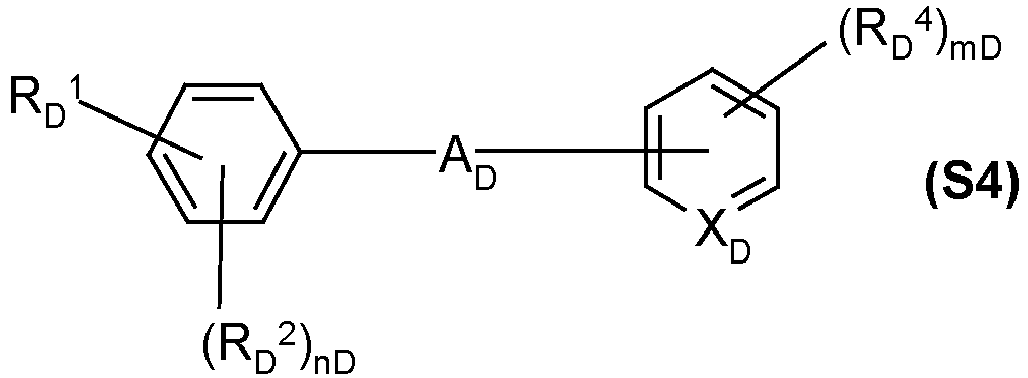
- AD ist SO2-NRD 3-CO oder CO-NRD 3-SO2
- XD ist CH oder N;
- RD 1 ist CO-NRD 5RD 6 oder NHCO-RD 7;
- RD 2 ist Halogen, (C1-C4)Haloalkyl, (C1-C4)Haloalkoxy, Nitro, (C1-C4)Alkyl, (C1-C4)Alkoxy, (C1-C4)Alkylsulfonyl, (C1-C4)Alkoxycarbonyl oder (C1-C4)Alkylcarbonyl;
- RD 3 ist Wasserstoff, (C1-C4)Alkyl, (C2-C4)Alkenyl oder (C2-C4)Alkinyl,
- RD 4 ist Halogen, Nitro, (C1-C4)Alkyl, (C1-C4)Haloalkyl, (C1-C4)Haloalkoxy, (C3-C6)Cycloalkyl, Phenyl, (C1-C4)Alkoxy, Cyano, (C1-C4)Alkylthio, (C1-C4)Alkylsulfinyl, (C1-C4)Alkylsulfonyl, (C1-C4)Alkoxycarbonyl oder (C1-C4)Alkylcarbonyl;
- RD 5 ist Wasserstoff, (C1-C6)Alkyl, (C3-C6)Cycloalkyl, (C2-C6)Alkenyl, (C2-C6)Alkinyl, (C5-C6)Cycloalkenyl, Phenyl oder 3- bis 6-gliedriges Heterocyclyl enthaltend vD Heteroatome aus der Gruppe Stickstoff, Sauerstoff und Schwefel, wobei die sieben letztgenannten Reste durch vD Substituenten aus der Gruppe Halogen, (C1-C6)Alkoxy, (C1-C6)Haloalkoxy, (C1-C2)Alkylsulfinyl, (C1-C2)Alkylsulfonyl, (C3-C6)Cycloalkyl, (C1-C4)Alkoxycarbonyl, (C1-C4)Alkylcarbonyl und Phenyl und im Falle cyclischer Reste auch (C1-C4) Alkyl und (C1-C4)Haloalkyl substituiert sind;
- RD 6 ist Wasserstoff, (C1-C6)Alkyl, (C2-C6)Alkenyl oder (C2-C6)Alkinyl, wobei die drei letztgenannten Reste durch vD Reste aus der Gruppe Halogen, Hydroxy, (C1-C4)Alkyl, (C1-C4)Alkoxy und (C1-C4)Alkylthio substituiert sind, oder
- RD 5 und RD 6 gemeinsam mit dem dem sie tragenden Stickstoffatom einen Pyrrolidinyl- oder Piperidinyl-Rest bilden;
- RD 7 ist Wasserstoff, (C1-C4)Alkylamino, Di-(C1-C4)alkylamino, (C1-C6)Alkyl, (C3-C6)Cycloalkyl, wobei die 2 letztgenannten Reste durch vD Substituenten aus der Gruppe Halogen, (C1-C4)Alkoxy, (C1-C6)Haloalkoxy und (C1-C4)Alkylthio und im Falle cyclischer Reste auch (C1-C4)Alkyl und (C1-C4)Haloalkyl substituiert sind;
- nD ist 0, 1 oder 2;
- mD ist 1 oder 2;
- vD ist 0, 1, 2 oder 3;
- davon bevorzugt sind Verbindungen vom Typ der N-Acylsulfonamide, z.B. der nachfolgenden Formel (S4a), die z. B. bekannt sind aus
WO-A-97/45016 
- worin
- RD 7 (C1-C6)Alkyl, (C3-C6)Cycloalkyl, wobei die 2 letztgenannten Reste durch vD Substituenten aus der Gruppe Halogen, (C1-C4)Alkoxy, (C1-C6)Haloalkoxy und (C1-C4)Alkylthio und im Falle cyclischer Reste auch (C1-C4)Alkyl und (C1-C4)Haloalkyl substituiert sind;
- RD 4 Halogen, (C1-C4)Alkyl, (C1-C4)Alkoxy, CF3,
- mD 1 oder 2;
- vD ist 0, 1, 2 oder 3 bedeutet;
- sowie
- Acylsulfamoylbenzoesäureamide, z.B. der nachfolgenden Formel (S4b), die z.B. bekannt sind aus
WO-A-99/16744 
- z.B. solche worin
- RD 5 = Cyclopropyl und (RD 4) = 2-OMe ist ("Cyprosulfamide", S4-1),
- RD 5 = Cyclopropyl und (RD 4) = 5-Cl-2-OMe ist (S4-2),
- RD 5 = Ethyl und (RD 4) = 2-OMe ist (S4-3),
- RD 5 = Isopropyl und (RD 4) = 5-Cl-2-OMe ist (S4-4) und
- RD 5 = Isopropyl und (RD 4) = 2-OMe ist (S4-5).
- sowie
- Verbindungen vom Typ der N-Acylsulfamoylphenylharnstoffe der Formel (S4c), die z.B. bekannt sind aus der
EP-A-365484 
- worin
- RD 8 und RD 9 unabhängig voneinander Wasserstoff, (C1-C8)Alkyl, (C3-C8)Cycloalkyl, (C3-C6)Alkenyl, (C3-C6)Alkinyl,
- RD 4 Halogen, (C1-C4)Alkyl, (C1-C4)Alkoxy, CF3
- mD 1 oder 2 bedeutet;
- beispielsweise
- 1-[4-(N-2-Methoxybenzoylsulfamoyl)phenyl]-3-methylharnstoff,
- 1-[4-(N-2-Methoxybenzoylsulfamoyl)phenyl]-3,3-dimethylharnstoff,
- 1-[4-(N-4,5-Dimethylbenzoylsulfamoyl)phenyl]-3-methylharnstoff,
- sowie
- N-Phenylsulfonylterephthalamide der Formel (S4d), die z.B. bekannt sind aus
CN 101838227 ,
- z.B. solche worin
- RD 4 Halogen, (C1-C4)Alkyl, (C1-C4)Alkoxy, CF3,
- mD 1 oder 2;
- RD 5 Wasserstoff, (C1-C6)Alkyl, (C3-C6)Cycloalkyl, (C2-C6)Alkenyl, (C2-C6)Alkinyl, (C5-C6)Cycloalkenyl bedeutet.
- S5) Wirkstoffe aus der Klasse der Hydroxyaromaten und der aromatisch-aliphatischen Carbonsäurederivate (S5), z.B.
3,4,5-Triacetoxybenzoesäureethylester, 3,5-Dimethoxy-4-hydroxybenzoesäure, 3,5-Dihydroxybenzoesäure, 4-Hydroxysalicylsäure, 4-Fluorsalicyclsäure, 2-Hydroxyzimtsäure, 2,4-Dichlorzimtsäure, wie sie in derWO-A-2004/084631 ,WO-A-2005/015994 ,WO-A-2005/016001 beschrieben sind. - S6) Wirkstoffe aus der Klasse der 1,2-Dihydrochinoxalin-2-one (S6), z.B. 1-Methyl-3-(2-thienyl)-1,2-dihydrochinoxalin-2-on, 1-Methyl-3-(2-thienyl)-1,2-dihydrochinoxalin-2-thion, 1-(2-Aminoethyl)-3-(2-thienyl)-1,2-dihydro-chinoxalin-2-on-hydrochlorid, 1-(2-Methylsulfonylaminoethyl)-3-(2-thienyl)-1,2-dihydro-chinoxalin-2-on, wie sie in der
WO-A-2005/112630 beschrieben sind. - S7) Verbindungen der Formel (S7),wie sie in der
WO-A-1998/38856 
- RE 1, RE 2 sind unabhängig voneinander Halogen, (C1-C4)Alkyl, (C1-C4)Alkoxy, (C1-C4)Haloalkyl, (C1-C4)Alkylamino, Di-(C1-C4)Alkylamino, Nitro;
- AE ist COORE 3 oder COSRE 4
- RE 3, RE 4 sind unabhängig voneinander Wasserstoff, (C1-C4)Alkyl, (C2-C6)Alkenyl, (C2-C4)Alkinyl, Cyanoalkyl, (C1-C4)Haloalkyl, Phenyl, Nitrophenyl, Benzyl, Halobenzyl, Pyridinylalkyl und Alkylammonium,
- nE 1 ist 0 oder 1
- nE 2, nE 3 sind unabhängig voneinander 0, 1 oder 2,
- vorzugsweise:
- Diphenylmethoxyessigsäure,
- Diphenylmethoxyessigsäureethylester,
- Diphenylmethoxyessigsäuremethylester (CAS-Reg.Nr. 41858-19-9) (S7-1).
- S8) Verbindungen der Formel (S8),wie sie in der
WO-A-98/27049 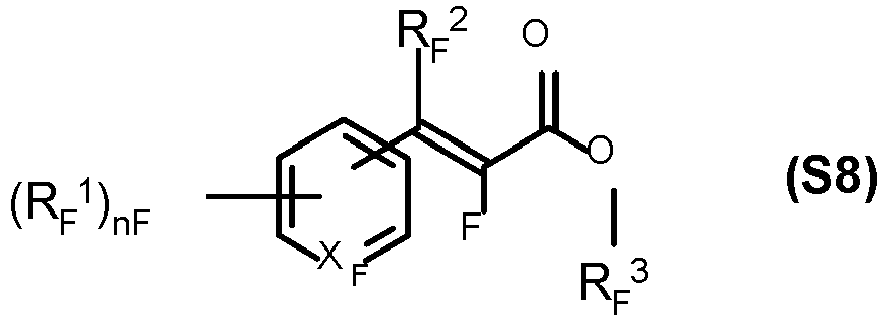
- XF CH oder N,
- nF für den Fall, dass XF=N ist, eine ganze Zahl von 0 bis 4 und
für den Fall, dass XF=CH ist, eine ganze Zahl von 0 bis 5 , - RF 1 Halogen, (C1-C4)Alkyl, (C1-C4)Haloalkyl, (C1-C4)Alkoxy, (C1-C4)Haloalkoxy, Nitro, (C1-C4)Alkylthio, (C1-C4)-Alkylsulfonyl, (C1-C4)Alkoxycarbonyl, ggf. substituiertes. Phenyl, ggf. substituiertes Phenoxy,
- RF 2 Wasserstoff oder (C1-C4)Alkyl
- RF 3 Wasserstoff, (C1-C8)Alkyl, (C2-C4)Alkenyl, (C2-C4)Alkinyl, oder Aryl, wobei jeder der vorgenannten C-haltigen Reste unsubstituiert oder durch einen oder mehrere, vorzugsweise bis zu drei gleiche oder verschiedene Reste aus der Gruppe, bestehend aus Halogen und Alkoxy substituiert ist; bedeuten, oder deren Salze,
- vorzugsweise Verbindungen worin
- XF CH,
- nF eine ganze Zahl von 0 bis 2 ,
- RF 1 Halogen, (C1-C4)Alkyl, (C1-C4)Haloalkyl, (C1-C4)Alkoxy, (C1-C4)Haloalkoxy,
- RF 2 Wasserstoff oder (C1-C4)Alkyl,
- RF 3 Wasserstoff, (C1-C8)Alkyl, (C2-C4)Alkenyl, (C2-C4)Alkinyl, oder Aryl, wobei jeder der vorgenannten C-haltigen Reste unsubstituiert oder durch einen oder mehrere, vorzugsweise bis zu drei gleiche oder verschiedene Reste aus der Gruppe, bestehend aus Halogen und Alkoxy substituiert ist, bedeuten,
- oder deren Salze.
- S9) Wirkstoffe aus der Klasse der 3-(5-Tetrazolylcarbonyl)-2-chinolone (S9), z.B. 1,2-Dihydro-4-hydroxy-1-ethyl-3-(5-tetrazolylcarbonyl)-2-chinolon (CAS-Reg.Nr. 219479-18-2), 1,2-Dihydro-4-hydroxy-1-methyl-3-(5-tetrazolyl-carbonyl)-2-chinolon (CAS-Reg.Nr. 95855-00-8), wie sie in der
WO-A-1999/000020 beschrieben sind. - S10) Verbindungen der Formeln (S10a) oder (S10b)
wie sie in derWO-A-2007/023719 undWO-A-2007/023764 beschrieben sind
- RG 1 Halogen, (C1-C4)Alkyl, Methoxy, Nitro, Cyano, CF3, OCF3
- YG, ZG unabhängig voneinander O oder S,
- nG eine ganze Zahl von 0 bis 4,
- RG 2 (C1-C16)Alkyl, (C2-C6)Alkenyl, (C3-C6)Cycloalkyl, Aryl; Benzyl, Halogenbenzyl,
- RG 3 Wasserstoff oder (C1-C6)Alkyl bedeutet.
- S11) Wirkstoffe vom Typ der Oxyimino-Verbindungen (S11), die als Saatbeizmittel bekannt sind, wie z. B.
- "Oxabetrinil" ((Z)-1,3-Dioxolan-2-ylmethoxyimino(phenyl)acetonitril) (S11-1), das als Saatbeiz-Safener für Hirse gegen Schäden von Metolachlor bekannt ist,
- "Fluxofenim" (1-(4-Chlorphenyl)-2,2,2-trifluor-1-ethanon-O-(1,3-dioxolan-2-ylmethyl)-oxim) (S11-2), das als Saatbeiz-Safener für Hirse gegen Schäden von Metolachlor bekannt ist, und
- "Cyometrinil" oder "CGA-43089" ((Z)-Cyanomethoxyimino(phenyl)acetonitril) (S11-3), das als Saatbeiz-Safener für Hirse gegen Schäden von Metolachlor bekannt ist.
- S12) Wirkstoffe aus der Klasse der Isothiochromanone (S12), wie z.B. Methyl-[(3-oxo-1H-2-benzothiopyran-4(3H)-yliden)methoxy]acetat (CAS-Reg.Nr. 205121-04-6) (S12-1) und verwandte Verbindungen aus
WO-A-1998/13361 - S13) Eine oder mehrere Verbindungen aus Gruppe (S13):
- "Naphthalic anhydrid" (1,8-Naphthalindicarbonsäureanhydrid) (S13-1), das als Saatbeiz-Safener für Mais gegen Schäden von Thiocarbamatherbiziden bekannt ist,
- "Fenclorim" (4,6-Dichlor-2-phenylpyrimidin) (S13-2), das als Safener für Pretilachlor in gesätem Reis bekannt ist,
- "Flurazole" (Benzyl-2-chlor-4-trifluormethyl-1,3-thiazol-5-carboxylat) (S13-3), das als Saatbeiz-Safener für Hirse gegen Schäden von Alachlor und Metolachlor bekannt ist,
- "CL 304415" (CAS-Reg.Nr. 31541-57-8)
- (4-Carboxy-3,4-dihydro-2H-1-benzopyran-4-essigsäure) (S13-4) der Firma American Cyanamid, das als Safener für Mais gegen Schäden von Imidazolinonen bekannt ist,
- "MG 191" (CAS-Reg.Nr. 96420-72-3) (2-Dichlormethyl-2-methyl-1,3-dioxolan) (S13-5) der Firma Nitrokemia, das als Safener für Mais bekannt ist,
- "MG 838" (CAS-Reg.Nr. 133993-74-5)
- (2-propenyl 1-oxa-4-azaspiro[4.5]decan-4-carbodithioat) (S13-6) der Firma Nitrokemia,
- "Disulfoton" (O,O-Diethyl S-2-ethylthioethyl phosphordithioat) (S13-7),
- "Dietholate" (O,O-Diethyl-O-phenylphosphorothioat) (S13-8),
- "Mephenate" (4-Chlorphenyl-methylcarbamat) (S13-9).
- S14) Wirkstoffe, die neben einer herbiziden Wirkung gegen Schadpflanzen auch Safenerwirkung an Kulturpflanzen wie Reis aufweisen, wie z. B.
- "Dimepiperate" oder "MY 93" (S-1-Methyl-1-phenylethyl-piperidin-1-carbothioat), das als Safener für Reis gegen Schäden des Herbizids Molinate bekannt ist,
- "Daimuron" oder "SK 23" (1-(1-Methyl-1-phenylethyl)-3-p-tolyl-harnstoff), das als Safener für Reis gegen Schäden des Herbizids Imazosulfuron bekannt ist,
- "Cumyluron" = "JC 940" (3-(2-Chlorphenylmethyl)-1-(1-methyl-1-phenyl-ethyl)harnstoff, siehe
JP-A-60087254 - "Methoxyphenon" oder "NK 049" (3,3'-Dimethyl-4-methoxy-benzophenon), das als Safener für Reis gegen Schäden einiger Herbizide bekannt ist,
- "CSB" (1-Brom-4-(chlormethylsulfonyl)benzol) von Kumiai, (CAS-Reg.Nr. 54091-06-4), das als Safener gegen Schäden einiger Herbizide in Reis bekannt ist.
- S15) Verbindungen der Formel (S15) oder deren Tautomere

- wie sie in der
WO-A-2008/131861 undWO-A-2008/131860 beschrieben sind, worin - RH 1 einen (C1-C6)Haloalkylrest bedeutet und
- RH 2 Wasserstoff oder Halogen bedeutet und
- RH 3, RH 4 unabhängig voneinander Wasserstoff, (C1-C16)Alkyl, (C2-C16)Alkenyl oder (C2-C16)Alkinyl,
- wobei jeder der letztgenannten 3 Reste unsubstituiert oder durch einen oder mehrere Reste aus der Gruppe Halogen, Hydroxy, Cyano, (C1-C4)Alkoxy, (C1-C4)Haloalkoxy, (C1-C4)Alkylthio, (C1-C4)Alkylamino, Di[(C1-C4)alkyl]-amino, [(C1-C4)Alkoxy]-carbonyl, [(C1-C4)Haloalkoxy]-carbonyl, (C3-C6)Cycloalkyl, das unsubstituiert oder substituiert ist, Phenyl, das unsubstituiert oder substituiert ist, und Heterocyclyl, das unsubstituiert oder substituiert ist, substituiert ist,
- oder (C3-C6)Cycloalkyl, (C4-C6)Cycloalkenyl, (C3-C6)Cycloalkyl, das an einer Seite des Rings mit einem 4 bis 6-gliedrigen gesättigten oder ungesättigten carbocyclischen Ring kondensiert ist, oder (C4-C6)Cycloalkenyl, das an einer Seite des Rings mit einem 4 bis 6-gliedrigen gesättigten oder ungesättigten carbocyclischen Ring kondensiert ist,
- wobei jeder der letztgenannten 4 Reste unsubstituiert oder durch einen oder mehrere Reste aus der Gruppe Halogen, Hydroxy, Cyano, (C1-C4)Alkyl, (C1-C4)Haloalkyl, (C1-C4)Alkoxy, (C1-C4)Haloalkoxy, (C1-C4)Alkylthio, (C1-C4)Alkylamino, Di[(C1-C4)alkyl]-amino, [(C1-c4)Alkoxy]-carbonyl, [(C1-C4)Haloalkoxy]-carbonyl, (C3-C6)Cycloalkyl, das unsubstituiert oder substituiert ist, Phenyl, das unsubstituiert oder substituiert ist, und Heterocyclyl, das unsubstituiert oder substituiert ist, substituiert ist,
- bedeutet oder
- RH 3 (C1-C4)-Alkoxy, (C2-C4)Alkenyloxy, (C2-C6)Alkinyloxy oder (C2-C4)Haloalkoxy bedeutet und
- RH 4 Wasserstoff oder (C1-C4)-Alkyl bedeutet oder
- RH 3 und RH 4 zusammen mit dem direkt gebundenen N-Atom einen vier- bis achtgliedrigen heterocyclischen Ring, der neben dem N-Atom auch weitere Heteroringatome, vorzugsweise bis zu zwei weitere Heteroringatome aus der Gruppe N, O und S enthalten kann und der unsubstituiert oder durch einen oder mehrere Reste aus der Gruppe Halogen, Cyano, Nitro, (C1-C4)Alkyl, (C1-C4)Haloalkyl, (C1-C4)Alkoxy, (C1-C4)Haloalkoxy und (C1-C4)Alkylthio substituiert ist, bedeutet.
- wie sie in der
- S16) Wirkstoffe, die vorrangig als Herbizide eingesetzt werden, jedoch auch Safenerwirkung auf Kulturpflanzen aufweisen, z.B.
- (2,4-Dichlorphenoxy)essigsäure (2,4-D), (4-Chlorphenoxy)essigsäure,
- (R,S)-2-(4-Chlor-o-tolyloxy)propionsäure (Mecoprop), 4-(2,4-Dichlorphenoxy)buttersäure (2,4-DB), (4-Chlor-o-tolyloxy)essigsäure (MCPA), 4-(4-Chlor-o-tolyloxy)buttersäure,
- 4-(4-Chlorphenoxy)buttersäure,
- 3,6-Dichlor-2-methoxybenzoesäure (Dicamba), 1-(Ethoxycarbonyl)ethyl-3,6-dichlor-2-methoxybenzoat (Lactidichlor-ethyl).
- Besonders bevorzugte Safener sind Mefenpyr-diethyl, Cyprosulfamid, Isoxadifen-ethyl, Cloquintocetmexyl, Dichlormid und Metcamifen.
- Spritzpulver sind in Wasser gleichmäßig dispergierbare Präparate, die neben dem Wirkstoff außer einem Verdünnungs- oder Inertstoff noch Tenside ionischer und/oder nichtionischer Art (Netzmittel, Dispergiermittel), z.B. polyoxyethylierte Alkylphenole, polyoxethylierte Fettalkohole, polyoxethylierte Fettamine, Fettalkoholpolyglykolether-sulfate, Alkansulfonate, Alkylbenzolsulfonate, ligninsulfonsaures Natrium, 2,2'-dinaphthylmethan-6,6'-disulfonsaures Natrium, dibutylnaphthalin-sulfonsaures Natrium oder auch oleoylmethyltaurinsaures Natrium enthalten. Zur Herstellung der Spritzpulver werden die herbiziden Wirkstoffe beispielsweise in üblichen Apparaturen wie Hammermühlen, Gebläsemühlen und Luftstrahlmühlen feingemahlen und gleichzeitig oder anschließend mit den Formulierungshilfsmitteln vermischt.
- Emulgierbare Konzentrate werden durch Auflösen des Wirkstoffes in einem organischen Lösungsmittel z.B. Butanol, Cyclohexanon, Dimethylformamid, Xylol oder auch höhersiedenden Aromaten oder Kohlenwasserstoffen oder Mischungen der organischen Lösungsmittel unter Zusatz von einem oder mehreren Tensiden ionischer und/oder nichtionischer Art (Emulgatoren) hergestellt. Als Emulgatoren können beispielsweise verwendet werden: Alkylarylsulfonsaure Calzium-Salze wie Ca-Dodecylbenzolsulfonat oder nichtionische Emulgatoren wie Fettsäurepoly-glykolester, Alkylarylpolyglykolether, Fettalkoholpolyglykolether, Propylenoxid-Ethylenoxid-Kondensationsprodukte, Alkylpolyether, Sorbitanester wie z.B. Sorbitanfett-säureester oder Polyoxethylensorbitanester wie z.B. Polyoxyethylensorbitan-fettsäureester.
- Stäubemittel erhält man durch Vermahlen des Wirkstoffes mit fein verteilten festen Stoffen, z.B. Talkum, natürlichen Tonen, wie Kaolin, Bentonit und Pyrophyllit, oder Diatomeenerde.
- Suspensionskonzentrate können auf Wasser- oder Ölbasis sein. Sie können beispielsweise durch Naß-Vermahlung mittels handelsüblicher Perlmühlen und gegebenenfalls Zusatz von Tensiden, wie sie z.B. oben bei den anderen Formulierungstypen bereits aufgeführt sind, hergestellt werden.
- Emulsionen, z.B. Öl-in-Wasser-Emulsionen (EW), lassen sich beispielsweise mittels Rührern, Kolloidmühlen und/oder statischen Mischern unter Verwendung von wäßrigen organischen Lösungsmitteln und gegebenenfalls Tensiden, wie sie z.B. oben bei den anderen Formulierungstypen bereits aufgeführt sind, herstellen.
- Granulate können entweder durch Verdüsen des Wirkstoffes auf adsorptionsfähiges, granuliertes Inertmaterial hergestellt werden oder durch Aufbringen von Wirkstoffkonzentraten mittels Klebemitteln, z.B. Polyvinylalkohol, polyacrylsaurem Natrium oder auch Mineralölen, auf die Oberfläche von Trägerstoffen wie Sand, Kaolinite oder von granuliertem Inertmaterial. Auch können geeignete Wirkstoffe in der für die Herstellung von Düngemittelgranulaten üblichen Weise - gewünschtenfalls in Mischung mit Düngemitteln - granuliert werden.
- Wasserdispergierbare Granulate werden in der Regel nach den üblichen Verfahren wie Sprühtrocknung, Wirbelbett-Granulierung, Teller-Granulierung, Mischung mit Hochgeschwindigkeitsmischern und Extrusion ohne festes Inertmaterial hergestellt.
- Zur Herstellung von Teller-, Fließbett-, Extruder- und Sprühgranulate siehe z.B. Verfahren in "Spray-Drying Handbook" 3rd ed. 1979, G. Goodwin Ltd., London, J.E. Browning, "Agglomeration", Chemical and Engineering 1967, Seiten 147 ff, "Perry's Chemical Engineer's Handbook", 5th Ed., McGraw-Hill, New York 1973, S. 8-57.
- Für weitere Einzelheiten zur Formulierung von Pflanzenschutzmitteln siehe z.B. G.C. Klingman, "Weed Control as a Science", John Wiley and Sons, Inc., New York, 1961, Seiten 81-96 und J.D. Freyer, S.A. Evans, "Weed Control Handbook", 5th Ed., Blackwell Scientific Publications, Oxford, 1968, Seiten 101-103.
- Die agrochemischen Zubereitungen enthalten in der Regel 0.1 bis 99 Gew.-%, insbesondere 0.1 bis 95 Gew.-%, erfindungsgemäße Verbindungen. In Spritzpulvern beträgt die Wirkstoff-konzentration z.B. etwa 10 bis 90 Gew.-%, der Rest zu 100 Gew.-% besteht aus üblichen Formulierungsbestandteilen. Bei emulgierbaren Konzentraten kann die Wirkstoffkonzentration etwa 1 bis 90, vorzugsweise 5 bis 80 Gew.-% betragen. Staubförmige Formulierungen enthalten 1 bis 30 Gew.-% Wirkstoff, vorzugsweise meistens 5 bis 20 Gew.-% an Wirkstoff, versprühbare Lösungen enthalten etwa 0.05 bis 80, vorzugsweise 2 bis 50 Gew.-% Wirkstoff. Bei wasser-dispergierbaren Granulaten hängt der Wirkstoffgehalt zum Teil davon ab, ob die wirksame Verbindung flüssig oder fest vorliegt und welche Granulierhilfsmittel, Füllstoffe usw. verwendet werden. Bei den in Wasser dispergierbaren Granulaten liegt der Gehalt an Wirkstoff beispielsweise zwischen 1 und 95 Gew.-%, vorzugsweise zwischen 10 und 80 Gew.-%. Daneben enthalten die genannten Wirkstofformulierungen gegebenenfalls die jeweils üblichen Haft-, Netz-, Dispergier-, Emulgier-, Penetrations-, Konservierungs-, Frostschutz- und Lösungsmittel, Füll-, Träger- und Farbstoffe, Entschäumer, Verdunstungshemmer und den pH-Wert und die Viskosität beeinflussende Mittel.
- Auf der Basis dieser Formulierungen lassen sich auch Kombinationen mit anderen pestizid wirksamen Stoffen, wie z.B. Insektiziden, Akariziden, Herbiziden, Fungiziden, sowie mit Safenern, Düngemitteln und/oder Wachstumsregulatoren herstellen, z.B. in Form einer Fertigformulierung oder als Tankmix. Zur Anwendung werden die in handelsüblicher Form vorliegenden Formulierungen gegebenenfalls in üblicher Weise verdünnt z.B. bei Spritzpulvern, emulgierbaren Konzentraten, Dispersionen und wasserdispergierbaren Granulaten mittels Wasser. Staubförmige Zubereitungen, Boden- bzw. Streugranulate sowie versprühbare Lösungen werden vor der Anwendung üblicherweise nicht mehr mit weiteren inerten Stoffen verdünnt.
- Mit den äußeren Bedingungen wie Temperatur, Feuchtigkeit, der Art des verwendeten Herbizids, u.a. variiert die erforderliche Aufwandmenge der Verbindungen der Formel (I) und deren Salze. Sie kann innerhalb weiter Grenzen schwanken, z.B. zwischen 0,001 und 10,0 kg/ha oder mehr Aktivsubstanz, vorzugsweise liegt sie jedoch zwischen 0,005 bis 5 kg/ha, weiter bevorzugt im Bereich von 0,01 bis 1,5 kg/ha, insbesondere bevorzugt im Bereich von 0,05 bis 1 kg/ha g/ha. Dies gilt sowohl für die Anwendung im Vorauflauf oder im Nachauflauf.
- Trägerstoff bedeutet eine natürliche oder synthetische, organische oder anorganische Substanz, mit welchen die Wirkstoffe zur besseren Anwendbarkeit, v.a. zum Aufbringen auf Pflanzen oder Pflanzenteile oder Saatgut, gemischt oder verbunden sind. Der Trägerstoff, welcher fest oder flüssig sein kann, ist im Allgemeinen inert und sollte in der Landwirtschaft verwendbar sein.
- Als feste oder flüssige Trägerstoffe kommen infrage: z.B. Ammoniumsalze und natürliche Gesteinsmehle, wie Kaoline, Tonerden, Talkum, Kreide, Quarz, Attapulgit, Montmorillonit oder Diatomeenerde und synthetische Gesteinsmehle, wie hochdisperse Kieselsäure, Aluminiumoxid und natürliche oder synthetische Silikate, Harze, Wachse, feste Düngemittel, Wasser, Alkohole, besonders Butanol, organische Solventien, Mineral- und Pflanzenöle sowie Derivate hiervon. Mischungen solcher Trägerstoffe können ebenfalls verwendet werden. Als feste Trägerstoffe für Granulate kommen infrage: z.B. gebrochene und fraktionierte natürliche Gesteine wie Calcit, Marmor, Bims, Sepiolith, Dolomit sowie synthetische Granulate aus anorganischen und organischen Mehlen sowie Granulate aus organischem Material wie Sägemehl, Kokosnussschalen, Maiskolben und Tabakstängel.
- Als verflüssigte gasförmige Streckmittel oder Trägerstoffe kommen solche Flüssigkeiten infrage, welche bei normaler Temperatur und unter Normaldruck gasförmig sind, z.B. Aerosol-Treibgase, wie Halogenkohlenwasserstoffe, sowie Butan, Propan, Stickstoff und Kohlendioxid.
- Es können in den Formulierungen Haftmittel wie Carboxymethylcellulose, natürliche und synthetische pulverige, körnige oder latexförmige Polymere verwendet werden, wie Gummiarabikum, Polyvinylalkohol, Polyvinylacetat, sowie natürliche Phospholipide, wie Kephaline und Lecithine, und synthetische Phospholipide. Weitere Additive können mineralische und vegetabile Öle sein.
- Im Falle der Benutzung von Wasser als Streckmittel können z.B. auch organische Lösungsmittel als Hilfslösungsmittel verwendet werden. Als flüssige Lösungsmittel kommen im Wesentlichen infrage: Aromaten, wie Xylol, Toluol oder Alkylnaphthaline, chlorierte Aromaten oder chlorierte aliphatische Kohlenwasserstoffe, wie Chlorbenzole, Chlorethylene oder Dichlormethan, aliphatische Kohlenwasserstoffe, wie Cyclohexan oder Paraffine, z.B. Erdölfraktionen, mineralische und pflanzliche Öle, Alkohole, wie Butanol oder Glykol sowie deren Ether und Ester, Ketone, wie Aceton, Methylethylketon, Methylisobutylketon oder Cyclohexanon, stark polare Lösungsmittel wie Dimethylformamid und Dimethylsulfoxid, sowie Wasser.
- Die erfindungsgemäßen Mittel können zusätzlich weitere Bestandteile enthalten, wie z.B. oberflächenaktive Stoffe. Als oberflächenaktive Stoffe kommen Emulgier- und/oder Schaum erzeugende Mittel, Dispergiermittel oder Benetzungsmittel mit ionischen oder nicht-ionischen Eigenschaften oder Mischungen dieser oberflächenaktiven Stoffe infrage. Beispiele hierfür sind Salze von Polyacrylsäure, Salze von Lignosulphonsäure, Salze von Phenolsulphonsäure oder Naphthalinsulphonsäure, Polykondensate von Ethylenoxid mit Fettalkoholen oder mit Fettsäuren oder mit Fettaminen, substituierten Phenolen (vorzugsweise Alkylphenole oder Arylphenole), Salze von Sulphobernsteinsäureestern, Taurinderivate (vorzugsweise Alkyltaurate), Phosphorsäureester von polyethoxylierten Alkoholen oder Phenole, Fettsäureester von Polyolen, und Derivate der Verbindungen enthaltend Sulphate, Sulphonate und Phosphate, z.B. Alkylarylpolyglycolether, Alkylsulfonate, Alkylsulfate, Arylsulfonate, Eiweißhydrolysate, Lignin-Sulfitablaugen und Methylcellulose. Die Anwesenheit einer oberflächenaktiven Substanz ist notwendig, wenn einer der Wirkstoff und/oder einer der inerten Trägerstoffe nicht in Wasser löslich ist und wenn die Anwendung in Wasser erfolgt. Der Anteil an oberflächenaktiven Stoffen liegt zwischen 5 und 40 Gewichtsprozent des erfindungsgemäßen Mittels. Es können Farbstoffe wie anorganische Pigmente, z.B. Eisenoxid, Titanoxid, Ferrocyanblau und organische Farbstoffe, wie Alizarin-, Azo- und Metallphthalocyaninfarbstoffe und Spurennährstoffe, wie Salze von Eisen, Mangan, Bor, Kupfer, Kobalt, Molybdän und Zink verwendet werden.
- Gegebenenfalls können auch andere zusätzliche Komponenten enthalten sein, z.B. schützende Kolloide, Bindemittel, Klebstoffe, Verdicker, thixotrope Stoffe, Penetrationsförderer, Stabilisatoren, Sequestiermittel, Komplexbildner. Im Allgemeinen können die Wirkstoffe mit jedem festen oder flüssigen Additiv, welches für Formulierungszwecke gewöhnlich verwendet wird, kombiniert werden. Im Allgemeinen enthalten die erfindungsgemäßen Mittel und Formulierungen zwischen 0,05 und 99 Gew.- %, 0,01 und 98 Gew.-%, vorzugsweise zwischen 0,1 und 95 Gew.-%, besonders bevorzugt zwischen 0,5 und 90 % Wirkstoff, ganz besonders bevorzugt zwischen 10 und 70 Gewichtsprozent. Die erfindungsgemäßen Wirkstoffe bzw. Mittel können als solche oder in Abhängigkeit von ihren jeweiligen physikalischen und/oder chemischen Eigenschaften in Form ihrer Formulierungen oder den daraus bereiteten Anwendungsformen, wie Aerosole, Kapselsuspensionen, Kaltnebelkonzentrate, Heißnebelkonzentrate, verkapselte Granulate, Feingranulate, fließfähige Konzentrate für die Behandlung von Saatgut, gebrauchsfertige Lösungen, verstäubbare Pulver, emulgierbare Konzentrate, Öl-in-Wasser-Emulsionen, Wasser-in-Öl-Emulsionen, Makrogranulate, Mikrogranulate, Öl dispergierbare Pulver, Öl mischbare fließfähige Konzentrate, Öl mischbare Flüssigkeiten, Schäume, Pasten, Pestizid ummanteltes Saatgut, Suspensionskonzentrate, Suspensions-Emulsions-Konzentrate, lösliche Konzentrate, Suspensionen, Spritzpulver, lösliche Pulver, Stäubemittel und Granulate, wasserlösliche Granulate oder Tabletten, wasserlösliche Pulver für Saatgut-behandlung, benetzbare Pulver, Wirkstoff-imprägnierte Natur- und synthetische Stoffe sowie Feinstverkapselungen in polymeren Stoffen und in Hüllmassen für Saatgut, sowie ULV-Kalt- und Warmnebel-Formulierungen eingesetzt werden.
- Die genannten Formulierungen können in an sich bekannter Weise hergestellt werden, z.B. durch Vermischen der Wirkstoffe mit mindestens einem üblichen Streckmittel, Lösungs- bzw. Verdünnungsmittel, Emulgator, Dispergier- und/oder Binde- oder Fixiermittels, Netzmittel, Wasser-Repellent, gegebenenfalls Sikkative und UV-Stabilisatoren und gegebenenfalls Farbstoffen und Pigmenten, Entschäumer, Konservierungsmittel, sekundäre Verdickungsmittel, Kleber, Gibberelline sowie weiteren Verarbeitungshilfsmitteln.
- Die erfindungsgemäßen Mittel umfassen nicht nur Formulierungen, welche bereits anwendungsfertig sind und mit einer geeigneten Apparatur auf die Pflanze oder das Saatgut ausgebracht werden können, sondern auch kommerzielle Konzentrate, welche vor Gebrauch mit Wasser verdünnt werden müssen.
- Die erfindungsgemäßen Wirkstoffe können als solche oder in ihren (handelsüblichen) Formulierungen sowie in den aus diesen Formulierungen bereiteten Anwendungsformen in Mischung mit anderen (bekannten) Wirkstoffen, wie Insektiziden, Lockstoffen, Sterilantien, Bakteriziden, Akariziden, Nematiziden, Fungiziden, Wachstumsregulatoren, Herbiziden, Düngemitteln, Safener bzw. Semiochemicals vorliegen.
- Die erfindungsgemäße Behandlung der Pflanzen und Pflanzenteile mit den Wirkstoffen bzw. Mitteln erfolgt direkt oder durch Einwirkung auf deren Umgebung, Lebensraum oder Lagerraum nach den üblichen Behandlungsmethoden, z.B. durch Tauchen, (Ver-)Spritzen, (Ver-)Sprühen, Berieseln, Verdampfen, Zerstäuben, Vernebeln, (Ver-)Streuen, Verschäumen, Bestreichen, Verstreichen, Gießen (drenchen), Tröpfchenbewässerung und bei Vermehrungsmaterial, insbesondere bei Samen, weiterhin durch Trockenbeizen, Nassbeizen, Schlämmbeizen, Inkrustieren, ein- oder mehrschichtiges Umhüllen usw. Es ist ferner möglich, die Wirkstoffe nach dem Ultra-Low-Volume-Verfahren auszubringen oder die Wirkstoffzubereitung oder den Wirkstoff selbst in den Boden zu injizieren.
- Wie auch weiter unten beschrieben, ist die Behandlung von transgenem Saatgut mit den erfindungsgemäßen Wirkstoffen bzw. Mitteln von besonderer Bedeutung. Dies betrifft das Saatgut von Pflanzen, die wenigstens ein heterologes Gen enthalten, das die Expression eines Polypeptids oder Proteins mit insektiziden Eigenschaften ermöglicht. Das heterologe Gen in transgenem Saatgut kann z.B. aus Mikroorganismen der Arten Bacillus, Rhizobium, Pseudomonas, Serratia, Trichoderma, Clavibacter, Glomus oder Gliocladium stammen. Bevorzugt stammt dieses heterologe Gen aus Bacillus sp., wobei das Genprodukt eine Wirkung gegen den Maiszünsler (European corn borer) und/oder Western Corn Rootworm besitzt. Besonders bevorzugt stammt das heterologe Gen aus Bacillus thuringiensis.
- Im Rahmen der vorliegenden Erfindung wird das erfindungsgemäße Mittel alleine oder in einer geeigneten Formulierung auf das Saatgut aufgebracht. Vorzugsweise wird das Saatgut in einem Zustand behandelt, in dem so stabil ist, dass keine Schäden bei der Behandlung auftreten. Im Allgemeinen kann die Behandlung des Saatguts zu jedem Zeitpunkt zwischen der Ernte und der Aussaat erfolgen. Üblicherweise wird Saatgut verwendet, das von der Pflanze getrennt und von Kolben, Schalen, Stängeln, Hülle, Wolle oder Fruchtfleisch befreit wurde. So kann zum Beispiel Saatgut verwendet werden, das geerntet, gereinigt und bis zu einem Feuchtigkeitsgehalt von unter 15 Gew.-% getrocknet wurde. Alternativ kann auch Saatgut verwendet werden, das nach dem Trocknen z.B. mit Wasser behandelt und dann erneut getrocknet wurde.
- Im Allgemeinen muss bei der Behandlung des Saatguts darauf geachtet werden, dass die Menge des auf das Saatgut aufgebrachten erfindungsgemäßen Mittels und/oder weiterer Zusatzstoffe so gewählt wird, dass die Keimung des Saatguts nicht beeinträchtigt bzw. die daraus hervorgehende Pflanze nicht geschädigt wird. Dies ist vor allem bei Wirkstoffen zu beachten, die in bestimmten Aufwandmengen phytotoxische Effekte zeigen können.
- Die erfindungsgemäßen Mittel können unmittelbar aufgebracht werden, also ohne weitere Komponenten zu enthalten und ohne verdünnt worden zu sein. In der Regel ist es vorzuziehen, die Mittel in Form einer geeigneten Formulierung auf das Saatgut aufzubringen. Geeignete Formulierungen und Verfahren für die Saatgutbehandlung sind dem Fachmann bekannt und werden z.B. in den folgenden Dokumenten beschrieben:
US 4,272,417 A ,US 4,245,432 A ,US 4,808,430 ,US 5,876,739 ,US 2003/0176428 A1 ,WO 2002/080675 A1 ,WO 2002/028186 A2 . - Die erfindungsgemäßen Wirkstoffe können in die üblichen Beizmittel-Formulierungen überführt werden, wie Lösungen, Emulsionen, Suspensionen, Pulver, Schäume, Slurries oder andere Hüllmassen für Saatgut, sowie ULV-Formulierungen.
- Diese Formulierungen werden in bekannter Weise hergestellt, indem man die Wirkstoffe mit üblichen Zusatzstoffen vermischt, wie zum Beispiel übliche Streckmittel sowie Lösungs- oder Verdünnungsmittel, Farbstoffe, Netzmittel, Dispergiermittel, Emulgatoren, Entschäumer, Konservierungsmittel, sekundäre Verdickungsmittel, Kleber, Gibberelline und auch Wasser.
- Als Farbstoffe, die in den erfindungsgemäß verwendbaren Beizmittel-Formulierungen enthalten sein können, kommen alle für derartige Zwecke üblichen Farbstoffe in Betracht. Dabei sind sowohl in Wasser wenig lösliche Pigmente als auch in Wasser lösliche Farbstoffe verwendbar. Als Beispiele genannt seien die unter den Bezeichnungen Rhodamin B, C.I. Pigment Red 112 und C.I. Solvent Red 1 bekannten Farbstoffe.
- Als Netzmittel, die in den erfindungsgemäß verwendbaren Beizmittel-Formulierungen enthalten sein können, kommen alle zur Formulierung von agrochemischen Wirkstoffen üblichen, die Benetzung fördernden Stoffe in Frage. Vorzugsweise verwendbar sind Alkylnaphthalin-Sulfonate, wie Diisopropyl- oder Diisobutyl-naphthalin-Sulfonate.
- Als Dispergiermittel und/oder Emulgatoren, die in den erfindungsgemäß verwendbaren Beizmittel-Formulierungen enthalten sein können, kommen alle zur Formulierung von agrochemischen Wirkstoffen üblichen nichtionischen, anionischen und kationischen Dispergiermittel in Betracht. Vorzugsweise verwendbar sind nichtionische oder anionische Dispergiermittel oder Gemische von nichtionischen oder anionischen Dispergiermitteln. Als geeignete nichtionische Dispergiermittel sind insbesondere Ethylenoxid-Propylenoxid Blockpolymere, Alkylphenolpolyglykolether sowie Tristryrylphenolpolyglykolether und deren phosphatierte oder sulfatierte Derivate zu nennen. Geeignete anionische Dispergiermittel sind insbesondere Ligninsulfonate, Polyacrylsäuresalze und Arylsulfonat-Formaldehydkondensate.
- Als Entschäumer können in den erfindungsgemäß verwendbaren Beizmittel-Formulierungen alle zur Formulierung von agrochemischen Wirkstoffen üblichen schaumhemmenden Stoffe enthalten sein. Vorzugsweise verwendbar sind Silikonentschäumer und Magnesiumstearat.
- Als Konservierungsmittel können in den erfindungsgemäß verwendbaren Beizmittel-Formulierungen alle für derartige Zwecke in agrochemischen Mitteln einsetzbaren Stoffe vorhanden sein. Beispielhaft genannt seien Dichlorophen und Benzylalkoholhemiformal.
- Als sekundäre Verdickungsmittel, die in den erfindungsgemäß verwendbaren Beizmittel-Formulierungen enthalten sein können, kommen alle für derartige Zwecke in agrochemischen Mitteln einsetzbaren Stoffe in Frage. Vorzugsweise in Betracht kommen Cellulosederivate, Acrylsäurederivate, Xanthan, modifizierte Tone und hochdisperse Kieselsäure.
- Als Kleber, die in den erfindungsgemäß verwendbaren Beizmittel-Formulierungen enthalten sein können, kommen alle üblichen in Beizmitteln einsetzbaren Bindemittel in Frage. Vorzugsweise genannt seien Polyvinylpyrrolidon, Polyvinylacetat, Polyvinylalkohol und Tylose.
- Die erfindungsgemäß verwendbaren Beizmittel-Formulierungen können entweder direkt oder nach vorherigem Verdünnen mit Wasser zur Behandlung von Saatgut der verschiedensten Art, auch von Saatgut transgener Pflanzen, eingesetzt werden. Dabei können im Zusammenwirken mit den durch Expression gebildeten Substanzen auch zusätzliche synergistische Effekte auftreten.
- Zur Behandlung von Saatgut mit den erfindungsgemäß verwendbaren Beizmittel-Formulierungen oder den daraus durch Zugabe von Wasser hergestellten Zubereitungen kommen alle üblicherweise für die Beizung einsetzbaren Mischgeräte in Betracht. Im einzelnen geht man bei der Beizung so vor, dass man das Saatgut in einen Mischer gibt, die jeweils gewünschte Menge an Beizmittel-Formulierungen entweder als solche oder nach vorherigem Verdünnen mit Wasser hinzufügt und bis zur gleichmäßigen Verteilung der Formulierung auf dem Saatgut mischt. Gegebenenfalls schließt sich ein Trocknungsvorgang an.
- Die erfindungsgemäßen Wirkstoffe eignen sich bei guter Pflanzenverträglichkeit, günstiger Warmblütertoxizität und guter Umweltverträglichkeit zum Schutz von Pflanzen und Pflanzenorganen, zur Steigerung der Ernteerträge, Verbesserung der Qualität des Erntegutes. Sie können vorzugsweise als Pflanzenschutzmittel eingesetzt werden. Sie sind gegen normal sensible und resistente Arten sowie gegen alle oder einzelne Entwicklungsstadien wirksam.
- Als Pflanzen, welche erfindungsgemäß behandelt werden können, seien folgende Hauptanbaupflanzen erwähnt: Mais, Sojabohne, Baumwolle, Brassica Ölsaaten wie Brassica napus (z.B. Canola), Brassica rapa, B. juncea (z.B. (Acker-)Senf) und Brassica carinata, Reis, Weizen Zuckerrübe, Zurckerrohr, Hafer, Roggen, Gerste, Hirse, Triticale, Flachs, Wein und verschiedene Früchte und Gemüse von verschiedenen botanischen Taxa wie z.B. Rosaceae sp. (beispielsweise Kernfrüchte wie Apfel und Birne, aber auch Steinfrüchte wie Aprikosen, Kirschen, Mandeln und Pfirsiche und Beerenfrüchte wie Erdbeeren), Ribesioidae sp., Juglandaceae sp., Betulaceae sp., Anacardiaceae sp., Fagaceae sp., Moraceae sp., Oleaceae sp., Actinidaceae sp., Lauraceae sp., Musaceae sp. (beispielsweise Bananenbäume und - plantagen), Rubiaceae sp. (beispielsweise Kaffee), Theaceae sp., Sterculiceae sp., Rutaceae sp. (beispielsweise Zitronen, Organen und Grapefruit); Solanaceae sp. (beispielsweise Tomaten, Kartoffeln, Pfeffer, Auberginen), Liliaceae sp., Compositae sp. (beispielsweise Salat, Artischocke and Chicoree - einschließlich Wurzelchicoree, Endivie oder gemeinen Chicoree), Umbelliferae sp. (beispielsweise Karrotte, Petersilie, Stangensellerie und Knollensellerie), Cucurbitaceae sp. (beispielsweise Gurke - einschließlich Gewürzgurke, Kürbis, Wassermelone, Flaschenkürbis und Melonen), Alliaceae sp. (beispielsweise Lauch und Zwiebel), Cruciferae sp. (beispielsweise Weißkohl, Rotkohl, Brokkoli, Blumenkohl, Rosenkohl, Pak Choi, Kohlrabi, Radieschen, Meerrettich, Kresse und Chinakohl), Leguminosae sp. (beispielsweise Erdnüsse, Erbsen, und Bohnen - wie z.B. Stangenbohne und Ackerbohne), Chenopodiaceae sp. (beispielsweise Mangold, Futterrübe, Spinat, Rote Rübe), Malvaceae (beispielsweise Okra), Asparagaceae (beispielsweise Spargel); Nutzpflanzen und Zierpflanzen in Garten und Wald; sowie jeweils genetisch modifizierte Arten dieser Pflanzen.
- Wie oben erwähnt, können erfindungsgemäß alle Pflanzen und deren Teile behandelt werden. In einer bevorzugten Ausführungsform werden wild vorkommende oder durch konventionelle biologische Zuchtmethoden, wie Kreuzung oder Protoplastenfusion erhaltenen Pflanzenarten und Pflanzensorten sowie deren Teile behandelt. In einer weiteren bevorzugten Ausführungsform werden transgene Pflanzen und Pflanzensorten, die durch gentechnologische Methoden gegebenenfalls in Kombination mit konventionellen Methoden erhalten wurden (Genetically Modified Organisms) und deren Teile behandelt. Der Begriff "Teile" bzw. "Teile von Pflanzen" oder "Pflanzenteile" wurde oben erläutert. Besonders bevorzugt werden erfindungsgemäß Pflanzen der jeweils handelsüblichen oder in Gebrauch befindlichen Pflanzensorten behandelt. Unter Pflanzensorten versteht man Pflanzen mit neuen Eigenschaften ("Traits"), die sowohl durch konventionelle Züchtung, durch Mutagenese oder durch rekombinante DNA-Techniken gezüchtet worden sind. Dies können Sorten, Rassen, Bio- und Genotypen sein.
- Das erfindungsgemäße Behandlungsverfahren kann für die Behandlung von genetisch modifizierten Organismen (GMOs), z. B. Pflanzen oder Samen, verwendet werden. Genetisch modifizierte Pflanzen (oder transgene Pflanzen) sind Pflanzen, bei denen ein heterologes Gen stabil in das Genom integriert worden ist. Der Begriff "heterologes Gen" bedeutet im wesentlichen ein Gen, das außerhalb der Pflanze bereitgestellt oder assembliert wird und das bei Einführung in das Zellkerngenom, das Chloroplastengenom oder das Mitochondriengenom der transformierten Pflanze dadurch neue oder verbesserte agronomische oder sonstige Eigenschaften verleiht, dass es ein interessierendes Protein oder Polypeptid exprimiert oder dass es ein anderes Gen, das in der Pflanze vorliegt bzw. andere Gene, die in der Pflanze vorliegen, herunterreguliert oder abschaltet (zum Beispiel mittels Antisense-Technologie, Cosuppressionstechnologie oder RNAi-Technologie [RNA Interference]). Ein heterologes Gen, das im Genom vorliegt, wird ebenfalls als Transgen bezeichnet. Ein Transgen, das durch sein spezifisches Vorliegen im Pflanzengenom definiert ist, wird als Transformations- bzw. transgenes Event bezeichnet.
- In Abhängigkeit von den Pflanzenarten oder Pflanzensorten, ihrem Standort und ihren Wachstumsbedingungen (Böden, Klima, Vegetationsperiode, Ernährung) kann die erfindungsgemäße Behandlung auch zu überadditiven ("synergistischen") Effekten führen. So sind zum Beispiel die folgenden Effekte möglich, die über die eigentlich zu erwartenden Effekte hinausgehen: verringerte Aufwandmengen und/oder erweitertes Wirkungsspektrum und/oder erhöhte Wirksamkeit der Wirkstoffe und Zusammensetzungen, die erfindungsgemäß eingesetzt werden können, besseres Pflanzenwachstum, erhöhte Toleranz gegenüber hohen oder niedrigen Temperaturen, erhöhte Toleranz gegenüber Trockenheit oder Wasser- oder Bodensalzgehalt, erhöhte Blühleistung, Ernteerleichterung, Reifebeschleunigung, höhere Erträge, größere Früchte, größere Pflanzenhöhe, intensiver grüne Farbe des Blatts, frühere Blüte, höhere Qualität und/oder höherer Nährwert der Ernteprodukte, höhere Zuckerkonzentration in den Früchten, bessere Lagerfähigkeit und/oder Verarbeitbarkeit der Ernteprodukte.
- Zu Pflanzen und Pflanzensorten, die vorzugsweise erfindungsgemäß behandelt werden, zählen alle Pflanzen, die über Erbgut verfügen, das diesen Pflanzen besonders vorteilhafte, nützliche Merkmale verleiht (egal, ob dies durch Züchtung und/oder Biotechnologie erzielt wurde).
- Beispiele für Nematoden-resistente Pflanzen sind z.B. folgenden US Patentanmeldungen beschrieben: 11/765,491, 11/765,494, 10/926,819, 10/782,020, 12/032,479, 10/783,417, 10/782,096, 11/657,964, 12/192,904, 11/396,808, 12/166,253, 12/166,239, 12/166,124, 12/166,209, 11/762,886, 12/364,335, 11/763,947, 12/252,453, 12/209,354, 12/491,396 und 12/497,221.
- Pflanzen, die erfindungsgemäß behandelt werden können, sind Hybridpflanzen, die bereits die Eigenschaften der Heterosis bzw. des Hybrideffekts exprimieren, was im Allgemeinen zu höherem Ertrag, höherer Wüchsigkeit, besserer Gesundheit und besserer Resistenz gegen biotische und abiotische Stressfaktoren führt. Solche Pflanzen werden typischerweise dadurch erzeugt, dass man eine ingezüchtete pollensterile Elternlinie (den weiblichen Kreuzungspartner) mit einer anderen ingezüchteten pollenfertilen Elternlinie (dem männlichen Kreuzungspartner) kreuzt. Das Hybridsaatgut wird typischerweise von den pollensterilen Pflanzen geerntet und an Vermehrer verkauft. Pollensterile Pflanzen können manchmal (z. B. beim Mais) durch Entfahnen (d.h. mechanischem Entfernen der männlichen Geschlechtsorgane bzw. der männlichen Blüten), produziert werden; es ist jedoch üblicher, dass die Pollensterilität auf genetischen Determinanten im Pflanzengenom beruht. In diesem Fall, insbesondere dann, wenn es sich bei dem gewünschten Produkt, da man von den Hybridpflanzen ernten will, um die Samen handelt, ist es üblicherweise günstig, sicherzustellen, dass die Pollenfertilität in Hybridpflanzen, die die für die Pollensterilität verantwortlichen genetischen Determinanten enthalten, völlig restoriert wird. Dies kann erreicht werden, indem sichergestellt wird, dass die männlichen Kreuzungspartner entsprechende Fertilitätsrestorergene besitzen, die in der Lage sind, die Pollenfertilität in Hybridpflanzen, die die genetischen Determinanten, die für die Pollensterilität verantwortlich sind, enthalten, zu restorieren. Genetische Determinanten für Pollensterilität können im Cytoplasma lokalisiert sein. Beispiele für cytoplasmatische Pollensterilität (CMS) wurden zum Beispiel für Brassica-Arten beschrieben. Genetische Determinanten für Pollensterilität können jedoch auch im Zellkerngenom lokalisiert sein. Pollensterile Pflanzen können auch mit Methoden der pflanzlichen Biotechnologie, wie Gentechnik, erhalten werden. Ein besonders günstiges Mittel zur Erzeugung von pollensterilen Pflanzen ist in
WO 89/10396 - Pflanzen oder Pflanzensorten (die mit Methoden der Pflanzenbiotechnologie, wie der Gentechnik, erhalten werden), die erfindungsgemäß behandelt werden können, sind herbizidtolerante Pflanzen, d. h. Pflanzen, die gegenüber einem oder mehreren vorgegebenen Herbiziden tolerant gemacht worden sind. Solche Pflanzen können entweder durch genetische Transformation oder durch Selektion von Pflanzen, die eine Mutation enthalten, die solch eine Herbizidtoleranz verleiht, erhalten werden.
- Herbizidtolerante Pflanzen sind zum Beispiel glyphosatetolerante Pflanzen, d. h. Pflanzen, die gegenüber dem Herbizid Glyphosate oder dessen Salzen tolerant gemacht worden sind. Pflanzen können mit verschiedenen Methoden tolerant gegenüber Glyphosate gemacht werden. So können zum Beispiel glyphosatetolerante Pflanzen durch Transformation der Pflanze mit einem Gen, das für das Enzym 5-Enolpyruvylshikimat-3-phosphatsynthase (EPSPS) kodiert, erhalten werden. Beispiele für solche EPSPS-Gene sind das AroA-Gen (Mutante CT7) des Bakterium Salmonella typhimurium (Comai et al., 1983, Science 221, 370-371), das CP4-Gen des Bakteriums Agrobacterium sp. (Barry et al., 1992, Curr. Topics Plant Physiol. 7, 139-145), die Gene, die für eine EPSPS aus der Petunie (Shah et al., 1986, Science 233, 478-481), für eine EPSPS aus der Tomate (Gasser et al., 1988, J. Biol. Chem. 263, 4280-4289) oder für eine EPSPS aus Eleusine (
WO 01/66704 - Sonstige herbizidresistente Pflanzen sind zum Beispiel Pflanzen, die gegenüber Herbiziden, die das Enzym Glutaminsynthase hemmen, wie Bialaphos, Phosphinotricin oder Glufosinate, tolerant gemacht worden sind. Solche Pflanzen können dadurch erhalten werden, dass man ein Enzym exprimiert, das das Herbizid oder eine Mutante des Enzyms Glutaminsynthase, das gegenüber Hemmung resistent ist, entgiftet. Solch ein wirksames entgiftendes Enzym ist zum Beispiel ein Enzym, das für ein Phosphinotricin-acetyltransferase kodiert (wie zum Beispiel das bar- oder pat-Protein aus Streptomyces-Arten). Pflanzen, die eine exogene Phosphinotricin-acetyltransferase exprimieren, sind beschrieben. Weitere herbizidtolerante Pflanzen sind auch Pflanzen, die gegenüber den Herbiziden, die das Enzym Hydroxyphenylpyruvatdioxygenase (HPPD) hemmen, tolerant gemacht worden sind. Bei den Hydroxyphenylpyruvatdioxygenasen handelt es sich um Enzyme, die die Reaktion, in der para-Hydroxyphenylpyruvat (HPP) zu Homogentisat umgesetzt wird, katalysieren. Pflanzen, die gegenüber HPPD-Hemmern tolerant sind, können mit einem Gen, das für ein natürlich vorkommendes resistentes HPPD-Enzym kodiert, oder einem Gen, das für ein mutiertes oder chimäres HPPD-Enzym kodiert, transformiert werden, wie in
WO 96/38567 WO 99/24585 WO 99/24586 WO 2009/144079 ,WO 2002/046387 oderUS 6,768,044 beschrieben. Eine Toleranz gegenüber HPPD-Hemmern kann auch dadurch erzielt werden, dass man Pflanzen mit Genen transformiert, die für gewisse Enzyme kodieren, die die Bildung von Homogentisat trotz Hemmung des nativen HPPD-Enzyms durch den HPPD-Hemmer ermöglichen. Solche Pflanzen sind inWO 99/34008 WO 02/36787 WO 2004/024928 beschrieben ist. Außerdem können Pflanzen noch toleranter gegen HPPD-Hemmern gemacht werden, indem man ein Gen in ihr Genom einfügt, welches für ein Enzym kodiert, das HPPD-Hemmer metabolisiert oder abbaut, wie z.B. CYP450 Enzyme (sieheWO 2007/103567 undWO 2008/150473 ). - Weitere herbizidresistente Pflanzen sind Pflanzen, die gegenüber Acetolactatsynthase (ALS)-Hemmern tolerant gemacht worden sind. Zu bekannten ALS-Hemmern zählen zum Beispiel Sulfonylharnstoff, Imidazolinon, Triazolopyrimidine, Pyrimidinyloxy(thio)benzoate und/oder Sulfonylaminocarbonyltriazolinon-Herbizide. Es ist bekannt, dass verschiedene Mutationen im Enzym ALS (auch als Acetohydroxysäure-Synthase, AHAS, bekannt) eine Toleranz gegenüber unterschiedlichen Herbiziden bzw. Gruppen von Herbiziden verleihen wie z.B. in Tranel und Wright (Weed Science 2002, 50, 700-712) beschrieben ist. Die Herstellung von sulfonylharnstofftoleranten Pflanzen und imidazolinontoleranten Pflanzen ist beschrieben. Weitere sulfonylharnstoff- und imidazolinontolerante Pflanzen sind auch beschrieben.
- Weitere Pflanzen, die gegenüber Imidazolinonen und/oder Sulfonylharnstoffen tolerant sind, können durch induzierte Mutagenese, Selektion in Zellkulturen in Gegenwart des Herbizids oder durch Mutationszüchtung erhalten werden (vgl. z.B. für Sojabohne
US 5,084,082 , für ReisWO 97/41218 US 5,773,702 undWO 99/057965 US 5,198,599 oder für SonnenblumeWO 01/065922 - Pflanzen oder Pflanzensorten (die nach Methoden der pflanzlichen Biotechnologie, wie der Gentechnik, erhalten wurden), die ebenfalls erfindungsgemäß behandelt werden können, sind gegenüber abiotischen Stressfaktoren tolerant. Solche Pflanzen können durch genetische Transformation oder durch Selektion von Pflanzen, die eine Mutation enthalten, die solch eine Stressresistenz verleiht, erhalten werden. Zu besonders nützlichen Pflanzen mit Stresstoleranz zählen folgende:
- a. Pflanzen, die ein Transgen enthalten, das die Expression und/oder Aktivität des Gens für die Poly(ADP-ribose)polymerase (PARP) in den Pflanzenzellen oder Pflanzen zu reduzieren vermag.
- b. Pflanzen, die ein stresstoleranzförderndes Transgen enthalten, das die Expression und/oder Aktivität der für PARG kodierenden Gene der Pflanzen oder Pflanzenzellen zu reduzieren vermag;
- c. Pflanzen, die ein stresstoleranzfördemdes Transgen enthalten, das für ein in Pflanzen funktionelles Enzym des Nicotinamidadenindinukleotid-Salvage-Biosynthesewegs kodiert, darunter Nicotinamidase, Nicotinatphosphoribosyltransferase, Nicotinsäuremononukleotidadenyltransferase, Nicotinamidadenindinukleotidsynthetase oder Nicotinamidphosphoribosyltransferase.
- Pflanzen oder Pflanzensorten (die nach Methoden der pflanzlichen Biotechnologie, wie der Gentechnik, erhalten wurden), die ebenfalls erfindungsgemäß behandelt werden können, weisen eine veränderte Menge, Qualität und/oder Lagerfähigkeit des Ernteprodukts und/oder veränderte Eigenschaften von bestimmten Bestandteilen des Ernteprodukts auf, wie zum Beispiel:
- 1) Transgene Pflanzen, die eine modifizierte Stärke synthetisieren, die bezüglich ihrer chemisch-physikalischen Eigenschaften, insbesondere des Amylosegehalts oder des Amylose/Amylopektin-Verhältnisses, des Verzweigungsgrads, der durchschnittlichen Kettenlänge, der Verteilung der Seitenketten, des Viskositätsverhaltens, der Gelfestigkeit, der Stärkekomgröße und/oder Stärkekommorphologie im Vergleich mit der synthetisierten Stärke in Wildtyppflanzenzellen oder -pflanzen verändert ist, so dass sich diese modifizierte Stärke besser für bestimmte Anwendungen eignet.
- 2) Transgene Pflanzen, die Nichtstärkekohlenhydratpolymere synthetisieren, oder Nichtstärkekohlenhydratpolymere, deren Eigenschaften im Vergleich zu Wildtyppflanzen ohne genetische Modifikation verändert sind. Beispiele sind Pflanzen, die Polyfructose, insbesondere des Inulin- und Levantyps, produzieren, Pflanzen, die alpha-1,4-Glucane produzieren, Pflanzen, die alpha-1,6-verzweigte alpha-1,4-Glucane produzieren und Pflanzen, die Alternan produzieren.
- 3) Transgene Pflanzen, die Hyaluronan produzieren.
- 4) Transgene Pflanzen oder Hybridpflanzen wie Zwiebeln mit bestimmten Eigenschaften wie "hohem Anteil an löslichen Feststoffen" (,high soluble solids content'), geringe Schärfe (,low pungency', LP) und/oder lange Lagerfähigkeit (,long storage', LS).
- Pflanzen oder Pflanzensorten (die nach Methoden der pflanzlichen Biotechnologie, wie der Gentechnik, erhalten wurden), die ebenfalls erfindungsgemäß behandelt werden können, sind Pflanzen wie Baumwollpflanzen mit veränderten Fasereigenschaften. Solche Pflanzen können durch genetische Transformation oder durch Selektion von Pflanzen, die eine Mutation enthalten, die solche veränderten Fasereigenschaften verleiht, erhalten werden; dazu zählen:
- a) Pflanzen wie Baumwollpflanzen, die eine veränderte Form von Cellulosesynthasegenen enthalten,
- b) Pflanzen wie Baumwollpflanzen, die eine veränderte Form von rsw2- oder rsw3-homologen Nukleinsäuren enthalten, wie Baumwollpflanzen mit einer erhöhten Expression der Saccharosephosphatsynthase;
- c) Pflanzen wie Baumwollpflanzen mit einer erhöhten Expression der Saccharosesynthase;
- d) Pflanzen wie Baumwollpflanzen bei denen der Zeitpunkt der Durchlaßsteuerung der Plasmodesmen an der Basis der Faserzelle verändert ist, z. B. durch Herunterregulieren der faserselektiven β-1,3-Glucanase;
- e) Pflanzen wie Baumwollpflanzen mit Fasern mit veränderter Reaktivität, z. B. durch Expression des N-Acetylglucosamintransferasegens, darunter auch nodC, und von Chitinsynthasegenen.
- Pflanzen oder Pflanzensorten (die nach Methoden der pflanzlichen Biotechnologie, wie der Gentechnik, erhalten wurden), die ebenfalls erfindungsgemäß behandelt werden können, sind Pflanzen wie Raps oder verwandte Brassica-Pflanzen mit veränderten Eigenschaften der Ölzusammensetzung. Solche Pflanzen können durch genetische Transformation oder durch Selektion von Pflanzen, die eine Mutation enthalten, die solche veränderten Öleigenschaften verleiht, erhalten werden; dazu zählen:
- a) Pflanzen wie Rapspflanzen, die Öl mit einem hohen Ölsäuregehalt produziere;
- b) Pflanzen wie Rapspflanzen, die Öl mit einem niedrigen Linolensäuregehalt produzieren.
- c) Pflanzen wie Rapspflanzen, die Öl mit einem niedrigen gesättigten Fettsäuregehalt produzieren.
- Pflanzen oder Pflanzensorten (die nach Methoden der pflanzlichen Biotechnologie, wie der Gentechnik, erhalten werden können), die ebenfalls erfindungsgemäß behandelt werden können, sind Pflanzen wie Kartoffeln, welche Virus-resistent sind z.B. gegen den Kartoffelvirus Y (Event SY230 und SY233 von Tecnoplant, Argentinien), oder welche resistent gegen Krankheiten wie die Kraut- und Knollenfäule (potato late blight) (z.B. RB Gen), oder welche eine verminderte kälteinduzierte Süße zeigen (welche die Gene Nt-Inh, II-INV tragen) oder welche den Zwerg-Phänotyp zeigen (Gen A-20 Oxidase).
- Pflanzen oder Pflanzensorten (die nach Methoden der pflanzlichen Biotechnologie, wie der Gentechnik, erhalten wurden), die ebenfalls erfindungsgemäß behandelt werden können, sind Pflanzen wie Raps oder verwandte Brassica-Pflanzen mit veränderten Eigenschaften im Samenausfall (seed shattering). Solche Pflanzen können durch genetische Transformation oder durch Selektion von Pflanzen, die eine Mutation enthalten, die solche veränderten Eigenschaften verleihen, und umfassen Pflanzen wie Raps mit verzögertem oder vermindertem Samenausfall.
- Besonders nützliche transgene Pflanzen, die erfindungsgemäß behandelt werden können, sind Pflanzen mit Transformationsevents oder Kombinationen von Transformationsevent, welche in den USA beim Animal and Plant Health Inspection Service (APHIS) of the United States Department of Agriculture (USDA) Gegenstand von erteilten oder anhängigen Petitionen für den nicht-regulierten Status sind. Die Information hierzu ist jederzeit beim APHIS (4700 River Road Riverdale, MD 20737, USA) erhältlich, z.B. über die Internetseite http://www.aphis.usda.gov/brs/not_reg.html. Am Anmeldetag dieser Anmeldung waren beim APHIS die Petitionen mit folgenden Informationen entweder erteilt oder anhängig:
- Petition: Identifikationsnummer der Petition. Die Technische Beschreibung des Transformationsevents kann im einzelnen Petitionsdokument erhältlich von APHIS auf der Website über die Petitionsnummer gefunden werden. Diese Beschreibungen sind hiermit per Referenz offenbart.
- Erweiterung einer Petition: Referenz zu einer frühere Petition, für die eine Erweiterung oder Verlängerung beantragt wird.
- Institution: Name der die Petition einreichenden Person.
- Regulierter Artikel: die betroffen Pflanzenspecies.
- Transgener Phänotyp: die Eigenschaft ("Trait"), die der Pflanze durch das Transformationsevent verliehen wird.
- Transformationevent oder -linie: der Name des oder der Events (manchmal auch als Linie(n) bezeichnet), für die der nicht-regulierte Status beantragt ist.
- APHIS Documente: verschiedene Dokumente, die von APHIS bzgl. der Petition veröffentlicht warden oder von APHIS auf Anfrage erhalten werden können.
- Besonders nützliche transgene Pflanzen, die erfindungsgemäß behandelt werden können, sind Pflanzen mit einem oder mehreren Genen, die für ein oder mehrere Toxine kodieren, sind die transgenen Pflanzen, die unter den folgenden Handelsbezeichnungen angeboten werden: YIELD GARD® (zum Beispiel Mais, Baumwolle, Sojabohnen), KnockOut® (zum Beispiel Mais), BiteGard® (zum Beispiel Mais), BT-Xtra® (zum Beispiel Mais), StarLink® (zum Beispiel Mais), Bollgard® (Baumwolle), Nucotn® (Baumwolle), Nucotn 33B® (Baumwolle), NatureGard® (zum Beispiel Mais), Protecta® und NewLeaf® (Kartoffel). Herbizidtolerante Pflanzen, die zu erwähnen sind, sind zum Beispiel Maissorten, Baumwollsorten und Sojabohnensorten, die unter den folgenden Handelsbezeichnungen angeboten werden: Roundup Ready® (Glyphosatetoleranz, zum Beispiel Mais, Baumwolle, Sojabohne), Liberty Link® (Phosphinotricintoleranz, zum Beispiel Raps), IMI® (Imidazolinontoleranz) und SCS® (Sylfonylhamstofftoleranz), zum Beispiel Mais. Zu den herbizidresistenten Pflanzen (traditionell auf Herbizidtoleranz gezüchtete Pflanzen), die zu erwähnen sind, zählen die unter der Bezeichnung Clearfield® angebotenen Sorten (zum Beispiel Mais).
- Die nachstehenden Beispiele erläutern die vorliegende Erfindung.
- Die vorliegende Erfindung wird anhand der nachfolgenden Beispiele näher erläutert, welche die Erfindung jedoch keinesfalls beschränken.
- N'-(3-Fluorpyridin-2-yl)-3-(6-methylpyridin-3-yl)prop-2-inhydrazid:
Zu einer Lösung von 1,27 g (6,92 mmol) 3-(6-Fluorpyridin-3-yl)prop-2-insäure, 1,32 g (10,38 mmol) 2-Fluor-6-hydrazinopyridin und 3,5 g (34,61 mmol) Triethylamin in72 ml THF gibt man tropfenweise 6,6 g (10,38 mmol) einer 50%igen Propanphosphonsäureanhydrid-lösung in THF und rührt diese Mischung eine Stunde bei Raumtemperatur. Zur Aufarbeitung wird mit H2O versetzt, die organische Phase abgetrennt und die wässerige Phase mehrmals mit CH2Cl2 extrahiert. Die vereinigte organische Phase wird über Na2SO4 getrocknet und eingeengt. Man erhält 2,25 g (95%) Rohprodukt, das ohne weitere Reinigung für die nächste Reaktionsstufe eingesetzt wird. - 1-(3-Fluorpyridin-2-yl)-5-(6-fluorpyridin-3-y1)-1H-pyrazol-3-ol:
Eine Lösung von 2,23 g (6,50 mmol) N'-(3-Fluorpyridin-2-yl)-3-(6-methylpyridin-3-yl)prop-2-inhydrazid in 10 ml CH2Cl2 und 3 ml DMF wird mit 99 mg (0,52 mmol) CuI versetzt und eine Stunde bei 80 °C gerührt. Danach wird abfiltriert, eingeengt und das Rohprodukt säulenchromatographisch über Kieselgel mit Heptan/Essigester (3:7) gereinigt. Auf diese Weise erhält man 0,95 g (53%) Produkt als Feststoff. - 1H-NMR (400MHz, DMSO-d6): δ 6.25 (bs, 1H), 7.15 (d, 1H), 7.50 (bs, 1H), 7.78 (m, 1H), 7.95 (m, 1H), 8.10 (s, 1H), 8.20 (bs, 1H).
- Methyl-(2R)-2-{[1-(3-fluorpyridin-2-yl)-5-(6-fluorpyridin-3-yl)-1H-pyrazol-3-yl]oxy}propanoat:
Eine Lösung von 0,34 g (1,25 mmol) 1-(3-Fluorpyridin-2-yl)-5-(6-fluorpyridin-3-yl)-1H-pyrazol-3-ol in 10 ml DMF wird nacheinander mit 0,61 g (1,87 mmol)C2CO3 und 0,18 (1,50 mmol) Methyl-(2S)-2-chlorpropanoat versetzt und anschließend 1 Stunde bei 80°C gerührt. Danach wird das Reaktionsgemisch bis zur Trockene eingengt, in H2O aufgenommen und mehrmals mit CH2Cl2 extrahiert. Die organische Phase wird über Na2SO4 getrocknet und anschließend eingeengt. Säulenchromatographische Reinigung über Kieselgel mit Heptan/Essigester (8.2) ergibt 0,4 g (87%) Produkt als farbloses Öl. - 1H-NMR (400 MHz, CDCl3): δ 1.65 (d, 3H), 3.79 (s, 3H), 5.25 (q, 1H), 6.14 (s, 1H), 6.89 (m, 1H), 7.35 (m, 1H), 7.50 (m, 1H), 7.68 (m, 1H), 8.10 (s, 1H), 8.25 (d, 1H).
- Methyl-(2R)-2-{[4-brom-1-(3-fluorpyridin-2-yl)-5-(6-fluorpyridin-3-yl)-1H-pyrazol-3- yl]oxy}propanoat:
Eine Lösung von 0,38 g (1,05 mmol) Methyl-(2R)-2-{[1-(3-fluorpyridin-2-yl)-5-(6-fluorpyridin-3-yl)-1H-pyrazol-3-yl]oxy}propanoat in 4 ml DMF wird mit 0,22 g (1,26 mmol) N-Bromsuccinimid versetzt und 1 Stunde bei 65°C gerührt. Danach gibt man das Reaktionsgemisch auf H2O und extrahiert mehrmals mit CH2Cl2. Die organische Phase wird über Na2SO4 getrocknet, eingeengt und das so erhaltene Rohprodukt säulenchromatographisch über Kieselgel mit Heptan/Essigester (8:2) gereinigt. Auf diese Weise erhält man 0,45 g (95%) Produkt als Feststoff. - 1H-NMR (400 MHz, CDCl3): δ 1.70 (d, 3H), 3.78 (s, 3H), 5.70 (q, 1H), 6.95 (m, 1H), 7.30 (m, 1H), 7.50 (m, 1H), 7.84 (m, 1H), 8.12 S, 1H), 8.20 (d, 1H).
- Unter Argon wird ein Gemisch aus 0,17 g (0,40 mmol) Methyl-(2R)-2-{[4-brom-1-(3-fluorpyridin-2-yl)-5-(6-fluorpyridin-3-yl)-1H-pyrazol-3-yl]oxy}propanoat, 0,045 g (0,38 mmol) Zn(CN)2 und 0,046 g (0,040 mmol) Tetrakis(triphenylphosphin)palladium in einem ausgeheizten MW-Vial vorgelegt und mit 5 ml N,N-Dimethlacetamid versetzt. Das Gefäß wird entgast, mit Argon überlagert und das Reaktionsgemisch in der Mikrowelle 40 Minuten bei 180°C gerührt. Anschließend wird das Reaktionsgemisch eingeengt, in H2O aufgenommen und mehrmals mit CH2Cl2 extrahiert. Die organische Phase wird über Na2SO4 getrocknet, eingeengt und das so erhaltene Rohprodukt säulenchromatographisch über Kieselgel mit Heptan/ Essigester (8:2) gereinigt. Auf diese Weise erhält man 0,082 g (52%) Produkt als Feststoff..
- 1H-NMR (400 MHz, CDCl3): δ 1.70 (d, 3H), 3.79 (s, 3H), 5.77 (q, 1H), 7.00 (m, 1H), 7.45 (m, 1H), 7.68 (m, 1H), 7.92 (m, 1H), 8.12 (s, 1H), 8.29 (d, 1H).
- Zu einer Lösung von 2 g (11,35 mmol) 5-Amino-1-(pyridin-2-yl)-1H-pyrazol-3-ol in 80 ml DMF gibt man portionsweise 1,10 g (12,48 mmol) N-Chlorsuccinimid. Die Reaktionsmischung wird 5 Stunden bei 50°C gerührt und anschließend 12 Stunden bei Raumtemperatur stehen gelassen. Nach Zugabe von 80 ml H2O und 60 ml CH2Cl2 fällt das Produkt als Feststoff aus. Filtration und Trocknung unter Vakuum liefert 1,43 g (60%) Produkt als Feststoff.
- 1H-NMR (400 MHz, DMSO-d6): δ 7.10 (bs, 2H, NH2), 7.20 (dd, 1H), 7.55 (d, 1H), 7.90 (dd, 1H), 8.46 (d, 1H).
- Zu einer Lösung von 1,4 g (6,64 mmol) 5-Amino-4-chlor-1-(pyridin-2-yl)-1H-pyrazol-3-ol gibt man 3,25 g (9,98 mmol) C2CO3 und rührt diese Mischung 10 Minuten bei Raumtemperatur. Nach Zugabe von 1,20 g (7,97 mmol) Methyl-(2S)-2-chlorpropanoat wird das Reaktionsgemisch 12 Stunden bei Raumtemperatur gerührt. Nach Filtration wird die Reaktionslösung auf H2O gegeben und mehrmals mit CH2Cl2 extrahiert. Die organische Phase wird über Na2SO4 getrocknet und eingengt. Man erhält 1,56 g (75%) Produkt als Feststoff.
- 1H-NMR (400 MHz, CDCl3): δ 1.65 (d, 3H), 3.75 (s, 3H), 5.18 (q, 1H), 6.00 (bs, 2H, NH2), 7.04 (dd, 1H), 7.63 (d, 1H), 7.72 (dd, 1H), 8.26 (d, 2H).
- Eine Lösung von 0,30 g (1,01 mmol) Methyl-(2R)-2-{[5-amino-4-chlor-1-(pyridin-2-yl)-1H-pyrazol-3-yl]oxy}propanoat in 6 ml Acetonitril wird nacheineander mit 1,08 g (4,04 mmol) Diiodmethan und 0,23 g (2,02 mmol) Isopentylnitrit versetzt und anschließend 1 Stunde bei 50°C gerührt. Danach wird die Reaktionsmischung auf H2O gegeben und mehrmals mit CH2Cl2 extrahiert. Die organische Phase wird über Na2SO4 getrocknet, eingeengt und das Rohprodukt säulenchromatographisch über Kieselgel mit Heptan/Essigester (1:1) gereinigt. Auf diese Weise erhält man 0,24 g (55%) Produkt als Öl.
- 1H-NMR (400 MHz, CDCl3): δ 1.68 (d, 3H), 3.75 (s, 3H), 5.20 (q, 1H), 7.21 (dd, 1H), 7.60 (d, 1H), 7.70 (dd, 1H), 8.45 (d, 1H).
- Unter Argon wird eine Mischung aus 0,18 g (0,45 mmol) Methyl-(2R)-2-{[4-chlor-5-iod-1-(pyridin-2-yl)-1H-pyrazol-3-yl]oxy}propanoat, 0,16 g (1,13 mmol) (2-Fluorpyridin-4-yl)boronsäure, 0,055 g (0,067 mmol) PdChdppf, DCM complex und 0,44 g (1,35 mmol) C2CO3 in 3 ml 1,4 Dioxan und 0,9 ml H2O für 3,5 Stunden bei 130°C in der Mikrowelle gerührt. Danach gibt man das Reaktionsgemisch auf eine gesättigte wässerige NH4Cl-Lösung und extrahiert mehrmals mit CH2Cl2. Die organische Phase wird über Na2SO4 getrocknet, eingeengt und das so erhaltene Rohprodukt säulenchromatographisch über Kieselgel mit Heptan/Essigester (1:1) gereinigt. Man erhält auf diese Weise 38 mg (21%) des Methylesters. Einengen der Wasserphase und anschließende säulenchromatographische Reinigung über Kieselgel mit Heptan/Essigester (3:7) liefert 67 mg (33%) der Carbonsäure.
- 1H-NMR (400 MHz, DMSO-d6): δ 1.55 (d, 3H), 5.10 (q, 1H), 7.26 (m, 2H) 7.65 (d, 1H), 7.96 (m, 2H), 8.10 (d, 1H), 8.20 (s, 1H).
- Eine Mischung bestehend aus 5 g (28,70 mmol) 3-(Benzyloxy)-1H-pyrazol, 6,80 g (43,05 mmol) 2-Brompyridin, 0,77 g (4,02 mmol) CuI und 13,09 (40,18 mmol) Cs2CO3 in 40 ml DMF wird 5 Stunden unter Argon bei 100°C gerührt. Danach wird das Reaktionsgemisch über Kieselgur filtriert, auf H2O gegeben und mehrmals mit CH2Cl2 extrahiert. Die organische Phase wird über Na2SO4 getrocknet, eingeengt und das Rohprodukt säulenchromatographisch über Kieselgel mit Heptan/Essigester (1:1) gereinigt. Auf diese Weise erhält man 6,65 g (92%) Produkt als Feststoff.
- 1H-NMR (400 MHz, CDCl3): δ 5.31 (s, 2H), 5.95 (s, 1H), 7.10 (dd, 1H), 7.35 (m, 3H), 7.50 (m, 2H), 7.75 (m, 1H), 7.80 (d, 1H), 8.35 (d, 1H), 8.40 (s, 1H).
- Zu einer Lösung von 31,80 mmol LDA in 140 ml THF gibt man unter Argon bei -78°C tropfenweise eine Lösung von 4,70 g (18,70 mmol) 2-[3-(Benzyloxy)-1H-pyrazol-1-yl]pyridin in 130 ml THF und rührt diese Mischung weitere 1,5 Stunden bei -78°C. Danach versetzt man das Reaktionsgemisch tropfenweise mit einer Lösung von 7,6 g (30,00 mmol) Iod in 130 ml THF und rührt das Reakionsgemisch weitere 2 Stunden bei -78°C, bevor man es auf Raumtemperatur kommen lässt. Danach gibt man das Reaktionsgemisch auf H2O und und extrahiert mehrmals mit CH2Cl2. Die organische Phase wird über Na2SO4 getrocknet, eingeengt und das Rohprodukt säulenchromatographisch über Kieselgel mit Heptan/Essigester (8:2) gereinigt. Auf diese Weise erhält man 3,83 g (54%) Produkt als Öl.
- 1H-NMR (400 MHz, CDCl3): δ 5.29 (s, 2H), 6.20 (s, 1H), 7.25 (m, 1H), 7.24 (m, 1H), 7.38 (m, 2H), 7.45 (m, 1H), 7,73 (d, 1H), 8.50 (s, 1H).
- 4-[3-(Benzyloxy)-1-(pyridin-2-yl)-1H-pyrazol-5-yl]-2-fluorpyridin:
Zu einer Lösung von 0,50 g (1,32 mmol) 2-[3-(Benzyloxy)-5-iod-1H-pyrazol-1-yl]pyridin in 8 ml 1,4 Dioxan gibt man unter Argon nacheinander 0,65 g (2,91 mmol) 2-Fluor-4-(4,4,5,5-tetramethyl-1,3,2-dioxaborolan-2-yl)pyridin, 0,86 g (2,65 mmol) Cs2CO3, 13 mg (0,066 mmol) CuI, 1ml H2O und 77 mg (0,066 mmol) Tetrakis(triphenylphosphin)palladium(0), rührt diese Mischung 3,5 Stunden bei 70°C und lässt sie anschließend über Nacht stehen. Nach Filtration wird die Reaktionslösung eingeengt und das Rohgemisch säulenchromatographisch über Kieselgel mit Heptan/Essigester (7:3) gereinigt. Auf diese Weise erhält man 0,32 g (69%) produkt als Feststoff. - 1-H-NMR (400 MHz, CDCl3) d 5.35 (s, 1H), 6.10 (s, 1H), 6.85 (s, 1H), 7.08 (d, 1H), 7.20 (m, 1H), 7.40 (m, 3H) 7.50 (m, 2H), 7.70 (d, 1H), 7.82, (m, 1H), 8.20 (m, 2H), 8.40 (d, 1H).
- 5-(2-Fluorpyridin-4-yl)-1-(pyridin-2-yl)-1H-pyrazol-3-ol:
Eine Lösung von 0,44 g (0,63 mmol) 5-(2-Fluorpyridin-4-yl)-1-(pyridin-2-yl)-1H-pyrazol-3-ol in 18 ml Toluol wird mit 37 g (324,5 mmol) Trifluoressigsäure (über Molsieb getrocknet) versetzt und anschließend 3,5 Stunden bei 50°C gerührt und über Nacht bei Raumtemperatur stehen gelassen. Danach gibt man nochmals 3 ml Trifluoressigsäure zu und rührt weitere 3 Stunden bei 50°C. Nach Filtration wird die Reaktionslösung eingeengt und das Rohprodukt säulenchromatographisch über Kieslgel mit Heptan/Essigester (1:1) gereinigt. Das so erhaltene Gemisch enthält 50% Produkt und wird ohne weitere Reinigung im nächsten Reaktionsschritt eingesetzt. - Ethyl-{ [5-(2-fluorpyridin-4-yl)-1-(pyridin-2-yl)-1H-pyrazol-3-yl]oxy} acetat:
Eine Lösung von 0,07 g (0,273 mmol) 5-(2-Fluorpyridin-4-yl)-1-(pyridin-2-yl)-1H-pyrazol-3-ol in 5,5 ml Acetonitril wird mit 0,23 g (1,64 mmol) K2CO3 versetzt und 10 Minuten bei Raumtemperatur gerührt. Nach Hinzufügen von 0,091 g (0,55 mmol) Bromessigsäureethylester wird die Reaktionsmischung 5 Stunden unter Rückfluss gerührt und anschließend über Nacht bei Raumtemperatur stehen gelassen. Zur Aufarbeitung wird bis zur Trockene eingeengt, der Rückstand in H2O aufgenommen und mehrmals mit CH2Cl2 extrahiert. Die organische Phase wird über Na2SO4 getrocknet, eingeengt und das Rohprodukt säulenchromatographisch über Kieselgel mit Heptan/Essigester (7:3) gereinigt. Man erhält 0,036 g (38%) Produkt als Feststoff. - 1H-NMR (400 MHz, CDCl3): δ 1.32 (t, 3h), 4.30 (q, 2H), 4.90 (s, 2H), 6.15 (s, 1H), 6.85 (s, 1H), 7.08 (s, 1H), 7.08 (m, 1H), 7.15 (dd, 1H),7.65 (d, 1H), 7.80 dd, 1H), 8.15 (m, 2H).
- Ethyl-{ [4-brom-5-(2-fluorpyridin-4-yl)-1-(pyridin-2-yl)-1H-pyrazol-3-yl]oxy}acetat:
Eine Lösung von 0,036 g (0,105 mmol) Ethyl-{[5-(2-fluorpyridin-4-yl)-1-(pyridin-2-yl)-1H-pyrazol-3-yl]oxy}acetat in 0,6 ml CH2Cl2 wird mit 0,021 g (0,116 mmol) N-Bromsuccinimid versetzt und 12 Stunden bei Raumtemperatur gerührt. Danach wird bis zur Trockene eingeengt, der Rückstand mit Diethylether ausgerührt und abfiltriert. Die Etherphase wird eingeengt und das so erhaltene Rohprodukt über Kieselgel mit Heptan/Essigester (1.1) gereinigt. Auf diese Weise erhält man 0.021 g(47%) Produkt als Feststoff. - 1H-NMR (400 MHz, CDCl3): δ 1.30 (t, 3H), 4.70 (q, 2H), 4.95 (s, 2H), 6.93 (6.93 (s, 1H), 7.12 (m, 2H), 7.62 (d, 1H), 7.69 (m, 1H), 8.08 (m, 1H), 8.25 (s, 1H).
- Die 1H-NMR-Daten ausgewählter Beispiele werden in Form von 1H-NMR-Peaklisten notiert. Zu jedem Signalpeak wird erst der δ-Wert in ppm und dann die Signalintensität in runden Klammern aufgeführt.
- Die δ-Wert - Signalintensitäts- Zahlenpaare von verschiedenen Signalpeaks werden durch Semikolons voneinander getrennt aufgelistet.
- Die Peakliste eines Beispieles hat daher die Form:
δ1 (Intensität1 ); δ2 (Intensität2);........; δi (Intensitäti );......; δn (Intensitätn) - Die Intensität scharfer Signale korreliert mit der Höhe der Signale in einem gedruckten Beispiel eines NMR-Spektrums in cm und zeigt die wirklichen Verhältnisse der Signalintensitäten. Bei breiten Signalen können mehrere Peaks oder die Mitte des Signals und ihre relative Intensität im Vergleich zum intensivsten Signal im Spektrum gezeigt werden.
- Zur Kalibrierung der chemischen Verschiebung von 1H-NMR-Spektren benutzen wir Tetramethylsilan und/oder die chemische Verschiebung des Lösungsmittels, besondern im Falle von Spektren, die in DMSO gemessen werden. Daher kann in NMR-Peaklisten der Tetramethylsilan-Peak vorkommen, muss es aber nicht.
- Die Listen der 1H-NMR-Peaks sind ähnlich den klassischen 1H-NMR-Ausdrucken und enthalten somit gewöhnlich alle Peaks, die bei einer klassischen NMR-Interpretation aufgeführt werden.
- Darüber hinaus können sie wie klassische 1H-NMR-Ausdrucke Lösungsmittelsignale, Signale von Stereoisomeren der Zielverbindungen, die ebenfalls Gegenstand der Erfindung sind, und/oder Peaks von Verunreinigungen zeigen.
- Bei der Angabe von Verbindungssignalen im Delta-Bereich von Lösungsmitteln und/oder Wasser sind in unseren Listen von 1H-NMR-Peaks die gewöhnlichen Lösungsmittelpeaks, zum Beispiel Peaks von DMSO in DMSO-D6 und der Peak von Wasser, gezeigt, die gewöhnlich im Durchschnitt eine hohe Intensität aufweisen.
- Die Peaks von Stereoisomeren der Targetverbindungen und/oder Peaks von Verunreinigungen haben gewöhnlich im Durchschnitt eine geringere Intensität als die Peaks der Zielverbindungen (zum Beispiel mit einer Reinheit von >90%).
- Solche Stereoisomere und/oder Verunreinigungen können typisch für das jeweilige Herstellungsverfahren sein. Ihre Peaks können somit dabei helfen, die Reproduktion unseres Herstellungsverfahrens anhand von "Nebenprodukt-Fingerabdrücken" zu erkennen.
- Einem Experten, der die Peaks der Zielverbindungen mit bekannten Verfahren (MestreC, ACD-Simulation, aber auch mit empirisch ausgewerteten Erwartungswerten) berechnet, kann je nach Bedarf die Peaks der Zielverbindungen isolieren, wobei gegebenenfalls zusätzliche Intensitätsfilter eingesetzt werden. Diese Isolierung wäre ähnlich dem betreffenden Peak-Picking bei der klassischen 1H-NMR-Interpretation.
- Weitere Details zu 1H-NMR-Peaklisten können der Research Disclosure Database Number 564025 entnommen werden.
III-17: 1H-NMR(400.6 MHz, CDCl3): δ= 8.2900 (1.0); 8.2858 (0.8); 8.2838 (1.1); 8.2369 (1.5); 8.2229 (1.5); 7.7967 (0.5); 7.7905 (0.5); 7.7784 (0.6); 7.7756 (0.7); 7.7721 (0.6); 7.7693 (0.6); 7.7572 (0.6); 7.7509 (0.6); 7.2622 (23.5); 7.2472 (1.5); 7.2431 (1.5); 7.2425 (1.5); 7.1074 (0.7); 7.1059 (0.7); 7.0998 (0.7); 7.0984 (0.7); 7.0862 (0.6); 7.0847 (0.7); 7.0786 (0.7); 7.0771 (0.7); 6.8507 (1.2); 6.8457 (1.1); 6.8367 (1.2); 6.8318 (1.2); 5.3008 (2.4); 4.9451 (6.9); 4.4248 (0.5); 4.4071 (0.5); 4.3977 (1.4); 4.3800 (1.5); 4.3691 (1.4); 4.3554 (1.5); 4.3420 (0.6); 4.3283 (0.5); 3.7264 (5.8); 3.6838 (16.0); 2.8442 (0.7); 2.8304 (0.7); 1.5598 (1.0); 1.2166 (6.4); 1.1985 (8.8); 1.1801 (2.8); 0.0080 (0.5); -0.0002 (20.0); -0.0085 (0.6) III-18: 1H-NMR(400.6 MHz, CDCl3): δ= 8.2943 (1.2); 8.2920 (0.9); 8.2880 (1.2); 8.2667 (1.9); 8.2527 (2.0); 7.7848 (0.6); 7.7785 (0.6); 7.7664 (0.7); 7.7636 (0.7); 7.7602 (0.7); 7.7574 (0.7); 7.7454 (0.6); 7.7391 (0.6); 7.2730 (2.0); 7.2718 (1.9); 7.2681 (2.3); 7.2669 (2.2); 7.2613 (66.1); 7.2571 (1.1); 7.2547 (0.6); 7.1186 (0.9); 7.1110 (0.9); 7.0974 (1.0); 7.0959 (0.9); 7.0898 (1.2); 6.8962 (1.4); 6.8913 (1.4); 6.8822 (1.4); 6.8773 (1.4); 5.3005 (5.6); 4.8910 (7.1); 4.7277 (0.8); 4.7097 (1.2); 4.6916 (0.8); 3.7897 (16.0); 2.0457 (0.9); 1.5610 (0.8); 1.5155 (6.4); 1.4976 (6.4); 1.2598 (0.8); 0.0080 (1.3); -0.0002 (43.5); -0.0085 (1.2) III-19: 1H-NMR(400.6 MHz, CDCl3): δ= 8.2865 (1.7); 8.2806 (1.7); 8.2423 (2.2); 8.2284 (2.2); 7.7914 (0.6); 7.7851 (0.6); 7.7728 (0.9); 7.7702 (1.0); 7.7667 (0.9); 7.7642 (0.9); 7.7518 (0.7); 7.7456 (0.7); 7.2618 (22.0); 7.2373 (2.4); 7.2328 (2.5); 7.1055 (1.1); 7.0987 (1.1); 7.0844 (1.0); 7.0776 (1.0); 6.8606 (1.5); 6.8557 (1.5); 6.8466 (1.5); 6.8417 (1.4); 5.3007 (3.1); 4.9430 (8.9); 4.5290 (2.3); 4.5135 (4.5); 4.4980 (2.3); 3.6977 (16.0); 2.7244 (2.3); 2.7090 (4.5); 2.6934 (2.2); 1.5550 (4.1); 0.0077 (1.0); -0.0002 (18.4); -0.0085 (0.8) III-20: 1H-NMR(400.0 MHz, CDCl3): δ= 8.8739 (2.0); 8.3010 (4.7); 8.2871 (7.3); 7.7875 (1.5); 7.7666 (2.3); 7.7485 (1.3); 7.5191 (0.9); 7.2606 (138.6); 7.2459 (5.6); 7.1329 (2.3); 7.1119 (2.3); 6.9969 (1.0); 6.8927 (2.9); 6.8787 (2.6); 5.3001 (6.6); 4.9916 (16.0); 4.3623 (1.9); 4.3410 (5.6); 4.3199 (5.6); 4.2984 (2.1); 3.7009 (1.1); 3.6783 (3.4); 2.3863 (1.1); 2.0480 (1.9); 1.2551 (5.1); 0.8813 (1.0); -0.0002 (86.1) III-21: 1H-NMR(400.6 MHz, CDCl3): δ= 8.2761 (1.6); 8.2700 (1.7); 8.2213 (2.2); 8.2074 (2.2); 7.7718 (0.8); 7.7655 (0.8); 7.7533 (1.0); 7.7506 (1.0); 7.7470 (1.0); 7.7444 (1.0); 7.7322 (0.9); 7.7259 (0.9); 7.3382 (2.1); 7.3341 (2.2); 7.2618 (48.0); 7.0931 (1.1); 7.0869 (1.0); 7.0720 (1.1); 7.0657 (0.9); 6.8511 (1.6); 6.8462 (1.6); 6.8371 (1.6); 6.8322 (1.8); 5.3006 (10.2); 5.1282 (8.2); 5.0132 (1.4); 4.1923 (7.1); 4.1629 (1.4); 3.8196 (2.8); 3.7545 (16.0); 3.7263 (1.9); 3.6778 (1.2); 3.1780 (15.4); 3.0640 (2.4); 2.0455 (1.5); 1.5623 (2.7); 1.2775 (0.5); 1.2596 (1.2); 1.1981 (0.9); 1.1800 (0.9); 0.0079 (1.2); -0.0002 (41.9); -0.0085 (1.3) III-22: 1H-NMR(400.6 MHz, CDCl3): δ= 8.2716 (1.1); 8.2695 (0.8); 8.2674 (0.9); 8.2653 (1.1); 8.2244 (1.7); 8.2233 (1.7); 8.2104 (1.8); 8.2093 (1.7); 7.7748 (0.6); 7.7685 (0.6); 7.7563 (0.7); 7.7536 (0.7); 7.7501 (0.7); 7.7473 (0.7); 7.7352 (0.6); 7.7289 (0.6); 7.2610 (18.5); 7.2044 (1.7); 7.2033 (1.8); 7.1995 (1.8); 7.1984 (1.7); 7.1034 (0.8); 7.1018 (0.8); 7.0957 (0.8); 7.0942 (0.8); 7.0822 (0.7); 7.0807 (0.8); 7.0746 (0.8); 7.0731 (0.7); 6.8187 (1.6); 6.8138 (1.5); 6.8047 (1.5); 6.7998 (1.5); 5.3003 (4.6); 5.2557 (1.5); 5.2383 (1.5); 3.8171 (16.0); 1.7238 (6.1); 1.7064 (6.0); 1.5446 (5.7); 0.0079 (0.8); -0.0002 (29.6); -0.0044 (0.7); -0.0085 (0.9) III-23: 1H-NMR(400.6 MHz, d6-DMSO): δ= 8.3828 (3.2); 8.3765 (3.4); 8.3304 (5.1); 8.3293 (5.1); 8.3165 (5.3); 8.3153 (5.3); 8.1194 (1.3); 8.1132 (1.3); 8.1000 (1.7); 8.0982 (1.8); 8.0938 (1.7); 8.0920 (1.8); 8.0789 (1.4); 8.0726 (1.4); 7.4231 (1.9); 7.4175 (2.0); 7.4017 (2.0); 7.3962 (1.8); 7.3949 (1.8); 7.3413 (5.0); 7.3402 (5.4); 7.3365 (5.5); 7.3353 (5.0); 7.0466 (4.6); 7.0418 (4.3); 7.0327 (4.5); 7.0278 (4.5); 4.9455 (13.8); 4.0555 (1.0); 4.0377 (3.3); 4.0200 (3.4); 4.0022 (1.1); 3.3197 (14.5); 2.6746 (0.7); 2.6700 (1.0); 2.6654 (0.7); 2.5238 (2.6); 2.5191 (3.6); 2.5104 (53.3); 2.5058 (117.6); 2.5012 (165.8); 2.4966 (113.7); 2.4920 (50.1); 2.3329 (0.7); 2.3282 (1.0); 2.3236 (0.7); 1.9886 (16.0); 1.9084 (6.4); 1.1922 (4.8); 1.1744 (9.8); 1.1566 (4.6); 0.0079 (3.5); 0.0063 (0.8); 0.0055 (0.8); 0.0047 (1.0); 0.0039 (1.5); 0.0030 (2.6); 0.0022 (4.6); -0.0002 (126.0); -0.0027 (5.4); -0.0035 (3.7); -0.0043 (2.2); -0.0052 (1.6); -0.0060 (1.4); -0.0068 (1.2); -0.0085 (3.7); -0.0098 (0.8); -0.0107 (0.6) III-24: 1H-NMR(400.6 MHz, CDCl3): δ= 8.2774 (2.2); 8.2755 (1.7); 8.2730 (1.8); 8.2712 (2.3); 8.2274 (3.4); 8.2135 (3.5); 7.7848 (1.1); 7.7785 (1.1); 7.7664 (1.2); 7.7637 (1.4); 7.7601 (1.3); 7.7574 (1.3); 7.7453 (1.2); 7.7390 (1.2); 7.2659 (5.4); 7.2566 (3.4); 7.2559 (3.3); 7.2518 (3.7); 7.1090 (1.5); 7.1076 (1.5); 7.1014 (1.6); 7.1000 (1.5); 7.0878 (1.4); 7.0865 (1.4); 7.0802 (1.5); 7.0789 (1.4); 6.8223 (2.7); 6.8174 (2.6); 6.8083 (2.6); 6.8034 (2.6); 5.3015 (10.6); 4.9365 (15.5); 4.3343 (2.0); 4.3165 (6.4); 4.2987 (6.4); 4.2809 (2.1); 1.5976 (1.8); 1.3536 (7.8); 1.3358 (16.0); 1.3180 (7.5); -0.0002 (7.7) II-05: 1H-NMR(599.6 MHz, CDCl3): δ= 8.1957 (8.6); 8.1880 (8.5); 8.0835 (12.3); 8.0800 (12.8); 7.8348 (4.0); 7.8321 (4.4); 7.8195 (8.3); 7.8069 (4.3); 7.8042 (4.4); 7.7761 (3.9); 7.7721 (4.2); 7.7621 (6.7); 7.7597 (6.7); 7.7497 (4.1); 7.7456 (4.0); 7.2948 (6.5); 7.2866 (6.9); 7.2828 (6.7); 7.2740 (6.0); 7.2628 (23.5); 6.9817 (7.2); 6.9773 (7.4); 6.9676 (6.9); 6.9631 (6.9); 5.1781 (3.4); 5.1665 (10.9); 5.1549 (10.9); 5.1433 (3.4); 4.3424 (0.4); 4.3306 (0.3); 4.2776 (0.5); 4.2656 (1.4); 4.2596 (4.0); 4.2557 (4.8); 4.2477 (11.6); 4.2439 (12.5); 4.2358 (11.9); 4.2321 (12.2); 4.2240 (4.5); 4.2203 (4.1); 4.2140 (1.3); 4.2021 (0.4); 4.1278 (0.4); 4.1158 (0.4); 2.0443 (1.4); 1.6935 (42.5); 1.6819 (42.0); 1.6011 (0.4); 1.5896 (0.6); 1.5719 (39.4); 1.3895 (0.4); 1.3777 (0.8); 1.3660 (0.5); 1.3002 (1.1); 1.2766 (25.3); 1.2647 (50.0); 1.2529 (25.0); 1.2157 (0.3); 1.2037 (0.4); 0.8933 (2.0); 0.8819 (4.4); 0.8699 (2.2); -0.0001 (32.1) II-01: 1H-NMR(400.0 MHz, CDCl3_5mm): δ= 8.2145 (1.4); 8.2105 (1.9); 8.2070 (1.5); 8.2025 (1.5); 8.1988 (1.9); 8.1949 (1.4); 8.0914 (2.7); 8.0853 (2.7); 7.8801 (1.2); 7.8756 (1.1); 7.8608 (1.5); 7.8568 (2.0); 7.8529 (1.3); 7.8381 (1.2); 7.8335 (1.2); 7.7941 (1.1); 7.7878 (1.1); 7.7754 (1.4); 7.7728 (1.6); 7.7692 (1.5); 7.7666 (1.4); 7.7542 (1.2); 7.7480 (1.1); 7.3180 (1.5); 7.3154 (1.5); 7.3058 (1.5); 7.3032 (1.5); 7.2987 (1.5); 7.2961 (1.4); 7.2866 (1.4); 7.2840 (1.3); 7.2629 (9.8); 6.9946 (1.8); 6.9882 (1.8); 6.9743 (1.6); 6.9733 (1.7); 6.9670 (1.6); 4.8918 (16.0); 4.3018 (2.0); 4.2840 (6.3); 4.2661 (6.4); 4.2483 (2.1); 2.0454 (0.9); 1.5681 (12.7); 1.3140 (7.4); 1.2962 (14.9); 1.2783 (7.6); 1.2596 (1.2); 0.8818 (1.2); 0.0079 (0.6); -0.0002 (13.6); -0.0084 (0.5) II-03: 1H-NMR(599.6 MHz, CDCl3): δ= 8.2192 (7.4); 8.2115 (7.3); 8.1073 (11.4); 8.1034 (11.3); 7.9010 (3.7); 7.8981 (3.7); 7.8856 (7.1); 7.8730 (3.9); 7.8702 (3.6); 7.7990 (3.6); 7.7949 (3.6); 7.7848 (5.7); 7.7825 (5.5); 7.7725 (3.8); 7.7684 (3.4); 7.3295 (5.8); 7.3212 (6.1); 7.3169 (5.9); 7.3087 (5.3); 7.2638 (14.2); 7.0023 (6.5); 6.9979 (6.5); 6.9881 (6.3); 6.9837 (6.1); 5.9493 (0.3); 5.2999 (12.4); 5.0641 (0.3); 4.9612 (50.0); 2.1801 (2.2); 1.3126 (0.7); 1.3015 (1.4); 1.2897 (1.7); 1.2798 (1.6); 1.2652 (3.6); 0.8932 (3.4); 0.8817 (7.7); 0.8697 (3.7); -0.0001 (17.0) II-36: 1H-NMR(400.0 MHz, CDCl3_5mm): δ= 8.2050 (0.8); 8.2012 (1.1); 8.1975 (0.9); 8.1930 (0.9); 8.1894 (1.1); 8.1855 (0.8); 8.0862 (1.6); 8.0801 (1.6); 7.8409 (0.6); 7.8363 (0.6); 7.8215 (0.8); 7.8176 (1.2); 7.8137 (0.8); 7.7989 (0.7); 7.7943 (0.7); 7.7831 (0.7); 7.7769 (0.6); 7.7644 (0.8); 7.7619 (0.9); 7.7583 (0.9); 7.7557 (0.8); 7.7433 (0.7); 7.7371 (0.6); 7.3053 (0.8); 7.3027 (0.8); 7.2932 (0.9); 7.2906 (0.9); 7.2861 (0.9); 7.2835 (0.8); 7.2739 (0.8); 7.2713 (0.9); 7.2624 (6.5); 6.9894 (1.0); 6.9884 (1.0); 6.9821 (1.0); 6.9682 (1.0); 6.9672 (1.0); 6.9608 (1.0); 5.2009 (1.7); 5.1834 (1.7); 3.7815 (16.0); 2.0454 (1.1); 1.7016 (6.8); 1.6841 (6.7); 1.5632 (8.5); 1.2773 (0.6); 1.2596 (1.2); 0.8818 (1.0); -0.0002 (9.3) III-01: 1H-NMR(400.6 MHz, CDCl3): δ= 8.2767 (2.0); 8.2745 (1.5); 8.2724 (1.6); 8.2704 (2.0); 8.2685 (1.3); 8.0783 (2.9); 8.0642 (3.0); 7.7967 (1.1); 7.7905 (1.1); 7.7784 (1.2); 7.7756 (1.3); 7.7721 (1.2); 7.7693 (1.3); 7.7572 (1.2); 7.7510 (1.2); 7.2610 (34.6); 7.1099 (1.4); 7.1083 (1.4); 7.1023 (1.4); 7.1007 (1.4); 7.0887 (1.4); 7.0872 (1.4); 7.0811 (1.4); 7.0795 (1.3); 6.8357 (1.1); 6.8328 (1.3); 6.8311 (1.5); 6.8283 (1.4); 6.8216 (1.0); 6.8187 (1.2); 6.8170 (1.6); 6.8143 (1.5); 6.7998 (2.1); 6.7966 (2.8); 6.7932 (1.6); 4.9354 (14.4); 4.3306 (1.8); 4.3128 (5.9); 4.2950 (6.0); 4.2772 (1.9); 2.0455 (0.9); 1.5450 (8.2); 1.3469 (7.6); 1.3291 (16.0); 1.3113 (7.5); 1.2641 (0.7); 1.2597 (1.0); 0.8820 (1.6); 0.8643 (0.6); 0.0080 (1.2); -0.0002 (46.5); -0.0085 (1.3) III-25: 1H-NMR(400.6 MHz, d6-DMSO): δ= 12.6699 (1.3); 8.5145 (2.9); 8.4960 (3.0); 8.3741 (4.4); 8.3678 (4.5); 8.1583 (6.5); 8.1441 (6.8); 8.1147 (1.8); 8.1085 (1.8); 8.0953 (2.3); 8.0936 (2.5); 8.0891 (2.2); 8.0873 (2.4); 8.0742 (1.9); 8.0679 (1.9); 7.4245 (2.7); 7.4190 (2.7); 7.4046 (2.4); 7.4032 (2.6); 7.3977 (2.6); 7.3964 (2.4); 7.0636 (4.8); 7.0622 (4.9); 7.0059 (2.4); 7.0027 (3.1); 6.9984 (2.1); 6.9918 (2.4); 6.9886 (3.0); 6.9843 (2.1); 6.8707 (0.7); 4.8530 (15.4); 4.3384 (0.5); 4.3203 (2.6); 4.3020 (4.1); 4.2836 (2.7); 4.2656 (0.5); 3.6216 (0.9); 3.6177 (5.2); 3.6155 (2.9); 3.6114 (2.7); 3.6093 (2.0); 3.6074 (3.6); 3.6011 (12.2); 3.5989 (4.2); 3.5949 (3.8); 3.5930 (2.0); 3.5908 (2.7); 3.5866 (2.7); 3.5845 (5.4); 3.5806 (0.9); 3.3208 (25.7); 3.2024 (1.4); 2.6749 (0.6); 2.6703 (0.9); 2.6657 (0.6); 2.5409 (1.9); 2.5241 (2.4); 2.5195 (3.2); 2.5107 (48.1); 2.5061 (105.8); 2.5015 (148.8); 2.4969 (102.1); 2.4923 (44.6); 2.3332 (0.6); 2.3286 (0.9); 2.3239 (0.6); 2.1829 (1.2); 1.9949 (1.1); 1.9086 (0.8); 1.7809 (0.8); 1.7763 (5.3); 1.7686 (4.2); 1.7642 (2.5); 1.7597 (15.2); 1.7549 (2.6); 1.7507 (4.1); 1.7431 (5.2); 1.7385 (0.8); 1.3552 (11.4); 1.3254 (16.0); 1.3072 (15.9); 1.2363 (0.8); 1.0897 (0.6); 1.0743 (0.6); 0.0080 (1.4); 0.0039 (0.7); 0.0022 (1.9); -0.0002 (46.9); -0.0027 (1.9); -0.0034 (1.2); -0.0043 (0.6); - 0.0085 (1.2) III-26: 1H-NMR(400.6 MHz, d6-DMSO): δ= 12.6543 (1.2); 8.4833 (1.4); 8.4686 (2.9); 8.4537 (1.4); 8.3683 (4.3); 8.3620 (4.4); 8.1613 (6.3); 8.1472 (6.6); 8.1062 (1.7); 8.0999 (1.6); 8.0850 (2.4); 8.0804 (2.2); 8.0788 (2.3); 8.0656 (1.8); 8.0594 (1.8); 7.4229 (2.7); 7.4172 (2.6); 7.4016 (2.6); 7.3959 (2.5); 7.0825 (5.1); 7.0259 (2.4); 7.0227 (3.1); 7.0186 (2.0); 7.0118 (2.3); 7.0086 (3.0); 7.0044 (2.0); 4.8783 (16.0); 3.8523 (8.0); 3.8376 (8.1); 3.6176 (0.8); 3.6072 (0.6); 3.6010 (1.9); 3.5948 (0.7); 3.5865 (0.5); 3.5844 (0.8); 3.3207 (28.0); 2.6747 (0.7); 2.6702 (1.0); 2.6657 (0.7); 2.5239 (2.7); 2.5193 (4.1); 2.5104 (54.6); 2.5059 (116.9); 2.5013 (161.6); 2.4968 (111.6); 2.4922 (49.2); 2.4737 (0.6); 2.4692 (0.7); 2.3331 (0.7); 2.3285 (1.0); 2.3238 (0.7); 1.7762 (0.8); 1.7686 (0.7); 1.7596 (2.4); 1.7506 (0.7); 1.7431 (0.8); 1.3550 (3.8); 0.0080 (1.2); -0.0002 (45.9); -0.0085 (1.3) III-02: 1H-NMR(400.6 MHz, d6-DMSO): δ= 13.1557 (0.6); 8.3798 (3.0); 8.3736 (3.1); 8.1842 (4.4); 8.1701 (4.5); 8.1164 (1.3); 8.1100 (1.2); 8.0969 (1.6); 8.0952 (1.8); 8.0908 (1.6); 8.0889 (1.7); 8.0758 (1.4); 8.0695 (1.4); 7.4184 (1.9); 7.4129 (1.9); 7.3971 (1.8); 7.3917 (1.8); 7.0277 (1.4); 7.0233 (2.1); 7.0201 (1.7); 7.0137 (1.4); 7.0093 (2.2); 7.0061 (1.8); 6.9802 (3.7); 4.9454 (12.8); 4.0554 (1.1); 4.0377 (3.4); 4.0199 (3.4); 4.0021 (1.1); 3.3185 (43.8); 2.6790 (0.6); 2.6744 (1.3); 2.6698 (1.8); 2.6652 (1.3); 2.6605 (0.6); 2.5342 (1.0); 2.5294 (1.5); 2.5236 (5.5); 2.5190 (7.4); 2.5102 (97.6); 2.5056 (219.0); 2.5010 (309.1); 2.4964 (217.1); 2.4918 (96.9); 2.4596 (0.7); 2.4561 (0.7); 2.3374 (0.6); 2.3327 (1.3); 2.3281 (1.8); 2.3234 (1.3); 2.3190 (0.6); 1.9885 (16.0); 1.9082 (6.6); 1.1922 (4.7); 1.1744 (9.7); 1.1566 (4.7); 0.1458 (1.0); 0.0294 (0.5); 0.0279 (0.8); 0.0174 (0.5); 0.0150 (0.6); 0.0143 (0.7); 0.0134 (0.7); 0.0127 (0.8); 0.0119 (0.9); 0.0111 (1.0); 0.0102 (1.4); 0.0080 (9.5); 0.0064 (2.4); 0.0055 (2.6); 0.0047 (3.2); 0.0038 (4.5); -0.0002 (322.9); -0.0050 (4.7); -0.0059 (3.4); -0.0067 (2.8); -0.0085 (9.1); -0.0107 (1.2); -0.0115 (1.1); -0.0122 (0.8); -0.0130 (0.6); -0.0394 (0.6); -0.1493 (1.0) III-07: 1H-NMR(400.6 MHz, CDCl3): δ= 8.2904 (1.3); 8.2861 (1.0); 8.2841 (1.3); 8.1193 (1.8); 8.1052 (1.9); 7.7981 (0.7); 7.7918 (0.7); 7.7798 (0.7); 7.7769 (0.8); 7.7735 (0.8); 7.7706 (0.8); 7.7586 (0.7); 7.7523 (0.7); 7.2633 (17.0); 7.1206 (0.9); 7.1193 (0.9); 7.1130 (0.9); 7.1117 (0.9); 7.0995 (0.8); 7.0980 (0.9); 7.0919 (0.8); 7.0905 (0.8); 6.9198 (0.8); 6.9170 (0.9); 6.9153 (0.9); 6.9126 (0.8); 6.9058 (0.7); 6.9030 (0.9); 6.9012 (0.9); 6.8985 (0.8); 6.8176 (1.2); 6.8141 (1.9); 6.8106 (1.1); 5.3011 (4.1); 4.9294 (7.5); 4.1853 (3.5); 4.1720 (3.4); 3.7992 (16.0); 2.0456 (1.8); 1.5772 (7.7); 1.2776 (0.5); 1.2597 (1.1); 1.2419 (0.5); -0.0002 (11.7) III-27: 1H-NMR(400.6 MHz, CDCl3): δ= 8.2873 (1.2); 8.2853 (0.9); 8.2831 (0.9); 8.2810 (1.2); 8.0864 (1.6); 8.0724 (1.6); 7.8080 (0.6); 7.8017 (0.6); 7.7896 (0.7); 7.7869 (0.8); 7.7834 (0.7); 7.7806 (0.7); 7.7685 (0.7); 7.7622 (0.7); 7.2627 (17.0); 7.1099 (0.8); 7.1084 (0.8); 7.1023 (0.8); 7.1008 (0.8); 7.0888 (0.8); 7.0872 (0.8); 7.0811 (0.8); 7.0796 (0.8); 6.8565 (0.6); 6.8537 (0.8); 6.8520 (0.9); 6.8492 (0.8); 6.8425 (0.6); 6.8396 (0.7); 6.8379 (0.9); 6.8351 (0.8); 6.8129 (1.2); 6.8096 (1.6); 6.8063 (0.9); 5.3009 (2.2); 4.9395 (8.0); 4.5278 (2.0); 4.5123 (3.8); 4.4969 (2.0); 3.6987 (16.0); 2.7208 (1.9); 2.7054 (3.7); 2.6899 (1.9); 1.5644 (10.0); -0.0002 (11.8) III-28: 1H-NMR(400.6 MHz, CDCl3): δ= 8.2929 (1.1); 8.2908 (0.9); 8.2885 (0.9); 8.2867 (1.2); 8.1171 (1.5); 8.1031 (1.5); 7.8021 (0.6); 7.7958 (0.6); 7.7838 (0.7); 7.7809 (0.7); 7.7775 (0.7); 7.7747 (0.7); 7.7626 (0.6); 7.7563 (0.6); 7.2643 (11.6); 7.1225 (0.8); 7.1211 (0.8); 7.1149 (0.9); 7.1135 (0.8); 7.1013 (1.0); 7.0999 (1.0); 7.0938 (1.1); 7.0924 (1.0); 6.9154 (0.7); 6.9126 (0.8); 6.9108 (0.8); 6.9082 (0.7); 6.9013 (0.6); 6.8985 (0.8); 6.8968 (0.8); 6.8941 (0.7); 6.8166 (1.0); 6.8132 (1.6); 6.8097 (1.0); 5.3014 (4.0); 4.8908 (7.1); 4.7269 (0.8); 4.7088 (1.2); 4.6908 (0.8); 3.7883 (16.0); 2.0458 (1.6); 1.5928 (5.1); 1.5143 (6.4); 1.4964 (6.3); 1.2777 (0.5); 1.2599 (1.1); - 0.0002 (8.1) I-23: 1H-NMR(400.6 MHz, CDCl3): δ= 8.3881 (2.3); 8.3841 (2.4); 8.3764 (2.4); 8.3724 (2.4); 8.1389 (2.2); 8.1327 (2.4); 7.8626 (1.1); 7.8564 (1.0); 7.8438 (1.2); 7.8414 (1.3); 7.8376 (1.2); 7.8352 (1.3); 7.8227 (1.2); 7.8164 (1.1); 7.8012 (2.4); 7.7972 (2.4); 7.7811 (2.6); 7.7771 (2.6); 7.3335 (2.5); 7.3219 (2.5); 7.3135 (2.4); 7.3018 (2.3); 7.2617 (11.3); 6.9351 (1.5); 6.9280 (1.6); 6.9138 (1.5); 6.9067 (1.5); 4.9187 (16.0); 4.2820 (1.9); 4.2642 (6.0); 4.2464 (6.1); 4.2286 (2.0); 2.0453 (1.3); 1.5616 (5.4); 1.3002 (7.2); 1.2824 (14.6); 1.2646 (7.6); 1.2599 (1.5); 0.8821 (1.3); 0.8644 (0.5); -0.0002 (16.8); -0.0085 (0.6) I-24: 1H-NMR(400.6 MHz, CDCl3): δ= 8.3500 (1.3); 8.3460 (1.4); 8.3384 (1.4); 8.3343 (1.4); 8.1353 (1.0); 8.1332 (0.8); 8.1311 (0.9); 8.1291 (1.1); 7.8576 (0.6); 7.8513 (0.6); 7.8388 (0.7); 7.8364 (0.7); 7.8325 (0.7); 7.8301 (0.7); 7.8176 (0.6); 7.8114 (0.6); 7.8028 (1.4); 7.7988 (1.4); 7.7827 (1.5); 7.7787 (1.5); 7.3170 (1.5); 7.3053 (1.5); 7.2969 (1.4); 7.2852 (1.4); 7.2619 (7.1); 6.9300 (0.7); 6.9286 (0.8); 6.9226 (0.8); 6.9211 (0.8); 6.9088 (0.8); 6.9073 (0.8); 6.9013 (0.8); 6.8998 (0.7); 5.2593 (1.5); 5.2419 (1.5); 4.1309 (0.6); 4.1130 (0.6); 3.7563 (16.0); 2.0453 (2.8); 1.6961 (6.3); 1.6787 (6.3); 1.5609 (3.4); 1.2773 (1.0); 1.2645 (0.8); 1.2595 (2.1); 1.2416 (0.9); 0.8818 (1.5); 0.8641 (0.6); -0.0002 (11.2) I-25: 1H-NMR(400.6 MHz, CDCl3): δ= 8.3707 (3.6); 8.3667 (3.8); 8.3590 (3.8); 8.3550 (3.8); 8.1350 (3.4); 8.1287 (3.5); 7.8620 (1.7); 7.8557 (1.6); 7.8433 (2.0); 7.8408 (2.1); 7.8371 (2.0); 7.8346 (1.9); 7.8221 (1.8); 7.8158 (1.8); 7.8111 (3.8); 7.8071 (3.8); 7.7910 (4.1); 7.7870 (4.0); 7.3331 (4.0); 7.3214 (4.0); 7.3130 (3.8); 7.3012 (3.6); 7.2606 (50.9); 6.9398 (2.3); 6.9325 (2.4); 6.9186 (2.2); 6.9112 (2.2); 5.3337 (1.2); 5.3162 (4.6); 5.2988 (4.7); 5.2814 (1.3); 1.7459 (16.0); 1.7284 (15.9); 1.2644 (2.1); 0.8990 (1.1); 0.8821 (3.8); 0.8644 (1.5); 0.0080 (2.4); -0.0002 (81.0); -0.0086 (2.8) I-26: 1H-NMR(400.6 MHz, CDCl3): δ= 8.3888 (3.3); 8.3872 (3.5); 8.3849 (3.6); 8.3771 (3.5); 8.3756 (3.7); 8.3732 (3.6); 8.1350 (4.4); 8.1291 (4.6); 7.8596 (1.8); 7.8534 (1.8); 7.8387 (2.6); 7.8327 (2.5); 7.8197 (2.0); 7.8135 (2.0); 7.8030 (4.1); 7.7990 (4.3); 7.7830 (4.6); 7.7790 (4.6); 7.3362 (4.0); 7.3245 (4.0); 7.3161 (3.9); 7.3044 (3.9); 7.2668 (73.3); 6.9349 (3.2); 6.9275 (3.3); 6.9137 (3.2); 6.9063 (3.2); 5.3020 (1.2); 4.9259 (16.0); 4.9220 (14.5); 4.0916 (0.8); 4.0876 (0.8); 2.5953 (1.2); 2.0982 (1.2); 1.2637 (2.1); 0.8983 (1.0); 0.8819 (2.9); 0.8641 (1.3); 0.0079 (2.0); -0.0002 (84.1); -0.0084 (4.0); -0.0266 (0.8) I-27: 1H-NMR(400.6 MHz, CDCl3): δ= 8.3542 (2.5); 8.3502 (2.7); 8.3425 (2.7); 8.3385 (2.8); 8.1323 (2.4); 8.1261 (2.6); 7.8582 (1.2); 7.8520 (1.2); 7.8394 (1.4); 7.8371 (1.5); 7.8332 (1.4); 7.8309 (1.5); 7.8183 (1.3); 7.8120 (1.3); 7.7986 (2.6); 7.7946 (2.7); 7.7786 (2.9); 7.7745 (2.9); 7.3154 (2.8); 7.3038 (2.8); 7.2954 (2.7); 7.2837 (2.6); 7.2613 (17.2); 6.9288 (1.8); 6.9215 (1.8); 6.9076 (1.7); 6.9003 (1.7); 5.3002 (1.7); 5.2577 (0.9); 5.2403 (3.3); 5.2230 (3.4); 5.2056 (1.0); 4.2408 (1.8); 4.2230 (5.9); 4.2052 (6.2); 4.1875 (2.1); 2.1730 (1.1); 1.6909 (13.0); 1.6735 (13.0); 1.2677 (7.8); 1.2499 (16.0); 1.2321 (7.8); 0.0079 (0.8); -0.0002 (26.7); -0.0084 (1.2) I-28: 1H-NMR(400.6 MHz, CDCl3): δ= 8.3902 (1.3); 8.3862 (1.4); 8.3785 (1.4); 8.3745 (1.4); 8.1420 (1.3); 8.1358 (1.4); 7.8654 (0.6); 7.8591 (0.6); 7.8466 (0.7); 7.8442 (0.8); 7.8404 (0.8); 7.8380 (0.8); 7.8255 (0.7); 7.8193 (0.7); 7.8062 (1.4); 7.8022 (1.4); 7.7860 (1.6); 7.7821 (1.5); 7.3382 (1.5); 7.3265 (1.5); 7.3182 (1.4); 7.3064 (1.4); 7.2610 (13.6); 6.9387 (0.9); 6.9314 (1.0); 6.9175 (0.9); 6.9101 (0.9); 5.3003 (0.6); 4.9372 (9.2); 3.7929 (16.0); 0.0079 (0.6); -0.0002 (21.5); -0.0085 (0.9) 1-08: 1H-NMR(400.6 MHz, d6-DMSO): δ= 13.0716 (0.6); 8.2690 (2.0); 8.2666 (2.7); 8.2656 (2.6); 8.2635 (2.2); 8.2573 (2.3); 8.2551 (2.9); 8.2541 (2.6); 8.2518 (2.2); 8.2214 (3.2); 8.2151 (3.5); 7.9863 (3.0); 7.9826 (2.2); 7.9804 (1.8); 7.9653 (4.1); 7.9613 (4.9); 7.9589 (2.9); 7.9578 (2.8); 7.9461 (1.8); 7.9401 (3.4); 7.9367 (2.2); 7.6052 (2.0); 7.5958 (2.4); 7.5936 (2.1); 7.5843 (3.7); 7.5750 (1.8); 7.5727 (1.9); 7.5634 (1.7); 7.2910 (2.0); 7.2897 (2.1); 7.2841 (2.2); 7.2828 (2.1); 7.2697 (2.0); 7.2684 (2.1); 7.2628 (2.1); 7.2614 (2.0); 5.7569 (1.2); 4.8568 (16.0); 3.3362 (17.9); 2.6709 (0.6); 2.5247 (1.5); 2.5200 (2.0); 2.5112 (28.2); 2.5067 (62.8); 2.5021 (89.3); 2.4975 (63.5); 2.4929 (30.3); 2.4693 (1.1); 2.3291 (0.6); 1.2472 (1.0); 0.8749 (0.5); 0.8581 (2.1); 0.8404 (0.7); 0.0080 (1.6); 0.0056 (0.5); 0.0047 (0.6); -0.0002 (52.2); -0.0050 (1.0); -0.0058 (0.9); -0.0067 (0.8); -0.0085 (1.7) I-08: 1H-NMR(400.0 MHz, d6-DMSO): δ= 13.0690 (0.6); 8.2662 (2.8); 8.2549 (3.0); 8.2218 (3.5); 8.2155 (3.6); 7.9865 (2.8); 7.9825 (2.1); 7.9655 (3.8); 7.9614 (4.8); 7.9464 (1.6); 7.9401 (3.2); 7.9368 (1.9); 7.6053 (1.8); 7.5958 (2.2); 7.5939 (2.0); 7.5843 (3.2); 7.5749 (1.7); 7.5729 (1.8); 7.5634 (1.4); 7.2900 (2.2); 7.2838 (2.3); 7.2687 (2.2); 7.2623 (2.1); 5.7570 (1.2); 4.8573 (16.0); 3.1690 (1.0); 2.5247 (0.8); 2.5201 (1.2); 2.5112 (22.3); 2.5067 (49.8); 2.5021 (70.0); 2.4976 (49.8); 2.4930 (22.7); 1.2466 (1.1); 0.8747 (0.5); 0.8580 (1.9); 0.8403 (0.7); 0.0080 (1.0); -0.0002 (39.0); -0.0085 (1.2) I-18: 1H-NMR(400.6 MHz, CDCl3): δ= 8.4613 (3.2); 8.4547 (3.3); 8.3036 (3.5); 8.2283 (2.4); 8.2263 (2.5); 8.2183 (2.2); 8.2166 (2.5); 8.2147 (2.4); 7.5540 (1.6); 7.5496 (1.7); 7.5471 (1.8); 7.5427 (1.6); 7.5319 (1.7); 7.5275 (1.9); 7.5250 (1.8); 7.5190 (2.2); 7.5142 (1.7); 7.4972 (2.2); 7.4939 (2.7); 7.4911 (1.9); 7.4740 (2.1); 7.4703 (2.0); 7.3554 (2.0); 7.3463 (2.3); 7.3438 (2.1); 7.3347 (3.5); 7.3257 (1.6); 7.3230 (1.7); 7.3141 (1.6); 7.2704 (1.0); 7.2697 (1.0); 7.2680 (1.1); 7.2672 (1.3); 7.2664 (1.6); 7.2606 (212.2); 7.2494 (0.5); 6.9970 (1.1); 5.3576 (1.2); 5.3401 (4.7); 5.3226 (4.8); 5.3052 (1.2); 5.3002 (0.9); 2.7754 (0.7); 1.7488 (16.0); 1.7313 (15.9); 1.7142 (0.6); 1.2425 (1.2); 1.2390 (1.2); 1.2222 (0.5); 0.0080 (3.7); 0.0056 (1.1); 0.0047 (1.5); -0.0002 (126.8); -0.0058 (1.4); -0.0066 (1.2); - 0.0084 (3.3); -0.0115 (0.5) I-18: 1H-NMR(599.6 MHz, d6-DMSO): δ= 8.6435 (2.3); 8.6390 (2.2); 8.3566 (2.4); 8.2335 (1.4); 8.2259 (1.4); 7.9829 (0.7); 7.9667 (1.2); 7.9523 (0.7); 7.8251 (0.8); 7.8220 (0.9); 7.8179 (0.6); 7.8093 (0.8); 7.8062 (0.9); 7.8021 (0.6); 7.5878 (0.6); 7.5812 (0.9); 7.5739 (1.1); 7.5673 (0.8); 7.5601 (0.5); 5.0737 (0.4); 5.0622 (1.6); 5.0506 (1.6); 5.0390 (0.4); 3.3186 (21.5); 2.6135 (0.3); 2.5221 (1.2); 2.5191 (1.4); 2.5159 (1.6); 2.5042 (39.7); 2.5014 (50.0); 2.4985 (36.2); 1.5768 (5.4); 1.5651 (5.3); -0.0001 (5.4) I-17: 1H-NMR(400.6 MHz, d6-DMSO): δ= 13.0891 (1.1); 8.6502 (5.7); 8.6432 (5.8); 8.3674 (3.0); 8.3633 (5.6); 8.3594 (2.8); 8.2467 (2.1); 8.2444 (2.7); 8.2434 (2.7); 8.2412 (2.2); 8.2351 (2.3); 8.2328 (2.9); 8.2296 (2.2); 7.9959 (1.8); 7.9924 (1.8); 7.9751 (2.1); 7.9711 (3.1); 7.9673 (2.0); 7.9500 (2.0); 7.9464 (1.9); 7.8428 (2.0); 7.8384 (2.0); 7.8359 (2.1); 7.8315 (1.9); 7.8191 (2.1); 7.8147 (2.3); 7.8122 (2.0); 7.8078 (1.9); 7.6008 (2.1); 7.5914 (2.4); 7.5892 (2.2); 7.5799 (3.7); 7.5706 (1.8); 7.5683 (1.9); 7.5590 (1.6); 5.7569 (4.0); 4.8613 (16.0); 3.6011 (0.5); 3.3203 (13.8); 2.6748 (0.7); 2.6702 (0.9); 2.6656 (0.7); 2.5239 (2.4); 2.5193 (3.3); 2.5105 (49.0); 2.5060 (107.5); 2.5014 (150.7); 2.4968 (103.1); 2.4922 (45.4); 2.3330 (0.6); 2.3284 (0.9); 2.3238 (0.6); 1.7595 (0.6); 1.3552 (1.4); 1.2355 (0.7); 0.0080 (1.6); 0.0040 (0.6); -0.0002 (56.7); -0.0050 (0.7); -0.0058 (0.6); -0.0085 (1.5) I-17: 1H-NMR(400.6 MHz, d6-DMSO): δ= 13.0844 (1.7); 8.6499 (5.8); 8.6430 (5.8); 8.3670 (3.0); 8.3628 (5.8); 8.3589 (2.9); 8.2464 (2.1); 8.2440 (2.8); 8.2430 (2.8); 8.2409 (2.4); 8.2348 (2.4); 8.2325 (3.0); 8.2294 (2.3); 7.9959 (1.8); 7.9924 (1.8); 7.9750 (2.1); 7.9710 (3.2); 7.9672 (2.0); 7.9498 (2.1); 7.9463 (2.0); 7.8424 (2.0); 7.8381 (2.1); 7.8355 (2.1); 7.8311 (1.9); 7.8188 (2.2); 7.8144 (2.3); 7.8119 (2.0); 7.8075 (1.9); 7.6006 (2.1); 7.5913 (2.4); 7.5890 (2.2); 7.5797 (3.8); 7.5704 (1.8); 7.5682 (2.0); 7.5588 (1.7); 5.7568 (4.2); 4.8604 (16.0); 3.3190 (34.6); 2.6745 (1.0); 2.6698 (1.5); 2.6652 (1.1); 2.6607 (0.5); 2.5405 (1.2); 2.5237 (3.1); 2.5190 (4.7); 2.5102 (79.1); 2.5056 (175.0); 2.5011 (247.3); 2.4965 (172.8); 2.4919 (78.5); 2.4742 (3.7); 2.4703 (3.4); 2.3328 (1.0); 2.3281 (1.5); 2.3235 (1.1); 0.1457 (0.7); 0.0079 (6.6); 0.0055 (1.5); -0.0002 (243.0); -0.0068 (2.5); -0.0085 (7.4); -0.0139 (0.9); -0.0155 (0.8); -0.0187 (0.6); -0.0211 (0.6); -0.0226 (0.7); -0.0258 (0.5); -0.0275 (0.9); -0.0313 (0.9); -0.0322 (0.8); -0.0344 (0.5); -0.1495 (0.7) I-17: 1H-NMR(599.6 MHz, d6-DMSO): δ= 8.6435 (2.3); 8.6390 (2.2); 8.3566 (2.4); 8.2335 (1.4); 8.2259 (1.4); 7.9829 (0.7); 7.9667 (1.2); 7.9523 (0.7); 7.8251 (0.8); 7.8220 (0.9); 7.8179 (0.6); 7.8093 (0.8); 7.8062 (0.9); 7.8021 (0.6); 7.5878 (0.6); 7.5812 (0.9); 7.5739 (1.1); 7.5673 (0.8); 7.5601 (0.5); 5.0737 (0.4); 5.0622 (1.6); 5.0506 (1.6); 5.0390 (0.4); 3.3186 (21.5); 2.6135 (0.3); 2.5221 (1.2); 2.5191 (1.4); 2.5159 (1.6); 2.5042 (39.7); 2.5014 (50.0); 2.4985 (36.2); 1.5768 (5.4); 1.5651 (5.3); -0.0001 (5.4) I-15: 1H-NMR(400.6 MHz, CDCl3): δ= 8.4443 (1.3); 8.4376 (1.4); 8.2932 (1.5); 8.2037 (0.8); 8.2020 (0.9); 8.2002 (0.9); 8.1921 (0.9); 8.1904 (1.0); 8.1885 (1.0); 7.5266 (1.0); 7.5239 (0.9); 7.5221 (0.9); 7.5197 (1.0); 7.5152 (0.7); 7.5070 (1.0); 7.5040 (1.8); 7.5003 (1.2); 7.4973 (0.9); 7.4929 (0.7); 7.4838 (0.8); 7.4801 (0.8); 7.3419 (0.7); 7.3329 (0.8); 7.3303 (0.8); 7.3213 (1.3); 7.3123 (0.6); 7.3096 (0.7); 7.3007 (0.6); 7.2614 (30.4); 5.2864 (1.6); 5.2690 (1.6); 3.7710 (16.0); 2.0454 (0.6); 1.7015 (6.6); 1.6841 (6.6); 1.5664 (1.7); 1.2596 (0.6); 0.8820 (0.6); 0.0080 (0.6); -0.0002 (18.4); -0.0084 (0.7) I-15: 1H-NMR(400.0 MHz, CDCl3): δ= 8.4434 (1.7); 8.4369 (1.6); 8.2926 (1.9); 8.2004 (1.3); 8.1903 (1.3); 7.5258 (1.3); 7.5027 (2.0); 7.4922 (0.8); 7.4826 (0.8); 7.3410 (0.7); 7.3304 (1.0); 7.3202 (1.3); 7.3101 (0.8); 7.2998 (0.7); 7.2600 (23.4); 5.3035 (0.5); 5.2860 (1.8); 5.2684 (1.7); 5.2511 (0.6); 3.7709 (16.0); 1.7012 (7.0); 1.6838 (6.8); 1.5459 (12.9); 0.0072 (1.4); -0.0002 (32.0); -0.0081 (1.2) I-29: 1H-NMR(400.6 MHz, CDCl3): δ= 8.2558 (0.6); 8.2541 (0.7); 8.2522 (0.7); 8.2505 (0.6); 8.2442 (0.6); 8.2424 (0.7); 8.2406 (0.7); 8.2389 (0.7); 8.1338 (0.9); 8.1318 (0.7); 8.1296 (0.8); 8.1276 (1.0); 7.8457 (0.6); 7.8432 (0.6); 7.8395 (0.6); 7.8370 (0.6); 7.8245 (0.6); 7.8183 (0.5); 7.5051 (0.5); 7.4881 (0.7); 7.4845 (0.8); 7.4820 (0.6); 7.4650 (0.7); 7.4613 (0.7); 7.3557 (0.6); 7.3467 (0.7); 7.3441 (0.7); 7.3351 (1.1); 7.3260 (0.5); 7.3234 (0.6); 7.2612 (21.3); 6.9646 (0.6); 6.9631 (0.7); 6.9571 (0.7); 6.9556 (0.7); 6.9434 (0.6); 6.9418 (0.7); 6.9359 (0.6); 6.9344 (0.6); 4.9905 (6.9); 4.3640 (1.6); 4.3556 (0.9); 4.3523 (1.7); 4.3486 (0.9); 4.3404 (1.8); 3.6273 (2.0); 3.6190 (0.9); 3.6154 (1.8); 3.6121 (1.0); 3.6037 (1.9); 3.3659 (16.0); 1.5532 (10.3); 0.0079 (0.6); -0.0002 (24.7); -0.0085 (0.9) I-29: 1H-NMR(400.6 MHz, CDCl3): δ= 8.2539 (1.0); 8.2523 (1.0); 8.2424 (1.0); 8.2407 (1.0); 8.1338 (1.3); 8.1277 (1.4); 7.8643 (0.6); 7.8581 (0.6); 7.8455 (0.7); 7.8432 (0.8); 7.8393 (0.7); 7.8371 (0.7); 7.8244 (0.6); 7.8182 (0.6); 7.5089 (0.6); 7.5052 (0.6); 7.4881 (0.9); 7.4848 (1.1); 7.4651 (0.8); 7.4615 (0.7); 7.3557 (0.7); 7.3465 (0.8); 7.3442 (0.8); 7.3350 (1.2); 7.3259 (0.6); 7.3236 (0.6); 7.3144 (0.5); 7.2615 (29.8); 6.9633 (0.9); 6.9560 (0.9); 6.9421 (0.9); 6.9347 (0.8); 4.9903 (8.3); 4.3638 (2.1); 4.3521 (2.3); 4.3485 (1.4); 4.3402 (2.2); 3.6271 (2.3); 3.6189 (1.4); 3.6152 (2.4); 3.6121 (1.4); 3.6035 (2.2); 3.3657 (16.0); 1.5595 (1.4); 0.0078 (0.7); -0.0002 (18.1); -0.0085 (0.7) I-30: 1H-NMR(400.6 MHz, CDCl3): δ= 8.2566 (2.4); 8.2467 (2.4); 8.1491 (3.1); 7.8691 (1.2); 7.8627 (1.1); 7.8482 (1.8); 7.8441 (1.7); 7.8292 (1.2); 7.8231 (1.1); 7.5227 (1.2); 7.5023 (2.4); 7.4823 (1.5); 7.3725 (1.2); 7.3630 (1.8); 7.3519 (2.0); 7.3425 (1.4); 7.3313 (0.9); 7.2610 (54.2); 6.9706 (2.0); 6.9643 (1.9); 6.9499 (1.9); 6.9430 (1.8); 5.0371 (14.5); 4.8405 (16.0); 4.3074 (0.7); 2.0454 (0.8); 1.5505 (2.2); 1.2596 (0.9); -0.0002 (32.7) I-30: 1H-NMR(400.6 MHz, CDCl3): δ= 8.2583 (1.2); 8.2564 (1.3); 8.2466 (1.3); 8.2448 (1.3); 8.1494 (1.7); 8.1431 (1.8); 7.8692 (0.9); 7.8629 (0.9); 7.8505 (1.0); 7.8480 (1.1); 7.8443 (1.0); 7.8418 (1.1); 7.8293 (1.0); 7.8231 (1.0); 7.5260 (0.9); 7.5223 (0.9); 7.5190 (0.6); 7.5053 (1.2); 7.5019 (1.5); 7.4993 (1.0); 7.4823 (1.2); 7.4785 (1.2); 7.3724 (1.2); 7.3633 (1.3); 7.3608 (1.2); 7.3517 (2.0); 7.3426 (0.9); 7.3401 (0.9); 7.3310 (0.9); 7.2606 (84.6); 6.9705 (1.2); 6.9644 (1.2); 6.9492 (1.2); 6.9431 (1.2); 5.0371 (13.7); 4.8404 (16.0); 1.5427 (8.1); 0.0081 (2.8); -0.0002 (97.2); -0.0085 (3.3) I-31: 1H-NMR(400.6 MHz, CDCl3): δ= 8.2951 (1.6); 8.2934 (1.9); 8.2915 (1.9); 8.2898 (1.8); 8.2835 (1.8); 8.2818 (2.0); 8.2799 (2.0); 8.2782 (1.8); 8.1602 (2.5); 8.1582 (1.9); 8.1559 (2.0); 8.1539 (2.7); 7.8498 (1.4); 7.8435 (1.4); 7.8312 (1.5); 7.8286 (1.7); 7.8249 (1.6); 7.8224 (1.6); 7.8100 (1.5); 7.8037 (1.5); 7.5386 (1.3); 7.5349 (1.4); 7.5179 (1.9); 7.5156 (1.9); 7.5143 (2.1); 7.5121 (1.6); 7.4950 (1.8); 7.4913 (1.8); 7.3980 (1.8); 7.3888 (2.0); 7.3864 (1.9); 7.3773 (3.2); 7.3681 (1.4); 7.3657 (1.5); 7.3566 (1.3); 7.2627 (20.5); 6.9737 (1.8); 6.9723 (1.8); 6.9663 (1.9); 6.9648 (1.8); 6.9526 (1.7); 6.9510 (1.8); 6.9451 (1.8); 6.9436 (1.8); 6.6525 (0.6); 5.9488 (0.6); 5.9350 (1.3); 5.9230 (0.8); 5.9214 (0.7); 5.9093 (1.4); 5.9060 (0.8); 5.8956 (0.7); 5.8922 (1.6); 5.8801 (0.9); 5.8786 (0.9); 5.8665 (1.6); 5.8528 (0.8); 5.2850 (0.8); 5.2808 (2.0); 5.2776 (2.2); 5.2734 (1.0); 5.2422 (0.7); 5.2379 (1.8); 5.2347 (1.9); 5.2305 (0.9); 5.1997 (0.9); 5.1961 (2.3); 5.1928 (2.3); 5.1893 (0.9); 5.1740 (0.8); 5.1704 (2.2); 5.1671 (2.2); 5.1636 (0.9); 4.8925 (16.0); 4.0378 (1.1); 4.0338 (2.1); 4.0299 (1.3); 4.0233 (2.2); 4.0196 (3.8); 4.0158 (2.3); 4.0093 (1.4); 4.0053 (2.2); 4.0013 (1.3); 2.0454 (0.7); 1.5810 (5.4); 1.2595 (0.7); 1.2558 (0.5); -0.0002 (19.4); -0.0085 (0.7) I-32: 1H-NMR(400.6 MHz, CDCl3): δ= 8.2186 (2.6); 8.2085 (2.6); 8.1250 (3.4); 8.1191 (3.3); 7.8562 (1.3); 7.8501 (1.3); 7.8352 (1.9); 7.8312 (1.8); 7.8164 (1.4); 7.8101 (1.3); 7.5151 (1.4); 7.5115 (1.3); 7.4913 (2.7); 7.4712 (1.7); 7.4676 (1.6); 7.3406 (1.4); 7.3315 (1.9); 7.3200 (2.5); 7.3108 (1.6); 7.2995 (1.1); 7.2882 (0.7); 7.2607 (91.6); 6.9971 (0.5); 6.9611 (2.2); 6.9542 (2.2); 6.9398 (2.1); 6.9328 (2.0); 5.2846 (1.0); 5.2673 (3.4); 5.2499 (3.4); 5.2327 (1.1); 4.2557 (1.9); 4.2382 (5.8); 4.2205 (6.0); 4.2027 (2.1); 1.6950 (13.6); 1.6776 (13.5); 1.5614 (3.7); 1.2730 (7.9); 1.2553 (16.0); 1.2375 (7.6); -0.0002 (53.1); -0.0082 (2.8) I-32: 1H-NMR(400.0 MHz, CDCl3): δ= 8.2276 (0.6); 8.2159 (0.7); 8.1274 (0.9); 8.1214 (0.9); 7.8382 (0.6); 7.8357 (0.6); 7.8319 (0.5); 7.8293 (0.5); 7.4966 (0.6); 7.4935 (0.8); 7.4734 (0.6); 7.4697 (0.6); 7.3439 (0.5); 7.3349 (0.6); 7.3323 (0.5); 7.3232 (0.9); 7.2606 (32.9); 6.9615 (0.6); 6.9553 (0.6); 6.9402 (0.6); 6.9326 (0.6); 5.2744 (1.0); 5.2569 (1.1); 4.2582 (0.6); 4.2403 (1.8); 4.2233 (1.8); 4.2053 (0.6); 1.6959 (4.9); 1.6785 (4.8); 1.5489 (16.0); 1.2744 (3.0); 1.2566 (6.3); 1.2388 (2.9); 0.0080 (0.9); -0.0002 (33.9); -0.0085 (1.0) I-33: 1H-NMR(400.6 MHz, CDCl3): δ= 8.2173 (1.4); 8.2155 (1.6); 8.2137 (1.6); 8.2120 (1.4); 8.2057 (1.5); 8.2039 (1.6); 8.2020 (1.6); 8.2004 (1.4); 8.1339 (2.0); 8.1317 (1.6); 8.1295 (1.7); 8.1276 (2.2); 7.8630 (1.1); 7.8567 (1.1); 7.8442 (1.3); 7.8418 (1.3); 7.8380 (1.3); 7.8356 (1.3); 7.8230 (1.2); 7.8168 (1.2); 7.5079 (1.1); 7.5043 (1.1); 7.4873 (1.5); 7.4844 (1.8); 7.4838 (1.8); 7.4810 (1.3); 7.4641 (1.4); 7.4604 (1.4); 7.3362 (1.4); 7.3272 (1.6); 7.3246 (1.4); 7.3156 (2.5); 7.3066 (1.1); 7.3039 (1.2); 7.2950 (1.0); 7.2630 (25.4); 6.9575 (1.5); 6.9560 (1.5); 6.9501 (1.5); 6.9486 (1.4); 6.9363 (1.4); 6.9348 (1.4); 6.9289 (1.5); 6.9274 (1.4); 5.2827 (0.8); 5.2653 (3.1); 5.2479 (3.1); 5.2306 (0.8); 4.2547 (1.2); 4.2529 (1.2); 4.2369 (3.8); 4.2352 (3.7); 4.2190 (4.0); 4.2175 (3.8); 4.2011 (1.4); 4.1998 (1.3); 1.6937 (12.0); 1.6763 (12.0); 1.5810 (1.1); 1.2719 (7.7); 1.2592 (0.7); 1.2541 (16.0); 1.2363 (7.4); -0.0002 (15.3) I-33: 1H-NMR(400.0 MHz, CDCl3): δ= 8.2157 (1.3); 8.2139 (1.3); 8.2040 (1.3); 8.2023 (1.3); 8.1334 (1.7); 8.1272 (1.8); 7.8631 (0.8); 7.8569 (0.8); 7.8443 (1.0); 7.8419 (1.0); 7.8381 (1.0); 7.8357 (1.0); 7.8231 (0.9); 7.8168 (0.8); 7.5072 (0.8); 7.5035 (0.8); 7.4865 (1.1); 7.4831 (1.4); 7.4803 (1.0); 7.4633 (1.0); 7.4596 (1.0); 7.3355 (1.0); 7.3265 (1.2); 7.3239 (1.1); 7.3149 (1.8); 7.3058 (0.9); 7.3032 (0.9); 7.2942 (0.8); 7.2615 (20.5); 6.9557 (1.2); 6.9495 (1.2); 6.9344 (1.1); 6.9283 (1.1); 5.2825 (0.6); 5.2651 (2.3); 5.2477 (2.3); 5.2303 (0.6); 4.2531 (1.0); 4.2369 (2.9); 4.2354 (3.0); 4.2190 (3.1); 4.2176 (3.0); 4.2011 (1.1); 2.0453 (0.6); 1.6936 (8.8); 1.6762 (8.7); 1.5569 (16.0); 1.2719 (5.6); 1.2594 (1.2); 1.2541 (11.3); 1.2363 (5.3); 0.8819 (1.1); 0.0079 (0.6); -0.0002 (20.9); -0.0085 (0.6) I-34: 1H-NMR(400.6 MHz, CDCl3): δ= 8.2179 (0.6); 8.2162 (0.7); 8.2143 (0.7); 8.2126 (0.6); 8.2063 (0.6); 8.2045 (0.7); 8.2027 (0.7); 8.2010 (0.6); 8.1309 (0.9); 8.1246 (0.9); 7.8398 (0.5); 7.8373 (0.6); 7.8335 (0.5); 7.8311 (0.6); 7.4884 (0.6); 7.4850 (0.7); 7.4822 (0.5); 7.4652 (0.6); 7.4615 (0.6); 7.3394 (0.6); 7.3305 (0.6); 7.3279 (0.6); 7.3188 (1.0); 7.2613 (39.3); 6.9573 (0.6); 6.9558 (0.6); 6.9498 (0.6); 6.9483 (0.6); 6.9361 (0.6); 6.9346 (0.6); 6.9286 (0.6); 6.9271 (0.6); 5.3053 (1.2); 5.2879 (1.3); 4.3627 (0.6); 4.3512 (0.8); 4.3492 (0.6); 4.3376 (0.6); 4.3327 (0.6); 4.3215 (0.7); 4.3194 (0.8); 4.3084 (0.6); 3.7115 (0.8); 3.7080 (0.8); 3.7008 (1.0); 3.6974 (1.2); 3.6945 (1.1); 3.6868 (0.8); 3.6833 (0.8); 3.6121 (0.8); 3.6079 (0.8); 3.6015 (1.8); 3.5969 (1.0); 3.5940 (1.3); 3.5881 (1.3); 3.5859 (1.3); 3.5110 (2.1); 3.5055 (0.5); 3.5022 (1.0); 3.4984 (1.8); 3.4883 (1.0); 3.3607 (16.0); 1.7082 (4.7); 1.6908 (4.6); 0.0080 (0.7); -0.0002 (22.8); -0.0027 (1.2); -0.0034 (0.9); -0.0043 (0.6); -0.0084 (0.7) I-34: 1H-NMR(400.0 MHz, CDC13_5mm): δ= 8.2157 (0.8); 8.2139 (0.8); 8.2058 (0.8); 8.2040 (0.8); 8.2022 (0.8); 8.1301 (1.1); 8.1239 (1.1); 7.8575 (0.5); 7.8512 (0.5); 7.8387 (0.6); 7.8363 (0.7); 7.8325 (0.6); 7.8300 (0.6); 7.8175 (0.6); 7.8112 (0.6); 7.5084 (0.6); 7.5047 (0.6); 7.4877 (0.8); 7.4844 (1.0); 7.4816 (0.7); 7.4645 (0.7); 7.4608 (0.7); 7.3389 (0.7); 7.3299 (0.8); 7.3273 (0.8); 7.3183 (1.2); 7.3092 (0.6); 7.3067 (0.6); 7.2976 (0.6); 7.2606 (37.3); 6.9553 (0.7); 6.9492 (0.8); 6.9341 (0.7); 6.9280 (0.7); 5.3047 (1.4); 5.2873 (1.5); 4.3622 (0.7); 4.3506 (1.0); 4.3370 (0.8); 4.3326 (0.7); 4.3194 (1.0); 4.3084 (0.8); 3.7111 (1.0); 3.7076 (1.0); 3.7004 (1.2); 3.6968 (1.6); 3.6865 (0.9); 3.6829 (0.9); 3.6119 (0.9); 3.6077 (0.9); 3.6013 (2.0); 3.5968 (1.2); 3.5939 (1.4); 3.5878 (1.5); 3.5858 (1.6); 3.5110 (2.4); 3.5055 (0.6); 3.5022 (1.2); 3.4984 (2.1); 3.4948 (0.6); 3.4882 (1.2); 3.3601 (16.0); 1.7080 (5.4); 1.6906 (5.4); 1.6265 (2.2); 0.0079 (1.9); -0.0002 (53.3); -0.0085 (1.8) I-35: 1H-NMR(400.6 MHz, CDCl3): δ= 8.2149 (0.6); 8.2132 (0.7); 8.2113 (0.7); 8.2096 (0.6); 8.2033 (0.6); 8.2015 (0.7); 8.1997 (0.7); 8.1981 (0.6); 8.1294 (0.9); 8.1232 (1.0); 7.8593 (0.5); 7.8406 (0.6); 7.8381 (0.6); 7.8343 (0.6); 7.8319 (0.6); 7.8194 (0.5); 7.8131 (0.5); 7.5040 (0.5); 7.4870 (0.7); 7.4836 (0.8); 7.4808 (0.6); 7.4638 (0.6); 7.4601 (0.6); 7.3357 (0.6); 7.3268 (0.7); 7.3241 (0.6); 7.3151 (1.1); 7.3035 (0.5); 7.2609 (56.6); 6.9576 (0.6); 6.9561 (0.7); 6.9501 (0.7); 6.9486 (0.7); 6.9364 (0.6); 6.9349 (0.6); 6.9289 (0.6); 6.9274 (0.6); 5.3136 (1.3); 5.2962 (1.4); 4.3344 (0.8); 4.3281 (0.9); 4.3247 (0.9); 4.3214 (1.0); 4.3171 (1.0); 4.3138 (0.9); 4.3100 (1.0); 4.3045 (0.9); 3.6013 (1.0); 3.5974 (1.0); 3.5887 (1.7); 3.5861 (1.8); 3.5773 (0.9); 3.5734 (0.9); 3.3304 (16.0); 1.7121 (5.1); 1.6947 (5.1); 1.5523 (2.4); 0.0080 (1.0); -0.0002 (34.2); -0.0085 (0.9) I-35: 1H-NMR(400.6 MHz, CDCl3): δ= 8.2149 (0.6); 8.2130 (0.7); 8.2112 (0.7); 8.2095 (0.7); 8.2032 (0.6); 8.2015 (0.7); 8.1996 (0.7); 8.1979 (0.7); 8.1293 (0.9); 8.1231 (1.0); 7.8593 (0.5); 7.8406 (0.6); 7.8381 (0.6); 7.8343 (0.6); 7.8319 (0.6); 7.8194 (0.5); 7.8131 (0.5); 7.5075 (0.5); 7.5038 (0.5); 7.4869 (0.7); 7.4834 (0.9); 7.4806 (0.6); 7.4636 (0.6); 7.4599 (0.6); 7.3355 (0.7); 7.3266 (0.7); 7.3239 (0.7); 7.3149 (1.2); 7.3059 (0.5); 7.3033 (0.5); 7.2607 (20.0); 6.9575 (0.6); 6.9560 (0.7); 6.9500 (0.7); 6.9486 (0.7); 6.9362 (0.6); 6.9347 (0.7); 6.9288 (0.6); 6.9273 (0.6); 5.3137 (1.4); 5.2963 (1.4); 4.3344 (0.8); 4.3281 (0.9); 4.3247 (0.9); 4.3213 (1.1); 4.3171 (1.1); 4.3138 (1.0); 4.3100 (1.0); 4.3045 (0.9); 3.6013 (1.0); 3.5973 (1.0); 3.5886 (1.7); 3.5860 (1.8); 3.5772 (0.9); 3.5733 (1.0); 3.3304 (16.0); 1.7120 (5.3); 1.6946 (5.2); 1.5480 (12.0); 0.0080 (0.8); -0.0002 (30.1); -0.0085 (0.9) I-36: 1H-NMR(599.6 MHz, CDCl3): δ= 8.6302 (2.0); 8.2879 (2.2); 8.2811 (2.2); 8.1464 (3.1); 7.8591 (0.9); 7.8452 (1.7); 7.8326 (1.0); 7.5382 (1.0); 7.5230 (2.1); 7.5091 (1.2); 7.4030 (0.9); 7.3962 (1.5); 7.3894 (1.6); 7.3829 (1.2); 7.2602 (32.6); 6.9805 (1.7); 6.9665 (1.7); 4.9133 (10.7); 4.1279 (0.6); 4.1159 (0.6); 2.9962 (33.0); 2.0444 (2.6); 1.5479 (41.5); 1.2710 (1.1); 1.2592 (2.1); 1.2474 (0.9); 0.8933 (0.4); 0.8821 (0.9); 0.8702 (0.4); -0.0001 (50.0) I-36: 1H-NMR(400.6 MHz, CDCl3): δ= 8.1481 (0.5); 8.1418 (0.5); 7.3910 (0.7); 7.2610 (11.3); 4.9143 (4.6); 2.9970 (16.0); 2.9898 (0.6); 2.0455 (1.0); 1.5538 (2.7); 1.2596 (0.7); -0.0002 (17.2) I-37: 1H-NMR(400.0 MHz, CDCl3_5mm): δ= 8.2588 (0.8); 8.2572 (0.9); 8.2554 (0.9); 8.2472 (0.8); 8.2456 (0.9); 8.2438 (0.9); 8.1350 (1.2); 8.1289 (1.2); 7.8645 (0.6); 7.8582 (0.6); 7.8457 (0.7); 7.8433 (0.7); 7.8395 (0.7); 7.8371 (0.7); 7.8245 (0.6); 7.8183 (0.6); 7.5103 (0.6); 7.5066 (0.6); 7.4895 (0.8); 7.4862 (1.0); 7.4836 (0.7); 7.4665 (0.7); 7.4628 (0.7); 7.3588 (0.7); 7.3498 (0.8); 7.3472 (0.8); 7.3382 (1.2); 7.3291 (0.6); 7.3266 (0.6); 7.2622 (8.2); 6.9646 (0.8); 6.9633 (0.8); 6.9571 (0.8); 6.9433 (0.8); 6.9421 (0.8); 6.9359 (0.8); 4.9801 (7.5); 4.3790 (1.8); 4.3701 (1.3); 4.3670 (2.0); 4.3634 (1.2); 4.3548 (1.8); 3.7374 (2.1); 3.7289 (1.3); 3.7252 (2.1); 3.7220 (1.3); 3.7132 (1.8); 3.6404 (1.5); 3.6321 (1.6); 3.6295 (2.0); 3.6243 (1.6); 3.6174 (2.5); 3.5371 (2.6); 3.5302 (1.6); 3.5250 (1.9); 3.5224 (1.5); 3.5142 (1.4); 3.3724 (16.0); 1.5661 (7.2); 0.0079 (0.6); -0.0002 (12.7) I-37: 1H-NMR(400.0 MHz, CDCl3): δ= 8.2569 (0.9); 8.2435 (1.0); 8.1350 (1.2); 8.1285 (1.2); 7.8644 (0.5); 7.8580 (0.5); 7.8432 (0.7); 7.8395 (0.7); 7.8244 (0.6); 7.8184 (0.6); 7.5196 (0.6); 7.5095 (0.5); 7.5059 (0.5); 7.4862 (1.0); 7.4657 (0.7); 7.4618 (0.7); 7.3581 (0.8); 7.3487 (0.9); 7.3373 (1.1); 7.3282 (0.6); 7.2606 (108.8); 6.9966 (0.6); 6.9641 (0.8); 6.9565 (0.9); 6.9427 (0.8); 6.9351 (0.8); 4.9798 (7.6); 4.3788 (1.7); 4.3668 (1.9); 4.3546 (1.9); 3.7371 (2.0); 3.7287 (1.2); 3.7250 (2.0); 3.7130 (1.8); 3.6403 (1.4); 3.6293 (1.9); 3.6241 (1.5); 3.6172 (2.6); 3.5369 (2.5); 3.5300 (1.4); 3.5249 (1.9); 3.5137 (1.4); 3.3724 (16.0); 1.5424 (12.2); 0.0080 (1.6); -0.0002 (66.1); - 0.0085 (2.1) I-38: 1H-NMR(400.0 MHz, CDCl3): δ= 8.2633 (1.7); 8.2517 (1.7); 8.1287 (2.3); 8.1225 (2.3); 7.8610 (1.1); 7.8546 (1.1); 7.8422 (1.3); 7.8397 (1.3); 7.8359 (1.3); 7.8335 (1.2); 7.8210 (1.2); 7.8147 (1.1); 7.5198 (0.5); 7.5167 (1.1); 7.5130 (1.1); 7.4959 (1.5); 7.4925 (1.9); 7.4900 (1.2); 7.4728 (1.4); 7.4691 (1.3); 7.3620 (1.3); 7.3529 (1.6); 7.3504 (1.4); 7.3413 (2.3); 7.3322 (1.1); 7.3297 (1.1); 7.3206 (1.0); 7.2610 (70.8); 6.9676 (1.5); 6.9614 (1.5); 6.9476 (1.5); 6.9401 (1.4); 4.9380 (16.0); 4.2936 (1.9); 4.2757 (6.1); 4.2578 (6.2); 4.2400 (2.0); 1.5488 (5.2); 1.3054 (7.3); 1.2875 (15.0); 1.2697 (7.2); 0.0079 (1.2); -0.0002 (42.2); -0.0085 (1.2) I-38: 1H-NMR(400.0 MHz, CDCl3): δ= 8.2620 (2.5); 8.2517 (2.5); 8.1287 (3.4); 7.8610 (1.2); 7.8550 (1.2); 7.8418 (1.9); 7.8358 (1.8); 7.8211 (1.2); 7.8150 (1.1); 7.5167 (1.3); 7.4933 (2.5); 7.4731 (1.6); 7.3624 (1.3); 7.3526 (1.9); 7.3417 (2.1); 7.3323 (1.5); 7.3212 (0.9); 7.2613 (42.9); 6.9688 (2.1); 6.9615 (2.0); 6.9477 (2.0); 6.9404 (1.8); 4.9383 (16.0); 4.2938 (2.1); 4.2758 (6.2); 4.2580 (6.2); 4.2401 (2.1); 1.5586 (2.2); 1.3054 (6.9); 1.2876 (13.5); 1.2697 (6.6); -0.0002 (26.0) I-39: 1H-NMR(400.0 MHz, CDCl3_5mm): δ= 8.2605 (1.5); 8.2588 (1.8); 8.2570 (1.8); 8.2553 (1.6); 8.2489 (1.6); 8.2471 (1.8); 8.2453 (1.8); 8.2437 (1.5); 8.1378 (2.3); 8.1359 (1.9); 8.1336 (1.9); 8.1316 (2.4); 7.8678 (1.2); 7.8616 (1.1); 7.8490 (1.4); 7.8466 (1.5); 7.8428 (1.4); 7.8404 (1.4); 7.8278 (1.2); 7.8216 (1.1); 7.5103 (1.2); 7.5066 (1.2); 7.4896 (1.7); 7.4861 (2.0); 7.4836 (1.4); 7.4665 (1.5); 7.4628 (1.4); 7.3583 (1.5); 7.3492 (1.7); 7.3466 (1.6); 7.3376 (2.5); 7.3285 (1.2); 7.3260 (1.2); 7.3169 (1.0); 7.2641 (6.7); 6.9654 (1.6); 6.9640 (1.6); 6.9581 (1.6); 6.9566 (1.6); 6.9442 (1.5); 6.9428 (1.6); 6.9368 (1.5); 6.9353 (1.5); 5.3007 (3.1); 4.9373 (16.0); 4.2908 (2.0); 4.2729 (6.2); 4.2551 (6.3); 4.2372 (2.0); 1.5858 (5.0); 1.3037 (7.7); 1.2974 (0.6); 1.2858 (15.7); 1.2796 (0.7); 1.2679 (7.5); -0.0002 (10.6) I-39: 1H-NMR(400.0 MHz, CDCl3): δ= 8.2585 (1.8); 8.2567 (1.7); 8.2468 (1.8); 8.2450 (1.7); 8.1373 (2.3); 8.1311 (2.3); 7.8676 (1.1); 7.8613 (1.1); 7.8488 (1.3); 7.8463 (1.4); 7.8426 (1.3); 7.8401 (1.3); 7.8276 (1.2); 7.8214 (1.1); 7.5198 (0.5); 7.5087 (1.1); 7.5049 (1.1); 7.4879 (1.6); 7.4845 (1.8); 7.4649 (1.4); 7.4611 (1.4); 7.3565 (1.4); 7.3474 (1.7); 7.3449 (1.4); 7.3358 (2.4); 7.3268 (1.2); 7.3242 (1.2); 7.3151 (1.0); 7.2609 (90.8); 6.9629 (1.6); 6.9567 (1.6); 6.9430 (1.5); 6.9356 (1.6); 4.9367 (16.0); 4.2909 (2.0); 4.2730 (6.1); 4.2552 (6.2); 4.2373 (2.0); 1.5461 (10.5); 1.3038 (7.5); 1.2859 (15.3); 1.2680 (7.3); 0.0079 (1.6); -0.0002 (53.6); -0.0085 (1.6) I-40: 1H-NMR(400.6 MHz, CDCl3): δ= 8.2293 (1.2); 8.2274 (1.4); 8.2256 (1.4); 8.2239 (1.2); 8.2176 (1.2); 8.2157 (1.4); 8.2140 (1.4); 8.2122 (1.2); 8.1363 (1.9); 8.1342 (1.5); 8.1321 (1.5); 8.1301 (2.0); 7.7748 (1.0); 7.7686 (1.0); 7.7558 (1.2); 7.7537 (1.3); 7.7496 (1.2); 7.7475 (1.2); 7.7347 (1.1); 7.7285 (1.0); 7.4624 (1.0); 7.4586 (1.1); 7.4418 (1.4); 7.4385 (1.8); 7.4352 (1.2); 7.4184 (1.3); 7.4146 (1.3); 7.2867 (1.2); 7.2777 (1.4); 7.2751 (1.3); 7.2660 (2.7); 7.2614 (66.0); 7.2546 (1.2); 7.2455 (0.9); 6.9194 (1.3); 6.9179 (1.4); 6.9120 (1.4); 6.9105 (1.3); 6.8983 (1.3); 6.8968 (1.3); 6.8909 (1.3); 6.8894 (1.3); 4.8877 (14.6); 4.2747 (1.8); 4.2568 (5.8); 4.2390 (5.8); 4.2212 (1.9); 1.6015 (0.5); 1.5999 (0.6); 1.5951 (0.8); 1.5877 (0.6); 1.5808 (1.9); 1.5730 (0.6); 1.5675 (0.6); 1.5655 (0.7); 1.5611 (0.9); 1.5540 (7.6); 1.5465 (0.6); 1.3011 (7.6); 1.2833 (16.0); 1.2655 (7.6); 0.7979 (1.2); 0.7932 (3.7); 0.7902 (3.0); 0.7871 (3.2); 0.7843 (4.7); 0.7823 (3.2); 0.7794 (4.4); 0.7753 (2.3); 0.7679 (2.4); 0.7639 (3.4); 0.7609 (1.6); 0.7583 (1.5); 0.0080 (1.2); -0.0002 (41.0); -0.0085 (1.0) I-41: 1H-NMR(400.6 MHz, CDCl3): δ= 8.2220 (0.7); 8.2202 (0.8); 8.2183 (0.8); 8.2166 (0.7); 8.2103 (0.8); 8.2085 (0.8); 8.2067 (0.8); 8.2051 (0.7); 8.1279 (1.1); 8.1258 (0.8); 8.1236 (0.9); 8.1218 (1.1); 7.8570 (0.6); 7.8507 (0.6); 7.8382 (0.7); 7.8357 (0.7); 7.8320 (0.7); 7.8295 (0.7); 7.8170 (0.6); 7.8108 (0.6); 7.5206 (0.7); 7.5169 (0.6); 7.5000 (0.8); 7.4970 (1.0); 7.4936 (0.7); 7.4767 (0.8); 7.4730 (0.7); 7.3441 (0.7); 7.3351 (0.8); 7.3325 (0.8); 7.3234 (1.3); 7.3145 (0.6); 7.3118 (0.6); 7.3028 (0.5); 7.2611 (44.6); 6.9634 (0.8); 6.9619 (0.8); 6.9559 (0.8); 6.9544 (0.8); 6.9421 (0.8); 6.9406 (0.8); 6.9347 (0.8); 6.9331 (0.7); 5.2926 (1.5); 5.2752 (1.5); 3.7708 (16.0); 1.7001 (6.4); 1.6828 (6.4); 1.5547 (1.0); 0.0080 (0.8); -0.0002 (27.8); -0.0085 (0.8) I-42: 1H-NMR(400.6 MHz, CDCl3): δ= 8.2315 (0.7); 8.2296 (0.9); 8.2279 (0.9); 8.2261 (0.8); 8.2198 (0.8); 8.2179 (0.9); 8.2162 (0.9); 8.2144 (0.8); 8.1366 (1.2); 8.1303 (1.2); 7.7747 (0.6); 7.7685 (0.6); 7.7557 (0.7); 7.7536 (0.8); 7.7495 (0.7); 7.7474 (0.8); 7.7346 (0.7); 7.7284 (0.7); 7.5191 (0.6); 7.4641 (0.6); 7.4604 (0.7); 7.4436 (0.8); 7.4401 (1.2); 7.4370 (0.7); 7.4201 (0.8); 7.4164 (0.8); 7.2895 (0.7); 7.2805 (0.9); 7.2778 (0.9); 7.2689 (1.8); 7.2607 (110.2); 7.2509 (0.7); 7.2484 (1.0); 6.9970 (0.6); 6.9201 (0.8); 6.9186 (0.9); 6.9126 (0.9); 6.9111 (0.9); 6.8990 (0.8); 6.8975 (0.8); 6.8915 (0.8); 6.8900 (0.8); 4.9056 (8.5); 3.7858 (16.0); 1.5980 (0.8); 1.5811 (1.2); 1.5639 (1.2); 1.5473 (3.0); 0.7823 (10.1); 0.7652 (6.5); 0.0079 (1.9); -0.0002 (66.1); -0.0085 (2.0) I-43: 1H-NMR(400.6 MHz, CDCl3): δ= 8.2723 (1.8); 8.2623 (1.8); 8.2607 (1.8); 8.1385 (2.7); 8.1324 (2.8); 7.7709 (1.1); 7.7647 (1.1); 7.7519 (1.4); 7.7499 (1.5); 7.7457 (1.4); 7.7437 (1.5); 7.7309 (1.2); 7.7247 (1.2); 7.4642 (1.1); 7.4607 (1.1); 7.4435 (1.6); 7.4404 (2.2); 7.4375 (1.4); 7.4203 (1.4); 7.4168 (1.4); 7.3098 (1.2); 7.3007 (1.5); 7.2984 (1.4); 7.2892 (2.1); 7.2801 (1.1); 7.2778 (1.2); 7.2686 (1.0); 7.2626 (34.1); 6.9256 (1.7); 6.9193 (1.7); 6.9044 (1.7); 6.8982 (1.6); 5.3001 (1.1); 4.9419 (16.0); 1.6072 (0.5); 1.5933 (1.0); 1.5867 (1.1); 1.5809 (0.7); 1.5731 (2.0); 1.5669 (0.8); 1.5590 (1.0); 1.5526 (1.1); 1.5389 (0.6); 1.4320 (1.2); 1.2644 (1.6); 0.8986 (0.9); 0.8817 (3.3); 0.8640 (1.2); 0.7961 (0.6); 0.7808 (1.8); 0.7762 (3.1); 0.7734 (2.1); 0.7697 (2.5); 0.7601 (2.0); 0.7574 (2.2); 0.7532 (4.2); 0.7495 (4.2); 0.7462 (3.1); 0.7386 (3.0); 0.7341 (3.6); 0.7312 (2.2); 0.7282 (2.1); 0.0079 (0.5); -0.0002 (20.9); -0.0085 (0.7) I-07: 1H-NMR(400.6 MHz, CDCl3): δ= 8.2632 (0.8); 8.2614 (0.9); 8.2596 (0.9); 8.2578 (0.8); 8.2516 (0.9); 8.2498 (1.0); 8.2479 (0.9); 8.2463 (0.8); 8.1390 (1.2); 8.1369 (0.9); 8.1347 (1.0); 8.1328 (1.2); 8.1309 (0.8); 7.8678 (0.7); 7.8615 (0.6); 7.8490 (0.8); 7.8466 (0.8); 7.8428 (0.8); 7.8403 (0.8); 7.8279 (0.7); 7.8216 (0.7); 7.5122 (0.6); 7.5085 (0.7); 7.4915 (0.9); 7.4890 (1.0); 7.4880 (1.0); 7.4855 (0.7); 7.4685 (0.9); 7.4648 (0.8); 7.3610 (0.8); 7.3519 (1.0); 7.3494 (0.8); 7.3403 (1.4); 7.3312 (0.7); 7.3287 (0.7); 7.3197 (0.6); 7.2628 (6.7); 6.9662 (0.9); 6.9647 (0.9); 6.9588 (0.9); 6.9572 (0.8); 6.9451 (0.9); 6.9435 (0.8); 6.9376 (0.9); 6.9361 (0.8); 4.9572 (8.6); 3.8007 (16.0); 2.0453 (1.1); 1.5693 (1.3); 1.2595 (0.8); 0.8818 (0.5); -0.0002 (9.2) I-07: 1H-NMR(400.6 MHz, CDCl3): δ= 8.2637 (0.8); 8.2618 (0.9); 8.2600 (0.9); 8.2583 (0.9); 8.2520 (0.9); 8.2502 (1.0); 8.2484 (1.0); 8.2467 (0.9); 8.1384 (1.2); 8.1364 (1.0); 8.1322 (1.3); 7.8677 (0.7); 7.8615 (0.6); 7.8490 (0.7); 7.8465 (0.8); 7.8428 (0.8); 7.8403 (0.8); 7.8278 (0.7); 7.8216 (0.7); 7.5116 (0.7); 7.5079 (0.7); 7.4909 (0.9); 7.4873 (1.1); 7.4848 (0.8); 7.4679 (0.9); 7.4641 (0.9); 7.3606 (0.8); 7.3516 (1.0); 7.3490 (0.9); 7.3399 (1.5); 7.3309 (0.7); 7.3283 (0.7); 7.3193 (0.6); 7.2612 (61.9); 7.2530 (0.7); 7.2522 (0.6); 6.9660 (0.9); 6.9645 (0.9); 6.9585 (0.9); 6.9570 (0.9); 6.9448 (0.8); 6.9433 (0.9); 6.9373 (0.9); 6.9358 (0.8); 4.9570 (8.7); 3.8011 (16.0); 1.5493 (7.5); 0.0079 (1.0); -0.0002 (37.0); -0.0051 (0.9); -0.0059 (0.7); -0.0068 (0.7); -0.0085 (1.3) I-10: 1H-NMR(400.0 MHz, CDCl3): δ= 8.2644 (2.7); 8.2549 (2.8); 8.1326 (4.0); 8.1264 (4.0); 7.8656 (1.8); 7.8594 (1.7); 7.8468 (2.1); 7.8444 (2.2); 7.8406 (2.0); 7.8382 (1.9); 7.8257 (1.8); 7.8194 (1.7); 7.5058 (1.6); 7.5022 (1.7); 7.4851 (2.4); 7.4818 (3.0); 7.4620 (2.2); 7.4583 (2.1); 7.3557 (2.1); 7.3465 (2.4); 7.3441 (2.2); 7.3350 (3.6); 7.3259 (1.7); 7.3234 (1.6); 7.3142 (1.4); 7.2608 (37.3); 6.9669 (2.6); 6.9604 (2.5); 6.9454 (2.5); 6.9391 (2.4); 5.3739 (1.2); 5.3564 (4.4); 5.3389 (4.5); 5.3214 (1.2); 5.3000 (1.9); 1.7448 (16.0); 1.7273 (15.8); 1.7156 (0.9); 0.0079 (1.4); -0.0002 (48.8); -0.0085 (1.4) 1-10: 1H-NMR(400.0 MHz, CDCl3_5mm): δ= 8.2667 (4.7); 8.2558 (3.8); 8.1301 (5.8); 7.8630 (2.7); 7.8568 (2.7); 7.8420 (3.4); 7.8231 (1.8); 7.8170 (1.5); 7.5001 (2.6); 7.4800 (4.0); 7.4596 (2.2); 7.3555 (3.1); 7.3446 (3.6); 7.3349 (3.6); 7.3257 (2.4); 7.3143 (1.6); 7.2620 (14.9); 6.9659 (4.0); 6.9591 (3.6); 6.9448 (3.2); 6.9382 (2.6); 5.3607 (2.1); 5.3438 (4.2); 5.3264 (3.8); 5.3088 (1.4); 5.3005 (1.4); 3.6410 (4.4); 1.7398 (16.0); 1.7224 (13.3); 1.2541 (2.3); -0.0002 (22.2) 1-10: 1H-NMR(400.6 MHz, CDCl3): δ= 8.2713 (2.2); 8.2698 (2.6); 8.2677 (2.6); 8.2663 (2.5); 8.2597 (2.4); 8.2581 (2.7); 8.2561 (2.7); 8.2547 (2.5); 8.1313 (3.6); 8.1251 (3.9); 7.8663 (1.8); 7.8601 (1.7); 7.8476 (2.0); 7.8451 (2.2); 7.8414 (2.0); 7.8389 (2.1); 7.8264 (1.9); 7.8202 (1.8); 7.5034 (1.7); 7.4996 (1.8); 7.4826 (2.4); 7.4791 (2.9); 7.4766 (2.2); 7.4596 (2.3); 7.4559 (2.3); 7.3542 (2.3); 7.3452 (2.5); 7.3426 (2.4); 7.3335 (3.9); 7.3245 (1.8); 7.3219 (1.9); 7.3128 (1.6); 7.2615 (24.5); 6.9682 (2.3); 6.9669 (2.5); 6.9610 (2.4); 6.9596 (2.4); 6.9471 (2.2); 6.9457 (2.4); 6.9397 (2.3); 6.9383 (2.3); 5.3723 (1.2); 5.3549 (4.8); 5.3374 (4.9); 5.3199 (1.2); 2.1740 (1.2); 1.7423 (16.0); 1.7248 (15.9); 1.7111 (0.7); 0.8818 (0.6); 0.0080 (0.8); -0.0002 (31.7); -0.0085 (1.0) 1-10: 1H-NMR(400.6 MHz, CDCl3): δ= 8.2697 (2.5); 8.2677 (2.6); 8.2595 (2.4); 8.2580 (2.7); 8.2560 (2.7); 8.1330 (3.5); 8.1268 (3.9); 7.8671 (1.6); 7.8608 (1.6); 7.8484 (1.9); 7.8458 (2.1); 7.8421 (2.0); 7.8397 (2.1); 7.8272 (1.8); 7.8210 (1.8); 7.5068 (1.6); 7.5031 (1.7); 7.4860 (2.3); 7.4827 (2.9); 7.4801 (2.1); 7.4630 (2.2); 7.4593 (2.2); 7.3572 (2.1); 7.3481 (2.5); 7.3455 (2.3); 7.3364 (3.7); 7.3274 (1.8); 7.3248 (1.8); 7.3158 (1.6); 7.2610 (26.2); 6.9684 (2.4); 6.9623 (2.4); 6.9611 (2.4); 6.9471 (2.4); 6.9410 (2.4); 6.9399 (2.3); 5.3734 (1.2); 5.3560 (4.6); 5.3385 (4.7); 5.3210 (1.3); 1.7447 (15.9); 1.7272 (16.0); 1.7147 (0.8); 0.8819 (0.7); 0.0079 (1.2); -0.0002 (40.7); - 0.0085 (1.6) I-05: 1H-NMR(400.6 MHz, CDCl3): δ= 8.2168 (0.7); 8.2151 (0.8); 8.2132 (0.8); 8.2115 (0.8); 8.2052 (0.7); 8.2034 (0.8); 8.2016 (0.8); 8.1999 (0.8); 8.1359 (1.1); 8.1340 (0.8); 8.1318 (0.8); 8.1297 (1.1); 7.8634 (0.6); 7.8572 (0.6); 7.8447 (0.7); 7.8423 (0.7); 7.8384 (0.7); 7.8360 (0.7); 7.8235 (0.6); 7.8172 (0.6); 7.5130 (0.6); 7.5093 (0.6); 7.4923 (0.8); 7.4888 (1.0); 7.4860 (0.7); 7.4690 (0.8); 7.4653 (0.8); 7.3390 (0.8); 7.3300 (0.8); 7.3274 (0.8); 7.3183 (1.3); 7.3094 (0.6); 7.3067 (0.6); 7.2977 (0.6); 7.2621 (21.6); 6.9586 (0.7); 6.9572 (0.8); 6.9512 (0.8); 6.9497 (0.8); 6.9374 (0.7); 6.9359 (0.8); 6.9300 (0.8); 6.9285 (0.8); 5.2887 (1.6); 5.2713 (1.6); 3.7688 (16.0); 2.0454 (0.5); 1.6986 (6.5); 1.6812 (6.5); 1.5647 (2.2); 1.2596 (0.5); 0.8818 (0.7); -0.0002 (13.4) I-05: 1H-NMR(400.6 MHz, CDCl3): δ= 8.2164 (0.8); 8.2146 (0.9); 8.2128 (0.9); 8.2111 (0.7); 8.2048 (0.8); 8.2030 (0.9); 8.2011 (0.9); 8.1995 (0.7); 8.1362 (1.1); 8.1341 (0.9); 8.1319 (0.9); 8.1300 (1.2); 7.8635 (0.6); 7.8572 (0.6); 7.8447 (0.7); 7.8423 (0.7); 7.8384 (0.7); 7.8360 (0.7); 7.8236 (0.6); 7.8173 (0.6); 7.5130 (0.6); 7.5093 (0.6); 7.4923 (0.8); 7.4889 (1.0); 7.4861 (0.7); 7.4691 (0.8); 7.4654 (0.7); 7.3388 (0.8); 7.3298 (0.8); 7.3272 (0.8); 7.3182 (1.3); 7.3091 (0.6); 7.3066 (0.6); 7.2976 (0.6); 7.2625 (5.9); 6.9586 (0.8); 6.9571 (0.8); 6.9511 (0.9); 6.9497 (0.8); 6.9374 (0.8); 6.9359 (0.8); 6.9299 (0.8); 6.9285 (0.7); 5.2890 (1.6); 5.2716 (1.6); 3.7686 (16.0); 1.6986 (6.5); 1.6812 (6.4); 1.5702 (0.8); 0.8818 (0.6); -0.0002 (7.9) I-03: 1H-NMR(400.0 MHz, CDCl3): δ= 8.5762 (1.6); 8.5671 (1.5); 8.5643 (1.6); 8.4971 (2.3); 8.4934 (2.3); 8.2124 (1.7); 8.2010 (1.7); 7.7525 (1.3); 7.7325 (1.4); 7.4880 (0.8); 7.4674 (1.6); 7.4444 (1.0); 7.3219 (1.8); 7.3110 (1.8); 7.3023 (2.4); 7.2903 (1.7); 7.2819 (0.7); 7.2620 (9.2); 5.3215 (0.6); 5.3040 (1.8); 5.2866 (1.8); 5.2691 (0.6); 3.7703 (16.0); 2.7737 (1.9); 1.7011 (7.5); 1.6837 (7.4); -0.0002 (10.4) I-06: 1H-NMR(400.6 MHz, CDCl3): δ= 8.2844 (0.8); 8.2828 (0.8); 8.2808 (0.9); 8.2792 (0.8); 8.2729 (0.8); 8.2712 (0.9); 8.2692 (0.9); 8.2677 (0.8); 8.1353 (1.1); 8.1334 (0.8); 8.1309 (0.9); 8.1290 (1.2); 7.9558 (0.6); 7.9494 (0.6); 7.9376 (0.7); 7.9345 (0.8); 7.9312 (0.7); 7.9281 (0.7); 7.9163 (0.7); 7.9099 (0.6); 7.5892 (0.6); 7.5855 (0.6); 7.5684 (0.9); 7.5665 (0.8); 7.5648 (0.9); 7.5629 (0.7); 7.5457 (0.8); 7.5421 (0.8); 7.4541 (0.8); 7.4449 (0.9); 7.4425 (0.8); 7.4333 (1.3); 7.4241 (0.6); 7.4217 (0.6); 7.4125 (0.5); 7.2632 (5.3); 7.0251 (0.8); 7.0236 (0.8); 7.0176 (0.8); 7.0161 (0.8); 7.0038 (0.8); 7.0023 (0.8); 6.9962 (0.8); 6.9947 (0.8); 5.2648 (1.5); 5.2474 (1.6); 3.7689 (16.0); 2.0453 (0.6); 1.7006 (6.3); 1.6832 (6.2); 1.5683 (0.7); -0.0002 (7.0) I-09: 1H-NMR(400.6 MHz, CDCl3): δ= 8.3199 (0.8); 8.3184 (0.9); 8.3164 (0.9); 8.3150 (0.9); 8.3083 (0.8); 8.3069 (1.0); 8.3048 (0.9); 8.1365 (1.2); 8.1302 (1.3); 7.9623 (0.7); 7.9559 (0.6); 7.9441 (0.7); 7.9410 (0.8); 7.9377 (0.7); 7.9346 (0.7); 7.9228 (0.7); 7.9164 (0.7); 7.5890 (0.6); 7.5854 (0.6); 7.5681 (0.9); 7.5667 (0.8); 7.5645 (1.0); 7.5457 (0.8); 7.5420 (0.8); 7.4696 (0.8); 7.4604 (1.0); 7.4581 (0.9); 7.4488 (1.4); 7.4395 (0.6); 7.4373 (0.6); 7.4280 (0.6); 7.2616 (11.6); 7.0326 (0.8); 7.0313 (0.9); 7.0251 (0.9); 7.0238 (0.9); 7.0113 (0.8); 7.0100 (0.9); 7.0038 (0.8); 7.0025 (0.8); 4.9528 (8.7); 4.1309 (0.5); 4.1131 (0.5); 3.8038 (16.0); 2.0454 (2.4); 1.5509 (1.2); 1.2775 (0.7); 1.2596 (1.4); 1.2418 (0.6); -0.0002 (15.2) I-04: 1H-NMR(400.0 MHz, CDCl3): δ= 8.6474 (1.0); 8.6434 (1.1); 8.6352 (1.1); 8.6312 (1.1); 8.4585 (1.4); 8.4539 (1.4); 8.2784 (1.0); 8.2689 (1.0); 7.8547 (0.7); 7.8503 (0.9); 7.8448 (0.7); 7.8347 (0.8); 7.8301 (1.0); 7.8248 (0.7); 7.5667 (0.6); 7.5630 (0.6); 7.5456 (1.0); 7.5422 (1.0); 7.5232 (0.8); 7.5196 (0.8); 7.4361 (0.8); 7.4268 (0.9); 7.4246 (0.8); 7.4153 (1.3); 7.4060 (0.6); 7.4038 (0.6); 7.3945 (0.6); 7.3885 (0.8); 7.3761 (0.8); 7.3685 (0.8); 7.3564 (0.8); 7.2617 (9.5); 5.2775 (1.7); 5.2600 (1.7); 3.7702 (16.0); 2.1270 (0.5); 2.0913 (0.9); 1.7023 (6.6); 1.6848 (6.5); -0.0002 (14.9) I-44: 1H-NMR(400.6 MHz, CDCl3): δ= 8.2886 (0.9); 8.2869 (1.0); 8.2850 (1.1); 8.2834 (1.0); 8.2770 (1.0); 8.2753 (1.1); 8.2734 (1.1); 8.2718 (1.0); 8.1543 (1.4); 8.1480 (1.5); 7.8684 (0.7); 7.8622 (0.7); 7.8499 (0.8); 7.8472 (0.9); 7.8437 (0.8); 7.8410 (0.9); 7.8287 (0.8); 7.8224 (0.8); 7.5556 (0.7); 7.5519 (0.8); 7.5348 (1.0); 7.5312 (1.2); 7.5290 (0.9); 7.5119 (1.0); 7.5082 (1.0); 7.4147 (1.0); 7.4055 (1.1); 7.4031 (1.0); 7.3940 (1.7); 7.3848 (0.8); 7.3824 (0.8); 7.3732 (0.7); 7.2618 (17.1); 6.9914 (0.9); 6.9900 (1.0); 6.9840 (1.0); 6.9825 (1.0); 6.9702 (0.9); 6.9687 (1.0); 6.9627 (1.0); 6.9613 (1.0); 4.9522 (11.5); 3.3771 (16.0); 3.3705 (0.8); 2.1725 (3.9); 0.8819 (0.7); 0.0080 (0.6); -0.0002 (21.4); -0.0085 (0.7) I-45: 1H-NMR(400.6 MHz, CDCl3): δ= 8.2753 (0.8); 8.2734 (0.8); 8.2637 (0.8); 8.2618 (0.8); 8.1311 (1.1); 8.1249 (1.2); 7.8640 (0.5); 7.8578 (0.5); 7.8452 (0.6); 7.8428 (0.7); 7.8390 (0.6); 7.8366 (0.6); 7.8241 (0.6); 7.8179 (0.6); 7.5011 (0.5); 7.4975 (0.5); 7.4804 (0.8); 7.4773 (0.9); 7.4747 (0.6); 7.4575 (0.7); 7.4538 (0.7); 7.3653 (0.7); 7.3562 (0.8); 7.3538 (0.7); 7.3446 (1.2); 7.3355 (0.6); 7.3331 (0.6); 7.2609 (29.4); 6.9670 (0.8); 6.9604 (0.8); 6.9466 (0.7); 6.9392 (0.7); 5.1198 (8.6); 2.0433 (14.2); 1.9725 (15.2); 1.5477 (16.0); 1.2599 (0.7); 0.0081 (1.0); -0.0002 (34.2); -0.0085 (1.2) I-46: 1H-NMR(400.6 MHz, CDCl3): δ= 8.5752 (1.4); 8.5650 (1.4); 8.5631 (1.4); 8.2657 (1.6); 8.2639 (1.7); 8.2542 (1.7); 8.2523 (1.7); 8.1326 (2.2); 8.1263 (2.4); 7.8629 (1.1); 7.8567 (1.1); 7.8441 (1.3); 7.8418 (1.4); 7.8379 (1.3); 7.8355 (1.3); 7.8230 (1.2); 7.8168 (1.2); 7.6351 (1.0); 7.6306 (1.0); 7.6158 (2.0); 7.6114 (2.0); 7.5966 (1.2); 7.5921 (1.2); 7.5121 (1.0); 7.5084 (1.1); 7.4913 (1.6); 7.4882 (1.8); 7.4854 (1.2); 7.4684 (1.4); 7.4647 (1.4); 7.3682 (1.5); 7.3592 (3.6); 7.3570 (2.7); 7.3475 (2.6); 7.3387 (2.6); 7.3269 (1.1); 7.2609 (39.1); 7.2238 (1.1); 7.2115 (1.1); 7.2049 (1.1); 7.1927 (1.0); 6.9673 (1.6); 6.9599 (1.6); 6.9461 (1.5); 6.9387 (1.6); 5.3574 (11.4); 5.0698 (16.0); 2.1719 (0.9); 1.5601 (2.8); 1.2597 (0.6); 0.8819 (0.9); 0.0078 (1.5); 0.0053 (0.6); -0.0002 (53.1); -0.0085 (1.9) I-47: 1H-NMR(400.6 MHz, CDCl3): δ= 8.2893 (1.8); 8.2875 (1.8); 8.2778 (1.8); 8.2759 (1.8); 8.1551 (2.4); 8.1488 (2.6); 7.8508 (1.1); 7.8446 (1.1); 7.8321 (1.3); 7.8297 (1.4); 7.8259 (1.4); 7.8235 (1.4); 7.8110 (1.2); 7.8048 (1.2); 7.5321 (1.1); 7.5285 (1.1); 7.5113 (1.6); 7.5085 (1.9); 7.4886 (1.5); 7.4849 (1.5); 7.3914 (1.4); 7.3822 (1.6); 7.3798 (1.5); 7.3707 (2.5); 7.3615 (1.2); 7.3591 (1.2); 7.3500 (1.0); 7.2631 (14.3); 7.1166 (0.8); 6.9713 (1.7); 6.9640 (1.8); 6.9502 (1.7); 6.9428 (1.7); 4.8520 (15.0); 4.2002 (2.2); 4.1824 (6.8); 4.1646 (6.9); 4.1468 (2.3); 3.6798 (1.4); 3.6644 (3.8); 3.6492 (4.0); 3.6337 (1.6); 2.6179 (3.4); 2.6025 (5.4); 2.5874 (3.3); 1.5857 (5.6); 1.2918 (7.8); 1.2740 (16.0); 1.2562 (8.0); 0.0080 (0.6); -0.0002 (20.9); -0.0085 (0.8) I-48: 1H-NMR(400.6 MHz, CDCl3): δ= 8.2969 (1.4); 8.2953 (1.6); 8.2934 (1.7); 8.2853 (1.6); 8.2837 (1.8); 8.2818 (1.7); 8.1577 (2.2); 8.1514 (2.4); 7.8583 (1.1); 7.8520 (1.1); 7.8396 (1.3); 7.8371 (1.4); 7.8334 (1.3); 7.8308 (1.3); 7.8184 (1.2); 7.8122 (1.2); 7.5328 (1.0); 7.5291 (1.1); 7.5120 (1.6); 7.5086 (1.8); 7.5064 (1.3); 7.4892 (1.5); 7.4855 (1.4); 7.3936 (1.4); 7.3844 (1.6); 7.3820 (1.5); 7.3729 (2.4); 7.3637 (1.1); 7.3613 (1.2); 7.3522 (1.0); 7.2631 (13.4); 7.1160 (0.8); 6.9741 (1.6); 6.9730 (1.6); 6.9667 (1.6); 6.9530 (1.6); 6.9518 (1.5); 6.9455 (1.6); 4.9173 (13.2); 4.2839 (2.0); 4.2661 (6.3); 4.2482 (6.4); 4.2304 (2.1); 4.1605 (6.3); 4.1474 (6.4); 4.1309 (0.9); 4.1131 (0.8); 2.0454 (3.7); 1.5810 (4.7); 1.3269 (7.8); 1.3091 (16.0); 1.2913 (7.9); 1.2774 (1.3); 1.2596 (2.6); 1.2417 (1.1); 0.8819 (1.2); 0.8642 (0.5); 0.0080 (0.5); -0.0002 (19.8); -0.0085 (0.7) I-49: 1H-NMR(400.6 MHz, CDCl3): δ= 8.3109 (0.7); 8.3091 (0.8); 8.3072 (0.8); 8.3056 (0.7); 8.2992 (0.7); 8.2976 (0.8); 8.2956 (0.8); 8.2941 (0.7); 8.1055 (1.3); 8.1038 (1.3); 8.0994 (1.4); 8.0977 (1.3); 7.5663 (1.3); 7.5602 (1.2); 7.5448 (1.3); 7.5386 (1.3); 7.4810 (0.5); 7.4772 (0.5); 7.4603 (0.8); 7.4581 (0.7); 7.4567 (0.8); 7.4546 (0.6); 7.4376 (0.7); 7.4338 (0.7); 7.3518 (0.7); 7.3427 (0.8); 7.3402 (0.8); 7.3311 (1.2); 7.3220 (0.5); 7.3196 (0.6); 7.2607 (18.0); 6.7239 (1.5); 6.7220 (1.6); 6.7023 (1.5); 6.7005 (1.5); 4.9554 (7.4); 3.9244 (16.0); 3.7958 (13.8); 2.0453 (1.4); 1.5491 (6.9); 1.2597 (1.0); 0.8821 (0.7); 0.0079 (0.8); -0.0002 (27.1); -0.0085 (0.8) I-50: 1H-NMR(400.6 MHz, d6-DMSO): δ= 12.9883 (1.4); 8.3151 (0.8); 8.3128 (1.1); 8.3098 (0.9); 8.3035 (0.9); 8.3012 (1.2); 8.2983 (0.9); 8.1041 (1.7); 8.1024 (1.7); 8.0979 (1.8); 8.0962 (1.8); 7.9660 (0.6); 7.9625 (0.7); 7.9451 (0.8); 7.9415 (1.4); 7.9378 (0.8); 7.9205 (0.8); 7.9169 (0.8); 7.6123 (0.8); 7.6028 (1.0); 7.6007 (0.9); 7.5968 (1.7); 7.5909 (2.5); 7.5819 (0.8); 7.5799 (0.8); 7.5752 (1.8); 7.5690 (1.9); 6.8624 (1.9); 6.8606 (1.9); 6.8408 (1.9); 6.8390 (1.9); 5.7571 (0.6); 5.0423 (1.8); 5.0248 (1.9); 3.8484 (16.0); 3.3250 (4.9); 2.5199 (0.6); 2.5112 (8.7); 2.5066 (19.2); 2.5020 (27.1); 2.4975 (19.6); 2.4930 (9.6); 2.4707 (0.6); 2.0859 (1.4); 1.5681 (5.0); 1.5507 (5.0); 0.0080 (0.5); -0.0002 (17.6); -0.0085 (0.7) I-51: 1H-NMR(400.0 MHz, CDCl3): δ= 8.4512 (3.8); 8.4445 (3.7); 8.2975 (4.0); 8.2458 (2.4); 8.2345 (2.3); 7.5282 (1.8); 7.5234 (2.9); 7.4995 (4.0); 7.4794 (1.5); 7.4759 (1.4); 7.3599 (1.5); 7.3507 (1.9); 7.3393 (2.4); 7.3301 (1.4); 7.3186 (1.0); 7.2616 (13.9); 5.3001 (6.2); 4.9384 (16.0); 4.2929 (2.2); 4.2751 (6.2); 4.2573 (6.2); 4.2394 (2.1); 2.7742 (0.7); 1.5650 (6.9); 1.3050 (7.0); 1.2872 (13.7); 1.2693 (6.7); - 0.0002 (19.9) I-52: 1H-NMR(400.6 MHz, CDCl3): δ= 8.5510 (1.8); 8.5487 (2.0); 8.5467 (2.0); 8.5444 (1.7); 8.5390 (1.8); 8.5367 (2.1); 8.5345 (2.0); 8.5324 (1.6); 8.2331 (2.3); 8.2313 (2.5); 8.2294 (2.5); 8.2278 (2.1); 8.2214 (2.3); 8.2197 (2.6); 8.2178 (2.5); 8.1223 (3.2); 8.1161 (3.3); 7.8536 (1.6); 7.8473 (1.5); 7.8348 (2.0); 7.8324 (2.0); 7.8286 (1.9); 7.8262 (1.8); 7.8137 (1.6); 7.8074 (1.6); 7.5612 (1.2); 7.5567 (1.2); 7.5419 (2.6); 7.5375 (2.6); 7.5226 (1.7); 7.5185 (1.8); 7.5036 (1.6); 7.4999 (1.6); 7.4829 (2.4); 7.4795 (2.6); 7.4767 (1.8); 7.4598 (2.1); 7.4561 (2.0); 7.3511 (2.0); 7.3421 (2.5); 7.3395 (2.1); 7.3305 (3.8); 7.3216 (3.5); 7.3190 (2.1); 7.3098 (1.8); 7.3045 (2.4); 7.2605 (83.7); 7.1889 (1.5); 7.1756 (1.5); 7.1702 (1.5); 7.1581 (1.4); 6.9607 (2.3); 6.9533 (2.4); 6.9518 (2.1); 6.9395 (2.2); 6.9380 (2.1); 6.9320 (2.2); 6.9305 (1.9); 5.4288 (1.1); 5.4114 (4.3); 5.3940 (4.4); 5.3767 (1.1); 5.3338 (13.9); 1.7655 (16.0); 1.7481 (15.8); 1.5507 (10.8); 0.0079 (3.8); -0.0002 (129.1); -0.0061 (1.9); -0.0085 (3.8) I-53: 1H-NMR(400.6 MHz, CDCl3): δ= 8.6885 (0.9); 8.2923 (0.8); 8.2907 (0.9); 8.2888 (1.0); 8.2873 (0.9); 8.2808 (0.9); 8.2791 (1.0); 8.2772 (1.0); 8.1466 (1.3); 8.1404 (1.4); 7.8679 (0.6); 7.8616 (0.6); 7.8493 (0.7); 7.8467 (0.8); 7.8431 (0.8); 7.8405 (0.8); 7.8281 (0.7); 7.8218 (0.7); 7.5445 (0.6); 7.5409 (0.6); 7.5237 (1.0); 7.5201 (1.1); 7.5182 (0.8); 7.5010 (0.9); 7.4973 (0.8); 7.4078 (0.8); 7.3987 (1.0); 7.3963 (0.9); 7.3871 (1.4); 7.3779 (0.7); 7.3755 (0.7); 7.3664 (0.6); 7.2613 (15.8); 6.9881 (0.8); 6.9868 (0.9); 6.9806 (0.9); 6.9793 (0.9); 6.9669 (0.8); 6.9655 (0.9); 6.9595 (0.9); 6.9581 (0.9); 4.8859 (9.7); 4.2566 (0.8); 4.2398 (1.2); 4.2230 (0.9); 2.9082 (16.0); 2.0455 (0.6); 1.5543 (8.7); 1.2596 (0.6); 1.1572 (13.6); 1.1404 (13.6); 0.8819 (0.5); 0.0080 (0.7); -0.0002 (24.3); -0.0085 (1.0) I-54: 1H-NMR(400.0 MHz, CDCl3): δ= 9.1339 (2.0); 8.2860 (2.0); 8.2746 (2.0); 8.1517 (2.7); 8.1460 (2.7); 7.8574 (1.0); 7.8512 (1.0); 7.8362 (1.5); 7.8302 (1.4); 7.8175 (1.1); 7.8112 (1.0); 7.5408 (0.9); 7.5200 (2.3); 7.4967 (1.1); 7.4053 (1.1); 7.3942 (1.6); 7.3846 (2.0); 7.3734 (1.2); 7.3641 (0.8); 7.2612 (74.0); 6.9805 (1.8); 6.9731 (1.8); 6.9592 (1.8); 6.9519 (1.8); 5.3003 (3.1); 4.9221 (13.0); 4.2494 (1.5); 4.2316 (4.7); 4.2138 (4.8); 4.1960 (1.7); 4.1761 (9.3); 4.1311 (0.8); 4.1130 (0.8); 3.0726 (16.0); 2.0451 (3.6); 1.5673 (13.2); 1.3048 (5.6); 1.2869 (11.3); 1.2775 (1.8); 1.2690 (6.4); 1.2596 (4.0); 1.2418 (1.1); 0.8982 (0.6); 0.8818 (1.3); 0.8645 (0.7); 0.0080 (1.2); -0.0002 (39.5); -0.0084 (1.2) I-55: 1H-NMR(400.0 MHz, CDCl3): δ= 8.2454 (1.1); 8.2356 (1.1); 8.1358 (1.4); 8.1295 (1.5); 7.8564 (0.7); 7.8502 (0.6); 7.8354 (0.9); 7.8314 (0.8); 7.8292 (0.8); 7.8165 (0.7); 7.8102 (0.7); 7.4959 (0.6); 7.4922 (0.6); 7.4752 (0.9); 7.4718 (1.2); 7.4522 (0.9); 7.4484 (0.8); 7.3429 (0.8); 7.3339 (1.0); 7.3314 (0.9); 7.3223 (1.5); 7.3131 (0.7); 7.3106 (0.7); 7.3017 (0.6); 7.2612 (42.3); 6.9602 (1.0); 6.9528 (1.0); 6.9390 (1.0); 6.9315 (0.9); 4.9300 (9.9); 4.2871 (1.2); 4.2692 (3.8); 4.2513 (3.8); 4.2335 (1.2); 1.5513 (16.0); 1.3026 (4.5); 1.2848 (9.2); 1.2669 (4.5); 0.0079 (0.8); -0.0002 (26.3); -0.0086 (0.7) I-56: 1H-NMR(400.6 MHz, CDCl3): δ= 8.2591 (1.4); 8.2572 (1.4); 8.2475 (1.5); 8.2457 (1.5); 8.1173 (1.9); 8.1113 (2.0); 7.8362 (0.7); 7.8300 (0.7); 7.8156 (1.0); 7.8100 (1.0); 7.7965 (0.7); 7.7904 (0.7); 7.5148 (1.0); 7.5111 (1.0); 7.4940 (1.6); 7.4922 (1.5); 7.4903 (1.7); 7.4887 (1.3); 7.4715 (1.5); 7.4678 (1.4); 7.3878 (1.3); 7.3785 (1.5); 7.3763 (1.4); 7.3670 (2.1); 7.3577 (1.0); 7.3555 (1.0); 7.3462 (0.9); 7.2663 (4.6); 6.9493 (1.5); 6.9478 (1.5); 6.9418 (1.6); 6.9404 (1.5); 6.9281 (1.4); 6.9266 (1.4); 6.9207 (1.4); 6.9192 (1.4); 4.9394 (13.9); 4.2846 (2.0); 4.2667 (6.3); 4.2489 (6.3); 4.2311 (2.1); 3.8782 (0.5); 3.0300 (0.5); 2.9983 (0.5); 1.6151 (4.8); 1.3027 (0.7); 1.2975 (7.8); 1.2850 (1.6); 1.2797 (16.0); 1.2671 (0.8); 1.2619 (7.7); -0.0002 (6.3) I-57: 1H-NMR(400.6 MHz, CDCl3): δ= 8.2960 (1.2); 8.2940 (1.2); 8.2845 (1.2); 8.2825 (1.2); 8.1270 (1.6); 8.1209 (1.6); 7.9824 (0.7); 7.9762 (0.7); 7.9639 (0.8); 7.9611 (0.9); 7.9577 (0.8); 7.9550 (0.8); 7.9427 (0.7); 7.9365 (0.7); 7.5492 (0.7); 7.5455 (0.7); 7.5281 (1.3); 7.5245 (1.3); 7.5061 (1.0); 7.5025 (1.0); 7.4495 (1.0); 7.4400 (1.2); 7.4381 (1.1); 7.4286 (1.6); 7.4191 (0.8); 7.4172 (0.8); 7.4078 (0.6); 7.2621 (11.3); 7.0078 (1.1); 7.0068 (1.1); 7.0005 (1.1); 6.9865 (1.0); 6.9854 (1.0); 6.9792 (1.1); 5.0231 (10.7); 4.2976 (1.4); 4.2797 (4.2); 4.2619 (4.3); 4.2441 (1.4); 2.0457 (0.9); 1.5588 (16.0); 1.3018 (5.0); 1.2840 (10.2); 1.2777 (0.6); 1.2661 (5.2); 1.2598 (0.9); 0.8819 (0.5); 0.0079 (0.6); -0.0002 (17.1); -0.0085 (0.6) I-16: 1H-NMR(400.6 MHz, CDCl3): δ= 8.4532 (1.8); 8.4463 (1.9); 8.3017 (1.0); 8.2979 (1.8); 8.2940 (1.0); 8.2515 (0.8); 8.2497 (0.9); 8.2479 (0.9); 8.2461 (0.8); 8.2399 (0.8); 8.2381 (0.9); 8.2362 (0.9); 8.2345 (0.8); 7.5285 (0.8); 7.5261 (0.8); 7.5241 (0.9); 7.5219 (1.2); 7.5172 (0.8); 7.5057 (1.3); 7.5019 (1.9); 7.4994 (1.6); 7.4950 (0.8); 7.4823 (0.9); 7.4786 (0.9); 7.3640 (0.9); 7.3550 (1.0); 7.3524 (0.9); 7.3434 (1.5); 7.3343 (0.7); 7.3317 (0.7); 7.3227 (0.6); 7.2617 (36.6); 4.9588 (8.4); 3.8031 (16.0); 2.9631 (1.0); 2.7750 (0.6); 2.0454 (0.5); 1.5596 (5.9); 0.0080 (0.6); -0.0002 (21.9); -0.0084 (0.7) I-14: 1H-NMR(400.0 MHz, d6-DMSO): δ= 13.1318 (0.6); 8.2740 (3.6); 8.2679 (3.6); 8.1682 (4.9); 8.1607 (5.2); 8.0299 (1.4); 8.0237 (1.4); 8.0090 (2.2); 8.0028 (2.1); 7.9891 (1.5); 7.9829 (1.5); 7.9601 (1.7); 7.9526 (1.5); 7.9395 (2.0); 7.9377 (2.3); 7.9301 (2.2); 7.9171 (2.0); 7.9095 (1.8); 7.7365 (2.8); 7.7268 (2.9); 7.7138 (2.4); 7.7042 (2.3); 7.3072 (2.3); 7.3009 (2.3); 7.2859 (2.2); 7.2797 (2.1); 4.9188 (16.0); 3.3231 (1.2); 2.5249 (0.8); 2.5202 (1.0); 2.5114 (16.8); 2.5069 (36.9); 2.5023 (51.5); 2.4978 (36.1); 2.4932 (16.1); 2.1834 (0.6); 1.3559 (4.6); 0.0080 (1.0); -0.0002 (37.2); -0.0085 (1.1) I-13: 1H-NMR(599.6 MHz, CDCl3): δ= 8.1922 (12.8); 8.1884 (13.0); 7.9613 (0.4); 7.9565 (0.4); 7.9151 (14.6); 7.9102 (14.9); 7.8328 (4.0); 7.8288 (4.0); 7.8189 (6.7); 7.8161 (6.5); 7.8063 (4.3); 7.8022 (4.1); 7.6173 (6.5); 7.6110 (6.7); 7.6022 (7.7); 7.5959 (7.6); 7.5375 (0.4); 7.5334 (0.5); 7.4536 (4.7); 7.4487 (4.7); 7.4410 (5.6); 7.4386 (5.7); 7.4363 (6.0); 7.4339 (5.0); 7.4262 (4.2); 7.4212 (3.8); 7.4115 (0.4); 7.2607 (34.4); 7.0003 (7.3); 6.9959 (7.4); 6.9862 (7.2); 6.9818 (7.2); 6.6449 (0.4); 6.6292 (0.4); 5.3183 (3.0); 5.3067 (9.8); 5.2950 (9.9); 5.2833 (3.1); 5.2697 (0.4); 5.2580 (0.3); 3.9749 (0.7); 2.2711 (1.2); 1.7606 (39.1); 1.7489 (38.9); 1.7322 (1.3); 1.4320 (8.8); 1.2550 (2.8); 0.8797 (0.4); 0.0701 (0.6); 0.0052 (2.2); -0.0001 (50.0); -0.0056 (1.8) I-12: 1H-NMR(400.0 MHz, CDCl3): δ= 8.1947 (1.3); 8.1885 (1.4); 7.9220 (1.8); 7.9152 (1.8); 7.8470 (0.7); 7.8408 (0.7); 7.8281 (0.8); 7.8259 (0.8); 7.8219 (0.8); 7.8197 (0.8); 7.8070 (0.7); 7.8008 (0.7); 7.6636 (0.8); 7.6540 (0.8); 7.6412 (1.1); 7.6315 (1.1); 7.5082 (0.8); 7.5008 (0.8); 7.4895 (0.9); 7.4857 (0.7); 7.4821 (0.8); 7.4783 (0.7); 7.4670 (0.7); 7.4596 (0.6); 7.2615 (20.4); 7.0048 (0.9); 6.9974 (1.0); 6.9849 (0.9); 6.9836 (0.9); 6.9776 (0.9); 4.9546 (8.7); 3.8287 (16.0); 1.5579 (1.6); 0.8819 (0.6); -0.0002 (14.2) I-11: 1H-NMR(400.0 MHz, CDCl3): δ= 8.1907 (1.2); 8.1888 (1.0); 8.1865 (1.0); 8.1845 (1.2); 7.8990 (1.7); 7.8916 (1.7); 7.8418 (0.6); 7.8356 (0.6); 7.8229 (0.7); 7.8207 (0.8); 7.8167 (0.7); 7.8145 (0.7); 7.8018 (0.6); 7.7956 (0.6); 7.6469 (0.7); 7.6459 (0.7); 7.6372 (0.8); 7.6362 (0.8); 7.6243 (1.0); 7.6233 (1.0); 7.6147 (1.0); 7.6138 (1.0); 7.4984 (0.8); 7.4910 (0.7); 7.4796 (0.8); 7.4759 (0.6); 7.4722 (0.8); 7.4685 (0.6); 7.4571 (0.6); 7.4497 (0.6); 7.2629 (7.7); 7.0011 (0.8); 6.9998 (0.8); 6.9937 (0.8); 6.9925 (0.8); 6.9800 (0.8); 6.9787 (0.8); 6.9726 (0.8); 6.9712 (0.8); 5.2486 (1.6); 5.2312 (1.6); 3.7972 (16.0); 2.0449 (0.7); 1.7171 (6.3); 1.6996 (6.3); 1.5757 (0.7); 1.2641 (0.8); 1.2594 (0.9); 0.8816 (1.5); 0.8638 (0.6); -0.0002 (5.4) I-01: 1H-NMR(400.0 MHz, CDCl3): δ= 8.2452 (2.7); 8.2322 (2.8); 8.0794 (1.6); 8.0768 (1.6); 8.0747 (1.5); 8.0691 (1.5); 8.0672 (1.7); 8.0645 (1.6); 8.0626 (1.4); 7.8012 (1.1); 7.7965 (1.0); 7.7826 (1.5); 7.7806 (1.8); 7.7780 (1.5); 7.7759 (1.6); 7.7621 (1.6); 7.7574 (1.5); 7.6457 (2.9); 7.6273 (1.5); 7.6251 (2.2); 7.5212 (1.0); 7.3121 (0.8); 7.2623 (166.4); 7.2124 (0.7); 7.1535 (1.4); 7.1510 (1.4); 7.1413 (1.5); 7.1388 (1.6); 7.1346 (2.5); 7.1325 (2.2); 7.1309 (2.3); 7.1263 (1.7); 7.1209 (2.4); 7.1177 (2.1); 7.1135 (1.4); 6.9983 (1.0); 6.9412 (3.2); 4.9451 (14.8); 4.7010 (0.5); 4.3221 (2.0); 4.3042 (6.2); 4.2864 (6.2); 4.2686 (2.0); 1.5859 (0.5); 1.3326 (8.0); 1.3147 (16.0); 1.2969 (8.6); 1.2533 (4.5); 0.8798 (1.0); 0.8621 (0.6); 0.0079 (2.9); -0.0002 (94.2); -0.0085 (4.0) I-01: 1H-NMR(599.6 MHz, CDCl3): δ= 8.5362 (1.8); 8.5343 (1.9); 8.5284 (1.9); 8.5262 (1.8); 8.4282 (0.4); 8.2542 (11.2); 8.2456 (11.3); 8.0981 (6.6); 8.0963 (6.6); 8.0901 (6.7); 8.0883 (6.4); 7.8572 (1.2); 7.8543 (1.2); 7.8442 (2.0); 7.8416 (2.0); 7.8312 (1.4); 7.8281 (1.3); 7.7984 (3.7); 7.7954 (3.6); 7.7846 (6.5); 7.7828 (6.3); 7.7723 (4.6); 7.7693 (4.2); 7.7612 (0.3); 7.6572 (0.3); 7.6435 (0.4); 7.6225 (10.6); 7.6088 (9.0); 7.3077 (1.6); 7.2995 (1.7); 7.2954 (1.7); 7.2872 (1.6); 7.2656 (10.5); 7.1614 (5.6); 7.1532 (6.0); 7.1522 (5.9); 7.1475 (8.9); 7.1446 (8.8); 7.1416 (8.7); 7.1394 (7.9); 7.1360 (7.9); 6.9597 (13.5); 5.0092 (0.4); 4.9453 (50.0); 4.9007 (1.0); 4.8887 (15.3); 4.8780 (1.6); 4.3122 (6.6); 4.3003 (19.7); 4.2884 (19.8); 4.2765 (8.7); 4.2646 (6.3); 4.2527 (6.3); 4.2408 (2.1); 1.3248 (21.4); 1.3129 (41.8); 1.3010 (21.0); 1.2948 (7.2); 1.2829 (13.2); 1.2711 (6.6); 1.2556 (0.6); -0.0001 (10.6); -0.0054 (0.4) I-01: 1H-NMR(400.6 MHz, CDCl3): δ= 8.2433 (1.6); 8.2419 (2.6); 8.2404 (1.5); 8.2306 (1.7); 8.2290 (2.7); 8.0776 (1.2); 8.0755 (1.3); 8.0729 (1.4); 8.0708 (1.3); 8.0654 (1.3); 8.0633 (1.4); 8.0608 (1.4); 8.0586 (1.3); 7.7983 (1.1); 7.7935 (1.1); 7.7798 (1.3); 7.7776 (1.6); 7.7751 (1.3); 7.7729 (1.6); 7.7592 (1.6); 7.7545 (1.6); 7.6490 (1.7); 7.6467 (2.9); 7.6443 (1.7); 7.6284 (1.4); 7.6261 (2.2); 7.6237 (1.2); 7.2629 (24.3); 7.2596 (0.6); 7.1495 (1.5); 7.1470 (1.4); 7.1374 (1.4); 7.1348 (1.6); 7.1327 (1.6); 7.1311 (2.0); 7.1285 (2.9); 7.1249 (1.3); 7.1191 (2.1); 7.1164 (2.8); 7.1119 (1.2); 6.9435 (1.4); 6.9418 (1.7); 6.9401 (2.0); 6.9385 (2.8); 6.9369 (1.9); 6.9353 (1.7); 6.9337 (1.3); 5.3005 (4.9); 4.9434 (14.5); 4.3211 (1.8); 4.3032 (5.8); 4.2854 (5.8); 4.2677 (1.9); 1.5809 (1.2); 1.3313 (7.6); 1.3135 (16.0); 1.2957 (7.4); -0.0002 (15.2) I-01: 1H-NMR(400.0 MHz, CDCl3): δ= 8.2418 (2.8); 8.2289 (2.9); 8.0755 (1.5); 8.0728 (1.6); 8.0708 (1.4); 8.0633 (1.5); 8.0607 (1.6); 8.0588 (1.4); 7.7974 (1.1); 7.7927 (1.0); 7.7788 (1.4); 7.7768 (1.7); 7.7742 (1.4); 7.7722 (1.6); 7.7583 (1.6); 7.7536 (1.5); 7.6460 (3.1); 7.6253 (2.5); 7.2611 (59.1); 7.1488 (1.4); 7.1463 (1.5); 7.1366 (1.5); 7.1325 (1.9); 7.1280 (3.2); 7.1246 (1.4); 7.1183 (2.2); 7.1156 (3.1); 7.1117 (1.3); 6.9379 (3.1); 4.9718 (0.8); 4.9428 (16.0); 4.3210 (2.0); 4.3031 (6.2); 4.2928 (0.5); 4.2853 (6.3); 4.2674 (2.1); 1.6344 (1.2); 1.3312 (7.4); 1.3133 (15.1); 1.2955 (7.2); 1.2551 (0.6); 0.0080 (0.9); -0.0002 (37.0); -0.0085 (1.2) I-01: 1H-NMR(400.0 MHz, CDCl3): δ= 8.2428 (2.7); 8.2298 (2.8); 8.0787 (1.3); 8.0766 (1.4); 8.0740 (1.5); 8.0720 (1.4); 8.0665 (1.3); 8.0645 (1.4); 8.0618 (1.4); 8.0598 (1.3); 7.7985 (1.1); 7.7938 (1.1); 7.7799 (1.4); 7.7779 (1.6); 7.7753 (1.4); 7.7732 (1.6); 7.7593 (1.6); 7.7546 (1.5); 7.6478 (1.7); 7.6455 (2.9); 7.6432 (1.7); 7.6272 (1.3); 7.6249 (2.2); 7.6226 (1.3); 7.2629 (20.8); 7.1502 (1.4); 7.1476 (1.5); 7.1380 (1.5); 7.1353 (1.8); 7.1339 (1.7); 7.1293 (3.0); 7.1259 (1.4); 7.1196 (2.0); 7.1169 (2.9); 7.1130 (1.3); 6.9445 (1.5); 6.9430 (1.8); 6.9397 (2.9); 6.9365 (1.7); 6.9350 (1.4); 5.3001 (5.2); 4.9431 (15.4); 4.3209 (2.0); 4.3031 (6.2); 4.2852 (6.2); 4.2674 (2.0); 1.3312 (7.7); 1.3134 (16.0); 1.2955 (7.6); -0.0002 (12.0) I-59: 1H-NMR(400.6 MHz, CDCl3): δ= 8.2170 (1.3); 8.2109 (1.4); 8.0929 (0.7); 8.0831 (0.7); 7.8722 (0.6); 7.8661 (0.6); 7.8533 (0.7); 7.8512 (0.8); 7.8471 (0.7); 7.8450 (0.7); 7.8324 (0.7); 7.8262 (0.6); 7.8117 (0.5); 7.8071 (0.5); 7.7930 (0.7); 7.7910 (0.9); 7.7886 (0.8); 7.7865 (0.9); 7.7727 (0.8); 7.7681 (0.8); 7.7016 (1.2); 7.6810 (0.8); 7.2675 (2.8); 7.1558 (0.7); 7.1536 (0.7); 7.1437 (0.7); 7.1414 (0.7); 7.1376 (0.7); 7.1353 (0.6); 7.1254 (0.6); 7.1231 (0.6); 7.0153 (0.9); 7.0082 (0.9); 6.9942 (0.8); 6.9871 (0.9); 4.9144 (7.8); 4.7249 (0.9); 4.7068 (1.3); 4.6887 (0.9); 3.7815 (16.0); 2.0093 (0.8); 1.5140 (6.5); 1.4961 (6.5); -0.0002 (3.4) I-59: 1H-NMR(400.0 MHz, CDCl3): δ= 8.2148 (1.4); 8.2088 (1.4); 8.0885 (0.9); 8.0857 (0.9); 8.0764 (0.9); 8.0737 (0.9); 7.8677 (0.6); 7.8615 (0.6); 7.8466 (0.8); 7.8425 (0.8); 7.8405 (0.8); 7.8277 (0.7); 7.8216 (0.6); 7.8071 (0.6); 7.8024 (0.6); 7.7865 (1.0); 7.7819 (0.9); 7.7681 (0.9); 7.7634 (0.9); 7.7052 (1.8); 7.6845 (1.1); 7.2619 (25.8); 7.1486 (1.1); 7.1462 (1.1); 7.1366 (1.1); 7.1340 (1.1); 7.1305 (1.0); 7.1279 (0.8); 7.1182 (0.8); 7.1157 (0.7); 7.0094 (1.0); 7.0023 (1.0); 6.9881 (0.9); 6.9812 (0.9); 4.9065 (8.6); 4.7245 (0.9); 4.7064 (1.3); 4.6882 (0.9); 4.1310 (1.2); 4.1131 (1.2); 3.7800 (16.0); 2.0452 (5.2); 1.5740 (1.0); 1.5119 (6.7); 1.4940 (6.6); 1.2773 (1.7); 1.2595 (3.4); 1.2416 (1.4); 0.8987 (0.5); 0.8819 (1.7); 0.8642 (0.7); 0.0079 (0.6); -0.0002 (14.9) I-60: 1H-NMR(400.6 MHz, CDCl3): δ= 8.2130 (2.0); 8.2068 (2.2); 8.1268 (1.3); 8.1248 (1.3); 8.1222 (1.5); 8.1146 (1.4); 8.1100 (1.4); 7.8671 (1.0); 7.8609 (1.1); 7.8483 (1.3); 7.8460 (1.3); 7.8421 (1.3); 7.8398 (1.2); 7.8273 (1.1); 7.8222 (1.5); 7.8178 (1.2); 7.8019 (1.5); 7.7991 (1.4); 7.7972 (1.4); 7.7833 (1.5); 7.7786 (1.4); 7.6286 (2.7); 7.6081 (2.2); 7.5188 (0.9); 7.2603 (167.8); 7.1912 (1.4); 7.1887 (1.3); 7.1790 (1.4); 7.1765 (1.3); 7.1727 (1.3); 7.1702 (1.2); 7.1605 (1.3); 7.1580 (1.2); 7.0254 (1.4); 7.0182 (1.4); 7.0044 (1.5); 6.9968 (2.4); 5.0298 (0.7); 4.9840 (16.0); 4.3501 (1.6); 4.3287 (5.1); 4.3073 (5.3); 4.2859 (1.8); 1.6115 (4.3); 1.2538 (0.6); 0.1457 (0.7); 0.0080 (5.1); -0.0002 (208.2); -0.0085 (7.5); -0.0294 (0.6); -0.1494 (0.7) I-61: 1H-NMR(400.6 MHz, CDCl3): δ= 8.2552 (1.8); 8.2422 (1.8); 8.0907 (0.9); 8.0881 (1.0); 8.0806 (0.9); 8.0786 (1.0); 8.0760 (1.0); 7.8361 (0.7); 7.8315 (0.6); 7.8176 (0.9); 7.8155 (1.1); 7.8129 (1.0); 7.8109 (1.0); 7.7971 (1.0); 7.7925 (1.0); 7.7156 (1.9); 7.6950 (1.3); 7.2606 (43.7); 7.1807 (0.9); 7.1781 (0.9); 7.1685 (0.9); 7.1660 (0.9); 7.1623 (1.0); 7.1598 (0.8); 7.1501 (0.9); 7.1475 (0.8); 7.1328 (0.8); 7.1293 (1.2); 7.1251 (0.9); 7.1199 (0.9); 7.1163 (1.2); 7.1122 (0.9); 6.9434 (1.9); 5.3003 (2.5); 4.9419 (8.0); 4.1829 (3.7); 4.1696 (3.7); 3.7948 (16.0); 1.5424 (16.0); 1.2556 (1.2); 0.0079 (2.2); -0.0002 (70.3); -0.0085 (2.7) I-62: 1H-NMR(400.6 MHz, d6-DMSO): δ= 12.3088 (1.1); 8.2504 (2.8); 8.2443 (2.9); 8.1007 (1.7); 8.0988 (1.9); 8.0962 (2.0); 8.0941 (1.8); 8.0887 (1.8); 8.0867 (2.1); 8.0840 (2.0); 8.0820 (1.8); 8.0231 (1.2); 8.0169 (1.1); 8.0020 (1.8); 7.9958 (1.7); 7.9824 (1.3); 7.9762 (1.2); 7.9594 (1.5); 7.9547 (1.4); 7.9409 (1.8); 7.9388 (2.0); 7.9362 (1.8); 7.9341 (1.8); 7.9203 (1.8); 7.9155 (1.7); 7.6788 (2.0); 7.6766 (3.6); 7.6746 (2.4); 7.6582 (1.8); 7.6561 (3.2); 7.6539 (2.0); 7.3018 (1.9); 7.2960 (2.0); 7.2803 (2.1); 7.2785 (2.5); 7.2757 (3.0); 7.2663 (1.8); 7.2639 (2.0); 7.2599 (1.8); 7.2575 (1.6); 7.2478 (1.7); 7.2453 (1.7); 5.1825 (0.6); 5.1460 (2.1); 5.0933 (2.0); 5.0579 (0.6); 4.2193 (0.6); 4.1869 (0.6); 4.0986 (0.8); 4.0808 (0.8); 4.0557 (1.1); 4.0379 (3.4); 4.0201 (3.4); 4.0024 (1.2); 3.8076 (0.6); 3.7738 (0.6); 3.3220 (30.6); 3.1522 (0.7); 2.7920 (0.7); 2.6705 (0.5); 2.5680 (0.6); 2.5583 (1.1); 2.5484 (0.7); 2.5411 (2.1); 2.5301 (0.8); 2.5243 (1.4); 2.5197 (1.8); 2.5108 (24.5); 2.5063 (54.7); 2.5017 (77.4); 2.4971 (54.8); 2.4926 (25.3); 2.1832 (0.6); 1.9887 (16.0); 1.9090 (1.5); 1.8718 (0.9); 1.8258 (0.7); 1.6402 (0.5); 1.4102 (0.5); 1.3554 (5.2); 1.2351 (0.9); 1.2036 (1.0); 1.1922 (4.7); 1.1858 (2.3); 1.1745 (9.3); 1.1681 (1.1); 1.1567 (4.5); 0.0080 (1.3); -0.0002 (48.1); -0.0085 (1.5) I-63: 1H-NMR(400.6 MHz, d6-DMSO): δ= 12.5889 (1.3); 8.2481 (6.1); 8.1032 (4.6); 8.0943 (4.5); 8.0215 (2.1); 8.0155 (2.2); 8.0009 (3.9); 7.9959 (3.8); 7.9808 (3.6); 7.9753 (3.6); 7.9595 (3.1); 7.7000 (3.0); 7.6799 (5.5); 7.6599 (2.8); 7.3025 (4.1); 7.2964 (4.3); 7.2822 (5.5); 7.2748 (7.1); 7.2566 (3.1); 6.8699 (0.6); 5.0144 (10.4); 4.9638 (0.7); 4.0552 (1.3); 4.0378 (3.7); 4.0200 (3.7); 4.0024 (1.3); 3.7947 (1.0); 3.7698 (1.8); 3.7501 (1.5); 3.6783 (1.6); 3.6607 (1.9); 3.6348 (1.6); 3.6097 (1.8); 3.5937 (2.7); 3.5751 (2.6); 3.5638 (4.3); 3.5448 (5.4); 3.5291 (2.7); 3.4985 (1.2); 3.4675 (1.4); 3.4491 (1.4); 3.4370 (1.0); 3.3927 (1.2); 3.3741 (2.3); 3.3206 (26.0); 3.2046 (1.4); 3.1859 (1.8); 3.1672 (1.3); 3.0778 (1.4); 3.0598 (1.9); 3.0420 (1.4); 2.6701 (1.6); 2.5404 (6.6); 2.5014 (226.7); 2.3286 (1.6); 2.2051 (1.2); 2.1850 (2.1); 2.1719 (1.6); 2.1444 (1.6); 2.1259 (1.8); 2.1129 (1.7); 2.0981 (1.7); 2.0809 (1.5); 2.0677 (1.2); 1.9886 (16.0); 1.9701 (1.8); 1.9576 (1.2); 1.9375 (0.9); 1.9087 (0.6); 1.7602 (0.6); 1.3551 (7.0); 1.2352 (3.8); 1.1921 (4.2); 1.1744 (8.0); 1.1565 (4.1); -0.0002 (65.7) I-64: 1H-NMR(400.6 MHz, CDCl3): δ= 8.2200 (1.3); 8.2178 (1.0); 8.2157 (1.1); 8.2138 (1.3); 8.0980 (0.8); 8.0960 (0.8); 8.0934 (0.9); 8.0914 (0.8); 8.0859 (0.8); 8.0839 (0.9); 8.0813 (0.9); 8.0793 (0.8); 7.8677 (0.7); 7.8615 (0.7); 7.8488 (0.8); 7.8465 (0.8); 7.8426 (0.8); 7.8404 (0.8); 7.8277 (0.7); 7.8215 (0.7); 7.8132 (0.7); 7.8085 (0.6); 7.7948 (0.8); 7.7925 (1.0); 7.7901 (0.8); 7.7879 (1.0); 7.7742 (1.0); 7.7695 (1.0); 7.7110 (1.2); 7.7088 (1.9); 7.7064 (1.1); 7.6904 (0.8); 7.6882 (1.2); 7.6858 (0.7); 7.2623 (25.4); 7.1549 (0.9); 7.1523 (0.9); 7.1428 (0.8); 7.1402 (0.9); 7.1366 (0.9); 7.1340 (0.8); 7.1245 (0.8); 7.1218 (0.8); 7.0115 (1.0); 7.0101 (0.9); 7.0041 (1.0); 7.0026 (0.9); 6.9903 (0.9); 6.9889 (0.8); 6.9829 (0.9); 6.9815 (0.8); 5.3004 (0.9); 4.9476 (7.7); 4.1834 (3.5); 4.1699 (3.5); 3.7905 (16.0); 1.5837 (0.8); -0.0002 (15.3) I-64: 1H-NMR(400.6 MHz, CDCl3): δ= 8.2218 (0.8); 8.2198 (1.2); 8.2178 (0.9); 8.2157 (0.9); 8.2136 (1.2); 8.2117 (0.8); 8.0975 (0.7); 8.0954 (0.8); 8.0928 (0.8); 8.0907 (0.8); 8.0854 (0.8); 8.0832 (0.8); 8.0807 (0.9); 8.0786 (0.8); 7.8676 (0.7); 7.8613 (0.7); 7.8487 (0.8); 7.8464 (0.8); 7.8426 (0.8); 7.8402 (0.8); 7.8276 (0.7); 7.8214 (0.7); 7.8129 (0.7); 7.8082 (0.6); 7.7946 (0.7); 7.7922 (1.0); 7.7899 (0.8); 7.7875 (1.0); 7.7739 (1.1); 7.7692 (1.0); 7.7117 (1.1); 7.7093 (1.8); 7.7069 (1.1); 7.6910 (0.7); 7.6887 (1.2); 7.6863 (0.7); 7.2624 (8.4); 7.1545 (0.9); 7.1519 (0.9); 7.1424 (0.8); 7.1397 (0.9); 7.1362 (0.9); 7.1335 (0.8); 7.1241 (0.9); 7.1214 (0.8); 7.0113 (0.9); 7.0097 (0.9); 7.0039 (0.9); 7.0023 (0.9); 6.9901 (0.8); 6.9885 (0.9); 6.9827 (0.8); 6.9811 (0.8); 5.3003 (3.8); 4.9474 (7.2); 4.1834 (3.2); 4.1699 (3.2); 3.7905 (16.0); 1.5748 (1.9); -0.0002 (13.5) I-65: 1H-NMR(400.6 MHz, CDCl3): δ= 8.5021 (1.2); 8.4957 (1.3); 8.3435 (1.5); 8.1153 (1.2); 8.1122 (0.8); 8.1066 (0.8); 8.1034 (1.4); 8.1001 (0.8); 7.8413 (1.4); 7.8377 (2.5); 7.8293 (3.0); 7.8259 (2.5); 7.5117 (0.7); 7.5049 (0.8); 7.5006 (0.7); 7.4894 (0.7); 7.4852 (0.8); 7.4826 (0.8); 7.4783 (0.7); 7.2603 (46.8); 7.2092 (0.9); 7.1972 (1.4); 7.1867 (1.4); 7.1759 (0.8); 4.0858 (4.1); 4.0727 (4.2); 3.8973 (8.2); 3.7025 (16.0); 2.0455 (0.5); 1.5432 (6.4); 0.0081 (1.9); -0.0002 (73.8); -0.0085 (2.8) I-66: 1H-NMR(599.6 MHz, d6-DMSO): δ= 13.0936 (0.3); 8.2586 (7.0); 8.2547 (7.0); 8.1131 (4.6); 8.1113 (4.8); 8.1102 (4.3); 8.1061 (4.2); 8.1050 (4.7); 8.1032 (4.6); 8.1022 (4.1); 8.0226 (2.2); 8.0184 (2.3); 8.0088 (3.9); 8.0050 (3.7); 7.9954 (2.4); 7.9913 (2.3); 7.9833 (3.0); 7.9802 (2.8); 7.9707 (4.2); 7.9696 (4.7); 7.9678 (4.4); 7.9667 (4.1); 7.9572 (3.3); 7.9541 (3.2); 7.6807 (7.5); 7.6669 (6.9); 7.2979 (4.2); 7.2938 (4.4); 7.2904 (4.5); 7.2889 (4.3); 7.2824 (6.5); 7.2805 (7.1); 7.2784 (6.3); 7.2699 (3.6); 7.2684 (3.5); 4.9262 (29.8); 4.8965 (0.4); 4.0479 (0.7); 4.0360 (2.2); 4.0242 (2.2); 4.0123 (0.7); 3.3890 (0.5); 3.3773 (0.6); 3.3655 (0.6); 3.3275 (6.4); 2.6153 (0.3); 2.5241 (1.1); 2.5211 (1.4); 2.5179 (1.5); 2.5089 (19.0); 2.5062 (37.4); 2.5032 (50.0); 2.5002 (37.1); 2.4974 (17.9); 1.9890 (9.4); 1.9106 (4.3); 1.3570 (0.7); 1.1869 (2.6); 1.1751 (5.1); 1.1632 (2.5); 1.0908 (0.5); 0.0053 (0.5); -0.0001 (11.6); -0.0056 (0.4) I-66: 1H-NMR(400.0 MHz, d6-DMSO): δ= 8.2593 (3.4); 8.2532 (3.5); 8.1151 (2.2); 8.1124 (2.4); 8.1104 (2.2); 8.1029 (2.4); 8.1002 (2.3); 8.0983 (2.2); 8.0305 (1.4); 8.0242 (1.4); 8.0096 (2.2); 8.0033 (2.1); 7.9913 (2.2); 7.9869 (2.0); 7.9835 (1.6); 7.9728 (2.1); 7.9710 (2.4); 7.9682 (2.1); 7.9664 (2.2); 7.9523 (2.1); 7.9476 (1.9); 7.6826 (4.2); 7.6620 (3.8); 7.3034 (2.3); 7.2962 (4.2); 7.2818 (4.2); 7.2753 (4.0); 7.2655 (2.0); 7.2630 (1.9); 4.9246 (16.0); 4.0381 (1.0); 4.0203 (1.0); 3.3238 (8.0); 2.5246 (0.8); 2.5199 (1.0); 2.5111 (16.1); 2.5065 (35.7); 2.5020 (50.4); 2.4974 (35.8); 2.4929 (16.2); 1.9888 (4.3); 1.9093 (1.5); 1.3557 (0.5); 1.1923 (1.2); 1.1746 (2.4); 1.1568 (1.2); 0.0080 (0.6); -0.0002 (23.1); -0.0085 (0.7) I-66: 1H-NMR(400.6 MHz, CDCl3): δ= 8.2064 (2.4); 8.2002 (2.6); 8.1164 (1.5); 8.1143 (1.7); 8.1116 (1.8); 8.1096 (1.7); 8.1042 (1.7); 8.1021 (1.8); 8.0994 (1.8); 8.0974 (1.7); 7.8625 (1.4); 7.8563 (1.3); 7.8437 (1.6); 7.8414 (1.7); 7.8375 (1.6); 7.8352 (1.6); 7.8226 (1.4); 7.8164 (1.4); 7.7751 (1.2); 7.7704 (1.2); 7.7565 (1.5); 7.7545 (1.8); 7.7518 (1.5); 7.7498 (1.7); 7.7360 (1.7); 7.7312 (1.7); 7.6097 (3.2); 7.5891 (2.4); 7.5198 (1.8); 7.2891 (1.3); 7.2860 (0.7); 7.2724 (0.6); 7.2693 (1.3); 7.2669 (1.9); 7.2613 (330.6); 7.2547 (3.6); 7.2522 (2.2); 7.2515 (2.1); 7.2499 (1.4); 7.2490 (1.2); 7.2482 (1.2); 7.2283 (0.6); 7.1399 (1.7); 7.1373 (1.7); 7.1277 (1.6); 7.1252 (1.7); 7.1214 (1.8); 7.1189 (1.7); 7.1093 (1.6); 7.1067 (1.6); 7.0058 (1.7); 7.0043 (1.8); 6.9976 (3.3); 6.9847 (1.7); 6.9831 (1.7); 6.9774 (1.9); 5.4649 (0.6); 5.3006 (0.5); 5.0617 (0.6); 5.0243 (16.0); 4.1317 (0.6); 4.1138 (0.6); 2.2718 (0.6); 2.1063 (2.0); 2.0466 (4.4); 2.0037 (2.4); 1.4322 (4.5); 1.3325 (0.9); 1.2843 (1.4); 1.2776 (1.3); 1.2598 (3.5); 1.2540 (4.8); 1.2430 (1.9); 0.8800 (0.8); 0.1459 (0.6); 0.0276 (0.8); 0.0239 (0.5); 0.0080 (6.3); 0.0056 (1.9); -0.0002 (211.9); -0.0085 (6.0); -0.1494 (0.6) I-66: 1H-NMR(400.0 MHz, d6-DMSO): δ= 8.2593 (2.9); 8.2532 (3.1); 8.1154 (1.9); 8.1127 (2.0); 8.1108 (2.0); 8.1033 (2.0); 8.1005 (2.0); 8.0987 (1.9); 8.0304 (1.2); 8.0242 (1.1); 8.0096 (1.9); 8.0033 (1.8); 7.9916 (1.8); 7.9899 (1.8); 7.9873 (1.7); 7.9835 (1.3); 7.9714 (2.0); 7.9686 (1.8); 7.9667 (1.9); 7.9527 (1.7); 7.9479 (1.6); 7.6826 (3.6); 7.6620 (3.2); 7.3035 (2.0); 7.2966 (3.6); 7.2822 (3.7); 7.2757 (3.5); 7.2659 (1.6); 7.2636 (1.7); 4.9253 (13.7); 4.0381 (0.6); 4.0203 (0.6); 3.3318 (16.0); 2.5660 (0.5); 2.5250 (0.6); 2.5203 (0.9); 2.5115 (15.3); 2.5070 (34.0); 2.5024 (47.9); 2.4979 (34.2); 2.4934 (15.6); 1.9889 (2.8); 1.9097 (1.6); 1.1924 (0.8); 1.1746 (1.6); 1.1568 (0.8) I-19: 1H-NMR(400.6 MHz, CDCl3): δ= 8.2086 (1.0); 8.2064 (0.8); 8.2044 (0.8); 8.2024 (1.1); 8.0601 (0.7); 8.0580 (0.7); 8.0554 (0.8); 8.0533 (0.7); 8.0479 (0.7); 8.0459 (0.8); 8.0432 (0.8); 8.0412 (0.7); 7.8631 (0.6); 7.8569 (0.6); 7.8441 (0.7); 7.8419 (0.8); 7.8380 (0.7); 7.8357 (0.7); 7.8230 (0.6); 7.8169 (0.6); 7.7695 (0.6); 7.7648 (0.6); 7.7511 (0.7); 7.7488 (0.8); 7.7463 (0.7); 7.7441 (0.8); 7.7304 (0.9); 7.7257 (0.8); 7.6278 (0.9); 7.6255 (1.6); 7.6232 (0.9); 7.6071 (0.7); 7.6048 (1.2); 7.6025 (0.6); 7.2607 (14.6); 7.1086 (0.8); 7.1060 (0.8); 7.0964 (0.8); 7.0938 (0.8); 7.0901 (0.8); 7.0876 (0.7); 7.0780 (0.7); 7.0754 (0.7); 6.9958 (0.8); 6.9943 (0.8); 6.9884 (0.8); 6.9869 (0.8); 6.9746 (0.7); 6.9731 (0.8); 6.9673 (0.8); 6.9658 (0.7); 5.2765 (1.5); 5.2591 (1.5); 3.8014 (16.0); 1.7213 (6.3); 1.7038 (6.2); 1.5486 (1.1); 0.8819 (0.7); 0.0080 (0.6); -0.0002 (22.4); -0.0085 (0.7) I-19: 1H-NMR(400.6 MHz, CDCl3): δ= 8.2105 (0.6); 8.2084 (1.0); 8.2064 (0.8); 8.2044 (0.8); 8.2022 (1.0); 8.2004 (0.7); 8.0601 (0.6); 8.0580 (0.7); 8.0554 (0.8); 8.0533 (0.7); 8.0479 (0.7); 8.0459 (0.8); 8.0432 (0.8); 8.0411 (0.7); 7.8632 (0.6); 7.8570 (0.6); 7.8443 (0.7); 7.8421 (0.7); 7.8381 (0.7); 7.8359 (0.7); 7.8231 (0.6); 7.8170 (0.6); 7.7702 (0.6); 7.7655 (0.6); 7.7518 (0.7); 7.7496 (0.9); 7.7471 (0.7); 7.7448 (0.8); 7.7312 (0.9); 7.7264 (0.8); 7.6274 (0.8); 7.6251 (1.6); 7.6228 (0.9); 7.6068 (0.7); 7.6044 (1.2); 7.6021 (0.7); 7.2632 (4.0); 7.1094 (0.8); 7.1068 (0.8); 7.0973 (0.7); 7.0947 (0.8); 7.0910 (0.8); 7.0885 (0.7); 7.0789 (0.7); 7.0763 (0.7); 6.9968 (0.7); 6.9953 (0.8); 6.9894 (0.8); 6.9879 (0.8); 6.9756 (0.7); 6.9740 (0.8); 6.9683 (0.7); 6.9667 (0.7); 5.3000 (9.1); 5.2769 (1.5); 5.2595 (1.5); 3.8016 (16.0); 1.7210 (6.2); 1.7036 (6.1); -0.0002 (5.3) I-67: 1H-NMR(400.0 MHz, CDCl3): δ= 9.2223 (4.2); 8.7933 (9.7); 8.0386 (1.1); 8.0292 (1.1); 7.7968 (0.6); 7.7920 (0.6); 7.7751 (1.2); 7.7578 (1.2); 7.7530 (1.1); 7.7132 (2.1); 7.6926 (1.2); 7.2614 (56.4); 7.1244 (1.0); 7.1098 (1.1); 7.1066 (1.0); 7.0941 (0.8); 4.9797 (9.5); 4.9559 (0.6); 3.8404 (16.0); 3.8303 (1.3); 1.6019 (1.0); 1.4373 (0.5); 1.2539 (1.8); 0.0073 (2.0); -0.0002 (32.8); -0.0084 (1.5) I-68: 1H-NMR(599.6 MHz, CDCl3): δ= 9.2245 (0.3); 8.7897 (0.7); 8.6074 (0.4); 7.2712 (3.2); 4.9556 (0.7); 4.3109 (0.3); 4.2995 (0.3); 2.7549 (23.2); 2.6273 (50.0); 2.0446 (0.3); 2.0335 (0.4); 1.8407 (0.6); 1.3738 (0.3); 1.3334 (2.0); 1.3234 (1.1); 1.3110 (1.1); 1.2849 (3.2); 1.2567 (12.3); 0.8911 (0.8); 0.8806 (1.4); 0.8690 (0.8); 0.8422 (0.4); 0.0699 (1.8); -0.0001 (4.0) I-68: 1H-NMR(400.0 MHz, CDCl3): δ= 8.7895 (0.6); 7.2618 (20.5); 4.9549 (0.6); 2.7741 (16.0); 2.7495 (0.9); 1.3329 (1.3); 1.3232 (0.8); 1.3053 (0.7); 1.2844 (2.0); 1.2552 (6.7); 0.8800 (0.9); 0.0691 (1.8); -0.0002 (12.8) I-69: 1H-NMR(400.0 MHz, d6-DMSO): δ= 8.6621 (4.8); 8.6551 (4.8); 8.4160 (2.8); 8.4120 (5.0); 8.4083 (2.6); 8.1422 (2.2); 8.1396 (2.4); 8.1378 (2.2); 8.1301 (2.3); 8.1275 (2.3); 8.1256 (2.1); 8.0476 (1.6); 8.0430 (1.4); 8.0272 (2.4); 8.0243 (2.1); 8.0226 (2.2); 8.0084 (1.9); 8.0038 (1.7); 7.8805 (1.7); 7.8762 (1.8); 7.8736 (1.9); 7.8693 (1.6); 7.8564 (1.7); 7.8521 (1.9); 7.8496 (1.8); 7.8452 (1.6); 7.8140 (4.0); 7.7935 (3.4); 7.3571 (1.9); 7.3548 (2.0); 7.3449 (1.8); 7.3426 (2.1); 7.3385 (2.0); 7.3362 (1.9); 7.3264 (1.7); 7.3240 (1.8); 5.7563 (10.1); 4.0370 (16.0); 2.5250 (1.3); 2.5115 (12.5); 2.5071 (26.1); 2.5026 (35.8); 2.4980 (25.6); 2.4936 (11.9); 1.9891 (0.7); 1.6758 (0.9); 1.3565 (2.4); 1.2341 (1.8); 1.1749 (0.7); 0.0080 (0.9); -0.0002 (25.8); -0.0085 (1.0) I-69: 1H-NMR(400.0 MHz, CDCl3): δ= 8.5173 (1.6); 8.5102 (1.6); 8.3401 (1.4); 8.1395 (0.7); 8.1276 (0.6); 7.8251 (0.7); 7.8203 (0.6); 7.8063 (0.7); 7.8016 (0.6); 7.7028 (1.2); 7.6823 (0.9); 7.5141 (0.5); 7.5069 (0.6); 7.5027 (0.5); 7.4916 (0.6); 7.4875 (0.6); 7.2606 (54.9); 7.2211 (0.6); 7.2064 (0.6); 7.2024 (0.6); 7.2000 (0.6); 7.1904 (0.5); 6.9782 (0.9); 5.2999 (4.7); 3.9514 (6.4); 2.2715 (1.8); 1.6668 (3.8); 1.5605 (1.1); 1.5150 (8.0); 1.4321 (16.0); 1.2843 (0.5); 1.2550 (1.8); 1.2222 (0.5); 0.0079 (1.2); -0.0002 (43.4); -0.0085 (1.2) I-70: 1H-NMR(400.6 MHz, CDCl3): δ= 8.2098 (1.4); 8.2076 (1.1); 8.2056 (1.2); 8.2037 (1.4); 8.0585 (0.8); 8.0565 (0.9); 8.0538 (1.0); 8.0518 (0.8); 8.0463 (0.9); 8.0443 (0.9); 8.0417 (0.9); 8.0397 (0.8); 7.8172 (0.7); 7.8110 (0.6); 7.7980 (0.9); 7.7962 (0.9); 7.7918 (0.9); 7.7900 (0.8); 7.7771 (0.7); 7.7709 (0.7); 7.7492 (0.6); 7.7444 (0.6); 7.7309 (0.8); 7.7285 (1.1); 7.7262 (0.8); 7.7238 (1.0); 7.7103 (1.1); 7.7055 (1.0); 7.6507 (1.2); 7.6484 (1.9); 7.6461 (1.1); 7.6300 (0.8); 7.6278 (1.2); 7.6254 (0.6); 7.2617 (41.6); 7.0732 (1.0); 7.0705 (1.0); 7.0610 (1.2); 7.0583 (1.2); 7.0549 (1.2); 7.0522 (1.2); 7.0428 (1.2); 7.0401 (1.1); 6.9728 (1.0); 6.9714 (0.9); 6.9654 (1.0); 6.9518 (0.9); 6.9504 (0.9); 6.9444 (0.9); 5.3003 (2.0); 4.8918 (7.5); 4.1783 (3.4); 4.1656 (3.4); 3.7969 (16.0); 1.5643 (1.7); 1.5504 (0.8); 1.5424 (0.6); 1.5293 (1.2); 1.5161 (0.6); 1.5082 (0.7); 0.8240 (0.6); 0.8132 (1.6); 0.8079 (1.7); 0.8029 (0.8); 0.7975 (1.0); 0.7918 (1.6); 0.7867 (1.4); 0.7765 (0.8); 0.6697 (0.9); 0.6593 (1.7); 0.6560 (1.7); 0.6542 (1.6); 0.6463 (1.5); 0.6422 (1.5); 0.6301 (0.6); 0.0080 (0.7); -0.0002 (26.4); -0.0085 (0.7) I-71: 1H-NMR(400.6 MHz, CDCl3): δ= 8.2101 (1.1); 8.2041 (1.2); 8.0361 (0.6); 8.0343 (0.7); 8.0315 (0.7); 8.0296 (0.7); 8.0240 (0.7); 8.0221 (0.7); 8.0194 (0.7); 8.0175 (0.6); 7.8217 (0.5); 7.8156 (0.5); 7.8024 (0.7); 7.8009 (0.7); 7.7962 (0.7); 7.7947 (0.7); 7.7815 (0.6); 7.7754 (0.5); 7.7207 (0.5); 7.7160 (0.5); 7.7023 (0.6); 7.7000 (0.8); 7.6977 (0.7); 7.6953 (0.8); 7.6817 (0.8); 7.6770 (0.7); 7.5932 (1.5); 7.5911 (0.9); 7.5726 (1.1); 7.5704 (0.6); 7.2613 (42.9); 7.2574 (0.7); 7.0382 (0.7); 7.0356 (0.7); 7.0260 (0.7); 7.0235 (0.7); 7.0199 (0.7); 7.0173 (0.6); 7.0078 (0.6); 7.0052 (0.6); 6.9609 (0.8); 6.9548 (0.8); 6.9411 (0.7); 6.9399 (0.7); 6.9338 (0.7); 6.9325 (0.7); 5.3003 (0.8); 4.8895 (7.8); 4.5046 (2.0); 4.4889 (4.0); 4.4732 (2.0); 3.6905 (16.0); 2.7120 (1.9); 2.6963 (3.8); 2.6806 (1.8); 1.5684 (0.6); 1.4835 (0.6); 1.4739 (0.5); 1.4703 (0.9); 1.4492 (0.6); 0.7779 (1.2); 0.7728 (1.2); 0.7654 (2.1); 0.7593 (1.2); 0.7518 (1.0); 0.7489 (0.5); 0.7397 (1.3); 0.7322 (1.2); 0.7278 (0.8); 0.7221 (0.6); 0.7191 (1.1); 0.7119 (1.3); 0.7063 (1.0); 0.0080 (0.7); -0.0002 (26.5); -0.0085 (0.8) I-72: 1H-NMR(400.6 MHz, d6-DMSO): δ= 12.9557 (0.7); 8.2209 (3.2); 8.2147 (3.3); 8.0566 (2.0); 8.0545 (2.2); 8.0519 (2.6); 8.0498 (2.3); 8.0445 (2.2); 8.0424 (2.5); 8.0397 (2.5); 8.0377 (2.4); 7.9728 (1.5); 7.9665 (1.4); 7.9519 (2.2); 7.9457 (2.1); 7.9319 (1.6); 7.9257 (1.5); 7.9206 (2.0); 7.9158 (1.9); 7.9021 (2.2); 7.8999 (2.4); 7.8973 (2.2); 7.8952 (2.4); 7.8815 (2.4); 7.8767 (2.3); 7.6173 (2.4); 7.6150 (4.5); 7.6128 (2.7); 7.5967 (2.2); 7.5944 (4.1); 7.5921 (2.3); 7.2479 (2.1); 7.2422 (2.1); 7.2268 (2.0); 7.2211 (2.0); 7.2198 (2.0); 7.2013 (2.3); 7.1988 (2.4); 7.1891 (2.1); 7.1867 (2.4); 7.1829 (2.3); 7.1804 (2.1); 7.1707 (2.3); 7.1682 (2.2); 4.8305 (16.0); 4.0555 (1.1); 4.0377 (3.3); 4.0199 (3.4); 4.0022 (1.1); 3.3194 (16.8); 2.6746 (0.7); 2.6700 (1.0); 2.6653 (0.7); 2.5282 (0.8); 2.5238 (3.2); 2.5191 (4.1); 2.5103 (54.2); 2.5058 (121.3); 2.5012 (172.8); 2.4966 (121.6); 2.4920 (54.2); 2.3329 (0.7); 2.3283 (1.0); 2.3236 (0.7); 1.9886 (16.0); 1.9084 (3.2); 1.5421 (0.6); 1.5288 (1.4); 1.5212 (1.4); 1.5160 (0.9); 1.5080 (2.4); 1.5045 (1.2); 1.4945 (1.4); 1.4871 (1.5); 1.4738 (0.7); 1.3551 (1.3); 1.1922 (4.7); 1.1744 (9.9); 1.1566 (4.7); 0.7032 (1.2); 0.6997 (0.6); 0.6907 (2.5); 0.6855 (3.8); 0.6825 (2.0); 0.6778 (2.7); 0.6725 (1.4); 0.6697 (2.7); 0.6640 (3.7); 0.6570 (2.8); 0.6463 (1.1); 0.6409 (2.5); 0.6333 (3.7); 0.6277 (5.6); 0.6205 (3.9); 0.6152 (3.6); 0.6023 (1.2); 0.0080 (3.5); 0.0064 (0.9); 0.0055 (1.0); 0.0047 (1.2); 0.0039 (1.6); 0.0022 (4.6); -0.0002 (119.2); -0.0026 (6.1); -0.0051 (1.7); -0.0059 (1.3); -0.0067 (1.0); -0.0085 (3.4) I-73: 1H-NMR(400.0 MHz, CDCl3): δ= 8.4859 (2.0); 8.4791 (2.0); 8.3722 (2.1); 8.0363 (1.0); 8.0336 (1.0); 8.0241 (1.0); 8.0216 (1.0); 7.7896 (0.6); 7.7849 (0.6); 7.7689 (1.0); 7.7643 (1.0); 7.7504 (0.9); 7.7458 (0.8); 7.6711 (1.9); 7.6504 (1.3); 7.5296 (0.7); 7.5230 (0.8); 7.5188 (0.8); 7.5072 (0.7); 7.5006 (0.8); 7.4960 (0.6); 7.2611 (40.5); 7.1071 (0.9); 7.0951 (0.9); 7.0913 (0.9); 7.0889 (0.9); 7.0792 (0.7); 7.0766 (0.8); 5.3001 (1.0); 5.2528 (0.5); 5.2356 (1.7); 5.2181 (1.8); 5.2008 (0.5); 4.4914 (1.0); 4.4836 (1.2); 4.4756 (2.2); 4.4681 (2.1); 4.4600 (1.2); 4.4524 (1.1); 3.7263 (0.7); 3.6581 (16.0); 2.6887 (1.8); 2.6729 (3.0); 2.6573 (1.6); 1.7082 (6.5); 1.6908 (6.5); 0.0079 (0.8); -0.0002 (24.2); -0.0084 (0.8) I-74: 1H-NMR(400.6 MHz, CDCl3): δ= 8.4898 (1.6); 8.4829 (1.7); 8.3764 (0.9); 8.3725 (1.6); 8.3688 (0.9); 8.0743 (0.6); 8.0722 (0.7); 8.0696 (0.8); 8.0675 (0.7); 8.0621 (0.7); 8.0601 (0.8); 8.0575 (0.8); 8.0554 (0.7); 7.7962 (0.5); 7.7915 (0.5); 7.7778 (0.6); 7.7756 (0.8); 7.7731 (0.7); 7.7709 (0.8); 7.7572 (0.8); 7.7525 (0.8); 7.6721 (0.8); 7.6698 (1.6); 7.6675 (1.0); 7.6515 (0.6); 7.6492 (1.1); 7.6468 (0.6); 7.5349 (0.6); 7.5306 (0.6); 7.5280 (0.7); 7.5237 (0.6); 7.5124 (0.6); 7.5081 (0.6); 7.5055 (0.7); 7.5012 (0.6); 7.2611 (42.0); 7.1333 (0.7); 7.1308 (0.7); 7.1212 (0.7); 7.1186 (0.7); 7.1150 (0.8); 7.1124 (0.7); 7.1028 (0.7); 7.1002 (0.7); 4.9554 (7.2); 4.4230 (0.6); 4.4050 (0.6); 4.3959 (1.3); 4.3779 (1.4); 4.3527 (1.3); 4.3386 (1.4); 4.3256 (0.6); 4.3115 (0.6); 3.7263 (2.8); 3.7131 (0.6); 3.6746 (16.0); 2.8456 (0.7); 2.8315 (0.7); 1.2065 (6.6); 1.1981 (1.5); 1.1886 (6.5); 1.1800 (1.5); 0.0080 (0.6); -0.0002 (26.9); -0.0085 (0.8) I-75: 1H-NMR(400.6 MHz, CDCl3): δ= 8.4904 (1.2); 8.4836 (1.3); 8.3754 (1.4); 8.0741 (0.7); 8.0720 (0.8); 8.0694 (0.9); 8.0674 (0.8); 8.0620 (0.8); 8.0599 (0.8); 8.0573 (0.8); 8.0552 (0.8); 7.8005 (0.6); 7.7958 (0.6); 7.7821 (0.7); 7.7798 (0.9); 7.7774 (0.8); 7.7751 (0.9); 7.7615 (0.9); 7.7567 (0.9); 7.6765 (1.0); 7.6742 (1.7); 7.6719 (1.0); 7.6559 (0.8); 7.6536 (1.2); 7.6513 (0.7); 7.5370 (0.6); 7.5327 (0.7); 7.5302 (0.7); 7.5259 (0.6); 7.5191 (0.6); 7.5145 (0.6); 7.5102 (0.7); 7.5077 (0.7); 7.5033 (0.6); 7.2606 (93.3); 7.1350 (0.8); 7.1324 (0.8); 7.1228 (0.8); 7.1202 (0.8); 7.1166 (0.8); 7.1140 (0.8); 7.1045 (0.8); 7.1019 (0.7); 6.9970 (0.5); 5.3002 (0.6); 4.9523 (8.3); 4.5262 (2.0); 4.5106 (4.1); 4.4949 (2.1); 3.6861 (16.0); 2.7200 (2.0); 2.7043 (3.9); 2.6886 (1.9); 0.0079 (1.6); -0.0002 (59.7); -0.0085 (1.7) I-76: 1H-NMR(400.6 MHz, CDCl3): δ= 8.4909 (1.2); 8.4841 (1.3); 8.3698 (0.8); 8.3661 (1.3); 8.3626 (0.8); 8.0628 (0.6); 8.0608 (0.7); 8.0581 (0.8); 8.0561 (0.7); 8.0507 (0.7); 8.0486 (0.8); 8.0460 (0.8); 8.0439 (0.7); 7.7910 (0.5); 7.7863 (0.5); 7.7726 (0.6); 7.7703 (0.8); 7.7679 (0.6); 7.7656 (0.8); 7.7520 (0.8); 7.7473 (0.8); 7.6730 (0.8); 7.6707 (1.5); 7.6684 (0.9); 7.6524 (0.6); 7.6501 (1.0); 7.6477 (0.6); 7.5277 (0.6); 7.5234 (0.6); 7.5209 (0.7); 7.5165 (0.6); 7.5053 (0.6); 7.5009 (0.7); 7.4983 (0.6); 7.4940 (0.6); 7.2625 (15.4); 7.1263 (0.7); 7.1237 (0.7); 7.1141 (0.7); 7.1115 (0.7); 7.1079 (0.7); 7.1053 (0.7); 7.0958 (0.7); 7.0932 (0.6); 4.9541 (6.9); 4.4218 (0.6); 4.4039 (0.6); 4.3947 (1.3); 4.3768 (1.3); 4.3508 (1.3); 4.3367 (1.3); 4.3237 (0.6); 4.3096 (0.6); 3.6748 (16.0); 2.8441 (0.6); 2.8300 (0.6); 1.2054 (6.3); 1.1875 (6.2); -0.0002 (9.2) I-77: 1H-NMR(400.6 MHz, CDCl3): δ= 8.4907 (1.0); 8.4840 (1.0); 8.3677 (1.2); 8.0635 (0.7); 8.0614 (0.8); 8.0588 (0.8); 8.0567 (0.8); 8.0514 (0.7); 8.0493 (0.8); 8.0467 (0.8); 8.0446 (0.7); 7.7950 (0.6); 7.7903 (0.6); 7.7766 (0.7); 7.7744 (0.9); 7.7719 (0.7); 7.7697 (0.9); 7.7560 (0.9); 7.7512 (0.9); 7.6765 (0.9); 7.6742 (1.7); 7.6719 (1.0); 7.6559 (0.7); 7.6536 (1.2); 7.6512 (0.7); 7.5262 (0.6); 7.5219 (0.7); 7.5195 (0.8); 7.5150 (0.6); 7.5038 (0.7); 7.4995 (0.7); 7.4969 (0.7); 7.4926 (0.6); 7.2614 (33.9); 7.1278 (0.8); 7.1252 (0.8); 7.1157 (0.8); 7.1131 (0.8); 7.1095 (0.8); 7.1068 (0.8); 7.0973 (0.8); 7.0947 (0.7); 4.9507 (8.0); 4.5244 (1.9); 4.5087 (4.0); 4.4930 (2.0); 3.6860 (16.0); 2.7187 (1.9); 2.7031 (3.8); 2.6874 (1.8); 0.0080 (0.6); -0.0002 (21.3); -0.0085 (0.6) I-78: 1H-NMR(400.0 MHz, CDCl3): δ= 8.2065 (2.5); 8.2005 (2.5); 8.0335 (1.5); 8.0305 (1.6); 8.0213 (1.5); 8.0185 (1.5); 7.8191 (1.2); 7.8130 (1.1); 7.7984 (1.6); 7.7923 (1.5); 7.7788 (1.2); 7.7727 (1.1); 7.7079 (1.0); 7.7031 (1.0); 7.6894 (1.3); 7.6871 (1.7); 7.6825 (1.5); 7.6688 (1.5); 7.6641 (1.4); 7.5863 (3.1); 7.5656 (2.1); 7.2612 (36.6); 7.0326 (1.4); 7.0301 (1.4); 7.0205 (1.4); 7.0179 (1.4); 7.0144 (1.4); 7.0119 (1.3); 7.0022 (1.3); 6.9997 (1.2); 6.9599 (1.7); 6.9529 (1.6); 6.9389 (1.6); 6.9316 (1.5); 4.8882 (16.0); 4.3012 (2.1); 4.2834 (6.4); 4.2655 (6.4); 4.2477 (2.1); 1.5788 (0.8); 1.4995 (1.0); 1.4918 (1.1); 1.4787 (1.7); 1.4705 (0.6); 1.4652 (1.1); 1.4575 (1.1); 1.4442 (0.6); 1.3262 (7.4); 1.3084 (14.9); 1.2905 (7.2); 0.8055 (0.8); 0.8022 (0.6); 0.7921 (2.6); 0.7869 (3.0); 0.7792 (3.7); 0.7745 (3.0); 0.7659 (1.7); 0.7560 (0.7); 0.7481 (1.0); 0.7442 (1.9); 0.7356 (2.7); 0.7314 (2.0); 0.7232 (1.9); 0.7152 (2.5); 0.7098 (1.9); 0.7030 (0.7); 0.6969 (0.7); 0.0080 (0.9); -0.0002 (22.0); -0.0085 (0.7) I-79: 1H-NMR(400.6 MHz, d6-DMSO): δ= 13.0812 (1.3); 8.6574 (7.1); 8.6503 (7.2); 8.4145 (3.8); 8.4103 (7.1); 8.4061 (3.5); 8.0895 (2.5); 8.0875 (3.0); 8.0849 (3.4); 8.0828 (3.1); 8.0774 (2.8); 8.0754 (3.3); 8.0728 (3.2); 8.0707 (3.0); 8.0018 (2.6); 7.9971 (2.3); 7.9833 (3.1); 7.9812 (3.2); 7.9786 (2.8); 7.9765 (3.0); 7.9627 (3.2); 7.9579 (2.8); 7.8770 (2.4); 7.8727 (2.6); 7.8700 (2.6); 7.8657 (2.3); 7.8529 (2.6); 7.8486 (2.8); 7.8459 (2.4); 7.8417 (2.3); 7.6726 (3.1); 7.6704 (6.0); 7.6682 (3.5); 7.6520 (3.0); 7.6498 (5.4); 7.6475 (3.0); 7.2915 (3.0); 7.2890 (3.2); 7.2794 (2.7); 7.2769 (3.1); 7.2730 (3.0); 7.2705 (2.7); 7.2608 (2.9); 7.2584 (2.8); 5.1724 (1.2); 5.1552 (5.6); 5.1378 (5.6); 5.1203 (1.2); 4.0376 (1.1); 4.0198 (1.1); 3.3519 (0.7); 3.3195 (200.2); 2.6791 (1.0); 2.6743 (2.2); 2.6698 (3.1); 2.6651 (2.3); 2.6605 (1.2); 2.5404 (2.0); 2.5347 (1.6); 2.5317 (1.7); 2.5235 (8.1); 2.5189 (10.6); 2.5101 (161.1); 2.5055 (355.7); 2.5009 (499.5); 2.4964 (345.9); 2.4918 (155.2); 2.3326 (2.0); 2.3280 (2.9); 2.3233 (2.0); 2.3189 (0.9); 1.9884 (5.2); 1.9082 (0.5); 1.6011 (16.0); 1.5837 (15.8); 1.3549 (2.2); 1.2359 (0.9); 1.1921 (1.6); 1.1744 (3.3); 1.1566 (1.6); 0.1456 (1.0); 0.0111 (0.5); 0.0103 (0.6); 0.0080 (8.9); 0.0064 (1.9); 0.0056 (2.0); 0.0048 (2.4); 0.0039 (3.1); -0.0002 (326.8); -0.0050 (5.9); -0.0058 (4.6); -0.0067 (3.9); -0.0085 (10.1); -0.0114 (1.9); -0.0122 (1.4); -0.0131 (1.2); -0.0138 (1.2); -0.0146 (1.2); -0.0154 (1.0); -0.0162 (0.8); - 0.0170 (0.9); -0.0178 (0.7); -0.0186 (0.7); -0.0194 (0.7); -0.0210 (0.8); -0.0281 (1.0); -0.1494 (1.0) I-80: 1H-NMR(400.6 MHz, d6-DMSO): δ= 12.6748 (1.4); 8.4653 (2.8); 8.4468 (2.9); 8.2494 (4.0); 8.2451 (3.1); 8.2433 (4.2); 8.0978 (2.6); 8.0958 (2.9); 8.0932 (3.4); 8.0911 (3.0); 8.0857 (2.8); 8.0837 (3.2); 8.0810 (3.2); 8.0789 (3.1); 8.0221 (1.9); 8.0158 (1.8); 8.0024 (2.4); 8.0009 (2.6); 7.9962 (2.4); 7.9947 (2.6); 7.9813 (2.1); 7.9747 (4.1); 7.9699 (2.4); 7.9561 (2.8); 7.9539 (3.2); 7.9514 (2.7); 7.9492 (3.1); 7.9355 (3.2); 7.9307 (3.0); 7.7671 (3.1); 7.7648 (5.8); 7.7626 (3.4); 7.7464 (2.8); 7.7442 (5.0); 7.7419 (2.8); 7.3041 (2.7); 7.2985 (2.7); 7.2972 (2.5); 7.2832 (5.4); 7.2808 (3.9); 7.2773 (2.8); 7.2759 (2.7); 7.2711 (2.8); 7.2686 (3.0); 7.2648 (3.0); 7.2623 (2.7); 7.2527 (3.0); 7.2501 (2.9); 4.8393 (16.0); 4.3306 (2.6); 4.3123 (4.1); 4.2940 (2.6); 4.2758 (0.5); 3.6216 (0.9); 3.6177 (5.2); 3.6155 (2.9); 3.6115 (2.7); 3.6093 (2.1); 3.6074 (3.6); 3.6028 (3.9); 3.6011 (12.0); 3.5989 (4.3); 3.5950 (3.8); 3.5930 (2.1); 3.5908 (2.7); 3.5867 (2.8); 3.5845 (5.4); 3.5806 (1.0); 3.3212 (11.7); 2.6751 (0.6); 2.6705 (0.8); 2.6658 (0.6); 2.5242 (2.1); 2.5196 (2.8); 2.5108 (40.1); 2.5062 (91.1); 2.5016 (129.2); 2.4970 (90.8); 2.4924 (40.8); 2.3333 (0.5); 2.3287 (0.8); 2.3241 (0.5); 2.1829 (0.8); 1.9087 (0.7); 1.7808 (0.8); 1.7761 (5.3); 1.7685 (4.2); 1.7640 (2.6); 1.7595 (15.2); 1.7548 (2.7); 1.7505 (4.2); 1.7429 (5.2); 1.7384 (0.8); 1.3554 (7.3); 1.3262 (15.9); 1.3080 (15.8); 0.1457 (0.6); 0.0079 (6.1); 0.0062 (1.3); 0.0054 (1.5); 0.0045 (1.9); - 0.0002 (240.5); -0.0028 (10.9); -0.0052 (2.8); -0.0061 (2.2); -0.0069 (1.9); -0.0085 (6.9); -0.0108 (0.9); -0.0117 (0.8); -0.0124 (0.8); -0.0132 (0.6); -0.0140 (0.6); -0.1495 (0.7) I-81: 1H-NMR(400.0 MHz, d6-DMSO): δ= 13.1448 (1.5); 8.6646 (5.2); 8.6577 (5.2); 8.4348 (2.9); 8.4308 (5.3); 8.4269 (2.7); 8.1063 (2.2); 8.1036 (2.4); 8.1017 (2.2); 8.0941 (2.4); 8.0915 (2.4); 8.0896 (2.1); 8.0078 (1.7); 8.0031 (1.6); 7.9891 (2.2); 7.9872 (2.3); 7.9845 (2.1); 7.9826 (2.1); 7.9686 (2.1); 7.9639 (1.9); 7.8960 (1.8); 7.8918 (1.9); 7.8890 (1.9); 7.8848 (1.7); 7.8719 (1.9); 7.8676 (2.0); 7.8650 (1.8); 7.8607 (1.6); 7.7018 (4.2); 7.6812 (3.7); 7.3075 (2.1); 7.3051 (2.1); 7.2954 (1.9); 7.2929 (2.1); 7.2890 (2.1); 7.2866 (2.0); 7.2768 (2.0); 7.2744 (1.9); 4.9418 (16.0); 4.0380 (0.8); 4.0201 (0.9); 3.3191 (15.8); 2.6705 (0.8); 2.5239 (1.8); 2.5191 (2.7); 2.5104 (43.0); 2.5059 (93.5); 2.5013 (129.9); 2.4967 (92.1); 2.4922 (41.8); 2.3283 (0.7); 1.9885 (3.7); 1.1923 (1.1); 1.1745 (2.1); 1.1567 (1.1); 0.0080 (1.8); -0.0002 (61.1); -0.0086 (1.9) I-82: 1H-NMR(400.6 MHz, CDCl3): δ= 8.5045 (1.9); 8.4976 (1.9); 8.3531 (1.0); 8.3493 (1.8); 8.3455 (1.0); 8.1167 (0.7); 8.1146 (0.8); 8.1121 (0.8); 8.1100 (0.8); 8.1046 (0.7); 8.1024 (0.8); 8.1001 (0.8); 8.0979 (0.8); 7.8481 (0.5); 7.8455 (1.0); 7.8437 (0.6); 7.8409 (1.0); 7.8276 (1.1); 7.8230 (1.1); 7.8043 (1.0); 7.8015 (1.7); 7.7991 (1.2); 7.7838 (0.6); 7.7813 (0.7); 7.5112 (0.7); 7.5068 (0.8); 7.5043 (0.8); 7.4999 (0.7); 7.4888 (0.7); 7.4845 (0.8); 7.4820 (0.8); 7.4776 (0.7); 7.2645 (5.7); 7.2098 (0.8); 7.2067 (0.8); 7.1977 (0.8); 7.1945 (0.8); 7.1919 (0.8); 7.1888 (0.8); 7.1798 (0.8); 7.1766 (0.7); 5.3006 (3.1); 3.8261 (7.5); 3.5681 (0.9); 3.5552 (16.0); 3.5380 (2.0); 3.5226 (0.9); 2.5160 (1.6); 2.5007 (2.4); 2.4860 (1.6); -0.0002 (8.4) I-83: 1H-NMR(400.6 MHz, CDCl3): δ= 8.0422 (0.6); 8.0403 (0.6); 8.0377 (0.7); 8.0357 (0.6); 8.0301 (0.6); 8.0282 (0.7); 8.0256 (0.7); 8.0236 (0.6); 7.7573 (0.6); 7.7551 (0.7); 7.7526 (0.6); 7.7504 (0.7); 7.7367 (0.7); 7.7320 (0.6); 7.6417 (0.8); 7.6396 (1.3); 7.6374 (0.8); 7.6211 (0.6); 7.6190 (1.0); 7.6168 (0.6); 7.2612 (30.9); 7.1092 (0.6); 7.1068 (0.6); 7.0971 (0.6); 7.0946 (0.6); 7.0909 (0.6); 7.0884 (0.6); 7.0788 (0.6); 7.0762 (0.6); 5.3001 (0.8); 5.2732 (1.3); 5.2558 (1.3); 3.8017 (16.0); 1.7227 (5.8); 1.7052 (5.7); 0.0080 (0.5); -0.0002 (19.0); - 0.0085 (0.6) I-84: 1H-NMR(400.0 MHz, d6-DMSO): δ= 13.1203 (0.9); 8.6592 (2.8); 8.6523 (2.8); 8.4198 (1.5); 8.4157 (2.9); 8.4116 (1.4); 8.0955 (1.1); 8.0927 (1.2); 8.0832 (1.2); 8.0806 (1.2); 8.0010 (0.9); 7.9963 (0.8); 7.9804 (1.2); 7.9759 (1.2); 7.9619 (1.0); 7.9571 (1.0); 7.8808 (0.9); 7.8766 (1.0); 7.8740 (1.0); 7.8697 (0.9); 7.8568 (1.0); 7.8525 (1.1); 7.8499 (1.0); 7.8456 (0.9); 7.6977 (2.2); 7.6771 (2.0); 7.2981 (1.1); 7.2958 (1.1); 7.2860 (1.0); 7.2836 (1.1); 7.2797 (1.1); 7.2773 (1.0); 7.2675 (1.1); 7.2651 (1.0); 4.9299 (8.4); 4.0377 (0.6); 4.0199 (0.6); 3.3182 (16.0); 2.6700 (0.6); 2.5236 (1.2); 2.5189 (1.7); 2.5101 (30.8); 2.5056 (68.0); 2.5010 (95.4); 2.4964 (67.4); 2.4919 (30.4); 2.3278 (0.6); 1.9884 (2.7); 1.1922 (0.7); 1.1744 (1.5); 1.1566 (0.7); 0.0080 (1.4); -0.0002 (51.8); -0.0086 (1.5) I-85: 1H-NMR(400.6 MHz, CDCl3): δ= 8.4868 (3.2); 8.4799 (3.3); 8.3688 (1.7); 8.3650 (3.2); 8.3610 (1.7); 8.0758 (1.2); 8.0737 (1.3); 8.0711 (1.4); 8.0690 (1.4); 8.0636 (1.3); 8.0616 (1.4); 8.0589 (1.4); 8.0569 (1.4); 7.7869 (1.1); 7.7822 (1.1); 7.7685 (1.2); 7.7663 (1.6); 7.7638 (1.3); 7.7616 (1.6); 7.7478 (1.6); 7.7431 (1.6); 7.6592 (1.6); 7.6568 (3.0); 7.6546 (1.9); 7.6386 (1.2); 7.6362 (2.1); 7.6339 (1.3); 7.5221 (1.3); 7.5178 (1.3); 7.5153 (1.4); 7.5109 (1.3); 7.4996 (1.3); 7.4953 (1.4); 7.4927 (1.3); 7.4884 (1.2); 7.2625 (8.6); 7.1299 (1.4); 7.1273 (1.5); 7.1178 (1.4); 7.1152 (1.4); 7.1115 (1.4); 7.1089 (1.4); 7.0994 (1.4); 7.0968 (1.4); 5.2998 (5.8); 4.9501 (15.3); 4.3264 (1.9); 4.3086 (6.0); 4.2908 (6.1); 4.2730 (2.0); 1.3350 (7.6); 1.3172 (16.0); 1.2994 (7.5); -0.0002 (12.4) I-86: 1H-NMR(400.6 MHz, CDCl3): δ= 8.4890 (3.0); 8.4821 (3.0); 8.3634 (1.6); 8.3597 (3.0); 8.3560 (1.6); 8.0641 (1.2); 8.0620 (1.3); 8.0594 (1.4); 8.0573 (1.3); 8.0519 (1.3); 8.0499 (1.4); 8.0473 (1.4); 8.0452 (1.3); 7.7815 (1.0); 7.7767 (1.0); 7.7630 (1.3); 7.7608 (1.6); 7.7583 (1.3); 7.7561 (1.5); 7.7424 (1.6); 7.7377 (1.5); 7.6598 (1.7); 7.6574 (2.9); 7.6551 (1.7); 7.6391 (1.3); 7.6368 (2.1); 7.6344 (1.2); 7.5194 (1.3); 7.5151 (1.3); 7.5125 (1.3); 7.5082 (1.2); 7.4969 (1.2); 7.4926 (1.3); 7.4900 (1.3); 7.4857 (1.2); 7.2615 (14.4); 7.1232 (1.4); 7.1206 (1.4); 7.1111 (1.4); 7.1084 (1.4); 7.1048 (1.4); 7.1022 (1.3); 7.0927 (1.3); 7.0901 (1.3); 4.9487 (14.7); 4.3246 (1.8); 4.3068 (5.8); 4.2890 (5.9); 4.2712 (1.9); 1.5849 (0.6); 1.3341 (7.6); 1.3163 (16.0); 1.2985 (7.4); 1.2649 (0.8); 0.8819 (1.5); 0.8643 (0.6); 0.0080 (0.6); -0.0002 (22.2); -0.0085 (0.6) I-87: 1H-NMR(400.6 MHz, CDCl3): δ= 8.2227 (1.1); 8.2205 (0.9); 8.2184 (1.0); 8.2165 (1.1); 8.0974 (0.7); 8.0954 (0.8); 8.0927 (0.9); 8.0907 (0.7); 8.0853 (0.8); 8.0832 (0.8); 8.0806 (0.8); 8.0786 (0.7); 7.8710 (0.6); 7.8648 (0.6); 7.8521 (0.7); 7.8498 (0.7); 7.8459 (0.7); 7.8436 (0.7); 7.8310 (0.6); 7.8248 (0.6); 7.8107 (0.6); 7.8060 (0.5); 7.7923 (0.7); 7.7901 (0.9); 7.7876 (0.7); 7.7854 (0.8); 7.7718 (0.9); 7.7671 (0.9); 7.7070 (1.1); 7.7046 (1.7); 7.7023 (1.0); 7.6863 (0.8); 7.6840 (1.1); 7.6817 (0.6); 7.2617 (11.1); 7.1530 (0.8); 7.1504 (0.8); 7.1408 (0.9); 7.1381 (1.0); 7.1346 (1.1); 7.1320 (1.0); 7.1225 (1.0); 7.1198 (1.0); 7.0129 (0.8); 7.0114 (0.8); 7.0055 (0.9); 7.0040 (0.8); 6.9917 (0.8); 6.9902 (0.8); 6.9844 (0.8); 6.9829 (0.7); 5.3003 (1.2); 4.9085 (6.8); 4.7300 (0.8); 4.7119 (1.1); 4.6937 (0.8); 3.7782 (16.0); 1.5106 (6.3); 1.4927 (6.3); -0.0002 (16.0) I-88: 1H-NMR(400.6 MHz, CDCl3): δ= 8.2170 (1.2); 8.2148 (0.9); 8.2127 (1.0); 8.2108 (1.2); 8.0814 (0.7); 8.0795 (0.7); 8.0768 (0.8); 8.0748 (0.7); 8.0693 (0.7); 8.0673 (0.7); 8.0646 (0.8); 8.0627 (0.6); 7.8706 (0.6); 7.8644 (0.6); 7.8517 (0.8); 7.8495 (0.8); 7.8455 (0.8); 7.8433 (0.7); 7.8306 (0.7); 7.8244 (0.6); 7.7887 (0.6); 7.7839 (0.6); 7.7702 (0.7); 7.7680 (0.9); 7.7655 (0.8); 7.7633 (0.9); 7.7496 (0.9); 7.7449 (0.8); 7.6603 (1.0); 7.6581 (1.5); 7.6559 (0.9); 7.6396 (0.7); 7.6375 (1.1); 7.6353 (0.6); 7.2625 (6.7); 7.1273 (0.7); 7.1248 (0.7); 7.1151 (0.7); 7.1126 (0.7); 7.1089 (0.8); 7.1064 (0.7); 7.0968 (0.7); 7.0942 (0.6); 7.0000 (0.8); 6.9987 (0.8); 6.9927 (0.9); 6.9913 (0.8); 6.9789 (0.8); 6.9774 (0.8); 6.9715 (0.8); 6.9701 (0.7); 5.3003 (1.5); 4.9496 (8.3); 4.5246 (2.0); 4.5090 (4.2); 4.4933 (2.1); 3.7260 (1.0); 3.6846 (16.0); 2.7198 (2.0); 2.7041 (4.0); 2.6884 (1.9); 1.5699 (0.6); -0.0002 (9.3) I-02: 1H-NMR(400.0 MHz, CDCl3): δ= 8.2035 (2.2); 8.1974 (2.2); 8.0728 (1.3); 8.0709 (1.5); 8.0682 (1.5); 8.0662 (1.4); 8.0606 (1.4); 8.0587 (1.6); 8.0560 (1.5); 8.0540 (1.4); 7.8625 (1.1); 7.8563 (1.1); 7.8436 (1.4); 7.8414 (1.4); 7.8374 (1.3); 7.8353 (1.4); 7.8225 (1.2); 7.8163 (1.2); 7.7707 (1.1); 7.7660 (1.0); 7.7522 (1.3); 7.7501 (1.7); 7.7476 (1.3); 7.7454 (1.6); 7.7316 (1.6); 7.7269 (1.5); 7.6448 (1.8); 7.6426 (3.1); 7.6404 (1.9); 7.6242 (1.4); 7.6219 (2.3); 7.6197 (1.3); 7.2628 (17.0); 7.1173 (1.4); 7.1147 (1.4); 7.1051 (1.4); 7.1025 (1.5); 7.0989 (1.4); 7.0963 (1.4); 7.0867 (1.4); 7.0842 (1.3); 6.9960 (1.6); 6.9899 (1.6); 6.9886 (1.6); 6.9748 (1.5); 6.9687 (1.5); 6.9675 (1.5); 5.2996 (1.1); 4.9460 (16.0); 4.3225 (2.0); 4.3047 (6.3); 4.2868 (6.4); 4.2690 (2.1); 1.3331 (7.5); 1.3152 (15.4); 1.2974 (7.3); -0.0002 (10.3) I-02: 1H-NMR(400.0 MHz, CDCl3): δ= 8.2031 (3.4); 8.0687 (2.3); 8.0591 (2.3); 7.8629 (1.1); 7.8569 (1.1); 7.8435 (2.0); 7.8376 (2.0); 7.8228 (1.2); 7.8169 (1.2); 7.7706 (1.1); 7.7497 (2.3); 7.7313 (1.6); 7.7268 (1.6); 7.6421 (3.7); 7.6215 (2.7); 7.2605 (79.7); 7.1172 (1.8); 7.1044 (2.0); 7.0866 (1.8); 6.9971 (2.4); 6.9900 (2.2); 6.9761 (2.1); 6.9688 (2.0); 4.9720 (0.7); 4.9461 (16.0); 4.3231 (2.0); 4.3052 (6.0); 4.2875 (6.2); 4.2696 (2.1); 4.2455 (0.6); 4.2325 (1.2); 2.8046 (0.5); 1.5504 (2.4); 1.3335 (6.9); 1.3156 (13.8); 1.2978 (7.1); 1.2847 (1.1); 1.2755 (1.0); 1.2551 (0.9); -0.0002 (55.3) I-02: 1H-NMR(400.0 MHz, CDCl3): δ= 8.2030 (2.2); 8.2011 (1.7); 8.1968 (2.1); 8.0723 (1.3); 8.0702 (1.4); 8.0676 (1.5); 8.0655 (1.4); 8.0601 (1.4); 8.0581 (1.5); 8.0555 (1.4); 8.0534 (1.3); 7.8619 (1.2); 7.8557 (1.1); 7.8430 (1.4); 7.8408 (1.5); 7.8368 (1.4); 7.8347 (1.4); 7.8219 (1.2); 7.8157 (1.2); 7.7695 (1.1); 7.7648 (1.1); 7.7511 (1.4); 7.7488 (1.7); 7.7464 (1.3); 7.7441 (1.6); 7.7304 (1.7); 7.7257 (1.6); 7.6446 (1.8); 7.6423 (3.2); 7.6400 (1.8); 7.6239 (1.4); 7.6216 (2.3); 7.6193 (1.2); 7.2607 (46.4); 7.1161 (1.5); 7.1135 (1.5); 7.1039 (1.5); 7.1013 (1.5); 7.0977 (1.5); 7.0951 (1.4); 7.0856 (1.4); 7.0830 (1.3); 6.9961 (1.7); 6.9946 (1.6); 6.9886 (1.6); 6.9872 (1.5); 6.9748 (1.4); 6.9734 (1.5); 6.9675 (1.5); 6.9661 (1.4); 4.9706 (0.7); 4.9451 (15.9); 4.3224 (2.0); 4.3046 (6.2); 4.2931 (0.5); 4.2867 (6.2); 4.2689 (2.1); 4.2609 (0.5); 4.2568 (0.6); 4.2541 (0.6); 4.2430 (1.5); 4.2314 (4.0); 4.2252 (1.5); 4.2072 (0.5); 3.9441 (0.6); 2.8027 (1.0); 1.5510 (5.8); 1.3329 (8.0); 1.3284 (0.7); 1.3150 (16.0); 1.3107 (3.1); 1.3055 (0.6); 1.2972 (8.2); 1.2929 (4.6); 1.2837 (1.0); 1.2803 (0.6); 1.2750 (2.1); 1.2656 (0.5); 1.2546 (0.5); 0.0079 (1.0); -0.0002 (31.2); -0.0085 (0.8) I-02: 1H-NMR(400.0 MHz, CDCl3): δ= 8.2030 (2.3); 8.1969 (2.4); 8.0713 (1.5); 8.0686 (1.6); 8.0666 (1.5); 8.0610 (1.4); 8.0591 (1.6); 8.0564 (1.6); 8.0545 (1.4); 7.8627 (1.1); 7.8565 (1.1); 7.8437 (1.3); 7.8417 (1.5); 7.8376 (1.3); 7.8355 (1.4); 7.8227 (1.2); 7.8165 (1.2); 7.7708 (1.0); 7.7660 (1.0); 7.7522 (1.3); 7.7501 (1.7); 7.7476 (1.4); 7.7454 (1.6); 7.7317 (1.6); 7.7269 (1.5); 7.6421 (3.2); 7.6400 (2.0); 7.6215 (2.3); 7.6193 (1.4); 7.2617 (20.9); 7.1176 (1.4); 7.1151 (1.4); 7.1054 (1.4); 7.1029 (1.5); 7.0992 (1.4); 7.0966 (1.4); 7.0870 (1.3); 7.0845 (1.3); 6.9962 (1.6); 6.9889 (1.6); 6.9750 (1.5); 6.9677 (1.5); 4.9459 (16.0); 4.3228 (2.0); 4.3049 (6.2); 4.2871 (6.3); 4.2693 (2.1); 1.5631 (9.8); 1.3333 (7.4); 1.3155 (15.1); 1.2977 (7.2); 0.0697 (0.7); -0.0002 (17.4); -0.0085 (0.5) I-02: 1H-NMR(400.0 MHz, CDCl3_5mm): δ= 8.2030 (1.7); 8.1969 (1.7); 8.0734 (1.0); 8.0715 (1.1); 8.0688 (1.2); 8.0670 (1.0); 8.0613 (1.0); 8.0594 (1.1); 8.0567 (1.1); 8.0548 (1.0); 7.8629 (0.8); 7.8567 (0.8); 7.8438 (1.0); 7.8418 (1.0); 7.8377 (1.0); 7.8357 (1.0); 7.8229 (0.8); 7.8167 (0.8); 7.7708 (0.7); 7.7661 (0.7); 7.7522 (1.0); 7.7501 (1.2); 7.7476 (1.0); 7.7455 (1.1); 7.7317 (1.1); 7.7270 (1.0); 7.6419 (2.2); 7.6213 (1.5); 7.2611 (13.8); 7.1177 (1.0); 7.1152 (1.0); 7.1056 (1.0); 7.1030 (1.0); 7.0994 (1.0); 7.0969 (0.9); 7.0872 (0.9); 7.0847 (0.9); 6.9973 (1.2); 6.9901 (1.2); 6.9763 (1.1); 6.9689 (1.1); 4.9460 (10.9); 4.3230 (1.4); 4.3051 (4.2); 4.2873 (4.3); 4.2695 (1.4); 1.5528 (16.0); 1.3335 (5.0); 1.3157 (10.1); 1.2978 (4.8); 0.0079 (0.8); -0.0002 (21.2); -0.0085 (0.6) I-02: 1H-NMR(400.0 MHz, CDCl3_5mm): δ= 8.2035 (2.5); 8.2019 (2.2); 8.1994 (2.2); 8.1975 (2.6); 8.0730 (1.5); 8.0711 (1.7); 8.0684 (1.8); 8.0665 (1.6); 8.0609 (1.6); 8.0589 (1.8); 8.0563 (1.8); 8.0544 (1.6); 7.8628 (1.2); 7.8566 (1.2); 7.8438 (1.5); 7.8418 (1.6); 7.8377 (1.5); 7.8356 (1.5); 7.8227 (1.2); 7.8166 (1.2); 7.7718 (1.1); 7.7671 (1.1); 7.7533 (1.4); 7.7512 (1.9); 7.7487 (1.6); 7.7465 (1.8); 7.7327 (1.6); 7.7280 (1.6); 7.6445 (2.0); 7.6424 (3.3); 7.6403 (2.2); 7.6239 (1.5); 7.6218 (2.4); 7.6197 (1.5); 7.2660 (4.0); 7.1184 (1.5); 7.1159 (1.6); 7.1062 (1.5); 7.1037 (1.6); 7.1000 (1.6); 7.0975 (1.5); 7.0879 (1.4); 7.0853 (1.4); 6.9970 (1.8); 6.9909 (1.7); 6.9897 (1.7); 6.9770 (1.6); 6.9759 (1.7); 6.9698 (1.6); 6.9685 (1.6); 4.9465 (16.0); 4.3226 (2.0); 4.3048 (6.3); 4.2869 (6.4); 4.2691 (2.1); 1.6396 (0.7); 1.3331 (7.5); 1.3153 (15.1); 1.2975 (7.3); -0.0002 (3.8) I-02: 1H-NMR(599.6 MHz, CDCl3): δ= 8.2015 (9.8); 8.1979 (9.9); 8.0682 (6.6); 8.0665 (6.7); 8.0602 (6.6); 8.0585 (6.5); 8.0180 (0.5); 7.8543 (3.3); 7.8502 (3.4); 7.8405 (5.7); 7.8366 (5.3); 7.8276 (3.5); 7.8236 (3.3); 7.7621 (3.5); 7.7590 (3.5); 7.7483 (6.7); 7.7468 (6.5); 7.7360 (4.4); 7.7329 (4.4); 7.6389 (11.0); 7.6251 (8.6); 7.2618 (32.2); 7.1099 (5.4); 7.1017 (5.8); 7.0990 (5.5); 7.0977 (5.4); 7.0895 (4.9); 6.9907 (6.1); 6.9860 (6.0); 6.9766 (5.8); 6.9719 (5.6); 4.9453 (50.0); 4.3136 (6.4); 4.3017 (19.2); 4.2898 (19.3); 4.2779 (6.4); 2.9562 (3.2); 2.8836 (3.0); 2.7714 (1.3); 1.5695 (41.5); 1.3271 (21.2); 1.3152 (41.9); 1.3033 (20.7); 1.2924 (0.5); 1.2540 (0.5); 1.2195 (0.4); 1.2077 (0.6); -0.0001 (31.3) I-02: 1H-NMR(400.6 MHz, CDCl3): δ= 8.2031 (2.1); 8.2010 (1.7); 8.1988 (1.8); 8.1969 (2.2); 8.0736 (1.4); 8.0716 (1.4); 8.0689 (1.6); 8.0670 (1.3); 8.0615 (1.5); 8.0595 (1.5); 8.0568 (1.5); 8.0549 (1.3); 7.8629 (1.2); 7.8568 (1.1); 7.8440 (1.4); 7.8419 (1.4); 7.8378 (1.4); 7.8357 (1.4); 7.8229 (1.2); 7.8168 (1.2); 7.7709 (1.1); 7.7662 (1.1); 7.7524 (1.4); 7.7502 (1.7); 7.7477 (1.4); 7.7455 (1.6); 7.7319 (1.6); 7.7271 (1.6); 7.6441 (1.9); 7.6419 (3.1); 7.6396 (1.8); 7.6235 (1.4); 7.6213 (2.2); 7.6190 (1.2); 7.2612 (21.0); 7.1178 (1.5); 7.1153 (1.4); 7.1057 (1.4); 7.1031 (1.4); 7.0995 (1.5); 7.0969 (1.4); 7.0873 (1.4); 7.0848 (1.3); 6.9977 (1.7); 6.9964 (1.5); 6.9904 (1.6); 6.9890 (1.5); 6.9766 (1.5); 6.9752 (1.4); 6.9692 (1.6); 6.9678 (1.4); 4.9462 (16.0); 4.3230 (2.0); 4.3051 (6.2); 4.2873 (6.3); 4.2695 (2.1); 1.5570 (3.7); 1.3335 (7.6); 1.3157 (15.6); 1.2979 (7.5); 0.0079 (0.8); -0.0002 (28.9); -0.0085 (1.0) I-02: 1H-NMR(400.0 MHz, CDCl3): δ= 8.2031 (2.3); 8.1969 (2.3); 8.0711 (1.2); 8.0684 (1.3); 8.0588 (1.3); 8.0564 (1.2); 7.8625 (1.2); 7.8564 (1.2); 7.8436 (1.4); 7.8415 (1.6); 7.8374 (1.4); 7.8352 (1.4); 7.8225 (1.2); 7.8163 (1.3); 7.7702 (1.1); 7.7655 (1.1); 7.7518 (1.3); 7.7496 (1.7); 7.7471 (1.4); 7.7448 (1.6); 7.7311 (1.6); 7.7264 (1.6); 7.6423 (2.4); 7.6216 (1.8); 7.2604 (45.3); 7.1170 (1.2); 7.1146 (1.3); 7.1049 (1.2); 7.1024 (1.3); 7.0987 (1.3); 7.0962 (1.2); 7.0866 (1.1); 7.0841 (1.1); 6.9958 (1.7); 6.9896 (1.6); 6.9882 (1.6); 6.9758 (1.5); 6.9743 (1.6); 6.9683 (1.5); 4.9707 (0.7); 4.9457 (15.7); 4.3227 (2.0); 4.3049 (6.3); 4.2870 (6.4); 4.2692 (2.1); 4.2322 (0.5); 1.5533 (0.9); 1.3332 (7.9); 1.3154 (16.0); 1.3058 (0.8); 1.2976 (7.7); 1.2933 (1.5); 1.2844 (0.6); 1.2809 (0.6); 1.2753 (0.6); 1.2540 (0.5); 0.0079 (1.6); -0.0002 (53.8); -0.0085 (1.6) I-02: 1H-NMR(400.0 MHz, CDCl3): δ= 8.2037 (1.8); 8.1977 (1.8); 8.0702 (0.8); 8.0617 (0.8); 7.8632 (1.1); 7.8570 (1.1); 7.8443 (1.3); 7.8421 (1.4); 7.8381 (1.3); 7.8359 (1.3); 7.8231 (1.2); 7.8169 (1.2); 7.7710 (0.9); 7.7664 (0.9); 7.7525 (1.1); 7.7503 (1.4); 7.7480 (1.2); 7.7457 (1.3); 7.7319 (1.3); 7.7273 (1.2); 7.6426 (1.0); 7.6217 (0.7); 7.2615 (41.8); 7.1182 (0.6); 7.1010 (0.7); 7.0881 (0.5); 6.9972 (1.5); 6.9909 (1.3); 6.9896 (1.3); 6.9771 (1.2); 6.9758 (1.3); 6.9697 (1.3); 6.9684 (1.2); 4.9466 (12.0); 4.8855 (0.9); 4.3229 (2.0); 4.3050 (6.2); 4.2872 (6.4); 4.2693 (2.4); 1.3333 (7.8); 1.3155 (16.0); 1.3025 (0.8); 1.2976 (7.6); 1.2847 (1.3); 1.2668 (0.7); 0.0080 (0.7); - 0.0002 (26.8); -0.0085 (0.8) I-02: 1H-NMR(599.6 MHz, CDCl3): δ= 8.2023 (10.1); 8.1985 (9.6); 8.0674 (6.6); 8.0657 (6.6); 8.0594 (6.7); 8.0577 (6.3); 7.8542 (3.5); 7.8501 (3.4); 7.8403 (5.6); 7.8373 (5.3); 7.8275 (3.6); 7.8234 (3.3); 7.7620 (3.7); 7.7589 (3.4); 7.7482 (6.8); 7.7467 (6.2); 7.7359 (4.7); 7.7328 (4.2); 7.6398 (10.9); 7.6260 (8.6); 7.2627 (14.9); 7.1107 (5.4); 7.1095 (5.0); 7.1025 (5.6); 7.1012 (5.7); 7.0985 (5.6); 7.0903 (5.0); 7.0891 (4.5); 6.9908 (6.0); 6.9863 (5.9); 6.9767 (5.8); 6.9722 (5.6); 4.9454 (50.0); 4.3135 (6.5); 4.3016 (19.5); 4.2897 (19.6); 4.2778 (6.6); 2.7693 (1.1); 2.0440 (0.4); 1.5813 (11.2); 1.3269 (21.4); 1.3150 (42.4); 1.3031 (21.1); 1.2586 (0.7); 1.2073 (0.4); -0.0001 (23.3); -0.0055 (0.8) I-02: 1H-NMR(400.0 MHz, CDCl3): δ= 8.2034 (2.4); 8.1970 (2.3); 8.0724 (1.5); 8.0697 (1.5); 8.0603 (1.5); 8.0554 (1.4); 7.8631 (1.1); 7.8570 (1.1); 7.8422 (1.5); 7.8360 (1.5); 7.8233 (1.2); 7.8169 (1.2); 7.7706 (1.1); 7.7657 (1.0); 7.7499 (1.7); 7.7452 (1.6); 7.7315 (1.6); 7.7267 (1.6); 7.6412 (3.2); 7.6206 (2.2); 7.2601 (74.1); 7.1178 (1.4); 7.1153 (1.4); 7.1055 (1.4); 7.1031 (1.6); 7.0996 (1.4); 7.0969 (1.3); 7.0873 (1.2); 7.0847 (1.3); 6.9962 (2.0); 6.9888 (1.7); 6.9751 (1.6); 6.9689 (1.5); 5.0852 (0.8); 4.9459 (16.0); 4.7446 (0.9); 4.3228 (1.9); 4.3049 (6.1); 4.2871 (6.2); 4.2692 (2.0); 1.3333 (7.6); 1.3154 (15.2); 1.2976 (7.5); 1.2809 (0.8); 1.2545 (1.1); 0.0079 (2.9); - 0.0002 (98.9); -0.0085 (2.7) I-89: 1H-NMR(400.0 MHz, d6-DMSO): δ= 12.2270 (0.6); 8.2508 (1.4); 8.2446 (1.4); 8.1006 (1.2); 8.0959 (1.1); 8.0837 (1.9); 8.0223 (0.5); 8.0161 (0.5); 8.0016 (0.9); 7.9953 (0.9); 7.9876 (0.7); 7.9821 (1.0); 7.9752 (0.6); 7.9670 (0.9); 7.9642 (0.8); 7.9624 (0.9); 7.9483 (0.8); 7.9437 (0.7); 7.7125 (1.6); 7.6919 (1.4); 7.3045 (0.9); 7.2981 (0.9); 7.2829 (1.6); 7.2764 (0.9); 7.2727 (0.8); 7.2704 (0.9); 7.2663 (0.8); 7.2641 (0.8); 7.2542 (0.8); 7.2519 (0.8); 4.7456 (4.4); 4.1694 (0.6); 3.6177 (1.1); 3.6114 (0.7); 3.6074 (1.0); 3.6011 (2.8); 3.5951 (1.0); 3.5910 (0.7); 3.5846 (1.2); 3.3213 (16.0); 2.5243 (0.5); 2.5195 (0.7); 2.5108 (11.1); 2.5063 (24.1); 2.5017 (33.8); 2.4972 (24.0); 2.4927 (10.8); 2.4756 (1.1); 2.4604 (1.1); 2.3774 (1.1); 2.3589 (1.1); 2.3383 (0.7); 2.3199 (0.7); 1.7761 (1.2); 1.7682 (1.2); 1.7595 (3.5); 1.7508 (1.2); 1.7431 (1.2); 1.3556 (3.0); 1.2348 (0.6); 1.1383 (4.7); 1.1217 (4.6); -0.0002 (17.2); -0.0085 (0.5) I-90: 1H-NMR(400.6 MHz, CDCl3): δ= 8.2013 (2.4); 8.1993 (1.9); 8.1952 (2.5); 8.0821 (1.5); 8.0801 (1.6); 8.0774 (1.7); 8.0755 (1.5); 8.0700 (1.6); 8.0680 (1.7); 8.0653 (1.8); 8.0634 (1.5); 7.8604 (1.2); 7.8542 (1.2); 7.8414 (1.5); 7.8393 (1.5); 7.8352 (1.5); 7.8331 (1.4); 7.8204 (1.3); 7.8142 (1.3); 7.7761 (1.2); 7.7714 (1.2); 7.7576 (1.6); 7.7555 (1.8); 7.7528 (1.6); 7.7508 (1.7); 7.7371 (1.7); 7.7323 (1.7); 7.6254 (2.1); 7.6234 (3.4); 7.6212 (1.9); 7.6049 (1.6); 7.6028 (2.5); 7.6005 (1.4); 7.2614 (20.9); 7.1265 (1.6); 7.1240 (1.5); 7.1143 (1.6); 7.1119 (1.6); 7.1081 (1.6); 7.1056 (1.5); 7.0959 (1.6); 7.0934 (1.4); 6.9999 (1.7); 6.9985 (1.7); 6.9926 (1.8); 6.9913 (1.6); 6.9788 (1.7); 6.9774 (1.6); 6.9714 (1.7); 5.3002 (2.4); 4.9648 (16.0); 4.2712 (1.4); 4.2552 (1.5); 4.2442 (2.2); 4.2282 (2.2); 4.1520 (2.3); 4.1322 (2.4); 4.1250 (1.6); 4.1052 (1.6); 3.8525 (0.7); 3.8387 (0.8); 3.8317 (1.5); 3.8179 (1.6); 3.8110 (2.9); 3.7974 (1.2); 3.7931 (1.9); 3.7888 (2.1); 3.7710 (2.0); 3.7453 (1.2); 3.7270 (1.8); 3.7086 (1.5); 3.6875 (0.9); 3.5632 (1.9); 3.5495 (2.0); 3.5410 (1.7); 3.5273 (1.7); 2.6265 (0.6); 2.6094 (0.8); 2.5922 (0.7); 2.0324 (0.7); 2.0200 (0.9); 2.0116 (0.5); 2.0070 (0.6); 1.9991 (0.9); 1.9872 (0.7); 1.9803 (0.6); 1.9666 (0.5); 1.6600 (0.5); 1.6426 (0.8); 1.6280 (1.0); 1.6085 (1.0); 1.5937 (0.7); 1.5767 (0.5); 1.5579 (5.7); 1.2556 (0.9); 0.0080 (1.0); -0.0002 (32.8); -0.0057 (0.7); -0.0065 (0.6); -0.0086 (1.1) I-92: 1H-NMR(400.6 MHz, CDCl3): δ= 8.2153 (1.1); 8.2133 (0.9); 8.2112 (0.9); 8.2091 (1.2); 8.2073 (0.8); 8.0826 (0.6); 8.0805 (0.7); 8.0779 (0.8); 8.0758 (0.7); 8.0704 (0.7); 8.0684 (0.8); 8.0658 (0.8); 8.0637 (0.8); 7.8637 (0.6); 7.8575 (0.6); 7.8449 (0.7); 7.8426 (0.8); 7.8387 (0.8); 7.8364 (0.8); 7.8238 (0.7); 7.8176 (0.7); 7.8057 (0.6); 7.8010 (0.6); 7.7874 (0.7); 7.7851 (1.0); 7.7827 (0.7); 7.7804 (1.0); 7.7668 (1.0); 7.7621 (1.0); 7.7060 (0.9); 7.7036 (1.6); 7.7013 (1.0); 7.6854 (0.6); 7.6830 (1.0); 7.6807 (0.6); 7.2631 (7.7); 7.1452 (0.7); 7.1426 (0.8); 7.1331 (0.7); 7.1304 (0.8); 7.1269 (0.8); 7.1243 (0.8); 7.1148 (0.8); 7.1121 (0.9); 7.0094 (0.8); 7.0078 (0.8); 7.0020 (0.8); 7.0004 (0.9); 6.9882 (0.8); 6.9867 (0.8); 6.9808 (0.8); 6.9793 (0.8); 5.3006 (1.3); 4.8618 (8.2); 3.6806 (16.0); 2.6050 (3.3); 2.5917 (3.2); 1.5888 (1.5); 1.3186 (5.8); 1.3017 (5.8); -0.0002 (11.0) I-93: 1H-NMR(400.6 MHz, CDCl3): δ= 8.1976 (2.5); 8.1914 (2.6); 8.0650 (1.5); 8.0631 (1.6); 8.0603 (1.8); 8.0584 (1.6); 8.0528 (1.7); 8.0509 (1.8); 8.0482 (1.8); 8.0464 (1.6); 7.8583 (1.3); 7.8522 (1.3); 7.8393 (1.5); 7.8373 (1.6); 7.8331 (1.6); 7.8311 (1.6); 7.8183 (1.4); 7.8121 (1.3); 7.7691 (1.2); 7.7644 (1.2); 7.7507 (1.4); 7.7484 (1.9); 7.7460 (1.5); 7.7438 (1.8); 7.7302 (1.9); 7.7254 (1.9); 7.6649 (2.1); 7.6627 (3.6); 7.6604 (2.1); 7.6442 (1.5); 7.6421 (2.4); 7.6398 (1.4); 7.2609 (37.0); 7.1145 (1.6); 7.1119 (1.6); 7.1024 (1.6); 7.0997 (1.6); 7.0962 (1.7); 7.0936 (1.5); 7.0841 (1.5); 7.0814 (1.5); 6.9975 (2.0); 6.9902 (1.9); 6.9765 (1.8); 6.9691 (1.8); 5.3002 (6.6); 5.0017 (16.0); 4.3332 (0.5); 4.3176 (2.3); 4.2984 (3.3); 4.2919 (0.7); 4.2822 (1.2); 4.1967 (1.3); 4.1810 (3.4); 4.1771 (2.0); 4.1618 (5.8); 4.1541 (1.3); 4.1515 (1.2); 4.1453 (1.1); 3.9016 (0.9); 3.8846 (1.6); 3.8807 (1.6); 3.8681 (1.1); 3.8638 (2.6); 3.8473 (1.3); 3.8124 (1.2); 3.7947 (1.7); 3.7788 (1.4); 3.7743 (1.2); 3.7581 (0.8); 2.0003 (0.7); 1.9877 (0.7); 1.9796 (0.9); 1.9653 (0.8); 1.9499 (0.7); 1.9350 (0.7); 1.9237 (0.7); 1.9196 (1.0); 1.9149 (0.9); 1.9071 (2.0); 1.9026 (1.3); 1.8990 (1.2); 1.8903 (1.9); 1.8863 (1.6); 1.8726 (0.9); 1.8691 (1.3); 1.6458 (0.9); 1.6413 (0.5); 1.6322 (0.7); 1.6241 (0.8); 1.6152 (0.8); 1.5974 (0.7); 1.5487 (8.9); 0.0079 (1.4); - 0.0002 (50.3); -0.0085 (1.9) I-94: 1H-NMR(400.0 MHz, d6-DMSO): δ= 8.2765 (1.2); 8.2708 (1.3); 8.1417 (0.8); 8.1390 (0.9); 8.1295 (0.9); 8.1268 (0.9); 8.0737 (0.8); 8.0677 (0.7); 8.0145 (0.6); 8.0098 (0.6); 7.9942 (0.9); 7.9896 (0.9); 7.9753 (0.8); 7.9707 (0.7); 7.6634 (1.6); 7.6429 (1.4); 7.3508 (0.8); 7.3485 (0.8); 7.3386 (0.7); 7.3364 (0.8); 7.3321 (0.8); 7.3298 (0.7); 7.3201 (0.8); 7.3177 (0.7); 7.2963 (0.8); 7.2899 (0.9); 7.2750 (0.8); 7.2684 (0.8); 5.1911 (1.5); 5.1736 (1.5); 3.3189 (16.0); 2.5238 (0.7); 2.5191 (1.0); 2.5103 (18.0); 2.5057 (40.1); 2.5012 (56.5); 2.4966 (40.2); 2.4921 (18.2); 1.9884 (1.1); 1.5950 (4.6); 1.5776 (4.6); 1.3554 (0.8); 1.2356 (0.8); 1.1745 (0.6); 0.0080 (1.3); -0.0002 (50.2); - 0.0085 (1.5) I-95: 1H-NMR(400.6 MHz, CDCl3): δ= 8.2023 (1.1); 8.1961 (1.2); 8.0763 (0.6); 8.0744 (0.7); 8.0717 (0.7); 8.0698 (0.7); 8.0642 (0.7); 8.0623 (0.7); 8.0595 (0.7); 8.0577 (0.7); 7.8609 (0.6); 7.8547 (0.5); 7.8419 (0.6); 7.8398 (0.7); 7.8357 (0.7); 7.8336 (0.7); 7.8209 (0.6); 7.8147 (0.6); 7.7755 (0.5); 7.7707 (0.5); 7.7570 (0.6); 7.7548 (0.8); 7.7523 (0.7); 7.7501 (0.8); 7.7365 (0.8); 7.7317 (0.8); 7.6538 (0.9); 7.6517 (1.5); 7.6496 (0.9); 7.6332 (0.6); 7.6311 (1.1); 7.6289 (0.6); 7.2612 (14.2); 7.1232 (0.7); 7.1206 (0.7); 7.1110 (0.6); 7.1085 (0.7); 7.1048 (0.7); 7.1023 (0.7); 7.0927 (0.6); 7.0901 (0.6); 6.9979 (0.8); 6.9917 (0.8); 6.9779 (0.7); 6.9706 (0.8); 4.9783 (7.7); 4.4228 (2.0); 4.4059 (4.1); 4.3890 (2.1); 2.7825 (2.2); 2.7657 (4.4); 2.7487 (2.1); 2.1441 (16.0); 1.5776 (0.9); -0.0002 (17.6); -0.0085 (0.6) I-96: 1H-NMR(400.6 MHz, CDCl3): δ= 8.2002 (1.1); 8.1941 (1.2); 8.0656 (0.6); 8.0629 (0.7); 8.0535 (0.7); 8.0508 (0.7); 7.8599 (0.5); 7.8537 (0.5); 7.8408 (0.6); 7.8388 (0.7); 7.8347 (0.7); 7.8327 (0.6); 7.8199 (0.6); 7.8137 (0.6); 7.7512 (0.6); 7.7490 (0.8); 7.7466 (0.6); 7.7444 (0.7); 7.7307 (0.7); 7.7260 (0.7); 7.6545 (1.4); 7.6339 (1.0); 7.2613 (9.9); 7.1153 (0.6); 7.1128 (0.6); 7.1031 (0.6); 7.1006 (0.6); 7.0970 (0.7); 7.0945 (0.6); 7.0849 (0.6); 7.0823 (0.6); 6.9969 (0.8); 6.9896 (0.8); 6.9757 (0.7); 6.9684 (0.8); 5.0026 (7.3); 4.3973 (1.8); 4.3893 (1.0); 4.3858 (1.9); 4.3819 (1.0); 4.3741 (2.0); 3.6510 (2.1); 3.6431 (1.0); 3.6393 (2.0); 3.6357 (1.1); 3.6277 (2.0); 3.3793 (16.0); -0.0002 (12.0) I-96: 1H-NMR(400.6 MHz, CDCl3): δ= 8.2008 (0.9); 8.1988 (0.7); 8.1966 (0.7); 8.1946 (0.9); 8.1928 (0.6); 8.0670 (0.6); 8.0649 (0.6); 8.0623 (0.7); 8.0602 (0.6); 8.0549 (0.6); 8.0528 (0.7); 8.0502 (0.7); 8.0481 (0.6); 7.8599 (0.5); 7.8537 (0.5); 7.8410 (0.6); 7.8388 (0.6); 7.8348 (0.6); 7.8326 (0.6); 7.8199 (0.6); 7.8137 (0.5); 7.7698 (0.5); 7.7514 (0.6); 7.7492 (0.8); 7.7467 (0.6); 7.7444 (0.8); 7.7308 (0.8); 7.7261 (0.8); 7.6579 (0.8); 7.6556 (1.4); 7.6533 (0.8); 7.6373 (0.6); 7.6350 (1.0); 7.6326 (0.5); 7.2628 (4.2); 7.1151 (0.7); 7.1125 (0.7); 7.1030 (0.6); 7.1003 (0.7); 7.0968 (0.7); 7.0941 (0.6); 7.0846 (0.6); 7.0820 (0.6); 6.9972 (0.7); 6.9957 (0.7); 6.9898 (0.7); 6.9883 (0.7); 6.9761 (0.6); 6.9746 (0.7); 6.9687 (0.6); 6.9672 (0.6); 5.3002 (2.8); 5.0027 (6.9); 4.3973 (1.7); 4.3893 (0.8); 4.3858 (1.7); 4.3819 (0.8); 4.3740 (1.8); 3.6509 (2.0); 3.6430 (0.9); 3.6392 (1.8); 3.6357 (0.9); 3.6344 (0.7); 3.6276 (1.9); 3.3789 (16.0); 1.5785 (0.9); -0.0002 (6.5) I-97: 1H-NMR(400.6 MHz, CDCl3): δ= 8.2122 (1.2); 8.2082 (1.0); 8.2060 (1.3); 8.0905 (0.7); 8.0885 (0.8); 8.0859 (0.9); 8.0838 (0.8); 8.0784 (0.8); 8.0763 (0.9); 8.0737 (0.9); 8.0717 (0.8); 7.8644 (0.7); 7.8582 (0.7); 7.8456 (0.8); 7.8433 (0.8); 7.8394 (0.8); 7.8372 (0.8); 7.8245 (0.8); 7.8183 (0.7); 7.8093 (0.6); 7.8046 (0.6); 7.7910 (0.7); 7.7887 (1.0); 7.7863 (0.8); 7.7840 (1.0); 7.7704 (1.0); 7.7657 (1.0); 7.7121 (1.0); 7.7097 (1.9); 7.7075 (1.2); 7.6915 (0.7); 7.6891 (1.2); 7.6868 (0.7); 7.2617 (15.3); 7.1504 (0.9); 7.1477 (0.9); 7.1382 (0.8); 7.1356 (0.9); 7.1321 (0.9); 7.1294 (0.9); 7.1199 (0.9); 7.1173 (0.8); 7.0091 (0.9); 7.0077 (0.9); 7.0017 (0.9); 7.0003 (0.9); 6.9880 (0.9); 6.9866 (0.9); 6.9806 (0.9); 6.9792 (0.9); 5.3003 (6.8); 4.9460 (7.7); 4.1838 (3.5); 4.1704 (3.5); 3.7928 (16.0); 1.5619 (8.1); 1.2557 (0.5); 0.0080 (0.5); -0.0002 (20.8); -0.0085 (0.8) I-98: 1H-NMR(400.0 MHz, d6-DMSO): δ= 8.2778 (3.2); 8.2716 (3.4); 8.1260 (1.9); 8.1241 (2.1); 8.1214 (2.4); 8.1195 (2.1); 8.1138 (2.0); 8.1120 (2.3); 8.1093 (2.3); 8.1074 (2.1); 8.0448 (1.4); 8.0386 (1.3); 8.0238 (2.0); 8.0177 (2.0); 8.0040 (1.5); 7.9979 (3.1); 7.9932 (1.6); 7.9792 (2.1); 7.9774 (2.3); 7.9746 (2.0); 7.9727 (2.1); 7.9588 (2.0); 7.9540 (1.9); 7.6868 (4.1); 7.6662 (3.7); 7.3089 (2.2); 7.3020 (4.2); 7.2921 (2.1); 7.2894 (3.4); 7.2862 (3.1); 7.2831 (2.9); 7.2737 (2.0); 7.2713 (1.9); 4.9361 (16.0); 4.0561 (0.5); 4.0382 (1.7); 4.0205 (1.7); 4.0027 (0.6); 3.3224 (3.0); 2.5246 (0.7); 2.5199 (1.0); 2.5112 (17.3); 2.5066 (38.2); 2.5021 (53.5); 2.4975 (37.8); 2.4929 (16.9); 1.9889 (7.4); 1.9094 (3.8); 1.1925 (2.0); 1.1747 (4.0); 1.1569 (2.0); 0.0080 (1.2); -0.0002 (45.3); -0.0085 (1.3) I-99: 1H-NMR(400.0 MHz, CDCl3): δ= 8.1584 (2.0); 8.1520 (2.2); 8.1026 (1.4); 8.1000 (1.4); 8.0878 (1.4); 7.8516 (0.8); 7.8459 (0.7); 7.8316 (1.2); 7.8118 (0.8); 7.8056 (0.8); 7.7909 (1.1); 7.7862 (1.0); 7.7704 (1.5); 7.7659 (1.4); 7.7517 (1.4); 7.7470 (1.3); 7.6111 (2.7); 7.5906 (2.1); 7.2605 (66.6); 7.1759 (1.3); 7.1637 (1.3); 7.1599 (1.2); 7.1453 (1.2); 6.9948 (1.6); 6.9869 (1.5); 6.9789 (1.2); 6.9730 (1.5); 6.9667 (1.4); 5.0311 (13.8); 5.0208 (0.9); 5.0075 (0.6); 4.9719 (0.6); 4.8594 (0.9); 3.8864 (1.1); 3.1157 (0.5); 2.2716 (1.8); 1.4322 (16.0); 1.2540 (2.8); 1.2224 (0.7); 0.8796 (0.5); 0.0690 (0.9); 0.0080 (2.0); -0.0002 (81.2); -0.0085 (2.6) I-100: 1H-NMR(400.0 MHz, CDCl3): δ= 8.2105 (2.3); 8.2044 (2.3); 8.0800 (1.3); 8.0773 (1.4); 8.0679 (1.4); 8.0651 (1.4); 7.8667 (1.1); 7.8605 (1.1); 7.8477 (1.4); 7.8456 (1.4); 7.8415 (1.3); 7.8394 (1.4); 7.8266 (1.2); 7.8204 (1.2); 7.7752 (1.1); 7.7704 (1.0); 7.7566 (1.3); 7.7545 (1.7); 7.7520 (1.4); 7.7498 (1.6); 7.7360 (1.6); 7.7313 (1.5); 7.6423 (2.7); 7.6217 (1.9); 7.2617 (11.8); 7.1226 (1.3); 7.1201 (1.3); 7.1104 (1.3); 7.1079 (1.4); 7.1042 (1.3); 7.1017 (1.3); 7.0920 (1.2); 7.0895 (1.2); 6.9979 (1.7); 6.9905 (1.6); 6.9767 (1.6); 6.9694 (1.5); 4.9472 (16.0); 4.3248 (2.0); 4.3069 (6.3); 4.2891 (6.4); 4.2713 (2.1); 1.5627 (5.7); 1.3344 (7.5); 1.3165 (15.4); 1.2987 (7.4); 0.0080 (0.5); -0.0002 (15.4) 1-101: 1H-NMR(400.0 MHz, CDCl3): δ= 8.1754 (2.3); 8.1693 (2.3); 8.0295 (1.4); 8.0275 (1.5); 8.0249 (1.6); 8.0229 (1.4); 8.0174 (1.4); 8.0154 (1.5); 8.0127 (1.5); 8.0107 (1.4); 7.8344 (1.2); 7.8282 (1.1); 7.8153 (1.4); 7.8134 (1.5); 7.8091 (1.4); 7.8072 (1.4); 7.7943 (1.2); 7.7881 (1.2); 7.7470 (1.1); 7.7422 (1.0); 7.7285 (1.2); 7.7262 (1.7); 7.7239 (1.3); 7.7215 (1.6); 7.7079 (1.7); 7.7031 (1.6); 7.6383 (1.8); 7.6361 (3.3); 7.6339 (2.0); 7.6177 (1.3); 7.6154 (2.2); 7.6131 (1.2); 7.2615 (16.8); 7.0810 (1.4); 7.0785 (1.5); 7.0689 (1.4); 7.0663 (1.5); 7.0628 (1.5); 7.0601 (1.4); 7.0506 (1.4); 7.0480 (1.3); 6.9933 (1.6); 6.9871 (1.6); 6.9721 (1.6); 6.9660 (1.5); 5.2437 (0.9); 5.2262 (3.1); 5.2088 (3.2); 5.1914 (0.9); 4.2901 (1.0); 4.2831 (1.1); 4.2722 (3.1); 4.2654 (3.2); 4.2544 (3.2); 4.2477 (3.1); 4.2366 (1.1); 4.2300 (1.0); 1.7114 (11.9); 1.6939 (11.9); 1.5609 (8.8); 1.3049 (7.9); 1.2871 (16.0); 1.2692 (8.6); 0.8987 (1.0); 0.8818 (3.6); 0.8641 (1.4); 0.0079 (0.5); -0.0002 (19.0); -0.0085 (0.6) 1-102: 1H-NMR(400.6 MHz, CDCl3): δ= 8.1982 (2.3); 8.1921 (2.4); 8.0465 (1.4); 8.0445 (1.5); 8.0419 (1.6); 8.0399 (1.5); 8.0344 (1.5); 8.0324 (1.6); 8.0298 (1.6); 8.0277 (1.5); 7.8583 (1.2); 7.8521 (1.2); 7.8393 (1.4); 7.8372 (1.5); 7.8332 (1.4); 7.8311 (1.4); 7.8183 (1.3); 7.8121 (1.2); 7.7579 (1.1); 7.7531 (1.1); 7.7395 (1.3); 7.7372 (1.8); 7.7348 (1.4); 7.7325 (1.7); 7.7189 (1.7); 7.7141 (1.7); 7.6375 (1.8); 7.6354 (3.1); 7.6332 (1.9); 7.6169 (1.3); 7.6147 (2.2); 7.6125 (1.2); 7.2626 (23.6); 7.0980 (1.5); 7.0954 (1.5); 7.0859 (1.5); 7.0833 (1.6); 7.0797 (1.6); 7.0771 (1.5); 7.0675 (1.5); 7.0650 (1.4); 6.9934 (1.6); 6.9920 (1.6); 6.9861 (1.6); 6.9847 (1.6); 6.9722 (1.5); 6.9709 (1.6); 6.9650 (1.6); 6.9636 (1.5); 5.2555 (0.9); 5.2381 (3.2); 5.2207 (3.3); 5.2033 (0.9); 4.2935 (1.0); 4.2864 (1.1); 4.2757 (3.1); 4.2687 (3.1); 4.2578 (3.2); 4.2510 (3.1); 4.2401 (1.1); 4.2333 (1.0); 3.5060 (1.9); 3.4885 (6.0); 3.4710 (6.1); 3.4535 (2.0); 1.7152 (12.3); 1.6978 (12.2); 1.5835 (6.5); 1.3055 (7.7); 1.2877 (16.0); 1.2699 (7.7); 1.2263 (6.4); 1.2088 (12.8); 1.1912 (6.2); 0.8820 (0.5); -0.0002 (11.4) 1-103: 1H-NMR(400.6 MHz, d6-DMSO): δ= 8.2163 (3.4); 8.2101 (3.6); 8.0964 (2.2); 8.0944 (2.4); 8.0917 (2.7); 8.0897 (2.5); 8.0843 (2.4); 8.0823 (2.6); 8.0796 (2.7); 8.0776 (2.4); 7.9897 (1.6); 7.9834 (1.6); 7.9723 (2.5); 7.9680 (3.6); 7.9637 (2.2); 7.9624 (2.3); 7.9538 (2.6); 7.9518 (2.9); 7.9491 (4.0); 7.9472 (3.0); 7.9427 (1.8); 7.9333 (2.6); 7.9285 (2.4); 7.6686 (2.6); 7.6664 (4.8); 7.6642 (2.8); 7.6480 (2.4); 7.6459 (4.3); 7.6436 (2.4); 7.2933 (2.3); 7.2876 (2.3); 7.2719 (2.4); 7.2693 (3.1); 7.2667 (4.5); 7.2572 (2.3); 7.2547 (2.5); 7.2508 (2.5); 7.2484 (2.2); 7.2387 (2.3); 7.2362 (2.3); 4.8941 (16.0); 4.0382 (0.8); 4.0204 (0.8); 3.3370 (9.0); 2.5256 (0.8); 2.5209 (1.1); 2.5122 (15.4); 2.5076 (34.1); 2.5030 (48.2); 2.4984 (34.1); 2.4939 (15.6); 1.9891 (3.6); 1.9100 (4.0); 1.3559 (1.3); 1.1924 (1.0); 1.1747 (2.2); 1.1569 (1.0) 1-104: 1H-NMR(400.6 MHz, CDCl3): δ= 8.5475 (2.6); 8.5406 (2.6); 8.3448 (1.5); 8.3411 (2.6); 8.3375 (1.5); 8.1952 (1.2); 8.1930 (1.3); 8.1907 (1.4); 8.1885 (1.3); 8.1831 (1.2); 8.1807 (1.4); 8.1788 (1.4); 8.1764 (1.3); 7.9271 (0.7); 7.9225 (0.7); 7.9096 (0.6); 7.9066 (1.9); 7.9021 (1.9); 7.8892 (2.3); 7.8848 (2.3); 7.8811 (2.1); 7.8788 (2.4); 7.8774 (2.7); 7.8749 (2.4); 7.8606 (0.8); 7.8584 (0.9); 7.8570 (0.6); 7.5385 (1.2); 7.5341 (1.3); 7.5316 (1.3); 7.5272 (1.2); 7.5167 (1.3); 7.5123 (1.4); 7.5098 (1.3); 7.5054 (1.2); 7.3327 (1.4); 7.3289 (1.4); 7.3206 (1.4); 7.3166 (1.5); 7.3153 (1.6); 7.3115 (1.3); 7.3033 (1.4); 7.2993 (1.3); 7.2647 (10.0); 5.3012 (13.1); 4.4380 (15.8); 4.2762 (2.1); 4.2583 (6.8); 4.2405 (6.8); 4.2226 (2.2); 1.6028 (2.1); 1.2834 (7.6); 1.2656 (16.0); 1.2592 (0.6); 1.2568 (0.6); 1.2551 (0.6); 1.2477 (7.4); 0.0705 (3.1); -0.0002 (10.6) 1-105: 1H-NMR(400.0 MHz, CDCl3): δ= 8.1519 (2.3); 8.1459 (2.3); 8.0663 (1.6); 8.0636 (1.6); 8.0543 (1.6); 8.0514 (1.6); 7.8464 (0.9); 7.8403 (0.8); 7.8259 (1.3); 7.8202 (1.2); 7.8067 (0.9); 7.8006 (0.9); 7.7838 (1.1); 7.7790 (1.2); 7.7633 (1.8); 7.7586 (1.7); 7.7446 (1.6); 7.7399 (1.5); 7.6305 (3.0); 7.6099 (2.3); 7.2608 (31.2); 7.1562 (1.4); 7.1537 (1.4); 7.1440 (1.5); 7.1416 (1.5); 7.1377 (1.5); 7.1351 (1.4); 7.1255 (1.4); 7.1230 (1.3); 6.9861 (1.7); 6.9788 (1.7); 6.9659 (1.7); 6.9579 (1.6); 5.2999 (5.7); 4.9538 (16.0); 4.9476 (1.4); 4.7851 (0.6); 4.3166 (2.1); 4.2987 (6.4); 4.2808 (6.6); 4.2686 (0.7); 4.2630 (2.2); 3.9012 (0.8); 1.5454 (11.2); 1.3279 (7.7); 1.3204 (1.2); 1.3101 (15.6); 1.3025 (1.0); 1.2991 (1.2); 1.2923 (7.6); 1.2812 (0.6); 1.2552 (0.8); 0.0080 (1.3); -0.0002 (42.0); -0.0085 (1.4) 1-106: 1H-NMR(400.6 MHz, CDCl3): δ= 8.5338 (3.0); 8.5269 (3.1); 8.3349 (1.6); 8.3312 (3.0); 8.3276 (1.6); 8.1816 (1.2); 8.1794 (1.3); 8.1771 (1.4); 8.1749 (1.3); 8.1695 (1.3); 8.1672 (1.4); 8.1651 (1.4); 8.1628 (1.3); 7.9156 (0.8); 7.9110 (0.8); 7.8979 (0.7); 7.8951 (1.9); 7.8906 (1.8); 7.8775 (2.2); 7.8731 (2.2); 7.8668 (2.0); 7.8645 (2.4); 7.8633 (2.7); 7.8609 (2.3); 7.8463 (0.9); 7.8440 (1.0); 7.8428 (0.8); 7.8404 (0.6); 7.5133 (1.3); 7.5089 (1.3); 7.5064 (1.4); 7.5020 (1.2); 7.4913 (1.3); 7.4869 (1.4); 7.4845 (1.3); 7.4801 (1.3); 7.3059 (1.4); 7.3022 (1.4); 7.2937 (1.3); 7.2900 (1.4); 7.2883 (1.6); 7.2846 (1.3); 7.2762 (1.4); 7.2725 (1.4); 7.2626 (22.8); 5.3006 (9.1); 4.4170 (16.0); 4.2811 (1.7); 4.2633 (5.5); 4.2455 (5.8); 4.2277 (1.9); 1.5794 (5.8); 1.2966 (7.4); 1.2788 (15.6); 1.2609 (7.4); 0.0696 (3.7); 0.0080 (0.6); -0.0002 (24.8); -0.0085 (0.7) 1-107: 1H-NMR(400.0 MHz, CDCl3): δ= 8.1455 (1.9); 8.1395 (1.9); 8.0421 (1.2); 8.0403 (1.3); 8.0376 (1.4); 8.0356 (1.2); 8.0301 (1.3); 8.0281 (1.4); 8.0254 (1.4); 8.0235 (1.3); 7.8393 (0.8); 7.8333 (0.7); 7.8187 (1.1); 7.8131 (1.1); 7.7993 (0.8); 7.7934 (0.8); 7.7702 (1.0); 7.7654 (1.0); 7.7516 (1.2); 7.7497 (1.5); 7.7469 (1.3); 7.7450 (1.4); 7.7311 (1.4); 7.7263 (1.4); 7.6239 (1.6); 7.6217 (2.8); 7.6011 (2.0); 7.2609 (25.4); 7.1369 (1.3); 7.1345 (1.3); 7.1248 (1.3); 7.1223 (1.3); 7.1184 (1.2); 7.1159 (1.1); 7.1063 (1.2); 7.1038 (1.2); 6.9814 (1.4); 6.9741 (1.4); 6.9603 (1.4); 6.9542 (1.3); 5.2716 (0.7); 5.2543 (2.5); 5.2369 (2.6); 5.2195 (0.8); 4.2856 (1.0); 4.2817 (1.0); 4.2678 (3.0); 4.2639 (3.0); 4.2499 (3.1); 4.2462 (2.9); 4.2320 (1.0); 4.2284 (1.0); 1.7113 (0.6); 1.6999 (10.5); 1.6942 (1.0); 1.6825 (10.3); 1.5508 (16.0); 1.3047 (0.6); 1.2986 (6.5); 1.2870 (1.4); 1.2808 (13.5); 1.2693 (1.3); 1.2630 (6.8); 0.8819 (0.6); 0.0080 (0.8); - 0.0002 (28.3); -0.0085 (0.8) 1-108: 1H-NMR(400.6 MHz, CDCl3): δ= 8.2005 (1.1); 8.1943 (1.2); 8.0860 (0.6); 8.0750 (0.6); 7.8559 (0.6); 7.8496 (0.6); 7.8369 (0.7); 7.8348 (0.8); 7.8308 (0.7); 7.8286 (0.7); 7.8158 (0.6); 7.8097 (0.6); 7.7536 (0.6); 7.2606 (39.7); 6.9925 (0.7); 6.9853 (0.7); 6.9715 (0.7); 6.9642 (0.7); 5.3003 (5.3); 5.1175 (1.3); 5.0434 (0.9); 3.7107 (2.3); 3.6798 (1.6); 3.1571 (0.6); 2.0455 (1.2); 1.5446 (16.0); 1.2596 (0.9); 0.0080 (1.6); 0.0058 (0.5); 0.0050 (0.5); -0.0002 (64.7); -0.0085 (2.0) 1-109: 1H-NMR(400.6 MHz, CDCl3): δ= 8.2018 (2.0); 8.2000 (2.1); 8.1978 (1.9); 8.1958 (2.2); 8.0848 (1.5); 8.0828 (1.6); 8.0801 (1.7); 8.0781 (1.5); 8.0726 (1.6); 8.0707 (1.6); 8.0680 (1.7); 8.0660 (1.4); 7.8572 (0.6); 7.8540 (0.7); 7.8510 (0.7); 7.8479 (0.7); 7.8381 (0.8); 7.8356 (1.2); 7.8326 (1.3); 7.8296 (1.2); 7.8268 (0.8); 7.8172 (0.7); 7.8140 (0.7); 7.8110 (0.7); 7.8079 (0.7); 7.7792 (0.8); 7.7745 (0.8); 7.7588 (1.5); 7.7574 (1.4); 7.7541 (1.4); 7.7401 (1.2); 7.7353 (1.2); 7.6558 (1.0); 7.6536 (1.6); 7.6513 (1.0); 7.6418 (1.1); 7.6396 (1.7); 7.6373 (1.1); 7.6353 (0.9); 7.6330 (1.2); 7.6307 (0.7); 7.6212 (0.8); 7.6190 (1.2); 7.6167 (0.7); 7.2620 (23.2); 7.1218 (1.6); 7.1192 (1.6); 7.1096 (1.6); 7.1070 (1.6); 7.1034 (1.6); 7.1008 (1.4); 7.0913 (1.5); 7.0887 (1.4); 6.9927 (1.6); 6.9853 (1.7); 6.9715 (1.6); 6.9642 (1.6); 5.3004 (13.5); 4.9833 (5.7); 4.9754 (3.7); 4.9721 (3.3); 3.8745 (1.3); 3.8643 (1.2); 3.8569 (1.3); 3.8449 (1.7); 3.8291 (1.1); 3.8229 (1.3); 3.8130 (1.2); 3.7606 (0.6); 3.7543 (0.9); 3.7428 (15.2); 3.7298 (0.6); 3.7195 (16.0); 3.6631 (0.7); 3.6381 (0.5); 3.5889 (0.7); 3.5588 (0.5); 3.2273 (0.6); 3.2088 (0.9); 3.1904 (0.6); 3.1157 (0.6); 3.0984 (0.8); 3.0796 (0.6); 2.3251 (0.8); 2.3073 (1.0); 2.2893 (0.9); 2.2743 (0.7); 2.2219 (0.6); 2.2033 (1.1); 2.1895 (0.7); 2.1842 (1.3); 2.1646 (1.0); 1.5761 (7.2); 0.0079 (1.0); - 0.0002 (36.5); -0.0085 (1.0) 1-110: 1H-NMR(400.6 MHz, CDCl3): δ= 8.2024 (1.8); 8.1966 (2.2); 8.0706 (1.5); 8.0588 (1.5); 7.8533 (0.7); 7.8472 (0.8); 7.8324 (1.2); 7.8281 (1.3); 7.8133 (0.8); 7.8072 (0.9); 7.7781 (0.7); 7.7736 (0.7); 7.7573 (1.5); 7.7530 (1.4); 7.7394 (1.3); 7.7349 (1.3); 7.7063 (2.2); 7.6858 (1.1); 7.6621 (0.5); 7.2627 (8.3); 7.1150 (1.0); 7.1124 (1.0); 7.1027 (1.2); 7.1000 (1.3); 7.0973 (1.2); 7.0944 (1.0); 7.0850 (0.9); 7.0822 (0.8); 6.9884 (1.3); 6.9817 (1.3); 6.9675 (1.3); 6.9606 (1.2); 5.3005 (6.3); 5.0258 (8.2); 4.9364 (0.9); 4.9231 (0.8); 4.6059 (0.8); 4.5970 (1.0); 4.5859 (0.9); 4.5759 (0.9); 3.7904 (0.9); 3.7779 (0.8); 3.7717 (0.8); 3.7582 (4.0); 3.7168 (16.0); 3.7011 (1.2); 3.6833 (1.2); 3.6659 (0.6); 3.6588 (0.8); 2.2218 (0.6); 2.2096 (0.7); 2.1958 (0.6); 2.1891 (0.6); 2.1786 (0.7); 2.1666 (0.5); 2.1511 (0.6); 2.1353 (0.6); 2.0640 (0.9); 2.0453 (2.7); 2.0332 (1.1); 2.0200 (0.8); 1.5923 (3.1); 1.2773 (0.6); 1.2594 (1.4); 1.2416 (0.6); -0.0002 (12.8) 1-111: 1H-NMR(400.6 MHz, d6-DMSO): δ= 8.2464 (2.3); 8.2421 (2.0); 8.2403 (2.3); 8.1035 (1.2); 8.1015 (1.4); 8.0988 (1.8); 8.0968 (1.8); 8.0943 (0.7); 8.0915 (1.5); 8.0894 (1.5); 8.0867 (1.8); 8.0847 (1.8); 8.0183 (0.9); 8.0122 (0.9); 7.9972 (1.5); 7.9924 (1.2); 7.9910 (1.2); 7.9777 (1.1); 7.9731 (1.5); 7.9716 (1.2); 7.9685 (1.1); 7.9584 (0.5); 7.9546 (1.6); 7.9526 (1.6); 7.9499 (1.3); 7.9479 (1.4); 7.9341 (1.5); 7.9293 (1.3); 7.7515 (1.4); 7.7492 (2.6); 7.7470 (1.6); 7.7309 (1.3); 7.7287 (2.3); 7.7264 (1.3); 7.7059 (0.8); 7.6853 (0.7); 7.3033 (1.6); 7.2975 (1.6); 7.2836 (2.7); 7.2814 (2.8); 7.2764 (1.7); 7.2717 (1.4); 7.2691 (1.6); 7.2654 (1.6); 7.2627 (1.5); 7.2596 (0.5); 7.2532 (1.3); 7.2505 (1.5); 5.0709 (4.1); 5.0654 (3.6); 5.0352 (0.7); 4.8073 (0.6); 4.7709 (0.5); 4.3088 (1.0); 4.2987 (1.2); 4.2870 (1.2); 4.2770 (1.0); 4.0557 (1.1); 4.0379 (3.3); 4.0202 (3.4); 4.0024 (1.1); 3.6395 (0.7); 3.6239 (1.3); 3.6074 (0.9); 3.6012 (1.8); 3.5842 (0.8); 3.5771 (0.6); 3.3227 (5.1); 2.5411 (1.3); 2.5243 (0.8); 2.5197 (1.1); 2.5109 (17.0); 2.5063 (37.8); 2.5017 (53.3); 2.4972 (37.4); 2.4926 (16.9); 2.1946 (0.5); 2.1835 (0.8); 2.1731 (0.8); 2.1634 (0.8); 2.1532 (0.5); 2.1445 (0.7); 1.9888 (16.0); 1.9679 (1.7); 1.9506 (1.2); 1.9334 (0.5); 1.9090 (1.0); 1.9045 (0.6); 1.8858 (0.6); 1.8753 (0.6); 1.8717 (0.5); 1.7593 (0.6); 1.3555 (3.5); 1.2352 (1.2); 1.1922 (4.6); 1.1745 (9.3); 1.1567 (4.4); 0.0080 (1.0); -0.0002 (35.3); -0.0085 (1.0) 1-112: 1H-NMR(400.6 MHz, CDCl3): δ= 8.2026 (1.9); 8.2004 (1.5); 8.1984 (1.6); 8.1964 (2.0); 8.1944 (1.4); 8.0863 (1.2); 8.0843 (1.4); 8.0816 (1.5); 8.0795 (1.4); 8.0742 (1.4); 8.0721 (1.5); 8.0695 (1.5); 8.0674 (1.4); 7.8561 (1.1); 7.8499 (1.1); 7.8372 (1.3); 7.8350 (1.4); 7.8310 (1.3); 7.8288 (1.3); 7.8161 (1.2); 7.8099 (1.2); 7.7840 (1.1); 7.7792 (1.1); 7.7655 (1.3); 7.7634 (1.6); 7.7608 (1.3); 7.7586 (1.6); 7.7449 (1.7); 7.7402 (1.6); 7.6485 (1.6); 7.6462 (3.0); 7.6439 (1.8); 7.6279 (1.3); 7.6256 (2.2); 7.6232 (1.2); 7.2623 (19.3); 7.1215 (1.4); 7.1189 (1.4); 7.1093 (1.4); 7.1068 (1.5); 7.1031 (1.5); 7.1005 (1.4); 7.0909 (1.4); 7.0883 (1.3); 6.9928 (1.4); 6.9913 (1.4); 6.9855 (1.4); 6.9839 (1.4); 6.9717 (1.4); 6.9701 (1.4); 6.9643 (1.4); 6.9628 (1.4); 5.3003 (14.6); 5.0555 (2.9); 5.0406 (3.0); 4.1890 (2.0); 4.1712 (6.4); 4.1533 (6.5); 4.1355 (2.0); 3.2242 (0.5); 2.9432 (0.5); 2.5978 (0.6); 2.5876 (1.1); 2.5775 (0.6); 2.5612 (0.6); 2.0453 (1.0); 1.9937 (0.8); 1.9686 (0.5); 1.5773 (3.7); 1.2823 (7.4); 1.2774 (0.6); 1.2645 (16.0); 1.2596 (1.3); 1.2467 (7.2); 1.2418 (0.6); 0.0079 (0.8); -0.0002 (30.9); -0.0028 (1.8); -0.0043 (0.9); -0.0052 (0.7); -0.0060 (0.6); -0.0085 (1.0) 1-113: 1H-NMR(400.6 MHz, CDCl3): δ= 8.3320 (2.4); 8.3303 (2.5); 8.3259 (2.5); 8.3242 (2.4); 8.1160 (1.1); 8.1138 (1.2); 8.1116 (1.4); 8.1093 (1.2); 8.1039 (1.2); 8.1012 (1.4); 8.0999 (1.5); 8.0972 (1.2); 7.8253 (0.6); 7.8208 (0.5); 7.8047 (1.9); 7.8002 (1.8); 7.7879 (2.3); 7.7834 (4.0); 7.7811 (2.7); 7.7785 (2.3); 7.7647 (0.7); 7.7625 (0.7); 7.7028 (2.4); 7.6967 (2.3); 7.6822 (2.7); 7.6761 (2.6); 7.3929 (3.0); 7.3912 (3.0); 7.3723 (2.6); 7.3706 (2.6); 7.2633 (6.3); 7.1806 (1.2); 7.1763 (1.2); 7.1685 (1.2); 7.1639 (2.3); 7.1595 (1.2); 7.1520 (1.2); 7.1474 (1.1); 5.3001 (3.1); 4.2643 (2.0); 4.2465 (6.2); 4.2287 (6.2); 4.2109 (2.0); 3.9398 (16.0); 1.5827 (5.8); 1.3003 (7.2); 1.2824 (14.6); 1.2646 (7.0); 0.0705 (1.7); -0.0002 (8.3) 1-114: 1H-NMR(400.6 MHz, CDCl3): δ= 8.2039 (1.4); 8.2017 (1.3); 8.1979 (1.8); 8.0764 (1.2); 8.0743 (1.3); 8.0717 (1.4); 8.0697 (1.3); 8.0643 (1.3); 8.0622 (1.4); 8.0596 (1.4); 8.0575 (1.3); 7.8566 (0.7); 7.8503 (0.8); 7.8375 (0.9); 7.8355 (0.9); 7.8312 (1.0); 7.8294 (1.1); 7.8166 (0.8); 7.8103 (0.9); 7.7791 (0.6); 7.7745 (0.6); 7.7610 (1.0); 7.7585 (1.4); 7.7539 (1.1); 7.7405 (1.3); 7.7358 (1.2); 7.7068 (1.2); 7.7045 (2.0); 7.7021 (1.4); 7.6863 (0.8); 7.6840 (1.1); 7.6813 (0.9); 7.6785 (0.6); 7.2619 (16.5); 7.1151 (0.9); 7.1121 (0.9); 7.1029 (1.1); 7.1000 (1.1); 7.0970 (1.0); 7.0941 (0.9); 7.0849 (0.9); 7.0820 (0.8); 6.9900 (1.2); 6.9827 (1.2); 6.9688 (1.2); 6.9615 (1.2); 5.3003 (8.7); 5.1281 (8.8); 5.0156 (1.9); 4.2225 (1.8); 4.1929 (7.5); 3.7930 (3.6); 3.7375 (16.0); 3.1866 (15.4); 3.0605 (3.1); 2.0453 (2.0); 1.5735 (5.7); 1.2773 (0.6); 1.2594 (1.4); 1.2562 (0.6); 1.2416 (0.6); 0.0079 (0.7); -0.0002 (25.4); -0.0085 (0.9) 1-115: 1H-NMR(400.0 MHz, CDCl3): δ= 9.2263 (4.1); 8.8053 (0.6); 8.7652 (10.3); 8.0695 (0.9); 8.0576 (0.9); 7.8596 (0.6); 7.8423 (1.4); 7.8397 (1.8); 7.8366 (1.4); 7.8280 (1.3); 7.8235 (1.1); 7.8104 (1.1); 7.8059 (1.0); 7.2603 (68.5); 7.1733 (0.8); 7.1697 (0.8); 7.1612 (0.8); 7.1577 (0.9); 7.1523 (0.7); 7.1435 (0.8); 7.1401 (0.7); 4.2757 (1.2); 4.2579 (3.9); 4.2400 (3.8); 4.2222 (1.3); 3.9539 (9.9); 1.7397 (2.8); 1.5435 (16.0); 1.3115 (4.6); 1.2936 (9.2); 1.2758 (4.4); 1.2557 (1.0); 0.0080 (2.6); -0.0002 (93.7); -0.0085 (2.6) 1-115: 1H-NMR(400.0 MHz, CDCl3): δ= 7.2608 (9.6); 4.2462 (1.7); 4.2283 (5.3); 4.2105 (5.4); 4.1926 (1.8); 3.5824 (16.0); 1.5432 (6.4); 1.3202 (6.1); 1.3023 (12.5); 1.2845 (6.0); -0.0002 (13.5) 1-115: 1H-NMR(400.0 MHz, CDCl3): δ= 9.2213 (6.2); 8.7667 (16.0); 8.1373 (1.1); 8.1336 (1.5); 8.1228 (1.4); 7.8799 (0.7); 7.8661 (2.4); 7.8620 (4.3); 7.8583 (3.2); 7.8458 (2.0); 7.8413 (2.2); 7.8328 (7.9); 7.8251 (0.6); 7.8207 (0.7); 7.2604 (59.9); 7.2217 (1.3); 7.2169 (1.3); 7.2096 (1.2); 7.2052 (2.2); 7.2006 (1.2); 7.1929 (1.1); 7.1884 (1.0); 5.2999 (0.6); 1.5483 (16.0); 1.2568 (0.6); 0.0080 (2.2); -0.0002 (80.3); - 0.0085 (2.3) 1-116: 1H-NMR(400.6 MHz, CDCl3): δ= 8.2102 (1.2); 8.2081 (0.9); 8.2041 (1.2); 8.0726 (0.7); 8.0706 (0.8); 8.0679 (0.8); 8.0659 (0.8); 8.0605 (0.8); 8.0585 (0.8); 8.0558 (0.9); 8.0538 (0.8); 7.8670 (0.6); 7.8608 (0.6); 7.8480 (0.7); 7.8459 (0.8); 7.8418 (0.8); 7.8397 (0.8); 7.8270 (0.7); 7.8208 (0.7); 7.7845 (0.6); 7.7797 (0.6); 7.7660 (0.7); 7.7638 (0.9); 7.7613 (0.8); 7.7591 (0.9); 7.7455 (0.9); 7.7407 (0.9); 7.6608 (1.0); 7.6586 (1.7); 7.6563 (1.0); 7.6402 (0.7); 7.6380 (1.2); 7.6357 (0.7); 7.2622 (6.1); 7.1220 (0.8); 7.1194 (0.8); 7.1099 (0.8); 7.1073 (0.8); 7.1036 (0.8); 7.1011 (0.8); 7.0915 (0.8); 7.0889 (0.7); 6.9978 (0.9); 6.9965 (0.8); 6.9904 (0.9); 6.9892 (0.8); 6.9766 (0.8); 6.9754 (0.8); 6.9693 (0.9); 6.9680 (0.8); 4.9481 (8.5); 4.5227 (2.0); 4.5070 (4.3); 4.4913 (2.2); 3.6845 (16.0); 2.7182 (2.0); 2.7026 (4.1); 2.6869 (2.0); 1.5648 (1.0); -0.0002 (9.7) 1-117: 1H-NMR(400.6 MHz, CDCl3): δ= 8.2124 (1.4); 8.2063 (1.4); 8.0812 (0.9); 8.0784 (1.0); 8.0691 (1.0); 8.0663 (1.0); 7.8607 (0.6); 7.8545 (0.6); 7.8416 (0.8); 7.8396 (0.9); 7.8355 (0.8); 7.8335 (0.8); 7.8207 (0.7); 7.8146 (0.7); 7.8064 (0.6); 7.8017 (0.6); 7.7858 (1.0); 7.7833 (0.9); 7.7812 (1.0); 7.7674 (1.0); 7.7627 (0.9); 7.6988 (1.9); 7.6782 (1.2); 7.2612 (15.7); 7.1464 (0.8); 7.1440 (0.8); 7.1343 (0.8); 7.1318 (0.9); 7.1282 (0.9); 7.1257 (0.8); 7.1160 (0.9); 7.1135 (0.9); 7.0077 (1.0); 7.0005 (1.0); 6.9867 (1.0); 6.9794 (1.0); 4.8751 (8.4); 3.6809 (16.0); 3.6684 (2.4); 3.6532 (2.4); 3.6378 (1.0); 2.6295 (1.9); 2.6142 (3.0); 2.5992 (1.9); 1.5551 (6.5); 1.2556 (0.7); 0.0078 (0.9); -0.0002 (25.1); -0.0085 (1.0) 1-118: 1H-NMR(400.6 MHz, d6-DMSO): δ= 12.6501 (1.0); 8.4673 (1.2); 8.4527 (2.6); 8.4379 (1.2); 8.2656 (3.8); 8.2614 (3.0); 8.2594 (3.9); 8.1151 (2.5); 8.1131 (2.8); 8.1105 (3.2); 8.1084 (2.9); 8.1031 (2.7); 8.1010 (3.1); 8.0984 (3.1); 8.0963 (2.8); 8.0331 (1.8); 8.0269 (1.8); 8.0135 (2.3); 8.0119 (2.5); 8.0073 (2.2); 8.0057 (2.4); 7.9924 (2.0); 7.9861 (2.0); 7.9818 (2.4); 7.9770 (2.2); 7.9633 (2.7); 7.9611 (3.0); 7.9586 (2.5); 7.9564 (2.9); 7.9427 (3.1); 7.9379 (2.9); 7.7796 (3.1); 7.7773 (5.7); 7.7750 (3.2); 7.7589 (2.7); 7.7567 (4.8); 7.7544 (2.6); 7.3128 (2.4); 7.3115 (2.6); 7.3059 (2.6); 7.3046 (2.5); 7.2988 (3.0); 7.2963 (3.0); 7.2916 (2.5); 7.2902 (2.8); 7.2866 (3.3); 7.2843 (5.1); 7.2804 (3.1); 7.2779 (2.6); 7.2683 (2.8); 7.2657 (2.7); 4.8733 (16.0); 3.8544 (7.9); 3.8396 (7.9); 3.6217 (0.8); 3.6177 (4.3); 3.6155 (2.4); 3.6115 (2.2); 3.6093 (1.7); 3.6074 (3.0); 3.6029 (3.2); 3.6011 (9.9); 3.5989 (3.4); 3.5950 (3.1); 3.5931 (1.7); 3.5908 (2.1); 3.5867 (2.2); 3.5845 (4.4); 3.5806 (0.7); 3.3225 (12.0); 3.2025 (1.2); 2.6706 (0.6); 2.5244 (1.9); 2.5197 (2.6); 2.5110 (34.2); 2.5064 (74.6); 2.5018 (104.1); 2.4972 (71.1); 2.4926 (30.7); 2.3289 (0.6); 2.1831 (0.8); 1.9950 (1.0); 1.9090 (0.8); 1.7808 (0.7); 1.7761 (4.3); 1.7744 (1.9); 1.7684 (3.4); 1.7641 (2.1); 1.7595 (12.5); 1.7548 (2.2); 1.7505 (3.4); 1.7429 (4.3); 1.7383 (0.6); 1.3555 (7.5); 1.2390 (0.8); 1.0897 (0.5); 1.0744 (0.5); 0.0079 (1.6); 0.0038 (0.7); -0.0002 (63.1); -0.0027 (2.6); -0.0043 (0.9); - 0.0052 (0.6); -0.0060 (0.5); -0.0085 (1.8) 1-118: 1H-NMR(400.0 MHz, d6-DMSO): δ= 8.4563 (0.6); 8.4419 (1.2); 8.4273 (0.6); 8.2646 (1.7); 8.2586 (1.7); 8.1125 (1.2); 8.1100 (1.3); 8.1006 (1.2); 8.0978 (1.2); 8.0322 (0.7); 8.0261 (0.7); 8.0116 (1.1); 8.0052 (1.0); 7.9916 (0.7); 7.9853 (0.7); 7.9812 (0.9); 7.9765 (0.7); 7.9606 (1.2); 7.9421 (1.0); 7.9374 (0.9); 7.7760 (2.1); 7.7554 (1.7); 7.3105 (1.1); 7.3038 (1.2); 7.2982 (1.2); 7.2837 (2.0); 7.2653 (0.9); 4.8715 (6.8); 4.0557 (0.6); 4.0378 (1.8); 4.0200 (1.8); 4.0022 (0.6); 3.8496 (3.3); 3.8349 (3.3); 3.3177 (16.0); 2.6701 (0.6); 2.5236 (3.4); 2.5099 (36.6); 2.5055 (75.9); 2.5010 (103.8); 2.4965 (74.1); 2.4920 (34.4); 2.3277 (0.6); 1.9883 (7.7); 1.3551 (1.4); 1.1922 (2.1); 1.1745 (4.1); 1.1566 (2.0); 0.0080 (3.1); -0.0002 (88.2); -0.0085 (3.1) 1-119: 1H-NMR(400.6 MHz, d6-DMSO): δ= 8.2715 (1.8); 8.2653 (1.8); 8.1037 (1.1); 8.1017 (1.2); 8.0991 (1.4); 8.0971 (1.2); 8.0916 (1.2); 8.0896 (1.3); 8.0870 (1.3); 8.0849 (1.2); 8.0400 (0.8); 8.0338 (0.8); 8.0203 (1.1); 8.0189 (1.1); 8.0141 (1.0); 8.0127 (1.1); 7.9993 (0.9); 7.9930 (0.8); 7.9721 (1.0); 7.9675 (1.0); 7.9536 (1.2); 7.9515 (1.3); 7.9489 (1.2); 7.9468 (1.2); 7.9330 (1.3); 7.9283 (1.2); 7.6904 (1.3); 7.6883 (2.3); 7.6862 (1.3); 7.6698 (1.2); 7.6677 (2.0); 7.6655 (1.1); 7.3036 (1.2); 7.2980 (1.2); 7.2840 (2.2); 7.2819 (2.3); 7.2767 (1.2); 7.2753 (1.2); 7.2721 (1.2); 7.2696 (1.2); 7.2657 (1.2); 7.2633 (1.1); 7.2536 (1.1); 7.2511 (1.1); 5.7566 (16.0); 4.8364 (3.2); 4.4534 (0.6); 4.4280 (0.6); 4.0379 (1.4); 4.0201 (1.4); 3.3455 (0.5); 2.6703 (0.5); 2.5241 (1.3); 2.5194 (1.7); 2.5107 (26.6); 2.5061 (58.5); 2.5015 (82.1); 2.4969 (56.8); 2.4924 (25.0); 2.3286 (0.5); 1.9886 (6.7); 1.2355 (1.4); 1.1923 (2.0); 1.1745 (3.9); 1.1568 (1.8); 0.0080 (1.3); -0.0002 (50.4); -0.0051 (0.8); -0.0059 (0.6); -0.0067 (0.6); -0.0085 (1.5) 1-119: 1H-NMR(400.6 MHz, CDCl3): δ= 8.2108 (2.6); 7.8399 (0.7); 7.8342 (0.8); 7.8191 (1.3); 7.8002 (0.8); 7.7943 (0.7); 7.7332 (0.8); 7.2612 (26.6); 7.1863 (1.4); 7.1724 (1.5); 7.1679 (1.5); 7.1539 (1.3); 7.0073 (1.5); 7.0003 (1.6); 6.9861 (1.5); 6.9792 (1.5); 5.3001 (16.0); 4.9022 (1.6); 4.1486 (0.8); 4.1307 (2.1); 4.1129 (2.1); 4.0950 (0.9); 2.0456 (9.1); 1.2837 (0.5); 1.2768 (2.8); 1.2590 (6.5); 1.2412 (2.8); 0.0080 (1.1); -0.0002 (43.6); -0.0085 (1.3) 1-120: 1H-NMR(400.6 MHz, CDCl3): δ= 9.2075 (1.2); 8.2087 (1.6); 8.2067 (1.3); 8.2045 (1.3); 8.2024 (1.7); 8.0973 (1.0); 8.0953 (1.1); 8.0927 (1.2); 8.0906 (1.0); 8.0852 (1.1); 8.0832 (1.1); 8.0805 (1.1); 8.0785 (1.0); 7.8592 (0.9); 7.8530 (0.9); 7.8404 (1.1); 7.8381 (1.1); 7.8342 (1.0); 7.8318 (1.0); 7.8193 (1.0); 7.8160 (1.0); 7.8130 (1.1); 7.8114 (1.0); 7.7975 (1.0); 7.7954 (1.3); 7.7928 (1.0); 7.7907 (1.2); 7.7769 (1.2); 7.7722 (1.2); 7.6945 (1.3); 7.6923 (2.3); 7.6900 (1.3); 7.6739 (1.0); 7.6717 (1.6); 7.6694 (0.9); 7.2617 (18.1); 7.1651 (1.2); 7.1625 (1.2); 7.1529 (1.1); 7.1504 (1.2); 7.1467 (1.2); 7.1441 (1.1); 7.1345 (1.1); 7.1319 (1.0); 7.0147 (1.2); 7.0132 (1.2); 7.0073 (1.2); 7.0058 (1.1); 6.9936 (1.1); 6.9920 (1.1); 6.9862 (1.2); 6.9847 (1.1); 5.3005 (6.0); 4.9417 (11.9); 4.2445 (1.4); 4.2267 (4.5); 4.2088 (4.6); 4.1910 (1.6); 4.1802 (7.9); 4.1309 (0.6); 4.1131 (0.6); 3.0727 (16.0); 2.0455 (2.8); 1.5653 (1.8); 1.3064 (0.6); 1.3005 (5.8); 1.2827 (12.1); 1.2774 (1.2); 1.2648 (5.8); 1.2595 (2.1); 1.2417 (0.8); 0.0080 (0.8); -0.0002 (29.2); -0.0085 (0.8) 1-22: 1H-NMR(400.0 MHz, d6-DMSO): δ= 9.2496 (7.1); 8.8883 (13.9); 8.6788 (2.0); 8.0732 (1.5); 8.0610 (1.5); 8.0130 (1.1); 8.0084 (1.0); 7.9923 (1.8); 7.9738 (1.5); 7.9691 (1.2); 7.7084 (2.9); 7.6877 (2.6); 7.6393 (1.0); 7.6184 (0.9); 7.3226 (0.7); 7.3055 (0.7); 7.2939 (1.8); 7.2793 (1.5); 7.2753 (1.4); 7.2608 (1.4); 5.7568 (5.4); 5.1972 (0.7); 5.1797 (2.3); 5.1622 (2.2); 5.1451 (0.6); 5.1159 (0.6); 5.0986 (0.8); 3.3203 (16.0); 2.6702 (1.0); 2.5239 (2.8); 2.5192 (4.0); 2.5104 (53.4); 2.5059 (115.4); 2.5013 (161.0); 2.4968 (114.4); 2.4923 (52.1); 2.3328 (0.9); 2.3284 (1.2); 2.1168 (0.7); 1.6108 (7.8); 1.5935 (7.6); 1.5741 (2.4); 1.5566 (2.4); 1.5279 (0.6); 1.4686 (0.8); 1.4513 (1.5); 1.2983 (1.6); 1.2583 (2.4); 1.2346 (7.0); 1.1404 (1.9); 1.1068 (1.1); 1.0571 (0.9); 1.0418 (0.9); 1.0135 (2.6); 0.9998 (0.8); 0.8888 (0.5); 0.8720 (1.0); 0.8615 (0.9); 0.8535 (1.4); 0.8363 (0.7); 0.1460 (0.6); 0.0080 (4.0); -0.0002 (142.7); -0.0085 (4.7); -0.1496 (0.6) 1-21: 1H-NMR(400.6 MHz, d6-DMSO): δ= 8.6673 (2.8); 8.4204 (0.7); 8.4107 (0.7); 8.4084 (0.7); 8.3131 (5.6); 8.3002 (5.8); 8.1181 (2.9); 8.1161 (3.2); 8.1135 (3.6); 8.1115 (3.2); 8.1060 (3.2); 8.1040 (3.5); 8.1014 (3.5); 8.0994 (3.1); 8.0111 (2.5); 8.0064 (2.3); 7.9925 (3.5); 7.9905 (3.7); 7.9880 (3.5); 7.9859 (3.2); 7.9720 (3.2); 7.9673 (3.2); 7.9496 (0.7); 7.9451 (0.6); 7.6732 (6.0); 7.6548 (3.8); 7.6527 (5.4); 7.6388 (1.4); 7.6181 (1.1); 7.4282 (0.6); 7.4228 (0.7); 7.4119 (0.7); 7.4063 (1.0); 7.3997 (0.8); 7.3889 (0.7); 7.3834 (0.8); 7.3548 (0.8); 7.3479 (0.7); 7.3385 (0.9); 7.3136 (6.3); 7.3012 (6.5); 7.2993 (6.6); 7.2954 (5.3); 7.2830 (3.2); 7.2806 (2.9); 7.2438 (5.5); 6.3099 (1.0); 6.2869 (1.0); 6.1606 (0.5); 6.1577 (0.5); 6.1444 (1.0); 6.1416 (0.9); 5.7569 (12.6); 5.1530 (1.1); 5.1358 (3.8); 5.1184 (4.0); 5.0995 (1.6); 5.0816 (0.9); 4.0557 (0.8); 4.0378 (2.5); 4.0200 (2.5); 4.0022 (0.9); 3.3889 (2.1); 3.3268 (7.8); 2.6754 (0.9); 2.6708 (1.3); 2.6661 (0.9); 2.5412 (1.4); 2.5346 (1.6); 2.5301 (2.4); 2.5246 (4.6); 2.5197 (6.4); 2.5110 (71.1); 2.5065 (148.2); 2.5019 (202.3); 2.4973 (146.2); 2.4928 (72.4); 2.4720 (5.0); 2.4673 (4.4); 2.3335 (1.3); 2.3290 (1.6); 2.3245 (1.3); 2.1172 (1.5); 1.9888 (11.1); 1.9079 (2.2); 1.7542 (0.5); 1.5867 (15.4); 1.5693 (16.0); 1.5641 (6.1); 1.5465 (3.8); 1.5201 (0.7); 1.4509 (0.6); 1.2983 (1.3); 1.2585 (2.1); 1.2355 (6.4); 1.1923 (3.6); 1.1745 (6.7); 1.1567 (3.4); 1.1404 (4.1); 1.1067 (1.6); 1.0573 (1.2); 1.0419 (1.2); 1.0223 (0.8); 1.0133 (0.7); 1.0066 (0.9); 0.9997 (0.6); 0.8884 (0.7); 0.8726 (1.3); 0.8537 (1.5); 0.8363 (0.7); 0.1457 (0.5); 0.0279 (1.3); 0.0080 (5.6); -0.0002 (170.9); -0.0085 (8.4); -0.0344 (1.1); -0.0377 (1.0); -0.1494 (0.7) 1-20: 1H-NMR(400.0 MHz, d6-DMSO): δ= 8.6435 (2.7); 8.6360 (0.8); 8.4120 (0.7); 8.3999 (0.8); 8.2493 (3.0); 8.2431 (3.3); 8.0967 (2.5); 8.0844 (2.4); 8.0166 (1.1); 8.0105 (1.2); 7.9964 (1.8); 7.9899 (2.0); 7.9743 (2.5); 7.9695 (2.9); 7.9537 (3.0); 7.9349 (2.2); 7.9302 (2.1); 7.6619 (4.0); 7.6411 (3.8); 7.6169 (0.9); 7.4066 (0.5); 7.3000 (2.5); 7.2935 (2.8); 7.2778 (4.1); 7.2634 (2.2); 7.2591 (2.0); 7.2448 (1.9); 6.3103 (0.5); 5.7568 (16.0); 5.1154 (0.7); 5.0981 (2.5); 5.0807 (2.8); 5.0641 (1.5); 5.0461 (0.8); 4.0379 (1.0); 4.0202 (1.0); 3.3894 (3.8); 3.3388 (6.7); 2.6714 (1.0); 2.5415 (3.2); 2.5247 (2.1); 2.5112 (51.6); 2.5067 (112.5); 2.5021 (157.4); 2.4975 (111.9); 2.4931 (50.8); 2.3332 (0.7); 2.3289 (0.9); 2.1174 (0.6); 1.9888 (4.3); 1.9063 (1.1); 1.5668 (9.4); 1.5494 (9.8); 1.5257 (3.2); 1.3380 (1.5); 1.2977 (0.8); 1.2816 (0.6); 1.2585 (0.9); 1.2348 (5.4); 1.1924 (1.2); 1.1746 (2.3); 1.1567 (1.2); 1.1403 (1.4); 0.8722 (0.6); 0.8537 (1.0); 0.0080 (2.8); -0.0002 (95.8); -0.0085 (3.0) 1-20: 1H-NMR(400.6 MHz, d6-DMSO): δ= 8.2714 (1.2); 8.2652 (1.3); 8.1180 (0.8); 8.1160 (0.9); 8.1134 (1.0); 8.1113 (0.9); 8.1059 (0.8); 8.1039 (1.0); 8.1012 (1.0); 8.0992 (0.9); 8.0409 (0.6); 8.0347 (0.6); 8.0213 (0.8); 8.0198 (0.8); 8.0135 (0.8); 7.9984 (1.0); 7.9937 (1.3); 7.9798 (0.9); 7.9777 (1.0); 7.9751 (0.8); 7.9730 (0.9); 7.9592 (1.0); 7.9544 (0.9); 7.6610 (1.0); 7.6587 (1.8); 7.6565 (1.0); 7.6404 (0.9); 7.6381 (1.6); 7.6358 (0.9); 7.3063 (0.8); 7.2992 (0.9); 7.2976 (1.1); 7.2950 (1.0); 7.2853 (1.6); 7.2830 (1.2); 7.2790 (1.7); 7.2767 (1.1); 7.2668 (0.9); 7.2643 (0.9); 5.1628 (1.8); 5.1454 (1.8); 4.0556 (1.1); 4.0378 (3.4); 4.0200 (3.4); 4.0022 (1.1); 3.6011 (0.8); 3.3209 (6.7); 2.5240 (0.9); 2.5193 (1.2); 2.5105 (17.7); 2.5059 (39.0); 2.5014 (54.7); 2.4968 (37.6); 2.4922 (16.5); 1.9886 (16.0); 1.9086 (4.1); 1.7596 (1.0); 1.6032 (4.9); 1.5857 (4.9); 1.1922 (4.8); 1.1744 (9.5); 1.1567 (4.5); 0.0080 (0.8); -0.0002 (35.3); -0.0085 (1.0) 1-123: 1H-NMR(400.0 MHz, CDCl3): δ= 8.6124 (0.7); 8.6062 (0.6); 8.5847 (3.8); 8.5788 (3.7); 8.3972 (3.8); 8.3926 (3.7); 8.3737 (0.6); 8.3690 (0.6); 8.1031 (1.4); 8.0988 (1.6); 8.0910 (1.4); 8.0877 (2.1); 8.0843 (1.2); 7.8538 (0.6); 7.8333 (0.8); 7.8289 (0.6); 7.8127 (2.2); 7.8083 (2.3); 7.8006 (2.7); 7.7975 (4.1); 7.7952 (3.7); 7.7930 (4.4); 7.7776 (0.9); 7.7719 (0.7); 7.7666 (0.5); 7.7490 (2.7); 7.7438 (3.8); 7.7385 (2.4); 7.2616 (45.4); 7.1818 (1.4); 7.1762 (1.3); 7.1696 (1.4); 7.1663 (1.4); 7.1636 (1.4); 7.1607 (1.4); 7.1547 (1.2); 7.1485 (1.2); 4.2681 (2.0); 4.2502 (6.2); 4.2324 (6.3); 4.2145 (2.1); 3.9438 (16.0); 1.6012 (0.9); 1.5160 (1.3); 1.4928 (0.8); 1.3029 (7.0); 1.2851 (14.1); 1.2672 (6.9); 0.0080 (1.0); -0.0002 (28.8); -0.0085 (1.3) 1-123: 1H-NMR(400.0 MHz, CDCl3): δ= 8.6236 (3.8); 8.6178 (3.8); 8.3939 (3.8); 8.3892 (3.7); 8.1856 (1.3); 8.1834 (1.4); 8.1813 (1.5); 8.1790 (1.4); 8.1736 (1.3); 8.1710 (1.6); 8.1695 (1.6); 8.1669 (1.2); 7.9170 (0.6); 7.9125 (0.6); 7.8999 (0.6); 7.8964 (2.0); 7.8920 (1.9); 7.8794 (2.4); 7.8753 (4.2); 7.8736 (2.9); 7.8716 (2.8); 7.8690 (2.4); 7.8551 (0.8); 7.8529 (0.8); 7.7589 (2.7); 7.7535 (3.7); 7.7484 (2.6); 7.3065 (1.4); 7.3023 (1.3); 7.2944 (1.3); 7.2897 (2.4); 7.2853 (1.2); 7.2776 (1.4); 7.2731 (1.4); 7.2627 (34.0); 5.3004 (2.1); 4.4141 (16.0); 4.2800 (1.8); 4.2622 (5.9); 4.2443 (6.1); 4.2265 (2.0); 2.0916 (1.6); 1.2962 (7.1); 1.2784 (14.8); 1.2605 (7.1); 0.0079 (0.8); - 0.0002 (21.9); -0.0085 (0.6) 1-124: 1H-NMR(400.6 MHz, CDCl3): δ= 8.5836 (3.1); 8.5777 (3.2); 8.3964 (3.1); 8.3917 (3.2); 8.1031 (1.1); 8.1007 (1.3); 8.0988 (1.4); 8.0964 (1.3); 8.0911 (1.2); 8.0873 (1.8); 8.0842 (1.2); 7.8333 (0.6); 7.8126 (2.1); 7.8082 (2.2); 7.8007 (2.3); 7.7972 (3.5); 7.7951 (3.2); 7.7931 (3.6); 7.7925 (3.6); 7.7801 (0.6); 7.7777 (0.5); 7.7471 (2.7); 7.7423 (3.1); 7.7413 (3.3); 7.7365 (2.7); 7.2639 (7.0); 7.1816 (1.3); 7.1760 (1.2); 7.1694 (1.3); 7.1660 (1.4); 7.1634 (1.3); 7.1605 (1.3); 7.1544 (1.3); 7.1484 (1.2); 5.2999 (4.0); 4.2678 (2.0); 4.2500 (6.3); 4.2321 (6.4); 4.2143 (2.1); 3.9442 (15.9); 1.6173 (0.9); 1.4921 (0.7); 1.3026 (7.6); 1.2848 (16.0); 1.2670 (7.6); 1.2554 (0.6); -0.0002 (9.4) 1-124: 1H-NMR(400.6 MHz, CDCl3): δ= 8.5804 (4.5); 8.5752 (4.7); 8.3908 (5.0); 8.3873 (5.1); 8.1760 (2.5); 8.1652 (2.6); 7.8620 (2.5); 7.8574 (2.5); 7.8439 (2.6); 7.8415 (5.0); 7.8394 (3.2); 7.8369 (5.0); 7.8235 (5.4); 7.8188 (5.5); 7.8082 (16.0); 7.7927 (5.3); 7.7725 (2.5); 7.7623 (7.3); 7.7566 (10.1); 7.7517 (7.5); 7.2621 (25.5); 7.2320 (2.9); 7.2291 (2.8); 7.2199 (2.9); 7.2168 (3.2); 7.2140 (3.2); 7.2110 (3.0); 7.2018 (2.6); 7.1989 (2.7); 2.3419 (0.8); 2.3229 (0.6); 1.5277 (3.9); 1.4922 (1.4); 1.4512 (1.3); 1.3336 (0.6); 1.3027 (0.9); 1.2845 (1.6); 1.2542 (10.4); 0.8959 (0.6); 0.8792 (1.9); 0.8616 (0.8); 0.0080 (1.0); -0.0002 (35.0); -0.0084 (1.1) 1-124: 1H-NMR(400.6 MHz, CDCl3): δ= 8.5818 (0.8); 8.5764 (0.8); 8.4048 (0.8); 8.4001 (0.9); 7.8249 (0.6); 7.8213 (0.7); 7.8191 (0.6); 7.8140 (0.6); 7.8097 (0.5); 7.7924 (0.6); 7.7580 (0.7); 7.7522 (0.8); 7.7475 (0.6); 7.2604 (72.1); 5.3002 (0.8); 2.6590 (1.2); 1.5611 (16.0); 1.5443 (3.2); 1.3137 (0.9); 1.3073 (0.7); 1.2972 (0.5); 1.2843 (0.8); 1.2562 (1.9); 0.0079 (2.5); 0.0063 (0.5); 0.0055 (0.6); 0.0046 (0.7); -0.0002 (94.4); -0.0068 (1.2); -0.0085 (3.0) 1-124: 1H-NMR(400.6 MHz, CDCl3): δ= 8.5780 (5.7); 8.5722 (5.7); 8.3895 (5.4); 8.3849 (5.6); 8.1785 (1.9); 8.1764 (2.1); 8.1739 (2.3); 8.1718 (2.1); 8.1664 (2.1); 8.1642 (2.2); 8.1618 (2.3); 8.1596 (2.1); 7.8614 (1.7); 7.8567 (1.7); 7.8433 (1.7); 7.8409 (3.2); 7.8388 (1.9); 7.8363 (3.2); 7.8228 (3.5); 7.8182 (3.6); 7.8068 (16.0); 7.7943 (3.4); 7.7917 (5.1); 7.7891 (3.7); 7.7738 (1.7); 7.7713 (2.3); 7.7686 (1.6); 7.7619 (5.0); 7.7571 (5.6); 7.7562 (5.9); 7.7514 (5.0); 7.2634 (11.6); 7.2335 (0.5); 7.2307 (3.1); 7.2277 (3.0); 7.2186 (2.6); 7.2155 (2.7); 7.2126 (2.8); 7.2095 (2.7); 7.2005 (2.4); 7.1974 (2.3); 5.2990 (10.0); 4.8158 (0.6); 4.5075 (0.6); 4.4897 (0.6); 4.4572 (0.6); 4.4393 (0.6); 4.2500 (0.5); 4.2457 (0.6); 4.2319 (0.5); 4.2278 (1.7); 4.2159 (0.5); 4.2100 (1.8); 4.1981 (0.5); 4.1921 (0.6); 3.9441 (0.9); 3.6124 (0.6); 3.6040 (0.6); 3.5829 (3.5); 1.6631 (1.2); 1.5532 (4.0); 1.5514 (4.0); 1.5261 (0.7); 1.4527 (0.8); 1.4511 (1.0); 1.4349 (1.4); 1.4170 (0.7); 1.4059 (0.7); 1.3881 (1.6); 1.3702 (1.0); 1.3423 (0.6); 1.3245 (1.2); 1.3195 (1.6); 1.3174 (0.8); 1.3148 (0.8); 1.3066 (0.8); 1.3017 (3.5); 1.2996 (1.7); 1.2970 (1.4); 1.2872 (0.9); 1.2840 (2.2); 1.2818 (1.0); 1.2792 (0.8); 1.2694 (0.6); 1.2668 (0.8); 1.2540 (1.4); -0.0002 (16.3) 1-124: 1H-NMR(400.6 MHz, CDCl3): δ= 8.5836 (3.1); 8.5782 (3.4); 8.5777 (3.6); 8.3971 (3.0); 8.3929 (3.2); 8.3924 (3.2); 8.1026 (1.1); 8.1002 (1.2); 8.0983 (1.4); 8.0958 (1.2); 8.0905 (1.2); 8.0869 (1.8); 8.0837 (1.2); 7.8333 (0.5); 7.8127 (1.9); 7.8082 (2.2); 7.8067 (1.1); 7.8010 (2.2); 7.7984 (2.6); 7.7972 (3.2); 7.7954 (3.1); 7.7929 (3.8); 7.7805 (0.5); 7.7779 (0.5); 7.7479 (2.7); 7.7431 (3.1); 7.7421 (3.2); 7.7373 (2.6); 7.2654 (5.0); 7.1813 (1.3); 7.1757 (1.2); 7.1692 (1.2); 7.1659 (1.4); 7.1630 (1.2); 7.1603 (1.3); 7.1543 (1.2); 7.1481 (1.2); 5.2996 (16.0); 4.2677 (1.9); 4.2498 (6.0); 4.2320 (6.1); 4.2142 (2.0); 3.9446 (15.3); 2.0448 (0.7); 1.4915 (0.6); 1.3025 (7.5); 1.2847 (15.4); 1.2668 (7.4); 1.2589 (0.7); 0.8810 (0.6); -0.0002 (7.0) 1-124: 1H-NMR(400.6 MHz, CDCl3): δ= 8.5819 (0.8); 8.5761 (0.7); 8.4049 (0.7); 8.4002 (0.8); 7.8220 (0.5); 7.8208 (0.5); 7.7579 (0.7); 7.7531 (0.7); 7.7521 (0.8); 7.7473 (0.6); 7.2608 (14.5); 5.3001 (2.4); 1.5610 (16.0); 1.3476 (1.7); 1.2596 (0.8); 0.8819 (1.0); 0.0079 (0.6); 0.0022 (0.7); - 0.0002 (19.1); -0.0084 (0.6) 1-124: 1H-NMR(400.6 MHz, CDCl3): δ= 7.2613 (7.4); 4.2463 (1.7); 4.2284 (5.3); 4.2106 (5.4); 4.1928 (1.8); 3.5827 (16.0); 1.5457 (3.0); 1.3203 (6.4); 1.3025 (13.1); 1.2846 (6.3); -0.0002 (10.5) 1-125: 1H-NMR(400.0 MHz, d6-DMSO): δ= 8.6452 (0.5); 8.6382 (0.5); 8.3818 (0.6); 8.1263 (1.3); 7.8305 (0.6); 4.1539 (0.7); 4.1361 (2.3); 4.1183 (2.3); 4.1005 (0.8); 3.7262 (6.2); 3.3201 (16.0); 2.5105 (3.9); 2.5060 (8.8); 2.5015 (12.5); 2.4969 (9.0); 2.4924 (4.2); 1.2285 (2.5); 1.2107 (5.1); 1.1929 (2.5); -0.0002 (6.5) 1-125: 1H-NMR(400.0 MHz, d6-DMSO): δ= 4.1542 (1.9); 4.1364 (5.9); 4.1186 (6.0); 4.1009 (2.0); 3.7246 (16.0); 3.3117 (1.6); 2.5099 (1.1); 2.5056 (2.5); 2.5011 (3.5); 2.4966 (2.5); 2.4922 (1.2); 1.2294 (6.3); 1.2116 (12.6); 1.1938 (6.1); -0.0002 (1.6) 1-126: 1H-NMR(400.6 MHz, CDCl3): δ= 8.6098 (3.6); 8.6040 (3.7); 8.4036 (3.6); 8.3990 (3.7); 8.1282 (1.4); 8.1255 (1.5); 8.1180 (1.4); 8.1161 (1.5); 8.1134 (1.5); 7.8357 (1.0); 7.8310 (1.0); 7.8170 (1.4); 7.8151 (1.7); 7.8125 (1.4); 7.8104 (1.6); 7.7967 (1.7); 7.7920 (1.7); 7.7548 (2.9); 7.7498 (4.0); 7.7443 (2.8); 7.7239 (3.1); 7.7219 (1.9); 7.7034 (2.1); 7.2613 (65.4); 7.2064 (1.3); 7.2039 (1.3); 7.1943 (1.3); 7.1917 (1.4); 7.1880 (1.4); 7.1855 (1.3); 7.1758 (1.3); 7.1733 (1.2); 5.3003 (1.6); 3.9602 (16.0); 2.1038 (12.7); 1.2595 (0.6); 1.2556 (0.6); 0.0079 (1.2); -0.0002 (48.8); -0.0085 (1.6) II-09: 1H-NMR(400.0 MHz, CDCl3): δ= 8.5139 (1.5); 8.5030 (1.5); 8.4435 (1.9); 8.1949 (2.9); 8.1891 (2.9); 7.7413 (1.0); 7.7352 (1.0); 7.7205 (1.5); 7.7145 (1.5); 7.7016 (1.1); 7.6955 (1.0); 7.4858 (1.4); 7.4645 (1.6); 7.2926 (1.3); 7.2808 (1.5); 7.2718 (1.6); 7.2608 (82.8); 7.0153 (1.8); 7.0081 (1.9); 6.9942 (1.7); 6.9867 (1.7); 4.9214 (16.0); 4.3124 (1.9); 4.2945 (6.0); 4.2766 (6.0); 4.2589 (2.0); 2.9572 (0.9); 2.8845 (0.7); 1.5848 (2.3); 1.3288 (6.7); 1.3110 (13.5); 1.2932 (6.6); 0.0080 (1.2); -0.0002 (43.2); -0.0084 (1.4) III-08: 1H-NMR(400.6 MHz, CDCl3): δ= 8.5203 (1.6); 8.5065 (1.6); 8.2626 (1.2); 8.2606 (1.8); 8.2586 (1.5); 8.2565 (1.5); 8.2544 (1.9); 8.2524 (1.4); 7.7684 (1.0); 7.7622 (1.0); 7.7499 (1.2); 7.7473 (1.3); 7.7437 (1.2); 7.7410 (1.3); 7.7288 (1.2); 7.7225 (1.2); 7.2625 (28.3); 7.0724 (1.3); 7.0708 (1.4); 7.0648 (1.6); 7.0632 (1.8); 7.0589 (3.2); 7.0549 (2.3); 7.0513 (1.9); 7.0496 (2.1); 7.0471 (2.4); 7.0434 (4.2); 5.3005 (1.7); 4.9364 (13.7); 4.3247 (1.8); 4.3069 (5.9); 4.2891 (6.0); 4.2713 (2.0); 2.7729 (4.0); 1.3386 (7.7); 1.3208 (16.0); 1.3030 (7.6); 1.2847 (0.5); 0.0079 (0.7); -0.0002 (25.2); -0.0052 (0.5); -0.0085 (0.8) III-09: 1H-NMR(400.6 MHz, d6-DMSO): δ= 13.1233 (0.7); 8.5404 (6.3); 8.5364 (4.4); 8.5288 (4.4); 8.5248 (6.5); 8.3405 (3.4); 8.3342 (3.7); 8.0736 (1.5); 8.0674 (1.5); 8.0542 (1.8); 8.0525 (2.0); 8.0480 (1.9); 8.0462 (2.0); 8.0331 (1.6); 8.0268 (1.6); 7.3970 (2.3); 7.3915 (2.3); 7.3757 (2.2); 7.3702 (2.1); 7.1641 (7.8); 7.1602 (5.2); 7.1525 (5.2); 7.1485 (7.8); 5.4145 (0.7); 4.9237 (16.0); 3.6010 (1.0); 3.3361 (9.1); 2.6792 (0.6); 2.6745 (1.4); 2.6698 (1.9); 2.6653 (1.3); 2.6606 (0.6); 2.5643 (7.0); 2.5237 (5.5); 2.5190 (7.1); 2.5102 (102.6); 2.5057 (226.2); 2.5011 (317.8); 2.4965 (217.1); 2.4919 (95.5); 2.3374 (0.6); 2.3327 (1.3); 2.3281 (1.9); 2.3235 (1.3); 2.3189 (0.6); 2.1830 (0.5); 1.9083 (1.3); 1.7596 (1.2); 1.3549 (4.9); 1.2980 (1.0); 1.2584 (1.6); 1.2352 (1.8); 1.1809 (0.5); 0.8568 (0.6); 0.8404 (0.6); 0.0080 (3.3); -0.0002 (131.7); -0.0085 (3.6) 1-122: 1H-NMR(400.0 MHz, d6-DMSO): δ= 8.3153 (3.4); 8.3024 (3.5); 8.1155 (1.8); 8.1128 (1.9); 8.1110 (1.8); 8.1033 (1.9); 8.1006 (1.9); 8.0989 (1.8); 8.0130 (1.3); 8.0084 (1.2); 7.9926 (1.9); 7.9881 (1.8); 7.9738 (1.5); 7.9692 (1.4); 7.6986 (3.3); 7.6780 (3.0); 7.3172 (3.0); 7.3149 (3.1); 7.3051 (3.2); 7.3025 (3.1); 7.2985 (1.8); 7.2962 (1.7); 7.2862 (1.5); 7.2840 (1.6); 7.2533 (3.8); 4.9274 (12.7); 3.3292 (16.0); 2.5245 (0.7); 2.5199 (1.0); 2.5110 (17.2); 2.5066 (37.9); 2.5021 (53.1); 2.4975 (38.0); 2.4930 (17.4); 2.0742 (2.6); 1.2344 (0.7) CDCl3_BAES11895-1-1: 1.2 (t, 3H), 1.7 (d, 3H), 4.3 (q, 2H), 6.9 (m, 1H), 7.1 (m, 1H), 7.6 (d, 1H), 7.7 (t, 1H), 7.8 (t, 1H), 8.1 (m, 1H), 8.2 (s, 1H) CDCl3: 1.4 (t, 3H), 4.35 (q, 2H), 5.0 (s, 2H), 6.9 (m, 1H), 7.1 (m, 1H), 7.6 (d, 1H), 7.6-7.7 (m, 2H), 8.1 (d, 1H), 8.2 (s, 1H) -
- a) Ein Stäubemittel wird erhalten, indem man 10 Gew. Teile einer Verbindung der Formel (I) und/oder deren Salze und 90 Gew. Teile Talkum als Inertstoff mischt und in einer Schlagmühle zerkleinert.
- b) Ein in Wasser leicht dispergierbares, benetzbares Pulver wird erhalten, indem man 25 Gewichtsteile einer Verbindung der Formel (I) und/oder deren Salze, 64 Gew. Teile kaolinhaltigen Quarz als Inertstoff, 10 Gewichtsteile ligninsulfonsaures Kalium und 1 Gew. Teil oleoylmethyltaurinsaures Natrium als Netz und Dispergiermittel mischt und in einer Stiftmühle mahlt.
- c) Ein in Wasser leicht dispergierbares Dispersionskonzentrat wird erhalten, indem man 20 Gew. Teile einer Verbindung der Formel (I) und/oder deren Salze mit 6 Gew. Teilen
Alkylphenolpolyglykolether (®Triton X 207), 3 Gew. Teilen Isotridecanolpolyglykolether (8 EO) und 71 Gew. Teilen paraffinischem Mineralöl (Siedebereich z.B. ca. 255 bis über 277 C) mischt und in einer Reibkugelmühle auf eine Feinheit von unter 5 Mikron vermahlt. - d) Ein emulgierbares Konzentrat wird erhalten aus 15 Gew. Teilen einer Verbindung der Formel (I) und/oder deren Salze, 75 Gew. Teilen Cyclohexanon als Lösungsmittel und 10 Gew. Teilen oxethyliertes Nonylphenol als Emulgator.
- e) Ein in Wasser dispergierbares Granulat wird erhalten indem man
- 75 Gew. Teile einer Verbindung der Formel (I) und/oder deren Salze,
- 10 Gew. Teile ligninsulfonsaures Calcium,
- 5 Gew. Teile Natriumlaurylsulfat,
- 3 Gew. Teile Polyvinylalkohol und
- 7 Gew. Teile Kaolin
- mischt, auf einer Stiftmühle mahlt und das Pulver in einem Wirbelbett durch Aufsprühen von Wasser als Granulierflüssigkeit granuliert.
- f) Ein in Wasser dispergierbares Granulat wird auch erhalten, indem man
- 25 Gew. Teile einer Verbindung der Formel (I) und/oder deren Salze,
- 5 Gew. Teile 2,2' Dinaphthylmethan 6,6' disulfonsaures Natrium,
- 2 Gew. Teile oleoylmethyltaurinsaures Natrium,
- 1 Gew. Teil Polyvinylalkohol,
- 17 Gew. Teile Calciumcarbonat und
- 50 Gew. Teile Wasser
- Samen von mono- bzw. dikotylen Unkraut und Kulturpflanzen werden in Kunststoff- oder organischen Pflanztöpfen ausgelegt und mit Erde abgedeckt. Die in Form von benetzbaren Pulvern (WP) oder als Emulsionskonzentrate (EC) formulierten erfindungsgemäßen Verbindungen werden dann als wässrige Suspension bzw. Emulsion unter Zusatz von 0,5% Additiv mit einer Wasseraufwandmenge von umgerechnet 600 l/ha auf die Oberfläche der Abdeckerde appliziert. Nach der Behandlung werden die Töpfe im Gewächshaus aufgestellt und unter guten Wachstumsbedingungen für die Testpflanzen gehalten. Nach ca. 3 Wochen wird die Wirkung der Präparate visuell im Vergleich zu unbehandelten Kontrollen in Prozentwerten bonitiert. Beispielsweise bedeutet 100% Wirkung = Pflanzen sind abgestorben, 0% Wirkung = wie Kontrollpflanzen.
- In den nachstehenden Tabellen 1 bis 11 sind die Wirkungen ausgewählter Verbindungen der allgemeinen Formel (I) auf verschiedene Schadpflanzen und einer Aufwandmenge entsprechend 320 g/ha, die gemäß zuvor genannter Versuchsvorschrift erhalten wurden, dargestellt.
-
ALOMY: Alopecurus myosuroides SETVI: Setaria viridis AVEFA: Avena fatua POLCO: Fallopia convolvulus AMARE: Amaranthus retroflexus ECHCG: Echinochloa crus-galli LOLRI: Lolium rigidum STEME: Stellaria media VERPE: Veronica persica MATIN: Tripleurospermum inodorum DIGSA: Digitaria sanguinalis ABUTH: Abutylon threophrasti - Wie die Ergebnisse aus den Tabellen 1 bis 10 zeigen, weisen erfindungsgemäße Verbindungen eine gute herbizide Vorauflaufwirksamkeit gegen ein breites Spektrum von Ungräsern und Unkräutern auf.


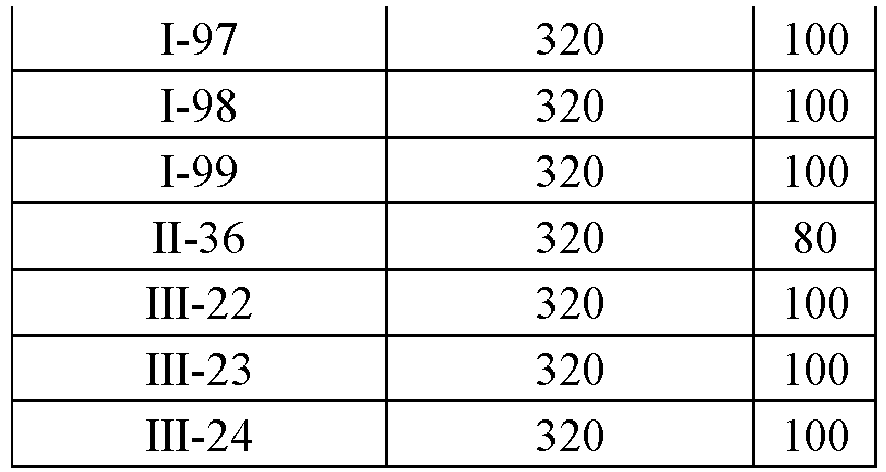


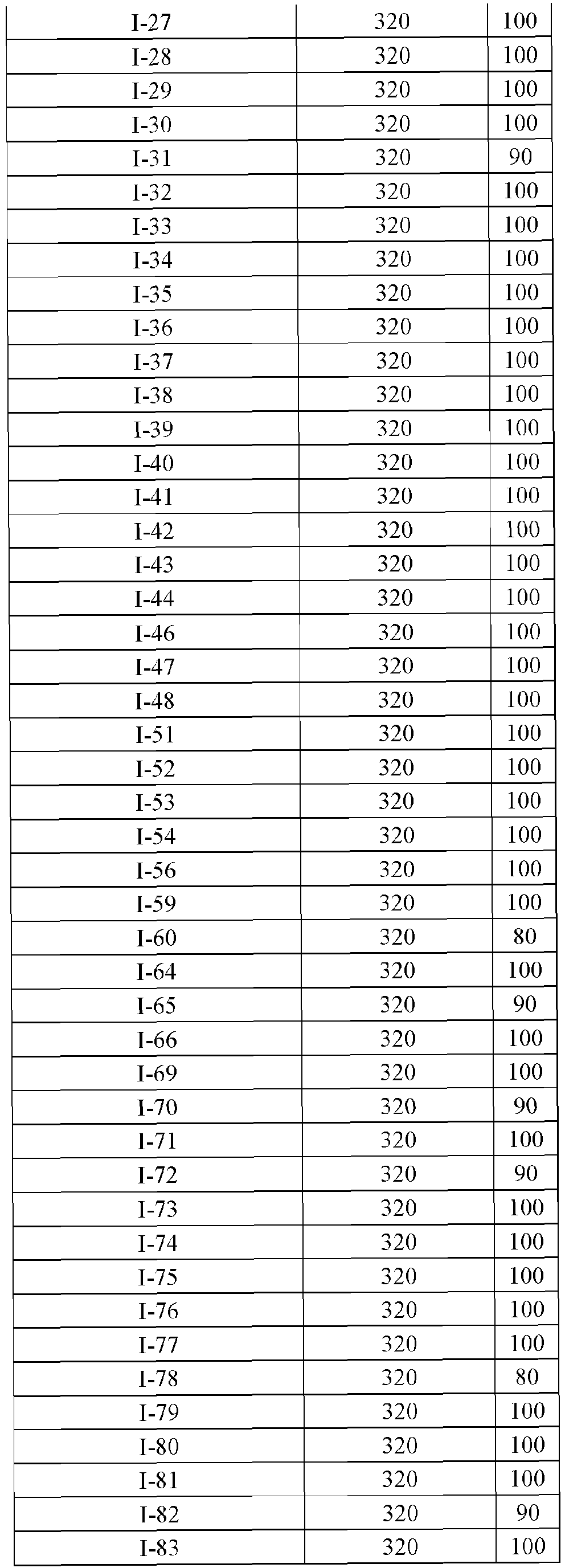


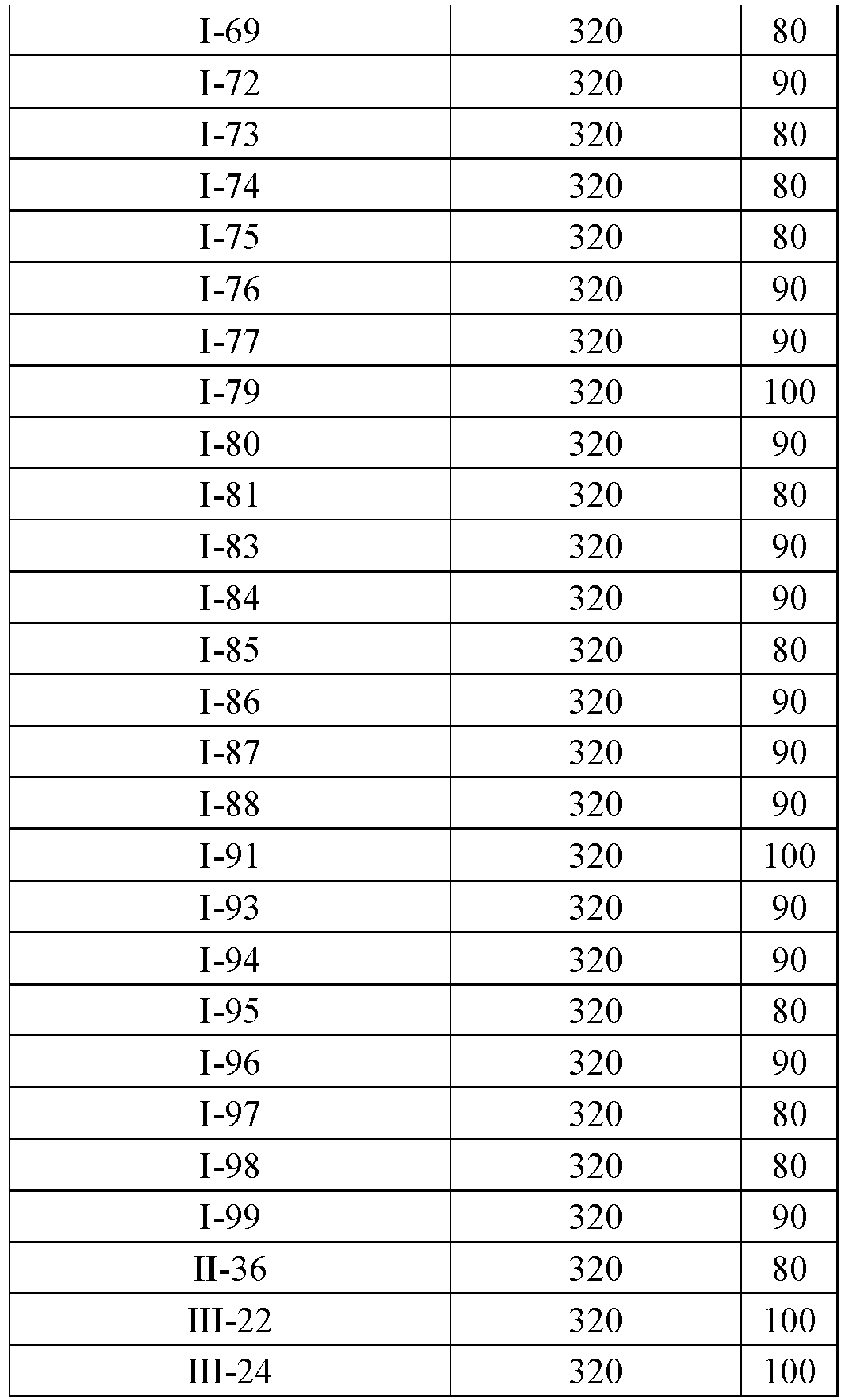


- Beispielsweise zeigen die Verbindungen Nr. 1-03, 1-04 und 1-05 in den Tabellen 1 bis 11 bei einer Aufwandmenge von 320 g/ha jeweils eine 90-100%-ige Wirkung gegen Alopecurus myrosoroides, Digitaria sanguinalis, Lolium rigidu und Setaria viridis.
- Die erfindungsgemäßen Verbindungen eignen sich deshalb im Vorauflaufverfahren zur Bekämpfung von unerwünschtem Pflanzenwuchs.
- Samen von mono- bzw. dikotylen Unkraut- bzw. Kulturpflanzen werden in Kunststoff- oder organischen Pflanztöpfen in sandigem Lehmboden ausgelegt, mit Erde abgedeckt und im Gewächshaus unter kontrollierten Wachstumsbedingungen angezogen. 2 bis 3 Wochen nach der Aussaat werden die Versuchspflanzen im Einblattstadium behandelt. Die in Form von benetzbaren Pulvern (WP) oder als Emulsionskonzentrate (EC) formulierten erfindungsgemäßen Verbindungen werden dann als wässrige Suspension bzw. Emulsion unter Zusatz von 0,5% Additiv mit einer
- Wasseraufwandmenge von umgerechnet 600 l/ha auf die grünen Pflanzenteile gesprüht. Nach ca. 3 Wochen Standzeit der Versuchspflanzen im Gewächshaus, unter optimalen Wachstumsbedingungen, wird die Wirkung der Präparate visuell im Vergleich zu unbehandelten Kontrollen bonitiert. Beispielsweise bedeutet 100% Wirkung = Pflanzen sind abgestorben, 0% Wirkung = wie Kontrollpflanzen.
- In den nachstehenden Tabellen 12 bis 23 sind die Wirkungen ausgewählter Verbindungen der allgemeinen Formel (I) gemäß der Tabellen I bis III auf verschiedene Schadpflanzen und einer Aufwandmenge entsprechend 320 g/ha, die gemäß zuvor genannter Versuchsvorschrift erhalten wurden, dargestellt.


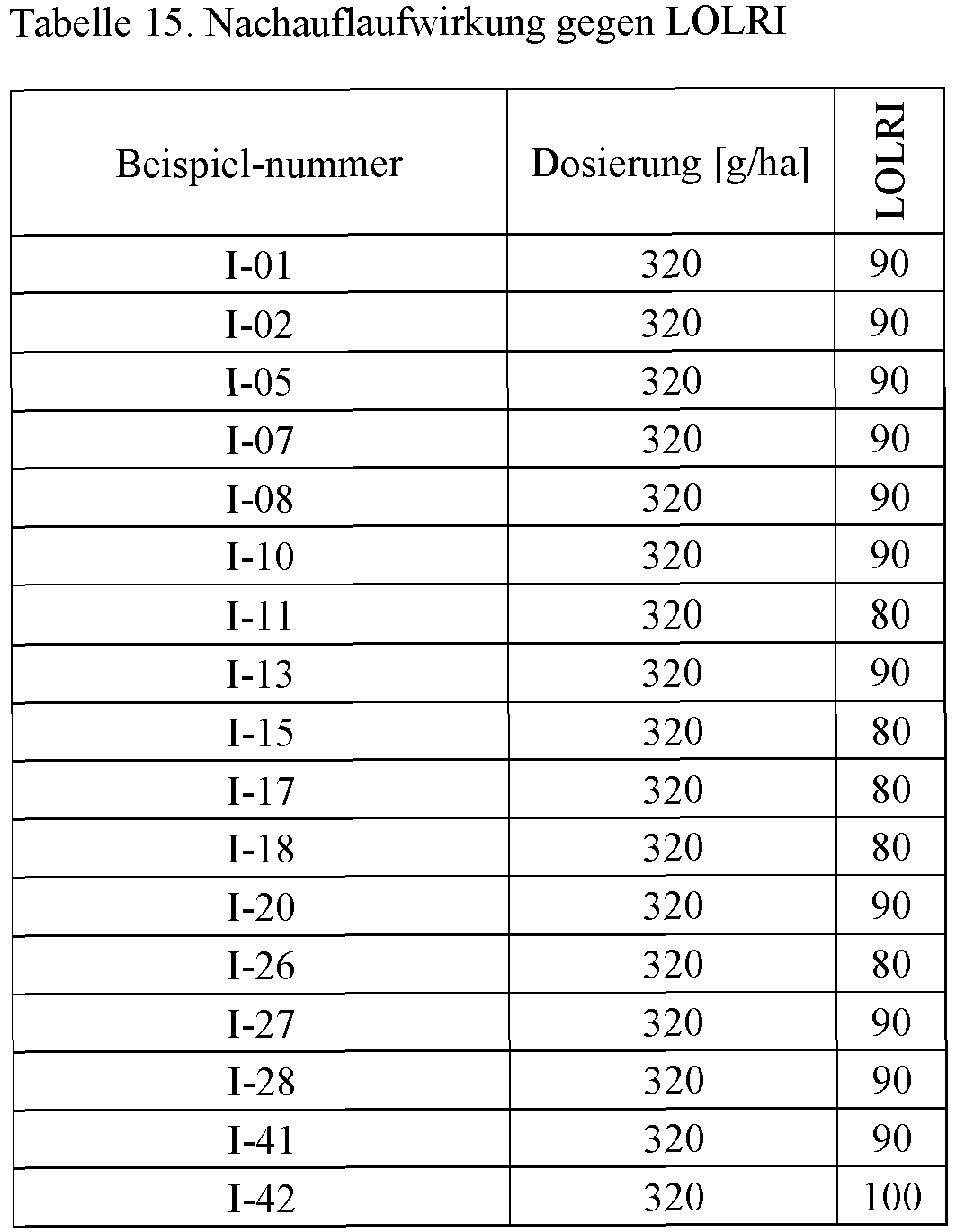


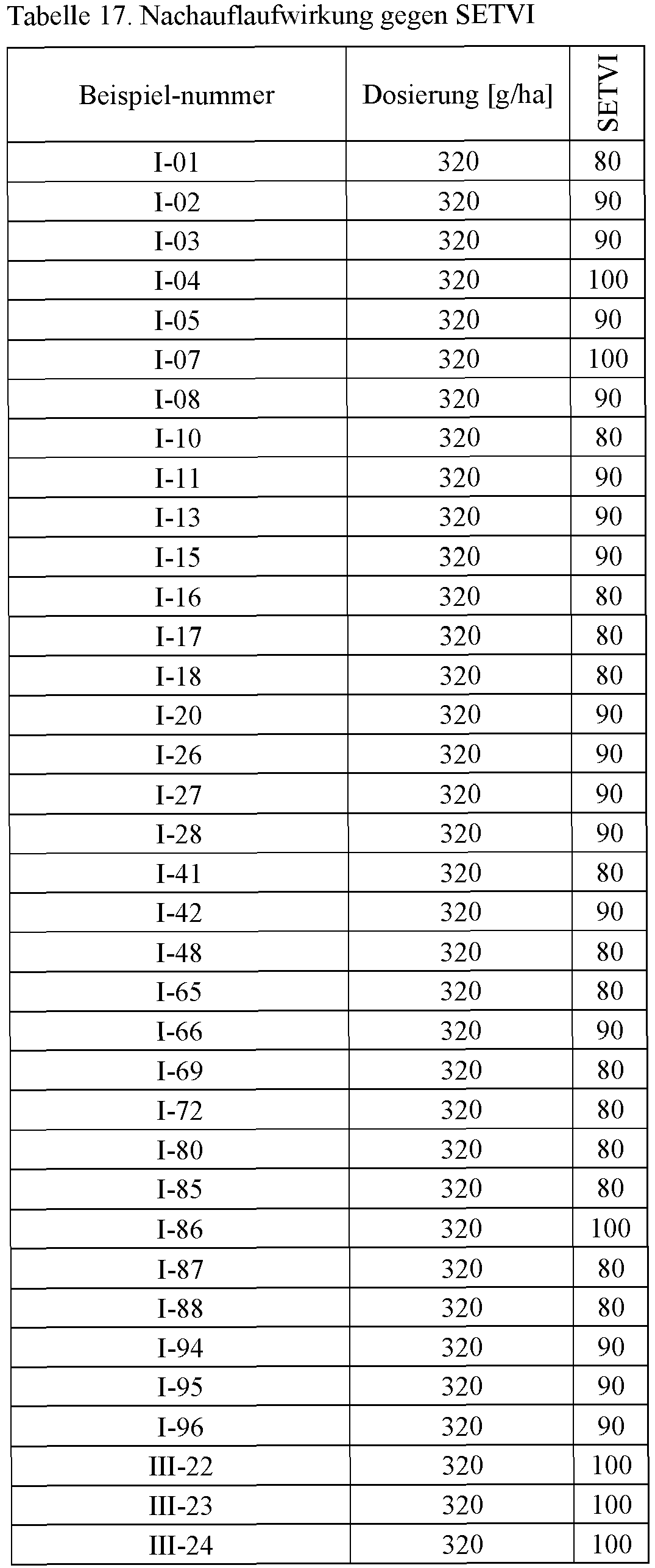


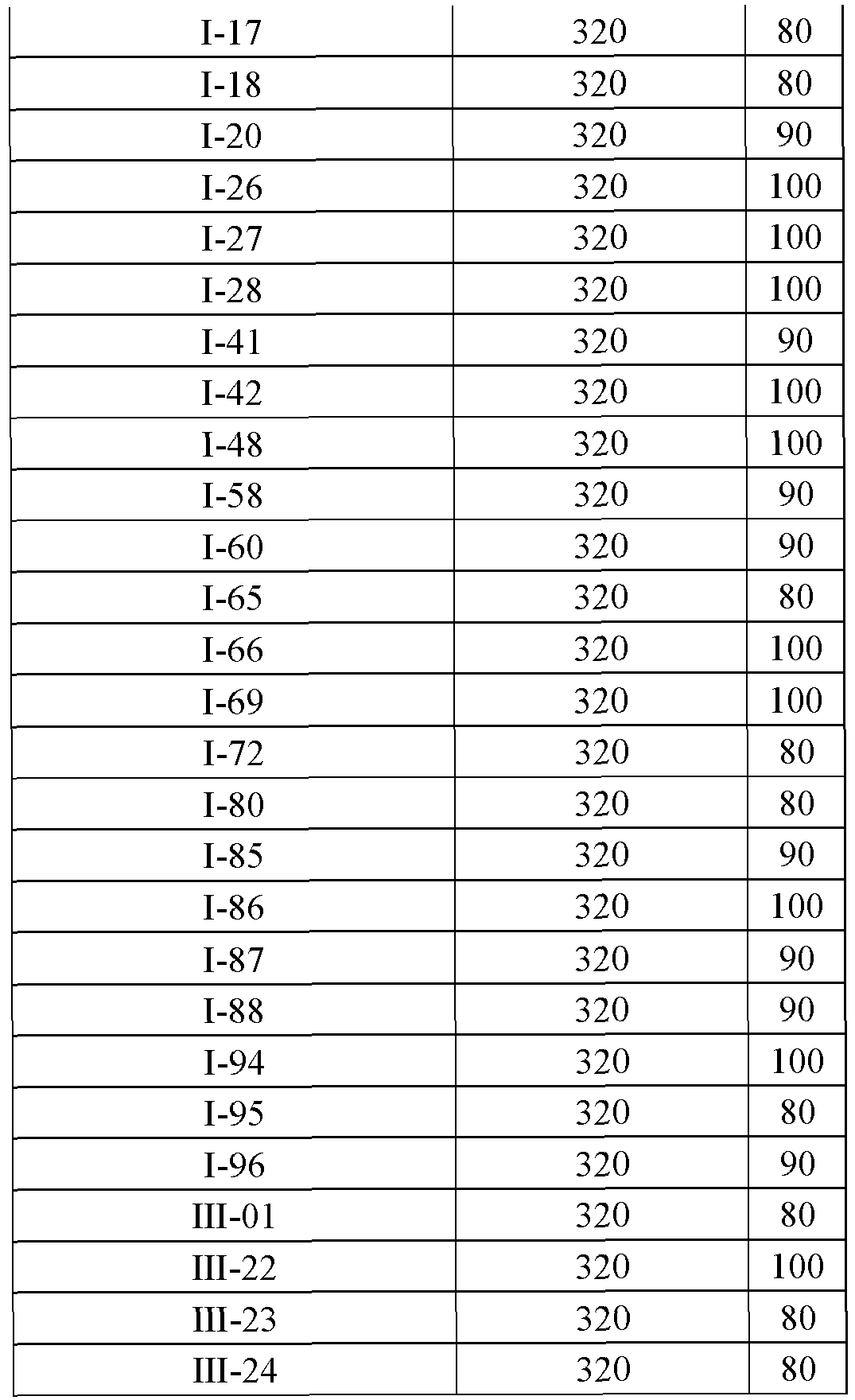


- Beispielsweise zeigen alle erfindungsgemäßen Verbindungen 1-08 und 1-04 in den Tabellen 12 und 23 bei einer Aufwandmenge von 320g/ha jeweils eine 90 - 100%-ige Wirkung gegen Alopecurus myosuroides, Digitaria sanguinalis, Setaria viridis und Echinochloa crus-galli und eignen sich deshalb im Nachauflaufverfahren zur Bekämpfung von unerwünschtem Pflanzenwuchs.
Claims (16)




A ausgewählt ist aus der Gruppe, bestehend aus Al- A4, A6, A8, A9, A12, A15


A ausgewählt ist aus der Gruppe, bestehend aus A2, A3, A6 und A8


A ausgewählt ist aus der Gruppe, bestehend aus A2, A3 und A6


A ausgewählt ist aus der Gruppe, bestehend aus A2, A3 und A6


Applications Claiming Priority (2)
| Application Number | Priority Date | Filing Date | Title |
|---|---|---|---|
| EP20203487 | 2020-10-23 | ||
| PCT/EP2021/078878 WO2022084278A1 (de) | 2020-10-23 | 2021-10-19 | 1-(pyridyl)-5-azinylpyrazol derivate und deren verwendung zur bekämpfung unerwünschten pflanzenwachstums |
Publications (2)
| Publication Number | Publication Date |
|---|---|
| EP4232443A1 EP4232443A1 (de) | 2023-08-30 |
| EP4232443B1 true EP4232443B1 (de) | 2024-12-18 |
Family
ID=73013340
Family Applications (1)
| Application Number | Title | Priority Date | Filing Date |
|---|---|---|---|
| EP21790929.0A Active EP4232443B1 (de) | 2020-10-23 | 2021-10-19 | 1-(pyridyl)-5-azinylpyrazol derivate und deren verwendung zur bekämpfung unerwünschten pflanzenwachstums |
Country Status (9)
| Country | Link |
|---|---|
| US (1) | US20240041042A1 (de) |
| EP (1) | EP4232443B1 (de) |
| JP (1) | JP2023549462A (de) |
| CN (1) | CN116368129A (de) |
| AR (1) | AR123901A1 (de) |
| AU (1) | AU2021367046A1 (de) |
| CA (1) | CA3199303A1 (de) |
| MX (1) | MX2023004617A (de) |
| WO (1) | WO2022084278A1 (de) |
Families Citing this family (3)
| Publication number | Priority date | Publication date | Assignee | Title |
|---|---|---|---|---|
| BR112022012674A2 (pt) * | 2020-01-31 | 2022-09-06 | Bayer Ag | Derivados de ácido [(1,4,5-trissubstituído-1h-pirazol-3-il)sulfanil]acético e sais dos mesmos e uso dos mesmos como ingredientes herbicidas ativos |
| WO2024078871A1 (de) * | 2022-10-14 | 2024-04-18 | Bayer Aktiengesellschaft | 1-pyridyl-5-phenylpyrazolyl-3-oxy- und -3-thioalkylsäuren und derivate und deren verwendung zur bekämpfung unerwünschten pflanzenwachstums |
| AR130755A1 (es) * | 2022-10-17 | 2025-01-15 | Bayer Ag | Derivados para-sustituidos por bromo o yodo de ácido [(1,5-difenil-1h-1,2,4-triazol-3-il)oxi]acético y sus sales, agentes protectores de plantas útiles o de cultivo que los contienen, procedimientos para su preparación y su uso como protectores |
Family Cites Families (82)
| Publication number | Priority date | Publication date | Assignee | Title |
|---|---|---|---|---|
| DE2906507A1 (de) | 1979-02-20 | 1980-08-28 | Bayer Ag | Mittel zur regulierung des pflanzenwachstums |
| DE2828529A1 (de) * | 1978-06-29 | 1980-01-17 | Kali Chemie Pharma Gmbh | Neue 5-phenylpyrazol-derivate, verfahren zu deren herstellung und arzneimittel |
| US4272417A (en) | 1979-05-22 | 1981-06-09 | Cargill, Incorporated | Stable protective seed coating |
| US4245432A (en) | 1979-07-25 | 1981-01-20 | Eastman Kodak Company | Seed coatings |
| DE2948024A1 (de) | 1979-11-29 | 1981-08-27 | Bayer Ag, 5090 Leverkusen | 1-amino-cyclopropancarbonsaeure-derivate, verfahren zu ihrer herstellung und ihre verwendung als pflanzenwachstumsregulatoren |
| MA19709A1 (fr) | 1982-02-17 | 1983-10-01 | Ciba Geigy Ag | Application de derives de quinoleine a la protection des plantes cultivees . |
| ATE103902T1 (de) | 1982-05-07 | 1994-04-15 | Ciba Geigy Ag | Verwendung von chinolinderivaten zum schuetzen von kulturpflanzen. |
| JPS60500438A (ja) | 1983-01-17 | 1985-04-04 | モンサント カンパニ− | 植物細胞を形質転換するためのプラスミド |
| BR8404834A (pt) | 1983-09-26 | 1985-08-13 | Agrigenetics Res Ass | Metodo para modificar geneticamente uma celula vegetal |
| DE3335514A1 (de) | 1983-09-30 | 1985-04-18 | Bayer Ag, 5090 Leverkusen | 1-methylamino-cyclopropan-1-carbonsaeure-derivate |
| JPS6087254A (ja) | 1983-10-19 | 1985-05-16 | Japan Carlit Co Ltd:The | 新規尿素化合物及びそれを含有する除草剤 |
| DE3525205A1 (de) | 1984-09-11 | 1986-03-20 | Hoechst Ag, 6230 Frankfurt | Pflanzenschuetzende mittel auf basis von 1,2,4-triazolderivaten sowie neue derivate des 1,2,4-triazols |
| BR8600161A (pt) | 1985-01-18 | 1986-09-23 | Plant Genetic Systems Nv | Gene quimerico,vetores de plasmidio hibrido,intermediario,processo para controlar insetos em agricultura ou horticultura,composicao inseticida,processo para transformar celulas de plantas para expressar uma toxina de polipeptideo produzida por bacillus thuringiensis,planta,semente de planta,cultura de celulas e plasmidio |
| EP0191736B1 (de) | 1985-02-14 | 1991-07-17 | Ciba-Geigy Ag | Verwendung von Chinolinderivaten zum Schützen von Kulturpflanzen |
| ATE80182T1 (de) | 1985-10-25 | 1992-09-15 | Monsanto Co | Pflanzenvektoren. |
| DE3765449D1 (de) | 1986-03-11 | 1990-11-15 | Plant Genetic Systems Nv | Durch gentechnologie erhaltene und gegen glutaminsynthetase-inhibitoren resistente pflanzenzellen. |
| US5123951A (en) | 1986-03-31 | 1992-06-23 | Rhone-Poulenc Nederland B.V. | Synergistic plant growth regulator compositions |
| JPH01503663A (ja) | 1986-05-01 | 1989-12-07 | ハネウエル・インコーポレーテツド | 多重集積回路相互接続装置 |
| US5013659A (en) | 1987-07-27 | 1991-05-07 | E. I. Du Pont De Nemours And Company | Nucleic acid fragment encoding herbicide resistant plant acetolactate synthase |
| IL83348A (en) | 1986-08-26 | 1995-12-08 | Du Pont | Nucleic acid fragment encoding herbicide resistant plant acetolactate synthase |
| DE3633840A1 (de) | 1986-10-04 | 1988-04-14 | Hoechst Ag | Phenylpyrazolcarbonsaeurederivate, ihre herstellung und verwendung als pflanzenwachstumsregulatoren und safener |
| DE3775527D1 (de) | 1986-10-22 | 1992-02-06 | Ciba Geigy Ag | 1,5-diphenylpyrazol-3-carbonsaeurederivate zum schuetzen von kulturpflanzen. |
| US4808430A (en) | 1987-02-27 | 1989-02-28 | Yazaki Corporation | Method of applying gel coating to plant seeds |
| DE3733017A1 (de) | 1987-09-30 | 1989-04-13 | Bayer Ag | Stilbensynthase-gen |
| DE3808896A1 (de) * | 1988-03-17 | 1989-09-28 | Hoechst Ag | Pflanzenschuetzende mittel auf basis von pyrazolcarbonsaeurederivaten |
| GB8810120D0 (en) | 1988-04-28 | 1988-06-02 | Plant Genetic Systems Nv | Transgenic nuclear male sterile plants |
| DE3817192A1 (de) | 1988-05-20 | 1989-11-30 | Hoechst Ag | 1,2,4-triazolderivate enthaltende pflanzenschuetzende mittel sowie neue derivate des 1,2,4-triazols |
| US5084082A (en) | 1988-09-22 | 1992-01-28 | E. I. Du Pont De Nemours And Company | Soybean plants with dominant selectable trait for herbicide resistance |
| ES2054088T3 (es) | 1988-10-20 | 1994-08-01 | Ciba Geigy Ag | Sulfamoilfenilureas. |
| DE3939010A1 (de) | 1989-11-25 | 1991-05-29 | Hoechst Ag | Isoxazoline, verfahren zu ihrer herstellung und ihre verwendung als pflanzenschuetzende mittel |
| DE3939503A1 (de) | 1989-11-30 | 1991-06-06 | Hoechst Ag | Neue pyrazoline zum schutz von kulturpflanzen gegenueber herbiziden |
| ATE241007T1 (de) | 1990-03-16 | 2003-06-15 | Calgene Llc | Dnas, die für pflanzliche desaturasen kodieren und deren anwendungen |
| US5198599A (en) | 1990-06-05 | 1993-03-30 | Idaho Resarch Foundation, Inc. | Sulfonylurea herbicide resistance in plants |
| ATE212670T1 (de) | 1990-06-18 | 2002-02-15 | Monsanto Technology Llc | Erhöhter stärkegehalt in pflanzen |
| EP0536330B1 (de) | 1990-06-25 | 2002-02-27 | Monsanto Technology LLC | Glyphosattolerante pflanzen |
| DE4107396A1 (de) | 1990-06-29 | 1992-01-02 | Bayer Ag | Stilbensynthase-gene aus weinrebe |
| SE467358B (sv) | 1990-12-21 | 1992-07-06 | Amylogene Hb | Genteknisk foeraendring av potatis foer bildning av staerkelse av amylopektintyp |
| DE59108636D1 (de) | 1990-12-21 | 1997-04-30 | Hoechst Schering Agrevo Gmbh | Neue 5-Chlorchinolin-8-oxyalkancarbonsäurederivate, Verfahren zu ihrer Herstellung und ihre Verwendung als Antidots von Herbiziden |
| DE4104782B4 (de) | 1991-02-13 | 2006-05-11 | Bayer Cropscience Gmbh | Neue Plasmide, enthaltend DNA-Sequenzen, die Veränderungen der Karbohydratkonzentration und Karbohydratzusammensetzung in Pflanzen hervorrufen, sowie Pflanzen und Pflanzenzellen enthaltend dieses Plasmide |
| TW259690B (de) | 1992-08-01 | 1995-10-11 | Hoechst Ag | |
| DE4331448A1 (de) | 1993-09-16 | 1995-03-23 | Hoechst Schering Agrevo Gmbh | Substituierte Isoxazoline, Verfahren zu deren Herstellung, diese enthaltende Mittel und deren Verwendung als Safener |
| FR2734842B1 (fr) | 1995-06-02 | 1998-02-27 | Rhone Poulenc Agrochimie | Sequence adn d'un gene de l'hydroxy-phenyl pyruvate dioxygenase et obtention de plantes contenant un gene de l'hydroxy-phenyl pyruvate dioxygenase, tolerantes a certains herbicides |
| US5773704A (en) | 1996-04-29 | 1998-06-30 | Board Of Supervisors Of Louisiana State University And Agricultural And Mechanical College | Herbicide resistant rice |
| DE19621522A1 (de) | 1996-05-29 | 1997-12-04 | Hoechst Schering Agrevo Gmbh | Neue N-Acylsulfonamide, neue Mischungen aus Herbiziden und Antidots und deren Verwendung |
| US5876739A (en) | 1996-06-13 | 1999-03-02 | Novartis Ag | Insecticidal seed coating |
| US5773702A (en) | 1996-07-17 | 1998-06-30 | Board Of Trustees Operating Michigan State University | Imidazolinone herbicide resistant sugar beet plants |
| WO1998013361A1 (en) | 1996-09-26 | 1998-04-02 | Novartis Ag | Herbicidal composition |
| DE19652961A1 (de) | 1996-12-19 | 1998-06-25 | Hoechst Schering Agrevo Gmbh | Neue 2-Fluoracrylsäurederivate, neue Mischungen aus Herbiziden und Antidots und deren Verwendung |
| US6071856A (en) | 1997-03-04 | 2000-06-06 | Zeneca Limited | Herbicidal compositions for acetochlor in rice |
| DE19727410A1 (de) | 1997-06-27 | 1999-01-07 | Hoechst Schering Agrevo Gmbh | 3-(5-Tetrazolylcarbonyl)-2-chinolone und diese enthaltende nutzpflanzenschützende Mittel |
| DE19742951A1 (de) | 1997-09-29 | 1999-04-15 | Hoechst Schering Agrevo Gmbh | Acylsulfamoylbenzoesäureamide, diese enthaltende nutzpflanzenschützende Mittel und Verfahren zu ihrer Herstellung |
| FR2770854B1 (fr) | 1997-11-07 | 2001-11-30 | Rhone Poulenc Agrochimie | Sequence adn d'un gene de l'hydroxy-phenyl pyruvate dioxygenase et obtention de plantes contenant un tel gene, tolerantes aux herbicides |
| FR2772789B1 (fr) | 1997-12-24 | 2000-11-24 | Rhone Poulenc Agrochimie | Procede de preparation enzymatique d'homogentisate |
| DE19821614A1 (de) | 1998-05-14 | 1999-11-18 | Hoechst Schering Agrevo Gmbh | Sulfonylharnstoff-tolerante Zuckerrübenmutanten |
| US6503904B2 (en) | 1998-11-16 | 2003-01-07 | Syngenta Crop Protection, Inc. | Pesticidal composition for seed treatment |
| CA2326020A1 (en) * | 1999-11-17 | 2001-05-17 | Basf Corporation | Herbicidal 2-aryloxy-4-methyl-6-pyrazol-1-yl-pyridines |
| EP2266390A3 (de) | 2000-03-09 | 2011-04-20 | E. I. du Pont de Nemours and Company | Sulfonylurea tolerante Sonnenblumenpflanzen |
| CA2401093A1 (en) | 2000-03-09 | 2001-09-13 | Monsanto Technology Llc | Methods for making plants tolerant to glyphosate and compositions thereof |
| US6768044B1 (en) | 2000-05-10 | 2004-07-27 | Bayer Cropscience Sa | Chimeric hydroxyl-phenyl pyruvate dioxygenase, DNA sequence and method for obtaining plants containing such a gene, with herbicide tolerance |
| US6660690B2 (en) | 2000-10-06 | 2003-12-09 | Monsanto Technology, L.L.C. | Seed treatment with combinations of insecticides |
| AR031027A1 (es) | 2000-10-23 | 2003-09-03 | Syngenta Participations Ag | Composiciones agroquimicas |
| FR2815969B1 (fr) | 2000-10-30 | 2004-12-10 | Aventis Cropscience Sa | Plantes tolerantes aux herbicides par contournement de voie metabolique |
| JP2004528821A (ja) | 2000-12-07 | 2004-09-24 | シンジェンタ リミテッド | 除草剤抵抗性植物 |
| US20020134012A1 (en) | 2001-03-21 | 2002-09-26 | Monsanto Technology, L.L.C. | Method of controlling the release of agricultural active ingredients from treated plant seeds |
| FR2844142B1 (fr) | 2002-09-11 | 2007-08-17 | Bayer Cropscience Sa | Plantes transformees a biosynthese de prenylquinones amelioree |
| BRPI0408943A (pt) | 2003-03-26 | 2006-04-04 | Bayer Cropscience Gmbh | aplicação de compostos hidroxiaromáticos como antìdotos |
| DE10335726A1 (de) | 2003-08-05 | 2005-03-03 | Bayer Cropscience Gmbh | Verwendung von Hydroxyaromaten als Safener |
| DE10335725A1 (de) | 2003-08-05 | 2005-03-03 | Bayer Cropscience Gmbh | Safener auf Basis aromatisch-aliphatischer Carbonsäuredarivate |
| DE102004023332A1 (de) | 2004-05-12 | 2006-01-19 | Bayer Cropscience Gmbh | Chinoxalin-2-on-derivate, diese enthaltende nutzpflanzenschützende Mittel und Verfahren zu ihrer Herstellung und deren Verwendung |
| JPWO2007023719A1 (ja) | 2005-08-22 | 2009-02-26 | クミアイ化学工業株式会社 | 薬害軽減剤及び薬害が軽減された除草剤組成物 |
| JPWO2007023764A1 (ja) | 2005-08-26 | 2009-02-26 | クミアイ化学工業株式会社 | 薬害軽減剤及び薬害が軽減された除草剤組成物 |
| US20070214515A1 (en) | 2006-03-09 | 2007-09-13 | E.I.Du Pont De Nemours And Company | Polynucleotide encoding a maize herbicide resistance gene and methods for use |
| WO2008083233A2 (en) * | 2006-12-29 | 2008-07-10 | Dow Agrosciences Llc | In vitro methods for the induction and maintenance of plant cell lines as single suspension cells with intact cell walls, and transformation thereof |
| EP1938686A1 (de) * | 2006-12-29 | 2008-07-02 | Bayer CropScience AG | Substituierte 1-(3-Pyridinyl)pyrazol-4-yl-essigsäuren, Verfahren zu deren Herstellung und deren Verwendung als Herbizide und Pflanzenwachstumsregulatoren |
| EP1987717A1 (de) | 2007-04-30 | 2008-11-05 | Bayer CropScience AG | Pyridoncarboxamide, diese enthaltende nutzpflanzenschützende Mittel und Verfahren zu ihrer Herstellung und deren Verwendung |
| EP1987718A1 (de) | 2007-04-30 | 2008-11-05 | Bayer CropScience AG | Verwendung von Pyridin-2-oxy-3-carbonamiden als Safener |
| CA2688682A1 (en) | 2007-05-30 | 2008-12-11 | Syngenta Participations Ag | Cytochrome p450 genes conferring herbicide resistance |
| CN105368799A (zh) | 2008-04-14 | 2016-03-02 | 拜耳作物科学公司 | 新的突变羟基苯基丙酮酸双加氧酶,dna序列和耐受hppd抑制剂除草剂的植物分离 |
| CN101284815B (zh) | 2008-05-16 | 2011-04-13 | 南京工业大学 | 吡唑氧乙酸类化合物、制备方法及用途 |
| PL2324008T3 (pl) | 2008-07-24 | 2012-09-28 | Nerviano Medical Sciences Srl | 3,4-diarylopirazole jako inhibitory kinazy białkowej |
| EP2248421A1 (de) | 2009-05-07 | 2010-11-10 | GMI - Gregor-Mendel-Institut für Molekulare Pflanzenbiologie GmbH | Ansammlung von Biomasse in Pflanzen |
| CN101838227A (zh) | 2010-04-30 | 2010-09-22 | 孙德群 | 一种苯甲酰胺类除草剂的安全剂 |
-
2021
- 2021-10-19 CN CN202180072369.1A patent/CN116368129A/zh active Pending
- 2021-10-19 CA CA3199303A patent/CA3199303A1/en active Pending
- 2021-10-19 MX MX2023004617A patent/MX2023004617A/es unknown
- 2021-10-19 WO PCT/EP2021/078878 patent/WO2022084278A1/de not_active Ceased
- 2021-10-19 US US18/249,310 patent/US20240041042A1/en active Pending
- 2021-10-19 AU AU2021367046A patent/AU2021367046A1/en not_active Abandoned
- 2021-10-19 EP EP21790929.0A patent/EP4232443B1/de active Active
- 2021-10-19 JP JP2023524371A patent/JP2023549462A/ja not_active Ceased
- 2021-10-22 AR ARP210102941A patent/AR123901A1/es not_active Application Discontinuation
Also Published As
| Publication number | Publication date |
|---|---|
| AU2021367046A9 (en) | 2024-09-26 |
| US20240041042A1 (en) | 2024-02-08 |
| CA3199303A1 (en) | 2022-04-28 |
| EP4232443A1 (de) | 2023-08-30 |
| AR123901A1 (es) | 2023-01-25 |
| MX2023004617A (es) | 2023-05-09 |
| AU2021367046A1 (en) | 2023-06-08 |
| JP2023549462A (ja) | 2023-11-27 |
| WO2022084278A1 (de) | 2022-04-28 |
| CN116368129A (zh) | 2023-06-30 |
Similar Documents
| Publication | Publication Date | Title |
|---|---|---|
| EP3638665B1 (de) | Herbizid wirksame 3-phenylisoxazolin-5-carboxamide von tetrahydro- und dihydrofurancarbonsäuren und -estern | |
| EP3668845B1 (de) | Herbizid wirksame 3-phenyl-5-trifluormethylisoxazolin-5-carboxamide von cyclopentylcarbonsäuren und -estern | |
| EP3937637B1 (de) | Herbizid wirksame 3-phenylisoxazolin-5-carboxamide von s-haltigen cyclopentenylcarbonsäureestern | |
| US12180187B2 (en) | 1-phenyl-5-azinylpyrazolyl-3-oxyalkyl acids and their use for controlling unwanted plant growth | |
| WO2019219587A1 (de) | 2-brom-6-alkoxyphenyl-substituierte pyrrolin-2-one und deren verwendung als herbizide | |
| WO2022084278A1 (de) | 1-(pyridyl)-5-azinylpyrazol derivate und deren verwendung zur bekämpfung unerwünschten pflanzenwachstums | |
| EP3938348A1 (de) | Neue 3-(2-brom-4-alkinyl-6-alkoxyphenyl)-3-pyrrolin-2-one und deren verwendung als herbizide | |
| WO2019219584A1 (de) | Neue spirocyclohexylpyrrolin-2-one und deren verwendung als herbizide | |
| EP3853219B1 (de) | Herbizid wirksame substituierte phenylpyrimidinhydrazide | |
| WO2019228788A1 (de) | 2-brom-6-alkoxyphenyl-substituierte pyrrolin-2-one und deren verwendung als herbizide | |
| WO2019228787A1 (de) | Speziell substituierte 2-alkyl-6-alkoxyphenyl-3-pyrrolin-2-one und deren verwendung als herbizide | |
| WO2024078871A1 (de) | 1-pyridyl-5-phenylpyrazolyl-3-oxy- und -3-thioalkylsäuren und derivate und deren verwendung zur bekämpfung unerwünschten pflanzenwachstums | |
| EP4358718A1 (de) | (1,4,5-trisubstituierte-1h-pyrazol-3-yl)oxy-2-alkoxy-alkylsäuren und -alkylsäure-derivate, deren salze und ihre verwendung als herbizide wirkstoffe | |
| WO2023274869A1 (de) | 3-(4-alkenyl-phenyl)-3-pyrrolin-2-one und deren verwendung als herbizide | |
| EP3938350A1 (de) | 3-(2-brom-4-alkinyl-6-alkoxyphenyl)-substituierte 5-spirocyclohexyl-3-pyrrolin-2-one und deren verwendung als herbizide | |
| EP3938346A1 (de) | Speziell substituierte 3-(2-halogen-6-alkyl-4-propinylphenyl)-3-pyrrolin-2-one und deren verwendung als herbizide | |
| WO2023099381A1 (de) | (1,4,5-trisubstituierte-1h-pyrazol-3-yl)oxy-2-alkylthio-alkylsäuren und -alkylsäure-derivate, deren salze und ihre verwendung als herbizide wirkstoffe | |
| EA047217B1 (ru) | 1-фенил-5-азинилпиразолил-3-оксиалкильные кислоты и их применение для борьбы с нежелательным ростом растений | |
| WO2022253700A1 (de) | Speziell substituierte pyrrolin-2-one und deren verwendung als herbizide | |
| EP3938347A1 (de) | Speziell substituierte 3-phenyl-5-spirocyclopentyl-3-pyrrolin-2-one und deren verwendung als herbizide | |
| EP3938349A1 (de) | Speziell substituierte 3-(2-alkoxy-6-alkyl-4-propinylphenyl)-3-pyrrolin-2-one und deren verwendung als herbizide | |
| EP3802516A1 (de) | Herbizid wirksame substituierte phenylpyrimidine | |
| WO2019219588A1 (de) | Speziell substituierte 2-alkyl-6-alkoxyphenyl-3-pyrroliin-2-one und deren verwendung als herbizide | |
| WO2019219585A1 (de) | Neue 3-(4-alkinyl-6-alkoxy-2-chlorphenyl)-3-pyrrolin-2-one und deren verwendung als herbizide | |
| EP3360417A1 (de) | Verwendung von sulfonylindol als herbizid |
Legal Events
| Date | Code | Title | Description |
|---|---|---|---|
| STAA | Information on the status of an ep patent application or granted ep patent |
Free format text: STATUS: UNKNOWN |
|
| STAA | Information on the status of an ep patent application or granted ep patent |
Free format text: STATUS: THE INTERNATIONAL PUBLICATION HAS BEEN MADE |
|
| PUAI | Public reference made under article 153(3) epc to a published international application that has entered the european phase |
Free format text: ORIGINAL CODE: 0009012 |
|
| STAA | Information on the status of an ep patent application or granted ep patent |
Free format text: STATUS: REQUEST FOR EXAMINATION WAS MADE |
|
| 17P | Request for examination filed |
Effective date: 20230523 |
|
| AK | Designated contracting states |
Kind code of ref document: A1 Designated state(s): AL AT BE BG CH CY CZ DE DK EE ES FI FR GB GR HR HU IE IS IT LI LT LU LV MC MK MT NL NO PL PT RO RS SE SI SK SM TR |
|
| DAV | Request for validation of the european patent (deleted) | ||
| DAX | Request for extension of the european patent (deleted) | ||
| GRAP | Despatch of communication of intention to grant a patent |
Free format text: ORIGINAL CODE: EPIDOSNIGR1 |
|
| STAA | Information on the status of an ep patent application or granted ep patent |
Free format text: STATUS: GRANT OF PATENT IS INTENDED |
|
| INTG | Intention to grant announced |
Effective date: 20240711 |
|
| GRAS | Grant fee paid |
Free format text: ORIGINAL CODE: EPIDOSNIGR3 |
|
| GRAA | (expected) grant |
Free format text: ORIGINAL CODE: 0009210 |
|
| STAA | Information on the status of an ep patent application or granted ep patent |
Free format text: STATUS: THE PATENT HAS BEEN GRANTED |
|
| AK | Designated contracting states |
Kind code of ref document: B1 Designated state(s): AL AT BE BG CH CY CZ DE DK EE ES FI FR GB GR HR HU IE IS IT LI LT LU LV MC MK MT NL NO PL PT RO RS SE SI SK SM TR |
|
| REG | Reference to a national code |
Ref country code: CH Ref legal event code: EP |
|
| REG | Reference to a national code |
Ref country code: DE Ref legal event code: R096 Ref document number: 502021006171 Country of ref document: DE |
|
| REG | Reference to a national code |
Ref country code: IE Ref legal event code: FG4D Free format text: LANGUAGE OF EP DOCUMENT: GERMAN |
|
| REG | Reference to a national code |
Ref country code: LT Ref legal event code: MG9D |
|
| PG25 | Lapsed in a contracting state [announced via postgrant information from national office to epo] |
Ref country code: HR Free format text: LAPSE BECAUSE OF FAILURE TO SUBMIT A TRANSLATION OF THE DESCRIPTION OR TO PAY THE FEE WITHIN THE PRESCRIBED TIME-LIMIT Effective date: 20241218 |
|
| PG25 | Lapsed in a contracting state [announced via postgrant information from national office to epo] |
Ref country code: FI Free format text: LAPSE BECAUSE OF FAILURE TO SUBMIT A TRANSLATION OF THE DESCRIPTION OR TO PAY THE FEE WITHIN THE PRESCRIBED TIME-LIMIT Effective date: 20241218 |
|
| PG25 | Lapsed in a contracting state [announced via postgrant information from national office to epo] |
Ref country code: BG Free format text: LAPSE BECAUSE OF FAILURE TO SUBMIT A TRANSLATION OF THE DESCRIPTION OR TO PAY THE FEE WITHIN THE PRESCRIBED TIME-LIMIT Effective date: 20241218 |
|
| PG25 | Lapsed in a contracting state [announced via postgrant information from national office to epo] |
Ref country code: NO Free format text: LAPSE BECAUSE OF FAILURE TO SUBMIT A TRANSLATION OF THE DESCRIPTION OR TO PAY THE FEE WITHIN THE PRESCRIBED TIME-LIMIT Effective date: 20250318 |
|
| REG | Reference to a national code |
Ref country code: NL Ref legal event code: MP Effective date: 20241218 |
|
| PG25 | Lapsed in a contracting state [announced via postgrant information from national office to epo] |
Ref country code: LV Free format text: LAPSE BECAUSE OF FAILURE TO SUBMIT A TRANSLATION OF THE DESCRIPTION OR TO PAY THE FEE WITHIN THE PRESCRIBED TIME-LIMIT Effective date: 20241218 Ref country code: GR Free format text: LAPSE BECAUSE OF FAILURE TO SUBMIT A TRANSLATION OF THE DESCRIPTION OR TO PAY THE FEE WITHIN THE PRESCRIBED TIME-LIMIT Effective date: 20250319 |
|
| PG25 | Lapsed in a contracting state [announced via postgrant information from national office to epo] |
Ref country code: RS Free format text: LAPSE BECAUSE OF FAILURE TO SUBMIT A TRANSLATION OF THE DESCRIPTION OR TO PAY THE FEE WITHIN THE PRESCRIBED TIME-LIMIT Effective date: 20250318 |
|
| PG25 | Lapsed in a contracting state [announced via postgrant information from national office to epo] |
Ref country code: NL Free format text: LAPSE BECAUSE OF FAILURE TO SUBMIT A TRANSLATION OF THE DESCRIPTION OR TO PAY THE FEE WITHIN THE PRESCRIBED TIME-LIMIT Effective date: 20241218 |
|
| PG25 | Lapsed in a contracting state [announced via postgrant information from national office to epo] |
Ref country code: SM Free format text: LAPSE BECAUSE OF FAILURE TO SUBMIT A TRANSLATION OF THE DESCRIPTION OR TO PAY THE FEE WITHIN THE PRESCRIBED TIME-LIMIT Effective date: 20241218 |
|
| PG25 | Lapsed in a contracting state [announced via postgrant information from national office to epo] |
Ref country code: PL Free format text: LAPSE BECAUSE OF FAILURE TO SUBMIT A TRANSLATION OF THE DESCRIPTION OR TO PAY THE FEE WITHIN THE PRESCRIBED TIME-LIMIT Effective date: 20241218 |
|
| PG25 | Lapsed in a contracting state [announced via postgrant information from national office to epo] |
Ref country code: ES Free format text: LAPSE BECAUSE OF FAILURE TO SUBMIT A TRANSLATION OF THE DESCRIPTION OR TO PAY THE FEE WITHIN THE PRESCRIBED TIME-LIMIT Effective date: 20241218 |
|
| PG25 | Lapsed in a contracting state [announced via postgrant information from national office to epo] |
Ref country code: IS Free format text: LAPSE BECAUSE OF FAILURE TO SUBMIT A TRANSLATION OF THE DESCRIPTION OR TO PAY THE FEE WITHIN THE PRESCRIBED TIME-LIMIT Effective date: 20250418 |
|
| PG25 | Lapsed in a contracting state [announced via postgrant information from national office to epo] |
Ref country code: PT Free format text: LAPSE BECAUSE OF FAILURE TO SUBMIT A TRANSLATION OF THE DESCRIPTION OR TO PAY THE FEE WITHIN THE PRESCRIBED TIME-LIMIT Effective date: 20250421 |
|
| PG25 | Lapsed in a contracting state [announced via postgrant information from national office to epo] |
Ref country code: EE Free format text: LAPSE BECAUSE OF FAILURE TO SUBMIT A TRANSLATION OF THE DESCRIPTION OR TO PAY THE FEE WITHIN THE PRESCRIBED TIME-LIMIT Effective date: 20241218 |
|
| PG25 | Lapsed in a contracting state [announced via postgrant information from national office to epo] |
Ref country code: SK Free format text: LAPSE BECAUSE OF FAILURE TO SUBMIT A TRANSLATION OF THE DESCRIPTION OR TO PAY THE FEE WITHIN THE PRESCRIBED TIME-LIMIT Effective date: 20241218 |
|
| PG25 | Lapsed in a contracting state [announced via postgrant information from national office to epo] |
Ref country code: CZ Free format text: LAPSE BECAUSE OF FAILURE TO SUBMIT A TRANSLATION OF THE DESCRIPTION OR TO PAY THE FEE WITHIN THE PRESCRIBED TIME-LIMIT Effective date: 20241218 |
|
| PG25 | Lapsed in a contracting state [announced via postgrant information from national office to epo] |
Ref country code: SE Free format text: LAPSE BECAUSE OF FAILURE TO SUBMIT A TRANSLATION OF THE DESCRIPTION OR TO PAY THE FEE WITHIN THE PRESCRIBED TIME-LIMIT Effective date: 20241218 |
|
| REG | Reference to a national code |
Ref country code: DE Ref legal event code: R097 Ref document number: 502021006171 Country of ref document: DE |
|
| PG25 | Lapsed in a contracting state [announced via postgrant information from national office to epo] |
Ref country code: DK Free format text: LAPSE BECAUSE OF FAILURE TO SUBMIT A TRANSLATION OF THE DESCRIPTION OR TO PAY THE FEE WITHIN THE PRESCRIBED TIME-LIMIT Effective date: 20241218 |
|
| PLBE | No opposition filed within time limit |
Free format text: ORIGINAL CODE: 0009261 |
|
| STAA | Information on the status of an ep patent application or granted ep patent |
Free format text: STATUS: NO OPPOSITION FILED WITHIN TIME LIMIT |
|
| 26N | No opposition filed |
Effective date: 20250919 |
|
| PGFP | Annual fee paid to national office [announced via postgrant information from national office to epo] |
Ref country code: AT Payment date: 20260113 Year of fee payment: 5 |