EP4230293A1 - Wabenkatalysatorstruktur und scr-vorrichtung - Google Patents
Wabenkatalysatorstruktur und scr-vorrichtung Download PDFInfo
- Publication number
- EP4230293A1 EP4230293A1 EP21882415.9A EP21882415A EP4230293A1 EP 4230293 A1 EP4230293 A1 EP 4230293A1 EP 21882415 A EP21882415 A EP 21882415A EP 4230293 A1 EP4230293 A1 EP 4230293A1
- Authority
- EP
- European Patent Office
- Prior art keywords
- cells
- honeycomb
- exhaust gas
- catalyst structure
- scr
- Prior art date
- Legal status (The legal status is an assumption and is not a legal conclusion. Google has not performed a legal analysis and makes no representation as to the accuracy of the status listed.)
- Pending
Links
Images



Classifications
-
- B—PERFORMING OPERATIONS; TRANSPORTING
- B01—PHYSICAL OR CHEMICAL PROCESSES OR APPARATUS IN GENERAL
- B01D—SEPARATION
- B01D53/00—Separation of gases or vapours; Recovering vapours of volatile solvents from gases; Chemical or biological purification of waste gases, e.g. engine exhaust gases, smoke, fumes, flue gases, aerosols
- B01D53/34—Chemical or biological purification of waste gases
- B01D53/92—Chemical or biological purification of waste gases of engine exhaust gases
- B01D53/94—Chemical or biological purification of waste gases of engine exhaust gases by catalytic processes
- B01D53/9404—Removing only nitrogen compounds
- B01D53/9409—Nitrogen oxides
- B01D53/9431—Processes characterised by a specific device
-
- F—MECHANICAL ENGINEERING; LIGHTING; HEATING; WEAPONS; BLASTING
- F01—MACHINES OR ENGINES IN GENERAL; ENGINE PLANTS IN GENERAL; STEAM ENGINES
- F01N—GAS-FLOW SILENCERS OR EXHAUST APPARATUS FOR MACHINES OR ENGINES IN GENERAL; GAS-FLOW SILENCERS OR EXHAUST APPARATUS FOR INTERNAL-COMBUSTION ENGINES
- F01N3/00—Exhaust or silencing apparatus having means for purifying, rendering innocuous, or otherwise treating exhaust
- F01N3/08—Exhaust or silencing apparatus having means for purifying, rendering innocuous, or otherwise treating exhaust for rendering innocuous
- F01N3/10—Exhaust or silencing apparatus having means for purifying, rendering innocuous, or otherwise treating exhaust for rendering innocuous by thermal or catalytic conversion of noxious components of exhaust
- F01N3/24—Exhaust or silencing apparatus having means for purifying, rendering innocuous, or otherwise treating exhaust for rendering innocuous by thermal or catalytic conversion of noxious components of exhaust characterised by constructional aspects of converting apparatus
- F01N3/28—Construction of catalytic reactors
- F01N3/2803—Construction of catalytic reactors characterised by structure, by material or by manufacturing of catalyst support
- F01N3/2825—Ceramics
- F01N3/2828—Ceramic multi-channel monoliths, e.g. honeycombs
-
- B—PERFORMING OPERATIONS; TRANSPORTING
- B01—PHYSICAL OR CHEMICAL PROCESSES OR APPARATUS IN GENERAL
- B01J—CHEMICAL OR PHYSICAL PROCESSES, e.g. CATALYSIS OR COLLOID CHEMISTRY; THEIR RELEVANT APPARATUS
- B01J35/00—Catalysts, in general, characterised by their form or physical properties
- B01J35/50—Catalysts, in general, characterised by their form or physical properties characterised by their shape or configuration
- B01J35/56—Foraminous structures having flow-through passages or channels, e.g. grids or three-dimensional [3D] monoliths
- B01J35/57—Honeycombs
-
- B—PERFORMING OPERATIONS; TRANSPORTING
- B01—PHYSICAL OR CHEMICAL PROCESSES OR APPARATUS IN GENERAL
- B01D—SEPARATION
- B01D53/00—Separation of gases or vapours; Recovering vapours of volatile solvents from gases; Chemical or biological purification of waste gases, e.g. engine exhaust gases, smoke, fumes, flue gases, aerosols
- B01D53/34—Chemical or biological purification of waste gases
- B01D53/92—Chemical or biological purification of waste gases of engine exhaust gases
- B01D53/94—Chemical or biological purification of waste gases of engine exhaust gases by catalytic processes
-
- B—PERFORMING OPERATIONS; TRANSPORTING
- B01—PHYSICAL OR CHEMICAL PROCESSES OR APPARATUS IN GENERAL
- B01J—CHEMICAL OR PHYSICAL PROCESSES, e.g. CATALYSIS OR COLLOID CHEMISTRY; THEIR RELEVANT APPARATUS
- B01J21/00—Catalysts comprising the elements, oxides, or hydroxides of magnesium, boron, aluminium, carbon, silicon, titanium, zirconium, or hafnium
- B01J21/06—Silicon, titanium, zirconium or hafnium; Oxides or hydroxides thereof
-
- B—PERFORMING OPERATIONS; TRANSPORTING
- B01—PHYSICAL OR CHEMICAL PROCESSES OR APPARATUS IN GENERAL
- B01J—CHEMICAL OR PHYSICAL PROCESSES, e.g. CATALYSIS OR COLLOID CHEMISTRY; THEIR RELEVANT APPARATUS
- B01J21/00—Catalysts comprising the elements, oxides, or hydroxides of magnesium, boron, aluminium, carbon, silicon, titanium, zirconium, or hafnium
- B01J21/06—Silicon, titanium, zirconium or hafnium; Oxides or hydroxides thereof
- B01J21/063—Titanium; Oxides or hydroxides thereof
-
- B—PERFORMING OPERATIONS; TRANSPORTING
- B01—PHYSICAL OR CHEMICAL PROCESSES OR APPARATUS IN GENERAL
- B01J—CHEMICAL OR PHYSICAL PROCESSES, e.g. CATALYSIS OR COLLOID CHEMISTRY; THEIR RELEVANT APPARATUS
- B01J35/00—Catalysts, in general, characterised by their form or physical properties
- B01J35/30—Catalysts, in general, characterised by their form or physical properties characterised by their physical properties
-
- B—PERFORMING OPERATIONS; TRANSPORTING
- B01—PHYSICAL OR CHEMICAL PROCESSES OR APPARATUS IN GENERAL
- B01J—CHEMICAL OR PHYSICAL PROCESSES, e.g. CATALYSIS OR COLLOID CHEMISTRY; THEIR RELEVANT APPARATUS
- B01J37/00—Processes, in general, for preparing catalysts; Processes, in general, for activation of catalysts
- B01J37/02—Impregnation, coating or precipitation
- B01J37/0201—Impregnation
-
- B—PERFORMING OPERATIONS; TRANSPORTING
- B01—PHYSICAL OR CHEMICAL PROCESSES OR APPARATUS IN GENERAL
- B01J—CHEMICAL OR PHYSICAL PROCESSES, e.g. CATALYSIS OR COLLOID CHEMISTRY; THEIR RELEVANT APPARATUS
- B01J37/00—Processes, in general, for preparing catalysts; Processes, in general, for activation of catalysts
- B01J37/02—Impregnation, coating or precipitation
- B01J37/0215—Coating
-
- B—PERFORMING OPERATIONS; TRANSPORTING
- B01—PHYSICAL OR CHEMICAL PROCESSES OR APPARATUS IN GENERAL
- B01J—CHEMICAL OR PHYSICAL PROCESSES, e.g. CATALYSIS OR COLLOID CHEMISTRY; THEIR RELEVANT APPARATUS
- B01J37/00—Processes, in general, for preparing catalysts; Processes, in general, for activation of catalysts
- B01J37/04—Mixing
-
- B—PERFORMING OPERATIONS; TRANSPORTING
- B63—SHIPS OR OTHER WATERBORNE VESSELS; RELATED EQUIPMENT
- B63H—MARINE PROPULSION OR STEERING
- B63H21/00—Use of propulsion power plant or units on vessels
- B63H21/12—Use of propulsion power plant or units on vessels the vessels being motor-driven
- B63H21/14—Use of propulsion power plant or units on vessels the vessels being motor-driven relating to internal-combustion engines
-
- F—MECHANICAL ENGINEERING; LIGHTING; HEATING; WEAPONS; BLASTING
- F01—MACHINES OR ENGINES IN GENERAL; ENGINE PLANTS IN GENERAL; STEAM ENGINES
- F01N—GAS-FLOW SILENCERS OR EXHAUST APPARATUS FOR MACHINES OR ENGINES IN GENERAL; GAS-FLOW SILENCERS OR EXHAUST APPARATUS FOR INTERNAL-COMBUSTION ENGINES
- F01N3/00—Exhaust or silencing apparatus having means for purifying, rendering innocuous, or otherwise treating exhaust
- F01N3/08—Exhaust or silencing apparatus having means for purifying, rendering innocuous, or otherwise treating exhaust for rendering innocuous
-
- F—MECHANICAL ENGINEERING; LIGHTING; HEATING; WEAPONS; BLASTING
- F01—MACHINES OR ENGINES IN GENERAL; ENGINE PLANTS IN GENERAL; STEAM ENGINES
- F01N—GAS-FLOW SILENCERS OR EXHAUST APPARATUS FOR MACHINES OR ENGINES IN GENERAL; GAS-FLOW SILENCERS OR EXHAUST APPARATUS FOR INTERNAL-COMBUSTION ENGINES
- F01N3/00—Exhaust or silencing apparatus having means for purifying, rendering innocuous, or otherwise treating exhaust
- F01N3/08—Exhaust or silencing apparatus having means for purifying, rendering innocuous, or otherwise treating exhaust for rendering innocuous
- F01N3/10—Exhaust or silencing apparatus having means for purifying, rendering innocuous, or otherwise treating exhaust for rendering innocuous by thermal or catalytic conversion of noxious components of exhaust
-
- F—MECHANICAL ENGINEERING; LIGHTING; HEATING; WEAPONS; BLASTING
- F01—MACHINES OR ENGINES IN GENERAL; ENGINE PLANTS IN GENERAL; STEAM ENGINES
- F01N—GAS-FLOW SILENCERS OR EXHAUST APPARATUS FOR MACHINES OR ENGINES IN GENERAL; GAS-FLOW SILENCERS OR EXHAUST APPARATUS FOR INTERNAL-COMBUSTION ENGINES
- F01N3/00—Exhaust or silencing apparatus having means for purifying, rendering innocuous, or otherwise treating exhaust
- F01N3/08—Exhaust or silencing apparatus having means for purifying, rendering innocuous, or otherwise treating exhaust for rendering innocuous
- F01N3/10—Exhaust or silencing apparatus having means for purifying, rendering innocuous, or otherwise treating exhaust for rendering innocuous by thermal or catalytic conversion of noxious components of exhaust
- F01N3/18—Exhaust or silencing apparatus having means for purifying, rendering innocuous, or otherwise treating exhaust for rendering innocuous by thermal or catalytic conversion of noxious components of exhaust characterised by methods of operation; Control
- F01N3/20—Exhaust or silencing apparatus having means for purifying, rendering innocuous, or otherwise treating exhaust for rendering innocuous by thermal or catalytic conversion of noxious components of exhaust characterised by methods of operation; Control specially adapted for catalytic conversion
- F01N3/206—Adding periodically or continuously substances to exhaust gases for promoting purification, e.g. catalytic material in liquid form, NOx reducing agents
- F01N3/2066—Selective catalytic reduction [SCR]
-
- F—MECHANICAL ENGINEERING; LIGHTING; HEATING; WEAPONS; BLASTING
- F01—MACHINES OR ENGINES IN GENERAL; ENGINE PLANTS IN GENERAL; STEAM ENGINES
- F01N—GAS-FLOW SILENCERS OR EXHAUST APPARATUS FOR MACHINES OR ENGINES IN GENERAL; GAS-FLOW SILENCERS OR EXHAUST APPARATUS FOR INTERNAL-COMBUSTION ENGINES
- F01N3/00—Exhaust or silencing apparatus having means for purifying, rendering innocuous, or otherwise treating exhaust
- F01N3/08—Exhaust or silencing apparatus having means for purifying, rendering innocuous, or otherwise treating exhaust for rendering innocuous
- F01N3/10—Exhaust or silencing apparatus having means for purifying, rendering innocuous, or otherwise treating exhaust for rendering innocuous by thermal or catalytic conversion of noxious components of exhaust
- F01N3/24—Exhaust or silencing apparatus having means for purifying, rendering innocuous, or otherwise treating exhaust for rendering innocuous by thermal or catalytic conversion of noxious components of exhaust characterised by constructional aspects of converting apparatus
- F01N3/28—Construction of catalytic reactors
-
- F—MECHANICAL ENGINEERING; LIGHTING; HEATING; WEAPONS; BLASTING
- F01—MACHINES OR ENGINES IN GENERAL; ENGINE PLANTS IN GENERAL; STEAM ENGINES
- F01N—GAS-FLOW SILENCERS OR EXHAUST APPARATUS FOR MACHINES OR ENGINES IN GENERAL; GAS-FLOW SILENCERS OR EXHAUST APPARATUS FOR INTERNAL-COMBUSTION ENGINES
- F01N3/00—Exhaust or silencing apparatus having means for purifying, rendering innocuous, or otherwise treating exhaust
- F01N3/08—Exhaust or silencing apparatus having means for purifying, rendering innocuous, or otherwise treating exhaust for rendering innocuous
- F01N3/10—Exhaust or silencing apparatus having means for purifying, rendering innocuous, or otherwise treating exhaust for rendering innocuous by thermal or catalytic conversion of noxious components of exhaust
- F01N3/24—Exhaust or silencing apparatus having means for purifying, rendering innocuous, or otherwise treating exhaust for rendering innocuous by thermal or catalytic conversion of noxious components of exhaust characterised by constructional aspects of converting apparatus
- F01N3/28—Construction of catalytic reactors
- F01N3/2803—Construction of catalytic reactors characterised by structure, by material or by manufacturing of catalyst support
- F01N3/2807—Metal other than sintered metal
- F01N3/281—Metallic honeycomb monoliths made of stacked or rolled sheets, foils or plates
-
- B—PERFORMING OPERATIONS; TRANSPORTING
- B01—PHYSICAL OR CHEMICAL PROCESSES OR APPARATUS IN GENERAL
- B01D—SEPARATION
- B01D2251/00—Reactants
- B01D2251/20—Reductants
- B01D2251/206—Ammonium compounds
- B01D2251/2067—Urea
-
- B—PERFORMING OPERATIONS; TRANSPORTING
- B01—PHYSICAL OR CHEMICAL PROCESSES OR APPARATUS IN GENERAL
- B01D—SEPARATION
- B01D2255/00—Catalysts
- B01D2255/20—Metals or compounds thereof
- B01D2255/207—Transition metals
- B01D2255/20707—Titanium
-
- B—PERFORMING OPERATIONS; TRANSPORTING
- B01—PHYSICAL OR CHEMICAL PROCESSES OR APPARATUS IN GENERAL
- B01D—SEPARATION
- B01D2255/00—Catalysts
- B01D2255/20—Metals or compounds thereof
- B01D2255/207—Transition metals
- B01D2255/20723—Vanadium
-
- B—PERFORMING OPERATIONS; TRANSPORTING
- B01—PHYSICAL OR CHEMICAL PROCESSES OR APPARATUS IN GENERAL
- B01D—SEPARATION
- B01D2255/00—Catalysts
- B01D2255/50—Zeolites
-
- B—PERFORMING OPERATIONS; TRANSPORTING
- B01—PHYSICAL OR CHEMICAL PROCESSES OR APPARATUS IN GENERAL
- B01D—SEPARATION
- B01D2258/00—Sources of waste gases
- B01D2258/01—Engine exhaust gases
- B01D2258/012—Diesel engines and lean burn gasoline engines
-
- B—PERFORMING OPERATIONS; TRANSPORTING
- B01—PHYSICAL OR CHEMICAL PROCESSES OR APPARATUS IN GENERAL
- B01D—SEPARATION
- B01D2259/00—Type of treatment
- B01D2259/45—Gas separation or purification devices adapted for specific applications
- B01D2259/4566—Gas separation or purification devices adapted for specific applications for use in transportation means
-
- B—PERFORMING OPERATIONS; TRANSPORTING
- B01—PHYSICAL OR CHEMICAL PROCESSES OR APPARATUS IN GENERAL
- B01J—CHEMICAL OR PHYSICAL PROCESSES, e.g. CATALYSIS OR COLLOID CHEMISTRY; THEIR RELEVANT APPARATUS
- B01J21/00—Catalysts comprising the elements, oxides, or hydroxides of magnesium, boron, aluminium, carbon, silicon, titanium, zirconium, or hafnium
- B01J21/02—Boron or aluminium; Oxides or hydroxides thereof
- B01J21/04—Alumina
-
- B—PERFORMING OPERATIONS; TRANSPORTING
- B01—PHYSICAL OR CHEMICAL PROCESSES OR APPARATUS IN GENERAL
- B01J—CHEMICAL OR PHYSICAL PROCESSES, e.g. CATALYSIS OR COLLOID CHEMISTRY; THEIR RELEVANT APPARATUS
- B01J21/00—Catalysts comprising the elements, oxides, or hydroxides of magnesium, boron, aluminium, carbon, silicon, titanium, zirconium, or hafnium
- B01J21/06—Silicon, titanium, zirconium or hafnium; Oxides or hydroxides thereof
- B01J21/08—Silica
-
- B—PERFORMING OPERATIONS; TRANSPORTING
- B01—PHYSICAL OR CHEMICAL PROCESSES OR APPARATUS IN GENERAL
- B01J—CHEMICAL OR PHYSICAL PROCESSES, e.g. CATALYSIS OR COLLOID CHEMISTRY; THEIR RELEVANT APPARATUS
- B01J23/00—Catalysts comprising metals or metal oxides or hydroxides, not provided for in group B01J21/00
- B01J23/16—Catalysts comprising metals or metal oxides or hydroxides, not provided for in group B01J21/00 of arsenic, antimony, bismuth, vanadium, niobium, tantalum, polonium, chromium, molybdenum, tungsten, manganese, technetium or rhenium
- B01J23/20—Vanadium, niobium or tantalum
- B01J23/22—Vanadium
-
- B—PERFORMING OPERATIONS; TRANSPORTING
- B01—PHYSICAL OR CHEMICAL PROCESSES OR APPARATUS IN GENERAL
- B01J—CHEMICAL OR PHYSICAL PROCESSES, e.g. CATALYSIS OR COLLOID CHEMISTRY; THEIR RELEVANT APPARATUS
- B01J23/00—Catalysts comprising metals or metal oxides or hydroxides, not provided for in group B01J21/00
- B01J23/16—Catalysts comprising metals or metal oxides or hydroxides, not provided for in group B01J21/00 of arsenic, antimony, bismuth, vanadium, niobium, tantalum, polonium, chromium, molybdenum, tungsten, manganese, technetium or rhenium
- B01J23/24—Chromium, molybdenum or tungsten
- B01J23/28—Molybdenum
-
- B—PERFORMING OPERATIONS; TRANSPORTING
- B01—PHYSICAL OR CHEMICAL PROCESSES OR APPARATUS IN GENERAL
- B01J—CHEMICAL OR PHYSICAL PROCESSES, e.g. CATALYSIS OR COLLOID CHEMISTRY; THEIR RELEVANT APPARATUS
- B01J23/00—Catalysts comprising metals or metal oxides or hydroxides, not provided for in group B01J21/00
- B01J23/16—Catalysts comprising metals or metal oxides or hydroxides, not provided for in group B01J21/00 of arsenic, antimony, bismuth, vanadium, niobium, tantalum, polonium, chromium, molybdenum, tungsten, manganese, technetium or rhenium
- B01J23/24—Chromium, molybdenum or tungsten
- B01J23/30—Tungsten
-
- B—PERFORMING OPERATIONS; TRANSPORTING
- B01—PHYSICAL OR CHEMICAL PROCESSES OR APPARATUS IN GENERAL
- B01J—CHEMICAL OR PHYSICAL PROCESSES, e.g. CATALYSIS OR COLLOID CHEMISTRY; THEIR RELEVANT APPARATUS
- B01J29/00—Catalysts comprising molecular sieves
- B01J29/04—Catalysts comprising molecular sieves having base-exchange properties, e.g. crystalline zeolites
- B01J29/06—Crystalline aluminosilicate zeolites; Isomorphous compounds thereof
- B01J29/08—Crystalline aluminosilicate zeolites; Isomorphous compounds thereof of the faujasite type, e.g. type X or Y
- B01J29/085—Crystalline aluminosilicate zeolites; Isomorphous compounds thereof of the faujasite type, e.g. type X or Y containing rare earth elements, titanium, zirconium, hafnium, zinc, cadmium, mercury, gallium, indium, thallium, tin or lead
-
- B—PERFORMING OPERATIONS; TRANSPORTING
- B63—SHIPS OR OTHER WATERBORNE VESSELS; RELATED EQUIPMENT
- B63H—MARINE PROPULSION OR STEERING
- B63H21/00—Use of propulsion power plant or units on vessels
- B63H21/32—Arrangements of propulsion power-unit exhaust uptakes; Funnels peculiar to vessels
-
- F—MECHANICAL ENGINEERING; LIGHTING; HEATING; WEAPONS; BLASTING
- F01—MACHINES OR ENGINES IN GENERAL; ENGINE PLANTS IN GENERAL; STEAM ENGINES
- F01N—GAS-FLOW SILENCERS OR EXHAUST APPARATUS FOR MACHINES OR ENGINES IN GENERAL; GAS-FLOW SILENCERS OR EXHAUST APPARATUS FOR INTERNAL-COMBUSTION ENGINES
- F01N2370/00—Selection of materials for exhaust purification
- F01N2370/02—Selection of materials for exhaust purification used in catalytic reactors
- F01N2370/04—Zeolitic material
-
- F—MECHANICAL ENGINEERING; LIGHTING; HEATING; WEAPONS; BLASTING
- F01—MACHINES OR ENGINES IN GENERAL; ENGINE PLANTS IN GENERAL; STEAM ENGINES
- F01N—GAS-FLOW SILENCERS OR EXHAUST APPARATUS FOR MACHINES OR ENGINES IN GENERAL; GAS-FLOW SILENCERS OR EXHAUST APPARATUS FOR INTERNAL-COMBUSTION ENGINES
- F01N2590/00—Exhaust or silencing apparatus adapted to particular use, e.g. for military applications, airplanes, submarines
- F01N2590/02—Exhaust or silencing apparatus adapted to particular use, e.g. for military applications, airplanes, submarines for marine vessels or naval applications
-
- F—MECHANICAL ENGINEERING; LIGHTING; HEATING; WEAPONS; BLASTING
- F01—MACHINES OR ENGINES IN GENERAL; ENGINE PLANTS IN GENERAL; STEAM ENGINES
- F01N—GAS-FLOW SILENCERS OR EXHAUST APPARATUS FOR MACHINES OR ENGINES IN GENERAL; GAS-FLOW SILENCERS OR EXHAUST APPARATUS FOR INTERNAL-COMBUSTION ENGINES
- F01N3/00—Exhaust or silencing apparatus having means for purifying, rendering innocuous, or otherwise treating exhaust
- F01N3/08—Exhaust or silencing apparatus having means for purifying, rendering innocuous, or otherwise treating exhaust for rendering innocuous
- F01N3/0807—Exhaust or silencing apparatus having means for purifying, rendering innocuous, or otherwise treating exhaust for rendering innocuous by using absorbents or adsorbents
- F01N3/0814—Exhaust or silencing apparatus having means for purifying, rendering innocuous, or otherwise treating exhaust for rendering innocuous by using absorbents or adsorbents combined with catalytic converters, e.g. NOx absorption/storage reduction catalysts
-
- F—MECHANICAL ENGINEERING; LIGHTING; HEATING; WEAPONS; BLASTING
- F01—MACHINES OR ENGINES IN GENERAL; ENGINE PLANTS IN GENERAL; STEAM ENGINES
- F01N—GAS-FLOW SILENCERS OR EXHAUST APPARATUS FOR MACHINES OR ENGINES IN GENERAL; GAS-FLOW SILENCERS OR EXHAUST APPARATUS FOR INTERNAL-COMBUSTION ENGINES
- F01N3/00—Exhaust or silencing apparatus having means for purifying, rendering innocuous, or otherwise treating exhaust
- F01N3/08—Exhaust or silencing apparatus having means for purifying, rendering innocuous, or otherwise treating exhaust for rendering innocuous
- F01N3/0807—Exhaust or silencing apparatus having means for purifying, rendering innocuous, or otherwise treating exhaust for rendering innocuous by using absorbents or adsorbents
- F01N3/0871—Exhaust or silencing apparatus having means for purifying, rendering innocuous, or otherwise treating exhaust for rendering innocuous by using absorbents or adsorbents using means for controlling, e.g. purging, the absorbents or adsorbents
-
- F—MECHANICAL ENGINEERING; LIGHTING; HEATING; WEAPONS; BLASTING
- F01—MACHINES OR ENGINES IN GENERAL; ENGINE PLANTS IN GENERAL; STEAM ENGINES
- F01N—GAS-FLOW SILENCERS OR EXHAUST APPARATUS FOR MACHINES OR ENGINES IN GENERAL; GAS-FLOW SILENCERS OR EXHAUST APPARATUS FOR INTERNAL-COMBUSTION ENGINES
- F01N3/00—Exhaust or silencing apparatus having means for purifying, rendering innocuous, or otherwise treating exhaust
- F01N3/08—Exhaust or silencing apparatus having means for purifying, rendering innocuous, or otherwise treating exhaust for rendering innocuous
- F01N3/10—Exhaust or silencing apparatus having means for purifying, rendering innocuous, or otherwise treating exhaust for rendering innocuous by thermal or catalytic conversion of noxious components of exhaust
- F01N3/18—Exhaust or silencing apparatus having means for purifying, rendering innocuous, or otherwise treating exhaust for rendering innocuous by thermal or catalytic conversion of noxious components of exhaust characterised by methods of operation; Control
- F01N3/20—Exhaust or silencing apparatus having means for purifying, rendering innocuous, or otherwise treating exhaust for rendering innocuous by thermal or catalytic conversion of noxious components of exhaust characterised by methods of operation; Control specially adapted for catalytic conversion
- F01N3/206—Adding periodically or continuously substances to exhaust gases for promoting purification, e.g. catalytic material in liquid form, NOx reducing agents
-
- Y—GENERAL TAGGING OF NEW TECHNOLOGICAL DEVELOPMENTS; GENERAL TAGGING OF CROSS-SECTIONAL TECHNOLOGIES SPANNING OVER SEVERAL SECTIONS OF THE IPC; TECHNICAL SUBJECTS COVERED BY FORMER USPC CROSS-REFERENCE ART COLLECTIONS [XRACs] AND DIGESTS
- Y02—TECHNOLOGIES OR APPLICATIONS FOR MITIGATION OR ADAPTATION AGAINST CLIMATE CHANGE
- Y02T—CLIMATE CHANGE MITIGATION TECHNOLOGIES RELATED TO TRANSPORTATION
- Y02T10/00—Road transport of goods or passengers
- Y02T10/10—Internal combustion engine [ICE] based vehicles
- Y02T10/12—Improving ICE efficiencies
Definitions
- the present invention relates to a honeycomb catalyst structure and an SCR device, and in particular, relates to a honeycomb catalyst structure and an SCR device that have high reliability without being damaged by vibrations of a marine diesel engine, for example, and also in which a pressure loss is less likely to increase even if the number of cells is increased.
- SCR selective catalytic reduction
- urea-SCR method A method in which a reducing agent is added to exhaust gas exhausted from a marine diesel engine and the resulting gas is subjected to catalytic reduction while passing through a denitration catalyst and is converted into harmless nitrogen and water is known as a urea-SCR method.
- This urea-SCR method is a method of rendering NOx harmless by injecting urea into a flow upstream of the denitration catalyst and subjecting the gas to the following reduction reaction (Patent Document 1). (Reduction reaction) 4NO + 4NH 3 + O 2 ⁇ 4N 2 + 6H 2 O 6NO 2 + 8NH 3 ⁇ 7N 2 + 12H 2 O
- Marine SCR devices need to be installed separately from engines due to their large size, which makes the layout in engine rooms very difficult. For this reason, an SCR device that is compact enough to enable an SCR reactor to be attached to a diesel engine and an SCR device in which an exhaust receiver and an SCR reactor are integrated into one unit have been developed.
- a monolithic honeycomb catalyst manufactured by extruding ceramic as described in Patent Document 2 has a problem of being damaged by engine vibrations.
- the strength of the monolithic honeycomb can also be increased but the area of opening thereof accordingly decrease. This causes a greater pressure loss, resulting in a problem of inapplicability.
- the honeycomb catalyst structure and the SCR device that have high reliability without being damaged by vibrations of the marine diesel engine, for example, and also in which the pressure loss is less likely to increase even if the number of the cells is increased.
- An SCR device of the present invention includes a honeycomb catalyst structure having a unique configuration of the present invention, in which an SCR catalyst is supported on a metal honeycomb unit having a shape divided by cell walls into a plurality of cells extending from one end face to the other end face along a longitudinal direction.
- a conventional ceramic-type monolithic honeycomb catalyst described in Patent Document 2 has a problem of being damaged by vibrations when being in direct contact with a marine diesel engine.
- the honeycomb catalyst structure having the unique configuration of the present invention can continuously perform denitration without being damaged by vibrations of the marine diesel engine.
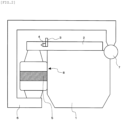
- Fig. 1 and Fig. 2 Types of the SCR device disposed so as to be in direct contact with the marine diesel engine are illustrated in Fig. 1 and Fig. 2 .
- Fig. 1 is a schematic flow diagram illustrating an example of the diesel engine including the SCR device according to the present invention.
- the numeral "1" denotes a diesel engine body, which is used in the marine diesel engine, for example.
- the numeral “2" denotes a receiver tank that receives and stores exhaust gas sent from the diesel engine body 1, and serves as a buffer tank that absorbs a fluctuation in the amount of exhaust gas sent from the diesel engine body 1, for example.
- the receiver tank 2 also serves as piping 2 for exhaust gas.
- the diesel engine illustrated in Fig. 1 is an example of a compact diesel engine in which the diesel engine body 1 and the SCR device including a denitration unit 5 provided to the receiver tank 2 are integrated into one unit.
- the SCR device is disposed so as to be in direct contact with the engine body 1 and is provided in a position where engine vibrations are transmitted.
- a urea-solution supply pipe 3 for supplying pressurized air (compressed air) and a urea solution is disposed, and a urea-solution spray nozzle 4 is provided near a tip of the urea-solution supply pipe 3.
- the urea-solution spray nozzle 4 is configured to be able to spray the urea solution into the receiver tank 2.
- a urea-solution hydrolysis unit (not illustrated) may be provided downstream of the urea-solution spray nozzle 4.
- the hydrolysis unit is preferably provided with a hydrolysis catalyst.
- the hydrolysis catalyst can promote hydrolysis of urea and decrease the amount of urea to be sent to the SCR catalyst described later, thereby decreasing formation of urea-derived solids in the SCR honeycomb catalyst.
- the urea solution sprayed by the urea-solution spray nozzle 4 and/or the NH 3 produced by hydrolysis in the hydrolysis unit is sent with the exhaust gas to the denitration unit 5.
- the denitration unit 5 is provided with an SCR catalyst supported on a metal honeycomb serving as a support.
- the NOx is reduced by the action of the SCR catalyst to produce nitrogen gas (N 2 ), whereby denitration treatment is performed.
- the treated gas thus denitrated is returned for reuse to a turbocharger 7 through treated-gas piping 6.
- Fig. 2 is a schematic flow diagram illustrating another example of the diesel engine including the SCR device according to the present invention.
- the diesel engine illustrated in Fig. 2 is an example of a compact diesel engine in which the diesel engine body 1 and the SCR device 8 are provided separately but are in contact with each other.
- the receiver tank 2 extends to an inlet of the SCR device 8.
- the SCR device 8 is disposed such that it is in contact with the diesel engine body 1 and vibrations of the engine are transmitted thereto. This can contribute to downsizing of the diesel engine.
- the SCR device 8 is provided with the denitration unit 5. The treated gas thus denitrated is returned for reuse to the turbocharger 7 through the treated piping 6.
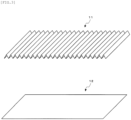
- the following describes an example of the honeycomb catalyst structure of the denitration unit 5 used in the SCR device with reference to Fig. 3 and Fig. 4 .
- the numeral "10" in Fig. 4 denotes a metal honeycomb unit.
- the metal honeycomb unit 10 includes a metal corrugated plate 11 having a triangular cross-section and a metal flat plate 12 illustrated in Fig. 3 .
- the metal corrugated plate 11 and the metal flat plate 12 are brazed together to form a honeycomb substrate (not illustrated).
- the honeycomb substrate is then spirally wound to form the metal honeycomb unit 10.
- the diameter of the metal honeycomb unit 10 can be adjusted appropriately in accordance with the number of windings of the honeycomb substrate, as long as the metal honeycomb unit 10 can be attached to the piping 2 for exhaust gas.
- Fig. 4 illustrates a state in which the metal honeycomb unit 10 provided to the piping 2 for exhaust gas is spirally wound.
- the metal honeycomb unit 10 has a configuration including cells extending from one end face to the other end face along the longitudinal direction (left-and-right direction in Fig. 5 ).
- a plurality of the cells 13 divided by cell walls and each having a triangular cross-section are formed.
- the cells 13 each having a triangular cross-section extend and penetrate from one end to the other end along the longitudinal direction (left-and-right direction in Fig. 5 ), so that exhaust gas can pass through the cells and come into contact with the catalyst while passing therethrough.
- each cell is triangular in cross section, but is not limited to a particular one.
- the cell may have any of a semicircular cross-section, an elliptical cross-section, a quadrangular cross-section, and a polygonal cross-section, for example.
- the materials of the metal corrugated plate 11 and the metal flat plate 12, which constitute the metal honeycomb unit 10, are preferably made of an alloy containing Fe as a main component, Cr at 15 to 20 wt%, and Al at 2 to 5 wt% (an alloy containing Cr at 15 to 20 wt% and Al at 2 to 5 wt% with a remainder of Fe and unavoidable impurities).
- the metal honeycomb unit 10 constituted by the metal corrugated plate 11 and the metal flat plate 12 is excellent in strength, vibration resistance, and heat resistance.
- a temperature reaches about 1000°C.
- the Cr content of 15 to 20 wt% allows formation of the honeycomb unit 10 having excellent heat resistance.
- the presence of Al provides excellent corrosion resistance because aluminum oxide is formed on an outermost surface of the honeycomb unit when heated at high temperature.
- the content of Al is preferably within a range of 2 to 5 wt% when balance is considered in terms of strength, vibration resistance, heat resistance, and corrosion resistance.
- the cell density is 50 to 500 cpsi, preferably 80 to 500 cpsi, more preferably 100 to 500 cpsi, and even more preferably 100 to 400 cpsi.
- a cell density within this range has such effects that the honeycomb catalyst structure can be made compact and the pressure loss can be kept within a range that does not impair the performance of an engine including a turbocharger.
- a relationship between linear velocity LV and pressure loss is illustrated in Fig. 7 .
- a graph of linear velocity LV versus pressure loss at respective cell densities of 78 cpsi, 100 cpsi, 200 cpsi, 300 cpsi, 400 cpsi, and 500 cpsi is illustrated.
- the slope of the straight line at each cell density in this graph is preferably 30 or more and 180 or less.
- an optimal cell density based on the pressure loss in the cells can be set in consideration of the performance of the engine with the turbocharger, as well as the honeycomb catalyst structure can be made compact as described above.
- the SCR catalyst which is a carrier, is supported on the support forming the metal honeycomb unit 10 provided to the denitration unit 5.
- the SCR catalyst contains TiO 2 as a principal component.
- the content of TiO 2 is preferably 50 vol% or more. This is because it is excellent in functionality as an SCR catalyst.
- the SCR catalyst preferably contains, in addition to TiO 2 , any one type or two or more types of V 2 O 5 , WO 3 , MoO 3 , SiO 2 , and Al 2 O 3 in combination.
- the method of supporting the SCR catalyst on the support is not limited to a particular one, but the impregnation method is preferred.
- the SCR device illustrated in Fig. 1 was used.
- the honeycomb catalyst structures with the SCR catalyst supported on the support forming the metal honeycomb unit 10 illustrated in Figs. 3 , 4, and 5 were also used.
- the cross-sectional shape of each of the cells is an isosceles triangle.
- honeycomb catalyst structures were prepared.
- the relationship between the maximum SV (h -1 ) and the cell density was determined.
- the results are illustrated in Fig. 6 .
- the SV is calculated as gas flow rate/catalyst volume.
- honeycomb catalyst structures were prepared such that a cell density is less than 500 cpsi, and denitration experiments were conducted.
- Honeycomb catalyst structure E cell density 78 cpsi
- the linear velocity LV is a gas flow velocity (m/sec) measured as (the flow rate of exhaust gas flowing through each cell)/(cell cross-sectional area).
- the pressure loss was calculated from the gas pressures at the inlet and the outlet of the honeycomb catalyst structure.
- the unit of the result thus determined is the pascal (Pa).
Landscapes
- Chemical & Material Sciences (AREA)
- Engineering & Computer Science (AREA)
- Chemical Kinetics & Catalysis (AREA)
- Combustion & Propulsion (AREA)
- Mechanical Engineering (AREA)
- Health & Medical Sciences (AREA)
- Materials Engineering (AREA)
- Organic Chemistry (AREA)
- General Engineering & Computer Science (AREA)
- Toxicology (AREA)
- Ceramic Engineering (AREA)
- Ocean & Marine Engineering (AREA)
- Oil, Petroleum & Natural Gas (AREA)
- General Chemical & Material Sciences (AREA)
- Analytical Chemistry (AREA)
- Environmental & Geological Engineering (AREA)
- Biomedical Technology (AREA)
- Catalysts (AREA)
- Exhaust Gas After Treatment (AREA)
- Exhaust Gas Treatment By Means Of Catalyst (AREA)
Applications Claiming Priority (3)
| Application Number | Priority Date | Filing Date | Title |
|---|---|---|---|
| JP2020175623A JP6840283B1 (ja) | 2020-10-19 | 2020-10-19 | ハニカム触媒構造体及びscr装置 |
| JP2021022742A JP6911259B1 (ja) | 2020-10-19 | 2021-02-16 | ハニカム触媒構造体及びscr装置 |
| PCT/JP2021/029520 WO2022085274A1 (ja) | 2020-10-19 | 2021-08-10 | ハニカム触媒構造体及びscr装置 |
Publications (2)
| Publication Number | Publication Date |
|---|---|
| EP4230293A1 true EP4230293A1 (de) | 2023-08-23 |
| EP4230293A4 EP4230293A4 (de) | 2024-06-05 |
Family
ID=74845242
Family Applications (1)
| Application Number | Title | Priority Date | Filing Date |
|---|---|---|---|
| EP21882415.9A Pending EP4230293A4 (de) | 2020-10-19 | 2021-08-10 | Wabenkatalysatorstruktur und scr-vorrichtung |
Country Status (6)
| Country | Link |
|---|---|
| US (1) | US12025044B2 (de) |
| EP (1) | EP4230293A4 (de) |
| JP (2) | JP6840283B1 (de) |
| KR (1) | KR20230115981A (de) |
| CN (1) | CN116568383A (de) |
| WO (1) | WO2022085274A1 (de) |
Families Citing this family (3)
| Publication number | Priority date | Publication date | Assignee | Title |
|---|---|---|---|---|
| CN113976094A (zh) * | 2021-11-15 | 2022-01-28 | 复旦大学 | 一种高活性无钒脱硝催化剂及其制备方法和应用 |
| CN114433056A (zh) * | 2022-01-26 | 2022-05-06 | 浙江科卓环保科技有限公司 | 一种宽温区蜂窝式scr脱硝催化剂的制备方法 |
| CN118649674B (zh) * | 2024-06-13 | 2025-10-03 | 河北威达蓝海环保科技股份有限公司 | 一种双载体脱硝催化剂及其制备方法和载体干燥装置 |
Family Cites Families (20)
| Publication number | Priority date | Publication date | Assignee | Title |
|---|---|---|---|---|
| JPS5356064U (de) | 1976-10-08 | 1978-05-13 | ||
| JP2003328734A (ja) | 2002-05-09 | 2003-11-19 | Babcock Hitachi Kk | 尿素の付着を防止した排気管および排ガス脱硝装置 |
| US6832473B2 (en) * | 2002-11-21 | 2004-12-21 | Delphi Technologies, Inc. | Method and system for regenerating NOx adsorbers and/or particulate filters |
| CN100471570C (zh) * | 2005-06-24 | 2009-03-25 | 揖斐电株式会社 | 蜂窝结构体、蜂窝结构体集合体及蜂窝催化剂 |
| JP2007285295A (ja) * | 2006-03-24 | 2007-11-01 | Ngk Insulators Ltd | 排気ガス浄化システム |
| JP2009039635A (ja) * | 2007-08-08 | 2009-02-26 | Nippon Yakin Kogyo Co Ltd | 耐熱性および高耐食性を有する船舶用脱硝触媒担持体 |
| JP5368776B2 (ja) * | 2007-12-03 | 2013-12-18 | 日本碍子株式会社 | ハニカム構造体 |
| JP2009202114A (ja) * | 2008-02-28 | 2009-09-10 | Hiroshi Matsuoka | メタルハニカム担体構造 |
| JP5356064B2 (ja) | 2008-05-20 | 2013-12-04 | イビデン株式会社 | ハニカム構造体 |
| KR101117468B1 (ko) * | 2008-05-20 | 2012-03-07 | 이비덴 가부시키가이샤 | 허니컴 구조체 |
| JP5106261B2 (ja) * | 2008-06-17 | 2012-12-26 | 新日鉄住金マテリアルズ株式会社 | メタルハニカム基材、その製造方法、及びメタルハニカム触媒コンバータ |
| EP2540370B1 (de) * | 2010-02-22 | 2018-04-04 | Hitachi Metals, Ltd. | Keramikwabenstruktur |
| KR101535088B1 (ko) * | 2012-06-12 | 2015-07-08 | 희성촉매 주식회사 | 고성능 scr 촉매 시스템 |
| WO2014054607A1 (ja) * | 2012-10-02 | 2014-04-10 | 日揮触媒化成株式会社 | 船舶用排ガス処理装置 |
| US9868670B2 (en) * | 2014-09-05 | 2018-01-16 | Corning Incorporated | High cordierite-to-mullite ratio cordierite-mullite-aluminum magnesium titanate compositions and ceramic articles comprising same |
| JP7249099B2 (ja) * | 2014-11-19 | 2023-03-30 | ジョンソン、マッセイ、パブリック、リミテッド、カンパニー | 低温排出制御のためのscrとpnaの組み合わせ |
| US10632458B2 (en) * | 2015-11-30 | 2020-04-28 | Corning Incorporated | Compound honeycomb body, exhaust gas treatment article, exhaust system and methods of manufacturing same |
| JP2019525828A (ja) * | 2016-06-13 | 2019-09-12 | ビーエーエスエフ コーポレーション | バナジア、タングスタおよびチタニアの共沈物を含む触媒物品 |
| US11471863B2 (en) * | 2017-02-08 | 2022-10-18 | Basf Corporation | Catalytic articles |
| JP2018143905A (ja) * | 2017-03-01 | 2018-09-20 | 日本碍子株式会社 | ハニカム触媒体 |
-
2020
- 2020-10-19 JP JP2020175623A patent/JP6840283B1/ja active Active
-
2021
- 2021-02-16 JP JP2021022742A patent/JP6911259B1/ja active Active
- 2021-08-10 KR KR1020237015541A patent/KR20230115981A/ko active Pending
- 2021-08-10 US US18/249,474 patent/US12025044B2/en active Active
- 2021-08-10 CN CN202180071536.0A patent/CN116568383A/zh active Pending
- 2021-08-10 EP EP21882415.9A patent/EP4230293A4/de active Pending
- 2021-08-10 WO PCT/JP2021/029520 patent/WO2022085274A1/ja not_active Ceased
Also Published As
| Publication number | Publication date |
|---|---|
| JP6911259B1 (ja) | 2021-07-28 |
| WO2022085274A1 (ja) | 2022-04-28 |
| EP4230293A4 (de) | 2024-06-05 |
| KR20230115981A (ko) | 2023-08-03 |
| US12025044B2 (en) | 2024-07-02 |
| JP6840283B1 (ja) | 2021-03-10 |
| US20230392535A1 (en) | 2023-12-07 |
| JP2022066985A (ja) | 2022-05-02 |
| CN116568383A (zh) | 2023-08-08 |
| JP2022067037A (ja) | 2022-05-02 |
Similar Documents
| Publication | Publication Date | Title |
|---|---|---|
| US12025044B2 (en) | Honeycomb catalyst structure and SCR device | |
| US8176731B2 (en) | Exhaust gas aftertreatment system | |
| KR101198968B1 (ko) | 소음감쇄 구조를 갖는 배기가스 탈질시스템 | |
| JP4928873B2 (ja) | 内燃機関の排気ガスに反応物質を添加する方法と装置 | |
| US20080041040A1 (en) | Exhaust gas post treatment system | |
| US20110064632A1 (en) | Staged Catalyst System and Method of Using the Same | |
| US20100180579A1 (en) | Emission control system with an integrated particulate filter and selective catalytic reduction unit | |
| US20120023914A1 (en) | Exhaust Purification Apparatus | |
| JP2008045559A (ja) | 内燃機関の排気ガス流への少なくとも1種の反応物の添加方法および内燃機関の排気ガス流の処理装置 | |
| KR101619098B1 (ko) | 배기가스 정화장치 | |
| US8850801B2 (en) | Catalytic converter and muffler | |
| US20080175776A1 (en) | Method for Reducing a Particle and Nitrogen Oxide Proportion in an Exhaust Gas Flow of an Internal Combustion Engine and Corresponding Exhaust Gas Treatment Unit | |
| US8470253B2 (en) | Exhaust flow distribution device | |
| US20190162098A1 (en) | Exhaust line for a vehicle | |
| US8899020B2 (en) | Apparatus and method for assisting selective catalytic reduction | |
| US20110162346A1 (en) | Progressive catalyst loading for integrated particulate filter and selective catalytic reduction unit | |
| KR102867969B1 (ko) | 고융점 배관 폐색 물질의 생성 억제 장치 및 방법 | |
| JP7463587B2 (ja) | 脱硝部の閉塞防止装置 | |
| EP2360360A1 (de) | Abgasreinigungsvorrichtung | |
| KR20120125972A (ko) | 소음감쇄 구조를 갖는 배기가스 탈질시스템 | |
| JP7402364B2 (ja) | 尿素気化装置 | |
| JP6326580B2 (ja) | NOx還元触媒手段を備えた排気ガス浄化装置 | |
| KR20200124650A (ko) | 배기가스 정화장치 | |
| JP2019183665A (ja) | 排ガス浄化装置 |
Legal Events
| Date | Code | Title | Description |
|---|---|---|---|
| STAA | Information on the status of an ep patent application or granted ep patent |
Free format text: STATUS: THE INTERNATIONAL PUBLICATION HAS BEEN MADE |
|
| PUAI | Public reference made under article 153(3) epc to a published international application that has entered the european phase |
Free format text: ORIGINAL CODE: 0009012 |
|
| STAA | Information on the status of an ep patent application or granted ep patent |
Free format text: STATUS: REQUEST FOR EXAMINATION WAS MADE |
|
| 17P | Request for examination filed |
Effective date: 20230515 |
|
| AK | Designated contracting states |
Kind code of ref document: A1 Designated state(s): AL AT BE BG CH CY CZ DE DK EE ES FI FR GB GR HR HU IE IS IT LI LT LU LV MC MK MT NL NO PL PT RO RS SE SI SK SM TR |
|
| DAV | Request for validation of the european patent (deleted) | ||
| DAX | Request for extension of the european patent (deleted) | ||
| REG | Reference to a national code |
Ref country code: DE Ref legal event code: R079 Free format text: PREVIOUS MAIN CLASS: B01J0035040000 Ipc: B01J0021060000 |
|
| A4 | Supplementary search report drawn up and despatched |
Effective date: 20240507 |
|
| RIC1 | Information provided on ipc code assigned before grant |
Ipc: F01N 3/28 20060101ALI20240430BHEP Ipc: F01N 3/10 20060101ALI20240430BHEP Ipc: F01N 3/08 20060101ALI20240430BHEP Ipc: B01D 53/94 20060101ALI20240430BHEP Ipc: B63H 21/32 20060101ALI20240430BHEP Ipc: B63H 21/14 20060101ALI20240430BHEP Ipc: B01J 37/04 20060101ALI20240430BHEP Ipc: B01J 21/06 20060101AFI20240430BHEP |