EP4198822A1 - Casier à boissons avec fonction de centrage pour bouteilles et évidement supplémentaire pour application de sérialisation - Google Patents
Casier à boissons avec fonction de centrage pour bouteilles et évidement supplémentaire pour application de sérialisation Download PDFInfo
- Publication number
- EP4198822A1 EP4198822A1 EP22212237.6A EP22212237A EP4198822A1 EP 4198822 A1 EP4198822 A1 EP 4198822A1 EP 22212237 A EP22212237 A EP 22212237A EP 4198822 A1 EP4198822 A1 EP 4198822A1
- Authority
- EP
- European Patent Office
- Prior art keywords
- containers
- receiving
- container
- image recording
- receptacles
- Prior art date
- Legal status (The legal status is an assumption and is not a legal conclusion. Google has not performed a legal analysis and makes no representation as to the accuracy of the status listed.)
- Granted
Links
Images

Classifications
-
- G—PHYSICS
- G06—COMPUTING OR CALCULATING; COUNTING
- G06K—GRAPHICAL DATA READING; PRESENTATION OF DATA; RECORD CARRIERS; HANDLING RECORD CARRIERS
- G06K7/00—Methods or arrangements for sensing record carriers, e.g. for reading patterns
- G06K7/10—Methods or arrangements for sensing record carriers, e.g. for reading patterns by electromagnetic radiation, e.g. optical sensing; by corpuscular radiation
- G06K7/10544—Methods or arrangements for sensing record carriers, e.g. for reading patterns by electromagnetic radiation, e.g. optical sensing; by corpuscular radiation by scanning of the records by radiation in the optical part of the electromagnetic spectrum
- G06K7/10712—Fixed beam scanning
- G06K7/10722—Photodetector array or CCD scanning
-
- G—PHYSICS
- G06—COMPUTING OR CALCULATING; COUNTING
- G06K—GRAPHICAL DATA READING; PRESENTATION OF DATA; RECORD CARRIERS; HANDLING RECORD CARRIERS
- G06K17/00—Methods or arrangements for effecting co-operative working between equipments covered by two or more of main groups G06K1/00 - G06K15/00, e.g. automatic card files incorporating conveying and reading operations
-
- B—PERFORMING OPERATIONS; TRANSPORTING
- B65—CONVEYING; PACKING; STORING; HANDLING THIN OR FILAMENTARY MATERIAL
- B65G—TRANSPORT OR STORAGE DEVICES, e.g. CONVEYORS FOR LOADING OR TIPPING, SHOP CONVEYOR SYSTEMS OR PNEUMATIC TUBE CONVEYORS
- B65G43/00—Control devices, e.g. for safety, warning or fault-correcting
- B65G43/08—Control devices operated by article or material being fed, conveyed or discharged
-
- B—PERFORMING OPERATIONS; TRANSPORTING
- B08—CLEANING
- B08B—CLEANING IN GENERAL; PREVENTION OF FOULING IN GENERAL
- B08B9/00—Cleaning hollow articles by methods or apparatus specially adapted thereto
- B08B9/08—Cleaning containers, e.g. tanks
- B08B9/46—Inspecting cleaned containers for cleanliness
-
- B—PERFORMING OPERATIONS; TRANSPORTING
- B65—CONVEYING; PACKING; STORING; HANDLING THIN OR FILAMENTARY MATERIAL
- B65D—CONTAINERS FOR STORAGE OR TRANSPORT OF ARTICLES OR MATERIALS, e.g. BAGS, BARRELS, BOTTLES, BOXES, CANS, CARTONS, CRATES, DRUMS, JARS, TANKS, HOPPERS, FORWARDING CONTAINERS; ACCESSORIES, CLOSURES, OR FITTINGS THEREFOR; PACKAGING ELEMENTS; PACKAGES
- B65D1/00—Rigid or semi-rigid containers having bodies formed in one piece, e.g. by casting metallic material, by moulding plastics, by blowing vitreous material, by throwing ceramic material, by moulding pulped fibrous material or by deep-drawing operations performed on sheet material
- B65D1/22—Boxes or like containers with side walls of substantial depth for enclosing contents
- B65D1/24—Boxes or like containers with side walls of substantial depth for enclosing contents with moulded compartments or partitions
- B65D1/243—Crates for bottles or like containers
-
- B—PERFORMING OPERATIONS; TRANSPORTING
- B65—CONVEYING; PACKING; STORING; HANDLING THIN OR FILAMENTARY MATERIAL
- B65G—TRANSPORT OR STORAGE DEVICES, e.g. CONVEYORS FOR LOADING OR TIPPING, SHOP CONVEYOR SYSTEMS OR PNEUMATIC TUBE CONVEYORS
- B65G15/00—Conveyors having endless load-conveying surfaces, i.e. belts and like continuous members, to which tractive effort is transmitted by means other than endless driving elements of similar configuration
-
- B—PERFORMING OPERATIONS; TRANSPORTING
- B65—CONVEYING; PACKING; STORING; HANDLING THIN OR FILAMENTARY MATERIAL
- B65G—TRANSPORT OR STORAGE DEVICES, e.g. CONVEYORS FOR LOADING OR TIPPING, SHOP CONVEYOR SYSTEMS OR PNEUMATIC TUBE CONVEYORS
- B65G47/00—Article or material-handling devices associated with conveyors; Methods employing such devices
- B65G47/74—Feeding, transfer, or discharging devices of particular kinds or types
-
- B—PERFORMING OPERATIONS; TRANSPORTING
- B65—CONVEYING; PACKING; STORING; HANDLING THIN OR FILAMENTARY MATERIAL
- B65G—TRANSPORT OR STORAGE DEVICES, e.g. CONVEYORS FOR LOADING OR TIPPING, SHOP CONVEYOR SYSTEMS OR PNEUMATIC TUBE CONVEYORS
- B65G47/00—Article or material-handling devices associated with conveyors; Methods employing such devices
- B65G47/74—Feeding, transfer, or discharging devices of particular kinds or types
- B65G47/90—Devices for picking-up and depositing articles or materials
-
- G—PHYSICS
- G01—MEASURING; TESTING
- G01N—INVESTIGATING OR ANALYSING MATERIALS BY DETERMINING THEIR CHEMICAL OR PHYSICAL PROPERTIES
- G01N21/00—Investigating or analysing materials by the use of optical means, i.e. using sub-millimetre waves, infrared, visible or ultraviolet light
- G01N21/84—Systems specially adapted for particular applications
- G01N21/88—Investigating the presence of flaws or contamination
- G01N21/90—Investigating the presence of flaws or contamination in a container or its contents
-
- G—PHYSICS
- G06—COMPUTING OR CALCULATING; COUNTING
- G06K—GRAPHICAL DATA READING; PRESENTATION OF DATA; RECORD CARRIERS; HANDLING RECORD CARRIERS
- G06K7/00—Methods or arrangements for sensing record carriers, e.g. for reading patterns
- G06K7/10—Methods or arrangements for sensing record carriers, e.g. for reading patterns by electromagnetic radiation, e.g. optical sensing; by corpuscular radiation
- G06K7/10544—Methods or arrangements for sensing record carriers, e.g. for reading patterns by electromagnetic radiation, e.g. optical sensing; by corpuscular radiation by scanning of the records by radiation in the optical part of the electromagnetic spectrum
- G06K7/10821—Methods or arrangements for sensing record carriers, e.g. for reading patterns by electromagnetic radiation, e.g. optical sensing; by corpuscular radiation by scanning of the records by radiation in the optical part of the electromagnetic spectrum further details of bar or optical code scanning devices
- G06K7/10861—Methods or arrangements for sensing record carriers, e.g. for reading patterns by electromagnetic radiation, e.g. optical sensing; by corpuscular radiation by scanning of the records by radiation in the optical part of the electromagnetic spectrum further details of bar or optical code scanning devices sensing of data fields affixed to objects or articles, e.g. coded labels
-
- B—PERFORMING OPERATIONS; TRANSPORTING
- B65—CONVEYING; PACKING; STORING; HANDLING THIN OR FILAMENTARY MATERIAL
- B65D—CONTAINERS FOR STORAGE OR TRANSPORT OF ARTICLES OR MATERIALS, e.g. BAGS, BARRELS, BOTTLES, BOXES, CANS, CARTONS, CRATES, DRUMS, JARS, TANKS, HOPPERS, FORWARDING CONTAINERS; ACCESSORIES, CLOSURES, OR FITTINGS THEREFOR; PACKAGING ELEMENTS; PACKAGES
- B65D2203/00—Decoration means, markings, information elements, contents indicators
- B65D2203/06—Arrangements on packages concerning bar-codes
-
- B—PERFORMING OPERATIONS; TRANSPORTING
- B65—CONVEYING; PACKING; STORING; HANDLING THIN OR FILAMENTARY MATERIAL
- B65D—CONTAINERS FOR STORAGE OR TRANSPORT OF ARTICLES OR MATERIALS, e.g. BAGS, BARRELS, BOTTLES, BOXES, CANS, CARTONS, CRATES, DRUMS, JARS, TANKS, HOPPERS, FORWARDING CONTAINERS; ACCESSORIES, CLOSURES, OR FITTINGS THEREFOR; PACKAGING ELEMENTS; PACKAGES
- B65D2501/00—Containers having bodies formed in one piece
- B65D2501/24—Boxes or like containers with moulded compartments or partitions
- B65D2501/24006—Details relating to bottle crates
- B65D2501/2405—Construction
- B65D2501/24121—Construction of the bottom
- B65D2501/24133—Grid, mesh
-
- B—PERFORMING OPERATIONS; TRANSPORTING
- B65—CONVEYING; PACKING; STORING; HANDLING THIN OR FILAMENTARY MATERIAL
- B65D—CONTAINERS FOR STORAGE OR TRANSPORT OF ARTICLES OR MATERIALS, e.g. BAGS, BARRELS, BOTTLES, BOXES, CANS, CARTONS, CRATES, DRUMS, JARS, TANKS, HOPPERS, FORWARDING CONTAINERS; ACCESSORIES, CLOSURES, OR FITTINGS THEREFOR; PACKAGING ELEMENTS; PACKAGES
- B65D2501/00—Containers having bodies formed in one piece
- B65D2501/24—Boxes or like containers with moulded compartments or partitions
- B65D2501/24006—Details relating to bottle crates
- B65D2501/24197—Arrangements for locating the bottles
- B65D2501/24203—Construction of locating arrangements
- B65D2501/2421—Partitions
- B65D2501/24216—Partitions forming square or rectangular cells
-
- B—PERFORMING OPERATIONS; TRANSPORTING
- B65—CONVEYING; PACKING; STORING; HANDLING THIN OR FILAMENTARY MATERIAL
- B65G—TRANSPORT OR STORAGE DEVICES, e.g. CONVEYORS FOR LOADING OR TIPPING, SHOP CONVEYOR SYSTEMS OR PNEUMATIC TUBE CONVEYORS
- B65G2201/00—Indexing codes relating to handling devices, e.g. conveyors, characterised by the type of product or load being conveyed or handled
- B65G2201/02—Articles
- B65G2201/0235—Containers
- B65G2201/0258—Trays, totes or bins
-
- B—PERFORMING OPERATIONS; TRANSPORTING
- B65—CONVEYING; PACKING; STORING; HANDLING THIN OR FILAMENTARY MATERIAL
- B65G—TRANSPORT OR STORAGE DEVICES, e.g. CONVEYORS FOR LOADING OR TIPPING, SHOP CONVEYOR SYSTEMS OR PNEUMATIC TUBE CONVEYORS
- B65G2203/00—Indexing code relating to control or detection of the articles or the load carriers during conveying
- B65G2203/02—Control or detection
- B65G2203/0208—Control or detection relating to the transported articles
- B65G2203/0216—Codes or marks on the article
-
- B—PERFORMING OPERATIONS; TRANSPORTING
- B65—CONVEYING; PACKING; STORING; HANDLING THIN OR FILAMENTARY MATERIAL
- B65G—TRANSPORT OR STORAGE DEVICES, e.g. CONVEYORS FOR LOADING OR TIPPING, SHOP CONVEYOR SYSTEMS OR PNEUMATIC TUBE CONVEYORS
- B65G2203/00—Indexing code relating to control or detection of the articles or the load carriers during conveying
- B65G2203/04—Detection means
- B65G2203/041—Camera
Definitions
- the present invention relates to a device and a method for inspecting containers.
- Numerous devices and methods for inspecting containers and in particular beverage crates that are equipped with containers are known from the prior art.
- beverage crates that serve different functions are also known from the prior art.
- each drink crates known, which have a centering function for bottles. This is used for the exact alignment of the containers in the receiving container such as a drinks crate. In this way, containers and in particular bottles can be transported more safely and with less noise. In addition, the removal of the bottles is made easier by a robot.
- the present invention is therefore based on the object of facilitating such a serialization and/or tracking of containers. According to the invention, this is achieved by the subject matter of the independent patent claims. Advantageous embodiments and developments are the subject of the dependent claims.
- packages in particular in the form of receiving containers equipped with containers, are transported by means of a first transport device, with the containers each having a marking in their bottom areas which uniquely identifies the containers and/or which allows conclusions to be drawn about at least one characteristic Property of the containers allows.
- an image recording device records at least one (spatially resolved) image of the bottom areas of the containers located in the pack and/or receptacle and at least one piece of information is output which is for the markings arranged on the containers and/or the containers and/or at least one property of the containers is characteristic.
- Each marking is preferably characteristic of the container on which it is arranged. This means that the markings of all markings arranged on said containers differ from one another in at least one property and/or in at least one feature.
- a significant advantage of a marking arranged on the base area is that this marking can be optically detected independently of a rotational position of the container with respect to its longitudinal direction is.
- a further advantage of applying the marking to the bottom area of the container is that the peripheral wall of the container can remain free of such markings (which could annoy the end user).
- a disadvantage of attaching the marking in the floor area is that this floor area is not accessible or observable, or only with difficulty, in the case of a large number of transport devices, such as, for example, in the case of conveyor belts.
- the bottom area of the container is preferably that area which is visible from below. i.e. the outer surface of the container facing the respective base when the container is standing upright.
- the containers are preferably bottles and in particular plastic bottles or glass bottles.
- the receiving container is a receiving container which is suitable and intended for receiving a large number of containers and in particular a large number of bottles.
- the bottoms of the containers are preferably viewed through corresponding openings in the receiving container (in particular the bottom area or areas of the receiving container or the receiving areas).
- the receiving container(s) are boxes, crates or cartons that are suitable and intended for receiving the containers.
- At least four, preferably at least six and preferably at least eight containers are particularly preferably accommodated in the receiving container.
- Preferably at most 40, preferably at most 35, preferably at most 30 and preferably at most 25 containers are accommodated in the receiving areas of the receiving container.
- the markings are particularly preferably machine-readable markings and/or markings that can be read without contact and, in particular, optically.
- the markings are particularly preferably selected from a group of markings which contains barcodes, QR codes and the like. However, it would also be conceivable for other markings, for example smart labels, to be arranged on the containers.
- an image evaluation device which evaluates the recorded images.
- the image recording device can identify the markings and particularly preferably also read out or evaluate the markings.
- the markings are inextricably linked to the containers. This means in particular that it is not possible to remove the marking from the containers without destroying the container. It is possible for the marking to be printed (in particular by means of direct printing) or engraved (for example by means of laser engraving) directly onto an outer surface of the container.
- a marking is characteristic of properties of the container on which it is arranged. These properties can be properties such as an age of the container, a number of times this container has been circulated, a manufacturer of the container, a material of the container, a drink with which this container is filled and the like.
- the containers are particularly preferably reusable containers. These can be both glass containers and plastic containers (for example made of PET).
- the marking particularly preferably serves to serialize the containers.
- the receiving container particularly preferably has receiving areas for the individual containers and, in particular, a recess in a bottom area, for example in the form of a rectangle and in particular a square, which enables the marking attached to the container to be observed or photographed.
- the image recording device which is in particular a camera or a camera system, is particularly preferably used to read out the markings applied to the bottoms of the bottles, for example QR codes.
- This image recording device is preferably arranged in such a way that another machine, such as a robot, can move the receptacles over it and, in particular, pivot it over it. It is possible for the receptacles or a pallet with receptacles to be stopped above the image recording device, so that the image recording device can read the visible bottoms of the bottles and thus the markings.
- the image recording device is particularly preferably arranged in a stationary manner and the receptacles are transported past the image recording device.
- the image recording device is particularly preferably arranged next to the above-mentioned transport device on which the receiving containers are transported with the containers. In this way, as little time as possible is required for the readout.
- the image recording device prefferably be arranged on a gripping device which picks up the containers from the first transport device.
- a transport device which transports the receptacles off the bottom so that an image recording device such as a camera arranged below this transport device can capture the container bases or the markings arranged on these container bases.
- a transport device could have lateral guide belts, for example, or transport belts which only support the receptacles at their edges.
- Such a transport device could also have transparent belts on which the receptacles are conveyed.
- components of the image recording device such as camera lenses, are aligned directly with the receptacles, or are also arranged horizontally with respect to the receptacles using one or more mirrors, for example a mirror cabinet, in order to facilitate the installation and maintenance of the image recording device if necessary .
- the detection angle can be increased with an image recording device or camera.
- an image recording device or camera Depending on the size of a pallet, it is possible to use only one image recording device, but it would also be conceivable to use several image recording devices or cameras. This can be taken into account accordingly in the evaluation software.
- the receptacles and in particular the bases of the receptacles are illuminated for the purpose of image recording. This illumination is preferably synchronized with the image recording.
- the image recording device records exactly one image of the bottom areas of the containers, but it would also be conceivable for a plurality of images to be recorded.
- At least one container or a receiving container equipped with a large number of containers, preferably several and particularly preferably all receiving containers, are gripped by means of a gripping device and placed in an image recording area of the image recording device. As described in more detail below, this can be done, for example, by pivoting into an image recording area of the image recording device.
- container in the context of the present patent application refers in particular to the receptacles equipped with containers and that the receptacles are in particular in (beverage) crates, (beverage) crates.
- the packs or receptacles are particularly preferably transported by means of a second transport device, which differs in particular from the first transport device, for the purpose of recording an image.
- this second transport device removes the container from the first transport device, for example a conveyor belt, and moves it to the image recording device for image recording, for example swiveling it.
- the containers can then be placed back on the first transport device.
- a plurality of second transport devices are provided which transport the containers into one or more image recording areas or spend more imaging devices. In this way, the throughput can be increased at higher transport speeds.
- the gripping device is particularly preferably a (robot) gripper.
- the gripping device is particularly preferably an active and/or a controlled gripping device which can be switched between an open position in which the engagement of the container is released and a gripping position in which the container can be gripped.
- the gripping device is particularly preferably suitable and intended for gripping the receptacles on at least two opposite walls.
- the containers are particularly preferably transported above an image recording area of the image recording device, so that the image recording device can observe the container bases—in particular from below.
- a transport path of these second transport devices, such as the robot device, is particularly preferably freely programmable.
- the second transport device removes the receptacles from the first transport device and the second transport device preferably places the receptacles back on the first transport device at a time and/or location after the image recording.
- the receiving containers are preferably removed from the first transport device for the purpose of taking the picture and are preferably also placed back on the first transport device.
- a movement of the bundles or receptacles is stopped at least temporarily in order to take a picture of the bottom areas. It is thus possible for the packs to be removed by the first transport device, to be transported via the image recording device and for the movement to be stopped there. The packs can then be brought back to the first transport device (if necessary, however, at a different position).
- the containers are positioned in predetermined positions relative to the receiving containers.
- insertion aids be provided as insertion bevels, which precisely determine or align the position of the containers and in particular also the container bottoms in relation to the receiving areas.
- a certain proportion preferably at least one and preferably several containers, is removed from the receiving container after the inspection. It would be possible, for example, for containers to be removed whose marking indicates an error, or for the need to eject this container, for example a maximum number of circulations of this container that has already been exceeded. In addition, it would also be possible for containers to be ejected that do not have any markings.
- a removal device can be provided, which is arranged downstream of the image recording device and/or the second transport device, in particular in the transport direction of the receptacles.
- This removal device is preferably suitable and intended for removing individual containers from the receiving container.
- this removal device can have one or more gripping devices which are suitable and intended for gripping individual containers located in the receptacle.
- This removal device is particularly preferably controlled as a function of at least one image recorded by the image recording device. If, for example, it is determined that a specific container is faulty, the removal device can subsequently remove this container from the receiving container.
- a removal device or packer device could be provided, which preferably has individually controllable packing tulips to remove unwanted containers from the receiving container in this way.
- a comprehensive communication protocol is particularly preferably provided for this purpose, which can, for example, exchange data across the cell level of the machine line in order to pass on the exact positions of the undesired bottles.
- the device has a memory device in which information about possibly faulty containers within the receiving container or the box can be stored.
- the proportion of containers is particularly preferably removed in response to an image recorded by the image recording device. For example, unmarked containers can be sorted out without a code, or containers with an incorrect or inaccurate code.
- a special treatment for example a washing process or a disposal process, in the further process.
- certain containers for example reusable containers, to be driven into a car wash, such as a car wash, together or without the receiving container.
- the containers are preferably not sorted out first.
- a process of sorting out the containers in the crates is the same as described above, but here the washing device itself preferably removes defective containers and carries them away.
- Further containers to be cleaned are preferably also removed and run through (preferably simultaneously with the receiving container) a dedicated washing line in a washing machine.
- receptacles are sorted out and washed separately.
- An advantage can be that the clean containers can be returned to the beverage crate d. at the end of a wash cycle. H. the receptacle can be inserted. The containers are then preferably refilled.
- a linear filling machine is particularly preferably used for filling. The advantage of using a linear filling machine is that it can also process receiving containers or beverage crates with containers.
- At least some of the containers are removed from the receiving container. This can be, for example, incorrect Act containers, or containers that are no longer to be processed. In addition, these can also be containers that have no markings.
- At least one container or the portion of the containers is removed in response to an image recorded by the image recording device. This removal can take place immediately after the inspection. However, it would also be conceivable for this extraction to take place at a later point in time during processing. It would also be possible for the corresponding empty position of the receiving container to be reloaded with containers.
- the present invention is also directed to a receiving container for receiving containers, the receiving container having a multiplicity of receiving areas in order to receive the containers separately from one another and in the same orientation. At least one and preferably exactly one container can be accommodated in each accommodation area and the accommodation container has at least one wall delimiting this accommodation container.
- a floor is provided in each of these receiving areas in order to support the containers via their floor areas.
- each of these bases has a recess through which a base of a container located in this receiving area can be observed and/or inspected.
- This recess can particularly preferably be a recess with a square or rectangular or circular cross section.
- this recess preferably has a cross section that is smaller than the cross section of the bottom area of the container, so that it is still supported by the bottom area and cannot fall out of the receiving container.
- Said opening of the recess preferably enables scanning functions that require visual contact.
- the advantage in using a rectangular or square The shape of the cutout or recess is that this shape facilitates axial storage of the containers.
- the serialization of containers plays a major role, especially in returnable cycles for returnable bottles. Due to the traceability, the reusable cycles of the containers that have already been completed can be viewed by a beverage manufacturer and also by the end customer, thus enabling more efficient handling in the reusable line.
- Container washing can be mentioned as an example, in which certain containers are ejected from the process (due to age or excessive soiling) or possibly in the future the respective degree of soiling of a container type or container can be precisely addressed. In this way, the reusable process can be streamlined, saving time and energy.
- At least one of the receiving areas and preferably each of the receiving areas has a positioning device and in particular a centering device which positions and in particular centers a container in relation to this receiving area.
- Positioning means in particular that the containers are positioned in relation to the respective receiving areas in such a way that they have a movement play of less than 5mm, preferably less than 4mm, preferably less than 3mm, preferably less than 2mm and particularly preferably less than have 1 mm.
- the centering device or positioning device brings the container into a central and/or central position with respect to the assigned receiving area.
- the present invention is also directed to a device for inspecting containers, with a first transport device being provided, which transports receiving containers equipped with containers along a predetermined transport path, the containers each having a marking in their bottom areas, which is preferably suitable and intended for this purpose To identify the containers clearly and / or which is characteristic of at least one property of the containers and/or which is suitable and intended for making at least one physical property of the containers readable and/or ascertainable.
- the device has an image recording device which records at least one image of the bottom areas of the containers located in the receptacle or bundle and which preferably outputs at least one piece of information which is characteristic of the markings arranged on the containers and/or the at least one property of the containers is (or makes it possible to determine the same).
- a device which reads corresponding markings on the containers and in particular outputs data which are characteristic of these markings and/or of the container on which this marking is arranged.
- the device has a second transport device, which transports the packs or receptacles to an image recording device and/or transports the packs or receptacles away from the image recording device. It is therefore proposed that this transport device transports the containers into an image recording area of the image recording device, in which this image recording device can record at least one image of the containers.
- the second transport device particularly preferably has a gripping device which is suitable and intended for gripping the containers.
- the image recording device is arranged in a stationary manner (with respect to a movement of the container).
- An illumination device is particularly preferably provided, which illuminates the containers and/or the receiving containers for the purpose of image recording. In this way, the marking on the containers can be determined more easily by evaluating the image.
- the device particularly preferably has an (image) evaluation device which evaluates the recorded images, in particular with regard to the markings applied. It is possible that the (image) evaluation device only determines that markings available. In addition, however, it would also be conceivable for each individual marking to be read out.
- this (image) evaluation device can preferably also detect the marking independently of a rotational position of the containers. Usually, the containers will not be in a defined rotational position of a receiving container, but randomly. Depending on the marking, the evaluation device can determine whether and, if so, how the marking is twisted in order to nevertheless enable an evaluation of the marking.
- the image recording device particularly preferably records several markings and/or several containers at the same time and particularly preferably evaluates the corresponding images. In particular, it can also be determined whether there are unmarked containers in the receiving container.
- the first transport device is particularly preferably a transport belt.
- the second transport device is particularly preferably a robot and in particular a multi-axis robot.
- the device particularly preferably has a container removal device which is suitable and intended for removing individual containers from the bundle or the receiving container. It is possible that these containers are removed in response to an image recorded and/or evaluated by the image recording device.
- FIG. 1 shows a schematic representation of a device 1 according to the invention.
- This has a transport device 2 in the form of a conveyor belt, on which receiving containers 10 for containers (not shown) are transported along the transport path T.
- the reference symbols P1 and P2 identify two possible positions of the receptacles 10 on the transport device 2.
- the first transport device 2 preferably transports the receptacles 10 in a straight line.
- the reference number 6 designates a second transport device, which is used to grip the receiving containers 10 and to swivel them over an image recording device 4 so that this can record images of the undersides of the containers 20 .
- This second transport device 6 preferably enables transport or movement of the receptacles 10 in at least two mutually perpendicular directions and preferably in three mutually perpendicular directions.
- a transport path of the containers 20 transported by the second transport device 6 can preferably be changed and, in particular, freely programmed.
- the second transport device 6 has a drive device 62, which can pivot a pivotable arm 64.
- the actual gripping device 66 which grips the containers 20 is arranged on this pivotable arm 64 via a rotary drive 68 .
- the receptacles 10 can be transported (over) over the image recording device 4 . As mentioned above, the transport can be stopped when the receiving container 10 is arranged above the image recording device 4 .
- Reference number 42 designates lighting devices which can illuminate the underside of the receiving container 10 and/or the containers 20 from below for the purpose of image recording. This lighting and also the image recording on the containers 20 used in each case and the marking 12 arranged thereon can be optimized.
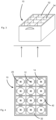
- FIG. 3 shows a representation of a receiving container 10. This has a multiplicity of receiving areas (here only two receiving areas 32, 34 shown), in each of which containers 20 can be placed.
- FIG 4 shows a receiving container 10 equipped with containers 20 from below.
- containers 20 such as bottles
- containers 20 such as bottles
- these bottles each have a marking 12 which is arranged on the bottom 14 of the container.
- Reference number 42 designates centering devices and/or positioning devices which center and/or position the containers 20 in relation to the receiving areas 32 .
- the image recording device 4 can record an image of the receiving container 10 with the total of twelve containers 20 . Furthermore, the image evaluation device allows the evaluation of the individual markings 12 and thus also a statement about the characteristic properties of the individual containers 20.
Landscapes
- Engineering & Computer Science (AREA)
- Physics & Mathematics (AREA)
- Mechanical Engineering (AREA)
- General Physics & Mathematics (AREA)
- Electromagnetism (AREA)
- General Health & Medical Sciences (AREA)
- Health & Medical Sciences (AREA)
- Theoretical Computer Science (AREA)
- Toxicology (AREA)
- Artificial Intelligence (AREA)
- Computer Vision & Pattern Recognition (AREA)
- Ceramic Engineering (AREA)
- Analytical Chemistry (AREA)
- Biochemistry (AREA)
- Chemical & Material Sciences (AREA)
- Immunology (AREA)
- Pathology (AREA)
- Life Sciences & Earth Sciences (AREA)
- Sorting Of Articles (AREA)
- Specific Conveyance Elements (AREA)
- Investigating Materials By The Use Of Optical Means Adapted For Particular Applications (AREA)
Applications Claiming Priority (1)
| Application Number | Priority Date | Filing Date | Title |
|---|---|---|---|
| DE102021133125.0A DE102021133125A1 (de) | 2021-12-14 | 2021-12-14 | Getränkekasten mit Zentrierfunktion für Flaschen und zusätzlicher Aussparung für Serialisierungsanwendung |
Publications (3)
| Publication Number | Publication Date |
|---|---|
| EP4198822A1 true EP4198822A1 (fr) | 2023-06-21 |
| EP4198822B1 EP4198822B1 (fr) | 2025-09-17 |
| EP4198822C0 EP4198822C0 (fr) | 2025-09-17 |
Family
ID=84799740
Family Applications (1)
| Application Number | Title | Priority Date | Filing Date |
|---|---|---|---|
| EP22212237.6A Active EP4198822B1 (fr) | 2021-12-14 | 2022-12-08 | Casier à boissons avec fonction de centrage pour bouteilles et évidement supplémentaire pour application de sérialisation |
Country Status (4)
| Country | Link |
|---|---|
| US (1) | US12139344B2 (fr) |
| EP (1) | EP4198822B1 (fr) |
| CN (1) | CN116262569B (fr) |
| DE (1) | DE102021133125A1 (fr) |
Families Citing this family (1)
| Publication number | Priority date | Publication date | Assignee | Title |
|---|---|---|---|---|
| US12493855B2 (en) | 2023-12-17 | 2025-12-09 | Rehrig Pacific Company | Validation system for conveyor |
Citations (8)
| Publication number | Priority date | Publication date | Assignee | Title |
|---|---|---|---|---|
| DE1934560U (de) * | 1965-12-10 | 1966-03-10 | 1001 Plastik G M B H | Flaschenkasten. |
| EP0094530A2 (fr) * | 1982-05-13 | 1983-11-23 | Spumalit-Anstalt | Casier à bouteilles en plastique et emballage pour bouteilles obtenu avec ce casier |
| EP0114392A1 (fr) | 1983-01-11 | 1984-08-01 | Franz Delbrouck GmbH | Casier à bouteilles en matière plastique |
| EP0452751A1 (fr) | 1990-04-20 | 1991-10-23 | Grafenwald Kunststoff Gesellschaft mbH & Co. Verarbeitungs und Vertriebs KG | Caisse de bouteilles |
| US20050211593A1 (en) * | 2004-02-27 | 2005-09-29 | Muller Vinosafe Sas, Societe Par Actions Simplifiee | Device for marking the bottom of a bottle |
| US20050218126A1 (en) * | 2002-06-19 | 2005-10-06 | Frewitt Printing Sa | Method and a device for depositing a wipe-proof and rub-proof marking onto transparent glass |
| EP2682756A2 (fr) * | 2012-04-25 | 2014-01-08 | Ziath Ltd | Dispositif pour lire des codes-barres |
| DE202017105355U1 (de) * | 2017-09-05 | 2017-11-10 | Knut Oppermann | Vorrichtung zur Erkennung von Flaschen |
Family Cites Families (17)
| Publication number | Priority date | Publication date | Assignee | Title |
|---|---|---|---|---|
| CH471349A (fr) | 1967-02-28 | 1969-05-30 | Francispam | Briquet à gaz |
| DE10359781B4 (de) | 2003-12-19 | 2006-01-05 | Krones Ag | Vorrichtung zur Inspektion von Leergut-Gebinden |
| CN2732639Y (zh) * | 2004-09-29 | 2005-10-12 | 刘庆隆 | 饮料箱 |
| DE102007031749A1 (de) * | 2007-07-06 | 2009-01-08 | Syscona Kontrollsysteme Gmbh | Erkennungssystem für Markierungen im Schulter- und Halsbereich von Flaschen |
| DE102008029952A1 (de) | 2008-06-26 | 2009-12-31 | Wincor Nixdorf International Gmbh | Verfahren und Vorrichtung zum Erkennen von Transportbehältnissen |
| US11308601B2 (en) * | 2015-04-29 | 2022-04-19 | Emhart Glass S.A. | Container inspection system with individual light control |
| US10311634B2 (en) * | 2015-07-21 | 2019-06-04 | IAM Robotics, LLC | Three dimensional scanning and data extraction systems and processes for supply chain piece automation |
| DE202015105854U1 (de) | 2015-11-04 | 2017-02-08 | Krones Ag | Inspektionsvorrichtung zur optischen Kontrolle von Leergutkästen |
| DE102017004358A1 (de) | 2017-05-04 | 2018-11-08 | QuISS Qualitäts-lnspektionssysteme und Service AG | Vorrichtung und Verfahren zum Selektieren von mit hoher Geschwindigkeit bewegten Gebinden |
| GB201712421D0 (en) * | 2017-08-02 | 2017-09-13 | Ziath Ltd | Device for reading barcodes |
| DE102017120410B4 (de) | 2017-09-05 | 2021-05-06 | vision-tec Patent GmbH | Verfahren zum Erkennen von Flaschen |
| CN111656199A (zh) * | 2018-01-26 | 2020-09-11 | 基础科学公司 | 自动采样器容器识别和污染物监测 |
| DE102018132132B3 (de) | 2018-12-13 | 2020-04-02 | Centro Kontrollsysteme Gmbh | Verfahren zur Erkennung eines Typs eines Behälters sowie Inspektionssystem |
| US10456915B1 (en) * | 2019-01-25 | 2019-10-29 | Mujin, Inc. | Robotic system with enhanced scanning mechanism |
| DE102019201229A1 (de) | 2019-01-31 | 2020-08-06 | Krones Ag | Greifroboter zum Aufnehmen und Abstellen von ausgestatteten Flaschen und/oder ausgestatteten Gebinden, Behandlungsanlage für Flaschen und/oder Gebinde und Verfahren zum Betreiben der Behandlungsanlage für Flaschen und/oder Gebinde |
| CN210776712U (zh) * | 2019-12-30 | 2020-06-16 | 常州腾睿机械有限公司 | 一种装箱机的物料罐底部二维码识别装置 |
| CN111428836A (zh) * | 2020-04-30 | 2020-07-17 | 深圳市联新移动医疗科技有限公司 | 一种基于视觉的药瓶自动盘点装置 |
-
2021
- 2021-12-14 DE DE102021133125.0A patent/DE102021133125A1/de active Pending
-
2022
- 2022-12-08 EP EP22212237.6A patent/EP4198822B1/fr active Active
- 2022-12-13 CN CN202211617146.1A patent/CN116262569B/zh active Active
- 2022-12-14 US US18/081,203 patent/US12139344B2/en active Active
Patent Citations (8)
| Publication number | Priority date | Publication date | Assignee | Title |
|---|---|---|---|---|
| DE1934560U (de) * | 1965-12-10 | 1966-03-10 | 1001 Plastik G M B H | Flaschenkasten. |
| EP0094530A2 (fr) * | 1982-05-13 | 1983-11-23 | Spumalit-Anstalt | Casier à bouteilles en plastique et emballage pour bouteilles obtenu avec ce casier |
| EP0114392A1 (fr) | 1983-01-11 | 1984-08-01 | Franz Delbrouck GmbH | Casier à bouteilles en matière plastique |
| EP0452751A1 (fr) | 1990-04-20 | 1991-10-23 | Grafenwald Kunststoff Gesellschaft mbH & Co. Verarbeitungs und Vertriebs KG | Caisse de bouteilles |
| US20050218126A1 (en) * | 2002-06-19 | 2005-10-06 | Frewitt Printing Sa | Method and a device for depositing a wipe-proof and rub-proof marking onto transparent glass |
| US20050211593A1 (en) * | 2004-02-27 | 2005-09-29 | Muller Vinosafe Sas, Societe Par Actions Simplifiee | Device for marking the bottom of a bottle |
| EP2682756A2 (fr) * | 2012-04-25 | 2014-01-08 | Ziath Ltd | Dispositif pour lire des codes-barres |
| DE202017105355U1 (de) * | 2017-09-05 | 2017-11-10 | Knut Oppermann | Vorrichtung zur Erkennung von Flaschen |
Also Published As
| Publication number | Publication date |
|---|---|
| US20230183019A1 (en) | 2023-06-15 |
| DE102021133125A1 (de) | 2023-06-15 |
| EP4198822B1 (fr) | 2025-09-17 |
| CN116262569A (zh) | 2023-06-16 |
| CN116262569B (zh) | 2026-08-07 |
| US12139344B2 (en) | 2024-11-12 |
| EP4198822C0 (fr) | 2025-09-17 |
Similar Documents
| Publication | Publication Date | Title |
|---|---|---|
| EP2477914B1 (fr) | Système et procédé de séparation et de préparation de commande d'articles | |
| EP3479105B1 (fr) | Dispositif et procédé d'inspection de récipients disposés dans une caisse de bouteilles consignées | |
| EP3012198B2 (fr) | Dispositif et procede de manutention d'articles | |
| DE60028756T2 (de) | Methode und vorrichtung zur handhabung von ausgeworfenen sprtizgussteilen | |
| EP2776176A2 (fr) | Dispositif et procédé d'appariement de cartes et de supports de cartes, de manipulation de cartes et/ou de tri de cartes, ainsi que magasin de cartes | |
| WO1985000763A1 (fr) | Procede de triage de containers, comme des recipients industriels, des caisses de bouteilles, etc. a partir d'un parc de containers et dispositif servant a l'identification d'un container a trier | |
| EP3071340B1 (fr) | Procédé et dispositif de tri d'objets | |
| EP4198822B1 (fr) | Casier à boissons avec fonction de centrage pour bouteilles et évidement supplémentaire pour application de sérialisation | |
| EP3559765B1 (fr) | Procédé d'identification de pièces, poste de production associé et procédé de modernisation associé | |
| EP3241621B1 (fr) | Procédé de tri par type de composants et dispositif de tri | |
| EP0982241B1 (fr) | Procédé pour la manutention d'articles dans une entreprise de vente par correspondance | |
| EP3808685B1 (fr) | Dispositif et procédé pour le tri et la préparation de commandes d'articles | |
| DE102010034167A1 (de) | System und Verfahren zum Bearbeiten von Sicherheits- oder Identifikationsgegenständen | |
| EP2354047A1 (fr) | Procédé de rassemblement et d'emballage de marchandises à envoyer | |
| DE102008029025A1 (de) | Vorrichtung zur Erfassung von Erkennungsmerkmalen von Leergutgebinden | |
| DE102018212671A1 (de) | Verfahren zur Erstellung einer Versandinformation und mobile Vorrichtungen und Auswerterechner zur Durchführung des Verfahrens zur Erstellung einer Versandinformation | |
| EP3866128A1 (fr) | Système de détection et procédé de détection des objets pour ou dans un distributeur automatique d'acceptation | |
| DE4136253A1 (de) | Sortiervorrichtung zum sortieren von verschiedenartigen gegenstaenden nach ihren merkmalen | |
| DE602005005686T2 (de) | Vorrichtung zum Sortieren und Gruppieren von Gegenständen, Behältern u.ä. | |
| DE10300164A1 (de) | Verfahren und Vorrichtung zum Verpacken von Stückgutartikeln | |
| EP0934778B1 (fr) | Installation de réception d'articles repris | |
| DE102023000184A1 (de) | Generieren von Daten beim Übergeben von autonom fahrenden Hängetaschen in ein Hängetaschenlager | |
| WO2017063967A1 (fr) | Dispositif et procédé de tri de documents de valeur ou de sécurité de type livre | |
| DE102024116764A1 (de) | Magazin für Etikettenbandrollen, Etikettiermaschine, Anlage zum Herstellen und/oder Behandeln von Behältern und Verfahren zum Steuern mindestens eines Magazins | |
| EP2343256A2 (fr) | Procédé et agencement destinés à la manipulation d'objets |
Legal Events
| Date | Code | Title | Description |
|---|---|---|---|
| PUAI | Public reference made under article 153(3) epc to a published international application that has entered the european phase |
Free format text: ORIGINAL CODE: 0009012 |
|
| STAA | Information on the status of an ep patent application or granted ep patent |
Free format text: STATUS: THE APPLICATION HAS BEEN PUBLISHED |
|
| AK | Designated contracting states |
Kind code of ref document: A1 Designated state(s): AL AT BE BG CH CY CZ DE DK EE ES FI FR GB GR HR HU IE IS IT LI LT LU LV MC ME MK MT NL NO PL PT RO RS SE SI SK SM TR |
|
| STAA | Information on the status of an ep patent application or granted ep patent |
Free format text: STATUS: REQUEST FOR EXAMINATION WAS MADE |
|
| 17P | Request for examination filed |
Effective date: 20231201 |
|
| RBV | Designated contracting states (corrected) |
Designated state(s): AL AT BE BG CH CY CZ DE DK EE ES FI FR GB GR HR HU IE IS IT LI LT LU LV MC ME MK MT NL NO PL PT RO RS SE SI SK SM TR |
|
| STAA | Information on the status of an ep patent application or granted ep patent |
Free format text: STATUS: EXAMINATION IS IN PROGRESS |
|
| 17Q | First examination report despatched |
Effective date: 20240604 |
|
| GRAP | Despatch of communication of intention to grant a patent |
Free format text: ORIGINAL CODE: EPIDOSNIGR1 |
|
| STAA | Information on the status of an ep patent application or granted ep patent |
Free format text: STATUS: GRANT OF PATENT IS INTENDED |
|
| INTG | Intention to grant announced |
Effective date: 20250513 |
|
| GRAS | Grant fee paid |
Free format text: ORIGINAL CODE: EPIDOSNIGR3 |
|
| GRAA | (expected) grant |
Free format text: ORIGINAL CODE: 0009210 |
|
| STAA | Information on the status of an ep patent application or granted ep patent |
Free format text: STATUS: THE PATENT HAS BEEN GRANTED |
|
| AK | Designated contracting states |
Kind code of ref document: B1 Designated state(s): AL AT BE BG CH CY CZ DE DK EE ES FI FR GB GR HR HU IE IS IT LI LT LU LV MC ME MK MT NL NO PL PT RO RS SE SI SK SM TR |
|
| REG | Reference to a national code |
Ref country code: GB Ref legal event code: FG4D Free format text: NOT ENGLISH |
|
| REG | Reference to a national code |
Ref country code: CH Ref legal event code: EP |
|
| REG | Reference to a national code |
Ref country code: IE Ref legal event code: FG4D Free format text: LANGUAGE OF EP DOCUMENT: GERMAN |
|
| REG | Reference to a national code |
Ref country code: DE Ref legal event code: R096 Ref document number: 502022005504 Country of ref document: DE |
|
| U01 | Request for unitary effect filed |
Effective date: 20251014 |
|
| U07 | Unitary effect registered |
Designated state(s): AT BE BG DE DK EE FI FR IT LT LU LV MT NL PT RO SE SI Effective date: 20251020 |
|
| U20 | Renewal fee for the european patent with unitary effect paid |
Year of fee payment: 4 Effective date: 20251110 |
|
| PG25 | Lapsed in a contracting state [announced via postgrant information from national office to epo] |
Ref country code: NO Free format text: LAPSE BECAUSE OF FAILURE TO SUBMIT A TRANSLATION OF THE DESCRIPTION OR TO PAY THE FEE WITHIN THE PRESCRIBED TIME-LIMIT Effective date: 20251217 |
|
| PG25 | Lapsed in a contracting state [announced via postgrant information from national office to epo] |
Ref country code: HR Free format text: LAPSE BECAUSE OF FAILURE TO SUBMIT A TRANSLATION OF THE DESCRIPTION OR TO PAY THE FEE WITHIN THE PRESCRIBED TIME-LIMIT Effective date: 20250917 |
|
| PG25 | Lapsed in a contracting state [announced via postgrant information from national office to epo] |
Ref country code: GR Free format text: LAPSE BECAUSE OF FAILURE TO SUBMIT A TRANSLATION OF THE DESCRIPTION OR TO PAY THE FEE WITHIN THE PRESCRIBED TIME-LIMIT Effective date: 20251218 |
|
| PG25 | Lapsed in a contracting state [announced via postgrant information from national office to epo] |
Ref country code: RS Free format text: LAPSE BECAUSE OF FAILURE TO SUBMIT A TRANSLATION OF THE DESCRIPTION OR TO PAY THE FEE WITHIN THE PRESCRIBED TIME-LIMIT Effective date: 20251217 |
|
| PG25 | Lapsed in a contracting state [announced via postgrant information from national office to epo] |
Ref country code: SM Free format text: LAPSE BECAUSE OF FAILURE TO SUBMIT A TRANSLATION OF THE DESCRIPTION OR TO PAY THE FEE WITHIN THE PRESCRIBED TIME-LIMIT Effective date: 20250917 |
|
| PG25 | Lapsed in a contracting state [announced via postgrant information from national office to epo] |
Ref country code: ES Free format text: LAPSE BECAUSE OF FAILURE TO SUBMIT A TRANSLATION OF THE DESCRIPTION OR TO PAY THE FEE WITHIN THE PRESCRIBED TIME-LIMIT Effective date: 20250917 |
|
| PG25 | Lapsed in a contracting state [announced via postgrant information from national office to epo] |
Ref country code: IS Free format text: LAPSE BECAUSE OF FAILURE TO SUBMIT A TRANSLATION OF THE DESCRIPTION OR TO PAY THE FEE WITHIN THE PRESCRIBED TIME-LIMIT Effective date: 20260117 |
|
| U1N | Appointed representative for the unitary patent procedure changed after the registration of the unitary effect |
Representative=s name: HANNKE BITTNER & PARTNER MBB REGENSBURG; DE |
|
| PG25 | Lapsed in a contracting state [announced via postgrant information from national office to epo] |
Ref country code: CZ Free format text: LAPSE BECAUSE OF FAILURE TO SUBMIT A TRANSLATION OF THE DESCRIPTION OR TO PAY THE FEE WITHIN THE PRESCRIBED TIME-LIMIT Effective date: 20250917 |
|
| PG25 | Lapsed in a contracting state [announced via postgrant information from national office to epo] |
Ref country code: PL Free format text: LAPSE BECAUSE OF FAILURE TO SUBMIT A TRANSLATION OF THE DESCRIPTION OR TO PAY THE FEE WITHIN THE PRESCRIBED TIME-LIMIT Effective date: 20250917 |
|
| PG25 | Lapsed in a contracting state [announced via postgrant information from national office to epo] |
Ref country code: SK Free format text: LAPSE BECAUSE OF FAILURE TO SUBMIT A TRANSLATION OF THE DESCRIPTION OR TO PAY THE FEE WITHIN THE PRESCRIBED TIME-LIMIT Effective date: 20250917 |
|
| PG25 | Lapsed in a contracting state [announced via postgrant information from national office to epo] |
Ref country code: MC Free format text: LAPSE BECAUSE OF FAILURE TO SUBMIT A TRANSLATION OF THE DESCRIPTION OR TO PAY THE FEE WITHIN THE PRESCRIBED TIME-LIMIT Effective date: 20250917 |
|
| REG | Reference to a national code |
Ref country code: CH Ref legal event code: H13 Free format text: ST27 STATUS EVENT CODE: U-0-0-H10-H13 (AS PROVIDED BY THE NATIONAL OFFICE) Effective date: 20260723 |
|
| PLBE | No opposition filed within time limit |
Free format text: ORIGINAL CODE: 0009261 |
|
| STAA | Information on the status of an ep patent application or granted ep patent |
Free format text: STATUS: NO OPPOSITION FILED WITHIN TIME LIMIT |
|
| REG | Reference to a national code |
Ref country code: CH Ref legal event code: L10 Free format text: ST27 STATUS EVENT CODE: U-0-0-L10-L00 (AS PROVIDED BY THE NATIONAL OFFICE) Effective date: 20260729 |