EP4177451A1 - Stoppsteuervorrichtung für verbrennungsmotor - Google Patents
Stoppsteuervorrichtung für verbrennungsmotor Download PDFInfo
- Publication number
- EP4177451A1 EP4177451A1 EP21832881.3A EP21832881A EP4177451A1 EP 4177451 A1 EP4177451 A1 EP 4177451A1 EP 21832881 A EP21832881 A EP 21832881A EP 4177451 A1 EP4177451 A1 EP 4177451A1
- Authority
- EP
- European Patent Office
- Prior art keywords
- internal combustion
- control device
- closing timing
- engine
- combustion engine
- Prior art date
- Legal status (The legal status is an assumption and is not a legal conclusion. Google has not performed a legal analysis and makes no representation as to the accuracy of the status listed.)
- Granted
Links
Images




Classifications
-
- F—MECHANICAL ENGINEERING; LIGHTING; HEATING; WEAPONS; BLASTING
- F02—COMBUSTION ENGINES; HOT-GAS OR COMBUSTION-PRODUCT ENGINE PLANTS
- F02D—CONTROLLING COMBUSTION ENGINES
- F02D41/00—Electrical control of supply of combustible mixture or its constituents
- F02D41/02—Circuit arrangements for generating control signals
- F02D41/04—Introducing corrections for particular operating conditions
- F02D41/042—Introducing corrections for particular operating conditions for stopping the engine
-
- F—MECHANICAL ENGINEERING; LIGHTING; HEATING; WEAPONS; BLASTING
- F02—COMBUSTION ENGINES; HOT-GAS OR COMBUSTION-PRODUCT ENGINE PLANTS
- F02D—CONTROLLING COMBUSTION ENGINES
- F02D13/00—Controlling the engine output power by varying inlet or exhaust valve operating characteristics, e.g. timing
- F02D13/02—Controlling the engine output power by varying inlet or exhaust valve operating characteristics, e.g. timing during engine operation
- F02D13/0203—Variable control of intake and exhaust valves
- F02D13/0215—Variable control of intake and exhaust valves changing the valve timing only
-
- F—MECHANICAL ENGINEERING; LIGHTING; HEATING; WEAPONS; BLASTING
- F01—MACHINES OR ENGINES IN GENERAL; ENGINE PLANTS IN GENERAL; STEAM ENGINES
- F01L—CYCLICALLY OPERATING VALVES FOR MACHINES OR ENGINES
- F01L1/00—Valve-gear or valve arrangements, e.g. lift-valve gear
- F01L1/34—Valve-gear or valve arrangements, e.g. lift-valve gear characterised by the provision of means for changing the timing of the valves without changing the duration of opening and without affecting the magnitude of the valve lift
- F01L1/344—Valve-gear or valve arrangements, e.g. lift-valve gear characterised by the provision of means for changing the timing of the valves without changing the duration of opening and without affecting the magnitude of the valve lift changing the angular relationship between crankshaft and camshaft, e.g. using helicoidal gear
- F01L1/352—Valve-gear or valve arrangements, e.g. lift-valve gear characterised by the provision of means for changing the timing of the valves without changing the duration of opening and without affecting the magnitude of the valve lift changing the angular relationship between crankshaft and camshaft, e.g. using helicoidal gear using bevel or epicyclic gear
-
- F—MECHANICAL ENGINEERING; LIGHTING; HEATING; WEAPONS; BLASTING
- F02—COMBUSTION ENGINES; HOT-GAS OR COMBUSTION-PRODUCT ENGINE PLANTS
- F02D—CONTROLLING COMBUSTION ENGINES
- F02D13/00—Controlling the engine output power by varying inlet or exhaust valve operating characteristics, e.g. timing
- F02D13/02—Controlling the engine output power by varying inlet or exhaust valve operating characteristics, e.g. timing during engine operation
- F02D13/0203—Variable control of intake and exhaust valves
-
- F—MECHANICAL ENGINEERING; LIGHTING; HEATING; WEAPONS; BLASTING
- F02—COMBUSTION ENGINES; HOT-GAS OR COMBUSTION-PRODUCT ENGINE PLANTS
- F02D—CONTROLLING COMBUSTION ENGINES
- F02D13/00—Controlling the engine output power by varying inlet or exhaust valve operating characteristics, e.g. timing
- F02D13/02—Controlling the engine output power by varying inlet or exhaust valve operating characteristics, e.g. timing during engine operation
- F02D13/0203—Variable control of intake and exhaust valves
- F02D13/0215—Variable control of intake and exhaust valves changing the valve timing only
- F02D13/0219—Variable control of intake and exhaust valves changing the valve timing only by shifting the phase, i.e. the opening periods of the valves are constant
-
- F—MECHANICAL ENGINEERING; LIGHTING; HEATING; WEAPONS; BLASTING
- F02—COMBUSTION ENGINES; HOT-GAS OR COMBUSTION-PRODUCT ENGINE PLANTS
- F02D—CONTROLLING COMBUSTION ENGINES
- F02D13/00—Controlling the engine output power by varying inlet or exhaust valve operating characteristics, e.g. timing
- F02D13/02—Controlling the engine output power by varying inlet or exhaust valve operating characteristics, e.g. timing during engine operation
- F02D13/0223—Variable control of the intake valves only
-
- F—MECHANICAL ENGINEERING; LIGHTING; HEATING; WEAPONS; BLASTING
- F02—COMBUSTION ENGINES; HOT-GAS OR COMBUSTION-PRODUCT ENGINE PLANTS
- F02D—CONTROLLING COMBUSTION ENGINES
- F02D13/00—Controlling the engine output power by varying inlet or exhaust valve operating characteristics, e.g. timing
- F02D13/02—Controlling the engine output power by varying inlet or exhaust valve operating characteristics, e.g. timing during engine operation
- F02D13/0223—Variable control of the intake valves only
- F02D13/0234—Variable control of the intake valves only changing the valve timing only
-
- F—MECHANICAL ENGINEERING; LIGHTING; HEATING; WEAPONS; BLASTING
- F02—COMBUSTION ENGINES; HOT-GAS OR COMBUSTION-PRODUCT ENGINE PLANTS
- F02D—CONTROLLING COMBUSTION ENGINES
- F02D13/00—Controlling the engine output power by varying inlet or exhaust valve operating characteristics, e.g. timing
- F02D13/02—Controlling the engine output power by varying inlet or exhaust valve operating characteristics, e.g. timing during engine operation
- F02D13/0242—Variable control of the exhaust valves only
-
- F—MECHANICAL ENGINEERING; LIGHTING; HEATING; WEAPONS; BLASTING
- F02—COMBUSTION ENGINES; HOT-GAS OR COMBUSTION-PRODUCT ENGINE PLANTS
- F02D—CONTROLLING COMBUSTION ENGINES
- F02D13/00—Controlling the engine output power by varying inlet or exhaust valve operating characteristics, e.g. timing
- F02D13/02—Controlling the engine output power by varying inlet or exhaust valve operating characteristics, e.g. timing during engine operation
- F02D13/0242—Variable control of the exhaust valves only
- F02D13/0249—Variable control of the exhaust valves only changing the valve timing only
-
- F—MECHANICAL ENGINEERING; LIGHTING; HEATING; WEAPONS; BLASTING
- F02—COMBUSTION ENGINES; HOT-GAS OR COMBUSTION-PRODUCT ENGINE PLANTS
- F02D—CONTROLLING COMBUSTION ENGINES
- F02D13/00—Controlling the engine output power by varying inlet or exhaust valve operating characteristics, e.g. timing
- F02D13/08—Controlling the engine output power by varying inlet or exhaust valve operating characteristics, e.g. timing for rendering engine inoperative or idling
-
- F—MECHANICAL ENGINEERING; LIGHTING; HEATING; WEAPONS; BLASTING
- F02—COMBUSTION ENGINES; HOT-GAS OR COMBUSTION-PRODUCT ENGINE PLANTS
- F02D—CONTROLLING COMBUSTION ENGINES
- F02D41/00—Electrical control of supply of combustible mixture or its constituents
- F02D41/009—Electrical control of supply of combustible mixture or its constituents using means for generating position or synchronisation signals
-
- F—MECHANICAL ENGINEERING; LIGHTING; HEATING; WEAPONS; BLASTING
- F01—MACHINES OR ENGINES IN GENERAL; ENGINE PLANTS IN GENERAL; STEAM ENGINES
- F01L—CYCLICALLY OPERATING VALVES FOR MACHINES OR ENGINES
- F01L2800/00—Methods of operation using a variable valve timing mechanism
- F01L2800/03—Stopping; Stalling
-
- F—MECHANICAL ENGINEERING; LIGHTING; HEATING; WEAPONS; BLASTING
- F01—MACHINES OR ENGINES IN GENERAL; ENGINE PLANTS IN GENERAL; STEAM ENGINES
- F01L—CYCLICALLY OPERATING VALVES FOR MACHINES OR ENGINES
- F01L2820/00—Details on specific features characterising valve gear arrangements
- F01L2820/01—Absolute values
-
- F—MECHANICAL ENGINEERING; LIGHTING; HEATING; WEAPONS; BLASTING
- F01—MACHINES OR ENGINES IN GENERAL; ENGINE PLANTS IN GENERAL; STEAM ENGINES
- F01L—CYCLICALLY OPERATING VALVES FOR MACHINES OR ENGINES
- F01L2820/00—Details on specific features characterising valve gear arrangements
- F01L2820/03—Auxiliary actuators
- F01L2820/032—Electric motors
-
- F—MECHANICAL ENGINEERING; LIGHTING; HEATING; WEAPONS; BLASTING
- F02—COMBUSTION ENGINES; HOT-GAS OR COMBUSTION-PRODUCT ENGINE PLANTS
- F02D—CONTROLLING COMBUSTION ENGINES
- F02D41/00—Electrical control of supply of combustible mixture or its constituents
- F02D41/0002—Controlling intake air
- F02D2041/001—Controlling intake air for engines with variable valve actuation
-
- F—MECHANICAL ENGINEERING; LIGHTING; HEATING; WEAPONS; BLASTING
- F02—COMBUSTION ENGINES; HOT-GAS OR COMBUSTION-PRODUCT ENGINE PLANTS
- F02D—CONTROLLING COMBUSTION ENGINES
- F02D2200/00—Input parameters for engine control
- F02D2200/60—Input parameters for engine control said parameters being related to the driver demands or status
- F02D2200/602—Pedal position
-
- F—MECHANICAL ENGINEERING; LIGHTING; HEATING; WEAPONS; BLASTING
- F02—COMBUSTION ENGINES; HOT-GAS OR COMBUSTION-PRODUCT ENGINE PLANTS
- F02N—STARTING OF COMBUSTION ENGINES; STARTING AIDS FOR SUCH ENGINES, NOT OTHERWISE PROVIDED FOR
- F02N19/00—Starting aids for combustion engines, not otherwise provided for
- F02N19/005—Aiding engine start by starting from a predetermined position, e.g. pre-positioning or reverse rotation
- F02N2019/008—Aiding engine start by starting from a predetermined position, e.g. pre-positioning or reverse rotation the engine being stopped in a particular position
-
- Y—GENERAL TAGGING OF NEW TECHNOLOGICAL DEVELOPMENTS; GENERAL TAGGING OF CROSS-SECTIONAL TECHNOLOGIES SPANNING OVER SEVERAL SECTIONS OF THE IPC; TECHNICAL SUBJECTS COVERED BY FORMER USPC CROSS-REFERENCE ART COLLECTIONS [XRACs] AND DIGESTS
- Y02—TECHNOLOGIES OR APPLICATIONS FOR MITIGATION OR ADAPTATION AGAINST CLIMATE CHANGE
- Y02T—CLIMATE CHANGE MITIGATION TECHNOLOGIES RELATED TO TRANSPORTATION
- Y02T10/00—Road transport of goods or passengers
- Y02T10/10—Internal combustion engine [ICE] based vehicles
- Y02T10/12—Improving ICE efficiencies
Definitions
- the present disclosure relates to stop control devices for internal combustion engines.
- Patent Document 1 describes a form of control in which a generator driven by an engine is provided, and when a request to stop the engine occurs, a target trajectory as a rotation behavior to be exhibited until the engine stops at a target stop crank angle is calculated, and the load of the generator is controlled so that an actual engine rotation behavior exhibited when performing engine rotation stop control matches the target trajectory.
- Patent Document 2 describes a form of control in which an internal combustion engine includes an intake phase variable mechanism that can change the opening and closing timing of an intake valve, and a throttle valve, the throttle valve opening degree is controlled after the internal combustion engine is automatically stopped, and after this automatic stopping, the opening and closing timing of the intake valve is controlled toward an advancing side when the temperature in a cylinder is equal to or higher than a predetermined value and the opening and closing timing of the intake valve is earlier than when a piston reaches the bottom dead center.
- Patent Document 2 also describes a form of control in which the throttle valve opening degree is controlled after the internal combustion engine is automatically stopped, and after this automatic stopping, the opening and closing timing of the intake valve is controlled toward a retarding side when the temperature in the cylinder is equal to or higher than the predetermined value and the opening and closing timing of the intake valve is later than when the piston reaches the bottom dead center.
- a stop control device for an internal combustion engine that stops an engine in a state suitable for starting and that does not cause the crank angle to change after the engine is stopped.
- a characteristic structure of a stop control device for an internal combustion engine is that a four-cycle internal combustion engine includes an electric valve opening and closing timing control device that sets an opening and closing timing of either or both of an intake valve and an exhaust valve, stop control of stopping the internal combustion engine is performed when a stop signal for stopping the internal combustion engine is acquired, and post-stop phase control of displacing the opening and closing timing of the valve opening and closing timing control device in either an advancing direction or a retarding direction is performed after the internal combustion engine is stopped by the stop control.
- the post-stop phase control of displacing the opening and closing timing of the valve opening and closing timing control device in either the advancing direction or the retarding direction is performed after the internal combustion engine is stopped.
- Gas in a cylinder in a compressed state can thus be discharged, and a pressure acting on a piston can also be reduced.
- the weights of pistons and cam torques can also be balanced by performing the post-stop phase control.
- an external force acting on a crankshaft can be reduced after the internal combustion engine is stopped. Therefore, the stopped internal combustion engine can be smoothly restarted.
- the stop control device for an internal combustion engine is thus structured that stops the engine in a state suitable for starting and that does not cause a crank angle to change after the engine is stopped.
- Pre-stop phase control of displacing the opening and closing timing of the valve opening and closing timing control device in a direction opposite to the direction in which the opening and closing timing is displaced in the post-stop phase control may be performed.
- a relative rotation phase of the valve opening and closing timing control device is displaced in, for example, the advancing direction by the pre-stop phase control.
- a compression ratio in the cylinder is thus increased, and a strong braking force is applied to the crankshaft by the gas pressure.
- the engine can thus be stopped in a short time.
- the relative rotation phase of the valve opening and closing timing control device is displaced, for example, from the advancing direction to the retarding direction by the post-stop phase control.
- the gas in the cylinder in the compressed state can thus be discharged, and the pressure acting on the piston can be reduced.
- the weights of the pistons and the cam torques can also be balanced.
- the valve opening and closing timing control device may set the opening and closing timing of the intake valve.
- the opening and closing timing of the valve opening and closing timing control device may be set to a most advanced angle by the pre-stop phase control, and the opening and closing timing of the valve opening and closing timing control device may be set to a most retarded angle by the post-stop phase control after the internal combustion engine is stopped.
- the relative rotation phase when stopping the internal combustion engine by the stop control, the relative rotation phase is set to the most advanced angle by the pre-stop phase control.
- the intake valve is thus closed early and the compression ratio in the cylinder is increased. A large load is thus applied to the crankshaft, so that the engine can be stopped quickly.
- the relative rotation phase is set to the most retarded angle by the post-stop phase control. Air in the cylinder with an increased pressure is thus discharged via the intake valve, transitioning to the state in which no pressure is applied to the crankshaft. The crank angle can thus be stabilized in a balanced manner.
- the pre-stop phase control may be performed when a crank angle of a crankshaft reaches minus 180 degrees before the internal combustion engine is stopped, the crank angle when the internal combustion engine is stopped by the stop control being 0 degrees.
- the relative rotation phase is set to the most advanced angle by the pre-stop phase control when the crank angle reaches 180 degrees before the angle at which the internal combustion engine is stopped by the stop control (minus 180 degrees).
- the intake valve is thus closed early and the compression ratio in the cylinder is increased. A large load is thus applied to the crankshaft, so that the engine can be stopped quickly.
- the relative rotation phase is set to the most retarded angle by the post-stop phase control. Air in the cylinder with an increased pressure is thus discharged via the intake valve, transitioning to the state in which no pressure is applied to the crankshaft. The crank angle can thus be stabilized in a balanced manner.
- the valve opening and closing timing control device may set the opening and closing timing of the exhaust valve.
- the opening and closing timing of the valve opening and closing timing control device may be set to the most retarded angle by the pre-stop phase control before the internal combustion engine is stopped by the stop control, and the opening and closing timing of the valve opening and closing timing control device may be set to the most advanced angle by the post-stop phase control after the internal combustion engine is stopped.
- the relative rotation phase of the valve opening and closing timing control device is set to the most advanced angle by the pre-stop phase control.
- the exhaust valve is thus closed early, and a large load is applied to the crankshaft due to an increased compression ratio in the cylinder, so that the engine can be stopped quickly.
- the relative rotation phase of the valve opening and closing timing control device is set to the most retarded angle. Air in the cylinder with an increased compression ratio is thus discharged, transitioning to the state in which no pressure is applied to the crankshaft.
- the crank angle can thus be stabilized in a balanced manner.
- the pre-stop phase control may be performed when the crank angle of the crankshaft reaches minus 180 degrees before the internal combustion engine is stopped, the crank angle when the internal combustion engine is stopped by the stop control being 0 degrees.
- the relative rotation phase is set to the most advanced angle by the pre-stop phase control when the crank angle reaches 180 degrees before the angle at which the engine is stopped by the stop control (minus 180 degrees).
- the exhaust valve is thus closed early, and a large load is applied to the crankshaft due to an increased compression ratio in the cylinder, so that the engine can be stopped quickly.
- the relative rotation phase is set to the most retarded angle by the post-stop phase control. Air in the cylinder with an increased compression ratio is thus discharged, transitioning to the state in which no pressure is applied to the crankshaft. The crank angle can thus be stabilized in a balanced manner.
- the internal combustion engine may include a plurality of cylinders.
- the internal combustion engine when the internal combustion engine is stopped by the stop control, the internal combustion engine can be stopped with the weights of the pistons in the plurality of cylinders and the cam torques being balanced.
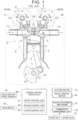
- an engine E as an internal combustion engine includes an intake valve Va and an exhaust valve Vb, and also includes an electric first valve opening and closing timing control device A1 that sets the valve timing (opening and closing timing) of the intake valve Va, and an electric second valve opening and closing timing control device A2 that sets the valve timing (opening and closing timing) of the exhaust valve Vb.
- This engine E (example of the internal combustion engine) is illustrated as an engine mounted on a vehicle such as a passenger car.
- the engine E is controlled by an engine control device 40.
- the first valve opening and closing timing control device A1 and the second valve opening and closing timing control device A2 have a common structure.
- the first valve opening and closing timing control device A1 and the second valve opening and closing timing control device A2 have hardware that determines the valve timing by the driving force of a phase control motor M (electric motor).
- Each phase control motor M is controlled by the engine control device 40.
- the first valve opening and closing timing control device A1 and the second valve opening and closing timing control device A2 are sometimes referred to as "valve opening and closing timing control device A" as a generic concept thereof.
- the engine control device 40 is an example of the stop control device for an internal combustion engine.
- a stop control unit 43 controls either or both of the first valve opening and closing timing control device A1 and the second valve opening and closing timing control device A2.
- the valve opening and closing timing control device A has a drive case 21 (drive-side rotating body) and an internal rotor 22 (driven-side rotating body), and also has a phase adjustment mechanism G that changes the relative rotation phase between the drive case 21 and the internal rotor 22 (hereinafter sometimes simply referred to as "relative rotation phase”) by the driving force of the phase control motor M.
- the relative rotation phase between the drive case 21 and the internal rotor 22 is a relative angle between the drive case 21 and the internal rotor 22 about their rotation axis X.
- the engine E is structured as a four-cycle engine in which a cylinder head 3 is connected to the top of a cylinder block 2 supporting a crankshaft 1, pistons 4 are reciprocatingly housed in a plurality of cylinder bores formed in the cylinder block 2, and the pistons 4 are connected to the crankshaft 1 by connecting rods 5.
- the intake valve Va and the exhaust valve Vb are mounted in the cylinder head 3, and an intake camshaft 7 that controls the intake valve Va and an exhaust camshaft 8 that controls the exhaust valve Vb are mounted on top of the cylinder head 3.
- a timing belt 6 is wound around an output pulley 1S of the crankshaft 1 and drive pulleys 21S of the two drive cases 21.
- An injector 9 that injects fuel into a combustion chamber and a spark plug 10 are mounted in the cylinder head 3.
- the engine E includes a starter motor 15 that drives and rotates the crankshaft 1, and also includes, at a position near the crankshaft 1, a crank angle sensor 16 that detects a crank angle.
- a first cam angle sensor 17 that detects a cam angle of the intake camshaft 7 is provided near the intake camshaft 7, and a second cam angle sensor 18 that detects a cam angle of the exhaust camshaft 8 is provided near the exhaust camshaft 8.
- the engine control device 40 is structured as an ECU that controls the engine E, and includes a start control unit 41, a phase control unit 42, and the stop control unit 43 that are configured by software. Detection signals from the crank angle sensor 16, the first cam angle sensor 17, and the second cam angle sensor 18 are input to the engine control device 40. Signals from a main switch 45 and an accelerator pedal sensor 14 are also input to the engine control device 40.
- the engine control device 40 also outputs control signals to the starter motor 15, the two phase control motors M, and a combustion management unit 19.
- the combustion management unit 19 controls the fuel injection amount and injection timing from the injector 9 and the ignition timing of the spark plug 10.
- the start control unit 41, the phase control unit 42, and the stop control unit 43 are configured as software. However, a part of each of these units may be configured by hardware such as logic circuit or memory.
- the main switch 45 is disposed on a panel portion in front of the driver's seat of the vehicle, and the start control unit 41 implements starting of the engine E by an operation of turning on the main switch 45.
- the phase control unit 42 implements valve timing control of the first valve opening and closing timing control device A1 and the second valve opening and closing timing control device A2.
- the stop control unit 43 implements control of stopping the engine E by an operation of turning off the main switch 45 (hereinafter referred to as "engine stop control").
- the engine control device 40 functions as a stop control device for an internal combustion engine
- the stop control unit 43 that forms the engine control device 40 performs the control of stopping the engine E.
- the stop control unit 43 allows so-called start-stop control in which the engine E is automatically stopped when a condition for stopping the engine E is satisfied based on information including a signal from the accelerator pedal sensor 14 indicating that an accelerator pedal is released, and the engine E is automatically started when a condition for starting the engine E such as that the accelerator pedal is depressed is subsequently satisfied.
- the engine E is quickly stopped by the engine stop control, and when the engine E is stopped, the crank angle of the crankshaft 1 is stabilized, and the state of the crankshaft 1 is set so as to increase subsequent startability of the engine E.
- This engine stop control will be described in detail later.
- Each of the crank angle sensor 16, the first cam angle sensor 17, and the second cam angle sensor 18 is structured as a pickup sensor that outputs a pulse signal according to rotation.
- the crank angle sensor 16 outputs successive pulse signals as crank angle signals using a preset crank angle as a reference (reference angle). Therefore, a crank angle from the set reference angle can be detected by counting the crank angle signals.
- the first cam angle sensor 17 and the second cam angle sensor 18 are structured to output a single pulse signal as a cam angle signal every time a preset cam angle is reached.
- the camshaft (generic concept of the intake camshaft 7 and the exhaust camshaft 8) is structured to output a cam angle signal (generic concept of signals detected by the first cam angle sensor 17 and the second cam angle sensor 18) a plurality of times at different intervals as the camshaft makes one rotation at a constant speed. Therefore, a cam angle at the timing when a cam angle signal is detected can be detected by determining the interval of the cam angle signals based on the above crank angle signals.
- the relative rotation phase can be detected by performing an operation of comparing a count value of crank angle signals and a count value of cam angle signals, even when the relative rotation phase is displaced from the reference phase in either the advancing direction or the retarding direction. That is, the relative rotation phases of the first valve opening and closing timing control device A1 and the second valve opening and closing timing control device A2 can be individually detected by using the crank angle sensor 16, the first cam angle sensor 17, and the second cam angle sensor 18.
- the first valve opening and closing timing control device A1 and the second valve opening and closing timing control device A2 have a common structure.
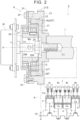
- FIG. 2 shows a cross section of the first valve opening and closing timing control device A1 as a specific example of the valve opening and closing timing control device A.
- the valve opening and closing timing control device A has the drive case 21 (drive-side rotating body) and the internal rotor 22 (driven-side rotating body) that are disposed coaxially with the rotation axis X of the intake camshaft 7, and includes the phase adjustment mechanism G that sets the relative rotation phase therebetween by the driving force of the phase control motor M.
- the drive pulley 21S is formed on the outer periphery of the drive case 21.
- the internal rotor 22 is enclosed in the drive case 21, and is connected and fixed to the intake camshaft 7 by a connecting bolt 23. With this structure, the internal rotor 22 is connected to and supported by the intake camshaft 7, and the drive case 21 is relatively rotatably supported on the outer peripheral portion of the internal rotor 22.
- the phase adjustment mechanism G is disposed between the drive case 21 and the internal rotor 22, and a front plate 24 is fastened by a plurality of fastening bolts 25 at such a position that the front plate 24 covers an opening portion of the drive case 21. Displacement between the phase adjustment mechanism G and the internal rotor 22 in a direction along the rotation axis X is restricted by the front plate 24.
- the phase adjustment mechanism G includes: a ring gear 26 formed coaxially with the rotation axis X on the inner periphery of the internal rotor 22; an inner gear 27 rotatably disposed radially inside the internal rotor 22 coaxially with an offset axis Y having an attitude parallel to the rotation axis X; an eccentric cam body 28 located radially inside the inner gear 27; the front plate 24; and a joint portion J.
- the offset axis Y has an attitude parallel to the rotation axis X.
- the ring gear 26 has a plurality of internal teeth 26T
- the inner gear 27 has a plurality of external teeth 27T.
- a part of the external teeth 27T meshes with the internal teeth 26T of the ring gear 26.
- This phase adjustment mechanism G is structured as an internal planetary gear reducer in which the number of external teeth 27T of the inner gear 27 is one fewer than the number of internal teeth 26T of the ring gear 26.
- the joint portion J is structured as an Oldham's joint that rotates the inner gear 27 and the drive case 21 together while maintaining such a positional relationship that the inner gear 27 is eccentric with respect to the drive case 21.
- the eccentric cam body 28 has a cylindrical overall shape, and has in its inner periphery a pair of engagement grooves 28B having an attitude parallel to the rotation axis X.
- the eccentric cam body 28 is supported on the front plate 24 via a first bearing 31 so as to rotate coaxially with the rotation axis X, and has an eccentric cam surface 28A on a part of its outer periphery located on the intake cam shaft 7 side with respect to this support position.
- the eccentric cam surface 28A is formed in a circular shape (circular in cross section) about the offset axis Y having an attitude parallel to the rotation axis X.
- the inner gear 27 is rotatably supported on the eccentric cam surface 28A via a second bearing 32.
- a spring 29 is fitted in a recess formed in the eccentric cam surface 28A, so that the biasing force of the spring 29 is applied to the inner gear 27 via the second bearing 32.
- the phase control motor M is supported by the engine E, and an engagement pin 34 formed on an output shaft Ma is fitted in the engagement grooves 28B in the inner periphery of the eccentric cam body 28.
- the phase control motor M includes: a rotor having permanent magnets; a stator having a plurality of field coils arranged at such positions that the field coils surround the rotor; the output shaft Ma (shaft) to which rotation of the rotor is transmitted; and a rotation detection unit having three Hall elements for detecting magnetism of the permanent magnets of the rotor.
- the phase control motor M is thus structured as a brushless motor with a structure common to three-phase motors.
- valve opening and closing timing control device A when the engine E is running, the relative rotation phase of the valve opening and closing timing control device A is maintained by driving and rotating the output shaft Ma in the a driving rotation direction S (see FIG. 1 ) at a speed equal to that of the crankshaft 1.
- Control of reducing the rotational speed of the output shaft Ma is performed when displacing the relative rotation phase in an advancing direction Sa (see FIG. 1 ), and control of increasing the rotational speed of the output shaft Ma is performed when displacing the relative rotation phase in a retarding direction Sb (see FIG. 1 ).
- the phase adjustment mechanism G rotates the inner gear 27 and the ring gear 26 relative to each other by an angle corresponding to the difference in number of teeth therebetween every time the inner gear 27 makes one rotation.
- the drive case 21 that rotates together with the inner gear 27 via the joint portion J and the intake camshaft 7 connected to the ring gear 26 by the connecting bolt 23 are rotated relative to each other to implement adjustment of the valve timing.
- both the entire first valve opening and closing timing control device A1 and the entire second valve opening and closing timing control device A2 are rotated in the driving rotation direction S by the driving force from the timing belt 6.
- the driving force of the phase control motor M is transmitted to the internal rotor 22 via the phase adjustment mechanism G, the relative rotational phase of the internal rotor 22 with respect to the drive case 21 is displaced.
- the displacement direction that is the same as the driving rotation direction S is referred to as the advancing direction Sa
- the opposite direction to this direction is referred to as the retarding direction Sb.
- the limit phase in the advancing direction Sa is referred to as the most advanced angle
- the limit phase in the retarding direction Sb is referred to as the most retarded angle.
- the stop control unit 43 implements control in which, in the start-stop control, the engine E is quickly stopped, and immediately after the engine E is stopped, the forces acting on the crankshaft 1 are balanced to allow slight rotation of the crank shaft 1 and stabilize the crank angle. Since the crank angle is stabilized in this way, the cranking load during starting of the engine E is reduced, and improvement in startability is achieved.
- the engine stop control can be performed by only the valve timing control of either the first valve opening and closing timing control device A1 or the second valve opening and closing timing control device A2. Therefore, two types of engine stop control will be individually described below.
- FIG. 3 shows a form of control of the valve timing of the intake valve Va in the engine stop control.
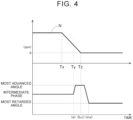
- FIG. 4 shows the relationship between the rotational speed of the engine E (to be exact, the rotational speed of the crankshaft 1: hereinafter simply referred to as the rotational speed) and the valve timing (relative rotation phase) in a timing chart.
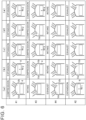
- FIG. 5 shows, in diagrams, the strokes in each cylinder denoted by #1 to #4 in FIG. 2 and the relationship between the intake valve Va and the exhaust valve Vb.
- FIG. 6 shows this relationship in a stroke diagram in the form of a chart.
- the states at the same timings during passage of time are denoted by signs (a) to (e).
- Signs #1 to #4 identify cylinder #1, cylinder #2, cylinder #3, and cylinder #4 of the engine E shown in FIG. 2 . In these cylinders, combustion is performed in the order of cylinder #1, cylinder #3, cylinder #4, and cylinder #2, as shown in the stroke diagram.
- the region in which the crankshaft 1 makes two rotations (720 degrees) is represented as one circle, the cylinders are shown by signs #1 to #4, and the strokes are labeled by intake, compression, expansion, and exhaust.
- the region in which the intake valve Va is open is denoted by sign In
- the region in which the exhaust valve Vb is open is denoted by sign Ex.
- TDC refers to top dead center
- BDC bottom dead center.
- step #103 is a specific example of the pre-stop phase control.
- cylinder #1 is in the compression stroke, and as shown in the timing (a), the valve timing of the intake valve Va is set to the most advanced angle by the control of the first valve opening and closing timing control device A1. Therefore, the intake valve Va is closed when the piston 4 of cylinder #1 is in the early stage of the compression stroke. The amount of gas discharged from the intake valve Va to the intake side thus decreases and the compression ratio in cylinder #1 increases.
- cylinder #2 is in the expansion stroke at the timing (a) shown in FIGS. 5 and 6 , and a force F1 acts on the piston 4.
- the intake valve Va is open from immediately before the piston 4 reaches the bottom dead center BDC to the initial stage of the compression stroke in which the piston 4 starts to rise. Therefore, the valve timing of the intake valve Va is set to the most advanced angle in the initial stage of the compression stroke so that the intake valve Va is closed early after the piston 4 reaches the bottom dead center BDC. This reduces the phenomenon that a part of the gas in cylinder #1 is discharged to the intake side in the early stage of the compression stroke, and thus achieves an increase in compression ratio.
- the timing (a) when the valve timing of the intake valve Va is set to the most advanced angle is minus 180 degrees.
- the cylinder in which the intake valve Va is closed early in the initial stage of the compression stroke is not limited to cylinder #1, and may be other cylinder. In this case, the engine E is stopped by the action with the pressure in the cylinder in the intake stroke.
- step #105 (d), (e) in FIG. 5 ).
- the control in this step #105 is a specific example of the post-stop phase control.
- the intake valve Va of cylinder #3 that has already been in the compression stroke is opened (see the timing (d) of #3 in FIG. 6 ), and the gas in cylinder #3 is discharged via this intake valve Va.
- the pressure in cylinder #3 decreases with respect to the pressure in cylinder #1. Since the pressure in cylinder #3 decreases, the force F3 acting on the piston 4 of cylinder #3 at the timing (c) decreases to a force F4 as shown in the timing (e).
- crankshaft 1 is rotated slightly in the direction in which the pressure (force F2) in cylinder #1 and the pressure (F4) in cylinder #3 are balanced (direction in which the piston 4 of cylinder #1 moves downward).
- the balanced state shown in the timing (e) is thus reached, and the rotation of the crankshaft 1 stops completely.
- FIG. 7 shows a form of control of the valve timing of the exhaust valve Vb in the engine stop control.
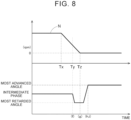
- FIG. 8 shows the relationship between the rotational speed N of the engine E and the valve timing (relative rotation phase) of the exhaust valve Vb in a timing chart.
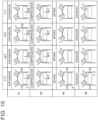
- FIG. 9 shows diagrams of the relationship between the stroke in each cylinder denoted by #1 to #4 in FIG. 2 and the intake valve Va and the exhaust valve Vb.
- FIG. 10 shows this relationship in a stroke diagram in the form of a chart.
- the states at the same timings along the axis of time are denoted by signs (f) to (i).
- Signs #1 to #4 identify cylinder #1, cylinder #2, cylinder #3, and cylinder #4 of the engine E shown in FIG. 2 . In these cylinders, combustion is performed in the order of cylinder #1, cylinder #3, cylinder #4, and cylinder #2, as shown in the stroke diagram.
- the region in which the crankshaft 1 makes two rotations (720 degrees) is represented as one circle, the cylinders are shown by signs #1 to #4, and the strokes are labeled by intake, compression, expansion, and exhaust.
- the region in which the intake valve Va is open is denoted by sign In
- the region in which the exhaust valve Vb is open is denoted by sign Ex.
- TDC refers to top dead center
- BDC bottom dead center.
- step #203 is a specific example of the pre-stop phase control.
- cylinder #1 is in the expansion stroke at the timing (f) shown in FIG. 10 , and a force F6 acts on the piston 4.
- Cylinder #3 is in the compression stroke at this timing (f), and a force F7 acts on the piston 4 of cylinder #3.
- the piston 4 in cylinder #1 is near the bottom dead center BDC, while the piston 4 in cylinder #3 is near the top dead center TDC. Therefore, the force F7 is larger than the force F6, and the crankshaft 1 rotates slightly in a reverse direction due to the balance of the forces.
- the cylinder in which the exhaust valve Vb is closed early near the end of the expansion stroke is not limited to cylinder #1, and may be other cylinder.
- the engine E is stopped by the action with the pressure in the cylinder in the compression stroke.
- step #205 (h), (i) in FIG. 9 ).
- the control in this step #205 is a specific example of the post-stop phase control.
- the engine E when there is a stop request to stop the engine E (a stop signal is acquired), the engine E can be quickly stopped using the pressures of gas enclosed in the plurality of cylinders by merely controlling the valve timing by the valve opening and closing timing control device A in the engine stop control. After the engine E is stopped, the valve timing is further controlled by the valve opening and closing timing control device A to discharge gas in the cylinder. The engine E can thus be stopped with a reduced force acting on the crankshaft 1 due to the pressure of the cylinder.
- the stop position of the crankshaft 1 is determined with not only the pressures in the cylinders but also the weights of the plurality of pistons 4 and the cam torques of the intake camshaft 7 and the exhaust camshaft 8 being balanced. That is, in the engine stop control, the pre-stop phase control of stopping the valve timing is performed when there is a stop request to stop the engine E (a stop signal is acquired). The engine E is thus stopped. Thereafter, the post-stop phase control is performed. The crankshaft 1 is thus rotated slightly, and the engine E is stopped completely in a balanced state.
- the engine stop control When the engine stop control is performed for the start-stop control, the engine E is stopped quickly, and therefore fuel consumption is reduced.
- the starter motor 15 When starting the engine E subsequently, the starter motor 15 can be driven and rotated with the load on the crankshaft 1 reduced. Therefore, the crankshaft 1 can be rotated at high speed in a short time, and the starting time can be reduced.
- valve timing of the intake valve Va is controlled during the engine stop control
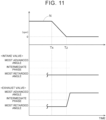
- the valve timing of the intake valve Va is kept at the most retarded angle with the engine E stopped. This allows cranking in a decompressed state when starting the engine E. The load during starting can thus further be reduced, and the crankshaft 1 can be rotated at high speed in a short time. The engine E can therefore be started quickly.
- the present disclosure may be structured as follows in addition to the above embodiment (portions having the same functions as those of the above embodiment are denoted by same numerals and signs as those of the above embodiment).
- the valve timing of the intake valve Va is set to the most retarded angle and the valve timing of the exhaust valve Vb is set to the most retarded angle. Therefore, by a process similar to that in "control of the valve timing of the exhaust valve Vb in the engine stop control," the engine E is quickly stopped, and then stopping of the engine E is achieved with not only the pressures in the plurality of cylinders being balanced but also with the weights of the plurality of pistons 4 being balanced and with the cam torques acting from the cam surface of the intake camshaft 7 and the cam surface of the exhaust cam shaft 8 being balanced.
- the present disclosure is applicable to stop control devices for internal combustion engines.
Landscapes
- Engineering & Computer Science (AREA)
- Mechanical Engineering (AREA)
- General Engineering & Computer Science (AREA)
- Chemical & Material Sciences (AREA)
- Combustion & Propulsion (AREA)
- Output Control And Ontrol Of Special Type Engine (AREA)
- Control Of Vehicle Engines Or Engines For Specific Uses (AREA)
Applications Claiming Priority (2)
| Application Number | Priority Date | Filing Date | Title |
|---|---|---|---|
| JP2020115609 | 2020-07-03 | ||
| PCT/JP2021/017814 WO2022004135A1 (ja) | 2020-07-03 | 2021-05-11 | 内燃機関の停止制御装置 |
Publications (3)
| Publication Number | Publication Date |
|---|---|
| EP4177451A1 true EP4177451A1 (de) | 2023-05-10 |
| EP4177451A4 EP4177451A4 (de) | 2024-01-10 |
| EP4177451B1 EP4177451B1 (de) | 2026-04-29 |
Family
ID=79315180
Family Applications (1)
| Application Number | Title | Priority Date | Filing Date |
|---|---|---|---|
| EP21832881.3A Active EP4177451B1 (de) | 2020-07-03 | 2021-05-11 | Stoppsteuervorrichtung für verbrennungsmotor |
Country Status (5)
| Country | Link |
|---|---|
| US (1) | US12012906B2 (de) |
| EP (1) | EP4177451B1 (de) |
| JP (1) | JP7397990B2 (de) |
| CN (1) | CN115735051B (de) |
| WO (1) | WO2022004135A1 (de) |
Cited By (1)
| Publication number | Priority date | Publication date | Assignee | Title |
|---|---|---|---|---|
| EP4567262A1 (de) * | 2023-12-04 | 2025-06-11 | Aisin Corporation | Vorrichtung zur zeitsteuerung der ventilöffnung und -schliessung |
Family Cites Families (20)
| Publication number | Priority date | Publication date | Assignee | Title |
|---|---|---|---|---|
| JP2005337110A (ja) * | 2004-05-27 | 2005-12-08 | Denso Corp | 内燃機関 |
| JP4419800B2 (ja) * | 2004-10-28 | 2010-02-24 | トヨタ自動車株式会社 | エンジン始動装置 |
| JP4432729B2 (ja) * | 2004-10-29 | 2010-03-17 | 株式会社デンソー | エンジンの停止制御装置 |
| JP2006144567A (ja) * | 2004-11-16 | 2006-06-08 | Toyota Motor Corp | 内燃機関のバルブタイミング制御装置 |
| JP2006291792A (ja) * | 2005-04-08 | 2006-10-26 | Toyota Motor Corp | 内燃機関の制御装置 |
| US7243633B2 (en) * | 2005-04-22 | 2007-07-17 | Ford Global Technologies, Llc | HEV internal combustion engine pre-positioning |
| JP2008095519A (ja) * | 2006-10-06 | 2008-04-24 | Mazda Motor Corp | エンジンの停止制御装置 |
| US8352153B2 (en) * | 2009-02-13 | 2013-01-08 | Ford Global Technologies, Llc | Methods and systems for engine starting |
| JP5476748B2 (ja) * | 2009-03-09 | 2014-04-23 | 日産自動車株式会社 | ハイブリッド車両 |
| US20110100312A1 (en) * | 2009-11-02 | 2011-05-05 | Denso Corporation | Control system for variable valve timing apparatus |
| JP5255003B2 (ja) | 2010-01-25 | 2013-08-07 | 株式会社デンソー | エンジン回転停止制御装置 |
| JP5759106B2 (ja) | 2010-02-25 | 2015-08-05 | 本田技研工業株式会社 | 内燃機関の制御装置 |
| JP5180249B2 (ja) * | 2010-03-16 | 2013-04-10 | 日立オートモティブシステムズ株式会社 | ハイブリッド車両における可変動弁制御装置 |
| JP2012036864A (ja) * | 2010-08-10 | 2012-02-23 | Hitachi Automotive Systems Ltd | 内燃機関の可変動弁装置と、内燃機関の始動システム及び内燃機関の始動制御装置 |
| JP5666922B2 (ja) * | 2011-01-12 | 2015-02-12 | 日立オートモティブシステムズ株式会社 | バルブタイミング制御装置のコントローラ及び内燃機関のバルブタイミング制御装置 |
| JP5825432B2 (ja) * | 2012-10-30 | 2015-12-02 | トヨタ自動車株式会社 | 内燃機関の制御装置 |
| US9121358B2 (en) * | 2013-02-22 | 2015-09-01 | Borgwarner Inc. | Using camshaft timing device with hydraulic lock in an intermediate position for vehicle restarts |
| JP6142605B2 (ja) * | 2013-03-21 | 2017-06-07 | アイシン精機株式会社 | 内燃機関 |
| JP2018200006A (ja) * | 2017-05-25 | 2018-12-20 | アイシン精機株式会社 | 内燃機関の制御装置 |
| JP7151287B2 (ja) * | 2018-09-04 | 2022-10-12 | トヨタ自動車株式会社 | ミラーサイクルエンジン |
-
2021
- 2021-05-11 CN CN202180046660.1A patent/CN115735051B/zh active Active
- 2021-05-11 US US18/002,728 patent/US12012906B2/en active Active
- 2021-05-11 WO PCT/JP2021/017814 patent/WO2022004135A1/ja not_active Ceased
- 2021-05-11 JP JP2022533709A patent/JP7397990B2/ja active Active
- 2021-05-11 EP EP21832881.3A patent/EP4177451B1/de active Active
Cited By (1)
| Publication number | Priority date | Publication date | Assignee | Title |
|---|---|---|---|---|
| EP4567262A1 (de) * | 2023-12-04 | 2025-06-11 | Aisin Corporation | Vorrichtung zur zeitsteuerung der ventilöffnung und -schliessung |
Also Published As
| Publication number | Publication date |
|---|---|
| WO2022004135A1 (ja) | 2022-01-06 |
| US20230243313A1 (en) | 2023-08-03 |
| JP7397990B2 (ja) | 2023-12-13 |
| EP4177451A4 (de) | 2024-01-10 |
| CN115735051A (zh) | 2023-03-03 |
| CN115735051B (zh) | 2025-09-19 |
| US12012906B2 (en) | 2024-06-18 |
| JPWO2022004135A1 (de) | 2022-01-06 |
| EP4177451B1 (de) | 2026-04-29 |
Similar Documents
| Publication | Publication Date | Title |
|---|---|---|
| US7762226B2 (en) | Method for adjusting a camshaft of an internal combustion engine and internal combustion engine with an adjustable camshaft | |
| US10316765B2 (en) | Control device and control method for internal combustion engine | |
| US6988477B2 (en) | Control apparatus for an internal combustion engine and control method thereof | |
| WO2018216291A1 (ja) | 内燃機関の制御装置 | |
| US7958858B2 (en) | Variable valve timing system and method for controlling the same | |
| US20200182163A1 (en) | Control device for internal combustion engine | |
| EP4177451B1 (de) | Stoppsteuervorrichtung für verbrennungsmotor | |
| US11725547B2 (en) | Valve opening and closing timing control apparatus device | |
| JP2007239461A (ja) | 内燃機関の制御装置 | |
| WO2014076531A1 (en) | Control apparatus and control method for internal combustion engine | |
| JP2018197521A (ja) | 内燃機関の制御装置 | |
| US11434835B2 (en) | Valve timing controller | |
| US20200200055A1 (en) | Valve timing controller and valve timing control method | |
| JP7559615B2 (ja) | 内燃機関の制御装置 | |
| JP3175243B2 (ja) | 内燃機関のバルブタイミング制御装置 | |
| US12385421B2 (en) | Valve opening and closing timing control device | |
| JP7288552B2 (ja) | 内燃機関の制御装置及び内燃機関の制御方法 | |
| JP4720642B2 (ja) | 可変バルブタイミング装置 | |
| JP2017180122A (ja) | 内燃機関の制御装置 | |
| WO2022071023A1 (ja) | 弁開閉時期制御装置 | |
| WO2018216290A1 (ja) | 内燃機関の制御装置 | |
| JPH08270467A (ja) | 内燃機関のバルブタイミング制御装置 |
Legal Events
| Date | Code | Title | Description |
|---|---|---|---|
| STAA | Information on the status of an ep patent application or granted ep patent |
Free format text: STATUS: THE INTERNATIONAL PUBLICATION HAS BEEN MADE |
|
| PUAI | Public reference made under article 153(3) epc to a published international application that has entered the european phase |
Free format text: ORIGINAL CODE: 0009012 |
|
| STAA | Information on the status of an ep patent application or granted ep patent |
Free format text: STATUS: REQUEST FOR EXAMINATION WAS MADE |
|
| 17P | Request for examination filed |
Effective date: 20221221 |
|
| AK | Designated contracting states |
Kind code of ref document: A1 Designated state(s): AL AT BE BG CH CY CZ DE DK EE ES FI FR GB GR HR HU IE IS IT LI LT LU LV MC MK MT NL NO PL PT RO RS SE SI SK SM TR |
|
| DAV | Request for validation of the european patent (deleted) | ||
| DAX | Request for extension of the european patent (deleted) | ||
| A4 | Supplementary search report drawn up and despatched |
Effective date: 20231207 |
|
| RIC1 | Information provided on ipc code assigned before grant |
Ipc: F02D 41/04 20060101ALI20231201BHEP Ipc: F02D 41/00 20060101ALI20231201BHEP Ipc: F01L 1/352 20060101ALI20231201BHEP Ipc: F02D 13/06 20060101ALI20231201BHEP Ipc: F02D 13/02 20060101ALI20231201BHEP Ipc: F02D 29/02 20060101AFI20231201BHEP |
|
| GRAP | Despatch of communication of intention to grant a patent |
Free format text: ORIGINAL CODE: EPIDOSNIGR1 |
|
| STAA | Information on the status of an ep patent application or granted ep patent |
Free format text: STATUS: GRANT OF PATENT IS INTENDED |
|
| RIC1 | Information provided on ipc code assigned before grant |
Ipc: F02D 29/02 20060101AFI20251126BHEP Ipc: F02D 13/02 20060101ALI20251126BHEP Ipc: F02D 13/06 20060101ALI20251126BHEP Ipc: F01L 1/352 20060101ALI20251126BHEP Ipc: F02D 41/00 20060101ALI20251126BHEP Ipc: F02D 41/04 20060101ALI20251126BHEP Ipc: F02D 13/08 20060101ALI20251126BHEP |
|
| INTG | Intention to grant announced |
Effective date: 20251209 |
|
| GRAS | Grant fee paid |
Free format text: ORIGINAL CODE: EPIDOSNIGR3 |
|
| GRAA | (expected) grant |
Free format text: ORIGINAL CODE: 0009210 |
|
| STAA | Information on the status of an ep patent application or granted ep patent |
Free format text: STATUS: THE PATENT HAS BEEN GRANTED |
|
| RIN1 | Information on inventor provided before grant (corrected) |
Inventor name: TOKUNAGA, YOSHINARI Inventor name: KASUYA, YUKI Inventor name: NAKAI, TAKANO Inventor name: SUZUKI, KENICHIRO Inventor name: KAMOYAMA, YOSHIYUKI Inventor name: HIROTA, TORU |