EP4159472B1 - Verfahren zur herstellung einer dreidimensionalen struktur auf einer oberfläche eines flachen substrats - Google Patents
Verfahren zur herstellung einer dreidimensionalen struktur auf einer oberfläche eines flachen substrats Download PDFInfo
- Publication number
- EP4159472B1 EP4159472B1 EP22210109.9A EP22210109A EP4159472B1 EP 4159472 B1 EP4159472 B1 EP 4159472B1 EP 22210109 A EP22210109 A EP 22210109A EP 4159472 B1 EP4159472 B1 EP 4159472B1
- Authority
- EP
- European Patent Office
- Prior art keywords
- product
- relief
- face
- covering
- substrate
- Prior art date
- Legal status (The legal status is an assumption and is not a legal conclusion. Google has not performed a legal analysis and makes no representation as to the accuracy of the status listed.)
- Active
Links
Images

Classifications
-
- B—PERFORMING OPERATIONS; TRANSPORTING
- B29—WORKING OF PLASTICS; WORKING OF SUBSTANCES IN A PLASTIC STATE IN GENERAL
- B29C—SHAPING OR JOINING OF PLASTICS; SHAPING OF MATERIAL IN A PLASTIC STATE, NOT OTHERWISE PROVIDED FOR; AFTER-TREATMENT OF THE SHAPED PRODUCTS, e.g. REPAIRING
- B29C64/00—Additive manufacturing, i.e. manufacturing of three-dimensional [3D] objects by additive deposition, additive agglomeration or additive layering, e.g. by 3D printing, stereolithography or selective laser sintering
- B29C64/10—Processes of additive manufacturing
- B29C64/106—Processes of additive manufacturing using only liquids or viscous materials, e.g. depositing a continuous bead of viscous material
- B29C64/112—Processes of additive manufacturing using only liquids or viscous materials, e.g. depositing a continuous bead of viscous material using individual droplets, e.g. from jetting heads
-
- B—PERFORMING OPERATIONS; TRANSPORTING
- B44—DECORATIVE ARTS
- B44C—PRODUCING DECORATIVE EFFECTS; MOSAICS; TARSIA WORK; PAPERHANGING
- B44C5/00—Processes for producing special ornamental bodies
- B44C5/04—Ornamental plaques, e.g. decorative panels, decorative veneers
-
- B—PERFORMING OPERATIONS; TRANSPORTING
- B05—SPRAYING OR ATOMISING IN GENERAL; APPLYING FLUENT MATERIALS TO SURFACES, IN GENERAL
- B05D—PROCESSES FOR APPLYING FLUENT MATERIALS TO SURFACES, IN GENERAL
- B05D1/00—Processes for applying liquids or other fluent materials
- B05D1/32—Processes for applying liquids or other fluent materials using means for protecting parts of a surface not to be coated, e.g. using stencils, resists
- B05D1/322—Removable films used as masks
-
- B—PERFORMING OPERATIONS; TRANSPORTING
- B05—SPRAYING OR ATOMISING IN GENERAL; APPLYING FLUENT MATERIALS TO SURFACES, IN GENERAL
- B05D—PROCESSES FOR APPLYING FLUENT MATERIALS TO SURFACES, IN GENERAL
- B05D7/00—Processes, other than flocking, specially adapted for applying liquids or other fluent materials to particular surfaces or for applying particular liquids or other fluent materials
- B05D7/50—Multilayers
- B05D7/52—Two layers
- B05D7/53—Base coat plus clear coat type
- B05D7/536—Base coat plus clear coat type each layer being cured, at least partially, separately
-
- B—PERFORMING OPERATIONS; TRANSPORTING
- B29—WORKING OF PLASTICS; WORKING OF SUBSTANCES IN A PLASTIC STATE IN GENERAL
- B29C—SHAPING OR JOINING OF PLASTICS; SHAPING OF MATERIAL IN A PLASTIC STATE, NOT OTHERWISE PROVIDED FOR; AFTER-TREATMENT OF THE SHAPED PRODUCTS, e.g. REPAIRING
- B29C64/00—Additive manufacturing, i.e. manufacturing of three-dimensional [3D] objects by additive deposition, additive agglomeration or additive layering, e.g. by 3D printing, stereolithography or selective laser sintering
- B29C64/30—Auxiliary operations or equipment
-
- B—PERFORMING OPERATIONS; TRANSPORTING
- B33—ADDITIVE MANUFACTURING TECHNOLOGY
- B33Y—ADDITIVE MANUFACTURING, i.e. MANUFACTURING OF THREE-DIMENSIONAL [3-D] OBJECTS BY ADDITIVE DEPOSITION, ADDITIVE AGGLOMERATION OR ADDITIVE LAYERING, e.g. BY 3-D PRINTING, STEREOLITHOGRAPHY OR SELECTIVE LASER SINTERING
- B33Y10/00—Processes of additive manufacturing
-
- B—PERFORMING OPERATIONS; TRANSPORTING
- B33—ADDITIVE MANUFACTURING TECHNOLOGY
- B33Y—ADDITIVE MANUFACTURING, i.e. MANUFACTURING OF THREE-DIMENSIONAL [3-D] OBJECTS BY ADDITIVE DEPOSITION, ADDITIVE AGGLOMERATION OR ADDITIVE LAYERING, e.g. BY 3-D PRINTING, STEREOLITHOGRAPHY OR SELECTIVE LASER SINTERING
- B33Y30/00—Apparatus for additive manufacturing; Details thereof or accessories therefor
-
- B—PERFORMING OPERATIONS; TRANSPORTING
- B33—ADDITIVE MANUFACTURING TECHNOLOGY
- B33Y—ADDITIVE MANUFACTURING, i.e. MANUFACTURING OF THREE-DIMENSIONAL [3-D] OBJECTS BY ADDITIVE DEPOSITION, ADDITIVE AGGLOMERATION OR ADDITIVE LAYERING, e.g. BY 3-D PRINTING, STEREOLITHOGRAPHY OR SELECTIVE LASER SINTERING
- B33Y40/00—Auxiliary operations or equipment, e.g. for material handling
- B33Y40/20—Post-treatment, e.g. curing, coating or polishing
-
- B—PERFORMING OPERATIONS; TRANSPORTING
- B41—PRINTING; LINING MACHINES; TYPEWRITERS; STAMPS
- B41J—TYPEWRITERS; SELECTIVE PRINTING MECHANISMS, i.e. MECHANISMS PRINTING OTHERWISE THAN FROM A FORME; CORRECTION OF TYPOGRAPHICAL ERRORS
- B41J11/00—Devices or arrangements of selective printing mechanisms, e.g. ink-jet printers or thermal printers, for supporting or handling copy material in sheet or web form
- B41J11/0015—Devices or arrangements of selective printing mechanisms, e.g. ink-jet printers or thermal printers, for supporting or handling copy material in sheet or web form for treating before, during or after printing or for uniform coating or laminating the copy material before or after printing
-
- B—PERFORMING OPERATIONS; TRANSPORTING
- B41—PRINTING; LINING MACHINES; TYPEWRITERS; STAMPS
- B41J—TYPEWRITERS; SELECTIVE PRINTING MECHANISMS, i.e. MECHANISMS PRINTING OTHERWISE THAN FROM A FORME; CORRECTION OF TYPOGRAPHICAL ERRORS
- B41J11/00—Devices or arrangements of selective printing mechanisms, e.g. ink-jet printers or thermal printers, for supporting or handling copy material in sheet or web form
- B41J11/0015—Devices or arrangements of selective printing mechanisms, e.g. ink-jet printers or thermal printers, for supporting or handling copy material in sheet or web form for treating before, during or after printing or for uniform coating or laminating the copy material before or after printing
- B41J11/002—Curing or drying the ink on the copy materials, e.g. by heating or irradiating
-
- B—PERFORMING OPERATIONS; TRANSPORTING
- B41—PRINTING; LINING MACHINES; TYPEWRITERS; STAMPS
- B41J—TYPEWRITERS; SELECTIVE PRINTING MECHANISMS, i.e. MECHANISMS PRINTING OTHERWISE THAN FROM A FORME; CORRECTION OF TYPOGRAPHICAL ERRORS
- B41J3/00—Typewriters or selective printing or marking mechanisms characterised by the purpose for which they are constructed
- B41J3/407—Typewriters or selective printing or marking mechanisms characterised by the purpose for which they are constructed for marking on special material
- B41J3/4073—Printing on three-dimensional objects not being in sheet or web form, e.g. spherical or cubic objects
-
- B—PERFORMING OPERATIONS; TRANSPORTING
- B44—DECORATIVE ARTS
- B44C—PRODUCING DECORATIVE EFFECTS; MOSAICS; TARSIA WORK; PAPERHANGING
- B44C3/00—Processes, not specifically provided for elsewhere, for producing ornamental structures
- B44C3/02—Superimposing layers
- B44C3/025—Superimposing layers to produce ornamental relief structures
-
- B—PERFORMING OPERATIONS; TRANSPORTING
- B41—PRINTING; LINING MACHINES; TYPEWRITERS; STAMPS
- B41M—PRINTING, DUPLICATING, MARKING, OR COPYING PROCESSES; COLOUR PRINTING
- B41M3/00—Printing processes to produce particular kinds of printed work, e.g. patterns
- B41M3/16—Braille printing
-
- B—PERFORMING OPERATIONS; TRANSPORTING
- B41—PRINTING; LINING MACHINES; TYPEWRITERS; STAMPS
- B41M—PRINTING, DUPLICATING, MARKING, OR COPYING PROCESSES; COLOUR PRINTING
- B41M5/00—Duplicating or marking methods; Sheet materials for use therein
- B41M5/0041—Digital printing on surfaces other than ordinary paper
- B41M5/0047—Digital printing on surfaces other than ordinary paper by ink-jet printing
-
- B—PERFORMING OPERATIONS; TRANSPORTING
- B41—PRINTING; LINING MACHINES; TYPEWRITERS; STAMPS
- B41M—PRINTING, DUPLICATING, MARKING, OR COPYING PROCESSES; COLOUR PRINTING
- B41M7/00—After-treatment of prints, e.g. heating, irradiating, setting of the ink, protection of the printed stock
- B41M7/0036—After-treatment of prints, e.g. heating, irradiating, setting of the ink, protection of the printed stock using protective coatings or layers dried without curing
-
- B—PERFORMING OPERATIONS; TRANSPORTING
- B41—PRINTING; LINING MACHINES; TYPEWRITERS; STAMPS
- B41M—PRINTING, DUPLICATING, MARKING, OR COPYING PROCESSES; COLOUR PRINTING
- B41M7/00—After-treatment of prints, e.g. heating, irradiating, setting of the ink, protection of the printed stock
- B41M7/0045—After-treatment of prints, e.g. heating, irradiating, setting of the ink, protection of the printed stock using protective coatings or film forming compositions cured by mechanical wave energy, e.g. ultrasonics, cured by electromagnetic radiation or waves, e.g. ultraviolet radiation, electron beams, or cured by magnetic or electric fields, e.g. electric discharge, plasma
-
- B—PERFORMING OPERATIONS; TRANSPORTING
- B41—PRINTING; LINING MACHINES; TYPEWRITERS; STAMPS
- B41M—PRINTING, DUPLICATING, MARKING, OR COPYING PROCESSES; COLOUR PRINTING
- B41M7/00—After-treatment of prints, e.g. heating, irradiating, setting of the ink, protection of the printed stock
- B41M7/0054—After-treatment of prints, e.g. heating, irradiating, setting of the ink, protection of the printed stock using protective coatings or film forming compositions cured by thermal means, e.g. infrared radiation, heat
Definitions
- the substrates being configured as panels and being made of a material which can be selected, for example, from wood (chipboard, medium-density fibres "MDF”, high-density fibres “HDF” or plywood), plastic (PVC), cellulose-based materials (paper or cardboard) and metal.
- MDF medium-density fibres
- HDF high-density fibres
- plywood plastic
- PVC plastic
- cellulose-based materials paper or cardboard
- the changes in the thickness of the first product layer must coincide as much as possible with the position of said grain or cracks, according to the image included before or after the application of the first product and/or the second product.
- the relief product and the covering product comprise properties such that they are immiscible with each other in order to generate a removal of the covering product in correspondence with the droplets of the relief product.
- the device for producing the mentioned substrate comprises injection heads for applying the relief product in the form of droplets on a face of the substrate, first fixing means for drying or curing the relief product, means for applying the covering product on the face of the substrate, second fixing means for drying or curing the covering product, means for applying the protective product, third fixing means for drying the protective product and a control unit configured to apply the method as described.
- the first fixing means, the second fixing means and/or the third fixing means may be the same or different from each other, the properties and nature of the relief product, the covering product and the protective product being that which determine it.
- the present invention relates to a method for producing a three-dimensional structure on a face (1') of a flat substrate (1).
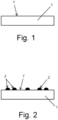
- the substrate (1) is flat since it has at least the face (1') to be treated as flat in order to arrange the three-dimensional structure thereon, which can be seen, for example, in figure 1 .
- the substrate (1) is preferably configured as a panel, plank or slab of a material which can be selected, for example, from wood (chipboard, medium-density fibres "MDF", high-density fibres "HDF” or plywood), plastic (PVC), cellulose-based materials (paper or cardboard) and metal.
- the substrate (1) is arranged in relation to the device used to carry out the method such that the face (1') is in the arrangement to receive a first relief product (2).
- the relief product (2) is selected from ink, which is preferably transparent, silicone, varnish, lacquer, water-based liquid, solvent-based liquid and any combination of the above, in other words, between some or all of the above.
- the device comprises injection heads such that by means of the use of inkjet digital printing technology, said heads apply or eject the first relief product (2) on the face (1').
- a print or a preparation layer can be arranged on the substrate (1), and more specifically directly on the face (1') thereof. Both the print and said preparation layer are considered as part of the thickness of the substrate (1) itself, since the relief product (2) is arranged on them, not being absorbed to any extent. In other words, neither the substrate (1), nor the print, nor the preparation layer absorb the relief product (2) such that when said relief product (2) is applied, it remains on them, without moving through them.
- substrate (1) corresponds to the substrate (1) free from the print and from the preparation layer or the substrate (1) including either said print or said preparation layer.
- the relief product (2) determines the changes in thickness of the final substrate (1) produced, in other words, it determines slits or recesses in a final external surface position of the substrate (1) produced.
- the relief product (2) covers only selected positions. These selected positions correspond to specific and isolated positions, in other words, leaving a portion of the face (1') of the substrate (1) uncovered or not covered.
- the selected positions of the droplets of the relief product (2) can correspond with a selection of the positions in order to correspond to specific identifiable positions on the print or the preparation layer.
- the relief product (2) covers only specific and isolated positions, in other words, it leaves portions of the face (1') of the substrate (1), of the print or the preparation layer uncovered or not covered. In this manner, the production of the three-dimensional structure can be synchronised with the drawings or the identifiable specific positions in the print or the preparation layer.
- the selected positions of the droplets of the relief product (2) can correspond to a selection of the shape positions that are random.
- the application of the droplets of the relief product (2) is done corresponding exactly to the position point of the slits or the recesses in the final external surface position of the substrate (1) produced since said product (2) is arranged such that it is prevented from undergoing displacements through other products. This is due to the application of the relief product (2) on the substrate (1), without passing through any film of another substance, preventing an interaction therewith from modifying the application point.
- the droplets of the relief product (2) are at least partially dried or cured such that they reach at least a semi-solid or gelling state. This contributes to fixing, even to a greater extent, the positioning of said droplets on the face (1') of the substrate (1) established precisely and directly by means of the application or ejection of the droplets of the relief product (2) on the substrate (1).
- the method after the application of the relief product (2), comprises applying a covering product (3) on the substrate (1) entailing an increase in the thickness of the substrate (1).
- Said covering product (3) is applied such that it forms a layer on the face (1'). Accordingly, the covering product (3) is applied both in correspondence with the droplets and in correspondence with the portions of the face (1') of the substrate (1) free from the relief product (2), such that said covering product (3) remains around the droplets and on said face (1').
- the device used to carry out the method comprises application means.
- the application means of the covering product (3) can be selected from, among others, injection heads that use digital inkjet printing technology, spray guns and rollers.
- the covering product (3) is a lacquer or a varnish.
- said product (3) is preferably UV-radiation curing.
- Said covering product (3) is applied in a liquid state according to level measurements, preferably two.
- a first level measurement is determined when the thickness thereof on the face (1') reaches or even exceeds the thickness of the droplets of the relief product (2) on the face (1'), as seen, for example, in figure 3 .
- a second level measurement is determined when the thickness thereof on the face (1') is less than the thickness of the droplets of the relief product (2) on the face (1'), as seen, for example, in figure 4 .
- Both figure 3 and figure 4 show the arrangement in the form of a layer of the covering product (3) after the application thereof on the face (1') of the substrate (1).
- the covering product (3) applied is at least partially dried or cured such that it reaches at least a semi-solid or gelling state. This contributes to fixing the relative positioning of said covering product (3) with respect to the droplets of the relief product (2).
- the method preferably comprises allowing a generation of reactions, physical and chemical, to take place between the relief product (2) and the covering product (3) due to interaction with each other. These reactions give rise to a removal or a displacement of the covering product (3) in correspondence with the droplets of the relief product (2), in other words, the covering product (3) is displaced away from the relief product (2).
- the covering product (3) and the relief product (2) have physical and/or chemical features which do not make them miscible with each other, in other words, they are immiscible, thereby generating a rejection reaction or effect and a consequent physical separation, mainly due to the differences in surface tension between them.
- the surface tension of the relief product (2) may be greater than that of the covering product (3) or the surface tension of the covering product (3) may be greater than that of the relief product (2).
- the method comprises selecting these products (2, 3) such that they are immiscible with each other.
- the relief product (2) tends to have a surface tension considerably lower than the surface tension of the covering product (3).
- the method may comprise selecting a silicone as the relief product (2) and a varnish as the covering product (3).
- the method may comprise selecting an ink, preferably transparent, as the relief product (2) and a lacquer as the covering product (3).
- the ink could be combined with the varnish and the silicone with the lacquer.
- the method may comprise the use of additives such that a control is performed on the surface tension of both products (2, 3) such that two products (2, 3) which are not miscible with each other are produced, giving rise to the previously described rejection effect.
- said products (2, 3) can be the same product or substance; in other words, having the same or substantially the same composition in the absence of the additives.
- a first varnish is selectable and usable as the relief product (2) and a second varnish as the covering product (3), the surface tension of the first varnish being greater or less than the surface tension of the second varnish, such that the rejection effect is produced between the first and the second varnish.
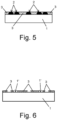
- Figure 5 shows the substrate (1) at a time when the reactions derived from the interaction of the covering product (3) with the relief product (2) are taking place, having surface tension values clearly different from each other.
- figure 5 shows a moment in the generation of the reactions starting from figure 3 , in other words, according to the first measurement of the level of application of the covering product (3), although it could also start from figure 4 , in other words, according to the second measurement of application level of the covering product (3).
- the method comprises, as a result of said created reactions, producing the face (1') of the substrate (1) with the relief product (2) according to the partial selective arrangement, in addition to the covering product (3) according to the portions of the face (1') free from both the relief product (2) and the rejection effect.
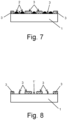
- Figure 7 is a representation of what was produced as a result of said generation of reactions.
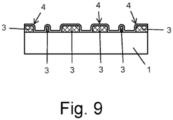
- the method may then comprise the step of removing the relief product (2), as represented by figure 8 .
- This step is optional since, depending on the relief or the three-dimensional structure to be produced on the final substrate (1) produced, it may be convenient to remove it or maintain it.
- the method comprises or applies the step of removing the relief product (2) after the described generation of reactions
- said method comprises two pathways to do so, mainly depending on the features of the relief product (2): a) application of energy in the form of heat and b) applying a blowing, brushing, etc., in other words, a physical or mechanical process.
- a) application of energy in the form of heat and b) applying a blowing, brushing, etc., in other words, a physical or mechanical process.
- Pathway a) implies that the removal of the relief product (2) is carried out, preferably, by applying a radiation, which for example can be UV, UV-LED, Eb, hot air, infrared, etc.
- the removal of the relief product (2) is determined according to pathway a) based on the chemical features thereof such that the removal thereof is caused by evaporation. In other words, depending on the relief product (2) chosen in the method, it (2) is dried through pathway a) or pathway b). In a parallel manner, applying pathway a) can cause the gelling or partial drying of the covering product (3).
- the method comprises choosing the relief product (2) depending on the substrate (1), with or without the print and with or without the preparation layer, and the features to be produced in the final substrate (1) produced.
- the substrate (1) is a parquet
- UV-drying varnishes would be used as the relief product (2)
- the substrate (1) is cardboard
- water-based varnishes would be used for the drying thereof by means of hot air as the relief product (2)
- a UV varnish would be used as the relief product (2), the covering product (3) being a UV drying varnish.
- the method comprises selecting the relief product (2) and the covering product (3) such that they include properties which favour the drying or curing of one of the products (2, 3) before the other (2, 3).
- the relief product (2) is selected including properties to equip it with a delaying effect in the drying thereof, for example by UV.
- the step of removing the relief product (2) takes place, first producing the drying, curing, gelling or solidification only of the covering product (3) and afterwards the removal of the relief product (2) according to one of the two pathways a) or b) described previously.
- the covering product (3) is applied such that the relief product (2) is removable, preferably by means of direct access from the outside. Therefore, the covering product (3) is preferably applied according to the second level measurement.
- the method comprises applying a protective product (4).
- the protective product (4) is preferably a UV-curing varnish, although alternatively it can be a water-based varnish or a solvent-based varnish.
- the application of the protective product (4) takes place after the fixing, drying or curing of the covering product (3), the slits or the recesses which determine the relief or the three-dimensional structure being defined.
- means for applying it are preferably used, such as preferably a rubber roller formulated so that it adapts to the relief, normally with a Shore hardness of less than or equal to 20-25. Additionally or alternatively, a spray gun can be used.
- the method comprises fixing or curing the protective product (4), and more specifically the protective layer of the protective product (4).
- the protective product (4) in addition to the relief product (2) and the covering product (3), is completely or at least partially dryable or curable such that it reaches a solid state or at least a semi-solid or gelling state.
- This curing which is usable for any of said three products (2, 3, 4), is able to be performed by applying energy through a technology that can be selected from ultraviolet radiation, UV-LED radiation, infrared radiation, hot air and others which use similar radiation.
- the method may comprise using accelerators for the drying, for example, photoinitiators for the UV drying, such that the times of this fixing step of the relief product (2), the covering product (3) and/or the protective product (4) are shortened.
- accelerators for the drying for example, photoinitiators for the UV drying
- the relief product (2) it is removable or hardenable in order to be maintained when energy is applied to it, such as ultraviolet radiation, UV-LED radiation, Eb radiation, infrared radiation and hot air.
- the relief product (2) When the relief product (2) is a varnish, depending on the composition thereof, it can be dried by means of radiation (UV, UV-LED, Infrared) or by means of physical drying (hot air). When the relief product (2) is a silicone, it may require a "mechanical" removal, such as through a blowing or a brushing instead of applying the aforementioned radiations or the hot air.
- the device used to produce the substrate (1) through the method additionally comprises first fixing means for fixing or drying the relief product (2) and/or second fixing means for fixing or drying the covering product (3), in addition to third fixing means for fixing or drying the protective product (4).
- said device additionally comprises a control unit configured to apply the present method as described.
Landscapes
- Engineering & Computer Science (AREA)
- Chemical & Material Sciences (AREA)
- Materials Engineering (AREA)
- Manufacturing & Machinery (AREA)
- Physics & Mathematics (AREA)
- Mechanical Engineering (AREA)
- Optics & Photonics (AREA)
- Life Sciences & Earth Sciences (AREA)
- Wood Science & Technology (AREA)
- Application Of Or Painting With Fluid Materials (AREA)
- Coating Apparatus (AREA)
- Shaping Of Tube Ends By Bending Or Straightening (AREA)
Claims (10)
- Verfahren zur Herstellung einer dreidimensionalen Struktur auf einer Fläche (1') eines flachen Substrats (1), umfassend die folgenden Schritte:- Bereitstellen des Substrats (1) mit der behandlungsbereiten Fläche (1');- Auftragen eines Reliefprodukts (2) in Form von Tröpfchen auf die Fläche (1'), sodass ausgewählte Positionen von Tröpfchen auf der Fläche (1') erzeugt werden;- Auftragen eines Abdeckprodukts (3) auf die Fläche (1'), sodass es eine Schicht auf der Fläche (1') bildet;- Fixieren durch Trocknen oder Aushärten der Schicht des Abdeckprodukts (3), um die ausgewählten Positionen auf der von dem Abdeckprodukt (3) freien Fläche (1') zu erlangen;das Reliefprodukt (2) umfassend Eigenschaften, die eine verzögernde Wirkung beim Trocknen oder Aushärten bereitstellen, sodass die Trocknungs- oder Aushärtungszeit des Reliefprodukts (2) größer ist als die des Abdeckprodukts (3).
- Verfahren nach Anspruch 1, dadurch gekennzeichnet, dass das Reliefprodukt (2) und das Abdeckprodukt (3) Eigenschaften umfassen, sodass sie nicht miteinander mischbar sind, um eine Entfernung des Abdeckprodukts (3) in Übereinstimmung mit den Tröpfchen des Reliefprodukts (2) zu erzeugen.
- Verfahren nach einem der Ansprüche 1 oder 2, dadurch gekennzeichnet, dass nach Fixieren der Schicht des Abdeckprodukts (3) das Reliefprodukt (2) auf der Fläche (1') beibehalten wird.
- Verfahren nach einem der Ansprüche 1 bis 3, dadurch gekennzeichnet, dass nach oder während des Fixierens der Schicht des Abdeckprodukts (3) das Reliefprodukt (2) entfernt wird.
- Verfahren nach Anspruch 4, dadurch gekennzeichnet, dass das Reliefprodukt (2) durch Bürsten oder durch Anwenden von Druckluft entfernt wird.
- Verfahren nach einem der Ansprüche 1 bis 5, dadurch gekennzeichnet, dass nach Fixieren der Schicht des Abdeckprodukts (3) ein Schutzprodukt (4) auf die Fläche (1') aufgetragen wird.
- Verfahren nach Anspruch 6, dadurch gekennzeichnet, dass ein Fixieren des Schutzprodukts (4) durchgeführt wird.
- Verfahren nach einem der Ansprüche 1 bis 7, dadurch gekennzeichnet, dass das Reliefprodukt (2) ausgewählt ist aus Tinte, Silikon, Lack, Farbe, Flüssigkeit auf Wasserbasis, Flüssigkeit auf Lösungsmittelbasis und jeder Kombination der obigen.
- Verfahren nach einem der Ansprüche 1 bis 8, dadurch gekennzeichnet, dass das Reliefprodukt (2) mittels Injektionsköpfen aufgetragen wird.
- Verfahren nach einem der Ansprüche 1 bis 9, dadurch gekennzeichnet, dass das Beschichtungsprodukt (3) ein Lack oder eine Lasur ist.
Priority Applications (4)
| Application Number | Priority Date | Filing Date | Title |
|---|---|---|---|
| ES22210109T ES3040796T3 (en) | 2018-10-31 | 2018-10-31 | Method for producing a three-dimensional structure on a surface of a flat substrate |
| PL22210109.9T PL4159472T3 (pl) | 2018-10-31 | 2018-10-31 | Sposób wykonania trójwymiarowej struktury na powierzchni płaskiego podłoża |
| EP22210109.9A EP4159472B1 (de) | 2018-10-31 | 2018-10-31 | Verfahren zur herstellung einer dreidimensionalen struktur auf einer oberfläche eines flachen substrats |
| HRP20251251TT HRP20251251T1 (hr) | 2018-10-31 | 2018-10-31 | Metoda za izradu trodimenzionalne strukture na površini ravne podloge |
Applications Claiming Priority (3)
| Application Number | Priority Date | Filing Date | Title |
|---|---|---|---|
| PCT/ES2018/070705 WO2020089491A1 (es) | 2018-10-31 | 2018-10-31 | Método para producir una estructura tridimensional sobre una cara de un sustrato plano, sustrato obtenible y dispositivo para producir el sustrato según el método |
| EP18939015.6A EP3875248B1 (de) | 2018-10-31 | 2018-10-31 | Verfahren zur herstellung einer dreidimensionalen struktur auf einer oberfläche eines flachen substrats |
| EP22210109.9A EP4159472B1 (de) | 2018-10-31 | 2018-10-31 | Verfahren zur herstellung einer dreidimensionalen struktur auf einer oberfläche eines flachen substrats |
Related Parent Applications (2)
| Application Number | Title | Priority Date | Filing Date |
|---|---|---|---|
| EP18939015.6A Division EP3875248B1 (de) | 2018-10-31 | 2018-10-31 | Verfahren zur herstellung einer dreidimensionalen struktur auf einer oberfläche eines flachen substrats |
| EP18939015.6A Division-Into EP3875248B1 (de) | 2018-10-31 | 2018-10-31 | Verfahren zur herstellung einer dreidimensionalen struktur auf einer oberfläche eines flachen substrats |
Publications (3)
| Publication Number | Publication Date |
|---|---|
| EP4159472A1 EP4159472A1 (de) | 2023-04-05 |
| EP4159472B1 true EP4159472B1 (de) | 2025-07-09 |
| EP4159472C0 EP4159472C0 (de) | 2025-07-09 |
Family
ID=70462950
Family Applications (4)
| Application Number | Title | Priority Date | Filing Date |
|---|---|---|---|
| EP22210095.0A Active EP4159471B1 (de) | 2018-10-31 | 2018-10-31 | Verfahren zur herstellung einer dreidimensionalen struktur auf einer oberfläche eines flachen substrats |
| EP18939015.6A Active EP3875248B1 (de) | 2018-10-31 | 2018-10-31 | Verfahren zur herstellung einer dreidimensionalen struktur auf einer oberfläche eines flachen substrats |
| EP22210109.9A Active EP4159472B1 (de) | 2018-10-31 | 2018-10-31 | Verfahren zur herstellung einer dreidimensionalen struktur auf einer oberfläche eines flachen substrats |
| EP22210128.9A Active EP4159473B1 (de) | 2018-10-31 | 2018-10-31 | Verfahren zur herstellung einer dreidimensionalen struktur auf einer oberfläche eines flachen substrats |
Family Applications Before (2)
| Application Number | Title | Priority Date | Filing Date |
|---|---|---|---|
| EP22210095.0A Active EP4159471B1 (de) | 2018-10-31 | 2018-10-31 | Verfahren zur herstellung einer dreidimensionalen struktur auf einer oberfläche eines flachen substrats |
| EP18939015.6A Active EP3875248B1 (de) | 2018-10-31 | 2018-10-31 | Verfahren zur herstellung einer dreidimensionalen struktur auf einer oberfläche eines flachen substrats |
Family Applications After (1)
| Application Number | Title | Priority Date | Filing Date |
|---|---|---|---|
| EP22210128.9A Active EP4159473B1 (de) | 2018-10-31 | 2018-10-31 | Verfahren zur herstellung einer dreidimensionalen struktur auf einer oberfläche eines flachen substrats |
Country Status (13)
| Country | Link |
|---|---|
| US (1) | US12304136B2 (de) |
| EP (4) | EP4159471B1 (de) |
| JP (1) | JP7229583B2 (de) |
| CN (1) | CN112996649B (de) |
| ES (4) | ES3040748T3 (de) |
| FI (1) | FI3875248T3 (de) |
| HR (4) | HRP20251249T1 (de) |
| HU (1) | HUE066265T2 (de) |
| LT (1) | LT3875248T (de) |
| PL (4) | PL3875248T3 (de) |
| PT (1) | PT3875248T (de) |
| SI (1) | SI3875248T1 (de) |
| WO (1) | WO2020089491A1 (de) |
Families Citing this family (6)
| Publication number | Priority date | Publication date | Assignee | Title |
|---|---|---|---|---|
| HUE050387T2 (hu) | 2017-06-13 | 2020-11-30 | Hymmen Gmbh Maschinen & Anlagenbau | Eljárás és eszköz strukturált felület kialakítására |
| DE102019206431A1 (de) * | 2019-05-03 | 2020-11-05 | Hymmen GmbH Maschinen- und Anlagenbau | Verfahren zum Herstellen einer Struktur auf einer Oberfläche |
| LU102233B1 (en) * | 2020-11-23 | 2022-05-23 | Tarkett Gdl Sa | Digital Embossing of decorative surface coverings |
| EP4088943B1 (de) * | 2021-05-10 | 2023-04-12 | Foshan Hope Digital Printing Equipment Co., Ltd. | Verfahren zur herstellung einer dekorativen 3d-texturplatte und dekorative 3d-texturplatte |
| DE102022103652A1 (de) | 2022-02-16 | 2023-08-17 | Van Der Vlis Design Gmbh | Dreidimensional strukturiertes Dekorelement |
| CN116985548B (zh) * | 2023-08-03 | 2025-08-15 | 芯体素(杭州)科技发展有限公司 | 一种差异性厚度涂层的固化方法以及装置 |
Family Cites Families (22)
| Publication number | Priority date | Publication date | Assignee | Title |
|---|---|---|---|---|
| JPS4827458B1 (de) * | 1968-08-27 | 1973-08-22 | ||
| JPS58163474A (ja) * | 1982-03-24 | 1983-09-28 | Matsushita Electric Works Ltd | 建築用板の模様付法 |
| JPH0669547B2 (ja) * | 1985-06-18 | 1994-09-07 | 大日本印刷株式会社 | 同調エンボスを有する化粧材の製造方法 |
| JP3321596B2 (ja) * | 1994-07-18 | 2002-09-03 | 凸版印刷株式会社 | 立体模様化粧紙及びその製造方法 |
| WO2002097532A1 (en) * | 2001-05-30 | 2002-12-05 | Kaneka Corporation | Photosensitive resin composition and photosensitive dry film resist and photosensitive cover ray film using the same |
| DE10224128A1 (de) * | 2002-05-29 | 2003-12-18 | Schmid Rhyner Ag Adliswil | Verfahren zum Auftrag von Beschichtungen auf Oberflächen |
| US6793778B2 (en) * | 2002-07-15 | 2004-09-21 | Hitachi Global Storage Technologies Netherlands N.V. | Method of fabricating slider pads for a transducer operating with moving magnetic media |
| JP2005032769A (ja) * | 2003-07-07 | 2005-02-03 | Seiko Epson Corp | 多層配線の形成方法、配線基板の製造方法、デバイスの製造方法 |
| JP4557755B2 (ja) * | 2004-03-11 | 2010-10-06 | キヤノン株式会社 | 基板、導電性基板および有機電界効果型トランジスタの各々の製造方法 |
| ITMI20061227A1 (it) * | 2006-06-26 | 2007-12-27 | Dante Frati | Procedimento per stampare superfici di elementi piani a base di legno |
| US9278515B2 (en) * | 2010-06-14 | 2016-03-08 | Hewlett-Packard Development Company, L.P. | Printing method |
| US8677929B2 (en) * | 2010-12-29 | 2014-03-25 | Intevac, Inc. | Method and apparatus for masking solar cell substrates for deposition |
| US20130019918A1 (en) * | 2011-07-18 | 2013-01-24 | The Regents Of The University Of Michigan | Thermoelectric devices, systems and methods |
| US10369837B2 (en) * | 2012-04-30 | 2019-08-06 | Valinge Innovation Ab | Method for forming a decorative design on an element of a wood-based material |
| JP6473285B2 (ja) * | 2012-12-05 | 2019-02-20 | 株式会社ミマキエンジニアリング | 樹脂盛装飾方法 |
| ES2522922B1 (es) * | 2013-04-16 | 2015-07-07 | Jesús Francisco Barberan Latorre | Sistema de impresión por inyección de tinta con secado |
| US10328680B2 (en) * | 2013-10-23 | 2019-06-25 | Ceraloc Innovation Ab | Method of forming a decorative wear resistant layer |
| DE102013018182A1 (de) * | 2013-10-30 | 2015-04-30 | Voxeljet Ag | Verfahren und Vorrichtung zum Herstellen von dreidimensionalen Modellen mit Bindersystem |
| US9994010B2 (en) * | 2014-01-24 | 2018-06-12 | Ceraloc Innovation Ab | Digital print with water-based ink on panel surfaces |
| ES2586981B1 (es) * | 2015-04-15 | 2017-06-14 | Jesús Francisco Barberán Latorre | Procedimiento de impresión para conseguir un efecto óptico de relieve e instalación para llevar a cabo dicho procedimiento |
| NO2750604T3 (de) | 2015-06-25 | 2018-03-03 | ||
| EP3526043B1 (de) | 2016-10-13 | 2022-12-07 | Giorgio Macor | Verfahren zur erzeugung einer oberflächlichen struktur |
-
2018
- 2018-10-31 HR HRP20251249TT patent/HRP20251249T1/hr unknown
- 2018-10-31 EP EP22210095.0A patent/EP4159471B1/de active Active
- 2018-10-31 FI FIEP18939015.6T patent/FI3875248T3/fi active
- 2018-10-31 LT LTEPPCT/ES2018/070705T patent/LT3875248T/lt unknown
- 2018-10-31 EP EP18939015.6A patent/EP3875248B1/de active Active
- 2018-10-31 PL PL18939015.6T patent/PL3875248T3/pl unknown
- 2018-10-31 US US17/288,734 patent/US12304136B2/en active Active
- 2018-10-31 JP JP2021523727A patent/JP7229583B2/ja active Active
- 2018-10-31 SI SI201831082T patent/SI3875248T1/sl unknown
- 2018-10-31 ES ES22210095T patent/ES3040748T3/es active Active
- 2018-10-31 HU HUE18939015A patent/HUE066265T2/hu unknown
- 2018-10-31 HR HRP20240385TT patent/HRP20240385T1/hr unknown
- 2018-10-31 PL PL22210109.9T patent/PL4159472T3/pl unknown
- 2018-10-31 HR HRP20251251TT patent/HRP20251251T1/hr unknown
- 2018-10-31 ES ES22210109T patent/ES3040796T3/es active Active
- 2018-10-31 PT PT189390156T patent/PT3875248T/pt unknown
- 2018-10-31 EP EP22210109.9A patent/EP4159472B1/de active Active
- 2018-10-31 ES ES22210128T patent/ES3037178T3/es active Active
- 2018-10-31 PL PL22210128.9T patent/PL4159473T3/pl unknown
- 2018-10-31 WO PCT/ES2018/070705 patent/WO2020089491A1/es not_active Ceased
- 2018-10-31 PL PL22210095.0T patent/PL4159471T3/pl unknown
- 2018-10-31 CN CN201880099165.5A patent/CN112996649B/zh active Active
- 2018-10-31 EP EP22210128.9A patent/EP4159473B1/de active Active
- 2018-10-31 HR HRP20251252TT patent/HRP20251252T1/hr unknown
- 2018-10-31 ES ES18939015T patent/ES2974049T3/es active Active
Also Published As
Similar Documents
| Publication | Publication Date | Title |
|---|---|---|
| EP4159472B1 (de) | Verfahren zur herstellung einer dreidimensionalen struktur auf einer oberfläche eines flachen substrats | |
| US11717850B2 (en) | Method and apparatus for producing a decorative workpiece and workpiece | |
| CN112399922B (zh) | 在表面上形成结构的方法 | |
| RU2356639C2 (ru) | Способ и устройство для изготовления структурированной поверхности и заготовка со структурированной поверхностью | |
| RU2635061C1 (ru) | Способ изготовления декоративных панелей | |
| JP5130172B2 (ja) | 木目調化粧材及びその製造方法 | |
| US20150258716A1 (en) | Method for producing a decorated wall or floor panel | |
| TR201802141T4 (tr) | Bir panelin dekore edilmesine yönelik bir yöntem ve bir aparat. | |
| BR112015000640B1 (pt) | Superfície em alinhamento impressa em relevo digital | |
| US10569524B2 (en) | System and method for protection of printed images formed on surfaces of three-dimensional printed objects | |
| EP4188619A1 (de) | Verfahren und vorrichtung zur herstellung einer dreidimensionalen oberflächenstruktur | |
| CN104903113B (zh) | 生产在至少一个表面上具有图像的基体的方法 | |
| JP2022510671A (ja) | 板状材での浮き出し模様を得るための方法及び装置 | |
| JP7526508B2 (ja) | 浮き彫りを作製する方法及び機械、並びにその浮き彫りを備えたパネル | |
| US20240351366A1 (en) | Method and Device for Applying a Decoration and a Surface Structure to a Carrier Material | |
| JP7541750B2 (ja) | 板状材を印刷するための機械及びその機械を使用して板状材を印刷するための方法 | |
| BR112021008160B1 (pt) | Método para produzir uma estrutura tridimensional sobre uma superfície de um substrato plano | |
| CN118991274A (zh) | 材料装饰和压花的方法、机械、装饰薄膜和涂层 | |
| CN116847992A (zh) | 用于对表面进行覆层的方法以及设备 |
Legal Events
| Date | Code | Title | Description |
|---|---|---|---|
| REG | Reference to a national code |
Ref country code: HR Ref legal event code: TUEP Ref document number: P20251251T Country of ref document: HR |
|
| PUAI | Public reference made under article 153(3) epc to a published international application that has entered the european phase |
Free format text: ORIGINAL CODE: 0009012 |
|
| STAA | Information on the status of an ep patent application or granted ep patent |
Free format text: STATUS: THE APPLICATION HAS BEEN PUBLISHED |
|
| AC | Divisional application: reference to earlier application |
Ref document number: 3875248 Country of ref document: EP Kind code of ref document: P |
|
| AK | Designated contracting states |
Kind code of ref document: A1 Designated state(s): AL AT BE BG CH CY CZ DE DK EE ES FI FR GB GR HR HU IE IS IT LI LT LU LV MC MK MT NL NO PL PT RO RS SE SI SK SM TR |
|
| P01 | Opt-out of the competence of the unified patent court (upc) registered |
Effective date: 20230517 |
|
| STAA | Information on the status of an ep patent application or granted ep patent |
Free format text: STATUS: REQUEST FOR EXAMINATION WAS MADE |
|
| 17P | Request for examination filed |
Effective date: 20230929 |
|
| RBV | Designated contracting states (corrected) |
Designated state(s): AL AT BE BG CH CY CZ DE DK EE ES FI FR GB GR HR HU IE IS IT LI LT LU LV MC MK MT NL NO PL PT RO RS SE SI SK SM TR |
|
| GRAP | Despatch of communication of intention to grant a patent |
Free format text: ORIGINAL CODE: EPIDOSNIGR1 |
|
| STAA | Information on the status of an ep patent application or granted ep patent |
Free format text: STATUS: GRANT OF PATENT IS INTENDED |
|
| INTG | Intention to grant announced |
Effective date: 20250207 |
|
| GRAS | Grant fee paid |
Free format text: ORIGINAL CODE: EPIDOSNIGR3 |
|
| GRAA | (expected) grant |
Free format text: ORIGINAL CODE: 0009210 |
|
| STAA | Information on the status of an ep patent application or granted ep patent |
Free format text: STATUS: THE PATENT HAS BEEN GRANTED |
|
| AC | Divisional application: reference to earlier application |
Ref document number: 3875248 Country of ref document: EP Kind code of ref document: P |
|
| AK | Designated contracting states |
Kind code of ref document: B1 Designated state(s): AL AT BE BG CH CY CZ DE DK EE ES FI FR GB GR HR HU IE IS IT LI LT LU LV MC MK MT NL NO PL PT RO RS SE SI SK SM TR |
|
| REG | Reference to a national code |
Ref country code: GB Ref legal event code: FG4D |
|
| REG | Reference to a national code |
Ref country code: CH Ref legal event code: EP |
|
| REG | Reference to a national code |
Ref country code: IE Ref legal event code: FG4D |
|
| REG | Reference to a national code |
Ref country code: DE Ref legal event code: R096 Ref document number: 602018083543 Country of ref document: DE |
|
| U01 | Request for unitary effect filed |
Effective date: 20250805 |
|
| U07 | Unitary effect registered |
Designated state(s): AT BE BG DE DK EE FI FR IT LT LU LV MT NL PT RO SE SI Effective date: 20250814 |
|
| P04 | Withdrawal of opt-out of the competence of the unified patent court (upc) registered |
Free format text: CASE NUMBER: UPC_APP_185924_1/2023 Effective date: 20250814 |
|
| REG | Reference to a national code |
Ref country code: CH Ref legal event code: R17 Free format text: ST27 STATUS EVENT CODE: U-0-0-R10-R17 (AS PROVIDED BY THE NATIONAL OFFICE) Effective date: 20251006 |
|
| REG | Reference to a national code |
Ref country code: CH Ref legal event code: U11 Free format text: ST27 STATUS EVENT CODE: U-0-0-U10-U11 (AS PROVIDED BY THE NATIONAL OFFICE) Effective date: 20251101 |
|
| REG | Reference to a national code |
Ref country code: ES Ref legal event code: FG2A Ref document number: 3040796 Country of ref document: ES Kind code of ref document: T3 Effective date: 20251105 |
|
| REG | Reference to a national code |
Ref country code: HR Ref legal event code: ODRP Ref document number: P20251251T Country of ref document: HR Payment date: 20251031 Year of fee payment: 8 |
|
| REG | Reference to a national code |
Ref country code: SK Ref legal event code: T3 Ref document number: E 47265 Country of ref document: SK |
|
| U20 | Renewal fee for the european patent with unitary effect paid |
Year of fee payment: 8 Effective date: 20251027 |