EP4151624A1 - Neue amin-n-oxid-verbindungen - Google Patents
Neue amin-n-oxid-verbindungen Download PDFInfo
- Publication number
- EP4151624A1 EP4151624A1 EP21198124.6A EP21198124A EP4151624A1 EP 4151624 A1 EP4151624 A1 EP 4151624A1 EP 21198124 A EP21198124 A EP 21198124A EP 4151624 A1 EP4151624 A1 EP 4151624A1
- Authority
- EP
- European Patent Office
- Prior art keywords
- ethyl
- oxide
- formula
- amine
- hydrogen
- Prior art date
- Legal status (The legal status is an assumption and is not a legal conclusion. Google has not performed a legal analysis and makes no representation as to the accuracy of the status listed.)
- Pending
Links
- AVXURJPOCDRRFD-UHFFFAOYSA-N Hydroxylamine Chemical class ON AVXURJPOCDRRFD-UHFFFAOYSA-N 0.000 title claims abstract description 18
- 125000004432 carbon atom Chemical group C* 0.000 claims abstract description 33
- 229910052739 hydrogen Inorganic materials 0.000 claims abstract description 31
- 239000001257 hydrogen Substances 0.000 claims abstract description 28
- UFHFLCQGNIYNRP-UHFFFAOYSA-N Hydrogen Chemical compound [H][H] UFHFLCQGNIYNRP-UHFFFAOYSA-N 0.000 claims abstract description 25
- 229910052757 nitrogen Inorganic materials 0.000 claims abstract description 20
- 229910052760 oxygen Inorganic materials 0.000 claims abstract description 20
- 125000003118 aryl group Chemical group 0.000 claims abstract description 15
- 125000004434 sulfur atom Chemical group 0.000 claims abstract description 15
- 239000004094 surface-active agent Substances 0.000 claims abstract description 14
- 150000002431 hydrogen Chemical class 0.000 claims abstract description 13
- 239000000539 dimer Substances 0.000 claims abstract description 12
- 125000004433 nitrogen atom Chemical group N* 0.000 claims abstract description 10
- QJGQUHMNIGDVPM-UHFFFAOYSA-N nitrogen group Chemical group [N] QJGQUHMNIGDVPM-UHFFFAOYSA-N 0.000 claims abstract description 6
- 238000004519 manufacturing process Methods 0.000 claims abstract description 3
- 125000001183 hydrocarbyl group Chemical group 0.000 claims abstract 3
- -1 Amine N-oxide compound Chemical class 0.000 claims description 197
- 238000006243 chemical reaction Methods 0.000 claims description 50
- RTZKZFJDLAIYFH-UHFFFAOYSA-N Diethyl ether Chemical compound CCOCC RTZKZFJDLAIYFH-UHFFFAOYSA-N 0.000 claims description 37
- UYPYRKYUKCHHIB-UHFFFAOYSA-N trimethylamine N-oxide Chemical compound C[N+](C)(C)[O-] UYPYRKYUKCHHIB-UHFFFAOYSA-N 0.000 claims description 34
- 150000001875 compounds Chemical class 0.000 claims description 28
- 238000000034 method Methods 0.000 claims description 23
- 239000007864 aqueous solution Substances 0.000 claims description 18
- 239000007787 solid Substances 0.000 claims description 18
- WSFSSNUMVMOOMR-UHFFFAOYSA-N Formaldehyde Chemical compound O=C WSFSSNUMVMOOMR-UHFFFAOYSA-N 0.000 claims description 17
- 239000002904 solvent Substances 0.000 claims description 17
- 125000000217 alkyl group Chemical group 0.000 claims description 15
- 239000001301 oxygen Substances 0.000 claims description 15
- 229910052717 sulfur Inorganic materials 0.000 claims description 15
- ISWSIDIOOBJBQZ-UHFFFAOYSA-N phenol group Chemical group C1(=CC=CC=C1)O ISWSIDIOOBJBQZ-UHFFFAOYSA-N 0.000 claims description 14
- XLYOFNOQVPJJNP-UHFFFAOYSA-N water Substances O XLYOFNOQVPJJNP-UHFFFAOYSA-N 0.000 claims description 14
- 229910052799 carbon Inorganic materials 0.000 claims description 13
- MYMOFIZGZYHOMD-UHFFFAOYSA-N Dioxygen Chemical compound O=O MYMOFIZGZYHOMD-UHFFFAOYSA-N 0.000 claims description 12
- TZIHFWKZFHZASV-UHFFFAOYSA-N methyl formate Chemical compound COC=O TZIHFWKZFHZASV-UHFFFAOYSA-N 0.000 claims description 12
- 239000000203 mixture Substances 0.000 claims description 11
- 238000007281 aminoalkylation reaction Methods 0.000 claims description 10
- 125000002887 hydroxy group Chemical group [H]O* 0.000 claims description 10
- 125000002496 methyl group Chemical group [H]C([H])([H])* 0.000 claims description 10
- 150000002989 phenols Chemical class 0.000 claims description 10
- IJGRMHOSHXDMSA-UHFFFAOYSA-N Atomic nitrogen Chemical compound N#N IJGRMHOSHXDMSA-UHFFFAOYSA-N 0.000 claims description 9
- PZMIGEOOGFFCNT-UHFFFAOYSA-N 1-[amino(phenyl)methyl]naphthalen-2-ol Chemical compound OC=1C=CC2=CC=CC=C2C=1C(N)C1=CC=CC=C1 PZMIGEOOGFFCNT-UHFFFAOYSA-N 0.000 claims description 8
- 239000003960 organic solvent Substances 0.000 claims description 8
- JRMUNVKIHCOMHV-UHFFFAOYSA-M tetrabutylammonium bromide Chemical compound [Br-].CCCC[N+](CCCC)(CCCC)CCCC JRMUNVKIHCOMHV-UHFFFAOYSA-M 0.000 claims description 8
- 125000003545 alkoxy group Chemical group 0.000 claims description 7
- 125000001495 ethyl group Chemical group [H]C([H])([H])C([H])([H])* 0.000 claims description 7
- JWUJQDFVADABEY-UHFFFAOYSA-N 2-methyltetrahydrofuran Chemical compound CC1CCCO1 JWUJQDFVADABEY-UHFFFAOYSA-N 0.000 claims description 6
- 238000006266 etherification reaction Methods 0.000 claims description 6
- 125000004356 hydroxy functional group Chemical group O* 0.000 claims description 6
- 229920006395 saturated elastomer Polymers 0.000 claims description 6
- 239000007800 oxidant agent Substances 0.000 claims description 5
- 125000001436 propyl group Chemical group [H]C([*])([H])C([H])([H])C([H])([H])[H] 0.000 claims description 5
- CPELXLSAUQHCOX-UHFFFAOYSA-M Bromide Chemical compound [Br-] CPELXLSAUQHCOX-UHFFFAOYSA-M 0.000 claims description 4
- 125000004435 hydrogen atom Chemical group [H]* 0.000 claims description 4
- 239000003444 phase transfer catalyst Substances 0.000 claims description 4
- 239000007791 liquid phase Substances 0.000 claims description 3
- 125000000956 methoxy group Chemical group [H]C([H])([H])O* 0.000 claims description 3
- 230000001590 oxidative effect Effects 0.000 claims description 3
- 238000006276 transfer reaction Methods 0.000 claims description 3
- VEXZGXHMUGYJMC-UHFFFAOYSA-M Chloride anion Chemical compound [Cl-] VEXZGXHMUGYJMC-UHFFFAOYSA-M 0.000 claims description 2
- 125000003277 amino group Chemical group 0.000 claims description 2
- 150000004820 halides Chemical class 0.000 claims description 2
- 239000002798 polar solvent Substances 0.000 claims description 2
- 150000003871 sulfonates Chemical class 0.000 claims description 2
- 125000000467 secondary amino group Chemical class [H]N([*:1])[*:2] 0.000 claims 3
- WSFSSNUMVMOOMR-NJFSPNSNSA-N methanone Chemical compound O=[14CH2] WSFSSNUMVMOOMR-NJFSPNSNSA-N 0.000 claims 1
- 239000004215 Carbon black (E152) Substances 0.000 abstract description 3
- 229930195733 hydrocarbon Natural products 0.000 abstract description 3
- 125000004430 oxygen atom Chemical group O* 0.000 abstract 3
- 238000005481 NMR spectroscopy Methods 0.000 description 24
- 230000015572 biosynthetic process Effects 0.000 description 20
- 239000000047 product Substances 0.000 description 20
- 238000003786 synthesis reaction Methods 0.000 description 19
- 238000002360 preparation method Methods 0.000 description 18
- VMKOFRJSULQZRM-UHFFFAOYSA-N 1-bromooctane Chemical compound CCCCCCCCBr VMKOFRJSULQZRM-UHFFFAOYSA-N 0.000 description 14
- CHWNEIVBYREQRF-UHFFFAOYSA-N 4-Ethyl-2-methoxyphenol Chemical compound CCC1=CC=C(O)C(OC)=C1 CHWNEIVBYREQRF-UHFFFAOYSA-N 0.000 description 14
- 239000005457 ice water Substances 0.000 description 14
- XEKOWRVHYACXOJ-UHFFFAOYSA-N Ethyl acetate Chemical compound CCOC(C)=O XEKOWRVHYACXOJ-UHFFFAOYSA-N 0.000 description 12
- 239000002585 base Substances 0.000 description 12
- 239000000843 powder Substances 0.000 description 12
- 150000003254 radicals Chemical class 0.000 description 12
- LFQSCWFLJHTTHZ-UHFFFAOYSA-N Ethanol Chemical compound CCO LFQSCWFLJHTTHZ-UHFFFAOYSA-N 0.000 description 11
- 229920005610 lignin Polymers 0.000 description 11
- 238000001644 13C nuclear magnetic resonance spectroscopy Methods 0.000 description 10
- KLIDCXVFHGNTTM-UHFFFAOYSA-N 2,6-dimethoxyphenol Chemical class COC1=CC=CC(OC)=C1O KLIDCXVFHGNTTM-UHFFFAOYSA-N 0.000 description 10
- PBLNBZIONSLZBU-UHFFFAOYSA-N 1-bromododecane Chemical compound CCCCCCCCCCCCBr PBLNBZIONSLZBU-UHFFFAOYSA-N 0.000 description 9
- RWRDLPDLKQPQOW-UHFFFAOYSA-N Pyrrolidine Chemical compound C1CCNC1 RWRDLPDLKQPQOW-UHFFFAOYSA-N 0.000 description 9
- 239000003208 petroleum Substances 0.000 description 9
- ROSDSFDQCJNGOL-UHFFFAOYSA-N Dimethylamine Chemical compound CNC ROSDSFDQCJNGOL-UHFFFAOYSA-N 0.000 description 8
- LHGVFZTZFXWLCP-UHFFFAOYSA-N guaiacol Chemical compound COC1=CC=CC=C1O LHGVFZTZFXWLCP-UHFFFAOYSA-N 0.000 description 8
- 239000000543 intermediate Substances 0.000 description 8
- 239000012074 organic phase Substances 0.000 description 8
- 239000007858 starting material Substances 0.000 description 8
- WEVYAHXRMPXWCK-UHFFFAOYSA-N Acetonitrile Chemical compound CC#N WEVYAHXRMPXWCK-UHFFFAOYSA-N 0.000 description 7
- OKKJLVBELUTLKV-UHFFFAOYSA-N Methanol Chemical compound OC OKKJLVBELUTLKV-UHFFFAOYSA-N 0.000 description 6
- 150000001721 carbon Chemical group 0.000 description 6
- 238000003756 stirring Methods 0.000 description 6
- 238000003818 flash chromatography Methods 0.000 description 5
- 238000007254 oxidation reaction Methods 0.000 description 5
- 239000011541 reaction mixture Substances 0.000 description 5
- 150000003335 secondary amines Chemical class 0.000 description 5
- 229930040373 Paraformaldehyde Natural products 0.000 description 4
- GLUUGHFHXGJENI-UHFFFAOYSA-N Piperazine Chemical compound C1CNCCN1 GLUUGHFHXGJENI-UHFFFAOYSA-N 0.000 description 4
- 239000006227 byproduct Substances 0.000 description 4
- 150000004985 diamines Chemical class 0.000 description 4
- 229920002866 paraformaldehyde Polymers 0.000 description 4
- 238000011160 research Methods 0.000 description 4
- OKTJSMMVPCPJKN-UHFFFAOYSA-N Carbon Chemical compound [C] OKTJSMMVPCPJKN-UHFFFAOYSA-N 0.000 description 3
- YMWUJEATGCHHMB-UHFFFAOYSA-N Dichloromethane Chemical compound ClCCl YMWUJEATGCHHMB-UHFFFAOYSA-N 0.000 description 3
- HEMHJVSKTPXQMS-UHFFFAOYSA-M Sodium hydroxide Chemical compound [OH-].[Na+] HEMHJVSKTPXQMS-UHFFFAOYSA-M 0.000 description 3
- YXFVVABEGXRONW-UHFFFAOYSA-N Toluene Chemical compound CC1=CC=CC=C1 YXFVVABEGXRONW-UHFFFAOYSA-N 0.000 description 3
- QVGXLLKOCUKJST-UHFFFAOYSA-N atomic oxygen Chemical compound [O] QVGXLLKOCUKJST-UHFFFAOYSA-N 0.000 description 3
- 239000003054 catalyst Substances 0.000 description 3
- 238000000354 decomposition reaction Methods 0.000 description 3
- 239000007857 degradation product Substances 0.000 description 3
- 238000000921 elemental analysis Methods 0.000 description 3
- 239000008098 formaldehyde solution Substances 0.000 description 3
- 229960001867 guaiacol Drugs 0.000 description 3
- 125000005842 heteroatom Chemical group 0.000 description 3
- 201000006747 infectious mononucleosis Diseases 0.000 description 3
- 239000000178 monomer Substances 0.000 description 3
- VLKZOEOYAKHREP-UHFFFAOYSA-N n-Hexane Chemical compound CCCCCC VLKZOEOYAKHREP-UHFFFAOYSA-N 0.000 description 3
- 238000005457 optimization Methods 0.000 description 3
- 239000000243 solution Substances 0.000 description 3
- 239000000126 substance Substances 0.000 description 3
- 125000004178 (C1-C4) alkyl group Chemical group 0.000 description 2
- HNTGIJLWHDPAFN-UHFFFAOYSA-N 1-bromohexadecane Chemical compound CCCCCCCCCCCCCCCCBr HNTGIJLWHDPAFN-UHFFFAOYSA-N 0.000 description 2
- WSULSMOGMLRGKU-UHFFFAOYSA-N 1-bromooctadecane Chemical compound CCCCCCCCCCCCCCCCCCBr WSULSMOGMLRGKU-UHFFFAOYSA-N 0.000 description 2
- HFLGBNBLMBSXEM-UHFFFAOYSA-N 4-Ethyl-1,2-benzenediol Chemical compound CCC1=CC=C(O)C(O)=C1 HFLGBNBLMBSXEM-UHFFFAOYSA-N 0.000 description 2
- HXDOZKJGKXYMEW-UHFFFAOYSA-N 4-ethylphenol Chemical compound CCC1=CC=C(O)C=C1 HXDOZKJGKXYMEW-UHFFFAOYSA-N 0.000 description 2
- NQRYJNQNLNOLGT-UHFFFAOYSA-N Piperidine Chemical compound C1CCNCC1 NQRYJNQNLNOLGT-UHFFFAOYSA-N 0.000 description 2
- NINIDFKCEFEMDL-UHFFFAOYSA-N Sulfur Chemical compound [S] NINIDFKCEFEMDL-UHFFFAOYSA-N 0.000 description 2
- 230000015556 catabolic process Effects 0.000 description 2
- 230000003197 catalytic effect Effects 0.000 description 2
- YCIMNLLNPGFGHC-UHFFFAOYSA-N catechol Chemical compound OC1=CC=CC=C1O YCIMNLLNPGFGHC-UHFFFAOYSA-N 0.000 description 2
- JMFRWRFFLBVWSI-NSCUHMNNSA-N coniferol Chemical group COC1=CC(\C=C\CO)=CC=C1O JMFRWRFFLBVWSI-NSCUHMNNSA-N 0.000 description 2
- 238000006731 degradation reaction Methods 0.000 description 2
- 230000000694 effects Effects 0.000 description 2
- 238000010828 elution Methods 0.000 description 2
- 239000012456 homogeneous solution Substances 0.000 description 2
- 239000000693 micelle Substances 0.000 description 2
- 230000003647 oxidation Effects 0.000 description 2
- 238000006116 polymerization reaction Methods 0.000 description 2
- 238000006467 substitution reaction Methods 0.000 description 2
- 239000011593 sulfur Substances 0.000 description 2
- KCDXJAYRVLXPFO-UHFFFAOYSA-N syringaldehyde Chemical compound COC1=CC(C=O)=CC(OC)=C1O KCDXJAYRVLXPFO-UHFFFAOYSA-N 0.000 description 2
- COBXDAOIDYGHGK-UHFFFAOYSA-N syringaldehyde Natural products COC1=CC=C(C=O)C(OC)=C1O COBXDAOIDYGHGK-UHFFFAOYSA-N 0.000 description 2
- 238000012360 testing method Methods 0.000 description 2
- LZFOPEXOUVTGJS-ONEGZZNKSA-N trans-sinapyl alcohol Chemical compound COC1=CC(\C=C\CO)=CC(OC)=C1O LZFOPEXOUVTGJS-ONEGZZNKSA-N 0.000 description 2
- MWOOGOJBHIARFG-UHFFFAOYSA-N vanillin Chemical compound COC1=CC(C=O)=CC=C1O MWOOGOJBHIARFG-UHFFFAOYSA-N 0.000 description 2
- FGQOOHJZONJGDT-UHFFFAOYSA-N vanillin Natural products COC1=CC(O)=CC(C=O)=C1 FGQOOHJZONJGDT-UHFFFAOYSA-N 0.000 description 2
- 235000012141 vanillin Nutrition 0.000 description 2
- 150000005206 1,2-dihydroxybenzenes Chemical class 0.000 description 1
- WNXJIVFYUVYPPR-UHFFFAOYSA-N 1,3-dioxolane Chemical compound C1COCO1 WNXJIVFYUVYPPR-UHFFFAOYSA-N 0.000 description 1
- PVOAHINGSUIXLS-UHFFFAOYSA-N 1-Methylpiperazine Chemical compound CN1CCNCC1 PVOAHINGSUIXLS-UHFFFAOYSA-N 0.000 description 1
- MYMSJFSOOQERIO-UHFFFAOYSA-N 1-bromodecane Chemical compound CCCCCCCCCCBr MYMSJFSOOQERIO-UHFFFAOYSA-N 0.000 description 1
- KOFZTCSTGIWCQG-UHFFFAOYSA-N 1-bromotetradecane Chemical compound CCCCCCCCCCCCCCBr KOFZTCSTGIWCQG-UHFFFAOYSA-N 0.000 description 1
- MEKOFIRRDATTAG-UHFFFAOYSA-N 2,2,5,8-tetramethyl-3,4-dihydrochromen-6-ol Chemical compound C1CC(C)(C)OC2=C1C(C)=C(O)C=C2C MEKOFIRRDATTAG-UHFFFAOYSA-N 0.000 description 1
- XKZQKPRCPNGNFR-UHFFFAOYSA-N 2-(3-hydroxyphenyl)phenol Chemical class OC1=CC=CC(C=2C(=CC=CC=2)O)=C1 XKZQKPRCPNGNFR-UHFFFAOYSA-N 0.000 description 1
- UNVCTEDSMFNZNC-UHFFFAOYSA-N 4-ethyl-2-methoxyphenol 5-ethyl-2-methoxyphenol Chemical compound CCC1=CC=C(OC)C(O)=C1.CCC1=CC=C(O)C(OC)=C1 UNVCTEDSMFNZNC-UHFFFAOYSA-N 0.000 description 1
- FEOFBGZEAFKYCO-UHFFFAOYSA-N 4-ethylbenzene-1,2-diol Chemical compound CCC1=CC=C(O)C(O)=C1.CCC1=CC=C(O)C(O)=C1 FEOFBGZEAFKYCO-UHFFFAOYSA-N 0.000 description 1
- AFVFQIVMOAPDHO-UHFFFAOYSA-N Methanesulfonic acid Chemical compound CS(O)(=O)=O AFVFQIVMOAPDHO-UHFFFAOYSA-N 0.000 description 1
- 125000000815 N-oxide group Chemical group 0.000 description 1
- 150000001204 N-oxides Chemical class 0.000 description 1
- VYPSYNLAJGMNEJ-UHFFFAOYSA-N Silicium dioxide Chemical compound O=[Si]=O VYPSYNLAJGMNEJ-UHFFFAOYSA-N 0.000 description 1
- 239000002253 acid Substances 0.000 description 1
- 150000007513 acids Chemical class 0.000 description 1
- 150000001298 alcohols Chemical class 0.000 description 1
- 150000001299 aldehydes Chemical class 0.000 description 1
- 229910001854 alkali hydroxide Inorganic materials 0.000 description 1
- 229910000288 alkali metal carbonate Inorganic materials 0.000 description 1
- 150000008041 alkali metal carbonates Chemical class 0.000 description 1
- 150000001350 alkyl halides Chemical class 0.000 description 1
- 150000001412 amines Chemical class 0.000 description 1
- 239000008346 aqueous phase Substances 0.000 description 1
- 239000003125 aqueous solvent Substances 0.000 description 1
- 239000012300 argon atmosphere Substances 0.000 description 1
- 150000003934 aromatic aldehydes Chemical class 0.000 description 1
- 150000001491 aromatic compounds Chemical group 0.000 description 1
- 150000003935 benzaldehydes Chemical class 0.000 description 1
- 229920001222 biopolymer Polymers 0.000 description 1
- LZFOPEXOUVTGJS-UHFFFAOYSA-N cis-sinapyl alcohol Natural products COC1=CC(C=CCO)=CC(OC)=C1O LZFOPEXOUVTGJS-UHFFFAOYSA-N 0.000 description 1
- 238000004440 column chromatography Methods 0.000 description 1
- 230000000052 comparative effect Effects 0.000 description 1
- 239000000470 constituent Substances 0.000 description 1
- 238000011161 development Methods 0.000 description 1
- SYELZBGXAIXKHU-UHFFFAOYSA-N dodecyldimethylamine N-oxide Chemical compound CCCCCCCCCCCC[N+](C)(C)[O-] SYELZBGXAIXKHU-UHFFFAOYSA-N 0.000 description 1
- 150000002148 esters Chemical class 0.000 description 1
- 125000001033 ether group Chemical group 0.000 description 1
- 150000002170 ethers Chemical class 0.000 description 1
- 238000001704 evaporation Methods 0.000 description 1
- 230000008020 evaporation Effects 0.000 description 1
- 238000002474 experimental method Methods 0.000 description 1
- 150000002191 fatty alcohols Chemical class 0.000 description 1
- 238000007306 functionalization reaction Methods 0.000 description 1
- 239000011521 glass Substances 0.000 description 1
- 229910052736 halogen Inorganic materials 0.000 description 1
- 150000002367 halogens Chemical class 0.000 description 1
- 150000002430 hydrocarbons Chemical group 0.000 description 1
- 150000004679 hydroxides Chemical class 0.000 description 1
- 229910003480 inorganic solid Inorganic materials 0.000 description 1
- 239000013067 intermediate product Substances 0.000 description 1
- 150000002576 ketones Chemical group 0.000 description 1
- 229930014251 monolignol Natural products 0.000 description 1
- 125000002293 monolignol group Chemical group 0.000 description 1
- HVOYZOQVDYHUPF-UHFFFAOYSA-N n,n',n'-trimethylethane-1,2-diamine Chemical compound CNCCN(C)C HVOYZOQVDYHUPF-UHFFFAOYSA-N 0.000 description 1
- KVKFRMCSXWQSNT-UHFFFAOYSA-N n,n'-dimethylethane-1,2-diamine Chemical compound CNCCNC KVKFRMCSXWQSNT-UHFFFAOYSA-N 0.000 description 1
- 125000006574 non-aromatic ring group Chemical group 0.000 description 1
- NSDWWGAIPUNJAX-UHFFFAOYSA-N o-quinomethane Chemical compound C=C1C=CC=CC1=O NSDWWGAIPUNJAX-UHFFFAOYSA-N 0.000 description 1
- 229930015763 p-coumaryl alcohol Natural products 0.000 description 1
- 229940112041 peripherally acting muscle relaxants other quaternary ammonium compound in atc Drugs 0.000 description 1
- 239000012071 phase Substances 0.000 description 1
- 239000002244 precipitate Substances 0.000 description 1
- BDERNNFJNOPAEC-UHFFFAOYSA-N propan-1-ol Chemical compound CCCO BDERNNFJNOPAEC-UHFFFAOYSA-N 0.000 description 1
- 238000000746 purification Methods 0.000 description 1
- 239000002994 raw material Substances 0.000 description 1
- 239000000376 reactant Substances 0.000 description 1
- 230000002829 reductive effect Effects 0.000 description 1
- 238000007086 side reaction Methods 0.000 description 1
- 239000000741 silica gel Substances 0.000 description 1
- 229910002027 silica gel Inorganic materials 0.000 description 1
- 125000001424 substituent group Chemical group 0.000 description 1
- BDHFUVZGWQCTTF-UHFFFAOYSA-M sulfonate Chemical compound [O-]S(=O)=O BDHFUVZGWQCTTF-UHFFFAOYSA-M 0.000 description 1
- 150000003463 sulfur Chemical class 0.000 description 1
- JOXIMZWYDAKGHI-UHFFFAOYSA-M toluene-4-sulfonate Chemical compound CC1=CC=C(S([O-])(=O)=O)C=C1 JOXIMZWYDAKGHI-UHFFFAOYSA-M 0.000 description 1
- PTNLHDGQWUGONS-UHFFFAOYSA-N trans-p-coumaric alcohol Natural products OCC=CC1=CC=C(O)C=C1 PTNLHDGQWUGONS-UHFFFAOYSA-N 0.000 description 1
- PTNLHDGQWUGONS-OWOJBTEDSA-N trans-p-coumaryl alcohol Chemical group OC\C=C\C1=CC=C(O)C=C1 PTNLHDGQWUGONS-OWOJBTEDSA-N 0.000 description 1
- 238000002604 ultrasonography Methods 0.000 description 1
Classifications
-
- C—CHEMISTRY; METALLURGY
- C07—ORGANIC CHEMISTRY
- C07C—ACYCLIC OR CARBOCYCLIC COMPOUNDS
- C07C291/00—Compounds containing carbon and nitrogen and having functional groups not covered by groups C07C201/00 - C07C281/00
- C07C291/02—Compounds containing carbon and nitrogen and having functional groups not covered by groups C07C201/00 - C07C281/00 containing nitrogen-oxide bonds
- C07C291/04—Compounds containing carbon and nitrogen and having functional groups not covered by groups C07C201/00 - C07C281/00 containing nitrogen-oxide bonds containing amino-oxide bonds
-
- C—CHEMISTRY; METALLURGY
- C07—ORGANIC CHEMISTRY
- C07C—ACYCLIC OR CARBOCYCLIC COMPOUNDS
- C07C209/00—Preparation of compounds containing amino groups bound to a carbon skeleton
- C07C209/60—Preparation of compounds containing amino groups bound to a carbon skeleton by condensation or addition reactions, e.g. Mannich reaction, addition of ammonia or amines to alkenes or to alkynes or addition of compounds containing an active hydrogen atom to Schiff's bases, quinone imines, or aziranes
-
- C—CHEMISTRY; METALLURGY
- C07—ORGANIC CHEMISTRY
- C07C—ACYCLIC OR CARBOCYCLIC COMPOUNDS
- C07C213/00—Preparation of compounds containing amino and hydroxy, amino and etherified hydroxy or amino and esterified hydroxy groups bound to the same carbon skeleton
- C07C213/02—Preparation of compounds containing amino and hydroxy, amino and etherified hydroxy or amino and esterified hydroxy groups bound to the same carbon skeleton by reactions involving the formation of amino groups from compounds containing hydroxy groups or etherified or esterified hydroxy groups
-
- C—CHEMISTRY; METALLURGY
- C07—ORGANIC CHEMISTRY
- C07C—ACYCLIC OR CARBOCYCLIC COMPOUNDS
- C07C213/00—Preparation of compounds containing amino and hydroxy, amino and etherified hydroxy or amino and esterified hydroxy groups bound to the same carbon skeleton
- C07C213/06—Preparation of compounds containing amino and hydroxy, amino and etherified hydroxy or amino and esterified hydroxy groups bound to the same carbon skeleton from hydroxy amines by reactions involving the etherification or esterification of hydroxy groups
-
- C—CHEMISTRY; METALLURGY
- C07—ORGANIC CHEMISTRY
- C07C—ACYCLIC OR CARBOCYCLIC COMPOUNDS
- C07C215/00—Compounds containing amino and hydroxy groups bound to the same carbon skeleton
- C07C215/46—Compounds containing amino and hydroxy groups bound to the same carbon skeleton having hydroxy groups bound to carbon atoms of at least one six-membered aromatic ring and amino groups bound to acyclic carbon atoms or to carbon atoms of rings other than six-membered aromatic rings of the same carbon skeleton
- C07C215/48—Compounds containing amino and hydroxy groups bound to the same carbon skeleton having hydroxy groups bound to carbon atoms of at least one six-membered aromatic ring and amino groups bound to acyclic carbon atoms or to carbon atoms of rings other than six-membered aromatic rings of the same carbon skeleton with amino groups linked to the six-membered aromatic ring, or to the condensed ring system containing that ring, by carbon chains not further substituted by hydroxy groups
- C07C215/50—Compounds containing amino and hydroxy groups bound to the same carbon skeleton having hydroxy groups bound to carbon atoms of at least one six-membered aromatic ring and amino groups bound to acyclic carbon atoms or to carbon atoms of rings other than six-membered aromatic rings of the same carbon skeleton with amino groups linked to the six-membered aromatic ring, or to the condensed ring system containing that ring, by carbon chains not further substituted by hydroxy groups with amino groups and the six-membered aromatic ring, or the condensed ring system containing that ring, bound to the same carbon atom of the carbon chain
-
- C—CHEMISTRY; METALLURGY
- C07—ORGANIC CHEMISTRY
- C07C—ACYCLIC OR CARBOCYCLIC COMPOUNDS
- C07C217/00—Compounds containing amino and etherified hydroxy groups bound to the same carbon skeleton
- C07C217/54—Compounds containing amino and etherified hydroxy groups bound to the same carbon skeleton having etherified hydroxy groups bound to carbon atoms of at least one six-membered aromatic ring and amino groups bound to acyclic carbon atoms or to carbon atoms of rings other than six-membered aromatic rings of the same carbon skeleton
- C07C217/56—Compounds containing amino and etherified hydroxy groups bound to the same carbon skeleton having etherified hydroxy groups bound to carbon atoms of at least one six-membered aromatic ring and amino groups bound to acyclic carbon atoms or to carbon atoms of rings other than six-membered aromatic rings of the same carbon skeleton with amino groups linked to the six-membered aromatic ring, or to the condensed ring system containing that ring, by carbon chains not further substituted by singly-bound oxygen atoms
- C07C217/58—Compounds containing amino and etherified hydroxy groups bound to the same carbon skeleton having etherified hydroxy groups bound to carbon atoms of at least one six-membered aromatic ring and amino groups bound to acyclic carbon atoms or to carbon atoms of rings other than six-membered aromatic rings of the same carbon skeleton with amino groups linked to the six-membered aromatic ring, or to the condensed ring system containing that ring, by carbon chains not further substituted by singly-bound oxygen atoms with amino groups and the six-membered aromatic ring, or the condensed ring system containing that ring, bound to the same carbon atom of the carbon chain
-
- C—CHEMISTRY; METALLURGY
- C07—ORGANIC CHEMISTRY
- C07D—HETEROCYCLIC COMPOUNDS
- C07D207/00—Heterocyclic compounds containing five-membered rings not condensed with other rings, with one nitrogen atom as the only ring hetero atom
- C07D207/46—Heterocyclic compounds containing five-membered rings not condensed with other rings, with one nitrogen atom as the only ring hetero atom with hetero atoms directly attached to the ring nitrogen atom
-
- C—CHEMISTRY; METALLURGY
- C07—ORGANIC CHEMISTRY
- C07D—HETEROCYCLIC COMPOUNDS
- C07D211/00—Heterocyclic compounds containing hydrogenated pyridine rings, not condensed with other rings
- C07D211/92—Heterocyclic compounds containing hydrogenated pyridine rings, not condensed with other rings with a hetero atom directly attached to the ring nitrogen atom
- C07D211/94—Oxygen atom, e.g. piperidine N-oxide
-
- C—CHEMISTRY; METALLURGY
- C07—ORGANIC CHEMISTRY
- C07D—HETEROCYCLIC COMPOUNDS
- C07D295/00—Heterocyclic compounds containing polymethylene-imine rings with at least five ring members, 3-azabicyclo [3.2.2] nonane, piperazine, morpholine or thiomorpholine rings, having only hydrogen atoms directly attached to the ring carbon atoms
- C07D295/22—Heterocyclic compounds containing polymethylene-imine rings with at least five ring members, 3-azabicyclo [3.2.2] nonane, piperazine, morpholine or thiomorpholine rings, having only hydrogen atoms directly attached to the ring carbon atoms with hetero atoms directly attached to ring nitrogen atoms
- C07D295/24—Oxygen atoms
-
- C—CHEMISTRY; METALLURGY
- C11—ANIMAL OR VEGETABLE OILS, FATS, FATTY SUBSTANCES OR WAXES; FATTY ACIDS THEREFROM; DETERGENTS; CANDLES
- C11D—DETERGENT COMPOSITIONS; USE OF SINGLE SUBSTANCES AS DETERGENTS; SOAP OR SOAP-MAKING; RESIN SOAPS; RECOVERY OF GLYCEROL
- C11D1/00—Detergent compositions based essentially on surface-active compounds; Use of these compounds as a detergent
- C11D1/66—Non-ionic compounds
- C11D1/75—Amino oxides
Definitions
- the present invention relates to new amine N-oxide compounds, a production process therefor and their use as surfactants.
- Lignin is an abundant aromatic biopolymer whose structure is mainly based on three substituted phenols called monolignols (p-coumaryl, coniferyl and sinapyl alcohol), which are linked by a variety of different C-O and C-C bonds to create an amorphous 3 -form dimensional structure.
- monolignols p-coumaryl, coniferyl and sinapyl alcohol
- C-O and C-C bonds to create an amorphous 3 -form dimensional structure.
- Different methods have been developed to enable the catalytic degradation of lignin by depolymerization in order to be able to obtain industrially usable monomolecular phenol and/or benzaldehyde derivatives. Besides monomers, the products of these depolymerization processes can also contain phenolic di-, tri- and oligomers.
- the major products of such depolymerization processes include guaiacol and syringol, or vanillin and syringaldehyde, each of which often has one or more alkyl and/or alkoxy substituents on the aromatic ring.
- the aim of the invention was the synthesis of new chemical compounds by means of functionalization of these products of lignin degradation and similar compounds, preferably in an environmentally friendly manner, which are particularly suitable for use as surfactants.
- such amine N-oxide monomers of the formula (I) or corresponding dimers of the formula (II) can be prepared from readily available lignin degradation products in a relatively simple and environmentally friendly manner and are excellently suitable as surfactants. Due to the high hydrophilicity of the N-oxide group(s) and the hydrophobicity of the aromatic(s), even a single-digit number of carbon atoms in the radicals R 1 to R 5 is sufficient to give the compounds the required amphiphilic character.
- the number of carbon atoms in the radicals R 1 to R 5 is preferably at least 9 carbon atoms. This is to be preferred in particular with regard to hydrophobicity when two or more amine-N-oxide groups -CH 2 -N + (O - )R 6 R 6 are attached to the aromatic compound.
- the main products of the depolymerization of lignin in addition to the derivatives of guaiacol and syringol mentioned at the beginning, also include those of catechol, in particular derivatives substituted once or twice with lower alkyl and/or alkoxy, simplifies the synthesis of amine N-oxide compounds with at least 9 carbon atoms, since the respective free phenolic OH groups only need to be etherified with readily available and biodegradable fatty alkyl radicals.
- non-aromatic rings eg dioxolane
- the present invention also includes dimers of the formula (II) in addition to the amine N-oxide monomers of the formula (I) is due to the synthesis beginning with an aminoalkylation reaction according to Betti/Mannich and using secondary mono- and diamines takes place in an analogous manner, which is explained in more detail in relation to the second aspect of the invention and is demonstrated by the examples below.
- the lower and upper limit for the number of carbon atoms in the radicals R 1 to R 5 relates to the preferred use of fatty alkyl radicals for the etherification of free phenolic OH groups in the starting materials, for their chain length between 4 and 6 as the lower limit in the literature and between 22 and 26 as the upper limit. According to the invention, preference is given to a maximum length of 18 carbon atoms for the fatty alkyl radicals introduced by etherification in the synthesis process or of 4 carbon atoms for the alkyl or alkoxy radicals or optionally also alkylthio radicals already bonded to the aromatics in the starting material, which is particularly important for the radical R 4 in the para-position to the ether group R 1 -O- applies.
- one or more of the radicals R 2 , R 3 and R 5 can also represent an amine-N-oxide group -CH 2 -N + (O - )R 6 R 6 , on the other hand, specifically relates to the synthesis process , in the first step of which the aromatic ring can also be aminoalkylated at more than one position - and was, as the examples show.
- R 1 is C 6 -C 22 alkyl, more preferably C 8 -C 18 alkyl.
- R 2 is selected from C 1 -C 22 alkyl, C 1 -C 22 alkoxy and -CH 2 -N + (O - )R 6 R 6 , more preferably from C 1 -C 18 -alkoxy and -CH 2 -N + (O - )R 6 R 6 .
- R 3 and R 5 are selected from hydrogen and -CH 2 -N + (O - )R 6 R 6 , with one of R 3 and R 5 being particularly preferably hydrogen and the other being -CH 2 -N + (O - ) R6 R6 .
- the option -CH 2 -N + (O - )R 6 R 6 for R 2 , R 3 or R 5 relates to a multiple aminoalkylation of the aromatic.
- R 4 is selected from hydrogen, C 1 -C 4 alkyl and C 1 -C 4 alkoxy, and more preferably from hydrogen and C 1 -C 4 alkyl, and is even more preferably C 1 - C4 alkyl.
- R 2 is particularly preferably C 1 -C 18 -alkoxy, otherwise, for example when using a derivative of guaiacol or syringol, R 2 is in particular methoxy . In the latter case, when syringol is used, R 5 is also methoxy at the same time.
- radicals R 6 which can generally comprise up to six carbon and optionally heteroatoms (O, S or especially N), it applies in some preferred embodiments of the first aspect of the present invention that they are each independently selected from methyl, ethyl and dimethylaminoethyl are selected.
- two radicals R 6 bonded to the same nitrogen atom are connected to one another and together with the nitrogen atom form one of the following groups: where the asterisk indicates attachment to the aromatic ring.
- the radicals R 6 are each methyl, and one or both methyl groups of a moiety -N + (O - )(CH 3 ) 2 is/are linked to one or both methyl groups of such a moiety of another molecule of formula (I) so as to form a bridge with the structure wherein the dashed line indicates an optional bond between the two methyl groups and the asterisks indicate the attachments of the bridge to the two aromatic rings, forming a dimer of the amine N-oxide compound of formula (II).
- amine-N-oxide compounds from phenol derivatives of the formula (III) by a comparatively simple and inexpensive process which comprises a sequence of individual reactions known per se.
- the starting compounds are readily available products of lignin depolymerization and the process is carried out in the most environmentally friendly way possible.
- step 1) the aminoalkylation according to Betti/Mannich in step 1) is carried out in water and more preferably at room temperature, which avoids the use of solvents and large amounts of energy and, surprisingly, the yields can also be increased.
- organic solvents such as alcohols such as methanol, ethanol or (iso)propanol, or acetonitrile or toluene can still be used, and in each case instead of or in a mixture with water.
- the starting compound used is preferably a phenol derivative of the formula (III) which is unsubstituted in the two o-positions but substituted in the p-position, for example alkylated, in order to replace the two -CH 2 -NR to be introduced 6 R 6 groupings to conduct each to an o-position.
- a solid-liquid phase transfer reaction is carried out in each case in the etherification step 2) using a solid base and in the presence of a phase transfer catalyst in order to increase the conversions.
- the base is added in solid form to the respective Betti base of the formula (IV) or (V) and the reactants are reacted with one another either in an organic solvent or else without a solvent, in particular at room temperature.
- Particular preference is given to using the chloride or bromide, in particular the bromide, and an anhydrous solvent as the leaving group X, in order to suppress the formation of by-products.
- other solvents such as e.g. acetonitrile
- anhydrous 2-methyltetrahydrofuran in particular has proven itself, since it was able to promote the conversions and the selectivities for the desired product the most.
- a sulfonate, such as mesylate or tosylate can also be used as the leaving group, although the use of long-chain fatty alcohol sulfonates would be uneconomical since these are themselves surfactants.
- Tetra-n-butylammonium bromide is a particularly preferred phase transfer catalyst used in accordance with the present invention, although other common catalysts such as a variety of other quaternary ammonium compounds can also be used.
- step 3) is also carried out in a gentle, environmentally friendly manner and with conversion that is as quantitative as possible, since the purification of amphiphilic molecules is usually quite complex.
- an aqueous solution of H 2 O 2 is used as the oxidizing agent, methyl formate being optionally added as an additional solvent, the ether of formula (VI) or (VII) even more preferably containing 2.5 to 3 equivalents of H 2 O 2 is implemented to ensure complete conversion.
- organic solvents such as dichloromethane or acetonitrile, sometimes with the use of catalysts, are also suitable, an (e.g. 30%) aqueous solvent has proven itself Solution of H 2 O 2 as an oxidizing agent.
- organic solvents such as dichloromethane or acetonitrile, sometimes with the use of catalysts, are also suitable, an (e.g. 30%) aqueous solvent has proven itself Solution of H 2 O 2 as an oxidizing agent.
- small amounts of organic solvent can be added, for which purpose methyl formate is preferred according to the invention.
- the present invention relates to the use of the new amine N-oxide compounds of formula (I) or (II) in which the total number of carbon atoms of the radicals R 1 to R 5 should be at least 9 as surfactants .
- reaction mixture was then extracted 5 ⁇ with 25 ml of petroleum ether (bp: 40-60° C.), and the combined organic phases were concentrated in vacuo on a rotary evaporator, after which the residue was completely dried in a vacuum desiccator.
- 2-dimethylaminomethyl-4-ethyl-6-methoxyphenol (1.05g, 5mmol) was added together with 1-bromooctane (0.95g, 4.9mmol) and tetrabutylammonium bromide (TBAB) (0.16g, 0, 5 mmol) as catalyst in 10 ml 2-methyltetrahydrofuran (2-MeTHF) as solvent at room temperature stirred vigorously until a homogeneous solution was obtained, after which solid powdered KOH (0.56 g, 10 mmol) was added and at room temperature for 8 h was stirred. Thereafter, the inorganic solid was centrifuged off and washed 3 ⁇ with 10 ml of diethyl ether.
- 1-bromooctane (0.95g, 4.9mmol
- TBAB tetrabutylammonium bromide
- 2-dimethylaminomethyl-4-ethyl-6-methoxyphenol (1.05g, 5mmol) was added together with 1-bromooctane (1.06g, 5.5mmol) and tetrabutylammonium bromide (TBAB) (0.16g, 0, 5 mmol) in 10 mL of 2-MeTHF was stirred vigorously at room temperature until a homogeneous solution was obtained, after which solid powdered KOH (0.56 g, 10 mmol) was added and stirred at room temperature for 8 h. Then 25 ml Et 2 O and 5 ml H 2 O were added and the aqueous phase was extracted 3x with 10 ml Et 2 O.
- TBAB tetrabutylammonium bromide
- N,N-dimethyl-1-(5-ethyl-3-methoxy-2-octyloxyphenyl)methanamine (0.96 g, 3 mmol) was provided, and 3 equivalents of a 30 wt% aqueous solution of H 2 O 2 (9 mmol) was added all at once.
- the cloudy reaction mixture was stirred at room temperature overnight or until it appeared clear and homogeneous, indicating complete consumption of starting material.
- a catalytic amount of activated charcoal or MnO 2 was then added and the mixture stirred for 24 h, or oven-dried Na 2 CO 3 (1.06 g, 10 mmol) in 5 mL ethanol was added and the mixture stirred for 30 min to to decompose the excess H 2 O 2 .
- reaction mixture was then extracted 5x with 10 ml Et 2 O, and the combined organic phases were washed 5x with 5 ml water and then concentrated in vacuo on a rotary evaporator, after which the residue was completely dried in a vacuum desiccator, giving a mixture of the doubly aminomethylated intermediates, 3,4- and 3,6-bis(dimethylaminomethyl)-5-ethylpyrocatechol as a cream-colored powder (yield: 1.20 g; 65.5% of theory).
- Example 1, variant 2.2 The reaction was carried out analogously to that in Example 1, variant 2.2, except that it was carried out under an argon atmosphere for 12 h and the flash chromatography eluted with a petroleum ether/ethyl acetate gradient, using a mixture of 1,1' -(2,3-dioctyloxy-5-ethyl-1,4-phenylene)-bis(N,N-dimethylmethanamine) and 1,1'-(2,3-dioctyloxy-5-ethyl-1,6-phenylene) -bis(N,N-dimethylmethanamine) was obtained as a yellow oil (yield: 0.15 g; 12.3% of theory).
- reaction was carried out analogously to that in example 1, variant 2.2, except that the KOH was added in two portions (0.28 g each at the beginning and after 2 h) and in the case of flash chromatography elution with a petroleum ether/ethyl acetate gradient was carried out to give 1,1'-(5-ethyl-2-octyloxy-1,3-phenylene)-bis(N,N-dimethylmethanamine) as a yellow oil (yield: 1.54 g; 8.6% of theory .Th.).
- the precipitated solid was then filtered off (glass frit, porosity 4), suspended in 10 ml petroleum ether and mixed by means of ultrasound, then centrifuged off and completely dried in a vacuum desiccator, the dimeric intermediate product, 6,6'-(piperazine-1,4-dimethylene)-bis(4-ethyl-2-methoxyphenol) in the form of white needles (yield: 3.40 g; 82.1% of theory) .
- the parameter for the surfactant properties of the new amine-N-oxide compounds was the critical micelle concentration (CMC), ie the concentration above which micelles can form, using a K100C Force Tensiometer from Krüss Scientific determined by the Wilhelmy plate method at 25 °C and pH 3.
- CMC critical micelle concentration
- K100C Force Tensiometer from Krüss Scientific determined by the Wilhelmy plate method at 25 °C and pH 3.
- dodecyldimethylamine N-oxide (“Comparison") was measured under the same conditions. The results are given in Table 1 below, with lower values indicating a stronger surfactant effect of the respective substance.
- the examples according to the invention have lower--in fact mostly significantly lower--CMC values than the comparative substance used in a large number of commercially available products.
- the CMC value of 1.4 g/l for the amine N-oxide (1) from example 1, which contains the lowest number of carbon atoms in the radicals R 1 to R 5 also proves its suitability as a surfactant.
- the present invention thus provides a group of new amine N-oxide compounds which can be obtained in an economical and environmentally friendly manner by means of relatively simple synthesis steps and the great majority of which are suitable for use as surfactants.
Landscapes
- Chemical & Material Sciences (AREA)
- Organic Chemistry (AREA)
- Chemical Kinetics & Catalysis (AREA)
- Life Sciences & Earth Sciences (AREA)
- Engineering & Computer Science (AREA)
- Oil, Petroleum & Natural Gas (AREA)
- Wood Science & Technology (AREA)
- Organic Low-Molecular-Weight Compounds And Preparation Thereof (AREA)
- Emulsifying, Dispersing, Foam-Producing Or Wetting Agents (AREA)
- Low-Molecular Organic Synthesis Reactions Using Catalysts (AREA)
Abstract

R1 aus Kohlenwasserstoff-Resten mit 4 bis 26 C-Atomen und gegebenenfalls zumindest einem O- oder S-Atom ausgewählt ist;
R2, R3 und R5 jeweils unabhängig aus Wasserstoff, R1-O-, R8 und in Formel (I) auch aus -CH2-N+(O-)R6R6 ausgewählt sind, wobei R8 für einen Kohlenwasserstoff-Rest mit 1 bis 26 C-Atomen und gegebenenfalls zumindest einem O- oder S-Atom steht;
R4 aus Wasserstoff und R8 ausgewählt ist; und
die R6 jeweils unabhängig aus Kohlenwasserstoff-Resten mit 1 bis 6 C-Atomen und gegebenenfalls zumindest einem N-, O- oder S-Atom ausgewählt sind;
wobei gegebenenfalls zwei an dasselbe Stickstoffatom gebundene Reste R6 miteinander zu einem stickstoffhältigen Ring verbunden sind oder
wobei gegebenenfalls einer oder beide Reste R6 einer Gruppierung -N+(O-)R6R6 mit einem oder beiden Resten R6 einer solchen Gruppierung eines anderen Moleküls der Formel (I) verbunden sind und unter Ausbildung einer Brücke mit der Struktur
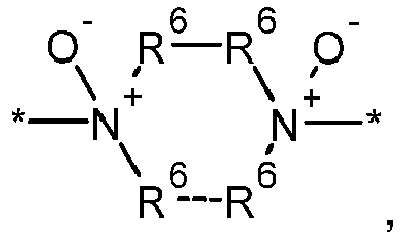
sowie ein Herstellungsverfahren dafür und ihre Verwendung als Tenside.
Description
- Die vorliegende Erfindung betrifft neue Amin-N-oxid-Verbindungen, ein Herstellungsverfahren dafür sowie deren Verwendung als Tenside.
- Lignin stellt ein im Überfluss vorkommendes aromatisches Biopolymer dar, dessen Struktur hauptsächlich auf drei substituierten Phenolen, so genannten Monolignolen (p-Coumaryl-, Coniferyl- und Sinapylalkohol), basiert, die durch eine Vielzahl von unterschiedlichen C-O- und C-C-Bindungen eine amorphe 3-dimensionale Struktur ausbilden. Unterschiedliche Methoden wurden entwickelt, um den katalytischen Abbau von Lignin mittels Depolymerisation zu ermöglichen, um industriell verwertbare monomolekulare Phenol- und/oder Benzaldehyd-Derivate erhalten zu können. Neben Monomeren, können die Produkte dieser Depolymerisationsprozesse auch phenolische Di-, Tri- und Oligomere enthalten.
- Erst kürzlich wurden verschiedene Methoden entwickelt, durch welche eine selektive Depolymerisation von Lignin möglich geworden ist, wobei es sich hauptsächlich um reduktive oder oxidative Reaktionsstrategien handelt. Durch Erstere werden üblicherweise Phenol-, Guajacol- oder Syringol-Derivate mit aliphatischen Resten gewonnen, die typischerweise ein bis drei Kohlenstoffatome lang und mit Alkohol-, Aldehyd-, Ester- und/oder Ketonfunktionalitäten versehen sind. Letztere liefern hingegen typischerweise aromatische Aldehyde wie Vanillin oder Syringaldehyd oder ähnlich funktionalisierte Guajacol- und Syringol-Derivate. Die Hauptprodukte solcher Depolymerisationsverfahren umfassen Guajacol und Syringol bzw. Vanillin und Syringaldehyd, die häufig jeweils einen oder mehrere Alkyl- und/oder Alkoxy-Substituenten am aromatischen Ring aufweisen.
- All die genannten Ligninabbauprodukte stellen wertvolle Ressourcen auf biologischer Basis dar, aus denen in den letzten Jahren auch eine Reihe verschiedenster Produkte hergestellt wurden. Den Recherchen der Erfinder zufolge befinden sich darunter allerdings kaum Tenside, obwohl auch auf diesem Gebiet ein Bedarf an Produkten besteht, die auf der Grundlage nicht-essbarer nachwachsender Rohstoffe synthetisierbar sind.
- Ziel der Erfindung war vor diesem Hintergrund die Synthese neuer chemischer Verbindungen mittels Funktionalisierung dieser Produkte des Ligninabbaus sowie ähnlicher Verbindungen, vorzugsweise auf eine umweltschonende Weise, die sich insbesondere zur Verwendung als Tenside eignen.
- Dieses Ziel erreicht die vorliegende Erfindung in einem ersten Aspekt durch Bereitstellung von Amin-N-oxid-Verbindungen der nachstehenden Formel (I) oder (II):

- R1 aus linearen, verzweigten oder zyklischen Kohlenwasserstoff-Resten mit 4 bis 26 Kohlenstoffatomen, in denen gegebenenfalls zumindest ein Kohlenstoffatom durch ein Sauerstoff- oder Schwefelatom ersetzt ist, ausgewählt ist;
- R2, R3 und R5 jeweils unabhängig aus Wasserstoff, R1-O-, R8 und in Formel (I) auch aus -CH2-N+(O-)R6R6 ausgewählt sind, wobei R8 für einen linearen, verzweigten oder zyklischen Kohlenwasserstoff-Rest mit 1 bis 26 Kohlenstoffatomen, in dem gegebenenfalls zumindest ein Kohlenstoffatom durch ein Sauerstoff- oder Schwefelatom ersetzt ist, steht;
- R4 aus Wasserstoff und R8 ausgewählt ist; und
- die Reste R6 jeweils unabhängig aus gesättigten, linearen oder verzweigten Kohlenwasserstoff-Resten mit 1 bis 6 Kohlenstoffatomen, in denen gegebenenfalls zumindest ein Kohlenstoffatom durch ein Stickstoff-, Sauerstoff- oder Schwefelatom ersetzt ist, ausgewählt sind;
- wobei gegebenenfalls zwei an dasselbe Stickstoffatom gebundene Reste R6 miteinander zu einem fünf- oder sechsgliedrigen stickstoffhältigen Ring verbunden sind oder
- wobei gegebenenfalls ein Rest R6 oder beide Reste R6 einer Amin-N-oxid-Gruppierung -N+(O-)R6R6 mit einem oder beiden Resten R6 einer solchen Gruppierung eines anderen Moleküls der Formel (I) verbunden sind und unter Ausbildung einer Brücke mit der Struktur

- Derartige Amin-N-oxid-Monomere der Formel (I) oder entsprechende Dimere der Formel (II) lassen sich, wie die Erfinder festgestellt haben, auf relativ einfache sowie umweltschonende Weise aus leicht verfügbaren Lignin-Abbauprodukten herstellen und eignen sich ausgezeichnet als Tenside. Aufgrund der starken Hydrophilie der N-Oxid-Gruppierung(en) und der Hydrophobie des bzw. der Aromaten reicht sogar eine einstellige Anzahl an Kohlenstoffatomen in den Resten R1 bis R5 aus, um den Verbindungen die erforderliche Amphiphilie zu verleihen.
- Vorzugsweise beträgt die Anzahl an Kohlenstoffatomen in den Resten R1 bis R5 jedoch zumindest 9 Kohlenstoffatome. Dies ist vor allem im Hinblick auf die Hydrophobie zu bevorzugen, wenn zwei oder mehr Amin-N-Oxid-Gruppierungen -CH2-N+(O-)R6R6 an den Aromaten gebunden sind. Aber auch der Umstand, dass zu den Hauptprodukten der Depolymerisation von Lignin neben den eingangs erwähnten Derivaten von Guajacol und Syringol auch solche von Brenzcatechin zählen, insbesondere jeweils ein- oder zweifach mit Niederalkyl und/oder -alkoxy substituierte Derivate, vereinfacht die Synthese von Amin-N-oxid-Verbindungen mit zumindest 9 Kohlenstoffatomen, da die jeweiligen freien phenolischen OH-Gruppen bloß mit leicht verfügbaren und biologisch abbaubaren Fettalkylresten verethert zu werden brauchen.
- Da einerseits Fettalkohole in der Natur sowohl in gesättigter als auch in ungesättigter Form, d.h. mit einer oder mehreren C=C-Doppelbindungen vorkommen, und andererseits, wie eingangs erwähnt, die Lignin-Abbauprodukte auch mehr als einen aromatischen, aber auch nicht-aromatische Ringe (z.B. Dioxolan) als Substituenten umfassen können, sind in der Definition von R1 bis R5 gemäß vorliegender Erfindung sowohl gesättigte als auch ungesättigte sowie zyklische Reste umfasst.
- Dass neben den Amin-N-oxid-Monomeren der Formel (I) auch Dimere der Formel (II) von der vorliegenden Erfindung umfasst sind, liegt an der mit einer Aminoalkylierungsreaktion nach Betti/Mannich beginnenden Synthese, die mit sekundären Mono- und Diaminen auf analoge Weise abläuft, was in Bezug auf den zweiten Aspekt der Erfindung näher erläutert und durch die späteren Beispiele belegt wird.
- Die untere und obere Grenze für die Anzahl der Kohlenstoffatome in den Resten R1 bis R5 bezieht sich auf die bevorzugte Verwendung von Fettalkylresten zur Veretherung von freien phenolischen OH-Gruppen in den Ausgangsprodukten, für deren Kettenlänge in der Literatur zwischen 4 bis 6 als Untergrenze und zwischen 22 und 26 als Obergrenze angegeben werden. Erfindungsgemäß bevorzugt wird eine maximale Länge von 18 Kohlenstoffatomen für die im Syntheseverfahren mittels Veretherung eingeführten Fettalkylreste bzw. von 4 Kohlenstoffatomen für die bereits im Ausgangsmaterial an den Aromaten gebundenen Alkyl- bzw. Alkoxy- oder gegebenenfalls auch Alkylthio-Resten, was insbesondere für den Rest R4 in p-Stellung zur Ethergruppe R1-O- gilt.
- Die Option, dass manche Kohlenstoffatome durch Sauerstoff oder Schwefel ersetzt sein können, bezieht sich ebenfalls vor allem auf das Substitutionsmuster der vorzugsweise durch Lignin-Depolymerisation erhaltenen Ausgangsverbindungen, die, wie eingangs erwähnt, verschiedene Sauerstoff-hältige Funktionalitäten, mitunter aber auch Schwefel-Analoga davon aufweisen können. Andere Heteroatome, wie z.B. Halogene oder Stickstoff, kommen in solchen Verbindungen hingegen kaum vor. Während erstere das Syntheseverfahren gemäß dem zweiten Aspekt der Erfindung nicht stören würden, würden jedoch Stickstoffatome in den Resten R1 bis R5 im abschließenden Oxidationsschritt mit hoher Wahrscheinlichkeit ebenfalls zu N-Oxiden oxidiert werden, was die Hydrophobie dieses Abschnitts der erfindungsgemäßen Verbindungen senken würde, vor allem, wenn die Stickstoffatome nicht sehr nahe zum aromatischen Ring positioniert wären. Für die Zwecke der vorliegenden Erfindung brauchen daher andere Heteroatome als Sauerstoff und Schwefel nicht in Betracht gezogen zu werden.
- Die Option, dass einer oder mehrere der Reste R2, R3 und R5 auch eine Amin-N-oxid-Gruppierung -CH2-N+(O-)R6R6 darstellen können, bezieht sich hingegen gezielt auf das Syntheseverfahren, in dessen erstem Schritt der aromatische Ring auch an mehr als einer Position aminoalkyliert werden kann - und auch wurde, wie die Beispiele belegen.
- In manchen bevorzugten Ausführungsformen der Erfindung ist daher R1 C6-C22-Alkyl, noch bevorzugter C8-C18-Alkyl.
- Alternativ oder zusätzlich dazu ist in manchen bevorzugten Ausführungsformen R2 aus C1-C22-Alkyl, C1-C22-Alkoxy und -CH2-N+(O-)R6R6, noch bevorzugter aus C1-C18-Alkoxy und -CH2-N+(O-)R6R6, ausgewählt. Alternativ oder zusätzlich dazu sind in bevorzugten Ausführungsformen R3 und R5 aus Wasserstoff und -CH2-N+(O-)R6R6 ausgewählt, wobei besonders bevorzugt einer von R3 und R5 Wasserstoff ist und der andere -CH2-N+(O-)R6R6 ist. Dabei bezieht sich die Option -CH2-N+(O-)R6R6 für R2, R3 bzw. R5, wie zuvor erwähnt, auf eine mehrfache Aminoalkylierung des Aromaten.
- Alternativ oder zusätzlich dazu ist in manchen bevorzugten Ausführungsformen R4 aus Wasserstoff, C1-C4-Alkyl und C1-C4-Alkoxy und noch bevorzugter aus Wasserstoff und C1-C4-Alkyl ausgewählt und ist noch bevorzugter C1-C4-Alkyl.
- In manchen besonders bevorzugten Ausführungsformen ― nach nur einfacher Aminoalkylierung im Syntheseverfahren ― gilt Folgendes:
- R1 ist C8-C18-Alkyl,
- R2 ist C1-C18-Alkoxy;
- R3 und R5 sind jeweils Wasserstoff; und
- R4 ist C1-C4-Alkyl, insbesondere Ethyl oder Propyl.
- Falls als Ausgangssubstanz ein Derivat von Brenzcatechin mit zwei vicinalen phenolischen OH-Gruppen im Syntheseverfahren eingesetzt wurde, ist R2 besonders bevorzugt C1-C18-Alkoxy, ansonsten, z.B. bei Verwendung eines Derivats von Guajacol oder Syringol, ist R2 jedoch insbesondere Methoxy. In letzterem Fall, bei Verwendung von Syringol, ist gleichzeitig auch R5 Methoxy.
- In manchen besonders bevorzugten Ausführungsformen ― nach doppelter Aminoalkylierung im Syntheseverfahren ― gilt hingegen Folgendes:
- R1 ist C8-C18-Alkyl,
- R2 ist -CH2-N+(O-)R6R6;
- R3 und R5 sind jeweils Wasserstoff; und
- R4 ist C1-C4-Alkyl, insbesondere Ethyl oder Propyl.
- In Bezug auf die Reste R6, die allgemein bis zu sechs Kohlenstoff- und gegebenenfalls Heteroatome (O, S oder speziell N) umfassen können, gilt in manchen bevorzugten Ausführungsformen des ersten Aspekts der vorliegenden Erfindung, dass sie jeweils unabhängig aus Methyl, Ethyl und Dimethylaminoethyl ausgewählt sind.
- Alternativ oder zusätzlich dazu gilt in manchen bevorzugten Ausführungsformen, dass zwei an dasselbe Stickstoffatom gebundene Reste R6 miteinander verbunden sind und zusammen mit dem Stickstoffatom eine der nachstehenden Gruppen bilden:

- In manchen besonders bevorzugten Ausführungsformen sind die Reste R6 jeweils Methyl, und eine oder beide Methylgruppen einer Gruppierung -N+(O-)(CH3)2 ist/sind mit einer oder beiden Methylgruppen einer solchen Gruppierung eines anderen Moleküls der Formel (I) verbunden, so dass diese unter Ausbildung einer Brücke mit der Struktur

- Insbesondere ist die Amin-N-oxid-Verbindung gemäß dem ersten Aspekt der vorliegenden Erfindung aus den folgenden Verbindungen ausgewählt:
- N,N-Dimethyl-1-(5-ethyl-3-methoxy-2-octyloxyphenyl)methanamin-N-oxid (1)

- N,N-Dimethyl-1-(2-decyloxy-5-ethyl-3-methoxyphenyl)methanamin-N-oxid (2)

- N,N-Dimethyl-1-(2-dodecyloxy-5-ethyl-3-methoxyphenyl)methanamin-N-oxid (3)

- N,N-Dimethyl-1-(5-ethyl-3-methoxy-2-tetradecyloxyphenyl)methanamin-N-oxid (4)

- N,N-Dimethyl-1-(5-ethyl-2-hexadecyloxy-3-methoxyphenyl)methanamin-N-oxid (5)

- N,N-Dimethyl-1-(5-ethyl-3-methoxy-2-octadecyloxyphenyl)methanamin-N-oxid (6)

- 1-(2-Dodecyloxy-5-ethyl-3-methoxybenzyl)pyrrolidin-1-oxid (7)

- 1-(2-Dodecyloxy-5-ethyl-3-methoxybenzyl)piperidin-1-oxid (8)

- 1-(2-Dodecyloxy-5-ethyl-3-methoxybenzyl)-4-methylpiperazin-1,4-dioxid (9)

- N,N-Dimethyl-N'-(2-dodecyloxy-5-ethyl-3-methoxybenzyl)-N'-methylethan-1,2-diamin-di-N-oxid (10)

- 1,1'-(2,3-Dioctyloxy-5-ethyl-1,4-phenylen)-bis(N,N-dimethylmethanamin-N-oxid) und 1,1'-(2,3-Dioctyloxy-5-ethyl-1,6-phenylen)-bis(N,N-dimethylmethanamin-N-oxid) (11)

- 1,1'-(5-Ethyl-2-octyloxy-1,3-phenylen)-bis(N,N-dimethylmethanamin-N-oxid) (12)

- 1,1'-(2-Dodecyloxy-5-ethyl-1,3-phenylen)-bis(N,N-dimethylmethanamin-N-oxid) (13)

- 1,1'-(5-Ethyl-2-hexadecyloxy-1,3-phenylen)-bis(N,N-dimethylmethanamin-N-oxid) (14)

- 1,1'-(5-Ethyl-2-octadecyloxy-1,3-phenylen)-bis(N,N-dimethylmethanamin-N-oxid) (15)

- 1,4-Bis(5-ethyl-3-methoxy-2-octyloxybenzyl)piperazin-1,4-dioxid (16)

- 1,4-Bis(2-dodecyloxy-5-ethyl-3-methoxybenzyl)piperazin-1,4-dioxid (17)

- N,N'-Bis(5-ethyl-3-methoxy-2-octyloxybenzyl)-N,N'-dimethylethan-1,2-diamin-di-N-oxid (18)

- In einem zweiten Aspekt betrifft die vorliegende Erfindung ein Verfahren zur Herstellung einer Amin-N-oxid-Verbindung gemäß dem ersten Aspekt, das die folgenden Schritte umfasst:
- 1) das Umsetzen eines Phenol-Derivats der nachstehenden Formel (III):

- R4 aus Wasserstoff und R8 ausgewählt ist, wobei R8 für einen linearen, verzweigten oder zyklischen Kohlenwasserstoff-Rest mit 1 bis 26 Kohlenstoffatomen, in dem gegebenenfalls zumindest ein Kohlenstoffatom durch ein Sauerstoff- oder Schwefelatom ersetzt ist, steht, und
- die R7 jeweils unabhängig aus Wasserstoff, Hydroxy und R8 ausgewählt sind, mit einem sekundären Amin HNR6R6, worin die Reste R6 jeweils unabhängig aus gesättigten, linearen oder verzweigten Kohlenwasserstoff-Resten mit 1 bis 6 Kohlenstoffatomen, in denen gegebenenfalls zumindest ein Kohlenstoffatom durch ein Stickstoff-, Sauerstoff- oder Schwefelatom ersetzt ist, ausgewählt sind,
- wobei gegebenenfalls die beiden Reste R6 miteinander zu einem fünf- oder sechsgliedrigen stickstoffhältigen Ring verbunden sind oder
- wobei gegebenenfalls jeweils ein Rest R6 oder jeweils beide Reste R6 zweier Moleküle des sekundären Amins unter Ausbildung eines Dimers des sekundären Amins mit der Struktur

mittels einer Aminoalkylierungsreaktion nach Betti/Mannich in Gegenwart von Formaldehyd in einem polaren Lösungsmittel, wodurch das Wasserstoffatom in ortho-Stellung zur phenolischen OH-Gruppe und gegebenenfalls ein weiteres substituierbares Wasserstoffatom R7 des Phenol-Derivats der Formel (II) durch eine Gruppierung -CH2-NR6R6 ersetzt wird/werden und eine entsprechende Betti-Base der Formel (IV) oder (V) erhalten wird:
- 2) das Umsetzen der (beiden) phenolischen OH-Gruppe(n) und gegebenenfalls weiterer freier OH-Gruppen R7 der jeweiligen Betti-Base der Formel (IV) oder (V) mit einer Verbindung der Formel R1-X, worin R1 aus linearen, verzweigten oder zyklischen Kohlenwasserstoff-Resten mit 4 bis 26 Kohlenstoffatomen, in denen gegebenenfalls zumindest ein Kohlenstoffatom durch ein Sauerstoff- oder Schwefelatom ersetzt ist, ausgewählt ist und X für eine aus Halogeniden und Sulfonaten ausgewählte Abgangsgruppe steht, mittels einer Veretherungsreaktion nach Williamson in Gegenwart einer Base in einem organischen Lösungsmittel oder ohne Lösungsmittel, wodurch ein entsprechender Ether der Formel (VI) oder (VII) erhalten wird:

- 3) das Oxidieren jeglicher Aminogruppen -NR6R6 des jeweiligen Ethers der Formel (VI) oder (VII) durch Umsetzung mit einem Oxidationsmittel in Wasser, einem organischen Lösungsmittel oder einem Gemisch davon, wodurch die Amin-N-oxid-Verbindung der Formel (I) oder (II) erhalten wird:

- Auf diese Weise ist es gemäß vorliegender Erfindung möglich, durch ein vergleichsweise einfaches und kostengünstiges Verfahren, das eine Abfolge an sich bekannter Einzelreaktionen umfasst, aus Phenol-Derivaten der Formel (III) Amin-N-oxid-Verbindungen zu synthetisieren. In bevorzugten Ausführungsformen handelt es sich bei den Ausgangsverbindungen um leicht verfügbare Produkte der Lignin-Depolymerisation, und das Verfahren wird auf möglichst umweltschonende Weise durchgeführt.
- Dazu zählt unter anderem, dass in bevorzugten Ausführungsformen des Verfahrens die Aminoalkylierung nach Betti/Mannich in Schritt 1) in Wasser und noch bevorzugter bei Raumtemperatur durchgeführt wird, wodurch der Einsatz von Lösungsmitteln und großen Energiemengen vermieden wird und überraschenderweise auch die Ausbeuten gesteigert werden können. Allerdings können organische Lösungsmittel, wie z.B. Alkohole wie Methanol, Ethanol oder (Iso-)Propanol, oder Acetonitril oder Toluol, dennoch eingesetzt werden, und das jeweils anstelle oder auch im Gemisch mit Wasser. Bevorzugt wird jedoch die Verwendung von Wasser als alleiniges Lösungsmittel, sofern die Löslichkeit des Phenol-Derivats der Formel (III) dies zulässt.
- Letzteres wird in Schritt 1) vorzugsweise mit jeweils 1,05 und noch bevorzugter 1,5 Äquivalenten des sekundären Amins und von Formaldehyd umgesetzt, um eine vollständige Aminoalkylierung an nur einer Position des Aromaten zu gewährleisten, falls eine monomere Amin-N-oxid-Verbindung der Formel (I) gewünscht wird. Soll eine doppelte Aminoalkylierung erfolgen, wird als Ausgangsverbindung vorzugsweise ein an den beiden o-Positionen unsubstituiertes, in p-Stellung aber sehr wohl substituiertes, z.B. alkyliertes, Phenol-Derivat der Formel (III) eingesetzt, um die beiden einzuführenden -CH2-NR6R6 Gruppierungen jeweils an eine o-Position zu dirigieren. Ist nur ein o-Wasserstoffatom substituierbar, werden häufig Isomerengemische der doppelt aminoalkylierten Betti-Base der Formel (IV) erhalten. Soll jedoch eine dimere Amin-N-oxid-Verbindung der Formel (II) hergestellt werden, so wird vorzugsweise das Phenol-Derivat der Formel (III) gegenüber dem sekundären Diamin (oder Dimer des sekundären Amins) in einem Verhältnis von 2:1 eingesetzt.
- Alternativ oder zusätzlich dazu wird in manchen bevorzugten Ausführungsformen des Verfahrens im Veretherungsschritt 2) jeweils eine Fest-Flüssig-Phasentransferreaktion unter Verwendung einer festen Base und in Gegenwart eines Phasentransfer-Katalysators durchgeführt, um die Umsätze zu erhöhen. Versuche der Erfinder unter Einsatz von Standard-Arbeitsvorschriften der Veretherung nach Williamson, d.h. einphasig in verschiedenen Lösungsmitteln unter Einsatz einer Lösung verschiedener Basen und bei verschiedenen Temperaturen, haben zwar ebenfalls jeweils zur gewünschten Verbindung geführt, allerdings kam es dabei in unterschiedlichem Ausmaß zur Bildung von Nebenprodukten. Der Grund dafür ist, dass Betti-Basen der Formel (IV) mit einer freien OH-Gruppe in ortho-Stellung zur Zersetzung unter Bildung des jeweiligen o-Chinonmethids, wie nachstehend gezeigt, neigen:

- Der Umstand, dass sowohl Wärme als auch die Gegenwart von Basen (oder Säuren) die Zersetzung der Betti-Basen und die Polymerisation der o-Chinonmethide fördern, stellt einerseits einen weiteren Grund für die bevorzugte Reaktionsführung in Schritt 1) und andererseits jenen für die Entwicklung der Fest-Flüssig-Phasentransferreaktion in Schritt 2) durch die vorliegenden Erfinder dar. Dies trifft insbesondere für die dimeren Betti-Basen der Formel (V) zu, die aufgrund der Gegenwart zweier anfälliger Gruppierungen noch eher zu Zersetzung und Polymerisation neigen.
- In besonders bevorzugten Ausführungsformen wird die Base in fester Form zur jeweiligen Betti-Base der Formel (IV) oder (V) zugesetzt und die Reaktanten entweder in einem organischen Lösungsmittel oder auch ohne Lösungsmittel, insbesondere bei Raumtemperatur, miteinander umgesetzt. Besonders bevorzugt werden dabei als Abgangsgruppe X das Chlorid oder Bromid, insbesondere das Bromid, sowie ein wasserfreies Lösungsmittel eingesetzt, um die Bildung von Nebenprodukten zu unterdrücken. Speziell wasserfreies 2-Methyltetrahydrofuran hat sich, nach einer Reihe von Versuchen mit anderen Lösungsmitteln, wie z.B. Acetonitril, bewährt, da es die Umsätze und die Selektivitäten für das gewünschte Produkt am stärksten zu fördern imstande war. Als Abgangsgruppe kann auch ein Sulfonat, wie z.B. Mesylat oder Tosylat, eingesetzt werden, allerdings wäre der Einsatz langkettiger Fettalkoholsulfonate unökonomisch, da diese ja selbst bereits Tenside sind.
- Als Base wurden, wie erwähnt, zunächst verschiedene wässrige Lösungen von Alkalimetallcarbonaten und -hydroxiden untersucht, wonach aus den genannten Gründen zu festen Pulvern der Base übergegangen wurde, wobei sich NaOH und besonders gepulverte KOH bewährt haben. Als Phasentransfer-Katalysator wird gemäß vorliegender Erfindung besonders bevorzugt Tetra-n-butylammoniumbromid (TBAB) eingesetzt, obwohl auch andere gängige Katalysatoren, wie z.B. eine Vielzahl anderer quaternärer Ammonium-Verbindungen, eingesetzt werden können.
- In bevorzugten Ausführungsformen des erfindungsgemäßen Verfahrens wird auch Schritt 3) auf schonende, umweltfreundliche Weise und mit möglichst quantitativem Umsatz durchgeführt, da sich die Reinigung von amphiphilen Molekülen üblicherweise recht aufwändig gestaltet. In manchen dieser bevorzugten Ausführungsformen wird eine wässrige Lösung von H2O2 als Oxidationsmittel eingesetzt, wobei gegebenenfalls Ameisensäuremethylester als zusätzliches Lösungsmittel zugesetzt wird, wobei der Ether der Formel (VI) oder (VII) noch bevorzugter mit 2,5 bis 3 Äquivalenten H2O2 umgesetzt wird, um vollständigen Umsatz zu gewährleisten.
- Zwar sind auch organische Lösungsmittel wie Dichlormethan oder Acetonitril, mitunter unter Einsatz von Katalysatoren, geeignet, allerdings hat sich eine (z.B. 30%ige) wässrige Lösung von H2O2 als Oxidationsmittel bestens bewährt. Zur Erhöhung der Löslichkeit, speziell im Falle der dimeren Amin-N-oxide, können geringe Mengen an organischem Lösungsmittel zugesetzt werden, zu welchem Zweck erfindungsgemäß Ameisensäuremethylester bevorzugt wird.
- Und in einem dritten Aspekt betrifft die vorliegende Erfindung die Verwendung der neuen Amin-N-oxid-Verbindungen der Formel (I) oder (II), in denen die Gesamtanzahl der Kohlenstoffatome der Reste R1 bis R5 zumindest 9 betragen sollte, als Tenside.
- Die vorliegende Erfindung wird nachstehend anhand von Beispielen näher beschrieben, die jedoch nicht als Einschränkung des Schutzumfangs zu verstehen sind. Zur Illustration wurden zwei repräsentative Modellverbindungen für die als Ausgangssubstanzen im erfindungsgemäßen Verfahren bevorzugten häufigen Lignin-Depolymerisationsprodukte eingesetzt. Zu diesem Zweck wurde je ein Phenol- und ein Diphenol-Derivat, nämlich 4-Ethylguajacol (4-Ethyl-2-methoxyphenol) und 4-Ethylbrenzcatechin (1,2-Dihydroxy-4-ethylbenzol) zu den erfindungsgemäßen Amin-N-oxid-Verbindungen umgesetzt:
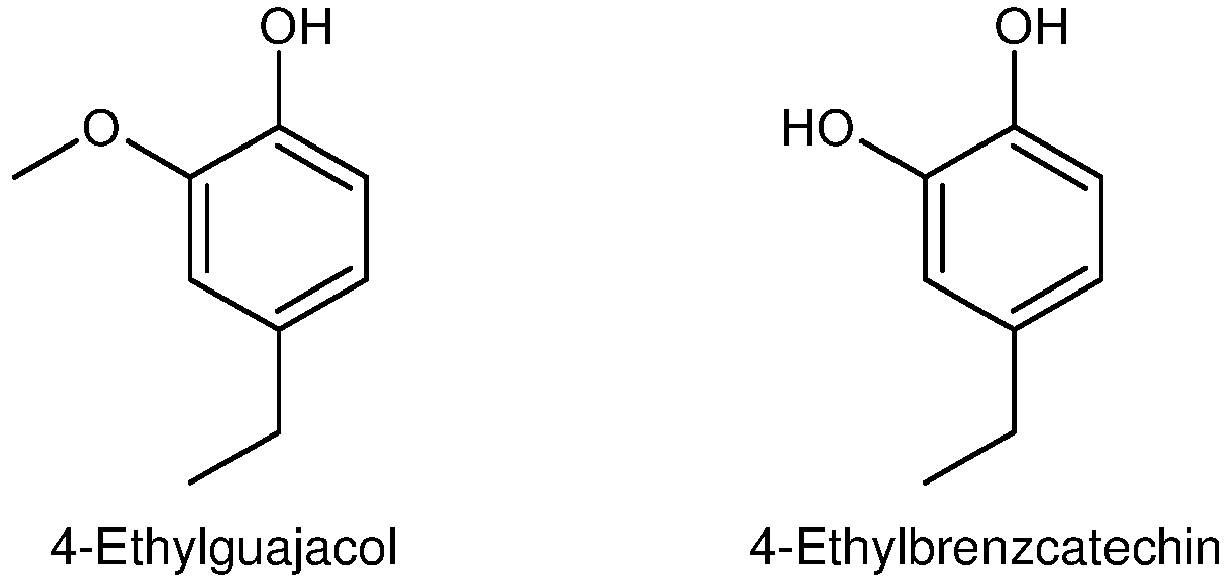
- Diese wurden zunächst mit verschiedenen sekundären Aminen und Diaminen in Gegenwart von Formaldehyd einfach oder doppelt aminomethyliert, um entsprechende Betti-Basen zu erhalten, die anschließend mit einer Reihe von Fettalkylhalogeniden einfach oder doppelt verethert und zuletzt zu den Amin-N-oxiden oxidiert wurden.
- Herstellung von N,N-Dimethyl-1-(5-ethyl-3-methoxy-2-octyloxyphenyl)methanamin-N-oxid (1)
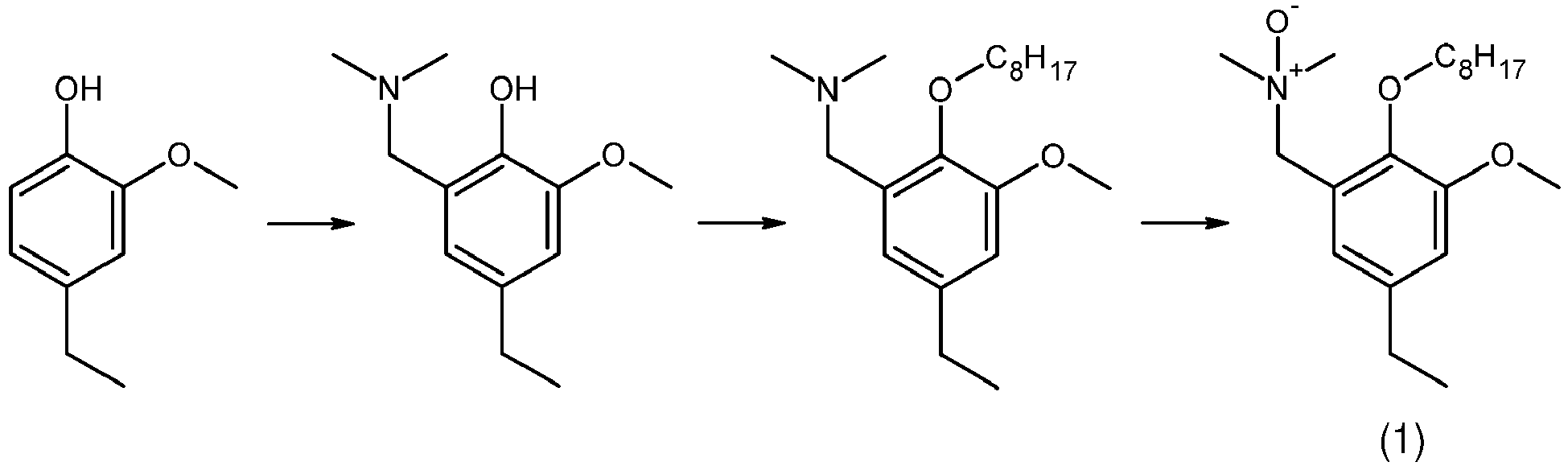
- Eine wässrige Lösung von 4-Ethylguajacol (15,20 g, 100 mmol) wurde binnen 15 min unter konstantem Rühren zu einer 40-gew.-%igen wässrigen Lösung von Dimethylamin (6,76 g, 150 mmol) in einem Eiswasserbad zugetropft. Dazu wurde Paraformaldehyd (4,50 g, 150 mmol) in Aliquoten von jeweils 0,5 g alle 10 min zugesetzt und 3 h lang im Eiswasserbad und danach 9 h lang bei Raumtemperatur gerührt. Anschließend wurden am Rotationsverdampfer die flüchtigen Bestandteile bei Raumtemperatur und danach das Wasser bei 50 °C im Vakuum entfernt, wonach der Rückstand im Vakuumexsikkator vollständig getrocknet wurde. Das aminomethylierte Zwischenprodukt, 2-Dimethylaminomethyl-4-ethyl-6-methoxyphenol, wurde als viskoses, gelbes Öl erhalten (Ausbeute: 20,83 g; 99,5 % d.Th.).
- Eine wässrige Lösung von 4-Ethylguajacol (15,20 g, 100 mmol) wurde binnen 15 min unter konstantem Rühren zu einer 40-gew.-%igen wässrigen Lösung von Dimethylamin (4,56 g, 101 mmol) in einem Eiswasserbad zugetropft. Dazu wurde Paraformaldehyd (4,50 g, 150 mmol) in Aliquoten von jeweils 0,5 g alle 10 min zugesetzt und 3 h lang im Eiswasserbad und danach 72 h lang bei Raumtemperatur gerührt. Anschließend wurde das Reaktionsgemisch 5x mit 25 ml Petrolether (Kp.: 40-60 °C) extrahiert, und die vereinigten organischen Phasen wurden am Rotationsverdampfer im Vakuum eingeengt, wonach der Rückstand im Vakuumexsikkator vollständig getrocknet wurde.
- Das aminomethylierte Zwischenprodukt, 2-Dimethylaminomethyl-4-ethyl-6-methoxyphenol, wurde als viskoses gelbliches Öl erhalten (Ausbeute: 19,43 g; 93,0 % d.Th.).
- 2-Dimethylaminomethyl-4-ethyl-6-methoxyphenol (1,05 g, 5 mmol) wurde zusammen mit 1-Bromoctan (0,95 g, 4,9 mmol) und Tetrabutylammoniumbromid (TBAB) (0,16 g , 0,5 mmol) als Katalysator in 10 ml 2-Methyltetrahydrofuran (2-MeTHF) als Lösungsmittel bei Raumtemperatur heftig gerührt, bis eine homogene Lösung erhalten wurde, wonach festes gepulvertes KOH (0,56 g ,10 mmol) zugesetzt und 8 h lang bei Raumtemperatur gerührt wurde. Danach wurde der anorganische Feststoff abzentrifugiert und 3× mit 10 ml Diethylether gewaschen. Die vereinigten organischen Phasen wurden am Rotationsverdampfer eingeengt, der Rückstand erneut in 45 ml Petrolether gelöst und 4× mit je 5 ml Wasser gewaschen. Anschließend wurde die organische Phase am Rotationsverdampfer eingeengt und der Rückstand im Vakuumexsikkator vollständig getrocknet. Das veretherte Zwischenprodukt, N,N-Dimethyl-1-(5-ethyl-3-methoxy-2-octyloxyphenyl)methanamin, wurde als viskoses, gelbes Öl erhalten (Ausbeute: 1,45 g; 92,3 % d.Th.).
- 2-Dimethylaminomethyl-4-ethyl-6-methoxyphenol (1,05 g, 5 mmol) wurde zusammen mit 1-Bromoctan (1,06 g, 5,5 mmol) und Tetrabutylammoniumbromid (TBAB) (0,16 g , 0,5 mmol) in 10 ml 2-MeTHF bei Raumtemperatur heftig gerührt, bis eine homogene Lösung erhalten wurde, wonach festes gepulvertes KOH (0,56 g ,10 mmol) zugesetzt und 8 h lang bei Raumtemperatur gerührt wurde. Danach wurden 25 ml Et2O und 5 ml H2O zugesetzt, und die wässrige Phase wurde 3x mit 10 ml Et2O extrahiert. Die vereinigten organischen Phasen wurden am Rotationsverdampfer eingeengt, und der Rückstand wurde über 5 g Kieselgel gelagert. Der Rückstand wurde mittels Flash-Chromatographie über eine Filtersäule gereinigt, wobei das veretherte Zwischenprodukt, N,N-Dimethyl-1-(5-ethyl-3-methoxy-2-octyloxyphenyl)methanamin, mit Et2O eluierte und nach Abdampfen des Ethers als viskoses, gelbes Öl erhalten wurde (Ausbeute: 1,45 g; 92,9 % d.Th.).
- N,N-Dimethyl-1-(5-ethyl-3-methoxy-2-octyloxyphenyl)methanamin (0,96 g, 3 mmol) wurde vorgelegt, und 3 Äquivalente einer 30-gew.-%igen wässrigen Lösung von H2O2 (9 mmol) wurden auf einmal zugesetzt. Das trübe Reaktionsgemisch wurde bei Raumtemperatur über Nacht bzw. so lange gerührt, bis es klar und homogen erschien, was den vollständigen Verbrauch des Ausgangsmaterials anzeigte. Anschließend wurde eine katalytische Menge an Aktivkohle oder MnO2 zugesetzt und das Gemisch 24 h lang gerührt, oder es wurde ofengetrocknetes Na2CO3 (1,06 g, 10 mmol) in 5 ml Ethanol zugesetzt und das Gemisch 30 min lang gerührt, um das überschüssige H2O2 zu zersetzen. Danach wurde der feste Niederschlag abzentrifugiert und 3x mit abs. EtOH gewaschen. Die vereinigten organischen Phasen wurden durch einen 0,2-µm-Spritzenfilter filtriert und anschließend am Rotationsverdampfer im Vakuum eingeengt, mit Hexan versetzt und erneut eingeengt, um das EtOH vollständig zu entfernen. Der Rückstand wurde danach im Vakuum vollständig getrocknet, wodurch die Titelverbindung (1) als klares, gelbes Öl erhalten wurde (Ausbeute: 0,98 g; 97,3 % d.Th.).
- 1H-NMR: δH (600 MHz, CDCl3) 6,90 (d, J = 2,0 Hz, 1H, C3), 6,81 (d, J = 2,0 Hz, 1H, C5), 4,54 (s, 2H, C12), 3,94 (t, J = 6,9, 6,9 Hz, 2H, C17), 3,86 (s, 3H, C11), 3,18 (s, 6H, C14, C15), 2,61 (q, J = 7,6, 7,6, 7,6 Hz, 2H, C7), 1,77 (p, J = 7,1, 7,1, 7,1, 7,1 Hz, 2H, C18), 1,41 (p, J = 7,1, 7,1, 6,8, 6,8 Hz, 2H, C19), 1,35-1,19 (m, 11H, C8, C20-23), 0,88 (t, J = 6,9, 6,9 Hz, 3H, C24). 13C-NMR: δC (151 MHz, CDCl3) δ 152,7 (C6), 146,0 (C1), 140,4 (C4), 124,6 (C3), 123,9 (C2), 114,0 (C5), 74,0 (C17), 70,5 (C12), 57,4 (C14, C15), 55,9 (C11), 32,0 (C18), 30,4 (C19), 29,5 (C20), 29,4 (C21), 28,7 (C7), 26,1 (C22), 22,8 (C23), 15,7 (C8), 14,2 (C24). HRMS: (ESI+, m/z) ber. für C20H36NO3 [M+H]+: 338,26929; gef.: 338,26292.
- Herstellung von N,N-Dimethyl-1-(2-decyloxy-5-ethyl-3-methoxyphenyl)methanamin-N-oxid (2)

- Die Synthese und das Produkt waren identisch mit Beispiel 1.
- Die Reaktion erfolgte analog zu jener in Beispiel 1, außer dass 1-Bromdecan anstelle von 1-Bromoctan eingesetzt wurde, wobei N,N-Dimethyl-1-(2-decyloxy-5-ethyl-3-methoxyphenyl)methanamin als viskoses, gelbes Öl erhalten wurde.
- Ausbeute: 1,50 g; 87,6 % d.Th.
- Ausbeute: 1,63 g; 93,2 % d.Th.
- Die Reaktion erfolgte analog zu jener in Beispiel 1, außer dass nur 2 mmol N,N-Dimethyl-1-(2-decyloxy-5-ethyl-3-methoxyphenyl)methanamin eingesetzt wurden, wobei die Titelverbindung (2) als klares, gelbes Öl erhalten wurde (Ausbeute: 0,70 g; 96,1 % d.Th.).
- 1H-NMR: δH (600 MHz, CDCl3) 6,89 (d, J = 2,0 Hz, 1H, C3), 6,79 (d, J = 2,0 Hz, 1H, C5), 4,52 (s, 2H, C17), 3,93 (t, J = 6,9, 6,9 Hz, 2H, C18), 3,84 (s, 3H, C11), 3,16 (s, 6H, C14, C15), 2,60 (q, J = 7,6, 7,6, 7,6 Hz, 2H, C7), 1,76 (p, J = 7,1, 7,1, 7,1, 7,1 Hz, 2H, C18), 1,39 (p, J = 7,4, 7,4, 6,9, 6,9 Hz, 2H, C19), 1,34-1,17 (m, 16H, C8, C20-C25), 0,86 (t, J = 7,0, 7,0 Hz, 3H, C26). 13C-NMR: δC (151 MHz, CDCl3) 152,6 (C6), 145,9 (C1), 140,3 (C4), 124,5 (C3), 124,0 (C2), 113,9 (C5), 74,0 (C17), 70,5 (C12), 57,5 (C14, C15), 55,8 (C11), 32,0 (C18), 30,4 (C19), 29,7 (C20, C21), 29,5 (C22), 29,4 (C23), 28,7 (C7), 26,1 (C24), 22,8 (C25), 15,6 (C8), 14,2 (C26). HRMS: (ESI+, m/z) ber. für C22H40NO3 [M+H]+: 366,30027; gef.: 366,30049.
- Herstellung von N,N-Dimethyl-1-(2-dodecyloxy-5-ethyl-3-methoxyphenyl)methan-amin-N-oxid (3)

- Die Synthese und das Produkt waren identisch mit Beispiel 1.
- Die Reaktion erfolgte analog zu jener in Beispiel 1, außer dass 1-Bromdodecan anstelle von 1-Bromoctan eingesetzt wurde, wobei N,N-Dimethyl-1-(2-dodecyloxy-5-ethyl-3-methoxyphenyl)methanamin als viskoses, gelbes Öl erhalten wurde.
- Ausbeute: 1,77 g; 96,0 % d.Th.
- Ausbeute: 1,67 g; 88,4 % d.Th.
- Die Reaktion erfolgte analog zu jener in Beispiel 1, außer dass nur 2 mmol N,N-Dimethyl-1-(2-dodecyloxy-5-ethyl-3-methoxyphenyl)methanamin eingesetzt wurden, wobei die Titelverbindung (3) als klares, gelbes Öl erhalten wurde (Ausbeute: 0,75 g; 95,2 % d.Th.).
- 1H-NMR: δH (600 MHz, CDCl3) 6,80 (d, J = 2,0 Hz, 1H, C3), 6,64 (d, J = 2,0 Hz, 1H, C5), 3,88 (t, J = 6,7, 6,7 Hz, 2H, C17), 3,83 (s, 3H, C11), 3,45 (s, 2H, C12), 2,59 (q, J = 7,6, 7,6, 7,5 Hz, 2H, C7), 2,25 (s, 6H, C14, C15), 1,80-1,72 (m, 2H, C18), 1,47 (p, J = 7,3, 7,3, 7,0, 7,0 Hz, 2H, C19), 1,38-1,24 (m, 17H, C20-C27), 1,22 (t, J = 7,6, 7,6 Hz, 3H, C8), 0,88 (t, J = 7,0, 7,0 Hz, 3H, C28). 13C-NMR: δ C (151 MHz, CDCl3) 152,6 (C6), 145,0 (C1), 139,7 (C4), 132,3 (C2), 121,6 (C3), 110,9 (C5), 73,5 (C17), 57,7 (C12), 55,9 (C11), 45,7 (C14, C15), 32,1 (C18), 30,5(C19), 29,8 (C20, C21), 29,8 (C22, C23), 29,7(C24), 29,5 (C25), 28,9 (C7), 26,3 (C26), 22,8 (C27), 15,8 (C8), 14,2 (C28). Elementaranalyse: Ber.: C, 76,34; H, 11,48; N, 3,71; gef.: C, 76,33; H, 11,64; N, 3,43; HRMS: (ESI+, m/z) ber. für C24H44NO2 [M+H]+: 378,33666; gef.: 378,33690.
- Herstellung von N,N-Dimethyl-1-(5-ethyl-3-methoxy-2-tetradecyloxyphenyl)methan-amin-N-oxid (4)

- Die Synthese und das Produkt waren identisch mit Beispiel 1.
- Die Reaktion erfolgte analog zu jener in Beispiel 1, außer dass 1-Bromtetradecan anstelle von 1-Bromoctan eingesetzt wurde, wobei N,N-Dimethyl-1-(5-ethyl-3-methoxy-2-tetradecyloxyphenyl)methanamin als viskoses, gelbes Öl erhalten wurde.
- Ausbeute: 1,91 g; 96,1 % d.Th.
- Ausbeute: 1,85 g; 91,1 % d.Th.
- Die Reaktion erfolgte analog zu jener in Beispiel 1, außer dass nur 2 mmol N,N-Dimethyl-1-(5-ethyl-3-methoxy-2-tetradecyloxyphenyl)methanamin eingesetzt wurden, wobei die Titelverbindung (4) als klares, gelbes Öl erhalten wurde (Ausbeute: 0,80 g; 94,3 % d.Th.).
- 1H-NMR: δH (600 MHz, CDCl3) 6,89 (d, J = 2,0 Hz, 1H, C3), 6,80 (d, J = 2,0 Hz, 1H, C5), 4,55 (s, 2H, C12), 3,93 (t, J = 6,9, 6,9 Hz, 2H, C17), 3,85 (s, 3H, C11), 3,19 (s, 6H, C14, C15), 2,60 (q, J = 7,6, 7,6, 7,6 Hz, 2H, C7), 1,76 (p, J = 7,1, 7,1, 7,1, 7,1 Hz, 2H, C18), 1,40 (p, J = 7,3, 7,3, 6,9, 6,9 Hz, 2H, C19), 1,34-1,19 (m, 23H, C18, C20-C29), 0,86 (t, J = 7,0, 7,0 Hz, 3H, C30). 13C-NMR: δC (151 MHz, CDCl3) 152,6 (C6), 145,9 (C1), 140,4 (C4), 124,6 (C3), 123,7 (C2), 114,0 (C5), 74,0 (C17), 70,2 (C12), 57,2 (C14, C15), 55,9 (C11), 32,0 (C18), 30,4 (C19), 29,8 (C20, C21), 29,8 (C22, C23), 29,8 (C24), 29,7 (C25), 29,5 (C26), 29,5 (C27), 28,7 (C7), 26,1 (C28), 22,8 (C29), 15,7 (C8), 14,2 (C30). HRMS: (ESI+, m/z) ber. für C26H48NO3 [M+H]+: 422,36287; gef.: 422,36323.
- Herstellung von N,N-Dimethyl-1-(5-ethyl-2-hexadecyloxy-3-methoxyphenyl)methan-amin-N-oxid (5)

- Die Synthese und das Produkt waren identisch mit Beispiel 1.
- Die Reaktion erfolgte analog zu jener in Beispiel 1, außer dass 1-Bromhexadecan anstelle von 1-Bromoctan eingesetzt wurde, wobei N,N-Dimethyl-1-(5-ethyl-2-hexadecyl-oxy-3-methoxyphenyl)methanamin als viskoses, gelbes Öl erhalten wurde.
- Ausbeute: 2,00 g; 94,0 % d.Th.
- Ausbeute: 2,11 g; 97,4 % d.Th.
- Die Reaktion erfolgte analog zu jener in Beispiel 1, außer dass nur 2 mmol N,N-Dimethyl-1-(5-ethyl-2-hexadecyloxy-3-methoxyphenyl)methanamin eingesetzt wurden, wobei die Titelverbindung (5) als klares, gelbes Öl erhalten wurde (Ausbeute: 0,87 g; 97,0 % d.Th.).
- 1H-NMR: δH (600 MHz, CDCl3) 6,90 (d, J = 1,9 Hz, 1H, C3), 6,81 (d, J = 1,9 Hz, 1H, C5), 4,53 (s, 2H, C11), 3,94 (t, J = 6,9, 6,9 Hz, 2H, C17), 3,86 (s, 3H, C11), 3,18 (s, 6H, C14, C15), 2,62 (q, J = 7,6, 7,6, 7,6 Hz, 2H, C7), 1,77 (p, J = 7,1, 7,1, 7,1, 7,1 Hz, 2H, C18), 1,41 (p, J = 7,3, 7,3, 6,9, 6,9 Hz, 2H, , C19), 1,36-1,20 (m, 29H, C8, C20-C31), 0,87 (t, J = 6,9, 6,9 Hz, 3H, C32). 13C-NMR: δC (151 MHz, CDCl3) 152,7 (C6), 146,0 (C1), 140,4 (C4), 124,5 (C3), 123,9 (C2), 114,0 (C5), 74,0 (C17), 70,5 (C12), 57,5 (C14, C15), 55,9 (C11), 32,1 (C18), 30,4 (C19), 29,8 (C20), 29,8 (C21, C22), 29,8 (C23, C24), 29,8 (C25), 29,7 (C26), 29,6 (C27), 29,5 (C28), 28,7 (C29) (C7), 26,1 (C30), 22,8 (C31), 15,7 (C8), 14,3 (C32). HRMS: (ESI+, m/z) ber. für C28H52NO3 [M+H]+: 450,39417; gef.: 450,39428.
- Herstellung von N,N-Dimethyl-1-(5-ethyl-3-methoxy-2-octadecyloxyphenyl)methan-amin-N-oxid (6)

- Die Synthese und das Produkt waren identisch mit Beispiel 1.
- Die Reaktion erfolgte analog zu jener in Beispiel 1, außer dass 1-Bromoctadecan anstelle von 1-Bromoctan eingesetzt wurde, wobei N,N-Dimethyl-1-(5-ethyl-3-methoxy-2-octadecyloxyphenyl)methanamin als viskoses, gelbes Öl (Variante 2.1; Ausbeute: 2,06 g; 91,0 % d.Th.) bzw. als weißer, wachsartiger Feststoff (Variante 2.2; Ausbeute: 2,00 g; 86,3 % d.Th.) erhalten wurde.
- Die Reaktion erfolgte analog zu jener in Beispiel 1, außer dass nur 2 mmol N,N-Dimethyl-1-(5-ethyl-3-methoxy-2-octadecyloxyphenyl)methanamin eingesetzt und 0,5 ml MeOH zur Erhöhung der Löslichkeit zugesetzt wurden, wobei die Titelverbindung (6) als weißer, wachsartiger Feststoff erhalten wurde (Ausbeute: 0,916 g; 95,9 % d.Th.).
- 1H-NMR: δH (600 MHz, CDCl3) 6,91 (d, J = 2,0 Hz, 1H, C3), 6,82 (d, J = 2,0 Hz, 1H, C5), 4,56 (s, 2H, C12), 3,95 (t, J = 6,9, 6,9 Hz, 2H, C17), 3,86 (s, 3H, C11), 3,19 (s, 6H, C14, C15), 2,62 (q, J = 7,6, 7,6, 7,6 Hz, 2H, C7), 1,77 (p, J = 7,1, 7,1, 7,1, 7,1 Hz, 2H, C18), 1,41 (p, J = 7,2, 7,2, 6,9, 6,9 Hz, 2H, C19), 1,36-1,19 (m, 30H, C8, C20-C33), 0,87 (t, J = 7,0, 7,0 Hz, 3H, C34). 13C-NMR: δC (151 MHz, CDCl3) 152,7 (C6), 146,0 (C1), 140,4 (C4), 124,5 (C3), 123,7 (C2), 114,0 (C5), 74,0 (C17), 70,3 (C12), 57,3 (C14, C15), 55,9 (C11), 32,1 (C18), 30,4 (C19), 29,8 (C20, C21, C22, C23), 29,8 (C24, C25, C26, C27), 29,8 (C28), 29,7 (C29), 29,6 (C30), 29,5 (C31), 28,7 (C7), 26,1 (C32), 22,8 (C33), 15,7 (C8), 14,3 (C34). HRMS: (ESI+, m/z) ber. für C30H56NO3 [M+H]+: 478,42547; gef.: 478,42540.
- Herstellung von 1-(2-Dodecyloxy-5-ethyl-3-methoxybenzyl)pyrrolidin-1-oxid (7)

- Eine wässrige Lösung von 4-Ethylguajacol (4,56 g, 30 mmol) wurde binnen 15 min unter konstantem Rühren zu einer wässrigen Lösung (10 ml) von Pyrrolidin (2,21 g, 31 mmol) in einem Eiswasserbad zugetropft. Dazu wurde Paraformaldehyd (1,35 g, 45 mmol) in Aliquoten von jeweils 0,5 g alle 10 min zugesetzt und 3 h lang im Eiswasserbad und danach 72 h lang bei Raumtemperatur gerührt. Anschließend wurde das Reaktionsgemisch 5x mit 25 ml Petrolether extrahiert, die vereinigten organischen Phasen 5x mit 4 ml Wasser gewaschen und am Rotationsverdampfer im Vakuum eingeengt, wonach der Rückstand im Vakuumexsikkator vollständig getrocknet wurde. Das aminomethylierte Zwischenprodukt, 4-Ethyl-6-methoxy-2-(pyrrolidinomethyl)-phenol, wurde als viskoses, hellgelbes Öl erhalten (Ausbeute: 6,50 g; 92,1 % d.Th.).
- Die Reaktion erfolgte analog zu jener in Beispiel 1, Variante 2.1, außer dass 1-Bromdodecan anstelle von 1-Bromoctan eingesetzt wurde, wobei 1-(2-Dodecyloxy-5-ethyl-3-methoxybenzyl)pyrrolidin als leicht gelbliches Öl erhalten wurde (Ausbeute: 1,93 g; 97,6 % d.Th.).
- Die Reaktion erfolgte analog zu jener in Beispiel 1, außer dass nur 2 mmol 1-(2-Dodecyloxy-5-ethyl-3-methoxybenzyl)pyrrolidin eingesetzt wurden, wobei die Titelverbindung (7) als klares, gelbes Öl erhalten wurde (Ausbeute: 0,80 g; 95,5 % d.Th.).
- 1H-NMR: δH (300 MHz, CDCl3) 6,94 (d, J = 2,0 Hz, 1H, 2), 6,76 (d, J = 2,0 Hz, 1H, 4), 4,64 (s, 2H, 12), 3,91 (t, J = 6,9 Hz, 2H, 19), 3,83 (s, 3H, 9), 3,50-3,21 (m, 4H, 14', 17'), 2,58 (q, J = 7,6 Hz, 2H, 10), 2,49-2,34 (m, 2H, 20), 1,87-1,69 (m, 4H, 15", 16"), 1,37-1,15 (m, 21H, 11, 21, 22, 23, 24, 25, 26, 27, 28, 29), 0,85 (t, J = 6,9 Hz, 3H, 30). 13C-NMR: δC (75 MHz, CDCl3) 152,5 (5), 145,7 (6), 140,2 (3), 125,1 (2), 124,3 (1), 113,4 (4), 73,9 (19), 65,5 (14, 17), 65,5, (12), 55,8 (9), 32,0 (20), 30,3 (21), 29,7 (22, 23), 29,7 (24, 25), 29,7 (26), 29,5 (27), 29,4 (28), 28,6 (10), 26,1, 22,8 , (15, 16), 21,3 (29), 15,6 (11), 14,2 (30). HRMS: (ESI+, m/z) ber. für C26H46NO3 [M+H]+: 420,34777; gef.: 420,347257.
- Herstellung von 1-(2-Dodecyloxy-5-ethyl-3-methoxybenzyl)piperidin-1-oxid (8)

- Die Reaktion erfolgte analog zu jener in Beispiel 7, außer dass Piperidin (2,64 g, 31 mmol) anstelle von Pyrrolidin eingesetzt wurde, wobei 4-Ethyl-6-methoxy-2-(piperidinomethyl)phenol als leicht gelbliches Öl erhalten wurde (Ausbeute: 7,06 g; 94,4 % d.Th.).
- Die Reaktion erfolgte analog zu jener in Beispiel 1, Variante 2.1, außer dass 10 mmol 4-Ethyl-6-methoxy-2-(piperidinomethyl)phenol und 1-Bromdodecan statt 1-Bromoctan eingesetzt wurden, wobei 1-(2-Dodecyloxy-5-ethyl-3-methoxybenzyl)piperidin als leicht gelbliches Öl erhalten wurde (Ausbeute: 3,93 g; 94,1 % d.Th.).
- Die Reaktion erfolgte analog zu jener in Beispiel 1, außer dass 5 mmol 1-(2-Dodecyloxy-5-ethyl-3-methoxybenzyl)piperidin eingesetzt wurden, wobei die Titelverbindung (8) als klares, gelbes Öl erhalten wurde (Ausbeute: 2,10 g; 96,8 % d.Th.).
- 1H-NMR: δH (300 MHz, CDCl3) 6,99 (d, J = 2,0 Hz, 1H), 6,79 (d, J = 2,0 Hz, 1H), 4,50 (s, 2H), 3,92 (t, J = 6,9 Hz, 2H), 3,85 (s, 3H), 3,29 (d, J = 11,8 Hz, 2H), 3,04 (td, J = 12,2, 3,1 Hz, 2H), 2,61 (q, J = 7,6 Hz, 2H), 2,47-2,26 (m, 2H), 1,85-1,02 (m, 28H), 0,87 (t, J = 7,0, 6,2 Hz, 3H). 13C-NMR: δ C (75 MHz, CDCl3) 152,4, 146,0, 140,1, 125,3, 123,5, 113,5, 74,0, 70,6, 63,7, 55,8, 32,0, 30,4, 29,8, 29,8, 29,8, 29,6, 29,5, 28,7, 26,2, 22,8, 22,0, 20,6, 15,6, 14,2. HRMS: (ESI+, m/z) ber. für C27H48NO3 [M+H]+: 434,36342; gef.: 434,362833.
- Herstellung von 1-(2-Dodecyloxy-5-ethyl-3-methoxybenzyl)-4-methylpiperazin-1,4-dioxid (9)

- Eine wässrige Lösung von 4-Ethylguajacol (3,04 g, 20 mmol) wurde binnen 15 min unter konstantem Rühren zu einer wässrigen Lösung (5 ml) von 1-Methylpiperazin (2,64 g, 30 mmol) in einem Eiswasserbad zugetropft. Dazu wurde eine 37-gew.-%ige wässrige Formaldehyd-Lösung (0,90 g, 30 mmol) in Aliquoten von jeweils 0,1 g alle 10 min zugesetzt und 3 h lang im Eiswasserbad und danach 9 h lang bei Raumtemperatur gerührt. Anschließend wurde der ausgefallene Feststoff abzentrifugiert und erneut in 45 ml Et2O gelöst. Die Lösung wurde 5x mit 5 ml Wasser gewaschen und danach am Rotationsverdampfer im Vakuum eingeengt, wobei das aminomethylierte Zwischenprodukt, 4-Ethyl-6-methoxy-2-(4-methylpiperazinomethyl)phenol, als weißes Pulver erhalten wurde (Ausbeute: 1,65 g; 31,1 % d.Th.).
- Die Reaktion erfolgte analog zu jener in Beispiel 1, Variante 2.2, außer dass 1-Bromdodecan statt 1-Bromoctan eingesetzt wurde, wobei 1-(2-Dodecyloxy-5-ethyl-3-methoxybenzyl)-4-methylpiperazin als cremefarbenes Pulver erhalten wurde (Ausbeute: 0,28 g; 12,9 % d.Th.).
- Die Reaktion erfolgte analog zu jener in Beispiel 1, außer dass 0,125 mmol 1-(2-Dodecyloxy-5-ethyl-3-methoxybenzyl)-4-methylpiperazin eingesetzt wurden, wobei die Titelverbindung (9) als cremefarbenes Pulver erhalten wurde (Ausbeute: 0,058 g; 99,9 % d.Th.).
- 1H-NMR: δH (300 MHz, CDCl3) 6,97 (d, J = 2,0 Hz, 1H), 6,79 (d, J = 2,0 Hz, 1H), 4,46 (s, 2H), 4,39-4,18 (m, 4H), 3,95 (t, J = 7,0, 7,0 Hz, 2H), 3,83 (s, 3H), 3,25 (s, 3H), 3,01 (dd, J = 15,4, 9,6 Hz, 4H), 2,60 (q, J = 7,6, 7,6, 7,6 Hz, 2H), 1,81-1,68 (m, 2H), 1,45-1,13 (m, 22H), 0,85 (d, J = 6,8 Hz, 3H). 13C-NMR: δC (75 MHz, CDCl3) 152,2, 145,8, 140,3, 125,4, 121,6, 114,4, 74,0, 69,3, 60,0, 59,1, 57,8, 55,8, 32,0, 29,9, 29,8, 29,8, 29,7, 29,5, 29,4, 28,6, 25,8, 22,8, 15,5, 14,2. HRMS: (ESI+, m/z) ber. für C27H48N2O4 [M+H]+: 465,368684; gef.: 465,367767.
- Herstellung von N,N-Dimethyl-N'-(2-dodecyloxy-5-ethyl-3-methoxybenzyl)-N'-methyl-ethan-1,2-diamin-di-N-oxid (10)

- Die Reaktion erfolgte analog zu jener in Beispiel 7, außer dass N,N,N'-Trimethylethan-1,2-diamin (3,07 g, 30 mmol) anstelle von Pyrrolidin eingesetzt wurde, wobei 2-(2-Dimethylaminoethyl)aminomethyl-4-ethyl-6-methoxyphenol als cremefarbenes Pulver erhalten wurde (Ausbeute: 4,59 g; 86,3 % d.Th.).
- Die Reaktion erfolgte analog zu jener in Beispiel 1, Variante 2.2, außer dass 1-Bromdodecan statt 1-Bromoctan eingesetzt wurde, wobei N,N-Dimethyl-N'-(2-Dodecyloxy-5-ethyl-3-methoxybenzyl)-N'-methylethan-1,2-diamin als cremefarbenes Pulver erhalten wurde (Ausbeute: 1,17 g; 53,8 % d.Th.).
- Die Reaktion erfolgte analog zu jener in Beispiel 1, außer dass 1 mmol N,N-Dimethyl-N'-(2-Dodecyloxy-5-ethyl-3-methoxybenzyl)-N'-methylethan-1,2-diamin eingesetzt wurde, wobei die Titelverbindung (10) als cremefarbenes Pulver erhalten wurde (Ausbeute: 0,97 g; 69,0 % d.Th.).
- 1H-NMR δH (300 MHz, CDCl3) 6,95 (d, J = 2,0 Hz, 1H), 6,80 (d, J = 2,0 Hz, 1H), 4,49 (d, J = 12,4 Hz, 1H), 4,36 (d, J = 12,4 Hz, 1H), 4,07-3,92 (m, 2H), 3,91-3,79 (m, 3+3H), 3,67 (q, J = 7,0, 7,0, 7,0 Hz, 1H), 3,33-3,17 (m, 6H), 3,04 (s, 3H), 2,70-2,56 (m, 2H), 1,75 (dd, J = 10,8, 4,7 Hz, 2H), 1,45-1,35 (m, 2H), 1,35-1,17 (m, 28H), 0,85 (t, J = 6,9 Hz, 3H). 13C-NMR δC (75 MHz, CDCl3) 152,6, 146,0, 140,4, 124,2, 114,1, 74,0, 64,6, 55,9, 32,0, 30,4, 29,8, 29,7, 29,6, 29,5, 28,7, 26,1, 22,8, 15,7, 14,2.
- Herstellung von 1,1'-(2,3-Dioctyloxy-5-ethyl-1,4-phenylen)-bis(N,N-dimethylmethan-amin-N-oxid) und 1,1'-(2,3-Dioctyloxy-5-ethyl-1,6-phenylen)-bis(N,N-dimethylmethan-amin-N-oxid) (11)

- Eine wässrige Lösung von 4-Ethylbrenzcatechin (1,0 g, 7,24 mmol) wurde binnen 15 min unter konstantem Rühren und unter Argon-Atmosphäre zu einer 40-gew.-%-igen wässrigen Lösung von Dimethylamin (0,98 g, 21,7 mmol) in einem Eiswasserbad zugetropft. Dazu wurden 10 ml einer 37-gew.-%igen wässrigen Formaldehyd-Lösung (0,65 g, 21,7 mmol) in 5 Aliquoten alle 10 min zugesetzt und 2 h lang im Eiswasserbad und danach 58 h lang bei Raumtemperatur gerührt. Anschließend wurde das Reaktionsgemisch 5x mit 10 ml Et2O extrahiert, und die vereinigten organischen Phasen wurden 5x mit 5 ml Wasser gewaschen und danach am Rotationsverdampfer im Vakuum eingeengt, wonach der Rückstand im Vakuumexsikkator vollständig getrocknet wurde, wobei ein Gemisch der doppelt aminomethylierten Zwischenprodukte, 3,4- und 3,6-Bis(dimethylaminomethyl)-5-ethylbrenzcatechin, als cremefarbenes Pulver erhalten wurde (Ausbeute: 1,20 g; 65,5 % d.Th.).
- Die Reaktion erfolgte analog zu jener in Beispiel 1, Variante 2.2, außer dass sie unter Argon-Atmosphäre 12 h lang durchgeführt wurde und bei der Flash-Chromatographie die Elution mit einem Petrolether/Ethylacetat-Gradienten erfolgte, wobei ein Gemisch aus 1,1'-(2,3-Dioctyloxy-5-ethyl-1,4-phenylen)-bis(N,N-dimethylmethanamin) und 1,1'-(2,3-Dioctyloxy-5-ethyl-1,6-phenylen)-bis(N,N-dimethylmethanamin) als gelbes Öl erhalten wurde (Ausbeute: 0,15 g; 12,3 % d.Th.).
- 1H-NMR: δH (300 MHz, CDCl3) δ 6,91 (s, 1H), 3,92 (dt, J = 8,2, 6,7 Hz, 4H), 3,40 (d, J = 7,1 Hz, 4H), 2,71 (q, J = 7,5 Hz, 2H), 2,24 (d, J = 6,6 Hz, 12H), 1,75 (dt, J = 8,3, 6,3 Hz, 4H), 1,53-1,39 (m, 4H), 1,36-1,25 (m, 18H), 1,19 (t, J = 7,5 Hz, 3H), 0,94-0,83 (m, 6H). 13C-NMR: δC (75 MHz, CDCl3) 151,5, 148,9, 139,9, 131,4, 129,7, 125,3, 73,4 (d, J = 2,2 Hz), 58,2, 54,2, 45,7, 32,0, 30,7 (d, J = 2,0 Hz), 29,7, 29,5, 26,4 (d, J = 1,5 Hz), 25,3, 22,8, 15,7, 14,3. Elementaranalyse: Ber.: C, 75,57; H, 11,84; N, 5,88; gef.: C, 75,34; H, 11,85; N, 5,56; HRMS: (ESI+, m/z) ber. für C30H57N2O2 [M+H]+: 477,4420; gef.: 477,441284.
- Die Reaktion erfolgte analog zu jener in Beispiel 1, außer dass 0,25 mmol des Amin-Gemischs eingesetzt wurden, wobei jedoch die Titelverbindungen (11) aufgrund von Nebenreaktionen im Gemisch mit mehreren Nebenprodukten anfielen. Die Optimierung dieser Oxidationsreaktion ist derzeit Gegenstand der Forschung der Erfinder.
- Herstellung von 1,1'-(5-Ethyl-2-octyloxy-1,3-phenylen)-bis(N,N-dimethylmethanamin-N-oxid) (12)

- Eine wässrige Lösung von 4-Ethylphenol (6,11 g, 50 mmol) wurde binnen 15 min unter konstantem Rühren und zu einer 40-gew.-%igen wässrigen Lösung von Dimethylamin (6,76 g, 150 mmol) in einem Eiswasserbad zugetropft. Dazu wurde Paraformaldehyd (4,50 g, 150 mmol) in Aliquoten von jeweils 1,5 g alle 10 min zugesetzt und 2 h lang im Eiswasserbad und danach 58 h lang bei Raumtemperatur gerührt. Anschließend wurde das Reaktionsgemisch 5x mit 25 ml Petrolether extrahiert, und die vereinigten organischen Phasen wurden 5x mit 4 ml Wasser gewaschen und am Rotationsverdampfer im Vakuum eingeengt, wonach der Rückstand im Vakuumexsikkator vollständig getrocknet wurde. Das doppelt aminomethylierte Zwischenprodukt, 2,6-Bis-(dimethylaminomethyl)-4-ethylphenol, wurde als viskoses klares Öl erhalten (Ausbeute: 11,02 g; 93,3 %d.Th.).
- Die Reaktion erfolgte analog zu jener in Beispiel 1, Variante 2.2, außer dass das KOH in zwei Portionen (je 0,28 g zu Beginn und nach 2 h) zugesetzt wurde und bei der Flash-Chromatographie die Elution mit einem Petrolether/Ethylacetat-Gradienten erfolgte, wobei 1,1'-(5-Ethyl-2-octyloxy-1,3-phenylen)-bis(N,N-dimethylmethanamin) als gelbes Öl erhalten wurde (Ausbeute: 1,54 g; 8,6 % d.Th.).
- Die Reaktion erfolgte analog zu jener in Beispiel 1, wobei die Titelverbindung (12) als viskoses, klares, gelbes Öl erhalten wurde (Ausbeute: 1,12 g; 97,9 % d.Th.).
- 1H-NMR: δH (300 MHz, CDCl3) 7,51 (s, 2H, C2, C4), 4,48 (s, 4H, C8, C11), 3,71 (t, J = 6,8, 6,8 Hz, 2H, C19), 3,16 (s, 12H, C13, C14, C16, C17), 2,67-2,54 (m, 2H, C9), 1,89-1,76 (m, 2H, C20), 1,45-1,34 (m, 2H, C21), 1,33-1,04 (m, 14H, C10, C22-C25), 0,85 (t, J = 6,7 Hz, 3H, C26). 13C-NMR: δC (75 MHz, CDCl3) 156,4 (C6), 141,1 (C3), 136,7 (C1, C5), 124,0 (C2, C4), 69,4 (C8, C11), 57,6 (C13, C14, C16, C17), 31,9 (C20), 30,4 (C21), 29,5 (C22), 29,3 (C23), 28,0 (C9), 26,2 (C24), 22,7 (C25), 15,3 (C10), 14,2 (C26). HRMS: (ESI+, m/z) ber. für C22H41NO3 [M+H]+: 381,31172; gef.: 381,310922.
- Herstellung von 1,1'-(2-Dodecyloxy-5-ethyl-1,3-phenylen)-bis(N,N-dimethylmethan-amin-N-oxid) (13)

- Die Synthese und das Produkt waren identisch mit Beispiel 12.
- Die Reaktion erfolgte analog zu jener in Beispiel 1, Variante 2.2, außer dass 1-Bromdodecan anstelle von 1-Bromoctan eingesetzt wurde, das KOH in zwei Portionen (je 0,28 g zu Beginn und nach 2 h) zugesetzt wurde und bei der Flash-Chromatographie die Elution mit einem Petrolether/Ethylacetat-Gradienten erfolgte, wobei 1,1'-(2-Dodecyloxy-5-ethyl-1,3-phenylen)-bis(N,N-dimethylmethanamin) als gelbes Öl erhalten wurde (Ausbeute: 1,53 g; 75,7 % d.Th.).
- Die Reaktion erfolgte analog zu jener in Beispiel 1, außer dass nur 2,5 mmol 1,1'-(2-Dodecyloxy-5-ethyl-1,3-phenylen)-bis(N,N-dimethylmethanamin) eingesetzt wurden, wobei die Titelverbindung (13) als cremefarbener, wachsartiger Feststoff erhalten wurde (Ausbeute: 0,70 g; 96,1 % d.Th.).
- 1H-NMR: δH (300 MHz, CDCl3) 7,53 (s, 2H, C2, C4), 4,49 (s, 4H, C8, C11), 3,74 (t, J = 6,8 Hz, 2H, C19), 3,19 (s, 12H, C13, C14, C16, C17), 2,64 (q, J = 7,6 Hz, 2H, C9), 1,84 (t, J = 7,4 Hz, 2H, C20), 1,46-1,37 (m, 2H, C21), 1,32-1,17 (m, 22H, C10, C22-C29), 0,87 (t, J = 6,9 Hz, 3H, C30). 13C-NMR: δC (75 MHz, CDCl3) 156,4 (C6), 141,2 (C3), 136,8 (C1, C5), 123,9 (C2, C4), 69,4 (C8, C11), 57,6 (C13, C14, C16, C17), 32,0 (C20), 30,5 (C21), 29,8 (C22, C24, C25), 29,6 (C26), 29,5 (C27), 28,1 (C9), 26,3 (C28), 22,8 (C29), 15,4 (C10), 14,3 (C30). HRMS: (ESI+, m/z) ber. für C26H49NO3 [M+H]+: 437,37432; gef.: 437,373256.
- Herstellung von 1,1'-(5-Ethyl-2-hexadecyloxy-1,3-phenylen)-bis(N,N-dimethylmethan-amin-N-oxid) (14)

- Die Synthese und das Produkt waren identisch mit Beispiel 12.
- Die Reaktion erfolgte analog zu jener in Beispiel 13, außer dass 1-Bromhexadecan anstelle von 1-Bromdodecan eingesetzt wurde, wobei 1,1'-(5-Ethyl-2-hexadecyloxy-1,3-phenylen)-bis(N,N-dimethylmethanamin) als gelbes Öl erhalten wurde (Ausbeute: 1,57 g; 68,1 % d.Th.).
- Die Reaktion erfolgte analog zu jener in Beispiel 13, wobei die Titelverbindung (14) als cremefarbener, wachsartiger Feststoff erhalten wurde (Ausbeute: 1,20 g; 97,2 % d.Th.).
- 1H-NMR: δH (300 MHz, CDCl3) 7,54 (s, 2H, C2, C4), 4,50 (s, 4H, C8, C11), 3,74 (t, J = 6,8 Hz, 2H, C19), 3,17 (s, 12H, C13, C14, C16, C17), 2,65 (q, J = 7,5 Hz, 2H, C9), 1,88-1,82 (m, 2H, C20), 1,48-1,39 (m, 2H, C21), 1,30-1,21 (m, 29H, C10, C22-C33), 0,86 (t, J = 7,0 Hz, 3H, C34). 13C-NMR: δC (75 MHz, CDCl3) 156,4 (C6), 141,2 (C3), 136,7 (C1, C5), 124,2 (C2, C4), 69,6 (C8, C11), 57,8 (C13, C14, C16, C17), 32,0 (C20), 30,5 (C21), 30,0-29,3 (m) (C22-C31), 28,1 (C9), 26,3 (C32), 22,8 (C33), 15,4 (C10), 14,3 (C34). HRMS: (ESI+, m/z) ber. für C30H57N2O3 [M+H]+: 493,43692; gef.: 493,436311.
- Herstellung von 1,1'-(5-Ethyl-2-octadecyloxy-1,3-phenylen)-bis(N,N-dimethylmethan-amin-N-oxid) (15)

- Die Synthese und das Produkt waren identisch mit Beispiel 12.
- Die Reaktion erfolgte analog zu jener in Beispiel 13, außer dass 1-Bromoctadecan anstelle von 1-Bromdodecan eingesetzt wurde, wobei 1,1'-(5-Ethyl-2-octadecyloxy-1,3-phenylen)-bis(N,N-dimethylmethanamin) als cremefarbener, wachsartiger Feststoff erhalten wurde (Ausbeute: 1,61 g; 66,0 % d.Th.).
- Die Reaktion erfolgte analog zu jener in Beispiel 13, wobei die Titelverbindung (15) als gelblicher, wachsartiger Feststoff erhalten wurde (Ausbeute: 1,00 g; 96,2 % d.Th.).
- 1H-NMR: δH (300 MHz, CDCl3) 7,51 (s, 2H, C2, C4), 4,40 (s, 4H, C8, C11), 3,72 (t, J = 6,8 Hz, 2H, C19), 3,08 (s, 12H, C13, C14, C16, C17), 2,65 (q, J = 7,7 Hz, 2H, C9), 1,88-1,77 (m, 2H, C20), 1,45-1,36 (m, 2H, C21), 1,26-1,18 (m, 33H, C10, C22-C35), 0,84 (t, J = 7,0 Hz, 3H, C36). 13C-NMR: δC (75 MHz, CDCl3) 156,2 (C6), 141,2 (C3), 136,3 (C1, C5), 124,6 (C2, C4), 70,2 (C8, C11), 58,1 (C13, C14, C16, C17), 32,0 (C20), 30,5 (C21), 29,9-29,6 (m) (C22-C31), 29,5 (C32), 29,4 (C33), 28,1 (C9), 26,2 (C34), 22,8 (C35), 15,3 (C10), 14,2 (C36). HRMS: (ESI+, m/z) ber. für C32H61NO3 [M+H]+: 521,46822; gef.: 521,467246.
- Herstellung von 1,4-Bis(5-ethyl-3-methoxy-2-octyloxybenzyl)piperazin-1,4-dioxid (16)

- Eine wässrige Lösung von 4-Ethylguajacol (3,04 g, 20 mmol) wurde binnen 15 min unter konstantem Rühren zu einer wässrigen Lösung (10 ml) von Piperazin (1,29 g, 15 mmol) in einem Eiswasserbad zugetropft. Dazu wurde eine 37-gew.-%ige wässrige Formaldehyd-Lösung (0,90 g, 30 mmol) in Aliquoten von jeweils 0,1 g alle 10 min zugesetzt und 3 h lang im Eiswasserbad und danach 9 h lang bei Raumtemperatur gerührt. Anschließend wurde der ausgefallene Feststoff abfiltriert (Glasfritte, Porosität 4), in 10 ml Petrolether aufgeschlämmt und mittels Ultraschall vermischt, danach abzentrifugiert und im Vakuumexsikkator vollständig getrocknet, wobei das dimere Zwischenprodukt, 6,6'-(Piperazin-1,4-dimethylen)-bis(4-ethyl-2-methoxyphenol), in Form von weißen Nadeln erhalten wurde (Ausbeute: 3,40 g; 82,1 % d.Th.).
- Die Reaktion erfolgte analog zu jener in Beispiel 1, Variante 2.2, außer dass 2,12 g (11 mmol) 1-Bromoctan und 40 ml 2-MeTHF als Lösungsmittel eingesetzt wurden und bei der Flash-Chromatographie die Elution mit einem Petrolether/Ethylacetat-Gradienten erfolgte, wobei 1,4-Bis(5-ethyl-3-methoxy-2-octyloxybenzyl)piperazin als weißes Pulver erhalten wurde (Ausbeute: 1,45 g; 45,4 % d.Th.).
- Die Reaktion erfolgte analog zu jener in Beispiel 1, außer dass nur 1 mmol 1,4-Bis(5-ethyl-3-methoxy-2-octyloxybenzyl)piperazin und Ameisensäuremethylester (15 ml) als zusätzliches Lösungsmittel eingesetzt wurden, wobei die Titelverbindung (16) als weißer, wachsartiger Feststoff erhalten wurde (Ausbeute: 0,21 g; 31,6 % d.Th.).
- 1H-NMR: δH (300 MHz, CDCl3) 6,94 (d, J = 2,0 Hz, 2H), 6,77 (d, J = 2,0 Hz, 2H), 4,45 (s, 4H), 4,28 (d, J = 8,3 Hz, 4H), 3,93 (t, J = 7,0 Hz, 4H), 3,82 (s, 6H), 3,02 (d, J = 8,1 Hz, 4H), 2,59 (q, J = 7,6 Hz, 4H), 1,74 (q, J = 7,0 Hz, 4H), 1,44-1,15 (m, 26H), 0,93-0,82 (m, 6H). 13C-NMR: δC (75 MHz, CDCl3) 152,4, 139,8, 125,2, 122,4, 114,1, 73,7, 58,6, 55,9, 32,0, 30,4, 29,5, 29,4, 28,6, 26,0, 22,8, 15,4, 14,3. HRMS: (ESI+, m/z) ber. für C40H67N2O6 [M+H]+: 671,49991; gef.: 671,498929.
- Herstellung von 1,4-Bis(2-dodecyloxy-5-ethyl-3-methoxybenzyl)piperazin-1,4-dioxid (17)

- Die Synthese und das Produkt waren identisch mit Beispiel 16.
- Die Reaktion erfolgte analog zu jener in Beispiel 16, außer dass 1-Bromdodecan anstelle von 1-Bromoctan eingesetzt wurde, wobei 1,4-Bis(2-dodecyloxy-5-ethyl-3-methoxybenzyl)piperazin als weißes Pulver erhalten wurde (Ausbeute: 1,61 g; 79,6 % d.Th.).
- 1H-NMR: δH (600 MHz, CDCl3) 6,77 (2 H, d, J 2,0), 6,63 (2 H, d, J 2,0), 3,89 (4 H, t, J 6,8), 3,82 (6 H, s), 3,52 (4 H, s), 2,66-2,32 (12 H, m), 1,75 (4 H, p, J 6,9), 1,48-1,40 (4 H, m), 1,37-1,23 (36 H, m), 1,22 (6 H, t, J 7,6), 0,88 (6 H, t, J 7,0). 13C-NMR: δC (151 MHz, CDCl3) 152,7, 145,2, 139,5, 131,8, 121,9, 110,9, 73,6, 56,8, 55,9, 53,4, 32,1, 30,5, 29,9-29,8 (m), 29,7, 29,5, 28,9, 26,3, 22,8, 15,8, 14,3. Elementaranalyse: Ber.: C, 76,75; H, 11,00; N, 3,73; gef.: C, 76,18; H, 10,51; N, 3,67; HRMS: (ESI+, m/z) ber. für C48H83N2O4 [M+H]+: 751,63474; gef.: 751,63595.
- Die Reaktion erfolgte analog zu jener in Beispiel 1, wobei jedoch aufgrund der schlechten Wasserlöslichkeit des 1,4-Bis(2-dodecyloxy-5-ethyl-3-methoxybenzyl)piperazins nur äußerst geringer Umsatz zu beobachten war. Die Optimierung dieser Oxidationsreaktion mit Ameisensäuremethylester als zusätzlichem Lösungsmittel ist derzeit Gegenstand der Forschung der Erfinder.
- Herstellung von N,N'-Bis(5-ethyl-3-methoxy-2-octyloxybenzyl)-N,N'-dimethylethan-1,2-diamin-di-N-oxid (18)

- Die Reaktion erfolgte analog zu jener in Beispiel 16, außer dass N,N'-Dimethylethylendiamin anstelle von Piperazin eingesetzt wurde, wobei 6,6'-(N,N'-Dimethylethan-1,2-diamin-N,N'-dimethylen)-bis(4-ethyl-2-methoxyphenol) als leicht gelbliches Pulver erhalten wurde (Ausbeute: 1,90 g; 91,4 % d.Th.).
- Die Reaktion erfolgte analog zu jener in Beispiel 16, wobei N,N'-Bis(5-ethyl-3-methoxy-2-octyloxybenzyl)-N,N'-dimethylethan-1,2-diamin als cremefarbenes Pulver erhalten wurde (Ausbeute: 0,91 g; 28,5 % d.Th.).
- Die Reaktion erfolgte analog zu jener in Beispiel 16 mit Ameisensäuremethylester (15 ml) als zusätzlichem Lösungsmittel, wobei die Titelverbindung (17) als weißer, wachsartiger Feststoff erhalten wurde. Da es allerdings im Verlauf der Oxidation zu Zersetzungsreaktionen des Diamins kam, fiel das gewünschte Produkt im Gemisch mit einer Reihe von Nebenprodukten an, die auch mittels Säulenchromatographie kaum zu trennen waren. Die Optimierung dieser Oxidationsreaktion ist derzeit Gegenstand der Forschung der Erfinder.
- Tests bezüglich der Eignung der isolierten Amin-N-oxid-Verbindungen der Formel (I) und (II) als Tenside
- Als Parameter für die Tensideigenschaften der neuen Amin-N-oxid-Verbindungen wurde wie üblich die kritische Mizellenbildungskonzentration ("critical micelle concentration", CMC), d.h. die Konzentration, ab der sich Mizellen bilden können, mittels eines K100C Force Tensiometers von Krüss Scientific gemäß der Wilhelmy-Platten-Methode bei 25 °C und pH 3 bestimmt. Zum Vergleich wurde Dodecyldimethylamin-N-oxid ("Vergleich") unter den gleichen Bedingungen vermessen. Die Ergebnisse sind in der nachfolgenden Tabelle 1 angegeben, wobei niedrigere Werte eine stärkere Tensidwirkung der jeweiligen Substanz anzeigen.
Tabelle 1 Verbindung CMC (mg/l) Verbindung CMC (mg/l) (1) 1,4 x 10³ (7) 15 (2) 2,1 x 10² (8) 55 (3) 35 (13) 85 (4) 5,2 (14) 37 (5) 1,8 (15) 15 (6) 1,3 V1 9,6 x 10² - Man erkennt, dass die erfindungsgemäßen Beispiele mit Ausnahme von Beispiel 1 niedrigere ― und zwar mehrheitlich deutlich niedrigere ― CMC-Werte aufweisen als die in einer Vielzahl von im Handel erhältlichen Produkten eingesetzte Vergleichssubstanz. Allerdings belegt auch der CMC-Wert von 1,4 g/l für das Amin-N-oxid (1) aus Beispiel 1, das die geringste Anzahl an Kohlenstoffatomen in den Resten R1 bis R5 enthält, durchaus dessen Eignung als Tensid.
- Aufgrund der Analogien bzw. starken Ähnlichkeiten der Substitutionsmuster der übrigen, bisher noch nicht getesteten erfindungsgemäßen Verbindungen ist für den einschlägigen Fachmann zu erwarten, dass auch für diese mehrheitlich eine starke Tensidwirkung nachweisbar sein wird.
- Die vorliegende Erfindung stellt somit eine Gruppe von neuen Amin-N-oxid-Verbindungen bereit, die mittels relativ einfacher Syntheseschritte auf wirtschaftliche und die Umwelt schonende Weise erhältlich sind und von denen sich die große Mehrzahl zur Verwendung als Tenside eignen.
Claims (15)
- Amin-N-oxid-Verbindung der nachstehenden Formel (I) oder (II):
 R1 aus linearen, verzweigten oder zyklischen Kohlenwasserstoff-Resten mit 4 bis 26 Kohlenstoffatomen, in denen gegebenenfalls zumindest ein Kohlenstoffatom durch ein Sauerstoff- oder Schwefelatom ersetzt ist, ausgewählt ist;R2, R3 und R5 jeweils unabhängig aus Wasserstoff, R1-O-, R8 und in Formel (I) auch aus -CH2-N+(O-)R6R6 ausgewählt sind, wobei R8 für einen linearen, verzweigten oder zyklischen Kohlenwasserstoff-Rest mit 1 bis 26 Kohlenstoffatomen, in dem gegebenenfalls zumindest ein Kohlenstoffatom durch ein Sauerstoff- oder Schwefelatom ersetzt ist, steht;R4 aus Wasserstoff und R8 ausgewählt ist; unddie Reste R6 jeweils unabhängig aus gesättigten, linearen oder verzweigten Kohlenwasserstoff-Resten mit 1 bis 6 Kohlenstoffatomen, in denen gegebenenfalls zumindest ein Kohlenstoffatom durch ein Stickstoff-, Sauerstoff- oder Schwefelatom ersetzt ist, ausgewählt sind;wobei gegebenenfalls zwei an dasselbe Stickstoffatom gebundene Reste R6 miteinander zu einem fünf- oder sechsgliedrigen stickstoffhältigen Ring verbunden sind oderwobei gegebenenfalls ein Rest R6 oder beide Reste R6 einer Amin-N-oxid-Gruppierung -N+(O-)R6R6 mit einem oder beiden Resten R6 einer solchen Gruppierung eines anderen Moleküls der Formel (I) verbunden sind und unter Ausbildung einer Brücke mit der Struktur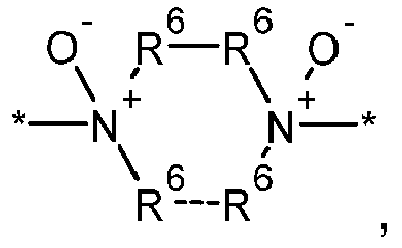
- Amin-N-oxid-Verbindung nach Anspruch 1, dadurch gekennzeichnet, dassR1 C6-C22-Alkyl ist; und/oderR2 aus C1-C22-Alkyl, C1-C22-Alkoxy und -CH2-N+(O-)R6R6 ausgewählt ist; und/oderR3 und R5 aus Wasserstoff und -CH2-N+(O-)R6R6 ausgewählt sind; und/oderR4 aus Wasserstoff, C1-C4-Alkyl und C1-C4-Alkoxy ausgewählt ist.
- Amin-N-oxid-Verbindung nach Anspruch 2, dadurch gekennzeichnet, dassR1 C8-C18-Alkyl ist; und/oderR2 aus C1-C18-Alkoxy und -CH2-N+(O-)R6R6 ausgewählt ist; und/oderR4 und R5 aus Wasserstoff und C1-C4-Alkyl ausgewählt sind.
- Amin-N-oxid-Verbindung nach Anspruch 2, dadurch gekennzeichnet, dassR1 C8-C18-Alkyl ist;R2 C1-C18-Alkoxy ist;einer von R3 und R5 Wasserstoff ist und der andere -CH2-N+(O-)R6R6 ist; undR4 C1-C4-Alkyl ist.
- Amin-N-oxid-Verbindung nach Anspruch 2, dadurch gekennzeichnet, dassR1 C8-C18-Alkyl ist;R2 C1-C18-Alkoxy ist;R3 und R5 jeweils Wasserstoff sind; undR4 C1-C4-Alkyl ist.
- Amin-N-oxid-Verbindung nach Anspruch 5, dadurch gekennzeichnet, dassR2 Methoxy ist; undR4 Ethyl oder Propyl ist.
- Amin-N-oxid-Verbindung nach Anspruch 2, dadurch gekennzeichnet, dassR1 C8-C18-Alkyl ist;R2 -CH2-N+(O-)R6R6 ist;R3 und R5 jeweils Wasserstoff sind; undR4 C1-C4-Alkyl ist.
- Amin-N-oxid-Verbindung nach einem der Ansprüche 1 bis 7, dadurch gekennzeichnet, dassdie Reste R6 jeweils unabhängig aus Methyl, Ethyl und Dimethylaminoethyl ausgewählt sind; und/oderzwei an dasselbe Stickstoffatom gebundene Reste R6 miteinander verbunden sind und zusammen mit dem Stickstoffatom eine der nachstehenden Gruppen bilden:
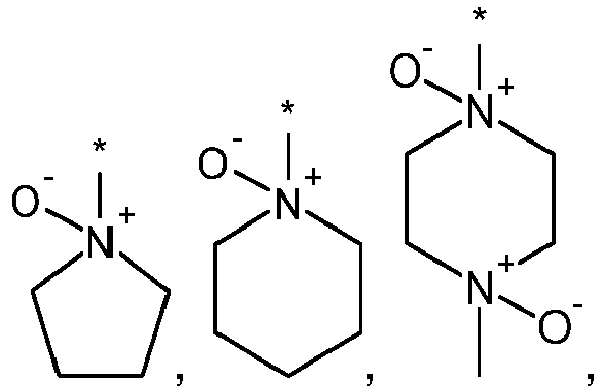 die Reste R6 jeweils Methyl sind und eine oder beide Methylgruppen einer Gruppierung -N+(O-)(CH3)2 mit einer oder beiden Methylgruppen einer solchen Gruppierung eines anderen Moleküls der Formel (I) verbunden sind und unter Ausbildung einer Brücke mit der Struktur
- Amin-N-oxid-Verbindung nach einem der Ansprüche 1 bis 8, dadurch gekennzeichnet, dass sie aus den folgenden Verbindungen ausgewählt ist:N,N-Dimethyl-1-(5-ethyl-3-methoxy-2-octyloxyphenyl)methanamin-N-oxid (1)
 N,N-Dimethyl-1-(2-decyloxy-5-ethyl-3-methoxyphenyl)methanamin-N-oxid (2)
 N,N-Dimethyl-1-(2-dodecyloxy-5-ethyl-3-methoxyphenyl)methanamin-N-oxid (3)
 N,N-Dimethyl-1-(5-ethyl-3-methoxy-2-tetradecyloxyphenyl)methanamin-N-oxid (4)
 N,N-Dimethyl-1-(5-ethyl-2-hexadecyloxy-3-methoxyphenyl)methanamin-N-oxid (5)
 N,N-Dimethyl-1-(5-ethyl-3-methoxy-2-octadecyloxyphenyl)methanamin-N-oxid (6)
 1-(2-Dodecyloxy-5-ethyl-3-methoxybenzyl)pyrrolidin-1-oxid (7)
 1-(2-Dodecyloxy-5-ethyl-3-methoxybenzyl)piperidin-1-oxid (8)
 1-(2-Dodecyloxy-5-ethyl-3-methoxybenzyl)-4-methylpiperazin-1,4-dioxid (9)
 N,N-Dimethyl-N'-(2-dodecyloxy-5-ethyl-3-methoxybenzyl)-N'-methylethan-1,2-diamin-di-N-oxid (10)
 1,1'-(2,3-Dioctyloxy-5-ethyl-1,4-phenylen)-bis(N,N-dimethylmethanamin-N-oxid) und 1,1'-(2,3-Dioctyloxy-5-ethyl-1,6-phenylen)-bis(N,N-dimethylmethanamin-N-oxid) (11)
 1,1'-(5-Ethyl-2-octyloxy-1,3-phenylen)-bis(N,N-dimethylmethanamin-N-oxid) (12)
 1,1'-(2-Dodecyloxy-5-ethyl-1,3-phenylen)-bis(N,N-dimethylmethanamin-N-oxid) (13)
 1,1'-(5-Ethyl-2-hexadecyloxy-1,3-phenylen)-bis(N,N-dimethylmethanamin-N-oxid) (14)
 1,1'-(5-Ethyl-2-octadecyloxy-1,3-phenylen)-bis(N,N-dimethylmethanamin-N-oxid) (15)
 1,4-Bis(5-ethyl-3-methoxy-2-octyloxybenzyl)piperazin-1,4-dioxid (16)
 1,4-Bis(2-dodecyloxy-5-ethyl-3-methoxybenzyl)piperazin-1,4-dioxid (17)

- Verfahren zur Herstellung einer Amin-N-oxid-Verbindung nach einem der Ansprüche 1 bis 9, das die folgenden Schritte umfasst:1) das Umsetzen eines Phenol-Derivats der nachstehenden Formel (III):
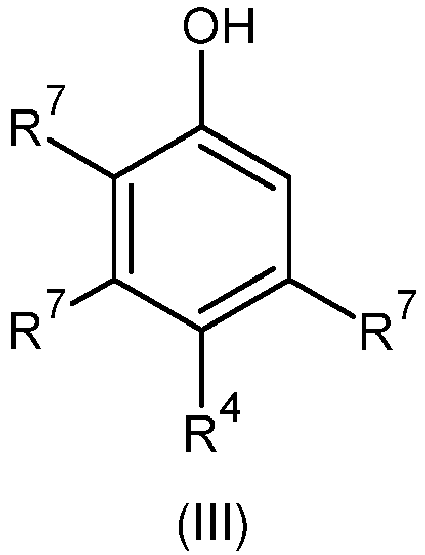 R4 aus Wasserstoff und R8 ausgewählt ist, wobei R8 für einen linearen, verzweigten oder zyklischen Kohlenwasserstoff-Rest mit 1 bis 26 Kohlenstoffatomen, in dem gegebenenfalls zumindest ein Kohlenstoffatom durch ein Sauerstoff- oder Schwefelatom ersetzt ist, steht, unddie R7 jeweils unabhängig aus Wasserstoff, Hydroxy und R8 ausgewählt sind,
mit einem sekundären Amin HNR6R6, worin die Reste R6 jeweils unabhängig aus gesättigten, linearen oder verzweigten Kohlenwasserstoff-Resten mit 1 bis 6 Kohlenstoffatomen, in denen gegebenenfalls zumindest ein Kohlenstoffatom durch ein Stickstoff-, Sauerstoff- oder Schwefelatom ersetzt ist, ausgewählt sind,wobei gegebenenfalls die beiden Reste R6 miteinander zu einem fünf- oder sechsgliedrigen stickstoffhältigen Ring verbunden sind oderwobei gegebenenfalls jeweils ein Rest R6 oder jeweils beide Reste R6 zweier Moleküle des sekundären Amins unter Ausbildung eines Dimers des sekundären Amins mit der Strukturworin die R7 jeweils unabhängig aus Wasserstoff, Hydroxy, R8 und in Formel (IV) auch aus -CH2-NR6R6 ausgewählt sind und die gestrichelte Linie eine optionale Bindung zwischen den beiden Resten R6 anzeigt;
mittels einer Aminoalkylierungsreaktion nach Betti/Mannich in Gegenwart von Formaldehyd in einem polaren Lösungsmittel, wodurch das Wasserstoffatom in ortho-Stellung zur phenolischen OH-Gruppe und gegebenenfalls ein weiteres substituierbares Wasserstoffatom R7 des Phenol-Derivats der Formel (II) durch eine Gruppierung -CH2-NR6R6 ersetzt wird/werden und eine entsprechende Betti-Base der Formel (IV) oder (V) erhalten wird: 2) das Umsetzen der (beiden) phenolischen OH-Gruppe(n) und gegebenenfalls weiterer freier OH-Gruppen R7 der jeweiligen Betti-Base der Formel (IV) oder (V) mit einer Verbindung der Formel R1-X, worin R1 aus linearen, verzweigten oder zyklischen Kohlenwasserstoff-Resten mit 4 bis 26 Kohlenstoffatomen, in denen gegebenenfalls zumindest ein Kohlenstoffatom durch ein Sauerstoff- oder Schwefelatom ersetzt ist, ausgewählt ist und X für eine aus Halogeniden und Sulfonaten ausgewählte Abgangsgruppe steht, mittels einer Veretherungsreaktion nach Williamson in Gegenwart einer Base in einem organischen Lösungsmittel oder ohne Lösungsmittel, wodurch ein entsprechender Ether der Formel (VI) oder (VII) erhalten wird:
 3) das Oxidieren jeglicher Aminogruppen -NR6R6 des jeweiligen Ethers der Formel (VI) oder (VII) durch Umsetzung mit einem Oxidationsmittel in Wasser, einem organischen Lösungsmittel oder einem Gemisch davon, wodurch die Amin-N-oxid-Verbindung der Formel (I) oder (II) erhalten wird:
- Verfahren nach Anspruch 10, dadurch gekennzeichnet, dass in Schritt 1) das Phenol-Derivat der Formel (III) mit jeweils 1,5 Äquivalenten des sekundären Amins und von Formaldehyd umgesetzt wird,
wobei die Reaktion gegebenenfalls in Wasser bei Raumtemperatur durchgeführt wird. - Verfahren nach Anspruch 10 oder 11, dadurch gekennzeichnet, dass in Schritt 2) jeweilseine Fest-Flüssig-Phasentransferreaktion unter Verwendung einer festen Base und in Gegenwart eines Phasentransfer-Katalysators durchgeführt wird; und/oderals Abgangsgruppe X das Chlorid oder Bromid eingesetzt wird; und/oder ein wasserfreies Lösungsmittel eingesetzt wird.
- Verfahren nach Anspruch 12, dadurch gekennzeichnet, dass in Schritt 2)als feste Base gepulverte KOH eingesetzt wird;als Phasentransfer-Katalysator Tetra-n-butylammoniumbromid (TBAB) eingesetzt wird;als Abgangsgruppe X das Bromid eingesetzt wird; undals Lösungsmittel wasserfreies 2-Methyltetrahydrofuran eingesetzt wird.
- Verfahren nach einem der Ansprüche 10 bis 13, dadurch gekennzeichnet, dass in Schritt 3)eine wässrige Lösung von H2O2 als Oxidationsmittel eingesetzt wird, wobei gegebenenfalls Ameisensäuremethylester als zusätzliches Lösungsmittel zugesetzt wird; und/oderder Ether der Formel (VI) oder (VII) mit 2,5 bis 3 Äquivalenten H2O2 umgesetzt wird.
- Verwendung einer Amin-N-oxid-Verbindung der Formel (I) oder (II) nach einem der Ansprüche 1 bis 9 oder hergestellt nach einem der Ansprüche 10 bis 14, bei der die Gesamtanzahl der Kohlenstoffatome der Reste R1 bis R5 zumindest 9 beträgt, als Tensid.
Priority Applications (11)
| Application Number | Priority Date | Filing Date | Title |
|---|---|---|---|
| EP21198124.6A EP4151624A1 (de) | 2021-09-21 | 2021-09-21 | Neue amin-n-oxid-verbindungen |
| JP2024518094A JP2024533634A (ja) | 2021-09-21 | 2022-09-21 | 新規なアミンn-オキシド化合物 |
| US18/693,845 US20240383840A1 (en) | 2021-09-21 | 2022-09-21 | Amine-n-oxide compounds |
| MX2024003467A MX2024003467A (es) | 2021-09-21 | 2022-09-21 | Compuestos de n-óxido de amina novedosos. |
| KR1020247012874A KR20240093484A (ko) | 2021-09-21 | 2022-09-21 | 신규 아민-n-옥사이드 화합물 |
| PCT/EP2022/076255 WO2023046768A1 (de) | 2021-09-21 | 2022-09-21 | Neue amin-n-oxid-verbindungen |
| AU2022351363A AU2022351363A1 (en) | 2021-09-21 | 2022-09-21 | Novel amine-n-oxide compounds |
| CA3232708A CA3232708A1 (en) | 2021-09-21 | 2022-09-21 | Novel amine-n-oxide compounds |
| IL311613A IL311613A (en) | 2021-09-21 | 2022-09-21 | Novel amine-n-oxide compounds |
| CN202280076991.4A CN118265694A (zh) | 2021-09-21 | 2022-09-21 | 新的胺-n-氧化物化合物 |
| ZA2024/02290A ZA202402290B (en) | 2021-09-21 | 2024-03-20 | Novel amine-n-oxide compounds |
Applications Claiming Priority (1)
| Application Number | Priority Date | Filing Date | Title |
|---|---|---|---|
| EP21198124.6A EP4151624A1 (de) | 2021-09-21 | 2021-09-21 | Neue amin-n-oxid-verbindungen |
Publications (1)
| Publication Number | Publication Date |
|---|---|
| EP4151624A1 true EP4151624A1 (de) | 2023-03-22 |
Family
ID=77897509
Family Applications (1)
| Application Number | Title | Priority Date | Filing Date |
|---|---|---|---|
| EP21198124.6A Pending EP4151624A1 (de) | 2021-09-21 | 2021-09-21 | Neue amin-n-oxid-verbindungen |
Country Status (11)
| Country | Link |
|---|---|
| US (1) | US20240383840A1 (de) |
| EP (1) | EP4151624A1 (de) |
| JP (1) | JP2024533634A (de) |
| KR (1) | KR20240093484A (de) |
| CN (1) | CN118265694A (de) |
| AU (1) | AU2022351363A1 (de) |
| CA (1) | CA3232708A1 (de) |
| IL (1) | IL311613A (de) |
| MX (1) | MX2024003467A (de) |
| WO (1) | WO2023046768A1 (de) |
| ZA (1) | ZA202402290B (de) |
Family Cites Families (5)
| Publication number | Priority date | Publication date | Assignee | Title |
|---|---|---|---|---|
| GB0512751D0 (en) * | 2005-06-22 | 2005-07-27 | Glaxo Group Ltd | New adjuvant |
| GB0611654D0 (en) * | 2006-06-13 | 2006-07-19 | Medivir Ab | Compounds |
| CN106565869B (zh) * | 2016-11-10 | 2018-08-28 | 万华化学集团股份有限公司 | 一种固体超强酸及其制备方法和用途 |
| CN107349870B (zh) * | 2017-06-22 | 2019-01-04 | 华中师范大学 | 油类火灾含氟灭火剂和液烃抑蒸剂及其制备方法与应用 |
| CN112812076B (zh) * | 2021-01-13 | 2022-02-01 | 西南石油大学 | 一种双磺酸基表面活性剂、清洁压裂液及其制备方法 |
-
2021
- 2021-09-21 EP EP21198124.6A patent/EP4151624A1/de active Pending
-
2022
- 2022-09-21 AU AU2022351363A patent/AU2022351363A1/en active Pending
- 2022-09-21 WO PCT/EP2022/076255 patent/WO2023046768A1/de not_active Ceased
- 2022-09-21 US US18/693,845 patent/US20240383840A1/en active Pending
- 2022-09-21 MX MX2024003467A patent/MX2024003467A/es unknown
- 2022-09-21 CN CN202280076991.4A patent/CN118265694A/zh active Pending
- 2022-09-21 IL IL311613A patent/IL311613A/en unknown
- 2022-09-21 KR KR1020247012874A patent/KR20240093484A/ko active Pending
- 2022-09-21 CA CA3232708A patent/CA3232708A1/en active Pending
- 2022-09-21 JP JP2024518094A patent/JP2024533634A/ja active Pending
-
2024
- 2024-03-20 ZA ZA2024/02290A patent/ZA202402290B/en unknown
Non-Patent Citations (2)
| Title |
|---|
| CESARETTI A. ET AL: "Inclusion of push-pull N-methylpyridinium salts within surfactant hydrogels: is their excited state intramolecular charge transfer mediated by twisting?", PHYSICAL CHEMISTRY CHEMICAL PHYSICS, vol. 17, no. 26, 2015, pages 17214 - 17220, XP055896744, ISSN: 1463-9076, DOI: 10.1039/C5CP01639H * |
| GABRIELE FRANCESCO ET AL: "Effect of Surfactant Structure on the Superactivity of Candida rugosa Lipase", LANGMUIR, vol. 34, no. 38, 28 August 2018 (2018-08-28), US, pages 11510 - 11517, XP055896749, ISSN: 0743-7463, DOI: 10.1021/acs.langmuir.8b02255 * |
Also Published As
| Publication number | Publication date |
|---|---|
| IL311613A (en) | 2024-05-01 |
| ZA202402290B (en) | 2024-12-18 |
| CN118265694A (zh) | 2024-06-28 |
| JP2024533634A (ja) | 2024-09-12 |
| KR20240093484A (ko) | 2024-06-24 |
| AU2022351363A1 (en) | 2024-04-11 |
| US20240383840A1 (en) | 2024-11-21 |
| CA3232708A1 (en) | 2023-03-30 |
| MX2024003467A (es) | 2024-06-05 |
| WO2023046768A1 (de) | 2023-03-30 |
Similar Documents
| Publication | Publication Date | Title |
|---|---|---|
| DE60205624T2 (de) | Methoden zur herstellung von im wesentlichen monodispersen polymermischungen mit polyethylenglykoleinheiten | |
| DE2610254A1 (de) | Verfahren zur oxydation von beta- aethylenischen ketonen | |
| CH691124A5 (de) | Verfahren zur Herstellung von Fluvoxamin-Maleat. | |
| EP0091011A2 (de) | Verfahren zur Herstellung von Phenyläthern | |
| WO2023046768A1 (de) | Neue amin-n-oxid-verbindungen | |
| DE2759964C2 (de) | 2,6-Dimethoxy-4-(quaternäre-alkyl)phenyl-disubstituierte-phosphate und Verfahren zu ihrer Herstellung | |
| EP4151625A1 (de) | Neue sulfonat-verbindungen | |
| DE2061538C3 (de) | Verfahren zur Herstellung von Kobalt (III)-bis-salicylaldehydäthylendiiminat -Komplexen | |
| DE69302036T2 (de) | Verfahren zur Darstellung von o-Hydroxymandelsäure und ihren Salzen | |
| EP0227057B1 (de) | Verfahren zur Herstellung von in 1-Stellung durch aromatische oder heterocyclische Reste substituierten Alkanolen | |
| DE10160721A1 (de) | Verfahren zur Herstellung von Deoxybenzoinen | |
| DE102005058206B4 (de) | N-heterozyklische Carbenkomplexe des Platins und des Palladiums und deren Verwendung | |
| DE2044854C3 (de) | Verfahren zur Herstellung von CC-ungesättigten organischen Verbindungen durch Zersetzen der Xanthogenatester von entsprechenden Alkoholen | |
| DE1925299A1 (de) | Verfahren zur Herstellung von substituierten Hydrochinonen | |
| WO2001096277A1 (de) | Verfahren zur herstellung von 2,3,4,6-tetramethylmandelsäure und 2,3,4,6-tetramethylmandelsäureacetat | |
| DE2703640A1 (de) | Verfahren zur herstellung von aromatischen methylendioxy-verbindungen | |
| EP0025182B1 (de) | 3-Methyl-1,4-dioxa-bicyclo(4.4.0)decan-2-on, dessen Herstellung und Verwendung als Riechstoff sowie dieses enthaltende Riechstoffkompositionen | |
| EP0773211B1 (de) | Verfahren zur Herstellung von primären Octadienylaminen | |
| EP0937018A1 (de) | Verfahren zur herstellung von 2-methyl-4-(2,2,3-trimethyl-cyclopent-3-en-1-yl)-but-2-en-1-ol | |
| DE2413189C2 (de) | Verfahren zur Herstellung von Benzohydrochinonen | |
| DE1470171C (de) | Verfahren zur Herstellung von Dioxo oetahydroanthracendenvaten Ausscheidung aus 1480150 | |
| DD151161A5 (de) | Verfahren zur herstellung von 2,2-dialkyl-4-methyl-5,5-dialkyl-3-formyl-3-pyrrolin | |
| DE3536107A1 (de) | Tert.-octhylhydrazin, seine salze und derivate | |
| DE3206129A1 (de) | Fluorbenzophenonderivat, verfahren zu seiner herstellung und seine verwendung | |
| EP1282608A1 (de) | Herstellung von 2-ethyl-3-methyl-1,4-diazin |
Legal Events
| Date | Code | Title | Description |
|---|---|---|---|
| PUAI | Public reference made under article 153(3) epc to a published international application that has entered the european phase |
Free format text: ORIGINAL CODE: 0009012 |
|
| STAA | Information on the status of an ep patent application or granted ep patent |
Free format text: STATUS: THE APPLICATION HAS BEEN PUBLISHED |
|
| AK | Designated contracting states |
Kind code of ref document: A1 Designated state(s): AL AT BE BG CH CY CZ DE DK EE ES FI FR GB GR HR HU IE IS IT LI LT LU LV MC MK MT NL NO PL PT RO RS SE SI SK SM TR |
|
| STAA | Information on the status of an ep patent application or granted ep patent |
Free format text: STATUS: REQUEST FOR EXAMINATION WAS MADE |
|
| 17P | Request for examination filed |
Effective date: 20230922 |
|
| RBV | Designated contracting states (corrected) |
Designated state(s): AL AT BE BG CH CY CZ DE DK EE ES FI FR GB GR HR HU IE IS IT LI LT LU LV MC MK MT NL NO PL PT RO RS SE SI SK SM TR |