EP4151304A1 - Hohlfasermembranmodul und verfahren zur entfernung von endotoxinen - Google Patents
Hohlfasermembranmodul und verfahren zur entfernung von endotoxinen Download PDFInfo
- Publication number
- EP4151304A1 EP4151304A1 EP21803547.5A EP21803547A EP4151304A1 EP 4151304 A1 EP4151304 A1 EP 4151304A1 EP 21803547 A EP21803547 A EP 21803547A EP 4151304 A1 EP4151304 A1 EP 4151304A1
- Authority
- EP
- European Patent Office
- Prior art keywords
- hollow fiber
- fiber membrane
- endotoxins
- solution
- membrane module
- Prior art date
- Legal status (The legal status is an assumption and is not a legal conclusion. Google has not performed a legal analysis and makes no representation as to the accuracy of the status listed.)
- Pending
Links
Images




Classifications
-
- A—HUMAN NECESSITIES
- A61—MEDICAL OR VETERINARY SCIENCE; HYGIENE
- A61M—DEVICES FOR INTRODUCING MEDIA INTO, OR ONTO, THE BODY; DEVICES FOR TRANSDUCING BODY MEDIA OR FOR TAKING MEDIA FROM THE BODY; DEVICES FOR PRODUCING OR ENDING SLEEP OR STUPOR
- A61M1/00—Suction or pumping devices for medical purposes; Devices for carrying-off, for treatment of, or for carrying-over, body-liquids; Drainage systems
- A61M1/14—Dialysis systems; Artificial kidneys; Blood oxygenators ; Reciprocating systems for treatment of body fluids, e.g. single needle systems for hemofiltration or pheresis
- A61M1/16—Dialysis systems; Artificial kidneys; Blood oxygenators ; Reciprocating systems for treatment of body fluids, e.g. single needle systems for hemofiltration or pheresis with membranes
- A61M1/1621—Constructional aspects thereof
-
- A—HUMAN NECESSITIES
- A61—MEDICAL OR VETERINARY SCIENCE; HYGIENE
- A61M—DEVICES FOR INTRODUCING MEDIA INTO, OR ONTO, THE BODY; DEVICES FOR TRANSDUCING BODY MEDIA OR FOR TAKING MEDIA FROM THE BODY; DEVICES FOR PRODUCING OR ENDING SLEEP OR STUPOR
- A61M1/00—Suction or pumping devices for medical purposes; Devices for carrying-off, for treatment of, or for carrying-over, body-liquids; Drainage systems
- A61M1/34—Filtering material out of the blood by passing it through a membrane, i.e. hemofiltration or diafiltration
-
- B—PERFORMING OPERATIONS; TRANSPORTING
- B01—PHYSICAL OR CHEMICAL PROCESSES OR APPARATUS IN GENERAL
- B01D—SEPARATION
- B01D61/00—Processes of separation using semi-permeable membranes, e.g. dialysis, osmosis or ultrafiltration; Apparatus, accessories or auxiliary operations specially adapted therefor
- B01D61/24—Dialysis ; Membrane extraction
-
- B—PERFORMING OPERATIONS; TRANSPORTING
- B01—PHYSICAL OR CHEMICAL PROCESSES OR APPARATUS IN GENERAL
- B01D—SEPARATION
- B01D61/00—Processes of separation using semi-permeable membranes, e.g. dialysis, osmosis or ultrafiltration; Apparatus, accessories or auxiliary operations specially adapted therefor
- B01D61/24—Dialysis ; Membrane extraction
- B01D61/243—Dialysis
-
- B—PERFORMING OPERATIONS; TRANSPORTING
- B01—PHYSICAL OR CHEMICAL PROCESSES OR APPARATUS IN GENERAL
- B01D—SEPARATION
- B01D63/00—Apparatus in general for separation processes using semi-permeable membranes
- B01D63/02—Hollow fibre modules
- B01D63/031—Two or more types of hollow fibres within one bundle or within one potting or tube-sheet
-
- B—PERFORMING OPERATIONS; TRANSPORTING
- B01—PHYSICAL OR CHEMICAL PROCESSES OR APPARATUS IN GENERAL
- B01D—SEPARATION
- B01D69/00—Semi-permeable membranes for separation processes or apparatus characterised by their form, structure or properties; Manufacturing processes specially adapted therefor
- B01D69/02—Semi-permeable membranes for separation processes or apparatus characterised by their form, structure or properties; Manufacturing processes specially adapted therefor characterised by their properties
-
- B—PERFORMING OPERATIONS; TRANSPORTING
- B01—PHYSICAL OR CHEMICAL PROCESSES OR APPARATUS IN GENERAL
- B01D—SEPARATION
- B01D69/00—Semi-permeable membranes for separation processes or apparatus characterised by their form, structure or properties; Manufacturing processes specially adapted therefor
- B01D69/08—Hollow fibre membranes
-
- B—PERFORMING OPERATIONS; TRANSPORTING
- B01—PHYSICAL OR CHEMICAL PROCESSES OR APPARATUS IN GENERAL
- B01D—SEPARATION
- B01D71/00—Semi-permeable membranes for separation processes or apparatus characterised by the material; Manufacturing processes specially adapted therefor
- B01D71/06—Organic material
- B01D71/48—Polyesters
- B01D71/481—Polyarylates
-
- B—PERFORMING OPERATIONS; TRANSPORTING
- B01—PHYSICAL OR CHEMICAL PROCESSES OR APPARATUS IN GENERAL
- B01J—CHEMICAL OR PHYSICAL PROCESSES, e.g. CATALYSIS OR COLLOID CHEMISTRY; THEIR RELEVANT APPARATUS
- B01J20/00—Solid sorbent compositions or filter aid compositions; Sorbents for chromatography; Processes for preparing, regenerating or reactivating thereof
- B01J20/22—Solid sorbent compositions or filter aid compositions; Sorbents for chromatography; Processes for preparing, regenerating or reactivating thereof comprising organic material
- B01J20/26—Synthetic macromolecular compounds
- B01J20/264—Synthetic macromolecular compounds derived from different types of monomers, e.g. linear or branched copolymers, block copolymers, graft copolymers
-
- B—PERFORMING OPERATIONS; TRANSPORTING
- B01—PHYSICAL OR CHEMICAL PROCESSES OR APPARATUS IN GENERAL
- B01J—CHEMICAL OR PHYSICAL PROCESSES, e.g. CATALYSIS OR COLLOID CHEMISTRY; THEIR RELEVANT APPARATUS
- B01J20/00—Solid sorbent compositions or filter aid compositions; Sorbents for chromatography; Processes for preparing, regenerating or reactivating thereof
- B01J20/28—Solid sorbent compositions or filter aid compositions; Sorbents for chromatography; Processes for preparing, regenerating or reactivating thereof characterised by their form or physical properties
- B01J20/28002—Solid sorbent compositions or filter aid compositions; Sorbents for chromatography; Processes for preparing, regenerating or reactivating thereof characterised by their form or physical properties characterised by their physical properties
- B01J20/28011—Other properties, e.g. density, crush strength
-
- B—PERFORMING OPERATIONS; TRANSPORTING
- B01—PHYSICAL OR CHEMICAL PROCESSES OR APPARATUS IN GENERAL
- B01J—CHEMICAL OR PHYSICAL PROCESSES, e.g. CATALYSIS OR COLLOID CHEMISTRY; THEIR RELEVANT APPARATUS
- B01J20/00—Solid sorbent compositions or filter aid compositions; Sorbents for chromatography; Processes for preparing, regenerating or reactivating thereof
- B01J20/28—Solid sorbent compositions or filter aid compositions; Sorbents for chromatography; Processes for preparing, regenerating or reactivating thereof characterised by their form or physical properties
- B01J20/28014—Solid sorbent compositions or filter aid compositions; Sorbents for chromatography; Processes for preparing, regenerating or reactivating thereof characterised by their form or physical properties characterised by their form
- B01J20/28033—Membrane, sheet, cloth, pad, lamellar or mat
- B01J20/28038—Membranes or mats made from fibers or filaments
-
- B—PERFORMING OPERATIONS; TRANSPORTING
- B01—PHYSICAL OR CHEMICAL PROCESSES OR APPARATUS IN GENERAL
- B01J—CHEMICAL OR PHYSICAL PROCESSES, e.g. CATALYSIS OR COLLOID CHEMISTRY; THEIR RELEVANT APPARATUS
- B01J20/00—Solid sorbent compositions or filter aid compositions; Sorbents for chromatography; Processes for preparing, regenerating or reactivating thereof
- B01J20/28—Solid sorbent compositions or filter aid compositions; Sorbents for chromatography; Processes for preparing, regenerating or reactivating thereof characterised by their form or physical properties
- B01J20/28014—Solid sorbent compositions or filter aid compositions; Sorbents for chromatography; Processes for preparing, regenerating or reactivating thereof characterised by their form or physical properties characterised by their form
- B01J20/28052—Several layers of identical or different sorbents stacked in a housing, e.g. in a column
-
- A—HUMAN NECESSITIES
- A61—MEDICAL OR VETERINARY SCIENCE; HYGIENE
- A61M—DEVICES FOR INTRODUCING MEDIA INTO, OR ONTO, THE BODY; DEVICES FOR TRANSDUCING BODY MEDIA OR FOR TAKING MEDIA FROM THE BODY; DEVICES FOR PRODUCING OR ENDING SLEEP OR STUPOR
- A61M2202/00—Special media to be introduced, removed or treated
- A61M2202/04—Liquids
- A61M2202/0413—Blood
-
- B—PERFORMING OPERATIONS; TRANSPORTING
- B01—PHYSICAL OR CHEMICAL PROCESSES OR APPARATUS IN GENERAL
- B01D—SEPARATION
- B01D2319/00—Membrane assemblies within one housing
- B01D2319/06—Use of membranes of different materials or properties within one module
-
- B—PERFORMING OPERATIONS; TRANSPORTING
- B01—PHYSICAL OR CHEMICAL PROCESSES OR APPARATUS IN GENERAL
- B01D—SEPARATION
- B01D2325/00—Details relating to properties of membranes
- B01D2325/20—Specific permeability or cut-off range
-
- B—PERFORMING OPERATIONS; TRANSPORTING
- B01—PHYSICAL OR CHEMICAL PROCESSES OR APPARATUS IN GENERAL
- B01D—SEPARATION
- B01D2325/00—Details relating to properties of membranes
- B01D2325/34—Molecular weight or degree of polymerisation
-
- B—PERFORMING OPERATIONS; TRANSPORTING
- B01—PHYSICAL OR CHEMICAL PROCESSES OR APPARATUS IN GENERAL
- B01D—SEPARATION
- B01D71/00—Semi-permeable membranes for separation processes or apparatus characterised by the material; Manufacturing processes specially adapted therefor
- B01D71/06—Organic material
- B01D71/66—Polymers having sulfur in the main chain, with or without nitrogen, oxygen or carbon only
- B01D71/68—Polysulfones; Polyethersulfones
Definitions
- the present invention relates to hollow fiber membrane modules and a method for removing endotoxins.
- Endotoxins are one of inflammation-inducing substances represented by pathogen-associated molecular patterns (PAMPs).
- PAMPs pathogen-associated molecular patterns
- a method is known that adsorbs and removes endotoxins by bringing blood to come into contact directly with an immobilized polymyxin molded article in which an endotoxin adsorbent such as polymyxin B is immobilized on a carrier (see, for example, Patent Literature 1).
- Patent Literature 1 Japanese Unexamined Patent Application Publication NO. S61-135674
- a purpose of the present invention is to provide a more practical endotoxin removal technology.
- This hollow fiber membrane module includes: a first hollow fiber membrane whose sieving coefficient for dextran having a molecular weight of not less than 300 kDa nor more than 1000 kDa is not less than 0.12 nor more than 0.28, wherein the first hollow fiber membrane adsorbs endotoxins.
- Another embodiment of the present invention is a method for removing endotoxins.
- This method for removing endotoxins includes bringing the hollow fiber membrane module according to any one of the embodiments to come into contact with the endotoxins.
- the present invention can provide a more practical endotoxin removal technology.
- This hollow fiber membrane module includes: a first hollow fiber membrane whose sieving coefficient for dextran having a molecular weight of not less than 300 kDa nor more than 1000 kDa is not less than 0.12 nor more than 0.28, wherein the first hollow fiber membrane adsorbs endotoxins.
- the first hollow fiber membrane may adsorb the endotoxins in the blood.
- the first hollow fiber membrane may be composed of polyester polymer alloy membrane containing a polyarylate resin having repeating units represented by the following chemical formula (1) and a polyethersulfone resin having repeating units represented by the following chemical formula (2) or (3): where, in the chemical formula (1), R1 and R2 are lower alkyl groups having 1 to 5 carbons, and R1 and R2 may be identical or different from each other; where, in the chemical formula (2), R3 and R4 are lower alkyl groups having 1 to 5 carbons, and R3 and R4 may be identical or different from each other; and
- the hollow fiber membrane module may include: a second hollow fiber membrane whose sieving coefficient for dextran having a molecular weight of not less than 20 kDa nor more than 30 kDa is not less than 0.64 nor more than 0.80, wherein the second hollow fiber membrane may adsorb interleukins 6.
- Another embodiment of the present invention is a method for removing endotoxins.
- This method for removing endotoxins includes bringing the hollow fiber membrane module according to any one of the embodiments to come into contact with the endotoxins.
- FIG. 1 is a cross-sectional view of a hollow fiber membrane module according to an embodiment.
- a hollow fiber membrane module 1 of the present embodiment takes, for example, a form similar to that of a dialyzer for hemodialysis (HD); however, the form is not limited to this form.
- the hollow fiber membrane module 1 includes a column 2, a hollow fiber membrane bundle 4, a sealing member 6, a first header 8, and a second header 10.
- the column 2 is a cylindrical container that houses the hollow fiber membrane bundle 4.
- the column 2 is made of resin such as polycarbonate, for example.
- the column 2 has openings at the respective ends in the longitudinal direction.
- the column 2 has a dialysate discharge port 12 and a dialysate introduction port 14 protruding radially from the cylinder near both ends in the longitudinal direction.
- a dialysate is supplied into the column 2 from the outside via the dialysate introduction port 14 and is then discharged to the outside from the inside of the column 2 via the dialysate discharge port 12.
- HF hemofiltration
- the hollow fiber membrane bundle 4 has a structure consisting of a plurality of hollow fiber membranes 16 bundled together. Each hollow fiber membrane 16 extends approximately parallel to the longitudinal direction of the column 2. The openings at the respective ends of each hollow fiber membrane 16 are open, and blood flows from one opening to the other. The configuration of the hollow fiber membranes 16 will be explained in detail later.
- the sealing member 6, also called potting material, is composed of a thermosetting resin such as polyurethane, phenolic resin, epoxy resin, etc.
- the sealing member 6 fills gaps between the plurality of hollow fiber membranes 16 at each end of the hollow fiber membrane bundle 4.
- the sealing member 6 is also fixed to the inner surface of the column 2 at each end. This causes the hollow fiber membrane bundle 4 to be fixed to the column 2 and the respective openings at both ends of the column 2 to be sealed.
- the first header 8 is attached to one end of the column 2 and seals the opening at one end.
- the second header 10 is attached to the other end of the column 2 and seals the opening at the other end.
- the first header 8 has a blood introduction port 18 that connects the inside and outside of the column 2.
- the second header 10 has a blood discharge port 20 that connects the inside and outside of the column 2.
- a tube for removing blood from a patient is connected to the blood introduction port 18, and a tube for returning blood to the patient is connected to the blood discharge port 20.
- Blood removed from the patient is supplied into the column 2 via the blood introduction port 18.
- the blood supplied into the column 2 flows through each of the hollow fiber membranes 16 and moves toward the blood discharge port 20.
- material exchange occurs through the hollow fiber membranes 16 between the blood flowing inside the hollow fiber membranes 16 and the dialysate flowing outside the hollow fiber membranes 16.
- the blood that has passed through the hollow fiber membranes 16 is discharged to the outside of the column 2 through the blood discharge port 20 and returned to the patient.
- Each hollow fiber membranes 16 is composed of a hydrophobic polymer porous semipermeable membrane that is mainly composed of polysulfone resin and polyester resin.
- Each hollow fiber membrane 16 is a thin tube having a thickness of 5 to 150 um and a circular cross section whose inner diameter of about 100 to 500 ⁇ m.
- the hollow fiber membranes 16 according to the present embodiment are composed of polyester polymer alloy (PEPA) membranes containing a polyarylate resin having repeating units represented by the following chemical formula (1) and a polyethersulfone resin having repeating units represented by the following chemical formula (2) or (3).
- PEPA polyester polymer alloy
- the indication of the phthalic acid moiety in chemical formula (1) means that the arrangement of two carboxyl groups relative to a benzene ring does not matter. For example, a structure in which two carboxyl groups are bonded to a benzene ring in a meta position with respect to each other (i.e., isophthalic acid) or in a para-position with respect to each other (i.e., terephthalic acid) is included.
- R1 and R2 are lower alkyl groups having 1 to 5 carbons, and R1 and R2 may be identical or different from each other.
- R3 and R4 are lower alkyl groups having 1 to 5 carbons, and R3 and R4 may be identical or different from each other.
- FIG. 2 is a schematic diagram for explaining the principle of removing target substances T by a hollow fiber membrane 16.
- the hollow fiber membrane 16 has pores 22 with diameters corresponding to the size of the target substances T and removes the target substances T by adsorption.
- the target substances T contained in blood flowing inside the hollow fiber membrane 16 flow toward the outside of the hollow fiber membrane 16 and enter the pores 22. Due to van der Waals forces and hydrophobic interactions that occur between the target substances T and the inner surfaces of the pores 22, the target substances T that have entered the pores 22 adhere to the inner wall surfaces. Thereby, the target substances T are efficiently collected.
- the hollow fiber membrane module 1 includes a first hollow fiber membrane 16a and a second hollow fiber membrane 16b. Both the first hollow fiber membrane 16a and the second hollow fiber membrane 16b are composed of the above-mentioned PEPA membranes.
- FIG. 3A is a scanning electron micrograph of the first hollow fiber membrane 16a.
- FIG. 3B is a scanning electron micrograph of the second hollow fiber membrane 16b.
- the first hollow fiber membrane 16a has a plurality of first pores 22a.
- the second hollow fiber membrane 16b has a plurality of second pores 22b.
- the target substances T in the hollow fiber membrane module 1 are endotoxins and interleukins 6.
- the interleukins 6 are hereafter denoted as IL-6, as appropriate.
- the first hollow fiber membrane 16a adsorbs endotoxins by means of the first pores 22a. Endotoxins have hydrophilic and hydrophobic segments and have a micellar structure in aqueous solution. The apparent molecular weight of the endotoxins having a micellar structure is not less than 300 kDa nor more than 1,000 kDa.
- the first hollow fiber membrane 16a has first pores 22a with diameters that correspond to this molecular weight.
- the second hollow fiber membrane 16b adsorbs IL-6 by means of the second pores 22b.
- IL-6 is a type of inflammatory cytokine.
- the molecular weight of IL-6 is not less than 20 kDa nor more than 30 kDa.
- the second hollow fiber membrane 16b has second pores 22a with diameters that correspond to this molecular weight.
- the first hollow fiber membrane 16a has a sieving coefficient of not less than 0.12 nor more than 0.28 for dextran having a molecular weight of not less than 300 kDa nor more than 1000 kDa. This sieving coefficient is realized when the first hollow fiber membrane 16a has the first pores 22a.
- the second hollow fiber membrane 16b has a sieving coefficient of not less than 0.64 nor more than 0.80 for dextran having a molecular weight of not less than 20 kDa nor more than 30 kDa. This sieving coefficient is realized when the second hollow fiber membrane 16b has the second pores 22b.
- the first hollow fiber membrane 16a in the present embodiment comes in contact with blood and adsorbs endotoxins in the blood.
- the second hollow fiber membrane 16b also comes in contact with blood and adsorbs IL-6 in the blood.
- the hollow fiber membrane module 1 allows for efficient collection of the endotoxins and IL-6 so as to purify blood.
- the first and second hollow fiber membranes 16a and 16b can be produced as follows.
- a composite resin containing a polyarylate resin represented by the above chemical formula (1) and a polyethersulfone resin represented by the above chemical formula (2) or (3) is dissolved in a predetermined organic solvent to prepare a spinning dope.
- the mass ratio of the polyarylate resin to the polyethersulfone resin is, for example, 2:1 to 1:2 for both the first and second hollow fiber membranes 16a and 16b.
- the organic solvent is not particularly limited as long as the organic solvent can dissolve a polyarylate resin and a polyethersulfone resin.
- Examples include, e.g., tetrahydrofuran, dioxane, dimethylformamide, dimethylacetamide, N-methyl-2-pyrrolidone, etc.
- the mass ratio of the composite resin to the organic solvent is, for example, 0.5:9.5 to 3:7.
- the temperature at which the composite resin is dissolved in the organic solvent is, for example, not less than 30 degrees Celsius nor more than 100 degrees Celsius.
- a first hollow fiber membrane 16a and a second hollow fiber membrane 16b are formed.
- the internal coagulation liquid and the external coagulation liquid are both mixtures of water and an organic solvent.
- the mixing ratio of water and the organic solvent in the internal coagulation liquid and in the external coagulation liquid is, for example, 4:6 to 7:3.
- the sieving coefficient of the hollow fiber membranes with respect to the solute can be adjusted by changing the mixing ratio of water and the organic solvent in the internal coagulation liquid.
- a hollow fiber membrane module 1 filled with three types of hollow fiber membranes 16 with different permeability properties was prepared.
- Each hollow fiber membrane 16 was prepared according to the procedure described above.
- the three hollow fiber membranes 16 are respectively referred to as PEPA-A, PEPA-B, and PEPA-C.
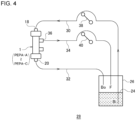
- FIG. 4 is a schematic diagram of a circulator used in a test.
- dextran solution 24 various types were first mixed and diluted to 500 mL with distilled water so as to prepare a dextran solution 24. This solution was dispensed into a container 26 with a volume of 100 mL and used for the test.
- dextran 0.125 g of dextran with a mass average molecular weight of 9,000-11,000 (model D9260 manufactured by Sigma-Aldrich), 0.125 g of dextran with a mass average molecular weight of 35,000-45,000 (model D1662 manufactured by Sigma-Aldrich), 0.5 g of dextran with a mass average molecular weight of 150,000 (model D4876 manufactured by Sigma-Aldrich), and 0.75 g of dextran with a mass average molecular weight of 180,000-210,000 (model 043-22611 manufactured by FUJIFILM Wako Pure Chemical Corporation) were used.
- a circulation process of repeatedly letting the dextran solution 24 flow to PEPA-A through PEPA-C was carried out using a circulator 28 shown in FIG. 4 .
- "Bi" indicates an inlet for the solution
- "Bo” indicates an outlet for the solution
- "F” indicates an outlet for filtrate.
- a solution inlet Bi is located at one end of a solution inlet channel 30 and is connected to the container 26.
- the other end of the solution inlet channel 30 is connected to a blood introduction port 18 of the hollow fiber membrane module 1.
- PEPA-A through PEPA-C are used, each of which is housed separately.
- a solution outlet Bo is located at one end of a solution outlet channel 32 and is connected to the container 26.
- the other end of the solution outlet channel 32 is connected to a blood discharge port 20 of each hollow fiber membrane module 1.
- a filtrate outlet F is located at one end of a filtrate channel 34 and is connected to the container 26.
- the other end of the filtrate channel 34 is connected to a filtrate discharge port 36 of the hollow fiber membrane module 1.
- An introduction pump 38 is provided in the solution inlet channel 30.
- a discharge pump 40 is provided in the filtrate channel 34.
- the introduction pump 38 is driven, the dextran solution 24 in the container 26 flows through the solution inlet channel 30 and the blood introduction port 18 from the solution inlet Bi and flows into the hollow fiber membrane module 1.
- the dextran solution 24 that has flown into the hollow fiber membrane module 1 passes through the hollow fiber membranes 16 and then through the blood discharge port 20 and the solution outlet channel 32 and returns from the solution outlet port Bo to the container 26.
- the discharge pump 40 is driven, some of the dextran solution 24 passing through the inside of the hollow fiber membranes 16 moves from the inside of the hollow fiber membranes 16 to the outside of the hollow fiber membranes 16.
- the dextran solution 24 that has moved to the outside of the hollow fiber membranes 16 passes through the filtrate discharge port 36 and the filtrate channel 34 and returns to the container 26 through the filtrate outlet F.
- the introduction pump 38 was driven such that the flow rate of the dextran solution 24 in the solution inlet channel 30 was 1.0 mL/min, and the discharge pump 40 was driven such that the flow rate of the filtrate in the filtrate channel 34 was 0.1 mL/min. After two hours had elapsed from the start of driving each pump, the solution passing through each of the solution inlet Bi, the solution outlet Bo, and the filtrate outlet F was sampled.
- the molecular weight of dextran contained in each sampled solution was measured by high performance liquid chromatography (HPLC).
- HPLC high performance liquid chromatography
- the high performance liquid chromatography was performed using a 2695 separation module (manufactured by Waters), a 2414 differential refractive index detector (manufactured by Waters), and two separation columns GF-710HQ (manufactured by Shodex).
- the measurement conditions were as follows: flow rate of 0.6 mL/min, a column temperature of 40 degrees Celsius, an injection volume of 100 uL, and a measurement time of 60 minutes.
- the two separation columns were connected in series.
- the sieving coefficient can be calculated using the following mathematical formula (3).
- CF represents the refractive index intensity of a sample taken at the filtrate outlet F.
- CBi represents the refractive index intensity of a sample taken at the solution inlet Bi.
- CBo represents the refractive index intensity of a sample taken at the solution outlet Bo.
- SC 2 CF / CBi + CBo
- FIG. 5A shows the molecular weight cut off curves of the respective hollow fiber membranes.
- FIG. 5B shows the sieving coefficients of the respective hollow fiber membranes in the molecular weight range of endotoxins and the molecular weight range of IL-6.
- the sieving coefficient of PEPA-A in the molecular weight range of the endotoxins was not less than 0.12 nor more than 0.28.
- the sieving coefficient of PEPA-C in the molecular weight range of IL-6 was not less than 0.64 nor more than 0.80. Therefore, PEPA-A corresponds to the first hollow fiber membrane 16a, and PEPA-C corresponds to the second hollow fiber membrane 16b.
- endotoxins 1,000 EU/mL
- 20 mL of pyrogen-free water model H20CC0124, manufactured by Merck
- an endotoxin standard 10,000 EU/mL, manufactured by Pharmaceutical and Medical Device Regulatory Science Society of Japan
- the prepared endotoxin solution was put in a dry heat sterilized glass container.
- several glass containers containing 20 mL of the endotoxin solution were prepared.
- a circulation process of repeatedly letting the endotoxin solution flow to PEPA-A through PEPA-C was carried out using the circulator 28 shown in FIG. 4 .
- the container 26 the above-described glass container containing 20 mL of the endotoxin solution was used. An autoclavesterilized silicone tube was used for each channel. PEPA-A through PEPA-C were gamma-sterilized for use.
- the introduction pump 38 was driven such that the flow rate of the endotoxin solution in the solution inlet channel 30 was 1.0 mL/min, and the discharge pump 40 was driven such that the flow rate of the filtrate in the filtrate channel 34 was 0.1 mL/min.
- the endotoxin solution in the container 26 was sampled. Endotoxin-free pipette tips and dry heat sterilized glass containers were used for the sampling.
- Endospecy ES-50M (manufactured by Seikagaku Corporation) and PyroColor Diazo Reagents DIA150-MP (manufactured by Seikagaku Corporation) were used to measure the endotoxin concentration of each sampled solution using the endpoint colorimetric method. The measurement procedure was performed according to the protocol of a reagent set. Each sampled solution was diluted 100-fold with pyrogen-free water. Microplates (model 900570, manufactured by Seikagaku Corporation) and pipette tips (model 298-35031, 291-35021, manufactured by FUJIFILM Wako Pure Chemical Corporation) that were used were all endotoxin-free.
- the absorbance of each solution was measured using a microplate reader (Wallac 1420 ARVO MX, manufactured by PerkinElmer) at a measurement wavelength of 540 nm and a control wavelength of 630 nm.
- the circulation process and concentration measurement were performed three times, and the average of the concentrations obtained in the respective measurements was calculated.
- the circulation process and concentration measurement were performed in the same manner except that the hollow fiber membrane module 1 was not attached to the circulator 28 and that the solution inlet channel 30 was directly connected to the solution outlet channel 32 and the filtrate channel 34.
- FIGS. 6A to 6D are diagrams showing the results of endotoxin adsorption tests.
- FIG. 6A shows the result of PEPA-A
- FIG. 6B shows the result of PEPA-B
- FIG. 6C shows the result of PEPA-C
- FIG. 6D shows the result of the control plot.
- a significant decrease in the endotoxin concentration was confirmed in PEPA-A.
- PEPA-B and PEPA-C the decrease in the endotoxin concentration was small.
- the circulator 28 has a channel structure where an endotoxin solution and a filtrate that have passed through the hollow fiber membrane module 1 go back to the container 26, a decrease in the endotoxin concentration means that the endotoxin has been adsorbed and removed by the hollow fiber membranes 16.
- the adsorption amount of endotoxin (M) after the circulation process was performed for 120 minutes was calculated using the following mathematical formula (4).
- CB 0 represents the endotoxin concentration in the endotoxin solution before the start of the circulation process.
- CB 120 represents the endotoxin concentration in the endotoxin solution after the circulation process was performed for 120 minutes.
- 20 represents the volume of the endotoxin solution.
- M CB 0 ⁇ CB 120 ⁇ 20
- FIG. 7 is a diagram showing the calculation results of endotoxin adsorption amounts. As shown in FIG. 7 , the adsorption amount of endotoxins was significantly higher in PEPA-A than those in PEPA-B and PEPA-C. From the above, it has been shown that the endotoxins can be efficiently adsorbed and removed by the first hollow fiber membrane 16a having a sieving coefficient of not less than 0.12 nor more than 0.28 for dextran having a molecular weight of not less than 300 kDa nor more than 1000 kDa.
- an IL-6 solution (10,000 pg/mL) containing 18 mL of PBS (model 045-29795, manufactured by FUJIFILM Wako Pure Chemical Corporation), 2 mL of Blocker (registered trademark) BSA (10 ⁇ ) in PBS (Model 37525, manufactured by Thermo Fisher), and 0.02 mL of human recombinant IL-6 (IL-6, Human, Recombinant, 10 ⁇ g/mL, model 206-IL-010, manufactured by R&D Systems) was prepared.
- the human recombinant IL-6 prepared to 10 ug/mL using 1% Blocker (registered trademark) BSA/PBS was used.
- Several containers containing 20 mL of the prepared IL-6 solution were prepared.
- a circulation process of repeatedly letting the IL-6 solution flow to PEPA-A through PEPA-C was carried out using the circulator 28 shown in FIG. 4 .
- the container 26 the above-described container containing 20 mL of the IL-6 solution was used.
- the introduction pump 38 was driven such that the flow rate of the IL-6 solution in the solution inlet channel 30 was 1.0 mL/min, and the discharge pump 40 was driven such that the flow rate of the filtrate in the filtrate channel 34 was 0.1 mL/min.
- the IL-6 solution in the container 26 was sampled.
- a human IL-6 quantification kit (Human IL-6 Quantikine ELISA Kit, model D6050, manufactured by R&D systems) was used to measure the IL-6 concentration in each sampled solution. The measurement procedure was performed according to the protocol of the quantification kit. Each sampled solution was diluted 100-fold with a dilution buffer (Calibrator Diluent, model RD5T) attached to the kit. The absorbance of each solution was measured using a microplate reader (Wallac 1420 ARVO MX, manufactured by PerkinElmer) at a measurement wavelength of 450 nm and a control wavelength of 540 nm. The circulation process and concentration measurement were performed three times, and the average of the concentrations obtained in the respective measurements was calculated.
- the circulation process and concentration measurement were performed in the same manner except that the hollow fiber membrane module 1 was not attached to the circulator 28 and that the solution inlet channel 30 was directly connected to the solution outlet channel 32 and the filtrate channel 34.
- FIGS. 8A to 8D are diagrams showing the results of IL-6 adsorption tests.
- FIG. 8A shows the result of PEPA-A
- FIG. 8B shows the result of PEPA-B
- FIG. 8C shows the result of PEPA-C
- FIG. 8D shows the result of the control plot.
- a significant decrease in the IL-6 concentration was confirmed in PEPA-C.
- the decrease in the endotoxin concentration was small.
- the circulator 28 has a channel structure where an IL-6 solution and a filtrate that have passed through the hollow fiber membrane module 1 go back to the container 26, a decrease in the IL-6 concentration means that IL-6 has been adsorbed and removed by the hollow fiber membranes 16.
- the adsorption amount of IL-6 (M) after the circulation process was performed for 120 minutes was calculated using the above mathematical formula (4).
- CB 0 represents the IL-6 concentration in the IL-6 solution before the start of the circulation process.
- CB 120 represents the IL-6 concentration in the IL-6 solution after the circulation process was performed for 120 minutes.
- 20 represents the volume of the IL-6 solution.
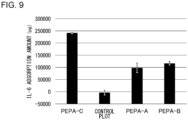
- FIG. 9 is a diagram showing the calculation results of IL-6 adsorption amounts. As shown in FIG. 9 , the adsorption amount of IL-6 was significantly higher in PEPA-C than those in PEPA-A and PEPA-B. From the above, it has been shown that IL-6 can be efficiently adsorbed and removed by the second hollow fiber membrane 16b having a sieving coefficient of not less than 0.64 nor more than 0.80 for dextran having a molecular weight of not less than 20 kDa nor more than 30 kDa.
- the hollow fiber membrane module 1 has a first hollow fiber membrane 16a whose sieving coefficient for dextran having a molecular weight of not less than 300 kDa nor more than 1000 kDa is not less than 0.12 nor more than 0.28, and the first hollow fiber membrane 16a adsorbs the endotoxins.
- the hollow fiber membrane module 1 simply by incorporating the hollow fiber membrane module 1 into a channel of a target object from which the endotoxins are to be removed, the endotoxins can be adsorbed and removed from the target object. Therefore, compared to a case where a conventional immobilized polymyxin molded article is used, the complication of the structure of a blood circuit and an increase in the cost of treatment can be suppressed.
- the hollow fiber membrane module 1 adsorbs the endotoxins by means of the first hollow fiber membrane 16a, a task of fixing an endotoxin adsorbent, ligand, or the like to the carrier is not necessary. Therefore, the present embodiment can provide a more practical endotoxin removal technology.
- the first hollow fiber membrane 16a adsorbs the endotoxins in the blood.
- the hollow fiber membrane module 1 is used as a blood purifier. This allows for more efficient blood purification.
- the first hollow fiber membrane 16a is composed of a polyester polymer alloy membrane containing a polyarylate resin represented by the above chemical formula (1) and a polyethersulfone resin represented by the above chemical formula (2) or (3).
- a polyarylate resin represented by the above chemical formula (1) and a polyethersulfone resin represented by the above chemical formula (2) or (3).
- two types of hydrophobic polymers i.e., polyarylate and polyethersulfone, shrink to different degrees to form pores 22 of a desired diameter. Therefore, there is no need to use an opening agent of a hydrophilic polymer such as polyvinylpyrrolidone to form the pores 22. Therefore, the first hollow fiber membrane 16a can be manufactured more easily.
- the hollow fiber membrane module 1 of the present embodiment has a second hollow fiber membrane 16b whose sieving coefficient for dextran having a molecular weight of not less than 20 kDa nor more than 30 kDa is not less than 0.64 nor more than 0.80, and the second hollow fiber membrane 16b adsorbs IL-6. This allows for simultaneous adsorption and removal of both the endotoxins and IL-6. Thus, a more practical endotoxin removal technology can be provided.
- a method for removing endotoxins including bringing a hollow fiber membrane module (1) according to an embodiment to come into contact with the endotoxins.
- the present invention can be used for hollow fiber membrane modules and a method for removing endotoxins.
Landscapes
- Chemical & Material Sciences (AREA)
- Chemical Kinetics & Catalysis (AREA)
- Health & Medical Sciences (AREA)
- Engineering & Computer Science (AREA)
- Urology & Nephrology (AREA)
- Heart & Thoracic Surgery (AREA)
- Organic Chemistry (AREA)
- Analytical Chemistry (AREA)
- Water Supply & Treatment (AREA)
- Hematology (AREA)
- Biomedical Technology (AREA)
- Life Sciences & Earth Sciences (AREA)
- Animal Behavior & Ethology (AREA)
- General Health & Medical Sciences (AREA)
- Public Health (AREA)
- Veterinary Medicine (AREA)
- Anesthesiology (AREA)
- Vascular Medicine (AREA)
- Emergency Medicine (AREA)
- External Artificial Organs (AREA)
- Separation Using Semi-Permeable Membranes (AREA)
- Solid-Sorbent Or Filter-Aiding Compositions (AREA)
Applications Claiming Priority (2)
| Application Number | Priority Date | Filing Date | Title |
|---|---|---|---|
| JP2020083505A JP7471907B2 (ja) | 2020-05-11 | 2020-05-11 | 中空糸膜モジュール |
| PCT/JP2021/016934 WO2021230082A1 (ja) | 2020-05-11 | 2021-04-28 | 中空糸膜モジュールおよびエンドトキシンの除去方法 |
Publications (2)
| Publication Number | Publication Date |
|---|---|
| EP4151304A1 true EP4151304A1 (de) | 2023-03-22 |
| EP4151304A4 EP4151304A4 (de) | 2024-06-05 |
Family
ID=78509980
Family Applications (1)
| Application Number | Title | Priority Date | Filing Date |
|---|---|---|---|
| EP21803547.5A Pending EP4151304A4 (de) | 2020-05-11 | 2021-04-28 | Hohlfasermembranmodul und verfahren zur entfernung von endotoxinen |
Country Status (5)
| Country | Link |
|---|---|
| US (1) | US20230070035A1 (de) |
| EP (1) | EP4151304A4 (de) |
| JP (1) | JP7471907B2 (de) |
| CN (1) | CN115484996B (de) |
| WO (1) | WO2021230082A1 (de) |
Families Citing this family (2)
| Publication number | Priority date | Publication date | Assignee | Title |
|---|---|---|---|---|
| WO2025183194A1 (ja) * | 2024-02-29 | 2025-09-04 | 東レ株式会社 | 分離膜及びその製造方法 |
| CN118320801B (zh) * | 2024-04-15 | 2024-11-05 | 武汉大学人民医院(湖北省人民医院) | 一种用于血液灌流的吸附剂及其制备方法 |
Family Cites Families (16)
| Publication number | Priority date | Publication date | Assignee | Title |
|---|---|---|---|---|
| JPS60172313A (ja) * | 1984-02-17 | 1985-09-05 | Mitsubishi Rayon Co Ltd | エンドトキシン除去材および除去方法 |
| JPH0611331B2 (ja) | 1984-12-05 | 1994-02-16 | 東レ株式会社 | 固定化ポリミキシン成形品からのエンドトキシン除去方法 |
| JPH1057476A (ja) * | 1996-08-26 | 1998-03-03 | Toray Ind Inc | 膜分離装置 |
| JPH1147267A (ja) * | 1997-08-06 | 1999-02-23 | Terumo Corp | セルロース系中空糸濾過膜および濾過器 |
| JP4042876B2 (ja) * | 1998-05-27 | 2008-02-06 | 旭化成クラレメディカル株式会社 | 膜型血液透析器 |
| EP1129738A4 (de) * | 1998-11-09 | 2003-08-06 | Asahi Medical Co | Blutreinigungsvorrichtung |
| JP4103037B2 (ja) * | 2002-10-03 | 2008-06-18 | 東洋紡績株式会社 | 透析液清浄化用中空糸膜およびその製造方法 |
| EP1795254B1 (de) * | 2004-08-10 | 2014-05-21 | Nipro Corporation | Herstellungsverfahren eines moduls mit einer auf polysulfon basierenden selektiv permeablen hohlfasermembran |
| US20080000830A1 (en) * | 2004-08-10 | 2008-01-03 | Kimihiro Mabuchi | Highly Water Permeable Hollow Fiber Membrane Type Blood Purifier and Process for Manufacturing the Same |
| JP4937767B2 (ja) * | 2007-01-16 | 2012-05-23 | 日機装株式会社 | 血液浄化器、及び、その製造方法 |
| TWI374038B (en) * | 2007-05-25 | 2012-10-11 | Asahi Kasei Medical Co Ltd | A polysulphone-based membrane for the blood treatment and its manufacturing method |
| CN101596422B (zh) * | 2009-07-07 | 2011-08-10 | 浙江大学 | 以氨基酸为配基的聚偏氟乙烯亲和膜的制备方法 |
| US10661231B2 (en) * | 2014-02-06 | 2020-05-26 | Gambro Lundia Ab | Membrane for blood purification |
| WO2015118046A1 (en) * | 2014-02-06 | 2015-08-13 | Gambro Lundia Ab | Hemodialyzer for blood purification |
| EP3290067B1 (de) * | 2016-09-06 | 2021-03-03 | Gambro Lundia AB | Leberunterstützungssystem |
| CN108579698B (zh) * | 2018-04-11 | 2021-08-31 | 成都艾伟孚生物科技有限公司 | 一种内毒素特异吸附膜的制备及其在辅助生殖领域的应用 |
-
2020
- 2020-05-11 JP JP2020083505A patent/JP7471907B2/ja active Active
-
2021
- 2021-04-28 WO PCT/JP2021/016934 patent/WO2021230082A1/ja not_active Ceased
- 2021-04-28 EP EP21803547.5A patent/EP4151304A4/de active Pending
- 2021-04-28 CN CN202180032609.5A patent/CN115484996B/zh active Active
-
2022
- 2022-11-02 US US17/979,451 patent/US20230070035A1/en active Pending
Also Published As
| Publication number | Publication date |
|---|---|
| WO2021230082A1 (ja) | 2021-11-18 |
| CN115484996A (zh) | 2022-12-16 |
| EP4151304A4 (de) | 2024-06-05 |
| JP7471907B2 (ja) | 2024-04-22 |
| US20230070035A1 (en) | 2023-03-09 |
| JP2021177833A (ja) | 2021-11-18 |
| CN115484996B (zh) | 2025-11-18 |
Similar Documents
| Publication | Publication Date | Title |
|---|---|---|
| US10675399B2 (en) | Polymeric whole blood hollow fiber membrane filter medium and use thereof for separating blood plasma/serum from whole blood | |
| AU2014206128C1 (en) | A hollow fiber module having thin film composite- aquaporin modified membranes | |
| US20230070035A1 (en) | Hollow fiber membrane module and method for removing endotoxins | |
| EP0294737B1 (de) | Polysulfon-Hohlfasermembran und Verfahren zu ihrer Herstellung | |
| US9687794B2 (en) | Polysulfone-based hollow fiber membrane and hollow fiber membrane module that purifies blood preparations | |
| AU2013349975B2 (en) | Integrated device for liver support system | |
| AU2014301062A1 (en) | Ceramic whole blood hollow fiber membrane filter medium and use thereof for separating blood plasma / serum from whole blood | |
| CN100457242C (zh) | 改良的除去中分子的透析膜 | |
| US10843111B2 (en) | Process of separating blood plasma/serum from whole blood | |
| EP2926820A1 (de) | Verfahren zur herstellung einer mit künstlicher konservierungslösung ersetzten thrombozytenlösung | |
| JP2012143554A (ja) | ポリスルホン系中空糸膜及び血小板浮遊液浄化用中空糸膜モジュール並びに血小板浮遊液の浄化方法 | |
| EP0750936A1 (de) | Permselektive Membranen und Verfahren zu ihrer Herstellung | |
| US20010035375A1 (en) | Filter for arrayable micro-centrifuge | |
| JPWO2013129384A1 (ja) | 吸着カラム | |
| KR20240038924A (ko) | 미소 유용 물질의 분리 정제 방법과 분리 정제 장치 | |
| JPS6011166A (ja) | 臨床検査用血漿の採取方法 | |
| CN108181479B (zh) | 膜截留分子量自动分析仪 | |
| JP4892824B2 (ja) | 中空糸膜型分離膜の製造方法ならびにその製造方法で製造された中空糸膜型分離膜の使用方法 | |
| US20170266362A1 (en) | System for removal of pro-inflammatory mediators as well as granulocytes and monocytes from blood | |
| JPH07506496A (ja) | 整流透析装置,バイオリアクター及び膜 | |
| JP2006343220A (ja) | 生体成分含有溶液の前処理方法および分析溶液精製方法 | |
| Alsudais | Development of Nanopocket Membranes for the Isolation and Purification of Extracellular Vesicles | |
| JP3489372B2 (ja) | 選択透過性分離膜 | |
| JP2007003213A (ja) | 生体成分含有溶液の分離精製システムおよび分離精製方法 | |
| CN120079258A (zh) | 一种制药用聚醚砜多孔过滤膜及其制备方法与应用 |
Legal Events
| Date | Code | Title | Description |
|---|---|---|---|
| STAA | Information on the status of an ep patent application or granted ep patent |
Free format text: STATUS: THE INTERNATIONAL PUBLICATION HAS BEEN MADE |
|
| PUAI | Public reference made under article 153(3) epc to a published international application that has entered the european phase |
Free format text: ORIGINAL CODE: 0009012 |
|
| STAA | Information on the status of an ep patent application or granted ep patent |
Free format text: STATUS: REQUEST FOR EXAMINATION WAS MADE |
|
| 17P | Request for examination filed |
Effective date: 20221103 |
|
| AK | Designated contracting states |
Kind code of ref document: A1 Designated state(s): AL AT BE BG CH CY CZ DE DK EE ES FI FR GB GR HR HU IE IS IT LI LT LU LV MC MK MT NL NO PL PT RO RS SE SI SK SM TR |
|
| DAV | Request for validation of the european patent (deleted) | ||
| DAX | Request for extension of the european patent (deleted) | ||
| A4 | Supplementary search report drawn up and despatched |
Effective date: 20240503 |
|
| RIC1 | Information provided on ipc code assigned before grant |
Ipc: A61M 1/16 20060101ALI20240427BHEP Ipc: B01J 20/28 20060101ALI20240427BHEP Ipc: B01D 69/08 20060101ALI20240427BHEP Ipc: B01D 69/02 20060101ALI20240427BHEP Ipc: B01D 61/24 20060101ALI20240427BHEP Ipc: A61M 1/18 20060101ALI20240427BHEP Ipc: B01J 20/26 20060101ALI20240427BHEP Ipc: B01D 71/68 20060101ALI20240427BHEP Ipc: B01D 71/48 20060101ALI20240427BHEP Ipc: B01D 63/02 20060101ALI20240427BHEP Ipc: B01D 61/14 20060101AFI20240427BHEP |