EP4138469B1 - Verfahren zur bestimmung von positionsinformationen und kommunikationsvorrichtung - Google Patents
Verfahren zur bestimmung von positionsinformationen und kommunikationsvorrichtung Download PDFInfo
- Publication number
- EP4138469B1 EP4138469B1 EP20933938.1A EP20933938A EP4138469B1 EP 4138469 B1 EP4138469 B1 EP 4138469B1 EP 20933938 A EP20933938 A EP 20933938A EP 4138469 B1 EP4138469 B1 EP 4138469B1
- Authority
- EP
- European Patent Office
- Prior art keywords
- terminal device
- information
- antenna
- positioning
- management device
- Prior art date
- Legal status (The legal status is an assumption and is not a legal conclusion. Google has not performed a legal analysis and makes no representation as to the accuracy of the status listed.)
- Active
Links
Images





Classifications
-
- H—ELECTRICITY
- H04—ELECTRIC COMMUNICATION TECHNIQUE
- H04W—WIRELESS COMMUNICATION NETWORKS
- H04W84/00—Network topologies
- H04W84/005—Moving wireless networks
-
- G—PHYSICS
- G01—MEASURING; TESTING
- G01S—RADIO DIRECTION-FINDING; RADIO NAVIGATION; DETERMINING DISTANCE OR VELOCITY BY USE OF RADIO WAVES; LOCATING OR PRESENCE-DETECTING BY USE OF THE REFLECTION OR RERADIATION OF RADIO WAVES; ANALOGOUS ARRANGEMENTS USING OTHER WAVES
- G01S5/00—Position-fixing by co-ordinating two or more direction or position line determinations; Position-fixing by co-ordinating two or more distance determinations
- G01S5/0009—Transmission of position information to remote stations
-
- G—PHYSICS
- G01—MEASURING; TESTING
- G01S—RADIO DIRECTION-FINDING; RADIO NAVIGATION; DETERMINING DISTANCE OR VELOCITY BY USE OF RADIO WAVES; LOCATING OR PRESENCE-DETECTING BY USE OF THE REFLECTION OR RERADIATION OF RADIO WAVES; ANALOGOUS ARRANGEMENTS USING OTHER WAVES
- G01S5/00—Position-fixing by co-ordinating two or more direction or position line determinations; Position-fixing by co-ordinating two or more distance determinations
- G01S5/0009—Transmission of position information to remote stations
- G01S5/0018—Transmission from mobile station to base station
- G01S5/0027—Transmission from mobile station to base station of actual mobile position, i.e. position determined on mobile
-
- G—PHYSICS
- G01—MEASURING; TESTING
- G01S—RADIO DIRECTION-FINDING; RADIO NAVIGATION; DETERMINING DISTANCE OR VELOCITY BY USE OF RADIO WAVES; LOCATING OR PRESENCE-DETECTING BY USE OF THE REFLECTION OR RERADIATION OF RADIO WAVES; ANALOGOUS ARRANGEMENTS USING OTHER WAVES
- G01S5/00—Position-fixing by co-ordinating two or more direction or position line determinations; Position-fixing by co-ordinating two or more distance determinations
- G01S5/0009—Transmission of position information to remote stations
- G01S5/0018—Transmission from mobile station to base station
- G01S5/0036—Transmission from mobile station to base station of measured values, i.e. measurement on mobile and position calculation on base station
-
- G—PHYSICS
- G01—MEASURING; TESTING
- G01S—RADIO DIRECTION-FINDING; RADIO NAVIGATION; DETERMINING DISTANCE OR VELOCITY BY USE OF RADIO WAVES; LOCATING OR PRESENCE-DETECTING BY USE OF THE REFLECTION OR RERADIATION OF RADIO WAVES; ANALOGOUS ARRANGEMENTS USING OTHER WAVES
- G01S5/00—Position-fixing by co-ordinating two or more direction or position line determinations; Position-fixing by co-ordinating two or more distance determinations
- G01S5/02—Position-fixing by co-ordinating two or more direction or position line determinations; Position-fixing by co-ordinating two or more distance determinations using radio waves
- G01S5/0257—Hybrid positioning
- G01S5/0268—Hybrid positioning by deriving positions from different combinations of signals or of estimated positions in a single positioning system
-
- G—PHYSICS
- G16—INFORMATION AND COMMUNICATION TECHNOLOGY [ICT] SPECIALLY ADAPTED FOR SPECIFIC APPLICATION FIELDS
- G16Y—INFORMATION AND COMMUNICATION TECHNOLOGY SPECIALLY ADAPTED FOR THE INTERNET OF THINGS [IoT]
- G16Y20/00—Information sensed or collected by the things
- G16Y20/10—Information sensed or collected by the things relating to the environment, e.g. temperature; relating to location
-
- H—ELECTRICITY
- H04—ELECTRIC COMMUNICATION TECHNIQUE
- H04W—WIRELESS COMMUNICATION NETWORKS
- H04W64/00—Locating users or terminals or network equipment for network management purposes, e.g. mobility management
-
- G—PHYSICS
- G01—MEASURING; TESTING
- G01S—RADIO DIRECTION-FINDING; RADIO NAVIGATION; DETERMINING DISTANCE OR VELOCITY BY USE OF RADIO WAVES; LOCATING OR PRESENCE-DETECTING BY USE OF THE REFLECTION OR RERADIATION OF RADIO WAVES; ANALOGOUS ARRANGEMENTS USING OTHER WAVES
- G01S5/00—Position-fixing by co-ordinating two or more direction or position line determinations; Position-fixing by co-ordinating two or more distance determinations
- G01S5/02—Position-fixing by co-ordinating two or more direction or position line determinations; Position-fixing by co-ordinating two or more distance determinations using radio waves
- G01S5/0247—Determining attitude
Definitions
- This application relates to the field of communications technologies, and in particular, to a positioning information determining method and a communication apparatus.
- a positioning device uses all antennas of a terminal device as one mass point at a same location for positioning, and uses a determined antenna location as a location of the terminal device.
- the positioning precision is at a level of several meters, the size of the terminal device is small relative to the positioning precision, all the antennas of the terminal device may be used as one mass point for positioning, and a distance between a plurality of antennas of the terminal device may be ignored in such positioning precision.
- the positioning precision of the terminal device is required to be less than 0.2 m (meter), in other words, a positioning error of the terminal device should be less than 0.2 m.
- the size of a terminal device for example, an automatic vehicle or an automatic cargo ship
- a distance between a plurality of antennas of the terminal device are usually greater than the positioning precision.
- an approximation error of determined location information of the terminal device is large.
- EPC discloses a terminal-based positioning method and device and, the terminal-based positioning method performed by a terminal in a wireless communication system, according to one aspect, can comprise the steps of: measuring a time difference of arrival (TDoA) for each distributed antenna on the basis of signals received from an anchor node through a plurality of distributed antennas; setting the relative position for each distributed antenna on the basis of a reference point preset in correspondence with the terminal; and determining an absolute position, which is the position of the reference point, on the basis of the TDoA measured for each distributed antenna and the relative position set for each distributed antenna.
- TDoA time difference of arrival
- This application provides a positioning information determining method and a communication apparatus, to help a positioning device accurately determine positioning information of a terminal device.
- this application provides a positioning information determining method.
- the method includes: A positioning management device receives first information sent by a terminal device, where the first information includes a plurality of antenna identifiers of the terminal device and local antenna coordinates corresponding to each antenna identifier.
- the positioning management device receives measurement information sent by the terminal device, where the measurement information includes the plurality of antenna identifiers of the terminal device and a measurement result that is of a downlink reference signal and that corresponds to each antenna identifier.
- the positioning management device determines positioning information of the terminal device based on the first information and the measurement information, where the positioning information includes one or more of the following information: absolute coordinates of the terminal device, orientation or posture information of the terminal device, a rotation angle of the terminal device, or uptilt and downtilt angles of the terminal device.
- the positioning management device may determine the positioning information of the terminal device with reference to the first information and measurement results corresponding to the plurality of antenna identifiers. This helps improve the precision of determining the positioning information of the terminal device.
- the positioning information of the terminal device may alternatively be determined by sending a downlink reference signal by one access network device. This helps reduce an environment deployment condition for determining a location, an orientation, or a posture of the terminal device.
- the first information further includes local coordinates of a reference point of the terminal device and/or an antenna identifier that is of the terminal device and that corresponds to the reference point, and the absolute coordinates of the terminal device are absolute coordinates of the reference point of the terminal device.
- the positioning management device may determine the absolute coordinates of the reference point of the terminal device based on the local coordinates of the reference point of the terminal device and/or the antenna identifier that is of the terminal device and that corresponds to the reference point, and further determine the absolute coordinates of the terminal device.
- a specific implementation in which the positioning management device receives the first information sent by the terminal device is: The positioning management device receives a positioning capability message of the terminal device sent by the terminal device, where the positioning capability message of the terminal device carries the first information, and the positioning capability message indicates that the terminal device has a capability of determining the positioning information by using a plurality of antennas.
- the positioning management device can obtain the positioning capability message of the terminal device in time. In this way, the positioning management device can subsequently determine whether positioning can be performed by using a multi-antenna positioning algorithm.
- the first information is included in the positioning capability message and sent to the positioning management device, so that the positioning management device can know earlier information such as the antenna identifier of the terminal device and the local antenna coordinates corresponding to the antenna identifier.
- the positioning management device may further send a report request to the terminal device, where the report request requests to report the measurement information.
- the positioning management device may send the report request to the terminal device based on a service positioning precision requirement of the terminal device.
- the positioning management device may flexibly obtain required measurement information from the terminal device based on a positioning requirement.
- the positioning management device may alternatively receive a positioning capability message of the terminal device sent by the terminal device, where the positioning capability message indicates that the terminal device has a capability of determining the positioning information by using a plurality of antennas.
- the positioning management device can obtain the positioning capability message of the terminal device in time. In this way, the positioning management device can subsequently determine whether positioning can be performed by using a multi-antenna positioning algorithm.
- the positioning management device may further send a report request to the terminal device, where the report request requests to report the measurement information and the first information.
- the positioning management device may flexibly obtain required measurement information from the terminal device based on a positioning requirement.
- the terminal device needs to report the first information only when the positioning management device needs to use the multi-antenna positioning algorithm. This helps save communication resources.
- the absolute coordinates of the terminal device are the absolute coordinates of the reference point of the terminal device, the reference point is not an antenna of the terminal device, and that the positioning management device determines absolute coordinates of the terminal device based on the first information and the measurement information includes: The positioning management device determines absolute coordinates corresponding to the antenna identifier based on the measurement information, the antenna identifier in the first information, and the local antenna coordinates of the antenna identifier; and the positioning management device determines the absolute coordinates of the reference point based on the absolute coordinates corresponding to the antenna identifier, the local antenna coordinates corresponding to the antenna identifier, and the local coordinates of the reference point. Based on this possible implementation, the absolute coordinates of the terminal device can be accurately determined.
- the absolute coordinates of the terminal device are the absolute coordinates of the reference point of the terminal device
- the reference point is an antenna of the terminal device
- the measurement information includes a measurement result corresponding to the reference point
- the positioning management device determines absolute coordinates of the terminal device based on the first information and the measurement information includes: The positioning management device determines absolute coordinates corresponding to the antenna identifier and the absolute coordinates of the reference point based on the measurement information, the local coordinates of the reference point, the antenna identifier in the first information, and the local antenna coordinates of the antenna identifier. Based on this possible implementation, the absolute coordinates of the terminal device can be accurately determined.
- a specific implementation in which the positioning management device determines the orientation or posture information of the terminal device, the rotation angle, and/or the uptilt and downtilt angles of the terminal device based on antenna information and the measurement information is: The positioning management device determines an absolute location corresponding to the antenna identifier based on the measurement information, the antenna identifier in the first information, and the local antenna coordinates of the antenna identifier; and the positioning management device determines the orientation or posture information of the terminal device, the rotation angle, and/or the uptilt and downtilt angles of the terminal device based on a conversion relationship between the absolute location corresponding to the antenna identifier and the local antenna coordinates corresponding to the antenna identifier. Based on this possible implementation, the orientation or posture information of the terminal device, the rotation angle, and/or the uptilt and downtilt angles of the terminal device can be accurately determined.
- this application provides a positioning information determining method.
- the method includes: A terminal device sends first information to a positioning management device, where the first information includes a plurality of antenna identifiers of the terminal device and local antenna coordinates corresponding to each antenna identifier.
- the terminal device measures, by using antennas corresponding to the plurality of antenna identifiers, downlink reference signals sent by an access network device.
- the terminal device sends measurement information to the positioning management device, where the measurement information includes the plurality of antenna identifiers of the terminal device and a measurement result that is of a downlink reference signal and that corresponds to each antenna identifier.
- the first information further includes local coordinates of a reference point of the terminal device and/or an antenna identifier that is of the terminal device and that corresponds to the reference point, and absolute coordinates of the reference point of the terminal device are absolute coordinates of the terminal device.
- a specific implementation in which the terminal device sends the first information to the positioning management device is: The terminal device sends a positioning capability message of the terminal device to the positioning management device, where the positioning capability message of the terminal device carries the first information, and the positioning capability message indicates that the terminal device has a capability of determining positioning information by using a plurality of antennas.
- the terminal device may further receive a report request sent by the positioning management device, where the report request requests to report the measurement information.
- the terminal device may further send a positioning capability message of the terminal device to the positioning management device, where the positioning capability message indicates that the terminal device has a capability of determining positioning information by using a plurality of antennas.
- the terminal device may further receive a report request sent by the positioning management device, where the report request requests to report the measurement information and the first information.
- this application provides a positioning information determining method.
- the method includes: A positioning management device receives first information sent by a terminal device, where the first information includes a plurality of antenna identifiers of the terminal device and local antenna coordinates corresponding to each antenna identifier.
- the positioning management device receives measurement information sent by an access network device, where the measurement information includes indexes of a plurality of uplink reference signal resources and/or resource sets and a measurement result corresponding to the index of each uplink reference signal resource and/or resource set.
- the positioning management device determines positioning information of the terminal device based on the first information and the measurement information, where the positioning information includes one or more of the following information: absolute coordinates of the terminal device, orientation or posture information of the terminal device, a rotation angle of the terminal device, and uptilt and downtilt angles of the terminal device.
- the precision of determining the positioning information of the terminal device can be improved.
- the positioning information of the terminal device may alternatively be determined by receiving an uplink reference signal by one access network device. This helps reduce an environment deployment condition for determining a location, an orientation, or a posture of the terminal device.
- the first information further includes local coordinates of a reference point of the terminal device and/or an antenna identifier that is of the terminal device and that corresponds to the reference point, and the absolute coordinates of the terminal device are absolute coordinates of the reference point of the terminal device.
- the positioning management device may determine the absolute coordinates of the reference point of the terminal device based on the local coordinates of the reference point of the terminal device and/or the antenna identifier that is of the terminal device and that corresponds to the reference point, and further determine the absolute coordinates of the terminal device.
- the positioning management device may further receive a positioning capability message of the terminal device sent by the terminal device, where the positioning capability message of the terminal device carries the first information, and the positioning capability message indicates that the terminal device has a capability of determining the positioning information by using a plurality of antennas.
- the positioning management device can obtain the positioning capability message of the terminal device in time. In this way, the positioning management device can subsequently determine whether positioning can be performed by using a multi-antenna positioning algorithm.
- the first information is included in the positioning capability message and sent to the positioning management device, so that the positioning management device can know earlier information such as the antenna identifier of the terminal device and the local antenna coordinates corresponding to the antenna identifier.
- the positioning management device may further receive a plurality of pieces of first configuration information sent by a serving cell of the terminal device, where the plurality of pieces of first configuration information is used to configure the plurality of uplink reference signal resources and/or resource sets, and each piece of first configuration information includes the index of the uplink reference signal resource and/or resource set and an antenna identifier that is of the terminal device and that corresponds to the uplink reference signal resource and/or resource set.
- the positioning management device sends second configuration information of the plurality of uplink reference signal resources and/or resource sets to the access network device, where each piece of the second configuration information includes the index of the uplink reference signal resource and/or resource set.
- an antenna for sending an uplink reference signal on an uplink reference signal resource or resource set can be required or recommended to the terminal device.
- the positioning management device sends the first configuration information of the plurality of uplink reference signal resources and/or resource sets to the terminal device. Based on this possible implementation, an antenna for sending an uplink reference signal on an uplink reference signal resource or resource set can be required or recommended to the terminal device.
- the positioning management device sends the first configuration information of the plurality of uplink reference signal resources and/or resource sets to the terminal device. Based on this possible implementation, an antenna for sending an uplink reference signal on an uplink reference signal resource or resource set can be required or recommended to the terminal device.
- a specific implementation in which the positioning management device determines the positioning information of the terminal device based on the first information and the measurement information is: The positioning management device determines an antenna identifier that is of the terminal device and that corresponds to each measurement result based on the plurality of pieces of first configuration information and the index that is of the uplink reference signal resource and/or resource set and that corresponds to each measurement result. The positioning management device determines the positioning information of the terminal device based on the first information, each measurement result, and the antenna identifier that is of the terminal device and that corresponds to each measurement result. Based on this possible implementation, the antenna identifier that is of the terminal device and that corresponds to each measurement result can be accurately determined.
- the positioning management device receives second information reported by the terminal device, where the second information includes the index that is of the uplink reference signal resource or resource set and that is sent by the terminal device, and the antenna identifier that is of the terminal device, that corresponds to the uplink reference signal resource and/or resource set, and that is sent by the terminal device; and a specific implementation in which the positioning management device determines the positioning information of the terminal device based on the first information and the measurement information is: The positioning management device determines an antenna identifier that is of the terminal device and that corresponds to each measurement result based on the second information and the index that is of the uplink reference signal resource and/or resource set that corresponds to each measurement result; and the positioning management device determines the positioning information of the terminal device based on the first information, each measurement result, and the antenna identifier that is of the terminal device and that corresponds to each measurement result. Based on this possible implementation, the antenna identifier that is of the terminal device and that corresponds to each measurement result can be accurately determined.
- the absolute coordinates of the terminal device are the absolute coordinates of the reference point of the terminal device, the reference point is not an antenna of the terminal device, and a specific implementation in which the positioning management device determines the absolute coordinates of the terminal device based on the first information, each measurement result, and the antenna identifier that is of the terminal device and that corresponds to each measurement result is: The positioning management device determines an absolute location corresponding to the antenna identifier based on each measurement result, the antenna identifier that is of the terminal device and that corresponds to each measurement result, the antenna identifier in the first information, and the local antenna coordinates of the antenna identifier; and the positioning management device determines the absolute coordinates of the reference point based on the absolute location corresponding to the antenna identifier, the local antenna coordinates corresponding to the antenna identifier, and the local coordinates of the reference point. Based on this possible implementation, the absolute coordinates of the terminal device can be accurately determined.
- the absolute coordinates of the terminal device are the absolute coordinates of the reference point of the terminal device
- the reference point is an antenna of the terminal device
- the measurement information includes a measurement result corresponding to the reference point
- a specific implementation in which the positioning management device determines the absolute coordinates of the terminal device based on the first information, each measurement result, and the antenna identifier that is of the terminal device and that corresponds to each measurement result is: The positioning management device determines absolute coordinates corresponding to the antenna identifier and the absolute coordinates of the reference point based on each measurement result, the antenna identifier that is of the terminal device and that corresponds to each measurement result, the local coordinates of the reference point, the antenna identifier in the first information, and the local antenna coordinates of the antenna identifier. Based on this possible implementation, the absolute coordinates of the terminal device can be accurately determined.
- a specific implementation in which the positioning management device determines the orientation or posture information of the terminal device, the rotation angle, and/or the uptilt and downtilt angles of the terminal device based on the first information, the plurality of measurement results, and the antenna identifier that is of the terminal device and that corresponds to each measurement result is: The positioning management device determines an absolute location corresponding to the antenna identifier based on each measurement result, the antenna identifier that is of the terminal device and that corresponds to each measurement result, the antenna identifier in the first information, and the local antenna coordinates of the antenna identifier; and the positioning management device determines the orientation or posture information of the terminal device, the rotation angle, and/or the uptilt and downtilt angles of the terminal device based on a conversion relationship between the absolute location corresponding to the antenna identifier and the local antenna coordinates corresponding to the antenna identifier.
- this application provides a positioning information determining method.
- the method includes: A terminal device sends first information to a positioning management device, where the first information includes a plurality of antenna identifiers of the terminal device and local antenna coordinates corresponding to each antenna identifier.
- the terminal device sends uplink reference signals to an access network device by using antennas corresponding to the plurality of antenna identifiers.
- the first information further includes local coordinates of a reference point of the terminal device and/or an antenna identifier that is of the terminal device and that corresponds to the reference point, and absolute coordinates of the reference point of the terminal device are absolute coordinates of the terminal device.
- a specific implementation in which the terminal device sends the first information to the positioning management device is: The terminal device sends a positioning capability message of the terminal device to the positioning management device, where the positioning capability message of the terminal device carries the first information, and the positioning capability message indicates that the terminal device has a capability of determining the positioning information by using a plurality of antennas.
- the terminal device may further receive a plurality of pieces of first configuration information sent by a serving cell of the terminal device or the positioning management device, where the plurality of pieces of first configuration information is used to configure a plurality of uplink reference signal resources and/or resource sets, and each piece of first configuration information includes an index of the uplink reference signal resource and/or resource set and an antenna identifier that is of the terminal device and that corresponds to the uplink reference signal resource and/or resource set.
- a specific implementation in which the terminal device sends the uplink reference signals to the access network device by using the antennas corresponding to the plurality of antenna identifiers is: The terminal device sends, based on the plurality of pieces of first configuration information, the uplink reference signals to the access network device on corresponding uplink reference signal resources and/or resource sets by using the antennas corresponding to the plurality of antenna identifiers.
- the terminal device may further report second information to the positioning management device, where the second information includes an index that is of an uplink reference signal resource or resource set and that is sent by the terminal device, and an antenna identifier that is of the terminal device and that corresponds to the uplink reference signal resource and/or resource set sent by the terminal device.
- a communication apparatus is provided.
- the apparatus is a positioning management device.
- the communication apparatus performs the method according to the first aspect or the third aspect.
- a function of the communication apparatus may be implemented by hardware, or may be implemented by hardware by executing corresponding software.
- the hardware or the software includes one or more units corresponding to the functions.
- the unit may be software and/or hardware.
- a communication apparatus is provided.
- the apparatus is a terminal device.
- the communication apparatus performs the method according to the second aspect or the fourth aspect.
- a function of the communication apparatus may be implemented by hardware, or may be implemented by hardware by executing corresponding software.
- the hardware or the software includes one or more units corresponding to the functions.
- the unit may be software and/or hardware.
- this application provides a computer-readable storage medium.
- the computer-readable storage medium is configured to store computer-executable instructions. When the computer-executable instructions are executed, the method performed by the terminal device in the method according to the second aspect or the fourth aspect is implemented.
- this application provides a computer program product including a computer program.
- the computer program When the computer program is executed, the method performed by the positioning management device in the method according to the first aspect or the third aspect is implemented.
- this application provides a communication system.
- the communication system includes the communication apparatus according to the fifth aspect, the seventh aspect, the ninth aspect, the eleventh aspect, or the thirteenth aspect, and the communication apparatus according to the sixth aspect, the eighth aspect, the tenth aspect, the twelfth aspect, or the fourteenth aspect.
- At least one (item) means one or more
- a plurality of means two or more
- at least two (items) means two, three, or more
- and "and/or” is used to describe a correspondence relationship between corresponding objects, and indicates that there may be three relationships.
- a and/or B may indicate that only A exists, only B exists, and both A and B exist, where A and B may be singular or plural.
- the character “/” generally represents an “or” relationship between the associated objects.
- At least one of the following items (pieces) or a similar expression thereof refers to any combination of these items, including any combination of singular items (pieces) or plural items (pieces).
- At least one of a, b, or c may indicate a, b, c, a and b, a and c, b and c, or a, b, and c, where a, b, and c may be singular or plural.
- the method provided in the embodiments of this application may be applied to various communication systems, for example, an Internet of Things (internet of things, loT) system, a narrow band Internet of Things (narrow band internet of things, NB-IoT) system, a long term evolution (long term evolution, LTE) system, a 5th-generation (5th-generation, 5G) communication system, an LTE-5G hybrid architecture, a 5G new radio (new radio, NR) system, and a new communication system emerging in future communication development.
- an Internet of Things internet of things, loT
- NB-IoT narrow band internet of things
- LTE long term evolution
- 5th-generation, 5G 5th-generation
- LTE-5G LTE-5G
- new radio new radio
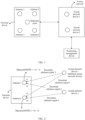
- FIG. 1 is a schematic diagram of a system architecture according to an embodiment of this application. As shown in FIG. 1 , the system architecture includes a terminal device, an access network, and a positioning management device.
- the terminal device supports antennas corresponding to a plurality of antenna identifiers.
- One antenna identifier of the terminal device may identify one antenna or one group of antennas, in other words, one antenna identifier may correspond to one antenna or one group of antennas.
- the antenna 1 and the antenna 2 may be identified by using different antenna identifiers. If the antenna 1 and the antenna 2 are deployed close to each other on the terminal device, the antenna 1 and the antenna 2 may be considered as one antenna, and the antenna 1 and the antenna 2 are identified by using a same antenna identifier.
- FIG. 1 is described by using an example in which the terminal device supports an antenna 1 corresponding to an antenna identifier 1 to an antenna 4 corresponding to an antenna identifier 4.
- the terminal device in embodiments of this application is a user-side entity configured to receive or transmit a signal.
- the terminal device may be a device that provides a user with voice and/or data connectivity, for example, a handheld device or a vehicle-mounted device having a wireless connection function.
- the terminal device may alternatively be another processing device connected to a wireless modem.
- the terminal device may communicate with a radio access network (RAN).
- RAN radio access network
- the terminal device may also be referred to as a wireless terminal, a subscriber unit, a subscriber station, a mobile station, a mobile console, a remote station, an access point, a remote terminal, an access terminal, a user terminal, a user agent, a user device , user equipment (UE), or the like.
- the terminal device may be a mobile terminal, for example, a mobile phone (or referred to as a "cellular" phone), and a computer that has a mobile terminal.
- the terminal device may be a portable, pocket-sized, handheld, computer built-in, or a vehicle-mounted mobile apparatus, which exchanges a voice and/or data with the radio access network.
- the terminal device may alternatively be a device such as a personal communications service (PCS) phone, a cordless telephone set, a session initiation protocol (SIP) phone, a wireless local loop (WLL) station, or a personal digital assistant (PDA).
- PCS personal communications service
- SIP session initiation protocol
- WLL wireless local loop
- PDA personal digital assistant
- Common terminal devices include, for example, a car, a drone, a mechanical arm, a mobile phone, a tablet computer, a notebook computer, a palmtop computer, a mobile internet device (MID), and a wearable device such as a smartwatch, a smart band, or a pedometer.
- a car a drone
- a mechanical arm a mobile phone
- a tablet computer a notebook computer
- a palmtop computer a mobile internet device (MID)
- MID mobile internet device
- a wearable device such as a smartwatch, a smart band, or a pedometer.
- embodiments of this application are not limited thereto.
- the access network may include one or more access network devices.
- the access network device in embodiments of this application is an entity for transmitting or receiving a signal on a network side, may be configured to mutually convert a received over-the-air frame and an internet protocol (IP) packet, and serves as a router between a terminal device and a remaining part of an access network.
- IP internet protocol
- the remaining part of the access network may include an IP network and the like.
- the access network device may further coordinate attribute management of an air interface.
- the access network device may be an evolved NodeB (eNB or e-NodeB) in LTE, may be a new radio controller (NR controller), may be an ng-eNB, may be a gNodeB (gNB) in a 5G system, may be a centralized network element (centralized unit), may be a new radio base station, may be a remote radio module, may be a micro base station, may be a relay, may be a distributed unit, may be a transmission reception point (TRP), a transmission point (TP), or any other radio access device.
- eNB evolved NodeB
- NR controller new radio controller
- ng-eNB may be a gNodeB (gNB) in a 5G system
- gNB gNodeB
- 5G system may be a centralized network element (centralized unit)
- may be a new radio base station may be a remote radio module
- may be a micro base station may be a relay
- may be a distributed unit may be
- the positioning management device is a device used by the network side to determine positioning information of the terminal device.
- the positioning management device may be a location management function (LMF) entity, an evolved serving mobile location center (E-SMLC), or another device that can be used to determine the positioning information of the terminal device.
- LMF location management function
- E-SMLC evolved serving mobile location center
- the system architecture shown in FIG. 1 may further include another device.
- an access management function (AMF) entity may further be included.
- the AMF entity is a control plane network function provided by the operator network, and is responsible for access control and mobility management for accessing the operator network by the terminal device.
- the access control and mobility management includes functions such as mobility status management, temporary user identity allocation, and user authentication and authorization.
- Embodiments of this application specifically provide a downlink positioning information determining method and an uplink positioning information determining method.
- the downlink positioning information determining method means that the access network device sends a downlink reference signal to the terminal device.
- the terminal device measures the downlink reference signal, and sends a measurement result to the positioning management device, so that the positioning management device determines the positioning information of the terminal device based on the measurement result.
- the uplink positioning information determining method includes: The terminal device sends an uplink reference signal to the access network device, and the access network device measures the uplink reference signal, and sends a measurement result to the positioning management device.
- the positioning management device determines the positioning information of the terminal device based on the measurement result.
- a reference signal (reference signal, RS) is a pilot signal, and is a known signal sent by a transmit end to a receive end for channel estimation or channel sounding. Reference signals may be classified into uplink reference signals and downlink reference signals. For example, a reference signal sent by the terminal device to the access network device (such as a base station) on the network side is an uplink reference signal, and a reference signal sent by the access network device to the terminal device is a downlink reference signal.
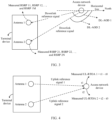
- a reference signal time difference of arrival is a measurement result obtained by the terminal device by measuring a downlink reference signal.
- the terminal device may report the measured RSTD to the positioning management device, and the positioning management device determines the positioning information of the terminal device based on the RSTD.
- the terminal device may measure the RSTD by using antennas corresponding to a plurality of antenna identifiers.
- An RSTD measured by an antenna corresponding to an antenna identifier of the terminal device is equal to T uerx2 - T uerx1 .
- T uerx2 is start time at which the antenna corresponding to the antenna identifier receives a downlink reference signal b from an access network device 2.
- T uerx1 is start time at which the antenna corresponding to the antenna identifier receives a downlink reference signal a from an access network device 1.
- the downlink reference signal a is a reference signal that is received by the antenna corresponding to the antenna identifier from the access network device 1 and that is closest to receiving start time of the downlink reference signal b.
- the access network device 1 is a reference device.
- the terminal device has an antenna 1 corresponding to an antenna identifier 1 and an antenna 2 corresponding to an antenna identifier 2.
- the access network device 1 is a reference device. Start time at which the antenna 1 receives a downlink reference signal 2 from the access network device 2 is t2, and start time at which the antenna 1 receives a downlink reference signal 1 from the access network device 1 is t1.
- the downlink reference signal 1 is a reference signal that is received by the antenna 1 from the access network device 1 and that is closest to receiving start time of the downlink reference signal 2. Therefore, an RSTD 1 measured by the antenna 1 is equal to t2 - t1.
- start time at which the antenna 2 receives a downlink reference signal 4 from the access network device 2 is t4
- start time at which the antenna 2 receives a downlink reference signal 3 from the access network device 1 is t3
- the downlink reference signal 3 is a reference signal that is received by the antenna 2 from the access network device 1 and that is closest to receiving start time of the downlink reference signal 4. Therefore, an RSTD 2 measured by the antenna 2 is equal to t4 - t3.
- a reference signal received power (reference signal received power, RSRP) is a measurement result obtained by the terminal device by measuring the downlink reference signal sent by the access network device.
- the terminal device may report the measured RSRP to the positioning management device.
- the positioning management device obtains a DL-AOD based on the RSRP, and determines the positioning information of the terminal device based on the DL-AOD.
- the DL-AOD is an angle included between a direction (for example, a direction of a horizontal plane or a normal direction of the horizontal plane) and a reference signal sent by the access network device to an antenna of the terminal device when the reference signal leaves the access network device.
- the terminal device may measure the RSRP by using antennas corresponding to a plurality of antenna identifiers.
- the terminal device has an antenna 1 corresponding to an antenna identifier 1 and an antenna 2 corresponding to an antenna identifier 2.
- the antenna 1 measures one or more downlink reference signals sent by the access network device to obtain an RSRP 11, an RSRP 12, ..., and an RSRP 1M.
- the antenna 2 measures the downlink reference signals sent by the access network device to obtain an RSRP 21, an RSRP 22, ..., and an RSRP 2N.
- M may be equal to N, or may not be equal to N, where M ⁇ 1, and N ⁇ 1.
- the positioning management device may obtain a DL-AOD 1 based on the RSRP 11, the RSRP 12, ..., and the RSRP 1M, and obtain a DL-AOD 2 based on the RSRP 21, the RSRP 22, ..., and the RSRP 2N.
- the positioning management device may determine the positioning information of the terminal device based on the DL-AOD 1 and the DL-AOD 2.
- a synchronization signal-reference signal received power SS-RSRP)/Synchronization signal-reference signal received quality (SS-RSRQ)/Synchronization signal-signal to interference plus noise ratio (SS-SINR) is a measurement result obtained by the terminal device by measuring a downlink reference signal sent by the access network device.
- the terminal device may report the measured SS-RSRP/SS-RSRQ/SS-SINR to the positioning management device, and the positioning management device determines the positioning information of the terminal device based on the SS-RSRP/SS-RSRQ/SS-SINR.
- the terminal device may measure the SS-RSRP/SS-RSRQ/SS-SINR by using antennas corresponding to a plurality of antenna identifiers.
- Uplink relative time of arrival is a measurement result obtained by the access network device by measuring an uplink reference signal sent by the terminal device.
- the access network device may report the UL-RTOA to the positioning management device, and the positioning management device determines the positioning information of the terminal device based on the UL-RTOA.
- the terminal device may send uplink reference signals by using antennas corresponding to a plurality of antenna identifiers.
- UL-RTOA obtained by the access network device by measuring an uplink reference signal sent by an antenna corresponding to an antenna identifier is equal to T gnbrx1 - T reference .
- T gnbrx1 is start time at which the access network device receives the uplink reference signal sent by the antenna.
- T reference is reference time of the access network device.
- the terminal device has an antenna 1 corresponding to an antenna identifier 1 and an antenna 2 corresponding to an antenna identifier 2.
- the antenna 1 sends an uplink reference signal 1.
- the antenna 2 sends an uplink reference signal 2.
- Start time at which the access network device receives the uplink reference signal 1 is 11, start time at which the access network device receives the uplink reference signal 2 is t2, and reference time of the access network device is t0.
- An uplink angle of arrival is a measurement result obtained by the access network device by measuring an uplink reference signal sent by the terminal device.
- the access network device may report the UL-AOA to the positioning management device, and the positioning management device determines the positioning information of the terminal device based on the UL-AOA.
- the terminal device may send uplink reference signals by using antennas corresponding to a plurality of antenna identifiers.
- the UL-AOA is an angle included between a direction (for example, a direction of a horizontal plane or a normal direction of the horizontal plane) and a reference signal sent by an antenna of the terminal device when the reference signal arrives at the access network device.
- the terminal device has an antenna 1 corresponding to an antenna identifier 1 and an antenna 2 corresponding to an antenna identifier 2.
- the access network device measures an uplink reference signal sent by the antenna 1, to obtain a UL-AOA 1.
- the access network device measures an uplink reference signal sent by the antenna 2, to obtain a UL-AOA 2.
- An uplink zenith of arrival is a measurement result obtained by the access network device by measuring an uplink reference signal sent by the terminal device.
- the access network device may report the UL-ZOA to the positioning management device, and the positioning management device determines the positioning information of the terminal device based on the UL-ZOA.
- the terminal device may send uplink reference signals by using antennas corresponding to a plurality of antenna identifiers.
- the UL-ZOA is an angle included between a vertical direction and a reference signal sent by an antenna of the terminal device when the reference signal arrives at the access network device. For example, as shown in FIG.
- the terminal device has an antenna 1 corresponding to an antenna identifier 1 and an antenna 2 corresponding to an antenna identifier 2.
- the access network device measures an uplink reference signal sent by the antenna 1, to obtain a UL-ZOA 1.
- the access network device measures an uplink reference signal sent by the antenna 2, to obtain a UL-ZOA 2.
- Multi-round trip time (Multi-RTT) positioning technology The terminal device measures a downlink reference signal sent by the access network device, to obtain a UE receive-transmit time difference (UE-RxTxTimeDiff, UE Rx-Tx time difference), and reports a measurement result to the positioning management device.
- UE-RxTxTimeDiff T uerx -T uetx .
- T uerx is time at which the terminal device receives a downlink reference signal
- T uetx is time at which the terminal device sends an uplink reference signal.
- the access network device measures a gNB receive-transmit time difference (gNB-RxTxTimeDiff, gNB Rx - Tx time difference) of an uplink reference signal sent by the terminal device, and reports a measurement result to the positioning management device.
- gNB-RxTxTimeDiff T gnbrx -T gnbtx .
- T gnbrx is time at which the access network device receives an uplink reference signal
- T gnbtx is time at which the access network device sends a downlink reference signal.
- the positioning management device determines the positioning information of the terminal device based on UE-RxTxTimeDiff and gNB-RxTxTimeDiff.
- the terminal device may measure downlink reference signals by using antennas corresponding to a plurality of antenna identifiers, to obtain UE-RxTxTimeDiff corresponding to each antenna identifier.
- the terminal device may send uplink reference signals by using antennas corresponding to a plurality of antenna identifiers, and the access network device obtains gNB-RxTxTimeDiff corresponding to each uplink reference signal resource.
- the positioning management device obtains gNB-RxTxTimeDiff corresponding to each antenna identifier based on a correspondence between an uplink signal resource and an antenna identifier.
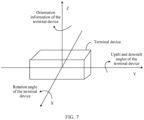
- FIG. 7 is a coordinate system with the center of the terminal device as the origin.
- An angle by which the terminal device rotates around the X axis is the rotation angle of the terminal device.
- An angle by which the terminal device rotates around the Y axis is the uptilt and downtilt angles of the terminal device.
- An angle by which the terminal device rotates around the Z axis is the orientation information of the terminal device.
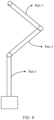
- Posture information of the terminal device For a terminal device (such as a mechanical arm) with an unfixed or irregular shape, a plurality of pieces of orientation information of the terminal device may form posture information of the terminal device.
- the terminal device is a mechanical arm, and the terminal device has three parts.
- Orientation information of a part 1 is an angle ⁇ 1
- orientation information of a part 2 is an angle ⁇ 2
- orientation information of a part 3 is an angle ⁇ 3.
- ⁇ 1, ⁇ 2, and ⁇ 3 form the posture information of the mechanical arm.
- the posture information may be other information that can indicate a posture of the terminal device.
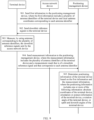
- FIG. 9 is a schematic flowchart of a downlink positioning information determining method according to an embodiment of this application.
- the downlink positioning information determining method includes the following step 901 to step 905.
- the method shown in FIG. 9 may be performed by a terminal device, an access network device, and a positioning management device, or may be performed by a chip in the terminal device, a chip in the access network device, and a chip in a chip in the access network device.
- FIG. 9 is described by using an example in which the method is performed by the terminal device, the access network device, and the positioning management device. Execution bodies of the positioning information determining methods shown in other accompanying drawings in embodiments of this application are similar to the foregoing devices. Details are not described below again.
- a terminal device sends first information to a positioning management device, where the first information includes a plurality of antenna identifiers of the terminal device and local antenna coordinates corresponding to each of the plurality of antenna identifiers.
- the positioning management device may receive the first information sent by the terminal device.
- the local antenna coordinates refer to coordinates in a local coordinate system.
- the local coordinate system may be a two-dimensional coordinate system or a three-dimensional coordinate system with a point of the terminal device as the origin.
- the local coordinate system may be a two-dimensional coordinate system or a three-dimensional coordinate system with the center of the terminal device as the origin.
- the plurality of antenna identifiers included in the first information may be some antenna identifiers or all antenna identifiers of the terminal device.
- the terminal device includes an antenna 1 corresponding to an antenna identifier 1 to an antenna 4 corresponding to an antenna identifier 4.
- the antenna identifier 1 0, and local coordinates of the antenna 1 are (-0.5, 0.5).
- the antenna identifier 2 1, and local coordinates of the antenna 2 are (0.5, -0.5).
- the antenna identifier 3 2, and local coordinates of the antenna 3 are (-0.5, -0.5).
- the antenna identifier 4 3, and local coordinates of the antenna 4 are (0.5, -0.5).
- the first information includes a plurality of antenna identifiers in the antenna identifier 1 to the antenna identifier 4, but does not include all the antenna identifiers in the antenna identifier 1 to the antenna identifier 4.
- the first information further includes local coordinates of a reference point of the terminal device and/or an antenna identifier that is of the terminal device and that corresponds to the reference point.
- a location of the reference point of the terminal device represents a location of the terminal device, in other words, absolute coordinates of the terminal device are absolute coordinates of the reference point of the terminal device.
- the positioning management device may determine the absolute coordinates of the reference point of the terminal device based on the local coordinates of the reference point of the terminal device and/or the antenna identifier that is of the terminal device and that corresponds to the reference point, and further determine the absolute coordinates of the terminal device.
- the reference point of the terminal device may be the central location of the terminal device, or a location distant from the central location of the terminal device by less than a preset distance.
- the first information when the reference point of the terminal device is an antenna of the terminal device, the first information further includes an antenna identifier that is of the terminal device and that corresponds to the reference point.
- the first information may include the local coordinates of the reference point of the terminal device, or may not include the local coordinates of the reference point of the terminal device.
- the terminal device does not need to report the local coordinates of the reference point of the terminal device in the first information, and only needs to report, in the first information, the antenna identifier that is of the terminal device and that corresponds to the reference point.
- the positioning management device can determine the local coordinates of the reference point of the terminal device according to the specifications of the protocol. For example, if the protocol specifies in advance that the local coordinates of the reference point of the terminal device are the origin in the local coordinate system by default, the positioning management device can determine that the local coordinates of the reference point of the terminal device are (0,0). On the contrary, if the protocol does not specify default values of the local coordinates of the reference point of the terminal device in advance, the first information may further include the local coordinates of the reference point of the terminal device in addition to the antenna identifier that is of the terminal device and that corresponds to the reference point.
- the first information further includes the local coordinates of the reference point.
- the first information may not include the local coordinates of the reference point.
- the terminal device does not need to report the local coordinates of the reference point of the terminal device in the first information.
- the positioning management device can determine the local coordinates of the reference point of the terminal device according to the specifications of the protocol. For example, if the protocol specifies in advance that the local coordinates of the reference point of the terminal device are the origin in the local coordinate system by default, the positioning management device can determine that the local coordinates of the reference point of the terminal device are (0,0). On the contrary, if the protocol does not specify default values of the local coordinates of the reference point of the terminal device in advance, the first information may further include the local coordinates of the reference point of the terminal device.
- a specific implementation in which the terminal device sends the first information to the positioning management device is: The terminal device sends a positioning capability message of the terminal device to the positioning management device, where the positioning capability message of the terminal device carries the first information, and the positioning capability message indicates that the terminal device has a capability of determining positioning information by using a plurality of antennas.
- a specific implementation in which the positioning management device receives the first information sent by the terminal device is: The positioning management device receives the positioning capability message sent by the terminal device.
- the terminal device includes the first information and positioning capability information of the terminal device to a same message, and sends the message to the positioning management device.
- the terminal device may send the positioning capability message of the terminal device to the positioning management device before performing step 902.
- the capability of determining positioning information by using a plurality of antennas means whether the terminal device has a capability of measuring, by using antennas corresponding to the plurality of antenna identifiers, downlink reference signals sent by the access network device.
- the positioning management device can obtain the positioning capability message of the terminal device in time. In this way, the positioning management device can subsequently determine whether positioning can be performed by using a multi-antenna positioning algorithm.
- the first information is included in the positioning capability message and sent to the positioning management device, so that the positioning management device can know earlier information such as the antenna identifier of the terminal device and the local antenna coordinates corresponding to the antenna identifier.
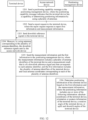
- step 1002 may be further performed: The positioning management device sends a report request to the terminal device, where the report request requests to report the measurement information including the plurality of antenna identifiers of the terminal device and a measurement result that is of a downlink reference signal and that corresponds to each antenna identifier.
- the terminal device may further receive the report request sent by the positioning management device.
- step 1001 and step 1003 to step 1006 are not described herein.
- the positioning management device may send the reporting request to the terminal device, to request the terminal device to measure, by using the antennas corresponding to the plurality of antenna identifiers, the downlink reference signals sent by the access network device, and report the measurement information including the plurality of antenna identifiers of the terminal device and the measurement result that is of the downlink reference signal and that corresponds to each antenna identifier.
- the positioning management device may flexibly obtain required measurement information from the terminal device based on a positioning requirement.
- the positioning management device may send the report request to the terminal device based on a service positioning precision requirement of the terminal device. For example, if the service positioning precision requirement of the terminal device is higher than or equal to a preset value, the positioning management device sends a report request to the terminal device.
- the report request requests the terminal device to report the measurement information including the plurality of antenna identifiers of the terminal device and the measurement result that is of the downlink reference signal and that corresponds to each antenna identifier. If the service positioning precision requirement of the terminal device is lower than a preset value, the positioning management device sends a report request to the terminal device.
- the report request requests the terminal device to report measurement information of a single antenna (that is, in an existing solution, all antennas of the terminal device are considered as a single antenna, and signals of the antenna are measured to obtain a measurement result). Based on this optional manner, the positioning management device may flexibly obtain the required measurement information based on the service positioning precision requirement of the terminal device.
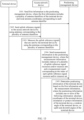
- the terminal device before measuring, by using the antennas corresponding to the plurality of antenna identifiers, the downlink reference signals sent by the access network device, the terminal device may further perform step 1101, that is, the terminal device sends a positioning capability message of the terminal device to the positioning management device, where the positioning capability message indicates that the terminal device has a capability of determining positioning information by using a plurality of antennas.
- the positioning management device before receiving the measurement information sent by the terminal device, the positioning management device may further receive the positioning capability message sent by the terminal device.
- step 1102 to step 1106 is not described herein.
- the first information is sent to the positioning management device without being carried in the positioning capability message.
- the first information may be sent to the positioning management device before the positioning capability message is sent, or the first information may be sent to the positioning management device after the positioning capability message is sent.
- the positioning management device can obtain the positioning capability message of the terminal device in time. In this way, the positioning management device can subsequently determine whether positioning can be performed by using a multi-antenna positioning algorithm.
- the positioning management device may further perform step 1202: The positioning management device sends a report request to the terminal device, where the report request requests to report the first information and the measurement information including the plurality of antenna identifiers of the terminal device and a measurement result that is of a downlink reference signal and that corresponds to each antenna identifier.
- the terminal device may further receive the report request sent by the positioning management device.
- the terminal device may include the measurement information and the first information to a same message, and send the message to the positioning management device. Specific implementations of step 1201 and step 1203 to step 1206 are not described herein.
- the positioning management device may flexibly obtain required measurement information from the terminal device based on a positioning requirement.
- the terminal device needs to report the first information only when the positioning management device needs to use the multi-antenna positioning algorithm. This helps save communication resources.
- the positioning management device may send the report request to the terminal device based on a service positioning precision requirement of the terminal device. For example, if the service positioning precision requirement of the terminal device is higher than or equal to a preset value, the positioning management device sends a report request to the terminal device.
- the report request requests the terminal device to report the first information and the measurement information including the plurality of antenna identifiers of the terminal device and the measurement result that is of the downlink reference signal and that corresponds to each antenna identifier. If the service positioning precision requirement of the terminal device is lower than a preset value, the positioning management device sends a report request to the terminal device.
- the report request requests the terminal device to report a measurement result of a single antenna (that is, in an existing solution, all antennas of the terminal device are considered as a single antenna, and signals of the antenna are measured to obtain a measurement result).
- the positioning management device may flexibly obtain the required measurement information based on the service positioning precision requirement of the terminal device.
- the terminal device may include the first information in the positioning capability message and send the positioning capability message to the positioning management device.
- the first information may be sent to the positioning management device before the positioning capability message is sent, or the first information may be sent to the positioning management device after the positioning capability message is sent.
- the first information and the measurement information may be carried in a same message and sent to the positioning management device.
- the access network device sends downlink reference signals to the terminal device.
- one or more access network devices may send the downlink reference signals to the terminal device.
- the downlink reference signal may be a channel state information-reference signal (channel state information-reference signal, CSI-RS), a positioning reference signal (positioning reference signal, PRS), or the like.
- the terminal device measures, by using the antennas corresponding to the plurality of antenna identifiers, the downlink reference signals sent by the access network device.
- the terminal device may measure, by using the antennas corresponding to the plurality of antenna identifiers, the downlink reference signals sent by the one or more access network devices.
- the plurality of antenna identifiers herein may be some antenna identifiers in the first information, or may be all antenna identifiers in the first information.
- the terminal device may measure, by using the antenna 1 to the antenna 4, the downlink reference signals sent by the access network device. Alternatively, the terminal device may measure, by using two or three antennas in the antenna 1 to the antenna 4, the downlink reference signals sent by the access network device.
- a measurement result obtained by the terminal device by measuring the downlink reference signals by using the antennas corresponding to the plurality of antenna identifiers may be one or more of the following information: an RSTD, an RSRP, an SS-RSRP, an SS-RSRQ, an SS-SINR, or a UE receive-transmit time difference.
- an RSTD an RSTD
- an RSRP an RSRP
- an SS-RSRP an SS-RSRQ
- an SS-SINR an SS-SINR
- UE receive-transmit time difference refer to the descriptions corresponding to the foregoing descriptions of related terms. Details are not described herein again.
- an antenna corresponding to each antenna identifier may measure the downlink reference signals sent by all access network devices, or antennas corresponding to one or more antenna identifiers measure only downlink reference signals sent by some access network devices. It needs to be ensured that an antenna corresponding to each of the plurality of antenna identifiers in step 903 measures a downlink reference signal.
- the access network device includes an access network device 1 to an access network device 3. Both an antenna 1 and an antenna 2 may measure downlink reference signals sent by the access network device 1 to the access network device 3.
- the antenna 1 measures downlink reference signals sent by the access network device 1 and the access network device 2
- the antenna 2 measures downlink reference signals sent by the access network device 1 and the access network device 3.
- the terminal device sends measurement information to the positioning management device, where the measurement information includes the plurality of antenna identifiers of the terminal device and a measurement result that is of a downlink reference signal and that corresponds to each antenna identifier.
- the terminal device after obtaining the measurement results corresponding to the plurality of antenna identifiers, the terminal device sends the measurement information to the positioning management device.
- the measurement information includes the plurality of antenna identifiers of the terminal device and the measurement result that is of the downlink reference signal and that corresponds to each antenna identifier.
- the measurement information reported by the terminal device may be: ⁇ measurement result 1, antenna identifier 1 ⁇ , ⁇ measurement result 2, antenna identifier 2 ⁇ , ⁇ measurement result 3, antenna identifier 3 ⁇ , and ⁇ measurement result 4, antenna identifier 4 ⁇ .
- the positioning management device can determine a correspondence between a measurement result and an antenna identifier based on the measurement information.
- the plurality of antenna identifiers included in the measurement information may be all or some antenna identifiers that measure the downlink reference signals in step 903.
- the terminal device may choose to report only measurement results corresponding to some antenna identifiers. For example, after obtaining the measurement result 1 corresponding to the antenna identifier 1 to the measurement result 4 corresponding to the antenna identifier 4, the terminal device may report only ⁇ measurement result 1, antenna identifier 1 ⁇ and ⁇ measurement result 2, antenna identifier 2 ⁇ .
- the following further describes an information element structure of the measurement information by using an example in which the measurement result is an RSTD.
- the access network device includes an access network device 1, an access network device 2, and an access network device 3.
- the access network device 1 is a reference device.
- the terminal device measures, by using an antenna 1 corresponding to an antenna identifier 1, downlink reference signals sent by the access network device 1 and the access network device 2, to obtain an RSTD 1.
- the terminal device measures, by using an antenna 2 corresponding to an antenna identifier 2, downlink reference signals sent by the access network device 1 and the access network device 2, to obtain an RSTD 2.
- the terminal device measures, by using an antenna 3 corresponding to an antenna identifier 3, downlink reference signals sent by the access network device 1 and the access network device 3, to obtain an RSTD 3.
- the terminal device measures, by using an antenna 4 corresponding to an antenna identifier 4, downlink reference signals sent by the access network device 1 and the access network device 3, to obtain an RSTD 4.
- an information element structure of a measurement result corresponding to the access network device 2 and an information element structure of an antenna identifier corresponding to the measurement result may have the following information element structures:
- nr-RSTD-r16 and nr-RSTD-ResultDiff-r16 are values of the RSTD.
- rx-ID is an antenna identifier corresponding to nr-RSTD-r16.
- rx-ID-additional is an antenna identifier corresponding to nr-RSTD-ResultDiff-r16.
- nr-RSTD-r16 may be an RSTD 1
- rx-ID is an antenna identifier 1.
- additionalDelay-r16 may be an RSTD 2
- rx-ID-additional is an antenna identifier 2.
- an information element structure of a measurement result corresponding to the access network device 3 and an information element structure of an antenna identifier corresponding to the measurement result are similar to the foregoing descriptions. Details are not described herein again.
- the measurement result is the RSRP, the SS-RSRP, the SS-RSRQ, the SS-SINR, or the UE receive-transmit time difference
- an information element structure of the measurement information is similar to the foregoing descriptions. Details are not described herein again.
- the positioning management device determines positioning information of the terminal device based on the first information and the measurement information, where the positioning information includes one or more of the following information: absolute coordinates of the terminal device, orientation or posture information of the terminal device, a rotation angle of the terminal device, or uptilt and downtilt angles of the terminal device.
- the positioning management device determines the positioning information of the terminal device based on the first information and the measurement information.
- the positioning information includes one or more of the following information: the absolute coordinates of the terminal device, the orientation or posture information of the terminal device, the rotation angle of the terminal device, or the uptilt and downtilt angles of the terminal device.
- the absolute coordinates of the terminal device are coordinates of the terminal device in an absolute coordinate system.
- the absolute coordinates of the terminal device may be two-dimensional coordinates or three-dimensional coordinates.
- the following describes two specific implementations in which the positioning management device determines the absolute coordinates of the terminal device based on the first information and the measurement information.
- the absolute coordinates of the terminal device are the absolute coordinates of the reference point of the terminal device, the reference point is not an antenna of the terminal device, and the positioning management device determines absolute coordinates corresponding to the antenna identifier based on the measurement information, the antenna identifier in the first information, and the local antenna coordinates of the antenna identifier; and the positioning management device determines the absolute coordinates of the reference point based on the absolute coordinates corresponding to the antenna identifier, the local antenna coordinates corresponding to the antenna identifier, and the local coordinates of the reference point.
- the measurement information includes: ⁇ measurement result 1, antenna identifier 1 ⁇ , ⁇ measurement result 2, antenna identifier 2 ⁇ , ⁇ measurement result 3, antenna identifier 3 ⁇ , and ⁇ measurement result 4, antenna identifier 4 ⁇ .
- the positioning management device After receiving the first information and the measurement information, the positioning management device first determines initial absolute coordinates of the antenna 1 based on the measurement result 1, determines initial absolute coordinates of the antenna 2 based on the measurement result 2, determines initial absolute coordinates of the antenna 3 based on the measurement result 3, and determines initial absolute coordinates of the antenna 4 based on the measurement result 4. Then, the positioning management device determines a relative location relationship between the antenna 1 to the antenna 4 based on the local coordinates of the antenna 1 to the antenna 4 in the first information.
- the positioning management device calibrates the initial absolute coordinates of the antenna 1 to the initial absolute coordinates of the antenna 4 based on the relative location relationship between the antenna 1 to the antenna 4, and determines the calibrated absolute coordinates as final absolute coordinates of the antenna 1 to the antenna 4. After determining the absolute coordinates of the antenna 1 to the antenna 4, the positioning management device can determine the absolute coordinates of the reference point with reference to local antenna coordinates of the antenna 1 to the antenna 4 and the local coordinates of the reference point.
- the absolute coordinates of the terminal device are the absolute coordinates of the reference point of the terminal device, the reference point is an antenna of the terminal device, the measurement information includes a measurement result corresponding to the reference point, and the positioning management device determines absolute coordinates corresponding to the antenna identifier and the absolute coordinates of the reference point based on the measurement information, the local coordinates of the reference point, the antenna identifier in the first information, and the local antenna coordinates of the antenna identifier.
- the measurement information includes: ⁇ measurement result 1, antenna identifier 1 ⁇ , ⁇ measurement result 2, antenna identifier 2 ⁇ , ⁇ measurement result 3, antenna identifier 3 ⁇ , ⁇ measurement result 4, antenna identifier 4 ⁇ , and ⁇ measurement result 5, antenna identifier of the reference point ⁇ .
- the positioning management device After receiving the first information and the measurement information, the positioning management device first determines initial absolute coordinates of the antenna 1 based on the measurement result 1, determines initial absolute coordinates of the antenna 2 based on the measurement result 2, determines initial absolute coordinates of the antenna 3 based on the measurement result 3, determines initial absolute coordinates of the antenna 4 based on the measurement result 4, and determines initial absolute coordinates of the reference point based on the measurement result 5.
- the positioning management device determines a relative location relationship between the antenna 1 to the antenna 4 and the reference point based on the local coordinates of the antenna 1 to the antenna 4 and the reference point in the first information.
- the positioning management device calibrates the initial absolute coordinates of the antenna 1 to the initial absolute coordinates of the antenna 4 and the initial absolute coordinates of the reference point based on the relative position relationship between the antenna 1 to the antenna 4 and the reference point, and determines the calibrated absolute coordinates as final absolute coordinates of the antenna 1 to the antenna 4 and the absolute coordinates of the reference point.
- the absolute coordinates of the terminal device can be accurately determined.
- a specific implementation in which the positioning management device determines the orientation or posture information of the terminal device, the rotation angle, and/or the uptilt and downtilt angles of the terminal device based on antenna information and the measurement information is: The positioning management device determines an absolute location corresponding to each antenna identifier based on the measurement information, the plurality of antenna identifiers, and the local antenna coordinates corresponding to each antenna identifier. The positioning management device determines the orientation or posture information of the terminal device, the rotation angle, and/or the uptilt and downtilt angles of the terminal device based on a conversion relationship between the absolute location corresponding to each antenna identifier and the local antenna coordinates corresponding to each antenna identifier.
- the positioning management device determines the absolute location corresponding to each antenna identifier based on the measurement information, the plurality of antenna identifiers, and the local antenna coordinates corresponding to each antenna identifier, refer to the foregoing descriptions. Details are not described herein again. Based on this possible implementation, the orientation or posture information of the terminal device, the rotation angle, and/or the uptilt and downtilt angles of the terminal device can be accurately determined.
- the positioning management device may determine the positioning information of the terminal device with reference to the first information and the measurement results corresponding to the plurality of antenna identifiers. This helps improve the precision of determining the positioning information of the terminal device.
- the positioning information of the terminal device may alternatively be determined by sending a downlink reference signal by one access network device. This helps reduce an environment deployment condition for determining a location, an orientation, or a posture of the terminal device.
- FIG. 13 is a schematic flowchart of an uplink positioning information determining method according to an embodiment of this application. As shown in FIG. 13 , the uplink positioning information determining method includes the following step 1301 to step 1305.
- a terminal device sends first information to a positioning management device, where the first information includes a plurality of antenna identifiers of the terminal device and local antenna coordinates corresponding to each of the plurality of antenna identifiers.
- the positioning management device may receive the first information sent by the terminal device.
- Step 1301 may be performed before step 1302.
- the first information further includes local coordinates of a reference point of the terminal device and/or an antenna identifier that is of the terminal device and that corresponds to the reference point.
- a location of the reference point of the terminal device represents a location of the terminal device, in other words, absolute coordinates of the terminal device are absolute coordinates of the reference point of the terminal device.
- the positioning management device may determine the absolute coordinates of the reference point of the terminal device based on the local coordinates of the reference point of the terminal device and/or the antenna identifier that is of the terminal device and that corresponds to the reference point, and further determine the absolute coordinates of the terminal device.
- the reference point refer to the embodiment corresponding to FIG. 9 . Details are not described herein again.
- a specific implementation in which the terminal device sends the first information to the positioning management device is: The terminal device sends a positioning capability message of the terminal device to the positioning management device, where the positioning capability message of the terminal device carries the first information, and the positioning capability message indicates that the terminal device has a capability of determining positioning information by using a plurality of antennas.
- a specific implementation in which the positioning management device receives the first information sent by the terminal device is: The positioning management device receives the positioning capability message sent by the terminal device.
- the terminal device includes the first information and positioning capability information of the terminal device to a same message, and sends the message to the positioning management device.
- the capability of determining positioning information by using a plurality of antennas means whether the terminal device has a capability of measuring, by using the antennas corresponding to the plurality of antenna identifiers, downlink reference signals sent by an access network device.
- the positioning management device can obtain the positioning capability message of the terminal device in time. In this way, the positioning management device can subsequently determine whether positioning can be performed by using a multi-antenna positioning algorithm.
- the first information is included in the positioning capability message and sent to the positioning management device, so that the positioning management device can know earlier information such as the antenna identifier of the terminal device and the local antenna coordinates corresponding to the antenna identifier.
- the terminal device sends uplink reference signals to the access network device by using antennas corresponding to the plurality of antenna identifiers.
- the terminal device may send the uplink reference signals to one or more access network devices by using the antennas corresponding to the plurality of antenna identifiers.
- the plurality of antenna identifiers herein may be some antenna identifiers in the first information, or may be all antenna identifiers in the first information.
- the uplink reference signal may be a sounding reference signal (sounding reference signal, SRS) or another uplink reference signal.
- the access network device measures the uplink reference signals that are sent by the terminal device by using the antennas corresponding to the plurality of antenna identifiers.
- the one or more access network devices may measure the uplink reference signals that are sent by the terminal device by using the antennas corresponding to the plurality of antenna identifiers.
- a measurement result may be one or more of the following information: UL-RTOA, UL-AOA, UL-ZOA, or a gNB receive-send time difference.
- UL-RTOA UL-RTOA
- UL-AOA UL-AOA
- UL-ZOA UL-ZOA
- gNB receive-send time difference For the descriptions of the UL-RTOA, the UL-AOA, the UL-ZOA, or the gNB receive-transmit time difference, refer to the descriptions corresponding to the foregoing descriptions of related terms. Details are not described herein again.
- each access network device may measure uplink reference signals sent by antennas corresponding to all of the plurality of antenna identifiers, or one or more antenna access network devices measure only uplink reference signals sent by antennas corresponding to some of the plurality of antenna identifiers.
- the access network device includes an access network device 1 and an access network device 2.
- the access network device 1 may measure downlink reference signals sent by an antenna 1 and an antenna 2, and the access network device 2 may measure downlink reference signals sent by the antenna 1 and the antenna 2. Alternatively, the access network device 1 may measure a downlink reference signal sent by an antenna 1, and the access network device 2 may measure a downlink reference signal sent by an antenna 2.
- the access network device sends measurement information to the positioning management device, where the measurement information includes indexes of a plurality of uplink reference signal resources and/or resource sets and a measurement result corresponding to the index of each uplink reference signal resource and/or resource set.
- the one or more access network devices after measuring the uplink reference signals that are sent by the terminal device by using the antennas corresponding to the plurality of antenna identifiers, send the measurement information to the positioning management device.
- the measurement information includes the indexes of the plurality of uplink reference signal resources and/or resource sets and the measurement result corresponding to the index of each uplink reference signal resource and/or resource set.
- the measurement result corresponding to the index of the uplink reference signal resource and/or resource set is a measurement result obtained by the access network device by performing measurement on the uplink reference signal resource and/or resource set. For example, the access network device measures the uplink reference signal on the uplink reference signal resource 1 and/or resource set 1, to obtain a measurement result 1.
- the measurement result 1 is a measurement result corresponding to an index of the uplink reference signal resource 1 and/or resource set 1.
- the measurement information reported by the one or more access network devices may be ⁇ measurement result 1, index of the uplink reference signal resource 1, index of the resource set 1 ⁇ , ⁇ measurement result 2, index of an uplink reference signal resource 2, index of a resource set 2 ⁇ , ⁇ measurement result 3, index of an uplink reference signal resource 3, index of a resource set 3 ⁇ , and ⁇ measurement result 4, index of an uplink reference signal resource 4, index of a resource set 4 ⁇ .
- the positioning management device can determine, based on the measurement information, a correspondence between a measurement result and an index of an uplink reference signal resource and/or resource set.
- the one or more access network devices may choose to report measurement results corresponding to indexes of all or some of the plurality of uplink reference signal resources and/or resource sets. For example, after the one or more access network devices obtain a measurement result 1 to a measurement result 4, the measurement information may include only ⁇ measurement result 1, index of the uplink reference signal resource 1 and/or resource set 1 ⁇ and ⁇ measurement result 2, index of the uplink reference signal resource 2 and/or resource set 2 ⁇ .
- the positioning management device determines positioning information of the terminal device based on the first information and the measurement information, where the positioning information includes one or more of the following information: absolute coordinates of the terminal device, orientation or posture information of the terminal device, a rotation angle of the terminal device, and uptilt and downtilt angles of the terminal device.
- the positioning management device determines the positioning information of the terminal device based on the first information and the measurement information, where the positioning information includes one or more of the following information: the absolute coordinates of the terminal device, the orientation or posture information of the terminal device, the rotation angle of the terminal device, and the uptilt and downtilt angles of the terminal device.
- the absolute coordinates of the terminal device are coordinates of the terminal device in an absolute coordinate system.
- the absolute coordinates of the terminal device may be two-dimensional coordinates or three-dimensional coordinates.
- the positioning management device specifically determines the positioning information of the terminal device based on the first information and the measurement information, refer to descriptions in the embodiment corresponding to FIG. 14A and FIG. 14B . Details are not described herein.
- the positioning management device may determine the positioning information of the terminal device with reference to the first information and the measurement results of the uplink reference signals sent by the plurality of antenna identifiers. This helps improve the precision of determining the positioning information of the terminal device.
- the positioning information of the terminal device may alternatively be determined by receiving an uplink reference signal by one access network device. This helps reduce an environment deployment condition for determining a location, an orientation, or a posture of the terminal device.
- FIG. 14A and FIG. 14B are a schematic flowchart of another uplink positioning information determining method according to an embodiment of this application. As shown in FIG. 14A and FIG. 14B , the uplink positioning information determining method includes the following step 1401 to step 1408.
- a terminal device sends first information to a positioning management device, where the first information includes a plurality of antenna identifiers of the terminal device and local antenna coordinates corresponding to each of the plurality of antenna identifiers.
- the positioning management device may receive the first information sent by the terminal device.
- step 1401 For a specific implementation of step 1401, refer to the foregoing step 1301. Details are not described herein again.
- the positioning management device receives a plurality of pieces of first configuration information sent by a serving cell of the terminal device.
- the plurality of pieces of first configuration information is used to configure a plurality of uplink reference signal resources and/or resource sets, and each piece of first configuration information includes an index of the uplink reference signal resource and/or resource set and an antenna identifier that is of the terminal device and that corresponds to the uplink reference signal resource and/or resource set.
- the antenna identifier that is of the terminal device and that corresponds to the uplink reference signal resource and/or resource set is an identifier of an antenna for sending an uplink reference signal on the uplink reference signal resource and/or resource set.
- the first configuration information implies a correspondence between an index of an uplink reference signal resource and/or resource set and an antenna identifier of the terminal device.
- the plurality of pieces of first configuration information is first configuration information 1 and first configuration information 2.
- the first configuration information 1 is used to configure an uplink reference signal resource 1.
- the first configuration information 1 includes an index of the uplink reference signal resource 1 and an antenna identifier 1 that is of the terminal device and that corresponds to the uplink reference signal resource 1.
- the first configuration information 2 is used to configure an uplink reference signal resource 2.
- the first configuration information 2 includes an index of the uplink reference signal resource 2 and an antenna identifier 2 that is of the terminal device and that corresponds to the uplink reference signal resource 2.
- an uplink reference signal is an SRS reference signal
- an information element structure of the first configuration information 1 may be as follows:
- srs-ResourceId tx-ID is the index of the uplink reference signal resource 1
- tx-ID is the antenna identifier 1 of the terminal device.
- An information element structure of the second configuration information 2 is similar, and details are not described herein.
- Step 1402 may be performed before step 1401, or may be performed after step 1401. This is not limited in this embodiment of this application.
- the positioning management device sends second configuration information of the plurality of uplink reference signal resources and/or resource sets to an access network device.
- the access network device may receive the second configuration information that is of the plurality of uplink reference signal resources and/or resource sets and that is sent by the positioning management device.
- Each piece of second configuration information includes an index of an uplink reference signal resource and/or resource set in the first configuration information.
- the plurality of pieces of first configuration information is first configuration information 1 and first configuration information 2.
- the first configuration information 1 includes an index of the uplink reference signal resource 1 and an antenna identifier 1 that is of the terminal device and that corresponds to the uplink reference signal resource 1.
- the first configuration information 2 includes an index of the uplink reference signal resource 2 and an antenna identifier 2 that is of the terminal device and that corresponds to the uplink reference signal resource 2.
- the positioning management device sends the second configuration information 1 and the second configuration information 2 to the access network device.
- the second configuration information 1 includes the index of the uplink reference signal resource 1.
- the second configuration information 2 includes the index of the uplink reference signal resource 2.
- the second configuration information may alternatively be the same as the first configuration information.
- the positioning management device sends the plurality of pieces of first configuration information to the terminal device.
- the terminal device may receive the plurality of pieces of first configuration information sent by the positioning device.
- Step 1404 may be performed before steps 1401 to 1403, or may be performed after steps 1401 to 1403. This is not limited in this embodiment of this application.
- step 1404 may not be performed, and the serving cell of the terminal device may send the plurality of pieces of first configuration information to the terminal device.
- the terminal device may receive the plurality of pieces of first configuration information sent by the serving cell of the terminal device.
- step 1402 may not be performed.
- the positioning management device may generate the plurality of pieces of first configuration information. After generating the plurality of pieces of first configuration information, the positioning management device may send the second configuration information of the plurality of uplink reference signal resources and/or resource sets to the access network device, and send the plurality of pieces of first configuration information to the terminal device.
- the positioning management device needs to obtain, from the serving cell of the terminal device in advance, a plurality of pieces of configuration information used to configure the plurality of uplink reference signal resources and/or resource sets, and the positioning management device generates the plurality of pieces of first configuration information based on the plurality of pieces of configuration information and the antenna identifiers in the first information.
- the plurality of pieces of configuration information obtained by the positioning management device from the serving cell of the terminal device include configuration information 1 and configuration information 2.
- the configuration information 1 is used to configure an uplink reference signal resource 1 and/or resource set 1, and the configuration information 1 includes an index of the uplink reference signal resource 1 and/or resource set 1.
- the configuration information 2 is used to configure an uplink reference signal resource 2 and/or resource set 2, and the configuration information 2 includes an index of the uplink reference signal resource 2 and/or resource set 2.
- the positioning management device may generate the first configuration information 1 and the first configuration information 2.
- the first configuration information 1 includes the antenna identifier 1 and the index of the uplink reference signal resource 1 and/or resource set 1.
- the first configuration information 2 includes the antenna identifier 2 and the index of the uplink reference signal resource 2 and/or resource set 2.
- the terminal device sends uplink reference signals to the access network device by using antennas corresponding to the plurality of antenna identifiers.
- the terminal device may send the uplink reference signals based on the first configuration information; or after receiving the plurality of pieces of first configuration information, the terminal device may send the uplink reference signals not based on the first configuration information, and the terminal device may determine, based on a requirement of the terminal device, an antenna for sending a reference signal on an uplink reference signal resource.
- the first configuration information may be used to forcibly require the terminal device to send the uplink reference signals based on the first configuration information.
- the first configuration information is only used to recommend, to the terminal device, an antenna for sending a reference signal on an uplink reference signal resource, and a specific antenna used by the terminal device for sending the reference signal on the uplink reference signal resource is determined by the terminal device based on a requirement of the terminal device. Therefore, according to step 1402 to step 1404, an antenna for sending an uplink reference signal on an uplink reference signal resource or resource set can be required or recommended to the terminal device.
- a specific implementation in which the terminal device sends the uplink reference signals to the access network device by using the antennas corresponding to the plurality of antenna identifiers is: The terminal device sends, based on the plurality of pieces of first configuration information, the uplink reference signals to the access network device on corresponding uplink reference signal resources and/or resource sets by using the antennas corresponding to the plurality of antenna identifiers.
- a specific implementation in which the positioning management device determines the positioning information of the terminal device based on the first information and the measurement information is: The positioning management device determines an antenna identifier that is of the terminal device and that corresponds to each measurement result based on the plurality of pieces of first configuration information and the index that is of the uplink reference signal resource and/or resource set and that corresponds to each measurement result. The positioning management device determines the positioning information of the terminal device based on the first information, each measurement result, and the antenna identifier that is of the terminal device and that corresponds to each measurement result.
- the first configuration information is used to forcibly require the terminal device to send the uplink reference signal based on the first configuration information. Therefore, the terminal device sends, based on the plurality of pieces of first configuration information, the uplink reference signals to the access network device on corresponding uplink reference signal resources and/or resource sets by using the antennas corresponding to the plurality of antenna identifiers. Based on this possible implementation, the antenna identifier that is of the terminal device and that corresponds to each measurement result can be accurately determined.
- the first configuration information 1 includes the antenna identifier 1 and the index of the uplink reference signal resource 1 and/or resource set 1.
- the first configuration information 2 includes the antenna identifier 2 and the index of the uplink reference signal resource 2 and/or resource set 2.
- the terminal device sends an uplink reference signal on the uplink reference signal resource 1 and/or resource set 1 by using the antenna 1 corresponding to the antenna identifier 1.
- the terminal device sends an uplink reference signal on the uplink reference signal resource 2 and/or resource set 2 by using the antenna 2 corresponding to the antenna identifier 2.
- the access network device measures the uplink reference signal on the uplink reference signal resource 1 and/or resource set 1, to obtain a measurement result 1.
- the access network device measures the uplink reference signal on the uplink reference signal resource 2 and/or resource set 2, to obtain a measurement result 2.
- the measurement information sent by the access network device to the positioning management device includes: ⁇ index of the uplink reference signal resource 1 and/or resource set 1, measurement result 1 ⁇ and ⁇ index of the uplink reference signal resource 2 and/or the resource set 2, measurement result 2 ⁇ .
- the positioning management device may determine, based on the first configuration information 1 and ⁇ index of the uplink reference signal resource 1 and/or resource set 1, measurement result 1 ⁇ , that the measurement result 1 corresponds to the antenna identifier 1.
- the measurement result 1 is obtained by measuring the reference signal sent by the antenna 1 corresponding to the antenna identifier 1.
- the positioning management device may determine, based on the first configuration information 2 and ⁇ index of the uplink reference signal resource 2 and/or resource set 2, measurement result 2 ⁇ , that the measurement result 2 corresponds to the antenna identifier 2.
- the measurement result 2 is obtained by measuring the reference signal sent by the antenna 2 corresponding to the antenna identifier 2.
- the positioning management device determines the positioning information of the terminal device based on the first information, the measurement result 1, the antenna identifier 1 corresponding to the measurement result 1, the measurement result 2, and the antenna identifier 2 corresponding to the measurement result 2.
- the terminal device may further report second information to the positioning management device, where the second information includes an index that is of an uplink reference signal resource or resource set and that is sent by the terminal device, and an antenna identifier that is of the terminal device and that corresponds to the uplink reference signal resource and/or resource set sent by the terminal device.
- the positioning management device may further receive second information reported by the terminal device, where the second information includes the index that is of the uplink reference signal resource or resource set and that is sent by the terminal device, and the antenna identifier that is of the terminal device, that corresponds to the uplink reference signal resource and/or resource set, and that is sent by the terminal device; and a specific implementation in which the positioning management device determines the positioning information of the terminal device based on the first information and the measurement information is: The positioning management device determines, based on the second information and the index that is of the uplink reference signal resource and/or resource set that corresponds to each measurement result, an antenna identifier that is of the terminal device and that corresponds to each measurement result; and the positioning management device determines the positioning information of the terminal device based on the first information, each measurement result, and the antenna identifier that is of the terminal device and that corresponds to each measurement result.
- the second information indicates an antenna actually used by the terminal device for sending the reference signal on the uplink reference signal resource.
- the first configuration information is only used to recommend, to the terminal device, an antenna for sending a reference signal on an uplink reference signal resource, and a specific antenna used by the terminal device for sending the reference signal on the uplink reference signal resource is determined by the terminal device based on a requirement of the terminal device. Therefore, after sending the uplink reference signal by using the antennas corresponding to the plurality of antenna identifiers, the terminal device needs to send the second information.
- the positioning management device can determine the antenna actually used by the terminal device for sending the reference signal on the uplink reference signal resource, and subsequently can accurately determine, based on the second information, the antenna identifier that is of the terminal device and that corresponds to each measurement result reported by the access network device.
- the positioning management device determines, based on the second information and the index that is of the uplink reference signal resource and/or resource set and that corresponds to each measurement result, the antenna identifier that is of the terminal device and that corresponds to each measurement result is the same as the foregoing specific implementation principle in which the positioning management device determines, based on the first configuration information and the index that is of the uplink reference signal resource and/or resource set and that corresponds to each measurement result, the antenna identifier that is of the terminal device and that corresponds to each measurement result. Details are not described herein again. It should be noted that, when step 1402 to step 1404 are not performed, the terminal device may alternatively report the second information to the positioning management device.
- the absolute coordinates of the terminal device are the absolute coordinates of the reference point of the terminal device, the reference point is not an antenna of the terminal device, and a specific implementation in which the positioning management device determines the absolute coordinates of the terminal device based on the first information, each measurement result, and the antenna identifier that is of the terminal device and that corresponds to each measurement result is: The positioning management device determines an absolute location corresponding to the antenna identifier based on each measurement result, the antenna identifier that is of the terminal device and that corresponds to each measurement result, the antenna identifier in the first information, and the local antenna coordinates of the antenna identifier; and the positioning management device determines the absolute coordinates of the reference point based on the absolute location corresponding to the antenna identifier, the local antenna coordinates corresponding to the antenna identifier, and the local coordinates of the reference point.
- the positioning management device determines the absolute coordinates of the reference point based on the absolute location corresponding to the antenna identifier, the local antenna coordinates corresponding to the antenna identifier,
- the absolute coordinates of the terminal device are the absolute coordinates of the reference point of the terminal device
- the reference point is an antenna of the terminal device
- the measurement information includes a measurement result corresponding to the reference point
- a specific implementation in which the positioning management device determines the absolute coordinates of the terminal device based on the first information, each measurement result, and the antenna identifier that is of the terminal device and that corresponds to each measurement result is: The positioning management device determines absolute coordinates corresponding to the antenna identifier and the absolute coordinates of the reference point based on each measurement result, the antenna identifier that is of the terminal device and that corresponds to each measurement result, the local coordinates of the reference point, the antenna identifier in the first information, and the local antenna coordinates of the antenna identifier.
- the positioning management device determines absolute coordinates corresponding to the antenna identifier and the absolute coordinates of the reference point based on each measurement result, the antenna identifier that is of the terminal device and that corresponds to each measurement result, the local coordinates of the reference point, the
- a specific implementation in which the positioning management device determines the orientation or posture information of the terminal device, the rotation angle, and/or the uptilt and downtilt angles of the terminal device based on the first information, the plurality of measurement results, and the antenna identifier that is of the terminal device and that corresponds to each measurement result is: The positioning management device determines an absolute location corresponding to the antenna identifier based on each measurement result, the antenna identifier that is of the terminal device and that corresponds to each measurement result, the antenna identifier in the first information, and the local antenna coordinates of the antenna identifier; and the positioning management device determines the orientation or posture information of the terminal device, the rotation angle, and/or the uptilt and downtilt angles of the terminal device based on a conversion relationship between the absolute location corresponding to the antenna identifier and the local antenna coordinates corresponding to the antenna identifier.
- the positioning management device determines the orientation or posture information of the terminal device, the rotation angle, and/or the uptilt and downtil
- the access network device measures the uplink reference signals that are sent by the terminal device by using the antennas corresponding to the plurality of antenna identifiers.
- the access network device sends the measurement information to the positioning management device, where the measurement information includes a plurality of measurement results of the uplink reference signals and an index of an uplink reference signal resource and/or resource set corresponding to each measurement result.
- the positioning management device determines positioning information of the terminal device based on the first information and the measurement information, where the positioning information includes one or more of the following information: absolute coordinates of the terminal device, orientation or posture information of the terminal device, a rotation angle of the terminal device, and uptilt and downtilt angles of the terminal device.
- FIG. 15 is a schematic structural diagram of a communication apparatus according to an embodiment of this application.
- the communication apparatus shown in FIG. 15 may be configured to implement some or all functions of the positioning management device in the embodiment corresponding to the foregoing downlink positioning information determining method.
- the communication apparatus shown in FIG. 15 may be configured to implement some or all functions of the positioning management device in the method embodiments described in FIG. 9 to FIG. 12 .
- the apparatus may be a positioning management device, may be an apparatus in the positioning management device, or may be an apparatus that can be used together with the positioning management device.
- the communication apparatus may alternatively be a chip system.
- the communication apparatus shown in FIG. 15 may include a communication unit 1501 and a processing unit 1502.
- the communication unit 1501 is configured to receive first information sent by a terminal device, where the first information includes a plurality of antenna identifiers of the terminal device and local antenna coordinates corresponding to each antenna identifier.
- the communication unit 1501 is further configured to receive measurement information sent by the terminal device, where the measurement information includes the plurality of antenna identifiers of the terminal device and a measurement result that is of a downlink reference signal and that corresponds to each antenna identifier.
- the processing unit 1502 is configured to determine positioning information of the terminal device based on the first information and the measurement information, where the positioning information includes one or more of the following information: absolute coordinates of the terminal device, orientation or posture information of the terminal device, a rotation angle of the terminal device, or uptilt and downtilt angles of the terminal device.
- the first information further includes local coordinates of a reference point of the terminal device and/or an antenna identifier that is of the terminal device and that corresponds to the reference point, and the absolute coordinates of the terminal device are absolute coordinates of the reference point of the terminal device.
- a specific manner in which the communication unit 1501 receives the first information sent by the terminal device is: receiving a positioning capability message of the terminal device sent by the terminal device, where the positioning capability message of the terminal device carries the first information, and the positioning capability message indicates that the terminal device has a capability of determining the positioning information by using a plurality of antennas.
- the communication unit 1501 after the communication unit 1501 receives the positioning capability message of the terminal device sent by the terminal device, and before the communication unit 1501 receives the measurement information sent by the terminal device, the communication unit 1501 is further configured to send a report request to the terminal device, where the report request requests to report the measurement information.
- the communication unit 1501 before receiving the measurement information sent by the terminal device, is further configured to receive a positioning capability message of the terminal device sent by the terminal device, where the positioning capability message indicates that the terminal device has a capability of determining the positioning information by using a plurality of antennas.
- the communication unit 1501 is further configured to send a report request to the terminal device, where the report request requests to report the measurement information and the first information.
- the absolute coordinates of the terminal device are the absolute coordinates of the reference point of the terminal device, the reference point is not an antenna of the terminal device, and a specific manner in which the processing unit 1502 determines the absolute coordinates of the terminal device based on the first information and the measurement information includes: determining absolute coordinates corresponding to the antenna identifier based on the measurement information, the antenna identifier in the first information, and the local antenna coordinates of the antenna identifier; and determining the absolute coordinates of the reference point based on the absolute coordinates corresponding to the antenna identifier, the local antenna coordinates corresponding to the antenna identifier, and the local coordinates of the reference point; or the absolute coordinates of the terminal device are the absolute coordinates of the reference point of the terminal device, the reference point is an antenna of the terminal device, the measurement information includes a measurement result corresponding to the reference point, and a specific manner in which the processing unit 1502 determines the absolute coordinates of the terminal device based on the first information and the measurement information is: determining absolute coordinates corresponding to the
- a specific manner in which the processing unit 1502 determines the orientation or posture information of the terminal device, the rotation angle, and/or the uptilt and downtilt angles of the terminal device based on antenna information and the measurement information is: determining an absolute location corresponding to the antenna identifier based on the measurement information, the antenna identifier in the first information, and the local antenna coordinates of the antenna identifier; and determining the orientation or posture information of the terminal device, the rotation angle, and/or the uptilt and downtilt angles of the terminal device based on a conversion relationship between the absolute location corresponding to the antenna identifier and the local antenna coordinates corresponding to the antenna identifier.
- FIG. 15 is a schematic structural diagram of a communication apparatus according to an embodiment of this application.
- the communication apparatus shown in FIG. 15 may be configured to implement some or all functions of the terminal device in the embodiment corresponding to the foregoing downlink positioning information determining method.
- the communication apparatus shown in FIG. 15 may be configured to implement some or all functions of the terminal device in the method embodiments described in FIG. 9 to FIG. 12 .
- the apparatus may be a terminal device, an apparatus in the terminal device, or an apparatus that can be used together with the terminal device.
- the communication apparatus may alternatively be a chip system.
- the communication apparatus shown in FIG. 15 may include a communication unit 1501 and a processing unit 1502.
- the processing unit 1502 is configured to perform a data processing operation.
- the communication unit 1501 is configured to send first information to a positioning management device, where the first information includes a plurality of antenna identifiers of the communication apparatus and local antenna coordinates corresponding to each antenna identifier.
- the communication unit 1501 is further configured to measure, by using antennas corresponding to the plurality of antenna identifiers, downlink reference signals sent by an access network device.
- the communication unit 1501 is further configured to send measurement information to the positioning management device, where the measurement information includes the plurality of antenna identifiers of the communication apparatus and a measurement result that is of a downlink reference signal and that corresponds to each antenna identifier.
- the first information further includes local coordinates of a reference point of the communication apparatus and/or an antenna identifier that is of the communication apparatus and that corresponds to the reference point, and absolute coordinates of the reference point of the communication apparatus are absolute coordinates of the communication apparatus.
- a specific manner in which the communication unit 1501 sends the first information to the positioning management device is: sending a positioning capability message of the communication apparatus to the positioning management device, where the positioning capability message of the communication apparatus carries the first information, and the positioning capability message indicates that the communication apparatus has a capability of determining positioning information by using a plurality of antennas.
- the communication unit 1501 is further configured to receive a report request sent by the positioning management device, where the report request requests to report the measurement information.
- the communication unit 1501 before measuring, by using the antennas corresponding to the plurality of antenna identifiers, the downlink reference signals sent by the access network device, the communication unit 1501 is further configured to send a positioning capability message of the communication apparatus to the positioning management device, where the positioning capability message indicates that the communication apparatus has a capability of determining positioning information by using a plurality of antennas.
- the communication unit 1501 is further configured to receive a report request sent by the positioning management device, where the report request requests to report the measurement information and the first information.
- FIG. 15 is a schematic structural diagram of a communication apparatus according to an embodiment of this application.
- the communication apparatus shown in FIG. 15 may be configured to implement some or all functions of the positioning management device in the embodiment corresponding to the foregoing uplink positioning information determining method.
- the communication apparatus shown in FIG. 15 may be configured to implement some or all functions of the positioning management device in the method embodiments described in FIG. 13 to FIG. 14B .
- the apparatus may be a positioning management device, may be an apparatus in the positioning management device, or may be an apparatus that can be used together with the positioning management device.
- the communication apparatus may alternatively be a chip system.
- the communication apparatus shown in FIG. 15 may include a communication unit 1501 and a processing unit 1502.
- the communication unit 1501 is configured to receive first information sent by a terminal device, where the first information includes a plurality of antenna identifiers of the terminal device and local antenna coordinates corresponding to each antenna identifier.
- the communication unit 1501 is further configured to receive measurement information sent by an access network device, where the measurement information includes indexes of a plurality of uplink reference signal resources and/or resource sets and a measurement result corresponding to the index of each uplink reference signal resource and/or resource set.
- the processing unit 1502 is configured to determine positioning information of the terminal device based on the first information and the measurement information, where the positioning information includes one or more of the following information: absolute coordinates of the terminal device, orientation or posture information of the terminal device, a rotation angle of the terminal device, and uptilt and downtilt angles of the terminal device.
- the first information further includes local coordinates of a reference point of the terminal device and/or an antenna identifier that is of the terminal device and that corresponds to the reference point, and the absolute coordinates of the terminal device are absolute coordinates of the reference point of the terminal device.
- the communication unit 1501 before receiving the measurement information sent by the access network device, is further configured to receive a positioning capability message of the terminal device sent by the terminal device, where the positioning capability message of the terminal device carries the first information, and the positioning capability message indicates that the terminal device has a capability of determining the positioning information by using a plurality of antennas.
- the communication unit 1501 before the processing unit 1502 determines the positioning information of the terminal device based on the first information and the measurement information, the communication unit 1501 is further configured to receive a plurality of pieces of first configuration information sent by a serving cell of the terminal device, where the plurality of pieces of first configuration information is used to configure the plurality of uplink reference signal resources and/or resource sets, and each piece of first configuration information includes the index of the uplink reference signal resource and/or resource set and an antenna identifier that is of the terminal device and that corresponds to the uplink reference signal resource and/or resource set.
- the communication unit 1501 is further configured to send second configuration information of the plurality of uplink reference signal resources and/or resource sets to the access network device, where each piece of the second configuration information includes the index of the uplink reference signal resource and/or resource set.
- the communication unit 1501 is further configured to send the first configuration information of the plurality of uplink reference signal resources and/or resource sets to the terminal device.
- the communication unit 1501 before the processing unit 1502 determines the positioning information of the terminal device based on the first information and the measurement information, the communication unit 1501 is further configured to generate a plurality of pieces of first configuration information, where the plurality of pieces of first configuration information is used to configure the plurality of uplink reference signal resources and/or resource sets, and each piece of first configuration information includes the index of the uplink reference signal resource and/or resource set and an antenna identifier that is of the terminal device and that corresponds to the uplink reference signal resource and/or resource set.
- the communication unit 1501 is further configured to send second configuration information of the plurality of uplink reference signal resources and/or resource sets to the access network device, where each piece of the second configuration information includes the index of the uplink reference signal resource and/or resource set.
- the communication unit 1501 is further configured to send the first configuration information of the plurality of uplink reference signal resources and/or resource sets to the terminal device.
- a specific manner in which the processing unit 1502 determines the positioning information of the terminal device based on the first information and the measurement information is: determining an antenna identifier that is of the terminal device and that corresponds to each measurement result based on the plurality of pieces of first configuration information and the index that is of the uplink reference signal resource and/or resource set and that corresponds to each measurement result; and determining the positioning information of the terminal device based on the first information, each measurement result, and the antenna identifier that is of the terminal device and that corresponds to each measurement result.
- the communication unit 1501 is further configured to receive second information reported by the terminal device, where the second information includes the index that is of the uplink reference signal resource or resource set and that is sent by the terminal device, and the antenna identifier that is of the terminal device, that corresponds to the uplink reference signal resource and/or resource set, and that is sent by the terminal device; and a specific manner in which the processing unit 1502 determines the positioning information of the terminal device based on the first information and the measurement information is: determining an antenna identifier that is of the terminal device and that corresponds to each measurement result based on the second information and the index that is of the uplink reference signal resource and/or resource set that corresponds to each measurement result; and determining the positioning information of the terminal device based on the first information, each measurement result, and the antenna identifier that is of the terminal device and that corresponds to each measurement result.
- the absolute coordinates of the terminal device are the absolute coordinates of the reference point of the terminal device, the reference point is not an antenna of the terminal device, and a specific manner in which the processing unit 1502 determines the absolute coordinates of the terminal device based on the first information, each measurement result, and the antenna identifier that is of the terminal device and that corresponds to each measurement result is: determining an absolute location corresponding to the antenna identifier based on each measurement result, the antenna identifier that is of the terminal device and that corresponds to each measurement result, the antenna identifier in the first information, and the local antenna coordinates of the antenna identifier; and determining the absolute coordinates of the reference point based on the absolute location corresponding to the antenna identifier, the local antenna coordinates corresponding to the antenna identifier, and the local coordinates of the reference point; or the absolute coordinates of the terminal device are the absolute coordinates of the reference point of the terminal device, the reference point is an antenna of the terminal device, the measurement information includes a measurement result corresponding to the reference
- a specific manner in which the processing unit 1502 determines the orientation or posture information of the terminal device, the rotation angle, and/or the uptilt and downtilt angles of the terminal device based on the first information, the plurality of measurement results, and the antenna identifier that is of the terminal device and that corresponds to each measurement result is: determining an absolute location corresponding to the antenna identifier based on each measurement result, the antenna identifier that is of the terminal device and that corresponds to each measurement result, the antenna identifier in the first information, and the local antenna coordinates of the antenna identifier; and determining the orientation or posture information of the terminal device, the rotation angle, and/or the uptilt and downtilt angles of the terminal device based on a conversion relationship between the absolute location corresponding to the antenna identifier and the local antenna coordinates corresponding to the antenna identifier.
- FIG. 15 is a schematic structural diagram of a communication apparatus according to an embodiment of this application.
- the communication apparatus shown in FIG. 15 may be configured to implement some or all functions of the terminal device in the embodiment corresponding to the foregoing downlink positioning information determining method.
- the communication apparatus shown in FIG. 15 may be configured to implement some or all functions of the terminal device in the method embodiments described in FIG. 9 to FIG. 12 .
- the apparatus may be a terminal device, an apparatus in the terminal device, or an apparatus that can be used together with the terminal device.
- the communication apparatus may alternatively be a chip system.
- the communication apparatus shown in FIG. 15 may include a communication unit 1501 and a processing unit 1502.
- the processing unit 1502 is configured to perform a data processing operation.
- the communication unit 1501 is configured to send first information to a positioning management device, where the first information includes a plurality of antenna identifiers of the communication apparatus and local antenna coordinates corresponding to each antenna identifier.
- the communication unit 1501 is further configured to send uplink reference signals to an access network device by using antennas corresponding to the plurality of antenna identifiers.
- the first information further includes local coordinates of a reference point of the communication apparatus and/or an antenna identifier that is of the communication apparatus and that corresponds to the reference point, and absolute coordinates of the reference point of the communication apparatus are absolute coordinates of the communication apparatus.
- a specific manner in which the communication unit 1501 sends the first information to the positioning management device is: sending a positioning capability message of the communication apparatus to the positioning management device, where the positioning capability message of the communication apparatus carries the first information, and the positioning capability message indicates that the communication apparatus has a capability of determining positioning information by using a plurality of antennas.
- the communication unit 1501 is further configured to receive a plurality of pieces of first configuration information sent by a serving cell of the communication apparatus or the positioning management device, where the plurality of pieces of first configuration information is used to configure a plurality of uplink reference signal resources and/or resource sets, and each piece of first configuration information includes an index of the uplink reference signal resource and/or resource set and an antenna identifier that is of the communication apparatus and that corresponds to the uplink reference signal resource and/or resource set.
- a specific manner in which the communication unit 1501 sends the uplink reference signals to the access network device by using the antennas corresponding to the plurality of antenna identifiers is: sending, based on the plurality of pieces of first configuration information, the uplink reference signals to the access network device on corresponding uplink reference signal resources and/or resource sets by using the antennas corresponding to the plurality of antenna identifiers.
- the communication unit 1501 is further configured to report second information to the positioning management device, where the second information includes an index that is of an uplink reference signal resource or resource set and that is sent by the communication apparatus, and an antenna identifier that is of the communication apparatus and that corresponds to the uplink reference signal resource and/or resource set sent by the communication apparatus.
- FIG. 16a shows a communication apparatus 160 according to an embodiment of this application, to implement functions of the terminal device or the positioning management device in the foregoing uplink positioning information determining method or downlink positioning information determining method.
- the apparatus may be a terminal device or an apparatus used in the terminal device.
- the apparatus used in the terminal device may be a chip system or a chip in the terminal device.
- the apparatus may be a positioning management device or an apparatus used in the positioning management device.
- the apparatus used in the positioning management device may be a chip system or a chip in the positioning management device.
- the chip system may include a chip, or may include a chip and another discrete component.
- the communication apparatus 160 includes at least one processor 1620, configured to implement a data processing function of the terminal device or the positioning management device in the methods provided in the embodiments of this application.
- the apparatus 160 may further include a communication interface 1610, configured to implement receiving and sending operations of the terminal device or the positioning management device in the methods provided in the embodiments of this application.
- the communication interface may be a transceiver, a circuit, a bus, a module, or a communication interface of another type, and is configured to communicate with another device by using a transmission medium.
- the communication interface 1610 is used by an apparatus in the apparatus 160 to communicate with another device.
- the processor 1620 receives and sends data through the communication interface 1610, and is configured to implement the methods in the foregoing method embodiments.
- the apparatus 160 may further include at least one memory 1630, configured to store program instructions and/or data.
- the memory 1630 is coupled to the processor 1620.
- the coupling in this embodiment of this application may be an indirect coupling or a communication connection between apparatuses, units, or modules in an electrical form, a mechanical form, or another form, and is used for information exchange between the apparatuses, the units, or the modules.
- the processor 1620 may cooperate with the memory 1630.
- the processor 1620 may execute the program instructions stored in the memory 1630. At least one of the at least one memory may be included in the processor.
- a specific connection medium between the communication interface 1610, the processor 1620, and the memory 1630 is not limited in this embodiment of this application.
- the memory 1630, the processor 1620, and the communication interface 1610 are connected through a bus 1640 in FIG. 16a .
- the bus is represented by using a thick line in FIG. 16a .
- the foregoing is merely an example for description.
- a connection manner between other components is not limited thereto.
- the bus may be classified into an address bus, a data bus, a control bus, and the like. For ease of representation, only one thick line is used to represent the bus in FIG. 16a , but this does not mean that there is only one bus or only one type of bus.
- the communication interface 1610 may output or receive a baseband signal.
- the communication interface 1610 may output or receive a radio frequency signal.
- the processor may be a general-purpose processor, a digital signal processor, an application-specific integrated circuit, a field programmable gate array or another programmable logic device, a discrete gate or transistor logic device, or a discrete hardware component, and may implement or execute the methods, steps, and logical block diagrams disclosed in embodiments of this application.
- the general purpose processor may be a microprocessor or any conventional processor or the like. The steps of the methods disclosed with reference to the embodiments of this application may be directly performed by a hardware processor, or may be performed by using a combination of hardware in the processor and a software module.
- FIG. 16b is a schematic structural diagram of another terminal device 1600 according to an embodiment of this application.
- the terminal device may perform an operation performed by the terminal device in the uplink positioning information determining method or the downlink positioning information determining method.
- FIG. 16b shows only main components of the terminal device.
- the terminal device 1600 includes a processor, a memory, a radio frequency circuit, an antenna, and an input/output apparatus.
- the processor is mainly configured to: process a communication protocol and communication data, control the entire terminal device, execute a software program, and process data of the software program, for example, configured to support the terminal device in performing the procedure described in FIG. 9 to FIG. 14B .
- the memory is mainly configured to store the software program and data.
- the radio frequency circuit is mainly configured to: perform conversion between a baseband signal and a radio frequency signal, and process the radio frequency signal.
- the antenna is mainly configured to receive and send a radio frequency signal in a form of an electromagnetic wave.
- the terminal device 1600 may further include an input/output apparatus, for example, a touchscreen, a display screen, or a keyboard.
- the input/output apparatus is mainly configured to: receive data entered by a user, and output data to the user. It should be noted that some types of terminal devices may have no input/output apparatus.
- the processor may read the software program in a storage unit, interpret and execute the data of the software program, and process the data of the software program.
- the processor performs baseband processing on the to-be-sent data, and then outputs a baseband signal to a radio frequency circuit.
- the radio frequency circuit performs radio frequency processing on the baseband signal, and then sends, by using the antenna, a radio frequency signal in an electromagnetic wave form.
- the radio frequency circuit receives the radio frequency signal through the antenna, converts the radio frequency signal into a baseband signal, and outputs the baseband signal to the processor.
- the processor converts the baseband signal into data, and processes the data.
- FIG. 16b shows only one memory and one processor.
- the memory may also be referred to as a storage medium, a storage device, or the like. This is not limited in embodiments of this application.
- the processor may include a baseband processor and a central processing unit (central processing unit, CPU).
- the baseband processor is mainly configured to process a communications protocol and communications data.
- the CPU is mainly configured to control the entire terminal device, execute a software program, and process data of the software program.
- the processor may alternatively be a network processor (network processor, NP) or a combination of a CPU and an NP.
- the processor may further include a hardware chip.
- the hardware chip may be an application-specific integrated circuit (application-specific integrated circuit, ASIC), a programmable logic device (programmable logic device, PLD), or a combination thereof.
- the PLD may be a complex programmable logic device (complex programmable logic device, CPLD), a field-programmable gate array (field-programmable gate array, FPGA), a generic array logic (generic array logic, GAL), or any combination thereof.
- the memory may include a volatile memory (volatile memory), for example, a random access memory (random access memory, RAM).
- the memory may alternatively include a non-volatile memory (non-volatile memory), for example, a flash memory (flash memory), a hard disk drive (hard disk drive, HDD), or a solid-state drive (solid-state drive, SSD).
- flash memory flash memory
- HDD hard disk drive
- SSD solid-state drive
- the memory may alternatively include a combination of the foregoing types of memories.
- the antenna and the radio frequency circuit that have a transceiver function may be considered as a communication unit 1601 of the terminal device 1600, and the processor having a processing function may be considered as a processing unit 1602 of the terminal device 1600.
- the communication unit 1601 may also be referred to as a transceiver, a transceiver, a transceiver apparatus, a transceiver unit, or the like, and is configured to implement the sending and receiving functions.
- a component that is in the communication unit 1601 and that is configured to implement the receiving function may be considered as a receiving unit
- a component that is in the communication unit 1601 and that is configured to implement the sending function may be considered as a sending unit.
- the communication unit 1601 includes the receiving unit and the sending unit.
- the receiving unit may also be referred to as a receiver, a receiver, a receiver circuit, or the like
- the sending unit may be referred to as a transmitter, a transmitter, a transmitter circuit, or the like.
- the communication unit 1601 and the processing unit 1602 may be integrated into one component, or may be separated as different components.
- the processor and the memory may be integrated into one component, or may be separated as different components.
- the communication unit 1601 may be configured to perform receiving and sending operations of the terminal device in the foregoing method embodiments.
- the processing unit 1602 may be configured to perform a data processing operation of the terminal device in the foregoing method embodiments.
- An embodiment of this application further provides a computer-readable storage medium.
- the computer-readable storage medium stores computer-executable instructions. When the computer-executable instructions are executed, the method performed by the terminal device in the foregoing method embodiments is implemented.
- An embodiment of this application further provides a computer-readable storage medium.
- the computer-readable storage medium stores computer-executable instructions. When the computer-executable instructions are executed, the method performed by the positioning management device in the foregoing method embodiments is implemented.
- An embodiment of this application further provides a computer program product.
- the computer program product includes a computer program.
- the computer program is executed, the method performed by the positioning management device in the foregoing method embodiments is implemented.
- An embodiment of this application further provides a communication system.
- the communication system includes a terminal device and a positioning management device.
- the terminal device is configured to perform the method performed by the terminal device in the foregoing method embodiments.
- the positioning management device is configured to perform the method performed by the positioning management device in the foregoing method embodiments.
Landscapes
- Engineering & Computer Science (AREA)
- Physics & Mathematics (AREA)
- General Physics & Mathematics (AREA)
- Radar, Positioning & Navigation (AREA)
- Remote Sensing (AREA)
- Signal Processing (AREA)
- Computer Networks & Wireless Communication (AREA)
- Health & Medical Sciences (AREA)
- Environmental & Geological Engineering (AREA)
- General Health & Medical Sciences (AREA)
- Toxicology (AREA)
- Computing Systems (AREA)
- Mobile Radio Communication Systems (AREA)
- Position Fixing By Use Of Radio Waves (AREA)
Claims (15)
- Verfahren zum Bestimmen von Positionsinformationen, wobei das Verfahren Folgendes umfasst:Empfangen von ersten, von einer Endgerätvorrichtung gesendeten Informationen durch eine Positionsverwaltungsvorrichtung, wobei die ersten Informationen eine Vielzahl von Antennenkennungen der Endgerätvorrichtung und lokale Antennenkoordinaten umfassen, die jeder Antennenkennung entsprechen;Empfangen von Messinformationen, die von der Endgerätvorrichtung gesendet werden, durch die Positionsverwaltungsvorrichtung, wobei die Messinformationen die Vielzahl von Antennenkennungen der Endgerätvorrichtung und ein Messergebnis umfassen, das zu einem Downlink-Referenzsignal gehört und jeder Antennenkennung entspricht; undBestimmen von Positionsinformationen der Endgerätvorrichtung durch die Positionsverwaltungsvorrichtung auf Grundlage der ersten Informationen und der Messinformationen, wobei die Positionsinformationen eine oder mehrere der folgenden Informationen umfassen: absolute Koordinaten der Endgerätvorrichtung, Ausrichtungs- oder Haltungsinformationen der Endgerätvorrichtung, einen Drehwinkel der Endgerätvorrichtung oder Aufwärts- und Abwärtsneigungswinkel der Endgerätvorrichtung, wobei die ersten Informationen ferner lokale Koordinaten eines Referenzpunkts der Endgerätvorrichtung und/oder eine Antennenkennung umfassen, die zu der Endgerätvorrichtung gehört und dem Referenzpunkt entspricht, und die absoluten Koordinaten der Endgerätvorrichtung absolute Koordinaten des Referenzpunkts der Endgerätvorrichtung sind.
- Verfahren nach Anspruch 1, wobei die absoluten Koordinaten der Endgerätvorrichtung die absoluten Koordinaten des Referenzpunkts der Endgerätvorrichtung sind, der Referenzpunkt keine Antenne (1, 2, 3, 4) der Endgerätvorrichtung ist, und das Bestimmen der absoluten Koordinaten der Endgerätvorrichtung durch die Positionsverwaltungsvorrichtung auf Grundlage der ersten Informationen und der Messinformationen umfasst:Bestimmen von absoluten Koordinaten, die der Antennenkennung entsprechen, durch die Positionsverwaltungsvorrichtung auf Grundlage der Messinformationen, der Antennenkennung in den ersten Informationen und der lokalen Antennenkoordinaten der Antennenkennung; und Bestimmen der absoluten Koordinaten des Referenzpunkts durch die Positionsverwaltungsvorrichtung auf Grundlage der absoluten Koordinaten, die der Antennenkennung entsprechen, der lokalen Antennenkoordinaten, die der Antennenkennung entsprechen, und der lokalen Koordinaten des Referenzpunkts;
oderdie absoluten Koordinaten der Endgerätvorrichtung die absoluten Koordinaten des Referenzpunkts der Endgerätvorrichtung sind, der Referenzpunkt eine Antenne (1, 2, 3, 4) der Endgerätvorrichtung ist, die Messinformationen ein Messergebnis umfassen, das dem Referenzpunkt entspricht, und das Bestimmen der absoluten Koordinaten der Endgerätvorrichtung durch die Positionierungsverwaltungsvorrichtung auf Grundlage der ersten Informationen und der Messinformationen umfasst: Bestimmen von absoluten Koordinaten, die der Antennenkennung und den absoluten Koordinaten des Referenzpunkts entsprechen, durch die Positionsverwaltungsvorrichtung auf Grundlage der Messinformationen, der lokalen Koordinaten des Referenzpunkts, der Antennenkennung in den ersten Informationen und der lokalen Antennenkoordinaten der Antennenkennung. - Verfahren nach Anspruch 1, wobei das Bestimmen der Ausrichtungs- oder Haltungsinformationen der Endgerätvorrichtung, des Drehwinkels und/oder der Auf- und Abneigungswinkel der Endgerätvorrichtung auf Grundlage von Informationen der Antennen (1, 2, 3, 4) und den Messinformationen durch die Positionsverwaltungsvorrichtung umfasst:Bestimmen eines absoluten Standorts, der der Antennenkennung entspricht, durch die Positionsverwaltungsvorrichtung auf Grundlage der Messinformationen, der Antennenkennung in den ersten Informationen und der lokalen Antennenkoordinaten der Antennenkennung; undBestimmen der Ausrichtungs- oder Haltungsinformationen der Endgerätvorrichtung, des Drehwinkels und/oder der Auf- und Abneigungswinkel der Endgerätvorrichtung durch die Positionsverwaltungsvorrichtung auf Grundlage einer Umrechnungsbeziehung zwischen dem absoluten Standort, der der Antennenkennung entspricht, und den lokalen Antennenkoordinaten, die der Antennenkennung entsprechen.
- Verfahren zum Bestimmen von Positionsinformationen, wobei das Verfahren Folgendes umfasst:Empfangen von ersten, von einer Endgerätvorrichtung gesendeten Informationen durch eine Positionsverwaltungsvorrichtung, wobei die ersten Informationen eine Vielzahl von Antennenkennungen der Endgerätvorrichtung und lokale Antennenkoordinaten umfassen, die jeder Antennenkennung entsprechen;Messen von Downlink-Referenzsignalen, die von einer Zugangsnetzwerkvorrichtung gesendet werden, durch die Endgerätvorrichtung unter Verwendung von Antennen (1, 2, 3, 4), die der Vielzahl von Antennenkennungen entsprechen; undSenden von Messinformationen durch die Endgerätvorrichtung an die Positionsverwaltungsvorrichtung, wobei die Messinformationen die Vielzahl von Antennenkennungen der Endgerätvorrichtung und ein Messergebnis umfassen, das zu einem Downlink-Referenzsignal gehört und das jeder Antennenkennung entspricht, wobei die ersten Informationen ferner lokale Koordinaten eines Referenzpunkts der Endgerätvorrichtung und/oder eine Antennenkennung umfassen, die zu der Endgerätvorrichtung gehört und die dem Referenzpunkt entspricht, und absolute Koordinaten des Referenzpunkts der Endgerätvorrichtung absolute Koordinaten der Endgerätvorrichtung sind.
- Verfahren zum Bestimmen von Positionsinformationen, wobei das Verfahren Folgendes umfasst:Empfangen von ersten, von einer Endgerätvorrichtung gesendeten Informationen durch eine Positionsverwaltungsvorrichtung, wobei die ersten Informationen eine Vielzahl von Antennenkennungen der Endgerätvorrichtung und lokale Antennenkoordinaten umfassen, die jeder Antennenkennung entsprechen;Empfangen von Messinformationen, die von einer Zugangsnetzvorrichtung gesendet werden, durch die Positionsverwaltungsvorrichtung, wobei die Messinformationen Indizes einer Vielzahl von Uplink-Referenzsignalressourcen und/oder Ressourcensätzen und ein Messergebnis umfassen, das dem Index jeder Uplink-Referenzsignalressource und/oder jedes Uplink-Ressourcensatzes entspricht; undBestimmen von Positionsinformationen der Endgerätvorrichtung durch die Positionsverwaltungsvorrichtung auf Grundlage der ersten Informationen und der Messinformationen, wobei die Positionsinformationen eine oder mehrere der folgenden Informationen umfassen: absolute Koordinaten der Endgerätvorrichtung, Ausrichtungs- oder Haltungsinformationen der Endgerätvorrichtung, einen Drehwinkel der Endgerätvorrichtung und Aufwärts- und Abwärtsneigungswinkel der Endgerätvorrichtung, wobei die ersten Informationen ferner lokale Koordinaten eines Referenzpunkts der Endgerätvorrichtung und/oder eine Antennenkennung umfassen, die zu der Endgerätvorrichtung gehört und dem Referenzpunkt entspricht, und die absoluten Koordinaten der Endgerätvorrichtung absolute Koordinaten des Referenzpunkts der Endgerätvorrichtung sind.
- Verfahren nach Anspruch 5, wobei das Verfahren vor dem Bestimmen von Positionsinformationen der Endgerätvorrichtung durch die Positionsverwaltungsvorrichtung auf Grundlage der ersten Informationen und der Messinformationen ferner Folgendes umfasst:Empfangen einer Vielzahl von Teilen erster Konfigurationsinformationen durch die Positionsverwaltungsvorrichtung, die von einer bedienenden Zelle der Endgerätvorrichtung gesendet werden, wobei die Vielzahl von Teilen erster Konfigurationsinformationen zum Konfigurieren der Vielzahl von Uplink-Referenzsignalressourcen und/oder Ressourcensätzen verwendet wird und jede erste Konfigurationsinformation den Index der Uplink-Referenzsignalressource und/oder des Ressourcensatzes und eine Antennenkennung umfasst, die zu der Endgerätvorrichtung gehört und der Uplink-Referenzsignalressource und/oder dem Ressourcensatz entspricht; undSenden zweiter Konfigurationsinformationen der Vielzahl von Uplink-Referenzsignalressourcen und/oder Ressourcensätzen durch die Positionsverwaltungsvorrichtung an das Zugangsnetzwerkvorrichtung, wobei jeder Teil der zweiten Konfigurationsinformationen den Index der Uplink-Referenzsignalressource und/oder des Ressourcensatzes umfasst.
- Verfahren nach Anspruch 6, wobei das Bestimmen von Positionsinformationen der Endgerätvorrichtung durch die Positionsverwaltungsvorrichtung auf Grundlage der ersten Informationen und der Messinformationen ferner Folgendes umfasst:
Bestimmen einer Antennenkennung durch die Positionsverwaltungsvorrichtung, die zu der Endgerätvorrichtung gehört und die jedem Messergebnis entspricht, auf Grundlage der Vielzahl von Teilen erster Konfigurationsinformationen und dem Index, der zu der Uplink-Referenzsignalressource und/oder dem Ressourcensatz gehört und der jedem Messergebnis entspricht; und Bestimmen der Positionsinformationen der Endgerätvorrichtung durch die Positionsverwaltungsvorrichtung auf Grundlage der ersten Informationen, jedes Messergebnisses und der Antennenkennung, die zu der Endgerätvorrichtung gehört und jedem Messergebnis entspricht. - Verfahren nach Anspruch 5 oder 6, wobei das Verfahren ferner Folgendes umfasst:Empfangen von zweiten Informationen durch die Positionsverwaltungsvorrichtung, die von der Endgerätvorrichtung gemeldet werden, wobei die zweiten Informationen den Index, der der Uplink-Referenzsignalressource oder dem Uplink-Referenzsignalressourcensatz entspricht und der von der Endgerätvorrichtung gesendet wird, und die Antennenkennung umfassen, die zu der Endgerätvorrichtung gehört, der der Uplink-Referenzsignalressource und/oder dem Uplink-Referenzsignalressourcensatz entspricht und die von der Endgerätvorrichtung gesendet wird; undwobei das Bestimmen von Positionsinformationen der Endgerätvorrichtung durch die Positionsverwaltungsvorrichtung auf Grundlage der ersten Informationen und der Messinformationen ferner Folgendes umfasst:Bestimmen einer Antennenkennung durch die Positionsverwaltungsvorrichtung, die zu der Endgerätvorrichtung gehört und die jedem Messergebnis entspricht, auf Grundlage der zweiten Konfigurationsinformationen und dem Index, der zu der Uplink-Referenzsignalressource und/oder dem Ressourcensatz gehört und der jedem Messergebnis entspricht; undBestimmen der Positionsinformationen der Endgerätvorrichtung durch die Positionsverwaltungsvorrichtung auf Grundlage der ersten Informationen, jedes Messergebnisses und der Antennenkennung, die zu der Endgerätvorrichtung gehört und jedem Messergebnis entspricht.
- Verfahren zum Bestimmen von Positionsinformationen, wobei das Verfahren Folgendes umfasst:Empfangen von ersten, von einer Endgerätvorrichtung gesendeten Informationen durch eine Positionsverwaltungsvorrichtung, wobei die ersten Informationen eine Vielzahl von Antennenkennungen der Endgerätvorrichtung und lokale Antennenkoordinaten umfassen, die jeder Antennenkennung entsprechen; undSenden von Uplink-Referenzsignalen durch die Endgerätvorrichtung an eine Zugangsnetzvorrichtung unter Verwendung von Antennen (1, 2, 3, 4), die der Vielzahl von Antennenkennungen entsprechen, wobei die ersten Informationen ferner lokale Koordinaten eines Referenzpunkts der Endgerätvorrichtung und/oder eine Antennenkennung umfassen, die zu der Endgerätvorrichtung gehört und die dem Referenzpunkt entspricht, und die absoluten Koordinaten des Referenzpunkts der Endgerätvorrichtung absolute Koordinaten der Endgerätvorrichtung sind.
- Verfahren nach Anspruch 9, wobei das Verfahren nach dem Senden erster Informationen durch eine Endgerätvorrichtung an eine Positionierungsverwaltungsvorrichtung und vor dem Senden von Uplink-Referenzsignalen durch die Endgerätvorrichtung an eine Zugangsnetzvorrichtung unter Verwendung von Antennen (1, 2, 3, 4), die der Vielzahl von Antennenkennungen entsprechen, ferner Folgendes umfasst:
Empfangen einer Vielzahl von Teilen erster Konfigurationsinformationen, die von einer bedienenden Zelle der Endgerätvorrichtung oder die Positionsverwaltungsvorrichtung gesendet werden, wobei die Vielzahl von Teilen erster Konfigurationsinformationen zum Konfigurieren einer Vielzahl von Uplink-Referenzsignalressourcen und/oder Ressourcensätzen verwendet wird und jede erste Konfigurationsinformation einen Index der Uplink-Referenzsignalressource und/oder des Ressourcensatzes und eine Antennenkennung umfasst, die zu der Endgerätvorrichtung gehört und der Uplink-Referenzsignalressource und/oder dem Ressourcensatz entspricht. - Positionsverwaltungsvorrichtung, wobei die Positionsverwaltungsvorrichtung einen Prozessor (1620) umfasst, und wenn der Prozessor (1620) ein Computerprogramm in einem Speicher (1630) ausführt, das Verfahren nach einem der Ansprüche 1 bis 3 und 5 bis 8 durchgeführt wird.
- Endgerätvorrichtung, wobei die Endgerätvorrichtung einen Prozessor (1620) umfasst, und wenn der Prozessor (1620) ein Computerprogramm in einem Speicher (1630) ausführt, das Verfahren nach einem der Ansprüche 4, 9 und 10 durchgeführt wird.
- Kommunikationssystem, das die Positionsverwaltungsvorrichtung nach Anspruch 11 und die Endgerätvorrichtung nach Anspruch 12 beinhaltet.
- Computerlesbares Speichermedium, das dazu konfiguriert ist, computerausführbare Anweisung zu speichern, die, wenn die computerausführbaren Anweisungen durch eine Positionsverwaltungsvorrichtung ausgeführt werden, das Verfahren nach einem der Ansprüche 1 bis 3 und 5 bis 8 umgesetzt wird.
- Computerlesbares Speichermedium, das dazu konfiguriert ist, computerausführbare Anweisung zu speichern, die, wenn die computerausführbaren Anweisungen durch eine Endgerätvorrichtung ausgeführt werden, das Verfahren nach einem der Ansprüche 4, 9 und 10 umgesetzt wird.
Applications Claiming Priority (1)
| Application Number | Priority Date | Filing Date | Title |
|---|---|---|---|
| PCT/CN2020/087603 WO2021217457A1 (zh) | 2020-04-28 | 2020-04-28 | 一种定位信息的确定方法及通信装置 |
Publications (3)
| Publication Number | Publication Date |
|---|---|
| EP4138469A1 EP4138469A1 (de) | 2023-02-22 |
| EP4138469A4 EP4138469A4 (de) | 2023-05-03 |
| EP4138469B1 true EP4138469B1 (de) | 2024-10-23 |
Family
ID=78331696
Family Applications (1)
| Application Number | Title | Priority Date | Filing Date |
|---|---|---|---|
| EP20933938.1A Active EP4138469B1 (de) | 2020-04-28 | 2020-04-28 | Verfahren zur bestimmung von positionsinformationen und kommunikationsvorrichtung |
Country Status (4)
| Country | Link |
|---|---|
| EP (1) | EP4138469B1 (de) |
| JP (1) | JP7455233B2 (de) |
| CN (1) | CN115462137B (de) |
| WO (1) | WO2021217457A1 (de) |
Families Citing this family (3)
| Publication number | Priority date | Publication date | Assignee | Title |
|---|---|---|---|---|
| US20250007574A1 (en) * | 2021-11-30 | 2025-01-02 | Telefonaktiebolaget Lm Ericsson (Publ) | Relative orientation with ultra-fine precision |
| WO2024069617A1 (en) * | 2022-11-15 | 2024-04-04 | Lenovo (Singapore) Pte Limited | Device orientation and positioning using local and global coordinate systems |
| CN117062004A (zh) * | 2023-08-08 | 2023-11-14 | 中国电信股份有限公司技术创新中心 | 一种5g室分基站定位方法及装置 |
Family Cites Families (14)
| Publication number | Priority date | Publication date | Assignee | Title |
|---|---|---|---|---|
| JP2007306540A (ja) | 2006-04-11 | 2007-11-22 | Oki Electric Ind Co Ltd | 位置推定方法及び位置推定システム並びに無線通信端末 |
| US10845453B2 (en) * | 2012-08-03 | 2020-11-24 | Polte Corporation | Network architecture and methods for location services |
| JP6310202B2 (ja) * | 2013-07-24 | 2018-04-11 | 古野電気株式会社 | 状態算出装置、移動体、状態算出方法、および状態算出プログラム |
| CN105557042B (zh) * | 2013-10-21 | 2020-04-10 | 英特尔公司 | 估计移动设备的位置的装置、系统和方法 |
| EP3609021A1 (de) * | 2015-10-08 | 2020-02-12 | PoLTE Corporation | Einfallswinkelpositionierungssystem zur verfolgung von objekten |
| WO2017146485A1 (ko) * | 2016-02-23 | 2017-08-31 | 엘지전자(주) | 다중 안테나 무선 통신 시스템에서 채널 상태 정보 송수신 방법 및 이를 위한 장치 |
| CN107315164B (zh) * | 2017-06-01 | 2020-12-08 | 大连海事大学 | 一种单ais参考点的船舶自主定位方法 |
| PL3643126T3 (pl) | 2017-06-22 | 2022-02-07 | Ipcom Gmbh & Co. Kg | Sygnały referencyjne anteny dla pomiarów odległości |
| US10736074B2 (en) | 2017-07-31 | 2020-08-04 | Qualcomm Incorporated | Systems and methods to facilitate location determination by beamforming of a positioning reference signal |
| CN112968756B (zh) * | 2018-09-14 | 2022-06-28 | 华为技术有限公司 | 参考信号配置方法和装置 |
| CN109462886B (zh) * | 2018-09-19 | 2020-10-23 | 中央民族大学 | 基于CSI的Wi-Fi单接入点测距定位方法、系统及电子设备 |
| CN114189933A (zh) | 2018-09-27 | 2022-03-15 | 华为技术有限公司 | 信息处理方法、通信设备及存储介质 |
| CN110366243A (zh) * | 2019-07-30 | 2019-10-22 | 深圳市微能信息科技有限公司 | 一种基于蓝牙aoa基站定位方法及装置 |
| EP4027717B1 (de) * | 2019-10-15 | 2024-07-31 | LG Electronics Inc. | Positionierungsverfahren in einem drahtloskommunikationssystem und vorrichtung dafür |
-
2020
- 2020-04-28 EP EP20933938.1A patent/EP4138469B1/de active Active
- 2020-04-28 CN CN202080100292.XA patent/CN115462137B/zh active Active
- 2020-04-28 WO PCT/CN2020/087603 patent/WO2021217457A1/zh not_active Ceased
- 2020-04-28 JP JP2022565931A patent/JP7455233B2/ja active Active
Also Published As
| Publication number | Publication date |
|---|---|
| CN115462137B (zh) | 2024-11-29 |
| JP2023523078A (ja) | 2023-06-01 |
| EP4138469A4 (de) | 2023-05-03 |
| JP7455233B2 (ja) | 2024-03-25 |
| EP4138469A1 (de) | 2023-02-22 |
| WO2021217457A1 (zh) | 2021-11-04 |
| CN115462137A (zh) | 2022-12-09 |
| US20230138181A1 (en) | 2023-05-04 |
Similar Documents
| Publication | Publication Date | Title |
|---|---|---|
| CN111565414B (zh) | 一种用于定位的波束信息获取方法及装置 | |
| CN114286330B (zh) | 一种定位参考信号prs的关联方法及设备通信装置 | |
| EP3668205A1 (de) | Verfahren und vorrichtung zur positions- und messungsmeldung | |
| CN111278116B (zh) | 上行信号发送方法及装置 | |
| CN111406434A (zh) | 用于无线网络的联合波束报告 | |
| CN108093360B (zh) | 一种ue、基站和服务中心中的方法和设备 | |
| CN114731658B (zh) | 一种信息上报方法及装置 | |
| CN116686323B (zh) | 一种定位方法及相关装置 | |
| CN112399330A (zh) | 一种基于相对角度的定位方法及装置 | |
| JP7589341B2 (ja) | アップリンク基準信号関連付け方法および通信装置 | |
| EP4138469B1 (de) | Verfahren zur bestimmung von positionsinformationen und kommunikationsvorrichtung | |
| CN113454924A (zh) | 使用空间滤波器发送同步信息的设备 | |
| EP3531736B1 (de) | Verfahren und vorrichtung zur übertragung von referenzsignalen | |
| EP4087345A1 (de) | Strahlenpaartrainingsverfahren und kommunikationsgerät | |
| CN116097842B (zh) | 一种下行定位方法及通信装置 | |
| EP4195786A1 (de) | Positionierungsverfahren und -vorrichtung, endgerät und basisstation | |
| CN111372308B (zh) | 一种通信方法及装置 | |
| CN113194531A (zh) | 定位方法及通信设备 | |
| CN112491515A (zh) | 一种探测参考信号传输的方法、相关设备以及存储介质 | |
| US12259488B2 (en) | Method for determining positioning information and communication apparatus | |
| EP4277388A1 (de) | Verfahren und vorrichtung zur übertragung von standortinformationen | |
| US12498443B2 (en) | Positioning information determining method and communication apparatus | |
| KR20210147023A (ko) | 포지셔닝 측정치를 결정하기 위한 방법 및 장치 | |
| CN116324465B (zh) | 一种rss的测量方法、装置及系统 | |
| CN121142584A (zh) | 一种测量及上报方法及装置 |
Legal Events
| Date | Code | Title | Description |
|---|---|---|---|
| STAA | Information on the status of an ep patent application or granted ep patent |
Free format text: STATUS: THE INTERNATIONAL PUBLICATION HAS BEEN MADE |
|
| PUAI | Public reference made under article 153(3) epc to a published international application that has entered the european phase |
Free format text: ORIGINAL CODE: 0009012 |
|
| STAA | Information on the status of an ep patent application or granted ep patent |
Free format text: STATUS: REQUEST FOR EXAMINATION WAS MADE |
|
| 17P | Request for examination filed |
Effective date: 20221115 |
|
| AK | Designated contracting states |
Kind code of ref document: A1 Designated state(s): AL AT BE BG CH CY CZ DE DK EE ES FI FR GB GR HR HU IE IS IT LI LT LU LV MC MK MT NL NO PL PT RO RS SE SI SK SM TR |
|
| A4 | Supplementary search report drawn up and despatched |
Effective date: 20230330 |
|
| RIC1 | Information provided on ipc code assigned before grant |
Ipc: G01S 5/00 20060101ALI20230324BHEP Ipc: H04W 84/00 20090101ALI20230324BHEP Ipc: H04W 4/029 20180101ALI20230324BHEP Ipc: H04W 4/02 20180101ALI20230324BHEP Ipc: H04W 64/00 20090101AFI20230324BHEP |
|
| DAV | Request for validation of the european patent (deleted) | ||
| DAX | Request for extension of the european patent (deleted) | ||
| GRAP | Despatch of communication of intention to grant a patent |
Free format text: ORIGINAL CODE: EPIDOSNIGR1 |
|
| STAA | Information on the status of an ep patent application or granted ep patent |
Free format text: STATUS: GRANT OF PATENT IS INTENDED |
|
| RIC1 | Information provided on ipc code assigned before grant |
Ipc: G01S 5/00 20060101ALI20240527BHEP Ipc: H04W 84/00 20090101ALI20240527BHEP Ipc: H04W 4/029 20180101ALI20240527BHEP Ipc: H04W 4/02 20180101ALI20240527BHEP Ipc: H04W 64/00 20090101AFI20240527BHEP |
|
| INTG | Intention to grant announced |
Effective date: 20240610 |
|
| GRAS | Grant fee paid |
Free format text: ORIGINAL CODE: EPIDOSNIGR3 |
|
| GRAA | (expected) grant |
Free format text: ORIGINAL CODE: 0009210 |
|
| STAA | Information on the status of an ep patent application or granted ep patent |
Free format text: STATUS: THE PATENT HAS BEEN GRANTED |
|
| AK | Designated contracting states |
Kind code of ref document: B1 Designated state(s): AL AT BE BG CH CY CZ DE DK EE ES FI FR GB GR HR HU IE IS IT LI LT LU LV MC MK MT NL NO PL PT RO RS SE SI SK SM TR |
|
| REG | Reference to a national code |
Ref country code: GB Ref legal event code: FG4D |
|
| REG | Reference to a national code |
Ref country code: CH Ref legal event code: EP |
|
| REG | Reference to a national code |
Ref country code: DE Ref legal event code: R096 Ref document number: 602020040108 Country of ref document: DE |
|
| REG | Reference to a national code |
Ref country code: IE Ref legal event code: FG4D |
|
| REG | Reference to a national code |
Ref country code: LT Ref legal event code: MG9D |
|
| REG | Reference to a national code |
Ref country code: NL Ref legal event code: MP Effective date: 20241023 |
|
| REG | Reference to a national code |
Ref country code: AT Ref legal event code: MK05 Ref document number: 1735879 Country of ref document: AT Kind code of ref document: T Effective date: 20241023 |
|
| PG25 | Lapsed in a contracting state [announced via postgrant information from national office to epo] |
Ref country code: NL Free format text: LAPSE BECAUSE OF FAILURE TO SUBMIT A TRANSLATION OF THE DESCRIPTION OR TO PAY THE FEE WITHIN THE PRESCRIBED TIME-LIMIT Effective date: 20241023 |
|
| PG25 | Lapsed in a contracting state [announced via postgrant information from national office to epo] |
Ref country code: NL Free format text: LAPSE BECAUSE OF FAILURE TO SUBMIT A TRANSLATION OF THE DESCRIPTION OR TO PAY THE FEE WITHIN THE PRESCRIBED TIME-LIMIT Effective date: 20241023 |
|
| PG25 | Lapsed in a contracting state [announced via postgrant information from national office to epo] |
Ref country code: HR Free format text: LAPSE BECAUSE OF FAILURE TO SUBMIT A TRANSLATION OF THE DESCRIPTION OR TO PAY THE FEE WITHIN THE PRESCRIBED TIME-LIMIT Effective date: 20241023 Ref country code: IS Free format text: LAPSE BECAUSE OF FAILURE TO SUBMIT A TRANSLATION OF THE DESCRIPTION OR TO PAY THE FEE WITHIN THE PRESCRIBED TIME-LIMIT Effective date: 20250223 Ref country code: PT Free format text: LAPSE BECAUSE OF FAILURE TO SUBMIT A TRANSLATION OF THE DESCRIPTION OR TO PAY THE FEE WITHIN THE PRESCRIBED TIME-LIMIT Effective date: 20250224 |
|
| PG25 | Lapsed in a contracting state [announced via postgrant information from national office to epo] |
Ref country code: FI Free format text: LAPSE BECAUSE OF FAILURE TO SUBMIT A TRANSLATION OF THE DESCRIPTION OR TO PAY THE FEE WITHIN THE PRESCRIBED TIME-LIMIT Effective date: 20241023 |
|
| PG25 | Lapsed in a contracting state [announced via postgrant information from national office to epo] |
Ref country code: BG Free format text: LAPSE BECAUSE OF FAILURE TO SUBMIT A TRANSLATION OF THE DESCRIPTION OR TO PAY THE FEE WITHIN THE PRESCRIBED TIME-LIMIT Effective date: 20241023 |
|
| PG25 | Lapsed in a contracting state [announced via postgrant information from national office to epo] |
Ref country code: ES Free format text: LAPSE BECAUSE OF FAILURE TO SUBMIT A TRANSLATION OF THE DESCRIPTION OR TO PAY THE FEE WITHIN THE PRESCRIBED TIME-LIMIT Effective date: 20241023 |
|
| PG25 | Lapsed in a contracting state [announced via postgrant information from national office to epo] |
Ref country code: NO Free format text: LAPSE BECAUSE OF FAILURE TO SUBMIT A TRANSLATION OF THE DESCRIPTION OR TO PAY THE FEE WITHIN THE PRESCRIBED TIME-LIMIT Effective date: 20250123 |
|
| PG25 | Lapsed in a contracting state [announced via postgrant information from national office to epo] |
Ref country code: AT Free format text: LAPSE BECAUSE OF FAILURE TO SUBMIT A TRANSLATION OF THE DESCRIPTION OR TO PAY THE FEE WITHIN THE PRESCRIBED TIME-LIMIT Effective date: 20241023 Ref country code: GR Free format text: LAPSE BECAUSE OF FAILURE TO SUBMIT A TRANSLATION OF THE DESCRIPTION OR TO PAY THE FEE WITHIN THE PRESCRIBED TIME-LIMIT Effective date: 20250124 Ref country code: LV Free format text: LAPSE BECAUSE OF FAILURE TO SUBMIT A TRANSLATION OF THE DESCRIPTION OR TO PAY THE FEE WITHIN THE PRESCRIBED TIME-LIMIT Effective date: 20241023 |
|
| PG25 | Lapsed in a contracting state [announced via postgrant information from national office to epo] |
Ref country code: PL Free format text: LAPSE BECAUSE OF FAILURE TO SUBMIT A TRANSLATION OF THE DESCRIPTION OR TO PAY THE FEE WITHIN THE PRESCRIBED TIME-LIMIT Effective date: 20241023 |
|
| PG25 | Lapsed in a contracting state [announced via postgrant information from national office to epo] |
Ref country code: RS Free format text: LAPSE BECAUSE OF FAILURE TO SUBMIT A TRANSLATION OF THE DESCRIPTION OR TO PAY THE FEE WITHIN THE PRESCRIBED TIME-LIMIT Effective date: 20250123 |
|
| PG25 | Lapsed in a contracting state [announced via postgrant information from national office to epo] |
Ref country code: SM Free format text: LAPSE BECAUSE OF FAILURE TO SUBMIT A TRANSLATION OF THE DESCRIPTION OR TO PAY THE FEE WITHIN THE PRESCRIBED TIME-LIMIT Effective date: 20241023 |
|
| PGFP | Annual fee paid to national office [announced via postgrant information from national office to epo] |
Ref country code: DE Payment date: 20250305 Year of fee payment: 6 |
|
| PG25 | Lapsed in a contracting state [announced via postgrant information from national office to epo] |
Ref country code: DK Free format text: LAPSE BECAUSE OF FAILURE TO SUBMIT A TRANSLATION OF THE DESCRIPTION OR TO PAY THE FEE WITHIN THE PRESCRIBED TIME-LIMIT Effective date: 20241023 |
|
| PG25 | Lapsed in a contracting state [announced via postgrant information from national office to epo] |
Ref country code: EE Free format text: LAPSE BECAUSE OF FAILURE TO SUBMIT A TRANSLATION OF THE DESCRIPTION OR TO PAY THE FEE WITHIN THE PRESCRIBED TIME-LIMIT Effective date: 20241023 |
|
| PG25 | Lapsed in a contracting state [announced via postgrant information from national office to epo] |
Ref country code: RO Free format text: LAPSE BECAUSE OF FAILURE TO SUBMIT A TRANSLATION OF THE DESCRIPTION OR TO PAY THE FEE WITHIN THE PRESCRIBED TIME-LIMIT Effective date: 20241023 |
|
| REG | Reference to a national code |
Ref country code: DE Ref legal event code: R097 Ref document number: 602020040108 Country of ref document: DE |
|
| PG25 | Lapsed in a contracting state [announced via postgrant information from national office to epo] |
Ref country code: SK Free format text: LAPSE BECAUSE OF FAILURE TO SUBMIT A TRANSLATION OF THE DESCRIPTION OR TO PAY THE FEE WITHIN THE PRESCRIBED TIME-LIMIT Effective date: 20241023 |
|
| PG25 | Lapsed in a contracting state [announced via postgrant information from national office to epo] |
Ref country code: CZ Free format text: LAPSE BECAUSE OF FAILURE TO SUBMIT A TRANSLATION OF THE DESCRIPTION OR TO PAY THE FEE WITHIN THE PRESCRIBED TIME-LIMIT Effective date: 20241023 |
|
| PG25 | Lapsed in a contracting state [announced via postgrant information from national office to epo] |
Ref country code: IT Free format text: LAPSE BECAUSE OF FAILURE TO SUBMIT A TRANSLATION OF THE DESCRIPTION OR TO PAY THE FEE WITHIN THE PRESCRIBED TIME-LIMIT Effective date: 20241023 |
|
| PLBE | No opposition filed within time limit |
Free format text: ORIGINAL CODE: 0009261 |
|
| STAA | Information on the status of an ep patent application or granted ep patent |
Free format text: STATUS: NO OPPOSITION FILED WITHIN TIME LIMIT |
|
| PG25 | Lapsed in a contracting state [announced via postgrant information from national office to epo] |
Ref country code: SE Free format text: LAPSE BECAUSE OF FAILURE TO SUBMIT A TRANSLATION OF THE DESCRIPTION OR TO PAY THE FEE WITHIN THE PRESCRIBED TIME-LIMIT Effective date: 20241023 |
|
| 26N | No opposition filed |
Effective date: 20250724 |
|
| REG | Reference to a national code |
Ref country code: CH Ref legal event code: H13 Free format text: ST27 STATUS EVENT CODE: U-0-0-H10-H13 (AS PROVIDED BY THE NATIONAL OFFICE) Effective date: 20251125 |