EP4133710B1 - Verwendung von elektrischen oder hybriden fahrzeugen zur behandlung von umgebungsluft in stadtgebieten und kontrollzentrum zur verwaltung dieser verwendung - Google Patents
Verwendung von elektrischen oder hybriden fahrzeugen zur behandlung von umgebungsluft in stadtgebieten und kontrollzentrum zur verwaltung dieser verwendung Download PDFInfo
- Publication number
- EP4133710B1 EP4133710B1 EP21715948.2A EP21715948A EP4133710B1 EP 4133710 B1 EP4133710 B1 EP 4133710B1 EP 21715948 A EP21715948 A EP 21715948A EP 4133710 B1 EP4133710 B1 EP 4133710B1
- Authority
- EP
- European Patent Office
- Prior art keywords
- vehicle
- purification means
- pollutants
- level
- pollution
- Prior art date
- Legal status (The legal status is an assumption and is not a legal conclusion. Google has not performed a legal analysis and makes no representation as to the accuracy of the status listed.)
- Active
Links
Images
Classifications
-
- H—ELECTRICITY
- H04—ELECTRIC COMMUNICATION TECHNIQUE
- H04L—TRANSMISSION OF DIGITAL INFORMATION, e.g. TELEGRAPHIC COMMUNICATION
- H04L67/00—Network arrangements or protocols for supporting network services or applications
- H04L67/01—Protocols
- H04L67/12—Protocols specially adapted for proprietary or special-purpose networking environments, e.g. medical networks, sensor networks, networks in vehicles or remote metering networks
- H04L67/125—Protocols specially adapted for proprietary or special-purpose networking environments, e.g. medical networks, sensor networks, networks in vehicles or remote metering networks involving control of end-device applications over a network
-
- B—PERFORMING OPERATIONS; TRANSPORTING
- B60—VEHICLES IN GENERAL
- B60H—ARRANGEMENTS OF HEATING, COOLING, VENTILATING OR OTHER AIR-TREATING DEVICES SPECIALLY ADAPTED FOR PASSENGER OR GOODS SPACES OF VEHICLES
- B60H1/00—Heating, cooling or ventilating devices
- B60H1/00357—Air-conditioning arrangements specially adapted for particular vehicles
- B60H1/00385—Air-conditioning arrangements specially adapted for particular vehicles for vehicles having an electrical drive, e.g. hybrid or fuel cell
-
- B—PERFORMING OPERATIONS; TRANSPORTING
- B60—VEHICLES IN GENERAL
- B60H—ARRANGEMENTS OF HEATING, COOLING, VENTILATING OR OTHER AIR-TREATING DEVICES SPECIALLY ADAPTED FOR PASSENGER OR GOODS SPACES OF VEHICLES
- B60H1/00—Heating, cooling or ventilating devices
- B60H1/00642—Control systems or circuits; Control members or indication devices for heating, cooling or ventilating devices
- B60H1/00735—Control systems or circuits characterised by their input, i.e. by the detection, measurement or calculation of particular conditions, e.g. signal treatment, dynamic models
- B60H1/00764—Control systems or circuits characterised by their input, i.e. by the detection, measurement or calculation of particular conditions, e.g. signal treatment, dynamic models the input being a vehicle driving condition, e.g. speed
- B60H1/00778—Control systems or circuits characterised by their input, i.e. by the detection, measurement or calculation of particular conditions, e.g. signal treatment, dynamic models the input being a vehicle driving condition, e.g. speed the input being a stationary vehicle position, e.g. parking or stopping
-
- B—PERFORMING OPERATIONS; TRANSPORTING
- B60—VEHICLES IN GENERAL
- B60H—ARRANGEMENTS OF HEATING, COOLING, VENTILATING OR OTHER AIR-TREATING DEVICES SPECIALLY ADAPTED FOR PASSENGER OR GOODS SPACES OF VEHICLES
- B60H1/00—Heating, cooling or ventilating devices
- B60H1/00642—Control systems or circuits; Control members or indication devices for heating, cooling or ventilating devices
- B60H1/00735—Control systems or circuits characterised by their input, i.e. by the detection, measurement or calculation of particular conditions, e.g. signal treatment, dynamic models
- B60H1/008—Control systems or circuits characterised by their input, i.e. by the detection, measurement or calculation of particular conditions, e.g. signal treatment, dynamic models the input being air quality
-
- B—PERFORMING OPERATIONS; TRANSPORTING
- B60—VEHICLES IN GENERAL
- B60H—ARRANGEMENTS OF HEATING, COOLING, VENTILATING OR OTHER AIR-TREATING DEVICES SPECIALLY ADAPTED FOR PASSENGER OR GOODS SPACES OF VEHICLES
- B60H3/00—Other air-treating devices
- B60H3/06—Filtering
-
- G—PHYSICS
- G08—SIGNALLING
- G08G—TRAFFIC CONTROL SYSTEMS
- G08G1/00—Traffic control systems for road vehicles
- G08G1/20—Monitoring the location of vehicles belonging to a group, e.g. fleet of vehicles, countable or determined number of vehicles
- G08G1/207—Monitoring the location of vehicles belonging to a group, e.g. fleet of vehicles, countable or determined number of vehicles with respect to certain areas, e.g. forbidden or allowed areas with possible alerting when inside or outside boundaries
-
- H—ELECTRICITY
- H04—ELECTRIC COMMUNICATION TECHNIQUE
- H04L—TRANSMISSION OF DIGITAL INFORMATION, e.g. TELEGRAPHIC COMMUNICATION
- H04L67/00—Network arrangements or protocols for supporting network services or applications
- H04L67/50—Network services
- H04L67/52—Network services specially adapted for the location of the user terminal
-
- B—PERFORMING OPERATIONS; TRANSPORTING
- B60—VEHICLES IN GENERAL
- B60H—ARRANGEMENTS OF HEATING, COOLING, VENTILATING OR OTHER AIR-TREATING DEVICES SPECIALLY ADAPTED FOR PASSENGER OR GOODS SPACES OF VEHICLES
- B60H1/00—Heating, cooling or ventilating devices
- B60H1/00642—Control systems or circuits; Control members or indication devices for heating, cooling or ventilating devices
- B60H1/00735—Control systems or circuits characterised by their input, i.e. by the detection, measurement or calculation of particular conditions, e.g. signal treatment, dynamic models
- B60H1/00764—Control systems or circuits characterised by their input, i.e. by the detection, measurement or calculation of particular conditions, e.g. signal treatment, dynamic models the input being a vehicle driving condition, e.g. speed
- B60H1/00771—Control systems or circuits characterised by their input, i.e. by the detection, measurement or calculation of particular conditions, e.g. signal treatment, dynamic models the input being a vehicle driving condition, e.g. speed the input being a vehicle position or surrounding, e.g. GPS-based position or tunnel
Definitions
- the invention applies to the field of environmental preservation and, in particular, to air pollution control in urban areas.
- the invention relates to a method for using purification means on board electric or rechargeable hybrid vehicles for treating ambient air in an urban environment, as well as a control center intended to manage the use of a fleet of said vehicles for air depollution.
- motor vehicles are generally equipped with on-board devices for filtering ambient air before introducing it into the passenger compartment.
- Such devices include a fan that draws in outside air and injects it into a filtration system coupled with the filtration means integrated into the exhaust line.
- the invention proposes a technical solution making it possible to take into account the places of pollution and their level of pollution in restricted urban areas in order to remotely, automatically and efficiently control a local and selective treatment of ambient air using only the filtration equipment originally installed in the electrified vehicles present in these areas.
- a vehicle with an electric or hybrid motor for treating ambient air said vehicle being equipped with purification means intended to separate the pollutants by filtration and/or by adsorption and/or by catalytic separation of the outside air introduced into the passenger compartment, characterized in that an urban area where the pollution level is greater than or equal to a set value and the stationary presence of said vehicle in this area are detected from a control center, its on-board purification means are activated remotely and then said means are controlled and their performance analyzed as a function of time.
- a hybrid motor vehicle for treating ambient air said vehicle being equipped with purification means intended to separate the pollutants by filtration and/or adsorption and/or catalysis of the outside air introduced into the exhaust line of the emissions of the heat engine, characterized in that an urban area where the pollution level is greater than or equal to a set value and the stationary presence of said vehicle in this area are detected from a control center, its on-board purification means are activated remotely and then said means are controlled and their performance analyzed as a function of time
- the on-board purification means are stopped when the concentration of pollutants in the vehicle's environment falls below the set value.
- an alarm is triggered when the level of fouling of the air filtration purification means is greater than or equal to 90% of their maximum load.
- automatic regeneration of the purification means by catalytic separation is triggered when their clogging level is between 50% and 90% depending on the level of pollution to be treated and their capacity to desorb the pollutants.
- control center is remote and coordinates the treatment of ambient air by a fleet of vehicles distributed across several urban areas.
- control center manages the number of vehicles available according to the level of pollution to be treated and the quantity of pollutants to be separated in a targeted urban area in order to be able to identify the vehicles that can be activated during an imminent pollution episode.
- control center is located in the vehicle.
- the state of charge of the vehicle battery is checked with regard to the expected operating time depending on the level of pollution to be treated and the activation of the purification means is blocked and/or an alarm is triggered when the state of charge of the vehicle is insufficient. This alarm allows the control center to identify vehicles that cannot be activated during an imminent pollution episode.
- Another object of the invention is a remote or on-board control center in a vehicle for managing a use as defined above, characterized in that it is equipped with a computer and operating software capable of and intended to determine the mass of pollutants accumulated by the purification means, and therefore their saturation level, as a function of their operating time, the air flow rates treated, the concentrations of pollutants in the ambient air and the efficiency ratio of these purification means.
- the invention consists in managing the use of a vehicle or a fleet of electrified vehicles (electrically powered vehicles or rechargeable hybrid vehicles which are low or very low pollutants), parked on the public highway in an urban environment to remotely control their on-board purification means and thus separate urban pollutants (NOx, VOCs, CO, particles, etc.) from the ambient atmosphere.
- electrified vehicles electrically powered vehicles or rechargeable hybrid vehicles which are low or very low pollutants
- This use makes it possible to remotely control the depolluting action of these vehicles, in targeted areas, depending on the level of pollution, whether these vehicles are parked on the surface (in the streets or in car parks) or underground.
- This use is preferably applicable to vehicles with electric motors or vehicles with hybrid thermal electric motors, which may be rechargeable, equipped with purification means intended to separate pollutants by filtration of the outside air introduced into the passenger compartment.
- This use may also be applicable to vehicles with hybrid thermal electric motors, which may be rechargeable, equipped with purification means ensuring the catalytic separation, by adsorption and by filtration of the emissions from the thermal engine.
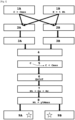
- FIG. 1 is a diagram illustrating a preferred embodiment of the use of according to the invention.
- the invention relates to the field of ambient air treatment in urban environments and, more particularly, to the use of electric or rechargeable hybrid vehicles with the aim of combating pollution.
- the invention proposes to divert the use of the purification means equipping these vehicles when they are parked on public roads, on the surface or even in underground car parks, to depollute the environmental air.
- the invention is based on the following observations. In a so-called "canyon" street with a central traffic lane and parking spaces located on either side of this lane, the volume of air surrounding a vehicle is approximately 65 m 3 . This volume is likely to pass through the on-board purification device in approximately 10 min. However, since the device is not systematically 100% effective, several passes may be necessary to remove the ambient pollution, and the invention provides for the depollution method to be implemented by a vehicle for a period of less than one hour.
- the vehicles used in the context of the invention and, in particular, their purification means must be equipped with a connection system allowing them to be controlled and piloted remotely from a control center and to be activated when a pollution peak appears.
- This control center can itself be controlled by the "Air Quality” information called QA, via internet networks and access to cloud computing.
- This information which is accessible via certain AASQA in France (for example, “AirParif” for the Ile-de-France region), is oriented towards classes of pollutants (NO 2 , PM 10 , O 3 , PM 2.5 , ...) and gives the air quality index as well as its evolution hour by hour, in an urban area, in particular, on a street scale.
- This information has two interests. The first is to know the moment when the pollution threshold is or will be exceeded relative to, for example, European standards, WHO recommendations, etc. The second is geographical and allows us to know in which street the decontamination treatment, via a fleet of parked vehicles, must be deployed.
- this information which is available on the Internet can be used, either directly by the control centre to carry out, in areas exceeding the threshold, the remote start-up of the purification means of its captive fleet of vehicles or private vehicles, or autonomously by the vehicle itself, or via connections with neighbouring vehicles (connections of the "Car2Car” type).
- the invention is preferably applicable to vehicles with electric motors or to vehicles with plug-in hybrid motors equipped with purification means intended to separate pollutants by filtration and/or adsorption and/or catalysis of the outside air introduced into the passenger compartment.
- the invention may also be applicable to vehicles with plug-in hybrid motors equipped with purification means ensuring the catalytic separation and/or adsorption and/or filtration of pollutants from the emissions of the thermal engine at the exhaust line (TWC system for the treatment of NOx, hydrocarbons and carbon oxides CO from gasoline engines; GPF particulate filter system for gasoline engines; DOC system for the treatment of hydrocarbons and CO from Diesel engines; SCR and/or "NOxTrap" system for trapping/treating NOx; DPF particulate filter system for Diesel engines; ASC system for the treatment of ammonia NH3 from Diesel engines, etc.).
- TWC system for the treatment of NOx, hydrocarbons and carbon oxides CO from gasoline engines
- DOC system for the
- the latter although generally equipping combustion engines, can be adapted in a manner known in itself to adsorb the pollutants at temperatures lower than those of the exhaust gases (temperatures below 100°C and preferably below 50°C).
- the method of the invention consists, first, in detecting, from the control center, an urban area where the pollution level is greater than or equal to a set value as well as the stationary presence in this area of at least one immobilized vehicle.
- the control center coordinates the treatment of ambient air by a fleet of captive vehicles or private vehicles, distributed over one or more urban areas.
- the effectiveness of the method proposed by the invention is based, on a city scale, on the number of vehicles detected by the control center and the recording by a computer of their parking position in relation to a polluted area to be treated.
- the control center remotely activates the air purification systems on board the vehicles, then controls these purification systems and analyzes their performance over time.
- control center stops the on-board purification systems when the concentration of pollutants in the vehicle's environment falls below a set value. corresponding, in the area considered, to environmental and/or regulatory criteria.
- the method of the invention also provides that, prior to the activation of the purification means, the state of charge of the vehicle battery is checked with regard to the expected operating time depending on the level of pollution to be treated. Where appropriate, if the state of charge of the vehicle proves to be insufficient, the control center can trigger an alarm to block the activation of the purification means and/or proceed, remotely, to an automatic connection to a nearby electrical network in order to perform a recharge.
- the activation of the purification means and their remote control, from the control center, are carried out by taking into account the filtration capacities specific to each vehicle as a function of time.
- the control center also ensures the continuous monitoring of the performance of the purification means (flow rates of polluted air sucked in, clean air discharged, etc.) by avoiding the unavailability of these means in order to optimize the depollution efficiency.
- the state of fouling of the purification means must be compatible, in all circumstances, with the level of pollution to be treated. Under these conditions, even during treatment, the quantity of pollutants that can still be separated or stored and therefore the treatment capacity of the purification means, must still be higher than the depollution rate assigned to the vehicle, depending on the urban area considered.
- the control center may be required to stop them as soon as they become saturated with pollutants. It is also possible, within the framework of the invention, to trigger an alarm when the level of fouling of the purification means compromises the effectiveness of the rest of the treatment.
- the method of the invention makes it possible to anticipate potential fouling and to send the information back to the control center and/or to the user of the vehicle to carry out rapid maintenance of the purification means and, where appropriate, to carry out their automatic regeneration if the vehicle is equipped with the appropriate means.
- the method of the invention considers that the maximum acceptable fouling rate is reached when the filters are at 90% of their maximum load. This value will be adjusted by taking into account the actual or calculated state of fouling of the filter, the initial concentration of pollutants and the concentration to be reached, the efficiency of the filter, the flow rate and the operating time.
- the method of the invention considers that the saturation level of these means is reached when their clogging level is between 50% and 90% depending on the level of pollution to be treated and the capacity of these means to desorb the pollutants.
- the control center can trigger their automatic regeneration before reactivating them to continue the purification.
- the control center used in the method of the invention can be embedded in a vehicle or installed in a fixed manner at a distance from the fleet of vehicles.
- This control center is equipped with a computer and operating software capable of and intended to determine the mass of pollutants accumulated by the means purification, and therefore their saturation level, depending on their operating time, the air flow rates treated, the concentrations of pollutants in the ambient air and the efficiency ratio of these purification methods.
- the measurement of the saturation of the purification means is carried out in the manner described below in the case where these means use the filtration of polluting particles.
- this measurement method could also be transposed to gaseous pollutants.
- the computer associated with it records the duration of filtration [time T in minutes], the air flow rates drawn in from outside the vehicle [Q in m3 /h] and the concentrations of particles present in the surrounding air and intended to be treated [C in ⁇ g/ m3 ].
- the control centre can then trigger an alarm and/or a maintenance operation of the filter (and/or the adsorbent material) and prompt the owner of the vehicle or fleet to quickly change the on-board filter.
- the purification means are intended to treat several pollutants (such as, for example, combined particle and VOC filters)
- the pollutant taken into account for triggering the alarm is the one that will saturate the filter first.
- the purification means include a catalyst to adsorb and separate the pollutants (catalysis, photo-catalysis, etc.)
- the result Mt of the calculation from equation (2) is compared to the quantity [Mmax] of pollutant corresponding to the clogging of the catalyst.
- the control center can trigger an alarm and, if necessary, launch an automatic regeneration of the catalyst.
- FIG. 1 illustrates the different phases for the implementation of the use of depolluting vehicles according to the invention.
- Phases 2A and 2B information via cloud computing and/or information from the captive vehicle fleet control center.
- Phases 3A and 3B direct information to vehicles parked and connected in the targeted pollution zone and/or information to fleets of vehicles parked and connected in the targeted pollution zone.
- Phase 4 prior to selecting the vehicles to be activated, check the battery charge status of these vehicles and the state of fouling of their purification means.
- Phase 5 activation of the purification means on board the selected vehicles until the concentrations (C) of pollutants in the targeted area are lower than the set value (Cmax) considered admissible.
- Phase 6 Recording the values of [Q x C x T] where Q is the air flow drawn from outside the vehicle, C the concentration of pollutants in the outside air and T the time.
- Phases 9A or 9B possible alarm and replacement of the filter or regeneration of the catalytic system.
- a variant of the method of the invention aims to limit or control the operating time of the purification means because they are likely to generate harmful noise pollution in a confined urban environment.
- the invention can thus provide for stopping the operation of the on-board purification means at night (for example between 10:30 p.m. and 6:00 a.m.) while managing the number of vehicles to be requested according to both the concentrations of pollutants reached and the level of noise generated.
Landscapes
- Engineering & Computer Science (AREA)
- Mechanical Engineering (AREA)
- Physics & Mathematics (AREA)
- Thermal Sciences (AREA)
- Computer Networks & Wireless Communication (AREA)
- Signal Processing (AREA)
- Computing Systems (AREA)
- Health & Medical Sciences (AREA)
- General Physics & Mathematics (AREA)
- General Health & Medical Sciences (AREA)
- Medical Informatics (AREA)
- Life Sciences & Earth Sciences (AREA)
- Sustainable Development (AREA)
- Sustainable Energy (AREA)
- Exhaust Gas After Treatment (AREA)
- Exhaust Gas Treatment By Means Of Catalyst (AREA)
- Treating Waste Gases (AREA)
- Hybrid Electric Vehicles (AREA)
Claims (11)
- Verwendung eines Fahrzeugs mit Elektro- oder Hybridmotor zur Behandlung der Umgebungsluft, wobei das Fahrzeug mit Reinigungsmitteln ausgestattet ist, die dazu bestimmt sind, Schadstoffe durch Filtration und/oder Adsorption und/oder Katalyse der in den Fahrgastraum eingeleiteten Außenluft abzutrennen, dadurch gekennzeichnet, dass Von einem Kontrollzentrum aus wird ein städtischer Bereich erfasst, in dem der Verschmutzungsgrad (C) größer oder gleich einem eingestellten Wert (Cmax) ist, und bei stationärer Anwesenheit des Fahrzeugs in diesem Bereich werden seine bordeigenen Reinigungseinrichtungen aus der Ferne aktiviert und dann werden diese Mittel gesteuert und ihre Leistung als Funktion der Zeit analysiert.
- Verwendung eines Hybrid-Kraftfahrzeugs zur Behandlung der Umgebungsluft, wobei das Fahrzeug mit Reinigungsmitteln ausgestattet ist, die dazu bestimmt sind, Schadstoffe durch Filtration und/oder Adsorption und/oder Katalyse der in die Abgasleitung eingeleiteten Außenluft von den Emissionen des Wärmemotors abzutrennen, dadurch gekennzeichnet , dass von einem Kontrollzentrum aus ein städtisches Gebiet erfasst wird, in dem der Verschmutzungsgrad (C) größer oder gleich einem festgelegten Wert (Cmax) ist, und die ortsfeste Präsenz des besagten Fahrzeugs in diesem Bereich, dessen Bordreinigung erfolgt Mittel werden aus der Ferne aktiviert und dann werden diese Mittel gesteuert und ihre Leistung als Funktion der Zeit analysiert.
- Verwendung nach Anspruch 1 oder Anspruch 2, dadurch gekennzeichnet, dass die bordeigenen Reinigungseinrichtungen gestoppt werden, wenn die Schadstoffkonzentration (C) in der Umgebung des Fahrzeugs unter den eingestellten Wert (Cmax) fällt.
- Verwendung nach einem der vorhergehenden Ansprüche, dadurch gekennzeichnet, dass vor der Aktivierung der bordeigenen Reinigungseinrichtungen und während ihres Betriebs deren Verschmutzungszustand im Hinblick auf den von dem Fahrzeug zu behandelnden Verschmutzungsgrad überprüft und blockiert wird oder sie werden sofort gestoppt, sobald sie mit Schadstoffen gesättigt sind.
- Verwendung nach dem vorhergehenden Anspruch, dadurch gekennzeichnet, dass ein Alarm ausgelöst wird, wenn der Verstopfungsgrad der Luftfilter-Reinigungsmittel größer oder gleich 90 % ihrer maximalen Belastung ( Mmax ) ist.
- Verwendung nach Anspruch 4 mit Anspruch 2, dadurch gekennzeichnet, dass eine automatische Regeneration der Reinigungsmittel durch katalytische Trennung ausgelöst wird, wenn ihr Verstopfungsgrad ( Mmax ) zwischen 50 % und 90 % liegt, abhängig vom Grad der zu behandelnden Verschmutzung und ihrem Fähigkeit, Schadstoffe zu desorbieren.
- Verwendung nach einem der vorhergehenden Ansprüche, dadurch gekennzeichnet, dass das Kontrollzentrum entfernt ist und die Behandlung der Umgebungsluft durch eine über mehrere Stadtgebiete verteilte Fahrzeugflotte koordiniert.
- Verwendung nach dem vorhergehenden Anspruch, dadurch gekennzeichnet, dass das Kontrollzentrum die Mittel zur Reinigung einer Anzahl (N) verfügbarer Fahrzeuge aktiviert, die vom Grad der zu behandelnden Verschmutzung und der Menge der in einem Zielgebiet zu trennenden Schadstoffe abhängt Stadtgebiet und über einen bestimmten Zeitraum.
- Verwendung nach einem der Ansprüche 1 bis 6, dadurch gekennzeichnet, dass sich die Steuerzentrale im Fahrzeug befindet.
- Verwendung nach einem der vorhergehenden Ansprüche, dadurch gekennzeichnet, dass vor der Aktivierung des Reinigungsmittels der Ladezustand der Fahrzeugbatterie im Hinblick auf die zu erwartende Betriebsdauer in Abhängigkeit vom zu verarbeitenden Verschmutzungsgrad des Fahrzeugs überprüft wird und Bei unzureichendem Ladezustand des Fahrzeugs wird ein Alarm ausgelöst.
- Fernsteuerzentrale oder eingebettet in ein Fahrzeug zur Verwaltung einer Nutzung nach einem der vorhergehenden Ansprüche, dadurch gekennzeichnet, dass sie mit einem Computer und einer Betriebssoftware ausgestattet ist, die in der Lage und dazu bestimmt ist, die Masse (Mt) der von den Reinigungsmitteln angesammelten Schadstoffe zu bestimmen, und damit ihr Sättigungsgrad, abhängig von ihrer Betriebsdauer (T), den Durchflussmengen (Q) der behandelten Luft, den Schadstoffkonzentrationen (C) in der Umgebungsluft und dem Wirkungsgrad (R) dieser Reinigungseinrichtungen.
Applications Claiming Priority (2)
| Application Number | Priority Date | Filing Date | Title |
|---|---|---|---|
| FR2003554A FR3109099B1 (fr) | 2020-04-09 | 2020-04-09 | Utilisation de vehicules electriques ou hybrides pour le traitement de l’air ambiant en milieu urbain et centre de controle pour la gestion de ladite utilisation |
| PCT/FR2021/050403 WO2021205088A1 (fr) | 2020-04-09 | 2021-03-10 | Utilisation de vehicules electriques ou hybrides pour le traitement de l'air ambiant en milieu urbain et centre de controle pour la gestion de ladite utilisation |
Publications (2)
| Publication Number | Publication Date |
|---|---|
| EP4133710A1 EP4133710A1 (de) | 2023-02-15 |
| EP4133710B1 true EP4133710B1 (de) | 2024-10-09 |
Family
ID=72709412
Family Applications (1)
| Application Number | Title | Priority Date | Filing Date |
|---|---|---|---|
| EP21715948.2A Active EP4133710B1 (de) | 2020-04-09 | 2021-03-10 | Verwendung von elektrischen oder hybriden fahrzeugen zur behandlung von umgebungsluft in stadtgebieten und kontrollzentrum zur verwaltung dieser verwendung |
Country Status (4)
| Country | Link |
|---|---|
| EP (1) | EP4133710B1 (de) |
| CN (1) | CN115362667A (de) |
| FR (1) | FR3109099B1 (de) |
| WO (1) | WO2021205088A1 (de) |
Families Citing this family (6)
| Publication number | Priority date | Publication date | Assignee | Title |
|---|---|---|---|---|
| FR3132233A1 (fr) * | 2022-02-03 | 2023-08-04 | Psa Automobiles Sa | Procédé et dispositif de contrôle de dispositifs mobiles de purification d’air |
| FR3132852A1 (fr) | 2022-02-22 | 2023-08-25 | Psa Automobiles Sa | Procédé et dispositif de contrôle d’un véhicule apte à purifier de l’air |
| FR3136087A1 (fr) | 2022-05-31 | 2023-12-01 | Psa Automobiles Sa | Systeme et procede de depollution par vehicules automobile par reservation et signalisation de places disponibles dans une zone sujette a un episode de pollution |
| EP4403390A1 (de) * | 2023-01-20 | 2024-07-24 | MANN+HUMMEL Ventures Pte. Ltd. | Fahrzeug, flotte und verfahren zur behandlung von umgebungsluft |
| FR3166843A1 (fr) | 2024-10-01 | 2026-04-03 | Stellantis Auto Sas | Procede de filtrage de l’air par un systeme de ventilation d’au moins un vehicule automobile electrique ou hybride |
| CN119269136B (zh) * | 2024-12-06 | 2025-02-25 | 中汽研华诚认证(天津)有限公司 | 一种整车车内污染净化能力的测试方法 |
Family Cites Families (11)
| Publication number | Priority date | Publication date | Assignee | Title |
|---|---|---|---|---|
| CS161842B2 (de) | 1968-03-09 | 1975-06-10 | ||
| EP0707989A1 (de) | 1994-10-14 | 1996-04-24 | HS Technik und Design Technische Entwicklungen GmbH | Vorrichtung zur Reinigung von Aussenluft |
| EP2927453A1 (de) * | 2014-04-02 | 2015-10-07 | Volvo Car Corporation | Fahrzeugumgebungsluftreinigungsanordnung und -verfahren, und Fahrzeug mit solch einer Anordnung |
| EP2927030B1 (de) * | 2014-04-02 | 2017-10-04 | Volvo Car Corporation | Fahrzeugumgebungsluftreinigungsanordnung und Verfahren, und Fahrzeug und Fahrzeugflotte mit einer derartigen Anordnung |
| CN106467000A (zh) * | 2015-08-14 | 2017-03-01 | 株式会社电装 | 车用空调装置的控制方法及控制系统 |
| FR3046572B1 (fr) * | 2016-01-11 | 2018-02-02 | Psa Automobiles Sa. | Procede de decontamination d’habitacle de vehicule |
| DE102016218858A1 (de) * | 2016-09-29 | 2018-03-29 | Audi Ag | Zeitoptimierte Partikelfilterregeneration bei Hybridfahrzeugen |
| KR102422140B1 (ko) * | 2017-11-07 | 2022-07-18 | 현대자동차주식회사 | 하이브리드 자동차 및 그를 위한 주행 모드 제어 방법 |
| JP7119346B2 (ja) | 2017-11-13 | 2022-08-17 | トヨタ自動車株式会社 | 環境改善システム、ならびにそれに用いられるサーバ |
| DE102018211039A1 (de) | 2018-01-12 | 2019-07-18 | Trittec Ag | Vorrichtung zur Reinigung von Luft, Anordnung von mehreren Vorrichtungen zur Reinigung von Luft und softwaregestützte Applikation |
| EP3628388A1 (de) * | 2018-09-26 | 2020-04-01 | Valeo Systemes Thermiques | Computerimplementiertes verfahren und system zur schätzung einer filterverstopfung |
-
2020
- 2020-04-09 FR FR2003554A patent/FR3109099B1/fr not_active Expired - Fee Related
-
2021
- 2021-03-10 WO PCT/FR2021/050403 patent/WO2021205088A1/fr not_active Ceased
- 2021-03-10 CN CN202180027225.4A patent/CN115362667A/zh active Pending
- 2021-03-10 EP EP21715948.2A patent/EP4133710B1/de active Active
Also Published As
| Publication number | Publication date |
|---|---|
| WO2021205088A1 (fr) | 2021-10-14 |
| FR3109099B1 (fr) | 2023-02-24 |
| CN115362667A (zh) | 2022-11-18 |
| EP4133710A1 (de) | 2023-02-15 |
| FR3109099A1 (fr) | 2021-10-15 |
Similar Documents
| Publication | Publication Date | Title |
|---|---|---|
| EP4133710B1 (de) | Verwendung von elektrischen oder hybriden fahrzeugen zur behandlung von umgebungsluft in stadtgebieten und kontrollzentrum zur verwaltung dieser verwendung | |
| FR2927361B1 (fr) | Procede de regeneration d'une installation de post-traitement des gaz d'echappement | |
| CA2384755C (fr) | Dispositif de traitement des gaz d'echappement d'un moteur a combustion interne | |
| FR3036326B1 (fr) | Dispositif de depollution d’air a strategie de depollution definie en fonction de l’itineraire prevu d’un vehicule | |
| US9605626B2 (en) | Siloxane filtration system and method | |
| FR2865767A1 (fr) | Procede de regeneration d'une installation de traitement aval de gaz d'echappement | |
| CN113356968A (zh) | 一种行车再生控制方法、装置、电子设备及存储介质 | |
| EP1536109B1 (de) | Verfahren und Vorrichtung zur Steuerung der Regenerierung eines Partikelfilters in einer Verbrennungsmotorabgaseinrichtung | |
| EP3017158B1 (de) | System und verfahren zur regeneration eines nox-adsorber | |
| EP3973150B1 (de) | Abgasnachbehandlungssystem einer abgasleitung einer brennkraftmaschine mit positiver zündung | |
| FR2894285A1 (fr) | Procede et dispositif de commande d'une installation de nettoyage des gaz d'echappement | |
| CN114013421B (zh) | 一种颗粒捕集器积碳清除方法及装置 | |
| EP1435306A1 (de) | Heizung- und/oder Klimaanlage- Steuerung mit einem Gebläse und Luftfiltermittel | |
| FR3007793A1 (fr) | Ligne d'echappement apte a depolluer des gaz d'echappement selon deux modes de fonctionnement | |
| WO2009089967A1 (fr) | Procede de gestion de regeneration d' un piege a oxydes d' azote | |
| FR3051147A1 (fr) | Dispositif de depollution d'air a phases d'alimentation en airs definies de facon anticipee en fonction de zones de l'itineraire d'un vehicule | |
| FR3132233A1 (fr) | Procédé et dispositif de contrôle de dispositifs mobiles de purification d’air | |
| FR2936995A3 (fr) | Regeneration d'un dispositif de post-traitement assistee par navigateur | |
| FR2941909A1 (fr) | Procede et dispositif de controle d'un systeme de motorisation pour vehicule automobile | |
| WO2009037406A1 (fr) | Installation de regeneration d'un organe de depollution tel qu'un filtre particules | |
| FR2992350A1 (fr) | Procede de pilotage d'un dispositif de depollution des gaz d'echappement d'un moteur thermique | |
| WO2019239022A1 (fr) | Dispositif de chauffage, ventilation et/ou climatisation pour vehicule automobile comprenant au moins un capteur de masse | |
| FR3132853A1 (fr) | Purification de l’air d’une zone par un dispositif mobile | |
| FR3063515A1 (fr) | Procede de depollution de gaz d’echappement passant dans au moins deux filtres a particules | |
| EP2993320A1 (de) | Kraftfahrzeug mit verbesserter abgasreinigung |
Legal Events
| Date | Code | Title | Description |
|---|---|---|---|
| STAA | Information on the status of an ep patent application or granted ep patent |
Free format text: STATUS: UNKNOWN |
|
| STAA | Information on the status of an ep patent application or granted ep patent |
Free format text: STATUS: THE INTERNATIONAL PUBLICATION HAS BEEN MADE |
|
| PUAI | Public reference made under article 153(3) epc to a published international application that has entered the european phase |
Free format text: ORIGINAL CODE: 0009012 |
|
| STAA | Information on the status of an ep patent application or granted ep patent |
Free format text: STATUS: REQUEST FOR EXAMINATION WAS MADE |
|
| 17P | Request for examination filed |
Effective date: 20220912 |
|
| AK | Designated contracting states |
Kind code of ref document: A1 Designated state(s): AL AT BE BG CH CY CZ DE DK EE ES FI FR GB GR HR HU IE IS IT LI LT LU LV MC MK MT NL NO PL PT RO RS SE SI SK SM TR |
|
| DAV | Request for validation of the european patent (deleted) | ||
| DAX | Request for extension of the european patent (deleted) | ||
| RAP3 | Party data changed (applicant data changed or rights of an application transferred) |
Owner name: STELLANTIS AUTO SAS |
|
| REG | Reference to a national code |
Ref country code: DE Ref legal event code: R079 Free format text: PREVIOUS MAIN CLASS: H04L0029080000 Ipc: H04L0067120000 Ref country code: DE Ref legal event code: R079 Ref document number: 602021019940 Country of ref document: DE Free format text: PREVIOUS MAIN CLASS: H04L0029080000 Ipc: H04L0067120000 |
|
| GRAP | Despatch of communication of intention to grant a patent |
Free format text: ORIGINAL CODE: EPIDOSNIGR1 |
|
| STAA | Information on the status of an ep patent application or granted ep patent |
Free format text: STATUS: GRANT OF PATENT IS INTENDED |
|
| RIC1 | Information provided on ipc code assigned before grant |
Ipc: H04L 67/12 20220101AFI20240525BHEP |
|
| INTG | Intention to grant announced |
Effective date: 20240612 |
|
| GRAS | Grant fee paid |
Free format text: ORIGINAL CODE: EPIDOSNIGR3 |
|
| GRAA | (expected) grant |
Free format text: ORIGINAL CODE: 0009210 |
|
| STAA | Information on the status of an ep patent application or granted ep patent |
Free format text: STATUS: THE PATENT HAS BEEN GRANTED |
|
| AK | Designated contracting states |
Kind code of ref document: B1 Designated state(s): AL AT BE BG CH CY CZ DE DK EE ES FI FR GB GR HR HU IE IS IT LI LT LU LV MC MK MT NL NO PL PT RO RS SE SI SK SM TR |
|
| REG | Reference to a national code |
Ref country code: CH Ref legal event code: EP |
|
| REG | Reference to a national code |
Ref country code: DE Ref legal event code: R084 Ref document number: 602021019940 Country of ref document: DE |
|
| REG | Reference to a national code |
Ref country code: DE Ref legal event code: R096 Ref document number: 602021019940 Country of ref document: DE |
|
| REG | Reference to a national code |
Ref country code: IE Ref legal event code: FG4D Free format text: LANGUAGE OF EP DOCUMENT: FRENCH |
|
| REG | Reference to a national code |
Ref country code: LT Ref legal event code: MG9D |
|
| REG | Reference to a national code |
Ref country code: NL Ref legal event code: MP Effective date: 20241009 |
|
| REG | Reference to a national code |
Ref country code: AT Ref legal event code: MK05 Ref document number: 1731853 Country of ref document: AT Kind code of ref document: T Effective date: 20241009 |
|
| PG25 | Lapsed in a contracting state [announced via postgrant information from national office to epo] |
Ref country code: NL Free format text: LAPSE BECAUSE OF FAILURE TO SUBMIT A TRANSLATION OF THE DESCRIPTION OR TO PAY THE FEE WITHIN THE PRESCRIBED TIME-LIMIT Effective date: 20241009 |
|
| PG25 | Lapsed in a contracting state [announced via postgrant information from national office to epo] |
Ref country code: NL Free format text: LAPSE BECAUSE OF FAILURE TO SUBMIT A TRANSLATION OF THE DESCRIPTION OR TO PAY THE FEE WITHIN THE PRESCRIBED TIME-LIMIT Effective date: 20241009 |
|
| PG25 | Lapsed in a contracting state [announced via postgrant information from national office to epo] |
Ref country code: PT Free format text: LAPSE BECAUSE OF FAILURE TO SUBMIT A TRANSLATION OF THE DESCRIPTION OR TO PAY THE FEE WITHIN THE PRESCRIBED TIME-LIMIT Effective date: 20250210 Ref country code: HR Free format text: LAPSE BECAUSE OF FAILURE TO SUBMIT A TRANSLATION OF THE DESCRIPTION OR TO PAY THE FEE WITHIN THE PRESCRIBED TIME-LIMIT Effective date: 20241009 Ref country code: IS Free format text: LAPSE BECAUSE OF FAILURE TO SUBMIT A TRANSLATION OF THE DESCRIPTION OR TO PAY THE FEE WITHIN THE PRESCRIBED TIME-LIMIT Effective date: 20250209 |
|
| PG25 | Lapsed in a contracting state [announced via postgrant information from national office to epo] |
Ref country code: FI Free format text: LAPSE BECAUSE OF FAILURE TO SUBMIT A TRANSLATION OF THE DESCRIPTION OR TO PAY THE FEE WITHIN THE PRESCRIBED TIME-LIMIT Effective date: 20241009 |
|
| PG25 | Lapsed in a contracting state [announced via postgrant information from national office to epo] |
Ref country code: BG Free format text: LAPSE BECAUSE OF FAILURE TO SUBMIT A TRANSLATION OF THE DESCRIPTION OR TO PAY THE FEE WITHIN THE PRESCRIBED TIME-LIMIT Effective date: 20241009 |
|
| PG25 | Lapsed in a contracting state [announced via postgrant information from national office to epo] |
Ref country code: ES Free format text: LAPSE BECAUSE OF FAILURE TO SUBMIT A TRANSLATION OF THE DESCRIPTION OR TO PAY THE FEE WITHIN THE PRESCRIBED TIME-LIMIT Effective date: 20241009 |
|
| PG25 | Lapsed in a contracting state [announced via postgrant information from national office to epo] |
Ref country code: NO Free format text: LAPSE BECAUSE OF FAILURE TO SUBMIT A TRANSLATION OF THE DESCRIPTION OR TO PAY THE FEE WITHIN THE PRESCRIBED TIME-LIMIT Effective date: 20250109 |
|
| PG25 | Lapsed in a contracting state [announced via postgrant information from national office to epo] |
Ref country code: LV Free format text: LAPSE BECAUSE OF FAILURE TO SUBMIT A TRANSLATION OF THE DESCRIPTION OR TO PAY THE FEE WITHIN THE PRESCRIBED TIME-LIMIT Effective date: 20241009 Ref country code: GR Free format text: LAPSE BECAUSE OF FAILURE TO SUBMIT A TRANSLATION OF THE DESCRIPTION OR TO PAY THE FEE WITHIN THE PRESCRIBED TIME-LIMIT Effective date: 20250110 Ref country code: AT Free format text: LAPSE BECAUSE OF FAILURE TO SUBMIT A TRANSLATION OF THE DESCRIPTION OR TO PAY THE FEE WITHIN THE PRESCRIBED TIME-LIMIT Effective date: 20241009 |
|
| PG25 | Lapsed in a contracting state [announced via postgrant information from national office to epo] |
Ref country code: PL Free format text: LAPSE BECAUSE OF FAILURE TO SUBMIT A TRANSLATION OF THE DESCRIPTION OR TO PAY THE FEE WITHIN THE PRESCRIBED TIME-LIMIT Effective date: 20241009 |
|
| PG25 | Lapsed in a contracting state [announced via postgrant information from national office to epo] |
Ref country code: RS Free format text: LAPSE BECAUSE OF FAILURE TO SUBMIT A TRANSLATION OF THE DESCRIPTION OR TO PAY THE FEE WITHIN THE PRESCRIBED TIME-LIMIT Effective date: 20250109 |
|
| PG25 | Lapsed in a contracting state [announced via postgrant information from national office to epo] |
Ref country code: SM Free format text: LAPSE BECAUSE OF FAILURE TO SUBMIT A TRANSLATION OF THE DESCRIPTION OR TO PAY THE FEE WITHIN THE PRESCRIBED TIME-LIMIT Effective date: 20241009 |
|
| PG25 | Lapsed in a contracting state [announced via postgrant information from national office to epo] |
Ref country code: DK Free format text: LAPSE BECAUSE OF FAILURE TO SUBMIT A TRANSLATION OF THE DESCRIPTION OR TO PAY THE FEE WITHIN THE PRESCRIBED TIME-LIMIT Effective date: 20241009 |
|
| REG | Reference to a national code |
Ref country code: DE Ref legal event code: R097 Ref document number: 602021019940 Country of ref document: DE |
|
| PG25 | Lapsed in a contracting state [announced via postgrant information from national office to epo] |
Ref country code: EE Free format text: LAPSE BECAUSE OF FAILURE TO SUBMIT A TRANSLATION OF THE DESCRIPTION OR TO PAY THE FEE WITHIN THE PRESCRIBED TIME-LIMIT Effective date: 20241009 |
|
| PG25 | Lapsed in a contracting state [announced via postgrant information from national office to epo] |
Ref country code: RO Free format text: LAPSE BECAUSE OF FAILURE TO SUBMIT A TRANSLATION OF THE DESCRIPTION OR TO PAY THE FEE WITHIN THE PRESCRIBED TIME-LIMIT Effective date: 20241009 |
|
| PG25 | Lapsed in a contracting state [announced via postgrant information from national office to epo] |
Ref country code: SK Free format text: LAPSE BECAUSE OF FAILURE TO SUBMIT A TRANSLATION OF THE DESCRIPTION OR TO PAY THE FEE WITHIN THE PRESCRIBED TIME-LIMIT Effective date: 20241009 |
|
| PG25 | Lapsed in a contracting state [announced via postgrant information from national office to epo] |
Ref country code: CZ Free format text: LAPSE BECAUSE OF FAILURE TO SUBMIT A TRANSLATION OF THE DESCRIPTION OR TO PAY THE FEE WITHIN THE PRESCRIBED TIME-LIMIT Effective date: 20241009 |
|
| PG25 | Lapsed in a contracting state [announced via postgrant information from national office to epo] |
Ref country code: IT Free format text: LAPSE BECAUSE OF FAILURE TO SUBMIT A TRANSLATION OF THE DESCRIPTION OR TO PAY THE FEE WITHIN THE PRESCRIBED TIME-LIMIT Effective date: 20241009 |
|
| PLBE | No opposition filed within time limit |
Free format text: ORIGINAL CODE: 0009261 |
|
| STAA | Information on the status of an ep patent application or granted ep patent |
Free format text: STATUS: NO OPPOSITION FILED WITHIN TIME LIMIT |
|
| PG25 | Lapsed in a contracting state [announced via postgrant information from national office to epo] |
Ref country code: SE Free format text: LAPSE BECAUSE OF FAILURE TO SUBMIT A TRANSLATION OF THE DESCRIPTION OR TO PAY THE FEE WITHIN THE PRESCRIBED TIME-LIMIT Effective date: 20241009 |
|
| 26N | No opposition filed |
Effective date: 20250710 |
|
| PG25 | Lapsed in a contracting state [announced via postgrant information from national office to epo] |
Ref country code: MC Free format text: LAPSE BECAUSE OF FAILURE TO SUBMIT A TRANSLATION OF THE DESCRIPTION OR TO PAY THE FEE WITHIN THE PRESCRIBED TIME-LIMIT Effective date: 20241009 |
|
| REG | Reference to a national code |
Ref country code: CH Ref legal event code: H13 Free format text: ST27 STATUS EVENT CODE: U-0-0-H10-H13 (AS PROVIDED BY THE NATIONAL OFFICE) Effective date: 20251024 |
|
| PG25 | Lapsed in a contracting state [announced via postgrant information from national office to epo] |
Ref country code: LU Free format text: LAPSE BECAUSE OF NON-PAYMENT OF DUE FEES Effective date: 20250310 |
|
| GBPC | Gb: european patent ceased through non-payment of renewal fee |
Effective date: 20250310 |
|
| REG | Reference to a national code |
Ref country code: BE Ref legal event code: MM Effective date: 20250331 |
|
| PG25 | Lapsed in a contracting state [announced via postgrant information from national office to epo] |
Ref country code: GB Free format text: LAPSE BECAUSE OF NON-PAYMENT OF DUE FEES Effective date: 20250310 |
|
| PG25 | Lapsed in a contracting state [announced via postgrant information from national office to epo] |
Ref country code: BE Free format text: LAPSE BECAUSE OF NON-PAYMENT OF DUE FEES Effective date: 20250331 |
|
| PG25 | Lapsed in a contracting state [announced via postgrant information from national office to epo] |
Ref country code: CH Free format text: LAPSE BECAUSE OF NON-PAYMENT OF DUE FEES Effective date: 20250331 |
|
| PG25 | Lapsed in a contracting state [announced via postgrant information from national office to epo] |
Ref country code: IE Free format text: LAPSE BECAUSE OF NON-PAYMENT OF DUE FEES Effective date: 20250310 |
|
| PGFP | Annual fee paid to national office [announced via postgrant information from national office to epo] |
Ref country code: DE Payment date: 20260219 Year of fee payment: 6 |
|
| PGFP | Annual fee paid to national office [announced via postgrant information from national office to epo] |
Ref country code: FR Payment date: 20260220 Year of fee payment: 6 |