EP4126932B1 - Antikörper gegen bk-viren - Google Patents
Antikörper gegen bk-viren Download PDFInfo
- Publication number
- EP4126932B1 EP4126932B1 EP21730952.5A EP21730952A EP4126932B1 EP 4126932 B1 EP4126932 B1 EP 4126932B1 EP 21730952 A EP21730952 A EP 21730952A EP 4126932 B1 EP4126932 B1 EP 4126932B1
- Authority
- EP
- European Patent Office
- Prior art keywords
- amino acid
- seq
- acid sequence
- virus
- complementarity determining
- Prior art date
- Legal status (The legal status is an assumption and is not a legal conclusion. Google has not performed a legal analysis and makes no representation as to the accuracy of the status listed.)
- Active
Links
Images









Classifications
-
- C—CHEMISTRY; METALLURGY
- C07—ORGANIC CHEMISTRY
- C07K—PEPTIDES
- C07K16/00—Immunoglobulins [IG], e.g. monoclonal or polyclonal antibodies
- C07K16/08—Immunoglobulins [IG], e.g. monoclonal or polyclonal antibodies against material from viruses
- C07K16/081—DNA viruses
- C07K16/084—Papillomaviridae (F); Polyomaviridae (F), e.g. SV40, BK virus or JC virus
-
- A—HUMAN NECESSITIES
- A61—MEDICAL OR VETERINARY SCIENCE; HYGIENE
- A61P—SPECIFIC THERAPEUTIC ACTIVITY OF CHEMICAL COMPOUNDS OR MEDICINAL PREPARATIONS
- A61P13/00—Drugs for disorders of the urinary system
- A61P13/12—Drugs for disorders of the urinary system of the kidneys
-
- A—HUMAN NECESSITIES
- A61—MEDICAL OR VETERINARY SCIENCE; HYGIENE
- A61P—SPECIFIC THERAPEUTIC ACTIVITY OF CHEMICAL COMPOUNDS OR MEDICINAL PREPARATIONS
- A61P31/00—Antiinfectives, i.e. antibiotics, antiseptics, chemotherapeutics
- A61P31/12—Antivirals
-
- A—HUMAN NECESSITIES
- A61—MEDICAL OR VETERINARY SCIENCE; HYGIENE
- A61P—SPECIFIC THERAPEUTIC ACTIVITY OF CHEMICAL COMPOUNDS OR MEDICINAL PREPARATIONS
- A61P31/00—Antiinfectives, i.e. antibiotics, antiseptics, chemotherapeutics
- A61P31/12—Antivirals
- A61P31/20—Antivirals for DNA viruses
-
- A—HUMAN NECESSITIES
- A61—MEDICAL OR VETERINARY SCIENCE; HYGIENE
- A61P—SPECIFIC THERAPEUTIC ACTIVITY OF CHEMICAL COMPOUNDS OR MEDICINAL PREPARATIONS
- A61P37/00—Drugs for immunological or allergic disorders
- A61P37/02—Immunomodulators
- A61P37/06—Immunosuppressants, e.g. drugs for graft rejection
-
- C—CHEMISTRY; METALLURGY
- C12—BIOCHEMISTRY; BEER; SPIRITS; WINE; VINEGAR; MICROBIOLOGY; ENZYMOLOGY; MUTATION OR GENETIC ENGINEERING
- C12N—MICROORGANISMS OR ENZYMES; COMPOSITIONS THEREOF; PROPAGATING, PRESERVING, OR MAINTAINING MICROORGANISMS; MUTATION OR GENETIC ENGINEERING; CULTURE MEDIA
- C12N15/00—Mutation or genetic engineering; DNA or RNA concerning genetic engineering, vectors, e.g. plasmids, or their isolation, preparation or purification; Use of hosts therefor
- C12N15/09—Recombinant DNA-technology
- C12N15/63—Introduction of foreign genetic material using vectors; Vectors; Use of hosts therefor; Regulation of expression
-
- G—PHYSICS
- G01—MEASURING; TESTING
- G01N—INVESTIGATING OR ANALYSING MATERIALS BY DETERMINING THEIR CHEMICAL OR PHYSICAL PROPERTIES
- G01N33/00—Investigating or analysing materials by specific methods not covered by groups G01N1/00 - G01N31/00
- G01N33/48—Biological material, e.g. blood, urine; Haemocytometers
- G01N33/50—Chemical analysis of biological material, e.g. blood, urine; Testing involving biospecific ligand binding methods; Immunological testing
- G01N33/53—Immunoassay; Biospecific binding assay; Materials therefor
- G01N33/569—Immunoassay; Biospecific binding assay; Materials therefor for microorganisms, e.g. protozoa, bacteria, viruses
- G01N33/56983—Viruses
-
- A—HUMAN NECESSITIES
- A61—MEDICAL OR VETERINARY SCIENCE; HYGIENE
- A61K—PREPARATIONS FOR MEDICAL, DENTAL OR TOILETRY PURPOSES
- A61K39/00—Medicinal preparations containing antigens or antibodies
- A61K2039/505—Medicinal preparations containing antigens or antibodies comprising antibodies
-
- C—CHEMISTRY; METALLURGY
- C07—ORGANIC CHEMISTRY
- C07K—PEPTIDES
- C07K2317/00—Immunoglobulins specific features
- C07K2317/20—Immunoglobulins specific features characterized by taxonomic origin
- C07K2317/24—Immunoglobulins specific features characterized by taxonomic origin containing regions, domains or residues from different species, e.g. chimeric, humanized or veneered
-
- C—CHEMISTRY; METALLURGY
- C07—ORGANIC CHEMISTRY
- C07K—PEPTIDES
- C07K2317/00—Immunoglobulins specific features
- C07K2317/30—Immunoglobulins specific features characterized by aspects of specificity or valency
- C07K2317/33—Crossreactivity, e.g. for species or epitope, or lack of said crossreactivity
-
- C—CHEMISTRY; METALLURGY
- C07—ORGANIC CHEMISTRY
- C07K—PEPTIDES
- C07K2317/00—Immunoglobulins specific features
- C07K2317/30—Immunoglobulins specific features characterized by aspects of specificity or valency
- C07K2317/35—Valency
-
- C—CHEMISTRY; METALLURGY
- C07—ORGANIC CHEMISTRY
- C07K—PEPTIDES
- C07K2317/00—Immunoglobulins specific features
- C07K2317/50—Immunoglobulins specific features characterized by immunoglobulin fragments
- C07K2317/56—Immunoglobulins specific features characterized by immunoglobulin fragments variable (Fv) region, i.e. VH and/or VL
- C07K2317/565—Complementarity determining region [CDR]
-
- C—CHEMISTRY; METALLURGY
- C07—ORGANIC CHEMISTRY
- C07K—PEPTIDES
- C07K2317/00—Immunoglobulins specific features
- C07K2317/70—Immunoglobulins specific features characterized by effect upon binding to a cell or to an antigen
-
- C—CHEMISTRY; METALLURGY
- C07—ORGANIC CHEMISTRY
- C07K—PEPTIDES
- C07K2317/00—Immunoglobulins specific features
- C07K2317/70—Immunoglobulins specific features characterized by effect upon binding to a cell or to an antigen
- C07K2317/76—Antagonist effect on antigen, e.g. neutralization or inhibition of binding
-
- C—CHEMISTRY; METALLURGY
- C07—ORGANIC CHEMISTRY
- C07K—PEPTIDES
- C07K2317/00—Immunoglobulins specific features
- C07K2317/90—Immunoglobulins specific features characterized by (pharmaco)kinetic aspects or by stability of the immunoglobulin
- C07K2317/92—Affinity (KD), association rate (Ka), dissociation rate (Kd) or EC50 value
-
- G—PHYSICS
- G01—MEASURING; TESTING
- G01N—INVESTIGATING OR ANALYSING MATERIALS BY DETERMINING THEIR CHEMICAL OR PHYSICAL PROPERTIES
- G01N2333/00—Assays involving biological materials from specific organisms or of a specific nature
- G01N2333/005—Assays involving biological materials from specific organisms or of a specific nature from viruses
- G01N2333/01—DNA viruses
- G01N2333/025—Papovaviridae, e.g. papillomavirus, polyomavirus, SV40, BK virus, JC virus
-
- Y—GENERAL TAGGING OF NEW TECHNOLOGICAL DEVELOPMENTS; GENERAL TAGGING OF CROSS-SECTIONAL TECHNOLOGIES SPANNING OVER SEVERAL SECTIONS OF THE IPC; TECHNICAL SUBJECTS COVERED BY FORMER USPC CROSS-REFERENCE ART COLLECTIONS [XRACs] AND DIGESTS
- Y02—TECHNOLOGIES OR APPLICATIONS FOR MITIGATION OR ADAPTATION AGAINST CLIMATE CHANGE
- Y02A—TECHNOLOGIES FOR ADAPTATION TO CLIMATE CHANGE
- Y02A50/00—TECHNOLOGIES FOR ADAPTATION TO CLIMATE CHANGE in human health protection, e.g. against extreme weather
- Y02A50/30—Against vector-borne diseases, e.g. mosquito-borne, fly-borne, tick-borne or waterborne diseases whose impact is exacerbated by climate change
Definitions
- the present disclosure relates to anti-BK virus antibody molecules or binding fragments thereof.
- the present disclosure further relates to nucleic acids encoding the antibody molecules or binding fragments thereof, expression vectors, host cells and methods for making the antibody molecules or binding fragments thereof.
- Pharmaceutical compositions comprising the antibody molecules or binding fragments thereof are also provided.
- the anti-BK virus antibody molecules or binding fragments thereof of the present disclosure can be used (alone or in combination with other agents or therapeutic modalities) to treat or prevent a BK virus infection and/or a BK virus associated disorder.
- the present disclosure further relates to anti-BK virus antibody molecules or binding fragments thereof, or pharmaceutical compositions comprising anti-BK virus antibody molecules or binding fragments thereof, for use in treatment or prevention of a BK virus infection and/or a BK virus associated disorder. Diagnostic composition comprising the antibody molecule or binding fragment thereof are also provided.
- Immunosuppressive drugs are the standard of care treatment for transplant recipients to allow engraftment and to prevent graft rejection. Immunosuppression may trigger reactivation of the human BK polyomavirus e.g. in 40 to 50% of kidney transplant recipients ( Hurdiss et al., Structure, 2016 Apr 5;24(4):528-536 ) and in up to 10% of cases this leads to BK virus (BKV) associated nephropathy (BKVAN)( Bennett et al., Microbes Infect, 2012 Aug;14(9):672-83 , Rinaldo et al, APMIS, 2013 Aug;121(8):728-45 ).
- BKV BK virus
- BKVAN BK virus associated nephropathy
- BKVAN is a serious threat and may result in a loss of graft function or even graft loss ( Ramos et al., Transplantation, 2009 Mar 15;87(5):621-30 ).
- the use of antivirals has been met with inconsistent efficacy results and is not considered a valuable treatment option ( Santeusanio et al. Am J Health Syst Pharm, 2017 Dec 15;74(24):2037-2045 ; Kable et al., Transplant Direct, 2017 Mar 10;3(4):e142 ).
- WO 2017/046676 and WO 2019/106578 describe polyomavirus neutralizing antibodies.
- the present disclosure relates to an anti-BK virus antibody molecule or an anti-BK virus binding fragment thereof.
- the present disclosure relates to an anti-BK virus antibody molecule or an anti-BK virus binding fragment thereof, wherein the antibody molecule or binding fragment comprises at least one, two, three, four, five or six complementarity determining regions (CDRs) (or collectively all of the CDRs) from a heavy chain variable region (VH) and/or a light chain variable region (VL) comprising an amino acid sequence shown in Table 3, wherein one or more of the CDRs (or collectively all of the CDRs) may have one, two, three, four, five, six or more changes, e.g., amino acid substitutions (e.g., conservative amino acid substitutions), insertions or deletions, relative to an amino acid sequence shown in Table 3.
- CDRs complementarity determining regions
- VH heavy chain variable region
- VL light chain variable region
- the present disclosure relates to an anti-BK virus antibody molecule or an anti-BK virus binding fragment thereof, comprising: a heavy chain variable region (VH) comprising one, two, or three of: a heavy chain complementarity determining region 1 (VHCDR1) amino acid sequence of SEQ ID NO: 21 or a sequence having one, two, three, or four amino acid substitutions (e.g., conservative amino acid substitutions), insertions or deletions, a heavy chain complementarity determining region 2 (VHCDR2) amino acid sequence of SEQ ID NO: 22 or a sequence having one, two, three, or four amino acid substitutions (e.g., conservative amino acid substitutions), insertions or deletions, and a heavy chain complementarity determining region 3 (VHCDR3) amino acid sequence of SEQ ID NO: 23 or a sequence having one, two, three, or four amino acid substitutions (e.g., conservative amino acid substitutions), insertions or deletions; and/or a light chain variable region (VH) comprising one, two
- the present disclosure relates to an anti-BK virus antibody molecule or an anti-BK virus binding fragment thereof comprising:
- the present disclosure relates to an anti-BK virus antibody molecule or an anti-BK virus binding fragment thereof, comprising:
- the present disclosure relates to an anti-BK virus antibody molecule or an anti-BK virus binding fragment thereof, comprising:
- the anti-BK virus antibody molecule or an anti-BK virus binding fragment thereof comprises:
- the anti-BK virus antibody molecule or an anti-BK virus binding fragment thereof comprises:
- the anti-BK virus antibody molecule or an anti-BK virus binding fragment thereof comprises a heavy chain variable region (VH) comprising the amino acid sequence of SEQ ID NO: 27, or an amino acid sequence having at least about 85%, 90%, 95%, or 99% sequence identity to SEQ ID NO: 27.
- VH heavy chain variable region
- the anti-BK virus antibody molecule or an anti-BK virus binding fragment thereof comprises (i) a light chain variable region (VL) comprising the amino acid sequence of SEQ ID NO: 28, or an amino acid sequence having at least about 85%, 90%, 95%, or 99% sequence identity to SEQ ID NO: 28; or (ii) a light chain variable region (VL) comprising the amino acid sequence of SEQ ID NO: 31, or an amino acid sequence having at least about 85%, 90%, 95%, or 99% sequence identity to SEQ ID NO: 31.
- VL light chain variable region
- the anti-BK virus antibody molecule or an anti-BK virus binding fragment thereof comprises
- the anti-BK virus antibody molecule or an anti-BK virus binding fragment thereof comprises
- the anti-BK virus antibody molecule or an anti-BK virus binding fragment thereof comprises one or more (e.g., 2, 3, 4, 5, 6, 7, 8 or 9) of the following properties:
- aspect A2 is not according to the invention and is present for illustration purposes only.
- the present disclosure relates to an antibody molecule or a binding fragment thereof that competes for binding to BK virus serotype I VP1, BK virus serotype II VP1, BK virus serotype III VP1, and/or BK virus serotype IV VP1 with an antibody molecule or a binding fragment thereof described herein.
- the present disclosure relates to an antibody molecule or a binding fragment thereof that competes for binding to BK virus genotype I VP1, BK virus genotype II VP1, BK virus genotype III VP1, and/or BK virus genotype IV VP1 with an antibody molecule or a binding fragment thereof that comprises a heavy chain variable region (VH) comprising a heavy chain complementarity determining region 1 (VHCDR1) amino acid sequence of SEQ ID NO: 21, a heavy chain complementarity determining region 2 (VHCDR2) amino acid sequence of SEQ ID NO: 22, and a heavy chain complementarity determining region 3 (VHCDR3) amino acid sequence of SEQ ID NO: 23; and a light chain variable region (VL) comprising a light chain complementarity determining region 1 (VLCDR1) amino acid sequence of SEQ ID NO: 24, a light chain complementarity determining region 2 (VLCDR2) amino acid sequence of SEQ ID NO: 25, and a light chain complementarity determining region 3 (VLCDR
- VH heavy chain variable
- the present disclosure relates to an antibody molecule or a binding fragment thereof that competes for binding to BK virus genotype I VP1, BK virus genotype II VP1, BK virus genotype III VP1, and/or BK virus genotype IV VP1 with an antibody molecule or a binding fragment thereof that comprises (i) a heavy chain variable region (VH) comprising the amino acid sequence of SEQ ID NO: 27, and a light chain variable region (VL) comprising the amino acid sequence of SEQ ID NO: 28; or (ii) a heavy chain variable region (VH) comprising the amino acid sequence of SEQ ID NO: 27, and a light chain variable region (VL) comprising the amino acid sequence of SEQ ID NO: 31.
- VH heavy chain variable region
- VL light chain variable region
- the present disclosure relates to a pharmaceutical composition
- a pharmaceutical composition comprising the antibody molecule or binding fragment thereof described herein and a pharmaceutically acceptable carrier, excipient or stabilizer.
- the present disclosure relates to anti-BK virus antibody molecules or binding fragments thereof described herein, or pharmaceutical compositions comprising anti-BK virus antibody molecules or binding fragments thereof described herein, for use in the treatment or prevention of a BK virus infection and/or a BK virus associated disorder.
- the BK virus associated disorder is selected from the group consisting of nephropathy, BK virus associated nephropathy (BKVAN), hemorrhagic cystitis (HC).
- the present disclosure relates to a nucleic acid encoding the antibody heavy and/or light chain variable region of the antibody molecule or binding fragment thereof described herein.
- the present disclosure relates to an expression vector comprising the nucleic acid described herein.
- the present disclosure relates to a host cell comprising the nucleic acid described herein or the expression vector described herein.
- the present disclosure relates to a method of producing an antibody molecule, the method comprising culturing the host cell described herein under conditions suitable for gene expression.
- the present disclosure relates to a diagnostic composition
- a diagnostic composition comprising the antibody molecule or binding fragment thereof described herein.
- the present disclosure relates to an anti-BK virus antibody molecule or an anti-BK virus binding fragment thereof.
- the present disclosure relates to an anti-BK virus antibody molecule or an anti-BK virus binding fragment thereof, wherein the antibody molecule or binding fragment comprises at least one, two, three, four, five or six complementarity determining regions (CDRs) (or collectively all of the CDRs) from a heavy chain variable region (VH) and/or a light chain variable region (VL) comprising an amino acid sequence shown in Table 4, wherein one or more of the CDRs (or collectively all of the CDRs) may have one, two, three, four, five, six or more changes, e.g., amino acid substitutions (e.g., conservative amino acid substitutions), insertions or deletions, relative to an amino acid sequence shown in Table 4.
- CDRs complementarity determining regions
- VH heavy chain variable region
- VL light chain variable region
- the present disclosure relates to an anti-BK virus antibody molecule or an anti-BK virus binding fragment thereof, comprising:
- the present disclosure relates to an anti-BK virus antibody molecule or an anti-BK virus binding fragment thereof comprising:
- the present disclosure relates to an anti-BK virus antibody molecule or an anti-BK virus binding fragment thereof, comprising:
- the present disclosure relates to an anti-BK virus antibody molecule or an anti-BK virus binding fragment thereof, comprising:
- the anti-BK virus antibody molecule or an anti-BK virus binding fragment thereof comprises:
- the anti-BK virus antibody molecule or an anti-BK virus binding fragment thereof comprises:
- the anti-BK virus antibody molecule or an anti-BK virus binding fragment thereof comprises (i) a heavy chain variable region (VH) comprising the amino acid sequence of SEQ ID NO: 40, or an amino acid sequence having at least about 85%, 90%, 95%, or 99% sequence identity to SEQ ID NO: 40; or (ii) a heavy chain variable region (VH) comprising the amino acid sequence of SEQ ID NO: 45, or an amino acid sequence having at least about 85%, 90%, 95%, or 99% sequence identity to SEQ ID NO: 45; or (iii) a heavy chain variable region (VH) comprising the amino acid sequence of SEQ ID NO: 49, or an amino acid sequence having at least about 85%, 90%, 95%, or 99% sequence identity to SEQ ID NO: 49.
- VH heavy chain variable region
- the anti-BK virus antibody molecule or an anti-BK virus binding fragment thereof comprises (i) a light chain variable region (VL) comprising the amino acid sequence of SEQ ID NO: 41, or an amino acid sequence having at least about 85%, 90%, 95%, or 99% sequence identity to SEQ ID NO: 41; or (ii) a light chain variable region (VL) comprising the amino acid sequence of SEQ ID NO: 50, or an amino acid sequence having at least about 85%, 90%, 95%, or 99% sequence identity to SEQ ID NO: 50.
- VL light chain variable region
- the anti-BK virus antibody molecule or an anti-BK virus binding fragment thereof comprises
- the anti-BK virus antibody molecule or an anti-BK virus binding fragment thereof comprises
- the anti-BK virus antibody molecule or an anti-BK virus binding fragment thereof comprises one or more (e.g., 2, 3, 4, 5, 6, 7, 8 or 9) of the following properties:
- the present disclosure relates to an antibody molecule or a binding fragment thereof that competes for binding to BK virus serotype I VP1, BK virus serotype II VP1, BK virus serotype III VP1, and/or BK virus serotype IV VP1 with an antibody molecule or a binding fragment thereof described herein.
- the present disclosure relates to an antibody molecule or a binding fragment thereof that competes for binding to BK virus genotype I VP1, BK virus genotype II VP1, BK virus genotype III VP1, and/or BK virus genotype IV VP1 with an antibody molecule or a binding fragment thereof that comprises
- the present disclosure relates to an antibody molecule or a binding fragment thereof that competes for binding to BK virus genotype I VP1, BK virus genotype II VP1, BK virus genotype III VP1, and/or BK virus genotype IV VP1 with an antibody molecule or a binding fragment thereof that comprises
- the present disclosure relates to a pharmaceutical composition
- a pharmaceutical composition comprising the antibody molecule or binding fragment thereof described herein and a pharmaceutically acceptable carrier, excipient or stabilizer.
- the present disclosure relates to anti-BK virus antibody molecules or binding fragments thereof described herein, or pharmaceutical compositions comprising anti-BK virus antibody molecules or binding fragments thereof described herein, for use in the treatment or prevention of a BK virus infection and/or a BK virus associated disorder.
- the BK virus associated disorder is selected from the group consisting of nephropathy, BK virus associated nephropathy (BKVAN), hemorrhagic cystitis (HC).
- the present disclosure relates to a nucleic acid encoding the antibody heavy and/or light chain variable region of the antibody molecule or binding fragment thereof described herein.
- the present disclosure relates to an expression vector comprising the nucleic acid described herein.
- the present disclosure relates to a host cell comprising the nucleic acid described herein or the expression vector described herein.
- the present disclosure relates to a method of producing an antibody molecule, the method comprising culturing the host cell described herein under conditions suitable for gene expression.
- the present disclosure relates to a diagnostic composition
- a diagnostic composition comprising the antibody molecule or binding fragment thereof described herein.
- Certain aspects of the present disclosure are based, at least in part, on the identification of anti-BK virus antibody molecules or binding fragments thereof that
- the anti-BK virus antibody molecules or binding fragments thereof neutralize BK virus serotypes I, II, III, and IV.
- the anti-BK virus antibody molecules or binding fragments thereof do not bind to JC virus VP1. Increased specificity is manifested by the absence of binding to the closely related JC virus VP1. Increased specificity is considered as better safety due to lower risk for off target reactivity.
- a full-length antibody includes a constant domain and a variable domain.
- the constant region need not be present in an antigen-binding fragment of an antibody.
- Binding fragments may thus include portions of an intact full-length antibody, such as an antigen binding or variable region of the complete antibody.
- antibody fragments include Fab, F(ab')2, Id and Fv fragments; diabodies; linear antibodies; single-chain antibody molecules (e.g., scFv); multispecific antibody fragments such as bispecific, trispecific, and multispecific antibodies (e.g., diabodies, triabodies, tetrabodies); minibodies; chelating recombinant antibodies; tribodies or bibodies; intrabodies; nanobodies; small modular immunopharmaceuticals (SMIP), binding-domain immunoglobulin fusion proteins; camelized antibodies; VHH containing antibodies; and any other polypeptides formed from antibody fragments.
- SMIP small modular immunopharmaceuticals
- polypeptides having the sequences specified, or sequences substantially identical or similar thereto, e.g. sequences having at least about 85%, 90%, 95%, or 99% sequence identity to the sequence specified.
- the determination of percent identity between two sequences is preferably accomplished using the mathematical algorithm of Karlin and Altschul (1993) Proc. Natl. Acad. Sci USA 90: 5873-5877 . Such an algorithm is incorporated into the BLASTp (Protein BLAST) program of Altschul et al. (1990) J. Mol. Biol. 215: 403-410 available at NCBI (https://blast.ncbi.nlm.nih.gov/). The determination of percent identity may be performed with the standard parameters of the BLASTp program.
- the "Max Target Sequences” box may be set to 100, the "Short queries” box may be ticked, the "Expect threshold” box may be set to 10, the "Word Size” box may be set to “3” and the "Max matches in a query range” may be set to "0".
- the scoring parameters the "Matrix” box may be set to "BLOSUM62”
- the "Gap Costs” Box may be set to "Existence: 11 Extension:1”
- the "Compositional adjustments” box may be set to "Conditional compositional score matrix adjustment”.
- the "Low complexity regions” box may not be ticked
- the "Mask for lookup table only” box may not be ticked and the "Mask lower case letters” box may not be ticked.
- a "conservative amino acid substitution” is an amino acid substitution in which the amino acid residue is replaced with an amino acid residue having a similar side chain.
- Families of amino acid residues having similar side chains have been defined in the art. These families include amino acids with basic side chains (e.g. , lysine, arginine, histidine), acidic side chains (e.g. , aspartic acid, glutamic acid), uncharged polar side chains (e.g. , glycine, asparagine, glutamine, serine, threonine, tyrosine, cysteine), nonpolar side chains (e.g.
- the disclosure also relates in some embodiments to a nucleic acid encoding antibody molecules or binding fragments thereof, vectors comprising such nucleic acids and host cells comprising such nucleic acids or vectors.
- the antibody molecules or binding fragments thereof may be encoded by a single nucleic acid (e.g., a single nucleic acid comprising nucleotide sequences that encode the light and heavy chain polypeptides of the antibody), or by two or more separate nucleic acids, each of which encode a different part of the antibody molecule or antibody fragment.
- the nucleic acids may be DNA, cDNA, RNA and the like.
- a "vector” is any molecule or composition that has the ability to carry a nucleic acid sequence into a suitable cell where synthesis of the encoded polypeptide can take place.
- the present disclosure in some aspects further provides a host cell (e.g., an isolated or purified cell) comprising a nucleic acid or vector of the invention.
- a host cell e.g., an isolated or purified cell
- the host cell can be any type of cell capable of being transformed with the nucleic acid or vector of the invention so as to produce a polypeptide encoded thereby.
- compositions can be formulated in compositions, especially pharmaceutical compositions.
- Such compositions comprise a therapeutically effective amount of an antibody or binding fragment thereof in admixture with a pharmaceutically acceptable carrier, excipient or stabilizer.
- anti-BK virus antibody molecules or anti-BK virus binding fragments thereof and the pharmaceutical compositions as described herein can be administered in methods of treating or preventing a BK virus infection and/or a BK virus associated disorder.
- references in the description to methods of treatment refer to the compounds, pharmaceutical compositions and medicaments of the present invention for use in a method for treatment of the human (or animal) body by therapy (or for diagnosis).
- Table 1 The amino acid sequences of the VP1 protein constructs used in the following examples are summarized in Table 1 below.
- Table 1 Amino acid sequences of VP1 protein constructs BKV serotype I SEQ ID NO: 1 VP1-I VP1-Pentamer SEQ ID NO: 2 VP1-la BK pseudovir us SEQ ID NO: 3 VP1-lb BK pseudovir us BKV serotype II SEQ ID NO: 4 VP1-II VP1-pentamer SEQ ID NO: 5 VP1-II BK pseudovir us BKV serotype III SEQ ID NO: 6 VP1-III VP1-pentamer SEQ ID NO: 7 VP1-III BK pseudovir us BKV serotype IV SEQ ID NO: 8 VP1-IV VP1-Pentamer SEQ ID NO: 9 VP1-IVc BK pseudovir us JCV SEQ ID NO: 10 VP1 VP1-Pentamer
- P8D11 ( WO 2017/046676 ) was cloned as described for the other antibodies. VH and VL of P8D11 as described in WO 2017/046676 was fused to the identical constant domains of IgG as described below. Amino acid sequences for comparative antibody P8D11 are summarized in Table 2 below.
- Negative control 24C3 is an antibody derived from healthy humans against Tetanus toxoid. The variable fragments were fused to the identical constant domains of IgG as described below.
- Peripheral blood memory B cells from healthy human donors or kidney transplant recipients were used to prepare antibody repertoire expression libraries by cloning the immunoglobulin light chain and heavy chain variable regions into an expression cassette providing the human immunoglobulin constant heavy region combined with a transmembrane domain derived from human CD8 to allow for mammalian cell display of the antibodies. Screening of the antibody libraries was performed after transduction of the library in HEK 293T cells by antigen-specific sorting using fluorescently labelled VP1-pentamers of BK-Virus.
- BK-Virus-specific-antibody-expressing HEK cell clones which were further propagated to upscale antibody production for downstream analysis of antibody properties such as additional binding assays in ELISA or BK-virus neutralization.
- the neutralizing capacity of the antibodies was tested using BK pseudoviruses (BK-PsV) carrying a luciferase expressing reporter plasmid and wild type BKV.
- BK-virus -specific antibodies with high affinity and virus neutralizing capacity were then sub-cloned into expression vectors for soluble antibody expression and expressed after transient transfection in HEK 293F or CHO cells.
- Antibodies were then purified over protein G or Protein A for characterization in the various assays.
- Amino acid sequences relating to identified antibody 319C07 are summarized in Table 3 below. In addition, variants were prepared and the corresponding amino acid sequences are also summarized in Table 3 below. Amino acid sequences relating to identified antibody 336F07 are summarized in Table 4 below. In addition, variants were prepared and the corresponding amino acid sequences are also summarized in Table 4 below. Table 3 - Amino acid sequences for anti-BK virus antibodies 319C07 and 319C07-var1.
- the binding of anti-BK virus antibodies to BKV-VP1 pentamers was analyzed by ELISA. Briefly, Costar ® 96 well Assay Plates, half area high binding plates (Corning Inc. #3690) were coated with 30 ⁇ l/well of 1 ⁇ g/ml BKV-VP1 pentamers overnight at 4°C. Subsequently, the plate was blocked using 5% skim milk powder (Rapilait, Migros #7610200017598) diluted in PBS. Antibodies were serially diluted in PBS with 0.5% skim milk powder and added to the antigen-coated plates for 1.5 h.
- the antibody 319C07 showed strong and selective binding to all BKV-VP1 serotypes ( Figure 1 , EC50 E values below). Compared to comparative antibody P8D11, antibody 319C07 showed higher affinity for serotype I, II and IV and showed a comparable affinity on BKV-VP1-serotype III.
- EC50 E (nM) VP1-I VP1-II VP1-III VP1-IV 319C07 0.05 0.06 0.06 0.06 P8D11 0.14 0.19 0.07 0.12
- antibody 336F07 showed strong and selective binding to all BKV-VP1 serotypes ( Figure 1 , EC50 E values below). Compared to comparative antibody P8D11, antibody 336F07 showed higher affinity on all four serotypes. EC50 E (nM) VP1-I VP1-II VP1-III VP1-IV 336F07 0.07 0.03 0.02 0.03 P8D11 0.14 0.19 0.07 0.12
- BK Pseudovirus (BK-PsV) carrying the NanoLuc reporter gene was produced as described ( Pastrana et al, J Virol, 2013 Sep; 87(18):10105-13 ).
- Five different genotypes were produced: BKV-la (BK-D; JF894228), BKV-lb2 (PittVR2; DQ989796) BKV-II (Q85238; CAA79596), BKV-III (Q0PDA6; BAF03017) and BKV-IVc2 (A-66H; AB369093).
- VP1 was purified over Agarose gel beads as described ( Buck et al, J Virol, 2008 Jun;82(11):5190-7 and Buck et al, Curr Protoc Cell Biol, 2007 Dec; Chapter 26; 26.21 ). Infectious virus titer was determined on 293TT cells. Different dilutions of the BK-PsV were tested in a 96 well plate with and without inhibitor. The dilution selected for further assays resulted in a high luminescence signal in non-inhibited cells.
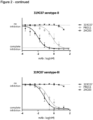
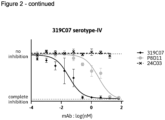
- 319C07 and the variant 319C07-var1 show strong inhibition of BK-Pseudovirus from all serotypes.
- 319C07 outperforms P8D11 significantly ( Figure 2 , IC50 values below).
- IC50 (nM) Ia Ib II III IV
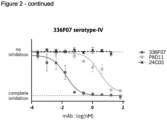
- antibody 336F07 and the variants 336F07-var1 and 336F07-var4 show strong inhibition of BK-Pseudovirus from all serotypes.
- 336F07 outperforms P8D11 significantly ( Figure 2 , IC50 values below).
- IC50 (nM) Ia lb II III IV
- HPRTEC human primary renal proximal tubular epithelial cells
- ATCC ® VR-837 TM wild type BK virus strain I
- anti-BK virus antibodies were added at three distinct concentrations corresponding to their EC95; EC50 and EC5 viral inhibition potency to cell-virus co-cultures for 1 week. After this period virus was harvested from the cells and remaining supernatant by 3 freeze thaw cycles. 10ul of this virus extract was then added to freshly seeded HRPTEC cells in the presence of antibodies at the various concentrations. After 2 weeks of inoculation virus load was again quantified and virus extracts were generated to be used in the next infection cycle. This procedure was repeated 3 times resulting in a total of 8 weeks of co-culture.
- the assay was performed in triplica in 96 well flat bottom cell culture plates. Quantification of viral load in the culture supernatant was performed by harvesting 15 ⁇ l of media which was then heat-inactivated at 95°C for 10 min and used for qPCRwith primers 5'-GGATGGGCAGCCTATGTATG-3' (SEQ ID NO: 53), and 5'-TCATATCTGGGTCCCCTGGA-3' (SEQ ID NO: 54) and a TaqMan TM probe FAM-AGGGTGTTTGATGGCACAGA-TAMRA (SEQ ID NO: 55). PCR was performed using PerfeCTa qPCR ToughMix (Quantabio, #95140) with following conditions: 95°C for 8 min and 40 cycles of 95°C for 10 sec and 60°C for 60 sec.
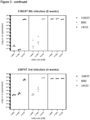
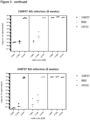
- Antibody 319C07 shows a more complete neutralization of the virus compared to P8D11. This becomes most apparent when looking at the last infection-neutralization cycle after 8 weeks where at concentrations corresponding to EC95 and EC50 no virus could be detected anymore whereas P8D11 shows measurable virus loads in both EC95 and EC50. ( Figure 3 , P8D11 is labelled with "BM2" in this figure).
- antibody 336F07 shows a more complete neutralization of the virus compared to P8D11. This becomes most apparent when looking at the last infection-neutralization cycle after 8 weeks ( Figure 3 , P8D11 is labelled with "BM2" in this figure).
- BKV-VP1 pentamers of serotypes I, II, III and IV were spotted to a nitrocellulose membrane either in their native form or after chemical and thermal denaturation using Tris buffer containing SDS and ⁇ -Mercaptoethanol and heating at 85°C for 5min. Both membranes were incubated with the anti-BK virus antibodies and their binding was revealed using HRP-conjugated secondary antibodies directed against human Fc. Detection was done using a colorimetric substrate (Sigma Fast DAB).
- Antibody 319C07 and antibody 336F07 show selective binding to a conformational epitope ( Figure 4 ). Due to absence of staining of denatured antigen, binding to a linear epitope can be excluded.
- Commercially available control antibody (Ab53977, Abcam, rabbit-lgG) known to recognize a linear epitope, detected both the denatured and non-denatured VP1.
- Example 6 Binding to mutations of BKV-VP1-pentamer and to JCV-VP1 pentamer in ELISA
- the VP1-Serotype Ib wild type sequence was used as the basis for the introduction of mutations at various positions.
- VP1 of the JC virus was used.
- the binding of anti-BK virus antibodies to wild type and variant VP1 pentamers was analyzed by ELISA. Briefly, Costar ® Assay Plate 96 well, half area high binding plates (Corning Inc. #3690) were coated with 30 ⁇ l/well of 1 ⁇ g/ml BKV-VP1 pentamer variants overnight at 4°C. After 16h, non-specific binding was blocked using 5% skim milk powder (Rapilait, Migros #7610200017598) diluted in PBS.
- Antibodies were serially diluted from 67nM down to 0.02nM in PBS containing 0.5% skim milk powder and incubated on the antigen-coated plates for 1.5 h. Plates were then washed three times with PBS 0.05% Tween20 (AppliChem, A4974) and then incubated with secondary antibody (HRP-conjugated goat anti-human IgG, Jackson-Immuno #109-035-098) diluted 1:10'000 in PBS with 0.5% skim milk powder for 45min. HRP activity of the bound secondary antibodies was revealed using 30 ⁇ l/well TMB liquid substrate (Sigma-Aldrich, #T0440). The reaction was stopped after 2.5min by addition of 15 ⁇ l/well 1M H2SO4.
- Binding to mutant forms of BKV VP1 in comparison to wild type VP1 and to VP1 of the closely related JC polyoma virus was tested for antibody 319C07 in comparison to antibody P8D11.
- Antibody 319C07 does not bind at all to VP1 of the JC virus whereas antibody P8D11 shows weak but significant binding. If amino acids at position N62, D175 or S275 is mutated to alanine, 319C07 shows a slightly reduced binding affinity. Changing amino acid K172 to alanine does not lower the binding.
- P8D11 shows reduced binding to the VP1-I-K172A mutant, while binding is not affected to N62A, D175A or S275A mutations.
- 319C07 shows here a clearly distinct pattern suggesting that it interacts with different amino acids of VP1 compared to P8D11 ( Figure 5 ).
- Binding to mutant forms of BKV VP1 in comparison to wild type VP1 and to VP1 of the closely related JC polyoma virus was also tested for antibody 336F07 in comparison to antibody P8D11.
- Antibody 336F07 does not bind at all to VP1 of the JC virus whereas antibody P8D11 shows weak but significant binding. If amino acids at position N62 or E73 is mutated, 336FC07 shows a slightly reduced binding affinity. Changing amino acid K172 to alanine does not lower the binding. P8D11 on the other hand, shows reduced binding to the VP1-I-K172A mutant, while binding is not affected to N62A or E73Q mutations. Compared to antibody P8D11, 336F07 shows here a clearly distinct pattern suggesting that it interacts with different amino acids of VP1 compared to P8D11 ( Figure 5 ).
- HRPTEC Primary Human Renal Proximal Tubule Epithelial Cells
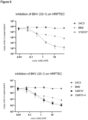
- Antibody 319C07 is showing around 100fold superiority over P8D11 for inhibition of BKV spread among HRPTEC; also antibody 336F07 is showing significant superiority over P8D11 for inhibition of BKV spread among HRPTEC ( Figure 6 , P8D11 is labelled with "BM2" in this figure).
- HPRTEC seeded in flat bottom 96 well plates either infected with wild type BK virus strain I (ATCC ® VR-837 TM ) or left uninfected were used as target cells.
- As effector cells engineered Jurkat cells, components of the ADCC Reporter Bioassay G7015 from Promega were used.
- Fc- ⁇ RIIIa signalling by the effector cells is quantified through a luminescence readout.
- Anti-BKV or control antibodies in serial dilutions were added at to the HPRTEC culture together with the effector cells and incubated for 6h prior to developing and measuring the bioluminescence as described by the assay kit manufacturer.
- 319C7 and 336F07 showed comparable ADCC activity on infected HPRTEC which in turn was comparable to that of P8D11. No ADCC was observed on HPRTEC that were left uninfected with either 319C7 and 336F07 or P8D11 ( Figure 7 ).
- HPRTEC seeded in flat bottom 96 well plates either infected with wild type BK virus strain I (ATCC ® VR-837 TM ) or left uninfected were used as target cells.
- Cells were incubated with anti-BKV antibodies at serial dilutions starting with 100 ⁇ g/ml and 20% human serum overnight and cell viability was quantified by determining the ratio of living cells using the FSC/SSC criterium in a cytometer.
- 319C7 and 336F07 showed no CDC activity at a concentration of 100 ⁇ g/ml on infected HPRTEC and the same observation was made with antibody P8D11 and control antibody Rituximab directed against an irrelevant target on HRPTEC ( Figure 8 ).
Landscapes
- Health & Medical Sciences (AREA)
- Life Sciences & Earth Sciences (AREA)
- Chemical & Material Sciences (AREA)
- Organic Chemistry (AREA)
- Engineering & Computer Science (AREA)
- General Health & Medical Sciences (AREA)
- Immunology (AREA)
- Medicinal Chemistry (AREA)
- Virology (AREA)
- Bioinformatics & Cheminformatics (AREA)
- Nuclear Medicine, Radiotherapy & Molecular Imaging (AREA)
- Animal Behavior & Ethology (AREA)
- Veterinary Medicine (AREA)
- Public Health (AREA)
- Pharmacology & Pharmacy (AREA)
- General Chemical & Material Sciences (AREA)
- Chemical Kinetics & Catalysis (AREA)
- Molecular Biology (AREA)
- Genetics & Genomics (AREA)
- Biochemistry (AREA)
- Biotechnology (AREA)
- Biophysics (AREA)
- Urology & Nephrology (AREA)
- Biomedical Technology (AREA)
- Proteomics, Peptides & Aminoacids (AREA)
- Oncology (AREA)
- Communicable Diseases (AREA)
- Transplantation (AREA)
- Zoology (AREA)
- Wood Science & Technology (AREA)
- General Engineering & Computer Science (AREA)
- Physics & Mathematics (AREA)
- Microbiology (AREA)
- Hematology (AREA)
- Plant Pathology (AREA)
- Analytical Chemistry (AREA)
- General Physics & Mathematics (AREA)
- Pathology (AREA)
- Food Science & Technology (AREA)
- Cell Biology (AREA)
Claims (10)
- Anti-BK-Virus-Antikörpermolekül oder Anti-BK-Virus-bindendes Fragment davon, umfassend:eine variable Region der schweren Kette (VH), umfassend eine komplementaritätsbestimmende Region 1 der schweren Kette (VHCDR1) mit der Aminosäuresequenz von SEQ ID NO: 21, eine komplementaritätsbestimmende Region 2 der schweren Kette (VHCDR2) mit der Aminosäuresequenz von SEQ ID NO: 22, und eine komplementaritätsbestimmende Region 3 der schweren Kette (VHCDR3) mit der Aminosäuresequenz von SEQ ID NO: 23; undeine variable Region der leichten Kette (VL), umfassend eine komplementaritätsbestimmende Region 1 der leichten Kette (VLCDR1) mit der Aminosäuresequenz von SEQ ID NO: 24, eine komplementaritätsbestimmende Region 2 der leichten Kette (VLCDR2) mit der Aminosäuresequenz von SEQ ID NO: 25, und eine komplementaritätsbestimmende Region 3 der leichten Kette (VLCDR3) mit der Aminosäuresequenz von SEQ ID NO: 26.
- Das Antikörpermolekül oder das bindende Fragment davon nach Anspruch 1, umfassend(i) eine variable Region der schweren Kette (VH), umfassend die Aminosäuresequenz von SEQ ID NO: 27 oder eine Aminosäuresequenz mit mindestens etwa 85 %, 90 %, 95 % oder 99 % Sequenzidentität zu SEQ ID NO: 27, und eine variable Region der leichten Kette (VL), umfassend die Aminosäuresequenz von SEQ ID NO: 28 oder eine Aminosäuresequenz mit mindestens etwa 85 %, 90 %, 95 % oder 99 % Sequenzidentität zu SEQ ID NO: 28; oder(ii) eine variable Region der schweren Kette (VH), umfassend die Aminosäuresequenz von SEQ ID NO: 27 oder eine Aminosäuresequenz mit mindestens etwa 85%, 90%, 95% oder 99% Sequenzidentität zu SEQ ID NO: 27, und eine variable Region der leichten Kette (VL), umfassend die Aminosäuresequenz von SEQ ID NO: 31 oder eine Aminosäuresequenz mit mindestens etwa 85%, 90%, 95% oder 99% Sequenzidentität zu SEQ ID NO: 31.
- Antikörpermolekül oder bindendes Fragment davon nach Anspruch 1 oder 2, umfassend(i) eine variable Region der schweren Kette (VH), umfassend die Aminosäuresequenz von SEQ ID NO: 27, und eine variable Region der leichten Kette (VL), umfassend die Aminosäuresequenz von SEQ ID NO: 28; oder(ii) eine variable Region der schweren Kette (VH), umfassend die Aminosäuresequenz von SEQ ID NO: 27, und eine variable Region der leichten Kette (VL), umfassend die Aminosäuresequenz von SEQ ID NO: 31.
- Pharmazeutische Zusammensetzung, umfassend das Antikörpermolekül oder das bindende Fragment davon nach einem der Ansprüche 1 bis 3 und einen pharmazeutisch akzeptablen Träger, Hilfsstoff oder Stabilisator.
- Antikörpermolekül oder bindendes Fragment davon nach einem der Ansprüche 1 bis 3 oder pharmazeutische Zusammensetzung nach Anspruch 4 zur Verwendung bei der Behandlung oder Vorbeugung einer BK-Virusinfektion und/oder einer BK-Virus-assoziierten Erkrankung, ausgewählt aus der Gruppe bestehend aus Nephropathie, BK-Virus-assoziierter Nephropathie (BKVAN) und hämorrhagischer Zystitis (HC).
- Nukleinsäure, die für die variablen Regionen der schweren und leichten Kette des Antikörpers des Antikörpermoleküls oder des bindenden Fragments davon nach einem der Ansprüche 1-3 kodiert.
- Expressionsvektor, der die Nukleinsäure nach Anspruch 6 umfasst.
- Wirtszelle, die die Nukleinsäure nach Anspruch 6 oder den Expressionsvektor nach Anspruch 7 umfasst.
- Verfahren zur Herstellung eines Antikörpermoleküls, wobei das Verfahren die Kultivierung der Wirtszelle nach Anspruch 8 unter für die Genexpression geeigneten Bedingungen umfasst.
- Diagnostische Zusammensetzung, umfassend das Antikörpermolekül oder das bindende Fragment davon nach einem der Ansprüche 1 bis 3.
Priority Applications (5)
| Application Number | Priority Date | Filing Date | Title |
|---|---|---|---|
| EP23209364.1A EP4327883A3 (de) | 2020-06-09 | 2021-06-09 | Antikörpermoleküle gegen das bk-virus |
| SI202130096T SI4126932T1 (sl) | 2020-06-09 | 2021-06-09 | Molekule protiteles virusa anti-bk |
| HRP20231739TT HRP20231739T1 (hr) | 2020-06-09 | 2021-06-09 | Molekule antitijela virusa anti-bk |
| RS20240013A RS65172B1 (sr) | 2020-06-09 | 2021-06-09 | Molekuli antitela protiv bk virusa |
| SM20240015T SMT202400015T1 (it) | 2020-06-09 | 2021-06-09 | Molecole di anticorpo anti-virus bk |
Applications Claiming Priority (3)
| Application Number | Priority Date | Filing Date | Title |
|---|---|---|---|
| EP20179044 | 2020-06-09 | ||
| EP20179041 | 2020-06-09 | ||
| PCT/EP2021/065462 WO2021250097A1 (en) | 2020-06-09 | 2021-06-09 | Anti-bk virus antibody molecules |
Related Child Applications (1)
| Application Number | Title | Priority Date | Filing Date |
|---|---|---|---|
| EP23209364.1A Division EP4327883A3 (de) | 2020-06-09 | 2021-06-09 | Antikörpermoleküle gegen das bk-virus |
Publications (2)
| Publication Number | Publication Date |
|---|---|
| EP4126932A1 EP4126932A1 (de) | 2023-02-08 |
| EP4126932B1 true EP4126932B1 (de) | 2023-11-15 |
Family
ID=76325565
Family Applications (2)
| Application Number | Title | Priority Date | Filing Date |
|---|---|---|---|
| EP21730952.5A Active EP4126932B1 (de) | 2020-06-09 | 2021-06-09 | Antikörper gegen bk-viren |
| EP23209364.1A Pending EP4327883A3 (de) | 2020-06-09 | 2021-06-09 | Antikörpermoleküle gegen das bk-virus |
Family Applications After (1)
| Application Number | Title | Priority Date | Filing Date |
|---|---|---|---|
| EP23209364.1A Pending EP4327883A3 (de) | 2020-06-09 | 2021-06-09 | Antikörpermoleküle gegen das bk-virus |
Country Status (26)
| Country | Link |
|---|---|
| US (2) | US11919943B2 (de) |
| EP (2) | EP4126932B1 (de) |
| JP (1) | JP7840274B2 (de) |
| KR (1) | KR20230035578A (de) |
| CN (1) | CN115776988B (de) |
| AU (1) | AU2021288986A1 (de) |
| BR (1) | BR112022024288A2 (de) |
| CA (1) | CA3181750A1 (de) |
| CL (1) | CL2022003491A1 (de) |
| CO (1) | CO2023000070A2 (de) |
| DK (1) | DK4126932T5 (de) |
| ES (1) | ES2971001T3 (de) |
| FI (1) | FI4126932T3 (de) |
| HR (1) | HRP20231739T1 (de) |
| HU (1) | HUE065440T2 (de) |
| IL (1) | IL298803A (de) |
| LT (1) | LT4126932T (de) |
| MX (1) | MX2022015071A (de) |
| PE (1) | PE20231444A1 (de) |
| PL (1) | PL4126932T3 (de) |
| PT (1) | PT4126932T (de) |
| RS (1) | RS65172B1 (de) |
| SI (1) | SI4126932T1 (de) |
| SM (1) | SMT202400015T1 (de) |
| WO (1) | WO2021250097A1 (de) |
| ZA (1) | ZA202212136B (de) |
Families Citing this family (9)
| Publication number | Priority date | Publication date | Assignee | Title |
|---|---|---|---|---|
| US9862760B2 (en) | 2015-09-16 | 2018-01-09 | Novartis Ag | Polyomavirus neutralizing antibodies |
| HUE065440T2 (hu) | 2020-06-09 | 2024-05-28 | Memo Therapeutics Ag | Anti-BK-vírus antitestmolekulák |
| WO2023175171A1 (en) * | 2022-03-18 | 2023-09-21 | Inserm (Institut National De La Sante Et De La Recherche Medicale) | Bk polyomavirus antibodies and uses thereof |
| WO2025252935A1 (en) | 2024-06-07 | 2025-12-11 | Universite De Strasbourg | Bkv neutralizing antibodies |
| EP4659811A1 (de) * | 2024-06-07 | 2025-12-10 | Université de Strasbourg | Bk-virus neutralisierende antikörper |
| WO2025252939A1 (en) * | 2024-06-07 | 2025-12-11 | Universite De Strasbourg | Bk virus neutralizing antibodies |
| EP4659810A1 (de) | 2024-06-07 | 2025-12-10 | Université de Strasbourg | Bkv-neutralisierende antikörper |
| CN119320446B (zh) * | 2024-12-02 | 2026-01-20 | 上海云泽生物科技有限公司 | 一种抗bkv抗体及其应用 |
| CN120623324B (zh) * | 2025-08-13 | 2025-10-31 | 北京溯本源和生物科技有限公司 | 一种用于bk病毒vp1蛋白检测的单克隆抗体3c7及应用 |
Family Cites Families (4)
| Publication number | Priority date | Publication date | Assignee | Title |
|---|---|---|---|---|
| CN104936980B (zh) * | 2012-12-31 | 2019-06-07 | 生物控股有限公司 | 用于治疗和预防多瘤病毒相关的疾病的重组人抗体 |
| US9862760B2 (en) * | 2015-09-16 | 2018-01-09 | Novartis Ag | Polyomavirus neutralizing antibodies |
| CA3083363A1 (en) * | 2017-12-01 | 2019-06-06 | Novartis Ag | Polyomavirus neutralizing antibodies |
| HUE065440T2 (hu) | 2020-06-09 | 2024-05-28 | Memo Therapeutics Ag | Anti-BK-vírus antitestmolekulák |
-
2021
- 2021-06-09 HU HUE21730952A patent/HUE065440T2/hu unknown
- 2021-06-09 IL IL298803A patent/IL298803A/en unknown
- 2021-06-09 LT LTEPPCT/EP2021/065462T patent/LT4126932T/lt unknown
- 2021-06-09 EP EP21730952.5A patent/EP4126932B1/de active Active
- 2021-06-09 DK DK21730952.5T patent/DK4126932T5/da active
- 2021-06-09 EP EP23209364.1A patent/EP4327883A3/de active Pending
- 2021-06-09 BR BR112022024288A patent/BR112022024288A2/pt unknown
- 2021-06-09 JP JP2022574127A patent/JP7840274B2/ja active Active
- 2021-06-09 PT PT217309525T patent/PT4126932T/pt unknown
- 2021-06-09 WO PCT/EP2021/065462 patent/WO2021250097A1/en not_active Ceased
- 2021-06-09 RS RS20240013A patent/RS65172B1/sr unknown
- 2021-06-09 CN CN202180041336.0A patent/CN115776988B/zh active Active
- 2021-06-09 ES ES21730952T patent/ES2971001T3/es active Active
- 2021-06-09 MX MX2022015071A patent/MX2022015071A/es unknown
- 2021-06-09 PE PE2022002875A patent/PE20231444A1/es unknown
- 2021-06-09 KR KR1020237000873A patent/KR20230035578A/ko active Pending
- 2021-06-09 AU AU2021288986A patent/AU2021288986A1/en active Pending
- 2021-06-09 SM SM20240015T patent/SMT202400015T1/it unknown
- 2021-06-09 CA CA3181750A patent/CA3181750A1/en active Pending
- 2021-06-09 HR HRP20231739TT patent/HRP20231739T1/hr unknown
- 2021-06-09 FI FIEP21730952.5T patent/FI4126932T3/fi active
- 2021-06-09 PL PL21730952.5T patent/PL4126932T3/pl unknown
- 2021-06-09 SI SI202130096T patent/SI4126932T1/sl unknown
-
2022
- 2022-10-25 US US18/049,559 patent/US11919943B2/en active Active
- 2022-11-07 ZA ZA2022/12136A patent/ZA202212136B/en unknown
- 2022-12-09 CL CL2022003491A patent/CL2022003491A1/es unknown
-
2023
- 2023-01-05 CO CONC2023/0000070A patent/CO2023000070A2/es unknown
- 2023-10-30 US US18/497,735 patent/US20240228590A9/en active Pending
Also Published As
Similar Documents
| Publication | Publication Date | Title |
|---|---|---|
| US11919943B2 (en) | Anti-BK virus antibody molecules | |
| CN113354729B (zh) | 一种抗新型冠状病毒的单克隆抗体及其应用 | |
| KR20220119394A (ko) | Tslp-관련 질환에 대한 치료제의 개발 및 적용 | |
| CN112409488B (zh) | 针对多种冠状病毒的单克隆抗体及应用 | |
| WO2022061594A1 (zh) | 新型冠状病毒(sars-cov-2)刺突蛋白结合分子及其应用 | |
| CN113354730B (zh) | 一种抗新型冠状病毒的单克隆抗体及其应用 | |
| CN114634566B (zh) | 一种抗Claudin18_2的抗原结合片段、抗体及其应用 | |
| CN114478755B (zh) | 抗新型冠状病毒的全人源抗体及其组合物与应用 | |
| CN113292649B (zh) | 新型冠状病毒的人源单克隆抗体及其应用 | |
| CN113683687A (zh) | 抗新型冠状病毒Spike蛋白抗体及其应用 | |
| CN118666996B (zh) | 结合冠状病毒SARS-CoV-2和SARS-CoV刺突蛋白RBD表位的中和抗体ZJ-11及其应用 | |
| CN118388643B (zh) | 结合冠状病毒SARS-CoV-2和SARS-CoV刺突蛋白RBD的中和抗体ZJ-9及其应用 | |
| CN116693671A (zh) | 新型冠状病毒中和性抗体及其制备方法与用途 | |
| RU2835801C1 (ru) | Молекулы антител против вируса bk | |
| CN118359710A (zh) | 结合冠状病毒SARS-CoV-2和SARS-CoV刺突蛋白RBD的中和抗体ZJ-2及其应用 | |
| WO2022052968A1 (zh) | 针对冠状病毒刺突蛋白的单克隆抗体及其用途 | |
| CN115925892A (zh) | 一种抗新型冠状病毒的中和抗体d9及其应用 | |
| CN106380516A (zh) | 一种特异性结合bvd病毒非结构蛋白ns5b的纳米抗体及其应用 | |
| US20220127337A1 (en) | Anti-Viroporin Antibodies and Methods of Treating COVID-19 | |
| Class et al. | Patent application title: Anti-Viroporin Antibodies and Methods of Treating COVID-19 | |
| CN116478281A (zh) | SARS-CoV-2变异株中和抗体的制备及应用 | |
| WO2022112392A1 (en) | Anti-sars-cov-2 antibody molecules | |
| WO2023089107A1 (en) | Novel sars-cov-2 neutralizing antibodies | |
| CN115925893A (zh) | 一种抗新型冠状病毒的中和抗体d7及其应用 | |
| WO2025078695A1 (en) | Broadly neutralizing antibodies targeting the cd4 binding site on hiv env |
Legal Events
| Date | Code | Title | Description |
|---|---|---|---|
| STAA | Information on the status of an ep patent application or granted ep patent |
Free format text: STATUS: UNKNOWN |
|
| STAA | Information on the status of an ep patent application or granted ep patent |
Free format text: STATUS: THE INTERNATIONAL PUBLICATION HAS BEEN MADE |
|
| PUAI | Public reference made under article 153(3) epc to a published international application that has entered the european phase |
Free format text: ORIGINAL CODE: 0009012 |
|
| STAA | Information on the status of an ep patent application or granted ep patent |
Free format text: STATUS: REQUEST FOR EXAMINATION WAS MADE |
|
| 17P | Request for examination filed |
Effective date: 20221103 |
|
| AK | Designated contracting states |
Kind code of ref document: A1 Designated state(s): AL AT BE BG CH CY CZ DE DK EE ES FI FR GB GR HR HU IE IS IT LI LT LU LV MC MK MT NL NO PL PT RO RS SE SI SK SM TR |
|
| STAA | Information on the status of an ep patent application or granted ep patent |
Free format text: STATUS: EXAMINATION IS IN PROGRESS |
|
| 17Q | First examination report despatched |
Effective date: 20230208 |
|
| REG | Reference to a national code |
Ref country code: HK Ref legal event code: DE Ref document number: 40079292 Country of ref document: HK |
|
| GRAP | Despatch of communication of intention to grant a patent |
Free format text: ORIGINAL CODE: EPIDOSNIGR1 |
|
| STAA | Information on the status of an ep patent application or granted ep patent |
Free format text: STATUS: GRANT OF PATENT IS INTENDED |
|
| INTG | Intention to grant announced |
Effective date: 20230531 |
|
| DAV | Request for validation of the european patent (deleted) | ||
| DAX | Request for extension of the european patent (deleted) | ||
| GRAS | Grant fee paid |
Free format text: ORIGINAL CODE: EPIDOSNIGR3 |
|
| GRAA | (expected) grant |
Free format text: ORIGINAL CODE: 0009210 |
|
| STAA | Information on the status of an ep patent application or granted ep patent |
Free format text: STATUS: THE PATENT HAS BEEN GRANTED |
|
| AK | Designated contracting states |
Kind code of ref document: B1 Designated state(s): AL AT BE BG CH CY CZ DE DK EE ES FI FR GB GR HR HU IE IS IT LI LT LU LV MC MK MT NL NO PL PT RO RS SE SI SK SM TR |
|
| REG | Reference to a national code |
Ref country code: CH Ref legal event code: EP Ref country code: GB Ref legal event code: FG4D |
|
| REG | Reference to a national code |
Ref country code: IE Ref legal event code: FG4D |
|
| REG | Reference to a national code |
Ref country code: DE Ref legal event code: R096 Ref document number: 602021006887 Country of ref document: DE |
|
| REG | Reference to a national code |
Ref country code: FI Ref legal event code: FGE Ref country code: PT Ref legal event code: SC4A Ref document number: 4126932 Country of ref document: PT Date of ref document: 20240118 Kind code of ref document: T Free format text: AVAILABILITY OF NATIONAL TRANSLATION Effective date: 20240112 |
|
| REG | Reference to a national code |
Ref country code: DK Ref legal event code: T3 Effective date: 20240117 |
|
| P01 | Opt-out of the competence of the unified patent court (upc) registered |
Effective date: 20231215 |
|
| REG | Reference to a national code |
Ref country code: NL Ref legal event code: FP |
|
| REG | Reference to a national code |
Ref country code: SE Ref legal event code: TRGR |
|
| REG | Reference to a national code |
Ref country code: NO Ref legal event code: T2 Effective date: 20231115 |
|
| REG | Reference to a national code |
Ref country code: HR Ref legal event code: T1PR Ref document number: P20231739 Country of ref document: HR |
|
| REG | Reference to a national code |
Ref country code: GR Ref legal event code: EP Ref document number: 20240400230 Country of ref document: GR Effective date: 20240312 |
|
| REG | Reference to a national code |
Ref country code: SK Ref legal event code: T3 Ref document number: E 43393 Country of ref document: SK |
|
| REG | Reference to a national code |
Ref country code: EE Ref legal event code: FG4A Ref document number: E024025 Country of ref document: EE Effective date: 20240119 |
|
| REG | Reference to a national code |
Ref country code: AT Ref legal event code: UEP Ref document number: 1631719 Country of ref document: AT Kind code of ref document: T Effective date: 20231115 |
|
| REG | Reference to a national code |
Ref country code: HU Ref legal event code: AG4A Ref document number: E065440 Country of ref document: HU |
|
| REG | Reference to a national code |
Ref country code: ES Ref legal event code: FG2A Ref document number: 2971001 Country of ref document: ES Kind code of ref document: T3 Effective date: 20240603 |
|
| REG | Reference to a national code |
Ref country code: HR Ref legal event code: ODRP Ref document number: P20231739 Country of ref document: HR Payment date: 20240531 Year of fee payment: 4 |
|
| REG | Reference to a national code |
Ref country code: DK Ref legal event code: T5 Effective date: 20240718 |
|
| REG | Reference to a national code |
Ref country code: DE Ref legal event code: R097 Ref document number: 602021006887 Country of ref document: DE |
|
| PLBE | No opposition filed within time limit |
Free format text: ORIGINAL CODE: 0009261 |
|
| STAA | Information on the status of an ep patent application or granted ep patent |
Free format text: STATUS: NO OPPOSITION FILED WITHIN TIME LIMIT |
|
| 26N | No opposition filed |
Effective date: 20240819 |
|
| PGFP | Annual fee paid to national office [announced via postgrant information from national office to epo] |
Ref country code: SM Payment date: 20250616 Year of fee payment: 5 |
|
| REG | Reference to a national code |
Ref country code: HR Ref legal event code: ODRP Ref document number: P20231739 Country of ref document: HR Payment date: 20250604 Year of fee payment: 5 |
|
| PGFP | Annual fee paid to national office [announced via postgrant information from national office to epo] |
Ref country code: MC Payment date: 20250617 Year of fee payment: 5 |
|
| PGFP | Annual fee paid to national office [announced via postgrant information from national office to epo] |
Ref country code: FI Payment date: 20250617 Year of fee payment: 5 |
|
| PGFP | Annual fee paid to national office [announced via postgrant information from national office to epo] |
Ref country code: PL Payment date: 20250606 Year of fee payment: 5 |
|
| PGFP | Annual fee paid to national office [announced via postgrant information from national office to epo] |
Ref country code: GB Payment date: 20250620 Year of fee payment: 5 Ref country code: DK Payment date: 20250618 Year of fee payment: 5 |
|
| PGFP | Annual fee paid to national office [announced via postgrant information from national office to epo] |
Ref country code: LT Payment date: 20250527 Year of fee payment: 5 |
|
| PGFP | Annual fee paid to national office [announced via postgrant information from national office to epo] |
Ref country code: IS Payment date: 20250630 Year of fee payment: 5 Ref country code: RS Payment date: 20250529 Year of fee payment: 5 Ref country code: NO Payment date: 20250617 Year of fee payment: 5 |
|
| PGFP | Annual fee paid to national office [announced via postgrant information from national office to epo] |
Ref country code: LU Payment date: 20250617 Year of fee payment: 5 Ref country code: AL Payment date: 20250627 Year of fee payment: 5 Ref country code: NL Payment date: 20250618 Year of fee payment: 5 Ref country code: BE Payment date: 20250617 Year of fee payment: 5 |
|
| PGFP | Annual fee paid to national office [announced via postgrant information from national office to epo] |
Ref country code: HR Payment date: 20250604 Year of fee payment: 5 |
|
| PGFP | Annual fee paid to national office [announced via postgrant information from national office to epo] |
Ref country code: LV Payment date: 20250617 Year of fee payment: 5 Ref country code: PT Payment date: 20250529 Year of fee payment: 5 |
|
| PGFP | Annual fee paid to national office [announced via postgrant information from national office to epo] |
Ref country code: EE Payment date: 20250618 Year of fee payment: 5 Ref country code: HU Payment date: 20250606 Year of fee payment: 5 Ref country code: FR Payment date: 20250626 Year of fee payment: 5 |
|
| PGFP | Annual fee paid to national office [announced via postgrant information from national office to epo] |
Ref country code: MT Payment date: 20250618 Year of fee payment: 5 Ref country code: BG Payment date: 20250613 Year of fee payment: 5 Ref country code: GR Payment date: 20250616 Year of fee payment: 5 |
|
| PGFP | Annual fee paid to national office [announced via postgrant information from national office to epo] |
Ref country code: AT Payment date: 20250721 Year of fee payment: 5 Ref country code: RO Payment date: 20250610 Year of fee payment: 5 |
|
| PGFP | Annual fee paid to national office [announced via postgrant information from national office to epo] |
Ref country code: TR Payment date: 20250530 Year of fee payment: 5 Ref country code: SK Payment date: 20250604 Year of fee payment: 5 |
|
| PGFP | Annual fee paid to national office [announced via postgrant information from national office to epo] |
Ref country code: CZ Payment date: 20250527 Year of fee payment: 5 |
|
| PGFP | Annual fee paid to national office [announced via postgrant information from national office to epo] |
Ref country code: IE Payment date: 20250618 Year of fee payment: 5 |
|
| PGFP | Annual fee paid to national office [announced via postgrant information from national office to epo] |
Ref country code: SI Payment date: 20250602 Year of fee payment: 5 Ref country code: SE Payment date: 20250618 Year of fee payment: 5 |
|
| PGFP | Annual fee paid to national office [announced via postgrant information from national office to epo] |
Ref country code: ES Payment date: 20250718 Year of fee payment: 5 |
|
| PGFP | Annual fee paid to national office [announced via postgrant information from national office to epo] |
Ref country code: DE Payment date: 20250627 Year of fee payment: 5 |
|
| PGFP | Annual fee paid to national office [announced via postgrant information from national office to epo] |
Ref country code: IT Payment date: 20250630 Year of fee payment: 5 |
|
| PGFP | Annual fee paid to national office [announced via postgrant information from national office to epo] |
Ref country code: CH Payment date: 20250701 Year of fee payment: 5 |
|
| PGFP | Annual fee paid to national office [announced via postgrant information from national office to epo] |
Ref country code: MK Payment date: 20250528 Year of fee payment: 5 |
|
| PGFP | Annual fee paid to national office [announced via postgrant information from national office to epo] |
Ref country code: CY Payment date: 20250424 Year of fee payment: 5 |