EP4121206B1 - Metathesekatalysatorsysteme mit verbesserter ringöffnung zur cyclischen olefinpolymerisation - Google Patents
Metathesekatalysatorsysteme mit verbesserter ringöffnung zur cyclischen olefinpolymerisation Download PDFInfo
- Publication number
- EP4121206B1 EP4121206B1 EP21714783.4A EP21714783A EP4121206B1 EP 4121206 B1 EP4121206 B1 EP 4121206B1 EP 21714783 A EP21714783 A EP 21714783A EP 4121206 B1 EP4121206 B1 EP 4121206B1
- Authority
- EP
- European Patent Office
- Prior art keywords
- polymer
- catalyst
- cyclic
- cyclic olefin
- kda
- Prior art date
- Legal status (The legal status is an assumption and is not a legal conclusion. Google has not performed a legal analysis and makes no representation as to the accuracy of the status listed.)
- Active
Links
Images


Classifications
-
- B—PERFORMING OPERATIONS; TRANSPORTING
- B01—PHYSICAL OR CHEMICAL PROCESSES OR APPARATUS IN GENERAL
- B01J—CHEMICAL OR PHYSICAL PROCESSES, e.g. CATALYSIS OR COLLOID CHEMISTRY; THEIR RELEVANT APPARATUS
- B01J31/00—Catalysts comprising hydrides, coordination complexes or organic compounds
- B01J31/16—Catalysts comprising hydrides, coordination complexes or organic compounds containing coordination complexes
- B01J31/22—Organic complexes
- B01J31/2204—Organic complexes the ligands containing oxygen or sulfur as complexing atoms
-
- C—CHEMISTRY; METALLURGY
- C08—ORGANIC MACROMOLECULAR COMPOUNDS; THEIR PREPARATION OR CHEMICAL WORKING-UP; COMPOSITIONS BASED THEREON
- C08F—MACROMOLECULAR COMPOUNDS OBTAINED BY REACTIONS ONLY INVOLVING CARBON-TO-CARBON UNSATURATED BONDS
- C08F4/00—Polymerisation catalysts
- C08F4/42—Metals; Metal hydrides; Metallo-organic compounds; Use thereof as catalyst precursors
- C08F4/44—Metals; Metal hydrides; Metallo-organic compounds; Use thereof as catalyst precursors selected from light metals, zinc, cadmium, mercury, copper, silver, gold, boron, gallium, indium, thallium, rare earths or actinides
- C08F4/60—Metals; Metal hydrides; Metallo-organic compounds; Use thereof as catalyst precursors selected from light metals, zinc, cadmium, mercury, copper, silver, gold, boron, gallium, indium, thallium, rare earths or actinides together with refractory metals, iron group metals, platinum group metals, manganese, rhenium technetium or compounds thereof
- C08F4/62—Refractory metals or compounds thereof
- C08F4/639—Component covered by group C08F4/62 containing a transition metal-carbon bond
- C08F4/63912—Component covered by group C08F4/62 containing a transition metal-carbon bond in combination with an organoaluminium compound
-
- B—PERFORMING OPERATIONS; TRANSPORTING
- B01—PHYSICAL OR CHEMICAL PROCESSES OR APPARATUS IN GENERAL
- B01J—CHEMICAL OR PHYSICAL PROCESSES, e.g. CATALYSIS OR COLLOID CHEMISTRY; THEIR RELEVANT APPARATUS
- B01J31/00—Catalysts comprising hydrides, coordination complexes or organic compounds
- B01J31/16—Catalysts comprising hydrides, coordination complexes or organic compounds containing coordination complexes
- B01J31/22—Organic complexes
- B01J31/2204—Organic complexes the ligands containing oxygen or sulfur as complexing atoms
- B01J31/2208—Oxygen, e.g. acetylacetonates
- B01J31/2226—Anionic ligands, i.e. the overall ligand carries at least one formal negative charge
-
- B—PERFORMING OPERATIONS; TRANSPORTING
- B01—PHYSICAL OR CHEMICAL PROCESSES OR APPARATUS IN GENERAL
- B01J—CHEMICAL OR PHYSICAL PROCESSES, e.g. CATALYSIS OR COLLOID CHEMISTRY; THEIR RELEVANT APPARATUS
- B01J31/00—Catalysts comprising hydrides, coordination complexes or organic compounds
- B01J31/16—Catalysts comprising hydrides, coordination complexes or organic compounds containing coordination complexes
- B01J31/22—Organic complexes
- B01J31/2265—Carbenes or carbynes, i.e.(image)
-
- C—CHEMISTRY; METALLURGY
- C08—ORGANIC MACROMOLECULAR COMPOUNDS; THEIR PREPARATION OR CHEMICAL WORKING-UP; COMPOSITIONS BASED THEREON
- C08F—MACROMOLECULAR COMPOUNDS OBTAINED BY REACTIONS ONLY INVOLVING CARBON-TO-CARBON UNSATURATED BONDS
- C08F32/00—Homopolymers and copolymers of cyclic compounds having no unsaturated aliphatic radicals in a side chain, and having one or more carbon-to-carbon double bonds in a carbocyclic ring system
- C08F32/02—Homopolymers and copolymers of cyclic compounds having no unsaturated aliphatic radicals in a side chain, and having one or more carbon-to-carbon double bonds in a carbocyclic ring system having no condensed rings
- C08F32/04—Homopolymers and copolymers of cyclic compounds having no unsaturated aliphatic radicals in a side chain, and having one or more carbon-to-carbon double bonds in a carbocyclic ring system having no condensed rings having one carbon-to-carbon double bond
-
- B—PERFORMING OPERATIONS; TRANSPORTING
- B01—PHYSICAL OR CHEMICAL PROCESSES OR APPARATUS IN GENERAL
- B01J—CHEMICAL OR PHYSICAL PROCESSES, e.g. CATALYSIS OR COLLOID CHEMISTRY; THEIR RELEVANT APPARATUS
- B01J2231/00—Catalytic reactions performed with catalysts classified in B01J31/00
- B01J2231/50—Redistribution or isomerisation reactions of C-C, C=C or C-C triple bonds
- B01J2231/54—Metathesis reactions, e.g. olefin metathesis
-
- B—PERFORMING OPERATIONS; TRANSPORTING
- B01—PHYSICAL OR CHEMICAL PROCESSES OR APPARATUS IN GENERAL
- B01J—CHEMICAL OR PHYSICAL PROCESSES, e.g. CATALYSIS OR COLLOID CHEMISTRY; THEIR RELEVANT APPARATUS
- B01J2231/00—Catalytic reactions performed with catalysts classified in B01J31/00
- B01J2231/50—Redistribution or isomerisation reactions of C-C, C=C or C-C triple bonds
- B01J2231/54—Metathesis reactions, e.g. olefin metathesis
- B01J2231/543—Metathesis reactions, e.g. olefin metathesis alkene metathesis
-
- B—PERFORMING OPERATIONS; TRANSPORTING
- B01—PHYSICAL OR CHEMICAL PROCESSES OR APPARATUS IN GENERAL
- B01J—CHEMICAL OR PHYSICAL PROCESSES, e.g. CATALYSIS OR COLLOID CHEMISTRY; THEIR RELEVANT APPARATUS
- B01J2531/00—Additional information regarding catalytic systems classified in B01J31/00
- B01J2531/60—Complexes comprising metals of Group VI (VIA or VIB) as the central metal
- B01J2531/66—Tungsten
-
- B—PERFORMING OPERATIONS; TRANSPORTING
- B01—PHYSICAL OR CHEMICAL PROCESSES OR APPARATUS IN GENERAL
- B01J—CHEMICAL OR PHYSICAL PROCESSES, e.g. CATALYSIS OR COLLOID CHEMISTRY; THEIR RELEVANT APPARATUS
- B01J2540/00—Compositional aspects of coordination complexes or ligands in catalyst systems
- B01J2540/40—Non-coordinating groups comprising nitrogen
Definitions
- the present disclosure relates to ring-opening metathesis catalysts and polymerization of cyclic olefins using same.
- a metathesis reaction is a catalytic reaction in which recombination of the double bonds occurs between two kinds of olefins or alkynes.
- Ring-opening metathesis polymerization involves the formation of unsaturated polymers from the ring opening of one, two, or more cyclic olefin comonomers.
- the cyclic olefin comonomers are strained cyclic olefins that react with a ROMP catalyst to open and relieve the strain, which produces linear molecules that react with other cyclic olefins.
- US 3,598,796 , US 3,631,010 and US 3,778,420 describe the copolymerization of pre-mixed cyclopentene and dicyclopentadiene in various media before adding the ROMP catalyst.
- the resultant polymers are block copolymers or/and cross-linked copolymers.
- the properties of the resultant polymer depends, at least in part, on the relative amounts of each comonomer in the polymer. Accordingly, the ability to control the amount of each comonomer in the resultant polymer, including incorporation of the slower reacting comonomer at greater than 50 mol% of the polymer, would be advantageous.
- the ability to control the amount of each comonomer in the resultant polymer, including incorporation of the slower reacting comonomer at greater than 50 mol% of the polymer, throughout the polymer structure would be advantageous.
- references of interest include US patent numbers: US 3,598,796 , US 3,631,010 , US 3,707,520 , US 3,778,420 , US 3,941,757 , US 4,002,815 , US 4,239,484 , US 8,889,786 ; US patent publication numbers: US 2016/0289352 , US 2017/0247479 ; Canadian patent number: CA 1,074,949 ; Chinese Pat. Pub. No. 2018/8001293 ; WO patent publication number WO 2018/173968 , Japanese patent application publication numbers JP 2019/081839A and JP 2019/081840A , and Yao, Z. et al.
- Rhers et al. Comptes Rendus Chimie, Vol. 9 (2006), pages 1169-1177 , discloses the preparation and characterization of tungsten-based aryloxy complexes. Quignard et al.
- X halogen
- R 1 is a hydrocarbon group or an electronegative group or atom
- R 2 and R 3 individually are hydrogen atoms or straight or branched C 1 to C 8 alkyl groups.
- the catalyst comprises a transition metal carbene as defined in claim 1.
- the catalyst is particularly useful for ring-opening metathesis polymerization (ROMP).
- a process for cyclic olefin polymerization as described in attached claims 2 to 12 is also provided.
- mass% means percentage by mass such as percentage by weight
- vol% means percentage by volume
- mol% means percentage by mole
- ppm means parts per million
- alkyl and “alkyl group” are used interchangeably herein and refer to a saturated hydrocarbyl group consisting of carbon and hydrogen atoms.
- An alkyl group can be linear, branched, cyclic, or substituted cyclic.
- cycloalkyl or “cycloalkyl group” interchangeably refers to a saturated hydrocarbyl group wherein the carbon atoms form one or more ring structures.
- aryl or "aryl group” interchangeably refers to a hydrocarbyl group comprising an aromatic ring structure therein.
- a substituted group means such a group in which at least one atom is replaced by a different atom or a group.
- a substituted alkyl group can be an alkyl group in which at least one hydrogen atom is replaced by a hydrocarbyl group, a halogen, any other non-hydrogen group, and/or a least one carbon atom and hydrogen atoms bonded thereto is replaced by a different group.
- a substituted group is a radical in which at least one hydrogen atom has been substituted with a heteroatom or heteroatom containing group, preferably with at least one functional group, such as halogen (Cl, Br, I, F), NR* 2 , OR*, SeR*, TeR*, PR* 2 , AsR* 2 , SbR* 2 , SR*, BR* 2 , SiR* 3 , GeR* 3 , SnR* 3 , PbR* 3 , and the like or where at least one heteroatom has been inserted within the hydrocarbyl radical, such as halogen (Cl, Br, I, F), O, S, Se, Te, NR*, PR*, AsR*, SbR*, BR*, SiR* 2 , GeR* 2 , SnR* 2 , PbR* 2 , and the like, where R* is, independently, hydrogen or a hydrocarbyl.
- halogen Cl, Br, I, F
- heteroatom refers to non-metal or metalloid atoms from Groups 13, 14, 15 and 16 of the periodic table, typically which supplant a carbon atom.
- pyridine is a heteroatom containing form of benzene.
- Halogen refers to atoms from group 17 of the periodic table.
- hydrocarbyl radical refers to a group consisting of hydrogen and carbon atoms only.
- a hydrocarbyl group can be saturated or unsaturated, linear, branched, cyclic or acyclic, aromatic or nonaromatic.
- Substituted hydrocarbyl radicals are radicals in which at least one hydrogen atom has been substituted with a heteroatom or heteroatom containing group, preferably with at least one functional group, such as halogen (Cl, Br, I, F), NR* 2 , OR*, SeR*, TeR*, PR* 2 , AsR* 2 , SbR* 2 , SR*, BR* 2 , SiR* 3 , GeR* 3 , SnR* 3 , PbR* 3 , and the like or where at least one heteroatom has been inserted within the hydrocarbyl radical, such as halogen (Cl, Br, I, F), O, S, Se, Te, NR*, PR*, AsR*, SbR*, BR*, SiR* 2 , GeR* 2 , SnR* 2 , PbR* 2 , and the like, where R* is, independently, hydrogen or a hydrocarbyl.
- halogen Cl, Br,
- the hydrocarbyl radical is independently selected from methyl, ethyl, ethenyl and isomers of propyl, butyl, pentyl, hexyl, heptyl, octyl, nonyl, decyl, undecyl, dodecyl, tridecyl, tetradecyl, pentadecyl, hexadecyl, heptadecyl, octadecyl, nonadecyl, eicosyl, heneicosyl, docosyl, tricosyl, tetracosyl, pentacosyl, hexacosyl, heptacosyl, octacosyl, nonacosyl, triacontyl, propenyl, butenyl, pentenyl, hexenyl, heptenyl, octenyl, nonenyl, dec
- examples include phenyl, methylphenyl, benzyl, methylbenzyl, naphthyl, cyclohexyl, cyclohexenyl, methylcyclohexyl, and the like.
- a radical when listed, it indicates that radical type and all other radicals formed when that radical type is subjected to the substitutions defined above.
- Alkyl, alkenyl, and alkynyl radicals listed include all isomers including where appropriate cyclic isomers, for example, butyl includes n-butyl, 2-methylpropyl, 1-methylpropyl, tert-butyl, and cyclobutyl (and analogous substituted cyclopropyls); pentyl includes n-pentyl, cyclopentyl, 1-methylbutyl, 2-methylbutyl, 3-methylbutyl, 1-ethylpropyl, and neopentyl (and analogous substituted cyclobutyls and cyclopropyls); butenyl includes E and Z forms of 1-butenyl, 2-butenyl, 3-butenyl, 1-methyl-1-propenyl, 1-methyl-2-propenyl, 2-methyl-1-propenyl, and 2-methyl-2-propenyl (and cyclobutenyls and cyclopropenyls).
- Cyclic compound having substitutions include all isomer forms, for example, methylphenyl would include ortho-methylphenyl, meta-methylphenyl and para-methylphenyl; dimethylphenyl would include 2,3-dimethylphenyl, 2,4-dimethylphenyl, 2,5-dimethylphenyl, 2,6-diphenylmethyl, 3,4-dimethylphenyl, and 3,5-dimethylphenyl.
- C n group or compound refers to a group or a compound comprising carbon atoms at total number thereof of n.
- a “C m -C n” group or compound refers to a group or compound comprising carbon atoms at a total number thereof in the range from m to n.
- a C 1 -C 50 alkyl group refers to an alkyl group comprising carbon atoms at a total number thereof in the range from 1 to 50.
- olefin refers to an unsaturated hydrocarbon compound having a hydrocarbon chain containing at least one carbon-to-carbon double bond in the structure thereof, wherein the carbon-to-carbon double bond does not constitute a part of an aromatic ring.
- the olefin may be linear, branched, or cyclic.
- a polymer or copolymer when referred to as comprising a cyclic olefin, including, but not limited to cyclic pentene (cC5), cyclic pentadiene and other cyclic C6-C9 hydrocarbons and their dienes, the cyclic olefin present in such unsaturated polymer or copolymer is the polymerized form of the cyclic olefin.
- a "polymer” has two or more of the same or different monomer units.
- a “homopolymer” is a polymer having monomer units that are the same.
- a “copolymer” is a polymer having two or more monomer units that are different from each other.
- oligomer is a polymer having a low molecular weight, such as an M n of 21,000 g/mol or less (preferably 10,000 g/mol or less), and/or a low number of mer units, such as 100 mer units or less (preferably 75 mer units or less).
- cyclic olefin refers to any cyclic species comprising at least one ethylenic double bond in a ring.
- the atoms of the ring may be optionally substituted.
- the ring may comprise any number of carbon atoms and/or heteroatoms. In some cases, the cyclic olefin may comprise more than one ring.
- a ring may comprise at least 3, at least 4, at least 5, at least 6, at least 7, at least 8, or more, atoms.
- Non-limiting examples of cyclic olefins include cyclopentene, cyclohexene, norbomene, dicyclopentadiene, bicyclo compounds, oxabicyclo compounds, and the like, all optionally substituted.
- Bicyclo compounds are a class of compounds consisting of two rings only, having two or more atoms in common.
- the term "substantially all” with respect to a molecule refers to at least 90 mol% (such as at least 95 mol%, at least 98 mol%, at least 99 mol%, or even 100 mol%).
- the term "substantially free of” with respect to a particular component means the concentration of that component in the relevant composition is no greater than 10 mol% (such as no greater than 5 mol%, no greater than 3 mol%, no greater than 1 mol%, or about 0%, within the bounds of the relevant measurement framework), based on the total quantity of the relevant composition.
- catalyst and “catalyst compound” are used interchangeably and refer to a compound capable of initiating catalysis and/or of facilitating a chemical reaction with little or no poisoning/consumption.
- the catalyst may be described as a catalyst precursor, a pre-catalyst compound, or a transition metal compound, and these terms are used interchangeably.
- a catalyst compound may be used by itself to initiate catalysis or may be used in combination with an activator to initiate catalysis. When the catalyst compound is combined with an activator to initiate catalysis, the catalyst compound is often referred to as a pre-catalyst or catalyst precursor.
- a "catalyst system” is a combination of at least one catalyst compound, at least one activator, an optional co-activator, and an optional support material, where the system can polymerize one or more monomers to form polymer.
- percent refers to percent by weight, expressed as "wt%.”
- molecular weight data are in the unit of g ⁇ mol -1 .
- molecular weight of oligomer or polymer materials and distribution thereof in the present disclosure are determined using gel permeation chromatography employing a Tosoh EcoSEC High Temperature GPC system (GPC-Tosoh EcoSEC; Tosoh Bioscience LLC).
- GPC can be used to determine the polypentenamer Mw, Mn and Mw/Mn using the high temperature gel permeation chromatograph equipped with a differential refractive index detector (DRI).
- DRI differential refractive index detector
- Three high temperature TSK gel column Tosoh GMHHR-H(20)HT2 are used.
- the nominal flow rate is 1.0 mL/min, and the nominal injection volume is 300 ⁇ L.
- the various transfer lines, columns, and dual flow differential refractometer is contained in an oven maintained at 160°C.
- the mobile phase Solvent for the experiment is prepared by dissolving 1.2 grams of butylated hydroxytoluene as an antioxidant in 4 liters of Aldrich reagent grade 1,2,4 trichlorobenzene (TCB).
- TCB Aldrich reagent grade 1,2,4 trichlorobenzene
- the TCB mixture is next filtered through a 0.1 ⁇ m teflon filter.
- the TCB is then degassed with an online degasser before entering the GPC instrument.
- the polydispersity index (PDI), also referred to as the molecular weight distribution (MWD), of the material is then the ratio of M w / M n .
- the polymer trans:cis ratio can be measured with a standard 13 C NMR techniques according to methods known in the art. Samples are prepared with 66.67 mg/ml of CDCl 3 (deuterated chloroform) in a 10mm tube. The 13 C NMR spectra is measured on a Bruker 600 MHz cryoprobe with inverse gated decoupling, 20s delay, 90° pulse, and 512 transients. Assignments are based on assignments from O. Dereli et al. (2006) European Polymer Journal, v.42, pp. 368-374 . Three different positions are used for calculation of the trans/cis composition:
- small scale polymerization conversion rates can be monitored and estimated with 1 H NMR method using a Bruker 400 MHz instrument, as indicated.
- CDCl 3 can be the lock solvent.
- the chemical shift of cyclopentene monomer double bond protons is about 5.75 ppm and the chemical shift of polypentenamer double bond protons is about 5.53 ppm. Integral from 5.45 to 6.00 ppm (I m+p ) can be used to cover the two chemical shifts, which can be set to 100% to represent total cyclopentene.
- M n is the number average molecular weight
- M w is the weight average molecular weight
- M z is the z average molecular weight.
- the molecular weight distribution, molecular weight moments ( M w , M n , M w / M n ) and long chain branching indices are determined by using a Polymer Char GPC-IR, equipped with four in-line detectors, an 18-angle light scattering ("LS") detector, a viscometer and a differential refractive index detector ("DRI").
- LS 18-angle light scattering
- DRI differential refractive index detector
- Three Agilent PLgel 10 ⁇ m Mixed-B LS columns are used for the GPC tests herein.
- the nominal flow rate can be 0.5 mL/min, and the nominal injection volume is 200 ⁇ L.
- the columns, viscometer and DRI detector are contained in ovens maintained at 40°C.
- THF tetrahydrofuran
- BHT butylated hydroxytoluene
- the conventional molecular weight can be determined by combining universal calibration relationship with the column calibration, which is performed with a series of monodispersed polystyrene (PS) standards ranging from 300 g/mol to 12,000,000 g/mol.
- AR( ⁇ ) is the measured excess Rayleigh scattering intensity at scattering angle ⁇
- "c" is the polymer concentration determined from the DRI analysis
- a 2 is the second virial coefficient
- P( ⁇ ) is the form factor for a mono-disperse random coil
- the dn/dc is measured as 0.1154 by DRI detector.
- Bu is butyl
- n -Bu is normal butyl
- i -Bu is isobutyl
- t -Bu is tertiary butyl
- p-t-Bu is para -tertiary butyl
- Et is ethyl
- Me is methyl
- p -Me is para-methyl
- Ph is phenyl
- Pr is propyl
- i -Pr is isopropyl
- n -Pr is normal propyl
- RT is room temperature (i.e., approximately 23°C)
- THF is tetrahydrofuran
- tol is toluene.
- the present disclosure provides new catalyst systems that are particularly useful for ring-opening metathesis polymerization (ROMP) of cyclic olefins, including cyclopentene and dicyclopentadiene (DCPD) and mixtures thereof.
- the catalysts provided herein have 4-benzylphenolate or 4-diphenylamino(phenolate) ligands.
- Such catalyst frameworks have demonstrated significantly higher activity that its predecessors not having the same ligands.
- Such substantial improvement in catalyst activity reduces the costs of materials (catalysts, activators) and process expenses.
- the high catalyst activity also decreases the amounts of catalyst residue left after polymerization.
- These new catalysts also have low toxicity and avoid the production of fatal, highly hazardous substances (SHS) upon contact with moisture.
- SHS fatal, highly hazardous substances
- the catalyst can be prepared from at least one metal alkoxide (I) and at least one transition metal halide (II) to form a transition metal precatalyst (III) according to the general formula:
- the at least one metal alkoxide (I) can be or can include Group 2 metal (e.g., Mg(OR') 2 ) and Group 13 metal dialkoxides (e.g., Al(OR') 2 X) and Group 13 metal trialkoxides (e.g., Al(OR') 3 ).
- Group 2 metal e.g., Mg(OR') 2
- Group 13 metal dialkoxides e.g., Al(OR') 2 X
- Group 13 metal trialkoxides e.g., Al(OR') 3
- the metal alkoxide (I) can be formed by contacting a compound comprising a hydroxyl functional group (FI) with the metal alkyl activator (IV) to form the metal alkoxide (I) according to the general formula:
- the metal alkoxide (I) also can be formed by contacting a compound comprising the hydroxyl functional group (FI) with a Group 1 or Group 2 metal hydride M u *(H) u according to the general formula:
- the metal alkoxide pre-catalyst (I) can be represented by one or more of the following general structures A-C:
- the activated catalyst (V) can be represented by one or more of the following general structures D-F: wherein R 1 is a H, alkyl, or aryl; and R 2 is a H, alkyl, or aryl, preferably both R 1 and R 2 are hydrogen.
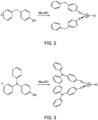
- FIG. 2 shows an illustrative reaction scheme for forming the metal alkoxide (I) from the reaction of dimethylaluminum chloride with 2 equivalents of 4-benzylphenol.
- FIG. 3 shows an illustrative reaction scheme for forming a metal alkoxide (I) from the reaction of dimethylaluminum chloride with 2 equivalents of 4-(diphenylamino)phenol.
- M u can be a Group 1, 2, or 13 metal of valence u, preferably Li, Na, Ca, Mg, Al, or Ga; R is a C 1 -C 8 alkyl; c is 1, 2, or 3; c ⁇ u; and when present, X is halogen.
- the metal alkyl activator (IV) can also be an alkyl aluminum.
- a suitable alkyl aluminum activator has the general formula: AlR* r (Y) 3-r wherein R* is a C 1 -C 8 alkyl, each Y is hydrogen, halogen, or -OR 5 , wherein each R 5 is independently a C 1 -C 20 hydrocarbyl radical, optionally when present, two or more of R 5 join to form a ring having 40 or less atoms from Groups 14, 15, and/or 16 of the periodic table; and r is 1 to 3.
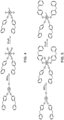
- FIG. 4 shows an illustrative reaction scheme for forming the transition metal precatalyst (III) from the reaction of the metal alkoxide (I) in FIG. 2 with a transition metal halide (II) being tungsten hexachloride (WCl 6 ) and then forming the activated catalyst (V) having the active metal carbene moiety.
- a transition metal halide (II) being tungsten hexachloride (WCl 6 ) and then forming the activated catalyst (V) having the active metal carbene moiety.
- FIG. 5 shows an illustrative reaction scheme for forming the transition metal precatalyst (III) from the reaction of the metal alkoxide (I) in FIG. 3 with the transition metal halide (II) being tungsten hexachloride (WCl 6 ) and then forming the activated catalyst (V) having the active metal carbene moiety.
- the catalyst system may comprise an inert support material.
- the supported material is a porous support material, for example, talc, and inorganic oxides.
- Other support materials include zeolites, clays, organoclays, or any other organic or inorganic support material and the like, or mixtures thereof.
- the support material is an inorganic oxide in a finely divided form.
- Suitable inorganic oxide materials for use in catalyst systems herein include Groups 2, 4, 13, and 14 metal oxides, such as silica, alumina, and mixtures thereof.
- Other inorganic oxides that may be employed either alone or in combination with the silica, or alumina are magnesia, titania, zirconia, and the like.
- suitable support materials can be employed, for example, finely divided functionalized polyolefins, such as finely divided polyethylene.
- Particularly useful supports include magnesia, titania, zirconia, montmorillonite, phyllosilicate, zeolites, talc, clays, and the like.
- support materials may be used, for example, silica-chromium, silica-alumina, silica-titania, and the like.
- Preferred support materials include Al 2 O 3 , ZrO 2 , SiO 2 , and combinations thereof, more preferably SiO 2 , Al 2 O 3 , or SiO 2 /Al 2 O 3 .
- the support material most preferably an inorganic oxide, has a surface area in the range of from about 10 to about 700 m 2 /g, pore volume in the range of from about 0.1 to about 4.0 cc/g and average particle size in the range of from about 5 to about 500 ⁇ m. More preferably, the surface area of the support material is in the range of from about 50 to about 500 m 2 /g, pore volume of from about 0.5 to about 3.5 cc/g and average particle size of from about 10 to about 200 ⁇ m.
- the surface area of the support material is in the range is from about 100 to about 400 m 2 /g, pore volume from about 0.8 to about 3.0 cc/g and average particle size is from about 5 to about 100 ⁇ m.
- the average pore size of the support material useful in the invention is in the range of from 10 to 1000 ⁇ , preferably 50 to about 500 ⁇ , and most preferably 75 to about 350 ⁇ .
- Preferred silicas are marketed under the tradenames of DAVISON TM 952 or DAVISON TM 955 by the Davison Chemical Division of W.R. Grace and Company. In other embodiments DAVISON TM 948 is used.
- the support material should be dry, that is, free of absorbed water. Drying of the support material can be effected by heating or calcining at about 100°C to about 1000°C, preferably at least about 600°C. When the support material is silica, it is heated to at least 200°C, preferably about 200°C to about 850°C, and most preferably at about 600°C; and for a time of about 1 minute to about 100 hours, from about 12 hours to about 72 hours, or from about 24 hours to about 60 hours.
- the calcined support material must have at least some reactive hydroxyl (OH) groups to produce supported catalyst systems of this invention.
- the calcined support material is then contacted with at least one polymerization catalyst comprising at least one catalyst compound and an activator.
- the support material having reactive surface groups, typically hydroxyl groups, is slurried in a non-polar solvent and the resulting slurry is contacted with a solution of a catalyst compound and an activator.
- the slurry of the support material is first contacted with the activator for a period of time in the range of from about 0.5 hours to about 24 hours, from about 2 hours to about 16 hours, or from about 4 hours to about 8 hours.
- the solution of the catalyst compound is then contacted with the isolated support/activator.
- the supported catalyst system is generated in situ.
- the slurry of the support material is first contacted with the catalyst compound for a period of time in the range of from about 0.5 hours to about 24 hours, from about 2 hours to about 16 hours, or from about 4 hours to about 8 hours.
- the slurry of the supported catalyst compound is then contacted with the activator solution.
- the mixture of the catalyst, activator and support is heated to about 0°C to about 70°C, preferably to about 23°C to about 60°C, preferably at room temperature.
- Contact times typically range from about 0.5 hours to about 24 hours, from about 2 hours to about 16 hours, or from about 4 hours to about 8 hours.
- Suitable non-polar solvents are materials in which all of the reactants used herein, i.e., the activator, and the catalyst compound, are at least partially soluble and which are liquid at reaction temperatures.
- Preferred non-polar solvents are alkanes, such as isopentane, hexane, n-heptane, octane, nonane, and decane, although a variety of other materials including cycloalkanes, such as cyclohexane, aromatics, such as benzene, toluene, and ethylbenzene, may also be employed.
- the catalysts provided herein can be used for ring opening metathesis polymerization (ROMP) for making polymers comprising one or more polyalkenamers such as polypentenamer.
- Such polymers may also include a cyclic olefin homopolymer and/or a cyclic olefin copolymer.
- FIG. 6 depicts an illustrative polymerization scheme for making polypentenamers from cyclopentene.
- the reaction can be carried out in a continuous reactor or batch reactors.
- the reaction also can be carried out in slurry phase or solution.
- the polymerization process for making polypenenamers using the catalyst described herein will be further described with reference to a solution polymerization in a diluent whereby the reaction mixture can include one or more diluents at 60 vol% or less, or 40 vol% or less, or 20 vol% or less, based on the total volume of the reaction mixture.
- Suitable diluents can include non-coordinating, inert liquids.
- Suitable diluents can include, but are not limited to, straight and branched-chain hydrocarbons (e.g., isobutane, butane, pentane, isopentane, hexanes, isohexane, heptane, octane, dodecane, and mixtures thereof); cyclic and alicyclic hydrocarbons (e.g., cyclohexane, cycloheptane, methylcyclohexane, methylcycloheptane, and mixtures thereof such as ISOPAR TM (synthetic isoparaffins, commercially available from ExxonMobil Chemical Company)); perhalogenated hydrocarbons (e.g., perfluorinated C 4 -C 10 alkanes, chlorobenzene, and aromatic); alkyl substituted aromatic compounds (e.g., benzene, toluene, mesitylene, and xylene); and the like,
- the preparation of the catalyst and/or the copolymerization may be carried out in an inert atmosphere (e.g., under a nitrogen or argon environment) to minimize the presence of air and/or water.
- the polymerization can include contacting one or more C 4 -C 20 cyclic olefin monomers in a polymerization reactor under conditions sufficient to form a reaction mixture comprising a polymer, monomer, catalyst, and optionally a diluent.
- the polymer, the catalyst, and optionally the solvent can be recovered from the reaction product mixture. At least a portion of the recovered catalyst, unreacted cyclic olefin monomer, and optionally the solvent can be recycled to the polymerization reactor.
- the temperature of the reaction may be -50°C to 200°C, or -25°C to 100°C, or -10°C to 25°C.
- the pressure of the reaction may be from 0 MPa to 50 MPa, or 0 MPa to 25 MPa, or ambient pressure to 10 MPa.
- the reaction may be carried out over a period of time, which may be from 1 minute to 48 hours, or 1 minute to 20 hours, or 5 minutes to 3 hours, or 10 minutes to 1 hour.
- a suitable mol ratio of metal in the catalyst to total comonomer may be 1:1 to 1000:1.
- Other suitable mol ratios of metal in the catalyst to total comonomer may be 1:1 to 250:1, 1:1 to 50:1, 1:1 to 10:1, 10:1 to 100:1, 50:1 to 250:1, 100:1 to 500:1, or 250:1 to 1000:1.
- the cyclic olefins may be strained or unstrained (preferably strained); monocyclic or polycyclic (e.g., bicyclic); and optionally include heteroatoms and/or one or more functional groups.
- Examples of cyclic olefins suitable for use as (co)monomers in the methods of the present disclosure include, but are not limited to, cyclooctene, 1,5-cyclooctadiene, 1-hydroxy-4-cyclooctene, 1-acetoxy-4-cyclooctene, 5-methylcyclopentene, dicyclopentadiene (DCPD), cyclopentene (cC5), norbomene, norbornadiene, cycloheptene, cyclooctene, cyclooctadiene, cyclododecene, 7-oxanorbornene, 7-oxanorbomadiene, cis-5-norbornene-endo-2,3-dicarboxy
- Suitable functional groups include, but are not limited to, hydroxyl, thiol, ketone, aldehyde, ester, ether, amine, imine, amide, nitro, carboxylic acid, disulfide, carbonate, isocyanate, carbodiimide, carboalkoxyl, and halogen.
- the cyclic olefins may further include one or more C 4 -C 20 cyclic diolefins comprising at least one cyclic structure having the general formula: and/or one or more functionalized C 4 -C 20 cyclic diolefins comprising at least one cyclic structure according to the general formula: as a comonomer into the reaction product mixture, wherein each functional group (FG) is integral to a corresponding cyclic structure and/or pendant to a corresponding cyclic structure, and wherein each FG is independently halogen, NR ⁇ 2 , OR ⁇ , SeR ⁇ , TeR ⁇ , PR ⁇ 2, AsR ⁇ 2, SbR ⁇ 2, SR ⁇ , BR ⁇ 2 , SiR ⁇ 3 , GeR ⁇ 3 , SnR ⁇ 3 , PbR ⁇ 3 , O, S, Se, Te, NR ⁇ , PR ⁇ , AsR ⁇ , SbR ⁇ , BR ⁇ , SiR ⁇ 2 , GeR ⁇ 2 , SnR ⁇ 2 ,
- the cyclic olefin polymerization process further comprises:
- the transition metal M v is preferably present in the catalyst at from 0.1 wt% to 30 wt%, based on the total amount of catalyst present.
- a molar ratio of transition metal M v to aluminum (M v :Al) in the supported catalyst is preferably from 1:1000 to 4:10, based on the total number of moles of M v and aluminum present.
- quenching compounds can be used to stop the polymerization reaction when desired.
- Suitable quenching compounds can be or can include one or more antioxidants, which may be dispersed in alcohols (e.g., methanol or ethanol).
- examples of quenching compounds may include, but are not limited to, butylated hydroxytoluene (BHT), IRGANOX TM antioxidants (available from BASF), and the like, and any combination thereof.
- BHT butylated hydroxytoluene
- IRGANOX TM antioxidants available from BASF
- the quenching compounds can be added to the reaction mixture at 0.05 wt% to 5 wt%, or 0.1 wt% to 2 wt% based on the total weight of the polymer product.
- the properties of the polymers produced may depend, at least in part, on the composition of the catalyst, the composition of the (co)monomers, the rate of addition of the comonomer, the reaction temperature, and the reaction time. If two cyclic olefin comonomers are used, the copolymers produced may have a mol ratio of a first cyclic olefin comonomer-derived units to a second cyclic olefin comonomer-derived units of 3:1 to 100:1, or 4:1 to 75:1, or 5:1 to 50:1, or 6:1 to 35:1.
- a slower rate of addition of the second comonomer in combination with high concentration of the first cyclic olefin comonomer may lead to a higher amount of first cyclic olefin comonomer-derived units in the resultant polymer.
- the ratio of cis to trans in the polymers produced may be 95:5 to 5:95, or 95:5 to 80:20, or 80:20 to 60:40, or 75:25 to 50:50, or 75:25 to 25:75, or 50:50 to 5:95, or 40:60 to 5:95, or 30:70 to 5:95, or 20:80 to 5:95, or 20:80 to 10:90, or 100:0 for both comonomer entities.
- the targeted cis/trans ratio may be achieved by appropriate selection of the catalysts and activators, catalyst:activator ratios, catalyst:monomer ratios, concentrations of reagents, solvents and mixtures of solvents, process temperature, and reaction times, and any combination thereof.
- Polymers produced may have a M w of 1 kDa to 1,000 kDa, or 10 kDa to 1,000 kDa, or 100 kDa to 1,000 kDa, or 250 kDa to 750 kDa, or 250 kDa to 550 kDa.
- Polymers produced may have a M n of 0.5 kDa to 500 kDa, or 1 kDa to 250 kDa, or 10 kDa to 250 kDa, or 50 kDa to 250 kDa, or 100 kDa to 500 kDa.
- Polymers of the present disclosure may have a MWD of 1 to 10, or 1 to 5, or 2 to 4, or 1 to 3.
- the level of LCB can be quantified by the GPC method with triple detector via a branching index (g' vis ).
- the branching index (g' vis or simply g') is defined as the ratio of the intrinsic viscosity of the branched polymer to the intrinsic viscosity of a linear polymer of equal molecular weight.
- the Mv is the viscosity-average molecular weight based on molecular weights determined by LS analysis.
- the Mark-Houwink parameters ⁇ and k used for the reference linear polymer are 0.725 and 0.000291, respectively.
- the polymers of the present disclosure having long chain branching may have a g' vis of 0.5 to 0.91, 0.5 to 0.8, or 0.6 to 0.8, or 0.7 to 0.91.
- the polymers of the present disclosure having a linear structure may have a g' vis of 0.92 to 1.0, 0.92 to 0.95, or 0.95 to 0.99, or 0.95 to 1.0.
- the polymers produced having a long chain branching structure may have (a) a g' vis of 0.5 to 0.91, 0.5 to 0.8, or 0.6 to 0.8, or 0.7 to 0.91 and one or more of (b) a mol ratio of first cyclic olefin comonomer-derived units to second cyclic olefin comonomer-derived units of 3:1 to 100:1, or 4:1 to 75:1, or 5:1 to 50:1, or 6:1 to 35:1, (b) a ratio of cis to trans of 5:5 to 5:95, or 95:5 to 80:20, or 80:20 to 60:40, or 75:25 to 50:50, or 75:25 to 25:75, or 40:60 to 5:95, or 30:70 to 5:95, or 20:80 to 5:95, or 20:80 to 10:90, or 100:0 for both comonomer entities, (d) a M w of 1 kDa to 1,000 kDa, or
- the polymers produced having a linear structure may have (a) a g' vis of 0.92 to 1.0, 0.92 to 0.95, or 0.95 to 0.99, or 0.95 to 1.0 and one or more of (b) a mol ratio of first cyclic olefin comonomer-derived units to second cyclic olefin comonomer-derived units of 3:1 to 100:1, or 4:1 to 75:1, or 5:1 to 50:1, or 6:1 to 35:1, (c) a ratio of cis to trans of 5:5 to 5:95, or 95:5 to 80:20, or 80:20 to 60:40, or 75:25 to 50:50, or 75:25 to 25:75, or 40:60 to 5:95, or 30:70 to 5:95, or 20:80 to 5:95, or 20:80 to 10:90, or 100:0 for both comonomer entities, (d) a M w of 1 kDa to 1,000 kDa, or 10 k
- Embodiments discussed and described herein can be further described with the following non-limiting examples. Although the examples are directed to specific embodiments, they are not to be viewed as limiting in any specific respect. Methodologies for characterization of the samples (NMR and GPC) are included in embodiments 0042-0053.
- Example 1 used a (4-PhCH 2 C 6 H 4 O) 2 AlCl pre-catalyst and Example 2 used a (4-(Ph 2 N)C 6 H 4 O) 2 AlCl precatalyst. Both precatalysts were activated using a mixture of WCl 6 in toluene and used to polymerize cyclopentene to provide a solid polypentenamer product.
- a comparative example using (4-MeC 6 H 4 O) 2 AlCl as the precatalyst is also provided (Comp.Ex.3).
- the polymers produced using the catalyst systems of Examples 1 and 2 provided a polypentenamer product having the desired cis / trans ratio of about 20/80, a narrow molecular MWD (about 2.0) and a M w of up to 563 kDa. It was surprisingly and unexpectedly discovered, however, that the activity of the (4-PhCH 2 C 6 H 4 O)-based system (Ex. 1) and the (4-(Ph 2 N)C 6 H 4 O)-based system (Ex.2) were significantly higher than all the others. It was even more surprising and unexpected to find that the activity of the (4-PhCH 2 C 6 H 4 O)-based system (Ex. 1) was 2,070 g polymer /gw, which was more than twice the activity of the (4-MeC 6 H 4 O)-based system (976 g polymer /gw) (Comp.Ex. 3).
- Solid (4-PhCH 2 C 6 H 4 O) 2 AlCl 130 mg, 0.303 mmol) was added to a solution of WCl 6 (60 mg, 0.151 mmol) in toluene (20 mL).
- the resulting solution was stirred at ambient conditions for 1 hour.
- the obtained solution was added to the mechanically stirred mixture (400 rpm), containing cyclopentene (103 g, 1.513 mol), triethylaluminum (35 mg, 0.303 mmol) and toluene (250 mL) at 0°C.
- the reaction was agitated for 3 hours at 0°C. Then, the active catalyst was quench by adding 2,6-di-tert-butyl-4-methylphenol (1.0 g) in ethanol/toluene (20/80 mL). The resulting solution was poured into ethanol (1L) under intense mechanical stirring. The precipitated polymer was washed with ethanol (3 x 250 mL) and dried the stream of nitrogen for 3 days.
- the obtained solution was added to the mechanically stirred mixture (400 rpm), containing cyclopentene (85.86 g, 1.263 mol), triethylaluminum (72 mg, 0.632 mmol) and toluene (250 mL) at 0°C.
- the reaction was agitated for 3 hours at 0°C.
- the active catalyst was quench by adding 2,6-di-tert-butyl-4-methylphenol (1.0 g) in ethanol/toluene (20/80 mL).
- the resulting solution was poured into ethanol (1L) under intense mechanical stirring.
- the precipitated polymer was washed with ethanol (3 x 250 mL) and dried the stream of nitrogen for 3 days.
- the catalyst was formed in situ by adding solid (4-(PhCH 2 )C 6 H 4 O) 2 AlCl (865 mg, 2.02 mmol) to a solution of WCl 6 (400 mg, 1.01 mmol) in toluene (20 mL).
- the reaction was agitated for 2 hours at 0°C.
- the active catalyst was then quenched by adding 2,6-di-tert-butyl-4-methylphenol (1.0 g, 4.5 mmol) in ethanol/toluene (20/80 mL).
- the resulting solution was poured into ethanol (1L) under intense mechanical stirring.
- the precipitated polymer was washed with ethanol (3 ⁇ 250 mL) and dried in vacuo for 12 hours.
- the molecular weight distribution, molecular weight moments (Mw, Mn, Mw/Mn) and long chain branching indices were determined by using a Polymer Char GPC-IR, equipped with three in-line detectors, a 18-angle light scattering ("LS") detector, a viscometer and a differential refractive index detector ("DRI").
- LS 18-angle light scattering
- DRI differential refractive index detector
- Three Agilent PLgel 10 ⁇ m Mixed-B LS columns were used for the GPC tests herein. The nominal flow rate was 0.5 mL/min, and the nominal injection volume was 200 ⁇ L.
- the columns, viscometer and DRI detector were contained in ovens maintained at 40°C.
- THF tetrahydrofuran
- BHT butylated hydroxytoluene
- the conventional molecular weight was determined by combining universal calibration relationship with the column calibration which was performed with a series of monodispersed polystyrene (PS) standards ranging from 300 g/mole to 12,000,000 g/mole.
- ⁇ R( ⁇ ) is the measured excess Rayleigh scattering intensity at scattering angle ⁇
- "c” is the polymer concentration determined from the DRI analysis
- a 2 is the second virial coefficient
- P( ⁇ ) is the form factor for a mono-disperse random coil
- the dn/dc is measured as 0.1154 by DRI detector.
- the branching index (g'vis or simply g') is defined as the ratio of the intrinsic viscosity of the branched polymer to the intrinsic viscosity of a linear polymer of equal molecular weight.
- the Mark-Houwink parameters k/ ⁇ used in the reference linear polymer were 0.725/0.000291.
Landscapes
- Chemical & Material Sciences (AREA)
- Organic Chemistry (AREA)
- Chemical Kinetics & Catalysis (AREA)
- Engineering & Computer Science (AREA)
- Materials Engineering (AREA)
- Inorganic Chemistry (AREA)
- Polymers & Plastics (AREA)
- Health & Medical Sciences (AREA)
- Medicinal Chemistry (AREA)
- Crystallography & Structural Chemistry (AREA)
- Polyoxymethylene Polymers And Polymers With Carbon-To-Carbon Bonds (AREA)
- Addition Polymer Or Copolymer, Post-Treatments, Or Chemical Modifications (AREA)
- Transition And Organic Metals Composition Catalysts For Addition Polymerization (AREA)
Claims (12)
- Katalysator zur Polymerisation von cyclischen Olefinen, der Übergangsmetallcarben mit der folgenden Struktur (V) umfasst:
Mv (OR')c*mX(v-c*m-2)=C(R*)2 (V),
in der:Mv Wolfram mit einer Wertigkeit (v) von 6 ist,jedes OR' 4-Benzylphenolat oder 4-(Diphenylamino)phenolat ist,c eine ganze Zahl von 1 bis 3 ist,m 1/3, 1/2, 1, 3/2, 2, 3 oder 4 ist, und c*m ≤ v-2,X Chlor oder Fluor ist, undjedes R* unabhängig H oder C1- bis C7-Alkyl ist. - Polymerisationsverfahren für cyclisches Olefin, bei dem Katalysator zur Polymerisation für cyclisches Olefin gemäß Anspruch 1 mit cyclischen C4- bis C20-Olefinmonomer, das mindestens einen cyclischen Olefinanteil umfasst, in einem Polymerisationsreaktor unter ausreichenden Bedingungen kontaktiert wird, um Reaktionsproduktmischung zu bilden, die Polymer, nicht-umgesetztes Monomer, Katalysator und gegebenenfalls Lösungsmittel umfasst, und
das Polymer gewonnen wird. - Verfahren nach Anspruch 2, bei dem des Weiterendas Monomer aus der Reaktionsproduktmischung abgetrennt und das Monomer in den Polymerisationsreaktor recycelt wird,der gewonnene Katalysator vor dem Recyceln in den Polymerisationsreaktor mit Aktivator kontaktiert wird,oder eine Kombination davon.
- Verfahren nach einem der Ansprüche 2 bis 3, bei dem die Polymerisation Ringöffnungsmetathesepolymerisation umfasst und das Polymer Polyalkenamer, Copolymer von cyclischem Olefin und/oder Polymer von cyclischem Olefin umfasst.
- Verfahren nach einem der Ansprüche 2 bis 4, bei dem des Weiteren der Katalysator und gegebenenfalls das Lösungsmittel aus der Reaktionsproduktmischung gewonnen werden und mindestens ein Anteil des gewonnenen Katalysators, nicht-umgesetzten Monomers und/oder gegebenenfalls des Lösungsmittels in den Polymerisationsreaktor rückgeführt wird.
- Verfahren nach einem der Ansprüche 2 bis 5, bei dem des Weiteren ein oder mehrere cyclische C4- bis C20-Diolefine, das/die mindestens eine cyclische Struktur mit der folgenden allgemeinen Formel umfasst/umfassen:

ein oder mehrere funktionalisierte cyclische C4- bis C20-Diolefine, das/die mindestens eine cyclische Struktur gemäß der folgenden allgemeinen Formel umfasst/umfassen:
- Verfahren nach einem der Ansprüche 2 bis 6, bei dem des WeiterenMw und/oder ein Verhältnis von trans:cis des Polymers gesteuert wird/werden, indem eine Reaktortemperatur von - 35°C bis 100°C gesteuert wird, die Menge an Monomer, die in den Reaktor recycelt wird, gesteuert wird, das Monomer als Reaktionslösungsmittel verwendet wird, oder eine Kombination davon,aktive Katalysatorspezies bei einer Temperatur kleiner als oder gleich etwa 5°C gebildet werden, gefolgt von Steigern der Reaktionstemperatur auf eine Temperatur kleiner als 100°C,eine Menge an Olefin, vorzugsweise alpha-Olefin, vorzugsweise alpha-Olefin, das mindestens eine Heteroatom enthaltende funktionelle Gruppe umfasst, in das cyclische Olefinmonomer einbezogen wird, um das Molekulargewicht des Polymers in der Produktmischung zu reduzieren,zwei oder mehr Katalysatoren für Polymerisation cyclischer Olefine in dem gleichen Reaktor oder unterschiedlichen Reaktoren verwendet werden, um Polymer zu produzieren, welches:ein multimodales Mw-Profil,ein Molverhältnis von trans:cis von 1,ein Molverhältnis von trans:cis größer als 1, typischerweise 2,33 bis 19,ein Molverhältnis von trans:cis kleiner als 1 aufweist, und/odermehrere Reaktoren verwendet werden, die in einer Sequenz verbunden sind, um heterophasige Copolymere zu produzieren.
- Verfahren nach einem der Ansprüche 2 bis 7, bei dem das Olefincomonomer die folgende allgemeine Formel aufweist:
CH2=CH-(CH2)n-CH3;
CH2=CH-[(CH2)n(FG)s]-CH3 und/oder
CH2=CH-(CH2)n-FG;
wobei jedes FG, falls vorhanden, unabhängig Halogen, NR^2, OR^, SeR^, TeR^, PR^2 , AsR^2, SbR^2, SR^, BR^2, SiR^3, GeR^3, SnR^3, PbR^3, O, S, Se, Te, NR^, PR^, AsR^, SbR^, BR^, SiR^2, GeR^2, SnR^2, PbR^2 oder eine Kombination davon ist, und jedes R^ unabhängig ein C1- bis C10-Kohlenwasserstoffrest ist,n größer als oder gleich 1 ist, unds, falls vorhanden, größer als oder gleich 1 ist. - Verfahren nach einem der Ansprüche 2 bis 8, bei dem das Polymer eine g'vis von 0,50 bis 0,91 aufweist.
- Verfahren nach einem der Ansprüche 2 bis 9, bei dem die Reaktionsmischung des Weiteren Verdünnungsmittel in 60 Vol.% oder weniger umfasst, bezogen auf ein Gesamtvolumen der Reaktionsmischung.
- Verfahren nach einem der Ansprüche 2 bis 10, bei dem das Polymer ein Verhältnis von cis zu trans von 50:50 bis 5:95 aufweist.
- Verfahren nach einem der Ansprüche 2 bis 11, bei dem das Polymer ein durchschnittliches Molekulargewicht (Gewichtsmittel) von 1 kDa bis 1000 kDa aufweist und das Polymer eine Molekulargewichtsverteilung von 1 bis 10 aufweist.
Applications Claiming Priority (2)
| Application Number | Priority Date | Filing Date | Title |
|---|---|---|---|
| US202062992002P | 2020-03-19 | 2020-03-19 | |
| PCT/US2021/021688 WO2021188335A1 (en) | 2020-03-19 | 2021-03-10 | Improved ring opening metathesis catalyst systems for cyclic olefin polymerization |
Publications (2)
| Publication Number | Publication Date |
|---|---|
| EP4121206A1 EP4121206A1 (de) | 2023-01-25 |
| EP4121206B1 true EP4121206B1 (de) | 2025-01-29 |
Family
ID=75252878
Family Applications (1)
| Application Number | Title | Priority Date | Filing Date |
|---|---|---|---|
| EP21714783.4A Active EP4121206B1 (de) | 2020-03-19 | 2021-03-10 | Metathesekatalysatorsysteme mit verbesserter ringöffnung zur cyclischen olefinpolymerisation |
Country Status (5)
| Country | Link |
|---|---|
| US (1) | US20230159670A1 (de) |
| EP (1) | EP4121206B1 (de) |
| JP (1) | JP2023518292A (de) |
| CN (1) | CN115461149B (de) |
| WO (1) | WO2021188335A1 (de) |
Families Citing this family (2)
| Publication number | Priority date | Publication date | Assignee | Title |
|---|---|---|---|---|
| CN115433236A (zh) * | 2022-08-31 | 2022-12-06 | 北京石油化工学院 | 一种卡宾催化剂、聚环戊烯基特种弹性体及其制备方法和应用 |
| CN116199812B (zh) * | 2023-05-04 | 2023-10-03 | 北京石油化工学院 | 环戊烯基特种弹性体及其制备方法和应用 |
Family Cites Families (19)
| Publication number | Priority date | Publication date | Assignee | Title |
|---|---|---|---|---|
| DE1720791C3 (de) | 1968-02-24 | 1978-04-13 | Bayer Ag, 5090 Leverkusen | Verfahren zur Herstellung von Polymeren des Cyclopentens |
| DE1770491C3 (de) | 1968-05-24 | 1982-07-08 | Bayer Ag, 5090 Leverkusen | Verfahren zur Herstellung von trans-Polynentenamer |
| DE1915684A1 (de) | 1969-03-27 | 1970-10-08 | Bayer Ag | Polymerisate von Cyclopenten |
| US3778420A (en) | 1970-07-27 | 1973-12-11 | Phillips Petroleum Co | Copolymers of cyclic monoolefins and cyclic polyolefin compounds |
| JPS5034699A (de) | 1973-07-31 | 1975-04-03 | ||
| US4002815A (en) | 1973-11-05 | 1977-01-11 | The B. F. Goodrich Company | Cyclopentene-dicyclopentadiene copolymers and method of making same |
| CA1074949A (en) | 1975-04-03 | 1980-04-01 | B.F. Goodrich Company (The) | Cyclopentene-dicyclopentadiene copolymers and method of making same |
| DE2839807C2 (de) | 1978-09-13 | 1986-04-17 | Degussa Ag, 6000 Frankfurt | Vakuumofen mit Gaskühleinrichtung |
| FR2577216B1 (fr) * | 1985-02-12 | 1987-09-11 | Elf Aquitaine | Perfectionnement a la metathese d'olefines avec un catalyseur a base d'un complexe de tungstene |
| JP4352620B2 (ja) * | 2001-02-26 | 2009-10-28 | 日本ゼオン株式会社 | ノルボルネン系開環重合体水素化物の製造方法 |
| CN201801293U (zh) | 2010-07-26 | 2011-04-20 | 北京二七轨道交通装备有限责任公司 | 自紧式吊具 |
| WO2012043802A1 (ja) | 2010-09-30 | 2012-04-05 | 日本ゼオン株式会社 | シクロペンテン開環重合体およびその製造方法 |
| EP3077433B1 (de) | 2013-12-05 | 2022-04-20 | ExxonMobil Chemical Patents Inc. | Funktionalisierte harze für hochleistungsreifen |
| JP6597627B2 (ja) | 2014-10-17 | 2019-10-30 | 日本ゼオン株式会社 | タイヤ用ゴム組成物 |
| CN110062777A (zh) * | 2016-10-19 | 2019-07-26 | 埃克森美孚化学专利公司 | 混合催化剂体系及其使用方法 |
| EP3604378B1 (de) | 2017-03-24 | 2024-08-28 | Zeon Corporation | Cyclopenten-ring-öffnungscopolymer und verfahren zur herstellung davon |
| JP7009920B2 (ja) | 2017-10-30 | 2022-01-26 | 日本ゼオン株式会社 | 高反発材料 |
| JP7006136B2 (ja) | 2017-10-30 | 2022-01-24 | 日本ゼオン株式会社 | ゴム架橋物 |
| EP3710501A2 (de) * | 2017-11-15 | 2020-09-23 | ExxonMobil Chemical Patents Inc. | Polymerisierungsverfahren |
-
2021
- 2021-03-10 EP EP21714783.4A patent/EP4121206B1/de active Active
- 2021-03-10 JP JP2022556554A patent/JP2023518292A/ja active Pending
- 2021-03-10 WO PCT/US2021/021688 patent/WO2021188335A1/en not_active Ceased
- 2021-03-10 US US17/906,249 patent/US20230159670A1/en active Pending
- 2021-03-10 CN CN202180031200.1A patent/CN115461149B/zh active Active
Non-Patent Citations (1)
| Title |
|---|
| DODD H.T. ET AL: "Tungsten phenoxides as metathesis catalysts", JOURNAL OF MOLECULAR CATALYSIS, 1 January 1982 (1982-01-01), pages 103 - 110, XP093136752, Retrieved from the Internet <URL:https://pdf.sciencedirectassets.com/272239/1-s2.0-S0304510200X00387/1-s2.0-0304510282800096/main.pdf?X-Amz-Security-Token=IQoJb3JpZ2luX2VjEDEaCXVzLWVhc3QtMSJGMEQCIA+izmt3yu1N/gZJlHjfibROOY5DoZr1ae6UcRrM/u2sAiBYzgv0v4zhirfzI27DDKjra7EhhySSdoHGNKG2hFLGOyqzBQgqEAUaDDA1OTAwMzU0Njg2NSIMn1jH8GWUaqSBm+aAKp> [retrieved on 20240301], DOI: 10.1016/0304-5102(82)80009-6 * |
Also Published As
| Publication number | Publication date |
|---|---|
| US20230159670A1 (en) | 2023-05-25 |
| EP4121206A1 (de) | 2023-01-25 |
| CN115461149B (zh) | 2025-09-16 |
| CN115461149A (zh) | 2022-12-09 |
| WO2021188335A1 (en) | 2021-09-23 |
| JP2023518292A (ja) | 2023-04-28 |
Similar Documents
| Publication | Publication Date | Title |
|---|---|---|
| EP1375506B1 (de) | Ruthenium und osmium metallcarben-komplexe mit hoher metathese-aktivität | |
| EP0626402B1 (de) | Linearen zweifunktionalen telechelen Polymerisaten und Verfahren zur Herstellung | |
| EP4121206B1 (de) | Metathesekatalysatorsysteme mit verbesserter ringöffnung zur cyclischen olefinpolymerisation | |
| US11794178B2 (en) | Catalyst for ring expansion metathesis polymerization of cyclic monomers | |
| US4020254A (en) | Metathesis polymerization of cycloolefins | |
| KR100540302B1 (ko) | 올레핀 메타시시스 반응에 의해 환형 올레핀으로부터 2관능성 텔레켈릭 폴리올레핀 부가 생성물을 제조하는 방법 | |
| Lassahn et al. | Palladium (ii) salts containing [PdCl 4] 2− and [Pd 2 Cl 6] 2− ions as pre-catalysts for the vinyl-polymerization of norbornene—evidence for the in situ formation of PdCl 2 as the active species | |
| EP3853267B1 (de) | Cycloolefins polymerisationsverfahren mit metathese-katalysator | |
| Hsieh et al. | Indium complexes incorporating bidentate substituted pyrrole ligand: Synthesis, characterization, and ring-opening polymerization of ε-caprolactone | |
| EP2756010B1 (de) | Bis-imin-pyridinkomplex von lanthaniden, katalysatorsystem mit diesem bis-imin-pyridinkomplex und verfahren zur (co)polymerisation von konjugierten dienen | |
| Katz et al. | Induction of olefin metathesis by phenylacetylene plus tungsten hexachloride | |
| Kawatsu et al. | (Trialkylsilyl-cyclopentadienyl) titanium (iv) dichloride complexes containing ketimide ligands, Cp′ TiCl 2 (N [double bond, length as m-dash] C t Bu 2)(Cp′= Me 3 SiC 5 H 4, Et 3 SiC 5 H 4), as efficient catalysts for ethylene copolymerisation with norbornene and tetracyclododecene | |
| US11926696B2 (en) | Functionalized low molecular weight sterically encumbered oligomers | |
| Arduini et al. | Reactivity of dicyclopentadienylbis (diethylamido) uranium (IV). Reactions with carboxylic and thiocarboxylic acids | |
| Heppert et al. | Asymmetric alkylidene and oxo complexes of tungsten (VI) | |
| WO2020061277A1 (en) | Metathesis catalyst system for polymerizing cycloolefins | |
| Karabulut et al. | Metal-containing polymers synthesized via acyclic diene metathesis (ADMET) polymerization using electrochemically reduced tungsten-based catalyst: Polycarbogermanes | |
| US20210246260A1 (en) | Low Molecular Weight Sterically Encumbered Oligomers | |
| Hayano et al. | Syndiospecific ring-opening metathesis polymerization of endo-dicyclopentadiene by tungsten (VI) phenylimido catalyst | |
| WO2021188337A1 (en) | Pentavalent dimeric group 6 transition metal complexes and methods for use thereof | |
| US20230001395A1 (en) | Catalysts for Olefin Metathesis, Methods of Preparation, and Processes for the Use Thereof | |
| Balcar et al. | Metathesis Polymerization of Phenylacetylene by Tungsten Aryloxo Complexes | |
| JP2007051251A (ja) | 反応性シリル基変性ノルボルネン系樹脂及びその製造方法 | |
| WO2021113503A1 (en) | Polymers prepared by ring opening metathesis polymerization | |
| JPH02283721A (ja) | シクロオレフィンの開環重合法およびそれに用いる触媒 |
Legal Events
| Date | Code | Title | Description |
|---|---|---|---|
| STAA | Information on the status of an ep patent application or granted ep patent |
Free format text: STATUS: UNKNOWN |
|
| STAA | Information on the status of an ep patent application or granted ep patent |
Free format text: STATUS: THE INTERNATIONAL PUBLICATION HAS BEEN MADE |
|
| PUAI | Public reference made under article 153(3) epc to a published international application that has entered the european phase |
Free format text: ORIGINAL CODE: 0009012 |
|
| STAA | Information on the status of an ep patent application or granted ep patent |
Free format text: STATUS: REQUEST FOR EXAMINATION WAS MADE |
|
| 17P | Request for examination filed |
Effective date: 20221007 |
|
| AK | Designated contracting states |
Kind code of ref document: A1 Designated state(s): AL AT BE BG CH CY CZ DE DK EE ES FI FR GB GR HR HU IE IS IT LI LT LU LV MC MK MT NL NO PL PT RO RS SE SI SK SM TR |
|
| DAV | Request for validation of the european patent (deleted) | ||
| DAX | Request for extension of the european patent (deleted) | ||
| STAA | Information on the status of an ep patent application or granted ep patent |
Free format text: STATUS: EXAMINATION IS IN PROGRESS |
|
| 17Q | First examination report despatched |
Effective date: 20240306 |
|
| GRAP | Despatch of communication of intention to grant a patent |
Free format text: ORIGINAL CODE: EPIDOSNIGR1 |
|
| STAA | Information on the status of an ep patent application or granted ep patent |
Free format text: STATUS: GRANT OF PATENT IS INTENDED |
|
| INTG | Intention to grant announced |
Effective date: 20240905 |
|
| GRAS | Grant fee paid |
Free format text: ORIGINAL CODE: EPIDOSNIGR3 |
|
| GRAA | (expected) grant |
Free format text: ORIGINAL CODE: 0009210 |
|
| STAA | Information on the status of an ep patent application or granted ep patent |
Free format text: STATUS: THE PATENT HAS BEEN GRANTED |
|
| AK | Designated contracting states |
Kind code of ref document: B1 Designated state(s): AL AT BE BG CH CY CZ DE DK EE ES FI FR GB GR HR HU IE IS IT LI LT LU LV MC MK MT NL NO PL PT RO RS SE SI SK SM TR |
|
| P01 | Opt-out of the competence of the unified patent court (upc) registered |
Free format text: CASE NUMBER: APP_67120/2024 Effective date: 20241219 |
|
| REG | Reference to a national code |
Ref country code: GB Ref legal event code: FG4D |
|
| REG | Reference to a national code |
Ref country code: CH Ref legal event code: EP |
|
| REG | Reference to a national code |
Ref country code: DE Ref legal event code: R096 Ref document number: 602021025372 Country of ref document: DE |
|
| REG | Reference to a national code |
Ref country code: IE Ref legal event code: FG4D |
|
| PGFP | Annual fee paid to national office [announced via postgrant information from national office to epo] |
Ref country code: DE Payment date: 20250327 Year of fee payment: 5 |
|
| PGFP | Annual fee paid to national office [announced via postgrant information from national office to epo] |
Ref country code: AT Payment date: 20250417 Year of fee payment: 5 |
|
| PGFP | Annual fee paid to national office [announced via postgrant information from national office to epo] |
Ref country code: FR Payment date: 20250324 Year of fee payment: 5 |
|
| REG | Reference to a national code |
Ref country code: NL Ref legal event code: MP Effective date: 20250129 |
|
| PG25 | Lapsed in a contracting state [announced via postgrant information from national office to epo] |
Ref country code: NL Free format text: LAPSE BECAUSE OF FAILURE TO SUBMIT A TRANSLATION OF THE DESCRIPTION OR TO PAY THE FEE WITHIN THE PRESCRIBED TIME-LIMIT Effective date: 20250129 |
|
| PG25 | Lapsed in a contracting state [announced via postgrant information from national office to epo] |
Ref country code: RS Free format text: LAPSE BECAUSE OF FAILURE TO SUBMIT A TRANSLATION OF THE DESCRIPTION OR TO PAY THE FEE WITHIN THE PRESCRIBED TIME-LIMIT Effective date: 20250429 |
|
| PG25 | Lapsed in a contracting state [announced via postgrant information from national office to epo] |
Ref country code: FI Free format text: LAPSE BECAUSE OF FAILURE TO SUBMIT A TRANSLATION OF THE DESCRIPTION OR TO PAY THE FEE WITHIN THE PRESCRIBED TIME-LIMIT Effective date: 20250129 |
|
| PG25 | Lapsed in a contracting state [announced via postgrant information from national office to epo] |
Ref country code: PL Free format text: LAPSE BECAUSE OF FAILURE TO SUBMIT A TRANSLATION OF THE DESCRIPTION OR TO PAY THE FEE WITHIN THE PRESCRIBED TIME-LIMIT Effective date: 20250129 |
|
| PG25 | Lapsed in a contracting state [announced via postgrant information from national office to epo] |
Ref country code: ES Free format text: LAPSE BECAUSE OF FAILURE TO SUBMIT A TRANSLATION OF THE DESCRIPTION OR TO PAY THE FEE WITHIN THE PRESCRIBED TIME-LIMIT Effective date: 20250129 |
|
| REG | Reference to a national code |
Ref country code: LT Ref legal event code: MG9D |
|
| PG25 | Lapsed in a contracting state [announced via postgrant information from national office to epo] |
Ref country code: IS Free format text: LAPSE BECAUSE OF FAILURE TO SUBMIT A TRANSLATION OF THE DESCRIPTION OR TO PAY THE FEE WITHIN THE PRESCRIBED TIME-LIMIT Effective date: 20250529 Ref country code: NO Free format text: LAPSE BECAUSE OF FAILURE TO SUBMIT A TRANSLATION OF THE DESCRIPTION OR TO PAY THE FEE WITHIN THE PRESCRIBED TIME-LIMIT Effective date: 20250429 |
|
| REG | Reference to a national code |
Ref country code: AT Ref legal event code: MK05 Ref document number: 1762911 Country of ref document: AT Kind code of ref document: T Effective date: 20250129 |
|
| PG25 | Lapsed in a contracting state [announced via postgrant information from national office to epo] |
Ref country code: HR Free format text: LAPSE BECAUSE OF FAILURE TO SUBMIT A TRANSLATION OF THE DESCRIPTION OR TO PAY THE FEE WITHIN THE PRESCRIBED TIME-LIMIT Effective date: 20250129 |
|
| PG25 | Lapsed in a contracting state [announced via postgrant information from national office to epo] |
Ref country code: LV Free format text: LAPSE BECAUSE OF FAILURE TO SUBMIT A TRANSLATION OF THE DESCRIPTION OR TO PAY THE FEE WITHIN THE PRESCRIBED TIME-LIMIT Effective date: 20250129 Ref country code: PT Free format text: LAPSE BECAUSE OF FAILURE TO SUBMIT A TRANSLATION OF THE DESCRIPTION OR TO PAY THE FEE WITHIN THE PRESCRIBED TIME-LIMIT Effective date: 20250529 |
|
| PG25 | Lapsed in a contracting state [announced via postgrant information from national office to epo] |
Ref country code: GR Free format text: LAPSE BECAUSE OF FAILURE TO SUBMIT A TRANSLATION OF THE DESCRIPTION OR TO PAY THE FEE WITHIN THE PRESCRIBED TIME-LIMIT Effective date: 20250430 Ref country code: BG Free format text: LAPSE BECAUSE OF FAILURE TO SUBMIT A TRANSLATION OF THE DESCRIPTION OR TO PAY THE FEE WITHIN THE PRESCRIBED TIME-LIMIT Effective date: 20250129 |
|
| PG25 | Lapsed in a contracting state [announced via postgrant information from national office to epo] |
Ref country code: AT Free format text: LAPSE BECAUSE OF FAILURE TO SUBMIT A TRANSLATION OF THE DESCRIPTION OR TO PAY THE FEE WITHIN THE PRESCRIBED TIME-LIMIT Effective date: 20250129 |
|
| PG25 | Lapsed in a contracting state [announced via postgrant information from national office to epo] |
Ref country code: SE Free format text: LAPSE BECAUSE OF FAILURE TO SUBMIT A TRANSLATION OF THE DESCRIPTION OR TO PAY THE FEE WITHIN THE PRESCRIBED TIME-LIMIT Effective date: 20250129 |
|
| PG25 | Lapsed in a contracting state [announced via postgrant information from national office to epo] |
Ref country code: SM Free format text: LAPSE BECAUSE OF FAILURE TO SUBMIT A TRANSLATION OF THE DESCRIPTION OR TO PAY THE FEE WITHIN THE PRESCRIBED TIME-LIMIT Effective date: 20250129 |
|
| PG25 | Lapsed in a contracting state [announced via postgrant information from national office to epo] |
Ref country code: DK Free format text: LAPSE BECAUSE OF FAILURE TO SUBMIT A TRANSLATION OF THE DESCRIPTION OR TO PAY THE FEE WITHIN THE PRESCRIBED TIME-LIMIT Effective date: 20250129 |
|
| PG25 | Lapsed in a contracting state [announced via postgrant information from national office to epo] |
Ref country code: MC Free format text: LAPSE BECAUSE OF FAILURE TO SUBMIT A TRANSLATION OF THE DESCRIPTION OR TO PAY THE FEE WITHIN THE PRESCRIBED TIME-LIMIT Effective date: 20250129 |
|
| PG25 | Lapsed in a contracting state [announced via postgrant information from national office to epo] |
Ref country code: IT Free format text: LAPSE BECAUSE OF FAILURE TO SUBMIT A TRANSLATION OF THE DESCRIPTION OR TO PAY THE FEE WITHIN THE PRESCRIBED TIME-LIMIT Effective date: 20250129 |
|
| PG25 | Lapsed in a contracting state [announced via postgrant information from national office to epo] |
Ref country code: CZ Free format text: LAPSE BECAUSE OF FAILURE TO SUBMIT A TRANSLATION OF THE DESCRIPTION OR TO PAY THE FEE WITHIN THE PRESCRIBED TIME-LIMIT Effective date: 20250129 Ref country code: EE Free format text: LAPSE BECAUSE OF FAILURE TO SUBMIT A TRANSLATION OF THE DESCRIPTION OR TO PAY THE FEE WITHIN THE PRESCRIBED TIME-LIMIT Effective date: 20250129 |
|
| PG25 | Lapsed in a contracting state [announced via postgrant information from national office to epo] |
Ref country code: RO Free format text: LAPSE BECAUSE OF FAILURE TO SUBMIT A TRANSLATION OF THE DESCRIPTION OR TO PAY THE FEE WITHIN THE PRESCRIBED TIME-LIMIT Effective date: 20250129 |
|
| REG | Reference to a national code |
Ref country code: CH Ref legal event code: H13 Free format text: ST27 STATUS EVENT CODE: U-0-0-H10-H13 (AS PROVIDED BY THE NATIONAL OFFICE) Effective date: 20251024 |
|
| PG25 | Lapsed in a contracting state [announced via postgrant information from national office to epo] |
Ref country code: SK Free format text: LAPSE BECAUSE OF FAILURE TO SUBMIT A TRANSLATION OF THE DESCRIPTION OR TO PAY THE FEE WITHIN THE PRESCRIBED TIME-LIMIT Effective date: 20250129 |
|
| REG | Reference to a national code |
Ref country code: DE Ref legal event code: R097 Ref document number: 602021025372 Country of ref document: DE |
|
| PG25 | Lapsed in a contracting state [announced via postgrant information from national office to epo] |
Ref country code: LU Free format text: LAPSE BECAUSE OF NON-PAYMENT OF DUE FEES Effective date: 20250310 |
|
| PLBE | No opposition filed within time limit |
Free format text: ORIGINAL CODE: 0009261 |
|
| STAA | Information on the status of an ep patent application or granted ep patent |
Free format text: STATUS: NO OPPOSITION FILED WITHIN TIME LIMIT |
|
| REG | Reference to a national code |
Ref country code: BE Ref legal event code: MM Effective date: 20250331 |
|
| GBPC | Gb: european patent ceased through non-payment of renewal fee |
Effective date: 20250429 |
|
| 26N | No opposition filed |
Effective date: 20251030 |
|
| PG25 | Lapsed in a contracting state [announced via postgrant information from national office to epo] |
Ref country code: GB Free format text: LAPSE BECAUSE OF NON-PAYMENT OF DUE FEES Effective date: 20250429 |
|
| PG25 | Lapsed in a contracting state [announced via postgrant information from national office to epo] |
Ref country code: BE Free format text: LAPSE BECAUSE OF NON-PAYMENT OF DUE FEES Effective date: 20250331 |
|
| PG25 | Lapsed in a contracting state [announced via postgrant information from national office to epo] |
Ref country code: CH Free format text: LAPSE BECAUSE OF NON-PAYMENT OF DUE FEES Effective date: 20250331 |
|
| PG25 | Lapsed in a contracting state [announced via postgrant information from national office to epo] |
Ref country code: IE Free format text: LAPSE BECAUSE OF NON-PAYMENT OF DUE FEES Effective date: 20250310 |