EP4114737B1 - Mittellehne fuer einer fluggastsitzreihe - Google Patents
Mittellehne fuer einer fluggastsitzreihe Download PDFInfo
- Publication number
- EP4114737B1 EP4114737B1 EP21715133.1A EP21715133A EP4114737B1 EP 4114737 B1 EP4114737 B1 EP 4114737B1 EP 21715133 A EP21715133 A EP 21715133A EP 4114737 B1 EP4114737 B1 EP 4114737B1
- Authority
- EP
- European Patent Office
- Prior art keywords
- wing
- hinge
- armrest
- bushing
- rest
- Prior art date
- Legal status (The legal status is an assumption and is not a legal conclusion. Google has not performed a legal analysis and makes no representation as to the accuracy of the status listed.)
- Active
Links
Images





Classifications
-
- B—PERFORMING OPERATIONS; TRANSPORTING
- B64—AIRCRAFT; AVIATION; COSMONAUTICS
- B64D—EQUIPMENT FOR FITTING IN OR TO AIRCRAFT; FLIGHT SUITS; PARACHUTES; ARRANGEMENT OR MOUNTING OF POWER PLANTS OR PROPULSION TRANSMISSIONS IN AIRCRAFT
- B64D11/00—Passenger or crew accommodation; Flight-deck installations not otherwise provided for
- B64D11/06—Arrangements of seats, or adaptations or details specially adapted for aircraft seats
- B64D11/0639—Arrangements of seats, or adaptations or details specially adapted for aircraft seats with features for adjustment or converting of seats
- B64D11/0644—Adjustable arm rests
-
- B—PERFORMING OPERATIONS; TRANSPORTING
- B60—VEHICLES IN GENERAL
- B60N—SEATS SPECIALLY ADAPTED FOR VEHICLES; VEHICLE PASSENGER ACCOMMODATION NOT OTHERWISE PROVIDED FOR
- B60N2/00—Seats specially adapted for vehicles; Arrangement or mounting of seats in vehicles
- B60N2/75—Arm-rests
- B60N2/79—Adaptations for additional use of the arm-rests
-
- B—PERFORMING OPERATIONS; TRANSPORTING
- B60—VEHICLES IN GENERAL
- B60N—SEATS SPECIALLY ADAPTED FOR VEHICLES; VEHICLE PASSENGER ACCOMMODATION NOT OTHERWISE PROVIDED FOR
- B60N3/00—Arrangements or adaptations of other passenger fittings, not otherwise provided for
- B60N3/001—Arrangements or adaptations of other passenger fittings, not otherwise provided for of tables or trays
- B60N3/002—Arrangements or adaptations of other passenger fittings, not otherwise provided for of tables or trays of trays
Definitions
- Hinges are known in a wide variety of designs and for a wide variety of applications.
- One of the best-known designs for a hinge is a door hinge.
- the door hinge connects a movable door or flap to a fixed door frame, with the door being movably mounted on the door frame by means of the hinge.
- double hinge by means of which two separate doors or flaps can each be separately movably connected to a fixed element, e.g. a frame.
- the invention is based on the object of providing an improved center backrest of a passenger seat row with a hinge.
- the invention is based on a center backrest of a passenger seat row with a hinge and an armrest, wherein the armrest is movably hinged to the hinge, wherein the Center backrest has a storage area which extends in a storage plane, wherein the hinge is arranged in the region of the storage area over the mounting member on the center backrest, wherein the storage plane is spaced from the bearing plane of the rotation axes, wherein the hinge has a center element and two wing elements, wherein a first wing element is pivotally connected to the center element about a first axis of rotation, wherein a second wing element is pivotally connected to the center element about a second axis of rotation, wherein the first wing element has a mounting element in order to arrange a wing or a flap, wherein the second wing element has a further mounting element in order to arrange a further wing or a further flap, wherein the hinge has a mounting member in order to fasten the center element to a passenger seat, so that in the mounted state of
- the hinge is present as a double hinge.
- the hinge is designed as a fitting, e.g. as a table hinge, in particular as an aircraft table hinge.
- the hinge is made of metal or plastic or a combination of the materials.
- the central element is rotatable relative to the first and the second wing element.
- the first and the second wing element are rotatable independently of each other relative to the central element.
- the first and the second rotation axes extend in the same direction.
- the first and the second rotation axes extend parallel to each other.
- the first and the second axis of rotation in a same bearing plane. It is conceivable that the first axis of rotation is formed in a region of a first side of the central element and the second axis of rotation is present in a region of a second side of the central element, wherein the first and the second sides of the central element are opposite each other and spaced apart from each other.
- the central element is present as a plate and the first side of the central element is a first narrow side of the plate and the second side of the central element is another narrow side of the plate.
- the first axis of rotation extends along a longitudinal extension of the first side of the central element and the second axis of rotation along a longitudinal extension of the second side of the central element.
- the central element, the first wing element and/or the second wing element are formed in a plate-like manner, e.g. as a plate or a plate.
- the mounting element is preferably designed as a bore, as a hole, as a pin, as a bolt, as an adhesive element, for example as an adhesive, and/or as a clamp.
- the wing or the flap can be detachably mounted on a wing element of the hinge.
- a wing or a flap can be permanently connected to one of the wing elements of the hinge.
- the wing elements are designed in such a way that a wing or a flap can be clamped, screwed, glued and/or clipped onto a wing element.
- the wing or flap is provided in the form of a plate, in particular designed as a plate. It is conceivable that the wing or flap is designed as a support for supporting an arm of a user, for example for supporting an arm of a user of an aircraft passenger seat. For example, the wing or flap is designed as an armrest, e.g. as an armrest support. For example, the wing or flap is designed in two parts. It is conceivable that the wing or flap is designed in such a way that when the wing or flap is mounted on one of the wing elements, the wing or flap encloses the wing element on five sides.
- the essence of the invention is that the first wing element is hinged to the central element with a single first bushing, in particular, the first bushing of the first wing element being present along the first axis of rotation between a second and a third bushing of the central element, the first to third bushings being mounted on a first shaft of the hinge, the second wing element being hinged to the central element with a single fourth bushing, in particular, the fourth bushing of the first wing element being present along the second axis of rotation between a fifth and a sixth bushing of the central element, the fourth to sixth bushings being mounted on a second shaft of the hinge.
- the first rotation axis is present as the rotation axis of the first shaft.
- the second rotation axis is designed as the rotation axis of the second shaft.
- the first, second and third bushings are rotatably mounted on the first shaft of the hinge.
- the first, second and/or third bushings are movable relative to the first shaft.
- the second and third bushings are connected to the shaft in a fixed position.
- the first bushing is connected to the shaft in a fixed position.
- the second and third bushings are fixed in position on the central element, so that the second and third bushings are movable together, in particular simultaneously, relative to the first bushing. are present.
- the second and third sockets are connected in a fixed position to the central element.
- the fourth, fifth and sixth bushings are rotatably mounted on the second shaft of the hinge.
- the fourth, fifth and/or sixth bushings are movable relative to the second shaft.
- the fifth and sixth bushings are connected to the shaft in a fixed position.
- the fourth bushing is connected to the shaft in a fixed position.
- the fifth and sixth bushings are present in a fixed position on the central element, so that the fifth and sixth bushings are movable together, in particular simultaneously, relative to the fourth bushing.
- the fifth and sixth bushings are connected to the central element in a fixed position.
- the first bushing is formed in a fixed position on the first wing element, for example connected to the first wing element in a fixed position.
- the fourth bushing is present in a fixed position on the second wing element, for example connected to the second wing element in a fixed position.
- the central element and the second bushing and the third bushing are formed in one piece. It is also conceivable that the central element and the fifth bushing and the sixth bushing are formed in one piece.
- the first bushing is formed in one piece on the first wing element and/or the fourth bushing is formed in one piece with the second wing element.
- the first bushing, the second bushing and/or the third bushing completely enclose or encompass the first shaft, in particular circumferentially around the axis of rotation of the first shaft.
- the fourth bushing, the fifth bushing and/or the sixth bushing completely enclose or encompass the second shaft, in particular circumferentially around the axis of rotation of the second shaft.
- the first bushing, the second bushing and the third bushing together with the first shaft form a first rotary joint.
- the fourth bushing, the fifth bushing and the sixth bushing together with the second shaft form a second rotary joint.
- the hinge comprises exactly two rotary joints.
- the hinge has a connecting element which extends in a main direction of extension transversely to the bearing plane of the rotation axes, the central element being arranged at a first end of the connecting element, and the mounting element being present at a second end of the connecting element.
- the first and second ends of the connecting element are advantageously spaced apart from one another and are present opposite one another.
- the mounting member and the connecting member are formed in one piece.
- the mounting member, the connecting member and the central element are formed in one piece.
- the connecting member connects the central element and the mounting member to one another.
- the connecting member is plate-like, e.g. formed as a plate.
- the connecting member extends with a length along a longitudinal extension of the central element.
- the axes of rotation extend in the direction, in particular parallel to the longitudinal extension of the central element.
- the connecting member is arranged in a direction transverse to the longitudinal extension of the central element between the second and/or the third bushing and the fifth and/or the sixth bushing on the central element.
- the connecting member comprises a recess, in particular a single recess.
- the recess on the connecting member is present as a depression on a first side of the connecting member.
- the recess extends in a first direction in an area between the central element and the mounting member and in a second direction in the direction of the longitudinal extension of the central element and/or in the direction of the extension of the axis of rotation, wherein the first direction and the second direction are aligned transversely to one another. This reduces the weight of the hinge, while advantageously the stability of the hinge is comparatively maintained.
- the connecting member prefferably has two recesses, wherein a first recess is formed on the first side of the connecting member and a second recess is formed on a second side of the connecting member, wherein the first and second sides of the connecting member are opposite one another and spaced apart.
- the mounting element extends in a plane transverse to the main extension plane of the connecting element, so that the mounting element and the connecting element are T-shaped.
- the central element, the connecting element and the mounting element are advantageously designed in a double T-shape. It is also conceivable that the central element, the connecting element and the mounting element are designed and arranged in relation to one another in such a way that the three elements together have at least one plane of symmetry, in particular exactly one plane of symmetry.
- the mounting member comprises a bore, e.g. a through-bore, a hole, e.g. a through-hole, a pin, a bolt, an adhesive element, e.g. an adhesive, and/or a clamp, in order to fasten the hinge to the passenger seat, e.g. to a center backrest of a passenger seat.
- the hinge can be detachably mounted on the passenger seat, e.g. to the center backrest of the passenger seat.
- the hinge can be permanently connected to the passenger seat, e.g. to the center backrest of the passenger seat.
- the mounting member is designed in such a way that the hinge can be attached to the passenger seat, e.g. to the center backrest. of the passenger seat, clamped, screwed, glued and/or clipped.
- the central element has a first and a second stop element, wherein in a first position of the first wing element the first wing element rests against the first stop element and in a first position of the second wing element the second wing element rests against the second stop element.
- the stop elements limit a movement of the wing elements relative to the central element in the first position.
- a wing element comprises a support member, e.g. two support members.
- the first wing element stands and/or rests with a support member, in particular with both support members in the first position of the first wing element, on the first stop member of the central element.
- the second wing element stands and/or rests with a support member, in particular with both support members in the first position of the second wing element, on the second stop member of the central element.
- a stop member and/or a contact member is designed as a stop surface and/or as a contact surface.
- a stop member extends between the second and the third bushing in the direction of an extension of a rotation axis.
- the contact member limits an extension of the first bushing in the direction of an extension of a rotation axis.
- the central element has a first and a second stop element, wherein in a second position of the wing elements the first wing element rests against the first stop element and the second wing element rests against the second stop element.
- the stop elements limit a movement of the wing elements relative to the central element in the second position.
- a wing element comprises a contact element, e.g. two contact elements.
- the first wing element stands and/or rests with a contact element, in particular the first wing element stands and/or rests with both contact elements in the second position of the first wing element on the first stop element of the central element.
- the second wing element stands and/or rests with a contact element, in particular the second wing element stands and/or rests with both contact elements in the second position of the second wing element on the second stop element of the central element.
- a stop element and/or a contact element is designed as a stop surface and/or as a contact surface.
- a stop element extends between the second and the third bushing as seen in the direction of an extension of a rotation axis.
- the contact element limits an extension of the first bushing in the direction of an extension of a rotation axis.
- the first wing element and/or the second wing element is/are rotatable between the first and second positions by less than 180° about the first or second axis of rotation.
- the first and/or the second wing element is/are rotatable between the first stop member and the first stop element in an angular range of less than 180° about the first axis of rotation.
- the first and/or the second wing element is/are rotatable between the first and second positions in an angular range of exactly 90° about the first or second axis of rotation.
- the first and/or the second wing element is/are rotatable between the first stop member and the first stop element by an angle of exactly 90° about the first or second axis of rotation.
- the first wing element is rotatable between the first and the second position in an angular range between 0° and 210°.
- the first wing element is rotatable between the first and the second position in an angular range between 0° and 190°, between 0° and 180°, between 0° and 175°, between 0° and 170° or between 0° and 160°.
- the second wing element is rotatable between the first and the second position in an angular range between 0° and 210°.
- the second wing element is rotatable between the first and the second position in an angular range between 0° and 190°, between 0° and 180°, between 0° and 175°, between 0° and 170° or between 0° and 160°.
- the first and the second wing element in the second position enclose an angle of 0°.
- the first and the second wing element in the second position enclose an angular range between 0° and 30°, an angular range between 0° and 25°, an angular range between 0° and 20°, an angular range between 0° and 15°, an angular range between 0° and 10° or an angular range between 0° and 5°.
- a main extension plane of the first wing element and a main extension plane of the second wing element enclose the angle.
- a center backrest of a passenger seat row is designed with a hinge according to one of the previously mentioned variants and an armrest, wherein the armrest is movably connected to the hinge.
- the armrest is movably present on the center backrest.
- the armrest is movably mounted by means of the hinge.
- the armrest can be connected in a fixed position to a wing element of the hinge.
- the center backrest comprises in particular exactly two Hinges. It is conceivable that the hinges on the center backrest are arranged at a distance from each other.
- an armrest is designed in two parts.
- an armrest comprises an armrest lower part and an armrest upper part.
- the armrest upper part and the armrest lower part enclose a wing element when arranged on the hinge.
- the armrest is designed so that a cushion element can be arranged on the armrest.
- a cushion element can be arranged on the armrest upper part.
- the armrest comprises the cushion element.
- exactly two armrests are movably connected to the hinge.
- a first armrest is attached to the first wing element and a second armrest is attached to the second wing element.
- the center backrest has a storage area which extends in a storage plane, wherein the hinge is arranged via the mounting member on the center backrest, wherein the hinge is arranged in the region of the storage area, wherein the storage plane is spaced from the bearing plane of the rotation axes.
- the center backrest is provided in such a way that storage space is created for utensils, e.g. for a mobile phone of a user of the passenger seat on which the center backrest can be arranged.
- the storage plane and the bearing plane are aligned parallel to one another.
- the center backrest is designed such that there is a free space between the storage area and an armrest in the first position and/or in the second position of the armrest, wherein the free space is designed such that a mobile phone and/or glasses can be arranged between the storage area and the armrest.
- the center backrest has exactly two storage areas, which extend in the same storage level and are spaced apart from one another.
- the storage levels are advantageously spaced apart by the hinge.
- the center backrest can be arranged on a passenger seat row, e.g. on a double passenger seat, so that the center backrest separates two passenger seats from one another.
- the center backrest forms an armrest for a first and a second passenger seat in the passenger seat row.
- the connecting element of the hinge is positioned at a distance from the storage level.
- the armrest has a support surface at a distance from the storage level.
- the connecting element of the hinge extends in a direction transverse to the storage levels on the center backrest.
- the center backrest has two armrests, the center backrest having two stop members, each armrest resting against a stop member in a first position, each armrest having a support surface, the support surfaces extending in the direction of the bearing plane in the first position of the armrests.
- the stop members of the center backrest advantageously support the armrest in the first position of the armrest.
- the stop member of the center backrest is designed as a limiting member, the limiting member limiting movement of the armrest from the second position of the armrest to the first position of the armrest.
- the limiting member e.g. together with the stop member of the hinge, defines the first position of the armrest.
- the armrests extend in the first position in the storage plane.
- the support surface of the armrest advantageously forms a plane for supporting an arm of a user of the seat as an armrest or armrest.
- the cushion element advantageously forms a support surface for an arm of a user.
- the center backrest has two armrests, with the two armrests each being movable into a second position, with the two armrests being adjacent to one another in the respective second position.
- the armrests rest against one another with their upholstery elements, in particular with their support surfaces, in the second position.
- the armrests, in particular the support surfaces are spaced apart from one another in the second position.
- the support surfaces of the armrests extend in the same direction in the second position, e.g. the support surfaces of the armrest are aligned parallel to one another in the second position.
- a support plane of one of the support surfaces in the second position of the armrest extends transversely to the bearing plane of the hinge and/or transversely to the storage plane of the storage surface of the center backrest.
- an advantageous modification of the invention is an aircraft passenger seat, in particular a passenger double seat, with a center backrest according to one of the previously mentioned variants.
- the aircraft passenger seat is available as a passenger seat row.
- the passenger seat row provides two or more seating options for users.
- the passenger seat row provides exactly two or exactly three seating options for users, e.g. in the form of a passenger double seat or in the form of a passenger triple seat.
- the passenger seat row comprises two or more Passenger seats which are, for example, connected to one another, in particular inseparably connected to one another.
- the center backrest is advantageously present between two passenger seats in a passenger seat row and/or between two passenger seats in the passenger double seat.
- the center backrest is preferably present as a separating element, e.g. as an armrest and/or as a separator, between two passenger seats in a passenger seat row and/or in the passenger double seat.
- One possible embodiment of the invention is an aircraft with a passenger seat according to one of the previously mentioned variants.
- Figure 1 shows a seat row 1 with a seat direction 2 with two passenger seats 3 and 4.
- position and direction information such as front, back, top and bottom refer to the seat direction 2 and the usage state of the seat row 1.
- the passenger seat 3 has a seat base 5, a backrest 6 and a housing 7 at the back of the backrest 6. Adjoining a front end region of the seat base 5 there is a preferably foldable or pivotable leg rest 8 which can be folded about a horizontal axis.
- the passenger seat 4 comprises a seat base 9, a backrest 10, a housing 11 and a leg rest 12.
- the seat base 5, 9, the backrests 6, 10 and the leg rests 8, 12 preferably comprise ergonomically shaped upholstery.
- the passenger seats 3 and 4 can be mounted on a cabin floor 14 of a flight cabin of an associated aircraft (not shown) via two support legs 13 (only one visible).
- the support leg 13 has a mounting point 17 on a lower end region 15 of a front strut 16 and a further mounting point 18 on a lower end region 19 of a rear strut 20.
- a bracing element 21 is provided between the end regions 15 and 19.
- the seat row 1 also has an outer armrest 22 on the side of the passenger seat 3 and an outer armrest 23 on the side of the passenger seat 4. Between the two passenger seats 3 and 4, preferably at the height of the two Between the outer armrests 22 and 23 there is a central rest 24 which forms an armrest for a passenger.
- the respective associated backrest 6 or 10 is arranged in a shell shape of the respective housing 7 or 11.
- the backrest 6 or 10 is preferably movably guided in the housing 7 or 11 for setting different tilt positions, for example together with the associated slidably mounted seat base 5 or 9.
- FIG. 2 shows a hinge 25 according to the invention in a perspective view obliquely from above.
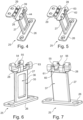
- the hinge 25 comprises a mounting member 26, a connecting member 27, a central element 28, a first wing element 29, and a second wing element 30.
- the mounting member 26 is plate-shaped.
- the mounting member 26 comprises a first and a second through hole 31, 32 in order to attach the hinge 25 to a central backrest 33 (see Figure 15 ), for example by means of screws (not shown).
- the mounting member 26 comprises and extends along a fastening surface 34, by means of which the mounting member 26 can be mounted adjacent to the central chord 33.
- the connecting member 27 is advantageously also designed in the form of a plate.
- a main extension plane of the connecting member 27 extends between the mounting member 26 and the central element 28.
- the main extension plane of the connecting member 27 is preferably transverse, in particular perpendicular to the fastening surface 34 of the mounting member 26.
- the connecting member 27 comprises a recess 36 on a main side 35 of the connecting member 27.
- the connecting member 27 is preferably designed in particular to be continuously flat on a second main side 37 opposite and spaced from the main side 35.
- the first wing element 29 comprises two mounting elements 48, 49 for attaching an armrest to it (see also Figures 11 to 16 ).
- the second wing element 30 comprises two mounting elements 50, 51 to attach another armrest to it (see also Figures 11 to 16 ).
- the first wing element 29 is rotatably connected to the central element 28 via a rotary joint 38.
- the rotary joint 38 comprises a shaft 39, a first bushing 40, a second bushing 41 and a third bushing 42.
- the first bushing 40 is advantageously integral with the first wing element 29.
- the second and third bushings 41, 42 are preferably integral with the central element 28.
- the first, second and third bushings 40-42 are advantageously rotatably mounted on the shaft 39 and connected to one another via the shaft 39.
- the second wing element 30 is connected to the central element 28 via a pivot joint 43.
- the pivot joint 43 comprises a shaft 44 (see Figure 4 ), a first bushing 45, a second bushing 46, and a third bushing 47.
- the first bushing 45 is advantageously provided in one piece with the first wing element 30.
- the second and third bushings 46, 47 are preferably formed in one piece with the central element 28.
- the first, second and third bushings 45 - 47 are advantageously rotatably mounted on the shaft 44 and connected to one another via the shaft 44.
- first and second wing elements 29, 30 are in a second position, wherein the first and second wing elements 29, 30 are rotatably mounted on the shafts 39, 44 so that they can be rotated about rotation axes A, B of the shafts 39, 44 into a second position according to Figure 3 are pivotable.
- the rotation axes A, B are advantageously located in one bearing plane.
- the wing elements 29, 30 are provided with attachment organs 52, 53 (exemplary for the first wing element 29 in Figure 10 shown) in particular directly on stop members 54 - 57 of the central element 28.
- the stop members 54 - 57 of the central element 28 limit a movement of the wing elements 29, 30 in a first direction of rotation.
- the wing elements 29, 30 are connected to the contact elements 58, 59 (exemplary for the first wing element 29 in Figure 10 shown) in particular directly on stop elements 60 - 63 of the central element 28.
- the stop elements 60 - 63 of the central element 28 limit a movement of the wing elements 29, 30 in a second direction of rotation.
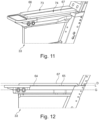
- FIG 11 shows a perspective view of a partial section of a center backrest 33.
- the center backrest 33 according to Figure 11 is, for example, identical to the center backrest 24 according to Figure 1
- the centre backrest 33 comprises two hinges 64, 65 (see also Figures 13 to 15 ).
- the hinges 64, 65 are advantageously designed to be identical to the hinge 25.
- the center backrest 33 comprises a first armrest 66 and a second armrest 67.
- the first armrest 66 is advantageously connected to first wing elements of the hinges 64, 65.
- the second armrest 67 is coupled to second wing elements 68, 69 of the hinges 64, 65.
- the center backrest 33 comprises, for example, a panel element 70 which has a storage area 71.
- the center backrest 33 comprises two panel elements 70, each with a storage area 71, 78.
- the storage area 71 of the panel element 70 advantageously extends in a storage plane C, wherein the storage plane is, for example, spaced apart and parallel to the storage plane L of the hinges 64, 65 (see also Figure 12 ).
- the armrests 66, 67 are advantageously designed in two parts.
- the armrests 66, 67 comprise an upper armrest part and an armrest lower part.
- the upper armrest part can in turn also be designed in two parts, consisting of a cushion element, which has a support surface for the armrest of a user, and a housing element located underneath.
- the armrest 67 is shown as an example, that it is designed in two parts, whereby Figure 13 for example, the upper part of the armrest is kept invisible so that an armrest lower part 72 of the armrest 67 can be seen.
- the armrests 66, 67 comprise support surfaces 73, 74.
- the support surfaces 73, 74 extend along a main extension plane D.
- the armrests 66, 67 are shown in the second position on the center backrest 33.
- the first armrest 66 is in a first position and the second armrest 67 is in the second position.
- both the first armrest 66 and the second armrest 67 are in the first position.
- the first and second armrests 66, 67 can be present in the first position with their support surfaces 73, 74 abutting one another.
- the central backrest 33 advantageously comprises stop members in the form of limiting members 75 - 77 which are designed, for example, as a support surface for supporting the armrests 66, 67 (see also Figure 18 ).
- the armrests 66, 67 in the second position rest against the limiting members 75 - 77, in particular on.
Landscapes
- Engineering & Computer Science (AREA)
- Aviation & Aerospace Engineering (AREA)
- Transportation (AREA)
- Mechanical Engineering (AREA)
- Seats For Vehicles (AREA)
- Chairs For Special Purposes, Such As Reclining Chairs (AREA)
- Pivots And Pivotal Connections (AREA)
Description
- Scharniere sind in vielfältigen Ausführungsformen und für vielfältige Anwendungen bekannt. Eine der bekanntesten Ausführungsformen für ein Scharnier ist ein Türscharnier. Das Türscharnier verbindet eine bewegliche Tür oder Klappe mit einem feststehenden Türrahmen, wobei die Tür mittels des Scharniers beweglich am Türrahmen gelagert ist.
- Außerdem bekannt ist ein sogenanntes Doppelscharnier mittels welchem zwei voneinander getrennt vorhandene Türen oder Klappen jeweils getrennt beweglich mit einem feststehenden Element, z.B. einem Rahmen, verbindbar sind.
- Auch sind Mittellehnen für eine Fluggastsitzreihe bekannt, welche ein Scharnier aufweisen. Beispielsweise beschreiben die
US 2014/217798 A1 und dieUS 1500524 A Armlehneneinheiten - Der Erfindung liegt die Aufgabe zugrunde eine verbesserte Mittellehne einer Fluggastsitzreihe mit einem Scharnier bereitzustellen.
- Diese Aufgabe wird durch die Merkmale des Anspruchs 1 gelöst.
- In den abhängigen Ansprüchen sind vorteilhafte und zweckmäßige Ausführungsformen der Erfindung angegeben.
- Die Erfindung geht von einer Mittellehne einer Fluggastsitzreihe mit einem Scharnier und mit einer Armauflage aus, wobei die Armauflage beweglich am Scharnier angelenkt ist, wobei die Mittellehne eine Aufbewahrungsfläche aufweist, welche sich in einer Aufbewahrungsebene erstreckt, wobei das Scharnier im Bereich der Aufbewahrungsfläche über das Montageorgan an der Mittellehne angeordnet ist, wobei die Aufbewahrungsebene von der Lagerebene der Rotationsachsen beabstandet vorhanden ist, wobei das Scharnier ein Mittenelement und zwei Flügelelemente aufweist, wobei ein erstes Flügelelement um eine erste Rotationsachse drehbar am Mittenelement angelenkt ist, wobei ein zweites Flügelelement um eine zweite Rotationsachse drehbar am Mittenelement angelenkt ist, wobei das erste Flügelelement ein Montageelement aufweist, um einen Flügel oder eine Klappe anzuordnen, wobei das zweite Flügelelement ein weiteres Montageelement aufweist, um einen weiteren Flügel oder eine weitere Klappe anzuordnen, wobei das Scharnier ein Montageorgan aufweist, um das Mittenelement an einem Fluggastsitz zu befestigen, sodass im montierten Zustand des Scharniers am Fluggastsitz und im angeordneten Zustand der Flügel oder der Klappen, die Flügel oder die Klappen relativ zum verbleibenden Fluggastsitz beweglich vorhanden sind, wobei die erste und die zweite Rotationsachse in einer Lagerebene sich erstreckend und voneinander beabstandet am Scharnier vorhanden sind.
- Bevorzugterweise ist das Scharnier als ein Doppelscharnier vorhanden. Beispielsweise ist das Scharnier als ein Beschlag, z.B. als ein Tischscharnier, insbesondere als ein Flugzeugtischscharnier ausgebildet. Vorteilhafterweise ist das Scharnier aus Metall oder Kunststoff oder einer Kombination der Materialien vorhanden.
- Vorteilhafterweise ist das Mittenelement drehbeweglich zum ersten und drehbeweglich zum zweiten Flügelelement vorhanden. Beispielsweise sind das erste und das zweite Flügelelement unabhängig voneinander relativ zum Mittenelement drehbeweglich vorhanden. Vorteilhafterweise erstrecken sich die erste und die zweite Rotationsachse in eine gleiche Richtung. Beispielsweise erstrecken sich die erste und die zweite Rotationsachse zueinander parallel. Beispielsweise erstrecken sich die erste und die zweite Rotationsachse in einer gleichen Lagerebene. Denkbar ist, dass die erste Rotationsachse in einem Bereich einer ersten Seite des Mittenelements ausgebildet ist und die zweite Rotationsachse in einem Bereich einer zweiten Seite des Mittenelements vorhanden ist, wobei die erste und die zweite Seite des Mittenelements gegenüberliegend und voneinander beabstandet vorhanden sind. Beispielweise ist das Mittenelement als eine Platte vorhanden und die erste Seite des Mittenelements ist eine erste Schmalseite der Platte und die zweite Seite des Mittenelements ist eine weitere Schmalseite der Platte. Vorteilhafterweise erstreckt sich die erste Rotationsachse entlang einer Längserstreckung der ersten Seite des Mittenelements und die zweite Rotationsachse entlang einer Längserstreckung der zweiten Seite des Mittenelements.
- Beispielsweise ist das Mittenelement, das erste Flügelelement und/oder das zweite Flügelelement plättchenartig ausgebildet, z.B. als ein Plättchen oder eine Platte vorhanden.
- Bevorzugterweise ist das Montageelement als eine Bohrung, als ein Loch, als ein Stift, als ein Bolzen, als ein Klebeelement, zum Beispiel als ein Kleber, und/oder als eine Klemme ausgebildet. Beispielweise ist der Flügel oder die Klappe an ein Flügelelement des Scharniers lösbar montierbar. Denkbar ist jedoch auch, dass ein Flügel oder ein Klappe mit einem der Flügelelemente des Scharniers unlösbar verbindbar ist. Beispielsweise sind die Flügelelemente in einer Weise ausgebildet, dass ein Flügel oder eine Klappe an ein Flügelelement angeklemmt, angeschraubt, angeklebt und/oder angeklipst werden kann.
- Vorteilhafterweise ist der Flügel oder die Klappe plattenartig vorhanden, insbesondere als eine Platte ausgebildet. Denkbar ist, dass der Flügel oder die Klappe als eine Auflage, zur Auflage eines Arms eines Nutzers, zum Beispiel zur Auflage eines Arms eines Nutzers eines Fluggastsitzes, ausgebildet ist. Zum Beispiel ist der Flügel oder die Klappe als eine Armauflage, z.B. als eine Armlehnenauflage, vorhanden. Beispielsweise ist der Flügel oder die Klappe zweiteilig ausgebildet. Denkbar ist, dass der Flügel oder die Klappe derart ausgebildet sind, dass im montierten Zustand des Flügels oder der Klappe an einem der Flügelelemente, der Flügel oder die Klappe das Flügelelement an fünf Seiten umschließt.
- Der Kern der Erfindung ist darin zu sehen, dass das erste Flügelelement mit einer insbesondere einzigen ersten Buchse am Mittenelement angelenkt ist, wobei die erste Buchse des ersten Flügelelements entlang der ersten Rotationsachse zwischen einer zweiten und einer dritten Buchse des Mittenelements vorhanden ist, wobei die erste bis dritte Buchse an einer ersten Welle des Scharniers gelagert sind, wobei das zweite Flügelelement mit einer insbesondere einzigen vierten Buchse am Mittenelement angelenkt ist, wobei die vierte Buchse des ersten Flügelelements entlang der zweiten Rotationsachse zwischen einer fünften und einer sechsten Buchse des Mittenelements vorhanden ist, wobei die vierte bis sechste Buchse an einer zweiten Welle des Scharniers gelagert sind. Hierdurch ist das Scharnier vergleichsweise stabil ausgebildet.
- Bevorzugterweise ist die erste Rotationsachse als Drehachse der ersten Welle vorhanden. Beispielsweise ist die zweite Rotationsachse als Drehachse der zweiten Welle ausgebildet.
- Vorteilhafterweise sind die erste, die zweite und die dritte Buchse an der ersten Welle des Scharniers drehbar gelagert. Beispielsweise sind die erste, die zweite und/oder die dritte Buchse relativ zur ersten Welle beweglich vorhanden. Denkbar ist auch, dass die zweite und die dritte Buchse positionsfest mit der Welle verbunden sind. Beispielsweise ist die erste Buchse positionsfest mit der Welle verbunden. Vorteilhafterweise sind die zweite und die dritte Buchse positionsfest am Mittenelement vorhanden, sodass die zweite und die dritte Buchse gemeinsam, insbesondere gleichzeitig, relativ zur ersten Buchse beweglich vorhanden sind. Beispielsweise sind die zweite und die dritte Buchse positionsfest mit dem Mittenelement verbunden.
- Vorteilhafterweise sind die vierte, die fünfte und die sechste Buchse an der zweiten Welle des Scharniers drehbar gelagert. Beispielsweise sind die vierte, die fünfte und/oder die sechste Buchse relativ zur zweiten Welle beweglich vorhanden. Denkbar ist auch, dass die fünfte und die sechste Buchse positionsfest mit der Welle verbunden sind. Beispielsweise ist die vierte Buchse positionsfest mit der Welle verbunden. Vorteilhafterweise sind die fünfte und die sechste Buchse positionsfest am Mittenelement vorhanden, sodass die fünfte und die sechste Buchse gemeinsam, insbesondere gleichzeitig, relativ zur vierten Buchse beweglich vorhanden sind. Beispielsweise sind die fünfte und die sechste Buchse positionsfest mit dem Mittenelement verbunden. Zum Beispiel ist die erste Buchse positionsfest am ersten Flügelelement ausgebildet, beispielsweise positionsfest mit dem ersten Flügelelement verbunden. Beispielsweise ist die vierte Buchse positionsfest am zweiten Flügelelement vorhanden, zum Beispiel positionsfest mit dem zweiten Flügelelement verbunden.
- Denkbar ist, dass das Mittenelement und die zweite Buchse und die dritte Buchse einstückig ausgebildet sind. Vorstellbar ist auch, dass das Mittenelement und die fünfte Buchse und die sechste Buchse einstückig ausgebildet sind. Zum Beispiel ist die erste Buchse einstückig am ersten Flügelelement und/oder die vierte Buchse einstückig mit dem zweiten Flügelelement vorhanden.
- Bevorzugterweise umschließen oder umgreifen die erste Buchse, die zweite Buchse und/oder die dritte Buchse die erste Welle vollständig, insbesondere umfänglich um die Drehachse der ersten Welle. Vorteilhafterweise umschließen oder umgreifen die vierte Buchse, die fünfte Buchse und/oder die sechste Buchse die zweite Welle vollständig, insbesondere umfänglich um die Drehachse der zweiten Welle.
- Vorteilhafterweise bilden die erste Buchse, die zweite Buchse und die dritte Buchse zusammen mit der ersten Welle ein erstes Drehgelenk. Beispielsweise bilden die vierte Buchse, die fünfte Buchse und die sechste Buchse zusammen mit der zweiten Welle ein zweites Drehgelenk. Beispielsweise umfasst das Scharnier genau zwei Drehgelenke.
- Von Vorteil erweist sich auch, dass das Scharnier ein Verbindungsorgan aufweist, welches in einer Haupterstreckungsrichtung quer zur Lagerebene der Rotationsachsen sich erstreckend vorhanden ist, wobei an einem ersten Ende des Verbindungsorgans das Mittenelement angeordnet ist, wobei an einem zweiten Ende des Verbindungsorgans das Montageorgan vorhanden ist. Vorteilhafterweise sind das erste und das zweite Ende des Verbindungsorgans zueinander beabstandet und gegenüberliegend vorhanden.
- Bevorzugterweise sind das Montageorgan und das Verbindungsorgan einstückig ausgebildet. Vorteilhafterweise sind das Montageorgan, das Verbindungsorgan und das Mittenelement einstückig ausgebildet. Beispielsweise verbindet das Verbindungsorgan das Mittenelement und das Montageorgan miteinander. Zum Beispiel ist das Verbindungsorgan plattenartig, z.B. als eine Platte ausgebildet. Vorteilhafterweise erstreckt sich das Verbindungsorgan mit einer Länge entlang einer Längserstreckung des Mittenelements. Beispielsweise erstrecken sich die Rotationsachsen in Richtung, insbesondere parallel zur Längserstreckung des Mittenelements. Beispielsweise ist das Verbindungsorgan in einer Richtung quer zur Längserstreckung des Mittenelements zwischen der zweiten und/oder der dritten Buchse und der fünften und/oder der sechsten Buchse am Mittenelement angeordnet.
- Vorteilhafterweise umfasst das Verbindungsorgan eine Ausnehmung, insbesondere eine einzige Ausnehmung. Beispielsweise ist die Ausnehmung am Verbindungsorgan als eine Vertiefung an einer ersten Seite des Verbindungsorgans vorhanden. Beispielsweise erstreckt sich die Vertiefung in einer ersten Richtung in einem Bereich zwischen dem Mittenelement und dem Montageorgan und in einer zweiten Richtung in Richtung Längserstreckung des Mittenelements und/oder in Richtung Erstreckung der Rotationsachse, wobei die erste Richtung und die zweite Richtung quer zueinander ausgerichtet vorhanden sind. Hierdurch ist ein Gewicht des Scharniers vermindert, wobei vorteilhafterweise eine Stabilität des Scharniers vergleichsweise erhalten bleibt. Denkbar ist auch, dass das Verbindungsorgan zwei Ausnehmungen aufweist, wobei eine erste Ausnehmung an der ersten Seite des Verbindungsorgans und eine zweite Ausnehmung an einer zweiten Seite des Verbindungsorgans ausgebildet sind, wobei die erste und die zweite Seite des Verbindungsorgans gegenüberliegend und beabstandet vorhanden sind.
- Von Vorteil erweist sich auch, dass das Montageorgan sich in einer Ebene quer zur Haupterstreckungsebene des Verbindungsorgans erstreckt, sodass das Montageorgan und das Verbindungsorgan T-förmig vorhanden sind. Vorteilhafterweise sind das Mittenelement, das Verbindungsorgan und das Montageorgan doppel-T-förmig ausgebildet. Vorstellbar ist außerdem, dass das Mittenelement, das Verbindungsorgan und das Montageorgan in einer Weise ausgebildet und zueinander angeordnet sind, dass die drei Elemente zusammen mindestens eine Symmetrieebene aufweisen, insbesondere genau eine Symmetrieebene.
- Bevorzugterweise umfasst das Montageorgan eine Bohrung, z.B. eine Durchgangsbohrung, ein Loch, z.B. ein Durchgangsloch, einen Stift, einen Bolzen, ein Klebeelement, zum Beispiel einen Kleber, und/oder eine Klemme, um das Scharnier am Fluggastsitz, z.B. an einer Mittellehne eines Fluggastsitzes, zu befestigen. Beispielweise ist das Scharnier lösbar am Fluggastsitz, z.B. an der Mittellehne der Fluggastsitzes, montierbar. Denkbar ist jedoch auch, dass das Scharnier mit dem Fluggastsitz, z.B. mit der Mittellehne des Fluggastsitzes, unlösbar verbindbar ist. Beispielsweise ist das Montageorgan in einer Weise ausgebildet, dass das Scharnier an den Fluggastsitz, z.B. an die Mittellehne des Fluggastsitzes, angeklemmt, angeschraubt, angeklebt und/oder angeklipst werden kann.
- Ebenfalls von Vorteil erweist sich, dass das Mittenelement ein erstes und ein zweites Anschlagorgan aufweist, wobei in einer ersten Position des ersten Flügelelements das erste Flügelelement am ersten Anschlagorgan ansteht und in einer ersten Position des zweiten Flügelelements das zweite Flügelelement am zweiten Anschlagorgan ansteht. Hierdurch begrenzen die Anschlagorgane eine Bewegung der Flügelelemente relativ zum Mittenelement in der ersten Position.
- Beispielsweise umfasst ein Flügelelement ein Anlageorgan, z.B. zwei Anlageorgane. Vorteilhafterweise steht und/oder liegt das erste Flügelelement mit einem Anlageorgan, insbesondere mit beiden Anlageorganen in der ersten Position des ersten Flügelelements am ersten Anschlagorgan des Mittenelements an. Zum Beispiel steht und/oder liegt das zweite Flügelelement mit einem Anlageorgan, insbesondere mit beiden Anlageorganen in der ersten Position des zweiten Flügelelements am zweiten Anschlagorgan des Mittenelements an.
- Vorteilhafterweise ist ein Anschlagorgan und/oder ein Anlageorgan als eine Anschlagfläche und/oder als eine Anlagefläche ausgebildet. Beispielsweise erstreckt sich ein Anschlagorgan in Richtung einer Erstreckung einer Rotationsachse gesehen zwischen der zweiten und der dritten Buchse. Vorteilhafterweise begrenzt das Anlageorgan eine Erstreckung der ersten Buchse in Richtung einer Erstreckung einer Rotationsachse.
- Auch ist es von Vorteil, dass das Mittenelement ein erstes und ein zweites Anschlagelement aufweist, wobei in einer zweiten Position der Flügelelemente das erste Flügelelement am ersten Anschlagelement und das zweite Flügelelement am zweiten Anschlagelement ansteht. Hierdurch begrenzen die Anschlagelemente eine Bewegung der Flügelelemente relativ zum Mittenelement in der zweiten Position.
- Beispielsweise umfasst ein Flügelelement ein Anlageelement, z.B. zwei Anlageelemente. Vorteilhafterweise steht und/oder liegt das erste Flügelelement mit einem Anlageelement, insbesondere steht und/oder liegt das erste Flügelelement mit beiden Anlageelementen in der zweiten Position des ersten Flügelelements am ersten Anschlagelement des Mittenelements an. Zum Beispiel steht und/oder liegt das zweite Flügelelement mit einem Anlageelement, insbesondere steht und/oder liegt das zweite Flügelelement mit beiden Anlageelementen in der zweiten Position des zweiten Flügelelements am zweiten Anschlagelement des Mittenelements an.
- Vorteilhafterweise ist ein Anschlagelement und/oder ein Anlageelement als eine Anschlagfläche und/oder als eine Anlagefläche ausgebildet. Beispielsweise erstreckt sich ein Anschlagelement in Richtung einer Erstreckung einer Rotationsachse gesehen zwischen der zweiten und der dritten Buchse. Vorteilhafterweise begrenzt das Anlageelement eine Erstreckung der ersten Buchse in Richtung einer Erstreckung einer Rotationsachse.
- Vorteilhafterweise ist das erste Flügelelement und/oder das zweite Flügelelement zwischen der ersten und der zweiten Position um weniger als 180° um die erste bzw. die zweite Rotationsachse drehbar vorhanden. Bevorzugterweise ist das erste und/oder das zweite Flügelelement zwischen dem ersten Anschlagorgan und dem ersten Anschlagelement in einem Winkelbereich von weniger als 180° um die erste Rotationsachse drehbar vorhanden. Beispielsweise ist das erste und/oder das zweite Flügelelement zwischen der ersten und der zweiten Position in einem Winkelbereich von genau 90° um die erste bzw. die zweite Rotationsachse drehbar vorhanden. Bevorzugterweise ist das erste und/oder das zweite Flügelelement zwischen dem ersten Anschlagorgan und dem ersten Anschlagelement um einen Winkel von genau 90° um die erste bzw. die zweite Rotationsachse drehbar vorhanden.
- Vorteilhafterweise ist das erste Flügelelement zwischen der ersten und der zweiten Position in einem Winkelbereich zwischen 0° und 210° drehbar vorhanden. Z.B. ist das erste Flügelelement zwischen der ersten und der zweiten Position in einem Winkelbereich zwischen 0° und 190°, zwischen 0° und 180°, zwischen 0° und 175°, zwischen 0° und 170° oder zwischen 0° und 160° drehbar vorhanden. Vorteilhafterweise ist das zweite Flügelelement zwischen der ersten und der zweiten Position in einem Winkelbereich zwischen 0° und 210° drehbar vorhanden. Z.B. ist das zweite Flügelelement zwischen der ersten und der zweiten Position in einem Winkelbereich zwischen 0° und 190°, zwischen 0° und 180°, zwischen 0° und 175°, zwischen 0° und 170° oder zwischen 0° und 160° drehbar vorhanden.
- Beispielsweise schließen das erste und das zweite Flügelelement in der zweiten Position einen Winkel von 0° ein. Vorteilhafterweise schließen das erste und das zweite Flügelelement in der zweiten Position einen Winkelbereich zwischen 0° und 30°, eine Winkelbereich zwischen 0° und 25°, einen Winkelbereich zwischen 0° und 20°, einen Winkelbereich zwischen 0° und 15°, einen Winkelbereich zwischen 0° und 10° oder einen Winkelbereich zwischen 0° und 5° ein. Vorteilhafterweise schließt eine Haupterstreckungsebene des ersten Flügelelements und eine Haupterstreckungsebene des zweiten Flügelelements den Winkel ein.
- Erfindungsgemäß ist eine Mittellehne einer Fluggastsitzreihe mit einem Scharnier nach einer der vorangegangen genannten Varianten und einer Armauflage ausgebildet, wobei die Armauflage beweglich am Scharnier angelenkt ist. Vorteilhafterweise ist die Armauflage beweglich an der Mittellehne vorhanden. Bevorzugterweise ist die Armauflage mittels des Scharniers beweglich gelagert vorhanden. Beispielsweise ist die Armauflage mit einem Flügelelement des Scharniers positionsfest verbindbar. Bevorzugterweise umfasst die Mittellehne insbesondere genau zwei Scharniere. Denkbar ist, dass die Scharniere an der Mittellehne voneinander beabstandet angeordnet sind.
- Bevorzugterweise ist eine Armauflage zweiteilig ausgebildet. Beispielsweise umfasst eine Armauflage ein Armauflagenunterteil und ein Armauflagenoberteil. Beispielsweise umschließen das Armauflagenoberteil und das Armauflagenunterteil im angeordneten Zustand am Scharnier ein Flügelelement. Vorstellbar ist weiterhin, dass die Armauflage ausgebildet ist, dass ein Polsterelement an die Armauflage angeordnet werden kann. Z.B. ist ein Polsterelement an das Armauflagenoberteil anordenbar. Vorstellbar ist auch, dass die Armauflage das Polsterelement umfasst.
- Vorteilhafterweise sind insbesondere genau zwei Armauflagen beweglich am Scharnier angelenkt. Vorteilhafterweise ist eine erste Armauflage am ersten Flügelelement und eine zweite Armauflage am zweiten Flügelelement befestigt.
- Erfindungsgemäß weist die Mittellehne eine Aufbewahrungsfläche auf, welche sich in einer Aufbewahrungsebene erstreckt, wobei das Scharnier über das Montageorgan an der Mittellehne angeordnet ist, wobei das Scharnier im Bereich der Aufbewahrungsfläche angeordnet ist, wobei die Aufbewahrungsebene von der Lagerebene der Rotationsachsen beabstandet vorhanden ist. Hierdurch ist die Mittellehne in einer Weise vorhanden, dass Lagerraum für Utensilien, z.B. für ein Mobiltelefon eines Nutzers des Fluggastsitzes, an welchem die Mittellehne anordenbar ist, geschaffen ist. Vorteilhafterweise sind die Aufbewahrungsebene und die Lagerebene zueinander parallel ausgerichtet vorhanden. Vorteilhafterweise ist die Mittellehne derart ausgebildet, dass zwischen der Aufbewahrungsfläche und einer Armlehne in der ersten Position und/oder in der zweiten Position der Armlehne ein Freiraum vorhanden ist, wobei der Freiraum derart ausgebildet ist, dass ein Mobiltelefon und/oder eine Brille zwischen Aufbewahrungsfläche und Armlehne anordenbar ist.
- Außerdem von Vorteil ist, das die Mittellehne insbesondere genau zwei Aufbewahrungsflächen aufweist, welche sich in der selben Aufbewahrungsebene erstrecken und voneinander beabstandet vorhanden sind. Vorteilhafterweise sind die Aufbewahrungsebenen durch das Scharnier beabstandet vorhanden. Vorstellbar ist, dass die Mittellehne an einer Fluggastsitzreihe, z.B. an einem Fluggastdoppelsitz, anordenbar ist, sodass die Mittellehne zwei Fluggastsitze voneinander trennt. Beispielsweise bildet die Mittellehne im angeordneten Zustand am Fluggastsitz eine Armauflage für einen ersten und einen zweiten Fluggastsitz der Fluggastsitzreihe. Vorstellbar ist, dass jeweils eine Aufbewahrungsfläche für einen Nutzer eines Fluggastsitzes der Fluggastsitzreihe an der Mittellehne vorhanden ist.
- Auch ist es von Vorteil, dass das Verbindungsorgan des Scharniers von der Aufbewahrungsebene abstehend vorhanden ist. Hierdurch ist eine Auflagefläche der Armauflage beabstandet zur Aufbewahrungsebene vorhanden. Beispielsweise erstreckt sich das Verbindungsorgan des Scharniers in eine Richtung quer zu den Aufbewahrungsebenen an der Mittellehne.
- Ebenfalls ist es von Vorteil, dass die Mittellehne zwei Armauflagen aufweist, wobei die Mittellehne zwei Anschlagorgane aufweist, wobei jeweils eine Armauflage in einer ersten Position an jeweils einem Anschlagorgan anliegt, wobei jede Armauflage eine Auflagefläche aufweist, wobei die Auflageflächen sich in der ersten Position der Armauflagen in Richtung der Lagerebene erstrecken. Vorteilhafterweise ist durch die Anschlagorgane der Mittellehne eine Abstützung der Armauflage in der ersten Position der Armauflage realisiert. Beispielsweise ist das Anschlagorgan der Mittellehne als ein Begrenzungsorgan ausgebildet, wobei das Begrenzungsorgan eine Bewegung der Armauflage von der zweiten Position der Armauflage in die erste Position der Armauflage begrenzt. Zum Beispiel definiert das Begrenzungsorgan, z.B. zusammen mit dem Anschlagorgan des Scharniers, die erste Position der Armauflage.
- Vorteilhafterweise erstrecken sich die Armauflagen in der ersten Position in der Lagerebene.
- Die Auflagefläche der Armauflage bildet vorteilhafterweise eine Ebene zur Auflage eines Arms eines Nutzers des Sitzes als Armstütze oder Armlehne. Vorteilhafterweise bildet das Polsterelement im angeordneten Zustand an der Armauflage eine Auflagefläche für einen Arm eines Nutzers.
- Von Vorteil ist es auch, dass die Mittellehne zwei Armauflagen aufweist, wobei die beiden Armauflagen jeweils in eine zweite Position bewegbar vorhanden sind, wobei in der jeweiligen zweiten Position die beiden Armauflagen aneinander anstehend vorhanden sind. Beispielsweise liegen die Armauflagen mit ihren Polsterelemente, insbesondere mit den Auflageflächen, in der zweiten Position aneinander an. Denkbar ist auch, dass die Armauflagen, insbesondere die Auflageflächen, in der zweiten Position beabstandet voneinander vorhanden sind. Beispielsweise erstrecken sich die Auflageflächen der Armauflagen in der zweiten Position in eine gleiche Richtung, z.B. sind die Auflageflächen der Armauflage in der zweiten Position zueinander parallel ausgerichtet vorhanden. Beispielsweise erstreckt sich eine Auflageebene einer der Auflageflächen in der zweiten Position der Armauflage quer zur Lagerebene des Scharniers und/oder quer zur Aufbewahrungsebene der Aufbewahrungsfläche der Mittellehne.
- Eine vorteilhafte Modifikation der Erfindung ist ein Fluggastsitz, insbesondere ein Fluggastdoppelsitz, mit einer Mittellehne nach einer der vorangegangen genannten Varianten. Beispielsweise ist der Fluggastsitz als eine Fluggastsitzreihe vorhanden. Denkbar ist, dass die Fluggastsitzreihe, zwei oder mehr Sitzmöglichkeiten für Nutzer bereitstellt. Denkbar ist, dass die Fluggastsitzreihe genau zwei oder genau drei Sitzmöglichkeiten für Nutzer bereitstellt, z.B. in Form eines Fluggastdoppelsitz oder in Form eines Fluggastdreiersitz. Bevorzugterweise umfasst die Fluggastsitzreihe zwei oder mehr Fluggastsitze, welche beispielsweise miteinander verbunden, insbesondere miteinander untrennbar verbunden vorhanden sind. Vorteilhafterweise ist die Mittellehne zwischen zwei Fluggastsitzen einer Fluggastsitzreihe und/oder zwischen zwei Fluggastsitzen des Fluggastdoppelsitzes vorhanden. Bevorzugterweise ist die Mittellehne als ein Trennelement, z.B. als eine Armlehne und/oder als ein Trenner, zwischen zwei Fluggastsitzen einer Fluggastsitzreihe und/oder des Fluggastdoppelsitzes vorhanden.
- Eine mögliche Ausführungsform der Erfindung ist ein Flugzeug mit einem Fluggastsitz nach einer der vorangegangen genannten Variante.
- Ein Ausführungsbeispiel wird anhand der nachstehenden schematischen Zeichnungen unter Angabe von weiteren Einzelheiten und Vorteilen näher erläutert.
- Es zeigen:
- Figur 1
- in einer perspektivischen Ansicht von schräg vorne eine Sitzreihe mit zwei Fluggastsitzen jeweils umfassend einen Sitzboden, eine Rückenlehne samt rückseitiger Umhausung, Mittellehne und eine Beinauflage,
- Figur 2
- eine perspektivische Ansicht von vorne, seitlich rechts, oben auf ein erfindungsgemäßes Scharnier mit Flügelelementen des Scharniers in einer zweiten Position,
- Figur 3
- eine weitere perspektivische Ansicht von vorne, seitlich rechts, oben auf das Scharnier gemäß
Figur 2 mit Flügelelementen des Scharniers in einer ersten Position, - Figur 4
- das Scharnier gemäß
Figur 2 , wobei ein Flügelelement des Scharniers unsichtbar gehalten ist, - Figur 5
- das Scharnier gemäß
Figur 4 , wobei zusätzlich zum Flügelelement eine Welle des Scharniers unsichtbar gehalten ist, - Figur 6
- eine weitere perspektivische Ansicht auf das Scharnier gemäß
Figur 2 , wobei beide Flügelelement und beide Wellen des Scharniers unsichtbar gehalten sind, - Figur 7
- eine weitere perspektivische Ansicht von vorne, seitlich links, oben auf das Scharnier gemäß der Ausbildung von
Figur 6 , - Figur 8
- eine Draufsicht auf das Scharnier gemäß
Figur 2 , - Figur 9
- eine Schnittansicht C-C durch das Scharnier, gemäß des in
Figur 8 eingezeichneten Schnitts C-C, - Figur 10
- eine perspektivische Ansicht von schräg seitlich oben auf ein Flügelelement des Scharniers mit angeordneter Welle,
- Figur 11
- eine perspektivische Teil-Ansicht von schräg seitlich vorne der Mittellehne der Sitzreihe gemäß
Figur 1 , - Figur 12
- eine seitliche Teil-Ansicht der Mittellehne gemäß
Figur 11 , - Figur 13
- eine perspektivische Teil-Ansicht der Mittellehne gemäß
Figur 11 , wobei ein Armauflageoberteil mit Polsterelement eine Armlehne der Mittellehne unsichtbar gehalten ist, - Figur 14
- eine perspektivische Teil-Ansicht der Mittellehne gemäß
Figur 11 , wobei eine Armlehne der Mittellehne unsichtbar gehalten ist, - Figur 15
- eine perspektivische Teil-Ansicht der Mittellehne gemäß
Figur 11 , wobei die Armlehne der Mittellehne und ein Blendenelement der Mittellehne, welche eine Aufbewahrungsfläche umfasst, unsichtbar gehalten ist, - Figur 16
- eine Frontansicht auf ein Scharnier mit angeordneten Armlehnen in einer zweiten Position des Scharniers,
- Figur 17
- eine perspektivische Teil-Ansicht von vorne oben auf eine Mittellehne, wobei eine Armauflage sich in einer ersten Position befindet und eine weitere Armauflage in einer zweiten Position und
- Figur 18
- eine perspektivische Teil-Ansicht von vorne oben auf eine Mittellehne, wobei beide Armauflage der Mittellehne sich in einer ersten Position befinden.
-
Figur 1 zeigt eine Sitzreihe 1 mit einer Sitzrichtung 2 mit zwei Fluggastsitzen 3 und 4. Nachfolgend beziehen sich Positions- und Richtungsangaben wie vorne, hinten, oben und unten auf die Sitzrichtung 2 und den Nutzzustand der Sitzreihe 1. - Beide Fluggastsitze 3 und 4 sind entsprechend aufgebaut. Der Fluggastsitz 3 weist einen Sitzboden 5, eine Rückenlehne 6 und eine zur Rückenlehne 6 rückseitige Umhausung 7 auf. Im Anschluss an einen vorne liegenden Endbereich des Sitzbodens 5 ist eine vorzugsweise klappbare oder schwenkbare Beinauflage 8 vorhanden, die um eine horizontale Achse klappbar ist.
- Dementsprechend umfasst der Fluggastsitz 4 einen Sitzboden 9, eine Rückenlehne 10, eine Umhausung 11 und eine Beinauflage 12.
- Die Sitzboden 5, 9, die Rückenlehnen 6, 10 und die Beinauflagen 8, 12 umfassen eine vorzugsweise ergonomisch geformte Polsterung.
- Beispielsweise sind die Fluggastsitze 3 und 4 über zwei Stützbeine 13 (nur einer sichtbar) an einem Kabinenboden 14 einer Flugkabine eines dazugehörigen Flugzeuges (nicht gezeigt) montierbar. Das Stützbein 13 weist hierfür an einem unteren Endbereich 15 einer vorderen Strebe 16 eine Montagestelle 17 und eine weitere Montagestelle 18 an einem unteren Endbereich 19 einer hinteren Strebe 20 auf. Zwischen den Endbereichen 15 und 19 ist ein Verstrebungselement 21 vorgesehen.
- Bevorzugterweise weist die Sitzreihe 1 zudem eine äußere Armlehne 22 seitlich am Fluggastsitz 3 und eine äußere Armlehne 23 seitlich am Fluggastsitz 4 auf. Zwischen den beiden Fluggastsitzen 3 und 4 ist vorzugsweise auf Höhe der beiden äußeren Armlehnen 22 und 23 eine Mittellehne 24 vorhanden, welche eine Armauflage für einen Fluggast bildet.
- Vorteilhafterweise ist in einer Schalenform der jeweiligen Umhausung 7 bzw. 11 die jeweils dazugehörige Rückenlehne 6 bzw. 10 angeordnet. Die Rückenlehne 6 bzw. 10 ist vorzugsweise zur Einstellung von unterschiedlichen Kippstellungen beweglich in der Umhausung 7 bzw. 11 geführt, beispielsweise zusammen mit dem dazugehörigen verschiebbar gelagerten Sitzboden 5 bzw. 9.
-
Figur 2 zeigt ein erfindungsgemäßes Scharnier 25 in einer perspektivischen Ansicht von schräg seitlich oben. Das Scharnier 25 umfasst ein Montageorgan 26, ein Verbindungsorgan 27, ein Mittenelement 28, ein erstes Flügelelement 29, sowie ein zweites Flügelelement 30. - Vorteilhafterweise ist das Montageorgan 26 plattenförmig ausgebildet. Z.B. umfasst das Montageorgan 26 eine erste und eine zweite Durchgangsbohrung 31, 32, um das Scharnier 25 an einer Mittellehne 33 (siehe
Figur 15 ), zum Beispiel mittels Schrauben (nicht gezeigt), zu befestigen. Bevorzugterweise umfasst und erstreckt sich das Montageorgan 26 entlang einer Befestigungsfläche 34, mittels welcher das Montageorgan 26 an der Mittelehne 33 anliegend montierbar ist. - Das Verbindungsorgan 27 ist vorteilhafterweise ebenfalls plattenförmig ausgebildet. Beispielsweise erstreckt sich eine Haupterstreckungsebene des Verbindungsorgans 27 zwischen dem Montageorgan 26 und dem Mittenelement 28. Bevorzugterweise ist die Haupterstreckungsebene des Verbindungsorgans 27 quer, insbesondere senkrecht zur Befestigungsfläche 34 des Montageorgans 26 vorhanden. Zum Beispiel umfasst das Verbindungsorgan 27 an einer Hauptseite 35 des Verbindungsorgans 27 eine Ausnehmung 36. Bevorzugterweise ist das Verbindungsorgan 27 an einer der Hauptseite 35 gegenüberliegenden und beabstandeten zweiten Hauptseite 37 insbesondere durchgehend flächig ausgebildet.
- Das erste Flügelelement 29 umfasst zwei Montageelemente 48, 49, um eine Armauflage daran zu befestigen (siehe auch
Figuren 11 bis 16 ). Das zweite Flügelelement 30 umfasst zwei Montageelemente 50, 51, um eine weitere Armauflage daran zu befestigen (siehe auchFiguren 11 bis 16 ). - Das erste Flügelelement 29 ist über ein Drehgelenk 38 drehbeweglich mit dem Mittenelement 28 verbunden. Das Drehgelenk 38 umfasst eine Welle 39, eine erste Buchse 40, eine zweite Buchse 41, sowie eine dritte Buchse 42. Vorteilhafterweise ist die erste Buchse 40 einstückig mit dem ersten Flügelelement 29 vorhanden. Bevorzugterweise sind die zweite und die dritte Buchse 41, 42 einstückig mit dem Mittenelement 28 ausgebildet. Vorteilhafterweise sind die erste, die zweite und die dritte Buchse 40 - 42 drehbar an der Welle 39 gelagert und über die Welle 39 miteinander verbunden.
- Das zweite Flügelelement 30 ist über ein Drehgelenk 43 drehbeweglich mit dem Mittenelement 28 verbunden. Das Drehgelenk 43 umfasst eine Welle 44 (siehe
Figur 4 ), eine erste Buchse 45, eine zweite Buchse 46, sowie eine dritte Buchse 47. Vorteilhafterweise ist die erste Buchse 45 einstückig mit dem ersten Flügelelement 30 vorhanden. Bevorzugterweise sind die zweite und die dritte Buchse 46, 47 einstückig mit dem Mittenelement 28 ausgebildet. Vorteilhafterweise sind die erste, die zweite und die dritte Buchse 45 - 47 drehbar an der Welle 44 gelagert und über die Welle 44 miteinander verbunden. - In
Figur 2 befinden sich das erste und das zweite Flügelelement 29, 30 in einer zweiten Position, wobei das erste und das zweite Flügelelement 29, 30 drehbar an den Wellen 39, 44 gelagert sind, sodass sie um Rotationsachsen A, B der Wellen 39, 44 in eine zweite Position gemäßFigur 3 verschwenkbar vorhanden sind. Vorteilhafterweise liegen die Rotationsachsen A, B in einer Lagerebene. - In der ersten Position der Flügelelemente 29, 30 gemäß
Figur 3 stehen die Flügelelemente 29, 30 mit Anlageorganen 52, 53 (beispielhaft für das erste Flügelelement 29 inFigur 10 gezeigt) insbesondere unmittelbar an Anschlagorganen 54 - 57 des Mittenelements 28 an. Hierdurch begrenzen die Anschlagsorgane 54 - 57 des Mittenelements 28 eine Bewegung der Flügelelemente 29, 30 in eine erste Drehrichtung. In der zweiten Position der Flügelelemente 29, 30 gemäßFigur 2 stehen die Flügelelemente 29, 30 mit Anlageelementen 58, 59 (beispielhaft für das erste Flügelelement 29 inFigur 10 gezeigt) insbesondere unmittelbar an Anschlagelementen 60 - 63 des Mittenelements 28 an. Hierdurch begrenzen die Anschlagelemente 60 - 63 des Mittenelements 28 eine Bewegung der Flügelelemente 29, 30 in eine zweite Drehrichtung. -
Figur 11 zeigt in einer perspektivischen Ansicht einen Teilausschnitt auf eine Mittellehne 33. Die Mittellehne 33 gemäßFigur 11 ist beispielsweise identisch zur Mittellehne 24 gemäßFigur 1 vorhanden. Die Mittellehne 33 umfasst zwei Scharniere 64, 65 (siehe auchFiguren 13 bis 15 ). Vorteilhafterweise sind die Scharniere 64, 65 identisch zum Scharnier 25 ausgebildet. Außerdem umfasst die Mittellehne 33 eine erste Armauflage 66 und eine zweite Armauflage 67. Vorteilhafterweise ist die erste Armauflage 66 mit ersten Flügelelementen der Scharniere 64, 65 verbunden. Beispielsweise ist die zweite Armauflage 67 mit zweiten Flügelelementen 68, 69 der Scharniere 64, 65 gekoppelt. - Außerdem umfasst die Mittellehne 33 zum Beispiel ein Blendenelement 70, welches eine Aufbewahrungsfläche 71 aufweist. Vorteilhafterweise umfasst die Mittellehne 33 zwei Blendenelemente 70 mit jeweils einer Aufbewahrungsfläche 71, 78. Die Aufbewahrungsfläche 71 des Blendenelements 70 erstreckt sich vorteilhafterweise in einer Aufbewahrungsebene C, wobei die Aufbewahrungsebene beispielsweise beabstandet und parallel zur Lagerebene L der Scharniere 64, 65 vorhanden ist (siehe auch
Figur 12 ). - Die Armauflagen 66, 67 sind vorteilhafterweise zweiteilig ausgebildet. Beispielsweise umfassen die Armauflagen 66, 67 ein Armauflagenoberteil und ein Armauflagenunterteil. Das Armauflagenoberteil kann wiederum ebenfalls 2-teilig ausgebildet sein, bestehend aus einem Polsterelement, welches eine Auflagefläche zu Armauflage eines Nutzers aufweist, und einem darunter befindlichen Gehäuseelement. In den
Figuren 11 bis 15 ist beispielhaft an der Armauflage 67 gezeigt, dass diese zweiteilig ausgebildet ist, wobei inFigur 13 beispielsweise das Armauflagenoberteil unsichtbar gehalten ist, sodass ein Armauflagenunterteil 72 der Armauflage 67 zu erkennen ist. Die Armauflagen 66, 67 umfassen Auflageflächen 73, 74. Die Auflageflächen 73, 74 erstrecken sich entlang einer Haupterstreckungsebene D. - In
Figuren 11 und 12 sind die Armauflagen 66, 67 in der zweiten Position an der Mittellehne 33 gezeigt. InFigur 17 befindet sich die erste Armauflage 66 in einer ersten Position und die zweite Armauflage 67 in der zweiten Position. InFigur 18 befinden sich sowohl die erste Armauflage 66 als auch die zweite Armauflage 67 in der ersten Position. InFigur 18 beispielhaft gezeigt ist, dass die erste und die zweite Armauflage 66, 67 in der ersten Position mit ihren Auflageflächen 73, 74 aneinander anstehend vorhanden sein können. - Die Mittellehne 33 umfasst vorteilhafterweise Anschlagsorgane in Form von Begrenzungsorganen 75 - 77 welche beispielsweise als eine Auflagefläche zur Auflage der Armauflagen 66, 67 ausgebildet sind (siehe auch
Figur 18 ). Vorteilhafterweise liegen die Armauflagen 66, 67 in der zweiten Position an den Begrenzungsorganen 75 - 77 an, insbesondere auf.Bezugszeichenliste 1 Sitzreihe 33 Mittellehne 2 Sitzrichtung 34 Befestigungsfläche 3 - 4 Fluggastsitz 35, 37 Hauptseite 5, 9 Sitzboden 36 Ausnehmung 6, 10 Rückenlehne 38, 43 Drehgelenk 7, 11 Umhausung 39, 44 Welle 8, 12 Beinauflage 40 - 42 Buchse 13 Stützbein 45 - 47 Buchse 14 Kabinenboden 48 - 51 Montageelement 15, 19 Endbereich 52, 53 Anlageorgan 16, 20 Strebe 54 - 57 Anschlagorgan 17, 18 Montagestelle 58, 59 Anlageelement 21 Verstrebungselement 60 - 63 Anschlagelement 22, 23 Armlehne 64, 65 Scharnier 24 Mittellehne 66, 67 Armauflage 25 Scharnier 68, 69 Flügelelement 26 Montageorgan 70 Blendenelement 27 Verbindungsorgan 71, 78 Aufbewahrungsfläche 28 Mittenelement 72 Armauflagenunterteil 29, 30 Flügelelement 73, 74 Auflagefläche 31, 32 Durchgangsbohrung 75 - 77 Begrenzungsorgan
Claims (11)
- Mittellehne (33) einer Fluggastsitzreihe, mit einem Scharnier (25) und mit einer Armauflage (66, 67), wobei die Armauflage (66, 67) beweglich am Scharnier (25) angelenkt ist, wobei das Scharnier (25) ein Mittenelement (28) und zwei Flügelelemente (29, 30) aufweist, wobei ein erstes Flügelelement (29) um eine erste Rotationsachse drehbar am Mittenelement (28) angelenkt ist, wobei ein zweites Flügelelement (30) um eine zweite Rotationsachse drehbar am Mittenelement (28) angelenkt ist, wobei das erste Flügelelement (29) ein Montageelement (48, 49) aufweist, um einen Flügel oder eine Klappe anzuordnen, wobei das zweite Flügelelement (30) ein weiteres Montageelement (50, 51) aufweist, um einen weiteren Flügel oder eine weitere Klappe anzuordnen, wobei das Scharnier (25) ein Montageorgan (26) aufweist, um das Mittenelement (28) an einem Fluggastsitz zu befestigen, sodass im montierten Zustand des Scharniers (25) am Fluggastsitz und im angeordneten Zustand der Flügel oder der Klappen, die Flügel oder die Klappen relativ zum verbleibenden Fluggastsitz beweglich vorhanden sind, wobei die erste und die zweite Rotationsachse in einer Lagerebene sich erstreckend und voneinander beabstandet am Scharnier (25) vorhanden sind, wobei das erste Flügelelement (29) mit einer ersten Buchse (40) am Mittenelement (28) angelenkt ist, wobei die erste Buchse (40) des ersten Flügelelements (29) entlang der ersten Rotationsachse zwischen einer zweiten und einer dritten Buchse (41, 42) des Mittenelements (28) vorhanden ist, wobei die erste bis dritte Buchse (40 - 42) an einer ersten Welle (39) des Scharniers (25) gelagert sind, wobei das zweite Flügelelement (30) mit einer vierten Buchse (45) am Mittenelement (28) angelenkt ist, wobei die vierte Buchse (45) des ersten Flügelelements (29) entlang der zweiten Rotationsachse zwischen einer fünften und einer sechsten Buchse (46, 47) des Mittenelements (28) vorhanden ist, wobei die vierte bis sechste Buchse (45 - 47) an einer zweiten Welle (44) des Scharniers (25) gelagert sind, wobei die Mittellehne (33) eine Aufbewahrungsfläche (71) aufweist, welche sich in einer Aufbewahrungsebene erstreckt, wobei das Scharnier (25) im Bereich der Aufbewahrungsfläche (71) über das Montageorgan (26) an der Mittellehne (33) angeordnet ist, wobei die Aufbewahrungsebene von der Lagerebene der Rotationsachsen beabstandet vorhanden ist.
- Mittellehne (33) nach dem vorangegangenen Anspruch 1, dadurch gekennzeichnet, dass das Scharnier (25) ein Verbindungsorgan (27) aufweist, welches in einer Haupterstreckungsrichtung quer zur Lagerebene der Rotationsachsen sich erstreckend vorhanden ist, wobei an einem ersten Ende des Verbindungsorgans (27) das Mittenelement (28) angeordnet ist, wobei an einem zweiten Ende des Verbindungsorgans (27), welches beabstandet und gegenüberliegend zum ersten Ende des Verbindungsorgans (27) vorhanden ist, das Montageorgan (26) vorhanden ist.
- Mittellehne (33) nach dem vorangegangenen Anspruch 2, dadurch gekennzeichnet, dass das Montageorgan (26) sich in einer Ebene quer zur Haupterstreckungsebene des Verbindungsorgans (27) erstreckt, sodass das Montageorgan (26) und das Verbindungsorgan (27) T-förmig vorhanden sind.
- Mittellehne (33) nach einem der vorangegangenen Ansprüche, dadurch gekennzeichnet, dass das Mittenelement (28) ein erstes und ein zweites Anschlagorgan (54 - 57) aufweist, wobei in einer ersten Position der Flügelelemente (29, 30) das erste Flügelelement (29) am ersten Anschlagorgan (54, 55) und das zweite Flügelelement (30) am zweiten Anschlagorgan (56, 57) ansteht.
- Mittellehne (33) nach einem der vorangegangenen Ansprüche, dadurch gekennzeichnet, dass das Mittenelement (28) ein erstes und ein zweites Anschlagelement (60 - 63) aufweist, wobei in einer zweiten Position der Flügelelemente (29, 30) das erste Flügelelement (29) am ersten Anschlagelement (60, 61) und das zweite Flügelelement (30) am zweiten Anschlagelement (62, 63) ansteht.
- Mittellehne (33) nach einem der vorangegangenen Ansprüche, dadurch gekennzeichnet, dass die Mittellehne (33) zwei Aufbewahrungsflächen (71, 78) aufweist, welche sich in der selben Aufbewahrungsebene erstrecken und voneinander beabstandet vorhanden sind.
- Mittellehne (33) nach einem der vorangegangenen Ansprüche 2 bis 6, dadurch gekennzeichnet, dass das Verbindungsorgan (27) des Scharniers (25) von der Aufbewahrungsebene abstehend vorhanden ist.
- Mittellehne (33) nach einem der vorangegangenen Ansprüche, dadurch gekennzeichnet, dass die Mittellehne (33) zwei Armauflagen (66, 67) aufweist, wobei die Mittellehne (33) zwei Anschlagsorgane (75 - 77) aufweist, wobei jeweils eine Armauflage (66, 67) in einer ersten Position an jeweils einem Anschlagsorgan (75 - 77) anliegt, wobei jede Armauflage (66, 67) eine Auflagefläche aufweist, wobei die Auflageflächen sich in der ersten Position in Richtung der Lagerebene erstrecken.
- Mittellehne (33) nach einem der vorangegangenen Ansprüche, dadurch gekennzeichnet, dass die Mittellehne (33) zwei Armauflagen (66, 67) aufweist, wobei die beiden Armauflagen (66, 67) jeweils in eine zweite Position bewegbar vorhanden sind, wobei in der jeweiligen zweiten Position die beiden Armauflagen (66, 67) aneinander anstehend vorhanden sind.
- Fluggastsitz (1), insbesondere Fluggastdoppelsitz, mit einer Mittellehne (33) nach einem der vorangegangenen Ansprüche.
- Flugzeug mit einem Fluggastsitz (1) nach Anspruch 10.
Applications Claiming Priority (2)
| Application Number | Priority Date | Filing Date | Title |
|---|---|---|---|
| DE102020106034.3A DE102020106034A1 (de) | 2020-03-05 | 2020-03-05 | Scharnier |
| PCT/EP2021/055125 WO2021175820A1 (de) | 2020-03-05 | 2021-03-02 | Scharnier |
Publications (2)
| Publication Number | Publication Date |
|---|---|
| EP4114737A1 EP4114737A1 (de) | 2023-01-11 |
| EP4114737B1 true EP4114737B1 (de) | 2024-08-21 |
Family
ID=75277956
Family Applications (1)
| Application Number | Title | Priority Date | Filing Date |
|---|---|---|---|
| EP21715133.1A Active EP4114737B1 (de) | 2020-03-05 | 2021-03-02 | Mittellehne fuer einer fluggastsitzreihe |
Country Status (5)
| Country | Link |
|---|---|
| US (1) | US12049322B2 (de) |
| EP (1) | EP4114737B1 (de) |
| CN (1) | CN115335288B (de) |
| DE (1) | DE102020106034A1 (de) |
| WO (1) | WO2021175820A1 (de) |
Families Citing this family (2)
| Publication number | Priority date | Publication date | Assignee | Title |
|---|---|---|---|---|
| US11591091B2 (en) * | 2021-04-28 | 2023-02-28 | Triodyne Safety Systems, L.L.C. | Pinch point free rotatable aircraft armrest |
| DE102024114860A1 (de) * | 2024-05-27 | 2025-11-27 | Recaro Aircraft Seating Gmbh & Co. Kg | Flugzeugsitzvorrichtung |
Family Cites Families (15)
| Publication number | Priority date | Publication date | Assignee | Title |
|---|---|---|---|---|
| US1500524A (en) * | 1923-05-11 | 1924-07-08 | William E Phillips | Armrest |
| DE102008017707A1 (de) * | 2008-04-08 | 2009-10-15 | GM Global Technology Operations, Inc., Detroit | Kraftfahrzeugsitz mit vorgespannter Flügellehne und Sitzanordnung mit einem solchen Kraftfahrzeugsitz |
| DE102009060841A1 (de) | 2009-12-29 | 2011-06-30 | Vierck, Udo, Dipl.-Ing. Architekt, 80335 | Mehrteiliger Beschlag |
| FR2979372B1 (fr) | 2011-08-31 | 2015-11-13 | Peugeot Citroen Automobiles Sa | Charniere pour volet de coffre et lunette arriere oscillante de vehicule, toit retractable sous la lunette arriere. |
| DE202012105089U1 (de) * | 2012-12-28 | 2013-01-29 | Airbus Operations Gmbh | Ablageanordnung für ein Fahrzeug, Passagiersitz und Flugzeug |
| US9468302B2 (en) * | 2013-02-04 | 2016-10-18 | Isaac Negusse | Armrest expansion device |
| US9248765B2 (en) * | 2013-03-07 | 2016-02-02 | Ken Friedlander | Portable passenger seat divider |
| US20150084393A1 (en) * | 2013-09-21 | 2015-03-26 | Arthur Chang | Portable Armrest Divider |
| EP2899066B1 (de) * | 2014-01-28 | 2019-09-25 | Airbus Defence and Space GmbH | Armlehne und Sitzanordnung damit |
| WO2015145410A2 (en) | 2014-03-28 | 2015-10-01 | Zodiac Seats France | Lightweight seat |
| KR101601522B1 (ko) * | 2014-11-03 | 2016-03-08 | 현대자동차주식회사 | 버스 시트의 암레스트 |
| DE102014119600A1 (de) * | 2014-12-23 | 2016-06-23 | Recaro Aircraft Seating Gmbh & Co. Kg | Sitzvorrichtung mit klappbarer Armlehneneinheit |
| US20190150622A1 (en) | 2016-04-04 | 2019-05-23 | Sabic Global Technologies B.V. | Armrests including one or more laminates and methods and kits for making the same |
| US10875652B2 (en) | 2017-04-03 | 2020-12-29 | Rockwell Collins, Inc. | Passenger tray table |
| US11370549B2 (en) * | 2018-04-06 | 2022-06-28 | B/E Aerospace, Inc. | Two-seat aircraft passenger seat unit and passenger seating arrangement including the same |
-
2020
- 2020-03-05 DE DE102020106034.3A patent/DE102020106034A1/de not_active Withdrawn
-
2021
- 2021-03-02 EP EP21715133.1A patent/EP4114737B1/de active Active
- 2021-03-02 CN CN202180019081.8A patent/CN115335288B/zh active Active
- 2021-03-02 WO PCT/EP2021/055125 patent/WO2021175820A1/de not_active Ceased
-
2022
- 2022-08-26 US US17/822,444 patent/US12049322B2/en active Active
Also Published As
| Publication number | Publication date |
|---|---|
| CN115335288B (zh) | 2025-09-02 |
| WO2021175820A1 (de) | 2021-09-10 |
| EP4114737A1 (de) | 2023-01-11 |
| US12049322B2 (en) | 2024-07-30 |
| DE102020106034A1 (de) | 2021-09-09 |
| CN115335288A (zh) | 2022-11-11 |
| US20220402616A1 (en) | 2022-12-22 |
Similar Documents
| Publication | Publication Date | Title |
|---|---|---|
| DE68903290T2 (de) | Umklappbarer sitz, insbesondere ruecksitz fuer ein kraftfahrzeug. | |
| DE102010053667B4 (de) | Fußstütze | |
| EP1817198B1 (de) | Fahrzeugsitz, insbesondere kraftfahrzeugsitz | |
| EP1849378B1 (de) | Vorrichtung zur Lehnenbefestigung | |
| EP0349762A2 (de) | Sitz, insbesondere für einen Flugbegleiter | |
| WO1988001967A1 (fr) | Siege pivotant, notamment pour un membre de l'equipage d'un avion | |
| EP2183127B1 (de) | Fahrzeugsitz für ein kraftfahrzeug | |
| EP4114737B1 (de) | Mittellehne fuer einer fluggastsitzreihe | |
| DE3019040A1 (de) | Fahrzeugsitz | |
| EP3898415B1 (de) | Montagebausatz für einen flugzeugsitz | |
| EP4045406B1 (de) | Fluggastsitz mit einer steckverbindung | |
| EP1695909A1 (de) | Fahrgastsitz, insbesondere Fluggastsitz | |
| DE102018114207B3 (de) | Virtuelle Schwenkvorrichtung mit Bewegungsbegrenzung | |
| DE69508618T2 (de) | Klappstuhl | |
| EP4323235B1 (de) | Unterschenkelstütze für einen fahrzeugsitz, fahrzeugsitz eines kraftfahrzeugs sowie kraftfahrzeug | |
| EP2203328B1 (de) | Fahrzeugsitz mit einer für den benutzungsfall aufbaubaren tischstruktur | |
| WO2000066390A1 (de) | Lager | |
| DE19804174B4 (de) | Sitz | |
| DE3872562T2 (de) | Beweglicher sessel. | |
| EP3785984B1 (de) | Sitzgestell für eine fahrzeugsitzanordnung | |
| DE19603932C2 (de) | Sitzvorrichtung zur Durchführung von Meditationen | |
| EP2217111B1 (de) | Klappstuhl | |
| DE102024211551A1 (de) | Einstellbare Sitzeinheit für einen Fahrzeugsitz | |
| DE102019202593A1 (de) | Vorrichtung zum Anbinden eines Tisches an eine Seitenwand eines Schienenfahrzeugs und Schienenfahrzeug | |
| EP2644503B1 (de) | Fluggastsitz |
Legal Events
| Date | Code | Title | Description |
|---|---|---|---|
| STAA | Information on the status of an ep patent application or granted ep patent |
Free format text: STATUS: UNKNOWN |
|
| STAA | Information on the status of an ep patent application or granted ep patent |
Free format text: STATUS: THE INTERNATIONAL PUBLICATION HAS BEEN MADE |
|
| PUAI | Public reference made under article 153(3) epc to a published international application that has entered the european phase |
Free format text: ORIGINAL CODE: 0009012 |
|
| STAA | Information on the status of an ep patent application or granted ep patent |
Free format text: STATUS: REQUEST FOR EXAMINATION WAS MADE |
|
| 17P | Request for examination filed |
Effective date: 20220727 |
|
| AK | Designated contracting states |
Kind code of ref document: A1 Designated state(s): AL AT BE BG CH CY CZ DE DK EE ES FI FR GB GR HR HU IE IS IT LI LT LU LV MC MK MT NL NO PL PT RO RS SE SI SK SM TR |
|
| DAV | Request for validation of the european patent (deleted) | ||
| DAX | Request for extension of the european patent (deleted) | ||
| GRAP | Despatch of communication of intention to grant a patent |
Free format text: ORIGINAL CODE: EPIDOSNIGR1 |
|
| STAA | Information on the status of an ep patent application or granted ep patent |
Free format text: STATUS: GRANT OF PATENT IS INTENDED |
|
| INTG | Intention to grant announced |
Effective date: 20240404 |
|
| GRAJ | Information related to disapproval of communication of intention to grant by the applicant or resumption of examination proceedings by the epo deleted |
Free format text: ORIGINAL CODE: EPIDOSDIGR1 |
|
| STAA | Information on the status of an ep patent application or granted ep patent |
Free format text: STATUS: REQUEST FOR EXAMINATION WAS MADE |
|
| GRAP | Despatch of communication of intention to grant a patent |
Free format text: ORIGINAL CODE: EPIDOSNIGR1 |
|
| STAA | Information on the status of an ep patent application or granted ep patent |
Free format text: STATUS: GRANT OF PATENT IS INTENDED |
|
| INTC | Intention to grant announced (deleted) | ||
| INTG | Intention to grant announced |
Effective date: 20240524 |
|
| GRAS | Grant fee paid |
Free format text: ORIGINAL CODE: EPIDOSNIGR3 |
|
| GRAA | (expected) grant |
Free format text: ORIGINAL CODE: 0009210 |
|
| STAA | Information on the status of an ep patent application or granted ep patent |
Free format text: STATUS: THE PATENT HAS BEEN GRANTED |
|
| AK | Designated contracting states |
Kind code of ref document: B1 Designated state(s): AL AT BE BG CH CY CZ DE DK EE ES FI FR GB GR HR HU IE IS IT LI LT LU LV MC MK MT NL NO PL PT RO RS SE SI SK SM TR |
|
| REG | Reference to a national code |
Ref country code: GB Ref legal event code: FG4D Free format text: NOT ENGLISH |
|
| REG | Reference to a national code |
Ref country code: CH Ref legal event code: EP |
|
| REG | Reference to a national code |
Ref country code: DE Ref legal event code: R096 Ref document number: 502021004862 Country of ref document: DE |
|
| REG | Reference to a national code |
Ref country code: IE Ref legal event code: FG4D Free format text: LANGUAGE OF EP DOCUMENT: GERMAN |
|
| REG | Reference to a national code |
Ref country code: LT Ref legal event code: MG9D |
|
| REG | Reference to a national code |
Ref country code: NL Ref legal event code: MP Effective date: 20240821 |
|
| PG25 | Lapsed in a contracting state [announced via postgrant information from national office to epo] |
Ref country code: NO Free format text: LAPSE BECAUSE OF FAILURE TO SUBMIT A TRANSLATION OF THE DESCRIPTION OR TO PAY THE FEE WITHIN THE PRESCRIBED TIME-LIMIT Effective date: 20241121 |
|
| PG25 | Lapsed in a contracting state [announced via postgrant information from national office to epo] |
Ref country code: NL Free format text: LAPSE BECAUSE OF FAILURE TO SUBMIT A TRANSLATION OF THE DESCRIPTION OR TO PAY THE FEE WITHIN THE PRESCRIBED TIME-LIMIT Effective date: 20240821 Ref country code: FI Free format text: LAPSE BECAUSE OF FAILURE TO SUBMIT A TRANSLATION OF THE DESCRIPTION OR TO PAY THE FEE WITHIN THE PRESCRIBED TIME-LIMIT Effective date: 20240821 Ref country code: GR Free format text: LAPSE BECAUSE OF FAILURE TO SUBMIT A TRANSLATION OF THE DESCRIPTION OR TO PAY THE FEE WITHIN THE PRESCRIBED TIME-LIMIT Effective date: 20241122 Ref country code: PL Free format text: LAPSE BECAUSE OF FAILURE TO SUBMIT A TRANSLATION OF THE DESCRIPTION OR TO PAY THE FEE WITHIN THE PRESCRIBED TIME-LIMIT Effective date: 20240821 Ref country code: PT Free format text: LAPSE BECAUSE OF FAILURE TO SUBMIT A TRANSLATION OF THE DESCRIPTION OR TO PAY THE FEE WITHIN THE PRESCRIBED TIME-LIMIT Effective date: 20241223 |
|
| PG25 | Lapsed in a contracting state [announced via postgrant information from national office to epo] |
Ref country code: BG Free format text: LAPSE BECAUSE OF FAILURE TO SUBMIT A TRANSLATION OF THE DESCRIPTION OR TO PAY THE FEE WITHIN THE PRESCRIBED TIME-LIMIT Effective date: 20240821 |
|
| PG25 | Lapsed in a contracting state [announced via postgrant information from national office to epo] |
Ref country code: LV Free format text: LAPSE BECAUSE OF FAILURE TO SUBMIT A TRANSLATION OF THE DESCRIPTION OR TO PAY THE FEE WITHIN THE PRESCRIBED TIME-LIMIT Effective date: 20240821 |
|
| PG25 | Lapsed in a contracting state [announced via postgrant information from national office to epo] |
Ref country code: IS Free format text: LAPSE BECAUSE OF FAILURE TO SUBMIT A TRANSLATION OF THE DESCRIPTION OR TO PAY THE FEE WITHIN THE PRESCRIBED TIME-LIMIT Effective date: 20241221 |
|
| PG25 | Lapsed in a contracting state [announced via postgrant information from national office to epo] |
Ref country code: HR Free format text: LAPSE BECAUSE OF FAILURE TO SUBMIT A TRANSLATION OF THE DESCRIPTION OR TO PAY THE FEE WITHIN THE PRESCRIBED TIME-LIMIT Effective date: 20240821 |
|
| PG25 | Lapsed in a contracting state [announced via postgrant information from national office to epo] |
Ref country code: ES Free format text: LAPSE BECAUSE OF FAILURE TO SUBMIT A TRANSLATION OF THE DESCRIPTION OR TO PAY THE FEE WITHIN THE PRESCRIBED TIME-LIMIT Effective date: 20240821 Ref country code: RS Free format text: LAPSE BECAUSE OF FAILURE TO SUBMIT A TRANSLATION OF THE DESCRIPTION OR TO PAY THE FEE WITHIN THE PRESCRIBED TIME-LIMIT Effective date: 20241121 |
|
| PG25 | Lapsed in a contracting state [announced via postgrant information from national office to epo] |
Ref country code: RS Free format text: LAPSE BECAUSE OF FAILURE TO SUBMIT A TRANSLATION OF THE DESCRIPTION OR TO PAY THE FEE WITHIN THE PRESCRIBED TIME-LIMIT Effective date: 20241121 Ref country code: PT Free format text: LAPSE BECAUSE OF FAILURE TO SUBMIT A TRANSLATION OF THE DESCRIPTION OR TO PAY THE FEE WITHIN THE PRESCRIBED TIME-LIMIT Effective date: 20241223 Ref country code: PL Free format text: LAPSE BECAUSE OF FAILURE TO SUBMIT A TRANSLATION OF THE DESCRIPTION OR TO PAY THE FEE WITHIN THE PRESCRIBED TIME-LIMIT Effective date: 20240821 Ref country code: NO Free format text: LAPSE BECAUSE OF FAILURE TO SUBMIT A TRANSLATION OF THE DESCRIPTION OR TO PAY THE FEE WITHIN THE PRESCRIBED TIME-LIMIT Effective date: 20241121 Ref country code: NL Free format text: LAPSE BECAUSE OF FAILURE TO SUBMIT A TRANSLATION OF THE DESCRIPTION OR TO PAY THE FEE WITHIN THE PRESCRIBED TIME-LIMIT Effective date: 20240821 Ref country code: LV Free format text: LAPSE BECAUSE OF FAILURE TO SUBMIT A TRANSLATION OF THE DESCRIPTION OR TO PAY THE FEE WITHIN THE PRESCRIBED TIME-LIMIT Effective date: 20240821 Ref country code: IS Free format text: LAPSE BECAUSE OF FAILURE TO SUBMIT A TRANSLATION OF THE DESCRIPTION OR TO PAY THE FEE WITHIN THE PRESCRIBED TIME-LIMIT Effective date: 20241221 Ref country code: HR Free format text: LAPSE BECAUSE OF FAILURE TO SUBMIT A TRANSLATION OF THE DESCRIPTION OR TO PAY THE FEE WITHIN THE PRESCRIBED TIME-LIMIT Effective date: 20240821 Ref country code: GR Free format text: LAPSE BECAUSE OF FAILURE TO SUBMIT A TRANSLATION OF THE DESCRIPTION OR TO PAY THE FEE WITHIN THE PRESCRIBED TIME-LIMIT Effective date: 20241122 Ref country code: FI Free format text: LAPSE BECAUSE OF FAILURE TO SUBMIT A TRANSLATION OF THE DESCRIPTION OR TO PAY THE FEE WITHIN THE PRESCRIBED TIME-LIMIT Effective date: 20240821 Ref country code: ES Free format text: LAPSE BECAUSE OF FAILURE TO SUBMIT A TRANSLATION OF THE DESCRIPTION OR TO PAY THE FEE WITHIN THE PRESCRIBED TIME-LIMIT Effective date: 20240821 Ref country code: BG Free format text: LAPSE BECAUSE OF FAILURE TO SUBMIT A TRANSLATION OF THE DESCRIPTION OR TO PAY THE FEE WITHIN THE PRESCRIBED TIME-LIMIT Effective date: 20240821 |
|
| REG | Reference to a national code |
Ref country code: DE Ref legal event code: R082 Ref document number: 502021004862 Country of ref document: DE Representative=s name: RAVENSPAT PATENTANWAELTE PARTNERSCHAFT MBB, DE |
|
| PGFP | Annual fee paid to national office [announced via postgrant information from national office to epo] |
Ref country code: DE Payment date: 20250319 Year of fee payment: 5 |
|
| PG25 | Lapsed in a contracting state [announced via postgrant information from national office to epo] |
Ref country code: DK Free format text: LAPSE BECAUSE OF FAILURE TO SUBMIT A TRANSLATION OF THE DESCRIPTION OR TO PAY THE FEE WITHIN THE PRESCRIBED TIME-LIMIT Effective date: 20240821 Ref country code: RO Free format text: LAPSE BECAUSE OF FAILURE TO SUBMIT A TRANSLATION OF THE DESCRIPTION OR TO PAY THE FEE WITHIN THE PRESCRIBED TIME-LIMIT Effective date: 20240821 Ref country code: SM Free format text: LAPSE BECAUSE OF FAILURE TO SUBMIT A TRANSLATION OF THE DESCRIPTION OR TO PAY THE FEE WITHIN THE PRESCRIBED TIME-LIMIT Effective date: 20240821 |
|
| PG25 | Lapsed in a contracting state [announced via postgrant information from national office to epo] |
Ref country code: EE Free format text: LAPSE BECAUSE OF FAILURE TO SUBMIT A TRANSLATION OF THE DESCRIPTION OR TO PAY THE FEE WITHIN THE PRESCRIBED TIME-LIMIT Effective date: 20240821 |
|
| PGFP | Annual fee paid to national office [announced via postgrant information from national office to epo] |
Ref country code: AT Payment date: 20250417 Year of fee payment: 5 |
|
| PG25 | Lapsed in a contracting state [announced via postgrant information from national office to epo] |
Ref country code: CZ Free format text: LAPSE BECAUSE OF FAILURE TO SUBMIT A TRANSLATION OF THE DESCRIPTION OR TO PAY THE FEE WITHIN THE PRESCRIBED TIME-LIMIT Effective date: 20240821 |
|
| PG25 | Lapsed in a contracting state [announced via postgrant information from national office to epo] |
Ref country code: SK Free format text: LAPSE BECAUSE OF FAILURE TO SUBMIT A TRANSLATION OF THE DESCRIPTION OR TO PAY THE FEE WITHIN THE PRESCRIBED TIME-LIMIT Effective date: 20240821 |
|
| PGFP | Annual fee paid to national office [announced via postgrant information from national office to epo] |
Ref country code: GB Payment date: 20250324 Year of fee payment: 5 |
|
| REG | Reference to a national code |
Ref country code: DE Ref legal event code: R097 Ref document number: 502021004862 Country of ref document: DE |
|
| PLBE | No opposition filed within time limit |
Free format text: ORIGINAL CODE: 0009261 |
|
| STAA | Information on the status of an ep patent application or granted ep patent |
Free format text: STATUS: NO OPPOSITION FILED WITHIN TIME LIMIT |
|
| PGFP | Annual fee paid to national office [announced via postgrant information from national office to epo] |
Ref country code: IT Payment date: 20250331 Year of fee payment: 5 |
|
| 26N | No opposition filed |
Effective date: 20250522 |
|
| PG25 | Lapsed in a contracting state [announced via postgrant information from national office to epo] |
Ref country code: SE Free format text: LAPSE BECAUSE OF FAILURE TO SUBMIT A TRANSLATION OF THE DESCRIPTION OR TO PAY THE FEE WITHIN THE PRESCRIBED TIME-LIMIT Effective date: 20240821 |
|
| PG25 | Lapsed in a contracting state [announced via postgrant information from national office to epo] |
Ref country code: MC Free format text: LAPSE BECAUSE OF FAILURE TO SUBMIT A TRANSLATION OF THE DESCRIPTION OR TO PAY THE FEE WITHIN THE PRESCRIBED TIME-LIMIT Effective date: 20240821 |
|
| REG | Reference to a national code |
Ref country code: CH Ref legal event code: H13 Free format text: ST27 STATUS EVENT CODE: U-0-0-H10-H13 (AS PROVIDED BY THE NATIONAL OFFICE) Effective date: 20251023 |
|
| PG25 | Lapsed in a contracting state [announced via postgrant information from national office to epo] |
Ref country code: LU Free format text: LAPSE BECAUSE OF NON-PAYMENT OF DUE FEES Effective date: 20250302 |
|
| REG | Reference to a national code |
Ref country code: BE Ref legal event code: MM Effective date: 20250331 |
|
| PG25 | Lapsed in a contracting state [announced via postgrant information from national office to epo] |
Ref country code: BE Free format text: LAPSE BECAUSE OF NON-PAYMENT OF DUE FEES Effective date: 20250331 |
|
| PG25 | Lapsed in a contracting state [announced via postgrant information from national office to epo] |
Ref country code: CH Free format text: LAPSE BECAUSE OF NON-PAYMENT OF DUE FEES Effective date: 20250331 |
|
| PG25 | Lapsed in a contracting state [announced via postgrant information from national office to epo] |
Ref country code: IE Free format text: LAPSE BECAUSE OF NON-PAYMENT OF DUE FEES Effective date: 20250302 |
|
| PGFP | Annual fee paid to national office [announced via postgrant information from national office to epo] |
Ref country code: FR Payment date: 20260324 Year of fee payment: 6 |