EP4101554A1 - Heissgewalztes stahlblech und verfahren zur herstellung davon - Google Patents
Heissgewalztes stahlblech und verfahren zur herstellung davon Download PDFInfo
- Publication number
- EP4101554A1 EP4101554A1 EP21750182.4A EP21750182A EP4101554A1 EP 4101554 A1 EP4101554 A1 EP 4101554A1 EP 21750182 A EP21750182 A EP 21750182A EP 4101554 A1 EP4101554 A1 EP 4101554A1
- Authority
- EP
- European Patent Office
- Prior art keywords
- steel sheet
- content
- hot
- less
- rolled steel
- Prior art date
- Legal status (The legal status is an assumption and is not a legal conclusion. Google has not performed a legal analysis and makes no representation as to the accuracy of the status listed.)
- Granted
Links
Images
Classifications
-
- C—CHEMISTRY; METALLURGY
- C22—METALLURGY; FERROUS OR NON-FERROUS ALLOYS; TREATMENT OF ALLOYS OR NON-FERROUS METALS
- C22C—ALLOYS
- C22C38/00—Ferrous alloys, e.g. steel alloys
- C22C38/02—Ferrous alloys, e.g. steel alloys containing silicon
-
- C—CHEMISTRY; METALLURGY
- C21—METALLURGY OF IRON
- C21D—MODIFYING THE PHYSICAL STRUCTURE OF FERROUS METALS; GENERAL DEVICES FOR HEAT TREATMENT OF FERROUS OR NON-FERROUS METALS OR ALLOYS; MAKING METAL MALLEABLE, e.g. BY DECARBURISATION OR TEMPERING
- C21D1/00—General methods or devices for heat treatment, e.g. annealing, hardening, quenching or tempering
- C21D1/74—Methods of treatment in inert gas, controlled atmosphere, vacuum or pulverulent material
- C21D1/76—Adjusting the composition of the atmosphere
-
- C—CHEMISTRY; METALLURGY
- C21—METALLURGY OF IRON
- C21D—MODIFYING THE PHYSICAL STRUCTURE OF FERROUS METALS; GENERAL DEVICES FOR HEAT TREATMENT OF FERROUS OR NON-FERROUS METALS OR ALLOYS; MAKING METAL MALLEABLE, e.g. BY DECARBURISATION OR TEMPERING
- C21D8/00—Modifying the physical properties of ferrous metals or ferrous alloys by deformation combined with, or followed by, heat treatment
- C21D8/02—Modifying the physical properties of ferrous metals or ferrous alloys by deformation combined with, or followed by, heat treatment during manufacturing of plates or strips
-
- C—CHEMISTRY; METALLURGY
- C21—METALLURGY OF IRON
- C21D—MODIFYING THE PHYSICAL STRUCTURE OF FERROUS METALS; GENERAL DEVICES FOR HEAT TREATMENT OF FERROUS OR NON-FERROUS METALS OR ALLOYS; MAKING METAL MALLEABLE, e.g. BY DECARBURISATION OR TEMPERING
- C21D8/00—Modifying the physical properties of ferrous metals or ferrous alloys by deformation combined with, or followed by, heat treatment
- C21D8/02—Modifying the physical properties of ferrous metals or ferrous alloys by deformation combined with, or followed by, heat treatment during manufacturing of plates or strips
- C21D8/021—Modifying the physical properties of ferrous metals or ferrous alloys by deformation combined with, or followed by, heat treatment during manufacturing of plates or strips involving particular fabrication steps or treatments of ingots or slabs
-
- C—CHEMISTRY; METALLURGY
- C21—METALLURGY OF IRON
- C21D—MODIFYING THE PHYSICAL STRUCTURE OF FERROUS METALS; GENERAL DEVICES FOR HEAT TREATMENT OF FERROUS OR NON-FERROUS METALS OR ALLOYS; MAKING METAL MALLEABLE, e.g. BY DECARBURISATION OR TEMPERING
- C21D8/00—Modifying the physical properties of ferrous metals or ferrous alloys by deformation combined with, or followed by, heat treatment
- C21D8/02—Modifying the physical properties of ferrous metals or ferrous alloys by deformation combined with, or followed by, heat treatment during manufacturing of plates or strips
- C21D8/0221—Modifying the physical properties of ferrous metals or ferrous alloys by deformation combined with, or followed by, heat treatment during manufacturing of plates or strips characterised by the working steps
- C21D8/0226—Hot rolling
-
- C—CHEMISTRY; METALLURGY
- C21—METALLURGY OF IRON
- C21D—MODIFYING THE PHYSICAL STRUCTURE OF FERROUS METALS; GENERAL DEVICES FOR HEAT TREATMENT OF FERROUS OR NON-FERROUS METALS OR ALLOYS; MAKING METAL MALLEABLE, e.g. BY DECARBURISATION OR TEMPERING
- C21D8/00—Modifying the physical properties of ferrous metals or ferrous alloys by deformation combined with, or followed by, heat treatment
- C21D8/02—Modifying the physical properties of ferrous metals or ferrous alloys by deformation combined with, or followed by, heat treatment during manufacturing of plates or strips
- C21D8/0278—Modifying the physical properties of ferrous metals or ferrous alloys by deformation combined with, or followed by, heat treatment during manufacturing of plates or strips involving a particular surface treatment
- C21D8/0284—Application of a separating or insulating coating
-
- C—CHEMISTRY; METALLURGY
- C21—METALLURGY OF IRON
- C21D—MODIFYING THE PHYSICAL STRUCTURE OF FERROUS METALS; GENERAL DEVICES FOR HEAT TREATMENT OF FERROUS OR NON-FERROUS METALS OR ALLOYS; MAKING METAL MALLEABLE, e.g. BY DECARBURISATION OR TEMPERING
- C21D9/00—Heat treatment, e.g. annealing, hardening, quenching or tempering, adapted for particular articles; Furnaces therefor
- C21D9/46—Heat treatment, e.g. annealing, hardening, quenching or tempering, adapted for particular articles; Furnaces therefor for sheet metals
-
- C—CHEMISTRY; METALLURGY
- C22—METALLURGY; FERROUS OR NON-FERROUS ALLOYS; TREATMENT OF ALLOYS OR NON-FERROUS METALS
- C22C—ALLOYS
- C22C38/00—Ferrous alloys, e.g. steel alloys
- C22C38/001—Ferrous alloys, e.g. steel alloys containing N
-
- C—CHEMISTRY; METALLURGY
- C22—METALLURGY; FERROUS OR NON-FERROUS ALLOYS; TREATMENT OF ALLOYS OR NON-FERROUS METALS
- C22C—ALLOYS
- C22C38/00—Ferrous alloys, e.g. steel alloys
- C22C38/002—Ferrous alloys, e.g. steel alloys containing In, Mg, or other elements not provided for in one single group C22C38/001 - C22C38/60
-
- C—CHEMISTRY; METALLURGY
- C22—METALLURGY; FERROUS OR NON-FERROUS ALLOYS; TREATMENT OF ALLOYS OR NON-FERROUS METALS
- C22C—ALLOYS
- C22C38/00—Ferrous alloys, e.g. steel alloys
- C22C38/005—Ferrous alloys, e.g. steel alloys containing rare earths, i.e. Sc, Y, Lanthanides
-
- C—CHEMISTRY; METALLURGY
- C22—METALLURGY; FERROUS OR NON-FERROUS ALLOYS; TREATMENT OF ALLOYS OR NON-FERROUS METALS
- C22C—ALLOYS
- C22C38/00—Ferrous alloys, e.g. steel alloys
- C22C38/008—Ferrous alloys, e.g. steel alloys containing tin
-
- C—CHEMISTRY; METALLURGY
- C22—METALLURGY; FERROUS OR NON-FERROUS ALLOYS; TREATMENT OF ALLOYS OR NON-FERROUS METALS
- C22C—ALLOYS
- C22C38/00—Ferrous alloys, e.g. steel alloys
- C22C38/04—Ferrous alloys, e.g. steel alloys containing manganese
-
- C—CHEMISTRY; METALLURGY
- C22—METALLURGY; FERROUS OR NON-FERROUS ALLOYS; TREATMENT OF ALLOYS OR NON-FERROUS METALS
- C22C—ALLOYS
- C22C38/00—Ferrous alloys, e.g. steel alloys
- C22C38/06—Ferrous alloys, e.g. steel alloys containing aluminium
-
- C—CHEMISTRY; METALLURGY
- C22—METALLURGY; FERROUS OR NON-FERROUS ALLOYS; TREATMENT OF ALLOYS OR NON-FERROUS METALS
- C22C—ALLOYS
- C22C38/00—Ferrous alloys, e.g. steel alloys
- C22C38/08—Ferrous alloys, e.g. steel alloys containing nickel
-
- C—CHEMISTRY; METALLURGY
- C22—METALLURGY; FERROUS OR NON-FERROUS ALLOYS; TREATMENT OF ALLOYS OR NON-FERROUS METALS
- C22C—ALLOYS
- C22C38/00—Ferrous alloys, e.g. steel alloys
- C22C38/10—Ferrous alloys, e.g. steel alloys containing cobalt
- C22C38/105—Ferrous alloys, e.g. steel alloys containing cobalt containing Co and Ni
-
- C—CHEMISTRY; METALLURGY
- C22—METALLURGY; FERROUS OR NON-FERROUS ALLOYS; TREATMENT OF ALLOYS OR NON-FERROUS METALS
- C22C—ALLOYS
- C22C38/00—Ferrous alloys, e.g. steel alloys
- C22C38/12—Ferrous alloys, e.g. steel alloys containing tungsten, tantalum, molybdenum, vanadium, or niobium
-
- C—CHEMISTRY; METALLURGY
- C22—METALLURGY; FERROUS OR NON-FERROUS ALLOYS; TREATMENT OF ALLOYS OR NON-FERROUS METALS
- C22C—ALLOYS
- C22C38/00—Ferrous alloys, e.g. steel alloys
- C22C38/14—Ferrous alloys, e.g. steel alloys containing titanium or zirconium
-
- C—CHEMISTRY; METALLURGY
- C22—METALLURGY; FERROUS OR NON-FERROUS ALLOYS; TREATMENT OF ALLOYS OR NON-FERROUS METALS
- C22C—ALLOYS
- C22C38/00—Ferrous alloys, e.g. steel alloys
- C22C38/16—Ferrous alloys, e.g. steel alloys containing copper
-
- C—CHEMISTRY; METALLURGY
- C22—METALLURGY; FERROUS OR NON-FERROUS ALLOYS; TREATMENT OF ALLOYS OR NON-FERROUS METALS
- C22C—ALLOYS
- C22C38/00—Ferrous alloys, e.g. steel alloys
- C22C38/18—Ferrous alloys, e.g. steel alloys containing chromium
- C22C38/34—Ferrous alloys, e.g. steel alloys containing chromium with more than 1.5% by weight of silicon
-
- C—CHEMISTRY; METALLURGY
- C22—METALLURGY; FERROUS OR NON-FERROUS ALLOYS; TREATMENT OF ALLOYS OR NON-FERROUS METALS
- C22C—ALLOYS
- C22C38/00—Ferrous alloys, e.g. steel alloys
- C22C38/18—Ferrous alloys, e.g. steel alloys containing chromium
- C22C38/40—Ferrous alloys, e.g. steel alloys containing chromium with nickel
- C22C38/42—Ferrous alloys, e.g. steel alloys containing chromium with nickel with copper
-
- C—CHEMISTRY; METALLURGY
- C22—METALLURGY; FERROUS OR NON-FERROUS ALLOYS; TREATMENT OF ALLOYS OR NON-FERROUS METALS
- C22C—ALLOYS
- C22C38/00—Ferrous alloys, e.g. steel alloys
- C22C38/18—Ferrous alloys, e.g. steel alloys containing chromium
- C22C38/40—Ferrous alloys, e.g. steel alloys containing chromium with nickel
- C22C38/44—Ferrous alloys, e.g. steel alloys containing chromium with nickel with molybdenum or tungsten
-
- C—CHEMISTRY; METALLURGY
- C22—METALLURGY; FERROUS OR NON-FERROUS ALLOYS; TREATMENT OF ALLOYS OR NON-FERROUS METALS
- C22C—ALLOYS
- C22C38/00—Ferrous alloys, e.g. steel alloys
- C22C38/18—Ferrous alloys, e.g. steel alloys containing chromium
- C22C38/40—Ferrous alloys, e.g. steel alloys containing chromium with nickel
- C22C38/48—Ferrous alloys, e.g. steel alloys containing chromium with nickel with niobium or tantalum
-
- C—CHEMISTRY; METALLURGY
- C22—METALLURGY; FERROUS OR NON-FERROUS ALLOYS; TREATMENT OF ALLOYS OR NON-FERROUS METALS
- C22C—ALLOYS
- C22C38/00—Ferrous alloys, e.g. steel alloys
- C22C38/18—Ferrous alloys, e.g. steel alloys containing chromium
- C22C38/40—Ferrous alloys, e.g. steel alloys containing chromium with nickel
- C22C38/50—Ferrous alloys, e.g. steel alloys containing chromium with nickel with titanium or zirconium
-
- C—CHEMISTRY; METALLURGY
- C22—METALLURGY; FERROUS OR NON-FERROUS ALLOYS; TREATMENT OF ALLOYS OR NON-FERROUS METALS
- C22C—ALLOYS
- C22C38/00—Ferrous alloys, e.g. steel alloys
- C22C38/18—Ferrous alloys, e.g. steel alloys containing chromium
- C22C38/40—Ferrous alloys, e.g. steel alloys containing chromium with nickel
- C22C38/58—Ferrous alloys, e.g. steel alloys containing chromium with nickel with more than 1.5% by weight of manganese
-
- C—CHEMISTRY; METALLURGY
- C23—COATING METALLIC MATERIAL; COATING MATERIAL WITH METALLIC MATERIAL; CHEMICAL SURFACE TREATMENT; DIFFUSION TREATMENT OF METALLIC MATERIAL; COATING BY VACUUM EVAPORATION, BY SPUTTERING, BY ION IMPLANTATION OR BY CHEMICAL VAPOUR DEPOSITION, IN GENERAL; INHIBITING CORROSION OF METALLIC MATERIAL OR INCRUSTATION IN GENERAL
- C23C—COATING METALLIC MATERIAL; COATING MATERIAL WITH METALLIC MATERIAL; SURFACE TREATMENT OF METALLIC MATERIAL BY DIFFUSION INTO THE SURFACE, BY CHEMICAL CONVERSION OR SUBSTITUTION; COATING BY VACUUM EVAPORATION, BY SPUTTERING, BY ION IMPLANTATION OR BY CHEMICAL VAPOUR DEPOSITION, IN GENERAL
- C23C22/00—Chemical surface treatment of metallic material by reaction of the surface with a reactive liquid, leaving reaction products of surface material in the coating, e.g. conversion coatings, passivation of metals
- C23C22/05—Chemical surface treatment of metallic material by reaction of the surface with a reactive liquid, leaving reaction products of surface material in the coating, e.g. conversion coatings, passivation of metals using aqueous solutions
- C23C22/06—Chemical surface treatment of metallic material by reaction of the surface with a reactive liquid, leaving reaction products of surface material in the coating, e.g. conversion coatings, passivation of metals using aqueous solutions using aqueous acidic solutions with pH less than 6
- C23C22/07—Chemical surface treatment of metallic material by reaction of the surface with a reactive liquid, leaving reaction products of surface material in the coating, e.g. conversion coatings, passivation of metals using aqueous solutions using aqueous acidic solutions with pH less than 6 containing phosphates
- C23C22/08—Orthophosphates
- C23C22/12—Orthophosphates containing zinc cations
Definitions
- the present invention relates to a hot-rolled steel sheet and a method for manufacturing the hot-rolled steel sheet.
- high strength steel sheets having a tensile strength of 540 MPa or more (the tensile strength is 540 MPa or more) are applied in order to reduce the weight. Even in a case where the strength is high, the rigidity may be insufficient in a case where the sheet thickness is small. Therefore, changing the shape or structure of the components is considered to be a measure against insufficient rigidity, but in this case, the shape or structure of the components is made complicated. Therefore, high strength steel sheets which are applied to reduce the weight of a vehicle body are required to have a high strength and improved workability and fatigue properties.
- Patent Document 1 discloses a method for manufacturing a hot-rolled steel sheet having a high strength and excellent surface properties, formability (ductility, burring properties), and notch fatigue properties.
- the Si content is reduced, and a composite structure including polygonal ferrite precipitation hardened by Ti carbides and 1% to 10% of a low temperature transformed product is made to realize high ductility and burring properties.
- Patent Document 2 discloses a high strength hot-rolled steel sheet having excellent ductility, fatigue properties, and corrosion resistance, and a method for manufacturing the high strength hot-rolled steel sheet.
- the Si content is reduced in order to suppress a tiger stripe-like scale pattern deteriorating the surface properties.
- the size of Ti carbides is controlled so that the mass of those having a circle equivalent grain size of 7 nm or more and 20 nm or less is 50% or more of the total mass of the Ti carbides, whereby fatigue properties are improved.
- Patent Document 2 describes that the hot-rolled steel sheet has good chemical convertibility and post-coating corrosion resistance.
- the alloying element content is usually increased in obtaining a high strength and good workability and fatigue properties, including Patent Documents 1 and 2 described above.
- the inventors have conducted studies, and as a result, found that in a case where a high strength steel sheet (for example, having a tensile strength of 490 MPa or more) having a relatively large alloying element content is subjected to a chemical conversion treatment using a deteriorated chemical conversion treatment liquid, problems occur in that the chemical convertibility is not necessarily sufficient, transparency that is a part where the base metal sheet is exposed to the surface of the steel sheet after the chemical conversion treatment is generated, and the adhesion between a lacquer and the steel sheet deteriorates when the surface of the steel sheet is coated with the lacquer.
- An object of the present invention is to provide a hot-rolled steel sheet having excellent chemical convertibility and a method for manufacturing the hot-rolled steel sheet.
- the inventors have conducted studies on the reason for the reduction in chemical convertibility of a high strength steel sheet depending on the conditions. As a result, it is thought that oxides of Si, Al, and the like or concentrated layers of Mn, Cu, and the like are formed on a surface of the high strength steel sheet or a surface layer area near the surface even after pickling, and these inhibit the elution of Fe during the chemical conversion treatment, thereby reducing the chemical convertibility.
- the inventors have further conducted studies, and as a result, found that by partially concentrating (locally concentrating) Ni on the surface layer of the steel sheet, the elution of Fe is accelerated and the chemical convertibility is improved.
- the present invention has been completed based on the above findings, and the gist thereof is the following hot-rolled steel sheet.
- the aspects of the present invention it is possible to obtain a hot-rolled steel sheet having excellent chemical convertibility and a method for manufacturing the hot-rolled steel sheet.
- a good chemical conversion film can be obtained.
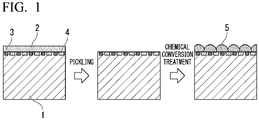
- FIG. 1 is a diagram for illustrating a mechanism in which the formation of chemical conversion crystals is accelerated by Ni locally concentrated on a surface layer.
- hot-rolled steel sheet according to an embodiment of the present invention (hot-rolled steel sheet according to this embodiment) will be described.
- the hot-rolled steel sheet according to this embodiment has a predetermined chemical composition, and among measurement points at which elemental analysis is performed at a measurement pitch of 1 ⁇ m using an EPMA in a region of 250 ⁇ m ⁇ 250 ⁇ m on a surface, the percentage of measurement points having a Ni content of 0.5 mass% or more is 10% to 70%.
- the hot-rolled steel sheet according to this embodiment may have a chemical conversion film and/or an electrodeposition coating film on the surface thereof.
- the hot-rolled steel sheet according to this embodiment may have a rust preventive oil film on the surface thereof.
- C is an element which contributes to high-strengthening of a steel sheet by structural strengthening by producing a low temperature transformed product, or by precipitation hardening by forming precipitates with Ti, Nb, and/or V in a case where Ti, Nb, and/or V is contained.
- the C content is less than 0.01%, it is not possible to obtain a strength of preferably 300 MPa or more, more preferably 490 MPa or more, and even more preferably 540 MPa or more as the strength required for the steel sheet. Therefore, the C content is 0.01% or more.
- the C content is preferably 0.03% or more, and more preferably 0.05% or more.
- the C content is 0.30% or less.
- the C content is preferably 0.25% or less, and more preferably 0.20% or less.
- Si is used as an element improving the strength, and is an important element for the formation of ferrite.
- Si is also an effective element for deoxidation. Therefore, the Si content is 0.01% or more.
- the Si content is preferably 0.50% or more, and more preferably 0.80% or more.
- the ferrite temperature range expands to the high temperature side.
- Si influences the growth rate and properties of scale.
- Si in a steel sheet forms Fe 2 SiO 4 on a surface of the steel sheet during hot-rolling.
- the Si content is 3.00% or less.
- the Si content is preferably 2.50% or less, and more preferably 2.00% or less.
- the Si content may be less than 0.50% in a case where microstructure control for forming ferrite is not used.
- Mn is an element which contributes to high-strengthening of a steel sheet by ferrite strengthening.
- the austenite temperature range expands to the low temperature side, and the two-phase temperature range of ferrite + austenite expands.
- Mn is an element having an effect of suppressing the hot cracking due to S by combining with S and fixing S as MnS.
- the Mn content is 0.20% or more.
- the Mn content is preferably 0.30% or more.
- the Mn content is more preferably 0.90% or more. In order to obtain a strength of even more preferably 540 MPa or more as a strength required for the steel sheet, the Mn content is even more preferably 1.20% or more.
- the Mn content is 3.00% or less.
- the Mn content is preferably 2.50% or less, and more preferably 2.00% or less.
- the P content is preferably small. In a case where the P content is greater than 0.030%, segregation of P leading to crystal granulation is remarkable, and thus the local ductility deteriorates due to grain boundary embrittlement. Therefore, the P content is 0.030% or less.
- the P content is preferably 0.020% or less, and more preferably 0.015%or less.
- the P content may be 0%. However, in a case where the P content is less than 0.005%, the cost significantly increases. Therefore, the lower limit of the P content may be 0.005%.
- the S content is preferably small. In a case where the S content is greater than 0.030%, adverse effects on the weldability, manufacturability during casting or hot-rolling, and hole expansibilityincrease. Therefore, the S content is 0.030% or less.
- the S content is preferably 0.015% or less, and more preferably 0.010% or less.
- the S content may be 0%. However, in a case where the S content is less than 0.002%, the cost significantly increases. Therefore, the lower limit of the S content may be 0.002%.
- Al is an element related to deoxidation and the formation of ferrite like Si.
- the Al content increases, the ferrite temperature range expands to the high temperature side.
- Al is an element which suppresses the formation of coarse cementite and contributes to the improvement of hole expansibility. Therefore, the Al content is 0.001% or more.
- the Al content is preferably 0.020% or more, and more preferably 0.030% or more.
- the Al content is preferably 0.050% or more.
- the Al content is 2.000% or less.
- the Al content is preferably 1.200% or less, more preferably 1.000% or less, and even more preferably 0.400% or less.
- the Al content may be less than 0.050% in a case where microstructure control for forming ferrite is not used.
- N is an element which reduces ductility in a case where it remains in steel as solid solution nitrogen.
- N combines with Ti and forms TiN.
- the N content is preferably small.
- the N content is greater than 0.0100%, the above-described adverse effects are remarkably exhibited. Therefore, the N content is 0.0100% or less.
- the N content is preferably 0.0060% or less, and more preferably 0.0040% or less.
- the N content may be 0%. However, in a case where the N content is less than 0.0010%, the cost significantly increases. Therefore, the lower limit of the N content may be 0.0010%.
- Ni is the most important element for the hot-rolled steel sheet according to this embodiment.
- Ni is locally concentrated on the surface layer side of the steel sheet near the interface between the surface of the steel sheet and the scale under specific operating conditions.
- a chemical conversion treatment such as a zinc phosphate treatment is performed on the surface of the steel sheet, a difference occurs in ionization tendency between the region where Ni is concentrated and the region therearound where Ni is not concentrated.
- the Ni content is 0.02% or more.
- the local concentration of Ni does not occur.
- iron elution into the chemical conversion bath is not accelerated, the size of chemical conversion crystals is increased, and the coating adhesion deteriorates.
- the Ni content is preferably 0.05% or more.
- the Ni content is 0.50% or less.
- the Ni content is preferably 0.45% or less, and more preferably 0.40% or less.
- the hot-rolled steel sheet according to this embodiment contains the above-described elements with a remainder consisting of Fe and impurities.
- the hot-rolled steel sheet may contain the following elements within an amount to be described later.
- the following elements are optional elements which are not necessarily contained, and may not be contained.
- Cu is an element which contributes to an increase in strength of the steel sheet. Therefore, Cu may be contained. In order to contribute to an increase in strength, the Cu content is preferably 0.01% or more. The Cu content is preferably 0.02% or more, and more preferably 0.04% or more.
- Cu has a low melting point, and is concentrated at the interface between the scale and the base metal sheet through austenite grain boundaries.
- the Cu content is large, a Cu concentrated layer is formed, and the zinc phosphate treatability is reduced.
- the Cu content is greater than 0.20%, a Cu concentrated layer covers the entire surface of the steel sheet, and thus the chemical convertibility significantly deteriorates. Therefore, the Cu content is 0.20% or less.
- the Cu content is preferably 0.15% or less, and more preferably 0.10% or less.
- Ni/Cu ⁇ 0.50 is preferable.
- Nb, V, Ti, Cr, Mo, Nb, and W are elements which increase the strength of the steel sheet by precipitation hardening and/or solid solution strengthening. Therefore, these may be contained.
- the Nb content is preferably 0.003% or more, more preferably 0.005% or more, even more preferably 0.010% or more, and still more preferably 0.015% or more.
- the V content is preferably 0.01% or more.
- the Ti content is preferably 0.01% or more, more preferably 0.05% or more, even more preferably 0.10% or more, and still more preferably 0.15% or more.
- the Cr content is preferably 0.01% or more, more preferably 0.05% or more, and even more preferably 0.10% or more.
- the Mo content is preferably 0.01% or more, and more preferably 0.02% or more.
- the W content is preferably 0.01% or more, and more preferably 0.02% or more.
- the Nb content is greater than 0.060%, the V content is greater than 0.20%, the Ti content is greater than 0.20%, the Cr content is greater than 0.20%, the Mo content is greater than 1.00%, and the W content is greater than 0.50%, the above effects are saturated, and the economic efficiency is reduced. Therefore, in a case where Nb, V, Ti, Cr, Mo, and W are contained, the Nb content is 0.060% or less, the V content is 0.20% or less, the Ti content is 0.20% or less, the Cr content is 0.20% or less, the Mo content is 1.00% or less, and the W content is 0.50% or less.
- the Nb content is preferably 0.055% or less, and more preferably 0.050% or less.
- the V content is preferably 0.15% or less, and more preferably 0.08% or less.
- the Ti content is preferably 0.18% or less, and more preferably 0.17% or less.
- the Cr content is preferably 0.18% or less, and more preferably 0.15% or less.
- the Mo content is preferably 0.70% or less, and more preferably 0.05% or less.
- the W content is preferably 0.40% or less, and more preferably 0.03% or less.
- B is an element having an effect of improving hardenability, thereby increasing the fraction of a low temperature transformed product phase. Therefore, in a case where it is desired to exhibit the hardenability improving effect, 0.0005% or more of B may be contained.
- the B content is preferably 0.0010% or more, and preferably 0.0015% or more.
- the B content is greater than 0.0020%, the effect is saturated, and there is an increased concern that cracks occur in slabs in a cooling step after continuous casting. Therefore, in a case where B is contained, the B content is 0.0020% or less.
- Mg, Ca, and REM are elements which control the morphology of non-metal inclusions which are fracture origins, causing the deterioration of workability, and improve the workability. Therefore, Mg, Ca, and REM may be contained.
- the Mg content is preferably 0.001% or more
- the Ca content is preferably 0.0010% or more
- the REM content is preferably 0.0010% or more.
- the Mg content is greater than 0.010%, the Ca content is greater than 0.0100%, and the REM content is greater than 0.0100%, the above effects are saturated, and the economic efficiency is reduced. Therefore, in a case where Mg, Ca, and REM are contained, the Mg content is 0.010% or less, the Ca content is 0.0100% or less, and the REM content is 0.0100% or less.
- the Mg content is preferably 0.005% or less, the Ca content is preferably 0.0070% or less, and the REM content is preferably 0.0070% or less.
- O is an element which disperses a large number of fine oxides during deoxidation of molten steel. Therefore, O may be contained. In a case where the above effect is obtained, the O content is preferably 0.0005% or more. The O content is preferably 0.0010% or more, and more preferably 0.0020% or more.
- the O content is an element which forms coarse oxides which are fracture origins in steel in a case where the content thereof is too large, thereby causing brittle fracture or hydrogen-induced cracks. Therefore, the O content is 0.0100% or less. From the viewpoint of weldability, the O content is preferably 0.0030% or less.
- Zr, Co, Zn, or Sn is contained in an amount of 0.500% or less, the effects of the hot-rolled steel sheet according to this embodiment are not impaired. Therefore, one or more of Zr, Co, Zn, and Sn may be contained in an amount of 0.500% or less, respectively.
- the amount of each element in the hot-rolled steel sheet according to this embodiment is the average content in the total sheet thickness, obtained by ICP emission spectroscopic analysis using chips according to JIS G 1201: 2014.
- the C content and the S content are obtained by a known high-frequency combustion method (combustion-infrared absorption method).
- the O content is obtained using a known inert gas fusion-nondispersive infrared absorption method.
- the inventors have conducted studies on the reason for the reduction in chemical convertibility of a high strength steel sheet. As a result, it is thought that oxides of Si, Al, and the like or concentrated layers of Mn, Cu, and the like are formed on a surface or a surface layer area of the high strength steel sheet even after pickling, and these inhibit the elution of Fe during the chemical conversion treatment, thereby reducing the chemical convertibility particularly in a state in which the conditions of the chemical conversion treatment have deteriorated due to the variation during the operation.
- Ni is partially (not the entire surface) concentrated on the surface layer of the steel sheet to generate a potential difference between Ni and Fe, and the elution of Fe around the Ni-concentrated layer is accelerated. That is, Ni remains, and regions therearound elute and form precipitation nuclei of the chemical conversion film.
- a film in which the size of chemical conversion crystals is small is formed without the generation of transparency, and the chemical convertibility is improved. For example, it is thought that this is because, as shown in FIG. 1 , due to Ni-concentrated layers 4 formed on a surface of a steel sheet (although FIG.
- the base metal sheet 1 refers to a steel sheet part excluding scale 2.
- the percentage of measurement points having a Ni content of 0.5 mass% or more is 10% to 70%, the chemical convertibility is improved.
- the hot-rolled steel sheet according to this embodiment has a chemical conversion film (including a case where an electrodeposition coating film is provided by further electrodeposition coating), it may be difficult to perform the elemental analysis on the surface of the hot-rolled steel sheet.
- the percentage of measurement points having a Ni content of 0.5 mass% or more is 10% to 70%, among measurement points at which elemental analysis is performed at a measurement pitch of 1 ⁇ m using an EPMA in a region of 250 ⁇ m ⁇ 250 ⁇ m on the surface, the percentage of measurement points having a Ni content of 0.5 mass% or more may be regarded to be 10% to 70%. This is because Ni shows a substantially three-dimensionally isotropic distribution in a range of 10 ⁇ m in the sheet thickness direction from the surface of the steel sheet and is 500 ⁇ m in the sheet width direction in a cross-section in the sheet thickness direction, the percentage of measurement points having a Ni content of 0.5 mass% or more is 10% to 70%, among measurement points at which elemental analysis is performed at a measurement pitch of 1 ⁇ m using an
- the measurement points having a Ni content of 0.5 mass% or more are preferably distributed in a patchy manner on the surface of the steel sheet.
- the average interval between the regions having a Ni content of 0.5 mass% or more is preferably 3 to 10 ⁇ m. In a case where the average interval is less than 3 ⁇ m or more than 10 ⁇ m, the elution of Fe around the Ni-concentrated portion is less likely to be accelerated.
- the average interval between the regions having a Ni content of 0.5 mass% or more is measured as follows. An average of intervals between the adjacent measurement points having a Ni content of 0.5 mass% or more among the measurement points at which elemental analysis is performed at a measurement pitch of 1 ⁇ m using an EPMA in a region of 250 ⁇ m ⁇ 250 ⁇ m on the surface of the hot-rolled steel sheet is defined as an average interval between the regions having a Ni content of 0.5 mass% or more.
- the hot-rolled steel sheet is pickled before the chemical conversion treatment, but in the hot-rolled steel sheet according to this embodiment, Ni is locally concentrated as described above even after pickling under normal pickling conditions (for example, for 30 to 60 seconds using a 1 to 10 wt% (weight%) hydrochloric acid solution at a temperature of 20°C to 95°C). Therefore, the chemical convertibility is excellent even after pickling.
- the hot-rolled steel sheet according to this embodiment may have a rust preventive oil film formed on the surface in order to prevent oxidation and the like after pickling and before the chemical conversion treatment is started.
- the measurement conditions in performing the elemental analysis at a measurement pitch of 1 ⁇ m using an EPMA in a region of 250 ⁇ m ⁇ 250 ⁇ m on the surface and in obtaining the average interval between the regions having a Ni content of 0.5 mass% or more are, for example, as follows.
- the measurement is performed using a tungsten electron gun type instrument of JEOL Ltd. (model number: JXA-8800RL) under conditions of an acceleration voltage of 15 kV, an irradiation current of 6 ⁇ 10 -8 A, an irradiation time of 15 ms, and a beam diameter of 0.5 ⁇ m.
- the same conditions may be applied also in a case where the elemental analysis is performed on the cross-section in the sheet thickness direction at a measurement pitch of 1 ⁇ m using an EPMA.
- the chemical convertibility improvement effect in the hot-rolled steel sheet according to this embodiment generated by the local concentration of Ni is effective for any steel sheet.
- the hot-rolled steel sheet according to this embodiment is subjected to the chemical conversion treatment and the electrodeposition coating, the above-described aspect in which Ni is locally concentrated rarely changes. That is, the distribution of the regions having a Ni content of 0.5 mass% or more near the boundary between the chemical conversion film and the hot-rolled steel sheet (corresponding to the vicinity of the surface of the hot-rolled steel sheet which is an original sheet) in the hot-rolled steel sheet subjected to the chemical conversion treatment is the same as the surface of the hot-rolled steel sheet which is an original sheet.
- the measurement result obtained by the following method can be regarded as the percentage of measurement points having a Ni content of 0.5 mass% or more (synonymous with the result of the measurement performed on the surface of the hot-rolled steel sheet) on the surface of the hot-rolled steel sheet which is an original sheet before the chemical conversion treatment.
- the percentage of measurement points having an oxygen content of 0.5 mass% or more is preferably 30% or less.
- oxides of Si and Al are formed at the measurement points having an oxygen content of 0.5 mass% or more, and the fact that the percentage of these measurement points is 30% or less shows that the amount of oxides of Si, Al, and the like formed is small.
- Oxides reduce the chemical convertibility by inhibiting the elution of Fe during the chemical conversion treatment. Therefore, in a case where the amount of oxides is small, a film in which the size of chemical conversion crystals is small is formed without the generation of transparency, and the chemical convertibility is further improved.
- EPMA analysis targeted at an element having an atomic number equal to or more than that of boron (B) is performed in a region of 250 ⁇ m ⁇ 250 ⁇ m at a measurement pitch of 1 ⁇ m.
- the percentage of measurement points having a Ni content of 0.5 mass% or more when the total mass of the element having an atomic number equal to or more than that of B is 100% is obtained.
- the rust preventive oil film is removed using a solvent such as acetone or alcohol so that the measurement can be performed on the surface of the steel sheet.
- the measurement is performed after pickling is performed under normal pickling conditions (for example, for 30 to 60 seconds using a 1 to 10 wt% (weight%) hydrochloric acid solution at a temperature of 20°C to 95°C).
- the EPMA analysis is performed using a tungsten electron gun type instrument of JEOL Ltd. (model number: JXA-8800RL) under conditions of an acceleration voltage of 15 kV, an irradiation current of 6 ⁇ 10 -8 A, an irradiation time of 15 ms, and a beam diameter of 0.5 ⁇ m.
- the structure (microstructure) of the hot-rolled steel sheet according to this embodiment is not limited. Regardless of the phase of the structure, the chemical convertibility is improved by the local concentration of Ni.
- the chemical convertibility improvement effect generated by the local concentration of Ni is large in a high strength steel sheet containing a large amount of alloying elements.
- the effect is clearly seen in a hot-rolled steel sheet having a tensile strength of 300 MPa or more, large in a hot-rolled steel sheet having a tensile strength of 490 MPa or more, and larger in a hot-rolled steel sheet having a tensile strength of 540 MPa or more.
- the sheet thickness of the hot-rolled steel sheet according to this embodiment is not limited, and is, for example, 1.2 to 10.0 mm.
- the hot-rolled steel sheet according to this embodiment can be manufactured by a manufacturing method having the following steps.
- a casting step (steel piece manufacturing step) which is performed prior to hot-rolling is not particularly limited. That is, following the melting by a blast furnace, an electric furnace, or the like, various secondary smelting may be performed to adjust the components as described above, and then casting may be performed by normal continuous casting or casting by an ingot method.
- a scrap may be used as a raw material.
- a steel piece such as a slab is heated in a heating furnace. Then, descaling is performed before the process reaches the hot-rolling step.
- the local concentration of Ni is achieved primarily in the heating step and the descaling step.
- Ni which is less likely to be oxidized than Fe is concentrated on the base metal sheet side of the interface between the scale and the base metal sheet. Then, oxides preferentially formed are removed to some extent by performing descaling, and the steel piece is held for a certain period of time or longer in a predetermined temperature range to further locally concentrate Ni.
- the steel piece In the heating step, after the surface temperature of the steel piece reaches 1,100°C or higher, the steel piece is held for 60 minutes or longer under an atmosphere having an air ratio of 0.9 or more, and an extraction temperature is 1,180°C or higher.
- the air ratio in the heating furnace is less than 0.9, the growth of scale is along the parabolic rule, but slows down during a limited time in the heating furnace. Therefore, it is not possible to form a sufficient Ni-concentrated layer at the interface between the scale and the base metal sheet.
- the air ratio may vary depending on the position in the heating furnace or the change over time during the period in which the steel piece is heated. It is preferable that the minimum value of the air ratio at each position in the heating furnace during the period in which the steel piece is heated is 0.9 or more since the air ratio is 0.9 or more in a case where the steel piece is heated.
- the air ratio is preferably 1.5 or less.
- the air ratio may vary depending on the position in the heating furnace or the change over time during the period in which the steel piece is heated. It is preferable that the maximum value of the air ratio at each position in the heating furnace during the period in which the steel piece is heated is 1.5 or less since the air ratio is 1.5 or less in a case where the steel piece is heated.
- the scale does not grow, and a sufficient Ni-concentrated layer cannot be formed at the interface between the scale and the base metal sheet.
- the holding time is longer than 240 minutes since the scale-off amount increases, and the yield is thus reduced. Moreover, the surface layer of the steel sheet is decarburized, and there is concern that the characteristics of the steel sheet deteriorate.
- the extraction temperature is required to be 1,180°C or higher in order to secure the surface temperature of the steel piece in the descaling step which is performed after the heating step. In a case where the interval time from the heating step to the descaling step is long, the extraction temperature may be raised to 1,200°C or higher to secure the surface temperature of the steel piece.
- the extraction temperature is a lower one out of a temperature calculated at a position 5 mm away from the upper surface of the steel piece in the thickness direction of the steel piece and a temperature calculated at a position 5 mm away from the lower surface of the steel piece in the thickness direction of the steel piece in a case where the heat transfer calculation is performed by dividing the steel piece in the thickness direction from the atmospheric temperature of the heating furnace.
- the steel piece having a surface temperature of 1,170°C or higher is descaled at least once with an injection pressure of 5 to 50 MPa.
- the surface temperature of the steel piece is held at 1,100°C or higher for 20 to 240 seconds from the completion of the descaling.
- the scale layer formed until the heating step is removed.
- the scale layer exists in a state in which a Fe oxide and oxides of other elements are mixed.
- the scale layer is generally in a molten state in a temperature range of 1,170°C or higher, but is in a solidified and firm state in a temperature range of less than 1,170°C, and thus it is difficult to remove it by descaling.
- the scale contains Si
- a composite oxide of Fe 2 SiO 4 exists at the same time as the Fe oxide, enters between the Fe oxides, and thus forms firm scale after solidification.
- descaling is performed at least once in a state in which the temperature of the steel piece is 1,170°C or higher.
- the injection pressure in the descaling is less than 5 MPa, the scale cannot be sufficiently removed.
- the injection pressure in the descaling is greater than 50 MPa, Ni concentrated near the interface during heating is also removed. Therefore, the injection pressure is 5 to 50 MPa.
- the descaling is preferably performed with an injection force of 50 to 700 MN/(m ⁇ s) per unit time and unit width.
- the injection force per unit time and unit width is obtained by the product of a descaling pressure (MPa), a descaling time (seconds), and a sheet length (m) of the steel sheet as a descaling target.
- the surface temperature of the steel piece is held at 1,100°C or higher for 20 to 240 seconds from the completion of the descaling (primary descaling).
- the surface of the steel sheet is oxidized again, and Ni is further concentrated at the interface.
- the holding time at 1,100°C or higher is shorter than 20 seconds, the concentration of Ni is not sufficient. Therefore, the holding time is 20 seconds or longer.
- the holding time is preferably 30 seconds or longer.
- the holding time after the descaling is longer than 240 seconds, the thickness of the scale increases. Accordingly, the chemical convertibility is reduced, and the productivity is reduced. Therefore, the holding time is 240 seconds or shorter.
- the holding time is preferably 180 seconds or shorter.
- the steel piece After the surface temperature of the steel piece is held at 1,100°C or higher, the steel piece is rolled.
- secondary descaling may be performed once or more on the steel piece in addition to the previous descaling (primary descaling). With the secondary descaling, the scale layer formed during holding can be removed. However, even in a case where the secondary descaling is performed so that the concentrated Ni is not removed, the injection pressure is 5 to 50 MPa as in the primary descaling.
- the surface temperature of the steel piece before the secondary descaling may be in a state in which the temperature of the steel piece is 1,170°C or higher, or in a state in which the temperature of the steel piece is lower than 1,170°C.
- the time for holding the surface temperature of the steel piece at 1,100°C or higher from the completion of the secondary descaling may be between 20 and 240 seconds, or may be shorter than 20 seconds.
- the time for holding the surface temperature of the steel piece at 1,100°C or higher from the completion of the secondary descaling is longer than 240 seconds, the thickness of the scale increases. Accordingly, the chemical convertibility is reduced, and the productivity is reduced.
- the temperature before descaling and the time for holding the temperature at 1,100°C or higher after descaling are not limited.
- the time for holding the surface temperature of the steel piece at 1,100°C or higher from the completion of the primary descaling may be within 20 seconds.
- the surface temperature of the steel piece may be held at 1,100°C or higher for a total of 20 seconds or longer from the completion of the descaling.
- the holding time in any one or more times of holding is preferably 20 seconds or longer.
- the hot-rolling conditions in the hot-rolling step which is performed after the descaling step are not particularly limited.
- the hot-rolling conditions may be appropriately adjusted according to the sheet thickness and mechanical characteristics to be required.
- the steel piece may be cooled to room temperature (up to 100°C or lower). Otherwise, it may be wound without cooling and air cooled in a state of a coil.
- combustion control was carried out so that the minimum value of the air ratio at each position in a heating furnace and the maximum value of the air ratio at each position in the heating furnace were as shown in Tables 2A to 2C.
- Tables 2A to 2C show the surface temperature of the steel piece before primary descaling, and the pressure and injection force per unit time and unit width in the primary descaling.
- the time for holding the surface temperature of the steel piece after completion of the primary descaling at 1,100°C or higher was shown as a condition in Tables 2A to 2C.
- the minimum surface temperature of the steel piece during the period of time from the completion of the primary descaling to the rolling of the steel piece was described in Tables 2A to 2C.
- Tables 2A to 2C show the surface temperature of the steel piece before primary descaling, the pressure and injection force per unit time and unit width in the primary descaling, and the pressure and injection force per unit time and unit width in the secondary descaling (in those subjected to the secondary descaling, the pressure is described in the column of pressure of the secondary descaling).
- finish rolling was performed with a rolling finishing temperature set to 800°C or higher.
- a part of the steels was cooled to 100°C or lower, and another part was wound without cooling and air cooled in a state of a coil.
- the obtained hot-rolled steel sheet was pickled under conditions of 30 to 60 seconds using a 1 to 10 wt% (weight%) hydrochloric acid solution at a temperature of 20°C to 95°C, and EPMA analysis targeted at an element having an atomic number equal to or more than that of B was performed in a region of 250 ⁇ m ⁇ 250 ⁇ m on the surface after the pickling at a measurement pitch of 1 ⁇ m under the above-described conditions to obtain the percentage of measurement points having a Ni content of 0.5 mass% or more and the percentage of measurement points having an oxygen content of 0.5 mass% or more when the total mass of the element having an atomic number equal to or more than that of B was 100%, and to obtain the average interval between the regions having a Ni content of 0.5 mass% or more.
- an average interval of ⁇ 1 ( ⁇ m) between the regions where the Ni content of the pickled surface is 0.5 mass% or more shows that the average interval is smaller than the measurement pitch and cannot be measured.
- the tensile strength (TS) was measured according to JIS Z 2241: 2011 using a test piece No. 5 of JIS Z 2241: 2011 collected with a direction (sheet width direction) orthogonal to the rolling direction as a longitudinal direction, at a position either W/4 or 3W/4 away from one end of the steel sheet in the sheet width direction where W is a sheet width.
- TS tensile strength
- the obtained hot-rolled steel sheet was pickled under the pickling conditions described above. Then, under the following conditions assuming a chemical conversion treatment liquid deteriorated due to continuous use or the like, a chemical conversion treatment was performed on the hot-rolled steel sheet pickled as described above, and the chemical convertibility was evaluated.
- the effects of the present steel sheet can be exhibited regardless of a zinc phosphate-based chemical conversion treatment liquid, and for example, the evaluation was performed under the following conditions.
- the free acidity is defined in such a manner that in a case where 3 drops of bromophenol blue are added to 10 ml of a chemical conversion treatment liquid and neutralization titration is carried out using 0.1 N sodium hydroxide until the color changes from a yellowish green color to a bluish green color, 1 ml of the 0.1 N sodium hydroxide required for this case is indicated as 1 pt.
- the total acidity is defined in such a manner that in a case where 3 drops of phenolphthalein are added to 10 ml of a chemical conversion treatment liquid and neutralization titration is carried out using 0.1 N sodium hydroxide until the color changes from colorless to a pink color, 1 ml of the 0.1 N sodium hydroxide required for this case is indicated as 1 pt.
- the chemical convertibility improvement effect in the present steel sheet can also be exhibited with chemical conversion treatment liquids of other model numbers or other companies, regardless of whether the chemical conversion treatment liquid is used under the conditions of the chemical conversion treatment shown above.
- the steel sheet was judged to have excellent chemical convertibility. This is because: regardless of whether the chemical conversion treatment has been performed, the adhesion between the steel sheet and the lacquer is reduced in a state in which the base metal sheet is exposed, that is, transparency is generated; and the coating adhesion is reduced due to the cohesive fracture of the zinc phosphate film itself in a case where the size of chemical conversion crystals after the chemical conversion treatment is greater than 10 ⁇ m.
- the adhesion between the lacquer and the steel sheet and the corrosion resistance after peeling of the coating film are improved, and in a case where the size of chemical conversion crystals is 5 ⁇ m or less, the adhesion between the lacquer and the steel sheet and the corrosion resistance after peeling of the coating film are further improved.
- steel sheets in which no transparency was generated and the size of chemical conversion crystals was 5 ⁇ m or less were evaluated to be A (invention examples), steel sheets in which no transparency was generated and the size of chemical conversion crystals was greater than 5 ⁇ m and equal to or less than 10 ⁇ m were evaluated to be B (invention examples), and steel sheets in which transparency was generated or the size of chemical conversion crystals was greater than 10 ⁇ m even without the generation of transparency were evaluated to be C (comparative examples).
- EPMA analysis targeted at an element having an atomic number equal to or more than that of B was performed at a measurement pitch of 1 ⁇ m on a rectangular region of 10 ⁇ m in sheet thickness direction from the surface of the steel sheet ⁇ 500 ⁇ m in sheet width direction in a cross-section of the hot-rolled steel sheet subjected to the chemical conversion treatment in the sheet thickness direction to obtain the percentage of measurement points having a Ni content of 0.5 mass% or more when the total mass of the element having an atomic number equal to or more than that of B was 100%, and the result thereof was the same as the percentage of measurement points having a Ni content of 0.5 mass% or more, measured in a region of 250 ⁇ m ⁇ 250 ⁇ m on the surface after pickling and before the chemical conversion treatment.
- a SEM was used for observing transparency. Specifically, the presence or absence of the transparency was investigated by confirming whether there is a surface in which the base metal sheet is exposed in a region of 250 ⁇ m ⁇ 250 ⁇ m in each of three visual fields of both sides of the steel sheet after the chemical conversion treatment by the SEM.
- the grain diameters (diameters) of chemical conversion crystals were obtained in a region of 250 ⁇ m ⁇ 250 ⁇ m in the SEM observation performed as described above, and the average of the grain diameters (diameters) of chemical conversion crystals was defined as the size of chemical conversion crystals.
- the present invention it is possible to obtain a hot-rolled steel sheet having excellent chemical convertibility and a method for manufacturing the hot-rolled steel sheet.
- a good chemical conversion film can be obtained. Accordingly, the present invention has high industrial applicability.
Landscapes
- Chemical & Material Sciences (AREA)
- Engineering & Computer Science (AREA)
- Mechanical Engineering (AREA)
- Materials Engineering (AREA)
- Metallurgy (AREA)
- Organic Chemistry (AREA)
- Physics & Mathematics (AREA)
- Thermal Sciences (AREA)
- Crystallography & Structural Chemistry (AREA)
- General Chemical & Material Sciences (AREA)
- Chemical Kinetics & Catalysis (AREA)
- Heat Treatment Of Sheet Steel (AREA)
Applications Claiming Priority (2)
| Application Number | Priority Date | Filing Date | Title |
|---|---|---|---|
| JP2020018844 | 2020-02-06 | ||
| PCT/JP2021/004305 WO2021157692A1 (ja) | 2020-02-06 | 2021-02-05 | 熱延鋼板及びその製造方法 |
Publications (3)
| Publication Number | Publication Date |
|---|---|
| EP4101554A1 true EP4101554A1 (de) | 2022-12-14 |
| EP4101554A4 EP4101554A4 (de) | 2023-02-22 |
| EP4101554B1 EP4101554B1 (de) | 2024-03-13 |
Family
ID=77200026
Family Applications (1)
| Application Number | Title | Priority Date | Filing Date |
|---|---|---|---|
| EP21750182.4A Active EP4101554B1 (de) | 2020-02-06 | 2021-02-05 | Heissgewalztes stahlblech |
Country Status (7)
| Country | Link |
|---|---|
| US (1) | US12448660B2 (de) |
| EP (1) | EP4101554B1 (de) |
| JP (1) | JP7368763B2 (de) |
| KR (1) | KR102762197B1 (de) |
| CN (1) | CN114901849B (de) |
| MX (1) | MX2022008076A (de) |
| WO (1) | WO2021157692A1 (de) |
Family Cites Families (16)
| Publication number | Priority date | Publication date | Assignee | Title |
|---|---|---|---|---|
| JP2000178655A (ja) * | 1998-12-11 | 2000-06-27 | Nippon Steel Corp | 表面性状に優れた鋼板およびその製造方法 |
| JP4283408B2 (ja) | 2000-02-14 | 2009-06-24 | 新日本製鐵株式会社 | 成形性の優れた溶融亜鉛メッキ高強度薄鋼板とその製造方法 |
| JP3900851B2 (ja) | 2001-04-12 | 2007-04-04 | Jfeスチール株式会社 | 表面性状に優れた鋼板の製造方法 |
| JP2007039812A (ja) * | 2006-10-06 | 2007-02-15 | Jfe Steel Kk | 表面性状に優れた鋼板 |
| JP4901799B2 (ja) | 2008-04-09 | 2012-03-21 | 新日本製鐵株式会社 | 表面処理性に優れた熱延鋼板の製造方法 |
| JP5779847B2 (ja) * | 2009-07-29 | 2015-09-16 | Jfeスチール株式会社 | 化成処理性に優れた高強度冷延鋼板の製造方法 |
| PL2503014T3 (pl) * | 2009-11-18 | 2019-07-31 | Nippon Steel & Sumitomo Metal Corporation | Blacha stalowa gruba walcowana na gorąco o dużej wytrzymałości wykazująca doskonałą właściwość wytrawiania kwasem, podatność na obróbkę przez konwersję chemiczną, właściwość zmęczeniową, podatność na wywijanie kołnierza i odporność na pogorszenie powierzchni podczas formowania oraz mająca izotropową wytrzymałość i ciągliwość, oraz sposób wytwarzania wspomnianej blachy stalowej grubej walcowanej na gorąco o dużej wytrzymałości |
| JP5083354B2 (ja) * | 2010-03-29 | 2012-11-28 | Jfeスチール株式会社 | 化成処理性に優れた高Si冷延鋼板の製造方法 |
| IN2015DN01476A (de) | 2012-09-26 | 2015-07-03 | Nippon Steel & Sumitomo Metal Corp | |
| MX380570B (es) * | 2012-10-03 | 2025-03-12 | Nippon Steel Corp Star | Lámina de acero revestida con zinc por inmersión en caliente aleada y método para producir la misma. |
| JP5821864B2 (ja) * | 2013-01-31 | 2015-11-24 | Jfeスチール株式会社 | バーリング加工性に優れた高強度熱延鋼板およびその製造方法 |
| JP6528522B2 (ja) | 2015-04-17 | 2019-06-12 | 日本製鉄株式会社 | 延性と疲労特性と耐食性に優れた高強度熱延鋼板とその製造方法 |
| TWI614350B (zh) | 2017-03-31 | 2018-02-11 | Nippon Steel & Sumitomo Metal Corp | 熱軋鋼板 |
| WO2018220412A1 (fr) * | 2017-06-01 | 2018-12-06 | Arcelormittal | Procede de fabrication de pieces d'acier a haute resistance mecanique et ductilite amelioree, et pieces obtenues par ce procede |
| US20200038030A1 (en) | 2018-08-03 | 2020-02-06 | Covidien Lp | Rotation knob assemblies and surgical instruments including the same |
| KR102529040B1 (ko) * | 2018-10-19 | 2023-05-10 | 닛폰세이테츠 가부시키가이샤 | 열연 강판 및 그 제조 방법 |
-
2021
- 2021-02-05 US US17/787,857 patent/US12448660B2/en active Active
- 2021-02-05 MX MX2022008076A patent/MX2022008076A/es unknown
- 2021-02-05 WO PCT/JP2021/004305 patent/WO2021157692A1/ja not_active Ceased
- 2021-02-05 EP EP21750182.4A patent/EP4101554B1/de active Active
- 2021-02-05 JP JP2021575882A patent/JP7368763B2/ja active Active
- 2021-02-05 CN CN202180007665.3A patent/CN114901849B/zh active Active
- 2021-02-05 KR KR1020227021824A patent/KR102762197B1/ko active Active
Also Published As
| Publication number | Publication date |
|---|---|
| KR20220105165A (ko) | 2022-07-26 |
| MX2022008076A (es) | 2022-08-02 |
| WO2021157692A1 (ja) | 2021-08-12 |
| KR102762197B1 (ko) | 2025-02-07 |
| JP7368763B2 (ja) | 2023-10-25 |
| JPWO2021157692A1 (de) | 2021-08-12 |
| US20230041990A1 (en) | 2023-02-09 |
| US12448660B2 (en) | 2025-10-21 |
| EP4101554A4 (de) | 2023-02-22 |
| CN114901849B (zh) | 2023-09-01 |
| EP4101554B1 (de) | 2024-03-13 |
| CN114901849A (zh) | 2022-08-12 |
Similar Documents
| Publication | Publication Date | Title |
|---|---|---|
| JP6879402B2 (ja) | 高強度亜鉛めっき鋼板および高強度部材 | |
| RU2726165C1 (ru) | Горячекатаная листовая сталь с нанесенным покрытием для горячей штамповки, горячештампованная стальная деталь с нанесенным покрытием и способы их изготовления | |
| EP2444510B1 (de) | Hochfestes, feuerverzinktes stahlblech mit hervorragenden verarbeitungs- und materialermüdungseigenschaften und herstellungsverfahren dafür | |
| EP3438311B1 (de) | Stahlblech, beschichtet stahlblech, verfahren zur herstellung von warmgewalztem stahlblech, verfahren zur herstellung von kaltgewalztem vollhartem stahlblech, verfahren zur herstellung von wärmebehandeltem blech, verfahren zur herstellung von dünnem stahlblech und verfahren zur herstellung von beschichtem stahlblech | |
| EP2716773B1 (de) | Verfahren zur herstellung eines hochfesten feuerverzinkten stahlblechs mit hervorragender materialqualitätsstabilität, verarbeitbarkeit und lagerbarkeit | |
| US11008632B2 (en) | Steel sheet, coated steel sheet, method for producing hot-rolled steel sheet, method for producing cold-rolled full hard steel sheet, method for producing heat-treated sheet, method for producing steel sheet, and method for producing coated steel sheet | |
| EP3106528B1 (de) | Hochfestes feuerverzinktes stahlblech und verfahren zur herstellung eines hochfesten legierten feuerverzinkten stahlblechs | |
| EP3508605A1 (de) | Kaltgewalztes hochfestes stahlblech mit hervorragender phosphatierungsleistung und formbarkeit sowie herstellungsverfahren dafür | |
| KR20180126580A (ko) | 저밀도 용융 아연도금 강철 및 이의 제조 방법 | |
| EP3940091B1 (de) | Heisspresselement, verfahren zur herstellung eines stahlblechs für eine heisspresse und verfahren zur herstellung eines heisspresselements | |
| JP2009221586A (ja) | 化成処理性および塗装後耐食性に優れる高強度冷延鋼板およびその製造方法 | |
| WO2008082146A9 (en) | High strength zn-coated steel sheet having excellent mechanical properites and surface quality and the method for manufacturing the same | |
| CN114207170A (zh) | 高强度薄钢板及其制造方法 | |
| KR102632877B1 (ko) | 우수한 표면 특성을 가지는 초고강도 용융아연도금 강재 및 그 제조방법 | |
| EP4417727A1 (de) | Galvanisiertes stahlblech und element sowie verfahren zur herstellung davon | |
| CN108603263A (zh) | 高屈服比型高强度镀锌钢板及其制造方法 | |
| CN120584208A (zh) | 钢板和部件以及它们的制造方法 | |
| CN120584209A (zh) | 镀锌钢板和部件、以及它们的制造方法 | |
| CN118679274A (zh) | 钢板、构件和它们的制造方法 | |
| EP4101554B1 (de) | Heissgewalztes stahlblech | |
| JP2001226742A (ja) | 成形性の優れた溶融亜鉛メッキ高強度薄鋼板とその製造方法 | |
| KR102606996B1 (ko) | 굽힘 가공성이 우수한 고강도 강판 및 그 제조방법 | |
| JP4826694B2 (ja) | 薄鋼板の耐疲労特性改善方法 | |
| CN118215753A (zh) | 钢板和部件以及它们的制造方法 | |
| JP5524814B2 (ja) | 化成処理性に優れた高強度冷延鋼板 |
Legal Events
| Date | Code | Title | Description |
|---|---|---|---|
| STAA | Information on the status of an ep patent application or granted ep patent |
Free format text: STATUS: THE INTERNATIONAL PUBLICATION HAS BEEN MADE |
|
| PUAI | Public reference made under article 153(3) epc to a published international application that has entered the european phase |
Free format text: ORIGINAL CODE: 0009012 |
|
| STAA | Information on the status of an ep patent application or granted ep patent |
Free format text: STATUS: REQUEST FOR EXAMINATION WAS MADE |
|
| 17P | Request for examination filed |
Effective date: 20220629 |
|
| AK | Designated contracting states |
Kind code of ref document: A1 Designated state(s): AL AT BE BG CH CY CZ DE DK EE ES FI FR GB GR HR HU IE IS IT LI LT LU LV MC MK MT NL NO PL PT RO RS SE SI SK SM TR |
|
| REG | Reference to a national code |
Ref country code: DE Ref legal event code: R079 Free format text: PREVIOUS MAIN CLASS: B21B0045080000 Ipc: C22C0038000000 Ref country code: DE Ref legal event code: R079 Ref document number: 602021010481 Country of ref document: DE Free format text: PREVIOUS MAIN CLASS: B21B0045080000 Ipc: C22C0038000000 |
|
| A4 | Supplementary search report drawn up and despatched |
Effective date: 20230119 |
|
| RIC1 | Information provided on ipc code assigned before grant |
Ipc: C22C 38/48 20060101ALI20230113BHEP Ipc: C22C 38/42 20060101ALI20230113BHEP Ipc: C22C 38/16 20060101ALI20230113BHEP Ipc: C22C 38/14 20060101ALI20230113BHEP Ipc: C22C 38/12 20060101ALI20230113BHEP Ipc: C21D 8/02 20060101ALI20230113BHEP Ipc: C22C 38/58 20060101ALI20230113BHEP Ipc: C22C 38/50 20060101ALI20230113BHEP Ipc: C21D 9/46 20060101ALI20230113BHEP Ipc: C22C 38/10 20060101ALI20230113BHEP Ipc: C22C 38/08 20060101ALI20230113BHEP Ipc: C22C 38/06 20060101ALI20230113BHEP Ipc: C22C 38/04 20060101ALI20230113BHEP Ipc: C22C 38/02 20060101ALI20230113BHEP Ipc: C22C 38/00 20060101AFI20230113BHEP |
|
| DAV | Request for validation of the european patent (deleted) | ||
| DAX | Request for extension of the european patent (deleted) | ||
| GRAP | Despatch of communication of intention to grant a patent |
Free format text: ORIGINAL CODE: EPIDOSNIGR1 |
|
| STAA | Information on the status of an ep patent application or granted ep patent |
Free format text: STATUS: GRANT OF PATENT IS INTENDED |
|
| RIC1 | Information provided on ipc code assigned before grant |
Ipc: C22C 38/48 20060101ALI20231031BHEP Ipc: C22C 38/42 20060101ALI20231031BHEP Ipc: C22C 38/16 20060101ALI20231031BHEP Ipc: C22C 38/14 20060101ALI20231031BHEP Ipc: C22C 38/12 20060101ALI20231031BHEP Ipc: C21D 8/02 20060101ALI20231031BHEP Ipc: C22C 38/58 20060101ALI20231031BHEP Ipc: C22C 38/50 20060101ALI20231031BHEP Ipc: C21D 9/46 20060101ALI20231031BHEP Ipc: C22C 38/10 20060101ALI20231031BHEP Ipc: C22C 38/08 20060101ALI20231031BHEP Ipc: C23C 22/12 20060101ALI20231031BHEP Ipc: C21D 1/76 20060101ALI20231031BHEP Ipc: C22C 38/06 20060101ALI20231031BHEP Ipc: C22C 38/04 20060101ALI20231031BHEP Ipc: C22C 38/02 20060101ALI20231031BHEP Ipc: C22C 38/00 20060101AFI20231031BHEP |
|
| INTG | Intention to grant announced |
Effective date: 20231130 |
|
| RIN1 | Information on inventor provided before grant (corrected) |
Inventor name: SAKAKIBARA, AKIFUMI Inventor name: YOKOI, TATSUO Inventor name: HAYASHIDA, TERUKI Inventor name: ANDO, JUN |
|
| GRAS | Grant fee paid |
Free format text: ORIGINAL CODE: EPIDOSNIGR3 |
|
| GRAA | (expected) grant |
Free format text: ORIGINAL CODE: 0009210 |
|
| STAA | Information on the status of an ep patent application or granted ep patent |
Free format text: STATUS: THE PATENT HAS BEEN GRANTED |
|
| AK | Designated contracting states |
Kind code of ref document: B1 Designated state(s): AL AT BE BG CH CY CZ DE DK EE ES FI FR GB GR HR HU IE IS IT LI LT LU LV MC MK MT NL NO PL PT RO RS SE SI SK SM TR |
|
| REG | Reference to a national code |
Ref country code: GB Ref legal event code: FG4D |
|
| REG | Reference to a national code |
Ref country code: CH Ref legal event code: EP |
|
| REG | Reference to a national code |
Ref country code: DE Ref legal event code: R096 Ref document number: 602021010481 Country of ref document: DE |
|
| REG | Reference to a national code |
Ref country code: IE Ref legal event code: FG4D |
|
| PG25 | Lapsed in a contracting state [announced via postgrant information from national office to epo] |
Ref country code: LT Free format text: LAPSE BECAUSE OF FAILURE TO SUBMIT A TRANSLATION OF THE DESCRIPTION OR TO PAY THE FEE WITHIN THE PRESCRIBED TIME-LIMIT Effective date: 20240313 |
|
| REG | Reference to a national code |
Ref country code: LT Ref legal event code: MG9D |
|
| PG25 | Lapsed in a contracting state [announced via postgrant information from national office to epo] |
Ref country code: GR Free format text: LAPSE BECAUSE OF FAILURE TO SUBMIT A TRANSLATION OF THE DESCRIPTION OR TO PAY THE FEE WITHIN THE PRESCRIBED TIME-LIMIT Effective date: 20240614 |
|
| REG | Reference to a national code |
Ref country code: NL Ref legal event code: MP Effective date: 20240313 |
|
| PG25 | Lapsed in a contracting state [announced via postgrant information from national office to epo] |
Ref country code: RS Free format text: LAPSE BECAUSE OF FAILURE TO SUBMIT A TRANSLATION OF THE DESCRIPTION OR TO PAY THE FEE WITHIN THE PRESCRIBED TIME-LIMIT Effective date: 20240613 Ref country code: HR Free format text: LAPSE BECAUSE OF FAILURE TO SUBMIT A TRANSLATION OF THE DESCRIPTION OR TO PAY THE FEE WITHIN THE PRESCRIBED TIME-LIMIT Effective date: 20240313 |
|
| PG25 | Lapsed in a contracting state [announced via postgrant information from national office to epo] |
Ref country code: ES Free format text: LAPSE BECAUSE OF FAILURE TO SUBMIT A TRANSLATION OF THE DESCRIPTION OR TO PAY THE FEE WITHIN THE PRESCRIBED TIME-LIMIT Effective date: 20240313 |
|
| PG25 | Lapsed in a contracting state [announced via postgrant information from national office to epo] |
Ref country code: RS Free format text: LAPSE BECAUSE OF FAILURE TO SUBMIT A TRANSLATION OF THE DESCRIPTION OR TO PAY THE FEE WITHIN THE PRESCRIBED TIME-LIMIT Effective date: 20240613 Ref country code: NO Free format text: LAPSE BECAUSE OF FAILURE TO SUBMIT A TRANSLATION OF THE DESCRIPTION OR TO PAY THE FEE WITHIN THE PRESCRIBED TIME-LIMIT Effective date: 20240613 Ref country code: LT Free format text: LAPSE BECAUSE OF FAILURE TO SUBMIT A TRANSLATION OF THE DESCRIPTION OR TO PAY THE FEE WITHIN THE PRESCRIBED TIME-LIMIT Effective date: 20240313 Ref country code: HR Free format text: LAPSE BECAUSE OF FAILURE TO SUBMIT A TRANSLATION OF THE DESCRIPTION OR TO PAY THE FEE WITHIN THE PRESCRIBED TIME-LIMIT Effective date: 20240313 Ref country code: GR Free format text: LAPSE BECAUSE OF FAILURE TO SUBMIT A TRANSLATION OF THE DESCRIPTION OR TO PAY THE FEE WITHIN THE PRESCRIBED TIME-LIMIT Effective date: 20240614 Ref country code: FI Free format text: LAPSE BECAUSE OF FAILURE TO SUBMIT A TRANSLATION OF THE DESCRIPTION OR TO PAY THE FEE WITHIN THE PRESCRIBED TIME-LIMIT Effective date: 20240313 Ref country code: ES Free format text: LAPSE BECAUSE OF FAILURE TO SUBMIT A TRANSLATION OF THE DESCRIPTION OR TO PAY THE FEE WITHIN THE PRESCRIBED TIME-LIMIT Effective date: 20240313 Ref country code: BG Free format text: LAPSE BECAUSE OF FAILURE TO SUBMIT A TRANSLATION OF THE DESCRIPTION OR TO PAY THE FEE WITHIN THE PRESCRIBED TIME-LIMIT Effective date: 20240313 |
|
| REG | Reference to a national code |
Ref country code: AT Ref legal event code: MK05 Ref document number: 1665816 Country of ref document: AT Kind code of ref document: T Effective date: 20240313 |
|
| PG25 | Lapsed in a contracting state [announced via postgrant information from national office to epo] |
Ref country code: SE Free format text: LAPSE BECAUSE OF FAILURE TO SUBMIT A TRANSLATION OF THE DESCRIPTION OR TO PAY THE FEE WITHIN THE PRESCRIBED TIME-LIMIT Effective date: 20240313 Ref country code: LV Free format text: LAPSE BECAUSE OF FAILURE TO SUBMIT A TRANSLATION OF THE DESCRIPTION OR TO PAY THE FEE WITHIN THE PRESCRIBED TIME-LIMIT Effective date: 20240313 |
|
| PG25 | Lapsed in a contracting state [announced via postgrant information from national office to epo] |
Ref country code: NL Free format text: LAPSE BECAUSE OF FAILURE TO SUBMIT A TRANSLATION OF THE DESCRIPTION OR TO PAY THE FEE WITHIN THE PRESCRIBED TIME-LIMIT Effective date: 20240313 |
|
| PG25 | Lapsed in a contracting state [announced via postgrant information from national office to epo] |
Ref country code: NL Free format text: LAPSE BECAUSE OF FAILURE TO SUBMIT A TRANSLATION OF THE DESCRIPTION OR TO PAY THE FEE WITHIN THE PRESCRIBED TIME-LIMIT Effective date: 20240313 |
|
| PG25 | Lapsed in a contracting state [announced via postgrant information from national office to epo] |
Ref country code: IS Free format text: LAPSE BECAUSE OF FAILURE TO SUBMIT A TRANSLATION OF THE DESCRIPTION OR TO PAY THE FEE WITHIN THE PRESCRIBED TIME-LIMIT Effective date: 20240713 |
|
| PG25 | Lapsed in a contracting state [announced via postgrant information from national office to epo] |
Ref country code: PT Free format text: LAPSE BECAUSE OF FAILURE TO SUBMIT A TRANSLATION OF THE DESCRIPTION OR TO PAY THE FEE WITHIN THE PRESCRIBED TIME-LIMIT Effective date: 20240715 Ref country code: SM Free format text: LAPSE BECAUSE OF FAILURE TO SUBMIT A TRANSLATION OF THE DESCRIPTION OR TO PAY THE FEE WITHIN THE PRESCRIBED TIME-LIMIT Effective date: 20240313 |
|
| PG25 | Lapsed in a contracting state [announced via postgrant information from national office to epo] |
Ref country code: EE Free format text: LAPSE BECAUSE OF FAILURE TO SUBMIT A TRANSLATION OF THE DESCRIPTION OR TO PAY THE FEE WITHIN THE PRESCRIBED TIME-LIMIT Effective date: 20240313 Ref country code: CZ Free format text: LAPSE BECAUSE OF FAILURE TO SUBMIT A TRANSLATION OF THE DESCRIPTION OR TO PAY THE FEE WITHIN THE PRESCRIBED TIME-LIMIT Effective date: 20240313 |
|
| PG25 | Lapsed in a contracting state [announced via postgrant information from national office to epo] |
Ref country code: AT Free format text: LAPSE BECAUSE OF FAILURE TO SUBMIT A TRANSLATION OF THE DESCRIPTION OR TO PAY THE FEE WITHIN THE PRESCRIBED TIME-LIMIT Effective date: 20240313 |
|
| PG25 | Lapsed in a contracting state [announced via postgrant information from national office to epo] |
Ref country code: PL Free format text: LAPSE BECAUSE OF FAILURE TO SUBMIT A TRANSLATION OF THE DESCRIPTION OR TO PAY THE FEE WITHIN THE PRESCRIBED TIME-LIMIT Effective date: 20240313 |
|
| PG25 | Lapsed in a contracting state [announced via postgrant information from national office to epo] |
Ref country code: SK Free format text: LAPSE BECAUSE OF FAILURE TO SUBMIT A TRANSLATION OF THE DESCRIPTION OR TO PAY THE FEE WITHIN THE PRESCRIBED TIME-LIMIT Effective date: 20240313 |
|
| PG25 | Lapsed in a contracting state [announced via postgrant information from national office to epo] |
Ref country code: SM Free format text: LAPSE BECAUSE OF FAILURE TO SUBMIT A TRANSLATION OF THE DESCRIPTION OR TO PAY THE FEE WITHIN THE PRESCRIBED TIME-LIMIT Effective date: 20240313 Ref country code: SK Free format text: LAPSE BECAUSE OF FAILURE TO SUBMIT A TRANSLATION OF THE DESCRIPTION OR TO PAY THE FEE WITHIN THE PRESCRIBED TIME-LIMIT Effective date: 20240313 Ref country code: RO Free format text: LAPSE BECAUSE OF FAILURE TO SUBMIT A TRANSLATION OF THE DESCRIPTION OR TO PAY THE FEE WITHIN THE PRESCRIBED TIME-LIMIT Effective date: 20240313 Ref country code: PT Free format text: LAPSE BECAUSE OF FAILURE TO SUBMIT A TRANSLATION OF THE DESCRIPTION OR TO PAY THE FEE WITHIN THE PRESCRIBED TIME-LIMIT Effective date: 20240715 Ref country code: PL Free format text: LAPSE BECAUSE OF FAILURE TO SUBMIT A TRANSLATION OF THE DESCRIPTION OR TO PAY THE FEE WITHIN THE PRESCRIBED TIME-LIMIT Effective date: 20240313 Ref country code: IS Free format text: LAPSE BECAUSE OF FAILURE TO SUBMIT A TRANSLATION OF THE DESCRIPTION OR TO PAY THE FEE WITHIN THE PRESCRIBED TIME-LIMIT Effective date: 20240713 Ref country code: EE Free format text: LAPSE BECAUSE OF FAILURE TO SUBMIT A TRANSLATION OF THE DESCRIPTION OR TO PAY THE FEE WITHIN THE PRESCRIBED TIME-LIMIT Effective date: 20240313 Ref country code: CZ Free format text: LAPSE BECAUSE OF FAILURE TO SUBMIT A TRANSLATION OF THE DESCRIPTION OR TO PAY THE FEE WITHIN THE PRESCRIBED TIME-LIMIT Effective date: 20240313 Ref country code: AT Free format text: LAPSE BECAUSE OF FAILURE TO SUBMIT A TRANSLATION OF THE DESCRIPTION OR TO PAY THE FEE WITHIN THE PRESCRIBED TIME-LIMIT Effective date: 20240313 |
|
| PG25 | Lapsed in a contracting state [announced via postgrant information from national office to epo] |
Ref country code: IT Free format text: LAPSE BECAUSE OF FAILURE TO SUBMIT A TRANSLATION OF THE DESCRIPTION OR TO PAY THE FEE WITHIN THE PRESCRIBED TIME-LIMIT Effective date: 20240313 |
|
| REG | Reference to a national code |
Ref country code: DE Ref legal event code: R097 Ref document number: 602021010481 Country of ref document: DE |
|
| PG25 | Lapsed in a contracting state [announced via postgrant information from national office to epo] |
Ref country code: IT Free format text: LAPSE BECAUSE OF FAILURE TO SUBMIT A TRANSLATION OF THE DESCRIPTION OR TO PAY THE FEE WITHIN THE PRESCRIBED TIME-LIMIT Effective date: 20240313 |
|
| PG25 | Lapsed in a contracting state [announced via postgrant information from national office to epo] |
Ref country code: DK Free format text: LAPSE BECAUSE OF FAILURE TO SUBMIT A TRANSLATION OF THE DESCRIPTION OR TO PAY THE FEE WITHIN THE PRESCRIBED TIME-LIMIT Effective date: 20240313 |
|
| PLBE | No opposition filed within time limit |
Free format text: ORIGINAL CODE: 0009261 |
|
| STAA | Information on the status of an ep patent application or granted ep patent |
Free format text: STATUS: NO OPPOSITION FILED WITHIN TIME LIMIT |
|
| PG25 | Lapsed in a contracting state [announced via postgrant information from national office to epo] |
Ref country code: DK Free format text: LAPSE BECAUSE OF FAILURE TO SUBMIT A TRANSLATION OF THE DESCRIPTION OR TO PAY THE FEE WITHIN THE PRESCRIBED TIME-LIMIT Effective date: 20240313 |
|
| 26N | No opposition filed |
Effective date: 20241216 |
|
| PG25 | Lapsed in a contracting state [announced via postgrant information from national office to epo] |
Ref country code: SI Free format text: LAPSE BECAUSE OF FAILURE TO SUBMIT A TRANSLATION OF THE DESCRIPTION OR TO PAY THE FEE WITHIN THE PRESCRIBED TIME-LIMIT Effective date: 20240313 |
|
| PG25 | Lapsed in a contracting state [announced via postgrant information from national office to epo] |
Ref country code: MC Free format text: LAPSE BECAUSE OF FAILURE TO SUBMIT A TRANSLATION OF THE DESCRIPTION OR TO PAY THE FEE WITHIN THE PRESCRIBED TIME-LIMIT Effective date: 20240313 |
|
| REG | Reference to a national code |
Ref country code: CH Ref legal event code: PL |
|
| PG25 | Lapsed in a contracting state [announced via postgrant information from national office to epo] |
Ref country code: LU Free format text: LAPSE BECAUSE OF NON-PAYMENT OF DUE FEES Effective date: 20250205 |
|
| PG25 | Lapsed in a contracting state [announced via postgrant information from national office to epo] |
Ref country code: CH Free format text: LAPSE BECAUSE OF NON-PAYMENT OF DUE FEES Effective date: 20250228 |
|
| GBPC | Gb: european patent ceased through non-payment of renewal fee |
Effective date: 20250205 |
|
| REG | Reference to a national code |
Ref country code: BE Ref legal event code: MM Effective date: 20250228 |
|
| PG25 | Lapsed in a contracting state [announced via postgrant information from national office to epo] |
Ref country code: GB Free format text: LAPSE BECAUSE OF NON-PAYMENT OF DUE FEES Effective date: 20250205 |
|
| PGFP | Annual fee paid to national office [announced via postgrant information from national office to epo] |
Ref country code: FR Payment date: 20251231 Year of fee payment: 6 |
|
| PG25 | Lapsed in a contracting state [announced via postgrant information from national office to epo] |
Ref country code: BE Free format text: LAPSE BECAUSE OF NON-PAYMENT OF DUE FEES Effective date: 20250228 |
|
| PG25 | Lapsed in a contracting state [announced via postgrant information from national office to epo] |
Ref country code: IE Free format text: LAPSE BECAUSE OF NON-PAYMENT OF DUE FEES Effective date: 20250205 |
|
| PGFP | Annual fee paid to national office [announced via postgrant information from national office to epo] |
Ref country code: DE Payment date: 20251230 Year of fee payment: 6 |