EP4098762B1 - Hot-rolled steel sheet - Google Patents
Hot-rolled steel sheet Download PDFInfo
- Publication number
- EP4098762B1 EP4098762B1 EP20916444.1A EP20916444A EP4098762B1 EP 4098762 B1 EP4098762 B1 EP 4098762B1 EP 20916444 A EP20916444 A EP 20916444A EP 4098762 B1 EP4098762 B1 EP 4098762B1
- Authority
- EP
- European Patent Office
- Prior art keywords
- hot
- less
- steel sheet
- rolled steel
- content
- Prior art date
- Legal status (The legal status is an assumption and is not a legal conclusion. Google has not performed a legal analysis and makes no representation as to the accuracy of the status listed.)
- Active
Links
Images
Classifications
-
- C—CHEMISTRY; METALLURGY
- C22—METALLURGY; FERROUS OR NON-FERROUS ALLOYS; TREATMENT OF ALLOYS OR NON-FERROUS METALS
- C22C—ALLOYS
- C22C38/00—Ferrous alloys, e.g. steel alloys
- C22C38/18—Ferrous alloys, e.g. steel alloys containing chromium
- C22C38/40—Ferrous alloys, e.g. steel alloys containing chromium with nickel
- C22C38/50—Ferrous alloys, e.g. steel alloys containing chromium with nickel with titanium or zirconium
-
- C—CHEMISTRY; METALLURGY
- C22—METALLURGY; FERROUS OR NON-FERROUS ALLOYS; TREATMENT OF ALLOYS OR NON-FERROUS METALS
- C22C—ALLOYS
- C22C38/00—Ferrous alloys, e.g. steel alloys
- C22C38/18—Ferrous alloys, e.g. steel alloys containing chromium
- C22C38/40—Ferrous alloys, e.g. steel alloys containing chromium with nickel
- C22C38/58—Ferrous alloys, e.g. steel alloys containing chromium with nickel with more than 1.5% by weight of manganese
-
- C—CHEMISTRY; METALLURGY
- C22—METALLURGY; FERROUS OR NON-FERROUS ALLOYS; TREATMENT OF ALLOYS OR NON-FERROUS METALS
- C22C—ALLOYS
- C22C38/00—Ferrous alloys, e.g. steel alloys
- C22C38/001—Ferrous alloys, e.g. steel alloys containing N
-
- C—CHEMISTRY; METALLURGY
- C21—METALLURGY OF IRON
- C21D—MODIFYING THE PHYSICAL STRUCTURE OF FERROUS METALS; GENERAL DEVICES FOR HEAT TREATMENT OF FERROUS OR NON-FERROUS METALS OR ALLOYS; MAKING METAL MALLEABLE, e.g. BY DECARBURISATION OR TEMPERING
- C21D8/00—Modifying the physical properties of ferrous metals or ferrous alloys by deformation combined with, or followed by, heat treatment
- C21D8/02—Modifying the physical properties of ferrous metals or ferrous alloys by deformation combined with, or followed by, heat treatment during manufacturing of plates or strips
-
- C—CHEMISTRY; METALLURGY
- C21—METALLURGY OF IRON
- C21D—MODIFYING THE PHYSICAL STRUCTURE OF FERROUS METALS; GENERAL DEVICES FOR HEAT TREATMENT OF FERROUS OR NON-FERROUS METALS OR ALLOYS; MAKING METAL MALLEABLE, e.g. BY DECARBURISATION OR TEMPERING
- C21D8/00—Modifying the physical properties of ferrous metals or ferrous alloys by deformation combined with, or followed by, heat treatment
- C21D8/02—Modifying the physical properties of ferrous metals or ferrous alloys by deformation combined with, or followed by, heat treatment during manufacturing of plates or strips
- C21D8/0221—Modifying the physical properties of ferrous metals or ferrous alloys by deformation combined with, or followed by, heat treatment during manufacturing of plates or strips characterised by the working steps
- C21D8/0226—Hot rolling
-
- C—CHEMISTRY; METALLURGY
- C21—METALLURGY OF IRON
- C21D—MODIFYING THE PHYSICAL STRUCTURE OF FERROUS METALS; GENERAL DEVICES FOR HEAT TREATMENT OF FERROUS OR NON-FERROUS METALS OR ALLOYS; MAKING METAL MALLEABLE, e.g. BY DECARBURISATION OR TEMPERING
- C21D9/00—Heat treatment, e.g. annealing, hardening, quenching or tempering, adapted for particular articles; Furnaces therefor
- C21D9/46—Heat treatment, e.g. annealing, hardening, quenching or tempering, adapted for particular articles; Furnaces therefor for sheet metals
-
- C—CHEMISTRY; METALLURGY
- C22—METALLURGY; FERROUS OR NON-FERROUS ALLOYS; TREATMENT OF ALLOYS OR NON-FERROUS METALS
- C22C—ALLOYS
- C22C38/00—Ferrous alloys, e.g. steel alloys
- C22C38/002—Ferrous alloys, e.g. steel alloys containing In, Mg, or other elements not provided for in one single group C22C38/001 - C22C38/60
-
- C—CHEMISTRY; METALLURGY
- C22—METALLURGY; FERROUS OR NON-FERROUS ALLOYS; TREATMENT OF ALLOYS OR NON-FERROUS METALS
- C22C—ALLOYS
- C22C38/00—Ferrous alloys, e.g. steel alloys
- C22C38/005—Ferrous alloys, e.g. steel alloys containing rare earths, i.e. Sc, Y, Lanthanides
-
- C—CHEMISTRY; METALLURGY
- C22—METALLURGY; FERROUS OR NON-FERROUS ALLOYS; TREATMENT OF ALLOYS OR NON-FERROUS METALS
- C22C—ALLOYS
- C22C38/00—Ferrous alloys, e.g. steel alloys
- C22C38/008—Ferrous alloys, e.g. steel alloys containing tin
-
- C—CHEMISTRY; METALLURGY
- C22—METALLURGY; FERROUS OR NON-FERROUS ALLOYS; TREATMENT OF ALLOYS OR NON-FERROUS METALS
- C22C—ALLOYS
- C22C38/00—Ferrous alloys, e.g. steel alloys
- C22C38/02—Ferrous alloys, e.g. steel alloys containing silicon
-
- C—CHEMISTRY; METALLURGY
- C22—METALLURGY; FERROUS OR NON-FERROUS ALLOYS; TREATMENT OF ALLOYS OR NON-FERROUS METALS
- C22C—ALLOYS
- C22C38/00—Ferrous alloys, e.g. steel alloys
- C22C38/04—Ferrous alloys, e.g. steel alloys containing manganese
-
- C—CHEMISTRY; METALLURGY
- C22—METALLURGY; FERROUS OR NON-FERROUS ALLOYS; TREATMENT OF ALLOYS OR NON-FERROUS METALS
- C22C—ALLOYS
- C22C38/00—Ferrous alloys, e.g. steel alloys
- C22C38/06—Ferrous alloys, e.g. steel alloys containing aluminium
-
- C—CHEMISTRY; METALLURGY
- C22—METALLURGY; FERROUS OR NON-FERROUS ALLOYS; TREATMENT OF ALLOYS OR NON-FERROUS METALS
- C22C—ALLOYS
- C22C38/00—Ferrous alloys, e.g. steel alloys
- C22C38/08—Ferrous alloys, e.g. steel alloys containing nickel
-
- C—CHEMISTRY; METALLURGY
- C22—METALLURGY; FERROUS OR NON-FERROUS ALLOYS; TREATMENT OF ALLOYS OR NON-FERROUS METALS
- C22C—ALLOYS
- C22C38/00—Ferrous alloys, e.g. steel alloys
- C22C38/10—Ferrous alloys, e.g. steel alloys containing cobalt
-
- C—CHEMISTRY; METALLURGY
- C22—METALLURGY; FERROUS OR NON-FERROUS ALLOYS; TREATMENT OF ALLOYS OR NON-FERROUS METALS
- C22C—ALLOYS
- C22C38/00—Ferrous alloys, e.g. steel alloys
- C22C38/12—Ferrous alloys, e.g. steel alloys containing tungsten, tantalum, molybdenum, vanadium, or niobium
-
- C—CHEMISTRY; METALLURGY
- C22—METALLURGY; FERROUS OR NON-FERROUS ALLOYS; TREATMENT OF ALLOYS OR NON-FERROUS METALS
- C22C—ALLOYS
- C22C38/00—Ferrous alloys, e.g. steel alloys
- C22C38/14—Ferrous alloys, e.g. steel alloys containing titanium or zirconium
-
- C—CHEMISTRY; METALLURGY
- C22—METALLURGY; FERROUS OR NON-FERROUS ALLOYS; TREATMENT OF ALLOYS OR NON-FERROUS METALS
- C22C—ALLOYS
- C22C38/00—Ferrous alloys, e.g. steel alloys
- C22C38/16—Ferrous alloys, e.g. steel alloys containing copper
-
- C—CHEMISTRY; METALLURGY
- C22—METALLURGY; FERROUS OR NON-FERROUS ALLOYS; TREATMENT OF ALLOYS OR NON-FERROUS METALS
- C22C—ALLOYS
- C22C38/00—Ferrous alloys, e.g. steel alloys
- C22C38/18—Ferrous alloys, e.g. steel alloys containing chromium
- C22C38/28—Ferrous alloys, e.g. steel alloys containing chromium with titanium or zirconium
-
- C—CHEMISTRY; METALLURGY
- C22—METALLURGY; FERROUS OR NON-FERROUS ALLOYS; TREATMENT OF ALLOYS OR NON-FERROUS METALS
- C22C—ALLOYS
- C22C38/00—Ferrous alloys, e.g. steel alloys
- C22C38/18—Ferrous alloys, e.g. steel alloys containing chromium
- C22C38/34—Ferrous alloys, e.g. steel alloys containing chromium with more than 1.5% by weight of silicon
-
- C—CHEMISTRY; METALLURGY
- C22—METALLURGY; FERROUS OR NON-FERROUS ALLOYS; TREATMENT OF ALLOYS OR NON-FERROUS METALS
- C22C—ALLOYS
- C22C38/00—Ferrous alloys, e.g. steel alloys
- C22C38/18—Ferrous alloys, e.g. steel alloys containing chromium
- C22C38/38—Ferrous alloys, e.g. steel alloys containing chromium with more than 1.5% by weight of manganese
-
- C—CHEMISTRY; METALLURGY
- C22—METALLURGY; FERROUS OR NON-FERROUS ALLOYS; TREATMENT OF ALLOYS OR NON-FERROUS METALS
- C22C—ALLOYS
- C22C38/00—Ferrous alloys, e.g. steel alloys
- C22C38/18—Ferrous alloys, e.g. steel alloys containing chromium
- C22C38/40—Ferrous alloys, e.g. steel alloys containing chromium with nickel
- C22C38/42—Ferrous alloys, e.g. steel alloys containing chromium with nickel with copper
-
- C—CHEMISTRY; METALLURGY
- C22—METALLURGY; FERROUS OR NON-FERROUS ALLOYS; TREATMENT OF ALLOYS OR NON-FERROUS METALS
- C22C—ALLOYS
- C22C38/00—Ferrous alloys, e.g. steel alloys
- C22C38/18—Ferrous alloys, e.g. steel alloys containing chromium
- C22C38/40—Ferrous alloys, e.g. steel alloys containing chromium with nickel
- C22C38/44—Ferrous alloys, e.g. steel alloys containing chromium with nickel with molybdenum or tungsten
-
- C—CHEMISTRY; METALLURGY
- C22—METALLURGY; FERROUS OR NON-FERROUS ALLOYS; TREATMENT OF ALLOYS OR NON-FERROUS METALS
- C22C—ALLOYS
- C22C38/00—Ferrous alloys, e.g. steel alloys
- C22C38/60—Ferrous alloys, e.g. steel alloys containing lead, selenium, tellurium, or antimony, or more than 0.04% by weight of sulfur
-
- C—CHEMISTRY; METALLURGY
- C21—METALLURGY OF IRON
- C21D—MODIFYING THE PHYSICAL STRUCTURE OF FERROUS METALS; GENERAL DEVICES FOR HEAT TREATMENT OF FERROUS OR NON-FERROUS METALS OR ALLOYS; MAKING METAL MALLEABLE, e.g. BY DECARBURISATION OR TEMPERING
- C21D2211/00—Microstructure comprising significant phases
- C21D2211/001—Austenite
-
- C—CHEMISTRY; METALLURGY
- C21—METALLURGY OF IRON
- C21D—MODIFYING THE PHYSICAL STRUCTURE OF FERROUS METALS; GENERAL DEVICES FOR HEAT TREATMENT OF FERROUS OR NON-FERROUS METALS OR ALLOYS; MAKING METAL MALLEABLE, e.g. BY DECARBURISATION OR TEMPERING
- C21D2211/00—Microstructure comprising significant phases
- C21D2211/005—Ferrite
-
- C—CHEMISTRY; METALLURGY
- C21—METALLURGY OF IRON
- C21D—MODIFYING THE PHYSICAL STRUCTURE OF FERROUS METALS; GENERAL DEVICES FOR HEAT TREATMENT OF FERROUS OR NON-FERROUS METALS OR ALLOYS; MAKING METAL MALLEABLE, e.g. BY DECARBURISATION OR TEMPERING
- C21D2211/00—Microstructure comprising significant phases
- C21D2211/008—Martensite
-
- C—CHEMISTRY; METALLURGY
- C23—COATING METALLIC MATERIAL; COATING MATERIAL WITH METALLIC MATERIAL; CHEMICAL SURFACE TREATMENT; DIFFUSION TREATMENT OF METALLIC MATERIAL; COATING BY VACUUM EVAPORATION, BY SPUTTERING, BY ION IMPLANTATION OR BY CHEMICAL VAPOUR DEPOSITION, IN GENERAL; INHIBITING CORROSION OF METALLIC MATERIAL OR INCRUSTATION IN GENERAL
- C23C—COATING METALLIC MATERIAL; COATING MATERIAL WITH METALLIC MATERIAL; SURFACE TREATMENT OF METALLIC MATERIAL BY DIFFUSION INTO THE SURFACE, BY CHEMICAL CONVERSION OR SUBSTITUTION; COATING BY VACUUM EVAPORATION, BY SPUTTERING, BY ION IMPLANTATION OR BY CHEMICAL VAPOUR DEPOSITION, IN GENERAL
- C23C2/00—Hot-dipping or immersion processes for applying the coating material in the molten state without affecting the shape; Apparatus therefor
- C23C2/04—Hot-dipping or immersion processes for applying the coating material in the molten state without affecting the shape; Apparatus therefor characterised by the coating material
- C23C2/06—Zinc or cadmium or alloys based thereon
-
- C—CHEMISTRY; METALLURGY
- C23—COATING METALLIC MATERIAL; COATING MATERIAL WITH METALLIC MATERIAL; CHEMICAL SURFACE TREATMENT; DIFFUSION TREATMENT OF METALLIC MATERIAL; COATING BY VACUUM EVAPORATION, BY SPUTTERING, BY ION IMPLANTATION OR BY CHEMICAL VAPOUR DEPOSITION, IN GENERAL; INHIBITING CORROSION OF METALLIC MATERIAL OR INCRUSTATION IN GENERAL
- C23C—COATING METALLIC MATERIAL; COATING MATERIAL WITH METALLIC MATERIAL; SURFACE TREATMENT OF METALLIC MATERIAL BY DIFFUSION INTO THE SURFACE, BY CHEMICAL CONVERSION OR SUBSTITUTION; COATING BY VACUUM EVAPORATION, BY SPUTTERING, BY ION IMPLANTATION OR BY CHEMICAL VAPOUR DEPOSITION, IN GENERAL
- C23C2/00—Hot-dipping or immersion processes for applying the coating material in the molten state without affecting the shape; Apparatus therefor
- C23C2/26—After-treatment
- C23C2/28—Thermal after-treatment, e.g. treatment in oil bath
-
- C—CHEMISTRY; METALLURGY
- C23—COATING METALLIC MATERIAL; COATING MATERIAL WITH METALLIC MATERIAL; CHEMICAL SURFACE TREATMENT; DIFFUSION TREATMENT OF METALLIC MATERIAL; COATING BY VACUUM EVAPORATION, BY SPUTTERING, BY ION IMPLANTATION OR BY CHEMICAL VAPOUR DEPOSITION, IN GENERAL; INHIBITING CORROSION OF METALLIC MATERIAL OR INCRUSTATION IN GENERAL
- C23C—COATING METALLIC MATERIAL; COATING MATERIAL WITH METALLIC MATERIAL; SURFACE TREATMENT OF METALLIC MATERIAL BY DIFFUSION INTO THE SURFACE, BY CHEMICAL CONVERSION OR SUBSTITUTION; COATING BY VACUUM EVAPORATION, BY SPUTTERING, BY ION IMPLANTATION OR BY CHEMICAL VAPOUR DEPOSITION, IN GENERAL
- C23C2/00—Hot-dipping or immersion processes for applying the coating material in the molten state without affecting the shape; Apparatus therefor
- C23C2/34—Hot-dipping or immersion processes for applying the coating material in the molten state without affecting the shape; Apparatus therefor characterised by the shape of the material to be treated
- C23C2/36—Elongated material
- C23C2/40—Plates; Strips
Definitions
- the present invention relates to a hot-rolled steel sheet. Specifically, the present invention relates to a hot-rolled steel sheet that is formed into various shapes by press working or the like to be used, and particularly relates to a hot-rolled steel sheet that has high strength and has excellent hole expansibility and shearing workability.
- vehicle members Since there are various working methods for vehicle members, the required formability differs depending on members to which the working methods are applied, but among these, hole expansibility is placed as important indices for formability.
- vehicle members are formed by press forming, and the press-formed blank sheet is often manufactured by highly productive shearing working.
- Patent Document 1 discloses a high strength steel sheet for a vehicle having excellent collision resistant safety and formability, in which residual austenite having an average grain size of 5 ⁇ m or less is dispersed in ferrite having an average grain size of 10 ⁇ m or less.
- the austenite is transformed into martensite during working and large elongation is exhibited due to transformation-induced plasticity, the formation of full hard martensite impairs hole expansibility.
- Patent Document 1 discloses that not only ductility but also hole expansibility are improved by refining the ferrite and the residual austenite.
- Patent Document 2 discloses a high strength steel sheet having excellent elongation and hole expansibility and having a tensile strength of 980 MPa or more, in which a second phase including residual austenite and/or martensite is finely dispersed in crystal grains.
- Patent Documents 3 and 4 disclose a high tensile hot-rolled steel sheet having excellent ductility and hole expansibility, and a method for manufacturing the same.
- Patent Document 3 discloses a method for manufacturing a high strength hot-rolled steel sheet having good ductility and stretch flangeability, and is a method including cooling a steel sheet to a temperature range of 720°C or lower within 1 second after the completion of hot rolling, retaining the steel sheet in a temperature range of higher than 500°C and 720°C or lower for a retention time of 1 to 20 seconds, and then the coiling the steel sheet in a temperature range of 350°C to 500°C.
- Patent Document 4 discloses a high strength hot-rolled steel sheet that has good ductility and stretch flangeability and includes bainite as a primary phase and an appropriate amount of polygonal ferrite and residual austenite, in which in a steel structure excluding the residual austenite, an average grain size of grains surrounded by a grain boundary having a crystal misorientation of 15° or more is 15 ⁇ m or less.
- Patent Document 5 discloses a hot-rolled steel sheet in which a composition contains, in mass%, C: 0.01% to 0.2%; Si: 2.5% or less; Mn: 4.0% or less; P: 0.10% or less; S: 0.03% or less; A1: 0.001% to 2.0%; N: 0.01% or less; O: 0.01% or less; Ti: 0.01 to 0.30%; and the balance being composed of iron and impurities and a structure is composed of by volume fraction, 90% or more of tempered martensite with an average aspect ratio of 2 or less, or 90% or more in total of both tempered martensite and lower bainite.
- vehicle components are formed by press forming, and the press-formed blank sheet is often manufactured by highly productive shearing working.
- the load required for a post-treatment such as coining after shearing working is large, and thus it is desired to control the unevenness of a fracture surface in an end surface after shearing working with particularly high accuracy.
- Patent Documents 1 to 4 All techniques disclosed in Patent Documents 1 to 4 are for improving strength and a press formability during hole expansion, but there is no mention of a technique for improving shearing workability, and a post-treatment is required at a stage of press forming a part, and it is estimated that manufacturing costs will increase.
- the present invention has been made in view of the above problems of the related art, and an object of the present invention is to provide a hot-rolled steel sheet having high strength and excellent hole expansibility and shearing workability.
- the present inventors have conducted intensive studies on a chemical composition of a hot-rolled steel sheet and a relationship between a metallographic structure and mechanical properties. As a result, the following findings (a) to (f) were obtained, and the present invention was completed.
- the expression of having excellent shearing workability refers to that an unevenness of the fracture surface in an end surface after shearing working is small.
- the expression of having excellent strength or having high strength refers to that tensile strength is 980 MPa or more.
- a hot-rolled steel sheet having excellent strength, hole expansibility, and shearing workability. Further, according to a preferred embodiment according to the present invention, it is possible to obtain a hot-rolled steel sheet having the above-mentioned various properties and further suppressing the occurrence of cracking inside a bend, that is, having excellent resistance to cracking inside a bend.
- the hot-rolled steel sheet according to the above aspect of the present invention is suitable as an industrial material used for vehicle members, mechanical structural members, and building members.
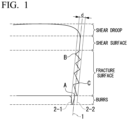
- FIG. 1 is a diagram showing a method of measuring a size of unevenness of a fracture surface in an end surface after shearing working.
- the numerical limit range described with “to” in between includes the lower limit and the upper limit. Regarding the numerical value indicated by “less than” or “more than”, the value does not fall within the numerical range. In the following description, % regarding the chemical composition of the hot-rolled steel sheet is mass% unless otherwise specified.
- C increases an area fraction of the hard phase.
- C increases the strength of martensite by combining to a precipitation hardening element such as Ti, Nb, and V.
- the C content is set to 0.040% or more.
- the C content is preferably 0.060% or more and more preferably 0.070% or more.
- the C content is set to 0.250% or less.
- the C content is preferably 0.150% or less.
- Si has an action of delaying the precipitation of cementite. Due to this action, the area fraction of martensite and tempered martensite can be increased, and the strength of the hot-rolled steel sheet can be increased by solid solution strengthening.
- Si has an action of making the steel sound by deoxidation (suppressing the occurrence of defects such as blow holes in the steel).
- the Si content is set to 0.05% or more.
- the Si content is preferably 0.50% or more or 1.00% or more.
- the Si content is set to 3.00% or less.
- the Si content is preferably 2.70% or less and more preferably 2.50% or less.
- Mn has actions of suppressing ferritic transformation and high-strengthening the hot-rolled steel sheet.
- the Mn content is set to 0.50% or more.
- the Mn content is preferably 1.00% or more, 1.50% or more, or 1.80% or more.
- the Mn content is set to 4.00% or less.
- the Mn content is preferably 3.70% or less or 3.50% or less.
- Al has an action of making the steel sound by deoxidation, and also has an action of increasing the area fraction of the martensite and the tempered martensite by suppressing the precipitation of cementite from austenite.
- a sol. Al content is less than 0.001%, an effect by the action cannot be obtained. Therefore, the sol. Al content is set to 0.001% or more.
- the sol. Al content is preferably 0.010% or more.
- the sol. Al content is set to 2.000% or less.
- the sol. Al content is preferably 1.500% or less or 1.300% or less.
- the sol. Al in the present embodiment means acid-soluble Al, and refers to solid solution Al present in steel in a solid solution state.
- P is an element that is generally contained as an impurity and is also an element having an action of enhancing the strength by solid solution strengthening. Therefore, although P may be positively contained, P is an element that is easily segregated, and when the P content is more than 0.100%, the hole expansibility is significantly decreased due to the boundary segregation. Therefore, the P content is set to 0.100% or less.
- the P content is preferably 0.030% or less.
- the lower limit of the P content does not need to be particularly specified, but is preferably 0.001% from the viewpoint of refining cost.
- S is an element that is contained as an impurity and forms sulfide-based inclusions in the steel to decrease the hole expansibility of the hot-rolled steel sheet.
- the S content is set to 0.0300% or less.
- the S content is preferably 0.0050% or less.
- the lower limit of the S content does not need to be particularly specified, but is preferably 0.0001% from the viewpoint of refining cost.
- N is an element contained in steel as an impurity and has an action of decreasing the hole expansibility of the hot-rolled steel sheet.
- the N content is set to 0.1000% or less.
- the N content is preferably 0.0800% or less and more preferably 0.0700% or less.
- the N content is preferably 0.0010% or more and more preferably 0.0020% or more to promote the precipitation of carbonitride.
- the O content is set to 0.0100% or less.
- the O content is preferably 0.0080% or less and 0.0050% or less.
- the O content may be 0.0005% or more or 0.0010% or more to disperse a large number of fine oxides when the molten steel is deoxidized.
- the remainder of the chemical composition of the hot-rolled steel sheet is according to the present embodiment Fe and impurities.
- the impurities mean those mixed from ore as a raw material, scrap, manufacturing environment, and the like, and are allowed within a range that does not adversely affect the hot-rolled steel sheet according to the present embodiment.
- the hot-rolled steel sheet according to the present embodiment may contain Ti, Nb, V, Cu, Cr, Mo, Ni, B, Ca, Mg, REM, Bi, Zr, Co, Zn, W, and Sn as optional elements.
- the lower limit of the content thereof is 0%.
- Ti, Nb, and V are precipitated as carbides or nitrides in the steel and have an action of refining the metallographic structure by an austenite pinning effect, one or two or more of these elements may be contained.
- the Ti content is set to 0.005% or more
- the Nb content is set to 0.005% or more
- the V content is set to 0.005% or more. That is, it is preferable that the amount of even one of Ti, Nb, and V is 0.005% or more.
- the Ti content is set to 0.300% or less, the Nb content is set to 0.100% or less, and the V content is set to 0.500% or less.
- the Ti content is preferably 0.200% or less, 0.150% or less, 0.120% or less, 0.110% or less, or 0.100% or less.
- All of Cu, Cr, Mo, Ni, and B have an action of enhancing the hardenability of the hot-rolled steel sheet.
- Cr and Ni have an action of stabilizing austenite
- Cu and Mo have an action of precipitating carbides in the steel at a low temperature to increase the strength.
- Ni has an action of effectively suppressing the grain boundary crack of the slab caused by Cu. Therefore, one or two or more of these elements may be contained.
- Cu has an action of enhancing the hardenability of the hot-rolled steel sheet and an action of being precipitated as carbide in the steel at a low temperature to enhance the strength of the hot-rolled steel sheet.
- the Cu content is preferably 0.01% or more and more preferably 0.05% or more.
- the Cu content is set to 2.00% or less.
- the Cu content is preferably 1.50% or less and 1.00% or less.
- the Cr content is preferably 0.01% or more or 0.05% or more.
- the Cr content is set to 2.00% or less.
- Mo has an action of enhancing the hardenability of the hot-rolled steel sheet and an action of precipitating carbides in the steel to enhance the strength.
- the Mo content is preferably 0.01% or more or 0.02% or more.
- the Mo content is set to 1.00% or less.
- the Mo content is preferably 0.50% or less and 0.20% or less.
- Ni has an action of enhancing the hardenability of the hot-rolled steel sheet.
- Ni has an action of effectively suppressing the grain boundary crack of the slab caused by Cu.
- the Ni content is preferably 0.02% or more. Since Ni is an expensive element, it is not economically preferable to contain a large amount of Ni. Therefore, the Ni content is set to 2.00% or less.
- B has an action of enhancing the hardenability of the hot-rolled steel sheet.
- the B content is preferably 0.0001% or more or 0.0002% or more.
- the B content is set to 0.0100% or less.
- the B content is preferably 0.0050% or less.
- All of Ca, Mg, and REM have an action of enhancing the formability of the hot-rolled steel sheet by adjusting the shape of inclusions to a preferable shape.
- Bi has an action of enhancing the formability of the hot-rolled steel sheet by refining the solidification structure. Therefore, one or two or more of these elements may be contained.
- any one or more of Ca, Mg, REM, and Bi is 0.0005% or more.
- the Ca content or Mg content is more than 0.0200%, or when the REM content is more than 0.1000%, the inclusions are excessively formed in the steel, and thus the hole expansibility of the hot-rolled steel sheet may be decreased in some cases.
- the Bi content is more than 0.020%, the above effect by the action is saturated, and this case is not economically preferable. Therefore, the Ca content and Mg content are set to 0.0200% or less, the REM content is set to 0.1000% or less, and the Bi content is set to 0.020% or less.
- the Bi content is preferably 0.010% or less.
- REM refers to a total of 17 elements including Sc, Y, and lanthanoid
- the REM content refers to the total amount of these elements.
- lanthanoid is industrially added in the form of misch metal.
- the present inventors have confirmed that even when the total amount of these elements is 1.00% or less, the effect of the hot-rolled steel sheet according to the present embodiment is not impaired. Therefore, one or two or more of Zr, Co, Zn, or W may be contained in a total of 1.00% or less.
- the present inventors have confirmed that the effect of the hot-rolled steel sheet according to the present embodiment is not impaired even if a small amount of Sn is contained. However, when a large amount of Sn is contained, a defect may occur during hot rolling, and thus, the Sn content is set to 0.050% or less.
- the above-described chemical composition of the hot-rolled steel sheet may be measured by a general analytical method.
- ICP-AES inductively coupled plasma-atomic emission spectrometry
- sol. Al may be measured by the ICP-AES using a filtrate after heat-decomposing a sample with an acid.
- C and S may be measured by using a combustion-infrared absorption method, and N may be measured by using the inert gas melting-thermal conductivity method.
- the metallographic structure contains more than 92.0% and 100.0% or less of martensite and tempered martensite in total, less than 3.0% of residual austenite, and less than 5.0% of ferrite, has a ratio S 60 /S 7 , which is a ratio of a density S 60 of a length of a grain boundary having a crystal misorientation of 60° to a density S 7 of a length of a grain boundary having a crystal misorientation of 7° about a ⁇ 110> direction, of more than 0.34 and less than 0.60, and has a standard deviation of a Mn concentration of 0.60 mass% or less. Therefore, the hot-rolled steel sheet according to the present embodiment can obtain excellent strength, ductility, and shearing workability.
- the metallographic structure is defined at a depth of 1/4 of the sheet thickness from a surface and a center position in a sheet width direction in a cross section parallel to a rolling direction. The reason is that the metallographic structure at this position is a typical metallographic structure of a steel sheet.
- the position at the depth of 1/4 of the sheet thickness from the surface is a region between a depth of 1/8 of the sheet thickness from the surface and a depth of 3/8 of the sheet thickness from the surface.
- the residual austenite is a structure that is present as a face-centered cubic lattice even at room temperature.
- the residual austenite has an action of increasing the ductility of the hot-rolled steel sheet due to transformation-induced plasticity (TRIP).
- TRIP transformation-induced plasticity
- the residual austenite is transformed into high-carbon martensite during shearing working, thus, inhibits stable crack initiation, and causes the unevenness of the fracture surface in the end surface after shearing working to be large.
- the area fraction of the residual austenite is 3.0% or more, the above-mentioned action is manifested, and not only the shearing workability of the hot-rolled steel sheet is deteriorated (the unevenness of the fracture surface in the end surface becomes large), but also the hole expansibility is also decreased. Therefore, the area fraction of the residual austenite is set to less than 3.0%.
- the area fraction of the residual austenite is preferably less than 1.0%. Since less residual austenite is preferable, the area fraction of the residual
- Ferrite is generally a soft structure.
- a predetermined amount or more of ferrite is contained, not only the desired strength cannot be obtained, but also the region of the shear surface on the end surface after shearing working is caused to increase.
- the region of the shear surface in the end surface after shearing working is increased, the unevenness of the fracture surface becomes large, which is not preferable.
- the area fraction of the ferrite is 5.0% or more, the action is manifested, shearing workability of the hot-rolled steel sheet is deteriorated. Therefore, the area fraction of the ferrite is set to less than 5.0%.
- the area fraction of the ferrite is preferably less than 1.0%. Since less ferrite is preferable, the area fraction of the ferrite may be 0 %.
- the measurement method of the area fraction of the residual austenite methods by X-ray diffraction, electron back scatter diffraction image (EBSP, electron back scattering diffraction pattern) analysis, and magnetic measurement and the like may be used and the measured values may differ depending on the measurement method.
- the area fraction of the residual austenite is measured by X-ray diffraction.
- the integrated intensities of a total of 6 peaks of ⁇ (110), ⁇ (200), ⁇ (211), ⁇ (111), ⁇ (200), and ⁇ (220) are obtained in the cross section parallel to the rolling direction at a depth of 1/4 of the sheet thickness of the steel sheet (region between a depth of 1/8 of the sheet thickness from the surface and a depth of 3/8 of the sheet thickness from the surface) and the center position in the sheet width direction, using Co-K ⁇ rays, and the area fraction of the residual austenite is obtained by calculation using the strength averaging method.
- Measurement of the area fraction of the ferrite is conducted in the following manner.
- the cross section perpendicular to the rolling direction is mirror-finished and polished at a room temperature with colloidal silica without containing an alkaline solution for 8 minutes to remove the strain introduced into the surface layer of a sample.
- a region with a length of 50 ⁇ m and between a depth of 1/8 of the sheet thickness from the surface to a depth of 3/8 of the sheet thickness from the surface is measured by electron backscatter diffraction at a measurement interval of 0.1 ⁇ m to obtain crystal orientation information.
- an EBSD analyzer configured of a thermal field emission scanning electron microscope (JSM-7001F manufactured by JEOL) and an EBSD detector (DVC5 type detector manufactured by TSL) is used.
- the EBSD analyzer is set such that the degree of vacuum inside is 9.6 ⁇ 10 -5 Pa or less, an acceleration voltage is 15 kV, an irradiation current level is 13, and an electron beam irradiation level is 62.
- a region where a Grain Average Misorientation value is 1.0° or less is determined to be ferrite, using the obtained crystal orientation information in a "Grain Average Misorientation” installed in the software "OIM Analysis (registered trademark)" (manufactured by AMETEK, Inc.) attached to the EBSD analyzer.
- OIM Analysis registered trademark
- the area fraction of the ferrite is obtained.
- the total area fraction of the martensite and the tempered martensite is set to more than 92.0%. It is not necessary to include both the martensite and the tempered martensite, and in a case where any one of the martensite or the tempered martensite is contained, the area fraction may be more than 92.0%. In a case where both the martensite and the tempered martensite are contained, the total area fraction of the martensite and the tempered martensite may be more than 92.0%.
- the total area fraction of the martensite and the tempered martensite is preferably 95.0% or more, 97.0% or more, or 99.0% or more.
- the total area fraction may be 100.0%.
- a region having a substructure in the grain and where cementite precipitates with a plurality of variants is determined to be tempered martensite.
- a region where the brightness is high and the substructure is not exposed by etching is determined as "martensite and residual austenite".
- a method such as buffing using alumina particles having a particle diameter of 0.1 ⁇ m or less or Ar ion sputtering may be used.
- Ratio S 60 /S 7 which is a Ratio of a Density S 60 of Length of Grain Boundary having Crystal Misorientation of 60° to a Density S 7 of Length of Grain Boundary having Crystal Misorientation of 7° about ⁇ 110> Direction: More than 0.34 and Less than 0.60
- a primary phase is necessary to be a full hard structure.
- the full hard structure is generally formed in a phase transformation at 600°C or lower, but in this temperature range, a large number of a grain boundary having a crystal misorientation of 60° and a grain boundary having a crystal misorientation of 7° about the ⁇ 110> direction are formed.
- the grain boundary having a crystal misorientation of 60° about the ⁇ 110> direction When the grain boundary having a crystal misorientation of 60° about the ⁇ 110> direction is formed, dislocation is significantly accumulated inside the structure and elastic strain increases. Therefore, in a metallographic structure in which the grain boundary having a crystal misorientation of 60° about the ⁇ 110> direction have high density and are uniformly dispersed (that is, a density of length of the grain boundary having a crystal misorientation of 60° about the ⁇ 110> direction is large), the strength of a material is increased, plastic deformation in shearing working is suppressed, and the unevenness of the fracture surface in the end surface after shearing working is suppressed.
- S 60 /S 7 is set to more than 0.34.
- the S 60 /S 7 is preferably 0.40 or more or 0.45 or more.
- the larger S 60 /S 7 is desirable, but a practical upper limit is 0.60. Therefore, S 60 /S 7 is set to less than 0.60.
- the grain boundary having a crystal misorientation of X° about the ⁇ 110> direction refers to a grain boundary having a crystallographic relationship in which the crystal orientations of the crystal grain A and the crystal grain B are the same by rotating one crystal grain B by X° about the ⁇ 110> axis, when two adjacent crystal grain A and crystal grain B are specified at a certain grain boundary.
- an orientation difference of ⁇ 4° is allowed from the matching orientation relationship.
- the density S 60 of the length of the grain boundary having a crystal misorientation of 60° and the density S 7 of the length of a grain boundary having a crystal misorientation of 7° about the ⁇ 110> direction are measured by using the electron back scatter diffraction pattern-orientation image microscopy (EBSP-OIM) method.
- EBSP-OIM electron back scatter diffraction pattern-orientation image microscopy
- a crystal orientation of an irradiation point can be measured for a short time period in such manner that a highly inclined sample in a scanning electron microscope (SEM) is irradiated with electron beams, a Kikuchi pattern formed by back scattering is photographed by a high sensitive camera, and the photographed image is processed by a computer.
- SEM scanning electron microscope
- the EBSP-OIM method is carried out using an EBSD analyzer configured of a thermal field emission scanning electron microscope (JSM-7001F manufactured by JEOL) and an EBSD detector, and OIM Analysis (registered trademark) manufactured by AMETEK, Inc.
- JSM-7001F thermal field emission scanning electron microscope
- OIM Analysis registered trademark
- the analyzable area of the EBSP-OIM method is a region that can be observed by the SEM.
- the EBSP-OIM method makes it possible to analyze a region with a minimum resolution of 20 nm, which varies depending on the resolution of the SEM.
- the analysis is performed with 1200 fold magnification, in a region of 40 ⁇ m ⁇ 30 ⁇ m, for at least 5 visual fields.
- S 60 is obtained by dividing an average value of the lengths of the grain boundary having a crystal misorientation of 60° about the ⁇ 110> direction by the area of the measurement region.
- S 7 is obtained by dividing an average value of the lengths of the grain boundary having a crystal misorientation of 7° about the ⁇ 110> direction by the area of the measurement region. As described above, the orientation difference of ⁇ 4° is allowed.
- the residual austenite is not a structure formed by phase transformation at 600°C or lower and has no effect of dislocation accumulation, the residual austenite is not included as a target in the analysis in the present measurement method. That is, in the present embodiment, the density S 60 of the length of a grain boundary having a crystal misorientation of 60° about the ⁇ 110> direction and the density S 7 of the length of a grain boundary having a crystal misorientation of 7° about the ⁇ 110> direction are the density of martensite, tempered martensite, or ferrite.
- the EBSP-OIM method, the residual austenite having a crystal structure of fcc can be excluded from the analysis target.
- the standard deviation of the Mn concentration at a depth of 1/4 of the sheet thickness from a surface of the hot-rolled steel sheet according to the present embodiment is 0.60 mass% or less. Accordingly, the grain boundary having a crystal misorientation of 60° about the ⁇ 110> direction can be uniformly dispersed. As a result, the unevenness of the fracture surface in the end surface after shearing working can be reduced.
- the standard deviation of the Mn concentration is preferably 0.55 mass% or less, 0.50 mass% or less, or 0.40 mass% or less.
- a lower limit of the standard deviation of the Mn concentration is preferably as small as the value, in order to suppress the unevenness of the fracture surface in the end surface after the shearing working, but a practical lower limit is 0.10 mass% due to the restrictions of the manufacturing process.
- the standard deviation of the Mn concentration is measured by the following method.
- the center position in the sheet width direction at the depth of 1/4 of the sheet thickness from the surface is measured using an electron probe microanalyzer (EPMA) to measure the standard deviation of the Mn concentration.
- the measurement condition is set such that an acceleration voltage is 15 kV and the magnification is 5000 times, and a distribution image in the range of 20 ⁇ m in the sample rolling direction and 20 ⁇ m in the sample sheet thickness direction is measured. More specifically, the measurement interval is set to 0.1 ⁇ m, and the Mn concentration at 40000 or more points is measured. Then, a standard deviation based on the Mn concentration obtained from all the measurement point is calculated to obtain the standard deviation of the Mn concentration.
- cracking inside a bend When the grain size of the surface layer is fine, it is possible to suppress having excellent resistance to cracking inside a bend of the hot-rolled steel sheet. As the strength of the steel sheet becomes higher, cracks are likely to initiate from an inside of a bend during bending (hereinafter referred to as cracking inside a bend).
- the mechanism of the cracking inside a bend is presumed as follows. During bending, compressive stress is generated inside the bend. At first, bending proceeds while uniformly deforming the entire inside of the bend, but when the bending amount increases, the deformation cannot be carried out only by uniform deformation, and the deformation proceeds due to the concentration of strain locally (generation of shearing deformation band). As this shearing deformation band further propagates, cracks along the shearing band are initiated from the inner surface of the bend and propagate.
- the cracking inside a bend becomes remarkable in the steel sheet having the tensile strength of 980 MPa or more. Furthermore, the present inventors have found that as the grain size of the surface layer of the hot-rolled steel sheet is finer, the local strain concentration is further suppressed and the cracking inside a bend becomes difficult to occur. In order to obtain the action, it is preferable that the average grain size of the surface layer of the hot-rolled steel sheet is less than 3.0 ⁇ m. It is more preferable that the average grain size is 2.5 ⁇ m or less.
- the lower limit is not particularly limited, and may be 1.0 ⁇ m or more, 1.5 ⁇ m or more, or 2.0 ⁇ m or more.
- the surface layer is a region from the surface of the hot-rolled steel sheet to a position at a depth of 50 ⁇ m from the surface.
- the grain size of the surface layer is measured by using the EBSP-OIM method.
- a region from the surface of the hot-rolled steel sheet to a position at a depth of 50 ⁇ m from the surface and the center position in the sheet width direction is analyzed with 1200 fold magnification, in a region of 40 ⁇ m ⁇ 30 ⁇ m, for at least 5 visual field, a place where the angular difference between adjacent measurement points is 5° or more is defined as a grain boundary, and an area average grain size is calculated.
- the obtained area average grain size is defined as the average grain size of the surface layer.
- the residual austenite is not a structure formed by phase transformation at 600°C or lower and has no effect of dislocation accumulation, the residual austenite is not included as a target in the analysis in the present measurement method. That is, in the present embodiment, the average grain size of the surface layer is a grain size of martensite, tempered martensite, and ferrite.
- the EBSP-OIM method the residual austenite having a crystal structure of fcc can be excluded from the analysis target.
- the hot-rolled steel sheet according to the present embodiment has a tensile (maximum) strength of 980 MPa or more.
- tensile strength is less than 980 MPa, an applicable component is limited, and the contribution of weight reduction of the vehicle body is small.
- An upper limit is not particularly limited, and may be 1780 MPa from the viewpoint of suppressing wearing of a die.
- the tensile strength is measured according to JIS Z 2241: 2011 using a No. 5 test piece of JIS Z 2241: 2011.
- the sampling position of the tensile test piece may be 1/4 portion from the end portion in the sheet width direction, and the direction perpendicular to the rolling direction may be the longitudinal direction.
- the hot-rolled steel sheet according to the present embodiment preferably has a hole expansion ratio ⁇ of 62% or more.
- the hole expansion ratio ⁇ is 62% or more, the applicable components are not limited, and a hot-rolled steel sheet that greatly contributes to weight reduction of the vehicle body can be obtained.
- An upper limit thereof does not need to be limited.
- the hole expansion ratio ⁇ is measured according to JIS Z 2256: 2010 using a No. 5 test piece of JIS Z 2241: 2011.
- the sampling position of the hole expansion test piece may be 1/4 part from the end portion in the sheet width direction.
- the product (TS ⁇ ⁇ ) of the tensile strength and the hole expansion which are indices of hole expansibility is preferably 60000 MPa ⁇ % or more.
- the product of the tensile strength and the hole expansion is 60000 MPa ⁇ % or more, it is possible to obtain a hot-rolled steel sheet that greatly contributes to weight reduction of a vehicle body without limiting applicable components.
- the sheet thickness of the hot-rolled steel sheet according to the present embodiment is not particularly limited and may be 0.5 to 8.0 mm.
- the sheet thickness of the hot-rolled steel sheet according to the present embodiment may be 0.5 mm or more.
- the sheet thickness is preferably 1.2 mm or more and 1.4 mm or more.
- the sheet thickness is set to 8.0 mm or less.
- the sheet thickness is preferably 6.0 mm or less.
- the hot-rolled steel sheet according to the present embodiment having the above-described chemical composition and metallographic structure may be a surface-treated steel sheet provided with a plating layer on the surface for the purpose of improving corrosion resistance and the like.
- the plating layer may be an electro plating layer or a hot-dip plating layer.
- the electro plating layer include electrogalvanizing and electro Zn-Ni alloy plating.
- the hot-dip plating layer include hot-dip galvanizing, hot-dip galvannealing, hot-dip aluminum plating, hot-dip Zn-Al alloy plating, hot-dip Zn-Al-Mg alloy plating, and hot-dip Zn-Al-Mg-Si alloy plating.
- the plating adhesion amount is not particularly limited and may be the same as before. Further, it is also possible to further enhance the corrosion resistance by applying an appropriate chemical conversion treatment (for example, application and drying of a silicate-based chromium-free chemical conversion treatment liquid) after plating.
- an appropriate chemical conversion treatment for example, application and drying of a silicate-based chromium-free chemical conversion treatment liquid
- a suitable method for manufacturing the hot-rolled steel sheet according to the present embodiment having the above-mentioned chemical composition and metallographic structure is as follows.
- the hot-rolled steel sheet it is effective that after performing heating the slab under predetermined conditions, hot rolling is performed and accelerated cooling is performed to a predetermined temperature range, and after coiling, the cooling history is controlled.
- the following steps (1) to (7) are sequentially performed.
- the temperature of the slab and the temperature of the steel sheet in the present embodiment refer to the surface temperature of the slab and the surface temperature of the steel sheet.
- a slab obtained by continuous casting, a slab obtained by casting and blooming, and the like can be used, and slabs obtained by performing hot working or cold working on these slabs as necessary can be used.
- the slab to be subjected to hot rolling is preferably retained in a temperature range of 700°C to 850°C during heating for 900 seconds or longer, then further heated and retained in a temperature range of 1100°C or higher for 6000 seconds or longer.
- the steel sheet temperature may be fluctuated or be constant in the temperature range.
- the steel sheet temperature may be fluctuated or be constant in the temperature range of 1100°C or higher.
- Mn In the austenite transformation at 700°C to 850°C, when Mn is distributed between the ferrite and the austenite and the transformation time becomes longer, Mn can be diffused in the ferrite region. Accordingly, the Mn microsegregation unevenly distributed in the slab can be eliminated, and the standard deviation of the Mn concentration can be significantly reduced. By reducing the standard deviation of the Mn concentration, it is possible to uniformly disperse the grain boundaries having a crystal misorientation of 60° about the ⁇ 110> direction in the final metallographic structure, and reduce the unevenness of the fracture surface in the end surface after shearing working.
- the slab in the temperature range of 1100°C or higher for 6000 seconds or longer.
- hot rolling it is preferable to use a reverse mill or a tandem mill for multipass rolling. Particularly, from the viewpoint of industrial productivity, it is more preferable that at least the final several stages are subjected to hot rolling using a tandem mill.
- Performing the hot rolling to obtain a total sheet thickness reduction of 90% or more in the temperature range of 850°C to 1100°C makes it possible that the accumulation of strain energy inside unrecrystallized austenite grains is promoted while achieving refinement mainly of the recrystallized austenite grains, and the atomic diffusion of Mn is promoted while promoting the recrystallization of the austenite to reduce the standard deviation of the Mn concentration.
- the hot rolling is performed in a temperature range of 850°C to 1100°C so that the total sheet thickness is reduced by 90% or more.
- the sheet thickness reduction in a temperature range of 850°C to 1100°C can be expressed as (t 0 - t 1 )/t 0 ⁇ 100 (%) when an inlet sheet thickness before the first pass in the rolling in this temperature range is t 0 and an outlet sheet thickness after the final pass in the rolling in this temperature range is t 1 .
- the hot rolling completion temperature Tf is preferably set to T1 (°C) or higher.
- T1 (°C) or higher an excessive increase in the number of ferrite nucleation sites in the austenite can be suppressed, and the formation of the ferrite in the final structure (the metallographic structure of the hot-rolled steel sheet after manufacturing) can be suppressed, and it is possible to obtain the hot-rolled steel sheet having high strength.
- the average cooling rate referred herein is a value obtained by dividing the temperature drop width of the steel sheet from the start of accelerated cooling (when introducing a steel sheet to cooling equipment) to T2 (°C) by the time required from the start of accelerated cooling to the time at which the temperature of the steel sheet reaches T2 (°C).
- the accelerated cooling after completion of hot rolling when the time to start cooling is set to be within 1.5 seconds and the average cooling rate to T2 (°C) or lower is set to 30 °C/s or higher, the ferritic transformation, bainitic transformation, and/or pearlitic transformation inside the steel sheet can be suppressed, and TS ⁇ 980 MPa can be obtained. Therefore, within 1.5 seconds after the completion of hot rolling, the accelerated cooling in which the average cooling rate to T2 (°C) or lower is 30 °C/s or higher is performed.
- the upper limit of the average cooling rate is not particularly specified, but when the cooling rate is increased, the cooling equipment becomes large and the equipment cost increases. Therefore, considering the equipment cost, the average cooling rate of accelerated cooling is preferably 300 °C/s or lower. In addition, the cooling stop temperature of the accelerated cooling may be set to 350°C or lower.
- cooling to a temperature range of hot rolling completion temperature Tf-50°C, within 1.0 second after the completion of the hot rolling is a more preferable. This is because the growth of austenite crystal grain that has been refined by hot rolling can be suppressed.
- cooling at a large average cooling rate is performed immediately after the completion of the hot rolling, for example, cooling water may be sprayed on the surface of the steel sheet.
- the accelerated cooling may be performed such that the average cooling rate to T2 (°C) or lower is set to 30 °C/s or higher.
- the average cooling rate from T2 (°C) to the coiling temperature is preferably set to 30 °C/s or higher. Accordingly, the primary phase structure can be full hard.
- the average cooling rate referred here refers to a value obtained by dividing the temperature drop width of the steel sheet from T2 (°C) to the coiling temperature by the time required to reach the coiling from the time at which the steel sheet temperature reaches T2 (°C).
- the average cooling rate from T2 (°C) to the coiling temperature is set to 30 °C/s or higher.
- the coiling temperature is preferably set to 300°C or lower.
- the coiling temperature is preferably set to 300°C or lower.
- the coiling temperature is more preferably set to 50°C or lower.
- the slab was allowed to retain in the temperature range of 700°C to 850°C for the retention time shown in Tables 3A and 3B, and then further heated to the heating temperature shown in Tables 3A and 3B and retained.
- the accelerated cooling was started within 1.5 seconds after the completion of hot rolling.
- the area fraction of each structure, S 60 /S 7 , the standard deviation of the Mn concentration, and the average grain size of the surface layer were determined by the above-described method.
- the obtained measurement results are shown in Tables 4A and 4B.
- the tensile strength properties were evaluated according to JIS Z 2241: 2011, and the hole expansion ratio was evaluated according to JIS Z 2256: 2010.
- a test piece was a No. 5 test piece of JIS Z 2241: 2011.
- the sampling position of the tensile test piece may be 1/4 portion from the end portion in the sheet width direction, and the direction perpendicular to the rolling direction was the longitudinal direction.
- the shearing workability of the hot-rolled steel sheet was evaluated by measuring the size of the unevenness of the fracture surface in the end surface after the shearing working by a punching test.
- Five punched holes were prepared with a hole diameter of 10 mm, a clearance of 10%, and a punching speed of 3 m/s.
- a cross section of the five punched holes parallel to the rolling direction in ten places was embedded in a resin, and the cross-section shape was imaged with a scanning electron microscope. In the obtained observation photograph, it was possible to observe a processed cross section configured of shear droop, a shear surface, a fracture surface, and burrs as shown in FIG. 1 .
- the shear droop is a region of an R-shaped smooth surface.
- the shear surface is a region of a punched end surface separated by shearing deformation.
- the fracture surface is a region of a punched end surface separated by cracks initiated from the vicinity of the cutting edge after the completion of the shearing deformation.
- the burr is a surface having projections projecting from a lower surface of a hot-rolled steel sheet.
- the size of the unevenness of the fracture surface was measured for 10 end surfaces obtained from the 5 punched holes.
- the maximum value of the size of the unevenness of the fracture surface is 3.0 ⁇ m or less, the shearing workability was determined excellent, which was pass.
- the maximum value of the size of the unevenness of the fracture surface is more than 3.0 ⁇ m, the shearing workability was determined poor, and which was fail.
- a strip-shaped test piece having a size of 100 mm ⁇ 30 mm was cut out from a 1/2 position in the sheet width direction of the hot-rolled steel sheet, and the resistance to cracking inside a bend was evaluated by the following bending test.
- the production Nos. 3 to 5, 7 to 10, and 24 to 27 in which a chemical composition and a metallographic structure are not within the range specified in the present invention were poor in any one or more of the properties (tensile strength TS, hole expansion ratio ⁇ , and shearing workability).
- a hot-rolled steel sheet having excellent strength, hole expansibility, and shearing workability. Further, according to a preferred embodiment according to the present invention, it is possible to obtain a hot-rolled steel sheet having the above-mentioned various properties and further suppressing the occurrence of cracking inside a bend, that is, having excellent resistance to cracking inside a bend.
- the hot-rolled steel sheet according to the present invention is suitable as an industrial material used for vehicle members, mechanical structural members, and building members.
Landscapes
- Chemical & Material Sciences (AREA)
- Engineering & Computer Science (AREA)
- Mechanical Engineering (AREA)
- Materials Engineering (AREA)
- Metallurgy (AREA)
- Organic Chemistry (AREA)
- Physics & Mathematics (AREA)
- Thermal Sciences (AREA)
- Crystallography & Structural Chemistry (AREA)
- Heat Treatment Of Sheet Steel (AREA)
- Heat Treatment Of Steel (AREA)
Applications Claiming Priority (2)
| Application Number | Priority Date | Filing Date | Title |
|---|---|---|---|
| JP2020010945 | 2020-01-27 | ||
| PCT/JP2020/046322 WO2021153036A1 (ja) | 2020-01-27 | 2020-12-11 | 熱延鋼板 |
Publications (3)
| Publication Number | Publication Date |
|---|---|
| EP4098762A4 EP4098762A4 (en) | 2022-12-07 |
| EP4098762A1 EP4098762A1 (en) | 2022-12-07 |
| EP4098762B1 true EP4098762B1 (en) | 2023-10-11 |
Family
ID=77078501
Family Applications (1)
| Application Number | Title | Priority Date | Filing Date |
|---|---|---|---|
| EP20916444.1A Active EP4098762B1 (en) | 2020-01-27 | 2020-12-11 | Hot-rolled steel sheet |
Country Status (7)
| Country | Link |
|---|---|
| US (1) | US12392020B2 (https=) |
| EP (1) | EP4098762B1 (https=) |
| JP (1) | JP7260824B2 (https=) |
| KR (1) | KR102776903B1 (https=) |
| CN (1) | CN114929915B (https=) |
| MX (1) | MX2022008544A (https=) |
| WO (1) | WO2021153036A1 (https=) |
Families Citing this family (7)
| Publication number | Priority date | Publication date | Assignee | Title |
|---|---|---|---|---|
| MX2023001946A (es) * | 2020-08-27 | 2023-03-14 | Nippon Steel Corp | Lamina de acero laminada en caliente. |
| KR20240038998A (ko) * | 2021-09-08 | 2024-03-26 | 닛폰세이테츠 가부시키가이샤 | 열연 강판 |
| WO2023063010A1 (ja) * | 2021-10-11 | 2023-04-20 | 日本製鉄株式会社 | 熱間圧延鋼板 |
| US20240318274A1 (en) * | 2021-10-11 | 2024-09-26 | Nippon Steel Corporation | Hot-rolled steel sheet |
| WO2025219477A1 (de) * | 2024-04-19 | 2025-10-23 | Salzgitter Flachstahl Gmbh | Warmgewalztes stahlflachprodukt und verfahren zu dessen herstellung |
| WO2026018588A1 (ja) * | 2024-07-18 | 2026-01-22 | Jfeスチール株式会社 | せん断加工性に優れる鋼材 |
| CN119571218A (zh) * | 2024-11-28 | 2025-03-07 | 天润工业技术股份有限公司 | 一种新型胀断连杆用非调质钢及其制造方法与控锻控冷工艺 |
Family Cites Families (27)
| Publication number | Priority date | Publication date | Assignee | Title |
|---|---|---|---|---|
| JPS59222528A (ja) | 1983-05-31 | 1984-12-14 | Sumitomo Metal Ind Ltd | 熱延高張力鋼板の製造方法 |
| JPH1161326A (ja) | 1997-08-06 | 1999-03-05 | Nippon Steel Corp | 耐衝突安全性及び成形性に優れた自動車用高強度鋼板とその製造方法 |
| JP3355970B2 (ja) | 1996-12-10 | 2002-12-09 | 日本鋼管株式会社 | 打ち抜き性に優れる冷延鋼板の製造方法 |
| US6544354B1 (en) | 1997-01-29 | 2003-04-08 | Nippon Steel Corporation | High-strength steel sheet highly resistant to dynamic deformation and excellent in workability and process for the production thereof |
| CA2297291C (en) | 1999-02-09 | 2008-08-05 | Kawasaki Steel Corporation | High tensile strength hot-rolled steel sheet and method of producing the same |
| JP4109619B2 (ja) | 2003-12-16 | 2008-07-02 | 株式会社神戸製鋼所 | 伸び、及び伸びフランジ性に優れた高強度鋼板 |
| JP4460343B2 (ja) | 2004-04-13 | 2010-05-12 | 新日本製鐵株式会社 | 打ち抜き加工性に優れた高強度熱延鋼板及びその製造方法 |
| JP4644075B2 (ja) | 2005-09-02 | 2011-03-02 | 新日本製鐵株式会社 | 穴拡げ性に優れた高強度薄鋼板およびその製造方法 |
| JP4644076B2 (ja) | 2005-09-05 | 2011-03-02 | 新日本製鐵株式会社 | 伸びと穴拡げ性に優れた高強度薄鋼板およびその製造方法 |
| JP5136182B2 (ja) | 2008-04-22 | 2013-02-06 | 新日鐵住金株式会社 | 切断後の特性劣化の少ない高強度鋼板及びその製造方法 |
| JP5438302B2 (ja) * | 2008-10-30 | 2014-03-12 | 株式会社神戸製鋼所 | 加工性に優れた高降伏比高強度の溶融亜鉛めっき鋼板または合金化溶融亜鉛めっき鋼板とその製造方法 |
| JP5533729B2 (ja) * | 2011-02-22 | 2014-06-25 | 新日鐵住金株式会社 | 局部変形能に優れ、成形性の方位依存性の少ない延性に優れた高強度熱延鋼板及びその製造方法 |
| MX354006B (es) * | 2011-03-18 | 2018-02-08 | Nippon Steel & Sumitomo Metal Corp | Lamina de acero laminada en caliente y proceso para producir la misma. |
| BR112013025015B1 (pt) | 2011-03-28 | 2018-11-06 | Nippon Steel & Sumitomo Metal Corporation | chapa de aço laminada a frio e método de produção da mesma |
| JP5655712B2 (ja) | 2011-06-02 | 2015-01-21 | 新日鐵住金株式会社 | 熱延鋼板の製造方法 |
| JP2014043629A (ja) * | 2012-08-28 | 2014-03-13 | Nippon Steel & Sumitomo Metal | 熱延鋼板 |
| CN105209650B (zh) | 2013-05-14 | 2017-11-07 | 新日铁住金株式会社 | 热轧钢板及其制造方法 |
| JP6241273B2 (ja) | 2013-12-26 | 2017-12-06 | 新日鐵住金株式会社 | 熱延鋼板 |
| JP6354268B2 (ja) * | 2014-04-02 | 2018-07-11 | 新日鐵住金株式会社 | 打抜き穴広げ性と低温靭性に優れた引張最大強度980MPa以上の高強度熱延鋼板及びその製造方法 |
| CN106661690B (zh) * | 2014-07-14 | 2018-09-07 | 新日铁住金株式会社 | 热轧钢板 |
| WO2016132549A1 (ja) | 2015-02-20 | 2016-08-25 | 新日鐵住金株式会社 | 熱延鋼板 |
| US11401571B2 (en) | 2015-02-20 | 2022-08-02 | Nippon Steel Corporation | Hot-rolled steel sheet |
| JP6696209B2 (ja) * | 2016-02-18 | 2020-05-20 | 日本製鉄株式会社 | 高強度鋼板の製造方法 |
| KR102186320B1 (ko) | 2016-08-05 | 2020-12-03 | 닛폰세이테츠 가부시키가이샤 | 강판 및 도금 강판 |
| CN110832098B (zh) | 2017-07-07 | 2021-11-23 | 日本制铁株式会社 | 热轧钢板及其制造方法 |
| JP2020010945A (ja) | 2018-07-20 | 2020-01-23 | 株式会社トミーテック | 鉄道模型用サウンドユニットおよび鉄道模型車両 |
| EP3936628A4 (en) * | 2019-03-06 | 2022-10-26 | Nippon Steel Corporation | HOT ROLLED STEEL SHEET |
-
2020
- 2020-12-11 JP JP2021574510A patent/JP7260824B2/ja active Active
- 2020-12-11 EP EP20916444.1A patent/EP4098762B1/en active Active
- 2020-12-11 KR KR1020227023219A patent/KR102776903B1/ko active Active
- 2020-12-11 CN CN202080093028.8A patent/CN114929915B/zh active Active
- 2020-12-11 WO PCT/JP2020/046322 patent/WO2021153036A1/ja not_active Ceased
- 2020-12-11 MX MX2022008544A patent/MX2022008544A/es unknown
- 2020-12-11 US US17/790,645 patent/US12392020B2/en active Active
Also Published As
| Publication number | Publication date |
|---|---|
| US12392020B2 (en) | 2025-08-19 |
| CN114929915B (zh) | 2023-10-27 |
| WO2021153036A1 (ja) | 2021-08-05 |
| CN114929915A (zh) | 2022-08-19 |
| US20230047602A1 (en) | 2023-02-16 |
| EP4098762A4 (en) | 2022-12-07 |
| MX2022008544A (es) | 2022-08-10 |
| JP7260824B2 (ja) | 2023-04-19 |
| JPWO2021153036A1 (https=) | 2021-08-05 |
| EP4098762A1 (en) | 2022-12-07 |
| KR102776903B1 (ko) | 2025-03-10 |
| KR20220110823A (ko) | 2022-08-09 |
Similar Documents
| Publication | Publication Date | Title |
|---|---|---|
| EP4039842B1 (en) | Hot-rolled steel sheet | |
| EP4098762B1 (en) | Hot-rolled steel sheet | |
| EP3936628A1 (en) | Hot rolled steel sheet | |
| EP4417714A1 (en) | Hot-rolled steel plate | |
| EP4206343A1 (en) | Hot-rolled steel sheet | |
| US12435382B2 (en) | Hot-rolled steel sheet | |
| EP3936630A1 (en) | Hot-rolled steel sheet | |
| EP4180545A1 (en) | Hot-rolled steel sheet | |
| EP4180546A1 (en) | Hot-rolled steel sheet | |
| EP4206344A1 (en) | Hot-rolled steel sheet | |
| EP4644578A1 (en) | Hot-rolled steel sheet | |
| EP4119689A1 (en) | Hot-rolled steel sheet | |
| EP4417715A1 (en) | Hot-rolled steel plate | |
| US20260022442A1 (en) | Hot-rolled steel sheet | |
| EP4368736A1 (en) | Hot-rolled steel sheet | |
| EP4400621A1 (en) | Hot-rolled steel sheet | |
| EP4438747A1 (en) | Hot-rolled steel sheet |
Legal Events
| Date | Code | Title | Description |
|---|---|---|---|
| STAA | Information on the status of an ep patent application or granted ep patent |
Free format text: STATUS: THE INTERNATIONAL PUBLICATION HAS BEEN MADE |
|
| PUAI | Public reference made under article 153(3) epc to a published international application that has entered the european phase |
Free format text: ORIGINAL CODE: 0009012 |
|
| STAA | Information on the status of an ep patent application or granted ep patent |
Free format text: STATUS: REQUEST FOR EXAMINATION WAS MADE |
|
| 17P | Request for examination filed |
Effective date: 20220629 |
|
| A4 | Supplementary search report drawn up and despatched |
Effective date: 20221013 |
|
| AK | Designated contracting states |
Kind code of ref document: A1 Designated state(s): AL AT BE BG CH CY CZ DE DK EE ES FI FR GB GR HR HU IE IS IT LI LT LU LV MC MK MT NL NO PL PT RO RS SE SI SK SM TR |
|
| DAV | Request for validation of the european patent (deleted) | ||
| DAX | Request for extension of the european patent (deleted) | ||
| GRAP | Despatch of communication of intention to grant a patent |
Free format text: ORIGINAL CODE: EPIDOSNIGR1 |
|
| STAA | Information on the status of an ep patent application or granted ep patent |
Free format text: STATUS: GRANT OF PATENT IS INTENDED |
|
| INTG | Intention to grant announced |
Effective date: 20230628 |
|
| GRAS | Grant fee paid |
Free format text: ORIGINAL CODE: EPIDOSNIGR3 |
|
| GRAA | (expected) grant |
Free format text: ORIGINAL CODE: 0009210 |
|
| STAA | Information on the status of an ep patent application or granted ep patent |
Free format text: STATUS: THE PATENT HAS BEEN GRANTED |
|
| AK | Designated contracting states |
Kind code of ref document: B1 Designated state(s): AL AT BE BG CH CY CZ DE DK EE ES FI FR GB GR HR HU IE IS IT LI LT LU LV MC MK MT NL NO PL PT RO RS SE SI SK SM TR |
|
| REG | Reference to a national code |
Ref country code: GB Ref legal event code: FG4D |
|
| REG | Reference to a national code |
Ref country code: CH Ref legal event code: EP |
|
| REG | Reference to a national code |
Ref country code: DE Ref legal event code: R096 Ref document number: 602020019274 Country of ref document: DE |
|
| REG | Reference to a national code |
Ref country code: IE Ref legal event code: FG4D |
|
| REG | Reference to a national code |
Ref country code: LT Ref legal event code: MG9D |
|
| REG | Reference to a national code |
Ref country code: NL Ref legal event code: MP Effective date: 20231011 |
|
| REG | Reference to a national code |
Ref country code: AT Ref legal event code: MK05 Ref document number: 1620291 Country of ref document: AT Kind code of ref document: T Effective date: 20231011 |
|
| PG25 | Lapsed in a contracting state [announced via postgrant information from national office to epo] |
Ref country code: NL Free format text: LAPSE BECAUSE OF FAILURE TO SUBMIT A TRANSLATION OF THE DESCRIPTION OR TO PAY THE FEE WITHIN THE PRESCRIBED TIME-LIMIT Effective date: 20231011 |
|
| PG25 | Lapsed in a contracting state [announced via postgrant information from national office to epo] |
Ref country code: GR Free format text: LAPSE BECAUSE OF FAILURE TO SUBMIT A TRANSLATION OF THE DESCRIPTION OR TO PAY THE FEE WITHIN THE PRESCRIBED TIME-LIMIT Effective date: 20240112 |
|
| PG25 | Lapsed in a contracting state [announced via postgrant information from national office to epo] |
Ref country code: IS Free format text: LAPSE BECAUSE OF FAILURE TO SUBMIT A TRANSLATION OF THE DESCRIPTION OR TO PAY THE FEE WITHIN THE PRESCRIBED TIME-LIMIT Effective date: 20240211 |
|
| PG25 | Lapsed in a contracting state [announced via postgrant information from national office to epo] |
Ref country code: LT Free format text: LAPSE BECAUSE OF FAILURE TO SUBMIT A TRANSLATION OF THE DESCRIPTION OR TO PAY THE FEE WITHIN THE PRESCRIBED TIME-LIMIT Effective date: 20231011 |
|
| PG25 | Lapsed in a contracting state [announced via postgrant information from national office to epo] |
Ref country code: AT Free format text: LAPSE BECAUSE OF FAILURE TO SUBMIT A TRANSLATION OF THE DESCRIPTION OR TO PAY THE FEE WITHIN THE PRESCRIBED TIME-LIMIT Effective date: 20231011 |
|
| PG25 | Lapsed in a contracting state [announced via postgrant information from national office to epo] |
Ref country code: ES Free format text: LAPSE BECAUSE OF FAILURE TO SUBMIT A TRANSLATION OF THE DESCRIPTION OR TO PAY THE FEE WITHIN THE PRESCRIBED TIME-LIMIT Effective date: 20231011 |
|
| PG25 | Lapsed in a contracting state [announced via postgrant information from national office to epo] |
Ref country code: LT Free format text: LAPSE BECAUSE OF FAILURE TO SUBMIT A TRANSLATION OF THE DESCRIPTION OR TO PAY THE FEE WITHIN THE PRESCRIBED TIME-LIMIT Effective date: 20231011 Ref country code: IS Free format text: LAPSE BECAUSE OF FAILURE TO SUBMIT A TRANSLATION OF THE DESCRIPTION OR TO PAY THE FEE WITHIN THE PRESCRIBED TIME-LIMIT Effective date: 20240211 Ref country code: GR Free format text: LAPSE BECAUSE OF FAILURE TO SUBMIT A TRANSLATION OF THE DESCRIPTION OR TO PAY THE FEE WITHIN THE PRESCRIBED TIME-LIMIT Effective date: 20240112 Ref country code: ES Free format text: LAPSE BECAUSE OF FAILURE TO SUBMIT A TRANSLATION OF THE DESCRIPTION OR TO PAY THE FEE WITHIN THE PRESCRIBED TIME-LIMIT Effective date: 20231011 Ref country code: BG Free format text: LAPSE BECAUSE OF FAILURE TO SUBMIT A TRANSLATION OF THE DESCRIPTION OR TO PAY THE FEE WITHIN THE PRESCRIBED TIME-LIMIT Effective date: 20240111 Ref country code: AT Free format text: LAPSE BECAUSE OF FAILURE TO SUBMIT A TRANSLATION OF THE DESCRIPTION OR TO PAY THE FEE WITHIN THE PRESCRIBED TIME-LIMIT Effective date: 20231011 Ref country code: PT Free format text: LAPSE BECAUSE OF FAILURE TO SUBMIT A TRANSLATION OF THE DESCRIPTION OR TO PAY THE FEE WITHIN THE PRESCRIBED TIME-LIMIT Effective date: 20240212 |
|
| PG25 | Lapsed in a contracting state [announced via postgrant information from national office to epo] |
Ref country code: SE Free format text: LAPSE BECAUSE OF FAILURE TO SUBMIT A TRANSLATION OF THE DESCRIPTION OR TO PAY THE FEE WITHIN THE PRESCRIBED TIME-LIMIT Effective date: 20231011 Ref country code: RS Free format text: LAPSE BECAUSE OF FAILURE TO SUBMIT A TRANSLATION OF THE DESCRIPTION OR TO PAY THE FEE WITHIN THE PRESCRIBED TIME-LIMIT Effective date: 20231011 Ref country code: PL Free format text: LAPSE BECAUSE OF FAILURE TO SUBMIT A TRANSLATION OF THE DESCRIPTION OR TO PAY THE FEE WITHIN THE PRESCRIBED TIME-LIMIT Effective date: 20231011 Ref country code: NO Free format text: LAPSE BECAUSE OF FAILURE TO SUBMIT A TRANSLATION OF THE DESCRIPTION OR TO PAY THE FEE WITHIN THE PRESCRIBED TIME-LIMIT Effective date: 20240111 Ref country code: LV Free format text: LAPSE BECAUSE OF FAILURE TO SUBMIT A TRANSLATION OF THE DESCRIPTION OR TO PAY THE FEE WITHIN THE PRESCRIBED TIME-LIMIT Effective date: 20231011 Ref country code: HR Free format text: LAPSE BECAUSE OF FAILURE TO SUBMIT A TRANSLATION OF THE DESCRIPTION OR TO PAY THE FEE WITHIN THE PRESCRIBED TIME-LIMIT Effective date: 20231011 |
|
| PG25 | Lapsed in a contracting state [announced via postgrant information from national office to epo] |
Ref country code: DK Free format text: LAPSE BECAUSE OF FAILURE TO SUBMIT A TRANSLATION OF THE DESCRIPTION OR TO PAY THE FEE WITHIN THE PRESCRIBED TIME-LIMIT Effective date: 20231011 |
|
| REG | Reference to a national code |
Ref country code: DE Ref legal event code: R097 Ref document number: 602020019274 Country of ref document: DE |
|
| PG25 | Lapsed in a contracting state [announced via postgrant information from national office to epo] |
Ref country code: CZ Free format text: LAPSE BECAUSE OF FAILURE TO SUBMIT A TRANSLATION OF THE DESCRIPTION OR TO PAY THE FEE WITHIN THE PRESCRIBED TIME-LIMIT Effective date: 20231011 |
|
| PG25 | Lapsed in a contracting state [announced via postgrant information from national office to epo] |
Ref country code: SK Free format text: LAPSE BECAUSE OF FAILURE TO SUBMIT A TRANSLATION OF THE DESCRIPTION OR TO PAY THE FEE WITHIN THE PRESCRIBED TIME-LIMIT Effective date: 20231011 |
|
| PG25 | Lapsed in a contracting state [announced via postgrant information from national office to epo] |
Ref country code: SM Free format text: LAPSE BECAUSE OF FAILURE TO SUBMIT A TRANSLATION OF THE DESCRIPTION OR TO PAY THE FEE WITHIN THE PRESCRIBED TIME-LIMIT Effective date: 20231011 Ref country code: SK Free format text: LAPSE BECAUSE OF FAILURE TO SUBMIT A TRANSLATION OF THE DESCRIPTION OR TO PAY THE FEE WITHIN THE PRESCRIBED TIME-LIMIT Effective date: 20231011 Ref country code: RO Free format text: LAPSE BECAUSE OF FAILURE TO SUBMIT A TRANSLATION OF THE DESCRIPTION OR TO PAY THE FEE WITHIN THE PRESCRIBED TIME-LIMIT Effective date: 20231011 Ref country code: IT Free format text: LAPSE BECAUSE OF FAILURE TO SUBMIT A TRANSLATION OF THE DESCRIPTION OR TO PAY THE FEE WITHIN THE PRESCRIBED TIME-LIMIT Effective date: 20231011 Ref country code: EE Free format text: LAPSE BECAUSE OF FAILURE TO SUBMIT A TRANSLATION OF THE DESCRIPTION OR TO PAY THE FEE WITHIN THE PRESCRIBED TIME-LIMIT Effective date: 20231011 Ref country code: DK Free format text: LAPSE BECAUSE OF FAILURE TO SUBMIT A TRANSLATION OF THE DESCRIPTION OR TO PAY THE FEE WITHIN THE PRESCRIBED TIME-LIMIT Effective date: 20231011 Ref country code: CZ Free format text: LAPSE BECAUSE OF FAILURE TO SUBMIT A TRANSLATION OF THE DESCRIPTION OR TO PAY THE FEE WITHIN THE PRESCRIBED TIME-LIMIT Effective date: 20231011 |
|
| REG | Reference to a national code |
Ref country code: CH Ref legal event code: PL |
|
| PLBE | No opposition filed within time limit |
Free format text: ORIGINAL CODE: 0009261 |
|
| STAA | Information on the status of an ep patent application or granted ep patent |
Free format text: STATUS: NO OPPOSITION FILED WITHIN TIME LIMIT |
|
| PG25 | Lapsed in a contracting state [announced via postgrant information from national office to epo] |
Ref country code: LU Free format text: LAPSE BECAUSE OF NON-PAYMENT OF DUE FEES Effective date: 20231211 |
|
| PG25 | Lapsed in a contracting state [announced via postgrant information from national office to epo] |
Ref country code: MC Free format text: LAPSE BECAUSE OF FAILURE TO SUBMIT A TRANSLATION OF THE DESCRIPTION OR TO PAY THE FEE WITHIN THE PRESCRIBED TIME-LIMIT Effective date: 20231011 |
|
| REG | Reference to a national code |
Ref country code: BE Ref legal event code: MM Effective date: 20231231 |
|
| PG25 | Lapsed in a contracting state [announced via postgrant information from national office to epo] |
Ref country code: MC Free format text: LAPSE BECAUSE OF FAILURE TO SUBMIT A TRANSLATION OF THE DESCRIPTION OR TO PAY THE FEE WITHIN THE PRESCRIBED TIME-LIMIT Effective date: 20231011 Ref country code: LU Free format text: LAPSE BECAUSE OF NON-PAYMENT OF DUE FEES Effective date: 20231211 |
|
| 26N | No opposition filed |
Effective date: 20240712 |
|
| REG | Reference to a national code |
Ref country code: IE Ref legal event code: MM4A |
|
| PG25 | Lapsed in a contracting state [announced via postgrant information from national office to epo] |
Ref country code: IE Free format text: LAPSE BECAUSE OF NON-PAYMENT OF DUE FEES Effective date: 20231211 |
|
| PG25 | Lapsed in a contracting state [announced via postgrant information from national office to epo] |
Ref country code: BE Free format text: LAPSE BECAUSE OF NON-PAYMENT OF DUE FEES Effective date: 20231231 |
|
| PG25 | Lapsed in a contracting state [announced via postgrant information from national office to epo] |
Ref country code: CH Free format text: LAPSE BECAUSE OF NON-PAYMENT OF DUE FEES Effective date: 20231231 |
|
| PG25 | Lapsed in a contracting state [announced via postgrant information from national office to epo] |
Ref country code: SI Free format text: LAPSE BECAUSE OF FAILURE TO SUBMIT A TRANSLATION OF THE DESCRIPTION OR TO PAY THE FEE WITHIN THE PRESCRIBED TIME-LIMIT Effective date: 20231011 |
|
| PG25 | Lapsed in a contracting state [announced via postgrant information from national office to epo] |
Ref country code: SI Free format text: LAPSE BECAUSE OF FAILURE TO SUBMIT A TRANSLATION OF THE DESCRIPTION OR TO PAY THE FEE WITHIN THE PRESCRIBED TIME-LIMIT Effective date: 20231011 Ref country code: IE Free format text: LAPSE BECAUSE OF NON-PAYMENT OF DUE FEES Effective date: 20231211 Ref country code: CH Free format text: LAPSE BECAUSE OF NON-PAYMENT OF DUE FEES Effective date: 20231231 Ref country code: BE Free format text: LAPSE BECAUSE OF NON-PAYMENT OF DUE FEES Effective date: 20231231 |
|
| PG25 | Lapsed in a contracting state [announced via postgrant information from national office to epo] |
Ref country code: FI Free format text: LAPSE BECAUSE OF FAILURE TO SUBMIT A TRANSLATION OF THE DESCRIPTION OR TO PAY THE FEE WITHIN THE PRESCRIBED TIME-LIMIT Effective date: 20231011 |
|
| PG25 | Lapsed in a contracting state [announced via postgrant information from national office to epo] |
Ref country code: CY Free format text: LAPSE BECAUSE OF FAILURE TO SUBMIT A TRANSLATION OF THE DESCRIPTION OR TO PAY THE FEE WITHIN THE PRESCRIBED TIME-LIMIT; INVALID AB INITIO Effective date: 20201211 |
|
| PG25 | Lapsed in a contracting state [announced via postgrant information from national office to epo] |
Ref country code: HU Free format text: LAPSE BECAUSE OF FAILURE TO SUBMIT A TRANSLATION OF THE DESCRIPTION OR TO PAY THE FEE WITHIN THE PRESCRIBED TIME-LIMIT; INVALID AB INITIO Effective date: 20201211 |
|
| GBPC | Gb: european patent ceased through non-payment of renewal fee |
Effective date: 20241211 |
|
| PG25 | Lapsed in a contracting state [announced via postgrant information from national office to epo] |
Ref country code: GB Free format text: LAPSE BECAUSE OF NON-PAYMENT OF DUE FEES Effective date: 20241211 |
|
| PG25 | Lapsed in a contracting state [announced via postgrant information from national office to epo] |
Ref country code: TR Free format text: LAPSE BECAUSE OF FAILURE TO SUBMIT A TRANSLATION OF THE DESCRIPTION OR TO PAY THE FEE WITHIN THE PRESCRIBED TIME-LIMIT Effective date: 20231011 |
|
| PGFP | Annual fee paid to national office [announced via postgrant information from national office to epo] |
Ref country code: DE Payment date: 20251028 Year of fee payment: 6 |
|
| PGFP | Annual fee paid to national office [announced via postgrant information from national office to epo] |
Ref country code: FR Payment date: 20251110 Year of fee payment: 6 |