EP4098668B1 - Modifiziertes konjugiertes dienbasiertes polymer und kautschukzusammensetzung damit - Google Patents
Modifiziertes konjugiertes dienbasiertes polymer und kautschukzusammensetzung damit Download PDFInfo
- Publication number
- EP4098668B1 EP4098668B1 EP21892228.4A EP21892228A EP4098668B1 EP 4098668 B1 EP4098668 B1 EP 4098668B1 EP 21892228 A EP21892228 A EP 21892228A EP 4098668 B1 EP4098668 B1 EP 4098668B1
- Authority
- EP
- European Patent Office
- Prior art keywords
- conjugated diene
- polymer
- modified conjugated
- based polymer
- temperature
- Prior art date
- Legal status (The legal status is an assumption and is not a legal conclusion. Google has not performed a legal analysis and makes no representation as to the accuracy of the status listed.)
- Active
Links
Images
Classifications
-
- C—CHEMISTRY; METALLURGY
- C08—ORGANIC MACROMOLECULAR COMPOUNDS; THEIR PREPARATION OR CHEMICAL WORKING-UP; COMPOSITIONS BASED THEREON
- C08F—MACROMOLECULAR COMPOUNDS OBTAINED BY REACTIONS ONLY INVOLVING CARBON-TO-CARBON UNSATURATED BONDS
- C08F236/00—Copolymers of compounds having one or more unsaturated aliphatic radicals, at least one having two or more carbon-to-carbon double bonds
- C08F236/02—Copolymers of compounds having one or more unsaturated aliphatic radicals, at least one having two or more carbon-to-carbon double bonds the radical having only two carbon-to-carbon double bonds
- C08F236/04—Copolymers of compounds having one or more unsaturated aliphatic radicals, at least one having two or more carbon-to-carbon double bonds the radical having only two carbon-to-carbon double bonds conjugated
- C08F236/10—Copolymers of compounds having one or more unsaturated aliphatic radicals, at least one having two or more carbon-to-carbon double bonds the radical having only two carbon-to-carbon double bonds conjugated with vinyl-aromatic monomers
-
- C—CHEMISTRY; METALLURGY
- C08—ORGANIC MACROMOLECULAR COMPOUNDS; THEIR PREPARATION OR CHEMICAL WORKING-UP; COMPOSITIONS BASED THEREON
- C08C—TREATMENT OR CHEMICAL MODIFICATION OF RUBBERS
- C08C19/00—Chemical modification of rubber
- C08C19/22—Incorporating nitrogen atoms into the molecule
-
- C—CHEMISTRY; METALLURGY
- C08—ORGANIC MACROMOLECULAR COMPOUNDS; THEIR PREPARATION OR CHEMICAL WORKING-UP; COMPOSITIONS BASED THEREON
- C08C—TREATMENT OR CHEMICAL MODIFICATION OF RUBBERS
- C08C19/00—Chemical modification of rubber
- C08C19/25—Incorporating silicon atoms into the molecule
-
- C—CHEMISTRY; METALLURGY
- C08—ORGANIC MACROMOLECULAR COMPOUNDS; THEIR PREPARATION OR CHEMICAL WORKING-UP; COMPOSITIONS BASED THEREON
- C08C—TREATMENT OR CHEMICAL MODIFICATION OF RUBBERS
- C08C19/00—Chemical modification of rubber
- C08C19/30—Addition of a reagent which reacts with a hetero atom or a group containing hetero atoms of the macromolecule
- C08C19/42—Addition of a reagent which reacts with a hetero atom or a group containing hetero atoms of the macromolecule reacting with metals or metal-containing groups
- C08C19/44—Addition of a reagent which reacts with a hetero atom or a group containing hetero atoms of the macromolecule reacting with metals or metal-containing groups of polymers containing metal atoms exclusively at one or both ends of the skeleton
-
- C—CHEMISTRY; METALLURGY
- C08—ORGANIC MACROMOLECULAR COMPOUNDS; THEIR PREPARATION OR CHEMICAL WORKING-UP; COMPOSITIONS BASED THEREON
- C08K—Use of inorganic or non-macromolecular organic substances as compounding ingredients
- C08K3/00—Use of inorganic substances as compounding ingredients
- C08K3/02—Elements
- C08K3/04—Carbon
-
- C—CHEMISTRY; METALLURGY
- C08—ORGANIC MACROMOLECULAR COMPOUNDS; THEIR PREPARATION OR CHEMICAL WORKING-UP; COMPOSITIONS BASED THEREON
- C08K—Use of inorganic or non-macromolecular organic substances as compounding ingredients
- C08K3/00—Use of inorganic substances as compounding ingredients
- C08K3/34—Silicon-containing compounds
- C08K3/36—Silica
-
- C—CHEMISTRY; METALLURGY
- C08—ORGANIC MACROMOLECULAR COMPOUNDS; THEIR PREPARATION OR CHEMICAL WORKING-UP; COMPOSITIONS BASED THEREON
- C08F—MACROMOLECULAR COMPOUNDS OBTAINED BY REACTIONS ONLY INVOLVING CARBON-TO-CARBON UNSATURATED BONDS
- C08F236/00—Copolymers of compounds having one or more unsaturated aliphatic radicals, at least one having two or more carbon-to-carbon double bonds
- C08F236/02—Copolymers of compounds having one or more unsaturated aliphatic radicals, at least one having two or more carbon-to-carbon double bonds the radical having only two carbon-to-carbon double bonds
- C08F236/04—Copolymers of compounds having one or more unsaturated aliphatic radicals, at least one having two or more carbon-to-carbon double bonds the radical having only two carbon-to-carbon double bonds conjugated
- C08F236/06—Butadiene
-
- Y—GENERAL TAGGING OF NEW TECHNOLOGICAL DEVELOPMENTS; GENERAL TAGGING OF CROSS-SECTIONAL TECHNOLOGIES SPANNING OVER SEVERAL SECTIONS OF THE IPC; TECHNICAL SUBJECTS COVERED BY FORMER USPC CROSS-REFERENCE ART COLLECTIONS [XRACs] AND DIGESTS
- Y02—TECHNOLOGIES OR APPLICATIONS FOR MITIGATION OR ADAPTATION AGAINST CLIMATE CHANGE
- Y02T—CLIMATE CHANGE MITIGATION TECHNOLOGIES RELATED TO TRANSPORTATION
- Y02T10/00—Road transport of goods or passengers
- Y02T10/80—Technologies aiming to reduce greenhouse gasses emissions common to all road transportation technologies
- Y02T10/86—Optimisation of rolling resistance, e.g. weight reduction
Definitions
- the present invention relates to a modified conjugated diene-based polymer which has excellent wet skid resistance and running resistance in a balanced way and improved abrasion resistance, and a rubber composition comprising the same.
- a conjugated diene-based polymer having modulational stability represented by wet skid resistance as well as low running resistance, and excellent abrasion resistance and tensile properties is required as a rubber material for tires.
- Natural rubbers, polyisoprene rubbers, or polybutadiene rubbers are known as rubber materials having low hysteresis loss, but these rubbers have a limitation of low wet skid resistance.
- conjugated diene-based polymers or copolymers such as styrene-butadiene rubbers (hereinafter, referred to as "SBR") and butadiene rubbers (hereinafter, referred to as "BR”), are prepared by emulsion polymerization or solution polymerization to be used as rubbers for tires.
- the greatest advantage of the solution polymerization in comparison to the emulsion polymerization is that the vinyl structure content and the styrene content, which specify physical properties of the rubber, may be arbitrarily adjusted and its molecular weight and physical properties may be controlled by coupling or modification.
- the SBR prepared by the solution polymerization is widely used as a rubber material for tires because it is easy to change a structure of the finally prepared SBR or BR, and movement of chain terminals may be reduced and a coupling force with a filler such as silica and carbon black may be increased by coupling or modification of the chain terminals.
- the solution-polymerized SBR is prepared by using an anionic polymerization initiator and is being used by coupling or modifying the chain terminals of the polymer thus formed using various modifiers.
- U.S. Patent No. 4,397,994 discloses a method of coupling active anions of the chain terminals of a polymer obtained by polymerizing styrene-butadiene using alkyllithium which is a monofunctional initiator in a non-polar solvent, and using a coupling agent such as a tin compound.
- the solution-polymerized SBR is used as a rubber material
- physical properties required for tires such as running resistance may be controlled by increasing the vinyl content in the SBR, but if the vinyl content is high, braking performance and abrasion resistance tend to become unfavorable, and accordingly, the styrene content in the SBR is required to a certain level or higher, but in this case, effects expressed by the high vinyl content may not be shown.
- Patent Document 1 US 4,397,994 A (1983. 08. 09.)
- EP 3 498 492 A1 , EP 3 501 844 A1 , EP 3 501 845 A1 and JP 2019 108451A disclose a modified conjugated diene-based polymer comprising: a repeating unit derived from a conjugated diene-based monomer; and a functional group derived from a modifier, wherein, if measured by differential scanning calorimetry, a difference between a glass transition onset temperature and a glass transition offset temperature, which arise glass transition, is 10°C to less than 20°C.
- WO 2019/141667 A1 discloses a modified conjugated diene-based polymer, wherein, in a tan ⁇ graph in accordance with temperature, derived from dynamic viscoelasticity analysis by an advanced geometric expansion system, a full width at half maximum value of a tan ⁇ peak in the range of - 80°C to 20°C is 65°C.
- KR 2019 0066566A discloses a modified conjugated diene-based polymer having unimodal molecular weight distribution curve, wherein the molecular weight distribution is at least 1.0 but less than 1.7.
- JP 2019108447A discloses a rubber composition for a tire.
- the present invention has been devised to solve the above-mentioned problems of the related arts, and an object is to provide a modified conjugated diene-based polymer having a difference between an onset temperature and an offset temperature of a glass transition temperature in a specific range through controlling the microstructure of the polymer to accomplish tires having improved properties of wet skid resistance and abrasion resistance in a balanced way in a state of maintaining excellent tensile properties and fuel consumption properties.
- Another object of the present invention is to provide a rubber composition including the modified conjugated diene-based polymer.
- a modified conjugated diene-based polymer comprising: a repeating unit derived from a conjugated diene-based monomer; and a functional group derived from a modifier, wherein, if measured by differential scanning calorimetry (DSC), a difference between a glass transition onset temperature (T g-on ) and a glass transition offset temperature (T g-off ), which arise glass transition, is 20°C to 30°C.
- DSC differential scanning calorimetry
- the modified conjugated diene-based polymer according to the present invention may show excellent wet skid resistance and running resistance in a balanced way and improving effects of abrasion resistance simultaneously, though having a low glass transition temperature, by controlling a difference between the onset temperature and offset temperature of glass transition in a specific range through the control of the microstructure of the polymer.
- cycloalkyl group may mean cyclic saturated hydrocarbon.
- glass transition temperature (Tg) is obtained based on ISO 22768:2006 using a differential scanning calorimetry (DSCQ100, TA Co.). Under the circulation of nitrogen in a rate of 50 ml/min, a differential scanning calorimetry (DSC) curve is recorded while elevating the temperature from -100°C in a rate of 10°C/min, and the peak top (inflection point) of the DSC differential curve is regarded as the glass transition temperature.
- DSCQ100 differential scanning calorimetry
- a differential scanning calorimetry curve is recorded while elevating the temperature from -100°C in a rate of 10°C/min under the circulation of nitrogen of 50 ml/min based on ISO 22768:2006, and the temperature initiating glass transition is set to the glass transition onset temperature, and the temperature finishing glass transition is set to the glass transition offset temperature in the curve.
- a "tan ⁇ peak” is a peak shown in a tan ⁇ graph in accordance with temperature, derived from dynamic viscoelasticity analysis by an Advanced Rheometric Expansion System (ARES), and is measured using a dynamic mechanical analyzer (TA Co., ARES-G2) with a torsional mode under conditions of a frequency of 10 Hz, a strain of 0.5%, a temperature rise rate of 5°C/min.
- ARES-G2 dynamic mechanical analyzer
- the "Si content” was measured by an ICP analysis method using an inductively coupled plasma optical emission spectroscopy (ICP-OES; Optima 7300DV), and by using the inductively coupled plasma optical emission spectroscopy, measurement was performed by adding about 0.7 g of a specimen to a platinum (Pt) crucible, adding about 1 mL of concentrated sulfuric acid (98 wt%, electronic grade) thereto, heating at 300°C for 3 hours, incinerating the specimen in an electrical furnace (Thermo Scientific, Lindberg Blue M) by the following program of steps 1 to 3:
- the "N content" may be measured through an NSX analysis method, and measurement by the NSX analysis method may use a quantitative analyzer of a trace amount of nitrogen (NSX-2100H).
- a quantitative analyzer of a trace amount of nitrogen Auto sampler, Horizontal furnace, PMT & Nitrogen detector
- carrier gas flow amounts were set to 250 ml/min for Ar, 350 ml/min for O 2 , and 300 ml/min for ozonizer
- a heater was set to 800°C
- the analyzer was stood for about 3 hours for stabilization.
- a calibration curve with calibration curve ranges of 5 ppm, 10 ppm, 50 ppm, 100 ppm and 500 ppm was made using Nitrogen standard (AccuStandard S-22750-01-5 ml), an area corresponding to each concentration was obtained, and then, by using the ratios of concentrations to areas, a straight line was made. After that, a ceramic boat holding 20 mg of a specimen was put in the auto sampler of the analyzer and measurement was conducted to obtain an area. By using the area of the specimen thus obtained and the calibration curve, the N content was calculated.
- the specimen used in the NSX analysis method may be a modified conjugated diene-based polymer from which solvents are removed by putting the specimen in hot water heated by steam and stirring, and may be a specimen from which remaining monomer and remaining modifier are removed.
- the specimen may be one from which oil was extracted (removed).
- the present invention provides a modified conjugated diene-based polymer having a difference between a glass transition onset temperature and a glass transition offset temperature in a specific range, through the control of a microstructure which may accomplish tires having improved properties of wet skid resistance and abrasion resistance in a balanced way, in a state of maintaining excellent tensile properties and running resistance (fuel consumption properties).
- the modified conjugated diene-based polymer according to an embodiment of the present invention is characterized in including: a repeating unit derived from a conjugated diene-based monomer; and a functional group derived from a modifier, wherein, if measured by differential scanning calorimetry (DSC), a difference between a glass transition onset temperature (T g-on ) and a glass transition offset temperature (T g-off ), arising glass transition, is 20°C to 30°C.
- DSC differential scanning calorimetry
- the modified conjugated diene-based polymer achieved a polymer having a specific microstructure through the application of a specific preparation method, which will be explained later, a difference between a glass transition onset temperature and a glass transition offset temperature is controlled to 20°C to 30°C in the glass transition temperature of the polymer, and through this, tensile properties and running resistance may become excellent, and wet skid resistance and abrasion resistance may be excellent in a balanced way.
- the modified conjugated diene-based copolymer if measured by differential scanning calorimetry (DSC), has a difference between a glass transition onset temperature (T g-on ) and a glass transition offset temperature (T g-off ) of 20°C to 30°C.
- T g-on glass transition onset temperature
- T g-off glass transition offset temperature
- a glass transition onset temperature and glass transition offset temperature are substantially the same as a glass transition temperature and are within a range of less than ⁇ 10°C, and a difference between the onset temperature and offset temperature is not 10°C or higher.
- the glass transition temperature is low, and abrasion resistance which may be expected to improve may be shown, but there are problems in accompanying the deterioration of physical properties of wet skid resistance.
- the modified conjugated diene-based polymer according to an embodiment of the present invention is prepared by a preparation method controlling the microstructure of the polymer, though the same glass transition temperature as that of the conventional modified conjugated diene-based polymer is shown, effects of improving wet skid resistance and abrasion resistance may be achieved simultaneously, by controlling the difference between the glass transition onset temperature and the glass transition offset temperature in a specific range.
- the difference between the glass transition onset temperature and the glass transition offset temperature is required to be controlled to 112010°C to 30°C, and in order to optimally achieve the aforementioned effects.
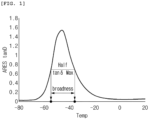
- the modified conjugated diene-based polymer satisfies the difference between the glass transition onset temperature and the glass transition offset temperature and has a full width at half maximum (FWHM) value of a tan ⁇ peak shown in a temperature range of -100°C to 100°C of 20°C or higher, in a tan ⁇ graph in accordance with temperature, derived from dynamic viscoelasticity analysis by an Advanced Rheometric Expansion System (ARES).
- FWHM full width at half maximum
- tan ⁇ peaks are shown, or the width of a peak is formed very narrow, and the width of a peak formed is not broad. This may be related to the glass transition temperature, and in the case where units are partitioned in a polymer as in a block copolymer, and there is a large glass transition temperature difference between the blocks, the tan ⁇ peak may have a narrow width and two or more peaks may be shown.
- the width of a peak is generally shown very narrow.
- the glass transition temperature may be the same for both the block copolymer and the random copolymer, but there is a large difference in wet skid resistance, and to solve such defects, there have been efforts to improve the wet skid resistance enduring the change of the glass transition temperature.
- the glass transition temperature changes there are problems in that abrasion resistance changes, and basic physical properties of the polymer change, and the task of achieving a polymer having improved performance is still present. That is, the adjustment of balance between abrasion resistance and wet skid resistance is difficult and remains as a difficult task to solve considering that these two properties are hard to improve simultaneously through a modification process.
- the conjugated diene-based polymer according to an embodiment of the present invention is prepared by a preparation method controlling the microstructure of the polymer, and though having the same glass transition temperature as that of the conventional modified conjugated diene-based polymer, a specific tan ⁇ peak may be shown, and improving effects of the wet skid resistance and abrasion resistance simultaneously, may be achieved.
- the tan ⁇ peak is characterized in being shown in a temperature range of -100°C to 100°C, and the full width at half maximum of the tan ⁇ peak is 25°C or higher, in a tan ⁇ graph in accordance with temperature, derived from dynamic viscoelasticity analysis by an Advanced Rheometric Expansion System (ARES).
- the number of the tan ⁇ peaks shown in the temperature range may be commonly one, or two or more, and in the case of showing two or more peaks, it may mean that the full width at half maximum of one peak among multiple peaks is 25°C or higher.
- the full width at half maximum value of the tan ⁇ peak may be 25°C or higher, preferably, 30°C or higher.
- the full width at half maximum value may be 80°C to the maximum, preferably, 70°C or less.
- the full width at half maximum value of the tan ⁇ peak may be 30°C to 80°C, or 35°C to 60°C.
- the full width at half maximum is less than 25°C, there arise defects of markedly reducing wet skid resistance at the same glass transition temperature, and it is unlikely to achieve a case where the full width at half maximum of the peak is greater than 80°C, and though achieved, phase separation may occur, defects of increasing hysteresis at a high temperature may be inevitably accompanied, and there may arise defects of degrading fuel consumption properties.
- the tan ⁇ peak may be shown at -100°C to 100°C, preferably, -80°C to 20°C, more preferably, -70°C to 0°C. If the peak is shown within the range, more favorable effects of abrasion resistance may be expected.
- Dynamic viscoelasticity analysis by the Advanced Rheometric Expansion System corresponds to measuring tan ⁇ in accordance with temperature in a temperature range of -100°C to 100°C using a dynamic mechanical analyzer (TA Co., ARES-G2) with a torsional mode under a frequency of 10 Hz, a strain of 0.5%, and a temperature rise rate of 5°C/min, and in this case, a graph derived is a tan ⁇ value in accordance with temperature.
- TA Co., ARES-G2 dynamic mechanical analyzer
- the modified conjugated diene-based polymer has a repeating unit derived from a conjugated diene-based monomer as a main unit, and the conjugated diene-based monomer may be, for example, one or more selected from the group consisting of 1,3-butadiene, 2,3-dimethyl-1,3-butadiene, piperylene, 3-butyl-1,3-octadiene, isoprene, 2-phenyl-1,3-butadiene and 2-halo-1,3-butadiene (halo means a halogen atom).
- the conjugated diene-based polymer additionally includes an aromatic vinyl-based monomer in addition to the conjugated diene-based monomer and may further include a repeating unit derived therefrom, and the aromatic vinyl-based monomer may be, for example, one or more selected from the group consisting of styrene, ⁇ -methylstyrene, 3-methylstyrene, 4-methylstyrene, 4-propylstyrene, 1-vinylnaphthalene, 4-cyclohexylstyrene, 4-(p-methylphenyl)styrene, 1-vinyl-5-hexylnaphthalene, 3-(2-pyrrolidino ethyl)styrene, 4-(2-pyrrolidino ethyl)styrene and 3-(2-pyrrolidino-1-methyl ethyl)- ⁇ -methylstyrene.
- the aromatic vinyl-based monomer may be, for example, one or more selected from
- the conjugated diene-based polymer may be a copolymer further including a repeating unit derived from a diene-based monomer of 1 to 10 carbon atoms together with the repeating unit derived from the conjugated diene-based monomer.
- the repeating unit derived from a diene-based monomer may be a repeating unit derived from a diene-based monomer which is different from the conjugated diene-based monomer, and the diene-based monomer which is different from the conjugated diene-based monomer may be, for example, 1,2-butadiene.
- the conjugated diene-based polymer is a copolymer further including a diene-based monomer
- the conjugated diene-based polymer may include a repeating unit derived from the diene-based monomer in greater than 0 wt% to 1 wt%, greater than 0 wt% to 0.1 wt%, greater than 0 wt% to 0.01 wt%, or greater than 0 wt% to 0.001 wt%, and within this range, effects of preventing gel formation may be achieved.
- a chain structure of a middle type of a random copolymer and a block copolymer may be formed, and in this case, the control of microstructure may be easy, and excellent effects of balance among physical properties may be achieved.
- the random copolymer may mean arrangement of repeating units forming the copolymer in disorder.
- the glass transition temperature of the modified conjugated diene-based polymer may be -100°C to 20°C.
- the glass transition temperature is a value changing according to the microstructure of the polymer, but in order to improve abrasion resistance, the polymer is preferably prepared to satisfy the range, more preferably, -100°C to 0°C, more preferably, -90°C to -10°C, further more preferably, -80°C to -20°C.
- the conjugated diene-based polymer may include the repeating unit derived from an aromatic vinyl-based monomer in 0 wt% to 50 wt%, particularly, 0 wt% to 45 wt%, preferably, 0 wt% to 30 wt%, and here, the inclusion of 0 wt% of the repeating unit derived from an aromatic vinyl-based monomer means that the repeating unit derived from an aromatic vinyl-based monomer is not included, and the polymer is composed of only the conjugated diene-based monomer.
- the 1,2-vinyl bond content may be 10 parts by weight to 80 parts by weight, preferably, 20 to 60 parts by weight, more preferably, 20 to 50 parts by weight with respect to 100 parts by weight of the modified conjugated diene-based polymer. If the microstructure is controlled like this, the improvement of abrasion resistance and wet skid resistance in a balanced way may be expected, with excellent tensile properties and fuel consumption properties.
- the modified conjugated diene-based polymer according to an embodiment of the present invention may have the Si and N contents of 50 ppm or more, or 50 ppm to 1000 ppm each, based on the total weight of the polymer.
- the lower limit may preferably be 100 ppm or more, and 150 ppm or more each, and the upper limit may preferably be 700 ppm or less, preferably, 500 ppm or less each.
- the mechanical properties such as tensile properties and viscoelasticity properties of a rubber composition including the modified conjugated diene-based polymer may be excellent.
- a compound having a modification functional group such as a modifier which will be explained later, a modification initiator and a modification monomer is introduced, the Si and N may be derived therefrom.
- the modified conjugated diene-based polymer includes a functional group derived from a modifier, and the modifier is for modifying the terminals of a polymer, and particularly, may be an alkoxysilane-based modifier as a modifier having affinity with silica.
- the modifier having affinity with silica may mean a modifier containing a functional group having affinity with silica in a compound used as the modifier, and the functional group having affinity with silica may mean a functional group having excellent affinity with a filler, particularly, a silica-based filler, and is capable of making interaction between the silica-based filler and the functional group derived from the modifier.
- the modifier may be, for example, an alkoxysilane-based modifier, particularly, an alkoxysilane-based modifier containing one or more heteroatoms including a nitrogen atom, an oxygen atom, and a sulfur atom.
- an alkoxysilane-based compound is used as a modifier, through substitution reaction between an anionic active part positioned at one terminal of an active polymer and an alkoxy group of the alkoxysilane-based modifier, the one terminal of the active polymer may be modified into a bonding state with a silyl group, and accordingly, the affinity with an inorganic filler of the modified conjugated diene-based polymer may be increased from the functional group derived from the modifier present at the one terminal of the polymer unit, and the viscoelasticity properties of a rubber composition including the modified conjugated diene-based polymer may be improved.
- alkoxysilane-based compound contains a nitrogen atom
- additional effects of improving physical properties due to the nitrogen atom may be anticipated in addition to the effects due to the silyl group.
- an alkoxysilane-based compound including an N-containing functional group is preferably applied.
- the modifier may include a compound represented by Formula 1 below.
- R 1 may be a single bond, or an alkylene group of 1 to 10 carbon atoms
- R 2 and R 3 may be each independently an alkyl group of 1 to 10 carbon atoms
- R 4 may be hydrogen, an alkyl group of 1 to 10 carbon atoms, a mono-substituted, di-substituted, or tri-substituted alkylsilyl group with an alkyl group of 1 to 10 carbon atoms, or a heterocycle of 2 to 10 carbon atoms
- R 21 may be a single bond, an alkylene group of 1 to 10 carbon atoms, or -[R 42 O] j -, where R 42 may be an alkylene group of 1 to 10 carbon atoms, a and m may be each independently an integer selected from 1 to 3, n may be an integer of 0, 1 or 2, and j may be an integer selected from 1 to 30.
- R 1 may be a single bond, or an alkylene group of 1 to 5 carbon atoms
- R 2 and R 3 may be each independently hydrogen, or an alkyl group of 1 to 5 carbon atoms
- R 4 may be hydrogen, an alkyl group of 1 to 5 carbon atoms, a trialkylsilyl group which is substituted with an alkyl group of 1 to 5 carbon atoms, or a heterocyclic group of 2 to 5 carbon atoms
- R 4 is a heterocyclic group
- the heterocyclic group may be unsubstituted or substituted with a trisubstituted alkoxysilyl group
- the trisubstituted alkoxysilyl group may be substituted via the connection with the heterocyclic group by an alkylene group of 1 to 10 carbon atoms
- the trisubstituted alkoxysilyl group may mean an alkoxysilyl group which is substituted with an alkoxy group of 1 to 10 carbon atoms.
- the compound represented by Formula 1 may be one selected from the group consisting of N,N-bis(3-(dimethoxy(methyl)silyl)propyl)-methyl-1-amine, N,N-bis(3-(diethoxy(methyl)silyl)propyl)-methyl-1-amine, N,N-bis(3-(trimethoxysilyl)propyl)-methyl-1-amine, N,N-bis(3-(triethoxysilyl)propyl)-methyl-1-amine, N,N-diethyl-3-(trimethoxysilyl)propan-1-amine, N,N-diethyl-3-(triethoxysilyl)propan-1-amine, tri(trimethoxysilyl)amine, tri-(3-(trimethoxysilyl)propyl)amine, N,N-bis(3-(diethoxy(methyl)silyl)propyl)-1,1,1-trimethlysilanamine,
- the modifier may include a compound represented by Formula 2 below.
- R 5 , R 6 and R 9 may be each independently an alkylene group of 1 to 10 carbon atoms
- R 7 , R 8 , R 10 and R 11 may be each independently an alkyl group of 1 to 10 carbon atoms
- R 12 may be hydrogen or an alkyl group of 1 to 10 carbon atoms
- b and c may be each independently 0, 1, 2 or 3, where b+c ⁇ 1 may be satisfied
- A may be where R 13 , R 14 , R 15 and R 16 may be each independently hydrogen or an alkyl group of 1 to 10 carbon atoms.
- the compound represented by Formula 2 may be one selected from the group consisting of N-(3-(1H-imidazol-1-yl)propyl)-3-(triethoxysilyl)-N-(3-(triethoxysilyl)propyl)propan-1-amine and 3-(4,5-dihydro-1H-imidazol-1-yl)-N,N-bis(3-(triethoxysilyl)propyl)propan-1-amine.
- the modifier may include a compound represented by Formula 3 below.
- a 1 and A 2 may be each independently a divalent hydrocarbon group of 1 to 20 carbon atoms, which contains an oxygen atom or not
- R 17 to R 20 may be each independently a monovalent hydrocarbon group of 1 to 20 carbon atoms
- L 1 to L 4 may be each independently a mono-substituted, di-substituted, or tri-substituted alkylsilyl group with an alkyl group of 1 to 10 carbon atoms, or a monovalent hydrocarbon group of 1 to 20 carbon atoms, where L 1 and L 2 , and L 3 and L 4 each may be combined with each other to form rings of 1 to 5 carbon atoms, and if L 1 and L 2 , and L 3 and L 4 each are combined with each other to form rings, the rings thus formed may include one to three of one or more types of heteroatoms selected from the group consisting of N, O and S.
- a 1 and A 2 may be each independently an alkylene group of 1 to 10 carbon atoms
- R 17 to R 20 may be each independently an alkyl group of 1 to 10 carbon atoms
- L 1 to L 4 may be each independently a trialkylsilyl group which is substituted with an alkyl group of 1 to 5 carbon atoms, or an alkyl group of 1 to 10 carbon atoms, where L 1 and L 2 , and L 3 and L 4 each may be combined with each other to form rings of 1 to 3 carbon atoms, and if L 1 and L 2 , and L 3 and L 4 each are combined with each other to form rings, the rings thus formed may include one to three of one or more types of heteroatoms selected from the group consisting of N, O and S.
- the compound represented by Formula 3 may be one selected from the group consisting of 3,3'-(1,1,3,3-tetramethoxydisiloxane-1,3-diyl)bis(N,N-dimethylpropan-1-amine), 3,3'-(1,1,3,3-tetraethoxydisiloxane-1,3-diyl)bis(N,N-dimethylpropan-1-amine), 3,3'-(1,1,3,3-tetrapropoxydisiloxane-1,3-diyl)bis(N,N-dimethylpropan-1-amine), 3,3'-(1,1,3,3-tetramethoxydisiloxane-1,3-diyl)bis(N,N-diethylpropan-1-amine), 3,3'-(1,1,3,3-tetramethoxydisiloxane-1,3-diyl)bis(N,N-dipropylpropan-1-amine),
- the modifier may include a compound represented by Formula 4 below.
- R 22 and R 23 may be each independently an alkylene group of 1 to 20 carbon atoms, or -R 28 [OR 29 ] f -, R 24 to R 27 may be each independently an alkyl group of 1 to 20 carbon atoms or an aryl group of 6 to 20 carbon atoms, R 28 and R 29 may be each independently an alkylene group of 1 to 20 carbon atoms, R 47 and R 48 may be each independently a divalent hydrocarbon group of 1 to 6 carbon atoms, d and e may be each independently 0 or an integer selected from 1 to 3, where d+e may be an integer of 1 or more, and f may be an integer of 1 to 30.
- R 22 and R 23 may be each independently an alkylene group of 1 to 10 carbon atoms, or - R 28 [OR 29 ] f -, R 24 to R 27 may be each independently an alkyl group of 1 to 10 carbon atoms, R 28 and R 29 may be each independently an alkylene group of 1 to 10 carbon atoms, d and e may be each independently 0 or an integer selected from 1 to 3, where d+e may be an integer of 1 or more, and f may be an integer of 1 to 30.
- the compound represented by Formula 4 may be a compound represented by Formula 4a, Formula 4b, or Formula 4c below.
- the compound represented by Formula 4 may be one selected from the group consisting of 1,4-bis(3-(3-(triethoxysilyl)propoxy)propyl)piperazine, 1,4-bis(3-(triethoxysilyl)propyl)piperazine, 1,4-bis(3-(trimethoxysilyl)propyl)piperazine, 1,4-bis(3-(dimethoxymethylsilyl)propyl)piperazine, 1-(3-(ethoxydimethlylsilyl)propyl)-4-(3-(triethoxysilyl)propyl)piperazine, 1-(3-(ethoxydimethyl)propyl)-4-(3-(triethoxysilyl)methyl)piperazine, 1-(3-(ethoxydimethyl)methyl)-4-(3-(triethoxysilyl)propyl)piperazine, 1,3-bis(3-(triethoxysilyl)propoxypiperaz
- the modifier may include a compound represented by Formula 5 below.
- R 30 may be a monovalent hydrocarbon group of 1 to 30 carbon atoms
- R 31 to R 33 may be each independently an alkylene group of 1 to 10 carbon atoms
- R 34 to R 37 may be each independently an alkyl group of 1 to 10 carbon atoms
- g and h may be each independently 0 or an integer selected from 1 to 3, where g+h may be an integer of 1 or more.
- the modifier may include a compound represented by Formula 6 below.
- a 3 and A 4 may be each independently an alkylene group of 1 to 10 carbon atoms
- R 31 to R 41 may be each independently an alkyl group of 1 to 10 carbon atoms, or an alkoxy group of 1 to 10 carbon atoms
- i may be an integer selected from 1 to 30.
- the modifier may include one or more selected from the group consisting of 3,4-bis(2-methoxyethoxy)-N-(4-(triethoxylsilyl)butyl)aniline, N,N-diethyl-3-(7-methyl-3,6,8,11-tetraoxa-7-silatridecan-7-yl)propan-1-amine, 2,4-bis(2-methoxyethoxy)-6-((trimethylsilyl)methyl)-1,3,5-triazine and 3,14-dimethoxy-3,8,8,13-tetramethyl-2,14-dioxa-7,9-dithia-3,8,13-trisilapentadecane.
- the modifier may include a compound represented by Formula 7 below.
- R 13 , R 45 and R 46 may be each independently an alkyl group of 1 to 10 carbon atoms, R 44 may be an alkylene group of 1 to 10 carbon atoms, and k may be an integer selected from 1 to 4.
- the compound represented by Formula 7 may be one selected from the group consisting of 8,8-dibutyl-3,13-dimethoxy-3,13-dimethyl-2,14-dioxa-7,9-dithia-3,13-disila-8-stannapentadecane, 8,8-dimethyl-3,13-dimethoxy-3,13-dimethyl-2,14-dioxa-7,9-dithia-3,13-disila-8-stannapentadecane, 8,8-dibutyl-3,3,13,13-tetramethoxy-2,14-dioxa-7,9-dithia-3,13-disila-8-stannapentadecane and 8-butyl-3,3,13,13-tetramethoxy-8-((3-(trimethoxysilyl)propyl)thio)-2,14-dioxa-7,9-dithia-3,13-d
- the modifier may include a compound represented by Formula 8 below.
- R b2 to R b4 are each independently an alkylene group of 1 to 10 carbon atoms
- R b5 to R b8 are each independently an alkyl group of 1 to 10 carbon atoms
- R b13 and R b14 are each independently an alkylene group of 1 to 10 carbon atoms
- R b15 to R b18 are each independently an alkyl group of 1 to 10 carbon atoms
- m1 , m2 , m3 and m4 are each independently an integer of 1 to 3.
- the modifier may include a compound represented by Formula 9 below.
- R e1 and R e2 are each independently an alkylene group of 1 to 10 carbon atoms
- R e3 to R e6 are each independently hydrogen, an alkyl group of 1 to 10 carbon atoms or -R e7 SiR e8 R e9 R e10 , where at least one among R e3 to R e6 is - R e7 SiR e8 R e9 R e10 , wherein R e7 is a single bond or an alkylene group of 1 to 10 carbon atoms
- R e8 to R e10 are each independently an alkyl group of 1 to 10 carbon atoms or an alkoxy group of 1 to 10 carbon atoms, where at least one among R e8 to R e10 is an alkoxy group of 1 to 10 carbon atoms.
- the modifier may include a compound represented by Formula 10 below.
- X is O or S
- R f1 and R f2 are each independently a single bond or an alkylene group of 1 to 10 carbon atoms
- R f3 to R f8 are each independently hydrogen, an alkyl group of 1 to 10 carbon atoms, an alkoxy group of 1 to 10 carbon atoms, an aryl group of 6 to 10 carbon atoms, a cycloalkyl group of 5 to 10 carbon atoms or an aralkyl group of 7 to 14 carbon atoms, and p is an integer of 0 or 1, where if p is 0, R e1 is an alkyl group of 1 to 10 carbon atoms or an alkoxy group of 1 to 10 carbon atoms.
- the modifier may include a compound represented by Formula 11 below.
- R g1 to R g4 are each independently hydrogen, an alkyl group of 1 to 10 carbon atoms, an alkoxy group of 1 to 10 carbon atoms, an aryl group of 6 to 12 carbon atoms or -R g5 SiOR g6 , where at least one among R g1 to R g4 is - R g5 SiOR g6 , wherein R g5 is a single bond or an alkylene group of 1 to 10 carbon atoms, R g6 is an alkyl group of 1 to 10 carbon atoms, and Y is C or N, where if Y is N, R g4 is not present.
- the modifier may include a compound represented by Formula 12 below.
- R h1 and R h2 are each independently an alkyl group of 1 to 10 carbon atoms or an alkoxy group of 1 to 10 carbon atoms
- R h3 is a single bond or an alkylene group of 1 to 10 carbon atoms
- a 3 is -Si (R h4 R h5 R h6 ) or -N [Si(R h7 R h8 R h9 )] 2 , where R h4 to R h9 are each independently an alkyl group of 1 to 10 carbon atoms or an alkoxy group of 1 to 10 carbon atoms.
- the modifier may include a compound represented by Formula 13 below.
- R g1 to R g3 are each independently an alkyl group of 1 to 10 carbon atoms or an alkoxy group of 1 to 10 carbon atoms
- R g4 is an alkoxy group of 1 to 10 carbon atoms
- q is an integer of 2 to 100.
- the modified conjugated diene-based polymer according to an embodiment of the present invention has a contraction factor (g') obtained by the measurement by a gel permeation chromatography-light scattering method equipped with a viscosity detector of 0.1 or more, preferably, 0.1 to 1.0, more particularly, 0.3 to 0.9.
- the contraction factor (g') obtained through the measurement by the gel permeation chromatography-light scattering method is a ratio of the intrinsic viscosity of a branched polymer with respect to the intrinsic viscosity of a linear polymer, which have the same absolute molecular weight, and may be used as the index of the branch structure of the branched polymer, that is, the index of the ratio occupied by branches.
- the contraction factor decreases with the increase of the branches, and the contraction factor may be used as the index of the degree of branching.
- the contraction factor is obtained by measuring chromatogram using a gel chromatography-light scattering measurement apparatus equipped with a viscosity detector and computing based on a solution viscosity and a light scattering method, and particularly, absolute molecular weights and intrinsic viscosity corresponding to each absolute molecular weight were obtained using a GPC-light scattering measurement apparatus equipped with a light scattering detector in which two columns using a polystyrene-based gel as a filler are connected and a viscosity detector, the intrinsic viscosity of a linear polymer corresponding to the absolute molecular weight was computed, and the contraction factor was obtained as a ratio of intrinsic viscosity corresponding to each absolute molecular weight.
- the contraction factor was shown by obtaining absolute molecular weights from a light scattering detector by injecting a specimen into a GPC-light scattering measurement apparatus (Viscotek TDAmax, Malvern Co.) equipped with a light scattering detector and a viscosity detector, obtaining intrinsic viscosity [ ⁇ ] on the absolute molecular weight from the light scattering detector and the viscosity detector, computing the intrinsic viscosity [ ⁇ ] 0 of a linear polymer on the absolute molecular weight through Mathematical Equation 1 below, and showing an average value of the ratio of intrinsic viscosities ([ ⁇ ]/[ ⁇ ] 0 ) corresponding to each absolute molecular weight as the contraction factor.
- a mixture solution of tetrahydrofuran and N,N,N',N'-tetramethylethylenediamine (controlled by mixing 20 mL of N,N,N',N'-tetramethylethylenediamine with 1 L of tetrahydrofuran) was used as an eluent, PL Olexis (Agilent Co.) was used as a column, measurement was conducted under conditions of an oven temperature of 40°C and a THF flow rate of 1.0 mL/min, and a specimen was prepared by dissolving 15 mg of a polymer in 10 mL of THF.
- M is an absolute molecular weight
- the modified conjugated diene-based polymer may have the vinyl content of 5 wt% or more, 10 wt% or more, or 10 wt% to 60 wt%.
- the vinyl content may mean the amount of not 1,4-added but 1,2-added conjugated diene-based monomer based on 100 wt% of a conjugated diene-based polymer composed of a monomer having a vinyl group and an aromatic vinyl-based monomer.
- the modified conjugated diene-based polymer may have a mooney relaxation ratio measured at 100°C of less than 0.7, and may be 0.7 to 3.0.
- the mooney relaxation ratio may be less than 0.7, preferably, 0.6 or less, more preferably, 0.5 or less, optimally 0.4 or less, and in case of a linear polymer having a small degree of branching, the mooney relaxation ratio may preferably be 0.7 to 2.5, more preferably, 0.7 to 2.0.
- the mooney relaxation ratio represents the stress change shown as the response to the same amount of strain, and may be measured using a mooney viscometer.
- the mooney relaxation ratio was obtained using a large rotor of MV2000E of Monsanto Co. in conditions of 100°C and a rotor speed of 2 ⁇ 0.02 rpm, by standing a polymer at room temperature (23 ⁇ 5°C) for 30 minutes or more, collecting 27 ⁇ 3 g of the polymer and putting in a die cavity, applying torque by operating a Platen and measuring mooney viscosity, and measuring the slope value of the change of the mooney viscosity shown while releasing torque.
- the mooney relaxation ratio may be used as the index of the branch structure of a corresponding polymer.
- the mooney relaxation ratio decreases with the increase of branching and may be used as the index of the degree of branching.
- the modified conjugated diene-based polymer according to an embodiment of the present invention may include a functional group derived from a modification initiator at the other terminal in addition to one terminal including a functional group derived from a modifier, and here, the modification initiator may be a reaction product of an N-functional group-containing compound and an organometallic compound.
- the N-functional group-containing compound may be a substituted with a substituent or unsubstituted aromatic hydrocarbon compound including an N-functional group including an amino group, amide group, amino group, imidazole group, imidazole group, pyrimidyl group or cyclic amino group
- the substituent may be an alkyl group of 1 to 20 carbon atoms, a cycloalkyl group of 3 to 20 carbon atoms, an aryl group of 6 to 20 carbon atoms, an alkylaryl group of 7 to 20 carbon atoms, an arylalkyl group of 7 to 20 carbon atoms or an alkoxysilyl group of 1 to 10 carbon atoms.
- the modified conjugated diene-based polymer may have a weight average molecular weight (Mw) measured by gel permeation chromatography (GPC) of 300,000 g/mol to 3,000,000 g/mol, 400,000 g/mol to 2,500,000 g/mol, or 500,000 g/mol to 2,000,000 g/mol, and within this range, running resistance and wet skid resistance may be excellent in a balanced way even better.
- Mw weight average molecular weight measured by gel permeation chromatography
- the modified conjugated diene-based polymer according to an embodiment of the present invention may be a polymer having a high molecular weight with a weight average molecular weight of 800,000 g/mol or more, preferably, 1,000,000 g/mol or more, and accordingly, a polymer having excellent tensile properties may be achieved, and if prepared by the above-described preparation method, effects of extending the chain of a polymer long may be achieved together with the control of microstructure.
- the modified conjugated diene-based polymer may have a number average molecular weight (Mn) of 1,000 g/mol to 2,000,000 g/mol, 10,000 g/mol to 1,500,000 g/mol, or 100,000 g/mol to 1,200,000 g/mol, and the number average molecular weight may preferably be 400,000 g/mol or more, more preferably, 500,000 g/mol or more.
- Mp peak top molecular weight
- Mp may be 1,000 g/mol to 3,000,000 g/mol, 10,000 g/mol to 2,000,000 g/mol, or 100,000 g/mol to 2,000,000 g/mol. Within these ranges, excellent effects of rolling resistance and wet skid resistance may be achieved.
- the modified conjugated diene-based polymer may have a unimodal molecular weight distribution curve by gel permeation chromatography (GPC) and molecular weight distribution of 1.0 to 3.0, preferably, 1.0 to 2.5, more preferably, 1.0 to 2.0, further more preferably, 1.0 to less than 1.7, and here, the unimodal curve shape and molecular weight distribution may be satisfied at the same time by a continuous type polymerization, which will be explained later.
- GPC gel permeation chromatography
- the modified conjugated diene-based polymer specifies a polymer structure so as to have a difference between glass transition initiation temperature and termination temperature through the control of the microstructure of the polymer, such as the aforementioned styrene bond content and 1,2-vinyl bond content, and through the selective control of a weight average molecular weight, a molecular weight distribution curve shape, molecular weight distribution, N and Si atom contents, and mooney viscosity, effects of improving abrasion resistance and wet skid resistance in a balanced way could be expected, while maintaining excellent tensile properties, fuel consumption properties and processability.
- the microstructure of the polymer such as the aforementioned styrene bond content and 1,2-vinyl bond content
- the present invention provides a method for preparing a modified conjugated diene-based polymer as follows.
- the method for preparing a modified conjugated diene-based polymer is characterized in being a continuous-type preparation method and including polymerizing a conjugated diene-based monomer, or a conjugated diene-based monomer and an aromatic vinyl-based monomer in the presence of a hydrocarbon solvent, a polymerization initiator and a polar additive to prepare an active polymer (S1); and reacting the active polymer prepared in step (S1) with a modifier (S2), wherein step (S1) is performed continuously in two or more polymerization reactors, a polymer is transported to a second reactor at a point where a polymerization conversion ratio in a first reactor is 70% to 85%, and a polar additive, or a polar additive and a conjugated diene-based monomer are additionally added to the second reactor.
- the hydrocarbon solvent is not specifically limited, but may be, for example, one or more selected from the group consisting of n-pentane, n-hexane, n-heptane, isooctane, cyclohexane, toluene, benzene and xylene.
- the polymerization initiator may be used in 0.1 equivalents to 3.0 equivalents, preferably, 0.1 equivalents to 2.0 equivalents, more preferably, 0.5 equivalents to 1.5 equivalents based on 1.0 equivalent of the monomer.
- the polymerization initiator may be used in 0.01 mmol to 10 mmol, 0.05 mmol to 5 mmol, 0.1 mmol to 2 mmol, 0.1 mmol to 1 mmol, or 0.15 to 0.8 mmol based on total 100 g of the monomer.
- the total 100 g of the monomer may be a conjugated diene-based monomer, or the sum of a conjugated diene-based monomer and an aromatic vinyl-based monomer.
- the polymerization initiator may be an organometallic compound, for example, one or more selected from the group consisting of an organolithium compound, an organosodium compound, an organopotassium compound, an organorubidium compound and an organocesium compound.
- the organometallic compound may be one or more selected from the group consisting of methyllithium, ethyllithium, propyllithium, n-butyllithium, s-butyllithium, t-butyllithium, hexyllithium, n-decyllithium, t-octyllithium, phenyllithium, 1-naphthyl lithium, n-eicosyl lithium, 4-butylphenyl lithium, 4-tolyl lithium, cyclohexyl lithium, 3,5-di-n-heptylcyclohexyl lithium, 4-cyclopentyl lithium, naphthyl sodium, naphthyl potassium, lithium alkoxide, sodium alkoxide, potassium alkoxide, lithium sulfonate, sodium sulfonate, potassium sulfonate, lithium amide, sodium amide, potassium amide, and lithium isopropylamide.
- the polymerization initiator may be a modification initiator, and the modification initiator may be a reaction product of an N-functional group-containing compound and the organometallic compound.
- step (S1) in the preparation method is a step of performing polymerization reaction of a conjugated diene-based monomer, or a conjugated diene-based monomer and an aromatic vinyl-based monomer by, for example, anionic polymerization.
- the anionic polymerization may be a living anionic polymerization by which an anionic active part is formed at the polymerization terminal through a propagation reaction by anions.
- the polymerization of step (S1) may be a polymerization with heating, an isothermal polymerization, or a polymerization at a constant temperature (adiabatic polymerization).
- the polymerization at a constant temperature may mean a polymerization method including a step of polymerizing using self-generated heat of reaction without optionally applying heat after adding a polymerization initiator
- the polymerization with heating may mean a polymerization method including injecting the polymerization initiator and then, increasing the temperature by optionally applying heat
- the isothermal polymerization may mean a polymerization method by which the temperature of a polymer is kept constant by increasing heat by applying heat or taking heat after injecting the polymerization initiator.
- the polymerization of step (S1) may be performed by further adding a diene-based compound of 1 to 10 carbon atoms in addition to the conjugated diene-based monomer, and in this case, effects of preventing the formation of gel on the wall of a reactor during operating for a long time may be achieved.
- the diene-based compound may be, for example, 1,2-butadiene.
- the polymerization of step (S1) is performed in two or more polymerization reactors, and a polymerization conversion ratio in the first polymerization reactor among the polymerization reactors may be 70% to 85%, or 70% to less than 80%. That is, the polymerization of step (S1) may be only performed until the polymerization conversion ratio in the first polymerization reactor becomes 70% or more, 70% to 85%, or 70% to less than 80%.
- the polymerization in the first reactor may be performed, for example, in a temperature range of 80°C or less, -20°C to 80°C, 0°C to 80°C, 0°C to 70°C, or 10°C to 70°C, and in this range, the molecular weight distribution of the polymer may be controlled narrow, and excellent effects of improving physical properties may be achieved.
- step (S1) is performed in two or more reactors, and after performing polymerization until the aforementioned conversion ratio in the first reactor is achieved, the polymer is transported to the second reactor, and the additional injection of a polar additive or a conjugated diene-based monomer to the second reactor may be performed.
- the polar additive, or the polar additive and the conjugated diene-based monomer, additionally injected may be injected at once or in order, and may be injected in installments at various points among the points in the range or injected continuously within the point in the range.
- the additional injection of the polar additive, or the polar additive and conjugated diene-based monomer may be a means for achieving the glass transition temperature properties of a polymer prepared together with for controlling the conversion ratio in the first reactor.
- a power may be further applied to polymerization reaction after a specific polymerization conversion ratio to arise the deformation of a microstructure.
- the polar additive may control the ratio of 1,2-bond and 1,4-bond through the control of a reaction rate, and in the case of copolymerizing a conjugated diene-based monomer and an aromatic vinyl-based monomer, a reaction rate difference between the monomers may be corrected to achieve inducing effects of easy formation of a random copolymer.
- the polar additive additionally injected may be used in a suitable amount in a direction so that the full width at half maximum of a tan ⁇ peak becomes broadened.
- the polar additive additionally injected may be used in a ratio of 0.001 g to 10 g, or 0.01 g to 1.0 g, more preferably, 0.02 g to 0.5 g based on total 100 g of the monomer used when initiating polymerization.
- the conjugated diene-based monomer selectively additionally injected may be used in an amount of 5 g to 25 g, or 5 g to 20 g based on 100 g of the monomer used when initiating polymerization. If the polar additive or the conjugated diene-based monomer additionally injected is controlled in the aforementioned amount, there are advantages in that the control of the glass transition temperature of the polymer may be easy, finer control thereof may be possible, and the full width at half maximum of a tan ⁇ peak by dynamic viscoelasticity analysis may be broadened.
- the total amount used of the polar additive used in the polymerization of step (S1) may be in a ratio of 0.001 g to 50 g, or 0.002 g to 1.0 g based on total 100 g of the monomer. In another embodiment, the total amount used of the polar additive may be in a ratio of greater than 0 g to 1 g, 0.01 g to 1 g, or 0.1 g to 0.9 g based on total 100 g of the polymerization initiator. Here, the total amount used of the polar additive includes the additionally injected amount of the polar additive.
- the polymerization in the second reactor may be performed in a temperature range of 80°C or less, -20°C to 80°C, 0°C to 80°C, 0°C to 70°C, or 10°C to 70°C, and in this range, the molecular weight distribution of the polymer may be controlled narrow, and excellent effects of improving physical properties may be achieved.
- the polar additive may be, for example, one or more selected from the group consisting of tetrahydrofuran, 2,2-di (2-tetrahydrofuryl)propane, diethyl ether, cyclopentyl ether, dipropyl ether, ethylene methyl ether, ethylene glycol dimethyl ether, diethylene glycol, dimethyl ether, tert-butoxy ethoxy ethane, bis(3-dimethylaminoethyl)ether, (dimethylaminoethyl) ethyl ether, trimethylamine, triethylamine, tripropylamine, N,N,N',N'-tetramethylethylenediamine, sodium mentholate and 2-ethyl tetrahydrofufuryl ether, and may preferably be 2,2-di(2-tetrahydrofuryl) propane, triethylamine, tetramethylethylenediamine, sodium mentholate or 2-e
- the polymerization conversion ratio may be determined, for example, by measuring the solid concentration in a polymer solution phase including the polymer during polymerization, and in a particular embodiment, in order to secure the polymer solution, a cylinder type container is installed at the outlet of each polymerization reactor to fill up a certain amount of the polymer solution in the cylinder type container, and then, the cylinder type container is separated from the reactor, the weight (A) of the cylinder filled with the polymer solution is measured, the polymer solution filled in the cylinder type container is transported to an aluminum container, for example, an aluminum dish, the weight (B) of the cylinder type container from which the polymer solution is removed is measured, the aluminum container containing the polymer solution is dried in an oven of 140°C for 30 minutes, the weight (C) of a dried polymer is measured, and calculation is performed according to Mathematical Equation 2 below.
- Polymerization conversion ratio % Weight C Weight A ⁇ Weight B ⁇ Total solid content TSC ⁇ 100
- the total solid content is the total solid content (monomer content) in a polymer solution separated from each reactor and is the weight percent of the solid content with respect to 100% of the polymer solution. For example, if the total solid content is 20 wt%, calculation may be performed by substituting 20/100, i.e., 0.2 in Mathematical Equation 2.
- the polymer polymerized in the second reactor may be transported to a final polymerization reactor in order, and polymerization may be performed until the final polymerization conversion ratio becomes 95% or more.
- the polymerization conversion ratio for each reactor of the third reactor to the final polymerization reactor may be suitably controlled to control molecular weight distribution.
- a reaction terminator for deactivating an activation part may be injected, and in case of preparing a modified conjugated diene-based polymer, an active polymer may be transported to a modification reaction process, and the reaction terminator may use any materials commonly used in this technical field, without limitation.
- the active polymer prepared by step (S1) may mean a polymer in which a polymer anion and the organometallic cation of a polymerization initiator are combined.
- the step (S2) is a modification step for reacting the active polymer prepared in step (S1) with a modifier, and the anion active part of the active polymer and an alkoxy group bonded to the silane of the modifier may react.
- the modifier may be used in an amount of 0.01 mmol to 10 mmol based on total 100 g of the monomer. In another embodiment, the modifier may be used in a molar ratio of 1:0.1 to 10, 1:0.1 to 5, or 1:0.1 to 1:3, based on 1 mol of the polymerization initiator of step (S1).
- the modifier may be injected into a modification reactor, and step (S2) may be conducted in the modification reactor.
- the modifier may be injected into a transporting part for transporting the active polymer prepared in step (S1) to a modification reactor for conducting step (S2), and the reaction may be performed by the mixing of the active polymer and the modifier in the transporting part.
- the reaction may be modification reaction for simply coupling the modifier with the active polymer, or coupling reaction for connecting the active polymer based on the modifier.
- a step of additionally injecting a conjugated diene-based monomer to the active polymer prepared in step (S1) and reacting may be further performed prior to the modification reaction of step (S2), and in this case, modification reaction afterward may become more favorable.
- the conjugated diene-based monomer may be injected in 1 mol to 100 mol based on 1 mol of the active polymer.
- the preparation method of a modified conjugated diene-based polymer according to an embodiment of the present invention is a method that may satisfy the properties of the aforementioned modified conjugated diene-based polymer, and as described above, the effects to achieve in the present invention may be achieved if the properties are satisfied, but through controlling other polymerization conditions diversely, the physical properties of the modified conjugated diene-based polymer according to the present invention may be achieved.
- a rubber composition including the modified conjugated diene-based polymer and a filler is provided.
- the rubber composition may include the modified conjugated diene-based polymer in an amount of 10 wt% or more, 10 wt% to 100 wt%, or 20 wt% to 90 wt%, and within this range, mechanical properties such as tensile strength and abrasion resistance are excellent, and effects of excellent balance between physical properties may be achieved.
- the rubber composition may further include other rubber components, as necessary, in addition to the modified conjugated diene-based polymer, and in this case, the rubber components may be included in an amount of 90 wt% or less based on the total weight of the rubber composition. In a particular embodiment, the other rubber components may be included in an amount of 1 part by weight to 900 parts by weight based on 100 parts by weight of the modified conjugated diene-based polymer.
- the rubber component may be, for example, natural rubber or synthetic rubber, and may particularly be natural rubber (NR) including cis-1, 4-polyisoprene; modified natural rubber which is obtained by modifying or purifying common natural rubber, such as epoxidized natural rubber (ENR), deproteinized natural rubber (DPNR), and hydrogenated natural rubber; and synthetic rubber such as a styrene-butadiene copolymer (SBR), a polybutadiene (BR), a polyisoprene (IR), butyl rubber (IIR), an ethylene-propylene copolymer, a polyisobutylene-co-isoprene, neoprene, a poly(ethylene-co-propylene), a poly(styrene-co-butadiene), a poly(styrene-co-isoprene), a poly(styrene-co-isoprene), a poly(styrene-co-iso
- the rubber composition may include a filler in 0.1 parts by weight to 200 parts by weight, or 10 parts by weight to 120 parts by weight based on 100 parts by weight of the modified conjugated diene-based polymer of the present invention.
- the filler may be, for example, a silica-based filler, particularly, wet silica (hydrated silicate), dry silica (anhydrous silicate), calcium silicate, aluminum silicate, colloid silica, etc., and preferably, the filler may be wet silica which has the most significant improving effects of destruction characteristics and compatible effects of wet grip.
- the rubber composition may further include a carbon-based filler, as necessary.
- silane coupling agent may be used together for the improvement of reinforcing and low exothermic properties.
- the silane coupling agent may include bis(3-triethoxysilylpropyl)tetrasulfide, bis(3-triethoxysilylpropyl)trisulfide, bis(3-triethoxysilylpropyl)disulfide, bis(2-triethoxysilylethyl)tetrasulfide, bis(3-trimethoxysilylpropyl)tetrasulfide, bis(2-trimethoxysilylethyl)tetrasulfide, 3-mercaptopropyltrimethoxysilane, 3-mercaptopropyltriethoxysilane, 2-mercaptoethyltrimethoxysilane, 2-mercaptoethyltriethoxysilane, 3-trimethoxysilyl
- bis(3-triethoxysilylpropyl)polysulfide or 3-trimethoxysilylpropylbenzothiazyltetrasulfide may be used in consideration of the improving effects of reinforcing properties.
- the mixing amount of the silane coupling agent may be smaller than a common case.
- the silane coupling agent may be used in an amount of 1 part by weight to 20 parts by weight, or 5 parts by weight to 15 parts by weight based on 100 parts by weight of silica, and within the above range, effects as a coupling agent may be sufficiently shown, and effects of preventing gelation of a rubber component may be achieved.
- the rubber composition according to an embodiment of the present invention may be sulfur crosslinkable, and may further include a vulcanizing agent.
- the vulcanizing agent may particularly be a sulfur powder and may be included in an amount of 0.1 parts by weight to 10 parts by weight based on 100 parts by weight of a rubber component, and within the above range, elasticity and strength required for a vulcanized rubber composition may be secured, and at the same time, an excellent low fuel consumption ratio may be achieved.
- the rubber composition according to an embodiment of the present invention may further include various additives used in a common rubber industry in addition to the above components, particularly, a vulcanization accelerator, a process oil, a plasticizer, an antiaging agent, a scorch preventing agent, a zinc white, stearic acid, a thermosetting resin, or a thermoplastic resin.
- various additives used in a common rubber industry particularly, a vulcanization accelerator, a process oil, a plasticizer, an antiaging agent, a scorch preventing agent, a zinc white, stearic acid, a thermosetting resin, or a thermoplastic resin.
- the vulcanization accelerator may include, for example, thiazole-based compounds such as 2-mercaptobenzothiazole (M), dibenzothiazyldisulfide (DM), and N-cyclohexyl-2-benzothiazylsulfenamide (CZ), or guanidine-based compounds such as diphenylguanidine (DPG), in 0.1 parts by weight to 5 parts by weight based on 100 parts by weight of the rubber component.
- M 2-mercaptobenzothiazole
- DM dibenzothiazyldisulfide
- CZ N-cyclohexyl-2-benzothiazylsulfenamide
- guanidine-based compounds such as diphenylguanidine (DPG)
- the process oil acts as a softener in a rubber composition and may include, for example, paraffin-based, naphthene-based, or aromatic compounds.
- the aromatic process oil may be used in consideration of tensile strength and abrasion resistance, and the naphthene-based or paraffin-based process oil may be used in consideration of hysteresis loss and properties at a low temperature.
- the process oil may be included in an amount of 100 parts by weight or less based on 100 parts by weight of the rubber component. Within the above-described range, the deterioration of the tensile strength and low exothermic properties (low fuel consumption ratio) of the vulcanized rubber may be prevented.
- the antiaging agent may include, for example, N-isopropyl-N'-phenyl-p-phenylenediamine, N-(1,3-dimethylbutyl)-N'-phenyl-p-phenylenediamine, 6-ethoxy-2,2,4-trimethyl-1,2-dihydroquinoline, or a condensate of diphenylamine and acetone at a high temperature, in 0.1 parts by weight to 6 parts by weight based on 100 parts by weight of the rubber component.
- the rubber composition according to an embodiment of the present invention may be obtained by mulling using a mulling apparatus such as a banbury mixer, a roll, and an internal mixer according to a mixing prescription, and a rubber composition having low exothermic properties and good abrasion properties may be obtained by a vulcanization process after a molding process.
- a mulling apparatus such as a banbury mixer, a roll, and an internal mixer according to a mixing prescription
- a rubber composition having low exothermic properties and good abrasion properties may be obtained by a vulcanization process after a molding process.
- the rubber composition may be useful to the manufacture of each member of a tire such as a tire tread, an under tread, a side wall, a carcass coating rubber, a belt coating rubber, a bead filler, a chafer, and a bead coating rubber, or to the manufacture of rubber products in various industries such as a vibration-proof rubber, a belt conveyor, and a hose.
- the present invention provides a tire manufactured using the rubber composition.
- the tire may be a tire or include a tire tread.
- n-hexane in a flow rate of 5 kg/hr, a monomer solution in which 60 wt% of 1,3-butadiene was dissolved in n-hexane in a flow rate of 1.16 kg/h, a monomer solution in which 60 wt% of styrene was dissolved in n-hexane in a flow rate of 0.31 kg/hr, an initiator solution in which 6.6 wt% of n-butyllithium was dissolved in n-hexane in a flow rate of 8.33 g/hr, and a polar additive solution in which 2 wt% of ditetrahydrofurylpropane was dissolved in n-hexane as a polar additive in a flow rate of 2.25 g/hr.
- the internal temperature of the reactor was maintained to 60°C, and when a polymerization conversion ratio reached
- the temperature of the second reactor was maintained to 60°C, and to the second reactor, continuously injected were a solution in which 60 wt% of 1,3-butadiene was dissolved in n-hexane in a flow rate of 0.2 kg/hr, and a polar additive solution in which 10 wt% of ditetrahydrofurylpropane was dissolved in n-hexane as a polar additive in a flow rate of 6 g/hr to participate in the reaction.
- a polymerization reactant was transported from the second reactor to a third reactor through a transport pipe, and a solution in which 5 wt% of N,N-dimethyl-3-(trimethoxysilyl)propan-1-amine was dissolved in n-hexane as a modifier was injected in a flow rate of 11.6 g/hr, and the reaction was performed for 30 minutes.
- a modified conjugated diene-based polymer was prepared by performing the same method as in Example 1 except for continuously injecting to the first reactor, a monomer solution in which 60 wt% of 1,3-butadiene was dissolved in n-hexane in a flow rate of 1.13 kg/hr, a monomer solution in which 60 wt% of styrene was dissolved in n-hexane in a flow rate of 0.28 kg/hr, and a polar additive solution in which 2 wt% of ditetrahydrofurylpropane was dissolved in n-hexane as a polar additive in a flow rate of 4.0 g/hr, and transporting the polymerization reactant from the first reactor to the second reactor, when the polymerization conversion ratio in the first reactor reached 72%, in Example 1.
- a modified conjugated diene-based polymer was prepared by performing the same method as in Example 1 except for maintaining the temperature of the first reactor to 70°C, and the temperature of the second reactor to 65°C, and transporting the polymerization reactant to the second reactor, when the polymerization conversion ratio in the first reactor reached 80%, in Example 1.
- a modified conjugated diene-based polymer was prepared by performing the same method as in Example 1 except for transporting the polymerization reactant from the first reactor to the second reactor, when the polymerization conversion ratio in the first reactor reached 77%, and not injecting to the second reactor, the 1,3-butadiene solution which was additionally injected to the second reactor, in Example 1.
- a modified conjugated diene-based polymer was prepared by performing the same method as in Example 1 except for injecting a solution in which 5 wt% of bis(3-(diethoxymethylsilylpropyl)-N-methylamine was dissolved in n-hexane instead of N,N-dimethyl-3-(trimethoxysilyl)propan-1-amine as the modifier in a flow rate of 23.0 g/hr, in Example 1.
- a modified conjugated diene-based polymer was prepared by performing the same method as in Example 1 except for continuously injecting to the first reactor, a monomer solution in which 60 wt% of 1,3-butadiene was dissolved in n-hexane in a flow rate of 1.08 kg/hr, a monomer solution in which 60 wt% of styrene was dissolved in n-hexane in a flow rate of 0.35 kg/hr, and a polar additive solution in which 2 wt% of ditetrahydrofurylpropane was dissolved in n-hexane as a polar additive in a flow rate of 3.0 g/hr, transporting the polymerization reactant from the first reactor to the second reactor, when the polymerization conversion ratio in the first reactor reached 75%, continuously injecting the 1,3-butadiene solution which was additionally injected to the second reactor, in a flow rate of 0.24 kg/hr, and injecting a solution in which 5 wt
- a modified conjugated diene-based polymer was prepared by performing the same method as in Example 1 except for transporting the polymerization reactant from the first reactor to the second reactor, when the polymerization conversion ratio in the first reactor reached 73%, and continuously injecting a polar additive solution in which 10 wt% of ditetrahydrofurylpropane was dissolved in n-hexane, which was additionally injected to the second reactor, in a flow rate of 15.0 g/hr, in Example 1.
- a modified conjugated diene-based polymer was prepared by performing the same method as in Example 2 except for transporting the polymerization reactant from the first reactor to the second reactor, when the polymerization conversion ratio in the first reactor reached 73%, and injecting a solution in which 5 wt% of bis(3-(diethoxymethylsilylpropyl)-N-methylamine was dissolved in n-hexane instead of N,N-dimethyl-3-(trimethoxysilyl)propan-1-amine as the modifier in a flow rate of 23.0 g/hr, in Example 2.
- a modified conjugated diene-based polymer was prepared by performing the same method as in Example 1 except for injecting to the first reactor, a polar additive solution in which 2 wt% of ditetrahydrofurylpropane was dissolved in n-hexane in a flow rate of 17.5 g/hr, transporting the polymerization reactant to the second reactor, when the polymerization conversion ratio in the first reactor reached 78%, and not injecting 1,3-butadiene and a polar additive to the second reactor, in Example 1.
- a modified conjugated diene-based polymer was prepared by performing the same method as in Example 6 except for injecting to the first reactor, a polar additive solution in which 2 wt% of ditetrahydrofurylpropane was dissolved in n-hexane in a flow rate of 6.0 g/hr, transporting the polymerization reactant to the second reactor, when the polymerization conversion ratio in the first reactor reached 73%, and not injecting 1,3-butadiene and a polar additive to the second reactor, in Example 6.
- a modified conjugated diene-based polymer was prepared by performing the same method as in Comparative Example 1 except for transporting the polymerization reactant to the second reactor, when the polymerization conversion ratio in the first reactor reached 72%, and performing polymerization reaction by injecting to the second reactor, a solution in which 60 wt% of 1,3-butadiene was dissolved in n-hexane in a flow rate of 0.2 kg/hr, in Comparative Example 1.
- a modified conjugated diene-based polymer was prepared by performing the same method as in Comparative Example 1 except for injecting to the first reactor, a monomer solution in which 60 wt% of 1,3-butadiene was dissolved in n-hexane in a flow rate of 1.08 kg/hr, a monomer solution in which 60 wt% of styrene was dissolved in n-hexane in a flow rate of 0.35 kg/hr, and the polar additive solution in a flow rate of 12.0 g/hr, transporting the polymerization reactant to the second reactor, when the polymerization conversion ratio in the first reactor reached 76%, injecting to the second reactor, a solution in which 60 wt% of 1,3-butadiene was dissolved in n-hexane in a flow rate of 0.2 kg/hr, and performing polymerization reaction, in Comparative Example 1.
- a modified conjugated diene-based polymer was prepared by performing the same method as in Example 1 except for transporting the polymerization reactant to the second reactor, when the polymerization conversion ratio in the first reactor reached 65%, in Example 1.
- a modified conjugated diene-based polymer was prepared by performing the same method as in Example 1 except for transporting the polymerization reactant to the second reactor, when the polymerization conversion ratio in the first reactor reached 87%, in Example 1.
- An unmodified conjugated diene-based polymer was prepared by performing the same method as in Comparative Example 1 except for injecting to the first reactor, a monomer solution in which 60 wt% of 1,3-butadiene was dissolved in n-hexane in a flow rate of 1.16 kg/hr, a monomer solution in which 60 wt% of styrene was dissolved in n-hexane in a flow rate of 0.31 kg/hr, and the polar additive solution in a flow rate of 5.0 g/hr, transporting the polymer to the second reactor, when the polymerization conversion ratio in the first reactor reached 75%, continuously supplying a solution in which 4.5 wt% of silicon tetrachloride was dissolved in n-hexane as a coupling agent instead of the modifier in a flow rate of 3.7 g/hr, and performing coupling reaction, in Comparative Example 1.
- the styrene unit content and vinyl content in each polymer a weight average molecular weight (Mw, x10 3 g/mol), a number average molecular weight molecular (Mn, x10 3 g/mol), molecular weight distribution (PDI, MWD), a glass transition temperature, a glass transition onset temperature, a glass transition offset temperature, and the full width at half maximum of a tan ⁇ peak were measured, and the results are shown in Table 1 below.
- styrene unit (SM) and vinyl contents in each polymer were measured and analyzed using Varian VNMRS 500 MHz NMR.
- 1,1,2,2-tetrachloroethane was used as a solvent, and styrene unit and vinyl contents were calculated by calculating a solvent peak as 6.00 ppm, and regarding 7.2-6.9 ppm as random styrene peaks, 6.9-6.2 ppm as block styrene peaks, 5.8-5.1 ppm as 1,4-vinyl and 1,2-vinyl peaks, and 5.1-4.5 ppm as 1,2-vinyl peaks.
- a differential scanning calorimetry curve (DSC curve) is recorded while elevating the temperature from -100°C in a rate of 10°C/min under the circulation of nitrogen in a rate of 50 ml/min, and the temperature initiating glass transition is set to the glass transition onset temperature, the temperature finishing glass transition is set to the glass transition offset temperature in the curve, and the peak top (inflection point) of a DSC differential curve is regarded as the glass transition temperature.
- Comparative Examples not following the preparation method according to the present invention showed the difference between the glass transition onset temperature and glass transition offset temperature of less than 10°C, and the full width at half maximum value of the tan ⁇ peak of less than 20°C.
- the rubber specimen was mulled via a first stage mulling and a second stage mulling.
- a raw material rubber silica (filler), an organic silane coupling agent (X50S, Evonik), a process oil (TADE oil), zinc oxide (ZnO), stearic acid, an antioxidant (TMQ (RD)) (2,2,4-trimethyl-1,2-dihydroquinoline polymer), an antiaging agent (6PPD ((dimethylbutyl)-N-phenyl-phenylenediamine) and wax (Microcrystaline Wax) were mulled using a banbury mixer equipped with a temperature controlling apparatus.
- the initial temperature of a mulling apparatus was controlled to 70°C, and after finishing compounding, a first compound mixture was obtained at a discharge temperature of 145°C.
- the first compound mixture was cooled to room temperature, and the first compound mixture, sulfur, a rubber accelerator (DPG (diphenylguanidine)), and a vulcanization accelerator (CZ (N-cyclohexyl-2-benzothiazylsulfenamide)) were added to the mulling apparatus and mixed at a temperature of 100°C or less to obtain a second compound mixture. Then, via a curing process at 160°C for 20 minutes, a rubber specimen was formed.
- DPG diphenylguanidine
- CZ vulcanization accelerator
- tan ⁇ in accordance with temperature in a temperature range of -100°C to 100°C was measured using a dynamic mechanical analyzer (TA Co., ARES-G2) with a torsional mode under a frequency of 10 Hz, a strain of 0.5 %, and a temperature rise rate of 5°C/min, and a tan ⁇ graph was obtained.
- TA Co., ARES-G2 dynamic mechanical analyzer
- a tan ⁇ value at 0°C and a tan ⁇ value at 60°C were confirmed.
- the modified conjugated diene-based polymer of the present invention has a difference between glass transition onset temperature and glass transition offset temperature of 10°C to 30°C through the control of a microstructure, and wet skid resistance and running resistance were excellent in a balanced way and at the same time, effects of improving abrasion resistance were achieved.
Landscapes
- Chemical & Material Sciences (AREA)
- Health & Medical Sciences (AREA)
- Chemical Kinetics & Catalysis (AREA)
- Medicinal Chemistry (AREA)
- Polymers & Plastics (AREA)
- Organic Chemistry (AREA)
- General Chemical & Material Sciences (AREA)
- Compositions Of Macromolecular Compounds (AREA)
- Addition Polymer Or Copolymer, Post-Treatments, Or Chemical Modifications (AREA)
Claims (12)
- Modifiziertes Polymer auf Basis eines konjugierten Diens, umfassend: eine Wiederholungseinheit, die von einem Monomer auf Basis eines konjugierten Diens abgeleitet ist; und eine funktionelle Gruppe, die von einem Modifizierungsmittel abgeleitet ist, wobei, wenn durch Differentialscanningkalorimetrie (DSC) gemessen, eine Differenz zwischen einer Glasübergangsbeginntemperatur (Tg-on) und einer Glasübergangsversatztemperatur (Tg-off), die einen Glasübergang hervorrufen, 20 °C bis 30 °C beträgt.
- Modifiziertes Polymer auf Basis eines konjugierten Diens nach Anspruch 1, wobei eine Glasübergangstemperatur (Tg) -100 °C bis 20 °C beträgt.
- Modifiziertes Polymer auf Basis eines konjugierten Diens nach Anspruch 1, wobei in einem tan-δ-Graphen gemäß der Temperatur, der von der dynamischen Viskoelastizitätsanalyse durch ein Advanced Rheometric Expansion System (ARES) abgeleitet ist, ein Halbwertsbreitenwert (FWHM-Wert) eines tan-δ-Peaks, der in einem Temperaturbereich von -100 °C bis 100 °C gezeigt ist, 20 °C oder höher beträgt, und
das Advanced Rheometric Expansion System unter Verwendung eines dynamischen mechanischen Analysators mit einem Torsionsmodus unter Bedingungen einer Frequenz von 10 Hz, einer Dehnung von 0,5 % und einer Temperaturanstiegsrate von 5 °C/min gemessen wird. - Modifiziertes Polymer auf Basis eines konjugierten Diens nach Anspruch 3, wobei der Halbwertsbreitenwert eines tan-δ-Peaks 30 °C bis 80 °C beträgt.
- Modifiziertes Polymer auf Basis eines konjugierten Diens nach Anspruch 3, wobei der tan-δ-Peak in einem Temperaturbereich von -80 °C bis 20 °C gezeigt ist.
- Modifiziertes Polymer auf Basis eines konjugierten Diens nach Anspruch 1, wobei eine Molekulargewichtsverteilungskurve durch Gelpermeationschromatographie unimodal ist und die Molekulargewichtsverteilung 1,0 bis 3,0 beträgt.
- Modifiziertes Polymer auf Basis eines konjugierten Diens nach Anspruch 1, wobei der Si- und N-Gehalt jeweils 50 ppm oder mehr beträgt, bezogen auf ein Gesamtgewicht des Polymers.
- Modifiziertes Polymer auf Basis eines konjugierten Diens nach Anspruch 1, ferner umfassend eine Wiederholungseinheit, die von einem Monomer auf Basis eines aromatischen Vinyls abgeleitet ist.
- Modifiziertes Polymer auf Basis eines konjugierten Diens nach Anspruch 1, wobei das Modifizierungsmittel eine Verbindung auf Alkoxysilanbasis ist, die eine N-funktionelle Gruppe umfasst.
- Kautschukzusammensetzung, umfassend das modifizierte Polymer auf Basis eines konjugierten Diens nach Anspruch 1 und einen Füllstoff.
- Kautschukzusammensetzung nach Anspruch 10, wobei der Füllstoff in 0,1 Gewichtsteilen bis 200 Gewichtsteilen, bezogen auf 100 Gewichtsteile des modifizierten Polymers auf Basis eines konjugierten Diens, enthalten ist.
- Kautschukzusammensetzung nach Anspruch 10, wobei der Füllstoff ein Füllstoff auf Siliciumdioxidbasis oder ein Füllstoff auf Rußbasis ist.
Applications Claiming Priority (3)
| Application Number | Priority Date | Filing Date | Title |
|---|---|---|---|
| KR20200153156 | 2020-11-16 | ||
| KR1020210088035A KR102803602B1 (ko) | 2020-11-16 | 2021-07-05 | 변성 공액디엔계 중합체 및 이를 포함하는 고무 조성물 |
| PCT/KR2021/015817 WO2022103060A1 (ko) | 2020-11-16 | 2021-11-03 | 변성 공액디엔계 중합체 및 이를 포함하는 고무 조성물 |
Publications (3)
| Publication Number | Publication Date |
|---|---|
| EP4098668A1 EP4098668A1 (de) | 2022-12-07 |
| EP4098668A4 EP4098668A4 (de) | 2023-08-16 |
| EP4098668B1 true EP4098668B1 (de) | 2025-03-19 |
Family
ID=81601484
Family Applications (1)
| Application Number | Title | Priority Date | Filing Date |
|---|---|---|---|
| EP21892228.4A Active EP4098668B1 (de) | 2020-11-16 | 2021-11-03 | Modifiziertes konjugiertes dienbasiertes polymer und kautschukzusammensetzung damit |
Country Status (6)
| Country | Link |
|---|---|
| US (1) | US20230038987A1 (de) |
| EP (1) | EP4098668B1 (de) |
| JP (1) | JP7601423B2 (de) |
| CN (1) | CN115298232A (de) |
| TW (1) | TWI898076B (de) |
| WO (1) | WO2022103060A1 (de) |
Families Citing this family (5)
| Publication number | Priority date | Publication date | Assignee | Title |
|---|---|---|---|---|
| JP7447306B2 (ja) * | 2020-11-16 | 2024-03-11 | エルジー・ケム・リミテッド | 油展共役ジエン系重合体およびそれを含むゴム組成物 |
| KR20250079027A (ko) * | 2023-04-27 | 2025-06-04 | 아사히 가세이 가부시키가이샤 | 공액 디엔계 중합체 및 공액 디엔계 중합체의 제조 방법 |
| WO2024225378A1 (ja) * | 2023-04-27 | 2024-10-31 | 旭化成株式会社 | 共役ジエン系重合体、共役ジエン系重合体の製造方法 |
| JP2025082287A (ja) | 2023-11-16 | 2025-05-28 | 旭化成株式会社 | ゴム状重合体及びそれを含むゴム組成物 |
| WO2025150432A1 (ja) * | 2024-01-12 | 2025-07-17 | 旭化成株式会社 | 変性共役ジエン系重合体、及び変性共役ジエン系重合体の製造方法 |
Family Cites Families (26)
| Publication number | Priority date | Publication date | Assignee | Title |
|---|---|---|---|---|
| NL86588C (de) | 1980-09-20 | |||
| JPH0629284B2 (ja) * | 1985-01-16 | 1994-04-20 | 日本エラストマ−株式会社 | タイヤ用ゴム組成物 |
| JPH0621187B2 (ja) * | 1986-03-24 | 1994-03-23 | 日本合成ゴム株式会社 | ブタジエン系ゴム組成物 |
| JP2002145965A (ja) * | 2000-08-30 | 2002-05-22 | Jsr Corp | 共役ジエン系ゴム及び油展ゴム並びにこれらを含むゴム組成物 |
| JP4635332B2 (ja) * | 2000-12-12 | 2011-02-23 | Jsr株式会社 | ゴム組成物 |
| KR20100015342A (ko) * | 2007-03-15 | 2010-02-12 | 제이에스알 가부시끼가이샤 | 공액 디올레핀 공중합 고무, 그의 제조 방법, 고무 조성물 및 타이어 |
| JP5535877B2 (ja) * | 2010-11-10 | 2014-07-02 | 日本エラストマー株式会社 | 変性共役ジエン系共重合体、その製造方法、及び変性共役ジエン系共重合体組成物 |
| JP5728295B2 (ja) * | 2011-05-27 | 2015-06-03 | 日本エラストマー株式会社 | 変性共役ジエン系共重合体の製造方法、変性共役ジエン系共重合体及び変性共役ジエン系共重合体組成物 |
| KR102143416B1 (ko) * | 2016-08-19 | 2020-08-11 | 아사히 가세이 가부시키가이샤 | 변성 공액 디엔계 중합체, 그의 제조 방법, 고무 조성물, 타이어 |
| KR20180084603A (ko) * | 2017-01-03 | 2018-07-25 | 주식회사 엘지화학 | 변성 공액디엔계 중합체 및 이를 포함하는 고무 조성물 |
| WO2018128291A1 (ko) * | 2017-01-03 | 2018-07-12 | 주식회사 엘지화학 | 변성 공액디엔계 중합체 및 이를 포함하는 고무 조성물 |
| GB201703451D0 (en) * | 2017-03-03 | 2017-04-19 | Apollo Tyres Global R & D Bv | Rubber composition for tyres with good wet grip and winter properties by tailoring phase morphology |
| EP3594251A4 (de) * | 2017-03-07 | 2020-06-03 | Asahi Kasei Kabushiki Kaisha | Modifiziertes konjugiertes dienpolymer, polymerzusammensetzung und kautschukzusammensetzung |
| JP2018162353A (ja) * | 2017-03-24 | 2018-10-18 | 住友化学株式会社 | 芳香族ビニル−共役ジエン共重合体 |
| CN109627382B (zh) * | 2017-10-06 | 2022-03-18 | 台橡股份有限公司 | 共轭二烯聚合物及其组合物及制造方法 |
| KR102167122B1 (ko) * | 2017-12-05 | 2020-10-16 | 주식회사 엘지화학 | 변성 공액디엔계 중합체 및 이를 포함하는 고무 조성물 |
| JP7056134B2 (ja) * | 2017-12-18 | 2022-04-19 | 住友ゴム工業株式会社 | タイヤ用ゴム組成物及び空気入りタイヤ |
| JP7043828B2 (ja) * | 2017-12-18 | 2022-03-30 | 住友ゴム工業株式会社 | タイヤ用ゴム組成物及び空気入りタイヤ |
| JP7069688B2 (ja) * | 2017-12-18 | 2022-05-18 | 住友ゴム工業株式会社 | タイヤ用ゴム組成物及び空気入りタイヤ |
| JP7056133B2 (ja) * | 2017-12-18 | 2022-04-19 | 住友ゴム工業株式会社 | タイヤ用ゴム組成物及び空気入りタイヤ |
| JP7358028B2 (ja) * | 2017-12-18 | 2023-10-10 | 住友ゴム工業株式会社 | タイヤ用ゴム組成物及び空気入りタイヤ |
| GB201800760D0 (en) * | 2018-01-17 | 2018-02-28 | Apollo Tyres Global R & D Bv | Rubber composition for tyres with good wet grip and winter properties by tailoring phase morphology |
| GB201801882D0 (en) * | 2018-02-06 | 2018-03-21 | Apollo Tyres Global R & D Bv | Rubber composition for tyres with good wet grip and rolling resistance properties |
| WO2019216636A1 (ko) * | 2018-05-08 | 2019-11-14 | 주식회사 엘지화학 | 변성 공액디엔계 중합체 및 이를 포함하는 고무 조성물 |
| KR102035177B1 (ko) * | 2018-07-11 | 2019-11-08 | 주식회사 엘지화학 | 변성 공액디엔계 중합체 및 이를 포함하는 고무 조성물 |
| AR117126A1 (es) * | 2018-11-20 | 2021-07-14 | Dow Global Technologies Llc | UNA TELA NO TEJIDA QUE TIENE FIBRAS DE POLÍMEROS DE ETILENO / a-OLEFINA |
-
2021
- 2021-11-03 CN CN202180021119.5A patent/CN115298232A/zh active Pending
- 2021-11-03 EP EP21892228.4A patent/EP4098668B1/de active Active
- 2021-11-03 WO PCT/KR2021/015817 patent/WO2022103060A1/ko not_active Ceased
- 2021-11-03 JP JP2022555151A patent/JP7601423B2/ja active Active
- 2021-11-03 US US17/911,854 patent/US20230038987A1/en active Pending
- 2021-11-03 TW TW110141016A patent/TWI898076B/zh active
Also Published As
| Publication number | Publication date |
|---|---|
| JP2023517122A (ja) | 2023-04-21 |
| TWI898076B (zh) | 2025-09-21 |
| JP7601423B2 (ja) | 2024-12-17 |
| US20230038987A1 (en) | 2023-02-09 |
| EP4098668A4 (de) | 2023-08-16 |
| TW202229367A (zh) | 2022-08-01 |
| WO2022103060A1 (ko) | 2022-05-19 |
| CN115298232A (zh) | 2022-11-04 |
| EP4098668A1 (de) | 2022-12-07 |
Similar Documents
| Publication | Publication Date | Title |
|---|---|---|
| EP3508508B1 (de) | Modifiziertes konjugiertes dienbasiertes polymer und kautschukzusammensetzung damit | |
| EP3536720B1 (de) | Modifiziertes konjugiertes dienbasiertes polymer und kautschukzusammensetzung damit | |
| EP3511350B1 (de) | Verfahren zur herstellung von modifiziertem konjugiertem dienbasiertem polymer | |
| EP3705502B1 (de) | Modifiziertes konjugiertes dienbasiertes polymer und kautschukzusammensetzung damit | |
| EP4098668B1 (de) | Modifiziertes konjugiertes dienbasiertes polymer und kautschukzusammensetzung damit | |
| EP3553095B1 (de) | Modifiziertes konjugiertes dienpolymer und kautschukzusammensetzung damit | |
| EP3536722B1 (de) | Modifiziertes konjugiertes dienbasiertes polymer und kautschukzusammensetzung damit | |
| EP3722342A1 (de) | Modifiziertes konjugiertes dienbasiertes polymer und kautschukzusammensetzung damit | |
| EP3536721B1 (de) | Modifiziertes konjugiertes dienbasiertes polymer und kautschukzusammensetzung damit | |
| US11427668B2 (en) | Modified conjugated diene-based polymer and rubber composition including the same | |
| EP3889194A1 (de) | Modifiziertes konjugiertes dienbasiertes polymer und kautschukzusammensetzung damit | |
| EP4043505B1 (de) | Modifiziertes konjugiertes polymer auf dienbasis, verfahren zur herstellung davon und kautschukzusammensetzung damit | |
| EP4086293A1 (de) | Konjugiertes dienbasiertes polymer und kautschukzusammensetzung damit | |
| EP4112658A1 (de) | Dielektrisches konjugiertes dienbasiertes polymer und kautschukzusammensetzung damit | |
| EP4079806B1 (de) | Ölverstrecktes modifiziertes polymer auf basis von konjugiertem dien, verfahren zum herstellen desselben und dieses umfassende kautschukzusammensetzung | |
| EP3907244B1 (de) | Modifizierte konjugierte polymers auf dienbasis, verfahren zur herstellung davon und kautschukzusammensetzung damit | |
| EP4067397B1 (de) | Modifiziertes konjugiertes dienbasiertes polymer und kautschukzusammensetzung damit | |
| EP4074741B1 (de) | Modifiziertes konjugiertes dienbasiertes polymer und kautschukzusammensetzung damit | |
| EP4112657B1 (de) | Modifiziertes konjugiertes polymer auf dien-basis, herstellungsverfahren dafür und kautschukzusammensetzung damit | |
| EP4095166A1 (de) | Modifizierte konjugierte polymere auf dienbasis, verfahren zur herstellung davon und kautschukzusammensetzung damit |
Legal Events
| Date | Code | Title | Description |
|---|---|---|---|
| STAA | Information on the status of an ep patent application or granted ep patent |
Free format text: STATUS: THE INTERNATIONAL PUBLICATION HAS BEEN MADE |
|
| PUAI | Public reference made under article 153(3) epc to a published international application that has entered the european phase |
Free format text: ORIGINAL CODE: 0009012 |
|
| STAA | Information on the status of an ep patent application or granted ep patent |
Free format text: STATUS: REQUEST FOR EXAMINATION WAS MADE |
|
| 17P | Request for examination filed |
Effective date: 20220902 |
|
| AK | Designated contracting states |
Kind code of ref document: A1 Designated state(s): AL AT BE BG CH CY CZ DE DK EE ES FI FR GB GR HR HU IE IS IT LI LT LU LV MC MK MT NL NO PL PT RO RS SE SI SK SM TR |
|
| A4 | Supplementary search report drawn up and despatched |
Effective date: 20230717 |
|
| RIC1 | Information provided on ipc code assigned before grant |
Ipc: C08L 15/00 20060101ALI20230711BHEP Ipc: C08L 9/06 20060101ALI20230711BHEP Ipc: C08F 8/32 20060101ALI20230711BHEP Ipc: C08F 8/42 20060101ALI20230711BHEP Ipc: C08F 236/10 20060101ALI20230711BHEP Ipc: C08F 36/04 20060101AFI20230711BHEP |
|
| DAV | Request for validation of the european patent (deleted) | ||
| DAX | Request for extension of the european patent (deleted) | ||
| GRAP | Despatch of communication of intention to grant a patent |
Free format text: ORIGINAL CODE: EPIDOSNIGR1 |
|
| STAA | Information on the status of an ep patent application or granted ep patent |
Free format text: STATUS: GRANT OF PATENT IS INTENDED |
|
| INTG | Intention to grant announced |
Effective date: 20241213 |
|
| GRAS | Grant fee paid |
Free format text: ORIGINAL CODE: EPIDOSNIGR3 |
|
| GRAA | (expected) grant |
Free format text: ORIGINAL CODE: 0009210 |
|
| STAA | Information on the status of an ep patent application or granted ep patent |
Free format text: STATUS: THE PATENT HAS BEEN GRANTED |
|
| AK | Designated contracting states |
Kind code of ref document: B1 Designated state(s): AL AT BE BG CH CY CZ DE DK EE ES FI FR GB GR HR HU IE IS IT LI LT LU LV MC MK MT NL NO PL PT RO RS SE SI SK SM TR |
|
| REG | Reference to a national code |
Ref country code: GB Ref legal event code: FG4D |
|
| REG | Reference to a national code |
Ref country code: CH Ref legal event code: EP |
|
| REG | Reference to a national code |
Ref country code: DE Ref legal event code: R096 Ref document number: 602021027950 Country of ref document: DE |
|
| REG | Reference to a national code |
Ref country code: IE Ref legal event code: FG4D |
|
| PG25 | Lapsed in a contracting state [announced via postgrant information from national office to epo] |
Ref country code: RS Free format text: LAPSE BECAUSE OF FAILURE TO SUBMIT A TRANSLATION OF THE DESCRIPTION OR TO PAY THE FEE WITHIN THE PRESCRIBED TIME-LIMIT Effective date: 20250619 |
|
| PG25 | Lapsed in a contracting state [announced via postgrant information from national office to epo] |
Ref country code: FI Free format text: LAPSE BECAUSE OF FAILURE TO SUBMIT A TRANSLATION OF THE DESCRIPTION OR TO PAY THE FEE WITHIN THE PRESCRIBED TIME-LIMIT Effective date: 20250319 |
|
| REG | Reference to a national code |
Ref country code: LT Ref legal event code: MG9D |
|
| PG25 | Lapsed in a contracting state [announced via postgrant information from national office to epo] |
Ref country code: NO Free format text: LAPSE BECAUSE OF FAILURE TO SUBMIT A TRANSLATION OF THE DESCRIPTION OR TO PAY THE FEE WITHIN THE PRESCRIBED TIME-LIMIT Effective date: 20250619 |
|
| PG25 | Lapsed in a contracting state [announced via postgrant information from national office to epo] |
Ref country code: HR Free format text: LAPSE BECAUSE OF FAILURE TO SUBMIT A TRANSLATION OF THE DESCRIPTION OR TO PAY THE FEE WITHIN THE PRESCRIBED TIME-LIMIT Effective date: 20250319 |
|
| PG25 | Lapsed in a contracting state [announced via postgrant information from national office to epo] |
Ref country code: LV Free format text: LAPSE BECAUSE OF FAILURE TO SUBMIT A TRANSLATION OF THE DESCRIPTION OR TO PAY THE FEE WITHIN THE PRESCRIBED TIME-LIMIT Effective date: 20250319 |
|
| PG25 | Lapsed in a contracting state [announced via postgrant information from national office to epo] |
Ref country code: GR Free format text: LAPSE BECAUSE OF FAILURE TO SUBMIT A TRANSLATION OF THE DESCRIPTION OR TO PAY THE FEE WITHIN THE PRESCRIBED TIME-LIMIT Effective date: 20250620 Ref country code: BG Free format text: LAPSE BECAUSE OF FAILURE TO SUBMIT A TRANSLATION OF THE DESCRIPTION OR TO PAY THE FEE WITHIN THE PRESCRIBED TIME-LIMIT Effective date: 20250319 |
|
| REG | Reference to a national code |
Ref country code: NL Ref legal event code: MP Effective date: 20250319 |
|
| REG | Reference to a national code |
Ref country code: AT Ref legal event code: MK05 Ref document number: 1776914 Country of ref document: AT Kind code of ref document: T Effective date: 20250319 |
|
| PG25 | Lapsed in a contracting state [announced via postgrant information from national office to epo] |
Ref country code: NL Free format text: LAPSE BECAUSE OF FAILURE TO SUBMIT A TRANSLATION OF THE DESCRIPTION OR TO PAY THE FEE WITHIN THE PRESCRIBED TIME-LIMIT Effective date: 20250319 |
|
| PG25 | Lapsed in a contracting state [announced via postgrant information from national office to epo] |
Ref country code: SE Free format text: LAPSE BECAUSE OF FAILURE TO SUBMIT A TRANSLATION OF THE DESCRIPTION OR TO PAY THE FEE WITHIN THE PRESCRIBED TIME-LIMIT Effective date: 20250319 |
|
| PG25 | Lapsed in a contracting state [announced via postgrant information from national office to epo] |
Ref country code: SM Free format text: LAPSE BECAUSE OF FAILURE TO SUBMIT A TRANSLATION OF THE DESCRIPTION OR TO PAY THE FEE WITHIN THE PRESCRIBED TIME-LIMIT Effective date: 20250319 |
|
| PG25 | Lapsed in a contracting state [announced via postgrant information from national office to epo] |
Ref country code: PT Free format text: LAPSE BECAUSE OF FAILURE TO SUBMIT A TRANSLATION OF THE DESCRIPTION OR TO PAY THE FEE WITHIN THE PRESCRIBED TIME-LIMIT Effective date: 20250721 Ref country code: ES Free format text: LAPSE BECAUSE OF FAILURE TO SUBMIT A TRANSLATION OF THE DESCRIPTION OR TO PAY THE FEE WITHIN THE PRESCRIBED TIME-LIMIT Effective date: 20250319 |
|
| PG25 | Lapsed in a contracting state [announced via postgrant information from national office to epo] |
Ref country code: PL Free format text: LAPSE BECAUSE OF FAILURE TO SUBMIT A TRANSLATION OF THE DESCRIPTION OR TO PAY THE FEE WITHIN THE PRESCRIBED TIME-LIMIT Effective date: 20250319 |
|
| PG25 | Lapsed in a contracting state [announced via postgrant information from national office to epo] |
Ref country code: AT Free format text: LAPSE BECAUSE OF FAILURE TO SUBMIT A TRANSLATION OF THE DESCRIPTION OR TO PAY THE FEE WITHIN THE PRESCRIBED TIME-LIMIT Effective date: 20250319 |
|
| PG25 | Lapsed in a contracting state [announced via postgrant information from national office to epo] |
Ref country code: CZ Free format text: LAPSE BECAUSE OF FAILURE TO SUBMIT A TRANSLATION OF THE DESCRIPTION OR TO PAY THE FEE WITHIN THE PRESCRIBED TIME-LIMIT Effective date: 20250319 Ref country code: EE Free format text: LAPSE BECAUSE OF FAILURE TO SUBMIT A TRANSLATION OF THE DESCRIPTION OR TO PAY THE FEE WITHIN THE PRESCRIBED TIME-LIMIT Effective date: 20250319 |
|
| PG25 | Lapsed in a contracting state [announced via postgrant information from national office to epo] |
Ref country code: RO Free format text: LAPSE BECAUSE OF FAILURE TO SUBMIT A TRANSLATION OF THE DESCRIPTION OR TO PAY THE FEE WITHIN THE PRESCRIBED TIME-LIMIT Effective date: 20250319 |
|
| PG25 | Lapsed in a contracting state [announced via postgrant information from national office to epo] |
Ref country code: SK Free format text: LAPSE BECAUSE OF FAILURE TO SUBMIT A TRANSLATION OF THE DESCRIPTION OR TO PAY THE FEE WITHIN THE PRESCRIBED TIME-LIMIT Effective date: 20250319 |
|
| PG25 | Lapsed in a contracting state [announced via postgrant information from national office to epo] |
Ref country code: IS Free format text: LAPSE BECAUSE OF FAILURE TO SUBMIT A TRANSLATION OF THE DESCRIPTION OR TO PAY THE FEE WITHIN THE PRESCRIBED TIME-LIMIT Effective date: 20250719 |