EP4097187B1 - Cmp-zusammensetzung zum polieren von harten materialien - Google Patents
Cmp-zusammensetzung zum polieren von harten materialien Download PDFInfo
- Publication number
- EP4097187B1 EP4097187B1 EP21748351.0A EP21748351A EP4097187B1 EP 4097187 B1 EP4097187 B1 EP 4097187B1 EP 21748351 A EP21748351 A EP 21748351A EP 4097187 B1 EP4097187 B1 EP 4097187B1
- Authority
- EP
- European Patent Office
- Prior art keywords
- slurry
- oxy
- zirconium
- transition metal
- permanganate
- Prior art date
- Legal status (The legal status is an assumption and is not a legal conclusion. Google has not performed a legal analysis and makes no representation as to the accuracy of the status listed.)
- Active
Links
Images


Classifications
-
- C—CHEMISTRY; METALLURGY
- C09—DYES; PAINTS; POLISHES; NATURAL RESINS; ADHESIVES; COMPOSITIONS NOT OTHERWISE PROVIDED FOR; APPLICATIONS OF MATERIALS NOT OTHERWISE PROVIDED FOR
- C09G—POLISHING COMPOSITIONS; SKI WAXES
- C09G1/00—Polishing compositions
- C09G1/02—Polishing compositions containing abrasives or grinding agents
-
- B—PERFORMING OPERATIONS; TRANSPORTING
- B24—GRINDING; POLISHING
- B24B—MACHINES, DEVICES, OR PROCESSES FOR GRINDING OR POLISHING; DRESSING OR CONDITIONING OF ABRADING SURFACES; FEEDING OF GRINDING, POLISHING, OR LAPPING AGENTS
- B24B37/00—Lapping machines or devices; Accessories
-
- C—CHEMISTRY; METALLURGY
- C09—DYES; PAINTS; POLISHES; NATURAL RESINS; ADHESIVES; COMPOSITIONS NOT OTHERWISE PROVIDED FOR; APPLICATIONS OF MATERIALS NOT OTHERWISE PROVIDED FOR
- C09K—MATERIALS FOR MISCELLANEOUS APPLICATIONS, NOT PROVIDED FOR ELSEWHERE
- C09K3/00—Materials not provided for elsewhere
- C09K3/14—Anti-slip materials; Abrasives
- C09K3/1409—Abrasive particles per se
-
- C—CHEMISTRY; METALLURGY
- C09—DYES; PAINTS; POLISHES; NATURAL RESINS; ADHESIVES; COMPOSITIONS NOT OTHERWISE PROVIDED FOR; APPLICATIONS OF MATERIALS NOT OTHERWISE PROVIDED FOR
- C09K—MATERIALS FOR MISCELLANEOUS APPLICATIONS, NOT PROVIDED FOR ELSEWHERE
- C09K3/00—Materials not provided for elsewhere
- C09K3/14—Anti-slip materials; Abrasives
- C09K3/1454—Abrasive powders, suspensions and pastes for polishing
- C09K3/1463—Aqueous liquid suspensions
-
- H—ELECTRICITY
- H10—SEMICONDUCTOR DEVICES; ELECTRIC SOLID-STATE DEVICES NOT OTHERWISE PROVIDED FOR
- H10P—GENERIC PROCESSES OR APPARATUS FOR THE MANUFACTURE OR TREATMENT OF DEVICES COVERED BY CLASS H10
- H10P52/00—Grinding, lapping or polishing of wafers, substrates or parts of devices
- H10P52/40—Chemomechanical polishing [CMP]
- H10P52/402—Chemomechanical polishing [CMP] of semiconductor materials
-
- H—ELECTRICITY
- H10—SEMICONDUCTOR DEVICES; ELECTRIC SOLID-STATE DEVICES NOT OTHERWISE PROVIDED FOR
- H10P—GENERIC PROCESSES OR APPARATUS FOR THE MANUFACTURE OR TREATMENT OF DEVICES COVERED BY CLASS H10
- H10P52/00—Grinding, lapping or polishing of wafers, substrates or parts of devices
- H10P52/40—Chemomechanical polishing [CMP]
- H10P52/403—Chemomechanical polishing [CMP] of conductive or resistive materials
Definitions
- This invention relates to chemical mechanical polishing (CMP) of hard materials, such as for fabricating integrated circuits (ICs) that comprise such hard materials.
- CMP chemical mechanical polishing
- Microelectronic device wafers are used to form integrated circuits.
- the microelectronic device wafer includes a substrate, such as silicon, into which regions are patterned for deposition of different materials having insulative, conductive or semiconductive properties.
- CMP Chemical mechanical polishing or planarization
- the CMP slurry should also be able to preferentially remove films that comprise complex layers of metals and other materials so that highly planar surfaces can be produced for subsequent photolithography, patterning, etching and thin-film processing.
- a substrate carrier or polishing head is mounted on a carrier assembly and positioned in contact with a polishing pad in a CMP apparatus.
- the carrier assembly provides a controllable pressure to the substrate pressing the substrate against the polishing pad.
- the pad is moved relative to the substrate.
- Amorphous carbon may also have hydrophobic surfaces which makes chemical reactivity very difficult and thus manifesting lower removal rates during CMP. These materials may be used as dielectrics, etch stops, or related functions for integrated circuits (ICs) and other related applications. It is generally important that the overall friction of the CMP process is low and essentially no polishing defects are generated on the surface of the substrate. Furthermore, as the pressure and velocity during polishing is increased, there is a need to decrease the temperature rise during the polishing process. A reduced temperature rise during the polishing process makes the process more stable and reproducible.
- Document US 2005/104048 A1 discloses an aqueous composition for polishing copper on a semiconductor wafer comprising an oxidizer, an inhibitor, a complexing agent, a carboxylic acid polymer, a modified cellulose, a cationic and an anionic component, the salt reducing noise level from vibration between the wafer and a polishing pad, and balance water.
- the specific combinations of a transition metal-compound and a per-based oxidizer as claimed in the present application is not disclosed.
- the invention provides a slurry for chemical mechanical polishing (CMP), comprising:
- the slurry compositions of the invention are useful for the chemical mechanical polishing of various substrates, including diamond, carbides such as silicon carbide, nitrides such as gallium nitride and aluminum nitride, along with amorphous (hard and soft) carbon, graphite and their mixed compounds.
- substrates including diamond, carbides such as silicon carbide, nitrides such as gallium nitride and aluminum nitride, along with amorphous (hard and soft) carbon, graphite and their mixed compounds.
- the invention provides a high removal rate for amorphous carbon with selectivity over silica films, and in certain embodiments, reduce the net abrasive content in the slurry composition to very low amounts or even zero, still while achieving high removal rates.
- Numerical ranges expressed using endpoints include all numbers subsumed within that range (e.g., 1 to 5 includes 1, 1.5, 2, 2.75, 3, 3.80, 4 and 5).
- the invention provides a slurry for chemical mechanical polishing (CMP), comprising:
- compositions comprise A; and at least one of B, a., b., or c; and C.
- the aqueous liquid carrier referred to above comprises water.
- the slurry contains abrasive particles and an oxidizer such as potassium or sodium permanganate, hydrogen peroxide, or potassium persulfate, besides other additives.
- a permanganate is the general name for a chemical compound containing the permanganate (VII) ion, MnO -4 . Because manganese for permanganate is in the +7 oxidation state, the permanganate ion is a strong oxidizing agent.
- persulfate (sometimes known as peroxysulfate or peroxodisulfate) refers to ions or compounds containing the anions SO 5 2- or S 2 O 8 2- .
- CAR is a ratio for an oxidizer having a general formula C a Y b , where "C” represents a metallic cation and Y represents an anion.
- C include Group 1 alkali metals including Na, K, and Cs
- Group II metals include calcium and barium and, containing either at least one carbon or one nitrogen atom, such as NH 4 + .
- Y include ions including nitrate (NO 3 - ), halide, sulfate, sulfide, and oxide.
- a and “b” as used herein refers to the # of units in the chemical formula of the cations and anions respectively.
- CAR -1.0 *[(a) * (oxidation number of cation C)]/[(b)* oxidation number of anion Y)].
- the CAR value is typically 1 for alkali metal oxidizers of Group I such as Na, K, and Cs and Group II metal oxidizers such as calcium or barium.
- Group I such as Na, K, and Cs and Group II metal oxidizers such as calcium or barium.
- calcium permanganate Ca(MnO 4 ) 2
- per-compound oxidizers if some or all the alkali metal cations such as Na, K, or Ca is/are replaced by hydrogen ions, the general formula for the per-compound oxidizers C a Y b becomes H c C a-x Y b , where 'c' and "x" are positive quantities greater than 0.01, and H refers to the hydrogen atom.
- charge neutrality c (oxidation number of cation) * x.
- a Group I and/or a Group II cation can be replaced by a hydrogen ion using a disclosed cation replacing process, such as ion exchange, or another cation replacing process such as electrodialysis, or reverse osmosis.
- the CAR value for the per-compound oxidizer can be reduced from 1 to less than 0.99.
- the slurries of the invention can also include (c.) water-soluble ions of oxy compounds having a chemical formula D a O d X b , where D refers to a transition metal such as Ti, Zr, Hf, Nd, Fe, Y, and Ni; O refers to oxygen; and X refers to anions such as nitrate, chloride, sulfate, sulfide, and oxide.
- D refers to a transition metal such as Ti, Zr, Hf, Nd, Fe, Y, and Ni
- O refers to oxygen
- X refers to anions such as nitrate, chloride, sulfate, sulfide, and oxide.
- Such oxy compounds can also be referred to as transition metal salts of oxy-chloride, oxy-nitrate, oxy-sulfate, oxy-sulfides, C 2 -C 10 oxy-alkanoates, (such as oxy-acetate), oxy-butyrate, or a mixture thereof.
- Such oxy compounds can be used as precursors that upon dissolution generate polyatomic cations comprising a transition metal and oxygen and/or hydrogen.
- the quantities "a,” “d,” “b” are positive quantities.
- the water-soluble cations of such compounds are distinctly different from single atoms transition metal cations such as Cu + , Fe 2+ , or Y 3+ , because they are at least diatomic, and can be polyatomic in nature such as D a O d H b e+ , where D refers to a transition metal cation, O refers to the oxygen atom, and H refers to hydrogen.
- D refers to a transition metal cation
- O refers to the oxygen atom
- H refers to hydrogen.
- the terms "a,” “d” and “b” refers to positive quantities
- e+ refers to the charge of the soluble cation.
- Examples of soluble cations include ZrO + , ZrO ++ , NiO + , ZrOH + , HfO + , HfOH + , TiO + , and TiO ++ .
- Examples of such oxy compounds include, but are not limited to zirconium oxynitrate [ZrO(NO 3 ) 2 ], zirconium oxychloride [ZrOCl 2 ], nickel oxynitrate [NiO(NO 3 ) 2 ], nickel oxychloride [NiOCl 2 ], hafnium oxynitrate [HfO(NO 3 ) 2 ], hafnium oxychloride [HfOCl 2 ], zirconium oxysulfate [ZrO(SO 4 )] and compounds having a formula XO(C n H 2n-1 O 2 ) 2 (where 'X' is a transition metal and 'n' may vary from 2 to 10), examples of which may include, but are not limited
- component c also include water insoluble, partially or fully soluble hydrated metal oxides having a chemical of the form DO a H b where D refers to a transition metal, and O and H refer to oxygen and hydrogen, respectively.
- Examples of hydrated oxides include, NiOOH, AlOOH, Zr(OH) 4 , and ZrO(OH).
- a CMP slurry comprising an aqueous liquid carrier, and a partially or fully water-soluble oxy compound having a chemical formula D a O d X b that may in situ generate polyatomic cations of the form D a O d H b e+ ( i.e., component b.), or amorphous insoluble hydrated amorphous transition metal oxide particles, mixed with a per-based oxidizer having a CAR value of 0 to 1.
- the slurry can also contain other particles and/or surfactants that can be ionic (e.g., cationic, zwitterionic, anionic) or non-ionic surfactants.
- the slurry can also be divided into two slurry components that can be mixed at an appropriate time so that there is not more than a predetermined time period between the mixing and the using for the polishing process, generally less than seven days.
- a slurry for CMP comprising an aqueous liquid carrier, an oxygen and anion containing transition metal compound or a polyatomic cation comprising a transition metal and oxygen and/or hydrogen, ( i.e., component a.), and a per-based oxidizer.
- the anion for the oxygen and anion containing transition metal compound can include oxynitrate, oxychloride, oxyhydroxide, or oxysulfate.
- the per-based oxidizer can be a permanganate compound. Examples of oxy and anion containing transition metal compound can comprise zirconium oxychloride, hafnium oxychloride, zirconium oxynitrate, or zirconium oxychloride.
- the slurry can optionally include abrasive oxide particles having a Mohs hardness of at least 5 comprising at least one of silica, zirconia, ceria, alumina, alumina-ceria, manganese oxide coated particles, and hydrated metal oxide particles.
- Other embodiments also include a method of chemical mechanical polishing of a substrate comprising: providing a slurry that comprises a first component including an aqueous liquid carrier and at least one per-based oxidizer, and a second component including an aqueous carrier and an oxygen and anion transition metal compound or polyatomic cations comprising a transition metal and oxygen and/or hydrogen.
- polyatomic cations may be formed by dissolution of oxy compounds, or by other compounds that act as precursors for polyatomic cations. Polyatomic cations are generally not directly added to the slurry but are instead advantageously formed in the slurry solution. It is recognized herein that oxy compounds upon dissolution give rise to polyatomic cations and other compounds as well.
- the first and second components are mixed to form the slurry.
- a CMP apparatus exposes or rubs the substrate against a polishing pad on which the slurry is fed to remove at least a portion of a surface of the substrate.
- the waiting between the mixing and the using of the slurry can, in certain embodiments, be up to seven days, or longer.
- the substrate can comprise a hard substrate material such as silicon carbide, gallium nitride, diamond, or amorphous carbon. Other substrates include amorphous soft carbon and graphite.
- the CMP polishing slurry composition includes one or more of the following: (i) a partially or fully water-soluble oxy compound having a chemical formula D a O d X b , (ii) polyatomic cations of the form D a O d H b e+ , and/or (iii) hydrated metal oxides which may be mixed with a permanganate-based oxidizer.
- the CAR value can be 0 to 1, such as 0.3 to 0.97, or less than 0.90, such as 0.20 to 0.90. It is noted that the CAR value can also be 0, such as for hydrogen permanganate that has a CAR value of 0.0. Hydrogen permanganate cannot be obtained commercially but can be generated using a disclosed cation replacement process.
- a CAR value below 1 can be achieved by processing the per-based oxidizer in which a Group I alkali metal or group II metal of a permanganate-based oxidizer are removed and replaced by hydrogen ions.
- the cation replacement processing can comprise an ion exchange process, electrodialysis or a reverse osmosis process.
- the alkali metals comprise the group 1 elements exclude hydrogen (H), where H is nominally a group 1 element but is not normally considered to be an alkali metal as it rarely exhibits behavior comparable to that of the alkali metals, and therefore H herein is not considered to be an alkali metal.
- the slurry can include soluble ions of oxy compounds having a chemical formula D a O d X b , where D refers a transition metal such as Ti, Zr, Hf, Nd, Fe, Y, Ni, O refers to oxygen, and X refers to an anion such as a nitrate, chloride, sulfate, sulfide, or an oxide.
- D refers a transition metal such as Ti, Zr, Hf, Nd, Fe, Y, Ni
- O refers to oxygen
- X refers to an anion such as a nitrate, chloride, sulfate, sulfide, or an oxide.
- the soluble ions of such compounds are distinctly different from single atom transition metal cations such as Cu + , Fe 2+ , Y 3+ , because they can be polyatomic in nature such as D a O d H b e+ where D refers to transition metal cation, O refers to oxygen
- a refers to positive quantities and e+ refers to charge of the soluble cation.
- water-soluble cations include ZrO + , ZrO ++ , NiO + , ZrOH + , HfO + , HfOH + , TiO + , TiO ++ .
- the D a O d H b e+ cations can also be added separately.
- the concentration of oxy-compounds can range from 0.1g/liter and 100 g/liter.
- the solubility of oxy compound can range from 10 part per million (ppm) to 100%.
- a 'per-based oxidizer' as used herein includes an element in its highest oxidation state.
- Some per-compound oxidizers include transition metal compounds, such as permanganate (MnO 4 - ), and some non-transition elements such as perchlorate (ClO 4 - ).
- per-compound types include permanganate, peroxide, perchlorate, and persulfate compounds.
- One particular per-compound type is an alkali metal (e.g., sodium, lithium, potassium, or barium) of permanganate, or a mixture of a per-compound with one component being a permanganate.
- hydrogen permanganate can also be used.
- Examples of specific per-based oxidizers include Potassium Permanganate (KMnO 4 ), sodium Permanganate (NaMnO 4 ), Potassium Perchlorate (KClO 4 ), Potassium Periodate (KIO 4 ), Potassium Perbromate (KBrO 4 ), Potassium Peroxide (K 2 O 2 ), Potassium Peroxoborate (KBO 3 ), Potassium Peroxochromate (K 3 CrO 8 ), Potassium Peroxodicarbonate (K 2 C 2 O 6 ), Potassium Peroxodisulfate (K 2 S 2 O 8 ), Potassium Perrhenate (KReO 4 ), Potassium peroxymonosulfate (KHSO 5 ), Potassium Ortho Periodate (K 5 IO 6 • 2H 2 O), and Potassium peroxomonosulfate (or Peroxymonosulfate) (K 2 SO 5 ).
- the oxidation state of manganese in these permanganates is +7, which is the highest oxidation state for manganese.
- the oxidation state for chlorine in chlorate is +7, which is its highest oxidation state.
- the oxidation state of the transition metal or per-based oxidizer can be at least +3, or higher.
- +3 or higher oxidation state transition metals include V 3+, 4+, 5+, Ti 3+, 4+ , Cr 3+, 6+ , Mn +3+, 4+, 7+ , Fe 3+ , Ni 3+ , Co 3+ , Mo 3+ , 4+,5+,6+ , Ru 3+, 4+ , Pd 4+ , Ta 4 + , 5+ , W 6+ , Re 4+, 6+, 7+ , Au 3+ , and Zr 4+ .
- a mixture of per-compound oxidizers can also be used.
- the concentration of per-compound oxidizers can, in certain embodiments, vary from 0.01 M to 10 M or up to maximum solubility of the per-based compound at an elevated CMP temperature used (e.g., 70 °C), but is typically between 0.01 M and 0.5 M, such as between 0.1 M and 0.5 M.
- sodium or potassium cations can be replaced by hydrogen ions using an ion exchange process, electrodialysis, or reverse osmosis process.
- Another way to achieve a CAR ⁇ 0.99 is to add hydrogen permanganate HMnO 4 to the alkali metal-based permanganate solution.
- the replacement of the cations in the permanganate-based oxidizer solution by hydrogen ions leads to a decrease in pH of the permanganate-based oxidizer solution by at least by 1.0 unit of pH.
- the pH of the permanganate-based oxidizer solution can decrease 8 units from 9.0 to 1.0.
- the pH range of alkali metal permanganate solution ranges from 0.1 to 12.0.
- the slurry may contain a second per oxidizer such as peroxide, or persulfate.
- the operating pH of the slurry is generally from 0.5 to 13.0.
- a typical pH range for the slurry may be 0.8 to 5.0.
- surfactant refers to an organic compound that lowers the surface tension (or interfacial tension) between two liquids or between a liquid and a solid, typically an organic amphiphilic compound that contains a hydrophobic group (e.g., a hydrocarbon (e.g., alkyl) "tail") and a hydrophilic group.
- surfactants can either be cationic, anionic, zwitterionic or non-ionic.
- the surfactants can be used individually or in a mixed state.
- a list of surfactants that can be used with the invention are provided in a book by M. J.
- Rosen Surfactants and Interfacial Phenomena, John Wiley & Sons, 1989, hereinafter Rosen, on pages 3-32, 52-54, 70-80, 122-132, and 398-401 .
- Further examples include, but are not limited to, amphoteric salts, cationic surfactants, anionic surfactants, zwitterionic surfactants, non-ionic surfactants, and combinations thereof including, but not limited to, decylphosphonic acid, dodecylphosphonic acid (DDPA), tetradecylphosphonic acid, hexadecylphosphonic acid, bis(2-ethylhexyl)phosphate, octadecylphosphonic acid, perfluoroheptanoic acid, prefluorodecanoic acid, trifluoromethanesulfonic acid, phosphonoacetic acid, dodecylbenzenesulfonic acid (DDBSA), other R 1 benzene sulf
- Non-ionic surfactants contemplated include, but are not limited to, polyoxyethylene lauryl ether, dodecenylsuccinic acid monodiethanol amide, ethylenediamine tetrakis (ethoxylate-block-propoxylate) tetrol, polyethylene glycols, polypropylene glycols, polyethylene or polypropylene glycol ethers, block copolymers based on ethylene oxide and propylene oxide, polyoxypropylene sucrose ether, t-octylphenoxypolyethoxyethanol, 10-ethoxy-9,9-dimethyldecan-1-amine, Polyoxyethylene (9) nonylphenylether, branched, Polyoxyethylene (40) nonylphenylether, branched, dinonylphenyl polyoxyethylene, nonylphenol alkoxylates, polyoxyethylene sorbitol hexaoleate, polyoxyethylene sorbitol tetraoleate, polyethylene glycol
- Cationic surfactants contemplated include, but are not limited to, cetyl trimethylammonium bromide (CTAB), heptadecanefluorooctane sulfonic acid, tetraethylammonium, stearyl trimethylammonium chloride, 4-(4-diethylaminophenylazo)-1-(4-nitrobenzyl)pyridium bromide, cetylpyridinium chloride monohydrate, benzalkonium chloride, benzethonium chloride benzyldimethyldodecylammonium chloride, benzyldimethylhexadecylammonium chloride, hexadecyltrimethylammonium bromide, dimethyldioctadecylammonium chloride, dodecyltrimethylammonium chloride, hexadecyltrimethylammonium p-toluenesulfonate, dido
- Anionic surfactants contemplated include, but are not limited to, poly(acrylic acid sodium salt), ammonium polyacrylate, sodium polyoxyethylene lauryl ether, sodium dihexylsulfosuccinate, sodium dodecyl sulfate, dioctylsulfosuccinate salt, 2-sulfosuccinate salts, 2,3-dimercapto-1-propanesulfonic acid salt, dicyclohexyl sulfosuccinate sodium salt, sodium 7-ethyl-2-methyl-4-undecyl sulfate, phosphate fluorosurfactants, fluorosurfactants, and polyacrylates.
- Zwitterionic surfactants include, but are not limited to, acetylenic diols or modified acetylenic diols, ethylene oxide alkylamines, N,N-dimethyldodecylamine N-oxide, sodium cocaminpropinate, 3-(N,N-dimethylmyristylammonio)propanesulfonate, and (3-(4-heptyl)phenyl-3-hydroxypropyl)dimethylammoniopropanesulfonate.
- non-ionic surfactants includes (t-octylphenoxypoly-ethoxyethanol, Polyethylene glycol tert-octylphenyl ether, CAS No. 9002-93-1 ), sodium alkyl sulfonates (SAS), and sodium dodecylbenzene sulfonate (SDBS); cationic surfactants include ammonium bromides, while anionic surfactants include carbon containing sulfates and sulfonates.
- the concentration of surfactants can vary from 0.001 times its critical micelle concentration (CMC) to 100 times its CMC;
- the number of carbon atoms in the surfactant can range from 6 to 20;
- the surfactant can be a fluorine containing surfactant, or a surfactant containing at least 8 carbon atoms, and/or
- the surfactant can be in a concentration from 0.1 gm/liter to 10 gm/liter.
- the use of surfactants can decrease the friction during the polishing process.
- Another function of the surfactants is when mixed with oxy compounds is to provide a breakdown of an oxy compound into insoluble hydrous oxide compounds.
- the slurry can contain polymeric compounds such as PEG (polyethylene glycol), PAA (polyacrylic acid), PEO (polyethylene oxide).
- the concentration of these polymeric compounds can range from 1 ppm to 100,000 parts per million. These polymeric compounds also generally decrease the friction during polishing of a substrate.
- the slurry can contain abrasive particles.
- these abrasive particles will have a Mohs hardness of at least 3 or at least 5. It has been found however that added slurry particles are not essential to be in a disclosed slurry, because the slurry surprisingly works to provide a reasonable removal rate even on hard substrate materials without any added slurry particles.
- the abrasive particles can include diamond, metal oxides, nitrides, carbides, hydroxides, oxy hydroxides, or a mixture of these compounds.
- the metals include, silicon, boron, aluminum, and transition metals such as titanium, copper, manganese, zirconium, hafnium.
- particles examples include silica, alumina, zirconia, titania, manganese oxide, zinc oxide, yttria, and their mixtures.
- Other examples of particles include hydroxides, oxyhydroxides of transition metals such as aluminum, zirconium, cobalt, nickel, silica, manganese.
- Further abrasive particle examples also include hydrogen containing metal oxides such as AlOOH, Zr(OH) 4 , ZrO(OH), and NiOOH. These compounds can be amorphous or crystalline.
- One aspect is the abrasive particles being coated with a thin layer (typically 0. 1 nm to 1 ⁇ m thick) of manganese-based oxides or a hydrogen containing metal oxide abrasive.
- the slurry may contain coated particles comprising an outer first composition providing a coating to a core particle that comprises a second composition different from the first composition.
- the average particle size of the abrasives can vary from 2 nm to 10 microns.
- the average size can be between 10 nm to 500 nm, or between 20 nm to 300 nm.
- the surface area of the particles can vary from 10 m 2 /gm to 200 m 2 /gm.
- the porosity of the particles can vary from 0% to 90%. Due to the porosity the density of the abrasive particles can vary from up to 90% percent lower than the theoretical density of the particle. The theoretical density of the particles is obtained by assuming that there is no porosity of the particles.
- the density of the porous zirconia particles should be less than 5.5 g/cm 3 , such as less than 5.0 g/cm 3 , or less than 4.5 g/cm 3 .
- the density of the porous silica particles is generally less than 2.34 gm/cm 2 , such as less than 2.06 gm/cm 3 .
- the density of the porous alumina particles is less 3.55 gm/cm 3 , such as less than 3.15 gm/cm 3 .
- the shape of the particles can vary, such as being nearly spherical, to being faceted.
- the substrates may be suitably polished without the presence of abrasive particles, or with reduced amounts of such particles in a range of from about 0.001 % to about 3 % by weight, or about 0.1 % to about 1.5 % by weight.
- the abrasive particle-free slurries are utilized with a permanganate oxidizing agent, which is observed to form manganese-based by-products at the surface of the polishing pad.
- hard and soft polyurethane pads having Shore D of about 30 to 80 can be utilized. Additionally, certain embodiments were found to remove hard amorphous carbon materials with high selectivity over silica films.
- the abrasive particles for polishing can be chosen from silica, titania, zirconia or alumina particles.
- the average size of the silica particles generally range from 20 nm to 200 nm.
- the silica particle may be coated with a thin layer of manganese oxide coating, formed by a catalytic reaction of the permanganate ion in the slurry.
- the IEP of the coated silica particle is generally 3.0 or less.
- the titania particles generally have an average size of 500 nm or less, such as 200 nm or less, or 120 nm or less.
- the surface of the titania particles can be coated one or more layers of silica, alumina, manganese oxide, or hydrated oxide of silica, alumina, or manganese or one if its mixture.
- the IEP of the titania particle can vary from 2.0 to 9.0.
- the abrasive oxide particles comprise zirconia or alumina and are coated with a silica or a manganese oxide surface
- the IEP value can be 0.5 to 4.0.
- the coating thickness can vary from 0.4 nm to 1 micron.
- the coating can also be a metal oxide or can be an oxide containing hydrogen.
- the titania particle can either be amorphous, or be crystalline and comprise rutile or anatase, or comprise a mixed phase.
- the zirconia particles can have average size range from 20 nm to 400 nm and have an amorphous, tetragonal or monoclinic phase.
- the porosity of the particles can range from 0.0% to 80%.
- the surface area of the particles can be 5 m 2 /gm or be higher such as 100 m 2 /gm or 200 m 2 /gm.
- These particles can be coated with a thin layer of manganese oxide formed by breaking down the permanganate solution at pH 7 or below which has been found to generally occur naturally with time. With the breakdown of the permanganate the IEP value of the coated particle can become below 5.0, such as less than 4.0 or less or 3.0 or less.
- a zirconia particle has a monoclinic or amorphous structure with porosity greater than 10 percent and density less than 5.0 gm/cm 3 .
- the surface area of the zirconia particles is 10 m 2 /gm or higher, such as 20 m 2 /gm or 30 m 2 /gm or higher, such as 100 m 2 /gm or 200 m 2 /gm.
- the alumina particle can generally be of any phase (alpha, beta, gamma, or delta) or its mixtures.
- the average particle size of the abrasives can vary from 10 nm to 1 micron.
- the alumina particles can be coated with a thin layer (typically a thickness greater than 0.4 nm) of hydrogen containing oxide materials such as AlOOH, Zr(OH) 4 , ZrO(OH), MnOOH or with manganese oxides.
- the IEP of the aluminum oxide particle due to the coating can be reduced to less than 6.0, less than 5.0 or to less than 4.0, or between 0.5 to 4.0.
- the change in IEP is an indicator of the change in surface of the particle due to the particle coating process.
- the slurry may also include insoluble, partially or fully soluble hydrated metal oxide having a chemical of DO a H b where D refers to transition metal, and O and H refer to oxygen and hydrogen respectively.
- examples of hydrated oxides include NiOOH, AlOOH, and Zr(OH) 4 , and ZrO(OH). The concentration of these hydrated oxide compounds can range from 0.1 gm/liter to 100 gm/liter.
- the slurry compositions of the present invention contain soluble ions of the form D a O d H b e+ .
- These cations are distinctly different from single atoms transition metal cations such as Cu + , Fe 2+ , Y 3+ , because they can be polyatomic in nature such as D a O d H b e+ where D refers to transition metal cation, O refers to oxygen atom, and H refers to hydrogen.
- D refers to transition metal cation
- O refers to oxygen atom
- H refers to hydrogen.
- the terms "a,” “d” and “b” refers to positive quantities and e+ refers to charge of the soluble cation.
- Examples of soluble cations include ZrO + ,ZrO ++ , NiO + , ZrOH + , HfO + , HfOH + , and TiO + .
- the concentration of these cations can range from 0.01 gm/liter to 20 grams/liter.
- the pH of the slurry in this disclosed aspect can be less than 7.0, such as less than 5.0, such as between 0.5 to 4.0.
- Zirconium ions formed with C 2 -C 10 oxy-alkanoic acids [e.g., [ZrO(C n H 2n-1 O 2 ) 2 ], wherein n is an integer from 2 to 10], which can be termed as C 2 -C 10 oxy-alkanoates, can be utilized for controlling temperature rise and polishing rates during polishing.
- C 2 -C 10 oxy-alkanoates include oxy-acetate, oxy-propionate, and oxy-oxalate.
- silicon carbide can be polished with disclosed slurries.
- SiC can comprise a single crystal (4H, 6H, cubic), or be polycrystalline or amorphous in nature. During polishing of a single crystal SiC surface, the SiC single crystal surface can be exposed to the "Si" face, or the "C" face.
- the grain size of polycrystalline materials can vary from 10 nm to 200 ⁇ ms.
- Other materials that can be polished by disclosed slurries include graphite, GaN, Diamond, AlN, other nitrides ( e.g., AlGaN) and their mixtures.
- Other materials that can also be polished with disclosed slurries include carbon containing materials such as graphene, and carbon nanotubes.
- the per-based oxidizer is chosen from potassium permanganate and sodium permanganate.
- Such per-based oxidizers are in one embodiment generally present in a range of from about 0.01 weight percent to about 10 weight percent. In another embodiment, they are present in a range of about 0.5 to about 5, or about 1 weight percent. It will be appreciated that as noted above, the listing of cations in c.
- D refers to a transition metal such as Ti, Zr, Hf, Fe, Y, and Ni
- O refers to oxygen
- X refers to anions such as nitrate, chloride, sulfate, sulfide, and oxide.
- the compound of component c above is chosen from zirconium oxynitrate, zirconium oxychloride, nickel oxynitrate, nickel oxychloride, hafnium oxynitrate, hafnium oxychloride. In one embodiment, the compound of component c above is zirconium oxynitrate or zirconium oxychloride, zirconium oxysulfate, and zirconium oxyacetate.
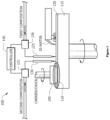
- a first inlet 125 including at least one control valve 126 is for delivering a first composition component and a second inlet 130 including at least a second control valve 131 is for delivering a second composition component.
- the slurry may contain a second per oxidizer such as a peroxide, or a persulfate.
- the operating pH of the slurry is generally from 0.5 to 13.0.
- a typical pH range for the slurry is generally 0.8 to 5.0.
- the two composition components can be mixed in a POU (point of use) tank and can be kept for less than 14 days, such as less than 5 days, or less than 24 hours.
- the CMP apparatus 100 is shown having two inlets, it is also generally possible to have all the slurry components to be introduced through a single inlet.
- FIG. 2 A schematic diagram of such a component mixing operation is shown in Figure 2 .
- the slurry is broken in at least two components.
- the first component shown as component 1 can include a permanganate-based oxidizer, and optionally can also include abrasive particles having a Mohs hardness of 5 or higher.
- the pH of the first component ranges from 1.0 to 13.0.
- Disclosed embodiments are further illustrated by the following specific Examples, which should not be construed as limiting the scope or content of disclosed embodiments in any way.
- a SiC single crystal n-doped wafer was polished using a Buehler CMP machine at a pressure of 4 psi and at 160 rpm. The wafer was polished on its silicon face.
- the slurry contained different concentrations of permanganate oxidizer and oxy compounds (containing a transition metal, oxygen and anion) having a chemical formula D a O d X b , where D refers to transition metal such as Zr or Hf, and X refers to nitrate or chloride anions.
- transition metals such as hafnium, titanium, manganese, copper, nickel, bismuth, iron, manganese can be substituted for "D.”
- X other anions such as sulfate, oxide, hydroxide can also be substituted.
- Other oxy compounds include FeOOH, CoOOH, MnOOH, MnO(OH) 2 , Fe 2 O(SO 4 ) 2 , Cu 2 Cl(OH) 3 , and BiClO.
- the dissolution of oxynitrate or oxychloride which contain oxygen and an anion and a transition metal in solution can result in the formation of D a O d H b e+ ions, where ZrO 2+ , ZrO(OH) + are formed during dissolution if the transition metal is zirconium.
- the dissolution of titanium oxysulfate leads to the formation of TiO 2+ ions.
- oxygen and hydrogen containing polyatomic cations include NiO + , CuO + , and HfO(OH) + .
- the concentration of either zirconium oxychloride or zirconium oxynitrate was varied from 0.01 gm/liter to 100 gm/liter.
- the removal rate and the temperature rise on the pad and the surface roughness of the wafer was measured during the polishing process.
- the temperature on the polishing pad was measured by an infrared thermometer.
- the concentration of permanganate was varied from 0.01 M to 1.0 M.
- the pH of the slurry solution can be adjusted by adding nitric acid and/or an alkali.
- the pH can be varied from 0.5 to 5.0, such as between 1.5 to 4.0.
- the flow rate of the slurry was 30 ml/minute.
- the pressure was varied from 0.5 psi to 10 psi, while the rpm was varied from 20 rpm to 600 rpm.
- the temperature rise on the polishing pad was measured by infrared thermometer.
- a CAR value for the potassium permanganate oxidizer was chosen to 1.0 for these experiments.
- AFM atomic force microscope
- the ratio of removal rate and temperature rise has been defined as RRTR provides a parameter on the ability of the slurry to polish at high rates with minimum temperature rise. The higher the RRTR value the higher is ability of the slurry to reach high removal rates with a fixed temperature rise. Table 1 displays all these parameters.
- the RRTR (in (nm/hr)/K) removal rate (nm/hr)/temperature rise (K) is also shown in Table 1 shown below.
- the table also includes another parameter called the finish quality per unit removal rate (abbreviated as FQPURR). This quantity provides a value of the surface finish normalized to the removal rate. The lower the value of FQPURR the faster the slurry can reach the optimal surface roughness. As the removal rate is decreased by decreasing the concentration of the permanganate, the surface finish is expected to improve (become smoother). Table 1 also displays the FQPURR values obtained. Table 1 KMnO4 Conc.
- Table 1 evidences that the addition of transition metal-based oxy compounds (or polyatomic cations comprising a transition metal and oxygen and/or hydrogen, increase both the removal rate and the RRTR values compared to solutions which do not include such compounds. This behavior is observed for all concentrations of permanganate solutions and transition metal-based oxy compounds. An increase in removal rate between 50% to greater than 100% is observed in RRTR and removal rate values when transition metal oxy compounds have been added. The FQPURR values have also found to be lower which is also more desirable when the oxy compounds (transition metal compounds that contain oxygen and an anion).
- a second or more oxidizers such as potassium persulfate, cerium ammonium nitrate, hydrogen peroxide is added to the slurry solution containing permanganate and transition metal oxy compounds (containing oxygen and anion), a similar 50% to 100% enhancement in RRTR values are obtained as compared to solutions lacking the oxy compounds.
- the pH of such mixed oxidizer solutions can be varied from 0.5 to 5.0 and the concentration of all the mixed oxidizers typically varied from 0.01 M to 1M and the concentration of the mixed oxy compounds can range from 0.01 g/liter to 100 g/liter.
- SAS refers to sodium alkyl sulfonate which is an anionic surfactant. It is generally desirable to replace the sodium in SAS with potassium using an ion exchange process.
- Table 2 above show that only the oxy-compounds of transition metals show increased removal rates and better RRTR. All additives mentioned in the Table 2 were found to not be completely soluble in water. Potassium permanganates can be replaced with other alkali permanganate such as sodium permanganate, cesium permanganate, hydrogen permanganate, barium permanganate, or other alkali metal permanganates.
- alkali permanganate such as sodium permanganate, cesium permanganate, hydrogen permanganate, barium permanganate, or other alkali metal permanganates.
- the increased removal rates and RRTR values can be obtained by other oxy-additives such oxynitrate, oxy-sulfates, oxychlorides, oxysulfides, oxyhydroxides of transition metals such as zinc, titanium, zirconium, yttrium, scandium, manganese, vanadium, iron, nickel, copper, niobium, ruthenium, silver.
- concentration of the compound can vary from 0.01 gm/liter to 100 gm/liter.
- This Example relates to addition of surfactants.
- the addition of surfactants to the slurry solution of permanganate and transition metal compounds of oxy compounds containing oxygen and anions can increase the removal rates and the RRTR values.
- a slurry solution was prepared by mixing zirconium oxynitrate solution with an anionic surfactant such as SAS (sodium alkyl sulfonate) and water so that the pH of the solution was between 0.5 to 3.0.
- the amount of anionic surfactant was varied from 0.01 gm/liter to 25 gm/liter. It was observed that the colorless solution was transformed into a slightly milky solution after the surfactant was added to it.
- zirconium oxynitrate into one of the following compounds including (i) amorphous hydrous zirconium oxide (ZrO 2 ), nH 2 O, (ii) amorphous zirconium hydroxide, or (iii) zirconium oxy-hydroxide.
- This hydrolysis reaction can also occur by heating the zirconium oxynitrate solution (without the addition of surfactant) to higher temperatures (such as between 50°C to 110°C).
- the amorphous zirconium oxide has a porous structure (with a porosity of 5 % to 80%), a rod-like shape, and a particle size ranging from 10 nm to 5000 nm, and an IEP values between 4 and 8. Due to the high porosity, the surface areas of the particles can exceed 20 m 2 /gm to 200 m 2/ gm. The density of the particles varied from 1.0 to 5.5 gm/cm 3 due to their high porosity. More generally, in the case of abrasive oxide particles, the density of the abrasive oxide particles can be 10% to 90% of their theoretical density.
- the amorphous hydrated particles in the solution were then added to 0.3 M KMnO 4 solution and used to polish the SiC substrate.
- zirconium hydroxide or zirconium oxyhydroxide can also be added to the slurry.
- a SiC single crystal wafer was polished using a Buehler CMP machine at a pressure of 4 psi and 160 rpm. The removal rate and the temperature rise on the polishing pad were measured during the polishing process.
- the concentration of permanganate was varied from 0.01 M to 1.0 M.
- the pH of solution can be adjusted by adding nitric acid and/or an alkali.
- the pH can be varied from 0.5 to 5.0, such as between 1.5 to 4.0.
- the flow rate of the slurry was 30 ml/minute.
- the IEP of the amorphous zirconia particles in permanganate solutions kept at least for 1 hour can decrease to less than 5, such as less than 4, or less than 3.0, such as between 0.5 to 4.0.
- Table 4 shows that the removal rate, RRTR values and the FQPURR values are all enhanced by the slurry prepared by the above method.
- This table clearly shows two unique results being (i) the addition of the surfactant decreases the temperature rise, resulting in slightly higher RRTR values and (ii) the addition of the surfactants and transition metal oxy compounds significantly increase removal rate and reduces temperature rise, thus significantly enhancing the FFTR values.
- the surface finish of the SiC surface was also found to be excellent with no identified surface scratches.
- certain surfactants such as SAS
- alpha alumina particles leads to the formation of scratches on the SiC surfaces.
- these slurries are expected to show higher rates when polishing other types of SiC materials including (i) carbon face SiC, (ii) polycrystalline SiC, (iii) GaN, (iv) diamond, and v) graphite, as well as a wide variety of metals and non-oxide dielectrics containing nitrogen and carbon.
- the concentration of potassium permanganate can vary from 0.01M to 1.0M
- the concentration of zirconium oxynitrate/oxychloride or other oxy compounds can vary from 0.01 gm/liter to 100 gm/liter
- the concentration of amorphous zirconium oxide, zirconium hydroxide and zirconium oxyhydroxide can vary from 0.0 gm/liter to 100 gm/liter.
- the pH of the slurry can vary from 0.5 to 4.0.
- the zirconium oxynitrate can be replaced with any oxynitrate, oxysulfate or oxyhydroxide compound of transition metal including but not limited to zirconium, titanium, copper with concentration varying from 0.1 gm/liter to 100 gm/liter.
- the surfactants can comprise as anionic, cationic or non-ionic based compounds. Mixed surfactants can also be used.
- the zirconia particles may be amorphous, or crystalline (tetragonal or monoclinic).
- the alumina particles can be crystalline or amorphous and may contain an oxy-hydroxide phase (e.g., an AlO(OH)) phase. All the particles can have a size varying from 10 nm to 2000 nm (2 ⁇ m).
- the porosity of the particles can vary from 2% to 80%, the IEP of the zirconium particles or alumina-based particles is generally less than 7, such as less than 5, or less than 4.
- the removal rate and the temperature rise on the pad was measured during the polishing process.
- the concentration of permanganate was varied from 0.01 M to 0.40 M, while the concentration of polyatomic zirconium cations was varied from 0.001 M to 0.1 M.
- the polyatomic zirconium cations were supplied by either adding zirconium oxychloride or zirconium oxynitrate in the solutions.
- the pH of solution can be adjusted by adding nitric acid and/or an alkali.
- the pH can be varied from 0.5 to 5.0, such as between 1.5 to 4.0.
- the flow rate of the slurry was 30 ml/minute.
- Table 5 shows the data obtained from the experimental runs.
- the concentration of the particles was 1 weight percent for generating the data in this Table.
- the concentration of the abrasive particles was varied from 0.1 to 20 weight percent.
- Table 5 KMnO 4 Conc. (M) Zirconium Oxy-Nitrate Conc.
- Table 6 shows the characteristics of different abrasives used in the slurry.
- the chemical composition of this slurry included permanganate concentration of 0.3 M, and 0.5 weight percent of zirconium oxynitrate solution.
- the abrasive particle content was varied from 0.1 % to 15 percent, however for Table 6, the content was 1 weight %.
- the various average size range of the abrasive particles that were tested are shown in the table, but the results are quoted for values indicated in the brackets. All these abrasive particles gave high RRTR values, however the slurries containing hydrous oxides and monoclinic zirconia have the lowest average surface scratches for these runs.
- the IEP of all the particles was found to be less than 5 due to the in-situ (or ex-situ) coating for the particles with a manganese oxide coating. All slurry particles mentioned in Table 6 have Mohs hardness greater than 5.
- Table 6 Particle Type Size (nm) Surface Charge (IEP) Porosity Phase Removal rate(nm/hr) Hydrous Zirconia (ZrO2.nH2O) 200-500 (400) 0.5 -3.0 ⁇ 60% Amorphous 1778 Zirconia 5- 200 ( 60) 2 10-20% Monoclinic 1672 Zirconia 100-500 (180) 2.0-5.0 - Tetragonal 1754 Manganese Oxide coated Zirconia 70-250 (180) 0.5-3.0 - Monoclinic 1712 Alumina 30-500 (80) 2.0-5.0 - Alpha/gamma 1689 Alumina Coated Titania 100-400 (200) 5.0 - - 1648 Manganese Oxide Coated Silica 50-200 (130) 0.5-5.0 - - 1587
- Table 7 shows the time dependent removal rate of a slurry mixed with two components.
- the first component contained 0.30 M permanganate solution and the second component contained 1 % zirconia particles, 20 mM per liter zirconium oxynitrate, and 2 gm/liter of the surfactant SDS. These two components were mixed, and the removal rate was measured as a function of time (a time of 0 days to 60 days), with the resulting data shown in Table 7.
- Table 7 evidences that for the first few days the removal rate is constant but starts to decrease after 15 days rather rapidly. This has been attributed to the breakdown of the permanganate-based oxidizer. To mitigate this effect, as described above, the slurry can be divided into two components as shown in Figure 2 and used for CMP generally within 7 days after mixing of the components.
- the polishing composition was prepared by mixing an oxidizer solution comprising of 5.5 wt.% KMnO 4 which is about 4.5 folds of the POU with about 1.3 wt.% Zirconium Oxy-Nitrate solution.
- This Zirconium Oxy-Nitrate solution also adjusts the pH of the slurry to the operating pH (about pH 2).
- the mixing ratio of the oxidizer solution to the Zirconium Oxy-Nitrate solution was about 10:1.
- the experiments were performed on a tabletop polisher having a 12" platen size, with a downforce of 34.47 kPa and platen speed of 300 RPM.
- a soft polyurethane pad with Shore A hardness of 67 was used for the experimental data mentioned in table 1,2 & 4.
- the slurry flow rate used is 30 mL/min for 2" x 2" coupons.
- Table 8 Abrasive-free polishing KMnO 4 Conc.
Landscapes
- Chemical & Material Sciences (AREA)
- Organic Chemistry (AREA)
- Engineering & Computer Science (AREA)
- Materials Engineering (AREA)
- Mechanical Engineering (AREA)
- Mechanical Treatment Of Semiconductor (AREA)
- Finish Polishing, Edge Sharpening, And Grinding By Specific Grinding Devices (AREA)
- Polishing Bodies And Polishing Tools (AREA)
Claims (12)
- Aufschlämmung zum chemisch-mechanischen Polieren (CMP), umfassend:eine wässrige Trägerflüssigkeit;eine Übergangsmetalloxyverbindung, ausgewählt aus Oxynitraten, Oxychloriden, Oxysulfaten, Oxycarbonaten und C2-C10-Oxyalkanoaten; undein Oxidationsmittel auf Per-Basis.
- Aufschlämmung nach Anspruch 1, wobei das Oxidationsmittel auf Per-Basis einen Wert eines Kationen-zu-Anionen-Verhältnisses (CAR) aufweist, der zwischen 0,0 bis 1,0 schwankt.
- Aufschlämmung nach Anspruch 1, umfassenda. Wasser;b. ein Oxidationsmittel auf Per-Basis; undc. mindestens eine Verbindung, die in Lösung ein Kation bildet, ausgewählt aus ZrO+, ZrO++, NiO+, ZrOH+, HfO+, HfOH+, TiO+ und TiO++; undwobei der pH-Wert etwa 1 bis etwa 5 beträgt.
- Aufschlämmung nach einem vorhergehenden Anspruch, wobei das Oxidationsmittel auf Per-Basis aus Kaliumpermanganat und Natriumpermanganat ausgewählt ist.
- Aufschlämmung nach Anspruch 3 oder Anspruch 4, wobei die Aufschlämmung c. umfasst und aus Zirconiumoxynitrat, Zirconiumoxychlorid, Nickeloxynitrat, Nickeloxychlorid, Hafniumoxynitrat, Hafniumoxychlorid und Zirconium-C2-C10-oxyalkanoaten ausgewählt ist.
- Aufschlämmung nach einem vorhergehenden Anspruch, ferner umfassend Schleifoxidpartikel, die mindestens eines von Zirconiumdioxid, Siliciumdioxid, Aluminiumoxid-Ceriumdioxid, hydratisiertem Metalloxid, mit Manganoxid beschichteten Partikeln und Aluminiumoxid umfassen.
- Aufschlämmung nach einem vorhergehenden Anspruch, ferner umfassend mindestens ein Tensid.
- Aufschlämmung nach Anspruch 1, wobei die Aufschlämmung polyatomare Kationen umfasst und wobei die Konzentration der polyatomaren Kationen 0,01 g/Liter bis 20 g/Liter beträgt.
- Aufschlämmung nach einem vorhergehenden Anspruch, wobei die Übergangsmetalloxyverbindung aus Zirconiumoxynitrat, Zirconiumoxychlorid, Nickeloxynitrat, Nickeloxychlorid, Hafniumoxynitrat, Hafniumoxychlorid und Zirconium-C2-C10-oxyalkanoaten ausgewählt ist.
- Aufschlämmung nach einem vorhergehenden Anspruch, wobei das Oxidationsmittel auf Per-Basis eine Permanganat-Verbindung in einer Konzentration von 0,01 M bis 0,5 M umfasst.
- Verfahren zum chemisch-mechanischen Polieren (CMP) eines Substrats, umfassend:
Bereitstellen einer Aufschlämmung, die Folgendes umfasst:eine erste Komponente, die eine wässrige Trägerflüssigkeit und mindestens ein Oxidationsmittel auf Per-Basis beinhaltet, undeine zweite Komponente, die eine Übergangsmetalloxyverbindung umfasst, ausgewählt aus Oxynitraten, Oxychloriden, Oxysulfaten, Oxycarbonaten und C2-C10-Oxyalkanoaten;Mischen der ersten und der zweiten Komponente, um die Aufschlämmung zu bilden;Verwenden einer CMP-Vorrichtung, um das Substrat gegenüber einem Polierkissen zu exponieren, auf das die Aufschlämmung gespeist wird, um mindestens einen Abschnitt einer Oberfläche des Substrats zu entfernen. - Aufschlämmung zum chemisch-mechanischen Polieren (CMP), umfassend:eine wässrige Trägerflüssigkeit;ein Additiv, das entweder eine sauerstoff- und anionenhaltige Übergangsmetallverbindung; oder polyatomare Kationen beinhaltet, die ein Übergangsmetall und Sauerstoff oder Wasserstoff umfassen; undein Oxidationsmittel auf Per-Basis.
Applications Claiming Priority (2)
| Application Number | Priority Date | Filing Date | Title |
|---|---|---|---|
| US202062968480P | 2020-01-31 | 2020-01-31 | |
| PCT/US2021/015947 WO2021155324A1 (en) | 2020-01-31 | 2021-01-30 | Cmp composition for polishing hard materials |
Publications (3)
| Publication Number | Publication Date |
|---|---|
| EP4097187A1 EP4097187A1 (de) | 2022-12-07 |
| EP4097187A4 EP4097187A4 (de) | 2023-12-13 |
| EP4097187B1 true EP4097187B1 (de) | 2025-04-16 |
Family
ID=77061355
Family Applications (1)
| Application Number | Title | Priority Date | Filing Date |
|---|---|---|---|
| EP21748351.0A Active EP4097187B1 (de) | 2020-01-31 | 2021-01-30 | Cmp-zusammensetzung zum polieren von harten materialien |
Country Status (7)
| Country | Link |
|---|---|
| US (1) | US11840645B2 (de) |
| EP (1) | EP4097187B1 (de) |
| JP (1) | JP7411105B2 (de) |
| KR (1) | KR102849193B1 (de) |
| CN (1) | CN115175971B (de) |
| TW (1) | TWI861353B (de) |
| WO (1) | WO2021155324A1 (de) |
Families Citing this family (21)
| Publication number | Priority date | Publication date | Assignee | Title |
|---|---|---|---|---|
| WO2022145653A1 (ko) * | 2020-12-30 | 2022-07-07 | 에스케이씨솔믹스 주식회사 | 반도체 공정용 연마 조성물, 연마 조성물의 제조 방법 및 연마 조성물을 적용한 반도체 소자의 제조 방법 |
| KR102744824B1 (ko) * | 2021-02-24 | 2024-12-18 | 주식회사 엘지화학 | 투명성 특성이 우수한 폴리(락트산-b-3-하이드록시프로피온산) 블록 공중합체 및 이를 포함하는 물품 |
| WO2023054385A1 (ja) * | 2021-09-30 | 2023-04-06 | 株式会社フジミインコーポレーテッド | 研磨用組成物 |
| CN118043427A (zh) * | 2021-09-30 | 2024-05-14 | 福吉米株式会社 | 研磨用组合物 |
| CN114406825B (zh) * | 2022-01-25 | 2023-06-27 | 华侨大学 | 一种碳化硅表面化学机械复合加工方法 |
| CN114410226A (zh) * | 2022-01-27 | 2022-04-29 | 中国科学院上海微系统与信息技术研究所 | 一种抛光液及其制备方法和应用 |
| WO2023189512A1 (ja) * | 2022-03-30 | 2023-10-05 | 株式会社フジミインコーポレーテッド | 研磨用組成物 |
| JP2023166263A (ja) * | 2022-05-09 | 2023-11-21 | 株式会社ディスコ | 化合物半導体基板研磨用の研磨液、及び、化合物半導体基板の研磨方法 |
| WO2024004750A1 (ja) * | 2022-06-27 | 2024-01-04 | 三井金属鉱業株式会社 | 研磨材スラリー及びその研磨方法 |
| JP2024037247A (ja) * | 2022-09-07 | 2024-03-19 | 株式会社ディスコ | 化合物半導体基板研磨用の研磨液 |
| TWI873902B (zh) * | 2022-10-11 | 2025-02-21 | 美商Cmc材料有限責任公司 | 用於高度摻雜硼之矽膜之化學機械拋光組合物 |
| JP2026502738A (ja) * | 2023-01-20 | 2026-01-26 | インテグリス・インコーポレーテッド | ハードマスクを研磨するための組成物並びに関連システム及び方法 |
| TW202438226A (zh) * | 2023-02-20 | 2024-10-01 | 日商東京威力科創股份有限公司 | 研磨裝置及基板之研磨方法 |
| KR20250170705A (ko) | 2023-10-13 | 2025-12-05 | 다이치 키겐소 카가쿠 코교 컴퍼니 리미티드 | 연마용 분산액 |
| CN118562395A (zh) * | 2024-03-01 | 2024-08-30 | 江苏山水半导体科技有限公司 | 一种高硬度材料抛光液及其应用方法 |
| US20260042934A1 (en) * | 2024-08-07 | 2026-02-12 | Entegris, Inc. | Compositions and methods for polishing substrates |
| WO2026070713A1 (ja) * | 2024-09-26 | 2026-04-02 | 株式会社フジミインコーポレーテッド | 研磨用組成物および研磨方法 |
| WO2026070714A1 (ja) * | 2024-09-26 | 2026-04-02 | 株式会社フジミインコーポレーテッド | 研磨用組成物および研磨方法 |
| WO2026070712A1 (ja) * | 2024-09-26 | 2026-04-02 | 株式会社フジミインコーポレーテッド | 研磨用組成物、研磨用組成物の製造方法および研磨方法 |
| WO2026070711A1 (ja) * | 2024-09-26 | 2026-04-02 | 株式会社フジミインコーポレーテッド | 研磨用組成物および研磨方法 |
| WO2026080397A1 (en) * | 2024-10-11 | 2026-04-16 | Entegris, Inc. | Compositions for increasing material removal rate of silicon carbide and related methods |
Family Cites Families (22)
| Publication number | Priority date | Publication date | Assignee | Title |
|---|---|---|---|---|
| US6602439B1 (en) * | 1997-02-24 | 2003-08-05 | Superior Micropowders, Llc | Chemical-mechanical planarization slurries and powders and methods for using same |
| US6270395B1 (en) * | 1998-09-24 | 2001-08-07 | Alliedsignal, Inc. | Oxidizing polishing slurries for low dielectric constant materials |
| US6755721B2 (en) * | 2002-02-22 | 2004-06-29 | Saint-Gobain Ceramics And Plastics, Inc. | Chemical mechanical polishing of nickel phosphorous alloys |
| US6821309B2 (en) * | 2002-02-22 | 2004-11-23 | University Of Florida | Chemical-mechanical polishing slurry for polishing of copper or silver films |
| JP4205939B2 (ja) * | 2002-12-13 | 2009-01-07 | 日本パーカライジング株式会社 | 金属の表面処理方法 |
| US20050104048A1 (en) * | 2003-11-13 | 2005-05-19 | Thomas Terence M. | Compositions and methods for polishing copper |
| US9176377B2 (en) * | 2010-06-01 | 2015-11-03 | Inpria Corporation | Patterned inorganic layers, radiation based patterning compositions and corresponding methods |
| WO2012057941A2 (en) | 2010-10-26 | 2012-05-03 | Fresenius Medical Care Holdings, Inc. | Methods of synthesizing hydrous zirconium oxide and other oxides |
| KR20140003557A (ko) * | 2011-01-27 | 2014-01-09 | 가부시키가이샤 후지미인코퍼레이티드 | 연마재 및 연마용 조성물 |
| CN102260461B (zh) * | 2011-07-01 | 2013-10-16 | 佛山科学技术学院 | 高光泽度铝型材的无烟抛光处理溶液及使用方法 |
| EP2540391A1 (de) * | 2011-07-01 | 2013-01-02 | Treibacher Industrie AG | Ceriumoxid-Zirconiumoxid-Aluminiumoxid-Zusammensetzung mit verbesserter Wärmebeständigkeit |
| CN102250552B (zh) * | 2011-08-19 | 2013-12-11 | 湖南皓志新材料股份有限公司 | 一种铈掺杂的氧化锆复合抛光粉的制备方法 |
| SG11201408381QA (en) * | 2012-06-15 | 2015-01-29 | Basf Corp | Composites of mixed metal oxides for oxygen storage |
| JP2014024960A (ja) * | 2012-07-26 | 2014-02-06 | Fujimi Inc | 研磨用組成物、酸化物材料の研磨方法及び酸化物材料基板の製造方法 |
| US9259818B2 (en) | 2012-11-06 | 2016-02-16 | Sinmat, Inc. | Smooth diamond surfaces and CMP method for forming |
| US9567492B2 (en) | 2014-08-28 | 2017-02-14 | Sinmat, Inc. | Polishing of hard substrates with soft-core composite particles |
| EP3276044A4 (de) * | 2015-09-16 | 2018-08-08 | Okuno Chemical Industries Co., Ltd. | Chemische umwandlungslösung für aluminium oder aluminiumlegierung, chemisches umwandlungsverfahren und chemische umwandlungsschicht |
| US9293339B1 (en) * | 2015-09-24 | 2016-03-22 | Rohm And Haas Electronic Materials Cmp Holdings, Inc. | Method of polishing semiconductor substrate |
| US11015086B2 (en) * | 2016-02-09 | 2021-05-25 | Mitsui Mining & Smelting Co., Ltd. | Polishing slurry and polishing material |
| JP6788988B2 (ja) | 2016-03-31 | 2020-11-25 | 株式会社フジミインコーポレーテッド | 研磨用組成物 |
| US11078380B2 (en) | 2017-07-10 | 2021-08-03 | Entegris, Inc. | Hard abrasive particle-free polishing of hard materials |
| US11043151B2 (en) | 2017-10-03 | 2021-06-22 | Cmc Materials, Inc. | Surface treated abrasive particles for tungsten buff applications |
-
2021
- 2021-01-29 TW TW110103508A patent/TWI861353B/zh active
- 2021-01-30 JP JP2022545832A patent/JP7411105B2/ja active Active
- 2021-01-30 KR KR1020227029559A patent/KR102849193B1/ko active Active
- 2021-01-30 WO PCT/US2021/015947 patent/WO2021155324A1/en not_active Ceased
- 2021-01-30 CN CN202180016656.0A patent/CN115175971B/zh active Active
- 2021-01-30 US US17/163,372 patent/US11840645B2/en active Active
- 2021-01-30 EP EP21748351.0A patent/EP4097187B1/de active Active
Also Published As
| Publication number | Publication date |
|---|---|
| TWI861353B (zh) | 2024-11-11 |
| EP4097187A4 (de) | 2023-12-13 |
| CN115175971B (zh) | 2024-10-29 |
| CN115175971A (zh) | 2022-10-11 |
| US20210238448A1 (en) | 2021-08-05 |
| JP2023512216A (ja) | 2023-03-24 |
| WO2021155324A1 (en) | 2021-08-05 |
| KR102849193B1 (ko) | 2025-08-22 |
| US11840645B2 (en) | 2023-12-12 |
| KR20220130787A (ko) | 2022-09-27 |
| TW202134364A (zh) | 2021-09-16 |
| JP7411105B2 (ja) | 2024-01-10 |
| EP4097187A1 (de) | 2022-12-07 |
Similar Documents
| Publication | Publication Date | Title |
|---|---|---|
| EP4097187B1 (de) | Cmp-zusammensetzung zum polieren von harten materialien | |
| JP5592276B2 (ja) | 水溶性酸化剤を用いた炭化ケイ素の研磨方法 | |
| US6251150B1 (en) | Slurry composition and method of chemical mechanical polishing using same | |
| JP6670587B2 (ja) | 研磨方法およびポリシング用組成物 | |
| US8828874B2 (en) | Chemical mechanical polishing of group III-nitride surfaces | |
| CN118974199A (zh) | 研磨用组合物 | |
| KR102531445B1 (ko) | 연마 슬러리 조성물 | |
| US20060032836A1 (en) | Methods of controlling the properties of abrasive particles for use in chemical-mechanical polishing slurries | |
| JP7690454B2 (ja) | ジルコニア粒子と酸化剤を含む研磨組成物 | |
| KR101184488B1 (ko) | 가용성 퍼옥소메탈레이트 착물을 함유하는 cmp 조성물 및 이들의 사용 방법 | |
| CN118055994A (zh) | 研磨用组合物 | |
| CN118043427A (zh) | 研磨用组合物 | |
| KR20090087034A (ko) | 알루미나 수화물 연마제를 포함하는 금속 표면용 평탄화 조성물 | |
| JP4159679B2 (ja) | 研磨用組成物 | |
| KR101279970B1 (ko) | 금속 배선 연마용 cmp 슬러리 조성물 | |
| WO2026070713A1 (ja) | 研磨用組成物および研磨方法 | |
| WO2026070711A1 (ja) | 研磨用組成物および研磨方法 |
Legal Events
| Date | Code | Title | Description |
|---|---|---|---|
| STAA | Information on the status of an ep patent application or granted ep patent |
Free format text: STATUS: THE INTERNATIONAL PUBLICATION HAS BEEN MADE |
|
| PUAI | Public reference made under article 153(3) epc to a published international application that has entered the european phase |
Free format text: ORIGINAL CODE: 0009012 |
|
| STAA | Information on the status of an ep patent application or granted ep patent |
Free format text: STATUS: REQUEST FOR EXAMINATION WAS MADE |
|
| 17P | Request for examination filed |
Effective date: 20220826 |
|
| AK | Designated contracting states |
Kind code of ref document: A1 Designated state(s): AL AT BE BG CH CY CZ DE DK EE ES FI FR GB GR HR HU IE IS IT LI LT LU LV MC MK MT NL NO PL PT RO RS SE SI SK SM TR |
|
| DAV | Request for validation of the european patent (deleted) | ||
| DAX | Request for extension of the european patent (deleted) | ||
| A4 | Supplementary search report drawn up and despatched |
Effective date: 20231109 |
|
| RIC1 | Information provided on ipc code assigned before grant |
Ipc: C09D 11/00 20140101ALI20231103BHEP Ipc: C09D 1/00 20060101ALI20231103BHEP Ipc: C09D 5/00 20060101ALI20231103BHEP Ipc: C09D 5/23 20060101ALI20231103BHEP Ipc: C09F 1/00 20060101ALI20231103BHEP Ipc: H01L 21/475 20060101ALI20231103BHEP Ipc: H01L 21/78 20060101ALI20231103BHEP Ipc: H01L 21/46 20060101ALI20231103BHEP Ipc: H01L 21/321 20060101ALI20231103BHEP Ipc: H01L 21/30 20060101ALI20231103BHEP Ipc: H01L 21/027 20060101ALI20231103BHEP Ipc: H01L 21/00 20060101ALI20231103BHEP Ipc: C09K 3/14 20060101ALI20231103BHEP Ipc: C09G 1/02 20060101AFI20231103BHEP |
|
| GRAP | Despatch of communication of intention to grant a patent |
Free format text: ORIGINAL CODE: EPIDOSNIGR1 |
|
| RIC1 | Information provided on ipc code assigned before grant |
Ipc: C09D 11/00 20140101ALI20240926BHEP Ipc: C09D 1/00 20060101ALI20240926BHEP Ipc: C09D 5/00 20060101ALI20240926BHEP Ipc: C09D 5/23 20060101ALI20240926BHEP Ipc: C09F 1/00 20060101ALI20240926BHEP Ipc: H01L 21/475 20060101ALI20240926BHEP Ipc: H01L 21/78 20060101ALI20240926BHEP Ipc: H01L 21/46 20060101ALI20240926BHEP Ipc: H01L 21/321 20060101ALI20240926BHEP Ipc: H01L 21/30 20060101ALI20240926BHEP Ipc: H01L 21/027 20060101ALI20240926BHEP Ipc: H01L 21/00 20060101ALI20240926BHEP Ipc: C09K 3/14 20060101ALI20240926BHEP Ipc: C09G 1/02 20060101AFI20240926BHEP |
|
| STAA | Information on the status of an ep patent application or granted ep patent |
Free format text: STATUS: GRANT OF PATENT IS INTENDED |
|
| INTG | Intention to grant announced |
Effective date: 20241031 |
|
| GRAS | Grant fee paid |
Free format text: ORIGINAL CODE: EPIDOSNIGR3 |
|
| GRAA | (expected) grant |
Free format text: ORIGINAL CODE: 0009210 |
|
| STAA | Information on the status of an ep patent application or granted ep patent |
Free format text: STATUS: THE PATENT HAS BEEN GRANTED |
|
| P01 | Opt-out of the competence of the unified patent court (upc) registered |
Free format text: CASE NUMBER: APP_8943/2025 Effective date: 20250221 |
|
| AK | Designated contracting states |
Kind code of ref document: B1 Designated state(s): AL AT BE BG CH CY CZ DE DK EE ES FI FR GB GR HR HU IE IS IT LI LT LU LV MC MK MT NL NO PL PT RO RS SE SI SK SM TR |
|
| REG | Reference to a national code |
Ref country code: GB Ref legal event code: FG4D |
|
| REG | Reference to a national code |
Ref country code: CH Ref legal event code: EP Ref country code: DE Ref legal event code: R096 Ref document number: 602021029262 Country of ref document: DE |
|
| REG | Reference to a national code |
Ref country code: IE Ref legal event code: FG4D |
|
| REG | Reference to a national code |
Ref country code: NL Ref legal event code: MP Effective date: 20250416 |
|
| PG25 | Lapsed in a contracting state [announced via postgrant information from national office to epo] |
Ref country code: NL Free format text: LAPSE BECAUSE OF FAILURE TO SUBMIT A TRANSLATION OF THE DESCRIPTION OR TO PAY THE FEE WITHIN THE PRESCRIBED TIME-LIMIT Effective date: 20250416 |
|
| REG | Reference to a national code |
Ref country code: AT Ref legal event code: MK05 Ref document number: 1785669 Country of ref document: AT Kind code of ref document: T Effective date: 20250416 |
|
| PG25 | Lapsed in a contracting state [announced via postgrant information from national office to epo] |
Ref country code: FI Free format text: LAPSE BECAUSE OF FAILURE TO SUBMIT A TRANSLATION OF THE DESCRIPTION OR TO PAY THE FEE WITHIN THE PRESCRIBED TIME-LIMIT Effective date: 20250416 Ref country code: PT Free format text: LAPSE BECAUSE OF FAILURE TO SUBMIT A TRANSLATION OF THE DESCRIPTION OR TO PAY THE FEE WITHIN THE PRESCRIBED TIME-LIMIT Effective date: 20250818 Ref country code: ES Free format text: LAPSE BECAUSE OF FAILURE TO SUBMIT A TRANSLATION OF THE DESCRIPTION OR TO PAY THE FEE WITHIN THE PRESCRIBED TIME-LIMIT Effective date: 20250416 |
|
| REG | Reference to a national code |
Ref country code: LT Ref legal event code: MG9D |
|
| PG25 | Lapsed in a contracting state [announced via postgrant information from national office to epo] |
Ref country code: NO Free format text: LAPSE BECAUSE OF FAILURE TO SUBMIT A TRANSLATION OF THE DESCRIPTION OR TO PAY THE FEE WITHIN THE PRESCRIBED TIME-LIMIT Effective date: 20250716 Ref country code: GR Free format text: LAPSE BECAUSE OF FAILURE TO SUBMIT A TRANSLATION OF THE DESCRIPTION OR TO PAY THE FEE WITHIN THE PRESCRIBED TIME-LIMIT Effective date: 20250717 |
|
| PG25 | Lapsed in a contracting state [announced via postgrant information from national office to epo] |
Ref country code: PL Free format text: LAPSE BECAUSE OF FAILURE TO SUBMIT A TRANSLATION OF THE DESCRIPTION OR TO PAY THE FEE WITHIN THE PRESCRIBED TIME-LIMIT Effective date: 20250416 |
|
| PG25 | Lapsed in a contracting state [announced via postgrant information from national office to epo] |
Ref country code: BG Free format text: LAPSE BECAUSE OF FAILURE TO SUBMIT A TRANSLATION OF THE DESCRIPTION OR TO PAY THE FEE WITHIN THE PRESCRIBED TIME-LIMIT Effective date: 20250416 |
|
| PG25 | Lapsed in a contracting state [announced via postgrant information from national office to epo] |
Ref country code: HR Free format text: LAPSE BECAUSE OF FAILURE TO SUBMIT A TRANSLATION OF THE DESCRIPTION OR TO PAY THE FEE WITHIN THE PRESCRIBED TIME-LIMIT Effective date: 20250416 |
|
| PG25 | Lapsed in a contracting state [announced via postgrant information from national office to epo] |
Ref country code: AT Free format text: LAPSE BECAUSE OF FAILURE TO SUBMIT A TRANSLATION OF THE DESCRIPTION OR TO PAY THE FEE WITHIN THE PRESCRIBED TIME-LIMIT Effective date: 20250416 |
|
| PG25 | Lapsed in a contracting state [announced via postgrant information from national office to epo] |
Ref country code: RS Free format text: LAPSE BECAUSE OF FAILURE TO SUBMIT A TRANSLATION OF THE DESCRIPTION OR TO PAY THE FEE WITHIN THE PRESCRIBED TIME-LIMIT Effective date: 20250716 |
|
| PG25 | Lapsed in a contracting state [announced via postgrant information from national office to epo] |
Ref country code: IS Free format text: LAPSE BECAUSE OF FAILURE TO SUBMIT A TRANSLATION OF THE DESCRIPTION OR TO PAY THE FEE WITHIN THE PRESCRIBED TIME-LIMIT Effective date: 20250816 |
|
| PG25 | Lapsed in a contracting state [announced via postgrant information from national office to epo] |
Ref country code: LV Free format text: LAPSE BECAUSE OF FAILURE TO SUBMIT A TRANSLATION OF THE DESCRIPTION OR TO PAY THE FEE WITHIN THE PRESCRIBED TIME-LIMIT Effective date: 20250416 |
|
| PG25 | Lapsed in a contracting state [announced via postgrant information from national office to epo] |
Ref country code: SM Free format text: LAPSE BECAUSE OF FAILURE TO SUBMIT A TRANSLATION OF THE DESCRIPTION OR TO PAY THE FEE WITHIN THE PRESCRIBED TIME-LIMIT Effective date: 20250416 Ref country code: DK Free format text: LAPSE BECAUSE OF FAILURE TO SUBMIT A TRANSLATION OF THE DESCRIPTION OR TO PAY THE FEE WITHIN THE PRESCRIBED TIME-LIMIT Effective date: 20250416 |
|
| PGFP | Annual fee paid to national office [announced via postgrant information from national office to epo] |
Ref country code: FR Payment date: 20251217 Year of fee payment: 6 |
|
| REG | Reference to a national code |
Ref country code: DE Ref legal event code: R097 Ref document number: 602021029262 Country of ref document: DE |
|
| PG25 | Lapsed in a contracting state [announced via postgrant information from national office to epo] |
Ref country code: CZ Free format text: LAPSE BECAUSE OF FAILURE TO SUBMIT A TRANSLATION OF THE DESCRIPTION OR TO PAY THE FEE WITHIN THE PRESCRIBED TIME-LIMIT Effective date: 20250416 |
|
| PGFP | Annual fee paid to national office [announced via postgrant information from national office to epo] |
Ref country code: IE Payment date: 20251218 Year of fee payment: 6 |
|
| PG25 | Lapsed in a contracting state [announced via postgrant information from national office to epo] |
Ref country code: EE Free format text: LAPSE BECAUSE OF FAILURE TO SUBMIT A TRANSLATION OF THE DESCRIPTION OR TO PAY THE FEE WITHIN THE PRESCRIBED TIME-LIMIT Effective date: 20250416 |
|
| PG25 | Lapsed in a contracting state [announced via postgrant information from national office to epo] |
Ref country code: SK Free format text: LAPSE BECAUSE OF FAILURE TO SUBMIT A TRANSLATION OF THE DESCRIPTION OR TO PAY THE FEE WITHIN THE PRESCRIBED TIME-LIMIT Effective date: 20250416 |
|
| PG25 | Lapsed in a contracting state [announced via postgrant information from national office to epo] |
Ref country code: IT Free format text: LAPSE BECAUSE OF FAILURE TO SUBMIT A TRANSLATION OF THE DESCRIPTION OR TO PAY THE FEE WITHIN THE PRESCRIBED TIME-LIMIT Effective date: 20250416 |
|
| PLBE | No opposition filed within time limit |
Free format text: ORIGINAL CODE: 0009261 |
|
| STAA | Information on the status of an ep patent application or granted ep patent |
Free format text: STATUS: NO OPPOSITION FILED WITHIN TIME LIMIT |
|
| REG | Reference to a national code |
Ref country code: CH Ref legal event code: L10 Free format text: ST27 STATUS EVENT CODE: U-0-0-L10-L00 (AS PROVIDED BY THE NATIONAL OFFICE) Effective date: 20260225 |
|
| 26N | No opposition filed |
Effective date: 20260119 |
|
| PGFP | Annual fee paid to national office [announced via postgrant information from national office to epo] |
Ref country code: DE Payment date: 20251217 Year of fee payment: 6 |