EP4091793B1 - Resin-made container manufacturing method, manufacturing device, and metal mold unit - Google Patents
Resin-made container manufacturing method, manufacturing device, and metal mold unit Download PDFInfo
- Publication number
- EP4091793B1 EP4091793B1 EP21741234.5A EP21741234A EP4091793B1 EP 4091793 B1 EP4091793 B1 EP 4091793B1 EP 21741234 A EP21741234 A EP 21741234A EP 4091793 B1 EP4091793 B1 EP 4091793B1
- Authority
- EP
- European Patent Office
- Prior art keywords
- layer
- mold
- injection molding
- preform
- unit
- Prior art date
- Legal status (The legal status is an assumption and is not a legal conclusion. Google has not performed a legal analysis and makes no representation as to the accuracy of the status listed.)
- Active
Links
Images




Classifications
-
- B—PERFORMING OPERATIONS; TRANSPORTING
- B29—WORKING OF PLASTICS; WORKING OF SUBSTANCES IN A PLASTIC STATE IN GENERAL
- B29C—SHAPING OR JOINING OF PLASTICS; SHAPING OF MATERIAL IN A PLASTIC STATE, NOT OTHERWISE PROVIDED FOR; AFTER-TREATMENT OF THE SHAPED PRODUCTS, e.g. REPAIRING
- B29C49/00—Blow-moulding, i.e. blowing a preform or parison to a desired shape within a mould; Apparatus therefor
- B29C49/02—Combined blow-moulding and manufacture of the preform or the parison
- B29C49/06—Injection blow-moulding
-
- B—PERFORMING OPERATIONS; TRANSPORTING
- B29—WORKING OF PLASTICS; WORKING OF SUBSTANCES IN A PLASTIC STATE IN GENERAL
- B29B—PREPARATION OR PRETREATMENT OF THE MATERIAL TO BE SHAPED; MAKING GRANULES OR PREFORMS; RECOVERY OF PLASTICS OR OTHER CONSTITUENTS OF WASTE MATERIAL CONTAINING PLASTICS
- B29B11/00—Making preforms
- B29B11/06—Making preforms by moulding the material
- B29B11/08—Injection moulding
-
- B—PERFORMING OPERATIONS; TRANSPORTING
- B29—WORKING OF PLASTICS; WORKING OF SUBSTANCES IN A PLASTIC STATE IN GENERAL
- B29C—SHAPING OR JOINING OF PLASTICS; SHAPING OF MATERIAL IN A PLASTIC STATE, NOT OTHERWISE PROVIDED FOR; AFTER-TREATMENT OF THE SHAPED PRODUCTS, e.g. REPAIRING
- B29C45/00—Injection moulding, i.e. forcing the required volume of moulding material through a nozzle into a closed mould; Apparatus therefor
- B29C45/16—Making multilayered or multicoloured articles
- B29C45/1615—The materials being injected at different moulding stations
- B29C45/1625—Injecting parison-like articles
-
- B—PERFORMING OPERATIONS; TRANSPORTING
- B29—WORKING OF PLASTICS; WORKING OF SUBSTANCES IN A PLASTIC STATE IN GENERAL
- B29C—SHAPING OR JOINING OF PLASTICS; SHAPING OF MATERIAL IN A PLASTIC STATE, NOT OTHERWISE PROVIDED FOR; AFTER-TREATMENT OF THE SHAPED PRODUCTS, e.g. REPAIRING
- B29C45/00—Injection moulding, i.e. forcing the required volume of moulding material through a nozzle into a closed mould; Apparatus therefor
- B29C45/16—Making multilayered or multicoloured articles
- B29C45/1684—Injecting parison-like articles
-
- B—PERFORMING OPERATIONS; TRANSPORTING
- B29—WORKING OF PLASTICS; WORKING OF SUBSTANCES IN A PLASTIC STATE IN GENERAL
- B29C—SHAPING OR JOINING OF PLASTICS; SHAPING OF MATERIAL IN A PLASTIC STATE, NOT OTHERWISE PROVIDED FOR; AFTER-TREATMENT OF THE SHAPED PRODUCTS, e.g. REPAIRING
- B29C45/00—Injection moulding, i.e. forcing the required volume of moulding material through a nozzle into a closed mould; Apparatus therefor
- B29C45/17—Component parts, details or accessories; Auxiliary operations
- B29C45/26—Moulds
-
- B—PERFORMING OPERATIONS; TRANSPORTING
- B29—WORKING OF PLASTICS; WORKING OF SUBSTANCES IN A PLASTIC STATE IN GENERAL
- B29C—SHAPING OR JOINING OF PLASTICS; SHAPING OF MATERIAL IN A PLASTIC STATE, NOT OTHERWISE PROVIDED FOR; AFTER-TREATMENT OF THE SHAPED PRODUCTS, e.g. REPAIRING
- B29C49/00—Blow-moulding, i.e. blowing a preform or parison to a desired shape within a mould; Apparatus therefor
- B29C49/02—Combined blow-moulding and manufacture of the preform or the parison
- B29C49/06—Injection blow-moulding
- B29C49/061—Injection blow-moulding with parison holding means displaceable between injection and blow stations
- B29C49/062—Injection blow-moulding with parison holding means displaceable between injection and blow stations following an arcuate path, e.g. rotary or oscillating-type
-
- B—PERFORMING OPERATIONS; TRANSPORTING
- B29—WORKING OF PLASTICS; WORKING OF SUBSTANCES IN A PLASTIC STATE IN GENERAL
- B29C—SHAPING OR JOINING OF PLASTICS; SHAPING OF MATERIAL IN A PLASTIC STATE, NOT OTHERWISE PROVIDED FOR; AFTER-TREATMENT OF THE SHAPED PRODUCTS, e.g. REPAIRING
- B29C49/00—Blow-moulding, i.e. blowing a preform or parison to a desired shape within a mould; Apparatus therefor
- B29C49/071—Preforms or parisons characterised by their configuration, e.g. geometry, dimensions or physical properties
-
- B—PERFORMING OPERATIONS; TRANSPORTING
- B29—WORKING OF PLASTICS; WORKING OF SUBSTANCES IN A PLASTIC STATE IN GENERAL
- B29C—SHAPING OR JOINING OF PLASTICS; SHAPING OF MATERIAL IN A PLASTIC STATE, NOT OTHERWISE PROVIDED FOR; AFTER-TREATMENT OF THE SHAPED PRODUCTS, e.g. REPAIRING
- B29C49/00—Blow-moulding, i.e. blowing a preform or parison to a desired shape within a mould; Apparatus therefor
- B29C49/22—Blow-moulding, i.e. blowing a preform or parison to a desired shape within a mould; Apparatus therefor using multilayered preforms or parisons
-
- B—PERFORMING OPERATIONS; TRANSPORTING
- B29—WORKING OF PLASTICS; WORKING OF SUBSTANCES IN A PLASTIC STATE IN GENERAL
- B29C—SHAPING OR JOINING OF PLASTICS; SHAPING OF MATERIAL IN A PLASTIC STATE, NOT OTHERWISE PROVIDED FOR; AFTER-TREATMENT OF THE SHAPED PRODUCTS, e.g. REPAIRING
- B29C49/00—Blow-moulding, i.e. blowing a preform or parison to a desired shape within a mould; Apparatus therefor
- B29C49/02—Combined blow-moulding and manufacture of the preform or the parison
- B29C2049/023—Combined blow-moulding and manufacture of the preform or the parison using inherent heat of the preform, i.e. 1 step blow moulding
-
- B—PERFORMING OPERATIONS; TRANSPORTING
- B29—WORKING OF PLASTICS; WORKING OF SUBSTANCES IN A PLASTIC STATE IN GENERAL
- B29C—SHAPING OR JOINING OF PLASTICS; SHAPING OF MATERIAL IN A PLASTIC STATE, NOT OTHERWISE PROVIDED FOR; AFTER-TREATMENT OF THE SHAPED PRODUCTS, e.g. REPAIRING
- B29C49/00—Blow-moulding, i.e. blowing a preform or parison to a desired shape within a mould; Apparatus therefor
- B29C49/22—Blow-moulding, i.e. blowing a preform or parison to a desired shape within a mould; Apparatus therefor using multilayered preforms or parisons
- B29C2049/222—Blow-moulding, i.e. blowing a preform or parison to a desired shape within a mould; Apparatus therefor using multilayered preforms or parisons only parts of the preforms or parisons are layered
-
- B—PERFORMING OPERATIONS; TRANSPORTING
- B29—WORKING OF PLASTICS; WORKING OF SUBSTANCES IN A PLASTIC STATE IN GENERAL
- B29C—SHAPING OR JOINING OF PLASTICS; SHAPING OF MATERIAL IN A PLASTIC STATE, NOT OTHERWISE PROVIDED FOR; AFTER-TREATMENT OF THE SHAPED PRODUCTS, e.g. REPAIRING
- B29C2949/00—Indexing scheme relating to blow-moulding
- B29C2949/07—Preforms or parisons characterised by their configuration
- B29C2949/0715—Preforms or parisons characterised by their configuration the preform having one end closed
-
- B—PERFORMING OPERATIONS; TRANSPORTING
- B29—WORKING OF PLASTICS; WORKING OF SUBSTANCES IN A PLASTIC STATE IN GENERAL
- B29C—SHAPING OR JOINING OF PLASTICS; SHAPING OF MATERIAL IN A PLASTIC STATE, NOT OTHERWISE PROVIDED FOR; AFTER-TREATMENT OF THE SHAPED PRODUCTS, e.g. REPAIRING
- B29C2949/00—Indexing scheme relating to blow-moulding
- B29C2949/07—Preforms or parisons characterised by their configuration
- B29C2949/074—Preforms or parisons characterised by their configuration having ribs or protrusions
- B29C2949/0741—Preforms or parisons characterised by their configuration having ribs or protrusions longitudinal, e.g. from top to bottom
-
- B—PERFORMING OPERATIONS; TRANSPORTING
- B29—WORKING OF PLASTICS; WORKING OF SUBSTANCES IN A PLASTIC STATE IN GENERAL
- B29C—SHAPING OR JOINING OF PLASTICS; SHAPING OF MATERIAL IN A PLASTIC STATE, NOT OTHERWISE PROVIDED FOR; AFTER-TREATMENT OF THE SHAPED PRODUCTS, e.g. REPAIRING
- B29C2949/00—Indexing scheme relating to blow-moulding
- B29C2949/07—Preforms or parisons characterised by their configuration
- B29C2949/076—Preforms or parisons characterised by their configuration characterised by the shape
- B29C2949/0768—Preforms or parisons characterised by their configuration characterised by the shape characterised by the shape of specific parts of preform
- B29C2949/0769—Preforms or parisons characterised by their configuration characterised by the shape characterised by the shape of specific parts of preform characterised by the lip, i.e. very top of preform neck
-
- B—PERFORMING OPERATIONS; TRANSPORTING
- B29—WORKING OF PLASTICS; WORKING OF SUBSTANCES IN A PLASTIC STATE IN GENERAL
- B29C—SHAPING OR JOINING OF PLASTICS; SHAPING OF MATERIAL IN A PLASTIC STATE, NOT OTHERWISE PROVIDED FOR; AFTER-TREATMENT OF THE SHAPED PRODUCTS, e.g. REPAIRING
- B29C2949/00—Indexing scheme relating to blow-moulding
- B29C2949/07—Preforms or parisons characterised by their configuration
- B29C2949/076—Preforms or parisons characterised by their configuration characterised by the shape
- B29C2949/0768—Preforms or parisons characterised by their configuration characterised by the shape characterised by the shape of specific parts of preform
- B29C2949/077—Preforms or parisons characterised by their configuration characterised by the shape characterised by the shape of specific parts of preform characterised by the neck
-
- B—PERFORMING OPERATIONS; TRANSPORTING
- B29—WORKING OF PLASTICS; WORKING OF SUBSTANCES IN A PLASTIC STATE IN GENERAL
- B29C—SHAPING OR JOINING OF PLASTICS; SHAPING OF MATERIAL IN A PLASTIC STATE, NOT OTHERWISE PROVIDED FOR; AFTER-TREATMENT OF THE SHAPED PRODUCTS, e.g. REPAIRING
- B29C2949/00—Indexing scheme relating to blow-moulding
- B29C2949/07—Preforms or parisons characterised by their configuration
- B29C2949/076—Preforms or parisons characterised by their configuration characterised by the shape
- B29C2949/0768—Preforms or parisons characterised by their configuration characterised by the shape characterised by the shape of specific parts of preform
- B29C2949/078—Preforms or parisons characterised by their configuration characterised by the shape characterised by the shape of specific parts of preform characterised by the bottom
- B29C2949/0781—Preforms or parisons characterised by their configuration characterised by the shape characterised by the shape of specific parts of preform characterised by the bottom characterised by the sprue, i.e. injection mark
-
- B—PERFORMING OPERATIONS; TRANSPORTING
- B29—WORKING OF PLASTICS; WORKING OF SUBSTANCES IN A PLASTIC STATE IN GENERAL
- B29C—SHAPING OR JOINING OF PLASTICS; SHAPING OF MATERIAL IN A PLASTIC STATE, NOT OTHERWISE PROVIDED FOR; AFTER-TREATMENT OF THE SHAPED PRODUCTS, e.g. REPAIRING
- B29C2949/00—Indexing scheme relating to blow-moulding
- B29C2949/20—Preforms or parisons whereby a specific part is made of only one component, e.g. only one layer
- B29C2949/22—Preforms or parisons whereby a specific part is made of only one component, e.g. only one layer at neck portion
-
- B—PERFORMING OPERATIONS; TRANSPORTING
- B29—WORKING OF PLASTICS; WORKING OF SUBSTANCES IN A PLASTIC STATE IN GENERAL
- B29C—SHAPING OR JOINING OF PLASTICS; SHAPING OF MATERIAL IN A PLASTIC STATE, NOT OTHERWISE PROVIDED FOR; AFTER-TREATMENT OF THE SHAPED PRODUCTS, e.g. REPAIRING
- B29C2949/00—Indexing scheme relating to blow-moulding
- B29C2949/30—Preforms or parisons made of several components
- B29C2949/3006—Preforms or parisons made of several components having tangentially different components within one layer, e.g. longitudinal stripes
-
- B—PERFORMING OPERATIONS; TRANSPORTING
- B29—WORKING OF PLASTICS; WORKING OF SUBSTANCES IN A PLASTIC STATE IN GENERAL
- B29C—SHAPING OR JOINING OF PLASTICS; SHAPING OF MATERIAL IN A PLASTIC STATE, NOT OTHERWISE PROVIDED FOR; AFTER-TREATMENT OF THE SHAPED PRODUCTS, e.g. REPAIRING
- B29C2949/00—Indexing scheme relating to blow-moulding
- B29C2949/30—Preforms or parisons made of several components
- B29C2949/3032—Preforms or parisons made of several components having components being injected
- B29C2949/3034—Preforms or parisons made of several components having components being injected having two or more components being injected
-
- B—PERFORMING OPERATIONS; TRANSPORTING
- B29—WORKING OF PLASTICS; WORKING OF SUBSTANCES IN A PLASTIC STATE IN GENERAL
- B29C—SHAPING OR JOINING OF PLASTICS; SHAPING OF MATERIAL IN A PLASTIC STATE, NOT OTHERWISE PROVIDED FOR; AFTER-TREATMENT OF THE SHAPED PRODUCTS, e.g. REPAIRING
- B29C2949/00—Indexing scheme relating to blow-moulding
- B29C2949/30—Preforms or parisons made of several components
- B29C2949/3086—Interaction between two or more components, e.g. type of or lack of bonding
- B29C2949/3088—Bonding
-
- B—PERFORMING OPERATIONS; TRANSPORTING
- B29—WORKING OF PLASTICS; WORKING OF SUBSTANCES IN A PLASTIC STATE IN GENERAL
- B29C—SHAPING OR JOINING OF PLASTICS; SHAPING OF MATERIAL IN A PLASTIC STATE, NOT OTHERWISE PROVIDED FOR; AFTER-TREATMENT OF THE SHAPED PRODUCTS, e.g. REPAIRING
- B29C45/00—Injection moulding, i.e. forcing the required volume of moulding material through a nozzle into a closed mould; Apparatus therefor
- B29C45/16—Making multilayered or multicoloured articles
-
- B—PERFORMING OPERATIONS; TRANSPORTING
- B29—WORKING OF PLASTICS; WORKING OF SUBSTANCES IN A PLASTIC STATE IN GENERAL
- B29K—INDEXING SCHEME ASSOCIATED WITH SUBCLASSES B29B, B29C OR B29D, RELATING TO MOULDING MATERIALS OR TO MATERIALS FOR MOULDS, REINFORCEMENTS, FILLERS OR PREFORMED PARTS, e.g. INSERTS
- B29K2995/00—Properties of moulding materials, reinforcements, fillers, preformed parts or moulds
- B29K2995/0018—Properties of moulding materials, reinforcements, fillers, preformed parts or moulds having particular optical properties, e.g. fluorescent or phosphorescent
- B29K2995/002—Coloured
- B29K2995/0021—Multi-coloured
-
- B—PERFORMING OPERATIONS; TRANSPORTING
- B29—WORKING OF PLASTICS; WORKING OF SUBSTANCES IN A PLASTIC STATE IN GENERAL
- B29L—INDEXING SCHEME ASSOCIATED WITH SUBCLASS B29C, RELATING TO PARTICULAR ARTICLES
- B29L2031/00—Other particular articles
- B29L2031/712—Containers; Packaging elements or accessories, Packages
-
- B—PERFORMING OPERATIONS; TRANSPORTING
- B29—WORKING OF PLASTICS; WORKING OF SUBSTANCES IN A PLASTIC STATE IN GENERAL
- B29L—INDEXING SCHEME ASSOCIATED WITH SUBCLASS B29C, RELATING TO PARTICULAR ARTICLES
- B29L2031/00—Other particular articles
- B29L2031/712—Containers; Packaging elements or accessories, Packages
- B29L2031/7158—Bottles
- B29L2031/716—Bottles of the wide mouth type, i.e. the diameters of the bottle opening and its body are substantially identical
Definitions
- the present invention relates to a manufacturing method, a manufacturing apparatus, and a mold unit of a resin container.
- containers that accommodate cosmetics, milky lotion, or the like have the visually attractive appearance of the containers themselves, in order to enhance the buying intention of consumers.
- a bottle that is made of glass creates luxurious feeling or massive feeling, and can maintain a beautiful state in repetitive use has been preferably used.
- a vertical-striped pattern be applied to containers that accommodate cosmetics or the like, by performing internal coloring.
- bottles made of glass are heavy and fragile, and also have a high transportation cost or manufacturing cost. Therefore, it has been considered that as containers that accommodate cosmetics or the like, a bottle made of glass is replaced with a resin container.
- a hot parison blow-molding method As one example of a manufacturing method of a resin container, a hot parison blow-molding method is conventionally known.
- a resin container In the hot parison blow-molding method, a resin container is blow-molded by using residual heat at the time of injection molding of a preform. Therefore, there is an advantage in which a variety of resin containers that have excellent esthetic appearance can be manufactured in comparison with a cold parison method.
- Patent Literatures 1 to 4 disclose a configuration in which a gas barrier resin having a longitudinal belt shape is disposed in parallel in a circumferential direction as an intermediate layer of a PET resin container in order to improve a gas barrier property of the container.
- a gas barrier resin having a longitudinal belt shape is disposed in parallel in a circumferential direction as an intermediate layer of a PET resin container in order to improve a gas barrier property of the container.
- two types of resin are merged in a multiple nozzle, a cavity of a mold is filled with the two types of resin, and a laminated preform is molded.
- Patent Literatures 1 to 4 in practice, it is very difficult to simultaneously inject plural types of resin and precisely control a width, a position, and a shape of an intermediate layer. In addition, a configuration of an injection molding apparatus is complicated and expensive. Therefore, the technology of Patent Literature 1 is not necessarily suitable for the purpose of stably forming a vertical-striped color pattern in a container after blow-molding, by performing internal coloring.
- a manufacturing method of a resin container in one aspect of the present invention includes: a first injection molding process for injection-molding a first layer of a preform by using a first resin material, the preform having a bottomed cylindrical shape and including a groove that extends in an axis direction; a second injection molding process for injecting a second resin material into the groove of the first layer, the second resin material having a color that is different from a color of the first resin material, and laminating a second layer on an outer peripheral side or an inner peripheral side of the first layer; and a blow-molding process for blow-molding a preform that includes multiple layers and has been obtained in the second injection molding process in a state where residual heat at a time of injection molding is contained, and manufacturing the resin container having a vertical-striped color pattern formed by using the second layer.
- a vertical-striped color pattern can be stably formed in a container after blow-molding, by performing internal coloring.
- Fig. 1(a) is a vertical sectional view of a preform 10 in a first example of the present embodiment
- Fig. 1(b) is a sectional view taken along line Ib-Ib of Fig. 1(a).
- Fig. 1(c) is a vertical sectional view of a preform 10 in a second example of the present embodiment
- Fig. 1(d) is a sectional view taken along line Id-Id of Fig. 1(c) .
- Both the entire shapes of the preforms 10 in the first example and the second example illustrated in Fig. 1 are a bottomed cylindrical shape in which one end side is open and another end side is closed.
- These preforms 10 include a first layer that includes a barrel 14 that has been formed in a cylindrical shape, a bottom 15 that closes the other end side of the barrel 14, and a neck 13 that has been formed in an opening on the one side of the barrel 14.
- these preforms have a multilayer structure in which a second layer 12 has been laminated on a first layer 11.
- the first layer 11 and the second layer 12 that have been described above are formed by performing two stages of injection molding, as described later.
- a plurality of grooves 11a that each extends along an axis direction has been formed on an outer peripheral side of the first layer 11.
- the grooves 11a of the first layer 11 are disposed at equal intervals in a circumferential direction, and therefore a transverse cross section of the first layer 11 illustrated in Fig. 1(b) forms an external gear shape.
- the second layer 12 has been formed in such a way that a space of each of the grooves 11a is filled.
- a plurality of grooves 11b that each extends along the axis direction has been formed on an inner peripheral side of the first layer 11.
- the grooves 11b of the first layer 11 are disposed at equal intervals in the circumferential direction, and therefore a transverse cross section of the first layer illustrated in Fig. 1(d) forms an internal gear shape.
- the second layer 12 has been formed in such a way that a space of each of the grooves 11b is filled.
- a hole 16 has been formed in a center of a bottom of the first layer 11, and the hole 16 of the first layer 11 is closed from an inside by the second layer 12.
- the specifications, such as a shape or a size, of the first layer 11 and the second layer 12 are appropriately adjusted according to a shape of a container to be manufactured, a color pattern to be formed in the container, or the like.
- Both the first resin material and the second resin material are a thermoplastic synthetic resin, and can be appropriately selected according to the specifications of a container.
- a type of material include polyethylene terephthalate (PET), polyethylene naphthalate (PEN), polycyclohexanedimethylene terephthalate (PCTA), Tritan (registered trademark) (copolyester from Eastman Chemical Company), polypropylene (PP), polyethylene (PE), polycarbonate (PC), polyethersulfone (PES), polyphenylsulfone (PPSU), polystyrene (PS), cyclic olefin polymer (COP/COC), polymethyl methacrylate (PMMA: acryl), polylactic acid (PLA), nylon, and the like.
- An additive such as colorant can be appropriately added to these resin materials.
- both or at least one of the first layer 11 and the second layer 12, for example, a layer including a portion that faces an outer periphery, may have a property that allows light to pass through (a light transmissive property).
- a layer having the light transmissive property may be colored. The present embodiment is described under the assumption that the first resin material is transparent (has the light transmissive property).
- first resin material and the second material can be appropriately set according to the specifications of a container, and it is preferable that materials having high mutual weldability be combined.
- first resin material and the second resin material may be resin materials that have different compositions of colorant and are of the same type (for example, PETs).
- Fig. 2(a) is a diagram illustrating an example of a container 20 obtained by blow-molding the preform 10 in the first example
- Fig. 2(b) is a sectional view taken along line IIb-IIb of Fig. 2(a).
- Fig. 2(c) is a diagram illustrating an example of a container 20 obtained by blow-molding the preform 10 in the second example
- Fig. 2(d) is a sectional view taken along line IId-IId of Fig. 2(c) .
- a right half portion of the drawing illustrates the appearance of the container 20
- a left half portion of the drawing illustrates a vertical cross section of the container 20.
- the container 20 includes a neck 21 that includes an opening at an upper end, a barrel 22 that continuously extends from the neck 21 and has a cylindrical shape, and a bottom 23 that continuously extends from the barrel 22.
- each of the barrels 22 of these containers 20 a color pattern that extends along the axis direction has been formed in a striped shape in the circumferential direction.
- decoration having such a pattern the esthetic appearance of the container 20 is improved, and the buying intention of consumers can be further enhanced in the use as a cosmetic container or the like.
- the color pattern of the container 20 according to the present embodiment is formed according to a thickness distribution of the first layer 11 and the second layer 12.
- a portion other than the grooves 11a and 11b of the first layer 11 (a portion of ridges 11c and 11d) has been formed to roughly only include the first layer 11 (to have a higher ratio of the first layer 11), and therefore the color of the first layer 11 appears.
- the second layer 12 has been laminated in a portion of each of the grooves 11a and 11b of the first layer 11. Therefore, in the portion of the grooves 11a and 11b of the first layer 11, the color of the second layer 12 that is located in an outer periphery appears in the case of Figs. 2(a) and (b) , or the color of the second layer 12 on an inner layer side appears through the first layer 11 in the case of in Figs. 2(c) and (d) .
- the barrel 22 of the container 20 may be formed to have a thickness that is much smaller than the thickness of the bottom 23, and the barrel 22 may have a uniform thickness distribution. If the container 20 is formed to have a shape having the thickness distribution described above, luxurious feeling or massive feeling is emphasized, and the container 20 can be made closer to a consumer's impression of a cosmetic container.
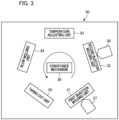
- FIG. 3 is a diagram schematically illustrating a configuration of a blow-molding apparatus according to the present embodiment.
- a blow-molding apparatus 30 according to the present embodiment is an example of a container manufacturing apparatus, and employs a hot parison method (also referred to as a one-stage method) for blow-molding the container 20 by utilizing residual heat (a quantity of internal heat) at the time of injection molding without cooling down the preform 10 to room temperature.
- a hot parison method also referred to as a one-stage method
- the blow-molding apparatus 30 includes a first injection molding unit 31, a second includes molding unit 32, a temperature adjusting unit 33, a blow-molding unit 34, a taking out unit 35, and a conveyance mechanism 36.
- the first injection molding unit 31, the second injection molding unit 32, the temperature adjusting unit 33, the blow-molding unit 34, and the taking out unit 35 are disposed in positions that have been displaced in a rotating manner by every predetermined angle (for example, every 72 degrees) with the conveyance mechanism 36 as a center.
- the conveyance mechanism 36 includes a transfer plate (not illustrated in Fig. 3 ) that rotates about an axis in a sheet vertical direction in Fig. 3 as a center.
- a neck mold 36a (not illustrated in Fig. 3 ) that holds the neck 13 of the preform 10 (or the neck 21 of the container 20) is disposed.
- the transfer plate includes a single roughly disk-shaped member, one or more neck molds 36a are disposed at every predetermined angle.
- the transfer plate includes roughly fan-shaped members that have been divided for respective molding units, one or more neck molds 36a are disposed for each of the divided transfer plates.
- the tapered part 36a1 comes into contact with or is fitted into a mold of each of the molding stations, and therefore a relative positional relationship between both parts at the time of molding can be regulated.
- the conveyance mechanism 36 can also elevate or lower the transfer plate, and also performs an operation relating to mold closing or mold opening (mold releasing) in the first injection molding unit 31 or the second injection molding unit 32.
- the fitting part 40b includes a tapered part 40b1 having a shape that is roughly similar to a shape of the tapered part 36a1 of the neck mold 36a, and receives the tapered part 36a1 of the neck mold 36a by using the tapered part 40b1.
- the blow-molding unit 34 performs blow-molding on the preform 10 in which temperature has been adjusted by the temperature adjusting unit 33, and manufactures the container 20.
- the blow-molding unit 34 includes a mold for blow-molding that includes blow cavity molds that are a pair of split molds that correspond to a shape of the container 20, a bottom mold, and a stretching rod and an air introducing member (a blowing core, both are not illustrated).
- the blow-molding unit 34 performs blow-molding while stretching the preform 10. This causes the preform 10 to be shaped into a shape of the blow cavity mold, and the container 20 can be manufactured.
- the pair of blow cavity molds include a fitting part (a position regulation part) that comes into contact with the neck mold 36a and can be fitted, and the fitting part includes a tapered part having a shape that is roughly similar to a shape of the tapered part 36a1 of the neck mold 36a.
- the taking out unit 35 is configured to release the neck 21 of the container 20 manufactured by the blow-molding unit 34 from the neck mold 36a, and take out the container 20 to an outside of the blow-molding apparatus 30.
- the taking out unit 35 includes a taking out rod (a mold for taking out) that is inserted from an opening of the neck mold 36a.
- the taking out rod includes a fitting part (a position regulation part) that can roughly abut onto the neck mold 36a.
- FIG. 6 is a flowchart illustrating processes of the container manufacturing method.
- Step S101 First Injection Molding Process
- the first resin material is injected from the first injection device 37 into a mold space formed by the cavity mold 40, the core mold 41, and the neck mold 36a of the conveyance mechanism 36, and the first layer 11 of the preform 10 is molded.
- the first injection molding unit 31a is used, and in a case where the preform 10 in the second example is formed, the first injection molding unit 31b is used.
- the first injection molding unit 31b As illustrated in Fig. 5(b) , after the first layer 11 of the preform 10 has been molded, a process of causing the valve pin 43 to protrude to a position close to the core mold 41 is performed. By doing this, in the center of the bottom of the first layer 11, the thin film 18 having a thickness that is smaller than a thickness of a peripheral part is formed.
- the transfer plate of the conveyance mechanism 36 rotates by a predetermined angle, and the first layer 11 of the preform 10 held by the neck mold 36a is conveyed to the second injection molding unit 32 in a state where residual heat at the time of injection molding is contained.
- Step S102 Second Injection Molding Process
- a mold space is formed between the grooves 11b on the inner peripheral side of the first layer 11 and the core mold 51 that faces the inner periphery of the first layer 11.
- the mold space described above is filled with the second resin material by using the hot runner mold 52.
- the thin film 18 has been formed in the bottom of the first layer 11.
- the thin film 18 is broken due to injection pressure of the second resin material, a hole 16 is formed in the bottom, and the second resin material is guided from the hole 16 described above to the inner peripheral side of the first layer 11.
- Step S104 Blow-Molding Process
- the container 20 is blow-molded.
- mold closing is performed on the blow cavity mold to accommodate the preform 10 in mold space, and the air introducing member (the blowing core) is lowered, and therefore the air introducing member abuts onto the neck 13 of the preform 10.
- the stretching rod is lowered, the bottom 15 of the preform 10 is pressed down from an inner face, and blowing air is supplied from the air introducing member while performing longitudinal-axis stretching as needed, and therefore lateral-axis stretching is performed on the preform 10.
- the preform 10 swells out and is shaped to come into close contact with the mold space of the blow cavity mold, and the container 20 is blow-molded.
- respective time periods of the first injection molding process, the second injection molding process, the temperature adjusting process, the blow-molding process, and the container taking out process have the same length.
- time periods of conveyance between the respective processes have the same length.
- a first layer 11 of a preform 10 is injection-molded
- a second layer 12 is injection-molded in the grooves 11a or 11b on the inner peripheral side or the outer peripheral side of the first layer 11, and a preform 10 having a multilayer structure is manufacture.
- each of the preforms 10 having a multilayer structure is molded in two stages of injection molding, and therefore shapes and thickness distributions of the grooves 11a or 11b of the first layer 11 and the second layer 12 formed in the grooves 11a or 11b can be precisely controlled. This enables a vertical-striped pattern to be stably formed in a container 20 by performing internal coloring.
- a preform 10 having a multilayer structure is manufactured in two stages of injection molding, the preform 10 is blow-molded in a state where residual heat at the time of injection molding is contained, and a container 20 is manufactured. Therefore, a device configuration of each injection molding unit or control performed on each of the injection molding units can be made simple in comparison with a case where a preform having a multilayer structure is manufactured in one injection molding, and therefore a manufacturing cost of a container can be reduced.
- a preform having a multilayer structure is manufactured, and after reheating, blow-molding is performed (a cold parison method), in the case of the present embodiment, a preform does not need to be cooled down to a temperature close to ordinary temperature, and neither is a process of assembling or reheating the preform needed. Therefore, according to the present embodiment, a series of processes from injection molding of a preform 10 to blow-molding of a container 20 can be completed in a relatively short time, and a container 20 having a vertical-striped pattern can be manufactured in a shorter cycle.
- a preform 10 having a two-layer structure is molded in two stages of injection molding, and this preform 10 is blow-molded.
- an injection molding unit may be further added, and a preform having an n-layer structure may be molded in n-stages of injection molding (where n is an integer of 3 or more).
- n is an integer of 3 or more.
- a container having a color pattern of more complicated color arrangement can be manufactured.
- a temperature adjusting unit may be appropriately added between the injection molding units.
- a striped pattern according to the present invention is not limited to the examples in the embodiment described above.
- Fig. 7(a) is a variation of Fig. 1(b) , and illustrates a transverse cross section of a preform 10 in which two grooves 11a (ridges 11c) have been formed at intervals of 180° in the outer periphery of the first layer 11.
- a container 20 having a color pattern of two vertical stripes is formed. Note that in a case where the same type of container is formed, the grooves 11b, the ridges 11d, and the second layer 12 may be formed in the inner periphery of the first layer 11.
- the first layer 11 in which the ridges 11c or the grooves 11b are formed is transparent (has a light transmissive property), and therefore a barrel of a container 20 that corresponds to the ridges 11c or the grooves 11b also serves as a portion where a residual amount of contents can be checked.
- Fig. 7(b) is a variation of Fig. 1(d) , and illustrates a transverse cross section of a preform 10 in which a depth of the groove 11b changes in a curved manner in the circumferential direction.
- a periodical gradation having a vertical-striped shape can be generated in the circumferential direction of a container 20 in accordance with a change in thickness in the circumferential direction of the second layer 12.
- the grooves 11a and the second layer 12 may be formed in the outer periphery of the first layer 11.
- the ridges 11d of the first layer may have a shape that protrudes toward a center axis of the container 20, and protruding ribs may be formed inside the container. It is preferable that the protruding ribs to be formed inside the container 20 be formed to extend at least from a lower side of the barrel 22 to an inside of the bottom 23, and the protruding ribs be provided at roughly equal intervals. By doing this, a degree of rigidity or pressure resistance of the container 20 can be enhanced.
- a blow-molding apparatus according to the present invention may be a six-station type blow-molding apparatus that includes a temperature adjusting unit that auxiliarily heats or cools down the first layer 11 of the preform 10, between the first injection molding unit 31 and the second injection molding unit 32.
- the blow-molding apparatus 30a illustrated in Fig. 8 includes a first injection molding unit 31, a temperature adjusting unit 39 (a first temperature adjusting unit), a second injection molding unit 32, a temperature adjusting unit 33 (a second temperature adjusting unit), a blow-molding unit 34, a taking out unit 35, and a conveyance mechanism 36.
- the first injection molding unit 31, the temperature adjusting unit 39, the second injection molding unit 32, the temperature adjusting unit 33, the blow-molding unit 34, and the taking out unit 35 are disposed in positions that have been displaced in a rotating manner by every predetermined angle (for example, every 60 degrees) with the conveyance mechanism 36 as a center.
- the temperature adjusting unit 39 has a configuration that is roughly similar to a configuration of the temperature adjusting unit 33, and includes a not-illustrated mold for temperature adjustment (a temperature adjusting pot or a temperature adjusting core).
- the temperature adjusting unit 39 accommodates the first layer 11 of the preform 10 conveyed from the first injection molding unit 32 in a mold unit that is maintained at a predetermined temperature, and therefore the temperature adjusting unit 39 auxiliarily heats or cools down the first layer 11.
Landscapes
- Engineering & Computer Science (AREA)
- Mechanical Engineering (AREA)
- Manufacturing & Machinery (AREA)
- Physics & Mathematics (AREA)
- Geometry (AREA)
- Blow-Moulding Or Thermoforming Of Plastics Or The Like (AREA)
- Moulds For Moulding Plastics Or The Like (AREA)
- Injection Moulding Of Plastics Or The Like (AREA)
- Moulding By Coating Moulds (AREA)
- Auxiliary Devices For And Details Of Packaging Control (AREA)
Applications Claiming Priority (2)
| Application Number | Priority Date | Filing Date | Title |
|---|---|---|---|
| JP2020003915 | 2020-01-14 | ||
| PCT/JP2021/000722 WO2021145314A1 (ja) | 2020-01-14 | 2021-01-12 | 樹脂製容器の製造方法、製造装置および金型ユニット |
Publications (4)
| Publication Number | Publication Date |
|---|---|
| EP4091793A1 EP4091793A1 (en) | 2022-11-23 |
| EP4091793A4 EP4091793A4 (en) | 2024-03-20 |
| EP4091793C0 EP4091793C0 (en) | 2025-07-09 |
| EP4091793B1 true EP4091793B1 (en) | 2025-07-09 |
Family
ID=76863827
Family Applications (1)
| Application Number | Title | Priority Date | Filing Date |
|---|---|---|---|
| EP21741234.5A Active EP4091793B1 (en) | 2020-01-14 | 2021-01-12 | Resin-made container manufacturing method, manufacturing device, and metal mold unit |
Country Status (6)
| Country | Link |
|---|---|
| US (1) | US12544955B2 (https=) |
| EP (1) | EP4091793B1 (https=) |
| JP (1) | JP7480186B2 (https=) |
| KR (1) | KR20220124755A (https=) |
| CN (1) | CN114945454B (https=) |
| WO (1) | WO2021145314A1 (https=) |
Family Cites Families (21)
| Publication number | Priority date | Publication date | Assignee | Title |
|---|---|---|---|---|
| JPS6058484B2 (ja) | 1978-05-11 | 1985-12-20 | 株式会社東芝 | 定位置停止検知方法 |
| JPS6058485B2 (ja) | 1979-04-13 | 1985-12-20 | アイシン精機株式会社 | 変速機の2段操作機構 |
| JPS55142623A (en) | 1979-04-24 | 1980-11-07 | Yoshino Kogyosho Co Ltd | Method of forming optical pattern in polyethylene terephthalate resin made product and method of reinforcing optical pattern formed by the said method |
| US4705907A (en) * | 1985-05-29 | 1987-11-10 | Showa Shell Sekiyu Kabushiki Kaisha | Production of liquid hydrocarbon from gas containing lower hydrocarbon |
| US5468443A (en) * | 1992-04-24 | 1995-11-21 | Nissei Asb Machine Co., Ltd. | Method and apparatus of injection stretch blow molding |
| US5688570A (en) * | 1995-10-13 | 1997-11-18 | Crown Cork & Seal Company, Inc. | Method and apparatus for forming a multi-layer preform |
| JPH1190975A (ja) | 1997-09-18 | 1999-04-06 | Toyo Seikan Kaisha Ltd | 回収ポリエステル樹脂層を有する多層プリフォームと該多層プリフォームの製造方法及びこの多層プリフォームから成形された多層容器 |
| JP4037578B2 (ja) | 1999-10-08 | 2008-01-23 | 大成化工株式会社 | 積層ボトルの製造方法、並びに、積層剥離容器の製造装置 |
| US6649121B1 (en) * | 1999-10-08 | 2003-11-18 | Taisei Kako Co., Ltd. | Method of producing laminated bottles having peelable inner layer |
| CN1195620C (zh) * | 2000-10-19 | 2005-04-06 | 帝人株式会社 | 多层预成型体及其制造方法 |
| FR2898293B1 (fr) * | 2006-03-08 | 2012-08-10 | Evian Saeme Sa | Preforme multicouches a parois minces et son procede d'obtention |
| US20080118686A1 (en) * | 2006-11-20 | 2008-05-22 | Katherine Glasgow | Injection blow molding process and article |
| WO2008125698A1 (es) | 2007-04-11 | 2008-10-23 | Molmasa Aplicaciones Técnicas, S.L. | Molde y procedimiento para fabricación de preformas bicomponente por sobremoldeo de inyección, y preforma bicomponente obtenida |
| JP5641685B2 (ja) * | 2007-10-12 | 2014-12-17 | 株式会社ユポ・コーポレーション | 射出成形複合容器およびその製造方法 |
| DK2266521T3 (da) * | 2008-03-14 | 2013-10-28 | Otsuka Pharma Co Ltd | Plastikampul |
| JP4953178B2 (ja) * | 2008-06-30 | 2012-06-13 | 株式会社吉野工業所 | 合成樹脂製積層壜体、射出成形装置及び積層プリフォームの成形方法 |
| JP5765656B2 (ja) | 2011-10-31 | 2015-08-19 | 株式会社吉野工業所 | プリフォームの射出成形装置 |
| JP6065266B2 (ja) * | 2012-11-30 | 2017-01-25 | 株式会社吉野工業所 | 合成樹脂製窓付き容器、プリフォーム及びプリフォームの射出成形装置 |
| JP6058485B2 (ja) | 2013-06-28 | 2017-01-11 | 株式会社吉野工業所 | プリフォームの射出成形装置 |
| JP6058484B2 (ja) | 2013-06-28 | 2017-01-11 | 株式会社吉野工業所 | プリフォームの射出成形装置 |
| CN121733792A (zh) * | 2017-10-19 | 2026-03-27 | 日精Asb机械株式会社 | 树脂制的容器的制造方法、模具单元以及成型机 |
-
2021
- 2021-01-12 JP JP2021571189A patent/JP7480186B2/ja active Active
- 2021-01-12 EP EP21741234.5A patent/EP4091793B1/en active Active
- 2021-01-12 US US17/792,257 patent/US12544955B2/en active Active
- 2021-01-12 KR KR1020227026997A patent/KR20220124755A/ko active Pending
- 2021-01-12 WO PCT/JP2021/000722 patent/WO2021145314A1/ja not_active Ceased
- 2021-01-12 CN CN202180009209.2A patent/CN114945454B/zh active Active
Also Published As
| Publication number | Publication date |
|---|---|
| EP4091793A4 (en) | 2024-03-20 |
| CN114945454A (zh) | 2022-08-26 |
| WO2021145314A1 (ja) | 2021-07-22 |
| US12544955B2 (en) | 2026-02-10 |
| JPWO2021145314A1 (https=) | 2021-07-22 |
| KR20220124755A (ko) | 2022-09-14 |
| JP7480186B2 (ja) | 2024-05-09 |
| EP4091793C0 (en) | 2025-07-09 |
| EP4091793A1 (en) | 2022-11-23 |
| US20230084023A1 (en) | 2023-03-16 |
| CN114945454B (zh) | 2024-07-09 |
Similar Documents
| Publication | Publication Date | Title |
|---|---|---|
| EP2276672B1 (en) | Preform for a blow molded polyester container with an over-molded thermoplastic layer | |
| CN103209818A (zh) | 流体吹塑的预制坯设计 | |
| EP4091793B1 (en) | Resin-made container manufacturing method, manufacturing device, and metal mold unit | |
| US12208558B2 (en) | Manufacturing method and manufacturing apparatus for delamination container | |
| EP0715937B1 (en) | Equipment for the injection molding of containers or preforms for containers of plastics material | |
| US12605877B2 (en) | Manufacturing method, manufacturing apparatus, and mold unit for resin container | |
| US12454091B2 (en) | Method and apparatus for producing resin container | |
| US12515392B2 (en) | Method and device for manufacturing resin-made container | |
| WO2024101420A1 (ja) | 剥離容器、プリフォーム、剥離容器の製造方法および製造装置 | |
| WO2022014540A1 (ja) | 樹脂製容器の製造方法および製造装置 | |
| WO2022030461A1 (ja) | 樹脂製容器の製造方法、金型ユニットおよびブロー成形装置 | |
| JP7566133B2 (ja) | 樹脂製容器の製造方法および製造装置 | |
| WO2023204262A1 (ja) | 樹脂製容器の製造方法および製造装置 | |
| WO2020262644A1 (ja) | プリフォームの製造方法、二重壁容器および二重壁容器の製造方法 |
Legal Events
| Date | Code | Title | Description |
|---|---|---|---|
| STAA | Information on the status of an ep patent application or granted ep patent |
Free format text: STATUS: THE INTERNATIONAL PUBLICATION HAS BEEN MADE |
|
| PUAI | Public reference made under article 153(3) epc to a published international application that has entered the european phase |
Free format text: ORIGINAL CODE: 0009012 |
|
| STAA | Information on the status of an ep patent application or granted ep patent |
Free format text: STATUS: REQUEST FOR EXAMINATION WAS MADE |
|
| 17P | Request for examination filed |
Effective date: 20220812 |
|
| AK | Designated contracting states |
Kind code of ref document: A1 Designated state(s): AL AT BE BG CH CY CZ DE DK EE ES FI FR GB GR HR HU IE IS IT LI LT LU LV MC MK MT NL NO PL PT RO RS SE SI SK SM TR |
|
| DAV | Request for validation of the european patent (deleted) | ||
| DAX | Request for extension of the european patent (deleted) | ||
| A4 | Supplementary search report drawn up and despatched |
Effective date: 20240216 |
|
| RIC1 | Information provided on ipc code assigned before grant |
Ipc: B29L 31/00 20060101ALN20240212BHEP Ipc: B29C 49/06 20060101ALN20240212BHEP Ipc: B29C 49/00 20060101ALN20240212BHEP Ipc: B29C 45/16 20060101ALI20240212BHEP Ipc: B29C 49/02 20060101ALI20240212BHEP Ipc: B29B 11/08 20060101ALI20240212BHEP Ipc: B29C 49/22 20060101AFI20240212BHEP |
|
| GRAP | Despatch of communication of intention to grant a patent |
Free format text: ORIGINAL CODE: EPIDOSNIGR1 |
|
| STAA | Information on the status of an ep patent application or granted ep patent |
Free format text: STATUS: GRANT OF PATENT IS INTENDED |
|
| RIC1 | Information provided on ipc code assigned before grant |
Ipc: B29L 31/00 20060101ALN20250121BHEP Ipc: B29C 49/06 20060101ALN20250121BHEP Ipc: B29C 49/00 20060101ALN20250121BHEP Ipc: B29C 45/16 20060101ALI20250121BHEP Ipc: B29C 49/02 20060101ALI20250121BHEP Ipc: B29B 11/08 20060101ALI20250121BHEP Ipc: B29C 49/22 20060101AFI20250121BHEP |
|
| INTG | Intention to grant announced |
Effective date: 20250213 |
|
| GRAS | Grant fee paid |
Free format text: ORIGINAL CODE: EPIDOSNIGR3 |
|
| GRAA | (expected) grant |
Free format text: ORIGINAL CODE: 0009210 |
|
| STAA | Information on the status of an ep patent application or granted ep patent |
Free format text: STATUS: THE PATENT HAS BEEN GRANTED |
|
| AK | Designated contracting states |
Kind code of ref document: B1 Designated state(s): AL AT BE BG CH CY CZ DE DK EE ES FI FR GB GR HR HU IE IS IT LI LT LU LV MC MK MT NL NO PL PT RO RS SE SI SK SM TR |
|
| REG | Reference to a national code |
Ref country code: GB Ref legal event code: FG4D |
|
| REG | Reference to a national code |
Ref country code: CH Ref legal event code: EP |
|
| REG | Reference to a national code |
Ref country code: IE Ref legal event code: FG4D |
|
| U01 | Request for unitary effect filed |
Effective date: 20250711 |
|
| U07 | Unitary effect registered |
Designated state(s): AT BE BG DE DK EE FI FR IT LT LU LV MT NL PT RO SE SI Effective date: 20250718 |
|
| PG25 | Lapsed in a contracting state [announced via postgrant information from national office to epo] |
Ref country code: IS Free format text: LAPSE BECAUSE OF FAILURE TO SUBMIT A TRANSLATION OF THE DESCRIPTION OR TO PAY THE FEE WITHIN THE PRESCRIBED TIME-LIMIT Effective date: 20251109 |
|
| PG25 | Lapsed in a contracting state [announced via postgrant information from national office to epo] |
Ref country code: NO Free format text: LAPSE BECAUSE OF FAILURE TO SUBMIT A TRANSLATION OF THE DESCRIPTION OR TO PAY THE FEE WITHIN THE PRESCRIBED TIME-LIMIT Effective date: 20251009 |
|
| PG25 | Lapsed in a contracting state [announced via postgrant information from national office to epo] |
Ref country code: HR Free format text: LAPSE BECAUSE OF FAILURE TO SUBMIT A TRANSLATION OF THE DESCRIPTION OR TO PAY THE FEE WITHIN THE PRESCRIBED TIME-LIMIT Effective date: 20250709 |
|
| PG25 | Lapsed in a contracting state [announced via postgrant information from national office to epo] |
Ref country code: GR Free format text: LAPSE BECAUSE OF FAILURE TO SUBMIT A TRANSLATION OF THE DESCRIPTION OR TO PAY THE FEE WITHIN THE PRESCRIBED TIME-LIMIT Effective date: 20251010 |
|
| PG25 | Lapsed in a contracting state [announced via postgrant information from national office to epo] |
Ref country code: PL Free format text: LAPSE BECAUSE OF FAILURE TO SUBMIT A TRANSLATION OF THE DESCRIPTION OR TO PAY THE FEE WITHIN THE PRESCRIBED TIME-LIMIT Effective date: 20250709 |
|
| PG25 | Lapsed in a contracting state [announced via postgrant information from national office to epo] |
Ref country code: RS Free format text: LAPSE BECAUSE OF FAILURE TO SUBMIT A TRANSLATION OF THE DESCRIPTION OR TO PAY THE FEE WITHIN THE PRESCRIBED TIME-LIMIT Effective date: 20251009 |
|
| PG25 | Lapsed in a contracting state [announced via postgrant information from national office to epo] |
Ref country code: ES Free format text: LAPSE BECAUSE OF FAILURE TO SUBMIT A TRANSLATION OF THE DESCRIPTION OR TO PAY THE FEE WITHIN THE PRESCRIBED TIME-LIMIT Effective date: 20250709 |
|
| U20 | Renewal fee for the european patent with unitary effect paid |
Year of fee payment: 6 Effective date: 20260128 |
|
| PG25 | Lapsed in a contracting state [announced via postgrant information from national office to epo] |
Ref country code: SM Free format text: LAPSE BECAUSE OF FAILURE TO SUBMIT A TRANSLATION OF THE DESCRIPTION OR TO PAY THE FEE WITHIN THE PRESCRIBED TIME-LIMIT Effective date: 20250709 |
|
| PG25 | Lapsed in a contracting state [announced via postgrant information from national office to epo] |
Ref country code: CZ Free format text: LAPSE BECAUSE OF FAILURE TO SUBMIT A TRANSLATION OF THE DESCRIPTION OR TO PAY THE FEE WITHIN THE PRESCRIBED TIME-LIMIT Effective date: 20250709 |
|
| PG25 | Lapsed in a contracting state [announced via postgrant information from national office to epo] |
Ref country code: SK Free format text: LAPSE BECAUSE OF FAILURE TO SUBMIT A TRANSLATION OF THE DESCRIPTION OR TO PAY THE FEE WITHIN THE PRESCRIBED TIME-LIMIT Effective date: 20250709 |