EP4086119B1 - Halter zur lösbaren befestigung eines flachen geräts an einem kraftfahrzeugsitz - Google Patents
Halter zur lösbaren befestigung eines flachen geräts an einem kraftfahrzeugsitz Download PDFInfo
- Publication number
- EP4086119B1 EP4086119B1 EP22171785.3A EP22171785A EP4086119B1 EP 4086119 B1 EP4086119 B1 EP 4086119B1 EP 22171785 A EP22171785 A EP 22171785A EP 4086119 B1 EP4086119 B1 EP 4086119B1
- Authority
- EP
- European Patent Office
- Prior art keywords
- holder
- coupling element
- holding device
- pivot
- relative
- Prior art date
- Legal status (The legal status is an assumption and is not a legal conclusion. Google has not performed a legal analysis and makes no representation as to the accuracy of the status listed.)
- Active
Links
Images



Classifications
-
- B—PERFORMING OPERATIONS; TRANSPORTING
- B60—VEHICLES IN GENERAL
- B60R—VEHICLES, VEHICLE FITTINGS, OR VEHICLE PARTS, NOT OTHERWISE PROVIDED FOR
- B60R11/00—Arrangements for holding or mounting articles, not otherwise provided for
- B60R11/02—Arrangements for holding or mounting articles, not otherwise provided for for radio sets, television sets, telephones, or the like; Arrangement of controls thereof
-
- B—PERFORMING OPERATIONS; TRANSPORTING
- B60—VEHICLES IN GENERAL
- B60R—VEHICLES, VEHICLE FITTINGS, OR VEHICLE PARTS, NOT OTHERWISE PROVIDED FOR
- B60R11/00—Arrangements for holding or mounting articles, not otherwise provided for
- B60R11/02—Arrangements for holding or mounting articles, not otherwise provided for for radio sets, television sets, telephones, or the like; Arrangement of controls thereof
- B60R11/0229—Arrangements for holding or mounting articles, not otherwise provided for for radio sets, television sets, telephones, or the like; Arrangement of controls thereof for displays, e.g. cathodic tubes
- B60R11/0235—Arrangements for holding or mounting articles, not otherwise provided for for radio sets, television sets, telephones, or the like; Arrangement of controls thereof for displays, e.g. cathodic tubes of flat type, e.g. LCD
-
- B—PERFORMING OPERATIONS; TRANSPORTING
- B60—VEHICLES IN GENERAL
- B60R—VEHICLES, VEHICLE FITTINGS, OR VEHICLE PARTS, NOT OTHERWISE PROVIDED FOR
- B60R11/00—Arrangements for holding or mounting articles, not otherwise provided for
-
- B—PERFORMING OPERATIONS; TRANSPORTING
- B60—VEHICLES IN GENERAL
- B60R—VEHICLES, VEHICLE FITTINGS, OR VEHICLE PARTS, NOT OTHERWISE PROVIDED FOR
- B60R11/00—Arrangements for holding or mounting articles, not otherwise provided for
- B60R11/02—Arrangements for holding or mounting articles, not otherwise provided for for radio sets, television sets, telephones, or the like; Arrangement of controls thereof
- B60R11/0241—Arrangements for holding or mounting articles, not otherwise provided for for radio sets, television sets, telephones, or the like; Arrangement of controls thereof for telephones
-
- B—PERFORMING OPERATIONS; TRANSPORTING
- B60—VEHICLES IN GENERAL
- B60R—VEHICLES, VEHICLE FITTINGS, OR VEHICLE PARTS, NOT OTHERWISE PROVIDED FOR
- B60R11/00—Arrangements for holding or mounting articles, not otherwise provided for
- B60R2011/0001—Arrangements for holding or mounting articles, not otherwise provided for characterised by position
- B60R2011/0003—Arrangements for holding or mounting articles, not otherwise provided for characterised by position inside the vehicle
- B60R2011/0012—Seats or parts thereof
- B60R2011/0015—Back-rests
-
- B—PERFORMING OPERATIONS; TRANSPORTING
- B60—VEHICLES IN GENERAL
- B60R—VEHICLES, VEHICLE FITTINGS, OR VEHICLE PARTS, NOT OTHERWISE PROVIDED FOR
- B60R11/00—Arrangements for holding or mounting articles, not otherwise provided for
- B60R2011/0042—Arrangements for holding or mounting articles, not otherwise provided for characterised by mounting means
- B60R2011/0049—Arrangements for holding or mounting articles, not otherwise provided for characterised by mounting means for non integrated articles
- B60R2011/005—Connection with the vehicle part
- B60R2011/0061—Connection with the vehicle part using key-type connections
-
- B—PERFORMING OPERATIONS; TRANSPORTING
- B60—VEHICLES IN GENERAL
- B60R—VEHICLES, VEHICLE FITTINGS, OR VEHICLE PARTS, NOT OTHERWISE PROVIDED FOR
- B60R11/00—Arrangements for holding or mounting articles, not otherwise provided for
- B60R2011/0042—Arrangements for holding or mounting articles, not otherwise provided for characterised by mounting means
- B60R2011/0049—Arrangements for holding or mounting articles, not otherwise provided for characterised by mounting means for non integrated articles
- B60R2011/0064—Connection with the article
- B60R2011/0071—Connection with the article using latches, clips, clamps, straps or the like
-
- B—PERFORMING OPERATIONS; TRANSPORTING
- B60—VEHICLES IN GENERAL
- B60R—VEHICLES, VEHICLE FITTINGS, OR VEHICLE PARTS, NOT OTHERWISE PROVIDED FOR
- B60R11/00—Arrangements for holding or mounting articles, not otherwise provided for
- B60R2011/0042—Arrangements for holding or mounting articles, not otherwise provided for characterised by mounting means
- B60R2011/0049—Arrangements for holding or mounting articles, not otherwise provided for characterised by mounting means for non integrated articles
- B60R2011/0078—Quick-disconnect two-parts mounting means
-
- B—PERFORMING OPERATIONS; TRANSPORTING
- B60—VEHICLES IN GENERAL
- B60R—VEHICLES, VEHICLE FITTINGS, OR VEHICLE PARTS, NOT OTHERWISE PROVIDED FOR
- B60R11/00—Arrangements for holding or mounting articles, not otherwise provided for
- B60R2011/0042—Arrangements for holding or mounting articles, not otherwise provided for characterised by mounting means
- B60R2011/008—Adjustable or movable supports
- B60R2011/0085—Adjustable or movable supports with adjustment by rotation in their operational position
-
- B—PERFORMING OPERATIONS; TRANSPORTING
- B60—VEHICLES IN GENERAL
- B60R—VEHICLES, VEHICLE FITTINGS, OR VEHICLE PARTS, NOT OTHERWISE PROVIDED FOR
- B60R11/00—Arrangements for holding or mounting articles, not otherwise provided for
- B60R2011/0042—Arrangements for holding or mounting articles, not otherwise provided for characterised by mounting means
- B60R2011/008—Adjustable or movable supports
- B60R2011/0085—Adjustable or movable supports with adjustment by rotation in their operational position
- B60R2011/0087—Adjustable or movable supports with adjustment by rotation in their operational position around two axes
Definitions
- the invention relates to a holder with the features of the preamble of patent claim 1.
- the invention proposes a holder with the features of patent claim 1.
- the holder according to the invention makes it possible to arrange the holding device with the device arranged thereon in a variety of different positions and locations.
- the holder according to the invention makes it possible to arrange the holding device with the device in the immediate vicinity of the vehicle seat or in a space further away from the vehicle seat and at a reduced distance from the user of the device. This is advantageous, for example, for vehicle situations in which a user with a smaller body size wants to use a relatively small device, especially if the holder is arranged in a vehicle with a generous rear seat space.
- first pivot axis and the second pivot axis are oriented horizontally in a position of use of the holder. This ensures that the movement of the components of the holder takes place in a vertical plane of movement which runs parallel to the longitudinal axis of the vehicle. If the holding device is located in an area further away from the vehicle seat and a rear-end collision of the vehicle is assumed, the holding device and the coupling element can be moved within the said plane of movement. forward, so that the risk of injury to a vehicle occupant who also moves forward in the direction of the vehicle in the event of an accident is reduced. This also applies if the vehicle occupant is sitting slightly offset from the holder in the transverse direction of the vehicle.
- the fastening device has a plug-in section extending along a plug-in axis, wherein the plug-in axis is oriented horizontally in the position of use of the holder and in a state inserted into the plug-in receptacle. This enables a simple and space-saving connection between the fastening device and the plug-in receptacle of the motor vehicle seat.
- a pivoting path of the coupling element is limited to a first part of the pivoting path in the direction of the motor vehicle seat of a maximum of 40°, and/or to an opposite second part of the pivoting path of a maximum of 150°.
- the limitation in the area of the first part of the pivoting path prevents an unwanted collision of the rear side of the holding device with components of the motor vehicle seat arranged above the plug-in receptacle, for example a scratch-sensitive surface of a headrest or headrest casing.
- a limitation of the second part of the pivoting path prevents such a collision in an area below the plug-in receptacle of the Motor vehicle seat, for example in the area of a cover or a panel on the backrest.
- the areas of a motor vehicle seat refer to an arrangement of the plug-in receptacle in an area of a transition between a headrest and a backrest of a motor vehicle seat, in particular in the area of exposed headrest rods.
- the areas mentioned are only examples; it is understood that the plug-in receptacle can also be arranged in an integral seat in which the backrest areas and headrest areas merge into one another.
- the coupling element and the fastening device are in contact with one another to limit a first end position of one or the pivoting path of the coupling element relative to the fastening device and/or to limit a second end position of one or the pivoting path of the coupling element relative to the fastening device.
- a pivoting angle of the holding device relative to the coupling element is at least 90°, preferably at least 120°, in particular at least 150°. This enables a largely free adjustment of the inclination of the holding device about the second pivot axis, preferably in each of the pivot positions of the coupling element relative to the fastening device.
- a pivoting angle of the holding device relative to the coupling element is a maximum of 170°, whereby the adjustability of the inclination of the holding device is limited to an adjustment range in which the holding device assumes an inclination in which a device held thereon is oriented approximately vertically, or points slightly downwards or points slightly upwards.
- positions of the holding device can be avoided in which the holding device points essentially downwards and in the event of an unintentional release of the holding device a device held thereon would fall downwards from the holding device.
- the holding device and the coupling element are in contact with one another, in particular in an area spaced apart from the second pivot axis. This enables a reliable and stable definition of the first end position and/or the second end position.
- first pivot joint and/or the second pivot joint is or are designed as a friction joint.
- friction joints in particular enable a continuous adjustability of the coupling element relative to the fastening device or the holding device relative to the coupling element.
- the holder comprises a device which applies a torque to the coupling element around the first pivot axis, which is effective for raising the coupling element from a horizontal position to a more vertically oriented position.
- the device therefore exerts a holding force that is counter to gravity on the coupling element and on the associated holding device, so that a weight balance can be created for a device held on the holding device.
- this enables the friction joint to move more easily and thus the holding device to be used more comfortably when setting a pivot position of the coupling element.
- the holding device has a swivel joint, by means of which a holding area of the holding device can be rotated about a rotation axis that is oriented perpendicular to the second pivot axis.
- a swivel joint by means of which a holding area of the holding device can be rotated about a rotation axis that is oriented perpendicular to the second pivot axis.
- This allows - in any position of the coupling element - the device held on the holding device together with the holding area to be arranged either in an upright position or in a transverse arrangement.
- the swivel joint has locking steps which are preferably offset by 90° relative to one another.
- a holder is designated overall with the reference number 10.
- the holder 10 has a fastening device 12 with a plug-in section 14, compare Figure 2 , which extends along a plug-in axis 16 and can be inserted along this plug-in axis 16 into a plug-in receptacle 18 and can be releasably locked there.
- the plug-in receptacle 18 is arranged on a schematically indicated motor vehicle seat 20, wherein the Motor vehicle seat 20 has a rear side 22 facing a vehicle rear space.
- the holder 10 further comprises a holding device, designated overall by the reference numeral 24, which serves to releasably hold an electronic device, in particular a tablet computer or a smartphone.
- the holding device 24 has a holding area 26 for arranging the device. When arranged in the holding area 26, the device is held between two holding elements 28 and 30 which are spaced apart from one another and pre-tensioned relative to one another when a device is arranged in the holding area 26.
- the holding device 24 comprises a swivel joint 32, see Figure 8 , for the definition of a rotation axis 34, see Figures 1 and 2 , whereby the holding area 26 is rotatable about the axis of rotation 34, so that a device held on the holding area 26 can be held in an upright or transverse arrangement.
- the holding device 24 and the fastening device 12 are connected to each other via a coupling element 36, which can also be designed in duplicate, compare reference numerals 36a and 36b in Figure 1 .
- the coupling element 36 has a first pivot axis 38, by means of which the coupling element 36 can be pivoted relative to the fastening device 12.
- the coupling element 36 has a second pivot axis 40, by means of which the holding device 24 can be pivoted relative to the coupling element 36.
- the pivot axes 38 and 40 are parallel to one another and in particular oriented horizontally. Preferably, the pivot axes 38 and 40 are at a maximum distance from one another (relative to an extension of the coupling element 36 along a coupling element axis).
- the pivot axes 38 and 40 are part of respective pivot joints 42 and 44.
- the holder 10 is shown as an example in a basic position in which the coupling element 36 and the holding device 24 with the holding area 26 are oriented vertically.
- This vertical position corresponds to a Figure 3 shown vertical plane 46, which is oriented perpendicular to the horizontal plug-in axis 16.
- the coupling element 36 can be rotated around the first plug-in axis 38 in a Figure 3 shown first end position, whereby the coupling element 36, starting from its basic position, is pivoted towards the vehicle seat 20 (see Figure 2 ) is pivoted about a first part 48 of a pivoting path.
- a pivoting angle associated with this pivoting path 48 is preferably a maximum of 40° and in particular a maximum of 25°.
- a stop 50 formed on the coupling element 36 lies in a Stop area 52 on a counter surface 54 of the fastening device 12, compare Figure 7 .
- the holding device 24 can be pivoted slightly downwards from a vertical position about the second pivot axis 40 to a first end position of the holding device 24, see Figure 4 .
- a corresponding pivoting path 56 of the holding device 24 around the second pivot axis 40 is limited in a first end position of the holding device 24 by a stop 58 formed on the holding area 24 being in contact with a counter surface 60 of the coupling element 36, so that in a stop area 62 a further pivoting of the holding area 24 relative to the coupling element 36 is prevented, see Figure 8 .
- FIG. 5 Also in Figure 5 is the one with Figure 2 corresponding basic position of the coupling element 36, in which it is vertically oriented, is illustrated using a vertical plane 46.
- the coupling element 36 In relation to this vertical plane 46, the coupling element 36 is in a position corresponding to the first part 48 of the pivoting path (compare Fig.3 ) opposite direction along a second part 64 of the pivot path about the first pivot axis 38, in particular by a maximum of 135°.
- the coupling element 36 assumes a Figures 5 and 6 second end position, in which a stop surface 66 of the coupling element 36 is in abutment with a counter surface 68 of the fastening device 12, compare Figure 9 .
- the holding device 24 can be pivoted around the second pivot axis 40 in a pivoting direction 70 in the direction of the rear side 22 of the motor vehicle seat 20, see Figure 2 , so that the holding area 26 of the holding device 24 is pivoted slightly obliquely upwards, which is particularly advantageous for tall users.
- the pivoting along the pivoting direction 70 is preferably limited by a (in Figure 6 shown) second end position of the holding device 24 relative to the coupling element 36, in which a stop surface 72 of the holding device 24 is in contact with a counter surface 74 of the coupling element 36, compare Figure 9 .
- the coupling element 36 preferably has a total of four sections, which, if required, also define one of the aforementioned end positions, namely the stop 50 (cf. Figure 7 ), the counter surface 60 (cf. Figure 8 ), the stop surface 66 (cf. Figure 9 ) and the counter surface 74 (cf. Figure 9 ).
- the above-mentioned four sections of the coupling element 36 are preferably spatially offset relative to one another and in particular by different Sections of a peripheral surface of the coupling element 36 are formed.
- the movement of the coupling element 36 relative to the fastening device 12 about the first pivot axis 38 is preferably self-locking. This also applies to the movement of the holding device 24 about the second pivot axis 40 of the coupling element 36. To achieve such self-locking, it is preferred if the pivot joints 42, 44 are designed as friction joints.
- the swivel joints 42, 44 have cylindrical friction areas 76, see Figure 9 in which a cylindrical outer surface interacts with a hollow cylindrical inner surface in a frictional manner. Plastic materials are preferred for this frictional engagement.
- the holder 10 has a (in Figure 10 shown) device 78.
- the device 78 comprises, for example, a spring 80, which is supported in a first region 82 on the fastening device 12 and generates a force in a region 84 spaced therefrom, which acts on a force absorption region 86 of the coupling element 36 and moves it around the first pivot axis 38 from a horizontal position - a torque direction 88 accordingly - into a more vertically oriented position.
- the device 78 serves accordingly to absorb or compensate the weight of the device or at least part of the weight of the device.
- the device 78 can also serve to move the coupling element 36 into the vertical basic position of the coupling element 36 (see Figures 2 , 3 and 5 ) so that the holding device 24 is arranged in an unactuated basic position close to the motor vehicle seat 20.
- the holder 10 allows a wide range of adjustability of the holding area 26 for large and small users in different vehicle environments.
Landscapes
- Engineering & Computer Science (AREA)
- Mechanical Engineering (AREA)
- Seats For Vehicles (AREA)
- Telephone Set Structure (AREA)
- Fittings On The Vehicle Exterior For Carrying Loads, And Devices For Holding Or Mounting Articles (AREA)
Description
- Die Erfindung betrifft einen Halter mit den Merkmalen des Oberbegriffs des Patentanspruchs 1.
- Aus der
DE 10 2016 102 611 A1 und derUS 2019/329717 A1 sind Halter für elektronische Geräte bekannt. - Es hat sich herausgestellt, dass Halter der vorstehend genannten Art in einer Vielzahl von Fahrzeugumgebungen (vom einfachen Kleinwagen bis zu Fahrzeugen der Luxusklasse) und von einer Vielzahl unterschiedlicher Nutzer unterschiedlichen Alters und unterschiedlicher Körpergrößen verwendet werden. Auch die Ausgestaltung der an der Halteeinrichtung zu haltenden Geräte variiert von kleineren Smartphones bis hin zu größeren Tablet-Computern.
- Die Erfindung schlägt einen Halter mit den Merkmalen des Patentanspruchs 1 vor.
- Der erfindungsgemäße Halter ermöglicht es, die Halteeinrichtung mit dem daran angeordneten Gerät in einer Vielzahl unterschiedlicher Positionen und Lagen anordnen zu können. Insbesondere ermöglicht es der erfindungsgemäße Halter, die Halteeinrichtung mit dem Gerät in unmittelbarer Nähe des Kraftfahrzeugsitzes anzuordnen oder aber in einem zu dem Kraftfahrzeugsitz weiter beabstandeten Raum mit einem zu dem Nutzer des Geräts verkleinerten Abstand. Dies ist beispielhaft für Fahrzeugsituationen vorteilhaft, in welchen ein Nutzer mit kleinerer Körpergröße ein relativ kleines Gerät benutzen möchte, insbesondere, wenn der Halter in einem Fahrzeug mit einem großzügigen Rücksitzraum angeordnet ist.
- Insbesondere ist es bevorzugt, wenn die erste Schwenkachse und die zweite Schwenkachse in einer Gebrauchslage des Halters horizontal orientiert sind. Dies stellt sicher, dass eine Bewegung der Bauteile des Halters in einer vertikalen Bewegungsebene erfolgt, welche parallel zur Fahrzeuglängsachse verläuft. Befindet sich die Halteeinrichtung in einem zu dem Kraftfahrzeugsitz weiter beabstandeten Bereich und nimmt man einen Auffahrunfall des Kraftfahrzeuges an, können die Halteeinrichtung und das Koppelelement innerhalb der genannten Bewegungsebene nach vorne ausweichen, sodass sich das Verletzungsrisiko eines Fahrzeuginsassens, der sich bei einem Unfall ebenfalls in Fahrzeugrichtung nach vorne bewegt, verringert. Dies gilt auch für den Fall, dass der Fahrzeuginsasse in Fahrzeugquerrichtung etwas versetzt zu dem Halter sitzen sollte.
- Bevorzugt ist es ferner, wenn die Befestigungseinrichtung einen sich längs einer Steckachse erstreckenden Steckabschnitt aufweist, wobei die Steckachse in der Gebrauchslage des Halters und in einem in die Steckaufnahme eingesteckten Zustand horizontal orientiert ist. Dies ermöglicht eine einfache und platzsparende Verbindung zwischen der Befestigungseinrichtung und der Steckaufnahme des Kraftfahrzeugsitzes.
- Bevorzugt ist es ferner, wenn ein Schwenkweg des Koppelelements ausgehend von einer vertikalen Orientierung des Koppelelements begrenzt ist auf einen ersten Teil des Schwenkwegs in Richtung auf den Kraftfahrzeugsitz von maximal 40°, und/oder auf einen entgegengesetzten zweiten Teil des Schwenkwegs von maximal 150°. Die Begrenzung im Bereich des ersten Teils des Schwenkwegs verhindert eine ungewollte Kollision der Rückseite der Halteeinrichtung mit oberhalb der Steckaufnahme angeordneten Bauteilen des Kraftfahrzeugsitzes, beispielsweise einer kratzempfindlichen Oberfläche einer Kopfstütze oder Kopfstützenverschalung. Eine Begrenzung des zweiten Teils des Schwenkwegs verhindert eine solche Kollision in einem Bereich unterhalb der Steckaufnahme des Kraftfahrzeugsitzes, beispielsweise im Bereich eines Bezuges oder einer Verschalung der Rückenlehne.
- Die vorstehenden Erläuterungen zu den Bereichen eines Kraftfahrzeugsitzes beziehen sich auf eine Anordnung der Steckaufnahme in einem Bereich eines Übergangs zwischen einer Kopfstütze und einer Rückenlehne eines Kraftfahrzeugsitzes, insbesondere im Bereich freiliegender Kopfstützenstangen. Die genannten Bereiche sind aber nur beispielhaft; es versteht sich, dass die Steckaufnahme auch in einem Integralsitz angeordnet sein kann, bei welchem Rückenlehnenbereiche und Kopfstützenbereiche ineinander übergehen.
- Bevorzugt ist es ferner, wenn zur Begrenzung einer ersten Endlage eines oder des Schwenkwegs des Koppelelements relativ zu der Befestigungseinrichtung und/oder zur Begrenzung einer zweiten Endlage eines oder des Schwenkwegs des Koppelelements relativ zu der Befestigungseinrichtung das Koppelelement und die Befestigungseinrichtung miteinander in Anschlag steht. Dies ermöglicht eine einfache Definition der genannten Endlagen durch einfache Anlage der genannten Bauteile, wobei die Bauteile insbesondere in einem zu der ersten Schwenkachse beabstandeten Bereich aneinander anliegen.
- Gemäß einer weiteren Ausführungsform der Erfindung ist vorgesehen, dass ein Schwenkwinkel der Halteeinrichtung relativ zu dem Koppelelement mindestens 90°, vorzugsweise mindestens 120°, insbesondere mindestens 150° beträgt. Dies ermöglicht eine weitgehend freie Neigungseinstellung der Halteeinrichtung um die zweite Schwenkachse, und zwar vorzugsweise in jeder der Schwenklagen des Koppelelements relativ zu der Befestigungseinrichtung.
- Es ist ferner bevorzugt, wenn ein Schwenkwinkel der Halteeinrichtung relativ zu dem Koppelelement maximal 170° beträgt, wodurch die Einstellbarkeit der Neigung der Halteeinrichtung auf einen Einstellbereich beschränkt wird, in welchem die Halteeinrichtung eine Neigung einnimmt, in der ein daran gehaltenes Gerät in etwa vertikal orientiert ist, oder geringfügig nach unten weist oder geringfügig nach oben weist. Insbesondere können Lagen der Halteeinrichtung vermieden werden, in welchen die Halteeinrichtung im Wesentlichen nach unten weist und bei einem unbeabsichtigten Lösen der Halteeinrichtung ein daran gehaltenes Gerät nach unten von der Halteeinrichtung abfallen würde.
- Zur Begrenzung einer ersten Endlage eines Schwenkwegs der Halteeinrichtung relativ zu dem Koppelelement und/oder zur Begrenzung einer zweiten Endlage eines oder des Schwenkwinkels der Halteeinrichtung relativ zu dem Koppelelement ist es bevorzugt, wenn die Halteeinrichtung und das Koppelelement miteinander in Anschlag stehen, insbesondere in einem zu der zweiten Schwenkachse beabstandeten Bereich. Dies ermöglicht eine zuverlässige und stabile Definition der ersten Endlage und/oder der zweiten Endlage.
- Es ist ferner bevorzugt, wenn das erste Schwenkgelenk und/oder das zweite Schwenkgelenk als Reibgelenk ausgebildet ist oder sind. Solche Reibgelenke ermöglichen insbesondere eine stufenlose Verstellbarkeit des Koppelelements relativ zu der Befestigungseinrichtung bzw. der Halteeinrichtung relativ zu dem Koppelelement.
- Erfindungsgemäß umfasst der Halter eine Einrichtung, welche das Koppelelement um die erste Schwenkachse herum mit einem Drehmoment beaufschlagt, das für eine Aufrichtung des Koppelelements aus einer horizontalen Lage in eine stärker vertikal orientierte Lage wirksam ist. Die Einrichtung übt also eine der Schwerkraft entgegengesetzte Haltekraft auf das Koppelelement und auf die damit verbundene Halteeinrichtung aus, sodass ein Gewichtsausgleich für ein an der Halteeinrichtung gehaltenes Gerät geschaffen werden kann. In Verbindung mit der Verwendung eines Reibgelenks für das erste Schwenkgelenk ermöglicht dies eine erhöhte Leichtgängigkeit des Reibgelenks und somit eine komfortablere Nutzung der Halteeinrichtung bei der Einstellung einer Schwenklage des Koppelelements.
- Zur weiteren Erhöhung des Komforts des Halters wird vorgeschlagen, dass die Halteeinrichtung ein Drehgelenk aufweist, mittels welchem ein Haltebereich der Halteeinrichtung um eine Drehachse verdrehbar ist, welche senkrecht zu der zweiten Schwenkachse orientiert ist. Dies ermöglicht es - in jeder Lage des Koppelelements - das an der Halteeinrichtung gehaltene Gerät gemeinsam mit dem Haltebereich wahlweise in eine Hochkant-Anordnung oder in eine Queranordnung zu verbringen. Zu diesem Zweck ist es bevorzugt, wenn das Drehgelenk Raststufen aufweist, welche vorzugsweise um 90° relativ zueinander versetzt sind.
- Weitere Merkmale und Vorteile der Erfindung sind Gegenstand der nachfolgenden Beschreibung und der zeichnerischen Darstellung eines bevorzugten Ausführungsbeispiels.
- In der Zeichnung zeigt
- Fig. 1
- eine perspektivische Ansicht einer Ausführungsform eines Halters;
- Fig. 2
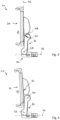
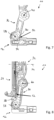
- eine Seitenansicht des Halters gemäß
Fig. 1 , in einer Grundstellung, in welcher ein Koppelelement und eine Halteeinrichtung vertikal orientiert; - Fig. 3
- eine der
Fig. 2 entsprechende Seitenansicht, wobei das Koppelelement eine erste Endlage relativ zu einer Befestigungseinrichtung einnimmt; - Fig. 4
- eine der
Fig. 3 entsprechende Seitenansicht, wobei die Halteeinrichtung eine erste Endlage relativ zu dem Koppelelement einnimmt; - Fig. 5
- eine der
Fig. 2 entsprechende Seitenansicht, wobei das Koppelelement eine zweite Endlage relativ zu einer Befestigungseinrichtung einnimmt; - Fig. 6
- eine der
Fig. 5 entsprechende Seitenansicht, wobei die Halteeinrichtung eine zweite Endlage relativ zu dem Koppelelement einnimmt; - Fig. 7
- eine mit der ersten Endlage des Koppelelements gemäß
Fig. 3 und Fig. 4 korrespondierende Schnittdarstellung; - Fig. 8
- eine mit der ersten Endlage der Halteeinrichtung gemäß
Fig. 4 korrespondierende Schnittdarstellung; - Fig. 9
- eine mit der zweiten Endlage des Koppelelements gemäß
Fig. 5 und Fig. 6 und mit einer zweiten Endlage der Halteeinrichtung gemäßFig. 6 korrespondierende Schnittdarstellung; und - Fig. 10
- einen Vertikalschnitt einer Einrichtung zur Drehmomentbeaufschlagung des Koppelelements.
- In der Zeichnung ist ein Halter insgesamt mit dem Bezugszeichen 10 bezeichnet. Der Halter 10 weist eine Befestigungseinrichtung 12 mit einem Steckabschnitt 14, vergleiche
Figur 2 , auf, der sich längs einer Steckachse 16 erstreckt und längs dieser Steckachse 16 in eine Steckaufnahme 18 einführbar und dort lösbar verriegelbar ist. Die Steckaufnahme 18 ist an einem schematisch angedeuteten Kraftfahrzeugsitz 20 angeordnet, wobei der Kraftfahrzeugsitz 20 eine einem Fahrzeugrückraum zugewandte Rückseite 22 aufweist. - Der Halter 10 umfasst ferner eine insgesamt mit dem Bezugszeichen 24 bezeichnete Halteeinrichtung, welche zum lösbaren Halten eines elektronischen Geräts, insbesondere eines Tablet-Computers oder eines Smartphones dient.
- Die Halteeinrichtung 24 weist einen Haltebereich 26 zur Anordnung des Geräts auf. Das Gerät ist bei Anordnung in dem Haltebereich 26 zwischen zwei zueinander beabstandeten und bei Anordnung eines Geräts in dem Haltebereich 26 relativ zueinander vorgespannten Halteelementen 28 und 30 gehalten. Optional umfasst die Halteeinrichtung 24 ein Drehgelenk 32, vergleiche
Figur 8 , zur Definition einer Drehachse 34, vergleicheFiguren 1 und 2 , wodurch der Haltebereich 26 um die Drehachse 34 verdrehbar ist, sodass ein an dem Haltebereich 26 gehaltenes Gerät in einer Hochkant- oder Queranordnung gehalten werden kann. - Die Halteeinrichtung 24 und die Befestigungseinrichtung 12 sind über ein Koppelelement 36 miteinander verbunden, welches auch doppelt ausgeführt sein kann, vergleiche Bezugszeichen 36a und 36b in
Figur 1 . - Das Koppelelement 36 weist eine erste Schwenkachse 38 auf, mittels welcher das Koppelelement 36 relativ zu der Befestigungseinrichtung 12 verschwenkbar ist. Das Koppelelement 36 weist eine zweite Schwenkachse 40 auf, mittels welcher die Halteeinrichtung 24 relativ zu dem Koppelelement 36 verschwenkbar ist.
- Die Schwenkachsen 38 und 40 sind zueinander parallel und insbesondere horizontal orientiert. Vorzugsweise sind die Schwenkachsen 38 und 40 (bezogen auf eine Erstreckung des Koppelelements 36 längs einer Koppelelementachse) maximal zueinander beabstandet.
- Die Schwenkachsen 38 und 40 sind Teil jeweiliger Schwenkgelenke 42 und 44.
- In
Figur 2 ist der Halter 10 beispielhaft in einer Grundstellung dargestellt, in welcher das Koppelelement 36 und die Halteeinrichtung 24 mit dem Haltebereich 26 vertikal orientiert sind. Diese Vertikalstellung korrespondiert mit einer inFigur 3 dargestellten Vertikalebene 46, welche senkrecht zu der horizontalen Steckachse 16 orientiert ist. Bezogen auf die Vertikalebene 46 kann das Koppelelement 36 um die erste Steckachse 38 herum in eine inFigur 3 dargestellte erste Endlage verschwenkt werden, wobei das Koppelelement 36 ausgehend von seiner Grundstellung in Richtung auf den Kraftfahrzeugsitz 20 (vergleicheFigur 2 ) um einen ersten Teil 48 eines Schwenkwegs verschwenkt. Ein diesem Schwenkweg 48 zugeordneter Schwenkwinkel beträgt vorzugsweise maximal 40° und insbesondere maximal 25°. - In der ersten Endlage des Koppelelements 36 liegt ein an dem Koppelelement 36 ausgebildeter Anschlag 50 in einem Anschlagbereich 52 an einer Gegenfläche 54 der Befestigungseinrichtung 12 an, vergleiche
Figur 7 . - Für das Beispiel der Stellung des Koppelelements 36 in der ersten Endlage, vergleiche
Figuren 3 und 4 , kann die Halteeinrichtung 24 ausgehend aus einer Vertikallage um die zweite Schwenkachse 40 geringfügig nach unten bis hin zu einer ersten Endlage der Halteeinrichtung 24 verschwenkt werden, vergleicheFigur 4 . Ein entsprechender Schwenkweg 56 der Halteeinrichtung 24 um die zweite Schwenkachse 40 herum ist in einer ersten Endlage der Halteeinrichtung 24 dadurch begrenzt, dass ein an dem Haltebereich 24 ausgebildeter Anschlag 58 in Kontakt mit einer Gegenfläche 60 des Koppelelements 36 steht, sodass in einem Anschlagbereich 62 eine weitere Verschwenkung des Haltebereichs 24 relativ zu dem Koppelelement 36 verhindert wird, vergleicheFigur 8 . - Auch in
Figur 5 ist die mitFigur 2 korrespondierende Grundstellung des Koppelelements 36, in welcher dieses vertikal orientiert ist, anhand einer Vertikalebene 46 illustriert. Bezogen auf diese Vertikalebene 46 ist das Koppelelement 36 in einer zu dem ersten Teil 48 des Schwenkwegs (vergleicheFig. 3 ) entgegengesetzten Richtung entlang eines zweiten Teils 64 des Schwenkwegs um die erste Schwenkachse 38 herum verschwenkbar, insbesondere um maximal 135°. - Bei maximaler Nutzung des zweiten Teils 64 des Schwenkwegs nimmt das Koppelelement 36 eine in den
Figuren 5 und 6 zweite Endlage ein, in welcher eine Anschlagfläche 66 des Koppelelements 36 in Anschlag mit einer Gegenfläche 68 der Befestigungseinrichtung 12 steht, vergleicheFigur 9 . - Ausgehend aus einer in
Figur 5 dargestellten vertikalen Orientierung der Halteeinrichtung 24, vergleicheFigur 5 , kann die Halteeinrichtung 24 um die zweite Schwenkachse 40 herum in einer Schwenkrichtung 70 in Richtung auf die Rückseite 22 des Kraftfahrzeugsitzes 20, vergleicheFigur 2 , verschwenkt werden, sodass der Haltebereich 26 der Halteeinrichtung 24 geringfügig nach schräg oben verschwenkt wird, was insbesondere für groß gewachsene Nutzer vorteilhaft ist. - Die Verschwenkung entlang der Schwenkrichtung 70 ist vorzugweise bis durch eine (in
Figur 6 dargestellte) zweite Endlage der Halteeinrichtung 24 relativ zu dem Koppelelement 36 begrenzt, in welcher eine Anschlagfläche 72 der Halteeinrichtung 24 in Anlage mit einer Gegenfläche 74 des Koppelelements 36 steht, vergleicheFigur 9 . - Somit weist das Koppelelement 36 vorzugsweise insgesamt vier Abschnitte auf, die bedarfsweise eine der vorgenannten Endlagen mit definieren, nämlich den Anschlag 50 (vgl.
Figur 7 ), die Gegenfläche 60 (vgl.Figur 8 ), die Anschlagfläche 66 (vgl.Figur 9 ) und die Gegenfläche 74 (vgl.Figur 9 ). Die vorstehend genannten vier Abschnitte des Koppelelements 36 sind vorzugsweise relativ zueinander räumlich versetzt und insbesondere durch unterschiedliche Abschnitte einer Umfangsfläche des Koppelelements 36 gebildet. - Die Bewegung des Koppelelements 36 relativ zu der Befestigungseinrichtung 12 um die erste Schwenkachse 38 herum ist vorzugsweise selbsthemmend. Dies gilt auch für die Bewegung der Halteeinrichtung 24 um die zweite Schwenkachse 40 des Koppelelements 36 herum. Zur Realisierung einer solchen Selbsthemmung ist es bevorzugt, wenn die Schwenkgelenke 42, 44 als Reibgelenke ausgebildet sind.
- Beispielsweise weisen die Schwenkgelenke 42, 44 zylindrische Reibbereiche 76 auf, vergleiche
Figur 9 , in welchen eine zylinderförmige Außenfläche mit einer hohlzylinderförmigen Innenfläche reibschlüssig zusammenwirkt. Für diesen Reibschluss sind Kunststoffmaterialien bevorzugt. - Um eine leichtere Bewegung des Koppelelements 36 um die erste Schwenkachse 38 herum relativ zu der Befestigungseinrichtung 12 zu ermöglichen, weist der Halter 10 eine (in
Figur 10 dargestellte) Einrichtung 78 auf. Die Einrichtung 78 umfasst beispielsweise eine Feder 80, welche sich in einem ersten Bereich 82 an der Befestigungseinrichtung 12 abstützt und in einem dazu beabstandeten Bereich 84 eine Kraft erzeugt, welche auf einen Kraftaufnahmebereich 86 des Koppelelements 36 wirkt und dieses um die erste Schwenkachse 38 herum aus einer horizontalen Lage - einer Drehmomentrichtung 88 entsprechend - in eine stärker vertikal orientierte Lage drängt. - Bei Anordnung eines Geräts in dem Haltebereich 26 der Halteeinrichtung 24 dient die Einrichtung 78 dementsprechend zur Aufnahme oder Kompensation des Gewichts des Geräts oder zumindest eines Teils des Gewichts des Geräts. Für den Fall, dass der Haltebereich 26 frei ist, kann die Einrichtung 78 auch dazu dienen, das Koppelelement 36 in die vertikale Grundstellung des Koppelelements 36 (vergleiche
Figuren 2 ,3 und5 ) zu verbringen, sodass die Halteeinrichtung 24 in einer unbetätigten Grundstellung nahe zu dem Kraftfahrzeugsitz 20 angeordnet ist. - Der Halter 10 ermöglicht eine vielfältige Einstellbarkeit des Haltebereichs 26 für große und kleine Nutzer in unterschiedlichen Fahrzeugumgebungen.
Claims (10)
- Halter (10) zur lösbaren Befestigung eines flachen, in etwa rechteckigen Geräts - wie eines Tablet-Computers oder eines Smartphones - an einem Kraftfahrzeugsitz (20), wobei der Halter (10) eine Befestigungseinrichtung (12) zur lösbaren Steckbefestigung des Halters (10) an einer dem Kraftfahrzeugsitz (20) zugeordneten Steckaufnahme (18) aufweist und wobei der Halter (10) eine Halteeinrichtung (24) zur lösbaren Halterung des Geräts an dem Halter (10) aufweist, wobei die Befestigungseinrichtung (12) und die Halteeinrichtung (24) über ein Koppelelement (36) miteinander verbunden sind, wobei das Koppelelement (36) über ein erstes Gelenk mit der Befestigungseinrichtung (12) und über ein zweites Gelenk mit der Halteeinrichtung (24) verbunden ist, wobei die Gelenke als Schwenkgelenke mit einem ersten Schwenkgelenk (42) und einer ersten Schwenkachse (38) und mit einem zweiten Schwenkgelenk (44) und einer zweiten Schwenkachse (40) ausgebildet sind, wobei die erste Schwenkachse (38) und die zweite Schwenkachse (40) zueinander parallel orientiert sind, dadurch gekennzeichnet, dass der Halter (10) eine Einrichtung (78) umfasst, welche das Koppelelement (36) um die erste Schwenkachse (38) herum mit einem Drehmoment beaufschlagt, das für eine Aufrichtung des Koppelelements (36) aus einer horizontalen Lage in eine stärker vertikal orientierte Lage wirksam ist.
- Halter (10) nach Anspruch 1, dadurch gekennzeichnet, dass die erste Schwenkachse (38) und die zweite Schwenkachse (40) in einer Gebrauchslage des Halters (10) horizontal orientiert sind.
- Halter (10) nach einem der vorstehenden Ansprüche, dadurch gekennzeichnet, dass die Befestigungseinrichtung (12) einen sich längs einer Steckachse (16) erstreckenden Steckabschnitt (14) aufweist, wobei die Steckachse (16) in einer oder der Gebrauchslage des Halters (10) und in einem in die Steckaufnahme (18) eingesteckten Zustand horizontal orientiert ist.
- Halter (10) nach einem der vorstehenden Ansprüche, dadurch gekennzeichnet, dass ein Schwenkweg des Koppelelements (36) ausgehend von einer vertikalen Orientierung (46) des Koppelelements (36) begrenzt ist:- auf einen ersten Teil (48) des Schwenkwegs in Richtung auf den Kraftfahrzeugsitz (20) von maximal 40°, und/oder- auf einen entgegensetzten zweiten Teil (64) des Schwenkwegs von maximal 150°.
- Halter (10) nach einem der vorstehenden Ansprüche, dadurch gekennzeichnet, dass zur Begrenzung einer ersten Endlage eines oder des Schwenkwegs des Koppelelements (36) relativ zu der Befestigungseinrichtung (12) und/oder zur Begrenzung einer zweiten Endlage eines oder des Schwenkwegs des Koppelelements (36) relativ zu der Befestigungseinrichtung (12) das Koppelelement (36) und die Befestigungseinrichtung (12) miteinander in Anschlag stehen.
- Halter (10) nach einem der vorstehenden Ansprüche, dadurch gekennzeichnet, dass ein Schwenkwinkel der Halteeinrichtung (24) relativ zu dem Koppelelement (36) mindestens 90°, vorzugsweise mindestens 120°, insbesondere mindestens 150° beträgt.
- Halter (10) nach einem der vorstehenden Ansprüche, dadurch gekennzeichnet, dass ein Schwenkwinkel der Halteeinrichtung (24) relativ zu dem Koppelelement (36) maximal 170° beträgt.
- Halter (10) nach einem der vorstehenden Ansprüche, dadurch gekennzeichnet, dass zur Begrenzung einer ersten Endlage eines Schwenkwegs der Halteeinrichtung (24) relativ zu dem Koppelelement (36) und/oder zur Begrenzung einer zweiten Endlage eines oder des Schwenkwegs der Halteeinrichtung (24) relativ zu dem Koppelelement (36) die Halteeinrichtung (24) und das Koppelelement (36) miteinander in Anschlag stehen.
- Halter (10) nach einem der vorstehenden Ansprüche, dadurch gekennzeichnet, dass das erste Schwenkgelenk (42) und/oder das zweite Schwenkgelenk (44) als Reibgelenk ausgebildet ist oder sind.
- Halter (10) nach einem der vorstehenden Ansprüche, dadurch gekennzeichnet, dass die Halteeinrichtung (24) ein Drehgelenk (32) aufweist, mittels welchem ein Haltebereich (26) der Halteeinrichtung (24) um eine Drehachse (34) verdrehbar ist, welche senkrecht zu der zweiten Schwenkachse (40) orientiert ist.
Applications Claiming Priority (1)
| Application Number | Priority Date | Filing Date | Title |
|---|---|---|---|
| DE202021102428.3U DE202021102428U1 (de) | 2021-05-05 | 2021-05-05 | Halter zur lösbaren Befestigung eines flachen Geräts an einem Kraftfahrzeugsitz |
Publications (2)
| Publication Number | Publication Date |
|---|---|
| EP4086119A1 EP4086119A1 (de) | 2022-11-09 |
| EP4086119B1 true EP4086119B1 (de) | 2024-04-24 |
Family
ID=76206192
Family Applications (1)
| Application Number | Title | Priority Date | Filing Date |
|---|---|---|---|
| EP22171785.3A Active EP4086119B1 (de) | 2021-05-05 | 2022-05-05 | Halter zur lösbaren befestigung eines flachen geräts an einem kraftfahrzeugsitz |
Country Status (5)
| Country | Link |
|---|---|
| US (1) | US11813989B2 (de) |
| EP (1) | EP4086119B1 (de) |
| CN (1) | CN115303189A (de) |
| DE (1) | DE202021102428U1 (de) |
| ES (1) | ES2981482T3 (de) |
Families Citing this family (7)
| Publication number | Priority date | Publication date | Assignee | Title |
|---|---|---|---|---|
| USD1032594S1 (en) * | 2021-03-25 | 2024-06-25 | Kinetix Ag | Electronic device holder |
| DE202021102428U1 (de) * | 2021-05-05 | 2021-05-14 | Kinetix Ag | Halter zur lösbaren Befestigung eines flachen Geräts an einem Kraftfahrzeugsitz |
| USD1009133S1 (en) * | 2021-08-05 | 2023-12-26 | Shenzhen Yuansu Chuangda Technology Co., Ltd | Selfie stick stabilizer |
| USD1077715S1 (en) * | 2023-02-28 | 2025-06-03 | Zebra Technologies Corporation | Vehicle mount |
| USD1091524S1 (en) * | 2024-01-08 | 2025-09-02 | Xiao Wang | Phone clip |
| USD1045841S1 (en) * | 2024-06-21 | 2024-10-08 | Fang Li | Mobile phone holder |
| USD1106142S1 (en) * | 2024-11-27 | 2025-12-16 | Shenzhen Huaptec Co., Ltd | Mobile phone holder for vehicle |
Family Cites Families (25)
| Publication number | Priority date | Publication date | Assignee | Title |
|---|---|---|---|---|
| US6173933B1 (en) * | 1998-12-09 | 2001-01-16 | Garmin Corporation | Multi-position articulating mounting apparatus for an electronic device |
| US6418010B1 (en) * | 2000-08-11 | 2002-07-09 | Gateway, Inc. | Convertible flat panel display hanging support |
| DE10244100B4 (de) * | 2002-09-23 | 2006-05-04 | Johnson Controls Gmbh | Bildschirm, insbesondere für den Sitz eines Kraftfahrzeugs |
| DE202007005661U1 (de) | 2007-04-19 | 2007-07-05 | Buchhalter, Thomas | KFZ Halter für mobile Systeme |
| DE202009013607U1 (de) | 2009-10-08 | 2009-12-24 | Tsai, Wen-Feng | Halterung für KFZ-Rechner/LCD-Monitore |
| US8881659B2 (en) * | 2009-12-04 | 2014-11-11 | Kinetix Ag | Folding table for attachment to the rear side of a vehicle seat part |
| US9278648B2 (en) * | 2010-01-28 | 2016-03-08 | Kinetix Ag | Device for attaching a tablet computer |
| WO2012160209A1 (de) * | 2011-05-25 | 2012-11-29 | Kinetix Ag | Vorrichtung zum halten eines tablet-computers in insbesondere einem fahrzeug |
| US9527456B2 (en) * | 2012-11-05 | 2016-12-27 | Kinetix Ag | Device for retaining flat, approximately rectangular appliances such as tablet computers or mobile telephones in the interior of a motor vehicle |
| DE102013014921B4 (de) | 2013-09-11 | 2020-04-23 | Harald Richter | Geräteträger mit Saugfuß und Schwenkarm für Mobiltelefone |
| CN106163877B (zh) * | 2014-01-21 | 2019-02-22 | 科尼蒂克西股份公司 | 用于将装置可拆卸地安置在机动车座椅的两个间隔的头枕杆上的固定装置 |
| CN106163876B (zh) * | 2014-04-09 | 2019-04-09 | 科尼蒂克西股份公司 | 用于机动车的内部空间中的照相机或摄像机的保持设备 |
| US9586532B1 (en) * | 2015-09-03 | 2017-03-07 | Lear Corporation | Vehicle seat assembly with entertainment system |
| WO2017041914A1 (de) * | 2015-09-09 | 2017-03-16 | Kinetix Ag | Halter für flache in etwa rechteckige geräte wie tablet-computer oder smartphones |
| CN106671890A (zh) * | 2015-11-05 | 2017-05-17 | 东康控股株式会社 | 交通工具的座椅用关节型物品支架 |
| DE102016120748A1 (de) | 2016-10-31 | 2018-05-03 | Kinetix Ag | Halter für flache, in etwa rechteckige Geräte wie Tablet-Computer oder Smartphones |
| EP3416854B1 (de) * | 2016-02-15 | 2019-12-11 | Kinetix AG | Halter für flache, in etwa rechteckige geräte wie tablet-computer oder smartphones |
| DE102016102611A1 (de) | 2016-02-15 | 2017-08-17 | Kinetix Ag | Halter für flache, in etwa rechteckige Geräte wie Tablet-Computer oder Smartphones |
| USD854537S1 (en) * | 2016-02-16 | 2019-07-23 | Kinetix Ag | Vehicle mount |
| DE102016111448A1 (de) | 2016-06-22 | 2017-12-28 | Bury Sp.Z.O.O | Haltersystem für ein elektronisches Gerät in einem Fahrzeug |
| DE102017107842A1 (de) * | 2017-04-11 | 2018-10-11 | Kinetix Ag | Halter für flache, in etwa rechteckige Geräte wie Tablet-Computer oder Smartphones |
| US11351892B1 (en) * | 2018-03-11 | 2022-06-07 | Matthew Roy | Autonomous vehicle adapted for sleeping or resting in a reclined posture |
| DE102019209556A1 (de) * | 2019-06-28 | 2020-12-31 | Ford Global Technologies, Llc | Befestigungsvorrichtung für ein verstellbares Zubehörteil |
| DE202021102428U1 (de) * | 2021-05-05 | 2021-05-14 | Kinetix Ag | Halter zur lösbaren Befestigung eines flachen Geräts an einem Kraftfahrzeugsitz |
| DE202021104338U1 (de) * | 2021-08-13 | 2022-11-15 | Kinetix Ag | Befestigungssystem zur lösbaren Befestigung elektronischer Geräte in einem Kraftfahrzeug |
-
2021
- 2021-05-05 DE DE202021102428.3U patent/DE202021102428U1/de active Active
-
2022
- 2022-05-02 US US17/734,609 patent/US11813989B2/en active Active
- 2022-05-04 CN CN202210477383.6A patent/CN115303189A/zh active Pending
- 2022-05-05 EP EP22171785.3A patent/EP4086119B1/de active Active
- 2022-05-05 ES ES22171785T patent/ES2981482T3/es active Active
Also Published As
| Publication number | Publication date |
|---|---|
| US20220355744A1 (en) | 2022-11-10 |
| US11813989B2 (en) | 2023-11-14 |
| CN115303189A (zh) | 2022-11-08 |
| ES2981482T3 (es) | 2024-10-09 |
| DE202021102428U1 (de) | 2021-05-14 |
| EP4086119A1 (de) | 2022-11-09 |
Similar Documents
| Publication | Publication Date | Title |
|---|---|---|
| EP4086119B1 (de) | Halter zur lösbaren befestigung eines flachen geräts an einem kraftfahrzeugsitz | |
| DE102008029438B4 (de) | Beschlag für einen Fahrzeugsitz | |
| DE102014207363B4 (de) | Lehnenversteller und Fahrzeugsitz mit einem Lehnenversteller | |
| EP3359416B1 (de) | Kopfstütze eines fahrzeugsitzes | |
| DE102011055585A1 (de) | Sitzeinrichtung für ein Kraftfahrzeug | |
| DE202011110296U1 (de) | Fahrzeugsitz mit in einem Querrohr angeordneter Drehstabfeder | |
| DE102012016918B4 (de) | Fahrzeugsitz mit Bodenstellung | |
| DE102012012850A1 (de) | Fahrzeugsitz | |
| DE102013224288A1 (de) | Kraftfahrzeugsitz mit Armlehne | |
| DE102017117343B4 (de) | Selbsteinrastende scharnierbaugruppe für schwingende tischfläche eines fahrzeugs | |
| DE102010048719A1 (de) | Klappbarer Fahrzeugsitz | |
| DE102014211527A1 (de) | Fahrzeugsitz | |
| EP2956333A1 (de) | Rastbeschlag für einen fahrzeugsitz sowie fahrzeugsitz | |
| DE19602909C2 (de) | Kopfstütze für Fahrzeugsitze | |
| DE102022110946A1 (de) | Armlehnenelement | |
| DE102007049067B3 (de) | Fahrzeugsitz, insbesondere Kraftfahrzeugsitz | |
| DE102015202078B4 (de) | Verfahren zur montage einer lehnenstruktur eines fahrzeugfondsitzes, schwenklagerung einer umklappbaren lehnenstruktur eines fahrzeugfondsitzes | |
| DE102022110960A1 (de) | Armlehnenelement | |
| DE102013215127A1 (de) | Fahrzeugsitz, insbesondere Kraftfahrzeugsitz | |
| DE10052838A1 (de) | Armlehne, insbesondere Mittelarmlehne eines Kfz | |
| DE10038813A1 (de) | Kopfstützenanordnung | |
| DE10247069A1 (de) | Verstellvorrichtung für die Rückenlehne von Sitzen | |
| DE102006021719A1 (de) | Überbrückungseinrichtung für eine Vertiefung zwischen einem Fahrzeugsitz und einem Laderaumboden | |
| DE102017210352B4 (de) | Fahrzeugsitz, insbesondere kraftfahrzeugsitz | |
| DE102015009659A1 (de) | Sitzlehnenanordnung, Fahrzeugsitz und Fahrzeug |
Legal Events
| Date | Code | Title | Description |
|---|---|---|---|
| PUAI | Public reference made under article 153(3) epc to a published international application that has entered the european phase |
Free format text: ORIGINAL CODE: 0009012 |
|
| STAA | Information on the status of an ep patent application or granted ep patent |
Free format text: STATUS: THE APPLICATION HAS BEEN PUBLISHED |
|
| AK | Designated contracting states |
Kind code of ref document: A1 Designated state(s): AL AT BE BG CH CY CZ DE DK EE ES FI FR GB GR HR HU IE IS IT LI LT LU LV MC MK MT NL NO PL PT RO RS SE SI SK SM TR |
|
| STAA | Information on the status of an ep patent application or granted ep patent |
Free format text: STATUS: REQUEST FOR EXAMINATION WAS MADE |
|
| 17P | Request for examination filed |
Effective date: 20230420 |
|
| RBV | Designated contracting states (corrected) |
Designated state(s): AL AT BE BG CH CY CZ DE DK EE ES FI FR GB GR HR HU IE IS IT LI LT LU LV MC MK MT NL NO PL PT RO RS SE SI SK SM TR |
|
| GRAP | Despatch of communication of intention to grant a patent |
Free format text: ORIGINAL CODE: EPIDOSNIGR1 |
|
| STAA | Information on the status of an ep patent application or granted ep patent |
Free format text: STATUS: GRANT OF PATENT IS INTENDED |
|
| INTG | Intention to grant announced |
Effective date: 20231212 |
|
| GRAS | Grant fee paid |
Free format text: ORIGINAL CODE: EPIDOSNIGR3 |
|
| GRAA | (expected) grant |
Free format text: ORIGINAL CODE: 0009210 |
|
| STAA | Information on the status of an ep patent application or granted ep patent |
Free format text: STATUS: THE PATENT HAS BEEN GRANTED |
|
| AK | Designated contracting states |
Kind code of ref document: B1 Designated state(s): AL AT BE BG CH CY CZ DE DK EE ES FI FR GB GR HR HU IE IS IT LI LT LU LV MC MK MT NL NO PL PT RO RS SE SI SK SM TR |
|
| P01 | Opt-out of the competence of the unified patent court (upc) registered |
Effective date: 20240314 |
|
| REG | Reference to a national code |
Ref country code: GB Ref legal event code: FG4D Free format text: NOT ENGLISH |
|
| REG | Reference to a national code |
Ref country code: CH Ref legal event code: EP |
|
| REG | Reference to a national code |
Ref country code: DE Ref legal event code: R096 Ref document number: 502022000787 Country of ref document: DE |
|
| REG | Reference to a national code |
Ref country code: IE Ref legal event code: FG4D Free format text: LANGUAGE OF EP DOCUMENT: GERMAN |
|
| REG | Reference to a national code |
Ref country code: SE Ref legal event code: TRGR |
|
| REG | Reference to a national code |
Ref country code: LT Ref legal event code: MG9D |
|
| REG | Reference to a national code |
Ref country code: NL Ref legal event code: MP Effective date: 20240424 |
|
| PG25 | Lapsed in a contracting state [announced via postgrant information from national office to epo] |
Ref country code: NL Free format text: LAPSE BECAUSE OF FAILURE TO SUBMIT A TRANSLATION OF THE DESCRIPTION OR TO PAY THE FEE WITHIN THE PRESCRIBED TIME-LIMIT Effective date: 20240424 |
|
| PG25 | Lapsed in a contracting state [announced via postgrant information from national office to epo] |
Ref country code: NL Free format text: LAPSE BECAUSE OF FAILURE TO SUBMIT A TRANSLATION OF THE DESCRIPTION OR TO PAY THE FEE WITHIN THE PRESCRIBED TIME-LIMIT Effective date: 20240424 |
|
| PG25 | Lapsed in a contracting state [announced via postgrant information from national office to epo] |
Ref country code: IS Free format text: LAPSE BECAUSE OF FAILURE TO SUBMIT A TRANSLATION OF THE DESCRIPTION OR TO PAY THE FEE WITHIN THE PRESCRIBED TIME-LIMIT Effective date: 20240824 |
|
| PG25 | Lapsed in a contracting state [announced via postgrant information from national office to epo] |
Ref country code: BG Free format text: LAPSE BECAUSE OF FAILURE TO SUBMIT A TRANSLATION OF THE DESCRIPTION OR TO PAY THE FEE WITHIN THE PRESCRIBED TIME-LIMIT Effective date: 20240424 |
|
| REG | Reference to a national code |
Ref country code: ES Ref legal event code: FG2A Ref document number: 2981482 Country of ref document: ES Kind code of ref document: T3 Effective date: 20241009 |
|
| PG25 | Lapsed in a contracting state [announced via postgrant information from national office to epo] |
Ref country code: HR Free format text: LAPSE BECAUSE OF FAILURE TO SUBMIT A TRANSLATION OF THE DESCRIPTION OR TO PAY THE FEE WITHIN THE PRESCRIBED TIME-LIMIT Effective date: 20240424 Ref country code: FI Free format text: LAPSE BECAUSE OF FAILURE TO SUBMIT A TRANSLATION OF THE DESCRIPTION OR TO PAY THE FEE WITHIN THE PRESCRIBED TIME-LIMIT Effective date: 20240424 |
|
| PG25 | Lapsed in a contracting state [announced via postgrant information from national office to epo] |
Ref country code: GR Free format text: LAPSE BECAUSE OF FAILURE TO SUBMIT A TRANSLATION OF THE DESCRIPTION OR TO PAY THE FEE WITHIN THE PRESCRIBED TIME-LIMIT Effective date: 20240725 |
|
| PG25 | Lapsed in a contracting state [announced via postgrant information from national office to epo] |
Ref country code: PT Free format text: LAPSE BECAUSE OF FAILURE TO SUBMIT A TRANSLATION OF THE DESCRIPTION OR TO PAY THE FEE WITHIN THE PRESCRIBED TIME-LIMIT Effective date: 20240826 |
|
| PG25 | Lapsed in a contracting state [announced via postgrant information from national office to epo] |
Ref country code: PL Free format text: LAPSE BECAUSE OF FAILURE TO SUBMIT A TRANSLATION OF THE DESCRIPTION OR TO PAY THE FEE WITHIN THE PRESCRIBED TIME-LIMIT Effective date: 20240424 |
|
| PG25 | Lapsed in a contracting state [announced via postgrant information from national office to epo] |
Ref country code: LV Free format text: LAPSE BECAUSE OF FAILURE TO SUBMIT A TRANSLATION OF THE DESCRIPTION OR TO PAY THE FEE WITHIN THE PRESCRIBED TIME-LIMIT Effective date: 20240424 |
|
| PG25 | Lapsed in a contracting state [announced via postgrant information from national office to epo] |
Ref country code: PT Free format text: LAPSE BECAUSE OF FAILURE TO SUBMIT A TRANSLATION OF THE DESCRIPTION OR TO PAY THE FEE WITHIN THE PRESCRIBED TIME-LIMIT Effective date: 20240826 Ref country code: PL Free format text: LAPSE BECAUSE OF FAILURE TO SUBMIT A TRANSLATION OF THE DESCRIPTION OR TO PAY THE FEE WITHIN THE PRESCRIBED TIME-LIMIT Effective date: 20240424 Ref country code: NO Free format text: LAPSE BECAUSE OF FAILURE TO SUBMIT A TRANSLATION OF THE DESCRIPTION OR TO PAY THE FEE WITHIN THE PRESCRIBED TIME-LIMIT Effective date: 20240724 Ref country code: LV Free format text: LAPSE BECAUSE OF FAILURE TO SUBMIT A TRANSLATION OF THE DESCRIPTION OR TO PAY THE FEE WITHIN THE PRESCRIBED TIME-LIMIT Effective date: 20240424 Ref country code: IS Free format text: LAPSE BECAUSE OF FAILURE TO SUBMIT A TRANSLATION OF THE DESCRIPTION OR TO PAY THE FEE WITHIN THE PRESCRIBED TIME-LIMIT Effective date: 20240824 Ref country code: HR Free format text: LAPSE BECAUSE OF FAILURE TO SUBMIT A TRANSLATION OF THE DESCRIPTION OR TO PAY THE FEE WITHIN THE PRESCRIBED TIME-LIMIT Effective date: 20240424 Ref country code: GR Free format text: LAPSE BECAUSE OF FAILURE TO SUBMIT A TRANSLATION OF THE DESCRIPTION OR TO PAY THE FEE WITHIN THE PRESCRIBED TIME-LIMIT Effective date: 20240725 Ref country code: FI Free format text: LAPSE BECAUSE OF FAILURE TO SUBMIT A TRANSLATION OF THE DESCRIPTION OR TO PAY THE FEE WITHIN THE PRESCRIBED TIME-LIMIT Effective date: 20240424 Ref country code: BG Free format text: LAPSE BECAUSE OF FAILURE TO SUBMIT A TRANSLATION OF THE DESCRIPTION OR TO PAY THE FEE WITHIN THE PRESCRIBED TIME-LIMIT Effective date: 20240424 Ref country code: RS Free format text: LAPSE BECAUSE OF FAILURE TO SUBMIT A TRANSLATION OF THE DESCRIPTION OR TO PAY THE FEE WITHIN THE PRESCRIBED TIME-LIMIT Effective date: 20240724 |
|
| PG25 | Lapsed in a contracting state [announced via postgrant information from national office to epo] |
Ref country code: DK Free format text: LAPSE BECAUSE OF FAILURE TO SUBMIT A TRANSLATION OF THE DESCRIPTION OR TO PAY THE FEE WITHIN THE PRESCRIBED TIME-LIMIT Effective date: 20240424 |
|
| PG25 | Lapsed in a contracting state [announced via postgrant information from national office to epo] |
Ref country code: LU Free format text: LAPSE BECAUSE OF NON-PAYMENT OF DUE FEES Effective date: 20240505 |
|
| PG25 | Lapsed in a contracting state [announced via postgrant information from national office to epo] |
Ref country code: EE Free format text: LAPSE BECAUSE OF FAILURE TO SUBMIT A TRANSLATION OF THE DESCRIPTION OR TO PAY THE FEE WITHIN THE PRESCRIBED TIME-LIMIT Effective date: 20240424 |
|
| PG25 | Lapsed in a contracting state [announced via postgrant information from national office to epo] |
Ref country code: CZ Free format text: LAPSE BECAUSE OF FAILURE TO SUBMIT A TRANSLATION OF THE DESCRIPTION OR TO PAY THE FEE WITHIN THE PRESCRIBED TIME-LIMIT Effective date: 20240424 |
|
| PG25 | Lapsed in a contracting state [announced via postgrant information from national office to epo] |
Ref country code: SK Free format text: LAPSE BECAUSE OF FAILURE TO SUBMIT A TRANSLATION OF THE DESCRIPTION OR TO PAY THE FEE WITHIN THE PRESCRIBED TIME-LIMIT Effective date: 20240424 Ref country code: RO Free format text: LAPSE BECAUSE OF FAILURE TO SUBMIT A TRANSLATION OF THE DESCRIPTION OR TO PAY THE FEE WITHIN THE PRESCRIBED TIME-LIMIT Effective date: 20240424 |
|
| REG | Reference to a national code |
Ref country code: DE Ref legal event code: R097 Ref document number: 502022000787 Country of ref document: DE |
|
| PG25 | Lapsed in a contracting state [announced via postgrant information from national office to epo] |
Ref country code: SM Free format text: LAPSE BECAUSE OF FAILURE TO SUBMIT A TRANSLATION OF THE DESCRIPTION OR TO PAY THE FEE WITHIN THE PRESCRIBED TIME-LIMIT Effective date: 20240424 |
|
| PG25 | Lapsed in a contracting state [announced via postgrant information from national office to epo] |
Ref country code: SM Free format text: LAPSE BECAUSE OF FAILURE TO SUBMIT A TRANSLATION OF THE DESCRIPTION OR TO PAY THE FEE WITHIN THE PRESCRIBED TIME-LIMIT Effective date: 20240424 Ref country code: SK Free format text: LAPSE BECAUSE OF FAILURE TO SUBMIT A TRANSLATION OF THE DESCRIPTION OR TO PAY THE FEE WITHIN THE PRESCRIBED TIME-LIMIT Effective date: 20240424 Ref country code: RO Free format text: LAPSE BECAUSE OF FAILURE TO SUBMIT A TRANSLATION OF THE DESCRIPTION OR TO PAY THE FEE WITHIN THE PRESCRIBED TIME-LIMIT Effective date: 20240424 Ref country code: LU Free format text: LAPSE BECAUSE OF NON-PAYMENT OF DUE FEES Effective date: 20240505 Ref country code: EE Free format text: LAPSE BECAUSE OF FAILURE TO SUBMIT A TRANSLATION OF THE DESCRIPTION OR TO PAY THE FEE WITHIN THE PRESCRIBED TIME-LIMIT Effective date: 20240424 Ref country code: DK Free format text: LAPSE BECAUSE OF FAILURE TO SUBMIT A TRANSLATION OF THE DESCRIPTION OR TO PAY THE FEE WITHIN THE PRESCRIBED TIME-LIMIT Effective date: 20240424 Ref country code: CZ Free format text: LAPSE BECAUSE OF FAILURE TO SUBMIT A TRANSLATION OF THE DESCRIPTION OR TO PAY THE FEE WITHIN THE PRESCRIBED TIME-LIMIT Effective date: 20240424 Ref country code: MC Free format text: LAPSE BECAUSE OF FAILURE TO SUBMIT A TRANSLATION OF THE DESCRIPTION OR TO PAY THE FEE WITHIN THE PRESCRIBED TIME-LIMIT Effective date: 20240424 |
|
| REG | Reference to a national code |
Ref country code: BE Ref legal event code: MM Effective date: 20240531 |
|
| PLBE | No opposition filed within time limit |
Free format text: ORIGINAL CODE: 0009261 |
|
| STAA | Information on the status of an ep patent application or granted ep patent |
Free format text: STATUS: NO OPPOSITION FILED WITHIN TIME LIMIT |
|
| 26N | No opposition filed |
Effective date: 20250127 |
|
| PG25 | Lapsed in a contracting state [announced via postgrant information from national office to epo] |
Ref country code: IE Free format text: LAPSE BECAUSE OF NON-PAYMENT OF DUE FEES Effective date: 20240505 |
|
| PG25 | Lapsed in a contracting state [announced via postgrant information from national office to epo] |
Ref country code: SI Free format text: LAPSE BECAUSE OF FAILURE TO SUBMIT A TRANSLATION OF THE DESCRIPTION OR TO PAY THE FEE WITHIN THE PRESCRIBED TIME-LIMIT Effective date: 20240424 Ref country code: BE Free format text: LAPSE BECAUSE OF NON-PAYMENT OF DUE FEES Effective date: 20240531 |
|
| PGFP | Annual fee paid to national office [announced via postgrant information from national office to epo] |
Ref country code: ES Payment date: 20250616 Year of fee payment: 4 |
|
| PGFP | Annual fee paid to national office [announced via postgrant information from national office to epo] |
Ref country code: FR Payment date: 20250526 Year of fee payment: 4 |
|
| PGFP | Annual fee paid to national office [announced via postgrant information from national office to epo] |
Ref country code: AT Payment date: 20250721 Year of fee payment: 4 |
|
| PGFP | Annual fee paid to national office [announced via postgrant information from national office to epo] |
Ref country code: SE Payment date: 20250522 Year of fee payment: 4 |
|
| PG25 | Lapsed in a contracting state [announced via postgrant information from national office to epo] |
Ref country code: CY Free format text: LAPSE BECAUSE OF FAILURE TO SUBMIT A TRANSLATION OF THE DESCRIPTION OR TO PAY THE FEE WITHIN THE PRESCRIBED TIME-LIMIT; INVALID AB INITIO Effective date: 20220505 |
|
| PG25 | Lapsed in a contracting state [announced via postgrant information from national office to epo] |
Ref country code: HU Free format text: LAPSE BECAUSE OF FAILURE TO SUBMIT A TRANSLATION OF THE DESCRIPTION OR TO PAY THE FEE WITHIN THE PRESCRIBED TIME-LIMIT; INVALID AB INITIO Effective date: 20220505 |
|
| PGFP | Annual fee paid to national office [announced via postgrant information from national office to epo] |
Ref country code: DE Payment date: 20250721 Year of fee payment: 4 |
|
| REG | Reference to a national code |
Ref country code: CH Ref legal event code: H13 Free format text: ST27 STATUS EVENT CODE: U-0-0-H10-H13 (AS PROVIDED BY THE NATIONAL OFFICE) Effective date: 20251223 |
|
| PGFP | Annual fee paid to national office [announced via postgrant information from national office to epo] |
Ref country code: IT Payment date: 20250531 Year of fee payment: 4 |
|
| PG25 | Lapsed in a contracting state [announced via postgrant information from national office to epo] |
Ref country code: IT Free format text: LAPSE BECAUSE OF NON-PAYMENT OF DUE FEES Effective date: 20240505 |
|
| PG25 | Lapsed in a contracting state [announced via postgrant information from national office to epo] |
Ref country code: CH Free format text: LAPSE BECAUSE OF NON-PAYMENT OF DUE FEES Effective date: 20250531 |
|
| PGFP | Annual fee paid to national office [announced via postgrant information from national office to epo] |
Ref country code: GB Payment date: 20260324 Year of fee payment: 5 |
|
| PG25 | Lapsed in a contracting state [announced via postgrant information from national office to epo] |
Ref country code: IT Free format text: LAPSE BECAUSE OF NON-PAYMENT OF DUE FEES Effective date: 20240505 |
|
| PGRI | Patent reinstated in contracting state [announced from national office to epo] |
Ref country code: IT Effective date: 20240531 |