EP4077273B1 - Aldimine und ihre verwendungen - Google Patents
Aldimine und ihre verwendungen Download PDFInfo
- Publication number
- EP4077273B1 EP4077273B1 EP20824933.4A EP20824933A EP4077273B1 EP 4077273 B1 EP4077273 B1 EP 4077273B1 EP 20824933 A EP20824933 A EP 20824933A EP 4077273 B1 EP4077273 B1 EP 4077273B1
- Authority
- EP
- European Patent Office
- Prior art keywords
- group
- carbon atoms
- cas
- radical
- formula
- Prior art date
- Legal status (The legal status is an assumption and is not a legal conclusion. Google has not performed a legal analysis and makes no representation as to the accuracy of the status listed.)
- Active
Links
Classifications
-
- C—CHEMISTRY; METALLURGY
- C07—ORGANIC CHEMISTRY
- C07C—ACYCLIC OR CARBOCYCLIC COMPOUNDS
- C07C251/00—Compounds containing nitrogen atoms doubly-bound to a carbon skeleton
- C07C251/02—Compounds containing nitrogen atoms doubly-bound to a carbon skeleton containing imino groups
- C07C251/04—Compounds containing nitrogen atoms doubly-bound to a carbon skeleton containing imino groups having carbon atoms of imino groups bound to hydrogen atoms or to acyclic carbon atoms
- C07C251/06—Compounds containing nitrogen atoms doubly-bound to a carbon skeleton containing imino groups having carbon atoms of imino groups bound to hydrogen atoms or to acyclic carbon atoms to carbon atoms of a saturated carbon skeleton
- C07C251/08—Compounds containing nitrogen atoms doubly-bound to a carbon skeleton containing imino groups having carbon atoms of imino groups bound to hydrogen atoms or to acyclic carbon atoms to carbon atoms of a saturated carbon skeleton being acyclic
-
- C—CHEMISTRY; METALLURGY
- C08—ORGANIC MACROMOLECULAR COMPOUNDS; THEIR PREPARATION OR CHEMICAL WORKING-UP; COMPOSITIONS BASED THEREON
- C08G—MACROMOLECULAR COMPOUNDS OBTAINED OTHERWISE THAN BY REACTIONS ONLY INVOLVING UNSATURATED CARBON-TO-CARBON BONDS
- C08G18/00—Polymeric products of isocyanates or isothiocyanates
- C08G18/06—Polymeric products of isocyanates or isothiocyanates with compounds having active hydrogen
- C08G18/08—Processes
- C08G18/10—Prepolymer processes involving reaction of isocyanates or isothiocyanates with compounds having active hydrogen in a first reaction step
- C08G18/12—Prepolymer processes involving reaction of isocyanates or isothiocyanates with compounds having active hydrogen in a first reaction step using two or more compounds having active hydrogen in the first polymerisation step
-
- C—CHEMISTRY; METALLURGY
- C08—ORGANIC MACROMOLECULAR COMPOUNDS; THEIR PREPARATION OR CHEMICAL WORKING-UP; COMPOSITIONS BASED THEREON
- C08G—MACROMOLECULAR COMPOUNDS OBTAINED OTHERWISE THAN BY REACTIONS ONLY INVOLVING UNSATURATED CARBON-TO-CARBON BONDS
- C08G18/00—Polymeric products of isocyanates or isothiocyanates
- C08G18/06—Polymeric products of isocyanates or isothiocyanates with compounds having active hydrogen
- C08G18/08—Processes
- C08G18/16—Catalysts
- C08G18/22—Catalysts containing metal compounds
- C08G18/24—Catalysts containing metal compounds of tin
- C08G18/244—Catalysts containing metal compounds of tin tin salts of carboxylic acids
- C08G18/246—Catalysts containing metal compounds of tin tin salts of carboxylic acids containing also tin-carbon bonds
-
- C—CHEMISTRY; METALLURGY
- C08—ORGANIC MACROMOLECULAR COMPOUNDS; THEIR PREPARATION OR CHEMICAL WORKING-UP; COMPOSITIONS BASED THEREON
- C08G—MACROMOLECULAR COMPOUNDS OBTAINED OTHERWISE THAN BY REACTIONS ONLY INVOLVING UNSATURATED CARBON-TO-CARBON BONDS
- C08G18/00—Polymeric products of isocyanates or isothiocyanates
- C08G18/06—Polymeric products of isocyanates or isothiocyanates with compounds having active hydrogen
- C08G18/28—Polymeric products of isocyanates or isothiocyanates with compounds having active hydrogen characterised by the compounds used containing active hydrogen
- C08G18/30—Low-molecular-weight compounds
- C08G18/302—Water
- C08G18/307—Atmospheric humidity
-
- C—CHEMISTRY; METALLURGY
- C08—ORGANIC MACROMOLECULAR COMPOUNDS; THEIR PREPARATION OR CHEMICAL WORKING-UP; COMPOSITIONS BASED THEREON
- C08G—MACROMOLECULAR COMPOUNDS OBTAINED OTHERWISE THAN BY REACTIONS ONLY INVOLVING UNSATURATED CARBON-TO-CARBON BONDS
- C08G18/00—Polymeric products of isocyanates or isothiocyanates
- C08G18/06—Polymeric products of isocyanates or isothiocyanates with compounds having active hydrogen
- C08G18/28—Polymeric products of isocyanates or isothiocyanates with compounds having active hydrogen characterised by the compounds used containing active hydrogen
- C08G18/40—High-molecular-weight compounds
- C08G18/48—Polyethers
- C08G18/4804—Two or more polyethers of different physical or chemical nature
- C08G18/4812—Mixtures of polyetherdiols with polyetherpolyols having at least three hydroxy groups
-
- C—CHEMISTRY; METALLURGY
- C08—ORGANIC MACROMOLECULAR COMPOUNDS; THEIR PREPARATION OR CHEMICAL WORKING-UP; COMPOSITIONS BASED THEREON
- C08G—MACROMOLECULAR COMPOUNDS OBTAINED OTHERWISE THAN BY REACTIONS ONLY INVOLVING UNSATURATED CARBON-TO-CARBON BONDS
- C08G18/00—Polymeric products of isocyanates or isothiocyanates
- C08G18/06—Polymeric products of isocyanates or isothiocyanates with compounds having active hydrogen
- C08G18/28—Polymeric products of isocyanates or isothiocyanates with compounds having active hydrogen characterised by the compounds used containing active hydrogen
- C08G18/40—High-molecular-weight compounds
- C08G18/48—Polyethers
- C08G18/4825—Polyethers containing two hydroxy groups
-
- C—CHEMISTRY; METALLURGY
- C08—ORGANIC MACROMOLECULAR COMPOUNDS; THEIR PREPARATION OR CHEMICAL WORKING-UP; COMPOSITIONS BASED THEREON
- C08G—MACROMOLECULAR COMPOUNDS OBTAINED OTHERWISE THAN BY REACTIONS ONLY INVOLVING UNSATURATED CARBON-TO-CARBON BONDS
- C08G18/00—Polymeric products of isocyanates or isothiocyanates
- C08G18/06—Polymeric products of isocyanates or isothiocyanates with compounds having active hydrogen
- C08G18/28—Polymeric products of isocyanates or isothiocyanates with compounds having active hydrogen characterised by the compounds used containing active hydrogen
- C08G18/40—High-molecular-weight compounds
- C08G18/48—Polyethers
- C08G18/4829—Polyethers containing at least three hydroxy groups
-
- C—CHEMISTRY; METALLURGY
- C08—ORGANIC MACROMOLECULAR COMPOUNDS; THEIR PREPARATION OR CHEMICAL WORKING-UP; COMPOSITIONS BASED THEREON
- C08G—MACROMOLECULAR COMPOUNDS OBTAINED OTHERWISE THAN BY REACTIONS ONLY INVOLVING UNSATURATED CARBON-TO-CARBON BONDS
- C08G18/00—Polymeric products of isocyanates or isothiocyanates
- C08G18/06—Polymeric products of isocyanates or isothiocyanates with compounds having active hydrogen
- C08G18/70—Polymeric products of isocyanates or isothiocyanates with compounds having active hydrogen characterised by the isocyanates or isothiocyanates used
- C08G18/72—Polyisocyanates or polyisothiocyanates
- C08G18/721—Two or more polyisocyanates not provided for in one single group C08G18/73 - C08G18/80
- C08G18/724—Combination of aromatic polyisocyanates with (cyclo)aliphatic polyisocyanates
-
- C—CHEMISTRY; METALLURGY
- C08—ORGANIC MACROMOLECULAR COMPOUNDS; THEIR PREPARATION OR CHEMICAL WORKING-UP; COMPOSITIONS BASED THEREON
- C08G—MACROMOLECULAR COMPOUNDS OBTAINED OTHERWISE THAN BY REACTIONS ONLY INVOLVING UNSATURATED CARBON-TO-CARBON BONDS
- C08G18/00—Polymeric products of isocyanates or isothiocyanates
- C08G18/06—Polymeric products of isocyanates or isothiocyanates with compounds having active hydrogen
- C08G18/70—Polymeric products of isocyanates or isothiocyanates with compounds having active hydrogen characterised by the isocyanates or isothiocyanates used
- C08G18/72—Polyisocyanates or polyisothiocyanates
- C08G18/74—Polyisocyanates or polyisothiocyanates cyclic
- C08G18/75—Polyisocyanates or polyisothiocyanates cyclic cycloaliphatic
- C08G18/751—Polyisocyanates or polyisothiocyanates cyclic cycloaliphatic containing only one cycloaliphatic ring
- C08G18/752—Polyisocyanates or polyisothiocyanates cyclic cycloaliphatic containing only one cycloaliphatic ring containing at least one isocyanate or isothiocyanate group linked to the cycloaliphatic ring by means of an aliphatic group
- C08G18/753—Polyisocyanates or polyisothiocyanates cyclic cycloaliphatic containing only one cycloaliphatic ring containing at least one isocyanate or isothiocyanate group linked to the cycloaliphatic ring by means of an aliphatic group containing one isocyanate or isothiocyanate group linked to the cycloaliphatic ring by means of an aliphatic group having a primary carbon atom next to the isocyanate or isothiocyanate group
- C08G18/755—Polyisocyanates or polyisothiocyanates cyclic cycloaliphatic containing only one cycloaliphatic ring containing at least one isocyanate or isothiocyanate group linked to the cycloaliphatic ring by means of an aliphatic group containing one isocyanate or isothiocyanate group linked to the cycloaliphatic ring by means of an aliphatic group having a primary carbon atom next to the isocyanate or isothiocyanate group and at least one isocyanate or isothiocyanate group linked to a secondary carbon atom of the cycloaliphatic ring, e.g. isophorone diisocyanate
-
- C—CHEMISTRY; METALLURGY
- C08—ORGANIC MACROMOLECULAR COMPOUNDS; THEIR PREPARATION OR CHEMICAL WORKING-UP; COMPOSITIONS BASED THEREON
- C08G—MACROMOLECULAR COMPOUNDS OBTAINED OTHERWISE THAN BY REACTIONS ONLY INVOLVING UNSATURATED CARBON-TO-CARBON BONDS
- C08G18/00—Polymeric products of isocyanates or isothiocyanates
- C08G18/06—Polymeric products of isocyanates or isothiocyanates with compounds having active hydrogen
- C08G18/70—Polymeric products of isocyanates or isothiocyanates with compounds having active hydrogen characterised by the isocyanates or isothiocyanates used
- C08G18/72—Polyisocyanates or polyisothiocyanates
- C08G18/74—Polyisocyanates or polyisothiocyanates cyclic
- C08G18/76—Polyisocyanates or polyisothiocyanates cyclic aromatic
- C08G18/7614—Polyisocyanates or polyisothiocyanates cyclic aromatic containing only one aromatic ring
- C08G18/7621—Polyisocyanates or polyisothiocyanates cyclic aromatic containing only one aromatic ring being toluene diisocyanate including isomer mixtures
-
- C—CHEMISTRY; METALLURGY
- C08—ORGANIC MACROMOLECULAR COMPOUNDS; THEIR PREPARATION OR CHEMICAL WORKING-UP; COMPOSITIONS BASED THEREON
- C08G—MACROMOLECULAR COMPOUNDS OBTAINED OTHERWISE THAN BY REACTIONS ONLY INVOLVING UNSATURATED CARBON-TO-CARBON BONDS
- C08G18/00—Polymeric products of isocyanates or isothiocyanates
- C08G18/06—Polymeric products of isocyanates or isothiocyanates with compounds having active hydrogen
- C08G18/70—Polymeric products of isocyanates or isothiocyanates with compounds having active hydrogen characterised by the isocyanates or isothiocyanates used
- C08G18/72—Polyisocyanates or polyisothiocyanates
- C08G18/74—Polyisocyanates or polyisothiocyanates cyclic
- C08G18/76—Polyisocyanates or polyisothiocyanates cyclic aromatic
- C08G18/7614—Polyisocyanates or polyisothiocyanates cyclic aromatic containing only one aromatic ring
- C08G18/7628—Polyisocyanates or polyisothiocyanates cyclic aromatic containing only one aromatic ring containing at least one isocyanate or isothiocyanate group linked to the aromatic ring by means of an aliphatic group
- C08G18/7642—Polyisocyanates or polyisothiocyanates cyclic aromatic containing only one aromatic ring containing at least one isocyanate or isothiocyanate group linked to the aromatic ring by means of an aliphatic group containing at least two isocyanate or isothiocyanate groups linked to the aromatic ring by means of an aliphatic group having a primary carbon atom next to the isocyanate or isothiocyanate groups, e.g. xylylene diisocyanate or homologues substituted on the aromatic ring
-
- C—CHEMISTRY; METALLURGY
- C09—DYES; PAINTS; POLISHES; NATURAL RESINS; ADHESIVES; COMPOSITIONS NOT OTHERWISE PROVIDED FOR; APPLICATIONS OF MATERIALS NOT OTHERWISE PROVIDED FOR
- C09D—COATING COMPOSITIONS, e.g. PAINTS, VARNISHES OR LACQUERS; FILLING PASTES; CHEMICAL PAINT OR INK REMOVERS; INKS; CORRECTING FLUIDS; WOODSTAINS; PASTES OR SOLIDS FOR COLOURING OR PRINTING; USE OF MATERIALS THEREFOR
- C09D175/00—Coating compositions based on polyureas or polyurethanes; Coating compositions based on derivatives of such polymers
- C09D175/04—Polyurethanes
- C09D175/08—Polyurethanes from polyethers
-
- C—CHEMISTRY; METALLURGY
- C09—DYES; PAINTS; POLISHES; NATURAL RESINS; ADHESIVES; COMPOSITIONS NOT OTHERWISE PROVIDED FOR; APPLICATIONS OF MATERIALS NOT OTHERWISE PROVIDED FOR
- C09J—ADHESIVES; NON-MECHANICAL ASPECTS OF ADHESIVE PROCESSES IN GENERAL; ADHESIVE PROCESSES NOT PROVIDED FOR ELSEWHERE; USE OF MATERIALS AS ADHESIVES
- C09J175/00—Adhesives based on polyureas or polyurethanes; Adhesives based on derivatives of such polymers
- C09J175/04—Polyurethanes
- C09J175/08—Polyurethanes from polyethers
Definitions
- the present invention relates to a novel family of (poly)aldimines, as well as the compositions comprising them.
- the present invention also relates to the use of these (poly)aldimines in adhesive compositions, sealants or coatings.
- Aldimines are particularly useful in moisture-curable polyurethane adhesive compositions, especially in sealants and in epoxy-based adhesive compositions. Their use as moisture-activatable latent hardeners in polyurethane-based systems advantageously avoids bubble formation, since crosslinking with aldimines (blocked amines) does not lead to the release of CO 2 (unlike direct crosslinking of isocyanate groups with moisture).
- the condition that "at most one radical among the radicals X 1 , X 2 and X 3 represents -XH or -Ph-XH" means that either none of the radicals X 1 , X 2 and X 3 represents -XH or -Ph-XH, or only one radical among the radicals X 1 , X 2 and X 3 represents -XH or -Ph-XH.
- -Ph-XH means a phenyl group substituted by a -XH group, with X representing O or S or Se.
- X representing O or S or Se.
- the -XH group is advantageously found in para.
- (hetero)aryl means a heteroaryl group or an aryl group, said (hetero)aryl group comprising from 4 to 12 carbon atoms.
- aryl means a monocyclic or bicyclic aromatic radical comprising from 6 to 12 carbon atoms.
- phenyl may be mentioned.
- heteroaryl means a monocyclic or bicyclic aromatic radical comprising at least one heteroatom such as, for example, O, S or N, and from 4 to 12 carbon atoms. Examples that may be mentioned are furanyl, thiophenyl, pyrrolyl, pyridinyl, indolyl or imidazolyl radicals.
- heterocycloalkyl means a heterocycloalkyl group or a cycloalkyl group.
- cycloalkyl means a monocyclic or polycyclic system, preferably mono or bicyclic, saturated, comprising from 3 to 12 carbon atoms, the rings being able to be two by two fused or bridged, such as the cyclopropyl, cyclopentyl, cyclohexyl or norbornyl groups.
- heterocycloalkyl means a monocyclic or polycyclic system, preferably mono or bicyclic, saturated, comprising from 3 to 12 carbon atoms and at least one heteroatom such as for example O or N, the rings possibly being two by two fused or bridged.
- alkyl, arylalkyl, (hetero)aryl, (hetero)cycloalkyl radicals may be optionally substituted.
- an “alkyl which may optionally comprise one or more heteroatoms” is an alkyl group which may optionally comprise a heteroatom chosen from -O-, S or -NH-.
- Z represents a monovalent Z m , divalent Z d or trivalent Z t organic radical, having a molar mass or a number-average molecular mass (Mn) ranging from 16 to 2,000 g/mol, preferably from 16 to 1,000 g/mol, and even more preferably from 30 to 500 g/mol.
- Mn number-average molecular mass
- G 1 , R 6 , R 7 , R 8 and G 2 are in particular those described below for the compounds of formula (IV).
- Preferred embodiments for G 3 include those described below for compounds of formula (VIII).
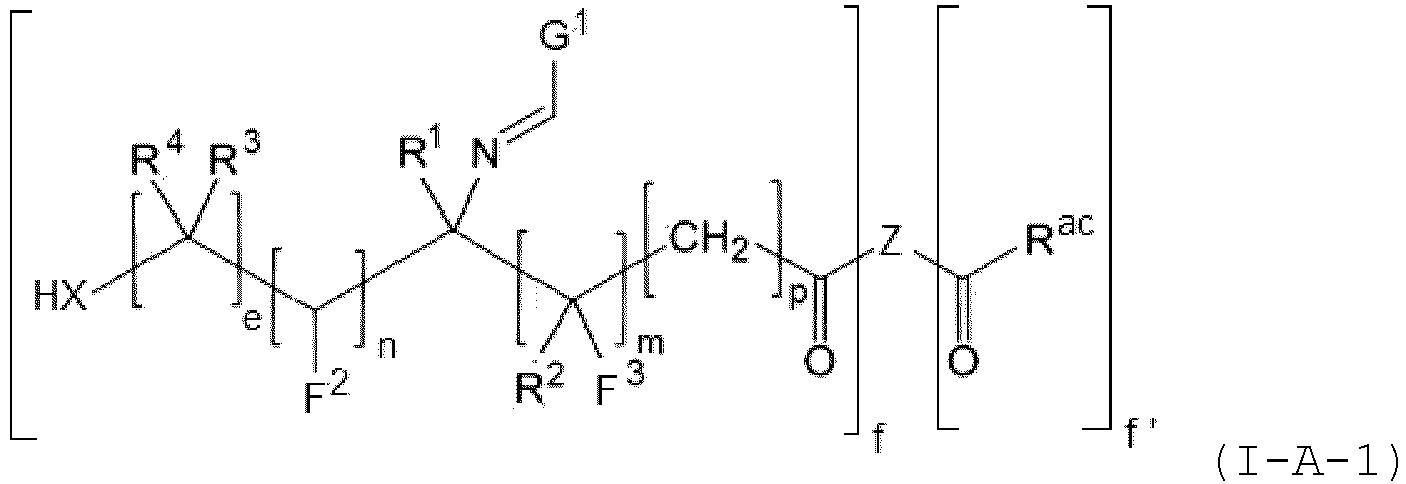
- Compounds of formula (IA) may have one of the following formulas (IA-1), (IA-2) or (IA-3): in which X, R 1 , R 2 , R 3 , R 4 , n, m, p, e, f, f', Z, F 2 , F 3 , G 1 and R ac are as previously defined in formula (IA); in which R 1 , R 2 , R 3 , R 4 , m, p, e, f, f', Z, X, G 1 , F 1 , F 3 , G 1 and R ac are as previously defined in formula (IA), in which R 1 , R 2 , R 3 , R 4 , n, p, q, e, f, f', Z, X, G 1 , F 1 , F 2 , R ac are as defined previously in formula (IA).
- Compounds of formula (IC) may have one of the following formulas (IC-1), (IC-2) or (IC-3): in which F 1 , F 3 , R 1 , R 2 , R 3 , R 4 , F 2 , m, p, q, e, f, G 1 and Z are as previously defined in formula (IC), in which F 1 , F 3 , R 1 , R 2 , R 3 , R 4 , F 2 , m, p, q, e, f, G 1 , Z and R ac are as previously defined in formula (IC), in which F 1 , F 3 , R 1 , R 2 , R 3 , R 4 , F 2 , m, p, q, e, f, G 1 , Z and R ac are as previously defined in formula (IC).
- Compounds of formula (ID) may have one of the following formulas (ID-1), (ID-2) or (ID-3): in which F 1 , F 2 , R 1 , R 2 , R 3 , R 4 , F 2 , n, m, p, q, e, f, G 1 and Z are as previously defined in formula (ID); in which F 1 , F 2 , R 1 , R 2 , R 3 , R 4 , F 2 , n, m, p, q, e, f, G 1 , Z and R ac are as previously defined in formula (ID), in which F 1 , F 2 , R 1 , R 2 , R 3 , R 4 , F 2 , n, m, p, q, e, f, G 1 , Z and R ac are as previously defined in formula (ID).
- reaction between a compound of the abovementioned formula (III) and a compound of the abovementioned formula (IV) can be carried out according to a procedure similar to that used (Example 15) in US 5,087,661 , either by azeotropic entrainment of the water formed at approximately 90°C in the presence of toluene as reaction solvent.
- the compounds of formula (III) are compounds of formula (III-A) mentioned above.
- aldehydes of formula (IV-A-2) we can for example cite 2,2-dimethyl-oxopropylacetate, or 2,2-dimethyl-3-oxopropyl dodecanoate.
- aldehydes of formula (IV-A-3) we can for example cite 2,2-dimethyl-3-(morpholin-4-yl)propanal ( CAS Number: 23588-51-4 ).
- aldehydes of formula (IV-B) we can for example cite the aldehydes of formulas (IV-B-1), (IV-B-2), (IV-B-3), (IV-B-4), (IV-B-5), (IV-B-6), (IV-B-7) or (IV-B-8) following: in which R a , R 16 , R 17 , R 19 , R 20 , R 21 , R 22 , R 23 , and R 24 are as defined above.
- aldehydes of formula (IV-B) we can cite for example 2- and 3- and 4-formylpyridine, 2-furfuraldehyde, 2-thiophenecarbaldehyde, quinoline-2-carbaldehyde and its positional isomers in 3-, 4-, 5-, 6-, 7- and 8-,; as well as glyoxal, glyoxalic acid esters such as glyoxalic acid methyl ester, cinnamaldehyde, and substituted cinnamaldehydes; and dimethylcyclohex-3-ene-1-carbaldehyde.
- the aldehydes of formula (IV) are chosen from the group consisting of 2,2-dimethyl-3-phenoxypropanal, 2,2-dimethyl-3-cyclohexyloxypropanal, 2,2-dimethyl-3-(2-ethylhexyloxy)propanal, 2,2-dimethyl-3-lauryloxypropanal, 2,2-dimethyl-3-stearyloxypropanal, 2,2-dimethyl-3-(morpholin-4-yl)propanal, 2,2-dimethyl-3-oxopropylacetate, 2,2-dimethyl-3-oxopropyl dodecanoate, 2,2-dimethyl-3(m-phenyl)propanal, 2,2-dimethyl-3(m-tolyl)propanal or Majantal, dimethylcyclohex-3-ene-1-carbaldehyde, 3-hydroxy-2-(hydroxymethyl)-2-methylpropionaldehyde, and mixtures thereof.
- a derivative of a compound of formula (V) above is understood to mean a compound of formula (V) in which the -NH 2 group is protected by a protective group P forming an -NHP group.
- Step i) is in particular carried out with such a derivative of a compound of formula (V) when it takes place in the presence of a compound of formula (VI) and/or (VII).
- a A derivative of a compound of formula (V) may for example be a compound of formula (V) in which the -NH 2 group(s) is (are) protected in the form of -NH-Boc (Boc being tertbutyloxycarbonyl), in the form of -NH-CBz (Cbz being N-benzyloxycarbonyl) or in the form of -NH-Fmoc (Fmoc being 9-fluorenylmethylenoxy-carbonyl).
- a derivative of a compound of formula (V) may for example be prepared by reacting a compound of formula (V) with di-tert-butyl dicarbonate to protect the -NH 2 group(s) in the -NHBoc form in order to obtain the N-Boc amino acids of the following formula:
- a derivative of a compound of formula (V) may for example be prepared by reacting a compound of formula (V) with tertbutyldimethylsilyl chloride in dimethylformamide in the presence of imidazole to protect the -XH and -Ph-XH group(s) in the -X-TBDMS form.
- step i) is carried out in the presence of a compound of formula (VII) when the aim is to prepare a compound of formula (III) in which f' is different from 0.
- the reaction can take place at low temperature, i.e. at a temperature less than or equal to 25°C.
- step i) is carried out with at least one compound of formula (V), and in the absence of a compound of formula (VII).
- the synthesis of the aminoesters during step i) can be carried out in an organic solvent, for example chosen from ethers (for example ethyl ether or tetrahydrofuran), chlorinated solvents (for example dichloromethane) or directly in excess Z'(OH)x according to its boiling point under reduced pressure as described in Tetrahedron Letters (1986), 27 (41), pages 4975-4978 and in Tetrahedron (1988), 44 (17), 5495-506 (1988) ).
- an organic solvent for example chosen from ethers (for example ethyl ether or tetrahydrofuran), chlorinated solvents (for example dichloromethane) or directly in excess Z'(OH)x according to its boiling point under reduced pressure as described in Tetrahedron Letters (1986), 27 (41), pages 4975-4978 and in Tetrahedron (1988), 44 (17), 5495-506 (1988) ).
- the synthesis of the aminoamides, during step i) can be carried out in an organic solvent, for example chosen from ethers (for example ethyl ether or tetrahydrofuran), chlorinated solvents (for example dichloromethane) as described in Journal of Organic Chemistry (2006), 71(4), 1750-1753 from the corresponding aminoesters.
- organic solvent for example chosen from ethers (for example ethyl ether or tetrahydrofuran), chlorinated solvents (for example dichloromethane) as described in Journal of Organic Chemistry (2006), 71(4), 1750-1753 from the corresponding aminoesters.
- Step ii) of deprotection of the -NH 2 functions in -NHBoc form can be carried out by any conventional method known to those skilled in the art. It can, for example, be an acid hydrolysis step. For example, it is possible to carry out step ii) in the presence of trifluoroacetic acid or hydrochloric acid.
- Step ii) of deprotection of the -XH and -Ph-XH functions in -X-TBDMS form can be carried out by any conventional method known to those skilled in the art. It can, for example, be a cleavage step. For example, it is possible to carry out step ii) in the presence of tetra-n-butylammonium fluoride (TBAF).
- TBAF tetra-n-butylammonium fluoride
- the compounds of formula (VI) can for example be chosen from monols, diols, triols, monoamines, diamines, triamines, amino alcohols.
- Compounds of formula (V-A) may be present as an L-enantiomer, a D-enantiomer or as a racemate.
- mineral filler(s) any mineral filler(s) typically used in the field of surface coating, adhesive or sealant compositions may be used.
- Inorganic fillers may be in the form of particles of various geometry. For example, they may be spherical, fibrous, or have an irregular shape.
- the filler is chosen from sand, glass beads, glass, quartz, barite, alumina, mica, talc, carbonate fillers, and mixtures thereof.
- the sand which can be used in the present invention preferably has a particle size ranging from 0.1 to 400 ⁇ m, preferably from 1 to 400 ⁇ m, more preferably from 10 to 350 ⁇ m, more preferably from 50 to 300 ⁇ m.
- the glass beads which can be used in the present invention preferably have a particle size ranging from 0.1 to 400 ⁇ m, preferably from 1 to 400 ⁇ m, more preferably from 10 to 350 ⁇ m, more preferably from 50 to 300 ⁇ m.
- the filler is a carbonated filler chosen from alkali or alkaline earth metal carbonates, such as for example calcium carbonate.
- Fillers can be natural or treated, for example using an organic acid such as stearic acid, or a mixture of organic acids consisting mainly of stearic acid.
- the total amount of filler may vary from 0.01% to 70% by weight, preferably from 20% to 65%, preferentially from 20% to 50%, advantageously from 25% to 40% by weight relative to the total weight of the composition.
- Composition C1 may comprise at least one plasticizing agent in an amount of 5% to 30% by weight, preferably 10% to 30% by weight, preferentially 15% to 25% by weight relative to the total weight of said composition.
- plasticizing agent usually used in the field of adhesives, sealants and/or surface coatings, such as, for example, phthalates, benzoates, trimethylolpropane esters, trimethylolethane esters, trimethylolmethane esters, glycerol esters, pentaerythritol esters, naphthe
- phthalates examples include diisononyl phthalate, diisobutyl phthalate, dioctyl phthalate, dicyclohexyl phthalate, diisooctyl phthalate, diisododecyl phthalate, dibenzyl phthalate, diisodecyl phthalate (e.g. marketed by BASF under the name PALATINOL TM DIDP), or butylbenzyl phthalate.
- benzoates include: neopentyl glycol dibenzoate (e.g. available under the name UNIPLEX ® 512 from LANXESS), dipropylene glycol dibenzoate (e.g. available under the name BENZOFLEX ® 9-88SG from EASTMAN), a mixture of diethylene glycol dibenzoate and dipropylene glycol dibenzoate (for example available under the name K-FLEX ® 850 S from KALAMA CHEMICAL), or a mixture of diethylene glycol dibenzoate, dipropylene glycol dibenzoate and triethylene glycol dibenzoate (for example available under the name BENZOFLEX ® 2088 from EASTMAN).
- neopentyl glycol dibenzoate e.g. available under the name UNIPLEX ® 512 from LANXESS
- dipropylene glycol dibenzoate e.g. available under the name BENZOFLEX ® 9-88SG
- pentaerythritol esters we can for example cite pentaerythritol tetravalerate (for example available under the name PEVALEN TM from the company PERSTORP).
- cyclohexanedicarboxylates we can cite for example diisononyl 1,2-cyclohexanedicarboxylate (for example available under the name HEXAMOLL DINCH ® from BASF).
- rheology agent(s) As an example of rheology agent(s) that can be used, mention may be made of any rheology agent usually used in the field of adhesive, mastic and/or surface coating compositions.
- the total content of rheology agent(s) which can be used can vary from 1% to 40% by weight, preferably from 5% to 30% by weight, more preferably from 10% to 25% by weight relative to the total weight of composition C1.
- the solvent is preferably a solvent that is volatile at a temperature of 23°C.
- the volatile solvent may, for example, be chosen from alcohols that are volatile at 23°C, such as ethanol or isopropanol.
- the volatile solvent makes it possible, for example, to reduce the viscosity of the composition and make the composition easier to apply.
- the volatile nature of the solvent allows, in particular, the joint obtained after the composition has hardened to no longer contain any solvent. Thus, the solvent, for example, has no negative influence on the hardness of the joint.
- composition C1 When a solvent, in particular a volatile solvent, is present in composition C1, its content is preferably less than or equal to 5% by weight, more preferably less than or equal to 3% by weight, relative to the total weight of the composition.
- the content of solvent(s) in composition C1 is between 0% and 5% by weight.
- Pigments can be organic or inorganic pigments.
- the pigment is TiO 2 , in particular KRONOS ® 2059 marketed by the KRONOS company.
- Composition C1 may comprise an amount of 0.1% to 3%, preferably 0.1% to 3%, even more preferably 0.1% to 1% by weight, of at least one UV stabilizer or antioxidant.
- These compounds are typically introduced to protect the composition from degradation resulting from a reaction with oxygen which is likely to form by the action of heat or light.
- These compounds may include primary antioxidants which scavenge free radicals. The primary antioxidants may be used alone or in combination with other secondary antioxidants or UV stabilizers.
- IRGANOX ® 1010 examples include IRGANOX ® 1010, IRGANOX ® B561, IRGANOX ® 245, IRGAFOS ® 168, TINUVIN ® 328 or TINUVIN TM 770 marketed by BASF.
- between x and y or “ranging from x to y”, we mean an interval in which the limits x and y are included.
- the range “between 0% and 25%” includes in particular the values 0% and 25%.
- the THF is removed under reduced pressure using a rotary evaporator, the aqueous phase is washed with diethyl ether, acidified with citric acid and then the reaction product is extracted 3 times with 100 ml of ethyl acetate.
- the organic phase is dried over anhydrous sodium sulfate (Na 2 SO 4 ) and concentrated under reduced pressure using a rotary evaporator.
- the N-Boc Amino acid is isolated with a yield greater than 98%.
- TDMSCI dimethyl-tert-butylchlorosilane
- Procedure 1 and then procedure 2 are applied successively.
- the N-Boc / X-TBDMS Amino acid is isolated with yields ranging from 92 to more than 98%.
- procedure 4a is preferably used for alcohols with a boiling point ⁇ 160°C at Patm or procedure 4b for alcohols with a boiling point > 160°C at Patm.
- N-Boc amino acid or N-Boc/X-TBDMS Amino Acid 52 mmol of N-Boc amino acid or N-Boc/X-TBDMS Amino Acid, anhydrous alcohol (monol, diol or triol) and 4-dimethylaminopyridine (DMAP) are dissolved in 500 ml of dichloromethane (CH2Cl2) in amounts such that the molar ratios -COOH/-OH and -COOH/DMAP are 1.02 and 1.7, respectively.
- 1-Ethyl-3-[3-(dimethylaminopropyl]carbodiimide (EDCI) chloride is added in an amount such that the molar ratio -COOH / EDCI is 0.92, the mixture is kept stirring for 1 hour then at room temperature (23°C) for approximately 12 hours.
- N-Boc Aminoester or N-Boc / X-TBDMS Aminoester previously obtained are dissolved in 750 ml of CH2Cl2. 250 ml of TFA are added and then stirred at room temperature for approximately 12 hours and the aminoester trifluoroacetate is neutralized with the addition of sodium bicarbonate. The sodium trifluoroacetate is removed by filtration, the organic phase is recovered and the dichloromethane is removed under reduced pressure using a rotary evaporator. The aminoester is isolated with a yield of 96%.
- N-Boc Aminoacid or N-Boc/X-TBDMS Aminoacid 60 mmol of N-Boc Aminoacid or N-Boc/X-TBDMS Aminoacid, the primary or secondary amine and 1-ethyl-3-(3-dimethylaminopropyl)-carbodiimide (EDCI) chloride are dissolved in 500 ml of methyl chloride under an inert atmosphere in amounts such that the molar ratios COOH/NH and COOH/EDCI are 1.2 and 0.80, respectively. Stirring is maintained at room temperature for at least 5 hours.
- EDCI 1-ethyl-3-(3-dimethylaminopropyl)-carbodiimide
- N-Boc Aminoamide or N-Boc / X-TBDMS Aminoamides previously obtained are dissolved in 500 ml of CH 2 Cl 2 . 250 ml of TFA are added then The mixture is stirred at room temperature for approximately 12 hours and the amino ester trifluoroacetate is neutralized with the addition of sodium bicarbonate. The sodium trifluoroacetate is removed by filtration, the organic phase is recovered, and the dichloromethane is removed under reduced pressure using a rotary evaporator. The aminoamide is isolated with a yield of at least 96%.
- aldehydes P to Z were synthesized according to the procedures mentioned or purchased: Aldehyde No. synthesis 2,2-dimethyl-3-(morpholin-4-yl)propanal ( CAS Number: 23588-51-4 , Tb: 199°C at Patm) P Available at BOC SCIENCES 2,2-dimethyl-3-oxopropyl acetate (CAS Number: 16184-79-5, Tb: 124 °C at Patm) Q Available at CHEMIELIVA PHARMACEUTICA L 2,2-dimethyl-3-oxopropyl laurate ( CAS Number: 102985-93-3 , Tb > 160°C at Patm) R Synthesized according to the procedures described in Macromolecular Chemistry and Physics (2004), 205(7), 973-978 (5-formyl-2-furanyl)methyl acetate ( CAS Number: 10551-58-3 , Tb > 160°C at Patm) S Synthesized from 5-(Hydroxymethyl)furfural (
- procedure 6a is preferably used for aldehydes with a boiling point ⁇ 160°C at Patm or procedures 6b or 6c for aldehydes with a boiling point > 160°C at Patm.
- Aldimine of formula (I) is obtained in quantitative yield.
- Aldimine of formula (I) is obtained in quantitative yield.
- procedure 7a is preferably used for aldehydes with a boiling point ⁇ 160°C at Patm or procedures 7b or 7c for aldehydes with a boiling point > 160°C at Patm.
- Aldimine of formula (II) is obtained in quantitative yield.
- Aldimine of formula (II) is obtained in quantitative yield.
- Aldimine of formula (II) is obtained in quantitative yield.
- aldimines were thus synthesized: Aminoeste r/ Aminoami of Aldehy of Aldmines of formula (I) or (II) No. HAS P Ald1 HAS Q Ald2 HAS R Ald3 HAS T Ald4 HAS U Ald5 HAS V Ald6 HAS W Ald7 HAS X Ald8 HAS Y Ald9 HAS Z1 Ald1 0 HAS Z3 Ald1 1 HAS Z4 Ald1 2 HAS Z5 Ald1 3 B R Ald1 4 C R Ald1 5 D R Ald1 6 E R Ald1 7 F R Ald1 8 H R Ald1 9 I R Ald2 0 K S Ald2 1 L P Ald2 2 I U Ald2 3 I Y Ald2 4
- NCO-terminated polyurethane (P1) used in the reference example outside the invention (without aldimine) and in examples C1 to C2 according to the invention (with aldimines according to the invention) was prepared by mixing the ingredients indicated in the following table at a temperature less than or equal to 95°C under conditions anhydrous.
- the quantities indicated in the table below are expressed as a percentage by weight relative to the total weight of the polyurethane composition of each of the examples.
- the % by weight of final NCO corresponds to the quantity of NCO functions in the polyurethane solution (P1) at the end of the polyurethane preparation reaction, expressed relative to the total weight of the polyurethane solution.
- Reference C1 C2 Prepolymer (P1) 19.40 17.31 17.11 Mesamoll: CAS 91082-17-6 16.90 16.91 16.91 Gel Paste CAS 77703-56-1 available from SIKA (dibutyl-4-4'-methylenedi(phenyl)urea) 12.33 12.34 12.34 DIDP: diisodecyl phthalate 2.10 2.10 2.10 PTSI p-toluenesulfonyl isocyanate 0.40 0.40 0.40 IPDI 0.40 0.40 0.40 XDI 0.20 0.20 0.20 Silquest A-187 (MOMENTIVE) 0.17 0.17 0.17 Tinuvin B 75 (BASF) 0.14 0.14 0.14 Xylene 1.90 1.90 1.90 PVC (solvin 373 MC) 15.60 15.61 15.61 OMYA B
Landscapes
- Chemical & Material Sciences (AREA)
- Organic Chemistry (AREA)
- Health & Medical Sciences (AREA)
- Chemical Kinetics & Catalysis (AREA)
- Medicinal Chemistry (AREA)
- Polymers & Plastics (AREA)
- Life Sciences & Earth Sciences (AREA)
- Engineering & Computer Science (AREA)
- Materials Engineering (AREA)
- Wood Science & Technology (AREA)
- Organic Low-Molecular-Weight Compounds And Preparation Thereof (AREA)
Claims (15)
- Verbindung einer der folgenden Formeln (I) oder (II):
 - X1 für F1 oder -N=C(H)-G1 oder -Ph-XH oder -XH steht, wobei X für O oder S oder Se steht und Ph für eine Phenylgruppe steht;- X2 für F2 oder -N=C(H)-G1 oder -Ph-XH oder -XH steht, wobei X für O oder S oder Se steht und Ph für eine Phenylgruppe steht;- X3 für F3 oder -N=C(H)-G1 oder -Ph-XH oder -XH steht, wobei X für O oder S oder Se steht und Ph für eine Phenylgruppe steht;mit der Maßgabe, dass höchstens ein einziger Rest unter den Resten X1, X2 und X3 für -N=C(H)-G1 steht;mit der Maßgabe, dass höchstens ein einziger Rest unter den Resten X1, X2 und X3 für -XH oder -Ph-XH steht;mit der Maßgabe, dass dann, wenn X1 = -N=C(H)-G1, q = 1; mit der Maßgabe, dass dann, wenn X1 = -N=C(H)-G1 oder - Ph-XH oder -XH, X2 = F2 und X3 = F3;der Maßgabe, dass dann, wenn X2 = -N=C(H)-G1 oder -Ph-XH oder -XH, X1 = F1 und X3 = F3;mit der Maßgabe, dass dann, wenn X3 = -N=C(H)-G1 oder - Ph-XH oder -XH, X2 = F2 und X1 = F1;- F1 für einen Rest steht, der aus einem Wasserstoffatom, einer linearen oder verzweigten Alkylgruppe mit 1 bis 20 Kohlenstoffatomen, einer Arylalkylgruppe mit 7 bis 20 Kohlenstoffatomen, einer (Hetero)arylgruppe mit 4 bis 12 Kohlenstoffatomen oder einer (Hetero)cycloalkylgruppe mit 3 bis 20 Kohlenstoffatomen, einer -COOZ-Gruppe, einer- C(O)NH2-Gruppe, einer -SMe-Gruppe oder einer Guanidylgruppe der Formel -NH-C(=NH)-NH2 ausgewählt ist,- F2 für einen Rest steht, der aus einem Wasserstoffatom, einer linearen oder verzweigten Alkylgruppe mit 1 bis 20 Kohlenstoffatomen, einer Arylalkylgruppe mit 7 bis 20 Kohlenstoffatomen, einer (Hetero)arylgruppe mit 4 bis 12 Kohlenstoffatomen oder einer (Hetero)cycloalkylgruppe mit 3 bis 20 Kohlenstoffatomen, einer -COOZ-Gruppe, einer -C(O)NH2-Gruppe, einer -SMe-Gruppe oder einer Guanidylgruppe der Formel -NH-C(=NH)-NH2 ausgewählt ist,- F3 für einen Rest steht, der aus einem Wasserstoffatom, einer linearen oder verzweigten Alkylgruppe mit 1 bis 20 Kohlenstoffatomen, einer Arylalkylgruppe mit 7 bis 20 Kohlenstoffatomen, einer (Hetero)arylgruppe mit 4 bis 12 Kohlenstoffatomen oder einer (Hetero)cycloalkylgruppe mit 3 bis 20 Kohlenstoffatomen, einer -COOZ-Gruppe, einer -C(O)NH2-Gruppe, einer -SMe-Gruppe oder einer Guanidylgruppe der Formel -NH-C(=NH)-NH2 ausgewählt ist,- R1, R2, R3 und R4 jeweils unabhängig voneinander für einen Rest stehen, der aus einem Wasserstoffatom, einer linearen oder verzweigten Alkylgruppe mit 1 bis 20 Kohlenstoffatomen, wobei die Alkylgruppe gegebenenfalls ein oder mehrere Heteroatome umfasst, einer (Hetero)cycloalkylgruppe mit 3 bis 20 Kohlenstoffatomen, einer Arylalkylgruppe mit 7 bis 20 Kohlenstoffatomen oder einer (Hetero)arylgruppe mit 4 bis 12 Kohlenstoffatomen ausgewählt ist;- n eine ganze Zahl im Bereich von 0 bis 28 ist;- p eine ganze Zahl im Bereich von 0 bis 10 ist;- m für 0 oder 1 steht;- q für 0 oder 1 steht;- e eine ganze Zahl im Bereich von 1 bis 3 ist;- f eine ganze oder gebrochene Zahl im Bereich von 1 bis 3 ist, wobei f vorzugsweise eine ganze Zahl mit einem Wert von 1, 2 oder 3 ist;- f' eine ganze oder gebrochene Zahl im Bereich von 0 bis 2 ist, wobei f' vorzugsweise eine ganze Zahl mit einem Wert von 0, 1 oder 2 ist;- die Summe f + f' für eine ganze Zahl im Bereich von 1 bis 3 steht;- Z für einen einwertigen organischen Rest Zm, zweiwertigen organischen Rest Zd oder dreiwertigen organischen Rest Zt mit einer Molmasse oder einer zahlenmittleren Molmasse (Mn) im Bereich von 16 bis 22.000 g/mol, vorzugsweise von 16 bis 12.000 g/mol, weiter bevorzugt von 16 bis 8000 g/mol, noch weiter bevorzugt von 16 bis 4000 g/mol, steht;- Rac für ein Wasserstoffatom oder einen einwertigen Kohlenwasserstoffrest mit 1 bis 60 Kohlenstoffatomen steht, wobei der Rest gegebenenfalls ein oder mehrere Heteroatome umfassen kann;- G1 für einen einwertigen Kohlenwasserstoffrest mit einer Molmasse oder zahlenmittleren Molmasse (Mn) im Bereich von 15 bis 4000 g/mol, vorzugsweise von 60 bis 2000 g/mol, bevorzugt von 60 bis 1000 g/mol und noch weiter bevorzugt von 60 bis 500 g/mol steht, wobei der Rest gegebenenfalls ein oder mehrere Heteroatome umfassen kann, mit der Maßgabe, dass G1 nicht für einen substituierten oder unsubstituierten Arylrest steht;
 - X1 für F1 oder -Ph-XH oder -XH steht;- X2 für F2 oder -Ph-XH oder -XH steht;- X3 für F3 oder -Ph-XH oder -XH steht;- F1 für einen Rest steht, der aus einem Wasserstoffatom, einer linearen oder verzweigten Alkylgruppe mit 1 bis 20 Kohlenstoffatomen, einer Arylalkylgruppe mit 7 bis 20 Kohlenstoffatomen, einer (Hetero)arylgruppe mit 4 bis 12 Kohlenstoffatomen oder einer (Hetero)cycloalkylgruppe mit 3 bis 20 Kohlenstoffatomen, einer -COOZm-Gruppe, einer -C(O)NH2-Gruppe, einer -SMe-Gruppe oder einer Guanidylgruppe der Formel -NH-C(=NH)-NH2 ausgewählt ist,- F2 für einen Rest steht, der aus einem Wasserstoffatom, einer linearen oder verzweigten Alkylgruppe mit 1 bis 20 Kohlenstoffatomen, einer Arylalkylgruppe mit 7 bis 20 Kohlenstoffatomen, einer (Hetero)arylgruppe mit 4 bis 12 Kohlenstoffatomen oder einer (Hetero)cycloalkylgruppe mit 3 bis 20 Kohlenstoffatomen, einer -COOZm-Gruppe, einer -C(O)NH2-Gruppe, einer -SMe-Gruppe oder einer Guanidylgruppe der Formel -NH-C(=NH)-NH2 ausgewählt ist,- F3 für einen Rest steht, der aus einem Wasserstoffatom, einer linearen oder verzweigten Alkylgruppe mit 1 bis 20 Kohlenstoffatomen, einer Arylalkylgruppe mit 7 bis 20 Kohlenstoffatomen, einer (Hetero)arylgruppe mit 4 bis 12 Kohlenstoffatomen oder einer (Hetero)cycloalkylgruppe mit 3 bis 20 Kohlenstoffatomen, einer -COOZm-Gruppe, einer -C(O)NH2-Gruppe, einer -SMe-Gruppe oder einer Guanidylgruppe der Formel -NH-C(=NH)-NH2 ausgewählt ist,- wobei X, R1, R2, R3, R4, n, q, m, p, e und Zm wie für obige Formel (I) definiert sind;- G3 für einen einwertigen Kohlenwasserstoffrest mit einer Molmasse oder zahlenmittleren Molmasse (Mn) im Bereich von 14 bis 4000 g/mol, vorzugsweise von 42 bis 2000 g/mol, bevorzugt von 42 bis 1000 g/mol und noch weiter bevorzugt von 42 bis 500 g/mol steht, wobei der Rest gegebenenfalls ein oder mehrere Heteroatome umfassen kann, mit der Maßgabe, dass G1 nicht für einen substituierten oder unsubstituierten Arylenrest steht;mit der Maßgabe, dass höchstens ein einziger Rest unter den Resten X1, X2 und X3 für -XH oder -Ph-XH steht;mit der Maßgabe, dass dann, wenn X1 = -Ph-XH oder -XH, X2 = F2 und X3 = F3;mit der Maßgabe, dass dann, wenn X2 = -Ph-XH oder -XH, X1 = F1 und X3 = F3;mit der Maßgabe, dass dann, wenn X3 = -Ph-XH oder -XH, X2 = F2 und X1 = F1.
 - Verbindung nach Anspruch 1, dadurch gekennzeichnet, dass Zm für einen Rest steht, der aus -OR5, -NH2, -NH-R' oder -N(R')(R'') ausgewählt ist, wobei:- R5 für eine lineare oder verzweigte Alkylgruppe mit 1 bis 60 Kohlenstoffatomen, die gegebenenfalls ein oder mehrere Heteroatome umfassen kann, eine (Hetero)cycloalkylgruppe mit 3 bis 20 Kohlenstoffatomen, eine Arylalkylgruppe mit 7 bis 20 Kohlenstoffatomen oder eine (Hetero)arylgruppe mit 4 bis 12 Kohlenstoffatomen steht;- R' für eine lineare oder verzweigte Alkylgruppe mit 1 bis 60 Kohlenstoffatomen, die gegebenenfalls ein oder mehrere Heteroatome umfassen kann, eine Arylalkylgruppe mit 7 bis 20 Kohlenstoffatomen, eine (Hetero)arylgruppe mit 4 bis 12 Kohlenstoffatomen oder eine (Hetero)cycloalkylgruppe mit 3 bis 20 Kohlenstoffatomen steht;- R'' für eine lineare oder verzweigte Alkylgruppe mit 1 bis 60 Kohlenstoffatomen, die gegebenenfalls ein oder mehrere Heteroatome umfassen kann, eine Arylalkylgruppe mit 7 bis 20 Kohlenstoffatomen, eine (Hetero)arylgruppe mit 4 bis 12 Kohlenstoffatomen oder eine (Hetero)cycloalkylgruppe mit 3 bis 20 Kohlenstoffatomen steht.
- Verbindung nach Anspruch 1 oder 2, dadurch gekennzeichnet, dass der Rest -G1 für einen Rest - C(R6)(R7)(R8) oder einen Rest -G2 steht, wobei:- R6 und R7 jeweils unabhängig voneinander für einen einwertigen Kohlenwasserstoffrest mit 1 bis 12 Kohlenstoffatomen stehen, wobei der Rest gegebenenfalls durch eine -OH-Gruppe substituiert ist;
oder R6 und R7 zusammen einen aliphatischen Ring mit 4 bis 12 Kohlenstoffatomen bilden, wobei der Ring gegebenenfalls substituiert ist;- R8 für einen einwertigen Kohlenwasserstoffrest mit 1 bis 60 Kohlenstoffatomen steht, wobei der Rest gegebenenfalls ein Heteroatom umfasst;- G2 für einen gegebenenfalls substituierten Heteroarylrest oder einen Rest -C(O)-R12 steht, wobei R12 für einen Alkoxyrest, einen Alkenylrest oder einen Arylalkenylrest mit mindestens sechs Kohlenstoffatomen steht;wobei der Rest G2 eine Molmasse oder eine zahlenmittlere Molmasse (Mn) im Bereich von 15 bis 4000 g/mol, vorzugsweise im Bereich von 60 bis 2000 g/mol, bevorzugt im Bereich von 60 bis 1000 g/mol und noch weiter bevorzugt im Bereich von 60 bis 500 g/mol aufweist. - Verbindung nach Anspruch 1 oder 2, dadurch gekennzeichnet, dass in Formel (II) der Rest -G3 für Folgendes steht:- einen linearen oder verzweigten, cyclischen oder acyclischen, gesättigten oder ungesättigten Alkylenrest oder- einen Rest -G5-(G6-G5)r-
mit einer Molmasse oder zahlenmittleren Molmasse (Mn) im Bereich von 14 bis 4000 g/mol, vorzugsweise im Bereich von 60 bis 2000 g/mol, bevorzugt im Bereich von 60 bis 1000 g/mol und noch weiter bevorzugt im Bereich von 60 bis 500 g/mol, wobei:- G5 für einen gegebenenfalls substituierten Hetero(arylen)rest steht;- G6 für ein Sauerstoffatom, ein Schwefelatom oder einen Rest, der aus den folgenden Resten ausgewählt ist, steht: -O-R27-O-, -CH2-O-R28-O-CH2-, -CH2-O-C(=O)-R29-C(=O)-O-CH2-, -CH2-O-C(=O)-NH-R30-NH-C(=O)-O-CH2-, -O-C(=O)-NH-R31-NH-C(=O)-O-, -O-C(=O)-R32-C(=O)-O-, und wobei R27, R28, R29, R30, R31 und R32 jeweils unabhängig voneinander für einen Kohlenwasserstoffrest, der gegebenenfalls mindestens ein Heteroatom umfasst, stehen;- r für 0 oder 1 steht;- mit der Maßgabe, dass dann, wenn r = 0, G5 für ein gegebenenfalls substituiertes Heteroarylen steht;- einen Rest -CH(R25)(R26)- [G4-CH(R25)(R26)]w- mit einer Molmasse oder zahlenmittleren Molmasse (Mn) im Bereich von 42 bis 4000 g/mol, vorzugsweise im Bereich von 42 bis 2000 g/mol, bevorzugt im Bereich von 42 bis 1000 g/mol und noch weiter bevorzugt im Bereich von 42 bis 500 g/mol, wobei:- R25 und R26 jeweils unabhängig voneinander für einen einwertigen Kohlenwasserstoffrest mit 1 bis 12 Kohlenstoffatomen stehen, wobei der Rest gegebenenfalls durch eine -OH-Gruppe substituiert ist;
oder R25 und R26 zusammen einen aliphatischen Ring mit 4 bis 12 Kohlenstoffatomen bilden, wobei der Ring gegebenenfalls substituiert ist;- G4 für eine Kohlenstoff-Kohlenstoffbindung oder einen zweiwertigen Kohlenwasserstoffrest steht, wobei der Rest gegebenenfalls mindestens ein Heteroatom umfasst;- w für eine ganze Zahl mit einem Wert von 0 oder 1 steht. - Verbindung nach einem der Ansprüche 1 bis 4, dadurch gekennzeichnet, dass in den Formeln (I) und (II):- n für 0, 1, 2, 3, 4, 9 oder 28 steht;- m für 0 oder 1 steht;- p für 0 oder 1 oder 9 oder 10 steht;- q für 0 oder 1 steht;- F1 für einen Rest steht, der aus einem Wasserstoffatom, einer (Hetero)arylgruppe mit 4 bis 12 Kohlenstoffatomen, einer -COOZ-Gruppe (Formel (I), wobei Z wie oben in Formel (I) definiert ist bzw. einer -COOZm-Gruppe, wobei Zm wie in Formel (II) definiert ist), einer -C(O)NH2-Gruppe, einer -SMe-Gruppe oder einer Guanidylgruppe der Formel -NH-C(=NH)-NH2 ausgewählt ist,- F2 für einen Rest steht, der aus einem Wasserstoffatom oder einer linearen oder verzweigten Alkylgruppe mit 1 bis 10 Kohlenstoffatomen ausgewählt ist,- F3 für einen Rest steht, der aus einem Wasserstoffatom oder einer linearen oder verzweigten Alkylgruppe mit 1 bis 10 Kohlenstoffatomen ausgewählt ist;- R1, R2, R3 und R4 jeweils unabhängig voneinander für ein Wasserstoffatom oder eine lineare oder verzweigte Alkylgruppe mit 1 bis 10 Kohlenstoffatomen, noch weiter bevorzugt von 1 bis 5 Kohlenstoffatomen, oder eine Arylalkylgruppe mit 7 bis 20 Kohlenstoffatomen oder eine Arylgruppe mit 6 bis 12 Kohlenstoffatomen stehen.
- Verbindung nach einem der Ansprüche 1 bis 5, dadurch gekennzeichnet, dass in den Formeln (I) und (II):- n für 0, 1, 2, 3 oder 4 steht;- m für 0 oder 1 steht;- p für 0 oder 1 steht;- q für 0 oder 1 steht;- F1 für einen Rest steht, der aus einem Wasserstoffatom, einer Heteroarylgruppe mit 4 bis 12 Kohlenstoffatomen, einer -COOZ-Gruppe (wobei Z wie oben in Formel (I) definiert ist), einer -C(O)NH2-Gruppe, einer -SMe-Gruppe oder einer Guanidylgruppe der Formel -NH-C(=NH)-NH2 ausgewählt ist,- F2 für einen Rest steht, der aus einem Wasserstoffatom oder einer linearen oder verzweigten Alkylgruppe mit 1 bis 5 Kohlenstoffatomen ausgewählt ist,- F3 für einen Rest steht, der aus einem Wasserstoffatom ausgewählt ist;- R1, R2, R3 und R4 jeweils unabhängig voneinander für ein Wasserstoffatom oder eine lineare oder verzweigte Alkylgruppe mit 1 bis 5 Kohlenstoffatomen oder eine Benzylgruppe oder eine Phenylgruppe stehen.
- Verbindung nach einem der Ansprüche 1 bis 6, dadurch gekennzeichnet, dass sie aus den Verbindungen der folgenden Formeln (I-A), (I-B), (I-C) oder (I-D) ausgewählt ist:
 - R1, R2, R3, R4, n, m, p, q, e, f, f', Z, G1 und Rac wie in Formel (I) in einem der Ansprüche 1 bis 6 definiert sind,- X1 für F1 gemäß der Definition in Formel (I) in einem der Ansprüche 1 bis 6 oder -Ph-XH oder -XH steht, wobei X für O oder S oder Se steht und Ph für eine Phenylgruppe steht;- X2 für F2 gemäß der Definition in Formel (I) in einem der Ansprüche 1 bis 6 oder -Ph-XH oder -XH steht, wobei X für O oder S oder Se steht und Ph für eine Phenylgruppe steht;- X3 für F3 gemäß der Definition in Formel (I) in einem der Ansprüche 1 bis 6 oder -Ph-XH oder -XH steht, wobei X für O oder S oder Se steht und Ph für eine Phenylgruppe steht;mit der Maßgabe, dass höchstens einer der Reste X1, X2 oder X3 für einen Rest-Ph-XH oder -XH steht, wobei X für O oder S oder Se steht und Ph für eine Phenylgruppe steht;
 wobei F2, F3, R1, R2, R3, R4, n, m, p, e, f, f', Z, G1 und Rac wie in Formel (I) in einem der Ansprüche 1 bis 6 definiert sind;
 wobei F1, F3, R1, R2, R3, R4, F2, m, p, q, e, f, f', G1, Z und Rac wie in Formel (I) in einem der Ansprüche 1 bis 6 definiert sind;
 wobei F1, F2, R1, R2, R3, R4, F2, n, m, p, q, e, f, f', G1, Z und Rac wie in Formel (I) in einem der Ansprüche 1 bis 6 definiert sind.
 - Verbindung nach Anspruch 7, dadurch gekennzeichnet, dass die Verbindungen der Formel (I-A) eine der folgenden Formeln (I-A-1), (I-A-2) oder (I-A-3) aufweisen:


- Verbindung nach Anspruch 7, dadurch gekennzeichnet, dass die Verbindungen der Formel (I-B) eine der folgenden Formeln (I-B-1), (I-B-2) oder (I-B-3) aufweisen:


- Verbindung nach Anspruch 7, dadurch gekennzeichnet, dass die Verbindungen der Formel (I-C) eine der folgenden Formeln (I-C-1), (I-C-2) oder (I-C-3) aufweisen:


- Verbindung nach Anspruch 7, dadurch gekennzeichnet, dass die Verbindungen der Formel (I-D) eine der folgenden Formeln (I-D-1), (I-D-2) oder (I-D-3) aufweisen:


- Verbindung der Formel (I) nach einem der Ansprüche 1 bis 11, dadurch gekennzeichnet, dass sie erhalten wird durch eine Reaktion zwischen:- einer Verbindung der folgenden Formel (III):
 - Y1 für F1 oder -NH2 oder -Ph-XH oder -XH steht, wobei X für O oder S oder Se steht und Ph für eine Phenylgruppe steht;- Y2 für F2 oder -NH2 oder -Ph-XH oder -XH steht, wobei X für O oder S oder Se steht und Ph für eine Phenylgruppe steht;- Y3 für F3 oder -NH2 oder -Ph-XH oder -XH steht, wobei X für O oder S oder Se steht und Ph für eine Phenylgruppe steht;mit der Maßgabe, dass höchstens ein einziger Rest unter den Resten Y1, Y2 und Y3 für -NH2 steht,mit der Maßgabe, dass höchstens ein einziger Rest unter den Resten Y1, Y2 und Y3 für -Ph-XH oder -XH steht;mit der Maßgabe, dass dann, wenn Y1 = -NH2, q = 1;mit der Maßgabe, dans dann, wenn Y1 = -NH2 oder -XH oder -Ph-XH, Y2 = F2 und Y3 = F3;mit der Maßgabe, dass dann, wenn Y2 = -NH2 oder -XH oder -Ph-XH, Y1 = F1 und Y3 = F3;mit der Maßgabe, dass dann, wenn Y3 = -NH2 oder -XH oder -Ph-XH, Y2 = F2 und Y1 = F1;- F1 für einen Rest steht, der aus einem Wasserstoffatom, einer linearen oder verzweigten Alkylgruppe mit 1 bis 20 Kohlenstoffatomen, einer Arylalkylgruppe mit 7 bis 20 Kohlenstoffatomen, einer (Hetero)arylgruppe mit 4 bis 12 Kohlenstoffatomen oder einer (Hetero)cycloalkylgruppe mit 3 bis 20 Kohlenstoffatomen, einer -COOZ-Gruppe, einer -C(O)NH2-Gruppe, einer -SMe-Gruppe oder einer Guanidylgruppe der Formel -NH-C(=NH)-NH2 ausgewählt ist,- F2 für einen Rest steht, der aus einem Wasserstoffatom, einer linearen oder verzweigten Alkylgruppe mit 1 bis 20 Kohlenstoffatomen, einer Arylalkylgruppe mit 7 bis 20 Kohlenstoffatomen, einer (Hetero)arylgruppe mit 4 bis 12 Kohlenstoffatomen oder einer (Hetero)cycloalkylgruppe mit 3 bis 20 Kohlenstoffatomen, einer -COOZ-Gruppe, einer -C(O)NH2-Gruppe, einer -SMe-Gruppe oder einer Guanidylgruppe der Formel -NH-C(=NH)-NH2 ausgewählt ist,- F3 für einen Rest steht, der aus einem Wasserstoffatom, einer linearen oder verzweigten Alkylgruppe mit 1 bis 20 Kohlenstoffatomen, einer Arylalkylgruppe mit 7 bis 20 Kohlenstoffatomen, einer (Hetero)arylgruppe mit 4 bis 12 Kohlenstoffatomen oder einer (Hetero)cycloalkylgruppe mit 3 bis 20 Kohlenstoffatomen, einer -COOZ-Gruppe, einer -C(O)NH2-Gruppe, einer -SMe-Gruppe oder einer Guanidylgruppe der Formel -NH-C(=NH)-NH2 ausgewählt ist,- R1, R2, R3 und R4 jeweils unabhängig voneinander für einen Rest stehen, der aus einem Wasserstoffatom, einer linearen oder verzweigten Alkylgruppe mit 1 bis 20 Kohlenstoffatomen, wobei die Alkylgruppe gegebenenfalls ein oder mehrere Heteroatome umfasst, einer (Hetero)cycloalkylgruppe mit 3 bis 20 Kohlenstoffatomen, einer Arylalkylgruppe mit 7 bis 20 Kohlenstoffatomen oder einer (Hetero)arylgruppe mit 4 bis 12 Kohlenstoffatomen ausgewählt ist;- n eine ganze Zahl im Bereich von 0 bis 28 ist;- p eine ganze Zahl im Bereich von 0 bis 10 ist;- m für 0 oder 1 steht;- q für 0 oder 1 steht;- e eine ganze Zahl im Bereich von 1 bis 3 ist;- f eine ganze oder gebrochene Zahl im Bereich von 1 bis 3 ist, wobei f vorzugsweise eine ganze Zahl mit einem Wert von 1, 2 oder 3 ist;- f' eine ganze oder gebrochene Zahl im Bereich von 0 bis 2 ist, wobei f' vorzugsweise eine ganze Zahl mit einem Wert von 0, 1 oder 2 ist;- die Summe f + f' für eine ganze Zahl im Bereich von 1 bis 3 steht;- Z für einen einwertigen organischen Rest Zm, zweiwertigen organischen Rest Zd oder dreiwertigen organischen Rest Zt mit einer zahlenmittleren Molmasse (Mn) im Bereich von 16 bis 22.000 g/mol steht,- Rac für ein Wasserstoffatom oder einen einwertigen Kohlenwasserstoffrest mit 1 bis 60 Kohlenstoffatomen steht, wobei der Rest gegebenenfalls ein oder mehrere Heteroatome umfassen kann;- und einer Verbindung der folgenden Formel (IV):
- Verbindungen der Formel (II) nach einem der Ansprüche 1 bis 12, dadurch gekennzeichnet, dass sie erhalten werden durch Reaktion zwischen:- einer Verbindung der folgenden Formel (III'):
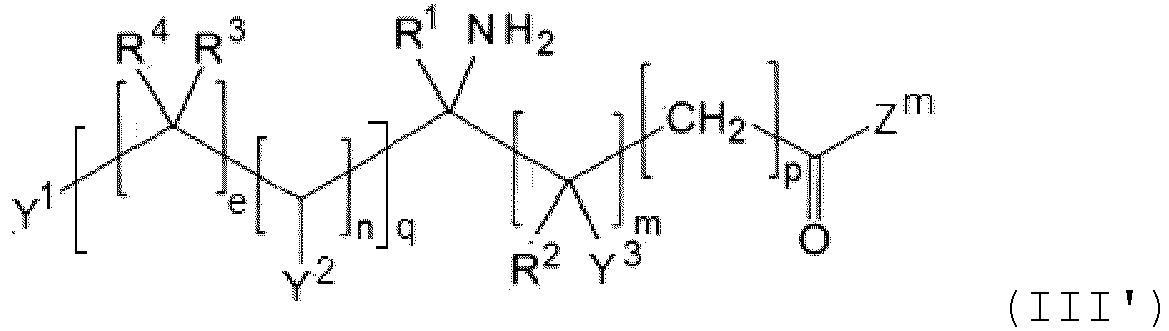 - Y1 für F1 oder -Ph-XH oder -XH steht, wobei X für O oder S oder Se steht und Ph für eine Phenylgruppe steht;- Y2 für F2 oder -Ph-XH oder -XH steht, wobei X für O oder S oder Se steht und Ph für eine Phenylgruppe steht;- Y3 für F3 oder -Ph-XH oder -XH steht, wobei X für O oder S oder Se steht und Ph für eine Phenylgruppe steht;mit der Maßgabe, dass höchstens ein einziger Rest unter den Resten Y1, Y2 und Y3 für -Ph-XH oder -XH steht;mit der Maßgabe, dass dann, wenn Y1 = -XH oder -Ph-XH, Y2 = F2 und Y3 = F3;mit der Maßgabe, dass dann, wenn Y2 = -XH oder -Ph-XH, Y1 = F1 und Y3 = F3;mit der Maßgabe, dass dann, wenn Y3 = -XH oder -Ph-XH, Y1 = F1 und Y2 = F2;- F1 für einen Rest steht, der aus einem Wasserstoffatom, einer linearen oder verzweigten Alkylgruppe mit 1 bis 20 Kohlenstoffatomen, einer Arylalkylgruppe mit 7 bis 20 Kohlenstoffatomen, einer (Hetero)arylgruppe mit 4 bis 12 Kohlenstoffatomen oder einer (Hetero)cycloalkylgruppe mit 3 bis 20 Kohlenstoffatomen, einer -COOZm-Gruppe, einer -C(O)NH2-Gruppe, einer -SMe-Gruppe oder einer Guanidylgruppe der Formel -NH-C(=NH)-NH2 ausgewählt ist,- F2 für einen Rest steht, der aus einem Wasserstoffatom, einer linearen oder verzweigten Alkylgruppe mit 1 bis 20 Kohlenstoffatomen, einer Arylalkylgruppe mit 7 bis 20 Kohlenstoffatomen, einer (Hetero)arylgruppe mit 4 bis 12 Kohlenstoffatomen oder einer (Hetero)cycloalkylgruppe mit 3 bis 20 Kohlenstoffatomen, einer -COOZm-Gruppe, einer -C(O)NH2-Gruppe, einer -SMe-Gruppe oder einer Guanidylgruppe der Formel -NH-C(=NH)-NH2 ausgewählt ist,- F3 für einen Rest steht, der aus einem Wasserstoffatom, einer linearen oder verzweigten Alkylgruppe mit 1 bis 20 Kohlenstoffatomen, einer Arylalkylgruppe mit 7 bis 20 Kohlenstoffatomen, einer (Hetero)arylgruppe mit 4 bis 12 Kohlenstoffatomen oder einer (Hetero)cycloalkylgruppe mit 3 bis 20 Kohlenstoffatomen, einer -COOZm-Gruppe, einer -C(O)NH2-Gruppe, einer -SMe-Gruppe oder einer Guanidylgruppe der Formel -NH-C(=NH)-NH2 ausgewählt ist,- R1, R2, R3 und R4 jeweils unabhängig voneinander für einen Rest stehen, der aus einem Wasserstoffatom, einer linearen oder verzweigten Alkylgruppe mit 1 bis 20 Kohlenstoffatomen, wobei die Alkylgruppe gegebenenfalls ein oder mehrere Heteroatome umfasst, einer (Hetero)cycloalkylgruppe mit 3 bis 20 Kohlenstoffatomen, einer Arylalkylgruppe mit 7 bis 20 Kohlenstoffatomen oder einer (Hetero)arylgruppe mit 5 bis 12 Kohlenstoffatomen ausgewählt ist;- n eine ganze Zahl im Bereich von 0 bis 28 ist;- p eine ganze Zahl im Bereich von 0 bis 10 ist;- m für 0 oder 1 steht;- q für 0 oder 1 steht;- e eine ganze Zahl im Bereich von 1 bis 3 ist;- Zm für einen einwertigen organischen Rest mit einer zahlenmittleren Molmasse (Mn) im Bereich von 16 bis 22.000 g/mol steht;- und einer Verbindung der folgenden Formel (VIII):
- Verwendung von Verbindungen der Formel (X) oder (XI) als Feuchtigkeitsabsorber ("Water Scavenger", Wasserfänger), insbesondere in einer Zusammensetzung auf Basis von Polyurethan, oder als Härtungsmittel in einer Zusammensetzung auf Basis von Epoxidharz:
 - X1 für F1 oder -N=C(H)-G1 oder -Ph-XH oder -XH steht, wobei X für O oder S oder Se steht und Ph für eine Phenylgruppe steht;- X2 für F2 oder -N=C(H)-G1 oder -Ph-XH oder -XH steht, wobei X für O oder S oder Se steht und Ph für eine Phenylgruppe steht;- X3 für F3 oder -N=C(H)-G1 oder -Ph-XH oder -XH steht, wobei X für O oder S oder Se steht und Ph für eine Phenylgruppe steht;mit der Maßgabe, dass höchstens ein einziger Rest unter den Resten X1, X2 and X3 für -N=C(H)-G1 steht;mit der Maßgabe, dass höchstens ein einziger Rest unter den Resten X1, X2 und X3 für -XH oder -Ph-XH steht;mit der Maßgabe, dass dann, wenn X1 = -N=C(H)-G1, q = 1; mit der Maßgabe, dass dann, wenn X1 = -N=C(H)-G1 oder - Ph-XH oder -XH, X2 = F2 und X3 = F3;mit der Maßgabe, dass dann, wenn X2 = -N=C(H)-G1 oder - Ph-XH oder -XH, X1 = F1 und X3 = F3;mit der Maßgabe, dass dann, wenn X3 = -N=C(H)-G1 oder - Ph-XH oder -XH, X2 = F2 und X1 = F1;- F1 für einen Rest steht, der aus einem Wasserstoffatom, einer linearen oder verzweigten Alkylgruppe mit 1 bis 20 Kohlenstoffatomen, einer Arylalkylgruppe mit 7 bis 20 Kohlenstoffatomen, einer (Hetero)arylgruppe mit 4 bis 12 Kohlenstoffatomen oder einer (Hetero)cycloalkylgruppe mit 3 bis 20 Kohlenstoffatomen, einer -COOZ-Gruppe, einer -C(O)NH2-Gruppe, einer -SMe-Gruppe oder einer Guanidylgruppe der Formel -NH-C(=NH)-NH2 ausgewählt ist,- F2 für einen Rest steht, der aus einem Wasserstoffatom, einer linearen oder verzweigten Alkylgruppe mit 1 bis 20 Kohlenstoffatomen, einer Arylalkylgruppe mit 7 bis 20 Kohlenstoffatomen, einer (Hetero)arylgruppe mit 4 bis 12 Kohlenstoffatomen oder einer (Hetero)cycloalkylgruppe mit 3 bis 20 Kohlenstoffatomen, einer -COOZ-Gruppe, einer -C(O)NH2-Gruppe, einer -SMe-Gruppe oder einer Guanidylgruppe der Formel -NH-C(=NH)-NH2 ausgewählt ist,- F3 für einen Rest steht, der aus einem Wasserstoffatom, einer linearen oder verzweigten Alkylgruppe mit 1 bis 20 Kohlenstoffatomen, einer Arylalkylgruppe mit 7 bis 20 Kohlenstoffatomen, einer (Hetero)arylgruppe mit 4 bis 12 Kohlenstoffatomen oder einer (Hetero)cycloalkylgruppe mit 3 bis 20 Kohlenstoffatomen, einer -COOZ-Gruppe, einer -C(O)NH2-Gruppe, einer -SMe-Gruppe oder einer Guanidylgruppe der Formel -NH-C(=NH)-NH2 ausgewählt ist,- R1, R2, R3 und R4 jeweils unabhängig voneinander für einen Rest stehen, der aus einem Wasserstoffatom, einer linearen oder verzweigten Alkylgruppe mit 1 bis 20 Kohlenstoffatomen, wobei die Alkylgruppe gegebenenfalls ein oder mehrere Heteroatome umfasst, einer (Hetero)cycloalkylgruppe mit 3 bis 20 Kohlenstoffatomen, einer Arylalkylgruppe mit 7 bis 20 Kohlenstoffatomen oder einer (Hetero)arylgruppe mit 4 bis 12 Kohlenstoffatomen ausgewählt ist;- n eine ganze Zahl im Bereich von 0 bis 28 ist;- p eine ganze Zahl im Bereich von 0 bis 10 ist;- m für 0 oder 1 steht;- q für 0 oder 1 steht;- e eine ganze Zahl im Bereich von 1 bis 3 ist;- f eine ganze oder gebrochene Zahl im Bereich von 1 bis 3 ist, wobei f vorzugsweise eine ganze Zahl mit einem Wert von 1, 2 oder 3 ist;- f' eine ganze oder gebrochene Zahl im Bereich von 0 bis 2 ist, wobei f' vorzugsweise eine ganze Zahl mit einem Wert von 0, 1 oder 2 ist;- die Summe f + f' für eine ganze Zahl im Bereich von 1 bis 3 steht;- Z für einen einwertigen organischen Rest Zm, zweiwertigen organischen Rest Zd oder dreiwertigen organischen Rest Zt mit einer Molmasse oder einer zahlenmittleren Molmasse (Mn) im Bereich von 16 bis 22.000 g/mol, vorzugsweise von 16 bis 12.000 g/mol, weiter bevorzugt von 16 bis 8000 g/mol, noch weiter bevorzugt von 16 bis 4000 g/mol, steht,- Rac für ein Wasserstoffatom oder einen einwertigen Kohlenwasserstoffrest mit 1 bis 60 Kohlenstoffatomen steht, wobei der Rest gegebenenfalls ein oder mehrere Heteroatome umfassen kann;- G1 für einen einwertigen Kohlenwasserstoffrest mit einer Molmasse oder zahlenmittleren Molmasse (Mn) im Bereich von 15 bis 4000 g/mol, vorzugsweise von 60 bis 2000 g/mol, bevorzugt von 60 bis 1000 g/mol und noch weiter bevorzugt von 60 bis 500 g/mol steht, wobei der Rest gegebenenfalls ein oder mehrere Heteroatome umfassen kann;
 - X1 für F1 oder -Ph-XH oder -XH steht;- X2 für F2 oder -Ph-XH oder -XH steht;- X3 für F3 oder -Ph-XH oder -XH steht;- F1 für einen Rest steht, der aus einem Wasserstoffatom, einer linearen oder verzweigten Alkylgruppe mit 1 bis 20 Kohlenstoffatomen, einer Arylalkylgruppe mit 7 bis 20 Kohlenstoffatomen, einer (Hetero)arylgruppe mit 4 bis 12 Kohlenstoffatomen oder einer (Hetero)cycloalkylgruppe mit 3 bis 20 Kohlenstoffatomen, einer -COOZm-Gruppe, einer -C(O)NH2-Gruppe, einer -SMe-Gruppe oder einer Guanidylgruppe der Formel -NH-C(=NH)-NH2 ausgewählt ist,- F2 für einen Rest steht, der aus einem Wasserstoffatom, einer linearen oder verzweigten Alkylgruppe mit 1 bis 20 Kohlenstoffatomen, einer Arylalkylgruppe mit 7 bis 20 Kohlenstoffatomen, einer (Hetero)arylgruppe mit 4 bis 12 Kohlenstoffatomen oder einer (Hetero)cycloalkylgruppe mit 3 bis 20 Kohlenstoffatomen, einer -COOZm-Gruppe, einer -C(O)NH2-Gruppe, einer -SMe-Gruppe oder einer Guanidylgruppe der Formel -NH-C(=NH)-NH2 ausgewählt ist,- F3 für einen Rest steht, der aus einem Wasserstoffatom, einer linearen oder verzweigten Alkylgruppe mit 1 bis 20 Kohlenstoffatomen, einer Arylalkylgruppe mit 7 bis 20 Kohlenstoffatomen, einer (Hetero)arylgruppe mit 4 bis 12 Kohlenstoffatomen oder einer (Hetero)cycloalkylgruppe mit 3 bis 20 Kohlenstoffatomen, einer -COOZm-Gruppe, einer -C(O)NH2-Gruppe, einer -SMe-Gruppe oder einer Guanidylgruppe der Formel -NH-C(=NH)-NH2 ausgewählt ist,- wobei X, R1, R2, R3, R4, n, q, m, p, e und Zm wie für obige Formel (I) definiert sind;- G3 für einen einwertigen Kohlenwasserstoffrest mit einer Molmasse oder zahlenmittleren Molmasse (Mn) im Bereich von 14 bis 4000 g/mol, vorzugsweise von 42 bis 2000 g/mol, bevorzugt von 42 bis 1000 g/mol und noch weiter bevorzugt von 42 bis 500 g/mol steht, wobei der Rest gegebenenfalls ein oder mehrere Heteroatome umfassen kann;mit der Maßgabe, dass höchstens ein einziger Rest unter den Resten X1, X2 und X3 für -XH oder -Ph-XH steht;mit der Maßgabe, dass dann, wenn X1 = -Ph-XH oder -XH, X2 = F2 und X3 = F3;mit der Maßgabe, dass dann, wenn X2 = -Ph-XH oder -XH, X1 = F1 und X3 = F3;mit der Maßgabe, dass dann, wenn X3 = -Ph-XH oder -XH, X2 = F2 und X1 = F1.
 - Feuchtigkeitsvernetzbare Zusammensetzung C1, umfassend:- mindestens eine Verbindung der Formel (X) oder (XI) gemäß Anspruch 14; und- mindestens ein Polymer P mit mindestens zwei endständigen NCO-Funktionen oder mindestens ein Epoxidharz.
Applications Claiming Priority (2)
| Application Number | Priority Date | Filing Date | Title |
|---|---|---|---|
| EP19306694.1A EP3838891A1 (de) | 2019-12-19 | 2019-12-19 | Aldimine und ihre verwendungen |
| PCT/EP2020/086216 WO2021122594A1 (fr) | 2019-12-19 | 2020-12-15 | Aldimines et leurs utilisations |
Publications (3)
| Publication Number | Publication Date |
|---|---|
| EP4077273A1 EP4077273A1 (de) | 2022-10-26 |
| EP4077273C0 EP4077273C0 (de) | 2025-04-02 |
| EP4077273B1 true EP4077273B1 (de) | 2025-04-02 |
Family
ID=69185203
Family Applications (2)
| Application Number | Title | Priority Date | Filing Date |
|---|---|---|---|
| EP19306694.1A Withdrawn EP3838891A1 (de) | 2019-12-19 | 2019-12-19 | Aldimine und ihre verwendungen |
| EP20824933.4A Active EP4077273B1 (de) | 2019-12-19 | 2020-12-15 | Aldimine und ihre verwendungen |
Family Applications Before (1)
| Application Number | Title | Priority Date | Filing Date |
|---|---|---|---|
| EP19306694.1A Withdrawn EP3838891A1 (de) | 2019-12-19 | 2019-12-19 | Aldimine und ihre verwendungen |
Country Status (3)
| Country | Link |
|---|---|
| US (1) | US12516147B2 (de) |
| EP (2) | EP3838891A1 (de) |
| WO (1) | WO2021122594A1 (de) |
Families Citing this family (2)
| Publication number | Priority date | Publication date | Assignee | Title |
|---|---|---|---|---|
| GB202217784D0 (en) * | 2022-11-28 | 2023-01-11 | Univ York | Furans |
| WO2025017071A1 (en) * | 2023-07-18 | 2025-01-23 | Basf Se | New latent hardeners and pu compositions containing them |
Family Cites Families (6)
| Publication number | Priority date | Publication date | Assignee | Title |
|---|---|---|---|---|
| US3547848A (en) | 1967-11-03 | 1970-12-15 | Armour Ind Chem Co | Thixotropic coating compositions comprising a varnish and a di-substituted urea |
| US5087661A (en) | 1990-07-20 | 1992-02-11 | Mitsui Toatsu Chemicals, Inc. | Moisture curable polyurethane composition comprising polyaldimine |
| EP1384709A1 (de) * | 2002-07-26 | 2004-01-28 | Sika Technology AG | Polyaldimine |
| EP1770107A1 (de) * | 2005-09-30 | 2007-04-04 | Sika Technology AG | Feuchtigkeitshärtende Polyurethanzusammensetzung |
| EP1772447A1 (de) * | 2005-09-30 | 2007-04-11 | Sika Technology AG | Aldimine mit aktivem Wasserstoff aufweisenden Reaktivgruppen sowie deren Verwendung |
| EP2194081B1 (de) | 2008-12-02 | 2011-09-07 | Sika Technology AG | Hydroxyaldimin enthaltende Polyurethanzusammensetzung |
-
2019
- 2019-12-19 EP EP19306694.1A patent/EP3838891A1/de not_active Withdrawn
-
2020
- 2020-12-15 US US17/785,095 patent/US12516147B2/en active Active
- 2020-12-15 EP EP20824933.4A patent/EP4077273B1/de active Active
- 2020-12-15 WO PCT/EP2020/086216 patent/WO2021122594A1/fr not_active Ceased
Also Published As
| Publication number | Publication date |
|---|---|
| WO2021122594A1 (fr) | 2021-06-24 |
| EP3838891A1 (de) | 2021-06-23 |
| EP4077273A1 (de) | 2022-10-26 |
| EP4077273C0 (de) | 2025-04-02 |
| US12516147B2 (en) | 2026-01-06 |
| US20230038642A1 (en) | 2023-02-09 |
Similar Documents
| Publication | Publication Date | Title |
|---|---|---|
| TWI405782B (zh) | 低黏度,烷氧基矽烷-官能預聚物及其製備之方法 | |
| EP4077273B1 (de) | Aldimine und ihre verwendungen | |
| CA2908014C (fr) | Composition d'allophanate | |
| EP4077446B1 (de) | Polyimine und ihre verwendungen | |
| WO2008107568A2 (fr) | Procede de preparation de polyhydroxy-urethanes | |
| KR20120054553A (ko) | 소수성으로 개질된 알킬렌 옥사이드 우레탄 폴리머 | |
| JP2019143125A (ja) | ポリイソシアネート組成物、塗料組成物、塗膜の製造方法及び塗膜 | |
| EP3898871A1 (de) | Zusammensetzung aus epoxidharz und polyurethan | |
| EP3947499A1 (de) | Verfahren zur herstellung einer vernetzbaren zusammensetzung | |
| KR102565304B1 (ko) | 실란트 및 높은 고형분 페인트를 위한 폴리아미드 조성물 | |
| US7842745B2 (en) | Degassing compositions for curable coatings | |
| EP4347684A1 (de) | Polyasparaginsäure-zusammensetzungen | |
| EP3774971A1 (de) | Polyurethanbasierte zusammensetzung | |
| EP3728386A1 (de) | Verfahren zur herstellung einer zusammensetzung mit einem polyurethan mit nco-endgruppen | |
| FR3135461A1 (fr) | Composition comprenant un polymère silylé | |
| FR3045616A1 (fr) | Mastics polyurethane superelastiques | |
| TWI904249B (zh) | 水分散型聚異氰酸酯、水性聚胺基甲酸酯樹脂組成物及物品 | |
| EP3877393B1 (de) | Funktionalisierte hydroxysilane, silylierte polyurethane und zusammensetzungen damit | |
| CN1299843A (zh) | 形成聚氨酯/聚脲的组合物 | |
| JP2023119349A (ja) | ポリウレトンイミン組成物、水分散組成物、溶液組成物、硬化性組成物、樹脂硬化物、および、ポリウレトンイミン組成物の製造方法 | |
| WO2022180343A1 (fr) | Mastic pour conditions climatiques extremes de temperature et d'humidite | |
| FR3078538A1 (fr) | Additif flexibilisant notamment pour adhesif de structure et son procede de fabrication | |
| CN109694362A (zh) | 3-芳基苯并呋喃酮丙酰胺化合物、其构成的组合物及其制备方法和应用 |
Legal Events
| Date | Code | Title | Description |
|---|---|---|---|
| STAA | Information on the status of an ep patent application or granted ep patent |
Free format text: STATUS: UNKNOWN |
|
| STAA | Information on the status of an ep patent application or granted ep patent |
Free format text: STATUS: THE INTERNATIONAL PUBLICATION HAS BEEN MADE |
|
| PUAI | Public reference made under article 153(3) epc to a published international application that has entered the european phase |
Free format text: ORIGINAL CODE: 0009012 |
|
| STAA | Information on the status of an ep patent application or granted ep patent |
Free format text: STATUS: REQUEST FOR EXAMINATION WAS MADE |
|
| 17P | Request for examination filed |
Effective date: 20220509 |
|
| AK | Designated contracting states |
Kind code of ref document: A1 Designated state(s): AL AT BE BG CH CY CZ DE DK EE ES FI FR GB GR HR HU IE IS IT LI LT LU LV MC MK MT NL NO PL PT RO RS SE SI SK SM TR |
|
| DAV | Request for validation of the european patent (deleted) | ||
| DAX | Request for extension of the european patent (deleted) | ||
| GRAP | Despatch of communication of intention to grant a patent |
Free format text: ORIGINAL CODE: EPIDOSNIGR1 |
|
| STAA | Information on the status of an ep patent application or granted ep patent |
Free format text: STATUS: GRANT OF PATENT IS INTENDED |
|
| INTG | Intention to grant announced |
Effective date: 20241218 |
|
| GRAS | Grant fee paid |
Free format text: ORIGINAL CODE: EPIDOSNIGR3 |
|
| GRAA | (expected) grant |
Free format text: ORIGINAL CODE: 0009210 |
|
| STAA | Information on the status of an ep patent application or granted ep patent |
Free format text: STATUS: THE PATENT HAS BEEN GRANTED |
|
| AK | Designated contracting states |
Kind code of ref document: B1 Designated state(s): AL AT BE BG CH CY CZ DE DK EE ES FI FR GB GR HR HU IE IS IT LI LT LU LV MC MK MT NL NO PL PT RO RS SE SI SK SM TR |
|
| REG | Reference to a national code |
Ref country code: GB Ref legal event code: FG4D Free format text: NOT ENGLISH |
|
| REG | Reference to a national code |
Ref country code: CH Ref legal event code: EP |
|
| REG | Reference to a national code |
Ref country code: DE Ref legal event code: R096 Ref document number: 602020048836 Country of ref document: DE |
|
| REG | Reference to a national code |
Ref country code: IE Ref legal event code: FG4D Free format text: LANGUAGE OF EP DOCUMENT: FRENCH |
|
| U01 | Request for unitary effect filed |
Effective date: 20250407 |
|
| RAP4 | Party data changed (patent owner data changed or rights of a patent transferred) |
Owner name: BOSTIK SA |
|
| U07 | Unitary effect registered |
Designated state(s): AT BE BG DE DK EE FI FR IT LT LU LV MT NL PT RO SE SI Effective date: 20250507 |
|
| PG25 | Lapsed in a contracting state [announced via postgrant information from national office to epo] |
Ref country code: ES Free format text: LAPSE BECAUSE OF FAILURE TO SUBMIT A TRANSLATION OF THE DESCRIPTION OR TO PAY THE FEE WITHIN THE PRESCRIBED TIME-LIMIT Effective date: 20250402 |
|
| PG25 | Lapsed in a contracting state [announced via postgrant information from national office to epo] |
Ref country code: GR Free format text: LAPSE BECAUSE OF FAILURE TO SUBMIT A TRANSLATION OF THE DESCRIPTION OR TO PAY THE FEE WITHIN THE PRESCRIBED TIME-LIMIT Effective date: 20250703 Ref country code: NO Free format text: LAPSE BECAUSE OF FAILURE TO SUBMIT A TRANSLATION OF THE DESCRIPTION OR TO PAY THE FEE WITHIN THE PRESCRIBED TIME-LIMIT Effective date: 20250702 |
|
| PG25 | Lapsed in a contracting state [announced via postgrant information from national office to epo] |
Ref country code: PL Free format text: LAPSE BECAUSE OF FAILURE TO SUBMIT A TRANSLATION OF THE DESCRIPTION OR TO PAY THE FEE WITHIN THE PRESCRIBED TIME-LIMIT Effective date: 20250402 |
|
| PG25 | Lapsed in a contracting state [announced via postgrant information from national office to epo] |
Ref country code: HR Free format text: LAPSE BECAUSE OF FAILURE TO SUBMIT A TRANSLATION OF THE DESCRIPTION OR TO PAY THE FEE WITHIN THE PRESCRIBED TIME-LIMIT Effective date: 20250402 |
|
| PG25 | Lapsed in a contracting state [announced via postgrant information from national office to epo] |
Ref country code: RS Free format text: LAPSE BECAUSE OF FAILURE TO SUBMIT A TRANSLATION OF THE DESCRIPTION OR TO PAY THE FEE WITHIN THE PRESCRIBED TIME-LIMIT Effective date: 20250702 |
|
| PG25 | Lapsed in a contracting state [announced via postgrant information from national office to epo] |
Ref country code: IS Free format text: LAPSE BECAUSE OF FAILURE TO SUBMIT A TRANSLATION OF THE DESCRIPTION OR TO PAY THE FEE WITHIN THE PRESCRIBED TIME-LIMIT Effective date: 20250802 |
|
| U20 | Renewal fee for the european patent with unitary effect paid |
Year of fee payment: 6 Effective date: 20251110 |
|
| REG | Reference to a national code |
Ref country code: CH Ref legal event code: U11 Free format text: ST27 STATUS EVENT CODE: U-0-0-U10-U11 (AS PROVIDED BY THE NATIONAL OFFICE) Effective date: 20260101 |
|
| PG25 | Lapsed in a contracting state [announced via postgrant information from national office to epo] |
Ref country code: SM Free format text: LAPSE BECAUSE OF FAILURE TO SUBMIT A TRANSLATION OF THE DESCRIPTION OR TO PAY THE FEE WITHIN THE PRESCRIBED TIME-LIMIT Effective date: 20250402 |
|
| PG25 | Lapsed in a contracting state [announced via postgrant information from national office to epo] |
Ref country code: CZ Free format text: LAPSE BECAUSE OF FAILURE TO SUBMIT A TRANSLATION OF THE DESCRIPTION OR TO PAY THE FEE WITHIN THE PRESCRIBED TIME-LIMIT Effective date: 20250402 |
|
| PG25 | Lapsed in a contracting state [announced via postgrant information from national office to epo] |
Ref country code: SK Free format text: LAPSE BECAUSE OF FAILURE TO SUBMIT A TRANSLATION OF THE DESCRIPTION OR TO PAY THE FEE WITHIN THE PRESCRIBED TIME-LIMIT Effective date: 20250402 |
|
| PLBE | No opposition filed within time limit |
Free format text: ORIGINAL CODE: 0009261 |
|
| STAA | Information on the status of an ep patent application or granted ep patent |
Free format text: STATUS: NO OPPOSITION FILED WITHIN TIME LIMIT |
|
| REG | Reference to a national code |
Ref country code: CH Ref legal event code: L10 Free format text: ST27 STATUS EVENT CODE: U-0-0-L10-L00 (AS PROVIDED BY THE NATIONAL OFFICE) Effective date: 20260211 |