EP4072997B1 - Matériau carbone, son utilisation dans des batteries, son procédé de fabrication et une électrode le comprenant - Google Patents
Matériau carbone, son utilisation dans des batteries, son procédé de fabrication et une électrode le comprenant Download PDFInfo
- Publication number
- EP4072997B1 EP4072997B1 EP20824226.3A EP20824226A EP4072997B1 EP 4072997 B1 EP4072997 B1 EP 4072997B1 EP 20824226 A EP20824226 A EP 20824226A EP 4072997 B1 EP4072997 B1 EP 4072997B1
- Authority
- EP
- European Patent Office
- Prior art keywords
- carbon material
- carbon
- electrode
- material according
- acid
- Prior art date
- Legal status (The legal status is an assumption and is not a legal conclusion. Google has not performed a legal analysis and makes no representation as to the accuracy of the status listed.)
- Active
Links
Images



Classifications
-
- C—CHEMISTRY; METALLURGY
- C01—INORGANIC CHEMISTRY
- C01B—NON-METALLIC ELEMENTS; COMPOUNDS THEREOF; METALLOIDS OR COMPOUNDS THEREOF NOT COVERED BY SUBCLASS C01C
- C01B32/00—Carbon; Compounds thereof
- C01B32/05—Preparation or purification of carbon not covered by groups C01B32/15, C01B32/20, C01B32/25, C01B32/30
-
- H—ELECTRICITY
- H01—ELECTRIC ELEMENTS
- H01M—PROCESSES OR MEANS, e.g. BATTERIES, FOR THE DIRECT CONVERSION OF CHEMICAL ENERGY INTO ELECTRICAL ENERGY
- H01M4/00—Electrodes
- H01M4/02—Electrodes composed of, or comprising, active material
- H01M4/36—Selection of substances as active materials, active masses, active liquids
- H01M4/58—Selection of substances as active materials, active masses, active liquids of inorganic compounds other than oxides or hydroxides, e.g. sulfides, selenides, tellurides, halogenides or LiCoFy; of polyanionic structures, e.g. phosphates, silicates or borates
- H01M4/583—Carbonaceous material, e.g. graphite-intercalation compounds or CFx
- H01M4/587—Carbonaceous material, e.g. graphite-intercalation compounds or CFx for inserting or intercalating light metals
-
- H—ELECTRICITY
- H01—ELECTRIC ELEMENTS
- H01M—PROCESSES OR MEANS, e.g. BATTERIES, FOR THE DIRECT CONVERSION OF CHEMICAL ENERGY INTO ELECTRICAL ENERGY
- H01M4/00—Electrodes
- H01M4/02—Electrodes composed of, or comprising, active material
- H01M4/62—Selection of inactive substances as ingredients for active masses, e.g. binders, fillers
- H01M4/624—Electric conductive fillers
- H01M4/625—Carbon or graphite
-
- C—CHEMISTRY; METALLURGY
- C01—INORGANIC CHEMISTRY
- C01P—INDEXING SCHEME RELATING TO STRUCTURAL AND PHYSICAL ASPECTS OF SOLID INORGANIC COMPOUNDS
- C01P2002/00—Crystal-structural characteristics
- C01P2002/70—Crystal-structural characteristics defined by measured X-ray, neutron or electron diffraction data
- C01P2002/72—Crystal-structural characteristics defined by measured X-ray, neutron or electron diffraction data by d-values or two theta-values, e.g. as X-ray diagram
-
- C—CHEMISTRY; METALLURGY
- C01—INORGANIC CHEMISTRY
- C01P—INDEXING SCHEME RELATING TO STRUCTURAL AND PHYSICAL ASPECTS OF SOLID INORGANIC COMPOUNDS
- C01P2004/00—Particle morphology
- C01P2004/01—Particle morphology depicted by an image
- C01P2004/03—Particle morphology depicted by an image obtained by SEM
-
- C—CHEMISTRY; METALLURGY
- C01—INORGANIC CHEMISTRY
- C01P—INDEXING SCHEME RELATING TO STRUCTURAL AND PHYSICAL ASPECTS OF SOLID INORGANIC COMPOUNDS
- C01P2004/00—Particle morphology
- C01P2004/30—Particle morphology extending in three dimensions
- C01P2004/32—Spheres
-
- C—CHEMISTRY; METALLURGY
- C01—INORGANIC CHEMISTRY
- C01P—INDEXING SCHEME RELATING TO STRUCTURAL AND PHYSICAL ASPECTS OF SOLID INORGANIC COMPOUNDS
- C01P2004/00—Particle morphology
- C01P2004/60—Particles characterised by their size
- C01P2004/61—Micrometer sized, i.e. from 1-100 micrometer
-
- C—CHEMISTRY; METALLURGY
- C01—INORGANIC CHEMISTRY
- C01P—INDEXING SCHEME RELATING TO STRUCTURAL AND PHYSICAL ASPECTS OF SOLID INORGANIC COMPOUNDS
- C01P2006/00—Physical properties of inorganic compounds
- C01P2006/11—Powder tap density
-
- C—CHEMISTRY; METALLURGY
- C01—INORGANIC CHEMISTRY
- C01P—INDEXING SCHEME RELATING TO STRUCTURAL AND PHYSICAL ASPECTS OF SOLID INORGANIC COMPOUNDS
- C01P2006/00—Physical properties of inorganic compounds
- C01P2006/12—Surface area
-
- C—CHEMISTRY; METALLURGY
- C01—INORGANIC CHEMISTRY
- C01P—INDEXING SCHEME RELATING TO STRUCTURAL AND PHYSICAL ASPECTS OF SOLID INORGANIC COMPOUNDS
- C01P2006/00—Physical properties of inorganic compounds
- C01P2006/40—Electric properties
-
- H—ELECTRICITY
- H01—ELECTRIC ELEMENTS
- H01M—PROCESSES OR MEANS, e.g. BATTERIES, FOR THE DIRECT CONVERSION OF CHEMICAL ENERGY INTO ELECTRICAL ENERGY
- H01M10/00—Secondary cells; Manufacture thereof
- H01M10/05—Accumulators with non-aqueous electrolyte
- H01M10/052—Li-accumulators
- H01M10/0525—Rocking-chair batteries, i.e. batteries with lithium insertion or intercalation in both electrodes; Lithium-ion batteries
-
- H—ELECTRICITY
- H01—ELECTRIC ELEMENTS
- H01M—PROCESSES OR MEANS, e.g. BATTERIES, FOR THE DIRECT CONVERSION OF CHEMICAL ENERGY INTO ELECTRICAL ENERGY
- H01M10/00—Secondary cells; Manufacture thereof
- H01M10/05—Accumulators with non-aqueous electrolyte
- H01M10/054—Accumulators with insertion or intercalation of metals other than lithium, e.g. with magnesium or aluminium
-
- Y—GENERAL TAGGING OF NEW TECHNOLOGICAL DEVELOPMENTS; GENERAL TAGGING OF CROSS-SECTIONAL TECHNOLOGIES SPANNING OVER SEVERAL SECTIONS OF THE IPC; TECHNICAL SUBJECTS COVERED BY FORMER USPC CROSS-REFERENCE ART COLLECTIONS [XRACs] AND DIGESTS
- Y02—TECHNOLOGIES OR APPLICATIONS FOR MITIGATION OR ADAPTATION AGAINST CLIMATE CHANGE
- Y02E—REDUCTION OF GREENHOUSE GAS [GHG] EMISSIONS, RELATED TO ENERGY GENERATION, TRANSMISSION OR DISTRIBUTION
- Y02E60/00—Enabling technologies; Technologies with a potential or indirect contribution to GHG emissions mitigation
- Y02E60/10—Energy storage using batteries
-
- Y—GENERAL TAGGING OF NEW TECHNOLOGICAL DEVELOPMENTS; GENERAL TAGGING OF CROSS-SECTIONAL TECHNOLOGIES SPANNING OVER SEVERAL SECTIONS OF THE IPC; TECHNICAL SUBJECTS COVERED BY FORMER USPC CROSS-REFERENCE ART COLLECTIONS [XRACs] AND DIGESTS
- Y02—TECHNOLOGIES OR APPLICATIONS FOR MITIGATION OR ADAPTATION AGAINST CLIMATE CHANGE
- Y02E—REDUCTION OF GREENHOUSE GAS [GHG] EMISSIONS, RELATED TO ENERGY GENERATION, TRANSMISSION OR DISTRIBUTION
- Y02E60/00—Enabling technologies; Technologies with a potential or indirect contribution to GHG emissions mitigation
- Y02E60/30—Hydrogen technology
- Y02E60/50—Fuel cells
Definitions
- the invention relates to a carbonaceous material comprising hard, non-porous carbon particles of small spherical morphology and its use as a material in electrochemical devices such as electrochemical cells, batteries and/or sodium ion accumulators.
- Hard carbon is a disordered form of carbon (neither graphite nor diamond) that cannot be graphitized even by heating at very high temperatures (3000 ° C). It consists of a mixture of areas of randomly stacked carbon atom monolayers and non-stacked monolayers, and has an overall low degree of graphitization. These carbons are generally manufactured by pyrolysis of carbon precursors such as sugars, biomass waste, polymers and phenolic resins. The use of hard carbon as a material in the field of electrochemistry has been studied for many years. Its availability, cost, corrosion resistance and good electronic conductivity make it a very promising material for the manufacture of electrodes for cells, fuel cells and batteries.
- this material is promising for the production of sodium ion cells because it allows the reversible intercalation of sodium ions.
- A. Beda et al. “Hard carbons derived from green phenolic resins for Na-ion batteries,” Carbon, vol. 139, p. 248-257, Nov. 2018 describes a carbonaceous material which is a hard carbon obtained by polymerization of a polyphenol, phloroglucinol, and an aldehyde, glyoxylic acid. The three-step process produces a material consisting of particles of heterogeneous shape which, after grinding, can be used in sodium ion batteries.
- the material must have specific physicochemical characteristics in order to be efficient.
- the material must allow simple and inexpensive manufacture of electrodes and make it possible to obtain rechargeable cells, batteries or accumulators, in particular sodium ion type, having an irreversible and reversible capacity that are both acceptable.
- the invention relates to a carbon material, comprising, consisting essentially of, or consisting of, hard and non-porous carbon particles having a spherical morphology, this material having an inter-reticular distance d 002 of between 3.50 ⁇ and 4.30 ⁇ , and a total specific surface area, measured by the BET N2 method, of less than 75 m 2 /g.
- Such a material has, by these characteristics, a substantial ease of use compared to existing carbon materials because this material is simple to obtain and this from low-polluting compounds and its particular and homogeneous morphology ensures a high reproducibility during the manufacture of the electrode.
- its manufacturing method which is also an object of the invention, allows the direct obtaining of a homogeneous powder without grinding steps, and particularly industrial and/or mechanical grinding, of the material resulting from the carbonization.
- the hard carbon resulting from conventional manufacturing methods is presented, after the carbonization step in the form of a mass or an agglomerate of very hard pieces that it is necessary to reduce to powder for its use in electrodes. This grinding step, when carried out at an industrial level, must necessarily be done by machine.
- the use of such machines can degrade the hard carbon by increasing its structural defects and/or by increasing the presence of functional oxygenated groups (CO x ).
- the carbon material according to the invention which does not require such an industrial grinding step for its manufacture, therefore preserves its intrinsic qualities and can be used directly.
- the material is a powder, advantageously a powder whose average apparent grain size is less than 10 ⁇ m, and preferably varies from 1 to 10 ⁇ m.
- the hard carbon according to the invention is a carbon of the so-called “disordered” type and which is non-graphitizable (ordered structure) even when heated at high temperature (1g at more than 2000C° for 1 hour under Argon).
- the structure of hard carbons is disordered when compared to highly ordered crystalline structures (e.g. of the graphite type) or slightly disordered (graphitizable carbon, or "soft" carbon).
- highly ordered crystalline structures e.g. of the graphite type
- slightly disordered graphitizable carbon, or "soft” carbon
- these hard carbons have more graphitic-like ordered (i.e. stacked graphene planes), which may explain some of their electrochemical properties.
- An interlattice distance d 002 greater than 3.5 ⁇ is generally a characteristic of a hard carbon, since the d 002 distance of graphite is 3.34 ⁇ and that of soft carbons varies from about 3.45 to 3.6 ⁇ . Beyond an interlattice distance d 002 of 4.3 ⁇ , the carbon is too disorganized and is generally no longer suitable for use as an electrode material.
- the particles of the carbonaceous material according to the invention have a spherical morphology.
- spherical morphology it is meant that these particles have an essentially spherical shape.
- the distance between the surface and the center of gravity of the particle (radius) must not vary by more than 10%, preferably 5%.
- These spheres are most of the time microspheres, that is to say that their diameters are essentially of the order of 0.1 to 100 microns, but other dimensions could be envisaged.
- the interreticular distance which is preferably measured by X-ray diffraction, XRD (see below), is greater than 3.6 ⁇ .
- this distance is between 3.70 ⁇ and 4.00 ⁇ , advantageously is chosen in a range from 3.75 ⁇ to 3.90 ⁇ , and even more preferably in a range from 3.80 ⁇ to 3.90 ⁇ .
- the very particularly preferred interreticular distance varies from 3.70 ⁇ to 3.80 ⁇ .
- the total specific surface area of the material according to the invention is preferably from 1 to 50 m 2 /g, in particular from 1 to 10 m 2 /g and even more preferably from 1 to 3.5 m 2 /g.
- the total specific surface area, measured by the BET CO 2 method, of the material according to the invention is from 1 to 100 m 2 /g, preferably from 1 to 60 m 2 /g, in particular from 1 to 21 m 2 /g, and very preferably from 1 to 10 m 2 /g.
- the carbon material has a tapped density , or compacted volumetric mass, which is particularly high compared to other known carbon materials.
- the material can have a tapped density similar to other materials used industrially and this in particular without a prior grinding step, a step which generally tends to degrade the properties of the material.
- the material according to the invention advantageously has a tapped density greater than 0.7 g/cm 3 , for example which is chosen in the range of 0.72 g/cm 3 to 1.1 g/cm3, preferably greater than 0.84 g/cm 3 .
- the measurement procedure which is a standard method, is described below.
- the hard carbon particles essentially have a size between 0 ⁇ m and 15 ⁇ m, preferably between 0 ⁇ m and 10 ⁇ m.
- the particle distribution is homogeneous and the average D50 value of the particles can range from 0.4 ⁇ m to 5 ⁇ m, preferably from 1.5 ⁇ m to 4.5 ⁇ m or from 3.5 ⁇ m to 4.5 ⁇ m, in particular approximately 3.8 ⁇ m.
- the particle size distribution is not homogeneous but comprises at least 2 distinct particle peaks.
- a first predominant peak comprises small-sized particles (generally approximately 4 ⁇ 0.5 ⁇ m) with a broader peak towards the larger sizes (generally approximately 7 ⁇ 0.5).
- the average particle size constituting these peaks are for example respectively 2.5 to 4 ⁇ m and 7.1 to 7.7 ⁇ m.
- the ratio of these sizes has a ratio of about 2.8 ⁇ 20.
- Such a particle distribution is advantageous particularly because it allows the increase of the density.
- the material according to the invention advantageously has a low active surface area (ASA), preferably less than 12m 2 /g, and even more preferably less than 5 m 2 /g and even less than 3 m 2 /g and even 1 m 2 /g.
- ASA active surface area
- the material according to the invention advantageously has a very low content of oxygen-based functional groups, in particular less than 0.5 mmol/g, preferably less than 0.1 mmol/g, in particular less than 0.05 mmol/g.
- the solvent is preferably an aqueous solvent, more particularly water, pure or simply potable (and therefore including certain salts).
- the solvent is water, and more particularly pure water.
- the amount of solvent, in particular water, relative to the phenolic precursor (1 g) may optionally be chosen in the range from 10 to 200 g, preferably from 20 to 60 g, (or a water:precursor mass ratio of 20:1 to 60:1).
- the amount of crosslinking agent (aldehyde) relative to the phenolic precursor (1 g) may optionally be chosen in the range from 0.5 to 4 g, preferably from 0.8 to 1.8 g (i.e. from 0.88 to 1.8 in mass percentage relative to the total mass of precursor (i.e. a mass ratio of crosslinking agent: precursor ranging from 0.88:1 to 1.8:1).
- the amount of catalyst (amine agent) relative to the phenolic precursor can optionally be chosen in the range from 0.1 to 0.9 g, preferably from 0.3 to 0.7 g.
- the hydroxylated aromatic compound may also be selected from benzene ring compounds having a hydroxy group.
- the benzene ring may be unsubstituted other than by the hydroxy group (a "phenol” type compound), or substituted by one or more groups, such as the following: hydrocarbon, halogen, nitro, amino, and/or alkoxy group.
- Such compounds include phenol, halophenols, aminophenols, hydrocarbyl-phenols ("hydrocarbyl” including, for example, linear, branched or cyclic groups of the alkyl, alkenyl, or alkynyl type containing, for example, from 1 to 6 carbons, optionally substituted by one or more oxygen or nitrogen atoms, naphthols, nitrophenols, hydroxyanisoles, hydroxybenzoic acids, phenols substituted by one or more fatty acid esters of one or more polyalkyleneoxy, phenols containing an azo linkage (p-hydroxyazobenzene), phenolsulfonic acids (p-phenolsulfonic acid).
- hydrocarbyl including, for example, linear, branched or cyclic groups of the alkyl, alkenyl, or alkynyl type containing, for example, from 1 to 6 carbons, optionally substituted by one or more oxygen or nitrogen atoms, naphthols, nitrophenols,
- These compounds include fluorophenols, chlorophenols, bromophenols, and iodophenols, 2-, 3-, and 4-aminophenols, 3,5- and 2,5-diaminophenols; 2-, 3-, and 4-nitrophenols, 2,5- and 3,5-dinitrophenol; cresols, methylphenols or hydroxytoluenes, xylenols, ethylphenols, n-propylphenols, isopropylphenols, butylphenols, hexylphenols, octylphenols, nonylphenols (, phenylphenols, hydroxycinnamic acids; hydroxyanisoles such as 2-methoxyphenol, 3-methoxyphenol, 4-methoxyphenol, 3-t-butyl-4-hydroxyanisole; 2-hydroxybenzoic, 3-hydroxybenzoic, 4-hydroxybenzoic acids, and their esters (methyl salicylate and ethyl-4-hydroxybenzoate).
- phenolic compounds with two hydroxy groups are: catechol, resorcinol, hydroquinone, hydrocarbyl bisphenols (such as bisphenol A, methylenebisphenol, and 4,4'-dihydroxystilbene), 4,4'-dihydroxybiphenyl (4,4'-biphenol), halo diphenols (2-haloresorcinols, 3-haloresorcinols, and 4-haloresorcinols, where halo is fluoro, chloro, bromo, or iodo), amino diphenols (2-a minoresorcinol, 3-a minoresorcinol, and 4-a minoresorcinol), hydrocarbyl diphenols (2,6-dihydroxytoluene, 2-methylresorcinol; 2,3-, 2,4-, 2,5-, and 3,5-dihydroxytoluene, 1-ethyl-2,6-dihydroxybenzene, caffeic or chlorogenic acid), nitro-diphenols (2- or 4-
- Examples of compounds comprising three hydroxy groups are: phloroglucinol (1,3,5-trihydroxybenzene), pyrogallol (1,2,3-trihydroxybenzene), 1,2,4-trihydroxybenzene, 5-chloro-1,2,4-trihydroxybenzene, resveratrol (trans-3,5,4'-trihydroxystilbene), hydrocarbyl-triphenols (2,4,6-trihydroxytoluene, methylphloroglucinol, and 3,4,5-trihydroxytoluene), halo-triphenols (5-chloro-1,2,4-trihydroxybenzene), carboxy-triphenols (3,4,5-trihydroxybenzoic and 2,4,6-trihydroxybenzoic acids), nitro-triphenols (2,4,6-trihydroxynitrobenzene), and phenol-formaldehyde resoles or novolak-type resins.
- tannins incl. tannic acid
- ellagotanins gallotanins
- phenol polymers poly-(4-hydroxystyrene)
- phenol-formaldehyde resoles or novolak-type resins containing at least four phenol groups (generally MW 500-5000), quercetin, ellagic acid and tetraphenol ethane.
- Tannins are a group of molecules of natural origin from plants and are readily available. They are polyphenols of high molecular weight, generally ranging from 500 to 20000 g/mol. They can be characterized in particular by the presence of at least 12 hydroxyl groups -OH and 5 phenyl groups.
- hydrolyzable tannins pyrogallol
- Phlorotannins contain phloroglucinol groups and are generally extracted from brown algae.
- Condensed tannins catechol and phlobotannins
- proanthocyanidins which contain flavan-3-ol groups.
- Condensed tannins and phlorotannins are the tannins most suitable for use in the process according to the invention and in particular condensed tannins such as mimosa or catechu tannins.
- phloroglucinol and condensed tannins are particularly preferred.
- the compound may also be selected from aldehyde, dialdehyde, and polyaldehyde compounds. They may be represented by the following formulas: R-CHO where R is a linear or cyclic alkyl, alkenyl, or alkynyl group containing at least 1, 2, 3, 4, 5, 6, 7, or 8 carbon atoms.
- Such examples include: acetaldehyde, propanal (propionaldehyde), butanal (butyraldehyde), pentanal (valeraldehyde), hexanal, crotonaldehyde, acrolein, benzaldehyde, and furfural; OHC-R-CHO where R is a covalent bond (glyoxal) or a linear, branched or cyclic group of the alkyl, alkenyl, or alkynyl type containing at least 1, 2, 3, 4, 5, 6, 7, or 8 carbon atoms.
- Such examples include: glyoxal, malondialdehyde, succinaldehyde, glutaraldehyde, adipaldehyde, pimelaldehyde, suberaldehyde, sebacaldehyde, cyclopentanedialdehyde, terephthaldehyde, and furfuraldehyde.
- one of the hydrogens of the aldehyde compound may be replaced by a hydrocarbon group, for example to form an aldehyde-ketone dione, for example methylglyoxal or 1,3-butanedione.
- an advantageous variant of the aldehyde compound to be used in the process of the invention comprises the use, as, or among, the aldehydes described above, of at least one organic compound comprising both an acid function and an aldehyde function. Mention may thus be made of organic compounds comprising both an acid function and an aldehyde function of the following formula (“keto acids”): HOOC-R-CHO where R is present or absent, and if present, represents a saturated, linear, branched or cyclic hydrocarbon chain preferably C1-C20, optionally substituted, optionally having one or more unsaturations, optionally including one or more heteroatoms and/or functions.
- keto acids HOOC-R-CHO where R is present or absent, and if present, represents a saturated, linear, branched or cyclic hydrocarbon chain preferably C1-C20, optionally substituted, optionally having one or more unsaturations, optionally including one or more heteroatoms and/or functions.
- the aldehyde plays the role of main crosslinking agent, it can therefore be capable of forming a phenolic resin using the phenol units of the carbon precursor compounds.
- substituted means one or more substitutions of a hydrogen atom by a halogen atom or by a group such as for example: alkyl, haloalkyl, cycloalkyl, alkenyl, alkynyl, aryl, a heterocyclic group, such as a heterocycloalkyl, a heteroaryl, or by one or more side functions, such as for example amine, cyano, acid, ester, amide functions, etc., without particular limitation.
- function designates a chemical group modifying at least one chemical property, such as for example an amide, ester, oxo, etc. function, without particular limitation.
- R is present or absent, and if present, represents an alkyl chain, linear, branched or cyclic, preferably C1-C20, optionally substituted.
- alkyl groups mention may be made of: methyl, ethyl, propyl, and butyl, or pentyl, hexyl, octyl, nonyl, decyl, dodecyl, hexadecyl, octadecyl, isopropyl, iso-butyl, sec-butyl, tert-butyl, 2-ethylhexyl, 2-methylbutyl, 2-methylpentyl, 1-methylpentyl and 3-methylheptyl.
- These compounds include alpha-keto acids, or 2-oxoacids (pyruvic acid); beta-keto acids, or 3-oxoacids (acetoacetic acid); gamma-keto acids, or 4-oxoacids (levulinic acid).
- the step of mixing the components may comprise a preliminary step of dissolving the carbon source and in particular the hydroxylated aromatic compounds and/or aldehyde in the solvent, these steps being carried out with stirring.
- the dissolution time may vary from a few minutes (e.g. 5 minutes) to several hours (e.g. 5 hours). A period of 0.5 to 1 hour may be sufficient.
- the addition of the catalyst may then be carried out with stirring as well.
- the stirring period is generally shorter. In general, it is chosen from 1 minute to 1 hour, in particular from 5 to 15 minutes.
- the term catalyst is used to designate the main function of the amine compound which is to catalyze the crosslinking reaction between the carbon precursor and the main crosslinking agent, for example the aldehyde. However, this amine compound may also, but to a lesser extent, participate in the crosslinking and thus be considered as a secondary crosslinking agent.
- Step b) of maturation of the mixture obtained at the end of these steps can be carried out at room temperature (approx. 20 to 25°C), which is an advantage in terms of costs.
- the maturation reaction takes place at rest and not with stirring. It may also be advantageous to work in a controlled atmosphere, and in particular to close the container containing the mixture or to work under inert gas, in order to avoid evaporation of the solvent.
- the maturation step advantageously lasts more than 24 hours.
- a maturation step of 36 to 72 hours, and more particularly of 44 to 52 hours (for example 48 hours) is preferred.
- Step c) of separating the solid phase, or resin, and the liquid phase is preferably carried out by gentle methods, for example by simple pouring (or suction) of the liquid may suffice.
- centrifugation means for particles of sufficient size for example more than 1 micron.
- Step d) which is a polymerization and/or drying step is preferably a thermal step. This thermal step is preferably gentle and can take place by heating to a temperature ranging from 70°C to 150°C.
- this temperature is chosen in a range from 75°C to 85°C, in particular around 80°C.
- the thermal step can be carried out at rest and is preferably chosen to reduce the cost and the steps of the synthesis.
- the heating time can be from 6 to 24 hours, and preferably from 8 to 16 hours, for example about 10 or 12 hours.
- drying time can vary from 10 to 48 hours, for example a period of 20 to 24 hours gives satisfactory results.
- the dry resin thus obtained is subjected to a carbonization step.
- carbonization is meant a pyrolysis or thermolysis step.
- the carbonization temperature can advantageously be chosen in the range of 1300°C to 2000°C. This carbonization preferably takes place in an atmosphere free of oxygen, and preferably under argon.
- the temperature variation can advantageously be from 1°C/min to 15°C/min, preferably around 5°C/min.
- the use of a temperature of around 1500°C, for example ⁇ 20% makes it possible to obtain a material particularly suitable for use as an electrode and more particularly as an anode in sodium ion batteries.
- the carbonaceous material is obtained. It is generally in the form of a powder and can be recovered by simple collection. Such a powder can be used directly in the manufacture of electrodes for a device, in particular an electrochemical device, without having to undergo a substantial grinding step as is usually the case.
- Another object according to the invention is therefore a carbon material obtained or obtainable by the process according to the invention.
- a carbon material according to the invention can advantageously be used in the manufacture of an electrode or an electrode material, preferably an electrode for a rechargeable battery, in particular for sodium-ion, lithium-ion, potassium-ion or Li-S batteries. It can also be used as an additive and combined with one or more other materials in a device and in particular an electrochemical device. Such use and such an electrode are other objects of the invention.
- the electrode has a porosity after calendering (and optionally pelletizing) of less than 65%, preferably less than 55%, advantageously less than 48% and even more preferably less than 44%.
- This porosity can therefore be from 30% to 65%, preferably from 35% to 55%, advantageously from 35% to 50%.
- the electrode when used in a sodium-in half-cell (Na cathode), has a low irreversible capacity, and in particular less than 14%, preferably less than 12% and advantageously less than 9%. In a particularly preferred manner, this capacity reaches approximately 8%.
- the electrode when used in a complete sodium-ion cell (NVPF cathode), has a high specific capacity, which can range from 100 mAh.g -1 to 140 mAh.g -1 , which can be equal to 125 mAh.g -1 .
- an electrode according to the invention comprises the carbon material as described above. It may advantageously comprise one or more materials, such as a conductive additive (for example carbon black) and/or a binder (for example a polymer such as PolyVinyliDene Fluoride, PVDF). According to a variant of the invention, no conductive additive is present.
- a conductive additive for example carbon black
- a binder for example a polymer such as PolyVinyliDene Fluoride, PVDF.
- no conductive additive is present.
- Such an electrode may contain a majority of carbon material according to the invention, in particular more than 80% by mass, preferably more than 90%, for example approximately 97% of carbon material. This quantity is therefore advantageously from 80% to 99%, preferably from 85% to 98%, for example from 88% to 94%.
- the quantity of conductor may vary from 0% to 10%, preferably from 2% to 5%.
- the quantity of binder may vary from 1% to 10%, preferably from 2% to 5%.
- the manufacture of such an electrode optionally comprises the mixing of its constituent elements and advantageously a step of calendering the material or mixture to obtain an electrode according to the invention.
- Such a manufacturing method is also an object of the invention.
- Another subject of the invention is a battery, an accumulator or a cell, possibly rechargeable, or an electrochemical device comprising either the carbon material according to the invention, or an electrode according to the invention.
- Example 1 Syntheses of carbon materials according to the invention
- a solid phase (composed of polymer spheres) and a liquid phase.
- the latter is removed and the solid phase recovered (without centrifugation, by simple pouring) and dried in an oven at 80 ° C for about 12 hours to evaporate the water and to better crosslink the resin spheres.
- a pyrolysis step was then carried out in an inert atmosphere (Ar), by heating 6.5 g of the resin obtained with a heating rate of 5 ° C / min up to 1300 ° C, 1400 ° C, 1500 ° C or 1600 ° C and once the desired temperature is reached a one-hour (1h) plateau is made then a natural cooling step is carried out.
- the hard carbon is thus obtained ( ⁇ 2.5 g) is used subsequently without the need for a grinding step to standardize the particle size.
- the materials obtained are called ABE1300, ABE 1400, ABE 1500 and ABE 1600.
- the hard carbon ABE 1300 was synthesized in larger quantities (30g) and that this change in scale did not produce any notable change in the structure or morphology of the hard carbon thus obtained.
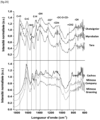
- Five other materials according to the invention were synthesized with condensed mimosa and catechu tannins as precursors. The spectra of the figure 20 highlight the structural differences between condensed tannins and tannins hydrolysable.
- Mimosa-G (MG) and Cachou (C) materials were purchased from GREEN'ING (France) while Mimosa-C (MC) material was obtained from Mimosa Extract Company Ltd.
- the spheres increase in size and weight and settle on the bottom of the flask.
- Two phases are observed: a solid phase (composed of polymer spheres) and a liquid phase (composed of the solvent and the rest of the residual organic products).
- the latter is removed and the solid phase recovered (without centrifugation), by simple pouring for syntheses using mimosa tannins as precursors.
- centrifugation was necessary due to the small particle size ( ⁇ 1 ⁇ m).
- the solid phase was dried at 25 ° C then in an oven at 80 ° C for about 12 hours to evaporate the water and to better crosslink the resin spheres.
- a pyrolysis step was then carried out in an inert atmosphere (Ar), by heating ⁇ 7 g of the resin obtained with a heating rate of 5 ° C / min up to 1500 ° C and once the desired temperature is reached a one-hour (1h) plateau is made then a natural cooling step is carried out.
- the hard carbon is thus obtained ( ⁇ 2.6 g) and it is ground manually.
- the carbons are called MG-00-1500 (from Mimosa-G), MC-00-1500 (from Mimosa-C) or C-00-1500 (from Cachou).
- the textural properties (porosity, specific surface) of the hard carbons according to the invention were studied by the gas sorption technique with a Micromeritics ASAP 2420 device (Micromeritics France SARL Merignac, France 33700 ) using nitrogen (N 2 ) as adsorbent at 77K and with a Micromeritics ASAP 2020 using CO 2 as adsorbent at 273K.
- the materials Prior to analysis, the materials were degassed at 300°C for 12h under vacuum on the degassing door to remove water molecules and a second degassing was then performed for an additional 2h on the analysis door to remove the fill gas. A mass between 150 and 300 mg was used.
- the BET Brunauer, Emmett and Teller
- the diffraction data collection is ensured by a Bruker D8 Advance A25 diffractometer theta/theta geometry (goniometer radius: 280mm), with Cu anode.
- the machine is equipped with a high-resolution ultra-fast 1D LynxEye XE-T detector with energy discrimination ( ⁇ 380eV, Cu Ka1,2).
- a motorized anti-diffusion knife for An efficient suppression of low-angle air diffusion is present.
- the samples are prepared in standard poly(methyl methacrylate) - (PMMA) sample holders by making a powder pyramid which is flattened using a glass slide.
- the acquisition conditions were as follows: angular range 10-90°2theta, counting step: 0.01°, counting time per step: 0.5s.
- the total acquisition time is 1h08. During this acquisition, the sample is rotated at 5 rpm.
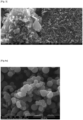
- the morphology of the carbonaceous material was analyzed with a FEI Quanta 400 Scanning Electron Microscope, high resolution low vacuum field emission gun (FEG).
- FEG high resolution low vacuum field emission gun
- the samples were analyzed with a resolution between 1 mm and 10 ⁇ m and a magnification up to 10,000X.
- ImageJ software was used to determine the average particle size.
- Several images were analyzed and approximately 700 to 1000 particles were counted in order to produce a particle size distribution histogram.
- TPD-MS Programmed thermodesorption coupled to mass spectrometry
- TPD-MS measures the desorption rate of molecules as a function of temperature, giving valuable information regarding desorption kinetics, surface concentrations, adsorption sites, etc.
- TPD-MS is mainly used to identify oxygenated surface functions; functions that, when decomposing, release CO, CO 2 , H 2 O and H 2 at the specific temperature of thermal stability of the corresponding functional group.
- Thermodesorption measurements were performed using a “home-made” setup operating under vacuum, equipped with a mass spectrometer (maximum pressure 10 -4 Torr).
- TPD-MS is performed up to 950°C (with a heating rate of 5°C/min followed by a one-hour hold), and the released gas phase is quantitatively analyzed, throughout the analysis, by the mass spectrometer.
- TPD-MS active surface area
- the active surface of a carbon material corresponds to the set of different types of defects present in carbon: stacking faults, single and multiple vacancies, as well as dislocations.
- the presence of such active sites is important because they can interact with other species (i.e. Li + , Na + ).
- ASA consists in performing oxygen chemisorption followed by a TPD-MS measurement. After a first TPD-MS measurement, the sample under vacuum is put in contact with oxygen at 300 °C (oxygen pressure: 66.5 Pa), which is chemisorbed for 10 h, leading to the formation of oxygen complexes on the surface of the material.
- the oxygen is removed from the system and a second TPD-MS is performed (up to 950°C with a heating rate of 10°C/min), and the oxygenated groups formed are decomposed into CO and CO 2 , their quantities then being determined by mass spectrometry.
- the ASA value is calculated by taking into account the number of moles of each of the desorbed gases, considering that the surface area of an active site of the carbon material that adsorbs an oxygen atom is 0.083 nm 2 .
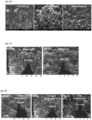
- the hard carbon according to the invention has a spherical and relatively uniform morphology, which allows it to be distinguished from currently available hard carbons.
- a hard carbon of known type Beda et al. and Irisarri et al .
- the hard carbon according to the invention not only has a morphology of these particles which is spherical and uniform, but also preferentially a uniformity of size. Finally, this average particle size is advantageously smaller ( ⁇ 10 ⁇ m).
- the hard carbon according to the invention is also very different from known spherical amorphous carbons such as PR 600 carbon (Maetz et al .).
- the hard carbon according to the invention is also a non-porous carbon, i.e. a carbon having a small total pore volume, or a low specific surface area and in particular having a BET N 2 specific surface area of less than 100 m 2 /g.
- Another advantageous characteristic is a low amount of oxygenated functions (COx) on the surface of the material.
- X-ray photoelectron spectroscopy was performed with a VG SCIENTA SES-2002 spectrometer equipped with a concentric hemispherical analyzer.
- the incident radiation used was generated by a monochromatic Al Ka X-ray source (1486.6 eV) operating at 420 W (14 kV; 30 mA).
- the broad scan spectrum signal (flight spectrum) was recorded with a pass energy of 500 eV.
- thermopolymerization step makes it possible to obtain different distributions in terms of average particle sizes.
- a carbon material according to the invention was obtained by carrying out a synthesis identical to those of example 1 having a thermal step at 1300°C but where the thermopolymerization step was replaced by a drying step (or simple polymerization by rest) at 25°C.
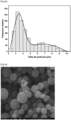
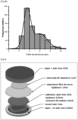
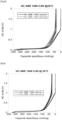
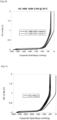
- the results are shown in Figures 4a And 4b And 5a And 5b which show a typical distribution for the material without thermal step ( Fig.5a And b) with two peaks for average particle size at about 3.5 ⁇ m and 6.5 ⁇ m and a more complex distribution with two distinct peaks of average particle sizes at 3.5 ⁇ m and 7.4 ⁇ m.
- Such a heterogeneous distribution can be advantageous for the porosity of the electrode.
- the measurement of the particle size of these materials was done using SEM images and ImageJ software which was used to determine the average particle size. Several SEM images were analyzed and about 700 to 1000 particles counted in order to make a particle size distribution histogram.
- TEDA vs HMTA catalyst was analyzed using as precursor, or hydroxylated aromatic compound, Mimosa-C.
- the process according to the invention described in Example 1 for Mimosa-C was replicated using either 0.5 g of TEDA or 0.624 g of HMTA.
- 1 g of precursor i.e., Mimosa-C and 1.2 g glyoxylic acid were dissolved in 40 mL (g) water under mechanical stirring ( ⁇ 30 min) at room temperature (25°C) in a flask. Then, TEDA or HMTA was added into this mixture and stirred for about 5-10 min until complete dissolution.
- the rest time appears to be optimized at around 48 hours because an increase in this duration only allows a small increase in the size of the spheres (cf. Fig. 19 ).
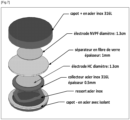
- Button-type electrochemical cells were assembled according to the scheme of Figure 6 .
- ⁇ 1 g of dispersed powder is placed in a vial with a magnetic bar.
- ⁇ 1 g of solvent N -methyl-2-pyrrolidone (NMP) (No. CAS 872-50-4 ) is added and the mixture is dispersed for 12 hours at 300 rpm at 25°C.
- the liquid, or ink, thus obtained is deposited by coating on an aluminum collector (from RJC HOLDINGS CORPORATION in Incheon-City in South Korea).
- the ink layer is dried for 2 hours at 60°C under air flow.
- the films thus obtained have a thickness of between 130 ⁇ m and 160 ⁇ m (collector included) and a mass varying between 7.5-10.2 mg/cm 2 of active material.
- the films are then calendered by successive passage between 2 rollers separated by an increasingly smaller size until a film is obtained whose thickness remains unchanged regardless of the pressure applied to the film.
- the films are then pelletized to obtain circular electrodes of 1 cm 2 for the batteries cycling vs Na and 1.327 cm 2 for those cycling vs NVPF.
- the electrodes are then dried in an oven at 70 ° C for 2 hours as well as the different parts of the button cell assembly.
- ⁇ 1 g of dispersed powder is placed in a vial with a magnetic bar.
- ⁇ 1 g of N -methyl-2-pyrrolidone (NMP) (No. CAS 872-50-4 ) is added and the mixture is dispersed for 12 hours at 300 rpm at 25°C.
- the liquid, or ink, thus obtained is deposited by coating on a 22 ⁇ m aluminum collector (from RJC HOLDINGS CORPORATION in Incheon-City, South Korea).
- the ink layer is dried for 2 hours at 60°C under air flow.
- the films thus obtained have a thickness of between 140 ⁇ m and 200 ⁇ m (collector included) and a mass varying between 15-20mg/cm 2 of active material.
- the films are then calendered by successive passage between 2 rollers separated by an increasingly smaller size until a film is obtained whose thickness remains unchanged regardless of the pressure applied to the film.
- the films are pelletized to obtain circular electrodes of 1.327 cm 2 .
- the electrodes are then dried in an oven at 70 ° C for 2 hours as well as the different parts of the button cell assembly.
- the electrodes comprising ABE 1400, 1500 and 1600 material were associated with sodium metal (to constitute a half-element or half-cell configuration).
- the electrode comprising ABE 1300 material was associated with an electrode based on Sodium vanadium (III) fluorophosphate (NVPF), to constitute a configuration in a complete cell, "full cell”).
- a stainless steel spring 6 is positioned in a lower part 2 of a steel cover and inside an insulating ring 4.
- a current collector 8 made of 316L stainless steel and 0.5 mm thick is positioned on the circular spring. This collector 8 is a disk with a diameter of approximately 15 mm covered with sodium metal. Sodium metal was spread over the entire upper surface of the collector 8 and then scraped with a spatula in order to obtain a clean surface, without metal oxides.
- a separator disk 10 made of glass fibers, 1 mm thick and 16 mm in diameter is positioned on the sodium metal surface.
- electrolyte 200 ⁇ L of electrolyte is then added.
- This electrolyte is a mixture of ethyl carbonate (EC) and dimethyl carbonate (DMC) in proportions (1:1% mass-mixture to which the salt NaPF 6 is added in proportions of 1mol/L.
- EC ethyl carbonate
- DMC dimethyl carbonate
- a carbon electrode 12 hard as described above is positioned on the separator 10.
- the upper part 14 of the stainless steel cover is positioned to encapsulate the electrode 12 and the two parts of the cover 2 and 14 are secured together (for example crimped).
- the electrode 12 is in the cathode position and the sodium metal is the anode.
- the production of this device is carried out under argon in a glove box. The electrochemical cell is left to rest for 2 hours before the first cycle.
- the characteristics of the device are then measured by galvanostatic cycling at C/50 in discharge and in charge with a rest of 1 min between 2 modes.
- Two half-cells (CELL 1 and CELL 2) were studied and as shown by the results in Figures 8 to 10 , the curves obtained are identical.
- the acquisition of the specific capacitance values was carried out when the variation of the potential reached 10mV compared to the previous acquisition and/or every 5 seconds. In this way it is possible to know the specific capacitance precisely.
- the elements of the complete cell device are shown in figure 7 . With the exception of the electrodes, they come from the company INNOV' METOR, FERRIERES EN GATINAIS, FR.
- a stainless steel spring 106 is positioned in a lower part 102 of a steel cover and inside an insulating ring 104.
- a current collector 108 made of 316L stainless steel and 0.5 mm thick is positioned on the circular spring. This collector 108 is a disk with a diameter of approximately 15 mm on which an electrode 112 comprising a material according to the invention ABE 1300 is positioned.
- the electrode 112 takes the form of a disk 1.3 cm in diameter and approximately 110 ⁇ m (collector included) thick.
- This electrolyte is a mixture of ethyl carbonate (EC) and dimethyl carbonate (DMC) in proportions (1:1% by mass), a mixture to which NaPF6 is added in proportions of 1 mol/L.
- an NVPF electrode 109 with a diameter of 1.3 cm as described above is positioned on the separator 110.
- the upper part 114 of the stainless steel cover is positioned to encapsulate the electrodes 112 and 109 and the two parts of the cover 102 and 114 are secured together (for example crimped).
- the electrode 112 constitutes the anode and the electrode 109 the cathode.
- the realization of this device is carried out under argon in a glove box.
- the electrochemical cell is left to rest for 2 hours before the first cycle.
- the mass ratio between the mass of NVPF and the ABE 1300 material, NVPF/ABE1300 varies between 2 and 2.5.
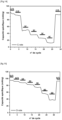
- the specific cell capacities were measured as follows: The specific capacities depending on the applied regime (at different currents) make it possible to obtain important information on the performance of the cells in power, for example with a view to addressing certain industrial applications represented in Figures 14 and 15 .
- the specific capacity of the cell is high (about 125 mAh*g -1 ).
- the specific discharge capacity is 80% of the charge capacity which corresponds to an initial irreversible capacity of 25 mAh g -1 , when cycled at a C/5 rate. This capacity loss is due to the irreversibility of the electrode with the highest irreversibility, i.e. hard carbon (irreversibility of NVPF: 10%).
- the capacity decreases to -75 mAh g-1 when cycled at 1C/1D.
- the materials according to the invention have a significant advantage in terms of initial irreversible capacity, which is lower than other similar hard carbon materials.
Landscapes
- Chemical & Material Sciences (AREA)
- Organic Chemistry (AREA)
- Inorganic Chemistry (AREA)
- Chemical Kinetics & Catalysis (AREA)
- Electrochemistry (AREA)
- General Chemical & Material Sciences (AREA)
- Carbon And Carbon Compounds (AREA)
- Battery Electrode And Active Subsutance (AREA)
Applications Claiming Priority (2)
| Application Number | Priority Date | Filing Date | Title |
|---|---|---|---|
| FR1914354A FR3104565B1 (fr) | 2019-12-13 | 2019-12-13 | Matériau carboné, son utilisation dans des batteries, son procédé de fabrication et une électrode le comprenant |
| PCT/EP2020/085847 WO2021116455A1 (fr) | 2019-12-13 | 2020-12-11 | Matériau carboné, son utilisation dans des batteries, son procédé de fabrication et une électrode le comprenant |
Publications (2)
| Publication Number | Publication Date |
|---|---|
| EP4072997A1 EP4072997A1 (fr) | 2022-10-19 |
| EP4072997B1 true EP4072997B1 (fr) | 2025-03-05 |
Family
ID=70295269
Family Applications (1)
| Application Number | Title | Priority Date | Filing Date |
|---|---|---|---|
| EP20824226.3A Active EP4072997B1 (fr) | 2019-12-13 | 2020-12-11 | Matériau carbone, son utilisation dans des batteries, son procédé de fabrication et une électrode le comprenant |
Country Status (7)
| Country | Link |
|---|---|
| US (1) | US20230067245A1 (pl) |
| EP (1) | EP4072997B1 (pl) |
| CN (1) | CN115279689A (pl) |
| FR (1) | FR3104565B1 (pl) |
| HU (1) | HUE071384T2 (pl) |
| PL (1) | PL4072997T3 (pl) |
| WO (1) | WO2021116455A1 (pl) |
Families Citing this family (5)
| Publication number | Priority date | Publication date | Assignee | Title |
|---|---|---|---|---|
| CN115849331A (zh) * | 2021-09-24 | 2023-03-28 | 胡启章 | 硬碳微珠、其制法及包含其的储能装置 |
| CN115849337B (zh) * | 2022-12-21 | 2024-08-16 | 赣州立探新能源科技有限公司 | 一种硬碳材料及其制备方法和应用 |
| CN118448629B (zh) * | 2023-02-03 | 2025-10-31 | 宁德时代新能源科技股份有限公司 | 碳负极活性材料及制备方法、二次电池和用电装置 |
| CN116395665B (zh) * | 2023-03-31 | 2024-09-10 | 山东森久生物材料有限公司 | 一种均质球形硬碳负极材料的制备方法 |
| CN118954471A (zh) * | 2024-07-25 | 2024-11-15 | 北京化工大学 | 一种大层间距酚醛树脂基硬碳微球的制备方法 |
Family Cites Families (7)
| Publication number | Priority date | Publication date | Assignee | Title |
|---|---|---|---|---|
| FR33700E (fr) | 1927-06-21 | 1928-11-29 | Téléloupe binoculaire | |
| CN1191195C (zh) * | 2000-04-27 | 2005-03-02 | 中国科学院物理研究所 | 热解硬碳材料及其制备方法和用途 |
| CN101887966B (zh) * | 2010-06-18 | 2012-12-05 | 深圳市贝特瑞新能源材料股份有限公司 | 锂离子电池复合硬碳负极材料的制备方法 |
| CN102386384B (zh) * | 2011-11-28 | 2013-07-10 | 深圳市贝特瑞新能源材料股份有限公司 | 球形硬碳锂离子电池负极材料及其制备方法 |
| US20170155149A1 (en) * | 2014-05-30 | 2017-06-01 | Showa Denko K.K. | Carbon material, method for manufacturing same, and application of same |
| CN103996833A (zh) * | 2014-06-12 | 2014-08-20 | 上海第二工业大学 | 一种锂离子电池用改性硬炭微球负极材料及其制备方法 |
| CN105914371B (zh) * | 2016-05-06 | 2019-06-25 | 宁德新能源科技有限公司 | 酚醛树脂基硬碳微球,其制备方法及负极材料和二次电池 |
-
2019
- 2019-12-13 FR FR1914354A patent/FR3104565B1/fr active Active
-
2020
- 2020-12-11 CN CN202080094931.6A patent/CN115279689A/zh active Pending
- 2020-12-11 WO PCT/EP2020/085847 patent/WO2021116455A1/fr not_active Ceased
- 2020-12-11 PL PL20824226.3T patent/PL4072997T3/pl unknown
- 2020-12-11 HU HUE20824226A patent/HUE071384T2/hu unknown
- 2020-12-11 EP EP20824226.3A patent/EP4072997B1/fr active Active
- 2020-12-11 US US17/784,374 patent/US20230067245A1/en active Pending
Also Published As
| Publication number | Publication date |
|---|---|
| WO2021116455A8 (fr) | 2022-09-29 |
| EP4072997A1 (fr) | 2022-10-19 |
| HUE071384T2 (hu) | 2025-08-28 |
| PL4072997T3 (pl) | 2025-06-09 |
| US20230067245A1 (en) | 2023-03-02 |
| CN115279689A (zh) | 2022-11-01 |
| WO2021116455A1 (fr) | 2021-06-17 |
| FR3104565B1 (fr) | 2022-08-19 |
| FR3104565A1 (fr) | 2021-06-18 |
Similar Documents
| Publication | Publication Date | Title |
|---|---|---|
| EP4072997B1 (fr) | Matériau carbone, son utilisation dans des batteries, son procédé de fabrication et une électrode le comprenant | |
| EP2478580B1 (fr) | Matériau constitue de particules composites d'oxyde, procédé pour sa préparation, et son utilisation comme matière active d' électrode | |
| US20130252082A1 (en) | Hard carbon materials | |
| EP2089316B1 (fr) | Oxydes complexes carbones | |
| JP2013515349A (ja) | アノード材料 | |
| WO2018158545A1 (fr) | Composition d'electrolyte polymere destinee a etre utilisee dans une batterie | |
| FR2817387A1 (fr) | Cellules de stockage d'energie a double couche electrochimique a haute densite d'energie et forte densite de puissance | |
| KR102405983B1 (ko) | 비수 전해질 이차 전지의 부극 활물질용의 탄소질 재료, 비수 전해질 이차 전지용 부극, 비수 전해질 이차 전지 그리고 탄소질 재료의 제조 방법 | |
| EP2118007A2 (fr) | Silicates mixtes de lithium. | |
| CA2534243A1 (fr) | Particules d'oxyde metallique enrobees a faible taux de dissolution, procedes de preparation et utilisation dans les systemes electrochimiques | |
| FR3014425A1 (fr) | Materiau carbone composite comprenant des particules d'un compose susceptible de former un alliage avec le lithium, son utilisation et sa preparation | |
| US12281016B2 (en) | Conductive composite material of graphene, preparation method therefor, use thereof and lithium-ion battery | |
| EP2932545B1 (fr) | Utilisation de nanoobjets en carbone sous fluore comme matériau d'électrode de batteries primaires au lithium de fortes capacités | |
| WO2020109505A1 (fr) | Electrolyte polymere conducteur pour batteries | |
| JP2020004589A (ja) | 炭素質材料の製造方法 | |
| FR2901156A1 (fr) | Composite catalytique a base de charbon actif catalytique et nanotubes de carbone, procede de fabrication, electrode et supercondensateur comprenant le composite catalytique | |
| Vidal | Effect of the positive electrode and of mechanical stresses on the cyclability of a Li-ion cell containing silicon-based negative electrode | |
| EP3457471B1 (fr) | Procede de fabrication d'une electrode pour accumulateur lithium-soufre a surface active importante | |
| WO2023141720A1 (fr) | Procédé de fabrication d'électrode négative protégée et électrode négative ainsi produite | |
| JP7032857B2 (ja) | 非水電解質二次電池の負極活物質用の炭素質材料、非水電解質二次電池用負極、非水電解質二次電池ならびに炭素質材料の製造方法 | |
| WO2025023816A1 (fr) | Procede de preparation de lithium fer phosphate micrometrique | |
| FR3154237A1 (fr) | Utilisation du 1-allyl-2,3,4,5,6-pentafluorobenzène pour traiter un matériau disposé en surface de lithium métallique | |
| FR3099298A1 (fr) | Composite SnOx/C fluoré pour matériau d’électrode | |
| FR3082358A1 (fr) | Procede de preparation d'un materiau composite lto/carbone utilise comme materiau d'electrode negative pour batterie li-ion | |
| JP2006273602A (ja) | 炭素材用組成物とその製造方法、及び、炭素材とその製造方法 |
Legal Events
| Date | Code | Title | Description |
|---|---|---|---|
| STAA | Information on the status of an ep patent application or granted ep patent |
Free format text: STATUS: UNKNOWN |
|
| STAA | Information on the status of an ep patent application or granted ep patent |
Free format text: STATUS: THE INTERNATIONAL PUBLICATION HAS BEEN MADE |
|
| PUAI | Public reference made under article 153(3) epc to a published international application that has entered the european phase |
Free format text: ORIGINAL CODE: 0009012 |
|
| STAA | Information on the status of an ep patent application or granted ep patent |
Free format text: STATUS: REQUEST FOR EXAMINATION WAS MADE |
|
| 17P | Request for examination filed |
Effective date: 20220706 |
|
| AK | Designated contracting states |
Kind code of ref document: A1 Designated state(s): AL AT BE BG CH CY CZ DE DK EE ES FI FR GB GR HR HU IE IS IT LI LT LU LV MC MK MT NL NO PL PT RO RS SE SI SK SM TR |
|
| DAV | Request for validation of the european patent (deleted) | ||
| DAX | Request for extension of the european patent (deleted) | ||
| STAA | Information on the status of an ep patent application or granted ep patent |
Free format text: STATUS: EXAMINATION IS IN PROGRESS |
|
| 17Q | First examination report despatched |
Effective date: 20231221 |
|
| GRAP | Despatch of communication of intention to grant a patent |
Free format text: ORIGINAL CODE: EPIDOSNIGR1 |
|
| STAA | Information on the status of an ep patent application or granted ep patent |
Free format text: STATUS: GRANT OF PATENT IS INTENDED |
|
| INTG | Intention to grant announced |
Effective date: 20240812 |
|
| GRAJ | Information related to disapproval of communication of intention to grant by the applicant or resumption of examination proceedings by the epo deleted |
Free format text: ORIGINAL CODE: EPIDOSDIGR1 |
|
| STAA | Information on the status of an ep patent application or granted ep patent |
Free format text: STATUS: EXAMINATION IS IN PROGRESS |
|
| GRAP | Despatch of communication of intention to grant a patent |
Free format text: ORIGINAL CODE: EPIDOSNIGR1 |
|
| STAA | Information on the status of an ep patent application or granted ep patent |
Free format text: STATUS: GRANT OF PATENT IS INTENDED |
|
| INTC | Intention to grant announced (deleted) | ||
| INTG | Intention to grant announced |
Effective date: 20241223 |
|
| GRAS | Grant fee paid |
Free format text: ORIGINAL CODE: EPIDOSNIGR3 |
|
| GRAA | (expected) grant |
Free format text: ORIGINAL CODE: 0009210 |
|
| STAA | Information on the status of an ep patent application or granted ep patent |
Free format text: STATUS: THE PATENT HAS BEEN GRANTED |
|
| AK | Designated contracting states |
Kind code of ref document: B1 Designated state(s): AL AT BE BG CH CY CZ DE DK EE ES FI FR GB GR HR HU IE IS IT LI LT LU LV MC MK MT NL NO PL PT RO RS SE SI SK SM TR |
|
| REG | Reference to a national code |
Ref country code: GB Ref legal event code: FG4D Free format text: NOT ENGLISH |
|
| REG | Reference to a national code |
Ref country code: CH Ref legal event code: EP |
|
| REG | Reference to a national code |
Ref country code: IE Ref legal event code: FG4D Free format text: LANGUAGE OF EP DOCUMENT: FRENCH |
|
| REG | Reference to a national code |
Ref country code: DE Ref legal event code: R096 Ref document number: 602020047328 Country of ref document: DE |
|
| P01 | Opt-out of the competence of the unified patent court (upc) registered |
Free format text: CASE NUMBER: APP_12068/2025 Effective date: 20250312 |
|
| REG | Reference to a national code |
Ref country code: SE Ref legal event code: TRGR |
|
| PG25 | Lapsed in a contracting state [announced via postgrant information from national office to epo] |
Ref country code: RS Free format text: LAPSE BECAUSE OF FAILURE TO SUBMIT A TRANSLATION OF THE DESCRIPTION OR TO PAY THE FEE WITHIN THE PRESCRIBED TIME-LIMIT Effective date: 20250605 |
|
| PG25 | Lapsed in a contracting state [announced via postgrant information from national office to epo] |
Ref country code: FI Free format text: LAPSE BECAUSE OF FAILURE TO SUBMIT A TRANSLATION OF THE DESCRIPTION OR TO PAY THE FEE WITHIN THE PRESCRIBED TIME-LIMIT Effective date: 20250305 |
|
| REG | Reference to a national code |
Ref country code: NL Ref legal event code: MP Effective date: 20250305 |
|
| PG25 | Lapsed in a contracting state [announced via postgrant information from national office to epo] |
Ref country code: ES Free format text: LAPSE BECAUSE OF FAILURE TO SUBMIT A TRANSLATION OF THE DESCRIPTION OR TO PAY THE FEE WITHIN THE PRESCRIBED TIME-LIMIT Effective date: 20250305 |
|
| REG | Reference to a national code |
Ref country code: LT Ref legal event code: MG9D |
|
| PG25 | Lapsed in a contracting state [announced via postgrant information from national office to epo] |
Ref country code: NO Free format text: LAPSE BECAUSE OF FAILURE TO SUBMIT A TRANSLATION OF THE DESCRIPTION OR TO PAY THE FEE WITHIN THE PRESCRIBED TIME-LIMIT Effective date: 20250605 |
|
| PG25 | Lapsed in a contracting state [announced via postgrant information from national office to epo] |
Ref country code: HR Free format text: LAPSE BECAUSE OF FAILURE TO SUBMIT A TRANSLATION OF THE DESCRIPTION OR TO PAY THE FEE WITHIN THE PRESCRIBED TIME-LIMIT Effective date: 20250305 |
|
| PG25 | Lapsed in a contracting state [announced via postgrant information from national office to epo] |
Ref country code: LV Free format text: LAPSE BECAUSE OF FAILURE TO SUBMIT A TRANSLATION OF THE DESCRIPTION OR TO PAY THE FEE WITHIN THE PRESCRIBED TIME-LIMIT Effective date: 20250305 |
|
| PG25 | Lapsed in a contracting state [announced via postgrant information from national office to epo] |
Ref country code: BG Free format text: LAPSE BECAUSE OF FAILURE TO SUBMIT A TRANSLATION OF THE DESCRIPTION OR TO PAY THE FEE WITHIN THE PRESCRIBED TIME-LIMIT Effective date: 20250305 Ref country code: GR Free format text: LAPSE BECAUSE OF FAILURE TO SUBMIT A TRANSLATION OF THE DESCRIPTION OR TO PAY THE FEE WITHIN THE PRESCRIBED TIME-LIMIT Effective date: 20250606 |
|
| REG | Reference to a national code |
Ref country code: AT Ref legal event code: MK05 Ref document number: 1772836 Country of ref document: AT Kind code of ref document: T Effective date: 20250305 |
|
| PG25 | Lapsed in a contracting state [announced via postgrant information from national office to epo] |
Ref country code: NL Free format text: LAPSE BECAUSE OF FAILURE TO SUBMIT A TRANSLATION OF THE DESCRIPTION OR TO PAY THE FEE WITHIN THE PRESCRIBED TIME-LIMIT Effective date: 20250305 |
|
| REG | Reference to a national code |
Ref country code: HU Ref legal event code: AG4A Ref document number: E071384 Country of ref document: HU |
|
| PG25 | Lapsed in a contracting state [announced via postgrant information from national office to epo] |
Ref country code: SM Free format text: LAPSE BECAUSE OF FAILURE TO SUBMIT A TRANSLATION OF THE DESCRIPTION OR TO PAY THE FEE WITHIN THE PRESCRIBED TIME-LIMIT Effective date: 20250305 |
|
| PG25 | Lapsed in a contracting state [announced via postgrant information from national office to epo] |
Ref country code: PT Free format text: LAPSE BECAUSE OF FAILURE TO SUBMIT A TRANSLATION OF THE DESCRIPTION OR TO PAY THE FEE WITHIN THE PRESCRIBED TIME-LIMIT Effective date: 20250707 |
|
| PG25 | Lapsed in a contracting state [announced via postgrant information from national office to epo] |
Ref country code: IT Free format text: LAPSE BECAUSE OF FAILURE TO SUBMIT A TRANSLATION OF THE DESCRIPTION OR TO PAY THE FEE WITHIN THE PRESCRIBED TIME-LIMIT Effective date: 20250305 |
|
| PG25 | Lapsed in a contracting state [announced via postgrant information from national office to epo] |
Ref country code: AT Free format text: LAPSE BECAUSE OF FAILURE TO SUBMIT A TRANSLATION OF THE DESCRIPTION OR TO PAY THE FEE WITHIN THE PRESCRIBED TIME-LIMIT Effective date: 20250305 |
|
| PG25 | Lapsed in a contracting state [announced via postgrant information from national office to epo] |
Ref country code: EE Free format text: LAPSE BECAUSE OF FAILURE TO SUBMIT A TRANSLATION OF THE DESCRIPTION OR TO PAY THE FEE WITHIN THE PRESCRIBED TIME-LIMIT Effective date: 20250305 Ref country code: CZ Free format text: LAPSE BECAUSE OF FAILURE TO SUBMIT A TRANSLATION OF THE DESCRIPTION OR TO PAY THE FEE WITHIN THE PRESCRIBED TIME-LIMIT Effective date: 20250305 |
|
| PG25 | Lapsed in a contracting state [announced via postgrant information from national office to epo] |
Ref country code: RO Free format text: LAPSE BECAUSE OF FAILURE TO SUBMIT A TRANSLATION OF THE DESCRIPTION OR TO PAY THE FEE WITHIN THE PRESCRIBED TIME-LIMIT Effective date: 20250305 |
|
| PG25 | Lapsed in a contracting state [announced via postgrant information from national office to epo] |
Ref country code: SK Free format text: LAPSE BECAUSE OF FAILURE TO SUBMIT A TRANSLATION OF THE DESCRIPTION OR TO PAY THE FEE WITHIN THE PRESCRIBED TIME-LIMIT Effective date: 20250305 |
|
| PG25 | Lapsed in a contracting state [announced via postgrant information from national office to epo] |
Ref country code: IS Free format text: LAPSE BECAUSE OF FAILURE TO SUBMIT A TRANSLATION OF THE DESCRIPTION OR TO PAY THE FEE WITHIN THE PRESCRIBED TIME-LIMIT Effective date: 20250705 |