EP4055015B1 - Gem-disubstituierte heterocyclische verbindungen und ihre verwendung als idh-inhibitoren - Google Patents
Gem-disubstituierte heterocyclische verbindungen und ihre verwendung als idh-inhibitoren Download PDFInfo
- Publication number
- EP4055015B1 EP4055015B1 EP20804176.4A EP20804176A EP4055015B1 EP 4055015 B1 EP4055015 B1 EP 4055015B1 EP 20804176 A EP20804176 A EP 20804176A EP 4055015 B1 EP4055015 B1 EP 4055015B1
- Authority
- EP
- European Patent Office
- Prior art keywords
- formula
- phenyl
- compound
- amino
- propan
- Prior art date
- Legal status (The legal status is an assumption and is not a legal conclusion. Google has not performed a legal analysis and makes no representation as to the accuracy of the status listed.)
- Active
Links
Classifications
-
- A—HUMAN NECESSITIES
- A61—MEDICAL OR VETERINARY SCIENCE; HYGIENE
- A61K—PREPARATIONS FOR MEDICAL, DENTAL OR TOILETRY PURPOSES
- A61K31/00—Medicinal preparations containing organic active ingredients
- A61K31/33—Heterocyclic compounds
- A61K31/395—Heterocyclic compounds having nitrogen as a ring hetero atom, e.g. guanethidine or rifamycins
- A61K31/495—Heterocyclic compounds having nitrogen as a ring hetero atom, e.g. guanethidine or rifamycins having six-membered rings with two or more nitrogen atoms as the only ring heteroatoms, e.g. piperazine or tetrazines
- A61K31/505—Pyrimidines; Hydrogenated pyrimidines, e.g. trimethoprim
- A61K31/519—Pyrimidines; Hydrogenated pyrimidines, e.g. trimethoprim ortho- or peri-condensed with heterocyclic rings
-
- A—HUMAN NECESSITIES
- A61—MEDICAL OR VETERINARY SCIENCE; HYGIENE
- A61K—PREPARATIONS FOR MEDICAL, DENTAL OR TOILETRY PURPOSES
- A61K31/00—Medicinal preparations containing organic active ingredients
- A61K31/33—Heterocyclic compounds
- A61K31/395—Heterocyclic compounds having nitrogen as a ring hetero atom, e.g. guanethidine or rifamycins
- A61K31/435—Heterocyclic compounds having nitrogen as a ring hetero atom, e.g. guanethidine or rifamycins having six-membered rings with one nitrogen as the only ring hetero atom
- A61K31/4353—Heterocyclic compounds having nitrogen as a ring hetero atom, e.g. guanethidine or rifamycins having six-membered rings with one nitrogen as the only ring hetero atom ortho- or peri-condensed with heterocyclic ring systems
- A61K31/4375—Heterocyclic compounds having nitrogen as a ring hetero atom, e.g. guanethidine or rifamycins having six-membered rings with one nitrogen as the only ring hetero atom ortho- or peri-condensed with heterocyclic ring systems the heterocyclic ring system containing a six-membered ring having nitrogen as a ring heteroatom, e.g. quinolizines, naphthyridines, berberine, vincamine
-
- A—HUMAN NECESSITIES
- A61—MEDICAL OR VETERINARY SCIENCE; HYGIENE
- A61K—PREPARATIONS FOR MEDICAL, DENTAL OR TOILETRY PURPOSES
- A61K31/00—Medicinal preparations containing organic active ingredients
- A61K31/33—Heterocyclic compounds
- A61K31/395—Heterocyclic compounds having nitrogen as a ring hetero atom, e.g. guanethidine or rifamycins
- A61K31/495—Heterocyclic compounds having nitrogen as a ring hetero atom, e.g. guanethidine or rifamycins having six-membered rings with two or more nitrogen atoms as the only ring heteroatoms, e.g. piperazine or tetrazines
- A61K31/496—Non-condensed piperazines containing further heterocyclic rings, e.g. rifampin, thiothixene or sparfloxacin
-
- A—HUMAN NECESSITIES
- A61—MEDICAL OR VETERINARY SCIENCE; HYGIENE
- A61K—PREPARATIONS FOR MEDICAL, DENTAL OR TOILETRY PURPOSES
- A61K31/00—Medicinal preparations containing organic active ingredients
- A61K31/33—Heterocyclic compounds
- A61K31/395—Heterocyclic compounds having nitrogen as a ring hetero atom, e.g. guanethidine or rifamycins
- A61K31/535—Heterocyclic compounds having nitrogen as a ring hetero atom, e.g. guanethidine or rifamycins having six-membered rings with at least one nitrogen and one oxygen as the ring hetero atoms, e.g. 1,2-oxazines
- A61K31/5365—Heterocyclic compounds having nitrogen as a ring hetero atom, e.g. guanethidine or rifamycins having six-membered rings with at least one nitrogen and one oxygen as the ring hetero atoms, e.g. 1,2-oxazines ortho- or peri-condensed with heterocyclic ring systems
-
- A—HUMAN NECESSITIES
- A61—MEDICAL OR VETERINARY SCIENCE; HYGIENE
- A61K—PREPARATIONS FOR MEDICAL, DENTAL OR TOILETRY PURPOSES
- A61K45/00—Medicinal preparations containing active ingredients not provided for in groups A61K31/00 - A61K41/00
- A61K45/06—Mixtures of active ingredients without chemical characterisation, e.g. antiphlogistics and cardiaca
-
- A—HUMAN NECESSITIES
- A61—MEDICAL OR VETERINARY SCIENCE; HYGIENE
- A61P—SPECIFIC THERAPEUTIC ACTIVITY OF CHEMICAL COMPOUNDS OR MEDICINAL PREPARATIONS
- A61P35/00—Antineoplastic agents
-
- A—HUMAN NECESSITIES
- A61—MEDICAL OR VETERINARY SCIENCE; HYGIENE
- A61P—SPECIFIC THERAPEUTIC ACTIVITY OF CHEMICAL COMPOUNDS OR MEDICINAL PREPARATIONS
- A61P37/00—Drugs for immunological or allergic disorders
-
- C—CHEMISTRY; METALLURGY
- C07—ORGANIC CHEMISTRY
- C07D—HETEROCYCLIC COMPOUNDS
- C07D471/00—Heterocyclic compounds containing nitrogen atoms as the only ring hetero atoms in the condensed system, at least one ring being a six-membered ring with one nitrogen atom, not provided for by groups C07D451/00 - C07D463/00
- C07D471/02—Heterocyclic compounds containing nitrogen atoms as the only ring hetero atoms in the condensed system, at least one ring being a six-membered ring with one nitrogen atom, not provided for by groups C07D451/00 - C07D463/00 in which the condensed system contains two hetero rings
- C07D471/04—Ortho-condensed systems
-
- C—CHEMISTRY; METALLURGY
- C07—ORGANIC CHEMISTRY
- C07D—HETEROCYCLIC COMPOUNDS
- C07D498/00—Heterocyclic compounds containing in the condensed system at least one hetero ring having nitrogen and oxygen atoms as the only ring hetero atoms
- C07D498/02—Heterocyclic compounds containing in the condensed system at least one hetero ring having nitrogen and oxygen atoms as the only ring hetero atoms in which the condensed system contains two hetero rings
- C07D498/04—Ortho-condensed systems
-
- C—CHEMISTRY; METALLURGY
- C07—ORGANIC CHEMISTRY
- C07B—GENERAL METHODS OF ORGANIC CHEMISTRY; APPARATUS THEREFOR
- C07B2200/00—Indexing scheme relating to specific properties of organic compounds
- C07B2200/05—Isotopically modified compounds, e.g. labelled
Definitions
- the present invention relates to certain gem-disubstituted heterocyclic compounds, which modulate the activity of Isocitrate Dehydrogenase (IDH).
- IDH Isocitrate Dehydrogenase
- the compounds of this invention are therefore useful in treating diseases caused by mutated IDH1 and/or mutated IDH2 enzyme and/or IDH1 wild type (wt) enzyme.
- the present invention also provides methods for preparing these compounds, pharmaceutical compositions comprising these compounds, and methods of treating diseases utilizing pharmaceutical compositions comprising these compounds.
- Isocitrate dehydrogenases represent a family of metal dependent oxidoreductases involved in cellular metabolism. These enzymes catalyze the oxidative decarboxylation of isocitrate to alpha-ketoglutarate generating carbon dioxide and NADH or NADPH in the process.
- IDH1 and IDH2 that are structurally related homodimers and use NADP + as electron acceptor
- IDH3 that is a heterotrimeric complex and uses instead NAD + as electron acceptor.
- IDH1 is localized in the cytoplasm and peroxisomes and represent a major source of NADPH production for cells, while IDH2 is localized in the mitochondria as an integral part of the tricarboxylic acid cycle (TCA).
- TCA tricarboxylic acid cycle
- IDH1 isocitrate dehydrogenase 1
- IDH1 and IDH2 mutations were also observed in a number of hematopoietic neoplasms, most commonly in 10%-15% acute myeloid leukemia (AML) (see, e.g. Mardis ER, N Engl J. Med. 2009, 361, 1058-136 , Gross S, J. Exp. Med. 2010, 207, 339-44 , Marcucci G, J. Clin. Oncol. 2010, 28, 2348-55 ) and 20% of angio-immunoblastic T-cell lymphoma (see Cairns RA, Blood 2012, 119, 1901-3 ).
- AML acute myeloid leukemia
- IDH1 or IDH2 were identified in the majority of enchondromas and spindle cell hemangiomas in patients with the Ollier disease and Maffuci syndrome, nonhereditary skeletal disorders (see Amary et al., Nature Genetics, 2011, 1261-1265 ; and Pansuriya TC, Nat. Genet. 2011, 43, 1256-61 ).
- IDH1 over-expression was shown to sustain a less differentiated tumor cell state, to promote growth, to accelerate tumor progression and to reduce susceptibility to RTK-targeting therapies in glioblastoma (GBM) and other solid and systemic cancer models.
- GBM glioblastoma
- IDH1 activity results in reduced ⁇ -ketoglutarate ( ⁇ -KG) and NADPH production, exhaustion of reduced glutathione, increased levels of reactive oxygen species (ROS), and enhanced histone methylation and differentiation markers expression.
- ROS reactive oxygen species
- Pharmacological inhibition of IDH1 with a small molecule reduces GBM tumor burden and increases the survival of PDX mice.
- cancer-associated IDH1 upregulation represents an actionable (“druggable”) cancer-promoting mechanism and provide the rationale for the evaluation of wild-type IDH1 inhibitors as anti-neoplastic agents (see Calvert et al., 2017, Cell Reports 19, 1858-1873 ).
- IDH enzymes The inhibition of activity of IDH enzymes is therefore a potential therapeutic treatment option for tumors and other IDH related disorders.
- pyrido-pyrimidin-7-one compounds useful as kinase inhibitors are disclosed in WO2007044813 and in WO20087021389 , in the name of Exelixis Inc., in WO1998/33798 in the name of Warner Lambert Co and in WO2008/034008 in the name of Deciphera Pharmaceuticals Lcc.
- pyrimido-oxazin-2-one derivatives having biological activity as IDH inhibitors are disclosed in WO2016/171755A1 in the name of Forma Therapeutics.
- compounds of formula (I), described below are inhibitors of mutated IDH1 and/or mutated IDH2 and/or IDH1 wt enzymes and are thus useful to treat diseases caused by high level of 2-HG, or caused by IDH wt over-functions.
- a first object of the present invention is a substituted gem-disubstituted heterocyclic derivative of formula (I): wherein:
- more preferred compounds of formula (I) are the compounds wherein:
- more preferred compounds of formula (I) are the compounds wherein:
- more preferred compounds of formula (I) are the compounds wherein:
- more preferred compounds of formula (I) are the compounds wherein:
- Preferred specific compounds of formula (I), or a pharmaceutically acceptable salt thereof are the compounds listed below:
- a stereogenic center or another form of an asymmetric center is present in a compound of the present invention, all forms of such optical isomer or isomers, including enantiomers and diastereomers, are intended to be covered herein.
- Compounds containing a stereogenic center may be used as a racemic mixture, an enantiomerically enriched mixture, or the racemic mixture may be separated using well-known techniques and an individual enantiomer may be used. In cases in which compounds have unsaturated carbon-carbon double bonds, both the cis (Z) and trans (E) isomers are within the scope of this invention.
- each tautomeric form is contemplated as being included within this invention whether existing in equilibrium or predominantly in one form.
- Pharmaceutically acceptable salts of the compounds of formula (I) include the salts with inorganic or organic acids, e.g. nitric, hydrochloric, hydrobromic, sulfuric, perchloric, phosphoric, acetic, trifluoroacetic, propionic, glycolic, lactic, oxalic, fumaric, malonic, malic, maleic, tartaric, citric, benzoic, cinnamic, mandelic, methanesulphonic, isethionic and salicylic acid.
- inorganic or organic acids e.g. nitric, hydrochloric, hydrobromic, sulfuric, perchloric, phosphoric, acetic, trifluoroacetic, propionic, glycolic, lactic, oxalic, fumaric, malonic, malic, maleic, tartaric, citric, benzoic, cinnamic, mandelic, methanesulphonic, isethionic and salicylic acid.
- Pharmaceutically acceptable salts of the compounds of formula (I) also include the salts with inorganic or organic bases, e.g. alkali or alkaline-earth metals, especially sodium, potassium, calcium, ammonium or magnesium hydroxides, carbonates or bicarbonates, acyclic or cyclic amines.
- inorganic or organic bases e.g. alkali or alkaline-earth metals, especially sodium, potassium, calcium, ammonium or magnesium hydroxides, carbonates or bicarbonates, acyclic or cyclic amines.
- (C1-C6) alkyl we intend an aliphatic (C1-C6) hydrocarbon chain, containing carbon-carbon single bonds only, which can be straight or branched.
- Representative examples include, but are not limited to, methyl, ethyl, n-propyl, isopropyl, n-butyl, isobutyl, tert-butyl, sec-butyl, n-pentyl, n-hexyl, and the like.
- (C 3 -C 6 ) cycloalkyl we intend, unless otherwise provided, 3- to 6-membered all-carbon monocyclic ring, which may contain one or more double bonds, but does not have a completely conjugated ⁇ -electron system.
- Examples of (C 3 -C 6 ) cycloalkyl groups are cyclopropyl, cyclobutyl, cyclopentyl, cyclopentenyl, cyclohexanyl, cyclohexenyl and cyclohexadienyl.
- the (C 3 -C 6 ) cycloalkyl ring can be optionally further fused or linked to aromatic and non-aromatic carbocyclic or heterocyclic rings.
- heterocyclyl we intend a 3- to 7-membered, saturated or partially unsaturated carbocyclic ring where one or more carbon atoms are replaced by heteroatoms such as nitrogen, oxygen and sulfur.
- heterocyclyl groups are, for instance, pyranyl, tetrahydropyranyl, pyrrolidinyl, pyrrolinyl, imidazolinyl, imidazolidinyl,
- heterocyclyl ring can be optionally further fused or linked to aromatic and non-aromatic carbocyclic or heterocyclic rings.
- (C 2 -C 6 ) alkenyl we intend an aliphatic straight or branched (C 2 -C 6 ) hydrocarbon chain containing at least one carbon-carbon double bond.
- Representative examples include, but are not limited to, ethenyl, 1-propenyl, 2-propenyl, 1- or 2-butenyl, and the like.
- (C 2 -C 6 ) alkynyl we intend an aliphatic straight or branched (C 2 -C 6 ) hydrocarbon chain containing at least one carbon-carbon triple bond.
- Representative examples include, but are not limited to, ethynyl, 1-propynyl, 2-propynyl, 1- or 2-butynyl, and the like.
- (C 1 -C 6 ) alkoxy we intend any of the above defined (C 1 -C 6 ) alkyl linked to the rest of the molecule through an oxygen atom (-O-).
- aryl refers to a mono-, bi- or poly-carbocyclic hydrocarbon with from 1 to 4 ring systems, optionally further fused or linked to each other by single bonds, wherein at least one of the carbocyclic rings is "aromatic", wherein the term “aromatic” refers to completely conjugated ⁇ -electron bond system.
- aryl groups are phenyl, ⁇ - or ⁇ -naphthyl, ⁇ - or ⁇ -tetrahydronaphthalenyl, biphenyl, and indanyl groups.
- heteroaryl refers to aromatic heterocyclic rings, typically 5- to 7-membered heterocycles with from 1 to 3 heteroatoms selected among N, O or S; the heteroaryl ring can be optionally further fused or linked to aromatic and non-aromatic carbocyclic and heterocyclic rings.
- heteroaryl groups are, for instance, pyridyl, pyrazinyl, pyrimidinyl, pyridazinyl, indolyl, imidazolyl, thiazolyl, isothiazolyl, pyrrolyl, furanyl, oxazolyl, isoxazolyl, pyrazolyl, thiophenyl, thiadiazolyl, oxadiazolyl, indazolyl, cinnolinyl, benzo[1,3]dioxolyl, benzo[1,4]dioxinyl, benzothiazolyl, benzothiophenyl, benzofuranyl, isoindolinyl, benzoimidazolyl, benzoxazolyl, quinolinyl, isoquinolinyl, 1,2,3-triazolyl, 1-phenyl-1,2,3-triazolyl, 2,3-dihydroindolyl, isoquino
- halogen we intend fluoro, chloro, bromo or iodo.
- polyfluorinated (C 1 -C 6 )alkyl or "polyfluorinated (C 1 -C 6 )alkoxy”
- we intend any of the above defined (C 1 -C 6 ) alkyl or (C 1 -C 6 ) alkoxy groups which are substituted by more than one fluoro atom such as, for instance, trifluoromethyl, trifluoroethyl, 1,1,1,3,3,3-hexafluoropropyl, trifluoromethoxy and the like.
- any group which name is a composite name such as, for instance, "arylamino” has to be intended as conventionally construed by the parts from which it derives, e.g. by an amino group which is substituted by aryl, wherein aryl is as above defined.
- any of the terms such as, for instance, (C 1 -C 6 )alkylthio, (C 1 -C 6 )alkylamino, di(C 1 -C 6 )alkylamino, (C 1 -C 6 )alkoxycarbonyl, (C 1 -C 6 )alkoxycarbonylamino, heterocyclylcarbonyl, heterocyclylcarbonylamino, (C 3 -C 7 )cycloalkyloxycarbonyl and the like, include groups wherein the (C 1 -C 6 )alkyl, (C 1 -C 6 )alkoxy, aryl, (C 3 -C 7 )cycloalkyl and heterocyclyl moieties are as above defined.
- the present invention also provides processes for the preparation of the compound of general formula (I) as defined above, by using the reaction routes and synthetic schemes described below, employing the techniques available in the art and starting materials readily available.
- the preparation of certain embodiments of the present invention is described in the examples that follow, but those of ordinary skill in the art will recognize that the preparations described may be readily adapted to prepare other embodiments of the present invention.
- the synthesis of non-exemplified compounds according to the invention may be performed by apparent modifications to those skilled in the art, for instance by appropriately protecting interfering groups, by suitably replacing reagents with others known in the art, or by making routine modifications of reaction conditions.
- other reactions referred to herein or known in the art will be recognized as having adaptability for preparing other compounds of the invention.
- the compounds of this invention can be prepared from readily available starting materials using the following general methods and procedures. Unless otherwise indicated, the starting materials are known compounds or may be prepared from known compounds according to well-known procedures. It will be appreciated that, where typical or preferred process conditions (i.e., reaction temperatures, times, mole ratios of reactants, solvents, pressures) are described, different process conditions can also be used unless otherwise stated. Optimum reaction conditions may vary with the reactants or solvents used, but such conditions can be determined by one skilled in the art by routine optimization procedures.
- a process of the present invention comprises the following steps:
- Example of a possible conversion is that reported below: conv. A1) converting a compound of formula (IV): wherein G is MeS(O) 2 -, into a compound of formula (IV) wherein G is -OTrif (triflate), by a two steps sequence with suitable reagents.
- a compound of formula (XXIII) can also be obtained by conversion of another compound of formula (XXIII) as described in the conversions below:
- a compound of formula (I) prepared according to scheme1 may be further converted into another compound of formula (I) following procedures well known to those skilled in the art. conv. 1) converting a compound of formula (I): wherein E is an acrylamide group, into a compound wherein E is a dihydroxypropionic group.
- reaction of a compound of the formula (II), with a compound of formula (III) wherein E is -COR11 can be accomplished in a variety of ways and operative conditions, which are widely known in the art for the preparation of amides.
- a suitable solvent such as for instance, DCM, THF, 1,4-dioxane, ACN, or DMF or the like at a temperature ranging from about -10°C to reflux and for a suitable time, for instance from about 30 minutes to about 96 hours.
- the reaction is carried out in the presence of an opportune proton scavenger such as triethylamine, N,N-diisopropylethylamine or pyridine; or when a carboxylic acid is involved, the reaction is carried out in the presence of a coupling agent such as, for instance, 2-(1H-benzotriazol-1-yl)-1,1,3,3-tetramethyluronium tetrafluoroborate (TBTU), 1-[Bis(dimethylamino)methylene]-1H-1,2,3-triazolo[4,5-b]pyridinium 3-oxide hexafluorophosphate (HATU), 1,3-dicyclohexylcarbodiimide, 1,3-diisopropylcarbodiimide, 1-(3-dimethylaminopropyl)-3-ethylcarbodiimide, N-cyclohexylcarbodiimide-N'-propylmethyl polys
- the alkylation of an intermediate of formula (II) can be carried out in the presence of a suitable base, such as Na 2 CO 3 , K 2 CO 3 , Cs 2 CO 3 , NaH, KH and the like, in a suitable solvent, such as DMF, DMA, ACN, acetone, THF and the like, at a temperature ranging from 0 °C to reflux.
- a suitable base such as Na 2 CO 3 , K 2 CO 3 , Cs 2 CO 3 , NaH, KH and the like
- a suitable solvent such as DMF, DMA, ACN, acetone, THF and the like
- step 2a the replacement of a leaving group such as methylsulphone, methylsulphoxide or chloro or triflate from intermediate of formula (IV) with a group of formula (V) is carried out using an organic base such as DIPEA, optionally with CsF as reaction accelerator, in a suitable solvent such as ACN, DMSO, 1,4-dioxane and a temperature ranging from room temperature to 90° C under conventional heating or microwave irradiation, for a time ranging from 1 to 24 h; alternatively, and more in particular when G is chloro and X is -CH the reaction can be accomplished under conditions well known by one skilled in the art.
- an organic base such as DIPEA
- CsF as reaction accelerator
- a suitable solvent such as ACN, DMSO, 1,4-dioxane and a temperature ranging from room temperature to 90° C under conventional heating or microwave irradiation, for a time ranging from 1 to 24 h; alternatively, and more in particular when G is
- the halide can be displaced by a Buchwald-Hartwig amination reaction with a suitable palladium source such as PEPPSI precatalyst and a base such as Cs 2 CO 3 , in a solvent such as toluene or ACN, at a temperature ranging from 60 to 110°C under conventional heating or microwave irradiation, and for a time ranging from 1 to 24 h.
- a suitable palladium source such as PEPPSI precatalyst and a base such as Cs 2 CO 3
- a solvent such as toluene or ACN
- step 2b deprotection of a compound of formula (VI) when the protecting group is a phenyl carbamate can be carried out under alkaline conditions by using for instance NaOH, KOH in a solvent such as ethanol, isopropanol, 1,4-dioxane at reflux for a time ranging from 6 to 18h.
- a solvent such as ethanol, isopropanol, 1,4-dioxane
- the reaction is performed under acidic conditions, such as for instance TFA, HCl and the like in a solvent such as DCM, 1,4-dioxane, or with a catalytic amount of CuCl in a suitable solvent such as MeOH, EtOH or a mixture EtOH/water at a temperature ranging from room temperature to reflux and for a time ranging from 1 to about 12 h.
- acidic conditions such as for instance TFA, HCl and the like in a solvent such as DCM, 1,4-dioxane, or with a catalytic amount of CuCl in a suitable solvent such as MeOH, EtOH or a mixture EtOH/water at a temperature ranging from room temperature to reflux and for a time ranging from 1 to about 12 h.
- the reaction is performed with Pd/C in the presence of a source of hydrogen such as ammonium formate, cyclohexene, 1,3 cyclohexadiene, in a suitable solvent such as EtOH or isopropanol at reflux temperature for a time ranging from 1 to about 18 h.
- a source of hydrogen such as ammonium formate, cyclohexene, 1,3 cyclohexadiene
- a suitable solvent such as EtOH or isopropanol at reflux temperature for a time ranging from 1 to about 18 h.
- step 3a substitution of chlorine of compound of formula (VII) with an amine of formula R 2 -NH 2 (VIII) can be carried out neat or in the presence of a suitable base, such as Na 2 CO 3 , K 2 CO 3 , Cs 2 CO 3 , TEA, DIPEA and the like, in a suitable solvent, such as DMF, DMA, ACN, DMSO and the like, at a temperature ranging from room temperature to reflux.
- a suitable base such as Na 2 CO 3 , K 2 CO 3 , Cs 2 CO 3 , TEA, DIPEA and the like
- a suitable solvent such as DMF, DMA, ACN, DMSO and the like
- step 3b of the process the reduction of an ester of formula (IX), to obtain a compound of formula (X) can be performed in different ways and experimental conditions well known in the art.
- a reducing agent such as lithium alluminium hydride or the like, in a suitable solvent such as THF at a temperature ranging from 0°C to room temperature from 2 to about 24 h can be used.
- the reaction is conveniently performed with lithium alluminium hydride in THF at room temperature.
- the oxidation of an intermediate of formula (X) to aldehyde of formula (XI) can be carried out with Manganese(II)dioxide, Pyridinium chlorochromate, o-Iodoxybenzoic acid (IBX), Tetrapropylammonium perruthenate (TPAP), 4-Methylmorpholine N-oxide or Sodium hypochlorite/TEMPO/Bu 4 NHSO 4 , in a solvent such as DCM, ACN, THF, EtOAc, acetone or chloroform at room temperature.
- a solvent such as DCM, ACN, THF, EtOAc, acetone or chloroform at room temperature.
- the Claisen-Schmidt condensation of an intermediate of formula (XI) with an intermediate of formula (XIV), can be carried out in the presence of a suitable base, such as Na 2 CO 3 , K 2 CO 3 , LiOH, Cs 2 CO 3 , Potassium t-butoxide, LiHMDS, KHMDS and the like, in a suitable solvent, such as THF, DMF, DMA, and the like, at a temperature ranging from -50°C to reflux for a time ranging from 1 to 24 h in classical thermal conditions or in a microwave apparatus.
- a suitable base such as Na 2 CO 3 , K 2 CO 3 , LiOH, Cs 2 CO 3 , Potassium t-butoxide, LiHMDS, KHMDS and the like
- a suitable solvent such as THF, DMF, DMA, and the like
- step 3e the oxidation of methylthio group of an intermediate of formula (XII) to yield a compound of formula (IV) wherein G is MeS(O) 2 - or MeS(O), can be carried out in the presence of an oxidant agent well-known to those skilled in the art, such as for instance, oxone or m-chloroperbenzoic acid and the like, in a suitable solvent such as DCM, or at room temperature for a time ranging from 1 to 16 h.
- an oxidant agent well-known to those skilled in the art, such as for instance, oxone or m-chloroperbenzoic acid and the like, in a suitable solvent such as DCM, or at room temperature for a time ranging from 1 to 16 h.
- cyclization of an intermediate of formula (X) under carbamoylation conditions to the oxazine-2-one can be accomplished by using triphosgene, carbonyldiimidazole, or phosgene in the presence of a base such as DIPEA or TEA at a temperature of about -30 °C to room temperature for a time ranging from 1 to 6h.
- a base such as DIPEA or TEA
- step 3g the alkylation of an intermediate of formula (XIII) with an intermediate of formula (XV), wherein Lg is bromine, iodine, -OMs or -OTs, can be carried out in the presence of a suitable base, such as Na 2 CO 3 , K 2 CO 3 , Cs 2 CO 3 , NaH, KH and the like, in a suitable solvent, such as DMF, DMA, ACN, acetone, THF and the like, at a temperature ranging from 0 °C to reflux.
- a suitable base such as Na 2 CO 3 , K 2 CO 3 , Cs 2 CO 3 , NaH, KH and the like
- a suitable solvent such as DMF, DMA, ACN, acetone, THF and the like
- the reaction is preferentially carried out under Mitsunobu alkylation conditions in the presence of a suitable reagent such as, for instance, diethylazodicarboxylate (DEAD), diisopropylazodicarboxylate (DIAD), ditertbutylazodicarboxylate (DBAD), 1,1'-(azodicarbonyl)dipiperidine (ADDP), and a phosphine reagent such as, for instance, trimethylphosphine, tritertbutylphosphine, triphenylphosphine and the like, in a suitable solvent, such as THF, DMF, DCM, toluene, and the like, at a temperature ranging from 0° C to 65 °C.
- a suitable reagent such as, for instance, diethylazodicarboxylate (DEAD), diisopropylazodicarboxylate (DIAD), ditertbutylazodicarboxylate (DBAD), 1,1'
- step 4a substitution of chlorine of compound of formula (XVI) with an amine of formula (VIII) can be carried out as described above in step 3a.
- step 4b of the process the reduction of an ester of formula (XVII), to obtain a compound of formula (XVIII) can be performed as described above in step 3b.
- step 4c of the process the oxidation of an intermediate of formula (XVIII) to aldehyde of formula (XIX) can be carried out as described above in step 3c.
- Step 4d the compound of formula (XIX) is cyclized under Claisen-Schmidt condensation condition reported in step 3d so to afford the compound of formula (IV) wherein G is chloro and X is nitrogen or -CH-.
- Step 4e the compound of formula (XVIII) is cyclized under carbamoylation to the oxazine-2-one condition reported in step 3f so to afford the compound of formula (IV) wherein G is chloro and X is nitrogen or -CH-, U is CH2, Y is O.
- an heteroaryl chloride of formula (XII) can be reacted in different ways and experimental conditions known in the art as nucleophylic aromatic substitution with a source of cyanide such as sodium cyanide, potassium cyanide or alternatively by using ZnCN, CuCN or potassium hexacyanoferrate(II) as a source of cyanide in the presence of palladium(II) acetate as catalyst, sodium carbonate, potassium carbonate or cesium carbonate as base, in a suitable solvent such as DMF, N-methylpyrrolidone, or DMA, from 80°C to reflux, for a time ranging from 4 to about 24 hours ( J. Org. Chem. 2005, 70, 1508-1510 , Org. Lett., 2011, 13(4), pp 648-651 , Org Lett. 2015 17(2), pp 202-205 ).
- a source of cyanide such as sodium cyanide, potassium cyanide or alternatively by using ZnCN, CuCN or potassium hexacyan
- a heteroaryl chloride of formula (XII) can be reacted in different ways and experimental conditions with amine PG-NH2in acetonitrile at reflux for a time ranging from 1 to about 24 hours.
- an heteroaryl chloride of formula (XII) can be reacted in different ways and experimental conditions with amines of formula NR12aR12b in suitable solvent such as acetonitrile, DMF, DMA from rt to reflux for a time ranging from 2 to about 24 hours.
- a heteroaryl nitrile of formula (XII) can be reacted with acetamide in the presence of 1,4-dioxane, with addition of Pd(OAc) 2 , at reflux for a time ranging from 4 to about 24 h.
- the obtained hydroxyl derivative is then reacted with triflic anhydride or N-phenyltriflimide in the presence of a base such as DIPEA, TEA, 2,6-lutidine, in a solvent such as DCM, THF at a temperature of about -10 to room temperature for a time ranging from 1 to 6h.
- a base such as DIPEA, TEA, 2,6-lutidine
- a solvent such as DCM, THF
- step 5a of the process for transformation of compound of formula (XX) into a derivative of formula (XXI) can be accomplished under acid-induced nucleophilic addition of a nitrile, followed by hydrolysis to the corresponding amide.
- the reaction is well known as Ritter reaction and is performed with H 2 SO 4 and chloroacetonitrile at temperature ranging from 0°C to 20°C for 6 to 12h.
- the so obtained amide is reacted further with thiourea in ethanol and acetic acid at 60° for 6 to 12h to yield the derivative of formula (XXI).
- step 5a' the reaction of a compound of formula (XX) with a suitable substituted heterocyclyl halide of formula (XXIIa) is accomplished by using a suitable base such as NaH, K 2 CO 3 , Cs 2 CO 3 , LiHMDS, in a suitable solvent such as DMF, acetonitrile, THF, DIPEA with addition of Nal, at temperatures ranging from rt to reflux and for a time ranging from 4 to about 24h, to give the corresponding derivative of formula (XXIII).
- a suitable base such as NaH, K 2 CO 3 , Cs 2 CO 3 , LiHMDS
- a suitable solvent such as DMF, acetonitrile, THF, DIPEA with addition of Nal
- step 5b' the reaction of a compound of formula (XXI) with a suitable substituted heterocyclyl halide of formula (XXIIa) is accomplished by using a suitable base such as NaH, K 2 CO 3 Cs 2 CO 3 , LiHMDS, in a suitable solvent such as DMF, acetonitrile, THF, DIPEA with addition of Nal, at temperatures ranging from rt to reflux and for a time ranging from 4 to about 24h.
- a suitable base such as NaH, K 2 CO 3 Cs 2 CO 3 , LiHMDS
- a suitable solvent such as DMF, acetonitrile, THF, DIPEA with addition of Nal
- reaction of a compound of formula (XXI) with a suitable heterocyclylketone of formula (XXIIa) is accomplished in the presence of tetraethoxytitanium or tetraisopropoxytitanium as suitable catalyst in a suitable solvent such as THF, toluene, 1,4-dioxane at temperatures ranging from 70°C to reflux for a time ranging from 16 to 24 h.
- suitable solvent such as THF, toluene, 1,4-dioxane
- Said reducing reaction can be optionally carried out in the presence of a suitable catalyst such as AcOH, TFA and the like or is reacted with suitable haloacyl derivative in a solvent such as DCM, THF, DMF and the like, optionally in the presence of a base, at a temperature ranging from rt to 40 °C and for a time ranging from 1 to about 24 h or is reacted with alkylcholoroformate derivative in a solvent such as DCM, THF, DMF, Dioxane and the like, optionally in the presence of a base, at a temperature ranging from rt to 40 °C and for a time ranging from 1 to about 24 h, to yield the compound of formula (XXIII).
- a suitable catalyst such as AcOH, TFA and the like
- suitable haloacyl derivative in a solvent such as DCM, THF, DMF and the like
- a base at a temperature ranging from rt to 40 °C and for
- step 5b" the reaction of a compound of formula (XXI) with a protected aminoalkyl aldehyde of formula (XXIIb) is accomplished by using a reducing agent such as NaCNBH 3 (sodium cyanoborohydride), NaBH(OAc) 3 (sodium triacetoxyborohydride), in a solvent such as DCM, THF and the like at a temperatures ranging from 20°C to 50°C, for a time ranging from 1 to 4 hours.
- a reducing agent such as NaCNBH 3 (sodium cyanoborohydride), NaBH(OAc) 3 (sodium triacetoxyborohydride)
- Said reducing reaction can be optionally carried out in the presence of a suitable catalyst such as AcOH, TFA to yield an intermediate compound that is reacted further with trifluoroacetic anhydride in the presence of pyridine and the like, at room temperature and for a time ranging from 1 to about 24 h, to yield the compound of formula (XXIII).
- a suitable catalyst such as AcOH, TFA to yield an intermediate compound that is reacted further with trifluoroacetic anhydride in the presence of pyridine and the like, at room temperature and for a time ranging from 1 to about 24 h, to yield the compound of formula (XXIII).
- reaction of a compound of the formula (XXI), with a protected aminoalkyl carboxylic acid of formula (XXIIb) wherein FG is -COOH can be accomplished in a variety of ways and operative conditions, which are widely known in the art for the preparation of amides.
- the reaction is carried out in the presence of a coupling agent such as, for instance, 2-(1H-benzotriazol-1-yl)-1,1,3,3-tetramethyluronium tetrafluoroborate (TBTU), 1-[Bis(dimethylamino)methylene]-1H-1,2,3-triazolo[4,5-b]pyridinium 3-oxide hexafluorophosphate (HATU), T3P (1-propanephosphonic anhydride), in a suitable solvent such as, for instance, dichloromethane, tetrahydrofuran, 1,4-dioxane, acetonitrile, N,N-dimethylformamide, ethyl acetate at a temperature ranging from about -10°C to reflux and for a time from about 30 minutes to about 48 hours.
- a coupling agent such as, for instance, 2-(1H-benzotriazol-1-yl)-1,1,3,3-tetramethyluron
- a compound of formula (XXIII) is submitted to the Kulinkovich-Szymoniak reaction that allows the preparation of primary cyclopropylamines by the reaction of Ethyl Grignard reagents in the presence of a stoichiometric amount of titanium(IV) isopropoxide, and exposure to a boron trifluoride diethyletherate in a subsequent step.
- the reaction is performed in diethylether, methyl tert-butyl ether (MTBE) at a temperature ranging from -70°C to 0°C, for a time ranging from 1 to 4 hours, to give the corresponding derivative of formula (V).
- MTBE methyl tert-butyl ether
- a compound of formula (XXIII) is reacted with tert-butanesulfinamide in the presence of tetraethoxytitanium or tetraisopropoxytitanium as suitable catalyst in a suitable solvent such as THF, toluene, 1,4-dioxane at temperatures ranging from 50°C to reflux for a time ranging from 4 to 16 h.
- a suitable solvent such as THF, toluene, 1,4-dioxane
- the obtained intermediate is treated directly with a reducing agent such as NaBH 4 (sodium borohydride), L-selectride at a temperature ranging from -70° C to 0° C, for a time ranging from 1 to 4 hours to yield the compound of formula (XXIV).
- a reducing agent such as NaBH 4 (sodium borohydride), L-selectride at a temperature ranging from -70° C to 0° C, for
- step 5c" a compound of formula (XXIII) is reacted with tert-butanesulfinamide in the presence of tetraethoxytitanium or tetraisopropoxytitanium as suitable catalyst in a suitable solvent such as THF, toluene, 1,4-dioxane at temperatures ranging from 50°C to reflux for a time ranging from 4 to 16 h.
- a suitable solvent such as THF, toluene, 1,4-dioxane
- step 5e a compound of formula (XXV) is reacted with methyl or ethyl Grignard reagent in diethyl ether or THF at temperature ranging from 0° C to room temperature for 1 to 4h, to give a compound of formula (XXIV).
- step 5d a compound of formula (XXIV) is reacted with a strong acid such as for instance hydrochloric acid in 1,4-dioxane or in methanol at room temperature for a time ranging from 1 to 24 hours to yield a compound of formula (V).
- a strong acid such as for instance hydrochloric acid in 1,4-dioxane or in methanol
- a compound of formula (XXIV) is reacted with iodine in a mixture of solvents such as THF and H 2 O at temperature ranging from room temperature to 80°C for a time ranging from 1 to 24 hours to yield a compound of formula (V).
- a compound of formula (XXIII) is cross-coupled with a suitable enol ether organometal derivative, such as 1-ethoxyvinyltri-n-butyltin in the presence of a suitable palladium catalyst such as PdCl 2 (PPh 3 ) 3 , Pd(dppf)Cl 2 ,and the like.
- a suitable palladium catalyst such as PdCl 2 (PPh 3 ) 3 , Pd(dppf)Cl 2 ,and the like.
- the reaction is carried out in the presence of a suitable base, such as TEA, DIPEA and the like, at a temperature ranging from r.t. to reflux for a time ranging from 1 to about 24 hours.
- a suitable base such as TEA, DIPEA and the like
- the acrylamide of formula (I) is reacted with Osmium tetraoxide in pyridine and tert-butanol (as reported in WO211046964 ) at room temperature for a time ranging from 8 to 24 hours.
- any compound of formula (I) bearing a functional group which can be further derivatized to another functional group, by working according to methods well known in the art thus leading to other compounds of the formula (I), is intended to be comprised within the scope of the present invention.
- optional functional groups within the starting materials, the reagents or the intermediates thereof, and which could give rise to unwanted side reactions need to be properly protected according to conventional techniques (see e.g., Green, Theodora W. and Wuts, Peter G.M. - Protective Groups in Organic Synthesis, Fourth Edition, John Wiley & Sons Inc., New York (NY), 2012 ).
- the conversion of these latter into the free deprotected compounds may be carried out according to known procedures.
- the starting materials and any other reactants are known or easily prepared according to known methods.
- the compounds of the formula (XXI) can be also prepared as described in Tetrahedron, Vol. 72, 2016, 1941-1953 .
- the compounds of the formula (XX) can be prepared as described in WO2014086316 .
- the compounds of the formula (XXII) can be prepared as described in WO2009065622A1 .
- the compounds of the formula (III, VII, VIII, XII, XIV, XV, XVI, XXIIa, XXIIb) are either commercially available or can be prepared with known methods.
- the final compounds may be isolated and purified using conventional procedures, for example chromatography and/or crystallization and salt formation.
- the compounds of general formula (I) as defined above can be converted into pharmaceutically acceptable salts.
- the compounds of general formula (I) as defined above, or the pharmaceutically acceptable salts thereof, can be subsequently formulated with a pharmaceutically acceptable carrier or diluent to provide a pharmaceutical composition.
- the synthesis of a compound of general formula (I), according to the synthetic processes described above, can be conducted in a stepwise manner, whereby each intermediate is isolated and purified if needed by standard purification techniques, like, for example, column chromatography, before carrying out the subsequent reaction.
- two or more steps of the synthetic sequence can be carried out in a so-called "one-pot" procedure, as known in the art, whereby only the compound resultant from the two or more steps is isolated and purified.
- a compound of general formula (I) contains one or more asymmetric centers
- said compound can be separated into the single stereoisomers by procedures known to those skilled in the art. Such procedures comprise standard chromatographic techniques, including chromatography using a chiral stationary phase, or crystallization.
- Standard chromatographic techniques including chromatography using a chiral stationary phase, or crystallization.
- General methods for separation of compounds containing one or more asymmetric centers are reported, for instance, in Jacques, Jean; Collet, André; Wilen, Samuel H., Enantiomers, Racemates, and Resolutions, John Wiley & Sons Inc., New York (NY), 1981 .
- the present invention also provides a method of treating a disease caused by and/or associated with increased 2-hydroxyglutarate level, which comprises administering to a mammal, preferably a human, in need thereof, an effective amount of a compound of formula (I) as defined above.
- the present invention provides a compound of formula (I) or a pharmaceutically acceptable salt thereof, as defined above, for use in a method of treating a disease caused by and/or associated with increased 2-hydroxyglutarate level, which comprises administering to a mammal, preferably a human, in need thereof, an effective amount of a compound of formula (I) as defined above.
- the present invention provides a pharmaceutical composition
- a pharmaceutical composition comprising a compound of formula (I) or a pharmaceutically acceptable salt thereof, for treating a disease caused by and/or associated with increased 2-hydroxyglutarate level, which comprises administering to a mammal, preferably a human, in need thereof, an effective amount of a compound of formula (I) as defined above.
- the invention provides the use of a compound of formula (I) or a pharmaceutically acceptable salt thereof, as defined above, in the manufacture of a medicament for treating a disease caused by and/or associated with increased 2-hydroxyglutarate level, which comprises administering to a mammal, preferably a human, in need thereof, an effective amount of a compound of formula (I) as defined above.
- the present invention provides a method of treating a disease caused by and/or associated with mutated IDH enzymes or with IDH wt over-functions, which comprises administering to a mammal, preferably a human, in need thereof, an effective amount of a compound of formula (I) as defined above.
- the invention provides a compound of formula (I) or a pharmaceutically acceptable salt thereof, as defined above, for use in a method of treating a disease caused by and/or associated with mutated IDH enzymes or with IDH wt over-functions, which comprises administering to a mammal, preferably a human, in need thereof, an effective amount of a compound of formula (I) as defined above.
- the invention provides a pharmaceutical composition comprising a compound of formula (I) or a pharmaceutically acceptable salt thereof, for treating a disease caused by and/or associated with mutated IDH enzymes or with IDH wt over-functions, which comprises administering to a mammal, preferably a human, in need thereof, an effective amount of a compound of formula (I) as defined above.
- the disease is selected from the group consisting of cancer, cell proliferative disorders, immune-related disorders. More preferably, the disease is cancer.
- the cancer is selected from the group consisting of: carcinomas, such as bladder, breast, kidney, liver, colon, lung, including small cell lung cancer, esophagus, gall-bladder, ovary, pancreas, stomach, cervix, prostate, and skin, including squamous cell carcinoma; hematopoietic tumors of lymphoid lineage including leukemia, acute lymphocitic leukemia, acute lymphoblastic leukemia, B-cell lymphoma, angioimmunoblastic T-cell lymphoma, Hodgkin's lymphoma, non-Hodgkin's lymphoma, hairy cell lymphoma and Burkitt's lymphoma; hematopoietic tumors of myeloid lineage, including acute and chronic myelogenous leukemias, myelodysplastic syndrome and promyelocytic leukemia; tumors of mesenchymal origin, including fibro
- mutated IDH enzymes with increased 2-hydroxyglutarate level are for example, Ollier disease or Mafucci syndrome.
- Additional preferred diseases caused by and/or associated with mutated IDH enzymes or IDH wt over-functions are immune-related disorders including but not limited to: transplant rejection, skin disorders like psoriasis, allergies, asthma and autoimmune-mediated diseases such as rheumatoid arthritis (RA), systemic lupus erythematosus (SLE), Crohn's disease and amyotrophic lateral sclerosis.
- the methods of the present invention further comprise treating a mammal in need thereof in combination with radiation therapy or chemotherapy regimen.
- the chemotherapy regimen comprises at least one cytostatic or cytotoxic agent.
- angiogenesis inhibitors farnesyl transferase inhibitors, ras-raf signal transduction pathway inhibitors, cell cycle inhibitors, other cdks inhibitors, tubulin binding agents, topoisomerase I inhibitors, topoisomerase II inhibitors, aromatase inhibitors, inhibitors of kinesins, therapeutic monoclonal antibodies, inhibitors of mTOR, histone deacetylase inhibitors, inhibitors of hypoxic response, PD-1 antagonists, or antigen binding fragment thereof, which specifically binds to PD-1 or PD-L1.
- such combination products employ the compounds of this invention within the dosage range described below and the other pharmaceutically active agent within the approved dosage range.
- the compounds of formula (I) of the present invention suitable for administration to a mammal, e.g. to humans, can be administered by the usual routes and the dosage level depends upon the age, weight, and conditions of the patient and administration route.
- a suitable dosage adopted for oral administration of a compound of formula (I) may range from about 10 to about 1000 mg per dose, from 1 to 5 times daily.
- the compounds of the invention can be administered in a variety of dosage forms, e.g. orally, in the form of tablets, capsules, sugar or film coated tablets, liquid solutions or suspensions; rectally in the form of suppositories; parenterally, e.g. intramuscularly, or through intravenous and/or intrathecal and/or intraspinal injection or infusion.
- compositions containing the compounds of the invention are usually prepared following conventional methods and are administered in a suitable pharmaceutical form.
- the solid oral forms may contain, together with the active compound, diluents, e.g. lactose, dextrose, saccharose, sucrose, cellulose, corn starch or potato starch; lubricants, e.g. silica, talc, stearic acid, magnesium or calcium stearate, and/or polyethylene glycols; binding agents, e.g. starches, arabic gum, gelatine methylcellulose, carboxymethylcellulose or polyvinyl pyrrolidone; disintegrating agents, e.g.
- diluents e.g. lactose, dextrose, saccharose, sucrose, cellulose, corn starch or potato starch
- lubricants e.g. silica, talc, stearic acid, magnesium or calcium stearate, and/or polyethylene glycols
- binding agents e.g. starches, arabic gum, gelatine methylcellulose, carboxymethylcellulose or polyvinyl
- starch alginic acid, alginates or sodium starch glycolate
- effervescing mixtures dyestuffs; sweeteners; wetting agents, such as lecithin, polysorbates, laurylsulphates; and, in general, non-toxic and pharmacologically inactive substances used in pharmaceutical formulations.
- These pharmaceutical preparations may be manufactured in known manner, for example, by means of mixing, granulating, tabletting, sugar-coating, or film-coating processes.
- liquid dispersions for oral administration may be, e.g. syrups, emulsions and suspensions.
- the syrups may contain, as a carrier, saccharose or saccharose with glycerine and/or mannitol and sorbitol.
- the suspensions and the emulsions may contain, as examples of carriers, natural gum, agar, sodium alginate, pectin, methylcellulose, carboxymethylcellulose or polyvinyl alcohol.
- the suspension or solutions for intramuscular injections may contain, together with the active compound, a pharmaceutically acceptable carrier, e.g. sterile water, olive oil, ethyl oleate, glycols, e.g. propylene glycol and, if desired, a suitable amount of lidocaine hydrochloride.
- a pharmaceutically acceptable carrier e.g. sterile water, olive oil, ethyl oleate, glycols, e.g. propylene glycol and, if desired, a suitable amount of lidocaine hydrochloride.
- the solutions for intravenous injections or infusions may contain, as a carrier, sterile water or preferably they may be in the form of sterile, aqueous, isotonic, saline solutions or they may contain propylene glycol as a carrier.
- the suppositories may contain, together with the active compound, a pharmaceutically acceptable carrier, e.g. cocoa butter, polyethylene glycol, a polyoxyethylene sorbitan fatty acid ester surfactant or lecithin.
- a pharmaceutically acceptable carrier e.g. cocoa butter, polyethylene glycol, a polyoxyethylene sorbitan fatty acid ester surfactant or lecithin.
- the present invention also provides a pharmaceutical composition
- a pharmaceutical composition comprising a therapeutically effective amount of a compound of formula (I) or a pharmaceutically acceptable salt thereof, as defined above, and at least one pharmaceutically acceptable excipient, carrier or diluent.
- the present invention further provides a pharmaceutical composition of a compound of formula (I) further comprising one or more chemotherapeutic agents.
- Chemotherapeutic agents included, but are not limited to, cytostatic or cytotoxic agents, antibiotic-type agents, alkylating agents, antimetabolite agents, hormonal agents, immunological agents, interferon-type agents, cyclooxygenase inhibitors (e.g. COX-2 inhibitors), matrixmetalloprotease inhibitors, telomerase inhibitors, tyrosine kinase inhibitors, anti-growth factor receptor agents, anti-HER agents, anti-EGFR agents, anti-angiogenesis agents (e.g.
- angiogenesis inhibitors farnesyl transferase inhibitors, ras-raf signal transduction pathway inhibitors, cell cycle inhibitors, other cdks inhibitors, tubulin binding agents, topoisomerase I inhibitors, topoisomerase II inhibitors, aromatase inhibitors, inhibitors of kinesins, therapeutic monoclonal antibodies, inhibitors of mTOR, histone deacetylase inhibitors, inhibitors of hypoxic response, PD-1 antagonists, or antigen binding fragment thereof, which specifically binds to PD-1 or PD-L1 and the like.
- the invention provides an in vitro method for inhibiting mutated IDH protein activity which comprises contacting the said protein with an effective amount of a compound of formula (I) as defined above.
- the invention provides a product comprising a compound of formula (I) or a pharmaceutically acceptable salt thereof, as defined above, and one or more chemotherapeutic agents, as a combined preparation for simultaneous, separate or sequential use in anticancer therapy.
- the invention provides a compound of formula (I) or a pharmaceutically acceptable salt thereof, as defined above, for use as a medicament.
- the invention provides the use of a compound of formula (I) or a pharmaceutically acceptable salt thereof, as defined above, in the manufacture of a medicament with anticancer activity.
- IDH mutated enzyme activity converting alpha-ketoglutarate to 2-hydroxyglutaric acid is measured using a NADPH depletion assay. In the assay the remaining cofactor is measured at the end of the reaction with the addition of a catalytic excess of diaphorase and resazurin, to generate a fluorescent signal in proportion to the amount of NADPH remaining.
- IDH1 WT enzyme as well as mutated isoforms IDH1 R132H , IDH1 R132C , and IDH2 R172K enzymes are commercially available proteins (see e.g. Sino Biological, Abcam, Active Motif or Creative BioMart).
- IDH1 R132H homodimer enzyme are diluted to 8nM, in 10 ⁇ L of Assay Buffer (150 mM NaCl, 50 mM Tris-HCl pH 7.6, 10 mM MgCl 2 , 0.001% Triton X-100, 4 mM ⁇ -mercaptoethanol); 0.2 uL of test compound, previously serially diluted 1 to 3, >10 experimental points from 1mM in DMSO, is added and the mixture is incubated for 15 minutes at room temperature. The reaction is started with the addition of 10 ⁇ L of Substrate Mix (12uM NADPH, 3.4mM alpha-ketoglutarate in Assay Buffer) and the mixture is incubated for 60 minutes at room temperature.
- Assay Buffer 150 mM NaCl, 50 mM Tris-HCl pH 7.6, 10 mM MgCl 2 , 0.001% Triton X-100, 4 mM ⁇ -mercaptoethanol
- test compound previously serially
- the reaction is terminated with the addition of 5 ⁇ l of Detection Buffer (100 ⁇ g/mL diaphorase, 30 ⁇ M resazurin, in IX Assay Buffer), and is incubated for 15 minutes before reading on a ViewLux as platereader at Ex544/Em590.
- Detection Buffer 100 ⁇ g/mL diaphorase, 30 ⁇ M resazurin, in IX Assay Buffer
- IDH1 R132C alpha-ketoglutarate final concentrations in the Assay Buffer is 2nM and 0.14 mM, respectively.
- IDH2 R172K Compounds are assayed for their activity against IDH2 R172K following the same assay as above with the following modifications: IDH2 R172K and alpha-ketoglutarate final concentrations in the Assay Buffer is 16nM and 0.55 mM, respectively.
- IDH1WT enzymatic activity converting isocitric acid to alpha-ketoglutarate is measured using a NADPH forming assay.
- the forming cofactor is measured in continuous with the addition of a catalytic excess of diaphorase and resazurin, to generate a fluorescent signal in proportion to the amount of NADPH forming.
- test compound previously serially diluted 1 to 3, 10 experimental points from 1mM in DMSO, was added to 0.016nM IDH1WT enzyme in 10 ⁇ L of Assay Buffer (150 mM NaCl, 50 mM Tris-HCl pH 7.6, 10 mM MgCl2, 0.001% Triton X-100, 4 mM ⁇ -mercaptoethanol); the mixture is incubated for 15 minutes at room temperature.
- Assay Buffer 150 mM NaCl, 50 mM Tris-HCl pH 7.6, 10 mM MgCl2, 0.001% Triton X-100, 4 mM ⁇ -mercaptoethanol
- the reaction is started with the addition of 10 ⁇ L of Substrate Mix (400 ⁇ M NADP + , 40 ⁇ M iso-citrate, 5ugr/mL Diaphorase and 7 ⁇ M resazurin in Assay Buffer), the mixture is incubated at room temperature and the reaction is reading on a ViewLux as platereader at Ex544/Em590 in continuous.
- Substrate Mix 400 ⁇ M NADP + , 40 ⁇ M iso-citrate, 5ugr/mL Diaphorase and 7 ⁇ M resazurin in Assay Buffer
- Cell lines HT-1080 (commercially available) are maintained in E-MEM 10% FCS and incubated at 37°C in a humidified 5% CO 2 atmosphere.
- Cells are seeded into 96 well black flat bottom plates at a density of 500 cells/well in 100 ⁇ L complete medium. After 24hr the medium is replaced with 200 uL of fresh medium and compounds (dissolved into DMSO) are administrated to the cells using D300E Digital Dispenser (Tecan).
- Calibration standards are obtained by ten folds dilution of aqueous 2-HG stock solutions with blank cell culture medium and denatured exactly in the same way as described above for samples. Samples and standards are assayed for 2-HG by reversed phase chromatography on a C18 column eluted with aqueous 0.15% formic acid and briefly washed with 90% methanol at the end of the run. 2-HG is determined by negative ion electrospray ionization with the internal standard method on a triple quadrupole mass spectrometer monitoring the MRM transitions 147 > 129 (2-HG) and 150 > 132 (2-HG-d3).
- 2-HG inhibition was calculated by comparing treated versus control data using Assay Explore (Symyx) software, with IC50 determined using a sigmoidal fitting algorithm.
- Table 3 reports the IC 50 values ( ⁇ M) of representative compounds on the inhibition of 2HG production in cell lines HT-1080 (IDH1 R132C ), determined according to the above described assay.
- Table 3 Cpd_ number HT1080 2-HG IC50 ( ⁇ M) 1 0.0024 2 0.0049 3 0.0130 4 0.0006 6 0.0052 7 0.562 8 1.93 9 0.067 11 0.0026 12 0.034 14 0.0048 15 0.009 16 0.0003 17 0.0049 19 0.003 22 0.121 23 0.122 20 0.001 24 0.0021 26 0.0005 28 0.047 30 0.0075 40 0.0148 43 0.003 44 0.0040 47 0.0006 48 0.065 49 0.003 50 0.010 51 0.0024 52 0.004 53 0.040
- Compound names are IUPAC names, generated by using ACD Name (by Advanced Chemistry Development, Inc.). Unless otherwise noted, all materials, including anhydrous solvent such as DMF, THF, DCM, were obtained from commercial suppliers, of the best grade and used without further purification. All reactions involving air- or moisture-sensitive compounds were performed under nitrogen or argon atmosphere.
- HPLC HPLC
- TM HT 2795 Waters Alliance TM HT 2795 system equipped with a Waters 996 PDA detector and Waters mod.
- ZQ 2000 single quadrupole mass spectrometer equipped with an electrospray (ESI) ion source.
- Instrument control, data acquisition and data processing were provided by Empower 2 and MassLynx 4.1 softwares.
- HPLC was carried out at 25 °C at a flow rate of 1.2 mL/min using a YMC-Triart C18 (4,6 x 50mm, 3 ⁇ m) column.
- the injection volume was 10 ⁇ L.
- the mass spectrometer operated in positive and in negative ion mode, the capillary voltage was set up at 3.5 kV (ES + ) and 2.8 kV (ES - ); cone voltage was 14 V (ES + ) and 28 V (ES - ); the source temperature was 120 °C; full scan, mass range from 100 to 800 amu was set up.
- the preparative HPLC equipment consisted of a Shimadzu HPLC system equipped with SCL-8A System Controller, two LC-8A Pumps, SPD-6A UV Spectrophotometric Detector and manual Rheodyne injection system. Data acquisition (analogic signal) and data processing were provided by Empower 2 software. Purification was carried out at 25 °C at a flow rate of 15mL/min using a Waters X-Terra MS RP18 (150 x 30 mm, 10 ⁇ m) column.
- Mobile phase A was 0.1% TFA in water/acetonitrile (95:5) or, alternatively, Mobile phase A was 0.05% NH 3 in water/acetonitrile (95:5) and mobile phase B was H 2 O/acetonitrile (5:95); the gradient was from 10 to 90% B in 15 minutes then ramp to 100% B in 0.1 minutes. Injection volume max 500 ⁇ L.
- the title compound was obtained as a light yellow oil (80 % yield).
- LiHMDS (47 mL of 1 M in THF solution, 47 mmol) was added to THF (78 mL) at -78°C and treated with EtOAc (5.8 mL, 53.92 mmol). The solution was stirred at -78°C for 10 min, then solid 2-(methylsulfanyl)-4-(propan-2-ylamino)pyrimidine-5-carbaldehyde (2.6g, 12.30 mmol) was added in one portion and the solution was stirred at - 78°C for 10 min then removed from the cooling bath warmed to RT in 2 h and left on stirring at room temperature for additional 4 h.
- Step 1 To a solution of 2-(methylsulfonyl)-8-(propan-2-yl)pyrido[2,3-d]pyrimidin-7(8H)-one (5 g, 18.7 mmol) in 1,4-dioxane (86 mL) was added NaOH 1N (37.4 ml, 37.4mmol) at rt. The mixture was stirred at 40°C for 1 h. The mixture was cooled down to rt and diluted with DCM (80ml) The aqueous phase was separated and conserved. The organic phase was washed with NaOH 0.5M (20mL) and aqueous phase added to the previous.
- Step 2 To a solution 2-hydroxy-8-(propan-2-yl)pyrido[2,3-d]pyrimidin-7(8H)-one (3.90 g, 19.02 mmol) in dry DCM (78 mL), under nitrogen atmosphere, at 2°C (internal temperature) 2,6-lutidine (2.65 mL, 22.8 mmol, 1.2 eq) was added. Triflic anhydride (3.83 mL, 22.8 mmol, 1.2 eq) was then dropped over 5 minutes, keeping the internal temperature between 2 and 10°C. After 1 h the reaction was completed and diluted with DCM and water. The organic phase was separated and washed with brine and dried over Na 2 SO 4 and concentrated in vacuo.
- Step 1 Preparation of 2-(4-bromophenyl)-2-methyl-1,3-dioxolane
- a mixture of 1-(4-bromophenyl)ethanone (7.0 g, 35.2 mmol, 1 eq ) and ethylene glycol (9.8 g, 158 mmol, 4.5 eq) in Toluene (35 mL) was added PTSA (0.669 g, 3.52 mmol, 0.1 eq) in one portion at 25 °C ⁇ 30 °C under N 2 .
- the mixture was stirred at reflux for 36 hrs and remove water by Dean-Stark trap.
- the mixture was cooled to 50 °C and concentrated in reduced pressure at 50 °C.
- the mixture was stirred at 20°C for 10 h.
- the aqueous phase was extracted with dichloromethane (15 mL x 3).
- the combined organic phase was washed with brine (20 mL), dried with anhydrous Na 2 SO 4 , filtered and concentrated in vacuum.
- the crude product was triturated with MTBE (20 mL) at 20°C for 10 min and filtered to give a white solid (4.0 g, 60.0% yield).
- Step 4 Preparation of phenyl 4-(4-(4-acetylphenyl)tetrahydro-2H-pyran-4-yl)piperazine-1-carboxylate step 5b
- the reaction mixture was quenched with saturated aqueous NH 4 Cl at 0°C and stirred at 20°C for 30 min (During the stirring, a white precipitate was formed.) and filtered to give a white solid.
- the white solid was dissolved in DCM (150 mL), the organic phase was washed with saturated aqueous Na 2 CO 3 , dried with anhydrous Na 2 SO 4 , filtered and concentrated in vacuum.
- the crude product was a white powder (3.98 g, 60 % yield).
- the mixture was stirred at 20°C for 10 h.
- the aqueous phase was extracted with dichloromethane (15 mL x 3).
- the combined organic phase was washed with brine (20 mL), dried with anhydrous Na 2 SO 4 , filtered and concentrated in vacuum.
- the crude product was triturated with MTBE (20 mL) at 20°C for 10 min and filtered to give a white solid (4.0 g, 60.0% yield).
- the aqueous phase was extracted with dichloromethane (20 mL ⁇ 3).
- the combined organic phase was washed with brine (20 mL) , dried with anhydrous Na 2 SO 4 , filtered and concentrated in vacuum.
- the crude product was triturated with MTBE (10 mL) at 25°C for 10 min and filtered to give the title compound as a off-white solid 1.27 g, 90.0% yield.
- Step b Synthesis of phenyl 4- ⁇ 4-[4-(1-aminocyclopropyl)phenyl]tetrahydro-2H-pyran-4-yl ⁇ piperazine-1-carboxylate
- phenyl 4-[4-(4-cyanophenyl)tetrahydro-2H-pyran-4-yl]piperazine-1-carboxylate (1 g, 2.43 mmol, 1eq) was dissolved in THF (35 mL) and Et 2 O (20 mL)and a cloudy suspension was obtained.
- Ti(Oi-Pr) 4 (875 mg, 3.08 mmol, 908.62 uL, 1.27 eq) was added at 20 °C. The reaction was cooled to -65 °C under N 2 .
- reaction mixtures were quenched by addition of HCl (1 M, 7.5 mL) at 0 °C, and then diluted with NaOH (10%, 25 mL) and together extracted with EtOAc (100 mL * 3). The combined organic layers were washed with brine 30 mL, dried over Na 2 SO 4 , filtered and concentrated under reduced pressure.
- the crude residue was purified by neutral prep-HPLC (HPLC: column: Agela DuraShell C18 250*25mm*10um; mobile phase: [water (10mM NH 4 HCO 3 )-ACN];B%: 15%-45%, 22 min. Lyophilization gave the amine [676 mg (total from 5 g of starting material), 12.5% yield] as white solid.
- Step 1 T i(OEt) 4 (18.70 g, 81.99 mmol, 17.00 mL, 1.5 eq) was added to a solution of compound 4-(4-bromophenyl)tetrahydro-2 H -pyran-4-amine (14 g, 54.66 mmol, 1 eq) and benzyl 3-oxoazetidine-1-carboxylate (16.82 g, 81.99 mmol, 1.5 eq) in anhydrous of THF (150 mL) at 25 °C. The reaction was stirred at 70 °C for 16 h.
- Step 2 NaBH 3 CN (11.29 g, 179.63 mmol, 5 eq) was added to a solution of compound benzyl 3- ⁇ [4-(4-bromophenyl)tetrahydro-2 H -pyran-4-yl]amino ⁇ azetidine-1-carboxylate (16 g, 35.93 mmol, 1 eq), formaldehyde (8.72 g, 290.42 mmol, 8.00 mL, 8.08 eq) and AcOH (8.40 g, 139.88 mmol, 8.00 mL, 3.89 eq) in anhydrous of MeOH (160 mL) at 0 °C.
- reaction was slowly added Na 2 SO 3 (1 M, 2 mL) to quench excess I 2 at 0 °C.
- the reaction mixture was concentrated in vacuo to dryness.
- the residue was purified by prep-HPLC (column: Phenomenex Gemini-NX 80*40mm*3um; mobile phase: [water (10mM NH 4 HCO 3 )-ACN];B%: 25%-55%,8min) to yield the title compound (60 mg, 123.57 umol, 52.05% yield, 100% purity) as white solid.
- step 5b To a solution of 1-[4-(1-amino-4,4-difluorocyclohexyl)phenyl]ethanone (3.9 g, 15.40 mmol, 1 eq), DIEA (15.92 g, 123.18 mmol, 21.46 mL, 8 eq) and 2-(benzyloxycarbonylamino)acetic acid (3.87 g, 18.48 mmol, 1.2 eq) in DCM (30 mL) was added a solution of T3P (14.70 g, 23.10 mmol, 13.74 mL, 50% purity, 1.5 eq) at 0 °C.
- step 5c' Ti(OEt) 4 (5.93 g, 25.99 mmol, 5.39 mL, 3 eq) was added to a solution of benzyl (2- ⁇ [1-(4-acetylphenyl)-4,4-difluorocyclohexyl]amino ⁇ -2-oxoethyl)carbamate (3.85 g, 8.66 mmol, 1 eq) and with (S) tert-butanesulfinamide (3.67 g, 30.32 mmol, 3.5 eq) in anhydrous of THF (80 mL) at 20 °C.
- reaction mixture was filtered though celite, the filter cake was washed by EtOAc 100 mL (50mL*2). The residue was extracted with EtOAc 40 mL (20 mL*2). Combined organic phase, dried over Na 2 SO 4 , filtered and concentrated in vacuo to dryness.
- Step b To a solution of 1-[4-(4-aminotetrahydro-2H-pyran-4-yl)phenyl]ethanone (9 g, 41.04 mmol, 1 eq) and benzyl N-(2-oxoethyl)carbamate (8.72 g, 45.15 mmol, 1.1 eq) in DCM (90 mL) was added HOAc (3.70 g, 61.57 mmol, 3.52 mL, 1.5 eq) and stirred at 25 °C for 0.5 h. NaBH(OAc) 3 (17.40 g, 82.09 mmol, 2 eq) was added to above mixture at 25 °C.
- the reaction mixture was diluted with H 2 O (15 mL), and then extracted with DCM (100 mL*2), washed with K 2 CO 3 (50 mL) and brine (25 mL), dried over Na 2 SO 4 , filtered and concentrated to give a crude product.
- the crude was purified by flash silica gel chromatography (ISCO; 80 g SepaFlash Silica Flash Column, Eluent of 20-25% EtOAc/n-Hexane gradient @ 100 mL/min).
- reaction mixture was quenched with Na 2 SO 3 (2 mL) and H 2 O (10 mL), and then extracted with DCM (25 mL*2), washed with brine (15 mL), dried over Na 2 SO 4 , filtered and concentrated to give a crude product.
- the residue was purified by prep-HPLC (column: Welch Xtimate C18 250*70mm#10um; mobile phase: [water (0.05%NH 3 H 2 O+10mM NH 4 HCO 3 )-ACN]; B%: 35%-65%, 25min).
- Phenyl 4-(4- ⁇ 4-[(1 S )-1-aminoethyl]phenyl ⁇ tetrahydro-2 H -pyran-4-yl)piperazine-1-carboxylate (377.17mg 0.921 mmol, 1.1 eq.) was dissolved in DMSO (11 ml). To this solution is then sequentially added 2-(methylsulfonyl)-8-(propan-2-yl)pyrido[2,3-d]pyrimidin-7(8H)-one (223.7 mg, 0.837 mmol), CsF (140 mg, 0.920 mmol) and DIPEA (0.175 ml, 0.1 mmol).
- X N
- R1a methyl
- R1b H
- A phenyl
- R2 propan-2-yl
- R3 H
- R4 H
- R5a and R5b 1-acetylpiperidin-4-yl
- M bond
- X N
- Y CH
- R1a methyl
- R1b H
- A phenyl
- R2 ethyl
- R3 H
- R4 H
- R5a and R5b tetrahydro-2H-pyran-4-yl
- M bond
- X N
- , R1a methyl
- R1b H
- A phenyl
- R2 propan-2-yl
- R3 H
- R4 H
- R5a and R5b cyclopentyl
- M bond
- phenyl 4- ⁇ 4-[4-(2-aminopropan-2-yl)phenyl]tetrahydro-2H-pyran-4-yl ⁇ piperazine-1-carboxylate (143 mg, 0.34 mmol, 1 eq.) was dissolved in 1,4-dioxane (6 ml). To this solution is then sequentially added 2-(methylsulfonyl)-8-(propan-2-yl)pyrido[2,3-d]pyrimidin-7(8H)-one (104 mg, 0.308 mmol, 0.9 eq.), and DIPEA (0.088 ml, 1.5 eq.). The reaction mixture is then heated at 60 °C for 48 hours and then allowed to warm to room temperature. The reaction mixture is slowly poured over cold water/brine. The precipitated solids are filtered, washed with water, and dried under vacuum. The title compound was obtained as solid (144 mg, 77%) and was taken forward without further purification.
- X N
- R1a and R1b cyclopropyl
- A phenyl
- R2 propan-2-yl
- R3 H
- R4 H
- R5a and R5b tetrahydro-2H-pyran-4-yl
- M bond
Landscapes
- Health & Medical Sciences (AREA)
- Chemical & Material Sciences (AREA)
- Organic Chemistry (AREA)
- Life Sciences & Earth Sciences (AREA)
- Pharmacology & Pharmacy (AREA)
- Animal Behavior & Ethology (AREA)
- General Health & Medical Sciences (AREA)
- Public Health (AREA)
- Veterinary Medicine (AREA)
- Medicinal Chemistry (AREA)
- Epidemiology (AREA)
- Nuclear Medicine, Radiotherapy & Molecular Imaging (AREA)
- Chemical Kinetics & Catalysis (AREA)
- General Chemical & Material Sciences (AREA)
- Bioinformatics & Cheminformatics (AREA)
- Immunology (AREA)
- Engineering & Computer Science (AREA)
- Pharmaceuticals Containing Other Organic And Inorganic Compounds (AREA)
- Nitrogen Condensed Heterocyclic Rings (AREA)
- Nitrogen And Oxygen Or Sulfur-Condensed Heterocyclic Ring Systems (AREA)
- Medicines That Contain Protein Lipid Enzymes And Other Medicines (AREA)
Claims (18)
- Verbindung der Formel (I):
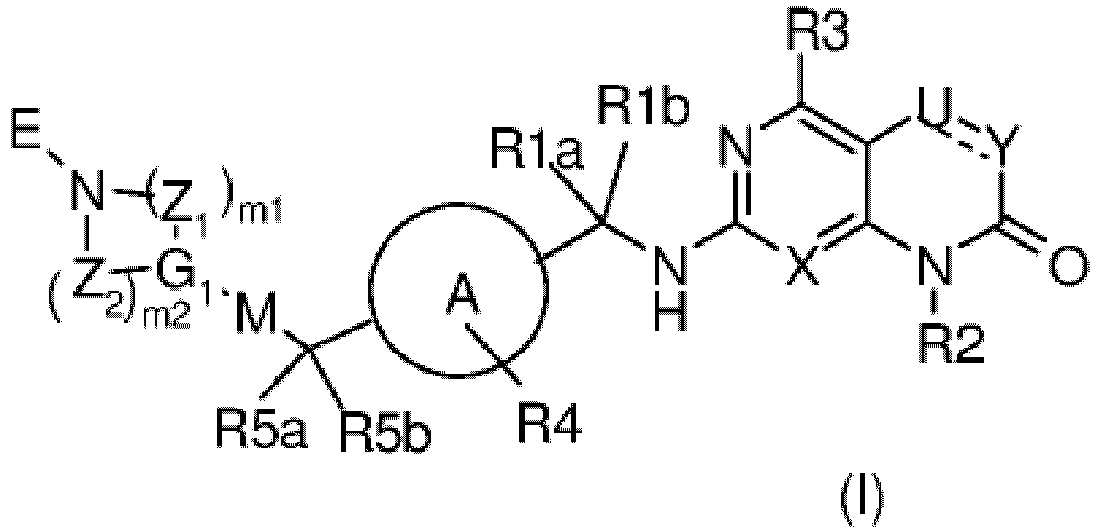 X Stickstoff oder -CH- ist;U CH, CH2 oder CMe ist;Y CH, CF oder O ist;
- - - - eine Einzel- oder eine Doppelbindung anzeigt;R1a, R1b jedes unabhängig Wasserstoff, ein wahlweise substituiertes gerades oder verzweigtes (C1-C6)-Alkyl ist oder sie zusammen mit dem Atom, an das sie gebunden sind, ein (C3-C6)-Cycloalkyl bilden können;A ein (C3-C6)-Cycloalkyl, Aryl oder Heteroaryl ist;R4 Wasserstoff, Halogen, Cyano oder ein wahlweise substituiertes gerades oder verzweigtes (C1-C6)-Alkyl ist;R5a und R5b jedes unabhängig eine Gruppe ist ausgewählt unter einem wahlweise substituierten geraden oder verzweigten (C1-C6)-Alkyl, (C3-C6)-Cycloalkyl oder sie zusammen mit dem Atom, an das sie gebunden sind, eine 3-bis 7-gliedrige Cyclylalkyl- oder Heterocyclylgruppe bilden können, die ein Heteroatom enthält ausgewählte unter O, S, N-R6;wobei:R6 ein wahlweise substituiertes gerades oder verzweigtes (Cl-C6)-Alkyl, -COOR7 oder -COR8 ist;wobei:R7 und R8 ein wahlweise substituiertes gerades oder verzweigtes (C1-C6)-Alkyl sind;M eine Bindung, NH, NR6 oder O ist, wobei R6 wie oben definiert ist;G1 N, CH, CH2 oder CO ist;Z1 CR9aR9b ist;Z2 CR10aR10b ist;wobei:R9a, R9b, R10a und R10b unabhängig Wasserstoff oder ein wahlweise substituiertes gerades oder verzweigtes (C1-C6)-Alkyl ist;ml 1, 2 oder 3 ist;m2 0, 1, 2 oder 3 ist;E CN oder ein wahlweise substituiertes gerades oder verzweigtes (C1-C6)-Alkyl, (C2-C6)-Alkenyl, (C2-C6)-Alkynyl ist;R2 eine wahlweise substituierte Gruppe ist ausgewählt unter geradem oder verzweigtem (C1-C6)-Alkyl, (C3-C6)-Cycloalkyl-(C1-C6)-alkyl, Aryl-(C1-C6)-alkyl und Heterocyclyl-(C1-C6)-alkyl;R3 Wasserstoff, Chlor, Cyano, CONH2, NH2, NR12aR12b, OR13 oder eine wahlweise substituierte Gruppe ist ausgewählt unter geradem oder verzweigtem (Cl-C6)-Alkyl, (C3-C6)-Cycloalkyl-(C1-C6)-alkyl, Aryl und Heteroaryl;wobei:R12a, R12b jedes unabhängig unter Wasserstoff oder wahlweise substituiertem geradem oder verzweigtem (Cl-C6)-Alkyl ausgewählt ist;R13 ein wahlweise substituiertes gerades oder verzweigtes (Cl-C6)-Alkyl ist;oder pharmazeutisch akzeptables Salz davon. - Verbindung der Formel (I) nach Anspruch 1 oder pharmazeutisch akzeptables Salz davon, wobei:Y CH oder O ist;R3 Wasserstoff, Chlor, Cyano, CONH2, NH2, NR12aR12b, OR13 oder eine wahlweise substituierte Gruppe ist ausgewählt unter geradem oder verzweigtem (Cl-C6)-Alkyl, (C3-C6)-Cycloalkyl-(C1-C6)-alkyl;wobei:R12a, R12b jedes unabhängig unter Wasserstoff oder wahlweise substituiertem geradem oder verzweigtem (Cl-C6)-Alkyl ausgewählt ist;R13 ein wahlweise substituiertes gerades oder verzweigtes (Cl-C6)-Alkyl ist;m1 1 oder 2 beträgt;m2 0, 1 oder 2 beträgt; undX, U,
- Verbindung der Formel (I) nach Anspruch 2 oder pharmazeutisch akzeptables Salz davon, wobei:A ein Aryl oder Heteroaryl ist;R4 Wasserstoff, Halogen oder ein wahlweise substituiertes gerades oder verzweigtes (C1-C6)-Alkyl ist;R3 Wasserstoff, Chlor, Cyano, CONH2, NH2, NR12aR12b oder eine wahlweise substituierte Gruppe ist ausgewählt unter geradem oder verzweigtem (Cl-C6)-Alkyl, (C3-C6)-Cycloalkyl-(C1-C6)-alkyl;wobei:R12a, R12b jedes unabhängig unter Wasserstoff oder wahlweise substituiertem geradem oder verzweigtem (Cl-C6)-Alkyl ausgewählt ist; undX, U, Y,

- Verbindung der Formel (I) nach Anspruch 3 oder pharmazeutisch akzeptables Salz davon, wobei:R4 Wasserstoff oder Halogen ist;R3 Wasserstoff, Chlor, Cyano, CONH2, NH2, NR12aR12b oder eine wahlweise substituierte Gruppe ist ausgewählt unter geradem oder verzweigtem (Cl-C6)-Alkyl;wobei:R12a, R12b jedes unabhängig unter Wasserstoff oder wahlweise substituiertem geradem oder verzweigtem (Cl-C6)-Alkyl ausgewählt ist; undX, U, Y,
- Verbindung der Formel (I) nach Anspruch 4 oder pharmazeutisch akzeptables Salz davon, wobei:R1a, R1b jedes unabhängig Wasserstoff, gerades oder verzweigtes (C1-C3)-Alkyl ist oder sie zusammen mit dem Atom, an das sie gebunden sind, eine Cyclopropylgruppe bilden können;A eine Phenyl-, Pyridyl- oder Pyrimidinylgruppe ist;R5a und R5b jedes unabhängig eine Gruppe ist ausgewählt unter einem geraden oder verzweigten (C1-C6)-Alkyl oder sie zusammen mit dem Atom, an das sie gebunden sind, eine 3- bis 7-gliedrige Cyclylalkyl- oder Heterocyclylgruppe bilden können, die ein Heteroatom enthält ausgewählte unter O oder N-R6,wobei:R6 ein gerades oder verzweigtes (C1-C6)-Alkyl oder COR8 ist;wobei:R8 ein gerades oder verzweigtes (C1-C6)-Alkyl ist;R2 ein gerades oder verzweigtes (C1-C6)-Alkyl, (C3-C6)-Cycloalkyl-(C1-C6)-alkyl ist;R3 Wasserstoff, Chlor, Cyano, NH2, NR12aR12b oder ein gerades oder verzweigtes (Cl-C6)-Alkyl ist; undX, U, Y,

- Verbindung der Formel (I) nach Anspruch 5 oder pharmazeutisch akzeptables Salz davon, wobei:R1a und R1b jedes unabhängig Wasserstoff, Methyl, Ethyl ist oder sie zusammen mit dem Atom, an das sie gebunden sind, eine Cyclopropylgruppe bilden können;A eine Phenyl- oder eine Pyridylgruppe ist;R4 Wasserstoff ist;R5a und R5b jedes unabhängig eine Gruppe ist ausgewählt unter Methyl oder Ethyl oder sie zusammen mit dem Atom, an das sie gebunden sind, eine wahlweise substituierte (C3-C6)-Cycloalkylgruppe bilden können ausgewählt unter Cyclopentyl, Cyclohexyl, 4,4-Difluorcyclohexyl oder eine Heterocyclylgruppe ausgewählt unter Pyranyl, Oxetyl, N-Methylpiperidinyl, N-Acetylpiperidinyl;R2 Methyl, Ethyl, Isopropyl oder Cyclopentyl ist;R3 Wasserstoff, Cyano, Methyl, NH2, NHMe oder N(Me)2 ist;E eine Gruppe der Formel -COR11 ist;wobei:R11 ein wahlweise substituiertes gerades oder verzweigtes (C2-C6)-Alkyl oder (C2-C6)-Alkenyl oder (C2-C6)-Alkynyl ist;X, U, Y,

- Verbindung der Formel (I) nach Anspruch 1 oder pharmazeutisch akzeptables Salz davon ausgewählt aus der Gruppe bestehend aus:2-{[(1S)-1-{4-[4-(4-acryloylpiperazin-1-yl)tetrahydro-2H-pyran-4-yl]phenyl}ethyl]amino}-8-(propan-2-yl) pyrido [2,3-d]pyrimidin-7(8H)-on (cpd 1);2-{[(1S)-1-{4-[2-(4-acryloylpiperazin-1-yl)propan-2-yl]phenyl}ethyl]amino}-8-(propan-2-yl)pyrido[2,3-d] pyrimidin-7(8H)-on (cpd 2);2-{[(1S)-1-{4-[3-(4-acryloylpiperazin-1-yl)oxetan-3-yl]phenyl}ethyl]amino}-8-(propan-2-yl)pyrido[2,3-d] pyrimidin-7(8H)-on (cpd 3);2-{[(1S)-1-{4-[3-(4-acryloylpiperazin-1-yl)pentan-3-yl] phenyl}ethyl]amino}-8-(propan-2-yl)pyrido[2,3-d] pyrimidin-7(8H)-on (cpd 4);2-{[(1S)-1-(4-{4-[4-(but-2-ynoyl)piperazin-1-yl] tetrahydro-2H-pyran-4-yl}phenyl)ethyl]amino}-8-(propan-2-yl)pyrido[2,3-d]pyrimidin-7(8H)-on (cpd 5);2-{[(1S)-1-{4-[1-acetyl-4-(4-acryloylpiperazin-1-yl) piperidin-4-yl]phenyl}ethyl]amino}-8-(propan-2-yl) pyrido[2,3-d]pyrimidin-7(8H)-on (cpd 6);2-{[(4-(4-{4-[(1S)-1-{[7-oxo-8-(propan-2-yl)-7,8-dihydropyrido[2,3-d]pyrimidin-2-yl]amino}ethyl]phenyl} tetrahydro-2H-pyran-4-yl)piperazin-1-yl]methyl}prop-2-enonsäure (cpd 7);2-{[(1S)-1-{4-[4-(4-propanoylpiperazin-1-yl)tetrahydro-2H-pyran-4-yl]phenyl}ethyl]amino}-8-(propan-2-yl)pyrido [2,3-d]pyrimidin-7(8H)-on (cpd 8);2-{[(1R)-1-{4-[4-(4-acryloylpiperazin-1-yl)tetrahydro-2H-pyran-4-yl]phenyl}ethyl]amino}-8-(propan-2-yl)pyrido [2,3-d]pyrimidin-7(8H)-on (cpd 9);2-{[(1S)-1-(4-{4-[4-(2,3-dihydroxypropanoyl)piperazin-1-yl]tetrahydro-2H-pyran-4-yl}phenyl)ethyl]amino}-8-(propan-2-yl)pyrido[2,3-d]pyrimidin-7(8H)-on (cpd 10);7-{[(1S)-1-{4-[4-(4-acryloylpiperazin-1-yl)tetrahydro-2H-pyran-4-yl]phenyl}ethyl]amino}-1-(propan-2-yl)-1,6-naphthyridin-2(1H)-on (cpd 11);2-{[(1S)-1-{6-[4-(4-acryloylpiperazin-1-yl)tetrahydro-2H-pyran-4-yl]pyridin-3-yl}ethyl]amino}-8-(propan-2-yl) pyrido[2,3-d]pyrimidin-7(8H)-on (cpd 12);2-{[(1S)-1-{4-[4-(4-acryloylpiperazin-1-yl)tetrahydro-2H-pyran-4-yl]phenyl} ethyl]amino}-4-methyl-8-(propan-2-yl)pyrido[2,3-d]pyrimidin-7(8H)-on (cpd 13);2-{[(1S)-1-{4-[4-(4-acryloylpiperazin-1-yl)tetrahydro-2H-pyran-4-yl]phenyl}ethyl]amino}-8-ethylpyrido[2,3-d]pyrimidin-7(8H)-on (cpd 14);2-{[(1S)-1-{4-[4-(4-acryloylpiperazin-1-yl)tetrahydro-2H-pyran-4-yl]phenyl}ethyl]amino}-8-cyclopentyl-5-methylpyrido[2,3-d]pyrimidin-7(8H)-on (cpd 15);2-{[(1S)-1-{4-[1-(4-acryloylpiperazin-1-yl)cyclopentyl] phenyl}ethyl]amino}-8-(propan-2-yl)-pyrido[2,3-d] pyrimidin-7(8H)-on (cpd 16);2-{[(1S)-1-{4-[3-(4-acryloylpiperazin-1-yl)tetrahydro furan-3-yl]phenyl}ethyl]amino}-8-(propan-2-yl)pyrido [2,3-d]pyrimidin-7(8H)-on (cpd 17);2-{[(1S)-1-{4-[4-(4-acryloylpiperazin-1-yl)tetrahydro-2H-pyran-4-yl]phenyl}ethyl]amino}-5-methyl-8-(propan-2-yl)pyrido[2,3-d]pyrimidin-7(8H)-on (cpd 18);2-{[(1S)-1-{4-[4-(4-acryloylpiperazin-1-yl)tetrahydro-2H-pyran-4-yl]phenyl}ethyl]amino}-4-amino-8-(propan-2-yl)pyrido[2,3-d]pyrimidin-7(8H)-on (cpd 19);2-{[(1S)-1-{4-[1-(4-acryloylpiperazin-1-yl)cyclohexyl] phenyl}ethyl]amino}-8-(propan-2-ylpyrido[2,3-d] pyrimidin-7(8H)-on (cpd 20);2-{[(1S)-1-(4-{4-[4-(2-methylacryloyl)piperazin-1-yl] tetrahydro-2H-pyran-4-yl}phenyl)ethyl]amino}-8-(propan-2-yl)pyrido[2,3-d]pyrimidin-7(8H)-on (cpd 21);2-{[(1S)-1-(4-{4-[4-(chloracetyl)piperazin-1-yl]tetra hydro-2H-pyran-4-yl}phenyl)ethyl]amino}-8-(propan-2-yl)pyrido[2,3-d]pyrimidin-7(8H)-on (cpd 22);2-{[(1S)-1-(4-{4-[4-(3-chlorpropanoyl)piperazin-1-yl] tetrahydro-2H-pyran-4-yl}phenyl)ethyl]amino}-8-(propan-2-yl)pyrido[2,3-d]pyrimidin-7(8H)-on (cpd 23);7-{[(1S)-1-{4-[4-(4-acryloylpiperazin-1-yl)tetrahydro-2H-pyran-4-yl]phenyl}ethyl]amino}-1-ethyl-1,4-dihydro-2H-pyrimido[4,5-d][1,3]oxazin-2-on (cpd 24);7-{[(1S)-1-{4-[4-(4-acryloylpiperazin-1-yl)tetrahydro-2H-pyran-4-yl]phenyl}ethyl]amino}-1-(propan-2-yl)-1,4-dihydro-2H-pyrimido[4,3-d][1,3]oxazin-2-on (cpd 25);2-{[(1S)-1-{4-[1-(4-acryloylpiperazin-1-yl)-4,4-difluor cyclohexyl]phenyl}ethyl]amino}-8-(propan-2-yl)pyrido [2,3-d]pyrimidin-7(8H)-on (cpd 26);2-{[(1S)-1-{5-[4-(4-acryloylpiperazin-1-yl)tetrahydro-2H-pyran-4-yl]pyridin-2-yl}ethyl]amino}-8-(propan-2-yl) pyrido(2,3d)pyrimidin-7(8H)-on (cpd 27);2-{[(1S)-1-(4-{4-[(1-acryloylazetidin-3-yl)(methyl) amino]tetrahydro-2H-pyran-4-yl}phenyl)ethyl]amino}-8-(propan-2yl)pyrido[2,3-d]pyrimidin-7(8H)-on (cpd 28);2-{[(1S)-1-(4-{4-[(1-acryloylazetidin-3-yl)oxy]tetra hydro-2H-pyran-4-yl}phenyl)ethyl]amino}-8-(propan-2-yl)pyrido[2,3-d]pyrimidin-7(8H)-on (cpd 29);2[(1-{4-[4-(4-acryloylpiperazin-1-yl)tetrahydro-2H-pyran-4-yl]phenyl}cyclopropyl)amino]-8-(propan-2-yl) pyrido[2,3-d] pyrimidin-7(8H)-on (cpd 30);2-({4-[4-(4-acryloylpiperazin-1-yl)tetrahydro-2H-pyran-4-yl]benzyl}amino)-8-(propan-2-yl)pyrido[2,3-d] pyrimidin-7(8H)-on (cpd 31);2-{[(1S)-1-{4-[4-(4-acryloylpiperazin-1-yl)-1-methyl piperidin-4-yl]phenyl}ethyl]amino}-8-(propan-2-yl) pyrido[2,3-d]pyrimidin-7(8H)-on (cpd 32);2-{[(1S)-1-{4[(2R)-2-(4-acryloylpiperazin-1-yl)butan-2-yl]phenyl}ethyl]amino}-8-(propan-2-yl)pyrido[2,3-d] pyrimidin-7(8H)-on (cpd 33);2-{[(1S)-1-{4[(2S)-2-(4-acryloylpiperazin-1-yl)butan-2-yl]phenyl}ethyl]amino}-8-(propan-2-yl)pyrido[2,3-d] pyrimidin-7(8H)-on (cpd 34);2-{[(1S)-1-{4-[4-(4-acryloylpiperazin-1-yl)tetrahydro-2H-pyran-4-yl]phenyl}ethyl]amino}-8-(pentan-3-yl) pyrido[2,3-d]pyrimidin-7(8H)-on (cpd 35);2-{[(1S)-1-{4-[4-(4-acryloylpiperazin-1-yl)tetrahydro-2H-pyran-4-yl]phenyl}ethyl]amino}-4-(dimethylamino)-8-(propan-2-yl)pyrido[2,3-d]pyrimidin-7(8H)-on (cpd 36);2-{[(1S)-1-{4-[4-(4-acryloylpiperazin-1-yl)tetrahydro-2H-pyran-4-yl)phenyl}ethyl]amino}-4-(methylamino)-8-(propan-2-yl)pyrido[2,3-d]pyrimidin-7(8H)-on (cpd 37);2-{[(1S)-1-{4-[4-(4-acryloylpiperazin-1-yl)tetrahydro-2H-pyran-4-yl]phenyl}ethyl]amino}-7-oxo-8-(propan-2-yl) -7,8-dihydropyrido[2,3-d]pyrimidin-4-carbonitril(cpd 38);2-{[(1S)-1-(4-{4-[(1-acryloylpiperidin-4-yl)oxy]tetra hydro-2H-pyran-4-yl}phenyl)ethyl]amino}-8-(propan-2-yl) pyrido[2,3-d]pyrimidin-7(8H)on (cpd 39);2-[(2)-{4-[4-(4-acryloylpiperazin-1-yl)tetrahydro-2H-pyran-4-yl]phenyl}propan-2-yl)amino]-8-(propan-2-yl) pyrido[2,3-d]pyrimidin-7(8H)-on (cpd 40);7-{[(1S)-1-{4-[4-(4-acryloylpiperazin-1-yl)tetrahydro-2H-pyran-4-yl]phenyl}ethyl]amino}-5-amino-1-(propan-2-yl)-1,4-dihydro-2H-pyrimido[4,5-d][1,3]oxazin-2-on(cpd 41);2-{[(1S)-1-{4[(2S)-2-(4-acryloylpiperazin-1-yl)-1-morpholin-4-yl)propan-2-yl]phenyl}ethyl]amino}-8-(propan-2-yl)pyrido[2,3-d]pyrimidin-7(8H)-on(cpd 42);2-{[(1S)-1-{4-[(2R)-2-(4-acyloylpiperazin-1-yl)-1-(morpholin-4-yl)propan-2-yl]phenyl}ethyl]amino}-8-(propan-2-yl)pyrido[2,3-d]pyrimidin-7(8H)-on (cpd 43);7-{[(1S)-1-{4-[4-(4-acryloylpiperazin-1-yl)tetrahydro-2H-pyran-4-yl]phenyl}ethyl]amino}-1-ethyl-1,4-dihydro-2H-pyrido[4,3-d][1,3]oxazin-2-on (cpd 44);7-{[(1S)-1-{4-[4-(4-ethylpiperazin-1-yl)tetrahydro-2H-pyran-4-yl] phenyl}ethyl]amino}-1-ethyl-1,4-dihydro-2H-pyrimido[4,5-d][1,3]oxazin-2-on (cpd 45);2-{[(1S)-1-{4-[2-(4-acryloylpiperazin-1-yl)butan-2-yl] phenyl}ethyl]amino}-8-(propan-2-yl)pyrido[2,3-d] pyrimidin-7(8H)-on (cpd 46);7-{[(1S)-1-{4-[1-(4-acryloylpiperazin-1-yl)-4,4-difluor cyclohexyl]phenyl}ethyl]amino}-1-(propan-2-yl)-1,6-naphthyridin-2(1H)-on (cpd 47);7-{[(1S)-1-(4-{4-[(1-acryloylazetidin-3-yl)(methyl) amino]tetrahydro-2H-pyran-4-yl}phenyl)ethyl]amino}-1-(propan-2-yl)-1,6-naphthyridin-2(1H)-on (cpd 48);2-[(1-{4-[1-(4-acryloylpiperazin-1-yl)cyclopentyl] phenyl}cyclopropyl)amino]-8-(propan-2-yl)pyrido[2,3-d]pyrimidin-7(8H)-on (cpd 49);2-{[(1S)-1-(4-{1-[(1-acryloylazetidin-3-yl)(methyl) amino]-4,4-difluorcyclohexyl}phenyl)ethyl]amino}-8-(propan-2-yl)pyrido[2,3-d]pyrimidin-7(8H)-on (cpd 50);8-(propan-2-yl)-2-({(S)-1-[4-(4-{4-[(2H3)prop-2-enoyl] piperazin-1-yl}tetrahydro-2H-pyran-4-yl}phenyl]ethyl} amino)pyrido[2,3-d]pyrimidin-7(8H)-on (cpd 51);2-[(2-{4-1-(4-acryloylpiperazin-1-yl)-4,4-difluor cyclohexyl]phenyl}propan-2-yl)amino]-8-(propan-2-yl) pyrido[2,3-d]pyrimidin-7(8H)-on (cpd 52);2-{[(1S)-1-(4-{1-[{1-[chlor(fluor)acetyl]azetidin-3-yl} (methyl)amino]-4,4-difluorcyclohexyl}phenyl)ethyl] amino}-8-(propan-2-yl)pyrido[2,3-d]pyrimidin-7(8H)-on (cpd 53);2-{[(1S)-1-(4-{4-[4-(2-fluoracryloyl)piperazin-1-yl] tetrahydro-2H-pyran-4-yl}phenyl)ethyl]amino}-8-(propan-2-yl)pyrido[2,3-d]pyrimidin-7(8H)-on (cpd 54);2-{[(1S)-1-{4-[4-(4-acryloylpiperazin-1-yl)tetrahydro-2H-pyran-4-yl]-phenyl}ethyl]amino}-8-[(2H7)propan-2-yl] pyrido [2,3-d]pyrimidin-7(8H)-on (cpd 55);N-{2-[(4,4-difIuor-1-{4-[(1S)-1-{[7-oxo-8-(propan-2-yl)-7-8-dihydropyrido[2,3-d]pyrimidin-2-yl]amino} ethyl] phenyl}cyclohexyl)amino]-2-oxoethyl}prop-2-enamid(cpd 56);N2-acryloyl-N-(4,4-difluor-1-{4-[(1S)-1-{[7-oxo-8-(propan-2-yl)-7,8-dihydropyrido[2,3-d]pyrimidin-2-yl] amino}ethyl]phenyl}cyclohexyl)-D-alaninamid (cpd 57);N2-acryloyl-N-(4,4-difluor-1-{4-[(1S)-1-{[7-oxo-8-(propan-2-yl)-7,8-dihydropyrido[2,3-d]pyrimidin-2-yl] amino}ethyl]phenyl}cyclohexyl)-L-alaninamid (cpd 58);N-{2-[(4-{4-[(1S)-1-{[7-oxo-8-(propan-2-yl)-7,8-dihydro pypyrido[2,3-d]pyrimidin-2-yl]amino}ethyl] phenyl}tetrahydro-2H-pyran-4-yl)amino]ethyl}prop-2-enamid (cpd 59);7-{[(1S)-1-(4-{1-[4-(2,3-dihydroxypropanoyl)piperazin-1-yl]-4,4-difluorcyclohexyl}phenyl)ethyl]amino}-1-(propan-2-yl)-1,6-naphthyridin-2(1H)-on (cpd 60);7-{[(1S)-1-(4-{1-[(1-acryloylazetidin-3-yl)(methyl) amino]-4,4-difluorcyclohexyl}phenyl)ethyl]amino}-1-(propan-2-yl)-1,6-naphthyridin-2(1H)-on (cpd 61);N-(1-acryloylazetidin-3-yl)-N-(4,4-difluor-1-{4-[(1S)-1-{[2-oxo-1-(propan-2-yl)-1,2-dihydro-1,6-naphthyridin-7-yl]amino}ethyl]phenyl}cyclohexyl) acetamid (cpd 62);7-{[(1R)-1-{4-[1-(4-acryloylpiperazin-1-yl)-4,4-difluor cyclohexyl]phenyl}ethyl]amino}-1-(propan-2-yl)-1,6-naphthyridin-2(1H)-on (cpd 63);2-{[(1S)-1-(4-{4,4-difluor-1-[4-(4-hydroxybutyl) piperazin-1-yl]cyclohexyl}phenyl)ethyl]amino}-8-(propan-2-yl)pyrido[2,3-d]pyrimidin-7(8H)-on (cpd 64)4-(4-{4-[(1S)-1-{[7-oxo-8-(propan-2-yl)-7,8-dihydro pyrido[2,3-d]pyrimidin-2-yl]amino}ethyl]phenyl}tetra hydro-2H-pyran-4-yl)piperazin-1-carbonitril(cpd 65);N-{2-[(4-{4-[(1S)-1-{[7-oxo-8-(propan-2-yl)-7,8-dihydro pyrido[2,3-d]pyrimidin-2-yl]amino}ethyl]phenyl} tetrahydro-2H-pyran-4-yl) (trifluoracetyl)amino]ethyl} prop-2-enamid (cpd 66) und7-{[(1S)-1-{4-[4,4-difluor-1-(4-propanoylpiperazin-1 - yl)cyclohexyl]phenyl}ethyl]amino}-1-(propan-2-yl)-1,6-naphthyridin-2(1H)-on (cpd 67).
- Verfahren für die Herstellung einer Verbindung der Formel (I) oder eines pharmazeutisch akzeptablen Salzes davon, wie in Anspruch 1 definiert, wobei das Verfahren die folgenden Schritte umfasst:Schritt 1a) Reagieren einer Verbindung der Formel (II):
 wobei X, U, Y,R2, R3, R1a, Rib, A, R4, R5a, R5b, M, G1, Z1 und Z2 wie in Anspruch 1 definiert sind, mit einer Verbindung der Formel (III):
 wobei E wie in Anspruch 1 definiert ist und Q Hydroxy oder Chlor oder Brom ist, um eine Verbindung der Formel (I) zu ergeben, wobei X, U, Y,, R2, R3, R1a, Rib, A, R4, R5a, R5b, M, G1, Z1, Z2 und E wie oben definiert sind;
 die Verbindung der Formel (II) aus einer Verbindung der Formel (IV) einem Verfahren entsprechend hergestellt werden kann, das die folgenden Schritte umfasst:Schritt 2a) Reagieren einer Verbindung der Formel (IV):
 wobei G Chlor, MeS(O)2-, MeS(O)- oder OTrif ist und X, U, Y,R2 und R3 wie in Anspruch 1 definiert sind, mit einer Verbindung der Formel (V):
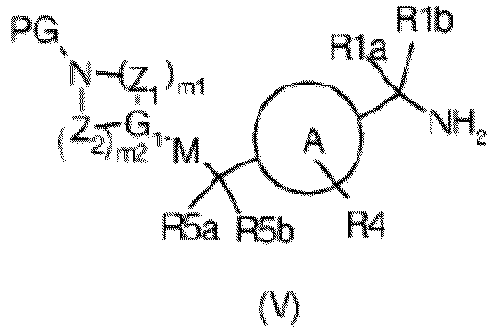 wobei R1a, R1b, A, R4, R5a, R5b, M, G1, Z1, Z2, ml und m2 wie in Anspruch 1 definiert sind und PG eine Schutzgruppe ist ausgewählt unter tert-Butylcarboxylat, Benzylcarboxylat, Phenylcarboxylat;Schritt 2b Reagieren einer Verbindung der Formel (VI):
 wobei PG wie oben in Schritt 2a definiert ist, mit einem geeigneten Entschützungmittel,um eine Verbindung der Formel (II) zu ergeben, wobei X, U, Y,A, R1a, R1b, R2, R3, R4, R5a, R5b, M, G1, Z1, Z2, ml und m2 wie oben in Schritt 2a definiert sind;
 die Verbindung der Formel (IV):
 wobei G MeS(O)2- oder MeS(O)- ist, X N ist, R3 Wasserstoff oder Chlor ist und U, Y,
 und R2 wie in Anspruch 1 definiert sind, kann einem Verfahren entsprechend hergestellt werden kann, das die folgenden Schritte umfasst:Schritt 3a) Substituieren des Chlors einer Zwischenverbindung der Formel (VII):
 wobei R3 Wasserstoff, Chlor oder ein wahlweise substituiertes gerades oder verzweigtes (C1-C6)-Alkyl ist, mit einer Aminzwischenverbindung der Formel (VIII):
R2-NH2 (VIII)
wobei R2 wie in Anspruch 1 definiert ist;Schritt 3b) Reagieren einer Verbindung der Formel (IX): wobei R2 und R3 wie oben in Schritt 3a definiert sind, mit einem Reduktionsmittel;Schritt 3c) Reagieren der resultierenden Verbindung der Formel (X):
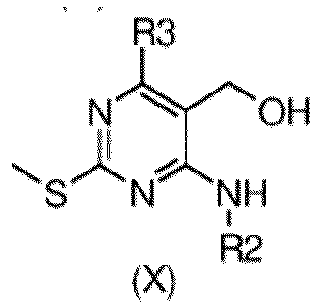 wobei R2 und R3 wie oben in Schritt 3a definiert sind, mit einem geeigneten Oxidationsreagenz;Schritt 3d) Reagieren der resultierenden Verbindung der Formel (XI):
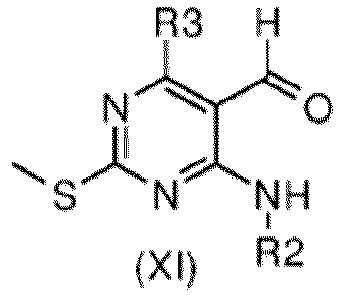 wobei R2 und R3 wie oben in Schritt 3a definiert sind, mit einem Reagenz der Formel T-CH2COOEt (XIV), wobei T Wasserstoff oder Fluor ist:Schritt 3e) Mischen der resultierenden Zwischenverbindung der Formel (XII):
 wobei U, Y und
 wie in Anspruch 1 definiert sind und R2 und R3 wie oben in Schritt 3a definiert sind, miteinem Oxidationsmittel, um eine Verbindung der Formel (IV) zu ergeben, wobei G MeS(O)2- oder MeS(O)- ist, X N ist und R2, R3, U, Y und
 wie oben definiert sind;
oderSchritt 3f) Reagieren der Verbindung der Formel (X): wobei R2 and R3 wie oben in Schritt 3e definiert sind, mit Carbonyldiimidazol oder Triphosgen, um eine Verbindung der Formel (XII) zu ergeben, wobei U CH2 ist, Y O ist,eine Einzelbindung ist und R2 und R3 wie oben definiert sind;
oderSchritt 3g) Alkylieren der zwischen Verbindung der Formel (XIII):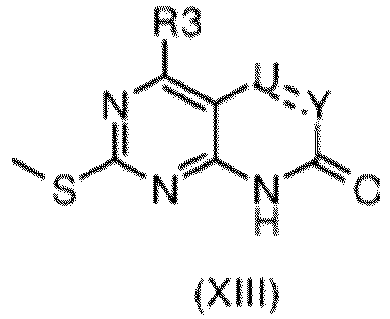 wobei R3, U, Y,
 wie oben in Schritt 3e definiert sind, mit einem Alkylierungsmittel der Formel R2-Lg (XV), wobei Lg Brom, Iod, -Oms -Ots oder Hydroxy ist und R2 wie oben in Schritt 3e definiert ist; um eine Verbindung der Formel (XII) zu ergeben,wobei R2, R3, U, Y undwie oben definiert sind;
 die Verbindung der Formel (IV), wobei G Chlor ist, R3, X, U, Y und R2 wie in Anspruch 1 definiert sind, kann einem Verfahren entsprechend hergestellt werden, das die folgenden Schritte umfasst:Schritt 4a) Substituieren des Chlors einer Zwischenverbindung der Formel (XVII):
 wobei X und R3 wie in Anspruch 1 definiert sind, mit einer Aminzwischenverbindung der Formel (VIII):
R2-NH2 (VIII)
wobei R2 wie in Anspruch 1 definiert ist;Schritt 4b) Reagieren einer Verbindung der Formel (XVII): wobei X, R3 und R2 wie oben in Schritt 4a definiert sind, mit einem Reduktionsmittel;Schritt 4c) Reagieren der resultierenden Verbindung der Formel (XVIII):
 wobei X, R3 und R2 wie in Schritt 4b definiert sind, mit einem geeigneten Oxidationsmittel;
dannSchritt 4d) Reagieren der resultierenden Verbindung der Formel (XIX): wobei X, R2 und R3 wie oben in Schritt 4c definiert sind, mit einer Verbindung der Formel T-CH2COOEt (XIV), wobei T Wasserstoff oder Fluor ist, um eine Verbindung der Formel (IV) zu ergeben, wobei G Chlor, U, Y, X,, R3 und R2 wie in Anspruch 1 definiert sind;
oderSchritt 4e) Reagieren der resultierenden Verbindung der Formel (XVIII): wobei X, R3 und R2 wie oben in Schritt 4c definiert sind, mit Carbonyldiimidazol oder Triphosgen; um eine Verbindung der Formel (IV) zu ergeben, wobei G Chlor ist, U CH2 ist, Y O ist,eine Einzelbindung ist und X und R2 wie oben definiert sind;
 falls erwünscht, Umwandeln einer ersten Verbindung der Formel (XII) in eine zweite Verbindung der Formel (XII) einem Verfahren entsprechend, das die folgenden Umwandlungen umfasst;Umwandlung A) Umwandeln einer Verbindung der Formel (XII) :
 wobei R3 Chlor ist, in eine Verbindung der Formel (XII) wobei R3 CN ist, durch Reagieren mit einer Quelle von Cyanid;Umwandlung B) Umwandeln einer Verbindung der Formel (XII):
 wobei R3 Chlor ist, in eine Verbindung der Formel (XII), wobei R3 NHPG ist, durch Reagieren mit einem Amin PG-NH2;Umwandlung C) Umwandeln einer Verbindung der Formel (XII):
 wobei R3 Chlor ist, in eine Verbindung der Formel (XII),wobei R3 NR12aR12b ist, durch Reagieren mit einem Amin HNR12aR12b, wobei R12a und R12b jedes unabhängig unter Wasserstoff oder wahlweise substituiertem geradem oder verzweigtem (C1-C6)-Alkyl ausgewählt ist;Umwandlung D) Umwandeln einer Verbindung der Formel (XII):
 wobei R3 Chlor ist, in eine Verbindung der Formel (XII),wobei R3 OR13 ist, durch Reagieren mit einem Alkohol R13-OH, wobei R13 ein wahlweise substituiertes gerades oder verzweigtes (C1-C6)-Alkyl ist;Umwandlung E) Umwandeln einer Verbindung der Formel (XII):
 wobei R3 Cyano ist, in eine Verbindung der Formel (XII),wobei R3 CONH2 ist, durch Hydrolyse mit einem geeigneten Mittel;falls erwünscht Umwandeln einer ersten Verbindung der Formel (IV) in eine zweite Verbindung der Formel (IV) einem Verfahren entsprechend, das die folgende Umwandlung umfasst:Umwandlung A1) Umwandeln einer Verbindung der Formel (IV) :
 wobei G MeS(O)2- ist, in eine Verbindung der Formel (IV),wobei G -OTrif (Triflat) ist, durch eine Zweischrittfolge mit geeigneten Reagentien;die Verbindung der Formel (V), wobei Rla, Rlb, A, R4, R5a, R5b, M, G1, Z1, Z2, m1 und m2 wie in Anspruch 1 angezeigt sind und PG eine Schutzgruppe ist, kann einem Verfahren entsprechend hergestellt werden, das die folgenden Schritte umfasst:Schritt 5a) Reagieren einer Verbindung der Formel (XX) :
 wobei W1 Brom, Cyano, COR1a ist und A, R4, R5a, R5b und R1a wie in Anspruch 1 definiert sind, mit ClCH2CN, gefolgt von Entschützen des Amidzwischenprodukts unter sauren Bedingungen, basischen Bedingungen oder mit Thioharnstoff, um die Verbindung der Formel (XXI) zu erhalten;Schritt 5b) Reagieren von Aminozwischenprodukt der Formel (XXI) :
 wobei W1, A, R4, R5a und R5b wie oben in Schritt 5a definiert sind, mit einer Verbindung der Formel (XXII):
 wobei Z1, Z2, m1 und m2 wie in Anspruch 1 angegeben sind, PG eine Schutzgruppe ist und Hal Halogen ist, um eine Verbindung der Formel (XXIII) zu ergeben, wobei W1, A, R4, R5a, R5b, Z1, Z2 und PG wie oben definiert sind, m1 und m2 1, 2 oder 3 betragen, G1 N ist und M eine Bindung ist;
oderSchritt 5b') Reagieren des Aminozwischenprodukts der Formel (XXI) mit einem Heterocyclylhalogenid der Formel (XXIIa) wobei Z1, Z2, m1, m2 und PG wie oben in Schritt 5b angegeben sind und Hal Halogen ist, dann Reagieren des erhaltenen Zwischenprodukts durch reduktive Aminierung mit Formaldehyd oder mit einem geeigneten Alkylaldehydderivat oder durch Acylierung mit geeignetem Haloacylderivat R8CO-hal oder durch Reaktion mit Alkylchlorformiatderivat R7OCO-Cl, wobei R7 und R8 wie in Anspruch 1 definiert sind; um eine Verbindung der Formel (XXIII) zu bilden, wobei PG wie oben definiert sind, W1, A, R4, R5a, R5b, Z1, Z2, m1 und m2 wie in Anspruch 1 definiert sind; G1 CH ist und M NR6 ist, wobei R6 wie in Anspruch 1 definiert ist;
oder,Schritt 5b") Reagieren des Aminozwischenprodukts der Formel (XXI) mit einem geschützten Aminoalkyl der Formel (XXIIb) wobei Z1, m1 und PG wie oben in Schritt 5b angegeben sind und FG eine funktionelle Gruppe ist ausgewählt unter Aldehyd (-CHO) oder Carbonsäure (-COOH), um eine Verbindung der Formel (XXIII) zu ergeben, wobei m2 0 beträgt, Gl CH2 oder CO ist, M NH oder NR6 ist,PG wie oben in Schritt 5b definiert ist und W1, A, R4, R5a, R5b, Z1, m1 und R6 wie in Anspruch 1 definiert sind;
oderSchritt 5a') Reagieren einer Verbindung der Formel (XX): wobei W1, A, R4, R5a und R5b wie oben in Schritt 5a definiert sind, mit einem Heterocyclylhalogenid der Formel (XXIIa)
 wobei Hal, Z1, Z2, m1, m2 und PG wie in Schritt 5b' definiert sind; um eine Verbindung der Formel (XXIII) zu bilden, wobei W1, A, R4, R5a, R5b wie in Schritt 5a definiert sind; Z1, Z2, m1, m2 und PG wie oben in Schritt 5b' definiert sind; G1 CH ist und M O ist;
dannSchritt 5c) Reagieren einer Verbindung der Formel (XXIII): die aus Schritt 5b oder 5b' oder 5b" oder 5a' erhalten worden ist, wobei W1 Cyano ist und A, R4, R5a, R5b, M, G1, Z1, Z2, m1, m2 und PG in Schritt 5b oder 5b' oder 5b" oder 5a' aufgeführt sind, mit Ethylmagnesiumbromid und Bortrifluoriddiethyleterat, um die erwünschte Verbindung der Formel (V) zu ergeben, wobei A, R4, R5a, R5b, M, G1, Z1, Z2, m1, m2 und PG wie oben in Schritt 5b oder 5b' oder 5b" oder 5a' definiert sind und Rla und Rlb gleich sind und wie in Anspruch 1 definiert sind; oder Rla mit Rib zusammengenommen Cyclopropyl ist;
oderSchritt 5c') Reagieren einer Verbindung der Formel (XXIII): die aus Schritt 5b oder 5b' oder 5b" oder 5a' erhalten worden ist, wobei W1 COR1a ist, wobei A, R4, R5a, R5b, M, G1, Z1, Z2, m1, m2, PG und Rla wie oben in Schritt 5b oder 5b' oder 5b" oder 5a' definiert sind, mit tert-Butansulfinamid, um eine Verbindung der Formel (XXIV) zu ergeben, wobei Rlb Wasserstoff ist und A, R4, R5a, R5b, M, G1, Z1, Z2, m1, m2, PG und Rla wie oben definiert sind;
oderSchritt 5c") Reagieren einer Verbindung der Formel (XXIII):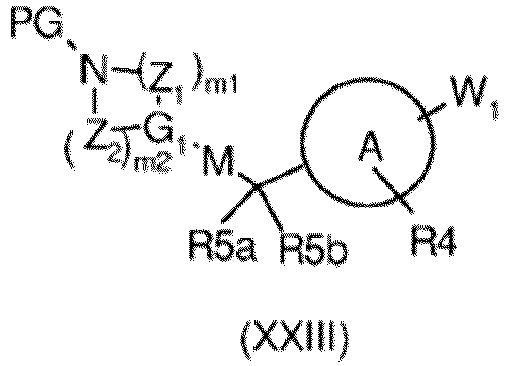 die aus Schritt 5b oder 5b' oder 5b" oder 5a' erhalten worden ist, wobei W1 CORia ist und A, R4, R5a, R5b, M, G1, Z1, Z2, m1, m2, PG und Rla wie oben in Schritt 5b oder 5b' oder 5b" oder 5a' definiert sind, mit tert-Butansulfinamid, um eine Verbindung der Formel (XXV) zu ergeben,
dannSchritt 5e) Reagieren der erhaltenen Verbindung der Formel (XXV): wobei Rla, A, R4, R5a, R5b, M, G1, Z1, Z2, ml, m2 und PG wie oben in Schritt 5b oder 5b' oder 5b" oder 5a' definiert sind, mit einem Alkyl-Grignar-Reagens, um die erwünschte Verbindung der Formel (XXIV) zu ergeben;schließlichSchritt 5d) Reagieren der Verbindung der Formel (XXIV), die wie in Schritt 5c' oder 5e beschrieben erhalten worden ist:
 wobei Rlb, Rla, A, R4, R5a, R5b, M, G1, Z1, Z2, m1, m2, und PG wie oben in Schritt 5c' oder 5e definiert sind, mit einem sauren Entschützungsreagens oder mit Iod, um die erwünschte Verbindung der Formel (V) zu ergeben, wobei R1b, R1a, A, R4, R5a, R5b, M, G1, Z1, Z2, m1 und m2 wie in Anspruch 1 definiert sind und PG eine Schutzgruppe ist; alternativ kann eine Verbindung der Formel (XXIII) auch durch Umwandlung einer anderen Verbindung der Formel (XXIII) der Umwandlung unten entsprechend erhalten werden:Umwandlung F) Eine Verbindung der Formel (XXIII), wobei W1 Cyano ist, wird durch Umwandlung der entsprechenden Verbindung der Formel (XXIII), die aus Schritt 5b oder 5b' oder 5b" oder 5a' erhalten worden ist, wobei W1 Brom ist, mit einer Quelle von Cyanid erhalten, der Bedingung entsprechend, die in der Technik für mit Palladium katalysierte Cyanierung von Arylhalogeniden bekannt ist;
 Umwandlung G) Eine Verbindung der Formel (XXIII), wobei W1 COR1a ist, wobei Rla wie in Anspruch 1 definiert ist, wird durch Umwandlung der Verbindung der Formel (XXIII), die aus Schritt 5b oder 5b' oder 5b" oder 5a' erhalten worden ist, wobei W1 Brom ist, mit einem geeigneten Enoletherorganometallderivat, gefolgt von Hydrolyse, erhalten;
 Eine Verbindung der Formel (l), die Schritt la entsprechend hergestellt wird, kann noch weiter in eine andere Verbindung der Formel (I) einem Verfahren entsprechend umgewandelt werden, das die folgende Umwandlung umfasst:Umwandlung 1) Umwandeln einer Verbindung der Formel (I):
 wobei E eine Acrylamidgruppe ist, in eine Verbindung, wobei E eine Dihydroxypropionsäuregruppe ist und X, U, Y,, R2, R3, Ria, Rib, A, R4, R5a, R5b, M, G1, Z1, Z2, m1 und m2 wie in Anspruch 1 definiert sind.
- Verbindung der Formel (I) oder pharmazeutisch akzeptables Salz davon, wie in Anspruch 1 definiert, zur Verwendung bei einem Verfahren zum Behandeln einer Krankheit, die durch einen erhöhten 2-Hydroxyglutaratspiegel verursacht wird und/oder damit verbunden ist, das das Verabreichen einem Säuger, bevorzugt einem Menschen, der dessen bedarf, einer wirksamen Menge einer Verbindung der Formel (I), wie in Anspruch 1 definiert, umfasst, wobei die Krankheit Krebs, zellproliferatives Leiden oder mit Immunität verbundenes Leiden ist.
- Verbindung der Formel (I) oder pharmazeutisch akzeptables Salz davon, wie in Anspruch 1 definiert, zur Verwendung bei einem Verfahren zum Behandeln von Krankheiten, die durch mutierte IDH-Enzyme verursacht werden und/oder damit verbunden sind, das das Verabreichen einem Säuger, bevorzugt einem Menschen, der dessen bedarf, einer wirksamen Menge der Verbindung der Formel (I), wie in Anspruch 1 definiert, umfasst, wobei die Krankheit Krebs, zellproliferatives Leiden oder mit Immunität verbundenes Leiden ist.
- Verbindung der Formel (I) oder pharmazeutisch akzeptables Salz davon, wie in Anspruch 1 definiert, zur Verwendung bei einem Verfahren zum Behandeln von Krankheiten, die durch IDH-WT-Überfunktionen verursacht werden und/oder damit verbunden sind, das das Verabreichen einem Säuger, bevorzugt einem Menschen, der dessen bedarf, einer wirksamen Menge der Verbindung der Formel (I), wie in Anspruch 1 definiert, umfasst, wobei die Krankheit Krebs, zellproliferatives Leiden oder mit Immunität verbundenes Leiden ist.
- Verbindung zur Verwendung nach einem der Ansprüche 9 bis 11, wobei die Krankheit Krebs ist.
- Verbindung zur Verwendung nach Anspruch 12, wobei der Krebs aus der Gruppe ausgewählt wird bestehend aus: Karzinomen wie beispielsweise Blasen-, Brust-, Nieren-, Leber-, Kolon-, Lungen-, einschließlich kleinzelligem Lungenkrebs-, Speiseröhren-, Gallenblasen-, Ovarial-Bauchspeicheldrüsen-, Magen-, Gebärmutterhals-, Prostata-, und Haut-, einschließlich Plattenepithelkarzinom; hämatopoetischen Tumoren lymphoider Abstammung, einschließlich Leukämie, akuter lymphozytischer Leukämie, akuter lymphoblastischer Leukämie, B-Zelllymphom, angioimmunoblastischem T-Zelllymphom, Hodgkin-Lymphom, Non-Hodgkin-Lymphom, Haarzellenlymphom und Burkitt-Lymphom; hämatopoetischen Tumoren myeloischer Abstammung, einschließlich akuter und chronischer myeloischer Leukämien, mylodysplastischem Syndrom und promyelozytischer Leukämie; Tumoren mesenchymalen Ursprungs, einschließlich Fibrosarkom und Rhabdomyosarkom; Tumoren des zentralen und peripheren Nervensystems, einschließlich Gliom, Glioblastom, Glioblastoma multiforme, Astrozytom, Oligodendrogliom, Paragliom, Neuroblastom und Schwannomen; und anderen Tumoren, einschließlich Melanom, Seminom, Teratokarzinom, Osteosarkom, Xeroderma pigmentosum, Keratoxanthom, Schilddrüsenkrebsen, wie beispielsweise papillärem Schilddrüsenkarzinom und medullärem Schilddrüsenkarzinom, Kaposi-Sarkom, Chondrosarkom und Cholangiokarzinom.
- Verbindung der Formel (I) oder pharmazeutisch akzeptables Salz davon, wie in Anspruch 1 definiert, zur Verwendung als Medikament.
- Pharmazeutische Zusammensetzung umfassend eine Verbindung der Formel (I) oder ein pharmazeutisch akzeptables Salz davon, wie in Anspruch 1 definiert, in Verbindung mit einem pharmazeutisch akzeptablen Trägerstoff, Träger oder Verdünnungsmittel.
- Pharmazeutische Zusammensetzung nach Anspruch 15, ferner ein oder mehrere chemotherapeutische Mittel umfassend.
- Produkt oder Kit umfassend eine Verbindung der Formel (I) oder ein pharmazeutisch akzeptables Salz davon, wie in Anspruch 1 definiert, und ein oder mehrere chemotherapeutische Mittel, als ein kombiniertes Präparat zur gleichzeitigen, einzelnen oder aufeinanderfolgenden Verwendung bei der Antikrebstherapie.
- Verbindung zur Verwendung nach Anspruch 12, ferner Unterwerfen des Säugers, der dessen bedarf, einer Strahlungstherapie oder einem Chemotherapieregime in Kombination mit mindestens einem zytostatischen oder zytotoxischen Mittel.
Applications Claiming Priority (2)
| Application Number | Priority Date | Filing Date | Title |
|---|---|---|---|
| EP19208128 | 2019-11-08 | ||
| PCT/EP2020/080361 WO2021089395A1 (en) | 2019-11-08 | 2020-10-29 | Gem-disubstituted heterocyclic compounds and their use as idh inhibitors |
Publications (2)
| Publication Number | Publication Date |
|---|---|
| EP4055015A1 EP4055015A1 (de) | 2022-09-14 |
| EP4055015B1 true EP4055015B1 (de) | 2025-04-02 |
Family
ID=68501514
Family Applications (1)
| Application Number | Title | Priority Date | Filing Date |
|---|---|---|---|
| EP20804176.4A Active EP4055015B1 (de) | 2019-11-08 | 2020-10-29 | Gem-disubstituierte heterocyclische verbindungen und ihre verwendung als idh-inhibitoren |
Country Status (7)
| Country | Link |
|---|---|
| US (1) | US20230000871A1 (de) |
| EP (1) | EP4055015B1 (de) |
| JP (1) | JP7744336B2 (de) |
| CN (1) | CN115038700B (de) |
| ES (1) | ES3033669T3 (de) |
| TW (1) | TW202132295A (de) |
| WO (1) | WO2021089395A1 (de) |
Family Cites Families (15)
| Publication number | Priority date | Publication date | Assignee | Title |
|---|---|---|---|---|
| ES2301194T3 (es) | 1997-02-05 | 2008-06-16 | Warner-Lambert Company Llc | Pirido 2,3-d pirimidinas y 4-aminopirimidinas como inhibidores de la proliferacion celular. |
| EP1685131B1 (de) | 2003-11-13 | 2007-03-07 | F. Hoffmann-La Roche AG | Hydroxyalkylsubstituierte pyrido-7-pyrimidin-7-one |
| HRP20130902T1 (hr) | 2005-10-07 | 2013-11-08 | Exelixis Inc. | PIRIDOPIRIMIDINONSKI INHIBITORI PI3Kalfa |
| JP2010500994A (ja) | 2006-08-16 | 2010-01-14 | エグゼリクシス, インコーポレイテッド | Pi3kおよびmekモジュレーターを使用する方法 |
| US8188113B2 (en) | 2006-09-14 | 2012-05-29 | Deciphera Pharmaceuticals, Inc. | Dihydropyridopyrimidinyl, dihydronaphthyidinyl and related compounds useful as kinase inhibitors for the treatment of proliferative diseases |
| DE602007012725D1 (de) | 2007-11-21 | 2011-04-07 | Synthon Bv | Verfahren zur Herstellung von N-(Diphenylmethyl)piperazinen |
| US7718662B1 (en) | 2009-10-12 | 2010-05-18 | Pharmacyclics, Inc. | Pyrazolo-pyrimidine inhibitors of bruton's tyrosine kinase |
| WO2014086032A1 (en) | 2012-12-07 | 2014-06-12 | Hutchison Medipharma Limited | Substituted pyridopyrazines as syk inhibitors |
| US9624175B2 (en) | 2015-04-21 | 2017-04-18 | Forma Therapeutics, Inc. | Fused-bicyclic aryl quinolinone derivatives as mutant-isocitrate dehydrogenase inhibitors |
| WO2016204429A1 (ko) | 2015-06-18 | 2016-12-22 | 한국화학연구원 | 헤테로아릴 유도체 또는 이의 약학적으로 허용가능한 염, 이의 제조방법 및 이를 유효성분으로 포함하는 pi3 키나아제 관련 질환의 예방 또는 치료용 약학적 조성물. |
| CN107849059B (zh) * | 2015-07-27 | 2020-04-28 | 伊莱利利公司 | 7-苯基乙基氨基-4h-嘧啶并[4,5-d][1,3]噁嗪-2-酮化合物及其作为突变体idh1抑制剂的用途 |
| CN107216312B (zh) | 2016-03-22 | 2023-08-01 | 上海海和药物研究开发股份有限公司 | 一种具有突变型idh抑制活性的化合物、其制备方法及用途 |
| AR108325A1 (es) | 2016-04-27 | 2018-08-08 | Samumed Llc | Isoquinolin-3-il carboxamidas y preparación y uso de las mismas |
| EA036112B1 (ru) * | 2016-12-16 | 2020-09-29 | Эли Лилли Энд Компани | 7-фенилэтиламино-4h-пиримидо[4,5-d][1,3]оксазин-2-оновые соединения в качестве ингибиторов мутантных idh1 и idh2 |
| MX2020012499A (es) * | 2018-05-21 | 2021-02-15 | Nerviano Medical Sciences Srl | Compuestos heterocondensados de piridonas y su uso como inhibidores de la idh. |
-
2020
- 2020-10-29 EP EP20804176.4A patent/EP4055015B1/de active Active
- 2020-10-29 JP JP2022526123A patent/JP7744336B2/ja active Active
- 2020-10-29 ES ES20804176T patent/ES3033669T3/es active Active
- 2020-10-29 US US17/775,124 patent/US20230000871A1/en active Pending
- 2020-10-29 WO PCT/EP2020/080361 patent/WO2021089395A1/en not_active Ceased
- 2020-10-29 CN CN202080093366.1A patent/CN115038700B/zh active Active
- 2020-11-06 TW TW109138785A patent/TW202132295A/zh unknown
Also Published As
| Publication number | Publication date |
|---|---|
| JP2022554364A (ja) | 2022-12-28 |
| ES3033669T3 (en) | 2025-08-06 |
| US20230000871A1 (en) | 2023-01-05 |
| CN115038700A (zh) | 2022-09-09 |
| CN115038700B (zh) | 2025-07-25 |
| WO2021089395A1 (en) | 2021-05-14 |
| TW202132295A (zh) | 2021-09-01 |
| EP4055015A1 (de) | 2022-09-14 |
| JP7744336B2 (ja) | 2025-09-25 |
Similar Documents
| Publication | Publication Date | Title |
|---|---|---|
| EP4157836B1 (de) | Anellierte 2-amino-3-cyano-thiophene und derivate zur behandlung von krebs | |
| JP2024543967A (ja) | ガン処置のための環化2-アミノ-3-シアノチオフェン及び誘導体 | |
| CN111989332B (zh) | 作为cdk抑制剂的大环化合物、其制备方法及其在医药上的应用 | |
| EP3797107B1 (de) | Heterokondensierte pyridonverbindungen und ihre verwendung als idh-inhibitoren | |
| WO2018066718A1 (en) | Therapeutic compounds | |
| WO2014100533A1 (en) | NOVEL SUBSTITUTED IMIDAZOLES AS CASEIN KINASE 1 δ/ε INHIBITORS | |
| KR20250113487A (ko) | 화합물 | |
| CN120322430A (zh) | Pcsk9抑制剂及其使用方法 | |
| CN102656172B (zh) | 8-氧代二氢嘌呤衍生物 | |
| KR20250022815A (ko) | Hpk1 억제제 및 이의 의약품에서의 응용 | |
| EP4055015B1 (de) | Gem-disubstituierte heterocyclische verbindungen und ihre verwendung als idh-inhibitoren | |
| HK40079136A (en) | Gem-disubstituted heterocyclic compounds and their use as idh inhibitors | |
| EA046117B1 (ru) | Гетероконденсированные соединения пиридона и их применение в качестве ингибиторов идг | |
| HK40072682A (en) | Pyridopyrimdinone cdk2/4/6 inhibitors | |
| HK40044072B (zh) | 杂缩合的吡啶酮化合物及其作为idh抑制剂的用途 | |
| HK40002986A (en) | Pyridopyrimdinone cdk2/4/6 inhibitors |
Legal Events
| Date | Code | Title | Description |
|---|---|---|---|
| STAA | Information on the status of an ep patent application or granted ep patent |
Free format text: STATUS: UNKNOWN |
|
| STAA | Information on the status of an ep patent application or granted ep patent |
Free format text: STATUS: THE INTERNATIONAL PUBLICATION HAS BEEN MADE |
|
| PUAI | Public reference made under article 153(3) epc to a published international application that has entered the european phase |
Free format text: ORIGINAL CODE: 0009012 |
|
| STAA | Information on the status of an ep patent application or granted ep patent |
Free format text: STATUS: REQUEST FOR EXAMINATION WAS MADE |
|
| 17P | Request for examination filed |
Effective date: 20220513 |
|
| AK | Designated contracting states |
Kind code of ref document: A1 Designated state(s): AL AT BE BG CH CY CZ DE DK EE ES FI FR GB GR HR HU IE IS IT LI LT LU LV MC MK MT NL NO PL PT RO RS SE SI SK SM TR |
|
| DAV | Request for validation of the european patent (deleted) | ||
| DAX | Request for extension of the european patent (deleted) | ||
| GRAP | Despatch of communication of intention to grant a patent |
Free format text: ORIGINAL CODE: EPIDOSNIGR1 |
|
| STAA | Information on the status of an ep patent application or granted ep patent |
Free format text: STATUS: GRANT OF PATENT IS INTENDED |
|
| INTG | Intention to grant announced |
Effective date: 20240529 |
|
| GRAJ | Information related to disapproval of communication of intention to grant by the applicant or resumption of examination proceedings by the epo deleted |
Free format text: ORIGINAL CODE: EPIDOSDIGR1 |
|
| STAA | Information on the status of an ep patent application or granted ep patent |
Free format text: STATUS: REQUEST FOR EXAMINATION WAS MADE |
|
| GRAP | Despatch of communication of intention to grant a patent |
Free format text: ORIGINAL CODE: EPIDOSNIGR1 |
|
| STAA | Information on the status of an ep patent application or granted ep patent |
Free format text: STATUS: GRANT OF PATENT IS INTENDED |
|
| INTC | Intention to grant announced (deleted) | ||
| INTG | Intention to grant announced |
Effective date: 20241007 |
|
| GRAS | Grant fee paid |
Free format text: ORIGINAL CODE: EPIDOSNIGR3 |
|
| GRAA | (expected) grant |
Free format text: ORIGINAL CODE: 0009210 |
|
| STAA | Information on the status of an ep patent application or granted ep patent |
Free format text: STATUS: THE PATENT HAS BEEN GRANTED |
|
| RAP3 | Party data changed (applicant data changed or rights of an application transferred) |
Owner name: NERVIANO MEDICAL SCIENCES S.R.L. |
|
| AK | Designated contracting states |
Kind code of ref document: B1 Designated state(s): AL AT BE BG CH CY CZ DE DK EE ES FI FR GB GR HR HU IE IS IT LI LT LU LV MC MK MT NL NO PL PT RO RS SE SI SK SM TR |
|
| REG | Reference to a national code |
Ref country code: GB Ref legal event code: FG4D |
|
| REG | Reference to a national code |
Ref country code: CH Ref legal event code: EP |
|
| REG | Reference to a national code |
Ref country code: DE Ref legal event code: R096 Ref document number: 602020048821 Country of ref document: DE |
|
| REG | Reference to a national code |
Ref country code: IE Ref legal event code: FG4D |
|
| P01 | Opt-out of the competence of the unified patent court (upc) registered |
Free format text: CASE NUMBER: APP_17142/2025 Effective date: 20250408 |
|
| REG | Reference to a national code |
Ref country code: NL Ref legal event code: FP |
|
| REG | Reference to a national code |
Ref country code: ES Ref legal event code: FG2A Ref document number: 3033669 Country of ref document: ES Kind code of ref document: T3 Effective date: 20250806 |
|
| REG | Reference to a national code |
Ref country code: AT Ref legal event code: MK05 Ref document number: 1781222 Country of ref document: AT Kind code of ref document: T Effective date: 20250402 |
|
| PG25 | Lapsed in a contracting state [announced via postgrant information from national office to epo] |
Ref country code: FI Free format text: LAPSE BECAUSE OF FAILURE TO SUBMIT A TRANSLATION OF THE DESCRIPTION OR TO PAY THE FEE WITHIN THE PRESCRIBED TIME-LIMIT Effective date: 20250402 Ref country code: PT Free format text: LAPSE BECAUSE OF FAILURE TO SUBMIT A TRANSLATION OF THE DESCRIPTION OR TO PAY THE FEE WITHIN THE PRESCRIBED TIME-LIMIT Effective date: 20250804 |
|
| REG | Reference to a national code |
Ref country code: LT Ref legal event code: MG9D |
|
| PG25 | Lapsed in a contracting state [announced via postgrant information from national office to epo] |
Ref country code: GR Free format text: LAPSE BECAUSE OF FAILURE TO SUBMIT A TRANSLATION OF THE DESCRIPTION OR TO PAY THE FEE WITHIN THE PRESCRIBED TIME-LIMIT Effective date: 20250703 Ref country code: NO Free format text: LAPSE BECAUSE OF FAILURE TO SUBMIT A TRANSLATION OF THE DESCRIPTION OR TO PAY THE FEE WITHIN THE PRESCRIBED TIME-LIMIT Effective date: 20250702 |
|
| PG25 | Lapsed in a contracting state [announced via postgrant information from national office to epo] |
Ref country code: PL Free format text: LAPSE BECAUSE OF FAILURE TO SUBMIT A TRANSLATION OF THE DESCRIPTION OR TO PAY THE FEE WITHIN THE PRESCRIBED TIME-LIMIT Effective date: 20250402 |
|
| PG25 | Lapsed in a contracting state [announced via postgrant information from national office to epo] |
Ref country code: BG Free format text: LAPSE BECAUSE OF FAILURE TO SUBMIT A TRANSLATION OF THE DESCRIPTION OR TO PAY THE FEE WITHIN THE PRESCRIBED TIME-LIMIT Effective date: 20250402 |
|
| PG25 | Lapsed in a contracting state [announced via postgrant information from national office to epo] |
Ref country code: HR Free format text: LAPSE BECAUSE OF FAILURE TO SUBMIT A TRANSLATION OF THE DESCRIPTION OR TO PAY THE FEE WITHIN THE PRESCRIBED TIME-LIMIT Effective date: 20250402 |
|
| PG25 | Lapsed in a contracting state [announced via postgrant information from national office to epo] |
Ref country code: AT Free format text: LAPSE BECAUSE OF FAILURE TO SUBMIT A TRANSLATION OF THE DESCRIPTION OR TO PAY THE FEE WITHIN THE PRESCRIBED TIME-LIMIT Effective date: 20250402 |
|
| PG25 | Lapsed in a contracting state [announced via postgrant information from national office to epo] |
Ref country code: RS Free format text: LAPSE BECAUSE OF FAILURE TO SUBMIT A TRANSLATION OF THE DESCRIPTION OR TO PAY THE FEE WITHIN THE PRESCRIBED TIME-LIMIT Effective date: 20250702 |
|
| PG25 | Lapsed in a contracting state [announced via postgrant information from national office to epo] |
Ref country code: IS Free format text: LAPSE BECAUSE OF FAILURE TO SUBMIT A TRANSLATION OF THE DESCRIPTION OR TO PAY THE FEE WITHIN THE PRESCRIBED TIME-LIMIT Effective date: 20250802 |
|
| PG25 | Lapsed in a contracting state [announced via postgrant information from national office to epo] |
Ref country code: LV Free format text: LAPSE BECAUSE OF FAILURE TO SUBMIT A TRANSLATION OF THE DESCRIPTION OR TO PAY THE FEE WITHIN THE PRESCRIBED TIME-LIMIT Effective date: 20250402 |
|
| REG | Reference to a national code |
Ref country code: CH Ref legal event code: U11 Free format text: ST27 STATUS EVENT CODE: U-0-0-U10-U11 (AS PROVIDED BY THE NATIONAL OFFICE) Effective date: 20251101 |
|
| PGFP | Annual fee paid to national office [announced via postgrant information from national office to epo] |
Ref country code: NL Payment date: 20251026 Year of fee payment: 6 |