EP4051694B1 - Aav vector variants for ocular gene delivery - Google Patents
Aav vector variants for ocular gene delivery Download PDFInfo
- Publication number
- EP4051694B1 EP4051694B1 EP20841660.2A EP20841660A EP4051694B1 EP 4051694 B1 EP4051694 B1 EP 4051694B1 EP 20841660 A EP20841660 A EP 20841660A EP 4051694 B1 EP4051694 B1 EP 4051694B1
- Authority
- EP
- European Patent Office
- Prior art keywords
- seq
- capsid
- aav
- acid sequence
- nucleic acid
- Prior art date
- Legal status (The legal status is an assumption and is not a legal conclusion. Google has not performed a legal analysis and makes no representation as to the accuracy of the status listed.)
- Active
Links
Images


Classifications
-
- A—HUMAN NECESSITIES
- A61—MEDICAL OR VETERINARY SCIENCE; HYGIENE
- A61K—PREPARATIONS FOR MEDICAL, DENTAL OR TOILETRY PURPOSES
- A61K48/00—Medicinal preparations containing genetic material which is inserted into cells of the living body to treat genetic diseases; Gene therapy
- A61K48/0075—Medicinal preparations containing genetic material which is inserted into cells of the living body to treat genetic diseases; Gene therapy characterised by an aspect of the delivery route, e.g. oral, subcutaneous
-
- A—HUMAN NECESSITIES
- A61—MEDICAL OR VETERINARY SCIENCE; HYGIENE
- A61K—PREPARATIONS FOR MEDICAL, DENTAL OR TOILETRY PURPOSES
- A61K9/00—Medicinal preparations characterised by special physical form
- A61K9/0012—Galenical forms characterised by the site of application
- A61K9/0019—Injectable compositions; Intramuscular, intravenous, arterial, subcutaneous administration; Compositions to be administered through the skin in an invasive manner
-
- A—HUMAN NECESSITIES
- A61—MEDICAL OR VETERINARY SCIENCE; HYGIENE
- A61K—PREPARATIONS FOR MEDICAL, DENTAL OR TOILETRY PURPOSES
- A61K9/00—Medicinal preparations characterised by special physical form
- A61K9/0012—Galenical forms characterised by the site of application
- A61K9/0048—Eye, e.g. artificial tears
-
- A—HUMAN NECESSITIES
- A61—MEDICAL OR VETERINARY SCIENCE; HYGIENE
- A61P—SPECIFIC THERAPEUTIC ACTIVITY OF CHEMICAL COMPOUNDS OR MEDICINAL PREPARATIONS
- A61P27/00—Drugs for disorders of the senses
- A61P27/02—Ophthalmic agents
-
- C—CHEMISTRY; METALLURGY
- C07—ORGANIC CHEMISTRY
- C07K—PEPTIDES
- C07K14/00—Peptides having more than 20 amino acids; Gastrins; Somatostatins; Melanotropins; Derivatives thereof
- C07K14/005—Peptides having more than 20 amino acids; Gastrins; Somatostatins; Melanotropins; Derivatives thereof from viruses
-
- C—CHEMISTRY; METALLURGY
- C12—BIOCHEMISTRY; BEER; SPIRITS; WINE; VINEGAR; MICROBIOLOGY; ENZYMOLOGY; MUTATION OR GENETIC ENGINEERING
- C12N—MICROORGANISMS OR ENZYMES; COMPOSITIONS THEREOF; PROPAGATING, PRESERVING, OR MAINTAINING MICROORGANISMS; MUTATION OR GENETIC ENGINEERING; CULTURE MEDIA
- C12N15/00—Mutation or genetic engineering; DNA or RNA concerning genetic engineering, vectors, e.g. plasmids, or their isolation, preparation or purification; Use of hosts therefor
- C12N15/09—Recombinant DNA-technology
- C12N15/63—Introduction of foreign genetic material using vectors; Vectors; Use of hosts therefor; Regulation of expression
- C12N15/79—Vectors or expression systems specially adapted for eukaryotic hosts
- C12N15/85—Vectors or expression systems specially adapted for eukaryotic hosts for animal cells
- C12N15/86—Viral vectors
-
- A—HUMAN NECESSITIES
- A61—MEDICAL OR VETERINARY SCIENCE; HYGIENE
- A61K—PREPARATIONS FOR MEDICAL, DENTAL OR TOILETRY PURPOSES
- A61K38/00—Medicinal preparations containing peptides
-
- C—CHEMISTRY; METALLURGY
- C07—ORGANIC CHEMISTRY
- C07K—PEPTIDES
- C07K2319/00—Fusion polypeptide
- C07K2319/33—Fusion polypeptide fusions for targeting to specific cell types, e.g. tissue specific targeting, targeting of a bacterial subspecies
-
- C—CHEMISTRY; METALLURGY
- C12—BIOCHEMISTRY; BEER; SPIRITS; WINE; VINEGAR; MICROBIOLOGY; ENZYMOLOGY; MUTATION OR GENETIC ENGINEERING
- C12N—MICROORGANISMS OR ENZYMES; COMPOSITIONS THEREOF; PROPAGATING, PRESERVING, OR MAINTAINING MICROORGANISMS; MUTATION OR GENETIC ENGINEERING; CULTURE MEDIA
- C12N2750/00—MICROORGANISMS OR ENZYMES; COMPOSITIONS THEREOF; PROPAGATING, PRESERVING, OR MAINTAINING MICROORGANISMS; MUTATION OR GENETIC ENGINEERING; CULTURE MEDIA ssDNA viruses
- C12N2750/00011—Details
- C12N2750/14011—Parvoviridae
- C12N2750/14111—Dependovirus, e.g. adenoassociated viruses
- C12N2750/14122—New viral proteins or individual genes, new structural or functional aspects of known viral proteins or genes
-
- C—CHEMISTRY; METALLURGY
- C12—BIOCHEMISTRY; BEER; SPIRITS; WINE; VINEGAR; MICROBIOLOGY; ENZYMOLOGY; MUTATION OR GENETIC ENGINEERING
- C12N—MICROORGANISMS OR ENZYMES; COMPOSITIONS THEREOF; PROPAGATING, PRESERVING, OR MAINTAINING MICROORGANISMS; MUTATION OR GENETIC ENGINEERING; CULTURE MEDIA
- C12N2750/00—MICROORGANISMS OR ENZYMES; COMPOSITIONS THEREOF; PROPAGATING, PRESERVING, OR MAINTAINING MICROORGANISMS; MUTATION OR GENETIC ENGINEERING; CULTURE MEDIA ssDNA viruses
- C12N2750/00011—Details
- C12N2750/14011—Parvoviridae
- C12N2750/14111—Dependovirus, e.g. adenoassociated viruses
- C12N2750/14141—Use of virus, viral particle or viral elements as a vector
- C12N2750/14143—Use of virus, viral particle or viral elements as a vector viral genome or elements thereof as genetic vector
-
- C—CHEMISTRY; METALLURGY
- C12—BIOCHEMISTRY; BEER; SPIRITS; WINE; VINEGAR; MICROBIOLOGY; ENZYMOLOGY; MUTATION OR GENETIC ENGINEERING
- C12N—MICROORGANISMS OR ENZYMES; COMPOSITIONS THEREOF; PROPAGATING, PRESERVING, OR MAINTAINING MICROORGANISMS; MUTATION OR GENETIC ENGINEERING; CULTURE MEDIA
- C12N2750/00—MICROORGANISMS OR ENZYMES; COMPOSITIONS THEREOF; PROPAGATING, PRESERVING, OR MAINTAINING MICROORGANISMS; MUTATION OR GENETIC ENGINEERING; CULTURE MEDIA ssDNA viruses
- C12N2750/00011—Details
- C12N2750/14011—Parvoviridae
- C12N2750/14111—Dependovirus, e.g. adenoassociated viruses
- C12N2750/14141—Use of virus, viral particle or viral elements as a vector
- C12N2750/14145—Special targeting system for viral vectors
-
- C—CHEMISTRY; METALLURGY
- C12—BIOCHEMISTRY; BEER; SPIRITS; WINE; VINEGAR; MICROBIOLOGY; ENZYMOLOGY; MUTATION OR GENETIC ENGINEERING
- C12N—MICROORGANISMS OR ENZYMES; COMPOSITIONS THEREOF; PROPAGATING, PRESERVING, OR MAINTAINING MICROORGANISMS; MUTATION OR GENETIC ENGINEERING; CULTURE MEDIA
- C12N2810/00—Vectors comprising a targeting moiety
- C12N2810/40—Vectors comprising a peptide as targeting moiety, e.g. a synthetic peptide, from undefined source
Definitions
- the present invention relates to adeno-associated virus capsid polypeptide sequences and their use in therapeutic transgene delivery to the eye targeting the photoreceptors or retinal pigment epithelial cells.
- PRs retinal photoreceptor cells
- ROS retinal pigment epithelial
- ALD age-related macular degeneration
- PRs retinal pigment epithelial
- RP retinal pigment epithelial
- ALD age-related macular degeneration
- the genetic mutations responsible for many forms of photoreceptor degeneration are identified, enabling interventions by administration of therapeutic transgenes.
- Existing PR targeting nucleic acid-based therapies are effective only at the early disease stages when damage to PR is minimal.
- Gene therapy employing a suitable optogenetic protein that confers light sensitivity to functional inner retinal cells might potentially restore vision even in later disease stages. To make such approaches applicable in a clinical setting, improved vectors with better retinal penetration for gene delivery are required.
- Recombinant vectors based on adeno-associated virus are candidates for therapeutic gene transfer in the eye.
- AAV vectors are typically applied subretinally.
- Subretinal application has been shown to lead to a decrease in retinal thickness and visual acuity.
- subretinal application only achieves gene transfer and expression in cells immediately adjacent to the bulk of injected fluid, while an effective administration method should reach cells along the entire width of the retina.
- Intravitreal injection into the jelly-like filling of the eye does not only have the potential to deliver the vector to the entire retina, but is also much safer and far less technically demanding than subretinal injection.
- the inner limiting membrane (ILM) that separates the neural retina from the vitreous humor is abundant in native receptors of many AAV serotypes and therefore presents a daunting barrier for AAV vectors.
- Engineered AAV vectors that penetrate better through the ILM and other retinal barriers when delivered intravitreally are needed to increase efficacy and safety of ocular AAV gene therapy.
- WO 2019/076856 A1 describes AAV capsids with an insert of 7 amino acids at position 587 for transduction of photoreceptors in an immortalized cone photoreceptor cell line.
- the objective of the present invention is to provide means and methods for gene transfer into the retina enabling targeting of all retinal cell types, particularly inner retinal cells and photoreceptors. This objective is attained by the subject-matter of the independent claims of the present specification.
- a first aspect of the invention relates to an adeno-associated virus (AAV) capsid polypeptide comprising a peptide insertion at position 453 or 587/588 of the AAV serotype 2 capsid or a position homologous thereto in an AAV capsid of another serotype (Table 3: #1, #2), located at the highest and second highest capsid protrusions, respectively.
- AAV adeno-associated virus
- a second aspect of the invention relates to a nucleic acid sequence encoding the AAV capsid polypeptide according to the first aspect.
- Particular embodiments include the inclusion of this nucleic acid sequence in an AAV cap sequence, particularly in an AAV serotype 2 capsid sequence for generation of a capsid-engineered AAV vector.
- AAV vector in the context of the present specification relate to a viral vector composed of 60 AAV capsid proteins and an encapsidated AAV nucleic acid.
- An AAV vector is derived from an AAV virion, but the AAV vector is engineered to be replication-incompetent in the presence of a helper virus by removing the rep and cap genes from the AAV genome.
- the encapsidated AAV nucleic acid may comprise a transgene which is to be delivered into a target cell.
- AAV capsid in the context of the present specification relates to a polypeptide encoded by engineered capsid ( cap ) genes generated by the inventors and listed herein below.
- the AAV capsid disclosed herein may be used to assemble recombinant adeno-associated viral vectors for gene therapy.
- homologous in the context of the present specification relates to nucleic acid or amino acid sequences derived from different serotypes of AAV.
- the corresponding positions of different adeno-associated virus serotypes are shown in Table 3.
- transgene in the context of the present specification relates to a gene or genetic material that has been transferred from one organism to another.
- the term may also refer to transfer of the natural or physiologically intact variant of a genetic sequence into tissue of a patient where it is missing. It may further refer to transfer of a natural encoded sequence the expression of which is driven by a promoter absent or silenced in the targeted tissue.
- a recombinant in the context of the present specification relates to a nucleic acid, which is the product of one or several steps of cloning, restriction and/or ligation and which is different from the naturally occurring nucleic acid.
- a recombinant virus particle comprises a recombinant nucleic acid.
- polypeptide in the context of the present specification relates to a molecule consisting of 50 or more amino acids that form a linear chain wherein the amino acids are connected by peptide bonds.
- the amino acid sequence of a polypeptide may represent the amino acid sequence of a whole (as found physiologically) protein or fragments thereof.
- polypeptides and protein are used interchangeably herein and include proteins and fragments thereof. Polypeptides are disclosed herein as amino acid residue sequences.
- biological activity in the context of the present specification relates to a specifically measurable quantity displayed by certain variants of the polypeptides enclosed herein.
- the biological activity of a capsid variant may be assayed by measuring expression of a transgene (e.g. firefly luciferase) into cultured cells or into a model organism in-vivo in a standard assay.
- a transgene e.g. firefly luciferase
- sequence identity values refer to the value obtained using the BLAST suite of programs ( Altschul et al., J. Mol. Biol. 215:403-410 (1990 )) using the above identified default parameters for protein and nucleic acid comparison, respectively.
- This peptide insert increases the retinal penetration and transduction efficacy of the virus after intravitreal delivery.
- the peptide insert can be present in the AAV capsid polypeptide as is or in the context of 1, 2, 3 or 4 flanking spacer amino acids at the amino terminus and/or at the carboxyl terminus.
- Suitable spacer AAs include, but are not limited to alanine, leucine, glycine, threonine and serine.
- the insertion between N 587 and R 588 of the AAV2 VP1 is a 12mer of the form R 585 G N A A A A X 1 X 2 X 3 X 4 X 5 X 6 X 7 - A A R 588 Q A A, whereas X 1 -X 7 represents the inserted heptamer oligo and A the flanking linkers. It is to be understood that this is an example only and the invention is not limited to inserts exactly at this position having exactly these flanking sequences.
- the oligo is always inserted between positions 587 and 588 on VP1 of AAV2. It is an insertion, so the VP1 AAV2 numbering does not change and subsequent positions are counted "without the insert” with respect to substitutions and the like.
- the inserted peptide contains the heptamer as specified herein, but may potentially also be shorter to function or longer.
- the inventors inserted a 12-mer in the form of AAA-X1X2X3X4X5X7-AA, whereas the linker amino acids can be freely selected from Ala, Leu, Gly, Ser, Thr.
- the N- and C-terminal linkers can be of 0-5 AA length.
- an insertion peptide can be of 5-13 amino acids length, comprising 0-6 linker amino acids.
- the peptide insertion (elsewhere in this specification referred to as "oligo") can move 1-5AA further to the C-terminus.
- the insertion site can also be at (e.g., immediately C-terminal to) amino acid 453.
- any of the peptide sequences recited above are inserted at position 453 of SEQ ID NO 001 instead of position 587.
- the position of insertion may vary and the peptide sequence may be flanked by inserts as discussed above and may consist of 5-13 AAs.
- R587A and R588A mutations may be introduced into VP1 of AAV2 ( Boucas Jet al. J Gene Med. 2009 Dec;11(12):1103-13. doi: 10.1002/jgm.1392 )
- a position homologous to position 587/588 or 453 in AAV serotype 2 can be selected (Table 3: #1, #2) to construct an AAV of another serotype with one of the inserted peptide sequences recited above.
- a tyrosine position homologous to any of the positions 252, 272, 444, 500, 700, 704 and 730 in AAV serotype 2 can be selected for substitution to phenylalanine (Table 3: #3 - #9) to construct an AAV of another serotype with tyrosine to phenylalanine substitutions. Also, other tyrosine positions may be substituted for phenylalanine.
- the transgene encodes a GPCR opsin such as for example human rhodopsin, melanopsin or a cone opsin.
- the transgene is under control of a promoter sequence operable in a mammalian cell.
- the promoter sequence is operable in a human retinal cell.
- the promoter is a CMV immediate early promoter. In certain embodiments, the promoter is a human Ef1a promoter. In certain embodiments, the promoter is a photoreceptor specific promoter.
- the eye is made up of three layers, composed of various anatomical structures.
- the fibrous tunic is the outermost layer and is composed of the cornea and sclera.
- the vascular tunic or uvea is the middle layer and consists of the choroid, ciliary body, pigmented epithelium and the iris.
- the retina is the innermost layer, which gets its oxygenation from the blood vessels of the choroid (posteriorly) as well as the retinal vessels (anteriorly).
- the spaces between the cornea and lens are filled with the aqueous humour, and the entire posterior cavity behind the lens is filled with the vitreous body, a jelly-like substance.
- the vitreous body is composed of water, collagen, fibrils, hyaluronic acid and ions.
- the void spaces in the retina that are not occupied by neurons or blood vessels; are filled by the processes of Müller glial cells that span all the retinal cell layers.
- the outer limiting membrane (OLM) of the retina is formed from junctions between Müller cells (MCs) and inner segments of photoreceptor cells and acts as a metabolic barrier between the subretinal space, restricting passage of large molecules.
- the inner limiting membrane (ILM) of the retina is formed by lateral connection between MCs end-feet and basement membranes and acts as a diffusion barrier between the vitreous humor and the neural retina.
- the retina is composed of macula, optic disc, fovea and peripheral retina.
- a photoreceptor cell is a specialized type of neuroepithelial cell found in the retina.
- Three types of photoreceptor cells are known: rods, cones, and photosensitive retinal ganglion cells.
- the rods are distributed at the peripheral region of the retina; whereas the central pigmented region called macula is enriched for cone photoreceptor cells.
- the retinal pigment epithelium (RPE) provides nutrition and maintains the health of photoreceptor cells.
- the nuclei of photoreceptor cells constitute the outer nuclear layer (ONL) whereas the nuclei of bipolar, amacrine and horizontal cells are located in the inner nuclear layer (INL).
- the agent selected from the AAV capsid polypeptide according to the first aspect, an AAV vector comprising a capsid polypeptide according to the first aspect, and a nucleic acid sequence according to the second aspect is for use in treatment of a condition affecting
- the agent is for use in treatment of glaucoma, retinitis pigmentosa, macular degeneration, retinoschisis, Leber' s Congenital Amaurosis, diabetic retinopathy, achromatopsia, or color blindness, melanoma-associated retinopathy, congenital stationary night blindness, cone-rod dystrophy, late stage age-related macular degeneration, maculopathies, early onset severe retinal dystrophy, achromatopsia, ocular albinism, oculocutaneous albinism, Stargardt disease, choroideremia, Spinocerebellar Ataxia type 7 (SCAT), lysosomal storage diseases that affect the cornea, such as Mucopolysaccharidosis (MPS) IV and MPS VII, retinoblastoma, ocular melanoma, hypertensive retinopathy.
- MPS Mucopolysaccharidosis
- MPS VII retinoblasto
- the agent of the invention can be employed for treatment or prevention of a disease affecting the inner ear.
- the agent is administered by:
- the agent is delivered to the posterior segment, the anterior segment, the sclera, the choroid, the conjunctiva, the iris, the lens, or the cornea.
- rod-cone dystrophies including retinitis pigmentosa
- cone-rod dystrophies including macular degeneration and congenital stationary night blindness (CSBN1)
- a dosage form for the prevention or treatment of a condition selected from cone-rod dystrophies, rod-cone dystrophies and congenital stationary night blindness comprising an AAV capsid and/or a nucleic acid sequence according to one of the above aspects of the invention.
- agents and methods disclosed herein do also provide significant advantages in early disease stages when damage to PR is small, as the vectors facilitated by the invention are more efficient than any existing alternatives.
- the AAV capsid is an icosahedron with 60 subunits.
- spiky protrusions peaks
- the highest peak is located at amino acid (AA) position 453 and the second highest at AA positions 587/588 (AAV2-VP1 numbering).
- AAV2(M6) six additional tyrosine to phenylalanine mutations (Y252,272,444,500,700,730F), referred to as AAV2(M6) (Table 2).
- Y-F and T-V mutations Büning & Srivastava, Mol Ther Methods Clin Dev. 2019 Jan 26;12:248-265.
- the dsDNA random oligonucleotides were cloned into the Ascl-Not l site of the modified AAV(M6) genome thereby replacing the stop codon.
- the virus library was generated such that each viral genome was packaged or encapsidated within the capsid protein variant which that genome encoded (genotype-phenotype coupling).
- all capsids were produced in a way that only one kind of peptide was present in each of the 60 subunits. In this way, functional improvements identified through selection can be linked to the genome sequence encoding this improved function contained within the viral capsid.
- This library was subjected to positive selection within C57BL/6_Opto-mGluR6 mice, generated by our laboratory ( van Wyk et al., PLoS Biol, 2015. 13(5): p. e1002143 ), expressing the red fluorescent marker FP635 in retinal ON-bipolar cells.
- This mouse line was selected based on the rationale that ON-bipolar cells are located deep within the retina and are known not to be permissive to AAV transduction, so that the selection would favor well penetrating AAVs and variants with advantageous properties to transduce ON-bipolar cells.
- mice of 4-6 weeks of age were injected intravitreally with 2.5 ⁇ l of iodixanol-purified library with a genomic titer of approximately 5 x 10 11 viral genomes (vg)/ml into both eyes as described in ( van Wyk et al., PLoS Biol, 2015. 13(5): p. e1002143 ; van Wyk et al., Front Neurosci, 2017. 11: p. 161 ).
- the capsid genes of 81'738 variants were identified by next-generation sequencing. 15 heptapeptide sequences from the top 67 ranked were selected for functional evaluation and characterization as outlined in table 1, on a combination of high overall transduction efficacy (accumulation in NGS), a preference for ON-bipolar cell targeting and motifs that either appeared early in the selection rounds or that looked promising in terms of their amino acid sequence (i.e. containing negatively charged residues or proline residues).
- a key characteristic of all library variants is the separation of the positive charges (R 585 and R 588 ) of the heparan sulphate proteoglycan binding motif of AAV2 through the insertion.
- the peptide sequence together with the two alanine of the linker sequence can reinstall the ability to bind to heparan sulphate proteoglycan (Uhrig... Büning, Gene Therapy).
- the 7mer insert sequences there were moderate preferences at particular positions, e.g. charged amino acids at position 1 or 2 and/or at position 5 or 6 and a polar amino acid, such as Cys or Ala at position 7 (Table 1).
- a recombinant form of AAV2(M6) ⁇ 7mer ⁇ was cloned for all 15 selected peptides as of table 1.
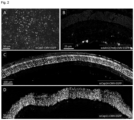
- the inventors packaged with a scCMV-EGFP transgene (CMV: cytomegalovirus promoter). Except for two variants (Cap8 and Cap10), all capsids packaged well with titers between 10 11 -10 12 vg/ml. Three weeks following intravitreal injections into adult mice, robust expression primarily in photoreceptors was observed for Cap3, Cap5, Cap7, Cap9, Cap 11, Cap 13 and Cap 14 (Table 1, Figures 1-3 ), but also some expression in cells of the inner retina such as bipolar cells, amacrine cells and Müller cells and very few retinal ganglion cells.
- AAV2(7m8) which is also an evolved AAV2 variant (Dalkara et al., Sci Transl Med, 2013. 5: p. 189ra76.) and currently considered state-of-the art for intravitreal injections
- the inventors' novel variants penetrated significantly better though the retina and transduced significantly more photoreceptors and significantly less ganglion cells ( Fig. 1 , Figures 1-3 ).
- the new variants transduced photoreceptors in significantly larger number than the titer-matched controls AAV2(M6) and AAV(7m8). Consequently, the selected variants appear to possess superior inner limiting membrane and retinal penetration properties compared to AAV2(M6) and AAV2(7m8) and are significantly more effective in transducing the photoreceptors in the outer nuclear layer (ONL) ( Fig. 1 ).
- Cap14 packaged with scCMV-EGFP and schEf1a-EGFP and injected at 3E+10 vg/ml performed significantly better than AAV2(7m8) injected at the same low dose ( Figs. 1 , 2 ) and even better than AAV2(7m8) at the minimal dose typically used in mouse of 1E+12 vg/ml. This is promising in light of using lower doses in patients to reduce concerns of toxicity and immune responses.
- the Cap gene of the library consists of VP3 (grey sequence), tyrosine to phenylalanine (Y-F) mutations are underlined, base pair numbering refers to the whole VP1 sequence.
Landscapes
- Health & Medical Sciences (AREA)
- Life Sciences & Earth Sciences (AREA)
- Chemical & Material Sciences (AREA)
- Genetics & Genomics (AREA)
- Organic Chemistry (AREA)
- Engineering & Computer Science (AREA)
- General Health & Medical Sciences (AREA)
- Medicinal Chemistry (AREA)
- Bioinformatics & Cheminformatics (AREA)
- Biotechnology (AREA)
- Molecular Biology (AREA)
- General Engineering & Computer Science (AREA)
- Virology (AREA)
- Wood Science & Technology (AREA)
- Zoology (AREA)
- Biophysics (AREA)
- Biochemistry (AREA)
- Biomedical Technology (AREA)
- Veterinary Medicine (AREA)
- Public Health (AREA)
- Animal Behavior & Ethology (AREA)
- Pharmacology & Pharmacy (AREA)
- Epidemiology (AREA)
- Gastroenterology & Hepatology (AREA)
- Physics & Mathematics (AREA)
- Proteomics, Peptides & Aminoacids (AREA)
- Plant Pathology (AREA)
- Microbiology (AREA)
- Ophthalmology & Optometry (AREA)
- Nuclear Medicine, Radiotherapy & Molecular Imaging (AREA)
- Chemical Kinetics & Catalysis (AREA)
- General Chemical & Material Sciences (AREA)
- Dermatology (AREA)
- Medicines That Contain Protein Lipid Enzymes And Other Medicines (AREA)
- Medicines Containing Material From Animals Or Micro-Organisms (AREA)
- Peptides Or Proteins (AREA)
- Pharmaceuticals Containing Other Organic And Inorganic Compounds (AREA)
- Micro-Organisms Or Cultivation Processes Thereof (AREA)
Applications Claiming Priority (2)
| Application Number | Priority Date | Filing Date | Title |
|---|---|---|---|
| EP19206603 | 2019-10-31 | ||
| PCT/EP2020/080704 WO2021084133A1 (en) | 2019-10-31 | 2020-11-02 | Aav vector variants for ocular gene delivery |
Publications (3)
| Publication Number | Publication Date |
|---|---|
| EP4051694A1 EP4051694A1 (en) | 2022-09-07 |
| EP4051694C0 EP4051694C0 (en) | 2025-07-02 |
| EP4051694B1 true EP4051694B1 (en) | 2025-07-02 |
Family
ID=68426130
Family Applications (1)
| Application Number | Title | Priority Date | Filing Date |
|---|---|---|---|
| EP20841660.2A Active EP4051694B1 (en) | 2019-10-31 | 2020-11-02 | Aav vector variants for ocular gene delivery |
Country Status (9)
| Country | Link |
|---|---|
| US (1) | US12509705B2 (https=) |
| EP (1) | EP4051694B1 (https=) |
| JP (1) | JP7791546B2 (https=) |
| KR (1) | KR20220093163A (https=) |
| CN (1) | CN114729009A (https=) |
| AU (1) | AU2020373326A1 (https=) |
| CA (1) | CA3157464A1 (https=) |
| IL (1) | IL291240A (https=) |
| WO (1) | WO2021084133A1 (https=) |
Families Citing this family (11)
| Publication number | Priority date | Publication date | Assignee | Title |
|---|---|---|---|---|
| US20240252679A1 (en) * | 2021-05-28 | 2024-08-01 | Shanghai Regenelead Therapies Co., Ltd. | Recombinant adeno-associated virus having variant capsid, and application thereof |
| KR20240095539A (ko) | 2021-10-08 | 2024-06-25 | 디노 테라퓨틱스, 인코포레이티드 | 캡시드 변이체 및 이의 사용 방법 |
| AU2023220219A1 (en) | 2022-02-17 | 2024-09-05 | Skyline Therapeutics Limited | Recombinant adeno-associated virus with modified aav capsid polypeptides |
| WO2024191778A1 (en) | 2023-03-10 | 2024-09-19 | Dyno Therapeutics, Inc. | Capsid polypeptides and methods of use thereof |
| AU2024276934A1 (en) * | 2023-05-23 | 2025-12-18 | Innovec Biotherapeutics | Adeno-associated virus capsid protein, adeno-associated virus containing same, vector and use thereof |
| AU2024332181A1 (en) | 2023-08-31 | 2026-02-12 | Dyno Therapeutics, Inc. | Capsid polypeptides and methods of use thereof |
| WO2025051292A1 (zh) * | 2024-01-16 | 2025-03-13 | 广州译码基因科技有限公司 | 提高aav病毒对眼组织感染能力的衣壳蛋白突变体及其应用 |
| CN118459557B (zh) * | 2024-01-16 | 2024-11-22 | 沈阳兴齐眼药股份有限公司 | 提高aav病毒视网膜穿透能力的衣壳蛋白突变体及其应用 |
| TW202545971A (zh) | 2024-02-08 | 2025-12-01 | 美商戴諾治療公司 | 殼體多肽及其使用方法 |
| WO2026033140A1 (en) * | 2024-08-09 | 2026-02-12 | Revvity Gene Delivery Gmbh | Variant aav capsid polypeptides targeting the eye |
| WO2026064442A2 (en) | 2024-09-18 | 2026-03-26 | Dyno Therapeutics, Inc. | Capsid polypeptides and methods of use thereof |
Family Cites Families (30)
| Publication number | Priority date | Publication date | Assignee | Title |
|---|---|---|---|---|
| US5284746A (en) | 1990-02-08 | 1994-02-08 | Zymogenetics, Inc. | Methods of producing hybrid G protein-coupled receptors |
| ES2308779T3 (es) | 1995-07-26 | 2008-12-01 | Astrazeneca Ab | Receptores quimericos y metodos para identificar compuestos activos en los receptores de glutamato metabotropico y el uso de tales compuestos en el tratamiento de trastornos y enfermedades neurologicas. |
| US20040248202A1 (en) | 1998-09-03 | 2004-12-09 | Wisconsin Alumni Research Foundation | Bacteriorhodopsin/G protein-coupled receptor chimeras |
| US9284363B2 (en) | 2006-07-26 | 2016-03-15 | Case Western Reserve University | System and method for controlling G-protein coupled receptor pathways |
| MY152003A (en) | 2008-05-29 | 2014-08-15 | Univ Leland Stanford Junior | Cell line, system and method for optical control of secondary messengers |
| WO2012051599A2 (en) | 2010-10-15 | 2012-04-19 | Eos Neuroscience, Inc. | Modulation neural pathways |
| CN105755044A (zh) * | 2011-04-22 | 2016-07-13 | 加利福尼亚大学董事会 | 具有变异衣壳的腺相关病毒病毒体及其使用方法 |
| EP3029063B1 (en) | 2011-06-24 | 2019-10-16 | Arctos Medical AG | Light-sensitive chimeric gpcr protein |
| CA2839938A1 (en) | 2011-06-28 | 2013-01-03 | University Of Rochester | Photoactivatable receptors and their uses |
| US20140087463A1 (en) | 2012-09-25 | 2014-03-27 | The Washington University | Optical control of cell signaling |
| EP3024497B1 (en) | 2013-07-26 | 2021-01-13 | University of Iowa Research Foundation | Methods and compositions for treating brain diseases |
| BR112016017817A2 (pt) | 2014-02-06 | 2017-10-10 | Genzyme Corp | composições e métodos para o tratamento e a prevenção de degeneração macular |
| US20170007720A1 (en) | 2014-02-21 | 2017-01-12 | University Of Florida Research Foundation, Inc. | Methods and compositions for gene delivery to on bipolar cells |
| GB201403260D0 (en) | 2014-02-25 | 2014-04-09 | Univ Manchester | Treatment of retinal degeneration using gene therapy |
| EP4678754A3 (en) | 2014-03-11 | 2026-04-08 | Wayne State University | A modified mglur6 promoter and methods of use |
| AU2016219789B2 (en) | 2015-02-20 | 2021-03-25 | Fondazione Telethon | Methods and compositions for treating genetic eye diseases |
| US11021519B2 (en) * | 2015-03-02 | 2021-06-01 | Adverum Biotechnologies, Inc. | Compositions and methods for intravitreal delivery of polynucleotides to retinal cones |
| US10533187B2 (en) | 2015-03-18 | 2020-01-14 | University Of Florida Research Foundation, Incorporated | Methods and compositions for restoration of cone function in BCM |
| CN105154470A (zh) | 2015-07-22 | 2015-12-16 | 华东师范大学 | 一种高效筛查g蛋白-偶联受体表达的融合基因构建方法 |
| US11364308B2 (en) * | 2016-05-13 | 2022-06-21 | 4D Molecular Therapeutics Inc. | Adeno-associated virus variant capsids and methods of use thereof |
| AU2017302013B2 (en) | 2016-07-29 | 2022-05-26 | The Regents Of The University Of California | Adeno-associated virus virions with variant capsid and methods of use thereof |
| EP4653537A3 (en) | 2016-09-02 | 2026-01-07 | Keio University | Rhodopsin gene therapy for regenerating visual function or for preventing deterioration in visual function |
| US10376265B2 (en) | 2017-01-30 | 2019-08-13 | Ethicon Llc | Non-magnetic fragmentable tissue compression devices |
| CA3053154A1 (en) | 2017-06-30 | 2019-01-03 | The Regents Of The University Of California | Adeno-associated virus virions with variant capsids and methods of use thereof |
| US12043848B2 (en) * | 2017-10-16 | 2024-07-23 | Vigeneron Gmbh | AAV vectors |
| JP7029160B2 (ja) | 2017-11-24 | 2022-03-03 | 公立大学法人大阪 | 新規な光受容タンパク質 |
| CN111770999A (zh) * | 2017-11-27 | 2020-10-13 | 4D分子治疗有限公司 | 腺相关病毒变体衣壳和用于抑制血管生成的应用 |
| WO2020148913A1 (ja) | 2019-01-18 | 2020-07-23 | 俊英 栗原 | 網膜疾患の予防および進行抑制、視覚認知行動機能の改善、および視覚機能強化 |
| CN115052988A (zh) | 2019-11-18 | 2022-09-13 | 伯尔尼大学 | 用于眼部基因递送的给光型双极细胞特异性启动子 |
| US20240174743A1 (en) | 2019-11-29 | 2024-05-30 | Universität Bern | Chimeric opsin gpcr proteins |
-
2020
- 2020-11-02 CN CN202080074852.9A patent/CN114729009A/zh active Pending
- 2020-11-02 KR KR1020227018274A patent/KR20220093163A/ko not_active Ceased
- 2020-11-02 JP JP2022525579A patent/JP7791546B2/ja active Active
- 2020-11-02 US US17/755,434 patent/US12509705B2/en active Active
- 2020-11-02 CA CA3157464A patent/CA3157464A1/en active Pending
- 2020-11-02 WO PCT/EP2020/080704 patent/WO2021084133A1/en not_active Ceased
- 2020-11-02 AU AU2020373326A patent/AU2020373326A1/en not_active Abandoned
- 2020-11-02 EP EP20841660.2A patent/EP4051694B1/en active Active
-
2022
- 2022-03-09 IL IL291240A patent/IL291240A/en unknown
Also Published As
| Publication number | Publication date |
|---|---|
| EP4051694C0 (en) | 2025-07-02 |
| CN114729009A (zh) | 2022-07-08 |
| JP2023504773A (ja) | 2023-02-07 |
| CA3157464A1 (en) | 2021-05-06 |
| WO2021084133A1 (en) | 2021-05-06 |
| JP7791546B2 (ja) | 2025-12-24 |
| US12509705B2 (en) | 2025-12-30 |
| EP4051694A1 (en) | 2022-09-07 |
| AU2020373326A1 (en) | 2022-06-02 |
| US20240287542A1 (en) | 2024-08-29 |
| IL291240A (en) | 2022-05-01 |
| KR20220093163A (ko) | 2022-07-05 |
Similar Documents
| Publication | Publication Date | Title |
|---|---|---|
| EP4051694B1 (en) | Aav vector variants for ocular gene delivery | |
| RU2742724C1 (ru) | Вирионы аденоассоциированного вируса с вариантным капсидом и способы их использования | |
| AU2016219789B2 (en) | Methods and compositions for treating genetic eye diseases | |
| KR20190005223A (ko) | 아데노-관련 바이러스 변이체 캡시드 및 그 용도 | |
| JP2018512125A (ja) | 多重ベクターシステム及びその使用 | |
| AU2014293460A1 (en) | Methods and compositions for treating brain diseases | |
| CA3096088A1 (en) | Compositions and methods for treating macular dystrophy | |
| AU2019304569B2 (en) | Treatment of neuropathy with DNA constructs expressing IGF-1 isoforms | |
| KR20240010489A (ko) | 시력 기능 향상을 위한 조성물 및 방법 | |
| KR20240023126A (ko) | 망막 장애 | |
| CN116368228A (zh) | 用于治疗眼部疾病的组合物和方法 | |
| EP4707397A1 (en) | Promoter for gene expression in retinal cells, and vector system comprising same | |
| EP4511496A2 (en) | Compositions and methods for treating dominant optic atrophy and x-linked retinoschisis | |
| KR20240005950A (ko) | 벡터 시스템 | |
| US20260041791A1 (en) | Compositions and methods for treatment of achromotopsia | |
| US20240307559A1 (en) | Kcnv2 gene therapy | |
| CN112522276B (zh) | 一种emc1核苷酸序列及其应用 | |
| CN117337331A (zh) | 用于增强视觉功能的组合物和方法 | |
| WO2024160770A1 (en) | An aav9 capsid variant for targeted gene transfer | |
| HK40092769A (zh) | 用於治疗眼部疾病的组合物和方法 | |
| EP4370695A1 (en) | Retgc gene therapy | |
| IL321968A (en) | Recombinant adeno-associated virus vector | |
| HK40035863A (en) | Adeno-associated virus virions with variant capsid and methods of use thereof | |
| CN112063625A (zh) | 编码arl2bp的核酸及其应用 |
Legal Events
| Date | Code | Title | Description |
|---|---|---|---|
| STAA | Information on the status of an ep patent application or granted ep patent |
Free format text: STATUS: UNKNOWN |
|
| STAA | Information on the status of an ep patent application or granted ep patent |
Free format text: STATUS: THE INTERNATIONAL PUBLICATION HAS BEEN MADE |
|
| PUAI | Public reference made under article 153(3) epc to a published international application that has entered the european phase |
Free format text: ORIGINAL CODE: 0009012 |
|
| STAA | Information on the status of an ep patent application or granted ep patent |
Free format text: STATUS: REQUEST FOR EXAMINATION WAS MADE |
|
| 17P | Request for examination filed |
Effective date: 20220530 |
|
| AK | Designated contracting states |
Kind code of ref document: A1 Designated state(s): AL AT BE BG CH CY CZ DE DK EE ES FI FR GB GR HR HU IE IS IT LI LT LU LV MC MK MT NL NO PL PT RO RS SE SI SK SM TR |
|
| DAV | Request for validation of the european patent (deleted) | ||
| DAX | Request for extension of the european patent (deleted) | ||
| REG | Reference to a national code |
Ref country code: HK Ref legal event code: DE Ref document number: 40079698 Country of ref document: HK |
|
| STAA | Information on the status of an ep patent application or granted ep patent |
Free format text: STATUS: EXAMINATION IS IN PROGRESS |
|
| 17Q | First examination report despatched |
Effective date: 20240118 |
|
| GRAP | Despatch of communication of intention to grant a patent |
Free format text: ORIGINAL CODE: EPIDOSNIGR1 |
|
| STAA | Information on the status of an ep patent application or granted ep patent |
Free format text: STATUS: GRANT OF PATENT IS INTENDED |
|
| INTG | Intention to grant announced |
Effective date: 20250131 |
|
| GRAS | Grant fee paid |
Free format text: ORIGINAL CODE: EPIDOSNIGR3 |
|
| GRAA | (expected) grant |
Free format text: ORIGINAL CODE: 0009210 |
|
| STAA | Information on the status of an ep patent application or granted ep patent |
Free format text: STATUS: THE PATENT HAS BEEN GRANTED |
|
| AK | Designated contracting states |
Kind code of ref document: B1 Designated state(s): AL AT BE BG CH CY CZ DE DK EE ES FI FR GB GR HR HU IE IS IT LI LT LU LV MC MK MT NL NO PL PT RO RS SE SI SK SM TR |
|
| REG | Reference to a national code |
Ref country code: GB Ref legal event code: FG4D |
|
| REG | Reference to a national code |
Ref country code: CH Ref legal event code: EP |
|
| REG | Reference to a national code |
Ref country code: DE Ref legal event code: R096 Ref document number: 602020053953 Country of ref document: DE |
|
| REG | Reference to a national code |
Ref country code: IE Ref legal event code: FG4D |
|
| U01 | Request for unitary effect filed |
Effective date: 20250801 |
|
| U07 | Unitary effect registered |
Designated state(s): AT BE BG DE DK EE FI FR IT LT LU LV MT NL PT RO SE SI Effective date: 20250812 |
|
| U20 | Renewal fee for the european patent with unitary effect paid |
Year of fee payment: 6 Effective date: 20250930 |
|
| REG | Reference to a national code |
Ref country code: CH Ref legal event code: U11 Free format text: ST27 STATUS EVENT CODE: U-0-0-U10-U11 (AS PROVIDED BY THE NATIONAL OFFICE) Effective date: 20251201 |
|
| PG25 | Lapsed in a contracting state [announced via postgrant information from national office to epo] |
Ref country code: IS Free format text: LAPSE BECAUSE OF FAILURE TO SUBMIT A TRANSLATION OF THE DESCRIPTION OR TO PAY THE FEE WITHIN THE PRESCRIBED TIME-LIMIT Effective date: 20251102 |
|
| PGFP | Annual fee paid to national office [announced via postgrant information from national office to epo] |
Ref country code: GB Payment date: 20251120 Year of fee payment: 6 |
|
| PG25 | Lapsed in a contracting state [announced via postgrant information from national office to epo] |
Ref country code: NO Free format text: LAPSE BECAUSE OF FAILURE TO SUBMIT A TRANSLATION OF THE DESCRIPTION OR TO PAY THE FEE WITHIN THE PRESCRIBED TIME-LIMIT Effective date: 20251002 |
|
| PG25 | Lapsed in a contracting state [announced via postgrant information from national office to epo] |
Ref country code: HR Free format text: LAPSE BECAUSE OF FAILURE TO SUBMIT A TRANSLATION OF THE DESCRIPTION OR TO PAY THE FEE WITHIN THE PRESCRIBED TIME-LIMIT Effective date: 20250702 |
|
| PG25 | Lapsed in a contracting state [announced via postgrant information from national office to epo] |
Ref country code: GR Free format text: LAPSE BECAUSE OF FAILURE TO SUBMIT A TRANSLATION OF THE DESCRIPTION OR TO PAY THE FEE WITHIN THE PRESCRIBED TIME-LIMIT Effective date: 20251003 |
|
| PGFP | Annual fee paid to national office [announced via postgrant information from national office to epo] |
Ref country code: CH Payment date: 20251201 Year of fee payment: 6 |
|
| PG25 | Lapsed in a contracting state [announced via postgrant information from national office to epo] |
Ref country code: CZ Free format text: LAPSE BECAUSE OF FAILURE TO SUBMIT A TRANSLATION OF THE DESCRIPTION OR TO PAY THE FEE WITHIN THE PRESCRIBED TIME-LIMIT Effective date: 20250702 |
|
| PG25 | Lapsed in a contracting state [announced via postgrant information from national office to epo] |
Ref country code: PL Free format text: LAPSE BECAUSE OF FAILURE TO SUBMIT A TRANSLATION OF THE DESCRIPTION OR TO PAY THE FEE WITHIN THE PRESCRIBED TIME-LIMIT Effective date: 20250702 |
|
| PG25 | Lapsed in a contracting state [announced via postgrant information from national office to epo] |
Ref country code: RS Free format text: LAPSE BECAUSE OF FAILURE TO SUBMIT A TRANSLATION OF THE DESCRIPTION OR TO PAY THE FEE WITHIN THE PRESCRIBED TIME-LIMIT Effective date: 20251002 |
|
| PG25 | Lapsed in a contracting state [announced via postgrant information from national office to epo] |
Ref country code: ES Free format text: LAPSE BECAUSE OF FAILURE TO SUBMIT A TRANSLATION OF THE DESCRIPTION OR TO PAY THE FEE WITHIN THE PRESCRIBED TIME-LIMIT Effective date: 20250702 |
|
| PG25 | Lapsed in a contracting state [announced via postgrant information from national office to epo] |
Ref country code: SM Free format text: LAPSE BECAUSE OF FAILURE TO SUBMIT A TRANSLATION OF THE DESCRIPTION OR TO PAY THE FEE WITHIN THE PRESCRIBED TIME-LIMIT Effective date: 20250702 |
|
| PG25 | Lapsed in a contracting state [announced via postgrant information from national office to epo] |
Ref country code: SK Free format text: LAPSE BECAUSE OF FAILURE TO SUBMIT A TRANSLATION OF THE DESCRIPTION OR TO PAY THE FEE WITHIN THE PRESCRIBED TIME-LIMIT Effective date: 20250702 |