EP4050409B1 - Elektronische vorrichtung - Google Patents
Elektronische vorrichtung Download PDFInfo
- Publication number
- EP4050409B1 EP4050409B1 EP22158903.9A EP22158903A EP4050409B1 EP 4050409 B1 EP4050409 B1 EP 4050409B1 EP 22158903 A EP22158903 A EP 22158903A EP 4050409 B1 EP4050409 B1 EP 4050409B1
- Authority
- EP
- European Patent Office
- Prior art keywords
- pad
- lead
- dummy
- pads
- leads
- Prior art date
- Legal status (The legal status is an assumption and is not a legal conclusion. Google has not performed a legal analysis and makes no representation as to the accuracy of the status listed.)
- Active
Links
Images





Classifications
-
- G—PHYSICS
- G01—MEASURING; TESTING
- G01R—MEASURING ELECTRIC VARIABLES; MEASURING MAGNETIC VARIABLES
- G01R31/00—Arrangements for testing electric properties; Arrangements for locating electric faults; Arrangements for electrical testing characterised by what is being tested not provided for elsewhere
- G01R31/28—Testing of electronic circuits, e.g. by signal tracer
- G01R31/2832—Specific tests of electronic circuits not provided for elsewhere
- G01R31/2836—Fault-finding or characterising
- G01R31/2844—Fault-finding or characterising using test interfaces, e.g. adapters, test boxes, switches, PIN drivers
-
- H—ELECTRICITY
- H01—ELECTRIC ELEMENTS
- H01L—SEMICONDUCTOR DEVICES NOT COVERED BY CLASS H10
- H01L22/00—Testing or measuring during manufacture or treatment; Reliability measurements, i.e. testing of parts without further processing to modify the parts as such; Structural arrangements therefor
- H01L22/30—Structural arrangements specially adapted for testing or measuring during manufacture or treatment, or specially adapted for reliability measurements
- H01L22/32—Additional lead-in metallisation on a device or substrate, e.g. additional pads or pad portions, lines in the scribe line, sacrificed conductors
-
- H—ELECTRICITY
- H05—ELECTRIC TECHNIQUES NOT OTHERWISE PROVIDED FOR
- H05K—PRINTED CIRCUITS; CASINGS OR CONSTRUCTIONAL DETAILS OF ELECTRIC APPARATUS; MANUFACTURE OF ASSEMBLAGES OF ELECTRICAL COMPONENTS
- H05K1/00—Printed circuits
- H05K1/02—Details
- H05K1/11—Printed elements for providing electric connections to or between printed circuits
- H05K1/118—Printed elements for providing electric connections to or between printed circuits specially for flexible printed circuits, e.g. using folded portions
-
- G—PHYSICS
- G02—OPTICS
- G02F—OPTICAL DEVICES OR ARRANGEMENTS FOR THE CONTROL OF LIGHT BY MODIFICATION OF THE OPTICAL PROPERTIES OF THE MEDIA OF THE ELEMENTS INVOLVED THEREIN; NON-LINEAR OPTICS; FREQUENCY-CHANGING OF LIGHT; OPTICAL LOGIC ELEMENTS; OPTICAL ANALOGUE/DIGITAL CONVERTERS
- G02F1/00—Devices or arrangements for the control of the intensity, colour, phase, polarisation or direction of light arriving from an independent light source, e.g. switching, gating or modulating; Non-linear optics
- G02F1/01—Devices or arrangements for the control of the intensity, colour, phase, polarisation or direction of light arriving from an independent light source, e.g. switching, gating or modulating; Non-linear optics for the control of the intensity, phase, polarisation or colour
- G02F1/13—Devices or arrangements for the control of the intensity, colour, phase, polarisation or direction of light arriving from an independent light source, e.g. switching, gating or modulating; Non-linear optics for the control of the intensity, phase, polarisation or colour based on liquid crystals, e.g. single liquid crystal display cells
- G02F1/133—Constructional arrangements; Operation of liquid crystal cells; Circuit arrangements
- G02F1/1333—Constructional arrangements; Manufacturing methods
- G02F1/1345—Conductors connecting electrodes to cell terminals
- G02F1/13458—Terminal pads
-
- G—PHYSICS
- G01—MEASURING; TESTING
- G01R—MEASURING ELECTRIC VARIABLES; MEASURING MAGNETIC VARIABLES
- G01R27/00—Arrangements for measuring resistance, reactance, impedance, or electric characteristics derived therefrom
- G01R27/02—Measuring real or complex resistance, reactance, impedance, or other two-pole characteristics derived therefrom, e.g. time constant
- G01R27/025—Measuring very high resistances, e.g. isolation resistances, i.e. megohm-meters
-
- G—PHYSICS
- G01—MEASURING; TESTING
- G01R—MEASURING ELECTRIC VARIABLES; MEASURING MAGNETIC VARIABLES
- G01R27/00—Arrangements for measuring resistance, reactance, impedance, or electric characteristics derived therefrom
- G01R27/02—Measuring real or complex resistance, reactance, impedance, or other two-pole characteristics derived therefrom, e.g. time constant
- G01R27/08—Measuring resistance by measuring both voltage and current
-
- G—PHYSICS
- G01—MEASURING; TESTING
- G01R—MEASURING ELECTRIC VARIABLES; MEASURING MAGNETIC VARIABLES
- G01R31/00—Arrangements for testing electric properties; Arrangements for locating electric faults; Arrangements for electrical testing characterised by what is being tested not provided for elsewhere
- G01R31/28—Testing of electronic circuits, e.g. by signal tracer
- G01R31/282—Testing of electronic circuits specially adapted for particular applications not provided for elsewhere
- G01R31/2825—Testing of electronic circuits specially adapted for particular applications not provided for elsewhere in household appliances or professional audio/video equipment
-
- G—PHYSICS
- G01—MEASURING; TESTING
- G01R—MEASURING ELECTRIC VARIABLES; MEASURING MAGNETIC VARIABLES
- G01R31/00—Arrangements for testing electric properties; Arrangements for locating electric faults; Arrangements for electrical testing characterised by what is being tested not provided for elsewhere
- G01R31/28—Testing of electronic circuits, e.g. by signal tracer
- G01R31/2851—Testing of integrated circuits [IC]
- G01R31/2855—Environmental, reliability or burn-in testing
- G01R31/286—External aspects, e.g. related to chambers, contacting devices or handlers
- G01R31/2863—Contacting devices, e.g. sockets, burn-in boards or mounting fixtures
-
- H—ELECTRICITY
- H05—ELECTRIC TECHNIQUES NOT OTHERWISE PROVIDED FOR
- H05K—PRINTED CIRCUITS; CASINGS OR CONSTRUCTIONAL DETAILS OF ELECTRIC APPARATUS; MANUFACTURE OF ASSEMBLAGES OF ELECTRICAL COMPONENTS
- H05K1/00—Printed circuits
- H05K1/02—Details
- H05K1/0266—Marks, test patterns or identification means
- H05K1/0268—Marks, test patterns or identification means for electrical inspection or testing
-
- H—ELECTRICITY
- H05—ELECTRIC TECHNIQUES NOT OTHERWISE PROVIDED FOR
- H05K—PRINTED CIRCUITS; CASINGS OR CONSTRUCTIONAL DETAILS OF ELECTRIC APPARATUS; MANUFACTURE OF ASSEMBLAGES OF ELECTRICAL COMPONENTS
- H05K1/00—Printed circuits
- H05K1/18—Printed circuits structurally associated with non-printed electric components
- H05K1/189—Printed circuits structurally associated with non-printed electric components characterised by the use of a flexible or folded printed circuit
-
- H—ELECTRICITY
- H05—ELECTRIC TECHNIQUES NOT OTHERWISE PROVIDED FOR
- H05K—PRINTED CIRCUITS; CASINGS OR CONSTRUCTIONAL DETAILS OF ELECTRIC APPARATUS; MANUFACTURE OF ASSEMBLAGES OF ELECTRICAL COMPONENTS
- H05K3/00—Apparatus or processes for manufacturing printed circuits
- H05K3/30—Assembling printed circuits with electric components, e.g. with resistor
- H05K3/32—Assembling printed circuits with electric components, e.g. with resistor electrically connecting electric components or wires to printed circuits
- H05K3/321—Assembling printed circuits with electric components, e.g. with resistor electrically connecting electric components or wires to printed circuits by conductive adhesives
- H05K3/323—Assembling printed circuits with electric components, e.g. with resistor electrically connecting electric components or wires to printed circuits by conductive adhesives by applying an anisotropic conductive adhesive layer over an array of pads
-
- H—ELECTRICITY
- H10—SEMICONDUCTOR DEVICES; ELECTRIC SOLID-STATE DEVICES NOT OTHERWISE PROVIDED FOR
- H10D—INORGANIC ELECTRIC SEMICONDUCTOR DEVICES
- H10D86/00—Integrated devices formed in or on insulating or conducting substrates, e.g. formed in silicon-on-insulator [SOI] substrates or on stainless steel or glass substrates
- H10D86/40—Integrated devices formed in or on insulating or conducting substrates, e.g. formed in silicon-on-insulator [SOI] substrates or on stainless steel or glass substrates characterised by multiple TFTs
- H10D86/441—Interconnections, e.g. scanning lines
-
- H—ELECTRICITY
- H10—SEMICONDUCTOR DEVICES; ELECTRIC SOLID-STATE DEVICES NOT OTHERWISE PROVIDED FOR
- H10D—INORGANIC ELECTRIC SEMICONDUCTOR DEVICES
- H10D86/00—Integrated devices formed in or on insulating or conducting substrates, e.g. formed in silicon-on-insulator [SOI] substrates or on stainless steel or glass substrates
- H10D86/40—Integrated devices formed in or on insulating or conducting substrates, e.g. formed in silicon-on-insulator [SOI] substrates or on stainless steel or glass substrates characterised by multiple TFTs
- H10D86/60—Integrated devices formed in or on insulating or conducting substrates, e.g. formed in silicon-on-insulator [SOI] substrates or on stainless steel or glass substrates characterised by multiple TFTs wherein the TFTs are in active matrices
-
- H—ELECTRICITY
- H10—SEMICONDUCTOR DEVICES; ELECTRIC SOLID-STATE DEVICES NOT OTHERWISE PROVIDED FOR
- H10H—INORGANIC LIGHT-EMITTING SEMICONDUCTOR DEVICES HAVING POTENTIAL BARRIERS
- H10H20/00—Individual inorganic light-emitting semiconductor devices having potential barriers, e.g. light-emitting diodes [LED]
- H10H20/80—Constructional details
- H10H20/85—Packages
- H10H20/857—Interconnections, e.g. lead-frames, bond wires or solder balls
-
- H—ELECTRICITY
- H10—SEMICONDUCTOR DEVICES; ELECTRIC SOLID-STATE DEVICES NOT OTHERWISE PROVIDED FOR
- H10K—ORGANIC ELECTRIC SOLID-STATE DEVICES
- H10K59/00—Integrated devices, or assemblies of multiple devices, comprising at least one organic light-emitting element covered by group H10K50/00
- H10K59/10—OLED displays
- H10K59/12—Active-matrix OLED [AMOLED] displays
- H10K59/131—Interconnections, e.g. wiring lines or terminals
-
- H—ELECTRICITY
- H05—ELECTRIC TECHNIQUES NOT OTHERWISE PROVIDED FOR
- H05K—PRINTED CIRCUITS; CASINGS OR CONSTRUCTIONAL DETAILS OF ELECTRIC APPARATUS; MANUFACTURE OF ASSEMBLAGES OF ELECTRICAL COMPONENTS
- H05K1/00—Printed circuits
- H05K1/02—Details
- H05K1/11—Printed elements for providing electric connections to or between printed circuits
- H05K1/111—Pads for surface mounting, e.g. lay-out
-
- H—ELECTRICITY
- H05—ELECTRIC TECHNIQUES NOT OTHERWISE PROVIDED FOR
- H05K—PRINTED CIRCUITS; CASINGS OR CONSTRUCTIONAL DETAILS OF ELECTRIC APPARATUS; MANUFACTURE OF ASSEMBLAGES OF ELECTRICAL COMPONENTS
- H05K2201/00—Indexing scheme relating to printed circuits covered by H05K1/00
- H05K2201/10—Details of components or other objects attached to or integrated in a printed circuit board
- H05K2201/10007—Types of components
- H05K2201/10128—Display
Definitions
- the present inventive concept relates to an electronic apparatus, and more particularly, to an electronic apparatus having increased manufacturing efficiency and reliability.
- an electronic apparatus typically includes two or more electronic components.
- an electronic apparatus such as a mobile phone, a notebook computer, or a television includes an electronic panel, a circuit board, or the like that generates an image.
- the electronic panel and the circuit board are electrically connected to each other through connections of pads.
- the two electronic components may be physically and electrically combined.
- the two electronic components may be combined by means of a thermo-compression tool or the like, after a step for arranging a conductive adhesive member and the pads.
- the electronic apparatus includes an inspection pad for determining whether the two electronic components are well connected. However, when a defective connection of the inspection pad is generated, despite the presence of a stable electrical connection between the circuit board and the electronic panel, an error may occur indicating a defective connection between the circuit board and the electronic panel.
- US 2019/067406 A1 US 2019/348357 A1 relate to display devices in which a circuit board is coupled to an electronic panel.
- the invention provides an electronic apparatus according to claim 1 and an electronic apparatus according to claim 12.
- the present inventive concept provides an electronic apparatus having an increased inspection reliability.
- an electronic apparatus includes an electronic panel comprising a base substrate, a plurality of pixels on the base substrate, and a plurality of pads in an adhesive area.
- the plurality of pads are spaced apart from the plurality of pixels.
- a circuit board comprises a base film, and a plurality of leads disposed on the base film and overlapping the plurality of pads in a plan view.
- a conductive adhesive member is disposed on the adhesive area and is configured to electrically connect the circuit board and the electronic panel.
- the plurality of pads comprises a plurality of pixel pads electrically connected to the plurality of pixels, an arrangement pad spaced apart from the plurality of pixel pads for providing, together with an arrangement lead, a reference for arrangement between the electronic panel and the circuit board when the electronic panel and the circuit board are combined by the adhesive member, and a resistance measurement pad disposed between the arrangement pad and the plurality of pixels pads and insulated from the plurality of pixel pads.
- the plurality of leads comprises a plurality of pixel leads overlapping the plurality of pixel pads in the plan view, an arrangement lead overlapping the arrangement pad in the plan view, and a resistance measurement lead disposed between the plurality of pixel leads and the arrangement lead and insulated from the plurality of pixel leads.
- the resistance measurement lead comprises a plurality of measurement leads disposed between the arrangement lead and the plurality of pixel leads and electrically connected to the resistance measurement pad, and a dummy lead spaced apart from each of the plurality of resistance measurement leads in the plan view, wherein the connection of the measurement leads to the resistance measurement pad forms a resistance measurement pattern.
- the resistance measurement lead may include first, second, and third leads arranged consecutively along a direction from the arrangement lead towards the pixel leads, and the third lead may be connected to a plurality of terminals.
- the dummy lead may be disposed between the first lead and the second lead.
- the dummy lead may be disposed between the first lead and the arrangement lead.
- the resistance measurement pad may include: a first pad connected with the first lead; a second pad connected with the second lead; and a third pad connected with the third lead.
- the first to third pads are connected with each other.
- the resistance measurement pad may further include a dummy pad disposed between the first pad and the second pad, and spaced apart from the first to third pads in the plan view. The dummy pad overlaps the dummy lead in the plan view.
- the dummy pad and the dummy lead may be connected with each other through the conductive adhesive member.
- a gap between the dummy pad and the dummy lead in a thickness direction of the electronic apparatus may be larger than a gap between the pixel lead and the pixel pad in the thickness direction of the electronic apparatus.
- the dummy lead may include a first dummy lead and a second dummy lead spaced apart from each other with the arrangement lead disposed therebetween.
- the first dummy lead includes a plurality of first dummy leads and the second dummy lead includes a plurality of second dummy leads. At least one of the plurality of first dummy leads has a shape that is different from a shape of another first dummy lead of the plurality of first dummy leads. At least one of the plurality of second dummy leads has a shape that is different from a shape of another second dummy lead of the plurality of second dummy leads.
- the plurality of leads may further include driving evaluation leads spaced apart from the arrangement lead and configured to receive an electrical signal, and the first dummy lead and the second dummy lead may be disposed in an area surrounded by the resistance measurement lead, the arrangement lead, and the driving evaluation leads.
- an electronic apparatus includes an electronic panel comprising a base substrate, a plurality of pixels on the base substrate, and a plurality of pads in an adhesive area.
- the plurality of pads are spaced apart from the plurality of pixels.
- a circuit board comprises a base film, and a plurality of leads disposed on the base film and overlapping the plurality of pads in a plan view.
- a conductive adhesive member is disposed on the adhesive area and is configured to electrically connect the circuit board and the electronic panel.
- the plurality of pads includes pixel pads electrically connected to the pixels and the circuit board.
- An arrangement pad is electrically insulated from the pixel pads for providing, together with an arrangement lead, a reference for arrangement between the electronic panel and the circuit board when the electronic panel and the circuit board are combined by the adhesive member.
- Resistance measurement pads are insulated from the pixel pads, and are electrically connected to the circuit board.
- a dummy pad is disposed between the arrangement pad and the pixel pads and is spaced apart from the resistance measurement pads in the plan view, wherein the connection of the measurement leads to the resistance measurement pad forms a resistance measurement pattern.
- the resistance measurement pads include first, second, and third pads arranged consecutively along a direction from the arrangement pad toward the pixel pads, and the dummy pad is disposed between the first pad and the second pad.
- the first to third pads may be connected with each other, and the dummy pad may be spaced apart from the first to third pads.
- the dummy pad may be disposed between the first pad and the arrangement pad.
- the dummy pad may include: a first dummy pad disposed among the arrangement pad, the first pad, and the plurality of pixels; and a second dummy lead spaced apart from the first dummy pad with the arrangement pad disposed therebetween.
- the plurality of leads may include: first to third leads separately disposed from each other and respectively connected to the first to third pads; and a dummy lead overlapping the dummy pad in the plan view.
- the dummy lead may be connected with the dummy pad.
- At least one of the base film or the base substrate includes a deformation that is positioned in an area in which the dummy lead or the dummy pad is disposed, and the dummy lead may be electrically insulated from the dummy pad.
- the third lead may be connected to a plurality of terminals.
- first, second, and the like may be used to describe various components, but these components should not be limited by the terms. These terms are only used to distinguish one element from another. For instance, a first component may be referred to as a second component, or similarly, a second component may be referred to as a first component, without departing from the scope of the present inventive concept. As used herein, the singular forms “a,” “an,” and “the” may be intended to include the plural forms as well, unless the context clearly indicates otherwise.
- FIG. 1 is a perspective view of an electronic apparatus according to an embodiment of the present inventive concept.
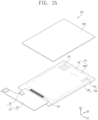
- FIG. 2A is an exploded perspective view of the electronic apparatus shown in FIG. 1 .
- FIG. 2B is a perspective view illustrating a portion of the electronic apparatus shown in FIG. 1 .
- embodiments of the present inventive concept will be described with reference to FIGS. 1 to 2B .
- An electronic apparatus EA includes an electronic panel EP, a circuit board CF, a driving chip CC, a conductive adhesive member AF ( FIG. 3A ), and an optical member OPL.
- the electronic panel EP displays an image on the front surface.
- the front surface may be defined in a first direction D1 and a second direction D2, and may be perpendicular to a third direction D3 which is a thickness direction of the electronic apparatus EA.
- the first direction D1, second direction D2 and third direction D3 may be perpendicular to each other.
- embodiments of the present inventive concept are not limited thereto and the first to third directions D1 to D3 may cross each other at various different angles.
- the front surface may be divided into an active area AA in which the image is displayed and a non-active area NAA adjacent to the active area AA.
- the non-active area NAA may have a frame shape surrounding the edge of the active area AA.
- embodiments of the present inventive concept are not limited thereto, and the non-active area NAA may be defined to be adjacent to a portion of the edge of the display area AA.
- the electronic panel EP may sense an external input.
- the electronic panel EP may include sensors disposed in the active area AA, and may sense the position or the strength of the external input applied to the active area AA.
- the sensors may be driven in an electrostatic type, a pressure sensitive type, or in other various types.
- the external input may be provided in various types including a hand of a user, an electromagnetic pen, light, heat, and the like.
- embodiments of the present inventive concept are not limited thereto and the external input may vary.
- the electronic panel EP may sense the external input when the external input is proximate to or in direct contact with the electronic panel EP.
- an electronic panel on which an image is displayed will be described for convenience of explanation and not limitation.
- the electronic panel EP includes a base substrate BS and a plurality of pixels PX.
- Each of the pixels PX may receive an electrical signal to display light forming the image.
- the pixels PX in FIG. 2A are illustrated to respectively correspond to light emission areas in which the light is displayed. Accordingly, the pixels PX are illustrated to be disposed in the active area AA and are spaced apart from each other (e.g., in the first and/or second directions D1, D2).
- embodiments of the present inventive concept are not limited thereto, and some among components configuring each of the pixels PX may be disposed in the non-active area NAA, disposed to be superimposed with components of an adjacent pixel in a plan view, etc.
- Each of the pixels PX may include at least one transistor or a display element.
- the transistor may include various semiconductor materials such as an oxide semiconductor, a multi-crystal semiconductor, a single-crystal semiconductor and an amorphous semiconductor.
- the display element may be electrically connected to the transistor and driven by the transistor.
- the display device may include a liquid crystal capacitor, an organic light emitting element, an inorganic light emitting element, an electrophoretic element, or an electric wetting element, and include various electric elements such as an OLED, or an ultra-small LED that may display light.
- embodiments of the present inventive concept are not limited thereto.
- the circuit board CF is disposed at one side of the electronic panel EP and electrically connected thereto.
- the circuit board CF may be disposed on a lower side of the electronic panel EP (e.g., in the second direction D2).
- the circuit board CF may be disposed in various different sides of the electronic panel EP.
- the circuit board CF may generate an electrical signal to provide the same to the electronic panel EP, and receive an electrical signal generated in and received from the electronic panel EP to process the same.
- electrical signals generated in the circuit board CF may be provided to each of the pixels PX through signal lines SL of the electronic panel EP.
- the signal lines SL may be electrically connected to the pixels PX.
- some of the signal lines SL may be electrically connected to sensors.
- the circuit board CF may include various components which are electrically connected to the electronic panel EP.
- the circuit board CF may include a flexible film CB and the driving chip CC.
- the flexible film CB may be directly attached to the electronic panel EP through a conductive adhesive member AF to electrically connect the circuit board CF to the electronic panel EP.
- the flexible film CB may have flexibility. Accordingly, the flexible film CB may be assembled in a curved state in which the flexible film CB is bent towards the rear surface of the electronic panel EP.
- the driving chip CC may be mounted on the flexible film CB in a chip-on-film manner.
- the driving chip CC may be electrically connected to the flexible film CB through circuit lines included in the flexible film CB.
- the flexible film CB may electrically connect the driving chip CC and the electronic panel EP, and the driving chip CC may generate an electrical signal to be provided to the electronic panel EP or process an electrical signal provided from the electronic panel EP.
- the driving chip CC may include a gate driving circuit configured to generate gate signals or a data driving circuit configured to generate data signals. However, the driving chip CC may include various control circuits configured to generate and process various kinds of control signals for driving the electronic panel EP.
- the conductive adhesive member AF is disposed between the circuit board CF and the electronic panel EP to combine them.
- the conductive adhesive member AF may have both electrical conductivity and adhesiveness for attaching the circuit board CF to the electronic panel EP. Accordingly, the conductive adhesive member AF may physically and electrically combine the circuit board CF and the electronic panel EP.
- the conductive adhesive member AF may include an anisotropic conductive adhesive film (ACF).
- ACF anisotropic conductive adhesive film
- the conductive adhesive member AF may extend along a direction intersecting with the signal lines SL.
- the conductive adhesive member AF may be provided in a shape having a length extending along the first direction DR1, but is not limited thereto. A portion of the conductive adhesive member AF may protrude to the outer side of the flexible film CB.
- the length in the first direction DR1 of the conductive adhesive member AF on the electronic panel EP may be greater than or equal to the width of the flexible film CB in the first direction DR1. Accordingly, the ends of the conductive adhesive member AF may be aligned with a corner of the flexible film CB, or a portion of the conductive adhesive member AF may be exposed from the flexible film CB.
- the driving circuit DV may be electrically connected to the electronic panel EP, in particular, to the pixels PX.
- the driving circuit DV may include a data driving circuit configured to provide data signals to the pixels PX.
- the driving circuit DV may include various driving circuits such as a gate driving circuit, a light emitting control circuit, a power generation circuit, or the like, that provide electrical signals to the pixels PX.
- the driving circuit DV may be mounted on the electronic panel EP in a chip-on-panel manner.
- the driving circuit DV may be provided through the same process as the pixels PX, such as a low temperature silicon process, to configure the electronic panel EP.
- the driving circuit DV may be disposed in a different area of the electronic apparatus EA other than the area between the active area AA and the circuit board CF, or may be omitted altogether.
- the optical member OPL is disposed on the electronic panel EP.
- a lower surface of the optical member OPL may be disposed directly on an upper surface of the electronic panel EP (e.g., in the third direction D3).
- the optical member OPL covers the active area AA.
- the optical member OPL may be optically transparent. Accordingly, an image displayed in the active area AA is transmitted through the optical member OPL.
- the image displayed by the electronic panel EP may be transmitted through the optical member OPL, and be displayed on the top surface of the optical member OPL to be easily viewed by a user.
- the optical member OPL may further cover at least a portion of the non-active area NAA.
- the optical member OPL may lower the external light reflectance.
- the optical member OPL may lower a ratio of external light incident on the front surface FS of the electronic panel EP, or lower the transmittance of reflective light when the external light incident through the optical member OPL is reflected and output from the components of the electronic panel EP.
- the optical member OPL may include at least one of a polarization film or a phase difference film.
- the optical member OPL may include a color filter or a black matrix.
- the optical member OPL may be attached to the front surface FS of the electronic panel EP by means of an adhesive member or the like, or directly formed on the front surface FS of the electronic panel EP.
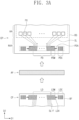
- FIG. 3C is an exploded plan view of the electronic apparatus shown in FIG. 1
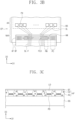
- FIG. 3B is a combined plan view of the electronic apparatus shown in FIG. 3A
- FIG. 3C is a cross-sectional view taken along line I-I' shown in FIG. 3B .
- FIGS. 3A to 3C an embodiment of the present inventive concept will be described with reference to FIGS. 3A to 3C .
- the electronic panel EP includes the base substrate BS, the pixels PX, the signal lines SL, a plurality of pixel pads PD, an arrangement pad PDA, a plurality of resistance measurement pads PDM, and a plurality of driving evaluation pads PDC.
- the base substrate BS includes the active area AA and the non-active area NAA, and is a base layer on which the pixels PX, the signal lines SL, the pixel pads PD, the arrangement pad PDA, the resistance measurement pads PDM, and the driving evaluation pads PDC are disposed.
- the base substrate BS may have an insulating property.
- each of the pixel pads PD, the arrangement pad PDA, the resistance measurement pads PDM, and the driving evaluation pads PDC may have conductivity.
- the signal lines SL may respectively connect the pixel pads PD and the pixels PX. Accordingly, the electrical signals received from the pixel pads PD may be delivered to each of the pixel pads PD through the signal lines SL.
- the pixel pads PD may extend along a direction inclined against (e.g., between) the first direction D1 and the second direction D2. However, embodiments of the present inventive concept are not limited thereto. For example, the pixel pads PD may extend along a direction parallel to the second direction D2 or may be variously arranged.
- the arrangement pad PDA is disposed to be spaced from the pixel pads PD in the first direction D1.
- the arrangement pad PDA is a reference for arrangement between the electronic panel EP and the circuit board CF together with an arrangement lead LDA when the electronic panel EP and the circuit board CF are combined by the adhesive member AF to be described later. If the circuit board circuit board CF and the electronic panel EP are aligned each other, an align mark AM would be formed by overlapping the arrangement pad PDA and the arrangement lead LDA.
- the arrangement pad PDA is electrically insulated from the pixel pads PD.
- the resistance measurement pad PDM is disposed between the pixel pads PD and the arrangement pad PDA (e.g., in the first direction D1).
- the resistance measurement pad PDM is spaced apart from the signal lines SL and the pixel pads PD on the plane (e.g., in a plane defined in the first and second directions D1, D2).
- the resistance measurement pad PDM is illustrated to have a similar shape to the pixel pads PD and is directly connected to the arrangement pad PDA.
- the resistance measurement pad PDM may have various different shapes and orientations.
- the resistance measurement pad PDM is electrically insulated from the pixel pads PD.
- the driving evaluation pads PDC may be electrically connected to at least some of the pixels PX through the signal lines SL.
- the driving evaluation pads PDC may be used for evaluating the electrical reliability of the electronic panel EP, and may receive independent signals from the pixel pads PD and the resistance measurement pad PDM. However, the driving evaluation pads PDC may be omitted in the electronic panel EP.
- the pixel pads PD, the resistance measurement pad PDM and the driving evaluation pads PDC may be disposed in an adhesive area ADA ( FIG. 5A ) of the electronic panel EP which may be positioned in the non-active area NAA of the base substrate BS.
- the circuit board CF includes a base film BF, a plurality of lines SL-F, a plurality of pixel leads LD, an arrangement lead LDA, a plurality of resistance measurement leads LDM, and a plurality of driving evaluation leads LDC.
- the base film BF may have flexibility and insulating properties. Accordingly, as described above, the flexible film CB may be curved in a combined state to the electronic panel EP.
- the lines SL-F, the pixel leads LD, the arrangement lead LDA, the resistance measurement lead LDM, and the driving evaluation leads LDC are arranged on one surface of the base film BF.
- Each of the lines SL-F, the pixel leads LD, the arrangement lead LDA, the resistance measurement lead LDM, and the driving evaluation leads LDC may be conductive.
- the resistance measurement lead LDM may be electrically insulated from the pixel leads LD.
- the pixel leads LD are electrically connected with the pixel pads PD of the electronic panel EP.
- the pixel leads LD may be spaced apart from each other along the first direction D1 and provide independent electrical signals.
- the pixel leads LD may extend along a direction inclined against (e.g., between) the first direction D1 and a second direction D2.
- embodiments of the present inventive concept are not limited thereto.
- the pixel leads LD may have a shape substantially corresponding to a shape of the pixel pads PD.
- Thermal deformation may be generated in the base film BF of the circuit board CF or in the base substrate BS of the electronic panel EP due to heat or the like generated in a bonding process of the circuit board CF and the electronic panel EP. Accordingly, the pitch of the pixel pads PD or the pitch of the pixel leads LD may be deformed during the manufacturing process.
- the pixel leads LD and the pixel pads PD are designed in a shape to extend along the inclined direction (e.g., between the first and second directions D1, D2), and thus even when the pitch of the pixel leads LD or the pixel pads PD is deformed, arrangement between the pixel pads PD and the pixel leads LD may be easily corrected through a positional movement of the circuit board CF in the second direction D2.
- embodiments of the present inventive concept are not limited thereto.
- the pixel leads LD may be provided in a shape extending along a direction parallel to the second direction D2.
- the lines SL-F are disposed on one surface of the base film BF. First ends of the lines SL-F may be respectively connected to the pixel leads LD. The second ends of the lines SL-F that are opposite to the first ends may be electrically connected to the driving chip CC (see FIG. 1 ). Accordingly, the electrical signals processed in the driving circuit DV may be output to the pixel leads LD through the lines SL-F.
- the arrangement lead LDA may be separated on the plane from the pixel leads LD.
- the arrangement leads LDA may be arranged separately from the pixel leads LD and may be spaced apart therefrom in the first direction D1.
- the arrangement between the circuit board CF and the electronic panel EP may be controlled by the degree of superposition between the arrangement pad PDA and the arrangement lead LDA.
- the arrangement lead LDA is illustrated in a symmetric shape with the arrangement pad PDA on the basis of an axis extending along the first direction D1.
- embodiments of the present inventive concept are not limited thereto, and the arrangement lead LDA may be designed in various different shapes.
- the conductive adhesive member AF and the circuit board CF may be sequentially laminated on the pixel pads PD along the direction of the arrows shown in FIG. 3A .
- the conductive adhesive member AF is provided in an adhesive area ADA ( FIG. 5A ) of the electronic panel EP, and after the circuit board CF is disposed on the conductive adhesive member AF so that the arrangement pad PDA of the electronic panel EP and the arrangement lead LDA of the circuit board CF are a predetermined orientation, the electronic panel EP and the circuit board CF are compressed together and combined.
- the conductive adhesive member AF may extend along a direction intersecting with the signal lines SL.
- the conductive adhesive member AF may be provided in a shape having a length longitudinally extending along the first direction D1.
- a portion of the conductive adhesive member AF may protrude to the outer side of the flexible film CB.
- the length in the first direction D1 of the conductive adhesive member AF on the electronic panel EP may be greater than or equal to the width of the flexible film CB in the first direction D1. Accordingly, the end of the conductive adhesive member AF may be aligned with a corner of the flexible film CB, or a portion of the conductive adhesive member AF may be exposed from the flexible film CB.
- the driving circuit DV may be electrically connected to the electronic panel EP, such as to the pixels PX.
- the driving circuit DV may include a data driving circuit configured to provide data signals to the pixels PX.
- the driving circuit DV may include various driving circuits such as a gate driving circuit, a light emitting control circuit, a power generation circuit, or the like, that provides electrical signals to the pixels PX.
- the pixel pads PD and the pixel leads LD may be arranged to overlap each other in a plan view (e.g., in a third direction D3).
- the pixel pads PD may be illustrated in the drawings as hatched so that the pixel pads PD and the pixel leads LD are easily distinguished.
- FIG. 3B the pixel pads PD and the respective corresponding pixel leads LD are combined and illustrated as one connection pattern PLD combined in parallel in a plan view.
- the pixel leads LD may be designed to have a greater length than the pixel pads PD in the inclined direction. Accordingly, even when the circuit board CF moves in the second direction D2 with respect to the electronic panel EP within a process error, the circuit board CF and the electronic panel EP may be stably connected.
- the pixel leads LD may be designed to have a length substantially the same as or less than a length of the pixel pads PD.
- the pixel leads LD and the pixel pads PD may be connected by means of the conductive adhesive member AF.
- the pixel pads PD are illustrated as disposed directly on one surface of the base substrate BS, and the pixel leads LD as disposed directly on one surface of the base film BF.
- at least one insulation layer may be further disposed between the pixel pads PD and the base substrate BS, and between the pixel leads LD and the base film BF.
- the conductive adhesive member AF may have a length extending along the first direction D1 and a width extending along the second direction D2.
- the length of the conductive adhesive member AF may be sized to cover the pixel pads PD, the arrangement pad PDA, the resistance measurement pad PDM, and the driving evaluation pads PDC.
- the width of the conductive adhesive member AF may be sized to cover at least a portion of the pixel pads PD.
- the conductive adhesive member AF may entirely cover the pixel pads PD to increase the electrical connection reliability between the circuit board CF and the electronic panel EP.
- the conductive adhesive member AF may include an adhesive layer AD and a plurality of conductive particles CD.
- the conductive particles CD may be dispersed inside the adhesive layer AD.
- the pixel leads LD may be respectively arranged to overlap the pixel pads PD (e.g., in the third direction D3).
- the pixel leads LD and the pixel pads PD may be physically combined (e.g., attached to each other) through the adhesive layer AD disposed therebetween (e.g., in the third direction D3).
- the pixel leads LD and the pixel pads PD may be electrically combined through the conductive particles CD disposed therebetween.
- the pixel leads LD and the pixel pads PD are illustrated as corresponding components that completely overlap on a cross section (e.g., in a third direction D3).
- a cross section e.g., in a third direction D3
- embodiments of the present inventive concept are not limited thereto, and an area in which the leads and the pads do not partially overlap may be present, such as an error generated at the time of designing or an error during the manufacturing process, such as a vibration generated in the first direction D1 at the time of bonding.
- the resistance measurement pads PDM and the resistance measurement leads LDM also overlap in a plan view (e.g., in the third direction D3).
- the resistance measurement pads PDM and the resistance measurement leads LDM are electrically combined through the conductive adhesive member AF to make a measurement connection pattern PM.
- the evaluation of a connection failure between the circuit board CF and the electronic panel EP may be performed through resistance measurement of the measurement connection pattern PM. A detailed description of this will be provided later.
- the driving evaluation pads PDC and the driving evaluation leads LDC also overlap in a plan view (e.g., in the third direction D3).
- the driving evaluation pads PDC and the driving evaluation leads LDC may be electrically combined through the conductive adhesive member AF to make an evaluation connection pattern PC.
- the driving evaluation pads PDC may be electrically connected with the pixels PX or the driving circuit DV (see FIG. 1 ), and the driving evaluation leads LDC may be electrically connected with the circuit board CF.
- driving performance of the electronic panel EP may be analyzed through the driving evaluation pads PDC before the circuit board CF is connected with the electronic panel EP, and through the evaluation connection pattern PC after the circuit board CF is connected with the electronic panel EP.
- the evaluation connection pattern PC may be omitted.
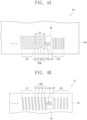
- FIG. 4A is a plan view illustrating a portion of an electronic panel according to an embodiment of the present inventive concept.
- FIG. 4B is a plan view of a portion of a circuit board according to an embodiment of the present inventive concept.
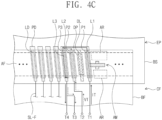
- FIG. 4C is a combined plan view of the electronic panel shown in FIG. 4A and the circuit board shown in FIG. 4B .
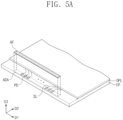
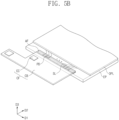
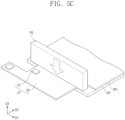
- FIGS. 5A to 5D are perspective views illustrating a method for manufacturing an electronic apparatus according to embodiments of the present inventive concept.
- FIGS. 5A to 5D illustrate a combination process of the electronic panel EP and the circuit board CF.
- FIGS. 5A to 5D For convenience of explanation, the resistance measurement pads PDM (see FIG. 4A ), the arrangement pad PDA, and the driving evaluation pads PDC (see FIG. 4A ) are omitted in FIGS. 5A to 5D .
- an embodiment of the present inventive concept will be described with reference to FIGS. 4A to 5D .
- the same reference numbers are given to the same components as those described in FIGS. 1 to 3C , and repetitive description of identical or similar elements may be omitted.
- the resistance measurement pad PDM may include a plurality of measurement pads and a dummy pad DP.
- the plurality of resistance measurement pads may include a first pad P1, a second pad P2, and a third pad P3 arranged consecutively along a direction away from the arrangement pad PDA.
- embodiments of the present inventive concept are not limited thereto and the number of the plurality of pads of the resistance measurement pad PDM may vary.
- the first pad P1 may directly contact the arrangement pad PDA, and the third pad P3 among the resistance measurement pads may be disposed at a position that is most adjacent to the pixel pads PD.
- the first to third pads P1, P2, P3 of the resistance measurement pads PDM may be connected with each other and may have an integrated shape, such as a general comb shape.
- the first to third pads P1, P2, and P3 of the resistance measurement pads PDM may be connected and electrically energized with each other through a connection unit that intersects with each of the first to third pads P1, P2, and P3 of the resistance measurement pads PDM.
- the dummy pad DP is spaced apart from the first to third pads P1, P2, and P3 of the resistance measurement pads.
- the dummy pad DP is illustrated as disposed between the first pad P1 and the second pad P2 among the resistance measurement pads PDM.
- the positioning of the dummy pad DP may vary.
- the dummy pad DP may have a pattern electrically floated from the first to third pads P1, P2, P3 of the resistance measurement pads PDM.
- the dummy pad DP is described as a component of the resistance measurement pad PDM.
- the structure of embodiments of the present inventive concept are not limited thereby.
- the dummy pad DP may be described as a component distinguished from the resistance measurement pad PDM and disposed at a corresponding position.
- the third pad P3 may be disposed separately from (e.g., spaced apart from) the arrangement pad PDA by a predetermined minimum separation distance.
- a predetermined minimum separation distance For example, when the width of each of the resistance measurement pads P1, P2, and P3 is about 0.060 mm and a pitch (a separation distance between the second pad and the first pad) is 0.040 mm, the minimum separation distance DT between the third pad P3 and the arrangement pad PDA is about 0.300 mm or greater.
- the minimum separation distance DT may be a distance in a straight line parallel to the first direction D1 (see FIG. 3A ). In FIG.
- the minimum separation distance is illustrated as the distance between one point on the right side of the third pad P3 and one point on the left side of the arrangement pad PDA that is spaced apart from the third pad P3 in the first direction D1 and is substantially co-planar to the third pad P3 in the second and third directions D2, D3.
- embodiments of the present inventive concept are not limited thereto and the minimum separation distance DT may be measured from various different points on the arrangement pad PDA and the third pad P3.
- the driving evaluation pads PDC are disposed separately from the arrangement pad PDA or the resistance measurement pad PDM in a plan view.
- the driving evaluation pads PDC are arranged separately from each other in one direction (e.g., the first direction D1).
- the driving evaluation pads PDC are illustrated to have a different shape from the pixel pads PD.
- the driving evaluation pads PDC extend substantially in the second direction D2 whereas the pixel pads PD have an inclined orientation.
- embodiments of the present inventive concept are not limited thereto, and the driving evaluation pads PDC may have the same shape as the pixel pads PD.
- the resistance measurement lead LDM may include a plurality of measurement leads, and a dummy lead DL.
- the plurality of measurement leads may include a first lead L1, a second lead L2, and a third lead L3 arranged consecutively along a direction away from the arrangement lead LDA.
- the number of leads of the resistance measurement lead LDM may vary.
- the first lead L1 may directly contact the arrangement lead LDA, and the third lead L3 among the measurement leads may be disposed at a position that is most adjacent to the pixel leads LD.
- the measurement leads such as the first to third leads L1, L2, and L3, and the dummy lead DL are spaced apart from each other.
- the dummy lead DL is illustrated as disposed between the first lead L1 and the second lead L2 among the measurement leads.
- the arrangement of the dummy lead DL may vary.
- the dummy lead DL may be disposed between the first lead L1 and the arrangement lead LDA.
- each of the dummy lead DL and the resistance measurement leads L1, L2, and L3 may have an electrically floated pattern.
- the conductive adhesive member AF and the circuit board CF are sequentially disposed on the electronic panel EP.
- the conductive adhesive member AF is disposed in the adhesive area ADA of the electronic panel EP, and the circuit board CF is arranged to overlap the conductive adhesive member AF in a plan view (e.g., in a third direction D3).
- the circuit board CF may be arranged so that the pixel leads LD overlap the pixel pads PD in a plan view (e.g., in the third direction D3).
- the electronic panel EP and the circuit board CF may be arranged by means of the orientation of the arrangement pad PDA with the arrangement lead LDA.
- the circuit board CF and the electronic panel EP may be arranged by orienting the circuit board CF and the electronic panel EP to have a shape similar to a plus sign '+'.
- the pixel pads PD and the pixel leads LD are arranged to overlap in a plan view (e.g., in the third direction D3)
- the resistance measurement pad PDM and the resistance measurement lead LDM are arranged to overlap in a plan view (e.g., in the third direction D3).
- the adhesive area ADA is compressed by means of a bonding machine PS to combine the circuit board CF and the electronic panel EP.
- the bonding machine PS may be various devices known in the art which may apply pressure to the adhesive area ADA along the arrow direction.
- the bonding machine PS may also apply heat to the adhesive area ADA.
- the conductive particles CD (see FIG. 3C ) dispersed in the conductive adhesive member AF electrically connect the pixel pads PD and the pixel leads LD, and electrically connect the resistance measurement pad PDM and the resistance measurement lead LDM.
- the adhesive layer AD of the conductive adhesive member AF physically combines the circuit board CF and the electronic panel EP.
- FIG. 4C may correspond to a plan view in a state in which the circuit board CF is combined with the electronic panel EP.
- the first to third pads P1, P2, and P3 of the resistance measurement pad PDM respectively correspond to and are combined with the first to third leads L1, L2, and L3 of the resistance measurement lead LDM.
- the dummy pad DP of the resistance measurement pad PDM overlaps the dummy lead DL of the resistance measurement lead LDM (e.g., in the third direction D3).
- the dummy pad DP and the dummy lead DL may or may not be electrically connected with each other based on the degree of connection of the circuit board CF and the electronic panel EP.
- terminals for inspecting connection failure between the resistance measurement pad PDM and the resistance measurement lead LDM may be provided to the base film BF of the circuit board CF.
- the resistance measurement lead LDM may be connected to first to fourth terminals T1, T2, T3, and T4.
- the first lead L1 is connected to the first terminal T1
- the second lead L2 is connected to the second terminal T2.
- the third lead L3 is branched into two lines to be connected to the third and fourth terminals T3 and T4.
- FIG. 4C briefly illustrates a contact resistance measurement arrangement for measuring connection failure.
- An inspection current IT is applied to the first terminal T1 and an inspection voltage VT is applied to the second terminal T2.
- the inspection current IT flows to a part at which the third lead L3 and the third pad P3 are connected via a part at which the first lead L1 and the first pad P1 are connected, and the inspection current IT is then output toward the fourth terminal T4.
- the inspection current IT has a flow that moves along the first terminal T1, the first lead L1/the first pad P1, the third lead L3/the third pad P3, and the fourth terminal T4.
- a current flow may be generated along a dotted line arrow by the inspection voltage VT applied to the second terminal T2.
- the current generated by the inspection voltage VT has a flow that is output through the third terminal T3 via the second terminal T2, the second lead L2/the second pad P2, and the third lead L3/the third pad P3.
- a connection resistance between the resistance measurement pad PDM and the resistance measurement lead LDM may be measured through the current measured at the third terminal T3 and the voltage measured at the fourth terminal T4. Where the connection resistance is equal to or less than a predetermined value, the connection resistance indicates that the connection between the circuit board CF and the electronic panel EP is stable. Where the connection resistance is greater than the predetermined value, the connection resistance may indicate that there is connection failure therebetween.
- connection failure between the circuit board CF and the electronic panel EP may be measured in various other ways.
- the connection failure may be determined by measuring loop resistance of the resistance measurement lead LDM by connecting the second lead L2 to two terminals and the third lead L3 to one terminal.
- the third pad P3, with which the third terminal T3 and the fourth terminal T4 are connected may be disposed at a position that is spaced apart further from the arrangement pad PDA than from the dummy pad DP.
- the third lead L3, with which the third terminal T3 and the fourth terminal T4 are connected may be disposed at a position that is spaced apart further from the arrangement lead LDA than from the dummy lead DL.
- the minimum separation distance DT between the third pad P3 and the arrangement pad PDA may be about 0.300 mm or greater.
- the third lead L3 may be disposed at a position corresponding to the third pad P3.
- embodiments of the present inventive concept are not limited thereto.
- the minimum separation distance DT between the third pad P3 and the arrangement pad PDA may be arranged in various ways.
- the third pad P3 and the third lead L3 are spaced apart from the arrangement pad PDA and the arrangement lead LDA, respectively, by a predetermined minimum distance and are disposed at positions adjacent to the pixel pad PD or the pixel lead LD. Therefore, a connection failure that may be generated due to the arrangement pad PDA may be prevented from influencing the connection between the third pad P3 and the third lead L3.
- embodiments of the present inventive concept are not limited thereto.
- another pad other than the third pad P3 among the resistance measurement pad PDM may be connected with the third terminal T3 and the fourth terminal T4 and a corresponding minimum separation distance DT may be the separation distance between the corresponding pad and the arrangement pad PDA.
- a pad for measuring the resistance is spaced apart from the arrangement pad PDA by a predetermined minimum distance, and the pad is not limited solely to the third pad P3.
- the inspection current IT or a current by the inspection voltage VT does not pass through the dummy pad DP and the dummy lead DL.
- the dummy pad DP or the dummy lead DL which does not influence the measurement of the connection resistance, is disposed in an area in which the connection failure may be generated. Therefore, an error may be prevented due to a partial connection failure generated in the resistance measurement pad PDM and the resistance measurement lead LDM which would erroneously indicate a connection failure between the pixel pad PD and the pixel lead LD.
- a surrounding area AR (hereinafter, the dummy area) of the arrangement pad PDA and the arrangement lead LDA is illustrated as a dotted line on the plane on which the circuit board CF is connected with the electronic panel EP.
- the dummy area AR is the surrounding area adjacent to the arrangement pad PDA and the arrangement lead LDA, and may be an area spaced apart from the resistance measurement pad PDM, the resistance measurement lead LDM, the driving evaluation pad PDC, and the driving evaluation lead LDC.
- the dummy area AR is illustrated as an empty space.
- the size and shape of the dummy area AR may vary and is not limited to those illustratively shown in FIG. 4C .
- the adhesive layer AD of the conductive adhesive member AF or the conductive particles CD may further flow into the dummy area AR and thus the base film BF and/or the base substrate BS may be easily deformed.
- the connection failure between the third lead L3 and the third pad P3 may be prevented by further separating (e.g., spacing apart) the third lead L3 and the third pad P3 from the dummy area AR, with which the third terminal T3 and the fourth terminal T4 corresponding to connection resistance measurement terminals are connected. Accordingly, the connection failure between the resistance measurement pad PDM and the resistance measurement lead LDM may be prevented, and the inspection reliability may be increased in a connection process of the circuit board CF and the electronic panel EP.
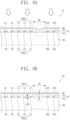
- FIGS. 6A and 6B are cross-sectional views according to a comparative example.
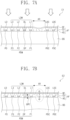
- FIGS. 7A and 7B are cross-sectional views of embodiments of the present inventive concept. Cross-sectional views of the resistance measurement pads and the resistance measurement leads are shown in FIGS. 6A to 7B .
- FIGS. 6A and 7A illustrate a step corresponding to FIG. 5C
- FIGS. 6B and 7B illustrate a step corresponding to FIG. 5D .
- a comparative example and embodiments of the present inventive concept will be described with reference to FIGS. 6A to 7B .
- a comparative example C1 includes a resistance measurement lead LDM_C configured to only include the first to third leads L1, L2, and L3, and a resistance measurement pad PDM_C configured to only include the first to third pads P1, P2, and P3.
- the resistance measurement lead LDM_C is arranged at a position corresponding to the resistance measurement pad PDM_C to be compressed by the bonding machine PS (see FIG. 5C ). Accordingly, the resistance measurement pad PDM_C and the resistance measurement lead LDM_C are electrically energized through the conductive particles CD.
- a deformation of the shape of the base film BF and/or the base substrate BS may be generated due to pressure.
- FIG. 6A it is illustrated that a deformation in the shape of the base film BF is generated.
- a comparative example C2 may correspond to a state after a certain time has elapsed in the comparative example C1 shown in FIG. 6A .
- the adhesive layer AD in the comparative example C2 may be expanded as indicated by the arrow in a process where a fluid state is changed to a fixed state by heat and pressure after a certain time has elapsed.
- delamination may be generated between the pads or leads adjacent to the dummy area AR, such as between the resistance measurement pad PDM_C and the resistance measurement lead LDM_C.
- the delamination phenomenon may frequently appear in an area in which the second lead L2 and the second pad P2 are disposed.
- the second lead L2 and the second pad P2 may have a gap GPC therebetween (e.g., in a thickness direction, such as the third direction D3) and the second lead L2 and the second pad P2 may not be electrically connected to each other.
- the gap GPC between the second lead L2 and the second pad P2 is larger than a gap between the pixel lead LD and the pixel pad PD, and is larger than the diameter of a conductive particle CP, the connection failure may be generated between the second lead L2 and the second pad P2.
- an electrical connection for stably driving the electronic panel EP and the circuit board CF is substantially made between the pixel leads LD and the pixel pads PD.
- the resistance measurement lead LDM_C and the resistance measurement pad PDM_C correspond to components for determining the connection failure between the electronic panel EP and the circuit board CF.
- the resistance measurement lead LDM_C and the resistance measurement pad PDM_C may indicate that there is an electrical connection failure between the circuit board CF and the electronic panel EP due to the connection failure between the resistance measurement lead LDM_C and the resistance measurement pad PDM_C.
- the resistance measurement lead LDM includes the dummy lead DL
- the resistance measurement pad PDM may include the dummy pad DP. If the position of the dummy area AR is the same as in the comparative example C1, the dummy lead DL and the dummy pad DP may be disposed at the positions at which the second lead L2 and the second pad P2 of the comparative example C1 are disposed. Accordingly, the second lead L2 and the second pad P2 may be disposed further away from the dummy area AR in the embodiment E1 than in the comparative example C1.
- the dummy lead DL and the dummy pad DP are disposed at positions at which the largest deformation is generated and the resistance measurement pads P1, P2, and P3 and the resistance measurement leads L1, L2, and L3 are spaced apart from the position at which the largest deformation is generated. Therefore, a connection failure may be prevented from being generated between the first to third pads P1, P2, and P3 of the resistance measurement pads PDM and the first to third leads L1, L2, and L3 of the resistance measurement leads LDM.
- the gap GPE between the dummy lead DL and the dummy pad DP may be greater than or equal to the gap between the pixel pad PD and the pixel lead LD due to the deformation in the base film BF and/or the base substrate BS.
- the gap GPE between the dummy lead DL and the dummy pad DP e.g., in a thickness direction of the electronic apparatus EA, such as the third direction D 3
- the first to third pads P1, P2, and P3 of the resistance measurement pads PDM or the first to third leads L1, L2, and L3 of the resistance measurement leads LDM are not electrically influenced.
- the circuit board CF and the electronic panel EP may not be measured to have a connection failure therebetween, and thus the process reliability may be increased.
- an electronic apparatus EA that is erroneously determined to be a failure may be prevented from being generated, thereby reducing process cost.
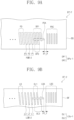
- FIG. 8A is a plan view illustrating a portion of an electronic panel according to an embodiment of the present inventive concept.
- FIG. 8B is a plan view of a portion of a circuit board according to an embodiment of the present inventive concept.
- FIG. 9A is a plan view illustrating a portion of an electronic panel according to an embodiment of the present inventive concept.
- FIG. 9B is a plan view of a portion of a circuit board according to an embodiment of the present inventive concept.
- FIG. 10A is a plan view illustrating a portion of an electronic panel according to an embodiment of the present inventive concept.
- FIG. 10B is a plan view of a portion of a circuit board according to an embodiment of the present inventive concept.
- FIGS. 8A , 9A , and 10A illustrate an area corresponding to FIG. 4A
- FIGS. 8B , 9B , and 10B illustrate an area corresponding to FIG. 4B
- FIGS. 8A to 10B illustrate an embodiment of the present inventive concept
- the same reference numbers are given to the same or similar components as those described in FIGS. 1 to 7B , and repetitive descriptions may be omitted for convenience of explanation.
- an electronic panel EP-1 may include a plurality of dummy pads DPs disposed outside a resistance measurement pad PDM-1.
- the dummy pads DPs are illustrated as three pads that are spaced apart from each other, and may be disposed between the arrangement pad PDA and the first pad P1. However, the number of pads of the dummy pads DPs may vary.
- a circuit board CF-1 may include a resistance measurement lead LDM-1 including a plurality of dummy leads DLs.
- the dummy leads DLs are illustrated as three leads spaced apart from each other, and may be disposed between the arrangement lead LDA and the first lead L1. However, the number of leads of the plurality of dummy leads DLs may vary.
- the arrangement pad PDA may be positioned in an area (indicated with a dotted line) in which any one among the driving evaluation pads PDC shown in FIG. 3A is removed. Accordingly, the number of the dummy pads DPs may be increased without changing the position of the existing pixel pads PD.
- the arrangement lead LDA may be positioned in an area (indicated with a dotted line) in which any one among the driving evaluation leads LDC shown in FIG. 3A is removed.
- an interval PT_P between the arrangement pad PDA and the driving evaluation pad PDC or an interval PT_F between the arrangement lead LDA and the driving evaluation lead LDC may be substantially equal to each other. Accordingly, the number of the dummy leads DLs may be increased without changing the position of the existing pixel leads LD.
- connection failure may be prevented from being generated between the resistance measurement pad PDM-1 and the resistance measurement lead LDM-1 by separating the positions of the resistance measurement pad PDM-1 and the resistance measurement lead LDM-1 from the arrangement pad PDA and the arrangement lead LDA.
- an influence on the measurement of the connection resistance may be reduced by filling the area in which the connection failure is generated with the dummy pads DPs and the dummy leads DLs. Accordingly, the reliability in connection inspection may be increased between the circuit board CF-1 and the electronic panel EP-1.
- dummy pads DPs-1 of an electronic panel EP-2 may be disposed around the arrangement pad PDA, and dummy leads DLs-1 of a circuit board CF-2 may be disposed around the arrangement lead LDA.
- the dummy pads DPs-1 may include at least one dummy pad DP1 disposed adjacent to an upper side of the arrangement pad PDA and at least one dummy pad DP2 disposed adjacent to a lower side thereof.
- the dummy leads DLs-1 may include at least one dummy lead DL1 disposed adjacent to an upper side of the arrangement lead LDA and at least one dummy lead DL2 disposed adjacent to a lower side thereof.
- the dummy pads DPs-1 and the dummy leads DLs-1 may be connected with each other. However, since they have electrically floated patterns, the dummy pads DPs-1 and the dummy leads DLs-1 may not have an electrical influence on the surrounding pads.
- the dummy area AR (see FIG. 4C ) may be filled with the dummy pads DPs-1 and the dummy leads DLs-1 Accordingly, even when a compression process by the bonding machine PS (see FIG. 5C ) is performed, a deformation in the base film BF or the base substrate BS may be prevented. Accordingly, a connection failure may be prevented from being generated between the circuit board CF-2 and the electronic panel EP-2, and thus the reliability of resistance measurement inspection for the resistance measurement pad PDM-2 and the resistance measurement lead LDM-2 may be increased.
- dummy pads DPs-2 of an electronic panel EP-3 and dummy leads DLs-2 of a circuit board CF-3 may be designed as various shapes of pads.
- the dummy pads DPs-2 may include dummy pads DP3 disposed adjacent to an upper side of the arrangement pad PDA and having different shapes, and dummy pads DP4 disposed adjacent to a lower side thereof and having different shapes.
- at least one of the dummy pads DP3 disposed on the upper side of the arrangement pad PDA may have a different shape from another of the dummy pads DP3 disposed on the upper side of the arrangement pad PDA.
- At least one of the dummy pads DP4 disposed on the lower side of the arrangement pad PDA may have a different shape from another of the dummy pads DP4 disposed on the lower side of the arrangement pad PDA.
- the leftmost dummy pads of the upper and lower dummy pads DP3, DP4 in FIG. 10A have a different shape than the other dummy pads of the upper and lower dummy pads DP3, DP4, respectively.
- the dummy leads DLs-2 may include dummy leads DL3 disposed adjacent to an upper side of the arrangement lead LDA and having different shapes, and dummy leads DL4 disposed adjacent to a lower side thereof and having different shapes.
- the dummy pads DPs-2 and the dummy leads DLs-2 may be connected with each other.
- the dummy pads DPs-2 and the dummy leads DLs-2 may not have an electrical influence on the surrounding pads or leads.
- the dummy area AR may be filled with the dummy pads DPs-2 and the dummy leads DLs-2. Accordingly, a connection failure, such as due to non-compression, may be prevented from being indicated in a connection process of the circuit board CF-3 and the electronic panel EP-3.
- embodiments of the present inventive concept are not limited thereto.
- the dummy pads and the dummy leads may have various different shapes.
- an error generation ratio may be reduced when a defective connection between the circuit board and the electronic panel is inspected. Accordingly, the reliability in contact resistance inspection may be increased between the circuit board and the electronic panel.
Landscapes
- Engineering & Computer Science (AREA)
- Physics & Mathematics (AREA)
- Microelectronics & Electronic Packaging (AREA)
- General Physics & Mathematics (AREA)
- General Engineering & Computer Science (AREA)
- Manufacturing & Machinery (AREA)
- Computer Hardware Design (AREA)
- Nonlinear Science (AREA)
- Environmental & Geological Engineering (AREA)
- Multimedia (AREA)
- Power Engineering (AREA)
- Chemical & Material Sciences (AREA)
- Crystallography & Structural Chemistry (AREA)
- Mathematical Physics (AREA)
- Optics & Photonics (AREA)
- Devices For Indicating Variable Information By Combining Individual Elements (AREA)
- Structure Of Printed Boards (AREA)
Claims (19)
- Elektronische Vorrichtung, umfassend:ein elektronisches Panel (EP), das ein Basissubstrat (BS), eine Vielzahl von Pixeln (PX) auf dem Basissubstrat und eine Vielzahl von Pads in einem Klebebereich (ADA) umfasst, wobei die Vielzahl von Pads von der Vielzahl von Pixeln beabstandet ist;eine Leiterplatte (CF), die einen Basisfilm (CB) und eine Vielzahl von Leitungen umfasst, die auf dem Basisfilm vorgesehen ist und die Vielzahl von Pads in einer Draufsicht überlappt; und ein leitendes Klebeelement (AF), das auf dem Klebebereich vorgesehen und konfiguriert ist, um die Leiterplatte und das elektronische Panel elektrisch zu verbinden, wobei die Vielzahl von Pads Folgendes umfasst:eine Vielzahl von Pixelpads (PD), die elektrisch mit der Vielzahl von Pixeln verbunden ist,ein Anordnungspad (PDA), das von der Vielzahl von Pixelpads (PD) beabstandet ist, um zusammen mit einer Anordnungsleitung (LDA) eine Referenz für Anordnung zwischen dem elektronischen Panel (EP) und der Leiterplatte (CF) bereitzustellen, wenn das elektronische Panel (EP) und die Leiterplatte (CF) durch das Klebeelement (AF) kombiniert sind, undein Widerstandsmesspad (PDM), das zwischen dem Anordnungspad und der Vielzahl von Pixelpads vorgesehen und von der Vielzahl von Pixelpads isoliert ist,wobei die Vielzahl von Leitungen eine Vielzahl von Pixelleitungen (LD), welche die Vielzahl von Pixelpads in der Draufsicht überlappt, die Anordnungsleitung (LDA), die das Anordnungspad in der Draufsicht überlappt, und eine Widerstandsmessleitung (LDM), die zwischen der Vielzahl von Pixelleitungen (LD) und der Anordnungsleitung (LDA) isoliert von der Vielzahl von Pixelleitungen (LD) und elektrisch mit dem Widerstandsmesspad (PDM) verbunden vorgesehen ist, umfasst;und wobei die Widerstandsmessleitung eine Vielzahl von Messleitungen, die zwischen der Anordnungsleitung und der Vielzahl von Pixelleitungen vorgesehen und elektrisch mit dem Widerstandsmesspad (PDM) verbunden ist, und eine Dummy-Leitung (DL), die von jeder aus der Vielzahl von Messleitungen (LDM) in der Draufsicht beabstandet ist, umfasst, wobei die Verbindung der Messleitungen mit dem Widerstandsmesspad ein Widerstandsmessmuster bildet.
- Elektronische Vorrichtung nach Anspruch 1, wobei:
die Messleitungen erste, zweite und dritte Leitungen (L1, L2, L3) umfassen, die entlang einer Richtung von der Anordnungsleitung (LDA) zu den Pixelleitungen (LD) angeordnet sind; und die dritte Leitung mit einer Vielzahl von Anschlüssen verbunden ist. - Elektronische Vorrichtung nach Anspruch 2, wobei die Dummy-Leitung (DL) zwischen der ersten Leitung (L1) und der zweiten Leitung (L2) vorgesehen ist.
- Elektronische Vorrichtung nach Anspruch 2, wobei die Dummy-Leitung (DLs) zwischen der ersten Leitung (L1) und der Anordnungsleitung (LDA) vorgesehen ist.
- Elektronische Vorrichtung nach Anspruch 2, wobei das Widerstandsmesspad Folgendes umfasst:ein erstes Pad (P1), das mit der ersten Leitung (L1) verbunden ist;ein zweites Pad (P2), das mit der zweiten Leitung (L2) verbunden ist; undein drittes Pad (P3), das mit der dritten Leitung (L3) verbunden ist, wobei das erste bis dritte Pad miteinander verbunden sind.
- Elektronische Vorrichtung nach Anspruch 5, wobei das Widerstandsmesspad ferner ein Dummy-Pad (DP) umfasst, das zwischen dem ersten Pad und dem zweiten Pad vorgesehen und von den ersten bis dritten Pads in der Draufsicht beabstandet ist.
wobei das Dummy-Pad die Dummy-Leitung in der Draufsicht überlappt. - Elektronische Vorrichtung nach Anspruch 6, wobei das Dummy-Pad und die Dummy-Leitung miteinander durch das leitende Klebeelement verbunden sind.
- Elektronische Vorrichtung nach Anspruch 6 oder 7, wobei ein Spalt zwischen dem Dummy-Pad und der Dummy-Leitung in einer Dickenrichtung der elektronischen Vorrichtung größer als ein Spalt zwischen der Pixelleitung und dem Pixelpad in der Dickenrichtung der elektronischen Vorrichtung ist.
- Elektronische Vorrichtung nach Anspruch 1, wobei die Dummy-Leitung eine erste Dummy-Leitung (DL1) und eine zweite Dummy-Leitung (DL2) umfasst, die voneinander beabstandet sind, wobei die Anordnungsleitung dazwischen vorgesehen ist.
- Elektronische Vorrichtung nach Anspruch 9, wobei die erste Dummy-Leitung eine Vielzahl von ersten Dummy-Leitungen umfasst und die zweite Dummy-Leitung eine Vielzahl von zweiten Dummy-Leitungen umfasst,wobei zumindest eine aus der Vielzahl von ersten Dummy-Leitungen eine Form aufweist, die sich von einer Form einer anderen ersten Dummy-Leitung aus der Vielzahl von ersten Dummy-Leitungen unterscheidet, undwobei zumindest eine aus der Vielzahl von zweiten Dummy-Leitungen eine Form aufweist, die sich von einer Form einer anderen zweiten Dummy-Leitung aus der Vielzahl von zweiten Dummy-Leitungen unterscheidet.
- Elektronische Vorrichtung nach Anspruch 9, wobei:die Vielzahl von Leitungen ferner Antriebsauswertungsleitungen (LDC) umfasst, die von der Anordnungsleitung beabstandet und konfiguriert sind, um ein elektrisches Signal zu empfangen; unddie erste Dummy-Leitung und die zweite Dummy-Leitung in einem Bereich vorgesehen sind, der durch die Widerstandsmessleitung, die Anordnungsleitung und die Antriebsauswertungsleitungen umgeben ist.
- Elektronische Vorrichtung, umfassend:ein elektronisches Panel (EL), das ein Basissubstrat (BS), eine Vielzahl von Pixeln (PX) auf dem Basissubstrat und eine Vielzahl von Pads in einem Klebebereich umfasst, wobei die Vielzahl von Pads von der Vielzahl von Pixeln beabstandet ist;eine Leiterplatte (CF), die einen Basisfilm (CB) und eine Vielzahl von Leitungen umfasst, die auf dem Basisfilm vorgesehen ist und die Vielzahl von Pads in einer Draufsicht überlappt; undein leitendes Klebeelement (AF), das auf dem Klebebereich vorgesehen und konfiguriert ist, um die Leiterplatte und das elektronische Panel elektrisch zu verbinden, wobei die Vielzahl von Pads Folgendes umfasst:Pixelpads (PD), die elektrisch mit den Pixeln und der Leiterplatte verbunden sind;ein Anordnungspad (PDA), das elektrisch von den Pixelpads isoliert ist, um zusammen mit einer Anordnungsleitung (LDA) aus der Vielzahl vonLeitungen eine Referenz für Anordnung zwischen dem elektronischen Panel (EP) und der Leiterplatte (CF) bereitzustellen, wenn das elektronische Panel (EP) und die Leiterplatte (CF) durch das Klebeelement (AF) kombiniert sind;Widerstandsmesspads (P1, P2, P3), die von den Pixelpads isoliert und elektrisch mit der Leiterplatte verbunden sind, wobei eine Verbindung der Widerstandsmesspads mit einer Widerstandsmessleitung aus der Vielzahl von Leitungen ein Widerstandsmessmuster bildet; undein Dummy-Pad (DP), das zwischen dem Anordnungspad (PDA) und den Pixelpads (PD) vorgesehen und von den Widerstandsmesspads (P1, P2, P3) in der Draufsicht beabstandet ist, undwobei:die Widerstandsmesspads erste, zweite und dritte Pads (P1, P2, P3) umfassen, die entlang einer Richtung von dem Anordnungspad zu den Pixelpads angeordnet sind; unddas Dummy-Pad zwischen dem ersten Pad und dem zweiten Pad vorgesehen ist.
- Elektronische Vorrichtung nach Anspruch 12, wobei:
die ersten bis dritten Pads miteinander verbunden sind; und das Dummy-Pad von den ersten bis dritten Pads beabstandet ist. - Elektronische Vorrichtung nach Anspruch 12, wobei das Dummy-Pad zwischen dem ersten Pad und dem Anordnungspad vorgesehen ist.
- Elektronische Vorrichtung nach Anspruch 12, wobei das Dummy-Pad Folgendes umfasst:ein erstes Dummy-Pad (DP1), das zwischen dem Anordnungspad, dem ersten Pad und der Vielzahl von Pixeln vorgesehen ist; undein zweites Dummy-Pad (DP2), das von dem ersten Dummy-Pad beabstandet ist, wobei das Anordnungspad dazwischen vorgesehen ist.
- Elektronische Vorrichtung nach Anspruch 12, wobei die Vielzahl von Leitungen Folgendes umfasst:erste bis dritte Leitungen (L1, L2, L3), die getrennt voneinander vorgesehen und jeweils mit den ersten bis dritten Pads verbunden sind; undeine Dummy-Leitung, die das Dummy-Pad in der Draufsicht überlappt.
- Elektronische Vorrichtung nach Anspruch 16, wobei die Dummy-Leitung mit dem Dummy-Pad verbunden ist.
- Elektronische Vorrichtung nach Anspruch 16, wobei:zumindest eines von dem Basisfilm oder dem Basissubstrat eine Verformung beinhaltet, die in einem Bereich positioniert ist, in dem die Dummy-Leitung oder das Dummy-Pad vorgesehen ist; unddie Dummy-Leitung elektrisch von dem Dummy-Pad isoliert ist.
- Elektronische Vorrichtung nach Anspruch 16, wobei die dritte Leitung mit einer Vielzahl von Anschlüssen verbunden ist.
Applications Claiming Priority (1)
| Application Number | Priority Date | Filing Date | Title |
|---|---|---|---|
| KR1020210026201A KR20220122843A (ko) | 2021-02-26 | 2021-02-26 | 전자 장치 |
Publications (2)
| Publication Number | Publication Date |
|---|---|
| EP4050409A1 EP4050409A1 (de) | 2022-08-31 |
| EP4050409B1 true EP4050409B1 (de) | 2025-01-22 |
Family
ID=80461508
Family Applications (1)
| Application Number | Title | Priority Date | Filing Date |
|---|---|---|---|
| EP22158903.9A Active EP4050409B1 (de) | 2021-02-26 | 2022-02-25 | Elektronische vorrichtung |
Country Status (4)
| Country | Link |
|---|---|
| US (3) | US11895774B2 (de) |
| EP (1) | EP4050409B1 (de) |
| KR (1) | KR20220122843A (de) |
| CN (2) | CN114975364A (de) |
Families Citing this family (3)
| Publication number | Priority date | Publication date | Assignee | Title |
|---|---|---|---|---|
| KR102769361B1 (ko) * | 2019-04-01 | 2025-02-17 | 삼성디스플레이 주식회사 | 표시 장치 및 그 제조 방법 |
| KR20220122843A (ko) | 2021-02-26 | 2022-09-05 | 삼성디스플레이 주식회사 | 전자 장치 |
| KR102761249B1 (ko) * | 2023-02-17 | 2025-01-31 | 삼성전자주식회사 | 반도체 장치 및 반도체 장치의 테스트 방법 |
Family Cites Families (16)
| Publication number | Priority date | Publication date | Assignee | Title |
|---|---|---|---|---|
| KR100891384B1 (ko) | 2007-06-14 | 2009-04-02 | 삼성모바일디스플레이주식회사 | 플렉서블 기판 접합 및 탈착장치 |
| KR101783953B1 (ko) | 2010-12-27 | 2017-10-11 | 삼성디스플레이 주식회사 | 표시 장치 및 그 검사 방법 |
| JP2012226058A (ja) | 2011-04-18 | 2012-11-15 | Japan Display East Co Ltd | 表示装置 |
| CN105632382B (zh) * | 2016-01-04 | 2018-05-18 | 京东方科技集团股份有限公司 | 显示装置及其检测绑定区域绑定情况的方法 |
| KR102481818B1 (ko) | 2017-08-22 | 2022-12-28 | 삼성디스플레이 주식회사 | 전자 부품 및 이를 포함하는 전자 장치 |
| KR102426607B1 (ko) | 2017-08-28 | 2022-07-28 | 삼성디스플레이 주식회사 | 표시 장치 |
| KR102477230B1 (ko) | 2018-01-25 | 2022-12-13 | 삼성디스플레이 주식회사 | 표시 장치 |
| KR102729421B1 (ko) | 2018-05-09 | 2024-11-13 | 삼성디스플레이 주식회사 | 표시 장치 |
| KR102603403B1 (ko) | 2018-08-09 | 2023-11-17 | 삼성디스플레이 주식회사 | 표시 장치 |
| US20200267837A1 (en) * | 2019-02-18 | 2020-08-20 | Samsung Display Co., Ltd. | Connection substrate and display device including the same and pad contact resistance measurement method |
| KR102776430B1 (ko) | 2019-02-21 | 2025-03-05 | 삼성디스플레이 주식회사 | 표시 장치 |
| KR20210036444A (ko) * | 2019-09-25 | 2021-04-05 | 삼성디스플레이 주식회사 | 표시 장치 |
| KR102705701B1 (ko) * | 2020-02-10 | 2024-09-12 | 삼성디스플레이 주식회사 | 표시 장치 |
| CN111985547A (zh) * | 2020-08-11 | 2020-11-24 | 华侨大学 | 一种基于注意力引导生成学习的跨分辨率车辆再辨识方法 |
| KR20220122843A (ko) | 2021-02-26 | 2022-09-05 | 삼성디스플레이 주식회사 | 전자 장치 |
| KR20240011927A (ko) * | 2022-07-19 | 2024-01-29 | 삼성디스플레이 주식회사 | 전자 장치 |
-
2021
- 2021-02-26 KR KR1020210026201A patent/KR20220122843A/ko active Pending
- 2021-12-27 US US17/562,493 patent/US11895774B2/en active Active
-
2022
- 2022-02-24 CN CN202210171642.2A patent/CN114975364A/zh active Pending
- 2022-02-24 CN CN202220383727.2U patent/CN217822793U/zh active Active
- 2022-02-25 EP EP22158903.9A patent/EP4050409B1/de active Active
-
2023
- 2023-12-29 US US18/400,347 patent/US12309926B2/en active Active
-
2025
- 2025-04-08 US US19/172,715 patent/US20250240888A1/en active Pending
Also Published As
| Publication number | Publication date |
|---|---|
| US11895774B2 (en) | 2024-02-06 |
| US12309926B2 (en) | 2025-05-20 |
| EP4050409A1 (de) | 2022-08-31 |
| KR20220122843A (ko) | 2022-09-05 |
| CN114975364A (zh) | 2022-08-30 |
| US20220279654A1 (en) | 2022-09-01 |
| US20240138065A1 (en) | 2024-04-25 |
| CN217822793U (zh) | 2022-11-15 |
| US20250240888A1 (en) | 2025-07-24 |
Similar Documents
| Publication | Publication Date | Title |
|---|---|---|
| US11825725B2 (en) | Display panel including vernier mark for aligning conductive adhesive member, electronic apparatus including the same, and method of manufacturing the electronic apparatus | |
| US12309926B2 (en) | Electronic apparatus | |
| CN107799003B (zh) | 显示装置及用于制造显示装置的方法 | |
| US12105566B2 (en) | Display device | |
| US6061246A (en) | Microelectric packages including flexible layers and flexible extensions, and liquid crystal display modules using the same | |
| CN103135267B (zh) | 驱动印刷电路板和包括该驱动印刷电路板的液晶显示装置 | |
| EP3361838A1 (de) | Chip-auf-film-verpackung, anzeigetafel und anzeigevorrichtung | |
| KR100867062B1 (ko) | 전기 광학 장치, 배선 기판, 전기 광학 장치의 제조 방법및 전자기기 | |
| EP1391774B1 (de) | Flüssigkristallanzeige | |
| US8013334B2 (en) | Bonding structure of circuit substrate for instant circuit inspecting | |
| KR20050015422A (ko) | 저가형 플랙서블 필름 패키지 모듈 및 그 제조방법 | |
| EP0911678B1 (de) | Anzeigevorrichtung mit Anschlüssen zur Verbindung mit einem gefalteten Filmsubstrat | |
| US20200133047A1 (en) | Display module | |
| CN111651096B (zh) | 一种显示装置 | |
| CN1211767C (zh) | 显示模块 | |
| WO2005067398A2 (en) | Driver chip and display apparatus | |
| CN113950714B (zh) | 显示装置、显示装置的制作方法和电子设备 | |
| KR20210076299A (ko) | 표시 장치 및 입력 센서 | |
| US11839025B2 (en) | Flexible printed circuit and manufacturing method thereof, and displaying device | |
| KR20040011353A (ko) | 액정표시장치 | |
| US20240030123A1 (en) | Electronic apparatus | |
| JP2008224934A (ja) | 電気光学装置および異方性導電層による電気的接合の検査方法 | |
| CN113628535A (zh) | 显示装置 | |
| US20050133912A1 (en) | Electrical connection structure | |
| CN223244938U (zh) | 显示模组以及显示装置 |
Legal Events
| Date | Code | Title | Description |
|---|---|---|---|
| PUAI | Public reference made under article 153(3) epc to a published international application that has entered the european phase |
Free format text: ORIGINAL CODE: 0009012 |
|
| STAA | Information on the status of an ep patent application or granted ep patent |
Free format text: STATUS: THE APPLICATION HAS BEEN PUBLISHED |
|
| AK | Designated contracting states |
Kind code of ref document: A1 Designated state(s): AL AT BE BG CH CY CZ DE DK EE ES FI FR GB GR HR HU IE IS IT LI LT LU LV MC MK MT NL NO PL PT RO RS SE SI SK SM TR |
|
| STAA | Information on the status of an ep patent application or granted ep patent |
Free format text: STATUS: REQUEST FOR EXAMINATION WAS MADE |
|
| 17P | Request for examination filed |
Effective date: 20230228 |
|
| RBV | Designated contracting states (corrected) |
Designated state(s): AL AT BE BG CH CY CZ DE DK EE ES FI FR GB GR HR HU IE IS IT LI LT LU LV MC MK MT NL NO PL PT RO RS SE SI SK SM TR |
|
| P01 | Opt-out of the competence of the unified patent court (upc) registered |
Effective date: 20230516 |
|
| STAA | Information on the status of an ep patent application or granted ep patent |
Free format text: STATUS: EXAMINATION IS IN PROGRESS |
|
| 17Q | First examination report despatched |
Effective date: 20231010 |
|
| RIC1 | Information provided on ipc code assigned before grant |
Ipc: H05K 1/11 20060101ALN20240619BHEP Ipc: H05K 1/18 20060101ALI20240619BHEP Ipc: H05K 1/02 20060101ALI20240619BHEP Ipc: H05K 3/32 20060101ALI20240619BHEP Ipc: G02F 1/1345 20060101AFI20240619BHEP |
|
| GRAP | Despatch of communication of intention to grant a patent |
Free format text: ORIGINAL CODE: EPIDOSNIGR1 |
|
| STAA | Information on the status of an ep patent application or granted ep patent |
Free format text: STATUS: GRANT OF PATENT IS INTENDED |
|
| INTG | Intention to grant announced |
Effective date: 20240730 |
|
| GRAS | Grant fee paid |
Free format text: ORIGINAL CODE: EPIDOSNIGR3 |
|
| GRAA | (expected) grant |
Free format text: ORIGINAL CODE: 0009210 |
|
| STAA | Information on the status of an ep patent application or granted ep patent |
Free format text: STATUS: THE PATENT HAS BEEN GRANTED |
|
| AK | Designated contracting states |
Kind code of ref document: B1 Designated state(s): AL AT BE BG CH CY CZ DE DK EE ES FI FR GB GR HR HU IE IS IT LI LT LU LV MC MK MT NL NO PL PT RO RS SE SI SK SM TR |
|
| REG | Reference to a national code |
Ref country code: GB Ref legal event code: FG4D |
|
| REG | Reference to a national code |
Ref country code: CH Ref legal event code: EP |
|
| REG | Reference to a national code |
Ref country code: IE Ref legal event code: FG4D |
|
| REG | Reference to a national code |
Ref country code: DE Ref legal event code: R096 Ref document number: 602022009690 Country of ref document: DE |
|
| REG | Reference to a national code |
Ref country code: NL Ref legal event code: FP |
|
| PGFP | Annual fee paid to national office [announced via postgrant information from national office to epo] |
Ref country code: NL Payment date: 20250205 Year of fee payment: 4 |
|
| PGFP | Annual fee paid to national office [announced via postgrant information from national office to epo] |
Ref country code: DE Payment date: 20250205 Year of fee payment: 4 |
|
| PGFP | Annual fee paid to national office [announced via postgrant information from national office to epo] |
Ref country code: AT Payment date: 20250417 Year of fee payment: 4 |
|
| PGFP | Annual fee paid to national office [announced via postgrant information from national office to epo] |
Ref country code: FR Payment date: 20250206 Year of fee payment: 4 |
|
| PG25 | Lapsed in a contracting state [announced via postgrant information from national office to epo] |
Ref country code: RS Free format text: LAPSE BECAUSE OF FAILURE TO SUBMIT A TRANSLATION OF THE DESCRIPTION OR TO PAY THE FEE WITHIN THE PRESCRIBED TIME-LIMIT Effective date: 20250422 |
|
| PG25 | Lapsed in a contracting state [announced via postgrant information from national office to epo] |
Ref country code: FI Free format text: LAPSE BECAUSE OF FAILURE TO SUBMIT A TRANSLATION OF THE DESCRIPTION OR TO PAY THE FEE WITHIN THE PRESCRIBED TIME-LIMIT Effective date: 20250122 |
|
| PG25 | Lapsed in a contracting state [announced via postgrant information from national office to epo] |
Ref country code: PL Free format text: LAPSE BECAUSE OF FAILURE TO SUBMIT A TRANSLATION OF THE DESCRIPTION OR TO PAY THE FEE WITHIN THE PRESCRIBED TIME-LIMIT Effective date: 20250122 |
|
| PG25 | Lapsed in a contracting state [announced via postgrant information from national office to epo] |
Ref country code: ES Free format text: LAPSE BECAUSE OF FAILURE TO SUBMIT A TRANSLATION OF THE DESCRIPTION OR TO PAY THE FEE WITHIN THE PRESCRIBED TIME-LIMIT Effective date: 20250122 |
|
| REG | Reference to a national code |
Ref country code: LT Ref legal event code: MG9D |
|
| PG25 | Lapsed in a contracting state [announced via postgrant information from national office to epo] |
Ref country code: NO Free format text: LAPSE BECAUSE OF FAILURE TO SUBMIT A TRANSLATION OF THE DESCRIPTION OR TO PAY THE FEE WITHIN THE PRESCRIBED TIME-LIMIT Effective date: 20250422 Ref country code: IS Free format text: LAPSE BECAUSE OF FAILURE TO SUBMIT A TRANSLATION OF THE DESCRIPTION OR TO PAY THE FEE WITHIN THE PRESCRIBED TIME-LIMIT Effective date: 20250522 |
|
| REG | Reference to a national code |
Ref country code: AT Ref legal event code: MK05 Ref document number: 1761900 Country of ref document: AT Kind code of ref document: T Effective date: 20250122 |
|
| PG25 | Lapsed in a contracting state [announced via postgrant information from national office to epo] |
Ref country code: HR Free format text: LAPSE BECAUSE OF FAILURE TO SUBMIT A TRANSLATION OF THE DESCRIPTION OR TO PAY THE FEE WITHIN THE PRESCRIBED TIME-LIMIT Effective date: 20250122 |
|
| PG25 | Lapsed in a contracting state [announced via postgrant information from national office to epo] |
Ref country code: LV Free format text: LAPSE BECAUSE OF FAILURE TO SUBMIT A TRANSLATION OF THE DESCRIPTION OR TO PAY THE FEE WITHIN THE PRESCRIBED TIME-LIMIT Effective date: 20250122 Ref country code: PT Free format text: LAPSE BECAUSE OF FAILURE TO SUBMIT A TRANSLATION OF THE DESCRIPTION OR TO PAY THE FEE WITHIN THE PRESCRIBED TIME-LIMIT Effective date: 20250522 |
|
| PG25 | Lapsed in a contracting state [announced via postgrant information from national office to epo] |
Ref country code: GR Free format text: LAPSE BECAUSE OF FAILURE TO SUBMIT A TRANSLATION OF THE DESCRIPTION OR TO PAY THE FEE WITHIN THE PRESCRIBED TIME-LIMIT Effective date: 20250423 Ref country code: BG Free format text: LAPSE BECAUSE OF FAILURE TO SUBMIT A TRANSLATION OF THE DESCRIPTION OR TO PAY THE FEE WITHIN THE PRESCRIBED TIME-LIMIT Effective date: 20250122 |
|
| PG25 | Lapsed in a contracting state [announced via postgrant information from national office to epo] |
Ref country code: AT Free format text: LAPSE BECAUSE OF FAILURE TO SUBMIT A TRANSLATION OF THE DESCRIPTION OR TO PAY THE FEE WITHIN THE PRESCRIBED TIME-LIMIT Effective date: 20250122 |
|
| PG25 | Lapsed in a contracting state [announced via postgrant information from national office to epo] |
Ref country code: SE Free format text: LAPSE BECAUSE OF FAILURE TO SUBMIT A TRANSLATION OF THE DESCRIPTION OR TO PAY THE FEE WITHIN THE PRESCRIBED TIME-LIMIT Effective date: 20250122 |
|
| REG | Reference to a national code |
Ref country code: CH Ref legal event code: PL |
|
| PG25 | Lapsed in a contracting state [announced via postgrant information from national office to epo] |
Ref country code: SM Free format text: LAPSE BECAUSE OF FAILURE TO SUBMIT A TRANSLATION OF THE DESCRIPTION OR TO PAY THE FEE WITHIN THE PRESCRIBED TIME-LIMIT Effective date: 20250122 |
|
| PG25 | Lapsed in a contracting state [announced via postgrant information from national office to epo] |
Ref country code: DK Free format text: LAPSE BECAUSE OF FAILURE TO SUBMIT A TRANSLATION OF THE DESCRIPTION OR TO PAY THE FEE WITHIN THE PRESCRIBED TIME-LIMIT Effective date: 20250122 |
|
| PG25 | Lapsed in a contracting state [announced via postgrant information from national office to epo] |
Ref country code: MC Free format text: LAPSE BECAUSE OF FAILURE TO SUBMIT A TRANSLATION OF THE DESCRIPTION OR TO PAY THE FEE WITHIN THE PRESCRIBED TIME-LIMIT Effective date: 20250122 |
|
| PG25 | Lapsed in a contracting state [announced via postgrant information from national office to epo] |
Ref country code: IT Free format text: LAPSE BECAUSE OF FAILURE TO SUBMIT A TRANSLATION OF THE DESCRIPTION OR TO PAY THE FEE WITHIN THE PRESCRIBED TIME-LIMIT Effective date: 20250122 Ref country code: LU Free format text: LAPSE BECAUSE OF NON-PAYMENT OF DUE FEES Effective date: 20250225 |
|
| PG25 | Lapsed in a contracting state [announced via postgrant information from national office to epo] |
Ref country code: CH Free format text: LAPSE BECAUSE OF NON-PAYMENT OF DUE FEES Effective date: 20250228 |
|
| PG25 | Lapsed in a contracting state [announced via postgrant information from national office to epo] |
Ref country code: CZ Free format text: LAPSE BECAUSE OF FAILURE TO SUBMIT A TRANSLATION OF THE DESCRIPTION OR TO PAY THE FEE WITHIN THE PRESCRIBED TIME-LIMIT Effective date: 20250122 Ref country code: EE Free format text: LAPSE BECAUSE OF FAILURE TO SUBMIT A TRANSLATION OF THE DESCRIPTION OR TO PAY THE FEE WITHIN THE PRESCRIBED TIME-LIMIT Effective date: 20250122 |
|
| REG | Reference to a national code |
Ref country code: DE Ref legal event code: R097 Ref document number: 602022009690 Country of ref document: DE |
|
| PG25 | Lapsed in a contracting state [announced via postgrant information from national office to epo] |
Ref country code: RO Free format text: LAPSE BECAUSE OF FAILURE TO SUBMIT A TRANSLATION OF THE DESCRIPTION OR TO PAY THE FEE WITHIN THE PRESCRIBED TIME-LIMIT Effective date: 20250122 |
|
| PG25 | Lapsed in a contracting state [announced via postgrant information from national office to epo] |
Ref country code: SK Free format text: LAPSE BECAUSE OF FAILURE TO SUBMIT A TRANSLATION OF THE DESCRIPTION OR TO PAY THE FEE WITHIN THE PRESCRIBED TIME-LIMIT Effective date: 20250122 |
|
| PLBE | No opposition filed within time limit |
Free format text: ORIGINAL CODE: 0009261 |
|
| STAA | Information on the status of an ep patent application or granted ep patent |
Free format text: STATUS: NO OPPOSITION FILED WITHIN TIME LIMIT |
|
| REG | Reference to a national code |
Ref country code: BE Ref legal event code: MM Effective date: 20250228 |