EP4046946B1 - Automatisierte zelle zur durchführung von behältersteuerung während eines verfahrens zum aufnehmen von gummiblöcken - Google Patents
Automatisierte zelle zur durchführung von behältersteuerung während eines verfahrens zum aufnehmen von gummiblöcken Download PDFInfo
- Publication number
- EP4046946B1 EP4046946B1 EP21203859.0A EP21203859A EP4046946B1 EP 4046946 B1 EP4046946 B1 EP 4046946B1 EP 21203859 A EP21203859 A EP 21203859A EP 4046946 B1 EP4046946 B1 EP 4046946B1
- Authority
- EP
- European Patent Office
- Prior art keywords
- cell
- container
- clamping
- chassis
- loading space
- Prior art date
- Legal status (The legal status is an assumption and is not a legal conclusion. Google has not performed a legal analysis and makes no representation as to the accuracy of the status listed.)
- Active
Links
Images




Classifications
-
- B—PERFORMING OPERATIONS; TRANSPORTING
- B07—SEPARATING SOLIDS FROM SOLIDS; SORTING
- B07C—POSTAL SORTING; SORTING INDIVIDUAL ARTICLES, OR BULK MATERIAL FIT TO BE SORTED PIECE-MEAL, e.g. BY PICKING
- B07C5/00—Sorting according to a characteristic or feature of the articles or material being sorted, e.g. by control effected by devices which detect or measure such characteristic or feature; Sorting by manually actuated devices, e.g. switches
- B07C5/34—Sorting according to other particular properties
- B07C5/342—Sorting according to other particular properties according to optical properties, e.g. colour
- B07C5/3422—Sorting according to other particular properties according to optical properties, e.g. colour using video scanning devices, e.g. TV-cameras
-
- B—PERFORMING OPERATIONS; TRANSPORTING
- B65—CONVEYING; PACKING; STORING; HANDLING THIN OR FILAMENTARY MATERIAL
- B65G—TRANSPORT OR STORAGE DEVICES, e.g. CONVEYORS FOR LOADING OR TIPPING, SHOP CONVEYOR SYSTEMS OR PNEUMATIC TUBE CONVEYORS
- B65G65/00—Loading or unloading
- B65G65/23—Devices for tilting and emptying of containers
-
- B—PERFORMING OPERATIONS; TRANSPORTING
- B23—MACHINE TOOLS; METAL-WORKING NOT OTHERWISE PROVIDED FOR
- B23Q—DETAILS, COMPONENTS, OR ACCESSORIES FOR MACHINE TOOLS, e.g. ARRANGEMENTS FOR COPYING OR CONTROLLING; MACHINE TOOLS IN GENERAL CHARACTERISED BY THE CONSTRUCTION OF PARTICULAR DETAILS OR COMPONENTS; COMBINATIONS OR ASSOCIATIONS OF METAL-WORKING MACHINES, NOT DIRECTED TO A PARTICULAR RESULT
- B23Q7/00—Arrangements for handling work specially combined with or arranged in, or specially adapted for use in connection with, machine tools, e.g. for conveying, loading, positioning, discharging, sorting
-
- B—PERFORMING OPERATIONS; TRANSPORTING
- B23—MACHINE TOOLS; METAL-WORKING NOT OTHERWISE PROVIDED FOR
- B23Q—DETAILS, COMPONENTS, OR ACCESSORIES FOR MACHINE TOOLS, e.g. ARRANGEMENTS FOR COPYING OR CONTROLLING; MACHINE TOOLS IN GENERAL CHARACTERISED BY THE CONSTRUCTION OF PARTICULAR DETAILS OR COMPONENTS; COMBINATIONS OR ASSOCIATIONS OF METAL-WORKING MACHINES, NOT DIRECTED TO A PARTICULAR RESULT
- B23Q7/00—Arrangements for handling work specially combined with or arranged in, or specially adapted for use in connection with, machine tools, e.g. for conveying, loading, positioning, discharging, sorting
- B23Q7/04—Arrangements for handling work specially combined with or arranged in, or specially adapted for use in connection with, machine tools, e.g. for conveying, loading, positioning, discharging, sorting by means of grippers
- B23Q7/043—Construction of the grippers
-
- B—PERFORMING OPERATIONS; TRANSPORTING
- B29—WORKING OF PLASTICS; WORKING OF SUBSTANCES IN A PLASTIC STATE IN GENERAL
- B29C—SHAPING OR JOINING OF PLASTICS; SHAPING OF MATERIAL IN A PLASTIC STATE, NOT OTHERWISE PROVIDED FOR; AFTER-TREATMENT OF THE SHAPED PRODUCTS, e.g. REPAIRING
- B29C31/00—Handling, e.g. feeding of the material to be shaped, storage of plastics material before moulding; Automation, i.e. automated handling lines in plastics processing plants, e.g. using manipulators or robots
- B29C31/006—Handling moulds, e.g. between a mould store and a moulding machine
-
- B—PERFORMING OPERATIONS; TRANSPORTING
- B65—CONVEYING; PACKING; STORING; HANDLING THIN OR FILAMENTARY MATERIAL
- B65G—TRANSPORT OR STORAGE DEVICES, e.g. CONVEYORS FOR LOADING OR TIPPING, SHOP CONVEYOR SYSTEMS OR PNEUMATIC TUBE CONVEYORS
- B65G47/00—Article or material-handling devices associated with conveyors; Methods employing such devices
- B65G47/02—Devices for feeding articles or materials to conveyors
- B65G47/04—Devices for feeding articles or materials to conveyors for feeding articles
- B65G47/12—Devices for feeding articles or materials to conveyors for feeding articles from disorderly-arranged article piles or from loose assemblages of articles
- B65G47/14—Devices for feeding articles or materials to conveyors for feeding articles from disorderly-arranged article piles or from loose assemblages of articles arranging or orientating the articles by mechanical or pneumatic means during feeding
- B65G47/1407—Devices for feeding articles or materials to conveyors for feeding articles from disorderly-arranged article piles or from loose assemblages of articles arranging or orientating the articles by mechanical or pneumatic means during feeding the articles being fed from a container, e.g. a bowl
- B65G47/1478—Devices for feeding articles or materials to conveyors for feeding articles from disorderly-arranged article piles or from loose assemblages of articles arranging or orientating the articles by mechanical or pneumatic means during feeding the articles being fed from a container, e.g. a bowl by means of pick-up devices, the container remaining immobile
-
- B—PERFORMING OPERATIONS; TRANSPORTING
- B65—CONVEYING; PACKING; STORING; HANDLING THIN OR FILAMENTARY MATERIAL
- B65G—TRANSPORT OR STORAGE DEVICES, e.g. CONVEYORS FOR LOADING OR TIPPING, SHOP CONVEYOR SYSTEMS OR PNEUMATIC TUBE CONVEYORS
- B65G57/00—Stacking of articles
- B65G57/28—Stacking of articles by assembling the articles and tilting the assembled articles to a stacked position
-
- B—PERFORMING OPERATIONS; TRANSPORTING
- B65—CONVEYING; PACKING; STORING; HANDLING THIN OR FILAMENTARY MATERIAL
- B65G—TRANSPORT OR STORAGE DEVICES, e.g. CONVEYORS FOR LOADING OR TIPPING, SHOP CONVEYOR SYSTEMS OR PNEUMATIC TUBE CONVEYORS
- B65G59/00—De-stacking of articles
-
- B—PERFORMING OPERATIONS; TRANSPORTING
- B65—CONVEYING; PACKING; STORING; HANDLING THIN OR FILAMENTARY MATERIAL
- B65G—TRANSPORT OR STORAGE DEVICES, e.g. CONVEYORS FOR LOADING OR TIPPING, SHOP CONVEYOR SYSTEMS OR PNEUMATIC TUBE CONVEYORS
- B65G61/00—Use of pick-up or transfer devices or of manipulators for stacking or de-stacking articles not otherwise provided for
-
- B—PERFORMING OPERATIONS; TRANSPORTING
- B65—CONVEYING; PACKING; STORING; HANDLING THIN OR FILAMENTARY MATERIAL
- B65G—TRANSPORT OR STORAGE DEVICES, e.g. CONVEYORS FOR LOADING OR TIPPING, SHOP CONVEYOR SYSTEMS OR PNEUMATIC TUBE CONVEYORS
- B65G65/00—Loading or unloading
-
- B—PERFORMING OPERATIONS; TRANSPORTING
- B60—VEHICLES IN GENERAL
- B60D—VEHICLE CONNECTIONS
- B60D1/00—Traction couplings; Hitches; Draw-gear; Towing devices
- B60D1/58—Auxiliary devices
Definitions
- the invention relates to an automated cell and a clamping process performed by the cell to control containers in which rubber blocks of rubber mixtures are arranged without prior knowledge of their arrangement.
- the cell of the invention is part of a rubber product production facility that controls the allocation and transport of containers according to a process of picking the rubber blocks arranged (or "sorted") therein.
- a rubber mixture can be selected from a variety of rubber mixtures that are mixed in different quantities and from a variety of recipes.
- Each rubber mixture incorporates different materials necessary to make the product, including, without limitation, elastomer(s) (e.g., natural rubber, synthetic elastomer, and combinations and equivalents thereof) and one or more ingredients, such as one or more processing agents, protective agents, and reinforcing fillers.
- the recipes thus require the mixing of "batches" of unvulcanized rubber (natural or synthetic) in predetermined mass proportions (i.e., "dosage").
- Each batch has one or more types of rubber that, after mixing, give a rubber product the desired properties.
- a batch can be made up of different batches from different suppliers for the same type and grade of elastomer.
- the properties of this elastomer can vary from one supplier to another and even from one batch to another for the same supplier.
- Each grade is typically supplied in blocks (or "bales") of gum (or “rubber”) of predetermined weight and volume (as used herein, it is understood that the terms “gum” and “rubber” are interchangeable).
- blocks or "bales" of gum (or "rubber" of predetermined weight and volume
- JP 2009 172720 A discloses an automated cell suitable for controlling containers in which rubber blocks are arranged.
- the cell comprises a frame that allows the fixed installation of the cell and a passive centering system comprising a guiding means that allows precise positioning of a loaded container in a loading space of the cell.
- FIG. 1 an embodiment of rubber block storage is shown in which one or more rubber blocks partially overlap one another.
- the rubber blocks may be randomly arranged in the container, with any orientation possible along all three dimensions.
- the rubber blocks may have "flowed" under their own weight, and thus may be randomly deformed.
- the incoming containers may be of different sizes and equipped (or not) with a plastic bag to protect the rubber blocks.
- the rubber blocks 10 are stacked in a container 12 with side portions 12a.
- container includes crate(s) and/or other equivalent container(s) capable of performing an automated picking process on the rubber blocks (the container being selected from, for example, pallets, truck bodies, chained trucks, van bodies and the like).
- picking includes the functions of posing and picking up arranged (or “sorted") rubber blocks in a container or other dedicated space, as well as the target arrangement of the rubber blocks.
- the disclosed invention relates to a robotic cell capable of controlling, during a clamping process performed by the cell, a variety of containers in which rubber blocks of any type are arranged (diversity of colors, sizes, shapes, hardness, stickiness, marking and plastic protections, variety of rubber mixtures, etc.).
- the disclosed invention enables the picking of the rubber blocks arranged in the controlled containers, regardless of their properties (e.g. harder, softer, wrapped, unwrapped, etc.) and regardless of their orientations in the corresponding containers.
- the invention is directed to an automated cell for controlling containers in which rubber blocks are arranged, characterized in that the cell includes:
- the guiding means includes a posing platform installed on the frame to provide a posing space where the container is held in the loading space.
- the platform includes at least one set of rollers for moving the container into the loading space.
- the platform includes:
- the chassis further includes a flap or flaps with each flap being pivotally moveable up and down.
- the cell further includes one or more sensors for collecting data corresponding to the container and its positioning relative to the loading space of the cell.
- the invention is also directed to a clamping process performed by disclosed cells, characterized in that the process includes the following steps:
- the clamping step further includes a step of lowering the flap(s) to engage the loaded container in the loading space of the cell.
- the process further includes a step of measuring the physical environment containing the cell to arrive at an accurate positioning of the container.
- the invention is further directed to a facility for producing rubber products, including:
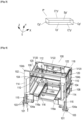
- Figures 2 and 3 show schematic diagrams of embodiments of a rubber block P, P' that include, in a representative manner, an outer surface having a top surface S P , S P' , an opposing bottom surface I P , Ip', two opposing sides C P , C P ' that define a length of the rubber block, and two opposing sides C *P , C *P' that define its width.
- a rubber block P, P' is typically described by a representation of its constituents in a meridian plane, i.e., a plane containing the parallel X-axis, the perpendicular Y-axis, and the Z-axis perpendicular to any meridian plane. It is understood that each of these parameters may be expressed in equivalent known length measurements (e.g., millimeters (mm) or inches (in)). It is understood that the geometries of the rubber blocks P, P' are given as examples, with other geometries being addressed (e.g., rubber blocks that have flowed).
- FIGS. 4-9 depicts an embodiment of an automated cell (or "cell") 100 of the invention.
- the cell 100 provides for the control of the containers in which the rubber blocks are arranged.
- the cell 100 may be part of a rubber product production facility (or "facility") for controlling the allocation and transportation of containers based on a process for picking arranged (or “sorted”) rubber blocks therein.
- the term “picking” includes the functions of posing and picking up arranged rubber blocks from the container handled by the cell 100, as well as the target arrangement of the rubber blocks.
- target rubber block (singular or plural) includes a rubber block that is present in the container and is identified for pickup during a picking process of the invention performed by a picking apparatus that is part of a rubber product production facility (e.g., a robot 200 as depicted and described below with reference to Figure 10 ).
- target location includes a dedicated space where the target rubber blocks will be arranged (e.g., a belt, a conveyor, another container, a rack, etc.).
- target arrangement (singular or plural) includes a desired arrangement for the rubber blocks arranged in a target location (e.g., "stacked storage").
- the cell 100 includes a clamping system, a container locking system (or “locking system”), and an automatic container centering system (or “centering system”).
- the clamping, locking and centering systems are incorporated into a frame 102 of the cell 100 that allows for the fixed installation of the cell (e.g., by support plates 101 and/or by fastening elements 103).
- One embodiment of the frame is shown as an example in Figures 4 to 9 . It is understood that the configuration of the frame 102 can be modified according to the footprint of the cell 100 and/or the installation of which the cell is a part.
- the embodiment of the frame 102 shown includes a pair of longitudinal members 104 spaced apart by a predetermined distance (e.g., a distance to allow loading of a container of corresponding dimensions into the cell 100).
- Each member 104 extends along a predetermined length between an attachment end 104a and an opposite end 104b.
- a cross bar 106 may join the opposite ends 104b of the members 104 to define an entrance that allows loading of a container into the cell 100.
- the frame 102 also includes a pair of lower supports 108 and a pair of upper supports 110 that extend substantially perpendicular to each member 104.
- Each pair of lower, upper supports 108, 110 is arranged in parallel with each other along the length of each member 104 and aligned with the corresponding supports.
- Each lower, upper support 108, 110 extends along a predetermined length between a respective attachment end 108a, 110a, where the support is attached to a corresponding member 104, and a respective opposite free end 108b, 110b (the lengths of the supports being substantially equal).
- the lower, upper supports 108, 110, together with the members 104, together define a loading space 112 of a container posed in the cell 100 during a clamping process performed by the cell. It is understood that the number and precise positioning of lower, upper supports 108, 110 may be varied and are not limited to the embodiment shown in the figures.
- the centering system of the cell 100 includes a guiding means that allows for precise positioning of the container loaded in the loading space 112 of the cell.
- the guiding means includes a pair of guides 114 aligned at the cell entrance, with one guide 114 being installed along the length of each member 104 (e.g., relative to mechanical stop(s) 115 as shown in Figure 4 ).
- the guiding means also includes a removal platform (or "platform") 116 installed on the frame 102 along the bottom supports 108. The platform 116, together with the frame 102, provides a drop-off space where the container is controlled and held in the loading space 112.
- the platform 116 includes at least one series of rollers 116a for moving the container into the loading space 112 (see Figures 4 and 5 ). It is understood that the number of series of rollers, the number of rollers in each series, and their arrangement may be varied depending on the containers being controlled.
- the cell clamping system 100 includes a pivoting frame (or "chassis") 118 installed on the frame 102.
- the chassis 118 includes two lateral sides 120, a longitudinal side 122, and a clamping member 124 that together form a tiltable, substantially rectangular holding frame for a container loaded into the loading space 112 of the cell.
- the frame 118 holds the container and the plastic bag.
- each lateral side 120 of the chassis 118 are substantially parallel, and each lateral side 120 includes a bottom edge 120a and a top edge 120b extending between a starting end 120 D and an opposite stopping end 120 AR (see Figure 6 ).
- the starting end 120 D of each lateral side 120 is aligned with a corresponding element 104 of the frame 102 so that the lateral sides 120 are spaced apart by a predetermined distance corresponding to the dimensions of the frame.
- the longitudinal side 122 joins the stop ends 120 AR of the lateral sides 120, and the clamping member 124 joins the start ends 120 D to form the tiltable holding frame.
- the longitudinal side 122 includes a lower edge 122a and an upper edge 122b extending between two opposing ends 122c.
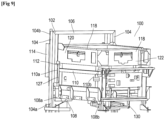
- the longitudinal side 122 incorporates a fastening means 123 along the lower edge 122a that allows the chassis 118 to be tilted between a standby position (where the chassis 118 remains tilted to allow for loading and positioning of a container in the loading space 112 of the cell 100) (see Figures 7 and 8 ) and a clamping position (where the chassis 118 descends) (e.g., to clamp the container's plastic bag, if present) (see Figure 9 ).
- the chassis 118 is tilted between the standby position and the clamping position by an actuator(s) 127 (or equivalent actuator(s) of the clamping system).
- Each actuator 127 may be operated by hydraulic, pneumatic, or equivalent means
- the chassis 118 also includes one or more pivotal flaps (or “flaps") that can pivotally move up and down.
- one or more side flaps V 120 are installed along the top edge 120b of each side 120.
- a longitudinal flap V 122 may be installed along the upper edge 122b of the longitudinal side 122.
- each lateral and longitudinal flap V 120a , V 120b includes a rubber strip that protects it from impact.
- Each side and longitudinal flap V 120a , V 120b pivotally moves up and down allowing a plastic bag to be pressed against a corresponding container packed in the plastic bag.
- each side and longitudinal flap V 120a , V 120b is pivoted by clamping cylinder(s) 129 (or equivalent clamping system actuator(s)).
- Each clamping cylinder 129 may be actuated by hydraulic, pneumatic or equivalent means.
- the container is held in its intended position in the cell 100 without damage to the chassis 118, regardless of the presence of a plastic bag.
- the cell 100 includes the locking system incorporating a pivoting barrier 130 that secures the container in the loading space 112 of the cell.
- the barrier 130 is installed on the frame 102 proximate to the free ends 108b of the lower supports 108.
- the barrier 130 pivots up and down allowing it to be tilted between an unlocked position (where the barrier 130 remains tilted to allow loading and positioning of the container in the loading space 112 of the cell 100)(see Figure 7 )) and a locked position (where the barrier 130 moves up to block and abut the container in a known plane)(see Figure 8 )).
- the locking system maintains the container in the loading space 112 even during the cycles of picking the rubber blocks arranged in the containers.
- the barrier 130 pivots between the unlocked position and the locked position in response to a clamping cylinder(s) 131 (or equivalent actuator(s) of the locking system).
- Each clamping cylinder 131 may be actuated by hydraulic, pneumatic or equivalent means.
- the cell 100 further includes sensor(s) for collecting data corresponding to the container (e.g., its dimensions) and its positioning relative to the loading space 112 of the cell 100.
- sensor singular or plural
- the term "sensor” may refer to one or more devices (including photos, cameras, and/or optical sensors). These devices may be configured to perform two-dimensional (2D) and/or three-dimensional (3D) image sensing, 3D depth sensing, and/or other types of sensing of the physical environment.
- 2D two-dimensional
- 3D three-dimensional
- the sensors may include one or more detection sensors 133 that detect the presence of a container in the loading space 112 of the cell 100.
- the detection sensors 133 may be selected from commercially available sensors (e.g., reflector-type sensors)(see dotted line A in Figure 5 ). Detection of a container in the loading space 112 may trigger a clamping process performed by the cell 100, which involves control of the clamping, locking and centering systems.
- the sensors may further include one or more calibration sensors 135 that manage the calibration of a vision system of the cell 100 (e.g., a 2D/3D type vision system)(see Figure 5 ).
- the detection sensors 133 and calibration sensors 135 may be attached to the frame 102 (e.g., along a member(s) 104, along a length of a lower, upper support(s) 108, 110, and/or along the platform 116).
- the sensors may further include a clamping sensor(s) 137 installed on the barrier 130 to trigger its tilt during a clamping process performed by the cell 100.
- the detection sensors 133, the calibration sensors 135, and the clamping sensors 137 are provided as examples. Other sensors with other functions may be provided for use with the cell 100 to perform the clamping processes based on the properties of the container (e.g., its dimensions, positioning, rubber block arrangement, presence or absence of plastic bags, etc.).
- the data collected by the sensors can be used in the control of an apparatus that performs the picking of the target rubber blocks arranged in the container.
- an apparatus that performs the picking of the target rubber blocks arranged in the container.
- the robot 200 may include a sensing system that uses one or more sensors (not shown) to gather information about the physical environment around the robot. It is understood that the terms "sensor,” “camera,” “camera,” and “optical sensor” may be used interchangeably and may refer to one or more devices configured to perform two-dimensional (2D) and/or three-dimensional (3D) image sensing, 3D depth sensing, and/or other types of sensing of the physical environment.
- the robot 200 may be a static robot or a mobile robot.
- mobile it is understood that the robot 200 may be set in motion either by integrated motion means (e.g., integrated motor(s)) or by non-integrated motion means (e.g., stand-alone mobile cart(s) or other equivalent mobile means).
- the robot 200 may be attached to a floor, ceiling, wall, or any support that allows the picking process of the invention to be performed by the robot 200.
- the robot 200 may be a conventional industrial robot or a collaborative robot or even a delta or cable robot.
- the robot 200 can be of the "Cartesian" type that allows the control of its movement in cases where the containers are positioned in a corresponding manner.
- the robot 200 includes a gripping device 202 supported by a pivotable elongated arm 204.
- the gripping device 202 extends from the elongated arm 204 to a free end 202a where a gripper 206 is disposed along a longitudinal axis l-l.
- the robot 200 is set in motion so that the gripper 206 can perform a pickup of a target rubber block during a picking process performed by the robot.
- the initial positioning of the robot 200 and the initial orientation of the gripper 206 may be determined from data obtained via image acquisition and the physical environment in which the robot 200 operates relative to the cell 100. Sensors of the sensing system incorporated with the robot 200 may be attached to the elongated arm 204 and/or the robot gripper 206.
- the gripper 206 includes one or more screws 208 installed in a functional platform 210 of the gripper such that each of the screws can be rotated.
- the screws 208 may be integrated, or they may be removable, with respect to the functional platform 210.
- the functional platform 210 allows the screw(s) 208 to be installed in a substantially equilateral geometry (e.g., a substantially square shape).
- the number of screws 208 is adjustable to enable quick mounting and dismounting of the screws as needed for the process of picking the intended rubber block.
- One or more screws 208 may be installed on the gripper 206 to optimize its gripping ability (e.g., to match the grip to the dimensions of the target rubber block), to optimize the holding force of the target rubber block, and to have the ability to grip one or more rubber blocks at a time with an adjustable number of screws.
- a vision system (not shown) may be used to detect the presence of an arrangement of rubber blocks within the field of view of a camera of the vision system, thereby triggering the camera to capture the image of the rubber block(s).
- an arbitrary point may be placed at a known position relative to the sensor of the sensing system (e.g., at a known horizontal distance and a known vertical distance from the sensor position).
- the sensors in the cell 100 and the sensors in the robot 200 may provide the physical environment information that may be used by a control system (that includes, for example, software for scheduling clamping of the cell 100 and/or corresponding movements of the robot 200).
- the control system could be in remote communication.
- one or more sensors mounted on the robot 200 may be integrated to form a digital model of the physical environment (including, where applicable, the side(s), floor and ceiling).
- the control system can provoke movement of the robot 200 so as to navigate among target rubber block picking positions, based on the positioning of the container in the loading space 112.
- the process includes a step of positioning a container C in the loading space 112 of the cell 100 (see Figure 7 ).
- the chassis 118 remains in the standby position, and the barrier 130 remains in the unlocked position.
- the platform 116 guides the container C onto the platform during this step.
- the facility of which the cell 100 is a part is shut down and secured to allow uninterrupted access to the container C.
- the clamping station can be supplied and unloaded with containers by automatic handling means (for example, of the AGV/RGV type) but also by any other manual or semi-automatic handling means.
- the clamping process further includes a locking step to press the container C against the frame 102 of the cell 100 (see Figure 8 ).
- a locking step to press the container C against the frame 102 of the cell 100 (see Figure 8 ).
- the detection of the presence and the correct positioning of the container allows the displacement of the barrier 130 from the unlocking position (see Figure 7 ) to the locking position (see Figure 8 ) in order to block and stop the container C.
- This configuration which ensures that the container C is held in the loading space 112, also optimizes a working area of a device that treats the rubber blocks arranged in the container (for example, the robot 200 of Figure 10 ).
- the locking step further includes a step of lowering the flaps to come to rest against the corresponding container C.
- the flap(s) come to rest against the plastic bag to hold it in place.
- the clamping process of the invention includes a final clamping step to position the tilting holding frame (see Figure 9 ).
- the chassis 118 moves from the standby position (see Figures 7 and 8 ) to the clamping position (see Figure 9 ) to press the container against the frame 102 and to clamp the plastic bag of the container (if present).
- one or more steps of the process may further include a step of scanning the physical environment containing the cell 100. In embodiments of the process, this step further includes a step of measuring the physical environment containing the cell 100 to arrive at an accurate positioning of the container C.
- the rubber product production facility and/or an apparatus for picking a rubber block e.g., robot 200
- the rubber product production facility and/or an apparatus for picking a rubber block may use one or more sensors to capture data corresponding to the clamped containers and arranged rubber blocks to determine the shapes and/or positions of the individual rubber block. This information is relevant to understanding the arrangement of the arranged rubber blocks and to determining the best candidate for picking among the arranged rubber blocks. This best candidate selection strategy allows for accurate modeling of the clamping process to optimize the time of an associated picking cycle.
- a cycle of the clamping process of the invention may be made by the PLC control and may include pre-programming of control information.
- a process setting may be associated with the inclination that is provided to the cell 100, and/or the properties of the mixture of the rubber blocks arranged in a container controlled by the cell 100 (including the properties of a rubber type(s) associated with the corresponding containers and/or the presence of plastic bags).
- the cell 100 (and/or a system incorporating the cell 100) can easily repeat one or more steps of the clamping process in a specified order to properly provide the rubber blocks to achieve a desired batch.
- the cell 100 may include pre-programming of control information.
- a process setting may be associated with parameters of typical physical environments in which the cell operates.
- the cell 100 (and/or a facility incorporating the cell 100) may receive voice commands or other audio data representing, for example, a step or stop of the cell 100 and/or a loading/unloading of the container from the loading space 112.
- the request may include a request for the current status of a cycle of an automatic recognition process.
- a generated response may be represented audibly, visually, tactilely (e.g., using a haptic interface) and/or in virtual and/or augmented manners. This response, together with corresponding data, may be entered into a neural network.
- a monitoring system could be implemented. At least a portion of the monitoring system may be provided in a wearable device such as a mobile network device (e.g., a cell phone, a wearable computer, wearable network-connected device(s) (including “augmented reality” and/or “virtual reality” devices), wearable network-connected clothing, and/or any combinations and/or any equivalents).
- a mobile network device e.g., a cell phone, a wearable computer, wearable network-connected device(s) (including "augmented reality” and/or “virtual reality” devices), wearable network-connected clothing, and/or any combinations and/or any equivalents).
- the process may include a step of training the cell 100 (or training a system incorporating the cell 100) to recognize values representative of the containers and/or the nature of rubber blocks associated with the containers controlled by the cell 100 (e.g., temperature and viscosity values) and to make a comparison with target values (e.g., to make a batch incorporating the picked rubber blocks).
- This step may include the step of training the cell 100 to recognize non-equivalences between the compared values.
- Each training step may include a classification generated by self-learning means.
- This classification may include, but is not limited to, the parameters of the selected batches, the container configurations, the durations of the clamping process cycles, and the expected values at the end of a cycle in progress (e.g., the weight of rubber blocks posed in the target location to achieve a desired batch).
Landscapes
- Engineering & Computer Science (AREA)
- Mechanical Engineering (AREA)
- Robotics (AREA)
- Multimedia (AREA)
- Warehouses Or Storage Devices (AREA)
- Auxiliary Devices For And Details Of Packaging Control (AREA)
- Human Computer Interaction (AREA)
- Manipulator (AREA)
Claims (11)
- Automatisierte Zelle (100) zum Steuern von Behältern, in denen Gummiblöcke angeordnet sind, dadurch gekennzeichnet, dass die Zelle (100) umfasst:- einen Rahmen (102), der die feste Installation der Zelle (100) ermöglicht;- ein automatisches Zentriersystem mit einem Führungsmittel, das eine präzise Positionierung eines beladenen Behälters in einem Laderaum (112) der Zelle ermöglicht;- ein Klemmsystem, das ein Haltemittel umfasst, das die Positionierung des beladenen Behälters im Laderaum der Zelle aufrechterhält; und- ein Verriegelungssystem mit einem Verriegelungsmittel, das die Aufrechterhaltung der Positionierung des Behälters im Laderaum der Zelle gewährleistet.
- Zelle (100) gemäß Anspruch 1, wobei:- das Führungsmittel ein Paar von Führungen (114) umfasst, die am Eingang der Zelle ausgerichtet sind;- das Haltemittel einen kippbaren Halterahmen mit einem schwenkbaren Chassis (118) umfasst, das auf dem Rahmen (102) so angebracht ist, dass sich das Chassis zwischen einer Bereitschaftsposition, in der das Chassis gekippt bleibt, um das Beladen und Positionieren des Behälters in einem Laderaum (112) der Zelle (100) zu ermöglichen, und einer Klemmposition, in der sich das Chassis (118) absenkt, bewegt; und- das Verriegelungsmittel eine Schranke (130) umfasst, die so am Rahmen (102) angebracht ist, dass sich die Schranke zwischen einer entriegelten Position, in der die Schranke (130) gekippt bleibt, um das Beladen und Positionieren des Behälters im Laderaum (112) der Zelle (100) zu ermöglichen, und einer verriegelten Position bewegt, in der sich die Schranke (130) nach oben bewegt, um den Behälter in einer bekannten Ebene zu verriegeln und daran anzuliegen.
- Zelle (100) gemäß Anspruch 2, wobei das Führungsmittel eine auf dem Rahmen (102) installierte Aufstellplattform (116) umfasst, um einen Aufstellraum zu schaffen, in dem der Behälter in dem Laderaum (112) gehalten wird.
- Zelle (100) gemäß Anspruch 3, wobei die Plattform (116) mindestens einen Satz von Rollen (116a) zum Bewegen des Behälters in den Laderaum (116a) umfasst.
- Zelle (100) gemäß einem der Ansprüche 2 bis 4, wobei das Chassis (118) umfasst:- ein Sicherungsmittel (123), das es ermöglicht, das Chassis (118) zwischen der Bereitschaftsstellung und der Klemmstellung zu bewegen; und- ein Klemmelement (124) zum Bilden des kippbaren Halterahmens.
- Zelle (100) gemäß Anspruch 5, wobei das Chassis (118) ferner eine oder mehrere Klappen (V120, V122) umfasst, wobei jede Klappe (V120), (V122) schwenkbar nach oben und unten bewegbar ist.
- Zelle (100) gemäß einem der Ansprüche 1 bis 6, ferner umfassend einen oder mehrere Sensoren (133, 135, 137) zum Sammeln von Daten, die dem Behälter und seiner Positionierung relativ zum Laderaum (112) der Zelle entsprechen.
- Klemmprozess, das durch die Zelle (100) gemäß Anspruch 6 oder Anspruch 7 durchgeführt wird, dadurch gekennzeichnet, dass das Verfahren die folgenden Schritte umfasst:- einen Schritt des Positionierens eines Behälters (C) in den Laderaum (112) der Zelle (100), während dessen das Chassis (118) in der Bereitschaftsposition und die Schranke (130) in der entriegelten Position verbleibt;- einen Schritt des Verriegelns der Schranke (130), bei dem sich die Schranke aus der entriegelten Position in die verriegelte Position bewegt, um den Behälter (C) gegen den Rahmen (102) der Zelle (100) zu drücken; und- einen Klemmschritt, bei dem sich das Chassis (118) aus der Bereitschaftsposition in die Klemmposition bewegt, um den kippbaren Halterahmen zu positionieren.
- Klemmprozess gemäß Anspruch 8, wobei der Verriegelungsschritt ferner einen Schritt des Absenkens einer oder mehrerer Klappen (V120, V122) umfasst, um den im Laderaum (112) der Zelle (100) befindlichen Behälter (C) zu erfassen.
- Klemmprozess gemäß Anspruch 8 oder 9, ferner umfassend einen Schritt des Messens der physischen Umgebung, die die Zelle (100) enthält, um eine genaue Positionierung des Behälters (C) zu erreichen.
- Anlage zur Herstellung von Gummiprodukten, umfassend:- die Zelle (100) gemäß einem der Ansprüche 1 bis 7; und- einen Roboter (200), umfassend:dass der Roboter (200) in Bewegung gesetzt wird, sodass der Greifer (206) das Greifen eines im Behälter angeordneten Zielgummiblocks während eines durch den Roboter durchgeführten Entnahmeprozesses durchführen kann.- eine Greifvorrichtung (202), die durch einen länglichen Arm (204) getragen wird, der schwenkbar ist und sich von dem länglichen Arm zu einem freien Ende (202a) erstreckt; und- einen Greifer (206), der am freien Ende (202a) der Greifvorrichtung (202) angeordnet ist, wobei der Greifer eine Schraube oder Schrauben (208) umfasst, die in einer Funktionsplattform (210) des Greifers so installiert sind,
Applications Claiming Priority (1)
| Application Number | Priority Date | Filing Date | Title |
|---|---|---|---|
| FR2101752A FR3120069B1 (fr) | 2021-02-23 | 2021-02-23 | Cellule Automatisée pour Gestion des Caisses Réalisée pendant un Procédé de Dévracage des Pains de Gomme |
Publications (2)
| Publication Number | Publication Date |
|---|---|
| EP4046946A1 EP4046946A1 (de) | 2022-08-24 |
| EP4046946B1 true EP4046946B1 (de) | 2024-01-03 |
Family
ID=75953992
Family Applications (1)
| Application Number | Title | Priority Date | Filing Date |
|---|---|---|---|
| EP21203859.0A Active EP4046946B1 (de) | 2021-02-23 | 2021-10-21 | Automatisierte zelle zur durchführung von behältersteuerung während eines verfahrens zum aufnehmen von gummiblöcken |
Country Status (5)
| Country | Link |
|---|---|
| US (1) | US12378086B2 (de) |
| EP (1) | EP4046946B1 (de) |
| CN (1) | CN113731858B (de) |
| ES (1) | ES2975164T3 (de) |
| FR (1) | FR3120069B1 (de) |
Families Citing this family (2)
| Publication number | Priority date | Publication date | Assignee | Title |
|---|---|---|---|---|
| US11820609B2 (en) * | 2021-02-23 | 2023-11-21 | Compagnie Generale Des Etablissements Michelin | Robot equipped with a gripper for performing a picking process |
| US12304737B2 (en) | 2021-05-06 | 2025-05-20 | Compagnie Generale Des Etablissements Michelin | Automated flow control for rubber product manufacturing processes |
Family Cites Families (48)
| Publication number | Priority date | Publication date | Assignee | Title |
|---|---|---|---|---|
| GB704421A (en) * | 1952-01-04 | 1954-02-24 | John Conrad Arnold | An improved check-weighing machine |
| GB1196918A (en) * | 1966-11-22 | 1970-07-01 | Roy Sanderson | Container Tipping Device |
| US5281081A (en) | 1990-01-10 | 1994-01-25 | Mitsubishi Denki Kabushiki Kaisha | Stowage device for plural species of works |
| JPH10297768A (ja) * | 1997-04-25 | 1998-11-10 | Bridgestone Corp | ゴムブロックの荷降ろし方法 |
| FR2808260B1 (fr) * | 2000-04-28 | 2002-08-30 | Foulon Cornel Draghici | Leve-conteneurs a verin bifonctionnel et verrou automatique de retenue de chariot de guidage lateral en position haute |
| TW461014B (en) * | 2000-10-11 | 2001-10-21 | Ind Tech Res Inst | A positioning method and device for wafer loading devices |
| US20020070640A1 (en) * | 2000-12-07 | 2002-06-13 | Hamilton Eugene R. | Locking mechanism, and locking barrier and cabinet using same |
| US6682292B2 (en) * | 2001-12-28 | 2004-01-27 | Codev Corp. | Motorcycle tow rack with yaw brace for a receiver hitch |
| JP2005297091A (ja) | 2004-04-07 | 2005-10-27 | Sumitomo Chemical Co Ltd | ゴムベール移送設備及び移送方法 |
| AT500331B1 (de) * | 2004-05-18 | 2007-01-15 | Ssi Schaefer Peem Gmbh | Verfahren und vorrichtung zur entleerung von behältern |
| JP4827076B2 (ja) * | 2005-03-04 | 2011-11-30 | 日本輸送機株式会社 | フォークリフト |
| CH698060B1 (de) * | 2006-03-01 | 2009-05-15 | Gilgen Logistics Ag | Vorrichtung zum Entladen von oben offenen, insbesondere kastenförmigen, Behältern. |
| CN201002253Y (zh) * | 2006-11-13 | 2008-01-09 | 浙江吉利汽车研究院有限公司 | 副车架分装台 |
| DE102007018634B8 (de) * | 2007-04-19 | 2008-11-27 | Siemens Ag | Vorrichtung und Verfahren zum Entladen eines Behälters |
| JP2009172720A (ja) * | 2008-01-24 | 2009-08-06 | Kondo Seisakusho:Kk | ビンピッキング装置 |
| IT1391912B1 (it) * | 2008-11-18 | 2012-02-02 | Toppy S R L | Dispositivo per la separazione di un bancale dal rispettivo carico |
| US8459625B1 (en) * | 2009-03-31 | 2013-06-11 | Honda Motor Co., Ltd. | Device for securing vehicle body to conveyor carrier |
| US8177058B2 (en) * | 2010-08-03 | 2012-05-15 | Cavallini Carlos | Tray and slip sheet for transporting rubber |
| FR2971237A1 (fr) | 2011-02-07 | 2012-08-10 | Engeenering Batiments Et Distrib D Equipements Pour Legumes | Installation pour la manutention et le stockage d'au moins un contenant sur une palette |
| DE102013013114A1 (de) * | 2012-08-17 | 2014-02-20 | Liebherr-Verzahntechnik Gmbh | Vorrichtung zum automatisierten Entnehmen von in einem Behälter angeordneten Werkstücken |
| US9481518B2 (en) | 2013-02-24 | 2016-11-01 | Intelligrated Headquarters Llc | Order fulfillment system and method |
| CN103708234B (zh) * | 2014-01-08 | 2016-05-25 | 山东兰剑物流科技股份有限公司 | 一种用于箱装药品的机械拆垛方法及设备 |
| CN203853797U (zh) * | 2014-03-20 | 2014-10-01 | 成都极点精密模具有限公司 | 一种轻型可翻转夹具 |
| JP6270595B2 (ja) | 2014-04-01 | 2018-01-31 | 鈴鹿エンヂニヤリング株式会社 | ベールゴムの吊り揚げ搬送方法及びその装置 |
| US10239210B2 (en) | 2014-04-11 | 2019-03-26 | Symbotic Canada Ulc | Vision-assisted system and method for picking of rubber bales in a bin |
| AU2016370628A1 (en) | 2015-12-16 | 2018-05-31 | Mbl Limited | Robotic kitchen including a robot, a storage arrangement and containers therefor |
| FR3049888A1 (fr) | 2016-04-11 | 2017-10-13 | Michelin & Cie | Maitrise du dosage dans la manufacture des pneumatiques |
| BR112018074184B1 (pt) * | 2016-05-25 | 2022-10-25 | Bobst Mex Sa | Dispositivo vibrador, transportador de descarregamento, estação de enchimento e método de descarregamento de containers |
| CN205837747U (zh) | 2016-06-03 | 2016-12-28 | 北京极智嘉科技有限公司 | 货物自动拣选系统 |
| CN205802495U (zh) * | 2016-07-26 | 2016-12-14 | 南安天航机械有限公司 | 一种便于砖块分类和卸料的装置 |
| JP2018027581A (ja) | 2016-08-17 | 2018-02-22 | 株式会社安川電機 | ピッキングシステム |
| CN106742061B (zh) | 2016-11-25 | 2019-04-09 | 北京空间机电研究所 | 一种小行星微重力表面巡视机构 |
| CN206840077U (zh) | 2017-07-05 | 2018-01-05 | 海南大学 | 一种橡胶干燥生产线卸胶机械手 |
| FR3069475A1 (fr) | 2017-07-27 | 2019-02-01 | Compagnie Generale Des Etablissements Michelin | Maitrise du dosage dans la manufacture des pneumatiques |
| CN208021776U (zh) | 2018-03-19 | 2018-10-30 | 滨州学院 | 一种航空箱运输托架车 |
| US10766701B2 (en) * | 2018-03-22 | 2020-09-08 | Feedall, LLC | Self-leveling bin assembly |
| FR3079767B1 (fr) | 2018-04-06 | 2020-03-27 | Compagnie Generale Des Etablissements Michelin | Dispositif et procede de prehension de bloc elastomerique souple |
| CN108527322B (zh) | 2018-04-09 | 2020-07-31 | 北京京东乾石科技有限公司 | 拣选装置和拣选方法 |
| US11922369B2 (en) | 2018-07-31 | 2024-03-05 | Compagnie Generale Des Etablissements Michelin | Automated flow management in a compounding station |
| US10829313B2 (en) * | 2018-08-02 | 2020-11-10 | Intelligrated Headquarters, Llc | Goods to operator workstation |
| CN208531711U (zh) * | 2018-08-13 | 2019-02-22 | 佛山市南海区多麦机械设备有限公司 | 码垛机 |
| US11046518B2 (en) * | 2019-01-14 | 2021-06-29 | Mujin, Inc. | Controller and control method for robot system |
| DE102019207401A1 (de) * | 2019-05-21 | 2020-11-26 | Continental Reifen Deutschland Gmbh | Verfahren und Vorrichtung zum automatisierten Vereinzeln von quaderförmigen Werkstücken von einem Stapel |
| CN110713019B (zh) | 2019-11-08 | 2024-07-02 | 中国机械总院集团云南分院有限公司 | 天然橡胶块智能取料码垛系统 |
| CN210417931U (zh) | 2020-02-27 | 2020-04-28 | 桂林师范高等专科学校 | 一种工厂仓库货架用自动化上料装置 |
| CN112407741A (zh) | 2020-11-12 | 2021-02-26 | 深圳市鲸仓科技有限公司 | 自动拣货仓库及其自动拣货方法 |
| US11820609B2 (en) | 2021-02-23 | 2023-11-21 | Compagnie Generale Des Etablissements Michelin | Robot equipped with a gripper for performing a picking process |
| US12304737B2 (en) | 2021-05-06 | 2025-05-20 | Compagnie Generale Des Etablissements Michelin | Automated flow control for rubber product manufacturing processes |
-
2021
- 2021-02-23 FR FR2101752A patent/FR3120069B1/fr active Active
- 2021-08-30 US US17/461,565 patent/US12378086B2/en active Active
- 2021-08-31 CN CN202111012318.8A patent/CN113731858B/zh active Active
- 2021-10-21 EP EP21203859.0A patent/EP4046946B1/de active Active
- 2021-10-21 ES ES21203859T patent/ES2975164T3/es active Active
Also Published As
| Publication number | Publication date |
|---|---|
| ES2975164T3 (es) | 2024-07-03 |
| FR3120069A1 (fr) | 2022-08-26 |
| EP4046946A1 (de) | 2022-08-24 |
| US20210387359A1 (en) | 2021-12-16 |
| CN113731858B (zh) | 2023-11-21 |
| CN113731858A (zh) | 2021-12-03 |
| US12378086B2 (en) | 2025-08-05 |
| FR3120069B1 (fr) | 2023-02-10 |
Similar Documents
| Publication | Publication Date | Title |
|---|---|---|
| US12297058B2 (en) | Vision-assisted robotized depalletizer | |
| US20260042216A1 (en) | Multi-pallet mixed-case robotic palletizer | |
| CN113021401B (zh) | 用于夹持和保持物体的机器人多爪夹持器总成和方法 | |
| KR101187234B1 (ko) | 로봇을 이용해 타이어들을 디팔레타이징하기 위한 방법 및 시스템 | |
| KR20210137060A (ko) | 로봇식 다품목 유형의 팔레타이징 및 디팔레타이징 | |
| JP2025157302A (ja) | 視覚支援型のロボット化デパレタイザ | |
| WO2022197468A1 (en) | Robotic palletization system with variable conveyor height | |
| CA2887261C (en) | Vision-assisted system and method for picking of rubber bales in a bin | |
| EP4046946B1 (de) | Automatisierte zelle zur durchführung von behältersteuerung während eines verfahrens zum aufnehmen von gummiblöcken | |
| US20080267759A1 (en) | Order picking system | |
| US11820609B2 (en) | Robot equipped with a gripper for performing a picking process | |
| KR20190053850A (ko) | 로봇 손을 이용해 크레이트에 오브젝트를 자동화 적재하는 방법 | |
| EP4086069B1 (de) | Automatisierte durchflusskontrolle bei der herstellung von gummiprodukten | |
| CA2628644C (en) | Method and device for automatically stacking tires on a support | |
| CN110987019A (zh) | 标定工装及标定方法 | |
| CN211317335U (zh) | 标定工装 | |
| CN119953856A (zh) | 将面状产品堆垛从高度可调的传送线转移至托盘的方法 | |
| CN120152823A (zh) | 用于在工厂内自动处理产品的方法 |
Legal Events
| Date | Code | Title | Description |
|---|---|---|---|
| PUAI | Public reference made under article 153(3) epc to a published international application that has entered the european phase |
Free format text: ORIGINAL CODE: 0009012 |
|
| STAA | Information on the status of an ep patent application or granted ep patent |
Free format text: STATUS: THE APPLICATION HAS BEEN PUBLISHED |
|
| AK | Designated contracting states |
Kind code of ref document: A1 Designated state(s): AL AT BE BG CH CY CZ DE DK EE ES FI FR GB GR HR HU IE IS IT LI LT LU LV MC MK MT NL NO PL PT RO RS SE SI SK SM TR |
|
| STAA | Information on the status of an ep patent application or granted ep patent |
Free format text: STATUS: REQUEST FOR EXAMINATION WAS MADE |
|
| 17P | Request for examination filed |
Effective date: 20230224 |
|
| RBV | Designated contracting states (corrected) |
Designated state(s): AL AT BE BG CH CY CZ DE DK EE ES FI FR GB GR HR HU IE IS IT LI LT LU LV MC MK MT NL NO PL PT RO RS SE SI SK SM TR |
|
| GRAP | Despatch of communication of intention to grant a patent |
Free format text: ORIGINAL CODE: EPIDOSNIGR1 |
|
| STAA | Information on the status of an ep patent application or granted ep patent |
Free format text: STATUS: GRANT OF PATENT IS INTENDED |
|
| INTG | Intention to grant announced |
Effective date: 20230808 |
|
| GRAS | Grant fee paid |
Free format text: ORIGINAL CODE: EPIDOSNIGR3 |
|
| GRAA | (expected) grant |
Free format text: ORIGINAL CODE: 0009210 |
|
| STAA | Information on the status of an ep patent application or granted ep patent |
Free format text: STATUS: THE PATENT HAS BEEN GRANTED |
|
| AK | Designated contracting states |
Kind code of ref document: B1 Designated state(s): AL AT BE BG CH CY CZ DE DK EE ES FI FR GB GR HR HU IE IS IT LI LT LU LV MC MK MT NL NO PL PT RO RS SE SI SK SM TR |
|
| REG | Reference to a national code |
Ref country code: GB Ref legal event code: FG4D |
|
| REG | Reference to a national code |
Ref country code: CH Ref legal event code: EP |
|
| REG | Reference to a national code |
Ref country code: DE Ref legal event code: R096 Ref document number: 602021008279 Country of ref document: DE |
|
| REG | Reference to a national code |
Ref country code: IE Ref legal event code: FG4D |
|
| REG | Reference to a national code |
Ref country code: LT Ref legal event code: MG9D |
|
| REG | Reference to a national code |
Ref country code: NL Ref legal event code: MP Effective date: 20240103 |
|
| REG | Reference to a national code |
Ref country code: AT Ref legal event code: MK05 Ref document number: 1646602 Country of ref document: AT Kind code of ref document: T Effective date: 20240103 |
|
| PG25 | Lapsed in a contracting state [announced via postgrant information from national office to epo] |
Ref country code: NL Free format text: LAPSE BECAUSE OF FAILURE TO SUBMIT A TRANSLATION OF THE DESCRIPTION OR TO PAY THE FEE WITHIN THE PRESCRIBED TIME-LIMIT Effective date: 20240103 |
|
| PG25 | Lapsed in a contracting state [announced via postgrant information from national office to epo] |
Ref country code: NL Free format text: LAPSE BECAUSE OF FAILURE TO SUBMIT A TRANSLATION OF THE DESCRIPTION OR TO PAY THE FEE WITHIN THE PRESCRIBED TIME-LIMIT Effective date: 20240103 |
|
| PG25 | Lapsed in a contracting state [announced via postgrant information from national office to epo] |
Ref country code: IS Free format text: LAPSE BECAUSE OF FAILURE TO SUBMIT A TRANSLATION OF THE DESCRIPTION OR TO PAY THE FEE WITHIN THE PRESCRIBED TIME-LIMIT Effective date: 20240503 |
|
| REG | Reference to a national code |
Ref country code: ES Ref legal event code: FG2A Ref document number: 2975164 Country of ref document: ES Kind code of ref document: T3 Effective date: 20240703 |
|
| PG25 | Lapsed in a contracting state [announced via postgrant information from national office to epo] |
Ref country code: LT Free format text: LAPSE BECAUSE OF FAILURE TO SUBMIT A TRANSLATION OF THE DESCRIPTION OR TO PAY THE FEE WITHIN THE PRESCRIBED TIME-LIMIT Effective date: 20240103 |
|
| PG25 | Lapsed in a contracting state [announced via postgrant information from national office to epo] |
Ref country code: GR Free format text: LAPSE BECAUSE OF FAILURE TO SUBMIT A TRANSLATION OF THE DESCRIPTION OR TO PAY THE FEE WITHIN THE PRESCRIBED TIME-LIMIT Effective date: 20240404 |
|
| PG25 | Lapsed in a contracting state [announced via postgrant information from national office to epo] |
Ref country code: HR Free format text: LAPSE BECAUSE OF FAILURE TO SUBMIT A TRANSLATION OF THE DESCRIPTION OR TO PAY THE FEE WITHIN THE PRESCRIBED TIME-LIMIT Effective date: 20240103 Ref country code: RS Free format text: LAPSE BECAUSE OF FAILURE TO SUBMIT A TRANSLATION OF THE DESCRIPTION OR TO PAY THE FEE WITHIN THE PRESCRIBED TIME-LIMIT Effective date: 20240403 |
|
| PG25 | Lapsed in a contracting state [announced via postgrant information from national office to epo] |
Ref country code: CZ Free format text: LAPSE BECAUSE OF FAILURE TO SUBMIT A TRANSLATION OF THE DESCRIPTION OR TO PAY THE FEE WITHIN THE PRESCRIBED TIME-LIMIT Effective date: 20240103 Ref country code: AT Free format text: LAPSE BECAUSE OF FAILURE TO SUBMIT A TRANSLATION OF THE DESCRIPTION OR TO PAY THE FEE WITHIN THE PRESCRIBED TIME-LIMIT Effective date: 20240103 |
|
| PG25 | Lapsed in a contracting state [announced via postgrant information from national office to epo] |
Ref country code: RS Free format text: LAPSE BECAUSE OF FAILURE TO SUBMIT A TRANSLATION OF THE DESCRIPTION OR TO PAY THE FEE WITHIN THE PRESCRIBED TIME-LIMIT Effective date: 20240403 Ref country code: NO Free format text: LAPSE BECAUSE OF FAILURE TO SUBMIT A TRANSLATION OF THE DESCRIPTION OR TO PAY THE FEE WITHIN THE PRESCRIBED TIME-LIMIT Effective date: 20240403 Ref country code: LT Free format text: LAPSE BECAUSE OF FAILURE TO SUBMIT A TRANSLATION OF THE DESCRIPTION OR TO PAY THE FEE WITHIN THE PRESCRIBED TIME-LIMIT Effective date: 20240103 Ref country code: IS Free format text: LAPSE BECAUSE OF FAILURE TO SUBMIT A TRANSLATION OF THE DESCRIPTION OR TO PAY THE FEE WITHIN THE PRESCRIBED TIME-LIMIT Effective date: 20240503 Ref country code: HR Free format text: LAPSE BECAUSE OF FAILURE TO SUBMIT A TRANSLATION OF THE DESCRIPTION OR TO PAY THE FEE WITHIN THE PRESCRIBED TIME-LIMIT Effective date: 20240103 Ref country code: GR Free format text: LAPSE BECAUSE OF FAILURE TO SUBMIT A TRANSLATION OF THE DESCRIPTION OR TO PAY THE FEE WITHIN THE PRESCRIBED TIME-LIMIT Effective date: 20240404 Ref country code: CZ Free format text: LAPSE BECAUSE OF FAILURE TO SUBMIT A TRANSLATION OF THE DESCRIPTION OR TO PAY THE FEE WITHIN THE PRESCRIBED TIME-LIMIT Effective date: 20240103 Ref country code: BG Free format text: LAPSE BECAUSE OF FAILURE TO SUBMIT A TRANSLATION OF THE DESCRIPTION OR TO PAY THE FEE WITHIN THE PRESCRIBED TIME-LIMIT Effective date: 20240103 Ref country code: AT Free format text: LAPSE BECAUSE OF FAILURE TO SUBMIT A TRANSLATION OF THE DESCRIPTION OR TO PAY THE FEE WITHIN THE PRESCRIBED TIME-LIMIT Effective date: 20240103 |
|
| PG25 | Lapsed in a contracting state [announced via postgrant information from national office to epo] |
Ref country code: PL Free format text: LAPSE BECAUSE OF FAILURE TO SUBMIT A TRANSLATION OF THE DESCRIPTION OR TO PAY THE FEE WITHIN THE PRESCRIBED TIME-LIMIT Effective date: 20240103 Ref country code: PT Free format text: LAPSE BECAUSE OF FAILURE TO SUBMIT A TRANSLATION OF THE DESCRIPTION OR TO PAY THE FEE WITHIN THE PRESCRIBED TIME-LIMIT Effective date: 20240503 |
|
| PG25 | Lapsed in a contracting state [announced via postgrant information from national office to epo] |
Ref country code: SE Free format text: LAPSE BECAUSE OF FAILURE TO SUBMIT A TRANSLATION OF THE DESCRIPTION OR TO PAY THE FEE WITHIN THE PRESCRIBED TIME-LIMIT Effective date: 20240103 Ref country code: PT Free format text: LAPSE BECAUSE OF FAILURE TO SUBMIT A TRANSLATION OF THE DESCRIPTION OR TO PAY THE FEE WITHIN THE PRESCRIBED TIME-LIMIT Effective date: 20240503 Ref country code: PL Free format text: LAPSE BECAUSE OF FAILURE TO SUBMIT A TRANSLATION OF THE DESCRIPTION OR TO PAY THE FEE WITHIN THE PRESCRIBED TIME-LIMIT Effective date: 20240103 Ref country code: LV Free format text: LAPSE BECAUSE OF FAILURE TO SUBMIT A TRANSLATION OF THE DESCRIPTION OR TO PAY THE FEE WITHIN THE PRESCRIBED TIME-LIMIT Effective date: 20240103 |
|
| REG | Reference to a national code |
Ref country code: DE Ref legal event code: R097 Ref document number: 602021008279 Country of ref document: DE |
|
| PG25 | Lapsed in a contracting state [announced via postgrant information from national office to epo] |
Ref country code: DK Free format text: LAPSE BECAUSE OF FAILURE TO SUBMIT A TRANSLATION OF THE DESCRIPTION OR TO PAY THE FEE WITHIN THE PRESCRIBED TIME-LIMIT Effective date: 20240103 |
|
| PG25 | Lapsed in a contracting state [announced via postgrant information from national office to epo] |
Ref country code: SM Free format text: LAPSE BECAUSE OF FAILURE TO SUBMIT A TRANSLATION OF THE DESCRIPTION OR TO PAY THE FEE WITHIN THE PRESCRIBED TIME-LIMIT Effective date: 20240103 |
|
| PG25 | Lapsed in a contracting state [announced via postgrant information from national office to epo] |
Ref country code: EE Free format text: LAPSE BECAUSE OF FAILURE TO SUBMIT A TRANSLATION OF THE DESCRIPTION OR TO PAY THE FEE WITHIN THE PRESCRIBED TIME-LIMIT Effective date: 20240103 |
|
| PG25 | Lapsed in a contracting state [announced via postgrant information from national office to epo] |
Ref country code: SK Free format text: LAPSE BECAUSE OF FAILURE TO SUBMIT A TRANSLATION OF THE DESCRIPTION OR TO PAY THE FEE WITHIN THE PRESCRIBED TIME-LIMIT Effective date: 20240103 |
|
| PG25 | Lapsed in a contracting state [announced via postgrant information from national office to epo] |
Ref country code: SM Free format text: LAPSE BECAUSE OF FAILURE TO SUBMIT A TRANSLATION OF THE DESCRIPTION OR TO PAY THE FEE WITHIN THE PRESCRIBED TIME-LIMIT Effective date: 20240103 Ref country code: SK Free format text: LAPSE BECAUSE OF FAILURE TO SUBMIT A TRANSLATION OF THE DESCRIPTION OR TO PAY THE FEE WITHIN THE PRESCRIBED TIME-LIMIT Effective date: 20240103 Ref country code: RO Free format text: LAPSE BECAUSE OF FAILURE TO SUBMIT A TRANSLATION OF THE DESCRIPTION OR TO PAY THE FEE WITHIN THE PRESCRIBED TIME-LIMIT Effective date: 20240103 Ref country code: EE Free format text: LAPSE BECAUSE OF FAILURE TO SUBMIT A TRANSLATION OF THE DESCRIPTION OR TO PAY THE FEE WITHIN THE PRESCRIBED TIME-LIMIT Effective date: 20240103 Ref country code: DK Free format text: LAPSE BECAUSE OF FAILURE TO SUBMIT A TRANSLATION OF THE DESCRIPTION OR TO PAY THE FEE WITHIN THE PRESCRIBED TIME-LIMIT Effective date: 20240103 |
|
| PLBE | No opposition filed within time limit |
Free format text: ORIGINAL CODE: 0009261 |
|
| STAA | Information on the status of an ep patent application or granted ep patent |
Free format text: STATUS: NO OPPOSITION FILED WITHIN TIME LIMIT |
|
| 26N | No opposition filed |
Effective date: 20241007 |
|
| PG25 | Lapsed in a contracting state [announced via postgrant information from national office to epo] |
Ref country code: SI Free format text: LAPSE BECAUSE OF FAILURE TO SUBMIT A TRANSLATION OF THE DESCRIPTION OR TO PAY THE FEE WITHIN THE PRESCRIBED TIME-LIMIT Effective date: 20240103 |
|
| REG | Reference to a national code |
Ref country code: CH Ref legal event code: PL |
|
| PG25 | Lapsed in a contracting state [announced via postgrant information from national office to epo] |
Ref country code: MC Free format text: LAPSE BECAUSE OF FAILURE TO SUBMIT A TRANSLATION OF THE DESCRIPTION OR TO PAY THE FEE WITHIN THE PRESCRIBED TIME-LIMIT Effective date: 20240103 |
|
| PG25 | Lapsed in a contracting state [announced via postgrant information from national office to epo] |
Ref country code: BE Free format text: LAPSE BECAUSE OF NON-PAYMENT OF DUE FEES Effective date: 20241031 Ref country code: LU Free format text: LAPSE BECAUSE OF NON-PAYMENT OF DUE FEES Effective date: 20241021 |
|
| PG25 | Lapsed in a contracting state [announced via postgrant information from national office to epo] |
Ref country code: CH Free format text: LAPSE BECAUSE OF NON-PAYMENT OF DUE FEES Effective date: 20241031 |
|
| REG | Reference to a national code |
Ref country code: BE Ref legal event code: MM Effective date: 20241031 |
|
| PG25 | Lapsed in a contracting state [announced via postgrant information from national office to epo] |
Ref country code: FI Free format text: LAPSE BECAUSE OF FAILURE TO SUBMIT A TRANSLATION OF THE DESCRIPTION OR TO PAY THE FEE WITHIN THE PRESCRIBED TIME-LIMIT Effective date: 20240103 |
|
| PG25 | Lapsed in a contracting state [announced via postgrant information from national office to epo] |
Ref country code: IE Free format text: LAPSE BECAUSE OF NON-PAYMENT OF DUE FEES Effective date: 20241021 |
|
| PGFP | Annual fee paid to national office [announced via postgrant information from national office to epo] |
Ref country code: DE Payment date: 20251021 Year of fee payment: 5 |
|
| PGFP | Annual fee paid to national office [announced via postgrant information from national office to epo] |
Ref country code: IT Payment date: 20251024 Year of fee payment: 5 |
|
| PGFP | Annual fee paid to national office [announced via postgrant information from national office to epo] |
Ref country code: FR Payment date: 20251030 Year of fee payment: 5 |
|
| PG25 | Lapsed in a contracting state [announced via postgrant information from national office to epo] |
Ref country code: CY Free format text: LAPSE BECAUSE OF FAILURE TO SUBMIT A TRANSLATION OF THE DESCRIPTION OR TO PAY THE FEE WITHIN THE PRESCRIBED TIME-LIMIT; INVALID AB INITIO Effective date: 20211021 |
|
| PGFP | Annual fee paid to national office [announced via postgrant information from national office to epo] |
Ref country code: ES Payment date: 20251216 Year of fee payment: 5 |
|
| PG25 | Lapsed in a contracting state [announced via postgrant information from national office to epo] |
Ref country code: HU Free format text: LAPSE BECAUSE OF FAILURE TO SUBMIT A TRANSLATION OF THE DESCRIPTION OR TO PAY THE FEE WITHIN THE PRESCRIBED TIME-LIMIT; INVALID AB INITIO Effective date: 20211021 |