EP4045590B1 - Amorphes poly-alpha-olefin enthaltendes polyolefingemenge - Google Patents
Amorphes poly-alpha-olefin enthaltendes polyolefingemenge Download PDFInfo
- Publication number
- EP4045590B1 EP4045590B1 EP20792365.7A EP20792365A EP4045590B1 EP 4045590 B1 EP4045590 B1 EP 4045590B1 EP 20792365 A EP20792365 A EP 20792365A EP 4045590 B1 EP4045590 B1 EP 4045590B1
- Authority
- EP
- European Patent Office
- Prior art keywords
- weight
- blend
- olefin
- butene
- alpha
- Prior art date
- Legal status (The legal status is an assumption and is not a legal conclusion. Google has not performed a legal analysis and makes no representation as to the accuracy of the status listed.)
- Active
Links
Images
Classifications
-
- C—CHEMISTRY; METALLURGY
- C08—ORGANIC MACROMOLECULAR COMPOUNDS; THEIR PREPARATION OR CHEMICAL WORKING-UP; COMPOSITIONS BASED THEREON
- C08L—COMPOSITIONS OF MACROMOLECULAR COMPOUNDS
- C08L23/00—Compositions of homopolymers or copolymers of unsaturated aliphatic hydrocarbons having only one carbon-to-carbon double bond; Compositions of derivatives of such polymers
- C08L23/02—Compositions of homopolymers or copolymers of unsaturated aliphatic hydrocarbons having only one carbon-to-carbon double bond; Compositions of derivatives of such polymers not modified by chemical after-treatment
- C08L23/10—Homopolymers or copolymers of propene
- C08L23/12—Polypropene
-
- C—CHEMISTRY; METALLURGY
- C08—ORGANIC MACROMOLECULAR COMPOUNDS; THEIR PREPARATION OR CHEMICAL WORKING-UP; COMPOSITIONS BASED THEREON
- C08L—COMPOSITIONS OF MACROMOLECULAR COMPOUNDS
- C08L23/00—Compositions of homopolymers or copolymers of unsaturated aliphatic hydrocarbons having only one carbon-to-carbon double bond; Compositions of derivatives of such polymers
- C08L23/02—Compositions of homopolymers or copolymers of unsaturated aliphatic hydrocarbons having only one carbon-to-carbon double bond; Compositions of derivatives of such polymers not modified by chemical after-treatment
- C08L23/10—Homopolymers or copolymers of propene
- C08L23/14—Copolymers of propene
- C08L23/142—Copolymers of propene at least partially crystalline copolymers of propene with other olefins
-
- C—CHEMISTRY; METALLURGY
- C08—ORGANIC MACROMOLECULAR COMPOUNDS; THEIR PREPARATION OR CHEMICAL WORKING-UP; COMPOSITIONS BASED THEREON
- C08L—COMPOSITIONS OF MACROMOLECULAR COMPOUNDS
- C08L23/00—Compositions of homopolymers or copolymers of unsaturated aliphatic hydrocarbons having only one carbon-to-carbon double bond; Compositions of derivatives of such polymers
- C08L23/02—Compositions of homopolymers or copolymers of unsaturated aliphatic hydrocarbons having only one carbon-to-carbon double bond; Compositions of derivatives of such polymers not modified by chemical after-treatment
- C08L23/04—Homopolymers or copolymers of ethene
- C08L23/06—Polyethylene
-
- C—CHEMISTRY; METALLURGY
- C08—ORGANIC MACROMOLECULAR COMPOUNDS; THEIR PREPARATION OR CHEMICAL WORKING-UP; COMPOSITIONS BASED THEREON
- C08L—COMPOSITIONS OF MACROMOLECULAR COMPOUNDS
- C08L23/00—Compositions of homopolymers or copolymers of unsaturated aliphatic hydrocarbons having only one carbon-to-carbon double bond; Compositions of derivatives of such polymers
- C08L23/02—Compositions of homopolymers or copolymers of unsaturated aliphatic hydrocarbons having only one carbon-to-carbon double bond; Compositions of derivatives of such polymers not modified by chemical after-treatment
- C08L23/18—Homopolymers or copolymers of hydrocarbons having four or more carbon atoms
- C08L23/20—Homopolymers or copolymers of hydrocarbons having four or more carbon atoms having four to nine carbon atoms
-
- C—CHEMISTRY; METALLURGY
- C08—ORGANIC MACROMOLECULAR COMPOUNDS; THEIR PREPARATION OR CHEMICAL WORKING-UP; COMPOSITIONS BASED THEREON
- C08L—COMPOSITIONS OF MACROMOLECULAR COMPOUNDS
- C08L2203/00—Applications
- C08L2203/10—Applications used for bottles
-
- C—CHEMISTRY; METALLURGY
- C08—ORGANIC MACROMOLECULAR COMPOUNDS; THEIR PREPARATION OR CHEMICAL WORKING-UP; COMPOSITIONS BASED THEREON
- C08L—COMPOSITIONS OF MACROMOLECULAR COMPOUNDS
- C08L2203/00—Applications
- C08L2203/16—Applications used for films
-
- C—CHEMISTRY; METALLURGY
- C08—ORGANIC MACROMOLECULAR COMPOUNDS; THEIR PREPARATION OR CHEMICAL WORKING-UP; COMPOSITIONS BASED THEREON
- C08L—COMPOSITIONS OF MACROMOLECULAR COMPOUNDS
- C08L2205/00—Polymer mixtures characterised by other features
- C08L2205/03—Polymer mixtures characterised by other features containing three or more polymers in a blend
-
- C—CHEMISTRY; METALLURGY
- C08—ORGANIC MACROMOLECULAR COMPOUNDS; THEIR PREPARATION OR CHEMICAL WORKING-UP; COMPOSITIONS BASED THEREON
- C08L—COMPOSITIONS OF MACROMOLECULAR COMPOUNDS
- C08L2205/00—Polymer mixtures characterised by other features
- C08L2205/03—Polymer mixtures characterised by other features containing three or more polymers in a blend
- C08L2205/035—Polymer mixtures characterised by other features containing three or more polymers in a blend containing four or more polymers in a blend
-
- C—CHEMISTRY; METALLURGY
- C08—ORGANIC MACROMOLECULAR COMPOUNDS; THEIR PREPARATION OR CHEMICAL WORKING-UP; COMPOSITIONS BASED THEREON
- C08L—COMPOSITIONS OF MACROMOLECULAR COMPOUNDS
- C08L2207/00—Properties characterising the ingredient of the composition
- C08L2207/02—Heterophasic composition
-
- C—CHEMISTRY; METALLURGY
- C08—ORGANIC MACROMOLECULAR COMPOUNDS; THEIR PREPARATION OR CHEMICAL WORKING-UP; COMPOSITIONS BASED THEREON
- C08L—COMPOSITIONS OF MACROMOLECULAR COMPOUNDS
- C08L2207/00—Properties characterising the ingredient of the composition
- C08L2207/20—Recycled plastic
Definitions
- the present invention relates to a mixture containing at least two different polyolefins, which is characterized in that it contains as a further component an amorphous polyalpha-olefin which is based on the monomers ethene, propene and 1-butene and whose viscosity at 190°C measured according to the method specified in the description is from 200 mPa*s to 200,000 mPa*s, wherein it contains polyethylene and polypropylene as at least two different polyolefins and wherein the polyethylene has a melt flow index [MFI 2.16kg@190°C] determined according to the ISO 1133 method specified in the description of less than 10g/10min, preferably from 0.01 to 2g/10min and the polypropylene has a melt flow index [MFI 2.16kg@230°C] determined according to the method specified in the description of less than 50g/10min, preferably from 0.01 to 25 g/10min, a process for producing such mixtures and their Use.
- Polyolefins particularly homo- and co-polymers from the class of polyethylene, polypropylene and polybutene, form the largest class of common plastics and have the largest production volumes worldwide.
- the main areas of application for these materials are films, packaging and various injection-molded parts, e.g. for automotive engineering. In automotive engineering in particular, it is important to produce these injection-molded parts with a balanced balance of strength and impact resistance in order to ensure the best possible suitability for everyday use.
- mixtures are often used that have a component that is intended to ensure strength, usually a crystalline polypropylene, and another component that is intended to ensure impact resistance, often a polyethylene-rich component.
- a component that is intended to ensure strength usually a crystalline polypropylene
- another component that is intended to ensure impact resistance often a polyethylene-rich component.
- the latter component is often rubbery and sometimes sticky, which is why the proportion of this component cannot be increased arbitrarily in the production process, because otherwise the mixture can no longer be processed because parts of the equipment will stick together.
- additives are often used to make the crystalline structured polypropylene matrix responsible for the strength compatible with the soft, polyethylene-rich fraction responsible for the impact force absorption.
- EP0884353A1 describes a synergistic combination composition comprising a random ethylene/propylene copolymer and a low to very low density ethylene/ ⁇ -olefin random copolymer, wherein the ⁇ -olefin contains at least 4 carbon atoms. It further relates to polyolefin compositions, in particular polypropylene compositions, comprising the combination composition.
- the random ethylene/ ⁇ -olefin copolymer has an MFI of 0.1 to 30 dg/min.
- EP1418205A1 describes polymer compositions for injection molded articles containing polyethylene and polypropylene as well as a terpolymer of the monomers ethene, propene and 1-butene as an amorphous polyalpha-olefin.
- the polyethylene has a melt flow index MFI (2.16 kg, 190 °C) of 70 and the polypropylene a melt flow index (2.16 kg, 230 °C) of 1200 g/10 min.
- compositions used to produce hot melt adhesives comprise polyethylene and polypropylene as well as an amorphous polyalpha-olefin made from the monomers ethene, propene and 1-butene.
- US2018134884 A1 describes the use of C 3 -C 2 block copolymers and styrene-ethylene-butylene-styrene (SEBS) rubber components with a maximum MFI of 30 dg/min.
- SEBS styrene-ethylene-butylene-styrene
- US2019218383 A1 describes polymer compositions comprising from 1 to 30 wt.% of a copolymer obtainable by reacting ethylene with an ⁇ -olefin having 3 to 10 carbon atoms.
- the copolymer has an MFI of 100 to 2000 dg/min and a molecular weight distribution (MWD) between 1 and 5.
- WO 2011/119486 A1 describes the production of an "impact modified" mixture based on polyolefins (PP or HDPE) using an ethylene- ⁇ -olefin copolymer with a MWD well below 5.
- CA 2102542 A1 describes a gas phase process for producing a C 2 -C 3 copolymer with a maximum MFI of 500 and mentions the fact that the material is "non-sticky" after the gas phase reactors. It is also described that a high rubber content in the process is a problem.
- Another challenge is to process recyclates containing polypropylene and/or polyethylene into blends that, after processing, have material properties similar to those that can be obtained using newly produced polyethylene and/or polypropylene.
- the object of the present invention was therefore to provide mixtures of polyolefins which solve one or more of the aforementioned problems.
- mixtures containing at least two different polyolefins which contain as a further component an amorphous polyalpha-olefin which is based on the monomers ethene, propene and 1-butene and whose viscosity at 190°C is from 200 mPa*s to 200,000 mPa*s, can solve one or more of the above-mentioned tasks.
- the present invention therefore relates to mixtures containing at least two different polyolefins, which are characterized in that they contain, as a further component, an amorphous polyalpha-olefin (APAO) which is based on the monomers ethene, propene and 1-butene and whose viscosity at 190°C, determined according to the method specified below in the measurement methods section, is from 200 mPa*s to 200,000 mPa*s, wherein it contains polyethylene and polypropylene as at least two different polyolefins and wherein the polyethylene has a melt flow index [MFI 2.16kg@190°C] determined according to the ISO 1133 method specified in the description of less than 10g/10min, preferably from 0.01 to 2g/10min and the polypropylene has a melt flow index [MFI 2.16kg@230°C] determined according to the method specified in the description of less than 50g/10min, preferably from 0.01 to 25 g/10min.
- APAO
- the present invention also relates to a process for producing a mixture according to the invention and to its use as defined in the claims and described in more detail below.
- the mixtures according to the invention have the advantage that they have improved material properties.
- the mixtures according to the invention have good or improved impact strength and good or improved elongation behavior with a moderate loss of tensile strength.
- a further advantage of the mixtures according to the invention is that, when polyethylene and polypropylene are contained as different polyolefins, they have good phase compatibility of polyethylene and polypropylene.
- the mixtures according to the invention can also contain larger amounts of recyclate, in particular polyethylene and/or propylene recyclate, without the material properties deteriorating to such an extent that the material is no longer usable for the intended purpose.
- PE recyclates still contain certain amounts of PP polymers and PP recyclates still contain small amounts of PE polymers.
- APAO according to the invention is particularly advantageous for mixtures that contain such non-pure recyclates.
- indices given can represent both absolute numbers and average values. In the case of polymeric compounds, the indices preferably represent average values.
- the mixtures according to the invention containing at least two different polyolefins are characterized in that they contain an amorphous polyalpha-olefin as a further component, which is based on the monomers ethene, propene and 1-butene and whose viscosity at 190°C, determined according to the method specified below in the measurement methods section, is from 200 mPa*s to 200,000 mPa*s, preferably from 1,000 to 150,000 mPa*s, preferably from 2,000 to 100,000 mPa*s and particularly preferably from 3,000 to 50,000 mPa*s, wherein it contains polyethylene and polypropylene as at least two different polyolefins and wherein the polyethylene has a melt flow index [MFI 2.16kg@190°C] determined according to the ISO 1133 method specified in the description of less than 10g/10min, preferably from 0.01 to 2g/10min and the polypropylene has a Melt flow index [MFI 2.16kg@230°C
- the mixture according to the invention contains polyethylene and polypropylene as at least two different polyolefins.
- the proportion of lesser-occurring polyolefin in the mixture is preferably from 1 to 45% by weight, preferably 2 to 30% by weight and particularly preferably 5 to 20% by weight and the proportion of the majority-occurring polyolefin in the mixture is preferably from 55 to 99% by weight, preferably 70 to 98% by weight and particularly preferably 80 to 95% by weight, based on the total mass of the at least two different polyolefins present in the mixture.
- the above-mentioned proportions are preferred in particular when the at least two different polyolefins are wholly or partly recyclates.
- At least one of the two different polyolefins is at least partially, preferably more than 50% by weight and preferably completely, a recyclate.
- both polyolefins are at least partially, preferably more than 50% by weight and particularly preferably completely recyclates.
- the proportion of amorphous polyalpha-olefin in the mixture according to the invention is preferably from 1 to 25% by weight, preferably 2 to 15% by weight, particularly preferably 3 to 10% by weight and very particularly preferably 5 to 7.5% by weight, based on the total mass of the mixture.
- the amorphous polyalpha-olefin preferably has a polydispersity (Mw/Mn) of 5 to 10 and/or, preferably, a glass transition temperature of -45°C to -25°C, each determined according to the measurement method specified below in the Measurement Methods section.
- the amorphous polyalpha-olefin has a melt flow index [MFI 2.16kg@140°C] of 40 to 10,000, preferably 50 to 5,000 and most preferably 100 to 2,000, determined according to the measurement method given below in the Measurement Methods section.
- the proportion of the monomers propylene or 1-butene is greater than 50% by weight, preferably 51 to 98% by weight, and the proportion of the sum of the remaining monomers ethylene and 1-butene or ethylene and propene is less than 50% by weight, in each case based on the sum of the proportions of ethylene, propylene and 1-butene.
- the proportion of ethylene is preferably from 1 to 15% by weight based on the sum of the monomers ethylene, propylene and 1-butene.
- the amorphous polyalpha-olefin has isotacticities of the 1-butene or propene blocks of less than 80% of the mmmm pentad determined according to the measurement method specified in the description.
- the mixture is preferably a mixture of the components mentioned, preferably a granulate mixture of granulates of the components mentioned. It can be advantageous if the mixture is present as mixed granulate, in which the granulates each contain all the components. Such mixed granulates have the advantage that when they are processed, e.g. by injection molding, components are obtained in which the components are distributed more homogeneously, which can lead to better material properties.
- the mixture according to the invention can contain further components such as additives, fillers and/or pigments (organic or inorganic).
- the mixtures according to the invention preferably contain fibers, preferably glass fibers, mineral fibers, wood fibers or other fiber components, as fillers. In this way, the strength of the mixtures according to the invention can be improved.
- the mixtures can therefore be used in applications that place higher mechanical demands on the material used, such as when used as or for the production of compounds or composites.
- the mixture preferably contains from 0.01 to 3% by weight of at least one antioxidant, based on the sum of APAO and antioxidants. Any substances known as antioxidants and/or inhibitors, i.e. substances that stop the progression of a radical reaction, can be used as antioxidants.
- the mixture according to the invention preferably contains sterically hindered amines, eg piperdine derivatives, preferably sterically hindered phenols, such as eg Irganox 1010, Naugard XL1, Songnox 1035.
- sterically hindered amines eg piperdine derivatives
- sterically hindered phenols such as eg Irganox 1010, Naugard XL1, Songnox 1035.
- the mixture can preferably contain from 0.01 to 3% by weight of at least one degradation product of a radical former, based on the sum of APAO and degradation products of radical formers.
- the mixture according to the invention preferably contains benzoic acid, methanol, butanol, tert-butanol, propionic acid and/or, preferably or, 2,5-dimethylhexanol as a degradation product of a radical former.
- the mixtures according to the invention can be produced by known processes for producing mixtures.
- the mixtures according to the invention are preferably produced by the process for producing mixtures described below, which is characterized in that the components of the mixture are mixed.
- the components are used and mixed as powder or granules. It can be advantageous if a granule mixture obtained in this way is processed into mixed granules, e.g. by extruding the granule mixture.
- the granule mixture can be fed into a mixing drum or the granules can be filled into a mixing funnel via a hopper and then fed homogeneously into a mixing extruder for a further granulation process and this additive-containing granule can then be subjected to further processing processes.
- the components can also be dosed into an extruder as a melt stream via a sequence of extruders, which then flows into a shaping process.
- one of these processes can also be used to directly manufacture the final workpiece using an extrusion or injection molding process, without going through the detour of the granules.
- the process according to the invention contains a step which comprises the production of packaging, films, injection-molded parts, pipes, hoses, fibers, textiles, bottles, plastic housings, masterbatch compounds for improved pigment dispersion, and engineering plastics in the automotive or transport sectors.
- the mixtures according to the invention or the mixtures produced according to the invention can be used for all applications for which polyolefin mixtures are usually used.
- the mixtures according to the invention or the mixtures produced according to the invention are preferably used as or for the production of packaging, films, injection-molded parts, pipes, hoses, fibers, textiles, bottles, plastic housings, masterbatch compounds for improved pigment dispersion, and construction plastics in the automotive or transport sectors.
- Notched impact strength was determined according to IZOD ISO 180/1A using a testing apparatus type 5102.100/00 from Zwick.
- Tensile test The tensile tests were carried out in accordance with EN ISO 527-1. Test equipment type BT1-FB010TH.D30 from Zwick was used.
- Glass transition temperature [T g ] The thermal analyses were carried out in accordance with DIN EN ISO 11357. The DSC1 from Mettler Toledo was used and the evaluation was carried out using the Stare Software 10.0. In the case of semi-crystalline polymer samples, the influence of the thermal history is only eliminated when the entire sample is melted; therefore, a second heating run is necessary to determine the T g in order to obtain reproducible results at the defined heating and cooling rate. Preferably, a uniform heating rate of 10K/min to Tg+50°C and a cooling rate of 20K/min to Tg-50°C should be used.
- the glass transition temperature is the sample temperature at which half of the change in the specific heat capacity [0.5 ⁇ c P ] is reached. It is the temperature of the intersection of the center line between the extrapolated base lines before and after the glass transition with the measurement curve.
- Mw stands for the weight-average molecular weight and Mn for the number-average molecular weight.
- the molecular weights Mw and Mn are determined using HT-GPC [high-temperature gel permeation chromatography] as described in DIN 55 672. Specifically, the analytical HT-GPC is carried out using a PL220 oven (Agilent, Waldbronn) with the associated isocratic pump at 150 °C.
- the mobile phase was 1,2,4-trichlorobenzene (TCB) (Merck, Darmstadt) mixed with ⁇ 1 g/L butylhydroxytoluene (BHT) at a flow rate of 1 mL/min and the stationary phase was an Agilent PLgel Olexis Guard (50 ⁇ 7.5 mm, guard column) and three Agilent PLgel Olexis (300 ⁇ 7.5 mm). Detection was carried out using an IR detector (Model IR4, PolymerChar, Valencia, Spain). The data sets were evaluated using a polystyrene calibration (EasiCal PS-1, Agilent) using the software WinGPC (Polymer Standards Service, Mainz). The polydispersity (Mw/Mn), also called molecular weight distribution, is calculated by dividing the weight-average molecular weight by the number-average molecular weight.
- TAB 1,2,4-trichlorobenzene
- BHT butylhydroxytoluene
- Viscosity at 190 °C The viscosity at 190 °C is determined by measurements with a rotational viscometer analogous to DIN 53 019. The measurements are carried out with the cone-plate viscometer CAP 2000+ from Brookfield with a viscosity-dependent shear rate analogous to the following table a: Table a: cone Shear rate Eta (at 10% torque utilization) Eta (at 100% torque utilization) 07 10s-1 6,300 mPas 63,000 mPas 08 10s-1 25,000 mPas 250,000 mPas 07 30s-1 2,100 mPas 21,000 mPas
- a Newtonian standard sample type 500,000 BW was used to calibrate the Brookfield viscometer. This was obtained from the Zentrum für Messen und Kalibrieren & Analytik GmbH and issued with an associated calibration certificate.
- the device calibration only takes place when the DKD oil is changed, using DKD- ⁇ L from ZMK& ANALYTIK GmbH. This is carried out with cone 7.
- an initial measurement of the new DKD- ⁇ I is taken.
- the Newtonian standard sample is weighed directly on the spindle. To do this, place it upside down in a 100 ml Erlenmeyer flask and weigh in the appropriate amount. The spindle is then hung in the viscometer and lowered.
- Melt flow index The MFI 2.16kg@230°C and 2.16kg@190°C was determined according to ISO 1133-1:2011 on the MFlow from Zwick.
- the melt mass flow rate (MFR) and the melt volume flow rate (MVR) are determined by extruding a molten material from the cylinder of a plastometer through an extrusion die of a fixed length and diameter under given conditions of temperature and applied load. If the MFI values with a load of 2.16kg are over 1,000 at a temperature of 190°C, the measuring temperature should be reduced to 140°C to obtain more reliable readings (MFI 2.16@140°C).
- timed extrudate sections are weighed and used to calculate the extrusion rate, in g/10 min.
- the MVR can be converted to the MFR, or vice versa, if the melt density of the material at the test temperature is known.
- Isotacticity The polymer composition and isotacticity [% of the mmmm pentad] is determined by high temperature 13 C NMR as described in the following publications: A. Zambelli et al: Macomolecules, 8, 687 (1975 ) and A. Filho, G. Galland: J. Appl. Polymer. Sci., 80, 1880 (2001 ).
- Granule mixtures were prepared using the raw materials and quantities given in Table 1 The mixing was carried out manually by adding all the ingredients into a PE bag, the contents of which were then fed into the funnel of a gravimetric dosing system. The granulate mixture was then processed into mixed granulate in an extruder (Leistritz ZSE 27 MAXXX 44LD) at 210 °C and a speed of 300 rpm. Table 1: Raw materials and quantities (in wt. %) used to produce the granulate mixtures Example PP P.E.
- Tensile test specimens (tensile test bones) according to DIN EN ISO 527-2 were then produced from this mixed granulate in an injection molding machine (Engel ES200/50HL) at an injection temperature of 230 °C, an injection pressure of 600 bar and a cycle time of 45 seconds.
Landscapes
- Chemical & Material Sciences (AREA)
- Health & Medical Sciences (AREA)
- Chemical Kinetics & Catalysis (AREA)
- Medicinal Chemistry (AREA)
- Polymers & Plastics (AREA)
- Organic Chemistry (AREA)
- Crystallography & Structural Chemistry (AREA)
- Compositions Of Macromolecular Compounds (AREA)
- Processes Of Treating Macromolecular Substances (AREA)
Description
- Die vorliegende Erfindung betrifft ein Gemenge enthaltend mindestens zwei verschiedene Polyolefine, welches dadurch gekennzeichnet ist, dass es als weiteren Bestandteil ein amorphes Polyalpha-Olefin enthält, welches auf den Monomeren Ethen, Propen und 1-Buten basiert und dessen Viskosität bei 190°C gemessen nach der in der Beschreibung angegeben Methode, von 200 mPa*s bis 200.000 mPa*s beträgt, wobei es als mindestens zwei verschiedene Polyolefine Polyethylen und Polypropylen enthält und wobei das Polyethylen einen Schmelzflussindex [MFI 2,16kg@190°C] bestimmt nach der in der Beschreibung angegebenen Methode ISO 1133 von kleiner 10g/10min, vorzugsweise von 0,01 bis 2g/10min und das Polypropylen einen Schmelzflussindex [MFI 2,16kg@230°C] bestimmt nach der in der Beschreibung angegebenen Methode von kleiner 50g/10min, vorzugsweise von 0,01 bis 25 g/10min aufweist, ein Verfahren zur Herstellung solcher Gemenge sowie deren Verwendung.
- Polyolefine, insbesondere die Homo- und Co-Polymere aus der Klasse der Polyethylene, Polypropylene und Polybutene bilden die größte Klasse der gängigen Kunststoffe und verzeichnen die weltweit größten Produktionsmengen. Wesentliche Einsatzgebiete dieser Materialien sind Folien, Verpackungen und diverse Spritzgussteile, z.B. für den Automobilbau. Gerade im Automobilbau kommt es darauf an, diese Spritzgussteile in einer ausgewogenen Balance aus Festigkeit und Schlagzähigkeit herzustellen, um beste Alltagstauglichkeit sicher zu stellen.
- Um diese Balance zu gewährleisten werden häufig Mischungen eingesetzt, die eine Komponente aufweist, die die Festigkeit sicherstellen soll, meistens ein kristallines Polypropylen, und eine weitere Komponente, die die Schlagzähigkeit sicherstellen soll, häufig eine Polyethylen-reiche Komponente. Letztere Komponente ist häufig gummiartig und mitunter klebrig, weshalb der Anteil dieser Komponente im Produktionsprozess nicht beliebig erhöht werden kann, weil die Mischung sonst nicht mehr verarbeitet werden kann, weil Teile der Anlagen verkleben.
- Um die Qualität von heterophasigen Polymermischungen, insbesondere solchen die Polyethylen und Polypropylen aufweisen, zu erhöhen, werden häufig Additive eingesetzt, um, die für die Festigkeit verantwortliche kristallin strukturierte Polypropylenmatrix mit der weichen, für die Schlagkraftaufnehmende, Polyethylen-reiche Fraktion verträglich zu machen.
-
EP 0884353 A1 beschreibt eine synergistische Kombinationszusammensetzung, die ein statistisches Ethylen/Propylen-Copolymer und ein statistisches Ethylen/α-Olefin-Copolymer mit niedriger bis sehr niedriger Dichte umfasst, wobei das α-Olefin wenigstens 4 Kohlenstoffatome enthält. Sie betrifft weiterhin Polyolefinzusammensetzungen, insbesondere Polypropylenzusammensetzungen, die die Kombinationszusammensetzung umfassen. Das statistische Ethylen/α-Olefin-Copolymer weist ein MFI von 0,1 bis 30 dg/min. -
EP 1418205 A1 beschreibt Polymerzusammensetzungen für Spritzgussformkörper enthaltend Polyethylen und Polypropylen sowie ein Terpolymer aus den Monomeren Ethen, Propen und 1-Buten als amorphes Polyalpha-Olefin. Das Polyethylen weist einen Schmelzflussindex MFI (2,16 kg, 190 °C) von 70 und das Polypropylen einen Schmelzflussindex (2,16 kg, 230 °C) von 1200g/10min auf. -
US 2016102230 A1 beschreibt Zusammensetzungen, die zur Herstellung von Heißschmelzklebern verwendet werden. Die Zusammensetzungen weisen Polyethylen und Polypropylen sowie ein amorphes Polyalpha-Olefin aus den Monomeren Ethen, Propen und 1-Buten auf. -
US 2018134884 A1 beschreibt den Einsatz von C3-C2-Blockcopolymeren und Styrol-Ethylen-Butylen-Styrol (SEBS) Gummikomponenten mit einem MFI von maximal 30dg/min. -
US 2019218383 A1 beschreibt Polymerzusammensetzungen die von 1 bis 30 Gew.-% eines Copolymers umfassen, erhältlich durch Umsetzung von Ethylen mit einem α-Olefin mit 3 bis 10 Kohlenstoffatomen. Das Copolymer weist einen MFI von 100 bis 2000 dg/min und eine Molekulargewichtsverteilung (MWD) zwischen 1 und 5 auf. -
WO 2011/119486 A1 beschreibt die Herstellung eines "Impact modified" Mischung auf Basis von Polyolefinen (PP oder HDPE) mittels eines Ethylen-α-Olefin Copolymers mit einem MWD deutlich unter 5. -
CA 2102542 A1 beschreibt einen Gasphasen-Prozess zur Herstellung eines C2-C3 Copolymers mit einem maximalen MFI von 500 und erwähnt die Tatsache, dass das Material nach den Gasphasenreaktoren "non-sticky" anfällt. Ferner ist beschrieben, dass ein hoher Rubber-content im Prozess ein Problem darstellt. - In jüngerer Zeit besteht eine weitere Herausforderung darin, Polypropylen und/oder Polyethylen aufweisende Rezyklate zu Mischungen zu verarbeiten, die nach der Verarbeitung Materialeigenschaften aufweisen, die ähnlich denen sind, die unter Einsatz von neu hergestelltem Polyethylen und/oder Polypropylen erhalten werden können.
- Aufgabe der vorliegenden Erfindung war deshalb die Bereitstellung von Gemengen von Polyolefinen, die eine oder mehrere der vorgenannten Aufgaben lösen.
- Überraschenderweise wurde gefunden, dass Gemenge enthaltend mindestens zwei verschiedene Polyolefine, die als weiteren Bestandteil ein amorphes Polyalpha-Olefin enthalten, welches auf den Monomeren Ethen, Propen und 1-Buten basiert und dessen Viskosität bei 190°C von 200 mPa*s bis 200.000 mPa*s beträgt, eine oder mehrere der genannten Aufgaben lösen können.
- Gegenstand der vorliegenden Erfindung sind deshalb Gemenge enthaltend mindestens zwei verschiedene Polyolefine, die sich dadurch auszeichnen, dass sie als weiteren Bestandteil ein amorphes Polyalpha-Olefin (APAO) enthalten, welches auf den Monomeren Ethen, Propen und 1-Buten basiert und dessen Viskosität bei 190°C bestimmt nach der unten im Abschnitt Messmethoden angegebenen Methode, von 200 mPa*s bis 200.000 mPa*s beträgt, wobei es als mindestens zwei verschiedene Polyolefine Polyethylen und Polypropylen enthält und wobei das Polyethylen einen Schmelzflussindex [MFI 2,16kg@190°C] bestimmt nach der in der Beschreibung angegebenen Methode ISO 1133 von kleiner 10g/10min, vorzugsweise von 0,01 bis 2g/10min und das Polypropylen einen Schmelzflussindex [MFI 2,16kg@230°C] bestimmt nach der in der Beschreibung angegebenen Methode von kleiner 50g/10min, vorzugsweise von 0,01 bis 25 g/10min aufweist.
- Ebenfalls Gegenstand der vorliegenden Erfindung ist ein Verfahren zur Herstellung eines erfindungsgemäßen Gemenges sowie dessen Verwendung wie in den Ansprüchen definiert und nachfolgend näher beschrieben.
- Die erfindungsgemäßen Gemenge haben den Vorteil, dass sie verbesserte Materialeigenschaften aufweisen. Insbesondere weisen die erfindungsgemäßen Gemenge eine gute bzw. verbesserte Schlagzähigkeit und ein gutes bzw. verbessertes Dehnverhalten bei einem moderaten Verlust an Zugfestigkeit auf.
- Ein weiterer Vorteil der erfindungsgemäßen Gemenge besteht darin, dass diese, wenn Polyethylen und Polypropylen als verschiedene Polyolefine enthalten sind, eine gute Phasenverträglichkeit von Polyethylen und Polypropylen aufweisen.
- Die erfindungsgemäßen Gemenge können wegen des Einsatzes des APAOs auch größere Mengen an Rezyklat, insbesondere Polyethylen- und/oder Propylen-Rezyklat enthalten, ohne dass die Materialeigenschaften sich soweit verschlechtern, dass das Material für den vorgesehenen Verwendungszweck nicht mehr brauchbar ist.
- Die Trennung von Polymerabfällen kann derzeit häufig noch nicht sortenrein betrieben werden, so dass zum Beispiel in PE-Rezyklaten immer noch gewisse Mengen an PP-Polymeren und in PP-Rezyklaten noch geringe Mengen an PE-Polymeren enthalten sind. Gerade für Gemenge, die solche nicht sortenreinen Rezyklate enthalten, ist der erfindungsgemäße Einsatz des APAOs besonders vorteilhaft.
- Die erfindungsgemäßen Gemenge, das erfindungsgemäße Verfahren und die erfindungsgemäße Verwendung der Gemenge werden nachfolgend beispielhaft beschrieben, ohne dass die Erfindung auf diese beispielhaften Ausführungsformen beschränkt sein soll. Sind nachfolgend Bereiche, allgemeine Formeln oder Verbindungsklassen angegeben, so sollen diese nicht nur die entsprechenden Bereiche oder Gruppen von Verbindungen umfassen, die explizit erwähnt sind, sondern auch alle Teilbereiche und Teilgruppen von Verbindungen, die durch Herausnahme von einzelnen Werten (Bereichen) oder Verbindungen erhalten werden können. Werden im Rahmen der vorliegenden Beschreibung Dokumente zitiert, so soll deren Inhalt, insbesondere bezüglich der in Bezug genommenen Sachverhalte vollständig zum Offenbarungsgehalt der vorliegenden Erfindung gehören. Werden nachfolgend Angaben in Prozent gemacht, so handelt es sich, wenn nicht anders angegeben um Angaben in Gewichts-%. Werden nachfolgend Mittelwerte, z.B. Molmassen-Mittelwerte angegeben, so handelt es sich, wenn nicht anders angegeben um das Zahlenmittel. Werden nachfolgend Stoffeigenschaften, wie z. B. Viskositäten oder ähnliches angegeben, so handelt es sich, wenn nicht anders angegeben, um die Stoffeigenschaften bei 25 °C. Werden in der vorliegenden Erfindung chemische (Summen-)Formeln verwendet, so können die angegebenen Indizes sowohl absolute Zahlen als auch Mittelwerte darstellen. Bei polymeren Verbindungen stellen die Indizes vorzugsweise Mittelwerte dar.
- Die erfindungsgemäßen Gemenge enthaltend mindestens zwei verschiedene Polyolefine, zeichnen sich dadurch aus, dass sie als weiteren Bestandteil ein amorphes Polyalpha-Olefin enthalten, welches auf den Monomeren Ethen, Propen und 1-Buten basiert und dessen Viskosität bei 190°C bestimmt nach der unten im Abschnitt Messmethoden angegebenen Methode, von 200 mPa*s bis 200.000 mPa*s, vorzugsweise von 1.000 bis 150.000 mPa*s, bevorzugt von 2.000 bis 100.000 mPa*s und besonders bevorzugt 3.000 bis 50.000 mPa*s beträgt, wobei es als mindestens zwei verschiedene Polyolefine Polyethylen und Polypropylen enthält und wobei das Polyethylen einen Schmelzflussindex [MFI 2,16kg@190°C] bestimmt nach der in der Beschreibung angegebenen Methode ISO 1133 von kleiner 10g/10min, vorzugsweise von 0,01 bis 2g/10min und das Polypropylen einen Schmelzflussindex [MFI 2,16kg@230°C] bestimmt nach der in der Beschreibung angegebenen Methode von kleiner 50g/10min, vorzugsweise von 0,01 bis 25 g/10min aufweist.
- Als mindestens zwei verschiedene Polyolefine enthält das erfindungsgemäße Gemenge Polyethylen und Polypropylen. Vorzugsweise beträgt der Anteil an geringer-vorkommendem Polyolefin an dem Gemenge von 1 bis 45 Gew.-%, bevorzugt 2 bis 30 Gew.-% und besonders bevorzugt 5 bis 20 Gew.-% und der Anteil am mehrheitlich vorkommenden Polyolefin an dem Gemenge beträgt vorzugsweise von 55 bis 99 Gew.-%, bevorzugt 70 bis 98 Gew.-% und besonders bevorzugt von 80 bis 95 Gew.-% bezogen auf die Gesamtmasse der im Gemenge vorkommenden mindestens zwei verschiedenen Polyolefine. Insbesondere wenn es sich bei den mindestens zwei verschiedenen Polyolefinen ganz oder teilweise um Rezyklate handelt, sind die vorgenannten Anteile bevorzugt.
- Es kann vorteilhaft sein, wenn mindestens eines der zwei verschiedenen Polyolefine zumindest teilweise, vorzugsweise zu mehr als 50 Gew.-% und bevorzugt vollständig ein Rezyklat ist. Bevorzugt sind von den mindestens zwei verschiedenen Polyolefinen beide Polyolefine zumindest teilweise, bevorzugt zu mehr als 50 Gew.-% und besonders bevorzugt vollständig Rezyklate.
- Der Anteil an amorphem Polyalpha-Olefin in dem erfindungsgemäßen Gemenge beträgt vorzugsweise von 1 bis 25 Gew.-%, bevorzugt 2 bis 15 Gew.-%, besonders bevorzugt 3 bis 10 Gew.-% und ganz besonders bevorzugt 5 bis 7,5 Gew.-% bezogen auf die Gesamtmasse des Gemenges.
- Das amorphe Polyalpha-Olefin weist vorzugsweise eine Polydispersität (Mw/Mn) von 5 bis 10 und/oder, bevorzugt und, eine Glasübergangstemperatur von -45°C bis -25°C auf, jeweils bestimmt nach der unten im Abschnitt Messmethoden angegebenen Messmethode.
- Vorzugsweise weist das amorphe Polyalpha-Olefin einen Schmelzflussindex [MFI 2,16kg@140°C] von 40 bis 10.000, vorzugsweise von 50 bis 5.000 und bevorzugt von 100 bis 2.000 bestimmt nach der unten im Abschnitt Messmethoden angegebenen Messmethode auf.
- In dem amorphen Polyalpha-Olefin, das auf den Monomeren Ethylen, Propylen und 1-Buten basiert, beträgt der Anteil der Monomeren Propylen oder 1-Buten größer 50 Gew.-%, bevorzugt zu 51 bis 98 Gew.- % und der Anteil der Summe der verbleibenden Monomere Ethylen und 1-Buten bzw. Ethylen und Propen beträgt jeweils kleiner 50 Gew.-%, jeweils bezogen auf die Summe der Anteile an Ethylen, Propylen und 1-Buten. Der Anteil an Ethylen beträgt bevorzugt von 1 bis 15 Gew.-% bezogen auf die Summe der Monomeren Ethylen, Propylen und 1-Buten.
- Es kann vorteilhaft sein, wenn das amorphe Polyalpha-Olefin Isotaktizitäten der 1-Buten- bzw. Propen-Blöcke von weniger als 80 % der mmmm-Pentade bestimmt nach der in der Beschreibung angegebenen Messmethode aufweist.
- Das Gemenge ist vorzugsweise eine Mischung der genannten Bestandteile, bevorzugt eine Granulatmischung von Granulaten der genannten Bestandteile. Es kann vorteilhaft sein, wenn das Gemenge als Mischgranulat vorliegt, beim der die Granulate jeweils alle Bestandteile enthalten. Solche Mischgranulate haben den Vorteil, dass bei deren Verarbeitung, z.B. durch Spritzgießen, Bauteile erhalten werden, in denen die Bestandteile homogener verteilt sind, was zu besseren Materialeigenschaften führen kann.
- Das erfindungsgemäße Gemenge kann weitere Bestandteile wie z. B. Additive, Füllstoffe und/oder Pigmente (organische oder anorganische) aufweisen. Als Füllstoffe weisen die erfindungsgemäßen Gemenge vorzugsweise Fasern, bevorzugt Glasfasern, Mineralfasem, Holzfasern oder sonstige Faserkomponenten, auf. Auf diese Weise kann die Festigkeit der erfindungsgemäßen Gemenge verbessert werden. Die Gemenge können dadurch in Anwendungen eingesetzt oder verwendet werden, die höhere mechanische Anforderungen an das eingesetzt Material stellen, wie z. B. bei der Verwendung als oder zur Herstellung von Compounds oder Compositen. Vorzugsweise weist das Gemenge von 0,01 bis 3 Gew.-% mindestens eines Antioxidants, bezogen auf die Summe aus APAO und Antioxidantien auf. Als Antioxidantien können jegliche als Antioxidantien und/oder Inhibitoren, also Substanzen, die den Fortgang einer radikalischen Reaktion stoppen, bekannten Substanzen eingesetzt werden. Vorzugsweise enthält das erfindungsgemäße Gemenge sterisch gehinderte Amine, z.B. Piperdin-Derivate, bevorzugt sterisch gehinderte Phenole, wie z.B. Irganox 1010, Naugard XL1, Songnox 1035. Auf diese Weise kann der Abbau des APAO und/oder ein vergilben des APAO vermieden oder vermindert werden.
- Das Gemenge kann vorzugsweise von 0,01 bis 3 Gew.-% mindestens eines Abbauproduktes eines Radikalbildners, bezogen auf die Summe aus APAO und Abbauprodukten von Radikalbildnem, aufweisen. Bevorzugt weist das erfindungsgemäße Gemenge Benzoesäure, Methanol, Butanol, tert.-Butanol, Propionsäure und/oder, vorzugsweise oder, 2,5-Dimethylhexanol als Abbauproduktes eines Radikalbildners auf.
- Die erfindungsgemäßen Gemenge können nach bekannten Verfahren zur Herstellung von Gemengen hergestellt werden. Vorzugsweise werden die erfindungsgemäßen Gemenge durch das nachfolgend beschriebene Verfahren zur Herstellung von Gemengen hergestellt, welches sich dadurch auszeichnet, dass die Bestandteile des Gemenges vermengt werden.
- Verzugsweise werden in dem erfindungsgemäßen Verfahren die Bestandteile als Pulver oder Granulate eingesetzt und vermischt. Es kann vorteilhaft sein, wenn eine so erhaltene Granulatmischung zu einem Mischgranulat verarbeitet wird, z.B. in dem die Granulatmischung extrudiert wird. So kann beispielsweise über eine Mischtrommel die Granulat-Mischung aufgegeben werden oder über Hopper die Granulate über einen Mischungstrichter gefüllt und so dann homogen in einen Mischextruder einem weiteren Granulierprozess zugeführt werden und dieses additivierte Granulat dann den weiteren Verarbeitungsprozessen unterworfen werden. Alternativ lassen sich auch über eine Sequenz aus Extrudern die Komponenten als Schmelzestrom in einen Extruder dosieren, der dann in einen Formgebungsprozess mündet. Ferner kann über einen dieser Prozesse auch das finale Werkstück über einen Extrusions- oder Spritzgussprozess direkt fabriziert werden, ohne über den Umweg des Granulats zu gehen.
- Es kann vorteilhaft sein, wenn das erfindungsgemäße Verfahren einen Schritt enthält, der die Herstellung von Verpackungen, Folien, Spritzgussteilen, Rohren, Schläuchen, Fasern, Textilien, Flaschen, Kunststoffgehäuse, Masterbatch Compounds für verbesserte Pigment Dispergierung, Konstruktionskunststoffen im Automobil oder Verkehrsbereich, umfasst.
- Die erfindungsgemäßen Gemenge bzw. erfindungsgemäße hergestellten Gemenge können für alle Anwendungszwecke eingesetzt werden, für die Polyolefin-Gemenge üblicherweise eingesetzt werden. Vorzugsweise werden die erfindungsgemäßen Gemenge bzw. die erfindungsgemäße hergestellten Gemenge als oder zur Herstellung von Verpackungen, Folien, Spritzgussteilen, Rohren, Schläuchen, Fasern, Textilien, Flaschen, Kunststoffgehäuse, Masterbatch Compounds für verbesserte Pigment Dispergierung, Konstruktionskunststoffe im Automobil oder Verkehrsbereich, verwendet bzw. eingesetzt.
- Auch ohne weitere Ausführungen wird davon ausgegangen, dass ein Fachmann die obige Beschreibung im weitesten Umfang nutzen kann. Die bevorzugten Ausführungsformen und Beispiele sind deswegen lediglich als beschreibende, keinesfalls als in irgendeiner Weise limitierende Offenbarung aufzufassen.
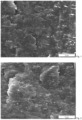
- Der Gegenstand der vorliegenden Erfindung wird an Hand der Figuren
Fig. 1 und Fig. 2 näher erläutert, ohne dass der Gegenstand der vorliegenden Erfindung darauf beschränkt sein soll. -
Fig. 1 zeigt eine rasterelektronenmikroskopische Aufnahme der Bruchkante des Probenkörpers gemäß Beispiel 1.11, vorbereitet und aufgenommen wie in Beispiel 2 beschrieben. -
Fig. 2 zeigt eine rasterelektronenmikroskopische Aufnahme der Bruchkante des Probenkörpers gemäß Beispiel 1.12, vorbereitet und aufgenommen wie in Beispiel 2 beschrieben. - Der Gegenstand der vorliegenden Erfindung wird in den nachfolgenden Beispielen näher erläutert, ohne dass der Gegenstand der vorliegenden Erfindung darauf beschränkt sein soll.
- Kerbschlagzähigkeit: Die Kerbschlagzähigkeit wurde gemäß IZOD ISO 180/1A unter Verwendung einer Prüfapparatur vom Typ 5102.100/00 der Firma Zwick bestimmt.
- Zugprüfung: Die Zugversuche wurden gemäß EN ISO 527-1 hergestellt und durchgeführt. Zum Einsatz kam Prüfapparatur Typ BT1-FB010TH.D30 der Firma Zwick.
- Optische Bestimmung der Domänen: Als Analysegeräte wurden ein Scanner Epson V850 Pro und ein Rasterelektronenmikroskop (REM) JEOL SM IT300 verwendet.
- Glasübergangstemperatur [Tg]: Die Thermoanalysen wurden gemäß DIN EN ISO 11357 durchgeführt. Zum Einsatz kam das DSC1 der Firma Mettler Toledo und die Auswertung erfolgte mittels der Stare Software 10.0. Bei teilkristallinen Polymerproben wird der Einfluss der thermischen Vorgeschichte erst beim Aufschmelzen der gesamten Probe beseitigt; deshalb ist zur Bestimmung des Tg ein zweiter Heizlauf nötig, um bei der definierter Heiz- und Kühlrate reproduzierbare Ergebnisse zu erhalten. Vorzugsweise sollte mit einer einheitlichen Heizrate von 10K/min bis Tg+50°C und Kühlrate von 20K/min bis Tg-50°C gearbeitet werden. Die Glasübergangstemperatur ist die Probentemperatur, bei der die Hälfte der Änderung der spezifischen Wärmekapazität [0,5 □ cP] erreicht ist. Sie ist die Temperatur des Schnittpunktes der Mittellinie zwischen den extrapolierten Basislinien vor und nach dem Glasübergang mit der Messkurve.
- Molekulargewichtsbestimmung: Mw steht dabei für das gewichtsmittlere Molekulargewicht und Mn für das zahlenmittlere Molekulargewicht. Die Bestimmung der Molekulargewichte Mw und Mn erfolgt mittels HT-GPC [Hochtemperatur-Gelpermeations-Chromatographie] wie in DIN 55 672 beschrieben. Konkret wird die analytische HT-GPC mittels eines PL220-Ofens (Agilent, Waldbronn) mit dazugehöriger isokratischer Pumpe bei 150 °C durchgeführt. Als mobile Phase wurde 1,2,4-Trichlorbenzol (TCB) (Merck, Darmstadt) versetzt mit ~1 g/L Butylhydroxytoluol (BHT) mit einer Flussrate von 1 mL/min und als stationäre Phase eine Agilent PLgel Olexis Guard (50 × 7.5 mm, Vorsäule) sowie drei Agilent PLgel Olexis (300 × 7.5 mm) verwendet. Die Detektion erfolgte mittels eines IR Detektors (Model IR4, PolymerChar, Valencia, Spanien). Ausgewertet wurden die Datensätze mittels einer Polystyrol-Kalibration (EasiCal PS-1, Agilent) durch die Software WinGPC (Polymer Standards Service, Mainz). Die Polydispersität (Mw/Mn), auch Molekulargewichtsverteilung genannt, ergibt sich durch Teilen des gewichtsmittleren Molekulargewichts durch das zahlenmittlere Molekulargewicht.
- Viskosität bei 190 °C: Die Bestimmung der Viskosität bei 190 °C erfolgt durch Messungen mit einem Rotations-Viskosimeter analog DIN 53 019. Die Messungen erfolgen mit dem Kegel-Platte-Viskosimeter CAP 2000+ von der Firma Brookfield mit einer viskositätsabhängigen Scherrate analog der folgenden Tabelle a:
Tabelle a: Kegel Schergeschwindigkeit Eta (bei 10 % Auslastung des Drehmoments) Eta (bei 100 % Auslastung des Drehmoments) 07 10 s-1 6.300 mPas 63.000 mPas 08 10 s-1 25.000 mPas 250.000 mPas 07 30 s-1 2.100 mPas 21.000 mPas - Zur Kalibrierung des Brookfield Viskosimeters wurde eine Newtonsche Normalprobe Typ 500.000 BW eingesetzt. Diese wurde vom Zentrum für Messen und Kalibrieren & Analytik GmbH bezogen und mit einem dazugehörigen Kalibrierschein ausgestellt. Die Gerätekalibrierung erfolgt nur bei DKD - Öl Wechsel, mittels DKD-ÖL von der Firma ZMK& ANALYTIK GmbH. Diese wird mit dem Kegel 7 durchgeführt. Zuerst wird eine Eingangsmessung von dem neuen DKD-ÖI gemacht. Danach beginnt die Kalibrierung des Gerätes. Die Newtonsche Normalprobe wird direkt auf der Spindle eingewogen. Dazu stellt man sie kopfüber in einen 100 ml Erlenmeyerkolben und wiegt die entsprechende Menge ein. Die Spindel wird anschließend ins Viskosimeter eingehängt und abgesenkt. Nach Einhaltung der Vortemperierung von mind. 3 min wird am Bedienfeld Spindel gedrückt und mit Enter bestätigt. Es erscheint die Abfrage Calibrate YES / NO. Mit Yes gelangt man in den Kalibriermodus. Anschließend wird die gewünschte Temperatur und die dynamische Viskosität (siehe aktuellen Kalibrierschein) des Fluid eingegeben und bestätigt. Hier ist zu beachten, dass die Viskositätsangabe in cP abgefragt wird (cP = mPas). Bei der Abfrage SPEED wird 10s-1 eingetragen und mit Enter bestätigt. Mit Run startet nun die Kalibrierung. Nach der Kalibrierung wird mit Enter der Kalibrierwert gespeichert.
- Schmelzflussindex (MFI): Der MFI 2,16kg@230°C und 2,16kg@190°C wurde bestimmt gemäß ISO 1133-1:2011 am MFlow der Firma Zwick. Die Schmelze-Massefließrate (MFR) und die Schmelze-Volumenfließrate (MVR) werden durch Extrudieren eines geschmolzenen Materials aus dem Zylinder eines Plastometers durch ein Extrusionswerkzeug mit festgelegter Länge und festgelegtem Durchmesser unter gegebenen Bedingungen von Temperatur und aufgebrachter Last bestimmt. Liegen bei einer Temperatur von 190°C die MFI-Werte mit einer Last von 2,16kg bei über 1.000 so ist die Messtemperatur auf 140°C zu senken, um verlässlichere Messwerte zu erhalten (MFI 2,16@140°C).
- Zur Messung der MFR (Verfahren A) werden zeitlich festgelegte Extrudatabschnitte gewogen und für die Berechnung der Extrusionsgeschwindigkeit, in g/10 min, angewendet.
- Zur Messung der MVR (Verfahren B) wird die Weglänge, die der Kolben in einer festgelegten Zeit zurücklegt, oder die Zeit, die der Kolben zum Zurücklegen einer festgelegten Weglänge benötigt, aufgezeichnet und für die Berechnung der Extrusionsgeschwindigkeit, in cm3/10 min, angewendet.
- Die MVR kann in die MFR umgewandelt werden, oder umgekehrt, wenn die Dichte der Schmelze des Materials bei der Prüftemperatur bekannt ist.
- Isotaktizität:
Die Polymerzusammensetzung und Isotaktiziät [% der mmmm-Pentade] wird mittels Hochtemperatur 13C-NMR bestimmt, wie in den folgenden Publikationen beschrieben:
A. Zambelli et al: Macomolecules, 8, 687 (1975) und A. Filho, G. Galland: J. Appl. Polym. Sci., 80, 1880 (2001). -
Polypropylen RB307MO Borealis AG Polypropylen HF955MO Borealis AG Polypropylen-Rezyklat procyclen® PP 10 M10 C09 ALBA Recycling GmbH Polyetheylen-Rezyklat recythen® HDPE ALBA Recycling GmbH Polyethylen BorPure™ MB5568 Borealis AG Polyethylen BB2581 Borealis AG APAO VESTOPLAST® 888 Evonik Resource Efficiency GmbH APAO VESTOPLAST® 704 Evonik Resource Efficiency GmbH Block-Copolymer INFUSE™ 9807 The Dow Chemical Company Polypropylen L-MODU™ S600 Idemitsu Kosan Co., Ltd. Gering-kristallines PE/PP-Copolymer LICOCENE® PP2602 Clariant AG Tabelle b: Parameter einiger Einsatzstoffe Additiv Mw/Mn MFI 2,16@190°C [g/10 min] MFI 2,16kg@140°C [g/10 min] Tg [°C] Viskosität@190 °C [mPas] VESTOPLAST® 888 6,8 129 n.m. -23 ∼ 90.000 VESTOPLAST® 704 5,9 >1.000 930 -28 ~ 4.000 INFUSE™ 9807 2,1 15 n.m. -62 >1.000.000 L-MODU™ S600 1,9 173 44 -10 ~ 40.000 LICOCENE® PP2602 1,8 >1.000 1300 -9 ~ 2.500 Tabelle c: Parameter einiger Einsatzstoffe (Herstellerangaben) Polymer MFI 2,16@190°C [g/10 min] MFI 2,16kg@230°C [g/10 min] RB307MO - 1,5 HF955MO - 20,0 BorPure™ MB5568 0,8 - BB2581 0,3 - procyclen® PP 10 M10 C09 10,0 recythen® HDPE - Es wurden Granulat-Mischungen unter Verwendung der in Tabelle 1 angegebenen Rohstoffe und Mengen hergestellt. Das Mischen erfolgte manuell durch Zugabe aller Ingredienzien in einen PE Beutel, dessen Inhalt anschließend dem Trichter eines gravimetrischen Dosiersystems zugeführt wurde. Anschließend wurde die Granulat-Mischung in einem Extruder (Leistritz ZSE 27 MAXXX 44LD) bei 210 °C und einer Drehzahl von 300 rpm zu einem Mischgranulat verarbeitet.
Tabelle 1: Eingesetzte Rohstoffe und Mengen (in Gew.-%) zur Herstellung der Granulatmischungen Beispiel PP PE APAO 1.1 65% HF955MO 35% BB2581 - 1.2 61% HF955MO 33% BB2581 6% VESTOPLAST® 888 1.3 61% HF955MO 33% BB2581 6% VESTOPLAST® 704 1.4 61% HF955MO 33% BB2581 6% L-MODU™ S600 1.5 61% HF955MO 33% BB2581 6% LICOCENE® PP2602 1.6 61% HF955MO 33% BB2581 6% INFUSE™ 9807 1.7 65% HF955MO 35% BorPure™MB5568 - 1.8 61% HF955MO 31% BorPure™MB5568 6% VESTOPLAST® 888 1.9 65% RB307MO 35% BB2581 - 1.10 61% RB307MO 33% BB2581 6% VESTOPLAST® 888 1.11 65% RB307MO 35% BorPure™MB5568 - 1.12 61% RB307MO 33% BorPure™MB5568 6% VESTOPLAST® 888 1.13 67% RB307MO 33% BorPure™MB5568 1.14 63% RB307MO 31% BorPure™MB5568 6% VESTOPLAST® 888 - Aus diesem Mischgranulat wurden anschließend in einer Spritzgussmaschine (Engel ES200/50HL) bei einer Spritztemperatur von 230 °C einem Spritzdruck von 600 bar und einer Zykluszeit von 45 sec. Zugprüfkörper (Zugprüfknochen) gemäß DIN EN ISO 527-2 hergestellt.
- Die Hälfte der Zugprüfknochen wurde zur Bestimmung der Kerbschlagzähigkeit (KSZ) gemäß IZOD ISO 180/1A, die andere Hälfte zur Zugprüfung gemäß EN ISO 527-1 verwendet. Die Ergebnisse der Ausprüfungen sind Tabelle 2 zu entnehmen. Darin bedeuten: ET = Zugmodul, σM = Zugfestigkeit, σY = Streckspannung, εY = Streckdehnung, εtB = Nominelle Bruchdehnung und εB = Bruchdehnung.
Tabelle 2: Ergebnisse der Ausprüfungen Beispiel KSZ Zugprüfung gemäß EN ISO 527-1 [kJ/m2] ET [MPa] σM [MPa] σY [MPa] εY [%] EtB [%] εB [%] 1.1 2,63 926 35,6 7,2 8,8 7,2 1.2 1,51 848 29,6 5,3 1.3 1,54 825 29,2 4,5 1.4 1,87 876 32,8 6,5 1.5 n.m. n.m. n.m. n.m. n.m. n.m. n.m. 1.6 6,06 840 30,6 30,6 6,8 9 6,7 1.7 3,60 889 36,3 36,3 7,4 11 1.8 2,34 774 30,5 6,2 1.9 13,03 602 25,9 25,9 12,0 160 1.10 14,46 525 23,3 23,2 13,0 280 1.11 13,62 585 25,4 25,4 12,0 150 1.12 24,37 505 22,7 22,8 13,0 270 1.13 13,60 25,0 100 1.14 24,90 22,1 186 n.m.: not measured - Wie den Tabellen 1 und 2 entnommen werden kann, können durch Zusatz von APAOs als Additive zu PE-/PP-Granulatmischungen Mischgranulate erhalten werden, aus denen Formköper spritzgegossen werden können, die bei nur geringfügig verschlechterten Zugfestigkeiten eine deutlich besseres (höheres) Dehnungsverhalten als auch eine bessere (höhere) Schlagzähigkeit aufweisen. Dies gilt insbesondere für solche Gemenge, die neben dem APAO mindestens eine weitere amorphe oder zumindest teilkristalline Polyolefinkomponente enthalten.
- Probenkörper der Beispiele 1.11 und 1.12 wurden in flüssigem Stickstoff abgekühlt und jeweils längs und quer gebrochen, mit Palladium besputtert und anschließend im REM untersucht. Aufnahmen sind in den Figuren
Fig. 1 und Fig. 2 wiedergegeben. - In den Proben gemäß Beispielen 1.11 und 1.12 sind auf den Bildern vermehrt kleinere Domänen erkennbar, die in
Fig. 2 homogener wirken. Die Anbindung scheint deswegen besser zu sein, was auch die besseren mechanischen Eigenschaften des Beispiels 1.12 zeigen (Tabelle 2).
Claims (13)
- Gemenge enthaltend mindestens zwei verschiedene Polyolefine, dadurch gekennzeichnet, dass es als weiteren Bestandteil ein amorphes Polyalpha-Olefin enthält, welches auf den Monomeren Ethen, Propen und 1-Buten basiert und dessen Viskosität bei 190°C gemessen nach der in der Beschreibung angegeben Methode, von 200 mPa*s bis 200.000 mPa*s beträgt, wobei es als mindestens zwei verschiedene Polyolefine Polyethylen und Polypropylen enthält und wobei das Polyethylen einen Schmelzflussindex [MFI 2,16kg@190°C] bestimmt nach der in der Beschreibung angegebenen Methode ISO 1133 von kleiner 10g/10min, vorzugsweise von 0,01 bis 2g/10min und das Polypropylen einen Schmelzflussindex [MFI 2,16kg@230°C] bestimmt nach der in der Beschreibung angegebenen Methode von kleiner 50g/10min, vorzugsweise von 0,01 bis 25 g/10min aufweist.
- Gemenge nach Anspruch 1, dadurch gekennzeichnet, dass mindestens eines der zwei verschiedenen Polyolefine zumindest teilweise, vorzugsweise vollständig, ein Rezyklat ist.
- Gemenge nach Anspruch 1 oder 2, dadurch gekennzeichnet, dass der Anteil an amorphem Polyalpha-Olefin von 1 bis 25, bevorzugt 2 bis 15, besonders bevorzugt 3 bis 10 Gew.-% und ganz besonders bevorzugt 5 bis 7,5 Gew.-% bezogen auf die Gesamtmasse des Gemenges beträgt.
- Gemenge nach einem der Ansprüche 1 bis 3, dadurch gekennzeichnet, dass der Anteil an geringer-vorkommendem Polyolefin an dem Gemenge von 1 bis 45 Gew.-%, bevorzugt von 2 bis 30 Gew.-% und besonders bevorzugt von 5 bis 20 Gew.-% und der Anteil am mehrheitlich vorkommendem Polyolefin an dem Gemenge von 55 bis 99 Gew.-%, bevorzugt von 70 bis 98 Gew.-% und besonders bevorzugt von 80 bis 95 Gew.-% bezogen auf die Gesamtmasse der mindestens zwei verschiedenen Polyolefine beträgt.
- Gemenge nach einem der Ansprüche 1 bis 4, dadurch gekennzeichnet, dass das amorphe Polyalpha-Olefin eine Polydispersität von 5 bis 10 und/oder, bevorzugt und, eine Glasübergangstemperatur von -45°C bis -25°C aufweist, jeweils bestimmt nach der in der Beschreibung angegebenen Messmethode.
- Gemenge nach einem der Ansprüche 1 bis 5, dadurch gekennzeichnet, dass das amorphe Polyalpha-Olefin einen Schmelzflussindex [MFI 2,16kg@140°C] von 40 bis 10.000 bestimmt nach der in der Beschreibung angegebenen Messmethode aufweist.
- Gemenge nach einem der Ansprüche 1 bis 6, dadurch gekennzeichnet, dass das amorphe Polyalpha-Olefin auf den Monomeren Ethylen, Propylen und 1-Buten basiert, wobei der Anteil der Monomeren Propylen oder 1-Buten größer 50 Gew.-% beträgt und der Anteil der Summe der verbleibenden Monomere Ethylen und 1-Buten bzw. Ethylen und Propen jeweils kleiner 50 Gew. -%, jeweils bezogen auf die Summe der molaren Anteile an Ethylen, Propylen und 1-Buten, beträgt.
- Gemenge nach einem der Ansprüche 1 bis 7, dadurch gekennzeichnet, dass das amorphe Polyalpha-Olefin Isotaktizitäten der 1-Buten- bzw. Propen-Blöcke von weniger als 80 % der mmmm-Pentade bestimmt nach der in der Beschreibung angegebenen Messmethode aufweist.
- Verfahren zur Herstellung von Gemengen gemäß einem der Ansprüche 1 bis 8 dadurch gekennzeichnet, dass die Bestandteile vermengt werden.
- Verfahren nach Anspruch 9, dadurch gekennzeichnet, dass die Bestandteile als Pulver oder Granulate eingesetzt und vermischt werden.
- Verfahren nach Anspruch 10, dadurch gekennzeichnet, dass die Granulatmischung zu einem Mischgranulat extrudiert wird.
- Verfahren nach einem der Ansprüche 9 bis 11, dadurch gekennzeichnet, dass es einen Schritt enthält, der die Herstellung von Verpackungen, Folien, Spritzgussteilen, Rohren, Schläuchen, Fasern, Textilien, Flaschen, Kunststoffgehäuse, Masterbatch Compounds für verbesserte Pigment Dispergierung, Konstruktionskunststoffen im Automobil oder Verkehrsbereich, umfasst.
- Verwendung eines Gemenges gemäß einem der Ansprüche 1 bis 8 als oder zur Herstellung von Verpackungen, Folien, Spritzgussteilen, Rohren, Schläuchen, Fasern, Textilien, Flaschen, Kunststoffgehäuse, Masterbatch Compounds für verbesserte Pigment Dispergierung, Konstruktionskunststoffe im Automobil oder Verkehrsbereich.
Applications Claiming Priority (2)
| Application Number | Priority Date | Filing Date | Title |
|---|---|---|---|
| EP19203594.7A EP3808809A1 (de) | 2019-10-16 | 2019-10-16 | Amorphes poly-alpha-olefin enthaltendes polyolefingemenge |
| PCT/EP2020/078736 WO2021074125A1 (de) | 2019-10-16 | 2020-10-13 | Amorphes poly-alpha-olefin enthaltendes polyolefingemenge |
Publications (3)
| Publication Number | Publication Date |
|---|---|
| EP4045590A1 EP4045590A1 (de) | 2022-08-24 |
| EP4045590B1 true EP4045590B1 (de) | 2024-05-29 |
| EP4045590C0 EP4045590C0 (de) | 2024-05-29 |
Family
ID=68281193
Family Applications (2)
| Application Number | Title | Priority Date | Filing Date |
|---|---|---|---|
| EP19203594.7A Withdrawn EP3808809A1 (de) | 2019-10-16 | 2019-10-16 | Amorphes poly-alpha-olefin enthaltendes polyolefingemenge |
| EP20792365.7A Active EP4045590B1 (de) | 2019-10-16 | 2020-10-13 | Amorphes poly-alpha-olefin enthaltendes polyolefingemenge |
Family Applications Before (1)
| Application Number | Title | Priority Date | Filing Date |
|---|---|---|---|
| EP19203594.7A Withdrawn EP3808809A1 (de) | 2019-10-16 | 2019-10-16 | Amorphes poly-alpha-olefin enthaltendes polyolefingemenge |
Country Status (11)
| Country | Link |
|---|---|
| US (1) | US12221531B2 (de) |
| EP (2) | EP3808809A1 (de) |
| JP (2) | JP7792898B2 (de) |
| KR (1) | KR102945375B1 (de) |
| CN (1) | CN114585679B (de) |
| CA (1) | CA3154527A1 (de) |
| ES (1) | ES2989267T3 (de) |
| MX (1) | MX2022004395A (de) |
| PL (1) | PL4045590T3 (de) |
| TW (1) | TWI860418B (de) |
| WO (1) | WO2021074125A1 (de) |
Families Citing this family (2)
| Publication number | Priority date | Publication date | Assignee | Title |
|---|---|---|---|---|
| KR102842765B1 (ko) * | 2023-07-19 | 2025-08-04 | 디렉스폴리머 유한회사 | 핫멜트 접착제 조성물 |
| KR102842763B1 (ko) * | 2023-07-19 | 2025-08-04 | 디렉스폴리머 유한회사 | 핫멜트 접착제 조성물 |
Family Cites Families (32)
| Publication number | Priority date | Publication date | Assignee | Title |
|---|---|---|---|---|
| JPS5829841A (ja) | 1981-08-14 | 1983-02-22 | Asahi Chem Ind Co Ltd | 改良されたポリエチレン組成物 |
| IL75719A (en) | 1984-07-18 | 1988-11-30 | Du Pont Canada | Polyolefin blends containing reactive agents |
| CA2102542A1 (en) | 1992-11-12 | 1994-05-13 | Thaddeus W. Klimek | Gas-phase process for producing copolymer of propylene and ethylene and polyolefin films made therefrom |
| JP3121231B2 (ja) | 1994-05-30 | 2000-12-25 | 住江織物株式会社 | 置き敷きマット |
| SG67392A1 (en) * | 1996-05-27 | 1999-09-21 | Sumitomo Chemical Co | Propylene/ethylene-alpha-olefin block copolymer and process for producing the same |
| US6610408B1 (en) * | 1996-11-08 | 2003-08-26 | Solvay Engineered Polymers | TPO blends containing multimodal elastomers |
| EP0850755A1 (de) * | 1996-12-23 | 1998-07-01 | Minnesota Mining And Manufacturing Company | Anpassungsfähige Markierungsfolie |
| DE69716717T2 (de) | 1997-06-12 | 2003-09-11 | Advanced Elastomer Systems, L.P. | Zähigkeitsvermittler für thermoplastische Polyolefine |
| JP4023527B2 (ja) * | 1998-07-14 | 2007-12-19 | 日本製紙株式会社 | 抗菌性包装用ラッピングフィルム |
| DE10228622A1 (de) | 2002-06-26 | 2004-01-15 | Degussa Ag | Verfahren zur Noppen- und Filamenteinbindung von Teppichrohwaren |
| US6838523B2 (en) * | 2002-10-31 | 2005-01-04 | Sonoco Development, Inc. | Composition for molding thin-walled parts, and injection-molded squeeze tube made thereof |
| US8273826B2 (en) | 2006-03-15 | 2012-09-25 | Dow Global Technologies Llc | Impact modification of thermoplastics with ethylene/α-olefin interpolymers |
| CN104963085A (zh) * | 2004-12-17 | 2015-10-07 | 埃克森美孚化学专利公司 | 聚合物共混物和由其获得的无纺制品 |
| DE102005017201A1 (de) | 2005-04-13 | 2006-10-19 | Degussa Ag | Hochviskoses, weitgehend amorphes Polyolefin |
| US7807768B2 (en) | 2005-04-13 | 2010-10-05 | Evonik Degussa Gmbh | Highly viscous, largely amorphous polyolefin |
| WO2007046307A1 (ja) * | 2005-10-21 | 2007-04-26 | Mitsui Chemicals, Inc. | 熱融着性プロピレン系重合体組成物、熱融着性フィルム及びその用途 |
| DE102008041279A1 (de) | 2008-08-15 | 2010-02-18 | Evonik Degussa Gmbh | Silanmodifizierte Polyolefine mit hohem Funktionalisierungsgrad |
| DE102008041278A1 (de) | 2008-08-15 | 2010-02-18 | Evonik Degussa Gmbh | Verwendung von Polyolefinen als Haftvermittler für die Herstellung flächiger Laminate |
| DE102009027446A1 (de) | 2009-07-03 | 2011-01-05 | Evonik Degussa Gmbh | Modifizierte Polyolefine mit besonderem Eigenschaftsprofil, Verfahren zu deren Herstellung und deren Verwendung |
| JP2011020299A (ja) | 2009-07-14 | 2011-02-03 | Dic Corp | 表面保護フィルム |
| DE102011086366A1 (de) | 2011-11-15 | 2013-05-16 | Evonik Degussa Gmbh | Verbundfolie und daraus hergestellte Verpackungen |
| JP6353676B2 (ja) * | 2014-03-25 | 2018-07-04 | 出光興産株式会社 | ホットメルト接着剤 |
| CA2946800C (en) * | 2014-05-07 | 2018-05-15 | Borealis Ag | Polypropylene - polyethylene blends with improved properties |
| CN106795404B (zh) * | 2014-10-13 | 2019-10-22 | 波士胶公司 | 具有改进的加工和粘合性能的基于聚烯烃的热熔性粘合剂 |
| CN107922686B (zh) * | 2015-09-10 | 2021-01-08 | 陶氏环球技术有限责任公司 | 包括增容剂的聚烯烃共混物 |
| ES2663149T3 (es) * | 2015-11-04 | 2018-04-11 | Borealis Ag | Composición de polipropileno-polietileno con fluidez mejorada |
| US9902846B2 (en) | 2016-07-18 | 2018-02-27 | Equistar Chemicals, Lp | Low density polyolefin resins with high dimensional stability |
| BR112019004741B1 (pt) | 2016-09-12 | 2022-11-16 | Dow Global Technologies Llc | Composição para formar um recipiente de uso de temperatura subambiente, artigo e recipiente de freezer |
| WO2019004206A1 (ja) * | 2017-06-26 | 2019-01-03 | 出光興産株式会社 | ポリエチレン系樹脂組成物 |
| EP3620475A1 (de) | 2018-09-06 | 2020-03-11 | Evonik Operations GmbH | Amorphe poly-alpha-olefine und deren verwendung in hot melt zusammensetzungen mit verbesserter versprühbarkeit |
| EP3947555A1 (de) * | 2019-03-29 | 2022-02-09 | Borealis AG | Recycelte polyethylen-polypropylen-mischungen mit kompatibilisierungsmittel |
| EP3910009A1 (de) | 2020-05-13 | 2021-11-17 | Evonik Operations GmbH | Faserpolymerverbund |
-
2019
- 2019-10-16 EP EP19203594.7A patent/EP3808809A1/de not_active Withdrawn
-
2020
- 2020-10-13 CN CN202080072223.2A patent/CN114585679B/zh active Active
- 2020-10-13 JP JP2022522247A patent/JP7792898B2/ja active Active
- 2020-10-13 EP EP20792365.7A patent/EP4045590B1/de active Active
- 2020-10-13 WO PCT/EP2020/078736 patent/WO2021074125A1/de not_active Ceased
- 2020-10-13 KR KR1020227015715A patent/KR102945375B1/ko active Active
- 2020-10-13 MX MX2022004395A patent/MX2022004395A/es unknown
- 2020-10-13 ES ES20792365T patent/ES2989267T3/es active Active
- 2020-10-13 CA CA3154527A patent/CA3154527A1/en active Pending
- 2020-10-13 PL PL20792365.7T patent/PL4045590T3/pl unknown
- 2020-10-13 US US17/763,160 patent/US12221531B2/en active Active
- 2020-10-14 TW TW109135524A patent/TWI860418B/zh active
-
2025
- 2025-04-15 JP JP2025066591A patent/JP2025108582A/ja not_active Withdrawn
Also Published As
| Publication number | Publication date |
|---|---|
| CN114585679B (zh) | 2024-03-26 |
| JP2025108582A (ja) | 2025-07-23 |
| CA3154527A1 (en) | 2021-04-22 |
| KR20220084319A (ko) | 2022-06-21 |
| WO2021074125A1 (de) | 2021-04-22 |
| EP3808809A1 (de) | 2021-04-21 |
| US20230002601A1 (en) | 2023-01-05 |
| ES2989267T3 (es) | 2024-11-25 |
| KR102945375B1 (ko) | 2026-03-27 |
| MX2022004395A (es) | 2022-05-18 |
| CN114585679A (zh) | 2022-06-03 |
| TW202116897A (zh) | 2021-05-01 |
| US12221531B2 (en) | 2025-02-11 |
| PL4045590T3 (pl) | 2024-09-23 |
| EP4045590C0 (de) | 2024-05-29 |
| EP4045590A1 (de) | 2022-08-24 |
| JP2022552959A (ja) | 2022-12-21 |
| TWI860418B (zh) | 2024-11-01 |
| JP7792898B2 (ja) | 2025-12-26 |
Similar Documents
| Publication | Publication Date | Title |
|---|---|---|
| DE19982218B3 (de) | Polypropylenharzmasse und spritzgeformter Gegenstand daraus | |
| DE60130672T2 (de) | Polyolefinkonzentrat und zum spritzgiessen geeignete mischung | |
| DE102008011287B4 (de) | Polypropylenharzzusammensetzung und spritzgeformter Gegenstand, umfassend die Polypropylenharzzusammensetzung | |
| DE69609115T2 (de) | Thermoplastische Harzzusammensetzung | |
| DE69513237T2 (de) | Polyolefin-Harzzusammensetzung für Innenbekleidung für Kraftfahrzeuge | |
| DE69609551T2 (de) | Thermoplastische Harzmasse und daraus hergestellter Spritzgussartikel | |
| DE69827744T2 (de) | Polybuten-1 enthaltende polyolefinzusammensetzung | |
| AT405286B (de) | Polypropylene mit reduzierter weissbruchneigung | |
| DE60317692T2 (de) | Polymerzusammensetzung für extrusionsbeschichtung | |
| DE102005060056A1 (de) | Polypropylenharzzusammensetzung | |
| DE112013001563B4 (de) | Polypropylenharzzusammensetzung und Formteil | |
| JP2025108582A (ja) | アモルファスポリαオレフィン含有ポリオレフィン配合物 | |
| DE102004045928B4 (de) | Thermoplastische Harzmasse und spritzgeformter Gegenstand | |
| EP2181155B1 (de) | Weiche polyolefinzusammensetzungen mit verbesserter verarbeitbarkeit | |
| DE10209999B4 (de) | Harzzusammensetzung auf Polypropylenbasis, Verfahren zur Herstellung derselben und spritzgegossener Gegenstand | |
| DE69407535T2 (de) | Verfahren zum Extrudieren einer Schlauchfolie aus Polypropylen | |
| DE102017223809B4 (de) | Polypropylenharzzusammensetzung und daraus geformtes Produkt | |
| DE10120501B4 (de) | Thermoplastische Harzmasse und spritzgeformter Gegenstand daraus | |
| DE10249398B4 (de) | Thermoplastische Harzzusammensetzung und deren Verwendung | |
| DE102005038865B4 (de) | Verfahren zur Herstellung einer Harzzusammensetzung auf Propylenbasis, Harzzusammensetzung auf Propylenbasis und spritzgegossener Gegenstand | |
| DE19619625C2 (de) | Hochzähe Polyolefinmischungen | |
| EP0953600B1 (de) | Verwendung von Modifikatoren auf Basis von Ethylenen oder amorphen Olefinelastomeren zur Reduktion der Oberflächenklebrigkeit von amorphen Polypropylenen | |
| DE102005051083B4 (de) | Polypropylenharzzusammensetzung und daraus hergestellter geschäumter Gegenstand | |
| EP1871814B1 (de) | Hochviskoses, weitgehend amorphes polyolefin | |
| EP0007603A1 (de) | Polypropylen-Formmasse und Verfahren zu ihrer Herstellung |
Legal Events
| Date | Code | Title | Description |
|---|---|---|---|
| STAA | Information on the status of an ep patent application or granted ep patent |
Free format text: STATUS: UNKNOWN |
|
| STAA | Information on the status of an ep patent application or granted ep patent |
Free format text: STATUS: THE INTERNATIONAL PUBLICATION HAS BEEN MADE |
|
| PUAI | Public reference made under article 153(3) epc to a published international application that has entered the european phase |
Free format text: ORIGINAL CODE: 0009012 |
|
| STAA | Information on the status of an ep patent application or granted ep patent |
Free format text: STATUS: REQUEST FOR EXAMINATION WAS MADE |
|
| 17P | Request for examination filed |
Effective date: 20220412 |
|
| AK | Designated contracting states |
Kind code of ref document: A1 Designated state(s): AL AT BE BG CH CY CZ DE DK EE ES FI FR GB GR HR HU IE IS IT LI LT LU LV MC MK MT NL NO PL PT RO RS SE SI SK SM TR |
|
| DAV | Request for validation of the european patent (deleted) | ||
| DAX | Request for extension of the european patent (deleted) | ||
| STAA | Information on the status of an ep patent application or granted ep patent |
Free format text: STATUS: EXAMINATION IS IN PROGRESS |
|
| 17Q | First examination report despatched |
Effective date: 20230424 |
|
| GRAP | Despatch of communication of intention to grant a patent |
Free format text: ORIGINAL CODE: EPIDOSNIGR1 |
|
| STAA | Information on the status of an ep patent application or granted ep patent |
Free format text: STATUS: GRANT OF PATENT IS INTENDED |
|
| INTG | Intention to grant announced |
Effective date: 20240313 |
|
| GRAS | Grant fee paid |
Free format text: ORIGINAL CODE: EPIDOSNIGR3 |
|
| GRAA | (expected) grant |
Free format text: ORIGINAL CODE: 0009210 |
|
| STAA | Information on the status of an ep patent application or granted ep patent |
Free format text: STATUS: THE PATENT HAS BEEN GRANTED |
|
| AK | Designated contracting states |
Kind code of ref document: B1 Designated state(s): AL AT BE BG CH CY CZ DE DK EE ES FI FR GB GR HR HU IE IS IT LI LT LU LV MC MK MT NL NO PL PT RO RS SE SI SK SM TR |
|
| REG | Reference to a national code |
Ref country code: CH Ref legal event code: EP |
|
| REG | Reference to a national code |
Ref country code: IE Ref legal event code: FG4D Free format text: LANGUAGE OF EP DOCUMENT: GERMAN |
|
| REG | Reference to a national code |
Ref country code: DE Ref legal event code: R096 Ref document number: 502020008167 Country of ref document: DE |
|
| U01 | Request for unitary effect filed |
Effective date: 20240529 |
|
| U07 | Unitary effect registered |
Designated state(s): AT BE BG DE DK EE FI FR IT LT LU LV MT NL PT SE SI Effective date: 20240607 |
|
| PG25 | Lapsed in a contracting state [announced via postgrant information from national office to epo] |
Ref country code: IS Free format text: LAPSE BECAUSE OF FAILURE TO SUBMIT A TRANSLATION OF THE DESCRIPTION OR TO PAY THE FEE WITHIN THE PRESCRIBED TIME-LIMIT Effective date: 20240929 |
|
| REG | Reference to a national code |
Ref country code: SK Ref legal event code: T3 Ref document number: E 44757 Country of ref document: SK |
|
| PG25 | Lapsed in a contracting state [announced via postgrant information from national office to epo] |
Ref country code: HR Free format text: LAPSE BECAUSE OF FAILURE TO SUBMIT A TRANSLATION OF THE DESCRIPTION OR TO PAY THE FEE WITHIN THE PRESCRIBED TIME-LIMIT Effective date: 20240529 |
|
| PG25 | Lapsed in a contracting state [announced via postgrant information from national office to epo] |
Ref country code: GR Free format text: LAPSE BECAUSE OF FAILURE TO SUBMIT A TRANSLATION OF THE DESCRIPTION OR TO PAY THE FEE WITHIN THE PRESCRIBED TIME-LIMIT Effective date: 20240830 |
|
| PG25 | Lapsed in a contracting state [announced via postgrant information from national office to epo] |
Ref country code: NO Free format text: LAPSE BECAUSE OF FAILURE TO SUBMIT A TRANSLATION OF THE DESCRIPTION OR TO PAY THE FEE WITHIN THE PRESCRIBED TIME-LIMIT Effective date: 20240829 Ref country code: IS Free format text: LAPSE BECAUSE OF FAILURE TO SUBMIT A TRANSLATION OF THE DESCRIPTION OR TO PAY THE FEE WITHIN THE PRESCRIBED TIME-LIMIT Effective date: 20240929 Ref country code: HR Free format text: LAPSE BECAUSE OF FAILURE TO SUBMIT A TRANSLATION OF THE DESCRIPTION OR TO PAY THE FEE WITHIN THE PRESCRIBED TIME-LIMIT Effective date: 20240529 Ref country code: GR Free format text: LAPSE BECAUSE OF FAILURE TO SUBMIT A TRANSLATION OF THE DESCRIPTION OR TO PAY THE FEE WITHIN THE PRESCRIBED TIME-LIMIT Effective date: 20240830 Ref country code: RS Free format text: LAPSE BECAUSE OF FAILURE TO SUBMIT A TRANSLATION OF THE DESCRIPTION OR TO PAY THE FEE WITHIN THE PRESCRIBED TIME-LIMIT Effective date: 20240829 |
|
| REG | Reference to a national code |
Ref country code: ES Ref legal event code: FG2A Ref document number: 2989267 Country of ref document: ES Kind code of ref document: T3 Effective date: 20241125 |
|
| U1N | Appointed representative for the unitary patent procedure changed after the registration of the unitary effect |
Representative=s name: EVONIK PATENT ASSOCIATION; DE |
|
| U20 | Renewal fee for the european patent with unitary effect paid |
Year of fee payment: 5 Effective date: 20241025 |
|
| PG25 | Lapsed in a contracting state [announced via postgrant information from national office to epo] |
Ref country code: RO Free format text: LAPSE BECAUSE OF FAILURE TO SUBMIT A TRANSLATION OF THE DESCRIPTION OR TO PAY THE FEE WITHIN THE PRESCRIBED TIME-LIMIT Effective date: 20240529 |
|
| PG25 | Lapsed in a contracting state [announced via postgrant information from national office to epo] |
Ref country code: SM Free format text: LAPSE BECAUSE OF FAILURE TO SUBMIT A TRANSLATION OF THE DESCRIPTION OR TO PAY THE FEE WITHIN THE PRESCRIBED TIME-LIMIT Effective date: 20240529 |
|
| PG25 | Lapsed in a contracting state [announced via postgrant information from national office to epo] |
Ref country code: SM Free format text: LAPSE BECAUSE OF FAILURE TO SUBMIT A TRANSLATION OF THE DESCRIPTION OR TO PAY THE FEE WITHIN THE PRESCRIBED TIME-LIMIT Effective date: 20240529 Ref country code: RO Free format text: LAPSE BECAUSE OF FAILURE TO SUBMIT A TRANSLATION OF THE DESCRIPTION OR TO PAY THE FEE WITHIN THE PRESCRIBED TIME-LIMIT Effective date: 20240529 |
|
| PLBE | No opposition filed within time limit |
Free format text: ORIGINAL CODE: 0009261 |
|
| STAA | Information on the status of an ep patent application or granted ep patent |
Free format text: STATUS: NO OPPOSITION FILED WITHIN TIME LIMIT |
|
| 26N | No opposition filed |
Effective date: 20250303 |
|
| REG | Reference to a national code |
Ref country code: CH Ref legal event code: PL |
|
| PG25 | Lapsed in a contracting state [announced via postgrant information from national office to epo] |
Ref country code: MC Free format text: LAPSE BECAUSE OF FAILURE TO SUBMIT A TRANSLATION OF THE DESCRIPTION OR TO PAY THE FEE WITHIN THE PRESCRIBED TIME-LIMIT Effective date: 20240529 |
|
| PG25 | Lapsed in a contracting state [announced via postgrant information from national office to epo] |
Ref country code: CH Free format text: LAPSE BECAUSE OF NON-PAYMENT OF DUE FEES Effective date: 20241031 |
|
| REG | Reference to a national code |
Ref country code: SK Ref legal event code: PC4A Ref document number: E 44757 Country of ref document: SK Owner name: EVONIK OXENO GMBH & CO. KG, MARL, DE Free format text: FORMER OWNER: EVONIK OPERATIONS GMBH, ESSEN, DE Effective date: 20250815 |
|
| U1K | Transfer of rights of the unitary patent after the registration of the unitary effect |
Owner name: EVONIK OXENO GMBH & CO. KG; DE |
|
| PG25 | Lapsed in a contracting state [announced via postgrant information from national office to epo] |
Ref country code: IE Free format text: LAPSE BECAUSE OF NON-PAYMENT OF DUE FEES Effective date: 20241013 |
|
| U20 | Renewal fee for the european patent with unitary effect paid |
Year of fee payment: 6 Effective date: 20251028 |
|
| REG | Reference to a national code |
Ref country code: GB Ref legal event code: 732E Free format text: REGISTERED BETWEEN 20251120 AND 20251126 |
|
| PGFP | Annual fee paid to national office [announced via postgrant information from national office to epo] |
Ref country code: GB Payment date: 20251022 Year of fee payment: 6 |
|
| PGFP | Annual fee paid to national office [announced via postgrant information from national office to epo] |
Ref country code: CZ Payment date: 20251009 Year of fee payment: 6 |
|
| PGFP | Annual fee paid to national office [announced via postgrant information from national office to epo] |
Ref country code: PL Payment date: 20251003 Year of fee payment: 6 |
|
| PGFP | Annual fee paid to national office [announced via postgrant information from national office to epo] |
Ref country code: SK Payment date: 20251008 Year of fee payment: 6 |
|
| PG25 | Lapsed in a contracting state [announced via postgrant information from national office to epo] |
Ref country code: CY Free format text: LAPSE BECAUSE OF FAILURE TO SUBMIT A TRANSLATION OF THE DESCRIPTION OR TO PAY THE FEE WITHIN THE PRESCRIBED TIME-LIMIT; INVALID AB INITIO Effective date: 20201013 |
|
| PGFP | Annual fee paid to national office [announced via postgrant information from national office to epo] |
Ref country code: ES Payment date: 20251216 Year of fee payment: 6 |
|
| PG25 | Lapsed in a contracting state [announced via postgrant information from national office to epo] |
Ref country code: HU Free format text: LAPSE BECAUSE OF FAILURE TO SUBMIT A TRANSLATION OF THE DESCRIPTION OR TO PAY THE FEE WITHIN THE PRESCRIBED TIME-LIMIT; INVALID AB INITIO Effective date: 20201013 |
|
| REG | Reference to a national code |
Ref country code: ES Ref legal event code: PC2A Owner name: EVONIK OXENO GMBH & CO. KG Effective date: 20260415 |