EP4045552B1 - Composition de revêtement à base d'eau, durcissable par uv pour revêtements faciles à nettoyer - Google Patents
Composition de revêtement à base d'eau, durcissable par uv pour revêtements faciles à nettoyer Download PDFInfo
- Publication number
- EP4045552B1 EP4045552B1 EP20792359.0A EP20792359A EP4045552B1 EP 4045552 B1 EP4045552 B1 EP 4045552B1 EP 20792359 A EP20792359 A EP 20792359A EP 4045552 B1 EP4045552 B1 EP 4045552B1
- Authority
- EP
- European Patent Office
- Prior art keywords
- coating composition
- polyurethane
- functional
- composition according
- coating
- Prior art date
- Legal status (The legal status is an assumption and is not a legal conclusion. Google has not performed a legal analysis and makes no representation as to the accuracy of the status listed.)
- Active
Links
Images


Classifications
-
- C—CHEMISTRY; METALLURGY
- C08—ORGANIC MACROMOLECULAR COMPOUNDS; THEIR PREPARATION OR CHEMICAL WORKING-UP; COMPOSITIONS BASED THEREON
- C08L—COMPOSITIONS OF MACROMOLECULAR COMPOUNDS
- C08L75/00—Compositions of polyureas or polyurethanes; Compositions of derivatives of such polymers
- C08L75/04—Polyurethanes
-
- C—CHEMISTRY; METALLURGY
- C09—DYES; PAINTS; POLISHES; NATURAL RESINS; ADHESIVES; COMPOSITIONS NOT OTHERWISE PROVIDED FOR; APPLICATIONS OF MATERIALS NOT OTHERWISE PROVIDED FOR
- C09D—COATING COMPOSITIONS, e.g. PAINTS, VARNISHES OR LACQUERS; FILLING PASTES; CHEMICAL PAINT OR INK REMOVERS; INKS; CORRECTING FLUIDS; WOODSTAINS; PASTES OR SOLIDS FOR COLOURING OR PRINTING; USE OF MATERIALS THEREFOR
- C09D175/00—Coating compositions based on polyureas or polyurethanes; Coating compositions based on derivatives of such polymers
- C09D175/04—Polyurethanes
- C09D175/14—Polyurethanes having carbon-to-carbon unsaturated bonds
- C09D175/16—Polyurethanes having carbon-to-carbon unsaturated bonds having terminal carbon-to-carbon unsaturated bonds
-
- C—CHEMISTRY; METALLURGY
- C08—ORGANIC MACROMOLECULAR COMPOUNDS; THEIR PREPARATION OR CHEMICAL WORKING-UP; COMPOSITIONS BASED THEREON
- C08G—MACROMOLECULAR COMPOUNDS OBTAINED OTHERWISE THAN BY REACTIONS ONLY INVOLVING UNSATURATED CARBON-TO-CARBON BONDS
- C08G18/00—Polymeric products of isocyanates or isothiocyanates
- C08G18/06—Polymeric products of isocyanates or isothiocyanates with compounds having active hydrogen
- C08G18/08—Processes
- C08G18/0804—Manufacture of polymers containing ionic or ionogenic groups
- C08G18/0819—Manufacture of polymers containing ionic or ionogenic groups containing anionic or anionogenic groups
- C08G18/0823—Manufacture of polymers containing ionic or ionogenic groups containing anionic or anionogenic groups containing carboxylate salt groups or groups forming them
-
- C—CHEMISTRY; METALLURGY
- C08—ORGANIC MACROMOLECULAR COMPOUNDS; THEIR PREPARATION OR CHEMICAL WORKING-UP; COMPOSITIONS BASED THEREON
- C08G—MACROMOLECULAR COMPOUNDS OBTAINED OTHERWISE THAN BY REACTIONS ONLY INVOLVING UNSATURATED CARBON-TO-CARBON BONDS
- C08G18/00—Polymeric products of isocyanates or isothiocyanates
- C08G18/06—Polymeric products of isocyanates or isothiocyanates with compounds having active hydrogen
- C08G18/08—Processes
- C08G18/10—Prepolymer processes involving reaction of isocyanates or isothiocyanates with compounds having active hydrogen in a first reaction step
-
- C—CHEMISTRY; METALLURGY
- C08—ORGANIC MACROMOLECULAR COMPOUNDS; THEIR PREPARATION OR CHEMICAL WORKING-UP; COMPOSITIONS BASED THEREON
- C08G—MACROMOLECULAR COMPOUNDS OBTAINED OTHERWISE THAN BY REACTIONS ONLY INVOLVING UNSATURATED CARBON-TO-CARBON BONDS
- C08G18/00—Polymeric products of isocyanates or isothiocyanates
- C08G18/06—Polymeric products of isocyanates or isothiocyanates with compounds having active hydrogen
- C08G18/08—Processes
- C08G18/10—Prepolymer processes involving reaction of isocyanates or isothiocyanates with compounds having active hydrogen in a first reaction step
- C08G18/12—Prepolymer processes involving reaction of isocyanates or isothiocyanates with compounds having active hydrogen in a first reaction step using two or more compounds having active hydrogen in the first polymerisation step
-
- C—CHEMISTRY; METALLURGY
- C08—ORGANIC MACROMOLECULAR COMPOUNDS; THEIR PREPARATION OR CHEMICAL WORKING-UP; COMPOSITIONS BASED THEREON
- C08G—MACROMOLECULAR COMPOUNDS OBTAINED OTHERWISE THAN BY REACTIONS ONLY INVOLVING UNSATURATED CARBON-TO-CARBON BONDS
- C08G18/00—Polymeric products of isocyanates or isothiocyanates
- C08G18/06—Polymeric products of isocyanates or isothiocyanates with compounds having active hydrogen
- C08G18/08—Processes
- C08G18/16—Catalysts
- C08G18/22—Catalysts containing metal compounds
- C08G18/24—Catalysts containing metal compounds of tin
- C08G18/244—Catalysts containing metal compounds of tin tin salts of carboxylic acids
-
- C—CHEMISTRY; METALLURGY
- C08—ORGANIC MACROMOLECULAR COMPOUNDS; THEIR PREPARATION OR CHEMICAL WORKING-UP; COMPOSITIONS BASED THEREON
- C08G—MACROMOLECULAR COMPOUNDS OBTAINED OTHERWISE THAN BY REACTIONS ONLY INVOLVING UNSATURATED CARBON-TO-CARBON BONDS
- C08G18/00—Polymeric products of isocyanates or isothiocyanates
- C08G18/06—Polymeric products of isocyanates or isothiocyanates with compounds having active hydrogen
- C08G18/28—Polymeric products of isocyanates or isothiocyanates with compounds having active hydrogen characterised by the compounds used containing active hydrogen
- C08G18/2805—Compounds having only one group containing active hydrogen
- C08G18/285—Nitrogen containing compounds
- C08G18/2875—Monohydroxy compounds containing tertiary amino groups
-
- C—CHEMISTRY; METALLURGY
- C08—ORGANIC MACROMOLECULAR COMPOUNDS; THEIR PREPARATION OR CHEMICAL WORKING-UP; COMPOSITIONS BASED THEREON
- C08G—MACROMOLECULAR COMPOUNDS OBTAINED OTHERWISE THAN BY REACTIONS ONLY INVOLVING UNSATURATED CARBON-TO-CARBON BONDS
- C08G18/00—Polymeric products of isocyanates or isothiocyanates
- C08G18/06—Polymeric products of isocyanates or isothiocyanates with compounds having active hydrogen
- C08G18/28—Polymeric products of isocyanates or isothiocyanates with compounds having active hydrogen characterised by the compounds used containing active hydrogen
- C08G18/30—Low-molecular-weight compounds
- C08G18/34—Carboxylic acids; Esters thereof with monohydroxyl compounds
- C08G18/348—Hydroxycarboxylic acids
-
- C—CHEMISTRY; METALLURGY
- C08—ORGANIC MACROMOLECULAR COMPOUNDS; THEIR PREPARATION OR CHEMICAL WORKING-UP; COMPOSITIONS BASED THEREON
- C08G—MACROMOLECULAR COMPOUNDS OBTAINED OTHERWISE THAN BY REACTIONS ONLY INVOLVING UNSATURATED CARBON-TO-CARBON BONDS
- C08G18/00—Polymeric products of isocyanates or isothiocyanates
- C08G18/06—Polymeric products of isocyanates or isothiocyanates with compounds having active hydrogen
- C08G18/28—Polymeric products of isocyanates or isothiocyanates with compounds having active hydrogen characterised by the compounds used containing active hydrogen
- C08G18/40—High-molecular-weight compounds
- C08G18/48—Polyethers
- C08G18/50—Polyethers having heteroatoms other than oxygen
- C08G18/5003—Polyethers having heteroatoms other than oxygen having halogens
- C08G18/5015—Polyethers having heteroatoms other than oxygen having halogens having fluorine atoms
-
- C—CHEMISTRY; METALLURGY
- C08—ORGANIC MACROMOLECULAR COMPOUNDS; THEIR PREPARATION OR CHEMICAL WORKING-UP; COMPOSITIONS BASED THEREON
- C08G—MACROMOLECULAR COMPOUNDS OBTAINED OTHERWISE THAN BY REACTIONS ONLY INVOLVING UNSATURATED CARBON-TO-CARBON BONDS
- C08G18/00—Polymeric products of isocyanates or isothiocyanates
- C08G18/06—Polymeric products of isocyanates or isothiocyanates with compounds having active hydrogen
- C08G18/28—Polymeric products of isocyanates or isothiocyanates with compounds having active hydrogen characterised by the compounds used containing active hydrogen
- C08G18/40—High-molecular-weight compounds
- C08G18/62—Polymers of compounds having carbon-to-carbon double bonds
- C08G18/6216—Polymers of alpha-beta ethylenically unsaturated carboxylic acids or of derivatives thereof
- C08G18/622—Polymers of esters of alpha-beta ethylenically unsaturated carboxylic acids
- C08G18/6225—Polymers of esters of acrylic or methacrylic acid
-
- C—CHEMISTRY; METALLURGY
- C08—ORGANIC MACROMOLECULAR COMPOUNDS; THEIR PREPARATION OR CHEMICAL WORKING-UP; COMPOSITIONS BASED THEREON
- C08G—MACROMOLECULAR COMPOUNDS OBTAINED OTHERWISE THAN BY REACTIONS ONLY INVOLVING UNSATURATED CARBON-TO-CARBON BONDS
- C08G18/00—Polymeric products of isocyanates or isothiocyanates
- C08G18/06—Polymeric products of isocyanates or isothiocyanates with compounds having active hydrogen
- C08G18/28—Polymeric products of isocyanates or isothiocyanates with compounds having active hydrogen characterised by the compounds used containing active hydrogen
- C08G18/65—Low-molecular-weight compounds having active hydrogen with high-molecular-weight compounds having active hydrogen
- C08G18/66—Compounds of groups C08G18/42, C08G18/48, or C08G18/52
- C08G18/6666—Compounds of group C08G18/48 or C08G18/52
- C08G18/6692—Compounds of group C08G18/48 or C08G18/52 with compounds of group C08G18/34
-
- C—CHEMISTRY; METALLURGY
- C08—ORGANIC MACROMOLECULAR COMPOUNDS; THEIR PREPARATION OR CHEMICAL WORKING-UP; COMPOSITIONS BASED THEREON
- C08G—MACROMOLECULAR COMPOUNDS OBTAINED OTHERWISE THAN BY REACTIONS ONLY INVOLVING UNSATURATED CARBON-TO-CARBON BONDS
- C08G18/00—Polymeric products of isocyanates or isothiocyanates
- C08G18/06—Polymeric products of isocyanates or isothiocyanates with compounds having active hydrogen
- C08G18/28—Polymeric products of isocyanates or isothiocyanates with compounds having active hydrogen characterised by the compounds used containing active hydrogen
- C08G18/67—Unsaturated compounds having active hydrogen
- C08G18/671—Unsaturated compounds having only one group containing active hydrogen
- C08G18/672—Esters of acrylic or alkyl acrylic acid having only one group containing active hydrogen
- C08G18/673—Esters of acrylic or alkyl acrylic acid having only one group containing active hydrogen containing two or more acrylate or alkylacrylate ester groups
-
- C—CHEMISTRY; METALLURGY
- C08—ORGANIC MACROMOLECULAR COMPOUNDS; THEIR PREPARATION OR CHEMICAL WORKING-UP; COMPOSITIONS BASED THEREON
- C08G—MACROMOLECULAR COMPOUNDS OBTAINED OTHERWISE THAN BY REACTIONS ONLY INVOLVING UNSATURATED CARBON-TO-CARBON BONDS
- C08G18/00—Polymeric products of isocyanates or isothiocyanates
- C08G18/06—Polymeric products of isocyanates or isothiocyanates with compounds having active hydrogen
- C08G18/70—Polymeric products of isocyanates or isothiocyanates with compounds having active hydrogen characterised by the isocyanates or isothiocyanates used
- C08G18/72—Polyisocyanates or polyisothiocyanates
- C08G18/74—Polyisocyanates or polyisothiocyanates cyclic
- C08G18/75—Polyisocyanates or polyisothiocyanates cyclic cycloaliphatic
- C08G18/751—Polyisocyanates or polyisothiocyanates cyclic cycloaliphatic containing only one cycloaliphatic ring
- C08G18/752—Polyisocyanates or polyisothiocyanates cyclic cycloaliphatic containing only one cycloaliphatic ring containing at least one isocyanate or isothiocyanate group linked to the cycloaliphatic ring by means of an aliphatic group
- C08G18/753—Polyisocyanates or polyisothiocyanates cyclic cycloaliphatic containing only one cycloaliphatic ring containing at least one isocyanate or isothiocyanate group linked to the cycloaliphatic ring by means of an aliphatic group containing one isocyanate or isothiocyanate group linked to the cycloaliphatic ring by means of an aliphatic group having a primary carbon atom next to the isocyanate or isothiocyanate group
- C08G18/755—Polyisocyanates or polyisothiocyanates cyclic cycloaliphatic containing only one cycloaliphatic ring containing at least one isocyanate or isothiocyanate group linked to the cycloaliphatic ring by means of an aliphatic group containing one isocyanate or isothiocyanate group linked to the cycloaliphatic ring by means of an aliphatic group having a primary carbon atom next to the isocyanate or isothiocyanate group and at least one isocyanate or isothiocyanate group linked to a secondary carbon atom of the cycloaliphatic ring, e.g. isophorone diisocyanate
-
- C—CHEMISTRY; METALLURGY
- C08—ORGANIC MACROMOLECULAR COMPOUNDS; THEIR PREPARATION OR CHEMICAL WORKING-UP; COMPOSITIONS BASED THEREON
- C08L—COMPOSITIONS OF MACROMOLECULAR COMPOUNDS
- C08L75/00—Compositions of polyureas or polyurethanes; Compositions of derivatives of such polymers
- C08L75/04—Polyurethanes
- C08L75/14—Polyurethanes having carbon-to-carbon unsaturated bonds
-
- C—CHEMISTRY; METALLURGY
- C08—ORGANIC MACROMOLECULAR COMPOUNDS; THEIR PREPARATION OR CHEMICAL WORKING-UP; COMPOSITIONS BASED THEREON
- C08L—COMPOSITIONS OF MACROMOLECULAR COMPOUNDS
- C08L75/00—Compositions of polyureas or polyurethanes; Compositions of derivatives of such polymers
- C08L75/04—Polyurethanes
- C08L75/14—Polyurethanes having carbon-to-carbon unsaturated bonds
- C08L75/16—Polyurethanes having carbon-to-carbon unsaturated bonds having terminal carbon-to-carbon unsaturated bonds
-
- C—CHEMISTRY; METALLURGY
- C09—DYES; PAINTS; POLISHES; NATURAL RESINS; ADHESIVES; COMPOSITIONS NOT OTHERWISE PROVIDED FOR; APPLICATIONS OF MATERIALS NOT OTHERWISE PROVIDED FOR
- C09D—COATING COMPOSITIONS, e.g. PAINTS, VARNISHES OR LACQUERS; FILLING PASTES; CHEMICAL PAINT OR INK REMOVERS; INKS; CORRECTING FLUIDS; WOODSTAINS; PASTES OR SOLIDS FOR COLOURING OR PRINTING; USE OF MATERIALS THEREFOR
- C09D175/00—Coating compositions based on polyureas or polyurethanes; Coating compositions based on derivatives of such polymers
- C09D175/04—Polyurethanes
- C09D175/08—Polyurethanes from polyethers
-
- C—CHEMISTRY; METALLURGY
- C09—DYES; PAINTS; POLISHES; NATURAL RESINS; ADHESIVES; COMPOSITIONS NOT OTHERWISE PROVIDED FOR; APPLICATIONS OF MATERIALS NOT OTHERWISE PROVIDED FOR
- C09D—COATING COMPOSITIONS, e.g. PAINTS, VARNISHES OR LACQUERS; FILLING PASTES; CHEMICAL PAINT OR INK REMOVERS; INKS; CORRECTING FLUIDS; WOODSTAINS; PASTES OR SOLIDS FOR COLOURING OR PRINTING; USE OF MATERIALS THEREFOR
- C09D175/00—Coating compositions based on polyureas or polyurethanes; Coating compositions based on derivatives of such polymers
- C09D175/04—Polyurethanes
- C09D175/14—Polyurethanes having carbon-to-carbon unsaturated bonds
-
- C—CHEMISTRY; METALLURGY
- C09—DYES; PAINTS; POLISHES; NATURAL RESINS; ADHESIVES; COMPOSITIONS NOT OTHERWISE PROVIDED FOR; APPLICATIONS OF MATERIALS NOT OTHERWISE PROVIDED FOR
- C09D—COATING COMPOSITIONS, e.g. PAINTS, VARNISHES OR LACQUERS; FILLING PASTES; CHEMICAL PAINT OR INK REMOVERS; INKS; CORRECTING FLUIDS; WOODSTAINS; PASTES OR SOLIDS FOR COLOURING OR PRINTING; USE OF MATERIALS THEREFOR
- C09D7/00—Features of coating compositions, not provided for in group C09D5/00; Processes for incorporating ingredients in coating compositions
- C09D7/20—Diluents or solvents
-
- C—CHEMISTRY; METALLURGY
- C09—DYES; PAINTS; POLISHES; NATURAL RESINS; ADHESIVES; COMPOSITIONS NOT OTHERWISE PROVIDED FOR; APPLICATIONS OF MATERIALS NOT OTHERWISE PROVIDED FOR
- C09D—COATING COMPOSITIONS, e.g. PAINTS, VARNISHES OR LACQUERS; FILLING PASTES; CHEMICAL PAINT OR INK REMOVERS; INKS; CORRECTING FLUIDS; WOODSTAINS; PASTES OR SOLIDS FOR COLOURING OR PRINTING; USE OF MATERIALS THEREFOR
- C09D7/00—Features of coating compositions, not provided for in group C09D5/00; Processes for incorporating ingredients in coating compositions
- C09D7/40—Additives
- C09D7/65—Additives macromolecular
Definitions
- the present invention relates to a waterborne, UV curable coating composition, a method of coating a substrate with such coating composition and a coated substrate obtained therefrom.
- the coating composition can be used for producing easy-clean coatings, which are particularly useful in the field of consumer electronics or automotive coatings.
- fluorinated polymers particularly, perfluoropolyether (PFPE)
- PFPE perfluoropolyether
- PFPE perfluoropolyether
- PFPE perfluoropolyether
- CN109054623A discloses the preparation of photocurable acrylate aqueous dispersion using either silicone polyol or a fluoro polyol.
- WO2019/129692A1 discloses a fluorinate polyacrylate coating composition
- the coatings are durable, stain-resistant and can withstand abrasion. It is further desired that the coating adheres well to substrates used in consumer electronics or automotive industries, particularly to plastic substrates.
- the present invention provides, in a first aspect, a waterborne, UV curable coating composition, comprising an aqueous dispersion of a polyurethane and at least one polymer different from the polyurethane, wherein the polyurethane is present in an amount 0.01-20 wt.% based on resin solids of the coating composition, and wherein the polyurethane is a carboxyl-functional, unsaturated polyurethane containing a perfluoropolyether block, said polyurethane having a molecular weight Mn in the range from 1,000 to 5,000 determined by gel permeation chromatography with a polystyrene standard and tetrahydrofuran as the mobile phase, said aqueous dispersion of polyurethane prepared by a method comprising the following steps:
- the invention also provides a method of coating a substrate, comprising applying the coating composition according to the invention to a substrate and curing the coating composition by means of UV radiation.
- the present invention provides a coated substrate obtained according to the invention.
- the polymer used in the present invention is a carboxyl-functional, unsaturated polyurethane based on a perfluoropolyether (PFPE) resin. It is prepared by a method comprising the following steps.
- PFPE perfluoropolyether
- a hydroxy-terminated perfluoropolyether A is subjected to a reaction with a molar excess of polyisocyanate B to obtain an isocyanate-functional urethane C.
- PFPE Perfluoropolyethers
- PFPE fluorinated polymers comprising a straight or branched fully or partially fluorinated polyoxyalkylene chain that contains recurring units having at least one catenary ether bond and at least one fluorocarbon moiety.
- PFPE can be divided into non-functional and functional; the former comprises a PFPE chain whose ends bear (per)haloalkyl groups, while the latter comprise a PFPE chain having at least two ends, wherein at least one end comprises a functional group.
- Functional PFPEs in particular mono- and bifunctional PFPE, comprise a PFPE chain having two ends, wherein one or both end(s) bear(s) a functional group.
- a bifunctional PFPE is used.
- PFPEs preferably do not contain organosilicon groups, e.g. polysiloxane chains. Although polysiloxane chains are known to be used in coatings with easy clean performance, they are considered to have worse performance in terms of oil and water contact angle than PFPEs.
- Hydroxy-terminated perfluoropolyethers are functional perfluoropolyethers (PFPE) containing one or more OH groups at each of both ends.
- Hydroxy-terminated perfluoropolyether A preferably has a number average molecular weight of from 400 to 3000. Mn can be determined by gel permeation chromatography (GPC) using a polystyrene standard with tetrahydrofuran as the mobile phase.
- Hydroxy-terminated perfluoropolyether A can have a general structure HO-(CF 2 -CF 2 -O) n -OH or HO-(CF 2 -CF 2 -O) n -(CF 2 -O) m -OH.
- p is in the range 1-5 and q is in the range 1-5.
- Hydroxy-terminated perfluoropolyethers are commercially available from Solvay as Fluorolink ® PFPE, or Fomblin ® PFPE, e.g. Fluorolink ® 5174X, Fluorolink ® E10H, Fluorolink ® PEG45.
- the polyisocyanate B is a compound with reactive isocyanate groups and has a functionality of at least 2. Also mixtures of polyisocyanates can be used.
- the polyisocyanate can be aliphatic or aromatic.
- suitable polyisocyanates include hexamethylene diisocyanate, 2, 2, 4- and/or 2,4,4-trimethyl hexamethylene diisocyanate, p- and m-tetramethyl xylene diisocyanate, methylene bis(4-cyclohexyl isocyanate) (hydrogenated MDI), 4, 4-methylene diphenyl isocyanate (MDI), p- and m-phenylene diisocyanate, 2, 4- and/or 2,6-tolyene diisocyanate (TDI) and addicts thereof, and isophorone diisocyanate (IPDI).
- Preferred polyisocyanates include aliphatic diisocyanates such as IPDI, MDI and hexamethylene diis
- the reaction is performed in a molar isocyanate excess.
- the molar ratio of the functional groups of A to B is preferably 1:1.1 to 1:5, more preferably from 1:2 to 1:4.
- Isocyanate excess also keeps the molecular weight relatively low since it prevents from forming polymer chains with several PFPE fragments in the same chain.
- the isocyanate-functional urethane C does not have more than one PFPE fragment in the polymer chain.
- the reaction conditions of forming the urethane compound are generally known to the skilled person.
- the reaction temperature can be in the range 40-160° C, preferably in the range 50-100° C.
- Conventional catalysts can be used such as dibutyl tin dilaurate (DBTDL), stannous octoate, diazobicyclo (2.2.2) octane (DABCO), Zn ACAC, tin octoate.
- the amount of catalyst is preferably from 0.005 to 1 part by weight per 100 parts by weight of the urethane forming monomers.
- Suitable solvents can be utilized such as n-butyl acetate, N-methyl-pyrrolidone, toluene, and the like.
- the solvent is water-miscible.
- the isocyanate-functional urethane C comprising a perfluoropolyether block, obtained in step (a), is subjected to the following two steps (b) and (c) in any order. It is important that both steps (b) and (c) are performed.
- step b) a carboxyl-functional polyol D is added to the reaction mixture under conditions of urethane formation.
- the carboxyl-functional polyol D is a diol, more preferably a polyester diol. Preferably, it contains at least one carboxylic acid group. Preferably, the carboxyl group is a tertiary acid group.
- compound D has the following formula: wherein R is a hydrogen or a C1-16 alkyl group.
- R is a C1-C3 alkyl group.
- compound D is 2,2-dimethylolpropionic acid (DMPA) or 2,2-dimethylolbutanoic acid (DMBA).
- DMPA 2,2-dimethylolpropionic acid
- DMBA 2,2-dimethylolbutanoic acid
- Compound D can also be a polymer, e.g. acid functional linear polyester polyol.
- Such compounds are commercially available e.g. DMPA polyol HA-0135 LV2 from GEO Chemicals.
- compound D is a polymer, then it preferably has an OH value of 20-190, more preferably 50-150 mg KOH/g resin. It preferably has an acid value of 20-250, more preferably 50-200 mg KOH/g resin.
- the acid value can be measured by potentiometric titration, e.g. in accordance with DIN EN ISO 3682.
- the hydroxyl value can be measured by potentiometric titration using the TSI method, e.g. according to ASTM E1899-08.
- the reaction with the carboxyl-functional polyol D allows to introduce carboxyl groups in the polymer chain, which contributes to water dispersibility of the resulting polymer.
- step b) is performed before step c). In these embodiments, there is no need to monitor NCO content.
- the reaction of step b) is performed under conditions of excess isocyanate groups (e.g. with the polyisocyanate B present), in order to obtain an isocyanate-functional polymer, which can react with the OH-functional (meth)acrylate monomer E in step c).
- the molar ratio of the functional groups of isocyanate-functional urethane to carboxyl-functional polyol D is preferably from 1:1.1 to 1:5, more preferably from 1:2 to 1:4.
- step b) is performed after step c).
- the progress of the reaction is monitored by analyzing the NCO content over time. The reaction is stopped when no NCO content is detected anymore.
- reaction conditions of the urethane reaction are known to the skilled person. Generally, the conditions described for step (a) can be used.
- step c) an OH-functional (meth)acrylate monomer E is added to the reaction mixture under condition of urethane formation reaction.
- OH-functional (meth)acrylate monomer E has one OH group and it preferably has 1 to 5 (meth)acrylate groups. It is preferred to use compounds with a molecular mass not higher than 1,500. Suitable compounds include (meth)acrylic esters of polyols, e.g. of ethylene glycol, pentaerythritol and dipentaerythritol. Examples include 2-hydroxyethyl (meth)acrylate, penta-erythritol tri(meth)acrylate, and dipenta-erythritol penta(meth)acrylate. Preferred compound E is dipenta-erythritol pentaacrylate (DPPA).
- DPPA dipenta-erythritol pentaacrylate
- reaction conditions of the urethane reaction are known to the skilled person. Generally, the conditions described for step (a) can be used.
- step c) is performed after step b).
- the progress of the reaction is monitored by analyzing the NCO content over time. The reaction is stopped when no NCO content is detected anymore.
- step c) is performed before step b). In these embodiments, there is no need to monitor NCO content.
- the reaction of step c) is performed under conditions of excess isocyanate groups, in order to obtain an isocyanate-functional polymer, which can react with the carboxyl-functional polyol D in step b). It can be desired to perform step c) before step b), i.e. add monomer E before polyol D is added, in order to prevent the chain extension caused by forming multiple repeating fragments of monomer E and polyol D.
- catalysts can be used such as mentioned earlier.
- DBTDL dibutyltin dilaurate
- the amount of catalyst is preferably from 0.005 to 1 part by weight per 100 parts by weight of the urethane forming monomers.
- inhibitors such as BHT (butylated hydroxytoluene), can be used.
- a carboxyl-functional, unsaturated polyurethane is obtained.
- it can be considered a modification of a PFPE chain with urethane fragments to bring in the functional groups for the water dispersibility and UV curing.
- this polyurethane has a sufficiently low molecular weight. Without wishing to be bound by theory, it is considered that the low molecular weight makes it possible to use this polyurethane as an easy clean additive in combination with a different (non-fluorinated) main binder resin in a coating. Upon curing of the coating, the low-weight additive can migrate to the surface and exercise its easy clean properties.
- the polyurethane preferably has a weight average molecular weight Mw in the range 2,000-20,000, more preferably in the range 4,000-15,000. Most preferred ranges for Mw include 2,000-12,000 and 4,000-9,000.
- the polyurethane preferably has a number average molecular weight Mn in the range 1,000-5,000, more preferably in the range 1,000-3,000.
- Mn and Mw can be determined by gel permeation chromatography (GPC) with a polystyrene standard and tetrahydrofuran as the mobile phase.
- the resulting polyurethane preferably has an acid value in the range 10-50 mg KOH/g.
- the acid value can be measured by potentiometric titration, e.g. in accordance with DIN EN ISO 3682.
- the resulting polyurethane does not have OH functionality.
- the hydroxyl value is preferably ⁇ 5 mg KOH/g, more preferably 0 mg KOH/g.
- the hydroxyl value can be measured by potentiometric titration using the TSI method, e.g. according to ASTM E1899-08.
- step (d) the carboxyl-functional, unsaturated polyurethane is neutralized with a neutralizer F.
- Neutralizer F can be ammonia or a tertiary amine, or a mixture of amines.
- Neutralizer F is preferably a saturated tertiary amine, e.g. triethylamine, tripropyl amine, triethanolamine, diethylenetriamine, methylamine and N,N-dimethyl ethanol amine (DMEA).
- DMEA is used.
- Advantages of the use of a saturated tertiary amine, such as DMEA, is that the resulting polymer is better dispersible in water.
- Neutralizer F can also be an ethylenically unsaturated tertiary amine, particularly, a tertiary amine with a (meth)acrylate functionality.
- a tertiary amine with a (meth)acrylate functionality examples include 2-(diethylamino)ethyl acrylate, 2-(diethylamino)ethyl methacrylate, 2-(dimethylamino)ethyl acrylate, 2-(dimethylamino)ethyl methacrylate, t-butylaminoethyl acrylate, t-butylaminoethyl methacrylate.
- neutralizer F comprises 2-(dimethylamino)-ethyl-methacrylate or 2-(dimethylamino)-ethylacrylate.
- Unsaturated amines may contribute to a higher crosslinking density of the coating composition, thereby improving physical properties of the coating.
- Neutralizer F is preferably added in an amount to achieve a neutralization degree of 20-150%, more preferably 80-120% of the carboxylic groups of the polyurethane, calculated as the molar ratio of the base groups from the neutralizer and the carboxylic groups from polyurethane.
- the resulting neutralized polyurethane is dispersed in water. It can be dispersed in the form of a solution in an organic solvent. In the latter case, preferably organic solvents soluble or miscible with water are used. Examples of such solvents include acetone, methoxypropyl acetate (PMA), butyl acetate etc. Presence of water-miscible solvents makes emulsification in water easier, when preparing a waterborne coating composition.
- the method does not contain steps of chain extension, e.g. with diamines or diols, which are common in polyurethane preparation after dispersion in water (step (e)).
- the solid content of the obtained polyurethane solution is preferably in the range 30-70 wt.%.
- the obtained polyurethane can be used as an easy clean additive in preparation of coating compositions.
- the solution of the polyurethane is used as such and further emulsified (dispersed in water).
- the solvent used during the synthesis can be removed from the dispersion by known methods, e.g. by distillation.
- the present invention provides a waterborne, UV curable coating composition
- a waterborne, UV curable coating composition comprising the above-described carboxyl-functional, unsaturated polyurethane as an additive.
- the polyurethane is used in combination with other polymer(s) in the coating composition.
- the advantages of using the polyurethane as an additive and not as a main resin include, for example, the low costs. Good easy clean performance can be achieved already with low amounts of the additive in combination with conventional binder resins.
- the unsaturated polyurethane of the invention is used in an amount 0.01-20 wt.%, preferably 0.05-15 wt.%, or 0.1-5 wt.% of solids to total resin solids weight of the coating composition.
- Total resin solids weight includes the weight of all binder resins and crosslinkers, if present, but excludes the weight of pigments and additives, if present.
- the coating composition further comprises at least one polymer different from the polyurethane described above.
- the polymer is non-fluorinated.
- Such polymers can be e.g. polyesters, polyurethanes, (meth)acrylates.
- the other polymer is also radiation curable, preferably, UV curable.
- the polymer can be a poly(meth)acrylate or a mixture thereof. Under "poly(meth)acrylate" polymers are understood that have a crosslinkable (meth)acrylate functionality.
- the coating composition comprises at least one poly(meth)acrylate or a mixture of poly(meth)acrylates in an amount from 30 to 80 wt.% based on the total weight of the coating composition.
- the coating composition can also comprise copolymerizable monomers and oligomers as reactive diluents.
- monomers include (meth)acrylate monomers, particularly methyl (meth)acrylate, ethyl (meth)acrylate, isopropyl (meth)acrylate, butyl (meth)acrylate, isobutyl (meth)acrylate, ethyl hexyl (meth)acrylate, dipentaerythritol hexaacrylate, acrylonitrile, methacryl amide.
- vinyl monomers can be used, e.g. vinyl acetate, vinyl propionate, vinyl butyrate, styrene.
- the coating composition comprises at least one photoinitiator or a mixture thereof.
- Photoinitiators generate free radicals when exposed to radiation energy. Any suitable UV photoinitiator known in the art can be used. Suitable photoinitiators include benzoin derivatives, benzile ketales, ⁇ -hydroxyalkylphenones, monoacylphosphine oxide (MAPO) and bisacylphosphine oxides (BAPO), such as diphenyl(2,4,6-trimethylbenzoyl)phosphine oxide, 1-hydroxy-cyclohexyl-phenyl-ketone, bis(2,4,6-trimethylbenzoyl)-phenylphosphineoxide, bis(2,6-dimethoxybenzoyl)-2,4,4-trimethylpentyl-phosphine oxide, 2-hydroxy-2-methyl-1-phenyl-propan-1-one, 2-methyl-1[4-(methylthio)phenyl]-2-morpholono-propan-1-one,
- the photoinitiator is preferably present in amount of from 0.1 to 10 wt.%, for example from 0.5 to 5.0 wt.% or from 0.5 to 2.5 wt.%, based on the total weight of the composition.
- the coating composition is preferably waterborne.
- Waterborne coating compositions comprise water as the major liquid phase when preparing and/or applying the coating composition.
- "Major liquid phase” means that water constitutes at least 50 wt.% of the liquid phase, preferably at least 80 wt.%, more preferably at least 90 wt.%, in some embodiments even 100 wt.%.
- the coating composition preferably contains 20 to 80% by weight of water, based on the total weight of the coating composition.
- the coating composition can in addition contain organic solvents.
- organic solvents can be present in up to 40%, preferably, up to 30% by weight of the liquid phase. It may be preferred in some embodiments that the coating composition contains less than 10 wt.% of organic solvents, or even does not contain organic solvents, based on the total weight of the coating composition.
- suitable organic solvents include alcohols (such as ethanol, isopropanol, n-butanol, n-propanol), esters (such as ethyl acetate, propyl acetate), aromatic solvents (such as toluene), ketone solvents (such as acetone, methyl ethyl ketone, methyl isobutyl ketone, cyclohexanone, diacetone alcohol); aliphatic hydrocarbons; chlorinated hydrocarbons (such as CH 2 Cl 2 ); ethers (such as diethyl ether, tetrahydrofuran, propylene glycol monomethyl ether) and mixtures thereof.
- the solvent is water-miscible.
- Preferred organic solvents include butyl acetate, methyl isobutyl ketone (MIBK), methyl ethyl ketone (MEK), propylene glycol monomethyl ether and methoxy propyl acetate (PMA), or mixtures thereof.
- MIBK methyl isobutyl ketone
- MEK methyl ethyl ketone
- PMA methoxy propyl acetate
- the solid content of the coating composition according to the invention can be in the range from 1 to 90 wt.%, preferably 5 to 65 wt.%, more preferably 10 to 50 wt.%.
- the coating composition can further comprise conventional additives, such as fillers, antioxidants, matting agents, pigments, abrasion resistant particles, flow control agents, surfactants, plasticizers, adhesion promotors, thixotropic agents, light stabilizers and others.
- conventional additives such as fillers, antioxidants, matting agents, pigments, abrasion resistant particles, flow control agents, surfactants, plasticizers, adhesion promotors, thixotropic agents, light stabilizers and others.
- the present invention further provides a method of coating a substrate, comprising applying the coating composition according to the invention to a substrate and curing the coating composition by means of UV radiation.
- the coating composition can be applied onto a wide range of substrates by conventional techniques including spraying, rolling, blade-coating, pouring, brushing or dipping. After evaporation of water and optionally organic solvents, if present, the coating composition results in a coating that is dust-dry to slightly tacky.
- Curing is then induced by means of UV radiation.
- Any suitable source of UV radiation can be used, e.g. Hg lamps, metal halide lamps, xenon lamps, UV-LED lamps. It is preferred to use UV-LED lamps. Skilled person is able to determine suitable conditions for curing by UV radiation.
- Curing of the coating composition can be done at ambient conditions, e.g. room temperature. Room temperature is understood here as from 15 to 30°C.
- the curing can also be accelerated by heating.
- the coated substrate can be heated to a temperature in the range 40-100°C, more preferably 50-80°C. Conventional methods can be used, e.g. placing in an oven. Heating is preferably done before or simultaneously with UV curing.
- the coating composition according to the present invention can be applied to a wide range of substrates including metallic and non-metallic substrates.
- Suitable substrates include polycarbonate acrylonitrile butadiene styrene (PC/ABS), polycarbonate, polyacrylate, polyolefin, polyamide, polystyrene, polyamide, glass, wood, stone, aluminium, aluminium alloys, and the like.
- the coating composition according to the present invention can be used as a single layer applied directly to the substrate, or in multilayer systems, e.g. as a primer, basecoat or clearcoat.
- the coating composition according to the present invention can be used in various coating industries, such as, consumer electronics, automotive, packaging, wood flooring and furniture, home appliance, glass and windows, sports equipment.
- the present invention further provides a substrate coated with the coating obtained from the coating composition of the invention.
- the coatings according to the present invention have exceptionally good general properties including adhesion and abrasion resistance.
- the coatings also have excellent easy clean and anti-stain properties as can be tested with a permanent marker pen.
- Isophorone diisocyanate (15.42 g), n-butyl acetate (17.6 g), dibutyl tin dilaurate (0.1 g) and butylated hydroxytoluene (0.1 g) were placed into a four-neck round bottom flask that is equipped with an agitator and a condenser.
- Fluorolink E10H (58.97 g) was dropped into the mixture at 60°C for one hour.
- the reaction mixture was heated at 60°C for half an hour.
- DPPA (20.47 g) was dropped into the mixture within half hour at 80°C and the mixture was cooked at 80°C for half an hour.
- DMBA dimethylol butanoic acid
- the resulting polyurethane has Mn 1106, Mw 4948, PD 4.5.
- the acid value of the polyurethane is 19.5 mg KOH/g before neutralization, the OH value 0 mg KOH/g.
- Isophorone diisocyanate (20.05 g), n-butyl acetate (25 g), dibutyl tin dilaurate (0.1 g) and butylated hydroxytoluene (0.1 g) were placed into a four-neck round bottom flask that is equipped with an agitator and a condenser.
- Fluorolink E10H 38.34 g was dropped into the mixture at 60°C for one hour.
- the reaction mixture was heated at 60°C for half an hour.
- HA-0135 LV2 14.99 g was dropped into the mixture within half an hour at 60°C and the mixture was heated at 80°C for half an hour.
- DPPA 26.62 g
- the temperature was then increased to 90°C and the reaction proceeded until no NCO groups were detected.
- the reaction mixture is then cooled down to 60°C, DMEA (3.21g) was added and stirred for another half an hour at 60°C.
- the resulting polyurethane has Mn 1497, Mw 12141, PD 8.1.
- the acid value of the polyurethane is 27 mg KOH/g before neutralization, the OH value 0 mg KOH/g.
- Coating 1 Coating 2 Waterborne UV resin (solid content: 45%) 60 g 60 g Dispersion of Polyurethane 1 (solid content: 50 wt. %) 0 g 0.24 g Photoinitiators (solid content: 60 wt.%) 2 g 2 g Wetting agent 0.3 g 0.3 g
- Coating 1 contains a commercially available waterborne UV curable resin (Mitsui Chemicals, Olester RA7011).
- Coating 2 contains a mixture of the same waterborne UV curable resin with 0.4 wt.% of the polyurethane additive (on resin solids) prepared in Example 1 and added as a 50 wt.% dispersion in water.
- Oil contact angle tests were conducted similarly with the same method.
- the droplets were set as 2 ⁇ l/droplet, and the measurement temperature was about 20°C.
- the test results are shown in the Table 2 below as well. Table 2.
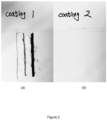
- Oil-based permanent marker pens with different colors were used to draw lines on top of the cured coatings, respectively. Pictures were taken to show the different appearance of the inks wrote onto the two coatings.
- Figure 1 shows the inks well spread on the coating 1 surface
- Figure 2 shows the red and blue inks do not well spread but shrink to beads on the coating 2 surface due to the lower surface energy of coating 2 than coating 1.
- black ink spreads well and does not shrink to beads on coating 2, which probably due to the chemical components' differences and black color of the ink.
- Figure 1 and 2 show the surface appearance of Coatings 1 and 2 after cleaning with a dry tissue.
- the inks cannot be cleaned on coating 1, but all coloured inks can be wiped off totally on Coating 2 by the dry tissue. Therefore, the polyurethane additive in Coating 2 dramatically improved the easy clean and anti-stain performances, compared to those of comparative Coating 1.
- Coating 3 was prepared in the same way as Coating 2 but using an aqueous 50 wt.% dispersion of Polyurethane 2 prepared in Example 2 instead of Polyurethane 1.
- the coating composition was applied onto a PC/ABS substrate and cured by exposure to ultraviolet light to form Coating 3.
- Figure 3 (a) shows the ink repellent ability of Coating 3 after drawing with the permanent marker.
- Figure 3 (b) shows the substrate after the ink has been wiped off with the tissue. This example demonstrates the ink repellence and easy clean properties of a coating using Polyurethane 2 as an easy clean additive.
Landscapes
- Chemical & Material Sciences (AREA)
- Organic Chemistry (AREA)
- Health & Medical Sciences (AREA)
- Chemical Kinetics & Catalysis (AREA)
- Medicinal Chemistry (AREA)
- Polymers & Plastics (AREA)
- Engineering & Computer Science (AREA)
- Life Sciences & Earth Sciences (AREA)
- Materials Engineering (AREA)
- Wood Science & Technology (AREA)
- Manufacturing & Machinery (AREA)
- Paints Or Removers (AREA)
- Polyurethanes Or Polyureas (AREA)
- Application Of Or Painting With Fluid Materials (AREA)
Claims (13)
- Composition de revêtement durcissable par des UV, à base d'eau, comprenant une dispersion aqueuse d'un polyuréthane et au moins un polymère différent du polyuréthane, le polyuréthane étant présent en une quantité de 0,01 à 20 % en poids sur la base des solides de résine de la composition de revêtement, et le polyuréthane étant un polyuréthane insaturé, fonctionnalisé par carboxyle contenant un bloc de perfluoropolyéther, ledit polyuréthane ayant un poids moléculaire Mn dans la plage de 1 000 à 5 000 déterminé par chromatographie à perméation de gel avec une référence de polystyrène et du tétrahydrofuranne comme phase mobile, ladite dispersion aqueuse de polyuréthane étant préparée par un procédé comprenant les étapes suivantes :a) soumission d'un perfluoropolyéther terminé par hydroxy A à une réaction avec un excès molaire de polyisocyanate B pour obtenir un uréthane fonctionnalisé par un isocyanate C,b) soumission de l'uréthane fonctionnalisé par un isocyanate C à une réaction avec un polyol fonctionnalisé par carboxyle D,c) soumission de l'uréthane fonctionnalisé par un isocyanate C à une réaction avec un monomère de (méth)acrylate monofonctionnalisé par OH E,
les étapes (b) et (c) pouvant être réalisées dans un ordre quelconque, et après les deux étapes b) et c), un polyuréthane insaturé fonctionnalisé par carboxyle est obtenu,d) neutralisation du polyuréthane insaturé fonctionnalisé par carboxyle obtenu après les deux étapes b) et c) avec un agent de neutralisation F pour obtenir un polyuréthane neutralisé, ete) dispersion du polyuréthane neutralisé dans de l'eau,et le procédé ne comprenant pas une extension de chaîne avec une diamine ou un diol après dispersion du polyuréthane neutralisé dans de l'eau. - Composition de revêtement selon la revendication 1, le composé A ayant une structure générale
HO-(CH2CH2O)p-CH2-CF2-Rf-CF2-CH2-(OCH2CH2)q-OH
p et q étant des entiers indépendamment choisis de 0 à 50, Rf représentant un radical bifonctionnel ayant une structure de perfluoropolyéther (CF2CF2O)n, (CF2O)m ou (CF2-CF2-O)n-(CF2-O)m, et n et m étant des entiers indépendamment choisis de 1 à 100. - Composition de revêtement selon la revendication 1 ou 2, l'étape b) étant mise en œuvre avant l'étape c) .
- Composition de revêtement selon l'une quelconque des revendications 1 ou 2, l'étape c) étant mise en œuvre avant l'étape b).
- Composition de revêtement selon l'une quelconque des revendications 1 à 4, le polyol fonctionnalisé par carboxyle D étant l'acide 2,2-diméthylolpropionique (DMPA) ou l'acide 2,2-diméthylolbutanoïque (DMBA).
- Composition de revêtement selon l'une quelconque des revendications 1 à 5, un monomère de (méth)acrylate monofonctionnalisé par OH E étant le pentaacrylate de dipentaérythritol (DPPA).
- Composition de revêtement selon l'une quelconque des revendications 1 à 6, l'au moins un polymère différent du polyuréthane étant non fluoré.
- Composition de revêtement selon la revendication 7, l'au moins un polymère étant un poly(méth)acrylate.
- Composition de revêtement selon l'une quelconque des revendications 1 à 8, comprenant en outre un photoinitiateur.
- Composition de revêtement selon l'une quelconque des revendications 1 à 9, comprenant en outre un solvant organique en une quantité inférieure à 10 % en poids, sur la base du poids total de la composition de revêtement.
- Procédé de revêtement d'un substrat, comprenant l'application de la composition de revêtement selon l'une quelconque des revendications 1 à 10 sur un substrat et un durcissement de la composition de revêtement au moyen d'un rayonnement UV.
- Substrat revêtu obtenu selon le procédé selon la revendication 11.
- Substrat selon la revendication 12, le substrat étant choisi dans le groupe constitué par un polycarbonate acrylonitrile butadiène styrène (PC/ABS), un polycarbonate, un polyacrylate, une polyoléfine, un polyamide, un polystyrène, un polyamide, un verre, du bois, de l'aluminium, et des alliages d'aluminium.
Applications Claiming Priority (3)
| Application Number | Priority Date | Filing Date | Title |
|---|---|---|---|
| CN2019111254 | 2019-10-15 | ||
| EP19207920 | 2019-11-08 | ||
| PCT/EP2020/078708 WO2021074113A1 (fr) | 2019-10-15 | 2020-10-13 | Composition de revêtement aqueuse durcissable aux uv pour revêtements faciles à nettoyer |
Publications (3)
| Publication Number | Publication Date |
|---|---|
| EP4045552A1 EP4045552A1 (fr) | 2022-08-24 |
| EP4045552C0 EP4045552C0 (fr) | 2024-04-03 |
| EP4045552B1 true EP4045552B1 (fr) | 2024-04-03 |
Family
ID=72885547
Family Applications (1)
| Application Number | Title | Priority Date | Filing Date |
|---|---|---|---|
| EP20792359.0A Active EP4045552B1 (fr) | 2019-10-15 | 2020-10-13 | Composition de revêtement à base d'eau, durcissable par uv pour revêtements faciles à nettoyer |
Country Status (7)
| Country | Link |
|---|---|
| US (1) | US12312490B2 (fr) |
| EP (1) | EP4045552B1 (fr) |
| KR (1) | KR102829987B1 (fr) |
| CN (1) | CN114599748B (fr) |
| BR (1) | BR112022004749A2 (fr) |
| MX (1) | MX2022003503A (fr) |
| WO (1) | WO2021074113A1 (fr) |
Families Citing this family (2)
| Publication number | Priority date | Publication date | Assignee | Title |
|---|---|---|---|---|
| CN113956784A (zh) * | 2021-10-18 | 2022-01-21 | 丽水学院 | 一种生态合成革用水性可见光驱动成膜涂饰剂 |
| CN118222175B (zh) * | 2024-04-15 | 2025-12-30 | 华南理工大学 | 一种uv固化含氟水性聚氨酯防雾涂料及其制备与应用 |
Family Cites Families (21)
| Publication number | Priority date | Publication date | Assignee | Title |
|---|---|---|---|---|
| IT1213441B (it) * | 1986-12-30 | 1989-12-20 | Ausimont Spa | Dispersioni acquose di poliuretani e fluorurati e loro impiego per spalmature tessili. |
| DE10397017A5 (de) | 2002-07-02 | 2015-05-28 | Panasonic Healthcare Holdings Co., Ltd. | Biosensor, Biosensorchip und Biosensoreinrichtung |
| US20060216524A1 (en) | 2005-03-23 | 2006-09-28 | 3M Innovative Properties Company | Perfluoropolyether urethane additives having (meth)acryl groups and hard coats |
| US20070149704A1 (en) * | 2005-06-17 | 2007-06-28 | Reichhold, Inc. | Radiation curable polyurethane dispersions |
| JP2009096927A (ja) | 2007-10-18 | 2009-05-07 | Tdk Corp | 活性エネルギー線硬化性樹脂組成物およびその積層体 |
| JP4547642B2 (ja) | 2008-04-30 | 2010-09-22 | Dic株式会社 | 活性エネルギー線硬化型塗料組成物、その硬化物、及び新規硬化性樹脂 |
| WO2010105096A2 (fr) | 2009-03-11 | 2010-09-16 | University Of Massachusetts | Modulation de la réplication du cytomégalovirus humain par micro-arn 132 (mir132), micro-arn 145 (mir145) et micro-arn 212 (mir212) |
| CN101775110B (zh) * | 2010-02-10 | 2014-01-01 | 上海应用技术学院 | 侧链含氟烷基的水性聚氨酯-聚丙烯酸酯及其制备方法 |
| US20120148846A1 (en) | 2010-12-10 | 2012-06-14 | Ppg Industries Ohio, Inc. | Color plus clear coating systems exhibiting desirable appearance and fingerprint resistance properties and related methods |
| EP2583986A1 (fr) * | 2011-10-17 | 2013-04-24 | Cytec Surface Specialties, S.A. | Agents hydrophobes/oléophobes fluorés |
| EP2861678B1 (fr) | 2012-06-19 | 2017-10-11 | 3M Innovative Properties Company | Compositions de revêtement comprenant un tensioactif non ionique polymérisable réduisant les traces d'empreinte |
| WO2014106939A1 (fr) * | 2013-01-07 | 2014-07-10 | 宇部興産株式会社 | Dispersion aqueuse de résine et son utilisation |
| CN105765013A (zh) * | 2013-11-22 | 2016-07-13 | 阿科玛法国公司 | 不含溶剂的水性能固化的聚氨酯分散体和制造不含溶剂的水性聚氨酯分散体的方法 |
| CN104231228A (zh) | 2014-08-14 | 2014-12-24 | 广东工业大学 | 一种可uv固化水性含氟聚氨酯树脂及其制备方法 |
| JP7000009B2 (ja) * | 2015-02-06 | 2022-01-19 | ジャパンコーティングレジン株式会社 | ウレタン-(メタ)アクリル複合樹脂、及びその水性分散液 |
| CN105482680B (zh) | 2016-01-06 | 2017-08-22 | 天津科技大学 | 紫外光固化超支化全氟聚醚聚氨酯丙烯酸酯涂料 |
| CN109071753B (zh) * | 2016-03-04 | 2021-09-14 | 陶氏环球技术有限责任公司 | 用于氨基甲酸酯丙烯酸酯树脂组合物的不含苯乙烯的反应性稀释剂 |
| CN108300274B (zh) | 2017-08-31 | 2020-08-25 | 浙江佑泰新材料科技有限公司 | 一种水性紫外光固化抗指纹涂料及其制备方法 |
| PL3732221T3 (pl) * | 2017-12-26 | 2022-06-20 | Akzo Nobel Coatings International B.V. | Poliakrylanowa fluorowana kompozycja powłokowa, sposób wytwarzania i jej zastosowanie |
| CN109054623A (zh) * | 2018-08-22 | 2018-12-21 | 广东昊辉新材料有限公司 | 一种光固化聚氨酯丙烯酸酯水分散体及其制备方法 |
| CN110105865A (zh) * | 2019-05-30 | 2019-08-09 | 江苏美乔科技有限公司 | 一种环保防潮uv上光油及其制备方法 |
-
2020
- 2020-10-13 EP EP20792359.0A patent/EP4045552B1/fr active Active
- 2020-10-13 KR KR1020227015412A patent/KR102829987B1/ko active Active
- 2020-10-13 MX MX2022003503A patent/MX2022003503A/es unknown
- 2020-10-13 CN CN202080070963.2A patent/CN114599748B/zh active Active
- 2020-10-13 US US17/768,542 patent/US12312490B2/en active Active
- 2020-10-13 WO PCT/EP2020/078708 patent/WO2021074113A1/fr not_active Ceased
- 2020-10-13 BR BR112022004749A patent/BR112022004749A2/pt not_active Application Discontinuation
Also Published As
| Publication number | Publication date |
|---|---|
| MX2022003503A (es) | 2022-04-25 |
| CN114599748A (zh) | 2022-06-07 |
| KR20220075425A (ko) | 2022-06-08 |
| EP4045552C0 (fr) | 2024-04-03 |
| CN114599748B (zh) | 2023-09-15 |
| BR112022004749A2 (pt) | 2022-07-12 |
| WO2021074113A1 (fr) | 2021-04-22 |
| US12312490B2 (en) | 2025-05-27 |
| EP4045552A1 (fr) | 2022-08-24 |
| KR102829987B1 (ko) | 2025-07-03 |
| US20240034906A1 (en) | 2024-02-01 |
Similar Documents
| Publication | Publication Date | Title |
|---|---|---|
| US11814470B2 (en) | Omniphobic polyurethane compositions, related articles, and related methods | |
| JPH1072568A (ja) | ペルフルオロポリマー類に基づくコーティング | |
| TWI806951B (zh) | 經氟化之聚丙烯酸酯塗料組合物、其製備方法及其用途 | |
| TWI795507B (zh) | 含氟活性能量線硬化性組成物及物品 | |
| US12312490B2 (en) | Waterborne, UV curable coating composition for easy-clean coatings | |
| CN115427474A (zh) | 用于防污和防刮擦涂料的氟化烷氧基甲硅烷基官能聚合物 | |
| EP2631254A1 (fr) | Agents hydrophobes/oléophobes fluorés | |
| JP4118969B2 (ja) | 2液型水性塗料組成物 | |
| KR102913970B1 (ko) | 방오성 및 내스크래치성 코팅을 위한 수계 uv 경화성 코팅 조성물 | |
| JP3238904B2 (ja) | 水性塗料組成物 | |
| US11920052B2 (en) | Waterborne, UV curable coating composition for easy-clean coatings | |
| HK40068266A (en) | Waterborne, uv curable coating composition for easy-clean coatings | |
| TW202124461A (zh) | 用於容易清潔的塗層之水基性uv可固化塗料組合物 | |
| JPH10219190A (ja) | 多液型水性塗料組成物 | |
| HK40078457A (en) | Waterborne uv curable coating composition for anti-stain and anti-scratch coatings | |
| TW202136350A (zh) | 用於抗污及抗刮痕塗料之水基性uv可固化塗料組合物 | |
| RU2799553C1 (ru) | Фторированный, функционализированный алкоксисилилом полимер для непачкающихся и нецарапающихся покрытий | |
| HK40063227B (en) | Waterborne, uv curable coating composition for easy-clean coatings | |
| HK40033438B (en) | Fluorinate polyacrylate coating composition, the preparation method therefore and use thereof | |
| HK40033438A (en) | Fluorinate polyacrylate coating composition, the preparation method therefore and use thereof | |
| TW202122437A (zh) | 用於容易清潔的塗層之水基性uv可固化塗料組合物 | |
| HK40063227A (en) | Waterborne, uv curable coating composition for easy-clean coatings |
Legal Events
| Date | Code | Title | Description |
|---|---|---|---|
| STAA | Information on the status of an ep patent application or granted ep patent |
Free format text: STATUS: UNKNOWN |
|
| STAA | Information on the status of an ep patent application or granted ep patent |
Free format text: STATUS: THE INTERNATIONAL PUBLICATION HAS BEEN MADE |
|
| PUAI | Public reference made under article 153(3) epc to a published international application that has entered the european phase |
Free format text: ORIGINAL CODE: 0009012 |
|
| STAA | Information on the status of an ep patent application or granted ep patent |
Free format text: STATUS: REQUEST FOR EXAMINATION WAS MADE |
|
| 17P | Request for examination filed |
Effective date: 20220330 |
|
| AK | Designated contracting states |
Kind code of ref document: A1 Designated state(s): AL AT BE BG CH CY CZ DE DK EE ES FI FR GB GR HR HU IE IS IT LI LT LU LV MC MK MT NL NO PL PT RO RS SE SI SK SM TR |
|
| DAV | Request for validation of the european patent (deleted) | ||
| DAX | Request for extension of the european patent (deleted) | ||
| GRAP | Despatch of communication of intention to grant a patent |
Free format text: ORIGINAL CODE: EPIDOSNIGR1 |
|
| STAA | Information on the status of an ep patent application or granted ep patent |
Free format text: STATUS: GRANT OF PATENT IS INTENDED |
|
| INTG | Intention to grant announced |
Effective date: 20230628 |
|
| GRAJ | Information related to disapproval of communication of intention to grant by the applicant or resumption of examination proceedings by the epo deleted |
Free format text: ORIGINAL CODE: EPIDOSDIGR1 |
|
| STAA | Information on the status of an ep patent application or granted ep patent |
Free format text: STATUS: REQUEST FOR EXAMINATION WAS MADE |
|
| GRAS | Grant fee paid |
Free format text: ORIGINAL CODE: EPIDOSNIGR3 |
|
| STAA | Information on the status of an ep patent application or granted ep patent |
Free format text: STATUS: GRANT OF PATENT IS INTENDED |
|
| INTC | Intention to grant announced (deleted) | ||
| GRAP | Despatch of communication of intention to grant a patent |
Free format text: ORIGINAL CODE: EPIDOSNIGR1 |
|
| INTG | Intention to grant announced |
Effective date: 20231129 |
|
| GRAF | Information related to payment of grant fee modified |
Free format text: ORIGINAL CODE: EPIDOSCIGR3 |
|
| GRAA | (expected) grant |
Free format text: ORIGINAL CODE: 0009210 |
|
| STAA | Information on the status of an ep patent application or granted ep patent |
Free format text: STATUS: THE PATENT HAS BEEN GRANTED |
|
| AK | Designated contracting states |
Kind code of ref document: B1 Designated state(s): AL AT BE BG CH CY CZ DE DK EE ES FI FR GB GR HR HU IE IS IT LI LT LU LV MC MK MT NL NO PL PT RO RS SE SI SK SM TR |
|
| REG | Reference to a national code |
Ref country code: CH Ref legal event code: EP |
|
| REG | Reference to a national code |
Ref country code: IE Ref legal event code: FG4D |
|
| REG | Reference to a national code |
Ref country code: DE Ref legal event code: R096 Ref document number: 602020028440 Country of ref document: DE |
|
| U01 | Request for unitary effect filed |
Effective date: 20240408 |
|
| U07 | Unitary effect registered |
Designated state(s): AT BE BG DE DK EE FI FR IT LT LU LV MT NL PT SE SI Effective date: 20240415 |
|
| PG25 | Lapsed in a contracting state [announced via postgrant information from national office to epo] |
Ref country code: IS Free format text: LAPSE BECAUSE OF FAILURE TO SUBMIT A TRANSLATION OF THE DESCRIPTION OR TO PAY THE FEE WITHIN THE PRESCRIBED TIME-LIMIT Effective date: 20240803 |
|
| PG25 | Lapsed in a contracting state [announced via postgrant information from national office to epo] |
Ref country code: HR Free format text: LAPSE BECAUSE OF FAILURE TO SUBMIT A TRANSLATION OF THE DESCRIPTION OR TO PAY THE FEE WITHIN THE PRESCRIBED TIME-LIMIT Effective date: 20240403 |
|
| PG25 | Lapsed in a contracting state [announced via postgrant information from national office to epo] |
Ref country code: GR Free format text: LAPSE BECAUSE OF FAILURE TO SUBMIT A TRANSLATION OF THE DESCRIPTION OR TO PAY THE FEE WITHIN THE PRESCRIBED TIME-LIMIT Effective date: 20240704 |
|
| PG25 | Lapsed in a contracting state [announced via postgrant information from national office to epo] |
Ref country code: ES Free format text: LAPSE BECAUSE OF FAILURE TO SUBMIT A TRANSLATION OF THE DESCRIPTION OR TO PAY THE FEE WITHIN THE PRESCRIBED TIME-LIMIT Effective date: 20240403 |
|
| PG25 | Lapsed in a contracting state [announced via postgrant information from national office to epo] |
Ref country code: CZ Free format text: LAPSE BECAUSE OF FAILURE TO SUBMIT A TRANSLATION OF THE DESCRIPTION OR TO PAY THE FEE WITHIN THE PRESCRIBED TIME-LIMIT Effective date: 20240403 |
|
| U20 | Renewal fee for the european patent with unitary effect paid |
Year of fee payment: 5 Effective date: 20240919 |
|
| PG25 | Lapsed in a contracting state [announced via postgrant information from national office to epo] |
Ref country code: PL Free format text: LAPSE BECAUSE OF FAILURE TO SUBMIT A TRANSLATION OF THE DESCRIPTION OR TO PAY THE FEE WITHIN THE PRESCRIBED TIME-LIMIT Effective date: 20240403 |
|
| PG25 | Lapsed in a contracting state [announced via postgrant information from national office to epo] |
Ref country code: PL Free format text: LAPSE BECAUSE OF FAILURE TO SUBMIT A TRANSLATION OF THE DESCRIPTION OR TO PAY THE FEE WITHIN THE PRESCRIBED TIME-LIMIT Effective date: 20240403 Ref country code: NO Free format text: LAPSE BECAUSE OF FAILURE TO SUBMIT A TRANSLATION OF THE DESCRIPTION OR TO PAY THE FEE WITHIN THE PRESCRIBED TIME-LIMIT Effective date: 20240703 Ref country code: IS Free format text: LAPSE BECAUSE OF FAILURE TO SUBMIT A TRANSLATION OF THE DESCRIPTION OR TO PAY THE FEE WITHIN THE PRESCRIBED TIME-LIMIT Effective date: 20240803 Ref country code: HR Free format text: LAPSE BECAUSE OF FAILURE TO SUBMIT A TRANSLATION OF THE DESCRIPTION OR TO PAY THE FEE WITHIN THE PRESCRIBED TIME-LIMIT Effective date: 20240403 Ref country code: GR Free format text: LAPSE BECAUSE OF FAILURE TO SUBMIT A TRANSLATION OF THE DESCRIPTION OR TO PAY THE FEE WITHIN THE PRESCRIBED TIME-LIMIT Effective date: 20240704 Ref country code: ES Free format text: LAPSE BECAUSE OF FAILURE TO SUBMIT A TRANSLATION OF THE DESCRIPTION OR TO PAY THE FEE WITHIN THE PRESCRIBED TIME-LIMIT Effective date: 20240403 Ref country code: CZ Free format text: LAPSE BECAUSE OF FAILURE TO SUBMIT A TRANSLATION OF THE DESCRIPTION OR TO PAY THE FEE WITHIN THE PRESCRIBED TIME-LIMIT Effective date: 20240403 Ref country code: RS Free format text: LAPSE BECAUSE OF FAILURE TO SUBMIT A TRANSLATION OF THE DESCRIPTION OR TO PAY THE FEE WITHIN THE PRESCRIBED TIME-LIMIT Effective date: 20240703 |
|
| REG | Reference to a national code |
Ref country code: DE Ref legal event code: R097 Ref document number: 602020028440 Country of ref document: DE |
|
| PG25 | Lapsed in a contracting state [announced via postgrant information from national office to epo] |
Ref country code: RO Free format text: LAPSE BECAUSE OF FAILURE TO SUBMIT A TRANSLATION OF THE DESCRIPTION OR TO PAY THE FEE WITHIN THE PRESCRIBED TIME-LIMIT Effective date: 20240403 Ref country code: SK Free format text: LAPSE BECAUSE OF FAILURE TO SUBMIT A TRANSLATION OF THE DESCRIPTION OR TO PAY THE FEE WITHIN THE PRESCRIBED TIME-LIMIT Effective date: 20240403 |
|
| PG25 | Lapsed in a contracting state [announced via postgrant information from national office to epo] |
Ref country code: SM Free format text: LAPSE BECAUSE OF FAILURE TO SUBMIT A TRANSLATION OF THE DESCRIPTION OR TO PAY THE FEE WITHIN THE PRESCRIBED TIME-LIMIT Effective date: 20240403 |
|
| PG25 | Lapsed in a contracting state [announced via postgrant information from national office to epo] |
Ref country code: SM Free format text: LAPSE BECAUSE OF FAILURE TO SUBMIT A TRANSLATION OF THE DESCRIPTION OR TO PAY THE FEE WITHIN THE PRESCRIBED TIME-LIMIT Effective date: 20240403 Ref country code: SK Free format text: LAPSE BECAUSE OF FAILURE TO SUBMIT A TRANSLATION OF THE DESCRIPTION OR TO PAY THE FEE WITHIN THE PRESCRIBED TIME-LIMIT Effective date: 20240403 Ref country code: RO Free format text: LAPSE BECAUSE OF FAILURE TO SUBMIT A TRANSLATION OF THE DESCRIPTION OR TO PAY THE FEE WITHIN THE PRESCRIBED TIME-LIMIT Effective date: 20240403 |
|
| PLBE | No opposition filed within time limit |
Free format text: ORIGINAL CODE: 0009261 |
|
| STAA | Information on the status of an ep patent application or granted ep patent |
Free format text: STATUS: NO OPPOSITION FILED WITHIN TIME LIMIT |
|
| 26N | No opposition filed |
Effective date: 20250106 |
|
| REG | Reference to a national code |
Ref country code: CH Ref legal event code: PL |
|
| GBPC | Gb: european patent ceased through non-payment of renewal fee |
Effective date: 20241013 |
|
| PG25 | Lapsed in a contracting state [announced via postgrant information from national office to epo] |
Ref country code: MC Free format text: LAPSE BECAUSE OF FAILURE TO SUBMIT A TRANSLATION OF THE DESCRIPTION OR TO PAY THE FEE WITHIN THE PRESCRIBED TIME-LIMIT Effective date: 20240403 |
|
| PG25 | Lapsed in a contracting state [announced via postgrant information from national office to epo] |
Ref country code: GB Free format text: LAPSE BECAUSE OF NON-PAYMENT OF DUE FEES Effective date: 20241013 |
|
| PG25 | Lapsed in a contracting state [announced via postgrant information from national office to epo] |
Ref country code: CH Free format text: LAPSE BECAUSE OF NON-PAYMENT OF DUE FEES Effective date: 20241031 |
|
| PG25 | Lapsed in a contracting state [announced via postgrant information from national office to epo] |
Ref country code: IE Free format text: LAPSE BECAUSE OF NON-PAYMENT OF DUE FEES Effective date: 20241013 |
|
| U20 | Renewal fee for the european patent with unitary effect paid |
Year of fee payment: 6 Effective date: 20251027 |
|
| PG25 | Lapsed in a contracting state [announced via postgrant information from national office to epo] |
Ref country code: CY Free format text: LAPSE BECAUSE OF FAILURE TO SUBMIT A TRANSLATION OF THE DESCRIPTION OR TO PAY THE FEE WITHIN THE PRESCRIBED TIME-LIMIT; INVALID AB INITIO Effective date: 20201013 |
|
| PG25 | Lapsed in a contracting state [announced via postgrant information from national office to epo] |
Ref country code: HU Free format text: LAPSE BECAUSE OF FAILURE TO SUBMIT A TRANSLATION OF THE DESCRIPTION OR TO PAY THE FEE WITHIN THE PRESCRIBED TIME-LIMIT; INVALID AB INITIO Effective date: 20201013 |
|
| PG25 | Lapsed in a contracting state [announced via postgrant information from national office to epo] |
Ref country code: TR Free format text: LAPSE BECAUSE OF FAILURE TO SUBMIT A TRANSLATION OF THE DESCRIPTION OR TO PAY THE FEE WITHIN THE PRESCRIBED TIME-LIMIT Effective date: 20240403 |