EP4028355B1 - System und verfahren zur alkalischen wasserelektrolyse - Google Patents
System und verfahren zur alkalischen wasserelektrolyse Download PDFInfo
- Publication number
- EP4028355B1 EP4028355B1 EP20740357.7A EP20740357A EP4028355B1 EP 4028355 B1 EP4028355 B1 EP 4028355B1 EP 20740357 A EP20740357 A EP 20740357A EP 4028355 B1 EP4028355 B1 EP 4028355B1
- Authority
- EP
- European Patent Office
- Prior art keywords
- piping
- liquid electrolyte
- separator tank
- electrolysis cells
- collector pipe
- Prior art date
- Legal status (The legal status is an assumption and is not a legal conclusion. Google has not performed a legal analysis and makes no representation as to the accuracy of the status listed.)
- Active
Links
Images

Classifications
-
- C—CHEMISTRY; METALLURGY
- C25—ELECTROLYTIC OR ELECTROPHORETIC PROCESSES; APPARATUS THEREFOR
- C25B—ELECTROLYTIC OR ELECTROPHORETIC PROCESSES FOR THE PRODUCTION OF COMPOUNDS OR NON-METALS; APPARATUS THEREFOR
- C25B9/00—Cells or assemblies of cells; Constructional parts of cells; Assemblies of constructional parts, e.g. electrode-diaphragm assemblies; Process-related cell features
- C25B9/13—Single electrolytic cells with circulation of an electrolyte
-
- C—CHEMISTRY; METALLURGY
- C02—TREATMENT OF WATER, WASTE WATER, SEWAGE, OR SLUDGE
- C02F—TREATMENT OF WATER, WASTE WATER, SEWAGE, OR SLUDGE
- C02F1/00—Treatment of water, waste water, or sewage
- C02F1/34—Treatment of water, waste water, or sewage with mechanical oscillations
- C02F1/36—Treatment of water, waste water, or sewage with mechanical oscillations ultrasonic vibrations
-
- C—CHEMISTRY; METALLURGY
- C02—TREATMENT OF WATER, WASTE WATER, SEWAGE, OR SLUDGE
- C02F—TREATMENT OF WATER, WASTE WATER, SEWAGE, OR SLUDGE
- C02F1/00—Treatment of water, waste water, or sewage
- C02F1/46—Treatment of water, waste water, or sewage by electrochemical methods
- C02F1/461—Treatment of water, waste water, or sewage by electrochemical methods by electrolysis
-
- C—CHEMISTRY; METALLURGY
- C25—ELECTROLYTIC OR ELECTROPHORETIC PROCESSES; APPARATUS THEREFOR
- C25B—ELECTROLYTIC OR ELECTROPHORETIC PROCESSES FOR THE PRODUCTION OF COMPOUNDS OR NON-METALS; APPARATUS THEREFOR
- C25B1/00—Electrolytic production of inorganic compounds or non-metals
- C25B1/01—Products
- C25B1/02—Hydrogen or oxygen
- C25B1/04—Hydrogen or oxygen by electrolysis of water
-
- C—CHEMISTRY; METALLURGY
- C25—ELECTROLYTIC OR ELECTROPHORETIC PROCESSES; APPARATUS THEREFOR
- C25B—ELECTROLYTIC OR ELECTROPHORETIC PROCESSES FOR THE PRODUCTION OF COMPOUNDS OR NON-METALS; APPARATUS THEREFOR
- C25B15/00—Operating or servicing cells
- C25B15/08—Supplying or removing reactants or electrolytes; Regeneration of electrolytes
-
- C—CHEMISTRY; METALLURGY
- C25—ELECTROLYTIC OR ELECTROPHORETIC PROCESSES; APPARATUS THEREFOR
- C25B—ELECTROLYTIC OR ELECTROPHORETIC PROCESSES FOR THE PRODUCTION OF COMPOUNDS OR NON-METALS; APPARATUS THEREFOR
- C25B9/00—Cells or assemblies of cells; Constructional parts of cells; Assemblies of constructional parts, e.g. electrode-diaphragm assemblies; Process-related cell features
- C25B9/17—Cells comprising dimensionally-stable non-movable electrodes; Assemblies of constructional parts thereof
- C25B9/19—Cells comprising dimensionally-stable non-movable electrodes; Assemblies of constructional parts thereof with diaphragms
- C25B9/23—Cells comprising dimensionally-stable non-movable electrodes; Assemblies of constructional parts thereof with diaphragms comprising ion-exchange membranes in or on which electrode material is embedded
-
- C—CHEMISTRY; METALLURGY
- C25—ELECTROLYTIC OR ELECTROPHORETIC PROCESSES; APPARATUS THEREFOR
- C25B—ELECTROLYTIC OR ELECTROPHORETIC PROCESSES FOR THE PRODUCTION OF COMPOUNDS OR NON-METALS; APPARATUS THEREFOR
- C25B9/00—Cells or assemblies of cells; Constructional parts of cells; Assemblies of constructional parts, e.g. electrode-diaphragm assemblies; Process-related cell features
- C25B9/70—Assemblies comprising two or more cells
-
- C—CHEMISTRY; METALLURGY
- C25—ELECTROLYTIC OR ELECTROPHORETIC PROCESSES; APPARATUS THEREFOR
- C25B—ELECTROLYTIC OR ELECTROPHORETIC PROCESSES FOR THE PRODUCTION OF COMPOUNDS OR NON-METALS; APPARATUS THEREFOR
- C25B9/00—Cells or assemblies of cells; Constructional parts of cells; Assemblies of constructional parts, e.g. electrode-diaphragm assemblies; Process-related cell features
- C25B9/70—Assemblies comprising two or more cells
- C25B9/73—Assemblies comprising two or more cells of the filter-press type
-
- C—CHEMISTRY; METALLURGY
- C25—ELECTROLYTIC OR ELECTROPHORETIC PROCESSES; APPARATUS THEREFOR
- C25B—ELECTROLYTIC OR ELECTROPHORETIC PROCESSES FOR THE PRODUCTION OF COMPOUNDS OR NON-METALS; APPARATUS THEREFOR
- C25B9/00—Cells or assemblies of cells; Constructional parts of cells; Assemblies of constructional parts, e.g. electrode-diaphragm assemblies; Process-related cell features
- C25B9/70—Assemblies comprising two or more cells
- C25B9/73—Assemblies comprising two or more cells of the filter-press type
- C25B9/77—Assemblies comprising two or more cells of the filter-press type having diaphragms
-
- Y—GENERAL TAGGING OF NEW TECHNOLOGICAL DEVELOPMENTS; GENERAL TAGGING OF CROSS-SECTIONAL TECHNOLOGIES SPANNING OVER SEVERAL SECTIONS OF THE IPC; TECHNICAL SUBJECTS COVERED BY FORMER USPC CROSS-REFERENCE ART COLLECTIONS [XRACs] AND DIGESTS
- Y02—TECHNOLOGIES OR APPLICATIONS FOR MITIGATION OR ADAPTATION AGAINST CLIMATE CHANGE
- Y02E—REDUCTION OF GREENHOUSE GAS [GHG] EMISSIONS, RELATED TO ENERGY GENERATION, TRANSMISSION OR DISTRIBUTION
- Y02E60/00—Enabling technologies; Technologies with a potential or indirect contribution to GHG emissions mitigation
- Y02E60/30—Hydrogen technology
- Y02E60/36—Hydrogen production from non-carbon containing sources, e.g. by water electrolysis
Definitions
- the disclosure relates generally to electrolysis for decomposing water into oxygen and hydrogen with the aid of electric current. More particularly, the disclosure relates to a system and to a method for alkaline water electrolysis.
- Alkaline water electrolysis is a widely used type of electrolysis where electrodes operate in alkaline liquid electrolyte that may comprise e.g. aqueous potassium hydroxide "KOH” or aqueous sodium hydroxide "NaOH".
- the electrodes are separated by a porous diaphragm that is non-conductive to electrons, thus avoiding electrical shorts between the electrodes while allowing a small distance between the electrodes.
- the porous diaphragm further avoids a mixing of produced hydrogen gas H 2 and oxygen gas O 2 .
- the ionic conductivity needed for electrolysis is caused by hydroxide ions OH- which are able to penetrate the porous diaphragm.
- a system for alkaline water electrolysis comprises electrolysis cells each of which comprises an anode, a cathode, and a porous diaphragm of the kind mentioned above.
- the porous diaphragm divides each electrolysis cell into a cathode compartment containing the cathode and an anode compartment containing the anode.
- the system further comprises a hydrogen separator tank, a first piping from the cathode compartments of the electrolysis cells to an upper portion of the hydrogen separator tank, an oxygen separator tank, and a second piping from the anode compartments of the electrolysis cells to an upper portion of the oxygen separator tank.
- the system comprises typically a third piping for conducting liquid electrolyte from a lower portion of the hydrogen separator tank and from a lower portion of the oxygen separator tank back to the electrolysis cells.
- hydrogen and oxygen separator tanks hydrogen and oxygen gases are separated as gases continue to rise upwards and the liquid electrolyte returns to an electrolyte cycle.
- the electrolyte cycle may be pump-controlled, especially when temperature control is desirable, but a gravitational electrolyte circulation is possible as well.
- the energy efficiency of an alkaline water electrolysis process is reduced by crossover of hydrogen gas to the anode compartments, i.e. to the oxygen side. Furthermore, the energy efficiency is reduced by stray currents taking place in the electrolysis system.
- the energy efficiency can be expressed in terms of e.g. mass of hydrogen gas produced with a given amount of energy.
- the crossover of hydrogen gas to the anode compartments as well as the crossover of oxygen gas to the cathode compartments, i.e. to the hydrogen side can be caused by diffusive and convective mass transfer mechanisms.
- the convective mass transfer mechanisms can be further categorized into differential pressure, electro-osmotic drag, and electrolyte mixing gas crossover.
- anodic and cathodic electrolyte cycles are typically mixed together to balance an electrolyte concentration gradient and therefore the electrolyte mixing gas crossover has typically the greatest impact.
- increase in operating pressure and decrease in current density decrease a cathodic hydrogen output and, on the other hand, increase a proportion of hydrogen gas in an oxygen gas outlet.
- the crossover of the hydrogen gas to the oxygen side sets, for a given operating pressure, a minimum current level at which a system for alkaline water electrolysis can be safely operated. Therefore, the crossover of the hydrogen gas to the oxygen side reduces the energy efficiency and, in addition, limits a safe control range of the alkaline water electrolysis process.
- US2012175268 , US2007234900 and JP2011006769 each deal with separating hydrogen from the electrolyte.
- a system according to the invention comprises:
- the ultrasound enhances the separation of dissolved hydrogen gas from the liquid electrolyte contained by the above-mentioned first piping. Therefore, crossover of the hydrogen gas to the oxygen side is reduced. As a corollary, the energy efficiency of the system is improved, and the safe control range of the system is broadened.
- a piping from cathode compartments of electrolysis cells to a hydrogen separator tank is mechanically arranged so that it is straightforward to retrofit an existing system with an ultrasound source in accordance with the invention.
- a method according to the invention comprises:
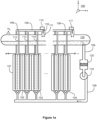
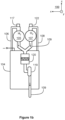
- FIGs 1a and 1b illustrate a system according to an exemplifying and non-limiting embodiment for alkaline water electrolysis. Viewing directions related to figures 1a and 1b are expressed with the aid of a coordinate system 199.
- the system comprises a stack of electrolysis cells each of which contains alkaline liquid electrolyte.
- four of the electrolysis cells are denoted with references 101, 102, 103, and 104.
- Each of the electrolytic cells comprises an anode, a cathode, and a porous diaphragm dividing the electrolysis cell into a cathode compartment containing the cathode and an anode compartment containing the anode.
- the liquid electrolyte may comprise e.g.
- the system may comprise e.g. tens or even hundreds of electrolysis cells. It is however also possible that a system according to an exemplifying and non-limiting embodiment comprises from one to ten electrolysis cells. In the exemplifying system illustrated in figures 1a and 1b , the electrolysis cells are electrically series connected. It is however also possible that electrolytic cells of a system according to an exemplifying and non-limiting embodiment are electrically parallel connected, or the electrolytic cells are arranged to constitute series connected groups of parallel connected electrolytic cells, or parallel connected groups of series connected electrolytic cells, or the electrolytic cells are electrically connected to each other in some other way.
- the system comprises a hydrogen separator tank 105 and a first piping 106 from the cathode compartments of the electrolysis cells to an upper portion of the hydrogen separator tank 105.
- the system comprises an oxygen separator tank and a second piping 108 from the anode compartments of the electrolysis cells to an upper portion of the oxygen separator tank.
- the oxygen separator tank is denoted with a reference 107.
- the system comprises a third piping 109 for circulating the liquid electrolyte from a lower portion of the hydrogen separator tank 105 and from a lower portion of the oxygen separator tank 107 back to the electrolysis cells.
- hydrogen and oxygen separator tanks 105 and 107 hydrogen and oxygen gases H 2 and O 2 are separated as gases continue to rise upwards and the liquid electrolyte returns to the electrolyte cycle.
- the third piping 109 comprises a controllable pump 119 for pumping the liquid electrolyte to the electrolysis cells.
- a pump-controlled electrolyte cycle is advantageous especially when temperature control is needed. It is however also possible that a system according to an exemplifying and non-limiting embodiment comprises a gravitational electrolyte circulation.
- the third piping 109 further comprises a filter 120 for filtering the liquid electrolyte.
- the filter 120 can be for example a membrane filter for removing impurities from the liquid electrolyte.
- the above-mentioned Faraday efficiency ⁇ F i.e. the ratio of the ideal hydrogen production rate to an actual hydrogen production rate should be as close to one as possible at all operating conditions.
- the Faraday efficiency decreases due to crossover of hydrogen gas to the anode compartments, i.e. to the oxygen side. Furthermore, the Faraday efficiency is reduced by stray currents taking place in the system for alkaline water electrolysis.
- the system comprises an ultrasound source 110 attached to the first piping 106 and configured to apply ultrasound on the liquid electrolyte contained by the first piping 106.
- the frequency of the ultrasound can be for example in the range from 16 kHz to 200 kHz.
- the ultrasound enhances the separation of dissolved hydrogen gas H 2 from the liquid electrolyte contained by the above-mentioned first piping 106. Therefore, the crossover of the hydrogen gas to the oxygen side is reduced. As a corollary, the Faraday efficiency of the system is improved.
- the safe control range of the system is broadened because the reduction in the hydrogen gas crossover reduces the amount of hydrogen gas on the oxygen side and thereby reduces a lower limit of the electric current and increases an upper limit of the operating pressure which correspond to a maximum allowable hydrogen content on the oxygen side.
- the ultrasound source 110 comprises an ultrasound radiator 118 that is inside the first piping 106. It is also possible that an ultrasound radiator is attached to an outer wall of the first piping 106, or there is some other arrangement for conducting ultrasound waves to the liquid electrolyte contained by the first piping 106.
- the first piping is arranged form manifolds each of which comprises a collector pipe connected to the hydrogen separator tank 105 and branch pipes connected to the collector pipe and to the cathode compartments of three of the electrolysis cells.
- the system comprises one ultrasound source per each manifold so that the ultrasound source related to a manifold under consideration is attached to the collector pipe of the manifold.
- the cathode compartments of the electrolysis cells 101-103 are connected to the hydrogen separator tank 105 with a manifold that comprises the branch pipes 112, 113, and 114 and the collector pipe 111.
- the ultrasound source 110 is attached to the collector pipe 111.
- the cathode compartments of three other electrolysis cells are connected to the hydrogen separator tank 105 with another manifold, and an ultrasound source 117 is attached to the collector pipe of this manifold.
- an ultrasound source 117 is attached to the collector pipe of this manifold.
- the second piping 108 from the anode compartments of the electrolysis cells to the oxygen separator tank is provided with ultrasound sources in the same way as the first piping from the cathode compartments of the electrolysis cells to the hydrogen separator tank 105.
- one of the ultrasound sources attached to the second piping 108 is denoted with a reference 122.
- the ultrasound sources attached to the second piping 108 enhance the separation of dissolved oxygen gas from the liquid electrolyte contained by the second piping 108. Therefore, crossover of the oxygen gas to the hydrogen side is reduced. It is however also possible that a system according to an exemplifying and non-limiting embodiment comprises one or more ultrasound sources on the hydrogen side only.
- Figure 2 shows a flowchart of a method according to an exemplifying and non-limiting embodiment for alkaline water electrolysis. The method comprises the following actions:
- the above-mentioned first piping forms a manifold comprising a collector pipe connected to the hydrogen separator tank and branch pipes connected to the collector pipe and to the cathode compartments of two or more of the electrolysis cells, and the ultrasound is applied on the liquid electrolyte contained by the collector pipe.
- the above-mentioned first piping forms at least one other manifold comprising another collector pipe connected to the hydrogen separator tank and other branch pipes connected to the other collector pipe and to the cathode compartments of other two or more of the electrolysis cells.
- the method comprises applying ultrasound also on the liquid electrolyte contained by the other collector pipe.
- a method comprises applying ultrasound on the liquid electrolyte contained by a second piping conducting oxygen gas and the liquid electrolyte from the anode compartments of the electrolysis cells to an upper portion of an oxygen separator tank so as to separate dissolved oxygen gas from the liquid electrolyte contained by the second piping.
- the liquid electrolyte comprises aqueous potassium hydroxide "KOH".
- the liquid electrolyte comprises aqueous sodium hydroxide "NaOH".
Landscapes
- Chemical & Material Sciences (AREA)
- Engineering & Computer Science (AREA)
- Organic Chemistry (AREA)
- Electrochemistry (AREA)
- Chemical Kinetics & Catalysis (AREA)
- Materials Engineering (AREA)
- Metallurgy (AREA)
- Inorganic Chemistry (AREA)
- Life Sciences & Earth Sciences (AREA)
- Hydrology & Water Resources (AREA)
- Environmental & Geological Engineering (AREA)
- Water Supply & Treatment (AREA)
- Mechanical Engineering (AREA)
- General Chemical & Material Sciences (AREA)
- Electrolytic Production Of Non-Metals, Compounds, Apparatuses Therefor (AREA)
Claims (15)
- System zur alkalischen Wasserelektrolyse, wobei das System aufweist:- eine oder mehrere Elektrolysezellen (101-104), die jeweils eine Anode, eine Kathode und ein poröses Diaphragma, das die Elektrolysezelle in eine Kathodenkammer, die die Kathode enthält, und eine Anodenkammer, die die Anode enthält, unterteilt, aufweisen,- einen Wasserstoffabscheidertank (105) und eine erste Rohrleitung (106) von den Kathodenkammern der Elektrolysezellen zu einem oberen Abschnitt des Wasserstoffabscheidertanks,- einen Sauerstoffabscheidertank (107) und eine zweite Rohrleitung (108) von den Anodenkammern der Elektrolysezellen zu einem oberen Abschnitt des Sauerstoffabscheidertanks, und- eine dritte Rohrleitung (109) zum Leiten flüssiger Elektrolyte von einem unteren Abschnitt des Wasserstoffabscheidertanks und von einem unteren Abschnitt des Sauerstoffabscheidertanks zu den Elektrolysezellen,dadurch gekennzeichnet, dass das System eine Ultraschallquelle (110) aufweist, die an der ersten Rohrleitung angebracht ist und Ultraschall auf den in der ersten Rohrleitung enthaltenen flüssigen Elektrolyten anwendet, um gelöstes Wasserstoffgas aus dem in der ersten Rohrleitung enthaltenen flüssigen Elektrolyten abzuscheiden.
- System nach Anspruch 1, wobei die erste Rohrleitung so angeordnet ist, dass sie einen Verteiler bildet, der ein Sammelrohr (111), das mit dem Wasserstoffabscheidertank verbunden ist, und Abzweigrohre (112-114), die mit dem Sammelrohr und den Kathodenkammern von zwei oder mehr der Elektrolysezellen verbunden sind, aufweist, wobei die Ultraschallquelle an dem Sammelrohr angebracht ist.
- System nach Anspruch 2, wobei die erste Rohrleitung so angeordnet ist, dass sie mindestens einen anderen Verteiler bildet, der ein anderes Sammelrohr, das mit dem Wasserstoffabscheidertank verbunden ist, und andere Abzweigrohre, die mit dem anderen Sammelrohr und den Kathodenkammern von anderen zwei oder mehreren der Elektrolysezellen verbunden sind, aufweist, und wobei das System ferner mindestens eine andere Ultraschallquelle (117) aufweist, die an das andere Sammelrohr angeschlossen ist.
- System nach einem der Ansprüche 1-3, wobei die Ultraschallquelle einen Ultraschallstrahler (118) innerhalb der ersten Rohrleitung aufweist.
- System nach einem der Ansprüche 1-4, wobei die dritte Rohrleitung eine steuerbare Pumpe (119) zum Pumpen des flüssigen Elektrolyten zu den Elektrolysezellen aufweist.
- System nach einem der Ansprüche 1-5, wobei die dritte Rohrleitung einen Filter (120) zum Filtern des flüssigen Elektrolyten aufweist.
- System nach einem der Ansprüche 1-6, wobei die Elektrolysezellen (101-104) elektrisch in Reihe geschaltet sind.
- System nach einem der Ansprüche 1-6, wobei die Elektrolysezellen elektrisch parallel geschaltet sind.
- System nach einem der Ansprüche 1 bis 8, wobei das System eine Ultraschallquelle (122) aufweist, die an der zweiten Rohrleitung (108) angebracht ist und Ultraschall auf den in der zweiten Rohrleitung enthaltenen flüssigen Elektrolyten anwendet, um gelöstes Sauerstoffgas aus dem in der zweiten Rohrleitung enthalten flüssigen Elektrolyten abzuscheiden.
- Verfahren zur alkalischen Wasserelektrolyse, wobei das Verfahren Leiten (201) von elektrischem Strom zu Elektrolysezellen aufweist, die jeweils eine Anode, eine Kathode und ein poröses Diaphragma, das die Elektrolysezelle in eine Kathodenkammer, die die Kathode enthält, und eine Anodenkammer, die die Anode enthält, unterteilt, aufweisen, dadurch gekennzeichnet, dass das Verfahren Anwenden (202) von Ultraschall auf flüssige Elektrolyte aufweist, die in einer ersten Rohrleitung enthalten sind, die Wasserstoffgas und den flüssigen Elektrolyten von den Kathodenkammern der Elektrolysezellen zu einem oberen Abschnitt eines Wasserstoffabscheidertanks leitet, um gelöstes Wasserstoffgas aus dem in der ersten Rohrleitung enthalten flüssigen Elektrolyten abzuscheiden.
- Verfahren nach Anspruch 10, wobei die erste Rohrleitung einen Verteiler bildet, der ein Sammelrohr, das mit dem Wasserstoffabscheidertank verbunden ist, und Abzweigrohre, die mit dem Sammelrohr und den Kathodenkammern von zwei oder mehr der Elektrolysezellen verbunden sind, aufweist, wobei der Ultraschall auf den in dem Sammelrohr enthaltenen flüssigen Elektrolyten angewendet wird.
- Verfahren nach Anspruch 11, wobei die erste Rohrleitung mindestens einen anderen Verteiler bildet, der ein anderes Sammelrohr aufweist, das mit dem Wasserstoffabscheidertank verbunden ist, und andere Abzweigrohre, die mit dem anderen Sammelrohr und den Kathodenkammern von anderen zwei oder mehreren der Elektrolysezellen verbunden sind, und das Verfahren Anwenden von Ultraschall auf den in dem anderen Sammelrohr enthaltenen flüssigen Elektrolyten aufweist.
- Verfahren nach einem der Ansprüche 10-12, wobei das Verfahren Anwenden von Ultraschall auf den flüssigen Elektrolyten aufweist, der in einer zweiten Rohrleitung enthalten ist, die Sauerstoffgas und den flüssigen Elektrolyten von den Anodenkammern der Elektrolysezellen zu einem oberen Abschnitt eines Sauerstoffabscheidertanks leitet, um gelöstes Sauerstoffgas aus dem in der zweiten Rohrleitung enthalten flüssigen Elektrolyten abzuscheiden.
- Verfahren nach einem der Ansprüche 10-13, wobei der flüssige Elektrolyt wässriges Kaliumhydroxid aufweist.
- Verfahren nach einem der Ansprüche 10-13, wobei der flüssige Elektrolyt wässriges Natriumhydroxid aufweist.
Applications Claiming Priority (2)
| Application Number | Priority Date | Filing Date | Title |
|---|---|---|---|
| FI20195758A FI128890B (en) | 2019-09-12 | 2019-09-12 | System and method for alkaline electrolysis of water |
| PCT/FI2020/050446 WO2021048461A1 (en) | 2019-09-12 | 2020-06-23 | A system and a method for alkaline water electrolysis |
Publications (3)
| Publication Number | Publication Date |
|---|---|
| EP4028355A1 EP4028355A1 (de) | 2022-07-20 |
| EP4028355C0 EP4028355C0 (de) | 2023-09-13 |
| EP4028355B1 true EP4028355B1 (de) | 2023-09-13 |
Family
ID=71614915
Family Applications (1)
| Application Number | Title | Priority Date | Filing Date |
|---|---|---|---|
| EP20740357.7A Active EP4028355B1 (de) | 2019-09-12 | 2020-06-23 | System und verfahren zur alkalischen wasserelektrolyse |
Country Status (4)
| Country | Link |
|---|---|
| US (1) | US12344951B2 (de) |
| EP (1) | EP4028355B1 (de) |
| FI (1) | FI128890B (de) |
| WO (1) | WO2021048461A1 (de) |
Families Citing this family (5)
| Publication number | Priority date | Publication date | Assignee | Title |
|---|---|---|---|---|
| KR102771529B1 (ko) * | 2020-02-14 | 2025-02-20 | 현대자동차주식회사 | 수전해 시스템 및 그 제어방법 |
| EP4339327A1 (de) * | 2022-09-14 | 2024-03-20 | Linde GmbH | Verfahren zum betreiben einer elektrolyseanlage und elektrolyseanlage |
| US20240400908A1 (en) | 2023-05-30 | 2024-12-05 | Arcadia eFuels US Inc. | Production of synthetic hydrocarbons |
| WO2024258489A1 (en) * | 2023-06-14 | 2024-12-19 | Utility Global, Inc. | Reactor assembly and method of use |
| DK202330253A1 (en) * | 2023-10-09 | 2025-05-13 | Green Hydrogen Systems As | Electrolyser stack fabrication method and electrolyser stack fabricated according to the method |
Citations (1)
| Publication number | Priority date | Publication date | Assignee | Title |
|---|---|---|---|---|
| JP2011006769A (ja) * | 2009-06-29 | 2011-01-13 | Mitsubishi Heavy Ind Ltd | 水電解装置 |
Family Cites Families (16)
| Publication number | Priority date | Publication date | Assignee | Title |
|---|---|---|---|---|
| JPH0889967A (ja) | 1994-09-19 | 1996-04-09 | Tokico Ltd | 電解水生成器 |
| JP2003313693A (ja) * | 2002-04-25 | 2003-11-06 | Toomu:Kk | 電気分解装置及び電気分解方法 |
| US7559978B2 (en) | 2005-09-19 | 2009-07-14 | General Electric Company | Gas-liquid separator and method of operation |
| DE102007051230B4 (de) * | 2006-10-23 | 2010-04-08 | SETT Solare Energietechnologien Thüringen GmbH | Elektrolysator |
| JP2009174043A (ja) * | 2007-12-27 | 2009-08-06 | Toshigoro Sato | 水電解ガス発生装置 |
| US20120063967A1 (en) * | 2009-05-21 | 2012-03-15 | Panasonic Corporation | Hydrogen generation system and hot water production system |
| EP2663668A2 (de) * | 2011-01-12 | 2013-11-20 | Ceramatec, Inc | Elektrochemische herstellung von wasserstoff |
| KR20140016921A (ko) * | 2011-04-05 | 2014-02-10 | 블랙라이트 파워 인코포레이티드 | H2o 기반의 전기화학적 수소-촉매 전력 시스템 |
| EP2871265A1 (de) * | 2012-07-03 | 2015-05-13 | JX Nippon Oil & Energy Corporation | Vorrichtung für elektrochemische reduktion und verfahren zur herstellung eines hydrierten produktes aus einer aromatischen kohlenwasserstoffverbindung oder einer stickstoffhaltigen heterocyclischen aromatischen verbindung |
| JP2015000354A (ja) * | 2013-06-13 | 2015-01-05 | シャープ株式会社 | 水素溶存水生成器 |
| JP6605884B2 (ja) * | 2014-09-02 | 2019-11-13 | 株式会社東芝 | 水素製造システム及び水素製造方法 |
| JP6588768B2 (ja) * | 2015-08-20 | 2019-10-09 | デノラ・ペルメレック株式会社 | 電解装置及び電解方法 |
| JP6697333B2 (ja) * | 2016-06-29 | 2020-05-20 | マクセルホールディングス株式会社 | 電解水素水生成方法及び電解水素水生成装置 |
| KR101732659B1 (ko) * | 2016-10-17 | 2017-05-24 | 한동하이드로 주식회사 | 가역 고분자전해질막 연료전지를 이용한 기능수 제조장치 |
| KR102279426B1 (ko) | 2017-09-07 | 2021-07-19 | 드 노라 페르멜렉 가부시키가이샤 | 전해 장치 |
| CN108862533A (zh) * | 2018-06-21 | 2018-11-23 | 鲁言和 | 一种氢饮料机 |
-
2019
- 2019-09-12 FI FI20195758A patent/FI128890B/en active IP Right Grant
-
2020
- 2020-06-23 US US17/642,558 patent/US12344951B2/en active Active
- 2020-06-23 WO PCT/FI2020/050446 patent/WO2021048461A1/en not_active Ceased
- 2020-06-23 EP EP20740357.7A patent/EP4028355B1/de active Active
Patent Citations (1)
| Publication number | Priority date | Publication date | Assignee | Title |
|---|---|---|---|---|
| JP2011006769A (ja) * | 2009-06-29 | 2011-01-13 | Mitsubishi Heavy Ind Ltd | 水電解装置 |
Also Published As
| Publication number | Publication date |
|---|---|
| WO2021048461A1 (en) | 2021-03-18 |
| FI20195758A1 (en) | 2021-02-26 |
| EP4028355C0 (de) | 2023-09-13 |
| FI128890B (en) | 2021-02-26 |
| EP4028355A1 (de) | 2022-07-20 |
| US12344951B2 (en) | 2025-07-01 |
| US20220325425A1 (en) | 2022-10-13 |
Similar Documents
| Publication | Publication Date | Title |
|---|---|---|
| EP4028355B1 (de) | System und verfahren zur alkalischen wasserelektrolyse | |
| US4758322A (en) | Apparatus for the electrolysis of solutions | |
| US6849356B2 (en) | Separated flow liquid catholyte aluminum hydrogen peroxide seawater semi fuel cell | |
| US20180371630A1 (en) | High pressure electrochemical cell | |
| EP3312304B1 (de) | Wasserbehandlungssystem mit alkalischer wasserelektrolysevorrichtung und alkalischer brennstoffzelle | |
| US8709220B2 (en) | Water electrolysis apparatus | |
| CN106030886B (zh) | 电化学电池 | |
| KR20180126573A (ko) | 수 전해장치 | |
| EP4370730B1 (de) | Verfahren zur elektrolyse von wasser mit variablen stromdichten | |
| CN113403630B (zh) | 一种催化电解制取氢气装置 | |
| US20160312370A1 (en) | Electrochemical cell without an electrolyte-impermeable barrier | |
| MX2014015248A (es) | Electrodos de gas permeable y celulas electroquimicas. | |
| WO2009040334A3 (fr) | Electrolyseur haute temperature a dispositif de recuperation d'hydrogene | |
| CN111826671B (zh) | 电解水制气装置和方法 | |
| JPWO2018139613A1 (ja) | 複極式エレメント、複極式電解槽、水素製造方法 | |
| EP3921458A1 (de) | Elektrolyseur zur herstellung von wasserstoff und sauerstoff | |
| CN104641020A (zh) | 外部加固的水电解槽模块 | |
| KR20220057576A (ko) | 크로스-플로우 물 전기분해 | |
| AU2021279136B2 (en) | Electrolytic cell, method for operating a cell of this type and electrolyser | |
| JP2009138253A (ja) | 電気分解装置及びこれを利用する燃料電池発電システム | |
| JP6803406B2 (ja) | 電解槽、電解装置、電解方法 | |
| SE447583B (sv) | Bipoler elektrolysor | |
| Hartvigsen et al. | New low to medium temperature electrolyte separation method and system for alkaline water electrolysis | |
| EP4570955A1 (de) | Wasserelektrolysezelle, zugehöriger stapel von wasserelektrolysezellen und verfahren | |
| EP4538426A1 (de) | Strömungsverteiler zur homogenen verteilung von reaktanten in eine elektrolysezelle, zellenrahmen damit und elektrolyseur mit dem zellenrahmen |
Legal Events
| Date | Code | Title | Description |
|---|---|---|---|
| STAA | Information on the status of an ep patent application or granted ep patent |
Free format text: STATUS: UNKNOWN |
|
| STAA | Information on the status of an ep patent application or granted ep patent |
Free format text: STATUS: THE INTERNATIONAL PUBLICATION HAS BEEN MADE |
|
| PUAI | Public reference made under article 153(3) epc to a published international application that has entered the european phase |
Free format text: ORIGINAL CODE: 0009012 |
|
| STAA | Information on the status of an ep patent application or granted ep patent |
Free format text: STATUS: REQUEST FOR EXAMINATION WAS MADE |
|
| 17P | Request for examination filed |
Effective date: 20220302 |
|
| AK | Designated contracting states |
Kind code of ref document: A1 Designated state(s): AL AT BE BG CH CY CZ DE DK EE ES FI FR GB GR HR HU IE IS IT LI LT LU LV MC MK MT NL NO PL PT RO RS SE SI SK SM TR |
|
| DAV | Request for validation of the european patent (deleted) | ||
| DAX | Request for extension of the european patent (deleted) | ||
| REG | Reference to a national code |
Ref country code: DE Ref legal event code: R079 Free format text: PREVIOUS MAIN CLASS: C01B0013140000 Ipc: C25B0001040000 Ref document number: 602020017667 Country of ref document: DE |
|
| GRAP | Despatch of communication of intention to grant a patent |
Free format text: ORIGINAL CODE: EPIDOSNIGR1 |
|
| STAA | Information on the status of an ep patent application or granted ep patent |
Free format text: STATUS: GRANT OF PATENT IS INTENDED |
|
| RIC1 | Information provided on ipc code assigned before grant |
Ipc: C25B 15/08 20060101ALI20230320BHEP Ipc: C25B 9/77 20210101ALI20230320BHEP Ipc: C25B 9/73 20210101ALI20230320BHEP Ipc: C25B 9/23 20210101ALI20230320BHEP Ipc: C25B 1/04 20210101AFI20230320BHEP |
|
| INTG | Intention to grant announced |
Effective date: 20230413 |
|
| GRAS | Grant fee paid |
Free format text: ORIGINAL CODE: EPIDOSNIGR3 |
|
| GRAA | (expected) grant |
Free format text: ORIGINAL CODE: 0009210 |
|
| STAA | Information on the status of an ep patent application or granted ep patent |
Free format text: STATUS: THE PATENT HAS BEEN GRANTED |
|
| AK | Designated contracting states |
Kind code of ref document: B1 Designated state(s): AL AT BE BG CH CY CZ DE DK EE ES FI FR GB GR HR HU IE IS IT LI LT LU LV MC MK MT NL NO PL PT RO RS SE SI SK SM TR |
|
| REG | Reference to a national code |
Ref country code: CH Ref legal event code: EP |
|
| REG | Reference to a national code |
Ref country code: DE Ref legal event code: R096 Ref document number: 602020017667 Country of ref document: DE |
|
| REG | Reference to a national code |
Ref country code: IE Ref legal event code: FG4D |
|
| U01 | Request for unitary effect filed |
Effective date: 20230913 |
|
| U07 | Unitary effect registered |
Designated state(s): AT BE BG DE DK EE FI FR IT LT LU LV MT NL PT SE SI Effective date: 20230920 |
|
| PG25 | Lapsed in a contracting state [announced via postgrant information from national office to epo] |
Ref country code: GR Free format text: LAPSE BECAUSE OF FAILURE TO SUBMIT A TRANSLATION OF THE DESCRIPTION OR TO PAY THE FEE WITHIN THE PRESCRIBED TIME-LIMIT Effective date: 20231214 |
|
| PG25 | Lapsed in a contracting state [announced via postgrant information from national office to epo] |
Ref country code: RS Free format text: LAPSE BECAUSE OF FAILURE TO SUBMIT A TRANSLATION OF THE DESCRIPTION OR TO PAY THE FEE WITHIN THE PRESCRIBED TIME-LIMIT Effective date: 20230913 Ref country code: NO Free format text: LAPSE BECAUSE OF FAILURE TO SUBMIT A TRANSLATION OF THE DESCRIPTION OR TO PAY THE FEE WITHIN THE PRESCRIBED TIME-LIMIT Effective date: 20231213 Ref country code: HR Free format text: LAPSE BECAUSE OF FAILURE TO SUBMIT A TRANSLATION OF THE DESCRIPTION OR TO PAY THE FEE WITHIN THE PRESCRIBED TIME-LIMIT Effective date: 20230913 Ref country code: GR Free format text: LAPSE BECAUSE OF FAILURE TO SUBMIT A TRANSLATION OF THE DESCRIPTION OR TO PAY THE FEE WITHIN THE PRESCRIBED TIME-LIMIT Effective date: 20231214 |
|
| PG25 | Lapsed in a contracting state [announced via postgrant information from national office to epo] |
Ref country code: IS Free format text: LAPSE BECAUSE OF FAILURE TO SUBMIT A TRANSLATION OF THE DESCRIPTION OR TO PAY THE FEE WITHIN THE PRESCRIBED TIME-LIMIT Effective date: 20240113 |
|
| PG25 | Lapsed in a contracting state [announced via postgrant information from national office to epo] |
Ref country code: ES Free format text: LAPSE BECAUSE OF FAILURE TO SUBMIT A TRANSLATION OF THE DESCRIPTION OR TO PAY THE FEE WITHIN THE PRESCRIBED TIME-LIMIT Effective date: 20230913 |
|
| PG25 | Lapsed in a contracting state [announced via postgrant information from national office to epo] |
Ref country code: SM Free format text: LAPSE BECAUSE OF FAILURE TO SUBMIT A TRANSLATION OF THE DESCRIPTION OR TO PAY THE FEE WITHIN THE PRESCRIBED TIME-LIMIT Effective date: 20230913 Ref country code: RO Free format text: LAPSE BECAUSE OF FAILURE TO SUBMIT A TRANSLATION OF THE DESCRIPTION OR TO PAY THE FEE WITHIN THE PRESCRIBED TIME-LIMIT Effective date: 20230913 Ref country code: IS Free format text: LAPSE BECAUSE OF FAILURE TO SUBMIT A TRANSLATION OF THE DESCRIPTION OR TO PAY THE FEE WITHIN THE PRESCRIBED TIME-LIMIT Effective date: 20240113 Ref country code: ES Free format text: LAPSE BECAUSE OF FAILURE TO SUBMIT A TRANSLATION OF THE DESCRIPTION OR TO PAY THE FEE WITHIN THE PRESCRIBED TIME-LIMIT Effective date: 20230913 Ref country code: CZ Free format text: LAPSE BECAUSE OF FAILURE TO SUBMIT A TRANSLATION OF THE DESCRIPTION OR TO PAY THE FEE WITHIN THE PRESCRIBED TIME-LIMIT Effective date: 20230913 Ref country code: SK Free format text: LAPSE BECAUSE OF FAILURE TO SUBMIT A TRANSLATION OF THE DESCRIPTION OR TO PAY THE FEE WITHIN THE PRESCRIBED TIME-LIMIT Effective date: 20230913 |
|
| PG25 | Lapsed in a contracting state [announced via postgrant information from national office to epo] |
Ref country code: PL Free format text: LAPSE BECAUSE OF FAILURE TO SUBMIT A TRANSLATION OF THE DESCRIPTION OR TO PAY THE FEE WITHIN THE PRESCRIBED TIME-LIMIT Effective date: 20230913 |
|
| REG | Reference to a national code |
Ref country code: DE Ref legal event code: R097 Ref document number: 602020017667 Country of ref document: DE |
|
| PLBE | No opposition filed within time limit |
Free format text: ORIGINAL CODE: 0009261 |
|
| STAA | Information on the status of an ep patent application or granted ep patent |
Free format text: STATUS: NO OPPOSITION FILED WITHIN TIME LIMIT |
|
| U20 | Renewal fee for the european patent with unitary effect paid |
Year of fee payment: 5 Effective date: 20240625 |
|
| 26N | No opposition filed |
Effective date: 20240614 |
|
| PG25 | Lapsed in a contracting state [announced via postgrant information from national office to epo] |
Ref country code: MC Free format text: LAPSE BECAUSE OF FAILURE TO SUBMIT A TRANSLATION OF THE DESCRIPTION OR TO PAY THE FEE WITHIN THE PRESCRIBED TIME-LIMIT Effective date: 20230913 |
|
| REG | Reference to a national code |
Ref country code: CH Ref legal event code: PL |
|
| GBPC | Gb: european patent ceased through non-payment of renewal fee |
Effective date: 20240623 |
|
| PG25 | Lapsed in a contracting state [announced via postgrant information from national office to epo] |
Ref country code: IE Free format text: LAPSE BECAUSE OF NON-PAYMENT OF DUE FEES Effective date: 20240623 |
|
| PG25 | Lapsed in a contracting state [announced via postgrant information from national office to epo] |
Ref country code: CH Free format text: LAPSE BECAUSE OF NON-PAYMENT OF DUE FEES Effective date: 20240630 |
|
| PG25 | Lapsed in a contracting state [announced via postgrant information from national office to epo] |
Ref country code: GB Free format text: LAPSE BECAUSE OF NON-PAYMENT OF DUE FEES Effective date: 20240623 |
|
| U20 | Renewal fee for the european patent with unitary effect paid |
Year of fee payment: 6 Effective date: 20250627 |
|
| PG25 | Lapsed in a contracting state [announced via postgrant information from national office to epo] |
Ref country code: CY Free format text: LAPSE BECAUSE OF FAILURE TO SUBMIT A TRANSLATION OF THE DESCRIPTION OR TO PAY THE FEE WITHIN THE PRESCRIBED TIME-LIMIT; INVALID AB INITIO Effective date: 20200623 |