EP4021169B1 - Transportverfahren und transporteinrichtung für hochwertige frischmilch unter transport- und umgebungskritischen bedingungen - Google Patents
Transportverfahren und transporteinrichtung für hochwertige frischmilch unter transport- und umgebungskritischen bedingungen Download PDFInfo
- Publication number
- EP4021169B1 EP4021169B1 EP19769006.8A EP19769006A EP4021169B1 EP 4021169 B1 EP4021169 B1 EP 4021169B1 EP 19769006 A EP19769006 A EP 19769006A EP 4021169 B1 EP4021169 B1 EP 4021169B1
- Authority
- EP
- European Patent Office
- Prior art keywords
- transport
- container
- fresh milk
- inclination
- angle
- Prior art date
- Legal status (The legal status is an assumption and is not a legal conclusion. Google has not performed a legal analysis and makes no representation as to the accuracy of the status listed.)
- Active
Links
Images



Classifications
-
- A—HUMAN NECESSITIES
- A01—AGRICULTURE; FORESTRY; ANIMAL HUSBANDRY; HUNTING; TRAPPING; FISHING
- A01J—MANUFACTURE OF DAIRY PRODUCTS
- A01J9/00—Milk receptacles
- A01J9/04—Milk receptacles with cooling arrangements
Definitions
- the invention relates to a transport method for high-quality fresh milk under transport and environmental critical conditions and a transport device for carrying out the method.
- the method comprises storing the high-quality fresh milk by filling a container that has an undivided volume of several cubic meters, preferably 20 cubic meters and more, a fresh milk temperature that is lower than an ambient temperature, preferably to 3.5 to 4 °C, and a head space in the container that is filled with a gaseous fluid, preferably hygienically treated air.
- the method also comprises transporting the high-quality fresh milk with a means of transport that is ground-based and transported by rail and road and/or is designed as a ship. Following the transport, the method provides for emptying the high-quality fresh milk from the container.
- high-quality fresh milk is intended to include so-called longer-life standardized fresh or ESL milk (ESL: extended shelf life ) with a pH value ⁇ 6.65 and a fat content of 1.5/3 or 3.5%.
- ESL extended shelf life
- This milk is such that it can be stored for at least 30 days or more at a storage temperature of no more than 4 °C without damage, as far as the microbiological aspect and the chemical, physical and technological properties or functionalities of the ingredients of this milk, such as milk fat, milk protein and lactose, are concerned.
- a hygienic tank which must be designed as a so-called sterile tank if very high quality requirements are met, is a container that has all the necessary functions and monitoring that are usually required to ensure that any reinfection of the transported product by spreading germs from the container and/or its environment to the product, resulting in microbiological spoilage of the product, is excluded during handling.
- the critical areas include a manhole, valve devices for filling and emptying, sampling devices, safety and cleaning devices, and measuring and monitoring devices, which must also be subjected to adequate sterilizing cleaning before the container is filled with product.
- the challenge in this regard is that the so-called standardized fresh or ESL milk must survive transport for at least 30 days or more at a storage temperature of no more than 4 °C without damage, as far as the microbiological aspect and the chemical, physical and technological properties or functionalities of the ingredients in this milk, such as milk fat, milk protein and lactose, are concerned.
- the situation is made worse by the fact that, in the worst case scenario, the high-quality fresh milk must be stored for a long time at high temperatures and/or the cold chain must be interrupted, resulting in microbiological changes.
- transport times and transport stresses may be necessary with land-based means of transport by land or rail to the ship and from the ship to the processing production facilities.
- the publication US 2012/0276262 A1 describes a method of handling a sterilized food product comprising sterilizing an intermodal container having a rigid shell with opposing closed ends and a discharge opening in one of the closed ends, and aseptically filling the intermodal container with the sterilized food product.
- the method further comprises transporting the filled intermodal container while maintaining the sterilized food product under aseptic conditions. Additionally, at a discharge point, the method may comprise moving the intermodal container to an incline angle of at least 8 degrees from the horizontal and discharging the sterilized food product from the discharge opening.
- WO99/23016 A1 discloses a method for aseptically transporting a bulk quantity of a sterile product, such as an edible food product.
- the method comprises sterilizing a transport container by flooding the container with a chemical sterilizing agent, pressurizing the sterilized container with a positive pressure inert gas atmosphere, and aseptically feeding a bulk quantity of the sterile product into the sterilized container.
- the pressure vessel filled with the sterile product is sealed to substantially maintain the positive pressure during transport of the container.
- the container with the sterile product therein is then transported to a remote location.
- a transport container for use in the present method comprises an insulated portable storage tank provided with a sealable atmospheric vent in an upper portion, an inert gas valve provided with a filter for separating microorganisms, and an aseptic inlet/outlet valve through which a sterile product is added or discharged.
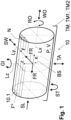
- FIG 1 In the drawing, the possible forms of movement of a means of transport TM in the form of a ship TM2 ( Figure 3 ) in relation to a geometric reference system BS with its spatial axes x, y and z.
- the spatial axes x, y and z should coincide with the main axes of the container 10, a first main axis Lx, a second Ly and a third Lz.
- the high-quality fresh milk P forms a free surface N in the head space 10.1.
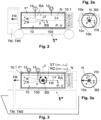
- the container 10, arranged in a transport device 1* may, regardless of the means of transport TM1, TM2, have a circular container shape 10a, an elliptical 10b or a suitcase-shaped 10c ( Figure 2a ).
- a fresh milk temperature T is kept constant by a cooling device 40* at a temperature which is usually lower than the ambient temperature before the container 10 is filled with the high-quality fresh milk P.
- a filling and emptying device 30* with known valve devices and associated piping is provided for filling and emptying the container 10.
- the container 10 also has a temperature measuring device 14 for detecting the fresh milk temperature T and a fill level measuring device 12 with a first measuring probe L1 for detecting the fill level of the high-quality fresh milk P in the container 10.
- Sliding movements of the free surface N are particularly pronounced and consequential when they move relative to the selected reference system BS by a distance Figures 2 and 3 at an angle referred to as the inclination angle +/-w. These sloshing movements occur in particular when pitching ST occurs in the direction of travel FR oriented in the direction of the first main axis Lx or when rolling RO occurs in the direction of travel FR oriented in the direction of the second main axis Ly.
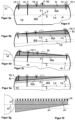
- the container 10 tilts in the direction of its first main axis Lx by the angle of inclination +/-w and thus guides the reference system BS related to the container 10 with ( Figures 5b to 5d ). Under the influence of gravity, the free surface N continues to orient itself horizontally and thus forms the angle of inclination +/-w with respect to the reference system BS.
- the high-quality fresh milk P located underneath shifts, depending on the amount of the angle of inclination +/-w, alternately either in one or the other corner area of the interior of the container 10, whereby this respective corner area is either partially or completely flooded.
- the correspondingly inclined free surface N has a smaller area in the case of the normally dimensioned head space 10.1 than when the container 10 is aligned horizontally.
- the free surface N is a rectangular surface formed from a double equivalent surface A1 and a double difference surface ⁇ A.
- the sum of both surfaces A1 and ⁇ A results from a dimension of a first chord s1 formed in the circular cross-section as a result of the filling level and approximately a length dimension of the container 10 ( Figures 5a, 5g ).
- the free surface N takes the shape of a triangle, of which Figure 5f only half is shown.
- This half triangular area has the size of the equivalent area A1. It in turn results from a dimension of a second chord s2 formed in the circular cross-section as a result of the filling level and approximately the length dimension of the container 10 ( Figures 5d, 5g ).
- the difference between the free surface N when the container 10 is horizontally oriented and that at an angle of inclination +/-w is thus twice the difference area ⁇ A.
- the cream layer RA must rearrange itself accordingly and inevitably forms a thicker layer when the container is at an angle.
- the high-quality fresh milk with this thicker cream layer RA gushes into the associated corner area of the container 10 and finds a corresponding, massaged, extended inner wall surface to adhere to. Clumps occur in these corner areas and massaged deposits or sedimentations similar to solid deposits in narrow bottle necks with liquid-solid mixtures.
- inventive basic idea and the related inventive features are also based on the physical mechanism described below. An approximate computational estimate is made below.
- the high-quality fresh milk P contains air if the gaseous, sterile fluid F is appropriately prepared and provided air. This air is present in more or less fine bubble form, distributed over the entire quantity of the high-quality fresh milk P and in particular also due to the usual homogenization process with the aim of a fine-particle fat distribution in the high-quality fresh milk P.
- the air bubbles act as so-called crystallization nuclei for fat particles, so that the air bubbles transport these fat particles against gravity in a manner similar to flotation. This transport is further supported by the density differences between the fat particles and the milk phase that absorbs them.
- the frictional force F R acting on the bladder also depends significantly on the dynamic viscosity ⁇ of the high-quality fresh milk P.
- the dynamic viscosity ⁇ is inversely proportional to the fresh milk temperature T ( ⁇ - 1/T).
- the stationary buoyancy speed v is inversely proportional to the pressure p in the head space of the container, which can increase to 1.4 bar overpressure in the inventive design.
- the two physical quantities pressure p and dynamic viscosity ⁇ or fresh milk temperature T have approximately the same reducing effect on the buoyancy speed v of the air bubbles and thus of the fat particles in their inventive dimensioning.
- a key feature is the handling of the high-quality fresh milk when filling and emptying the container under sterile conditions. These measures include all critical areas of the container, as already discussed above. Other significant features are the recording of the angle of inclination of the free surface in relation to the reference system and the recording of the pressure in the head space. They are based on the facts outlined above regarding the formation of the free surface, the thickness of the cream layer that depends on this and the influence of the pressure on the buoyancy speed of the air bubbles or fat particles. The pressure is then increased depending on and proportional to the amount of the angle of inclination by supplying the gaseous, sterile fluid, and this measure is also carried out under sterile conditions.
- step (G) The buoyancy speed of the fat particles and thus the degree of creaming are significantly reduced if the transport process according to step (G) lowers the fresh milk temperature from 3.5°C to 4°C to 2°C to 2.5°C in a final period of the storage time. It has proven to be particularly effective if the final period corresponds to a third of the storage time.
- the transport method is advantageously designed with regard to the inventive dependence between the angle of inclination and the pressure in such a way that a A tilt angle range and a permissible pressure range are specified.
- the tilt angle range is formed by a maximum negative tilt angle or a maximum positive tilt angle for the tilt angle.
- the tilt angle range can be up to +/- 5 degrees, or more in extreme situations.
- the permissible pressure range varies between a minimum pressure, which can correspond to at least atmospheric pressure, and a permissible maximum pressure, which is limited by the strength design of the container and is, according to a proposal, rated at up to 1.4 bar overpressure.
- a correlation is provided between the inclination angle range and the pressure range, i.e. the maximum pressure is assigned the amount of the maximum positive or maximum negative inclination angle.
- the transport method provides that the pressure only follows the temporal progression of the value of the angle of inclination recorded if a subsequent value of the angle of inclination recorded is equal to or greater than a previous value.
- the previous value is not the immediately preceding value, but any possible value in the transport time that has elapsed up to that point.
- the reference system for determining the angle of inclination is preferably an orthogonal three-axis reference system consisting of an x-, y- and z-axis.
- the inclination of the free surface is measured in a plane spanned by the x- and z-axis and in a plane spanned by the y- and z-axis.
- the relevant angle of inclination is determined from these two orthogonal measured values.
- the orthogonal three-axis reference system is formed by a first main axis oriented in the x-direction, a second main axis oriented in the y-direction oriented second main axis and a third main axis of the container oriented in the z-direction.
- the determination of the critical inclination movements is made easier if either the first main axis or the second main axis is oriented in a direction of travel of the means of transport.
- a sloshing movement of the high-quality fresh milk in the stationary, horizontally oriented container is identified if, according to a further proposal, a level measuring device for detecting the level of the high-quality fresh milk in the container is set up in such a way that two measuring probes are provided which are immersed in the free surface at a distance from one another and which, in conjunction with a suitably set up control system, quantitatively determine a corresponding change in position of the free surface through the different degree of their wetting.
- the control device has a data memory in which an inclination angle range is stored, which includes a maximum negative inclination angle and a maximum positive inclination angle.
- a permissible pressure range is also stored there, which includes a minimum pressure and a maximum pressure.
- the permissible pressure range correlates with the value of the inclination angle range in the course of the intended control of the pressure depending on the respective measured inclination angle.
- the minimum pressure can be based on atmospheric pressure; however, it can also be set at a higher pressure.
- the maximum pressure is determined by the strength design of the container, which also takes economic aspects into account.
- a reliable measurement of the most general spatially oriented and relevant angle of inclination is achieved if two inclinometers are provided in the reference system, which is preferably an orthogonal three-axis reference system with an x, y and z axis.
- the first inclinometer measures the inclination of the free surface in a first plane spanned by the x and z axes and a second inclinometer measures the inclination of the free surface in a second plane spanned by the y and z axes.
- the relevant angle of inclination is determined from the two orthogonal measured values.
- the orthogonal reference system is suitably oriented in such a way that it is formed by a first main axis oriented in the x-direction, a second main axis oriented in the y-direction and a third main axis of the container oriented in the z-direction.
- the determination of critical inclination movements of the container is simplified if either the first main axis or the second main axis is oriented in a direction of travel of the means of transport.
- the arrangement of the container preferably within a tank container requires an elongated, horizontal design of the container, wherein the x-axis of the reference system is oriented in the longitudinal direction of the container, thus in the first main axis.
- the container has an undivided volume of 20 m3 and more, whereby the upper volume is generally limited in the context of training in a tank container by its standardized size.
- the level measuring device provided on the container has a second measuring probe.
- the first and second measuring probes are arranged at a distance from each other and reach into the free surface of the high-quality fresh milk via the head space, whereby differing measurement results determined by both measuring probes can be evaluated effectively.
- the supply of the head space of the container with the gaseous, sterile fluid during transport is made considerably easier in terms of equipment if a buffer container is provided with a buffer volume that is tailored to the size of the head space, which can optionally be connected to the head space and in which the gaseous, sterile fluid is stored at an overpressure.
- This overpressure is dimensioned in such a way that it ensures that the maximum pressure is provided in the head space of the container over the entire storage period.
- a second device 16 is arranged for detecting a pressure p of a gaseous, sterile fluid F, which Headspace 10.1 is applied.
- the fill level measuring device 12 has a second measuring probe L2, wherein the first and the second measuring probe L1, L2 are arranged at a distance from one another and reach into the free surface N of the high-quality fresh milk P via the headspace 10.1.
- the reference system BS is designed as an orthogonal three-axis reference system BS xyz , consisting of the x-, y- and z-axes.
- BS xyz a plane spanned by the x- and z-axes
- E yz a plane spanned by the y- and z-axes
- the relevant spatial inclination angle +/-w is determined from these inclination angles +/-w assigned to the respective plane, two orthogonally obtained measured values.
- the orthogonal three-axis reference system BS xyz is formed by the first main axis L x oriented in the x-direction, the second main axis L y oriented in the y-direction and the third main axis L z oriented in the z-direction of the container 10.
- the first main axis L x or the second main axis L y is oriented in the direction of travel FR of the means of transport TM or TM1, TM2.
- the container 10 is elongated in the x-direction and arranged lying in this direction.
- the transport method according to the invention according to claim 1 comprises steps (A) to (D), whereby step (E), the emptying of the high-quality fresh milk P from the container 10, follows step (D) without any further time-linear or simultaneous measures.
- step (E) the emptying of the high-quality fresh milk P from the container 10, follows step (D) without any further time-linear or simultaneous measures.
- step (B) the angle of inclination +/-w is determined in the first device 60 and, if appropriate, sloshing movements of the free surface N are determined in parallel in the level measuring device 12 with the first and second measuring probes L1, L2.
- step (C) the pressure p in the head space 10.1 is recorded in the second device 16, which pressure p is then determined according to step (D) as a function of and proportional to the amount
- the angle of inclination +/-w (p f(
- the transport method according to the invention according to claim 2 differs from that according to claim 1 ( Figure 6 ) in that, according to step (G), the fresh milk temperature T present after filling is reduced by a targeted temperature difference using a cooling device 40 in a final time period ⁇ tx of the storage time ⁇ t in order to prevent any psychrophilic germ growth and is then kept at this level.
- step (G) flanks steps (B) to (D) in parallel.
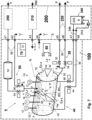
- the container 10 is found without restriction, as described in the description Figure 4 is shown. It has the undivided volume V with several cubic meters for storing the high-quality fresh milk P.
- the temperature measuring device 14 is provided for detecting the fresh milk temperature T in the container 10.
- the container 10 also has the cooling device 40, which at least keeps the fresh milk temperature T, which is lower than an ambient temperature, constant.
- a heat exchanger 42 is preferably located in the foot region of the container 10, which can be supplied with a coolant K via a third and a fourth valve device 44, 46 and a second line system 48.
- the high-quality fresh milk P can be cooled before it is filled, preferably outside the transport device 1, for example via a fifth device 240 provided in a filling and emptying platform 200, which has a coolant container 242 with the coolant K, a coolant pump 244 and coolant lines 246.
- the cooling device 40 is connected to the associated second line system 48 via its coolant lines 246 via detachable connection points k7, k8 at an interface and coupling point S between the filling and emptying platform 200 and the transport device 1.
- the fresh milk temperature T can be connected to the previously described cooling device 40 via a cooling device (not shown) that is operated independently within the transport device 1.
- the container 10 is set up in conjunction with a filling and emptying device 30 so that a comprehensive sterile treatment of the high-quality fresh milk P takes place.
- the filling and emptying device 30 has a first and a second valve device 32, 34, which are connected to an associated filling and emptying line 230 in the filling and emptying platform 200 via a first line system 36 and associated detachable connection points k5, k6 at the interface and coupling point S.
- the high-quality fresh milk P is first fed to the filling and emptying platform 200 via the filling and emptying line 230 and from there to the transport device 1.
- the transport device 1 further comprises a first device 60 with at least one first inclinometer 62 for detecting an angle of inclination +/-w which is formed between the free surface N of the high-quality fresh milk P towards the head space 10.1 and a reference system BS related to the container 10.
- a second inclinometer 64 is provided in the reference system BS, which is preferably an orthogonal three-axis reference system BS xyz consisting of an x, y and z axis.
- the first inclinometer 62 measures the inclination of the free surface N in the first plane E xz spanned by the x and z axes.
- the second inclinometer 64 measures the inclination of the free surface N in the second plane E yz spanned by the y and z axes.
- a control device 70 determines the relevant inclination angle +/-w from the two orthogonal measured values of the first and second inclinometers 62, 64.
- a third device 50 is also provided for supplying the gaseous, sterile fluid F into the head space 10.1 under sterile conditions, the third device 50 having a buffer container 52, a fifth and sixth valve device 54, 56 and an associated third line system 58.
- the third line system 58 is connected via detachable connection points k1, k2 at the interface and coupling point S to a sixth device 250 for providing the gaseous, sterile fluid F by means of the filling and emptying platform 200.
- the buffer container 52 which is expediently dimensioned with a buffer volume matched to the size of the head space 10.1, is optionally connected to the head space 10.1, wherein the gaseous, sterile fluid F is stored in the buffer container 52, preferably at an overpressure of 4 bar.
- a fourth device 210 for providing the necessary cleaning agents RM water, acid, alkali, steam and gaseous, sterile fluids
- the fourth device 210 is connected to a first, a second and a third cleaning agent connection a, b, c of the transport device 1 via detachable connection points k3, k4 at the interface and coupling point S of the filling and emptying platform 200.
- the third device 50 is cleaned up to the head space 10.1 via the first cleaning agent connection a in the area of the valve devices 54, 56.
- the filling and emptying device 30 is cleaned, also up to the container 10, via the second cleaning agent connection b in the area of the valve devices 32, 34.
- the entire interior of the container 10 is supplied with cleaning agent RM via an undesignated cleaning agent distribution system, for example several so-called spray balls, one of which is indicated schematically, via the third cleaning agent connection c.
- the control device 70 controls, among other things, an increase in the pressure p as a function of and proportional to the amount of the inclination angle +/-w by supplying the gaseous, sterile fluid F into the head space 10.1.
- the control device 70 has a data memory 72 in which an inclination angle range +/- ⁇ w max between a maximum negative inclination angle -w max and a maximum positive inclination angle +w max is stored for the inclination angle +/-w. Furthermore, a permissible pressure range ⁇ p between a minimum pressure p min and a maximum pressure p max for the pressure p is stored there.
- the control device 70 is set up in such a way that the permissible pressure range ⁇ p correlates with the amount of the inclination angle range +/- ⁇ w max .
- the control device 70 in conjunction with its data memory 72, is further configured to process measured values of the fresh milk temperature T and the detected fill levels in the container 10 and to control actuating devices for the supply of the gaseous, sterile fluid F and the cooling device 40.
- the level measuring device 12 advantageously has the second measuring probe L2, wherein the first and the second measuring probe L1, L2 are arranged at a distance from one another and reach into the free surface N of the high-quality fresh milk P via the head space 10.1. From a different wetting during sloshing movements of the high-quality fresh milk P, this sloshing movement can be detected and determined with an appropriately set up control system.
- the filling and emptying platform 200 together with the transport device 1 forms a system 100 which overall ensures the filling and emptying of the container 10, its cooling, the supply of the gaseous, sterile fluid F to the buffer container 52 and from there to the container 10 and the cleaning and sterilization of the entire transport device 1, always and comprehensively under sterile conditions.
- f(t)) of an amount
- of the inclination angle +/-w is postulated. Significant changes in the progression are marked on the abscissa, the time t, within the storage time ⁇ t with times t1 to t9.
- 5 degrees. This is a completely realistic range, which can also be larger in extreme situations.
- the fresh milk temperature T is plotted with a range of values from 0 to 5 °C. In the last time period ⁇ tx of the storage time ⁇ t, for example at a time before time t5, the fresh milk temperature T is reduced from 3.5°C to 4°C (range) to 2°C to 2.5°C (range).
- the auxiliary diagram p f(
- ) plotted shows the inventive relationship between the pressure p and the amount of the inclination angle
- the relationship between the independent inclination angle +/-w and the dependent pressure p is obtained. It is also possible to determine from the Figures 8 and 9 the inventive determination shows that the pressure p only follows the temporal progression of the value of the recorded inclination angle +/-w if a subsequent value of the recorded inclination angle +/-w is equal to or greater than a previous value (
- f(t)).
- the minimum pressure p min corresponds to the atmospheric pressure p b and the maximum pressure p max is, for example, 1.4 bar overpressure.
- the minimum pressure p min_ can also be set higher at the start of the storage time ⁇ t, for example with 0.4 to 0.6 bar overpressure.
Landscapes
- Life Sciences & Earth Sciences (AREA)
- Animal Husbandry (AREA)
- Environmental Sciences (AREA)
- Dairy Products (AREA)
- Vacuum Packaging (AREA)
Priority Applications (1)
| Application Number | Priority Date | Filing Date | Title |
|---|---|---|---|
| PL19769006.8T PL4021169T3 (pl) | 2019-08-29 | 2019-08-29 | Sposób transportu i urządzenie do transportu świeżego mleka wysokiej jakości w krytycznych warunkach transportu i otoczenia |
Applications Claiming Priority (1)
| Application Number | Priority Date | Filing Date | Title |
|---|---|---|---|
| PCT/EP2019/000249 WO2021037324A1 (de) | 2019-08-29 | 2019-08-29 | Transportverfahren und transporteinrichtung für hochwertige frischmilch unter transport- und umgebungskritischen bedingungen |
Publications (3)
| Publication Number | Publication Date |
|---|---|
| EP4021169A1 EP4021169A1 (de) | 2022-07-06 |
| EP4021169B1 true EP4021169B1 (de) | 2024-08-28 |
| EP4021169C0 EP4021169C0 (de) | 2024-08-28 |
Family
ID=67956688
Family Applications (1)
| Application Number | Title | Priority Date | Filing Date |
|---|---|---|---|
| EP19769006.8A Active EP4021169B1 (de) | 2019-08-29 | 2019-08-29 | Transportverfahren und transporteinrichtung für hochwertige frischmilch unter transport- und umgebungskritischen bedingungen |
Country Status (7)
| Country | Link |
|---|---|
| EP (1) | EP4021169B1 (es) |
| CN (1) | CN114929014B (es) |
| AU (1) | AU2019464010B2 (es) |
| CA (1) | CA3151825A1 (es) |
| ES (1) | ES2993019T3 (es) |
| PL (1) | PL4021169T3 (es) |
| WO (1) | WO2021037324A1 (es) |
Families Citing this family (1)
| Publication number | Priority date | Publication date | Assignee | Title |
|---|---|---|---|---|
| PL440618A1 (pl) * | 2022-03-14 | 2023-09-18 | Marcin Kaleta | Kontener do schładzania mleka |
Citations (1)
| Publication number | Priority date | Publication date | Assignee | Title |
|---|---|---|---|---|
| WO2013169226A1 (en) * | 2012-05-07 | 2013-11-14 | John Bean Technologies Corporation | Method and apparatus for handling sterilized food product |
Family Cites Families (17)
| Publication number | Priority date | Publication date | Assignee | Title |
|---|---|---|---|---|
| FR1540379A (fr) * | 1967-04-24 | 1968-09-27 | Atad | Conditionneuse de liquides alimentaires ou autres |
| DE2903731C2 (de) * | 1979-02-01 | 1983-03-10 | Messer Griesheim Gmbh, 6000 Frankfurt | Einrichtung zur Überwachung eines tiefkalten flüssigen Mediums |
| FR2665824B1 (fr) * | 1990-08-14 | 1993-09-17 | Prominox Sa | Procede et systeme de stockage et de conservation du lait en vrac dans une cuve. |
| IN180380B (es) * | 1995-05-26 | 1998-01-24 | Nr Dev Ltd | |
| DE29709926U1 (de) * | 1997-06-08 | 1997-08-21 | Sailer, Josef, 87474 Buchenberg | System zum Erfassen von Füllständen |
| US6030580A (en) * | 1997-10-31 | 2000-02-29 | Enerfab, Inc. | Method of aseptically transporting bulk quantities of sterile products |
| DE29825190U1 (de) * | 1998-08-27 | 2005-12-08 | Bartec Gmbh | Vorrichtung zur Volumenbestimmung |
| SG91291A1 (en) * | 2000-06-28 | 2002-09-17 | Fraser And Neave Ltd | Temperature controlled container |
| SE0003191D0 (sv) * | 2000-09-08 | 2000-09-08 | Delaval Holding Ab | An improved method and system for controlled cooling of small milk quantities |
| JP3587513B2 (ja) * | 2001-04-26 | 2004-11-10 | 株式会社ロッコーエンジニアリング | 冷却タンク |
| JP5155895B2 (ja) * | 2009-01-27 | 2013-03-06 | 日本エア・リキード株式会社 | 充填容器内の液体材料の供給装置および該液体材料の供給装置における充填容器内の液面管理方法 |
| EA020233B1 (ru) * | 2010-06-30 | 2014-09-30 | Александр Михайлович Басалай | Способ и система для хранения и транспортировки молока и емкость для хранения и транспортировки молока |
| US20120276262A1 (en) * | 2010-11-08 | 2012-11-01 | John Bean Technologies Corporation | Method and apparatus for handling sterilized food product |
| CH706952B1 (de) | 2012-09-11 | 2016-12-15 | Gea Aseptomag Ag | Ventilvorrichtung, Behälter mit Ventilvorrichtung und Verfahren zum Befüllen oder Entleeren eines Behälters. |
| NL2012791B1 (nl) * | 2014-05-09 | 2016-02-24 | Lely Patent Nv | Melktanksysteem, melktussenopslagvat daarvoor, melksysteem daarmee en werkwijze voor reinigen daarvan. |
| TW201603871A (zh) * | 2014-06-03 | 2016-02-01 | 安特格利斯公司 | 增強容量的流體儲存、運輸和分配設備 |
| CN207836422U (zh) * | 2018-02-07 | 2018-09-11 | 西藏高原之宝牦牛乳业股份有限公司 | 一种便于牧户的储奶装置 |
-
2019
- 2019-08-29 WO PCT/EP2019/000249 patent/WO2021037324A1/de not_active Ceased
- 2019-08-29 EP EP19769006.8A patent/EP4021169B1/de active Active
- 2019-08-29 ES ES19769006T patent/ES2993019T3/es active Active
- 2019-08-29 PL PL19769006.8T patent/PL4021169T3/pl unknown
- 2019-08-29 CN CN201980099879.0A patent/CN114929014B/zh active Active
- 2019-08-29 AU AU2019464010A patent/AU2019464010B2/en active Active
- 2019-08-29 CA CA3151825A patent/CA3151825A1/en active Pending
Patent Citations (1)
| Publication number | Priority date | Publication date | Assignee | Title |
|---|---|---|---|---|
| WO2013169226A1 (en) * | 2012-05-07 | 2013-11-14 | John Bean Technologies Corporation | Method and apparatus for handling sterilized food product |
Also Published As
| Publication number | Publication date |
|---|---|
| CN114929014B (zh) | 2023-12-12 |
| EP4021169A1 (de) | 2022-07-06 |
| AU2019464010B2 (en) | 2024-07-25 |
| ES2993019T3 (en) | 2024-12-20 |
| PL4021169T3 (pl) | 2025-01-07 |
| CN114929014A (zh) | 2022-08-19 |
| EP4021169C0 (de) | 2024-08-28 |
| CA3151825A1 (en) | 2021-03-04 |
| AU2019464010A2 (en) | 2022-05-26 |
| AU2019464010A1 (en) | 2022-04-07 |
| NZ785438A (en) | 2024-07-26 |
| BR112022003466A2 (pt) | 2022-05-24 |
| WO2021037324A1 (de) | 2021-03-04 |
Similar Documents
| Publication | Publication Date | Title |
|---|---|---|
| DE69810507T2 (de) | Verfahren zum aseptischen transportieren sterilen schüttgutes | |
| EP2420818B1 (de) | Verfahren und Vorrichtung zur Ermittlung der Viskosität | |
| EP4021169B1 (de) | Transportverfahren und transporteinrichtung für hochwertige frischmilch unter transport- und umgebungskritischen bedingungen | |
| DE69408754T2 (de) | Vorrichtung zum Befüllen von Verpackungsbehältern | |
| EP3593096A1 (de) | Vorrichtung zum bestimmen des füllstandes eines füllprodukts in einem füllproduktreservoir | |
| EP0297329A1 (de) | Anordnung zur Übernahme, Massenbestimmung und -abgrenzung von Flüssigkeiten, insbesondere für Getränke wie Milch oder Bier | |
| DE1973177U (de) | Vorrichtung fuer die zerstoerungsfreie pruefung von druckgefaessen. | |
| DE102011101471A1 (de) | Dynamisches Desinfektionsverfahren für einen Fahrzeugtrinkwassertank | |
| EP3812346A1 (de) | Verfahren zur volumen- bzw. massengenauen abfüllung von flüssigen produkten | |
| DE3545160C2 (es) | ||
| EP1397662B1 (de) | Verfahren und vorrichtung zur entnahme einer probe aus einer fluidcharge | |
| DE3332434T1 (de) | Verfahren zum einwiegen von milch in milchtankwagen und milchtankwagen zur durchfuehrung des verfahrens | |
| DE3311844C2 (es) | ||
| DE102012024421A9 (de) | Vorrichtung für gemeinsamen Transport von Gasflaschen | |
| DE102005029369A1 (de) | Vorrichtung und Verfahren für das Ballastwassermanagement eines Schiffes | |
| DE102011122215B4 (de) | Kraftstoffbehälter für ein Kraftfahrzeug mit anpassbarem Füllvolumen | |
| DE102015006969A1 (de) | Verfahren und Vorrichtung zum portionierten Abfüllen einer Lebensmittelzubereitung | |
| DE1972294U (de) | Vorrichtung zur bestimmung der spezifischen massen von festen koerpern. | |
| DE19500921A1 (de) | Vorrichtung und Verfahren zur Aufbereitung von Schokoladenmasse mit in der Masse eingeschlossenen Gasvolumina | |
| HK40069567A (en) | Transport method, transport apparatus for high-quality fresh milk and system | |
| HK40069567B (zh) | 用於优质鲜奶的运输方法、运输装置和系统 | |
| DE102020210485A1 (de) | Verfahren zur grafischen Darstellung von Füllstandverläufen | |
| DE344973C (de) | OElstandsanzeiger, insbesondere fuer Unterseebootsbunker | |
| DE202025100728U1 (de) | Schwimmende Anlage zur Herstellung von Betonmörtel auf Wasserstraßen | |
| DE102023108863A1 (de) | Vorrichtung zum Füllen von Behältern und zugehöriges Betriebsverfahren |
Legal Events
| Date | Code | Title | Description |
|---|---|---|---|
| STAA | Information on the status of an ep patent application or granted ep patent |
Free format text: STATUS: UNKNOWN |
|
| STAA | Information on the status of an ep patent application or granted ep patent |
Free format text: STATUS: THE INTERNATIONAL PUBLICATION HAS BEEN MADE |
|
| PUAI | Public reference made under article 153(3) epc to a published international application that has entered the european phase |
Free format text: ORIGINAL CODE: 0009012 |
|
| STAA | Information on the status of an ep patent application or granted ep patent |
Free format text: STATUS: REQUEST FOR EXAMINATION WAS MADE |
|
| 17P | Request for examination filed |
Effective date: 20220118 |
|
| AK | Designated contracting states |
Kind code of ref document: A1 Designated state(s): AL AT BE BG CH CY CZ DE DK EE ES FI FR GB GR HR HU IE IS IT LI LT LU LV MC MK MT NL NO PL PT RO RS SE SI SK SM TR |
|
| DAV | Request for validation of the european patent (deleted) | ||
| DAX | Request for extension of the european patent (deleted) | ||
| GRAP | Despatch of communication of intention to grant a patent |
Free format text: ORIGINAL CODE: EPIDOSNIGR1 |
|
| STAA | Information on the status of an ep patent application or granted ep patent |
Free format text: STATUS: GRANT OF PATENT IS INTENDED |
|
| INTG | Intention to grant announced |
Effective date: 20240412 |
|
| GRAS | Grant fee paid |
Free format text: ORIGINAL CODE: EPIDOSNIGR3 |
|
| GRAA | (expected) grant |
Free format text: ORIGINAL CODE: 0009210 |
|
| STAA | Information on the status of an ep patent application or granted ep patent |
Free format text: STATUS: THE PATENT HAS BEEN GRANTED |
|
| AK | Designated contracting states |
Kind code of ref document: B1 Designated state(s): AL AT BE BG CH CY CZ DE DK EE ES FI FR GB GR HR HU IE IS IT LI LT LU LV MC MK MT NL NO PL PT RO RS SE SI SK SM TR |
|
| REG | Reference to a national code |
Ref country code: GB Ref legal event code: FG4D Free format text: NOT ENGLISH |
|
| REG | Reference to a national code |
Ref country code: CH Ref legal event code: EP |
|
| REG | Reference to a national code |
Ref country code: DE Ref legal event code: R096 Ref document number: 502019011999 Country of ref document: DE |
|
| REG | Reference to a national code |
Ref country code: IE Ref legal event code: FG4D Free format text: LANGUAGE OF EP DOCUMENT: GERMAN |
|
| U01 | Request for unitary effect filed |
Effective date: 20240925 |
|
| U07 | Unitary effect registered |
Designated state(s): AT BE BG DE DK EE FI FR IT LT LU LV MT NL PT RO SE SI Effective date: 20241008 |
|
| U20 | Renewal fee for the european patent with unitary effect paid |
Year of fee payment: 6 Effective date: 20241025 |
|
| REG | Reference to a national code |
Ref country code: ES Ref legal event code: FG2A Ref document number: 2993019 Country of ref document: ES Kind code of ref document: T3 Effective date: 20241220 |
|
| PG25 | Lapsed in a contracting state [announced via postgrant information from national office to epo] |
Ref country code: NO Free format text: LAPSE BECAUSE OF FAILURE TO SUBMIT A TRANSLATION OF THE DESCRIPTION OR TO PAY THE FEE WITHIN THE PRESCRIBED TIME-LIMIT Effective date: 20241128 |
|
| PG25 | Lapsed in a contracting state [announced via postgrant information from national office to epo] |
Ref country code: GR Free format text: LAPSE BECAUSE OF FAILURE TO SUBMIT A TRANSLATION OF THE DESCRIPTION OR TO PAY THE FEE WITHIN THE PRESCRIBED TIME-LIMIT Effective date: 20241129 |
|
| PG25 | Lapsed in a contracting state [announced via postgrant information from national office to epo] |
Ref country code: IS Free format text: LAPSE BECAUSE OF FAILURE TO SUBMIT A TRANSLATION OF THE DESCRIPTION OR TO PAY THE FEE WITHIN THE PRESCRIBED TIME-LIMIT Effective date: 20241228 |
|
| PG25 | Lapsed in a contracting state [announced via postgrant information from national office to epo] |
Ref country code: HR Free format text: LAPSE BECAUSE OF FAILURE TO SUBMIT A TRANSLATION OF THE DESCRIPTION OR TO PAY THE FEE WITHIN THE PRESCRIBED TIME-LIMIT Effective date: 20240828 |
|
| PG25 | Lapsed in a contracting state [announced via postgrant information from national office to epo] |
Ref country code: RS Free format text: LAPSE BECAUSE OF FAILURE TO SUBMIT A TRANSLATION OF THE DESCRIPTION OR TO PAY THE FEE WITHIN THE PRESCRIBED TIME-LIMIT Effective date: 20241128 |
|
| PG25 | Lapsed in a contracting state [announced via postgrant information from national office to epo] |
Ref country code: RS Free format text: LAPSE BECAUSE OF FAILURE TO SUBMIT A TRANSLATION OF THE DESCRIPTION OR TO PAY THE FEE WITHIN THE PRESCRIBED TIME-LIMIT Effective date: 20241128 Ref country code: NO Free format text: LAPSE BECAUSE OF FAILURE TO SUBMIT A TRANSLATION OF THE DESCRIPTION OR TO PAY THE FEE WITHIN THE PRESCRIBED TIME-LIMIT Effective date: 20241128 Ref country code: IS Free format text: LAPSE BECAUSE OF FAILURE TO SUBMIT A TRANSLATION OF THE DESCRIPTION OR TO PAY THE FEE WITHIN THE PRESCRIBED TIME-LIMIT Effective date: 20241228 Ref country code: HR Free format text: LAPSE BECAUSE OF FAILURE TO SUBMIT A TRANSLATION OF THE DESCRIPTION OR TO PAY THE FEE WITHIN THE PRESCRIBED TIME-LIMIT Effective date: 20240828 Ref country code: GR Free format text: LAPSE BECAUSE OF FAILURE TO SUBMIT A TRANSLATION OF THE DESCRIPTION OR TO PAY THE FEE WITHIN THE PRESCRIBED TIME-LIMIT Effective date: 20241129 |
|
| REG | Reference to a national code |
Ref country code: CH Ref legal event code: PL |
|
| PG25 | Lapsed in a contracting state [announced via postgrant information from national office to epo] |
Ref country code: SM Free format text: LAPSE BECAUSE OF FAILURE TO SUBMIT A TRANSLATION OF THE DESCRIPTION OR TO PAY THE FEE WITHIN THE PRESCRIBED TIME-LIMIT Effective date: 20240828 |
|
| PG25 | Lapsed in a contracting state [announced via postgrant information from national office to epo] |
Ref country code: CH Free format text: LAPSE BECAUSE OF NON-PAYMENT OF DUE FEES Effective date: 20240831 |
|
| PG25 | Lapsed in a contracting state [announced via postgrant information from national office to epo] |
Ref country code: CZ Free format text: LAPSE BECAUSE OF FAILURE TO SUBMIT A TRANSLATION OF THE DESCRIPTION OR TO PAY THE FEE WITHIN THE PRESCRIBED TIME-LIMIT Effective date: 20240828 |
|
| PG25 | Lapsed in a contracting state [announced via postgrant information from national office to epo] |
Ref country code: SK Free format text: LAPSE BECAUSE OF FAILURE TO SUBMIT A TRANSLATION OF THE DESCRIPTION OR TO PAY THE FEE WITHIN THE PRESCRIBED TIME-LIMIT Effective date: 20240828 |
|
| PLBE | No opposition filed within time limit |
Free format text: ORIGINAL CODE: 0009261 |
|
| STAA | Information on the status of an ep patent application or granted ep patent |
Free format text: STATUS: NO OPPOSITION FILED WITHIN TIME LIMIT |
|
| PG25 | Lapsed in a contracting state [announced via postgrant information from national office to epo] |
Ref country code: MC Free format text: LAPSE BECAUSE OF FAILURE TO SUBMIT A TRANSLATION OF THE DESCRIPTION OR TO PAY THE FEE WITHIN THE PRESCRIBED TIME-LIMIT Effective date: 20240828 |
|
| PG25 | Lapsed in a contracting state [announced via postgrant information from national office to epo] |
Ref country code: IE Free format text: LAPSE BECAUSE OF NON-PAYMENT OF DUE FEES Effective date: 20240829 |
|
| 26N | No opposition filed |
Effective date: 20250530 |
|
| U20 | Renewal fee for the european patent with unitary effect paid |
Year of fee payment: 7 Effective date: 20250826 |
|
| PGFP | Annual fee paid to national office [announced via postgrant information from national office to epo] |
Ref country code: ES Payment date: 20250902 Year of fee payment: 7 |
|
| PGFP | Annual fee paid to national office [announced via postgrant information from national office to epo] |
Ref country code: PL Payment date: 20250722 Year of fee payment: 7 |
|
| PGFP | Annual fee paid to national office [announced via postgrant information from national office to epo] |
Ref country code: GB Payment date: 20250827 Year of fee payment: 7 |