EP4008360A1 - Method for eradicating pathogens - Google Patents
Method for eradicating pathogens Download PDFInfo
- Publication number
- EP4008360A1 EP4008360A1 EP21175361.1A EP21175361A EP4008360A1 EP 4008360 A1 EP4008360 A1 EP 4008360A1 EP 21175361 A EP21175361 A EP 21175361A EP 4008360 A1 EP4008360 A1 EP 4008360A1
- Authority
- EP
- European Patent Office
- Prior art keywords
- glass
- mol
- ppm
- less
- transmittance
- Prior art date
- Legal status (The legal status is an assumption and is not a legal conclusion. Google has not performed a legal analysis and makes no representation as to the accuracy of the status listed.)
- Pending
Links
Images

Classifications
-
- A—HUMAN NECESSITIES
- A61—MEDICAL OR VETERINARY SCIENCE; HYGIENE
- A61L—METHODS OR APPARATUS FOR STERILISING MATERIALS OR OBJECTS IN GENERAL; DISINFECTION, STERILISATION OR DEODORISATION OF AIR; CHEMICAL ASPECTS OF BANDAGES, DRESSINGS, ABSORBENT PADS OR SURGICAL ARTICLES; MATERIALS FOR BANDAGES, DRESSINGS, ABSORBENT PADS OR SURGICAL ARTICLES
- A61L2/00—Methods or apparatus for disinfecting or sterilising materials or objects other than foodstuffs or contact lenses; Accessories therefor
- A61L2/02—Methods or apparatus for disinfecting or sterilising materials or objects other than foodstuffs or contact lenses; Accessories therefor using physical phenomena
- A61L2/08—Radiation
- A61L2/10—Ultraviolet radiation
-
- C—CHEMISTRY; METALLURGY
- C03—GLASS; MINERAL OR SLAG WOOL
- C03C—CHEMICAL COMPOSITION OF GLASSES, GLAZES OR VITREOUS ENAMELS; SURFACE TREATMENT OF GLASS; SURFACE TREATMENT OF FIBRES OR FILAMENTS MADE FROM GLASS, MINERALS OR SLAGS; JOINING GLASS TO GLASS OR OTHER MATERIALS
- C03C3/00—Glass compositions
- C03C3/04—Glass compositions containing silica
- C03C3/076—Glass compositions containing silica with 40% to 90% silica, by weight
- C03C3/11—Glass compositions containing silica with 40% to 90% silica, by weight containing halogen or nitrogen
- C03C3/112—Glass compositions containing silica with 40% to 90% silica, by weight containing halogen or nitrogen containing fluorine
- C03C3/115—Glass compositions containing silica with 40% to 90% silica, by weight containing halogen or nitrogen containing fluorine containing boron
- C03C3/118—Glass compositions containing silica with 40% to 90% silica, by weight containing halogen or nitrogen containing fluorine containing boron containing aluminium
-
- A—HUMAN NECESSITIES
- A61—MEDICAL OR VETERINARY SCIENCE; HYGIENE
- A61L—METHODS OR APPARATUS FOR STERILISING MATERIALS OR OBJECTS IN GENERAL; DISINFECTION, STERILISATION OR DEODORISATION OF AIR; CHEMICAL ASPECTS OF BANDAGES, DRESSINGS, ABSORBENT PADS OR SURGICAL ARTICLES; MATERIALS FOR BANDAGES, DRESSINGS, ABSORBENT PADS OR SURGICAL ARTICLES
- A61L2/00—Methods or apparatus for disinfecting or sterilising materials or objects other than foodstuffs or contact lenses; Accessories therefor
- A61L2/0005—Methods or apparatus for disinfecting or sterilising materials or objects other than foodstuffs or contact lenses; Accessories therefor for pharmaceuticals, biologicals or living parts
- A61L2/0011—Methods or apparatus for disinfecting or sterilising materials or objects other than foodstuffs or contact lenses; Accessories therefor for pharmaceuticals, biologicals or living parts using physical methods
- A61L2/0029—Radiation
- A61L2/0047—Ultraviolet radiation
-
- A—HUMAN NECESSITIES
- A61—MEDICAL OR VETERINARY SCIENCE; HYGIENE
- A61L—METHODS OR APPARATUS FOR STERILISING MATERIALS OR OBJECTS IN GENERAL; DISINFECTION, STERILISATION OR DEODORISATION OF AIR; CHEMICAL ASPECTS OF BANDAGES, DRESSINGS, ABSORBENT PADS OR SURGICAL ARTICLES; MATERIALS FOR BANDAGES, DRESSINGS, ABSORBENT PADS OR SURGICAL ARTICLES
- A61L2/00—Methods or apparatus for disinfecting or sterilising materials or objects other than foodstuffs or contact lenses; Accessories therefor
- A61L2/26—Accessories or devices or components used for biocidal treatment
-
- A—HUMAN NECESSITIES
- A61—MEDICAL OR VETERINARY SCIENCE; HYGIENE
- A61L—METHODS OR APPARATUS FOR STERILISING MATERIALS OR OBJECTS IN GENERAL; DISINFECTION, STERILISATION OR DEODORISATION OF AIR; CHEMICAL ASPECTS OF BANDAGES, DRESSINGS, ABSORBENT PADS OR SURGICAL ARTICLES; MATERIALS FOR BANDAGES, DRESSINGS, ABSORBENT PADS OR SURGICAL ARTICLES
- A61L9/00—Disinfection, sterilisation or deodorisation of air
- A61L9/16—Disinfection, sterilisation or deodorisation of air using physical phenomena
- A61L9/18—Radiation
- A61L9/20—Ultraviolet radiation
-
- C—CHEMISTRY; METALLURGY
- C02—TREATMENT OF WATER, WASTE WATER, SEWAGE, OR SLUDGE
- C02F—TREATMENT OF WATER, WASTE WATER, SEWAGE, OR SLUDGE
- C02F1/00—Treatment of water, waste water, or sewage
- C02F1/30—Treatment of water, waste water, or sewage by irradiation
- C02F1/32—Treatment of water, waste water, or sewage by irradiation with ultraviolet light
- C02F1/325—Irradiation devices or lamp constructions
-
- C—CHEMISTRY; METALLURGY
- C03—GLASS; MINERAL OR SLAG WOOL
- C03C—CHEMICAL COMPOSITION OF GLASSES, GLAZES OR VITREOUS ENAMELS; SURFACE TREATMENT OF GLASS; SURFACE TREATMENT OF FIBRES OR FILAMENTS MADE FROM GLASS, MINERALS OR SLAGS; JOINING GLASS TO GLASS OR OTHER MATERIALS
- C03C3/00—Glass compositions
- C03C3/04—Glass compositions containing silica
- C03C3/076—Glass compositions containing silica with 40% to 90% silica, by weight
- C03C3/089—Glass compositions containing silica with 40% to 90% silica, by weight containing boron
-
- C—CHEMISTRY; METALLURGY
- C03—GLASS; MINERAL OR SLAG WOOL
- C03C—CHEMICAL COMPOSITION OF GLASSES, GLAZES OR VITREOUS ENAMELS; SURFACE TREATMENT OF GLASS; SURFACE TREATMENT OF FIBRES OR FILAMENTS MADE FROM GLASS, MINERALS OR SLAGS; JOINING GLASS TO GLASS OR OTHER MATERIALS
- C03C3/00—Glass compositions
- C03C3/04—Glass compositions containing silica
- C03C3/076—Glass compositions containing silica with 40% to 90% silica, by weight
- C03C3/089—Glass compositions containing silica with 40% to 90% silica, by weight containing boron
- C03C3/091—Glass compositions containing silica with 40% to 90% silica, by weight containing boron containing aluminium
-
- C—CHEMISTRY; METALLURGY
- C03—GLASS; MINERAL OR SLAG WOOL
- C03C—CHEMICAL COMPOSITION OF GLASSES, GLAZES OR VITREOUS ENAMELS; SURFACE TREATMENT OF GLASS; SURFACE TREATMENT OF FIBRES OR FILAMENTS MADE FROM GLASS, MINERALS OR SLAGS; JOINING GLASS TO GLASS OR OTHER MATERIALS
- C03C3/00—Glass compositions
- C03C3/04—Glass compositions containing silica
- C03C3/076—Glass compositions containing silica with 40% to 90% silica, by weight
- C03C3/089—Glass compositions containing silica with 40% to 90% silica, by weight containing boron
- C03C3/091—Glass compositions containing silica with 40% to 90% silica, by weight containing boron containing aluminium
- C03C3/093—Glass compositions containing silica with 40% to 90% silica, by weight containing boron containing aluminium containing zinc or zirconium
-
- C—CHEMISTRY; METALLURGY
- C03—GLASS; MINERAL OR SLAG WOOL
- C03C—CHEMICAL COMPOSITION OF GLASSES, GLAZES OR VITREOUS ENAMELS; SURFACE TREATMENT OF GLASS; SURFACE TREATMENT OF FIBRES OR FILAMENTS MADE FROM GLASS, MINERALS OR SLAGS; JOINING GLASS TO GLASS OR OTHER MATERIALS
- C03C3/00—Glass compositions
- C03C3/04—Glass compositions containing silica
- C03C3/076—Glass compositions containing silica with 40% to 90% silica, by weight
- C03C3/11—Glass compositions containing silica with 40% to 90% silica, by weight containing halogen or nitrogen
- C03C3/112—Glass compositions containing silica with 40% to 90% silica, by weight containing halogen or nitrogen containing fluorine
- C03C3/115—Glass compositions containing silica with 40% to 90% silica, by weight containing halogen or nitrogen containing fluorine containing boron
-
- C—CHEMISTRY; METALLURGY
- C03—GLASS; MINERAL OR SLAG WOOL
- C03C—CHEMICAL COMPOSITION OF GLASSES, GLAZES OR VITREOUS ENAMELS; SURFACE TREATMENT OF GLASS; SURFACE TREATMENT OF FIBRES OR FILAMENTS MADE FROM GLASS, MINERALS OR SLAGS; JOINING GLASS TO GLASS OR OTHER MATERIALS
- C03C4/00—Compositions for glass with special properties
- C03C4/0085—Compositions for glass with special properties for UV-transmitting glass
-
- A—HUMAN NECESSITIES
- A61—MEDICAL OR VETERINARY SCIENCE; HYGIENE
- A61L—METHODS OR APPARATUS FOR STERILISING MATERIALS OR OBJECTS IN GENERAL; DISINFECTION, STERILISATION OR DEODORISATION OF AIR; CHEMICAL ASPECTS OF BANDAGES, DRESSINGS, ABSORBENT PADS OR SURGICAL ARTICLES; MATERIALS FOR BANDAGES, DRESSINGS, ABSORBENT PADS OR SURGICAL ARTICLES
- A61L2202/00—Aspects relating to methods or apparatus for disinfecting or sterilising materials or objects
- A61L2202/10—Apparatus features
- A61L2202/11—Apparatus for generating biocidal substances, e.g. vaporisers, UV lamps
-
- A—HUMAN NECESSITIES
- A61—MEDICAL OR VETERINARY SCIENCE; HYGIENE
- A61L—METHODS OR APPARATUS FOR STERILISING MATERIALS OR OBJECTS IN GENERAL; DISINFECTION, STERILISATION OR DEODORISATION OF AIR; CHEMICAL ASPECTS OF BANDAGES, DRESSINGS, ABSORBENT PADS OR SURGICAL ARTICLES; MATERIALS FOR BANDAGES, DRESSINGS, ABSORBENT PADS OR SURGICAL ARTICLES
- A61L2202/00—Aspects relating to methods or apparatus for disinfecting or sterilising materials or objects
- A61L2202/20—Targets to be treated
- A61L2202/25—Rooms in buildings, passenger compartments
-
- C—CHEMISTRY; METALLURGY
- C02—TREATMENT OF WATER, WASTE WATER, SEWAGE, OR SLUDGE
- C02F—TREATMENT OF WATER, WASTE WATER, SEWAGE, OR SLUDGE
- C02F2201/00—Apparatus for treatment of water, waste water or sewage
- C02F2201/32—Details relating to UV-irradiation devices
- C02F2201/322—Lamp arrangement
- C02F2201/3222—Units using UV-light emitting diodes [LED]
-
- C—CHEMISTRY; METALLURGY
- C03—GLASS; MINERAL OR SLAG WOOL
- C03C—CHEMICAL COMPOSITION OF GLASSES, GLAZES OR VITREOUS ENAMELS; SURFACE TREATMENT OF GLASS; SURFACE TREATMENT OF FIBRES OR FILAMENTS MADE FROM GLASS, MINERALS OR SLAGS; JOINING GLASS TO GLASS OR OTHER MATERIALS
- C03C2204/00—Glasses, glazes or enamels with special properties
-
- Y—GENERAL TAGGING OF NEW TECHNOLOGICAL DEVELOPMENTS; GENERAL TAGGING OF CROSS-SECTIONAL TECHNOLOGIES SPANNING OVER SEVERAL SECTIONS OF THE IPC; TECHNICAL SUBJECTS COVERED BY FORMER USPC CROSS-REFERENCE ART COLLECTIONS [XRACs] AND DIGESTS
- Y02—TECHNOLOGIES OR APPLICATIONS FOR MITIGATION OR ADAPTATION AGAINST CLIMATE CHANGE
- Y02W—CLIMATE CHANGE MITIGATION TECHNOLOGIES RELATED TO WASTEWATER TREATMENT OR WASTE MANAGEMENT
- Y02W10/00—Technologies for wastewater treatment
- Y02W10/30—Wastewater or sewage treatment systems using renewable energies
- Y02W10/37—Wastewater or sewage treatment systems using renewable energies using solar energy
Definitions
- the present invention relates to methods for eradication of pathogens, especially to methods for eradicating bacteria in confined spaces.
- the method comprises the use of germicidal UV light at a wavelength of 220 nm, wherein the UV light is emitted by a UV lamp having a lamp cover made of 220 nm-UV-transparent glass.
- the present invention includes 220 nm-UV-transparent glass, uses of such UV-transparent glass as well as methods for making the same.
- pathogens are bacteria and viruses. Pathogens pose a constant threat for humans and livestock. Many methods for elimination of pathogens were developed, including elimination with light. The current SARS-CoV2 pandemic increased the need for effective and specific means of pathogen elimination, particularly virus elimination.
- Pathogens may become a major problem in hospitals, prisons, and nursing homes, where people with open wounds, invasive devices such as catheters, and weakened immune systems are at a greater risk of infection.
- Regular disinfection and antibiotic/antiviral agents are possible ways to address these threats.
- disinfectants may be very aggressive and cause irritant fumes that may cause harm themselves or reduce the desire to use these agents effectively, particularly in confined spaces.
- Antibiotics/antiviral agents may lead to resistances in the pathogens, rendering the agents largely ineffective.
- photosensitizers are sufficient to eradicate enough microorganisms to effectively prevent infections. This is because photosensitizers may not be concentrated enough to do significant damage. In addition, many photosensitizers are hydrophobic. This makes it difficult to disperse them in aqueous environments, where microorganisms typically exist (e.g. biofilms).
- UVGI ultraviolet germicidal irradiation
- UVC shortwavelength ultraviolet
- UVGI devices can produce strong enough UVC light in circulating air or water systems to make them inhospitable environments to microorganisms such as bacteria, viruses, molds and other pathogens. UVGI can be coupled with a filtration system to sanitize air and water. The application of UVGI to disinfection has been an accepted practice since the mid-20th century. It has been used primarily in medical sanitation and sterile work facilities.
- UV-absorption of UV-light at wavelengths of about 200 nm to about 250 nm is very high in otherwise transparent covers.
- UV-light does not transmit well through conventional glasses at wavelengths beyond 320 nm.
- Conventional glasses do not transmit light at wavelengths below 290 nm.
- these covers have the disadvantage that they are either impermissible for far-UV-light, or at least a high amount of energy is necessary to guarantee a sufficient UV-exposure of the treated surface, e.g. the treated skin.
- the invention pertains to a method for eradicating pathogens, the method comprising exposing the pathogens to germicidal UV light at a wavelength of 222 nm, wherein the UV light is irradiated by a UV lamp having a lamp cover made of a glass, the glass having a transmittance of at least 30% at a wavelength of 220 nm and less than 4% at 200 nm.
- the concentration of ozone may be less than 0.12 mg/m 3 in the room where the method is carried out.
- the lamp cover being disposed between the light source and the space to be irradiated, has a minimum transmission for UV light at 220 nm so that sufficient 220 nm-UV light intensity reaches the space to be treated.
- 220 nm many pathogens are particularly vulnerable to light irradiation whereas the human eyes and skin are less sensitive.
- the light transmittance of the lamp cover is very low at 200 nm. Reducing the light intensity at about 200 nm limits the photolysis rate caused by UV irradiation.
- Photolysis causes formation of ozone. Ozone may be a problem in confined spaces, e.g. homes and offices, when present in concentrations of more than 0.12 mg/m 3 .
- the method disclosed herein reduces ozone formation while safeguarding sufficient elimination of pathogens.
- the invention in another aspect, relates to a method for eradicating pathogens, the method comprising exposing the pathogens to germicidal UV light at a wavelength of 220 nm, wherein the UV light is irradiated by a UV lamp having a lamp cover made of a glass, the glass having a total platinum content of less than 3.5 ppm.
- UV radiation is able to split organic bonds. As a result, it is hostile to life by destroying biogenic substances. In addition, many plastics are damaged by ultraviolet radiation due to haze, embrittlement, and/or decay. At lower wavelength, UV-light causes photolysis which leads to increased ozone concentrations in the surrounding air.
- UV radiation In humans, excessive exposure to UV radiation can result in acute and chronic harmful effects on the eye's dioptric system and retina.
- the skin, the circadian and immune systems can also be affected.
- the skin and eyes are most sensitive to damage by UV at 265 to 275 nm.
- the wavelengths, which are applied according to the inventive method include 220 nm.
- Ultraviolet (UV) light of about 220 nm has similar antimicrobial properties as typical germicidal UV light (254 nm), but without inducing damage to outer tissue coverings of higher animals, such as amphibian, reptile, bird, mammal or human skin.
- the limited penetration distance of 220 nm light in biological samples compared with that of 254 nm light allows for the selective antimicrobial treatment without harming mammalian or human skin, such as the skin of a patient or health care professional.
- the lens is located distal to the cornea, which is sufficiently thick (500 ⁇ m) such that penetration of 220 nm light through the cornea to the lens is low. Even if one considers effects on the cornea from the perspective of photokeratitis, any protective device against eye splash, which is now almost universal amongst surgical staff, would be expected to sufficiently protect the cornea from 220 nm UV exposure.
- bacteria are much smaller than almost any human cell. Typical bacterial cells are less than 1 ⁇ m in diameter, whereas typical eukaryotic cells range in diameter from about 10 to 25 ⁇ m. It follows, that 220 nm UV light can penetrate throughout typical bacteriacells but cannot penetrate significantly beyond the outer perimeter of the cytoplasm of typical eukaryotic cells, such as human cells, and will be drastically attenuated before reaching the eukaryotic cell nucleus.
- UVC lamp By contrast, higher wavelength light from a conventional germicidal lamp can reach human cell nuclei without major attenuation. Based on these biophysical considerations, while radiation from a conventional UVC lamp is cytotoxic and mutagenic to both bacteria and human cells, 220 nm UV light is cytotoxic to bacteria, but much less cytotoxic or mutagenic to human cells.
- UV-light of wavelengths at 200 nm and below are not useful, because at these wavelengths a sufficient eradication of pathogens cannot be reached anymore. Furthermore, at wavelengths of 200 nm and below, UV reacts with oxygen and forms ozone, an effect which is not desired.
- the UVC light at about 222 nm efficiently eradicates pathogens regardless of their drug-resistant proficiency, but without the skin and eye damaging effects associated with conventional germicidal UV exposure.
- eradication is used herein for any reduction of pathogens after treatment of more than 90%, more than 95%, more than 99%, more than 99.9%, or more than 99.99% according to ISO 22196:2011-08-31.
- the invention pertains to a method wherein the UV-exposure of the pathogen and/or the surface to be treated is in the range from 2,000 to 8,000 ⁇ W ⁇ s/cm 2 , from 2,100 to 7,000 ⁇ W ⁇ s/cm 2 , from 2,200 to 5,000 ⁇ W ⁇ s/cm 2 , or from 2,300 to 3,000 ⁇ W ⁇ s/cm 2 .
- the UV-exposure of at least about 2,500 ⁇ W ⁇ s/cm 2 results in a 90% reduction of at least one pathogen.
- the methods of the present invention can be used for eradicating pathogens in confined spaces, e.g. homes, hospitals, schools, or nursing homes.
- confined spaces e.g. homes, hospitals, schools, or nursing homes.
- the reduced production of ozone and limited potential to harm human health makes this method ideal for regular or even continuous use.
- the method can be used to eliminate pathogens on UV-sensitive material, such as UV-sensitive surfaces.
- the UV-sensitive material may be susceptible to crosslinking of monomers to produce specific polymers by UV-radiation above 250 nm and/or up to 295 nm.
- the UV-sensitive material may be a gas or a liquid, which is sensitive to UV above 250 nm and/or up to 295 nm.
- the UV-sensitive material may be a pharmaceutical composition, which is sensitive to UV above 250 nm and/or up to 295 nm.
- the UV-sensitive material may be a biological tissue surface, such as a skin of an insect, invertebrate, vertebrate, mammal or human, (e.g. mollusc, fish, amphibia, reptile, bird, mammal and/or human or a chitinous exoskeleton from an arthropod, such as a lobster or an insect).
- a biological tissue surface such as a skin of an insect, invertebrate, vertebrate, mammal or human, (e.g. mollusc, fish, amphibia, reptile, bird, mammal and/or human or a chitinous exoskeleton from an arthropod, such as a lobster or an insect).
- biological tissue surface encompasses all biological surfaces, which may be harmed by UV-radiation above 250 nm and/or up to 295 nm.
- the invention includes biological surfaces which may be harmed by UV-radiation outside the wavelength range of 207 to 220 nm, and which are not harmed by UV-radiation at the wavelength of about 220 nm.
- tissue is used for any cellular organizational level between cells and a complete organ.
- a tissue is an ensemble of similar cells and their extracellular matrix from the same origin that together carry out a specific function. Organs are then formed by the functional grouping together of multiple tissues.
- tissue which may be exposed to UV-radiation during pathogen eradication method should be encompassed.
- those tissues will be epithelial tissues that are formed by cells that cover the organ surfaces, such as the surface of skin, the airways, the reproductive tract, and the inner lining of the digestive tract.
- the cells comprising an epithelial layer are linked via semi-permeable, tight junctions; hence, this tissue provides a barrier between the external environment and the organ it covers.
- epithelial tissue may also be specialized to function in secretion, excretion and absorption. Epithelial tissue helps to protect organs from microorganisms, injury, and fluid loss.
- methods of this invention include those methods where conventional UVGI-methods may not be applicable or suitable, such as for example UV-treatment of pathogens residing on a UV-sensitive surface, such as for example skin tissue or where eye exposure to UV cannot be avoided.
- mammalia refers herein to any vertebrate animal constituting the class Mammalia and characterized by the presence of mammary glands which in females produce milk for feeding (nursing) their young, a neocortex (a region of the brain), fur or hair, and three middle ear bones. These characteristics distinguish them from reptiles and birds, from which they diverged in the late Triassic, 201-227 million years ago. There are around 5,450 species of mammals. The largest orders are the rodents, bats and Soricomorpha (shrews and others).
- the next three are the Primates (apes, monkeys, and others), the Cetartiodactyla (cetaceans and even-toed ungulates), and the Carnivora (cats, dogs, seals, and others). This definition of mammals also includes humans.
- mammal skin refers to any skin of a mammal, including the skin of livestock, wherein the term “livestock” is commonly defined as domesticated animals raised in an agricultural setting to produce labor and commodities such as meat, eggs, milk, fur, leather, and wool, such as for example cattle, goats, horses, pigs and sheep.
- livestock is commonly defined as domesticated animals raised in an agricultural setting to produce labor and commodities such as meat, eggs, milk, fur, leather, and wool, such as for example cattle, goats, horses, pigs and sheep.
- mamal skin includes also the skin of humans, such as for example patients, health care professionals, people with weak or absent immune-system (elderly, children, post-surgery, post organ transplantation, HIV-positive, etc.), people with elevated potential exposure to pathogens, etc.
- Prior art UV lamp covers are made of sapphire, synthetic quartz or quartz glass (fused silica glass).
- sapphire is very expensive as compared to other transparent materials and cannot be bent, molded, drawn or melt-fused like glasses or metals.
- the UV-absorption at UVC wavelengths is quite high with nearly no transmission at wavelengths below 250 nm.
- the glass has a transmittance of at least 30%, at least 35%, at least 40% or at least 60% at 220 nm and/or at least 75% at wavelengths [ ⁇ ] of 260 nm, 280 nm and/or 310 nm (measured at a thickness of 0.71 mm).
- Quartz and fused silica glasses due to their high melting point, have high fabrication costs, since temperature and effort for melting and forming are much higher than for other glasses. Furthermore, any forms other than tubes or sheets must be ground and polished from blocks or ingots. Besides the costs of production, these covers have the disadvantage that high amounts of energy are necessary to guarantee a sufficient UV-exposure of the treated object, gas or liquid.
- the glasses disclosed herein are suitable for forming rods, tubes, sheets and bars, produced by casting, Danner, Vello, redraw and/or down-draw processes.
- the glasses of the present invention may have excellent optical properties.
- the refractive index can be 1.50 or more.
- the glass described herein has excellent UV transmission at wavelengths significantly above 200 nm.
- the glass has one or more of the following optical properties:
- any reference to a transmittance relates to the transmittance at a reference thickness of 0.71 mm. This does not mean that the glass, glass article or lamp cover has this particular thickness.
- the thickness serves as a reference for the determination of transmittance.
- Transmittance can be measured at a different thickness and the result used to calculate the 0.71 mm transmittance value.
- the glass and / or the glass article preferably has a transmittance of at least 50%, preferably at least 70%, at least 80%, or at least 83% at a wavelength of 254 nm. In one embodiment, the transmittance at 254 nm is at most 99.9%, at most 95% or at most 90%.
- the indication that a transmittance is measured at a certain wavelength does not mean that the glass is limited to the indicated thickness. Instead, the thickness indicates the thickness at which the transmittance can be measured. The indication of a thickness for measurement ensures that the values can be compared.
- glasses of any suitable thickness can be used in the glass covers and devices described hereinunder.
- the present invention makes use of and relates to glass and glass covers (lamp covers, LED cover glass) which show low UV-absorption (i.e. high UVC- transmittance) up to a certain wavelength and lower transmittance at lower wavelengths, thereby decreasing the operation energy, reducing the operation temperature and limit photolysis.
- the glass and glass covers of this invention are comparably cheap and easy to manufacture, can be bent, molded, drawn or melt-fused to guarantee a manifold of shapes, and are resistant to most chemicals, as well as temperature and physical stress.
- the glass has a transmittance at a wavelength of 220 nm of at least 30 % and a transmittance at a wavelength of 200 nm of less than 4.0 %, wherein the glass has a total platinum content of not more than 3.5 ppm, in some embodiments also having a low iron and titanium content of less than 10 ppm each.
- Pt-contaminations i.e. Pt 0 , Pt 2+ , Pt 4+ , and Pt 6+ , also referred to as "total platinum content" in the glass may reduce the UV- transmittance between 200 nm and about 250 nm.
- platinum-contamination in the glass may induce phase-separation by the formation of nuclei within the glass.
- the glass of this disclosure may have none or very low metal contamination, especially Pt-contamination of below 3.5 ppm, or below 2.5 ppm. In some embodiments, the glass may have Pt-contamination of above 0.05 ppm, or above 0.1 ppm.
- the glass is free of any Pt-contamination.
- TiO 2 contamination also referred to as "titanium content” in the glass may further reduce the UV-transmission between 200 nm and about 250 nm.
- glasses with a TiO 2 content of 100 ppm or less, preferably 50 ppm or less are preferred.
- the amount of TiO 2 should be below 10 ppm, below 7 ppm, below 5 ppm, or below 4 ppm.
- the TiO 2 content may be between 1 and 10 ppm, between 1.5 and 9.0 ppm, between 2.0 and 8.0 ppm, or between 1 and 5 ppm.
- Fe-contamination in the glass may further reduce the UV-transmission between 200 nm and about 250 nm.
- iron contents are expressed as parts by weight of Fe 2 O 3 in ppm. This value can be determined in a manner familiar to the person skilled in the art by determining the amounts of all iron species present in the glass and assuming for the calculation of the mass fraction that all iron is present as Fe 2 O 3 . For example, if 1 mmol of iron is found in the glass, the mass assumed for the calculation corresponds to 159.70 mg Fe 2 O 3 . This procedure takes into account the fact that the quantities of the individual iron species in the glass cannot be determined reliably or only with great effort.
- the glass contains less than 100 ppm Fe 2 O 3 , in particular less than 50 ppm, or less than 10 ppm.
- the content of Fe 2 O 3 is less than 10 ppm, less than 8 ppm, or less than 4.5 ppm.
- the Fe 2 O 3 content is between 0.5 and 10 ppm, between 1 and 10 ppm, between 1.5 and 9.0 ppm, between 2 and 8.5 ppm, between 2.5 and 8.0 ppm, or between 3 and 7 ppm.
- reducing conditions during the melt may increase the absorption at about 200 nm.
- reducing melting conditions during production of the glass may be chosen, for example, by addition of one or more reducing agents, such as sugar (reducing saccharides, e.g. sucrose), during the melt, in particular in an amount of from 0.1 to 1.0 wt.-%, for example from 0.2 to 0.6 wt.-%.
- sugar reducing saccharides, e.g. sucrose
- the conditions should not be too reducing in order to avoid high proportions of Fe 2+ species that may have a negative impact on the transmittance at 220 nm.
- the partial pressure of oxygen (pO 2 ) in the glass melt at a temperature of 1500°C is 0.5 bar or less when the glass melt is produced from the glass by inductively heating to a temperature of 1500°C in a platinum crucible under argon atmosphere.
- the pO 2 at 1500°C may for example be at most 0.4 bar, at most 0.3 bar, or at most 0.2 bar.
- the pO 2 may for example be at least 0.01 bar, at least 0.02 bar, at least 0.05 bar, or at least 0.1 bar.
- the pO 2 may for example be from 0.01 bar to 0.5 bar, from 0.02 bar to 0.4 bar, from 0.05 bar to 0.3 bar, or from 0.1 bar to 0.2 bar.
- the pO 2 of the glass melt may for example be determined based on the voltage between a reference electrode and a measuring electrode both of which are positioned in the glass melt.
- the pO 2 can be calculated from the voltage between the electrodes by using the Nernst equation.
- a platinum plate can be used as measuring electrode.
- the reference electrode may comprise a platinum wire positioned inside a ZrO 2 ceramic tube that is closed at the tip, wherein the platinum wire is in electrically conducting contact with the wall of the ZrO 2 tube.
- the ZrO 2 ceramic may be yttrium-stabilized, calcium-stabilized, or magnesium-stabilized (see for example EP 1 101 740 A1 , par. [0012], [0013]).
- the content of Fe 2 O 3 is from 1 ppm to 10 ppm, the amount of TiO 2 is from 2 ppm to 30 ppm, and the transmittance at 200 nm is less than 3%.
- glasses are preferred with a sum of all contaminations with Pt, TiO 2 and/or Fe 2 O 3 of below 20 ppm, in another embodiment below 18.5 ppm, in another embodiment below 13.5 ppm, or below 10.5 ppm.
- glasses are preferred with a sum of all contaminations Pt, TiO 2 and/or Fe 2 O 3 between 1 and 20 ppm, between 1.5 and 18.5 ppm, between 2.0 and 13.5 ppm, or between 2.5 and 12.0 ppm
- the glass is free of the contaminations with at least one of the impurities selected from Pt, TiO 2 and/or Fe 2 O 3 .
- contaminations with transition elements and/or heavy metals such as lead, rhodium, cadmium, mercury and hexavalent chromium may be kept below 10 ppm, in another embodiment below 8.5 ppm. In other embodiments these contaminations may be kept between 0 and 8.2 ppm, between 0 and 7.0 ppm, between 0 and 6.0 ppm, between 0 and 5.0 ppm, or between 0 and 4.0 ppm. In other embodiments, the level of these contaminations may be between 0 and 3.0 ppm, between 0 and 2.0 ppm, between 0 and 1.0 ppm, between 0 and 0.5 ppm, or between 0 and 0.25 ppm. In a further embodiment the glass is free of any transition metal and/or heavy metal-contamination.
- ppm means parts per million on a weight-by-weight basis (w/w).
- the present invention may also pertain to methods to produce glasses with high UV-transmission.
- the glass of the present invention is a glass with high UV-transmission and the following additional ranges of physical and chemical parameters.
- the glasses of this invention have excellent melting properties, e.g. low transformation temperatures and working points.
- suitable glass parameters may be selected from a transformation temperature T g (ISO 7884-8) below 550°C, such as from 400°C to 500°C, in one embodiment between 440°C and 480°C; in another embodiment between 450°C and 470°C.
- the glass may have a T 13 temperature, i.e. a glass temperature at a viscosity ⁇ in dPa*s of 10 13 (annealing point) (ISO 7884-4), between 410°C and 550°C, such as in one embodiment between 455°C and 495°C; in another embodiment between 460°C and 490°C.
- the glass may have a softening point, i.e. the temperature at which the viscosity is 10 7.6 dPa*s (softening point) (ISO 7884-3) between 630°C and 720°C, such as in one embodiment between 640°C and 700°C, in another embodiment between 650°C and 690°C.
- the glass may have a working point, i.e. of the temperature at which the viscosity is 10 4 dPa*s (working point) (ISO 7884-2) between 900°C and 1150°C, in one embodiment such as between 950°C and 1100°C; in another embodiment between 975°C and 1050°C.
- the temperature-viscosity dependence expressed by one or more of these parameters goes along with the ability of the glass to be drawn or otherwise formed into any desired shape, including UV lamp covers and UV-LED covers.
- the glasses of the present invention may have a density p at 25°C between 2.3 and 2.7 g*cm -3 , or between 2.4 and 2.6 g*cm -3 , e.g. below 2.55 g*cm -3 .
- the low density makes the glass most suitable for mobile applications, e.g. mobile pathogen eradication equipment.
- the glasses of the present invention may feature a thermal conductivity ⁇ w at 90°C between 0.8 and 1.2 W * m -1 * K -1 , or between 0.9 and 1.1 W * m -1 * K -1 making it most suitable for use as lamp cover.
- the UVC-glasses and the UVC-glass covers made thereof have the following additional features:
- the glasses of the invention are characterized by a particularly high solarization resistance.
- the solarization resistance can be determined by irradiating the glass with a HOK 4 lamp for 144 hours and comparing the transmittance at a wavelength of 220 nm before and after irradiation.
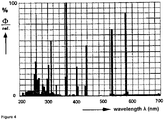
- the term "HOK 4 lamp” refers to the high pressure mercury-vapor lamp HOK 4/120 of Phillips.
- the emission spectrum of the HOK 4 lamp is shown in Figure 4 .
- the main emission of the lamp is at a wavelength of 365 nm.
- the power density at 200-280 nm in a distance of 1 m is 850 ⁇ W/cm 2 .
- the distance between the HOK 4 lamp and the sample is chosen to be 7 cm.
- a high solarization resistance is associated with low solarization and vice versa.
- a high solarization correlates with a high induced extinction Ext ind .
- Ext ind is the induced extinction
- T after is the transmittance after irradiation with the HOK 4 lamp for 144 hours
- T before is the transmittance before irradiation with the HOK 4 lamp for 144 hours
- d is the sample thickness
- In is the natural logarithm. If not indicated otherwise, the sample thickness d is given in cm so that the induced extinction is given in 1/cm. If not indicated otherwise, the transmittance before and after irradiation with the HOK 4 lamp are given for a wavelength of 220 nm.
- the induced extinction as described in the present disclosure refers to the induced extinction at a wavelength of 220 nm if not indicated otherwise.
- the induced extinction at a wavelength of 220 nm is at most 1.0/cm, at most 0.5/cm, at most 0.2/cm, at most 0.1/cm, at most 0.05/cm, at most 0.02/cm, or at most 0.01/cm.
- the induced extinction at a wavelength of 220 nm may for example be at least 0.001/cm, at least 0.002/cm, or at least 0.005/cm.
- the induced extinction at a wavelength of 220 nm may for example be from 0.001/cm to 1.0/cm, from 0.001/cm to 0.5/cm, from 0.002/cm to 0.2/cm, from 0.002/cm to 0.1/cm, from 0.002/cm to 0.05/cm, from 0.005/cm to 0.02/cm, from 0.005/cm to 0.01/cm.
- the transmittance (at a reference thickness of 0.71 mm) at a wavelength of 220 nm after irradiation with the HOK 4 lamp for 144 hours may for example be at least 30%, at least 35%, at least 40% or at least 60%.
- the transmittance (at a reference thickness of 0.71 mm) at a wavelength of 220 nm after irradiation with the HOK 4 lamp for 144 hours may for example be at most 95.0%, at most 90.0%, at most 85.0%, or at most 80.0%.
- the transmittance at a wavelength of 220 nm may for example be in a range of from 30.0% to 95.0%, from 35.0% to 90.0%, from 40.0% to 85.0%, or from 60.0% to 80.0%.
- the UVC-glass covers can be sealed hermetically, for example by the use of laser glass frit sealing.
- This hermetical sealing is important, since a number of UVGI-applications take place in either aqueous environments (e.g. biofilm treatment or water treatment), humid environments (e.g. sewage systems) and/or environments with elevated gas-pressure or under vacuum.
- the hermetical sealing allows the final device, e.g. a UVC-LED-lamp, to be autoclaved, so that it can be used in hospitals, in surgery, in laboratories or in any other environment where high hygienic standards are needed.
- the glasses of this invention preferably have a product CTE [°C -1 ] x T 4 [°C] of at most 0.01, more preferably at most 0.0099 or at most 0.0098.
- the product may be at least 0.0075 or at least 0.0085. It has been shown that these glasses show advantageous properties with regard to fusion stress and melting behavior.
- T 4 is the temperature at which the glass has a viscosity of 10 4 dPa*s.
- T 4 can be measured by the methods known to the person skilled in the art for determining the viscosity of glass, e.g. according to DIN ISO 7884-1: 1998-02.
- T 13 is the temperature at which the glass has a viscosity of 10 13 dPa*s.
- the average linear coefficient ⁇ of the thermal expansion (CTE) (at 20°C; 300°C, according to ISO 7991) is in one embodiment between 7.0 and 12.0 * 10 -6 K -1 .
- the thermal expansion coefficient (CTE) may be less than 11.5 *10 -6 K -1 . It may range from 7.5 to ⁇ 11 * 10 -6 K -1 , more preferably from 8.75 to 10.75 * 10 -6 K -1 , more preferably from 9.0 to 10.0 * 10 -6 K -1 , still more preferably from 9.2 to 9.8 * 10 -6 K -1 .
- This allows adapting the thermal expansion properties to the overall thermal expansion properties of the UV-device and therefore prevents tensions within the glass cover.
- the same or similar CTE is chosen for both the UVC-glass cover as well as the underlying UV-device (e.g. UVC-LED-package).
- the invention further includes glass articles having the indicated wavefront deviation.
- the wavefront deviation can be calculated according to the formula above.
- the wavefront deviation is determined over and/or applies to a surface area of 1 cm 2 .
- the wavefront deviation may be determined for a thickness of 10 mm of glass, or less; or 1 mm of glass or less.
- the thickness may be at least 200 ⁇ m.
- the wavefront deviation may be less than ⁇ 0.1 mm, less than ⁇ 0.08 mm, in further embodiments less than ⁇ 0.035 mm, less than ⁇ 25 ⁇ m, less than ⁇ 15 ⁇ m, or less than ⁇ 5 ⁇ m.
- the wavefront deviation may be between 0.1 ⁇ m and 250 ⁇ m, or between 1 ⁇ m and 100 ⁇ m, or between 2 ⁇ m and 85 ⁇ m.
- the wavefront deviation may be measured axially, e.g. in the case of glass tubes, as used for example in discharge lamps; or laterally, e.g. in the case of rod sections, as used for lenses in UVC-LEDs.
- the wavefront may also be measured by a wavefront sensor.
- This is a device which measures the wavefront aberration in a coherent signal to describe the optical quality or lack thereof in an optical system. Without being bound to a specific method, a very common method is to use a Shack-Hartmann lenslet array.
- Alternative wavefront sensing techniques to the Shack-Hartmann system are mathematical techniques like phase imaging or curvature sensing. These algorithms compute wavefront images from conventional brightfield images at different focal planes without the need for specialized wavefront optics.
- the glasses and glass articles according to the present invention may have a low content of wavefront deformations in the glass (striae, bubbles, streaks, etc.). In general, it can be distinguished between the global or long-range homogeneity of refractive index in the material and short-range deviations from glass homogeneity. Striae are spatially short-range variations of the homogeneity in a glass. Short-range variations are variations over a distance of about 0.1 mm and up to 2 mm, whereas the spatially long range global homogeneity of refractive index covers the complete glass piece.
- an ultraviolet ray transmission filter may be used, which filters out certain non-desired UV-wavelengths, e.g. wavelengths above 220 nm.
- the glasses for UV-covers according to the present invention may allow the shaping of lenses in order to optically shape the UV-beam, for example for directional focusing of the UV-light to the target.
- any beam angle between 10° and 180° is possible.
- 10° to 20°, 20° to 30°, 30° to 40°, 40° to 50°, 50° to 60°, 60° to 70°, 70° to 80°, 80 to 90° may be used.
- 15° to 35°, 25° to 45°, 35° to 60°, 45° to 90°, 75° to 120°, 90° to 145°, 120° to 180° may be used.
- beam shapes such as 90°, 120° or even 180°, are useful, for example in cases in which a surface of a certain size or a certain volume or a tube of a certain diameter needs to be decontaminated in one treatment.
- narrow beam shapes such as 10°, 5° or even 1°, are useful.
- narrow beam shapes can be used to concentrate the UV-exposure at the target site and avoid non-directional and undesired radiation, which would result in a less efficient energy-to-radiation ratio or exposure of UV-sensitive surfaces to UV-light.
- One example may be the limited decontamination of defined areas of an eye.
- different lens shapes and beam angles may be used to solve complex pathogen-eradication tasks. For example in cases in which UV-sensitive surfaces of different sensitivity levels are next to each other and need to be UV-exposed in one treatment. For example, it may be suitable to treat the skin of a patient in some areas with higher UV-exposure than in neighboring areas, e.g. during wound treatment and/or surgery, where the wound itself is exposed to less UV than the surrounding skin.
- the invention includes also methods for the production of LED-packages with covers made with the inventive 220 nm-UVC-transparent glasses.
- An LED package according to the present invention may comprise
- Such windows may be flat or have a shape for changing the path of the light (i.e. lensshape).
- UVC-LEDs may be packaged and sealed in a way (e.g. laser frit sealing) so that they are autoclavable, sterilizable and resistent against fluids. Such UVC-LEDs may be used for sterilization of air and water, surfaces; and for medical/dental applications.
- UVC-LEDs having the UVC-transparent glass described herein possess further advantages in comparison to conventional UVGI-lamps or devices (such as mercury-vapor lamps), for example:
- UV-lamps and the UV-devices under this invention are more energy efficient as compared to conventional UVGI-lamps or - devices. This is because the glass may transmit more than 60% of the UV-light at 220 nm and therefore the ratio between energy-input and radiation-output is significantly improved.
- UVC-LED-lamps This becomes important when these glasses are used as covers of UVC-LED-lamps. If the energy requirement of a conventional mercury-vapor-UV-lamp is set at 100%, the energy necessary to generate the same UV-radiation with the UVC-LEDs described herein is about 10 to 30%. In other words, if a conventional UV-lamp uses 10 W of energy to emit a certain UV-intensity the devices herein may use only between 1 and 3 W.
- UVC-transparent glasses described herein are their high thermal conductivity ( ⁇ w ), which may be between 0.75 and 1.25 W * m -1 * K -1 at 90°C, in other embodiments about 1.0 W * m -1 * K -1 .
- This superior thermal conductivity increases the lifetime of the device, since excess heat can dissipate easily before harming other parts of the device. This is for example in contrast to quartz-glasses, which normally have a less optimal thermal conductivity.
- the method according to present invention may include UV-lamps with an energy efficiency index (EEI) of ⁇ 0.11 according to the REGULATION (EU) No 874/2012 in case of non-directional UV-lamps and an energy efficiency index (EEI) of ⁇ 0.13 according to the REGULATION (EU) No 874/2012 in case of directional UV-lamps.
- EI energy efficiency index
- the methods described herein may be used for eradication of pathogens from any kind of surface, including UV-sensitive surfaces, UV-sensitive liquid and/or UV-sensitive gas.
- UV-sensitive pathogenic organisms such as viruses (such as for example influenza- or coronaviridae, such as SARS-CoV-2, especially resistant virus mutations, such as for example SARS-CoV2-D614G), bacteria (including spores), pathological yeasts, mold, and the like.
- viruses such as for example influenza- or coronaviridae, such as SARS-CoV-2, especially resistant virus mutations, such as for example SARS-CoV2-D614G
- bacteria including spores
- pathological yeasts pathological yeasts, mold, and the like.
- Potential applications can be selected from the list of uses comprising hand sanitizers (e.g. on private and public toilets), room sanitizers in health care environments, pathogen-eradication in preparation to or during or after surgery, wound treatment, eye treatment, food disinfection (e.g. during food production and/or meat, dairy or vegetable counter in supermarkets), livestock disinfection (especially in cases of intensive animal husbandry, such as for example laying batteries), production of pharmaceutical compounds and/or food production processes, storage facilities and/or disinfection of UV-sensitive surfaces which are often in contact with many different users, for example keyboards, handles, handrails, tooth brushes, hair brushes, ornaments, touch-devices, shaving razors, or kids toys.
- hand sanitizers e.g. on private and public toilets
- room sanitizers in health care environments e.g. on health care environments, pathogen-eradication in preparation to or during or after surgery, wound treatment, eye treatment, food disinfection (e.g. during food production and
- UVC-devices disclosed in this invention can also be used for a wide range of applications as "analytical instrumentation", for example:
- the UVC-devices disclosed in this invention may comprise devices for "water disinfection".
- UVC LEDs are advantageous as compared to traditional mercury lamps, which require a long warm up time (anywhere from 50 seconds to 10 minutes) to reach the required germicidal intensity.
- frequent on/off cycles can diminish lifetime by 50 percent or more.
- UVC LEDs enables on-demand disinfection, which reduces power consumption significantly. Additionally, the frequent on/off-cycles do not diminish LED lifetime, helping lower operating and maintenance costs.
- UVC-devices disclosed in this invention especially in cases of UV-sensitive surfaces, liquids or gases, may comprise:
- the use of the UV-LED-module may be selected from the group of water disinfection, analytical instrumentation (HPLC, spectrometers, water monitoring sensors), air purification, air disinfection, surface disinfection (e.g. keyboard disinfection, escalator handrail UV sterilizer), cytometry, molecular identification, protein analysis, biofilm treatment, curing, lithography, vegetable growth, skin cure, germ detection, drug discovery, protein analysis, induction of skin vitamine-D3-production and/or sterilization.
- HPLC analytical instrumentation
- spectrometers spectrometers
- water monitoring sensors water purification
- air disinfection e.g. keyboard disinfection, escalator handrail UV sterilizer
- cytometry molecular identification
- protein analysis biofilm treatment
- curing lithography
- vegetable growth skin cure
- germ detection drug discovery
- protein analysis induction of skin vitamine-D3-production and/or sterilization.
- the invention pertains to uses of the glass as a hermetically sealing lens cap for an UV-LED-module, e.g. for applications selected from the group of water disinfection, analytical instrumentation (HPLC, spectrometers, water monitoring sensors), air purification, air disinfection, surface disinfection (e.g.
- keyboard disinfection, escalator handrail UV sterilizer cytometry, molecular identification, protein analysis, biofilm treatment, curing, lithography, vegetable growth, skin cure (psoriasis, vitiligo, itching, neurodermatitis, acne, actinic dermatitis, phototherapy, pityriasis rosea,), germ detection, drug discovery, protein analysis, induction of skin vitamine-D3-production and/or sterilization.
- the glass is preferably a soda lime glass.
- glass comprises the following components (in mol% based on oxides): Component Content [mol%] SiO 2 40 to 85 Al 2 O 3 0 to 25 Na 2 O 0 to 18 K 2 O 0 to 15 MgO 0 to 10 B 2 O 3 0.1 to 4 Li 2 O 0 to 10 ZnO 0 to 5 CaO 0 to 16 BaO 0 to 12 ZrO 2 0 to 5 SnO 2 0 to 3 SrO 0 to 4 F - 0 to 6 Cl - 0 to 1
- the glass comprises the following components (in mol% based on oxides): Component Content [mol%] SiO 2 60 to 84 Al 2 O 3 0 to 10 B 2 O 3 0.5 to 3.5 Li 2 O 0 to 3 Na 2 O 0 to 15 K 2 O 0 to 12 MgO 0 to 6 CaO 0 to 6 SrO 0 to 4 BaO 0 to 8 F - 0 to 6 Cl - 0 to 0.8 R 2 O 5 to 25 RO 0 to 6
- R 2 O refers to the alkali metal oxides Li 2 O, Na 2 O and K 2 O; and "RO” denotes the alkaline earth metal oxides MgO, CaO, BaO and SrO.
- the glasses may contain SiO 2 in a proportion of at least 40 mol%, or at least 60 mol%.
- SiO 2 contributes to the hydrolytic resistance and transparency of the glass. If the SiO 2 content is too high, the melting point of the glass is too high. The temperatures T 4 and T g also rise sharply. Therefore, the content of SiO 2 should be limited to a maximum of 78 mol%, or to a maximum of 80 mol%, or to maximum of 81 mol%, or to a maximum of 82 mol%, or to a maximum of 85%.
- the content of SiO 2 is at least 61 mol%, at least 63 mol% or at least 65 mol%, at least 68 mol%, at least 69 mol%, or at least 70 mol%, or at least 72 mol%, or at least 75 mol%.
- the content can be limited to a maximum of 84 mol% or a maximum of 82 mol%, or a maximum of 81 mol%, or a maximum of 80 mol%.
- the glasses may contain Al 2 O 3 in a maximum proportion of 10 mol%.
- Al 2 O 3 contributes to the phase separation stability of the glasses, but in larger proportions reduces the acid resistance. Furthermore, Al 2 O 3 increases the melting temperature and T 4 .
- the content of this component should be limited to a maximum of 25 mol%, or to a maximum of 9 mol%, or to a maximum of 8 mol%, or to a maximum of 7 mol%, or to a maximum of 5 mol%, or to a maximum of 4.5 mol%.
- Al 2 O 3 is used in a small proportion of at least 0.1 mol%, at least 0.2 mol%, or at least 0.5 mol%, or at least 1.0 mol%.
- the glass may be free of Al 2 O 3 .
- the glasses may contain B 2 O 3 in a proportion of at least 0.5 mol%.
- B 2 O 3 has an effect on the melting properties of glass.
- B 2 O 3 may be limited to up to 4.0 mol%, up to 3.5 mol%, up to 3.0 mol%, up to 2.5 mol%, or up to 2.0 mol%. Limiting the amount of B 2 O 3 is advantageous for reducing transmittance at 200 nm.
- the content of B 2 O 3 can be at least 1.0 mol%, at least 1.2 mol%, or at least 1.5 mol%.
- the ratio of the sum of the contents (in mol%) of B 2 O 3 , R 2 O and RO to the sum of the contents (in mol%) of SiO 2 and Al 2 O 3 is at most 0.4, at most 0.35, or at most 0.3. In one embodiment, this value is at least 0.1, at least 0.15, or at least 0.2.
- the glasses may contain Li 2 O in a proportion of up to 10.0 mol%, or up to 3.0 mol%, or up to 2.8 mol%, or up to 2.5 mol%.
- the glass contains only a small amount of Li 2 O, e.g. to a maximum of 3.0 mol%, to a maximum of 2.8 mol%, to a maximum of 2.5 mol%, to a maximum of 2.0 mol%, or to a maximum of 1.9 mol%, or the glass is free of Li 2 O.
- the content of Li 2 O is between 1 mol% and 2 mol%.
- the glasses may contain Na 2 O in a proportion of up to 18 mol%, up to 15 mol%, up to 12 mol%, up to 11 mol%, or up to 10 mol%.
- Na 2 O increases the fusibility of the glasses.
- Sodium oxide also leads to a reduction in UV transmission and an increase in the coefficient of thermal expansion (CTE).
- the glass may contain Na 2 O in a proportion of at least 1 mol%, at least 2 mol%, at least 4 mol%, at least 5 mol%, or at least 6 mol%. In one version the content of Na 2 O is a maximum of 5 mol%, or a maximum of 4 mol%. In some embodiments the glass may be free of Na 2 O.
- the glasses may contain K 2 O in a maximum proportion of 15 mol%. Its content may be at least 1 mol%, at least 2 mol%, at least 4 mol%, at least 5 mol%, or at least 6 mol%. The content of this component may be limited to a maximum of 15 mol%, to a maximum of 12 mol%, to a maximum of 10 mol%, to a maximum of 9 mol%, or a maximum of 8 mol%. In some embodiments the glass may be free of K 2 O.
- the ratio of the contents of Na 2 O to K 2 O in mol% may be at least 1.0, in particular at least 1.1. In an embodiment of the invention the said ratio is at most 2, in particular at most 1.5. Both oxides serve to improve the fusibility of the glass. In certain embodiments the ratio is between 1.1 and 1.3.
- the amount of R 2 O in the glasses may be limited to not more than 25 mol%, not more than 22 mol%, or not more than 20 mol%.
- the glasses may contain R 2 O in amounts of at least 5 mol%, at least 8 mol%, or at least 10 mol%. In certain embodiments the content of R 2 O is between 10 mol% and 20 mol%.
- R 2 O may contribute to reducing transmittance at 200 nm.
- the glasses may contain MgO in a proportion of up to 10 mol%, up to 6 mol%, up to 4 mol%, or up to 2 mol%.
- MgO is advantageous for fusibility, but in high proportions it proves to be problematic with regard to the desired UV transmission and the tendency to phase separation.
- Preferred designs are free of MgO.
- the glasses may contain CaO in a proportion of up to 16 mol%, up to 6 mol%, up to 4 mol%, or up to 2 mol%, or up to 1 mol%.
- CaO is advantageous for fusibility, but in high proportions it proves to be problematic with regard to the desired UV transmission.
- Preferred forms are free of CaO or contain only little CaO, e.g. at least 0.1 mol%, at least 0.3 mol%, or at least 0.5 mol%.
- the glasses may contain SrO in a proportion of up to 4 mol%, up to 1 mol%, or up to 0.5 mol%.
- SrO is advantageous for fusibility, but in high proportions it proves to be problematic with regard to the desired UV transmission.
- Preferred designs are free from SrO.
- the glasses may contain BaO in a proportion of up to 12 mol%, or up to 8 mol%, or up to 6 mol%, or up to 5 mol%, or up to 4 mol%.
- BaO leads to an improvement of the hydrolytic resistance.
- a too high barium oxide content leads to phase separation and, thus, to instability of the glass.
- Preferred embodiments contain BaO in amounts of at least 0.5 mol%, at least 1.0 mol%, or at least 1.5 mol%.
- the content of BaO is between 1.0 mol% and 4.0 mol%.
- the glass may be free of BaO.
- the ratio of BaO in mol% to the sum of the contents of MgO, SrO and CaO in mol% may be at least 2.
- this value is at least 5, or at least 10, or at least 20.
- the value may be at least 40, or even at least 50.
- BaO offers the most advantages in terms of phase separation and hydrolytic resistance compared to the other alkaline earth metal oxides.
- the ratio should not exceed 120 or 100.
- the glass contains at least small amounts of CaO and BaO and is free of MgO and SrO. In certain embodiments the ratio is between 50 and 100.
- the ratio of the proportion of CaO in the glass to BaO in mol% is less than 0.2.
- this ratio may be less than 0.15 or less than 0.1.
- the ratios are even lower, in particular less than 0.08, or less than 0.06, and in a preferred design this ratio is at least 0.03. In certain embodiments the ratio is between 0 and 0.1.
- the glass has a mol% ratio of B 2 O 3 to BaO of at least 0.1 and at most 2.0.
- the ratio is at least 0.2, or at least 0.5 and, in a preferred design, the said ratio is limited to a maximum of 1.8, or of 1.5, or of 1.2. In another embodiment, the ratio may be limited to a maximum of 1.0 or 0.8. In particular, the ratio is not less than 0.2 and not more than 2.0, or in another embodiment not less than 0.5 and not more than 1.8; in certain embodiments the ratio is between 0.2 and 1.0.
- the proportion of RO in the glasses of the present invention can be at least 0.3 mol%.
- Alkaline earth metal oxides are advantageous for fusibility, but in high proportions they prove to be problematic with regard to the desired UV transmission.
- the glass contains a maximum of 5 mol% RO.
- the proportion of RO is between 1 and 5 mol%.
- the sum of the contents in mol% of alkaline earth metal oxides and alkali metal oxides, RO+R 2 O, can be limited to a maximum of 30 mol%.
- Advantageous designs can contain these components in quantities of maximum 25 mol%.
- the content of these oxides is at least 5 mol%, at least 10 mol%, or at least 12 mol%.
- the RO+R 2 O-proportion is between 12 and 20 mol%.
- the ratio of the contents in mol% of B 2 O 3 to the sum of the contents of R 2 O and RO in mol% may be at least 0.01, at least 0.02, or at least 0.05.
- the ratio can be limited to a maximum of 1.5, a maximum of 1.0, or a maximum of 0.5.
- the B 2 O 3 /(RO+R 2 O)-proportion is between 0.05 and 0.2.
- Alkali or alkaline earth borates can form during glass phase separation, if too much alkali or alkaline earth oxide is present in relation to B 2 O 3 . It has been proven to be advantageous to adjust the above ratio.
- the ratio of the content of B 2 O 3 to the sum of the contents of SiO 2 and Al 2 O 3 in mol% within a narrow range. In an advantageous design, this ratio is at least 0.015 and/or at most 0.04. In one embodiment the B 2 O 3 /(SiO 2 + Al 2 O 3 )-ratio is between 0.017 and 0.03.
- the ratio of the proportions in mol% of the sum of the alkali metal oxides R 2 O to the sum of the alkaline earth metal oxides RO is preferably >1, in particular >2 or >4. In the design forms, this ratio is at most 15, at most 10 or at most 7.5. In one embodiment the ratio is between 4 and 10.
- the glasses may contain F - in a content of 0 to 6 mol%.
- the content of F - is at most 4 mol% or at most 2 mol%.
- at least 0.5 mol%, or at least 1 mol% of this component is used.
- Component F - improves the fusibility of the glass and influences the UV edge towards smaller wavelengths.
- the glasses may contain Cl - in a content of less than 1 mol%, especially less than 0.9 mol%, or less than 0.8 mol%. Suitable lower limits are 0.1 mol%, or 0.2 mol%.
- the glasses may contain ZnO in a content of less than 5 mol%, especially less than 2.5 mol%, or less than 1 mol%. Suitable lower limits are 0.01 mol%, or 0.05 mol%. In some embodiments the glass may be free of ZnO.
- the glasses may contain ZrO 2 in a content of less than 5 mol%, less than 2.5 mol%, or especially less than 1 mol%. Suitable lower limits are 0.01 mol%, or 0.05 mol%. In some embodiments the glass may be free of ZrO 2 .
- the glasses may contain SnO 2 in a content of less than 3 mol%, especially less than 2 mol%, or less than 1 mol%. Suitable lower limits are 0.01 mol%, or 0.05 mol%. In some embodiments the glass may be free of SnO 2 .
- Non-significant quantities are quantities of less than 0.5 ppm, preferably less than 0.25 ppm, preferably less than 0.125 ppm and most preferably less than 0.05 ppm.
- the glass has less than 10 ppm Fe 2 O 3 , in particular less than 5 ppm or less than 4 ppm. In one embodiment, the glass has less than 10 ppm TiO 2 , in particular less than 5 ppm or less than 4 ppm. In one embodiment, the glass has less than 3.5 ppm arsenic, in particular less than 2.5 ppm or less than 1.0 ppm. Preference is given to glass containing less than 3.5 ppm antimony, less than 2.5 ppm antimony, or less than 1.0 ppm antimony. Besides the negative effects on UV-transmission and solarization, especially arsenic and antimony are toxic and dangerous to the environment and should be avoided.
- the glass includes the following components (in mol% on oxide basis): Component Content [mol%] SiO 2 68 to 82 Al 2 O 3 0.1 to 7 B 2 O 3 1.0 to 3.0 Li 2 O 0 to 3.0 Na 2 O 1 to 12 K 2 O 1 to 10 CaO 0 to 4 SrO 0 to 1 BaO 0.5 to 6 F - 0 to 6
- the glass includes the following components in mol%: Component Content [mol%] SiO 2 69 to 81 Al 2 O 3 0.2 to 5 B 2 O 3 1.2 to 2.5 Li 2 O 0 to 2.5 Na 2 O 2 to 11 K 2 O 2 to 9 CaO 0 to 2 SrO 0 to 0.5 BaO 1.0 to 5 F - 0.5 to 4
- the glass includes the following components in mol%: Component Content [mol%] SiO 2 70 to 80 Al 2 O 3 0.5 to 4.5 B 2 O 3 1.5 to 2.0 Li 2 O 0 to 2 Na 2 O 4 to 10 K 2 O 4 to 8 CaO 0 to 1 SrO 0 to 0.5 BaO 1.5 to 4 F - 1 to 2
- the invention also includes glass articles made from the glass described herein.
- the glass article can be produced by drawing processes known for glass tubes and rods.
- a suitable manufacturing process e.g. ingot casting for bars, floating or down draw for producing panes.
- the cooling of the glass in the process is adjusted so that the desired properties are achieved.
- the glass article is produced using the Danner or the Vello method.
- the glass melt flows vertically downwards (in the direction of the gravitational force) through a shaping tool made of an outlet ring and a needle.
- the shaping tool forms a negative form (matrix) of the generated cross-section of the glass tube or the glass rod.
- a needle is arranged as a shaping part in the center of the shaping tool.
- the difference between the Vello and the down draw method is first of all that the glass melt in the Vello method is deflected horizontally after it leaves the forming tool and, secondly, in the fact that the needle has a passage in the Vello method, through which blown air flows. As with the Danner method, the blown air ensures that the resulting glass tube does not collapse. In the down draw method, the solidified glass melt is separated without prior redirection. Since there is no redirection, one can also refrain from the use of blown air during the production of glass tubes.
- the invention relates to a glass article made of the glass disclosed herein.
- the thickness of the glass article in particular the wall thickness in the case of a glass tube, can be at least 0.1 mm or at least 0.3 mm.
- the thickness can be limited to up to 3 mm or up to 2 mm.
- the outside diameter of the glass article e.g. the outside diameter of a glass tube or glass rod, can be up to 50 mm, up to 40 mm, or up to 30 mm.
- the outside diameter can in particular be at least 1 mm, at least 2 mm, or at least 3 mm.
- the present invention pertains also to the following embodiments:
- the invention pertains to a method for eradicating pathogens, the method comprising exposing the pathogen to germicidal UV light with a wavelength of about 220 nm, wherein the UV light is irradiated by a UV lamp having a lamp cover made of a glass having a total platinum content of less than 3.5 ppm.
- said pathogen exposed to germicidal UV light resides on a UV-sensitive material, which is sensitive to UV-radiation above 222 nm.
- said UV-sensitive material is a biological tissue surface such as the eye or skin of an animal, wherein the animal is selected from an insect, invertebrate, vertebrate, mammal and/or human.
- said eradication of pathogen after treatment is > 99% according to BS ISO 22196:2011-08-31.
- said UV-exposure of the pathogen is at least in the range from 2,000 to 8,000 microwatt seconds per square centimeter ( ⁇ W ⁇ s/cm 2 ).
- all or part the cover of said UV lamp is shaped in form of a lens.
- the invention pertains to a glass having a transmittance at a wavelength of 220 nm of at least 30%, wherein the glass has a total platinum content of not more than 3.5 ppm, in some embodiments not more than 3 ppm, not more than 2.5 ppm, not more than 2 ppm.
- the glasses may have a ratio of the transmittance at 220 nm to the transmission at 200 nm of at least 20.00 or at least 30.00, in particular at most 100.00 or at most 80.00.
- said glass comprises one or more UV-blocking impurities selected from rhodium, lead, cadmium, mercury, hexavalent chromium, iron, titanium, and any combination thereof.
- said glass comprises a total platinum content below 1.0 ppm.
- the wavefront deviation may be less than ⁇ 0.1 mm, less than ⁇ 0.08 mm, in further embodiments less than ⁇ 0.035 mm, less than ⁇ 25 ⁇ m, less than ⁇ 15 ⁇ m, less than ⁇ 5 ⁇ m.
- the wavefront deviation may be between 0.1 ⁇ m and 250 ⁇ m, or between 1 ⁇ m and 100 ⁇ m, or between 2 ⁇ m and 85 ⁇ m.
- said glass comprises the following components in the indicated amounts (in mol%): Component Content [mol%] SiO 2 40 to 85 Al 2 O 3 0 to 25 Na 2 O 0 to 18 K 2 O 0 to 15 MgO 0 to 10 B 2 O 3 0.1 to 4 Li 2 O 0 to 10 ZnO 0 to 5 CaO 0 to 16 BaO 0 to 12 ZrO 2 0 to 5 SnO 2 0 to 3 SrO 0 to 4 F - 0 to 6 Cl - 0 to 1
- the invention pertains to the use of said glass as a hermetically sealing lens cap for a UV-LED-module, e.g. for applications selected from the group of water disinfection, analytical instrumentation (HPLC, spectrometers, water monitoring sensors), air purification, air disinfection, surface disinfection (e.g.
- keyboard disinfection, escalator handrail UV sterilizer cytometry, molecular identification, protein analysis, biofilm treatment, curing, lithography, vegetable growth, skin cure (psoriasis, vitiligo, itching, neurodermatitis, acne, actinic dermatitis, phototherapy, pityriasis rosea,), germ detection, drug discovery, protein analysis, induction of skin vit-D3-production and/or sterilization.
- Alkali-containing silicate glasses in accordance with the glass composition as described in the present disclosure were obtained under reducing melting conditions. Samples having a thickness of 0.71 mm have been tested for transmittance in the wavelength range of from 200 nm to 300 nm before and after irradiation with the HOK 4 lamp. The results are shown in Figure 3 .
- the glass has a low transmittance at 200 nm and a high transmittance at 220 nm.
- the transmittance at both 200 nm and 220 nm remains substantially unchanged after irradiation with the HOK 4 lamp for 144 hours.
Landscapes
- Chemical & Material Sciences (AREA)
- Life Sciences & Earth Sciences (AREA)
- Health & Medical Sciences (AREA)
- Engineering & Computer Science (AREA)
- Organic Chemistry (AREA)
- Materials Engineering (AREA)
- Geochemistry & Mineralogy (AREA)
- Chemical Kinetics & Catalysis (AREA)
- General Chemical & Material Sciences (AREA)
- Epidemiology (AREA)
- Animal Behavior & Ethology (AREA)
- General Health & Medical Sciences (AREA)
- Public Health (AREA)
- Veterinary Medicine (AREA)
- Molecular Biology (AREA)
- Medicinal Chemistry (AREA)
- Biomedical Technology (AREA)
- Toxicology (AREA)
- Hydrology & Water Resources (AREA)
- Environmental & Geological Engineering (AREA)
- Water Supply & Treatment (AREA)
- Glass Compositions (AREA)
- Apparatus For Disinfection Or Sterilisation (AREA)
- Pharmaceuticals Containing Other Organic And Inorganic Compounds (AREA)
Priority Applications (3)
| Application Number | Priority Date | Filing Date | Title |
|---|---|---|---|
| CN202111464974.1A CN114588288A (zh) | 2020-12-03 | 2021-12-03 | 用于根除病原体的方法 |
| JP2021197213A JP2022089195A (ja) | 2020-12-03 | 2021-12-03 | 病原体の根絶方法 |
| US17/541,759 US20220177354A1 (en) | 2020-12-03 | 2021-12-03 | Method for eradicating pathogens |
Applications Claiming Priority (2)
| Application Number | Priority Date | Filing Date | Title |
|---|---|---|---|
| EP20211687 | 2020-12-03 | ||
| DE202020107535.7U DE202020107535U1 (de) | 2020-12-03 | 2020-12-23 | UV-transparente Gläser zum Beseitigen von Methicillin-resistenten Staphylococcus aureus |
Publications (1)
| Publication Number | Publication Date |
|---|---|
| EP4008360A1 true EP4008360A1 (en) | 2022-06-08 |
Family
ID=73792928
Family Applications (2)
| Application Number | Title | Priority Date | Filing Date |
|---|---|---|---|
| EP21175361.1A Pending EP4008360A1 (en) | 2020-12-03 | 2021-05-21 | Method for eradicating pathogens |
| EP21191643.2A Active EP3960206B1 (en) | 2020-12-03 | 2021-08-17 | Method for eradicating methicillin-resistant staphylococcus aureus |
Family Applications After (1)
| Application Number | Title | Priority Date | Filing Date |
|---|---|---|---|
| EP21191643.2A Active EP3960206B1 (en) | 2020-12-03 | 2021-08-17 | Method for eradicating methicillin-resistant staphylococcus aureus |
Country Status (5)
| Country | Link |
|---|---|
| US (2) | US20220177352A1 (enExample) |
| EP (2) | EP4008360A1 (enExample) |
| JP (2) | JP3233968U (enExample) |
| CN (1) | CN114588288A (enExample) |
| DE (1) | DE202020107535U1 (enExample) |
Families Citing this family (9)
| Publication number | Priority date | Publication date | Assignee | Title |
|---|---|---|---|---|
| US11964062B2 (en) | 2019-09-03 | 2024-04-23 | Luxhygenix Inc. | Antimicrobial device using ultraviolet light |
| DE202020107535U1 (de) * | 2020-12-03 | 2021-04-28 | Schott Ag | UV-transparente Gläser zum Beseitigen von Methicillin-resistenten Staphylococcus aureus |
| JP7374151B2 (ja) * | 2020-12-03 | 2023-11-06 | ショット アクチエンゲゼルシャフト | ホウケイ酸ガラス物品 |
| EP4091998A1 (en) * | 2021-05-21 | 2022-11-23 | Schott Ag | Glass having high uv transmittance and high solarization resistance |
| JP2023060459A (ja) * | 2021-10-18 | 2023-04-28 | スタンレー電気株式会社 | Ledランプ装置およびledランプ装置を備えたコンソールボックス構造 |
| EP4180401B1 (en) | 2021-10-19 | 2024-06-05 | Schott Ag | Glass, glass article, method of making the glass, use of the glass and flash lamp comprising the glass |
| JP2023162698A (ja) | 2022-04-27 | 2023-11-09 | 国立大学法人山口大学 | 紫外線照射装置および紫外線照射方法 |
| EP4345076B1 (en) * | 2022-09-27 | 2025-12-10 | Schott Ag | Glass for radiation and/or particle detectors |
| WO2024150554A1 (ja) * | 2023-01-11 | 2024-07-18 | ウシオ電機株式会社 | 藻類又は微生物の増殖抑制方法、紫外線照射装置、及び照明装置 |
Citations (5)
| Publication number | Priority date | Publication date | Assignee | Title |
|---|---|---|---|---|
| EP1101740A1 (de) | 1999-11-20 | 2001-05-23 | Schott Glas | Verfahren zur Verbesserung der Glasqualität |
| DE102009021115A1 (de) * | 2009-05-13 | 2010-11-18 | Schott Ag | Silicatgläser mit hoher Transmission im UV-Bereich |
| US20130236353A1 (en) * | 2011-09-08 | 2013-09-12 | Jörg Blechschmidt | Device for disinfecting gases and/or liquids |
| CN112209617A (zh) * | 2020-09-28 | 2021-01-12 | 佛山千里目科技有限公司 | 一种紫外线波段高透过率多组分硅酸盐玻璃及其制备方法 |
| DE202020107535U1 (de) * | 2020-12-03 | 2021-04-28 | Schott Ag | UV-transparente Gläser zum Beseitigen von Methicillin-resistenten Staphylococcus aureus |
Family Cites Families (12)
| Publication number | Priority date | Publication date | Assignee | Title |
|---|---|---|---|---|
| DE3320980C2 (de) * | 1983-06-10 | 1987-01-15 | Schott Glaswerke, 6500 Mainz | Aggregat zum Schmelzen von Glas |
| JPS6046946A (ja) * | 1983-08-19 | 1985-03-14 | Nippon Sheet Glass Co Ltd | 紫外線透過ガラス |
| JPS6287433A (ja) * | 1985-10-12 | 1987-04-21 | Minolta Camera Co Ltd | 紫外線透過ガラス |
| DE3801840A1 (de) * | 1988-01-20 | 1989-08-03 | Schott Glaswerke | Uv-durchlaessiges glas |
| CA2299692C (en) * | 1999-03-01 | 2007-09-18 | Johnson & Johnson Vision Care, Inc. | Method of sterilization |
| CN101511742B (zh) * | 2006-09-04 | 2011-05-11 | 日本电气硝子株式会社 | 玻璃的制造方法 |
| US9145333B1 (en) * | 2012-05-31 | 2015-09-29 | Corning Incorporated | Chemically-strengthened borosilicate glass articles |
| TWI692459B (zh) * | 2015-05-29 | 2020-05-01 | 日商Agc股份有限公司 | 紫外線透射玻璃 |
| JP6847053B2 (ja) * | 2015-06-03 | 2021-03-24 | ザ トラスティーズ オブ コロンビア ユニバーシティ イン ザ シティ オブ ニューヨーク | 選択的にウイルスに影響を及ぼすかおよび/またはそれを死滅させるための装置、方法およびシステム |
| WO2018131582A1 (ja) * | 2017-01-10 | 2018-07-19 | ウシオ電機株式会社 | 紫外線殺菌装置 |
| JP7119534B2 (ja) * | 2018-04-24 | 2022-08-17 | ウシオ電機株式会社 | 乾燥殺菌装置および乾燥殺菌方法 |
| CN110240402B (zh) * | 2019-06-28 | 2021-09-28 | 中国建筑材料科学研究总院有限公司 | 一种环保型透深紫外硼硅酸盐玻璃及其制备方法、应用 |
-
2020
- 2020-12-23 DE DE202020107535.7U patent/DE202020107535U1/de active Active
-
2021
- 2021-02-25 JP JP2021000631U patent/JP3233968U/ja active Active
- 2021-05-21 EP EP21175361.1A patent/EP4008360A1/en active Pending
- 2021-08-17 EP EP21191643.2A patent/EP3960206B1/en active Active
- 2021-12-03 JP JP2021197213A patent/JP2022089195A/ja active Pending
- 2021-12-03 CN CN202111464974.1A patent/CN114588288A/zh active Pending
- 2021-12-03 US US17/541,793 patent/US20220177352A1/en active Pending
- 2021-12-03 US US17/541,759 patent/US20220177354A1/en active Pending
Patent Citations (5)
| Publication number | Priority date | Publication date | Assignee | Title |
|---|---|---|---|---|
| EP1101740A1 (de) | 1999-11-20 | 2001-05-23 | Schott Glas | Verfahren zur Verbesserung der Glasqualität |
| DE102009021115A1 (de) * | 2009-05-13 | 2010-11-18 | Schott Ag | Silicatgläser mit hoher Transmission im UV-Bereich |
| US20130236353A1 (en) * | 2011-09-08 | 2013-09-12 | Jörg Blechschmidt | Device for disinfecting gases and/or liquids |
| CN112209617A (zh) * | 2020-09-28 | 2021-01-12 | 佛山千里目科技有限公司 | 一种紫外线波段高透过率多组分硅酸盐玻璃及其制备方法 |
| DE202020107535U1 (de) * | 2020-12-03 | 2021-04-28 | Schott Ag | UV-transparente Gläser zum Beseitigen von Methicillin-resistenten Staphylococcus aureus |
Also Published As
| Publication number | Publication date |
|---|---|
| EP3960206A2 (en) | 2022-03-02 |
| JP2022089195A (ja) | 2022-06-15 |
| CN114588288A (zh) | 2022-06-07 |
| US20220177354A1 (en) | 2022-06-09 |
| US20220177352A1 (en) | 2022-06-09 |
| DE202020107535U1 (de) | 2021-04-28 |
| EP3960206A3 (en) | 2022-06-15 |
| JP3233968U (ja) | 2021-09-09 |
| EP3960206B1 (en) | 2025-02-19 |
Similar Documents
| Publication | Publication Date | Title |
|---|---|---|
| EP4008360A1 (en) | Method for eradicating pathogens | |
| CN114601941B (zh) | 用于根除耐甲氧西林金黄色葡萄球菌的方法 | |
| JP6306097B2 (ja) | 細胞破壊装置、及び、細胞破壊装置の作動方法 | |
| EP2266630B1 (en) | Device for calibration in a method for the validatable inactivation of pathogens in a biological fluid by irradiation | |
| Kim et al. | Effects of a low concentration hypochlorous acid nasal irrigation solution on bacteria, fungi, and virus | |
| KR20190028712A (ko) | 비완충 차아할로스산 조성물에 의한 고 내성 감염성 미생물 및 단백질의 불활성화 | |
| Demirel et al. | Antibacterial borosilicate glass and glass ceramic materials doped with ZnO for usage in the pharmaceutical industry | |
| Skudra et al. | UV inactivation of Semliki Forest virus and E. coli bacteria by alternative light sources | |
| Ceretta et al. | Evaluation of the effectiveness of peracetic acid in the sterilization of dental equipment | |
| JP2008161095A (ja) | 紫外線殺菌装置と紫外線殺菌方法 | |
| Jawed et al. | Effect of Ultraviolet Radiation on Various Bacterial Species | |
| Gala et al. | Acaricidal efficacy of ultraviolet-C irradiation of Tetranychus urticae adults and eggs using a pulsed krypton fluoride excimer laser | |
| CN211236431U (zh) | 一种用于流行病学分析的显微成像系统 | |
| Cheng et al. | Inactivation of Enveloped Viruses (Coronavirus, H5N1 Virus) and Disinfection of the Air with Legionella-X 100 Via Ultraviolet Germicidal Irradiation (UVGI) | |
| RU2111768C1 (ru) | Способ обеззараживания объектов | |
| Pasik et al. | Evaluating the Effectiveness of Ultraviolet-C Lamps for Reducing Escherichia Coli: Distance and Exposure Time | |
| JP7323147B2 (ja) | 微生物処理用液及び微生物処理用液の製造方法 | |
| Gafincu-Grigoriu et al. | PERIODONTAL DISEASE AND COMPLICATIONS IN THE CONTEXT OF THE COVID-19 PANDEMIC. INACTIVATION OF PATHOGENS AT THE LEVEL OF A DENTAL OFFICE IN THE CONTEXT OF THE PANDEMIC. REVIEW. | |
| Li et al. | Inactivation effect and damage of multi-irradiance by UVCLED on Acinetobacter baumannii | |
| Valluri et al. | UVC based Sterilization for Hospitals during COVID-19 Pandemic for the Control of Pathogenicity | |
| CN216629210U (zh) | 一种便携式实验室消毒用多功能紫外线灯罩 | |
| CN201484705U (zh) | 纸盒灌装封口机的纸盒杀菌机构 | |
| Mondal et al. | A Proposal For Disinfection Of Contaminated Subject Area Through Light | |
| US20080171355A1 (en) | Device for testing the effectiveness of disinfectants on protozoan parasites | |
| Subbaraman et al. | Qualitative Studies on Quartz Filters Used in Ultraviolet Sterilization System |
Legal Events
| Date | Code | Title | Description |
|---|---|---|---|
| PUAI | Public reference made under article 153(3) epc to a published international application that has entered the european phase |
Free format text: ORIGINAL CODE: 0009012 |
|
| STAA | Information on the status of an ep patent application or granted ep patent |
Free format text: STATUS: REQUEST FOR EXAMINATION WAS MADE |
|
| 17P | Request for examination filed |
Effective date: 20210521 |
|
| AK | Designated contracting states |
Kind code of ref document: A1 Designated state(s): AL AT BE BG CH CY CZ DE DK EE ES FI FR GB GR HR HU IE IS IT LI LT LU LV MC MK MT NL NO PL PT RO RS SE SI SK SM TR |
|
| RBV | Designated contracting states (corrected) |
Designated state(s): AL AT BE BG CH CY CZ DE DK EE ES FI FR GB GR HR HU IE IS IT LI LT LU LV MC MK MT NL NO PL PT RO RS SE SI SK SM TR |
|
| P01 | Opt-out of the competence of the unified patent court (upc) registered |
Effective date: 20230516 |
|
| GRAP | Despatch of communication of intention to grant a patent |
Free format text: ORIGINAL CODE: EPIDOSNIGR1 |
|
| STAA | Information on the status of an ep patent application or granted ep patent |
Free format text: STATUS: GRANT OF PATENT IS INTENDED |
|
| GRAJ | Information related to disapproval of communication of intention to grant by the applicant or resumption of examination proceedings by the epo deleted |
Free format text: ORIGINAL CODE: EPIDOSDIGR1 |
|
| STAA | Information on the status of an ep patent application or granted ep patent |
Free format text: STATUS: REQUEST FOR EXAMINATION WAS MADE |
|
| INTG | Intention to grant announced |
Effective date: 20251106 |
|
| INTC | Intention to grant announced (deleted) |