EP4006003B1 - Controlled release potassium chloride fertilizer - Google Patents
Controlled release potassium chloride fertilizer Download PDFInfo
- Publication number
- EP4006003B1 EP4006003B1 EP20210141.6A EP20210141A EP4006003B1 EP 4006003 B1 EP4006003 B1 EP 4006003B1 EP 20210141 A EP20210141 A EP 20210141A EP 4006003 B1 EP4006003 B1 EP 4006003B1
- Authority
- EP
- European Patent Office
- Prior art keywords
- kci
- coating
- polished
- less
- release
- Prior art date
- Legal status (The legal status is an assumption and is not a legal conclusion. Google has not performed a legal analysis and makes no representation as to the accuracy of the status listed.)
- Active
Links
Images
Classifications
-
- C—CHEMISTRY; METALLURGY
- C05—FERTILISERS; MANUFACTURE THEREOF
- C05G—MIXTURES OF FERTILISERS COVERED INDIVIDUALLY BY DIFFERENT SUBCLASSES OF CLASS C05; MIXTURES OF ONE OR MORE FERTILISERS WITH MATERIALS NOT HAVING A SPECIFIC FERTILISING ACTIVITY, e.g. PESTICIDES, SOIL-CONDITIONERS, WETTING AGENTS; FERTILISERS CHARACTERISED BY THEIR FORM
- C05G5/00—Fertilisers characterised by their form
- C05G5/30—Layered or coated, e.g. dust-preventing coatings
-
- C—CHEMISTRY; METALLURGY
- C05—FERTILISERS; MANUFACTURE THEREOF
- C05G—MIXTURES OF FERTILISERS COVERED INDIVIDUALLY BY DIFFERENT SUBCLASSES OF CLASS C05; MIXTURES OF ONE OR MORE FERTILISERS WITH MATERIALS NOT HAVING A SPECIFIC FERTILISING ACTIVITY, e.g. PESTICIDES, SOIL-CONDITIONERS, WETTING AGENTS; FERTILISERS CHARACTERISED BY THEIR FORM
- C05G3/00—Mixtures of one or more fertilisers with additives not having a specially fertilising activity
- C05G3/40—Mixtures of one or more fertilisers with additives not having a specially fertilising activity for affecting fertiliser dosage or release rate; for affecting solubility
-
- C—CHEMISTRY; METALLURGY
- C05—FERTILISERS; MANUFACTURE THEREOF
- C05D—INORGANIC FERTILISERS NOT COVERED BY SUBCLASSES C05B, C05C; FERTILISERS PRODUCING CARBON DIOXIDE
- C05D1/00—Fertilisers containing potassium
- C05D1/02—Manufacture from potassium chloride or sulfate or double or mixed salts thereof
-
- C—CHEMISTRY; METALLURGY
- C05—FERTILISERS; MANUFACTURE THEREOF
- C05G—MIXTURES OF FERTILISERS COVERED INDIVIDUALLY BY DIFFERENT SUBCLASSES OF CLASS C05; MIXTURES OF ONE OR MORE FERTILISERS WITH MATERIALS NOT HAVING A SPECIFIC FERTILISING ACTIVITY, e.g. PESTICIDES, SOIL-CONDITIONERS, WETTING AGENTS; FERTILISERS CHARACTERISED BY THEIR FORM
- C05G5/00—Fertilisers characterised by their form
- C05G5/10—Solid or semi-solid fertilisers, e.g. powders
- C05G5/12—Granules or flakes
-
- C—CHEMISTRY; METALLURGY
- C05—FERTILISERS; MANUFACTURE THEREOF
- C05G—MIXTURES OF FERTILISERS COVERED INDIVIDUALLY BY DIFFERENT SUBCLASSES OF CLASS C05; MIXTURES OF ONE OR MORE FERTILISERS WITH MATERIALS NOT HAVING A SPECIFIC FERTILISING ACTIVITY, e.g. PESTICIDES, SOIL-CONDITIONERS, WETTING AGENTS; FERTILISERS CHARACTERISED BY THEIR FORM
- C05G5/00—Fertilisers characterised by their form
- C05G5/30—Layered or coated, e.g. dust-preventing coatings
- C05G5/36—Layered or coated, e.g. dust-preventing coatings layered or coated with sulfur
-
- C—CHEMISTRY; METALLURGY
- C05—FERTILISERS; MANUFACTURE THEREOF
- C05G—MIXTURES OF FERTILISERS COVERED INDIVIDUALLY BY DIFFERENT SUBCLASSES OF CLASS C05; MIXTURES OF ONE OR MORE FERTILISERS WITH MATERIALS NOT HAVING A SPECIFIC FERTILISING ACTIVITY, e.g. PESTICIDES, SOIL-CONDITIONERS, WETTING AGENTS; FERTILISERS CHARACTERISED BY THEIR FORM
- C05G5/00—Fertilisers characterised by their form
- C05G5/30—Layered or coated, e.g. dust-preventing coatings
- C05G5/37—Layered or coated, e.g. dust-preventing coatings layered or coated with a polymer
Definitions
- the invention relates to controlled release potassium chloride fertilizer.
- CRFs controlled release fertilizers
- These CRFs are typically manufactured by applying a coating to the substrate fertilizer to form a coated mixture and curing the coated mixture, i.e., forming a coated fertilizer with one layer of coating, in a reaction vessel such as a rotating drum or pan. Additional layers of coating may be applied by the same process, i.e., coating and curing in a reaction vessel.
- US Patent No. 3,223,518 discloses granular, particulate, or pelletized fertilizers encapsulated by a water-insoluble, non-hydroscopic organic resinous encapsulating coating.
- US Patent No. 3,285,223 discloses coating and encapsulating granular materials with a plurality of coatings with a specifically designed apparatus that provides heating, blowing, and rotating means in a single vessel.
- the resin is a combination of polyol, cardol, cardanol, derivatives or oligomers thereof and polyisocyanate or isocyanate.
- the resin is cured or encapsulated onto the fertilizer by activation with an amine catalyst.
- the granular fertilizers available in the market used as substrate for coating in order to create a CRF vary in composition, size and shape. These fertilizers are manufactured by different means for example: granulation, compaction, prilling or the like. The manufacturing method chosen depends on the nature of the fertilizer, the target market and the production cost.
- the shape of the granular fertilizer has a big influence in their performance as substrate for coating to produce CRFs.
- a fertilizer substrate composed of perfectly spherical granules is preferred for CRFs since it allows to produce a layer with a homogenous thickness and, as a consequence, a homogeneous release.
- prilling or granulation of fertilizers can produce virtually spherical particles, which are very favourable for applying a thin homogeneous coating.
- Urea is a well-known fertilizer widely available as prilled or granulated product.
- KCI has been available as prilled product but prilling KCI is relatively expensive. Hence, the most widely available KCI fertilizer is obtained from a compaction process. KCI after compaction is known to have very irregular shape. Yet, prilled KCI is relatively small, comprises pin-holes and a hollow core, which is disadvantageous for controlled release fertilizers, as this increases dissolution of the KCI.
- the irregular shape of compacted KCI has a number of disadvantages. If the fertilizer is used as neat granules, the sharp edges are causing the formation of dust during transport and handling. In order to reduce the formation of dust during transportation and handling, it is not uncommon to apply a polishing step. Polishing of fertilizers (after compaction, for example) is a procedure either using a rotating drum in a so-called 'dry' process, or - more often - in a wet process where water is added, which dissolves sharp edges, and which is then evaporated. The latter process has the disadvantage that energy consumption is increased, but the dust in the product is reduced.
- polishing methods described for CRFs are targeted to smoothen rough surfaces of already relatively spherical granules. There is with no mention to highly irregularly shaped, non-spherical, substrates
- a polishing action generates a certain amount of small particles and dust, while more dust is generated the more irregular the product is. Presence of dust in the substrate is considered detrimental for coating, yielding imperfections in the coating layer and loss of costly polymer on coating the small particles.
- the second issue is cost.
- a polishing step is an extra step in the process of making CRFs so to be efficient it needs to be made in an equipment involving low investment, low operating costs (avoiding use of water, heat etc.) and with as high throughput (or shorter batch time if not continuous) as possible. If possible, polishing is avoided by using more spherical products; however, for certain fertilizers, such products are not available, or too expensive.
- the present invention provides a process for producing a slow release fertilizer of KCL comprising the following steps:
- the agitating elements of the intensive mixer type device generally keep a certain gap between the rotating elements and the static elements.
- the vessel can contain rotating elements on a central shaft, which have a certain gap with static elements on the vessel wall.
- the distance preferably is between about 1 mm and about 5 cm, preferably between about 5 mm and about 3 cm.
- the agitating elements generally move at a certain circumferential tip speed.
- the circumferential tip speed is about 0.3 m/s to about 5 m/s, more preferably about 1 m/s to 3 m/s.
- the process is a dry process. Hence, no, or virtually no water is used.
- the compacted KCI has a d50 of between 2-4 mm, preferably between 2.5 mm and 3.5 mm.
- the d90 generally is below 5.5 mm, preferably below 5 mm.
- the d50 is the size of particles at which 50% of the weight of the particles is smaller, and 50% is higher than the d50 value.
- the d90 defines the size of the particles at which 10 wt% is larger, and 90 wt% is smaller than the stated size.
- the process according the present invention allows an efficient and low-cost polishing step.
- the polishing process step is done within 1 hr, preferably within 30 min, and it appeared possible to perform an effective process within 20 min, like for example about 10 min.
- the present invention is also related to a coated and polished compacted potassium chloride controlled release fertilizer obtainable with the process according to the present invention.
- the coated and polished granular fertilizer has a release profile which can be slower than non-polished compacted KCI, prilled KCI or dry-drum polished compacted KCI, and has the following characteristics: lower release at day one, and a more gradual, slower, increase in the first weeks.
- the present invention is also related to a coated and polished compacted potassium chloride controlled release fertilizer wherein the KCI has a sphericity between 0.88 and 0.92, and shows, with 6 pph (parts per hundred) (6 parts by weight coating on solid basis relative to 100 parts by weight potassium chloride particles), a release of less than 18%, preferably about 15% or less, at day 7 in a standard test at 21 °C.
- the coated and polished granular KCI according to the invention has a d50 of between 3-4 mm and a d90 below 5.5 mm.
- the invention furthermore relates to the use of an intensive mixer type device consisting of a container vessel and at least one set of agitating elements rotating relative to static elements in said vessel, in the treatment of granular material prior to its coating to create a controlled release granular material.
- compacted KCL has a sphericity of below 0.87, like for example about 0.86.
- Such a substrate reflects common irregular (not spherical) shape of compacted (also called compacted and granulated) KCI, similarly to commercially available KCI for agriculture.
- Other fertilizer products are available in much more spherical shape, see for example the following table.
- a sphericity of higher than 0.9 generally allows good release properties, and generally little polishing is necessary. However, with compacted KCI, it appears more difficult to achieve a good release profile. Hence dry polishing or wet polishing, both using a standard drum, can be applied.
- the sphericity of several KCI reference products, and the release properties are given in the below table: Sample Pre-treatment time (min) Sphericity (SPHT at 50% Q3 ) Release 30d (%K2O) (6pph) Prilled KCL 0.966 44 Standard KCl 0 0.863 68 Dry drum polished 150 0.877 48 Water drum polished 130 0.90 43
- the standard KCl and the dry-drum polished in a standard drum showed fast initial release, and a very flat release profile after about 10-15 days.
- the present invention allows polishing in relatively short time, with low energy input, while coating at low amount results in a release profile which is even improved in comparison to coated prilled KCI with the same coating weight (for example 6 pph).
- common compacted and granulated KCI can be used.
- Compacted and granulated KCI is also simply called compacted KCI.
- Common KCI comprises an amount of KCI of at least 90%, preferably about 95% or more.
- Other components generally are sodium chloride (2-3 wt%) and other impurities.
- the amount of water generally is less than 0.5 wt%, like for example 0.2 wt%.
- Compacted potassium chloride generally has a d50 of between 2-4 mm, preferably between 2.5 mm and 3.5 mm.
- the d90 generally is below 5.5 mm, preferably below 5 mm
- Compacted KCl generally has a sphericity of below 0.87, like for example between 0.85 and 0.87, like about 0.86.
- Substrate fertilizer morphology and particle size distribution of the products can be analyzed by Particle Size and Particle Shape Analysis with Dynamic Image Analysis, by a RETSCH Camsizer.
- the polishing device consists in a vessel in which the material to be treated is contained, in which rotational elements in movement relative to static elements in the vessel impart energy to the bed of material providing for mixing.
- the vessel can contain rotating elements on a central shaft, which have a certain gap with static elements on the vessel wall.
- the vessel shell having agitating elements can rotate, while static elements are attached to a central shaft of the intensive mixer.
- the rotational and static elements can be, but are not restricted to, paddles, blades, ribbons and pins.
- the rotational and static elements are attached to one or more shafts or axels, or to the inner side of the vessel shell.
- the rotating elements keep a certain gap distance between them and the static elements in order to avoid excessive crushing of the granules and at the same time are operated at a high enough tip circumferential speed in order to provide enough polishing effect.
- the distance generally is about 1 mm or more, but preferably is about the d90 or more, like for example about 5 mm or more. Generally, the distance is about 5 cm or less, as otherwise lower efficiency is achieved. Preferably, the distance is about 3 cm or less. A suitable distance is for example 8 mm, 1 cm, 1.5 cm or 2 cm.
- Tip circumferential speed is the speed of the blade tip, which is the closest point of the mixing element to the wall or the furthest point from the rotation axis.
- the tip speed generally is between 0.3 and 5 m/s.
- a relatively low tip speed may cause an increase in treatment time and more dust generation and is, therefore, less preferred. Therefore, a tip speed of about 1 m/s or more is preferred.
- a to high tip speed may cause high energy input, and a tip speed of about 3 m/s is preferred.
- the effect of the polishing pretreatment according to the invention is not only to remove the sharp edges of the granules but also at the same time to incorporate part of the dust generated by the friction into the crevasses of the granule surface, providing a superior substrate for being coated into a controlled release fertilizer.
- the device can be operated batch-wise or continuously. Due to the short residence time needed for polishing the equipment can be incorporated upstream of a fertilizer coating line without affecting negatively its throughput.
- the device can handle at least one ton or more per batch, preferably 2 ton or more, like for example 3, 4 or 5 ton per batch.
- the potassium chloride after polishing has a sphericity of 0.88 or higher.
- the sphericity is about 0.92 or lower, and preferably about 0.9 or lower. More preferably, the sphericity is between 0.88 and 0.90, and even more preferably between 0.88 and 0.89, as such sphericity can suffice to provide proper release properties of the controlled release fertilizer.
- the presence of the small dust particles in the (small) cavities of the potassium chloride granules is thought to be instrumental in achieving such advantageous release profile.
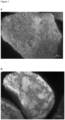
- Figure 1A is a photograph of unpolished compacted KCI
- Figure 1B shown a picture of blender polished compacted KCI according to the present invention.
- white patches of dust are visibly incorporated on the surface.
- the dust integrated in the surface of the granule of the polished material is thought to provide the surprising increased performance.
- the invention thus also relates to polished, compacted KCI granules, ready for coating, having a sphericity of between 0.88 and 0.92, and having visible dust patches under a microscope at 15x magnification.
- the polymer coating step can be a conventional coating step.
- the amount of polymer coating is determined by the required performance. More coating is needed to make the controlled release of fertilizer last for longer (longer longevity) which is needed for certain applications. However, more coating means more cost.
- the amount of polymer coating is about 6 pph (parts per hundred) (6 parts by weight coating on solid basis relative to 100 parts by weight potassium chloride particles) for a longevity of around 6-7 months.
- other amounts can be applied as well providing different longevities for different applications.
- the coating can be applied in an amount of 3 - 10 pph.
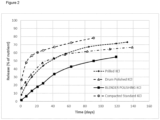
- Figure 2 shows a comparison of the release in water leach test of different KCI fertilizer, non-polished (prilled or compacted) and polished by different methods. The products were all coated with 6 pph of PU polymer coating.
- unpolished compacted and coated KCI shows a release of KCI in a standard test (as described below in the experimental section) of about 50% in about 10 days. After about 20 days, the release is relatively slow, leading to about 65% release at 30 days, and 70% release at 50 days.
- Prilled and coated KCI ( ⁇ prilled KCI'), just like standard drum polished KCI ('drum polished KCI') shows about 30% release at 10 days, about 50% at 30 days and 55% release at 50 days.
- the KCI polished according to the present invention ('BLENDER POLISHING KCI') shows only 10% release at 10 days, about 25% at 30 days, and about 40% at 50 days.
- the graphs show that the polished KCI according to the present invention allows a controlled release fertilizer with improved controlled release over prior art type of products.
- the preferred controlled release fertilizer according to the present invention shows a release at 7 days of about 18 % or less, preferably about 15 wt% or less. As explained above, the first week release is quite indicative for the controlled release behavior, and slow initial release is considered important.
- the preferred controlled release compacted KCI fertilizer according to the present invention preferably shows a release at 10 days of about 20% or less, preferably about 15% or less; and/or a release at 30 days of 40% or less, preferably of 35% or less; and/or a release at 50 days of 50% or less, preferably 45% or less. Even more preferably, at 20 days, the release is about 30% or less. Even more preferably, the KCI fertilizer conforms with the release percentages as described above at all time points.
- the KCI used in the examples is granular KCI, from ICL (Iberpotash). Composition is: 95% KCI, 2.3% NaCl, 0.2% H2O (moisture). Bulk density is 1 ton/m 3 .
- the particle size distribution of the material is shown in the table below. Particle size diameter range (mm) Cumulative Weight percentage [%] 0 2 2.1 2 3 19.2 3 4 64.3 4 5 95.2 5 6 99.9 6 7 100
- d90 Maximum diameter is defined as the d90 which is the diameter under which 90% of the weight of the sample is contained. In this case d90 is 4.71 mm.
- the device used for the pretreatment according to the invention is a paddle mixer it has approximately 300 liters working capacity (approximately 50 cm diameter and 150 cm length). It is equipped control panel with frequency inverter for speed control of the blade. It has a single shaft with 12 arms mounted perpendicularly to it, finished by adjustable blades. Distance from edge of blade to the wall is adjustable on a range of 1 to 30 mm.
- CRFs were prepared using the fertilizer pretreated in the mixing device to compare their performance.
- the CRFs prepared in these examples were coated with a polyurethane based resin made by reacting a liquid polyol and a liquid diisocyanate similarly as described in U.S. Patent No. 7,722,696 .
- the coating level for all examples is 6 parts of solid coating per 100 of fertilizer (6 pph).
- Samples are prepared in a rotating drum holding 1.5 kg of fertilizer and equipped with a heating system to keep fertilizer at a temperature between 60 C and 80 C.
- Substrate fertilizer morphology and particle size distribution of the fraction >2,36 mm were analyzed by Particle Size and Particle Shape Analysis with Dynamic Image Analysis by a RETSCH Camsizer.
- the performance of the coated fertilizer was measured by the rate of nutrient release from the granule when contacted with water. Slower release rates indicate longer longevity of the product in terms of releasing its nutrients over time.
- the industry standards for determining the release characteristics of the product include the water leach release test.
- CRFs produced were placed in water at 21°C and tested at different time intervals, 24 hours, 7 days and, in some cases, longer times (for example for preparing Fig 2 ).
- twenty grams of coated fertilizer was placed into a flask with 400 mL of de-mineralized water.
- the flask containing the sample was inverted three times to allow for mixing and kept at 21°C.
- the flask was inverted three times and a sample was taken to determine the amount of nutrients (K 2 O) in the water.
- the water was replaced and renewed with 400 mL of fresh de-mineralized water. The measurement was repeated again after 7 days.
- Extra measurement points can be obtained to be able to plot the release profile during the working time of the controlled release fertilizer. After the last measurement, the remaining particles were milled, dissolved to a known volume and analyzed to check closure of the mass balance for each component. Results are given as weight % of nutrient K 2 O released into the solution at different times intervals.
- Coating Weight 6 pph (parts of coating per hundred of fertilizer)
- Polishing generates a fine dust which is stuck on the fertilizer. In general the presence of dust is seen as detrimental for coating. Dust was removed on the untreated and polished fertilizer by a hexane washing treatment and performance compared.
Landscapes
- Chemical & Material Sciences (AREA)
- Organic Chemistry (AREA)
- Life Sciences & Earth Sciences (AREA)
- Pest Control & Pesticides (AREA)
- Chemical Kinetics & Catalysis (AREA)
- Inorganic Chemistry (AREA)
- Fertilizers (AREA)
- Glanulating (AREA)
Priority Applications (11)
| Application Number | Priority Date | Filing Date | Title |
|---|---|---|---|
| ES20210141T ES2991165T3 (es) | 2020-11-26 | 2020-11-26 | Fertilizante de cloruro de potasio de liberación controlada |
| EP20210141.6A EP4006003B1 (en) | 2020-11-26 | 2020-11-26 | Controlled release potassium chloride fertilizer |
| HUE20210141A HUE068976T2 (hu) | 2020-11-26 | 2020-11-26 | Kontrollált felszabadulású kálium-klorid mûtrágya |
| PL20210141.6T PL4006003T3 (pl) | 2020-11-26 | 2020-11-26 | Nawóz chlorkowo-potasowy o kontrolowanym uwalnianiu |
| CN202180079441.3A CN116635351B (zh) | 2020-11-26 | 2021-11-26 | 控释氯化钾肥料 |
| PCT/EP2021/083196 WO2022112512A1 (en) | 2020-11-26 | 2021-11-26 | Controlled release potassium chloride fertilizer |
| IL303126A IL303126A (en) | 2020-11-26 | 2021-11-26 | Fertilizer with controlled release of potassium chloride |
| CA3202101A CA3202101A1 (en) | 2020-11-26 | 2021-11-26 | Controlled release potassium chloride fertilizer |
| US18/039,004 US20240002309A1 (en) | 2020-11-26 | 2021-11-26 | Controlled release potassium chloride fertilizer |
| JP2023532140A JP2023550804A (ja) | 2020-11-26 | 2021-11-26 | 塩化カリウム緩効性肥料 |
| KR1020237020710A KR20230109721A (ko) | 2020-11-26 | 2021-11-26 | 방출 조절 염화칼륨 비료 |
Applications Claiming Priority (1)
| Application Number | Priority Date | Filing Date | Title |
|---|---|---|---|
| EP20210141.6A EP4006003B1 (en) | 2020-11-26 | 2020-11-26 | Controlled release potassium chloride fertilizer |
Publications (3)
| Publication Number | Publication Date |
|---|---|
| EP4006003A1 EP4006003A1 (en) | 2022-06-01 |
| EP4006003B1 true EP4006003B1 (en) | 2024-08-21 |
| EP4006003C0 EP4006003C0 (en) | 2024-08-21 |
Family
ID=73598807
Family Applications (1)
| Application Number | Title | Priority Date | Filing Date |
|---|---|---|---|
| EP20210141.6A Active EP4006003B1 (en) | 2020-11-26 | 2020-11-26 | Controlled release potassium chloride fertilizer |
Country Status (11)
| Country | Link |
|---|---|
| US (1) | US20240002309A1 (pl) |
| EP (1) | EP4006003B1 (pl) |
| JP (1) | JP2023550804A (pl) |
| KR (1) | KR20230109721A (pl) |
| CN (1) | CN116635351B (pl) |
| CA (1) | CA3202101A1 (pl) |
| ES (1) | ES2991165T3 (pl) |
| HU (1) | HUE068976T2 (pl) |
| IL (1) | IL303126A (pl) |
| PL (1) | PL4006003T3 (pl) |
| WO (1) | WO2022112512A1 (pl) |
Families Citing this family (1)
| Publication number | Priority date | Publication date | Assignee | Title |
|---|---|---|---|---|
| CN118084576A (zh) * | 2024-02-28 | 2024-05-28 | 新洋丰农业科技股份有限公司 | 基于连续式缓控释肥系统的肥料核芯预处理方法 |
Citations (1)
| Publication number | Priority date | Publication date | Assignee | Title |
|---|---|---|---|---|
| JP2004217434A (ja) * | 2003-01-09 | 2004-08-05 | Asahi Kasei Chemicals Corp | シグモイド溶出型被覆粒状加里肥料 |
Family Cites Families (14)
| Publication number | Priority date | Publication date | Assignee | Title |
|---|---|---|---|---|
| US3223518A (en) | 1961-08-18 | 1965-12-14 | Archer Daniels Midland | Granular fertilizer having a plurality of coatings and the process of making |
| US3285223A (en) | 1963-12-09 | 1966-11-15 | Archer Daniels Midland Co | Apparatus for coating granules |
| FR1588822A (pl) * | 1968-06-20 | 1970-03-16 | ||
| DE3544451C1 (de) | 1985-12-16 | 1987-01-15 | Ashland Suedchemie Kernfest | Verfahren zum Erzeugen einer wasserdurchlaessigen Umhuellung auf koernigen,wasserloeslichen Stoffen und seine Anwendung |
| CA2164547A1 (en) * | 1994-12-26 | 1996-06-27 | Shmuel Stern | Process for the manufacture of sulfur-containing fertilizers |
| JPH10101466A (ja) * | 1996-05-17 | 1998-04-21 | Chisso Corp | 被覆粒状肥料及びその製造方法 |
| JP3609222B2 (ja) * | 1996-10-04 | 2005-01-12 | チッソ株式会社 | 時限溶出型被覆粒状肥料、これを有効成分とする配合肥料およびこの配合肥料を用いた栽培方法 |
| US5993505A (en) * | 1998-05-22 | 1999-11-30 | Oms Investments, Inc. | Controlled release fertilizer compositions and processes for the preparation thereof |
| DE10158693A1 (de) | 2001-11-29 | 2003-06-26 | Ashland Suedchemie Kernfest | Beschichtete körnige Stoffe |
| CN100572340C (zh) | 2008-09-25 | 2009-12-23 | 山东金正大生态工程股份有限公司 | 包膜控释肥生产中肥料核芯的预处理方法和装置 |
| CN101352826B (zh) * | 2008-09-28 | 2011-01-26 | 清华大学 | 光学元件内凹面抛光方法及装置 |
| CN204824661U (zh) * | 2015-07-09 | 2015-12-02 | 山东晋煤日月化工有限公司 | 一种具有包膜抛光功能的复合肥生产装置 |
| US10450239B2 (en) * | 2016-03-22 | 2019-10-22 | Dead Sea Works Ltd. | Spherical fertilizers and process for the production thereof |
| CN108623333A (zh) * | 2017-03-24 | 2018-10-09 | 菱商肥材有限公司 | 粒状草酰胺的制造方法 |
-
2020
- 2020-11-26 HU HUE20210141A patent/HUE068976T2/hu unknown
- 2020-11-26 ES ES20210141T patent/ES2991165T3/es active Active
- 2020-11-26 EP EP20210141.6A patent/EP4006003B1/en active Active
- 2020-11-26 PL PL20210141.6T patent/PL4006003T3/pl unknown
-
2021
- 2021-11-26 US US18/039,004 patent/US20240002309A1/en active Pending
- 2021-11-26 IL IL303126A patent/IL303126A/en unknown
- 2021-11-26 KR KR1020237020710A patent/KR20230109721A/ko active Pending
- 2021-11-26 JP JP2023532140A patent/JP2023550804A/ja active Pending
- 2021-11-26 CN CN202180079441.3A patent/CN116635351B/zh active Active
- 2021-11-26 CA CA3202101A patent/CA3202101A1/en active Pending
- 2021-11-26 WO PCT/EP2021/083196 patent/WO2022112512A1/en not_active Ceased
Patent Citations (1)
| Publication number | Priority date | Publication date | Assignee | Title |
|---|---|---|---|---|
| JP2004217434A (ja) * | 2003-01-09 | 2004-08-05 | Asahi Kasei Chemicals Corp | シグモイド溶出型被覆粒状加里肥料 |
Also Published As
| Publication number | Publication date |
|---|---|
| KR20230109721A (ko) | 2023-07-20 |
| IL303126A (en) | 2023-07-01 |
| CN116635351A (zh) | 2023-08-22 |
| WO2022112512A1 (en) | 2022-06-02 |
| ES2991165T3 (es) | 2024-12-02 |
| HUE068976T2 (hu) | 2025-02-28 |
| EP4006003A1 (en) | 2022-06-01 |
| JP2023550804A (ja) | 2023-12-05 |
| US20240002309A1 (en) | 2024-01-04 |
| CN116635351B (zh) | 2025-06-03 |
| EP4006003C0 (en) | 2024-08-21 |
| PL4006003T3 (pl) | 2025-03-24 |
| CA3202101A1 (en) | 2022-06-02 |
Similar Documents
| Publication | Publication Date | Title |
|---|---|---|
| US2806773A (en) | Agricultural granule | |
| CN105060942A (zh) | 制备含元素硫的肥料的方法 | |
| WO2007064053A1 (en) | Apparatus for manufacturing nanoporous silica and method thereof | |
| CA1228441A (en) | Filler-containing polyurethane (urea) compositions and process for the production thereof | |
| EP4006003B1 (en) | Controlled release potassium chloride fertilizer | |
| US5039328A (en) | Process for producing a granular slow-acting nitrogenous fertilizer | |
| Ibrahim et al. | Controlling nitrogen pollution via encapsulation of urea fertilizer in cross-linked corn starch | |
| US5366534A (en) | Granular potassium sulfate preparation and process for production thereof | |
| CN111646869B (zh) | 一种聚氨酯包膜肥料及其制备方法 | |
| CA1229939A (en) | Hardner for epoxide resin masses | |
| US6045810A (en) | Reinforced-resin coated plant food granules | |
| UA112183C2 (uk) | Пилопригнічуючий агрегат | |
| JPH09202683A (ja) | 被覆肥料の製造方法 | |
| JP2002516255A (ja) | カタツムリの駆除剤および駆除方法 | |
| KR0184742B1 (ko) | 항균성 다공성 실리카겔 분말의 제조방법 | |
| RU2821906C1 (ru) | Сложное удобрение с наполнителем из фосфогипса | |
| JP7660084B2 (ja) | 生分解性樹脂エマルジョンを用いたグアニル尿素含有粒状肥料 | |
| US20240309216A1 (en) | Method for Agglomerating Pigments and Powders | |
| JP6273567B2 (ja) | 粉末消火薬剤処理物を用いてなる肥料およびその製造方法 | |
| JPH08283068A (ja) | ジルコニア微小球体及びその製造方法 | |
| CN117597321A (zh) | 制备具有尿素的微粒化硫肥料产品的方法 | |
| KR20250014222A (ko) | 에폭시 몰딩 컴파운드의 제조 방법 | |
| CN105670478A (zh) | 一种单组份水性聚氨酯涂料的制备方法 | |
| JPH0474710A (ja) | 顆粒状消石灰の製造方法 | |
| JPS598682A (ja) | 消石灰の多孔性粒状化方法 |
Legal Events
| Date | Code | Title | Description |
|---|---|---|---|
| PUAI | Public reference made under article 153(3) epc to a published international application that has entered the european phase |
Free format text: ORIGINAL CODE: 0009012 |
|
| STAA | Information on the status of an ep patent application or granted ep patent |
Free format text: STATUS: THE APPLICATION HAS BEEN PUBLISHED |
|
| AK | Designated contracting states |
Kind code of ref document: A1 Designated state(s): AL AT BE BG CH CY CZ DE DK EE ES FI FR GB GR HR HU IE IS IT LI LT LU LV MC MK MT NL NO PL PT RO RS SE SI SK SM TR |
|
| STAA | Information on the status of an ep patent application or granted ep patent |
Free format text: STATUS: REQUEST FOR EXAMINATION WAS MADE |
|
| 17P | Request for examination filed |
Effective date: 20221111 |
|
| RBV | Designated contracting states (corrected) |
Designated state(s): AL AT BE BG CH CY CZ DE DK EE ES FI FR GB GR HR HU IE IS IT LI LT LU LV MC MK MT NL NO PL PT RO RS SE SI SK SM TR |
|
| STAA | Information on the status of an ep patent application or granted ep patent |
Free format text: STATUS: EXAMINATION IS IN PROGRESS |
|
| 17Q | First examination report despatched |
Effective date: 20230126 |
|
| GRAP | Despatch of communication of intention to grant a patent |
Free format text: ORIGINAL CODE: EPIDOSNIGR1 |
|
| STAA | Information on the status of an ep patent application or granted ep patent |
Free format text: STATUS: GRANT OF PATENT IS INTENDED |
|
| INTG | Intention to grant announced |
Effective date: 20240405 |
|
| GRAS | Grant fee paid |
Free format text: ORIGINAL CODE: EPIDOSNIGR3 |
|
| GRAA | (expected) grant |
Free format text: ORIGINAL CODE: 0009210 |
|
| STAA | Information on the status of an ep patent application or granted ep patent |
Free format text: STATUS: THE PATENT HAS BEEN GRANTED |
|
| AK | Designated contracting states |
Kind code of ref document: B1 Designated state(s): AL AT BE BG CH CY CZ DE DK EE ES FI FR GB GR HR HU IE IS IT LI LT LU LV MC MK MT NL NO PL PT RO RS SE SI SK SM TR |
|
| REG | Reference to a national code |
Ref country code: GB Ref legal event code: FG4D |
|
| REG | Reference to a national code |
Ref country code: CH Ref legal event code: EP |
|
| RAP4 | Party data changed (patent owner data changed or rights of a patent transferred) |
Owner name: EVERRIS INTERNATIONAL B.V. |
|
| REG | Reference to a national code |
Ref country code: IE Ref legal event code: FG4D |
|
| REG | Reference to a national code |
Ref country code: DE Ref legal event code: R096 Ref document number: 602020036110 Country of ref document: DE |
|
| U01 | Request for unitary effect filed |
Effective date: 20240911 |
|
| U07 | Unitary effect registered |
Designated state(s): AT BE BG DE DK EE FI FR IT LT LU LV MT NL PT RO SE SI Effective date: 20241001 |
|
| REG | Reference to a national code |
Ref country code: ES Ref legal event code: FG2A Ref document number: 2991165 Country of ref document: ES Kind code of ref document: T3 Effective date: 20241202 |
|
| U20 | Renewal fee for the european patent with unitary effect paid |
Year of fee payment: 5 Effective date: 20241127 |
|
| PG25 | Lapsed in a contracting state [announced via postgrant information from national office to epo] |
Ref country code: NO Free format text: LAPSE BECAUSE OF FAILURE TO SUBMIT A TRANSLATION OF THE DESCRIPTION OR TO PAY THE FEE WITHIN THE PRESCRIBED TIME-LIMIT Effective date: 20241121 |
|
| PG25 | Lapsed in a contracting state [announced via postgrant information from national office to epo] |
Ref country code: GR Free format text: LAPSE BECAUSE OF FAILURE TO SUBMIT A TRANSLATION OF THE DESCRIPTION OR TO PAY THE FEE WITHIN THE PRESCRIBED TIME-LIMIT Effective date: 20241122 |
|
| PGFP | Annual fee paid to national office [announced via postgrant information from national office to epo] |
Ref country code: GB Payment date: 20241127 Year of fee payment: 5 |
|
| PG25 | Lapsed in a contracting state [announced via postgrant information from national office to epo] |
Ref country code: IS Free format text: LAPSE BECAUSE OF FAILURE TO SUBMIT A TRANSLATION OF THE DESCRIPTION OR TO PAY THE FEE WITHIN THE PRESCRIBED TIME-LIMIT Effective date: 20241221 |
|
| PG25 | Lapsed in a contracting state [announced via postgrant information from national office to epo] |
Ref country code: HR Free format text: LAPSE BECAUSE OF FAILURE TO SUBMIT A TRANSLATION OF THE DESCRIPTION OR TO PAY THE FEE WITHIN THE PRESCRIBED TIME-LIMIT Effective date: 20240821 |
|
| PGFP | Annual fee paid to national office [announced via postgrant information from national office to epo] |
Ref country code: IE Payment date: 20241127 Year of fee payment: 5 |
|
| PG25 | Lapsed in a contracting state [announced via postgrant information from national office to epo] |
Ref country code: RS Free format text: LAPSE BECAUSE OF FAILURE TO SUBMIT A TRANSLATION OF THE DESCRIPTION OR TO PAY THE FEE WITHIN THE PRESCRIBED TIME-LIMIT Effective date: 20241121 |
|
| PGFP | Annual fee paid to national office [announced via postgrant information from national office to epo] |
Ref country code: ES Payment date: 20241202 Year of fee payment: 5 |
|
| PG25 | Lapsed in a contracting state [announced via postgrant information from national office to epo] |
Ref country code: RS Free format text: LAPSE BECAUSE OF FAILURE TO SUBMIT A TRANSLATION OF THE DESCRIPTION OR TO PAY THE FEE WITHIN THE PRESCRIBED TIME-LIMIT Effective date: 20241121 Ref country code: NO Free format text: LAPSE BECAUSE OF FAILURE TO SUBMIT A TRANSLATION OF THE DESCRIPTION OR TO PAY THE FEE WITHIN THE PRESCRIBED TIME-LIMIT Effective date: 20241121 Ref country code: IS Free format text: LAPSE BECAUSE OF FAILURE TO SUBMIT A TRANSLATION OF THE DESCRIPTION OR TO PAY THE FEE WITHIN THE PRESCRIBED TIME-LIMIT Effective date: 20241221 Ref country code: HR Free format text: LAPSE BECAUSE OF FAILURE TO SUBMIT A TRANSLATION OF THE DESCRIPTION OR TO PAY THE FEE WITHIN THE PRESCRIBED TIME-LIMIT Effective date: 20240821 Ref country code: GR Free format text: LAPSE BECAUSE OF FAILURE TO SUBMIT A TRANSLATION OF THE DESCRIPTION OR TO PAY THE FEE WITHIN THE PRESCRIBED TIME-LIMIT Effective date: 20241122 |
|
| PGFP | Annual fee paid to national office [announced via postgrant information from national office to epo] |
Ref country code: CH Payment date: 20241201 Year of fee payment: 5 |
|
| REG | Reference to a national code |
Ref country code: HU Ref legal event code: AG4A Ref document number: E068976 Country of ref document: HU |
|
| PG25 | Lapsed in a contracting state [announced via postgrant information from national office to epo] |
Ref country code: SM Free format text: LAPSE BECAUSE OF FAILURE TO SUBMIT A TRANSLATION OF THE DESCRIPTION OR TO PAY THE FEE WITHIN THE PRESCRIBED TIME-LIMIT Effective date: 20240821 |
|
| PG25 | Lapsed in a contracting state [announced via postgrant information from national office to epo] |
Ref country code: CZ Free format text: LAPSE BECAUSE OF FAILURE TO SUBMIT A TRANSLATION OF THE DESCRIPTION OR TO PAY THE FEE WITHIN THE PRESCRIBED TIME-LIMIT Effective date: 20240821 |
|
| PGFP | Annual fee paid to national office [announced via postgrant information from national office to epo] |
Ref country code: PL Payment date: 20241104 Year of fee payment: 5 |
|
| PG25 | Lapsed in a contracting state [announced via postgrant information from national office to epo] |
Ref country code: SK Free format text: LAPSE BECAUSE OF FAILURE TO SUBMIT A TRANSLATION OF THE DESCRIPTION OR TO PAY THE FEE WITHIN THE PRESCRIBED TIME-LIMIT Effective date: 20240821 |
|
| PLBE | No opposition filed within time limit |
Free format text: ORIGINAL CODE: 0009261 |
|
| STAA | Information on the status of an ep patent application or granted ep patent |
Free format text: STATUS: NO OPPOSITION FILED WITHIN TIME LIMIT |
|
| PG25 | Lapsed in a contracting state [announced via postgrant information from national office to epo] |
Ref country code: MC Free format text: LAPSE BECAUSE OF FAILURE TO SUBMIT A TRANSLATION OF THE DESCRIPTION OR TO PAY THE FEE WITHIN THE PRESCRIBED TIME-LIMIT Effective date: 20240821 |
|
| 26N | No opposition filed |
Effective date: 20250522 |
|
| REG | Reference to a national code |
Ref country code: CH Ref legal event code: U11 Free format text: ST27 STATUS EVENT CODE: U-0-0-U10-U11 (AS PROVIDED BY THE NATIONAL OFFICE) Effective date: 20251201 |
|
| PGFP | Annual fee paid to national office [announced via postgrant information from national office to epo] |
Ref country code: HU Payment date: 20251107 Year of fee payment: 6 |