EP3998653B1 - Electrode having columnar structure provided with multilayer part - Google Patents
Electrode having columnar structure provided with multilayer part Download PDFInfo
- Publication number
- EP3998653B1 EP3998653B1 EP20843917.4A EP20843917A EP3998653B1 EP 3998653 B1 EP3998653 B1 EP 3998653B1 EP 20843917 A EP20843917 A EP 20843917A EP 3998653 B1 EP3998653 B1 EP 3998653B1
- Authority
- EP
- European Patent Office
- Prior art keywords
- columnar
- layer
- columnar structure
- metal oxide
- electrode
- Prior art date
- Legal status (The legal status is an assumption and is not a legal conclusion. Google has not performed a legal analysis and makes no representation as to the accuracy of the status listed.)
- Active
Links
Images



Classifications
-
- H—ELECTRICITY
- H01—ELECTRIC ELEMENTS
- H01M—PROCESSES OR MEANS, e.g. BATTERIES, FOR THE DIRECT CONVERSION OF CHEMICAL ENERGY INTO ELECTRICAL ENERGY
- H01M4/00—Electrodes
- H01M4/86—Inert electrodes with catalytic activity, e.g. for fuel cells
- H01M4/90—Selection of catalytic material
- H01M4/9016—Oxides, hydroxides or oxygenated metallic salts
-
- H—ELECTRICITY
- H01—ELECTRIC ELEMENTS
- H01M—PROCESSES OR MEANS, e.g. BATTERIES, FOR THE DIRECT CONVERSION OF CHEMICAL ENERGY INTO ELECTRICAL ENERGY
- H01M4/00—Electrodes
- H01M4/86—Inert electrodes with catalytic activity, e.g. for fuel cells
- H01M4/90—Selection of catalytic material
- H01M4/9016—Oxides, hydroxides or oxygenated metallic salts
- H01M4/9025—Oxides specially used in fuel cell operating at high temperature, e.g. SOFC
- H01M4/9033—Complex oxides, optionally doped, of the type M1MeO3, M1 being an alkaline earth metal or a rare earth, Me being a metal, e.g. perovskites
-
- H—ELECTRICITY
- H01—ELECTRIC ELEMENTS
- H01M—PROCESSES OR MEANS, e.g. BATTERIES, FOR THE DIRECT CONVERSION OF CHEMICAL ENERGY INTO ELECTRICAL ENERGY
- H01M4/00—Electrodes
- H01M4/86—Inert electrodes with catalytic activity, e.g. for fuel cells
- H01M4/8647—Inert electrodes with catalytic activity, e.g. for fuel cells consisting of more than one material, e.g. consisting of composites
-
- H—ELECTRICITY
- H01—ELECTRIC ELEMENTS
- H01M—PROCESSES OR MEANS, e.g. BATTERIES, FOR THE DIRECT CONVERSION OF CHEMICAL ENERGY INTO ELECTRICAL ENERGY
- H01M4/00—Electrodes
- H01M4/86—Inert electrodes with catalytic activity, e.g. for fuel cells
- H01M4/88—Processes of manufacture
- H01M4/8803—Supports for the deposition of the catalytic active composition
-
- H—ELECTRICITY
- H01—ELECTRIC ELEMENTS
- H01M—PROCESSES OR MEANS, e.g. BATTERIES, FOR THE DIRECT CONVERSION OF CHEMICAL ENERGY INTO ELECTRICAL ENERGY
- H01M4/00—Electrodes
- H01M4/86—Inert electrodes with catalytic activity, e.g. for fuel cells
- H01M4/88—Processes of manufacture
- H01M4/8825—Methods for deposition of the catalytic active composition
- H01M4/8867—Vapour deposition
-
- H—ELECTRICITY
- H01—ELECTRIC ELEMENTS
- H01M—PROCESSES OR MEANS, e.g. BATTERIES, FOR THE DIRECT CONVERSION OF CHEMICAL ENERGY INTO ELECTRICAL ENERGY
- H01M4/00—Electrodes
- H01M4/86—Inert electrodes with catalytic activity, e.g. for fuel cells
- H01M4/90—Selection of catalytic material
- H01M4/9016—Oxides, hydroxides or oxygenated metallic salts
- H01M4/9025—Oxides specially used in fuel cell operating at high temperature, e.g. SOFC
-
- H—ELECTRICITY
- H01—ELECTRIC ELEMENTS
- H01M—PROCESSES OR MEANS, e.g. BATTERIES, FOR THE DIRECT CONVERSION OF CHEMICAL ENERGY INTO ELECTRICAL ENERGY
- H01M4/00—Electrodes
- H01M4/86—Inert electrodes with catalytic activity, e.g. for fuel cells
- H01M4/90—Selection of catalytic material
- H01M4/9041—Metals or alloys
- H01M4/905—Metals or alloys specially used in fuel cell operating at high temperature, e.g. SOFC
-
- H—ELECTRICITY
- H01—ELECTRIC ELEMENTS
- H01M—PROCESSES OR MEANS, e.g. BATTERIES, FOR THE DIRECT CONVERSION OF CHEMICAL ENERGY INTO ELECTRICAL ENERGY
- H01M8/00—Fuel cells; Manufacture thereof
- H01M8/02—Details
- H01M8/0202—Collectors; Separators, e.g. bipolar separators; Interconnectors
- H01M8/023—Porous and characterised by the material
- H01M8/0236—Glass; Ceramics; Cermets
-
- H—ELECTRICITY
- H01—ELECTRIC ELEMENTS
- H01M—PROCESSES OR MEANS, e.g. BATTERIES, FOR THE DIRECT CONVERSION OF CHEMICAL ENERGY INTO ELECTRICAL ENERGY
- H01M8/00—Fuel cells; Manufacture thereof
- H01M8/02—Details
- H01M8/0202—Collectors; Separators, e.g. bipolar separators; Interconnectors
- H01M8/023—Porous and characterised by the material
- H01M8/0241—Composites
-
- H—ELECTRICITY
- H01—ELECTRIC ELEMENTS
- H01M—PROCESSES OR MEANS, e.g. BATTERIES, FOR THE DIRECT CONVERSION OF CHEMICAL ENERGY INTO ELECTRICAL ENERGY
- H01M8/00—Fuel cells; Manufacture thereof
- H01M8/10—Fuel cells with solid electrolytes
- H01M8/12—Fuel cells with solid electrolytes operating at high temperature, e.g. with stabilised ZrO2 electrolyte
- H01M8/1213—Fuel cells with solid electrolytes operating at high temperature, e.g. with stabilised ZrO2 electrolyte characterised by the electrode/electrolyte combination or the supporting material
-
- H—ELECTRICITY
- H01—ELECTRIC ELEMENTS
- H01M—PROCESSES OR MEANS, e.g. BATTERIES, FOR THE DIRECT CONVERSION OF CHEMICAL ENERGY INTO ELECTRICAL ENERGY
- H01M8/00—Fuel cells; Manufacture thereof
- H01M8/10—Fuel cells with solid electrolytes
- H01M8/12—Fuel cells with solid electrolytes operating at high temperature, e.g. with stabilised ZrO2 electrolyte
- H01M2008/1293—Fuel cells with solid oxide electrolytes
-
- Y—GENERAL TAGGING OF NEW TECHNOLOGICAL DEVELOPMENTS; GENERAL TAGGING OF CROSS-SECTIONAL TECHNOLOGIES SPANNING OVER SEVERAL SECTIONS OF THE IPC; TECHNICAL SUBJECTS COVERED BY FORMER USPC CROSS-REFERENCE ART COLLECTIONS [XRACs] AND DIGESTS
- Y02—TECHNOLOGIES OR APPLICATIONS FOR MITIGATION OR ADAPTATION AGAINST CLIMATE CHANGE
- Y02E—REDUCTION OF GREENHOUSE GAS [GHG] EMISSIONS, RELATED TO ENERGY GENERATION, TRANSMISSION OR DISTRIBUTION
- Y02E60/00—Enabling technologies; Technologies with a potential or indirect contribution to GHG emissions mitigation
- Y02E60/30—Hydrogen technology
- Y02E60/50—Fuel cells
Definitions
- the present application relates to an electrode, used for a solid oxide fuel cell (hereinafter sometimes referred to as an "SOFC”), a solid oxide electrolysis cell (hereinafter sometimes referred to as an "SOEC”), as well as storage batteries and the like, its columnar structure composing the electrode, and whose columnar structure comprises a composite structure.
- SOFC solid oxide fuel cell
- SOEC solid oxide electrolysis cell
- PLD pulsed laser deposition
- an electrode catalyst made of metal oxide increasing its surface area and increasing the interfaces between dissimilar materials is effective in increasing its catalytic activity.
- the electrode comprises granulated nanoparticles in order to increase its electrode surface area
- performance degradation due to a structural change such as that resulting from sintering
- resistance reduction by reducing the thickness of the entire cell is effective.
- a decrease in the mechanical strength due to thinning of the cell becomes a problem.
- An electrode catalyst material having high catalytic activity and mechanical strength and sustaining performance for a long period has been demanded not only for the SOFC and the SOEC but also for storage batteries, etc.
- Patent Document 1 U.S. Published Patent Application Publication, No. 2014/0141358 , Specification
- the object of the present application is to provide an electrode, which comprises a composite structure, capable of sustaining performance for a long period, having high catalytic activity and mechanical strength, and being suitable for use for, e.g., an SOFC.
- the inventors of the present application have conducted intensive study on the method for simultaneously forming different metal oxide layers on a polycrystalline base material by the PLD method. As a result, a composite structure including a columnar structure could be produced. Moreover, it has been found that an electrode including an electrode component having a columnar structure and a porous current collector layer prepared on it has high catalytic activity and mechanical strength and sustains performance for a long period of time. The present application is based on such findings.
- the columnar structure of the present application is a structure including multiple columnar sections with lateral surfaces which are at least partially in contact with each other, each columnar section including a multilayer part in which different inorganic compound layers are stacked on each other.
- the composite structure of the present application includes a polycrystalline base material and the columnar structure of the present application prepared on the polycrystalline base material.
- the electrode of the present application includes an electrode component having the columnar structure of the present application and a porous current collector layer prepared on it.
- the method for fabricating the composite structure of the present application includes the step of simultaneously forming the different metal oxide layers on the polycrystalline base material by pulsed laser deposition method.
- the electrode having high catalytic activity and mechanical strength and sustaining performance for a long period the columnar structure forming the electrode, and the columnar structure with composite structure are obtained.
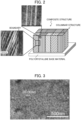
- FIG. 1 schematically shows a composite structure of an embodiment of the present application.
- an upper-lower direction is, in the present application, defined with reference to the orientation of the composite structure shown in FIG. 1 .
- a height direction of a columnar section is coincident with the upper-lower direction.
- the composite structure of the present embodiment includes a polycrystalline base material and a columnar structure of the embodiment of the present application provided on the polycrystalline base material.
- the columnar structure of the present embodiment includes multiple columnar sections with lateral surfaces which are at least partially in contact with each other. These columnar sections preferably should be in contact with each other over their entire lateral surfaces.
- the columnar section includes a multilayer part in which different inorganic compound layers are stacked on each other.
- the inorganic compound layers are preferably one or more types of layers including a metal oxide layer, a metal nitride layer, and a metal carbide layer. Since metal oxide is used for, e.g., an electrode of an SOFC, a case where the inorganic compound layer is the metal oxide layer will be hereinafter described as an example.
- the columnar structure of the present embodiment includes the multilayer parts in which different metal oxide layers are stacked on each other and has a large area of dissimilar material interfaces.
- an oxide ion conductor is used for one metal oxide
- an electron conductor or a mixed electron-oxide ion conductor is used for the other metal oxide.
- electrode activity is high at such dissimilar metal oxide interfaces.
- the columnar structure of the present embodiment is used as an electrode catalyst for, e.g., the SOFC, dissimilar material interfaces are present in high densities, and therefore, catalytic activity is high.
- An electrode of the present embodiment includes an electrode component having the columnar structure of the present embodiment and a porous current collector layer provided on the electrode component.
- the current collector layer preferably includes multiple columnar bodies prepared on some columnar sections of the columnar structure and voids formed in-between the columnar bodies. Corresponding to the current collector layer having this structure, an effective electron supply to the electrode component can be achieved, and diffusion of oxygen or fuel essential to electrode reaction is not inhibited.
- the interfaces between the dissimilar metal oxide layers exhibit a low mechanical strength along their planar direction, i.e., a low mechanical strength at the interface between the stacked layers.
- a low mechanical strength at the interface between the stacked layers i.e., a low mechanical strength at the interface between the stacked layers.
- the direction in which the mechanical strength is low varies according to the columnar sections.
- one columnar section compensates for the low mechanical strength of the other columnar section, and accordingly, the mechanical strength of the columnar structure increases.
- a thin columnar structure with reduced electrical resistance is used as an electrode catalyst for improving the performance of, e.g., the SOFC the necessary mechanical strength is obtained.
- the columnar structure of the present embodiment includes the columnar sections, each of which is configured such that the different metal oxide layers are stacked on each other. Moreover, in the columnar structure of the present embodiment, a layer stacking direction is different between adjacent ones of the columnar sections. That is, the columnar structure of the present embodiment includes two or more adjacent columnar sections different from each other in the layer stacking direction.
- the columnar structure of the present embodiment includes the columnar sections, each of which is configured such that the different metal oxide layers are stacked on each other. Moreover, the layer stacking direction is different between adjacent ones of the columnar sections. Thus, mass transfer at the contact interface between the columnar sections is inhibited, and the regions where the metal oxide particles of the same type exist together is small. Thus, even if the columnar structure of the present embodiment is used as the electrode catalyst of, e.g., the SOFC, sintering of the metal oxide is reduced. That is, if the columnar structure of the present embodiment is used as the electrode catalyst, the performance of the catalyst is sustained for a long period.
- the electrode catalyst e.g., the SOFC
- the width of the columnar section is preferably 10 nm to 100 nm, and the thickness of the metal oxide layer is preferably 1 nm to 10 nm. This is because the substance forming each metal oxide layer retains such a size that it exhibits its physical properties as a crystal (substance) while a sufficient multilayer structure is formed in the columnar structure. Furthermore, this is because adjacent parts of the columnar sections, which contribute to relieving stress and catalytic activity improvement, can be sufficiently formed.
- the layer stacking direction of the multilayer part is different from the height direction of the columnar section. That is, the planar direction of the multilayer part and the height direction of the columnar section are not perpendicular to each other.
- the planar direction of the multilayer part and the height direction of the columnar section is defined as 90° when the planar direction of the multilayer part and the height direction of the columnar section are orthogonal
- the angle between the planar direction of the multilayer part and the height direction of the columnar section should preferably be between 5° and 85°.
- the multilayer part may include two types of metal oxide layers as in the columnar structure of the present embodiment, or may include three or more different types of metal oxide layers as stacked layers.
- One of two or more types of metal oxide layers is preferably a (Ce,Gd)O 2 layer, a (La,Sr)CoO 3 layer, or a (La,Sr) (Co,Fe)O 3 layer.
- (Ce,Gd)O 2 indicates a compound in which part of Ce of CeO 2 is substituted with Gd
- (La,Sr)CoO 3 indicates a compound in which part of La of LaCoO 3 is substituted with Sr
- (La,Sr) (Co,Fe)O 3 indicates a compound in which part of La of LaCoO 3 is substituted with Sr and part of Co of LaCoO 3 is substituted with Fe.
- one metal oxide layer is the (Ce,Gd)O 2 layer
- the other metal oxide layer is the (La,Sr)CoO 3 layer or the (La,Sr)(Co,Fe)O 3 layer.
- the columnar structure of the present embodiment can be used not only for the electrode catalyst but also for, e.g., a catalyst for chemical synthesis.
- the columnar structure of the present embodiment including the multilayer parts, each of which is configured such that the different metal oxide layers are stacked on each other, and configured such that at least a part of the lateral surfaces of the columnar sections are in contact with each other is obtained in such a manner that the films of the different types of metal oxides are simultaneously formed on the polycrystalline base material by a PLD method. That is, the method for fabricating the composite structure of the embodiment of the present application has the step of simultaneously forming the different metal oxide layers on the polycrystalline base material by the pulsed laser deposition method.
- the films were formed under such conditions in which an oxygen partial pressure is 35 mTorr, a substrate temperature is 750°C, film deposition time is 100 minutes, a distance between a target and the substrate is 75 mm, a substrate rotation speed is 10 rpm, the incident angle of laser light (Coherent Inc., Compex Pro 102F, KrF, a wavelength of 248 nm) is 60°, a laser energy is 200 mJ, and a laser repetition rate is 10 Hz.
- HAADF-STEM images of the composite structure of the present example are shown in FIG. 2
- a surface SEM image is shown in FIG. 3 .
- FIG. 2 shows the cross-sectional HAADF-STEM image (a scale bar is 2 nm) for the rectangle at the upper part of the schematic perspective view of the composite structure and the HAADF-STEM image (a scale bar is 10 nm) for the rectangle at the lower part of the schematic perspective view.
- a columnar section comprises a multilayer part in which GDC layers and LSCF layers with thicknesses of 1 nm to 5 nm are alternately stacked on each other.
- lateral surfaces of the columnar sections are in contact with each other, and the layer stacking direction of the multilayer parts is different among these columnar sections. It is assumed that the lateral surfaces of the columnar sections are in contact with each other, the layer stacking direction of the multilayer part is different among the columnar sections, and the GDC layers the LSCF layers are alternately stacked on each other in the multilayer part resulting from the use of the polycrystalline GDC substrate. That is, in the PLD method, the deposited film is easily grown epitaxially along the orientation matching that of the substrate material.
- the films of the different types of metal oxides were simultaneously formed on the polycrystalline substrate by the PLD method. Accordingly, the different metal oxide layers simultaneously nucleated in a several-nm region and were epitaxially grown, thereby forming the columnar section. In addition, the crystal orientation of the substrate material is not constant. Thus, the growth direction was different for each metal oxide particle, resulting in a stripe-like multilayer structure with different inclinations in adjacent columnar sections.
- FIG. 3 shows that the composite structure of the present example includes the columnar structure having the columnar sections contacting each other at the lateral surfaces. The width of the columnar section was 20 nm to 30 nm.
- FIG. 4 An HAADF-STEM image of this composite structure is shown in (a) of FIG. 4 .
- Ce mapping data measured in the same field of view as that of (a) of FIG. 4 is shown in (b) of FIG. 4 .
- Fe mapping data measured in the same field of view as that of (a) of FIG. 4 is shown in (c) of FIG. 4 .
- Data showing the overlay of the mapping data of (b) of FIG. 4 and the mapping data of (c) of FIG. 4 is shown in (d) of FIG. 4 .
- the columnar section of the composite structure of the present example included the multilayer part in which the layers containing Ce and the layers containing Fe are alternately stacked on each other.
- Example 1 films of GDC and LSCF were simultaneously formed on a polycrystalline (Ce,Gd)O 2 substrate, and a columnar structure was produced on the substrate. Under such conditions in which an oxygen partial pressure is 100 mTorr, film deposition time is 90 minutes, a laser energy is 275 mJ, and a laser repetition rate is 20 Hz, a current collector layer of a porous layer of LSCF was, without heating the substrate, formed on the columnar structure by a PLD method, and an electrode was fabricated on a polycrystalline GDC substrate. A cross-sectional SEM image of the electrode of the present example is shown in FIG. 5 .
- the electrode was obtained, which includes the columnar structure (in the figure, "LSCF-GDC") made of LSCF and GDC and the LSCF nano current collector layer formed on the columnar structure and having nanosized columnar particles of LSCF.
- the columnar structure of the present example was configured such that columnar sections with a width of 20 nm to 30 nm and a height of about 400 nm are densely formed.
- the current collector layer of the present example included multiple columnar bodies with a width of 20 nm to 30 nm. These columnar bodies were prepared on some columnar sections of the columnar structure. Voids were formed in-between these columnar bodies.
- an electrode wherein the current collector layer has voids for gas diffusion and with columnar bodies having nanosized particles connected to the columnar structure and capable of uniform current collection across the entirety of the electrode is preferable.
- the electrode reaction resistance (ASR) of the electrode and the ohmic resistance of the cell were calculated by the following method.
- LSC paste was applied to the current collector layer of the cell of Example 3, and a metal mesh was pressed against such paste.
- an electrochemical measurement apparatus Primary Applied Research, VersaSTAT4
- FSA frequency response analyzer
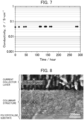
- FIG. 6 shows a change in the electrode reaction resistance component of the cell of the present example over time.
- the initial ASR of the cell of the present example was a small value of about 0.021 ⁇ cm 2 .
- the electrode reaction resistance of the cell after a lapse of 50 hours was about 0.037 ⁇ cm 2 , which increased to about 1.5 times as high as the initial value. However, the electrode reaction resistance was stable thereafter, and was maintained low until after a lapse of about 270 hours.
- FIG. 7 shows a change in ⁇ of the cell of the present example over time. As shown in FIG. 7 , ⁇ , i.e., the ohmic resistance component, of the cell of the present example did not change.
- FIG. 8 is a cross-sectional SEM image of the cell of the present example which had been held in air for 270 hours at 700°C. As shown in FIG. 8 , the cell structure having been held as described above showed little change from its cell structure before being held.
- the electrode of the present application includes the dense multilayer structure of the different types of metal oxides, and therefore, the catalytic activity is improved. Moreover, the electrode of the present application includes the dense multilayer structure of the different types of metal oxides, and therefore, the area of direct contact among the nanosized metal oxide particles of the same type can be decreased and sintering upon use for, e.g., the SOFC can be reduced. By suppressing sintering, the electrode of the present application can extend the performance lifetime, i.e., its performance as catalyst can be sustained for a long period.
Landscapes
- Chemical & Material Sciences (AREA)
- Engineering & Computer Science (AREA)
- Electrochemistry (AREA)
- General Chemical & Material Sciences (AREA)
- Chemical Kinetics & Catalysis (AREA)
- Materials Engineering (AREA)
- Manufacturing & Machinery (AREA)
- Sustainable Energy (AREA)
- Life Sciences & Earth Sciences (AREA)
- Sustainable Development (AREA)
- Composite Materials (AREA)
- Ceramic Engineering (AREA)
- Inert Electrodes (AREA)
- Catalysts (AREA)
- Battery Electrode And Active Subsutance (AREA)
- Fuel Cell (AREA)
- Electrodes For Compound Or Non-Metal Manufacture (AREA)
- Physical Vapour Deposition (AREA)
- Cell Electrode Carriers And Collectors (AREA)
Applications Claiming Priority (2)
| Application Number | Priority Date | Filing Date | Title |
|---|---|---|---|
| JP2019136008 | 2019-07-24 | ||
| PCT/JP2020/027490 WO2021015068A1 (ja) | 2019-07-24 | 2020-07-15 | 積層部を備える柱状構造体を有する電極 |
Publications (4)
| Publication Number | Publication Date |
|---|---|
| EP3998653A1 EP3998653A1 (en) | 2022-05-18 |
| EP3998653A4 EP3998653A4 (en) | 2022-10-05 |
| EP3998653B1 true EP3998653B1 (en) | 2024-10-23 |
| EP3998653C0 EP3998653C0 (en) | 2024-10-23 |
Family
ID=74192578
Family Applications (1)
| Application Number | Title | Priority Date | Filing Date |
|---|---|---|---|
| EP20843917.4A Active EP3998653B1 (en) | 2019-07-24 | 2020-07-15 | Electrode having columnar structure provided with multilayer part |
Country Status (5)
| Country | Link |
|---|---|
| US (1) | US12580203B2 (https=) |
| EP (1) | EP3998653B1 (https=) |
| JP (1) | JP7249062B2 (https=) |
| CN (1) | CN114128000B (https=) |
| WO (1) | WO2021015068A1 (https=) |
Families Citing this family (1)
| Publication number | Priority date | Publication date | Assignee | Title |
|---|---|---|---|---|
| ES3052461T3 (en) * | 2023-02-16 | 2026-01-07 | Tampere Univ Foundation Sr | Material layer for a fuel cell |
Citations (1)
| Publication number | Priority date | Publication date | Assignee | Title |
|---|---|---|---|---|
| US20140141358A1 (en) * | 2012-11-22 | 2014-05-22 | Korea Institute Of Science And Technology | Solid oxide fuel cell comprising post heat-treated composite cathode and method for preparing same |
Family Cites Families (14)
| Publication number | Priority date | Publication date | Assignee | Title |
|---|---|---|---|---|
| JPH02140648A (ja) * | 1988-11-22 | 1990-05-30 | Mitsubishi Electric Corp | 多結晶体の結晶方位判定方法 |
| JP3251034B2 (ja) * | 1991-07-22 | 2002-01-28 | 株式会社フジクラ | 酸化物超電導導体およびその製造方法 |
| JP4630857B2 (ja) * | 1998-03-31 | 2011-02-09 | キヤノン株式会社 | 二次電池の製造方法 |
| JP2003311290A (ja) * | 2002-04-19 | 2003-11-05 | Ebata Kk | 水質浄化用ブロック状積層体及び水質浄化装置 |
| JP2005302424A (ja) * | 2004-04-08 | 2005-10-27 | Toyota Motor Corp | 燃料電池用電解質膜、燃料電池、およびそれらの製造方法 |
| JP2008135376A (ja) * | 2006-10-26 | 2008-06-12 | Matsushita Electric Ind Co Ltd | 電池用電極板およびそれを用いるリチウム二次電池 |
| JP2009093812A (ja) * | 2007-10-04 | 2009-04-30 | Sumitomo Electric Ind Ltd | 積層型電池 |
| WO2012001960A1 (ja) * | 2010-07-01 | 2012-01-05 | パナソニック株式会社 | 不揮発性メモリセル、不揮発性メモリセルアレイ、およびその製造方法 |
| JP2012033804A (ja) * | 2010-08-02 | 2012-02-16 | Osaka Univ | 薄膜太陽電池及び半導体デバイス |
| US20120251917A1 (en) * | 2011-04-04 | 2012-10-04 | Korea Institute Of Science And Technology | Solid oxide fuel cell comprising nanostructure composite cathode and fabrication method thereof |
| JP5666404B2 (ja) | 2011-08-31 | 2015-02-12 | 本田技研工業株式会社 | 電解質・電極接合体及びその製造方法 |
| US20140041721A1 (en) * | 2012-08-09 | 2014-02-13 | Samsung Sdi Co., Ltd. | Solar cell and manufacturing method thereof |
| US20150295291A1 (en) * | 2012-10-18 | 2015-10-15 | Sharp Kabushiki Kaisha | Electrode body for batteries, anode, and metal air battery |
| JP5924507B2 (ja) * | 2014-09-25 | 2016-05-25 | 三菱マテリアル株式会社 | 硬質被覆層がすぐれた耐チッピング性を発揮する表面被覆切削工具 |
-
2020
- 2020-07-15 US US17/628,637 patent/US12580203B2/en active Active
- 2020-07-15 EP EP20843917.4A patent/EP3998653B1/en active Active
- 2020-07-15 JP JP2021533974A patent/JP7249062B2/ja active Active
- 2020-07-15 CN CN202080052866.0A patent/CN114128000B/zh active Active
- 2020-07-15 WO PCT/JP2020/027490 patent/WO2021015068A1/ja not_active Ceased
Patent Citations (1)
| Publication number | Priority date | Publication date | Assignee | Title |
|---|---|---|---|---|
| US20140141358A1 (en) * | 2012-11-22 | 2014-05-22 | Korea Institute Of Science And Technology | Solid oxide fuel cell comprising post heat-treated composite cathode and method for preparing same |
Also Published As
| Publication number | Publication date |
|---|---|
| EP3998653A1 (en) | 2022-05-18 |
| JPWO2021015068A1 (https=) | 2021-01-28 |
| CN114128000B (zh) | 2024-08-23 |
| US12580203B2 (en) | 2026-03-17 |
| JP7249062B2 (ja) | 2023-03-30 |
| WO2021015068A1 (ja) | 2021-01-28 |
| EP3998653A4 (en) | 2022-10-05 |
| CN114128000A (zh) | 2022-03-01 |
| EP3998653C0 (en) | 2024-10-23 |
| US20220320527A1 (en) | 2022-10-06 |
Similar Documents
| Publication | Publication Date | Title |
|---|---|---|
| Navickas et al. | Dislocations accelerate oxygen ion diffusion in La0. 8Sr0. 2MnO3 epitaxial thin films | |
| US9343746B2 (en) | Advanced materials and design for low temperature SOFCs | |
| US6645656B1 (en) | Thin film solid oxide fuel cell and method for forming | |
| KR101466974B1 (ko) | 나노 구조 복합체 공기극을 포함하는 고체산화물 연료전지 및 그 제조방법 | |
| US8399147B2 (en) | Electrolyte-electrode assembly comprising an apatite-type oxide electrolyte and method for manufacturing the same | |
| Stangl et al. | Tailored nano-columnar La 2 NiO 4 cathodes for improved electrode performance | |
| US7381492B2 (en) | Thin film solid oxide fuel cell and method for forming | |
| JP5802589B2 (ja) | 固体酸化物電気化学セル | |
| Kumar et al. | Spatially resolved mapping of oxygen reduction/evolution reaction on solid-oxide fuel cell cathodes with sub-10 nm resolution | |
| KR20070027741A (ko) | 서브미크론 고체산화물 전해막 | |
| JP5957534B2 (ja) | 固体酸化物型燃料電池の相互接続セル | |
| US7510819B2 (en) | Thin film solid oxide fuel cell with lithographically patterned electrolyte and anode layers | |
| JP5127438B2 (ja) | 電解質・電極接合体 | |
| EP3998653B1 (en) | Electrode having columnar structure provided with multilayer part | |
| EP1482584A1 (en) | Electrode for solid oxide type fuel cell and solid oxide type fuel cell | |
| EP1528615A2 (en) | Fuel cell | |
| JP5188191B2 (ja) | 電解質・電極接合体 | |
| JP2009163883A (ja) | 電解質・電極接合体及びその製造方法 | |
| KR20070026859A (ko) | 서브미크론 고체산화물 전해막의 제조방법 | |
| KR20160020520A (ko) | 연료 전지용 복합 재료, 연료 전지용 복합 재료의 제조 방법 및 연료 전지 | |
| JP2004111145A (ja) | 固体酸化物形燃料電池用単セル及びその製造方法 | |
| KR20120005877A (ko) | 프로톤 전도형 고체산화물 연료전지 제조방법 및 상기 방법으로 제조된 프로톤 전도형 고체산화물 연료전지 | |
| KR20200027237A (ko) | 유연성 전해질 막 및 이를 포함하는 고체산화물 연료전지 | |
| US9935318B1 (en) | Solid oxide fuel cell cathode with oxygen-reducing layer | |
| US20120141917A1 (en) | Proton conducting solid oxide electrolyte membrane, mea and fuel cell including the membrane, and method of preparing the membrane |
Legal Events
| Date | Code | Title | Description |
|---|---|---|---|
| STAA | Information on the status of an ep patent application or granted ep patent |
Free format text: STATUS: THE INTERNATIONAL PUBLICATION HAS BEEN MADE |
|
| PUAI | Public reference made under article 153(3) epc to a published international application that has entered the european phase |
Free format text: ORIGINAL CODE: 0009012 |
|
| STAA | Information on the status of an ep patent application or granted ep patent |
Free format text: STATUS: REQUEST FOR EXAMINATION WAS MADE |
|
| 17P | Request for examination filed |
Effective date: 20220214 |
|
| AK | Designated contracting states |
Kind code of ref document: A1 Designated state(s): AL AT BE BG CH CY CZ DE DK EE ES FI FR GB GR HR HU IE IS IT LI LT LU LV MC MK MT NL NO PL PT RO RS SE SI SK SM TR |
|
| A4 | Supplementary search report drawn up and despatched |
Effective date: 20220902 |
|
| RIC1 | Information provided on ipc code assigned before grant |
Ipc: H01M 8/0241 20160101ALI20220829BHEP Ipc: H01M 8/0236 20160101ALI20220829BHEP Ipc: H01M 8/12 20160101ALI20220829BHEP Ipc: H01M 8/1004 20160101ALI20220829BHEP Ipc: H01M 4/90 20060101ALI20220829BHEP Ipc: H01M 4/88 20060101ALI20220829BHEP Ipc: H01M 4/86 20060101ALI20220829BHEP Ipc: H01M 4/02 20060101AFI20220829BHEP |
|
| DAV | Request for validation of the european patent (deleted) | ||
| DAX | Request for extension of the european patent (deleted) | ||
| GRAP | Despatch of communication of intention to grant a patent |
Free format text: ORIGINAL CODE: EPIDOSNIGR1 |
|
| STAA | Information on the status of an ep patent application or granted ep patent |
Free format text: STATUS: GRANT OF PATENT IS INTENDED |
|
| INTG | Intention to grant announced |
Effective date: 20240531 |
|
| GRAS | Grant fee paid |
Free format text: ORIGINAL CODE: EPIDOSNIGR3 |
|
| GRAA | (expected) grant |
Free format text: ORIGINAL CODE: 0009210 |
|
| STAA | Information on the status of an ep patent application or granted ep patent |
Free format text: STATUS: THE PATENT HAS BEEN GRANTED |
|
| AK | Designated contracting states |
Kind code of ref document: B1 Designated state(s): AL AT BE BG CH CY CZ DE DK EE ES FI FR GB GR HR HU IE IS IT LI LT LU LV MC MK MT NL NO PL PT RO RS SE SI SK SM TR |
|
| REG | Reference to a national code |
Ref country code: GB Ref legal event code: FG4D |
|
| REG | Reference to a national code |
Ref country code: CH Ref legal event code: EP |
|
| REG | Reference to a national code |
Ref country code: DE Ref legal event code: R096 Ref document number: 602020040036 Country of ref document: DE |
|
| REG | Reference to a national code |
Ref country code: IE Ref legal event code: FG4D |
|
| U01 | Request for unitary effect filed |
Effective date: 20241118 |
|
| U07 | Unitary effect registered |
Designated state(s): AT BE BG DE DK EE FI FR IT LT LU LV MT NL PT RO SE SI Effective date: 20241125 |
|
| PG25 | Lapsed in a contracting state [announced via postgrant information from national office to epo] |
Ref country code: IS Free format text: LAPSE BECAUSE OF FAILURE TO SUBMIT A TRANSLATION OF THE DESCRIPTION OR TO PAY THE FEE WITHIN THE PRESCRIBED TIME-LIMIT Effective date: 20250223 Ref country code: HR Free format text: LAPSE BECAUSE OF FAILURE TO SUBMIT A TRANSLATION OF THE DESCRIPTION OR TO PAY THE FEE WITHIN THE PRESCRIBED TIME-LIMIT Effective date: 20241023 |
|
| PG25 | Lapsed in a contracting state [announced via postgrant information from national office to epo] |
Ref country code: ES Free format text: LAPSE BECAUSE OF FAILURE TO SUBMIT A TRANSLATION OF THE DESCRIPTION OR TO PAY THE FEE WITHIN THE PRESCRIBED TIME-LIMIT Effective date: 20241023 |
|
| PG25 | Lapsed in a contracting state [announced via postgrant information from national office to epo] |
Ref country code: NO Free format text: LAPSE BECAUSE OF FAILURE TO SUBMIT A TRANSLATION OF THE DESCRIPTION OR TO PAY THE FEE WITHIN THE PRESCRIBED TIME-LIMIT Effective date: 20250123 |
|
| PG25 | Lapsed in a contracting state [announced via postgrant information from national office to epo] |
Ref country code: GR Free format text: LAPSE BECAUSE OF FAILURE TO SUBMIT A TRANSLATION OF THE DESCRIPTION OR TO PAY THE FEE WITHIN THE PRESCRIBED TIME-LIMIT Effective date: 20250124 |
|
| PG25 | Lapsed in a contracting state [announced via postgrant information from national office to epo] |
Ref country code: PL Free format text: LAPSE BECAUSE OF FAILURE TO SUBMIT A TRANSLATION OF THE DESCRIPTION OR TO PAY THE FEE WITHIN THE PRESCRIBED TIME-LIMIT Effective date: 20241023 |
|
| PG25 | Lapsed in a contracting state [announced via postgrant information from national office to epo] |
Ref country code: RS Free format text: LAPSE BECAUSE OF FAILURE TO SUBMIT A TRANSLATION OF THE DESCRIPTION OR TO PAY THE FEE WITHIN THE PRESCRIBED TIME-LIMIT Effective date: 20250123 |
|
| PG25 | Lapsed in a contracting state [announced via postgrant information from national office to epo] |
Ref country code: SM Free format text: LAPSE BECAUSE OF FAILURE TO SUBMIT A TRANSLATION OF THE DESCRIPTION OR TO PAY THE FEE WITHIN THE PRESCRIBED TIME-LIMIT Effective date: 20241023 |
|
| PGFP | Annual fee paid to national office [announced via postgrant information from national office to epo] |
Ref country code: GB Payment date: 20250520 Year of fee payment: 6 |
|
| PG25 | Lapsed in a contracting state [announced via postgrant information from national office to epo] |
Ref country code: SK Free format text: LAPSE BECAUSE OF FAILURE TO SUBMIT A TRANSLATION OF THE DESCRIPTION OR TO PAY THE FEE WITHIN THE PRESCRIBED TIME-LIMIT Effective date: 20241023 |
|
| PG25 | Lapsed in a contracting state [announced via postgrant information from national office to epo] |
Ref country code: CZ Free format text: LAPSE BECAUSE OF FAILURE TO SUBMIT A TRANSLATION OF THE DESCRIPTION OR TO PAY THE FEE WITHIN THE PRESCRIBED TIME-LIMIT Effective date: 20241023 |
|
| U20 | Renewal fee for the european patent with unitary effect paid |
Year of fee payment: 6 Effective date: 20250723 |
|
| PLBE | No opposition filed within time limit |
Free format text: ORIGINAL CODE: 0009261 |
|
| STAA | Information on the status of an ep patent application or granted ep patent |
Free format text: STATUS: NO OPPOSITION FILED WITHIN TIME LIMIT |
|
| 26N | No opposition filed |
Effective date: 20250724 |
|
| REG | Reference to a national code |
Ref country code: CH Ref legal event code: H13 Free format text: ST27 STATUS EVENT CODE: U-0-0-H10-H13 (AS PROVIDED BY THE NATIONAL OFFICE) Effective date: 20260224 |
|
| PG25 | Lapsed in a contracting state [announced via postgrant information from national office to epo] |
Ref country code: CH Free format text: LAPSE BECAUSE OF NON-PAYMENT OF DUE FEES Effective date: 20250731 |