EP3991709A1 - Non-fixed shoulder brace - Google Patents
Non-fixed shoulder brace Download PDFInfo
- Publication number
- EP3991709A1 EP3991709A1 EP20831108.4A EP20831108A EP3991709A1 EP 3991709 A1 EP3991709 A1 EP 3991709A1 EP 20831108 A EP20831108 A EP 20831108A EP 3991709 A1 EP3991709 A1 EP 3991709A1
- Authority
- EP
- European Patent Office
- Prior art keywords
- affected
- wearer
- mounting part
- upper limb
- arm mounting
- Prior art date
- Legal status (The legal status is an assumption and is not a legal conclusion. Google has not performed a legal analysis and makes no representation as to the accuracy of the status listed.)
- Granted
Links
Images




Classifications
-
- A—HUMAN NECESSITIES
- A61—MEDICAL OR VETERINARY SCIENCE; HYGIENE
- A61F—FILTERS IMPLANTABLE INTO BLOOD VESSELS; PROSTHESES; DEVICES PROVIDING PATENCY TO, OR PREVENTING COLLAPSING OF, TUBULAR STRUCTURES OF THE BODY, e.g. STENTS; ORTHOPAEDIC, NURSING OR CONTRACEPTIVE DEVICES; FOMENTATION; TREATMENT OR PROTECTION OF EYES OR EARS; BANDAGES, DRESSINGS OR ABSORBENT PADS; FIRST-AID KITS
- A61F5/00—Orthopaedic methods or devices for non-surgical treatment of bones or joints; Nursing devices ; Anti-rape devices
- A61F5/37—Restraining devices for the body or for body parts; Restraining shirts
- A61F5/3715—Restraining devices for the body or for body parts; Restraining shirts for attaching the limbs to other parts of the body
- A61F5/3723—Restraining devices for the body or for body parts; Restraining shirts for attaching the limbs to other parts of the body for the arms
- A61F5/3738—Slings
-
- A—HUMAN NECESSITIES
- A61—MEDICAL OR VETERINARY SCIENCE; HYGIENE
- A61F—FILTERS IMPLANTABLE INTO BLOOD VESSELS; PROSTHESES; DEVICES PROVIDING PATENCY TO, OR PREVENTING COLLAPSING OF, TUBULAR STRUCTURES OF THE BODY, e.g. STENTS; ORTHOPAEDIC, NURSING OR CONTRACEPTIVE DEVICES; FOMENTATION; TREATMENT OR PROTECTION OF EYES OR EARS; BANDAGES, DRESSINGS OR ABSORBENT PADS; FIRST-AID KITS
- A61F5/00—Orthopaedic methods or devices for non-surgical treatment of bones or joints; Nursing devices ; Anti-rape devices
- A61F5/37—Restraining devices for the body or for body parts; Restraining shirts
-
- A—HUMAN NECESSITIES
- A61—MEDICAL OR VETERINARY SCIENCE; HYGIENE
- A61B—DIAGNOSIS; SURGERY; IDENTIFICATION
- A61B5/00—Measuring for diagnostic purposes; Identification of persons
- A61B5/103—Measuring devices for testing the shape, pattern, colour, size or movement of the body or parts thereof, for diagnostic purposes
- A61B5/11—Measuring movement of the entire body or parts thereof, e.g. head or hand tremor or mobility of a limb
- A61B5/1113—Local tracking of patients, e.g. in a hospital or private home
- A61B5/1114—Tracking parts of the body
-
- A—HUMAN NECESSITIES
- A61—MEDICAL OR VETERINARY SCIENCE; HYGIENE
- A61B—DIAGNOSIS; SURGERY; IDENTIFICATION
- A61B5/00—Measuring for diagnostic purposes; Identification of persons
- A61B5/103—Measuring devices for testing the shape, pattern, colour, size or movement of the body or parts thereof, for diagnostic purposes
- A61B5/11—Measuring movement of the entire body or parts thereof, e.g. head or hand tremor or mobility of a limb
- A61B5/112—Gait analysis
-
- A—HUMAN NECESSITIES
- A61—MEDICAL OR VETERINARY SCIENCE; HYGIENE
- A61B—DIAGNOSIS; SURGERY; IDENTIFICATION
- A61B5/00—Measuring for diagnostic purposes; Identification of persons
- A61B5/103—Measuring devices for testing the shape, pattern, colour, size or movement of the body or parts thereof, for diagnostic purposes
- A61B5/11—Measuring movement of the entire body or parts thereof, e.g. head or hand tremor or mobility of a limb
- A61B5/1126—Measuring movement of the entire body or parts thereof, e.g. head or hand tremor or mobility of a limb using a particular sensing technique
-
- A—HUMAN NECESSITIES
- A61—MEDICAL OR VETERINARY SCIENCE; HYGIENE
- A61B—DIAGNOSIS; SURGERY; IDENTIFICATION
- A61B5/00—Measuring for diagnostic purposes; Identification of persons
- A61B5/68—Arrangements of detecting, measuring or recording means, e.g. sensors, in relation to patient
- A61B5/6801—Arrangements of detecting, measuring or recording means, e.g. sensors, in relation to patient specially adapted to be attached to or worn on the body surface
- A61B5/6802—Sensor mounted on worn items
- A61B5/6812—Orthopaedic devices
-
- A—HUMAN NECESSITIES
- A61—MEDICAL OR VETERINARY SCIENCE; HYGIENE
- A61B—DIAGNOSIS; SURGERY; IDENTIFICATION
- A61B5/00—Measuring for diagnostic purposes; Identification of persons
- A61B5/68—Arrangements of detecting, measuring or recording means, e.g. sensors, in relation to patient
- A61B5/6801—Arrangements of detecting, measuring or recording means, e.g. sensors, in relation to patient specially adapted to be attached to or worn on the body surface
- A61B5/6813—Specially adapted to be attached to a specific body part
- A61B5/6824—Arm or wrist
-
- A—HUMAN NECESSITIES
- A61—MEDICAL OR VETERINARY SCIENCE; HYGIENE
- A61F—FILTERS IMPLANTABLE INTO BLOOD VESSELS; PROSTHESES; DEVICES PROVIDING PATENCY TO, OR PREVENTING COLLAPSING OF, TUBULAR STRUCTURES OF THE BODY, e.g. STENTS; ORTHOPAEDIC, NURSING OR CONTRACEPTIVE DEVICES; FOMENTATION; TREATMENT OR PROTECTION OF EYES OR EARS; BANDAGES, DRESSINGS OR ABSORBENT PADS; FIRST-AID KITS
- A61F5/00—Orthopaedic methods or devices for non-surgical treatment of bones or joints; Nursing devices ; Anti-rape devices
- A61F5/01—Orthopaedic devices, e.g. long-term immobilising or pressure directing devices for treating broken or deformed bones such as splints, casts or braces
- A61F5/0102—Orthopaedic devices, e.g. long-term immobilising or pressure directing devices for treating broken or deformed bones such as splints, casts or braces specially adapted for correcting deformities of the limbs or for supporting them; Ortheses, e.g. with articulations
- A61F5/0104—Orthopaedic devices, e.g. long-term immobilising or pressure directing devices for treating broken or deformed bones such as splints, casts or braces specially adapted for correcting deformities of the limbs or for supporting them; Ortheses, e.g. with articulations without articulation
- A61F5/0118—Orthopaedic devices, e.g. long-term immobilising or pressure directing devices for treating broken or deformed bones such as splints, casts or braces specially adapted for correcting deformities of the limbs or for supporting them; Ortheses, e.g. with articulations without articulation for the arms, hands or fingers
-
- A—HUMAN NECESSITIES
- A61—MEDICAL OR VETERINARY SCIENCE; HYGIENE
- A61F—FILTERS IMPLANTABLE INTO BLOOD VESSELS; PROSTHESES; DEVICES PROVIDING PATENCY TO, OR PREVENTING COLLAPSING OF, TUBULAR STRUCTURES OF THE BODY, e.g. STENTS; ORTHOPAEDIC, NURSING OR CONTRACEPTIVE DEVICES; FOMENTATION; TREATMENT OR PROTECTION OF EYES OR EARS; BANDAGES, DRESSINGS OR ABSORBENT PADS; FIRST-AID KITS
- A61F5/00—Orthopaedic methods or devices for non-surgical treatment of bones or joints; Nursing devices ; Anti-rape devices
- A61F5/01—Orthopaedic devices, e.g. long-term immobilising or pressure directing devices for treating broken or deformed bones such as splints, casts or braces
- A61F5/0102—Orthopaedic devices, e.g. long-term immobilising or pressure directing devices for treating broken or deformed bones such as splints, casts or braces specially adapted for correcting deformities of the limbs or for supporting them; Ortheses, e.g. with articulations
- A61F5/013—Orthopaedic devices, e.g. long-term immobilising or pressure directing devices for treating broken or deformed bones such as splints, casts or braces specially adapted for correcting deformities of the limbs or for supporting them; Ortheses, e.g. with articulations for the arms, hands or fingers
-
- A—HUMAN NECESSITIES
- A61—MEDICAL OR VETERINARY SCIENCE; HYGIENE
- A61F—FILTERS IMPLANTABLE INTO BLOOD VESSELS; PROSTHESES; DEVICES PROVIDING PATENCY TO, OR PREVENTING COLLAPSING OF, TUBULAR STRUCTURES OF THE BODY, e.g. STENTS; ORTHOPAEDIC, NURSING OR CONTRACEPTIVE DEVICES; FOMENTATION; TREATMENT OR PROTECTION OF EYES OR EARS; BANDAGES, DRESSINGS OR ABSORBENT PADS; FIRST-AID KITS
- A61F5/00—Orthopaedic methods or devices for non-surgical treatment of bones or joints; Nursing devices ; Anti-rape devices
- A61F5/01—Orthopaedic devices, e.g. long-term immobilising or pressure directing devices for treating broken or deformed bones such as splints, casts or braces
- A61F5/04—Devices for stretching or reducing fractured limbs; Devices for distractions; Splints
- A61F5/042—Devices for stretching or reducing fractured limbs; Devices for distractions; Splints for extension or stretching
- A61F5/048—Traction splints
-
- A—HUMAN NECESSITIES
- A61—MEDICAL OR VETERINARY SCIENCE; HYGIENE
- A61F—FILTERS IMPLANTABLE INTO BLOOD VESSELS; PROSTHESES; DEVICES PROVIDING PATENCY TO, OR PREVENTING COLLAPSING OF, TUBULAR STRUCTURES OF THE BODY, e.g. STENTS; ORTHOPAEDIC, NURSING OR CONTRACEPTIVE DEVICES; FOMENTATION; TREATMENT OR PROTECTION OF EYES OR EARS; BANDAGES, DRESSINGS OR ABSORBENT PADS; FIRST-AID KITS
- A61F5/00—Orthopaedic methods or devices for non-surgical treatment of bones or joints; Nursing devices ; Anti-rape devices
- A61F5/37—Restraining devices for the body or for body parts; Restraining shirts
- A61F5/3715—Restraining devices for the body or for body parts; Restraining shirts for attaching the limbs to other parts of the body
- A61F5/3723—Restraining devices for the body or for body parts; Restraining shirts for attaching the limbs to other parts of the body for the arms
-
- A—HUMAN NECESSITIES
- A61—MEDICAL OR VETERINARY SCIENCE; HYGIENE
- A61F—FILTERS IMPLANTABLE INTO BLOOD VESSELS; PROSTHESES; DEVICES PROVIDING PATENCY TO, OR PREVENTING COLLAPSING OF, TUBULAR STRUCTURES OF THE BODY, e.g. STENTS; ORTHOPAEDIC, NURSING OR CONTRACEPTIVE DEVICES; FOMENTATION; TREATMENT OR PROTECTION OF EYES OR EARS; BANDAGES, DRESSINGS OR ABSORBENT PADS; FIRST-AID KITS
- A61F5/00—Orthopaedic methods or devices for non-surgical treatment of bones or joints; Nursing devices ; Anti-rape devices
- A61F5/37—Restraining devices for the body or for body parts; Restraining shirts
- A61F5/3715—Restraining devices for the body or for body parts; Restraining shirts for attaching the limbs to other parts of the body
- A61F5/3723—Restraining devices for the body or for body parts; Restraining shirts for attaching the limbs to other parts of the body for the arms
- A61F5/373—Restraining devices for the body or for body parts; Restraining shirts for attaching the limbs to other parts of the body for the arms for restricting the movement of the arm at the elbow
-
- A—HUMAN NECESSITIES
- A61—MEDICAL OR VETERINARY SCIENCE; HYGIENE
- A61H—PHYSICAL THERAPY APPARATUS, e.g. DEVICES FOR LOCATING OR STIMULATING REFLEX POINTS IN THE BODY; ARTIFICIAL RESPIRATION; MASSAGE; BATHING DEVICES FOR SPECIAL THERAPEUTIC OR HYGIENIC PURPOSES OR SPECIFIC PARTS OF THE BODY
- A61H1/00—Apparatus for passive exercising; Vibrating apparatus; Chiropractic devices, e.g. body impacting devices, external devices for briefly extending or aligning unbroken bones
- A61H1/02—Stretching or bending or torsioning apparatus for exercising
- A61H1/0274—Stretching or bending or torsioning apparatus for exercising for the upper limbs
- A61H1/0281—Shoulder
-
- A—HUMAN NECESSITIES
- A61—MEDICAL OR VETERINARY SCIENCE; HYGIENE
- A61N—ELECTROTHERAPY; MAGNETOTHERAPY; RADIATION THERAPY; ULTRASOUND THERAPY
- A61N1/00—Electrotherapy; Circuits therefor
- A61N1/02—Details
- A61N1/04—Electrodes
- A61N1/0404—Electrodes for external use
- A61N1/0408—Use-related aspects
- A61N1/0452—Specially adapted for transcutaneous muscle stimulation [TMS]
-
- A—HUMAN NECESSITIES
- A61—MEDICAL OR VETERINARY SCIENCE; HYGIENE
- A61N—ELECTROTHERAPY; MAGNETOTHERAPY; RADIATION THERAPY; ULTRASOUND THERAPY
- A61N1/00—Electrotherapy; Circuits therefor
- A61N1/02—Details
- A61N1/04—Electrodes
- A61N1/0404—Electrodes for external use
- A61N1/0472—Structure-related aspects
- A61N1/0484—Garment electrodes worn by the patient
-
- A—HUMAN NECESSITIES
- A61—MEDICAL OR VETERINARY SCIENCE; HYGIENE
- A61N—ELECTROTHERAPY; MAGNETOTHERAPY; RADIATION THERAPY; ULTRASOUND THERAPY
- A61N1/00—Electrotherapy; Circuits therefor
- A61N1/18—Applying electric currents by contact electrodes
- A61N1/32—Applying electric currents by contact electrodes alternating or intermittent currents
- A61N1/36—Applying electric currents by contact electrodes alternating or intermittent currents for stimulation
- A61N1/36003—Applying electric currents by contact electrodes alternating or intermittent currents for stimulation of motor muscles, e.g. for walking assistance
-
- A—HUMAN NECESSITIES
- A61—MEDICAL OR VETERINARY SCIENCE; HYGIENE
- A61N—ELECTROTHERAPY; MAGNETOTHERAPY; RADIATION THERAPY; ULTRASOUND THERAPY
- A61N1/00—Electrotherapy; Circuits therefor
- A61N1/18—Applying electric currents by contact electrodes
- A61N1/32—Applying electric currents by contact electrodes alternating or intermittent currents
- A61N1/36—Applying electric currents by contact electrodes alternating or intermittent currents for stimulation
- A61N1/36014—External stimulators, e.g. with patch electrodes
- A61N1/3603—Control systems
- A61N1/36031—Control systems using physiological parameters for adjustment
-
- A—HUMAN NECESSITIES
- A61—MEDICAL OR VETERINARY SCIENCE; HYGIENE
- A61B—DIAGNOSIS; SURGERY; IDENTIFICATION
- A61B2505/00—Evaluating, monitoring or diagnosing in the context of a particular type of medical care
- A61B2505/09—Rehabilitation or training
-
- A—HUMAN NECESSITIES
- A61—MEDICAL OR VETERINARY SCIENCE; HYGIENE
- A61B—DIAGNOSIS; SURGERY; IDENTIFICATION
- A61B5/00—Measuring for diagnostic purposes; Identification of persons
- A61B5/48—Other medical applications
- A61B5/4836—Diagnosis combined with treatment in closed-loop systems or methods
-
- A—HUMAN NECESSITIES
- A61—MEDICAL OR VETERINARY SCIENCE; HYGIENE
- A61F—FILTERS IMPLANTABLE INTO BLOOD VESSELS; PROSTHESES; DEVICES PROVIDING PATENCY TO, OR PREVENTING COLLAPSING OF, TUBULAR STRUCTURES OF THE BODY, e.g. STENTS; ORTHOPAEDIC, NURSING OR CONTRACEPTIVE DEVICES; FOMENTATION; TREATMENT OR PROTECTION OF EYES OR EARS; BANDAGES, DRESSINGS OR ABSORBENT PADS; FIRST-AID KITS
- A61F5/00—Orthopaedic methods or devices for non-surgical treatment of bones or joints; Nursing devices ; Anti-rape devices
- A61F5/01—Orthopaedic devices, e.g. long-term immobilising or pressure directing devices for treating broken or deformed bones such as splints, casts or braces
- A61F5/0102—Orthopaedic devices, e.g. long-term immobilising or pressure directing devices for treating broken or deformed bones such as splints, casts or braces specially adapted for correcting deformities of the limbs or for supporting them; Ortheses, e.g. with articulations
- A61F2005/0132—Additional features of the articulation
- A61F2005/0172—Additional features of the articulation with cushions
-
- A—HUMAN NECESSITIES
- A61—MEDICAL OR VETERINARY SCIENCE; HYGIENE
- A61F—FILTERS IMPLANTABLE INTO BLOOD VESSELS; PROSTHESES; DEVICES PROVIDING PATENCY TO, OR PREVENTING COLLAPSING OF, TUBULAR STRUCTURES OF THE BODY, e.g. STENTS; ORTHOPAEDIC, NURSING OR CONTRACEPTIVE DEVICES; FOMENTATION; TREATMENT OR PROTECTION OF EYES OR EARS; BANDAGES, DRESSINGS OR ABSORBENT PADS; FIRST-AID KITS
- A61F5/00—Orthopaedic methods or devices for non-surgical treatment of bones or joints; Nursing devices ; Anti-rape devices
- A61F5/37—Restraining devices for the body or for body parts; Restraining shirts
- A61F5/3715—Restraining devices for the body or for body parts; Restraining shirts for attaching the limbs to other parts of the body
-
- A—HUMAN NECESSITIES
- A61—MEDICAL OR VETERINARY SCIENCE; HYGIENE
- A61H—PHYSICAL THERAPY APPARATUS, e.g. DEVICES FOR LOCATING OR STIMULATING REFLEX POINTS IN THE BODY; ARTIFICIAL RESPIRATION; MASSAGE; BATHING DEVICES FOR SPECIAL THERAPEUTIC OR HYGIENIC PURPOSES OR SPECIFIC PARTS OF THE BODY
- A61H2201/00—Characteristics of apparatus not provided for in the preceding codes
- A61H2201/10—Characteristics of apparatus not provided for in the preceding codes with further special therapeutic means, e.g. electrotherapy, magneto therapy or radiation therapy, chromo therapy, infrared or ultraviolet therapy
-
- A—HUMAN NECESSITIES
- A61—MEDICAL OR VETERINARY SCIENCE; HYGIENE
- A61H—PHYSICAL THERAPY APPARATUS, e.g. DEVICES FOR LOCATING OR STIMULATING REFLEX POINTS IN THE BODY; ARTIFICIAL RESPIRATION; MASSAGE; BATHING DEVICES FOR SPECIAL THERAPEUTIC OR HYGIENIC PURPOSES OR SPECIFIC PARTS OF THE BODY
- A61H2201/00—Characteristics of apparatus not provided for in the preceding codes
- A61H2201/12—Driving means
- A61H2201/1207—Driving means with electric or magnetic drive
- A61H2201/1215—Rotary drive
-
- A—HUMAN NECESSITIES
- A61—MEDICAL OR VETERINARY SCIENCE; HYGIENE
- A61H—PHYSICAL THERAPY APPARATUS, e.g. DEVICES FOR LOCATING OR STIMULATING REFLEX POINTS IN THE BODY; ARTIFICIAL RESPIRATION; MASSAGE; BATHING DEVICES FOR SPECIAL THERAPEUTIC OR HYGIENIC PURPOSES OR SPECIFIC PARTS OF THE BODY
- A61H2201/00—Characteristics of apparatus not provided for in the preceding codes
- A61H2201/14—Special force transmission means, i.e. between the driving means and the interface with the user
- A61H2201/1481—Special movement conversion means
- A61H2201/149—Special movement conversion means rotation-linear or vice versa
-
- A—HUMAN NECESSITIES
- A61—MEDICAL OR VETERINARY SCIENCE; HYGIENE
- A61H—PHYSICAL THERAPY APPARATUS, e.g. DEVICES FOR LOCATING OR STIMULATING REFLEX POINTS IN THE BODY; ARTIFICIAL RESPIRATION; MASSAGE; BATHING DEVICES FOR SPECIAL THERAPEUTIC OR HYGIENIC PURPOSES OR SPECIFIC PARTS OF THE BODY
- A61H2201/00—Characteristics of apparatus not provided for in the preceding codes
- A61H2201/16—Physical interface with patient
- A61H2201/1602—Physical interface with patient kind of interface, e.g. head rest, knee support or lumbar support
- A61H2201/1628—Pelvis
- A61H2201/163—Pelvis holding means therefor
-
- A—HUMAN NECESSITIES
- A61—MEDICAL OR VETERINARY SCIENCE; HYGIENE
- A61H—PHYSICAL THERAPY APPARATUS, e.g. DEVICES FOR LOCATING OR STIMULATING REFLEX POINTS IN THE BODY; ARTIFICIAL RESPIRATION; MASSAGE; BATHING DEVICES FOR SPECIAL THERAPEUTIC OR HYGIENIC PURPOSES OR SPECIFIC PARTS OF THE BODY
- A61H2201/00—Characteristics of apparatus not provided for in the preceding codes
- A61H2201/16—Physical interface with patient
- A61H2201/1602—Physical interface with patient kind of interface, e.g. head rest, knee support or lumbar support
- A61H2201/1635—Hand or arm, e.g. handle
- A61H2201/1638—Holding means therefor
-
- A—HUMAN NECESSITIES
- A61—MEDICAL OR VETERINARY SCIENCE; HYGIENE
- A61H—PHYSICAL THERAPY APPARATUS, e.g. DEVICES FOR LOCATING OR STIMULATING REFLEX POINTS IN THE BODY; ARTIFICIAL RESPIRATION; MASSAGE; BATHING DEVICES FOR SPECIAL THERAPEUTIC OR HYGIENIC PURPOSES OR SPECIFIC PARTS OF THE BODY
- A61H2201/00—Characteristics of apparatus not provided for in the preceding codes
- A61H2201/16—Physical interface with patient
- A61H2201/1602—Physical interface with patient kind of interface, e.g. head rest, knee support or lumbar support
- A61H2201/165—Wearable interfaces
-
- A—HUMAN NECESSITIES
- A61—MEDICAL OR VETERINARY SCIENCE; HYGIENE
- A61H—PHYSICAL THERAPY APPARATUS, e.g. DEVICES FOR LOCATING OR STIMULATING REFLEX POINTS IN THE BODY; ARTIFICIAL RESPIRATION; MASSAGE; BATHING DEVICES FOR SPECIAL THERAPEUTIC OR HYGIENIC PURPOSES OR SPECIFIC PARTS OF THE BODY
- A61H2201/00—Characteristics of apparatus not provided for in the preceding codes
- A61H2201/50—Control means thereof
- A61H2201/5058—Sensors or detectors
- A61H2201/5084—Acceleration sensors
-
- A—HUMAN NECESSITIES
- A61—MEDICAL OR VETERINARY SCIENCE; HYGIENE
- A61H—PHYSICAL THERAPY APPARATUS, e.g. DEVICES FOR LOCATING OR STIMULATING REFLEX POINTS IN THE BODY; ARTIFICIAL RESPIRATION; MASSAGE; BATHING DEVICES FOR SPECIAL THERAPEUTIC OR HYGIENIC PURPOSES OR SPECIFIC PARTS OF THE BODY
- A61H2230/00—Measuring physical parameters of the user
- A61H2230/62—Posture
- A61H2230/625—Posture used as a control parameter for the apparatus
Definitions
- the present invention relates to a non-fixed shoulder brace and, more particularly, to a shoulder brace that may prevent contracture of shoulder joint and elbow joint of an affected shoulder by inducing movement of an affected arm through an affected upper limb exercise assistance apparatus.
- a fixed-type brace as shown in FIG. 11 is generally clinically used at present for most patients with hemiplegia.
- a shoulder brace 100 having an arm support 200 adjusts the abduction angle of a shoulder through a shoulder support 400 and an arm protector 300, but it also causes contracture of the shoulder joint and elbow joint, which interferes with recovery of the function of the upper arm and causes pain in the shoulder joint.
- an objective of the present invention is to provide a shoulder brace that allows for movement of an affected arm.
- a shoulder brace that can maximize the rehabilitation effect of a wearer and also prevent contracture of joints by measuring movement of a normal arm according to walking of the wearer and inducing a corresponding movement of an affected arm.
- a shoulder brace that can maximize the rehabilitation effect of a wearer and prevent contracture of joints by maintaining a pivot motion of a normal arm while preventing subluxation of an affected arm joint.
- a non-fixed shoulder brace of the present invention includes: an affected shoulder support which is supported on an affected shoulder of a wearer; a waist support coupled to the wearer's waist; an affected arm mounting part in which an arm of an affected upper limb of the wearer is inserted and that is supported by an affected shoulder strap member from the affected shoulder support; and an affected upper limb exercise assistance apparatus coupled to both ends of the waist support and disposed between the wearer's waist and the affected arm mounting part, in which the affected upper limb exercise assistance apparatus assists movement of the affected arm mounting part.
- the affected upper limb exercise assistance apparatus of the present invention may include: a first cable connected to a front of the affected arm mounting part; a second cable connected to a rear of the affected arm mounting part; a motor unit having the first cable and the second cable wound thereon and tensioning the first cable and the second cable; a control unit controlling driving force and rotation direction of the motor unit; and a power unit supplying power to the motor unit and the control unit.
- the affected upper limb exercise assistance apparatus may be manufactured to have a type of moving an affected arm of a wearer by pulling a cable using an electric motor and a type of using pneumatic artificial muscles.
- the non-fixed shoulder brace of the present invention may further include a normal arm mounting part in which an arm of the wearer's normal upper limb is inserted, in which the normal arm mounting part may include a first inertia sensor, and the control unit may extract a walk cycle of a wearer from a signal received from the first inertia sensor and may correct the driving force and the rotation direction of the motor unit in accordance with the walk cycle.
- the affected arm mounting part of the present invention may include: a tension sensor and a second inertia sensor that measure a degree of subluxation of an affected upper limb; and an electric stimulator that applies electrical stimulation to muscles of the affected upper limb in accordance with the walk cycle of the wearer and the degree of subluxation of the affected arm.
- the waist support and the affected shoulder support of the present invention may be connected through a plurality of suspending shoulder strap members.
- the affected upper limb exercise assistance apparatus of the present invention may include an elastic support disposed to face the waist of the wearer.
- the affected upper limb exercise assistance apparatus of the present invention may include a first friction reduction pad disposed to face the affected arm mounting part, and the affected arm mounting part may include a second friction reduction pad disposed to face the waist of the wearer.
- the first and second friction reduction pads may be made of Teflon.
- a non-fixed shoulder brace of the present invention includes: an affected shoulder support which is supported on an affected shoulder of a wearer; a waist support coupled to the waist of the wearer; an affected arm mounting part in which an arm of an affected upper limb of the wearer is inserted and that is supported by an affected shoulder strap member from the affected shoulder support; a normal arm mounting part in which an arm of a normal upper limb of the wearer is inserted; and an affected upper limb exercise assistance apparatus coupled to both ends of the waist support and disposed between the waist of the wearer and the affected arm mounting part.
- the affected upper limb exercise assistance apparatus may include a belt connecting the affected arm mounting part and the normal arm mounting part and a plurality of belt insertion holes through which the belt is inserted.
- the waist support and the affected shoulder support of the present invention may be connected through a plurality of suspending shoulder strap members.
- the affected upper limb exercise assistance apparatus of the present invention may include an elastic support disposed to face the waist of the wearer.
- the affected upper limb exercise assistance apparatus of the present invention may include a first friction reduction pad disposed to face the affected arm mounting part, and the affected arm mounting part may include a second friction reduction pad disposed to face the waist of the wearer.
- an inner side of the affected upper limb exercise assistance apparatus of the present invention may be formed to be fitted to the curve of the waist of the wearer, and the upper half of the upper side thereof may be narrow and curved in comparison to the lower half to be fitted to the curve of the armpit of the wearer.
- the outer side of the affected upper limb exercise assistance apparatus of the present invention may be made of a hard material for inducing movement of the affected arm of the wearer when the wearer walks.
- the first and second friction reduction pads may be made of Teflon.
- the affected upper limb exercise assistance apparatus may assist a wearer to move forward the normal arm mounting part by pivoting forward the normal arm and may assist the affected arm mounting part to pivot rearward the affected arm of the wearer in response to movement of the normal arm mounting part.
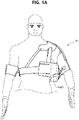
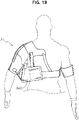
- FIGS. 1A and 1B are perspective views schematically showing a front and a back of a user wearing a non-fixed shoulder brace A1 according to a first embodiment of the present invention.
- a non-fixed shoulder brace A1 is designed to be worn on the upper body of a wearer; particularly, an affected upper limb exercise assistance apparatus A40 is held on a waist of the wearer by a waist support A13 and positioned between the wearer's waist and affected arm.
- an affected upper limb exercise assistance apparatus A40 is held on a waist of the wearer by a waist support A13 and positioned between the wearer's waist and affected arm.
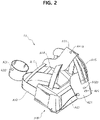
- FIG. 2 is a perspective view schematically showing components of the non-fixed shoulder brace A1 according to the first embodiment of the present invention.
- the non-fixed shoulder brace A1 includes an affected shoulder support A11, a waist support A13, an affected arm mounting part A21, and an affected upper limb exercise assistance apparatus A40.
- the affected shoulder support A11 is supported on an affected shoulder of a wearer and the waist support A13 is coupled to the wearer's waist.
- the affected arm mounting part A21 is coupled together with an arm of an affected upper limb of the wearer with the arm of the affected upper limb inserted therein.
- the affected shoulder support A11 and the affected arm mounting part A21 are connected through an affected shoulder strap A15 and the affected arm mounting part A21 is pulled towards inside the wearer's shoulder, whereby it is possible to prevent dislocation of the wearer's affected shoulder.
- the waist support A13 and the affected shoulder support A11 are connected through a plurality of suspending shoulder strap members A12, so it is possible to reduce a load of the affected arm, which is applied to the affected shoulder support A11, to the waist support A13.
- the affected arm assistant A40 may reduce its load through an apparatus support A14.
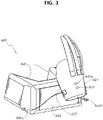
- FIG. 3 is a perspective view schematically showing connection relationships between components of an affected upper limb exercise assistance apparatus A40 and an affected arm mounting part A21 according to the first embodiment of the present invention.
- the affected upper limb exercise assistance apparatus A40 is coupled to the affected arm mounting part through a first cable A42a connected to a front of the affected arm mounting part A21 and a second cable A42b connected to a rear of the affected arm mounting part A21.
- the affected upper limb exercise assistance apparatus A40 may be coupled to both ends of the waist support A13 and held on the wearer's waist.
- a curved groove is formed on a side of the affected upper limb exercise assistance apparatus so that it may be easily fitted to the wearer's waist, and a portion where the curved groove is formed is made by an elastic support A41 so that a shape of the affected upper limb exercise assistance apparatus A40 may be easily deformed to be fitted to a waist shape of the wearer.
- the affected upper limb exercise assistance apparatus A40 includes a first friction reduction pad A43 disposed on a side thereof facing the affected arm mounting part A21.
- the affected arm mounting part A21 also has a second friction reduction pad A23 disposed on a side thereof facing the wearer's waist.
- friction between the affected arm mounting part A21 and the affected upper limb exercise assistance apparatus A40 may be reduced while the wearer's affected arm is moved, so it is possible to reduce resistance that interferes with movement of the affected arm mounting part A21 by the wearer.
- first friction reduction pad A43 and the second friction reduction pad A23 are made of Teflon, whereby friction can be minimized.
- the normal arm mounting part A31 includes a first inertia sensor A32, and a program of a control unit A45 included in the affected upper limb exercise assistance apparatus A40 may extract a walk cycle of the wearer from a signal received from the first inertia sensor A32.
- the non-fixed shoulder brace A1 that is the first embodiment of the present invention may improve mobility of an affected arm through electric stimulation by measuring subluxation degree of the wearer.
- the affected shoulder support A11 may include a tension sensor A11a and the affected arm mounting part A21 may include a second inertia sensor A22a. Signals extracted from the tension sensor A11a and the second inertia sensor A22a may extract information about the walk cycle and the subluxation degree of the wearer from the program of the control unit A45 included in the affected upper limb exercise assistance apparatus A40. This information signal applies an electrical signal to an electric stimulator A22 of the affected arm mounting part A21 worn on an affected upper limb of the wearer, whereby electric stimulation may be applied to muscles of the wearer's affected upper limb.
- FIG. 4 is a cross-sectional view schematically showing an inside of the affected upper limb exercise assistance apparatus A40 according to the first embodiment of the present invention.
- the affected upper limb exercise assistance apparatus A40 includes a motor unit A44 on which the first cable A42a and the second cable A42b are wound, a control unit A45 that may control driving force and rotation direction of the motor unit A44, and a power unit A46 that supplies power to the motor unit A44 and the control unit A45.
- first cable A42a and the second cable A42b may be tensioned toward the motor unit A44 in accordance with the driving force applied to the motor unit A44. That is, when the first cable A42a is wound to be tensioned, the second cable A42b is unwound from the motor unit 44. Further, when the second cable A42b is wound to be tensioned, the first cable A42a is unwound from the motor unit A44.
- one motor unit A44 is driven in two directions and the first cable A42a and the second cable A42b may be separately tensioned, it is possible to simplify a design of the affected upper limb exercise assistance apparatus A40 and as well remarkably reduce space for the entire affected upper limb exercise assistance apparatus A40.
- control unit A45 may control the driving force and rotation direction of the motor unit A44 and may correct the driving force and rotation direction of the motor unit A44 in accordance with the walk cycle of the wearer extracted from a signal from the first inertia sensor A32.
- control unit A45 may also include a program that may control the intensity and cycle of electric stimulation that is applied to the electric stimulator A22 on the basis of the information about the walk cycle and the subluxation degree of the wearer extracted from the tension sensor A11a and the second inertia sensor A22a.
- the power unit A46 that supplies power to the motor unit A44 and the control unit A45 for example, a chargeable battery may be used, and the affected upper limb exercise assistance apparatus A40 may be operated by a battery without being connected to an external power, so portability of the shoulder brace may be considerably improved.
- FIG. 5 is a view schematically showing movement of an affected arm of a user wearing the non-fixed shoulder brace A1 according to the first embodiment of the present invention.
- the first cable A42a and the second cable A42b that are tensioned in opposite directions are connected to the affected arm mounting part A21, so an affected arm of the wearer may be moved forward or backward by moving any one of the cables.
- the affected upper limb exercise assistance apparatus A40 may automatically assist an affected arm to move forward and rearward in accordance with the walk cycle of the wearer, it is possible to prevent pain due to contracture of the affected shoulder joint and elbow joint of the wearer.
- FIGS. 6A and 6B are perspective views schematically showing a front and a back of a user wearing a non-fixed shoulder brace P1 according to a second embodiment of the present invention.
- a non-fixed shoulder brace P1 according to the second embodiment of the present invention is designed to be worn on an upper body of a wearer; particularly, an affected upper limb exercise assistance apparatus P40 is held on the wearer's waist by a waist support P13 and positioned between the wearer's waist and affected arm.
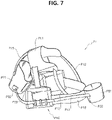
- FIG. 7 is a perspective view schematically showing components of the non-fixed shoulder brace P1 according to the second embodiment of the present invention.
- the non-fixed shoulder brace P1 includes an affected shoulder support P11, a waist support P13, an affected arm mounting part P21, a normal arm mounting part P31, and an affected upper limb exercise assistance apparatus P40.
- the affected shoulder support P11 is supported on an affected shoulder of the wearer, and the waist support P13 is coupled to the wearer's waist.
- the affected arm mounting part P21 and the normal arm mounting part P31 are coupled together with an arm of the affected upper limb and an arm of the normal upper limb with the arms inserted therein, respectively.
- the affected shoulder support P11 and the affected arm mounting part P21 are connected through an affected shoulder strap P15 and the affected arm mounting part P21 is pulled towards inside the wearer's shoulder, whereby it is possible to prevent dislocation of the wearer's affected shoulder.
- the waist support P13 and the affected shoulder support P11 are connected through a plurality of suspending shoulder strap members P12, so it is possible to reduce a load of the affected arm, which is applied to the affected shoulder support P11, to the waist support P13.
- FIG. 8 is a perspective view schematically showing components of an affected upper limb exercise assistance apparatus P40 according to the second embodiment of the present invention.
- the affected upper limb exercise assistance apparatus P40 is coupled to both ends P44 of the waist support P13, so it may be held on the wearer's waist.
- a curved groove is formed on a side of the affected upper limb exercise assistance apparatus so that it may be easily fitted to the wearer's waist, and a portion where the curved groove is formed is made by an elastic support P45 so that a shape of the affected upper limb exercise assistance apparatus may be easily deformed to be fitted to a waist shape of the wearer.
- the affected arm mounting part P21 and the normal arm mounting part P31 are connected to each other at connection portions P22 and P32, respectively, through a belt P41.
- the belt P41 is disposed through a plurality of insertion holes P42 formed on a side of the body of the affected upper limb exercise assistance apparatus P40, whereby it is possible to guide movement of the belt P41 and prevent the belt P41 from sagging down due to its own weight.
- the affected upper limb exercise assistance apparatus P40 includes a first friction reduction pad P43 disposed on a side thereof facing the affected arm mounting part P21.
- the affected arm mounting part P21 also has a second friction reduction pad P23 disposed on a side thereof facing the wearer's waist.
- friction between the affected arm mounting part P21 and the affected upper limb exercise assistance apparatus P40 may be reduced while the wearer's affected arm is moved, so it is possible to reduce resistance that interferes with movement of the affected arm mounting part P21 by the wearer.
- first friction reduction pad P43 and the second friction reduction pad P23 are made of Teflon, whereby friction can be minimized.
- An inner side of the affected upper limb exercise assistance apparatus of the present invention may be made to be fitted to a curve of the wearer's waist, and an upper half of an upper side of the affected upper limb exercise assistance apparatus is narrow and made to have curved groove in comparison to a lower half of the upper side so that the upper side is fitted to a curve of an armpit of the wearer.
- FIG. 9 is a view schematically showing movement of an affected arm and a normal arm of a user wearing the non-fixed shoulder brace P1 according to the second embodiment of the present invention.
- the affected arm may also be moved forward and rearward in response to the movement of the normal arm, so it is possible to prevent pain due to contracture of the affected shoulder joint and the elbow joint of the wearer.
- the non-fixed shoulder brace may prevent subluxation of the affected shoulder joint while reducing contracture and pain by inducing movement of an affected arm through an affected upper limb exercise assistance apparatus.
Landscapes
- Health & Medical Sciences (AREA)
- Life Sciences & Earth Sciences (AREA)
- Veterinary Medicine (AREA)
- Animal Behavior & Ethology (AREA)
- General Health & Medical Sciences (AREA)
- Public Health (AREA)
- Engineering & Computer Science (AREA)
- Biomedical Technology (AREA)
- Heart & Thoracic Surgery (AREA)
- Orthopedic Medicine & Surgery (AREA)
- Vascular Medicine (AREA)
- Nursing (AREA)
- Biophysics (AREA)
- Radiology & Medical Imaging (AREA)
- Nuclear Medicine, Radiotherapy & Molecular Imaging (AREA)
- Physiology (AREA)
- Surgery (AREA)
- Physics & Mathematics (AREA)
- Pathology (AREA)
- Medical Informatics (AREA)
- Molecular Biology (AREA)
- Oral & Maxillofacial Surgery (AREA)
- Dentistry (AREA)
- Physical Education & Sports Medicine (AREA)
- Epidemiology (AREA)
- Pain & Pain Management (AREA)
- Rehabilitation Therapy (AREA)
- Rehabilitation Tools (AREA)
- Orthopedics, Nursing, And Contraception (AREA)
Abstract
Description
- The present invention relates to a non-fixed shoulder brace and, more particularly, to a shoulder brace that may prevent contracture of shoulder joint and elbow joint of an affected shoulder by inducing movement of an affected arm through an affected upper limb exercise assistance apparatus.
- [National R&D Project for Supporting Invention]
- Subject No.: 2016R1A5A1938472
- Name of Department: Ministry of Science and ICT
- R&D Agency: National Research Foundation of Korea
- Project Name: Basic Research Program Advanced Research Center Support Program (ERC) by Ministry of Science and ICT
- Subject Name: Center for SoFT meta-Human
- Contribution Ratio: 1/1
- Management Agency: Seoul National University SNU R&DB Foundation
- Research Period: Dec. 11, 2016 - Dec. 31, 2022
- Recovery of shoulder function after cerebral apoplexy is a precondition for using hands and is important for walking and performing daily activities.
- As shown in
FIG. 10 , 81% of patients with cerebral apoplexy have subluxation of affected shoulder joint due to hemiplegia, and a prevalence of pain in a shoulder joint is 42 to 73%. - In order to prevent this situation, a fixed-type brace as shown in
FIG. 11 is generally clinically used at present for most patients with hemiplegia. - However, although it is important to prevent subluxation of a shoulder joint through a shoulder brace, there is a problem that contracture of the shoulder joint and elbow joint is caused and the contracture not only interferes with recovery of upper limb function but also causes pain in the shoulder joint.
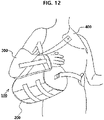
- For example, as shown in
FIG. 12 , ashoulder brace 100 having anarm support 200 adjusts the abduction angle of a shoulder through ashoulder support 400 and anarm protector 300, but it also causes contracture of the shoulder joint and elbow joint, which interferes with recovery of the function of the upper arm and causes pain in the shoulder joint. - Accordingly, it is difficult to achieve both of two contradictory treatment targets of preventing subluxation of a shoulder joint as well as of reducing contracture and pain of the shoulder joint and elbow joint using an existing fixed-type shoulder joint brace, so there is a need for a new type of brace.
- 1.
Korean Patent No. 0883324 - In order to solve the problems of the related art described above, an objective of the present invention is to provide a shoulder brace that allows for movement of an affected arm.
- In an aspect of the present invention, provided is a shoulder brace that can maximize the rehabilitation effect of a wearer and also prevent contracture of joints by measuring movement of a normal arm according to walking of the wearer and inducing a corresponding movement of an affected arm.
- In another aspect of the present invention, provided is a shoulder brace that can maximize the rehabilitation effect of a wearer and prevent contracture of joints by maintaining a pivot motion of a normal arm while preventing subluxation of an affected arm joint.
- According to an aspect, in order to achieve the objectives, in exemplary embodiments of the present invention, a non-fixed shoulder brace of the present invention includes: an affected shoulder support which is supported on an affected shoulder of a wearer; a waist support coupled to the wearer's waist; an affected arm mounting part in which an arm of an affected upper limb of the wearer is inserted and that is supported by an affected shoulder strap member from the affected shoulder support; and an affected upper limb exercise assistance apparatus coupled to both ends of the waist support and disposed between the wearer's waist and the affected arm mounting part, in which the affected upper limb exercise assistance apparatus assists movement of the affected arm mounting part.
- In an embodiment, the affected upper limb exercise assistance apparatus of the present invention may include: a first cable connected to a front of the affected arm mounting part; a second cable connected to a rear of the affected arm mounting part; a motor unit having the first cable and the second cable wound thereon and tensioning the first cable and the second cable; a control unit controlling driving force and rotation direction of the motor unit; and a power unit supplying power to the motor unit and the control unit.
- In an embodiment, the affected upper limb exercise assistance apparatus may be manufactured to have a type of moving an affected arm of a wearer by pulling a cable using an electric motor and a type of using pneumatic artificial muscles.
- In an embodiment, the non-fixed shoulder brace of the present invention may further include a normal arm mounting part in which an arm of the wearer's normal upper limb is inserted, in which the normal arm mounting part may include a first inertia sensor, and the control unit may extract a walk cycle of a wearer from a signal received from the first inertia sensor and may correct the driving force and the rotation direction of the motor unit in accordance with the walk cycle.
- In an embodiment, the affected arm mounting part of the present invention may include: a tension sensor and a second inertia sensor that measure a degree of subluxation of an affected upper limb; and an electric stimulator that applies electrical stimulation to muscles of the affected upper limb in accordance with the walk cycle of the wearer and the degree of subluxation of the affected arm.
- In an embodiment, the waist support and the affected shoulder support of the present invention may be connected through a plurality of suspending shoulder strap members.
- In an embodiment, the affected upper limb exercise assistance apparatus of the present invention may include an elastic support disposed to face the waist of the wearer.
- In an embodiment, the affected upper limb exercise assistance apparatus of the present invention may include a first friction reduction pad disposed to face the affected arm mounting part, and the affected arm mounting part may include a second friction reduction pad disposed to face the waist of the wearer.
- In an embodiment, the first and second friction reduction pads may be made of Teflon.
- According to another aspect, in order to achieve the objectives, in exemplary embodiments of the present invention, a non-fixed shoulder brace of the present invention includes: an affected shoulder support which is supported on an affected shoulder of a wearer; a waist support coupled to the waist of the wearer; an affected arm mounting part in which an arm of an affected upper limb of the wearer is inserted and that is supported by an affected shoulder strap member from the affected shoulder support; a normal arm mounting part in which an arm of a normal upper limb of the wearer is inserted; and an affected upper limb exercise assistance apparatus coupled to both ends of the waist support and disposed between the waist of the wearer and the affected arm mounting part.
- In an embodiment, the affected upper limb exercise assistance apparatus may include a belt connecting the affected arm mounting part and the normal arm mounting part and a plurality of belt insertion holes through which the belt is inserted.
- In an embodiment, the waist support and the affected shoulder support of the present invention may be connected through a plurality of suspending shoulder strap members.
- In an embodiment, the affected upper limb exercise assistance apparatus of the present invention may include an elastic support disposed to face the waist of the wearer.
- In an embodiment, the affected upper limb exercise assistance apparatus of the present invention may include a first friction reduction pad disposed to face the affected arm mounting part, and the affected arm mounting part may include a second friction reduction pad disposed to face the waist of the wearer.
- In an embodiment, an inner side of the affected upper limb exercise assistance apparatus of the present invention may be formed to be fitted to the curve of the waist of the wearer, and the upper half of the upper side thereof may be narrow and curved in comparison to the lower half to be fitted to the curve of the armpit of the wearer.
- In an embodiment, the outer side of the affected upper limb exercise assistance apparatus of the present invention may be made of a hard material for inducing movement of the affected arm of the wearer when the wearer walks.
- In an embodiment, the first and second friction reduction pads may be made of Teflon.
- In an embodiment, the affected upper limb exercise assistance apparatus may assist a wearer to move forward the normal arm mounting part by pivoting forward the normal arm and may assist the affected arm mounting part to pivot rearward the affected arm of the wearer in response to movement of the normal arm mounting part.
- According to the present invention, it is possible to prevent subluxation of the affected shoulder joint while reducing contracture and pain by inducing movement of the affected arm from movement of a normal arm.
-
-
FIGS. 1A and1B are perspective views schematically showing a front and a back of a user wearing a non-fixed shoulder brace according to a first embodiment of the present invention. -
FIG. 2 is a perspective view schematically showing components of the non-fixed shoulder brace according to the first embodiment of the present invention. -
FIG. 3 is a perspective view schematically showing connection relationships between components of an affected upper limb exercise assistance apparatus and an affected arm mounting part according to the first embodiment of the present invention. -
FIG. 4 is a cross-sectional view schematically showing an inside of the affected upper limb exercise assistance apparatus according to the first embodiment of the present invention. -
FIG. 5 is a view schematically showing movement of an affected arm of a user wearing the non-fixed shoulder brace according to the first embodiment of the present invention. -
FIGS. 6A and6B are perspective views schematically showing a front and a back of a user wearing a non-fixed shoulder brace according to a second embodiment of the present invention. -
FIG. 7 is a perspective view schematically showing components of the non-fixed shoulder brace according to the second embodiment of the present invention. -
FIG. 8 is a perspective view schematically showing components of an affected upper limb exercise assistance apparatus according to the second embodiment of the present invention. -
FIG. 9 is a view schematically showing movement of an affected arm and a normal arm of a user wearing the non-fixed shoulder brace according to the second embodiment of the present invention. -
FIG. 10 is a picture and a view showing subluxation of a shoulder joint after cerebral apoplexy. -
FIG. 11 is a picture showing a fixed-type shoulder brace for preventing subluxation of a shoulder joint. -
FIG. 12 is a view schematically showing a conventional fixed-type shoulder brace according to Patent Literature 1. -
- A1: non-fixed shoulder brace A11: affected shoulder support
- A11a: tension sensor A12: suspending shoulder strap member
- A13: waist support A14: apparatus support
- A15: affected shoulder strap
- A21: affected arm mounting part A22a: second inertia sensor
- A22: electric stimulator A23: second friction reduction pad
- A32: first inertia sensor A40: affected arm assistant
- A41: elastic support A42a: first cable
- A42b: second cable A43: first friction reduction pad
- A44: motor unit A45: control unit
- A46: power unit
-
- P1: non-fixed shoulder brace P11: affected shoulder support
- P12: suspending shoulder strap member P13: waist support
- P15: affected shoulder strap
- P21: affected arm mounting part
- P22: affected arm mounting part connection portion
- P23: second friction reduction pad P31: normal arm mounting part
- P32: normal arm mounting part connection portion
- P40: affected upper limb exercise assistance apparatus
- P41: belt P42: belt insertion hole
- P43: first friction reduction pad P45: elastic support
- Hereafter, a non-fixed shoulder brace according to an embodiment of the present invention is described through preferred embodiments of the present invention with reference to the accompanying drawings.
- In various embodiments, components having the same configuration are given the same reference numerals and are representatively described in an embodiment, and only different components are described in other embodiments.
-
FIGS. 1A and1B are perspective views schematically showing a front and a back of a user wearing a non-fixed shoulder brace A1 according to a first embodiment of the present invention. - As shown in
FIGS. 1A and1B , a non-fixed shoulder brace A1 according to a first embodiment of the present invention is designed to be worn on the upper body of a wearer; particularly, an affected upper limb exercise assistance apparatus A40 is held on a waist of the wearer by a waist support A13 and positioned between the wearer's waist and affected arm. Here the detailed components of the affected upper limb exercise assistance apparatus A40 will be described below. -
FIG. 2 is a perspective view schematically showing components of the non-fixed shoulder brace A1 according to the first embodiment of the present invention. - As shown in
FIG. 2 , the non-fixed shoulder brace A1 according to the first embodiment of the present invention includes an affected shoulder support A11, a waist support A13, an affected arm mounting part A21, and an affected upper limb exercise assistance apparatus A40. - In detail, the affected shoulder support A11 is supported on an affected shoulder of a wearer and the waist support A13 is coupled to the wearer's waist.
- The affected arm mounting part A21 is coupled together with an arm of an affected upper limb of the wearer with the arm of the affected upper limb inserted therein.
- In particular, the affected shoulder support A11 and the affected arm mounting part A21 are connected through an affected shoulder strap A15 and the affected arm mounting part A21 is pulled towards inside the wearer's shoulder, whereby it is possible to prevent dislocation of the wearer's affected shoulder.
- The waist support A13 and the affected shoulder support A11 are connected through a plurality of suspending shoulder strap members A12, so it is possible to reduce a load of the affected arm, which is applied to the affected shoulder support A11, to the waist support A13.
- The affected arm assistant A40 may reduce its load through an apparatus support A14.
-
FIG. 3 is a perspective view schematically showing connection relationships between components of an affected upper limb exercise assistance apparatus A40 and an affected arm mounting part A21 according to the first embodiment of the present invention. - As shown in
FIG. 3 , the affected upper limb exercise assistance apparatus A40 is coupled to the affected arm mounting part through a first cable A42a connected to a front of the affected arm mounting part A21 and a second cable A42b connected to a rear of the affected arm mounting part A21. - The affected upper limb exercise assistance apparatus A40 may be coupled to both ends of the waist support A13 and held on the wearer's waist.
- In detail, a curved groove is formed on a side of the affected upper limb exercise assistance apparatus so that it may be easily fitted to the wearer's waist, and a portion where the curved groove is formed is made by an elastic support A41 so that a shape of the affected upper limb exercise assistance apparatus A40 may be easily deformed to be fitted to a waist shape of the wearer.
- As shown in
FIGS. 2 and3 , the affected upper limb exercise assistance apparatus A40 includes a first friction reduction pad A43 disposed on a side thereof facing the affected arm mounting part A21. The affected arm mounting part A21 also has a second friction reduction pad A23 disposed on a side thereof facing the wearer's waist. - Accordingly, friction between the affected arm mounting part A21 and the affected upper limb exercise assistance apparatus A40 may be reduced while the wearer's affected arm is moved, so it is possible to reduce resistance that interferes with movement of the affected arm mounting part A21 by the wearer.
- In particular, the first friction reduction pad A43 and the second friction reduction pad A23 are made of Teflon, whereby friction can be minimized.
- The normal arm mounting part A31 includes a first inertia sensor A32, and a program of a control unit A45 included in the affected upper limb exercise assistance apparatus A40 may extract a walk cycle of the wearer from a signal received from the first inertia sensor A32.
- As shown in
FIGS. 2 and3 , the non-fixed shoulder brace A1 that is the first embodiment of the present invention may improve mobility of an affected arm through electric stimulation by measuring subluxation degree of the wearer. - In detail, the affected shoulder support A11 may include a tension sensor A11a and the affected arm mounting part A21 may include a second inertia sensor A22a. Signals extracted from the tension sensor A11a and the second inertia sensor A22a may extract information about the walk cycle and the subluxation degree of the wearer from the program of the control unit A45 included in the affected upper limb exercise assistance apparatus A40. This information signal applies an electrical signal to an electric stimulator A22 of the affected arm mounting part A21 worn on an affected upper limb of the wearer, whereby electric stimulation may be applied to muscles of the wearer's affected upper limb.
-
FIG. 4 is a cross-sectional view schematically showing an inside of the affected upper limb exercise assistance apparatus A40 according to the first embodiment of the present invention. - As shown in
FIG. 4 , the affected upper limb exercise assistance apparatus A40 includes a motor unit A44 on which the first cable A42a and the second cable A42b are wound, a control unit A45 that may control driving force and rotation direction of the motor unit A44, and a power unit A46 that supplies power to the motor unit A44 and the control unit A45. - In particular, the first cable A42a and the second cable A42b may be tensioned toward the motor unit A44 in accordance with the driving force applied to the motor unit A44. That is, when the first cable A42a is wound to be tensioned, the second cable A42b is unwound from the motor unit 44. Further, when the second cable A42b is wound to be tensioned, the first cable A42a is unwound from the motor unit A44.
- Accordingly, since one motor unit A44 is driven in two directions and the first cable A42a and the second cable A42b may be separately tensioned, it is possible to simplify a design of the affected upper limb exercise assistance apparatus A40 and as well remarkably reduce space for the entire affected upper limb exercise assistance apparatus A40.
- Further, the control unit A45 may control the driving force and rotation direction of the motor unit A44 and may correct the driving force and rotation direction of the motor unit A44 in accordance with the walk cycle of the wearer extracted from a signal from the first inertia sensor A32.
- Further, the control unit A45 may also include a program that may control the intensity and cycle of electric stimulation that is applied to the electric stimulator A22 on the basis of the information about the walk cycle and the subluxation degree of the wearer extracted from the tension sensor A11a and the second inertia sensor A22a.
- As for the power unit A46 that supplies power to the motor unit A44 and the control unit A45, for example, a chargeable battery may be used, and the affected upper limb exercise assistance apparatus A40 may be operated by a battery without being connected to an external power, so portability of the shoulder brace may be considerably improved.
-
FIG. 5 is a view schematically showing movement of an affected arm of a user wearing the non-fixed shoulder brace A1 according to the first embodiment of the present invention. - As described above, the first cable A42a and the second cable A42b that are tensioned in opposite directions are connected to the affected arm mounting part A21, so an affected arm of the wearer may be moved forward or backward by moving any one of the cables.
- In detail, as shown in (a) of
FIG. 5 , when the timing at which the wearer moves rearward an affected arm in accordance with the walk cycle is reached, the motor unit A44 is driven in response thereto so that the second cable A42b tensions the affected arm mounting part A21, whereby the affected arm is moved rearward. - Further, as shown in (b) of
FIG. 5 , when the timing at which the wearer moves forward an affected arm in accordance with the walk cycle is reached, the motor unit A44 is driven in response thereto so that the first cable A42a tensions the affected arm mounting part A21, whereby the affected arm is moved forward. - Accordingly, since the affected upper limb exercise assistance apparatus A40 may automatically assist an affected arm to move forward and rearward in accordance with the walk cycle of the wearer, it is possible to prevent pain due to contracture of the affected shoulder joint and elbow joint of the wearer.
-
FIGS. 6A and6B are perspective views schematically showing a front and a back of a user wearing a non-fixed shoulder brace P1 according to a second embodiment of the present invention. - As shown in
FIGS. 6A and6B , a non-fixed shoulder brace P1 according to the second embodiment of the present invention is designed to be worn on an upper body of a wearer; particularly, an affected upper limb exercise assistance apparatus P40 is held on the wearer's waist by a waist support P13 and positioned between the wearer's waist and affected arm. - The detailed components of the affected upper limb exercise assistance apparatus P40 will be described below.
-
FIG. 7 is a perspective view schematically showing components of the non-fixed shoulder brace P1 according to the second embodiment of the present invention. - As shown in
FIG. 7 , the non-fixed shoulder brace P1 according to the second embodiment of the present invention includes an affected shoulder support P11, a waist support P13, an affected arm mounting part P21, a normal arm mounting part P31, and an affected upper limb exercise assistance apparatus P40. - In detail, the affected shoulder support P11 is supported on an affected shoulder of the wearer, and the waist support P13 is coupled to the wearer's waist.
- The affected arm mounting part P21 and the normal arm mounting part P31 are coupled together with an arm of the affected upper limb and an arm of the normal upper limb with the arms inserted therein, respectively.
- In particular, the affected shoulder support P11 and the affected arm mounting part P21 are connected through an affected shoulder strap P15 and the affected arm mounting part P21 is pulled towards inside the wearer's shoulder, whereby it is possible to prevent dislocation of the wearer's affected shoulder.
- Further, the waist support P13 and the affected shoulder support P11 are connected through a plurality of suspending shoulder strap members P12, so it is possible to reduce a load of the affected arm, which is applied to the affected shoulder support P11, to the waist support P13.
-
FIG. 8 is a perspective view schematically showing components of an affected upper limb exercise assistance apparatus P40 according to the second embodiment of the present invention. - As shown in
FIGS. 7 and8 , the affected upper limb exercise assistance apparatus P40 is coupled to both ends P44 of the waist support P13, so it may be held on the wearer's waist. - In detail, a curved groove is formed on a side of the affected upper limb exercise assistance apparatus so that it may be easily fitted to the wearer's waist, and a portion where the curved groove is formed is made by an elastic support P45 so that a shape of the affected upper limb exercise assistance apparatus may be easily deformed to be fitted to a waist shape of the wearer.
- Further, as shown in
FIG. 7 , the affected arm mounting part P21 and the normal arm mounting part P31 are connected to each other at connection portions P22 and P32, respectively, through a belt P41. The belt P41 is disposed through a plurality of insertion holes P42 formed on a side of the body of the affected upper limb exercise assistance apparatus P40, whereby it is possible to guide movement of the belt P41 and prevent the belt P41 from sagging down due to its own weight. - Meanwhile, the affected upper limb exercise assistance apparatus P40 includes a first friction reduction pad P43 disposed on a side thereof facing the affected arm mounting part P21. The affected arm mounting part P21 also has a second friction reduction pad P23 disposed on a side thereof facing the wearer's waist.
- Accordingly, friction between the affected arm mounting part P21 and the affected upper limb exercise assistance apparatus P40 may be reduced while the wearer's affected arm is moved, so it is possible to reduce resistance that interferes with movement of the affected arm mounting part P21 by the wearer.
- In particular, the first friction reduction pad P43 and the second friction reduction pad P23 are made of Teflon, whereby friction can be minimized.
- An inner side of the affected upper limb exercise assistance apparatus of the present invention may be made to be fitted to a curve of the wearer's waist, and an upper half of an upper side of the affected upper limb exercise assistance apparatus is narrow and made to have curved groove in comparison to a lower half of the upper side so that the upper side is fitted to a curve of an armpit of the wearer.
-
FIG. 9 is a view schematically showing movement of an affected arm and a normal arm of a user wearing the non-fixed shoulder brace P1 according to the second embodiment of the present invention. - As described above, since the affected arm mounting part P21 and the normal arm mounting part P31 are connected to each other through the belt P41, movement of any one arm may assist movement of the other arm.
- In detail, as shown in (a) of
FIG. 9 , when a wearer pivots forward a normal arm, the normal arm mounting part P31 is correspondingly moved forward. Since the affected arm mounting part P21 is connected to the normal arm mounting part P31 through the belt P41, the affected arm of the wearer is pivoted rearward in response to the movement of the normal arm mounting part P31. - Further, as shown in (b) of
FIG. 9 , when a wearer pivots forward an affected arm, the affected arm mounting part P21 is correspondingly moved forward. Since the normal arm mounting part P31 is connected to the affected arm mounting part P21 through the belt P41, the normal arm of the wearer is pivoted rearward in response to the movement of the affected arm mounting part P21. - Therefore, when the normal arm is moved forward and rearward in accordance with the wearer's walk, the affected arm may also be moved forward and rearward in response to the movement of the normal arm, so it is possible to prevent pain due to contracture of the affected shoulder joint and the elbow joint of the wearer.
- Those skilled in the art may understand, with reference to be above description, that the present invention may be achieved in other embodied ways without a change of the spirit or the necessary features of the present invention.
- Therefore, it should be understood that the embodiments described above are not limitative but only exemplary in all respects, the scope of the present invention is expressed by claims described below, not the detailed description, and it should be construed that all changes and modifications achieved from the meanings, the scope and equivalent concepts of the claims are included in the scope of the present invention.
- The non-fixed shoulder brace according to exemplary embodiments of the present invention may prevent subluxation of the affected shoulder joint while reducing contracture and pain by inducing movement of an affected arm through an affected upper limb exercise assistance apparatus.
Claims (18)
- A non-fixed shoulder brace comprising:an affected shoulder support which is supported on an affected shoulder of a wearer;a waist support coupled to the wearer's waist;an affected arm mounting part in which an arm of an affected upper limb of the wearer is inserted and that is supported by an affected shoulder strap member from the affected shoulder support; andan affected upper limb exercise assistance apparatus coupled to both ends of the waist support and disposed between the wearer's waist and the affected arm mounting part,wherein the affected upper limb exercise assistance apparatus assists movement of the affected arm mounting part.
- The non-fixed shoulder brace of claim 1, wherein the affected upper limb exercise assistance apparatus comprises:a first cable connected to a front of the affected arm mounting part;a second cable connected to a rear of the affected arm mounting part;a motor unit having the first cable and the second cable wound thereon and tensioning the first cable and the second cable;a control unit controlling a driving force and a rotation direction of the motor unit; anda power unit supplying power to the motor unit and the control unit.
- The non-fixed shoulder brace of claim 2, further comprisinga normal arm mounting part in which an arm of the wearer's normal upper limb is inserted,wherein the normal arm mounting part includes a first inertia sensor, andthe control unit extracts a walk cycle of the wearer from a signal received from the first inertia sensor and corrects the driving force and the rotation direction of the motor unit in accordance with the walk cycle.
- The non-fixed shoulder brace of claim 3, wherein the affected arm mounting part comprises:a tension sensor and a second inertia sensor that measure a subluxation degree of the affected upper limb; andan electric stimulator that applies electrical stimulation to muscles of the affected upper limb according to the walk cycle of the wearer and the subluxation degree of the affected arm.
- The non-fixed shoulder brace of claim 1, wherein the affected upper limb exercise assistance apparatus uses pneumatic artificial muscles.
- The non-fixed shoulder brace of claim 2, wherein the waist support and the affected shoulder support are connected through a plurality of suspending shoulder strap members.
- The non-fixed shoulder brace of claim 2, wherein the affected upper limb exercise assistance apparatus comprises an elastic support disposed to face the wearer's waist.
- The non-fixed shoulder brace of claim 2, wherein the affected upper limb exercise assistance apparatus comprises a first friction reduction pad disposed to face the affected arm mounting part, and
the affected arm mounting part comprises a second friction reduction pad disposed to face the wearer's waist. - The non-fixed shoulder brace of claim 8, wherein the first and second friction reduction pads are made of Teflon.
- A non-fixed shoulder brace comprising:an affected shoulder support which is supported on an affected shoulder of a wearer;a waist support coupled to the wearer's waist;an affected arm mounting part in which an arm of an affected upper limb of the wearer is inserted and that is supported by an affected shoulder strap member from the affected shoulder support;a normal arm mounting part in which an arm of a normal upper limb of the wearer is inserted; andan affected upper limb exercise assistance apparatus coupled to both ends of the waist support and disposed between the wearer's waist and the affected arm mounting part.
- The non-fixed shoulder brace of claim 10, wherein the affected upper limb exercise assistance apparatus comprises a belt connecting the affected arm mounting part and the normal arm mounting part and a plurality of belt insertion holes through which the belt is inserted.
- The non-fixed shoulder brace of claim 10, wherein the waist support and the affected shoulder support are connected through a plurality of suspending shoulder strap members.
- The non-fixed shoulder brace of claim 10, wherein the affected upper limb exercise assistance apparatus comprises an elastic support disposed to face the wearer's waist.
- The non-fixed shoulder brace of claim 10, wherein the affected upper limb exercise assistance apparatus includes a first friction reduction pad disposed to face the affected arm mounting part, and
the affected arm mounting part comprises a second friction reduction pad disposed to face the wearer's waist. - The non-fixed shoulder brace of claim 10, wherein an inner side of the affected upper limb exercise assistance apparatus is made to be fitted to a curve of the wearer's waist, and
an upper half of an upper side thereof is narrow and made to have curved groove in comparison to a lower half of the upper side so that the upper side is fitted to a curve of an armpit of the wearer. - The non-fixed shoulder brace of claim 10, wherein an outer side of the affected upper limb exercise assistance apparatus is made of a material for inducing movement of an affected arm of the wearer when the wearer walks.
- The non-fixed shoulder brace of claim 14, wherein the first and second friction reduction pads are made of Teflon.
- The non-fixed shoulder brace of claim 11, wherein, when the wearer moves forward the normal arm mounting part by pivoting forward the normal arm, the affected upper limb exercise assistance apparatus assists the affected arm mounting part to pivot rearward the affected arm of the wearer in response to movement of the normal arm mounting part.
Applications Claiming Priority (3)
| Application Number | Priority Date | Filing Date | Title |
|---|---|---|---|
| KR1020190077651A KR102222966B1 (en) | 2019-06-28 | 2019-06-28 | Non-fixed manual shoulder orthosis for stroke patients |
| KR1020190078149A KR102222967B1 (en) | 2019-06-28 | 2019-06-28 | Non-fixed shoulder orthosis |
| PCT/KR2020/008395 WO2020263033A1 (en) | 2019-06-28 | 2020-06-26 | Non-fixed shoulder brace |
Publications (3)
| Publication Number | Publication Date |
|---|---|
| EP3991709A1 true EP3991709A1 (en) | 2022-05-04 |
| EP3991709A4 EP3991709A4 (en) | 2023-07-05 |
| EP3991709B1 EP3991709B1 (en) | 2025-11-26 |
Family
ID=74060303
Family Applications (1)
| Application Number | Title | Priority Date | Filing Date |
|---|---|---|---|
| EP20831108.4A Active EP3991709B1 (en) | 2019-06-28 | 2020-06-26 | Non-fixed shoulder brace |
Country Status (3)
| Country | Link |
|---|---|
| US (1) | US12350186B2 (en) |
| EP (1) | EP3991709B1 (en) |
| WO (1) | WO2020263033A1 (en) |
Family Cites Families (22)
| Publication number | Priority date | Publication date | Assignee | Title |
|---|---|---|---|---|
| US3892230A (en) | 1974-09-18 | 1975-07-01 | Fredrick A Baker | Orthopedic device for loosening stiffened shoulder joint |
| US4198964A (en) * | 1979-01-11 | 1980-04-22 | Zimmer Usa, Inc. | Acromioclavicular brace |
| US4441707A (en) * | 1981-07-15 | 1984-04-10 | Bosch Jack L | Isometric exerciser belt for joggers and the like |
| US5188587A (en) * | 1991-06-07 | 1993-02-23 | Mcguire Robert R | Active shoulder brace |
| US5203763A (en) | 1992-02-04 | 1993-04-20 | Lajiness O Neill Renee | Dynamic sling |
| US5590420A (en) * | 1994-03-24 | 1997-01-07 | Gunn; Robert T. | Low friction apparel |
| JP2002177310A (en) * | 2000-12-12 | 2002-06-25 | Daiya Industry Co | Shoulder supporter |
| JP4178186B2 (en) * | 2003-08-21 | 2008-11-12 | 国立大学法人 筑波大学 | Wearable motion assist device, control method for wearable motion assist device, and control program |
| US8460225B2 (en) * | 2008-03-04 | 2013-06-11 | Christopher Michael Wickstrom | Weight shifting apparatus for an orthopedic sling |
| KR100883324B1 (en) | 2008-12-02 | 2009-02-11 | 문성대 | Shoulder Abduction Orthosis |
| US8016780B1 (en) | 2009-01-02 | 2011-09-13 | George Sickles | Orthopedic brace |
| GB2467974B (en) | 2009-02-24 | 2011-01-05 | Spinecorporation Ltd | Spinal Orthosis |
| JP5323772B2 (en) | 2010-07-02 | 2013-10-23 | パナソニック株式会社 | Electrical stimulator |
| US8591441B2 (en) | 2010-10-22 | 2013-11-26 | Peter M. Bonutti | Shoulder orthosis including flexion/extension device |
| KR200465621Y1 (en) | 2012-08-30 | 2013-03-06 | 송회덕 | Airplanesplint for hemiplegic patients |
| EP3395506B2 (en) | 2012-12-11 | 2023-04-26 | Levitate Technologies, Inc. | Adaptive arm support systems and methods for use |
| JP2014128464A (en) | 2012-12-28 | 2014-07-10 | Tokyo Institute Of Technology | Walking support device and walking support method |
| KR101570396B1 (en) * | 2014-04-17 | 2015-11-19 | 서울대학교산학협력단 | Assisting device for eating |
| SE541542C2 (en) * | 2016-10-05 | 2019-10-29 | Bioservo Tech Aktiebolag | Armlifting support device |
| US10772782B2 (en) * | 2016-10-28 | 2020-09-15 | Spectrum Health Innovations, LLC | Dynamic tensioning orthosis and related method of use |
| KR101861041B1 (en) * | 2017-05-18 | 2018-05-24 | 동의대학교 산학협력단 | A shirt for correction having both of upper body exercise function |
| KR102207991B1 (en) * | 2018-04-26 | 2021-01-26 | 주식회사 엔젤로보틱스 | Flexible Sheet Type Muscular Strength Assisting Suit |
-
2020
- 2020-06-26 WO PCT/KR2020/008395 patent/WO2020263033A1/en not_active Ceased
- 2020-06-26 US US17/622,925 patent/US12350186B2/en active Active
- 2020-06-26 EP EP20831108.4A patent/EP3991709B1/en active Active
Also Published As
| Publication number | Publication date |
|---|---|
| WO2020263033A1 (en) | 2020-12-30 |
| US12350186B2 (en) | 2025-07-08 |
| US20220387208A1 (en) | 2022-12-08 |
| EP3991709B1 (en) | 2025-11-26 |
| EP3991709A4 (en) | 2023-07-05 |
Similar Documents
| Publication | Publication Date | Title |
|---|---|---|
| US20210039248A1 (en) | Soft exosuit for assistance with human motion | |
| US10427293B2 (en) | Soft exosuit for assistance with human motion | |
| US7048704B2 (en) | Orthotic device | |
| CN111070187A (en) | Active-passive combined transient center flexible rope driven lower limb exoskeleton robot and control method | |
| CN111920643A (en) | A wearable waist rehabilitation exoskeleton robot | |
| KR20230034614A (en) | Flexible wearable robot | |
| CN114714325A (en) | Upper limb assistance exoskeleton and exoskeleton device capable of assisting in carrying | |
| WO2016129716A1 (en) | Upper-limb exercising device of a type worn on the body | |
| WO2021116721A1 (en) | Motion assistance device | |
| CN114099256A (en) | Wearable flexible lower limb assistance exoskeleton | |
| CN116476033A (en) | Modularized knee joint power-assisted exoskeleton device based on bowden wire transmission | |
| CN216940673U (en) | Active lower limb exoskeleton | |
| US12350186B2 (en) | Non-fixed shoulder brace | |
| KR101970533B1 (en) | Robot suit for pose correction using method for correcting posture | |
| CN115177907B (en) | A training device for neurosurgery rehabilitation | |
| WO2016021940A1 (en) | Joint movement assistance device to which flexible material is applied, and control method therefor | |
| KR20250015074A (en) | Wearable apparatus and operating method therefor | |
| KR102222967B1 (en) | Non-fixed shoulder orthosis | |
| CN212261837U (en) | A lower limb exoskeleton robot for rehabilitation | |
| CN116616922B (en) | Power-assisted exoskeleton | |
| CN205698422U (en) | A kind of joint motions supplementary structure | |
| KR20240019448A (en) | Motion assist apparatus | |
| WO2026089200A1 (en) | Motion assist apparatus | |
| KR20250176216A (en) | Electric muscle stimulation for walking training for patients with hemiplegia | |
| WO2025121623A1 (en) | Exercise assistance device |
Legal Events
| Date | Code | Title | Description |
|---|---|---|---|
| STAA | Information on the status of an ep patent application or granted ep patent |
Free format text: STATUS: THE INTERNATIONAL PUBLICATION HAS BEEN MADE |
|
| PUAI | Public reference made under article 153(3) epc to a published international application that has entered the european phase |
Free format text: ORIGINAL CODE: 0009012 |
|
| STAA | Information on the status of an ep patent application or granted ep patent |
Free format text: STATUS: REQUEST FOR EXAMINATION WAS MADE |
|
| 17P | Request for examination filed |
Effective date: 20220126 |
|
| AK | Designated contracting states |
Kind code of ref document: A1 Designated state(s): AL AT BE BG CH CY CZ DE DK EE ES FI FR GB GR HR HU IE IS IT LI LT LU LV MC MK MT NL NO PL PT RO RS SE SI SK SM TR |
|
| DAV | Request for validation of the european patent (deleted) | ||
| DAX | Request for extension of the european patent (deleted) | ||
| A4 | Supplementary search report drawn up and despatched |
Effective date: 20230606 |
|
| RIC1 | Information provided on ipc code assigned before grant |
Ipc: A61F 5/048 20060101ALI20230531BHEP Ipc: A61B 5/00 20060101ALI20230531BHEP Ipc: A61F 5/37 20060101ALI20230531BHEP Ipc: A61N 1/04 20060101ALI20230531BHEP Ipc: A61N 1/36 20060101ALI20230531BHEP Ipc: A61B 5/11 20060101ALI20230531BHEP Ipc: A61F 5/042 20060101ALI20230531BHEP Ipc: A61F 5/01 20060101ALI20230531BHEP Ipc: A61H 1/02 20060101AFI20230531BHEP |
|
| STAA | Information on the status of an ep patent application or granted ep patent |
Free format text: STATUS: EXAMINATION IS IN PROGRESS |
|
| 17Q | First examination report despatched |
Effective date: 20240104 |
|
| GRAP | Despatch of communication of intention to grant a patent |
Free format text: ORIGINAL CODE: EPIDOSNIGR1 |
|
| STAA | Information on the status of an ep patent application or granted ep patent |
Free format text: STATUS: GRANT OF PATENT IS INTENDED |
|
| INTG | Intention to grant announced |
Effective date: 20250617 |
|
| GRAS | Grant fee paid |
Free format text: ORIGINAL CODE: EPIDOSNIGR3 |
|
| GRAA | (expected) grant |
Free format text: ORIGINAL CODE: 0009210 |
|
| STAA | Information on the status of an ep patent application or granted ep patent |
Free format text: STATUS: THE PATENT HAS BEEN GRANTED |
|
| RAP3 | Party data changed (applicant data changed or rights of an application transferred) |
Owner name: SEOUL NATIONAL UNIVERSITY R&DB FOUNDATION Owner name: SEOUL NATIONAL UNIVERSITY HOSPITAL |
|
| AK | Designated contracting states |
Kind code of ref document: B1 Designated state(s): AL AT BE BG CH CY CZ DE DK EE ES FI FR GB GR HR HU IE IS IT LI LT LU LV MC MK MT NL NO PL PT RO RS SE SI SK SM TR |
|
| REG | Reference to a national code |
Ref country code: CH Ref legal event code: F10 Free format text: ST27 STATUS EVENT CODE: U-0-0-F10-F00 (AS PROVIDED BY THE NATIONAL OFFICE) Effective date: 20251126 Ref country code: GB Ref legal event code: FG4D |
|
| REG | Reference to a national code |
Ref country code: IE Ref legal event code: FG4D |
|
| REG | Reference to a national code |
Ref country code: DE Ref legal event code: R096 Ref document number: 602020062887 Country of ref document: DE |
|
| P01 | Opt-out of the competence of the unified patent court (upc) registered |
Free format text: CASE NUMBER: UPC_APP_0019576_3991709/2025 Effective date: 20251229 |
|
| REG | Reference to a national code |
Ref country code: NL Ref legal event code: MP Effective date: 20251126 |
|
| PG25 | Lapsed in a contracting state [announced via postgrant information from national office to epo] |
Ref country code: ES Free format text: LAPSE BECAUSE OF FAILURE TO SUBMIT A TRANSLATION OF THE DESCRIPTION OR TO PAY THE FEE WITHIN THE PRESCRIBED TIME-LIMIT Effective date: 20251126 |
|
| REG | Reference to a national code |
Ref country code: LT Ref legal event code: MG9D |
|
| PG25 | Lapsed in a contracting state [announced via postgrant information from national office to epo] |
Ref country code: NO Free format text: LAPSE BECAUSE OF FAILURE TO SUBMIT A TRANSLATION OF THE DESCRIPTION OR TO PAY THE FEE WITHIN THE PRESCRIBED TIME-LIMIT Effective date: 20260226 |
|
| PG25 | Lapsed in a contracting state [announced via postgrant information from national office to epo] |
Ref country code: HR Free format text: LAPSE BECAUSE OF FAILURE TO SUBMIT A TRANSLATION OF THE DESCRIPTION OR TO PAY THE FEE WITHIN THE PRESCRIBED TIME-LIMIT Effective date: 20251126 Ref country code: FI Free format text: LAPSE BECAUSE OF FAILURE TO SUBMIT A TRANSLATION OF THE DESCRIPTION OR TO PAY THE FEE WITHIN THE PRESCRIBED TIME-LIMIT Effective date: 20251126 Ref country code: AT Free format text: LAPSE BECAUSE OF FAILURE TO SUBMIT A TRANSLATION OF THE DESCRIPTION OR TO PAY THE FEE WITHIN THE PRESCRIBED TIME-LIMIT Effective date: 20251126 |
|
| REG | Reference to a national code |
Ref country code: AT Ref legal event code: MK05 Ref document number: 1860365 Country of ref document: AT Kind code of ref document: T Effective date: 20251126 |
|
| PG25 | Lapsed in a contracting state [announced via postgrant information from national office to epo] |
Ref country code: NL Free format text: LAPSE BECAUSE OF FAILURE TO SUBMIT A TRANSLATION OF THE DESCRIPTION OR TO PAY THE FEE WITHIN THE PRESCRIBED TIME-LIMIT Effective date: 20251126 |
|
| PG25 | Lapsed in a contracting state [announced via postgrant information from national office to epo] |
Ref country code: RS Free format text: LAPSE BECAUSE OF FAILURE TO SUBMIT A TRANSLATION OF THE DESCRIPTION OR TO PAY THE FEE WITHIN THE PRESCRIBED TIME-LIMIT Effective date: 20260226 |
|
| PG25 | Lapsed in a contracting state [announced via postgrant information from national office to epo] |
Ref country code: IS Free format text: LAPSE BECAUSE OF FAILURE TO SUBMIT A TRANSLATION OF THE DESCRIPTION OR TO PAY THE FEE WITHIN THE PRESCRIBED TIME-LIMIT Effective date: 20260326 |
|
| PG25 | Lapsed in a contracting state [announced via postgrant information from national office to epo] |
Ref country code: PT Free format text: LAPSE BECAUSE OF FAILURE TO SUBMIT A TRANSLATION OF THE DESCRIPTION OR TO PAY THE FEE WITHIN THE PRESCRIBED TIME-LIMIT Effective date: 20260326 |
|
| PG25 | Lapsed in a contracting state [announced via postgrant information from national office to epo] |
Ref country code: PL Free format text: LAPSE BECAUSE OF FAILURE TO SUBMIT A TRANSLATION OF THE DESCRIPTION OR TO PAY THE FEE WITHIN THE PRESCRIBED TIME-LIMIT Effective date: 20251126 |
|
| PG25 | Lapsed in a contracting state [announced via postgrant information from national office to epo] |
Ref country code: LV Free format text: LAPSE BECAUSE OF FAILURE TO SUBMIT A TRANSLATION OF THE DESCRIPTION OR TO PAY THE FEE WITHIN THE PRESCRIBED TIME-LIMIT Effective date: 20251126 |
|
| PG25 | Lapsed in a contracting state [announced via postgrant information from national office to epo] |
Ref country code: BG Free format text: LAPSE BECAUSE OF FAILURE TO SUBMIT A TRANSLATION OF THE DESCRIPTION OR TO PAY THE FEE WITHIN THE PRESCRIBED TIME-LIMIT Effective date: 20251126 |