EP3973871A1 - Elektrochemischer biosensor mit kohlenstoffnanoröhre zur messung von biosignalen und verfahren zu seiner herstellung - Google Patents
Elektrochemischer biosensor mit kohlenstoffnanoröhre zur messung von biosignalen und verfahren zu seiner herstellung Download PDFInfo
- Publication number
- EP3973871A1 EP3973871A1 EP20809303.9A EP20809303A EP3973871A1 EP 3973871 A1 EP3973871 A1 EP 3973871A1 EP 20809303 A EP20809303 A EP 20809303A EP 3973871 A1 EP3973871 A1 EP 3973871A1
- Authority
- EP
- European Patent Office
- Prior art keywords
- carbon nanotube
- electrode
- electrochemical biosensor
- sensing membrane
- blood sugar
- Prior art date
- Legal status (The legal status is an assumption and is not a legal conclusion. Google has not performed a legal analysis and makes no representation as to the accuracy of the status listed.)
- Pending
Links
- OKTJSMMVPCPJKN-UHFFFAOYSA-N Carbon Chemical compound [C] OKTJSMMVPCPJKN-UHFFFAOYSA-N 0.000 title claims abstract description 125
- 239000002041 carbon nanotube Substances 0.000 title claims abstract description 117
- 229910021393 carbon nanotube Inorganic materials 0.000 title claims abstract description 117
- 238000000034 method Methods 0.000 title abstract description 40
- 238000004519 manufacturing process Methods 0.000 title 1
- 108090000854 Oxidoreductases Proteins 0.000 claims abstract description 42
- 102000004316 Oxidoreductases Human genes 0.000 claims abstract description 42
- 230000027756 respiratory electron transport chain Effects 0.000 claims abstract description 37
- 239000008280 blood Substances 0.000 claims description 58
- 210000004369 blood Anatomy 0.000 claims description 58
- 238000005259 measurement Methods 0.000 claims description 37
- 239000012528 membrane Substances 0.000 claims description 24
- 239000000463 material Substances 0.000 claims description 23
- 238000004132 cross linking Methods 0.000 claims description 20
- -1 Poly(vinylpyridine) Polymers 0.000 claims description 19
- 229920000642 polymer Polymers 0.000 claims description 11
- 229910052723 transition metal Inorganic materials 0.000 claims description 9
- 150000003624 transition metals Chemical class 0.000 claims description 9
- 239000000203 mixture Substances 0.000 claims description 7
- 239000000758 substrate Substances 0.000 claims description 7
- JUJWROOIHBZHMG-UHFFFAOYSA-N Pyridine Chemical compound C1=CC=NC=C1 JUJWROOIHBZHMG-UHFFFAOYSA-N 0.000 claims description 6
- 239000003446 ligand Substances 0.000 claims description 6
- 229920000447 polyanionic polymer Polymers 0.000 claims description 6
- 238000009792 diffusion process Methods 0.000 claims description 5
- VWWQXMAJTJZDQX-UYBVJOGSSA-N flavin adenine dinucleotide Chemical compound C1=NC2=C(N)N=CN=C2N1[C@@H]([C@H](O)[C@@H]1O)O[C@@H]1CO[P@](O)(=O)O[P@@](O)(=O)OC[C@@H](O)[C@@H](O)[C@@H](O)CN1C2=NC(=O)NC(=O)C2=NC2=C1C=C(C)C(C)=C2 VWWQXMAJTJZDQX-UYBVJOGSSA-N 0.000 claims description 5
- 235000019162 flavin adenine dinucleotide Nutrition 0.000 claims description 5
- 239000011714 flavin adenine dinucleotide Substances 0.000 claims description 5
- 229940093632 flavin-adenine dinucleotide Drugs 0.000 claims description 5
- 101710088194 Dehydrogenase Proteins 0.000 claims description 4
- 108090000371 Esterases Proteins 0.000 claims description 4
- 239000002048 multi walled nanotube Substances 0.000 claims description 4
- 229920002006 poly(N-vinylimidazole) polymer Polymers 0.000 claims description 4
- 239000002109 single walled nanotube Substances 0.000 claims description 4
- BAWFJGJZGIEFAR-NNYOXOHSSA-N NAD zwitterion Chemical compound NC(=O)C1=CC=C[N+]([C@H]2[C@@H]([C@H](O)[C@@H](COP([O-])(=O)OP(O)(=O)OC[C@@H]3[C@H]([C@@H](O)[C@@H](O3)N3C4=NC=NC(N)=C4N=C3)O)O2)O)=C1 BAWFJGJZGIEFAR-NNYOXOHSSA-N 0.000 claims description 3
- 239000012212 insulator Substances 0.000 claims description 3
- UMJSCPRVCHMLSP-UHFFFAOYSA-N pyridine Natural products COC1=CC=CN=C1 UMJSCPRVCHMLSP-UHFFFAOYSA-N 0.000 claims description 3
- STMDPCBYJCIZOD-UHFFFAOYSA-N 2-(2,4-dinitroanilino)-4-methylpentanoic acid Chemical compound CC(C)CC(C(O)=O)NC1=CC=C([N+]([O-])=O)C=C1[N+]([O-])=O STMDPCBYJCIZOD-UHFFFAOYSA-N 0.000 claims description 2
- 229910052741 iridium Inorganic materials 0.000 claims description 2
- 229910052742 iron Inorganic materials 0.000 claims description 2
- 229940101270 nicotinamide adenine dinucleotide (nad) Drugs 0.000 claims description 2
- MMXZSJMASHPLLR-UHFFFAOYSA-N pyrroloquinoline quinone Chemical compound C12=C(C(O)=O)C=C(C(O)=O)N=C2C(=O)C(=O)C2=C1NC(C(=O)O)=C2 MMXZSJMASHPLLR-UHFFFAOYSA-N 0.000 claims description 2
- 229910052707 ruthenium Inorganic materials 0.000 claims description 2
- RAXXELZNTBOGNW-UHFFFAOYSA-N imidazole Natural products C1=CNC=N1 RAXXELZNTBOGNW-UHFFFAOYSA-N 0.000 claims 3
- 150000004696 coordination complex Chemical class 0.000 claims 1
- 150000002391 heterocyclic compounds Chemical class 0.000 claims 1
- 239000008103 glucose Substances 0.000 abstract description 51
- WQZGKKKJIJFFOK-GASJEMHNSA-N Glucose Natural products OC[C@H]1OC(O)[C@H](O)[C@@H](O)[C@@H]1O WQZGKKKJIJFFOK-GASJEMHNSA-N 0.000 abstract description 50
- 239000013076 target substance Substances 0.000 abstract description 8
- 230000003647 oxidation Effects 0.000 abstract description 6
- 238000007254 oxidation reaction Methods 0.000 abstract description 6
- 238000012544 monitoring process Methods 0.000 abstract description 4
- 230000008569 process Effects 0.000 abstract description 2
- 239000004971 Cross linker Substances 0.000 abstract 1
- 238000002484 cyclic voltammetry Methods 0.000 description 19
- 239000000243 solution Substances 0.000 description 19
- 238000000970 chrono-amperometry Methods 0.000 description 15
- 230000004044 response Effects 0.000 description 15
- 108010050375 Glucose 1-Dehydrogenase Proteins 0.000 description 13
- 230000008859 change Effects 0.000 description 13
- 102000004190 Enzymes Human genes 0.000 description 12
- 108090000790 Enzymes Proteins 0.000 description 12
- 229910021607 Silver chloride Inorganic materials 0.000 description 12
- 229940088598 enzyme Drugs 0.000 description 12
- BASFCYQUMIYNBI-UHFFFAOYSA-N platinum Chemical compound [Pt] BASFCYQUMIYNBI-UHFFFAOYSA-N 0.000 description 12
- HKZLPVFGJNLROG-UHFFFAOYSA-M silver monochloride Chemical compound [Cl-].[Ag+] HKZLPVFGJNLROG-UHFFFAOYSA-M 0.000 description 12
- 239000003792 electrolyte Substances 0.000 description 11
- 239000006185 dispersion Substances 0.000 description 10
- 229910052799 carbon Inorganic materials 0.000 description 9
- 230000000694 effects Effects 0.000 description 9
- 239000002504 physiological saline solution Substances 0.000 description 8
- 239000011259 mixed solution Substances 0.000 description 7
- ROFVEXUMMXZLPA-UHFFFAOYSA-N Bipyridyl Chemical compound N1=CC=CC=C1C1=CC=CC=N1 ROFVEXUMMXZLPA-UHFFFAOYSA-N 0.000 description 6
- 230000001590 oxidative effect Effects 0.000 description 6
- 239000008363 phosphate buffer Substances 0.000 description 6
- 239000004094 surface-active agent Substances 0.000 description 6
- 239000002562 thickening agent Substances 0.000 description 6
- XLYOFNOQVPJJNP-UHFFFAOYSA-N water Substances O XLYOFNOQVPJJNP-UHFFFAOYSA-N 0.000 description 6
- 230000035945 sensitivity Effects 0.000 description 5
- 230000006641 stabilisation Effects 0.000 description 5
- 238000011105 stabilization Methods 0.000 description 5
- 238000001132 ultrasonic dispersion Methods 0.000 description 5
- AOBIOSPNXBMOAT-UHFFFAOYSA-N 2-[2-(oxiran-2-ylmethoxy)ethoxymethyl]oxirane Chemical compound C1OC1COCCOCC1CO1 AOBIOSPNXBMOAT-UHFFFAOYSA-N 0.000 description 4
- MHAJPDPJQMAIIY-UHFFFAOYSA-N Hydrogen peroxide Chemical compound OO MHAJPDPJQMAIIY-UHFFFAOYSA-N 0.000 description 4
- 229920000557 Nafion® Polymers 0.000 description 4
- 239000002202 Polyethylene glycol Substances 0.000 description 4
- BQCADISMDOOEFD-UHFFFAOYSA-N Silver Chemical compound [Ag] BQCADISMDOOEFD-UHFFFAOYSA-N 0.000 description 4
- 238000006243 chemical reaction Methods 0.000 description 4
- 206010012601 diabetes mellitus Diseases 0.000 description 4
- 239000012153 distilled water Substances 0.000 description 4
- 238000002848 electrochemical method Methods 0.000 description 4
- 238000002474 experimental method Methods 0.000 description 4
- 229920001223 polyethylene glycol Polymers 0.000 description 4
- 229920002635 polyurethane Polymers 0.000 description 4
- 239000004814 polyurethane Substances 0.000 description 4
- 229910052709 silver Inorganic materials 0.000 description 4
- 239000004332 silver Substances 0.000 description 4
- 239000002904 solvent Substances 0.000 description 4
- 102000007698 Alcohol dehydrogenase Human genes 0.000 description 3
- 108010021809 Alcohol dehydrogenase Proteins 0.000 description 3
- 108010025188 Alcohol oxidase Proteins 0.000 description 3
- CIWBSHSKHKDKBQ-JLAZNSOCSA-N Ascorbic acid Chemical compound OC[C@H](O)[C@H]1OC(=O)C(O)=C1O CIWBSHSKHKDKBQ-JLAZNSOCSA-N 0.000 description 3
- 102100035687 Bile salt-activated lipase Human genes 0.000 description 3
- 108010015428 Bilirubin oxidase Proteins 0.000 description 3
- 108010089254 Cholesterol oxidase Proteins 0.000 description 3
- 108010015776 Glucose oxidase Proteins 0.000 description 3
- 102000016901 Glutamate dehydrogenase Human genes 0.000 description 3
- 238000010521 absorption reaction Methods 0.000 description 3
- 239000003153 chemical reaction reagent Substances 0.000 description 3
- 238000001548 drop coating Methods 0.000 description 3
- 229910052697 platinum Inorganic materials 0.000 description 3
- 238000002360 preparation method Methods 0.000 description 3
- 238000003756 stirring Methods 0.000 description 3
- 238000003860 storage Methods 0.000 description 3
- 238000012360 testing method Methods 0.000 description 3
- 208000001072 type 2 diabetes mellitus Diseases 0.000 description 3
- LJCNDNBULVLKSG-UHFFFAOYSA-N 2-aminoacetic acid;butane Chemical compound CCCC.CCCC.NCC(O)=O LJCNDNBULVLKSG-UHFFFAOYSA-N 0.000 description 2
- 101000950981 Bacillus subtilis (strain 168) Catabolic NAD-specific glutamate dehydrogenase RocG Proteins 0.000 description 2
- 229920002491 Diethylaminoethyl-dextran Polymers 0.000 description 2
- 239000004366 Glucose oxidase Substances 0.000 description 2
- UFHFLCQGNIYNRP-UHFFFAOYSA-N Hydrogen Chemical compound [H][H] UFHFLCQGNIYNRP-UHFFFAOYSA-N 0.000 description 2
- 108010055297 Sterol Esterase Proteins 0.000 description 2
- 206010067584 Type 1 diabetes mellitus Diseases 0.000 description 2
- 239000003125 aqueous solvent Substances 0.000 description 2
- 235000010323 ascorbic acid Nutrition 0.000 description 2
- 229960005070 ascorbic acid Drugs 0.000 description 2
- 239000011668 ascorbic acid Substances 0.000 description 2
- 230000008901 benefit Effects 0.000 description 2
- 230000000740 bleeding effect Effects 0.000 description 2
- HVYWMOMLDIMFJA-DPAQBDIFSA-N cholesterol Chemical compound C1C=C2C[C@@H](O)CC[C@]2(C)[C@@H]2[C@@H]1[C@@H]1CC[C@H]([C@H](C)CCCC(C)C)[C@@]1(C)CC2 HVYWMOMLDIMFJA-DPAQBDIFSA-N 0.000 description 2
- 239000011248 coating agent Substances 0.000 description 2
- 238000000576 coating method Methods 0.000 description 2
- 229920001577 copolymer Polymers 0.000 description 2
- 229940116332 glucose oxidase Drugs 0.000 description 2
- 235000019420 glucose oxidase Nutrition 0.000 description 2
- PCHJSUWPFVWCPO-UHFFFAOYSA-N gold Chemical compound [Au] PCHJSUWPFVWCPO-UHFFFAOYSA-N 0.000 description 2
- 229910052737 gold Inorganic materials 0.000 description 2
- 239000010931 gold Substances 0.000 description 2
- 229910052739 hydrogen Inorganic materials 0.000 description 2
- 239000001257 hydrogen Substances 0.000 description 2
- NOESYZHRGYRDHS-UHFFFAOYSA-N insulin Chemical compound N1C(=O)C(NC(=O)C(CCC(N)=O)NC(=O)C(CCC(O)=O)NC(=O)C(C(C)C)NC(=O)C(NC(=O)CN)C(C)CC)CSSCC(C(NC(CO)C(=O)NC(CC(C)C)C(=O)NC(CC=2C=CC(O)=CC=2)C(=O)NC(CCC(N)=O)C(=O)NC(CC(C)C)C(=O)NC(CCC(O)=O)C(=O)NC(CC(N)=O)C(=O)NC(CC=2C=CC(O)=CC=2)C(=O)NC(CSSCC(NC(=O)C(C(C)C)NC(=O)C(CC(C)C)NC(=O)C(CC=2C=CC(O)=CC=2)NC(=O)C(CC(C)C)NC(=O)C(C)NC(=O)C(CCC(O)=O)NC(=O)C(C(C)C)NC(=O)C(CC(C)C)NC(=O)C(CC=2NC=NC=2)NC(=O)C(CO)NC(=O)CNC2=O)C(=O)NCC(=O)NC(CCC(O)=O)C(=O)NC(CCCNC(N)=N)C(=O)NCC(=O)NC(CC=3C=CC=CC=3)C(=O)NC(CC=3C=CC=CC=3)C(=O)NC(CC=3C=CC(O)=CC=3)C(=O)NC(C(C)O)C(=O)N3C(CCC3)C(=O)NC(CCCCN)C(=O)NC(C)C(O)=O)C(=O)NC(CC(N)=O)C(O)=O)=O)NC(=O)C(C(C)CC)NC(=O)C(CO)NC(=O)C(C(C)O)NC(=O)C1CSSCC2NC(=O)C(CC(C)C)NC(=O)C(NC(=O)C(CCC(N)=O)NC(=O)C(CC(N)=O)NC(=O)C(NC(=O)C(N)CC=1C=CC=CC=1)C(C)C)CC1=CN=CN1 NOESYZHRGYRDHS-UHFFFAOYSA-N 0.000 description 2
- 230000003914 insulin secretion Effects 0.000 description 2
- 229910052751 metal Inorganic materials 0.000 description 2
- 239000002184 metal Substances 0.000 description 2
- 239000002736 nonionic surfactant Substances 0.000 description 2
- 229920002113 octoxynol Polymers 0.000 description 2
- 239000003960 organic solvent Substances 0.000 description 2
- 229920001467 poly(styrenesulfonates) Polymers 0.000 description 2
- 239000004417 polycarbonate Substances 0.000 description 2
- 229920000139 polyethylene terephthalate Polymers 0.000 description 2
- 239000005020 polyethylene terephthalate Substances 0.000 description 2
- 229960002796 polystyrene sulfonate Drugs 0.000 description 2
- 239000011970 polystyrene sulfonate Substances 0.000 description 2
- 230000009467 reduction Effects 0.000 description 2
- 229920002379 silicone rubber Polymers 0.000 description 2
- 239000004945 silicone rubber Substances 0.000 description 2
- 238000012546 transfer Methods 0.000 description 2
- YFSUTJLHUFNCNZ-UHFFFAOYSA-M 1,1,2,2,3,3,4,4,5,5,6,6,7,7,8,8,8-heptadecafluorooctane-1-sulfonate Chemical compound [O-]S(=O)(=O)C(F)(F)C(F)(F)C(F)(F)C(F)(F)C(F)(F)C(F)(F)C(F)(F)C(F)(F)F YFSUTJLHUFNCNZ-UHFFFAOYSA-M 0.000 description 1
- CNJLMVZFWLNOEP-UHFFFAOYSA-N 4,7,7-trimethylbicyclo[4.1.0]heptan-5-one Chemical compound O=C1C(C)CCC2C(C)(C)C12 CNJLMVZFWLNOEP-UHFFFAOYSA-N 0.000 description 1
- 229930024421 Adenine Natural products 0.000 description 1
- GFFGJBXGBJISGV-UHFFFAOYSA-N Adenine Chemical compound NC1=NC=NC2=C1N=CN2 GFFGJBXGBJISGV-UHFFFAOYSA-N 0.000 description 1
- 208000035143 Bacterial infection Diseases 0.000 description 1
- 206010010356 Congenital anomaly Diseases 0.000 description 1
- 108700023156 Glutamate dehydrogenases Proteins 0.000 description 1
- 238000004566 IR spectroscopy Methods 0.000 description 1
- 102000004877 Insulin Human genes 0.000 description 1
- 108090001061 Insulin Proteins 0.000 description 1
- 206010022489 Insulin Resistance Diseases 0.000 description 1
- JVTAAEKCZFNVCJ-UHFFFAOYSA-M Lactate Chemical compound CC(O)C([O-])=O JVTAAEKCZFNVCJ-UHFFFAOYSA-M 0.000 description 1
- 108010073450 Lactate 2-monooxygenase Proteins 0.000 description 1
- 101710138959 NAD-specific glutamate dehydrogenase Proteins 0.000 description 1
- 239000004642 Polyimide Substances 0.000 description 1
- 208000001647 Renal Insufficiency Diseases 0.000 description 1
- 208000017442 Retinal disease Diseases 0.000 description 1
- 206010038923 Retinopathy Diseases 0.000 description 1
- AUNGANRZJHBGPY-SCRDCRAPSA-N Riboflavin Chemical compound OC[C@@H](O)[C@@H](O)[C@@H](O)CN1C=2C=C(C)C(C)=CC=2N=C2C1=NC(=O)NC2=O AUNGANRZJHBGPY-SCRDCRAPSA-N 0.000 description 1
- DBMJMQXJHONAFJ-UHFFFAOYSA-M Sodium laurylsulphate Chemical compound [Na+].CCCCCCCCCCCCOS([O-])(=O)=O DBMJMQXJHONAFJ-UHFFFAOYSA-M 0.000 description 1
- 208000006011 Stroke Diseases 0.000 description 1
- 239000013504 Triton X-100 Substances 0.000 description 1
- 229920004890 Triton X-100 Polymers 0.000 description 1
- 230000002159 abnormal effect Effects 0.000 description 1
- 239000000654 additive Substances 0.000 description 1
- 229960000643 adenine Drugs 0.000 description 1
- 239000000853 adhesive Substances 0.000 description 1
- 230000001070 adhesive effect Effects 0.000 description 1
- 230000032683 aging Effects 0.000 description 1
- 238000011166 aliquoting Methods 0.000 description 1
- 125000000129 anionic group Chemical group 0.000 description 1
- 229920006318 anionic polymer Polymers 0.000 description 1
- 208000022362 bacterial infectious disease Diseases 0.000 description 1
- 230000015572 biosynthetic process Effects 0.000 description 1
- 239000007853 buffer solution Substances 0.000 description 1
- 150000001721 carbon Chemical group 0.000 description 1
- 229910021387 carbon allotrope Inorganic materials 0.000 description 1
- 150000007942 carboxylates Chemical group 0.000 description 1
- 230000001413 cellular effect Effects 0.000 description 1
- 229920002301 cellulose acetate Polymers 0.000 description 1
- 238000005229 chemical vapour deposition Methods 0.000 description 1
- 235000012000 cholesterol Nutrition 0.000 description 1
- 230000000052 comparative effect Effects 0.000 description 1
- 238000012790 confirmation Methods 0.000 description 1
- 230000007547 defect Effects 0.000 description 1
- 238000000151 deposition Methods 0.000 description 1
- 230000008021 deposition Effects 0.000 description 1
- 238000001514 detection method Methods 0.000 description 1
- 235000014113 dietary fatty acids Nutrition 0.000 description 1
- 201000010099 disease Diseases 0.000 description 1
- 208000037265 diseases, disorders, signs and symptoms Diseases 0.000 description 1
- 239000002270 dispersing agent Substances 0.000 description 1
- 238000001035 drying Methods 0.000 description 1
- 235000006694 eating habits Nutrition 0.000 description 1
- 238000005868 electrolysis reaction Methods 0.000 description 1
- 230000001747 exhibiting effect Effects 0.000 description 1
- 229930195729 fatty acid Natural products 0.000 description 1
- 239000000194 fatty acid Substances 0.000 description 1
- 150000004665 fatty acids Chemical class 0.000 description 1
- 125000002791 glucosyl group Chemical group C1([C@H](O)[C@@H](O)[C@H](O)[C@H](O1)CO)* 0.000 description 1
- 229940088597 hormone Drugs 0.000 description 1
- 239000005556 hormone Substances 0.000 description 1
- 150000002460 imidazoles Chemical class 0.000 description 1
- 125000002883 imidazolyl group Chemical group 0.000 description 1
- 229940125396 insulin Drugs 0.000 description 1
- 230000002452 interceptive effect Effects 0.000 description 1
- 201000006370 kidney failure Diseases 0.000 description 1
- 230000007774 longterm Effects 0.000 description 1
- 230000007246 mechanism Effects 0.000 description 1
- 208000010125 myocardial infarction Diseases 0.000 description 1
- 229950006238 nadide Drugs 0.000 description 1
- 239000002071 nanotube Substances 0.000 description 1
- 210000000496 pancreas Anatomy 0.000 description 1
- 229920000058 polyacrylate Polymers 0.000 description 1
- 229920000515 polycarbonate Polymers 0.000 description 1
- 229920001721 polyimide Polymers 0.000 description 1
- 102000004169 proteins and genes Human genes 0.000 description 1
- 108090000623 proteins and genes Proteins 0.000 description 1
- 238000000197 pyrolysis Methods 0.000 description 1
- 230000035484 reaction time Effects 0.000 description 1
- 238000006479 redox reaction Methods 0.000 description 1
- 238000012827 research and development Methods 0.000 description 1
- 229920006395 saturated elastomer Polymers 0.000 description 1
- RYYKJJJTJZKILX-UHFFFAOYSA-M sodium octadecanoate Chemical compound [Na+].CCCCCCCCCCCCCCCCCC([O-])=O RYYKJJJTJZKILX-UHFFFAOYSA-M 0.000 description 1
- 238000001179 sorption measurement Methods 0.000 description 1
- 241000894007 species Species 0.000 description 1
- 239000003381 stabilizer Substances 0.000 description 1
- 230000000087 stabilizing effect Effects 0.000 description 1
- 238000005728 strengthening Methods 0.000 description 1
- 125000000472 sulfonyl group Chemical group *S(*)(=O)=O 0.000 description 1
- 238000003786 synthesis reaction Methods 0.000 description 1
- 238000010189 synthetic method Methods 0.000 description 1
- 150000003866 tertiary ammonium salts Chemical class 0.000 description 1
- 230000032258 transport Effects 0.000 description 1
- 238000007740 vapor deposition Methods 0.000 description 1
Images






Classifications
-
- A—HUMAN NECESSITIES
- A61—MEDICAL OR VETERINARY SCIENCE; HYGIENE
- A61B—DIAGNOSIS; SURGERY; IDENTIFICATION
- A61B5/00—Measuring for diagnostic purposes; Identification of persons
- A61B5/145—Measuring characteristics of blood in vivo, e.g. gas concentration or pH-value ; Measuring characteristics of body fluids or tissues, e.g. interstitial fluid or cerebral tissue
- A61B5/1468—Measuring characteristics of blood in vivo, e.g. gas concentration or pH-value ; Measuring characteristics of body fluids or tissues, e.g. interstitial fluid or cerebral tissue using chemical or electrochemical methods, e.g. by polarographic means
-
- A—HUMAN NECESSITIES
- A61—MEDICAL OR VETERINARY SCIENCE; HYGIENE
- A61B—DIAGNOSIS; SURGERY; IDENTIFICATION
- A61B5/00—Measuring for diagnostic purposes; Identification of persons
- A61B5/145—Measuring characteristics of blood in vivo, e.g. gas concentration or pH-value ; Measuring characteristics of body fluids or tissues, e.g. interstitial fluid or cerebral tissue
- A61B5/1468—Measuring characteristics of blood in vivo, e.g. gas concentration or pH-value ; Measuring characteristics of body fluids or tissues, e.g. interstitial fluid or cerebral tissue using chemical or electrochemical methods, e.g. by polarographic means
- A61B5/1486—Measuring characteristics of blood in vivo, e.g. gas concentration or pH-value ; Measuring characteristics of body fluids or tissues, e.g. interstitial fluid or cerebral tissue using chemical or electrochemical methods, e.g. by polarographic means using enzyme electrodes, e.g. with immobilised oxidase
-
- A—HUMAN NECESSITIES
- A61—MEDICAL OR VETERINARY SCIENCE; HYGIENE
- A61B—DIAGNOSIS; SURGERY; IDENTIFICATION
- A61B5/00—Measuring for diagnostic purposes; Identification of persons
- A61B5/145—Measuring characteristics of blood in vivo, e.g. gas concentration or pH-value ; Measuring characteristics of body fluids or tissues, e.g. interstitial fluid or cerebral tissue
- A61B5/14532—Measuring characteristics of blood in vivo, e.g. gas concentration or pH-value ; Measuring characteristics of body fluids or tissues, e.g. interstitial fluid or cerebral tissue for measuring glucose, e.g. by tissue impedance measurement
-
- G—PHYSICS
- G01—MEASURING; TESTING
- G01N—INVESTIGATING OR ANALYSING MATERIALS BY DETERMINING THEIR CHEMICAL OR PHYSICAL PROPERTIES
- G01N27/00—Investigating or analysing materials by the use of electric, electrochemical, or magnetic means
- G01N27/26—Investigating or analysing materials by the use of electric, electrochemical, or magnetic means by investigating electrochemical variables; by using electrolysis or electrophoresis
- G01N27/28—Electrolytic cell components
- G01N27/30—Electrodes, e.g. test electrodes; Half-cells
- G01N27/327—Biochemical electrodes, e.g. electrical or mechanical details for in vitro measurements
- G01N27/3271—Amperometric enzyme electrodes for analytes in body fluids, e.g. glucose in blood
- G01N27/3272—Test elements therefor, i.e. disposable laminated substrates with electrodes, reagent and channels
-
- G—PHYSICS
- G01—MEASURING; TESTING
- G01N—INVESTIGATING OR ANALYSING MATERIALS BY DETERMINING THEIR CHEMICAL OR PHYSICAL PROPERTIES
- G01N27/00—Investigating or analysing materials by the use of electric, electrochemical, or magnetic means
- G01N27/26—Investigating or analysing materials by the use of electric, electrochemical, or magnetic means by investigating electrochemical variables; by using electrolysis or electrophoresis
- G01N27/28—Electrolytic cell components
- G01N27/40—Semi-permeable membranes or partitions
-
- A—HUMAN NECESSITIES
- A61—MEDICAL OR VETERINARY SCIENCE; HYGIENE
- A61B—DIAGNOSIS; SURGERY; IDENTIFICATION
- A61B2562/00—Details of sensors; Constructional details of sensor housings or probes; Accessories for sensors
- A61B2562/02—Details of sensors specially adapted for in-vivo measurements
- A61B2562/0285—Nanoscale sensors
-
- A—HUMAN NECESSITIES
- A61—MEDICAL OR VETERINARY SCIENCE; HYGIENE
- A61B—DIAGNOSIS; SURGERY; IDENTIFICATION
- A61B2562/00—Details of sensors; Constructional details of sensor housings or probes; Accessories for sensors
- A61B2562/12—Manufacturing methods specially adapted for producing sensors for in-vivo measurements
- A61B2562/125—Manufacturing methods specially adapted for producing sensors for in-vivo measurements characterised by the manufacture of electrodes
-
- A—HUMAN NECESSITIES
- A61—MEDICAL OR VETERINARY SCIENCE; HYGIENE
- A61B—DIAGNOSIS; SURGERY; IDENTIFICATION
- A61B2562/00—Details of sensors; Constructional details of sensor housings or probes; Accessories for sensors
- A61B2562/16—Details of sensor housings or probes; Details of structural supports for sensors
-
- A—HUMAN NECESSITIES
- A61—MEDICAL OR VETERINARY SCIENCE; HYGIENE
- A61B—DIAGNOSIS; SURGERY; IDENTIFICATION
- A61B5/00—Measuring for diagnostic purposes; Identification of persons
- A61B5/15—Devices for taking samples of blood
- A61B5/155—Devices specially adapted for continuous or multiple sampling, e.g. at predetermined intervals
Definitions
- the present invention relates to a biosignal measuring electrochemical biosensor in which a carbon nanotube is introduced and thereby, the absorption, stability and electron transfer rate are increased and the reaction time is reduced and the linearity of response is improved, a method for preparing thereof.
- Diabetes is a very serious disease that affects 1 in 19 people worldwide, and it shows a trend that is further increasing with aging and changing eating habits.
- This diabetes is classified into type 1 diabetes in which blood sugar cannot be controlled because the pancreas does not secret insulin, and type 2 diabetes in which blood sugar cannot be controlled due to cellular insulin resistance despite insulin secretion, and when insulin secretion is abnormal in case of severe type 2 diabetes, it is classified as type 1.5.
- type 1 diabetes in which blood sugar cannot be controlled because the pancreas does not secret insulin
- type 2 diabetes in which blood sugar cannot be controlled due to cellular insulin resistance despite insulin secretion
- insulin secretion is abnormal in case of severe type 2 diabetes, it is classified as type 1.5.
- the risk of various complications e.g.: myocardial infarction, stroke, retinopathy, renal failure, etc.
- a technology that helps patients to measure and manage the blood sugar by themselves is very much needed.
- SMBG self monitoring blood glucose
- the most commonly used electrochemical measurement method is a method using an enzyme capable of oxidizing glucose.
- This electrochemical method is used in the commonly used SMBG technology.
- Research and development for technology to measure sugar concentration by the SMBG method are also being conducted worldwide to increase the accuracy of measurement and reduce errors.
- continuous glucose monitoring sensor technology that can continuously monitor blood sugar trends has also been actively researched and several products have been released.
- Dexcom Abbott and Medtronic are representative companies that developed and released continuous blood sugar measuring devices, and G5, Libre, and Guardian have been released and sold, respectively. All of these products are based on electrochemical principles. However, even with same electrochemical sensor, there is a big difference in performance and stability depending on the type of enzyme, electron transport mediator and electrode used in the sensor.
- a method for measuring the sugar concentration by oxidizing hydrogen peroxide and a method using an electron transfer mediator chemically bound to a polymer are known.
- a blood sugar sensor using an electrochemical principle usually comprises enzyme capable of oxidizing glucose and may comprise hydrogen peroxide or various kinds of electron transfer mediators to transfer electrons of the enzyme.
- the enzyme and electron transfer mediator consisting of the sensor must be stable under storage conditions or measurement conditions, and the response time must be short by responding quickly to changes in blood sugar.
- the electron transfer rate of the electron transfer mediator is very slow and low sensitivity is shown in many cases.
- biosignal measuring electrochemical sensor such as an electrochemical sensor for continuous blood sugar measurement, comprising an electron transfer mediator having a transition metal complex and a polymer
- an electron transfer mediator having a transition metal complex and a polymer there has been an increasing demand for a biosignal measuring electrochemical sensor which exhibits an excellently increased electron transfer rate and has high sensitivity.
- a problem to be solved by the present invention is to provide an electrochemical sensor for continuous blood sugar measurement having high sensitivity while exhibiting an excellently increased electron transfer rate as described above and a method for preparing the same.
- the present invention relates to a sensing membrane used in a biosignal measuring electrochemical sensor comprising a carbon nanotube and a biosignal measuring electrochemical sensor comprising the same.
- the biosignal measuring electrochemical sensor is an electrochemical sensor for continuous blood sugar measurement.
- the sensing membrane of the biosignal measuring electrochemical sensor and sensor according to one example of the present invention may comprise an enzyme, an electron transfer mediator and a carbon nanotube, and may further comprise an electrode and polyanionic polymer.
- a coating for mechanically and chemically strengthening and stabilizing these components may be comprised.
- the biosignal measuring electrochemical sensor comprising a carbon nanotube according to the present invention has a high reaction rate and accuracy by remarkably increasing the adsorption force, stability and electron transfer rate, so that electrons are easily transferred. Accordingly, there is an advantage in that it is possible to provide a sensor capable of quickly and accurately measuring a change in a biosignal such as blood sugar compared to a conventional electrochemical biosignal sensor.
- biosignal measuring means quantitatively analyzing a specific material in a biosample, for example, a material in a biosample or living body such as blood sugar, cholesterol, protein, hormone and the like in blood.
- the biosignal measuring may be blood sugar measurement.
- one example of the biosignal measuring electrochemical biosensor of the present invention may be an electrochemical biosensor for blood sugar measurement, and preferably, an electrochemical biosensor for continuous blood sugar measurement may be exemplified.
- the sensing membrane according to the present invention means a membrane which senses the biosignal in this biosignal measuring electrochemical biosensor.
- the sensing membrane for the biosignal measuring electrochemical biosensor according to the present invention is characterized by comprising a carbon nanotube as above.
- carbon nanotube is a carbon allotrope composed of carbon present in large quantities on Earth, and is a material in which one carbon is combined with another carbon atom in a hexagonal honeycomb pattern to form a tube, and means a material in a very small area in which the diameter of the tube is extremely small.
- the carbon nanotube is known as a perfect new material hardly having defects among present materials which have excellent mechanical properties, electrical selectivity, excellent field emission properties, high-efficiency hydrogen storage medium properties, and the like, and is prepared by advanced synthetic technology, and it may be prepared by electrical discharge, pyrolysis, laser deposition, plasma chemical vapor deposition, thermochemical vapor deposition, electrolysis, flame synthesis, and the like as a synthetic method.
- the carbon nanotube according to the present invention may have a single-walled, double-walled or multi-walled form, and in some cases, it may have a rope form, but preferably, it may be a single-walled carbon nanotube, a multi-walled carbon nanotube or a blend of a single-walled carbon nanotube and a multi-walled carbon nanotube.
- the carbon nanotube may be comprised in an amount of 1 to 20 % by weight based on the total weight of the sensor.
- the electrochemical biosensor for continuous blood sugar measurement of the present invention may exhibit an electron transfer rate increased for example, about 10 times, preferably, 1.5 to 20 times, compared to a biosensor without a carbon nanotube.
- the present inventors have confirmed the cyclic voltammetry, responsivity to glucose, response time, baseline current and electrode performance change for 14 days using an electrochemical biosensor for continuous blood sugar measurement as a biosignal measuring electrochemical biosensor with or without a carbon nanotube, they could confirmed that the electrochemical biosensor for continuous blood sugar measurement having a sensing membrane comprising a carbon nanotube and an electrode according to the present invention can reach the maximum current within seconds and show 2 times higher responsivity and also increase the current linearly without reduction of response due to saturation even in a high-concentration glucose region, and secure the electrode performance for a long time, compared to the sensor without a carbon nanotube.
- the sensing membrane according to the present invention may further comprise an oxidoreductase, an electron transfer mediator and a crosslinking material with the carbon nanotube.
- the carbon nanotube, oxidoreductase, electron transfer mediator and crosslinking material may be comprised in the biosignal measuring electrochemical sensor according to the present invention with an electrode and a polyanionic polymer by forming a blend together.
- the oxidoreductase comprised in the biosignal measuring sensing membrane and sensor according to the present invention is a generic term for enzymes which catalyze the redox reaction of a living body, and herein, it means an enzyme that is reduced by reacting with a target substance to be measured, for example, in case of the biosensor, a target substance (for example, glucose) to be measured.
- a target substance for example, glucose
- the oxidoreductase plays a role of oxidizing glucose, and it has a structure in which an electron transfer mediator delivers electrons obtained by oxidizing glucose like this. Then, a target substance is quantified by measuring signals such as the current change.
- the carbon nanotube provides the high conductivity and increase the rate and efficiency of transfer of electrons, thereby composing a sensor with enhanced performance.
- the oxidoreductase to be used herein may be one or more kinds selected from the group consisting of dehydrogenase, oxidase, and esterase, and according to the redox or detection target substance, an enzyme using the target substance as a substrate may be selected and used among enzymes belonging to the above enzyme group.
- the oxidoreductase may be one or more kinds selected from the group consisting of glucose dehydrogenase (GDH), glutamate dehydrogenase, glucose oxidase, cholesterol oxidase, cholesterol esterase, lactate oxidase, ascorbic acid oxidase, alcohol oxidase, alcohol dehydrogenase, bilirubin oxidase, and the like.
- GDH glucose dehydrogenase
- glutamate dehydrogenase glucose oxidase
- glucose oxidase glucose oxidase
- cholesterol oxidase cholesterol esterase
- lactate oxidase lactate oxidase
- ascorbic acid oxidase alcohol oxidase
- alcohol dehydrogenase alcohol dehydrogenase
- bilirubin oxidase bilirubin oxidase
- the oxidoreductase may comprise a cofactor which plays a role of storing hydrogen taken from the oxidoreductase from a target substance to be measured (for example, a target substance), and for example, it may be one or more kinds selected from the group consisting of flavin adenine dinucleotide (FAD), nicotinamide adenine dinucleotide (NAD), pyrroloquinoline quinone (PQQ), and the like.
- FAD flavin adenine dinucleotide
- NAD nicotinamide adenine dinucleotide
- PQQ pyrroloquinoline quinone
- glucose dehydrogenase may be used as the oxidoreductase
- the glucose dehydrogenase may be flavin adenine dinucleotide- glucose dehydrogenase (FAD-GDH) comprising FAD as a cofactor and/or nicotinamide adenine dinucleotide-glucose dehydrogenase comprising FAD-GDH as a cofactor.
- GDH glucose dehydrogenase
- FAD-GDH flavin adenine dinucleotide- glucose dehydrogenase
- FAD-GDH flavin adenine dinucleotide- glucose dehydrogenase
- nicotinamide adenine dinucleotide-glucose dehydrogenase comprising FAD-GDH as a cofactor
- the available oxidoreductase may be one or more kinds selected from the group consisting of FAD-GDH (for example, EC 1.1.99.10, etc.), NAD-GDH (for example, EC 1.1.1.47, etc.), PQQ-GDH (for example, EC1.1.5.2, etc.), glutamate dehydrogenase (for example, EC 1.4.1.2, etc.), glucose oxidase (for example, EC 1.1.3.4, etc.), cholesterol oxidase (for example, EC 1.1.3.6, etc.), cholesterol esterase (for example, EC 3.1.1.13, etc.), lactate esterase (for example, EC 1.1.3.2, etc.), ascorbic acid oxidase (for example, EC 1.10.3.3, etc.), alcohol oxidase (for example, EC 1.1.3.13, etc.), alcohol dehydrogenase (for example, EC 1.1.1.1, etc.), bilirubin oxid
- the oxidoreductase is glucose dehydrogenase which can maintain the activity of 70% or more in a 37°C buffer solution for 1 week.
- the redox mediator plays a role of delivering electrons obtained by reduction (glucose oxidation) of the oxidoreductase, and it may comprise a transition metal complex in which one or more ligands are coordinated to the transition metal and a polymer backbone such as one or more kinds selected from the group consisting of poly(vinylpyridine) (PVP) or poly(vinylimidazole) (PVI), and poly allyl glycidyl ether (PAGE), and selectively, a linker structure connecting the polymer backbone and transition metal complex.
- PVP poly(vinylpyridine)
- PVVI poly(vinylimidazole)
- PAGE poly allyl glycidyl ether
- the transition metal may be one kind transition metal selected from the group consisting of Os, Rh, Ru, Ir, Fe and Co, and more preferably, it is Os.
- ligands are generally monodentate, bidentate, tridentate or quadridentate, and any ligand capable of coordinating with a known transition metal may be used without limitation, but may preferably a nitrogen-containing heterocyclic compound such as a pyridine and/or imidazole derivative.
- multidentate ligands may comprise a multiple pyridine and/or imidazole ring (for example, bipyridine, biimidazole, etc.).
- crosslinking material available herein may be a dialdehyde compound, di-epoxide compound or the like, but not limited thereto.
- the sensing membrane according to the present invention may further comprise one or more kinds of additives selected from the group consisting of a surfactant, an aqueous polymer, a tertiary ammonium salt, fatty acid, a thickener, and the like, for a role of a dispersing agent for dissolving a reagent, an adhesive for preparing a reagent, a stabilizer for long-term storage, and the like.
- additives selected from the group consisting of a surfactant, an aqueous polymer, a tertiary ammonium salt, fatty acid, a thickener, and the like, for a role of a dispersing agent for dissolving a reagent, an adhesive for preparing a reagent, a stabilizer for long-term storage, and the like.
- the surfactant may play a role to aliquot the composition evenly on the electrode to be aliquoted with a uniform thickness when the composition is aliquoted.
- the surfactant one or more kinds selected from the group consisting of Triton X-100, sodium dodecyl sulfate, perfluorooctane sulfonate, sodium stearate, and the like may be used.
- the surfactant may be contained in an amount of 3 to 100 parts by weight, for example, 30 to 70 parts by weight, based on 100 parts by weight of the oxidoreductase.
- the surfactant when an oxidoreductase with the activity of 700 U/mg is used, the surfactant may be contained in an amount of 30 to 70 parts by weight based on the 100 parts by weight of the oxidoreductase, and when the activity of the oxidoreductase is higher than this, the content of the surfactant may be adjusted lower than this.
- the aqueous polymer may have a weight-average molecular weight of about 2,500 to 3,000,000, for example, about 5,000 to 1,000,000, to effectively perform a role of helping stabilization and dispersing of a support and an enzyme.
- the thickener plays a role of firmly attach a reagent to the electrode.
- a reagent to the electrode.
- the thickener one or more kinds selected from the group consisting of nitrosol, diethylaminoethyl-dextran hydrochloride (DEAE-Dextran hydrochloride), and the like may be used.
- the thickener may be contained in an amount of 10 to 90 parts by weight, for example, 30 to 90 parts by weight, based on 100 parts by weight of the oxidoreductase.
- the thickener when an oxidoreductase with the activity of 700 U/mg is used, the thickener may be contained in an amount of 30 to 90 parts by weight based on 100 parts by weight of the oxidoreductase, and when the activity of the oxidoreductase is higher than this, the content of the thickener may be adjusted lower than this.
- the present invention provides a biosignal measuring electrochemical biosensor comprising the sensing membrane comprising a carbon nanotube.
- the biosignal measuring electrochemical biosensor is an electrochemical biosensor for continuous blood sugar measurement.
- the electrochemical biosensor for continuous blood sugar measurement according to the present invention may further comprise an electrode and a polyanionic polymer.
- the working electrode carbon, metal, platinum, or a metal electrode in which the electrode is not ionized with respect to an applied potential may be used.
- a gold, platinum, silver or silver/silver chloride electrode may be used, and in case of the electrochemical biosensor of 3 electrodes comprising even a reference electrode, as the reference electrode, a gold, platinum, silver or silver/silver chloride electrode may be used.
- the polyanionic polymer is comprised to play a role of preventing interfering species having an anionic property, and for example, it means a multi-anionic polymer having a plurality of sulfonyl groups or carboxylate groups such as Nafion or PSS (polystyrene sulfonate) and polyacrylate.
- the present invention may further comprise for example, an insulator, a substrate, a diffusion layer, a protection layer, and the like.
- an insulator for example, 2 kinds of electrodes such as a working electrode and a counter electrode, and 2 kinds of electrodes such as a working electrode, a counter electrode and a reference electrode may be comprised.
- the biosensor according to the present invention may be an electrochemical biosensor produced by applying a blend comprising the aforementioned carbon nanotube, electron transfer mediator, oxidoreductase and crosslinking material, on a substrate equipped with at least two, preferably, two or three electrodes and then drying.
- an electrochemical biosensor in which a working electrode and a counter electrode are equipped on the opposite sides of the substrate each other, and the sensing membrane comprised according to the present invention is laminated on the working electrode, and an insulator, a diffusion layer and a protection layer are laminated on both sides of the substrate equipped with the working electrode and counter electrode in order.
- the substrate may be made of one or more kinds selected from the group consisting of PET (polyethylene terephthalate), PC (polycarbonate) and PI (polyimide).
- a diffusion layer one or more kinds selected from the group consisting of Nafion, cellulose acetate and silicone rubber, polyurethane, and polyurethane-based copolymer may be used, and as a protection layer, one or more kinds selected from the group consisting of silicone rubber, polyurethane, and polyurethane-based copolymer may be used, but not limited thereto.
- This electrochemical biosensor according to the present invention has a characteristic that the response time is reduced and the linearity of response is enhanced by excellently increasing the absorption, stability and electron transfer rate.
- Preparative example 1 Preparation of electrochemical sensor for continuous blood sugar measurement comprising carbon nanotube according to the present invention
- a sensor was prepared by the method as follows. At first, an electron transfer mediator (PVI-Os(bpy) 2 Cl), an oxidoreductase (glucose dehydrogenase) and a crosslinking material (polyethylene glycol diglycidylether) were dissolved using an aqueous or organic solvent, respectively, and each solution was prepared using a stirring and ultrasonic dispersion method, and then each solution prepared was mixed to prepare a mixed solution.
- an electron transfer mediator PVI-Os(bpy) 2 Cl
- an oxidoreductase oxidoreductase
- a crosslinking material polyethylene glycol diglycidylether
- a carbon nanotube dispersion was prepared separately from the solution comprising the electron transfer mediator (PVI-Os(bpy) 2 Cl), oxidoreductase (glucose dehydrogenase) and crosslinking material (polyethylene glycol diglycidylether).
- the carbon nanotube dispersion was prepared by dispersing a carbon nanotube (CNT) in a solvent with Triton-X purchased from sigma-aldrich as a non-ionic surfactant using water as the solvent.
- Triton-X purchased from sigma-aldrich as a non-ionic surfactant using water as the solvent.
- an ultrasonic dispersion method was used for the dispersion of the carbon nanotube.
- the carbon nanotube dispersion prepared by the method was additionally mixed with a mixed solution of the electron transfer mediator (PVI-Os(bpy) 2 Cl), oxidoreductase (glucose dehydrogenase) and crosslinking material (polyethylene glycol diglycidylether) and it was stirred for dispersion.
- a mixed solution comprising the electron transfer mediator (PVI-Os(bpy) 2 Cl), oxidoreductase (glucose dehydrogenase), crosslinking material (polyethylene glycol diglycidylether) and carbon nanotube was prepared.
- the solution prepared by the method described above was coated on a carbon paste-printed electrode using a drop coating method, and then it was cured by crosslinking reaction at a room temperature for 24 hours. After curing, the prepared sensor was washed using distilled water.
- Comparative example 1 Preparation of electrochemical sensor for continuous blood sugar measurement without carbon nanotube
- a sensor was prepared by the method as follows.
- An electron transfer mediator, an oxidoreductase and a crosslinking material were dissolved using an aqueous or organic solvent, respectively, and each solution was prepared using a stirring and ultrasonic dispersion method, and each solution prepared was mixed, and finally, a mixed solution comprising the electron transfer mediator, oxidoreductase and crosslinking material was prepared.
- the solution prepared by the method described above was coated on a carbon paste-printed electrode using a drop coating method, and then it was cured by crosslinking reaction at a room temperature for 24 hours. After curing, the prepared sensor was washed using distilled water.
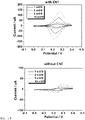
- Example 1 Comparison of cyclic voltammetry of electrochemical sensor for continuous blood sugar measurement with or without carbon nanotube
- cyclic voltammetry As a method for comparing the electron transfer performance of the electrode comprising a carbon nanotube with the electrode without a carbon nanotube, cyclic voltammetry was used.
- As a reference electrode for cyclic voltammetry Ag/AgCl electrode was used.
- As a counter electrode a platinum wire was used.
- As an electrolyte used when conducting cyclic voltammetry physiological saline solution comprising phosphate buffer was used.
- 10 mV/s was used. The order of applying voltage was first scan from high voltage to low voltage. This experimental result was shown in FIG. 1 . As could be confirmed in FIG. 1 , it could be found that the electrode comprising a carbon nanotube showed a higher redox peak than the electrode without it.
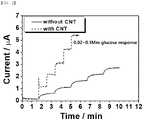
- Example 2 Comparison of responsivity to low concentration glucose of electrochemical sensor for continuous blood sugar measurement with or without carbon nanotube
- the glucose concentration to see the responsivity in a low concentration glucose range was 0.02 mM, 0.04 mM, 0.06 mM, 0.08 mM and, 0.1 mM, and the experiment was proceeded for 12 minutes.
- the result was shown in FIG. 2 .
- the electrode comprising a carbon nanotube according to the present invention showed the responsivity about 2 times higher than the electrode without it.
- Example 3 Comparison of responsivity in high concentration glucose of electrochemical sensor for continuous blood sugar measurement with or without carbon nanotube
- Example 4 Comparison of maximum current arrival time of electrochemical sensor for continuous blood sugar measurement with or without carbon nanotube
- Example 5 Comparison of baseline current of electrochemical sensor for continuous blood sugar measurement with or without carbon nanotube
- Example 6 Confirmation of stability of responsivity by time of electrochemical sensor for continuous blood sugar measurement comprising carbon nanotube
- the responsivity was confirmed by a value of dividing the current measured by chronoamperometry in a glucose solution at a concentration of 1 mM or less by the glucose concentration. Under the condition of storing the sensor for a certain time, glucose at a concentration of 1M was added to the electrolyte so as to be finally a glucose solution at a concentration of 5 mM. The result was shown in FIG. 6 . As shown in FIG. 6 , it could be found that the electrode comprising a carbon nanotube according to the present invention showed an error in the sensitivity depending on the air temperature or measurement error, but in general, the stable sensitivity was maintained.
- a sensor was prepared by the method as follows. At first, PVI-Os(bpy) 2 Cl as an electron transfer mediator, an oxidoreductase (GDH) and PEGDGE as a crosslinking material were dissolved in distilled water, respectively, and each solution was prepared using a stirring and ultrasonic dispersion method, and then each solution prepared was mixed finally to prepare a mixed solution comprising the electron transfer mediator, oxidoreductase and crosslinking material.
- a carbon nanotube dispersion was prepared separately from the solution comprising the electron transfer mediator, oxidoreductase and crosslinking material.
- the carbon nanotube dispersion was prepared by dispersing a carbon nanotube (CNT) in a solvent with Triton-X purchased from sigma-aldrich as a non-ionic surfactant using water as the solvent.
- Triton-X purchased from sigma-aldrich as a non-ionic surfactant using water as the solvent.
- Triton-X purchased from sigma-aldrich
- Triton-X Triton-X
- the carbon nanotube dispersion prepared by the method was additionally mixed with a mixed solution of the electron transfer mediator, oxidoreductase and crosslinking material and it was stirred for dispersion.
- a mixed solution comprising the electron transfer mediator, oxidoreductase, crosslinking material and carbon nanotube was prepared.
- the solution prepared by the method described above was coated on a carbon paste-printed electrode using a drop coating method.
- a screen printed carbon electrode was used. Then, it was cured by crosslinking reaction in an oven maintained at 25 °C Celsius and 50% relative humidity at a room temperature for 24 hours. After curing, the prepared sensor was washed using distilled water.
- Example 7 Comparison of responsivity to high concentration glucose of electrochemical sensor for continuous blood sugar measurement with or without carbon nanotube-2
- the responsivity was compared by performing chronoamperometry in a glucose solution at a high concentration.
- a reference electrode for chronoamperometry Ag/AgCl electrode was used.
- a counter electrode a platinum wire was used.
- As the voltage applied when performing chronoamperometry a voltage (0.4 V vs) larger than the oxidation voltage measured in a graph measured by cyclic voltammetry was applied in the positive (+) direction.
- physiological saline solution comprising phosphate buffer was used as an electrolyte.
- the glucose concentration to see the responsivity in a low concentration glucose range was 1 mM, 2 mM, 3 mM, 4 mM and 5 mM, and the experiment was proceeded for 12 minutes.
- the result was shown in FIG. 7 .
- the electrode comprising a carbon nanotube according to the present invention showed the high responsivity, whereas the electrode without a carbon nanotube hardly showed the responsivity.
- an electrode comprising a carbon nanotube or an electrode without it was used, and as a reference electrode, Ag/AgCl electrode was used, and as a counter electrode, a platinum wire was used.
- a voltage (0.4 V vs) larger than the oxidation voltage measured in a graph measured by cyclic voltammetry was applied in the positive (+) direction.
- physiological saline solution comprising phosphate buffer was used.
- the glucose concentration of the physiological saline solution to see the stabilization tendency was 0 mM, and the experiment was proceeded for 5 minutes.
- the result was shown in FIG. 8 .
- FIG. 8 it could be confirmed that the electrode comprising a carbon nanotube according to the present invention stabilized the current from the first voltage application, whereas the electrode without a carbon nanotube did not stabilize the current until about 3 minutes after the voltage application.
- Example 9 Comparison of response current change according to glucose concentration of electrochemical sensor for continuous blood sugar measurement with or without carbon nanotube
- a test was conducted by the method as follows.
- a working electrode an electrode comprising a carbon nanotube or an electrode without it was used, and as a reference electrode, Ag/AgCl electrode was used, and as a counter electrode, a platinum wire was used.
- a voltage 0.4 V vs Ag/AgCl
- physiological saline solution comprising phosphate buffer was used.
- Example 10 Comparison of cyclic voltammetry by scan rate of electrochemical sensor for continuous blood sugar measurement with or without a carbon nanotube
- cyclic voltammetry As a method for comparing the electron transfer performance of the electrode comprising a carbon nanotube with an electrode without a carbon nanotube, cyclic voltammetry was used.
- As a reference electrode for cyclic voltammetry Ag/AgCl electrode was used.
- As a counter electrode a platinum wire was used.
- As an electrolyte when performing cyclic voltammetry physiological saline solution comprising phosphate buffer was used.
- 1, 2, 5 and 10 mV/s was used. The order of applying voltage was first scan from high voltage to low voltage. This experimental result was shown in FIGs. 10 , 11 and 12 .
- FIG. 10 is a graph showing the change in the current value according to the voltage change, and as could be confirmed in FIG. 10 , it could be found that the electrode comprising a carbon nanotube showed a redox peak higher than the electrode without it at all scan rates.
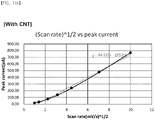
- FIGs. 11a , b and 12a , b are graphs showing the experimental results of the case of comprising a carbon nanotube ( FIGs. 11a and b ) and the case of not comprising it ( FIG.
- the electrode without a CNT followed the diffusion mechanism as the current magnitude of the CV peak is proportional to the 1/2 power of the scan rate, but in case of the electrode comprising a CNT, the current magnitude of the CV peak increased to a greater extent than the increase of the scan rate 1/2 power, and it was proportional to the 1 power of the scan rate at a scan rate of 10 mV/s or less, and therefore, the surface response was increased in the electrode comprising a CNT than the electrode without it.
Landscapes
- Health & Medical Sciences (AREA)
- Life Sciences & Earth Sciences (AREA)
- Physics & Mathematics (AREA)
- Chemical & Material Sciences (AREA)
- General Health & Medical Sciences (AREA)
- Molecular Biology (AREA)
- Pathology (AREA)
- Biophysics (AREA)
- Chemical Kinetics & Catalysis (AREA)
- Public Health (AREA)
- Animal Behavior & Ethology (AREA)
- Surgery (AREA)
- Veterinary Medicine (AREA)
- Heart & Thoracic Surgery (AREA)
- Medical Informatics (AREA)
- Optics & Photonics (AREA)
- Engineering & Computer Science (AREA)
- Biomedical Technology (AREA)
- General Chemical & Material Sciences (AREA)
- Analytical Chemistry (AREA)
- Immunology (AREA)
- General Physics & Mathematics (AREA)
- Biochemistry (AREA)
- Electrochemistry (AREA)
- Emergency Medicine (AREA)
- Hematology (AREA)
- Measurement Of The Respiration, Hearing Ability, Form, And Blood Characteristics Of Living Organisms (AREA)
- Measuring Or Testing Involving Enzymes Or Micro-Organisms (AREA)
- Apparatus Associated With Microorganisms And Enzymes (AREA)
Applications Claiming Priority (2)
| Application Number | Priority Date | Filing Date | Title |
|---|---|---|---|
| KR20190059001 | 2019-05-20 | ||
| PCT/KR2020/006558 WO2020235919A1 (ko) | 2019-05-20 | 2020-05-19 | 탄소나노튜브를 포함하는 생체신호 측정용 전기화학적 바이오 센서 및 이의 제조방법 |
Publications (2)
| Publication Number | Publication Date |
|---|---|
| EP3973871A1 true EP3973871A1 (de) | 2022-03-30 |
| EP3973871A4 EP3973871A4 (de) | 2022-07-20 |
Family
ID=73458336
Family Applications (1)
| Application Number | Title | Priority Date | Filing Date |
|---|---|---|---|
| EP20809303.9A Pending EP3973871A4 (de) | 2019-05-20 | 2020-05-19 | Elektrochemischer biosensor mit kohlenstoffnanoröhre zur messung von biosignalen und verfahren zu seiner herstellung |
Country Status (7)
| Country | Link |
|---|---|
| US (1) | US20220218239A1 (de) |
| EP (1) | EP3973871A4 (de) |
| JP (1) | JP7324871B2 (de) |
| KR (1) | KR102360124B1 (de) |
| CN (1) | CN114269246A (de) |
| AU (1) | AU2020278853B2 (de) |
| WO (1) | WO2020235919A1 (de) |
Families Citing this family (8)
| Publication number | Priority date | Publication date | Assignee | Title |
|---|---|---|---|---|
| KR102803737B1 (ko) * | 2021-04-19 | 2025-05-13 | 주식회사 아이센스 | 전이금속 착물 또는 산화-환원 중합체를 포함하는 전기화학적 바이오센서 또는 전기화학적 바이오센서용 센싱 막 |
| KR102732949B1 (ko) * | 2021-12-30 | 2024-11-21 | 인하대학교 산학협력단 | 피부를 통한 전기자극 효율을 개선시키기 위한 피부 임피던스 저감 생체적합성 전도성 타투잉크 조성물 |
| CN114740069A (zh) * | 2022-04-15 | 2022-07-12 | 深圳可孚生物科技有限公司 | 一种基于cnt网络层的微针葡萄糖传感器的制备方法 |
| CN114778645B (zh) * | 2022-05-24 | 2025-04-04 | 江苏跃凯生物技术有限公司 | 一种双金属中心导电纳米材料葡萄糖传感及其制备方法和应用 |
| WO2024157495A1 (ja) * | 2023-01-27 | 2024-08-02 | キッコーマン株式会社 | 酵素電極及びその製造方法、並びに酵素センサ |
| CN116042665B (zh) * | 2023-03-10 | 2023-08-11 | 河南大学 | 葡萄糖脱氢酶突变体及其制备方法和应用 |
| CN116087286B (zh) * | 2023-03-10 | 2024-08-23 | 上海微创生命科技有限公司 | 生物传感器及其制备方法和应用 |
| KR20250140889A (ko) | 2024-03-19 | 2025-09-26 | 국립부경대학교 산학협력단 | 야자수 줄기 모양의 계층적 나노구조체 제조방법 및 상기 제조방법으로 제조된 야자수 줄기 모양의 계층적 나노구조체 |
Family Cites Families (19)
| Publication number | Priority date | Publication date | Assignee | Title |
|---|---|---|---|---|
| US4919891A (en) * | 1986-04-18 | 1990-04-24 | Minnesota Mining And Manufacturing Company | Sensor with overcoating and process for making same |
| EP0359831B2 (de) * | 1988-03-31 | 2007-06-20 | Matsushita Electric Industrial Co., Ltd. | Biosensor und dessen herstellung |
| US5264105A (en) * | 1989-08-02 | 1993-11-23 | Gregg Brian A | Enzyme electrodes |
| US6338790B1 (en) * | 1998-10-08 | 2002-01-15 | Therasense, Inc. | Small volume in vitro analyte sensor with diffusible or non-leachable redox mediator |
| US7045054B1 (en) * | 1999-09-20 | 2006-05-16 | Roche Diagnostics Corporation | Small volume biosensor for continuous analyte monitoring |
| DE60322708D1 (de) * | 2002-06-17 | 2008-09-18 | Arkray Inc | Glucosesensor unter verwendung von glucosedehydrogenase |
| JP5089035B2 (ja) * | 2005-11-22 | 2012-12-05 | 学校法人 東洋大学 | Cnt薄膜の製造方法およびこの薄膜を用いたバイオセンサ |
| CA2654220A1 (en) * | 2006-06-19 | 2007-12-27 | F. Hoffmann-La Roche Ag | Amperometric sensor and method for its manufacturing |
| CN100594379C (zh) * | 2007-06-29 | 2010-03-17 | 浙江大学 | 一种碳纳米管修饰的血糖生物传感器 |
| US8771500B2 (en) * | 2007-10-22 | 2014-07-08 | The University Of Connecticut | Glucose sensors and methods of manufacture thereof |
| US8262874B2 (en) * | 2008-04-14 | 2012-09-11 | Abbott Diabetes Care Inc. | Biosensor coating composition and methods thereof |
| US20100072062A1 (en) * | 2008-05-05 | 2010-03-25 | Edwards Lifesciences Corporation | Membrane For Use With Amperometric Sensors |
| US20110046466A1 (en) * | 2009-08-19 | 2011-02-24 | Feldman Benjamin J | Analyte Sensors Including Nanomaterials and Methods of Using Same |
| US9682225B2 (en) * | 2010-02-12 | 2017-06-20 | Georgetown University | Polymer film bioelectrodes and methods of making and using the same |
| US20130098775A1 (en) * | 2011-10-20 | 2013-04-25 | Nova Biomedical Corporation | Glucose biosensor with improved shelf life |
| KR101992774B1 (ko) * | 2012-10-11 | 2019-06-25 | 삼성전자주식회사 | 효소 기반 바이오센서의 전자전달매개체 |
| KR101531384B1 (ko) * | 2013-07-02 | 2015-06-24 | 주식회사 인포피아 | 바이오센서용 시약조성물 및 이를 포함하는 바이오센서 |
| KR101694982B1 (ko) * | 2014-12-31 | 2017-01-10 | 주식회사 아이센스 | 전기화학적 바이오센서 |
| EP3688450A4 (de) * | 2017-09-28 | 2021-07-28 | California Institute of Technology | Verfahren zur herstellung von dünnen, enzymbasierten sensorschichten auf planaren sensoren |
-
2020
- 2020-05-19 WO PCT/KR2020/006558 patent/WO2020235919A1/ko not_active Ceased
- 2020-05-19 AU AU2020278853A patent/AU2020278853B2/en active Active
- 2020-05-19 JP JP2021568690A patent/JP7324871B2/ja active Active
- 2020-05-19 EP EP20809303.9A patent/EP3973871A4/de active Pending
- 2020-05-19 US US17/612,639 patent/US20220218239A1/en active Pending
- 2020-05-19 KR KR1020200059990A patent/KR102360124B1/ko active Active
- 2020-05-19 CN CN202080037988.2A patent/CN114269246A/zh active Pending
Also Published As
| Publication number | Publication date |
|---|---|
| JP2022537489A (ja) | 2022-08-26 |
| US20220218239A1 (en) | 2022-07-14 |
| KR20200133678A (ko) | 2020-11-30 |
| WO2020235919A1 (ko) | 2020-11-26 |
| JP7324871B2 (ja) | 2023-08-10 |
| EP3973871A4 (de) | 2022-07-20 |
| CN114269246A (zh) | 2022-04-01 |
| AU2020278853A1 (en) | 2021-12-09 |
| NZ782262A (en) | 2024-07-05 |
| KR102360124B1 (ko) | 2022-02-09 |
| AU2020278853B2 (en) | 2023-06-08 |
Similar Documents
| Publication | Publication Date | Title |
|---|---|---|
| AU2020278853B2 (en) | Electrochemical biosensor comprising carbon nanotube for measuring biosignals and method for manufacturing same | |
| Heller et al. | Electrochemical glucose sensors and their applications in diabetes management | |
| CN110799651B (zh) | 用于采用电化学生物传感器进行分析物检测的方法和设备 | |
| TWI559001B (zh) | 生物感測器用之製劑組成物及具有該製劑組成物之生物感測器 | |
| Palmisano et al. | A disposable, reagentless, third-generation glucose biosensor based on overoxidized poly (pyrrole)/tetrathiafulvalene− tetracyanoquinodimethane composite | |
| Dzyadevych et al. | Amperometric enzyme biosensors: Past, present and future | |
| CN104583418B (zh) | 用于氧化还原反应的试剂组合物 | |
| Zafar et al. | Electron-transfer studies with a new flavin adenine dinucleotide dependent glucose dehydrogenase and osmium polymers of different redox potentials | |
| Liu et al. | Miniature amperometric self-powered continuous glucose sensor with linear response | |
| US9617576B2 (en) | Enzyme electrode | |
| Haccoun et al. | Reagentless amperometric detection of L-lactate on an enzyme-modified conducting copolymer poly (5-hydroxy-1, 4-naphthoquinone-co-5-hydroxy-3-thioacetic acid-1, 4-naphthoquinone) | |
| Wang et al. | Achieving nonenzymatic blood glucose sensing by uprooting saturation | |
| Wang et al. | Amperometric bienzyme glucose biosensor based on carbon nanotube modified electrode with electropolymerized poly (toluidine blue O) film | |
| US20230293063A1 (en) | A propofol sensor | |
| Gao et al. | A disposable glucose biosensor based on diffusional mediator dispersed in nanoparticulate membrane on screen-printed carbon electrode | |
| KR102266197B1 (ko) | 글루코스 탈수소화효소 감응형 신규 루테늄계 전자전달 매개체, 이의 제조방법, 이를 포함하는 산화환원반응용 시약조성물 및 바이오센서 | |
| EP4596563A2 (de) | Elektrochemischer biosensor mit übergangsmetallkomplex oder oxidationsreduktionspolymer | |
| JP7449691B2 (ja) | 電気化学測定用の試薬組成物及びその用途 | |
| Suresh | Validation of a novel conductive membrane sensor protection technique to mitigate redox-active interferences | |
| Karan | Enzyme biosensors containing polymeric electron transfer systems | |
| Morshed | Self-Monitoring Blood Glucose Sensor Based on a Water-Soluble Quinone Type Mediator and Biofuel Cell by a Crosslinked-Thionine with Flavin Adenine Dinucleotide-Dependent Glucose Dehydrogenase | |
| KR20260038315A (ko) | 신규 오스뮴 기반 전자전달 매개체, 이의 제조방법 및 이를 포함하는 산화환원반응용 시약조성물 |
Legal Events
| Date | Code | Title | Description |
|---|---|---|---|
| STAA | Information on the status of an ep patent application or granted ep patent |
Free format text: STATUS: THE INTERNATIONAL PUBLICATION HAS BEEN MADE |
|
| PUAI | Public reference made under article 153(3) epc to a published international application that has entered the european phase |
Free format text: ORIGINAL CODE: 0009012 |
|
| STAA | Information on the status of an ep patent application or granted ep patent |
Free format text: STATUS: REQUEST FOR EXAMINATION WAS MADE |
|
| 17P | Request for examination filed |
Effective date: 20211108 |
|
| AK | Designated contracting states |
Kind code of ref document: A1 Designated state(s): AL AT BE BG CH CY CZ DE DK EE ES FI FR GB GR HR HU IE IS IT LI LT LU LV MC MK MT NL NO PL PT RO RS SE SI SK SM TR |
|
| A4 | Supplementary search report drawn up and despatched |
Effective date: 20220622 |
|
| RIC1 | Information provided on ipc code assigned before grant |
Ipc: A61B 5/155 20060101ALN20220615BHEP Ipc: G01N 27/327 20060101ALI20220615BHEP Ipc: A61B 5/1486 20060101ALI20220615BHEP Ipc: A61B 5/145 20060101ALI20220615BHEP Ipc: A61B 5/1468 20060101AFI20220615BHEP |
|
| DAV | Request for validation of the european patent (deleted) | ||
| DAX | Request for extension of the european patent (deleted) | ||
| STAA | Information on the status of an ep patent application or granted ep patent |
Free format text: STATUS: EXAMINATION IS IN PROGRESS |
|
| 17Q | First examination report despatched |
Effective date: 20241219 |