EP3971174B1 - Behandlungsmittel für hydrophile metalloberflächen - Google Patents
Behandlungsmittel für hydrophile metalloberflächen Download PDFInfo
- Publication number
- EP3971174B1 EP3971174B1 EP20825528.1A EP20825528A EP3971174B1 EP 3971174 B1 EP3971174 B1 EP 3971174B1 EP 20825528 A EP20825528 A EP 20825528A EP 3971174 B1 EP3971174 B1 EP 3971174B1
- Authority
- EP
- European Patent Office
- Prior art keywords
- group
- metal
- glycerol derivative
- branched glycerol
- och
- Prior art date
- Legal status (The legal status is an assumption and is not a legal conclusion. Google has not performed a legal analysis and makes no representation as to the accuracy of the status listed.)
- Active
Links
Images



Classifications
-
- C—CHEMISTRY; METALLURGY
- C07—ORGANIC CHEMISTRY
- C07C—ACYCLIC OR CARBOCYCLIC COMPOUNDS
- C07C327/00—Thiocarboxylic acids
- C07C327/20—Esters of monothiocarboxylic acids
- C07C327/32—Esters of monothiocarboxylic acids having sulfur atoms of esterified thiocarboxyl groups bound to carbon atoms of hydrocarbon radicals substituted by carboxyl groups
-
- C—CHEMISTRY; METALLURGY
- C23—COATING METALLIC MATERIAL; COATING MATERIAL WITH METALLIC MATERIAL; CHEMICAL SURFACE TREATMENT; DIFFUSION TREATMENT OF METALLIC MATERIAL; COATING BY VACUUM EVAPORATION, BY SPUTTERING, BY ION IMPLANTATION OR BY CHEMICAL VAPOUR DEPOSITION, IN GENERAL; INHIBITING CORROSION OF METALLIC MATERIAL OR INCRUSTATION IN GENERAL
- C23F—NON-MECHANICAL REMOVAL OF METALLIC MATERIAL FROM SURFACE; INHIBITING CORROSION OF METALLIC MATERIAL OR INCRUSTATION IN GENERAL; MULTI-STEP PROCESSES FOR SURFACE TREATMENT OF METALLIC MATERIAL INVOLVING AT LEAST ONE PROCESS PROVIDED FOR IN CLASS C23 AND AT LEAST ONE PROCESS COVERED BY SUBCLASS C21D OR C22F OR CLASS C25
- C23F11/00—Inhibiting corrosion of metallic material by applying inhibitors to the surface in danger of corrosion or adding them to the corrosive agent
- C23F11/08—Inhibiting corrosion of metallic material by applying inhibitors to the surface in danger of corrosion or adding them to the corrosive agent in other liquids
- C23F11/10—Inhibiting corrosion of metallic material by applying inhibitors to the surface in danger of corrosion or adding them to the corrosive agent in other liquids using organic inhibitors
- C23F11/12—Oxygen-containing compounds
-
- C—CHEMISTRY; METALLURGY
- C07—ORGANIC CHEMISTRY
- C07C—ACYCLIC OR CARBOCYCLIC COMPOUNDS
- C07C319/00—Preparation of thiols, sulfides, hydropolysulfides or polysulfides
- C07C319/02—Preparation of thiols, sulfides, hydropolysulfides or polysulfides of thiols
- C07C319/12—Preparation of thiols, sulfides, hydropolysulfides or polysulfides of thiols by reactions not involving the formation of mercapto groups
-
- C—CHEMISTRY; METALLURGY
- C07—ORGANIC CHEMISTRY
- C07C—ACYCLIC OR CARBOCYCLIC COMPOUNDS
- C07C323/00—Thiols, sulfides, hydropolysulfides or polysulfides substituted by halogen, oxygen or nitrogen atoms, or by sulfur atoms not being part of thio groups
- C07C323/10—Thiols, sulfides, hydropolysulfides or polysulfides substituted by halogen, oxygen or nitrogen atoms, or by sulfur atoms not being part of thio groups containing thio groups and singly-bound oxygen atoms bound to the same carbon skeleton
- C07C323/11—Thiols, sulfides, hydropolysulfides or polysulfides substituted by halogen, oxygen or nitrogen atoms, or by sulfur atoms not being part of thio groups containing thio groups and singly-bound oxygen atoms bound to the same carbon skeleton having the sulfur atoms of the thio groups bound to acyclic carbon atoms of the carbon skeleton
- C07C323/12—Thiols, sulfides, hydropolysulfides or polysulfides substituted by halogen, oxygen or nitrogen atoms, or by sulfur atoms not being part of thio groups containing thio groups and singly-bound oxygen atoms bound to the same carbon skeleton having the sulfur atoms of the thio groups bound to acyclic carbon atoms of the carbon skeleton the carbon skeleton being acyclic and saturated
-
- C—CHEMISTRY; METALLURGY
- C07—ORGANIC CHEMISTRY
- C07C—ACYCLIC OR CARBOCYCLIC COMPOUNDS
- C07C327/00—Thiocarboxylic acids
- C07C327/20—Esters of monothiocarboxylic acids
- C07C327/22—Esters of monothiocarboxylic acids having carbon atoms of esterified thiocarboxyl groups bound to hydrogen atoms or to acyclic carbon atoms
-
- C—CHEMISTRY; METALLURGY
- C07—ORGANIC CHEMISTRY
- C07D—HETEROCYCLIC COMPOUNDS
- C07D317/00—Heterocyclic compounds containing five-membered rings having two oxygen atoms as the only ring hetero atoms
- C07D317/08—Heterocyclic compounds containing five-membered rings having two oxygen atoms as the only ring hetero atoms having the hetero atoms in positions 1 and 3
- C07D317/10—Heterocyclic compounds containing five-membered rings having two oxygen atoms as the only ring hetero atoms having the hetero atoms in positions 1 and 3 not condensed with other rings
- C07D317/14—Heterocyclic compounds containing five-membered rings having two oxygen atoms as the only ring hetero atoms having the hetero atoms in positions 1 and 3 not condensed with other rings with substituted hydrocarbon radicals attached to ring carbon atoms
- C07D317/18—Radicals substituted by singly bound oxygen or sulfur atoms
- C07D317/20—Free hydroxyl or mercaptan
-
- C—CHEMISTRY; METALLURGY
- C07—ORGANIC CHEMISTRY
- C07D—HETEROCYCLIC COMPOUNDS
- C07D319/00—Heterocyclic compounds containing six-membered rings having two oxygen atoms as the only ring hetero atoms
- C07D319/04—1,3-Dioxanes; Hydrogenated 1,3-dioxanes
- C07D319/06—1,3-Dioxanes; Hydrogenated 1,3-dioxanes not condensed with other rings
-
- C—CHEMISTRY; METALLURGY
- C09—DYES; PAINTS; POLISHES; NATURAL RESINS; ADHESIVES; COMPOSITIONS NOT OTHERWISE PROVIDED FOR; APPLICATIONS OF MATERIALS NOT OTHERWISE PROVIDED FOR
- C09K—MATERIALS FOR MISCELLANEOUS APPLICATIONS, NOT PROVIDED FOR ELSEWHERE
- C09K3/00—Materials not provided for elsewhere
- C09K3/18—Materials not provided for elsewhere for application to surfaces to minimize adherence of ice, mist or water thereto; Thawing or antifreeze materials for application to surfaces
-
- C—CHEMISTRY; METALLURGY
- C23—COATING METALLIC MATERIAL; COATING MATERIAL WITH METALLIC MATERIAL; CHEMICAL SURFACE TREATMENT; DIFFUSION TREATMENT OF METALLIC MATERIAL; COATING BY VACUUM EVAPORATION, BY SPUTTERING, BY ION IMPLANTATION OR BY CHEMICAL VAPOUR DEPOSITION, IN GENERAL; INHIBITING CORROSION OF METALLIC MATERIAL OR INCRUSTATION IN GENERAL
- C23C—COATING METALLIC MATERIAL; COATING MATERIAL WITH METALLIC MATERIAL; SURFACE TREATMENT OF METALLIC MATERIAL BY DIFFUSION INTO THE SURFACE, BY CHEMICAL CONVERSION OR SUBSTITUTION; COATING BY VACUUM EVAPORATION, BY SPUTTERING, BY ION IMPLANTATION OR BY CHEMICAL VAPOUR DEPOSITION, IN GENERAL
- C23C22/00—Chemical surface treatment of metallic material by reaction of the surface with a reactive liquid, leaving reaction products of surface material in the coating, e.g. conversion coatings, passivation of metals
- C23C22/05—Chemical surface treatment of metallic material by reaction of the surface with a reactive liquid, leaving reaction products of surface material in the coating, e.g. conversion coatings, passivation of metals using aqueous solutions
- C23C22/60—Chemical surface treatment of metallic material by reaction of the surface with a reactive liquid, leaving reaction products of surface material in the coating, e.g. conversion coatings, passivation of metals using aqueous solutions using alkaline aqueous solutions with pH greater than 8
-
- C—CHEMISTRY; METALLURGY
- C23—COATING METALLIC MATERIAL; COATING MATERIAL WITH METALLIC MATERIAL; CHEMICAL SURFACE TREATMENT; DIFFUSION TREATMENT OF METALLIC MATERIAL; COATING BY VACUUM EVAPORATION, BY SPUTTERING, BY ION IMPLANTATION OR BY CHEMICAL VAPOUR DEPOSITION, IN GENERAL; INHIBITING CORROSION OF METALLIC MATERIAL OR INCRUSTATION IN GENERAL
- C23C—COATING METALLIC MATERIAL; COATING MATERIAL WITH METALLIC MATERIAL; SURFACE TREATMENT OF METALLIC MATERIAL BY DIFFUSION INTO THE SURFACE, BY CHEMICAL CONVERSION OR SUBSTITUTION; COATING BY VACUUM EVAPORATION, BY SPUTTERING, BY ION IMPLANTATION OR BY CHEMICAL VAPOUR DEPOSITION, IN GENERAL
- C23C26/00—Coating not provided for in groups C23C2/00 - C23C24/00
-
- C—CHEMISTRY; METALLURGY
- C23—COATING METALLIC MATERIAL; COATING MATERIAL WITH METALLIC MATERIAL; CHEMICAL SURFACE TREATMENT; DIFFUSION TREATMENT OF METALLIC MATERIAL; COATING BY VACUUM EVAPORATION, BY SPUTTERING, BY ION IMPLANTATION OR BY CHEMICAL VAPOUR DEPOSITION, IN GENERAL; INHIBITING CORROSION OF METALLIC MATERIAL OR INCRUSTATION IN GENERAL
- C23F—NON-MECHANICAL REMOVAL OF METALLIC MATERIAL FROM SURFACE; INHIBITING CORROSION OF METALLIC MATERIAL OR INCRUSTATION IN GENERAL; MULTI-STEP PROCESSES FOR SURFACE TREATMENT OF METALLIC MATERIAL INVOLVING AT LEAST ONE PROCESS PROVIDED FOR IN CLASS C23 AND AT LEAST ONE PROCESS COVERED BY SUBCLASS C21D OR C22F OR CLASS C25
- C23F11/00—Inhibiting corrosion of metallic material by applying inhibitors to the surface in danger of corrosion or adding them to the corrosive agent
- C23F11/08—Inhibiting corrosion of metallic material by applying inhibitors to the surface in danger of corrosion or adding them to the corrosive agent in other liquids
- C23F11/10—Inhibiting corrosion of metallic material by applying inhibitors to the surface in danger of corrosion or adding them to the corrosive agent in other liquids using organic inhibitors
- C23F11/16—Sulfur-containing compounds
Definitions
- the present invention relates to a branched glycerol derivative and a composition, such as a hydrophilic metal surface treatment agent, comprising the branched glycerol derivative as an active ingredient by which a water-repellent property can be given to a metal surface with suppressing a corrosion and a discolorment of the metal, a method for treating a surface of a metal by using the composition, a synthetic intermediate compound of the branched glycerol derivative as an active ingredient of the composition, and a method for efficiently producing the synthetic intermediate compound.
- a composition such as a hydrophilic metal surface treatment agent
- a surface treatment technique to control the properties of a base material surface plays an important role to maintain an excellent electrical property, a high reliability and a high corrosion resistance of electrical parts.
- An example of a technique to inhibit a decrease of an electrical property and an appearance deterioration caused by a corrosion of a metal base material due to oxidation and sulfurization among various surface treatment techniques includes a method for forming a coating membrane on a base material metal surface. Both of an organic material and an inorganic material are used as a raw material of such a coating membrane. A raw material of a self-assembled monolayer, i.e. SAM, among such raw materials is variously studied. In particular, alkanethiols have been conventionally and variously studied and utilized as a compound to form SAM.
- Patent document 1 discloses a method for forming a self-assembled monolayer composed of an alkanethiol on a metal base material surface by immersing the metal base material in an organic solvent solution of a linear alkanethiol.
- Patent document 2 discloses a functional metal composite substrate in which a SAM membrane composed of alkanethiol or the like is formed on a surface of a metal composite raw material.
- Patent document 3 discloses an aqueous sealing treatment agent containing an inhibitor such as a benzotriazole compound, a surfactant and an amine compound.
- Patent document 4 discloses a method for forming a coating membrane on a silver-coated surface of a metal material by contacting a surface treatment agent aqueous solution in which 6-anilino-1,3,5-triazine-2,4-dithiol and/or an alkali metal salt thereof is dissolved or dispersed in water with the silver-coated metal material.
- a formed coating membrane is water-repellent, the water repellency is qualitatively evaluated.
- the water repellency and corrosion resistance may not be sufficient, since the active ingredient is water-soluble.
- Patent document 5 The inventors of the present invention developed a branched glycerol structure to improve a water solubility of a compound (Patent document 5). Also, the present inventors developed the following branched glycerol trimer as a synthetic intermediate compound to form the branched glycerol structure (Patent document 6 and Non-patent document 1).
- Patent document 7 describes a compound which is useful in chemically modifying a physiologically active polypeptide or a derivative thereof, or a low molecular compound.
- Patent document 8 describes a polyalcohol compound which is highly water-soluble, can be formulated into a preparation readily, can be reduced in its dose amount, and can be used as an active ingredient for an antihyperlipidemic agent.
- Patent document 9 describes a method for preparing 5-hydroxy-1,3-dioxane which is very suitable as a raw material for branched glycerol.
- Patent document 10 describes a substrate with enhanced surface hydrophobicity or hydrophilicity.
- Patent document 11 describes a method for producing 5-hydroxy-1,3-dioxane and a method for producing a branched glycerol trimer using the 5-hydroxy-1,3-dioxane obtained by the method as a raw material.
- Patent document 12 describes a method for surface treatment of gold or gold alloy plating formed on metal, and a surface treatment liquid used in the method.
- Patent document 13 describes metal surface-treatment agents, a metal surface-treatment method and surface-treated metal materials which are excellent in the film corrosion resistance and electric conductivity and coating adhesiveness in case of forming an over-coating layer on a film.
- Patent document 14 describes rust removal and anti-rust agent for metal surface treatment.
- Non-patent document 2 describes the synthesis and evaluation of water-soluble resveratrol and piceatannol via branched glycerolation.
- Non-patent document 3 describes the anti-fouling chemistry of chiral monolayers.
- an organic solvent must be used as a solvent of a conventional metal surface treatment agent capable of forming a lipophilic coating membrane.
- an active ingredient of a metal surface treatment agent containing water as a solvent is hydrophilic, there is a problem of an endurance of a formed covering membrane.
- the present inventors developed two kinds of branched glycerol trimers as a synthetic intermediate compound to introduce a structure to improve a water solubility to a compound, but the dimethyl branched glycerol trimer is difficult to be synthesized. Also, an unsubstituted branched glycerol trimer is difficult to be efficiently synthesized, since a precursor thereof cannot be separated from an impurity. In addition, an unsubstituted branched glycerol trimer is relatively difficult to be deprotected.
- the objective of the present invention is to provide a branched glycerol derivative and a composition, such as a hydrophilic metal surface treatment agent, comprising the branched glycerol derivative as an active ingredient by which a water-repellent property can be given to a metal surface with suppressing a corrosion and a discolorment of the metal, a method for treating a surface of a metal by using the composition, such as a hydrophilic metal surface treatment agent, a synthetic intermediate compound of the branched glycerol derivative, and a method for efficiently producing the synthetic intermediate compound.
- a composition such as a hydrophilic metal surface treatment agent
- a self-assembled monolayer can be formed by dissolving or dispersing a compound formed by binding a branched glycerol structure and a hydrocarbon group with the specific structure in water and treating a metal surface therewith, and a high water repellency and a corrosion resistance can be given to the metal due to a hydrocarbon of the self-assembled monolayer.
- the compound is abbreviated as "the branched glycerol derivative (I)”.
- R 1 is a hydrocarbon group having the carbon number of 10 or more and 30 or less.
- An example of the hydrocarbon group includes a C 10-30 alkyl group, a C 10-30 alkenyl group, a C 10-30 alkynyl group, a C 10-30 aryl group and a C 10-30 arylalkyl group.
- the carbon number is 10 or more, a self-assembled monolayer excellent in a water repellency can be formed on a metal surface more surely and a protection of the metal surface becomes possible.
- the carbon number is 30 or less, the water solubility of the branched glycerol derivative (I) can be ensured more surely.
- the carbon number is preferably 12 or more, more preferably 14 or more, even more preferably 16 or more, and preferably 24 or less, more preferably 22 or less, even more preferably 20 or less.
- the "C 10-30 alkyl group” means a linear or branched monovalent saturated aliphatic hydrocarbon group having the carbon number of 10 or more and 30 or less, and is exemplified by decyl, dodecyl, tetradecyl, hexadecyl, octadecyl, icosyl, docosyl, tetracosyl, hexacosyl, octacosyl and triacontyl.
- the C 10-30 alkyl group is preferably a C 12-24 alkyl group, more preferably a C 14-22 alkyl group, and even more preferably C 16-20 alkyl group.
- the "C 10-30 alkenyl group” means a linear or branched monovalent unsaturated aliphatic hydrocarbon group of which carbon number is 10 or more and 30 or less and which has at least one carbon-carbon double bond, and is exemplified by decenyl, dodecenyl, tetradecenyl, hexadecenyl, octadecenyl, icosenyl, docosenyl, tetracosenyl, hexacosenyl, octacosenyl and triacontenyl.
- the C 10-30 alkenyl group is preferably a C 12-24 alkenyl group, more preferably a C 14-22 alkenyl group, and even more preferably a C 16-20 alkenyl group.
- the "C 10-30 alkynyl group” means a linear or branched monovalent unsaturated aliphatic hydrocarbon group of which carbon number is 10 or more and 30 or less and which has at least one carbon-carbon triple bond, and is exemplified by decynyl, dodecynyl, tetradecynyl, hexadecynyl, octadecynyl, icosynyl, docosynyl, tetracosynyl, hexacosynyl, octacosynyl and triacontynyl.
- the C 10-30 alkynyl group is preferably a C 12-24 alkynyl group, more preferably a C 14-22 alkynyl group, and even more preferably a C 16-20 alkynyl group.
- C 10-30 aryl group means a monovalent aromatic hydrocarbon group having the carbon number of 10 or more and 30 or less, and is exemplified by naphthyl, biphenyl, phenanthrenyl, anthracenyl, triphenylenyl, pyrenyl, naphthacenyl, pentacenyl, hexacenyl and heptacenyl.
- the "C 10-30 arylalkyl group” is exemplified by an alkyl group having a C 6-12 aryl group at the S-side end, the most end and the intermediate portion.
- An example of the C 6-12 aryl group includes phenyl, naphthyl, indenyl and biphenyl.
- the X in the formula (I) is S or a carbonyl group.
- the Y in the formula (I) is an n + 1 valent linker group to bind n-tuple branched glycerol structures to the X and has the function to facilitate the synthesis of the branched glycerol derivative (I).
- An example of the bound group includes a C 1-6 alkanediyl group having a group selected from an ether group, a carbonyl group, an ester group, an amide group, a urea group, a polyalkylene glycol group and a polyvinyl alcohol group at one end or both ends and/or an intermediate portion; and a C 1-6 alkanetriyl group having a group selected from an ether group, a carbonyl group, an ester group, an amide group, a urea group, a polyalkylene glycol group and a polyvinyl alcohol group at 1 or more and 3 or less of the ends and/or an intermediate portion.
- the branched glycerol derivative (I) may have a dendrimer structure formed by binding two branched glycerol units with a glycerol structure.
- a dendrimer structure is exemplified as follows.
- the structure in brackets in the formula (I) is referred to as "the branched glycerol unit" in some cases.
- the n in the formula (I) is the number of the branched glycerol unit and is an integer of 1 or more and 5 or less. When the n is 1 or more, the hydrophilicity of the branched glycerol derivative (I) can be ensured, and when the n is 5 or less, the cost to produce the branched glycerol derivative (I) can be effectively controlled.
- the n is preferably 2 or more, and preferably 4 or less and more preferably 2.
- the branched glycerol derivative (I) can be synthesized by reacting a compound having a protected branched glycerol structure and a compound having a long chain alkyl group R 1 to form a -S-X- group and the ester group or the amide group in the linker group.
- the production method to form a thioester group in the case where the X is a carbonyl group and the production method to form the ester group in the linker group are described as follows.
- a condensating agent may be used and a carboxy group may be active-esterized in order to form a thioester group and an ester group.
- the branched glycerol structure may be deprotected in an acidic condition.
- the "C 1-6 alkyl group” is a linear or branched monovalent saturated aliphatic hydrocarbon group having the carbon number of 1 or more and 6 or less, and is exemplified by methyl, ethyl, n-propyl, isopropyl, n-butyl, isobutyl, s-butyl, t-butyl, n-pentyl and n-hexyl.
- the C 1-6 alkyl group is preferably a C 1-4 alkyl group, more preferably a C 1-2 alkyl group, and even more preferably methyl.
- one of R 3 and R 4 is H and the other is a C 1-6 alkyl group.
- a protective group of which both of R 3 and R 4 are C 1-6 alkyl groups can be cleaved in the mildest condition, and as a result, the protective group can be cleaved without impacting on the S-X bond.
- the protective group of which both of R 3 and R 4 are H is the most difficult to be cleaved, and the easiness to cleave the protective group of which one of R 3 and R 4 is H and the other is a C 1-6 alkyl group is included between those of the above-described protective groups.
- a branched glycerol trimer of which R 3 and R 4 are C 1-6 alkyl groups is synthesized by transforming the protective group of a branched glycerol trimer of which R 3 and R 4 are H (Patent document 6 and Non-patent document 1).
- Patent document 6 and Non-patent document 1 a branched glycerol trimer of which R 3 and R 4 are H
- glycerin and formaldehyde when glycerin and formaldehyde are reacted, an ⁇ , ⁇ '-isomer and an ⁇ , ⁇ -isomer are generated in a ratio of 55 : 45 to 60 : 40 (Non-patent document 1).
- the isomers are needed to be esterified with pivalic acid, since the isomers cannot be directly separated (Patent document 6 and Non-patent document 1). In other words, an esterification step and a hydrolysis step are superfluously required.
- protected branched glycerol derivative (II) of which one of R 3 and R 4 is H and the other is a C 1-6 alkyl group
- 4 isomers i.e. trans- ⁇ , ⁇ '-isomer, cis- ⁇ , ⁇ '-isomer, trans- ⁇ , ⁇ -isomer and cis- ⁇ , ⁇ -isomer, are generated from glycerin and a ketone compound, and only the cis- ⁇ , ⁇ '-isomer can be directly separated from the other isomers by distillation.
- the protected branched glycerol derivative (II) can be deprotected in a relatively mild condition.
- the protected branched glycerol derivative (II) therefore, is very useful as a synthetic intermediate of the branched glycerol derivative (I).
- the protected branched glycerol derivative (II) can be synthesized by reacting the cis- ⁇ , ⁇ '-isomer of which one of R 3 and R 4 is H and the other is a C 1-6 alkyl group, i.e. cis-5-hydroxy-2-C 1-6 alkyl-1,3-dioxane, and an epihalohydrin.
- An example of an epihalohydrin includes epichlorohydrin, epibromohydrin and epiiodohydrin. wherein Hal is chloro, bromo or iodo.
- the composition, such as a hydrophilic metal surface treatment agent, of the present invention may not contain a solvent and may be dissolved or dispersed in a solvent to be a solution or a dispersion for use.
- concentration of the branched glycerol derivative (I) in the composition, such as a solid hydrophilic metal surface treatment agent, of the present invention in such a case is preferably 60 mass% or more or 70 mass% or more, more preferably 80 mass% or more or 90 mass% or more, and even more preferably 95 mass% or more or 98 mass% or more.
- the upper limit of the above concentration is not particularly restricted, and the composition, such as a solid hydrophilic metal surface treatment agent, is preferably composed of the branched glycerol derivative (I) other than an unavoidable impurity and an unavoidable contaminant.
- the above concentration is preferably 100 mass% or less.
- the solvent of the composition such as a hydrophilic metal surface treatment agent, according to the present invention is preferably water in terms of a safety and an environmental burden.
- a concentration of the branched glycerol derivative (I) in the composition, such as a hydrophilic metal surface treatment agent, of the present invention which contains water as a solvent may be 0.005 mM or more and 5 mM or less and 0.001 mass% or more and 5 mass% or less. When the concentration is 0.005 mM or more or 0.001 mass% or more, a self-assembled monolayer may be formed on a metal surface more surely.
- the branched glycerol derivative (I) when the concentration is 5 mM or less or 5 mass% or less, the branched glycerol derivative (I) may be effectively dissolved or dispersed.
- the concentration is more preferably 0.01 mM or more or 0.005 mass% or more, and more preferably 1 mM or less or 1 mass% or less, even more preferably 0.1 mM or less or 0.1 mass% or less.
- a solution of the branched glycerol derivative (I) having a relatively high concentration may be shipped out as the composition, such as a hydrophilic metal surface treatment agent, and diluted for use in terms of a haulage cost.
- the composition, such as a hydrophilic metal surface treatment agent, of the present invention may contain an alkaline agent.
- the alkaline agent accelerates the cleavage of a disulfide group or a thioester group of the branched glycerol derivative (I) and as a result, facilitates the formation of a self-assembled monolayer on a metal surface.
- the alkaline agent is not particularly restricted as long as the pH of the composition, such as a hydrophilic metal surface treatment agent, containing water as a solvent can be adjusted to more than 7 by the alkaline agent.
- an example of the alkaline agent includes a hydrogencarbonate salt of an alkali metal, such as sodium hydrogencarbonate and potassium hydrogencarbonate; a carbonate salt of an alkali metal, such as sodium carbonate and potassium carbonate; a carbonate salt of an alkaline earth metal, such as calcium carbonate; a hydroxide of an alkali metal, such as sodium hydroxide and potassium hydroxide; ammonia; an organic base such as triethylamine, N,N-diisopropylethylamine, triethanolamine and pyridine.
- a hydrogencarbonate salt of an alkali metal such as sodium hydrogencarbonate and potassium hydrogencarbonate
- a carbonate salt of an alkali metal such as sodium carbonate and potassium carbonate
- a carbonate salt of an alkaline earth metal such as calcium carbonate
- a hydroxide of an alkali metal such as sodium hydroxide and potassium hydroxide
- ammonia an organic base such as triethylamine, N,N-diiso
- a concentration of the alkaline agent in the composition, such as a hydrophilic metal surface treatment agent, according to the present invention may be appropriately adjusted, and for example, the concentration in the composition, such as a hydrophilic metal surface treatment agent, containing water as a solvent may be adjusted to 0.001 mass% or more and 5 mass% or less.
- the composition, such as a hydrophilic metal surface treatment agent, of the present invention may contain a surfactant.
- a surfactant has a function to stabilize the composition, such as a liquid hydrophilic metal surface treatment agent, by improving a solubility and a dispersibility of the branched glycerol derivative (I).
- the surfactant any of a non-ionic surfactant, an anion surfactant, a cation surfactant and a zwitterionic surfactant can be used.
- Non-ionic surfactant includes a polyoxyethylene alkylamine such as POE laurylamine; a polyoxyethylene alkyl ether such as POE lauryl ether and POE cetyl ether; a glycerin fatty acid ester such as glyceryl monostearate; and a sorbitan fatty acid ester such as sorbitan monolaurate.
- POE polyoxyethylene alkylamine
- POE laurylamine a polyoxyethylene alkyl ether
- POE cetyl ether such as POE lauryl ether and POE cetyl ether
- a glycerin fatty acid ester such as glyceryl monostearate
- sorbitan fatty acid ester such as sorbitan monolaurate.
- POE is an abbreviation for polyoxyethylene.
- an anion surfactant includes an alkyl sulfate ester salt such as sodium lauryl sulfate, potassium lauryl sulfate, ammonium lauryl sulfate, magnesium lauryl sulfate, monoethanolamine lauryl sulfate, sodium myristyl sulfate, sodium stearyl sulfate and sodium oleyl sulfate; an alkyl ether sulfate ester salt such as POE (2) sodium lauryl ether sulfate and POE (3) sodium myristyl ether sulfate; an N-acyl methyl taurine salt such as potassium methyl cocoyl taurate and sodium methyl lauroyl taurate; an N-acyl glutamate salt such as cocoyl glutamate; an N-acyl methylalanine salt such as sodium lauroyl methylalanine; an N-acyl sarcosinate salt such as sodium lauroyl sarc
- An example of a cation surfactant includes an alkyl quaternary ammonium salt such as lauryltrimethylammonium chloride, stearyltrimethylammonium bromide and dicocoyl dimethyl ammonium chloride; and an amine salt such as dimethylstearylamine and stearamidoethyl diethylamine.
- alkyl quaternary ammonium salt such as lauryltrimethylammonium chloride, stearyltrimethylammonium bromide and dicocoyl dimethyl ammonium chloride
- an amine salt such as dimethylstearylamine and stearamidoethyl diethylamine.
- An example of a zwitterionic surfactant includes betaine.
- a concentration of a surfactant in the composition, such as a hydrophilic metal surface treatment agent, of the present invention may be appropriately adjusted, and for example, the concentration in the composition, such as a hydrophilic metal surface treatment agent, containing water as a solvent may be adjusted to 0.005 mass% or more and 5 mass% or less.
- a metal surface is treated by using the composition, such as a hydrophilic metal surface treatment agent, of the present invention, a self-assembled monolayer is formed on the metal surface and a discolorment and a degeneration such as rusting can be suppressed due to a given water repellency.
- An example of the metal includes gold, silver, platinum, palladium, tin, aluminum, nickel, iron, copper, zinc or an alloy thereof.
- a shape of the metal is not particularly restricted, and a surface may be coated with the metal.
- a condition to treat a metal surface by the composition, such as a hydrophilic metal surface treatment agent, of the present invention is not particularly restricted.
- a metal may be immersed in the composition, such as a liquid hydrophilic metal surface treatment agent, or the composition, such as a liquid hydrophilic metal surface treatment agent, may be applied to or sprayed on the metal surface.
- a temperature of the composition, such as a liquid hydrophilic metal surface treatment agent, in the case of the immersion may be appropriately adjusted and may be adjusted to, for example, 20°C or higher and 80°C or lower.
- An immersion time may be adjusted to 1 second or longer and 10 hours or shorter.
- the metal may be heated in the above temperature range for a time similar to the above immersion time.
- a self-assembled monolayer may be formed on a metal surface treated as the above by cleaving the disulfide bond or the thioester group of the composition, such as a hydrophilic metal surface treatment agent. Then, the metal surface may be washed and further dried.
- BGL branched glycerol
- the mixture was stirred at 60°C for 6 to 24 hours. After the mixture was left to be cooled to room temperature, the obtained reaction mixture was diluted with water and the diluted reaction mixture was added into the other vessel. Ethyl acetate (1 L) was added thereto. The insoluble solid was removed by filtration using cerite and washed using ethyl acetate. The filtrate and the wash liquid were combined, the aqueous phase and the organic phase were separated, and extraction from the aqueous phase was carried out using ethyl acetate (500 mL, 300 mL).
- ethyl acetate 500 mL, 300 mL
- the organic phase and the extraction liquid were combined, and the mixture was washed using saturated sodium chloride aqueous solution (200 mL) and dried using anhydrous sodium sulfate (50 g).
- a low boiling point component such as ethyl acetate was distilled away using an evaporator to obtain a mixed liquid of Compound 8 and the raw material Isomer 3.
- the obtained mixed liquid was transferred into a distillation still to recover the raw material Isomer 3 (344.95 g, 2.92 mol, 94% could be recovered).
- the adherent residual liquid was heated at 1 mmHg and 60°C for a few hours in order to remove a low boiling point compound.
- the filtrate was left to stand at 4°C for a few hours, and the deposited crystal of Compound 10 was obtained by filtration.
- succinic anhydride Compound 12
- a pyridine solution (20 mL, 19.74 mg, 24.9 mmol) of BGL trimer 8 (2.92 g, 10 mmol) and N,N-dimethyl-4-aminopyridine (122 mg, 1 mmol, 0.1 eq) was stirred at 0°C.
- p-toluenesulfonyl chloride (4.19 g, 22 mmol, 2.2 eq) was added under argon atmosphere over 2 minutes to be reacted at room temperature for 7 hours.
- the obtained liquid mixture was added to 5% copper sulfate aqueous solution (40 mL), and the mixture was subjected to extraction three times using ethyl acetate (60 mL).
- the obtained extract was washed three times using sodium hydrogencarbonate aqueous solution (40 mL), dried using anhydrous magnesium sulfate and concentrated to obtain the target Compound 22 (yield amount: 4.07 g, 0.91 mmol, yield: 91%) as a faint yellow oil.
- the obtained Compound 22 was not further purified and used in the next reaction.
- Potassium thioacetate (15.94 g, 139.57 mmol) was added to an acetonitrile solution (20 mL) of the above residue (theoretically 1.0 mmol), and the mixture was stirred at 80°C for 15 hours. The obtained suspension was filtered, and the residue was washed using ethyl acetate. The filtrate and the wash fluid were combined and concentrated, and an oily residue was obtained using a short column (eluent: ethyl acetate). The residue was not further purified and used for the next reaction.
- Ion-exchange resin (“Amberlyst (R) 15” manufactured by Rohm and Haas) (50 mg) was added to a methanol solution (30 mL) of Compound 29, and the mixture was stirred at room temperature for 20 hours. The obtained suspension was filtered, and the filtrate was concentrated to obtain the target Compound 30 (yield amount: 314.99 mg, 0.57 mmol, yield: 95%).
- the obtained Compound 30 can be used as the branched glycerol derivative by binding to a long chain alkyl compound through a disulfide bond or a thioester bond.
- the branched glycerol derivative (Compound 21) (MW 608.86, 0.32 g) produced in Example 3 was added to ultrapure water (50.09 g), and the mixture was stirred after the water temperature was heated to 60°C. A particle aggregate of the branched glycerol derivative particle was formed in the early stage of the stirring, but the particle aggregate gradually became decomposed and dissolved as time advanced, and there was no visible undissolved residue after 3 hours.
- an aqueous solution having a concentration of 10.32 mM could be prepared.
- the branched glycerol derivative of the present invention can be dissolved in water in a concentration of about 10 mM, even when an additive such as a surfactant and a solubilizing agent are not added.
- An aqueous solution was prepared by adding an alkaline agent to the branched glycerol derivative aqueous solution in order to effectively bind the hydrophobic part in the branched glycerol derivative molecule on a metal surface.
- a mixture of triethanolamine (10.0 g), polyoxyethylenelaurylamine (40.0 g) and ultrapure water (48.0 g) was heated at 60°C and stirred to be a homogenous and viscous aqueous solution.
- the branched glycerol derivative (Compound 21) (2.0 g) produced in Example 3 was added to the aqueous solution, and the mixture was stirred for dissolution.
- the obtained aqueous solution (1.0 g) was added to ultrapure water (99.0 g) to be diluted 100 times to obtain a metal surface treatment agent.
- Potassium carbonate (1.38 g) and polyoxyethylenelaurylamine (2.50 g) were dissolved in ultrapure water (95.48 g) with warming at 60°C and stirring.
- the branched glycerol derivative (Compound 21) (0.64 g) produced in Example 3 was added to the obtained homogenous aqueous solution and dissolved by stirring the mixture at 60°C.
- the obtained aqueous solution (1.0 g) was added to ultrapure water (99.0 g) to be diluted 100 times to obtain a metal surface treatment agent.
- a plain plate of thickness 200 um ⁇ 2 cm ⁇ 3 cm with Au coat or Ag coat was immersed in each metal surface treatment agent (100 mL) warmed to 55°C for 3 hours. Then, the metal sample was taken out from the metal surface treatment agent, washed with ultrapure water, and then dried using a dryer.
- the surface of the metal sample was observed under magnification at 10 to 50 times using a digital microscope ("VHX-6000" manufactured by KEYENCE) before and after the above treatment. As a result, a noticeable change in appearance was not observed.
- An example of the cause for the corrosion of a metal includes the moisture adsorbed on the metal surface.
- a contact angle therefore, was measured in order to evaluate the change of a water repellency of a metal surface due to the branched glycerol derivative of the present invention.
- a plain plate of thickness 200 um ⁇ 2 cm ⁇ 3 cm with Au coat or Ag coat was immersed in each metal surface treatment agent (100 mL) warmed to 55°C for 10 seconds, 30 seconds or 6 hours. Then, the metal sample was taken out from the metal surface treatment agent, washed with ultrapure water, and then dried using a dryer.
- Potassium sulfide test was carried out to evaluate an effect to improve a corrosion resistance by the branched glycerol derivative of the present invention.
- a plain plate of thickness 200 um ⁇ 2 cm ⁇ 3 cm with Ag coat was immersed in each metal surface treatment agent (100 mL) warmed to 55°C for 3 hours. Then, the metal sample was taken out from the metal surface treatment agent, washed with ultrapure water, and then dried using a dryer.
- the Ag coated plate of which surface was treated was immersed in 5% potassium sulfide aqueous solution for 2 minutes or 15 minutes. Then, the metal sample was taken out from the potassium sulfide aqueous solution, washed with ultrapure water, and then dried using a dryer. In addition, untreated Ag coated plate was similarly treated for comparison. The result is shown in Fig. 1 .
- a part which was immersed in a potassium sulfide aqueous solution for 2 minutes in untreated Ag coated plate became discolored to brown - magenta, and the color was further changed by the treatment for 15 minutes.
- a discolorment was not observed in the Ag coated plate treated by using the branched glycerol derivative of the present invention, and a glossy appearance specific to Ag was maintained.
- the branched glycerol derivative of the present invention can protect a metal from an impact of potassium sulfide.
- Hydrogen sulfide test was carried out to evaluate an effect to improve a corrosion resistance by the branched glycerol derivative of the present invention.
- a plain plate of thickness 200 um ⁇ 2 cm ⁇ 3 cm with Ag coat was immersed in each metal surface treatment agent (100 mL) warmed to 55°C for 3 hours. Then, the metal sample was taken out from the metal surface treatment agent, washed with ultrapure water, and then dried using a dryer.
- the above treated metal sample and an untreated metal sample were exposed to a hydrogen sulfide gas using a constant flow-type gas corrosion tester ("GH-180" manufactured by Yamasaki Seiki Kenkyusho, Inc.) for 24 hour or 48 hours.
- a concentration of a hydrogen sulfide gas in the test chamber of the tester was adjusted to 3 ppm, a chamber temperature was adjusted to 40°C, and a chamber humidity was adjusted to 80%RH.
- an untreated Ag coated plate was similarly treated for comparison. The result is shown in Fig. 2 .
- the untreated Ag coated plate became discolored to ultramarine - blue after the exposure to a hydrogen sulfide gas for 24 to 48 hours.
- the effect of the branched glycerol derivative according to the present invention to improve a corrosion resistance could be confirmed, since the color specific to Ag coating of the Ag coated plate treated by the branched glycerol derivative of the present invention was maintained even after the plate was exposed to a hydrogen sulfide gas for 24 hours or 48 hours.
- a sodium chloride aqueous solution spray test was carried out to evaluate an effect to improve a corrosion resistance by the branched glycerol derivative of the present invention.
- a plain plate of thickness 200 um ⁇ 2 cm ⁇ 3 cm with Au coat or Ag coat was immersed in each metal surface treatment agent (100 mL) warmed to 55°C for 6 hours. Then, the metal sample was taken out from the metal surface treatment agent, washed with ultrapure water, and then dried using a dryer.
- a sodium chloride aqueous solution was sprayed on the above treated metal sample and an untreated metal sample using a salt spray test instrument ("STP-90V-2" manufactured by Suga Test Instruments).
- a concentration of the sodium chloride aqueous solution was adjusted to 5%
- a temperature of the spray chamber was adjusted to 35°C
- an amount of the sprayed sodium chloride aqueous solution was adjusted to 1.5 ⁇ 0.5 mL/80 cm 2 /hour
- a time to spray the sodium chloride aqueous solution on the Au coated plate was adjusted to 16 hours
- a time to spray the sodium chloride aqueous solution on the Ag coated plate was adjusted to 48 hours or 72 hours.
- an untreated Au coated plate and an untreated Ag coated plate were similarly treated for comparison.
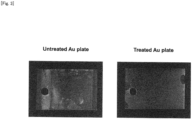
- the result of the Au coated plate is shown in Fig. 3
- the result of the Ag coated plate is shown in Fig. 4 .
- a friction coefficient of a metal surface was measured to evaluate an effect to improve a sliding property by the branched glycerol derivative of the present invention.
- a plain plate of thickness 200 um ⁇ 2 cm ⁇ 3 cm with Au coat was immersed in each metal surface treatment agent (100 mL) warmed to 55°C for 6 hours. Then, the metal sample was taken out from the metal surface treatment agent, washed with ultrapure water, and then dried using a dryer.
- a measuring probe was slid on the metal sample surface using a precise sliding test apparatus ("CRS-G2050-CHD-A" manufactured by Yamasaki Seiki) to measure a friction coefficient.
- a load was 50 gf
- a slide speed was 0.33 mm/sec
- a slide distance was 0.5 mm
- a measurement current was 1 mA
- a probe diameter was 1.5 mm
- measurement number was 30 times.
- an untreated Au coated plate was similarly subjected to the measurement for comparison. The result is shown in Table 2.
- Table 2 Initial friction coefficient Friction coefficient after 30 timesslides Untreated metal sample 0.39 0.58 Treated metal sample 0.15 0.49
- Electrochemical migration means a phenomenon of a short-circuit between electrodes in an electrical circuit by deteriorating an insulation property between the electrodes electrically, chemically or due to heat or by dissolving or reducing an electrode metal as an ion.
- ECM test was carried out and an insulation resistance value under a load of applied voltage was measured to evaluate an electrochemical migration (ECM) resistance property of an Ag coated comb-shaped electrode pattern substrate of which surface was treated by the branched glycerol derivative of the present invention.
- a plain plate of thickness 200 um ⁇ 2 cm ⁇ 3 cm with Ag coat was immersed in each metal surface treatment agent (100 mL) warmed to 55°C for 6 hours. Then, the metal sample was taken out from the metal surface treatment agent, washed with ultrapure water, and then dried using a dryer.
- the comb-shaped copper electrodes were coated with Ni in a thickness of 3.0 um as a base and coated with Au in a thickness of 0.15 um as a surface layer.
- An applied voltage was loaded on an evaluation substrate using an ion migration tester ("ECM-100" manufactured by J-RAS) and a thermo-hygrostat bath manufactured by Nagano Science, and a change of an insulation resistance value during the application was measured.
- the applied DC voltage was 20 V
- the chamber temperature was 85°C
- the chamber humidity was 85%RH
- the energizing time was 120 hours.
- An Ag coated comb-shaped electrode pattern substrate of which outermost surface was Ag coating treated by the branched glycerol derivative of the present invention was used as a substrate for evaluation.
- An untreated Ag coated plate was also subjected to the similar measurement for comparison.
Landscapes
- Chemical & Material Sciences (AREA)
- Organic Chemistry (AREA)
- Engineering & Computer Science (AREA)
- Materials Engineering (AREA)
- Metallurgy (AREA)
- Mechanical Engineering (AREA)
- Chemical Kinetics & Catalysis (AREA)
- Combustion & Propulsion (AREA)
- General Chemical & Material Sciences (AREA)
- Organic Low-Molecular-Weight Compounds And Preparation Thereof (AREA)
- Heterocyclic Compounds That Contain Two Or More Ring Oxygen Atoms (AREA)
- Materials Applied To Surfaces To Minimize Adherence Of Mist Or Water (AREA)
- Other Surface Treatments For Metallic Materials (AREA)
Claims (12)
- Verzweigtes Glycerinderivat, dargestellt durch die folgende Formel (I):
 wobei R1 eine Kohlenwasserstoffgruppe mit einerKohlenstoffanzahl von 10 oder mehr und 30 oder weniger ist,X S oder eine Carbonylgruppe ist,Y eine n + 1-wertige Linkergruppe ist, ausgewählt aus einer C1-6 Alkandiylgruppe, einer C1-6 Alkantriylgruppe, einer Ethergruppe, einer Carbonylgruppe, einer Estergruppe, einer Amidgruppe, einer Harnstoffgruppe, einer Polyalkylenglykolgruppe, einer Polyvinylalkoholgruppe und einer Gruppe, die durch die Bindung von 2 oder mehr und 5 oder weniger der Gruppen gebildet wird,n eine ganze Zahl von 1 oder mehr und 5 oder weniger ist.
 - Zusammensetzung, umfassend das verzweigte Glycerinderivat gemäß Anspruch 1 als ein aktiver Bestandteil.
- Zusammensetzung nach Anspruch 2, weiter umfassend Wasser als ein Lösungsmittel.
- Zusammensetzung nach Anspruch 3, wobei die Konzentration des verzweigten Glycerinderivats 0,005 mM oder mehr und 5 mM oder weniger beträgt.
- Zusammensetzung nach Anspruch 3, wobei die Konzentration des verzweigten Glycerinderivats 0,001 Massen-% oder mehr und 5 Massen-% oder weniger beträgt.
- Zusammensetzung nach einem der Ansprüche 2 bis 5, weiter umfassend ein alkalisches Mittel, ausgewählt aus einem Hydrogencarbonatsalz eines Alkalimetalls, einem Carbonatsalz eines Alkalimetalls, einem Carbonatsalz eines Erdalkalimetalls, einem Hydroxid eines Alkalimetalls, Ammoniak und einer organischen Base, ausgewählt aus Triethylamin, N,N-Diisopropylethylamin, Triethanolamin und Pyridin.
- Zusammensetzung nach einem der Ansprüche 2 bis 6, weiter umfassend ein Tensid, ausgewählt aus einem nichtionischen Tensid, einem anionischen Tensid, einem kationischen Tensid und einem zwitterionischen Tensid.
- Verfahren zum Behandeln einer Metalloberfläche, umfassend den Schritt des Behandelns der Metalloberfläche unter Verwendung der Zusammensetzung gemäß einem der Ansprüche 2 bis 7.
- Verfahren nach Anspruch 8, wobei die Oberfläche des Metalls behandelt wird, indem das Metall in die Zusammensetzung in flüssiger Form eingetaucht wird, die Zusammensetzung auf die Oberfläche des Metalls aufgetragen wird oder die Zusammensetzung auf die Oberfläche des Metalls gesprüht wird.
- Verfahren nach Anspruch 8 oder 9, wobei das Metall Gold, Silber, Platin, Palladium, Zinn, Aluminium, Nickel, Eisen, Kupfer, Zink oder eine Legierung davon ist.
- Geschütztes verzweigtes Glycerinderivat, dargestellt durch die folgende Formel (II):
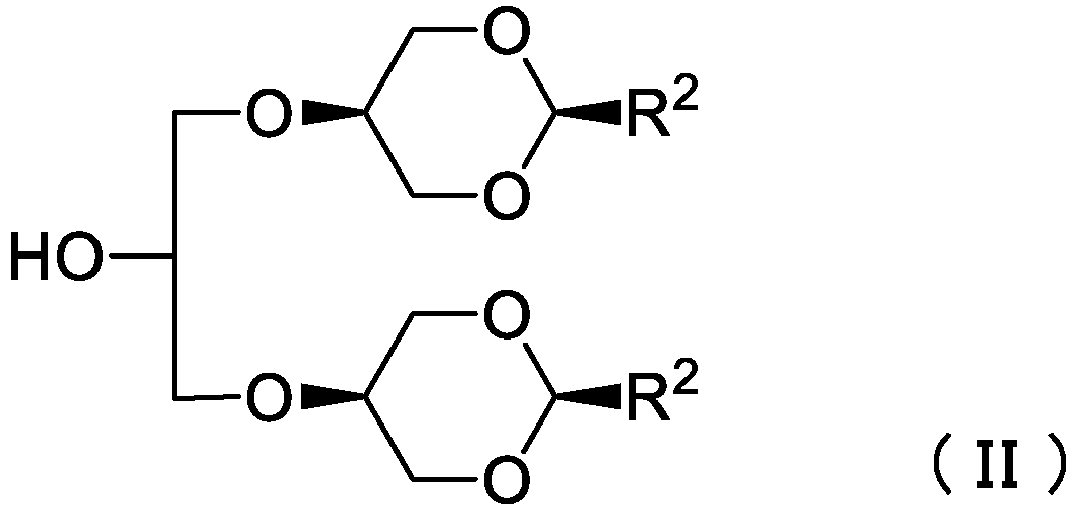
- Verfahren zur Herstellung eines geschützten verzweigten Glycerinderivats der folgenden Formel (II):
 wobei R2 eine C1-6 -Alkylgruppe ist,umfassend die Schritte:
Umsetzen von Glycerin mit einer Aldehydverbindung R2-CHO, um ein Gemisch, umfassend die Verbindungen der folgenden Formeln (III-1) bis (III-4), zu erhalten: wobei R2 dieselbe Bedeutung wie vorstehend hat,Reinigen der Verbindung der Formel (III-1) aus dem Gemisch durch Destillation, undUmsetzen der Verbindung der Formel (III-1) mit einem Epihalogenhydrin, um das geschützte verzweigte Glycerinderivat der Formel (II) zu erhalten.
Applications Claiming Priority (2)
| Application Number | Priority Date | Filing Date | Title |
|---|---|---|---|
| JP2019112183A JP6819973B2 (ja) | 2019-06-17 | 2019-06-17 | 親水性金属表面処理剤 |
| PCT/JP2020/022193 WO2020255741A1 (ja) | 2019-06-17 | 2020-06-04 | 親水性金属表面処理剤 |
Publications (4)
| Publication Number | Publication Date |
|---|---|
| EP3971174A1 EP3971174A1 (de) | 2022-03-23 |
| EP3971174A4 EP3971174A4 (de) | 2023-08-09 |
| EP3971174C0 EP3971174C0 (de) | 2024-08-14 |
| EP3971174B1 true EP3971174B1 (de) | 2024-08-14 |
Family
ID=73836916
Family Applications (1)
| Application Number | Title | Priority Date | Filing Date |
|---|---|---|---|
| EP20825528.1A Active EP3971174B1 (de) | 2019-06-17 | 2020-06-04 | Behandlungsmittel für hydrophile metalloberflächen |
Country Status (6)
| Country | Link |
|---|---|
| US (1) | US11124881B2 (de) |
| EP (1) | EP3971174B1 (de) |
| JP (1) | JP6819973B2 (de) |
| CN (1) | CN112566897B (de) |
| TW (1) | TWI728843B (de) |
| WO (1) | WO2020255741A1 (de) |
Families Citing this family (3)
| Publication number | Priority date | Publication date | Assignee | Title |
|---|---|---|---|---|
| JP7762899B2 (ja) * | 2021-06-01 | 2025-10-31 | 有限会社ケミカル電子 | 新規分岐型グリセロール誘導体およびコーティング剤 |
| CN113845791B (zh) * | 2021-10-13 | 2022-03-25 | 南昌航空大学 | 一种基于两性巯基化合物的自乳化金属防护处理液 |
| JP7784786B2 (ja) * | 2023-07-26 | 2025-12-12 | トモイケ バイオ リミテッド | 分岐型マルチ水酸基保護オリゴマー及びこれと結合されてなる連結体、並びに当該連結体が脱保護されてなる分岐型マルチ水酸基オリゴマー |
Family Cites Families (14)
| Publication number | Priority date | Publication date | Assignee | Title |
|---|---|---|---|---|
| TW387926B (en) * | 1998-05-15 | 2000-04-21 | Nippon Dacro Shamrock Co | Surface treatment agent for metals, surface treatment method for metals, and pre-coated steel plate |
| JP2001152363A (ja) | 1999-11-29 | 2001-06-05 | Dojin Kagaku Kenkyusho:Kk | 自己組織化単分子膜の製造方法 |
| JP2002241957A (ja) * | 2001-02-14 | 2002-08-28 | Nippon Paint Co Ltd | 金属表面処理剤、金属表面処理方法および表面処理金属材料 |
| JP3870225B2 (ja) | 2001-10-19 | 2007-01-17 | ユケン工業株式会社 | 金めっき封孔処理剤と方法 |
| JP4722484B2 (ja) * | 2002-09-26 | 2011-07-13 | 協和発酵キリン株式会社 | グリセロール誘導体 |
| JPWO2008093655A1 (ja) * | 2007-01-30 | 2010-05-20 | 国立大学法人徳島大学 | ポリアルコール化合物および医薬 |
| JP5396063B2 (ja) | 2008-10-27 | 2014-01-22 | 独立行政法人物質・材料研究機構 | 機能性金属複合基板およびその製造方法 |
| JP5636692B2 (ja) * | 2010-02-26 | 2014-12-10 | 国立大学法人徳島大学 | 5−ヒドロキシ−1,3−ジオキサンの製造方法および該方法により得られた5−ヒドロキシ−1,3−ジオキサンを原料とした分岐型グリセロール3量体の製造方法 |
| WO2013035899A1 (ko) * | 2011-09-07 | 2013-03-14 | 주식회사 코리아테크노에이전시 | 5-히드록시-1, 3-디옥산의 제조 방법 및 이를 원료로 한 분기형 글리세롤 3량체의 제조 방법 |
| JP6271233B2 (ja) | 2013-11-29 | 2018-01-31 | ローム・アンド・ハース電子材料株式会社 | 表面処理液 |
| JP6209996B2 (ja) | 2014-03-11 | 2017-10-11 | 住友金属鉱山株式会社 | 金属材の表面処理方法 |
| CN104372355A (zh) * | 2014-07-24 | 2015-02-25 | 梁胜光 | 一种金属表面处理用的含水除锈防锈剂 |
| JP2020023052A (ja) * | 2017-01-16 | 2020-02-13 | 仲山貴金属鍍金株式会社 | 表面の疎水性もしくは親水性が高められた基体 |
| JP6673324B2 (ja) | 2017-12-22 | 2020-03-25 | コベルコ建機株式会社 | 作業機械の手すり |
-
2019
- 2019-06-17 JP JP2019112183A patent/JP6819973B2/ja active Active
-
2020
- 2020-06-04 WO PCT/JP2020/022193 patent/WO2020255741A1/ja not_active Ceased
- 2020-06-04 EP EP20825528.1A patent/EP3971174B1/de active Active
- 2020-06-04 US US17/272,765 patent/US11124881B2/en active Active
- 2020-06-04 CN CN202080004543.4A patent/CN112566897B/zh active Active
- 2020-06-15 TW TW109119986A patent/TWI728843B/zh active
Also Published As
| Publication number | Publication date |
|---|---|
| EP3971174C0 (de) | 2024-08-14 |
| EP3971174A4 (de) | 2023-08-09 |
| JP2020204076A (ja) | 2020-12-24 |
| US11124881B2 (en) | 2021-09-21 |
| US20210246560A1 (en) | 2021-08-12 |
| JP6819973B2 (ja) | 2021-01-27 |
| TW202110795A (zh) | 2021-03-16 |
| CN112566897A (zh) | 2021-03-26 |
| WO2020255741A1 (ja) | 2020-12-24 |
| EP3971174A1 (de) | 2022-03-23 |
| CN112566897B (zh) | 2022-03-01 |
| TWI728843B (zh) | 2021-05-21 |
Similar Documents
| Publication | Publication Date | Title |
|---|---|---|
| EP3971174B1 (de) | Behandlungsmittel für hydrophile metalloberflächen | |
| Youda et al. | A SERS study on inhibition mechanisms of benzotriazole and its derivatives for copper corrosion in sulphate solutions | |
| Burczyk et al. | Synthesis and Surface Properties of N-Alkyl-N-methylgluconamides and N-Alkyl-N-methyllactobionamides | |
| JP5725712B2 (ja) | 化学変性による表面特性の調整制御 | |
| Hambley | Molecular mechanics analysis of the influence of interligand interactions on isomer stabilities and barriers to isomer interconversion in diammine-and bis (amine) bis (purine) platinum (II) complexes | |
| WO2013172350A1 (ja) | 新規グラフェンナノ分散液及びその調製方法 | |
| JP2014504920A (ja) | 腕時計製造用構成部品の疎油性を高めるための組成物 | |
| WO2003054536A1 (fr) | Electrode pour espece chimique d'oxygene actif et capteur utilisant l'electrode | |
| JP2001509500A (ja) | 分岐鎖脂肪酸、それらの誘導体、および中枢神経系障害の処置における使用 | |
| Öztürk | Synthesis and corrosion inhibition behavior of novel amide-based quarternary di-cationic surfactants on carbon steel in HCl solutions | |
| Herm et al. | Towards synthetic adrenaline receptors | |
| HK40042131A (en) | Hydrophilic metal-surface treatment agent | |
| EP2380664B1 (de) | Funktionalisiertes Substrat und seine Anwendungen | |
| HK40042131B (zh) | 亲水性金属表面处理剂 | |
| EP1979363B1 (de) | Neue silanverbindungen und deren verwendung zur funktionalisierung fester medien und zur immobilisierung biologischer moleküle auf diesen medien | |
| US20200298194A1 (en) | Aramid amphiphile self-assembled nanostructures | |
| EP0396435B1 (de) | Polyaza-Derivate und ihre Metallkomplexe und ihre Verwendung zur Fixierung des Sauerstoffs | |
| EP3322527A1 (de) | Verfahren zur herstellung von ionischen flüssigkeiten biologischen ursprungs zur katalyse | |
| Suenaga et al. | Sugar-controlled association–dissociation equilibria between DNA and boronic acid-appended porphyrin | |
| JP4993347B2 (ja) | ホスホリルコリン基含有シラン化合物の製造方法 | |
| JP5751580B2 (ja) | メトキシオリゴエチレングリコール−シラン化合物表面修飾材料 | |
| EP0551369B1 (de) | Silan-haftvermittler, verfahren zu seiner herstellung und seine anwendung zum beschichten auf glas mit leitfähigem beschichtungsfilm | |
| FR3045053A1 (fr) | Agents complexants hydrosolubles a base de triazapyridinophane et complexes de lanthanide fluorescents correspondants | |
| CA2208992A1 (fr) | 1-c-perfluoroalkyl glycosides, procede de preparation et utilisations | |
| EP3192854B1 (de) | Artikel, dessen oberfläche mit einem kopplungsmittel mit oleophoben und/oder hydrophoben eigenschaften behandelt wurde |
Legal Events
| Date | Code | Title | Description |
|---|---|---|---|
| STAA | Information on the status of an ep patent application or granted ep patent |
Free format text: STATUS: THE INTERNATIONAL PUBLICATION HAS BEEN MADE |
|
| PUAI | Public reference made under article 153(3) epc to a published international application that has entered the european phase |
Free format text: ORIGINAL CODE: 0009012 |
|
| STAA | Information on the status of an ep patent application or granted ep patent |
Free format text: STATUS: REQUEST FOR EXAMINATION WAS MADE |
|
| 17P | Request for examination filed |
Effective date: 20210304 |
|
| AK | Designated contracting states |
Kind code of ref document: A1 Designated state(s): AL AT BE BG CH CY CZ DE DK EE ES FI FR GB GR HR HU IE IS IT LI LT LU LV MC MK MT NL NO PL PT RO RS SE SI SK SM TR |
|
| DAV | Request for validation of the european patent (deleted) | ||
| DAX | Request for extension of the european patent (deleted) | ||
| A4 | Supplementary search report drawn up and despatched |
Effective date: 20230707 |
|
| RIC1 | Information provided on ipc code assigned before grant |
Ipc: C07C 327/22 20060101ALI20230703BHEP Ipc: C07C 323/12 20060101ALI20230703BHEP Ipc: C23C 26/00 20060101ALI20230703BHEP Ipc: C23C 22/60 20060101ALI20230703BHEP Ipc: C09K 3/18 20060101ALI20230703BHEP Ipc: C07D 317/20 20060101ALI20230703BHEP Ipc: C07D 319/06 20060101AFI20230703BHEP |
|
| GRAP | Despatch of communication of intention to grant a patent |
Free format text: ORIGINAL CODE: EPIDOSNIGR1 |
|
| STAA | Information on the status of an ep patent application or granted ep patent |
Free format text: STATUS: GRANT OF PATENT IS INTENDED |
|
| RIC1 | Information provided on ipc code assigned before grant |
Ipc: C07C 327/22 20060101ALI20240408BHEP Ipc: C07C 323/12 20060101ALI20240408BHEP Ipc: C23C 26/00 20060101ALI20240408BHEP Ipc: C23C 22/60 20060101ALI20240408BHEP Ipc: C09K 3/18 20060101ALI20240408BHEP Ipc: C07D 317/20 20060101ALI20240408BHEP Ipc: C07D 319/06 20060101AFI20240408BHEP |
|
| INTG | Intention to grant announced |
Effective date: 20240507 |
|
| GRAS | Grant fee paid |
Free format text: ORIGINAL CODE: EPIDOSNIGR3 |
|
| GRAA | (expected) grant |
Free format text: ORIGINAL CODE: 0009210 |
|
| STAA | Information on the status of an ep patent application or granted ep patent |
Free format text: STATUS: THE PATENT HAS BEEN GRANTED |
|
| AK | Designated contracting states |
Kind code of ref document: B1 Designated state(s): AL AT BE BG CH CY CZ DE DK EE ES FI FR GB GR HR HU IE IS IT LI LT LU LV MC MK MT NL NO PL PT RO RS SE SI SK SM TR |
|
| REG | Reference to a national code |
Ref country code: GB Ref legal event code: FG4D |
|
| REG | Reference to a national code |
Ref country code: CH Ref legal event code: EP |
|
| REG | Reference to a national code |
Ref country code: DE Ref legal event code: R096 Ref document number: 602020035907 Country of ref document: DE |
|
| REG | Reference to a national code |
Ref country code: IE Ref legal event code: FG4D |
|
| U01 | Request for unitary effect filed |
Effective date: 20240821 |
|
| U07 | Unitary effect registered |
Designated state(s): AT BE BG DE DK EE FI FR IT LT LU LV MT NL PT RO SE SI Effective date: 20240902 |
|
| PG25 | Lapsed in a contracting state [announced via postgrant information from national office to epo] |
Ref country code: NO Free format text: LAPSE BECAUSE OF FAILURE TO SUBMIT A TRANSLATION OF THE DESCRIPTION OR TO PAY THE FEE WITHIN THE PRESCRIBED TIME-LIMIT Effective date: 20241114 |
|
| PG25 | Lapsed in a contracting state [announced via postgrant information from national office to epo] |
Ref country code: GR Free format text: LAPSE BECAUSE OF FAILURE TO SUBMIT A TRANSLATION OF THE DESCRIPTION OR TO PAY THE FEE WITHIN THE PRESCRIBED TIME-LIMIT Effective date: 20241115 Ref country code: PL Free format text: LAPSE BECAUSE OF FAILURE TO SUBMIT A TRANSLATION OF THE DESCRIPTION OR TO PAY THE FEE WITHIN THE PRESCRIBED TIME-LIMIT Effective date: 20240814 |
|
| PG25 | Lapsed in a contracting state [announced via postgrant information from national office to epo] |
Ref country code: IS Free format text: LAPSE BECAUSE OF FAILURE TO SUBMIT A TRANSLATION OF THE DESCRIPTION OR TO PAY THE FEE WITHIN THE PRESCRIBED TIME-LIMIT Effective date: 20241214 |
|
| PG25 | Lapsed in a contracting state [announced via postgrant information from national office to epo] |
Ref country code: HR Free format text: LAPSE BECAUSE OF FAILURE TO SUBMIT A TRANSLATION OF THE DESCRIPTION OR TO PAY THE FEE WITHIN THE PRESCRIBED TIME-LIMIT Effective date: 20240814 |
|
| PG25 | Lapsed in a contracting state [announced via postgrant information from national office to epo] |
Ref country code: RS Free format text: LAPSE BECAUSE OF FAILURE TO SUBMIT A TRANSLATION OF THE DESCRIPTION OR TO PAY THE FEE WITHIN THE PRESCRIBED TIME-LIMIT Effective date: 20241114 Ref country code: ES Free format text: LAPSE BECAUSE OF FAILURE TO SUBMIT A TRANSLATION OF THE DESCRIPTION OR TO PAY THE FEE WITHIN THE PRESCRIBED TIME-LIMIT Effective date: 20240814 |
|
| PG25 | Lapsed in a contracting state [announced via postgrant information from national office to epo] |
Ref country code: RS Free format text: LAPSE BECAUSE OF FAILURE TO SUBMIT A TRANSLATION OF THE DESCRIPTION OR TO PAY THE FEE WITHIN THE PRESCRIBED TIME-LIMIT Effective date: 20241114 Ref country code: PL Free format text: LAPSE BECAUSE OF FAILURE TO SUBMIT A TRANSLATION OF THE DESCRIPTION OR TO PAY THE FEE WITHIN THE PRESCRIBED TIME-LIMIT Effective date: 20240814 Ref country code: NO Free format text: LAPSE BECAUSE OF FAILURE TO SUBMIT A TRANSLATION OF THE DESCRIPTION OR TO PAY THE FEE WITHIN THE PRESCRIBED TIME-LIMIT Effective date: 20241114 Ref country code: IS Free format text: LAPSE BECAUSE OF FAILURE TO SUBMIT A TRANSLATION OF THE DESCRIPTION OR TO PAY THE FEE WITHIN THE PRESCRIBED TIME-LIMIT Effective date: 20241214 Ref country code: HR Free format text: LAPSE BECAUSE OF FAILURE TO SUBMIT A TRANSLATION OF THE DESCRIPTION OR TO PAY THE FEE WITHIN THE PRESCRIBED TIME-LIMIT Effective date: 20240814 Ref country code: GR Free format text: LAPSE BECAUSE OF FAILURE TO SUBMIT A TRANSLATION OF THE DESCRIPTION OR TO PAY THE FEE WITHIN THE PRESCRIBED TIME-LIMIT Effective date: 20241115 Ref country code: ES Free format text: LAPSE BECAUSE OF FAILURE TO SUBMIT A TRANSLATION OF THE DESCRIPTION OR TO PAY THE FEE WITHIN THE PRESCRIBED TIME-LIMIT Effective date: 20240814 |
|
| PG25 | Lapsed in a contracting state [announced via postgrant information from national office to epo] |
Ref country code: SM Free format text: LAPSE BECAUSE OF FAILURE TO SUBMIT A TRANSLATION OF THE DESCRIPTION OR TO PAY THE FEE WITHIN THE PRESCRIBED TIME-LIMIT Effective date: 20240814 |
|
| PG25 | Lapsed in a contracting state [announced via postgrant information from national office to epo] |
Ref country code: CZ Free format text: LAPSE BECAUSE OF FAILURE TO SUBMIT A TRANSLATION OF THE DESCRIPTION OR TO PAY THE FEE WITHIN THE PRESCRIBED TIME-LIMIT Effective date: 20240814 |
|
| PG25 | Lapsed in a contracting state [announced via postgrant information from national office to epo] |
Ref country code: SK Free format text: LAPSE BECAUSE OF FAILURE TO SUBMIT A TRANSLATION OF THE DESCRIPTION OR TO PAY THE FEE WITHIN THE PRESCRIBED TIME-LIMIT Effective date: 20240814 |
|
| PLBE | No opposition filed within time limit |
Free format text: ORIGINAL CODE: 0009261 |
|
| STAA | Information on the status of an ep patent application or granted ep patent |
Free format text: STATUS: NO OPPOSITION FILED WITHIN TIME LIMIT |
|
| 26N | No opposition filed |
Effective date: 20250515 |
|
| U20 | Renewal fee for the european patent with unitary effect paid |
Year of fee payment: 6 Effective date: 20250626 |
|
| REG | Reference to a national code |
Ref country code: CH Ref legal event code: H13 Free format text: ST27 STATUS EVENT CODE: U-0-0-H10-H13 (AS PROVIDED BY THE NATIONAL OFFICE) Effective date: 20260127 |
|
| PG25 | Lapsed in a contracting state [announced via postgrant information from national office to epo] |
Ref country code: MC Free format text: LAPSE BECAUSE OF FAILURE TO SUBMIT A TRANSLATION OF THE DESCRIPTION OR TO PAY THE FEE WITHIN THE PRESCRIBED TIME-LIMIT Effective date: 20240814 |