EP3965591B1 - Produit et procédé à base de pomme de terre liquéfié - Google Patents
Produit et procédé à base de pomme de terre liquéfié Download PDFInfo
- Publication number
- EP3965591B1 EP3965591B1 EP20822358.6A EP20822358A EP3965591B1 EP 3965591 B1 EP3965591 B1 EP 3965591B1 EP 20822358 A EP20822358 A EP 20822358A EP 3965591 B1 EP3965591 B1 EP 3965591B1
- Authority
- EP
- European Patent Office
- Prior art keywords
- liquid
- potato
- oil
- shear
- dynes
- Prior art date
- Legal status (The legal status is an assumption and is not a legal conclusion. Google has not performed a legal analysis and makes no representation as to the accuracy of the status listed.)
- Active
Links
Images


Classifications
-
- A—HUMAN NECESSITIES
- A23—FOODS OR FOODSTUFFS; TREATMENT THEREOF, NOT COVERED BY OTHER CLASSES
- A23L—FOODS, FOODSTUFFS OR NON-ALCOHOLIC BEVERAGES, NOT OTHERWISE PROVIDED FOR; PREPARATION OR TREATMENT THEREOF
- A23L19/00—Products from fruits or vegetables; Preparation or treatment thereof
- A23L19/09—Mashed or comminuted products, e.g. pulp, purée, sauce, or products made therefrom, e.g. snacks
-
- A—HUMAN NECESSITIES
- A23—FOODS OR FOODSTUFFS; TREATMENT THEREOF, NOT COVERED BY OTHER CLASSES
- A23L—FOODS, FOODSTUFFS OR NON-ALCOHOLIC BEVERAGES, NOT OTHERWISE PROVIDED FOR; PREPARATION OR TREATMENT THEREOF
- A23L19/00—Products from fruits or vegetables; Preparation or treatment thereof
- A23L19/10—Products from fruits or vegetables; Preparation or treatment thereof of tuberous or like starch containing root crops
- A23L19/12—Products from fruits or vegetables; Preparation or treatment thereof of tuberous or like starch containing root crops of potatoes
-
- A—HUMAN NECESSITIES
- A23—FOODS OR FOODSTUFFS; TREATMENT THEREOF, NOT COVERED BY OTHER CLASSES
- A23L—FOODS, FOODSTUFFS OR NON-ALCOHOLIC BEVERAGES, NOT OTHERWISE PROVIDED FOR; PREPARATION OR TREATMENT THEREOF
- A23L23/00—Soups; Sauces; Preparation or treatment thereof
-
- A—HUMAN NECESSITIES
- A23—FOODS OR FOODSTUFFS; TREATMENT THEREOF, NOT COVERED BY OTHER CLASSES
- A23L—FOODS, FOODSTUFFS OR NON-ALCOHOLIC BEVERAGES, NOT OTHERWISE PROVIDED FOR; PREPARATION OR TREATMENT THEREOF
- A23L33/00—Modifying nutritive qualities of foods; Dietetic products; Preparation or treatment thereof
- A23L33/10—Modifying nutritive qualities of foods; Dietetic products; Preparation or treatment thereof using additives
- A23L33/105—Plant extracts, their artificial duplicates or their derivatives
-
- A—HUMAN NECESSITIES
- A23—FOODS OR FOODSTUFFS; TREATMENT THEREOF, NOT COVERED BY OTHER CLASSES
- A23L—FOODS, FOODSTUFFS OR NON-ALCOHOLIC BEVERAGES, NOT OTHERWISE PROVIDED FOR; PREPARATION OR TREATMENT THEREOF
- A23L5/00—Preparation or treatment of foods or foodstuffs, in general; Food or foodstuffs obtained thereby; Materials therefor
- A23L5/10—General methods of cooking foods, e.g. by roasting or frying
- A23L5/13—General methods of cooking foods, e.g. by roasting or frying using water or steam
-
- A—HUMAN NECESSITIES
- A23—FOODS OR FOODSTUFFS; TREATMENT THEREOF, NOT COVERED BY OTHER CLASSES
- A23L—FOODS, FOODSTUFFS OR NON-ALCOHOLIC BEVERAGES, NOT OTHERWISE PROVIDED FOR; PREPARATION OR TREATMENT THEREOF
- A23L5/00—Preparation or treatment of foods or foodstuffs, in general; Food or foodstuffs obtained thereby; Materials therefor
- A23L5/30—Physical treatment, e.g. electrical or magnetic means, wave energy or irradiation
-
- A—HUMAN NECESSITIES
- A23—FOODS OR FOODSTUFFS; TREATMENT THEREOF, NOT COVERED BY OTHER CLASSES
- A23L—FOODS, FOODSTUFFS OR NON-ALCOHOLIC BEVERAGES, NOT OTHERWISE PROVIDED FOR; PREPARATION OR TREATMENT THEREOF
- A23L19/00—Products from fruits or vegetables; Preparation or treatment thereof
- A23L19/10—Products from fruits or vegetables; Preparation or treatment thereof of tuberous or like starch containing root crops
- A23L19/12—Products from fruits or vegetables; Preparation or treatment thereof of tuberous or like starch containing root crops of potatoes
- A23L19/13—Mashed potato products
-
- A—HUMAN NECESSITIES
- A23—FOODS OR FOODSTUFFS; TREATMENT THEREOF, NOT COVERED BY OTHER CLASSES
- A23V—INDEXING SCHEME RELATING TO FOODS, FOODSTUFFS OR NON-ALCOHOLIC BEVERAGES AND LACTIC OR PROPIONIC ACID BACTERIA USED IN FOODSTUFFS OR FOOD PREPARATION
- A23V2002/00—Food compositions, function of food ingredients or processes for food or foodstuffs
Definitions
- the present invention is generally related to potato-based products that may be used to produce various food products. More generally, the present application is generally related to the production of liquid potato products that may be used to produce various healthy food products.
- Giannopoulos Eli "Skordalia recipe (Traditional Greek Potato and Garlic dip) - My Greek Dish",MyGreekDish.com, 15 March 2014 (2014-03-15 ) discloses a traditional Greek skordalia recipe, comprising cutting potatoes in pieces, adding them in a food processor and blending to combine. Pouring olive oil whilst blending, and blending until the oil is incorporated and the mixture is smooth and creamy.
- EP1229804B1 (FRITO LAY NORTH AMERICA) discloses a method for making a potato dough wherein the potato stock is next chopped during a grind step accomplished using a high-shear grinder having a sharp blade with a relatively high rotational speed.
- DANKAR IMAN ET AL "Assessing Mechanical and Rheological Properties of Potato Puree: Effect of Different Ingredient Combinations and Cooking Methods on the Feasibility of 3D Printing",FOODS, vol. 9, no. 1, 24 December 2019 discloses the effect of different ingredient combinations and cooking methods in the mechanical and rheological properties of potato puree, for instance olive oil.
- a method of making a liquid potato product comprising: (a) providing an initial potato feed comprising whole raw potatoes having an initial moisture content; (b) at least partially gelatinizing said initial potato feed to thereby form a gelatinized potato feed having a second moisture content, wherein said second moisture content is less than 50 percent lower than said initial moisture content; and (c) using a shearing device performing a high shearing process to shear at least a portion of said gelatinized potato feed in the presence of an oil until the sheared said gelatinized potato feed has a continuous non-particulate starch matrix to thereby form said liquid potato product.
- the present invention is generally related to the production of Liquid P, which is a liquid product at least partially derived from potatoes, and the use of Liquid P to produce various food products.
- Certain embodiments of the present invention may include a potato liquefaction system for converting potatoes and other root vegetables into a useful liquid product, such as Liquid P.
- a potato liquefaction system for converting potatoes and other root vegetables into a useful liquid product, such as Liquid P.
- the system described herein is capable of creating a unique liquid potato product, i.e., Liquid P, which can be used to produce various types of food products that exhibit one or more desirable traits.
- Liquid P may be used interchangeably with "liquid potato product” and both refer to a substance containing at least 5 weight percent potato and having a dynamic viscosity in the range of 70 to 250,000 cP at a shear rate of 4 1 /s and a temperature between 12.5°C to 95°C.
- FIG. 1 depicts an exemplary Liquid P production system 10 that may be employed to at least partially convert one or more potato-containing feeds into Liquid P and food products containing Liquid P.
- the Liquid P production system shown in FIG. 1 is just one example of a system within which the present invention can be embodied. Thus, the present invention may find application in a wide variety of other systems where it is desirable to efficiently and effectively produce Liquid P.
- the exemplary system illustrated in FIG. 1 will now be described in greater detail.
- the Liquid P Production System 10 may comprise a potato source 12 for supplying one or more types of potatoes to the system 10.
- the potato source 12 can be, for example, a hopper, storage bin, railcar, trailer, or any other device that may hold or store potatoes and other types of vegetables.
- the potato feed 14 derived from the potato source 12 can comprise, consist essentially of, or consist of whole raw potatoes.
- the potatoes supplied by the potato source 12 can comprise of any variety of Solanum tuberosum.
- Exemplary potato varieties can include, for example, Shepody potatoes, Bintje potatoes, American Blue potatoes, Royal potatoes, Innate Potatoes, Maris Piper potatoes, Focus potatoes, Yukon Gold potatoes, Lady Balfour potatoes, Kennebec potatoes, Colette potatoes, Chieftain potatoes, Innovator potatoes, Russet Burbank potatoes, purple potatoes, Russet potatoes, Bamberg potatoes, or combinations thereof.
- the potatoes derived from the potato source 12 are whole raw potatoes.
- the potato feed 14 can comprise at least 25, 50, 75, 80, 85, 90, 95, or 99 weight percent of one or more whole raw potatoes, based on the total weight of the feed stream.
- the potato source 12 may also supply one or more other root vegetables, such as parsnips, celery root, sweet potatoes, onions, red beets, carrots, or combinations thereof.
- root vegetable refers to an edible underground plant part that comprises a higher fiber content relative to peeled potatoes.
- the potato feed 14 can comprise at least 1, 5, 10, 15, 20, or 25 weight percent and/or less than 90, 85, 80, 75, 70, 65, 60, 55, 50, 45, 40, 35, or 30 weight percent of one or more root vegetables, based on the total weight of the potato feed.
- the potato feed 14 from the potato source 12 can be sent to a pretreatment unit 16 for further processing before any subsequent cooking and conversion steps.
- the pretreated potato feed 18 is then introduced into a blanching and gelatinization system 20. While in the blanching and gelatinization system 20, the pretreated potato feed 18 can undergo any known process or technique for at least partially gelatinizing at least a portion of the potatoes in the potato feed.
- the blanching and gelatinization system 20 can comprise any system or device capable of subjecting the pretreated potato feed 18 to a gelatinization process, such as a microwave, a hot water bath, autoclave, or any other device known in the art.
- the gelatinization process can involve any heat treatment capable of at least partially gelatinizing the potatoes in the pretreated potato feed 18.
- Such techniques may include, for example, microwaving, boiling, scalding, blanching, or combinations thereof.
- the gelatinization process comprises blanching.
- the blanching process can involve: (i) contacting the pretreated potato feed 18 with hot water and/or steam and (ii) subsequently contacting the cooked potato feed with an aqueous solution to thereby form the gelatinized feed 22.
- the aqueous solution can comprise one or more chelating agents and/or pH-modifying agents, such as citric acid, EDTA, a phosphate compound, or a combination thereof.
- the gelatinization process does not involve a mashing step.
- the gelatinized potato feed would not be considered "mashed.”
- the blanching step may help to mitigate undesirable enzymes in the potato feed, remove the peels from the potatoes and modify the texture of the potatoes and other root vegetables in the potato feed.
- the first step of the blanching process can comprise contacting the pretreated potato feed 18 with heated water over a time period of at least 1, 2, 3, 4, or 5 minutes and/or less than 30, 25, 20, 15, or 10 minutes.
- this water heat treatment can occur at around atmospheric pressures and at a temperature of at least 50°C, 55°C, 60°C, 65°C, 70°C, 75°C, or 80°C.
- the water heat treatment can occur at a temperature of less than 150°C, 125°C, 100°C, 95°C, 90°C, 85°C, 80°C, 75°C, 70°C, 65°C, 60°C, or 55°C.
- the first step of the blanching process can comprise contacting the pretreated potato feed 18 with pressurized steam over a time period of at least 1, 2, 3, 4, or 5 minutes and/or less than 30, 25, 20, 15, or 10 minutes.
- this steam treatment can occur at a gauge pressure of at least 10, 25, 50, 75, 100, or 125 psig and/or less than 300, 250, 200, 175, or 160 psig and at temperature of at least 100°C, 125°C, or 150°C and/or less than 300°C, 250°C, 200°C, or 185°C.
- the second step of the blanching process can occur at a temperature of at least 10°C, 15°C, 20°C, 25°C, 30°C, 35°C, 40°C, 45°C, 50°C, 55°C, 60°C, 65°C, 70°C, 75°C, or 80°C and/or less than 150°C, 125°C, 100°C, 95°C, 90°C, 85°C, 80°C, 75°C, 70°C, 65°C, or 60°C. Additionally or alternatively, in various embodiments, the second step of the blanching process can occur over a time period of less than 10, 5, 4, 3, 2, or 1 minutes.
- the gelatinization process will remove very little water and/or solids from the pretreated potato feed 18.
- the gelatinization techniques of the present disclosure may attempt to retain much of the water, moisture, and solids naturally present in the potatoes.
- the moisture content (by weight) of the gelatinized potato feed 22 is less than 50, 45, 40, 35, 30, 25, 20, 15, 10, 9, 8, 7, 6, 5, 4, or 3 percent lower than the moisture content of the pretreated potato feed 18.
- the moisture content of the gelatinized potato feed 22 is at least 50, 55, 60, 65, 70, 75, 80, 85, 90, 91, 92, 93, 94, 95, 96, or 97 percent of the moisture content of the pretreated potato feed 18.
- the gelatinized potato feed 22 can be introduced into a shearing device 24. While in the shearing device 24, the gelatinized potato feed 22 can be subjected to the specific temperature and shear conditions necessary to produce the Liquid P 26.
- the shearing step may be carried out at under specific temperature, pressure, and/or shear conditions so that the starch in the gelatinized potato feed 22 may become fully gelatinized, thereby facilitating the formation of the Liquid P.
- the temperature of the gelatinized potato feed 22 must reach at least 67°C in order to fully gelatinize the starch within the feed during the shearing step.
- shearing refers to a mechanical treatment that induces a shear rate through the liquid which changes the underlying micro-structure.
- shearing may include particle comminution.
- the shearing device 24 can comprise any shearing device known in the art capable of providing the high shear necessary to produce the Liquid P 26 from the gelatinized potato feed 22.
- Exemplary shearing devices can include, for example, a food processor, a high shear mixer with an impeller, or a high-speed turbine with a shroud.
- the shearing device 24 can comprise a high-speed turbine with a shroud, wherein the rpm of the turbine can influence the temperature and time conditions of the shearing process.
- the shearing step can occur at a temperature of at least 10°C, 15°C, 20°C, 25°C, 30°C, 35°C, or 40°C and/or less than 150°C, 125°C, 100°C, 90°C, 80°C, or 75°C and over a time period of at least 1, 2, 3, 4, 5, 6, 7, 8, 9, or 10 minutes and/or less than 60, 55, 50, 45, 40, 35, 30, 25, 20, or 15 minutes.
- the shearing can occur at a pressure of at least 1, 5, 10, or 14 psig and/or less than 1,000, 900, 800, 700, 600, 500, 400, 300, 200, 100, 50, 25, 20, or 15 psig.
- one or more oils and/or water are added to the shearing device 24 along with the gelatinized potato feed 22.
- one or more oils and/or water may be added directly into the gelatinized potato feed 22 prior to introducing the feed 22 into the shearing device 24.
- one or more oils and/or water may be added to the Liquid P 26 after it has left the shearing device 24.
- oils and water can be useful in producing the desired viscosity of the Liquid P and may also enhance certain taste and textural properties of the resulting Liquid P.
- Exemplary oils can include, for example, vegetable oil, peanut oil, sunflower oil, canola oil, coconut oil, palm oil, corn oil, avocado oil, walnut oil, soybean oil, sesame oil, or combinations thereof.
- an oil is added to the shearing step, but water is not added. In yet other embodiments, both water and oil are added to the shearing step, along with the gelatinized potato feed 22.
- the Liquid P comprises at least 5, 10, 15, 20, 25, 30, 35, or 40 weight percent and/or less than 99, 95, 90, 85, 80, 75, 70, 65, 60, 55, or 50 weight percent of a potato component originally derived from the potatoes in the initial potato feed, based on the total weight of the Liquid P composition.
- the Liquid P can include up to 90 weight percent of one or more additional complex carbohydrates, such as root vegetables, other than potatoes.
- additional complex carbohydrates used to make the Liquid P can have a higher fiber content than the potatoes used to make the Liquid P.
- additional complex carbohydrates suitable for use in Liquid P include root vegetables, such as parsnips, celery root, sweet potatoes, onions, red beets, carrots, or combinations thereof.
- the Liquid P comprises at least 1, 2, 5, 10, 15, or 20 weight percent and/or less than 60, 55, 50, 45, 40, 35, 30, 25, 20, 15, or 10 weight percent of one or more root vegetables originally present in the initial potato feed, based on the total weight of the Liquid P composition.
- the Liquid P comprises a weight ratio of potato to root vegetables of at least 0.1:1, 0.5:1, 1:1, 1.5:1, or 2:1 and/or less than 10:1, 9:1, 8:1, 7:1, 6:1, 5:1, 4:1, or 3:1.
- the oil is added in sufficient quantities so that the Liquid P comprises at least 1, 2, 3, 4, 5, 6, 7, 8, 9, or 10 weight percent and/or less than 75, 70, 65, 60, 55, 50, 45, 40, 35, 30, or 25 weight percent of the oil, based on the total weight of the Liquid P composition.
- the Liquid P comprises a weight ratio of potato to oil of at least 0.1:1, 0.5:1, 1:1, 2:1, 3:1, 4:1, 5:1, 6:1, or 7:1 and/or less than 100:1, 75:1, 50:1, 40:1, 30:1, or 20:1.
- the water is added in sufficient quantities so that the Liquid P comprises at least 1, 2, 3, 4, 5, 6, 7, 8, 9, or 10 weight percent and/or less than 75, 70, 65, 60, 55, 50, 45, 40, 35, 30, or 25 weight percent of the water, based on the total weight of the Liquid P composition.
- optional flavorants, optional additives, and other optional vegetables and fruits may be added into the shearing device 24 along with the gelatinized potato feed 22.
- These flavorants can include, for example, spices, meat, cheese, herbs, other flavorants desired in the final food product, or combinations thereof.
- Exemplary additives that may be added may include, for example, protein supplements (e.g., whey protein, chickpeas, soy, or combinations thereof), dietary fiber supplements, vitamins, minerals, or combinations thereof.
- the other vegetables and fruits that may be added at this stage can include, for example, Capsicum peppers (including sweet peppers and hot peppers), onions, spinach, kale, mushrooms, mango, artichokes, legumes, corn, olives, tomatoes, or combinations thereof.
- the flavorants, additives, and other vegetables and fruits are added in sufficient quantities so that the Liquid P comprises at least 1, 2, 3, 4, 5, 6, 7, 8, 9, 10, 15, or 20 weight percent and/or less than 75, 70, 65, 60, 55, 50, 45, 40, 35, 30, or 25 weight percent of flavorants, additives, other vegetables, and/or other fruits, based on the total weight of the Liquid P composition.
- the Liquid P may not contain any added water and/or flavorants.
- the above-referenced root vegetables may be separately added to the shearing device 24 along with the gelatinized potato feed 22.
- one or more root vegetables may or may not be added to the potato feed prior to introducing the gelatinized potato feed 22 into the shearing device 24.
- such root vegetables may be subjected to the pretreatment and gelatinizing steps described herein so as to produce a gelatinized root vegetable feed for the shearing device 24.
- the root vegetables may undergo the pretreatment and gelatinizing steps in the absence of any potatoes.
- the gelatinized potato feed 22 is not subjected to mashing or a retrogradation step prior to the shearing step.
- retrogradation may not occur during the production process described herein due to the amount of water present during each step of the production process, the pH of each step, the fiber contents of the potato feed due to the presence of root vegetables, and the oil added during the shearing step.
- the Liquid P 26 can be in the form of a viscous, flowable liquid that has a shiny and smooth appearance.
- the Liquid P described herein can exhibit desirable rheological profiles without the need for thickening agents, such as starches, gums, flour, etc., which can be considered undesirable additives by many consumers.
- the Liquid P may comprise less than 1, 0.5, 0.1, 0.05, or 0.01 weight percent of at least one thickening agent, based on the total weight of the Liquid P formulation.
- the resulting Liquid P 26 can exhibit a viscosity at 12.5°C or 25°C of at least 100, 250, 500, 1,000, 1,500, 2,000, 2,500, 3,000, 3,500, 4,000, 4,500, or 5,000 cP and/or less than 250,000, 200,000, 150,000, 100,000, 90,000, 80,000, 70,000, 60,000, 50,000, 40,000, 30,000, 25,000, or 20,000 cP.
- the Liquid P is a non-Newtonian fluid having a non-linear relationship between shear stress and shear rate.
- the Liquid P may exhibit a shear stress at 12.5°C of at least 5, 10, 15, 20, 25, 30, 35, 40, 45, 50, 75, 100, 125, 150, 175, 200, 225, 250, 275, 300, 325, 350, 375, 400, 425, or 450 dynes/cm 2 at a shear rate of 0, 5, 10, 15, or 20 1 /s.
- the Liquid P may exhibit a shear stress at 12.5°C of less than 900, 800, 700, 600, 500, 450, 400, 350, 300, 250, 200, 150, 125, 100, 75, or 50 dynes/cm 2 at a shear rate of 0, 5, 10, 15, or 20 1 /s. It should be noted that these above rheological measurements may be applicable to the Liquid P immediately after its production or after it has been stored for 24 hours (“Day 1"), 48 hours (“Day 2"), or 72 hours (“Day 3") at 6°C.
- a complex carbohydrate material such as fiber and other root vegetables
- a complex carbohydrate material comprises a higher complex carbohydrate content relative to peeled potatoes.
- a complex carbohydrate material may include other root vegetables (i.e., root vegetables that are not potatoes).
- the Liquid P may exhibit one of the following shear stress profiles at 12.5°C after storing the Liquid P for 24 hours ("Day 1"), 48 hours (“Day 2"), or 72 hours ("Day 3") at 6°C:
- the Liquid P may be a non-Newtonian fluid and, therefore, exhibit a non-linear rheological profile.
- Y 1 ,” “Y 5 ,” “Y 10 ,” “Y 15 ,” “Y 20 ,” “Y 30 ,” and “Y 40” refer to the shear stress values (dynes/cm 2 ) of Liquid P at 12.5°C at shear rates of 1, 5, 10, 15, 20, 30, and 40 1 /s, respectively.
- Y 1-5 ,” “Y 5-10 ,” “Y 10-15 ,” “Y 15-20 ,” “Y 1-10 ,” “Y 10-20 ,” “Y 20-30 ,” and Y 30-40 refer to the change in shear stress values between Y 1 and Y 5 , Y 5 and Y 10 , Y 10 and Y 15 , Y 15 and Y 20 , Y 1 and Y 10 , Y 10 and Y 20 , Y 20 and Y 30 , and Y 30 and Y 40 , respectively.
- the Liquid P may exhibit at least 1, 2, 3, 4, 5, or 6 of the following rheological properties:
- rheological property measurements and more than one storage criteria are claimed herein (e.g., "said rheological properties are either measured after storing said liquid potato product for 24 hours at 6°C, 48 hours at 6°C, or 72 hours at 6°C")
- infringement of the claimed rheological properties may be met if an infringing product exhibits the recited rheological property at any one of the recited storage criteria (e.g., after storing for 24 hours at 6°C).
- rheological tests need to be conducted at each of the recited storage criteria (e.g., after storing for 24 hours at 6°C, after storing for 48 hours at 6°C, and after storing for 72 hours at 6°C).
- the Liquid P formulation exhibits a unique particle portfolio derived directly from the shearing process.
- samples of the Liquid P stained with Lugol solution are characterized by fewer and smaller starch particles, as well as the presence of a continuous non-particulate starch matrix.
- a low-sheared conventional potato product comprises numerous visible starch particles in the size range of 100 to 600 ⁇ m and no continuous non-particulate starch matrix.
- the Liquid P 26 can be transferred to a food production plant 28, where the Liquid P 26 can be used to produce various food products.
- Exemplary food products that the Liquid P can be used to produce include, for example, dips, sauces, dressings, soups, imitation dairy products, spreads, confectionaries, beverages, and any other food product incorporating liquid and/or semi-solid components.
- the food product comprises a dip.
- the food products produced with the Liquid P can comprise at least 1, 5, 10, 15, 20, 25, 30, 35, 40, 45, 50, 55, 60, 65, or 70 weight percent of the Liquid P, based on the total weight of the food product. Additionally or alternatively, in various embodiments, the food products produced with the Liquid P can comprise less than 99, 95, 90, 85, 80, 75, 70, 65, 60, 55, 50, 45, or 40 weight percent of the Liquid P, based on the total weight of the food product.
- the starting potato material was diced into 3/8 inch cubes. Furthermore, the potato cubes had been previously blanched, pregelatinized, treated with citric acid, and frozen. The potatoes were then gently thawed in a microwave (1200W 110v Panasonic Rotary model NSD997S). Afterwards, the diced and thawed potatoes were then mixed with the oil and water fractions and poured into a Vitamix mixer (Vitamix 5200 model VM0103 11.5 amp 110v with variable speed). It was at this point that the conventional method and the inventive method described herein began to differ.
- the Vitamix was ran at a low speed setting (3-4 on dial) for 2 to 3 minutes until a consistent, homogeneous puree was achieved.
- the shear treatment was gentle enough to ensure that there was no appreciable temperature increase.
- the product was then heated in the microwave with stirring to achieve a temperature of 165 to 170 °F (74 to 77 °C).
- the Vitamix was run at a high speed setting (10 on dial) for 5 to 10 minutes until there was a characteristic appearance change where the product became glossy with a distinct sheen and the power draw for the motor noticeably rose. With the amount of mechanical work being applied to the product there was a temperature increase to around 170 to 180 °F (77 to 82 °C) by the end of the shear treatment.
- the finished product was allowed to stand for 30 minutes at room temperature and a portion was then transferred to the rheometer sample chamber (Brookfield DV3TRVTJ with small sample adaptor kit using a SC4-28 spindle and TC-650 AP controller water bath), where it was placed in the temperature-controlled water bath (set at 12.5°C). Subsequently, the rheometer spindle was positioned in the product. This represented the "Day 0" product. The remaining product was held in a refrigerator (4 to 8 °C) and samples were removed for measurement in the rheometer after 24, 48, and 72 hours, which referred to the "Day 1," “Day 2,” and “Day 3" samples, respectively.
- the rheometer sample chamber Brookfield DV3TRVTJ with small sample adaptor kit using a SC4-28 spindle and TC-650 AP controller water bath
- the rheometer spindle was positioned in the product. This represented the "Day 0" product.
- the remaining product was held in a
- the rheometer ran through a prescribed program.
- the spindle was spun at a defined rpm which, together with the wall-to-wall distance between the spindle and the chamber, created a defined shear rate in the sample. Consequently, the corresponding torque can be measured, which directly translated to the experienced shear stress (dynes/cm).
- the program stepped through a series of rotational speeds at 30 second intervals to create a shear rate range covering 0 to 67.2 1 /s. Once the maximum shear rate of 67.2 1 /s was reached, the program reduced the rotational speed of the spindle in 30 second intervals back down to zero (as shown in TABLES 2-4 below).
- TABLE 4 also provides a direct comparison of the measured shear stress values for the Day 0 and Day 3 samples of the conventional process and the Liquid P process.
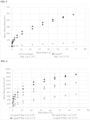
- FIG. 4 depicts a graph that compares the shear stress relative to the shear rate for the Day 0 samples
- FIG. 5 depicts a graph that compares the shear stress relative to the shear rate for the Day 3 samples.
- the Liquid P product produced by the inventive method exhibited a higher viscosity and a slightly non-Newtonian rheology relative to the product produced by the conventional method at Day 0.
- the rheological differences between the Liquid P product and the conventional product became much more apparent at Day 3. More particularly, FIG.
- Liquid P product was able to achieve a much higher viscosity (as indicated by the higher shear stress) relative to the conventional product, which actually decreased from Day 0 to Day 3. Furthermore, the Liquid P product demonstrated a clear non-Newtonian rheology at lower shear rates (less than 10 1 /s). Thus, the Liquid P product exhibited and was able to achieve a much more desirable rheological profile over time relative to the conventional product. Although not wishing to be bound by theory, it is believed that this rheological profile of the Liquid P product may be at least partially derived from the high shearing conditions used for its production.
- FIGS. 4 and 5 demonstrate how the Liquid P product exhibits and retains desirable rheological properties at 12.5°C that closely reflect the desired rheological profiles of certain food products, such as dips.
- the inventive Liquid P production method was tested and compared to a conventional process for producing potato-based food products. Both procedures used the same formulation, which is outlined in TABLE 5, below. It should be noted that the same procedural methods described in Example 1 were used for the conventional and inventive shearing steps. The only difference for this example was the use and presence of root vegetables, which were added with the potatoes, water, and oil into the Vitamix mixer. Furthermore, the rheological methods from Example 1 were also used to study the resulting samples. TABLE 5 Ingredient Weight Percent Innovator Potatoes (Diced) 25 Sunflower Oil 10 Water 50 Parsnips 7.5 Celery Root 7.5
- FIG. 6 depicts the rheological profiles of the Liquid P at Days 0 to 3.
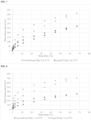
- FIG. 7 depicts a graph that compares the shear stress relative to the shear rate for the Day 0 samples
- FIG. 8 depicts a graph that compares the shear stress relative to the shear rate for the Day 1 samples.
- the Liquid P product produced by the inventive method actually exhibited a lower viscosity relative to the product produced by the conventional method at Day 0.
- the rheological differences between the Liquid P product and the conventional product became much more apparent and significantly distinctive over time, as shown by the data at Day 1. More particularly, FIG. 8 shows that the Liquid P product was able to achieve a much higher viscosity (as indicated by the higher shear stress) relative to the conventional product after a single day.
- the rheological profile of the conventional product began to degrade after a few days
- the Liquid P was able to maintain and achieve a desirable rheological profile that corresponds to a desired texture for food products, such as dips.
- the Liquid P product demonstrated a clear non-Newtonian rheology at lower shear rates (less than 10 1 /s).
- the Liquid P product exhibited and was able to achieve a much more desirable rheological profile over time relative to the conventional product.
- this rheological profile of the Liquid P product may be at least partially derived from the high shearing conditions used for its production.
- FIG. 8 demonstrates how the Liquid P product exhibits and retains desirable rheological properties at 25°C that closely reflect the desired rheological profiles of certain food products, such as dips.
- the term "and/or,” when used in a list of two or more items, means that any one of the listed items can be employed by itself or any combination of two or more of the listed items can be employed.
- the composition can contain A alone; B alone; C alone; A and B in combination; A and C in combination, B and C in combination; or A, B, and C in combination.
- the terms “comprising,” “comprises,” and “comprise” are open-ended transition terms used to transition from a subject recited before the term to one or more elements recited after the term, where the element or elements listed after the transition term are not necessarily the only elements that make up the subject.
- potato component refers to the component in the potato feed that is derived solely from potatoes.
Landscapes
- Life Sciences & Earth Sciences (AREA)
- Health & Medical Sciences (AREA)
- Nutrition Science (AREA)
- Chemical & Material Sciences (AREA)
- Engineering & Computer Science (AREA)
- Food Science & Technology (AREA)
- Polymers & Plastics (AREA)
- Botany (AREA)
- Mycology (AREA)
- Preparation Of Fruits And Vegetables (AREA)
- Coloring Foods And Improving Nutritive Qualities (AREA)
- Seeds, Soups, And Other Foods (AREA)
Claims (6)
- Le procédé de fabrication d'un produit liquide à base de pommes de terre comportant les étapes suivantes :(a) fourniture préalable de pommes de terre d'alimentation, comprenant des pommes de terre crues entières ayant une teneur initiale en humidité ;(b) gélatinisation au moins partielle dudit aliment initial à base de pommes de terre pour former ainsi un aliment gélatinisé à base de pommes de terre ayant une seconde teneur en humidité, laquelle se situe à au moins 50 pour cent de la teneur en humidité initiale évoquée ci-dessus ; et caractérisé par l'étape comprenant(c) utilisation d'un dispositif de cisaillement (24) effectuant un processus de cisaillement fin sur au moins une partie dudit aliment gélatinisé à base de pommes de terre en présence d'huile jusqu'à ce que ledit aliment gélatinisé à base de pommes de terre forme une pâte homogène d'amidon sans grumeaux pour former le produit liquide à base de pommes de terre en question.
- Le procédé selon la revendication l, caractérisé en ce que ladite gélatinisation consiste à blanchir ledit aliment à base de pommes de terre initial, ledit blanchiment comprenant : (i) le chauffage dudit aliment à base de pommes de terre initial pour former ainsi un aliment à base de pommes de terre cuites et (ii) la mise en contact dudit aliment à base de pommes de terre cuit avec une solution aqueuse pour former ainsi ledit aliment gélatinisé à base de pommes de terre.
- Le procédé selon la revendication l, caractérisé en ce que ledit cisaillement se produit à une température d'au moins 10 °C et inférieure à 125°C et pendant une durée de 1 à 60 minutes.
- Le procédé selon la revendication l, caractérisé en ce que ladite huile comprenne de l'huile végétale, d'arachide, de tournesol, de colza, de noix de coco, de palme, de maïs, d'avocat, de noix, de soja, de sésame, ou des combinaisons de celles-ci, et étant ajoutée en quantités suffisantes pour constituer 1 à 75 pour cent en poids dudit produit liquide à base de pommes de terre.
- Le procédé selon la revendication l, caractérisé en ce que ledit produit liquide à base de pommes de terre comprend au moins 1 à 75 pour cent en poids d'eau ajoutée et 5 à 90 pour cent en poids desdites pommes de terre crues entières, ledit produit liquide à base de pommes de terre présentant au moins deux des propriétés rhéologiques suivantes, mesurées à 12,5 °C :i.
 ii. Y 10 est supérieur d'au moins 50 pour cent à Y 10-15 et/ou Y 15-20 ;iii. Y 1-5 est supérieur d'au moins 50 pour cent à Y 5-10, Y 10-15 et/ou Y 15-20 ; etiv. Y 5-10 est supérieur d'au moins 50 pour cent à Y 10-15 et/ou Y 15-20,où « Y » est la contrainte de cisaillement en dynes par centimètre carré (dynes/cm2) et les valeurs d'indice utilisées avec « Y » sont les taux de cisaillement ou les plages de taux de cisaillement par seconde (1/s) auxquels la contrainte de cisaillement « Y » est mesurée, lesdites propriétés rhéologiques étant mesurées après stockage dudit produit liquide à base de pommes de terre dans une ou plusieurs des conditions de temps et de température suivantes :a. 24 heures à 6 °C,b. 48 heures à 6 °C, et/ouc. 72 heures à 6 °C.
 - Le procédé selon la revendication l, caractérisé en ce que ledit produit liquide à base de pommes de terre présente l'un des profils de contrainte de cisaillement suivants à 12,5 °C après stockage dudit produit liquide à base de pommes de terre pendant 72 heures à 6 °C :i. une contrainte de cisaillement d'au moins 15 dynes/cm2 à une fréquence de cisaillement de 5 1/s, une contrainte de cisaillement d'au moins 25 dynes/cm 2 à une fréquence de cisaillement de 101/s, une contrainte de cisaillement d'au moins 35 dynes/cm 2 à une fréquence de cisaillement de 151/s et/ou une contrainte de cisaillement d'au moins 40 dynes/cm2 à une fréquence de cisaillement de 20 1/s, lorsque ledit produit liquide à base de pommes de terre comprend moins de 10 pour cent en poids d'au moins une matière glucidique complexe autre que lesdites pommes de terre crues entières ; ouii. une contrainte de cisaillement d'au moins 150 dynes/cm2 à une fréquence de cisaillement de 5 1/s, une contrainte de cisaillement d'au moins 200 dynes/cm2 à une fréquence de cisaillement de 101/s, une contrainte de cisaillement d'au moins 225 dynes/cm2 à une fréquence de cisaillement de 15 1/s et/ou une contrainte de cisaillement d'au moins 250 dynes/cm2 à une fréquence de cisaillement de 20 1/s, lorsque ledit produit liquide à base de pommes de terre comprend au moins 10 pour cent en poids d'au moins une matière glucidique complexe autre que pommes de terre crues entières.
Applications Claiming Priority (3)
| Application Number | Priority Date | Filing Date | Title |
|---|---|---|---|
| US201962859542P | 2019-06-10 | 2019-06-10 | |
| US16/894,095 US20200383361A1 (en) | 2019-06-10 | 2020-06-05 | Liquified potato product and process |
| PCT/IB2020/055391 WO2020250119A1 (fr) | 2019-06-10 | 2020-06-09 | Produit et procédé à base de pomme de terre liquéfié |
Publications (4)
| Publication Number | Publication Date |
|---|---|
| EP3965591A1 EP3965591A1 (fr) | 2022-03-16 |
| EP3965591A4 EP3965591A4 (fr) | 2023-01-25 |
| EP3965591B1 true EP3965591B1 (fr) | 2025-05-21 |
| EP3965591C0 EP3965591C0 (fr) | 2025-05-21 |
Family
ID=73650401
Family Applications (2)
| Application Number | Title | Priority Date | Filing Date |
|---|---|---|---|
| EP20822358.6A Active EP3965591B1 (fr) | 2019-06-10 | 2020-06-09 | Produit et procédé à base de pomme de terre liquéfié |
| EP20821705.9A Active EP3965590B1 (fr) | 2019-06-10 | 2020-06-09 | Procédé amélioré de production d'un produit à base de pomme de terre liquide |
Family Applications After (1)
| Application Number | Title | Priority Date | Filing Date |
|---|---|---|---|
| EP20821705.9A Active EP3965590B1 (fr) | 2019-06-10 | 2020-06-09 | Procédé amélioré de production d'un produit à base de pomme de terre liquide |
Country Status (12)
| Country | Link |
|---|---|
| US (3) | US11478003B2 (fr) |
| EP (2) | EP3965591B1 (fr) |
| JP (2) | JP7756567B2 (fr) |
| CN (2) | CN114173577B (fr) |
| AU (2) | AU2020293673B2 (fr) |
| BR (2) | BR112021025028A2 (fr) |
| CA (2) | CA3083099A1 (fr) |
| CO (2) | CO2021016620A2 (fr) |
| GB (1) | GB2594350B (fr) |
| MX (2) | MX2021015019A (fr) |
| WO (2) | WO2020250118A1 (fr) |
| ZA (2) | ZA202109440B (fr) |
Families Citing this family (1)
| Publication number | Priority date | Publication date | Assignee | Title |
|---|---|---|---|---|
| CA3189829A1 (fr) * | 2022-02-18 | 2023-08-18 | Mccain Foods Limited | Produits alimentaires de legumes-racines |
Citations (1)
| Publication number | Priority date | Publication date | Assignee | Title |
|---|---|---|---|---|
| EP1229804B1 (fr) * | 1999-11-17 | 2008-01-16 | Frito-Lay North America, Inc. | Procédé de production de pâte de pomme de terre feuilletée à partir de stock de pomme de terre cru |
Family Cites Families (40)
| Publication number | Priority date | Publication date | Assignee | Title |
|---|---|---|---|---|
| US2798815A (en) * | 1954-08-04 | 1957-07-09 | Potagrain Foods Refining Corp | Method of preparing a granular food product from potatoes |
| US3063849A (en) * | 1960-10-17 | 1962-11-13 | Int Minerals & Chem Corp | Method of producing dehydrated cooked potatoes |
| US3109739A (en) | 1962-06-12 | 1963-11-05 | Frito Lay Inc | Potato products and process for making same |
| GB978818A (en) | 1962-06-12 | 1964-12-23 | Frito Lay Inc | Improvements in or relating to potato products |
| CA1029596A (fr) * | 1973-09-28 | 1978-04-18 | Corporate Foods Limited | Procede de rehydratation des solides de pomme de terre |
| FR2331293A1 (fr) | 1975-11-17 | 1977-06-10 | Roquette Freres | Nouvelles applications de la pulpe de pomme de terre et produits nouveaux correspondants |
| US4528202A (en) * | 1983-05-02 | 1985-07-09 | Nabisco Brands, Inc. | Process for making shredded potato products |
| US5061507A (en) * | 1987-02-20 | 1991-10-29 | Horizons International Foods, Inc. | Potato-based foodstuff and process for making same |
| US5425308A (en) * | 1994-02-02 | 1995-06-20 | Recot, Inc. | Apparatus and method for slicing potatoes and washing or coating potato slices |
| JPH09201181A (ja) * | 1996-01-24 | 1997-08-05 | Ajinomoto Co Inc | ポテト・スープ |
| IT1283607B1 (it) * | 1996-04-17 | 1998-04-22 | Vomm Chemipharma Srl | Metodo per la produzione di piatti pronti a base di patate. |
| WO2000022939A2 (fr) * | 1998-10-16 | 2000-04-27 | Basic Vegetable Products, L.P. | Substitut de matiere grasse en particules fines a base de feculents |
| US6485775B1 (en) * | 1998-10-16 | 2002-11-26 | Basic American, Inc. | Starchy food-based fine particle fat substitute |
| US6706298B1 (en) | 1999-04-26 | 2004-03-16 | The Procter & Gamble Co. | Method for preparing dehydrated potato products |
| US6808734B2 (en) | 1999-04-26 | 2004-10-26 | The Procter & Gamble Co. | Potato dough |
| JP2004504045A (ja) * | 2000-07-24 | 2004-02-12 | ザ プロクター アンド ギャンブル カンパニー | ポテトマッシュ |
| JP3584213B2 (ja) * | 2001-01-23 | 2004-11-04 | ハウス食品株式会社 | 流動性香辛味食品 |
| US20020189607A1 (en) | 2001-03-27 | 2002-12-19 | Opta Food Ingredients,Inc. | Potato starch compositions and methods of making same |
| GB0306317D0 (en) | 2003-03-19 | 2003-04-23 | Mccain Foods Gb Ltd | Potato based food product |
| US20040191382A1 (en) * | 2003-03-27 | 2004-09-30 | Cooper Kern L | Ultra-high-pressure vegetable sterilization method and product |
| US7026006B1 (en) * | 2003-10-09 | 2006-04-11 | Basic American, Inc. | Dehydrated mash potato process |
| US20060034981A1 (en) | 2004-08-13 | 2006-02-16 | The United States Of America, As Represented By The Secretary Of Agriculture | Novel infrared dry blanching (IDB), infrared blanching, and infrared drying technologies for food processing |
| US7879385B1 (en) * | 2004-10-14 | 2011-02-01 | Basic American, Inc. | Emulsified bean-based oil substitute |
| US20060188638A1 (en) | 2005-02-18 | 2006-08-24 | Joseph Ponnattu K | Fabricated food product made from fresh potato mash |
| US20060188639A1 (en) | 2005-02-18 | 2006-08-24 | Joseph Ponnattu K | Fabricated food product made from fresh potato mash |
| CN101257802A (zh) * | 2005-07-19 | 2008-09-03 | 康尼格拉食品有限公司 | 延长的冷藏货架寿命的马铃薯泥 |
| JP4987668B2 (ja) * | 2007-11-08 | 2012-07-25 | 独立行政法人農業・食品産業技術総合研究機構 | 紫系有色馬鈴薯含有飲食品およびその製造方法 |
| US20110104345A1 (en) * | 2007-11-20 | 2011-05-05 | Frito-Lay North America, Inc. | Method of reducing acrylamide by treating a food ingredient |
| US7820223B2 (en) | 2007-11-20 | 2010-10-26 | Frito-Lay North America, Inc. | Sweet potato flake process |
| ES2322529B1 (es) | 2007-12-21 | 2010-03-29 | Consejo Superior De Investigaciones Cientificas | Pure de patata natural congelado y estabilizado mediante una mezcla decrioprotectores y su procedimiento de elaboracion. |
| AU2009208374A1 (en) | 2008-01-29 | 2009-08-06 | Potato Magic Australia Pty Ltd | Method of making a baked snack base product and the snack base product produced thereby |
| US20100080868A1 (en) * | 2008-09-26 | 2010-04-01 | Frito-Lay North America, Inc. | Mash Process Offering Better Control |
| WO2011106022A1 (fr) * | 2010-02-26 | 2011-09-01 | Conagra Foods Rdm, Inc. | Réduction de taille de particules fibreuses dans des bouillies alimentaires contenant des fibres |
| US8940346B1 (en) | 2010-12-01 | 2015-01-27 | The United States Of America As Represented By The Secretary Of Agriculture | Infrared based peeling of fruits and vegetables |
| AU2013270528A1 (en) | 2013-12-11 | 2015-06-25 | Potatomagic Pty Ltd | Method of processing a starch to make a product base and products prepared therefrom. |
| CN105876549B (zh) * | 2016-04-29 | 2019-02-19 | 塔里木大学 | 一种马铃薯饮料 |
| CN105962202A (zh) * | 2016-05-05 | 2016-09-28 | 中国农业科学院农产品加工研究所 | 一种马铃薯泥及其加工方法 |
| US20190037904A1 (en) | 2017-08-04 | 2019-02-07 | Sean R. Daly | Food-based protein formulation |
| CN107549536A (zh) | 2017-09-20 | 2018-01-09 | 安徽三芋农业发展有限公司 | 一种红薯浊汁饮料的制作工艺 |
| SE542104C2 (en) * | 2017-10-04 | 2020-02-25 | Veg Of Lund Ab | Potato emulsion |
-
2020
- 2020-06-05 US US16/894,116 patent/US11478003B2/en active Active
- 2020-06-05 US US16/894,095 patent/US20200383361A1/en active Pending
- 2020-06-09 BR BR112021025028A patent/BR112021025028A2/pt unknown
- 2020-06-09 MX MX2021015019A patent/MX2021015019A/es unknown
- 2020-06-09 MX MX2021015113A patent/MX2021015113A/es unknown
- 2020-06-09 BR BR112021024991A patent/BR112021024991A2/pt unknown
- 2020-06-09 WO PCT/IB2020/055390 patent/WO2020250118A1/fr not_active Ceased
- 2020-06-09 AU AU2020293673A patent/AU2020293673B2/en active Active
- 2020-06-09 CN CN202080042456.8A patent/CN114173577B/zh active Active
- 2020-06-09 JP JP2021572901A patent/JP7756567B2/ja active Active
- 2020-06-09 EP EP20822358.6A patent/EP3965591B1/fr active Active
- 2020-06-09 JP JP2021572898A patent/JP7592641B2/ja active Active
- 2020-06-09 WO PCT/IB2020/055391 patent/WO2020250119A1/fr not_active Ceased
- 2020-06-09 CN CN202080042536.3A patent/CN114144074B/zh active Active
- 2020-06-09 AU AU2020291169A patent/AU2020291169B2/en active Active
- 2020-06-09 EP EP20821705.9A patent/EP3965590B1/fr active Active
- 2020-06-10 CA CA3083099A patent/CA3083099A1/fr active Pending
- 2020-06-10 CA CA3083096A patent/CA3083096C/fr active Active
- 2020-06-10 GB GB2102062.3A patent/GB2594350B/en active Active
-
2021
- 2021-11-23 ZA ZA2021/09440A patent/ZA202109440B/en unknown
- 2021-11-23 ZA ZA2021/09441A patent/ZA202109441B/en unknown
- 2021-12-07 CO CONC2021/0016620A patent/CO2021016620A2/es unknown
- 2021-12-07 CO CONC2021/0016634A patent/CO2021016634A2/es unknown
-
2023
- 2023-10-24 US US18/492,995 patent/US20240049757A1/en active Pending
Patent Citations (1)
| Publication number | Priority date | Publication date | Assignee | Title |
|---|---|---|---|---|
| EP1229804B1 (fr) * | 1999-11-17 | 2008-01-16 | Frito-Lay North America, Inc. | Procédé de production de pâte de pomme de terre feuilletée à partir de stock de pomme de terre cru |
Non-Patent Citations (2)
| Title |
|---|
| DANKAR IMAN ET AL: "Assessing Mechanical and Rheological Properties of Potato Puree: Effect of Different Ingredient Combinations and Cooking Methods on the Feasibility of 3D Printing", FOODS, vol. 9, no. 1, 24 December 2019 (2019-12-24), CH, pages 21, XP093120746, ISSN: 2304-8158, DOI: 10.3390/foods9010021 * |
| GIANNOPOULOS ELI: "Skordalia recipe (Traditional Greek Potato and Garlic dip) - My Greek Dish", MYGREEKDISH.COM, 15 March 2014 (2014-03-15), pages 1 - 5, XP093064015, Retrieved from the Internet <URL:https%3A%2F%2Fweb.archive.org%2Fweb%2F20140315132513%2Fhttps%3A%2F%2Fwww.mygreekdish.com%2Frecipe%2Fgreek-skordalia-recipe-potato-garlic-dip%2F> [retrieved on 20230714] * |
Also Published As
Similar Documents
| Publication | Publication Date | Title |
|---|---|---|
| EP1553850B1 (fr) | Procede pour la preparation d'une composition de puree comprenant une composition de pulpe de fruit stabilisee | |
| US20240049757A1 (en) | Liquified potato product and process | |
| KR102678381B1 (ko) | 채소류 원물의 영양소를 함유하고 천연 색상을 가지는 누룽지의 제조방법 | |
| WO2004112502A1 (fr) | Composition a base de pulpe de fruit stabilisee et composition pour puree la contenant | |
| GB2587260A (en) | Liquified potato product and process | |
| US20230263181A1 (en) | Food products from root vegetables | |
| GB2587464A (en) | Improved process for producing a liquid potato product | |
| Zagorulko et al. | Improving the production technique of pat based on multicomponent fruit and berry paste | |
| RU2826845C2 (ru) | Ожиженный картофельный продукт и способ | |
| Zavalishina et al. | The results of evaluating the use of vegetable additives in bread production | |
| Moreno-Ochoa et al. | Technological properties of orange sweet potato flour intended for functional food products as affected by conventional drying and milling methods | |
| Konrade et al. | Total content of phenolics and antioxidant activity in crispbreads with plant by-product addition | |
| RU2813657C2 (ru) | Улучшенный способ получения жидкого картофельного продукта | |
| CN105475985A (zh) | 一种高纤维高蛋白营养保健番茄酱及其制作方法 | |
| Bimantio et al. | The application of potato starch-based (Amylum solani) edible coating on Tomatoes (Solanum lycopersicum L.) | |
| Razali et al. | Converting durian-based traditional dessert into ready-to-eat durian stick through sausage technology application | |
| Gunasekara et al. | Physicochemical, Functional, and Nutritional Characterization of Cashew (Anacardium occidentale L.) Apple Flour and Its Use in | |
| Solanke et al. | Preparation and study the physical properties of snacks product Chakli by incorporation of gaur gum and gum Arabic | |
| KR101475754B1 (ko) | 신속호화 전분 및 이의 제조방법 | |
| WO2026052680A1 (fr) | Procédé de préparation d'un extrudat à base de plante à teneur élevée en légumes et/ou en fruits | |
| Banerjee et al. | Effect of different hydrocolloids on rheology of tamarind (Tamarindus indica L.) juice |
Legal Events
| Date | Code | Title | Description |
|---|---|---|---|
| STAA | Information on the status of an ep patent application or granted ep patent |
Free format text: STATUS: THE INTERNATIONAL PUBLICATION HAS BEEN MADE |
|
| PUAI | Public reference made under article 153(3) epc to a published international application that has entered the european phase |
Free format text: ORIGINAL CODE: 0009012 |
|
| STAA | Information on the status of an ep patent application or granted ep patent |
Free format text: STATUS: REQUEST FOR EXAMINATION WAS MADE |
|
| 17P | Request for examination filed |
Effective date: 20211210 |
|
| AK | Designated contracting states |
Kind code of ref document: A1 Designated state(s): AL AT BE BG CH CY CZ DE DK EE ES FI FR GB GR HR HU IE IS IT LI LT LU LV MC MK MT NL NO PL PT RO RS SE SI SK SM TR |
|
| DAV | Request for validation of the european patent (deleted) | ||
| DAX | Request for extension of the european patent (deleted) | ||
| A4 | Supplementary search report drawn up and despatched |
Effective date: 20230103 |
|
| RIC1 | Information provided on ipc code assigned before grant |
Ipc: A23L 19/00 20160101ALN20221221BHEP Ipc: A23L 33/105 20160101ALI20221221BHEP Ipc: A23L 29/212 20160101ALI20221221BHEP Ipc: A23L 23/00 20160101ALI20221221BHEP Ipc: A23D 7/04 20060101ALI20221221BHEP Ipc: A23D 7/005 20060101ALI20221221BHEP Ipc: A23L 19/12 20160101AFI20221221BHEP |
|
| STAA | Information on the status of an ep patent application or granted ep patent |
Free format text: STATUS: EXAMINATION IS IN PROGRESS |
|
| 17Q | First examination report despatched |
Effective date: 20230725 |
|
| GRAP | Despatch of communication of intention to grant a patent |
Free format text: ORIGINAL CODE: EPIDOSNIGR1 |
|
| STAA | Information on the status of an ep patent application or granted ep patent |
Free format text: STATUS: GRANT OF PATENT IS INTENDED |
|
| RIC1 | Information provided on ipc code assigned before grant |
Ipc: A23L 19/00 20160101ALN20241111BHEP Ipc: A23L 33/105 20160101ALI20241111BHEP Ipc: A23L 29/212 20160101ALI20241111BHEP Ipc: A23L 23/00 20160101ALI20241111BHEP Ipc: A23D 7/04 20060101ALI20241111BHEP Ipc: A23D 7/005 20060101ALI20241111BHEP Ipc: A23L 19/12 20160101AFI20241111BHEP |
|
| RIC1 | Information provided on ipc code assigned before grant |
Ipc: A23L 19/00 20160101ALN20241118BHEP Ipc: A23L 33/105 20160101ALI20241118BHEP Ipc: A23L 29/212 20160101ALI20241118BHEP Ipc: A23L 23/00 20160101ALI20241118BHEP Ipc: A23D 7/04 20060101ALI20241118BHEP Ipc: A23D 7/005 20060101ALI20241118BHEP Ipc: A23L 19/12 20160101AFI20241118BHEP |
|
| RIC1 | Information provided on ipc code assigned before grant |
Ipc: A23L 19/00 20160101ALN20241129BHEP Ipc: A23L 33/105 20160101ALI20241129BHEP Ipc: A23L 29/212 20160101ALI20241129BHEP Ipc: A23L 23/00 20160101ALI20241129BHEP Ipc: A23D 7/04 20060101ALI20241129BHEP Ipc: A23D 7/005 20060101ALI20241129BHEP Ipc: A23L 19/12 20160101AFI20241129BHEP |
|
| INTG | Intention to grant announced |
Effective date: 20241216 |
|
| GRAS | Grant fee paid |
Free format text: ORIGINAL CODE: EPIDOSNIGR3 |
|
| GRAA | (expected) grant |
Free format text: ORIGINAL CODE: 0009210 |
|
| STAA | Information on the status of an ep patent application or granted ep patent |
Free format text: STATUS: THE PATENT HAS BEEN GRANTED |
|
| AK | Designated contracting states |
Kind code of ref document: B1 Designated state(s): AL AT BE BG CH CY CZ DE DK EE ES FI FR GB GR HR HU IE IS IT LI LT LU LV MC MK MT NL NO PL PT RO RS SE SI SK SM TR |
|
| REG | Reference to a national code |
Ref country code: GB Ref legal event code: FG4D |
|
| REG | Reference to a national code |
Ref country code: CH Ref legal event code: EP |
|
| REG | Reference to a national code |
Ref country code: DE Ref legal event code: R096 Ref document number: 602020051736 Country of ref document: DE |
|
| REG | Reference to a national code |
Ref country code: IE Ref legal event code: FG4D |
|
| U01 | Request for unitary effect filed |
Effective date: 20250620 |
|
| U07 | Unitary effect registered |
Designated state(s): AT BE BG DE DK EE FI FR IT LT LU LV MT NL PT RO SE SI Effective date: 20250708 |
|
| U20 | Renewal fee for the european patent with unitary effect paid |
Year of fee payment: 6 Effective date: 20250728 |
|
| PG25 | Lapsed in a contracting state [announced via postgrant information from national office to epo] |
Ref country code: ES Free format text: LAPSE BECAUSE OF FAILURE TO SUBMIT A TRANSLATION OF THE DESCRIPTION OR TO PAY THE FEE WITHIN THE PRESCRIBED TIME-LIMIT Effective date: 20250521 |
|
| PG25 | Lapsed in a contracting state [announced via postgrant information from national office to epo] |
Ref country code: GR Free format text: LAPSE BECAUSE OF FAILURE TO SUBMIT A TRANSLATION OF THE DESCRIPTION OR TO PAY THE FEE WITHIN THE PRESCRIBED TIME-LIMIT Effective date: 20250822 Ref country code: NO Free format text: LAPSE BECAUSE OF FAILURE TO SUBMIT A TRANSLATION OF THE DESCRIPTION OR TO PAY THE FEE WITHIN THE PRESCRIBED TIME-LIMIT Effective date: 20250821 |
|
| PG25 | Lapsed in a contracting state [announced via postgrant information from national office to epo] |
Ref country code: PL Free format text: LAPSE BECAUSE OF FAILURE TO SUBMIT A TRANSLATION OF THE DESCRIPTION OR TO PAY THE FEE WITHIN THE PRESCRIBED TIME-LIMIT Effective date: 20250521 |
|
| PG25 | Lapsed in a contracting state [announced via postgrant information from national office to epo] |
Ref country code: HR Free format text: LAPSE BECAUSE OF FAILURE TO SUBMIT A TRANSLATION OF THE DESCRIPTION OR TO PAY THE FEE WITHIN THE PRESCRIBED TIME-LIMIT Effective date: 20250521 |
|
| PG25 | Lapsed in a contracting state [announced via postgrant information from national office to epo] |
Ref country code: RS Free format text: LAPSE BECAUSE OF FAILURE TO SUBMIT A TRANSLATION OF THE DESCRIPTION OR TO PAY THE FEE WITHIN THE PRESCRIBED TIME-LIMIT Effective date: 20250821 |
|
| PG25 | Lapsed in a contracting state [announced via postgrant information from national office to epo] |
Ref country code: IS Free format text: LAPSE BECAUSE OF FAILURE TO SUBMIT A TRANSLATION OF THE DESCRIPTION OR TO PAY THE FEE WITHIN THE PRESCRIBED TIME-LIMIT Effective date: 20250921 |
|
| PG25 | Lapsed in a contracting state [announced via postgrant information from national office to epo] |
Ref country code: SM Free format text: LAPSE BECAUSE OF FAILURE TO SUBMIT A TRANSLATION OF THE DESCRIPTION OR TO PAY THE FEE WITHIN THE PRESCRIBED TIME-LIMIT Effective date: 20250521 |
|
| PG25 | Lapsed in a contracting state [announced via postgrant information from national office to epo] |
Ref country code: CZ Free format text: LAPSE BECAUSE OF FAILURE TO SUBMIT A TRANSLATION OF THE DESCRIPTION OR TO PAY THE FEE WITHIN THE PRESCRIBED TIME-LIMIT Effective date: 20250521 |
|
| PG25 | Lapsed in a contracting state [announced via postgrant information from national office to epo] |
Ref country code: SK Free format text: LAPSE BECAUSE OF FAILURE TO SUBMIT A TRANSLATION OF THE DESCRIPTION OR TO PAY THE FEE WITHIN THE PRESCRIBED TIME-LIMIT Effective date: 20250521 |
|
| REG | Reference to a national code |
Ref country code: CH Ref legal event code: H13 Free format text: ST27 STATUS EVENT CODE: U-0-0-H10-H13 (AS PROVIDED BY THE NATIONAL OFFICE) Effective date: 20260127 |
|
| PG25 | Lapsed in a contracting state [announced via postgrant information from national office to epo] |
Ref country code: MC Free format text: LAPSE BECAUSE OF FAILURE TO SUBMIT A TRANSLATION OF THE DESCRIPTION OR TO PAY THE FEE WITHIN THE PRESCRIBED TIME-LIMIT Effective date: 20250521 |
|
| PLBE | No opposition filed within time limit |
Free format text: ORIGINAL CODE: 0009261 |
|
| STAA | Information on the status of an ep patent application or granted ep patent |
Free format text: STATUS: NO OPPOSITION FILED WITHIN TIME LIMIT |
|
| REG | Reference to a national code |
Ref country code: CH Ref legal event code: L10 Free format text: ST27 STATUS EVENT CODE: U-0-0-L10-L00 (AS PROVIDED BY THE NATIONAL OFFICE) Effective date: 20260402 |
|
| PG25 | Lapsed in a contracting state [announced via postgrant information from national office to epo] |
Ref country code: IE Free format text: LAPSE BECAUSE OF NON-PAYMENT OF DUE FEES Effective date: 20250609 |
|
| PG25 | Lapsed in a contracting state [announced via postgrant information from national office to epo] |
Ref country code: CH Free format text: LAPSE BECAUSE OF NON-PAYMENT OF DUE FEES Effective date: 20250630 |
|
| 26N | No opposition filed |
Effective date: 20260224 |
|
| GBPC | Gb: european patent ceased through non-payment of renewal fee |
Effective date: 20250821 |