EP3962986B1 - Polymerizable surfactants having water whitening resistance and methods for use - Google Patents
Polymerizable surfactants having water whitening resistance and methods for use Download PDFInfo
- Publication number
- EP3962986B1 EP3962986B1 EP20802402.6A EP20802402A EP3962986B1 EP 3962986 B1 EP3962986 B1 EP 3962986B1 EP 20802402 A EP20802402 A EP 20802402A EP 3962986 B1 EP3962986 B1 EP 3962986B1
- Authority
- EP
- European Patent Office
- Prior art keywords
- surfactant
- salt
- polymerizable
- composition
- integer
- Prior art date
- Legal status (The legal status is an assumption and is not a legal conclusion. Google has not performed a legal analysis and makes no representation as to the accuracy of the status listed.)
- Active
Links
Images


Classifications
-
- C—CHEMISTRY; METALLURGY
- C08—ORGANIC MACROMOLECULAR COMPOUNDS; THEIR PREPARATION OR CHEMICAL WORKING-UP; COMPOSITIONS BASED THEREON
- C08G—MACROMOLECULAR COMPOUNDS OBTAINED OTHERWISE THAN BY REACTIONS ONLY INVOLVING UNSATURATED CARBON-TO-CARBON BONDS
- C08G65/00—Macromolecular compounds obtained by reactions forming an ether link in the main chain of the macromolecule
- C08G65/02—Macromolecular compounds obtained by reactions forming an ether link in the main chain of the macromolecule from cyclic ethers by opening of the heterocyclic ring
- C08G65/26—Macromolecular compounds obtained by reactions forming an ether link in the main chain of the macromolecule from cyclic ethers by opening of the heterocyclic ring from cyclic ethers and other compounds
- C08G65/2642—Macromolecular compounds obtained by reactions forming an ether link in the main chain of the macromolecule from cyclic ethers by opening of the heterocyclic ring from cyclic ethers and other compounds characterised by the catalyst used
- C08G65/2669—Non-metals or compounds thereof
- C08G65/2678—Sulfur or compounds thereof
-
- C—CHEMISTRY; METALLURGY
- C09—DYES; PAINTS; POLISHES; NATURAL RESINS; ADHESIVES; COMPOSITIONS NOT OTHERWISE PROVIDED FOR; APPLICATIONS OF MATERIALS NOT OTHERWISE PROVIDED FOR
- C09K—MATERIALS FOR MISCELLANEOUS APPLICATIONS, NOT PROVIDED FOR ELSEWHERE
- C09K23/00—Use of substances as emulsifying, wetting, dispersing, or foam-producing agents
- C09K23/02—Alkyl sulfonates or sulfuric acid ester salts derived from monohydric alcohols
-
- C—CHEMISTRY; METALLURGY
- C08—ORGANIC MACROMOLECULAR COMPOUNDS; THEIR PREPARATION OR CHEMICAL WORKING-UP; COMPOSITIONS BASED THEREON
- C08G—MACROMOLECULAR COMPOUNDS OBTAINED OTHERWISE THAN BY REACTIONS ONLY INVOLVING UNSATURATED CARBON-TO-CARBON BONDS
- C08G65/00—Macromolecular compounds obtained by reactions forming an ether link in the main chain of the macromolecule
- C08G65/02—Macromolecular compounds obtained by reactions forming an ether link in the main chain of the macromolecule from cyclic ethers by opening of the heterocyclic ring
- C08G65/32—Polymers modified by chemical after-treatment
- C08G65/321—Polymers modified by chemical after-treatment with inorganic compounds
- C08G65/326—Polymers modified by chemical after-treatment with inorganic compounds containing sulfur
-
- C—CHEMISTRY; METALLURGY
- C08—ORGANIC MACROMOLECULAR COMPOUNDS; THEIR PREPARATION OR CHEMICAL WORKING-UP; COMPOSITIONS BASED THEREON
- C08F—MACROMOLECULAR COMPOUNDS OBTAINED BY REACTIONS ONLY INVOLVING CARBON-TO-CARBON UNSATURATED BONDS
- C08F212/00—Copolymers of compounds having one or more unsaturated aliphatic radicals, each having only one carbon-to-carbon double bond, and at least one being terminated by an aromatic carbocyclic ring
- C08F212/02—Monomers containing only one unsaturated aliphatic radical
- C08F212/04—Monomers containing only one unsaturated aliphatic radical containing one ring
- C08F212/06—Hydrocarbons
- C08F212/08—Styrene
-
- C—CHEMISTRY; METALLURGY
- C08—ORGANIC MACROMOLECULAR COMPOUNDS; THEIR PREPARATION OR CHEMICAL WORKING-UP; COMPOSITIONS BASED THEREON
- C08F—MACROMOLECULAR COMPOUNDS OBTAINED BY REACTIONS ONLY INVOLVING CARBON-TO-CARBON UNSATURATED BONDS
- C08F220/00—Copolymers of compounds having one or more unsaturated aliphatic radicals, each having only one carbon-to-carbon double bond, and only one being terminated by only one carboxyl radical or a salt, anhydride ester, amide, imide or nitrile thereof
- C08F220/02—Monocarboxylic acids having less than ten carbon atoms; Derivatives thereof
- C08F220/10—Esters
- C08F220/12—Esters of monohydric alcohols or phenols
- C08F220/16—Esters of monohydric alcohols or phenols of phenols or of alcohols containing two or more carbon atoms
- C08F220/18—Esters of monohydric alcohols or phenols of phenols or of alcohols containing two or more carbon atoms with acrylic or methacrylic acids
- C08F220/1808—C8-(meth)acrylate, e.g. isooctyl (meth)acrylate or 2-ethylhexyl (meth)acrylate
-
- C—CHEMISTRY; METALLURGY
- C08—ORGANIC MACROMOLECULAR COMPOUNDS; THEIR PREPARATION OR CHEMICAL WORKING-UP; COMPOSITIONS BASED THEREON
- C08F—MACROMOLECULAR COMPOUNDS OBTAINED BY REACTIONS ONLY INVOLVING CARBON-TO-CARBON UNSATURATED BONDS
- C08F290/00—Macromolecular compounds obtained by polymerising monomers on to polymers modified by introduction of aliphatic unsaturated end or side groups
- C08F290/08—Macromolecular compounds obtained by polymerising monomers on to polymers modified by introduction of aliphatic unsaturated end or side groups on to polymers modified by introduction of unsaturated side groups
- C08F290/14—Polymers provided for in subclass C08G
- C08F290/142—Polyethers
-
- C—CHEMISTRY; METALLURGY
- C08—ORGANIC MACROMOLECULAR COMPOUNDS; THEIR PREPARATION OR CHEMICAL WORKING-UP; COMPOSITIONS BASED THEREON
- C08G—MACROMOLECULAR COMPOUNDS OBTAINED OTHERWISE THAN BY REACTIONS ONLY INVOLVING UNSATURATED CARBON-TO-CARBON BONDS
- C08G65/00—Macromolecular compounds obtained by reactions forming an ether link in the main chain of the macromolecule
- C08G65/02—Macromolecular compounds obtained by reactions forming an ether link in the main chain of the macromolecule from cyclic ethers by opening of the heterocyclic ring
- C08G65/04—Macromolecular compounds obtained by reactions forming an ether link in the main chain of the macromolecule from cyclic ethers by opening of the heterocyclic ring from cyclic ethers only
- C08G65/06—Cyclic ethers having no atoms other than carbon and hydrogen outside the ring
- C08G65/14—Unsaturated oxiranes
-
- C—CHEMISTRY; METALLURGY
- C08—ORGANIC MACROMOLECULAR COMPOUNDS; THEIR PREPARATION OR CHEMICAL WORKING-UP; COMPOSITIONS BASED THEREON
- C08G—MACROMOLECULAR COMPOUNDS OBTAINED OTHERWISE THAN BY REACTIONS ONLY INVOLVING UNSATURATED CARBON-TO-CARBON BONDS
- C08G65/00—Macromolecular compounds obtained by reactions forming an ether link in the main chain of the macromolecule
- C08G65/02—Macromolecular compounds obtained by reactions forming an ether link in the main chain of the macromolecule from cyclic ethers by opening of the heterocyclic ring
- C08G65/26—Macromolecular compounds obtained by reactions forming an ether link in the main chain of the macromolecule from cyclic ethers by opening of the heterocyclic ring from cyclic ethers and other compounds
- C08G65/2603—Macromolecular compounds obtained by reactions forming an ether link in the main chain of the macromolecule from cyclic ethers by opening of the heterocyclic ring from cyclic ethers and other compounds the other compounds containing oxygen
- C08G65/2606—Macromolecular compounds obtained by reactions forming an ether link in the main chain of the macromolecule from cyclic ethers by opening of the heterocyclic ring from cyclic ethers and other compounds the other compounds containing oxygen containing hydroxyl groups
- C08G65/2609—Macromolecular compounds obtained by reactions forming an ether link in the main chain of the macromolecule from cyclic ethers by opening of the heterocyclic ring from cyclic ethers and other compounds the other compounds containing oxygen containing hydroxyl groups containing aliphatic hydroxyl groups
-
- C—CHEMISTRY; METALLURGY
- C08—ORGANIC MACROMOLECULAR COMPOUNDS; THEIR PREPARATION OR CHEMICAL WORKING-UP; COMPOSITIONS BASED THEREON
- C08G—MACROMOLECULAR COMPOUNDS OBTAINED OTHERWISE THAN BY REACTIONS ONLY INVOLVING UNSATURATED CARBON-TO-CARBON BONDS
- C08G65/00—Macromolecular compounds obtained by reactions forming an ether link in the main chain of the macromolecule
- C08G65/02—Macromolecular compounds obtained by reactions forming an ether link in the main chain of the macromolecule from cyclic ethers by opening of the heterocyclic ring
- C08G65/26—Macromolecular compounds obtained by reactions forming an ether link in the main chain of the macromolecule from cyclic ethers by opening of the heterocyclic ring from cyclic ethers and other compounds
- C08G65/2636—Macromolecular compounds obtained by reactions forming an ether link in the main chain of the macromolecule from cyclic ethers by opening of the heterocyclic ring from cyclic ethers and other compounds the other compounds containing sulfur
-
- C—CHEMISTRY; METALLURGY
- C08—ORGANIC MACROMOLECULAR COMPOUNDS; THEIR PREPARATION OR CHEMICAL WORKING-UP; COMPOSITIONS BASED THEREON
- C08G—MACROMOLECULAR COMPOUNDS OBTAINED OTHERWISE THAN BY REACTIONS ONLY INVOLVING UNSATURATED CARBON-TO-CARBON BONDS
- C08G65/00—Macromolecular compounds obtained by reactions forming an ether link in the main chain of the macromolecule
- C08G65/02—Macromolecular compounds obtained by reactions forming an ether link in the main chain of the macromolecule from cyclic ethers by opening of the heterocyclic ring
- C08G65/32—Polymers modified by chemical after-treatment
- C08G65/329—Polymers modified by chemical after-treatment with organic compounds
- C08G65/334—Polymers modified by chemical after-treatment with organic compounds containing sulfur
- C08G65/3344—Polymers modified by chemical after-treatment with organic compounds containing sulfur containing oxygen in addition to sulfur
-
- C—CHEMISTRY; METALLURGY
- C09—DYES; PAINTS; POLISHES; NATURAL RESINS; ADHESIVES; COMPOSITIONS NOT OTHERWISE PROVIDED FOR; APPLICATIONS OF MATERIALS NOT OTHERWISE PROVIDED FOR
- C09D—COATING COMPOSITIONS, e.g. PAINTS, VARNISHES OR LACQUERS; FILLING PASTES; CHEMICAL PAINT OR INK REMOVERS; INKS; CORRECTING FLUIDS; WOODSTAINS; PASTES OR SOLIDS FOR COLOURING OR PRINTING; USE OF MATERIALS THEREFOR
- C09D133/00—Coating compositions based on homopolymers or copolymers of compounds having one or more unsaturated aliphatic radicals, each having only one carbon-to-carbon double bond, and at least one being terminated by only one carboxyl radical, or of salts, anhydrides, esters, amides, imides, or nitriles thereof; Coating compositions based on derivatives of such polymers
-
- C—CHEMISTRY; METALLURGY
- C09—DYES; PAINTS; POLISHES; NATURAL RESINS; ADHESIVES; COMPOSITIONS NOT OTHERWISE PROVIDED FOR; APPLICATIONS OF MATERIALS NOT OTHERWISE PROVIDED FOR
- C09D—COATING COMPOSITIONS, e.g. PAINTS, VARNISHES OR LACQUERS; FILLING PASTES; CHEMICAL PAINT OR INK REMOVERS; INKS; CORRECTING FLUIDS; WOODSTAINS; PASTES OR SOLIDS FOR COLOURING OR PRINTING; USE OF MATERIALS THEREFOR
- C09D133/00—Coating compositions based on homopolymers or copolymers of compounds having one or more unsaturated aliphatic radicals, each having only one carbon-to-carbon double bond, and at least one being terminated by only one carboxyl radical, or of salts, anhydrides, esters, amides, imides, or nitriles thereof; Coating compositions based on derivatives of such polymers
- C09D133/04—Homopolymers or copolymers of esters
-
- C—CHEMISTRY; METALLURGY
- C09—DYES; PAINTS; POLISHES; NATURAL RESINS; ADHESIVES; COMPOSITIONS NOT OTHERWISE PROVIDED FOR; APPLICATIONS OF MATERIALS NOT OTHERWISE PROVIDED FOR
- C09D—COATING COMPOSITIONS, e.g. PAINTS, VARNISHES OR LACQUERS; FILLING PASTES; CHEMICAL PAINT OR INK REMOVERS; INKS; CORRECTING FLUIDS; WOODSTAINS; PASTES OR SOLIDS FOR COLOURING OR PRINTING; USE OF MATERIALS THEREFOR
- C09D133/00—Coating compositions based on homopolymers or copolymers of compounds having one or more unsaturated aliphatic radicals, each having only one carbon-to-carbon double bond, and at least one being terminated by only one carboxyl radical, or of salts, anhydrides, esters, amides, imides, or nitriles thereof; Coating compositions based on derivatives of such polymers
- C09D133/04—Homopolymers or copolymers of esters
- C09D133/06—Homopolymers or copolymers of esters of esters containing only carbon, hydrogen and oxygen, the oxygen atom being present only as part of the carboxyl radical
- C09D133/08—Homopolymers or copolymers of acrylic acid esters
-
- C—CHEMISTRY; METALLURGY
- C09—DYES; PAINTS; POLISHES; NATURAL RESINS; ADHESIVES; COMPOSITIONS NOT OTHERWISE PROVIDED FOR; APPLICATIONS OF MATERIALS NOT OTHERWISE PROVIDED FOR
- C09D—COATING COMPOSITIONS, e.g. PAINTS, VARNISHES OR LACQUERS; FILLING PASTES; CHEMICAL PAINT OR INK REMOVERS; INKS; CORRECTING FLUIDS; WOODSTAINS; PASTES OR SOLIDS FOR COLOURING OR PRINTING; USE OF MATERIALS THEREFOR
- C09D133/00—Coating compositions based on homopolymers or copolymers of compounds having one or more unsaturated aliphatic radicals, each having only one carbon-to-carbon double bond, and at least one being terminated by only one carboxyl radical, or of salts, anhydrides, esters, amides, imides, or nitriles thereof; Coating compositions based on derivatives of such polymers
- C09D133/24—Homopolymers or copolymers of amides or imides
- C09D133/26—Homopolymers or copolymers of acrylamide or methacrylamide
-
- C—CHEMISTRY; METALLURGY
- C09—DYES; PAINTS; POLISHES; NATURAL RESINS; ADHESIVES; COMPOSITIONS NOT OTHERWISE PROVIDED FOR; APPLICATIONS OF MATERIALS NOT OTHERWISE PROVIDED FOR
- C09D—COATING COMPOSITIONS, e.g. PAINTS, VARNISHES OR LACQUERS; FILLING PASTES; CHEMICAL PAINT OR INK REMOVERS; INKS; CORRECTING FLUIDS; WOODSTAINS; PASTES OR SOLIDS FOR COLOURING OR PRINTING; USE OF MATERIALS THEREFOR
- C09D151/00—Coating compositions based on graft polymers in which the grafted component is obtained by reactions only involving carbon-to-carbon unsaturated bonds; Coating compositions based on derivatives of such polymers
- C09D151/08—Coating compositions based on graft polymers in which the grafted component is obtained by reactions only involving carbon-to-carbon unsaturated bonds; Coating compositions based on derivatives of such polymers grafted on to macromolecular compounds obtained otherwise than by reactions only involving carbon-to-carbon unsaturated bonds
-
- C—CHEMISTRY; METALLURGY
- C09—DYES; PAINTS; POLISHES; NATURAL RESINS; ADHESIVES; COMPOSITIONS NOT OTHERWISE PROVIDED FOR; APPLICATIONS OF MATERIALS NOT OTHERWISE PROVIDED FOR
- C09D—COATING COMPOSITIONS, e.g. PAINTS, VARNISHES OR LACQUERS; FILLING PASTES; CHEMICAL PAINT OR INK REMOVERS; INKS; CORRECTING FLUIDS; WOODSTAINS; PASTES OR SOLIDS FOR COLOURING OR PRINTING; USE OF MATERIALS THEREFOR
- C09D5/00—Coating compositions, e.g. paints, varnishes or lacquers, characterised by their physical nature or the effects produced; Filling pastes
- C09D5/02—Emulsion paints including aerosols
- C09D5/022—Emulsions, e.g. oil in water
-
- C—CHEMISTRY; METALLURGY
- C09—DYES; PAINTS; POLISHES; NATURAL RESINS; ADHESIVES; COMPOSITIONS NOT OTHERWISE PROVIDED FOR; APPLICATIONS OF MATERIALS NOT OTHERWISE PROVIDED FOR
- C09D—COATING COMPOSITIONS, e.g. PAINTS, VARNISHES OR LACQUERS; FILLING PASTES; CHEMICAL PAINT OR INK REMOVERS; INKS; CORRECTING FLUIDS; WOODSTAINS; PASTES OR SOLIDS FOR COLOURING OR PRINTING; USE OF MATERIALS THEREFOR
- C09D7/00—Features of coating compositions, not provided for in group C09D5/00; Processes for incorporating ingredients in coating compositions
- C09D7/40—Additives
- C09D7/45—Anti-settling agents
-
- C—CHEMISTRY; METALLURGY
- C09—DYES; PAINTS; POLISHES; NATURAL RESINS; ADHESIVES; COMPOSITIONS NOT OTHERWISE PROVIDED FOR; APPLICATIONS OF MATERIALS NOT OTHERWISE PROVIDED FOR
- C09D—COATING COMPOSITIONS, e.g. PAINTS, VARNISHES OR LACQUERS; FILLING PASTES; CHEMICAL PAINT OR INK REMOVERS; INKS; CORRECTING FLUIDS; WOODSTAINS; PASTES OR SOLIDS FOR COLOURING OR PRINTING; USE OF MATERIALS THEREFOR
- C09D7/00—Features of coating compositions, not provided for in group C09D5/00; Processes for incorporating ingredients in coating compositions
- C09D7/40—Additives
- C09D7/60—Additives non-macromolecular
- C09D7/63—Additives non-macromolecular organic
-
- C—CHEMISTRY; METALLURGY
- C09—DYES; PAINTS; POLISHES; NATURAL RESINS; ADHESIVES; COMPOSITIONS NOT OTHERWISE PROVIDED FOR; APPLICATIONS OF MATERIALS NOT OTHERWISE PROVIDED FOR
- C09D—COATING COMPOSITIONS, e.g. PAINTS, VARNISHES OR LACQUERS; FILLING PASTES; CHEMICAL PAINT OR INK REMOVERS; INKS; CORRECTING FLUIDS; WOODSTAINS; PASTES OR SOLIDS FOR COLOURING OR PRINTING; USE OF MATERIALS THEREFOR
- C09D7/00—Features of coating compositions, not provided for in group C09D5/00; Processes for incorporating ingredients in coating compositions
- C09D7/40—Additives
- C09D7/65—Additives macromolecular
-
- C—CHEMISTRY; METALLURGY
- C09—DYES; PAINTS; POLISHES; NATURAL RESINS; ADHESIVES; COMPOSITIONS NOT OTHERWISE PROVIDED FOR; APPLICATIONS OF MATERIALS NOT OTHERWISE PROVIDED FOR
- C09J—ADHESIVES; NON-MECHANICAL ASPECTS OF ADHESIVE PROCESSES IN GENERAL; ADHESIVE PROCESSES NOT PROVIDED FOR ELSEWHERE; USE OF MATERIALS AS ADHESIVES
- C09J11/00—Features of adhesives not provided for in group C09J9/00, e.g. additives
- C09J11/08—Macromolecular additives
-
- C—CHEMISTRY; METALLURGY
- C09—DYES; PAINTS; POLISHES; NATURAL RESINS; ADHESIVES; COMPOSITIONS NOT OTHERWISE PROVIDED FOR; APPLICATIONS OF MATERIALS NOT OTHERWISE PROVIDED FOR
- C09J—ADHESIVES; NON-MECHANICAL ASPECTS OF ADHESIVE PROCESSES IN GENERAL; ADHESIVE PROCESSES NOT PROVIDED FOR ELSEWHERE; USE OF MATERIALS AS ADHESIVES
- C09J133/00—Adhesives based on homopolymers or copolymers of compounds having one or more unsaturated aliphatic radicals, each having only one carbon-to-carbon double bond, and at least one being terminated by only one carboxyl radical, or of salts, anhydrides, esters, amides, imides, or nitriles thereof; Adhesives based on derivatives of such polymers
- C09J133/04—Homopolymers or copolymers of esters
- C09J133/06—Homopolymers or copolymers of esters of esters containing only carbon, hydrogen and oxygen, the oxygen atom being present only as part of the carboxyl radical
- C09J133/08—Homopolymers or copolymers of acrylic acid esters
-
- C—CHEMISTRY; METALLURGY
- C09—DYES; PAINTS; POLISHES; NATURAL RESINS; ADHESIVES; COMPOSITIONS NOT OTHERWISE PROVIDED FOR; APPLICATIONS OF MATERIALS NOT OTHERWISE PROVIDED FOR
- C09J—ADHESIVES; NON-MECHANICAL ASPECTS OF ADHESIVE PROCESSES IN GENERAL; ADHESIVE PROCESSES NOT PROVIDED FOR ELSEWHERE; USE OF MATERIALS AS ADHESIVES
- C09J151/00—Adhesives based on graft polymers in which the grafted component is obtained by reactions only involving carbon-to-carbon unsaturated bonds; Adhesives based on derivatives of such polymers
- C09J151/08—Adhesives based on graft polymers in which the grafted component is obtained by reactions only involving carbon-to-carbon unsaturated bonds; Adhesives based on derivatives of such polymers grafted on to macromolecular compounds obtained otherwise than by reactions only involving carbon-to-carbon unsaturated bonds
-
- C—CHEMISTRY; METALLURGY
- C09—DYES; PAINTS; POLISHES; NATURAL RESINS; ADHESIVES; COMPOSITIONS NOT OTHERWISE PROVIDED FOR; APPLICATIONS OF MATERIALS NOT OTHERWISE PROVIDED FOR
- C09J—ADHESIVES; NON-MECHANICAL ASPECTS OF ADHESIVE PROCESSES IN GENERAL; ADHESIVE PROCESSES NOT PROVIDED FOR ELSEWHERE; USE OF MATERIALS AS ADHESIVES
- C09J7/00—Adhesives in the form of films or foils
- C09J7/30—Adhesives in the form of films or foils characterised by the adhesive composition
- C09J7/38—Pressure-sensitive adhesives [PSA]
-
- C—CHEMISTRY; METALLURGY
- C08—ORGANIC MACROMOLECULAR COMPOUNDS; THEIR PREPARATION OR CHEMICAL WORKING-UP; COMPOSITIONS BASED THEREON
- C08G—MACROMOLECULAR COMPOUNDS OBTAINED OTHERWISE THAN BY REACTIONS ONLY INVOLVING UNSATURATED CARBON-TO-CARBON BONDS
- C08G2150/00—Compositions for coatings
-
- C—CHEMISTRY; METALLURGY
- C08—ORGANIC MACROMOLECULAR COMPOUNDS; THEIR PREPARATION OR CHEMICAL WORKING-UP; COMPOSITIONS BASED THEREON
- C08G—MACROMOLECULAR COMPOUNDS OBTAINED OTHERWISE THAN BY REACTIONS ONLY INVOLVING UNSATURATED CARBON-TO-CARBON BONDS
- C08G2170/00—Compositions for adhesives
- C08G2170/40—Compositions for pressure-sensitive adhesives
-
- C—CHEMISTRY; METALLURGY
- C08—ORGANIC MACROMOLECULAR COMPOUNDS; THEIR PREPARATION OR CHEMICAL WORKING-UP; COMPOSITIONS BASED THEREON
- C08K—Use of inorganic or non-macromolecular organic substances as compounding ingredients
- C08K5/00—Use of organic ingredients
- C08K5/36—Sulfur-, selenium-, or tellurium-containing compounds
- C08K5/41—Compounds containing sulfur bound to oxygen
-
- C—CHEMISTRY; METALLURGY
- C09—DYES; PAINTS; POLISHES; NATURAL RESINS; ADHESIVES; COMPOSITIONS NOT OTHERWISE PROVIDED FOR; APPLICATIONS OF MATERIALS NOT OTHERWISE PROVIDED FOR
- C09J—ADHESIVES; NON-MECHANICAL ASPECTS OF ADHESIVE PROCESSES IN GENERAL; ADHESIVE PROCESSES NOT PROVIDED FOR ELSEWHERE; USE OF MATERIALS AS ADHESIVES
- C09J2301/00—Additional features of adhesives in the form of films or foils
- C09J2301/30—Additional features of adhesives in the form of films or foils characterized by the chemical, physicochemical or physical properties of the adhesive or the carrier
- C09J2301/302—Additional features of adhesives in the form of films or foils characterized by the chemical, physicochemical or physical properties of the adhesive or the carrier the adhesive being pressure-sensitive, i.e. tacky at temperatures inferior to 30°C
-
- C—CHEMISTRY; METALLURGY
- C09—DYES; PAINTS; POLISHES; NATURAL RESINS; ADHESIVES; COMPOSITIONS NOT OTHERWISE PROVIDED FOR; APPLICATIONS OF MATERIALS NOT OTHERWISE PROVIDED FOR
- C09J—ADHESIVES; NON-MECHANICAL ASPECTS OF ADHESIVE PROCESSES IN GENERAL; ADHESIVE PROCESSES NOT PROVIDED FOR ELSEWHERE; USE OF MATERIALS AS ADHESIVES
- C09J2301/00—Additional features of adhesives in the form of films or foils
- C09J2301/40—Additional features of adhesives in the form of films or foils characterized by the presence of essential components
- C09J2301/408—Additional features of adhesives in the form of films or foils characterized by the presence of essential components additives as essential feature of the adhesive layer
-
- C—CHEMISTRY; METALLURGY
- C09—DYES; PAINTS; POLISHES; NATURAL RESINS; ADHESIVES; COMPOSITIONS NOT OTHERWISE PROVIDED FOR; APPLICATIONS OF MATERIALS NOT OTHERWISE PROVIDED FOR
- C09J—ADHESIVES; NON-MECHANICAL ASPECTS OF ADHESIVE PROCESSES IN GENERAL; ADHESIVE PROCESSES NOT PROVIDED FOR ELSEWHERE; USE OF MATERIALS AS ADHESIVES
- C09J2301/00—Additional features of adhesives in the form of films or foils
- C09J2301/40—Additional features of adhesives in the form of films or foils characterized by the presence of essential components
- C09J2301/414—Additional features of adhesives in the form of films or foils characterized by the presence of essential components presence of a copolymer
-
- C—CHEMISTRY; METALLURGY
- C09—DYES; PAINTS; POLISHES; NATURAL RESINS; ADHESIVES; COMPOSITIONS NOT OTHERWISE PROVIDED FOR; APPLICATIONS OF MATERIALS NOT OTHERWISE PROVIDED FOR
- C09J—ADHESIVES; NON-MECHANICAL ASPECTS OF ADHESIVE PROCESSES IN GENERAL; ADHESIVE PROCESSES NOT PROVIDED FOR ELSEWHERE; USE OF MATERIALS AS ADHESIVES
- C09J2471/00—Presence of polyether
Definitions
- This invention relates to polymerizable surfactants, which are utilized in the preparation of polymers by emulsion polymerization.
- Surfactants are utilized in a variety of applications for, e.g., dispersion, emulsification, wetting and foaming, across numerous industries such as coatings, adhesives, home care, personal care, construction, paper, inks and the like. Surfactants are often times contained in products such as paints and coatings because they are necessary to stabilize the products or during manufacturing of the product. However, often times, the presence of surfactants in the end products negatively affect desirable properties in such end products. In paints, for example, the presence of excessive surfactants may contribute to increased water-sensitivity and water whitening.
- Emulsifiers are surfactants used in the preparation of polymers through a process called emulsion polymerization. Typically, such emulsifiers are understood to affect the mechanical stability and chemical stability, among others, of the resulting emulsions. Further, emulsifiers play a role in physical properties of the emulsions, such as viscosity, particle size, and the like. Emulsifiers also play a role in the physical properties of the films, such as weatherability, durability, and adhesion.
- the resulting latex is typically used in coating applications such as paints, inks, stains, pressure sensitive adhesives ("PSA"), etc.
- coating applications such as paints, inks, stains, pressure sensitive adhesives ("PSA"), etc.
- PSA pressure sensitive adhesives
- the surfactant is no longer needed or desired.
- the presence of the surfactant often degrades the moisture sensitivity of the coating.
- other coating properties can be negatively affected, such as adhesion to the substrate surface. It is typically understood that this negative effect is largely due to the mobility of the surfactant polymers. For example, locally high concentrations of surfactant molecules can form in the coating from the coalescence of surfactant-coated micelle spheres.
- these unbound surfactant molecules can be extracted from the coating leaving thin spots or pathways to the substrate surface. This can result in a pin-holing effect and attack of the substrate by water.
- Other undesired effects include whitening, blooming, or blushing in a coating film, which occurs as a result of the film being put in contact with water, causing surfactant to migrate to the surface. As a result, the film can become hazy or whiten, and the film can lose its original sheen.
- R 1 is H, a group according to formula (II) (otherwise referred to herein as "Nopol"), or a linear or branched: C 1 -C 50 alkyl group, C 1 -C 40 alkyl group, C 2 -C 30 alkyl group, C 4 -C 20 alkyl group, C 6 -C 20 alkyl group, C 8 -C 14 alkyl group, or C 6 -C 18 alkyl group.
- "x” is an integer from 1-20 and “y” is an integer from 1-50, provided that x+y is greater or equal to 1.
- "x" is an integer from 0-40 and "y” is an integer from 0-40.
- M+ is H+, Na+, NH 4 +, K+ or Li+. In one preferred embodiment, M+ is Na+ or NH 4 +. In a more preferred embodiment, M+ is NH 4 +
- described herein are methods of preparing a polymer (including but not limited to latex polymer emulsions and paints) utilizing the reactive surfactant of formula (I) above as an emulsifier.
- described herein are methods of preparing a polymer (including but not limited to latex polymer emulsions and paints) utilizing a polymerizable surfactant composition (or reactive surfactant composition) of formula (I) as an emulsifier in combination with at least one surfactant.
- the surfactant is sodium alkylbenzene sulfonates, alkyl sulfosuccinates, alkyldiphenyloxide disulfonates, ethoxylated alkylphenol sulfates and phosphates, sulfates and phosphates of fatty alcohols.
- the surfactant is a C 10 -C 16 alcohol ethoxylate sulfate or any salt thereof.
- alkyl means a saturated hydrocarbon radical, which may be straight, branched or cyclic, such as, for example, methyl, ethyl, n-propyl, iso-propyl, n-butyl, sec-butyl, t-butyl, pentyl, n-hexyl, cyclohexyl.
- cycloalkyl means a saturated hydrocarbon radical that includes one or more cyclic alkyl rings, such as, for example, cyclopentyl, cyclooctyl, and adamantanyl.
- hydroxyalkyl means an alkyl radical, more typically an alkyl radical, that is substituted with a hydroxyl groups, such as for example, hydroxymethyl, hydroxyethyl, hydroxypropyl, and hydroxydecyl.
- alkylene means a bivalent acyclic saturated hydrocarbon radical, including but not limited to methylene, polymethylene, and alkyl substituted polymethylene radicals, such as, for example, dimethylene, tetramethylene, and 2-methyltrimethylene.
- alkenyl means an unsaturated straight chain, branched chain, or cyclic hydrocarbon radical that contains one or more carbon-carbon double bonds, such as, for example, ethenyl, 1-propenyl, 2-propenyl.
- aryl means a monovalent unsaturated hydrocarbon radical containing one or more six-membered carbon rings in which the unsaturation may be represented by three conjugated double bonds, which may be substituted one or more of carbons of the ring with hydroxy, alkyl, alkenyl, halo, haloalkyl, or amino, such as, for example, phenoxy, phenyl, methylphenyl, dimethylphenyl, trimethylphenyl, chlorophenyl, trichloromethylphenyl, aminophenyl.
- aralkyl means an alkyl group substituted with one or more aryl groups, such as, for example, phenylmethyl, phenylethyl, triphenylmethyl.
- ethylenic unsaturation means a terminal (that is, e.g., ⁇ , ⁇ ) carbon-carbon double bond.
- Emulsion polymerization is typically utilized in preparing aqueous latexes used in coatings such as paints and inks.
- the polymerization reaction generally occurs in micelles where the monomer droplet is stabilized by surfactants.
- the surfactant often times is an anionic surfactant of a mixture of anionic surfactant with nonionic surfactant, under conditions that promote polymerization.
- These surfactants along with reaction conditions, determine properties of the polymer such as particle size.
- anionic surfactants can provide shear stability to prevent loss due to coagulation.
- Nonionic surfactants can provide electrolyte or chemical stability to the growing latex particles.
- the type and structure of a surfactant can have a dramatic effect on emulsion properties such as particle size, particle size distribution, and latex viscosity.
- polymerizable surfactants are molecules that typically have a hydrophobic segment and an ionizable and/or polar group.
- the hydrophobic segment preferentially adsorbs onto the surface of the polymer particle (e.g., latex polymer particle) during and following particle polymerization.
- the hydrophilic group extends into the aqueous solution phase and provides a steric barrier or charge repulsion against particle agglomeration and coagulation.
- polymerizable surfactants additionally contain a reactive group on the hydrophobic segment that is capable of covalently bonding to the latex surface.
- a reactive group on the hydrophobic segment that is capable of covalently bonding to the latex surface.
- this is a moiety such as terminal unsaturated carbon group(s), such as vinyl or an olefin group(s), which can participate in free-radical emulsion polymerization reactions.
- a large fraction of the surfactant molecules become irreversibly bound to the emulsion polymer chains and droplets. This can improve both the latex stability and reduce foaming, amongst other desirable properties.
- the polymerizable surfactants as described herein are prepared from readily-available raw materials, and generally their preparation does not require any equipment or special handling.
- the polymerizable surfactants described herein may be prepared in a batch mode or a continuous mode.
- the polymerizable surfactants can be prepared in a variety of forms, including but not limited to, liquids, solutions, flakes, powders, solids, semi-solids, gels, ringing gels, or pastes.
- the polymerizable surfactants are prepared in a conventional solvent such as water, solvent (such as an alcohol), or a mixture thereof, to produce an aqueous solution of the polymerizable surfactant.
- the polymerizable surfactant as described herein also encompasses surfactants as salts in dry form, and in another embodiment, the polymerizable surfactant as described herein also encompasses surfactants as aqueous solutions. Salts of the polymerizable surfactants may be isolated by drying a solution of the polymerizable surfactants. A solution of polymerizable surfactants can be prepared by dissolving the salt of the polymerizable surfactant in water, solvent, or a mixture thereof.
- the coatings are obtained from an aqueous dispersion comprising an effective amount of surfactant comprising at least one ionic polymerizable surfactant.
- Coatings comprised of the at least one polymerizable surfactant show better water whitening resistance in hot water (90 °C) whitening test.
- C 12 /C 14 -2.6AGE-5EO-sulfate sodium salt, C 12 /C 14 -2.6AGE-15EO-sulfate sodium salt and Nopol-2.6AGE-15EO-sulfate sodium salt exemplifies improved hot water whitening resistance in comparison to nonreactive regular surfactants.
- "AGE” is allyl glycidyl ether.
- the Nopol-2.6AGE-15EO-sulfate sodium salt is represented as follows: wherein "x" is an integer from 1-30, or 1-25, or 1-20, or 1-15, or 1-10, or 1-5; and “y” is an integer from 1-50, or 1-40, or 1-30, or 1-25, or 1-20, or 1-15, or 1-10, or 1-5, or 3-50, or 3-40, or 3-30, or 3-25, or 3-20, or 3-15, or 3-10, or 3-5, or 5-50, or 5-40, or 5-30, or 5-25, or 5-20, or 5-15, or 5-10, or 5-7.
- C 12 /C 14 -2.6AGE-5EO-sulfate ammonium salt, C 12 /C 14 -2.6AGE-15EO-sulfate ammonium salt and Nopol-2.6AGE-15EO-sulfate ammonium salt exemplifies improved hot water whitening resistance in comparison to nonreactive regular surfactants.
- the Nopol-2.6AGE-15EO-sulfate ammonium salt is represented as follows: wherein "x" is an integer from 1-30, or 1-25, or 1-20, or 1-15, or 1-10, or 1-5; and “y” is an integer from 1-50, or 1-40, or 1-30, or 1-25, or 1-20, or 1-15, or 1-10, or 1-5, or 3-50, or 3-40, or 3-30, or 3-25, or 3-20, or 3-15, or 3-10, or 3-5, or 5-50, or 5-40, or 5-30, or 5-25, or 5-20, or 5-15, or 5-10, or 5-7.
- the C 12 /C 14 -2.6AGE-15EO-sulfate sodium salt is represented as follows: wherein "x" is an integer from 1-30, or 1-25, or 1-20, or 1-15, or 1-10, or 1-5; and “y” is an integer from 1-50, or 1-40, or 1-30, or 1-25, or 1-20, or 1-15, or 1-10, or 1-5, or 3-50, or 3-40, or 3-30, or 3-25, or 3-20, or 3-15, or 3-10, or 3-5, or 5-50, or 5-40, or 5-30, or 5-25, or 5-20, or 5-15, or 5-10, or 5-7.
- the C 12 /C 14 -2.6AGE-15EO-sulfate ammonium salt is represented as follows: wherein "x" is an integer from 1-30, or 1-25, or 1-20, or 1-15, or 1-10, or 1-5; and “y” is an integer from 1-50, or 1-40, or 1-30, or 1-25, or 1-20, or 1-15, or 1-10, or 1-5, or 3-50, or 3-40, or 3-30, or 3-25, or 3-20, or 3-15, or 3-10, or 3-5, or 5-50, or 5-40, or 5-30, or 5-25, or 5-20, or 5-15, or 5-10, or 5-7.
- the polymerizable surfactants as described herein can be used for applications in which reactive surfactants containing one or more polyether groups have been used to date, specifically as emulsifiers for emulsion polymerization, dispersants for suspension polymerization, resin modifiers (for improvements in water repellency, adjustments in hydrophilicity, improvements in antistatic properties, improvements in anti-fogging properties, improvements in waterproofness, improvements in adhesion properties, improvements in dyeability, improvements in film-forming properties, improvements in weatherability, improvements in anti-blocking properties, etc.), fiber processing aids, non-dripping agents, soil resistance finishes, paints, and the like.
- any one of the polymerizable surfactants as described herein is used as an emulsifier for emulsion polymerization, it can be used in any desired proportion within a proportion range with other emulsifiers (surfactants) for emulsion polymerization. In general, however, it can be used preferably in a proportion of from 0.1 to 20 wt. %, typically, in a proportion of from 0.2 to 10 wt. % based on the raw material monomer or monomers, and in other embodiment, in a proportion of from 0.2 to 5 wt. % based on the raw material monomer or monomers.
- surfactants aside from the polymerizable surfactant as described herein can be utilized during the emulsion polymerization process.
- Non-reactive surfactants that are commonly used in the emulsion polymerization process include both anionic and nonionic molecules.
- the reactive surfactant as described herein can be utilized with one or more anionic surfactants.
- the reactive surfactant as described herein can be utilized with one or more cationic surfactants.
- the reactive surfactant as described herein can be utilized with one or more non-ionic surfactants.
- the reactive surfactant as described herein can be utilized any combination of one or more anionic surfactants and one or more non-ionic surfactants.
- Anionic surfactants used in connection with the reactive surfactants as described herein (in the emulsion polymerization process) are as follows: sodium alkylbenzene sulfonates, alkyl sulfosuccinates, alkyldiphenyloxide disulfonates, ethoxylated alkylphenol sulfates and phosphates, sulfates and phosphates of fatty alcohols, and the like, or any salt thereof.
- Non-ionic surfactants used in connection with the reactive surfactants as described herein (in the emulsion polymerization process) are as follows: alcohol ethoxylates, alkylphenol ethoxylates, and the like, or any salt thereof. In one embodiment.
- the anionic surfactant is a C 10-16 alcohol ethoxylate sulfate, or any salt thereof.
- the polymerizable surfactant utilized for emulsion polymerization can be used preferably for acrylate emulsions, styrene emulsions, vinyl acetate emulsions, SBR (styrene/butadiene) emulsion, ABS (acrylonitrile/butadiene/styrene) emulsion, BR (butadiene) emulsion, IR (isoprene) emulsion, NBR (acrylonitrile/butadiene) emulsion, and the like.
- Suitable monomers that may be polymerized under emulsion polymerization conditions as described herein include ethylenically unsaturated monomers, for example, vinyl monomers and acrylic monomers.
- Typical vinyl monomers suitable for use include, but are not limited to, vinyl esters such as vinyl acetate, vinyl benzoate, vinyl propionate; vinyl aromatic hydrocarbons such as styrene, methyl styrenes, other vinyl aromatics such as vinyl toluenes, vinyl naphthalenes, divinyl benzene, and the like.
- Halogenated vinyl monomers such as vinyl chloride, vinylidene chloride, etc. may also be used.
- Suitable acrylic monomers typically include compounds with acrylic functionality such as alkyl acrylates and methacrylates, acrylate acids and methacrylate acids as well as acrylamides and acrylonitrile.
- Typical acrylic monomers include, but are not limited to methyl acrylate and methyl methacrylate, ethyl, propyl, and butyl acrylate and methacrylate, benzyl acrylate and methacrylate, cyclohexyl acrylate and methacrylate, decyl and dodecyl acrylate and methacrylate, etc.
- acrylic monomers include hydroxy alkyl acrylates and methacrylates such as hydroxypropyl and hydroxyethyl acrylate and methacrylate, acrylic acids such as methacrylic and acrylic acid, and amino acrylates and methacrylates.
- (co)polymerizable monomers in the acrylate emulsions can include (meth)acrylic acid (acrylate) alone, (meth)acrylic acid (acrylate)/styrene, (meth)acrylic acid (acrylate)/vinyl acetate, (meth)acrylic acid (acrylate)/acrylonitrile, (meth)acrylic acid (acrylate)/butadiene, (meth)acrylic acid (acrylate)/vinylidene chloride, (meth)acrylic acid (acrylate)/allylamine, (meth)acrylic acid (acrylate)/vinylpyridine, (meth)acrylic acid (acrylate)/alkylolamides, (meth)acrylic acid (acrylate)/N,N-dimethylaminoethyl esters, and (meth)acrylic acid (acrylate)/N,N-diethylaminoethyl vinyl ether.
- additives or components which are known to those skilled in the art may also be used in accordance with the present invention. These include chain transfer agents, which are used to control molecular weight, additives to adjust pH, and compounds utilized as protective colloids which provide additional stability to the latex particles.
- the polymerizable surfactant is of formula (I): wherein R 1 is H or C 8 -C 14 alkyl group; "x" is an integer from 1-5; “y” is an integer from 5-15; and M+ is H+, Na+, NH 4 +, K+ or Li+, preferably M+ is Na+ or NH 4 +.
- the polymerizable surfactant can be a mixture of two or more surfactants of formula (I), wherein R 1 is two different C 8 -C 14 alkyl groups, and wherein "x" is an integer from 1-5; “y” is an integer from 5-15; and M+ is H+, Na+, NH 4 +, K+ or Li+, preferably M+ is Na+ or NH 4 +.
- the polymerizable surfactant can be a mixture of two or more surfactants of formula (I), wherein at least one surfactant of formula (I) has R 1 that is a C 8 -C 14 alkyl group, preferably a C 10 -C 14 alkyl group, and wherein at least one different surfactant of formula (I) has R 1 that is a different C 8 -C 14 alkyl group, preferably a different C 10 -C 14 alkyl group, and wherein "x" is an integer from 1-5; "y” is an integer from 5-15; and M+ is H+, Na+, NH 4 +, K+ or Li+, preferably M+ is Na+ or NH 4 +.
- R 1 is a bicyclic group, or more specifically in one embodiment, a bicycloheptyl-polyether, bicycloheptenyl-polyether or branched (C 5 -C 50 )alkyl-polyether group, wherein the bicycloheptyl-polyether or bicycloheptenyl-polyether group may, optionally, be substituted on one or more ring carbon atoms by one or two (C 1 -C 6 )alkyl groups per carbon atom.
- R1 is a linear or branched: C 1 -C 50 alkyl group, C 1 -C 40 alkyl group, C 2 -C 30 alkyl group, C 4 -C 20 alkyl group, C 6 -C 20 alkyl group, C 8 -C 14 alkyl group, or C 6 -C 18 alkyl group.
- x is an integer from 1-30, or 1-25, or 1-20, or 1-15, or 1-10, or 1-5.
- y is an integer from 1-50, or 1-40, or 1-30, or 1-25, or 1-20, or 1-15, or 1-10, or 1-5, or 3-50, or 3-40, or 3-30, or 3-25, or 3-20, or 3-15, or 3-10, or 3-5, or 5-50, or 5-40, or 5-30, or 5-25, or 5-20, or 5-15, or 5-10, or 5-7.
- M+ is, but is not limited to, H+, Na+, NH 4 +, K+ or Li+. In one preferred embodiment, M+ is Na+ or NH4+. In a more preferred embodiment, M+ is NH4+.
- R 1 is:
- Suitable bicyclic groups include bicycloheptyl- and bicycloheptenyl- moieties may be derived from, for example, terpenic compounds having core (non-substituted) 7 carbon atom bicyclic ring systems according to structures (XII) - (XVII):
- a bicycloheptyl- or bicycloheptenyl- intermediate is alkoxylated by reacting the bicycloheptyl- or bicycloheptenyl intermediate with one or more alkylene oxide compounds, such as ethylene oxide or propylene oxide, to form a bicycloheptyl-, or bicycloheptenyl- polyether intermediate.
- alkylene oxide compounds such as ethylene oxide or propylene oxide
- the alkoxylation may be conducted according to well-known methods, typically at a temperature in the range of about 100° to about 250°C and at a pressure in the range of from about 1 to about 4 bars, in the presence of a catalyst, such as a strong base, an aliphatic amine, or a Lewis acid, and an inert gas, such as nitrogen or argon.
- a catalyst such as a strong base, an aliphatic amine, or a Lewis acid
- an inert gas such as nitrogen or argon.
- the bicycloheptyl-, or bicycloheptenyl- polyether monomer is then formed by addition of a polymerizable functional group to the bicycloheptyl- or bicycloheptenyl- polyether intermediate, by, for example, esterification, under suitable reaction conditions, of the bicycloheptyl- or bicycloheptenyl- polyether intermediate with, for example, methacrylic anhydride.
- sulfate group or phosphate group includes their corresponding salt forms, wherein the cation includes but not limited to Na+, NH4+, K+ or Li+.
- M+ is, but is not limited to, H+, Na+, NH4+, K+ or Li+. In a typical embodiment, M+ is Na+ or NH4+. In a preferred embodiment, M+ is NH4+.
- reactive surfactants as described herein in emulsion polymerization imparts at least one of the following benefits to a latex and/or coating application: whitening resistance, high temp whitening resistance, medium reactivity, PME stability, good process control, and excellent application performance (e.g., water sensitivity).
- Polymerizable surfactant compositions can comprise any reactive surfactant according to formula (I) as an emulsifier in combination with at least one surfactant.
- the surfactant is sodium alkylbenzene sulfonates or any salt thereof, alkyl sulfosuccinates or any salt thereof, alkyldiphenyloxide disulfonates or any salt thereof, ethoxylated alkylphenol sulfates or any salt thereof, ethoxylated alkylphenol phosphates or any salt thereof, sulfates and phosphates of fatty alcohols or any salt thereof.
- the surfactant is an alkyl alcohol ethoxylate sulfate or any salt thereof.
- 360g of the previously described adduct was charged to an agitated autoclave reactor and heated to 110°C with a sub-surface purge of nitrogen gas.
- the reactor was evacuated by approximately 27"Hg and held at those conditions for 30 minutes. After breaking the vacuum with nitrogen and applying a positive pressure of 1.1 bars nitrogen, the reactor contents were heated to 155°C then 541g ethylene oxide were fed below the surface of the liquid over 140 minutes between 155-156°C reaching a maximum pressure of 5.3bars. One hour later the pressure was released and the reactor contents were cooled to 115°C before purging once more with nitrogen gas for 10 minutes before discharge. 889g clear liquid product was recovered from the reactor.
- 647.3g of the previously described adduct was charged to a 1 liter reactor followed by stirring at 350 RPM, initiation of a ⁇ 25 ml/min nitrogen sparge and heating to 65°C.
- Dicyandiamide (0.36g) was charged to the reactor followed by a 1 hour sparge to help reduce / remove dissolved oxygen, which contributes to color.
- 71.13g of sulfamic acid was charged to the reactor over one hour by dividing the charge into 5 nearly equal additions.
- the reaction temperature was increased to 90°C where it was maintained for 5 hours.
- the reaction mass was cooled to ⁇ 40°C and the dark amber liquid was bottled.
- the % actives was determined by use of a Hyamine test.
- 351g of the previously described adduct was charged to an agitated autoclave reactor and heated to 110°C with a sub-surface purge of nitrogen gas.
- the reactor was evacuated by approximately 27"Hg and held at those conditions for 30 minutes. After breaking the vacuum with nitrogen and applying a positive pressure of 1.0 bars nitrogen the reactor contents were heated to 155°C then 546g ethylene oxide were fed below the surface of the liquid over 130 minutes between 155-156°C reaching a maximum pressure of 5.6bars. One hour later the pressure was released and the reactor contents were cooled to 110°C before purging once more with nitrogen gas for 10 minutes before discharge. 876g clear liquid product was recovered from the reactor.
- 691.4g of the previously described adduct was charged to a 1 liter reactor followed by stirring at 350 RPM, initiation of an ⁇ 25 ml/min nitrogen sparge and heating to 65°C.
- Dicyandiamide (0.39g) was charged to the reactor followed by a 1 hour sparge to help reduce / remove dissolved oxygen, which contributes to color.
- 84.65g of sulfamic acid was charged to the reactor over one hour by dividing the charge into 5 nearly equal additions.
- the reaction temperature was increased to 90°C where it was maintained for 5 hours.
- the reaction mass was cooled to ⁇ 40°C and bottled.
- the % actives was determined by use of a Hyamine test for use in the dilution to the desired % actives of 30%.
- Example 3 The polymerizable surfactants A-I in Examples 1-9- shown in TABLE 1 were prepared by following the procedure described in Example 1 with adjusted molar ratio of starting raw materials accordingly. TABLE 1 - Polymerizable surfactants in Example 1-9 Example Sample ID Description Solids Example 1 Surfactant A C 12-14 -2.6AGE-15EO-Sulfate 29.10% Example 2 Surfactant B Nopol-2.6AGE-15EO-Sulfate 29.27% Example 3 Surfactant C C 12-14 -1.3AGE-5EO-Sulfate 34.30% Example 4 Surfactant D C 12-14 -1.3AGE-10EO-sulfate 31.89% Example 5 Surfactant E C 12-14 -1.3AGE-15EO-Sulfate 33.45% Example 6 Surfactant F C 12-14 -2.6AGE-5EO-Sulfate 33.23% Example 7 Surfactant G C 12-14 -2.6AGE-10EO-sulfate 31.18% Example 8 Surfactant H Nopol-2.6AGE-5EO-Sulfate 29.87% Example 9 Surfact
- Example 10 Preparation of latex polymer by using Surfactant A in an all acrylic emulsion polymerization
- De-ionized water (230.0 g) and the polymerizable Surfactant A (29.10% solids, 3.2 g) were added to a suitable reactor for emulsion polymerization equipped with agitation, heating and cooling means with a slow continuous nitrogen purge. Under continuous agitation, the temperature of the reactor was raised to 80°C.
- a monomer pre emulsion (26.07g) [5.0% of a total pre-emulsion prepared by mixing water (115g) polymerizable Surfactant A (5.8 g), methyl methacrylate (40g), 2-ehtylhexyl acrylate (296g), acrylic acid (12g), Sipomer BCEA (4g), and chain transfer agent (0.5g), and adjusted with ammonia (6.4g)] was added to the reactor. Once the temperature of the reactor had stabilized at 80°C. A 5% solution of ammonium persulfate (0.5g dissolved in deionized water (10g) was added to the reactor.
- Example 11 Preparation of latex polymers by using polymerizable surfactant samples prepared in Example 2 to 9 by following the similar procedure described in Example 10, and the latex recipes are set forth in TABLE 2. TABLE 2. Recipe of latex polymers (in grams) Kettle charge DI Water 230.0 230.0 230.0 230.0 230.0 230.0 230.0 230.0 230.0 230.0 230.0 230.0 230.0 Surfactant A 3.2 Surfactant B 3.4 Surfactant C 2.8 Surfactant D 3.1 Surfactant E 3.0 Surfactant F 3.1 Surfactant G 3.2 Surfactant H 3.3 Surfactant I 3.3 Catalyst I Ammonium persulfate 0.5 0.5 0.5 0.5 0.5 0.5 0.5 DI Water 10.0 10.0 10.0 10.0 10.0 10.0 10.0 10.0 10.0 10.0 10.0 10.0 10.0 10.0 10.0 Monomer D.
- Comparative example 12 Preparation of latex polymers by using comparative non-polymerizable surfactants.
- the polymerization recipe is listed in TABLE 3 and process is similar to that of Example 10.
- Traditional non-polymerizable surfactants were used, RHODACAL DS-10 (sodium dodecylbenzene sulfate, Comparative sample A), and RHODAFAC PA12 (Oleyl ether ethoxylated phosphate, Comparative sample B).
- the latex properties are listed in TABLE 4.
- TABLE 3. Recipe of comparative surfactants (in grams) Kettle charge Comparative A Comparative B DI Water 230.0 227.6 Comparative A 1.0 Comparative B 5.0 Catalyst I Ammonium persulfate 0.5 0.5 DI Water 10.0 10.0 Monomer D.
- Example 13 Water whitening and water resistance testing in pressure sensitive adhesive (PSA) application.
- PSA pressure sensitive adhesive
- Latex polymers prepared in Examples 10 to 12 were tested for water whitening and water resistance performance in the PSA applications. Water whitening resistance was measured both at room temperature and high temp water condition ( ⁇ 90 °C).
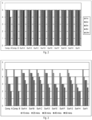
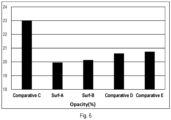
- Water whitening resistance test was performed according to the following test method. Apply latex polymer onto PET film with 90 ⁇ m applicator, and dry in 110 °C oven for 3 minutes. The films were let to cool down for overnight. Then the films were soaked in the water bath at room temperature for up to 24 hours and at high temperature condition of 90°C for up to 50 minutes. Water whitening and water resistance were tested by scale 0 to 5: 0 being the worst, 5 being the best. The measurement of water whitening was also evaluated by checking the color delta L value and delta E value changes before and after films soaked in water. The testing results are given in FIGS. 2-5 .
- FIG. 2 shows water whitening and water resistance testing at room temperature.
- FIG. 3 shows water whitening and water resistance testing at 90°C condition.
- FIG. 4 shows the color delta L value of water whiteness change (50 min at 90°C) of the examples.
- FIG. 5 shows the color delta E value of water whiteness change (50 min at 90°C) of the examples.
- the testing data showed that the polymerizable surfactants prepared by this invention significantly improved the water whitening and water resistance of the latex polymers in pressure adhesive applications compared to traditional surfactants.
- Example 14 Preparation of latex polymers by using polymerizable surfactant samples prepared in Example 1 and 2 (Surfactant A and Surfactant B) in a styrene acrylic emulsion polymerization by following the procedure described below. Comparative surfactant samples, comparative sample C (-allyl ethoxylate sulfate sodium salt), comparative sample D (tristyrenephenol EO-PO sulfate sodium salt), and comparative sample E (tristyrenephenol EO phosphate ammonium salt), were also used to prepare latex polymers. The recipe of these latex polymers are given in TABLE 5.
- Deionized water (DI) 233.5g
- sample Surfactant A 8.3 g
- agitation, heating and cooling means under continuous agitation, the temperature of the reactor was raised to 80.0°C.
- a monomer pre-emulsion (28.3g) [5.0% of a total 560g of monomer pre-emulsion was prepared by mixing deionized water (149.7g), Surfactant A (8.3g), styrene (194g), butyl acrylate (190g), acrylic acid (10g), acrylamide (6g), and Vinyl trimehoxy silane (2g)] were added to the reactor (the pre-emulsion was stabilized before adding), followed by a solution of ammonium persulfate (10.5g) solution [ammonium persulfate (0.5g) dissolved in the deionized water (10g)].
- the seed was kept for 15 minutes. A small sample was removed to check for the particle size.
- the continuous addition of the remaining monomer pre-emulsion (532.7g) and the initiator solution [ammonium persulfate (1.50g) dissolved in the deionized water (70.0g)] were set to finish in 3 hours.
- the reactor was kept at 80°C for further 30 minutes until the values of the final solids were constant or near maximum theoretical value.
- the reactor was then cooled below 40°C and the resulting latex was filter through a polyester filter.
- the polymer was neutralized to pH 8-8.5 using 28% ammonia hydroxide.
- the polymer dispersion obtained had solid content of 44.3%, viscosity of 1373cP, and average particle size of 119.2 d.nm.
- the opacity value is an indication of the water whitening and water resistance performance of the latex and paint film. Less opacity value showed less water whitening and hence better water resistance.
- FIG. 6 shows the opacity (%) values of these polymers, and the sample Surfactant A and Surfactant B showed improved water whitening and water resistance properties than the comparative samples.
- Example 15 Preparation of latex polymers by using polymerizable surfactant samples prepared in Example 2 (Surfactant B) in a styrene acrylic emulsion polymerization by following the procedure described Example 14.
- the recipe of the latex polymer is given in TABLE 7. Comparative surfactant samples, comparative sample E (tristyrenephenol EO phosphate ammonium salt), was also used to prepare latex polymers.
- the latex polymers were formulated in a 49% PVC exterior paint for stones or other construction substrates.
- the paint formulation is given in TABLE 9.
- TABLE 9 Grind Parts Water 130.00 Propylene glycol 15.00 Rhodoline WA1801 4.50 Rhodoline WA 40 2.00 QP-30000 1.50 AMP-95 1.00 Rhodoline DF6002 1.00 Tronox CR-826 190.00 Calcined Clay 40.00 Imercarb 3 180.00 Letdown Water 120.00 Full acrylic Latex (50%) 274.00 Texanol 15.00 Rhodoline DF6002 2.00 Acticide EG-CF 2.00 Acticide EPW 2.00 Acrysol RM2020NPR 8.00 Acrysol RM8W 2.00 Water 10.00 Total 1000.00
- Figure 1 shows the improved white base paint with watermark resistance, and paint tinted with 5% colorant.
Landscapes
- Chemical & Material Sciences (AREA)
- Organic Chemistry (AREA)
- Engineering & Computer Science (AREA)
- Materials Engineering (AREA)
- Life Sciences & Earth Sciences (AREA)
- Wood Science & Technology (AREA)
- Chemical Kinetics & Catalysis (AREA)
- Medicinal Chemistry (AREA)
- Polymers & Plastics (AREA)
- Health & Medical Sciences (AREA)
- General Chemical & Material Sciences (AREA)
- Dispersion Chemistry (AREA)
- Oil, Petroleum & Natural Gas (AREA)
- Inorganic Chemistry (AREA)
- Polymerisation Methods In General (AREA)
- Paints Or Removers (AREA)
- Emulsifying, Dispersing, Foam-Producing Or Wetting Agents (AREA)
- Polyethers (AREA)
- Macromonomer-Based Addition Polymer (AREA)
- Adhesives Or Adhesive Processes (AREA)
- Detergent Compositions (AREA)
Applications Claiming Priority (2)
| Application Number | Priority Date | Filing Date | Title |
|---|---|---|---|
| US201962842806P | 2019-05-03 | 2019-05-03 | |
| PCT/US2020/030997 WO2020227083A1 (en) | 2019-05-03 | 2020-05-01 | Polymerizable surfactants having water whitening resistance and methods for use |
Publications (3)
| Publication Number | Publication Date |
|---|---|
| EP3962986A1 EP3962986A1 (en) | 2022-03-09 |
| EP3962986A4 EP3962986A4 (en) | 2023-01-11 |
| EP3962986B1 true EP3962986B1 (en) | 2024-11-06 |
Family
ID=73050638
Family Applications (1)
| Application Number | Title | Priority Date | Filing Date |
|---|---|---|---|
| EP20802402.6A Active EP3962986B1 (en) | 2019-05-03 | 2020-05-01 | Polymerizable surfactants having water whitening resistance and methods for use |
Country Status (10)
| Country | Link |
|---|---|
| US (2) | US11884867B2 (pl) |
| EP (1) | EP3962986B1 (pl) |
| JP (2) | JP7648539B2 (pl) |
| KR (1) | KR20220004717A (pl) |
| CN (1) | CN114096586B (pl) |
| AU (1) | AU2020269271A1 (pl) |
| CA (1) | CA3136277A1 (pl) |
| ES (1) | ES3006909T3 (pl) |
| PL (1) | PL3962986T3 (pl) |
| WO (1) | WO2020227083A1 (pl) |
Families Citing this family (2)
| Publication number | Priority date | Publication date | Assignee | Title |
|---|---|---|---|---|
| CN120129727A (zh) * | 2022-11-02 | 2025-06-10 | 法国特种经营公司 | 具有改善特性的包含由可聚合表面活性剂形成的聚合物的涂料组合物 |
| WO2025026728A1 (en) * | 2023-08-03 | 2025-02-06 | Specialty Operations France | Coating compositions having improved properties comprising a polymer formed from polymerizable surfactants |
Family Cites Families (18)
| Publication number | Priority date | Publication date | Assignee | Title |
|---|---|---|---|---|
| EP0244841B1 (en) * | 1986-05-07 | 1992-03-18 | Dai-Ichi Kogyo Seiyaku Co., Ltd. | Surface active compounds having a polymerizable moiety |
| JPS63214336A (ja) * | 1987-08-07 | 1988-09-07 | Dai Ichi Kogyo Seiyaku Co Ltd | 新規界面活性剤 |
| JPS63205384A (ja) * | 1987-08-21 | 1988-08-24 | Dai Ichi Kogyo Seiyaku Co Ltd | 新規合成樹脂帯電防止剤 |
| WO2002057320A1 (fr) | 2000-12-28 | 2002-07-25 | Asahi Denka Co., Ltd. | Tensioactifs |
| JP4208462B2 (ja) | 2000-12-28 | 2009-01-14 | 株式会社Adeka | 界面活性剤 |
| CA2499815A1 (en) | 2002-09-26 | 2004-04-08 | Surface Specialties, S.A. | Removable, water-whitening resistant pressure sensitive adhesives |
| JP4258229B2 (ja) * | 2003-02-28 | 2009-04-30 | 東洋インキ製造株式会社 | 水性顔料分散液の製造方法および該方法で製造された水性顔料分散液を含むインクジェット用記録液 |
| JP4578803B2 (ja) * | 2003-12-25 | 2010-11-10 | 日本合成化学工業株式会社 | 難燃性水性樹脂組成物 |
| US7501470B2 (en) * | 2004-12-03 | 2009-03-10 | Rhodia Inc. | Use of polyoxypropylene and polyoxyethylene terpene compounds in emulsion polymerization |
| DE602007010622D1 (de) * | 2006-06-01 | 2010-12-30 | Cytec Surface Specialties Sa | Haftkleber |
| BR112014004927A2 (pt) * | 2011-08-29 | 2017-04-11 | Ethox Chemicals Llc | composto, látex polimérico, formulação de revestimento, composição de tensoativo reativo, formulação de revestimento curável por uv, dispersão de pigmento, e, pigmentos |
| CN103906768A (zh) | 2011-10-07 | 2014-07-02 | 第一工业制药株式会社 | 使用反应性乳化剂的乳液聚合方法、由此得到的水系聚合物分散液和聚合物薄膜 |
| EP2768904A4 (en) | 2011-10-21 | 2015-12-23 | Ethox Chemicals Llc | NEW REACTIVE SURFACES FOR FREEZER EMISSIONS EMULSION POLYMERS AND COATINGS MANUFACTURED THEREFROM |
| CN102417566A (zh) | 2011-11-17 | 2012-04-18 | 浙江理工大学 | 环保型棉织物分散染料热转移印花改性剂及其制备方法 |
| JP5567218B2 (ja) * | 2011-12-20 | 2014-08-06 | 第一工業製薬株式会社 | 乳化重合用乳化剤およびそれを用いる乳化重合方法 |
| MX379749B (es) | 2012-03-10 | 2025-03-11 | Ethox Chemicals Llc | Aditivos para mejorar las caracteristicas de tiempo abierto y congelamiento-descongelamiento de pinturas y recubrimientos a base de agua. |
| DE102013209023A1 (de) | 2013-05-15 | 2014-11-20 | Evonik Industries Ag | Superabsorbierende Polymere mit schnellen Absorptionseigenschaften sowie Verfahren zu dessen Herstellung |
| US9688780B2 (en) | 2014-08-08 | 2017-06-27 | Rhodia Operations | Allyl ether sulfate polymerizable surfactants and methods for use |
-
2020
- 2020-05-01 PL PL20802402.6T patent/PL3962986T3/pl unknown
- 2020-05-01 AU AU2020269271A patent/AU2020269271A1/en active Pending
- 2020-05-01 EP EP20802402.6A patent/EP3962986B1/en active Active
- 2020-05-01 KR KR1020217039225A patent/KR20220004717A/ko not_active Ceased
- 2020-05-01 WO PCT/US2020/030997 patent/WO2020227083A1/en not_active Ceased
- 2020-05-01 US US17/606,867 patent/US11884867B2/en active Active
- 2020-05-01 CA CA3136277A patent/CA3136277A1/en active Pending
- 2020-05-01 ES ES20802402T patent/ES3006909T3/es active Active
- 2020-05-01 JP JP2021565027A patent/JP7648539B2/ja active Active
- 2020-05-01 CN CN202080048839.6A patent/CN114096586B/zh active Active
-
2023
- 2023-12-13 US US18/538,989 patent/US20240110102A1/en active Pending
-
2024
- 2024-10-18 JP JP2024182552A patent/JP2025023931A/ja not_active Withdrawn
Also Published As
| Publication number | Publication date |
|---|---|
| CN114096586B (zh) | 2025-01-21 |
| WO2020227083A1 (en) | 2020-11-12 |
| US20220235272A1 (en) | 2022-07-28 |
| BR112021021905A2 (pt) | 2021-12-28 |
| CN114096586A (zh) | 2022-02-25 |
| JP2022531598A (ja) | 2022-07-07 |
| EP3962986A1 (en) | 2022-03-09 |
| PL3962986T3 (pl) | 2025-03-31 |
| CA3136277A1 (en) | 2020-11-12 |
| JP7648539B2 (ja) | 2025-03-18 |
| KR20220004717A (ko) | 2022-01-11 |
| US20240110102A1 (en) | 2024-04-04 |
| AU2020269271A1 (en) | 2021-11-25 |
| ES3006909T3 (en) | 2025-03-19 |
| US11884867B2 (en) | 2024-01-30 |
| EP3962986A4 (en) | 2023-01-11 |
| JP2025023931A (ja) | 2025-02-19 |
Similar Documents
| Publication | Publication Date | Title |
|---|---|---|
| AU2012302039B2 (en) | New reactive surfactants for emulsion polymerization, pigment dispersion, and UV coatings | |
| KR101991078B1 (ko) | 냉동-해동 안정한 에멀전 폴리머용 신규한 반응성 계면 활성제 및 그 코팅 | |
| EP2855579B1 (en) | Aqueous binder compositions | |
| US20240110102A1 (en) | Polymerizable surfactants having water whitening resistance and methods for use | |
| US20140249272A1 (en) | Emulsion polymerization method using reactive emulsifier, aqueous polymer dispersion obtained by the same, and polymer film | |
| KR102425714B1 (ko) | 수계 수지 분산체 및 도료 | |
| CN115947904A (zh) | 一种poss复合聚丙烯酸酯水分散体及其制备方法 | |
| EP3177673B1 (en) | Allyl ether sulfate polymerizable surfactants and methods for use | |
| CA2346461A1 (en) | Latex polymer compositions | |
| EP4612241A1 (en) | Coating compositions having improved properties comprising a polymer formed from polymerizable surfactants | |
| EP3494100B1 (en) | Monomer emulsion composition | |
| BR112021021905B1 (pt) | Composição polimerizável de tensoativos, adesivo sensível à pressão com aperfeiçoadas propriedades de clareamento e resistência à água, e tinta com aperfeiçoada resistência à marca de água e propriedades de resistência à lixiviação do tensoativo | |
| EP4455227A1 (en) | Emulsion system containing anionic latex composition for improved coating | |
| WO2025026728A1 (en) | Coating compositions having improved properties comprising a polymer formed from polymerizable surfactants | |
| MXPA01003532A (en) | Latex polymer compositions |
Legal Events
| Date | Code | Title | Description |
|---|---|---|---|
| STAA | Information on the status of an ep patent application or granted ep patent |
Free format text: STATUS: THE INTERNATIONAL PUBLICATION HAS BEEN MADE |
|
| PUAI | Public reference made under article 153(3) epc to a published international application that has entered the european phase |
Free format text: ORIGINAL CODE: 0009012 |
|
| STAA | Information on the status of an ep patent application or granted ep patent |
Free format text: STATUS: REQUEST FOR EXAMINATION WAS MADE |
|
| 17P | Request for examination filed |
Effective date: 20211203 |
|
| AK | Designated contracting states |
Kind code of ref document: A1 Designated state(s): AL AT BE BG CH CY CZ DE DK EE ES FI FR GB GR HR HU IE IS IT LI LT LU LV MC MK MT NL NO PL PT RO RS SE SI SK SM TR |
|
| RAP3 | Party data changed (applicant data changed or rights of an application transferred) |
Owner name: RHODIA OPERATIONS |
|
| DAV | Request for validation of the european patent (deleted) | ||
| DAX | Request for extension of the european patent (deleted) | ||
| A4 | Supplementary search report drawn up and despatched |
Effective date: 20221208 |
|
| RIC1 | Information provided on ipc code assigned before grant |
Ipc: C09J 11/08 20060101ALI20221202BHEP Ipc: C09D 133/00 20060101ALI20221202BHEP Ipc: C09D 7/65 20180101ALI20221202BHEP Ipc: C08G 65/26 20060101AFI20221202BHEP |
|
| STAA | Information on the status of an ep patent application or granted ep patent |
Free format text: STATUS: EXAMINATION IS IN PROGRESS |
|
| 17Q | First examination report despatched |
Effective date: 20230816 |
|
| RAP1 | Party data changed (applicant data changed or rights of an application transferred) |
Owner name: SPECIALTY OPERATIONS FRANCE |
|
| GRAP | Despatch of communication of intention to grant a patent |
Free format text: ORIGINAL CODE: EPIDOSNIGR1 |
|
| STAA | Information on the status of an ep patent application or granted ep patent |
Free format text: STATUS: GRANT OF PATENT IS INTENDED |
|
| INTG | Intention to grant announced |
Effective date: 20240611 |
|
| GRAS | Grant fee paid |
Free format text: ORIGINAL CODE: EPIDOSNIGR3 |
|
| GRAA | (expected) grant |
Free format text: ORIGINAL CODE: 0009210 |
|
| STAA | Information on the status of an ep patent application or granted ep patent |
Free format text: STATUS: THE PATENT HAS BEEN GRANTED |
|
| P01 | Opt-out of the competence of the unified patent court (upc) registered |
Free format text: CASE NUMBER: APP_52127/2024 Effective date: 20240917 |
|
| AK | Designated contracting states |
Kind code of ref document: B1 Designated state(s): AL AT BE BG CH CY CZ DE DK EE ES FI FR GB GR HR HU IE IS IT LI LT LU LV MC MK MT NL NO PL PT RO RS SE SI SK SM TR |
|
| REG | Reference to a national code |
Ref country code: GB Ref legal event code: FG4D |
|
| REG | Reference to a national code |
Ref country code: CH Ref legal event code: EP |
|
| REG | Reference to a national code |
Ref country code: DE Ref legal event code: R096 Ref document number: 602020040941 Country of ref document: DE |
|
| REG | Reference to a national code |
Ref country code: IE Ref legal event code: FG4D |
|
| REG | Reference to a national code |
Ref country code: NL Ref legal event code: FP |
|
| REG | Reference to a national code |
Ref country code: LT Ref legal event code: MG9D |
|
| REG | Reference to a national code |
Ref country code: ES Ref legal event code: FG2A Ref document number: 3006909 Country of ref document: ES Kind code of ref document: T3 Effective date: 20250319 |
|
| PG25 | Lapsed in a contracting state [announced via postgrant information from national office to epo] |
Ref country code: HR Free format text: LAPSE BECAUSE OF FAILURE TO SUBMIT A TRANSLATION OF THE DESCRIPTION OR TO PAY THE FEE WITHIN THE PRESCRIBED TIME-LIMIT Effective date: 20241106 Ref country code: IS Free format text: LAPSE BECAUSE OF FAILURE TO SUBMIT A TRANSLATION OF THE DESCRIPTION OR TO PAY THE FEE WITHIN THE PRESCRIBED TIME-LIMIT Effective date: 20250306 Ref country code: PT Free format text: LAPSE BECAUSE OF FAILURE TO SUBMIT A TRANSLATION OF THE DESCRIPTION OR TO PAY THE FEE WITHIN THE PRESCRIBED TIME-LIMIT Effective date: 20250306 |
|
| PG25 | Lapsed in a contracting state [announced via postgrant information from national office to epo] |
Ref country code: FI Free format text: LAPSE BECAUSE OF FAILURE TO SUBMIT A TRANSLATION OF THE DESCRIPTION OR TO PAY THE FEE WITHIN THE PRESCRIBED TIME-LIMIT Effective date: 20241106 |
|
| REG | Reference to a national code |
Ref country code: AT Ref legal event code: MK05 Ref document number: 1739297 Country of ref document: AT Kind code of ref document: T Effective date: 20241106 |
|
| PG25 | Lapsed in a contracting state [announced via postgrant information from national office to epo] |
Ref country code: BG Free format text: LAPSE BECAUSE OF FAILURE TO SUBMIT A TRANSLATION OF THE DESCRIPTION OR TO PAY THE FEE WITHIN THE PRESCRIBED TIME-LIMIT Effective date: 20241106 |
|
| PG25 | Lapsed in a contracting state [announced via postgrant information from national office to epo] |
Ref country code: NO Free format text: LAPSE BECAUSE OF FAILURE TO SUBMIT A TRANSLATION OF THE DESCRIPTION OR TO PAY THE FEE WITHIN THE PRESCRIBED TIME-LIMIT Effective date: 20250206 |
|
| PG25 | Lapsed in a contracting state [announced via postgrant information from national office to epo] |
Ref country code: LV Free format text: LAPSE BECAUSE OF FAILURE TO SUBMIT A TRANSLATION OF THE DESCRIPTION OR TO PAY THE FEE WITHIN THE PRESCRIBED TIME-LIMIT Effective date: 20241106 Ref country code: GR Free format text: LAPSE BECAUSE OF FAILURE TO SUBMIT A TRANSLATION OF THE DESCRIPTION OR TO PAY THE FEE WITHIN THE PRESCRIBED TIME-LIMIT Effective date: 20250207 Ref country code: AT Free format text: LAPSE BECAUSE OF FAILURE TO SUBMIT A TRANSLATION OF THE DESCRIPTION OR TO PAY THE FEE WITHIN THE PRESCRIBED TIME-LIMIT Effective date: 20241106 |
|
| PG25 | Lapsed in a contracting state [announced via postgrant information from national office to epo] |
Ref country code: RS Free format text: LAPSE BECAUSE OF FAILURE TO SUBMIT A TRANSLATION OF THE DESCRIPTION OR TO PAY THE FEE WITHIN THE PRESCRIBED TIME-LIMIT Effective date: 20250206 |
|
| PGFP | Annual fee paid to national office [announced via postgrant information from national office to epo] |
Ref country code: NL Payment date: 20250409 Year of fee payment: 6 |
|
| PG25 | Lapsed in a contracting state [announced via postgrant information from national office to epo] |
Ref country code: SM Free format text: LAPSE BECAUSE OF FAILURE TO SUBMIT A TRANSLATION OF THE DESCRIPTION OR TO PAY THE FEE WITHIN THE PRESCRIBED TIME-LIMIT Effective date: 20241106 |
|
| PGFP | Annual fee paid to national office [announced via postgrant information from national office to epo] |
Ref country code: PL Payment date: 20250415 Year of fee payment: 6 Ref country code: DE Payment date: 20250402 Year of fee payment: 6 |
|
| PG25 | Lapsed in a contracting state [announced via postgrant information from national office to epo] |
Ref country code: DK Free format text: LAPSE BECAUSE OF FAILURE TO SUBMIT A TRANSLATION OF THE DESCRIPTION OR TO PAY THE FEE WITHIN THE PRESCRIBED TIME-LIMIT Effective date: 20241106 |
|
| PGFP | Annual fee paid to national office [announced via postgrant information from national office to epo] |
Ref country code: GB Payment date: 20250401 Year of fee payment: 6 Ref country code: ES Payment date: 20250602 Year of fee payment: 6 |
|
| PGFP | Annual fee paid to national office [announced via postgrant information from national office to epo] |
Ref country code: IT Payment date: 20250422 Year of fee payment: 6 |
|
| PG25 | Lapsed in a contracting state [announced via postgrant information from national office to epo] |
Ref country code: EE Free format text: LAPSE BECAUSE OF FAILURE TO SUBMIT A TRANSLATION OF THE DESCRIPTION OR TO PAY THE FEE WITHIN THE PRESCRIBED TIME-LIMIT Effective date: 20241106 |
|
| PGFP | Annual fee paid to national office [announced via postgrant information from national office to epo] |
Ref country code: FR Payment date: 20250401 Year of fee payment: 6 |
|
| PG25 | Lapsed in a contracting state [announced via postgrant information from national office to epo] |
Ref country code: RO Free format text: LAPSE BECAUSE OF FAILURE TO SUBMIT A TRANSLATION OF THE DESCRIPTION OR TO PAY THE FEE WITHIN THE PRESCRIBED TIME-LIMIT Effective date: 20241106 |
|
| PG25 | Lapsed in a contracting state [announced via postgrant information from national office to epo] |
Ref country code: SK Free format text: LAPSE BECAUSE OF FAILURE TO SUBMIT A TRANSLATION OF THE DESCRIPTION OR TO PAY THE FEE WITHIN THE PRESCRIBED TIME-LIMIT Effective date: 20241106 |
|
| PG25 | Lapsed in a contracting state [announced via postgrant information from national office to epo] |
Ref country code: CZ Free format text: LAPSE BECAUSE OF FAILURE TO SUBMIT A TRANSLATION OF THE DESCRIPTION OR TO PAY THE FEE WITHIN THE PRESCRIBED TIME-LIMIT Effective date: 20241106 |
|
| REG | Reference to a national code |
Ref country code: DE Ref legal event code: R097 Ref document number: 602020040941 Country of ref document: DE |
|
| PG25 | Lapsed in a contracting state [announced via postgrant information from national office to epo] |
Ref country code: SE Free format text: LAPSE BECAUSE OF FAILURE TO SUBMIT A TRANSLATION OF THE DESCRIPTION OR TO PAY THE FEE WITHIN THE PRESCRIBED TIME-LIMIT Effective date: 20241106 |
|
| PLBE | No opposition filed within time limit |
Free format text: ORIGINAL CODE: 0009261 |
|
| STAA | Information on the status of an ep patent application or granted ep patent |
Free format text: STATUS: NO OPPOSITION FILED WITHIN TIME LIMIT |
|
| 26N | No opposition filed |
Effective date: 20250807 |
|
| REG | Reference to a national code |
Ref country code: CH Ref legal event code: H13 Free format text: ST27 STATUS EVENT CODE: U-0-0-H10-H13 (AS PROVIDED BY THE NATIONAL OFFICE) Effective date: 20251223 |