EP3960973B1 - Fahrzeugaufbau - Google Patents
Fahrzeugaufbau Download PDFInfo
- Publication number
- EP3960973B1 EP3960973B1 EP21184057.4A EP21184057A EP3960973B1 EP 3960973 B1 EP3960973 B1 EP 3960973B1 EP 21184057 A EP21184057 A EP 21184057A EP 3960973 B1 EP3960973 B1 EP 3960973B1
- Authority
- EP
- European Patent Office
- Prior art keywords
- guide
- lower panel
- vehicle body
- section
- body according
- Prior art date
- Legal status (The legal status is an assumption and is not a legal conclusion. Google has not performed a legal analysis and makes no representation as to the accuracy of the status listed.)
- Active
Links
Images



Classifications
-
- E—FIXED CONSTRUCTIONS
- E05—LOCKS; KEYS; WINDOW OR DOOR FITTINGS; SAFES
- E05D—HINGES OR SUSPENSION DEVICES FOR DOORS, WINDOWS OR WINGS
- E05D15/00—Suspension arrangements for wings
- E05D15/16—Suspension arrangements for wings for wings sliding vertically more or less in their own plane
- E05D15/24—Suspension arrangements for wings for wings sliding vertically more or less in their own plane consisting of parts connected at their edges
-
- B—PERFORMING OPERATIONS; TRANSPORTING
- B60—VEHICLES IN GENERAL
- B60J—WINDOWS, WINDSCREENS, NON-FIXED ROOFS, DOORS, OR SIMILAR DEVICES FOR VEHICLES; REMOVABLE EXTERNAL PROTECTIVE COVERINGS SPECIALLY ADAPTED FOR VEHICLES
- B60J5/00—Doors
- B60J5/10—Doors arranged at the vehicle rear
- B60J5/12—Doors arranged at the vehicle rear slidable; foldable
- B60J5/14—Doors arranged at the vehicle rear slidable; foldable of roller-blind type made of rigid elements
-
- E—FIXED CONSTRUCTIONS
- E05—LOCKS; KEYS; WINDOW OR DOOR FITTINGS; SAFES
- E05D—HINGES OR SUSPENSION DEVICES FOR DOORS, WINDOWS OR WINGS
- E05D13/00—Accessories for sliding or lifting wings, e.g. pulleys, safety catches
- E05D13/10—Counterbalance devices
- E05D13/12—Counterbalance devices with springs
- E05D13/1253—Counterbalance devices with springs with canted-coil torsion springs
- E05D13/1261—Counterbalance devices with springs with canted-coil torsion springs specially adapted for overhead wings
-
- E—FIXED CONSTRUCTIONS
- E05—LOCKS; KEYS; WINDOW OR DOOR FITTINGS; SAFES
- E05D—HINGES OR SUSPENSION DEVICES FOR DOORS, WINDOWS OR WINGS
- E05D15/00—Suspension arrangements for wings
- E05D15/16—Suspension arrangements for wings for wings sliding vertically more or less in their own plane
- E05D15/24—Suspension arrangements for wings for wings sliding vertically more or less in their own plane consisting of parts connected at their edges
- E05D15/244—Upper part guiding means
- E05D15/248—Upper part guiding means with lever arms for producing an additional movement
-
- E—FIXED CONSTRUCTIONS
- E05—LOCKS; KEYS; WINDOW OR DOOR FITTINGS; SAFES
- E05D—HINGES OR SUSPENSION DEVICES FOR DOORS, WINDOWS OR WINGS
- E05D15/00—Suspension arrangements for wings
- E05D15/16—Suspension arrangements for wings for wings sliding vertically more or less in their own plane
- E05D15/22—Suspension arrangements for wings for wings sliding vertically more or less in their own plane allowing an additional movement
- E05D2015/225—Suspension arrangements for wings for wings sliding vertically more or less in their own plane allowing an additional movement specially adapted for overhead wings
-
- E—FIXED CONSTRUCTIONS
- E05—LOCKS; KEYS; WINDOW OR DOOR FITTINGS; SAFES
- E05Y—INDEXING SCHEME ASSOCIATED WITH SUBCLASSES E05D AND E05F, RELATING TO CONSTRUCTION ELEMENTS, ELECTRIC CONTROL, POWER SUPPLY, POWER SIGNAL OR TRANSMISSION, USER INTERFACES, MOUNTING OR COUPLING, DETAILS, ACCESSORIES, AUXILIARY OPERATIONS NOT OTHERWISE PROVIDED FOR, APPLICATION THEREOF
- E05Y2900/00—Application of doors, windows, wings or fittings thereof
- E05Y2900/50—Application of doors, windows, wings or fittings thereof for vehicles
- E05Y2900/516—Application of doors, windows, wings or fittings thereof for vehicles for trucks or trailers
Definitions
- the present invention relates to a vehicle body with a sectional door arranged between two posts, which can be moved to open and close an opening in a loading space and has a plurality of panels which are pivotably mounted on one another and which can be moved on opposite sides via guide means along a guide which is in the area the opening has a substantially vertical section, in the upper region of the loading space a substantially horizontal section as a storage section for the sectional door and an arcuate section in between, a spring shaft being provided for biasing the sectional door into an open position, which is in a closed position on the bottom side arranged lower panel is pivotally held on a running part that can be moved along the guide. whereby the posts in the upper area are connected to each other via a lintel or a beam.
- the DE 20 2015 105 844 U1 discloses a vehicle body in which a loading space can be closed by a movable sectional door.
- the sectional door comprises a plurality of panels that are articulated to one another and are prestressed into an opening position via a spring shaft.
- a spring break protection device is also provided on the spring shaft.
- a sectional door with plate-shaped panels on a vehicle in which a cable pull is fixed via a holder on an outside of the lowest panel.
- the lowest panel can be moved on opposite sides via a carriage on a guide, the guide having a pivotable lever so that in the raised position a lower edge of the lower panel is arranged higher than the guide.
- the panels which are pivotably mounted on one another, can be moved along a guide, the lower panel, which is arranged on the floor in a closed position, having a guide roller on its radially outer side in the arcuate section, which can be rolled on a lintel or a beam at the top of the opening is.
- at least one guide roller can be held on the lintel or beam, which can be rolled on the lower panel when it is arranged on the arcuate section. This prevents an outer side of the lower panel from hitting the beam or the lintel and the lower panel can be moved smoothly to the maximum opening position.
- the at least one guide roller is arranged between the lintel or beam on the one hand and the lower panel on the other hand.
- guide rollers are arranged or fixed distributed over the length of the lower panel, so that the panel is supported in several places at the same time and can be moved along the beam or the lintel by the guide rollers.
- the guide rollers define a gap between the lower panel and the support or beam, in which other structures can be arranged, such as actuation aids, for example a handle, loops or a lock or a lock.
- a lintel or a beam is preferably arranged at the top of the sectional door, with the sectional door in an open position with a horizontal viewing direction preferably being arranged completely behind the lintel or the beam.
- the maximum opening height on the loading space is dictated by the lower edge of the lintel or beam, and the overhead door can be arranged with the lower panel higher or substantially level with the lower end of the lintel.
- the running part comprises a fastening section which is fixed to the panel, and a guide section which is pivotally held on the fastening section and which can be moved along the guide via a roller or a sliding element.
- the running part can thus be designed as a two-armed articulated lever, which is fixed to the panel on the one hand and can be moved along the guide on the other.
- the lower panel is preferably movable along a guide on opposite sides via such a running part.
- the lower panel has a groove into which a part of the guide section with a holder for the roller can be inserted.
- the panels are preferably made from one or more extruded profiles, in particular from plastic or metal, so that a groove integrally made into the profile can be used to fix the holder for the roller.
- the profile also has one or more hollow chambers for high torsional rigidity.
- the holder is fixed to the panel between an outer plane formed by the outer surface of the panel and an inner plane formed by an inner surface of the panel.
- the lower panel is arranged on the arcuate section of the guide in an opening position of the sectional door, and the lower panel is arranged with a lower end higher than a lower end of the running part.
- the lower panel can therefore be positioned higher in the opening position, deviating from the guide, in order to increase the maximum opening height for loading and unloading.
- the lower panel is preferably biased into the raised position via a spring element. This allows the trajectory of the lower panel to be controlled more precisely at the arcuate portion.
- the spring element can be supported with a first part on the guide section and with a second part on the fastening section of the running part.
- a tension element is fixed to the lower panel, with which the sectional door can be moved into an opening position via the spring shaft.
- the lower panel is automatically pivoted relative to the guide in the area of the arcuate section of the guide via the tension element, for example a cable, without the need for further components, such as springs or drives, would have to be provided.
- the tension element for example a cable
- an actuating element for example a handle or a loop, for moving the sectional door from the opening position to the closing position is fixed on the lower panel.
- the user can then, for example, pull the sectional door down using the actuating element until the sectional door is locked in a closed position via a lock, which can also be fixed to the lower panel.
- a stepped holder is preferably provided on the running part, on which a roller is rotatably mounted at one end and at the other end of which the holder is inserted, for example, into an opening in the guide section of the running part.
- This allows the holder to be fixed in a central region of the lower panel, while the roller is arranged at a distance from the opening towards a lower end of the guide. This enables a stable fixation of the holder in a central area of the lower panel and at the same time an arrangement of the lower roller in the area of a lower edge of the lower panel for optimized guidance.
- a lower end of the panel In an opening position of the sectional door, a lower end of the panel can be arranged at least 5 mm, preferably between 10 mm to 50 mm, higher than a roller on the running part. In a closed position, the roller on the running part can be located in an extension of the lower panel.
- a vehicle body 1 includes a sectional door 2, which has a plurality of panels 3 which are articulated to one another and which, in a closed position, cover an opening of a loading space. In the closed position, a lower panel 4 arranged on the floor is locked via a lock 5, which fixes the sectional door 2 to a floor of a vehicle.
- the sectional door 2 is arranged between two posts 6, which are connected to one another in the upper area via a lintel 7 or a beam and specify the maximum opening to the loading space.
- the sectional door 2 can be moved from a substantially vertical closing position to a horizontal opening position, in which the sectional door 2 is arranged below a roof 9.
- FIG. 2 the guide 10 for the sectional door 2 is shown, with other structural parts of the vehicle body being omitted.
- a guide 10 is provided on both sides of the sectional door 2, which has a vertical section 11 adjacent to the opening, a horizontal section for storing the sectional door 2 in an opening position and an arcuate section 13 between the vertical section 11 and the horizontal section 12.
- the guide 10 can be formed by individual rail sections on which guide means, such as rollers or sliding elements, are guided.
- a handle 16 and cable tie rod 17 are fixed to the lower panel 4, each of which is connected to a spring shaft 8 via a cable pull.
- the sectional door 2 can be moved via a spring shaft 8 arranged in the closed position above the sectional door 2, which biases the sectional door 2 into an open position via a tension element.
- the spring shaft 8 can for example, be trained as in the DE 20 2015 105 884 U1 is described, in which a spring break protection device for the spring shaft is also disclosed.
- FIG 3 the lower panel 4 of the sectional door 2 is shown in a position just before the maximum opening position.
- the lower panel 4 has been moved to the arcuate section 13 via a tension element, for example a cable pull, which pulls the sectional door 2 into the opening position via the spring shaft 8.
- the lower panel 4 is held movably on the guide 10 via upper rollers 15.
- the lower panel 4 is not connected directly to the arcuate section 13 of the guide 10 via a roller, but via a running part 20.
- the running part 20 has a plate-shaped fastening section 21, which is fixed on the inside of the lower panel 4, and a guide section 22 pivotably or rotatably connected thereto, to which a roller 23 or a sliding element is fixed.
- the lower panel 4 can be pivoted relative to the guide section 22, so that a lower end of the lower panel 4 is arranged higher than a lower end on the guide section 22 or the roller 23.
- a guide roller 40 is fixed via a holder 41, the guide roller 40 being able to roll on the lintel 7.
- the guide roller 40 prevents the outside of the lower panel 4 from hitting the lintel 7 and ensures that the lower panel 4 can be easily moved past the lower edge of the lintel 7, even if the lower panel 4 performs a pivoting movement.
- the guide roller 40 can optionally be made of an elastic material so that impact forces can be at least partially absorbed.
- the lower panel 4 is biased upwards via a spring element 31 so that after driving over the lintel 7 it is arranged higher than the lower edge of the lintel. In the open position, the lower panel 4 is arranged behind the lintel 7 with a horizontal viewing direction towards the lintel 7 and does not protrude downwards from it.
- An actuating element in the form of a handle or a loop is also fixed on the inside of the lower panel 4, by means of which the sectional door 2 can be moved into the closed position against the force of the spring shaft 8.
- the sectional door 2 can be moved because the lowest panel 4 is in the area of the arcuate section 13 of the guide 10.
- the lower panel 4 can be pivoted relative to the guide section 22 in order to then pull the lower panel 4 downwards from the arcuate section 13 when a stop is reached.
- the effort required to close the sectional door 2 can thus be kept low, and the user can also essentially pull the bottom panel 4 downwards using the actuating element in the usual manner and does not have to apply any force in the horizontal direction.
- Figure 4 shows a lower panel 4 with a running part 20 which has a plate-shaped fastening section 21 which is fixed to the lower panel 4.
- a guide section 22 is articulated on the fastening section 21, the essentially plate-shaped guide section 22 having a part 18 which protrudes towards the lower panel 4 and on which an opening 30 for the holder 24 ( Fig. 3 ) is designed to store a roller 23.
- the protruding part 18 is arranged in a groove 19 on the lower panel 4, so that the opening 30 for inserting the holder 24 is arranged within the two planes which are defined by an inner surface and an outer surface of the lower panel 4.
- the panels 3 and 4 are made from one or more extruded profiles made of plastic or metal, so that the groove 19 is integrally formed.
- One or more hollow chambers can be provided at a distance from the groove 19, so that the panels 4 have a high level of stability with little use of material.
- the guide section 22 is biased in a pivoting direction by a spring element 31 so that the running part 20 pivots the lower panel 4 upwards when it reaches the arcuate section 13.
- the fastening section 21 includes openings 25 for inserting fasteners and for fixing to the lower panel 4.
- a sleeve 26 is formed integrally with the fastening section 21, and further sleeves 27 are formed integrally with the guide section 22, so that through the sleeves 26 and 27 an axis 28 can be pushed through, which is secured in the axial direction by a securing element 29.
- the fastening section 21 and the guide section 22 are connected to one another in an articulated manner.
- a spring element 31 is provided, which is supported with a first part 32 on the guide section 22 and with one or more parts 33 on the fastening section 21.
- the spring element 31 comprises two sections with windings, each with a section with windings between one of the sleeves 26 and one of the sleeves 27 is arranged.
- Other spring elements 31 can also be used to pretension the guide section 22 relative to the fastening section 21.
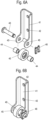
- the guide roller 40 with the holder 41 is shown in detail.
- the holder 41 is made of a U-shaped part made of plastic or metal, two webs 45 with openings being formed integrally with the holder 41 through which an axis 43 can be inserted.
- openings 42 are provided for fasteners in order to fix the holder 41 on the lower panel 4.
- the guide roller 40 is rotatably mounted on the axis 43 and is positioned at a distance from the webs 45 via two spacers 44.
- a securing element 46 is mounted on the axis 43, so that the axial movement of the axis 43 is limited on the webs 45.
- FIG 7 the lower panel 4 is shown in a top view.
- several holders 41 with guide rollers 40 can be provided, which are arranged on both sides of the central lock 5.
- the number of guide rollers 40 and holders 41 can be selected depending on the length of the lower panel.
- the guide rollers 40 are held on the lower panel 4. It is also possible to rotatably mount the guide rollers 40 partially or completely on the lintel 7 or beam so that they can be rolled off the lower panel 4 when it is moved along the arcuate section 13.
Landscapes
- Engineering & Computer Science (AREA)
- Mechanical Engineering (AREA)
- Lock And Its Accessories (AREA)
Description
- Die vorliegende Erfindung betrifft einen Fahrzeugaufbau mit einem zwischen zwei Pfosten angeordneten Sektionaltor, das zum Öffnen und Schließen einer Öffnung eines Laderaumes bewegbar ist und eine Vielzahl von verschwenkbar aneinander gelagerten Paneelen aufweist, die an gegenüberliegenden Seiten über Führungsmittel entlang einer Führung bewegbar sind, die im Bereich der Öffnung einen im Wesentlichen vertikalen Abschnitt, im oberen Bereich des Laderaums einen im Wesentlichen horizontalen Abschnitt als Speicherabschnitt für das Sektionaltor und dazwischen einen bogenförmigen Abschnitt aufweist, wobei eine Federwelle zum Vorspannen des Sektionaltores in eine Öffnungsposition vorgesehen ist, wobei das in einer geschlossenen Position bodenseitig angeordnete untere Paneel verschwenkbar an einem entlang der Führung bewegbaren Laufteil gehalten ist. wobei die Pfosten im oberen Bereich über einen Sturz oder einen Balken miteinander verbunden sind.
- Die
DE 20 2015 105 844 U1 offenbart einen Fahrzeugaufbau, bei dem ein Laderaum durch ein bewegbares Sektionaltor verschließbar ist. Das Sektionaltor umfasst eine Vielzahl von gelenkig miteinander verbundenen Paneelen, die über eine Federwelle in eine Öffnungsposition vorgespannt sind. An der Federwelle ist auch eine Federbruchsicherung vorgesehen. Wenn das Sektionaltor in die Öffnungsposition verfahren wurde, steht das unterste Paneel des Sektionaltores meist noch in die Öffnung hervor und ist in dem bogenförmigen Abschnitt der Führung angeordnet. Dadurch wird die Öffnungshöhe zum Be- und Entladen des Laderaums durch das unterste Paneel begrenzt. - In der
US 2015/0083348 A1 ist ein Sektionaltor mit plattenförmigen Paneelen an einem Fahrzeug offenbart, bei dem an einer Außenseite des untersten Paneels ein Seilzug über einen Halter fixiert ist. Das unterste Paneel ist an gegenüberliegenden Seiten jeweils über einen Laufwagen an einer Führung verfahrbar, wobei die Führung einen verschwenkbaren Hebel aufweist, so dass in der hochgezogenen Position eine untere Kante des unteren Paneels höher angeordnet ist als die Führung. - Ein ähnliches Sektionaltor mit plattenförmigen Paneelen und einer verschwenkbaren Führung für das unterste Paneel zeigt auch die
US 2012/0125545 A1 . - Es ist daher Aufgabe der vorliegenden Erfindung, einen Fahrzeugaufbau zu schaffen, bei dem die Öffnungshöhe vergrößert wird und das einfach zu bedienen ist.
- Diese Aufgabe wird mit einem Fahrzeugaufbau mit den Merkmalen des Anspruches 1 gelöst.
- Bei dem erfindungsgemäßen Fahrzeugaufbau sind die verschwenkbar aneinander gelagerten Paneele entlang einer Führung bewegbar, wobei das in einer geschlossenen Position bodenseitig angeordnete untere Paneel an seiner im bogenförmigen Abschnitt radial äußeren Seite eine Führungsrolle aufweist, die an einem Sturz oder einem Balken an der Oberseite der Öffnung abrollbar ist. Alternativ oder zusätzlich kann auch an dem Sturz oder Balken mindestens eine Führungsrolle gehalten sein, die an dem unteren Paneel abrollbar ist, wenn dieses an dem bogenförmigen Abschnitt angeordnet ist. Dadurch wird ein Anschlagen einer äußeren Seite des unteren Paneels an dem Balken oder dem Sturz verhindert und das untere Paneel kann leichtgängig bis in die maximale Öffnungsposition verfahren werden. Die mindestens eine Führungsrolle ist zwischen dem Sturz oder Balken einerseits und dem unteren Paneel andererseits angeordnet.
- Vorzugsweise sind über die Länge des unteren Paneels verteilt mehrere Führungsrollen angeordnet oder fixiert, so dass das Paneel an mehreren Stellen gleichzeitig abgestützt ist und durch die Führungsrollen entlang des Balkens oder des Sturzes bewegbar ist. Über die Führungsrollen wird ein Spalt zwischen dem unteren Paneel und der Stutz oder Balken definiert, in dem andere Aufbauten angeordnet werden können, wie Betätigungshilfen, beispielsweise ein Griff, Schlaufen oder eine Verriegelung oder ein Schloss.
- Bei dem Fahrzeugaufbau ist in der geschlossenen Position des Sektionaltores vorzugsweise ein Sturz oder ein Balken oben an dem Sektionaltores angeordnet, wobei das Sektionaltor in einer Öffnungsposition mit horizontaler Blickrichtung vorzugsweise vollständig hinter dem Sturz oder dem Balken angeordnet ist. Dadurch wird die maximale Öffnungshöhe an dem Laderaum durch die untere Kante des Sturzes oder des Balkens vorgegeben, und das Sektionaltor kann mit dem unteren Paneel höher oder im Wesentlichen auf gleicher Höhe mit dem unteren Ende des Sturzes angeordnet sein.
- Das Laufteil umfasst dabei einen Befestigungsabschnitt, der an dem Paneel fixiert ist, und einen verschwenkbar an dem Befestigungsabschnitt gehaltenen Führungsabschnitt, der über eine Laufrolle oder ein Gleitelement entlang der Führung verfahrbar ist. Das Laufteil kann somit als zweiarmiger Gelenkhebel ausgebildet sein, der einerseits an dem Paneel fixiert ist und andererseits entlang der Führung verfahrbar. Das untere Paneel ist vorzugsweise an gegenüberliegenden Seiten über ein solches Laufteil entlang einer Führung bewegbar. Für einen kompakten Aufbau weist das untere Paneel eine Nut auf, in die ein Teil des Führungsabschnittes mit einem Halter für die Laufrolle einfügbar ist.
- Die Paneele sind vorzugsweise aus ein oder mehreren extrudierten Profilen hergestellt, insbesondere aus Kunststoff oder Metall, so dass eine integral in das Profil eingebrachte Nut zur Fixierung des Halters für die Laufrolle genutzt werden kann. Optional weist das Profil auch ein oder mehrere Hohlkammern für eine hohe Verwindungssteifigkeit auf. Dadurch ist der Halter zwischen einer durch die äußere Oberfläche des Paneels gebildeten äußeren Ebene und einer durch eine innere Oberfläche des Paneels gebildeten inneren Ebene an dem Paneel fixiert.
- Vorzugsweise ist das untere Paneel in einer Öffnungsposition des Sektionaltores an dem bogenförmigen Abschnitt der Führung angeordnet, und das untere Paneel ist mit einem unteren Ende höher angeordnet als ein unteres Ende des Laufteils. Das untere Paneel kann somit in der Öffnungsposition abweichend von der Führung höher positioniert werden, um die maximale Öffnungshöhe zum Be- und Entladen zu vergrößern.
- Das untere Paneel ist vorzugsweise über ein Federelement in die angehobene Position vorgespannt ist. Dadurch kann die Bewegungsbahn des unteren Paneels an dem bogenförmigen Abschnitt genauer gesteuert werden. Das Federelement kann dabei mit einem ersten Teil an dem Führungsabschnitt und mit einem zweiten Teil an dem Befestigungsabschnitt des Laufteils abgestützt sein.
- Vorzugsweise ist an dem unteren Paneel ein Zugelement fixiert, mit dem das Sektionaltor über die Federwelle in eine Öffnungsposition bewegbar ist. Dadurch wird das untere Paneel über das Zugelement, beispielsweise einen Seilzug, im Bereich des bogenförmigen Abschnittes der Führung automatisch relativ zu der Führung verschwenkt, ohne dass weitere Bauteile, wie Federn oder Antriebe, vorgesehen werden müssten. Durch das Ziehen an dem Zugelement wird das untere Paneel höher angeordnet als der verschwenkbare Führungsabschnitt des Laufteils.
- An dem unteren Paneel ist in einer bevorzugten Ausgestaltung ein Betätigungselement, beispielsweise ein Griff oder eine Schlaufe, zum Bewegen des Sektionaltores von der Öffnungsposition in die Schließposition fixiert. Der Benutzer kann dann beispielsweise das Sektionaltor über das Betätigungselement nach unten ziehen, bis das Sektionaltor über ein Schloss in einer Schließposition verriegelt wird, das ebenfalls an dem unteren Paneel fixiert sein kann.
- An dem Laufteil ist vorzugsweise ein gestuft ausgebildeter Halter vorgesehen, an dem an einem Ende eine Laufrolle drehbar gelagert ist und an dessen anderem Ende der Halter beispielsweise in eine Öffnung an dem Führungsabschnitt des Laufteils eingesteckt ist. Dadurch kann der Halter in einem mittleren Bereich des unteren Paneels fixiert werden, während die Laufrolle beabstandet von der Öffnung in Richtung einem unteren Ende der Führung angeordnet ist. Dies ermöglicht eine stabile Fixierung des Halters in einem mittleren Bereich des unteren Paneels und gleichzeitig eine Anordnung der unteren Laufrolle im Bereich einer Unterkante des unteren Paneels für eine optimierte Führung.
- In einer Öffnungsposition des Sektionaltores kann ein unteres Ende des Paneels mindestens 5 mm, vorzugsweise zwischen 10 mm bis 50 mm, höher angeordnet sein als eine Laufrolle an dem Laufteil. In einer Schließposition kann sich die Laufrolle an dem Laufteil dabei in Verlängerung des unteren Paneels befinden.
- Die Erfindung wird nachfolgend anhand eines Ausführungsbeispiels mit Bezug auf die beigefügten Zeichnungen näher erläutert. Es zeigen:
- Figur 1
- eine perspektivische Ansicht eines erfindungsgemäßen Fahrzeugaufbaus;
- Figur 2
- eine Ansicht der Führung des Sektionaltores an dem Fahrzeugaufbau;
- Figur 3
- eine geschnittene Detailansicht des untersten Paneels des Sektionaltores in einer Öffnungsposition;
- Figur 4
- eine perspektivische Ansicht eines modifizierten Ausführungsbeispiels eines Laufteils in der montierten Position;
- Figur 5
- eine Explosionsdarstellung des Laufteils der
Figur 7 ; - Figuren 6A und 6B
- zwei Ansichten einer Führungsrolle für das untere Paneel, und
- Figur 7
- eine Ansicht des unteren Paneels mit zwei Führungsrollen.
- Ein Fahrzeugaufbau 1 umfasst ein Sektionaltor 2, das eine Vielzahl von gelenkig miteinander verbundenen Paneelen 3 aufweist, die in einer Schließposition eine Öffnung eines Laderaums überdecken. In der Schließposition ist ein bodenseitig angeordnetes unteres Paneel 4 über ein Schloss 5 verriegelt, das das Sektionaltor 2 an einem Boden eines Fahrzeuges fixiert.
- Das Sektionaltor 2 ist zwischen zwei Pfosten 6 angeordnet, die im oberen Bereich über einen Sturz 7 oder einen Balken miteinander verbunden sind und die maximale Öffnung zu dem Laderaum vorgeben. Das Sektionaltor 2 kann von einer im Wesentlichen vertikalen Schließposition in eine horizontale Öffnungsposition verfahren werden, in der das Sektionaltor 2 unterhalb eines Daches 9 angeordnet ist.
- In
Figur 2 ist die Führung 10 für das Sektionaltor 2 gezeigt, wobei weitere Konstruktionsteile des Fahrzeugaufbaus weggelassen wurden. An beiden Seiten des Sektionaltores 2 ist eine Führung 10 vorgesehen, die einen vertikalen Abschnitt 11 benachbart zu der Öffnung aufweist, einen horizontalen Abschnitt zum Speichern des Sektionaltores 2 in einer Öffnungsposition sowie einen bogenförmigen Abschnitt 13 zwischen dem vertikalen Abschnitt 11 und dem horizontalen Abschnitt 12. Die Führung 10 kann durch einzelne Schienenabschnitte gebildet sein, an denen Führungsmittel, wie Laufrollen oder Gleitelemente, geführt sind. An dem unteren Paneel 4 ist ein Griff 16 und Seilzuganker 17 fixiert, die jeweils über einen Seilzug mit einer Federwelle 8 verbunden sind. - Das Sektionaltor 2 ist über eine in der Schließposition oberhalb des Sektionaltores 2 angeordnete Federwelle 8 bewegbar, die über ein Zugelement das Sektionaltor 2 in eine Öffnungsposition vorspannt. Die Federwelle 8 kann beispielsweise so ausgebildet sein, wie dies in der
DE 20 2015 105 884 U1 beschrieben ist, in der auch eine Federbruchsicherung für die Federwelle offenbart ist. - In
Figur 3 ist das untere Paneel 4 des Sektionaltores 2 in einer Position kurz vor der maximalen Öffnungsposition gezeigt. Das untere Paneel 4 ist über ein Zugelement, beispielsweise einen Seilzug, das über die Federwelle 8 das Sektionaltor 2 in die Öffnungsposition zieht, zu dem bogenförmigen Abschnitt 13 bewegt worden. Das untere Paneel 4 ist dabei über obere Laufrollen 15 verfahrbar an der Führung 10 gehalten. Im unteren Bereich ist das untere Paneel 4 nicht unmittelbar über eine Laufrolle mit dem bogenförmigen Abschnitt 13 der Führung 10 verbunden, sondern über ein Laufteil 20. Das Laufteil 20 weist einen plattenförmigen Befestigungsabschnitt 21 auf, der an der Innenseite des unteren Paneels 4 fixiert ist, und einen verschwenkbar oder drehbar damit verbundenen Führungsabschnitt 22, an dem eine Laufrolle 23 oder ein Gleitelement fixiert ist. Dadurch kann das untere Paneel 4 relativ zu dem Führungsabschnitt 22 verschwenkt werden, so dass ein unteres Ende des unteren Paneels 4 höher angeordnet ist als ein unteres Ende an dem Führungsabschnitt 22 oder die Laufrolle 23. - An dem unteren Paneel 4 ist auf der bezogen auf den bogenförmigen Abschnitt 13 radial äußeren Seite eine Führungsrolle 40 über einen Halter 41 fixiert, wobei die Führungsrolle 40 an dem Sturz 7 abrollen kann. Über die Führungsrolle 40 wird ein Anschlagen der Außenseite des unteren Paneels 4 an dem Sturz 7 vermieden und gewährleistet, dass das untere Paneel 4 leichtgängig entlang der unteren Kante des Sturzes 7 vorbei bewegt werden kann, auch wenn das untere Paneel 4 dabei eine Schwenkbewegung ausführt. Die Führungsrolle 40 kann optional aus einem elastischen Material hergestellt sein, so dass Stoßkräfte zumindest teilweise absorbiert werden können. Durch das untere Paneel 4 ist dabei über ein Federelement 31 nach oben vorgespannt, um dieses nach Überfahren des Sturzes 7 höher als die Unterkante des Sturzes angeordnet. In der Öffnungsposition ist das untere Paneel 4 mit horizontaler Blickrichtung zu dem Sturz 7 hin hinter dem Sturz 7 angeordnet und steht von diesem nicht nach unten hervor.
- An dem unteren Paneel 4 ist auch an einer Innenseite ein Betätigungselement in Form eines Griffes oder einer Schlaufe fixiert, mittels dem das Sektionaltor 2 gegen die Kraft der Federwelle 8 in die Schließposition bewegt werden kann. Wenn der Benutzer an dem Betätigungselement im Wesentlichen in vertikale Richtung zieht, lässt sich das Sektionaltor 2 bewegen, da sich das unterste Paneel 4 im Bereich des bogenförmigen Abschnittes 13 der Führung 10 befindet. Durch Ziehen an dem Betätigungselement kann das untere Paneel 4 relativ zu dem Führungsabschnitt 22 verschwenkt werden, um dann bei Erreichen eines Anschlages das untere Paneel 4 von dem bogenförmigen Abschnitt 13 nach unten zu ziehen. Der Kraftaufwand zum Schließen des Sektionaltores 2 kann somit gering gehalten werden, und zudem kann der Benutzer in gewohnter Weise das unterste Paneel 4 über das Betätigungselement im Wesentlichen nach unten ziehen und muss keine Kraft in horizontale Richtung aufbringen.
-
Figur 4 zeigt ein unteres Paneel 4 mit einem Laufteil 20, das einen plattenförmigen Befestigungsabschnitt 21 aufweist, der an dem unteren Paneel 4 fixiert ist. An dem Befestigungsabschnitt 21 ist ein Führungsabschnitt 22 gelenkig gelagert, wobei der im Wesentlichen plattenförmige Führungsabschnitt 22 einen zu dem unteren Paneel 4 hervorstehenden Teil 18 aufweist, an dem eine Öffnung 30 für den Halter 24 (Fig. 3 ) zum Lagern einer Laufrolle 23 ausgebildet ist. Der hervorstehende Teil 18 ist dabei in einer Nut 19 an dem unteren Paneel 4 angeordnet, so dass die Öffnung 30 zum Einstecken des Halters 24 innerhalb der beiden Ebenen angeordnet ist, die durch eine innere Oberfläche und eine äußere Oberfläche des unteren Paneels 4 definiert werden. - Die Paneele 3 und 4 sind aus einem oder mehreren extrudierten Profilen aus Kunststoff oder Metall hergestellt, so dass die Nut 19 integral ausgebildet ist. Beabstandet von der Nut 19 können eine oder mehrere Hohlkammern vorgesehen sein, so dass die Paneele 4 bei geringem Materialeinsatz eine hohe Stabilität aufweisen. Der Führungsabschnitt 22 ist durch ein Federelement 31 in eine Schwenkrichtung vorgespannt, damit das Laufteil 20 bei Erreichen des bogenförmigen Abschnittes 13 das untere Paneel 4 nach oben verschwenkt.
- In
Figur 5 ist das Laufteil 20 in einer Explosionsdarstellung gezeigt. Der Befestigungsabschnitt 21 umfasst Öffnungen 25 zum Einfügen von Befestigungsmitteln und zur Fixierung an dem unteren Paneel 4. Integral mit dem Befestigungsabschnitt 21 ist eine Hülse 26 ausgebildet, und integral mit dem Führungsabschnitt 22 sind weitere Hülsen 27 ausgebildet, so dass durch die Hülsen 26 und 27 eine Achse 28 durchsteckbar ist, die in axiale Richtung durch ein Sicherungselement 29 gesichert ist. Dadurch sind der Befestigungsabschnitt 21 und der Führungsabschnitt 22 gelenkig miteinander verbunden. - Ferner ist ein Federelement 31 vorgesehen, das mit einem ersten Teil 32 an dem Führungsabschnitt 22 abgestützt ist und mit einem oder mehreren Teilen 33 an dem Befestigungsabschnitt 21. Das Federelement 31 umfasst zwei Abschnitte mit Wicklungen, wobei jeweils ein Abschnitt mit Wicklungen zwischen einer der Hülsen 26 und einer der Hülsen 27 angeordnet ist. Es können zum Vorspannen des Führungsabschnittes 22 relativ zu dem Befestigungsabschnitt 21 aber auch andere Federelemente 31 eingesetzt werden.
- In den
Figuren 6A und 6B ist die Führungsrolle 40 mit dem Halter 41 im Detail gezeigt. Der Halter 41 ist aus einem U-förmigen Teil aus Kunststoff oder Metall hergestellt, wobei integral mit dem Halter 41 zwei Stege 45 mit Öffnungen ausgebildet sind, durch die eine Achse 43 durchsteckbar ist. An einem Verbindungsabschnitt zwischen den Stegen 45 sind Öffnungen 42 für Befestigungsmittel vorgesehen, um den Halter 41 an dem unteren Paneel 4 zu fixieren. An der Achse 43 ist die Führungsrolle 40 drehbar gelagert, die über zwei Abstandshalter 44 beabstandet von den Stegen 45 positioniert ist. An der Achse 43 ist ein Sicherungselement 46 montiert, so dass die axiale Bewegung der Achse 43 an den Stegen 45 begrenzt ist. - In
Figur 7 ist das untere Paneel 4 in einer Draufsicht gezeigt. An dem unteren Paneel 4 können mehrere Halter 41 mit Führungsrollen 40 vorgesehen sein, die beidseits des mittigen Schlosses 5 angeordnet sind. Die Anzahl der Führungsrollen 40 und der Halter 41 kann abhängig von der Länge des unteren Paneels gewählt werden. - In dem dargestellten Ausführungsbeispiel sind die Führungsrollen 40 an dem unteren Paneel 4 gehalten. Es ist auch möglich, die Führungsrollen 40 teilweise oder vollständig an dem Sturz 7 oder Balken drehbar zu lagern, so dass diese an dem unteren Paneel 4 abrollbar sind, wenn dieses an dem bogenförmigen Abschnitt 13 verfahren wird.
-
- 1
- Fahrzeugaufbau
- 2
- Sektionaltor
- 3
- Paneel
- 4
- unteres Paneel
- 5
- Schloss
- 6
- Pfosten
- 7
- Sturz
- 8
- Federwelle
- 9
- Dach
- 10
- Führung
- 11
- vertikaler Abschnitt
- 12
- horizontaler Abschnitt
- 13
- bogenförmiger Abschnitt
- 15
- Laufrolle
- 16
- Griff
- 17
- Seilzuganker
- 18
- Teil
- 19
- Nut
- 20
- Laufteil
- 21
- Befestigungsabschnitt
- 22
- Führungsabschnitt
- 23
- Laufrolle
- 24
- Halter
- 25
- Öffnung
- 26
- Hülse
- 27
- Hülse
- 28
- Achse
- 29
- Sicherungselement
- 30
- Öffnung
- 31
- Federelement
- 32
- Teil
- 33
- Teil
- 40
- Führungsrolle
- 41
- Halter
- 42
- Öffnung
- 43
- Achse
- 44
- Abstandshalter
- 45
- Steg
- 46
- Sicherungselement
Claims (13)
- Fahrzeugaufbau (1) mit einem zwischen zwei Pfosten (6) angeordneten Sektionaltor (2), das zum Öffnen und Schließen einer Öffnung eines Laderaumes bewegbar ist und eine Vielzahl von verschwenkbar aneinander gelagerten Paneelen (3, 4) aufweist, die an gegenüberliegenden Seiten über Führungsmittel entlang einer Führung (10) bewegbar sind, die im Bereich der Öffnung einen im Wesentlichen vertikalen Abschnitt (11), im oberen Bereich des Laderaums einen im Wesentlichen horizontalen Abschnitt (12) als Speicherabschnitt für das Sektionaltor (2) und dazwischen einen bogenförmigen Abschnitt (13) aufweist, wobei eine Federwelle (8) zum Vorspannen des Sektionaltores (2) in eine Öffnungsposition vorgesehen ist, und ein in der geschlossenen Position bodenseitig angeordnetes unteres Paneel (4) verschwenkbar an einem entlang der Führung bewegbaren Laufteil (20) gehalten ist, wobei die Pfosten (6) im oberen Bereich über einen Sturz (7) oder einen Balken miteinander verbunden sind, dadurch gekennzeichnet, dass das untere Paneel (4) an seiner im bogenförmigen Abschnitt (13) radial äußeren Seite eine Führungsrolle (40) aufweist, die an dem Sturz (7) oder Balken an der Oberseite der Öffnung abrollbar ist oder an dem Sturz (7) oder Balken mindestens eine Führungsrolle 40 gehalten ist, die an dem unteren Paneel (4) abrollbar ist, wenn dieses an dem bogenförmigen Abschnitt (13) angeordnet ist.
- Fahrzeugaufbau nach Anspruch 1, dadurch gekennzeichnet, dass über die Länge des unteren Paneels (4) verteilt mehrere Führungsrollen (40) angeordnet oder fixiert sind.
- Fahrzeugaufbau nach Anspruch 1 oder 2, dadurch gekennzeichnet, dass in der geschlossenen Position des Sektionaltores (2) der Sturz (7) oder der Balken oberhalb des Sektionaltores (2) angeordnet ist und das Sektionaltor (2) in einer maximalen Öffnungsposition mit horizontaler Blickrichtung vollständig hinter dem Sturz (7) oder Balken angeordnet ist.
- Fahrzeugaufbau nach einem der vorhergehenden Ansprüche, dadurch gekennzeichnet, dass das Laufteil (20) mit einem Befestigungsabschnitt (21) an dem unteren Paneel (4) fixiert ist und mit einem verschwenkbar an dem Befestigungsabschnitt gehaltenen Führungsabschnitt (22) über eine Laufrolle (23) oder ein Gleitelement an der Führung (10) verfahrbar ist.
- Fahrzeugaufbau nach einem der vorhergehenden Ansprüche, dadurch gekennzeichnet, dass das untere Paneel (4) über ein Federelement (31) in die angehobene Position vorgespannt ist.
- Fahrzeugaufbau nach Anspruch 5, dadurch gekennzeichnet, dass das Federelement (31) mit einem ersten Teil an dem Führungsabschnitt (22) und mit einem zweiten Teil an dem Befestigungsabschnitt (21) des Laufteils (20) abgestützt ist.
- Fahrzeugaufbau nach einem der vorhergehenden Ansprüche, dadurch gekennzeichnet, dass das untere Paneel (4) eine Nut (19) aufweist, in die ein Teil (18) des Führungsabschnittes (22) mit einem Halter (24) für die Laufrolle (23) oder das Gleitelement einfügbar ist.
- Fahrzeugaufbau nach Anspruch 7, dadurch gekennzeichnet, dass in dem Teil (18) eine Öffnung (30) zur Fixierung eines Endes des Halters (24) vorgesehen ist, an dem die Laufrolle (23) drehbar gelagert ist.
- Fahrzeugaufbau nach Anspruch 7 oder 8, dadurch gekennzeichnet, dass das Laufteil (20) einen gestuft ausgebildeten Halter (24) aufweist, in dem eine Laufrolle (23) drehbar gelagert ist.
- Fahrzeugaufbau nach einem der vorhergehenden Ansprüche, dadurch gekennzeichnet, dass an dem unteren Paneel (4) an gegenüberliegenden Seiten jeweils ein Laufteil (20) fixiert ist.
- Fahrzeugaufbau nach einem der vorhergehenden Ansprüche, dadurch gekennzeichnet, dass an dem unteren Paneel (4) ein Zugelement fixiert ist, mit dem das Sektionaltor (2) über die Federwelle (8) in eine Öffnungsposition bewegbar ist.
- Fahrzeugaufbau nach einem der vorhergehenden Ansprüche, dadurch gekennzeichnet, dass die Paneele (4) aus ein oder mehreren extrudierten Profilen mit Hohlkammern gebildet sind.
- Fahrzeugaufbau nach einem der vorhergehenden Ansprüche, dadurch gekennzeichnet, dass in einer Öffnungsposition des Sektionaltores (2) ein unteres Ende des unteren Paneels (4) mindestens 5 mm, insbesondere zwischen 10 mm bis 50 mm, höher angeordnet ist als eine Laufrolle (23) an dem Laufteil (20).
Applications Claiming Priority (1)
| Application Number | Priority Date | Filing Date | Title |
|---|---|---|---|
| DE102020122203.3A DE102020122203A1 (de) | 2020-08-25 | 2020-08-25 | Fahrzeugaufbau |
Publications (3)
| Publication Number | Publication Date |
|---|---|
| EP3960973A1 EP3960973A1 (de) | 2022-03-02 |
| EP3960973C0 EP3960973C0 (de) | 2024-02-28 |
| EP3960973B1 true EP3960973B1 (de) | 2024-02-28 |
Family
ID=76829358
Family Applications (1)
| Application Number | Title | Priority Date | Filing Date |
|---|---|---|---|
| EP21184057.4A Active EP3960973B1 (de) | 2020-08-25 | 2021-07-06 | Fahrzeugaufbau |
Country Status (2)
| Country | Link |
|---|---|
| EP (1) | EP3960973B1 (de) |
| DE (1) | DE102020122203A1 (de) |
Family Cites Families (5)
| Publication number | Priority date | Publication date | Assignee | Title |
|---|---|---|---|---|
| WO2012071347A2 (en) | 2010-11-22 | 2012-05-31 | Wabash National, L.P. | Hinged bottom roller assembly and counterbalance mechanism for overhead door |
| US9234387B2 (en) | 2013-09-24 | 2016-01-12 | Whiting Door Manufacturing Corp. | Snubber devices for use in roll-up door assemblies |
| DE202015105844U1 (de) | 2015-11-03 | 2015-12-15 | Wihag Fahrzeugbausysteme Gmbh | Fahrzeugaufbau |
| DE202015105884U1 (de) | 2015-11-04 | 2015-11-12 | Schulz Farben- Und Lackfabrik Gmbh | Anlage zur Herstellung von Bautenfarben und Halbfabrikaten zu Bautenfarben und Bautenfarben |
| DE102017123493A1 (de) * | 2017-10-10 | 2019-04-11 | Hörmann KG Brockhagen | Unteres Torglied mit Klapprollenhalter |
-
2020
- 2020-08-25 DE DE102020122203.3A patent/DE102020122203A1/de not_active Withdrawn
-
2021
- 2021-07-06 EP EP21184057.4A patent/EP3960973B1/de active Active
Also Published As
| Publication number | Publication date |
|---|---|
| EP3960973C0 (de) | 2024-02-28 |
| DE102020122203A1 (de) | 2022-03-03 |
| EP3960973A1 (de) | 2022-03-02 |
Similar Documents
| Publication | Publication Date | Title |
|---|---|---|
| DE10014760B4 (de) | Heckscheibenrollo mit gefederten Rollen | |
| EP1383967B1 (de) | Abdeckung für eine entwässerungseinrichtung | |
| DE19846308C2 (de) | Abdicht- und Verriegelungsvorrichtung für Fenster oder Türen | |
| EP3911824B1 (de) | Schiebetürbeschlag und möbel | |
| DE102007042365A1 (de) | Führungseinheit für einen höhenverstellbaren Ladeboden und Kraftfahrzeug mit einer solchen Führungseinheit und einem höhenverstellbaren Ladeboden | |
| DE9310246U1 (de) | Kraftfahrzeugsitz mit einer zwischen dem Fahrzeugboden und dem Sitzkissen angeordneten Schublade | |
| DE3423504A1 (de) | Befestigungsvorrichtung | |
| EP3960973B1 (de) | Fahrzeugaufbau | |
| DE102019124732A1 (de) | Auszugsführung | |
| EP3655612B1 (de) | Plisseejalousie mit teleskopierbarer führungsschiene | |
| EP3789573B1 (de) | Fahrzeugaufbau | |
| DE102020114966A1 (de) | Schiebeabdeckung für eine Dachöffnung eines Nutzfahrzeug-Laderaums | |
| EP2505744A2 (de) | Schließplatte für einen von einem Blendrahmen abstellbaren Fenster- oder Türflügel | |
| EP4186823B1 (de) | Warenübergabeschleuse | |
| EP0679788A1 (de) | Laufwerk sowie Schiene und Verschiebeeinrichtung | |
| DE19834700B4 (de) | Vorrichtung zum Verschließen einer Wandöffnung | |
| DE19835684C2 (de) | Verfahrbare Türflügelanordnung | |
| DE10000163C1 (de) | Als Vorsatzkasten ausgebildeter Rollladenkasten | |
| DE102012210584A1 (de) | Schiebetüranlage | |
| EP2837549B1 (de) | Runge für ein Nutzfahrzeug | |
| DE2806172A1 (de) | Antriebsvorrichtung zum verschieben von scheiben | |
| DE102018200582B3 (de) | Teleskopschiebetürsystem | |
| EP1437469B1 (de) | Fenster | |
| EP1820423A1 (de) | Beschlag zur höhenverstellbaren Lagerung von Latten in einem Lattenrost | |
| DE9216213U1 (de) | Schließplatte |
Legal Events
| Date | Code | Title | Description |
|---|---|---|---|
| PUAI | Public reference made under article 153(3) epc to a published international application that has entered the european phase |
Free format text: ORIGINAL CODE: 0009012 |
|
| STAA | Information on the status of an ep patent application or granted ep patent |
Free format text: STATUS: THE APPLICATION HAS BEEN PUBLISHED |
|
| STAA | Information on the status of an ep patent application or granted ep patent |
Free format text: STATUS: REQUEST FOR EXAMINATION WAS MADE |
|
| AK | Designated contracting states |
Kind code of ref document: A1 Designated state(s): AL AT BE BG CH CY CZ DE DK EE ES FI FR GB GR HR HU IE IS IT LI LT LU LV MC MK MT NL NO PL PT RO RS SE SI SK SM TR |
|
| 17P | Request for examination filed |
Effective date: 20220207 |
|
| RBV | Designated contracting states (corrected) |
Designated state(s): AL AT BE BG CH CY CZ DE DK EE ES FI FR GB GR HR HU IE IS IT LI LT LU LV MC MK MT NL NO PL PT RO RS SE SI SK SM TR |
|
| GRAP | Despatch of communication of intention to grant a patent |
Free format text: ORIGINAL CODE: EPIDOSNIGR1 |
|
| STAA | Information on the status of an ep patent application or granted ep patent |
Free format text: STATUS: GRANT OF PATENT IS INTENDED |
|
| INTG | Intention to grant announced |
Effective date: 20231113 |
|
| GRAS | Grant fee paid |
Free format text: ORIGINAL CODE: EPIDOSNIGR3 |
|
| GRAA | (expected) grant |
Free format text: ORIGINAL CODE: 0009210 |
|
| STAA | Information on the status of an ep patent application or granted ep patent |
Free format text: STATUS: THE PATENT HAS BEEN GRANTED |
|
| AK | Designated contracting states |
Kind code of ref document: B1 Designated state(s): AL AT BE BG CH CY CZ DE DK EE ES FI FR GB GR HR HU IE IS IT LI LT LU LV MC MK MT NL NO PL PT RO RS SE SI SK SM TR |
|
| REG | Reference to a national code |
Ref country code: GB Ref legal event code: FG4D Free format text: NOT ENGLISH |
|
| REG | Reference to a national code |
Ref country code: CH Ref legal event code: EP |
|
| REG | Reference to a national code |
Ref country code: DE Ref legal event code: R096 Ref document number: 502021002806 Country of ref document: DE |
|
| REG | Reference to a national code |
Ref country code: IE Ref legal event code: FG4D Free format text: LANGUAGE OF EP DOCUMENT: GERMAN |
|
| U01 | Request for unitary effect filed |
Effective date: 20240311 |
|
| U07 | Unitary effect registered |
Designated state(s): AT BE BG DE DK EE FI FR IT LT LU LV MT NL PT SE SI Effective date: 20240319 |
|
| PG25 | Lapsed in a contracting state [announced via postgrant information from national office to epo] |
Ref country code: IS Free format text: LAPSE BECAUSE OF FAILURE TO SUBMIT A TRANSLATION OF THE DESCRIPTION OR TO PAY THE FEE WITHIN THE PRESCRIBED TIME-LIMIT Effective date: 20240628 |
|
| PG25 | Lapsed in a contracting state [announced via postgrant information from national office to epo] |
Ref country code: GR Free format text: LAPSE BECAUSE OF FAILURE TO SUBMIT A TRANSLATION OF THE DESCRIPTION OR TO PAY THE FEE WITHIN THE PRESCRIBED TIME-LIMIT Effective date: 20240529 |
|
| PG25 | Lapsed in a contracting state [announced via postgrant information from national office to epo] |
Ref country code: RS Free format text: LAPSE BECAUSE OF FAILURE TO SUBMIT A TRANSLATION OF THE DESCRIPTION OR TO PAY THE FEE WITHIN THE PRESCRIBED TIME-LIMIT Effective date: 20240528 Ref country code: HR Free format text: LAPSE BECAUSE OF FAILURE TO SUBMIT A TRANSLATION OF THE DESCRIPTION OR TO PAY THE FEE WITHIN THE PRESCRIBED TIME-LIMIT Effective date: 20240228 |
|
| PG25 | Lapsed in a contracting state [announced via postgrant information from national office to epo] |
Ref country code: ES Free format text: LAPSE BECAUSE OF FAILURE TO SUBMIT A TRANSLATION OF THE DESCRIPTION OR TO PAY THE FEE WITHIN THE PRESCRIBED TIME-LIMIT Effective date: 20240228 |
|
| U20 | Renewal fee for the european patent with unitary effect paid |
Year of fee payment: 4 Effective date: 20240619 |
|
| PG25 | Lapsed in a contracting state [announced via postgrant information from national office to epo] |
Ref country code: RS Free format text: LAPSE BECAUSE OF FAILURE TO SUBMIT A TRANSLATION OF THE DESCRIPTION OR TO PAY THE FEE WITHIN THE PRESCRIBED TIME-LIMIT Effective date: 20240528 Ref country code: NO Free format text: LAPSE BECAUSE OF FAILURE TO SUBMIT A TRANSLATION OF THE DESCRIPTION OR TO PAY THE FEE WITHIN THE PRESCRIBED TIME-LIMIT Effective date: 20240528 Ref country code: IS Free format text: LAPSE BECAUSE OF FAILURE TO SUBMIT A TRANSLATION OF THE DESCRIPTION OR TO PAY THE FEE WITHIN THE PRESCRIBED TIME-LIMIT Effective date: 20240628 Ref country code: HR Free format text: LAPSE BECAUSE OF FAILURE TO SUBMIT A TRANSLATION OF THE DESCRIPTION OR TO PAY THE FEE WITHIN THE PRESCRIBED TIME-LIMIT Effective date: 20240228 Ref country code: GR Free format text: LAPSE BECAUSE OF FAILURE TO SUBMIT A TRANSLATION OF THE DESCRIPTION OR TO PAY THE FEE WITHIN THE PRESCRIBED TIME-LIMIT Effective date: 20240529 Ref country code: ES Free format text: LAPSE BECAUSE OF FAILURE TO SUBMIT A TRANSLATION OF THE DESCRIPTION OR TO PAY THE FEE WITHIN THE PRESCRIBED TIME-LIMIT Effective date: 20240228 |
|
| PG25 | Lapsed in a contracting state [announced via postgrant information from national office to epo] |
Ref country code: PL Free format text: LAPSE BECAUSE OF FAILURE TO SUBMIT A TRANSLATION OF THE DESCRIPTION OR TO PAY THE FEE WITHIN THE PRESCRIBED TIME-LIMIT Effective date: 20240228 |
|
| PG25 | Lapsed in a contracting state [announced via postgrant information from national office to epo] |
Ref country code: PL Free format text: LAPSE BECAUSE OF FAILURE TO SUBMIT A TRANSLATION OF THE DESCRIPTION OR TO PAY THE FEE WITHIN THE PRESCRIBED TIME-LIMIT Effective date: 20240228 |
|
| PG25 | Lapsed in a contracting state [announced via postgrant information from national office to epo] |
Ref country code: SM Free format text: LAPSE BECAUSE OF FAILURE TO SUBMIT A TRANSLATION OF THE DESCRIPTION OR TO PAY THE FEE WITHIN THE PRESCRIBED TIME-LIMIT Effective date: 20240228 |
|
| PG25 | Lapsed in a contracting state [announced via postgrant information from national office to epo] |
Ref country code: CZ Free format text: LAPSE BECAUSE OF FAILURE TO SUBMIT A TRANSLATION OF THE DESCRIPTION OR TO PAY THE FEE WITHIN THE PRESCRIBED TIME-LIMIT Effective date: 20240228 |
|
| PG25 | Lapsed in a contracting state [announced via postgrant information from national office to epo] |
Ref country code: SK Free format text: LAPSE BECAUSE OF FAILURE TO SUBMIT A TRANSLATION OF THE DESCRIPTION OR TO PAY THE FEE WITHIN THE PRESCRIBED TIME-LIMIT Effective date: 20240228 |
|
| PG25 | Lapsed in a contracting state [announced via postgrant information from national office to epo] |
Ref country code: SM Free format text: LAPSE BECAUSE OF FAILURE TO SUBMIT A TRANSLATION OF THE DESCRIPTION OR TO PAY THE FEE WITHIN THE PRESCRIBED TIME-LIMIT Effective date: 20240228 Ref country code: SK Free format text: LAPSE BECAUSE OF FAILURE TO SUBMIT A TRANSLATION OF THE DESCRIPTION OR TO PAY THE FEE WITHIN THE PRESCRIBED TIME-LIMIT Effective date: 20240228 Ref country code: RO Free format text: LAPSE BECAUSE OF FAILURE TO SUBMIT A TRANSLATION OF THE DESCRIPTION OR TO PAY THE FEE WITHIN THE PRESCRIBED TIME-LIMIT Effective date: 20240228 Ref country code: CZ Free format text: LAPSE BECAUSE OF FAILURE TO SUBMIT A TRANSLATION OF THE DESCRIPTION OR TO PAY THE FEE WITHIN THE PRESCRIBED TIME-LIMIT Effective date: 20240228 |
|
| REG | Reference to a national code |
Ref country code: DE Ref legal event code: R097 Ref document number: 502021002806 Country of ref document: DE |
|
| PLBE | No opposition filed within time limit |
Free format text: ORIGINAL CODE: 0009261 |
|
| STAA | Information on the status of an ep patent application or granted ep patent |
Free format text: STATUS: NO OPPOSITION FILED WITHIN TIME LIMIT |
|
| 26N | No opposition filed |
Effective date: 20241129 |
|
| PG25 | Lapsed in a contracting state [announced via postgrant information from national office to epo] |
Ref country code: MC Free format text: LAPSE BECAUSE OF FAILURE TO SUBMIT A TRANSLATION OF THE DESCRIPTION OR TO PAY THE FEE WITHIN THE PRESCRIBED TIME-LIMIT Effective date: 20240228 |
|
| REG | Reference to a national code |
Ref country code: CH Ref legal event code: PL |
|
| PG25 | Lapsed in a contracting state [announced via postgrant information from national office to epo] |
Ref country code: CH Free format text: LAPSE BECAUSE OF NON-PAYMENT OF DUE FEES Effective date: 20240731 |
|
| U20 | Renewal fee for the european patent with unitary effect paid |
Year of fee payment: 5 Effective date: 20250505 |
|
| PG25 | Lapsed in a contracting state [announced via postgrant information from national office to epo] |
Ref country code: IE Free format text: LAPSE BECAUSE OF NON-PAYMENT OF DUE FEES Effective date: 20240706 |
|
| PG25 | Lapsed in a contracting state [announced via postgrant information from national office to epo] |
Ref country code: CY Free format text: LAPSE BECAUSE OF FAILURE TO SUBMIT A TRANSLATION OF THE DESCRIPTION OR TO PAY THE FEE WITHIN THE PRESCRIBED TIME-LIMIT; INVALID AB INITIO Effective date: 20210706 |
|
| PG25 | Lapsed in a contracting state [announced via postgrant information from national office to epo] |
Ref country code: HU Free format text: LAPSE BECAUSE OF FAILURE TO SUBMIT A TRANSLATION OF THE DESCRIPTION OR TO PAY THE FEE WITHIN THE PRESCRIBED TIME-LIMIT; INVALID AB INITIO Effective date: 20210706 |
|
| GBPC | Gb: european patent ceased through non-payment of renewal fee |
Effective date: 20250706 |
|
| PG25 | Lapsed in a contracting state [announced via postgrant information from national office to epo] |
Ref country code: GB Free format text: LAPSE BECAUSE OF NON-PAYMENT OF DUE FEES Effective date: 20250706 |