EP3936127B1 - Amorphous solid dispersion of pyrazole-amide compound - Google Patents
Amorphous solid dispersion of pyrazole-amide compound Download PDFInfo
- Publication number
- EP3936127B1 EP3936127B1 EP20765858.4A EP20765858A EP3936127B1 EP 3936127 B1 EP3936127 B1 EP 3936127B1 EP 20765858 A EP20765858 A EP 20765858A EP 3936127 B1 EP3936127 B1 EP 3936127B1
- Authority
- EP
- European Patent Office
- Prior art keywords
- pharmaceutically acceptable
- solid dispersion
- formula
- hydrate
- compound
- Prior art date
- Legal status (The legal status is an assumption and is not a legal conclusion. Google has not performed a legal analysis and makes no representation as to the accuracy of the status listed.)
- Active
Links
Images


Classifications
-
- A—HUMAN NECESSITIES
- A61—MEDICAL OR VETERINARY SCIENCE; HYGIENE
- A61K—PREPARATIONS FOR MEDICAL, DENTAL OR TOILETRY PURPOSES
- A61K9/00—Medicinal preparations characterised by special physical form
- A61K9/14—Particulate form, e.g. powders, Processes for size reducing of pure drugs or the resulting products, Pure drug nanoparticles
- A61K9/141—Intimate drug-carrier mixtures characterised by the carrier, e.g. ordered mixtures, adsorbates, solid solutions, eutectica, co-dried, co-solubilised, co-kneaded, co-milled, co-ground products, co-precipitates, co-evaporates, co-extrudates, co-melts; Drug nanoparticles with adsorbed surface modifiers
- A61K9/146—Intimate drug-carrier mixtures characterised by the carrier, e.g. ordered mixtures, adsorbates, solid solutions, eutectica, co-dried, co-solubilised, co-kneaded, co-milled, co-ground products, co-precipitates, co-evaporates, co-extrudates, co-melts; Drug nanoparticles with adsorbed surface modifiers with organic macromolecular compounds
-
- A—HUMAN NECESSITIES
- A61—MEDICAL OR VETERINARY SCIENCE; HYGIENE
- A61K—PREPARATIONS FOR MEDICAL, DENTAL OR TOILETRY PURPOSES
- A61K31/00—Medicinal preparations containing organic active ingredients
- A61K31/33—Heterocyclic compounds
- A61K31/395—Heterocyclic compounds having nitrogen as a ring hetero atom, e.g. guanethidine or rifamycins
- A61K31/41—Heterocyclic compounds having nitrogen as a ring hetero atom, e.g. guanethidine or rifamycins having five-membered rings with two or more ring hetero atoms, at least one of which being nitrogen, e.g. tetrazole
- A61K31/415—1,2-Diazoles
-
- A—HUMAN NECESSITIES
- A61—MEDICAL OR VETERINARY SCIENCE; HYGIENE
- A61K—PREPARATIONS FOR MEDICAL, DENTAL OR TOILETRY PURPOSES
- A61K47/00—Medicinal preparations characterised by the non-active ingredients used, e.g. carriers or inert additives; Targeting or modifying agents chemically bound to the active ingredient
- A61K47/06—Organic compounds, e.g. natural or synthetic hydrocarbons, polyolefins, mineral oil, petrolatum or ozokerite
- A61K47/08—Organic compounds, e.g. natural or synthetic hydrocarbons, polyolefins, mineral oil, petrolatum or ozokerite containing oxygen, e.g. ethers, acetals, ketones, quinones, aldehydes, peroxides
- A61K47/12—Carboxylic acids; Salts or anhydrides thereof
-
- A—HUMAN NECESSITIES
- A61—MEDICAL OR VETERINARY SCIENCE; HYGIENE
- A61K—PREPARATIONS FOR MEDICAL, DENTAL OR TOILETRY PURPOSES
- A61K47/00—Medicinal preparations characterised by the non-active ingredients used, e.g. carriers or inert additives; Targeting or modifying agents chemically bound to the active ingredient
- A61K47/30—Macromolecular organic or inorganic compounds, e.g. inorganic polyphosphates
- A61K47/36—Polysaccharides; Derivatives thereof, e.g. gums, starch, alginate, dextrin, hyaluronic acid, chitosan, inulin, agar or pectin
- A61K47/38—Cellulose; Derivatives thereof
-
- A—HUMAN NECESSITIES
- A61—MEDICAL OR VETERINARY SCIENCE; HYGIENE
- A61K—PREPARATIONS FOR MEDICAL, DENTAL OR TOILETRY PURPOSES
- A61K9/00—Medicinal preparations characterised by special physical form
- A61K9/0012—Galenical forms characterised by the site of application
- A61K9/0053—Mouth and digestive tract, i.e. intraoral and peroral administration
-
- A—HUMAN NECESSITIES
- A61—MEDICAL OR VETERINARY SCIENCE; HYGIENE
- A61K—PREPARATIONS FOR MEDICAL, DENTAL OR TOILETRY PURPOSES
- A61K9/00—Medicinal preparations characterised by special physical form
- A61K9/14—Particulate form, e.g. powders, Processes for size reducing of pure drugs or the resulting products, Pure drug nanoparticles
- A61K9/16—Agglomerates; Granulates; Microbeadlets ; Microspheres; Pellets; Solid products obtained by spray drying, spray freeze drying, spray congealing,(multiple) emulsion solvent evaporation or extraction
- A61K9/1605—Excipients; Inactive ingredients
- A61K9/1629—Organic macromolecular compounds
- A61K9/1635—Organic macromolecular compounds obtained by reactions only involving carbon-to-carbon unsaturated bonds, e.g. polyvinyl pyrrolidone, poly(meth)acrylates
-
- A—HUMAN NECESSITIES
- A61—MEDICAL OR VETERINARY SCIENCE; HYGIENE
- A61K—PREPARATIONS FOR MEDICAL, DENTAL OR TOILETRY PURPOSES
- A61K9/00—Medicinal preparations characterised by special physical form
- A61K9/14—Particulate form, e.g. powders, Processes for size reducing of pure drugs or the resulting products, Pure drug nanoparticles
- A61K9/16—Agglomerates; Granulates; Microbeadlets ; Microspheres; Pellets; Solid products obtained by spray drying, spray freeze drying, spray congealing,(multiple) emulsion solvent evaporation or extraction
- A61K9/1605—Excipients; Inactive ingredients
- A61K9/1629—Organic macromolecular compounds
- A61K9/1652—Polysaccharides, e.g. alginate, cellulose derivatives; Cyclodextrin
-
- A—HUMAN NECESSITIES
- A61—MEDICAL OR VETERINARY SCIENCE; HYGIENE
- A61K—PREPARATIONS FOR MEDICAL, DENTAL OR TOILETRY PURPOSES
- A61K9/00—Medicinal preparations characterised by special physical form
- A61K9/14—Particulate form, e.g. powders, Processes for size reducing of pure drugs or the resulting products, Pure drug nanoparticles
- A61K9/16—Agglomerates; Granulates; Microbeadlets ; Microspheres; Pellets; Solid products obtained by spray drying, spray freeze drying, spray congealing,(multiple) emulsion solvent evaporation or extraction
- A61K9/1682—Processes
- A61K9/1694—Processes resulting in granules or microspheres of the matrix type containing more than 5% of excipient
-
- A—HUMAN NECESSITIES
- A61—MEDICAL OR VETERINARY SCIENCE; HYGIENE
- A61K—PREPARATIONS FOR MEDICAL, DENTAL OR TOILETRY PURPOSES
- A61K9/00—Medicinal preparations characterised by special physical form
- A61K9/20—Pills, tablets, discs, rods
- A61K9/2004—Excipients; Inactive ingredients
- A61K9/2009—Inorganic compounds
-
- A—HUMAN NECESSITIES
- A61—MEDICAL OR VETERINARY SCIENCE; HYGIENE
- A61K—PREPARATIONS FOR MEDICAL, DENTAL OR TOILETRY PURPOSES
- A61K9/00—Medicinal preparations characterised by special physical form
- A61K9/20—Pills, tablets, discs, rods
- A61K9/2004—Excipients; Inactive ingredients
- A61K9/2013—Organic compounds, e.g. phospholipids, fats
-
- A—HUMAN NECESSITIES
- A61—MEDICAL OR VETERINARY SCIENCE; HYGIENE
- A61K—PREPARATIONS FOR MEDICAL, DENTAL OR TOILETRY PURPOSES
- A61K9/00—Medicinal preparations characterised by special physical form
- A61K9/20—Pills, tablets, discs, rods
- A61K9/2004—Excipients; Inactive ingredients
- A61K9/2022—Organic macromolecular compounds
- A61K9/2027—Organic macromolecular compounds obtained by reactions only involving carbon-to-carbon unsaturated bonds, e.g. polyvinyl pyrrolidone, poly(meth)acrylates
-
- A—HUMAN NECESSITIES
- A61—MEDICAL OR VETERINARY SCIENCE; HYGIENE
- A61K—PREPARATIONS FOR MEDICAL, DENTAL OR TOILETRY PURPOSES
- A61K9/00—Medicinal preparations characterised by special physical form
- A61K9/20—Pills, tablets, discs, rods
- A61K9/2004—Excipients; Inactive ingredients
- A61K9/2022—Organic macromolecular compounds
- A61K9/205—Polysaccharides, e.g. alginate, gums; Cyclodextrin
- A61K9/2054—Cellulose; Cellulose derivatives, e.g. hydroxypropyl methylcellulose
-
- A—HUMAN NECESSITIES
- A61—MEDICAL OR VETERINARY SCIENCE; HYGIENE
- A61K—PREPARATIONS FOR MEDICAL, DENTAL OR TOILETRY PURPOSES
- A61K9/00—Medicinal preparations characterised by special physical form
- A61K9/20—Pills, tablets, discs, rods
- A61K9/2072—Pills, tablets, discs, rods characterised by shape, structure or size; Tablets with holes, special break lines or identification marks; Partially coated tablets; Disintegrating flat shaped forms
- A61K9/2077—Tablets comprising drug-containing microparticles in a substantial amount of supporting matrix; Multiparticulate tablets
-
- A—HUMAN NECESSITIES
- A61—MEDICAL OR VETERINARY SCIENCE; HYGIENE
- A61K—PREPARATIONS FOR MEDICAL, DENTAL OR TOILETRY PURPOSES
- A61K9/00—Medicinal preparations characterised by special physical form
- A61K9/20—Pills, tablets, discs, rods
- A61K9/2095—Tabletting processes; Dosage units made by direct compression of powders or specially processed granules, by eliminating solvents, by melt-extrusion, by injection molding, by 3D printing
-
- A—HUMAN NECESSITIES
- A61—MEDICAL OR VETERINARY SCIENCE; HYGIENE
- A61K—PREPARATIONS FOR MEDICAL, DENTAL OR TOILETRY PURPOSES
- A61K9/00—Medicinal preparations characterised by special physical form
- A61K9/20—Pills, tablets, discs, rods
- A61K9/28—Dragees; Coated pills or tablets, e.g. with film or compression coating
- A61K9/2806—Coating materials
- A61K9/2833—Organic macromolecular compounds
- A61K9/286—Polysaccharides, e.g. gums; Cyclodextrin
- A61K9/2866—Cellulose; Cellulose derivatives, e.g. hydroxypropyl methylcellulose
-
- A—HUMAN NECESSITIES
- A61—MEDICAL OR VETERINARY SCIENCE; HYGIENE
- A61P—SPECIFIC THERAPEUTIC ACTIVITY OF CHEMICAL COMPOUNDS OR MEDICINAL PREPARATIONS
- A61P11/00—Drugs for disorders of the respiratory system
-
- A—HUMAN NECESSITIES
- A61—MEDICAL OR VETERINARY SCIENCE; HYGIENE
- A61P—SPECIFIC THERAPEUTIC ACTIVITY OF CHEMICAL COMPOUNDS OR MEDICINAL PREPARATIONS
- A61P21/00—Drugs for disorders of the muscular or neuromuscular system
-
- A—HUMAN NECESSITIES
- A61—MEDICAL OR VETERINARY SCIENCE; HYGIENE
- A61P—SPECIFIC THERAPEUTIC ACTIVITY OF CHEMICAL COMPOUNDS OR MEDICINAL PREPARATIONS
- A61P25/00—Drugs for disorders of the nervous system
-
- A—HUMAN NECESSITIES
- A61—MEDICAL OR VETERINARY SCIENCE; HYGIENE
- A61P—SPECIFIC THERAPEUTIC ACTIVITY OF CHEMICAL COMPOUNDS OR MEDICINAL PREPARATIONS
- A61P3/00—Drugs for disorders of the metabolism
- A61P3/06—Antihyperlipidemics
-
- A—HUMAN NECESSITIES
- A61—MEDICAL OR VETERINARY SCIENCE; HYGIENE
- A61P—SPECIFIC THERAPEUTIC ACTIVITY OF CHEMICAL COMPOUNDS OR MEDICINAL PREPARATIONS
- A61P3/00—Drugs for disorders of the metabolism
- A61P3/08—Drugs for disorders of the metabolism for glucose homeostasis
-
- A—HUMAN NECESSITIES
- A61—MEDICAL OR VETERINARY SCIENCE; HYGIENE
- A61P—SPECIFIC THERAPEUTIC ACTIVITY OF CHEMICAL COMPOUNDS OR MEDICINAL PREPARATIONS
- A61P3/00—Drugs for disorders of the metabolism
- A61P3/08—Drugs for disorders of the metabolism for glucose homeostasis
- A61P3/10—Drugs for disorders of the metabolism for glucose homeostasis for hyperglycaemia, e.g. antidiabetics
-
- A—HUMAN NECESSITIES
- A61—MEDICAL OR VETERINARY SCIENCE; HYGIENE
- A61P—SPECIFIC THERAPEUTIC ACTIVITY OF CHEMICAL COMPOUNDS OR MEDICINAL PREPARATIONS
- A61P35/00—Antineoplastic agents
-
- A—HUMAN NECESSITIES
- A61—MEDICAL OR VETERINARY SCIENCE; HYGIENE
- A61P—SPECIFIC THERAPEUTIC ACTIVITY OF CHEMICAL COMPOUNDS OR MEDICINAL PREPARATIONS
- A61P43/00—Drugs for specific purposes, not provided for in groups A61P1/00-A61P41/00
-
- A—HUMAN NECESSITIES
- A61—MEDICAL OR VETERINARY SCIENCE; HYGIENE
- A61P—SPECIFIC THERAPEUTIC ACTIVITY OF CHEMICAL COMPOUNDS OR MEDICINAL PREPARATIONS
- A61P9/00—Drugs for disorders of the cardiovascular system
- A61P9/04—Inotropic agents, i.e. stimulants of cardiac contraction; Drugs for heart failure
-
- A—HUMAN NECESSITIES
- A61—MEDICAL OR VETERINARY SCIENCE; HYGIENE
- A61P—SPECIFIC THERAPEUTIC ACTIVITY OF CHEMICAL COMPOUNDS OR MEDICINAL PREPARATIONS
- A61P9/00—Drugs for disorders of the cardiovascular system
- A61P9/10—Drugs for disorders of the cardiovascular system for treating ischaemic or atherosclerotic diseases, e.g. antianginal drugs, coronary vasodilators, drugs for myocardial infarction, retinopathy, cerebrovascula insufficiency, renal arteriosclerosis
-
- A—HUMAN NECESSITIES
- A61—MEDICAL OR VETERINARY SCIENCE; HYGIENE
- A61P—SPECIFIC THERAPEUTIC ACTIVITY OF CHEMICAL COMPOUNDS OR MEDICINAL PREPARATIONS
- A61P9/00—Drugs for disorders of the cardiovascular system
- A61P9/12—Antihypertensives
-
- A—HUMAN NECESSITIES
- A61—MEDICAL OR VETERINARY SCIENCE; HYGIENE
- A61K—PREPARATIONS FOR MEDICAL, DENTAL OR TOILETRY PURPOSES
- A61K9/00—Medicinal preparations characterised by special physical form
- A61K9/20—Pills, tablets, discs, rods
- A61K9/28—Dragees; Coated pills or tablets, e.g. with film or compression coating
- A61K9/2806—Coating materials
- A61K9/2833—Organic macromolecular compounds
- A61K9/284—Organic macromolecular compounds obtained by reactions only involving carbon-to-carbon unsaturated bonds, e.g. polyvinyl pyrrolidone
-
- C—CHEMISTRY; METALLURGY
- C07—ORGANIC CHEMISTRY
- C07B—GENERAL METHODS OF ORGANIC CHEMISTRY; APPARATUS THEREFOR
- C07B2200/00—Indexing scheme relating to specific properties of organic compounds
- C07B2200/13—Crystalline forms, e.g. polymorphs
Definitions
- the present invention relates to a solid dispersion containing an amorphous compound represented by the formula [I] : (hereinafter to be also referred to as the "compound of the formula [I]”) or a pharmaceutically acceptable salt thereof, or a hydrate thereof, and a specific pharmaceutically acceptable polymer, and a manufacturing method thereof.
- the present invention also relates to a pharmaceutical composition containing the solid dispersion.
- an active pharmaceutical ingredient has high oral absorbability.
- an active pharmaceutical ingredient is poorly soluble, the oral absorbability may be affected by meals. As a result, administration to patients who are unable to eat sufficiently may be limited. Even in patients who are able to eat, adherence may decrease since the timing of administration is limited.
- Known techniques to improve the solubility of poorly soluble compounds include salt formation, nanosizing, solid dispersion, solubilization using surfactant and cyclodextrin.
- Patent document 1 describes that the compound of the formula [I] and a monohydrate thereof have a pyruvate dehydrogenase kinase (PDHK) inhibitory activity and may become medicaments effective for the prophylaxis and/or treatment of diabetes, insulin resistance syndrome, metabolic syndrome, hyperglycemia, hyperlactacidemia, diabetic complications, cardiac failure, cardiomyopathy, myocardial ischemia, myocardial infarction, angina pectoris, dyslipidemia, atherosclerosis, peripheral arterial disease, intermittent claudication, chronic obstructive pulmonary diseases, brain ischemia, stroke, mitochondrial disease, mitochondrial encephalomyopathy, cancer or pulmonary hypertension.
- Patent document 2 describes a manufacturing method of the compound of the formula [I] or a pharmaceutically acceptable salt thereof, or a monohydrate thereof.
- the problem to be solved by the present invention is provision of a pharmaceutical composition containing a compound of the formula [I] with improved pharmacokinetics or a pharmaceutically acceptable salt thereof, or a hydrate thereof, and a manufacturing method thereof.
- the present inventors have found that an amorphous solid dispersion of a compound of the formula [I] or a pharmaceutically acceptable salt thereof, or a hydrate thereof can be obtained using a specific pharmaceutically acceptable polymer, and that the above-mentioned problem can be solved thereby, and completed the present invention.
- an amorphous form of a compound of the formula [I] or a pharmaceutically acceptable salt thereof, or a hydrate thereof with improved solubility as compared with crystals thereof can be provided. More specifically, according to the present invention, a solid dispersion capable of stably maintaining a compound of the formula [I] or a pharmaceutically acceptable salt thereof, or a hydrate thereof in an amorphous state is provided.
- precipitation of the amorphous solid dispersion of the present invention in an acidic solution is suppressed.
- the amorphous solid dispersion is not easily precipitated in the stomach when orally administered.
- the oral absorbability of the compound of the formula [I] is influenced by the diet, and when administered under fasting conditions, the exposure may be reduced as compared with the administration after a meal.
- an amorphous solid dispersion of the compound of the formula [I] according to the present invention shows high solubility in some embodiments regardless of the presence or absence of bile acid at the time of administration. Thus, it is less susceptible to the influence of the diet and shows high oral absorbability even when administered under fasting conditions.
- the "pharmaceutically acceptable salt” may be any salt known in the art that does not accompany excessive toxicity. Specifically, salts with inorganic acids, salts with organic acid, salts with inorganic bases, salts with organic bases can be mentioned. Various forms of pharmaceutically acceptable salts are well known in the art and are described, for example, in the following reference documents:
- salt with inorganic acid examples include salts with hydrofluoric acid, hydrochloric acid, hydrobromic acid, hydroiodic acid, nitric acid, phosphoric acid and sulfuric acid.
- salt with organic acid examples include salts with acetic acid, adipic acid, alginic acid, 4-aminosalicylic acid, anhydromethylenecitric acid, benzoic acid, benzenesulfonic acid, calcium edetate, camphoric acid, 10-camphorsulfonic acid, carbonic acid, citric acid, edetic acid, ethane-1,2-disulfonic acid, dodecylsulfuric acid, ethanesulfonic acid, fumaric acid, glucoheptonic acid, gluconic acid, glucuronic acid, glycolylarsanilic acid, hexylresorcinic acid, hydroxy-naphthoic acid, 2-hydroxy-1-ethanesulfonic acid, lactic acid, lactobionic acid, malic acid, maleic acid, mandelic acid, methanesulfonic acid, methylsulfuric acid, methylnitric acid, methylenebis (sal)
- salt with inorganic base examples include salts with lithium, sodium, potassium, magnesium, calcium, barium, aluminum, zinc, bismuth and ammonium.
- salt with organic base examples include salts with arecoline, betaine, choline, clemizole, ethylenediamine, N-methylglucamine, N-benzylphenethylamine, tris(hydroxymethyl)methylamine, arginine and lysine.
- the compound of the formula [I] or a pharmaceutically acceptable salt thereof, or a monohydrate of the compound of the formula [I] can be synthesized by a known method, for example, the method described in the aforementioned patent document 1 or patent document 2.
- the compound of the formula [I] or a pharmaceutically acceptable salt thereof may exist as a solvate thereof.
- solvate refers to the compound of the formula [I] or a pharmaceutically acceptable salt thereof with which a solvent molecule is coordinated, and also includes hydrates. Such solvates are preferably pharmaceutically acceptable solvates. Such solvates include, for example, hydrate, ethanol solvate, dimethylsulfoxide-solvate of the compound of the formula [I] or a pharmaceutically acceptable salt thereof. Specific examples include hemihydrate, monohydrate, dihydrate or mono ethanol solvate of the compound of the formula [I] or a monohydrate of the compound of the formula [I], 2/3 ethanol solvate of dihydrochloride of the same. Such solvates can be manufactured according to conventional methods.
- the solvate is preferably a hydrate of the compound of the formula [I], more preferably a monohydrate of the compound of the formula [I], and is represented by the following structural formula [I-h]:
- solid dispersion means a mixture in which the active pharmaceutical ingredient (hereinafter to be also referred to as “API”) is dispersed in a carrier, and is described, for example, in the following references:
- the "carrier" used in the preparation of a solid dispersion is a pharmaceutically acceptable polymer.
- Examples of the "pharmaceutically acceptable polymer” include aminoalkylmethacrylate copolymer E, copolyvidone, ethylacrylate methylmethacrylate copolymer, hydroxypropylmethylcellulose acetate succinate (HPMCAS), hydroxypropylmethylcellulose phthalate, hypromellose, macrogol 6000, methylcellulose, ethylene gylcol and vinyl alcohol graft copolymer, polyoxyethylene(160) polyoxypropylene(30) glycol, polyvinyl alcohol-acrylic acid-methylmethacrylate copolymer, polyvinyl caprolactam-polyvinyl acetate-polyethylene glycol graft copolymer, povidone, polyvinyl alcohol.
- Preferred polymer is HPMCAS, methylcellulose, copolyvidone, hypromellose, or polyvinyl alcohol.
- amorphous solid dispersion means a solid dispersion in which most of the APIs contained in the above-mentioned solid dispersion are amorphous.
- most of the APIs contained in the above-mentioned solid dispersion are amorphous.
- mostly amorphous means that not less than 90%, preferably not less than 95%, more preferably not less than 99%, of the compound of the formula [I] or a pharmaceutically acceptable salt thereof, or a hydrate thereof is amorphous.
- a solid dispersion means an amorphous solid dispersion.
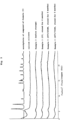
- API is in an amorphous form can be confirmed, for example, by powder X-ray diffraction.
- API is a crystal
- peaks peculiar to API is generally observed by powder X-ray diffraction
- an amorphous form shows a halo pattern without the specific peak derived from API by powder X-ray diffraction in many cases.
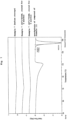
- API is in an amorphous form can also be confirmed by DSC.
- API is a crystal
- specific peaks are generally observed due to changes in the crystal form, desorption of solvent from solvate, melting, whereas an amorphous form shows a halo pattern without such peaks in many cases.
- the amorphous solid dispersion of the present invention can be used as a pharmaceutical composition as it is or in combination with a pharmaceutically acceptable carrier.
- the "pharmaceutically acceptable carrier” include various organic or inorganic carrier substances conventionally used as preparation materials, for example, excipient, disintegrant, binder, fluidizer, lubricant, adsorbent, coating agent for solid preparations, and base, emulsifier, wetting agent, stabilizer, stabilizing agent, dispersing agent, plasticizer, pH modifier, absorption promoter, gelling agent, antiseptic, filler, dissolving agent, solubilizing agent, suspending agent for semisolid preparations. Where necessary, moreover, additives such as preservative, antioxidant, colorant, sweetening agent may be used.
- the pharmaceutical composition of the present invention can be in various dosage forms such as tablet, capsule, powder, granule, and can be manufactured by a conventional method.
- a pharmaceutical preparation can be prepared through a formulation step such as mixing step, granulation step, tableting step, capsule filling step, coating step.
- a pharmaceutical preparation containing the amorphous solid dispersion of the present invention is preferably a tablet.
- excipient examples include lactose, lactose hydrate, sucrose, D-mannitol, D-sorbitol, cornstarch, dextrin, microcrystalline cellulose, crystalline cellulose, carmellose, carmellose calcium, sodium carboxymethyl starch, low-substituted hydroxypropyl cellulose, gum arabic, calcium silicate.
- disintegrant examples include carmellose, carmellose calcium, carmellose sodium, sodium carboxymethyl starch, croscarmellose sodium, crospovidone, low-substituted hydroxypropyl cellulose, hypromellose, crystalline cellulose, calcium silicate, silicified microcrystalline cellulose.
- a preferred disintegrant is croscarmellose sodium, low-substituted hydroxypropyl cellulose, calcium silicate or silicified microcrystalline cellulose.
- binder examples include hydroxypropyl cellulose, hypromellose, povidone, crystalline cellulose, sucrose, dextrin, starch, gelatin, carmellose sodium, gum arabic.
- fluidizer examples include light anhydrous silicic acid, magnesium stearate.
- lubricant examples include magnesium stearate, calcium stearate, talc.
- a preferred lubricant is magnesium stearate.
- base examples include water, animal and vegetable oils (olive oil, corn oil, peanut oil, sesame oil, castor oil etc.), lower alcohols (ethanol, propanol, propylene glycol, 1,3-butyleneglycol, phenol etc.), higher fatty acid and ester thereof, waxes, higher alcohol, polyhydric alcohol, hydrocarbons (white petrolatum, liquid paraffin, paraffin etc.), hydrophilic petrolatum, purified lanolin, absorption ointment, hydrolyzed lanolin, hydrophilic ointment, starch, pullulan, gum arabic, gum tragacanth, gelatin, dextran, cellulose derivative (methylcellulose, carboxymethylcellulose, hydroxyethylcellulose, hydroxypropyl cellulose etc.), synthetic polymers (carboxyvinyl polymer, sodium polyacrylate, polyvinyl alcohol, polyvinylpyrrolidone etc.), propylene glycol, macrogol (macrogol 4000 etc.), titanium oxide
- preservative examples include ethyl parahydroxybenzoate, chlorobutanol, benzyl alcohol, sodium dehydroacetate, sorbic acid.
- antioxidant examples include sodium sulfite, ascorbic acid.
- colorant examples include food colors (e.g., Food Color Red No. 2 or 3, Food Color yellow No. 4 or 5 etc.), ⁇ -carotene.
- sweetening agent examples include saccharin sodium, dipotassium glycyrrhizinate, aspartame.
- adsorbent examples include light anhydrous silicic acid, calcium silicate, microcrystalline cellulose.
- a core tablet composed of the amorphous solid dispersion or a combination of the amorphous solid dispersion and a pharmaceutically acceptable carrier of the present invention may be coated.
- the coating include sugar coating, film coating.
- agent used for sugar coating examples include sucrose, erythritol, maltitol. These agents and the aforementioned pharmaceutically acceptable carrier may be used in combination for the coating.
- agent used for film coating examples include methylhydroxyethylcellulose, ethylcellulose, hydroxypropyl cellulose, povidone, carboxymethylcellulose sodium, polyethylene glycol, acrylic polymer, polyvinyl alcohol, hypromellose.
- agents and the aforementioned pharmaceutically acceptable carrier may be used in combination for the coating.
- a coating agent mixed powder such as Kollicoat (registered trade mark, BASF), OPADRY (registered trade mark, Japan Colorcon) may also be used.
- the “solid dispersion tablet” means a tablet formulated using the amorphous solid dispersion of the present invention.
- the "conventional tablet” means a tablet substantially free of the amorphous solid dispersion of the present invention.
- the manufacturing method of the solid dispersion of the present invention is not particularly limited, and solvent method (precipitation, spray drying, freeze-drying, drying under reduced pressure), hot-melt extrusion method, cogrinding method, supercritical method can be mentioned.
- solvent method precipitation, spray drying, freeze-drying, drying under reduced pressure
- hot-melt extrusion method hot-melt extrusion method
- cogrinding method supercritical method
- solvent method or hot-melt extrusion method is preferred.
- the solvent method is a method in which API and a pharmaceutically acceptable polymer are dissolved or dispersed in a solvent, and then the solvent is evaporated.
- the solvent used for the solvent method is not particularly limited as long as it can dissolve or disperse API and the pharmaceutically acceptable polymer.
- Examples of the solvent include water, dichloromethane, dichloroethane, chloroform, methanol, ethanol, propanol, isopropanol, acetone, methyl ethyl ketone, diethyl ether, dibutyl ether, n-hexane, cyclohexane, n-heptane, benzene, toluene, xylene, acetic acid, propionic acid, ethyl acetate, dimethylformamide, dimethylacetamide.
- solvents may be used alone or as a mixed solvent.
- a preferred solvent is ethanol or acetone.
- the solvent can be removed, for example, by drying by heating or drying under reduced pressure.
- the hot-melt extrusion method is a process of continuously heating, kneading of the starting materials such as API, pharmaceutically acceptable polymer, and extruding the resulting molten material through a temperature controlled extruder.
- the melting can be performed at, for example, 120°C - 200°C (preferably, 125°C - 175°C).
- a general extruder is equipped with barrels and screws in the inside thereof. As the extruder, a twin-screw extruder having two screws is preferred.
- solid dispersion particles having any particle size can be easily obtained by milling with an appropriate pulverizer.
- a pharmaceutical preparation composed of a solid dispersion obtained by the manufacturing method of the present invention, or a pharmaceutical preparation containing a solid dispersion can be safely administered to mammals (e.g., rat, mouse, guinea pig, monkey, bovine, dog, swine, human etc.) orally or parenterally (e.g., intravenously, intramuscular, subcutaneous, intraorgan, intranasal, intradermal, instillation, intracerebral, intrarectal, vaginal, or intraperitoneal administration, or directly to the lesion).
- mammals e.g., rat, mouse, guinea pig, monkey, bovine, dog, swine, human etc.
- parenterally e.g., intravenously, intramuscular, subcutaneous, intraorgan, intranasal, intradermal, instillation, intracerebral, intrarectal, vaginal, or intraperitoneal administration, or directly to the lesion.
- a single dose is generally about 0.02 - about 30 mg/kg body weight, preferably about 0.2 - about 20 mg/kg body weight, further preferably about 0.5 - about 10 mg/kg body weight, and this amount is desirably administered once or several times (e.g., three times) per day.
- API in the solid dispersion of the present invention is an amorphous compound of the formula [I], 2- ⁇ 4-[(9R)-9-hydroxy-2-(3-hydroxy-3-methylbutyloxy)-9-(trifluoromethyl)-9H-fluoren-4-yl]-1H-pyrazol-1-yl ⁇ -2-methylpropanamide or a pharmaceutically acceptable salt thereof or a monohydrate thereof.
- the content of a compound of the formula [I] in the pharmaceutical composition (pharmaceutical preparation) of the present invention varies depending on the dosage form and administration route. For example, it is 0.5 - 50 mass % in the case of a pharmaceutical preparation for oral administration.
- the aforementioned pharmaceutically acceptable polymers can be mentioned.
- preferred are one to four kinds selected from the group consisting of HPMCAS, methylcellulose, hypromellose and polyvinyl alcohol, more preferred is HPMCAS, a mixture of HPMCAS and methylcellulose, or a mixture of HPMCAS, methylcellulose and polyvinyl alcohol.
- weight ratio of x and y or “mixing weight ratio of x and y” is shown by "weight of x:weight of y”.
- the weight ratio of a compound of the formula [I] or a pharmaceutically acceptable salt thereof or a hydrate thereof, and HPMCAS in the solid dispersion is within the range of from 1:0.01 to 1:20, preferably within the range of from 1:0.05 to 1:20, more preferably from 1:0.1 to 1:10, further preferably from 1:0.15 to 1:2, particularly preferably from 1:0.4 to 1:0.6.
- the weight ratio of a compound of the formula [I] or a pharmaceutically acceptable salt thereof or a hydrate thereof, and methylcellulose in the solid dispersion is preferably within the range of from 1:0.01 to 1:5, more preferably from 1:0.03 to 1:2, further preferably from 1:0.05 to 1:1, particularly preferably from 1:0.08 to 1:0.12.
- the weight ratio of a compound of the formula [I] or a pharmaceutically acceptable salt thereof or a hydrate thereof, and polyvinyl alcohol in the solid dispersion is preferably within the range of from 1:0.05 to 1:20, more preferably from 1:0.1 to 1:10, further preferably from 1:0.2 to 1:2, particularly preferably from 1:0.4 to 1:0.6.
- a specific preferred embodiment of the solid dispersion of the present invention is an amorphous solid dispersion of a compound of the formula [I], containing
- the weight ratio of a compound of the formula [I] or a pharmaceutically acceptable salt thereof or a hydrate thereof, and HPMCAS is preferably within the range of from 1:0.05 to 1:20. This range is more preferably from 1:0.1 to 1:10, further preferably from 1:0.15 to 1:2, particularly preferably from 1:0.4 to 1:0.6.
- a specific more preferred embodiment of the solid dispersion of the present invention is an amorphous solid dispersion of a compound of the formula [I] containing
- a preferable weight ratio of a compound of the formula [I] or a pharmaceutically acceptable salt thereof or a hydrate thereof, and HPMCAS is as described above.
- the weight ratio of a compound of the formula [I] or a pharmaceutically acceptable salt thereof or a hydrate thereof, and methylcellulose is preferably within the range of from 1:0.01 to 1:5. This range is more preferably from 1:0.03 to 1:2, further preferably from 1:0.05 to 1:1, particularly preferably from 1:0.08 to 1:0.12.
- solid dispersion of the present invention is an amorphous solid dispersion of a compound of the formula [I] containing
- a preferable weight ratio of a compound of the formula [I] or a pharmaceutically acceptable salt thereof or a hydrate thereof, and methylcellulose is as described above.
- the weight ratio of a compound of the formula [I] or a pharmaceutically acceptable salt thereof or a hydrate thereof, and polyvinyl alcohol is preferably within the range of from 1:0.05 to 1:20. This range is more preferably from 1:0.1 to 1:10, further preferably from 1:0.2 to 1:2, particularly preferably from 1:0.4 to 1:0.6.
- the mixing ratio of each component in the following examples may be increased or decreased by about 20%, preferably about 10%.
- the monohydrate of the compound of the formula [I] used in the following Examples and Comparative Examples was synthesized according to the method described in the aforementioned patent document 2.
- As a pharmaceutically acceptable polymer and a pharmaceutically acceptable carrier the 17th revision of the Japanese Pharmacopoeia or the Japanese Pharmaceutical Excipients 2018 compatible product was used.
- a monohydrate of the compound of the formula [I] (0.52 g) and HPMCAS (trade name: AQOAT AS-LF, manufactured by Shin-Etsu Chemical Co., Ltd.) (0.25 g) were dissolved in acetone (1.5 g).
- the obtained solution was dried overnight by a vacuum dryer (trade name: DRV320DA, manufactured by ADVANTEC) set at 60°C, and then sieved through a sieve with an opening of 180 ⁇ m to give the solid dispersion granules.
- the obtained solution was dried overnight by a vacuum dryer (trade name: DRV320DA, manufactured by ADVANTEC) set at 60°C, and then sieved through a sieve with an opening of 180 ⁇ m to give the solid dispersion granules.
- the obtained solution was dried overnight by a vacuum dryer (trade name: DRV320DA, manufactured by ADVANTEC) set at 60°C, and then sieved through a sieve with an opening of 180 ⁇ m to give the solid dispersion granules.
- a monohydrate (4.1 g) of the compound of the formula [I] and HPMCAS (trade name: AQOAT AS-LMP, manufactured by Shin-Etsu Chemical Co., Ltd.) (2.0 g) were mixed in a glass container.
- the mixing powder (5 g) was processed for 5 min with a twin screw extruder (trade name: HAKKE MiniCTW, manufactured by Thermo Fisher Scientific) at a kneading unit barrel temperature 150°C and screw speed 100 rpm to give a cylinder-shaped moldings.
- the obtained moldings were milled by a powermill (trade name: new PowerMill, manufactured by OSAKA CHEMICAL Co., Ltd.) at rotating speed 22,000 rpm to give the solid dispersion granules.
- a monohydrate (4.1 g) of the compound of the formula [I] and methylcellulose (trade name: METOLOSE SM-4, manufactured by Shin-Etsu Chemical Co., Ltd.) (2.0 g) were mixed in a glass container.
- This mixed powder (5 g) was processed for 5 min with a twin screw extruder (trade name: HAKKE MiniCTW, manufactured by Thermo Fisher Scientific) at a kneading unit barrel temperature 150°C and screw speed 100 rpm to give a cylinder-shaped moldings.
- the obtained moldings were milled by a PowerMill (trade name: new PowerMill, manufactured by OSAKA CHEMICAL Co., Ltd.) at rotating speed 22,000 rpm to give the solid dispersion granules.
- a monohydrate (4.1 g) of the compound of the formula [I] and hypromellose (trade name: TC-5E, manufactured by Shin-Etsu Chemical Co., Ltd.) (2.0 g) were mixed in a glass container.
- This mixed powder (5 g) was processed for 5 min with a twin screw extruder (trade name: HAKKE MiniCTW, manufactured by Thermo Fisher Scientific) at a kneading unit barrel temperature 180°C and screw speed 100 rpm to give a cylinder-shaped moldings.
- the obtained moldings were milled by a powermill (trade name: new PowerMill, manufactured by OSAKA CHEMICAL Co., Ltd.) at rotating speed 22,000 rpm to give the solid dispersion granules.
- a monohydrate (4.1 g) of the compound of the formula [I] and polyvinyl alcohol (trade name: JL-05E, manufactured by JAPAN VAM & POVAL CO., LTD.) (2.0 g) were mixed in a glass container.
- This mixed powder (5 g) was processed for 5 min with a twin screw extruder (trade name: HAKKE MiniCTW, manufactured by Thermo Fisher Scientific) at a kneading unit barrel temperature 180°C and screw speed 100 rpm to give a cylinder-shaped moldings.
- the obtained moldings were milled by a powermill (trade name: new PowerMill, manufactured by OSAKA CHEMICAL Co., Ltd.) at rotating speed 22,000 rpm to give the solid dispersion granules.
- HPMCAS trade name: AQOAT AS-LG, manufactured by Shin-Etsu Chemical Co., Ltd.
- the obtained granules were dried by a vacuum dryer (trade name: VOD-4, manufactured by IKEDA SCIENTIFIC Co., Ltd.) set at 80°C until the residual acetone concentration became not more than 2.0%, and then milled through a screen mill (trade name: QC-U5, manufactured by Quadro Engineering) with an opening of 610 ⁇ m. This operation was repeated twice, and the combined granules (1174 g) were blended with magnesium stearate (trade name: Parteck LUB MST, manufactured by Merck) (5 g) and then compressed to give a core tablet (mass 295.0 mg, hardness about 100N, caplet form (13.7x6.3 mm)).
- the obtained core tablets (885 g) were coated with a water dispersion containing a mixture (trade name: OPADRY, manufactured by Japan Colorcon) (36 g) of polyvinyl alcohol, titanium oxide, macrogol, and talc in a coating machine (trade name: HCT-LABO, manufactured by Freund) to give the tablet containing 100 mg of the compound of the formula [I] per tablet.
- a water dispersion containing a mixture (trade name: OPADRY, manufactured by Japan Colorcon) (36 g) of polyvinyl alcohol, titanium oxide, macrogol, and talc in a coating machine (trade name: HCT-LABO, manufactured by Freund) to give the tablet containing 100 mg of the compound of the formula [I] per tablet.
- HPMCAS trade name: AQOAT AS-LG, manufactured by Shin-Etsu Chemical Co., Ltd.
- the granules were dried by a vacuum dryer (trade name: VOD-4, manufactured by IKEDA SCIENTIFIC Co., Ltd.) set at 80°C until the residual acetone concentration became not more than 2.0%, and then milled through a screen mill (trade name: QC-U10, manufactured by Quadro Engineering) with an opening of 610 ⁇ m to give solid dispersion granules. This operation was repeated 8 times, and the combined granules (10498 g) were blended with magnesium stearate (trade name: Parteck LUB MST, manufactured by Merck) (50 g) and then compressed to give a core tablet (mass 295.0 mg, diameter 9.0 mm).
- VOD-4 manufactured by IKEDA SCIENTIFIC Co., Ltd.
- the obtained core tablets (1121 g) were coated with a water dispersion containing a mixture (trade name: OPADRY, manufactured by Japan Colorcon) (45 g) of polyvinyl alcohol, titanium oxide, macrogol, and talc in a coating machine (trade name: HCT-LABO, manufactured by Freund) to give the tablet containing 100 mg of the compound of the formula [I] per tablet.
- a water dispersion containing a mixture (trade name: OPADRY, manufactured by Japan Colorcon) (45 g) of polyvinyl alcohol, titanium oxide, macrogol, and talc in a coating machine (trade name: HCT-LABO, manufactured by Freund) to give the tablet containing 100 mg of the compound of the formula [I] per tablet.
- This mixed powder (5 g) was processed with a twin screw extruder (trade name: HAKKE MiniCTW, manufactured by Thermo Fisher Scientific) at a kneading unit barrel temperature 160°C and screw speed 100 rpm to give a cylinder-shaped moldings. This operation was performed 7 times, and the combined moldings were milled by a powermill (trade name: new PowerMill, manufactured by OSAKA CHEMICAL Co., Ltd.) at rotating speed 22,000 rpm.
- a twin screw extruder (trade name: HAKKE MiniCTW, manufactured by Thermo Fisher Scientific) at a kneading unit barrel temperature 160°C and screw speed 100 rpm to give a cylinder-shaped moldings. This operation was performed 7 times, and the combined moldings were milled by a powermill (trade name: new PowerMill, manufactured by OSAKA CHEMICAL Co., Ltd.) at rotating speed 22,000 rpm.
- the obtained milled granules (34 g) were mixed with low-substituted hydroxypropyl cellulose (trade name: L-HPC LH-B1, manufactured by Shin-Etsu Chemical Co., Ltd.) (8.7 g), silicified microcrystalline cellulose (trade name: PROSOLV SMCC 50, manufactured by JRS Pharma) (5.2 g) and magnesium stearate (trade name: Parteck LUB MST, manufactured by Merck) (0.2 g), and then compressed to give a core tablet (mass 274.6 mg, diameter 9.0 mm).
- L-HPC LH-B1 manufactured by Shin-Etsu Chemical Co., Ltd.
- silicified microcrystalline cellulose trade name: PROSOLV SMCC 50, manufactured by JRS Pharma
- magnesium stearate trade name: Parteck LUB MST, manufactured by Merck
- the obtained core tablets (15 g) were coated with a water dispersion containing a mixture (trade name: OPADRY, manufactured by Japan Colorcon) (0.6 g) of hypromellose, titanium oxide, lactose hydrate, macrogol 4000, and triacetin in a coating machine (trade name: HCT-LABO, manufactured by Freund) to give the tablet containing 100 mg of the compound of the formula [I] per tablet.
- a water dispersion containing a mixture (trade name: OPADRY, manufactured by Japan Colorcon) (0.6 g) of hypromellose, titanium oxide, lactose hydrate, macrogol 4000, and triacetin in a coating machine (trade name: HCT-LABO, manufactured by Freund)
- a monohydrate (25.9 g) of the compound of the formula [I], HPMCAS (trade name: AQOAT AS-LF, manufactured by Shin-Etsu Chemical Co., Ltd.) (12.5 g) and methylcellulose (trade name: METOLOSE SM-4, manufactured by Shin-Etsu Chemical Co., Ltd.) (2.5 g) were mixed in a bag, and sieved through a sieve with an opening of 710 ⁇ m.
- This mixed powder (5 g) was processed for 5 min with a twin screw extruder (trade name: HAKKE MiniCTW, manufactured by Thermo Fisher Scientific) at a kneading unit barrel temperature 150°C and screw speed 100 rpm to give a cylinder-shaped moldings.
- the obtained core tablets (2.2 g) were coated with a water dispersion containing a mixture (trade name: OPADRY, manufactured by Japan Colorcon) (12 g) of hypromellose, titanium oxide, lactose hydrate, macrogol 4000, and triacetin together with dummy tablets (300 g) in a coating machine (trade name: HCT-LABO, manufactured by Freund) to give the tablet containing 100 mg of the compound of the formula [I] per tablet.
- a water dispersion containing a mixture (trade name: OPADRY, manufactured by Japan Colorcon) (12 g) of hypromellose, titanium oxide, lactose hydrate, macrogol 4000, and triacetin together with dummy tablets (300 g) in a coating machine (trade name: HCT-LABO, manufactured by Freund)
- This mixed powder was processed with a dry granulator (trade name: TF-MINI, manufactured by Freund) and a screen mill (trade name: QC-U5, manufactured by Quadro Engineering) to give granules with a specific volume 2.2 mL/g.
- the obtained granules (579 g) were processed with a twin screw extruder (trade name: Nano-16, manufactured by Leistriz) at a maximum temperature 155°C and screw speed 200 rpm to give a cylinder-shaped moldings.
- the obtained moldings were milled by an impact mill (trade name: SAMF, manufactured by NARA MACHINERY CO., LTD.) at rotating speed 14000 rpm.
- the obtained milled granules (197 g) were blended with low-substituted hydroxypropyl cellulose (trade name: L-HPC LH-B1, manufactured by Shin-Etsu Chemical Co., Ltd.) (72 g) and magnesium stearate (trade name: Parteck LUB MST, manufactured by Merck) (1 g), and then compressed to give a core tablet (mass 225.0 mg, diameter 8.0 mm).
- the obtained core tablets (225 g) were coated with a water dispersion containing a mixture (trade name: OPADRY, manufactured by Japan Colorcon) (7 g) of hypromellose, titanium oxide, lactose hydrate, macrogol 4000, and triacetin in a coating machine (trade name: HCT-LABO, manufactured by Freund) to give the tablet containing 100 mg of the compound of the formula [I] per tablet.
- a water dispersion containing a mixture (trade name: OPADRY, manufactured by Japan Colorcon) 7 g) of hypromellose, titanium oxide, lactose hydrate, macrogol 4000, and triacetin in a coating machine (trade name: HCT-LABO, manufactured by Freund)
- the obtained granules were dried to loss on drying 3.5% in a fluid bed granulator (trade name: FD-MP-01, manufactured by POWREX) set to charge air temperature 65°C, and milled by a screen mill with an opening of 610 ⁇ m (trade name: QC-U10, manufactured by Quadro Engineering) to give granules.
- This operation was repeated twice, and the obtained granules (1347 g) and magnesium stearate (trade name: Parteck LUB MST, manufactured by Merck) (8 g) were blended, and then compressed to give a core tablet (mass 145.0 mg, hardness about 70N, diameter 7.5 mm).
- the obtained core tablets (1088 g) were coated with a water dispersion containing a mixture (trade name: OPADRY, manufactured by Japan Colorcon) (32 g) of hypromellose, titanium oxide, lactose hydrate, macrogol 4000, and triacetin in a coating machine (trade name: HCT-LABO, manufactured by Freund) to give the tablet containing 100 mg of the compound of the formula [I] per tablet.
- a water dispersion containing a mixture (trade name: OPADRY, manufactured by Japan Colorcon) (32 g) of hypromellose, titanium oxide, lactose hydrate, macrogol 4000, and triacetin in a coating machine (trade name: HCT-LABO, manufactured by Freund)
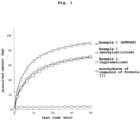
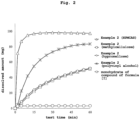
- the dissolution test was performed using a dissolution tester (trade name: NTR-VS6P, manufactured by Toyama Sangyo Co., Ltd.) that conforms to the Japanese Pharmacopoeia Dissolution Test Method 2 (Paddle Method), at paddle rotating speed 75 rpm, test media amount 450 mL.
- An amount equivalent to 100 mg of the compound of the formula [I] was added to the test media, and the dissolved amount of the compound of the formula [I] was measured at each sampling point with a spectrophotometer (UV-1600, manufactured by Shimadzu Corporation).
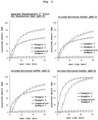
- Example 4 The dissolution profiles of the tablets obtained in Example 3, Example 5 or Comparative Example 1 in the following 4 test medium was evaluated by a method similar to that in Experimental Example 1. The results are shown in Fig. 4 .
- Example 3 and Example 5 showed better solubility in any of the test medium than the conventional tablet of Comparative Example 1.
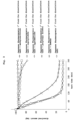
- Example 3 The tablets obtained in Example 3 were placed in a glass bottle together with a desiccant under the conditions of 5°C, 25°C/60% RH and 40°C 75% RH, and the bottle was closed and stored for 6 months. Then, the crystalline state was evaluated by Powder X-ray diffractometer (trade name: X'Pert PRO, manufactured by Malvern Panalytical) and differential scanning calorimetry (trade name: DSC Q2000, manufactured by TA instruments). As a controlled comparison, a monohydrate crystal of the compound of the formula [I] was similarly evaluated.
- Powder X-ray diffractometer trade name: X'Pert PRO, manufactured by Malvern Panalytical
- DSC Q2000 differential scanning calorimetry
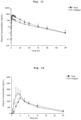
- Example 3 One tablet obtained in Example 3 or Comparative Example 2 (containing an amount equivalent to 100 mg as a compound of the formula [I]) was orally administered to a male beagle dog of the following conditions.
- the time to maximum plasma concentration (T max ), maximum plasma concentration (C max ), and the area under the plasma concentration curve (AUC 0-24hr ) up to 24 hr after administration were calculated from the obtained concentration profile of the obtained plasma.
- Fig. 8 shows the plasma concentration profile
- Table 1 shows pharmacokinetics parameters.
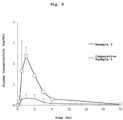
- Example 3 One tablet obtained in Example 3 or Example 6 was orally administered to a male beagle dog under the following conditions.
- the time to maximum plasma concentration (T max ), maximum plasma concentration (C max ), and the area under the plasma concentration curve (AUC 0-24hr ) up to 24 hr after administration were calculated from the obtained concentration profile of the obtained plasma.
- Fig. 9 shows the plasma concentration profile
- Table 2 shows pharmacokinetics parameters.
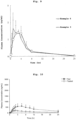
- first administration On the first day of the first phase (first administration), 14 healthy subjects were randomly assigned at a ratio of 1:1 to receive administration under any of the following conditions, and received a single oral administration of 250 mg of the compound of the formula [I] under the assigned conditions. 250 mg of the compound of the formula [I] was administered using two tablets each containing 100 mg of the compound of the formula [I] and two tablets each containing 25 mg thereof.
- the second phase (second administration) test was performed 7 days after the first administration.
- the second phase was performed by exchanging the administration conditions of each test subject. That is, the test subjects administered under fasting conditions in the first phase received a single oral administration of 250 mg of the compound of the formula [I] 30 min after the start of ingestion of the high-fat breakfast after fasting overnight (at least 10 hr).
- the test subjects who received administration under fed conditions in Phase 1 received a single oral administration of 250 mg of the compound of the formula [I] without breakfast after fasting overnight (at least 10 hr).
- Plasma samples were collected from all test subjects 0.5 hr before administration and 0.25, 0.5, 1, 1.5, 2, 2.5, 3, 4, 6, 8, 10, 12, 24, 36, 48, 72, 96 and 144 hr after administration.
- the plasma concentration of the compound of the formula [I] in the blood samples was measured. From the obtained plasma concentration profile, the maximum plasma concentration arrival time (T max ), maximum plasma concentration (C max ) and plasma concentration area under the curve (AUC inf ) were calculated.
- T max maximum plasma concentration arrival time
- C max maximum plasma concentration
- AUC inf plasma concentration area under the curve
- the plasma concentration profile is shown in Fig. 10 and Fig. 11 , and pharmacokinetics parameters are shown in Table 3.
- the oral absorbability of the compound of the formula [I] decreased when administered under the fasting conditions as compared with the fed conditions in the clinical test using the conventional tablet of the compound of the formula [I].
- the second phase (second administration) test was performed 7 days after the first administration.
- the second phase was performed by exchanging the administration conditions of each test subject. That is, the test subjects administered under fasting conditions in the first phase received a single oral administration of 300 mg of the compound of the formula [I] 30 min after the start of ingestion of the high-fat breakfast after fasting overnight (at least 10 hr).
- the test subjects who received administration under fed conditions in Phase 1 received a single oral administration of 300 mg of the compound of the formula [I] without breakfast after fasting overnight (at least 10 hr).
- Plasma concentration profile is shown in Fig. 12 and Fig. 13 , and pharmacokinetics parameters are shown in Table 4.
- a solid dispersion capable of stably maintaining a compound of the formula [I] or a pharmaceutically acceptable salt thereof, or a hydrate thereof in an amorphous state is provided. Consequently, a pharmaceutical preparation containing the compound of the formula [I] with improved pharmacokinetics or a pharmaceutically acceptable salt thereof or a hydrate thereof is provided.
- an amorphous solid dispersion of the compound of the formula [I] according to the present invention is advantageous in that it shows high solubility in some embodiments regardless of the presence or absence of bile acid at the time of administration. Thus, it is less susceptible to the influence of the diet and shows high oral absorbability even when administered under fasting conditions.
Landscapes
- Health & Medical Sciences (AREA)
- Chemical & Material Sciences (AREA)
- Life Sciences & Earth Sciences (AREA)
- Animal Behavior & Ethology (AREA)
- Public Health (AREA)
- Pharmacology & Pharmacy (AREA)
- Medicinal Chemistry (AREA)
- Veterinary Medicine (AREA)
- General Health & Medical Sciences (AREA)
- Engineering & Computer Science (AREA)
- Bioinformatics & Cheminformatics (AREA)
- Epidemiology (AREA)
- Chemical Kinetics & Catalysis (AREA)
- General Chemical & Material Sciences (AREA)
- Nuclear Medicine, Radiotherapy & Molecular Imaging (AREA)
- Organic Chemistry (AREA)
- Diabetes (AREA)
- Cardiology (AREA)
- Hematology (AREA)
- Obesity (AREA)
- Heart & Thoracic Surgery (AREA)
- Inorganic Chemistry (AREA)
- Emergency Medicine (AREA)
- Neurology (AREA)
- Endocrinology (AREA)
- Biophysics (AREA)
- Nutrition Science (AREA)
- Physiology (AREA)
- Oil, Petroleum & Natural Gas (AREA)
- Molecular Biology (AREA)
- Urology & Nephrology (AREA)
- Biomedical Technology (AREA)
- Orthopedic Medicine & Surgery (AREA)
- Physical Education & Sports Medicine (AREA)
- Pulmonology (AREA)
- Hospice & Palliative Care (AREA)
- Neurosurgery (AREA)
- Vascular Medicine (AREA)
- Medicinal Preparation (AREA)
- Pharmaceuticals Containing Other Organic And Inorganic Compounds (AREA)
Applications Claiming Priority (2)
| Application Number | Priority Date | Filing Date | Title |
|---|---|---|---|
| JP2019038327 | 2019-03-04 | ||
| PCT/JP2020/008840 WO2020179770A1 (ja) | 2019-03-04 | 2020-03-03 | ピラゾール-アミド化合物の非晶質固体分散体 |
Publications (3)
| Publication Number | Publication Date |
|---|---|
| EP3936127A1 EP3936127A1 (en) | 2022-01-12 |
| EP3936127A4 EP3936127A4 (en) | 2022-12-14 |
| EP3936127B1 true EP3936127B1 (en) | 2025-04-30 |
Family
ID=72337206
Family Applications (1)
| Application Number | Title | Priority Date | Filing Date |
|---|---|---|---|
| EP20765858.4A Active EP3936127B1 (en) | 2019-03-04 | 2020-03-03 | Amorphous solid dispersion of pyrazole-amide compound |
Country Status (10)
| Country | Link |
|---|---|
| US (1) | US20220409548A1 (enExample) |
| EP (1) | EP3936127B1 (enExample) |
| JP (1) | JP7489370B2 (enExample) |
| KR (1) | KR20210135266A (enExample) |
| CN (1) | CN113490492B (enExample) |
| AU (1) | AU2020232630A1 (enExample) |
| BR (1) | BR112021016815A2 (enExample) |
| CA (1) | CA3132296A1 (enExample) |
| MX (1) | MX2021010692A (enExample) |
| WO (1) | WO2020179770A1 (enExample) |
Families Citing this family (4)
| Publication number | Priority date | Publication date | Assignee | Title |
|---|---|---|---|---|
| EP4438040A4 (en) * | 2021-09-01 | 2025-08-20 | Japan Tobacco Inc | NITROGEN-CONTAINING TRICYCLIC COMPOUND AND ITS PHARMACEUTICAL USE |
| KR20240095240A (ko) * | 2021-11-03 | 2024-06-25 | 베이징 이노케어 파마 테크 씨오., 엘티디. | (s)-1-(1-아크릴로일피롤리딘-3-일)-3-((3,5-디메톡시페닐)에티닐)-5-(메틸아미노)-1h-피라졸-4-카르복사미드를포함하는 무정형 고체 분산물 |
| KR102769218B1 (ko) * | 2022-09-28 | 2025-02-24 | 주식회사 제이디바이오사이언스 | 신규한 플루오렌 유도체 및 이의 용도 |
| JP2024091760A (ja) * | 2024-04-15 | 2024-07-05 | 信越化学工業株式会社 | 非晶質固体分散体を含む複合物 |
Family Cites Families (8)
| Publication number | Priority date | Publication date | Assignee | Title |
|---|---|---|---|---|
| US20070218138A1 (en) * | 2006-03-20 | 2007-09-20 | Bittorf Kevin J | Pharmaceutical Compositions |
| CN103002880B (zh) * | 2010-06-09 | 2015-01-28 | Abbvie公司 | 含有激酶抑制剂的固态分散体 |
| JP5475561B2 (ja) * | 2010-06-14 | 2014-04-16 | ポリプラスチックス株式会社 | 充填材の配向解析方法 |
| US20140206717A1 (en) * | 2011-08-16 | 2014-07-24 | John Higgins | Use of inorganic matrix and organic polymer combinations for preparing stable amorphous dispersions |
| PL2975028T3 (pl) | 2013-03-15 | 2018-10-31 | Japan Tobacco, Inc. | Związek pirazoloamidowy i jego zastosowania medyczne |
| WO2018013693A1 (en) * | 2016-07-13 | 2018-01-18 | Celgene Corporation | Solid dispersions and cocrystals comprising 3-(4-amino-1-oxo-1,3-dihydro-isoindol-2-yl)-piperidine-2,6-dione compositions and methods of use thereof |
| KR20190036549A (ko) | 2016-07-29 | 2019-04-04 | 니뽄 다바코 산교 가부시키가이샤 | 피라졸-아미드 화합물의 제조 방법 |
| CN108785256B (zh) * | 2017-04-28 | 2021-06-29 | 江苏恒瑞医药股份有限公司 | 一种固体分散体及其制备方法 |
-
2020
- 2020-03-03 BR BR112021016815A patent/BR112021016815A2/pt not_active Application Discontinuation
- 2020-03-03 MX MX2021010692A patent/MX2021010692A/es unknown
- 2020-03-03 US US17/436,269 patent/US20220409548A1/en active Pending
- 2020-03-03 CN CN202080018640.9A patent/CN113490492B/zh active Active
- 2020-03-03 WO PCT/JP2020/008840 patent/WO2020179770A1/ja not_active Ceased
- 2020-03-03 KR KR1020217031240A patent/KR20210135266A/ko not_active Withdrawn
- 2020-03-03 CA CA3132296A patent/CA3132296A1/en active Pending
- 2020-03-03 EP EP20765858.4A patent/EP3936127B1/en active Active
- 2020-03-03 JP JP2021504101A patent/JP7489370B2/ja active Active
- 2020-03-03 AU AU2020232630A patent/AU2020232630A1/en not_active Abandoned
Also Published As
| Publication number | Publication date |
|---|---|
| US20220409548A1 (en) | 2022-12-29 |
| CN113490492B (zh) | 2024-09-27 |
| AU2020232630A1 (en) | 2021-09-16 |
| BR112021016815A2 (pt) | 2021-11-16 |
| CN113490492A (zh) | 2021-10-08 |
| JPWO2020179770A1 (enExample) | 2020-09-10 |
| KR20210135266A (ko) | 2021-11-12 |
| CA3132296A1 (en) | 2020-09-10 |
| EP3936127A4 (en) | 2022-12-14 |
| EP3936127A1 (en) | 2022-01-12 |
| MX2021010692A (es) | 2021-10-01 |
| JP7489370B2 (ja) | 2024-05-23 |
| WO2020179770A1 (ja) | 2020-09-10 |
Similar Documents
| Publication | Publication Date | Title |
|---|---|---|
| EP3936127B1 (en) | Amorphous solid dispersion of pyrazole-amide compound | |
| EP3010891B1 (en) | Amorphous letermovir and solid pharmaceutical formulations thereof for oral administration | |
| US9504746B2 (en) | Pharmaceutical compositions of 4-(3-chloro-4-(cyclopropylaminocarbonyl)aminophenoxy)-7-methoxy-6-quinolinecarboxamide | |
| US20210228489A1 (en) | Compositions for treating cystic fibrosis | |
| US20110207660A1 (en) | Pharmaceutical formulations of an hcv protease inhibitor in a solid molecular dispersion | |
| SK287252B6 (sk) | Farmaceutický prípravok s obsahom benzamidového derivátu | |
| CN112353762A (zh) | 具有改善的生物利用度的药物组合物 | |
| EP3299014B1 (en) | Somcl-9112 solid dispersion and preparation method thereof and somcl-9112 solid preparation containing somcl-9112 solid dispersion | |
| US20110097414A1 (en) | Pharmaceutical compositions comprising adsorbate of fenofibrate | |
| CA3029948C (en) | Antidiabetic solid pharmaceutical compositions | |
| WO2022180582A1 (en) | Oral pharmaceutical composition of arsenic trioxide | |
| EP3718548A1 (en) | Solid dispersion | |
| CN105828827A (zh) | 一种含他克莫司的药物组合物及其制备方法 | |
| WO2023143427A1 (zh) | Arv-110的晶型及其制备方法和用途 | |
| JPWO2007007656A1 (ja) | チアゾリジンジオン化合物を含有する医薬組成物 | |
| KR102078691B1 (ko) | 피마살탄을 포함하는 고체 분산체 | |
| WO2025067450A1 (zh) | 一种固体分散体、药物组合物、其制备方法及其用途 | |
| Rajan et al. | Solid state forms of 1-{(2S, 5R)-2-Methyl-5-[(7H-pyrrolo [2, 3-d] pyrimidin-4-yl) amino] piperidine-1-yl} prop-2-en-1-one 4-methylbenzene-1-sulfonic acid | |
| JP2025526729A (ja) | ナポラフェニブを含む非晶質固体分散体 | |
| KR20230097513A (ko) | 타크로리무스를 포함하는 안정성이 개선된 약제학적 조성물 | |
| HK1223935B (en) | Amorphous letermovir and solid pharmaceutical formulations thereof for oral administration | |
| HK40045939A (en) | Pharmaceutical composition with improved bioavailability | |
| JP2008162949A (ja) | チアゾリジンジオン化合物を含有する糖尿病治療薬 |
Legal Events
| Date | Code | Title | Description |
|---|---|---|---|
| STAA | Information on the status of an ep patent application or granted ep patent |
Free format text: STATUS: THE INTERNATIONAL PUBLICATION HAS BEEN MADE |
|
| PUAI | Public reference made under article 153(3) epc to a published international application that has entered the european phase |
Free format text: ORIGINAL CODE: 0009012 |
|
| STAA | Information on the status of an ep patent application or granted ep patent |
Free format text: STATUS: REQUEST FOR EXAMINATION WAS MADE |
|
| 17P | Request for examination filed |
Effective date: 20210929 |
|
| AK | Designated contracting states |
Kind code of ref document: A1 Designated state(s): AL AT BE BG CH CY CZ DE DK EE ES FI FR GB GR HR HU IE IS IT LI LT LU LV MC MK MT NL NO PL PT RO RS SE SI SK SM TR |
|
| DAV | Request for validation of the european patent (deleted) | ||
| A4 | Supplementary search report drawn up and despatched |
Effective date: 20221111 |
|
| RIC1 | Information provided on ipc code assigned before grant |
Ipc: A61K 9/14 20060101ALI20221107BHEP Ipc: A61P 43/00 20060101ALI20221107BHEP Ipc: A61P 35/00 20060101ALI20221107BHEP Ipc: A61P 25/00 20060101ALI20221107BHEP Ipc: A61P 21/00 20060101ALI20221107BHEP Ipc: A61P 11/00 20060101ALI20221107BHEP Ipc: A61P 9/12 20060101ALI20221107BHEP Ipc: A61P 9/10 20060101ALI20221107BHEP Ipc: A61P 9/04 20060101ALI20221107BHEP Ipc: A61P 3/10 20060101ALI20221107BHEP Ipc: A61P 3/08 20060101ALI20221107BHEP Ipc: A61P 3/06 20060101ALI20221107BHEP Ipc: A61K 47/38 20060101ALI20221107BHEP Ipc: A61K 47/32 20060101ALI20221107BHEP Ipc: A61K 47/04 20060101ALI20221107BHEP Ipc: A61K 47/02 20060101ALI20221107BHEP Ipc: A61K 9/36 20060101ALI20221107BHEP Ipc: A61K 9/28 20060101ALI20221107BHEP Ipc: A61K 9/20 20060101ALI20221107BHEP Ipc: A61K 9/10 20060101ALI20221107BHEP Ipc: A61K 31/415 20060101AFI20221107BHEP |
|
| GRAP | Despatch of communication of intention to grant a patent |
Free format text: ORIGINAL CODE: EPIDOSNIGR1 |
|
| STAA | Information on the status of an ep patent application or granted ep patent |
Free format text: STATUS: GRANT OF PATENT IS INTENDED |
|
| INTG | Intention to grant announced |
Effective date: 20241108 |
|
| GRAS | Grant fee paid |
Free format text: ORIGINAL CODE: EPIDOSNIGR3 |
|
| GRAA | (expected) grant |
Free format text: ORIGINAL CODE: 0009210 |
|
| STAA | Information on the status of an ep patent application or granted ep patent |
Free format text: STATUS: THE PATENT HAS BEEN GRANTED |
|
| P01 | Opt-out of the competence of the unified patent court (upc) registered |
Free format text: CASE NUMBER: APP_9340/2025 Effective date: 20250225 |
|
| AK | Designated contracting states |
Kind code of ref document: B1 Designated state(s): AL AT BE BG CH CY CZ DE DK EE ES FI FR GB GR HR HU IE IS IT LI LT LU LV MC MK MT NL NO PL PT RO RS SE SI SK SM TR |
|
| REG | Reference to a national code |
Ref country code: CH Ref legal event code: EP Ref country code: GB Ref legal event code: FG4D |
|
| REG | Reference to a national code |
Ref country code: DE Ref legal event code: R096 Ref document number: 602020050451 Country of ref document: DE |
|
| REG | Reference to a national code |
Ref country code: IE Ref legal event code: FG4D |
|
| REG | Reference to a national code |
Ref country code: NL Ref legal event code: MP Effective date: 20250430 |
|
| REG | Reference to a national code |
Ref country code: AT Ref legal event code: MK05 Ref document number: 1789415 Country of ref document: AT Kind code of ref document: T Effective date: 20250430 |
|
| PG25 | Lapsed in a contracting state [announced via postgrant information from national office to epo] |
Ref country code: PT Free format text: LAPSE BECAUSE OF FAILURE TO SUBMIT A TRANSLATION OF THE DESCRIPTION OR TO PAY THE FEE WITHIN THE PRESCRIBED TIME-LIMIT Effective date: 20250901 Ref country code: ES Free format text: LAPSE BECAUSE OF FAILURE TO SUBMIT A TRANSLATION OF THE DESCRIPTION OR TO PAY THE FEE WITHIN THE PRESCRIBED TIME-LIMIT Effective date: 20250430 Ref country code: FI Free format text: LAPSE BECAUSE OF FAILURE TO SUBMIT A TRANSLATION OF THE DESCRIPTION OR TO PAY THE FEE WITHIN THE PRESCRIBED TIME-LIMIT Effective date: 20250430 |
|
| REG | Reference to a national code |
Ref country code: LT Ref legal event code: MG9D |
|
| PG25 | Lapsed in a contracting state [announced via postgrant information from national office to epo] |
Ref country code: NO Free format text: LAPSE BECAUSE OF FAILURE TO SUBMIT A TRANSLATION OF THE DESCRIPTION OR TO PAY THE FEE WITHIN THE PRESCRIBED TIME-LIMIT Effective date: 20250730 Ref country code: GR Free format text: LAPSE BECAUSE OF FAILURE TO SUBMIT A TRANSLATION OF THE DESCRIPTION OR TO PAY THE FEE WITHIN THE PRESCRIBED TIME-LIMIT Effective date: 20250731 |
|
| PG25 | Lapsed in a contracting state [announced via postgrant information from national office to epo] |
Ref country code: NL Free format text: LAPSE BECAUSE OF FAILURE TO SUBMIT A TRANSLATION OF THE DESCRIPTION OR TO PAY THE FEE WITHIN THE PRESCRIBED TIME-LIMIT Effective date: 20250430 Ref country code: PL Free format text: LAPSE BECAUSE OF FAILURE TO SUBMIT A TRANSLATION OF THE DESCRIPTION OR TO PAY THE FEE WITHIN THE PRESCRIBED TIME-LIMIT Effective date: 20250430 |
|
| PG25 | Lapsed in a contracting state [announced via postgrant information from national office to epo] |
Ref country code: BG Free format text: LAPSE BECAUSE OF FAILURE TO SUBMIT A TRANSLATION OF THE DESCRIPTION OR TO PAY THE FEE WITHIN THE PRESCRIBED TIME-LIMIT Effective date: 20250430 |
|
| PG25 | Lapsed in a contracting state [announced via postgrant information from national office to epo] |
Ref country code: HR Free format text: LAPSE BECAUSE OF FAILURE TO SUBMIT A TRANSLATION OF THE DESCRIPTION OR TO PAY THE FEE WITHIN THE PRESCRIBED TIME-LIMIT Effective date: 20250430 |
|
| PG25 | Lapsed in a contracting state [announced via postgrant information from national office to epo] |
Ref country code: AT Free format text: LAPSE BECAUSE OF FAILURE TO SUBMIT A TRANSLATION OF THE DESCRIPTION OR TO PAY THE FEE WITHIN THE PRESCRIBED TIME-LIMIT Effective date: 20250430 |
|
| PG25 | Lapsed in a contracting state [announced via postgrant information from national office to epo] |
Ref country code: RS Free format text: LAPSE BECAUSE OF FAILURE TO SUBMIT A TRANSLATION OF THE DESCRIPTION OR TO PAY THE FEE WITHIN THE PRESCRIBED TIME-LIMIT Effective date: 20250731 |
|
| PG25 | Lapsed in a contracting state [announced via postgrant information from national office to epo] |
Ref country code: IS Free format text: LAPSE BECAUSE OF FAILURE TO SUBMIT A TRANSLATION OF THE DESCRIPTION OR TO PAY THE FEE WITHIN THE PRESCRIBED TIME-LIMIT Effective date: 20250830 |
|
| PG25 | Lapsed in a contracting state [announced via postgrant information from national office to epo] |
Ref country code: LV Free format text: LAPSE BECAUSE OF FAILURE TO SUBMIT A TRANSLATION OF THE DESCRIPTION OR TO PAY THE FEE WITHIN THE PRESCRIBED TIME-LIMIT Effective date: 20250430 |