EP3923876B1 - Dental appliance - Google Patents
Dental appliance Download PDFInfo
- Publication number
- EP3923876B1 EP3923876B1 EP20756010.3A EP20756010A EP3923876B1 EP 3923876 B1 EP3923876 B1 EP 3923876B1 EP 20756010 A EP20756010 A EP 20756010A EP 3923876 B1 EP3923876 B1 EP 3923876B1
- Authority
- EP
- European Patent Office
- Prior art keywords
- teeth
- protrusion
- mouth guard
- protrusions
- arch
- Prior art date
- Legal status (The legal status is an assumption and is not a legal conclusion. Google has not performed a legal analysis and makes no representation as to the accuracy of the status listed.)
- Active
Links
Images



Classifications
-
- A—HUMAN NECESSITIES
- A61—MEDICAL OR VETERINARY SCIENCE; HYGIENE
- A61F—FILTERS IMPLANTABLE INTO BLOOD VESSELS; PROSTHESES; DEVICES PROVIDING PATENCY TO, OR PREVENTING COLLAPSING OF, TUBULAR STRUCTURES OF THE BODY, e.g. STENTS; ORTHOPAEDIC, NURSING OR CONTRACEPTIVE DEVICES; FOMENTATION; TREATMENT OR PROTECTION OF EYES OR EARS; BANDAGES, DRESSINGS OR ABSORBENT PADS; FIRST-AID KITS
- A61F5/00—Orthopaedic methods or devices for non-surgical treatment of bones or joints; Nursing devices ; Anti-rape devices
- A61F5/56—Devices for preventing snoring
- A61F5/566—Intra-oral devices
-
- A—HUMAN NECESSITIES
- A63—SPORTS; GAMES; AMUSEMENTS
- A63B—APPARATUS FOR PHYSICAL TRAINING, GYMNASTICS, SWIMMING, CLIMBING, OR FENCING; BALL GAMES; TRAINING EQUIPMENT
- A63B71/00—Games or sports accessories not covered in groups A63B1/00 - A63B69/00
- A63B71/08—Body-protectors for players or sportsmen, i.e. body-protecting accessories affording protection of body parts against blows or collisions
- A63B71/085—Mouth or teeth protectors
-
- A—HUMAN NECESSITIES
- A61—MEDICAL OR VETERINARY SCIENCE; HYGIENE
- A61C—DENTISTRY; APPARATUS OR METHODS FOR ORAL OR DENTAL HYGIENE
- A61C7/00—Orthodontics, i.e. obtaining or maintaining the desired position of teeth, e.g. by straightening, evening, regulating, separating, or by correcting malocclusions
- A61C7/08—Mouthpiece-type retainers or positioners, e.g. for both the lower and upper arch
-
- A—HUMAN NECESSITIES
- A61—MEDICAL OR VETERINARY SCIENCE; HYGIENE
- A61F—FILTERS IMPLANTABLE INTO BLOOD VESSELS; PROSTHESES; DEVICES PROVIDING PATENCY TO, OR PREVENTING COLLAPSING OF, TUBULAR STRUCTURES OF THE BODY, e.g. STENTS; ORTHOPAEDIC, NURSING OR CONTRACEPTIVE DEVICES; FOMENTATION; TREATMENT OR PROTECTION OF EYES OR EARS; BANDAGES, DRESSINGS OR ABSORBENT PADS; FIRST-AID KITS
- A61F5/00—Orthopaedic methods or devices for non-surgical treatment of bones or joints; Nursing devices ; Anti-rape devices
- A61F5/56—Devices for preventing snoring
- A61F2005/563—Anti-bruxisme
Definitions
- the present invention relates generally to mouth guards. More particularly, the present invention relates to a mouth guard for reducing tooth damage during sleep.
- a mandibular arch i.e., the arch of teeth along the mandible (commonly referred to as the lower jaw) or lower arch
- a maxillary arch i.e., the arch of teeth along the maxilla (commonly referred to as the upper jaw) or upper arch
- Teeth along the mandibular or lower arch are commonly referred to as 'the lower teeth
- teeth along the maxillary arch or upper arch are commonly referred to as 'the upper teeth.
- Bruxism is excessive teeth grinding or jaw clenching.
- one or more lower teeth come into contact with one or more upper teeth as food is masticated (i.e., chewed).
- food is disposed between only a few of the lower and upper teeth.
- People chewing their food tend to focus on grinding the food with just those particular teeth where the food is located, and avoid needlessly grinding their other teeth together in those places where there is no food to chew.
- some people grind or clench their teeth at times other than when chewing food.
- Bruxism is excessive teeth grinding or jaw clenching, and it can occur during sleep.
- nocturnal bruxism Bruxism during sleep is referred to as nocturnal bruxism. While the cause of nocturnal bruxism is not completely understood, it is likely due to various factors including, but not limited to, personality, stress, and emotion. The majority of people with nocturnal bruxism do not make noises while grinding or clenching their teeth during sleep. However, there are a number of people who do create noises (e.g., screeching noises) from grinding or clenching their teeth during sleep.
- noises e.g., screeching noises
- Tooth wear caused by bruxism affects the occlusal surfaces (i.e., the biting surfaces) of the teeth.
- the exact location and pattern of tooth wear depends on how the bruxism occurs (e.g., when the canines and incisors of the opposing mandibular and maxillary arches are moved against each other laterally, this can lead to the wearing down of the incisal edges of the teeth.
- People with bruxism may grind their anterior teeth (i.e., front teeth) and may also grind their posterior teeth (i.e., back teeth).
- Adult anterior teeth include the central and lateral incisors and the canine teeth, and make up the six upper and six lower front teeth.
- Adult posterior teeth include three molars and two premolars (or bicuspids) and make up the ten upper and ten lower back teeth.
- This grinding and clenching of teeth can apply large amounts of force on those teeth being clenched or ground together.
- the force of this grinding and clenching of teeth can wear away the enamel layer of one or more teeth, and expose the dentin layer of these teeth to the grinding and clenching.
- the dentin layer is softer and more vulnerable to wear and tooth decay than the enamel layer. If enough of the tooth is worn away or decayed, the tooth will effectively be weakened, and may fracture under the increased forces that occur in bruxism.
- This grinding and clenching can subsequently cause various oral health issues including, but not limited to, toothaches, cavities, periodontitis, and tooth loss.
- This lateral force will cause this particular tooth to shift left and right due to the opposing tooth being stronger and unloading force that is far greater than the amount of force this particular tooth can bear.
- the person can experience various symptoms as a result of the grinding and clenching that include, but are not limited to, toothaches, cavities, periodontitis, and tooth loss.
- the apparatus for preventing bruxism comprises: a body part formed with a tooth groove to be fitted in any one of a mandibular anterior tooth part or a maxillary anterior tooth part made up of an incisal tooth, a lateral incisor tooth, a canine tooth; and a contact part formed at any one portion of the front surface or the rear surface of the body part, wherein the contact part is formed on the front surface of the body part and is in contact with the tongue side surface of the maxillary anterior tooth part when the body part is fitted to the mandibular anterior tooth part, and the contact part is formed on the rear part of the body part and is in contact with the outer surface of the mandibular anterior tooth part when the body part is fitted to the maxillary anterior tooth part.
- US 2014/0109919 A1 describes an intraoral discluding appliance for the prevention of trauma and temporomandibular joint syndrome.
- the device includes two discluding elements over the cuspid areas known as cuspid pads.
- the device is inserted in the mouth and retained against the upper or lower anterior teeth. As the mouth is closed, the discluding elements contact the opposing cuspids and prevent the posterior teeth from touching.
- an embodiment of the present invention resides in a mouth guard assembly 20 including a mouth guard tray 30 for teeth of a user's upper dental arch (i.e., an upper guard tray 30), and a mouth guard tray 40 for teeth of a user's lower dental arch (i.e., a lower guard tray 40).
- Each guard tray 30, 40 is fabricated using thermoplastic polyurethane (TPU) material.
- TPU thermoplastic polyurethane
- An example of TPU material used to form the guard trays 30, 40 is CLEARSPLINT from Astron Dental ( https://www.astrondental.com/ ).
- the TPU material may be optically clear (i.e., generally transparent), translucent, or opaque.
- the TPU material may be colored or uncolored.
- Both mouth guard trays 30, 40 can be worn at the same time. Alternatively, just one of the mouth guard trays 30, 40 can be worn.
- the upper guard tray 30 can be worn on the upper arch with no mouth guard tray on the lower arch (or the lower guard tray 40 can be worn on the lower arch with no mouth guard tray on the upper arch). If worn on both dental arches or just one of the dental arches, the result will be that the teeth on both arches will be protected. If a mouth guard tray is worn on just one arch, the mouth guard tray will be designed to cover all existing teeth on that arch. The number of teeth covered will depend on the unique dentition of each individual patient.
- the mouth guards 30, 40 extend from incisors at a front of the mouth back towards, and generally covering, at least one of the premolars on each side of the patient's mouth. It is preferable that all teeth be covered by the mouth guards 30, 40 in order to distribute the grinding force. Coverage of the molars, for example, can reduce the possibility of supra-eruption of one or more of a patient's molars, especially if a patient is missing a molar on one of their dental arches that would normally oppose a molar on the other dental arch. How far back the mouth guard tray 30, 40 extends can vary from patient-to-patient, as each individual patient's dentition is unique.
- Each of the mouth guards 30, 40 is designed to include a pair of protrusions 32, 42 that will generally cover an area over the user's canine teeth, but can also generally cover a lateral area extending between the user's lateral incisor, canine, and first premolar teeth. Due to the uniqueness of each individual, the protrusions 32, 42, may generally cover an area over portions of the user's lateral incisor and canine teeth, an area generally over the user's canine teeth, and an area generally over the user's canine and first premolar teeth.
- Placement of the protrusions 32, 42, over just the anterior teeth should be avoided as anterior teeth like the incisors have shorter roots and less periodontal ligament which makes them not as strong as the canine teeth and more vulnerable to the grinding forces. If the protrusions 32, 42 are placed over just anterior teeth such as the central incisors or lateral incisors, the force from grinding could cause these particular anterior teeth to shift outward and be more protrusive. Once the central incisors or lateral incisors are protrusive, gaps can form between the lateral incisors and the canines, and this can result in the incisors being more at risk of periodontal disease.
- the protrusions 32 are configured to engage the canine or first premolar teeth of the mandibular arch; and the protrusions 32 grind against the mandibular canine or premolar tooth during a lateral excursion which is the motion when the mandible or lower jaw moves generally laterally (i.e., generally left and right) during grinding movement.
- the maxillary canines (or upper canines) are preferable over the other teeth is because the canines have the longest roots and can withstand the force of grinding.
- the canine teeth are located the most distal from the temporomandibular joint (TMJ) as compared to the molars or premolars.
- the protrusions 32, 42 have a generally fang-like appearance.
- the protrusions 32, 42 can be shaped as desired to accommodate a particular user's unique dentition.
- the lower portion of the protrusions 32 can have a flat-shaped bottom portion rather than a sharp fang-like bottom portion according to the invention.
- the upper portion of the protrusions 42 can have a flat-shaped top portion rather than a 'sharp' fang-like top portion according to the invention.
- the flat-shaped bottom portion of the protrusions of the upper tray 30 can still function as the grinding contact point against the mandibular canines and be just as effective as the 'sharp' fang-like bottom portion of the protrusions 32.
- flat-shaped top portion of the protrusions of the lower tray 40 still able to function as the grinding contact point against the maxillary canines and be just as effective as the 'sharp' fang-like top portion of the protrusions 42.
- the angle of the slope of the protrusions 32, 42 also varies from zero (0) degrees of a flat top to as much as seventy-five (75) degrees that mimics the anatomy of a canine. This angle is determined by the lateral movement of the jaw and hence the mandibular anterior teeth and posterior teeth do not come into contact with the maxillary mouth guard 30 during the grinding movement.
- the length of the protrusions 32, 42 varies from person-to-person from five millimeters to twenty millimeters (5 mm to 20 mm) but the most optimal length is generally ten millimeters (10 mm).
- the lower posterior teeth such as the mandibular second premolars and the molars
- the protrusion 32 may fracture during grinding.
- the other areas of the mouth guard 30 have to be thin to avoid contact with the mandibular teeth to prevent damage to the anterior teeth and the posterior teeth.
- the protrusions 32, 42 are generally ten millimeters (10 mm) thick along a longitudinal length from a coronal portion of the dentition to a coronal portion of the protrusion 32, 42.
- the protrusion 32 can be generally ten millimeters (10 mm) long from the tip of one of the user's teeth (e.g., canine tooth) 36 on the maxillary arch
- the protrusion 42 can be generally ten millimeters (10 mm) long from the tip of one of the user's teeth (e.g., lateral incisor) 46 on the mandibular arch, with sloped portions of the protrusions 32, 42 deflecting each other.
- the protrusions 32, 42 of the mouth guards 30, 40 can be seen contacting each other along their respective ten millimeter (10 mm) lengths.
- the protrusions 32, 42 may contact each other or other portions of their opposing mouth guards at any number of places.
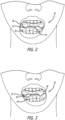
- Figure 11 an example shows the patient wearing only a lower mouth guard tray 40, with the protrusion 42 being generally ten millimeters (10 mm) long from the tip of one of the user's teeth (e.g., lateral incisor) 46 on the mandibular arch, and the protrusion 42 contacting one of the user's teeth (e.g., canine tooth) 36 on the maxillary arch.
- an example shows the patient wearing only an upper mouth guard tray 30, with the protrusion 32 being generally ten millimeters (10 mm) long from the tip of one of the user's teeth (e.g., canine) 36 on the maxillary arch, and the protrusion 32 contacting one of the user's teeth (e.g., lateral incisor) 46 on the mandibular arch.
- Ten millimeters (10 mm) is about the minimum distance necessary between the maxillary and mandibular dentitions.
- Two millimeters (2 mm) is about the minimum thickness T1 of the material of the upper mouth guard tray 30 between the central incisor and a bottom side of the upper mouth guard tray 30 that contacts the lower mouth guard tray 40.
- the thickness T1 of the upper mouth guard tray 30 between the central incisor and the bottom side of the upper mouth guard tray 30 can vary from individual-to-individual.
- two millimeters (2 mm) is about the minimum thickness T2 of the material of the lower mouth guard tray 40 between the central incisor and a top side of the lower mouth guard tray 40 that contacts the upper mouth guard tray 30.
- the thickness T2 of the lower mouth guard tray 40 between the central incisor and the top side of the lower mouth guard tray 40 can vary from individual-to-individual.
- the anterior and posterior dentition area on the mouth guard trays 30, 40 will be minimal where opposing dentition will not come into contact with these two areas.
- Each protrusion 32, 42 includes a curved slope on a palate side of the protrusion 32, 42 that creates a gap between the upper and lower dentition when the user is grinding generally laterally (i.e., sideways).
- Each protrusion 32, 42 includes a curved slope on a labial side of the protrusion 32, 42. In the alternative, the slopes on the palate and labial sides of the protrusions 32, 42 may angular, or a combination of angular and curved.
- the shape of the protrusions 32, 42 generally mimic the anatomy of a canine tooth, but the slopes on the palate and labial sides of the protrusions 32, 42 may be shaped as needed in order to accommodate the unique dentition of a particular user.
- the protrusions 32, 42 prevent the anterior teeth and molars from coming into contact during lateral excursions caused by grinding by guiding the guard trays 30, 40 away from each other and cushioning contact between the guard trays 30, 40. Wherever the guard trays 30, 40 come into contact, the TPU material provides cushioning and dissipation of the grinding force.
- the protrusions 32, 42 will cause the distance between the anterior and posterior maxillary and mandibular teeth to increase. Because of this increase, the anterior and posterior teeth will not be in direct contact and, hence, the force exerted on these teeth will be diminished; prolonging the life of these teeth. As for the canines and premolars covered by the protrusions 32, 42s, the ten millimeter (10 mm) thickness will also lessen the force applied directly to these teeth. As the distance between both arches increases, the effect of the force exerted by muscles in the user's head, neck, and shoulder will be diminished.
- the canine teeth are the longest teeth in both arches of dentitions and the canines also have more periodontal fibers which can tolerate more force than can be tolerated by the anterior incisors during grinding.
- the force on the molars from grinding is many times more than the force on the canines, premolars, and incisors, because the molars are closer to the temporomandibular (TMJ) joint.
- a first method for fabricating the upper and lower guards 30, 40 is for a dentist or other dental professional to take impressions of the patient's upper and lower arches of dentition, as well as a bite registration, and then send them to a dental laboratory.
- an impression can be taken of just one of the arches of dentition if it is determined that a mouth guard is required for only one of the arches of dentition.
- models of the patient's upper and lower arches of dentition are made from the impressions.
- a technician at the dental laboratory then heats up a sheet of TPU material with a heating machine to make a guard tray.
- This sheet of TPU material softens and can be formed around a selected one of the models of the patient's dentition (e.g., the upper arch of dentition). While the material is still soft, the technician cuts and shapes the material to forms the upper mouth guard tray 30 and protrusions 32. This process is repeated to create the lower mouth guard tray 40 and protrusions 42.
- the protrusions 32, 42 are shaped such that each protrusion 32, 42 is sloped on palate and labial sides of the maxillary and mandibular arches. As the dentition of each individual is unique, the protrusions 32, 42 are sloped to meet the unique needs of each individual.
- the technician would use the models of the patient's upper and lower arches of dentition to generally match the slope of the protrusions 32, 42 to the natural slope(s) of the patient's canines, incisors and/or bicuspids. Again, the unique nature of each individual's dentition is taken into account.
- An upper rim 34 of the upper mouth guard tray 30 should extend at least halfway up the coronal portion of the teeth but should not extend above the patient's gumline.
- a lower rim 44 of the lower mouth guard tray 40 should extend at least halfway down the coronal portion of the teeth but should not extend below the patient's gumline.
- guard trays 30, 40 can be created by a digital impression of a patient's dentition being taken, and then using the CAD/CAM machine to form the guard trays 30, 40.
- the TPU material of the mouth guard trays 30, 40 is hard enough to prevent contact between the upper and lower dentitions as the guards 30, 40 come into contact with each other when grinding starts. Sometimes an individual sleeps with their mouth open, and their upper and lower dentition will come into contact when grinding starts. For example, once the mouth guard trays 30, 40 and dentitions come into contact, the hardness of the TPU material of the mouth guard trays 30, 40 prevents the opposing dentitions from coming into direct contact, and decreasing the effect of the grinding or clenching force from muscles in the patient's head, neck, and/or shoulders.
- a soft material i.e., a material softer than TPU
- the soft material is no more effective than a stick of well-chewed chewing gum at dissipating the force on one or more teeth from the contact of opposing dentition during grinding and clenching.
- a user places the mouth guard trays 30, 40 on the lower and upper arches of their mouth prior to going to sleep at night.
- the protrusions 32, 42 will also cause the anterior dentitions on both the upper and lower arches not to directly contact which would alleviate the forces caused by grinding or clenching.
- each mouth guard tray 30, 40 can be used at the same time.
- each mouth guard tray 30, 40 can be used without the other.
- the function of each mouth guard tray 30, 40 is unchanged if used alone ortogether (although the number of covered teeth may vary due to the unique nature of each individual's dentition).
- opposite refers to the opposing arch which is not covered by the mouth guard tray 30, 40.
- opposing arch refers to the mandibular arch when the upper guard tray 30 is placed over teeth of the maxillary arch.
- opposite arch refers to the maxillary arch when the lower guard tray 40 is placed over teeth of the mandibular arch.
- the present invention has been discussed above in connection with use in a human mouth, the present invention is not limited to that environment and may also be used in the mouths of other species.
- Spatially relative terms such as “front,” “rear,” “left,” “right,” “inner,” “outer,” “beneath”, “below”, “lower”, “above”, “upper,” “horizontal,” “vertical” and the like, may be used herein for ease of description to describe one element or feature's relationship to another element(s) or feature(s) as illustrated in the figures.
- Spatially relative terms may be intended to encompass different orientations of the device in use or operation in addition to the orientation depicted in the figures. For example, if the device in the figures is turned over, elements described as “below” or “beneath” other elements or features would then be oriented “above” the other elements or features. Thus, the example term “below” can encompass both an orientation of above and below.
- the device may be otherwise oriented (rotated 90 degrees or at other orientations) and the spatially relative descriptors used herein interpreted accordingly.
Landscapes
- Health & Medical Sciences (AREA)
- General Health & Medical Sciences (AREA)
- Vascular Medicine (AREA)
- Life Sciences & Earth Sciences (AREA)
- Orthopedic Medicine & Surgery (AREA)
- Engineering & Computer Science (AREA)
- Biomedical Technology (AREA)
- Heart & Thoracic Surgery (AREA)
- Pulmonology (AREA)
- Nursing (AREA)
- Animal Behavior & Ethology (AREA)
- Otolaryngology (AREA)
- Public Health (AREA)
- Veterinary Medicine (AREA)
- Oral & Maxillofacial Surgery (AREA)
- Physical Education & Sports Medicine (AREA)
- Dental Tools And Instruments Or Auxiliary Dental Instruments (AREA)
Applications Claiming Priority (2)
| Application Number | Priority Date | Filing Date | Title |
|---|---|---|---|
| US16/277,663 US11369510B2 (en) | 2019-02-15 | 2019-02-15 | Dental appliance |
| PCT/US2020/018059 WO2020168041A1 (en) | 2019-02-15 | 2020-02-13 | Dental appliance |
Publications (4)
| Publication Number | Publication Date |
|---|---|
| EP3923876A1 EP3923876A1 (en) | 2021-12-22 |
| EP3923876A4 EP3923876A4 (en) | 2022-04-20 |
| EP3923876C0 EP3923876C0 (en) | 2024-03-27 |
| EP3923876B1 true EP3923876B1 (en) | 2024-03-27 |
Family
ID=72040742
Family Applications (1)
| Application Number | Title | Priority Date | Filing Date |
|---|---|---|---|
| EP20756010.3A Active EP3923876B1 (en) | 2019-02-15 | 2020-02-13 | Dental appliance |
Country Status (5)
| Country | Link |
|---|---|
| US (2) | US11369510B2 (https=) |
| EP (1) | EP3923876B1 (https=) |
| JP (1) | JP7471664B2 (https=) |
| CN (1) | CN113692263B (https=) |
| WO (1) | WO2020168041A1 (https=) |
Families Citing this family (5)
| Publication number | Priority date | Publication date | Assignee | Title |
|---|---|---|---|---|
| US10328225B2 (en) | 2015-10-20 | 2019-06-25 | Garner Geniothrust Llc | Dental appliance apparatus and respiratory performance |
| WO2017163085A1 (en) * | 2016-03-24 | 2017-09-28 | Clark William J | Single arch mandibular advancer |
| US11369510B2 (en) * | 2019-02-15 | 2022-06-28 | Steven Wen-Ku Huang | Dental appliance |
| US12370018B2 (en) * | 2021-05-18 | 2025-07-29 | 1092228 B.C. Ltd. | Orthodontic aligner with bulges |
| US20230233923A1 (en) * | 2022-01-21 | 2023-07-27 | Dental Choice Holdings Llc | Oral Appliance |
Family Cites Families (47)
| Publication number | Priority date | Publication date | Assignee | Title |
|---|---|---|---|---|
| US3518988A (en) * | 1967-12-05 | 1970-07-07 | Kenneth W Gores | Mouthguard |
| FR2576798B1 (fr) * | 1985-02-05 | 1989-05-26 | Sametzky Serge | Protege-dents, notamment pour la pratique de sports violents et procede de fabrication |
| US4773853A (en) * | 1987-11-09 | 1988-09-27 | Leon Kussick | Oral orthopedic appliance |
| JPH0623313Y2 (ja) * | 1990-05-08 | 1994-06-22 | 哲夫 浦部 | マウスガード |
| EP0705083A4 (en) | 1993-06-14 | 1997-02-05 | Kenneth L Hilsen | DEVICE AGAINST SNORING AND BREATHSTILL IN SLEEP |
| US5823193A (en) | 1997-01-27 | 1998-10-20 | Singer; Gary H. | Dental appliance for alleviating snoring and protecting teeth from bruxism |
| EP1205157B1 (en) | 1999-03-26 | 2008-12-10 | Masakazu Uenishi | Mouthpiece |
| US6530375B1 (en) * | 2000-03-22 | 2003-03-11 | Charles R. Cieslik, Jr. | Appliance to correct tempromandibular joint syndrome and methods of making and use |
| US20020139376A1 (en) * | 2001-02-02 | 2002-10-03 | Waddy Jude Michael | Custom fitted personalized mouthguard |
| US20060021622A1 (en) * | 2004-07-30 | 2006-02-02 | Buffington Robert T | Bruxism appliance |
| DE202004020196U1 (de) | 2004-12-30 | 2005-05-04 | Weiss, Franz | Oberkiefer-Aufbißschiene |
| US7730891B2 (en) | 2005-10-07 | 2010-06-08 | Lamberg Steven B | Intraoral mandibular advancement device for treatment of sleep disorders |
| US20070079833A1 (en) | 2005-10-07 | 2007-04-12 | Lamberg Steven B | Intraoral mandibular advancement device for treatment of sleep disorders, including snoring, obstructive sleep apnea, and gastroesophageal reflux disease and method for delivering the same |
| US7840042B2 (en) | 2006-01-20 | 2010-11-23 | 3M Innovative Properties Company | Superposition for visualization of three-dimensional data acquisition |
| US7607438B2 (en) | 2006-01-25 | 2009-10-27 | Pelerin Joseph J | Mouth guard |
| CN101742976B (zh) * | 2007-05-17 | 2014-11-19 | 迈克尔·斯塔布斯 | 下颌前移装置 |
| BRPI0920799A2 (pt) | 2008-10-03 | 2015-12-22 | Sleeping Well Llc | dispositivos de avanço mandibular, e, método de avanço mandibular |
| CN201668522U (zh) * | 2010-01-11 | 2010-12-15 | 西安交通大学口腔医院 | 一种真空成型改良式frⅲ型矫治器 |
| WO2011100355A1 (en) | 2010-02-09 | 2011-08-18 | Boyd James P | Multipurpose therapeutic mouthpiece assembly |
| US8752554B2 (en) | 2010-06-01 | 2014-06-17 | David L. Spainhower | Mouth guards for treating of temporomandibular disorder and associated methods |
| JP6062852B2 (ja) | 2011-05-09 | 2017-01-18 | 友和 上田 | 複層マウスピース、この製造方法及び製造装置 |
| US9408743B1 (en) * | 2011-05-19 | 2016-08-09 | W.R. Wagner Family Limited Partnership | Oral devices |
| US10610403B2 (en) | 2011-08-12 | 2020-04-07 | John C. Kline | Dental appliance |
| US8826913B2 (en) * | 2011-08-12 | 2014-09-09 | John C. Kline | Dental appliance |
| US8875713B2 (en) * | 2011-09-22 | 2014-11-04 | James Metz | Anti-obstructive airway dental orthotic |
| US9585785B2 (en) | 2012-03-26 | 2017-03-07 | Konrad Hofmann | Occlusion splint arrangement |
| US20140109919A1 (en) * | 2012-10-22 | 2014-04-24 | Daniel K. Crout | Intraoral Discluding Appliance |
| DE102013004517A1 (de) * | 2012-11-09 | 2014-05-15 | Andreas Bruderhofer | Okklusionsschiene |
| US20140190491A1 (en) * | 2013-01-08 | 2014-07-10 | Rene Garcia | Device and Methods for Treatment of Bruxism and TMJ Disorder |
| DK177809B1 (en) | 2013-06-02 | 2014-07-21 | Natashia Ingemarsson-Matzen | Incremental adjustable mandibular advancement device for |
| EP3016621B1 (en) * | 2013-07-01 | 2021-02-17 | Joseph R. Magness | Dental appliance for treatment of bruxism |
| DE102013110427A1 (de) | 2013-09-20 | 2015-04-16 | Alexander Berka | Zahnschiene |
| US9956111B2 (en) | 2013-10-24 | 2018-05-01 | Dante Togliatti | Dental appliance |
| US9655692B2 (en) | 2013-11-19 | 2017-05-23 | Kelly Wade Lucas | Pre-fabricated anterior guidance package kit for patients having bruxism/clenching habit with or without various malocclusions-II |
| US9681978B1 (en) | 2014-02-24 | 2017-06-20 | Karen Q. Roth | Mouth guard for the prevention of jaw clenching and teeth grinding |
| US20160095741A1 (en) * | 2014-10-03 | 2016-04-07 | 12th Man Technologies, Inc. | Bruxism guard with mandible compensation mechanism |
| KR102425662B1 (ko) * | 2014-12-26 | 2022-07-26 | 문형주 | 턱관절 교정 장치 |
| US10070941B2 (en) | 2015-05-21 | 2018-09-11 | Nordic Design, Llc | Thin-form nightguard |
| US9545332B2 (en) * | 2015-09-27 | 2017-01-17 | Kenneth Luco | Cuspid and first bi-cuspid bite retainer for sleep apnea |
| CN205514975U (zh) | 2016-02-29 | 2016-08-31 | 台州市立医院 | 一种具有引导斜面的牙齿矫正装置 |
| US20170348075A1 (en) | 2016-06-07 | 2017-12-07 | Lindsey E. Otero | Heat moldable, multilayer denture |
| US20180071134A1 (en) * | 2016-09-14 | 2018-03-15 | Gordon Honig | Device for treatment of sleep related disorders, a process to make the device and a process to use the device |
| US10952821B2 (en) * | 2016-09-21 | 2021-03-23 | uLab Systems, Inc. | Combined orthodontic movement of teeth with temporomandibular joint therapy |
| FR3059226A1 (fr) * | 2016-11-25 | 2018-06-01 | Charles Botbol | Appareil buccodentaire d'amelioration de la ventilation pulmonaire d'un sujet et procede de realisation |
| KR102088942B1 (ko) | 2017-04-14 | 2020-03-13 | 조용문 | 이갈이 방지구 |
| ES1184138Y (es) * | 2017-05-08 | 2017-08-22 | Gonzalez Esmoris Maria Isabel | Férula removible para la arcada dental superior para tratamiento del compromiso articular temporomandibular u otras patologías odontológicas de carácter oclusal similar |
| US11369510B2 (en) * | 2019-02-15 | 2022-06-28 | Steven Wen-Ku Huang | Dental appliance |
-
2019
- 2019-02-15 US US16/277,663 patent/US11369510B2/en active Active
-
2020
- 2020-02-13 CN CN202080028732.5A patent/CN113692263B/zh active Active
- 2020-02-13 EP EP20756010.3A patent/EP3923876B1/en active Active
- 2020-02-13 WO PCT/US2020/018059 patent/WO2020168041A1/en not_active Ceased
- 2020-02-13 JP JP2021547802A patent/JP7471664B2/ja active Active
-
2022
- 2022-06-23 US US17/848,029 patent/US12083038B2/en active Active
Also Published As
| Publication number | Publication date |
|---|---|
| CN113692263B (zh) | 2024-11-05 |
| EP3923876C0 (en) | 2024-03-27 |
| CN113692263A (zh) | 2021-11-23 |
| US11369510B2 (en) | 2022-06-28 |
| WO2020168041A1 (en) | 2020-08-20 |
| EP3923876A1 (en) | 2021-12-22 |
| US20200261255A1 (en) | 2020-08-20 |
| US12083038B2 (en) | 2024-09-10 |
| JP7471664B2 (ja) | 2024-04-22 |
| EP3923876A4 (en) | 2022-04-20 |
| US20220347005A1 (en) | 2022-11-03 |
| JP2022520124A (ja) | 2022-03-28 |
Similar Documents
| Publication | Publication Date | Title |
|---|---|---|
| EP3923876B1 (en) | Dental appliance | |
| US5566684A (en) | Custom fit mouthguard | |
| US8201560B2 (en) | Flexible dental appliance | |
| KR101841345B1 (ko) | 저작성 치아 교정기 | |
| US7882839B2 (en) | Custom mouthguard | |
| TWI663964B (zh) | 咀嚼式牙齒矯正裝置 | |
| US20040059382A1 (en) | Pacifier, a system and a method for maintaining proper dentitions | |
| EP2328538B1 (en) | Biologic response teether | |
| CA2728920A1 (en) | Composite oral appliances and methods for manufacture | |
| JP4489503B2 (ja) | マウスガード | |
| KR101506599B1 (ko) | 치아 보호기 | |
| CN211156366U (zh) | 一种壳状牙科器械、壳状牙科器械套组以及牙科矫治系统 | |
| US20110171592A1 (en) | Method of Direct Fabrication of Intraoral Devices | |
| CN114206592A (zh) | 用于治疗磨牙症和睡眠呼吸暂停的牙科器械 | |
| US20190336321A1 (en) | Intraoral device | |
| CN114052950B (zh) | 壳状牙齿矫治器的设计方法及制备方法 | |
| JP2023103133A (ja) | 口腔内装着具 | |
| JP3210257U (ja) | 食いしばり防止装置 | |
| TWM663213U (zh) | 牙套 | |
| JP7299452B1 (ja) | マウスピース | |
| CN223845783U (zh) | 一种无颌垫效应的透明保持器 | |
| CN218960972U (zh) | 牙齿矫正装置 | |
| KR102597507B1 (ko) | 이갈이 방지용 구강장치 | |
| JP2024070540A (ja) | マウスピース | |
| WO2022118486A1 (ja) | マウスピース |
Legal Events
| Date | Code | Title | Description |
|---|---|---|---|
| STAA | Information on the status of an ep patent application or granted ep patent |
Free format text: STATUS: THE INTERNATIONAL PUBLICATION HAS BEEN MADE |
|
| PUAI | Public reference made under article 153(3) epc to a published international application that has entered the european phase |
Free format text: ORIGINAL CODE: 0009012 |
|
| STAA | Information on the status of an ep patent application or granted ep patent |
Free format text: STATUS: REQUEST FOR EXAMINATION WAS MADE |
|
| 17P | Request for examination filed |
Effective date: 20210819 |
|
| AK | Designated contracting states |
Kind code of ref document: A1 Designated state(s): AL AT BE BG CH CY CZ DE DK EE ES FI FR GB GR HR HU IE IS IT LI LT LU LV MC MK MT NL NO PL PT RO RS SE SI SK SM TR |
|
| A4 | Supplementary search report drawn up and despatched |
Effective date: 20220321 |
|
| RIC1 | Information provided on ipc code assigned before grant |
Ipc: A61F 5/56 20060101AFI20220316BHEP |
|
| DAV | Request for validation of the european patent (deleted) | ||
| DAX | Request for extension of the european patent (deleted) | ||
| STAA | Information on the status of an ep patent application or granted ep patent |
Free format text: STATUS: EXAMINATION IS IN PROGRESS |
|
| 17Q | First examination report despatched |
Effective date: 20230102 |
|
| GRAP | Despatch of communication of intention to grant a patent |
Free format text: ORIGINAL CODE: EPIDOSNIGR1 |
|
| STAA | Information on the status of an ep patent application or granted ep patent |
Free format text: STATUS: GRANT OF PATENT IS INTENDED |
|
| INTG | Intention to grant announced |
Effective date: 20231020 |
|
| GRAS | Grant fee paid |
Free format text: ORIGINAL CODE: EPIDOSNIGR3 |
|
| GRAA | (expected) grant |
Free format text: ORIGINAL CODE: 0009210 |
|
| STAA | Information on the status of an ep patent application or granted ep patent |
Free format text: STATUS: THE PATENT HAS BEEN GRANTED |
|
| AK | Designated contracting states |
Kind code of ref document: B1 Designated state(s): AL AT BE BG CH CY CZ DE DK EE ES FI FR GB GR HR HU IE IS IT LI LT LU LV MC MK MT NL NO PL PT RO RS SE SI SK SM TR |
|
| REG | Reference to a national code |
Ref country code: GB Ref legal event code: FG4D |
|
| REG | Reference to a national code |
Ref country code: CH Ref legal event code: EP |
|
| REG | Reference to a national code |
Ref country code: DE Ref legal event code: R096 Ref document number: 602020027994 Country of ref document: DE |
|
| REG | Reference to a national code |
Ref country code: IE Ref legal event code: FG4D |
|
| U01 | Request for unitary effect filed |
Effective date: 20240327 |
|
| U07 | Unitary effect registered |
Designated state(s): AT BE BG DE DK EE FI FR IT LT LU LV MT NL PT SE SI Effective date: 20240404 |
|
| PG25 | Lapsed in a contracting state [announced via postgrant information from national office to epo] |
Ref country code: GR Free format text: LAPSE BECAUSE OF FAILURE TO SUBMIT A TRANSLATION OF THE DESCRIPTION OR TO PAY THE FEE WITHIN THE PRESCRIBED TIME-LIMIT Effective date: 20240628 |
|
| PG25 | Lapsed in a contracting state [announced via postgrant information from national office to epo] |
Ref country code: RS Free format text: LAPSE BECAUSE OF FAILURE TO SUBMIT A TRANSLATION OF THE DESCRIPTION OR TO PAY THE FEE WITHIN THE PRESCRIBED TIME-LIMIT Effective date: 20240627 Ref country code: HR Free format text: LAPSE BECAUSE OF FAILURE TO SUBMIT A TRANSLATION OF THE DESCRIPTION OR TO PAY THE FEE WITHIN THE PRESCRIBED TIME-LIMIT Effective date: 20240327 |
|
| PG25 | Lapsed in a contracting state [announced via postgrant information from national office to epo] |
Ref country code: RS Free format text: LAPSE BECAUSE OF FAILURE TO SUBMIT A TRANSLATION OF THE DESCRIPTION OR TO PAY THE FEE WITHIN THE PRESCRIBED TIME-LIMIT Effective date: 20240627 Ref country code: NO Free format text: LAPSE BECAUSE OF FAILURE TO SUBMIT A TRANSLATION OF THE DESCRIPTION OR TO PAY THE FEE WITHIN THE PRESCRIBED TIME-LIMIT Effective date: 20240627 Ref country code: HR Free format text: LAPSE BECAUSE OF FAILURE TO SUBMIT A TRANSLATION OF THE DESCRIPTION OR TO PAY THE FEE WITHIN THE PRESCRIBED TIME-LIMIT Effective date: 20240327 Ref country code: GR Free format text: LAPSE BECAUSE OF FAILURE TO SUBMIT A TRANSLATION OF THE DESCRIPTION OR TO PAY THE FEE WITHIN THE PRESCRIBED TIME-LIMIT Effective date: 20240628 |
|
| PG25 | Lapsed in a contracting state [announced via postgrant information from national office to epo] |
Ref country code: IS Free format text: LAPSE BECAUSE OF FAILURE TO SUBMIT A TRANSLATION OF THE DESCRIPTION OR TO PAY THE FEE WITHIN THE PRESCRIBED TIME-LIMIT Effective date: 20240727 |
|
| PG25 | Lapsed in a contracting state [announced via postgrant information from national office to epo] |
Ref country code: SM Free format text: LAPSE BECAUSE OF FAILURE TO SUBMIT A TRANSLATION OF THE DESCRIPTION OR TO PAY THE FEE WITHIN THE PRESCRIBED TIME-LIMIT Effective date: 20240327 |
|
| PG25 | Lapsed in a contracting state [announced via postgrant information from national office to epo] |
Ref country code: ES Free format text: LAPSE BECAUSE OF FAILURE TO SUBMIT A TRANSLATION OF THE DESCRIPTION OR TO PAY THE FEE WITHIN THE PRESCRIBED TIME-LIMIT Effective date: 20240327 |
|
| PG25 | Lapsed in a contracting state [announced via postgrant information from national office to epo] |
Ref country code: CZ Free format text: LAPSE BECAUSE OF FAILURE TO SUBMIT A TRANSLATION OF THE DESCRIPTION OR TO PAY THE FEE WITHIN THE PRESCRIBED TIME-LIMIT Effective date: 20240327 |
|
| PG25 | Lapsed in a contracting state [announced via postgrant information from national office to epo] |
Ref country code: PL Free format text: LAPSE BECAUSE OF FAILURE TO SUBMIT A TRANSLATION OF THE DESCRIPTION OR TO PAY THE FEE WITHIN THE PRESCRIBED TIME-LIMIT Effective date: 20240327 |
|
| PG25 | Lapsed in a contracting state [announced via postgrant information from national office to epo] |
Ref country code: SK Free format text: LAPSE BECAUSE OF FAILURE TO SUBMIT A TRANSLATION OF THE DESCRIPTION OR TO PAY THE FEE WITHIN THE PRESCRIBED TIME-LIMIT Effective date: 20240327 |
|
| PG25 | Lapsed in a contracting state [announced via postgrant information from national office to epo] |
Ref country code: SM Free format text: LAPSE BECAUSE OF FAILURE TO SUBMIT A TRANSLATION OF THE DESCRIPTION OR TO PAY THE FEE WITHIN THE PRESCRIBED TIME-LIMIT Effective date: 20240327 Ref country code: SK Free format text: LAPSE BECAUSE OF FAILURE TO SUBMIT A TRANSLATION OF THE DESCRIPTION OR TO PAY THE FEE WITHIN THE PRESCRIBED TIME-LIMIT Effective date: 20240327 Ref country code: RO Free format text: LAPSE BECAUSE OF FAILURE TO SUBMIT A TRANSLATION OF THE DESCRIPTION OR TO PAY THE FEE WITHIN THE PRESCRIBED TIME-LIMIT Effective date: 20240327 Ref country code: PL Free format text: LAPSE BECAUSE OF FAILURE TO SUBMIT A TRANSLATION OF THE DESCRIPTION OR TO PAY THE FEE WITHIN THE PRESCRIBED TIME-LIMIT Effective date: 20240327 Ref country code: IS Free format text: LAPSE BECAUSE OF FAILURE TO SUBMIT A TRANSLATION OF THE DESCRIPTION OR TO PAY THE FEE WITHIN THE PRESCRIBED TIME-LIMIT Effective date: 20240727 Ref country code: ES Free format text: LAPSE BECAUSE OF FAILURE TO SUBMIT A TRANSLATION OF THE DESCRIPTION OR TO PAY THE FEE WITHIN THE PRESCRIBED TIME-LIMIT Effective date: 20240327 Ref country code: CZ Free format text: LAPSE BECAUSE OF FAILURE TO SUBMIT A TRANSLATION OF THE DESCRIPTION OR TO PAY THE FEE WITHIN THE PRESCRIBED TIME-LIMIT Effective date: 20240327 |
|
| REG | Reference to a national code |
Ref country code: DE Ref legal event code: R097 Ref document number: 602020027994 Country of ref document: DE |
|
| PLBE | No opposition filed within time limit |
Free format text: ORIGINAL CODE: 0009261 |
|
| STAA | Information on the status of an ep patent application or granted ep patent |
Free format text: STATUS: NO OPPOSITION FILED WITHIN TIME LIMIT |
|
| 26N | No opposition filed |
Effective date: 20250103 |
|
| U20 | Renewal fee for the european patent with unitary effect paid |
Year of fee payment: 6 Effective date: 20250226 |
|
| PG25 | Lapsed in a contracting state [announced via postgrant information from national office to epo] |
Ref country code: MC Free format text: LAPSE BECAUSE OF FAILURE TO SUBMIT A TRANSLATION OF THE DESCRIPTION OR TO PAY THE FEE WITHIN THE PRESCRIBED TIME-LIMIT Effective date: 20240327 |
|
| REG | Reference to a national code |
Ref country code: CH Ref legal event code: PL |
|
| PG25 | Lapsed in a contracting state [announced via postgrant information from national office to epo] |
Ref country code: CH Free format text: LAPSE BECAUSE OF NON-PAYMENT OF DUE FEES Effective date: 20250228 |
|
| PG25 | Lapsed in a contracting state [announced via postgrant information from national office to epo] |
Ref country code: IE Free format text: LAPSE BECAUSE OF NON-PAYMENT OF DUE FEES Effective date: 20250213 |
|
| U20 | Renewal fee for the european patent with unitary effect paid |
Year of fee payment: 7 Effective date: 20260225 |
|
| PGFP | Annual fee paid to national office [announced via postgrant information from national office to epo] |
Ref country code: GB Payment date: 20260217 Year of fee payment: 7 |