EP3910703A2 - Elektrochemische vorrichtung und elektronische vorrichtung - Google Patents
Elektrochemische vorrichtung und elektronische vorrichtung Download PDFInfo
- Publication number
- EP3910703A2 EP3910703A2 EP21195132.2A EP21195132A EP3910703A2 EP 3910703 A2 EP3910703 A2 EP 3910703A2 EP 21195132 A EP21195132 A EP 21195132A EP 3910703 A2 EP3910703 A2 EP 3910703A2
- Authority
- EP
- European Patent Office
- Prior art keywords
- electrode plate
- porous substrate
- bonding layer
- electrochemical apparatus
- separator
- Prior art date
- Legal status (The legal status is an assumption and is not a legal conclusion. Google has not performed a legal analysis and makes no representation as to the accuracy of the status listed.)
- Granted
Links
Images
Classifications
-
- H—ELECTRICITY
- H01—ELECTRIC ELEMENTS
- H01M—PROCESSES OR MEANS, e.g. BATTERIES, FOR THE DIRECT CONVERSION OF CHEMICAL ENERGY INTO ELECTRICAL ENERGY
- H01M50/00—Constructional details or processes of manufacture of the non-active parts of electrochemical cells other than fuel cells, e.g. hybrid cells
- H01M50/40—Separators; Membranes; Diaphragms; Spacing elements inside cells
- H01M50/409—Separators, membranes or diaphragms characterised by the material
- H01M50/449—Separators, membranes or diaphragms characterised by the material having a layered structure
- H01M50/451—Separators, membranes or diaphragms characterised by the material having a layered structure comprising layers of only organic material and layers containing inorganic material
-
- H—ELECTRICITY
- H01—ELECTRIC ELEMENTS
- H01M—PROCESSES OR MEANS, e.g. BATTERIES, FOR THE DIRECT CONVERSION OF CHEMICAL ENERGY INTO ELECTRICAL ENERGY
- H01M10/00—Secondary cells; Manufacture thereof
- H01M10/05—Accumulators with non-aqueous electrolyte
- H01M10/052—Li-accumulators
- H01M10/0525—Rocking-chair batteries, i.e. batteries with lithium insertion or intercalation in both electrodes; Lithium-ion batteries
-
- H—ELECTRICITY
- H01—ELECTRIC ELEMENTS
- H01M—PROCESSES OR MEANS, e.g. BATTERIES, FOR THE DIRECT CONVERSION OF CHEMICAL ENERGY INTO ELECTRICAL ENERGY
- H01M10/00—Secondary cells; Manufacture thereof
- H01M10/05—Accumulators with non-aqueous electrolyte
- H01M10/058—Construction or manufacture
- H01M10/0587—Construction or manufacture of accumulators having only wound construction elements, i.e. wound positive electrodes, wound negative electrodes and wound separators
-
- H—ELECTRICITY
- H01—ELECTRIC ELEMENTS
- H01M—PROCESSES OR MEANS, e.g. BATTERIES, FOR THE DIRECT CONVERSION OF CHEMICAL ENERGY INTO ELECTRICAL ENERGY
- H01M10/00—Secondary cells; Manufacture thereof
- H01M10/42—Methods or arrangements for servicing or maintenance of secondary cells or secondary half-cells
- H01M10/4235—Safety or regulating additives or arrangements in electrodes, separators or electrolyte
-
- H—ELECTRICITY
- H01—ELECTRIC ELEMENTS
- H01M—PROCESSES OR MEANS, e.g. BATTERIES, FOR THE DIRECT CONVERSION OF CHEMICAL ENERGY INTO ELECTRICAL ENERGY
- H01M4/00—Electrodes
- H01M4/02—Electrodes composed of, or comprising, active material
- H01M4/13—Electrodes for accumulators with non-aqueous electrolyte, e.g. for lithium-accumulators; Processes of manufacture thereof
-
- H—ELECTRICITY
- H01—ELECTRIC ELEMENTS
- H01M—PROCESSES OR MEANS, e.g. BATTERIES, FOR THE DIRECT CONVERSION OF CHEMICAL ENERGY INTO ELECTRICAL ENERGY
- H01M4/00—Electrodes
- H01M4/02—Electrodes composed of, or comprising, active material
- H01M4/13—Electrodes for accumulators with non-aqueous electrolyte, e.g. for lithium-accumulators; Processes of manufacture thereof
- H01M4/139—Processes of manufacture
-
- H—ELECTRICITY
- H01—ELECTRIC ELEMENTS
- H01M—PROCESSES OR MEANS, e.g. BATTERIES, FOR THE DIRECT CONVERSION OF CHEMICAL ENERGY INTO ELECTRICAL ENERGY
- H01M4/00—Electrodes
- H01M4/02—Electrodes composed of, or comprising, active material
- H01M4/62—Selection of inactive substances as ingredients for active masses, e.g. binders, fillers
- H01M4/621—Binders
- H01M4/622—Binders being polymers
-
- H—ELECTRICITY
- H01—ELECTRIC ELEMENTS
- H01M—PROCESSES OR MEANS, e.g. BATTERIES, FOR THE DIRECT CONVERSION OF CHEMICAL ENERGY INTO ELECTRICAL ENERGY
- H01M4/00—Electrodes
- H01M4/02—Electrodes composed of, or comprising, active material
- H01M4/64—Carriers or collectors
- H01M4/70—Carriers or collectors characterised by shape or form
- H01M4/80—Porous plates, e.g. sintered carriers
- H01M4/806—Nonwoven fibrous fabric containing only fibres
-
- H—ELECTRICITY
- H01—ELECTRIC ELEMENTS
- H01M—PROCESSES OR MEANS, e.g. BATTERIES, FOR THE DIRECT CONVERSION OF CHEMICAL ENERGY INTO ELECTRICAL ENERGY
- H01M50/00—Constructional details or processes of manufacture of the non-active parts of electrochemical cells other than fuel cells, e.g. hybrid cells
- H01M50/10—Primary casings; Jackets or wrappings
- H01M50/102—Primary casings; Jackets or wrappings characterised by their shape or physical structure
- H01M50/105—Pouches or flexible bags
-
- H—ELECTRICITY
- H01—ELECTRIC ELEMENTS
- H01M—PROCESSES OR MEANS, e.g. BATTERIES, FOR THE DIRECT CONVERSION OF CHEMICAL ENERGY INTO ELECTRICAL ENERGY
- H01M50/00—Constructional details or processes of manufacture of the non-active parts of electrochemical cells other than fuel cells, e.g. hybrid cells
- H01M50/40—Separators; Membranes; Diaphragms; Spacing elements inside cells
- H01M50/409—Separators, membranes or diaphragms characterised by the material
- H01M50/411—Organic material
-
- H—ELECTRICITY
- H01—ELECTRIC ELEMENTS
- H01M—PROCESSES OR MEANS, e.g. BATTERIES, FOR THE DIRECT CONVERSION OF CHEMICAL ENERGY INTO ELECTRICAL ENERGY
- H01M50/00—Constructional details or processes of manufacture of the non-active parts of electrochemical cells other than fuel cells, e.g. hybrid cells
- H01M50/40—Separators; Membranes; Diaphragms; Spacing elements inside cells
- H01M50/409—Separators, membranes or diaphragms characterised by the material
- H01M50/411—Organic material
- H01M50/414—Synthetic resins, e.g. thermoplastics or thermosetting resins
-
- H—ELECTRICITY
- H01—ELECTRIC ELEMENTS
- H01M—PROCESSES OR MEANS, e.g. BATTERIES, FOR THE DIRECT CONVERSION OF CHEMICAL ENERGY INTO ELECTRICAL ENERGY
- H01M50/00—Constructional details or processes of manufacture of the non-active parts of electrochemical cells other than fuel cells, e.g. hybrid cells
- H01M50/40—Separators; Membranes; Diaphragms; Spacing elements inside cells
- H01M50/409—Separators, membranes or diaphragms characterised by the material
- H01M50/411—Organic material
- H01M50/429—Natural polymers
-
- H—ELECTRICITY
- H01—ELECTRIC ELEMENTS
- H01M—PROCESSES OR MEANS, e.g. BATTERIES, FOR THE DIRECT CONVERSION OF CHEMICAL ENERGY INTO ELECTRICAL ENERGY
- H01M50/00—Constructional details or processes of manufacture of the non-active parts of electrochemical cells other than fuel cells, e.g. hybrid cells
- H01M50/40—Separators; Membranes; Diaphragms; Spacing elements inside cells
- H01M50/409—Separators, membranes or diaphragms characterised by the material
- H01M50/431—Inorganic material
-
- H—ELECTRICITY
- H01—ELECTRIC ELEMENTS
- H01M—PROCESSES OR MEANS, e.g. BATTERIES, FOR THE DIRECT CONVERSION OF CHEMICAL ENERGY INTO ELECTRICAL ENERGY
- H01M50/00—Constructional details or processes of manufacture of the non-active parts of electrochemical cells other than fuel cells, e.g. hybrid cells
- H01M50/40—Separators; Membranes; Diaphragms; Spacing elements inside cells
- H01M50/46—Separators, membranes or diaphragms characterised by their combination with electrodes
- H01M50/461—Separators, membranes or diaphragms characterised by their combination with electrodes with adhesive layers between electrodes and separators
-
- H—ELECTRICITY
- H01—ELECTRIC ELEMENTS
- H01M—PROCESSES OR MEANS, e.g. BATTERIES, FOR THE DIRECT CONVERSION OF CHEMICAL ENERGY INTO ELECTRICAL ENERGY
- H01M50/00—Constructional details or processes of manufacture of the non-active parts of electrochemical cells other than fuel cells, e.g. hybrid cells
- H01M50/40—Separators; Membranes; Diaphragms; Spacing elements inside cells
- H01M50/489—Separators, membranes, diaphragms or spacing elements inside the cells, characterised by their physical properties, e.g. swelling degree, hydrophilicity or shut down properties
-
- H—ELECTRICITY
- H01—ELECTRIC ELEMENTS
- H01M—PROCESSES OR MEANS, e.g. BATTERIES, FOR THE DIRECT CONVERSION OF CHEMICAL ENERGY INTO ELECTRICAL ENERGY
- H01M50/00—Constructional details or processes of manufacture of the non-active parts of electrochemical cells other than fuel cells, e.g. hybrid cells
- H01M50/40—Separators; Membranes; Diaphragms; Spacing elements inside cells
- H01M50/489—Separators, membranes, diaphragms or spacing elements inside the cells, characterised by their physical properties, e.g. swelling degree, hydrophilicity or shut down properties
- H01M50/491—Porosity
-
- H—ELECTRICITY
- H01—ELECTRIC ELEMENTS
- H01M—PROCESSES OR MEANS, e.g. BATTERIES, FOR THE DIRECT CONVERSION OF CHEMICAL ENERGY INTO ELECTRICAL ENERGY
- H01M4/00—Electrodes
- H01M4/02—Electrodes composed of, or comprising, active material
- H01M2004/021—Physical characteristics, e.g. porosity, surface area
-
- Y—GENERAL TAGGING OF NEW TECHNOLOGICAL DEVELOPMENTS; GENERAL TAGGING OF CROSS-SECTIONAL TECHNOLOGIES SPANNING OVER SEVERAL SECTIONS OF THE IPC; TECHNICAL SUBJECTS COVERED BY FORMER USPC CROSS-REFERENCE ART COLLECTIONS [XRACs] AND DIGESTS
- Y02—TECHNOLOGIES OR APPLICATIONS FOR MITIGATION OR ADAPTATION AGAINST CLIMATE CHANGE
- Y02E—REDUCTION OF GREENHOUSE GAS [GHG] EMISSIONS, RELATED TO ENERGY GENERATION, TRANSMISSION OR DISTRIBUTION
- Y02E60/00—Enabling technologies; Technologies with a potential or indirect contribution to GHG emissions mitigation
- Y02E60/10—Energy storage using batteries
-
- Y—GENERAL TAGGING OF NEW TECHNOLOGICAL DEVELOPMENTS; GENERAL TAGGING OF CROSS-SECTIONAL TECHNOLOGIES SPANNING OVER SEVERAL SECTIONS OF THE IPC; TECHNICAL SUBJECTS COVERED BY FORMER USPC CROSS-REFERENCE ART COLLECTIONS [XRACs] AND DIGESTS
- Y02—TECHNOLOGIES OR APPLICATIONS FOR MITIGATION OR ADAPTATION AGAINST CLIMATE CHANGE
- Y02P—CLIMATE CHANGE MITIGATION TECHNOLOGIES IN THE PRODUCTION OR PROCESSING OF GOODS
- Y02P70/00—Climate change mitigation technologies in the production process for final industrial or consumer products
- Y02P70/50—Manufacturing or production processes characterised by the final manufactured product
Definitions
- This application relates to the field of electrochemical technology, and specifically, to an electrochemical apparatus and an electronic apparatus containing the electrochemical apparatus.
- Lithium-ion batteries have many advantages, such as high energy density, long cycle life, high nominal voltage, low self-discharge rate, small size, and small weight. They are widely applied in consumer electronics, electric vehicles, electric two-wheelers, energy storage and other fields. With the rapid development of electric vehicles and mobile electronic devices in recent years, people have increasingly high requirements for the service life of lithium-ion batteries. However, currently, as the number of cycles of the lithium-ion batteries increases, electrode assemblies inside the lithium-ion batteries gradually deform, making reliability of their packaging decrease, which affects the improvement of the service life of lithium-ion batteries. Therefore, there is an urgent need for a technical solution low in cost, which can avoid deformation of lithium ion batteries during use, and provides high packaging reliability.
- this application provides an electrochemical apparatus, including a first electrode plate, a second electrode plate, a first separator, and a second separator, where the first separator includes a first porous substrate, the second electrode plate includes a second porous substrate, and the first electrode plate, the first separator, the second electrode plate and the second separator are stacked in sequence to form an electrode assembly; and at least one surface of the first porous substrate is provided with a polymer bonding layer, and at least one surface of the second porous substrate is provided with no polymer bonding layer.
- both surfaces of the first porous substrate are provided with a polymer bonding layer. In some embodiments, neither surface of the second porous substrate is provided with a polymer bonding layer. In some embodiments, only one surface of the second porous substrate is provided with no polymer bonding layer. In some embodiments, only one surface of the first porous substrate is provided with a polymer bonding layer, and only one surface of the second porous substrate is provided with no polymer bonding layer.
- an inorganic material layer is further arranged between the first porous substrate and the polymer bonding layer, and a surface of the second porous substrate is provided with no inorganic material layer.
- the first electrode plate is a positive electrode plate
- the second electrode plate is a negative electrode plate
- the first electrode plate is a negative electrode plate
- the second electrode plate is a positive electrode plate.
- An area density of the polymer bonding layer is 0.5mg/1540.25mm 2 to 10mg/1540.25mm 2 .
- the first porous substrate and the second porous substrate may be each independently a polymer film, a multilayer polymer film, or a non-woven fabric composed of at least one polymer selected from the following: polyethylene, polypropylene, polyethylene terephthalate, polydiformylphenylenediamine, polybutylene terephthalate, polyester, polyacetal, polyamide, polycarbonate, polyimide, polyether-ether-ketone, polyetherketoneketone, polyether ketone, polyamideimide, PBI, polyethersulfone, polyphenylene oxide, cycloolefin copolymers, polyphenylene sulfide, or polyvinyl naphthaline.
- the polymer bonding layer includes a polymer
- the polymer includes at least one of the following: vinylidene fluoride-hexafluoropropylene copolymer, vinylidene fluoride-trichloroethylene copolymer, polyacrylate, polyacrylic acid, polyvinylpyrrolidone, polyacrylonitrile, polyvinylpyrrolidone, polyvinyl acetate, ethylene-acetic acid ethen copolymer, polyimide, polyoxyethylene, cellulose acetate, cellulose acetate butyrate, cellulose acetate propionate, cyanoethyl amylopectin, cyanethyl polyvinyl alcohol, cyanoethyl cellulose, cyanethyl sucrose, amylopectin, carboxymethyl cellulose, sodium carboxymethyl cellulose, lithium carboxymethyl cellulose, acrylonitrile-styrene-butadiene copolymer, polyviny
- the inorganic material layer includes an inorganic particle, and the inorganic particle includes at least one of the following: silicon dioxide, aluminum oxide, titanium oxide, zinc oxide, magnesium oxide, hafnium dioxide, tin oxide, zirconium oxide, yttrium oxide, silicon carbide, boehmite, magnesium hydroxide, aluminum hydroxide, calcium titanate, barium titanate, lithium phosphate, titanium lithium phosphate, or lanthanum titanate lithium.
- the electrode assembly has a winding structure, and an outermost circle of the electrode assembly is the second porous substrate.
- This application further provides an electronic apparatus, including the electrochemical apparatus in this application.
- a positive electrode plate and a negative electrode plate are separated through different arrangements of polymer bonding layers on a first separator and a second separator. This helps shape the electrode assembly and release a stress at corner, thereby inhibiting deformation of the electrochemical apparatus and improving packaging reliability.
- This application provides an electrochemical apparatus, including a first electrode plate, a second electrode plate, a first separator, and a second separator, where the first separator includes a first porous substrate, the second electrode plate includes a second porous substrate, and the first electrode plate, the first separator, the second electrode plate and the second separator are stacked in sequence to form an electrode assembly; and at least one surface of the first porous substrate is provided with a polymer bonding layer, and at least one surface of the second porous substrate is provided with no polymer bonding layer.
- the first electrode plate may be a positive electrode plate or a negative electrode plate.
- the second electrode plate may be a positive electrode plate or a negative electrode plate.
- the first electrode plate and the second electrode plate have opposite polarities.
- the first electrode plate is a positive electrode plate
- the second electrode plate is a negative electrode plate
- the first electrode plate is a negative electrode plate
- the second electrode plate is a positive electrode plate.
- the electrode assembly may be formed by stacking, folding or winding, and the first electrode plate and the second electrode plate are separated from each other by the first separator provided with a polymer bonding layer. After an electrode assembly is formed by winding, the first separator provided with a polymer bonding layer helps to release a stress at corner of the electrode assembly.
- the polymer bonding layer is formed by arranging a polymer binder on a surface of the first separator.
- the second separator can also be arranged between the first electrode plate and the second electrode plate.
- the first separator may be or may not be connected with the second separator.
- the first separator is not connected with the second separator.
- the first porous substrate and the second porous substrate may be porous substrate materials commonly used in the art.
- At least one surface of the first porous substrate of the first separator between the positive electrode plate and the negative electrode plate is provided with a polymer bonding layer. Therefore, at least one surface of the positive electrode plate or the negative electrode plate is in direct contact with the polymer bonding layer.
- both surfaces of the first porous substrate are provided with a polymer bonding layer, or only one surface of the first porous substrate is provided with a polymer bonding layer.
- neither surface of the second porous substrate is provided with a polymer bonding layer.
- the second separator is merely a second substrate, and neither the positive electrode plate nor the negative electrode plate functions as a binder.
- only one surface of the second porous substrate is provided with no polymer bonding layer.
- a surface of the second porous substrate facing away from the first separator is provided with no polymer bonding layer.
- the surface without a polymer bonding layer is not in direct contact with an electrolyte, which can alleviate a gel problem caused by dissolution of a coating by the electrolyte.
- only one surface of the first porous substrate is provided with a polymer bonding layer, and only one surface of the second porous substrate is provided with no polymer bonding layer.
- a polymer bonding layer may be arranged on any one surface of the first porous substrate and any one surface of the second porous substrate.
- the polymer bonding layer binds adjacent functional layers together, and an area density of the polymer bonding layer arranged on a surface of the first porous substrate or the second porous substrate significantly affects an adhesion strength.
- the area density of the polymer bonding layer is 0.5mg/1540.25mm 2 to 10mg/1540.25mm 2 .
- An excessively small area density of the polymer bonding layer will lead to a poor bonding effect.
- a higher area density of the polymer bonding layer can improve the adhesion strength, under a condition that an effective adhesion strength is ensured, an excessively high area density of the polymer bonding layer will lead to waste of materials and increased cost. Therefore, the area density of the polymer bonding layer is preferably 0.5mg/1540.25mm 2 to 10mg/1540.25mm 2 .
- the first porous substrate and the second porous substrate may be each independently a polymer film, a multilayer polymer film, or a non-woven fabric composed of at least one polymer selected from the following: polyethylene, polypropylene, polyethylene terephthalate, polydiformylphenylenediamine, polybutylene terephthalate, polyester, polyacetal, polyamide, polycarbonate, polyimide, polyether-ether-ketone, polyetherketoneketone, polyether ketone, polyamideimide, PBI, polyethersulfone, polyphenylene oxide, cycloolefin copolymers, polyphenylene sulfide, or polyvinyl naphthaline.
- Viscosity of the polymer bonding layer allows the positive electrode plate or the negative electrode plate to be bound to an adjacent separator, helping to shape the electrode assembly.
- elasticity of the polymer bonding layer helps to release a stress at corner of the wound electrode assembly, thereby inhibiting deformation and improving stability and safety of the electrode assembly.
- the polymer bonding layer includes a binder composed of a polymer, and the polymer includes at least one of the following: vinylidene fluoride-hexafluoropropylene copolymer, vinylidene fluoride-trichloroethylene copolymer, polyacrylate, polyacrylic acid, polyvinylpyrrolidone, polyacrylonitrile, polyvinylpyrrolidone, polyvinyl acetate, ethylene-acetic acid ethen copolymer, polyimide, polyoxyethylene, cellulose acetate, cellulose acetate butyrate, cellulose acetate propionate, cyanoethyl amylopectin, cyanethyl polyvinyl alcohol, cyanoethyl cellulose, cyanethyl sucrose, amylopectin, carboxymethyl cellulose, sodium carboxymethyl cellulose, lithium carboxymethyl cellulose, acrylonitrile-styrene-butadiene copolymer, poly
- an inorganic material layer may be arranged between the first porous substrate and the polymer bonding layer.
- the inorganic material layer includes an inorganic particle, and the inorganic particle includes at least one of the following: silicon dioxide, aluminum oxide, titanium oxide, zinc oxide, magnesium oxide, hafnium dioxide, tin oxide, zirconium oxide, yttrium oxide, silicon carbide, boehmite, magnesium hydroxide, aluminum hydroxide, calcium titanate, barium titanate, lithium phosphate, titanium lithium phosphate, or lanthanum titanate lithium.
- a surface of the second porous substrate is provided with no inorganic material layer.
- a surface of the second porous substrate may be provided with no inorganic material layer, so as to reduce thickness of the second separator and increase an energy density of the electrochemical apparatus.
- the positive electrode plate includes a positive electrode current collector and a positive electrode active material layer arranged on the positive electrode current collector, and the positive electrode active material layer includes a positive electrode active material, a binder and a conductive agent.
- the positive electrode active material includes a compound that reversibly intercalates and deintercalates a lithium ion.
- the positive electrode active material may include a composite oxide.
- the composite oxide includes lithium and at least one element selected from cobalt, manganese, or nickel. Specific types of the positive electrode active materials are not subject to specific limitations, and can be selected according to requirements.
- the positive electrode active material is selected from at least one of lithium cobalt oxide LiCoO 2 (LCO), lithium-nickel-manganese cobalt (811, 712, 622, 523, 111), lithium nickel cobalt aluminate, lithium iron phosphate, lithium manganese iron phosphate, or lithium manganate oxide. These positive electrode active materials may be used alone, or two or more types may be used in combination. The foregoing positive electrode active materials may be bulk-doped.
- the positive electrode active material may have a coating on its surface, or may be mixed with another compound having a same composition in the coating.
- the coating may include at least one compound of a coating element selected from oxides, hydroxides, hydroxyl oxides, oxycarbonates, and hydroxy carbonates of the coating element.
- the compound used for the coating may be amorphous or crystalline.
- the coating element may include one or more of Mg, Al, Co, K, Na, Ca, Si, Ti, V, Sn, Ge, Ga, B, A or Zr.
- the coating can be applied by any method as long as the method does not adversely affect the performance of the positive electrode active material.
- the method may include any coating method well known to a person of ordinary skill in the art, such as spraying or dipping.
- the binder can enhance bonding between particles of the positive electrode active material, and bonding between the positive electrode active material and the current collector.
- the binder include polyvinyl alcohol, hydroxypropyl cellulose, diacetyl cellulose, polyvinyl chloride, carboxylated polyvinyl chloride, polyvinylidene fluoride, polyacrylate, a polymer containing ethylene oxide, polyvinylpyrrolidone, polyurethane, polytetrafluoroethylene, poly(1,1-difluoroethylene), polyethylene, polypropylene, styrene-butadiene rubber, acrylic styrene-butadiene rubber, epoxy resin, nylon, and the like.
- the positive electrode active material layer includes a conductive agent, making the positive electrode plate conductive.
- the conductive agent may include any conductive material that causes no chemical change.
- Non-limiting examples of the conductive agent include a carbon-based material (for example, carbon black, acetylene black, Ketjen black, carbon fiber, an acarbon nanotube, or graphene), a metal-based material (for example, metal powder and metal fiber, including, for example, copper, nickel, aluminum, or silver), a conductive polymer (for example, a polyphenylene derivative), and a mixture thereof.
- the positive electrode current collector may be, but is not limited to, an aluminum foil, a copper foil, or a nickel foil.
- the negative electrode plate includes a negative electrode current collector and a negative electrode active material layer arranged on the current collector, and the negative electrode active material layer includes negative electrode active materials.
- the specific types of the negative electrode active material are not subject to specific restrictions, and can be selected according to requirements.
- the negative electrode active material is selected from one or more of natural graphite, artificial graphite, mesocarbon microbeads (MCMB for short), hard carbon, soft carbon, silicon, a silicon-carbon composite, a Li-Sn alloy, a Li-Sn-O alloy, Sn, SnO, SnO 2 , spinel-structure lithiated TiO 2 -Li 4 Ti 5 O 12 , and a Li-Al alloy.
- Non-limiting examples of the carbon material include crystalline carbon, amorphous carbon, or a mixture thereof.
- the crystalline carbon may be amorphous, plate-shaped, flake-shaped, spherical or fiber-shaped natural graphite or artificial graphite.
- the amorphous carbon may be a mesophase pitch carbonization product, burnt coke, or the like.
- the negative electrode active material layer may include a binder.
- the binder improves bonding of the negative electrode active material particles with each other and bonding of the negative electrode active material with the current collector.
- Non-limiting examples of the binder include polyvinyl alcohol, carboxymethyl cellulose, hydroxypropyl cellulose, diacetyl cellulose, polyvinyl chloride, carboxylated polyvinyl chloride, polyvinylidene fluoride, a polymer containing ethylene oxide, polyvinylpyrrolidone, polyurethane, polytetrafluoroethylene, poly(1,1-difluoroethylene), polyethylene, polypropylene, styrene-butadiene rubber, acrylic styrene-butadiene rubber, epoxy resin, nylon, and the like.
- the negative electrode active material layer includes a conductive agent.
- the conductive agent may include any conductive material that causes no chemical change.
- Non-limiting examples of the conductive material include a carbon-based material (for example, carbon black, acetylene black, Ketjen black, carbon fiber, or an acarbon nanotube), a metal-based material (for example, metal powder and metal fiber, such as copper, nickel, aluminum, or silver), a conductive polymer (for example, a polyphenylene derivative), and a mixture thereof.
- the negative electrode current collector may be selected from copper foil, nickel foil, stainless steel foil, titanium foil, nickel foam, copper foam, a polymer substrate coated with conductive metal, and any combination thereof.
- the electrochemical apparatus may be a secondary battery.
- the electrochemical apparatus in this application may be a lithium-ion battery, a sodium-ion battery, or a magnesium-ion battery.
- This application uses a lithium-ion battery as an example for detailed description.
- the electrochemical apparatus in this application may be a liquid battery, a gel battery, or a solid battery.
- a packaging material may be an aluminum-plastic film.
- a housing is used. Due to a low hardness, the aluminum-plastic film basically has no restriction on the electrode assembly. A stress caused by expansion of an electrode plate of the lithium-ion battery during charging and discharging cannot be released at corner, leaving the lithium-ion battery prone to deform, and its width and thickness uncontrollable. Therefore, for most soft-packed lithium-ion batteries of a winding structure, a coating separator with a bonding function is used to bind and shape the electrode plates. In addition, compressibility of the organic coating allows the stress to be released at corner, thereby inhibiting deformation of the electrode assembly.
- the organic compound coatings with the bonding function are polymer bonding layers.
- the organic coating easily interacts with some solvents or additives in the electrolyte to form gel during a high-temperature chemical conversion process.
- the formed gel may adhere to a sealing zone on the edge of an airbag.
- Packaging film sealing mainly depends on fusion and bonding of polypropylene (PP) in an inner layer of an aluminum-plastic film under high temperature and high pressure.
- the gel in the sealing zone is between the polypropylene layers of the aluminum-plastic film on both sides, affecting the fusion and bonding effect of the polypropylene, and leading to insufficient package strength.
- a packaging life of the airbag edge is affected, or even an electrolyte spill occurs due to incomplete sealing.
- Using a porous substrate with both surfaces coated with polymer bonding layers, or a porous substrate with neither surface provided with a polymer bonding layer cannot address the deformation and packaging reliability issues of the electrode assembly at the same time.
- the lithium-ion battery deformation will cause interface deterioration and drastic capacity decrease during cycling, or even cause safety risks such as lithium precipitation.
- An insufficient packaging strength will seriously reduce the packaging life of the lithium-ion battery and expose the battery at risk of electrolyte spill.
- This application separates a positive electrode plate and a negative electrode plate through a first separator provided with a polymer binder, and utilizes flexibility of a polymer bonding layer to shape the electrode assembly and release a stress at corner, thereby improving packaging reliability and extending the service life of soft-packed lithium-ion batteries.
- the second porous substrate is provided with no polymer bonding layer.
- the second separator may be a separator with neither surface provided with a polymer bonding layer, or with only an inner surface (facing towards a center of the electrode assembly) provided with a polymer bonding layer.
- an outermost side of the wound electrode assembly ends with a porous substrate with neither surface provided with a polymer bonding layer.
- the formed gel easily adheres to other objects, affecting the polypropylene packaging operation inside the aluminum-plastic film in a subsequent outer packaging process of the wound electrode assembly, and reducing the packaging reliability of the lithium-ion battery.
- Lithium cobaltate as a positive electrode active material acetylene black, and polyvinylidene fluoride (PVDF) were mixed at a mass ratio of 94:3:3, added with a solvent N-methylpyrrolidone (NMP), and stirred to obtain a slurry with a solid content of 75%.
- the slurry was uniformly coated on a surface of an aluminum foil with a thickness of 12 ⁇ m. After drying at 90°C and cold pressing, a positive electrode plate with a 100 ⁇ m-thick positive electrode active material layer was obtained. Then the foregoing steps were repeated on the other surface of the positive electrode plate to obtain the positive electrode plate with both surfaces coated with a positive electrode active material layer.
- the positive electrode plate was cut and tabs were welded on it for use.
- the propylene-vinylidene fluoride copolymer, N-dodecyl dimethylamine, and polydimethylsiloxane were mixed at a mass ratio of 90:3:7 to obtain a mixture, and then the mixture was dissolved in acetone to obtain a binder slurry with a solid content of 40%.
- the binder slurry was uniformly coated on both surfaces of the first porous substrate (with a thickness of 9 ⁇ m and a porosity of 36%, made from polyethylene) to form a polymer bonding layer with a thickness of 2 ⁇ m.
- the second porous substrate was 9 ⁇ m thick, made from polyethylene, and had a porosity of 36%.
- non-aqueous organic solvents ethylene carbonate (EC), diethyl carbonate (DEC), propylene carbonate (PC), propyl propionate (PP) and vinylene carbonate (VC) were mixed at a mass ratio of 20:30:20:28:2, and then lithium hexafluorophosphate (LiPF 6 ) was added to the non-aqueous organic solvent mixture and mixed uniformly to obtain an electrolyte.
- LiPF 6 lithium hexafluorophosphate
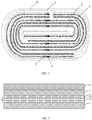
- FIG. 1 shows a cross section of a wound electrode assembly of a lithium-ion battery.
- the cross-section of the wound electrode assembly of the lithium-ion battery includes a first electrode plate 1, a first separator 3, a second electrode plate 2, and a second separator 4 that are arranged in sequence, multiple first tabs 5 arranged on the first electrode plate 1, and multiple second tabs 6 arranged on the second electrode plate 2.
- the second separator 4 is on the outermost side.
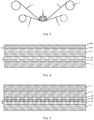
- FIG. 2 is a schematic diagram showing stacking of all layers of the wound electrode assembly of the lithium-ion battery in FIG. 1 .
- the first electrode plate 1 is a positive electrode plate
- the second electrode plate 2 is a negative electrode plate
- the first separator 3 includes a first porous substrate 30, and both surfaces of the first porous substrate 30 are coated with a polymer bonding layer 31 and a polymer bonding layer 32 with an area density of 0.5mg/1540.25mm 2
- the second separator 4 includes a second porous substrate 40, and neither surface of the second porous substrate 40 is coated with a polymer bonding layer.
- FIG. 3 shows a preparation process of a wound electrode assembly.
- the first separator 3 a separator provided with a polymer bonding layer
- the second separator 4 a separator provided with no polymer bonding layer
- the resulting electrode assembly after winding was placed in a housing of an outer packing aluminum-plastic film, leaving a liquid injection hole. After the steps of injecting the electrolyte into the liquid injection hole, packaging, chemical conversion, and capacitance, the lithium-ion battery was obtained.
- FIG. 4 shows an electrode assembly of an electrochemical apparatus according to this example.
- a difference from the electrochemical apparatus in Example 1 was that the electrochemical apparatus in Example 2 had only one surface of the first porous substrate 30 provided with a polymer bonding layer 31.
- one surface of the second porous substrate 40 closer to the second electrode plate 2 was coated with a polymer bonding layer 41, as shown in FIG. 4 .
- a difference from the electrochemical apparatus in Example 1 was that only one surface of the first porous substrate 30 was provided with a polymer bonding layer 31, and an inorganic material layer 34 was arranged between the first porous substrate 30 and the polymer bonding layer 32, as shown in FIG. 5 .
- a difference from the electrochemical apparatus in Example 1 was that one surface of the second porous substrate 40 closer to the second electrode plate 2 was coated with a polymer bonding layer 41, as shown in FIG. 6 .
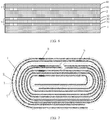
- a difference from the electrochemical apparatus in Example 1 was that tabs were only arranged on the first electrode plate at all layers and the second electrode plate at all layers on one side of a wound electrode assembly, to form a one-side multi-tab structure, and the first separator 3 and the second separator 4 were not connected to each other, as shown in FIG. 7 .
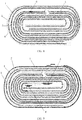
- a difference from the electrochemical apparatus in Example 1 was that tabs were only arranged in the middle part of the positive electrode plate and the negative electrode plate on one side of the wound electrode assembly, and the first separator 3 and the second separator 4 were not connected to each other, as shown in FIG. 8 .
- Example 1 A difference from the electrochemical apparatus in Example 1 was that the wound electrode assembly ended with the first electrode 1 (the positive electrode plate) on the outermost side, and a positive tab and a negative tab were respectively provided on the heads of the positive electrode plate and the negative electrode plate of the wound electrode assembly (a single-tab structure), as shown in FIG. 9 .
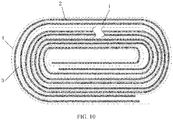
- Example 2 A difference from the electrochemical apparatus in Example 1 was that the wound electrode assembly had a full tab structure, that is, only foil zones without an active material were reserved without any cut tabs, as shown in FIG. 10 .
- a difference from the electrochemical apparatus in Example 1 was that the first porous substrate 30 was used as a first separator 3 and the second porous substrate 40 was used as a second separator 4.
- a difference from the electrochemical apparatus in Example 1 was that both surfaces of the first porous substrate 30 of the first separator 3 were coated with a polymer bonding layer, and both surfaces of the second porous substrate 40 of the second separator 4 were coated with a polymer bonding layer.
- the wound electrode assembly in this application had a good shaping effect after cold pressing. Because the second separator was provided with no polymer bonding layer, no gel was generated during the chemical conversion process of the battery. In addition, the cost of a polymer binder accounts for 30% of the total cost of a separator of the existing lithium-ion batteries.
- This application uses a first separator (a separator with a coating) and a second separator, which can significantly reduce usage of the polymer binder, thereby significantly reducing costs of a lithium-ion battery.
- the following analyzes how an area density of a polymer bonding layer affects performance of an electrode assembly.
- a difference from the electrochemical apparatus in Example 5 was that the area density of the polymer bonding layer was 5mg/1540.25mm 2 , and neither surface of the second separator was provided with a polymer bonding layer.
- a difference from the electrochemical apparatus in Example 5 was that the area density of the polymer bonding layer was 10mg/1540.25mm 2 , and neither surface of the second separator was provided with a polymer bonding layer.
- a difference from the electrochemical apparatus in Example 1 was that the area density of the polymer bonding layer was 0.3mg/1540.25mm 2 , and neither surface of the second separator was provided with a polymer bonding layer.
- a difference from the electrochemical apparatus in Example 1 was that the area density of the polymer bonding layer was 15mg/1540.25mm 2 , and neither surface of the second separator was provided with a polymer bonding layer.
- Electrode assemblies with different area densities of the polymer bonding layer were tested. Test results are shown in Table 2.
- Table 2 Example Area density of polymer bonding layer (mg/1540.25mm 2 ) Cycle performance (cycles) Energy density (kwh/L) Electrode assembly state after cold pressing Example 5 0.5 735 706 Good shaping Example 9 5 766 689 Very good shaping Example 10 10 788 675 Very good shaping Example 11 0.3 634 711 No shaping effect Example 12 15 769 652 Very good shaping
- the electronic apparatus may be a smartphone, an electric vehicle, an electric bicycle, a notebook computer, a camera, an electric toy, a drone, or the like.
Landscapes
- Chemical & Material Sciences (AREA)
- Chemical Kinetics & Catalysis (AREA)
- Electrochemistry (AREA)
- General Chemical & Material Sciences (AREA)
- Engineering & Computer Science (AREA)
- Manufacturing & Machinery (AREA)
- Materials Engineering (AREA)
- Inorganic Chemistry (AREA)
- Secondary Cells (AREA)
- Cell Separators (AREA)
- Battery Electrode And Active Subsutance (AREA)
- Electric Double-Layer Capacitors Or The Like (AREA)
Applications Claiming Priority (1)
| Application Number | Priority Date | Filing Date | Title |
|---|---|---|---|
| CN202011474081.0A CN112768784B (zh) | 2020-12-14 | 2020-12-14 | 一种电化学装置和电子装置 |
Publications (3)
| Publication Number | Publication Date |
|---|---|
| EP3910703A2 true EP3910703A2 (de) | 2021-11-17 |
| EP3910703A3 EP3910703A3 (de) | 2022-03-16 |
| EP3910703B1 EP3910703B1 (de) | 2025-10-15 |
Family
ID=75693865
Family Applications (1)
| Application Number | Title | Priority Date | Filing Date |
|---|---|---|---|
| EP21195132.2A Active EP3910703B1 (de) | 2020-12-14 | 2021-09-06 | Elektrochemische vorrichtung und elektronische vorrichtung |
Country Status (4)
| Country | Link |
|---|---|
| US (1) | US20220190442A1 (de) |
| EP (1) | EP3910703B1 (de) |
| JP (1) | JP7206344B2 (de) |
| CN (1) | CN112768784B (de) |
Cited By (4)
| Publication number | Priority date | Publication date | Assignee | Title |
|---|---|---|---|---|
| EP4336614A3 (de) * | 2022-09-08 | 2024-09-18 | Prime Planet Energy & Solutions, Inc. | Verfahren zur herstellung einer batterie |
| EP4336612A3 (de) * | 2022-09-08 | 2024-09-18 | Prime Planet Energy & Solutions, Inc. | Verfahren zur herstellung einer batterie |
| EP4456228A1 (de) * | 2023-03-15 | 2024-10-30 | SK On Co., Ltd. | Separator für sekundärbatterie und elektrodenanordnung mit dem separator und sekundärbatterie |
| EP4618293A3 (de) * | 2024-03-11 | 2025-10-08 | Ningde Amperex Technology Limited | Sekundärbatterie und elektronische vorrichtung |
Families Citing this family (13)
| Publication number | Priority date | Publication date | Assignee | Title |
|---|---|---|---|---|
| WO2022266866A1 (zh) * | 2021-06-22 | 2022-12-29 | 宁德新能源科技有限公司 | 电化学装置和用电设备 |
| CN113782870B (zh) * | 2021-08-19 | 2023-03-24 | 宁德新能源科技有限公司 | 一种电化学装置以及用电设备 |
| CN113782805B (zh) * | 2021-08-27 | 2023-05-02 | 宁德新能源科技有限公司 | 一种电化学装置以及电子装置 |
| CN114730963B (zh) * | 2021-09-01 | 2026-02-13 | 宁德新能源科技有限公司 | 电化学装置及包含该电化学装置的电子装置 |
| CN113708010B (zh) * | 2021-09-01 | 2023-03-14 | 东莞新能安科技有限公司 | 电化学装置和电子装置 |
| CN115295755A (zh) * | 2022-08-02 | 2022-11-04 | 宁德新能源科技有限公司 | 电化学装置及包含该电化学装置的电子装置 |
| CN115332727B (zh) * | 2022-08-29 | 2024-08-23 | 珠海冠宇电池股份有限公司 | 一种隔膜、卷芯和电池 |
| WO2024049132A1 (ko) * | 2022-09-02 | 2024-03-07 | 삼성전자 주식회사 | 배터리 및 상기 배터리를 포함하는 전자 장치 |
| JP7623985B2 (ja) * | 2022-09-08 | 2025-01-29 | プライムプラネットエナジー&ソリューションズ株式会社 | 電池の製造方法 |
| CN116315456B (zh) * | 2023-05-08 | 2023-08-01 | 合肥长阳新能源科技有限公司 | 一种五层共挤锂电池微孔隔膜及其制备方法 |
| CN116632456B (zh) * | 2023-07-26 | 2023-12-22 | 宁德时代新能源科技股份有限公司 | 电极组件、电池和用电设备 |
| CN118922957B (zh) * | 2023-12-07 | 2025-12-19 | 宁德新能源科技有限公司 | 电化学装置和电子装置 |
| CN117977015A (zh) * | 2024-03-11 | 2024-05-03 | 宁德新能源科技有限公司 | 一种二次电池和电子装置 |
Citations (2)
| Publication number | Priority date | Publication date | Assignee | Title |
|---|---|---|---|---|
| KR20060112738A (ko) * | 2005-04-27 | 2006-11-02 | 삼성에스디아이 주식회사 | 이차 전지 |
| JP5804712B2 (ja) * | 2010-02-08 | 2015-11-04 | 日立マクセル株式会社 | 非水電解質二次電池 |
Family Cites Families (12)
| Publication number | Priority date | Publication date | Assignee | Title |
|---|---|---|---|---|
| TW543225B (en) * | 2002-04-11 | 2003-07-21 | Ind Tech Res Inst | Manufacturing method of rechargeable polymer cell |
| KR101367754B1 (ko) | 2011-07-07 | 2014-02-27 | 주식회사 엘지화학 | 전기화학소자용 전극 조립체 및 이를 구비한 전기화학소자 |
| CN102306841B (zh) * | 2011-08-20 | 2014-10-01 | 惠州Tcl金能电池有限公司 | 一种凝胶态聚合物锂离子电池及其制作方法 |
| KR101557302B1 (ko) * | 2012-11-21 | 2015-10-05 | 주식회사 엘지화학 | 이종 분리막들을 포함하고 있는 전극조립체 및 이를 포함하는 이차전지 |
| JP2015069957A (ja) | 2013-10-01 | 2015-04-13 | 日立マクセル株式会社 | リチウムイオン二次電池用セパレータおよびその製造方法、並びにリチウムイオン二次電池およびその製造方法 |
| KR101676406B1 (ko) * | 2013-10-31 | 2016-11-15 | 주식회사 엘지화학 | 스택-폴딩형 전극 조립체 |
| KR101826894B1 (ko) * | 2013-11-04 | 2018-02-07 | 주식회사 엘지화학 | 전극 조립체 및 이를 제조하는 장치 |
| WO2016051639A1 (ja) | 2014-09-29 | 2016-04-07 | パナソニックIpマネジメント株式会社 | ラミネート電池 |
| WO2017039385A1 (ko) * | 2015-09-02 | 2017-03-09 | 주식회사 엘지화학 | 점착력이 상이한 점착 코팅부들을 포함하는 분리막 및 이를 포함하는 전극조립체 |
| CN107293680B (zh) * | 2016-04-01 | 2020-09-22 | 宁德新能源科技有限公司 | 锂离子电池及其隔离膜 |
| KR102890540B1 (ko) * | 2017-02-22 | 2025-11-26 | 삼성에스디아이 주식회사 | 멀티탭 쇼트 억제 구조를 갖는 이차 전지 |
| CN110452336B (zh) * | 2019-08-15 | 2021-10-01 | 宁德卓高新材料科技有限公司 | 制备改性偏氟乙烯聚合物粉末的方法 |
-
2020
- 2020-12-14 CN CN202011474081.0A patent/CN112768784B/zh active Active
-
2021
- 2021-09-06 EP EP21195132.2A patent/EP3910703B1/de active Active
- 2021-09-10 US US17/471,489 patent/US20220190442A1/en not_active Abandoned
- 2021-09-29 JP JP2021158742A patent/JP7206344B2/ja active Active
Patent Citations (2)
| Publication number | Priority date | Publication date | Assignee | Title |
|---|---|---|---|---|
| KR20060112738A (ko) * | 2005-04-27 | 2006-11-02 | 삼성에스디아이 주식회사 | 이차 전지 |
| JP5804712B2 (ja) * | 2010-02-08 | 2015-11-04 | 日立マクセル株式会社 | 非水電解質二次電池 |
Cited By (4)
| Publication number | Priority date | Publication date | Assignee | Title |
|---|---|---|---|---|
| EP4336614A3 (de) * | 2022-09-08 | 2024-09-18 | Prime Planet Energy & Solutions, Inc. | Verfahren zur herstellung einer batterie |
| EP4336612A3 (de) * | 2022-09-08 | 2024-09-18 | Prime Planet Energy & Solutions, Inc. | Verfahren zur herstellung einer batterie |
| EP4456228A1 (de) * | 2023-03-15 | 2024-10-30 | SK On Co., Ltd. | Separator für sekundärbatterie und elektrodenanordnung mit dem separator und sekundärbatterie |
| EP4618293A3 (de) * | 2024-03-11 | 2025-10-08 | Ningde Amperex Technology Limited | Sekundärbatterie und elektronische vorrichtung |
Also Published As
| Publication number | Publication date |
|---|---|
| JP2022002216A (ja) | 2022-01-06 |
| JP7206344B2 (ja) | 2023-01-17 |
| CN112768784B (zh) | 2022-12-09 |
| CN112768784A (zh) | 2021-05-07 |
| EP3910703A3 (de) | 2022-03-16 |
| EP3910703B1 (de) | 2025-10-15 |
| US20220190442A1 (en) | 2022-06-16 |
Similar Documents
| Publication | Publication Date | Title |
|---|---|---|
| EP3910703B1 (de) | Elektrochemische vorrichtung und elektronische vorrichtung | |
| EP3648204A1 (de) | Kathode, elektrochemische vorrichtung und elektronische vorrichtung damit | |
| CN209045679U (zh) | 电化学装置及包含其的电子装置 | |
| CN105934846B (zh) | 电器件 | |
| CN113675367A (zh) | 正极极片、电化学装置及包含其的电子装置 | |
| US20090311598A1 (en) | Electrode with porous protective film , nonaqueous electrolyte secondary battery, and method for manufacturing electrode with porous protective film | |
| CN114258610B (zh) | 一种电化学装置及电子装置 | |
| JP5444781B2 (ja) | リチウムイオン二次電池用電極及びリチウムイオン二次電池 | |
| CN113594409A (zh) | 极片和锂离子电池 | |
| US20090169986A1 (en) | Non-aqueous secondary battery and method for producing the same | |
| CN105934847B (zh) | 电器件 | |
| CN209045678U (zh) | 正极极片、电化学装置及包含其的电子装置 | |
| CN103904368A (zh) | 锂二次电池 | |
| JP2010225539A (ja) | リチウムイオン二次電池用電極及びリチウムイオン二次電池 | |
| EP4668459A1 (de) | Elektrodenanordnung, batterie und elektrische vorrichtung | |
| JP2010225545A (ja) | リチウムイオン二次電池用電極及びリチウムイオン二次電池 | |
| EP4207427A1 (de) | Elektrodenanordnung und batteriezelle damit | |
| JP7476936B2 (ja) | フィルム外装電池、組電池および前記フィルム外装電池の製造方法 | |
| CN119650867A (zh) | 一种电化学装置及电子装置 | |
| KR102872092B1 (ko) | 저항층이 형성된 전극의 제조방법 | |
| US20230327218A1 (en) | Electrochemical apparatus and electronic apparatus | |
| CN105934845A (zh) | 电器件 | |
| CN108428563B (zh) | 一种锂离子电池电容 | |
| CN110783528A (zh) | 一种锂电池及其制备方法 | |
| KR20230154747A (ko) | 이차전지 |
Legal Events
| Date | Code | Title | Description |
|---|---|---|---|
| PUAI | Public reference made under article 153(3) epc to a published international application that has entered the european phase |
Free format text: ORIGINAL CODE: 0009012 |
|
| STAA | Information on the status of an ep patent application or granted ep patent |
Free format text: STATUS: REQUEST FOR EXAMINATION WAS MADE |
|
| 17P | Request for examination filed |
Effective date: 20210906 |
|
| AK | Designated contracting states |
Kind code of ref document: A2 Designated state(s): AL AT BE BG CH CY CZ DE DK EE ES FI FR GB GR HR HU IE IS IT LI LT LU LV MC MK MT NL NO PL PT RO RS SE SI SK SM TR |
|
| PUAL | Search report despatched |
Free format text: ORIGINAL CODE: 0009013 |
|
| STAA | Information on the status of an ep patent application or granted ep patent |
Free format text: STATUS: EXAMINATION IS IN PROGRESS |
|
| AK | Designated contracting states |
Kind code of ref document: A3 Designated state(s): AL AT BE BG CH CY CZ DE DK EE ES FI FR GB GR HR HU IE IS IT LI LT LU LV MC MK MT NL NO PL PT RO RS SE SI SK SM TR |
|
| RIC1 | Information provided on ipc code assigned before grant |
Ipc: H01M 50/429 20210101ALI20220204BHEP Ipc: H01M 50/414 20210101ALI20220204BHEP Ipc: H01M 50/105 20210101ALI20220204BHEP Ipc: H01M 50/489 20210101ALI20220204BHEP Ipc: H01M 50/46 20210101ALI20220204BHEP Ipc: H01M 10/0587 20100101ALI20220204BHEP Ipc: H01M 50/451 20210101ALI20220204BHEP Ipc: H01M 50/431 20210101ALI20220204BHEP Ipc: H01M 50/411 20210101ALI20220204BHEP Ipc: H01M 10/42 20060101ALI20220204BHEP Ipc: H01M 10/0525 20100101ALI20220204BHEP Ipc: H01M 4/139 20100101ALI20220204BHEP Ipc: H01M 4/13 20100101AFI20220204BHEP |
|
| 17Q | First examination report despatched |
Effective date: 20220302 |
|
| GRAP | Despatch of communication of intention to grant a patent |
Free format text: ORIGINAL CODE: EPIDOSNIGR1 |
|
| STAA | Information on the status of an ep patent application or granted ep patent |
Free format text: STATUS: GRANT OF PATENT IS INTENDED |
|
| INTG | Intention to grant announced |
Effective date: 20250429 |
|
| GRAS | Grant fee paid |
Free format text: ORIGINAL CODE: EPIDOSNIGR3 |
|
| RAP1 | Party data changed (applicant data changed or rights of an application transferred) |
Owner name: NINGDE AMPEREX TECHNOLOGY LIMITED |
|
| GRAA | (expected) grant |
Free format text: ORIGINAL CODE: 0009210 |
|
| STAA | Information on the status of an ep patent application or granted ep patent |
Free format text: STATUS: THE PATENT HAS BEEN GRANTED |
|
| AK | Designated contracting states |
Kind code of ref document: B1 Designated state(s): AL AT BE BG CH CY CZ DE DK EE ES FI FR GB GR HR HU IE IS IT LI LT LU LV MC MK MT NL NO PL PT RO RS SE SI SK SM TR |
|
| RAP3 | Party data changed (applicant data changed or rights of an application transferred) |
Owner name: NINGDE AMPEREX TECHNOLOGY LIMITED |
|
| REG | Reference to a national code |
Ref country code: GB Ref legal event code: FG4D Ref country code: CH Ref legal event code: F10 Free format text: ST27 STATUS EVENT CODE: U-0-0-F10-F00 (AS PROVIDED BY THE NATIONAL OFFICE) Effective date: 20251015 |
|
| P01 | Opt-out of the competence of the unified patent court (upc) registered |
Free format text: CASE NUMBER: UPC_APP_7333_3910703/2025 Effective date: 20250917 |
|
| REG | Reference to a national code |
Ref country code: IE Ref legal event code: FG4D |
|
| REG | Reference to a national code |
Ref country code: DE Ref legal event code: R096 Ref document number: 602021040334 Country of ref document: DE |
|
| REG | Reference to a national code |
Ref country code: NL Ref legal event code: FP |
|
| REG | Reference to a national code |
Ref country code: AT Ref legal event code: MK05 Ref document number: 1847824 Country of ref document: AT Kind code of ref document: T Effective date: 20251015 |