EP3902539B1 - Methods for treating parkinson's disease by administering resiniferatoxin - Google Patents
Methods for treating parkinson's disease by administering resiniferatoxin Download PDFInfo
- Publication number
- EP3902539B1 EP3902539B1 EP19904905.7A EP19904905A EP3902539B1 EP 3902539 B1 EP3902539 B1 EP 3902539B1 EP 19904905 A EP19904905 A EP 19904905A EP 3902539 B1 EP3902539 B1 EP 3902539B1
- Authority
- EP
- European Patent Office
- Prior art keywords
- aav
- rtx
- vehicle
- mice
- null
- Prior art date
- Legal status (The legal status is an assumption and is not a legal conclusion. Google has not performed a legal analysis and makes no representation as to the accuracy of the status listed.)
- Active
Links
Images





Classifications
-
- A—HUMAN NECESSITIES
- A61—MEDICAL OR VETERINARY SCIENCE; HYGIENE
- A61K—PREPARATIONS FOR MEDICAL, DENTAL OR TOILETRY PURPOSES
- A61K31/00—Medicinal preparations containing organic active ingredients
- A61K31/33—Heterocyclic compounds
- A61K31/335—Heterocyclic compounds having oxygen as the only ring hetero atom, e.g. fungichromin
- A61K31/357—Heterocyclic compounds having oxygen as the only ring hetero atom, e.g. fungichromin having two or more oxygen atoms in the same ring, e.g. crown ethers, guanadrel
-
- A—HUMAN NECESSITIES
- A61—MEDICAL OR VETERINARY SCIENCE; HYGIENE
- A61K—PREPARATIONS FOR MEDICAL, DENTAL OR TOILETRY PURPOSES
- A61K9/00—Medicinal preparations characterised by special physical form
- A61K9/0012—Galenical forms characterised by the site of application
- A61K9/0019—Injectable compositions; Intramuscular, intravenous, arterial, subcutaneous administration; Compositions to be administered through the skin in an invasive manner
-
- A—HUMAN NECESSITIES
- A61—MEDICAL OR VETERINARY SCIENCE; HYGIENE
- A61K—PREPARATIONS FOR MEDICAL, DENTAL OR TOILETRY PURPOSES
- A61K9/00—Medicinal preparations characterised by special physical form
- A61K9/0012—Galenical forms characterised by the site of application
- A61K9/0085—Brain, e.g. brain implants; Spinal cord
-
- A—HUMAN NECESSITIES
- A61—MEDICAL OR VETERINARY SCIENCE; HYGIENE
- A61K—PREPARATIONS FOR MEDICAL, DENTAL OR TOILETRY PURPOSES
- A61K9/00—Medicinal preparations characterised by special physical form
- A61K9/08—Solutions
-
- A—HUMAN NECESSITIES
- A61—MEDICAL OR VETERINARY SCIENCE; HYGIENE
- A61P—SPECIFIC THERAPEUTIC ACTIVITY OF CHEMICAL COMPOUNDS OR MEDICINAL PREPARATIONS
- A61P25/00—Drugs for disorders of the nervous system
- A61P25/14—Drugs for disorders of the nervous system for treating abnormal movements, e.g. chorea, dyskinesia
- A61P25/16—Anti-Parkinson drugs
Definitions
- the present invention relates to a composition comprising Resiniferatoxin (RTX) for use in the treatment of Parkinson's Disease in a subject.
- RTX Resiniferatoxin
- RTX acts as an ultrapotent analog of capsaicin, the pungent principal ingredient of the red pepper.
- RTX is a tricyclic diterpene isolated from certain species of Euphorbia.
- a homovanillyl group is an important structural feature of capsaicin and is the most prominent feature distinguishing resiniferatoxin from typical phorbol-related compounds.
- Native RTX has the following structure:
- RTX and analog compounds such as tinyatoxin and other compounds (20-homovanillyl esters of diterpenes such as 12-deoxyphorbol 13-phenylacetate 20-homovanillate and mezerein 20-homovanillate) are described in U.S. Patent Nos. 4,939,194 ; 5,021,450 ; and 5,232,684 .
- Other resiniferatoxin-type phorboid vanilloids have also been identified ( Szallasi et al. (1999) Brit. J. Pharmacol. 128:428-434 ).
- TrpV1 the transient receptor potential cation channel subfamily V member 1 (also known as Vanilloid receptor-1 (VR1)) is a multimeric cation channel prominently expressed in nociceptive primary afferent neurons ( Caterina et al. (1997) Nature 389:816-824 ; Tominaga et al. (1998) Neuron 21:531-543 ).
- Activation of TrpV1 typically occurs at the nerve endings via application of painful heat and is up regulated during certain types of inflammatory stimuli.
- Activation of TrpV1 in peripheral tissues by a chemical agonist results in the opening of calcium channels and the transduction of a pain sensation ( Szalllasi et al. (1999) Mol.
- TrpV1 agonists to the cell body of a neuron (ganglion) expressing TrpV1 opens calcium channels and triggers a cascade of events leading to programmed cell death ("apoptosis") ( Karai et al. (2004) J. of Clin. Invest. 113:1344-1352 ).
- ZhenXiang at al. investigated the potential neuroprotective role of capsaicin in a rat model of 6-hydroxydopamine (6-OHDA)-induced Parkinson's disease.
- Capsaicin was treated intraperitoneally for the 6-OHDA induced PD rats and the locomotor activity and abnormal involuntary movements were found alleviated ( Zhao, ZhenXiang, et al. "Capsaicin protects against oxidative insults and alleviates behavioral deficits in rats with 6-OHDA-induced Parkinson's disease via activation of TRPV1.”
- Neurochemical Research 42 (2017): 3431-3438 investigated the potential neuroprotective role of capsaicin in a rat model of 6-hydroxydopamine (6-OHDA)-induced Parkinson's disease.
- Parkinson's disease is a movement disorder of increasing occurrence in aging populations. Parkinson's disease is a common disabling disease of old age affecting about one percent of the population over the age of 60 in the United States. The incidence of Parkinson's disease increases with age and the cumulative lifetime risk of an individual developing the disease is about 1 in 40. Symptoms include pronounced tremor of the extremities, bradykinesia, rigidity and postural change. A perceived pathophysiological cause of Parkinson's disease is progressive destruction of dopamine producing cells in the basal ganglia which comprise the pars compartum of the substantia nigra, a basal nuclei located in the brain stem. Loss of dopamineric neurons results in a relative excess of acetylcholine. Jellinger, J. Neural. Transm. 56 (Supp);1-29:1999 .
- Parkinson's disease is a progressive disorder which can begin with mild limb stiffness and infrequent tremors and progress over a period of ten or more years to frequent tremors and memory impairment, to uncontrollable tremors and dementia.
- L-dopa levo-dihydroxy-phenylalanine
- sinemet is a dopamine precursor which can cross the blood-brain barrier and be converted to dopamine in the brain.
- L-dopa has a short half life in the body and it is typical after long use (i.e. after about 4-5 years) for the effect of L-dopa to become sporadic and unpredictable, resulting in fluctuations in motor function, dyskinesias and psychiatric side effects. Additionally, L-dopa can cause B vitamin deficiencies to arise.
- Selegiline (Deprenyl, Eldepryl) has been used as an alternative to L-dopa, and acts by reducing the breakdown of dopamine in the brain. Unfortunately, Selegiline becomes ineffective after about nine months of use.
- Apomorphine a dopamine receptor agonist, has been used to treat Parkinson's disease, although is causes severe vomiting when used on its own, as well as skin reactions, infection, drowsiness and some psychiatric side effects.
- Systemically administered anticholinergic drugs have also been used to treat Parkinson's disease and act by reducing the amount of acetylcholine produced in the brain and thereby redress the dopamine/acetylcholine imbalance present in Parkinson's disease.
- systemically administered anticholinergics develop serious neuropsychiatric side effects, including hallucinations, as well as dyskinetic movements, and other effects resulting from wide anticholinergic distribution, including vision effects, difficulty swallowing, dry mouth and urine retention.
- stereotactic surgery offered one of the few treatments for Parkinson's disease.
- Unilateral stereotactic thalamotomy can be effective for controlling contralateral tremor and rigidity but carries a risk of hemiparesis.
- Bilateral thalamotomy carries an increased risk of speech and swallowing disorders resulting.
- Stereotactic pallidotomy surgical ablation of part of the globus pallidus (a basal ganglia), has also be used with some success.
- high frequency stimulating electrodes placed in the ventral intermedialis nucleus has been found to suppress abnormal movements in some cases.
- a variety of techniques exist to permit precise location of a probe including computed tomography and magnetic resonance imaging. Unfortunately, the akinesia, speech and gait disorder symptoms of Parkinson's disease are little helped by these surgical procedures, all of which result in destructive brain lesions.
- Intracranial lesions for the treatment of tremor and other parkinsonian symptoms have been made to the globus pallidus and the ansa lenticularis. Long term results of pallidotomy have sometimes been disappointing. Positive results for the surgical arrest of tremor have been obtained by lesioning the following thalamic nuclei: (1) the ventrointermedius (Vim) or ventral lateral posterior (VLp) nucleus; (2) ventrooralis anterior (Voa) nucleus (Voa and Vop have been collectively termed the ventral lateral anterior nucleus (VLa)); (3) ventrooralis posterior (Vop) nucleus; (4) subthalamic nuclei (campotomy), and; (5) CM-Pf thalamic nuclei.
- the ventrolateral thalamus has been the surgical target of choice in the treatment of Parkinson's disease and other systemically administered, drug resistant tremors. Thalamic excitation of the cortex is necessary for almost all cort
- Stereotactic surgery (assisted by neuroimaging and electrophysiologic recordings) has been used in the management of advanced, pharmacoresistant Parkinson's disease, targeting hyperactive globus pallidus and subthalamic nuclei.
- An electrode or a probe is placed into the brain using a brain atlas for reference with assistance from brain imaging by computer tomography or magnetic resonance imaging.
- Lesions in different parts of the pallidum i.e. posteroventral pallidum
- basal ganglia, thalamus and subthalamic nuclei have been carried out to treat motor disorders of Parkinson's disease.
- surgical brain lesions create a risk of impairment to speech, visual and cognitive brain areas.
- the present disclosure provides a method for treating Parkinson's Disease (PD) comprising administering an effective amount of Resiniferatoxin (RTX) by an intrathecal or an intracisternal administration.
- RTX Resiniferatoxin
- the dose of RTX for an adult human is from about 0.1 ⁇ g to about 100 ⁇ g.
- Embodiment 1 is a method for treating Parkinson's Disease (PD) comprising administering to a subject in need of treatment for PD an effective amount of a composition comprising Resiniferatoxin (RTX) intrathecally or intracisternally.
- PD Parkinson's Disease
- RTX Resiniferatoxin
- Embodiment 2 is a composition comprising resiniferatoxin (RTX) for use in a method of treating a subject in need of treatment for Parkinson's Disease (PD).
- RTX resiniferatoxin
- Embodiment 3 is the composition for use of embodiment 2, wherein the method comprises administering the composition to the subject intrathecally or intracisternally.
- Embodiment 4 is the method of embodiment 1 or composition for use of embodiments 2 or 3, wherein the subject is an adult human.
- Embodiment 5 is the method or composition for use of any one of the preceding embodiments, wherein the RTX is administered in a dose of from about 0.1 ⁇ g to about 100 ⁇ g.
- Embodiment 6 is the method or composition for use of embodiment 5, wherein the dose is from about 0.1 ⁇ g to about 1 ⁇ g, about 1 ⁇ g to about 5 ⁇ g, about 5 ⁇ g to about 10 ⁇ g, about 10 ⁇ g, to about 20 ⁇ g, about 20 ⁇ g to about 50 ⁇ g, or about 50 to about 100 ⁇ g.
- Embodiment 7 is the method or composition for use of any one of the preceding embodiments, wherein the method comprises intrathecal administration.
- Embodiment 8 is the method or composition for use of any one of embodiments 1-6, wherein the method comprises intracisternal administration.
- Embodiment 9 is the method or composition for use of any one of the preceding embodiments, wherein the RTX is administered in a pharmaceutical formulation comprising the RTX and a pharmaceutically acceptable carrier.
- Embodiment 10 is the method or composition for use of embodiment 9, wherein the pharmaceutically acceptable carrier comprises water.
- Embodiment 11 is the method or composition for use of embodiment 9, wherein the pharmaceutically acceptable carrier comprises saline.
- Embodiment 12 is the method or composition for use of any one of embodiments 9-11, wherein the RTX is present in the pharmaceutical formulation at a concentration ranging from 1 ⁇ g/ml to 100 ⁇ g/ml.
- Embodiment 13 is the method or composition for use of embodiment 12, wherein the RTX is present in the pharmaceutical formulation at a concentration ranging from 1 ⁇ g/ml to 5 ⁇ g/ml, 5 ⁇ g/ml to 10 ⁇ g/ml, 10 ⁇ g/ml to 20 ⁇ g/ml, 20 ⁇ g/ml to 50 ⁇ g/ml, or 50 ⁇ g/ml to 100 ⁇ g/ml.
- intrathecally or “intrathecal administration” refers to delivery of a drug or pharmaceutical formulation into the cerebrospinal fluid of the intrathecal space, also known as the subarachnoid space.
- intracisternally or “intracisternal administration” refers to delivery of a drug or pharmaceutical formulation into the cerebrospinal fluid of the brain ventricles.
- Treating is to be understood broadly and encompasses any beneficial effect, including, e.g., delaying, slowing, or arresting the worsening of symptoms associated with PD or remedying such symptoms, at least in part. Treating also encompasses bringing about any form of improved patient function, as discussed in detail below.
- RTX Parkinson's Disease
- the methods described herein are for use with any subject in whom RTX is effective, e.g., able to bind and activate TrpV1 or a homolog thereof, and who is in need of treatment for PD.
- the RTX is administered at a dose of 0.1-100 ⁇ g.
- the dose of RTX ranges from 0.1-0.5 ⁇ g, 0.5-1 ⁇ g, 1-2 ⁇ g, 2-5 ⁇ g, 5-10 ⁇ g, 10-20 ⁇ g, 20-30 ⁇ g, 30-40 ⁇ g, 40-50 ⁇ g, 50-60 ⁇ g, 60-70 ⁇ g, 70-80 ⁇ g, 80-90 ⁇ g, or 90-100 ⁇ g.
- the concentration of RTX in the formulation may be any suitable value for delivery of the intended dose.
- the concentration of RTX in the pharmaceutical formulation is in the range of 0.1 to 300 ⁇ g/ml. In some embodiments, the concentration of RTX in the pharmaceutical formulation is in the range of 0.1-1 ⁇ g/ml, 1-5 ⁇ g/ml, 5-10 ⁇ g/ml, 10-20 ⁇ g/ml, 10-30 ⁇ g/ml, 20-30 ⁇ g/ml, 20-50 ⁇ g/ml, 50-100 ⁇ g/ml, 100-150 ⁇ g/ml, 150-200 ⁇ g/ml, 200-250 ⁇ g/ml, or 250-300 ⁇ g/ml. In some embodiments, the concentration of RTX in the pharmaceutical formulation is in the range of 5-50 ⁇ g/ml, or 8-25 ⁇ g/ml.
- a formulation of RTX for delivery into a subject may be prepared by dilution in an appropriate diluent, such as saline.
- the pharmaceutical formulation comprising the RTX and a pharmaceutically acceptable carrier has a pH in the range of 6 to 7.6.
- the formulation further comprises polysorbate 80 and dextrose.
- the concentration of polysorbate 80 is 2-4% w/v, and/or the concentration of dextrose is 4-6% w/v.
- the concentration of polysorbate 80 is 3% w/v, and/or the concentration of dextrose is 5% w/v.
- the concentration of RTX may be 10-30 ⁇ g/ml, such as 10 ⁇ g/ml or 25 ⁇ g/ml.
- the formulation further comprises phosphate buffer, e.g., at a concentration and pH shown for phosphate buffer in Table 1.
- the formulation further comprises NaCl, e.g., at a concentration shown for NaCl in Table 1.
- the phosphate buffer and NaCl may be (but are not necessarily) present at a combination of concentrations and phosphate buffer pH shown for an individual formulation. Table 1.
- RTX Solution Formulations Formulation Number Formulation Components Component Concentration 1 RTX 200 ⁇ g/mL Polysorbate 80 7.0% w/v Dextrose 0.8% w/v 30 mM Phosphate Buffer w/ 0.44% NaCl 30 mM, pH 7.2 2 RTX 200 ⁇ g/mL Polyethylene Glycol 300 3.0% v/v Polysorbate 80 0.1% w/v Dextrose 0.8% w/v 10 mM Phosphate Buffer w/ 0.73% NaCl 10 mM, pH 6.5 3 RTX 200 ⁇ g/mL Polyethylene Glycol 300 30.0% v/v Polysorbate 80 1.0% w/v 10 mM Phosphate Buffer w/ 0.86% NaCl 10 mM, pH 6.5 4 RTX 200 ⁇ g/mL Polyethylene Glycol 300 30.0% v/v Polysorbate 80 0.04% w/v 10 mM Phosphate Buffer
- RTX for treating PD can be administered intrathecally or intracisternally.
- intrathecal administration when the PD treatment emphasis is on motor coordination in the hands (hand motor coordination is a frequent issue for PD patients) the intrathecal administration should be focused on the cervical or thoracic region of the spinal column. Intracisternal administration is preferred for a whole body approach for PD treatment.
- RTX can be administered intrathecally to the top of the spinal column at C1-C5.
- a method within the scope of the present disclosure can provide improved patient function.
- "Improved patient function” can be defined as an improvement measured by any one or more factors such as a reduced pain, reduced time spent in bed, increased ambulation, healthier attitude, more varied lifestyle and/or healing permitted by normal muscle tone.
- Improved patient function is synonymous with an improved quality of life (QOL).
- QOL can be assessed using, for example, the known SF-12 or SF-36 health survey scoring procedures.
- SF-36 assesses a patient's physical and mental health in the eight domains of physical functioning, role limitations due to physical problems, social functioning, bodily pain, general mental health, role limitations due to emotional problems, vitality, and general health perceptions. Scores obtained can be compared to published values available for various general and patient populations.
- PD Parkinson's Disease
- AAV adenovirus vector
- SN substantia nigra
- the vector contained a construct configured to overexpress mutated human A53T- ⁇ -synuclein, which leads to the degeneration of nigral dopaminergic neurons and reduction of dopamine levels in the striatum. This has been shown to lead to PD-like symptoms including motor deficits.
- mice 126 males and 16 females aged 2 months of age at the start of the study were housed at a standard temperature (22 ⁇ 1 °C) and in a light-controlled environment (lights on from 7 am to 8 pm) with ad libitum access to food and water.
- mice Of the 32 total mice used in the pilot study arm, in total 4 mice died during the 24 hour monitoring period after intrathecal infusion of RTX. Two females treated with 0.125 ⁇ g dose were found dead in cage within 4-24 hours after infusion due to unknown reason. In addition, one female and one male mouse from the same dosing group died immediately after infusion of RTX. No significant adverse effects were observed in the rest of the mice.
- mice a total of 110 male C57Bl/6J mice two months of age were infused with either AAV-A53T (90 mice) or AAV-Null (20 mice) into substantia nigra unilaterally to induce PD-like pathology or to serve as sham controls, respectively.
- Mice infused with AAV-Null (empty) vector (“sham-infused" mice) were used in order to control for the effect of the viral infusion.
- mice were treated with RTX (0.04 ⁇ g or 0.125 ⁇ g) (5 ⁇ L volume, prepared from a 25 ⁇ g/ml RTX solution containing Polysorbate 80 at 0.03% w/v, dextrose at 0.05% w/v, Phosphate Buffer at 30 mM, and NaCl 0.54% w/v, pH 7.2, and diluted in saline as needed) by single intrathecal infusion at lumbar spinal cord area.
- RTX 0.04 ⁇ g or 0.125 ⁇ g
- mice were then treated with RTX or vehicle by intrathecal infusion 7 or 14 days after AAV infusion.
- the mice were assigned to treatment groups as follows:
- mice were anesthetized with 5 % isoflurane (in 70 % N 2 O and 30 % O 2 ; flow 300 ml/min) and placed in a stereotactic frame. During the operation the concentration of anesthetic was reduced to 1 - 1.5 %. The rectal temperature was maintained at 37.0 ⁇ 1.0 °C with a homeothermic blanket system. The skin was opened by a medial incision and retracted laterally. The right brain hemisphere was exposed through a small craniectomy to the skull.
- AAV-Null Empty 5.1 ⁇ 1012 vg/mL
- AAV-A53T 5.1 ⁇ 1012 vg/mL
- a total of 2 ⁇ L of the vector was be infused at a speed of 0.4 ⁇ L/min. After infusion, the cannula was left in place for another 5 min before being withdrawn. The skin was thereafter closed and disinfected. The mice were then allowed to recover from anesthesia and were carefully monitored for possible post-surgical complications. After initial recovery, the animals were returned to the home cages with ad libitum access to food and water.
- mice were administered RTX or vehicle intrathecally 7 or 14 days after AAV-A53T or AAV-Null infusion.
- the mice were anaesthetized using 2 - 5 % isoflurane and set on prone position on the surgery platform.
- Xylocain gel (2 % Lidocain) was introduced to the area. 5 minutes later, gel was removed, and scrubbing by iodine solution was done as antiseptic preparation for skin incision.
- the laminectomy was performed lumbar (L5) level exposing the cord without disrupting the dura mater.
- a cannula attached to a 10 ⁇ L Hamilton syringe mounted on a microinfusion system (Harvard Apparatus) was inserted into the subarachnoid space and advanced to the level of L5-L6, by carefully lowering up to 10 to 15 mm under dura membrane so that opening of the needle was in the desired location. Junction between needle and dura opening was sealed with tissue sealant adhesive (Tisseel ® Duo Quick, Baxter) and infusion was started.
- mice Before AAV and intrathecal infusion surgery, the mice were given buprenorphine (Temgesic ® , 0.06 mg/kg, 2 mL/kg). Additional doses of buprenorphine were administered twice-a-day during the following 48 h resulting in altogether five administrations. All mice were also monitored for dehydration and given 0.9 % sterile saline (i.p.) following surgery and additionally as needed.
- buprenorphine Temgesic ® , 0.06 mg/kg, 2 mL/kg. Additional doses of buprenorphine were administered twice-a-day during the following 48 h resulting in altogether five administrations. All mice were also monitored for dehydration and given 0.9 % sterile saline (i.p.) following surgery and additionally as needed.
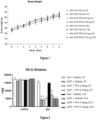
- Body weight of the mice was measured twice-per week (on Mondays and Fridays) for the whole study duration.
- mice 8 Weeks after AAV-A53T infusion, the mice were terminally anesthetized with intraperitoneal injection of pentobarbital (Mebunat ® , Orion Pharma). About 500 ⁇ L of blood was then collected by terminal cardiac puncture and transferred to pre-chilled K 2 -EDTA tubes. Plasma was separated immediately thereafter by centrifugation (2000 g, 10 min +4 °C). Thereafter, 150 ⁇ L of plasma was collected in 2.0 mL polypropylene tubes and frozen on dry ice. The plasma samples were stored at -80 °C until shipped to Sorrento Therapeutics, Inc. on dry ice. After blood collection, the mice were transcardially perfused with heparinized (2.5 IU/mL) saline in order to remove blood from the brain. Immediately after perfusion, the brains were dissected on ice.
- pentobarbital Mebunat ® , Orion Pharma
- Ipsi- and contralateral striatum were collected in 1.5 mL Eppendorf tubes, snap-frozen on dry ice (i.e. left and right separately), weighed and stored at -80 °C for HPLC analysis of dopamine and its metabolites.
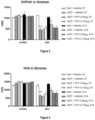
- Dopamine (DA), 3,4-dihydroxyphenylacetic acid (DOPAC) and homovanillic acid (HVA) concentrations in mouse striatal tissue samples were determined by high performance liquid chromatography (HPLC) method with electrochemical detection. After thawing on ice, tissue samples were homogenized (1:10, w/v) in 0.1 M perchloric acid with MSE Soniprep 150 ultrasonic disintegrator (MSE Scientific Instruments, Crawley, UK). Tissue homogenates were centrifuged for 15 min at 15000 g at 4°C.
- the ESA HPLC system (ESA Inc., Chelmsford, MA, USA) consists of a 582 solvent delivery system, a DG-1210 vacuum degasser, an 542 autosampler, a 880 thermostatted chamber, an eight-channel CoulArray ® 5600 electrochemical array detector equipped with a two-channel 5014B microdialysis cell and a CoulArray ® for Windows data acquisition module (version 1.00).
- the applied potentials are -175 mV (channel 1), +225 mV (channel 2), +350 mV (channel 3) and +450 mV (channel 4).
- DA and DOPAC are detected on channel 2 and HVA on channel 3. Injection volume is 10 ⁇ l.
- the analytes were separated on a Zorbax SB-Aq reversed-phase column (2.1 ⁇ 100 mm, 3.5 ⁇ m, Agilent Technologies Inc., Little Falls, Wilmington, DE, USA) with a Zorbax SB-Aq precolumn (2.1 ⁇ 12.5 mm, 5 ⁇ m) in an isocratic run.
- the column was maintained at 35 °C.
- the mobile phase was 100 mM monobasic sodium phosphate containing 4.75 mM citric acid monohydrate, 7 mM 1-octanesulfonic acid and 50 ⁇ M disodium EDTA - acetonitrile mixture (98:2, v/v).
- the pH of the mobile phase was adjusted to 2.2 with o-phosphoric acid.
- the flow rate was 0.3 mL/min.
- the levels of DA, DOPAC and HVA were expressed as nmol/g wet tissue.
- mice The fine motor skills of the mice were evaluated 7 weeks post infusion (MotoRater, TSE Systems, Homburg, Germany) using walking mode. On the day of testing the mice were marked in appropriate points of body, such as joints of limbs and parts of tail to ease the data analysis process.
- the movement data was captured using a high-speed camera (300 frames / second) from three different dimensions, from below and both sides. Different gait patterns and movements were analyzed using a custom-made automated analysis system.
- the analyzed parameters include: 1) general gait pattern parameters (stride time and speed, step width, stance and swing time during a stride, interlimb coordination), 2) body posture and balance (toe clearance, iliac crest and hip height, hind limb protraction and retraction, tail position and movement), and 3) fine motor skills (swing speed during a stride, jerk metric during swing phase, angle ranges and deviations of different joints, vertical and horizontal head movement).
- the gait parameters always have several (and complex) inter-correlations. For example, a shorter stride duration and longer step lengths lead to higher speed.
- Different "gait features", which are manifested in sets of highly correlating parameters, can be identified using Principal Component Analysis (PCA).
- PCA Principal Component Analysis
- Principal Component Analysis is a statistical tool to compact the information in a multivariate data set, reveal correlations between original variables, and ultimately, create a small set of new and sensitive uncorrelated parameters, the principal components (PC).
- PCA is a linear transformation based on principal component coefficients and eigenvectors.
- the transformed, new, uncorrelated variables are called the PC scores.
- the first principal component (PC) corresponds to such linear combination of data which has the largest possible variance.
- the second PC has again the largest possible variance of what is left when the proportion of the first PC is discarded, and so on for the rest of the PCs.
- the eigen vectors also reveal information about the internal structure of the data, i.e., mutually correlated parameters.
- Each PC score represent combined information of all the parameters which are emphasized in the corresponding PC.
- the number of PCs used was determined using Kaiser criterion (eigenvalue > 1.0).
- an overall gait analysis score based on PCA was determined. The score is based on differences between the AAV-null vehicle and the AAV-A53T vehicle groups in all the PC scores (Gait Overall Score), or in those PCs which demonstrate large effect size (Gait Discriminant Score).
- the purpose of that score is to identify a disease model specific combination of original variables - a "fingerprint" - which characterizes the disease model in the best possible way and differentiates the two groups.
- the overall gait analysis scores can be obtained by projecting the (normalized) parameter data of each individual mouse onto the discriminant direction vector.
- the overall kinematic effects of a pharmacological agent can be seen in a highly sensitive manner.
- mice During the study, one mouse was lost from groups 1, 2, 3, 4, 5 and 8. Mice from groups 3, 4 and 8 died during or right after infusion under anesthesia. Mice from groups 1, 2 and 5 were euthanized one day after intrathecal administration due to meeting an end-point criterion.
- AAV-A53T vehicle group was compared to AAV-A53T groups treated with 0.04 ⁇ g or 0.125 ⁇ g of resiniferatoxin to observe possible treatment effects of resiniferatoxin.
- Day 7 and Day 14 groups were analyzed separately.
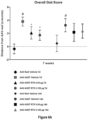
- An overall gait analysis score was established to assess the AAV1/2-A53T-induced gait deficits in vehicle-treated AAV1/2-A53T mice as compared to AAV1/2-Null control group, with emphasis on left-right asymmetry.
- the overall gait score was determined by the discriminant vector which was constructed using PCA and by utilizing the PC score differences of the two groups (pooled from D7 and D14 vehicle treated groups).
- the data set used in PCA consisted of 76 selected parameters; all bilaterally determined parameters were expressed as the difference between the left and right sides. All parameters were normalized to standard scores.
- the discriminant vector bar graph ( Figure 6B ) illustrates the combination of variables which best characterizes and captures the AAV1/2-A53T induced gait changes which can be interpreted as follows: The overall speed (stride time, distance, and speed) was slower and double support phase was increased especially in hindlimbs. Also, the proportion of diagonal support was decreased and support three and four (3 or 4 limbs simultaneously in ground contact) were increased. The most distinct left-right-asymmetries were seen in hip angle (max and range), forelimb toe clearance, hindlimb retraction, and in hind limb swing speeds.
- the overall gait analysis score shows highly significant AAV1/2-A53T-aSyn induced phenotype at both D7 and D14 vehicle treated groups (Unpaired t-test, AAV-Null versus AAV-A53T Vehicle; p ⁇ 0.0001 (D7), p ⁇ 0.01 (D14)).
- mice from the D14 AAV-Null group were excluded from the gait analysis because their gait performance suggested spinal cord injury due to the intrathecal surgical operation. Also, two animals from the D14 AAV-A53T Vehicle group were excluded. Both of these animals had no signs of gait impairments, and the other was confirmed to have likely unsuccessful AAV1/2-A53T transduction as indicated by ipsilateral striatal dopamine concentration at the level of healthy animals.
- the PCA of the gait parameters of D7 and D14 dosing groups using ten Varimax-rotated principal components is shown in Figure 7 .
- the PC scores PC#1 - PC#10 of the fine motor tests are presented at the left (group mean +/- SEM). The PC scores correspond to the PCs shown in the heat map on the right.
- PC#2 can be interpreted as “diagonal inter-limb coordination", including the increase in both the ILC Diagonal and Support Diagonal (diagonal, i.e., trotting cadence), and the decrease of other cadence types.
- the % in brackets behind the PCs on the top of each panel refer to the percentage of variation in the original data that is explained by the respective PC.
- Parkinson's disease-like state was first induced in C57Bl/6J male mice at 8 weeks of age by unilateral adenovirus vector (AAV) infusion to substantia nigra (SN) in the right hemisphere of the brain.
- AAV adenovirus vector
- SN substantia nigra
- Infusion of the vector aimed at overexpressing mutated human A53T- ⁇ -synuclein leading to the degeneration of nigral dopaminergic neurons and reduction of dopamine levels in the striatum. This has been shown to lead in Parkinson's disease-like symptoms including motor deficits.
- control groups of mice infused with AAV-Null (empty) vector were used.
- mice After 7 or 14 days of AAV-A53T mediated disease model induction, the mice were treated with vehicle or resiniferatoxin (RTX, 0.04 ⁇ g or 0.125 ⁇ g) by single intrathecal infusion at lumbar spinal cord area. AAV-Null-treated healthy control mice were treated with vehicle at day 7 or 14.
- RTX resiniferatoxin
- AAV-A53T-mediated disease state was observed as highly significant differences between the AAV-Null and respective AAV-A53T Vehicle groups. Comparing the AAV-A53T Vehicle groups to the resiniferatoxin-treated groups revealed also significant treatment effect of RTX in the early (D7) treatment groups at both low and high dose as the RTX-treated groups were shifted towards the AAV-Null ("healthy") group. In groups treated with RTX 14 days after AAV-A53T infusion, there was a similar however statistically non-significant trend towards the respective AAV-Null group.
- AAV-Null groups had similar levels of dopamine, DOPAC and HVA in ipsilateral and contralateral striata contrary to AAV-A53T infused mice that had significantly lower levels of dopamine and metabolites levels on the ipsilateral side treated with viral vectors with mutated A53T- ⁇ -synuclein. These results indicate that the disease model was induced successfully in both D7 and D14 groups. However, no significant effects of RTX treatment was shown when dopamine and its metabolites levels were compared between the AAV-A53T groups dosed with Vehicle and the corresponding groups treated with RTX. This suggests that the significant mitigating of gait impairments were transmitted through mechanisms not directly related to the nigrostriatal dopaminergic pathway. Neuroinflammation is known to play an important role in PD and its attenuation might be one possible explanation for the observed beneficial effects of RTX.
- D7 fine motor gait analysis data from the study described above was reevaluated to determine how left-right asymmetry is manifested on kinematic parameters instead of assessing changes which occur bilaterally and that are captured in the "normal" overall gait score.
- both the left and right sides of an animal are assessed for test parameters and the overall score and discriminant vector is based on the average of both the left and right-side values for a particular parameter.
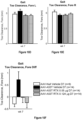
- the maximum hip angle is determined by the average of the left and right-side angle and it is similar in both AAV-Null Vehicle and AAV-A53T Vehicle groups.
- the hip angle max of AAV-A53T Vehicle treated mice is smaller on the left side ( Fig. 8A ) than on the right side ( Fig. 8B ) when compared to AAV-Null mice.
- FIG. 8C shows the maximum left-right difference of hip angle is greatest in AAV-A53T Vehicle treated mice.
- Fine motor gait analysis was performed by creating a discriminant vector using the transformed data set, where left-right difference is used instead of the average of left and right.
- the bar length corresponds to the left-right asymmetry of a parameter which pronounced in the AAV-A53T vehicle group in comparison to the AAV-Null group.
- individual gait parameters used for the PCA analysis are shown for groups dosed on day 7.
- the left-right gait difference discriminant score shows a significant phenotype in the AAV-A53T vehicle group. Both groups treated with RTX showed significantly lower Discriminant Vector Scores compared to the AAV-A53T vehicle group (p ⁇ 0.05, Unpaired t-test).
- Left-right asymmetry was also analyzed for other gait parameters such as interlimb coordination, hip function, swing speeds, and forelimb to clearance.
- Left-right asymmetry manifested on diagonal interlimb coordination is shown in Fig. 10A-10C .
- Graphs of the percentage of diagonal interlimb coordination for the left side and for the right side are shown in Fig. 10A and 10B respectively.
- the diagonal interlimb co-ordination is lower for the left side than the right side for the AAV-A53T vehicle group.
- the left-right difference is shown in Fig. 10C and reveals an RTX treatment effect as the mice in both the low and high RTX dose groups exhibit less of a a diagonal interlimb coordination difference that is in the range of the AAV-A53T Vehicle treated mice.
- the fore toe clearance parameter is shown in Fig. 10D-10F .
- Left side, right side and left-right difference are shown in Fig. 10D, 10E, and 10F , respectively.
- AAV-A53T Vehicle mice showed greater toe clearance on the left side ( Fig. 10D ) than on the right ( Fig. 10E ).
- the left-right difference graph ( Fig. 10F ) showed that both groups of RTX treated mice showed toe clearance similar to AAV-Null Vehicle mice and distinct from the AAV-A53T Vehicle group.
- Fine motor skills were further evaluated by examining left-right asymmetry of the hindlimb peak swing speed and swing speed metric as shown in Fig. 11 A-11-F .
- the graphs of hindlimb peak swing speed (cm/s) for the left side and for the right side are shown in Fig. 11A and 11B respectively.
- the peak swing speed left-right difference of both RTX treated groups is reduced compared to the AAV-A53T Vehicle D7 group as shown in Fig. 11C .
- the graphs of hindlimb swing speed (cm/s) for the left side and for the right side are shown in Fig. 11D and 11E respectively.
- the left-right difference of both RTX treated groups is reduced compared to the AAV-A53T Vehicle D7 group as shown in Fig. 11E .
Landscapes
- Health & Medical Sciences (AREA)
- Veterinary Medicine (AREA)
- Animal Behavior & Ethology (AREA)
- Life Sciences & Earth Sciences (AREA)
- Pharmacology & Pharmacy (AREA)
- General Health & Medical Sciences (AREA)
- Public Health (AREA)
- Chemical & Material Sciences (AREA)
- Medicinal Chemistry (AREA)
- Neurosurgery (AREA)
- Engineering & Computer Science (AREA)
- Neurology (AREA)
- Biomedical Technology (AREA)
- Epidemiology (AREA)
- Bioinformatics & Cheminformatics (AREA)
- Psychology (AREA)
- Organic Chemistry (AREA)
- Nuclear Medicine, Radiotherapy & Molecular Imaging (AREA)
- General Chemical & Material Sciences (AREA)
- Chemical Kinetics & Catalysis (AREA)
- Dermatology (AREA)
- Orthopedic Medicine & Surgery (AREA)
- Acyclic And Carbocyclic Compounds In Medicinal Compositions (AREA)
- Medicinal Preparation (AREA)
- Pharmaceuticals Containing Other Organic And Inorganic Compounds (AREA)
- Medicines That Contain Protein Lipid Enzymes And Other Medicines (AREA)
Applications Claiming Priority (3)
| Application Number | Priority Date | Filing Date | Title |
|---|---|---|---|
| US201862784650P | 2018-12-24 | 2018-12-24 | |
| US201962914170P | 2019-10-11 | 2019-10-11 | |
| PCT/US2019/068235 WO2020139797A1 (en) | 2018-12-24 | 2019-12-23 | Methods for treating parkinson's disease by administering resiniferatoxin |
Publications (3)
| Publication Number | Publication Date |
|---|---|
| EP3902539A1 EP3902539A1 (en) | 2021-11-03 |
| EP3902539A4 EP3902539A4 (en) | 2022-08-24 |
| EP3902539B1 true EP3902539B1 (en) | 2024-07-31 |
Family
ID=71126251
Family Applications (1)
| Application Number | Title | Priority Date | Filing Date |
|---|---|---|---|
| EP19904905.7A Active EP3902539B1 (en) | 2018-12-24 | 2019-12-23 | Methods for treating parkinson's disease by administering resiniferatoxin |
Country Status (8)
| Country | Link |
|---|---|
| US (1) | US12201608B2 (https=) |
| EP (1) | EP3902539B1 (https=) |
| JP (1) | JP7519359B2 (https=) |
| KR (1) | KR20210107086A (https=) |
| CN (1) | CN113473983B (https=) |
| AU (1) | AU2019414329A1 (https=) |
| CA (1) | CA3124499A1 (https=) |
| WO (1) | WO2020139797A1 (https=) |
Families Citing this family (6)
| Publication number | Priority date | Publication date | Assignee | Title |
|---|---|---|---|---|
| KR20210108979A (ko) | 2018-12-21 | 2021-09-03 | 소렌토 쎄라퓨틱스, 인코포레이티드 | 부적응 통증을 치료하기 위한 레시니페라톡신의 신경 주위 투여 |
| US11447444B1 (en) | 2019-01-18 | 2022-09-20 | Centrexion Therapeutics Corporation | Capsaicinoid prodrug compounds and their use in treating medical conditions |
| US11254659B1 (en) | 2019-01-18 | 2022-02-22 | Centrexion Therapeutics Corporation | Capsaicinoid prodrug compounds and their use in treating medical conditions |
| JP7530365B2 (ja) | 2019-01-22 | 2024-08-07 | ソレント・セラピューティクス・インコーポレイテッド | レシニフェラトキシンを投与することによって変形性関節症疼痛を処置するための方法 |
| CA3219312A1 (en) * | 2021-05-18 | 2022-11-24 | Alexis Nahama | Presurgical perineural administration of resiniferatoxin for reduction of post-operative pain |
| WO2025153517A1 (en) | 2024-01-15 | 2025-07-24 | Grünenthal GmbH | Treating knee joint pain by injecting resiniferatoxin at ultra low doses |
Family Cites Families (11)
| Publication number | Priority date | Publication date | Assignee | Title |
|---|---|---|---|---|
| GB2187193B (en) | 1986-02-27 | 1989-11-08 | Gerald Scott | Controllably and swiftly degradable polymer compositions and films and other products made therefrom |
| US5021450A (en) | 1989-05-30 | 1991-06-04 | The United States Of America As Represented By The Secretary Of The Department Of Health And Human Services | New class of compounds having a variable spectrum of activities for capsaicin-like responses, compositions and uses thereof |
| US5232684A (en) | 1990-06-29 | 1993-08-03 | The United States Of America As Represented By The Department Of Health And Human Services | Labelled resiniferatoxin, compositions thereof, and methods for using the same |
| MXPA05006670A (es) * | 2002-12-18 | 2005-10-19 | Algorx Pharmaceuticals Inc | Administracion de capsaicinoides. |
| WO2008109026A1 (en) | 2007-03-05 | 2008-09-12 | Mt Cook Pharma | Pharmaceutical compositions for the localized treatment of neurogenic dysfunction |
| DK2222289T3 (da) * | 2007-11-19 | 2013-10-07 | Nestec Sa | Behandling af oral pharyngeal dysphagi |
| US9956166B2 (en) * | 2013-09-18 | 2018-05-01 | Sorrento Therapeutics, Inc. | Methods for administration and methods for treating cardiovascular diseases with resiniferatoxin |
| CN105017155B (zh) * | 2014-04-16 | 2017-06-16 | 华东师范大学 | 类三环二萜并吡唑衍生物及其制备方法和应用 |
| CA2985235A1 (en) * | 2015-05-07 | 2016-11-10 | Shire Human Genetic Therapies, Inc. | Glucocerebrosidase gene therapy for parkinson's disease |
| PT3302454T (pt) * | 2015-05-26 | 2021-04-01 | Technophage Investig E Desenvolvimento Em Biotecnologia Sa | Composições para utilização no tratamento da doença de parkinson e distúrbios associados |
| CN107126445A (zh) * | 2017-04-20 | 2017-09-05 | 江南大学 | 粪菌移植在治疗帕金森病方面的应用 |
-
2019
- 2019-12-23 WO PCT/US2019/068235 patent/WO2020139797A1/en not_active Ceased
- 2019-12-23 JP JP2021536077A patent/JP7519359B2/ja active Active
- 2019-12-23 KR KR1020217023429A patent/KR20210107086A/ko not_active Ceased
- 2019-12-23 CN CN201980092939.6A patent/CN113473983B/zh active Active
- 2019-12-23 CA CA3124499A patent/CA3124499A1/en active Pending
- 2019-12-23 EP EP19904905.7A patent/EP3902539B1/en active Active
- 2019-12-23 AU AU2019414329A patent/AU2019414329A1/en not_active Abandoned
-
2021
- 2021-06-11 US US17/345,641 patent/US12201608B2/en active Active
Also Published As
| Publication number | Publication date |
|---|---|
| JP2022514695A (ja) | 2022-02-14 |
| US20210299090A1 (en) | 2021-09-30 |
| CA3124499A1 (en) | 2020-07-02 |
| CN113473983A (zh) | 2021-10-01 |
| EP3902539A4 (en) | 2022-08-24 |
| WO2020139797A1 (en) | 2020-07-02 |
| KR20210107086A (ko) | 2021-08-31 |
| EP3902539A1 (en) | 2021-11-03 |
| JP7519359B2 (ja) | 2024-07-19 |
| AU2019414329A1 (en) | 2021-06-10 |
| CN113473983B (zh) | 2024-07-23 |
| US12201608B2 (en) | 2025-01-21 |
Similar Documents
| Publication | Publication Date | Title |
|---|---|---|
| EP3902539B1 (en) | Methods for treating parkinson's disease by administering resiniferatoxin | |
| KR100298808B1 (ko) | 외상손상과관련된신경학적병변의치료를위한,릴루졸을포함하는제약학적조성물 | |
| AU2013295370B2 (en) | Use of biotin for the treatment of multiple sclerosis | |
| CA2761156C (en) | Methods of preventing ischemic injury using peripheral nociceptive stimulation | |
| Niu et al. | Effect of bilateral deep brain stimulation of the subthalamic nucleus on freezing of gait in Parkinson's disease | |
| JP7217259B2 (ja) | てんかん及び関連疾患を患う患者の予防及び治療のためのメセンブレノール及び/又はメセンブラノール | |
| EA012176B1 (ru) | Новое применение пептидных соединений для лечения боли при болезненной диабетической нейропатии | |
| Zou et al. | Effectiveness of deferoxamine on ferric chloride-induced epilepsy in rats | |
| JP2004521112A (ja) | 関節痛治療薬を製造することへの神経毒性物質の使用 | |
| CA2267381A1 (en) | Method for the treatment of neurological or neuropsychiatric disorders | |
| EP3057589B1 (en) | (s)-pirlindole or its pharmaceutically acceptable salts for use in medicine | |
| Sarubbo et al. | Five-year follow-up of 10 patients treated with globus pallidus internus deep brain stimulation for segmental or multisegmental dystonia | |
| JPS59163316A (ja) | けいれんの治療・予防剤 | |
| JP2009534360A (ja) | アルファ−ケトグルタレートを含む組成物およびその筋性能を調節するための使用 | |
| Chang et al. | Combined bilateral anterior cingulotomy and ventral capsule/ventral striatum deep brain stimulation for refractory obsessive-compulsive disorder with major depression: do combined procedures have a long-term benefit? | |
| DE60029463T2 (de) | Behandlung von dyskinesie | |
| KR102693607B1 (ko) | 하지 불안 증후군을 치료하기 위한 치료제 | |
| AU2011285703B2 (en) | Methods and pharmaceutical compositions for treating adverse or deleterious sequellae of traumatic brain injury | |
| KR101796923B1 (ko) | 인삼 열매 추출물을 함유하는 퇴행성 신경장애 치료용 조성물 | |
| JP6243850B2 (ja) | 抗がん剤による末梢神経障害の予防、治療、または軽減剤 | |
| GB2595077A (en) | Combination of gaboxadol and lithium for the treatment of psychiatric disorders | |
| Udall | Toxicology and the Nervous System: Drug-Induced Blindness in Some Experimental Animals and its Relevance to Toxicology | |
| EP1941879A1 (en) | Neuroprotective agent for the treatment of neuronal damage |
Legal Events
| Date | Code | Title | Description |
|---|---|---|---|
| STAA | Information on the status of an ep patent application or granted ep patent |
Free format text: STATUS: THE INTERNATIONAL PUBLICATION HAS BEEN MADE |
|
| PUAI | Public reference made under article 153(3) epc to a published international application that has entered the european phase |
Free format text: ORIGINAL CODE: 0009012 |
|
| STAA | Information on the status of an ep patent application or granted ep patent |
Free format text: STATUS: REQUEST FOR EXAMINATION WAS MADE |
|
| 17P | Request for examination filed |
Effective date: 20210707 |
|
| AK | Designated contracting states |
Kind code of ref document: A1 Designated state(s): AL AT BE BG CH CY CZ DE DK EE ES FI FR GB GR HR HU IE IS IT LI LT LU LV MC MK MT NL NO PL PT RO RS SE SI SK SM TR |
|
| REG | Reference to a national code |
Ref country code: HK Ref legal event code: DE Ref document number: 40053333 Country of ref document: HK |
|
| DAV | Request for validation of the european patent (deleted) | ||
| DAX | Request for extension of the european patent (deleted) | ||
| A4 | Supplementary search report drawn up and despatched |
Effective date: 20220727 |
|
| RIC1 | Information provided on ipc code assigned before grant |
Ipc: A61P 25/16 20060101ALI20220722BHEP Ipc: A61K 9/08 20060101ALI20220722BHEP Ipc: A61K 9/00 20060101ALI20220722BHEP Ipc: A61K 31/357 20060101AFI20220722BHEP |
|
| GRAP | Despatch of communication of intention to grant a patent |
Free format text: ORIGINAL CODE: EPIDOSNIGR1 |
|
| STAA | Information on the status of an ep patent application or granted ep patent |
Free format text: STATUS: GRANT OF PATENT IS INTENDED |
|
| INTG | Intention to grant announced |
Effective date: 20230704 |
|
| GRAJ | Information related to disapproval of communication of intention to grant by the applicant or resumption of examination proceedings by the epo deleted |
Free format text: ORIGINAL CODE: EPIDOSDIGR1 |
|
| STAA | Information on the status of an ep patent application or granted ep patent |
Free format text: STATUS: REQUEST FOR EXAMINATION WAS MADE |
|
| GRAP | Despatch of communication of intention to grant a patent |
Free format text: ORIGINAL CODE: EPIDOSNIGR1 |
|
| STAA | Information on the status of an ep patent application or granted ep patent |
Free format text: STATUS: GRANT OF PATENT IS INTENDED |
|
| INTC | Intention to grant announced (deleted) | ||
| INTG | Intention to grant announced |
Effective date: 20231205 |
|
| GRAS | Grant fee paid |
Free format text: ORIGINAL CODE: EPIDOSNIGR3 |
|
| GRAA | (expected) grant |
Free format text: ORIGINAL CODE: 0009210 |
|
| STAA | Information on the status of an ep patent application or granted ep patent |
Free format text: STATUS: THE PATENT HAS BEEN GRANTED |
|
| AK | Designated contracting states |
Kind code of ref document: B1 Designated state(s): AL AT BE BG CH CY CZ DE DK EE ES FI FR GB GR HR HU IE IS IT LI LT LU LV MC MK MT NL NO PL PT RO RS SE SI SK SM TR |
|
| REG | Reference to a national code |
Ref country code: CH Ref legal event code: EP Ref country code: GB Ref legal event code: FG4D |
|
| REG | Reference to a national code |
Ref country code: DE Ref legal event code: R096 Ref document number: 602019056361 Country of ref document: DE |
|
| REG | Reference to a national code |
Ref country code: IE Ref legal event code: FG4D |
|
| REG | Reference to a national code |
Ref country code: LT Ref legal event code: MG9D |
|
| REG | Reference to a national code |
Ref country code: NL Ref legal event code: MP Effective date: 20240731 |
|
| PG25 | Lapsed in a contracting state [announced via postgrant information from national office to epo] |
Ref country code: PT Free format text: LAPSE BECAUSE OF FAILURE TO SUBMIT A TRANSLATION OF THE DESCRIPTION OR TO PAY THE FEE WITHIN THE PRESCRIBED TIME-LIMIT Effective date: 20241202 |
|
| REG | Reference to a national code |
Ref country code: AT Ref legal event code: MK05 Ref document number: 1707837 Country of ref document: AT Kind code of ref document: T Effective date: 20240731 |
|
| RAP2 | Party data changed (patent owner data changed or rights of a patent transferred) |
Owner name: VIVASOR, INC. |
|
| PG25 | Lapsed in a contracting state [announced via postgrant information from national office to epo] |
Ref country code: PT Free format text: LAPSE BECAUSE OF FAILURE TO SUBMIT A TRANSLATION OF THE DESCRIPTION OR TO PAY THE FEE WITHIN THE PRESCRIBED TIME-LIMIT Effective date: 20241202 |
|
| PG25 | Lapsed in a contracting state [announced via postgrant information from national office to epo] |
Ref country code: NO Free format text: LAPSE BECAUSE OF FAILURE TO SUBMIT A TRANSLATION OF THE DESCRIPTION OR TO PAY THE FEE WITHIN THE PRESCRIBED TIME-LIMIT Effective date: 20241031 |
|
| PG25 | Lapsed in a contracting state [announced via postgrant information from national office to epo] |
Ref country code: GR Free format text: LAPSE BECAUSE OF FAILURE TO SUBMIT A TRANSLATION OF THE DESCRIPTION OR TO PAY THE FEE WITHIN THE PRESCRIBED TIME-LIMIT Effective date: 20241101 Ref country code: NL Free format text: LAPSE BECAUSE OF FAILURE TO SUBMIT A TRANSLATION OF THE DESCRIPTION OR TO PAY THE FEE WITHIN THE PRESCRIBED TIME-LIMIT Effective date: 20240731 Ref country code: FI Free format text: LAPSE BECAUSE OF FAILURE TO SUBMIT A TRANSLATION OF THE DESCRIPTION OR TO PAY THE FEE WITHIN THE PRESCRIBED TIME-LIMIT Effective date: 20240731 Ref country code: PL Free format text: LAPSE BECAUSE OF FAILURE TO SUBMIT A TRANSLATION OF THE DESCRIPTION OR TO PAY THE FEE WITHIN THE PRESCRIBED TIME-LIMIT Effective date: 20240731 |
|
| PG25 | Lapsed in a contracting state [announced via postgrant information from national office to epo] |
Ref country code: BG Free format text: LAPSE BECAUSE OF FAILURE TO SUBMIT A TRANSLATION OF THE DESCRIPTION OR TO PAY THE FEE WITHIN THE PRESCRIBED TIME-LIMIT Effective date: 20240731 |
|
| PG25 | Lapsed in a contracting state [announced via postgrant information from national office to epo] |
Ref country code: LV Free format text: LAPSE BECAUSE OF FAILURE TO SUBMIT A TRANSLATION OF THE DESCRIPTION OR TO PAY THE FEE WITHIN THE PRESCRIBED TIME-LIMIT Effective date: 20240731 |
|
| PG25 | Lapsed in a contracting state [announced via postgrant information from national office to epo] |
Ref country code: AT Free format text: LAPSE BECAUSE OF FAILURE TO SUBMIT A TRANSLATION OF THE DESCRIPTION OR TO PAY THE FEE WITHIN THE PRESCRIBED TIME-LIMIT Effective date: 20240731 Ref country code: IS Free format text: LAPSE BECAUSE OF FAILURE TO SUBMIT A TRANSLATION OF THE DESCRIPTION OR TO PAY THE FEE WITHIN THE PRESCRIBED TIME-LIMIT Effective date: 20241130 |
|
| PG25 | Lapsed in a contracting state [announced via postgrant information from national office to epo] |
Ref country code: HR Free format text: LAPSE BECAUSE OF FAILURE TO SUBMIT A TRANSLATION OF THE DESCRIPTION OR TO PAY THE FEE WITHIN THE PRESCRIBED TIME-LIMIT Effective date: 20240731 |
|
| PG25 | Lapsed in a contracting state [announced via postgrant information from national office to epo] |
Ref country code: ES Free format text: LAPSE BECAUSE OF FAILURE TO SUBMIT A TRANSLATION OF THE DESCRIPTION OR TO PAY THE FEE WITHIN THE PRESCRIBED TIME-LIMIT Effective date: 20240731 Ref country code: RS Free format text: LAPSE BECAUSE OF FAILURE TO SUBMIT A TRANSLATION OF THE DESCRIPTION OR TO PAY THE FEE WITHIN THE PRESCRIBED TIME-LIMIT Effective date: 20241031 |
|
| PG25 | Lapsed in a contracting state [announced via postgrant information from national office to epo] |
Ref country code: RS Free format text: LAPSE BECAUSE OF FAILURE TO SUBMIT A TRANSLATION OF THE DESCRIPTION OR TO PAY THE FEE WITHIN THE PRESCRIBED TIME-LIMIT Effective date: 20241031 Ref country code: PL Free format text: LAPSE BECAUSE OF FAILURE TO SUBMIT A TRANSLATION OF THE DESCRIPTION OR TO PAY THE FEE WITHIN THE PRESCRIBED TIME-LIMIT Effective date: 20240731 Ref country code: NO Free format text: LAPSE BECAUSE OF FAILURE TO SUBMIT A TRANSLATION OF THE DESCRIPTION OR TO PAY THE FEE WITHIN THE PRESCRIBED TIME-LIMIT Effective date: 20241031 Ref country code: NL Free format text: LAPSE BECAUSE OF FAILURE TO SUBMIT A TRANSLATION OF THE DESCRIPTION OR TO PAY THE FEE WITHIN THE PRESCRIBED TIME-LIMIT Effective date: 20240731 Ref country code: LV Free format text: LAPSE BECAUSE OF FAILURE TO SUBMIT A TRANSLATION OF THE DESCRIPTION OR TO PAY THE FEE WITHIN THE PRESCRIBED TIME-LIMIT Effective date: 20240731 Ref country code: IS Free format text: LAPSE BECAUSE OF FAILURE TO SUBMIT A TRANSLATION OF THE DESCRIPTION OR TO PAY THE FEE WITHIN THE PRESCRIBED TIME-LIMIT Effective date: 20241130 Ref country code: HR Free format text: LAPSE BECAUSE OF FAILURE TO SUBMIT A TRANSLATION OF THE DESCRIPTION OR TO PAY THE FEE WITHIN THE PRESCRIBED TIME-LIMIT Effective date: 20240731 Ref country code: GR Free format text: LAPSE BECAUSE OF FAILURE TO SUBMIT A TRANSLATION OF THE DESCRIPTION OR TO PAY THE FEE WITHIN THE PRESCRIBED TIME-LIMIT Effective date: 20241101 Ref country code: FI Free format text: LAPSE BECAUSE OF FAILURE TO SUBMIT A TRANSLATION OF THE DESCRIPTION OR TO PAY THE FEE WITHIN THE PRESCRIBED TIME-LIMIT Effective date: 20240731 Ref country code: ES Free format text: LAPSE BECAUSE OF FAILURE TO SUBMIT A TRANSLATION OF THE DESCRIPTION OR TO PAY THE FEE WITHIN THE PRESCRIBED TIME-LIMIT Effective date: 20240731 Ref country code: BG Free format text: LAPSE BECAUSE OF FAILURE TO SUBMIT A TRANSLATION OF THE DESCRIPTION OR TO PAY THE FEE WITHIN THE PRESCRIBED TIME-LIMIT Effective date: 20240731 Ref country code: AT Free format text: LAPSE BECAUSE OF FAILURE TO SUBMIT A TRANSLATION OF THE DESCRIPTION OR TO PAY THE FEE WITHIN THE PRESCRIBED TIME-LIMIT Effective date: 20240731 |
|
| REG | Reference to a national code |
Ref country code: DE Ref legal event code: R081 Ref document number: 602019056361 Country of ref document: DE Owner name: VIVASOR, INC., SAN DIEGO, US Free format text: FORMER OWNER: SORRENTO THERAPEUTICS, INC., SAN DIEGO, CA, US |
|
| PGFP | Annual fee paid to national office [announced via postgrant information from national office to epo] |
Ref country code: DE Payment date: 20250129 Year of fee payment: 6 |
|
| PG25 | Lapsed in a contracting state [announced via postgrant information from national office to epo] |
Ref country code: RO Free format text: LAPSE BECAUSE OF FAILURE TO SUBMIT A TRANSLATION OF THE DESCRIPTION OR TO PAY THE FEE WITHIN THE PRESCRIBED TIME-LIMIT Effective date: 20240731 Ref country code: SM Free format text: LAPSE BECAUSE OF FAILURE TO SUBMIT A TRANSLATION OF THE DESCRIPTION OR TO PAY THE FEE WITHIN THE PRESCRIBED TIME-LIMIT Effective date: 20240731 Ref country code: DK Free format text: LAPSE BECAUSE OF FAILURE TO SUBMIT A TRANSLATION OF THE DESCRIPTION OR TO PAY THE FEE WITHIN THE PRESCRIBED TIME-LIMIT Effective date: 20240731 |
|
| PG25 | Lapsed in a contracting state [announced via postgrant information from national office to epo] |
Ref country code: EE Free format text: LAPSE BECAUSE OF FAILURE TO SUBMIT A TRANSLATION OF THE DESCRIPTION OR TO PAY THE FEE WITHIN THE PRESCRIBED TIME-LIMIT Effective date: 20240731 |
|
| PGFP | Annual fee paid to national office [announced via postgrant information from national office to epo] |
Ref country code: CH Payment date: 20250130 Year of fee payment: 6 |
|
| PG25 | Lapsed in a contracting state [announced via postgrant information from national office to epo] |
Ref country code: CZ Free format text: LAPSE BECAUSE OF FAILURE TO SUBMIT A TRANSLATION OF THE DESCRIPTION OR TO PAY THE FEE WITHIN THE PRESCRIBED TIME-LIMIT Effective date: 20240731 |
|
| PGFP | Annual fee paid to national office [announced via postgrant information from national office to epo] |
Ref country code: FR Payment date: 20250127 Year of fee payment: 6 |
|
| PG25 | Lapsed in a contracting state [announced via postgrant information from national office to epo] |
Ref country code: IT Free format text: LAPSE BECAUSE OF FAILURE TO SUBMIT A TRANSLATION OF THE DESCRIPTION OR TO PAY THE FEE WITHIN THE PRESCRIBED TIME-LIMIT Effective date: 20240731 Ref country code: SK Free format text: LAPSE BECAUSE OF FAILURE TO SUBMIT A TRANSLATION OF THE DESCRIPTION OR TO PAY THE FEE WITHIN THE PRESCRIBED TIME-LIMIT Effective date: 20240731 |
|
| PGFP | Annual fee paid to national office [announced via postgrant information from national office to epo] |
Ref country code: GB Payment date: 20250127 Year of fee payment: 6 |
|
| REG | Reference to a national code |
Ref country code: DE Ref legal event code: R097 Ref document number: 602019056361 Country of ref document: DE |
|
| PLBE | No opposition filed within time limit |
Free format text: ORIGINAL CODE: 0009261 |
|
| STAA | Information on the status of an ep patent application or granted ep patent |
Free format text: STATUS: NO OPPOSITION FILED WITHIN TIME LIMIT |
|
| PG25 | Lapsed in a contracting state [announced via postgrant information from national office to epo] |
Ref country code: MC Free format text: LAPSE BECAUSE OF FAILURE TO SUBMIT A TRANSLATION OF THE DESCRIPTION OR TO PAY THE FEE WITHIN THE PRESCRIBED TIME-LIMIT Effective date: 20240731 |
|
| 26N | No opposition filed |
Effective date: 20250501 |
|
| PG25 | Lapsed in a contracting state [announced via postgrant information from national office to epo] |
Ref country code: LU Free format text: LAPSE BECAUSE OF NON-PAYMENT OF DUE FEES Effective date: 20241223 |
|
| PG25 | Lapsed in a contracting state [announced via postgrant information from national office to epo] |
Ref country code: SE Free format text: LAPSE BECAUSE OF FAILURE TO SUBMIT A TRANSLATION OF THE DESCRIPTION OR TO PAY THE FEE WITHIN THE PRESCRIBED TIME-LIMIT Effective date: 20240731 |
|
| REG | Reference to a national code |
Ref country code: BE Ref legal event code: MM Effective date: 20241231 |
|
| PG25 | Lapsed in a contracting state [announced via postgrant information from national office to epo] |
Ref country code: BE Free format text: LAPSE BECAUSE OF NON-PAYMENT OF DUE FEES Effective date: 20241231 |
|
| PG25 | Lapsed in a contracting state [announced via postgrant information from national office to epo] |
Ref country code: IE Free format text: LAPSE BECAUSE OF NON-PAYMENT OF DUE FEES Effective date: 20241223 |