EP3892463A1 - Gas barrier film - Google Patents
Gas barrier film Download PDFInfo
- Publication number
- EP3892463A1 EP3892463A1 EP19893482.0A EP19893482A EP3892463A1 EP 3892463 A1 EP3892463 A1 EP 3892463A1 EP 19893482 A EP19893482 A EP 19893482A EP 3892463 A1 EP3892463 A1 EP 3892463A1
- Authority
- EP
- European Patent Office
- Prior art keywords
- resin
- gas barrier
- agent
- coating film
- coating
- Prior art date
- Legal status (The legal status is an assumption and is not a legal conclusion. Google has not performed a legal analysis and makes no representation as to the accuracy of the status listed.)
- Granted
Links
Images

Classifications
-
- C—CHEMISTRY; METALLURGY
- C08—ORGANIC MACROMOLECULAR COMPOUNDS; THEIR PREPARATION OR CHEMICAL WORKING-UP; COMPOSITIONS BASED THEREON
- C08J—WORKING-UP; GENERAL PROCESSES OF COMPOUNDING; AFTER-TREATMENT NOT COVERED BY SUBCLASSES C08B, C08C, C08F, C08G or C08H
- C08J7/00—Chemical treatment or coating of shaped articles made of macromolecular substances
- C08J7/04—Coating
- C08J7/048—Forming gas barrier coatings
-
- B—PERFORMING OPERATIONS; TRANSPORTING
- B32—LAYERED PRODUCTS
- B32B—LAYERED PRODUCTS, i.e. PRODUCTS BUILT-UP OF STRATA OF FLAT OR NON-FLAT, e.g. CELLULAR OR HONEYCOMB, FORM
- B32B15/00—Layered products comprising a layer of metal
- B32B15/04—Layered products comprising a layer of metal comprising metal as the main or only constituent of a layer, which is next to another layer of the same or of a different material
- B32B15/08—Layered products comprising a layer of metal comprising metal as the main or only constituent of a layer, which is next to another layer of the same or of a different material of synthetic resin
-
- B—PERFORMING OPERATIONS; TRANSPORTING
- B32—LAYERED PRODUCTS
- B32B—LAYERED PRODUCTS, i.e. PRODUCTS BUILT-UP OF STRATA OF FLAT OR NON-FLAT, e.g. CELLULAR OR HONEYCOMB, FORM
- B32B15/00—Layered products comprising a layer of metal
- B32B15/20—Layered products comprising a layer of metal comprising aluminium or copper
-
- B—PERFORMING OPERATIONS; TRANSPORTING
- B32—LAYERED PRODUCTS
- B32B—LAYERED PRODUCTS, i.e. PRODUCTS BUILT-UP OF STRATA OF FLAT OR NON-FLAT, e.g. CELLULAR OR HONEYCOMB, FORM
- B32B27/00—Layered products comprising a layer of synthetic resin
- B32B27/06—Layered products comprising a layer of synthetic resin as the main or only constituent of a layer, which is next to another layer of the same or of a different material
- B32B27/08—Layered products comprising a layer of synthetic resin as the main or only constituent of a layer, which is next to another layer of the same or of a different material of synthetic resin
-
- B—PERFORMING OPERATIONS; TRANSPORTING
- B32—LAYERED PRODUCTS
- B32B—LAYERED PRODUCTS, i.e. PRODUCTS BUILT-UP OF STRATA OF FLAT OR NON-FLAT, e.g. CELLULAR OR HONEYCOMB, FORM
- B32B27/00—Layered products comprising a layer of synthetic resin
- B32B27/16—Layered products comprising a layer of synthetic resin specially treated, e.g. irradiated
-
- B—PERFORMING OPERATIONS; TRANSPORTING
- B32—LAYERED PRODUCTS
- B32B—LAYERED PRODUCTS, i.e. PRODUCTS BUILT-UP OF STRATA OF FLAT OR NON-FLAT, e.g. CELLULAR OR HONEYCOMB, FORM
- B32B27/00—Layered products comprising a layer of synthetic resin
- B32B27/18—Layered products comprising a layer of synthetic resin characterised by the use of special additives
-
- B—PERFORMING OPERATIONS; TRANSPORTING
- B32—LAYERED PRODUCTS
- B32B—LAYERED PRODUCTS, i.e. PRODUCTS BUILT-UP OF STRATA OF FLAT OR NON-FLAT, e.g. CELLULAR OR HONEYCOMB, FORM
- B32B27/00—Layered products comprising a layer of synthetic resin
- B32B27/18—Layered products comprising a layer of synthetic resin characterised by the use of special additives
- B32B27/20—Layered products comprising a layer of synthetic resin characterised by the use of special additives using fillers, pigments, thixotroping agents
-
- B—PERFORMING OPERATIONS; TRANSPORTING
- B32—LAYERED PRODUCTS
- B32B—LAYERED PRODUCTS, i.e. PRODUCTS BUILT-UP OF STRATA OF FLAT OR NON-FLAT, e.g. CELLULAR OR HONEYCOMB, FORM
- B32B27/00—Layered products comprising a layer of synthetic resin
- B32B27/18—Layered products comprising a layer of synthetic resin characterised by the use of special additives
- B32B27/24—Layered products comprising a layer of synthetic resin characterised by the use of special additives using solvents or swelling agents
-
- B—PERFORMING OPERATIONS; TRANSPORTING
- B32—LAYERED PRODUCTS
- B32B—LAYERED PRODUCTS, i.e. PRODUCTS BUILT-UP OF STRATA OF FLAT OR NON-FLAT, e.g. CELLULAR OR HONEYCOMB, FORM
- B32B27/00—Layered products comprising a layer of synthetic resin
- B32B27/18—Layered products comprising a layer of synthetic resin characterised by the use of special additives
- B32B27/26—Layered products comprising a layer of synthetic resin characterised by the use of special additives using curing agents
-
- B—PERFORMING OPERATIONS; TRANSPORTING
- B32—LAYERED PRODUCTS
- B32B—LAYERED PRODUCTS, i.e. PRODUCTS BUILT-UP OF STRATA OF FLAT OR NON-FLAT, e.g. CELLULAR OR HONEYCOMB, FORM
- B32B27/00—Layered products comprising a layer of synthetic resin
- B32B27/28—Layered products comprising a layer of synthetic resin comprising synthetic resins not wholly covered by any one of the sub-groups B32B27/30 - B32B27/42
- B32B27/281—Layered products comprising a layer of synthetic resin comprising synthetic resins not wholly covered by any one of the sub-groups B32B27/30 - B32B27/42 comprising polyimides
-
- B—PERFORMING OPERATIONS; TRANSPORTING
- B32—LAYERED PRODUCTS
- B32B—LAYERED PRODUCTS, i.e. PRODUCTS BUILT-UP OF STRATA OF FLAT OR NON-FLAT, e.g. CELLULAR OR HONEYCOMB, FORM
- B32B27/00—Layered products comprising a layer of synthetic resin
- B32B27/30—Layered products comprising a layer of synthetic resin comprising vinyl (co)polymers; comprising acrylic (co)polymers
-
- B—PERFORMING OPERATIONS; TRANSPORTING
- B32—LAYERED PRODUCTS
- B32B—LAYERED PRODUCTS, i.e. PRODUCTS BUILT-UP OF STRATA OF FLAT OR NON-FLAT, e.g. CELLULAR OR HONEYCOMB, FORM
- B32B27/00—Layered products comprising a layer of synthetic resin
- B32B27/30—Layered products comprising a layer of synthetic resin comprising vinyl (co)polymers; comprising acrylic (co)polymers
- B32B27/302—Layered products comprising a layer of synthetic resin comprising vinyl (co)polymers; comprising acrylic (co)polymers comprising aromatic vinyl (co)polymers, e.g. styrenic (co)polymers
-
- B—PERFORMING OPERATIONS; TRANSPORTING
- B32—LAYERED PRODUCTS
- B32B—LAYERED PRODUCTS, i.e. PRODUCTS BUILT-UP OF STRATA OF FLAT OR NON-FLAT, e.g. CELLULAR OR HONEYCOMB, FORM
- B32B27/00—Layered products comprising a layer of synthetic resin
- B32B27/30—Layered products comprising a layer of synthetic resin comprising vinyl (co)polymers; comprising acrylic (co)polymers
- B32B27/306—Layered products comprising a layer of synthetic resin comprising vinyl (co)polymers; comprising acrylic (co)polymers comprising vinyl acetate or vinyl alcohol (co)polymers
-
- B—PERFORMING OPERATIONS; TRANSPORTING
- B32—LAYERED PRODUCTS
- B32B—LAYERED PRODUCTS, i.e. PRODUCTS BUILT-UP OF STRATA OF FLAT OR NON-FLAT, e.g. CELLULAR OR HONEYCOMB, FORM
- B32B27/00—Layered products comprising a layer of synthetic resin
- B32B27/30—Layered products comprising a layer of synthetic resin comprising vinyl (co)polymers; comprising acrylic (co)polymers
- B32B27/308—Layered products comprising a layer of synthetic resin comprising vinyl (co)polymers; comprising acrylic (co)polymers comprising acrylic (co)polymers
-
- B—PERFORMING OPERATIONS; TRANSPORTING
- B32—LAYERED PRODUCTS
- B32B—LAYERED PRODUCTS, i.e. PRODUCTS BUILT-UP OF STRATA OF FLAT OR NON-FLAT, e.g. CELLULAR OR HONEYCOMB, FORM
- B32B27/00—Layered products comprising a layer of synthetic resin
- B32B27/32—Layered products comprising a layer of synthetic resin comprising polyolefins
-
- B—PERFORMING OPERATIONS; TRANSPORTING
- B32—LAYERED PRODUCTS
- B32B—LAYERED PRODUCTS, i.e. PRODUCTS BUILT-UP OF STRATA OF FLAT OR NON-FLAT, e.g. CELLULAR OR HONEYCOMB, FORM
- B32B27/00—Layered products comprising a layer of synthetic resin
- B32B27/34—Layered products comprising a layer of synthetic resin comprising polyamides
-
- B—PERFORMING OPERATIONS; TRANSPORTING
- B32—LAYERED PRODUCTS
- B32B—LAYERED PRODUCTS, i.e. PRODUCTS BUILT-UP OF STRATA OF FLAT OR NON-FLAT, e.g. CELLULAR OR HONEYCOMB, FORM
- B32B27/00—Layered products comprising a layer of synthetic resin
- B32B27/36—Layered products comprising a layer of synthetic resin comprising polyesters
-
- B—PERFORMING OPERATIONS; TRANSPORTING
- B32—LAYERED PRODUCTS
- B32B—LAYERED PRODUCTS, i.e. PRODUCTS BUILT-UP OF STRATA OF FLAT OR NON-FLAT, e.g. CELLULAR OR HONEYCOMB, FORM
- B32B27/00—Layered products comprising a layer of synthetic resin
- B32B27/36—Layered products comprising a layer of synthetic resin comprising polyesters
- B32B27/365—Layered products comprising a layer of synthetic resin comprising polyesters comprising polycarbonates
-
- B—PERFORMING OPERATIONS; TRANSPORTING
- B32—LAYERED PRODUCTS
- B32B—LAYERED PRODUCTS, i.e. PRODUCTS BUILT-UP OF STRATA OF FLAT OR NON-FLAT, e.g. CELLULAR OR HONEYCOMB, FORM
- B32B27/00—Layered products comprising a layer of synthetic resin
- B32B27/40—Layered products comprising a layer of synthetic resin comprising polyurethanes
-
- B—PERFORMING OPERATIONS; TRANSPORTING
- B32—LAYERED PRODUCTS
- B32B—LAYERED PRODUCTS, i.e. PRODUCTS BUILT-UP OF STRATA OF FLAT OR NON-FLAT, e.g. CELLULAR OR HONEYCOMB, FORM
- B32B7/00—Layered products characterised by the relation between layers; Layered products characterised by the relative orientation of features between layers, or by the relative values of a measurable parameter between layers, i.e. products comprising layers having different physical, chemical or physicochemical properties; Layered products characterised by the interconnection of layers
- B32B7/04—Interconnection of layers
- B32B7/12—Interconnection of layers using interposed adhesives or interposed materials with bonding properties
-
- B—PERFORMING OPERATIONS; TRANSPORTING
- B65—CONVEYING; PACKING; STORING; HANDLING THIN OR FILAMENTARY MATERIAL
- B65D—CONTAINERS FOR STORAGE OR TRANSPORT OF ARTICLES OR MATERIALS, e.g. BAGS, BARRELS, BOTTLES, BOXES, CANS, CARTONS, CRATES, DRUMS, JARS, TANKS, HOPPERS, FORWARDING CONTAINERS; ACCESSORIES, CLOSURES, OR FITTINGS THEREFOR; PACKAGING ELEMENTS; PACKAGES
- B65D65/00—Wrappers or flexible covers; Packaging materials of special type or form
- B65D65/38—Packaging materials of special type or form
- B65D65/40—Applications of laminates for particular packaging purposes
-
- B—PERFORMING OPERATIONS; TRANSPORTING
- B65—CONVEYING; PACKING; STORING; HANDLING THIN OR FILAMENTARY MATERIAL
- B65D—CONTAINERS FOR STORAGE OR TRANSPORT OF ARTICLES OR MATERIALS, e.g. BAGS, BARRELS, BOTTLES, BOXES, CANS, CARTONS, CRATES, DRUMS, JARS, TANKS, HOPPERS, FORWARDING CONTAINERS; ACCESSORIES, CLOSURES, OR FITTINGS THEREFOR; PACKAGING ELEMENTS; PACKAGES
- B65D65/00—Wrappers or flexible covers; Packaging materials of special type or form
- B65D65/38—Packaging materials of special type or form
- B65D65/42—Applications of coated or impregnated materials
-
- C—CHEMISTRY; METALLURGY
- C08—ORGANIC MACROMOLECULAR COMPOUNDS; THEIR PREPARATION OR CHEMICAL WORKING-UP; COMPOSITIONS BASED THEREON
- C08G—MACROMOLECULAR COMPOUNDS OBTAINED OTHERWISE THAN BY REACTIONS ONLY INVOLVING UNSATURATED CARBON-TO-CARBON BONDS
- C08G18/00—Polymeric products of isocyanates or isothiocyanates
- C08G18/06—Polymeric products of isocyanates or isothiocyanates with compounds having active hydrogen
- C08G18/08—Processes
- C08G18/0804—Manufacture of polymers containing ionic or ionogenic groups
- C08G18/0819—Manufacture of polymers containing ionic or ionogenic groups containing anionic or anionogenic groups
- C08G18/0823—Manufacture of polymers containing ionic or ionogenic groups containing anionic or anionogenic groups containing carboxylate salt groups or groups forming them
-
- C—CHEMISTRY; METALLURGY
- C08—ORGANIC MACROMOLECULAR COMPOUNDS; THEIR PREPARATION OR CHEMICAL WORKING-UP; COMPOSITIONS BASED THEREON
- C08G—MACROMOLECULAR COMPOUNDS OBTAINED OTHERWISE THAN BY REACTIONS ONLY INVOLVING UNSATURATED CARBON-TO-CARBON BONDS
- C08G18/00—Polymeric products of isocyanates or isothiocyanates
- C08G18/06—Polymeric products of isocyanates or isothiocyanates with compounds having active hydrogen
- C08G18/08—Processes
- C08G18/0838—Manufacture of polymers in the presence of non-reactive compounds
- C08G18/0842—Manufacture of polymers in the presence of non-reactive compounds in the presence of liquid diluents
- C08G18/0861—Manufacture of polymers in the presence of non-reactive compounds in the presence of liquid diluents in the presence of a dispersing phase for the polymers or a phase dispersed in the polymers
- C08G18/0866—Manufacture of polymers in the presence of non-reactive compounds in the presence of liquid diluents in the presence of a dispersing phase for the polymers or a phase dispersed in the polymers the dispersing or dispersed phase being an aqueous medium
-
- C—CHEMISTRY; METALLURGY
- C08—ORGANIC MACROMOLECULAR COMPOUNDS; THEIR PREPARATION OR CHEMICAL WORKING-UP; COMPOSITIONS BASED THEREON
- C08G—MACROMOLECULAR COMPOUNDS OBTAINED OTHERWISE THAN BY REACTIONS ONLY INVOLVING UNSATURATED CARBON-TO-CARBON BONDS
- C08G18/00—Polymeric products of isocyanates or isothiocyanates
- C08G18/06—Polymeric products of isocyanates or isothiocyanates with compounds having active hydrogen
- C08G18/28—Polymeric products of isocyanates or isothiocyanates with compounds having active hydrogen characterised by the compounds used containing active hydrogen
- C08G18/30—Low-molecular-weight compounds
- C08G18/32—Polyhydroxy compounds; Polyamines; Hydroxyamines
- C08G18/3203—Polyhydroxy compounds
- C08G18/3206—Polyhydroxy compounds aliphatic
-
- C—CHEMISTRY; METALLURGY
- C08—ORGANIC MACROMOLECULAR COMPOUNDS; THEIR PREPARATION OR CHEMICAL WORKING-UP; COMPOSITIONS BASED THEREON
- C08G—MACROMOLECULAR COMPOUNDS OBTAINED OTHERWISE THAN BY REACTIONS ONLY INVOLVING UNSATURATED CARBON-TO-CARBON BONDS
- C08G18/00—Polymeric products of isocyanates or isothiocyanates
- C08G18/06—Polymeric products of isocyanates or isothiocyanates with compounds having active hydrogen
- C08G18/28—Polymeric products of isocyanates or isothiocyanates with compounds having active hydrogen characterised by the compounds used containing active hydrogen
- C08G18/30—Low-molecular-weight compounds
- C08G18/32—Polyhydroxy compounds; Polyamines; Hydroxyamines
- C08G18/3271—Hydroxyamines
-
- C—CHEMISTRY; METALLURGY
- C08—ORGANIC MACROMOLECULAR COMPOUNDS; THEIR PREPARATION OR CHEMICAL WORKING-UP; COMPOSITIONS BASED THEREON
- C08G—MACROMOLECULAR COMPOUNDS OBTAINED OTHERWISE THAN BY REACTIONS ONLY INVOLVING UNSATURATED CARBON-TO-CARBON BONDS
- C08G18/00—Polymeric products of isocyanates or isothiocyanates
- C08G18/06—Polymeric products of isocyanates or isothiocyanates with compounds having active hydrogen
- C08G18/28—Polymeric products of isocyanates or isothiocyanates with compounds having active hydrogen characterised by the compounds used containing active hydrogen
- C08G18/30—Low-molecular-weight compounds
- C08G18/34—Carboxylic acids; Esters thereof with monohydroxyl compounds
- C08G18/348—Hydroxycarboxylic acids
-
- C—CHEMISTRY; METALLURGY
- C08—ORGANIC MACROMOLECULAR COMPOUNDS; THEIR PREPARATION OR CHEMICAL WORKING-UP; COMPOSITIONS BASED THEREON
- C08G—MACROMOLECULAR COMPOUNDS OBTAINED OTHERWISE THAN BY REACTIONS ONLY INVOLVING UNSATURATED CARBON-TO-CARBON BONDS
- C08G18/00—Polymeric products of isocyanates or isothiocyanates
- C08G18/06—Polymeric products of isocyanates or isothiocyanates with compounds having active hydrogen
- C08G18/70—Polymeric products of isocyanates or isothiocyanates with compounds having active hydrogen characterised by the isocyanates or isothiocyanates used
- C08G18/72—Polyisocyanates or polyisothiocyanates
- C08G18/721—Two or more polyisocyanates not provided for in one single group C08G18/73 - C08G18/80
- C08G18/724—Combination of aromatic polyisocyanates with (cyclo)aliphatic polyisocyanates
-
- C—CHEMISTRY; METALLURGY
- C08—ORGANIC MACROMOLECULAR COMPOUNDS; THEIR PREPARATION OR CHEMICAL WORKING-UP; COMPOSITIONS BASED THEREON
- C08G—MACROMOLECULAR COMPOUNDS OBTAINED OTHERWISE THAN BY REACTIONS ONLY INVOLVING UNSATURATED CARBON-TO-CARBON BONDS
- C08G18/00—Polymeric products of isocyanates or isothiocyanates
- C08G18/06—Polymeric products of isocyanates or isothiocyanates with compounds having active hydrogen
- C08G18/70—Polymeric products of isocyanates or isothiocyanates with compounds having active hydrogen characterised by the isocyanates or isothiocyanates used
- C08G18/72—Polyisocyanates or polyisothiocyanates
- C08G18/74—Polyisocyanates or polyisothiocyanates cyclic
- C08G18/75—Polyisocyanates or polyisothiocyanates cyclic cycloaliphatic
- C08G18/751—Polyisocyanates or polyisothiocyanates cyclic cycloaliphatic containing only one cycloaliphatic ring
- C08G18/752—Polyisocyanates or polyisothiocyanates cyclic cycloaliphatic containing only one cycloaliphatic ring containing at least one isocyanate or isothiocyanate group linked to the cycloaliphatic ring by means of an aliphatic group
- C08G18/757—Polyisocyanates or polyisothiocyanates cyclic cycloaliphatic containing only one cycloaliphatic ring containing at least one isocyanate or isothiocyanate group linked to the cycloaliphatic ring by means of an aliphatic group containing at least two isocyanate or isothiocyanate groups linked to the cycloaliphatic ring by means of an aliphatic group
-
- C—CHEMISTRY; METALLURGY
- C08—ORGANIC MACROMOLECULAR COMPOUNDS; THEIR PREPARATION OR CHEMICAL WORKING-UP; COMPOSITIONS BASED THEREON
- C08G—MACROMOLECULAR COMPOUNDS OBTAINED OTHERWISE THAN BY REACTIONS ONLY INVOLVING UNSATURATED CARBON-TO-CARBON BONDS
- C08G18/00—Polymeric products of isocyanates or isothiocyanates
- C08G18/06—Polymeric products of isocyanates or isothiocyanates with compounds having active hydrogen
- C08G18/70—Polymeric products of isocyanates or isothiocyanates with compounds having active hydrogen characterised by the isocyanates or isothiocyanates used
- C08G18/72—Polyisocyanates or polyisothiocyanates
- C08G18/74—Polyisocyanates or polyisothiocyanates cyclic
- C08G18/76—Polyisocyanates or polyisothiocyanates cyclic aromatic
- C08G18/7614—Polyisocyanates or polyisothiocyanates cyclic aromatic containing only one aromatic ring
- C08G18/7628—Polyisocyanates or polyisothiocyanates cyclic aromatic containing only one aromatic ring containing at least one isocyanate or isothiocyanate group linked to the aromatic ring by means of an aliphatic group
- C08G18/7642—Polyisocyanates or polyisothiocyanates cyclic aromatic containing only one aromatic ring containing at least one isocyanate or isothiocyanate group linked to the aromatic ring by means of an aliphatic group containing at least two isocyanate or isothiocyanate groups linked to the aromatic ring by means of an aliphatic group having a primary carbon atom next to the isocyanate or isothiocyanate groups, e.g. xylylene diisocyanate or homologues substituted on the aromatic ring
-
- C—CHEMISTRY; METALLURGY
- C08—ORGANIC MACROMOLECULAR COMPOUNDS; THEIR PREPARATION OR CHEMICAL WORKING-UP; COMPOSITIONS BASED THEREON
- C08G—MACROMOLECULAR COMPOUNDS OBTAINED OTHERWISE THAN BY REACTIONS ONLY INVOLVING UNSATURATED CARBON-TO-CARBON BONDS
- C08G18/00—Polymeric products of isocyanates or isothiocyanates
- C08G18/06—Polymeric products of isocyanates or isothiocyanates with compounds having active hydrogen
- C08G18/70—Polymeric products of isocyanates or isothiocyanates with compounds having active hydrogen characterised by the isocyanates or isothiocyanates used
- C08G18/72—Polyisocyanates or polyisothiocyanates
- C08G18/80—Masked polyisocyanates
- C08G18/8003—Masked polyisocyanates masked with compounds having at least two groups containing active hydrogen
- C08G18/8048—Masked polyisocyanates masked with compounds having at least two groups containing active hydrogen with compounds of C08G18/34
-
- C—CHEMISTRY; METALLURGY
- C08—ORGANIC MACROMOLECULAR COMPOUNDS; THEIR PREPARATION OR CHEMICAL WORKING-UP; COMPOSITIONS BASED THEREON
- C08J—WORKING-UP; GENERAL PROCESSES OF COMPOUNDING; AFTER-TREATMENT NOT COVERED BY SUBCLASSES C08B, C08C, C08F, C08G or C08H
- C08J5/00—Manufacture of articles or shaped materials containing macromolecular substances
- C08J5/18—Manufacture of films or sheets
-
- C—CHEMISTRY; METALLURGY
- C08—ORGANIC MACROMOLECULAR COMPOUNDS; THEIR PREPARATION OR CHEMICAL WORKING-UP; COMPOSITIONS BASED THEREON
- C08J—WORKING-UP; GENERAL PROCESSES OF COMPOUNDING; AFTER-TREATMENT NOT COVERED BY SUBCLASSES C08B, C08C, C08F, C08G or C08H
- C08J7/00—Chemical treatment or coating of shaped articles made of macromolecular substances
- C08J7/04—Coating
- C08J7/042—Coating with two or more layers, where at least one layer of a composition contains a polymer binder
- C08J7/0423—Coating with two or more layers, where at least one layer of a composition contains a polymer binder with at least one layer of inorganic material and at least one layer of a composition containing a polymer binder
-
- C—CHEMISTRY; METALLURGY
- C08—ORGANIC MACROMOLECULAR COMPOUNDS; THEIR PREPARATION OR CHEMICAL WORKING-UP; COMPOSITIONS BASED THEREON
- C08J—WORKING-UP; GENERAL PROCESSES OF COMPOUNDING; AFTER-TREATMENT NOT COVERED BY SUBCLASSES C08B, C08C, C08F, C08G or C08H
- C08J7/00—Chemical treatment or coating of shaped articles made of macromolecular substances
- C08J7/04—Coating
- C08J7/0427—Coating with only one layer of a composition containing a polymer binder
-
- C—CHEMISTRY; METALLURGY
- C09—DYES; PAINTS; POLISHES; NATURAL RESINS; ADHESIVES; COMPOSITIONS NOT OTHERWISE PROVIDED FOR; APPLICATIONS OF MATERIALS NOT OTHERWISE PROVIDED FOR
- C09D—COATING COMPOSITIONS, e.g. PAINTS, VARNISHES OR LACQUERS; FILLING PASTES; CHEMICAL PAINT OR INK REMOVERS; INKS; CORRECTING FLUIDS; WOODSTAINS; PASTES OR SOLIDS FOR COLOURING OR PRINTING; USE OF MATERIALS THEREFOR
- C09D129/00—Coating compositions based on homopolymers or copolymers of compounds having one or more unsaturated aliphatic radicals, each having only one carbon-to-carbon double bond, and at least one being terminated by an alcohol, ether, aldehydo, ketonic, acetal, or ketal radical; Coating compositions based on hydrolysed polymers of esters of unsaturated alcohols with saturated carboxylic acids; Coating compositions based on derivatives of such polymers
- C09D129/02—Homopolymers or copolymers of unsaturated alcohols
- C09D129/04—Polyvinyl alcohol; Partially hydrolysed homopolymers or copolymers of esters of unsaturated alcohols with saturated carboxylic acids
-
- C—CHEMISTRY; METALLURGY
- C09—DYES; PAINTS; POLISHES; NATURAL RESINS; ADHESIVES; COMPOSITIONS NOT OTHERWISE PROVIDED FOR; APPLICATIONS OF MATERIALS NOT OTHERWISE PROVIDED FOR
- C09D—COATING COMPOSITIONS, e.g. PAINTS, VARNISHES OR LACQUERS; FILLING PASTES; CHEMICAL PAINT OR INK REMOVERS; INKS; CORRECTING FLUIDS; WOODSTAINS; PASTES OR SOLIDS FOR COLOURING OR PRINTING; USE OF MATERIALS THEREFOR
- C09D175/00—Coating compositions based on polyureas or polyurethanes; Coating compositions based on derivatives of such polymers
- C09D175/04—Polyurethanes
- C09D175/12—Polyurethanes from compounds containing nitrogen and active hydrogen, the nitrogen atom not being part of an isocyanate group
-
- C—CHEMISTRY; METALLURGY
- C09—DYES; PAINTS; POLISHES; NATURAL RESINS; ADHESIVES; COMPOSITIONS NOT OTHERWISE PROVIDED FOR; APPLICATIONS OF MATERIALS NOT OTHERWISE PROVIDED FOR
- C09D—COATING COMPOSITIONS, e.g. PAINTS, VARNISHES OR LACQUERS; FILLING PASTES; CHEMICAL PAINT OR INK REMOVERS; INKS; CORRECTING FLUIDS; WOODSTAINS; PASTES OR SOLIDS FOR COLOURING OR PRINTING; USE OF MATERIALS THEREFOR
- C09D5/00—Coating compositions, e.g. paints, varnishes or lacquers, characterised by their physical nature or the effects produced; Filling pastes
-
- C—CHEMISTRY; METALLURGY
- C09—DYES; PAINTS; POLISHES; NATURAL RESINS; ADHESIVES; COMPOSITIONS NOT OTHERWISE PROVIDED FOR; APPLICATIONS OF MATERIALS NOT OTHERWISE PROVIDED FOR
- C09D—COATING COMPOSITIONS, e.g. PAINTS, VARNISHES OR LACQUERS; FILLING PASTES; CHEMICAL PAINT OR INK REMOVERS; INKS; CORRECTING FLUIDS; WOODSTAINS; PASTES OR SOLIDS FOR COLOURING OR PRINTING; USE OF MATERIALS THEREFOR
- C09D7/00—Features of coating compositions, not provided for in group C09D5/00; Processes for incorporating ingredients in coating compositions
- C09D7/40—Additives
- C09D7/60—Additives non-macromolecular
- C09D7/61—Additives non-macromolecular inorganic
-
- B—PERFORMING OPERATIONS; TRANSPORTING
- B32—LAYERED PRODUCTS
- B32B—LAYERED PRODUCTS, i.e. PRODUCTS BUILT-UP OF STRATA OF FLAT OR NON-FLAT, e.g. CELLULAR OR HONEYCOMB, FORM
- B32B2250/00—Layers arrangement
- B32B2250/02—2 layers
-
- B—PERFORMING OPERATIONS; TRANSPORTING
- B32—LAYERED PRODUCTS
- B32B—LAYERED PRODUCTS, i.e. PRODUCTS BUILT-UP OF STRATA OF FLAT OR NON-FLAT, e.g. CELLULAR OR HONEYCOMB, FORM
- B32B2250/00—Layers arrangement
- B32B2250/03—3 layers
-
- B—PERFORMING OPERATIONS; TRANSPORTING
- B32—LAYERED PRODUCTS
- B32B—LAYERED PRODUCTS, i.e. PRODUCTS BUILT-UP OF STRATA OF FLAT OR NON-FLAT, e.g. CELLULAR OR HONEYCOMB, FORM
- B32B2250/00—Layers arrangement
- B32B2250/24—All layers being polymeric
-
- B—PERFORMING OPERATIONS; TRANSPORTING
- B32—LAYERED PRODUCTS
- B32B—LAYERED PRODUCTS, i.e. PRODUCTS BUILT-UP OF STRATA OF FLAT OR NON-FLAT, e.g. CELLULAR OR HONEYCOMB, FORM
- B32B2255/00—Coating on the layer surface
- B32B2255/10—Coating on the layer surface on synthetic resin layer or on natural or synthetic rubber layer
-
- B—PERFORMING OPERATIONS; TRANSPORTING
- B32—LAYERED PRODUCTS
- B32B—LAYERED PRODUCTS, i.e. PRODUCTS BUILT-UP OF STRATA OF FLAT OR NON-FLAT, e.g. CELLULAR OR HONEYCOMB, FORM
- B32B2255/00—Coating on the layer surface
- B32B2255/20—Inorganic coating
-
- B—PERFORMING OPERATIONS; TRANSPORTING
- B32—LAYERED PRODUCTS
- B32B—LAYERED PRODUCTS, i.e. PRODUCTS BUILT-UP OF STRATA OF FLAT OR NON-FLAT, e.g. CELLULAR OR HONEYCOMB, FORM
- B32B2255/00—Coating on the layer surface
- B32B2255/26—Polymeric coating
-
- B—PERFORMING OPERATIONS; TRANSPORTING
- B32—LAYERED PRODUCTS
- B32B—LAYERED PRODUCTS, i.e. PRODUCTS BUILT-UP OF STRATA OF FLAT OR NON-FLAT, e.g. CELLULAR OR HONEYCOMB, FORM
- B32B2255/00—Coating on the layer surface
- B32B2255/28—Multiple coating on one surface
-
- B—PERFORMING OPERATIONS; TRANSPORTING
- B32—LAYERED PRODUCTS
- B32B—LAYERED PRODUCTS, i.e. PRODUCTS BUILT-UP OF STRATA OF FLAT OR NON-FLAT, e.g. CELLULAR OR HONEYCOMB, FORM
- B32B2264/00—Composition or properties of particles which form a particulate layer or are present as additives
-
- B—PERFORMING OPERATIONS; TRANSPORTING
- B32—LAYERED PRODUCTS
- B32B—LAYERED PRODUCTS, i.e. PRODUCTS BUILT-UP OF STRATA OF FLAT OR NON-FLAT, e.g. CELLULAR OR HONEYCOMB, FORM
- B32B2264/00—Composition or properties of particles which form a particulate layer or are present as additives
- B32B2264/02—Synthetic macromolecular particles
- B32B2264/0214—Particles made of materials belonging to B32B27/00
- B32B2264/0228—Vinyl resin particles, e.g. polyvinyl acetate, polyvinyl alcohol polymers or ethylene-vinyl acetate copolymers
- B32B2264/0235—Aromatic vinyl resin, e.g. styrenic (co)polymers
-
- B—PERFORMING OPERATIONS; TRANSPORTING
- B32—LAYERED PRODUCTS
- B32B—LAYERED PRODUCTS, i.e. PRODUCTS BUILT-UP OF STRATA OF FLAT OR NON-FLAT, e.g. CELLULAR OR HONEYCOMB, FORM
- B32B2264/00—Composition or properties of particles which form a particulate layer or are present as additives
- B32B2264/02—Synthetic macromolecular particles
- B32B2264/0214—Particles made of materials belonging to B32B27/00
- B32B2264/025—Acrylic resin particles, e.g. polymethyl methacrylate or ethylene-acrylate copolymers
-
- B—PERFORMING OPERATIONS; TRANSPORTING
- B32—LAYERED PRODUCTS
- B32B—LAYERED PRODUCTS, i.e. PRODUCTS BUILT-UP OF STRATA OF FLAT OR NON-FLAT, e.g. CELLULAR OR HONEYCOMB, FORM
- B32B2264/00—Composition or properties of particles which form a particulate layer or are present as additives
- B32B2264/02—Synthetic macromolecular particles
- B32B2264/0214—Particles made of materials belonging to B32B27/00
- B32B2264/0264—Polyamide particles
-
- B—PERFORMING OPERATIONS; TRANSPORTING
- B32—LAYERED PRODUCTS
- B32B—LAYERED PRODUCTS, i.e. PRODUCTS BUILT-UP OF STRATA OF FLAT OR NON-FLAT, e.g. CELLULAR OR HONEYCOMB, FORM
- B32B2264/00—Composition or properties of particles which form a particulate layer or are present as additives
- B32B2264/10—Inorganic particles
-
- B—PERFORMING OPERATIONS; TRANSPORTING
- B32—LAYERED PRODUCTS
- B32B—LAYERED PRODUCTS, i.e. PRODUCTS BUILT-UP OF STRATA OF FLAT OR NON-FLAT, e.g. CELLULAR OR HONEYCOMB, FORM
- B32B2264/00—Composition or properties of particles which form a particulate layer or are present as additives
- B32B2264/10—Inorganic particles
- B32B2264/102—Oxide or hydroxide
-
- B—PERFORMING OPERATIONS; TRANSPORTING
- B32—LAYERED PRODUCTS
- B32B—LAYERED PRODUCTS, i.e. PRODUCTS BUILT-UP OF STRATA OF FLAT OR NON-FLAT, e.g. CELLULAR OR HONEYCOMB, FORM
- B32B2264/00—Composition or properties of particles which form a particulate layer or are present as additives
- B32B2264/10—Inorganic particles
- B32B2264/105—Metal
-
- B—PERFORMING OPERATIONS; TRANSPORTING
- B32—LAYERED PRODUCTS
- B32B—LAYERED PRODUCTS, i.e. PRODUCTS BUILT-UP OF STRATA OF FLAT OR NON-FLAT, e.g. CELLULAR OR HONEYCOMB, FORM
- B32B2264/00—Composition or properties of particles which form a particulate layer or are present as additives
- B32B2264/12—Mixture of at least two particles made of different materials
-
- B—PERFORMING OPERATIONS; TRANSPORTING
- B32—LAYERED PRODUCTS
- B32B—LAYERED PRODUCTS, i.e. PRODUCTS BUILT-UP OF STRATA OF FLAT OR NON-FLAT, e.g. CELLULAR OR HONEYCOMB, FORM
- B32B2270/00—Resin or rubber layer containing a blend of at least two different polymers
-
- B—PERFORMING OPERATIONS; TRANSPORTING
- B32—LAYERED PRODUCTS
- B32B—LAYERED PRODUCTS, i.e. PRODUCTS BUILT-UP OF STRATA OF FLAT OR NON-FLAT, e.g. CELLULAR OR HONEYCOMB, FORM
- B32B2307/00—Properties of the layers or laminate
- B32B2307/30—Properties of the layers or laminate having particular thermal properties
-
- B—PERFORMING OPERATIONS; TRANSPORTING
- B32—LAYERED PRODUCTS
- B32B—LAYERED PRODUCTS, i.e. PRODUCTS BUILT-UP OF STRATA OF FLAT OR NON-FLAT, e.g. CELLULAR OR HONEYCOMB, FORM
- B32B2307/00—Properties of the layers or laminate
- B32B2307/30—Properties of the layers or laminate having particular thermal properties
- B32B2307/31—Heat sealable
-
- B—PERFORMING OPERATIONS; TRANSPORTING
- B32—LAYERED PRODUCTS
- B32B—LAYERED PRODUCTS, i.e. PRODUCTS BUILT-UP OF STRATA OF FLAT OR NON-FLAT, e.g. CELLULAR OR HONEYCOMB, FORM
- B32B2307/00—Properties of the layers or laminate
- B32B2307/50—Properties of the layers or laminate having particular mechanical properties
- B32B2307/514—Oriented
- B32B2307/518—Oriented bi-axially
-
- B—PERFORMING OPERATIONS; TRANSPORTING
- B32—LAYERED PRODUCTS
- B32B—LAYERED PRODUCTS, i.e. PRODUCTS BUILT-UP OF STRATA OF FLAT OR NON-FLAT, e.g. CELLULAR OR HONEYCOMB, FORM
- B32B2307/00—Properties of the layers or laminate
- B32B2307/50—Properties of the layers or laminate having particular mechanical properties
- B32B2307/54—Yield strength; Tensile strength
-
- B—PERFORMING OPERATIONS; TRANSPORTING
- B32—LAYERED PRODUCTS
- B32B—LAYERED PRODUCTS, i.e. PRODUCTS BUILT-UP OF STRATA OF FLAT OR NON-FLAT, e.g. CELLULAR OR HONEYCOMB, FORM
- B32B2307/00—Properties of the layers or laminate
- B32B2307/50—Properties of the layers or laminate having particular mechanical properties
- B32B2307/546—Flexural strength; Flexion stiffness
-
- B—PERFORMING OPERATIONS; TRANSPORTING
- B32—LAYERED PRODUCTS
- B32B—LAYERED PRODUCTS, i.e. PRODUCTS BUILT-UP OF STRATA OF FLAT OR NON-FLAT, e.g. CELLULAR OR HONEYCOMB, FORM
- B32B2307/00—Properties of the layers or laminate
- B32B2307/50—Properties of the layers or laminate having particular mechanical properties
- B32B2307/558—Impact strength, toughness
-
- B—PERFORMING OPERATIONS; TRANSPORTING
- B32—LAYERED PRODUCTS
- B32B—LAYERED PRODUCTS, i.e. PRODUCTS BUILT-UP OF STRATA OF FLAT OR NON-FLAT, e.g. CELLULAR OR HONEYCOMB, FORM
- B32B2307/00—Properties of the layers or laminate
- B32B2307/50—Properties of the layers or laminate having particular mechanical properties
- B32B2307/58—Cuttability
- B32B2307/581—Resistant to cut
-
- B—PERFORMING OPERATIONS; TRANSPORTING
- B32—LAYERED PRODUCTS
- B32B—LAYERED PRODUCTS, i.e. PRODUCTS BUILT-UP OF STRATA OF FLAT OR NON-FLAT, e.g. CELLULAR OR HONEYCOMB, FORM
- B32B2307/00—Properties of the layers or laminate
- B32B2307/50—Properties of the layers or laminate having particular mechanical properties
- B32B2307/582—Tearability
- B32B2307/5825—Tear resistant
-
- B—PERFORMING OPERATIONS; TRANSPORTING
- B32—LAYERED PRODUCTS
- B32B—LAYERED PRODUCTS, i.e. PRODUCTS BUILT-UP OF STRATA OF FLAT OR NON-FLAT, e.g. CELLULAR OR HONEYCOMB, FORM
- B32B2307/00—Properties of the layers or laminate
- B32B2307/70—Other properties
- B32B2307/716—Degradable
- B32B2307/7166—Water-soluble, water-dispersible
-
- B—PERFORMING OPERATIONS; TRANSPORTING
- B32—LAYERED PRODUCTS
- B32B—LAYERED PRODUCTS, i.e. PRODUCTS BUILT-UP OF STRATA OF FLAT OR NON-FLAT, e.g. CELLULAR OR HONEYCOMB, FORM
- B32B2307/00—Properties of the layers or laminate
- B32B2307/70—Other properties
- B32B2307/724—Permeability to gases, adsorption
- B32B2307/7242—Non-permeable
- B32B2307/7244—Oxygen barrier
-
- B—PERFORMING OPERATIONS; TRANSPORTING
- B32—LAYERED PRODUCTS
- B32B—LAYERED PRODUCTS, i.e. PRODUCTS BUILT-UP OF STRATA OF FLAT OR NON-FLAT, e.g. CELLULAR OR HONEYCOMB, FORM
- B32B2307/00—Properties of the layers or laminate
- B32B2307/70—Other properties
- B32B2307/724—Permeability to gases, adsorption
- B32B2307/7242—Non-permeable
- B32B2307/7246—Water vapor barrier
-
- B—PERFORMING OPERATIONS; TRANSPORTING
- B32—LAYERED PRODUCTS
- B32B—LAYERED PRODUCTS, i.e. PRODUCTS BUILT-UP OF STRATA OF FLAT OR NON-FLAT, e.g. CELLULAR OR HONEYCOMB, FORM
- B32B2307/00—Properties of the layers or laminate
- B32B2307/70—Other properties
- B32B2307/732—Dimensional properties
-
- B—PERFORMING OPERATIONS; TRANSPORTING
- B32—LAYERED PRODUCTS
- B32B—LAYERED PRODUCTS, i.e. PRODUCTS BUILT-UP OF STRATA OF FLAT OR NON-FLAT, e.g. CELLULAR OR HONEYCOMB, FORM
- B32B2307/00—Properties of the layers or laminate
- B32B2307/70—Other properties
- B32B2307/746—Slipping, anti-blocking, low friction
-
- B—PERFORMING OPERATIONS; TRANSPORTING
- B32—LAYERED PRODUCTS
- B32B—LAYERED PRODUCTS, i.e. PRODUCTS BUILT-UP OF STRATA OF FLAT OR NON-FLAT, e.g. CELLULAR OR HONEYCOMB, FORM
- B32B2439/00—Containers; Receptacles
- B32B2439/70—Food packaging
-
- B—PERFORMING OPERATIONS; TRANSPORTING
- B32—LAYERED PRODUCTS
- B32B—LAYERED PRODUCTS, i.e. PRODUCTS BUILT-UP OF STRATA OF FLAT OR NON-FLAT, e.g. CELLULAR OR HONEYCOMB, FORM
- B32B2439/00—Containers; Receptacles
- B32B2439/80—Medical packaging
-
- B—PERFORMING OPERATIONS; TRANSPORTING
- B32—LAYERED PRODUCTS
- B32B—LAYERED PRODUCTS, i.e. PRODUCTS BUILT-UP OF STRATA OF FLAT OR NON-FLAT, e.g. CELLULAR OR HONEYCOMB, FORM
- B32B2553/00—Packaging equipment or accessories not otherwise provided for
-
- C—CHEMISTRY; METALLURGY
- C08—ORGANIC MACROMOLECULAR COMPOUNDS; THEIR PREPARATION OR CHEMICAL WORKING-UP; COMPOSITIONS BASED THEREON
- C08J—WORKING-UP; GENERAL PROCESSES OF COMPOUNDING; AFTER-TREATMENT NOT COVERED BY SUBCLASSES C08B, C08C, C08F, C08G or C08H
- C08J2323/00—Characterised by the use of homopolymers or copolymers of unsaturated aliphatic hydrocarbons having only one carbon-to-carbon double bond; Derivatives of such polymers
- C08J2323/02—Characterised by the use of homopolymers or copolymers of unsaturated aliphatic hydrocarbons having only one carbon-to-carbon double bond; Derivatives of such polymers not modified by chemical after treatment
- C08J2323/10—Homopolymers or copolymers of propene
- C08J2323/12—Polypropene
-
- C—CHEMISTRY; METALLURGY
- C08—ORGANIC MACROMOLECULAR COMPOUNDS; THEIR PREPARATION OR CHEMICAL WORKING-UP; COMPOSITIONS BASED THEREON
- C08J—WORKING-UP; GENERAL PROCESSES OF COMPOUNDING; AFTER-TREATMENT NOT COVERED BY SUBCLASSES C08B, C08C, C08F, C08G or C08H
- C08J2429/00—Characterised by the use of homopolymers or copolymers of compounds having one or more unsaturated aliphatic radicals, each having only one carbon-to-carbon double bond, and at least one being terminated by an alcohol, ether, aldehydo, ketonic, acetal, or ketal radical; Hydrolysed polymers of esters of unsaturated alcohols with saturated carboxylic acids; Derivatives of such polymer
- C08J2429/02—Homopolymers or copolymers of unsaturated alcohols
- C08J2429/04—Polyvinyl alcohol; Partially hydrolysed homopolymers or copolymers of esters of unsaturated alcohols with saturated carboxylic acids
-
- C—CHEMISTRY; METALLURGY
- C08—ORGANIC MACROMOLECULAR COMPOUNDS; THEIR PREPARATION OR CHEMICAL WORKING-UP; COMPOSITIONS BASED THEREON
- C08J—WORKING-UP; GENERAL PROCESSES OF COMPOUNDING; AFTER-TREATMENT NOT COVERED BY SUBCLASSES C08B, C08C, C08F, C08G or C08H
- C08J2475/00—Characterised by the use of polyureas or polyurethanes; Derivatives of such polymers
- C08J2475/04—Polyurethanes
-
- C—CHEMISTRY; METALLURGY
- C08—ORGANIC MACROMOLECULAR COMPOUNDS; THEIR PREPARATION OR CHEMICAL WORKING-UP; COMPOSITIONS BASED THEREON
- C08J—WORKING-UP; GENERAL PROCESSES OF COMPOUNDING; AFTER-TREATMENT NOT COVERED BY SUBCLASSES C08B, C08C, C08F, C08G or C08H
- C08J2475/00—Characterised by the use of polyureas or polyurethanes; Derivatives of such polymers
- C08J2475/04—Polyurethanes
- C08J2475/12—Polyurethanes from compounds containing nitrogen and active hydrogen, the nitrogen atom not being part of an isocyanate group
-
- C—CHEMISTRY; METALLURGY
- C08—ORGANIC MACROMOLECULAR COMPOUNDS; THEIR PREPARATION OR CHEMICAL WORKING-UP; COMPOSITIONS BASED THEREON
- C08K—Use of inorganic or non-macromolecular organic substances as compounding ingredients
- C08K3/00—Use of inorganic substances as compounding ingredients
- C08K3/34—Silicon-containing compounds
-
- C—CHEMISTRY; METALLURGY
- C08—ORGANIC MACROMOLECULAR COMPOUNDS; THEIR PREPARATION OR CHEMICAL WORKING-UP; COMPOSITIONS BASED THEREON
- C08K—Use of inorganic or non-macromolecular organic substances as compounding ingredients
- C08K3/00—Use of inorganic substances as compounding ingredients
- C08K3/34—Silicon-containing compounds
- C08K3/346—Clay
-
- C—CHEMISTRY; METALLURGY
- C08—ORGANIC MACROMOLECULAR COMPOUNDS; THEIR PREPARATION OR CHEMICAL WORKING-UP; COMPOSITIONS BASED THEREON
- C08K—Use of inorganic or non-macromolecular organic substances as compounding ingredients
- C08K5/00—Use of organic ingredients
- C08K5/16—Nitrogen-containing compounds
- C08K5/29—Compounds containing one or more carbon-to-nitrogen double bonds
-
- C—CHEMISTRY; METALLURGY
- C08—ORGANIC MACROMOLECULAR COMPOUNDS; THEIR PREPARATION OR CHEMICAL WORKING-UP; COMPOSITIONS BASED THEREON
- C08K—Use of inorganic or non-macromolecular organic substances as compounding ingredients
- C08K7/00—Use of ingredients characterised by shape
Definitions
- the present invention relates to gas barrier films.
- the present application is based on and claims the benefits of priorities from earlier Japanese Patent Application Nos. 2018-228408 and 2019-159373 filed in Japan on December 5, 2018 and September 2, 2019, respectively, the descriptions of which are incorporated herein by reference.
- Packaging materials used for packaging food products or pharmaceutical products are required to have properties preventing entry of gases (water vapor, oxygen, etc.) that deteriorate the contents, i.e., are required to have gas barrier properties, to protect the contents from deterioration, decay, and the like, and retain the functions and nature of the contents. Therefore, these packaging materials use films having gas barrier properties (gas barrier films).
- gas barrier films there are known films in which a gas barrier layer made of a material having gas barrier properties is provided on the surface of a resin substrate.
- gas barrier layers there are known metal foils, vapor-deposited metal films, or coating films formed using wet coating methods.
- coating films formed using wet coating methods there are known resin films or inorganic laminar mineral composite resin films as films exhibiting oxygen barrier properties (PTL 1).
- the resin films are formed of a coating agent containing a water-soluble polymer and a resin such as polyvinylidene chloride.
- the inorganic laminar mineral composite resin films are formed of a coating agent containing a water-soluble polymer and an inorganic laminar mineral.
- gas barrier layers there has been proposed a gas barrier layer sequentially including a vapor-deposited inorganic oxide film and a gas barrier composite coating containing an aqueous polymer, inorganic laminar compound, and metal alkoxide (PTL 2), or a gas barrier layer containing a polyvalent metal salt of a carboxylic acid which is a reaction product of a carboxyl group of a polycarboxylic acid polymer with a polyvalent metal compound (PTL 3).
- Gas barrier films including a resin substrate whose surface is provided with a coating film obtained such as through a wet coating method, vapor deposition method, or sputtering method have often suffered from unstable oxygen barrier properties, depending on the production lot. Specifically, this type of gas barrier film has often exhibited oxygen barrier properties which are inferior to the intrinsic oxygen barrier properties assumed from the material forming the coating film and the thickness of the coating film. The issue of inferiority in oxygen barrier properties tends to occur in particular when the thickness of the coating film is reduced.
- the present invention aims to provide a gas barrier film having good oxygen barrier properties which can sufficiently exhibit intrinsic oxygen barrier properties even when the coating film for imparting the oxygen barrier properties is thin.
- the gas barrier film of the present invention achieves good oxygen barrier properties by sufficiently exhibiting intrinsic oxygen barrier properties even if the coating film for imparting the oxygen barrier properties is thin.
- the inventors of the present invention observed surfaces and cross sections of gas barrier films having poor oxygen barrier properties, using an electron microscope. Specifically, such gas barrier films were each electron-microscopically observed using a focused ion/electron beam processing observation device, in portions where an anti-blocking agent (also termed AB agent hereinafter) added to prevent blocking of the resin substrate was present. As a result of the observation, it was confirmed that defects with a width of several micrometers had occurred in portions of each coating film where an AB agent was present. It is considered that these defects became passages for gas permeation and prevented oxygen barrier properties from being sufficiently exhibited.
- an anti-blocking agent also termed AB agent hereinafter
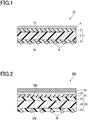
- Fig. 1 is a schematic cross-sectional view illustrating a gas barrier film 10 according to the first embodiment.
- the gas barrier film 10 includes a resin substrate 1 and a coating film 5 (oxygen barrier coating film).
- the coating film 5 is in contact with a first surface 1a of the resin substrate 1.
- the resin substrate 1 includes two or more resin layers including a base layer 4. Specifically, the resin substrate 1 includes the base layer 4, a front layer 2 located on one surface of the base layer 4, and a back layer 3 located on the other surface of the base layer 4.
- the front layer 2 configures the first surface 1a of the resin substrate 1.
- the back layer 3 configures a second surface 1b of the resin substrate 1 facing away from the first surface 1a.
- the resin substrate 1 contains a resin, i.e., the front layer 2, the back layer 3, and the base layer 4 configuring the resin substrate 1 each contain a resin.
- the base layer 4 controls physical characteristics, chemical characteristics, thermal characteristics, optical characteristics, and the like of the resin substrate 1.
- the physical characteristics refer to rigidity, flexibility, stiffness, tear strength, impact strength, puncture strength, pinhole resistance, and the like.
- the chemical characteristics refer to water vapor barrier properties, gas barrier properties, aroma retaining properties, chemical resistance, oil resistance, and the like.
- the thermal characteristics refer to melting temperature, glass-transition temperature, heat-resistance limit, cold-resistance limit, heat shrinkage, and the like.
- the optical characteristics refer to transparency, gloss, and the like.
- the resin as a material for the base layer 4 is preferred to be a polyolefin resin, from the perspective of availability and water vapor barrier properties.
- the resin substrate 1 is preferred to be a polyolefin resin substrate.
- the polyolefin resin may be polyethylene, polypropylene, or the like.
- the polypropylene may be any of a homopolymer, a random copolymer, and a block copolymer.
- a homopolymer is a polypropylene composed of propylene units alone.
- a random copolymer is a polypropylene having a main propylene monomer and a comonomer different from the propylene which are randomly copolymerized, forming a homogeneous phase
- a block copolymer is a polypropylene in which propylene as a main monomer and the above comonomer are copolymerized in blocks or polymerized in a rubber-like manner, forming a heterogeneous phase.
- These polyolefin resins may be used singly or as a mixture of two or more.
- the base layer 4 may contain additives.
- the additive may be appropriately selected from known additives.
- the additives may include anti-blocking agents (AB agents), heat-resistance stabilizers, weather-resistance stabilizers, UV absorbers, lubricants, slip agents, nucleating agents, antistatic agents, anti-fogging agents, pigments, and dyes.
- AB agents anti-blocking agents
- heat-resistance stabilizers heat-resistance stabilizers
- weather-resistance stabilizers weather-resistance stabilizers
- UV absorbers lubricants
- slip agents nucleating agents
- antistatic agents anti-fogging agents
- pigments pigments
- dyes dyes.
- slip agent is preferred from the perspective of processing suitability.
- the content of an additive in the base layer 4 can be appropriately controlled within a range not impairing the advantageous effects of the present invention.
- the base layer 4 does not contain an AB agent.
- the base layer 4 may have a single-layer structure or a multilayer structure.
- the base layer 4 may have a thickness in the range, for example, of 3 ⁇ m to 200 ⁇ m, and more preferably 6 ⁇ m to 30 ⁇ m.
- the resin forming the front layer 2 may be the same as or different from the resin forming the base layer 4.
- the resins forming the front layer 2 and the base layer 4 are polyolefin resins
- the polyolefin resin forming the front layer 2 may have a melting temperature lower than that of the polyolefin resin forming the base layer 4. This is beneficial to improve adhesion between the resin substrate 1 and the coating film 5.
- Examples of the polyolefin resin used for the front layer 2 may include an ethylene-1-butene copolymer, ethylene-propylene-1-butene copolymer, ethylene-acrylic acid copolymer, ionomer obtained by crosslinking an ethylene-acrylic acid copolymer with metal ions, polypropylene, poly(1-butene), 1-butene-ethylene copolymer, propylene-ethylene copolymer, propylene-1-butene copolymer, and propylene-pentene copolymer. These resins may be used singly or as a mixture of two or more.
- the front layer 2 does not contain an AB agent.
- the front layer 2 may contain additives other than an AB agent.
- the additive may be appropriately selected from known additives.
- the additives may include heat-resistance stabilizers, weather-resistance stabilizers, UV absorbers, lubricants, slip agents, nucleating agents, antistatic agents, anti-fogging agents, pigments, and dyes. These additives may be used singly or in combination of two or more. Of these additives, a slip agent is preferred from the perspective of processing suitability.
- the content of an additive in the front layer 2 can be appropriately controlled within a range not impairing the advantageous effects of the present invention.
- the front layer 2 may have a thickness in the range, for example, of 0.1 ⁇ m to 10 ⁇ m, and more preferably 0.5 ⁇ m to 5.0 ⁇ m.
- the resin forming the back layer 3 may be the same as or different from the resin forming the base layer 4, similarly to the resin forming the front layer 2.
- the resins forming the back layer 3 and the base layer 4 are polyolefin resins
- the polyolefin resin forming the back layer 3 may have a melting temperature lower than that of the polyolefin resin forming the base layer 4.
- the polyolefin resin used for the back layer 3 may, for example, be those which are mentioned for the polyolefin resin used for the front layer 2.
- the back layer 3 contains an AB agent 6.
- the AB agent 6 is dispersed in the back layer 3.
- convexities derived from the AB agent 6 are locally present on the second surface 1b of the resin substrate 1. These convexities can minimize blocking in the resin substrate 1 or the gas barrier film 10.
- the AB agent 6 may be exposed at the second surface 1b, or may be covered with resin.
- the AB agent 6 is in the form of solid particles, including organic particles and inorganic particles.
- the organic particles may include polymethylmethacrylate particles, polystyrene particles, and polyamide particles. These organic particles can be obtained through, for example, emulsion polymerization, suspension polymerization, or the like.
- the inorganic particles may be silica particles, zeolite, talc, kaolinite, feldspar, or the like. These AB agents may be used singly or in combination of two or more. When the AB agent 6 is an organic material, polymethylmethacrylate particles are preferred, and when it is an inorganic material, silica particles are preferred.
- the AB agent 6 may typically have an average particle size that is not more than the thickness of the back layer 3.
- the AB agent 6 is preferred to have an average particle size of 0.1 ⁇ m or more and 5 ⁇ m or less, when considering the appearance of the second surface 1b, transparency of the back layer 3, possible loss of the AB agent 6, and anti-blocking performance.
- the front layer 2 does not contain the AB agent 6. Therefore, the higher the anti-blocking performance of the AB agent 6 is in the back layer, the better. From the perspective of anti-blocking performance, the AB agent 6 is particularly preferred to have an average particle size of 2 ⁇ m or more and 5 ⁇ m or less.
- the average particle size of the AB agent 6 is measured using the Coulter principle.
- the addition amount of the AB agent 6 in the back layer 3 may, for example, be in the range of 0.1 mass% to 0.4 mass% relative to the total mass of the back layer 3.
- the addition amount of the AB agent 6 in the back layer 3 can specifically be calculated from the following formula.
- Addition amount of AB agent mass % i / 100 ⁇ ii / 100 ⁇ 100
- (i) indicates a concentration (mass%) of the AB agent in masterbatch resin chips in a pellet form obtained by adding an AB agent to a resin, agitating the mixture, and kneading and melt-extruding the agitated mixture using an extruder.
- (ii) indicates a concentration (mass%) of AB agent-containing masterbatch resin chips relative to the total mass of resin pellets forming the back layer 3, when blending the AB agent-containing masterbatch resin chips with a resin that does not contain an AB agent.
- the back layer 3 may contain additives other than an AB agent.
- the additives may be ones similar to those mentioned above.
- the content of an additives in the back layer 3 can be appropriately controlled within a range not impairing the advantageous effects of the present invention.
- the back layer 3 may have a thickness in the range, for example, of 0.1 ⁇ m to 10 ⁇ m, and more preferably 0.5 ⁇ m to 5.0 ⁇ m.
- the thickness of the back layer 3 is a thickness in portions where there are no convexities derived from the AB agent 6.
- the resin substrate 1 is preferred to be a coextruded film in which the front layer 2, the back layer 3, and the base layer 4 are laminated by coextrusion.
- the resin substrate 1 may be a stretched film or may be an unstretched film.
- the resin substrate 1 is preferred to include a biaxially stretched polypropylene film.
- Biaxially stretched polypropylene films have superiority in water vapor barrier performance in particular. Therefore, including a biaxially stretched polypropylene film can improve water vapor barrier properties of the gas barrier film 10.
- the biaxially stretched polypropylene film may be a film obtained by processing at least one of homopolymers, random copolymers, block copolymers, and the like.
- the biaxially stretched polypropylene film is preferred to be a coextruded film.
- the resin substrate including a biaxially stretched polyolefin film may be a biaxially stretched polypropylene film, or may be a laminate of a biaxially stretched polypropylene film and other resin films.
- other resin films include polyester films such as of polyethylene terephthalate and polyethylene naphthalate; polyolefin films such as of polyethylene; polystyrene films; polyamide films such as of nylon; polycarbonate films, and engineering plastic films such as polyacrylonitrile films and polyimide films.
- the thickness of the resin substrate 1 can be controlled according to usage, required characteristics, and the like, and may, for example, be in the range of 3 ⁇ m to 200 ⁇ m, and more preferably 6 ⁇ m to 30 ⁇ m, but is not particularly limited to these ranges.
- the thickness of the resin substrate 1 is a thickness in portions where there are no convexities derived from the AB agent 6.
- the surfaces of the resin substrate 1 may be subjected to at least one treatment selected from the group consisting of chemical treatment, solvent treatment, corona treatment, plasma treatment, and ozone treatment.
- the coating film 5 may be a coating film known as an oxygen barrier coating film formed using a wet coating method.
- the coating film 5 can be obtained by forming a coating of a coating agent on the first surface a of the resin substrate 1 using a wet coating method, and drying the coating. It should be noted that a coating refers to a wet film, and a coating film refers to a dry film.
- the coating film 5 is preferred to be a coating film formed of a coating agent containing a water-soluble polymer and an inorganic laminar mineral (inorganic laminar mineral composite resin film).
- Gas barrier films including an inorganic laminar mineral composite resin film as a gas barrier layer have advantages, such as exhibiting good oxygen barrier properties in a high humidity atmosphere, having sufficient adhesion strength or film cohesive strength, as a packaging material for other materials, having transparency and stretch resistance that cannot be found in metal foils or vapor-deposited metal films, having no risk of generating harmful substances such as dioxins, and other advantages. Details of the coating agent will be described later.
- the thickness of the coating film 5, i.e., the dry thickness of the coating of a coating agent, may be determined according to required oxygen barrier properties, and may be in the range of 0.2 ⁇ m to 5 ⁇ m, for example.
- the thickness of the coating film 5 is preferred to be in the range of 0.2 ⁇ m to 0.7 ⁇ m, and more preferably 0.3 ⁇ m to 0.5 ⁇ m. If the thickness of the coating film 5 is 0.2 ⁇ m or more, sufficient oxygen barrier properties are easily obtained.
- the thickness of the coating film 5 is 0.7 ⁇ m or less, oxygen barrier properties on the first surface 1a may be greatly affected by the presence or absence of the convexities derived from the AB agent, and usefulness of the present invention may be enhanced. If the thickness of the coating film 5 is 0.7 ⁇ m or less, a uniform coating surface can be easily formed, and drying load and manufacturing cost can be reduced.
- the gas barrier film 10 can be produced by forming a coating film 5 on the first surface a of the resin substrate 1.
- the resin substrate 1 may be a commercially available resin substrate, or may be a resin substrate produced using a known method.
- the coating film 5 can be obtained by forming a coating of a coating agent on the first surface a of the resin substrate 1 using a wet coating method, and drying the coating.
- the wet coating method may be a known wet coating method, such as roll coating, gravure coating, reverse coating, die coating, screen printing, or spray coating.
- the method of drying the coating film of the coating agent may be a known drying method, such as hot-air drying, hot-roll drying, or infrared radiation. Drying conditions may be 90°C and 10 seconds, for example.
- a preferred mode of a coating agent is a coating agent containing a water-soluble polymer and an inorganic laminar mineral.
- the coating agent of the present mode further contains an aqueous medium.
- the coating agent of the present mode is preferred to further contain an aqueous polyurethane resin.
- the coating agent of the present mode is preferred to further contain a curing agent.
- the coating agent of the present mode may further contain other components.
- the water-soluble polymer refers to a polymer that is soluble in water.
- soluble refers to a state in which a polymer as a solute is dispersed at the molecular chain level in water as a solvent to form a homogeneous system.
- soluble refers to a state in which a polymer is homogeneously dispersed in water with the polymer chains being disentangled as a result of the intermolecular force between a polymer chain and a water molecule becoming stronger than the intermolecular force between molecular chains of the polymer chains.
- the water-soluble polymer is not particularly limited as long as it can be inserted or coordinated (intercalated) between crystal units of an inorganic laminar mineral.
- water-soluble polymer examples include polyvinyl alcohol resins (polyvinyl alcohols, derivatives thereof, etc.), other vinyl polymers (polyvinylpyrrolidone, polyacrylic acid, polymethacrylic acid or ethers and salts of polymethacrylic acid, and copolymers thereof, polyhydroxyethyl methacrylate and copolymers thereof, etc.), cellulose derivatives (carboxymethylcellulose, hydroxyethylcellulose, etc.), starches (oxidized starches, etherified starches, dextrin, etc.), copolymerized polyester having a polar group (polyester having a sulfoisophthalic acid structure, etc.), urethane polymers, and functional group modified polymers in which carboxyl groups or the like of these various polymers are modified.
- polyvinyl alcohol resins polyvinyl alcohols, derivatives thereof, etc.
- other vinyl polymers polyvinylpyrrolidone, polyacrylic acid, polymethacryl
- the water-soluble polymer is preferred to have a polymerization degree of 200 or more.
- the coating agent of the present mode may contain one, or two or more water-soluble polymers.
- the water-soluble polymer is preferred to contain at least one polyvinyl alcohol resin selected from the group consisting of at least polyvinyl alcohol polymers and derivatives thereof, and is most preferred to contain a polyvinyl alcohol resin having a saponification degree of 95% or more and polymerization degree of 300 or more.
- the polymerization degree of the polyvinyl alcohol resin is preferred to be in the range of 300 to 2,400, and more preferably 450 to 2,000.
- Polyvinyl alcohol resins will have lower hygroscopic and swelling properties with an increase in saponification degree and polymerization degree, and will exhibit higher gas barrier properties.
- the saponification degree of the polyvinyl alcohol is 95% or more, sufficient gas barrier properties can be easily achieved If the polymerization degree of the polyvinyl alcohol is 300 or more, oxygen barrier properties and coating film cohesive strength can be enhanced. If the polymerization degree is 2,400 or less, the coating agent may have sufficiently low viscosity and may be easily homogeneously mixed with other components. Therefore, problems, such as deterioration in gas barrier properties and adhesion strength, may be unlikely to occur.
- the inorganic laminar mineral refers to an inorganic compound in which extremely thin crystal layer units are superposed to form one laminar particle.
- the inorganic laminar mineral is preferred to be a compound which swells and/or cleaves in water, and is particularly preferred to be a clay compound having water-swellable properties.
- the inorganic laminar mineral is preferred to be a clay compound coordinating water between the crystal layer units, and having properties of absorbency and/or swellability.
- such a clay compound is a compound having a laminar structure in which layers each having a tetrahedral structure with Si 4+ coordinated with O 2- , and layers each having an octahedral structure with Al 3+ , Mg 2+ , Fe 2+ , Fe 3+ , or the like coordinated with O 2- and OH - , are bound and laminated together at a ratio of 1:1 or 2:1.
- This clay compound may be a natural compound or a synthesized compound.
- Typical inorganic laminar minerals may include hydrous silicates such as phyllosilicate minerals, which include, for example, kaolinite clay minerals such as halloysite, kaolinite, endellite, dickite, and nacrite, antigorite clay minerals such as antigorite and chrysotile, smectite clay minerals such as montmorillonite, beidellite, nontronite, saponite, hectorite, sauconite, and stevensite, vermiculite clay minerals such as vermiculite, micas, and mica clay minerals such as white mica, bronze mica, margarite, tetra-silicic mica, and taeniolite.
- hydrous silicates such as phyllosilicate minerals, which include, for example, kaolinite clay minerals such as halloysite, kaolinite, endellite, dickite, and nacrite, antigorite clay minerals such as antigorite and chrysotile
- smectite clay minerals such as montmorillonite, or mica clay minerals such as water-swellable mica are particularly preferred.
- the inorganic laminar mineral is preferred to have an average particle size of 10 ⁇ m or less and a thickness of 500 nm or less. If the average particle size is 10 ⁇ m or less and the thickness is 500 nm or less, the inorganic laminar mineral may be easily evenly arranged in the coating film of the coating agent, to thereby enhance gas barrier properties and film cohesive strength.
- the lower limit of the average particle size of the inorganic laminar mineral may be 1 ⁇ m, for example.
- the lower limit of the thickness of the inorganic laminar mineral may be 10 nm, for example.
- the average particle size of the inorganic laminar mineral is measured using a laser diffractometry particle size distribution meter.
- the thickness of the inorganic laminar mineral is measured using an atomic force microscope (AFM).
- the inorganic laminar mineral is preferred to contain at least water-swellable synthetic mica having an average particle size in the range of 1 ⁇ m to 10 ⁇ m and a thickness in the range of 10 nm to 100 nm.
- Water-swellable synthetic mica has high miscibility with water-soluble polymers and aqueous polyurethane resins, and contains fewer impurities compared to natural mica. Accordingly, if such water-swellable synthetic mica is used as the inorganic laminar mineral, gas barrier properties and film cohesive force are unlikely to be deteriorated by impurities.
- the water-swellable synthetic mica which contains fluorine atoms in the crystal structure, may also contribute to minimizing humidity dependence of the gas barrier properties of the coating film of the coating agent.
- the water-swellable synthetic mica which has a high aspect ratio compared to other water-swellable inorganic laminar minerals, may contribute to more effectively exerting a labyrinth effect and thus may contribute to imparting particularly high gas barrier properties to the coating film of the coating agent.
- the aqueous medium may be water, a water-soluble or hydrophilic organic solvent, or a mixture of these materials.
- Aqueous media generally contain water, or contain water as a main component.
- Such an aqueous medium is preferred to have a water content of 70 mass% or more, and more preferably 80 mass% or more.
- water-soluble or hydrophilic organic solvent may include alcohols such as methanol, ethanol, and isopropanol; ketones such as acetone and methyl ethyl ketone; ethers such as tetrahydrofuran; cellosolves; carbitols; and nitriles such as acetonitriles.
- alcohols such as methanol, ethanol, and isopropanol
- ketones such as acetone and methyl ethyl ketone
- ethers such as tetrahydrofuran
- cellosolves cellosolves
- carbitols carbitols
- nitriles such as acetonitriles.
- the aqueous medium may contain or may not contain a neutralizing agent (bases) that neutralizes an acid group.
- a neutralizing agent bases
- coating media contain neutralizing agents.
- Aqueous polyurethane resins contain a polyurethane resin having an acid group (also termed an acid group-containing polyurethane resin hereinafter), and a polyamine compound.
- the coating agent if it contains an aqueous polyurethane resin, may enhance wettability of the coating agent for the resin substrate 1, and adhesion strength of the coating film of the coating agent for the resin substrate 1. Furthermore, the aqueous polyurethane resin, which contains an acid group-containing polyurethane resin and a polyamine compound, can exhibit good oxygen barrier properties even in a high humidity atmosphere.
- the acid group of the acid group-containing polyurethane resin (self-emulsifying anionic polyurethane resin) configuring an aqueous polyurethane resin can bind with the amino group (primary amino group, secondary amino group, tertiary amino group, etc.) of the polyamine compound configuring the aqueous polyurethane resin.
- the acid group may be a carboxyl group, sulfonic acid group, or the like.
- the acid group which can generally be neutralized with a neutralizer (base), may form a salt together with the base.
- the acid group may be located at the terminals or side chains of the acid group-containing polyurethane resin, and is preferred to be located at least at the side chains.
- the acid value of the acid group-containing polyurethane resin can be selected within the range with which water solubility or water dispersibility can be imparted.
- the acid value is generally in the range of 5 to 100 mg KOH/g, preferably 10 to 70 mg KOH/g, and more preferably 15 to 60 mg KOH/g. If the acid value of the acid group-containing polyurethane resin is less than 5 mg KOH/g, water solubility and water dispersibility of the acid group-containing polyurethane resin may become insufficient, which may impair uniform dispersibility of the aqueous polyurethane resin and other materials, or dispersion stability of the coating agent.
- the acid group-containing polyurethane resin exceeds 100 mg KOH/g, water resistance or oxygen barrier properties of the coating film of the coating agent may be impaired. Therefore, the acid group-containing polyurethane resin with an acid value in the range of 5 to 100 mg KOH/g can prevent lowering of dispersion stability of the coating agent, and lowering of water resistance or oxygen barrier properties of the coating film of the coating agent.
- the acid value of the acid group-containing polyurethane resin is measured using a method according to JIS K0070.
- the total of the urethane group concentration and the urea group concentration of the acid group-containing polyurethane resin is preferred to be not less than 15 to 60 mass%, and more preferably in the range of 20 mass% to 60 mass%. If the total of the urethane group concentration and the urea group concentration is 15 mass% or more, oxygen barrier properties of the coating film of the coating agent can be further enhanced. If the total of the urethane group concentration and the urea group concentration is 60 mass% or less, flexibility of the coating film of the coating agent can be further enhanced.
- the urethane group concentration refers to a ratio of the molecular weight of the urethane group (59 g/equivalent) to the molecular weight of the recurring polyurethane resin units.
- the urea group concentration refers to a ratio of the molecular weight of the urea group (primary amino group (amino group): 58 g/equivalent, secondary amino group (imino group): 57 g/equivalent) to the molecular weight of the recurring polyurethane resin units.
- the urethane group concentration and the urea group concentration can be calculated from the charge of reaction components, i.e. the ratios of the individual components used.
- Acid group-containing polyurethane resins generally contain at least rigid units (units of hydrocarbon rings) and short-chain units (e.g., units of hydrocarbon chains).
- the recurring units of an acid group-containing polyurethane resin generally contain hydrocarbon rings (aromatic and/or non-aromatic hydrocarbon rings) derived from a polyisocyanate component, polyhydroxy acid component, polyol component, or elongated chain component (especially, at least a polyisocyanate component).
- the ratio of the hydrocarbon ring units to the recurring units of the acid group-containing polyurethane resin is generally in the range of 10 mass% to 70 mass%, preferably 15 mass% to 65 mass%, and more preferably 20 mass% to 60 mass%. If the ratio of the hydrocarbon ring units to the recurring units of the acid group-containing polyurethane resin is 10 mass% or more, oxygen barrier properties of the coating film of the coating agent can be further enhanced. If the ratio of the hydrocarbon ring units to the recurring units of the acid group-containing polyurethane resin is 70 mass% or less, flexibility of the coating film of the coating agent can be further enhanced.
- the acid group-containing polyurethane resin may have an appropriately selected number average molecular weight which is preferred to be in the range of 800 to 1,000,000, more preferably 800 to 200,000, and even more preferably 800 to 100,000. If the number average molecular weight of the acid group-containing polyurethane resin is 1,000,000 or less, increase in viscosity of the coating agent can be minimized. If the number average molecular weight of the acid group-containing polyurethane resin is 800 or more, oxygen barrier properties of the coating film of the coating agent can be further enhanced.
- the number average molecular weight of the acid group-containing polyurethane resin is measured using gel permeation chromatography (GPC) and expressed relative to a polystyrene standard.
- the acid group-containing polyurethane resin may have crystalline nature to enhance oxygen barrier properties.
- the acid group-containing polyurethane resin is preferred to have a glass transition temperature of 100°C or more, more preferably 110°C or more, and even more preferably 120°C or more. If the glass transition temperature of the acid group-containing polyurethane resin is 100°C or more, oxygen barrier properties of the coating film of the coating agent can be further enhanced.
- Acid group-containing polyurethane resins typically have a glass transition temperature of 200°C or less, preferably 180°C or less, and more preferably 150°C or less. If the preferred ranges of the above items are satisfied, there may be substantially a low probability that the acid group-containing polyurethane resin would have a glass transition temperature higher than 200°C.
- the glass transition temperature of the acid group-containing polyurethane resin is preferred to be in the range of 100°C to 200°C, more preferably 110°C to 180°C, and even more preferably 120°C to 150°C.
- the glass transition temperature of the acid group-containing polyurethane resin can be measured using differential scanning calorimetry (DSC).
- the aqueous polyurethane resin can exhibit oxygen barrier properties by allowing the acid group of the acid-group-containing polyurethane resin to bind to the polyamine compound as a cross-linking agent.
- the polyamine compound composing the aqueous polyurethane resin is not particularly limited, but various compounds having two or more basic nitrogen atoms can be used, as long as the compounds can bind to the acid group and improve oxygen barrier properties.
- the basic nitrogen atoms are nitrogen atoms that can bind to the acid group of acid group-containing polyurethane resins, and include, for example, nitrogen atoms in an amino group, such as a primary amino group, secondary amino group, and tertiary amino group.
- the bond between the polyamine compound and the acid group of the polyurethane resin may be an ionic bond (e.g., ionic bond between a tertiary amino group and a carboxyl group), or may be a covalent bond (e.g., amide bond, etc.).
- the polyamine compound is preferred to include at least one type of amino group selected from the group consisting of a primary amino group, secondary amino group, and tertiary amino group.
- polyamine compound examples include alkylene diamines and polyalkylene polyamines.
- alkylene diamines include C2 to C10 alkylene diamines, such as ethylene diamine, 1,2-propylene diamine, 1,3-propylene diamine, 1,4-butane diamine, and 1,6-hexamethylene diamine.
- C refers to carbon number.
- the polyalkylene polyamines include tetraalkylene polyamine and silicon compounds having two or more basic nitrogen atoms (silane coupling agent, etc.).
- the silicon compounds include 2-(N-(2-aminoethyl)amino)ethyltrimethoxysilane and 3-(N-(2-aminoethyl)amino)propyltriethoxysilane.
- the polyamine compound is preferred to have an amine value in the range of 100 to 1,900 mgKOH/g, more preferably 150 to 1,900 mgKOH/g, even more preferably 200 to 1,900 mgKOH/g, still more preferably 200 to 1,700 mgKOH/g, and most preferably 300 to 1,500 mgKOH/g. If the amine value of the polyamine compound is 100 mgKOH/g or more, gas barrier properties of the aqueous polyurethane resin may be further enhanced. If the amine value of the polyamine compound is 1,900 mgKOH/g or less, water dispersion stability of the aqueous polyurethane resin may be further enhanced.
- the amine value of the polyamine compound is measured using the following method.
- the content of the polyamine compound is preferred to be a content that achieves a molar ratio between the acid group of the acid group-containing polyurethane resin and the basic nitrogen atoms of the polyamine compound (acid group/basic nitrogen atoms) in the range of 10/1 to 0.1/1, and more preferably 5/1 to 0.2/1. If the ratio of acid group/basic nitrogen atoms is in the range of 10/1 to 0.1/1, a cross-linking reaction appropriately occurs between the acid group of the acid group-containing polyurethane and the polyamine compound, so that the coating film of the coating agent can exhibit good oxygen barrier properties even in a high humidity atmosphere.
- Aqueous polyurethane resins are generally formed in a state of being dissolved or dispersed in an aqueous medium.
- the aqueous medium is as described above.
- the aqueous polyurethane resin may be in the form of a solution in which a polyurethane resin is dissolved in an aqueous medium, or may be in the form of a water dispersion in which a polyurethane resin is dispersed in an aqueous medium.
- the average particle size of dispersed particles is not particularly limited but is preferred to be in the range from 20 nm to 500 nm, more preferably 25 nm to 300 nm, and even more preferably 30 nm to 200 nm.
- the dispersed particles with an average particle size of 500 nm or less can enhance uniform dispersion between the dispersed particles and other materials and dispersion stability of the coating agent, and thus oxygen barrier properties of the coating film of the coating agent can be further enhanced.
- the dispersed particles with an average particle size of 20 nm or more can contribute to easily obtaining a water dispersion.
- the average particle size is a value measured using a concentrated particle size analyzer (FPAR-10 manufactured by Otsuka Electronics Co., Ltd.) under conditions where the solid content concentration is in the range of 0.03 mass% to 0.3 mass%.
- FPAR-10 concentrated particle size analyzer manufactured by Otsuka Electronics Co., Ltd.
- the aqueous polyurethane resin may be a commercially available resin, or may be a resin produced using a known method.
- the method of producing the aqueous polyurethane resin is not particularly limited, but may be a method of an ordinary aqueous conversion technique, such as an acetone method and prepolymer method, used for polyurethane resins.
- a urethanization catalyst such as an amine-, tin-, or lead-based catalyst, may be used, as necessary.
- the acid group-containing polyurethane resin can be prepared by reacting a polyisocyanate compound, a polyhydroxy acid, and, as necessary, a polyol component and/or a chain extender component, in an inert organic solvent of, for example, ketones such as acetone, ethers such as tetrahydrofuran, or nitriles such as acetonitrile.
- an inert organic solvent of, for example, ketones such as acetone, ethers such as tetrahydrofuran, or nitriles such as acetonitrile.
- an aqueous solution or a water dispersion of the acid group-containing polyurethane resin can be prepared by reaction of a polyisocyanate compound and a polyhydroxy acid with a polyol component in an inert organic solvent (particularly, a hydrophilic or water-soluble organic solvent) to produce a prepolymer having an isocyanate group at the terminals thereof, neutralizing the prepolymer with a neutralizer for dissolution or dispersion in an aqueous medium, adding a chain extension component for reaction, and removing the organic solvent.
- an inert organic solvent particularly, a hydrophilic or water-soluble organic solvent
- a polyamine compound is added to the aqueous solution or the water dispersion of the acid group-containing polyurethane resin obtained in this way, followed by heating, as necessary, to prepare an aqueous polyurethane resin in the form of an aqueous solution or a water dispersion. If heating is performed, the heating temperature is preferred to be in the range of 30°C to 60°C.
- the curing agent has reactivity to the components (water-soluble polymer, inorganic laminar mineral, aqueous polyurethane resin, etc.) of the coating agent.
- a coating agent containing a curing agent can achieve stronger adhesion between the coating film of the coating agent and the resin substrate 1.
- Types of the curing agent are not particularly limited as long as the curing agent has reactivity to the components of the coating agent.
- the curing agent is preferred to be a silane coupling agent or an epoxy compound.
- the silane coupling agent may be an ordinarily used silane coupling agent, including, for example, compounds having alkoxy groups and organic reactive groups bound to silicon atoms.
- the alkoxy group of the silane coupling agent produces a silanol group on hydrolysis for interaction, such as reaction or adsorption, with an inorganic compound.
- the inorganic laminar mineral and the silane coupling agent interact to improve cohesive strength of the coating film of the coating agent. Since the organic reactive group of the silane coupling agent reacts with the organic components, such as the water-soluble polymer and the aqueous polyurethane resin, adhesion of the coating film of the coating agent to the resin substrate 1 can be improved. Accordingly, the coating agent containing a silane coupling agent can enhance cohesive strength of the coating film of the coating agent and improve adhesion with the resin substrate 1 or other substrates, thereby enhancing practical strength as a packaging material.
- the silane coupling agent may, for example, be a compound expressed by RSiX 3 (R is an organic reactive group and X is an alkoxy group).
- the organic reactive group may be an organic reactive group having, for example, an amino group, (meth)acrylic group, epoxy group, vinyl group, mercapto group, isocyanate group, isocyanurate group, or the like.
- the (meth)acrylic group refers to both an acrylic group and a methacrylic group.
- the alkoxy group may, for example, be a methoxy group, ethoxy group, or the like.
- the silane coupling agent is preferred to be a silane coupling agent in which the organic reactive group has reactivity to the components of the coating agent.
- the silane coupling agent having a vinyl group may be vinyl trimethoxysilane, vinyl triethoxysilane, or the like.
- the silane coupling agent having an epoxy group may be 2(3,4-epoxy cyclohexyl) ethyltrimethoxysilane, 3-glycidoxypropyltrimethoxysilane, 3-glycidoxypropyltriethoxysilane, 3-glycidoxypropylmethyldimethoxysilane, 3-glycidoxypropylethyldiethoxy silane, or the like.
- the silane coupling agent having an amino group may be 3-aminopropyltrimethoxysilane, 3-aminopropyltriethoxysilane, N-2(aminoethyl)-3-aminopropyltrimethoxysilane, N-2(aminoethyl)-3-aminopropylmethyldimethoxysilane, or the like.
- the silane coupling agent having a mercapto group may be 3-mercaptopropyltrimethoxysilane, 3-mercaptopropylmethyldimethoxysilane, or the like.
- the silane coupling agent having a (meth)acrylic group may be 3-acryloxypropyltrimethoxysilane, or the like.
- the silane coupling agent having an isocyanate group may be 3-isocyanate propyltriethoxysilane, or the like.
- the silane coupling agent having an isocyanurate group may be tris-(trimethoxysilylpropyl)isocyanurate, or the like. These silane coupling agents may be used singly or in combination of two or more.
- the silane coupling agent is preferred to have an epoxy group.
- the epoxy group has good reactivity to a hydroxyl group of the aqueous polyurethane resin or the water-soluble polymer and thus achieve particularly high adhesion strength between the coating film of the coating agent and the resin substrate 1.
- the epoxy compound is not particularly limited as long as it is a compound having an epoxy group.
- the epoxy compound reacts with the terminal hydroxyl group of the aqueous polyurethane resin to form a strong bond. Accordingly, the coating agent containing an epoxy compound can enhance cohesive strength of the coating film and improve adhesion with the resin substrate 1 or other substrates, thereby enhancing practical strength as a packaging material. Also, since the reaction speed is in an appropriate range, the usable period of the coating agent after addition of the curing agent is long.
- the epoxy compound may be a monofunctional compound having one epoxy group, or may be a polyfunctional epoxy compound having two or more epoxy groups. These epoxy compounds may be used in combination.
- Examples of the monofunctional epoxy compound may include silane coupling agents having an epoxy group such as 2-(3,4-epoxycyclohexyl) ethyltrimethoxysilane, 3-glycidoxypropyltrimethoxysilane, 3-glycidoxypropyltriethoxysilane, 3-glycidoxypropylmethyldimethoxysilane, and 3-glycidoxypropylethyldiethoxysilane.
- silane coupling agents having an epoxy group such as 2-(3,4-epoxycyclohexyl) ethyltrimethoxysilane, 3-glycidoxypropyltrimethoxysilane, 3-glycidoxypropyltriethoxysilane, 3-glycidoxypropylmethyldimethoxysilane, and 3-glycidoxypropylethyldiethoxysilane.
- Examples of monofunctional epoxy compounds other than the silane coupling agents having an epoxy group may include phenylglycidyl ether, 2-ethylhexyl glycidyl ether, ethyl diethylene glycol glycidyl ether, dicyclopentadiene glycidyl ether, and 2-hydroxyethyl glycidyl ether. These monofunctional epoxy compounds may be used singly or in combination of two or more.
- polyfunctional epoxy compound may include hydroquinone diglycidyl ether, resorcinol diglycidyl ether, ethylene glycol diglycidyl ether, polyethylene glycol diglycidyl ether, cyclohexene diol diglycidyl ether, cyclohexanedimethanol diglycidyl ether, dicyclopentadienediol diglycidyl ether, sorbitol polyglycidyl ether, polyglycerol polyglycidyl ether, trimethylolpropane triglycidyl ether, pentaerythritol tetraglycidyl ether, phenolic novolac-type epoxy resin, cresol novolac-type epoxy resin, and epoxidized polybutadiene. These polyfunctional epoxy compounds may be used singly or in combination of two or more.
- the epoxy compound is preferred to be a silane coupling agent having an epoxy group or a polyfunctional epoxy compound because of being able to form a complicated and strong cross-linked structure.
- the polyfunctional epoxy compound is preferred to be a trifunctional or more epoxy compound because of being able to form a more complicated cross-linked structure.
- the content (solids) of the water-soluble polymer in the coating agent is preferred to be in the range of 25 mass% to 80 mass%, more preferably 30 mass% to 75 mass%, and even more preferably 35 mass% to 70 mass%, relative to the total solids of the coating agent. If the content of the water-soluble polymer is in the range of 25 mass% to 80 mass%, barrier properties can be effectively exerted in a high humidity environment, with the cohesive strength of the coating film of the coating agent retained.
- the content (solids) of the inorganic laminar mineral in the coating agent is preferred to be in the range of 5 mass% to 60 mass%, more preferably 7 mass% to 45 mass%, and even more preferably 10 mass% to 30 mass%, relative to the total solids of the coating agent. If the content of the inorganic laminar mineral is in the range of 5 mass% to 60 mass%, barrier properties can be effectively exerted in a high humidity environment, with the cohesive strength of the coating film of the coating agent retained.
- the coating agent contains an aqueous polyurethane resin
- the mass ratio of the aqueous polyurethane resin and the water-soluble polymer (aqueous polyurethane resin / water-soluble polymer) in terms of solids in the coating agent is preferred to be in the range of 5/95 to 85/15, more preferably 10/90 to 75/25, and even more preferably 15/85 to 70/30. If the aqueous polyurethane resin / water-soluble polymer is 85/15 or less, unevenness is unlikely to occur when applying the coating agent. The unevenness occurring when applying the coating agent may lead to deterioration in appearance and barrier properties.
- the aqueous polyurethane resin / water-soluble polymer is 5/95 or more, good wettability can be achieved for the resin substrate 1, and unevenness due to repellence is unlikely to occur when applying the coating agent.
- the unevenness due to repellence may deteriorate oxygen barrier properties.
- the aqueous polyurethane resin / water-soluble polymer being in the range of 5/95 to 85/15 can achieve good wettability of the coating agent for the resin substrate 1, and thus the coating agent can be applied without unevenness, thereby forming a coating film with good appearance and barrier properties.
- the content (solids) of the curing agent in the coating agent is preferred to be in the range of 0.5 mass% to 30 mass%, more preferably 1 mass% to 25 mass%, and even more preferably 3 mass% to 20 mass%, relative to the total solids of the coating agent. If the content of the curing agent is in the range of 0.5 mass% to 30 mass%, cohesive force of the coating film of the coating agent and adhesion strength thereof to the resin substrate 1 can be sufficiently enhanced, with good wettability for the resin substrate retained.
- the total content of the water-soluble polymer, the inorganic laminar mineral, the aqueous polyurethane resin, and the curing agent is preferred to be 85 mass% or more, more preferably 90 mass% or more, and even more preferably 95 mass% or more, relative to the total solids of the coating agent.
- the upper limit of the total content is not particularly limited, but may be 100 mass%.
- the coating agent is preferred to have a viscosity in the range of 10 to 80 mPa ⁇ s, and more preferably 10 to 50 mPa ⁇ s.
- the viscosity of the coating agent is a value measured using an E-type viscometer.
- the coating agent of the present mode can be prepared by mixing a water-soluble polymer with an inorganic laminar mineral, and, if necessary, by mixing therewith an aqueous polyurethane resin, a curing agent, other components, a further aqueous medium, and the like.
- the order of mixing these components is not particularly limited.
- the curing agent may be mixed together with other components, or may be added immediately before the coating agent is applied to the resin substrate 1.
- the gas barrier film 10 described above includes the resin substrate 1 and the coating film 5 contacting the first surface 1a of the resin substrate 1.
- the resin substrate 1 includes the front layer 2, the back layer 3, and the base layer 4. Since the front layer 2 does not contain an AB agent, no defects are caused in the coating film 5 if it is thin. Consequently, the coating film 5 can exhibit intrinsic oxygen barrier properties to serve as a coating film having good oxygen barrier properties. With the coating film 5 being made thin, the gas barrier film 10 can be provided at low cost.
- blocking can be minimized in the resin substrate 1 or in the gas barrier film 10 due to the back layer 3 containing an AB agent.
- Resin substrates containing AB agents for preventing blocking have convexities on the surfaces. If a coating agent is applied to such a resin substrate using a wet coating method and if, in particular, the application quantity is small, the coating film is not locally formed in portions where the convexities are present, allowing defects to occur. It is considered that these defects become passages for gas permeation and prevent oxygen barrier properties from being sufficiently exhibited.
- the front layer 2 does not contain an AB agent, no convexities that would be caused by the AB agent are present on the first surface 1a, preventing the occurrence of defects in the coating film 5 which would otherwise have been caused by the convexities. This is considered to be why intrinsic oxygen barrier properties can be sufficiently exhibited.
- the back layer 3 does not have to contain the AB agent 6.
- the back layer 3 is preferred to contain the AB agent 6.
- the gas barrier film may further include, as necessary, a print layer, anchor coat layer, overcoat layer, light-shielding layer, adhesive layer, heat-sealable layer, and other functional layers.
- the gas barrier film includes a heat-sealable layer
- the heat-sealable layer may be located on at least one outermost surface of the gas barrier film.
- the gas barrier film if it includes a heat-sealable layer, can hermetically achieve heat sealing.
- the heat-sealable layer can be laminated, for example, on a laminate, in which the first surface 1a of the resin substrate 1 is provided with the coating film 5, using a known adhesive such as a polyurethane-, polyester-, or polyether-based adhesive using a known dry lamination method, extrusion lamination method, or the like.
- the heat-sealable layer may be laminated on the second surface 1b of the resin substrate 1, or may be laminated on the coating film 5.
- FIG. 2 is a schematic cross-sectional view illustrating a gas barrier film 200 according to the second embodiment of the present invention.
- the gas barrier film 200 includes a resin substrate 20, an underlayer 27, an inorganic oxide layer 28, and a coating film 25 (oxygen barrier coating film). It should be noted that either the underlayer 27 or the inorganic oxide layer 28 may be omitted.
- the underlayer 27 has one surface contacting a first surface 20a of the resin substrate 20 and the other surface contacting the inorganic oxide layer 28 or the coating film 25 and facing away from the surface contacting the first surface 20a.
- the inorganic oxide layer 28 has one surface contacting the first surface 20a of the resin substrate 20 or the underlayer 27 and the other surface contacting the coating film 25 and facing away from the surface contacting the first surface 20a or the underlayer 27.
- the resin substrate 20 includes two or more resin layers including a base layer 24. Specifically, the resin substrate 20 includes the base layer 24, a front layer 22 located on one surface of the base layer 24, and a back layer 23 located on the other surface of the base layer 24.
- the front layer 22 configures the first surface 20a of the resin substrate 20.
- the back layer 23 configures a second surface 20b of the resin substrate 20 facing away from the first surface 20a.
- the resin substrate 20 contains a resin, i.e., the front layer 22, the back layer 23, and the base layer 24 configuring the resin substrate 20 each contain a resin.
- the base layer 24 controls physical characteristics, chemical characteristics, thermal characteristics, optical characteristics, or the like of the resin substrate 20.
- the physical characteristics refer to rigidity, flexibility, stiffness, tear strength, impact strength, puncture strength, pinhole resistance, and the like.
- the chemical characteristics refer to water vapor barrier properties, gas barrier properties, aroma retaining properties, chemical resistance, oil resistance, and the like.
- the thermal characteristics refer to melting temperature, glass-transition temperature, heat-resistance limit, cold-resistance limit, heat shrinkage, and the like.
- the optical characteristics refer to transparency, gloss, and the like.
- the resin as a material for the base layer 24 is preferred to be a polyolefin resin, from the perspective of availability and water vapor barrier properties.
- the resin substrate 20 is preferred to be a polyolefin resin substrate.
- the polyolefin resin may be polyethylene, polypropylene, or the like.
- the polypropylene may be any of a homopolymer, a random copolymer, and a block copolymer.
- a homopolymer is a polypropylene composed of propylene units alone.
- a random copolymer is a polypropylene having a main propylene monomer and a comonomer different from the propylene which are randomly copolymerized, forming a homogeneous phase
- a block copolymer is a polypropylene in which propylene as a main monomer and the above comonomer are copolymerized in blocks or polymerized in a rubber-like manner, forming a heterogeneous phase.
- These polyolefin resins may be used singly or as a mixture of two or more.
- the base layer 24 may contain an additive.
- the additive may be appropriately selected from known additives.
- the additives may include anti-blocking agents (AB agents), heat-resistance stabilizers, weather-resistance stabilizers, UV absorbers, lubricants, slip agents, nucleating agents, antistatic agents, anti-fogging agents, pigments, and dyes.
- AB agents anti-blocking agents
- heat-resistance stabilizers heat-resistance stabilizers
- weather-resistance stabilizers weather-resistance stabilizers
- UV absorbers lubricants
- slip agents nucleating agents
- antistatic agents anti-fogging agents
- pigments pigments
- dyes dyes.
- slip agent is preferred from the perspective of processing suitability.
- the content of an additive in the base layer 24 can be appropriately controlled within a range not impairing the advantageous effects of the present invention.
- the base layer 24 does not contain an AB agent.
- the base layer 24 may have a single-layer structure or a multilayer structure.
- the base layer 24 may have a thickness in the range, for example, of 3 ⁇ m to 200 ⁇ m, and more preferably 6 ⁇ m to 30 ⁇ m.
- the resin forming the front layer 22 may be the same as or different from the resin forming the base layer 24.
- the resins forming the front layer 22 and the base layer 24 are polyolefin resins
- the polyolefin resin forming the front layer 22 may have a melting temperature lower than that of the polyolefin resin forming the base layer 24. This is beneficial to improve adhesion between the resin substrate 20 and the coating film 25.
- Examples of the polyolefin resin used for the front layer 22 may include an ethylene-1-butene copolymer, ethylene-propylene-1-butene copolymer, ethylene-acrylic acid copolymer, ionomer obtained by crosslinking an ethylene-acrylic acid copolymer with metal ions, polypropylene, poly(1-butene), 1-butene-ethylene copolymer, propylene-ethylene copolymer, propylene-1-butene copolymer, and propylene-pentene copolymer. These resins may be used singly or as a mixture of two or more.
- the front layer 22 does not contain an AB agent.
- the front layer 22 may contain an additive other than an AB agent.
- the additive may be appropriately selected from known additives.
- the additives may include heat-resistance stabilizers, weather-resistance stabilizers, UV absorbers, lubricants, slip agents, nucleating agents, antistatic agents, anti-fogging agents, pigments, and dyes. These additives may be used singly or in combination of two or more. Of these additives, a slip agent is preferred from the perspective of processing suitability.
- the content of an additive in the front layer 22 can be appropriately controlled within a range not impairing the advantageous effects of the present invention.
- the front layer 22 may have a thickness in the range, for example, of 0.1 ⁇ m to 10 ⁇ m, and more preferably 0.5 ⁇ m to 5.0 ⁇ m.
- the resin forming the back layer 23 may be the same as or different from the resin forming the base layer 24, similarly to the resin forming the front layer 22.
- the resins forming the back layer 23 and the base layer 24 are polyolefin resins
- the polyolefin resin forming the back layer 23 may have a melting temperature lower than that of the polyolefin resin forming the base layer 24.
- the polyolefin resin used for the back layer 23 may, for example, be those which are mentioned for the polyolefin resin used for the front layer 22.
- the back layer 23 contains an AB agent 26.
- the AB agent 26 is dispersed in the back layer 23.
- convexities derived from the AB agent 26 are locally present on the second surface 20b of the resin substrate 20. These convexities can minimize blocking in the resin substrate 20 or the gas barrier film 200.
- the AB agent 26 may be exposed at the second surface 20b, or may be covered with resin.
- the AB agent 26 is in the form of solid particles, such as organic particles and inorganic particles.
- the organic particles may include polymethylmethacrylate particles, polystyrene particles, and polyamide particles. These organic particles can be obtained through, for example, emulsion polymerization, suspension polymerization, or the like.
- the inorganic particles may be silica particles, zeolite, talc, kaolinite, feldspar, or the like. These AB agents may be used singly or in combination of two or more. When the AB agent 26 is an organic material, polymethylmethacrylate particles are preferred, and when it is an inorganic material, silica particles are preferred.
- the AB agent 26 may typically have an average particle size that is not more than the thickness of the back layer 23.
- the AB agent 26 is preferred to have an average particle size of 0.1 ⁇ m or more and 5 ⁇ m or less, considering the appearance of the second surface 20b, transparency of the back layer 23, possible loss of the AB agent 26, and anti-blocking performance.
- the front layer 22 does not contain the AB agent 26. Therefore, it is preferred that high anti-blocking performance is exerted by the AB agent 26 of the back layer 23. From the perspective of anti-blocking performance, the AB agent 26 is particularly preferred to have an average particle size of 2 ⁇ m or more and 5 ⁇ m or less.
- the average particle size of the AB agent 26 is measured using the Coulter principle.
- the addition amount of the AB agent 26 in the back layer 23 may, for example, be in the range of 0.1 mass% to 0.4 mass% relative to the total mass of the back layer 23.
- the addition amount of the AB agent 26 in the back layer 23 can specifically be calculated from the following formula.
- (i) indicates a concentration (mass%) of the AB agent in masterbatch resin chips in a pellet form obtained by adding an AB agent to a resin, agitating the mixture, and kneading and melt-extruding the agitated mixture using an extruder.
- (ii) indicates a concentration (mass%) of the AB agent-containing masterbatch resin chips relative to the total mass of resin pellets forming the back layer 23, when blending the AB agent-containing masterbatch resin chips with a resin that does not contain an AB agent.
- the back layer 23 may contain an additive other than an AB agent.
- the additives may be ones similar to those mentioned above.
- the content of an additive in the back layer 23 can be appropriately controlled within a range not impairing the advantageous effects of the present invention.
- the back layer 23 may have a thickness in the range, for example, of 0.1 ⁇ m to 10 ⁇ m, and more preferably 0.5 ⁇ m to 5.0 ⁇ m.
- the thickness of the back layer 23 is a thickness in portions where there are no convexities derived from the AB agent 26.
- the resin substrate 20 is preferred to be a coextruded film in which the front layer 22, the back layer 23, and the base layer 24 are laminated by coextrusion.
- the resin substrate 20 may be a stretched film or may be an unstretched film.
- the resin substrate 20 is preferred to include a biaxially stretched polypropylene film.
- Biaxially stretched polypropylene films have particularly good water vapor barrier performance. Therefore, including a biaxially stretched polypropylene film can improve water vapor barrier properties of the gas barrier film 200.
- the biaxially stretched polypropylene film may be a film obtained by processing at least one of homopolymers, random copolymers, block copolymers, and the like.
- the biaxially stretched polypropylene film is preferred to be a coextruded film.
- the resin substrate including a biaxially stretched polyolefin film may be a biaxially stretched polypropylene film, or may be a laminate of a biaxially stretched polypropylene film and other resin films.
- other resin films include polyester films such as of polyethylene terephthalate and polyethylene naphthalate; polyolefin films such as of polyethylene; polystyrene films; polyamide films such as of nylon; polycarbonate films, and engineering plastic films such as polyacrylonitrile films and polyimide films.
- the thickness of the resin substrate 20 can be controlled according to usage, required characteristics, and the like, and may, for example, be in the range of 3 ⁇ m to 200 ⁇ m, and more preferably 6 ⁇ m to 30 ⁇ m, but is not particularly limited to these ranges.
- the thickness of the resin substrate 20 is a thickness in portions where there are no convexities derived from the AB agent 26.
- the surfaces of the resin substrate 20 may be subjected to at least one treatment selected from the group consisting of chemical treatment, solvent treatment, corona treatment, plasma treatment, and ozone treatment.
- the underlayer 27 is provided between the resin substrate 20 and the inorganic oxide layer 28 or the oxygen barrier coating film 25.
- the underlayer 27 is a layer that contains an organic polymer as a main component, and may also be called a primer layer. Provision of the underlayer 27 can improve film-forming properties or adhesion strength of the inorganic oxide layer 28 or the coating film 25.
- the organic polymer content of the underlayer 27 may, for example, be 70 mass% or more, or may be 80 mass% or more.
- the organic polymer may be a polyacrylic resin, polyester resin, polycarbonate resin, polyurethane resin, polyamide resin, polyolefin resin, polyimide resin, melamine resin, phenol resin, or the like. From the perspective of hot-water resistance of the adhesion between the resin substrate 20 and the inorganic oxide layer 28 or the coating film 25, the underlayer 27 is preferred to contain at least one of the polyacrylic resin, polyol resin, polyurethane resin, polyamide resin, or a reaction product of these inorganic polymers.
- the underlayer 27 may contain a silane coupling agent, organic titanate, or modified silicone oil.
- the organic polymer is more preferred to be an organic polymer having a urethane bond which is produced by reaction of a polyol having two or more hydroxyl groups at polymer terminals with an isocyanate compound, and/or an organic polymer containing a reaction product of a polyol having two or more hydroxyl groups at polymer terminals and an organosilane compound such as a silane coupling agent or a hydrolysate thereof.
- the polyol may, for example, be at least one selected from acrylic polyol, polyvinyl acetal, polystyrene polyol, polyurethane polyol, and the like.
- the acrylic polyol may be obtained by polymerizing an acrylic acid derivative monomer, or may be obtained by copolymerizing an acrylic acid derivative monomer and other monomers.
- the acrylic acid derivative monomer may be ethyl methacrylate, hydroxyethyl methacrylate, hydroxypropyl methacrylate, hydroxybutyl methacrylate, or the like.
- Monomers copolymerized with the acrylic acid derivative monomer may be styrene, and the like.
- the isocyanate compound increases adhesion between the resin substrate 20 and the inorganic oxide layer 28 or the coating film 25 due to the urethane bond which is produced by reaction with a polyol.
- the isocyanate compound serves as a cross-linking agent or a curing agent.
- the isocyanate compound may, for example, be a monomer such as aromatic tolylene diisocyanate (TDI), diphenylmethane diisocyanate (MDI), aliphatic xylene diisocyanate (XDI), hexamethylene diisocyanate (HMDI), isophorone diisocyanate (IPDI), and the like, or polymers or derivatives thereof.
- TDI aromatic tolylene diisocyanate
- MDI diphenylmethane diisocyanate
- XDI aliphatic xylene diisocyanate
- HMDI hexamethylene diisocyanate
- IPDI isophorone di
- silane coupling agent may include vinyl trimethoxy silane, ⁇ -chloropropyl methyl dimethoxy silane, ⁇ -chloropropyl trimethoxy silane, glycidoxy propyl trimethoxy silane, ⁇ -methacryloxy propyl trimethoxy silane, and ⁇ -methacryloxy propyl methyldimethoxy silane.
- the organosilane compound may be a hydrolysate of these silane coupling agents.
- the organosilane compound may contain one, or two or more in combination of the above silane coupling agents and hydrolysates thereof.
- the underlayer 27 can be formed by preparing a liquid mixture by mixing the above components in an organic solvent in any ratio, and applying the prepared liquid mixture onto the first surface a of the resin substrate 20.
- the liquid mixture may contain, for example, a curing accelerator, antioxidant, leveling agent, viscosity modifier, catalyst, crosslink reaction accelerator, filler, or the like.
- the curing accelerator may be a tertiary amine, imidazole derivative, metal salt compound of carboxylic acid, quaternary ammonium salt, quaternary phosphonium salt, or the like.
- the antioxidant may be a phenol-, sulfur-, or phosphite-based antioxidant.
- the liquid mixture can be applied onto the resin substrate 20 using a known printing method such as offset printing, gravure printing, or silk screen printing, or a known coating method such as roll coating, knife edge coating, or gravure coating.
- the applied liquid mixture may be heated to, for example, 50°C to 200°C, and dried and/or cured to form an underlayer 27.
- the thickness of the underlayer 27 is not particularly limited, but may, for example, be in the range of 0.005 ⁇ m to 5 ⁇ m. The thickness may be controlled according to usage or required characteristics.
- the thickness of the underlayer 27 is preferred to be in the range of 0.01 ⁇ m to 1 ⁇ m, and more preferably 0.01 ⁇ m to 0.5 ⁇ m. If the thickness of the underlayer 27 is 0.01 ⁇ m or more, sufficient adhesion strength can be achieved between the resin substrate 20 and the inorganic oxide layer 28 or the coating film 25, enhancing oxygen barrier properties. If the thickness of the underlayer 27 is 1 ⁇ m or less, a uniform coating surface can be easily formed, and drying load and manufacturing cost can be reduced.
- Examples of the components of the inorganic oxide layer 28 may include aluminum oxide, silicon oxide, magnesium oxide, titanium oxide, tin oxide, zinc oxide, and indium oxide.
- aluminum oxide or silicon oxide is preferred due to having good productivity, and having good oxygen barrier properties and water vapor barrier properties coupled with high heat resistance and high hot-moisture resistance.
- the inorganic oxide layer 28 may contain one, or two or more in combination of these components.
- the inorganic oxide layer 28 is preferred to have a thickness in the range of 1 nm to 200 nm. If the thickness is 1 nm or more, good oxygen barrier properties and water vapor barrier properties can be achieved. If the thickness is 200 nm or less, manufacturing cost can be reduced, and cracking due to bending or pulling is unlikely to occur, thereby reducing deterioration in barrier properties.
- the inorganic oxide layer 28 can be formed using, for example, a known film-forming method, such as vacuum vapor deposition, sputtering, ion plating, or plasma-enhanced chemical vapor deposition (CVD).
- a known film-forming method such as vacuum vapor deposition, sputtering, ion plating, or plasma-enhanced chemical vapor deposition (CVD).
- the coating film 25 may be a film known as an oxygen barrier coating film formed using a wet coating method.
- the coating film 25 can be obtained by forming a coating of a coating agent on the underlayer 27 or the inorganic oxide layer 28 using a wet coating method, and drying the coating. It should be noted that a coating refers to a wet film, and a coating film refers to a dry film.
- the coating film 25 is preferred to be a coating film containing a metal alkoxide and a hydrolysate thereof, or at least one of reaction products thereof, and a water-soluble polymer (organic-inorganic composite coating film).
- a coating film further containing a silane coupling agent and/or a hydrolysate thereof is even more preferred.
- Examples of the metal alkoxide and a hydrolysate thereof contained in the organic-inorganic composite film may include materials expressed by a general formula M(OR) n , such as tetraethoxysilane [Si(OC 2 H 5 ) 4 ] and triisopropoxy aluminum [Al(OC 3 H 7 ) 3 ], and hydrolysates thereof. These materials may be used singly or in combination of two or more.
- the total content of the metal alkoxide and a hydrolysate thereof, or at least one of reaction products thereof in the organic-inorganic composite film is preferred to be in the range of 40 mass% to 70 mass%, for example. From the perspective of further reducing oxygen permeability, the lower limit of the total content of the metal alkoxide and a hydrolysate thereof, or at least one of reaction products thereof in the organic-inorganic composite film may be 50 mass%. From the same perspective, the upper limit of the total content of the metal alkoxide and a hydrolysate thereof, or at least one of reaction products thereof in the organic-inorganic composite film may be 65 mass%.
- the water-soluble polymer contained in the organic-inorganic composite film is not particularly limited, but may, for example, be a polyvinyl alcohol polymer, a polysaccharide polymer such as of starch, methylcellulose, or carboxyl methylcellulose, or an acrylic polyol polymer. From the perspective of improving oxygen gas barrier properties, the water-soluble polymer is preferred to contain a polyvinyl alcohol polymer.
- the number average molecular weight of the water-soluble polymer may, for example, be in the range of 40,000 to 180,000.
- the polyvinyl alcohol water-soluble polymer can be obtained by, for example, saponification (including partial saponification) of a polyvinyl acetate. In this water-soluble polymer, several tens percent of an acetic acid group may remain, or only several percent of an acetic acid group may remain.
- the water-soluble polymer content in the organic-inorganic composite film may be in the range, for example, of 15 mass% to 50 mass%.
- the lower limit of the water-soluble polymer content in the organic-inorganic composite film may be 20 mass% from the perspective of further lowering oxygen permeability.
- the upper limit of the water-soluble polymer content in the organic-inorganic composite film may be 45 mass% from the perspective of further lowering oxygen permeability.
- the silane coupling agent and a hydrolysate thereof contained in the organic-inorganic composite film may be a silane coupling agent having an organic functional group.
- the silane coupling agent and a hydrolysate thereof may be ethyltrimethoxysilane, vinyltrimethoxysilane, ⁇ -chloropropylmethyldimethoxysilane, ⁇ -chloropropyltrimethoxysilane, glycidoxypropyltrimethoxysilane, ⁇ -methacryloxypropyltrimethoxysilane, ⁇ -methacryloxypropylmethyl dimethoxysilane, and hydrolysates thereof. These materials may be used singly or in combination of two or more.
- At least one of the silane coupling agent and a hydrolysate thereof is preferred to contain an epoxy group as an organic functional group.
- the silane coupling agent having an epoxy group may include ⁇ -glycidoxypropyltrimethoxysilane and ⁇ -(3,4-epoxycyclohexyl) ethyltrimethoxysilane.
- the silane coupling agent having an epoxy group and a hydrolysate thereof may contain an organic functional group, such as a vinyl group, amino group, methacrylic group, or ureido group, different from the epoxy group.
- the silane coupling agent having an organic functional group and a hydrolysate thereof can further improve oxygen barrier properties of the coating film 25 and adhesion to the underlayer 27 or the inorganic oxide layer 28 due to interaction between the organic functional group and the hydroxyl group of the water-soluble polymer.
- interaction of an epoxy group of the silane coupling agent and a hydrolysate thereof with a hydroxyl group of the polyvinyl alcohol can form a coating film 25 having particularly high oxygen barrier properties and particularly high adhesion to the underlayer 27 or the inorganic oxide layer 28.
- the total content of the silane coupling agent and a hydrolysate thereof, or at least one of reaction products thereof in the organic-inorganic composite film is preferred to be in the range of 1 mass% to 15 mass%, for example.
- the lower limit of the total content of the silane coupling agent and a hydrolysate thereof, or at least one of reaction products thereof, in the organic-inorganic composite film may be 2 mass%.
- the upper limit of the total content of the silane coupling agent and a hydrolysate thereof, or at least one of reaction products thereof, in the organic-inorganic composite film may be 12 mass%.
- the organic-inorganic composite film may contain a crystalline inorganic laminar compound having a laminar structure.
- the inorganic laminar compound may, for example, be a clay mineral represented such as by kaolinite, smectite, and mica. These compounds may be used singly or in combination of two or more.
- the inorganic laminar compound may have a particle size in the range, for example, of 0.1 ⁇ m to 10 ⁇ m.
- the inorganic laminar compound may have an aspect ratio in the range, for example, of 50 to 5,000.
- a smectite clay mineral is preferred because of being able to form a coating film having good oxygen barrier properties and high adhesion strength due to insertion (intercalation) of a water-soluble polymer between layers of the laminar structure.
- Specific examples of the smectite clay mineral may include montmorillonite, hectorite, saponite, and water-swellable synthetic mica.
- oxygen barrier coating film 25 may be a coating film containing a polyvalent metal salt of a carboxylic acid which is a reaction product of a carboxyl group of a polycarboxylic acid polymer (A) and a polyvalent metal compound (B) (polyvalent metal salt coating film of a polycarboxylic acid).
- the coating film may be a polyvalent metal salt coating film of a polycarboxylic acid obtained by applying, heating, and drying a coating agent that is a mixture of a polycarboxylic acid polymer (A) and a polyvalent metal compound (B), or may be a polyvalent metal salt coating film of a polycarboxylic acid obtained by forming an A coating film by applying and drying a coating agent containing a polycarboxylic acid polymer (A) as a main component, and then forming a B coating film on the A coating film by applying and drying a coating agent containing a polyvalent metal compound (B) as a main component, followed by allowing a cross-linking reaction to occur between the A layer and the B layer.
- the polycarboxylic acid polymer refers to a polymer having two or more carboxyl groups per molecule.
- examples of such a polycarboxylic acid polymer may include ethylenically unsaturated carboxylic acid (co)polymers; copolymers of an ethylenically unsaturated carboxylic acid and other ethylenically unsaturated monomers; and acid polysaccharides, such as alginic acid, carboxymethyl cellulose, and pectin, having a carboxyl group in a molecule.
- the ethylenically unsaturated carboxylic acid may, for example, be acrylic acid, methacrylic acid, itaconic acid, maleic acid, fumaric acid, crotonic acid, or the like.
- Examples of the ethylenically unsaturated monomer that can copolymerize with the ethylenically unsaturated carboxylic acid may include saturated carboxylic acid vinyl esters such as ethylene, propylene, and vinyl acetate, alkyl acrylates, alkyl methacrylates, alkyl itaconates, vinyl chloride, vinylidene chloride, styrene, acryl amide, and acrylonitrile.
- saturated carboxylic acid vinyl esters such as ethylene, propylene, and vinyl acetate
- alkyl acrylates alkyl methacrylates, alkyl itaconates
- vinyl chloride vinylidene chloride
- styrene styrene
- acryl amide acrylonitrile
- polycarboxylic acid polymers may be used singly or as a mixture of two or more.
- the component may be a polymer containing structural units derived from at least one polymerizable monomer selected from the group consisting of acrylic acid, maleic acid, methacrylic acid, itaconic acid, fumaric acid, and crotonic acid.
- the component is particularly preferred to be a polymer containing structural units derived from at least one polymerizable monomer selected from the group consisting of acrylic acid, maleic acid, methacrylic acid, and itaconic acid.
- the ratio of the structural units derived from at least one polymerizable monomer selected from the group consisting of acrylic acid, maleic acid, methacrylic acid, and itaconic acid is preferred to be 80 mol% or more, and more preferred to be 90 mol% or more (the total structural units configuring the polymer is taken to be 100 mol%).
- the above polymer may be a homopolymer, or may be a copolymer.
- the second structural units may, for example, be structural units derived from the ethylenically unsaturated monomer copolymerizable with an ethylenically unsaturated carboxylic acid, as mentioned above.
- the polycarboxylic acid polymer is preferred to have a number average molecular weight in the range of 2,000 to 10,000,000, and more preferably in the range of 5,000 to 1,000,000. If the number average molecular weight is less than 2,000, the gas barrier film to be obtained cannot achieve sufficient water resistance, and moisture may deteriorate gas barrier properties or transparency or may cause blushing. If the number average molecular weight exceeds 10,000,000, viscosity of the coating agent when forming the coating film 25 may become high, impairing coatability.
- the number average molecular weight is obtained using gel permeation chromatography (GPC) in terms of polystyrene.
- part of the carboxyl group of the polycarboxylic acid polymer may be neutralized in advance with a basic compound. Neutralization of part of the carboxyl group of the polycarboxylic acid polymer in advance can further improve water resistance or heat resistance of the A coating film.
- the basic compound is preferred to be at least one basic compound selected from the group consisting of a polyvalent metal compound, a monovalent metal compound, and ammonia.
- the polyvalent metal compound may be a compound exemplified in the description of the polyvalent metal compound (B) provided below.
- the monovalent metal compound may, for example, be sodium hydroxide, potassium hydroxide, or the like.
- the coating agent containing a polycarboxylic acid polymer (A) as a main component may be mixed with various additives, such as a cross-linking agent, curing agent, leveling agent, antifoam agent, anti-blocking agent, antistatic agent, dispersant, surfactant, softener, stabilizer, film-forming agent, and viscosity modifying agent, as long as the barrier performance is not impaired.
- additives such as a cross-linking agent, curing agent, leveling agent, antifoam agent, anti-blocking agent, antistatic agent, dispersant, surfactant, softener, stabilizer, film-forming agent, and viscosity modifying agent, as long as the barrier performance is not impaired.
- a solvent used for the coating agent containing a polycarboxylic acid polymer (A) as a main component is preferred to be an aqueous medium.
- the aqueous medium may be water, a water-soluble or hydrophilic organic solvent, or a mixture of these materials.
- Aqueous media generally contain water, or contain water as a main component.
- Such an aqueous medium is preferred to have a water content of 70 mass% or more, and more preferably 80 mass% or more.
- water-soluble or hydrophilic organic solvent may include alcohols such as methanol, ethanol, and isopropanol; ketones such as acetone and methyl ethyl ketone; ethers such as tetrahydrofuran; cellosolves; carbitols; and nitriles such as acetonitriles.
- alcohols such as methanol, ethanol, and isopropanol
- ketones such as acetone and methyl ethyl ketone
- ethers such as tetrahydrofuran
- cellosolves cellosolves
- carbitols carbitols
- nitriles such as acetonitriles.
- the polyvalent metal compound is not particularly limited as long as it reacts with a carboxyl group of a polycarboxylic acid polymer and forms a polyvalent metal salt of a polycarboxylic acid, and may include zinc oxide particles, magnesium oxide particles, magnesium methoxide, copper oxide, and calcium carbonate. These materials may be used singly or as a mixture of two or more.
- the polyvalent metal compound is preferred to use zinc oxide from the perspective of oxygen barrier properties of the oxygen barrier coating film.
- Zinc oxide is an inorganic material having a UV absorption function.
- the average particle size of the zinc oxide particles is not particularly limited. From the perspective of gas barrier properties, transparency, and coating suitability, the average particle size of the zinc oxide particles is preferred to be 5 ⁇ m or less, more preferred to be 1 ⁇ m or less, and even more preferred to be 0.1 ⁇ m or less.
- a B coating film is formed by applying and drying a coating agent containing a polyvalent metal compound (B) as a main component
- various additives may be added, as necessary, to the zinc oxide particles as long as the advantageous effects of the present invention are not impaired.
- the additives may be a resin which is soluble or dispersible in a solvent used for the coating agent, and may be a dispersant, surfactant, softener, stabilizer, film-forming agent, thickener, and the like which are soluble or dispersible in the solvent.
- the coating agent is preferred to contain a resin which is soluble or dispersible in a solvent used for the coating agent. This may improve coatability and film formability of the coating agent.
- a resin may include an alkyd resin, melamine resin, acrylic resin, urethane resin, polyester resin, phenol resin, amino resin, fluororesin, epoxy resin, and isocyanate resin.
- the coating agent is preferred to contain a dispersant which is soluble or dispersible in a solvent used for the coating agent. This may improve dispersibility of the polyvalent metal compound.
- the dispersant may be an anionic surfactant or a nonionic surfactant.
- Such surfactants may include various surfactants such as a (poly)carboxylic acid salt, alkyl sulfate ester salt, alkylbenzene sulfonic acid salt, alkylnaphthalene sulfonic acid salt, alkylsulfosuccinic acid salt, alkyl diphenyl ether disulfonic acid salt, alkyl phosphate salt, aromatic phosphate ester, polyoxyethylene alkyl ether, polyoxyethylene alkyl phenol ether, polyoxyethylene alkyl ester, alkylaryl sulfate ester salt, polyoxyethylene alkyl phosphate ester, sorbitan alkyl ester, glycerol fatty acid ester, sorbitan fatty acid ester, sucrose fatty acid ester, polyethylene glycol fatty acid ester, polyoxyethylene sorbitan alkyl ester, polyoxyethylene alkylaryl ether, polyoxyethylene derivative, polyoxyethylene sorbitol fatty acid
- the mass ratio of the polyvalent metal compound to the additive is preferred to be in the range of 30:70 to 99:1, and more preferably 50:50 to 98:2.
- Examples of the solvent used for the coating agent containing a polyvalent metal compound (B) as a main component may include water, methyl alcohol, ethyl alcohol, isopropyl alcohol, n-propyl alcohol, n-butyl alcohol, n-pentyl alcohol, dimethyl sulfoxide, dimethylformamide, dimethylacetamide, toluene, hexane, heptane, cyclohexane, acetone, methyl ethyl ketone, diethyl ether, dioxane, tetrahydrofuran, ethyl acetate, and butyl acetate. These solvents may be used singly or as a mixture of two or more.
- methyl alcohol, ethyl alcohol, isopropyl alcohol, toluene, ethyl acetate, methyl ethyl ketone, or water is preferred from the perspective of coatability. From the perspective of manufacturability, the solvent is preferred to be methyl alcohol, ethyl alcohol, isopropyl alcohol, or water.
- a polyvalent metal salt coating film of a polycarboxylic acid is formed by applying and drying a coating agent that is a mixture of a polycarboxylic acid polymer (A) and a polyvalent metal compound (B)
- the polycarboxylic acid polymer (A) and the polyvalent metal compound (B) may be mixed with a resin or a dispersant which is soluble or dispersible in water or an alcohol as a solvent, or mixed with an additive, as necessary, for use as a coating agent, and the coating agent may be applied using a known coating method and dried to form the polyvalent metal salt coating film of a polycarboxylic acid.
- the coating method may, for example, be casting, dipping, roll coating, gravure coating, screen printing, reverse coating, spray coating, kit coating, die coating, metering bar coating, combined chamber and doctor coating, curtain coating, or the like.
- the thickness of the oxygen barrier coating film 25 is determined according to required oxygen barrier properties, and may, for example, be in the range of 0.05 ⁇ m to 5 ⁇ m.
- the thickness of the coating film 25 is preferred to be in the range of 0.05 ⁇ m to 1 ⁇ m, and more preferably 0.1 ⁇ m to 0.5 ⁇ m. If the thickness of the coating film 25 is 0.05 ⁇ m or more, sufficient oxygen barrier properties may be easily achieved. If the thickness of the coating film 25 is 1 ⁇ m or less, oxygen barrier properties on the first surface 20a may be greatly affected by the presence or absence of the convexities derived from the AB agent, and usefulness of the present invention may be enhanced. If the thickness of the coating film 25 is 1 ⁇ m or less, a uniform coating surface can be easily formed, and drying load and manufacturing cost can be reduced.
- the gas barrier film having the organic-inorganic composite coating film or the polyvalent metal salt coating film of a polycarboxylic acid as a gas barrier coating film retains good oxygen barrier properties even when the film is subjected to boiling treatment or retort sterilization treatment. Accordingly, if a sealant film is laminated on the gas barrier film for use as a packaging material for boiling and retort treatment, sufficient adhesion strength or sealing strength can be exhibited. Furthermore, the gas barrier film has advantageous effects such as having high transparency, bending resistance, and stretch resistance which are not found in metal foil or vapor deposited metal films, and having no risk of generating harmful substances such as dioxins.
- the gas barrier film 200 can be produced by forming an underlayer 27 or an inorganic oxide layer 28, or forming both an underlayer 27 and an inorganic oxide layer 28 on the first surface a of the resin substrate 20, followed by forming an oxygen barrier coating film 25 on the underlayer 27 or the inorganic oxide layer 28.
- the resin substrate 20 may be a commercially available resin substrate, or may be a resin substrate produced using a known method.
- the underlayer 27 can be obtained by forming a coating film of a coating agent on the first surface a of the resin substrate 20 using a wet coating method, and drying the coating film.
- the wet coating method may be a known wet coating method, such as roll coating, gravure coating, reverse coating, die coating, screen printing, or spray coating.
- the method of drying the coating film of the coating agent may be a known drying method, such as hot-air drying, hot-roll drying, or infrared radiation. Drying conditions may be 90°C and 10 seconds, for example.
- the inorganic oxide layer 28 can be formed on the first surface a of the resin substrate 20 or the underlayer 27 using a method such as vacuum vapor deposition, sputtering, ion plating, or plasma-enhanced chemical vapor deposition (CVD).
- a method such as vacuum vapor deposition, sputtering, ion plating, or plasma-enhanced chemical vapor deposition (CVD).
- the oxygen barrier coating film 25 can be obtained by forming a coating of the coating agent mentioned above on the underlayer 27 or the inorganic oxide layer 28 using a wet coating method, and drying the coating.
- the wet coating method may be a known wet coating method, such as roll coating, gravure coating, reverse coating, die coating, screen printing, or spray coating.
- the method of drying the coating film of the coating agent may be a known drying method, such as hot-air drying, hot-roll drying, or infrared radiation. Drying conditions may be 90°C and 10 seconds, for example.
- the oxygen barrier coating film 25 may be formed through one-time application and drying, or may be formed through a plurality of times of application and drying using the same coating agent or different coating agents.
- convexities of an AB agent are present on a surface of a resin substrate, the convexities are present on both surfaces (first and second surfaces) of the resin substrate. It is considered that the inorganic oxide layer or the oxide barrier coating film may locally suffer from defects at the positions of the convexities forming passages for gas permeation, and that barrier properties may not be sufficiently exhibited.
- the front layer 22 does not contain an AB agent, no convexities that would be caused by the AB agent are present on the first surface 20a, preventing the occurrence of defects in the inorganic oxide layer 28 and the coating film 25 which would otherwise have been caused by the convexities. This is considered to be why intrinsic barrier properties can be sufficiently exhibited.
- blocking can be minimized in the resin substrate 20 or in the gas barrier film 200 due to the back layer 23 containing an AB agent.
- the base layer 21 has a thickness larger than the particle size of the AB agent, the base layer can sufficiently prevent the front layer from forming concavities and convexities affected by the AB agent. Accordingly, the occurrence of defects and blocking can both be minimized at a high level in the inorganic oxide layer 28 and the coating film 25.
- the back layer 23 does not have to contain the AB agent 26.
- the back layer 23 is preferred to contain the AB agent 26.
- the gas barrier film may further include, as necessary, a print layer, anchor coat layer, overcoat layer, light-shielding layer, adhesive layer, heat-sealable layer, and other functional layers.
- the gas barrier film includes a heat-sealable layer
- the heat-sealable layer may be located on at least one outermost surface of the gas barrier film.
- the gas barrier film if it includes a heat-sealable layer, can hermetically achieve heat sealing.
- the heat-sealable layer can be laminated, for example, using a known adhesive such as a polyurethane-, polyester-, or polyether-based adhesive using a known dry lamination method, extrusion lamination method, or the like.
- the heat-sealable layer may be laminated on the second surface 20b of the resin substrate 20, or may be laminated on the coating film 25.
- meta-xylylene diisocyanate also be termed mXDI hereinafter
- 93.9 g of 1,3-bis(isocyanato methyl) cyclohexane also be termed hydrogenated XDI hereinafter
- 24.8 g of ethylene glycol, 13.4 g of dimethylolpropionic acid, and 80.2 g of methyl ethyl ketone as a solvent were mixed together, followed by reaction in a nitrogen atmosphere at 70°C for 5 hours to prepare a carboxyl group-containing urethane prepolymer solution.
- this carboxyl group-containing urethane prepolymer solution was neutralized with 9.6 g of triethylamine at 40°C.
- the carboxyl group-containing urethane prepolymer solution was dispersed in 624.8 g of water using a Homodisper, followed by chain extension reaction with 21.1 g of 2-[(2-aminoethyl) amino]ethanol and distilling off of the methyl ethyl ketone to obtain a water dispersion of an acid group-containing polyurethane resin having a solid content of 25 mass%, an average particle size of 90 nm, and an acid value of 26.9 mgKOH/g.
- the aqueous polyurethane resin of Preparation Example 1 was used as an aqueous polyurethane resin containing an acid-group containing polyurethane resin and a polyamine compound (also termed component (C) hereinafter).
- a polyvinyl alcohol resin (product name: Poval PVA-105 manufactured by Kuraray Co., Ltd., a polyvinyl alcohol with a saponification degree of 98% to 99% and a polymerization degree of 500) was used as a water-soluble polymer (also termed component (D) hereinafter).
- a water-swellable synthetic mica (Somasif MEB-3 manufactured by Co-op Chemical Co, Ltd.) was used as an inorganic laminar mineral (also termed component (E) hereinafter).
- the components (C), (D) and (E) were formulated at a solid content ratio shown in Table 1 and heated and mixed at 80°C, followed by cooling down to room temperature. The mixture was then diluted with ion exchanged water and isopropanol so that 10 mass% of the solvent would be isopropanol and the final solid concentration would be 9 mass%, followed by adding water-soluble polyisocyanate (Takenate WD-725 manufactured by Mitsui Chemicals, Inc.) as a curing agent (also termed component (F) hereinafter), thereby preparing a coating agent. It should be noted that the component (F) was added immediately before application of the coating agent in Examples 1 to 3 and Comparative Examples 1 and 2 described below. [Table 1] Component (C) Component (D) Component (E) Component (F) Mixing ratio (mass%) 7 80 8 5
- a biaxially stretched polypropylene film A with a thickness of 20 ⁇ m was used as a resin substrate.
- the biaxially stretched polypropylene film A was a coextruded film having a total of 5 layers in which 1 front layer (thickness 1 ⁇ m) / 3 base layers (thickness 18 ⁇ m) / 1 back layer (thickness 1 ⁇ m) were laminated in this order. Only a first surface (front layer-side surface) of the biaxially stretched polypropylene film A was corona treated. Silica particles with an average particle size of 4 ⁇ m were added as an AB agent to the back layer so as to be 2,000 ppm relative to the total mass of the back layer.
- the coating agent of Preparation Example 2 was applied to the first surface of the resin substrate using a gravure printing machine to form a coating film.
- the resin substrate was passed through an oven at 90°C for 10 seconds to dry the coating and form a coating film, thereby obtaining a gas barrier film of Example 1.
- Example 2 A resin substrate similar to one used in Example 1 was coated, with the application quantity of the coating agent increased to make the coating film thicker than Example 1, thereby obtaining a gas barrier film of Example 2.
- Example 3 A resin substrate similar to one used in Example 1 was coated, with the application quantity of the coating agent decreased to make the coating film thinner than Example 1, thereby obtaining a gas barrier film of Example 3.
- a biaxially stretched polypropylene film B with a thickness of 20 ⁇ m was used as a resin substrate.
- the biaxially stretched polypropylene film B was a coextruded film having a total of 5 layers in which 1 front layer (thickness 1 ⁇ m) / 3 base layers (thickness 18 ⁇ m) / 1 back layer (thickness 1 ⁇ m) were laminated in this order. Only a first surface (front layer-side surface) of the biaxially stretched polypropylene film B was corona treated.
- Polymethylmethacrylate (PMMA) particles with an average particle size of 4 ⁇ m were added as an AB agent to the front layer so as to be 1,500 ppm relative to the total mass of the front layer.
- Silica particles with an average particle size of 4 ⁇ m were added as an AB agent to the back layer so as to be 2,000 ppm relative to the total mass of the back layer.
- the coating agent of Preparation Example 2 was applied to the first surface of the resin substrate using a gravure printing machine to form a coating film.
- the resin substrate was passed through an oven at 90°C for 10 seconds to dry the coating and form a coating film, thereby obtaining a gas barrier film of Comparative Example 1.
- a resin substrate similar to one used in Comparative Example 1 was coated, with the application quantity of the coating agent increased to make the coating film thicker than Comparative Example 1, thereby obtaining a gas barrier film of Comparative Example 2.
- oxygen permeability (OTR) (cc/(m 2 ⁇ day ⁇ atm)) was measured using an oxygen permeability measuring device (product name: OXTRAN-2/20 manufactured by Mocon Inc.) in an atmosphere of 30°C and 60% RH. The results are shown in Table 2.
- water vapor permeability (WVTR) (g/(m 2 ⁇ day) was measured using a water vapor permeability measuring device (product name: PERMATRAN-W-3/33 manufactured by MOCON, Inc.) in an atmosphere of 40°C and 90% RH. The results are shown in Table 2.
- Example 1 exhibited oxygen barrier properties equivalent to Example 2, although the coating of the former was thinner than the latter.
- the gas barrier film of Comparative Example 1 containing an AB agent in the front layer of the resin substrate exhibited oxygen gas barrier properties poorer than Examples 1 to 3.
- the gas barrier film of Comparative Example 2 was improved in oxygen barrier properties compared to Comparative Example 1 due to having a coating film thicker than Comparative Example 1, but the oxygen barrier properties were poorer than Examples 1 and 2.
- Fig. 3 shows a cross-sectional image of the gas barrier film of Comparative Example 2 obtained using a scanning electron microscope (SEM). As can be seen, cracking had occurred locally due to the presence of the AB agent 6 in the front layer, in spite of a thick film coating film 5 being formed.
- acrylic polyol Acrydic CL-1000 (manufactured by DIC Corporation) was used.
- isocyanate compound TDI type curing agent Coronate 2030 (manufactured by Tosoh Corporation) was used. These acrylic polyol and isocyanate compound were mixed such that a solid content weight ratio would be 6:4. Using a diluting solvent (ethyl acetate), this mixture was prepared into a liquid mixture A for forming an underlayer (solid content: 2 mass%).
- An aqueous solution was prepared by hydrolyzing a solution containing a polyvinyl alcohol resin (PVA, product name: Poval PVA-105 manufactured by Kuraray Co., Ltd., a polyvinyl alcohol with a saponification degree of 98% to 99% and a polymerization degree of 500), tetraethoxysilane (TEOS), and ⁇ -glycidoxypropyltrimethoxysilane (GPTMS, product name: KBM-403 manufactured by Shin-Etsu Chemical Co., Ltd.) with 0.02 mol/L hydrochloric acid.
- PVA, TEOS and GPTM were mixed at a ratio of 40:50:10 that was a weight ratio before hydrolysis.
- isopropyl alcohol was added to this aqueous solution so that the weight ratio of the solvent components, i.e., water and isopropyl alcohol, would be 90:10, thereby preparing a coating agent B (5 mass%).
- a biaxially stretched polypropylene film A with a thickness of 20 ⁇ m was used as a resin substrate, and only a first surface (front layer-side surface) thereof was corona treated.
- Silica particles with an average particle size of 4 ⁇ m were added as an AB agent to the back layer so as to be 2,000 ppm relative to the total mass of the back layer.
- the liquid mixture A of Preparation Example 3 was applied to the first surface of the resin substrate using a gravure printing machine to form a coating film, which was then passed through an oven at 100°C for 10 seconds for drying, thereby forming an underlayer with a thickness of 0.1 ⁇ m.
- the coating agent B of Preparation Example 4 was applied onto the underlayer as formed, using a gravure printing machine to form a coating film, which was then passed through an oven at 100°C for 10 seconds for drying, thereby obtaining a gas barrier film of Example 4.
- a gas barrier film of Example 5 was obtained as in Example 4, except that the coating film was made thicker than Example 4 by increasing the application quantity of the coating agent B.
- a gas barrier film of Example 6 was obtained as in Example 4, except that the coating film was made thinner than Example 4 by decreasing the application quantity of the coating agent B.
- the liquid mixture A of Preparation Example 3 was applied to the first surface of a resin substrate similar to one used in Example 4, using a gravure printing machine to form a coating film, which was then passed through an oven at 100°C for 10 seconds for drying, thereby forming an underlayer with a thickness of 0.1 ⁇ m.
- aluminum was evaporated with introduction of oxygen gas thereto to deposit aluminum oxide on the underlayer as formed, using a vacuum vapor deposition device operating according to an electron beam heating method, thereby forming an inorganic oxide layer with a thickness of 20 nm.
- the coating agent B of Preparation Example 4 was applied onto the inorganic oxide layer as formed, using a gravure printing machine to form a coating film, which was then passed through an oven at 100°C for 10 seconds for drying, thereby preparing a gas barrier film of Example 7.
- a gas barrier film of Example 8 was obtained as in Example 7, except that the coating film was made thicker than Example 7 by increasing the application quantity of the coating agent B.
- a gas barrier film of Example 9 was obtained as in Example 7, except that the coating film was made thinner than Example 7 by decreasing the application quantity of the coating agent B.
- Aluminum was evaporated with introduction of oxygen gas thereto to deposit aluminum oxide on the first surface of a resin substrate similar to one used in Example 4, using a vacuum vapor deposition device operating according to an electron beam heating method, thereby forming an inorganic oxide layer with a thickness of 20 nm. Furthermore, the coating agent B of Preparation Example 4 was applied onto the inorganic oxide layer as formed, using a gravure printing machine to form a coating film, which was then passed through an oven at 100°C for 10 seconds for drying, thereby preparing a gas barrier film of Example 10.
- a biaxially stretched polypropylene film B with a thickness of 20 ⁇ m was used as a resin substrate, and only a first surface (front layer-side surface) thereof was corona treated.
- Polymethylmethacrylate (PMMA) particles with an average particle size of 4 ⁇ m were added as an AB agent to the front layer so as to be 1,500 ppm relative to the total mass of the front layer.
- Silica particles with an average particle size of 4 ⁇ m were added as an AB agent to the back layer so as to be 2,000 ppm relative to the total mass of the back layer.
- the liquid mixture A of Preparation Example 3 was applied to the first surface of the resin substrate using a gravure printing machine to form a coating film, which was then passed through an oven at 100°C for 10 seconds for drying, thereby forming an underlayer with a thickness of 0.1 ⁇ m.
- the coating agent B of Preparation Example 4 was applied onto the underlayer as formed, using a gravure printing machine to form a coating film, which was then passed through an oven at 100°C for 10 seconds for drying, thereby obtaining a gas barrier film of Comparative Example 3.
- a gas barrier film of Comparative Example 4 was obtained as in Comparative Example 3, except that the coating film was made thicker than Comparative Example 3 by increasing the application quantity of the coating agent B.
- a gas barrier film of Comparative Example 5 was obtained as in Comparative Example 3, except that the coating film was made thinner than Comparative Example 3 by decreasing the application quantity of the coating agent B.
- the liquid mixture A of Preparation Example 3 was applied to the first surface of a resin substrate similar to one used in Comparative Example 3, using a gravure printing machine to form a coating film, which was then passed through an oven at 100°C for 10 seconds for drying, thereby forming an underlayer with a thickness of 0.1 ⁇ m.
- aluminum was evaporated with introduction of oxygen gas thereto to deposit aluminum oxide on the underlayer as formed, using a vacuum vapor deposition device operating according to an electron beam heating method, thereby forming an inorganic oxide layer with a thickness of 20 nm.
- the coating agent B of Preparation Example 4 was applied onto the inorganic oxide layer as formed, using a gravure printing machine to form a coating film, which was then passed through an oven at 100°C for 10 seconds for drying, thereby preparing a gas barrier film of Comparative Example 6.
- a gas barrier film of Comparative Example 7 was obtained as in Comparative Example 6, except that the coating film was made thicker than Comparative Example 6 by increasing the application quantity of the coating agent B.
- Aluminum was evaporated with introduction of oxygen gas thereto to deposit aluminum oxide on the first surface of a resin substrate similar to one used in Comparative Example 3, using a vacuum vapor deposition device operating according to an electron beam heating method, thereby forming an inorganic oxide layer with a thickness of 20 nm. Furthermore, the coating agent B of Preparation Example 4 was applied onto the inorganic oxide layer as formed, using a gravure printing machine to form a coating film, which was then passed through an oven at 100°C for 10 seconds for drying, thereby obtaining a gas barrier film of Comparative Example 8.
- oxygen permeability (OTR) (cc/(m 2 ⁇ day ⁇ atm)) was measured using an oxygen permeability measuring device (product name: OXTRAN-2/20 manufactured by Mocon Inc.) in an atmosphere of 30°C and 70% RH.
- water vapor permeability (WVTR) (g/(m 2 ⁇ day) was measured using a water vapor permeability measuring device (product name: PERMATRAN-W-3/33 manufactured by MOCON, Inc.) in an atmosphere of 40°C and 90% RH.
- the coating film thickness was measured using a scanning electron microscope (product name: JSM6700F manufactured by JEOL Ltd.).
- Table 3 shows the results of evaluation for the examples and Table 4 shows the results of evaluation for the comparative examples.
- [Table 3] Ex. 4 Ex. 5 Ex. 6 Ex. 7 Ex. 8 Ex. 9 Ex. 10
- Front layer AB agent Addition amount (ppm) 0 0 0 0 0 0 0 0 Material - - - - - - - - Average particle size ( ⁇ m) - - - -
- Examples 4 to 10 exhibited good oxygen barrier properties.
- Examples 4 and 7 exhibited oxygen barrier properties equivalent to respective Examples 5 and 8, although the coating films of the former were thinner than the latter.
- the gas barrier film of Comparative Example 3 containing an AB agent in the front layer of the resin substrate exhibited oxygen gas barrier properties poorer than Examples 4 to 6.
- the gas barrier film of Comparative Example 4 was improved in oxygen barrier properties compared to Comparative Example 3 due to having a coating film thicker than Comparative Example 3, but the oxygen barrier properties were poorer than Examples 4 to 6.
- the oxygen barrier properties of the gas barrier film of Comparative Example 5 were deteriorated due to having a coating film thinner than that of Comparative Example 3, and were much poorer than Examples 4 to 6.
- the gas barrier films of Comparative Examples 6 to 8 had oxygen barrier properties poorer than Examples 7 to 10. This was considered to be because the protrusions of the AB agent contained in the front layers of the resin substrates caused defects in the inorganic oxide layers.
- the liquid mixture A of Preparation Example 3 was applied to the first surface of the resin substrate using a gravure printing machine to form a coating film, which was then passed through an oven at 100°C for 10 seconds for drying, thereby forming an underlayer with a thickness of 0.1 ⁇ m. Then, the coating liquid C of Preparation Example 5 was applied onto the underlayer as formed, using a gravure printing machine to form a coating, which was then passed through an oven at 80°C for 10 seconds for drying, thereby forming an oxygen barrier coating film.
- the liquid mixture D of Preparation Example 6 was applied onto the oxygen barrier coating film as formed, using a gravure printing machine to form a coating, which was then passed through an oven at 50°C for 15 seconds for drying to form a metal particle layer with a thickness of 0.2 ⁇ m, thereby obtaining a gas barrier film of Example 11.
- a gas barrier film of Example 12 was obtained as in Example 11, except that the coating film was made thicker than Example 11 by increasing the application quantity of the coating liquid C.
- a gas barrier film of Example 13 was obtained as in Example 11, except that the coating film was made thinner than Example 11 by decreasing the application quantity of the coating liquid C.
- the liquid mixture A of Preparation Example 3 was applied to the first surface of a resin substrate similar to one used in Example 11, using a gravure printing machine to form a coating film, which was then passed through an oven at 100°C for 10 seconds for drying, thereby forming an underlayer with a thickness of 0.1 ⁇ m.
- aluminum was evaporated with introduction of oxygen gas thereto to deposit aluminum oxide on the underlayer as formed, using a vacuum vapor deposition device operating according to an electron beam heating method, thereby forming an inorganic oxide layer with a thickness of 20 nm.
- the coating liquid C of Preparation Example 5 was applied onto the inorganic oxide layer as formed, using a gravure printing machine to form a coating, which was then passed through an oven at 80°C for 10 seconds for drying, thereby forming an oxygen barrier coating film.
- the liquid mixture D of Preparation Example 6 was applied onto the oxygen barrier coating film as formed, using a gravure printing machine to form a coating, which was then passed through an oven at 50°C for 15 seconds for drying to form a metal particle layer with a thickness of 0.2 ⁇ m, thereby obtaining a gas barrier film of Example 14.
- a gas barrier film of Example 15 was obtained as in Example 14, except that the coating film was made thicker than Example 14 by increasing the application quantity of the coating liquid C.
- a gas barrier film of Example 16 was obtained as in Example 14, except that the coating film was made thinner than Example 14 by decreasing the application quantity of the coating liquid C.
- Aluminum was evaporated with introduction of oxygen gas thereto to deposit aluminum oxide on the first surface of a resin substrate similar to one used in Example 11, using a vacuum vapor deposition device operating using an electron beam heating method, thereby forming an inorganic oxide layer with a thickness of 20 nm. Then, the coating liquid C of Preparation Example 5 was applied onto the inorganic oxide layer as formed, using a gravure printing machine to form a coating, which was then passed through an oven at 80°C for 10 seconds for drying, thereby forming an oxygen barrier coating film.
- the liquid mixture D of Preparation Example 6 was applied onto the oxygen barrier coating film as formed, using a gravure printing machine to form a coating, which was then passed through an oven at 50°C for 15 seconds for drying to form a metal particle layer with a thickness of 0.2 ⁇ m, thereby obtaining a gas barrier film of Example 17.
- the liquid mixture A of Preparation Example 3 was applied to the first surface of the resin substrate using a gravure printing machine to form a coating film, which was then passed through an oven at 100°C for 10 seconds for drying, thereby forming an underlayer with a thickness of 0.1 ⁇ m. Then, the coating liquid C of Preparation Example 5 was applied onto the underlayer as formed, using a gravure printing machine to form a coating, which was then passed through an oven at 80°C for 10 seconds for drying, thereby forming an oxygen barrier coating film.
- the liquid mixture D of Preparation Example 6 was applied onto the oxygen barrier coating film as formed, using a gravure printing machine to form a coating, which was then passed through an oven at 50°C for 15 seconds for drying to form a metal particle layer with a thickness of 0.2 ⁇ m, thereby obtaining a gas barrier film of Comparative Example 9.
- a gas barrier film of Comparative Example 10 was obtained as in Comparative Example 9, except that the coating film was made thicker than Comparative Example 9 by increasing the application quantity of the coating liquid C.
- a gas barrier film of Comparative Example 11 was obtained as in Comparative Example 9, except that the coating film was made thinner than Comparative Example 9 by decreasing the application quantity of the coating liquid C.
- the liquid mixture A of Preparation Example 3 was applied to the first surface of a resin substrate similar to one used in Comparative Example 9, using a gravure printing machine to form a coating film, which was then passed through an oven at 100°C for 10 seconds for drying, thereby forming an underlayer with a thickness of 0.1 ⁇ m.
- aluminum was evaporated with introduction of oxygen gas thereto to deposit aluminum oxide on the underlayer as formed, using a vacuum vapor deposition device operating according to an electron beam heating method, thereby forming an inorganic oxide layer with a thickness of 20 nm.
- the coating liquid C of Preparation Example 5 was applied onto the inorganic oxide layer as formed, using a gravure printing machine to form a coating, which was then passed through an oven at 80°C for 10 seconds for drying, thereby forming an oxygen barrier coating film.
- the liquid mixture D of Preparation Example 6 was applied onto the oxygen barrier coating film as formed, using a gravure printing machine to form a coating, which was then passed through an oven at 50°C for 15 seconds for drying to form a metal particle layer with a thickness of 0.2 ⁇ m, thereby obtaining a gas barrier film of Comparative Example 12.
- a gas barrier film of Comparative Example 13 was obtained as in Comparative Example 12, except that the coating film was made thicker than Comparative Example 12 by increasing the application quantity of the coating liquid C.
- Aluminum was evaporated with introduction of oxygen gas thereto to deposit aluminum oxide on the first surface of a resin substrate similar to one used in Comparative Example 9, using a vacuum vapor deposition device operating using an electron beam heating method, thereby forming an inorganic oxide layer with a thickness of 20 nm. Then, the coating liquid C of Preparation Example 5 was applied onto the inorganic oxide layer as formed, using a gravure printing machine to form a coating, which was then passed through an oven at 80°C for 10 seconds for drying, thereby forming an oxygen barrier coating film.
- the liquid mixture D of Preparation Example 6 was applied onto the oxygen barrier coating film as formed, using a gravure printing machine to form a coating, which was then passed through an oven at 50°C for 15 seconds for drying to form a metal particle layer with a thickness of 0.2 ⁇ m, thereby obtaining a gas barrier film of Comparative Example 14.
- the gas barrier films of Examples 7 to 17 and Comparative Examples 6 to 14 were each bonded to CPP (polypropylene film) by dry lamination using an adhesive to prepare a laminate film having a structure of gas barrier film / adhesive / CPP as a packaging material for boiling and retort treatment.
- CPP polypropylene film
- Multicoater TM-MC manufactured by HIRANO TECSEED Co.,Ltd was used for dry lamination.
- the adhesive was disposed on the oxygen barrier coating.
- the adhesive used was Takelac A620 (base resin) / Takenate A65 (curing agent), a two-liquid curing type adhesive manufactured by Mitsui Chemicals Polyurethanes Inc.
- the CPP used was Torayfan ZK93FM (60 ⁇ m), a polypropylene film manufactured by Toray Advanced Film Co., Ltd.
- the obtained laminate films were cured at 40°C for three days.
- the laminate films of the examples and the comparative examples were heat sterilized in hot water at 120°C for 30 minutes and evaluated as to oxygen barrier properties and water vapor barrier properties through the same procedure as above.
- Table 5 shows the results of hot water treatment of Examples 7 to 17, and Table 6 shows the results of hot water treatment of Comparative Examples 6 to 14.
- Example 11 to 17 and Comparative Examples 9 to 14 are configured to exhibit barrier properties by being subjected to hot water treatment, only the data after the hot water treatment are shown.
- Example 7 Example 8
- Example 9 Example 10
- Example 12 Example 13
- Example 14 Example 15
- Example 16 Example 17 Front layer AB agent Addition amount (ppm) 0 0 0 0 0 0 0 0 0 0 Material - - - - - - - - - - - - - - - - - - Average particle size ( ⁇ m) - - - - - - - - - - - - - - - -
- Front layer AB agent Addition amount (ppm) 2,000 2,000 2,000 2,000 2,000 2,000 2,000 2,000 2,000 2,000 2,000 2,000 2,000 2,000 Material Silica Silica Silica Silica Silica Silica Silica Silica Average particle size ( ⁇ m) 4 4 4 4 4 4 4 4 4 4 4 4
- the laminate films using gas barrier films of the examples all exhibited good oxygen barrier properties after heat sterilization.
- Examples 7, 11 and 14 exhibited oxygen barrier properties equivalent to respective Examples 8, 12 and 15, although the coating films of the former were thinner than the latter.
- the laminate films using the gas barrier films of the comparative examples all exhibited oxygen barrier properties after heat sterilization poorer than those of the laminate films using the gas barrier films of the examples. This was considered to be because the front layers of the resin substrates contained AB agents.
- the gas barrier film of Comparative Example 10 was improved in oxygen barrier properties after being heat sterilized compared to Comparative Example 9 due to having a coating film thicker than Comparative Example 9, but the oxygen barrier properties were poorer than Examples 11 to 13.
- the gas barrier film of Comparative Example 11 was deteriorated in oxygen barrier properties after being heat sterilized compared to Comparative Example 9 due to having a coating film thinner than Comparative Example 9, and the oxygen barrier properties were significantly poorer than Examples 11 to 13.
- the gas barrier film of the present invention stably exhibits good barrier properties even in a high humidity atmosphere and has sufficient adhesion strength and film cohesive strength as a packaging material. Furthermore, the oxygen barrier coating film with a reduced thickness can contribute to reducing material cost.
- the gas barrier film of the present invention can be suitably used, for example, as a packaging material.
- Use of the gas barrier film of the present invention as a packaging material can contribute to enhancing retention of quality of the contents.
Landscapes
- Chemical & Material Sciences (AREA)
- Organic Chemistry (AREA)
- Chemical Kinetics & Catalysis (AREA)
- Polymers & Plastics (AREA)
- Medicinal Chemistry (AREA)
- Health & Medical Sciences (AREA)
- Engineering & Computer Science (AREA)
- Materials Engineering (AREA)
- Wood Science & Technology (AREA)
- Life Sciences & Earth Sciences (AREA)
- Manufacturing & Machinery (AREA)
- Inorganic Chemistry (AREA)
- Mechanical Engineering (AREA)
- Dispersion Chemistry (AREA)
- Laminated Bodies (AREA)
- Wrappers (AREA)
Abstract
Description
- The present invention relates to gas barrier films. The present application is based on and claims the benefits of priorities from earlier
Japanese Patent Application Nos. 2018-228408 2019-159373 - Packaging materials used for packaging food products or pharmaceutical products are required to have properties preventing entry of gases (water vapor, oxygen, etc.) that deteriorate the contents, i.e., are required to have gas barrier properties, to protect the contents from deterioration, decay, and the like, and retain the functions and nature of the contents. Therefore, these packaging materials use films having gas barrier properties (gas barrier films).
- As gas barrier films, there are known films in which a gas barrier layer made of a material having gas barrier properties is provided on the surface of a resin substrate. As such gas barrier layers, there are known metal foils, vapor-deposited metal films, or coating films formed using wet coating methods. As the coating films formed using wet coating methods, there are known resin films or inorganic laminar mineral composite resin films as films exhibiting oxygen barrier properties (PTL 1). The resin films are formed of a coating agent containing a water-soluble polymer and a resin such as polyvinylidene chloride. The inorganic laminar mineral composite resin films are formed of a coating agent containing a water-soluble polymer and an inorganic laminar mineral.
- Furthermore, as such gas barrier layers, there has been proposed a gas barrier layer sequentially including a vapor-deposited inorganic oxide film and a gas barrier composite coating containing an aqueous polymer, inorganic laminar compound, and metal alkoxide (PTL 2), or a gas barrier layer containing a polyvalent metal salt of a carboxylic acid which is a reaction product of a carboxyl group of a polycarboxylic acid polymer with a polyvalent metal compound (PTL 3).
-
- [PTL 1]
JP 6176239 B - [PTL 2]
JP 2000-254994 A - [PTL 3]
JP 4373797 B - Gas barrier films including a resin substrate whose surface is provided with a coating film obtained such as through a wet coating method, vapor deposition method, or sputtering method have often suffered from unstable oxygen barrier properties, depending on the production lot. Specifically, this type of gas barrier film has often exhibited oxygen barrier properties which are inferior to the intrinsic oxygen barrier properties assumed from the material forming the coating film and the thickness of the coating film. The issue of inferiority in oxygen barrier properties tends to occur in particular when the thickness of the coating film is reduced.
- The present invention aims to provide a gas barrier film having good oxygen barrier properties which can sufficiently exhibit intrinsic oxygen barrier properties even when the coating film for imparting the oxygen barrier properties is thin.
- Aspects of the present invention are as follows.
- [1] A gas barrier film including a resin substrate and an oxygen barrier coating film in contact with a first surface of the resin substrate, in which the resin substrate includes two or more resin layers including a base layer, and, of the two or more resin layers, a resin layer forming the first surface does not contain an anti-blocking agent.
- [2] A gas barrier film including a resin substrate, and an oxygen barrier coating film formed on a first surface of the resin substrate, in which at least one of an underlayer and an inorganic oxide layer is provided between the resin substrate and the oxygen barrier coating film; and the resin substrate includes two or more resin layers, and of the two or more resin layers, a resin layer forming the first surface does not contain an anti-blocking agent.
- The gas barrier film of the present invention achieves good oxygen barrier properties by sufficiently exhibiting intrinsic oxygen barrier properties even if the coating film for imparting the oxygen barrier properties is thin.
-
-
Fig. 1 is a schematic cross-sectional view illustrating a gas barrier film according to a first embodiment of the present invention. -
Fig. 2 is a schematic cross-sectional view illustrating a gas barrier film according to a second embodiment of the present invention. -
Fig. 3 is a cross-sectional image of a gas barrier film obtained using a scanning electron microscope, according to a comparative example. - To investigate the causes of the issue set forth above, the inventors of the present invention observed surfaces and cross sections of gas barrier films having poor oxygen barrier properties, using an electron microscope. Specifically, such gas barrier films were each electron-microscopically observed using a focused ion/electron beam processing observation device, in portions where an anti-blocking agent (also termed AB agent hereinafter) added to prevent blocking of the resin substrate was present. As a result of the observation, it was confirmed that defects with a width of several micrometers had occurred in portions of each coating film where an AB agent was present. It is considered that these defects became passages for gas permeation and prevented oxygen barrier properties from being sufficiently exhibited.
- There were convexities on the surfaces of the resin substrates caused by AB agents. It is considered that, when a coating agent was applied, a coating film was not locally formed in portions where the convexities were present, allowing defects to occur.
- The embodiments of the present invention are based on the findings set forth above. Referring to
Fig. 1 , a first embodiment of the present invention will be described. -
Fig. 1 is a schematic cross-sectional view illustrating agas barrier film 10 according to the first embodiment. - The
gas barrier film 10 includes aresin substrate 1 and a coating film 5 (oxygen barrier coating film). - The
coating film 5 is in contact with afirst surface 1a of theresin substrate 1. - The
resin substrate 1 includes two or more resin layers including abase layer 4. Specifically, theresin substrate 1 includes thebase layer 4, a front layer 2 located on one surface of thebase layer 4, and aback layer 3 located on the other surface of thebase layer 4. - The front layer 2 configures the
first surface 1a of theresin substrate 1. - The
back layer 3 configures asecond surface 1b of theresin substrate 1 facing away from thefirst surface 1a. - The
resin substrate 1 contains a resin, i.e., the front layer 2, theback layer 3, and thebase layer 4 configuring theresin substrate 1 each contain a resin. - The
base layer 4 controls physical characteristics, chemical characteristics, thermal characteristics, optical characteristics, and the like of theresin substrate 1. The physical characteristics refer to rigidity, flexibility, stiffness, tear strength, impact strength, puncture strength, pinhole resistance, and the like. The chemical characteristics refer to water vapor barrier properties, gas barrier properties, aroma retaining properties, chemical resistance, oil resistance, and the like. The thermal characteristics refer to melting temperature, glass-transition temperature, heat-resistance limit, cold-resistance limit, heat shrinkage, and the like. The optical characteristics refer to transparency, gloss, and the like. - The resin as a material for the
base layer 4 is preferred to be a polyolefin resin, from the perspective of availability and water vapor barrier properties. In other words, theresin substrate 1 is preferred to be a polyolefin resin substrate. - The polyolefin resin may be polyethylene, polypropylene, or the like. The polypropylene may be any of a homopolymer, a random copolymer, and a block copolymer. A homopolymer is a polypropylene composed of propylene units alone. A random copolymer is a polypropylene having a main propylene monomer and a comonomer different from the propylene which are randomly copolymerized, forming a homogeneous phase A block copolymer is a polypropylene in which propylene as a main monomer and the above comonomer are copolymerized in blocks or polymerized in a rubber-like manner, forming a heterogeneous phase. These polyolefin resins may be used singly or as a mixture of two or more.
- The
base layer 4 may contain additives. - The additive may be appropriately selected from known additives. Examples of the additives may include anti-blocking agents (AB agents), heat-resistance stabilizers, weather-resistance stabilizers, UV absorbers, lubricants, slip agents, nucleating agents, antistatic agents, anti-fogging agents, pigments, and dyes. These additives may be used singly or in combination of two or more. Of these additives, a slip agent is preferred from the perspective of processing suitability.
- The content of an additive in the
base layer 4 can be appropriately controlled within a range not impairing the advantageous effects of the present invention. - Typically, the
base layer 4 does not contain an AB agent. - The
base layer 4 may have a single-layer structure or a multilayer structure. - The
base layer 4 may have a thickness in the range, for example, of 3 µm to 200 µm, and more preferably 6 µm to 30 µm. - The resin forming the front layer 2 may be the same as or different from the resin forming the
base layer 4. For example, if the resins forming the front layer 2 and thebase layer 4 are polyolefin resins, the polyolefin resin forming the front layer 2 may have a melting temperature lower than that of the polyolefin resin forming thebase layer 4. This is beneficial to improve adhesion between theresin substrate 1 and thecoating film 5. Examples of the polyolefin resin used for the front layer 2 may include an ethylene-1-butene copolymer, ethylene-propylene-1-butene copolymer, ethylene-acrylic acid copolymer, ionomer obtained by crosslinking an ethylene-acrylic acid copolymer with metal ions, polypropylene, poly(1-butene), 1-butene-ethylene copolymer, propylene-ethylene copolymer, propylene-1-butene copolymer, and propylene-pentene copolymer. These resins may be used singly or as a mixture of two or more. - The front layer 2 does not contain an AB agent.
- Due to the front layer 2 containing no AB agent, no convexities that may otherwise be derived from an AB agent are present on the
first surface 1a of theresin substrate 1. This may minimize the occurrence of defects that may become passages for gas permeation when forming thecoating film 5 using a wet coating method, so that good oxygen barrier properties can be exhibited. - The front layer 2 may contain additives other than an AB agent.
- The additive may be appropriately selected from known additives. Examples of the additives may include heat-resistance stabilizers, weather-resistance stabilizers, UV absorbers, lubricants, slip agents, nucleating agents, antistatic agents, anti-fogging agents, pigments, and dyes. These additives may be used singly or in combination of two or more. Of these additives, a slip agent is preferred from the perspective of processing suitability.
- The content of an additive in the front layer 2 can be appropriately controlled within a range not impairing the advantageous effects of the present invention.
- The front layer 2 may have a thickness in the range, for example, of 0.1 µm to 10 µm, and more preferably 0.5 µm to 5.0 µm.
- The resin forming the
back layer 3 may be the same as or different from the resin forming thebase layer 4, similarly to the resin forming the front layer 2. For example, if the resins forming theback layer 3 and thebase layer 4 are polyolefin resins, the polyolefin resin forming theback layer 3 may have a melting temperature lower than that of the polyolefin resin forming thebase layer 4. The polyolefin resin used for theback layer 3 may, for example, be those which are mentioned for the polyolefin resin used for the front layer 2. - As shown in
Fig. 1 , theback layer 3 contains anAB agent 6. TheAB agent 6 is dispersed in theback layer 3. - Due to the
back layer 3 containing theAB agent 6, convexities derived from theAB agent 6 are locally present on thesecond surface 1b of theresin substrate 1. These convexities can minimize blocking in theresin substrate 1 or thegas barrier film 10. - The
AB agent 6 may be exposed at thesecond surface 1b, or may be covered with resin. - The
AB agent 6 is in the form of solid particles, including organic particles and inorganic particles. The organic particles may include polymethylmethacrylate particles, polystyrene particles, and polyamide particles. These organic particles can be obtained through, for example, emulsion polymerization, suspension polymerization, or the like. The inorganic particles may be silica particles, zeolite, talc, kaolinite, feldspar, or the like. These AB agents may be used singly or in combination of two or more. When theAB agent 6 is an organic material, polymethylmethacrylate particles are preferred, and when it is an inorganic material, silica particles are preferred. - The
AB agent 6 may typically have an average particle size that is not more than the thickness of theback layer 3. TheAB agent 6 is preferred to have an average particle size of 0.1 µm or more and 5 µm or less, when considering the appearance of thesecond surface 1b, transparency of theback layer 3, possible loss of theAB agent 6, and anti-blocking performance. - In the
gas barrier film 10, the front layer 2 does not contain theAB agent 6. Therefore, the higher the anti-blocking performance of theAB agent 6 is in the back layer, the better. From the perspective of anti-blocking performance, theAB agent 6 is particularly preferred to have an average particle size of 2 µm or more and 5 µm or less. - The average particle size of the
AB agent 6 is measured using the Coulter principle. - The addition amount of the
AB agent 6 in theback layer 3 may, for example, be in the range of 0.1 mass% to 0.4 mass% relative to the total mass of theback layer 3. - The addition amount of the
AB agent 6 in theback layer 3 can specifically be calculated from the following formula.
- In the formula, (i) indicates a concentration (mass%) of the AB agent in masterbatch resin chips in a pellet form obtained by adding an AB agent to a resin, agitating the mixture, and kneading and melt-extruding the agitated mixture using an extruder.
- (ii) indicates a concentration (mass%) of AB agent-containing masterbatch resin chips relative to the total mass of resin pellets forming the
back layer 3, when blending the AB agent-containing masterbatch resin chips with a resin that does not contain an AB agent. - The
back layer 3 may contain additives other than an AB agent. The additives may be ones similar to those mentioned above. The content of an additives in theback layer 3 can be appropriately controlled within a range not impairing the advantageous effects of the present invention. - The
back layer 3 may have a thickness in the range, for example, of 0.1 µm to 10 µm, and more preferably 0.5 µm to 5.0 µm. - The thickness of the
back layer 3 is a thickness in portions where there are no convexities derived from theAB agent 6. - The
resin substrate 1 is preferred to be a coextruded film in which the front layer 2, theback layer 3, and thebase layer 4 are laminated by coextrusion. - The
resin substrate 1 may be a stretched film or may be an unstretched film. - The
resin substrate 1 is preferred to include a biaxially stretched polypropylene film. Biaxially stretched polypropylene films have superiority in water vapor barrier performance in particular. Therefore, including a biaxially stretched polypropylene film can improve water vapor barrier properties of thegas barrier film 10. - The biaxially stretched polypropylene film may be a film obtained by processing at least one of homopolymers, random copolymers, block copolymers, and the like. The biaxially stretched polypropylene film is preferred to be a coextruded film.
- The resin substrate including a biaxially stretched polyolefin film may be a biaxially stretched polypropylene film, or may be a laminate of a biaxially stretched polypropylene film and other resin films. Examples of other resin films include polyester films such as of polyethylene terephthalate and polyethylene naphthalate; polyolefin films such as of polyethylene; polystyrene films; polyamide films such as of nylon; polycarbonate films, and engineering plastic films such as polyacrylonitrile films and polyimide films.
- The thickness of the
resin substrate 1 can be controlled according to usage, required characteristics, and the like, and may, for example, be in the range of 3 µm to 200 µm, and more preferably 6 µm to 30 µm, but is not particularly limited to these ranges. - The thickness of the
resin substrate 1 is a thickness in portions where there are no convexities derived from theAB agent 6. - The surfaces of the resin substrate 1 (the first and
second surfaces - The
coating film 5 may be a coating film known as an oxygen barrier coating film formed using a wet coating method. - The
coating film 5 can be obtained by forming a coating of a coating agent on the first surface a of theresin substrate 1 using a wet coating method, and drying the coating. It should be noted that a coating refers to a wet film, and a coating film refers to a dry film. - The
coating film 5 is preferred to be a coating film formed of a coating agent containing a water-soluble polymer and an inorganic laminar mineral (inorganic laminar mineral composite resin film). Gas barrier films including an inorganic laminar mineral composite resin film as a gas barrier layer have advantages, such as exhibiting good oxygen barrier properties in a high humidity atmosphere, having sufficient adhesion strength or film cohesive strength, as a packaging material for other materials, having transparency and stretch resistance that cannot be found in metal foils or vapor-deposited metal films, having no risk of generating harmful substances such as dioxins, and other advantages. Details of the coating agent will be described later. - The thickness of the
coating film 5, i.e., the dry thickness of the coating of a coating agent, may be determined according to required oxygen barrier properties, and may be in the range of 0.2 µm to 5 µm, for example. - The thickness of the
coating film 5 is preferred to be in the range of 0.2 µm to 0.7 µm, and more preferably 0.3 µm to 0.5 µm. If the thickness of thecoating film 5 is 0.2 µm or more, sufficient oxygen barrier properties are easily obtained. - If the thickness of the
coating film 5 is 0.7 µm or less, oxygen barrier properties on thefirst surface 1a may be greatly affected by the presence or absence of the convexities derived from the AB agent, and usefulness of the present invention may be enhanced. If the thickness of thecoating film 5 is 0.7 µm or less, a uniform coating surface can be easily formed, and drying load and manufacturing cost can be reduced. - The
gas barrier film 10 can be produced by forming acoating film 5 on the first surface a of theresin substrate 1. - The
resin substrate 1 may be a commercially available resin substrate, or may be a resin substrate produced using a known method. - As described above, the
coating film 5 can be obtained by forming a coating of a coating agent on the first surface a of theresin substrate 1 using a wet coating method, and drying the coating. - The wet coating method may be a known wet coating method, such as roll coating, gravure coating, reverse coating, die coating, screen printing, or spray coating.
- The method of drying the coating film of the coating agent may be a known drying method, such as hot-air drying, hot-roll drying, or infrared radiation. Drying conditions may be 90°C and 10 seconds, for example.
- As mentioned above, a preferred mode of a coating agent is a coating agent containing a water-soluble polymer and an inorganic laminar mineral.
- Typically, the coating agent of the present mode further contains an aqueous medium.
- The coating agent of the present mode is preferred to further contain an aqueous polyurethane resin.
- The coating agent of the present mode is preferred to further contain a curing agent.
- As necessary, the coating agent of the present mode may further contain other components.
- The water-soluble polymer refers to a polymer that is soluble in water. The term soluble as used herein refers to a state in which a polymer as a solute is dispersed at the molecular chain level in water as a solvent to form a homogeneous system. Specifically, the term soluble refers to a state in which a polymer is homogeneously dispersed in water with the polymer chains being disentangled as a result of the intermolecular force between a polymer chain and a water molecule becoming stronger than the intermolecular force between molecular chains of the polymer chains.
- The water-soluble polymer is not particularly limited as long as it can be inserted or coordinated (intercalated) between crystal units of an inorganic laminar mineral.
- Examples of the water-soluble polymer include polyvinyl alcohol resins (polyvinyl alcohols, derivatives thereof, etc.), other vinyl polymers (polyvinylpyrrolidone, polyacrylic acid, polymethacrylic acid or ethers and salts of polymethacrylic acid, and copolymers thereof, polyhydroxyethyl methacrylate and copolymers thereof, etc.), cellulose derivatives (carboxymethylcellulose, hydroxyethylcellulose, etc.), starches (oxidized starches, etherified starches, dextrin, etc.), copolymerized polyester having a polar group (polyester having a sulfoisophthalic acid structure, etc.), urethane polymers, and functional group modified polymers in which carboxyl groups or the like of these various polymers are modified.
- Considering coating film cohesion rate, the water-soluble polymer is preferred to have a polymerization degree of 200 or more.
- The coating agent of the present mode may contain one, or two or more water-soluble polymers.
- The water-soluble polymer is preferred to contain at least one polyvinyl alcohol resin selected from the group consisting of at least polyvinyl alcohol polymers and derivatives thereof, and is most preferred to contain a polyvinyl alcohol resin having a saponification degree of 95% or more and polymerization degree of 300 or more. The polymerization degree of the polyvinyl alcohol resin is preferred to be in the range of 300 to 2,400, and more preferably 450 to 2,000. Polyvinyl alcohol resins will have lower hygroscopic and swelling properties with an increase in saponification degree and polymerization degree, and will exhibit higher gas barrier properties. If the saponification degree of the polyvinyl alcohol is 95% or more, sufficient gas barrier properties can be easily achieved If the polymerization degree of the polyvinyl alcohol is 300 or more, oxygen barrier properties and coating film cohesive strength can be enhanced. If the polymerization degree is 2,400 or less, the coating agent may have sufficiently low viscosity and may be easily homogeneously mixed with other components. Therefore, problems, such as deterioration in gas barrier properties and adhesion strength, may be unlikely to occur.
- The inorganic laminar mineral refers to an inorganic compound in which extremely thin crystal layer units are superposed to form one laminar particle. The inorganic laminar mineral is preferred to be a compound which swells and/or cleaves in water, and is particularly preferred to be a clay compound having water-swellable properties. Specifically, the inorganic laminar mineral is preferred to be a clay compound coordinating water between the crystal layer units, and having properties of absorbency and/or swellability. In general, such a clay compound is a compound having a laminar structure in which layers each having a tetrahedral structure with Si4+ coordinated with O2-, and layers each having an octahedral structure with Al3+, Mg2+, Fe2+, Fe3+, or the like coordinated with O2- and OH-, are bound and laminated together at a ratio of 1:1 or 2:1. This clay compound may be a natural compound or a synthesized compound.
- Typical inorganic laminar minerals may include hydrous silicates such as phyllosilicate minerals, which include, for example, kaolinite clay minerals such as halloysite, kaolinite, endellite, dickite, and nacrite, antigorite clay minerals such as antigorite and chrysotile, smectite clay minerals such as montmorillonite, beidellite, nontronite, saponite, hectorite, sauconite, and stevensite, vermiculite clay minerals such as vermiculite, micas, and mica clay minerals such as white mica, bronze mica, margarite, tetra-silicic mica, and taeniolite. These inorganic laminar minerals may be used singly or in combination of two or more.
- Of these inorganic laminar minerals, smectite clay minerals such as montmorillonite, or mica clay minerals such as water-swellable mica are particularly preferred.
- The inorganic laminar mineral is preferred to have an average particle size of 10 µm or less and a thickness of 500 nm or less. If the average particle size is 10 µm or less and the thickness is 500 nm or less, the inorganic laminar mineral may be easily evenly arranged in the coating film of the coating agent, to thereby enhance gas barrier properties and film cohesive strength.
- The lower limit of the average particle size of the inorganic laminar mineral may be 1 µm, for example.
- The lower limit of the thickness of the inorganic laminar mineral may be 10 nm, for example.
- The average particle size of the inorganic laminar mineral is measured using a laser diffractometry particle size distribution meter.
- The thickness of the inorganic laminar mineral is measured using an atomic force microscope (AFM).
- The inorganic laminar mineral is preferred to contain at least water-swellable synthetic mica having an average particle size in the range of 1 µm to 10 µm and a thickness in the range of 10 nm to 100 nm. Water-swellable synthetic mica has high miscibility with water-soluble polymers and aqueous polyurethane resins, and contains fewer impurities compared to natural mica. Accordingly, if such water-swellable synthetic mica is used as the inorganic laminar mineral, gas barrier properties and film cohesive force are unlikely to be deteriorated by impurities. Furthermore, the water-swellable synthetic mica, which contains fluorine atoms in the crystal structure, may also contribute to minimizing humidity dependence of the gas barrier properties of the coating film of the coating agent. In addition, the water-swellable synthetic mica, which has a high aspect ratio compared to other water-swellable inorganic laminar minerals, may contribute to more effectively exerting a labyrinth effect and thus may contribute to imparting particularly high gas barrier properties to the coating film of the coating agent.
- The aqueous medium may be water, a water-soluble or hydrophilic organic solvent, or a mixture of these materials. Aqueous media generally contain water, or contain water as a main component.
- Such an aqueous medium is preferred to have a water content of 70 mass% or more, and more preferably 80 mass% or more.
- Examples of the water-soluble or hydrophilic organic solvent may include alcohols such as methanol, ethanol, and isopropanol; ketones such as acetone and methyl ethyl ketone; ethers such as tetrahydrofuran; cellosolves; carbitols; and nitriles such as acetonitriles.
- If the coating agent contains an aqueous polyurethane resin, the aqueous medium may contain or may not contain a neutralizing agent (bases) that neutralizes an acid group. Usually, coating media contain neutralizing agents.
- Aqueous polyurethane resins contain a polyurethane resin having an acid group (also termed an acid group-containing polyurethane resin hereinafter), and a polyamine compound.
- The coating agent, if it contains an aqueous polyurethane resin, may enhance wettability of the coating agent for the
resin substrate 1, and adhesion strength of the coating film of the coating agent for theresin substrate 1. Furthermore, the aqueous polyurethane resin, which contains an acid group-containing polyurethane resin and a polyamine compound, can exhibit good oxygen barrier properties even in a high humidity atmosphere. - The acid group of the acid group-containing polyurethane resin (self-emulsifying anionic polyurethane resin) configuring an aqueous polyurethane resin can bind with the amino group (primary amino group, secondary amino group, tertiary amino group, etc.) of the polyamine compound configuring the aqueous polyurethane resin. The acid group may be a carboxyl group, sulfonic acid group, or the like. The acid group, which can generally be neutralized with a neutralizer (base), may form a salt together with the base. The acid group may be located at the terminals or side chains of the acid group-containing polyurethane resin, and is preferred to be located at least at the side chains.
- The acid value of the acid group-containing polyurethane resin can be selected within the range with which water solubility or water dispersibility can be imparted. The acid value is generally in the range of 5 to 100 mg KOH/g, preferably 10 to 70 mg KOH/g, and more preferably 15 to 60 mg KOH/g. If the acid value of the acid group-containing polyurethane resin is less than 5 mg KOH/g, water solubility and water dispersibility of the acid group-containing polyurethane resin may become insufficient, which may impair uniform dispersibility of the aqueous polyurethane resin and other materials, or dispersion stability of the coating agent. If the acid value of the acid group-containing polyurethane resin exceeds 100 mg KOH/g, water resistance or oxygen barrier properties of the coating film of the coating agent may be impaired. Therefore, the acid group-containing polyurethane resin with an acid value in the range of 5 to 100 mg KOH/g can prevent lowering of dispersion stability of the coating agent, and lowering of water resistance or oxygen barrier properties of the coating film of the coating agent.
- The acid value of the acid group-containing polyurethane resin is measured using a method according to JIS K0070.
- The total of the urethane group concentration and the urea group concentration of the acid group-containing polyurethane resin is preferred to be not less than 15 to 60 mass%, and more preferably in the range of 20 mass% to 60 mass%. If the total of the urethane group concentration and the urea group concentration is 15 mass% or more, oxygen barrier properties of the coating film of the coating agent can be further enhanced. If the total of the urethane group concentration and the urea group concentration is 60 mass% or less, flexibility of the coating film of the coating agent can be further enhanced.
- The urethane group concentration refers to a ratio of the molecular weight of the urethane group (59 g/equivalent) to the molecular weight of the recurring polyurethane resin units.
- The urea group concentration refers to a ratio of the molecular weight of the urea group (primary amino group (amino group): 58 g/equivalent, secondary amino group (imino group): 57 g/equivalent) to the molecular weight of the recurring polyurethane resin units.
- If a mixture of two or more acid group-containing polyurethane resins is used, the urethane group concentration and the urea group concentration can be calculated from the charge of reaction components, i.e. the ratios of the individual components used.
- Acid group-containing polyurethane resins generally contain at least rigid units (units of hydrocarbon rings) and short-chain units (e.g., units of hydrocarbon chains). Specifically, the recurring units of an acid group-containing polyurethane resin generally contain hydrocarbon rings (aromatic and/or non-aromatic hydrocarbon rings) derived from a polyisocyanate component, polyhydroxy acid component, polyol component, or elongated chain component (especially, at least a polyisocyanate component).
- The ratio of the hydrocarbon ring units to the recurring units of the acid group-containing polyurethane resin is generally in the range of 10 mass% to 70 mass%, preferably 15 mass% to 65 mass%, and more preferably 20 mass% to 60 mass%. If the ratio of the hydrocarbon ring units to the recurring units of the acid group-containing polyurethane resin is 10 mass% or more, oxygen barrier properties of the coating film of the coating agent can be further enhanced. If the ratio of the hydrocarbon ring units to the recurring units of the acid group-containing polyurethane resin is 70 mass% or less, flexibility of the coating film of the coating agent can be further enhanced.
- The acid group-containing polyurethane resin may have an appropriately selected number average molecular weight which is preferred to be in the range of 800 to 1,000,000, more preferably 800 to 200,000, and even more preferably 800 to 100,000. If the number average molecular weight of the acid group-containing polyurethane resin is 1,000,000 or less, increase in viscosity of the coating agent can be minimized. If the number average molecular weight of the acid group-containing polyurethane resin is 800 or more, oxygen barrier properties of the coating film of the coating agent can be further enhanced.
- The number average molecular weight of the acid group-containing polyurethane resin is measured using gel permeation chromatography (GPC) and expressed relative to a polystyrene standard.
- The acid group-containing polyurethane resin may have crystalline nature to enhance oxygen barrier properties.
- The acid group-containing polyurethane resin is preferred to have a glass transition temperature of 100°C or more, more preferably 110°C or more, and even more preferably 120°C or more. If the glass transition temperature of the acid group-containing polyurethane resin is 100°C or more, oxygen barrier properties of the coating film of the coating agent can be further enhanced.
- Acid group-containing polyurethane resins typically have a glass transition temperature of 200°C or less, preferably 180°C or less, and more preferably 150°C or less. If the preferred ranges of the above items are satisfied, there may be substantially a low probability that the acid group-containing polyurethane resin would have a glass transition temperature higher than 200°C.
- Accordingly, the glass transition temperature of the acid group-containing polyurethane resin is preferred to be in the range of 100°C to 200°C, more preferably 110°C to 180°C, and even more preferably 120°C to 150°C.
- The glass transition temperature of the acid group-containing polyurethane resin can be measured using differential scanning calorimetry (DSC).
- The aqueous polyurethane resin can exhibit oxygen barrier properties by allowing the acid group of the acid-group-containing polyurethane resin to bind to the polyamine compound as a cross-linking agent.
- The polyamine compound composing the aqueous polyurethane resin is not particularly limited, but various compounds having two or more basic nitrogen atoms can be used, as long as the compounds can bind to the acid group and improve oxygen barrier properties. The basic nitrogen atoms are nitrogen atoms that can bind to the acid group of acid group-containing polyurethane resins, and include, for example, nitrogen atoms in an amino group, such as a primary amino group, secondary amino group, and tertiary amino group. The bond between the polyamine compound and the acid group of the polyurethane resin may be an ionic bond (e.g., ionic bond between a tertiary amino group and a carboxyl group), or may be a covalent bond (e.g., amide bond, etc.).
- The polyamine compound is preferred to include at least one type of amino group selected from the group consisting of a primary amino group, secondary amino group, and tertiary amino group.
- Specific examples of the polyamine compound include alkylene diamines and polyalkylene polyamines. Examples of the alkylene diamines include C2 to C10 alkylene diamines, such as ethylene diamine, 1,2-propylene diamine, 1,3-propylene diamine, 1,4-butane diamine, and 1,6-hexamethylene diamine.
- It should be noted that C refers to carbon number. Examples of the polyalkylene polyamines include tetraalkylene polyamine and silicon compounds having two or more basic nitrogen atoms (silane coupling agent, etc.). Examples of the silicon compounds include 2-(N-(2-aminoethyl)amino)ethyltrimethoxysilane and 3-(N-(2-aminoethyl)amino)propyltriethoxysilane.
- The polyamine compound is preferred to have an amine value in the range of 100 to 1,900 mgKOH/g, more preferably 150 to 1,900 mgKOH/g, even more preferably 200 to 1,900 mgKOH/g, still more preferably 200 to 1,700 mgKOH/g, and most preferably 300 to 1,500 mgKOH/g. If the amine value of the polyamine compound is 100 mgKOH/g or more, gas barrier properties of the aqueous polyurethane resin may be further enhanced. If the amine value of the polyamine compound is 1,900 mgKOH/g or less, water dispersion stability of the aqueous polyurethane resin may be further enhanced.
- The amine value of the polyamine compound is measured using the following method.
- 0.5 to 2 g of sample (sample amount S g) is weighed. 30 g of ethanol is added to the weighed sample to dissolve it. Bromophenol blue is added as an indicator to the obtained solution to titrate the solution with 0.2 mol/L of ethanol hydrochloric acid solution (titer f). A point where the color of the solution changes to a color between green and yellow is set as an end point, and a titer (AmL) at the end point is used for calculating an amine value through the following formula.

- In the aqueous polyurethane resin, the content of the polyamine compound is preferred to be a content that achieves a molar ratio between the acid group of the acid group-containing polyurethane resin and the basic nitrogen atoms of the polyamine compound (acid group/basic nitrogen atoms) in the range of 10/1 to 0.1/1, and more preferably 5/1 to 0.2/1. If the ratio of acid group/basic nitrogen atoms is in the range of 10/1 to 0.1/1, a cross-linking reaction appropriately occurs between the acid group of the acid group-containing polyurethane and the polyamine compound, so that the coating film of the coating agent can exhibit good oxygen barrier properties even in a high humidity atmosphere.
- Aqueous polyurethane resins are generally formed in a state of being dissolved or dispersed in an aqueous medium. The aqueous medium is as described above.
- The aqueous polyurethane resin may be in the form of a solution in which a polyurethane resin is dissolved in an aqueous medium, or may be in the form of a water dispersion in which a polyurethane resin is dispersed in an aqueous medium.
- In the water dispersion, the average particle size of dispersed particles (polyurethane resin particles) is not particularly limited but is preferred to be in the range from 20 nm to 500 nm, more preferably 25 nm to 300 nm, and even more preferably 30 nm to 200 nm. The dispersed particles with an average particle size of 500 nm or less can enhance uniform dispersion between the dispersed particles and other materials and dispersion stability of the coating agent, and thus oxygen barrier properties of the coating film of the coating agent can be further enhanced. The dispersed particles with an average particle size of 20 nm or more can contribute to easily obtaining a water dispersion.
- The average particle size is a value measured using a concentrated particle size analyzer (FPAR-10 manufactured by Otsuka Electronics Co., Ltd.) under conditions where the solid content concentration is in the range of 0.03 mass% to 0.3 mass%.
- The aqueous polyurethane resin may be a commercially available resin, or may be a resin produced using a known method. The method of producing the aqueous polyurethane resin is not particularly limited, but may be a method of an ordinary aqueous conversion technique, such as an acetone method and prepolymer method, used for polyurethane resins. In a urethanization reaction, a urethanization catalyst, such as an amine-, tin-, or lead-based catalyst, may be used, as necessary.
- For example, the acid group-containing polyurethane resin can be prepared by reacting a polyisocyanate compound, a polyhydroxy acid, and, as necessary, a polyol component and/or a chain extender component, in an inert organic solvent of, for example, ketones such as acetone, ethers such as tetrahydrofuran, or nitriles such as acetonitrile. Specifically, an aqueous solution or a water dispersion of the acid group-containing polyurethane resin can be prepared by reaction of a polyisocyanate compound and a polyhydroxy acid with a polyol component in an inert organic solvent (particularly, a hydrophilic or water-soluble organic solvent) to produce a prepolymer having an isocyanate group at the terminals thereof, neutralizing the prepolymer with a neutralizer for dissolution or dispersion in an aqueous medium, adding a chain extension component for reaction, and removing the organic solvent. A polyamine compound is added to the aqueous solution or the water dispersion of the acid group-containing polyurethane resin obtained in this way, followed by heating, as necessary, to prepare an aqueous polyurethane resin in the form of an aqueous solution or a water dispersion. If heating is performed, the heating temperature is preferred to be in the range of 30°C to 60°C.
- The curing agent has reactivity to the components (water-soluble polymer, inorganic laminar mineral, aqueous polyurethane resin, etc.) of the coating agent.
- A coating agent containing a curing agent can achieve stronger adhesion between the coating film of the coating agent and the
resin substrate 1. - Types of the curing agent are not particularly limited as long as the curing agent has reactivity to the components of the coating agent.
- The curing agent is preferred to be a silane coupling agent or an epoxy compound.
- The silane coupling agent may be an ordinarily used silane coupling agent, including, for example, compounds having alkoxy groups and organic reactive groups bound to silicon atoms.
- The alkoxy group of the silane coupling agent produces a silanol group on hydrolysis for interaction, such as reaction or adsorption, with an inorganic compound. In the coating agent, the inorganic laminar mineral and the silane coupling agent interact to improve cohesive strength of the coating film of the coating agent. Since the organic reactive group of the silane coupling agent reacts with the organic components, such as the water-soluble polymer and the aqueous polyurethane resin, adhesion of the coating film of the coating agent to the
resin substrate 1 can be improved. Accordingly, the coating agent containing a silane coupling agent can enhance cohesive strength of the coating film of the coating agent and improve adhesion with theresin substrate 1 or other substrates, thereby enhancing practical strength as a packaging material. - The silane coupling agent may, for example, be a compound expressed by RSiX3 (R is an organic reactive group and X is an alkoxy group). The organic reactive group may be an organic reactive group having, for example, an amino group, (meth)acrylic group, epoxy group, vinyl group, mercapto group, isocyanate group, isocyanurate group, or the like. The (meth)acrylic group refers to both an acrylic group and a methacrylic group. The alkoxy group may, for example, be a methoxy group, ethoxy group, or the like.
- The silane coupling agent is preferred to be a silane coupling agent in which the organic reactive group has reactivity to the components of the coating agent. For example, the silane coupling agent having a vinyl group may be vinyl trimethoxysilane, vinyl triethoxysilane, or the like. The silane coupling agent having an epoxy group may be 2(3,4-epoxy cyclohexyl) ethyltrimethoxysilane, 3-glycidoxypropyltrimethoxysilane, 3-glycidoxypropyltriethoxysilane, 3-glycidoxypropylmethyldimethoxysilane, 3-glycidoxypropylethyldiethoxy silane, or the like. The silane coupling agent having an amino group may be 3-aminopropyltrimethoxysilane, 3-aminopropyltriethoxysilane, N-2(aminoethyl)-3-aminopropyltrimethoxysilane, N-2(aminoethyl)-3-aminopropylmethyldimethoxysilane, or the like. The silane coupling agent having a mercapto group may be 3-mercaptopropyltrimethoxysilane, 3-mercaptopropylmethyldimethoxysilane, or the like. The silane coupling agent having a (meth)acrylic group may be 3-acryloxypropyltrimethoxysilane, or the like. The silane coupling agent having an isocyanate group may be 3-isocyanate propyltriethoxysilane, or the like. The silane coupling agent having an isocyanurate group may be tris-(trimethoxysilylpropyl)isocyanurate, or the like. These silane coupling agents may be used singly or in combination of two or more.
- The silane coupling agent is preferred to have an epoxy group. The epoxy group has good reactivity to a hydroxyl group of the aqueous polyurethane resin or the water-soluble polymer and thus achieve particularly high adhesion strength between the coating film of the coating agent and the
resin substrate 1. - The epoxy compound is not particularly limited as long as it is a compound having an epoxy group.
- The epoxy compound reacts with the terminal hydroxyl group of the aqueous polyurethane resin to form a strong bond. Accordingly, the coating agent containing an epoxy compound can enhance cohesive strength of the coating film and improve adhesion with the
resin substrate 1 or other substrates, thereby enhancing practical strength as a packaging material. Also, since the reaction speed is in an appropriate range, the usable period of the coating agent after addition of the curing agent is long. - The epoxy compound may be a monofunctional compound having one epoxy group, or may be a polyfunctional epoxy compound having two or more epoxy groups. These epoxy compounds may be used in combination.
- Examples of the monofunctional epoxy compound may include silane coupling agents having an epoxy group such as 2-(3,4-epoxycyclohexyl) ethyltrimethoxysilane, 3-glycidoxypropyltrimethoxysilane, 3-glycidoxypropyltriethoxysilane, 3-glycidoxypropylmethyldimethoxysilane, and 3-glycidoxypropylethyldiethoxysilane. Examples of monofunctional epoxy compounds other than the silane coupling agents having an epoxy group may include phenylglycidyl ether, 2-ethylhexyl glycidyl ether, ethyl diethylene glycol glycidyl ether, dicyclopentadiene glycidyl ether, and 2-hydroxyethyl glycidyl ether. These monofunctional epoxy compounds may be used singly or in combination of two or more.
- Examples of the polyfunctional epoxy compound may include hydroquinone diglycidyl ether, resorcinol diglycidyl ether, ethylene glycol diglycidyl ether, polyethylene glycol diglycidyl ether, cyclohexene diol diglycidyl ether, cyclohexanedimethanol diglycidyl ether, dicyclopentadienediol diglycidyl ether, sorbitol polyglycidyl ether, polyglycerol polyglycidyl ether, trimethylolpropane triglycidyl ether, pentaerythritol tetraglycidyl ether, phenolic novolac-type epoxy resin, cresol novolac-type epoxy resin, and epoxidized polybutadiene. These polyfunctional epoxy compounds may be used singly or in combination of two or more.
- The epoxy compound is preferred to be a silane coupling agent having an epoxy group or a polyfunctional epoxy compound because of being able to form a complicated and strong cross-linked structure.
- The polyfunctional epoxy compound is preferred to be a trifunctional or more epoxy compound because of being able to form a more complicated cross-linked structure.
- The content (solids) of the water-soluble polymer in the coating agent is preferred to be in the range of 25 mass% to 80 mass%, more preferably 30 mass% to 75 mass%, and even more preferably 35 mass% to 70 mass%, relative to the total solids of the coating agent. If the content of the water-soluble polymer is in the range of 25 mass% to 80 mass%, barrier properties can be effectively exerted in a high humidity environment, with the cohesive strength of the coating film of the coating agent retained.
- The content (solids) of the inorganic laminar mineral in the coating agent is preferred to be in the range of 5 mass% to 60 mass%, more preferably 7 mass% to 45 mass%, and even more preferably 10 mass% to 30 mass%, relative to the total solids of the coating agent. If the content of the inorganic laminar mineral is in the range of 5 mass% to 60 mass%, barrier properties can be effectively exerted in a high humidity environment, with the cohesive strength of the coating film of the coating agent retained.
- If the coating agent contains an aqueous polyurethane resin, the mass ratio of the aqueous polyurethane resin and the water-soluble polymer (aqueous polyurethane resin / water-soluble polymer) in terms of solids in the coating agent is preferred to be in the range of 5/95 to 85/15, more preferably 10/90 to 75/25, and even more preferably 15/85 to 70/30. If the aqueous polyurethane resin / water-soluble polymer is 85/15 or less, unevenness is unlikely to occur when applying the coating agent. The unevenness occurring when applying the coating agent may lead to deterioration in appearance and barrier properties. If the aqueous polyurethane resin / water-soluble polymer is 5/95 or more, good wettability can be achieved for the
resin substrate 1, and unevenness due to repellence is unlikely to occur when applying the coating agent. The unevenness due to repellence may deteriorate oxygen barrier properties. The aqueous polyurethane resin / water-soluble polymer being in the range of 5/95 to 85/15 can achieve good wettability of the coating agent for theresin substrate 1, and thus the coating agent can be applied without unevenness, thereby forming a coating film with good appearance and barrier properties. - If the coating agent contains a curing agent, the content (solids) of the curing agent in the coating agent is preferred to be in the range of 0.5 mass% to 30 mass%, more preferably 1 mass% to 25 mass%, and even more preferably 3 mass% to 20 mass%, relative to the total solids of the coating agent. If the content of the curing agent is in the range of 0.5 mass% to 30 mass%, cohesive force of the coating film of the coating agent and adhesion strength thereof to the
resin substrate 1 can be sufficiently enhanced, with good wettability for the resin substrate retained. - In the coating agent, the total content of the water-soluble polymer, the inorganic laminar mineral, the aqueous polyurethane resin, and the curing agent is preferred to be 85 mass% or more, more preferably 90 mass% or more, and even more preferably 95 mass% or more, relative to the total solids of the coating agent. The upper limit of the total content is not particularly limited, but may be 100 mass%.
- At 23°C, the coating agent is preferred to have a viscosity in the range of 10 to 80 mPa·s, and more preferably 10 to 50 mPa·s.
- The viscosity of the coating agent is a value measured using an E-type viscometer.
- The coating agent of the present mode can be prepared by mixing a water-soluble polymer with an inorganic laminar mineral, and, if necessary, by mixing therewith an aqueous polyurethane resin, a curing agent, other components, a further aqueous medium, and the like. The order of mixing these components is not particularly limited.
- The curing agent may be mixed together with other components, or may be added immediately before the coating agent is applied to the
resin substrate 1. - The
gas barrier film 10 described above includes theresin substrate 1 and thecoating film 5 contacting thefirst surface 1a of theresin substrate 1. Theresin substrate 1 includes the front layer 2, theback layer 3, and thebase layer 4. Since the front layer 2 does not contain an AB agent, no defects are caused in thecoating film 5 if it is thin. Consequently, thecoating film 5 can exhibit intrinsic oxygen barrier properties to serve as a coating film having good oxygen barrier properties. With thecoating film 5 being made thin, thegas barrier film 10 can be provided at low cost. - Furthermore, in the present embodiment, blocking can be minimized in the
resin substrate 1 or in thegas barrier film 10 due to theback layer 3 containing an AB agent. - The reason why intrinsic oxygen barrier properties can be sufficiently exhibited with the
thin coating film 5 can be considered as follows. - Resin substrates containing AB agents for preventing blocking have convexities on the surfaces. If a coating agent is applied to such a resin substrate using a wet coating method and if, in particular, the application quantity is small, the coating film is not locally formed in portions where the convexities are present, allowing defects to occur. It is considered that these defects become passages for gas permeation and prevent oxygen barrier properties from being sufficiently exhibited.
- In the
gas barrier film 10, since the front layer 2 does not contain an AB agent, no convexities that would be caused by the AB agent are present on thefirst surface 1a, preventing the occurrence of defects in thecoating film 5 which would otherwise have been caused by the convexities. This is considered to be why intrinsic oxygen barrier properties can be sufficiently exhibited. - The configurations and combinations of the configurations in the embodiment are only examples. These configurations may be modified by adding, omitting, or replacing the configurations, or may be modified otherwise, within the scope not departing from the spirit of the invention.
- For example, the
back layer 3 does not have to contain theAB agent 6. From the perspective of production of theresin substrate 1 or handleability of thegas barrier film 10, theback layer 3 is preferred to contain theAB agent 6. - The gas barrier film may further include, as necessary, a print layer, anchor coat layer, overcoat layer, light-shielding layer, adhesive layer, heat-sealable layer, and other functional layers.
- If the gas barrier film includes a heat-sealable layer, the heat-sealable layer may be located on at least one outermost surface of the gas barrier film. The gas barrier film, if it includes a heat-sealable layer, can hermetically achieve heat sealing.
- The heat-sealable layer can be laminated, for example, on a laminate, in which the
first surface 1a of theresin substrate 1 is provided with thecoating film 5, using a known adhesive such as a polyurethane-, polyester-, or polyether-based adhesive using a known dry lamination method, extrusion lamination method, or the like. The heat-sealable layer may be laminated on thesecond surface 1b of theresin substrate 1, or may be laminated on thecoating film 5. - A second embodiment of the present invention will be described.
Fig. 2 is a schematic cross-sectional view illustrating agas barrier film 200 according to the second embodiment of the present invention. - The
gas barrier film 200 includes aresin substrate 20, anunderlayer 27, aninorganic oxide layer 28, and a coating film 25 (oxygen barrier coating film). It should be noted that either theunderlayer 27 or theinorganic oxide layer 28 may be omitted. - The
underlayer 27 has one surface contacting afirst surface 20a of theresin substrate 20 and the other surface contacting theinorganic oxide layer 28 or thecoating film 25 and facing away from the surface contacting thefirst surface 20a. - The
inorganic oxide layer 28 has one surface contacting thefirst surface 20a of theresin substrate 20 or theunderlayer 27 and the other surface contacting thecoating film 25 and facing away from the surface contacting thefirst surface 20a or theunderlayer 27. - The
resin substrate 20 includes two or more resin layers including abase layer 24. Specifically, theresin substrate 20 includes thebase layer 24, afront layer 22 located on one surface of thebase layer 24, and aback layer 23 located on the other surface of thebase layer 24. - The
front layer 22 configures thefirst surface 20a of theresin substrate 20. - The
back layer 23 configures asecond surface 20b of theresin substrate 20 facing away from thefirst surface 20a. - The
resin substrate 20 contains a resin, i.e., thefront layer 22, theback layer 23, and thebase layer 24 configuring theresin substrate 20 each contain a resin. - The
base layer 24 controls physical characteristics, chemical characteristics, thermal characteristics, optical characteristics, or the like of theresin substrate 20. The physical characteristics refer to rigidity, flexibility, stiffness, tear strength, impact strength, puncture strength, pinhole resistance, and the like. The chemical characteristics refer to water vapor barrier properties, gas barrier properties, aroma retaining properties, chemical resistance, oil resistance, and the like. The thermal characteristics refer to melting temperature, glass-transition temperature, heat-resistance limit, cold-resistance limit, heat shrinkage, and the like. The optical characteristics refer to transparency, gloss, and the like. - The resin as a material for the
base layer 24 is preferred to be a polyolefin resin, from the perspective of availability and water vapor barrier properties. In other words, theresin substrate 20 is preferred to be a polyolefin resin substrate. - The polyolefin resin may be polyethylene, polypropylene, or the like. The polypropylene may be any of a homopolymer, a random copolymer, and a block copolymer. A homopolymer is a polypropylene composed of propylene units alone. A random copolymer is a polypropylene having a main propylene monomer and a comonomer different from the propylene which are randomly copolymerized, forming a homogeneous phase A block copolymer is a polypropylene in which propylene as a main monomer and the above comonomer are copolymerized in blocks or polymerized in a rubber-like manner, forming a heterogeneous phase. These polyolefin resins may be used singly or as a mixture of two or more.
- The
base layer 24 may contain an additive. - The additive may be appropriately selected from known additives. Examples of the additives may include anti-blocking agents (AB agents), heat-resistance stabilizers, weather-resistance stabilizers, UV absorbers, lubricants, slip agents, nucleating agents, antistatic agents, anti-fogging agents, pigments, and dyes. These additives may be used singly or in combination of two or more. Of these additives, a slip agent is preferred from the perspective of processing suitability.
- The content of an additive in the
base layer 24 can be appropriately controlled within a range not impairing the advantageous effects of the present invention. - Typically, the
base layer 24 does not contain an AB agent. - The
base layer 24 may have a single-layer structure or a multilayer structure. - The
base layer 24 may have a thickness in the range, for example, of 3 µm to 200 µm, and more preferably 6 µm to 30 µm. - The resin forming the
front layer 22 may be the same as or different from the resin forming thebase layer 24. For example, if the resins forming thefront layer 22 and thebase layer 24 are polyolefin resins, the polyolefin resin forming thefront layer 22 may have a melting temperature lower than that of the polyolefin resin forming thebase layer 24. This is beneficial to improve adhesion between theresin substrate 20 and thecoating film 25. Examples of the polyolefin resin used for thefront layer 22 may include an ethylene-1-butene copolymer, ethylene-propylene-1-butene copolymer, ethylene-acrylic acid copolymer, ionomer obtained by crosslinking an ethylene-acrylic acid copolymer with metal ions, polypropylene, poly(1-butene), 1-butene-ethylene copolymer, propylene-ethylene copolymer, propylene-1-butene copolymer, and propylene-pentene copolymer. These resins may be used singly or as a mixture of two or more. - The
front layer 22 does not contain an AB agent. - Due to the
front layer 22 containing no AB agent, no convexities that may otherwise be derived from an AB agent are present on thefirst surface 20a of theresin substrate 20. This may minimize the occurrence of defects that may become passages for gas permeation when forming thecoating film 25 using a wet coating method, so that good oxygen barrier properties can be exhibited. - The
front layer 22 may contain an additive other than an AB agent. - The additive may be appropriately selected from known additives. Examples of the additives may include heat-resistance stabilizers, weather-resistance stabilizers, UV absorbers, lubricants, slip agents, nucleating agents, antistatic agents, anti-fogging agents, pigments, and dyes. These additives may be used singly or in combination of two or more. Of these additives, a slip agent is preferred from the perspective of processing suitability.
- The content of an additive in the
front layer 22 can be appropriately controlled within a range not impairing the advantageous effects of the present invention. - The
front layer 22 may have a thickness in the range, for example, of 0.1 µm to 10 µm, and more preferably 0.5 µm to 5.0 µm. - The resin forming the
back layer 23 may be the same as or different from the resin forming thebase layer 24, similarly to the resin forming thefront layer 22. For example, if the resins forming theback layer 23 and thebase layer 24 are polyolefin resins, the polyolefin resin forming theback layer 23 may have a melting temperature lower than that of the polyolefin resin forming thebase layer 24. The polyolefin resin used for theback layer 23 may, for example, be those which are mentioned for the polyolefin resin used for thefront layer 22. - As shown in
Fig. 1 , theback layer 23 contains anAB agent 26. TheAB agent 26 is dispersed in theback layer 23. - Due to the
back layer 23 containing theAB agent 26, convexities derived from theAB agent 26 are locally present on thesecond surface 20b of theresin substrate 20. These convexities can minimize blocking in theresin substrate 20 or thegas barrier film 200. - The
AB agent 26 may be exposed at thesecond surface 20b, or may be covered with resin. - The
AB agent 26 is in the form of solid particles, such as organic particles and inorganic particles. The organic particles may include polymethylmethacrylate particles, polystyrene particles, and polyamide particles. These organic particles can be obtained through, for example, emulsion polymerization, suspension polymerization, or the like. The inorganic particles may be silica particles, zeolite, talc, kaolinite, feldspar, or the like. These AB agents may be used singly or in combination of two or more. When theAB agent 26 is an organic material, polymethylmethacrylate particles are preferred, and when it is an inorganic material, silica particles are preferred. - The
AB agent 26 may typically have an average particle size that is not more than the thickness of theback layer 23. TheAB agent 26 is preferred to have an average particle size of 0.1 µm or more and 5 µm or less, considering the appearance of thesecond surface 20b, transparency of theback layer 23, possible loss of theAB agent 26, and anti-blocking performance. - In the
gas barrier film 200, thefront layer 22 does not contain theAB agent 26. Therefore, it is preferred that high anti-blocking performance is exerted by theAB agent 26 of theback layer 23. From the perspective of anti-blocking performance, theAB agent 26 is particularly preferred to have an average particle size of 2 µm or more and 5 µm or less. - The average particle size of the
AB agent 26 is measured using the Coulter principle. - The addition amount of the
AB agent 26 in theback layer 23 may, for example, be in the range of 0.1 mass% to 0.4 mass% relative to the total mass of theback layer 23. - The addition amount of the
AB agent 26 in theback layer 23 can specifically be calculated from the following formula. - Addition amount of AB agent [mass%] = {(i)/100}×{(ii)/100}×100
- In the formula, (i) indicates a concentration (mass%) of the AB agent in masterbatch resin chips in a pellet form obtained by adding an AB agent to a resin, agitating the mixture, and kneading and melt-extruding the agitated mixture using an extruder.
- (ii) indicates a concentration (mass%) of the AB agent-containing masterbatch resin chips relative to the total mass of resin pellets forming the
back layer 23, when blending the AB agent-containing masterbatch resin chips with a resin that does not contain an AB agent. - The
back layer 23 may contain an additive other than an AB agent. The additives may be ones similar to those mentioned above. The content of an additive in theback layer 23 can be appropriately controlled within a range not impairing the advantageous effects of the present invention. - The
back layer 23 may have a thickness in the range, for example, of 0.1 µm to 10 µm, and more preferably 0.5 µm to 5.0 µm. - The thickness of the
back layer 23 is a thickness in portions where there are no convexities derived from theAB agent 26. - The
resin substrate 20 is preferred to be a coextruded film in which thefront layer 22, theback layer 23, and thebase layer 24 are laminated by coextrusion. - The
resin substrate 20 may be a stretched film or may be an unstretched film. - The
resin substrate 20 is preferred to include a biaxially stretched polypropylene film. Biaxially stretched polypropylene films have particularly good water vapor barrier performance. Therefore, including a biaxially stretched polypropylene film can improve water vapor barrier properties of thegas barrier film 200. - The biaxially stretched polypropylene film may be a film obtained by processing at least one of homopolymers, random copolymers, block copolymers, and the like. The biaxially stretched polypropylene film is preferred to be a coextruded film.
- The resin substrate including a biaxially stretched polyolefin film may be a biaxially stretched polypropylene film, or may be a laminate of a biaxially stretched polypropylene film and other resin films. Examples of other resin films include polyester films such as of polyethylene terephthalate and polyethylene naphthalate; polyolefin films such as of polyethylene; polystyrene films; polyamide films such as of nylon; polycarbonate films, and engineering plastic films such as polyacrylonitrile films and polyimide films.
- The thickness of the
resin substrate 20 can be controlled according to usage, required characteristics, and the like, and may, for example, be in the range of 3 µm to 200 µm, and more preferably 6 µm to 30 µm, but is not particularly limited to these ranges. - The thickness of the
resin substrate 20 is a thickness in portions where there are no convexities derived from theAB agent 26. - The surfaces of the resin substrate 20 (the first and
second surfaces - The
underlayer 27 is provided between theresin substrate 20 and theinorganic oxide layer 28 or the oxygenbarrier coating film 25. - The
underlayer 27 is a layer that contains an organic polymer as a main component, and may also be called a primer layer. Provision of theunderlayer 27 can improve film-forming properties or adhesion strength of theinorganic oxide layer 28 or thecoating film 25. - The organic polymer content of the
underlayer 27 may, for example, be 70 mass% or more, or may be 80 mass% or more. The organic polymer may be a polyacrylic resin, polyester resin, polycarbonate resin, polyurethane resin, polyamide resin, polyolefin resin, polyimide resin, melamine resin, phenol resin, or the like. From the perspective of hot-water resistance of the adhesion between theresin substrate 20 and theinorganic oxide layer 28 or thecoating film 25, theunderlayer 27 is preferred to contain at least one of the polyacrylic resin, polyol resin, polyurethane resin, polyamide resin, or a reaction product of these inorganic polymers.
Theunderlayer 27 may contain a silane coupling agent, organic titanate, or modified silicone oil. - The organic polymer is more preferred to be an organic polymer having a urethane bond which is produced by reaction of a polyol having two or more hydroxyl groups at polymer terminals with an isocyanate compound, and/or an organic polymer containing a reaction product of a polyol having two or more hydroxyl groups at polymer terminals and an organosilane compound such as a silane coupling agent or a hydrolysate thereof.
- The polyol may, for example, be at least one selected from acrylic polyol, polyvinyl acetal, polystyrene polyol, polyurethane polyol, and the like. The acrylic polyol may be obtained by polymerizing an acrylic acid derivative monomer, or may be obtained by copolymerizing an acrylic acid derivative monomer and other monomers. The acrylic acid derivative monomer may be ethyl methacrylate, hydroxyethyl methacrylate, hydroxypropyl methacrylate, hydroxybutyl methacrylate, or the like. Monomers copolymerized with the acrylic acid derivative monomer may be styrene, and the like.
- The isocyanate compound increases adhesion between the
resin substrate 20 and theinorganic oxide layer 28 or thecoating film 25 due to the urethane bond which is produced by reaction with a polyol. In other words, the isocyanate compound serves as a cross-linking agent or a curing agent. The isocyanate compound may, for example, be a monomer such as aromatic tolylene diisocyanate (TDI), diphenylmethane diisocyanate (MDI), aliphatic xylene diisocyanate (XDI), hexamethylene diisocyanate (HMDI), isophorone diisocyanate (IPDI), and the like, or polymers or derivatives thereof. These isocyanate compounds may be used singly or in combination of two or more. - Examples of the silane coupling agent may include vinyl trimethoxy silane, γ-chloropropyl methyl dimethoxy silane, γ-chloropropyl trimethoxy silane, glycidoxy propyl trimethoxy silane, γ-methacryloxy propyl trimethoxy silane, and γ-methacryloxy propyl methyldimethoxy silane. The organosilane compound may be a hydrolysate of these silane coupling agents. The organosilane compound may contain one, or two or more in combination of the above silane coupling agents and hydrolysates thereof.
- The
underlayer 27 can be formed by preparing a liquid mixture by mixing the above components in an organic solvent in any ratio, and applying the prepared liquid mixture onto the first surface a of theresin substrate 20. The liquid mixture may contain, for example, a curing accelerator, antioxidant, leveling agent, viscosity modifier, catalyst, crosslink reaction accelerator, filler, or the like. The curing accelerator may be a tertiary amine, imidazole derivative, metal salt compound of carboxylic acid, quaternary ammonium salt, quaternary phosphonium salt, or the like. The antioxidant may be a phenol-, sulfur-, or phosphite-based antioxidant. - The liquid mixture can be applied onto the
resin substrate 20 using a known printing method such as offset printing, gravure printing, or silk screen printing, or a known coating method such as roll coating, knife edge coating, or gravure coating. The applied liquid mixture may be heated to, for example, 50°C to 200°C, and dried and/or cured to form anunderlayer 27. - The thickness of the
underlayer 27 is not particularly limited, but may, for example, be in the range of 0.005 µm to 5 µm. The thickness may be controlled according to usage or required characteristics. - The thickness of the
underlayer 27 is preferred to be in the range of 0.01 µm to 1 µm, and more preferably 0.01 µm to 0.5 µm. If the thickness of theunderlayer 27 is 0.01 µm or more, sufficient adhesion strength can be achieved between theresin substrate 20 and theinorganic oxide layer 28 or thecoating film 25, enhancing oxygen barrier properties. If the thickness of theunderlayer 27 is 1 µm or less, a uniform coating surface can be easily formed, and drying load and manufacturing cost can be reduced. - Examples of the components of the
inorganic oxide layer 28 may include aluminum oxide, silicon oxide, magnesium oxide, titanium oxide, tin oxide, zinc oxide, and indium oxide. In particular, aluminum oxide or silicon oxide is preferred due to having good productivity, and having good oxygen barrier properties and water vapor barrier properties coupled with high heat resistance and high hot-moisture resistance. Theinorganic oxide layer 28 may contain one, or two or more in combination of these components. - The
inorganic oxide layer 28 is preferred to have a thickness in the range of 1 nm to 200 nm. If the thickness is 1 nm or more, good oxygen barrier properties and water vapor barrier properties can be achieved. If the thickness is 200 nm or less, manufacturing cost can be reduced, and cracking due to bending or pulling is unlikely to occur, thereby reducing deterioration in barrier properties. - The
inorganic oxide layer 28 can be formed using, for example, a known film-forming method, such as vacuum vapor deposition, sputtering, ion plating, or plasma-enhanced chemical vapor deposition (CVD). - The
coating film 25 may be a film known as an oxygen barrier coating film formed using a wet coating method. - The
coating film 25 can be obtained by forming a coating of a coating agent on theunderlayer 27 or theinorganic oxide layer 28 using a wet coating method, and drying the coating. It should be noted that a coating refers to a wet film, and a coating film refers to a dry film. - The
coating film 25 is preferred to be a coating film containing a metal alkoxide and a hydrolysate thereof, or at least one of reaction products thereof, and a water-soluble polymer (organic-inorganic composite coating film). A coating film further containing a silane coupling agent and/or a hydrolysate thereof is even more preferred. - Examples of the metal alkoxide and a hydrolysate thereof contained in the organic-inorganic composite film may include materials expressed by a general formula M(OR)n, such as tetraethoxysilane [Si(OC2H5)4] and triisopropoxy aluminum [Al(OC3H7)3], and hydrolysates thereof. These materials may be used singly or in combination of two or more.
- The total content of the metal alkoxide and a hydrolysate thereof, or at least one of reaction products thereof in the organic-inorganic composite film is preferred to be in the range of 40 mass% to 70 mass%, for example. From the perspective of further reducing oxygen permeability, the lower limit of the total content of the metal alkoxide and a hydrolysate thereof, or at least one of reaction products thereof in the organic-inorganic composite film may be 50 mass%. From the same perspective, the upper limit of the total content of the metal alkoxide and a hydrolysate thereof, or at least one of reaction products thereof in the organic-inorganic composite film may be 65 mass%.
- The water-soluble polymer contained in the organic-inorganic composite film is not particularly limited, but may, for example, be a polyvinyl alcohol polymer, a polysaccharide polymer such as of starch, methylcellulose, or carboxyl methylcellulose, or an acrylic polyol polymer. From the perspective of improving oxygen gas barrier properties, the water-soluble polymer is preferred to contain a polyvinyl alcohol polymer. The number average molecular weight of the water-soluble polymer may, for example, be in the range of 40,000 to 180,000.
- The polyvinyl alcohol water-soluble polymer can be obtained by, for example, saponification (including partial saponification) of a polyvinyl acetate. In this water-soluble polymer, several tens percent of an acetic acid group may remain, or only several percent of an acetic acid group may remain.
- The water-soluble polymer content in the organic-inorganic composite film may be in the range, for example, of 15 mass% to 50 mass%. The lower limit of the water-soluble polymer content in the organic-inorganic composite film may be 20 mass% from the perspective of further lowering oxygen permeability. The upper limit of the water-soluble polymer content in the organic-inorganic composite film may be 45 mass% from the perspective of further lowering oxygen permeability.
- The silane coupling agent and a hydrolysate thereof contained in the organic-inorganic composite film may be a silane coupling agent having an organic functional group. The silane coupling agent and a hydrolysate thereof may be ethyltrimethoxysilane, vinyltrimethoxysilane, γ-chloropropylmethyldimethoxysilane, γ-chloropropyltrimethoxysilane, glycidoxypropyltrimethoxysilane, γ-methacryloxypropyltrimethoxysilane, γ-methacryloxypropylmethyl dimethoxysilane, and hydrolysates thereof. These materials may be used singly or in combination of two or more.
- At least one of the silane coupling agent and a hydrolysate thereof is preferred to contain an epoxy group as an organic functional group. Examples of the silane coupling agent having an epoxy group may include γ-glycidoxypropyltrimethoxysilane and β-(3,4-epoxycyclohexyl) ethyltrimethoxysilane. The silane coupling agent having an epoxy group and a hydrolysate thereof may contain an organic functional group, such as a vinyl group, amino group, methacrylic group, or ureido group, different from the epoxy group.
- The silane coupling agent having an organic functional group and a hydrolysate thereof can further improve oxygen barrier properties of the
coating film 25 and adhesion to theunderlayer 27 or theinorganic oxide layer 28 due to interaction between the organic functional group and the hydroxyl group of the water-soluble polymer. In particular, interaction of an epoxy group of the silane coupling agent and a hydrolysate thereof with a hydroxyl group of the polyvinyl alcohol can form acoating film 25 having particularly high oxygen barrier properties and particularly high adhesion to theunderlayer 27 or theinorganic oxide layer 28. - The total content of the silane coupling agent and a hydrolysate thereof, or at least one of reaction products thereof in the organic-inorganic composite film, is preferred to be in the range of 1 mass% to 15 mass%, for example. From the perspective of further reducing oxygen permeability, the lower limit of the total content of the silane coupling agent and a hydrolysate thereof, or at least one of reaction products thereof, in the organic-inorganic composite film may be 2 mass%. From the same perspective, the upper limit of the total content of the silane coupling agent and a hydrolysate thereof, or at least one of reaction products thereof, in the organic-inorganic composite film may be 12 mass%.
- The organic-inorganic composite film may contain a crystalline inorganic laminar compound having a laminar structure. The inorganic laminar compound may, for example, be a clay mineral represented such as by kaolinite, smectite, and mica. These compounds may be used singly or in combination of two or more. The inorganic laminar compound may have a particle size in the range, for example, of 0.1 µm to 10 µm. The inorganic laminar compound may have an aspect ratio in the range, for example, of 50 to 5,000.
- As the inorganic laminar compound, a smectite clay mineral is preferred because of being able to form a coating film having good oxygen barrier properties and high adhesion strength due to insertion (intercalation) of a water-soluble polymer between layers of the laminar structure. Specific examples of the smectite clay mineral may include montmorillonite, hectorite, saponite, and water-swellable synthetic mica.
- Furthermore, another preferred example of the oxygen
barrier coating film 25 may be a coating film containing a polyvalent metal salt of a carboxylic acid which is a reaction product of a carboxyl group of a polycarboxylic acid polymer (A) and a polyvalent metal compound (B) (polyvalent metal salt coating film of a polycarboxylic acid). In this case, the coating film may be a polyvalent metal salt coating film of a polycarboxylic acid obtained by applying, heating, and drying a coating agent that is a mixture of a polycarboxylic acid polymer (A) and a polyvalent metal compound (B), or may be a polyvalent metal salt coating film of a polycarboxylic acid obtained by forming an A coating film by applying and drying a coating agent containing a polycarboxylic acid polymer (A) as a main component, and then forming a B coating film on the A coating film by applying and drying a coating agent containing a polyvalent metal compound (B) as a main component, followed by allowing a cross-linking reaction to occur between the A layer and the B layer. - The polycarboxylic acid polymer refers to a polymer having two or more carboxyl groups per molecule. Examples of such a polycarboxylic acid polymer may include ethylenically unsaturated carboxylic acid (co)polymers; copolymers of an ethylenically unsaturated carboxylic acid and other ethylenically unsaturated monomers; and acid polysaccharides, such as alginic acid, carboxymethyl cellulose, and pectin, having a carboxyl group in a molecule.
- The ethylenically unsaturated carboxylic acid may, for example, be acrylic acid, methacrylic acid, itaconic acid, maleic acid, fumaric acid, crotonic acid, or the like.
- Examples of the ethylenically unsaturated monomer that can copolymerize with the ethylenically unsaturated carboxylic acid may include saturated carboxylic acid vinyl esters such as ethylene, propylene, and vinyl acetate, alkyl acrylates, alkyl methacrylates, alkyl itaconates, vinyl chloride, vinylidene chloride, styrene, acryl amide, and acrylonitrile.
- These polycarboxylic acid polymers may be used singly or as a mixture of two or more.
- From the perspective of gas barrier properties of the gas barrier film to be obtained, the component may be a polymer containing structural units derived from at least one polymerizable monomer selected from the group consisting of acrylic acid, maleic acid, methacrylic acid, itaconic acid, fumaric acid, and crotonic acid. The component is particularly preferred to be a polymer containing structural units derived from at least one polymerizable monomer selected from the group consisting of acrylic acid, maleic acid, methacrylic acid, and itaconic acid.
- In the above polymer, the ratio of the structural units derived from at least one polymerizable monomer selected from the group consisting of acrylic acid, maleic acid, methacrylic acid, and itaconic acid is preferred to be 80 mol% or more, and more preferred to be 90 mol% or more (the total structural units configuring the polymer is taken to be 100 mol%). The above polymer may be a homopolymer, or may be a copolymer.
- If the polymer is a copolymer containing second structure units other than the above structural units, the second structural units may, for example, be structural units derived from the ethylenically unsaturated monomer copolymerizable with an ethylenically unsaturated carboxylic acid, as mentioned above.
- The polycarboxylic acid polymer is preferred to have a number average molecular weight in the range of 2,000 to 10,000,000, and more preferably in the range of 5,000 to 1,000,000. If the number average molecular weight is less than 2,000, the gas barrier film to be obtained cannot achieve sufficient water resistance, and moisture may deteriorate gas barrier properties or transparency or may cause blushing. If the number average molecular weight exceeds 10,000,000, viscosity of the coating agent when forming the
coating film 25 may become high, impairing coatability. - The number average molecular weight is obtained using gel permeation chromatography (GPC) in terms of polystyrene.
- When forming a B coating film after forming an A coating film by applying and drying a coating agent containing a polycarboxylic acid polymer (A) as a main component, part of the carboxyl group of the polycarboxylic acid polymer may be neutralized in advance with a basic compound. Neutralization of part of the carboxyl group of the polycarboxylic acid polymer in advance can further improve water resistance or heat resistance of the A coating film.
- The basic compound is preferred to be at least one basic compound selected from the group consisting of a polyvalent metal compound, a monovalent metal compound, and ammonia.
- The polyvalent metal compound may be a compound exemplified in the description of the polyvalent metal compound (B) provided below. The monovalent metal compound may, for example, be sodium hydroxide, potassium hydroxide, or the like.
- The coating agent containing a polycarboxylic acid polymer (A) as a main component may be mixed with various additives, such as a cross-linking agent, curing agent, leveling agent, antifoam agent, anti-blocking agent, antistatic agent, dispersant, surfactant, softener, stabilizer, film-forming agent, and viscosity modifying agent, as long as the barrier performance is not impaired.
- A solvent used for the coating agent containing a polycarboxylic acid polymer (A) as a main component is preferred to be an aqueous medium. The aqueous medium may be water, a water-soluble or hydrophilic organic solvent, or a mixture of these materials. Aqueous media generally contain water, or contain water as a main component.
- Such an aqueous medium is preferred to have a water content of 70 mass% or more, and more preferably 80 mass% or more.
- Examples of the water-soluble or hydrophilic organic solvent may include alcohols such as methanol, ethanol, and isopropanol; ketones such as acetone and methyl ethyl ketone; ethers such as tetrahydrofuran; cellosolves; carbitols; and nitriles such as acetonitriles.
- The polyvalent metal compound is not particularly limited as long as it reacts with a carboxyl group of a polycarboxylic acid polymer and forms a polyvalent metal salt of a polycarboxylic acid, and may include zinc oxide particles, magnesium oxide particles, magnesium methoxide, copper oxide, and calcium carbonate. These materials may be used singly or as a mixture of two or more. The polyvalent metal compound is preferred to use zinc oxide from the perspective of oxygen barrier properties of the oxygen barrier coating film.
- Zinc oxide is an inorganic material having a UV absorption function. The average particle size of the zinc oxide particles is not particularly limited. From the perspective of gas barrier properties, transparency, and coating suitability, the average particle size of the zinc oxide particles is preferred to be 5 µm or less, more preferred to be 1 µm or less, and even more preferred to be 0.1 µm or less.
- If a B coating film is formed by applying and drying a coating agent containing a polyvalent metal compound (B) as a main component, various additives may be added, as necessary, to the zinc oxide particles as long as the advantageous effects of the present invention are not impaired. The additives may be a resin which is soluble or dispersible in a solvent used for the coating agent, and may be a dispersant, surfactant, softener, stabilizer, film-forming agent, thickener, and the like which are soluble or dispersible in the solvent.
- Of these additives, the coating agent is preferred to contain a resin which is soluble or dispersible in a solvent used for the coating agent. This may improve coatability and film formability of the coating agent. Examples of such a resin may include an alkyd resin, melamine resin, acrylic resin, urethane resin, polyester resin, phenol resin, amino resin, fluororesin, epoxy resin, and isocyanate resin.
- Furthermore, the coating agent is preferred to contain a dispersant which is soluble or dispersible in a solvent used for the coating agent. This may improve dispersibility of the polyvalent metal compound. The dispersant may be an anionic surfactant or a nonionic surfactant. Such surfactants may include various surfactants such as a (poly)carboxylic acid salt, alkyl sulfate ester salt, alkylbenzene sulfonic acid salt, alkylnaphthalene sulfonic acid salt, alkylsulfosuccinic acid salt, alkyl diphenyl ether disulfonic acid salt, alkyl phosphate salt, aromatic phosphate ester, polyoxyethylene alkyl ether, polyoxyethylene alkyl phenol ether, polyoxyethylene alkyl ester, alkylaryl sulfate ester salt, polyoxyethylene alkyl phosphate ester, sorbitan alkyl ester, glycerol fatty acid ester, sorbitan fatty acid ester, sucrose fatty acid ester, polyethylene glycol fatty acid ester, polyoxyethylene sorbitan alkyl ester, polyoxyethylene alkylaryl ether, polyoxyethylene derivative, polyoxyethylene sorbitol fatty acid ester, polyoxy fatty acid ester, and polyoxyethylene alkylamine. These surfactants may be used singly or as a mixture of two or more.
- If the coating agent containing the polyvalent metal compound (B) as a main component contains an additive, the mass ratio of the polyvalent metal compound to the additive (polyvalent metal compound: additive) is preferred to be in the range of 30:70 to 99:1, and more preferably 50:50 to 98:2.
- Examples of the solvent used for the coating agent containing a polyvalent metal compound (B) as a main component may include water, methyl alcohol, ethyl alcohol, isopropyl alcohol, n-propyl alcohol, n-butyl alcohol, n-pentyl alcohol, dimethyl sulfoxide, dimethylformamide, dimethylacetamide, toluene, hexane, heptane, cyclohexane, acetone, methyl ethyl ketone, diethyl ether, dioxane, tetrahydrofuran, ethyl acetate, and butyl acetate. These solvents may be used singly or as a mixture of two or more.
- Of these solvents, methyl alcohol, ethyl alcohol, isopropyl alcohol, toluene, ethyl acetate, methyl ethyl ketone, or water is preferred from the perspective of coatability. From the perspective of manufacturability, the solvent is preferred to be methyl alcohol, ethyl alcohol, isopropyl alcohol, or water.
- If a polyvalent metal salt coating film of a polycarboxylic acid is formed by applying and drying a coating agent that is a mixture of a polycarboxylic acid polymer (A) and a polyvalent metal compound (B), the polycarboxylic acid polymer (A) and the polyvalent metal compound (B) may be mixed with a resin or a dispersant which is soluble or dispersible in water or an alcohol as a solvent, or mixed with an additive, as necessary, for use as a coating agent, and the coating agent may be applied using a known coating method and dried to form the polyvalent metal salt coating film of a polycarboxylic acid. The coating method may, for example, be casting, dipping, roll coating, gravure coating, screen printing, reverse coating, spray coating, kit coating, die coating, metering bar coating, combined chamber and doctor coating, curtain coating, or the like.
- The thickness of the oxygen
barrier coating film 25 is determined according to required oxygen barrier properties, and may, for example, be in the range of 0.05 µm to 5 µm. - The thickness of the
coating film 25 is preferred to be in the range of 0.05 µm to 1 µm, and more preferably 0.1 µm to 0.5 µm. If the thickness of thecoating film 25 is 0.05 µm or more, sufficient oxygen barrier properties may be easily achieved. If the thickness of thecoating film 25 is 1 µm or less, oxygen barrier properties on thefirst surface 20a may be greatly affected by the presence or absence of the convexities derived from the AB agent, and usefulness of the present invention may be enhanced. If the thickness of thecoating film 25 is 1 µm or less, a uniform coating surface can be easily formed, and drying load and manufacturing cost can be reduced. - The gas barrier film having the organic-inorganic composite coating film or the polyvalent metal salt coating film of a polycarboxylic acid as a gas barrier coating film retains good oxygen barrier properties even when the film is subjected to boiling treatment or retort sterilization treatment. Accordingly, if a sealant film is laminated on the gas barrier film for use as a packaging material for boiling and retort treatment, sufficient adhesion strength or sealing strength can be exhibited. Furthermore, the gas barrier film has advantageous effects such as having high transparency, bending resistance, and stretch resistance which are not found in metal foil or vapor deposited metal films, and having no risk of generating harmful substances such as dioxins.
- The
gas barrier film 200 can be produced by forming anunderlayer 27 or aninorganic oxide layer 28, or forming both anunderlayer 27 and aninorganic oxide layer 28 on the first surface a of theresin substrate 20, followed by forming an oxygenbarrier coating film 25 on theunderlayer 27 or theinorganic oxide layer 28. - The
resin substrate 20 may be a commercially available resin substrate, or may be a resin substrate produced using a known method. - As described above, the
underlayer 27 can be obtained by forming a coating film of a coating agent on the first surface a of theresin substrate 20 using a wet coating method, and drying the coating film. - The wet coating method may be a known wet coating method, such as roll coating, gravure coating, reverse coating, die coating, screen printing, or spray coating.
- The method of drying the coating film of the coating agent may be a known drying method, such as hot-air drying, hot-roll drying, or infrared radiation. Drying conditions may be 90°C and 10 seconds, for example.
- The
inorganic oxide layer 28 can be formed on the first surface a of theresin substrate 20 or theunderlayer 27 using a method such as vacuum vapor deposition, sputtering, ion plating, or plasma-enhanced chemical vapor deposition (CVD). - The oxygen
barrier coating film 25 can be obtained by forming a coating of the coating agent mentioned above on theunderlayer 27 or theinorganic oxide layer 28 using a wet coating method, and drying the coating. - The wet coating method may be a known wet coating method, such as roll coating, gravure coating, reverse coating, die coating, screen printing, or spray coating.
- The method of drying the coating film of the coating agent may be a known drying method, such as hot-air drying, hot-roll drying, or infrared radiation. Drying conditions may be 90°C and 10 seconds, for example.
- The oxygen
barrier coating film 25 may be formed through one-time application and drying, or may be formed through a plurality of times of application and drying using the same coating agent or different coating agents. - If convexities of an AB agent are present on a surface of a resin substrate, the convexities are present on both surfaces (first and second surfaces) of the resin substrate. It is considered that the inorganic oxide layer or the oxide barrier coating film may locally suffer from defects at the positions of the convexities forming passages for gas permeation, and that barrier properties may not be sufficiently exhibited.
- In the
gas barrier film 200, since thefront layer 22 does not contain an AB agent, no convexities that would be caused by the AB agent are present on thefirst surface 20a, preventing the occurrence of defects in theinorganic oxide layer 28 and thecoating film 25 which would otherwise have been caused by the convexities. This is considered to be why intrinsic barrier properties can be sufficiently exhibited. - Furthermore, in the present embodiment, blocking can be minimized in the
resin substrate 20 or in thegas barrier film 200 due to theback layer 23 containing an AB agent. In this case, if the base layer 21 has a thickness larger than the particle size of the AB agent, the base layer can sufficiently prevent the front layer from forming concavities and convexities affected by the AB agent. Accordingly, the occurrence of defects and blocking can both be minimized at a high level in theinorganic oxide layer 28 and thecoating film 25. - The configurations and combinations of the configurations in the embodiment are only examples. These configurations may be modified by adding, omitting, or replacing the configurations, or may be modified otherwise, within the scope not departing from the spirit of the invention.
- For example, the
back layer 23 does not have to contain theAB agent 26. From the perspective of producing theresin substrate 20 or handleability of thegas barrier film 200, theback layer 23 is preferred to contain theAB agent 26. - The gas barrier film may further include, as necessary, a print layer, anchor coat layer, overcoat layer, light-shielding layer, adhesive layer, heat-sealable layer, and other functional layers.
- If the gas barrier film includes a heat-sealable layer, the heat-sealable layer may be located on at least one outermost surface of the gas barrier film. The gas barrier film, if it includes a heat-sealable layer, can hermetically achieve heat sealing.
- The heat-sealable layer can be laminated, for example, using a known adhesive such as a polyurethane-, polyester-, or polyether-based adhesive using a known dry lamination method, extrusion lamination method, or the like. The heat-sealable layer may be laminated on the
second surface 20b of theresin substrate 20, or may be laminated on thecoating film 25. - The present invention will be further described in detail through examples and comparative examples. It should be noted that the present invention should not be construed as being limited to the following examples.
- 45.5 g of meta-xylylene diisocyanate (also be termed mXDI hereinafter), 93.9 g of 1,3-bis(isocyanato methyl) cyclohexane (also be termed hydrogenated XDI hereinafter), 24.8 g of ethylene glycol, 13.4 g of dimethylolpropionic acid, and 80.2 g of methyl ethyl ketone as a solvent were mixed together, followed by reaction in a nitrogen atmosphere at 70°C for 5 hours to prepare a carboxyl group-containing urethane prepolymer solution.
- Next, this carboxyl group-containing urethane prepolymer solution was neutralized with 9.6 g of triethylamine at 40°C. The carboxyl group-containing urethane prepolymer solution was dispersed in 624.8 g of water using a Homodisper, followed by chain extension reaction with 21.1 g of 2-[(2-aminoethyl) amino]ethanol and distilling off of the methyl ethyl ketone to obtain a water dispersion of an acid group-containing polyurethane resin having a solid content of 25 mass%, an average particle size of 90 nm, and an acid value of 26.9 mgKOH/g.
- Next, the water dispersion of the acid group-containing polyurethane resin was mixed with γ-(2-aminoethyl)aminopropyl methyl dimethoxysilane (amine value 544 mgKOH/g) as a polyamine compound so that a molar ratio between the acid group and the basic nitrogen atoms would be 1/1, thereby obtaining an aqueous polyurethane resin of Production Example 1.
- The aqueous polyurethane resin of Preparation Example 1 was used as an aqueous polyurethane resin containing an acid-group containing polyurethane resin and a polyamine compound (also termed component (C) hereinafter).
- A polyvinyl alcohol resin (product name: Poval PVA-105 manufactured by Kuraray Co., Ltd., a polyvinyl alcohol with a saponification degree of 98% to 99% and a polymerization degree of 500) was used as a water-soluble polymer (also termed component (D) hereinafter).
- A water-swellable synthetic mica (Somasif MEB-3 manufactured by Co-op Chemical Co, Ltd.) was used as an inorganic laminar mineral (also termed component (E) hereinafter).
- The components (C), (D) and (E) were formulated at a solid content ratio shown in Table 1 and heated and mixed at 80°C, followed by cooling down to room temperature. The mixture was then diluted with ion exchanged water and isopropanol so that 10 mass% of the solvent would be isopropanol and the final solid concentration would be 9 mass%, followed by adding water-soluble polyisocyanate (Takenate WD-725 manufactured by Mitsui Chemicals, Inc.) as a curing agent (also termed component (F) hereinafter), thereby preparing a coating agent. It should be noted that the component (F) was added immediately before application of the coating agent in Examples 1 to 3 and Comparative Examples 1 and 2 described below.
[Table 1] Component (C) Component (D) Component (E) Component (F) Mixing ratio (mass%) 7 80 8 5 - A biaxially stretched polypropylene film A with a thickness of 20 µm was used as a resin substrate. The biaxially stretched polypropylene film A was a coextruded film having a total of 5 layers in which 1 front layer (
thickness 1 µm) / 3 base layers (thickness 18 µm) / 1 back layer (thickness 1 µm) were laminated in this order. Only a first surface (front layer-side surface) of the biaxially stretched polypropylene film A was corona treated. Silica particles with an average particle size of 4 µm were added as an AB agent to the back layer so as to be 2,000 ppm relative to the total mass of the back layer. - The coating agent of Preparation Example 2 was applied to the first surface of the resin substrate using a gravure printing machine to form a coating film. The resin substrate was passed through an oven at 90°C for 10 seconds to dry the coating and form a coating film, thereby obtaining a gas barrier film of Example 1.
- A resin substrate similar to one used in Example 1 was coated, with the application quantity of the coating agent increased to make the coating film thicker than Example 1, thereby obtaining a gas barrier film of Example 2.
- <Example 3>
- A resin substrate similar to one used in Example 1 was coated, with the application quantity of the coating agent decreased to make the coating film thinner than Example 1, thereby obtaining a gas barrier film of Example 3.
- A biaxially stretched polypropylene film B with a thickness of 20 µm was used as a resin substrate. The biaxially stretched polypropylene film B was a coextruded film having a total of 5 layers in which 1 front layer (
thickness 1 µm) / 3 base layers (thickness 18 µm) / 1 back layer (thickness 1 µm) were laminated in this order. Only a first surface (front layer-side surface) of the biaxially stretched polypropylene film B was corona treated. Polymethylmethacrylate (PMMA) particles with an average particle size of 4 µm were added as an AB agent to the front layer so as to be 1,500 ppm relative to the total mass of the front layer. Silica particles with an average particle size of 4 µm were added as an AB agent to the back layer so as to be 2,000 ppm relative to the total mass of the back layer. - The coating agent of Preparation Example 2 was applied to the first surface of the resin substrate using a gravure printing machine to form a coating film. The resin substrate was passed through an oven at 90°C for 10 seconds to dry the coating and form a coating film, thereby obtaining a gas barrier film of Comparative Example 1.
- A resin substrate similar to one used in Comparative Example 1 was coated, with the application quantity of the coating agent increased to make the coating film thicker than Comparative Example 1, thereby obtaining a gas barrier film of Comparative Example 2.
- For the gas barrier films of Examples 1 to 3 and Comparative examples 1 and 2, oxygen permeability (OTR) (cc/(m2·day·atm)) was measured using an oxygen permeability measuring device (product name: OXTRAN-2/20 manufactured by Mocon Inc.) in an atmosphere of 30°C and 60% RH. The results are shown in Table 2.
- For the gas barrier films of Examples 1 to 3 and Comparative Examples 1 and 2, water vapor permeability (WVTR) (g/(m2·day)) was measured using a water vapor permeability measuring device (product name: PERMATRAN-W-3/33 manufactured by MOCON, Inc.) in an atmosphere of 40°C and 90% RH. The results are shown in Table 2.
- For the gas barrier films of Examples 1 to 3 and Comparative Examples 1 and 2, the coating film thickness was measured using a scanning electron microscope (product name: JSM6700F manufactured by JEOL Ltd.). The results are shown in Table 2.
[Table 2] Ex. 1 Ex. 2 Ex. 3 Comp. Ex. 1 Comp. Ex. 2 Front layer AB agent Addition amount (ppm) 0 0 0 1,500 1,500 Material - - - PMMA PMMA Average particle size (µm) - - - 4 4 Front layer AB agent Addition amount (ppm) 2,000 2,000 2,000 2,000 2,000 Material Silica Silica Silica Silica Silica Average particle size (µm) 4 4 4 4 4 Coating film Thickness (µm) 0.45 0.7 0.3 0.45 1 Oxygen barrier properties (cc/(m2-day-atm)) 0.8 0.7 1.2 3.0 1.3 Water vapor barrier properties (g/(m2-day)) 4.5 4.4 4.5 4.4 4.5 - As shown in Table 2, the gas barrier films of Examples 1 to 3 exhibited good oxygen barrier properties. In particular, Example 1 exhibited oxygen barrier properties equivalent to Example 2, although the coating of the former was thinner than the latter.
- The gas barrier film of Comparative Example 1 containing an AB agent in the front layer of the resin substrate exhibited oxygen gas barrier properties poorer than Examples 1 to 3.
- The gas barrier film of Comparative Example 2 was improved in oxygen barrier properties compared to Comparative Example 1 due to having a coating film thicker than Comparative Example 1, but the oxygen barrier properties were poorer than Examples 1 and 2.
Fig. 3 shows a cross-sectional image of the gas barrier film of Comparative Example 2 obtained using a scanning electron microscope (SEM). As can be seen, cracking had occurred locally due to the presence of theAB agent 6 in the front layer, in spite of a thickfilm coating film 5 being formed. - The following examples and comparative examples are related to the second embodiment.
- As an acrylic polyol, Acrydic CL-1000 (manufactured by DIC Corporation) was used. As an isocyanate compound, TDI type curing agent Coronate 2030 (manufactured by Tosoh Corporation) was used. These acrylic polyol and isocyanate compound were mixed such that a solid content weight ratio would be 6:4. Using a diluting solvent (ethyl acetate), this mixture was prepared into a liquid mixture A for forming an underlayer (solid content: 2 mass%).
- An aqueous solution was prepared by hydrolyzing a solution containing a polyvinyl alcohol resin (PVA, product name: Poval PVA-105 manufactured by Kuraray Co., Ltd., a polyvinyl alcohol with a saponification degree of 98% to 99% and a polymerization degree of 500), tetraethoxysilane (TEOS), and γ-glycidoxypropyltrimethoxysilane (GPTMS, product name: KBM-403 manufactured by Shin-Etsu Chemical Co., Ltd.) with 0.02 mol/L hydrochloric acid. In this aqueous solution, PVA, TEOS and GPTM were mixed at a ratio of 40:50:10 that was a weight ratio before hydrolysis. As a diluting solvent, isopropyl alcohol was added to this aqueous solution so that the weight ratio of the solvent components, i.e., water and isopropyl alcohol, would be 90:10, thereby preparing a coating agent B (5 mass%).
- A biaxially stretched polypropylene film A with a thickness of 20 µm was used as a resin substrate, and only a first surface (front layer-side surface) thereof was corona treated. Silica particles with an average particle size of 4 µm were added as an AB agent to the back layer so as to be 2,000 ppm relative to the total mass of the back layer.
- The liquid mixture A of Preparation Example 3 was applied to the first surface of the resin substrate using a gravure printing machine to form a coating film, which was then passed through an oven at 100°C for 10 seconds for drying, thereby forming an underlayer with a thickness of 0.1 µm. Then, the coating agent B of Preparation Example 4 was applied onto the underlayer as formed, using a gravure printing machine to form a coating film, which was then passed through an oven at 100°C for 10 seconds for drying, thereby obtaining a gas barrier film of Example 4.
- A gas barrier film of Example 5 was obtained as in Example 4, except that the coating film was made thicker than Example 4 by increasing the application quantity of the coating agent B.
- A gas barrier film of Example 6 was obtained as in Example 4, except that the coating film was made thinner than Example 4 by decreasing the application quantity of the coating agent B.
- The liquid mixture A of Preparation Example 3 was applied to the first surface of a resin substrate similar to one used in Example 4, using a gravure printing machine to form a coating film, which was then passed through an oven at 100°C for 10 seconds for drying, thereby forming an underlayer with a thickness of 0.1 µm. Then, aluminum was evaporated with introduction of oxygen gas thereto to deposit aluminum oxide on the underlayer as formed, using a vacuum vapor deposition device operating according to an electron beam heating method, thereby forming an inorganic oxide layer with a thickness of 20 nm. Furthermore, the coating agent B of Preparation Example 4 was applied onto the inorganic oxide layer as formed, using a gravure printing machine to form a coating film, which was then passed through an oven at 100°C for 10 seconds for drying, thereby preparing a gas barrier film of Example 7.
- A gas barrier film of Example 8 was obtained as in Example 7, except that the coating film was made thicker than Example 7 by increasing the application quantity of the coating agent B.
- A gas barrier film of Example 9 was obtained as in Example 7, except that the coating film was made thinner than Example 7 by decreasing the application quantity of the coating agent B.
- Aluminum was evaporated with introduction of oxygen gas thereto to deposit aluminum oxide on the first surface of a resin substrate similar to one used in Example 4, using a vacuum vapor deposition device operating according to an electron beam heating method, thereby forming an inorganic oxide layer with a thickness of 20 nm. Furthermore, the coating agent B of Preparation Example 4 was applied onto the inorganic oxide layer as formed, using a gravure printing machine to form a coating film, which was then passed through an oven at 100°C for 10 seconds for drying, thereby preparing a gas barrier film of Example 10.
- A biaxially stretched polypropylene film B with a thickness of 20 µm was used as a resin substrate, and only a first surface (front layer-side surface) thereof was corona treated. Polymethylmethacrylate (PMMA) particles with an average particle size of 4 µm were added as an AB agent to the front layer so as to be 1,500 ppm relative to the total mass of the front layer. Silica particles with an average particle size of 4 µm were added as an AB agent to the back layer so as to be 2,000 ppm relative to the total mass of the back layer.
- The liquid mixture A of Preparation Example 3 was applied to the first surface of the resin substrate using a gravure printing machine to form a coating film, which was then passed through an oven at 100°C for 10 seconds for drying, thereby forming an underlayer with a thickness of 0.1 µm. Then, the coating agent B of Preparation Example 4 was applied onto the underlayer as formed, using a gravure printing machine to form a coating film, which was then passed through an oven at 100°C for 10 seconds for drying, thereby obtaining a gas barrier film of Comparative Example 3.
- A gas barrier film of Comparative Example 4 was obtained as in Comparative Example 3, except that the coating film was made thicker than Comparative Example 3 by increasing the application quantity of the coating agent B.
- A gas barrier film of Comparative Example 5 was obtained as in Comparative Example 3, except that the coating film was made thinner than Comparative Example 3 by decreasing the application quantity of the coating agent B.
- The liquid mixture A of Preparation Example 3 was applied to the first surface of a resin substrate similar to one used in Comparative Example 3, using a gravure printing machine to form a coating film, which was then passed through an oven at 100°C for 10 seconds for drying, thereby forming an underlayer with a thickness of 0.1 µm. Then, aluminum was evaporated with introduction of oxygen gas thereto to deposit aluminum oxide on the underlayer as formed, using a vacuum vapor deposition device operating according to an electron beam heating method, thereby forming an inorganic oxide layer with a thickness of 20 nm. Furthermore, the coating agent B of Preparation Example 4 was applied onto the inorganic oxide layer as formed, using a gravure printing machine to form a coating film, which was then passed through an oven at 100°C for 10 seconds for drying, thereby preparing a gas barrier film of Comparative Example 6.
- A gas barrier film of Comparative Example 7 was obtained as in Comparative Example 6, except that the coating film was made thicker than Comparative Example 6 by increasing the application quantity of the coating agent B.
- Aluminum was evaporated with introduction of oxygen gas thereto to deposit aluminum oxide on the first surface of a resin substrate similar to one used in Comparative Example 3, using a vacuum vapor deposition device operating according to an electron beam heating method, thereby forming an inorganic oxide layer with a thickness of 20 nm. Furthermore, the coating agent B of Preparation Example 4 was applied onto the inorganic oxide layer as formed, using a gravure printing machine to form a coating film, which was then passed through an oven at 100°C for 10 seconds for drying, thereby obtaining a gas barrier film of Comparative Example 8.
- For the gas barrier films of Examples 4 to 10 and Comparative examples 3 to 8, oxygen permeability (OTR) (cc/(m2·day·atm)) was measured using an oxygen permeability measuring device (product name: OXTRAN-2/20 manufactured by Mocon Inc.) in an atmosphere of 30°C and 70% RH.
- For the gas barrier films of Examples 4 to 10 and Comparative Examples 3 to 8, water vapor permeability (WVTR) (g/(m2·day)) was measured using a water vapor permeability measuring device (product name: PERMATRAN-W-3/33 manufactured by MOCON, Inc.) in an atmosphere of 40°C and 90% RH.
- For the gas barrier films of Examples 4 to 10 and Comparative Examples 3 to 8, the coating film thickness was measured using a scanning electron microscope (product name: JSM6700F manufactured by JEOL Ltd.).
- Table 3 shows the results of evaluation for the examples and Table 4 shows the results of evaluation for the comparative examples.
[Table 3] Ex. 4 Ex. 5 Ex. 6 Ex. 7 Ex. 8 Ex. 9 Ex. 10 Front layer AB agent Addition amount (ppm) 0 0 0 0 0 0 0 Material - - - - - - - Average particle size (µm) - - - - - - - Front layer AB agent Addition amount (ppm) 2,000 2,000 2,000 2,000 2,000 2,000 2,000 Material Silica Silica Silica Silica Silica Silica Silica Average particle size (µm) 4 4 4 4 4 4 4 Underlayer Provided Provided Provided Provided Provided Provided Not provided Inorganic oxide layer - - - Aluminum oxide Aluminum oxide Aluminum oxide Aluminum oxide Coating film Thickness (µm) 0.35 0.7 0.2 0.35 0.7 0.2 0.35 Oxygen barrier properties (cc/(m2-day-atm)) 1.7 1.4 2.5 0.8 0.6 0.9 1.2 Water vapor barrier properties (g/(m2-day)) 4.3 4.2 4.3 1.2 1.0 1.3 2.1 [Table 4] Comp. Ex. 3 Comp. Ex 4Comp. Ex 5Comp. Ex 6Comp. Ex. 7 Comp. Ex. 8 Front layer AB agent Addition amount (ppm) 1,500 1,500 1,500 1,500 1,500 1,500 Material PMMA PMMA PMMA PMMA PMMA PMMA Average particle size (µm) 4 4 4 4 4 4 Front layer AB agent Addition amount (ppm) 2,000 2,000 2,000 2,000 2,000 2,000 Material Silica Silica Silica Silica Silica Silica Average particle size (µm) 4 4 4 4 4 4 Underlayer Provided Provided Provided Provided Provided Not provided Inorganic oxide layer - - - Aluminum oxide Aluminum oxide Aluminum oxide Coating film Thickness (µm) 0.35 1.0 0.2 0.35 1.0 0.35 Oxygen barrier properties (cc/(m2-day-atm)) 4.8 3.6 9.8 2.0 1.6 3.2 Water vapor barrier properties (g/(m2-day)) 4.4 4.3 4.4 1.8 1.7 2.0 - As shown in Table 3, the gas barrier films of Examples 4 to 10 exhibited good oxygen barrier properties. In particular, Examples 4 and 7 exhibited oxygen barrier properties equivalent to respective Examples 5 and 8, although the coating films of the former were thinner than the latter.
- The gas barrier film of Comparative Example 3 containing an AB agent in the front layer of the resin substrate exhibited oxygen gas barrier properties poorer than Examples 4 to 6.
- The gas barrier film of Comparative Example 4 was improved in oxygen barrier properties compared to Comparative Example 3 due to having a coating film thicker than Comparative Example 3, but the oxygen barrier properties were poorer than Examples 4 to 6.
- The oxygen barrier properties of the gas barrier film of Comparative Example 5 were deteriorated due to having a coating film thinner than that of Comparative Example 3, and were much poorer than Examples 4 to 6.
- The gas barrier films of Comparative Examples 6 to 8 had oxygen barrier properties poorer than Examples 7 to 10. This was considered to be because the protrusions of the AB agent contained in the front layers of the resin substrates caused defects in the inorganic oxide layers.
- 20 g of polyacrylic acid aqueous solution (Aron A-10H manufactured by Toagosei Co., Ltd., 25-mass% solid concentration) having a number average molecular weight of 200,000 was diluted by adding 58.9 g of distilled water. Then, 0.44 g of aminopropyltrimethoxysilane (APTMS manufactured by Aldrich) was added, followed by stirring to form a uniform solution, thereby preparing a coating liquid C.
- 100 g of water dispersion of zinc oxide fine particles (ZE143 manufactured by Sumitomo Osaka Cement Co., Ltd.) was mixed with 2 g of curing agent Liofol HAERTER UR 5889-21 (manufactured by Henkel), thereby obtaining a liquid mixture D for forming a metal particle layer.
- A resin substrate similar to one used in Example 4 was used.
- The liquid mixture A of Preparation Example 3 was applied to the first surface of the resin substrate using a gravure printing machine to form a coating film, which was then passed through an oven at 100°C for 10 seconds for drying, thereby forming an underlayer with a thickness of 0.1 µm. Then, the coating liquid C of Preparation Example 5 was applied onto the underlayer as formed, using a gravure printing machine to form a coating, which was then passed through an oven at 80°C for 10 seconds for drying, thereby forming an oxygen barrier coating film. Then, the liquid mixture D of Preparation Example 6 was applied onto the oxygen barrier coating film as formed, using a gravure printing machine to form a coating, which was then passed through an oven at 50°C for 15 seconds for drying to form a metal particle layer with a thickness of 0.2 µm, thereby obtaining a gas barrier film of Example 11.
- A gas barrier film of Example 12 was obtained as in Example 11, except that the coating film was made thicker than Example 11 by increasing the application quantity of the coating liquid C.
- A gas barrier film of Example 13 was obtained as in Example 11, except that the coating film was made thinner than Example 11 by decreasing the application quantity of the coating liquid C.
- The liquid mixture A of Preparation Example 3 was applied to the first surface of a resin substrate similar to one used in Example 11, using a gravure printing machine to form a coating film, which was then passed through an oven at 100°C for 10 seconds for drying, thereby forming an underlayer with a thickness of 0.1 µm. Then, aluminum was evaporated with introduction of oxygen gas thereto to deposit aluminum oxide on the underlayer as formed, using a vacuum vapor deposition device operating according to an electron beam heating method, thereby forming an inorganic oxide layer with a thickness of 20 nm. Then, the coating liquid C of Preparation Example 5 was applied onto the inorganic oxide layer as formed, using a gravure printing machine to form a coating, which was then passed through an oven at 80°C for 10 seconds for drying, thereby forming an oxygen barrier coating film. Then, the liquid mixture D of Preparation Example 6 was applied onto the oxygen barrier coating film as formed, using a gravure printing machine to form a coating, which was then passed through an oven at 50°C for 15 seconds for drying to form a metal particle layer with a thickness of 0.2 µm, thereby obtaining a gas barrier film of Example 14.
- A gas barrier film of Example 15 was obtained as in Example 14, except that the coating film was made thicker than Example 14 by increasing the application quantity of the coating liquid C.
- A gas barrier film of Example 16 was obtained as in Example 14, except that the coating film was made thinner than Example 14 by decreasing the application quantity of the coating liquid C.
- Aluminum was evaporated with introduction of oxygen gas thereto to deposit aluminum oxide on the first surface of a resin substrate similar to one used in Example 11, using a vacuum vapor deposition device operating using an electron beam heating method, thereby forming an inorganic oxide layer with a thickness of 20 nm. Then, the coating liquid C of Preparation Example 5 was applied onto the inorganic oxide layer as formed, using a gravure printing machine to form a coating, which was then passed through an oven at 80°C for 10 seconds for drying, thereby forming an oxygen barrier coating film. Then, the liquid mixture D of Preparation Example 6 was applied onto the oxygen barrier coating film as formed, using a gravure printing machine to form a coating, which was then passed through an oven at 50°C for 15 seconds for drying to form a metal particle layer with a thickness of 0.2 µm, thereby obtaining a gas barrier film of Example 17.
- A resin substrate similar to one used in Comparative Example 3 was used.
- The liquid mixture A of Preparation Example 3 was applied to the first surface of the resin substrate using a gravure printing machine to form a coating film, which was then passed through an oven at 100°C for 10 seconds for drying, thereby forming an underlayer with a thickness of 0.1 µm. Then, the coating liquid C of Preparation Example 5 was applied onto the underlayer as formed, using a gravure printing machine to form a coating, which was then passed through an oven at 80°C for 10 seconds for drying, thereby forming an oxygen barrier coating film. Then, the liquid mixture D of Preparation Example 6 was applied onto the oxygen barrier coating film as formed, using a gravure printing machine to form a coating, which was then passed through an oven at 50°C for 15 seconds for drying to form a metal particle layer with a thickness of 0.2 µm, thereby obtaining a gas barrier film of Comparative Example 9.
- A gas barrier film of Comparative Example 10 was obtained as in Comparative Example 9, except that the coating film was made thicker than Comparative Example 9 by increasing the application quantity of the coating liquid C.
- A gas barrier film of Comparative Example 11 was obtained as in Comparative Example 9, except that the coating film was made thinner than Comparative Example 9 by decreasing the application quantity of the coating liquid C.
- The liquid mixture A of Preparation Example 3 was applied to the first surface of a resin substrate similar to one used in Comparative Example 9, using a gravure printing machine to form a coating film, which was then passed through an oven at 100°C for 10 seconds for drying, thereby forming an underlayer with a thickness of 0.1 µm. Then, aluminum was evaporated with introduction of oxygen gas thereto to deposit aluminum oxide on the underlayer as formed, using a vacuum vapor deposition device operating according to an electron beam heating method, thereby forming an inorganic oxide layer with a thickness of 20 nm. Then, the coating liquid C of Preparation Example 5 was applied onto the inorganic oxide layer as formed, using a gravure printing machine to form a coating, which was then passed through an oven at 80°C for 10 seconds for drying, thereby forming an oxygen barrier coating film. Then, the liquid mixture D of Preparation Example 6 was applied onto the oxygen barrier coating film as formed, using a gravure printing machine to form a coating, which was then passed through an oven at 50°C for 15 seconds for drying to form a metal particle layer with a thickness of 0.2 µm, thereby obtaining a gas barrier film of Comparative Example 12.
- A gas barrier film of Comparative Example 13 was obtained as in Comparative Example 12, except that the coating film was made thicker than Comparative Example 12 by increasing the application quantity of the coating liquid C.
- Aluminum was evaporated with introduction of oxygen gas thereto to deposit aluminum oxide on the first surface of a resin substrate similar to one used in Comparative Example 9, using a vacuum vapor deposition device operating using an electron beam heating method, thereby forming an inorganic oxide layer with a thickness of 20 nm. Then, the coating liquid C of Preparation Example 5 was applied onto the inorganic oxide layer as formed, using a gravure printing machine to form a coating, which was then passed through an oven at 80°C for 10 seconds for drying, thereby forming an oxygen barrier coating film. Then, the liquid mixture D of Preparation Example 6 was applied onto the oxygen barrier coating film as formed, using a gravure printing machine to form a coating, which was then passed through an oven at 50°C for 15 seconds for drying to form a metal particle layer with a thickness of 0.2 µm, thereby obtaining a gas barrier film of Comparative Example 14.
- The gas barrier films of Examples 7 to 17 and Comparative Examples 6 to 14 were examined assuming that they would be used as packaging materials for boiling and retort treatment.
- The gas barrier films of Examples 7 to 17 and Comparative Examples 6 to 14 were each bonded to CPP (polypropylene film) by dry lamination using an adhesive to prepare a laminate film having a structure of gas barrier film / adhesive / CPP as a packaging material for boiling and retort treatment. For dry lamination, Multicoater TM-MC manufactured by HIRANO TECSEED Co.,Ltd was used. The adhesive was disposed on the oxygen barrier coating. The adhesive used was Takelac A620 (base resin) / Takenate A65 (curing agent), a two-liquid curing type adhesive manufactured by Mitsui Chemicals Polyurethanes Inc. The CPP used was Torayfan ZK93FM (60 µm), a polypropylene film manufactured by Toray Advanced Film Co., Ltd. The obtained laminate films were cured at 40°C for three days.
- The laminate films of the examples and the comparative examples were heat sterilized in hot water at 120°C for 30 minutes and evaluated as to oxygen barrier properties and water vapor barrier properties through the same procedure as above.
- Table 5 shows the results of hot water treatment of Examples 7 to 17, and Table 6 shows the results of hot water treatment of Comparative Examples 6 to 14.
- Since the laminate films of Examples 11 to 17 and Comparative Examples 9 to 14 are configured to exhibit barrier properties by being subjected to hot water treatment, only the data after the hot water treatment are shown.
[Table 5] Example 7 Example 8 Example 9 Example 10 Example 11 Example 12 Example 13 Example 14 Example 15 Example 16 Example 17 Front layer AB agent Addition amount (ppm) 0 0 0 0 0 0 0 0 0 0 0 Material - - - - - - - - - - - Average particle size (µm) - - - - - - - - - - - Front layer AB agent Addition amount (ppm) 2,000 2,000 2,000 2,000 2,000 2,000 2,000 2,000 2,000 2,000 2,000 Material Silica Silica Silica Silica Silica Silica Silica Silica Silica Silica Silica Average particle size (µm) 4 4 4 4 4 4 4 4 4 4 4 Underlayer Provided Provided Provided Not provided Provided Provided Provided Provided Provided Provided Not provided Inorganic oxide layer Aluminum oxide Aluminum oxide Aluminum oxide Aluminum oxide - - - Aluminum oxide Aluminum oxide Aluminum oxide Aluminum oxide Coating film Thickness (µm) 0.35 0.7 0.2 0.35 0.3 0.5 0.2 0.3 0.5 0.2 0.3 Oxygen barrier properties (cc/(m2-day-atm)) 1.5 1.3 1.9 2.1 0.5 0. 4 0.6 0.2 0.2 0.3 0. 4 Water vapor barrier properties (g/(m2-day)) 1.5 1.4 1.7 2.2 4.5 4.4 4.5 1.6 1.4 1.9 2.0 [Table 6] Comp. Ex. 6 Comp. Ex. 7 Comp. Ex. 8 Comp. Ex. 9 Comp. Ex. 10 Comp. Ex. 11 Comp. Ex. 12 Comp. Ex. 13 Comp. Ex. 14 Front layer AB agent Addition amount (ppm) 1,500 1,500 1,500 1,500 1,500 1,500 1,500 1,500 1,500 Material PMMA PMMA PMMA PMMA PMMA PMMA PMMA PMMA PMMA Average particle size (µm) 4 4 4 4 4 4 4 4 4 Front layer AB agent Addition amount (ppm) 2,000 2,000 2,000 2,000 2,000 2,000 2,000 2,000 2,000 Material Silica Silica Silica Silica Silica Silica Silica Silica Silica Average particle size (µm) 4 4 4 4 4 4 4 4 4 Underlayer Provided Provided Not provided Provided Provided Provided Provided Provided Not provided Inorganic oxide layer Aluminum oxide Aluminum oxide Aluminum oxide - - - Aluminum oxide Aluminum oxide Aluminum oxide Coating film Thickness (µm) 0.35 1.0 0.35 0.3 0.8 0.2 0.3 0.8 0.3 Oxygen barrier properties (cc/(m2-day-atm)) 5.8 4.3 8.6 3.4 2.6 6.3 2.8 2.2 3.5 Water vapor barrier properties (g/(m2-day)) 1.7 1.6 2.1 4.5 4.4 4.4 1.8 1.8 2.0 - As shown in Table 5, the laminate films using gas barrier films of the examples all exhibited good oxygen barrier properties after heat sterilization. In particular, Examples 7, 11 and 14 exhibited oxygen barrier properties equivalent to respective Examples 8, 12 and 15, although the coating films of the former were thinner than the latter.
- The laminate films using the gas barrier films of the comparative examples all exhibited oxygen barrier properties after heat sterilization poorer than those of the laminate films using the gas barrier films of the examples. This was considered to be because the front layers of the resin substrates contained AB agents.
- The gas barrier film of Comparative Example 10 was improved in oxygen barrier properties after being heat sterilized compared to Comparative Example 9 due to having a coating film thicker than Comparative Example 9, but the oxygen barrier properties were poorer than Examples 11 to 13.
- The gas barrier film of Comparative Example 11 was deteriorated in oxygen barrier properties after being heat sterilized compared to Comparative Example 9 due to having a coating film thinner than Comparative Example 9, and the oxygen barrier properties were significantly poorer than Examples 11 to 13.
- The gas barrier film of the present invention stably exhibits good barrier properties even in a high humidity atmosphere and has sufficient adhesion strength and film cohesive strength as a packaging material. Furthermore, the oxygen barrier coating film with a reduced thickness can contribute to reducing material cost.
- The gas barrier film of the present invention can be suitably used, for example, as a packaging material. Use of the gas barrier film of the present invention as a packaging material can contribute to enhancing retention of quality of the contents.
-
- 1, 20
- Resin substrate
- 1a, 20a
- First surface
- 1b, 20b
- Second surface
- 4, 24
- Base layer
- 5, 25
- Coating film (Oxygen barrier coating film)
- 6, 26
- Anti-blocking agent
- 10, 200
- Gas barrier film
- 27
- Underlayer
- 28
- Inorganic oxide layer
Claims (19)
- A gas barrier film comprising a resin substrate and an oxygen barrier coating film in contact with a first surface of the resin substrate, whereinthe resin substrate includes two or more resin layers including a base layer, and,of the two or more resin layers, a resin layer forming the first surface does not contain an anti-blocking agent.
- The gas barrier film according to claim 1, wherein, in the resin substrate, a resin layer forming a second surface facing away from the first surface contains an anti-blocking agent.
- The gas barrier film according to claim 2, wherein the base layer has a thickness greater than a particle size of the anti-blocking agent.
- The gas barrier film according to any one of claim 1 to 3, wherein the resin substrate is a polyolefin resin substrate.
- The gas barrier film according to any one of claims 1 to 4, wherein the oxygen barrier coating film has a thickness in a range of 0.2 µm to 0.7 µm.
- The gas barrier film according to any one of claims 1 to 5, wherein the oxygen barrier coating film is a coating film formed of a coating agent that contains a water-soluble polymer and an inorganic laminar mineral.
- The gas barrier film according to claim 6, wherein the coating agent further contains an aqueous polyurethane resin.
- The gas barrier film according to claim 6 or 7, wherein the coating agent further contains a curing agent.
- A gas barrier film comprising:a resin substrate; andan oxygen barrier coating film formed on a first surface of the resin substrate, whereinat least one of an underlayer and an inorganic oxide layer is provided between the resin substrate and the oxygen barrier coating film; andthe resin substrate includes two or more resin layers including a base layer, and, of the two or more resin layers, a resin layer forming the first surface does not contain an anti-blocking agent.
- The gas barrier film according to claim 9, wherein, in the resin substrate, a resin layer forming a second surface facing away from the first surface contains an anti-blocking agent.
- The gas barrier film according to claim 9 or 10, wherein the resin substrate is a polyolefin resin.
- The gas barrier film according to any one of claims 9 to 11, whereinthe underlayer is provided between the resin substrate and the oxygen barrier coating film; andthe underlayer has a thickness in a range of 0.01 µm to 1 µm.
- The gas barrier film according to any one of claims 9 to 12, whereinthe underlayer is provided between the resin substrate and the oxygen barrier coating film;the underlayer contains an organic polymer as a main component; andthe organic polymer contains at least one of a polyacrylic resin, a polyol resin, a polyurethane resin, a polyamide resin, and a reaction product of these organic polymers.
- The gas barrier film according to any one of claims 9 to 13, whereinthe inorganic oxide layer is provided between the resin substrate and the oxygen barrier coating film; andthe inorganic oxide layer has a thickness in a range of 1 nm to 200 nm.
- The gas barrier film according to any one of claims 9 to 14, whereinthe inorganic oxide layer is provided between the resin substrate and the oxygen barrier coating film; andthe inorganic oxide layer is aluminum oxide or silicon oxide.
- The gas barrier film according to any one of claims 9 to 15, wherein the oxygen barrier coating film has a thickness in a range of 0.05 µm to 1 µm.
- The gas barrier film according to any one of claims 9 to 16, wherein the oxygen barrier coating film contains a water-soluble polymer and at least one of a metal alkoxide, a hydrolysate of a metal alkoxide hydrolysate, and a reaction product of a metal alkoxide.
- The gas barrier film according to claim 17, wherein the oxygen barrier coating film further contains at least one of a silane coupling agent and a reaction product of a silane coupling agent.
- The gas barrier film according to any one of claims 9 to 16, wherein the oxygen barrier coating film contains a polyvalent metal salt of a polycarboxylic acid that is a reaction product of a carboxyl group of a polycarboxylic acid polymer and a polyvalent metal compound.
Applications Claiming Priority (3)
| Application Number | Priority Date | Filing Date | Title |
|---|---|---|---|
| JP2018228408 | 2018-12-05 | ||
| JP2019159373 | 2019-09-02 | ||
| PCT/JP2019/047543 WO2020116544A1 (en) | 2018-12-05 | 2019-12-05 | Gas barrier film |
Publications (3)
| Publication Number | Publication Date |
|---|---|
| EP3892463A1 true EP3892463A1 (en) | 2021-10-13 |
| EP3892463A4 EP3892463A4 (en) | 2022-01-05 |
| EP3892463B1 EP3892463B1 (en) | 2025-11-05 |
Family
ID=70974724
Family Applications (1)
| Application Number | Title | Priority Date | Filing Date |
|---|---|---|---|
| EP19893482.0A Active EP3892463B1 (en) | 2018-12-05 | 2019-12-05 | Gas barrier film |
Country Status (5)
| Country | Link |
|---|---|
| US (1) | US20210291501A1 (en) |
| EP (1) | EP3892463B1 (en) |
| JP (2) | JP7639342B2 (en) |
| CN (1) | CN113474162B (en) |
| WO (1) | WO2020116544A1 (en) |
Cited By (4)
| Publication number | Priority date | Publication date | Assignee | Title |
|---|---|---|---|---|
| WO2024206165A1 (en) * | 2023-03-24 | 2024-10-03 | Specialty Minerals (Michigan) Inc. | Swellable clay containing water-based barrier coating and method of making the same |
| EP4324644A4 (en) * | 2021-04-13 | 2024-10-16 | Toppan Inc. | GAS BARRIER FILM, PACKAGING MATERIAL AND PACKAGING BAGS |
| EP4265415A4 (en) * | 2020-12-18 | 2024-11-27 | Toyobo Co., Ltd. | COMPOSITE FILM AND PACKAGING MATERIAL |
| US12703177B2 (en) | 2021-02-25 | 2026-08-11 | Toppan Holdings Inc. | Barrier film and laminate |
Families Citing this family (12)
| Publication number | Priority date | Publication date | Assignee | Title |
|---|---|---|---|---|
| CN115135734A (en) * | 2020-02-28 | 2022-09-30 | 日涂汽车涂料有限公司 | Aqueous coating composition and method for forming multilayer coating film |
| JP7500336B2 (en) * | 2020-08-12 | 2024-06-17 | エステー株式会社 | Film for packaging volatile preparations and lid material using the same |
| WO2022071248A1 (en) * | 2020-09-29 | 2022-04-07 | 凸版印刷株式会社 | Packaging material, packaging bag, and package |
| JP6962437B1 (en) * | 2020-11-12 | 2021-11-05 | 凸版印刷株式会社 | A composition for forming a gas barrier layer, a gas barrier film using the composition, a packaging film and a packaging bag, a method for producing a gas barrier film, a method for producing a packaging film, and a method for producing a packaging bag. |
| CN113061372A (en) * | 2021-03-31 | 2021-07-02 | 海南必凯水性新材料有限公司 | Polyvinyl alcohol emulsion special for aluminum oxide film-plated protective coating, and preparation method and application thereof |
| JP2022159102A (en) * | 2021-03-31 | 2022-10-17 | 凸版印刷株式会社 | Gas barrier film, laminate, and packaging bag |
| JP7743711B2 (en) * | 2021-04-23 | 2025-09-25 | 東洋紡株式会社 | Laminated films and packaging materials |
| CN114059385A (en) * | 2021-10-13 | 2022-02-18 | 广州慧谷化学有限公司 | Barrier film for food paper and paperboard, and food paper and paperboard |
| JP2024058265A (en) * | 2022-10-14 | 2024-04-25 | Toppanホールディングス株式会社 | Laminate for gas barrier film, gas barrier film, packaging film, packaging container and packaging product |
| US20260208471A1 (en) * | 2022-12-19 | 2026-07-23 | Loparex Germany Gmbh & Co. Kg | Recyclable surface-coated plastic film |
| CN120677064A (en) * | 2023-05-18 | 2025-09-19 | 凸版控股株式会社 | Gas barrier film, laminate, and packaging bag |
| JP7789873B1 (en) | 2024-10-04 | 2025-12-22 | 王子ホールディングス株式会社 | Polypropylene film, packaging material, and packaging body |
Family Cites Families (53)
| Publication number | Priority date | Publication date | Assignee | Title |
|---|---|---|---|---|
| JP2969657B2 (en) | 1989-07-18 | 1999-11-02 | 東レ株式会社 | Polypropylene composite film and metallized polypropylene composite film |
| JPH10237188A (en) | 1997-02-24 | 1998-09-08 | Toray Ind Inc | Polyolefin-based unstretched film and vapor-deposited unstretched film using the same |
| JPH11227090A (en) * | 1998-02-19 | 1999-08-24 | Toppan Printing Co Ltd | Laminate and package and retort food using the same |
| WO2000005069A1 (en) * | 1998-07-24 | 2000-02-03 | Japan Polyolefins Co., Ltd. | Gas barrier laminate, process for producing the same, and paper container made using the laminate |
| JP2000254994A (en) | 1999-03-04 | 2000-09-19 | Toppan Printing Co Ltd | Deposition film laminated packaging material |
| JP2001199016A (en) | 1999-11-08 | 2001-07-24 | Oji Paper Co Ltd | Gas barrier laminate |
| JP3804509B2 (en) | 2001-10-15 | 2006-08-02 | 東洋インキ製造株式会社 | Base material for gas barrier laminate, production method thereof, and gas barrier laminate using the same |
| JP2003154596A (en) | 2001-11-22 | 2003-05-27 | Nitto Denko Corp | Transparent gas barrier film, and transparent conductive electrode substrate, display element, solar cell or planar light-emitting body using the same |
| EP1352933B1 (en) * | 2002-04-08 | 2011-06-08 | Mitsubishi Gas Chemical Company, Inc. | Flexible gas barrier film |
| EP1561774B1 (en) | 2002-04-23 | 2020-01-08 | Toppan Printing Co., Ltd. | Film and process for producing the same |
| DE10247893A1 (en) * | 2002-10-14 | 2004-04-22 | Mitsubishi Polyester Film Gmbh | Multilayer, biaxially oriented polyester film, process for its production and its use |
| DE10247892A1 (en) | 2002-10-14 | 2004-04-22 | Mitsubishi Polyester Film Gmbh | Multilayer, biaxially oriented polyester film, process for its production and its use |
| JP2004142238A (en) * | 2002-10-24 | 2004-05-20 | Tokuyama Corp | Laminated film |
| US20040151934A1 (en) * | 2003-01-27 | 2004-08-05 | Schwark Dwight W. | Oxygen scavenging film with high slip properties |
| JP4432423B2 (en) | 2003-09-25 | 2010-03-17 | 東洋製罐株式会社 | Chemical vapor deposition film by plasma CVD method |
| JP2005125693A (en) | 2003-10-27 | 2005-05-19 | Tohcello Co Ltd | Gas-barrier laminated film |
| JP4451213B2 (en) | 2004-05-21 | 2010-04-14 | 大日本印刷株式会社 | Display substrate |
| JP2006056007A (en) * | 2004-08-17 | 2006-03-02 | Dainippon Printing Co Ltd | Gas barrier laminate film and laminate using the same |
| JP2006159801A (en) * | 2004-12-10 | 2006-06-22 | Oji Paper Co Ltd | Gas barrier laminate |
| EP2537673B1 (en) * | 2005-08-31 | 2015-10-28 | Mitsubishi Plastics, Inc. | Gas barrier multilayer film |
| JP5103184B2 (en) * | 2005-09-20 | 2012-12-19 | 三菱樹脂株式会社 | Gas barrier laminated film |
| WO2007119825A1 (en) * | 2006-04-14 | 2007-10-25 | Mitsubishi Plastics, Inc. | Gas barrier laminate |
| JP2008006637A (en) | 2006-06-28 | 2008-01-17 | Toppan Printing Co Ltd | Strong adhesion gas barrier transparent film and package |
| JP5016266B2 (en) * | 2006-06-30 | 2012-09-05 | 三井化学株式会社 | Primer for optical plastic lens |
| JP4924806B2 (en) | 2006-07-25 | 2012-04-25 | 凸版印刷株式会社 | Gas barrier laminate |
| ATE511526T1 (en) * | 2006-08-30 | 2011-06-15 | Unitika Ltd | COATING MATERIAL FOR FORMING A GAS BARRIER LAYER AND GAS BARRIER MULTI-LAYER BODY |
| JP4943124B2 (en) * | 2006-11-27 | 2012-05-30 | 株式会社ダイセル | Polypropylene-based laminated film and gas barrier film |
| AU2008255926B2 (en) | 2007-05-29 | 2010-12-09 | Toppan Printing Co., Ltd. | Gas barrier precursor laminate, gas barrier laminate, method for production of gas barrier precursor laminate, and method for production of gas barrier laminate |
| JP2010188600A (en) | 2009-02-18 | 2010-09-02 | Toppan Printing Co Ltd | Highly adhesive transparent gas barrier film and highly adhesive gas barrier laminated body |
| JP5657936B2 (en) | 2010-07-13 | 2015-01-21 | ユニチカ株式会社 | Slippery polyester film and method for producing the same |
| JP2013208901A (en) | 2012-02-28 | 2013-10-10 | Toppan Printing Co Ltd | Gas barrier laminate |
| JP5953921B2 (en) | 2012-05-15 | 2016-07-20 | 東レ株式会社 | Gas barrier film |
| JP6217173B2 (en) * | 2013-06-25 | 2017-10-25 | 凸版印刷株式会社 | Gas barrier laminate |
| US10125213B2 (en) * | 2013-07-30 | 2018-11-13 | Mitsui Chemicals, Inc. | Polyurethane dispersion and polyurethane laminate |
| US10030113B2 (en) | 2014-03-31 | 2018-07-24 | Dai Nippon Printing Co., Ltd. | Gas barrier film and method for producing it |
| JP6613549B2 (en) | 2014-04-25 | 2019-12-04 | 凸版印刷株式会社 | Gas barrier film and gas barrier laminate |
| JP6331652B2 (en) * | 2014-04-25 | 2018-05-30 | 凸版印刷株式会社 | Gas barrier film and gas barrier laminate |
| EP3181353A4 (en) * | 2014-08-13 | 2018-04-11 | Kuraray Co., Ltd. | Multilayer structure, packaging material including same, and method for manufacturing said multilayer structure |
| JP2016148418A (en) | 2015-02-13 | 2016-08-18 | 凸版印刷株式会社 | Sheath material for vacuum heat insulation material and evaluation method of sheath material for vacuum heat insulation material |
| CN107405896A (en) | 2015-03-27 | 2017-11-28 | 凸版印刷株式会社 | Stacked film and packaging bag |
| JP6497188B2 (en) | 2015-04-14 | 2019-04-10 | 凸版印刷株式会社 | Gas barrier coating solution, gas barrier packaging material and hot water treatment packaging bag |
| US20170015821A1 (en) * | 2015-07-13 | 2017-01-19 | Toray Plastics (America), Inc. | Transparent oriented polypropylene film with high moisture vapor and oxygen barrier properties |
| JP2017071693A (en) | 2015-10-07 | 2017-04-13 | 凸版印刷株式会社 | Coating agent and gas barrier film |
| JP2017202624A (en) | 2016-05-11 | 2017-11-16 | 凸版印刷株式会社 | Gas barrier film |
| JP6906278B2 (en) | 2016-07-04 | 2021-07-21 | 三井化学東セロ株式会社 | Barrier laminated film and food packaging |
| JP6834230B2 (en) | 2016-08-05 | 2021-02-24 | 大日本印刷株式会社 | Barrier film |
| JP6866589B2 (en) | 2016-08-12 | 2021-04-28 | 大日本印刷株式会社 | Packaging body consisting of film, laminated film and laminated film |
| JP6804972B2 (en) * | 2016-12-27 | 2020-12-23 | サンアロマー株式会社 | Anti-blocking agent masterbatch, polypropylene-based resin composition and its manufacturing method, and film and its manufacturing method |
| JP6818250B2 (en) | 2017-01-06 | 2021-01-20 | 大日本印刷株式会社 | Barrier film |
| US20190126601A1 (en) * | 2017-11-02 | 2019-05-02 | Toppan Printing Co., Ltd. | Gas barrier film and packaging material |
| JP2019159373A (en) | 2018-03-07 | 2019-09-19 | 株式会社Jvcケンウッド | Terminal apparatus, file management method and file management program |
| JP7371616B2 (en) * | 2018-03-28 | 2023-10-31 | 大日本印刷株式会社 | Packaging materials and retort pouches or microwave pouches containing packaging materials |
| JP7151338B2 (en) * | 2018-09-28 | 2022-10-12 | 凸版印刷株式会社 | Laminated films and packaging containers |
-
2019
- 2019-12-05 JP JP2020559991A patent/JP7639342B2/en active Active
- 2019-12-05 CN CN201980078569.0A patent/CN113474162B/en active Active
- 2019-12-05 WO PCT/JP2019/047543 patent/WO2020116544A1/en not_active Ceased
- 2019-12-05 EP EP19893482.0A patent/EP3892463B1/en active Active
-
2021
- 2021-06-03 US US17/338,533 patent/US20210291501A1/en active Pending
-
2025
- 2025-02-19 JP JP2025025338A patent/JP7889662B2/en active Active
Cited By (4)
| Publication number | Priority date | Publication date | Assignee | Title |
|---|---|---|---|---|
| EP4265415A4 (en) * | 2020-12-18 | 2024-11-27 | Toyobo Co., Ltd. | COMPOSITE FILM AND PACKAGING MATERIAL |
| US12703177B2 (en) | 2021-02-25 | 2026-08-11 | Toppan Holdings Inc. | Barrier film and laminate |
| EP4324644A4 (en) * | 2021-04-13 | 2024-10-16 | Toppan Inc. | GAS BARRIER FILM, PACKAGING MATERIAL AND PACKAGING BAGS |
| WO2024206165A1 (en) * | 2023-03-24 | 2024-10-03 | Specialty Minerals (Michigan) Inc. | Swellable clay containing water-based barrier coating and method of making the same |
Also Published As
| Publication number | Publication date |
|---|---|
| EP3892463A4 (en) | 2022-01-05 |
| CN113474162B (en) | 2024-04-12 |
| EP3892463B1 (en) | 2025-11-05 |
| WO2020116544A1 (en) | 2020-06-11 |
| JP2025068070A (en) | 2025-04-24 |
| JPWO2020116544A1 (en) | 2021-10-21 |
| JP7889662B2 (en) | 2026-07-14 |
| JP7639342B2 (en) | 2025-03-05 |
| US20210291501A1 (en) | 2021-09-23 |
| CN113474162A (en) | 2021-10-01 |
Similar Documents
| Publication | Publication Date | Title |
|---|---|---|
| EP3892463B1 (en) | Gas barrier film | |
| JP6876265B2 (en) | Gas barrier film | |
| EP3061606B1 (en) | Gas barrier packaging material precursor and gas barrier packaging material | |
| JP7750368B2 (en) | Gas barrier film | |
| JP6760270B2 (en) | Coating agent for gas barrier film formation and gas barrier film | |
| WO2014192500A1 (en) | Gas-barrier packaging material | |
| JP7238557B2 (en) | gas barrier film | |
| WO2014119662A1 (en) | Gas barrier film | |
| US11981785B2 (en) | Water-barrier laminated film | |
| JP7110709B2 (en) | gas barrier film | |
| JP2018158530A (en) | Gas barrier laminated film | |
| EP3892457A1 (en) | Gas barrier film | |
| JP2015208885A (en) | Gas barrier laminate | |
| KR102852989B1 (en) | Moisture barrier laminated film | |
| JP2017209802A (en) | Gas barrier laminate and method for producing the same | |
| JP6187079B2 (en) | Gas barrier laminate | |
| JP2020163858A (en) | Protective film, film laminate using it, and its manufacturing method | |
| JP2020183064A (en) | Moisture barrier laminated film | |
| JP2023086487A (en) | Gas barrier films, laminates, and packaging materials | |
| WO2022049758A1 (en) | Moisture barrier laminated film | |
| JP6679920B2 (en) | Gas barrier laminate and method for producing the same | |
| JP7319947B2 (en) | Anchor coating agent | |
| JP2018058253A (en) | Gas permeability control laminate and manufacturing method thereof | |
| JP2023049126A (en) | Gas barrier films, laminates, and packaging materials | |
| JP2024165250A (en) | Substrate for gas barrier film, gas barrier film, laminate, and packaging material |
Legal Events
| Date | Code | Title | Description |
|---|---|---|---|
| STAA | Information on the status of an ep patent application or granted ep patent |
Free format text: STATUS: THE INTERNATIONAL PUBLICATION HAS BEEN MADE |
|
| PUAI | Public reference made under article 153(3) epc to a published international application that has entered the european phase |
Free format text: ORIGINAL CODE: 0009012 |
|
| STAA | Information on the status of an ep patent application or granted ep patent |
Free format text: STATUS: REQUEST FOR EXAMINATION WAS MADE |
|
| 17P | Request for examination filed |
Effective date: 20210531 |
|
| AK | Designated contracting states |
Kind code of ref document: A1 Designated state(s): AL AT BE BG CH CY CZ DE DK EE ES FI FR GB GR HR HU IE IS IT LI LT LU LV MC MK MT NL NO PL PT RO RS SE SI SK SM TR |
|
| A4 | Supplementary search report drawn up and despatched |
Effective date: 20211208 |
|
| RIC1 | Information provided on ipc code assigned before grant |
Ipc: B32B 27/40 20060101ALI20211202BHEP Ipc: B32B 27/36 20060101ALI20211202BHEP Ipc: B32B 27/34 20060101ALI20211202BHEP Ipc: B32B 27/30 20060101ALI20211202BHEP Ipc: B32B 27/26 20060101ALI20211202BHEP Ipc: B32B 27/24 20060101ALI20211202BHEP Ipc: B32B 27/08 20060101ALI20211202BHEP Ipc: B32B 15/20 20060101ALI20211202BHEP Ipc: B32B 15/08 20060101ALI20211202BHEP Ipc: C09D 7/61 20180101ALI20211202BHEP Ipc: C09D 201/00 20060101ALI20211202BHEP Ipc: C09D 175/04 20060101ALI20211202BHEP Ipc: C08J 7/04 20200101ALI20211202BHEP Ipc: B65D 65/40 20060101ALI20211202BHEP Ipc: B32B 27/32 20060101ALI20211202BHEP Ipc: B32B 27/20 20060101ALI20211202BHEP Ipc: B32B 27/00 20060101AFI20211202BHEP |
|
| DAV | Request for validation of the european patent (deleted) | ||
| DAX | Request for extension of the european patent (deleted) | ||
| TPAC | Observations filed by third parties |
Free format text: ORIGINAL CODE: EPIDOSNTIPA |
|
| TPAC | Observations filed by third parties |
Free format text: ORIGINAL CODE: EPIDOSNTIPA |
|
| GRAP | Despatch of communication of intention to grant a patent |
Free format text: ORIGINAL CODE: EPIDOSNIGR1 |
|
| STAA | Information on the status of an ep patent application or granted ep patent |
Free format text: STATUS: GRANT OF PATENT IS INTENDED |
|
| INTG | Intention to grant announced |
Effective date: 20250402 |
|
| GRAJ | Information related to disapproval of communication of intention to grant by the applicant or resumption of examination proceedings by the epo deleted |
Free format text: ORIGINAL CODE: EPIDOSDIGR1 |
|
| STAA | Information on the status of an ep patent application or granted ep patent |
Free format text: STATUS: REQUEST FOR EXAMINATION WAS MADE |
|
| GRAP | Despatch of communication of intention to grant a patent |
Free format text: ORIGINAL CODE: EPIDOSNIGR1 |
|
| STAA | Information on the status of an ep patent application or granted ep patent |
Free format text: STATUS: GRANT OF PATENT IS INTENDED |
|
| INTC | Intention to grant announced (deleted) | ||
| INTG | Intention to grant announced |
Effective date: 20250710 |
|
| GRAS | Grant fee paid |
Free format text: ORIGINAL CODE: EPIDOSNIGR3 |
|
| GRAA | (expected) grant |
Free format text: ORIGINAL CODE: 0009210 |
|
| STAA | Information on the status of an ep patent application or granted ep patent |
Free format text: STATUS: THE PATENT HAS BEEN GRANTED |
|
| AK | Designated contracting states |
Kind code of ref document: B1 Designated state(s): AL AT BE BG CH CY CZ DE DK EE ES FI FR GB GR HR HU IE IS IT LI LT LU LV MC MK MT NL NO PL PT RO RS SE SI SK SM TR |
|
| REG | Reference to a national code |
Ref country code: CH Ref legal event code: F10 Free format text: ST27 STATUS EVENT CODE: U-0-0-F10-F00 (AS PROVIDED BY THE NATIONAL OFFICE) Effective date: 20251105 Ref country code: GB Ref legal event code: FG4D |
|
| REG | Reference to a national code |
Ref country code: DE Ref legal event code: R096 Ref document number: 602019077887 Country of ref document: DE |
|
| REG | Reference to a national code |
Ref country code: IE Ref legal event code: FG4D |
|
| REG | Reference to a national code |
Ref country code: NL Ref legal event code: MP Effective date: 20251105 |
|
| PG25 | Lapsed in a contracting state [announced via postgrant information from national office to epo] |
Ref country code: ES Free format text: LAPSE BECAUSE OF FAILURE TO SUBMIT A TRANSLATION OF THE DESCRIPTION OR TO PAY THE FEE WITHIN THE PRESCRIBED TIME-LIMIT Effective date: 20251105 |
|
| REG | Reference to a national code |
Ref country code: LT Ref legal event code: MG9D |
|
| PG25 | Lapsed in a contracting state [announced via postgrant information from national office to epo] |
Ref country code: NO Free format text: LAPSE BECAUSE OF FAILURE TO SUBMIT A TRANSLATION OF THE DESCRIPTION OR TO PAY THE FEE WITHIN THE PRESCRIBED TIME-LIMIT Effective date: 20260205 |
|
| PGFP | Annual fee paid to national office [announced via postgrant information from national office to epo] |
Ref country code: DE Payment date: 20251224 Year of fee payment: 7 |
|
| PG25 | Lapsed in a contracting state [announced via postgrant information from national office to epo] |
Ref country code: FI Free format text: LAPSE BECAUSE OF FAILURE TO SUBMIT A TRANSLATION OF THE DESCRIPTION OR TO PAY THE FEE WITHIN THE PRESCRIBED TIME-LIMIT Effective date: 20251105 Ref country code: HR Free format text: LAPSE BECAUSE OF FAILURE TO SUBMIT A TRANSLATION OF THE DESCRIPTION OR TO PAY THE FEE WITHIN THE PRESCRIBED TIME-LIMIT Effective date: 20251105 Ref country code: AT Free format text: LAPSE BECAUSE OF FAILURE TO SUBMIT A TRANSLATION OF THE DESCRIPTION OR TO PAY THE FEE WITHIN THE PRESCRIBED TIME-LIMIT Effective date: 20251105 |
|
| REG | Reference to a national code |
Ref country code: AT Ref legal event code: MK05 Ref document number: 1853941 Country of ref document: AT Kind code of ref document: T Effective date: 20251105 |
|
| PG25 | Lapsed in a contracting state [announced via postgrant information from national office to epo] |
Ref country code: NL Free format text: LAPSE BECAUSE OF FAILURE TO SUBMIT A TRANSLATION OF THE DESCRIPTION OR TO PAY THE FEE WITHIN THE PRESCRIBED TIME-LIMIT Effective date: 20251105 |
|
| PG25 | Lapsed in a contracting state [announced via postgrant information from national office to epo] |
Ref country code: RS Free format text: LAPSE BECAUSE OF FAILURE TO SUBMIT A TRANSLATION OF THE DESCRIPTION OR TO PAY THE FEE WITHIN THE PRESCRIBED TIME-LIMIT Effective date: 20260205 |
|
| PG25 | Lapsed in a contracting state [announced via postgrant information from national office to epo] |
Ref country code: IS Free format text: LAPSE BECAUSE OF FAILURE TO SUBMIT A TRANSLATION OF THE DESCRIPTION OR TO PAY THE FEE WITHIN THE PRESCRIBED TIME-LIMIT Effective date: 20260305 |
|
| PG25 | Lapsed in a contracting state [announced via postgrant information from national office to epo] |
Ref country code: PT Free format text: LAPSE BECAUSE OF FAILURE TO SUBMIT A TRANSLATION OF THE DESCRIPTION OR TO PAY THE FEE WITHIN THE PRESCRIBED TIME-LIMIT Effective date: 20260305 |
|
| PG25 | Lapsed in a contracting state [announced via postgrant information from national office to epo] |
Ref country code: PL Free format text: LAPSE BECAUSE OF FAILURE TO SUBMIT A TRANSLATION OF THE DESCRIPTION OR TO PAY THE FEE WITHIN THE PRESCRIBED TIME-LIMIT Effective date: 20251105 |
|
| PG25 | Lapsed in a contracting state [announced via postgrant information from national office to epo] |
Ref country code: LV Free format text: LAPSE BECAUSE OF FAILURE TO SUBMIT A TRANSLATION OF THE DESCRIPTION OR TO PAY THE FEE WITHIN THE PRESCRIBED TIME-LIMIT Effective date: 20251105 |
|
| PG25 | Lapsed in a contracting state [announced via postgrant information from national office to epo] |
Ref country code: BG Free format text: LAPSE BECAUSE OF FAILURE TO SUBMIT A TRANSLATION OF THE DESCRIPTION OR TO PAY THE FEE WITHIN THE PRESCRIBED TIME-LIMIT Effective date: 20251105 |
|
| PG25 | Lapsed in a contracting state [announced via postgrant information from national office to epo] |
Ref country code: RO Free format text: LAPSE BECAUSE OF FAILURE TO SUBMIT A TRANSLATION OF THE DESCRIPTION OR TO PAY THE FEE WITHIN THE PRESCRIBED TIME-LIMIT Effective date: 20251105 |
|
| PG25 | Lapsed in a contracting state [announced via postgrant information from national office to epo] |
Ref country code: LT Free format text: LAPSE BECAUSE OF FAILURE TO SUBMIT A TRANSLATION OF THE DESCRIPTION OR TO PAY THE FEE WITHIN THE PRESCRIBED TIME-LIMIT Effective date: 20251105 |
|
| PG25 | Lapsed in a contracting state [announced via postgrant information from national office to epo] |
Ref country code: SM Free format text: LAPSE BECAUSE OF FAILURE TO SUBMIT A TRANSLATION OF THE DESCRIPTION OR TO PAY THE FEE WITHIN THE PRESCRIBED TIME-LIMIT Effective date: 20251105 |
|
| PG25 | Lapsed in a contracting state [announced via postgrant information from national office to epo] |
Ref country code: DK Free format text: LAPSE BECAUSE OF FAILURE TO SUBMIT A TRANSLATION OF THE DESCRIPTION OR TO PAY THE FEE WITHIN THE PRESCRIBED TIME-LIMIT Effective date: 20251105 |
|
| PG25 | Lapsed in a contracting state [announced via postgrant information from national office to epo] |
Ref country code: IT Free format text: LAPSE BECAUSE OF FAILURE TO SUBMIT A TRANSLATION OF THE DESCRIPTION OR TO PAY THE FEE WITHIN THE PRESCRIBED TIME-LIMIT Effective date: 20251105 |
|
| PG25 | Lapsed in a contracting state [announced via postgrant information from national office to epo] |
Ref country code: EE Free format text: LAPSE BECAUSE OF FAILURE TO SUBMIT A TRANSLATION OF THE DESCRIPTION OR TO PAY THE FEE WITHIN THE PRESCRIBED TIME-LIMIT Effective date: 20251105 |
|
| PG25 | Lapsed in a contracting state [announced via postgrant information from national office to epo] |
Ref country code: CZ Free format text: LAPSE BECAUSE OF FAILURE TO SUBMIT A TRANSLATION OF THE DESCRIPTION OR TO PAY THE FEE WITHIN THE PRESCRIBED TIME-LIMIT Effective date: 20251105 |
|
| REG | Reference to a national code |
Ref country code: CH Ref legal event code: H13 Free format text: ST27 STATUS EVENT CODE: U-0-0-H10-H13 (AS PROVIDED BY THE NATIONAL OFFICE) Effective date: 20260723 |
|
| PG25 | Lapsed in a contracting state [announced via postgrant information from national office to epo] |
Ref country code: SK Free format text: LAPSE BECAUSE OF FAILURE TO SUBMIT A TRANSLATION OF THE DESCRIPTION OR TO PAY THE FEE WITHIN THE PRESCRIBED TIME-LIMIT Effective date: 20251105 |
|
| PG25 | Lapsed in a contracting state [announced via postgrant information from national office to epo] |
Ref country code: SE Free format text: LAPSE BECAUSE OF FAILURE TO SUBMIT A TRANSLATION OF THE DESCRIPTION OR TO PAY THE FEE WITHIN THE PRESCRIBED TIME-LIMIT Effective date: 20251105 |
|
| PLBI | Opposition filed |
Free format text: ORIGINAL CODE: 0009260 |
|
| REG | Reference to a national code |
Ref country code: CH Ref legal event code: L10 Free format text: ST27 STATUS EVENT CODE: U-0-0-L10-L00 (AS PROVIDED BY THE NATIONAL OFFICE) Effective date: 20260812 |
|
| PG25 | Lapsed in a contracting state [announced via postgrant information from national office to epo] |
Ref country code: MC Free format text: LAPSE BECAUSE OF FAILURE TO SUBMIT A TRANSLATION OF THE DESCRIPTION OR TO PAY THE FEE WITHIN THE PRESCRIBED TIME-LIMIT Effective date: 20251105 |