EP3885843B1 - Uhr mit mechanischem oder elektronischem uhrwerk, die mit einem schlagwerk ausgestattet ist - Google Patents
Uhr mit mechanischem oder elektronischem uhrwerk, die mit einem schlagwerk ausgestattet ist Download PDFInfo
- Publication number
- EP3885843B1 EP3885843B1 EP20165319.3A EP20165319A EP3885843B1 EP 3885843 B1 EP3885843 B1 EP 3885843B1 EP 20165319 A EP20165319 A EP 20165319A EP 3885843 B1 EP3885843 B1 EP 3885843B1
- Authority
- EP
- European Patent Office
- Prior art keywords
- hammer
- oscillation
- watch
- impulse
- gong
- Prior art date
- Legal status (The legal status is an assumption and is not a legal conclusion. Google has not performed a legal analysis and makes no representation as to the accuracy of the status listed.)
- Active
Links
Images
Classifications
-
- G—PHYSICS
- G04—HOROLOGY
- G04C—ELECTROMECHANICAL CLOCKS OR WATCHES
- G04C21/00—Producing acoustic time signals by electrical means
- G04C21/04—Indicating the time of the day
- G04C21/06—Indicating the time of the day by striking mechanism
-
- G—PHYSICS
- G04—HOROLOGY
- G04B—MECHANICALLY-DRIVEN CLOCKS OR WATCHES; MECHANICAL PARTS OF CLOCKS OR WATCHES IN GENERAL; TIME PIECES USING THE POSITION OF THE SUN, MOON OR STARS
- G04B23/00—Arrangements producing acoustic signals at preselected times
- G04B23/02—Alarm clocks
- G04B23/026—Hammer driving; hammers; devices with several hammers or sounding bodies; vibrators
-
- G—PHYSICS
- G04—HOROLOGY
- G04C—ELECTROMECHANICAL CLOCKS OR WATCHES
- G04C21/00—Producing acoustic time signals by electrical means
- G04C21/02—Constructional details
Definitions
- the invention relates to a striking mechanism for a watch.
- Said mechanism is capable of generating one or more sounds to signal an alarm or minute repeaters.
- said system traditionally comprises one or more gongs, each consisting of a metal wire generally of circular shape and placed in a plane parallel to the dial of the watch.
- the metal wire of each gong is generally arranged around the watch movement, in the watch cage and above a plate on which the different parts of the movement are mounted.
- One end or more ends of each gong are fixed, for example by soldering, to a gong holder secured to the plate, for example, which may be unique for all the gongs.
- the other end of each gong may generally be free.
- the striking mechanism includes at least one hammer operated at the user's request, to indicate the time by a series of hammer impact noises on the gong.
- Each hammer is equipped with a return spring allowing it to fall back on the gongs.
- the energy reserve for a series of strikes comes from a barrel spring, which is regularly recharged by the user.
- This type of mechanism is quite complex and bulky and the energy of the impacts is limited and often decreases with the mechanical discharge of the spring, the interval between impacts is also dependent on the discharge of the spring.
- the autonomy of the barrel spring is ultimately limited, and the latter often has to be rearmed once the alarm or audible indication has ended.
- Electronic watches of the quartz type or others are also known, equipped with a striking system and/or minute repeaters, in which a piezoelectric actuator acts as a loudspeaker.
- the striking takes place using an integrated circuit linked to the actuator.
- the loudspeaker produces a series of sounds for an alarm, or to indicate the time at the user's request.
- this system is less complex and that the autonomy of this type of striking, as well as the volumes are greater than in the case of a mechanical watch.
- the sound produced by this mechanism is synthetic and unattractive compared to the natural sound of a mechanical gong.
- the patent application FR 1 335 311 A describes a striking mechanism for a timepiece.
- This mechanism is composed of a gong arranged at least partly around the movement and an electromechanical device comprising at least one hammer to strike the gong by activating a coil mounted on a metal axial rod. Activation of the hammer is provided by an electrical control.
- the patent application CH 705 303 A1 describes a timepiece that includes a sound mechanism, which includes a striking mechanism in a sealed portion of the case and at least one gong to be activated by the striking mechanism.
- the hammer is electrically activated to strike the gong.
- the patent application FR 2 061 680 A1 describes an electric hour-striking mechanism for a clock.
- the mechanism includes an electromagnet, which is energized by pulses and acts on a clock hammer to strike a bell or gong.
- the invention therefore aims to overcome the drawbacks of the state of the art by providing a striking mechanism for a watch, which uses a new principle for generating one or more sounds from at least one gong.
- the invention relates to a watch provided with a striking mechanism and to a method for producing sounds by the mechanism, comprising the features defined in the claims.
- a watch according to the invention comprises a striking mechanism, according to claim 1.
- a watch according to the invention may comprise a basic mechanical or electronic watch movement. In both cases, the watch becomes a hybrid watch that overcomes the drawbacks described above.
- the watch comprises a majority of mechanical components supplemented by an electromechanical striking mechanism, which is more compact and capable of increasing autonomy, as well as energy and uniformity of impacts compared to the state of the art.
- the watch comprises a majority of electronic and/or electromechanical components, as well as a gong that generates a natural sound instead of the synthetic sounds produced by state-of-the-art electronic watches.
- the hammer undergoes one or more pre-oscillations before reaching impact.
- the hammer and the gong are respectively provided with attracting magnets.
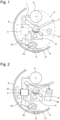
- the minute repeater system comprises a gong 4 fixed to the plate (not shown) of the watch by a gong holder 5.
- the gong 4 can be produced according to an embodiment known from the state of the art.
- the minute repeater mechanism further comprises an electrical energy accumulator 6, such as a battery, and an integrated circuit 7 powered by the electrical energy accumulator 6, as well as detectors 8 and 9 of the position of the axes of the hands 1 and 2.
- detectors are also known per se. They can be configured to detect for example, but not limited to, the position of a series of teeth provided on the respective axes.
- a hammer 15 is rotatably mounted about a rotation axis 16, so that the hammer can impact the gong 4.
- the rotation of the hammer 15 is actuable by an electrodynamic actuator 17, which is connected to the integrated circuit 7.
- the hammer 15 is provided with a spring (not shown) which returns the hammer to its rest position after the impact.
- the actuator 17 receives current pulses generated by the integrated circuit 7, based on the position detected by the detectors 8 and 9, so as to announce the time upon request of the user, by a series of specific sounds.
- a second gong 4' and a second hammer provided with its electromechanical actuator (not shown) are present to generate distinct sounds.
- the dimensions of the actuator 17 and the hammer 15 are shown only as an indication, but it is clear that all of these components will occupy only a fraction of the space occupied by a purely mechanical striking mechanism, which generally occupies the complete surface of the dial.
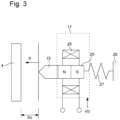
- FIG. 2 represents an electronic watch of the quartz type according to the invention, also comprising two mechanical gongs 4 and 4' and corresponding hammers 15 and electrodynamic actuators 17 (only one hammer and one actuator is shown), of the same type and dimensions as in the case of the Figure 1 .
- Hands 1 and 2 are rotated by a motor 20 powered by an electrical energy accumulator 6, such as a battery, using an integrated circuit 7 linked to a quartz 21, said components being part of the electronic movement of the watch, as known in the prior art.
- Electrodynamic actuator 17 receives pulses from integrated circuit 7 of the electronic movement.
- the presence of detectors 8 and 9 of the position of the axes of hands 1 and 2 is optional in this embodiment. Instead of having detectors 8 and 9, it is also possible to configure integrated circuit 7 so that it can determine the time to be announced by the hammers.
- a watch according to the invention combines one or more mechanical gongs with a hammer actuated by an electrodynamic actuator. Compared to purely mechanical watches, this solution allows for a much greater autonomy, a higher sound intensity, improved repeatability of the impulses, a constant interval between the impulses, as well as a spatial occupation of the striking system which is much lower than that of mechanical striking systems.
- the invention makes it possible to implement a natural sound of alarms and/or minute repeaters.
- the loudness of impact noises depends on the performance of the electrodynamic actuator used. Tests using an existing electrodynamic vibrator were carried out. As can be seen below, the finding is that the energy of a single impact is comparable, but still lower than the energy of the impact of a mechanical actuator.
- particular embodiments of the invention are linked to the way in which the current pulses sent to the actuator 17 are configured by relative to the rest position of the hammer 15, and relative to a number of parameters of the striking mechanism.
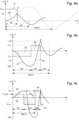
- a schematic diagram of the mechanism is shown in Figure 3 .
- the hammer 15 is integral with a magnet 25 linked to the plate 26 of the watch by a return means 27, which may be a spring.
- a coil 28 surrounds the magnet 25 and receives the current pulses I(t) generated by a voltage signal U(t), which actuate axial movements of the hammer 15, in the direction x.
- the assembly of the magnet 25, the coil 28 and the spring 27 constitutes the electrodynamic actuator 17.
- the distance between the gong 4 and the hammer 15 in the rest position is the distance x 0 indicated in the drawing. In this position, the spring 27 is not prestressed.
- the movement of the hammer 15 takes place in the direction +x or -x.
- the spring 27 returns the hammer to the rest position after a number of oscillations determined by the characteristics of the mass-spring system.
- the system represented in the Figure 3 is equivalent to the system represented in Figures 1 and 2 , insofar as in the latter the spring could be a torsion spring or a leaf spring and the actuator is configured to actuate a rotation of the hammer about the axis 16.
- the return means 27 can also be a mechanical cam, or even an electromagnetic force, or another means.
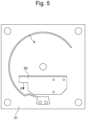
- the magnitude of the electromechanical force F em applied by the impulse is such that the force actuates an oscillation 30 of amplitude 2x 0 .
- This oscillation is illustrated by curve 30 up to the moment of impact ti. If the stamp were not present, the oscillation would follow the dotted curve.
- the duration of the pulse 31 is such that the impact takes place approximately at the moment when the hammer speed is maximum. This implies that the duration of the pulse is approximately ⁇ 4 .
- the test prototype tested used for the actuator - hammer - spring assembly a vibrator 50 striking a mechanical gong mounted on a brass base 51.
- the x direction is indicated on the drawing. The dimensions are given in mm, for example the diameter of the stamp can be 35.6 mm, the base 51 can be 44 mm by 44 mm, and the vibrator can be 24.15 mm long and 9.56 mm wide.
- the kinetic energy of the impact made by the prototype according to the form of execution of the Figure 4a was calculated as 15.3 ⁇ J. This is of the same order of magnitude as the impact achieved by a mechanical ringing system, estimated at 50 ⁇ J, but clearly lower than the latter.
- the impact energy generated by an electromechanical force equal to or less than the force F em applied for the previous case which uses a single impulse is increased by operating the hammer in a different manner, illustrated for example in Figure 4b .
- a first inverse pulse 35 of the same magnitude F em as the single pulse of the previous form is first applied.
- the inverse pulse 35 therefore activates a negative pre-oscillation 30, having an amplitude of 2x 0 in the -x direction.
- FIG. 4c represents the impulses and displacements during a double pre-oscillation.
- the right column expresses the multiplicative factor to be applied to the electrical consumption of the mode in question, to arrive at the same kinetic energy as with 3 pulses ( Figure 4c ).
- embodiments that include at least one pre-oscillation can be formulated as follows: the hammer is actuated so that it undergoes at least two oscillations before reaching impact, at least one of which is designated 'pre-oscillation', the pre-oscillation(s) being followed by a final oscillation that leads to impact.
- 'pre-oscillation' refers to the movement between two consecutive extreme positions of a vibration experienced by the hammer.
- the oscillations are generated by a series of pulses of opposite signs, so that from the second pulse onwards, each pulse is applied approximately at the time when the hammer reaches an extreme point of the oscillation generated by the previous pulse.
- the magnitudes of the pulses that generate pre-oscillations are equal to or less than the magnitude of the pulse that generates the final oscillation.
- the number of pre-oscillations can be greater than two, provided that the magnitude of the pulses is adapted so as to avoid impacts during the pre-oscillations.
- the hammer 15 and the gong 4 are provided with magnets in attraction, one magnet being fixedly mounted on the gong 4 and the other magnet being fixedly mounted on the hammer 15, so that the magnets come into physical contact at the moment of impact of the hammer on the gong.
- the force of attraction is such that the hammer and the gong remain in contact during the vibration of the gong, until the moment when a reverse impulse applied to the electrodynamic actuator causes the hammer to recoil, breaking the contact between the magnets.
- This prolonged contact between the hammer and the gong is capable of improving the transfer of kinetic energy from the hammer to the gong.
- This embodiment can be combined with the methods described above according to which the striking is operated without or with pre-oscillations. In the case of several pre-oscillations, their amplitudes must be adjusted to prevent the magnets from sticking the hammer to the gong before the desired moment of impact.
Landscapes
- Physics & Mathematics (AREA)
- General Physics & Mathematics (AREA)
- Acoustics & Sound (AREA)
- Apparatuses For Generation Of Mechanical Vibrations (AREA)
- Electromechanical Clocks (AREA)
Claims (15)
- Uhr, die mit einem Schlagwerk versehen ist, wobei das Schlagwerk mindestens einen an einem Gonghalter (5) befestigten Gong (4) und mindestens einen Hammer (15) zum Aktivieren des Gongs so, dass er schwingt, umfasst, dadurch gekennzeichnet, dass das Schlagwerk ferner Folgendes umfasst:- einen Speicher (6) für elektrische Energie,- eine integrierte Schaltung (7), die von dem Speicher (6) für elektrische Energie gespeist wird und konfiguriert ist, mindestens einen Stromimpuls zu erzeugen,- einen elektrodynamischen Aktuator (17), der mit der integrierten Schaltung verbunden ist und der in der Lage ist, den/die Impuls(e) zu empfangen, wobei der Aktuator einen Magneten (25) umfasst, der integral mit einem Hammer (15) ausgebildet oder mit dem Hammer verbunden ist, um, als Reaktion auf einen einzelnen Stromimpuls (31), eine Schwingung (30) des Hammers (15) aus der Ruhestellung zu erzeugen, und wobei der Schlag ungefähr dann auftritt, wenn die Hammergeschwindigkeit während der Schwingung maximal ist, wobei der Aktuator außerdem eine Spule (28) umfasst, die den Magneten (25) umgibt und den/die Impuls(e) empfängt, wobei die Schwingung einen Hammerschlag auf den Gong (4) auslösen kann,- ein Rückstellmittel (27), das einerseits mit der Uhrplatine (26) und andererseits mit dem Magneten (25) verbunden ist und mit dem Hammer verbunden ist, um den Hammer (15) nach dem Schlag in seine Ruhestellung zurückzubringen.
- Uhr nach Anspruch 1, dadurch gekennzeichnet, dass die Uhr eine Uhr (3) mit mechanischem Uhrwerk ist.
- Uhr nach Anspruch 1, dadurch gekennzeichnet, dass die Uhr eine Uhr mit elektronischem Uhrwerk ist, und wobei der Speicher (6) für elektrische Energie und die integrierte Schaltung (7) Teil des Uhrwerks der Uhr sind.
- Uhr nach Anspruch 1, dadurch gekennzeichnet, dass die integrierte Schaltung (7) konfiguriert ist, eine Reihe von Impulsen mit entgegengesetzten Vorzeichen zu erzeugen, sodass:- der Hammer (15) vor Erreichen des Schlags mindestens zwei Schwingungen durchläuft, von denen mindestens eine als "Vorschwingung" bezeichnet wird, wobei sich an die Vorschwingung(en) eine zum Schlag führende Endschwingung anschließt,- ab dem zweiten Impuls jeder Impuls ungefähr dann angelegt wird, wenn der Hammer den Extrempunkt der durch den vorhergehenden Impuls erzeugten Schwingung erreicht,- die Stärke der Impulse, die die Vorschwingungen erzeugen, gleich oder kleiner als die Stärke des Impulses ist, der die Endschwingung erzeugt.
- Uhr nach Anspruch 4, dadurch gekennzeichnet, dass der Hammer (15) eine einzelne Vorschwingung (37), gefolgt von der Endschwingung (38), durchläuft.
- Uhr nach Anspruch 4, dadurch gekennzeichnet, dass der Hammer (15) zwei Vorschwingungen (43, 44), gefolgt von der Endschwingung (45), durchläuft.
- Uhr nach einem der Ansprüche 1, 5 und 6, dadurch gekennzeichnet, dass die Frequenz der/des Impulse(s) ungefähr gleich der Resonanzfrequenz des Masse-Feder-Systems ist, das der Anordnung des Hammers (15) und des Rückstellmittels, wie einer Feder (27), entspricht.
- Uhr nach einem der vorhergehenden Ansprüche, die ferner ein Paar von anziehenden Magneten aufweist, wobei ein Magnet permanent an dem Gong (4) angebracht ist und der andere Magnet permanent an dem Hammer (15) angebracht ist, sodass die Magnete physisch berührt werden, wenn der Hammer auf den Gong schlägt.
- Verfahren zum Erzeugen eines Schlagschalls in einer Uhr nach Anspruch 1, dadurch gekennzeichnet, dass die integrierte Schaltung (7) einen einzigen Stromimpuls (31) erzeugt, der eine Schwingung (30) des Hammers (15) aus der Ruhestellung erzeugt, und wobei der Schlag ungefähr dann auftritt, wenn die Hammergeschwindigkeit während der Schwingung maximal ist.
- Verfahren zum Erzeugen eines Schlagschalls in einer Uhr nach Anspruch 1, dadurch gekennzeichnet, dass die integrierte Schaltung (7) eine Reihe von Impulsen mit einander entgegengesetzten Vorzeichen erzeugt, sodass:- der Hammer (15) vor Erreichen des Schlags mindestens zwei Schwingungen durchläuft, von denen mindestens eine als "Vorschwingung" bezeichnet wird, wobei sich an die Vorschwingung(en) eine zum Schlag führende Endschwingung anschließt,- ab dem zweiten Impuls jeder Impuls ungefähr dann angelegt wird, wenn der Hammer den Extrempunkt der durch den vorhergehenden Impuls erzeugten Schwingung erreicht,- die Stärke der Impulse, die die Vorschwingungen erzeugen, gleich oder kleiner als die Stärke des Impulses ist, der die Endschwingung erzeugt.
- Verfahren nach Anspruch 10, dadurch gekennzeichnet, dass der Hammer (15) eine einzige Vorschwingung (37), gefolgt von der Endschwingung (38), durchläuft.
- Verfahren nach Anspruch 11, dadurch gekennzeichnet, dass der Hammer, am Ende der Vorschwingung (37), um ungefähr das Dreifache des Abstands (x0), der der Ruhestellung entspricht, von dem Gong wegbewegt wird.
- Verfahren nach Anspruch 11, dadurch gekennzeichnet, dass der Hammer (15) zwei Vorschwingungen (43, 44), gefolgt von der Endschwingung (45), durchläuft.
- Verfahren nach Anspruch 13, dadurch gekennzeichnet, dass die erste Vorschwingung (43) den Hammer in die Nähe des Gongs bringt, ohne diesen zu berühren, und dass der Hammer, am Ende der zweiten Vorschwingung (44), um ungefähr das Vierfache des Abstandes (x0), der der Ruhestellung entspricht, von dem Gong wegbewegt wird.
- Uhr nach einem der Ansprüche 9 bis 14, dadurch gekennzeichnet, dass die Frequenz der/des Impulse(s) ungefähr gleich der Resonanzfrequenz des Masse-Feder-Systems ist, das der Anordnung des Hammers (15) und des Rückstellmittels, wie einer Feder (27), entspricht.
Priority Applications (4)
| Application Number | Priority Date | Filing Date | Title |
|---|---|---|---|
| EP20165319.3A EP3885843B1 (de) | 2020-03-24 | 2020-03-24 | Uhr mit mechanischem oder elektronischem uhrwerk, die mit einem schlagwerk ausgestattet ist |
| US17/169,633 US11703808B2 (en) | 2020-03-24 | 2021-02-08 | Watch with mechanical or electronic movement provided with a striking mechanism |
| JP2021031395A JP7143464B2 (ja) | 2020-03-24 | 2021-03-01 | 打ち方機構を備える機械式または電子ムーブメントを有する腕時計 |
| CN202110310886.XA CN113448239B (zh) | 2020-03-24 | 2021-03-24 | 设有报时机构的带有机械或电子机芯的手表 |
Applications Claiming Priority (1)
| Application Number | Priority Date | Filing Date | Title |
|---|---|---|---|
| EP20165319.3A EP3885843B1 (de) | 2020-03-24 | 2020-03-24 | Uhr mit mechanischem oder elektronischem uhrwerk, die mit einem schlagwerk ausgestattet ist |
Publications (2)
| Publication Number | Publication Date |
|---|---|
| EP3885843A1 EP3885843A1 (de) | 2021-09-29 |
| EP3885843B1 true EP3885843B1 (de) | 2025-05-21 |
Family
ID=69960461
Family Applications (1)
| Application Number | Title | Priority Date | Filing Date |
|---|---|---|---|
| EP20165319.3A Active EP3885843B1 (de) | 2020-03-24 | 2020-03-24 | Uhr mit mechanischem oder elektronischem uhrwerk, die mit einem schlagwerk ausgestattet ist |
Country Status (4)
| Country | Link |
|---|---|
| US (1) | US11703808B2 (de) |
| EP (1) | EP3885843B1 (de) |
| JP (1) | JP7143464B2 (de) |
| CN (1) | CN113448239B (de) |
Families Citing this family (1)
| Publication number | Priority date | Publication date | Assignee | Title |
|---|---|---|---|---|
| CN115316777B (zh) * | 2022-08-31 | 2024-11-22 | 广东台德智联科技有限公司 | 一种便于调节的智能终端解扣结构 |
Family Cites Families (18)
| Publication number | Priority date | Publication date | Assignee | Title |
|---|---|---|---|---|
| FR1335311A (fr) * | 1962-09-20 | 1963-08-16 | Mécanisme d'entraînement et de sonneries pour horlogerie électrique et autres applications | |
| US3440814A (en) * | 1967-12-18 | 1969-04-29 | Gen Time Corp | Electric clock alarm system |
| DE1946341A1 (de) * | 1969-09-12 | 1971-04-22 | Junghans Gmbh Geb | Elektrisches Schlagwerk fuer Uhren |
| CH640688GA3 (fr) * | 1980-10-27 | 1984-01-31 | Eterna Sa | Montre a mouvement electronique et a deux moyens d'affichage. |
| DE3247021A1 (de) * | 1982-12-18 | 1984-06-20 | Wehrle Uhrenfabrik GmbH, 7741 Schönwald | Uhr mit weck- und schlagwerk |
| CN2442295Y (zh) * | 2000-04-07 | 2001-08-08 | 王建兰 | 一种钟用报时机构 |
| JP3761424B2 (ja) * | 2001-05-30 | 2006-03-29 | リズム時計工業株式会社 | 打鈴装置 |
| EP2290480B1 (de) * | 2009-08-26 | 2012-04-25 | Montres Breguet SA | Glocke für ein Schlagwerk einer Uhr |
| CH702424A1 (fr) * | 2009-12-24 | 2011-06-30 | Montres Breguet Sa | Mécanisme de sonnerie d'une montre. |
| EP2362279B1 (de) * | 2010-02-26 | 2019-05-08 | Montres Breguet SA | Schlagwerkmechanismus einer Armbanduhr mit aktiver Dämpfungsgegenfeder |
| EP2428857B1 (de) * | 2010-09-13 | 2016-02-17 | Montres Breguet SA | Uhr mit Schlagwerk, die mit einem Klangisolator ausgestattet ist |
| EP2463731B1 (de) * | 2010-12-10 | 2015-06-17 | Montres Breguet SA | Schlagwerkmechanismus einer Armbanduhr |
| EP2707779B1 (de) * | 2011-05-12 | 2020-06-10 | Hublot S.A., Genève | Uhr mit akustischem mechanismus |
| CH705303B1 (fr) * | 2011-07-22 | 2016-08-31 | Hublot Sa Genève | Pièce d'horlogerie à mécanisme sonore. |
| CH705679B1 (fr) * | 2011-10-28 | 2017-01-31 | Swatch Group Res & Dev Ltd | Circuit d'autorégulation de la fréquence d'oscillation d'un système mécanique oscillant, et dispositif le comprenant. |
| US9465366B2 (en) * | 2013-12-23 | 2016-10-11 | The Swatch Group Research And Development Ltd | Angular speed regulating device for a wheel set in a timepiece movement including a magnetic escapement mechanism |
| JP6961463B2 (ja) * | 2017-11-01 | 2021-11-05 | セイコーインスツル株式会社 | 鳴鐘機構、携帯機器、ムーブメントおよび時計 |
| US10311685B1 (en) * | 2018-06-29 | 2019-06-04 | Logitech Europe S.A. | Doorbell system with pulse-driven boost rectifier |
-
2020
- 2020-03-24 EP EP20165319.3A patent/EP3885843B1/de active Active
-
2021
- 2021-02-08 US US17/169,633 patent/US11703808B2/en active Active
- 2021-03-01 JP JP2021031395A patent/JP7143464B2/ja active Active
- 2021-03-24 CN CN202110310886.XA patent/CN113448239B/zh active Active
Also Published As
| Publication number | Publication date |
|---|---|
| US11703808B2 (en) | 2023-07-18 |
| CN113448239A (zh) | 2021-09-28 |
| US20210311437A1 (en) | 2021-10-07 |
| JP2021152532A (ja) | 2021-09-30 |
| EP3885843A1 (de) | 2021-09-29 |
| JP7143464B2 (ja) | 2022-09-28 |
| CN113448239B (zh) | 2023-02-10 |
Similar Documents
| Publication | Publication Date | Title |
|---|---|---|
| EP2463732B1 (de) | Schlagwerkmechanismus einer Armbanduhr oder einer Spieluhr | |
| EP2463731B1 (de) | Schlagwerkmechanismus einer Armbanduhr | |
| EP3885843B1 (de) | Uhr mit mechanischem oder elektronischem uhrwerk, die mit einem schlagwerk ausgestattet ist | |
| EP2290480B1 (de) | Glocke für ein Schlagwerk einer Uhr | |
| EP3079024B1 (de) | Magnetischer aktivierungsmechanismus für schlagwerke einer uhr | |
| JP6827064B2 (ja) | 計時器打撃機構 | |
| CH717257A2 (fr) | Montre à mouvement mécanique ou électronique pourvue d'un mécanisme de sonnerie. | |
| FR2466903A1 (fr) | Transducteur piezoelectrique reglable pour montre | |
| KR102706200B1 (ko) | 악기의 현의 진동을 캡처하기 위한 전기적 또는 전자적 시스템들을 인터체인징하기 위한 디바이스 | |
| HK40059959A (en) | Watch with mechanical or electronic movement provided with a striking mechanism | |
| HK40059959B (en) | Watch with mechanical or electronic movement provided with a striking mechanism | |
| EP4105733B1 (de) | Perkussionsschlagwerk, insbesondere für uhren | |
| CH702145A1 (fr) | Timbre pour une sonnerie d'une piece d'horlogerie. | |
| JP7407236B2 (ja) | 特に計時器のための、打撃アクチュエートシステムを備えるマイクロメカニカル機構 | |
| CH718729A2 (fr) | Mécanisme de sonnerie à percussion, notamment pour l'horlogerie. | |
| CH718730A2 (fr) | Mécanisme micromécanique à percussion, notamment de sonnerie pour un mouvement d'horlogerie. | |
| EP3070541A1 (de) | Armbanduhr mit schlagwerk, das mit einer speziellen schlaganordnung einer klangfeder ausgestattet ist | |
| HK1173234B (en) | Watch striking mechanism | |
| JP2024014748A (ja) | 可撓性ガイドを具備する時打ち機構を備える時計のムーブメント | |
| CH710899A2 (fr) | Montre à sonnerie munie d'un agencement particulier de frappe d'un timbre | |
| BE408767A (de) | ||
| BE562161A (de) | ||
| BE340161A (de) |
Legal Events
| Date | Code | Title | Description |
|---|---|---|---|
| PUAI | Public reference made under article 153(3) epc to a published international application that has entered the european phase |
Free format text: ORIGINAL CODE: 0009012 |
|
| STAA | Information on the status of an ep patent application or granted ep patent |
Free format text: STATUS: THE APPLICATION HAS BEEN PUBLISHED |
|
| AK | Designated contracting states |
Kind code of ref document: A1 Designated state(s): AL AT BE BG CH CY CZ DE DK EE ES FI FR GB GR HR HU IE IS IT LI LT LU LV MC MK MT NL NO PL PT RO RS SE SI SK SM TR |
|
| STAA | Information on the status of an ep patent application or granted ep patent |
Free format text: STATUS: REQUEST FOR EXAMINATION WAS MADE |
|
| 17P | Request for examination filed |
Effective date: 20220329 |
|
| RBV | Designated contracting states (corrected) |
Designated state(s): AL AT BE BG CH CY CZ DE DK EE ES FI FR GB GR HR HU IE IS IT LI LT LU LV MC MK MT NL NO PL PT RO RS SE SI SK SM TR |
|
| STAA | Information on the status of an ep patent application or granted ep patent |
Free format text: STATUS: EXAMINATION IS IN PROGRESS |
|
| 17Q | First examination report despatched |
Effective date: 20230329 |
|
| P01 | Opt-out of the competence of the unified patent court (upc) registered |
Effective date: 20230615 |
|
| GRAP | Despatch of communication of intention to grant a patent |
Free format text: ORIGINAL CODE: EPIDOSNIGR1 |
|
| STAA | Information on the status of an ep patent application or granted ep patent |
Free format text: STATUS: GRANT OF PATENT IS INTENDED |
|
| INTG | Intention to grant announced |
Effective date: 20250114 |
|
| GRAS | Grant fee paid |
Free format text: ORIGINAL CODE: EPIDOSNIGR3 |
|
| GRAA | (expected) grant |
Free format text: ORIGINAL CODE: 0009210 |
|
| STAA | Information on the status of an ep patent application or granted ep patent |
Free format text: STATUS: THE PATENT HAS BEEN GRANTED |
|
| AK | Designated contracting states |
Kind code of ref document: B1 Designated state(s): AL AT BE BG CH CY CZ DE DK EE ES FI FR GB GR HR HU IE IS IT LI LT LU LV MC MK MT NL NO PL PT RO RS SE SI SK SM TR |
|
| REG | Reference to a national code |
Ref country code: GB Ref legal event code: FG4D Free format text: NOT ENGLISH |
|
| REG | Reference to a national code |
Ref country code: CH Ref legal event code: EP |
|
| REG | Reference to a national code |
Ref country code: DE Ref legal event code: R096 Ref document number: 602020051504 Country of ref document: DE |
|
| REG | Reference to a national code |
Ref country code: IE Ref legal event code: FG4D Free format text: LANGUAGE OF EP DOCUMENT: FRENCH |
|
| REG | Reference to a national code |
Ref country code: NL Ref legal event code: MP Effective date: 20250521 |
|
| PG25 | Lapsed in a contracting state [announced via postgrant information from national office to epo] |
Ref country code: FI Free format text: LAPSE BECAUSE OF FAILURE TO SUBMIT A TRANSLATION OF THE DESCRIPTION OR TO PAY THE FEE WITHIN THE PRESCRIBED TIME-LIMIT Effective date: 20250521 Ref country code: ES Free format text: LAPSE BECAUSE OF FAILURE TO SUBMIT A TRANSLATION OF THE DESCRIPTION OR TO PAY THE FEE WITHIN THE PRESCRIBED TIME-LIMIT Effective date: 20250521 Ref country code: PT Free format text: LAPSE BECAUSE OF FAILURE TO SUBMIT A TRANSLATION OF THE DESCRIPTION OR TO PAY THE FEE WITHIN THE PRESCRIBED TIME-LIMIT Effective date: 20250922 |
|
| REG | Reference to a national code |
Ref country code: LT Ref legal event code: MG9D |
|
| PG25 | Lapsed in a contracting state [announced via postgrant information from national office to epo] |
Ref country code: GR Free format text: LAPSE BECAUSE OF FAILURE TO SUBMIT A TRANSLATION OF THE DESCRIPTION OR TO PAY THE FEE WITHIN THE PRESCRIBED TIME-LIMIT Effective date: 20250822 Ref country code: NO Free format text: LAPSE BECAUSE OF FAILURE TO SUBMIT A TRANSLATION OF THE DESCRIPTION OR TO PAY THE FEE WITHIN THE PRESCRIBED TIME-LIMIT Effective date: 20250821 |
|
| PG25 | Lapsed in a contracting state [announced via postgrant information from national office to epo] |
Ref country code: NL Free format text: LAPSE BECAUSE OF FAILURE TO SUBMIT A TRANSLATION OF THE DESCRIPTION OR TO PAY THE FEE WITHIN THE PRESCRIBED TIME-LIMIT Effective date: 20250521 Ref country code: PL Free format text: LAPSE BECAUSE OF FAILURE TO SUBMIT A TRANSLATION OF THE DESCRIPTION OR TO PAY THE FEE WITHIN THE PRESCRIBED TIME-LIMIT Effective date: 20250521 |
|
| PG25 | Lapsed in a contracting state [announced via postgrant information from national office to epo] |
Ref country code: BG Free format text: LAPSE BECAUSE OF FAILURE TO SUBMIT A TRANSLATION OF THE DESCRIPTION OR TO PAY THE FEE WITHIN THE PRESCRIBED TIME-LIMIT Effective date: 20250521 |
|
| PG25 | Lapsed in a contracting state [announced via postgrant information from national office to epo] |
Ref country code: HR Free format text: LAPSE BECAUSE OF FAILURE TO SUBMIT A TRANSLATION OF THE DESCRIPTION OR TO PAY THE FEE WITHIN THE PRESCRIBED TIME-LIMIT Effective date: 20250521 |
|
| PG25 | Lapsed in a contracting state [announced via postgrant information from national office to epo] |
Ref country code: RS Free format text: LAPSE BECAUSE OF FAILURE TO SUBMIT A TRANSLATION OF THE DESCRIPTION OR TO PAY THE FEE WITHIN THE PRESCRIBED TIME-LIMIT Effective date: 20250821 |
|
| PG25 | Lapsed in a contracting state [announced via postgrant information from national office to epo] |
Ref country code: IS Free format text: LAPSE BECAUSE OF FAILURE TO SUBMIT A TRANSLATION OF THE DESCRIPTION OR TO PAY THE FEE WITHIN THE PRESCRIBED TIME-LIMIT Effective date: 20250921 |
|
| PG25 | Lapsed in a contracting state [announced via postgrant information from national office to epo] |
Ref country code: LV Free format text: LAPSE BECAUSE OF FAILURE TO SUBMIT A TRANSLATION OF THE DESCRIPTION OR TO PAY THE FEE WITHIN THE PRESCRIBED TIME-LIMIT Effective date: 20250521 |
|
| REG | Reference to a national code |
Ref country code: AT Ref legal event code: MK05 Ref document number: 1797253 Country of ref document: AT Kind code of ref document: T Effective date: 20250521 |