EP3883552B1 - Cyanoaryl-anilin-verbindungen zur behandlung von hauterkrankungen - Google Patents
Cyanoaryl-anilin-verbindungen zur behandlung von hauterkrankungen Download PDFInfo
- Publication number
- EP3883552B1 EP3883552B1 EP19886174.2A EP19886174A EP3883552B1 EP 3883552 B1 EP3883552 B1 EP 3883552B1 EP 19886174 A EP19886174 A EP 19886174A EP 3883552 B1 EP3883552 B1 EP 3883552B1
- Authority
- EP
- European Patent Office
- Prior art keywords
- alkyl
- amino
- compound
- mek
- cycloalkyl
- Prior art date
- Legal status (The legal status is an assumption and is not a legal conclusion. Google has not performed a legal analysis and makes no representation as to the accuracy of the status listed.)
- Active
Links
Images


Classifications
-
- C—CHEMISTRY; METALLURGY
- C07—ORGANIC CHEMISTRY
- C07D—HETEROCYCLIC COMPOUNDS
- C07D205/00—Heterocyclic compounds containing four-membered rings with one nitrogen atom as the only ring hetero atom
- C07D205/02—Heterocyclic compounds containing four-membered rings with one nitrogen atom as the only ring hetero atom not condensed with other rings
- C07D205/04—Heterocyclic compounds containing four-membered rings with one nitrogen atom as the only ring hetero atom not condensed with other rings having no double bonds between ring members or between ring members and non-ring members
-
- A—HUMAN NECESSITIES
- A61—MEDICAL OR VETERINARY SCIENCE; HYGIENE
- A61K—PREPARATIONS FOR MEDICAL, DENTAL OR TOILETRY PURPOSES
- A61K31/00—Medicinal preparations containing organic active ingredients
- A61K31/33—Heterocyclic compounds
- A61K31/395—Heterocyclic compounds having nitrogen as a ring hetero atom, e.g. guanethidine or rifamycins
- A61K31/41—Heterocyclic compounds having nitrogen as a ring hetero atom, e.g. guanethidine or rifamycins having five-membered rings with two or more ring hetero atoms, at least one of which being nitrogen, e.g. tetrazole
- A61K31/42—Oxazoles
-
- A—HUMAN NECESSITIES
- A61—MEDICAL OR VETERINARY SCIENCE; HYGIENE
- A61K—PREPARATIONS FOR MEDICAL, DENTAL OR TOILETRY PURPOSES
- A61K31/00—Medicinal preparations containing organic active ingredients
- A61K31/16—Amides, e.g. hydroxamic acids
- A61K31/165—Amides, e.g. hydroxamic acids having aromatic rings, e.g. colchicine, atenolol, progabide
- A61K31/166—Amides, e.g. hydroxamic acids having aromatic rings, e.g. colchicine, atenolol, progabide having the carbon of a carboxamide group directly attached to the aromatic ring, e.g. procainamide, procarbazine, metoclopramide, labetalol
-
- A—HUMAN NECESSITIES
- A61—MEDICAL OR VETERINARY SCIENCE; HYGIENE
- A61K—PREPARATIONS FOR MEDICAL, DENTAL OR TOILETRY PURPOSES
- A61K31/00—Medicinal preparations containing organic active ingredients
- A61K31/185—Acids; Anhydrides, halides or salts thereof, e.g. sulfur acids, imidic, hydrazonic or hydroximic acids
- A61K31/19—Carboxylic acids, e.g. valproic acid
- A61K31/195—Carboxylic acids, e.g. valproic acid having an amino group
- A61K31/196—Carboxylic acids, e.g. valproic acid having an amino group the amino group being directly attached to a ring, e.g. anthranilic acid, mefenamic acid, diclofenac, chlorambucil
-
- A—HUMAN NECESSITIES
- A61—MEDICAL OR VETERINARY SCIENCE; HYGIENE
- A61K—PREPARATIONS FOR MEDICAL, DENTAL OR TOILETRY PURPOSES
- A61K31/00—Medicinal preparations containing organic active ingredients
- A61K31/33—Heterocyclic compounds
- A61K31/335—Heterocyclic compounds having oxygen as the only ring hetero atom, e.g. fungichromin
- A61K31/337—Heterocyclic compounds having oxygen as the only ring hetero atom, e.g. fungichromin having four-membered rings, e.g. taxol
-
- A—HUMAN NECESSITIES
- A61—MEDICAL OR VETERINARY SCIENCE; HYGIENE
- A61K—PREPARATIONS FOR MEDICAL, DENTAL OR TOILETRY PURPOSES
- A61K31/00—Medicinal preparations containing organic active ingredients
- A61K31/33—Heterocyclic compounds
- A61K31/395—Heterocyclic compounds having nitrogen as a ring hetero atom, e.g. guanethidine or rifamycins
- A61K31/397—Heterocyclic compounds having nitrogen as a ring hetero atom, e.g. guanethidine or rifamycins having four-membered rings, e.g. azetidine
-
- A—HUMAN NECESSITIES
- A61—MEDICAL OR VETERINARY SCIENCE; HYGIENE
- A61K—PREPARATIONS FOR MEDICAL, DENTAL OR TOILETRY PURPOSES
- A61K31/00—Medicinal preparations containing organic active ingredients
- A61K31/33—Heterocyclic compounds
- A61K31/395—Heterocyclic compounds having nitrogen as a ring hetero atom, e.g. guanethidine or rifamycins
- A61K31/40—Heterocyclic compounds having nitrogen as a ring hetero atom, e.g. guanethidine or rifamycins having five-membered rings with one nitrogen as the only ring hetero atom, e.g. sulpiride, succinimide, tolmetin, buflomedil
-
- A—HUMAN NECESSITIES
- A61—MEDICAL OR VETERINARY SCIENCE; HYGIENE
- A61K—PREPARATIONS FOR MEDICAL, DENTAL OR TOILETRY PURPOSES
- A61K31/00—Medicinal preparations containing organic active ingredients
- A61K31/33—Heterocyclic compounds
- A61K31/395—Heterocyclic compounds having nitrogen as a ring hetero atom, e.g. guanethidine or rifamycins
- A61K31/435—Heterocyclic compounds having nitrogen as a ring hetero atom, e.g. guanethidine or rifamycins having six-membered rings with one nitrogen as the only ring hetero atom
- A61K31/44—Non condensed pyridines; Hydrogenated derivatives thereof
-
- A—HUMAN NECESSITIES
- A61—MEDICAL OR VETERINARY SCIENCE; HYGIENE
- A61K—PREPARATIONS FOR MEDICAL, DENTAL OR TOILETRY PURPOSES
- A61K45/00—Medicinal preparations containing active ingredients not provided for in groups A61K31/00 - A61K41/00
- A61K45/06—Mixtures of active ingredients without chemical characterisation, e.g. antiphlogistics and cardiaca
-
- A—HUMAN NECESSITIES
- A61—MEDICAL OR VETERINARY SCIENCE; HYGIENE
- A61P—SPECIFIC THERAPEUTIC ACTIVITY OF CHEMICAL COMPOUNDS OR MEDICINAL PREPARATIONS
- A61P17/00—Drugs for dermatological disorders
-
- C—CHEMISTRY; METALLURGY
- C07—ORGANIC CHEMISTRY
- C07C—ACYCLIC OR CARBOCYCLIC COMPOUNDS
- C07C255/00—Carboxylic acid nitriles
- C07C255/49—Carboxylic acid nitriles having cyano groups bound to carbon atoms of six-membered aromatic rings of a carbon skeleton
- C07C255/58—Carboxylic acid nitriles having cyano groups bound to carbon atoms of six-membered aromatic rings of a carbon skeleton containing cyano groups and singly-bound nitrogen atoms, not being further bound to other hetero atoms, bound to the carbon skeleton
-
- C—CHEMISTRY; METALLURGY
- C07—ORGANIC CHEMISTRY
- C07C—ACYCLIC OR CARBOCYCLIC COMPOUNDS
- C07C255/00—Carboxylic acid nitriles
- C07C255/49—Carboxylic acid nitriles having cyano groups bound to carbon atoms of six-membered aromatic rings of a carbon skeleton
- C07C255/58—Carboxylic acid nitriles having cyano groups bound to carbon atoms of six-membered aromatic rings of a carbon skeleton containing cyano groups and singly-bound nitrogen atoms, not being further bound to other hetero atoms, bound to the carbon skeleton
- C07C255/59—Carboxylic acid nitriles having cyano groups bound to carbon atoms of six-membered aromatic rings of a carbon skeleton containing cyano groups and singly-bound nitrogen atoms, not being further bound to other hetero atoms, bound to the carbon skeleton the carbon skeleton being further substituted by singly-bound oxygen atoms
-
- C—CHEMISTRY; METALLURGY
- C07—ORGANIC CHEMISTRY
- C07D—HETEROCYCLIC COMPOUNDS
- C07D207/00—Heterocyclic compounds containing five-membered rings not condensed with other rings, with one nitrogen atom as the only ring hetero atom
- C07D207/02—Heterocyclic compounds containing five-membered rings not condensed with other rings, with one nitrogen atom as the only ring hetero atom with only hydrogen or carbon atoms directly attached to the ring nitrogen atom
- C07D207/04—Heterocyclic compounds containing five-membered rings not condensed with other rings, with one nitrogen atom as the only ring hetero atom with only hydrogen or carbon atoms directly attached to the ring nitrogen atom having no double bonds between ring members or between ring members and non-ring members
- C07D207/10—Heterocyclic compounds containing five-membered rings not condensed with other rings, with one nitrogen atom as the only ring hetero atom with only hydrogen or carbon atoms directly attached to the ring nitrogen atom having no double bonds between ring members or between ring members and non-ring members with hetero atoms or with carbon atoms having three bonds to hetero atoms with at the most one bond to halogen, e.g. ester or nitrile radicals, directly attached to ring carbon atoms
- C07D207/12—Oxygen or sulfur atoms
-
- C—CHEMISTRY; METALLURGY
- C07—ORGANIC CHEMISTRY
- C07D—HETEROCYCLIC COMPOUNDS
- C07D213/00—Heterocyclic compounds containing six-membered rings, not condensed with other rings, with one nitrogen atom as the only ring hetero atom and three or more double bonds between ring members or between ring members and non-ring members
- C07D213/02—Heterocyclic compounds containing six-membered rings, not condensed with other rings, with one nitrogen atom as the only ring hetero atom and three or more double bonds between ring members or between ring members and non-ring members having three double bonds between ring members or between ring members and non-ring members
- C07D213/04—Heterocyclic compounds containing six-membered rings, not condensed with other rings, with one nitrogen atom as the only ring hetero atom and three or more double bonds between ring members or between ring members and non-ring members having three double bonds between ring members or between ring members and non-ring members having no bond between the ring nitrogen atom and a non-ring member or having only hydrogen or carbon atoms directly attached to the ring nitrogen atom
- C07D213/60—Heterocyclic compounds containing six-membered rings, not condensed with other rings, with one nitrogen atom as the only ring hetero atom and three or more double bonds between ring members or between ring members and non-ring members having three double bonds between ring members or between ring members and non-ring members having no bond between the ring nitrogen atom and a non-ring member or having only hydrogen or carbon atoms directly attached to the ring nitrogen atom with hetero atoms or with carbon atoms having three bonds to hetero atoms with at the most one bond to halogen, e.g. ester or nitrile radicals, directly attached to ring carbon atoms
- C07D213/78—Carbon atoms having three bonds to hetero atoms, with at the most one bond to halogen, e.g. ester or nitrile radicals
- C07D213/84—Nitriles
-
- C—CHEMISTRY; METALLURGY
- C07—ORGANIC CHEMISTRY
- C07D—HETEROCYCLIC COMPOUNDS
- C07D261/00—Heterocyclic compounds containing 1,2-oxazole or hydrogenated 1,2-oxazole rings
- C07D261/02—Heterocyclic compounds containing 1,2-oxazole or hydrogenated 1,2-oxazole rings not condensed with other rings
- C07D261/04—Heterocyclic compounds containing 1,2-oxazole or hydrogenated 1,2-oxazole rings not condensed with other rings having one double bond between ring members or between a ring member and a non-ring member
-
- C—CHEMISTRY; METALLURGY
- C07—ORGANIC CHEMISTRY
- C07D—HETEROCYCLIC COMPOUNDS
- C07D305/00—Heterocyclic compounds containing four-membered rings having one oxygen atom as the only ring hetero atoms
- C07D305/02—Heterocyclic compounds containing four-membered rings having one oxygen atom as the only ring hetero atoms not condensed with other rings
- C07D305/04—Heterocyclic compounds containing four-membered rings having one oxygen atom as the only ring hetero atoms not condensed with other rings having no double bonds between ring members or between ring members and non-ring members
- C07D305/06—Heterocyclic compounds containing four-membered rings having one oxygen atom as the only ring hetero atoms not condensed with other rings having no double bonds between ring members or between ring members and non-ring members with only hydrogen atoms, hydrocarbon or substituted hydrocarbon radicals, directly attached to the ring atoms
Definitions
- NF1 Neurofibromatosis type 1
- NF1 Neurofibromatosis type 1
- dermal neurofibromas are associated with several dermal disorders, including dermal neurofibromas; plexiform neurofibromas; café au lait spots; and axillary and inguinal freckling.
- Dermal neurofibromas occur in over 95% of NF1 patients, and can appear anywhere on the body, causing itching, irritation, infection, physical pain, and disfigurement.
- dermal neurofibromas are associated with social isolation and anxiety.
- NF1 is caused by one or more germ line mutations in NF1 , a gene that inactivates the RAS pathway. Because the NF1 gene encodes a Ras-GAP protein, NF1 loss results in high Ras-GTP. Therefore, NF1 research has focused intensively on testing inhibitors in the Ras signaling pathway, including the Ras- mitogen-activated protein kinase (MAPK) cascade.
- MAPK Ras- mitogen-activated protein kinase
- MEK proteins belong to a family of enzymes that lie upstream to their specific MAPK targets in each of the four MAP kinase signaling pathways. Two of these MEK proteins, MEK1 and MEK2, are closely related and participate in this signaling pathway cascade. Inhibitors of MEK1 and MEK2 have been shown to effectively inhibit MEK signaling downstream of Ras, and thus provide a strong rationale for targeting MEK in the treatment of NF1. See Rice et al. Medicinal Chemistry Letters 3:416-421, 2012 . WO2007123939 describes N-heteroaryl MEK-inhibitors.
- MEK inhibitors are designed to have oral bioavailability for systemic delivery, and are associated with significant side effects including decreased left ventricular ejection fraction, elevated creatine phosphokinase, pneumonitis, renal failure, diarrhea, infection, uticaria, and maculo-papular rash, all of which are dose limiting or require permanent discontinuation.
- clinical trials have shown side effects with prolonged high-dose administration of MEK inhibitors. See Huang et al. J. Ocul. Pharmacol. Ther. 25:519-530, 2009 .
- PD0325901 a MEK inhibitor currently in clinical trials, has exhibited neurological side effects associated with ataxia, confusion, and syncope.
- a pharmaceutical composition including the compound of formula (I) as defined above and a pharmaceutically acceptable carrier.
- a compound of the invention or a composition of the invention for use in a method of treating a MEK-inhibitor responsive disorder, a MEK-inhibitor responsive dermal disorder, a MEK-mediated disorder or disease, or a MEK-mediated dermal disorder, the method including administering a therapeutically effective amount of the compound or composition to a patient in need thereof, thereby treating the disorder or disease.
- compounds of formula (I) are provided herein.
- pharmaceutical compositions including the compounds of formula (I) are provided herein.
- substituent groups are specified by their conventional chemical formulae, written from left to right, they equally encompass the substituents that would result from writing the structure from right to left, e.g., -CH 2 O- is meant to include -OCH 2 -.
- Alkyl refers to a straight or branched, saturated, aliphatic radical having the number of carbon atoms indicated (i.e., C 1 -C 6 means one to six carbons). Alkyl can include any number of carbons, such as C 1 -C 2 , C 1 -C 3 , C 1 -C 4 , C 1 -C 5 , C 1 -C 6 , C 1 -C 7 , C 1 -C 8 , C 1 -C 9 , C 1 -C 10 , C 2 -C 3 , C 2 -C 4 , C 2 -C 5 , C 2 -C 6 , C 3 -C 4 , C 3 -C 5 , C 3 -C 6 , C 4 -C 5 , C 4 -C 6 and C 5 -C 6 .
- C 1 -C 6 alkyl includes, but is not limited to, methyl, ethyl, propyl, isopropyl, butyl, isobutyl, sec-butyl, tert-butyl, pentyl, isopentyl, hexyl, etc.
- Alkyl can also refer to alkyl groups having up to 20 carbons atoms, such as, but not limited to heptyl, octyl, nonyl, decyl, etc.
- Alkylene refers to a straight or branched, saturated, aliphatic radical having the number of carbon atoms indicated (i.e., C 1 -C 6 means one to six carbons), and linking at least two other groups, i.e. , a divalent hydrocarbon radical.
- the two moieties linked to the alkylene can be linked to the same atom or different atoms of the alkylene group.
- a straight chain alkylene can be the bivalent radical of -(CH 2 ) n -, where n is 1, 2, 3, 4, 5 or 6.
- Representative alkylene groups include, but are not limited to, methylene, ethylene, propylene, isopropylene, butylene, isobutylene, sec-butylene, pentylene and hexylene.
- Alkenyl refers to a straight chain or branched hydrocarbon having at least 2 carbon atoms and at least one double bond and having the number of carbon atom indicated (i.e., C 2 -C 6 means to two to six carbons). Alkenyl can include any number of carbons, such as C 2 , C 2 -C 3 , C 2 -C 4 , C 2 -C 5 , C 2 -C 6 , C 2 -C 7 , C 2 -C 8 , C 2 -C 9 , C 2 -C 10 , C 3 , C 3 -C 4 , C 3 -C 5 , C 3 -C 6 , C 4 , C 4 -C 5 , C 4 -C 5 , C 5 , C 5 -C 6 , and C 6 .
- Alkenyl groups can have any suitable number of double bonds, including, but not limited to, 1, 2, 3, 4, 5 or more.
- alkenyl groups include, but are not limited to, vinyl (ethenyl), propenyl, isopropenyl, 1-butenyl, 2-butenyl, isobutenyl, butadienyl, 1-pentenyl, 2-pentenyl, isopentenyl, 1,3-pentadienyl, 1,4-pentadienyl, 1-hexenyl, 2-hexenyl, 3-hexenyl, 1,3-hexadienyl, 1,4-hexadienyl, 1,5-hexadienyl, 2,4-hexadienyl, or 1,3,5-hexatrienyl.
- Alkynyl refers to either a straight chain or branched hydrocarbon having at least 2 carbon atoms and at least one triple bond and having the number of carbon atom indicated (i.e., C 2 -C 6 means to two to six carbons).
- Alkynyl can include any number of carbons, such as C 2 , C 2 -C 3 , C 2 -C 4 , C 2 -C 5 , C 2 -C 6 , C 2 -C 7 , C 2 -C 8 , C 2 -C 9 , C 2 -C 10 , C 3 , C 3 -C 4 , C 3 -C 5 , C 3 -C 6 , C 4 , C 4 -C 5 , C 4 -C 6 , C 5 , C 5 -C 6 , and C 6 .
- alkynyl groups include, but are not limited to, acetylenyl, propynyl, 1-butynyl, 2-butynyl, butadiynyl, 1-pentynyl, 2-pentynyl, isopentynyl, 1,3-pentadiynyl, 1,4-pentadiynyl, 1-hexynyl, 2-hexynyl, 3-hexynyl, 1,3-hexadiynyl, 1,4-hexadiynyl, 1,5-hexadiynyl, 2,4-hexadiynyl, or 1,3,5-hexatriynyl.
- Cycloalkyl refers to a saturated or partially unsaturated, monocyclic, fused bicyclic or bridged polycyclic ring assembly containing from 3 to 12 ring atoms, or the number of atoms indicated. Cycloalkyl can include any number of carbons, such as C 3 -C 6 , C 4 -C 6 , C 5 -C 6 , C 3 -C 8 , C 4 -C 8 , C 5 -C 8 , C 6 -C 8 , C 3 -C 9 , C 3 -C 10 , C 3 -C 11 , and C 3 -C 12 .
- Saturated monocyclic cycloalkyl rings include, for example, cyclopropyl, cyclobutyl, cyclopentyl, cyclohexyl, and cyclooctyl.
- Saturated bicyclic and polycyclic cycloalkyl rings include, for example, norbornane, [2.2.2] bicyclooctane, decahydronaphthalene and adamantane. Cycloalkyl groups can also be partially unsaturated, having one or more double or triple bonds in the ring.
- Representative cycloalkyl groups that are partially unsaturated include, but are not limited to, cyclobutene, cyclopentene, cyclohexene, cyclohexadiene (1,3- and 1,4-isomers), cycloheptene, cycloheptadiene, cyclooctene, cyclooctadiene (1,3-, 1,4- and 1,5-isomers), norbornene, and norbornadiene.
- exemplary groups include, but are not limited to cyclopropyl, cyclobutyl, cyclopentyl, cyclohexyl, cycloheptyl and cyclooctyl.
- Cycloalkylalkyl refers to a radical having an alkyl component and a cycloalkyl component, where the alkyl component links the cycloalkyl component to the point of attachment.
- the alkyl component is as defined above, except that the alkyl component is at least divalent, an alkylene, to link to the cycloalkyl component and to the point of attachment.
- the alkyl component can include any number of carbons, such as C 1 -C 6 , C 1 -C 2 , C 1 -C 3 , C 1 -C 4 , C 1 -C 5 , C 2 -C 3 , C 2 -C 4 , C 2 -C 5 , C 2 -C 6 , C 3 -C 4 , C 3 -C 5 , C 3 -C 6 , C 4 -C 5 , C 4 -C 6 and C 5 -C 6 .
- the cycloalkyl component is as defined above. Exemplary cycloalkyl-alkyl groups include, but are not limited to, cyclopropylmethyl, cyclobutylmethyl, cyclopentylmethyl and cyclohexylmethyl.
- Alkoxy refers to an alkyl group having an oxygen atom that connects the alkyl group to the point of attachment: alkyl-O-. Alkoxy groups can have any suitable number of carbon atoms, such as C 1 -C 6 . Alkoxy groups include, for example, methoxy, ethoxy, propoxy, iso-propoxy, butoxy, 2-butoxy, iso-butoxy, sec-butoxy, tert-butoxy, pentoxy, hexoxy, etc.
- Hydroalkyl refers to an alkyl group, as defined above, where at least one of the hydrogen atoms is replaced with a hydroxy group.
- a hydroxyalkyl group can have any suitable number of carbon atoms, such as C 1 -C 6 .
- Exemplary hydroxyalkyl groups include, but are not limited to, hydroxymethyl, hydroxyethyl (where the hydroxy is in the 1- or 2-position), hydroxypropyl (where the hydroxy is in the 1-, 2- or 3-position), hydroxybutyl (where the hydroxy is in the 1-, 2-, 3- or 4-position), hydroxypentyl (where the hydroxy is in the 1-, 2-, 3-, 4- or 5-position), hydroxyhexyl (where the hydroxy is in the 1-, 2-, 3-, 4-, 5- or 6-position), 1,2-dihydroxyethyl, and the like.
- Alkoxyalkyl refers to a radical having an alkyl component and an alkoxy component, where the alkyl component links the alkoxy component to the point of attachment.
- the alkyl component is as defined above, except that the alkyl component is at least divalent, an alkylene, to link to the alkoxy component and to the point of attachment.
- the alkyl component can include any number of carbons, such as C 1 -C 2 , C 1 -C 3 , C 1 -C 4 , C 1 -C 5 , C 1 -C 6 , C 2 -C 3 , C 2 -C 4 , C 2 -C 5 , C 2 -C 6 , C 3 -C 4 , C 3 -C 5 , C 3 -C 6 , C 4 -C 5 , C 4 -C 6 and C 5 -C 6 .
- the alkoxy component is as defined above. Examples of the alkoxy-alkyl group include, but are not limited to, 2-ethoxy-ethyl and methoxymethyl.
- Halogen or halo refers to fluoro, chloro, bromo, or iodo.
- Haloalkyl refers to alkyl, as defined above, where some or all of the hydrogen atoms are replaced with halogen atoms.
- alkyl group haloalkyl groups can have any suitable number of carbon atoms, such as C 1 -C 6 .
- haloalkyl includes trifluoromethyl, fluoromethyl, 2,2,2-trifluoroethyl, etc.
- perfluoro can be used to define a compound or radical where all the hydrogens are replaced with fluorine.
- perfluoromethyl refers to 1,1,1-trifluoromethyl.
- Amino as used herein, and unless otherwise specified, refers to -NH 2 .
- alkylamino refers to an -NHR radical where R is alkyl as defined herein, or an N-oxide derivative thereof.
- alkylamino is C 1 -C 6 alkylamino.
- C 1 -C 6 alkylamino is methylamino, ethylamino, n-, iso -propylamino, n- , iso- , tert -butylamino, or methylamino-N-oxide, and the like.
- Dialkylamino refers to an -NR'R radical where R and R' are independently alkyl as defined herein, or an N-oxide derivative thereof.
- dialkylamino is di-(C 1 -C 6 alkyl)amino.
- di-(C 1 -C 6 alkyl)amino is dimethylamino, methyl-ethylamino, diethylamino, or dimethylamino-N-oxide, and the like.
- aminoalkyl refers to an alkyl group substituted with one or two NH 2 . In some embodiments, aminoalkyl is amino-C 1 -C 6 alkyl.
- alkylaminoalkyl refers to an alkyl group substituted with one or two -NH(alkyl) groups.
- alkylaminoalkyl is C 1 -C 6 alkylamino-C 1 -C 6 alkyl.
- Dialkylaminoalkyl refers to an alkyl group substituted with one or two -N(alkyl) 2 groups. In some embodiments, dialkylaminoalkyl is di-(C 1 -C 6 alkyl)amino-C 1 -C 6 alkyl.
- Hydroamino as used herein, unless otherwise specified, refers to -NHOH.
- N -alkylhydroxyamino refers to the amine hydrogen of -NHOH is substituted with alkyl as defined herein.
- N-alkyl hydroxyamino is N -C 1 -C 6 alkyl-hydroxyamino.
- N -C 1 -C 6 alkyl-hydroxyamino is N -methylhydroxyamino, N -ethylhydroxyamino, N-( n-, iso- propyl)-hydroxyamino, or N- ( n-, iso- , tert -butyl)hydroxyamino, and the like.
- Heterocycloalkyl refers to a saturated ring system having from 3 to 12 ring members and from 1 to 4 heteroatoms selected from N, O and S.
- the heteroatoms can also be oxidized, such as, but not limited to, -S(O)- and -S(O) 2 -.
- Heterocycloalkyl groups can include any number of ring atoms, such as, 3 to 6, 4 to 6, 5 to 6, 3 to 8, 4 to 8, 5 to 8, 6 to 8, 3 to 9, 3 to 10, 3 to 11, or 3 to 12 ring members. Any suitable number of heteroatoms can be included in the heterocycloalkyl groups, such as 1, 2, 3, or 4, or 1 to 2, 1 to 3, 1 to 4, 2 to 3, 2 to 4, or 3 to 4.
- the heterocycloalkyl group can include groups such as aziridinyl, azetidinyl, pyrrolidinyl, piperidinyl, azepanyl, azocanyl, quinuclidinyl, pyrazolidinyl, imidazolidinyl, piperazinyl (1,2-, 1,3- and 1,4-isomers), oxiranyl, oxetanyl, tetrahydrofuranyl, oxanyl (tetrahydropyranyl), oxepanyl, thiiranyl, thietanyl, thiolanyl (tetrahydrothiophenyl), thianyl (tetrahydrothiopyranyl), oxazolidinyl, isoxazolidinyl, thiazolidinyl, isothiazolidinyl, dioxolanyl, dithiolanyl, morpholinyl, thiomorph
- heterocycloalkyl groups can also be fused to aromatic or non-aromatic ring systems to form members including, but not limited to, indoline.
- Heterocycloalkyl groups can be unsubstituted or substituted.
- N-linked heterocycloalkyl or “nitrogen-linked heterocycloalkyl” refers to the heterocycloalkyl group linked via N-position on the ring.
- N-linked aziridinyl is aziridin-1-yl
- N-linked azetidinyl is azetidin-1-yl
- N-linked pyrrolidinyl is pyrrolidin-1-yl
- N-linked piperidinyl is piperidin-1-yl
- N-linked pyrazolidinyl is pyrazolidin-1-yl or pyrazolidin-2-yl
- N-linked imidazolidinyl can be imidazolidin-1-yl or imidazolidin-3-yl
- N-linked piperazinyl is piperazin-1-yl or piperazin-4-yl
- N-linked oxazolidinyl is oxazolidin-3-yl
- N-linked isoxazolidiny is is
- Heterocycloalkyl can also form a ring having 5 to 6 ring members and 1 to 2 heteroatoms, with representative members including, but not limited to, pyrrolidinyl, piperidinyl, tetrahydrofuranyl, tetrahydrothiophenyl, pyrazolidinyl, imidazolidinyl, piperazinyl, oxazolidinyl, isoxazolidinyl, thiazolidinyl, isothiazolidinyl, and morpholinyl.
- Protecting group refers to a compound that renders a functional group unreactive to a particular set of reaction conditions, but that is then removable in a later synthetic step so as to restore the functional group to its original state.
- protecting groups are well known to one of ordinary skill in the art and include compounds that are disclosed in "Protective Groups in Organic Synthesis", 4th edition, T. W. Greene and P. G. M. Wuts, John Wiley & Sons, New York, 2006.
- Salt refers to acid or base salts of the compounds of the present invention.
- Illustrative examples of pharmaceutically acceptable salts are mineral acid (hydrochloric acid, hydrobromic acid, phosphoric acid, and the like) salts, organic acid (acetic acid, propionic acid, glutamic acid, citric acid and the like) salts, quaternary ammonium (methyl iodide, ethyl iodide, and the like) salts. It is understood that the pharmaceutically acceptable salts are non-toxic. Additional information on suitable pharmaceutically acceptable salts can be found in Remington's Pharmaceutical Sciences, 17th ed., Mack Publishing Company, Easton, Pa., 1985 .
- salts of the acidic compounds of the present invention are salts formed with bases, namely cationic salts such as alkali and alkaline earth metal salts, such as sodium, lithium, potassium, calcium, magnesium, as well as ammonium salts, such as ammonium, trimethyl-ammonium, diethylammonium, and tris-(hydroxymethyl)-methyl-ammonium salts.
- bases namely cationic salts such as alkali and alkaline earth metal salts, such as sodium, lithium, potassium, calcium, magnesium, as well as ammonium salts, such as ammonium, trimethyl-ammonium, diethylammonium, and tris-(hydroxymethyl)-methyl-ammonium salts.
- the neutral forms of the compounds may be regenerated by contacting the salt with a base or acid and isolating the parent compound in the conventional manner.
- the parent form of the compound differs from the various salt forms in certain physical properties, such as solubility in polar solvents, but otherwise the salts are equivalent to the parent form of the compound for the purposes of the present invention.
- Racer refers to compounds with the same chemical formula but which are structurally distinguishable. Certain compounds of the present invention possess asymmetric carbon atoms (optical centers) or double bonds; the racemates, diastereomers, geometric isomers and individual isomers.
- composition as used herein is intended to encompass a product comprising the specified ingredients in the specified amounts, as well as any product, which results, directly or indirectly, from combination of the specified ingredients in the specified amounts.
- pharmaceutically acceptable it is meant the carrier, diluent or excipient must be compatible with the other ingredients of the formulation and deleterious to the recipient thereof.
- “Pharmaceutically acceptable excipient” refers to a substance that aids the administration of an active agent to and absorption by a subject.
- Pharmaceutical excipients useful in the present invention include, but are not limited to, binders, fillers, disintegrants, lubricants, coatings, sweeteners, flavors and colors.
- binders include, but are not limited to, binders, fillers, disintegrants, lubricants, coatings, sweeteners, flavors and colors.
- IC 50 refers to an amount, concentration or dosage of a particular test compound that achieves a 50% inhibition of a maximal response in an assay that measures such response.
- Inhibition refers to a compound that prohibits or a method of prohibiting, a specific action or function.
- Patient refers to a living organism suffering from or prone to a disease or condition that can be treated by administration of a pharmaceutical composition as provided herein.
- Non-limiting examples include humans, other mammals, bovines, rats, mice, dogs, monkeys, goat, sheep, cows, deer, and other non-mammalian animals.
- the patient is human.
- “Therapeutically effective amount” refers to an amount of a compound or of a pharmaceutical composition useful for treating or ameliorating an identified disease or condition, or for exhibiting a detectable therapeutic or inhibitory effect. The exact amounts will depend on the purpose of the treatment, and will be ascertainable by one skilled in the art using known techniques (see , e.g. , Lieberman, Pharmaceutical Dosage Forms (vols. 1-3, 1992 ); Lloyd, The Art, Science and Technology of Pharmaceutical Compounding (1999 ); Pickar, Dosage Calculations (1999 ); and Remington: The Science and Practice of Pharmacy, 20th Edition, 2003, Gennaro, Ed., Lippincott, Williams & Wilkins ).
- the disclosure provides "soft" MEK inhibitors, compositions comprising "soft” MEK inhibitors, and methods of treating and/or preventing a dermal disorder (e.g ., a MEK-inhibitor responsive dermal disorder or a MEK mediated dermal disorder, e.g., a dermal rasopathy, e.g., a dermal disorder associated with neurofibromatosis type 1 (NF1), e.g., a dermal neurofibroma, a subdermal neurofibroma, or a superficial plexiform neurofibroma) with MEK inhibitors e.g ., "soft" MEK inhibitors.
- a dermal disorder e.g ., a MEK-inhibitor responsive dermal disorder or a MEK mediated dermal disorder, e.g., a dermal rasopathy, e.g., a dermal disorder associated with neurofibromatosis type 1 (NF1), e.g., a
- soft MEK inhibitors e.g ., such as the "soft" MEK inhibitors described herein
- soft MEK inhibitors are more metabolically labile than known "hard” MEK inhibitors. Due to their inherent metabolic instability, e.g ., for degradation upon reaching the systemic circulation, "soft" MEK inhibitors, e.g ., such as the “soft” MEK inhibitors described herein, are dermally active but have low systemic exposure upon local or non-systemic administration, e.g ., topical, intradermal, or intralesional administration, because they rapidly degrade upon exposure to plasma or blood or hepatic metabolic enzymes.
- a compound of formula (1) or a stereoisomer, mixture of stereoisomers, and/or a pharmaceutically acceptable salt thereof, wherein:
- the C 3 -C 8 cycloalkyl group as alone or as part of C 3 -C 8 cycloalkyl-C 1 -C 6 alkyl, is substituted with one to six R 6 and R 6 is as defined and described herein.
- each R 6 is independently halo, hydroxy, oxo, C 1 -C 6 alkyl, C 1 -C 6 alkoxy, C 1 -C 6 -hydroxyalkyl, C 1 -C 6 haloalkyl, amino, C 1 -C 6 alkylamino, di-(C 1 -C 6 alkyl)amino, amino-C 1 -C 6 alkyl, C 1 -C 6 alkylamino-C 1 -C 6 alkyl, or di-(C 1 -C 6 alkyl)amino-C 1 -C 6 alkyl.
- heterocycloalkyl of R 1 , R 4 , R 5 and R 5b is a 3 to 8 membered heterocycloalkyl having 1 to 3 heteroatoms of N, O, or S. In some embodiments, heterocycloalkyl is a 3 to 6 membered heterocycloalkyl having 1 to 2 heteroatoms of N or O. In some embodiments, the heterocycloalkyl group, as alone or as part of heterocycloalkyl-C 1 -C 6 alkyl, is unsubstituted.
- each R 6 is independently halo, hydroxy, oxo, C 1 -C 6 alkyl, C 1 -C 6 alkoxy, C 1 -C 6 -hydroxyalkyl, C 1 -C 6 haloalkyl, amino, C 1 -C 6 alkylamino, di-(C 1 -C 6 alkyl)amino, amino-C 1 -C 6 alkyl, C 1 -C 6 alkylamino-C 1 -C 6 alkyl, or di-(C 1 -C 6 alkyl)amino-C 1 -C 6 alkyl.
- X is -CR 3b , and the compound is represented by formula (Ia): wherein R 1 , R 2 , R 2a , R 3 , R 3a , and R 3b are as defined herein in any aspect or embodiment described herein.
- R 3 , R 3a , and R 3b are each independently hydrogen, halo, or C 1 -C 6 alkyl.
- R 3a is hydrogen, halo, or C 1 -C 6 alkyl. In some embodiments, R 3a is hydrogen. In some embodiments, R 3a is halo. In some embodiments, R 3a is fluoro, chloro, bromo, or iodo. In some embodiments, R 3a is fluoro. In some embodiments, R 3a is C 1 -C 6 alkyl. In some embodiments, R 3a is methyl, ethyl, propyl, isopropyl, butyl, isobutyl, sec-butyl, tert-butyl, pentyl, isopentyl, or hexyl. In some embodiments, R 3a is methyl.
- R 3b is hydrogen, halo, or C 1 -C 6 alkyl. In some embodiments, R 3b is hydrogen. In some embodiments, R 3b is halo. In some embodiments, R 3b is fluoro, chloro, bromo, or iodo. In some embodiments, R 3b is fluoro. In some embodiments, R 3b is C 1 -C 6 alkyl. In some embodiments, R 3b is methyl, ethyl, propyl, isopropyl, butyl, isobutyl, sec-butyl, tert-butyl, pentyl, isopentyl, or hexyl. In some embodiments, R 3b is methyl.
- R 3 is hydrogen, halo, or C 1 -C 6 alkyl. In some embodiments, R 3 is hydrogen. In some embodiments, R 3 is halo. In some embodiments, R 3 is fluoro, chloro, bromo, or iodo. In some embodiments, R 3 is fluoro. In some embodiments, R 3 is C 1 -C 6 alkyl. In some embodiments, R 3 is methyl.
- R 3a is hydrogen, halo, or C 1 -C 6 alkyl. In some embodiments, R 3a is hydrogen. In some embodiments, R 3a is halo. In some embodiments, R 3a is fluoro, chloro, bromo, or iodo. In some embodiments, R 3a is fluoro. In some embodiments, R 3a is C 1 -C 6 alkyl. In some embodiments, R 3a is methyl.
- R 3 and R 3a are each independently hydrogen or halo. In some embodiments, R 3 and R 3a are each hydrogen. In some embodiments, one of R 3 and R 3a is hydrogen and the other is halo. In some embodiments, one of R 3 and R 3a is hydrogen and the other is fluoro.
- R 2 is halo, C 1 -C 6 alkyl, -S-C 1 -C 6 alkyl, C 3 -C 8 cycloalkyl, C 2 -C 6 alkenyl, or C 2 -C 6 alkynyl.
- R 2 is halo or C 1 -C 6 alkyl.
- R 2 is halo, -SCH 3 , -CH 3 , C 2 -C 3 alkenyl, or C 2 -C 3 alkynyl.
- R 2 is halo. In some embodiments, R 2 is fluoro. In some embodiments, R 2 is iodo. In some embodiments, R 2 is chloro. In some embodiments, R 2 is bromo.
- R 2 is C 1 -C 6 alkyl. In some embodiments, R 2 is C 1 -C 3 alkyl. In some embodiments, R 2 is methyl.
- R 2 is -S-C 1 -C 6 alkyl. In some embodiments, R 2 is -S-C 1 -C 3 alkyl. In some embodiments, R 2 is -SCH 3 .
- R 2 is C 3 -C 8 cycloalkyl. In some embodiments, R 2 is cyclopropyl.
- R 2 is C 2 -C 6 alkynyl. In some embodiments, R 2 is C 2 -C 3 alkynyl. In some embodiments, R 2 is acetylenyl or propynyl. In some embodiments, R 2 is acetylenyl.
- R 2a is halo or C 1 -C 3 alkyl. In some embodiments, R 2a is halo or CH 3 . In some embodiments, R 2a is fluoro or CH 3 . In some embodiments, R 2a is iodo or CH 3 . In some embodiments, R 2a is chloro or CH 3 . In some embodiments, R 2a is bromo or CH 3 .
- R 2a is halo. In some embodiments, R 2a is fluoro. In some embodiments, R 2a is iodo. In some embodiments, R 2a is chloro. In some embodiments, R 2a is bromo.
- R 2 and R 2a are each halo.
- R 2 is halo and R 2a is C 1 -C 6 alkyl.
- R 2 is C 1 -C 6 alkyl and R 2a is halo.
- R 2 is -S-C 1 -C 6 alkyl and R 2a is halo.
- R 2 is -SCH 3 and R 2a is halo.
- R 2 is C 3 -C 8 cycloalkyl and R 2a is halo.
- R 2 is cyclopropyl and R 2a is halo.
- R 2 is C 2 -C 6 alkenyl and R 2a is halo. In some embodiments, R 2 is C 2 -C 6 alkynyl and R 2a is halo. In some embodiments, R 2 is acetylenyl and R 2a is halo. In some embodiments, R 2 and R 2a are each independently fluoro, chloro, bromo, or iodo. In some embodiments, R 2 is iodo and R 2a is fluoro. In some embodiments, R 2 is halo and R 2a is -CH 3 . In some embodiments, R 2 is bromo and R 2a is -CH 3 .
- R 4 is cyclopropyl, cyclobutyl, cyclopropyl-C 1 -C 6 alkyl, or cyclobutyl-C 1 -C 6 alkyl; and each of the cyclopropyl and cyclobutyl groups is unsubstituted or substituted with one to six R 6 and R 6 is as defined and described herein.
- R 4 is C 1 -C 6 alkylamino-C 1 -C 6 alkyl. In some embodiments, R 4 is di-(C 1 -C 6 alkyl)amino-C 1 -C 6 alkyl. In some embodiments, R 4 is heterocycloalkyl unsubstituted or substituted with one to six R 6 and R 6 is as defined and described herein. In some embodiments, R 4 is heterocycloalkyl unsubstituted or substituted with one to six R 6 and each R 6 is independently hydroxy or C 1 -C 6 alkyl.
- R 4 is R 7 -C(O)-C 1 -C 6 alkyl; and R 7 is hydroxy, C 1 -C 6 alkoxy, amino, C 1 -C 6 alkylamino, di-(C 1 -C 6 alkyl)amino, hydroxyamino, or N -C 1 -C 6 alkyl hydroxyamino.
- R 4 is R 7 -C(O)-C 1 -C 6 alkyl; and R 7 is hydroxy, C 1 -C 6 alkoxy, amino, or hydroxyamino.
- R 1 is -NR 5 R 5a .
- R 5 is hydrogen.
- R 5 is C 1 -C 6 alkyl.
- R 5 is C 3 -C 8 cycloalkyl unsubstituted or substituted with one to six R 6 and R 6 is as defined and described herein.
- R 5 is C 3 -C 8 cycloalkyl unsubstituted or substituted with one to six R 6 and each R 6 is independently hydroxy or C 1 -C 6 alkyl.
- R 5 is C 3 -C 8 cycloalkyl-C 1 -C 6 alkyl, wherein the C 3 -C 8 cycloalkyl group is unsubstituted or substituted with one to six R 6 and R 6 is as defined and described herein. In some embodiments, R 5 is C 3 -C 8 cycloalkyl-C 1 -C 6 alkyl, wherein the C 3 -C 8 cycloalkyl group is unsubstituted or substituted with one to six R 6 and each R 6 is independently hydroxy or C 1 -C 6 alkyl.
- R 5 is cyclopropyl, cyclobutyl, cyclopropyl-C 1 -C 6 alkyl, or cyclobutyl-C 1 -C 6 alkyl; and each of the cyclopropyl and cyclobutyl groups is unsubstituted or substituted with one to six R 6 and R 6 is as defined and described herein.
- R 5 is cyclopropyl, cyclobutyl, cyclopropyl-C 1 -C 6 alkyl, or cyclobutyl-C 1 -C 6 alkyl; and each of the cyclopropyl and cyclobutyl groups is unsubstituted or substituted with one to six R 6 and each R 6 is independently hydroxy or C 1 -C 6 alkyl.
- R 5 is C 1 -C 6 hydroxyalkyl.
- R 5 is C 1 -C 6 alkoxy-C 1 -C 6 alkyl.
- R 5 is amino-C 1 -C 6 alkyl.
- R 3 is oxetanyl, azetidinyl, pyrrolidinyl, piperidinyl, oxetanyl-C 1 -C 6 alkyl, azetidinyl-C 1 -C 6 alkyl, pyrrolidinyl-C 1 -C 6 alkyl, piperidinyl-C 1 -C 6 alkyl, or 2,2-dimethyl-1,3-dioxolan-4-yl-C 1 -C 6 alkyl.
- R 5 is R 7 -C(O)-C 1 -C 6 alkyl; and R 7 is hydroxy, C 1 -C 6 alkoxy, amino, C 1 -C 6 alkylamino, di-(C 1 -C 6 alkyl)amino, hydroxyamino, or N -C 1 -C 6 alkyl hydroxyamino.
- R 5 is R 7 -C(O)-C 1 -C 6 alkyl; and R 7 is hydroxy, C 1 -C 6 alkoxy, amino, or hydroxyamino.
- R 1 is -N(OR 5b )R 5a .
- R 5b is hydrogen.
- R 5b is C 1 -C 6 alkyl.
- R 5b is C 3 -C 8 cycloalkyl unsubstituted or substituted with one to six R 6 and R 6 is as defined and described herein.
- R 5b is C 3 -C 8 cycloalkyl unsubstituted or substituted with one to six R 6 and each R 6 is independently hydroxy or C 1 -C 6 alkyl.
- R 5b is C 1 -C 6 alkylamino-C 1 -C 6 alkyl. In some embodiments, R 5b is di-(C 1 -C 6 alkyl)amino-C 1 -C 6 alkyl. In some embodiments, R 5b is heterocycloalkyl unsubstituted or substituted with one to six R 6 and R 6 is as defined and described herein. In some embodiments, R 5b is heterocycloalkyl unsubstituted or substituted with one to six R 6 and each R 6 is independently hydroxy or C 1 -C 6 alkyl.
- R 5b is heterocycloalkyl-C 1 -C 6 alkyl, wherein the heterocycloalkyl group is unsubstituted or substituted with one to six R 6 and R 6 is as defined and described herein. In some embodiments, R 5b is heterocycloalkyl-C 1 -C 6 alkyl, wherein the heterocycloalkyl group is unsubstituted or substituted with one to six R 6 and each R 6 is independently hydroxy or C 1 -C 6 alkyl.
- R 5b is oxetanyl, azetidinyl, pyrrolidinyl, piperidinyl, oxetanyl-C 1 -C 6 alkyl, azetidinyl-C 1 -C 6 alkyl, pyrrolidinyl-C 1 -C 6 alkyl, piperidinyl-C 1 -C 6 alkyl, or 2,2-dimethyl-1,3-dioxolan-4-yl-C 1 -C 6 alkyl.
- R 5b is R 7 -C(O)-C 1 -C 6 alkyl; and R 7 is hydroxy, C 1 -C 6 alkoxy, amino, C 1 -C 6 alkylamino, di-(C 1 -C 6 alkyl)amino, hydroxyamino, or N -C 1 -C 6 alkyl hydroxyamino.
- R 5b is R 7 -C(O)-C 1 -C 6 alkyl; and R 7 is hydroxy, C 1 -C 6 alkoxy, amino, or hydroxyamino.
- each R 6 is independently hydroxy, oxo, or amino. In some embodiments, each R 6 is hydroxy. In some embodiments, each R 6 is oxo. In some embodiments, each R 6 is amino. In some embodiments, one of R 6 is hydroxy and the other R 6 is amino.
- the compound of formula (I) or formula (Ia) is represented by any one of the following formulae: wherein R 2 , R 2a , R 3 , R 3a , and R 3b are as defined herein in any aspect or embodiment described herein.
- R 3 and R 3a are each hydrogen.
- Table 1 Compounds of formula (I) No. Structure No. Structure 1.001 1.002 1.003 1.004 1.005 1.006 1.007 1.008 1.009 1.010 1.011 1.012 1.013 1.014 1.015 1.016 1.017 1.018 1.019 1.020 1.021 1.022 1.023 1.024 1.025 1.026 1.027 1.028 1.029 1.030 1.031 1.032 1.033 1.034 1.035 1.036 1.037 1.038 1.039 1.040 1.041
- Table 2 Additional Compounds of formula (1) No. Structure No. Structure 1.042 1.043 1.044 1.045 1.046 1.047 1.048 1.049 1.050 1.051 1.052 1.053 1.054 1.055 1.056 1.057 1.058 1.059 1.060 1.061 1.062 1.063
- the compound of formula (I) or (Ib) is not ethyl 6-cyano-2-((2-fluoro-4-iodophenyl)amino)-5-methylnicotinate.
- the compounds of the present invention may exist as salts.
- the present invention includes such salts.
- Examples of applicable salt forms include hydrochlorides, hydrobromides, sulfates, methanesulfonates, nitrates, maleates, acetates, citrates, fumarates, tartrates (eg (+)-tartrates, (-)-tartrates or mixtures thereof including racemic mixtures, succinates, benzoates and salts with amino acids such as glutamic acid.
- These salts may be prepared by methods known to those skilled in art.
- base addition salts such as sodium, potassium, calcium, ammonium, organic amino, or magnesium salt, or a similar salt.
- acid addition salts can be obtained by contacting the neutral form of such compounds with a sufficient amount of the desired acid, either neat or in a suitable inert solvent.
- acceptable acid addition salts include those derived from inorganic acids like hydrochloric, hydrobromic, nitric, carbonic, monohydrogencarbonic, phosphoric, monohydrogenphosphoric, dihydrogenphosphoric, sulfuric, monohydrogensulfuric, hydriodic, or phosphorous acids and the like, as well as the salts derived organic acids like acetic, propionic, isobutyric, maleic, malonic, benzoic, succinic, suberic, fumaric, lactic, mandelic, phthalic, benzenesulfonic, p-tolylsulfonic, citric, tartaric, methanesulfonic, and the like.
- salts of amino acids such as arginate and the like, and salts of organic acids like glucuronic or galactunoric acids and the like.
- Certain specific compounds of the present invention contain both basic and acidic functionalities that allow the compounds to be converted into either base or acid addition salts.
- Pharmaceutically acceptable salts includes salts of the active compounds which are prepared with relatively nontoxic acids or bases, depending on the particular substituents found on the compounds described herein.
- base addition salts can be obtained by contacting the neutral form of such compounds with a sufficient amount of the desired base, either neat or in a suitable inert solvent.
- Examples of pharmaceutically acceptable base addition salts include sodium, potassium, calcium, ammonium, organic amino, or magnesium salt, or a similar salt.
- acid addition salts can be obtained by contacting the neutral form of such compounds with a sufficient amount of the desired acid, either neat or in a suitable inert solvent.
- Examples of pharmaceutically acceptable acid addition salts include those derived from inorganic acids like hydrochloric, hydrobromic, nitric, carbonic, monohydrogencarbonic, phosphoric, monohydrogenphosphoric, dihydrogenphosphoric, sulfuric, monohydrogensulfuric, hydriodic, or phosphorous acids and the like, as well as the salts derived from relatively nontoxic organic acids like acetic, propionic, isobutyric, maleic, malonic, benzoic, succinic, suberic, fumaric, lactic, mandelic, phthalic, benzenesulfonic, p-tolylsulfonic, citric, tartaric, methanesulfonic, and the like.
- inorganic acids like hydrochloric, hydrobromic, nitric, carbonic, monohydrogencarbonic, phosphoric, monohydrogenphosphoric, dihydrogenphosphoric, sulfuric, monohydrogensulfuric, hydriodic, or phosphorous acids and
- salts of amino acids such as arginate and the like, and salts of organic acids like glucuronic or galactunoric acids and the like (see , for example, Berge et al., "Pharmaceutical Salts", Journal of Pharmaceutical Science, 1977, 66, 1-19 ).
- Certain specific compounds of the present invention contain both basic and acidic functionalities that allow the compounds to be converted into either base or acid addition salts.
- Certain compounds of the present invention possess asymmetric carbon atoms (optical centers) or double bonds; the enantiomers, racemates, diastereomers, tautomers, geometric isomers, stereoisometric forms that may be defined, in terms of absolute stereochemistry, as (R)- or (S)- or, as (D)- or (L)- for amino acids, and individual isomers are encompassed within the scope of the present invention.
- the compounds of the present invention do not include those which are known in art to be too unstable to synthesize and/or isolate.
- the present invention is meant to include compounds in racemic and optically pure forms.
- Optically active (R)- and (S)-, or (D)- and (L)-isomers may be prepared using chiral synthons or chiral reagents, or resolved using conventional techniques.
- Isomers include compounds having the same number and kind of atoms, and hence the same molecular weight, but differing in respect to the structural arrangement or configuration of the atoms.
- Tautomer refers to one of two or more structural isomers which exist in equilibrium and which are readily converted from one isomeric form to another.
- the compounds provided herein can be formulated into pharmaceutical compositions using methods available in the art and those disclosed herein. Any of the compounds disclosed herein can be provided in the appropriate pharmaceutical composition and be administered by a suitable route of administration.
- Administration of the compound described herein to a subject may be local or non-systemic, e.g., topical, subcutaneously, intradermal, or intralesional.
- the compound can be administered by topical administration.
- the compound can be administered by intradermal administration.
- the compound can be administered by intralesional administration, e.g. , by intralesional injection.
- the second agent can be formulated or packaged with the compound provided herein.
- the second agent will only be formulated with the compound provided herein when, according to the judgment of those of skill in the art, such co-formulation should not interfere with the activity of either agent or the method of administration.
- the compound provided herein and the second agent are formulated separately. They can be packaged together, or packaged separately, for the convenience of the practitioner of skill in the art.
- the active agents provided herein may be administered by any conventional route, in particular topically, subcutaneously, intradermally, intralesionally, orally, parenterally, rectally or by inhalation (e.g. in the form of aerosols).
- the compound provided herein is administered topically, subcutaneously, intradermally, or intralesionally.
- the compound provided herein is administered topically.
- the compound provided herein is administered intradermally.
- the compound provided herein is administered intralesionally.
- compositions for oral administration of solutions which are pharmaceutically acceptable, suspensions, emulsions, syrups and elixirs containing inert diluents, such as water or liquid paraffin.
- solutions which are pharmaceutically acceptable, suspensions, emulsions, syrups and elixirs containing inert diluents, such as water or liquid paraffin.
- These compositions can also comprise substances other than diluents, in some embodiments, wetting, sweetening or flavoring products.
- compositions for topical administration as lotions, tinctures, creams, emulsions, gels or ointments.
- the active product is mixed with one or more inert excipients including water, acetone, ethanol, ethylene glycol, propylene glycol, butane 1,3 diol, isopropyl myristate, isopropyl palmitate, mineral oil, and mixtures thereof.
- compositions for parenteral, intralesional, or intradermal administration can be emulsions or sterile solutions.
- Use may be made, as solvent or vehicle, of propylene glycol, a polyethylene glycol, vegetable oils, in particular olive oil, or injectable organic esters, in some embodiments, ethyl oleate.
- These compositions can also contain adjuvants, in particular wetting, isotonizing, emulsifying, dispersing and stabilizing agents.
- Sterilization can be carried out in several ways, in some embodiments, using a bacteriological filter, by radiation or by heating. They can also be prepared in the form of sterile solid compositions which can be dissolved at the time of use in sterile water or any other injectable sterile medium.
- compositions for rectal administration are suppositories or rectal capsules which contain, in addition to the active principle, excipients such as cocoa butter, semi-synthetic glycerides or polyethylene glycols.
- compositions can also be aerosols.
- the compositions can be stable sterile solutions or solid compositions dissolved at the time of use in apyrogenic sterile water, in saline or any other pharmaceutically acceptable vehicle.
- the active principle is finely divided and combined with a water-soluble solid diluent or vehicle, in some embodiments, dextran, mannitol or lactose.
- anhydrous pharmaceutical compositions and dosage forms comprising active ingredients, since water can facilitate the degradation of some compounds.
- water e.g., 5%
- water is widely accepted in the pharmaceutical arts as a means of simulating long term storage in order to determine characteristics such as shelf life or the stability of formulations over time. See, e.g., Jens T. Carstensen, Drug Stability: Principles & Practice, 2d. Ed., Marcel Dekker, New York, 1995, pp. 379 80 .
- water and heat accelerate the decomposition of some compounds.
- the effect of water on a formulation can be of great significance since moisture and/or humidity are commonly encountered during manufacture, handling, packaging, storage, shipment, and use of formulations.
- compositions and single unit dosage forms can take the form of solutions, suspensions, emulsion, tablets, pills, capsules, powders, sustained-release formulations and the like.
- Oral formulation can include standard carriers such as pharmaceutical grades of mannitol, lactose, starch, magnesium stearate, sodium saccharine, cellulose, magnesium carbonate, etc.
- Such compositions and dosage forms will contain a prophylactically or therapeutically effective amount of a prophylactic or therapeutic agent, in some embodiments, in purified form, together with a suitable amount of carrier so as to provide the form for proper administration to the subject.
- the formulation should suit the mode of administration.
- the pharmaceutical compositions or single unit dosage forms are sterile and in suitable form for administration to a subject, in some embodiments, an animal subject, such as a mammalian subject, in some embodiments, a human subject.
- liquid dosage forms suitable for parenteral administration to a subject aqueous or non-aqueous liquid suspensions, oil in water emulsions, or a water in oil liquid emulsions), solutions, and elixirs; liquid dosage forms suitable for parenteral administration to a subject; and sterile solids (e.g. , crystalline or amorphous solids) that can be reconstituted to provide liquid dosage forms suitable for parenteral administration to a subject.
- sterile solids e.g. , crystalline or amorphous solids
- composition, shape, and type of dosage forms provided herein will typically vary depending on their use.
- a dosage form used in the initial treatment of a MEK-inhibitor responsive disorder or disease, a MEK-inhibitor responsive dermal disorder or disease, a MEK-mediated disorder or disease, or a MEK-mediated dermal disorder or disease may contain larger amounts of one or more of the active ingredients it comprises than a dosage form used in the maintenance treatment of the same disorder or disease.
- a parenteral dosage form may contain smaller amounts of one or more of the active ingredients it comprises than an oral dosage form used to treat the same disease or disorder.
- compositions are supplied either separately or mixed together in unit dosage form, in some embodiments, as a dry lyophilized powder or water free concentrate in a hermetically sealed container such as an ampoule or sachet indicating the quantity of active agent.
- a hermetically sealed container such as an ampoule or sachet indicating the quantity of active agent.
- the composition is to be administered by infusion, it can be dispensed with an infusion bottle containing sterile pharmaceutical grade water or saline.
- an ampoule of sterile water for injection or saline can be provided so that the ingredients may be mixed prior to administration.
- the oral dosage forms are solid and prepared under anhydrous diseases or disorders with anhydrous ingredients, as described in detail herein.
- anhydrous, solid oral dosage forms As such, further forms are described herein.
- tablets and capsules represent the most advantageous oral dosage unit forms, in which case solid excipients are employed. If desired, tablets can be coated by standard aqueous or non-aqueous techniques. Such dosage forms can be prepared by any of the methods of pharmacy. In general, pharmaceutical compositions and dosage forms are prepared by uniformly and intimately admixing the active ingredients with liquid carriers, finely divided solid carriers, or both, and then shaping the product into the desired presentation if necessary.
- excipients that can be used in oral dosage forms include, but are not limited to, binders, fillers, disintegrants, and lubricants.
- Binders suitable for use in pharmaceutical compositions and dosage forms include, but are not limited to, corn starch, potato starch, or other starches, gelatin, natural and synthetic gums such as acacia, sodium alginate, alginic acid, other alginates, powdered tragacanth, guar gum, cellulose and its derivatives (e.g., ethyl cellulose, cellulose acetate, carboxymethyl cellulose calcium, sodium carboxymethyl cellulose), polyvinyl pyrrolidone, methyl cellulose, pre gelatinized starch, hydroxypropyl methyl cellulose, ( e.g. , Nos. 2208, 2906, 2910), microcrystalline cellulose, and mixtures thereof.
- fillers suitable for use in the pharmaceutical compositions and dosage forms disclosed herein include, but are not limited to, talc, calcium carbonate (e.g., granules or powder), microcrystalline cellulose, powdered cellulose, dextrates, kaolin, mannitol, silicic acid, sorbitol, starch, pre gelatinized starch, and mixtures thereof.
- the binder or filler in pharmaceutical compositions is typically present in from about 50 to about 99 weight percent of the pharmaceutical composition or dosage form.
- Disintegrants are used in the compositions to provide tablets that disintegrate when exposed to an aqueous environment. Tablets that contain too much disintegrant may disintegrate in storage, while those that contain too little may not disintegrate at a desired rate or under the desired conditions. Thus, a sufficient amount of disintegrant that is neither too much nor too little to detrimentally alter the release of the active ingredients should be used to form solid oral dosage forms.
- the amount of disintegrant used varies based upon the type of formulation, and is readily discernible to those of ordinary skill in the art.
- Typical pharmaceutical compositions comprise from about 0.5 to about 15 weight percent of disintegrant, specifically from about 1 to about 5 weight percent of disintegrant.
- Disintegrants that can be used in pharmaceutical compositions and dosage forms include, but are not limited to, agar, alginic acid, calcium carbonate, microcrystalline cellulose, croscarmellose sodium, crospovidone, polacrilin potassium, sodium starch glycolate, potato or tapioca starch, pre gelatinized starch, other starches, clays, other algins, other celluloses, gums, and mixtures thereof.
- Additional lubricants include, in some embodiments, a syloid silica gel (AEROSIL 200, manufactured by W.R. Grace Co. of Baltimore, MD), a coagulated aerosol of synthetic silica (marketed by Degussa Co. of Plano, TX), CAB O SIL (a pyrogenic silicon dioxide product sold by Cabot Co. of Boston, MA), and mixtures thereof. If used at all, lubricants are typically used in an amount of less than about 1 weight percent of the pharmaceutical compositions or dosage forms into which they are incorporated.
- AEROSIL 200 a syloid silica gel
- a coagulated aerosol of synthetic silica marketed by Degussa Co. of Plano, TX
- CAB O SIL a pyrogenic silicon dioxide product sold by Cabot Co. of Boston, MA
- lubricants are typically used in an amount of less than about 1 weight percent of the pharmaceutical compositions or dosage forms into which they are incorporated.
- a controlled release system can be placed in a subject at an appropriate site determined by a practitioner of skill, i.e., thus requiring only a fraction of the systemic dose (see, e.g., Goodson, Medical Applications of Controlled Release, vol. 2, pp. 115-138 (1984 )). Other controlled release systems are discussed in the review by Langer (Science 249:1527-1533 (1990 )).
- parenteral dosage forms can be administered to subjects by various routes including, but not limited to, subcutaneous, intravenous (including bolus injection), intramuscular, and intraarterial. In some embodiments, parenteral dosage forms can be administered to subjects by various routes including, but not limited to, topical, intradermal, or intralesional. Because their administration typically bypasses subjects' natural defenses against contaminants, parenteral dosage forms are typically, sterile or capable of being sterilized prior to administration to a subject. In some embodiments, parenteral dosage forms include, but are not limited to, solutions ready for injection, dry products ready to be dissolved or suspended in a pharmaceutically acceptable vehicle for injection, suspensions ready for injection, and emulsions.
- Suitable vehicles that can be used to provide parenteral dosage forms are well known to those skilled in the art.
- suitable vehicles include, but are not limited to: Water for Injection USP; aqueous vehicles such as, but not limited to, Sodium Chloride Injection, Ringer's Injection, Dextrose Injection, Dextrose and Sodium Chloride Injection, and Lactated Ringer's Injection; water miscible vehicles such as, but not limited to, ethyl alcohol, polyethylene glycol, and polypropylene glycol; and non-aqueous vehicles such as, but not limited to, corn oil, cottonseed oil, peanut oil, sesame oil, ethyl oleate, isopropyl myristate, and benzyl benzoate.
- Transdermal, topical, and mucosal dosage forms include, but are not limited to, ophthalmic solutions, sprays, aerosols, creams, lotions, ointments, gels, solutions, emulsions, suspensions, or other forms known to one of skill in the art. See, e.g., Remington: The Science and Practice of Pharmacy; Pharmaceutical Press; 22 edition (September 15, 2012 ); and Introduction to Pharmaceutical Dosage Forms, 4th ed., Lea & Febiger, Philadelphia (1985 ). Dosage forms suitable for treating mucosal tissues within the oral cavity can be formulated as mouthwashes or as oral gels. Further, transdermal dosage forms include "reservoir type" or "matrix type” patches, which can be applied to the skin and worn for a specific period of time to permit the penetration of a desired amount of active ingredients.
- Moisturizers or humectants can also be added to pharmaceutical compositions and dosage forms if desired. Examples of such additional ingredients are well known in the art. See, e.g., Remington: The Science and Practice of Pharmacy; Pharmaceutical Press; 22 edition (September 15, 2012 ).
- doses are from about 1 to about 1000 mg per day for an adult, or from about 5 to about 250 mg per day or from about 10 to 50 mg per day for an adult. In some embodiments, doses are from about 5 to about 400 mg per day or 25 to 200 mg per day per adult. In some embodiments, dose rates of from about 50 to about 500 mg per day are also contemplated.
- a disease or disorder where the subject is in need thereof and/or a MEK-inhibitor responsive disorder or disease, a MEK-inhibitor responsive dermal disorder or disease, a MEK-mediated dermal disorder or disease, or a MEK-mediated dermal disorder or disease in a subject by administering, to a subject in need thereof, a therapeutically or prophylactically effective amount of a compound provided herein, or a pharmaceutically acceptable salt thereof.
- the amount of the compound or composition which will be therapeutically or prophylactically effective in the treatment of a disorder or one or more symptoms thereof will vary with the nature and severity of the disease or condition, and the route by which the active ingredient is administered.
- the recommended daily dose range of a composition provided herein for the diseases or disorders described herein lie within the range of from about 0.1 mg to about 1000 mg per day, given as a single once-a-day dose or as divided doses throughout a day.
- the daily dose is administered twice daily in equally divided doses.
- a daily dose range should be from about 10 mg to about 200 mg per day, in some embodiments, between about 10 mg and about 150 mg per day, in further embodiments, between about 25 and about 100 mg per day. It may be necessary to use dosages of the active ingredient outside the ranges disclosed herein in some cases, as will be apparent to those of ordinary skill in the art.
- the clinician or treating physician will know how and when to interrupt, adjust, or terminate therapy in conjunction with subject response.
- the dosage of the composition provided herein, based on weight of the active compound, administered to prevent, treat, manage, or ameliorate a disorder, or one or more symptoms thereof in a subject is 0.1 mg/kg, 1 mg/kg, 2 mg/kg, 3 mg/kg, 4 mg/kg, 5 mg/kg, 6 mg/kg, 10 mg/kg, or 15 mg/kg or more of a subject's body weight.
- the dosage of the composition or a composition provided herein administered to prevent, treat, manage, or ameliorate a disorder, or one or more symptoms thereof in a subject is a unit dose of 0.1 mg to 200 mg, 0.1 mg to 100 mg, 0.1 mg to 50 mg, 0.1 mg to 25 mg, 0.1 mg to 20 mg, 0.1 mg to 15 mg, 0.1 mg to 10 mg, 0.1 mg to 7.5 mg, 0.1 mg to 5 mg, 0.1 to 2.5 mg, 0.25 mg to 20 mg, 0.25 to 15 mg, 0.25 to 12 mg, 0.25 to 10 mg, 0.25 mg to 7.5 mg, 0.25 mg to 5 mg, 0.5 mg to 2.5 mg, 1 mg to 20 mg, 1 mg to 15 mg, 1 mg to 12 mg, 1 mg to 10 mg, 1 mg to 7.5 mg, 1 mg to 5 mg, or 1 mg to 2.5 mg.
- a specific dosage and treatment regimen for any particular patient will depend upon a variety of factors, including the activity of the specific compound employed, the age, the size of the lesion, number of lesions, general health, sex, diet, time of administration, drug combination, and the judgment of the treating physician and the severity of the particular disease being treated.
- the amount of a soft MEK inhibitor, e.g., a soft MEK inhibitor described herein, in the composition will also depend upon the particular soft MEK inhibitor in the composition.
- kits can also include a second agent or composition, and instructions providing information to a health care provider regarding usage for treating a MEK-inhibitor responsive disorder or disease, a MEK-inhibitor responsive dermal disorder or disease, a MEK-mediated disorder or disease, or a MEK-mediated dermal disorder or disease.
- Instructions may be provided in printed form or in the form of an electronic medium such as a floppy disc, CD, or DVD, or in the form of a website address where such instructions may be obtained.
- a unit dose of a compound or composition provided herein, or a second agent or composition can include a dosage such that when administered to a subject, a therapeutically or prophylactically effective plasma level of the compound or composition can be maintained in the subject for at least 1 day.
- a compound or composition can be included as a sterile aqueous pharmaceutical composition or dry powder (e.g., lyophilized) composition.
- the method includes administering the subject with a therapeutically effective amount of a compound of formula (I) and compounds in Tables 1 and 2, including a single enantiomer, a mixture of an enantiomeric pair, an individual diastereomer, a mixture of diastereomers, an individual stereoisomer, a mixture of stereoisomers, or a tautomeric form thereof; or a pharmaceutically acceptable salt or solvate thereof.
- the method includes administering the subject with a therapeutically effective amount of a compound of formula (I) and compounds in Table 1, including a single enantiomer, a mixture of an enantiomeric pair, an individual diastereomer, a mixture of diastereomers, an individual stereoisomer, a mixture of stereoisomers, or a tautomeric form thereof; or a pharmaceutically acceptable salt or solvate thereof.
- the MEK-inhibitor responsive dermal disorder or MEK-mediated dermal disorder is selected from the group consisting of dermal rasopathy, neurofibromatosis type 1, dermal neurofibroma, subdermal neurofibroma, and superficial plexiform neurofibroma.
- the tumor associated with neurofibromatosis type 1 e.g., a dermal neurofibroma, a subdermal neurofibroma, or a superficial plexiform neurofibroma
- NF1 neurofibromatosis type 1
- the reference standard is the size or the total tumor volume in an untreated control, e.g., from the same subject or a different subject.
- the size or total tumor volume of the tumor associated with neurofibromatosis type 1 is reduced by at least about 15%, by at least about 20%, by at least about 25%, by at least about 30%, by at least about 35%, by at least about 40%, by at least about 45%, by at least about 50%, by at least about 55%, by at least about 60% relative to the reference standard.
- the reference standard is the size or the total tumor volume in an untreated control, e.g., from the same subject or a different subject.
- the method includes evaluating the subject with magnetic resonance imaging (MRI), or optical imaging, e.g., evaluating the volume of tumors obtained from the subject, e.g., prior to, during and/or after treatment.
- MRI magnetic resonance imaging
- optical imaging e.g., evaluating the volume of tumors obtained from the subject, e.g., prior to, during and/or after treatment.
- NF1 Neurofibromatosis type 1
- the dermal disorder is associated with NF1.
- NF1 also known as von Recklinghausen Neurofibromatosis or Peripheral Neurofibromatosis, occurs in approximately 1:3,000 births, and is one of the most prevalent genetic disorders and the most common neurocutaneous disorders.
- NF1 is caused by a deficiency in neurofibromin, which leads to hyperactivation of various cell-signaling pathways, e.g., Ras and Rho, is associated with several dermal disorders, including dermal neurofibromas (DFs); subdermal neurofibromas; superficial plexiform neurofibromas (PFs); cutaneous neurofibromas (CFs); café au lait spots; and axillary and inguinal freckling.
- DFs dermal neurofibromas
- PFs superficial plexiform neurofibromas
- CFs cutaneous neurofibromas
- café au lait spots and axillary and inguinal freckling.
- DFs occur in over 95% of NF1 patients. DFs can appear anywhere on the body, with 88% of NF1 patients over 40 years of age having over 100 DFs. DFs can cause both severe physical pain, disfigurement, as well as social anxiety. Facial DFs can create significant social anxiety issues and pain among affected individuals. DFs (also known as cutaneous neurofibromas or discrete neurofibromas) grow from small nerves in the skin or just under the skin and appear as small bumps typically beginning around the time of puberty. Current treatment options for DF are limited to surgical excisin and CO 2 laser removal, both of which cause scarring and neither of which is preventative.
- the disease to be reduced, ameliorated, treated, or prevented is not cancer (e.g. melanoma).
- the disease to be reduced, ameliorated, treated, or prevented is cancer. In some embodiments, the disease to be reduced, ameliorated, treated, or prevented is selected from the group consisting of basal cell carcinoma, squamous cell carcinoma, aktinic keratosis, Kaposi's sarcoma, dermal lymphoma, cervical cancer, HPV-related squamous cell carcinoma, and melanoma.
- the compounds described herein are for use for the reduction of a MEK-inhibitor responsive disorder or disease, a MEK-inhibitor responsive dermal disorder or disease, a MEK-mediated disorder or disease, or a MEK-mediated dermal disorder or disease, where the subject is in need thereof.
- the methods encompass the step of administering to the subject in need thereof an amount of a compound effective for the treatment of a MEK-inhibitor responsive disorder or disease, a MEK-inhibitor responsive dermal disorder or disease, a MEK-mediated disorder or disease, or a MEK-mediated dermal disorder or disease where the subject is in need thereof in combination with a second agent effective for the treatment or prevention of a MEK-inhibitor responsive disorder or disease, a MEK-inhibitor responsive dermal disorder or disease, a MEK-mediated disorder or disease, or a MEK-mediated dermal disorder or disease where the subject is in need thereof.
- the compound can be any compound as described herein, and the second agent can be any second agent described in the art or herein.
- the compound is in the form of a pharmaceutical composition or dosage form, as described elsewhere herein.
- the term "in combination” includes the use of more than one therapy (e.g., one or more prophylactic and/or therapeutic agents).
- the use of the term “in combination” does not restrict the order in which therapies (e.g. , prophylactic and/or therapeutic agents) are administered to a subject with a disorder.
- a first therapy e.g., a prophylactic or therapeutic agent such as a compound provided herein
- a first therapy can be administered prior to (e.g., 5 minutes, 15 minutes, 30 minutes, 45 minutes, 1 hour, 2 hours, 4 hours, 6 hours, 12 hours, 24 hours, 48 hours, 72 hours, 96 hours, 1 week, 2 weeks, 3 weeks, 4 weeks, 5 weeks, 6 weeks, 8 weeks, or 12 weeks before), concomitantly with, or subsequent to (e.g., 5 minutes, 15 minutes, 30 minutes, 45 minutes, 1 hour, 2 hours, 4 hours, 6 hours, 12 hours, 24 hours, 48 hours, 72 hours, 96 hours, 1 week, 2 weeks, 3 weeks, 4 weeks, 5 weeks, 6 weeks, 8 weeks, or 12 weeks after) the administration of a second therapy (e.g., a prophylactic or therapeutic agent) to a subject with a disorder.
- a second therapy e.g., a prophylactic or therapeutic agent
- the therapies are for administration less than 5 minutes apart, less than 30 minutes apart, 1 hour apart, at about 1 hour apart, at about 1 to about 2 hours apart, at about 2 hours to about 3 hours apart, at about 3 hours to about 4 hours apart, at about 4 hours to about 5 hours apart, at about 5 hours to about 6 hours apart, at about 6 hours to about 7 hours apart, at about 7 hours to about 8 hours apart, at about 8 hours to about 9 hours apart, at about 9 hours to about 10 hours apart, at about 10 hours to about 11 hours apart, at about 11 hours to about 12 hours apart, at about 12 hours to 18 hours apart, 18 hours to 24 hours apart, 24 hours to 36 hours apart, 36 hours to 48 hours apart, 48 hours to 52 hours apart, 52 hours to 60 hours apart, 60 hours to 72 hours apart, 72 hours to 84 hours apart, 84 hours to 96 hours apart, or 96 hours to 120 hours apart.
- the therapies are for administration no more than 24 hours apart or no more than
- a compound provided herein and a second agent are for administration to a patient, in some embodiments, a mammal, such as a human, in a sequence and within a time interval such that the compound provided herein can act together with the other agent to provide an increased benefit than if they were administered otherwise.
- the second active agent can be for administration at the same time or sequentially in any order at different points in time; however, if not for administration at the same time, they should be for administration sufficiently close in time so as to provide the desired therapeutic or prophylactic effect.
- the compound provided herein and the second active agent are for use such that they exert their effect at times which overlap. Each second active agent can be for administeration separately, in any appropriate form and by any suitable route.
- the compound provided herein is for administration before, concurrently or after administration of the second active agent.
- the compound provided herein and the second agent are for cyclical administeration to a patient.
- Cycling therapy involves the administration of a first agent (e.g., a first prophylactic or therapeutic agent) for a period of time, followed by the administration of a second agent and/or third agent (e.g., a second and/or third prophylactic or therapeutic agent) for a period of time and repeating this sequential administration. Cycling therapy can reduce the development of resistance to one or more of the therapies, avoid or reduce the side effects of one of the therapies, and/or improve the efficacy of the treatment.
- a first agent e.g., a first prophylactic or therapeutic agent
- third agent e.g., a second and/or third prophylactic or therapeutic agent
- the compounds or compostions of the invention are for use in methods in which courses of treatment are administered concurrently to a patient, i.e. , individual doses of the second agent are administered separately yet within a time interval such that the compound provided herein can work together with the second active agent.
- one component can be for administration once per week in combination with the other components that can be for administration once every two weeks or once every three weeks.
- the compounds or compostions of the invention may be for use in methods in which the dosing regimens are carried out concurrently even if the therapeutics are not administered simultaneously or during the same day.
- the second agent can act additively or synergistically with the compound provided herein.
- the compound provided herein is for administration concurrently with one or more second agents in the same pharmaceutical composition.
- a compound provided herein is for administration concurrently with one or more second agents in separate pharmaceutical compositions.
- a compound provided herein is for administration prior to or subsequent to administration of a second agent.
- a compound provided herein and a second agent for administration by the same or different routes of administration e.g., oral and parenteral.
- the compounds provided herein can be prepared, isolated or obtained by any method apparent to those of skill in the art.
- Compounds provided herein can be prepared according to the Exemplary Preparation Schemes provided below. Reaction conditions, steps and reactants not provided in the Exemplary Preparation Schemes would be apparent to, and known by, those skilled in the art.
- the symbols and conventions used in these processes, schemes and examples, regardless of whether a particular abbreviation is specifically defined, are consistent with those used in the contemporary scientific literature, for example, the Journal of the American Chemical Society or the Journal of Biological Chemistry.
- R 1 is -OR 4 , -NR 5 R 5a , -N(OR 5b )R 5a , or a N-linked heterocycloalkyl which is unsubstituted or substituted with one or two R 6 ; and X, R 2 , R 2a , R 3 , R 3a , R 4 , R 5 , R 5a , R 5b , and R 6 are as defined in any aspect, embodiment, or claim as described herein.
- R 3 and R 3a are each hydrogen.
- the acid chlorides or active esters can then be reacted with compounds of formula R 4 OH, HNR 5 R 5a , HN(OR 5b )R 5a , R a -H (where R a is a N-linked heterocycloalkyl unsubstituted or substituted with one or two R 6 ), or suitable protected forms thereof to produce compounds of formula (Ia), in which R 2 is iodo and R 3b is fluoro.
- compounds of formula (110) can be prepared by methods apparent to those of skill in the art.
- compounds of formula (110) can be converted to methyl ester of formula (111) by methods known in the art.
- a compound of formula (110) or formula (111) is then treated with Zn(CN) 2 in the presence of a catalyst such as Pd(PPh 3 ) 4 .
- the compound of formula (114) or formula (115) is prepared by treating the compound of formula (110) or formula (111) with iodine in the presence of siver trifluoroacetate or alternatively with iodine monochloride.
- Step 1 tert-Butyl (2-((4-cyano-2-((2-fluoro-4-iodophenyl)amino)benzamido)oxy)ethyl) carbamate
- Step 2 2-((4-Cyano-2-((2-fluoro-4-iodophenyl)amino)benzamido)oxy)ethan-1-aminium 2,2,2-trifluoroacetate
- Step 4 4-cyano-3-fluoro-2-((2-fluoro-4-iodophenyl)amino)benzoic acid
- reaction mixture was stirred for 15 min and an additional portion of iodine monochloride (7 mg, 0.044 mmol) in DCM (0.1 mL) was added. After 15 min the reaction mixture was quenched with a saturated Na 2 S 2 O 3 aqueous solution (1 mL), extracted with EtOAc (3 ⁇ 5 mL), the organic phase was washed with brine (5 mL), dried over Na 2 SO 4 and the solvent was removed in vacuo to give the product (53 mg, 91%) as a yellow solid. m / z 398.0 [M+H] + .
- aqueous phase was acidified to pH 3 with 1M HCl aqueous solution and extracted with EtOAc (3 ⁇ 10 mL). The combined organic phase was washed with brine (10 mL), dried over Na 2 SO 4 and concentrated in vacuo to give the product (0.40 g, quant.) as a yellow solid. m / z 382.0 [M-H] - .
- the reaction mixture was cooled down to 0°C and was quenched with a saturated NH 4 Cl aqueous solution, then diluted with EtOAc (200 mL), acidified with 1M HCl to pH 3, partitioned and the aqueous phase was extracted with EtOAc (2 ⁇ 100 mL). The organic phase was washed with brine (100 mL), dried over Na 2 SO 4 and concentrated in vacuo. The crude material was purified by trituration with methanol to the product (7.5 g, 55%) as a yellow solid. m / z 357.0/359.0 [M+H] + .
- reaction mixture was stirred for 30 min and an additional portion of iodine monochloride (0.21 g, 1.295 mmol) in DCM (2.5 mL) was added. After 30 min the reaction mixture was quenched with a saturated Na 2 S 2 O 3 aqueous solution (10 mL), extracted with EtOAc (3 ⁇ 25 mL), the organic phase was washed with brine (25 mL), dried over Na 2 SO 4 and the solvent was removed in vacuo to give the product (0.36 g, 76%) as a yellow solid. m/z 416.4 [M+H] + .
- the substrate was prepared in freshly prepared Reaction Buffer.
- the kinase was delivered into the substrate solution and gently mixed.
- Test compounds were delivered in 100% DMSO into the kinase reaction mixture by Acoustic technology (Echo550; nanolitter range), and incubated for 20 min at room temperature.
- 33 P-ATP was delivered into the reaction mixture to initiate the reaction.
- the reaction mixture was incubated for 2 hours at room temperature.
- Kinase activity was detected by P81 filter-binding method.
- MEK1 inhibitory activity of compounds were tested using the following procedure (protocol available at thermofisher.com/content/dam/LifeTech/migration/files/drug-discovery/pdfs.par.60256.file.dat/20130430%20ssbk%20customer%20protocol%20and%20assa y%20conditions.pdf).
- the Z'-LYTE biochemical assay (ThermoFisher) employs a fluorescence-based, coupled-enzyme format and is based on the differential sensitivity of phosphorylated and non-phosphorylated peptides to proteolytic cleavage.
- ATP solutions were diluted to a 4X working concentration in Kinase Buffer (50 mM HEPES pH 7.5, 0.01% BRIJ-35, 10 mM MgCl 2 , 1 mM EGTA). ATP Km apparent was previously determined using a Z'-LYTE assay.
- the Development Reagent was diluted in Development Buffer (available from Invitrogen, catalog no. P3127).
- Assay Protocol 2.5 ⁇ L of 4X test compound or 100 nL of 100X Test Compound plus 2.4 ⁇ L Kinase Buffer, 5 ⁇ L of the 2X Peptide/Kinase Mixture, 2.5 ⁇ L of 4X ATP Solution were added to the plates and placed on a shake plate for 30-seconds. The kinase reaction was allowed to proceed for 60-minute at room temperature, before 5 ⁇ L of Development Reagent Solution was added, and the mixture agitated for 30-seconds on a shake plate. The mixture was incubated for 60-minute at room temperature. Fluorescence was measured using a plate reader and the data were analyzed.
- the maximum emission ratio was established by the 0% Phosphorylation Control (100% Inhibition Control), which contained no ATP and therefore exhibited no kinase activity. This control yielded 100% cleaved peptide in the Development Reaction.
- the 100% Phosphorylation Control which consisted of a synthetically phosphorylated peptide of the same sequence as the peptide substrate, was designed to allow for the calculation of percent phosphorylation. This control yielded a very low percentage of cleaved peptide in the Development Reaction.
- the 0% Phosphorylation and 100% Phosphorylation Controls allow for the calculation of the percent phosphorylation achieved in a specific reaction well. Control wells did not include any kinase inhibitors.
- the following controls are prepared for each concentration of Test Compound assayed.
- the Development Reaction Interference was established by comparing the Test Compound Control wells that did not contain ATP versus the 0% Phosphorylation Control (which did not contain the Test Compound).
- the expected value for a non-interfering compound should be 100%. Any value outside of 90% to 110% was flagged.
- the Test Compound Fluorescence Interference was determined by comparing the Test Compound Control wells that did not contain the Kinase/Peptide Mixture (zero peptide control) versus the 0% Inhibition Control.
- the expected value for a non-fluorescence compound should be 0%. Any value > 20% was flagged.
- Table A The data in Table A was calculated. XL fit from IDBS was used. The dose response curve was curve fit to model number 205 (sigmoidal dose-response model). If the bottom of the curve did not fit between -20% & 20% inhibition, it was set to 0% inhibition. If the top of the curve did not fit between 70% and 130% inhibition, it was set to 100% inhibition. Table A.
- Control C 0% Average Coumarin emission signal of the 0% Phos.
- Control F 100% Average Fluorescein emission signal of the 100% Phos.
- Control F 0% Average Fluorescein emission signal of the 0% Phos.
- Luminescence was recorded by Envision 2104 Multilabel Reader (PerkinElmer, Santa Clara, CA). The number of viable cells in culture was determined based on quantitation of the ATP present in each culture well.
- Luminescence was recorded by Envision 2104 Multilabel Reader (PerkinElmer, Santa Clara, CA). The number of viable cells in culture was determined based on quantitation of the ATP present in each culture well.
- Compounds can be assessed for metabolic stability in human skin by assessing their rate of disappearance from human S9 skin fraction. Similarly, compounds can be assessed for metabolic stability in human liver by assessing their rate of disappearance from human S9 liver fraction. The protocol below is used to assess the difference between skin and hepatic metabolism.
- the assay was carried out in 96-well microtiter plates at 37°C.
- Reaction mixtures 25 ⁇ L contained a final concentration of 1 ⁇ M test compound, 2 mg/mL liver or skin protein, and 1 mM NADPH in buffer (100 mM potassium phosphate, pH 7.4 buffer with 1 mM EDTA, 3 mM MgCl 2 ).
- 150 ⁇ L of quench solution (100% acetonitrile with 0.1% formic acid) with internal standard was transferred to each well.
- mixtures containing the same components except the NADPH were also prepared as the negative control.
- Verapamil or testosterone was included as a positive control to verify assay performance. Plates were sealed and centrifuged at 4°C for 15 minutes at 4000 rpm. The supernatant was transferred to fresh plates for LC/MS/MS analysis.
- Metabolic stability of testing compound can be evaluated using human liver microsomes to predict intrinsic clearance.
- Human liver microsomes are obtained from Corning Gentest.
- the assay was carried out in 96-well microtiter plates at 37°C. Reaction mixtures (25 ⁇ L) contain a final concentration of 1 ⁇ M test compound, 0.5 mg/mL liver microsomes protein, and 1 mM NADPH in buffer (100 mM potassium phosphate, pH 7.4 buffer with 3 mM MgCl 2 ). At each of the time points (0, 15, 30, and 60 minutes), 150 ⁇ L of quench solution (100% acetonitrile with 0.1% formic acid) with internal standard was transferred to each well. Verapamil was included as a positive control to verify assay performance. Plates were sealed and centrifuged at 4 °C for 15 minutes at 4000 rpm. The supernatant was transferred to fresh plates for LC/MS/MS analysis.
- Assay 2 is the A375 (BRAF) GI 50 (nM) cell-based assay as described in Example 41.
- A2 indicates an IC 50 of less than or equal to 500 nM
- B2 indicates an IC 50 of greater than 500 nM and less than or equal to 1.5 ⁇ M.
- Assay 4 is the liver S9 half-life stability assay as described in Example 42. A4 indicates a half life of greater than 50 min and less than or equal to 200 min and B4 indicates a half life of less than or equal to 50 minutes. Table 4: Assay Results of Tested Compounds Comp. No. Assay 1 2 3 4 1.007 B1 B2 B3 B4 1.008 A1 B2 B3 B4 1.009 B1 -- -- B4 1.010 A1 A2 A3 A4 1.030 A1 A2 A3 A4 1.031 A1 A2 B3 B4
- a topical formulation of a compound described herein along with a topical formulation of vehicle are applied to the skin of nude mice in duplicate. Skin is biopsied at discrete time intervals and bisected with half snap frozen in liquid nitrogen and half formalin fixed and paraffin embedded. Protein is isolated for Western blot analysis for p-ERK levels. p-ERK immunostaining is performed of formalin-fixed paraffin-embedded (FFPE) sections for cell-specific analysis of p-ERK levels. Additional analysis includes H&E staining to investigate skin integrity.
- FFPE formalin-fixed paraffin-embedded
- Western Blot analysis For immunoblotting, epidermal skin is snap frozen in liquid nitrogen immediately afterbiopsy. The epidermis is lysed in lysis buffer and run on Western blots.
- Antibodies used for immunoblotting include rabbit anti-phospho-p44/42 MAPK (1:3000, Cell Signaling) and rabbit anti-p44/42 MAPK (1:3000, Cell Signaling), mouse anti-actin (1:5,000, Sigma-Aldrich), donkey anti-mouse IgG conjugated to horseradish peroxidase (HRP; 1:40,000, Amersham Biosciences) and goat anti-rabbit IgG conjugated HRP (1:40,000, Jackson ImmunoResearch).
- HRP horseradish peroxidase
- Immunohistochemistry Immunohistochemistry is performed on 5 ⁇ m paraffin sections. Antigen retrival is accomplished with enzyme treatment (1:1000) using standard protocols. Antibodies used are rabbit p-ERK (Cell Signaling, 4307S, 1:100). Bond Polymer Refine anti-rabbit HRP Detection (Leica Biosystems) is used according to manufacturer's protocol. Sections are then counterstained with hematoxylin, dehydrated and film coverslipped using a TissueTek-Prisma and Coverslipper (Sakura).
- H&E histologic analysis: H&E is performed on 5 ⁇ M paraffin sections and tissue is examined to assess for cellular toxicity, inflammation or other changes in the integrity of murine skin.
- T-test is used to assess differences in p-ERK and Ki-67 in samples treated with topical MEK1 inhibitors compared to vehicle control.
- a compound described herein is tested in a mouse model of NF1, e.g., genetically modified mouse model of NF1, a human dermal neurofibroma xenograft to nude mouse model or both.
- a mouse model of NF1 e.g., genetically modified mouse model of NF1, a human dermal neurofibroma xenograft to nude mouse model or both.
- methods using the Nf1 flox/flox ; Dhh-Cre mouse model described in Jousma et al. Pediatr. Blood Cancer 62: 1709-1716, 2015 are used in this study.
- Magnetic resonance imaging (MRI) and volumetric measurements is used to measure tumor volumes.
- Patients have the following data to be enrolled in the study: Patient is older than 18 years of age; patient is not undergoing chemotherapy treatment at time of biopsy; and patients met clinical and/or genetic diagnosis of NF1 based on presence of two of the following:
- Specimens are chopped into 2mm fragments and placed in 24-well plates containing cell proliferation media (DMEM/F12 containing penicillin/streptomycin (0.1%); fungizone (40 ⁇ g/mL); B27 (without vitamin A) and submerged in media with drug.
- cell proliferation media DMEM/F12 containing penicillin/streptomycin (0.1%); fungizone (40 ⁇ g/mL); B27 (without vitamin A) and submerged in media with drug.
- samples are placed in 96 well plates with epidermal surface exposed to air.
- Western Blot analysis For immunoblotting, total skin biopies are lysed in lysis buffer and run on Western blots.
- Antibodies used for immunoblotting included rabbit anti-phospho-p44/42 MAPK (1:3000, Cell Signaling) and rabbit anti-p44/42 MAPK (1:3000, Cell Signaling), rabbit anti-phospho-Mek1/2 (1: 3000, Cell Signaling), mouse anti-actin (1:5000, Sigma-Aldrich), donkey anti-mouse IgG conjugated to horseradish peroxidase (HRP; 1:40,000, Amersham Biosciences) and goat anti-rabbit IgG conjugated HRP (1:40,000, Jackson ImmunoResearch).
- HRP horseradish peroxidase
- Immunohistochemistry is performed on 5 ⁇ m paraffin sections. Antigen retrieval is accomplished with enzyme treatment (1:1000) using standard protocols. Antibodies used are rabbit p-ERK (Cell Signaling, 4307S, 1:100). Bond Polymer Refine anti-rabbit HRP Detection (Leica Biosystems) is used according to manufacturer's protocol. Sections are then counterstained with hematoxylin, dehydrated and film coverslipped using a TissueTek-Prisma and Coverslipper (Sakura).
- FIG. 4 demonstrates suppression of pERK in human cutaneous neurofibroma (cNF) explants after treatment for 4 hours with Compound 1.030 at concentrations of 5 nM, 50 nM, and 500 nM.
Landscapes
- Chemical & Material Sciences (AREA)
- Health & Medical Sciences (AREA)
- Organic Chemistry (AREA)
- Veterinary Medicine (AREA)
- Medicinal Chemistry (AREA)
- Pharmacology & Pharmacy (AREA)
- Life Sciences & Earth Sciences (AREA)
- Animal Behavior & Ethology (AREA)
- General Health & Medical Sciences (AREA)
- Public Health (AREA)
- Epidemiology (AREA)
- Engineering & Computer Science (AREA)
- Bioinformatics & Cheminformatics (AREA)
- Dermatology (AREA)
- Chemical Kinetics & Catalysis (AREA)
- General Chemical & Material Sciences (AREA)
- Nuclear Medicine, Radiotherapy & Molecular Imaging (AREA)
- Pharmaceuticals Containing Other Organic And Inorganic Compounds (AREA)
- Acyclic And Carbocyclic Compounds In Medicinal Compositions (AREA)
- Epoxy Compounds (AREA)
- Pyridine Compounds (AREA)
- Pyrrole Compounds (AREA)
- Organic Low-Molecular-Weight Compounds And Preparation Thereof (AREA)
Claims (15)
- Verbindung der Formel (I):
 X -CR3b oder N·ist;R1 -OR4, -NR5R5a, -N(OR56)R5a oder ein N-gebundenes Heterocycloalkyl ist, das unsubstituiert oder mit einem oder zwei R6 substituiert ist;R2 Halo, C1-C6-Alkyl, -S-C1-C6-Alkyl, C3-C8-Cycloalkyl, C2-C6-Alkenyl oder C2-C6-Alkinyl ist;R2a Halo oder C1-C6-Alkyl ist;R3, R3a und R3b jeweils unabhängig voneinander Wasserstoff, Halo, C1-C6-Alkyl, C2-C6-Alkenyl oder C2-C6-Alkinyl sind;R4, R5 und R56 jeweils unabhängig voneinander Wasserstoff, C1-C6-Alkyl, C3-C8-Cycloalkyl, C3-C8-Cycloalkyl-C1-C6-alkyl, C1-C6-Hydroxyalkyl, C1-C6-Alkoxy-C1-C6-alkyl, Amino-C1-C6-alkyl, C1-C6-Alkylamino-C1-C6-alkyl, Di-(C1-C6-alkyl)amino-C1-C6-alkyl, Heterocycloalkyl, Heterocycloalkyl-C1-C6-alkyl oder R7-C(O)-C1-C6-Alkyl sind, wobei jede der C3-C8-Cycloalkyl- und Heterocycloalkylgruppen unsubstituiert oder mit einem bis sechs R6 substituiert ist;R5a Wasserstoff oder C1-C6-Alkyl ist;jedes R6 unabhängig voneinander Halo, Hydroxy, Oxo, C1-C6-Alkyl, C3-C8-Cycloalkyl, C1-C6-Alkoxy, C1-C6-Hydroxyalkyl, C1-C6-Haloalkyl, Amino, C1-C6-Alkylamino, Di-(C1-C6-alkyl)amino, Amino-C1-C6-alkyl, C1-C6-Alkylamino-C1-C6-alkyl oder Di-(C1-C6-alkyl)amino-C1-C6-alkyl ist;R7 Hydroxy, C1-C6-Alkoxy, Amino, C1-C6-Alkylamino, Di-(C1-C6-alkyl)amino, Hydroxyamino oder N-C1-C6-Alkylhydroxyamino ist; undvorausgesetzt, dass die Verbindung nicht Ethyl-6-cyan-2-((2-fluor-4-iodphenyl)amino)-5-methylnicotinat ist.
 - Verbindung nach Anspruch 1 mit der Formel Ia:
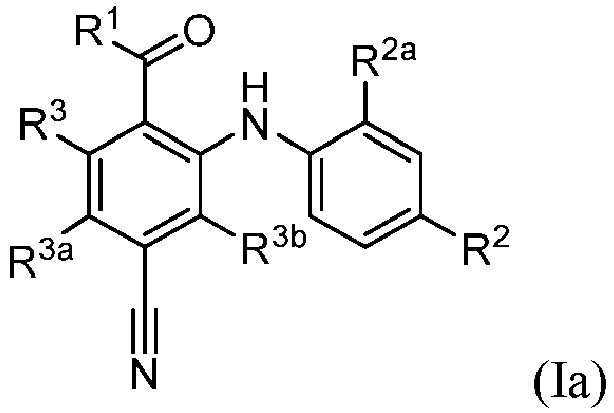
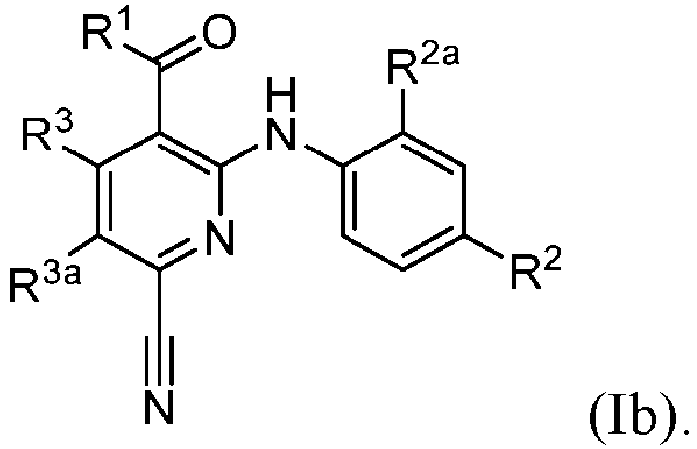
- Verbindung nach Anspruch 1 oder 2, wobei:(a) R3, R3a und R3b jeweils unabhängig voneinander Wasserstoff, Halo oder C1-C6-Alkyl sind; und/oder(b) R3 Wasserstoff ist; und/oder(c) R3a Wasserstoff ist; und/oder(d) R3b Wasserstoff oder Halo, vorzugsweise Fluor, ist.
- Verbindung nach einem der Ansprüche 1-3, wobei R2 Halo ist, vorzugsweise wobei R2 Iod ist; oder R2 C1-C6-Alkyl ist, vorzugsweise wobei R2 CH3 ist.
- Verbindung nach einem der Ansprüche 1-4, wobei (a) R2a Halo ist, vorzugsweise wobei R2a Fluor ist; oder (b) R2a C1-C6-Alkyl ist, vorzugsweise wobei R2a Methyl ist.
- Verbindung nach einem der Ansprüche 1-5, wobei:(a) R1 -OR4 ist; R4 R7-C(O)-C1-C6-alkyl ist; und R7 Hydroxy, C1-C6-Alkoxy, Amino oder Hydroxyamino ist; oder(b) R1 -OR4 ist und R4 Wasserstoff, C1-C6-Alkyl, C3-C8-Cycloalkyl, C3-C8-Cycloalkyl-C1-C6-alkyl, C1-C6-Hydroxyalkyl, C1-C6-Alkoxy-C1-C6-alkyl, Amino-C1-C6-alkyl, C1-C6-Alkylamino-C1-C6-alkyl, Di-(C1-C6-alkyl)amino-C1-C6-alkyl, Heterocycloalkyl oder Heterocycloalkyl-C1-C6-alkyl ist, wobei jede der C3-C8-Cycloalkyl- und Heterocycloalkylgruppen unsubstituiert oder mit einem bis sechs R6 substituiert ist und jedes R6 unabhängig voneinander Hydroxy oder C1-C6-Alkyl ist; vorzugsweise R1 -OR4 ist und R4 C1-C6-Hydroxyalkyl ist oder R1 aus der Gruppe ausgewählt ist, bestehend aus -OH,

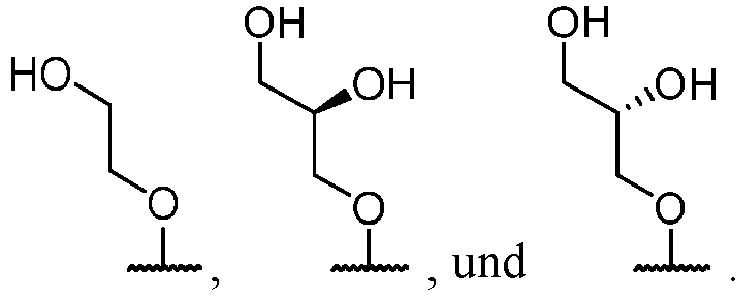
- Verbindung eines der Ansprüche 1-5, wobei R1 -NR5R5a ist und(a) R5 Wasserstoff, C1-C6-Alkyl, C3-C8-Cycloalkyl, C3-C8-Cycloalkyl-C1-C6-alkyl, C1-C6-Hydroxyalkyl, C1-C6-Alkoxy-C1-C6-alkyl, Amino-C1-C6-alkyl, C1-C6-Alkylamino-C1-C6-alkyl, Di-(C1-C6-alkyl)amino-C1-C6-alkyl, Heterocycloalkyl oder Heterocycloalkyl-C1-C6-alkyl ist, wobei jede der C3-C8-Cycloalkyl- und Heterocycloalkylgruppen unsubstituiert oder mit einem bis sechs R6 substituiert ist und jedes R6 unabhängig Hydroxy oder C1-C6-Alkyl ist, vorzugsweise wobei eines von (i) bis (iv) gilt:(i) R5 C3-C8-Cycloalkyl ist, das unsubstituiert oder mit einem bis sechs R6 substituiert ist und jedes R6 unabhängig voneinander Hydroxy oder C1-C6-Alkyl ist;(ii) R5 C1-C6-Hydroxyalkyl ist;(iii) R5 Amino-C1-C6-alkyl ist;(iv) R5 Heterocycloalkyl-C1-C6-alkyl ist, wobei die Heterocycloalkylgruppe unsubstituiert oder mit einem bis sechs R6 substituiert ist und jedes R6 unabhängig voneinander Hydroxy oder C1-C6-Alkyl ist;(b) R5 R7-C(O)-C1-C6-Alkyl ist; und R7 Hydroxy, C1-C6-Alkoxy, Amino oder Hydroxyamino ist; oder(c) R5 aus der Gruppe ausgewählt ist, bestehend aus Wasserstoff,


- Verbindung nach einem der Ansprüche 1-5, wobeii) R1 -N(OR5b)R5a ist und R5b Wasserstoff, C1-C6-Alkyl, C3-C8-Cycloalkyl, C3-C8-Cycloalkyl-C1-C6-alkyl, C1-C6-Hydroxyalkyl, C1-C6-Alkoxy-C1-C6-alkyl, Amino-C1-C6-alkyl, C1-C6-Alkylamino-C1-C6-alkyl, Di-(C1-C6-alkyl)amino-C1-C6-alkyl, Heterocycloalkyl oder Heterocycloalkyl-C1-C6-alkyl ist, wobei jede der C3-C8-Cycloalkyl- und Heterocycloalkylgruppen unsubstituiert oder mit einem bis sechs R6 substituiert ist und jedes R6 unabhängig voneinander Hydroxy oder C1-C6-Alkyl ist, vorzugsweise wobei:(a) R5b C3-C8-Cycloalkyl ist, wobei die C3-C8-Cycloalkylgruppe unsubstituiert oder mit einem bis sechs R6 substituiert ist und jedes R6 unabhängig Hydroxy oder C1-C6-Alkyl ist; oder(b) R5b C1-C6-Hydroxyalkyl ist; oder(c) R5b Amino-C1-C6-alkyl ist; oder(d) R5b Heterocycloalkyl-C1-C6-alkyl ist, wobei die Heterocycloalkylgruppe unsubstituiert oder mit einem bis sechs R6 substituiert ist und jedes R6 unabhängig Hydroxy oder C1-C6-Alkyl ist, oderii) R1 -N(OR5b)R5a ist; und(a) R5b R7-C(O)-C1-C6-alkyl ist; und R7 Hydroxy, C1-C6-Alkoxy, Amino oder Hydroxyamino ist; oder(b) OR5b aus der Gruppe ausgewählt ist, bestehend aus -OH,


- Verbindung nach einem der Ansprüche 1-5 und 7-8, wobei R1 -NR5R5a oder - N(OR5b)R5a ist und R5a Wasserstoff oder C1-C6-Alkyl ist.
- Verbindung nach Anspruch 1, ausgewählt aus der Gruppe, bestehend aus:
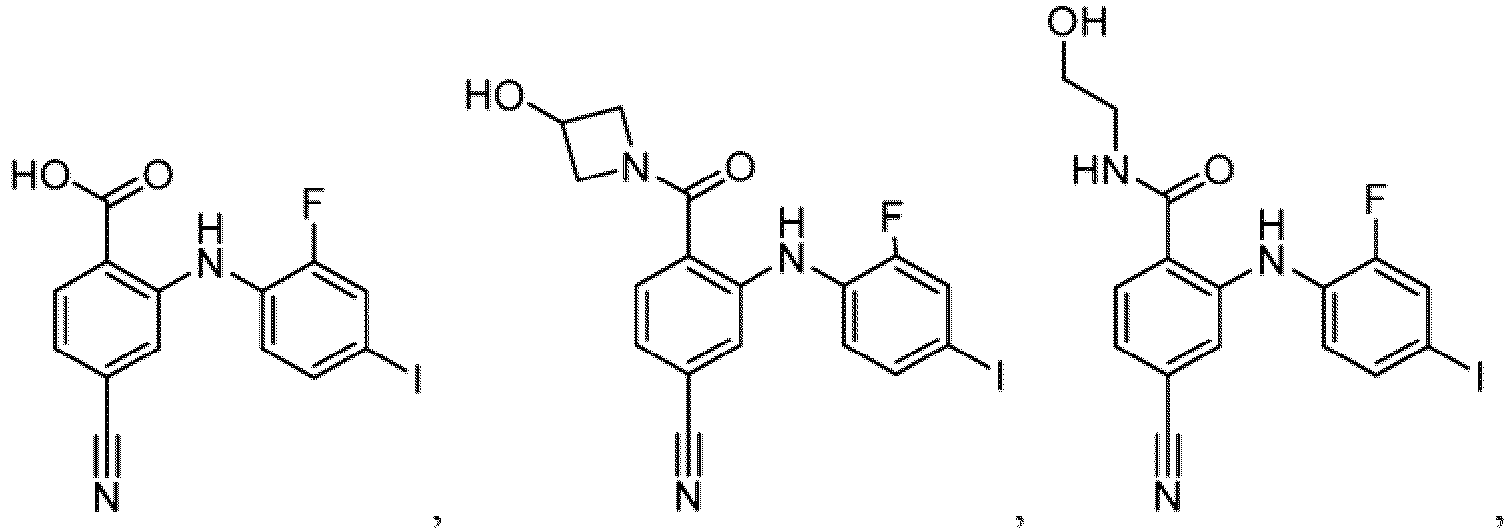
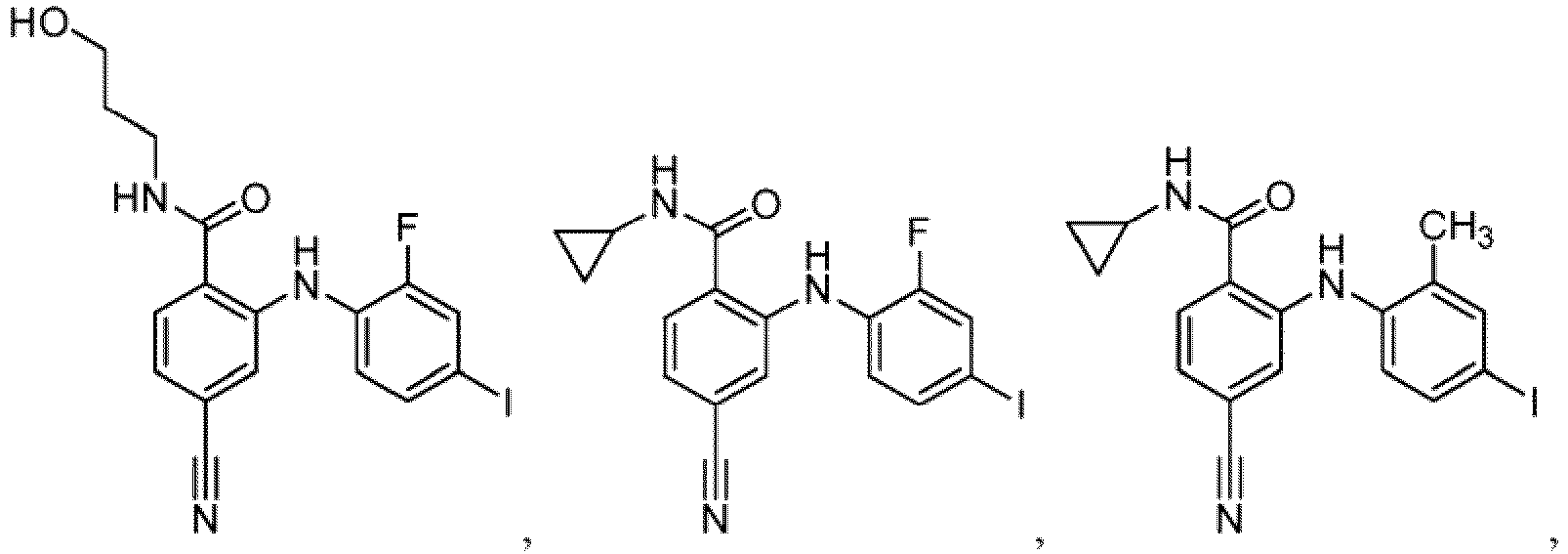

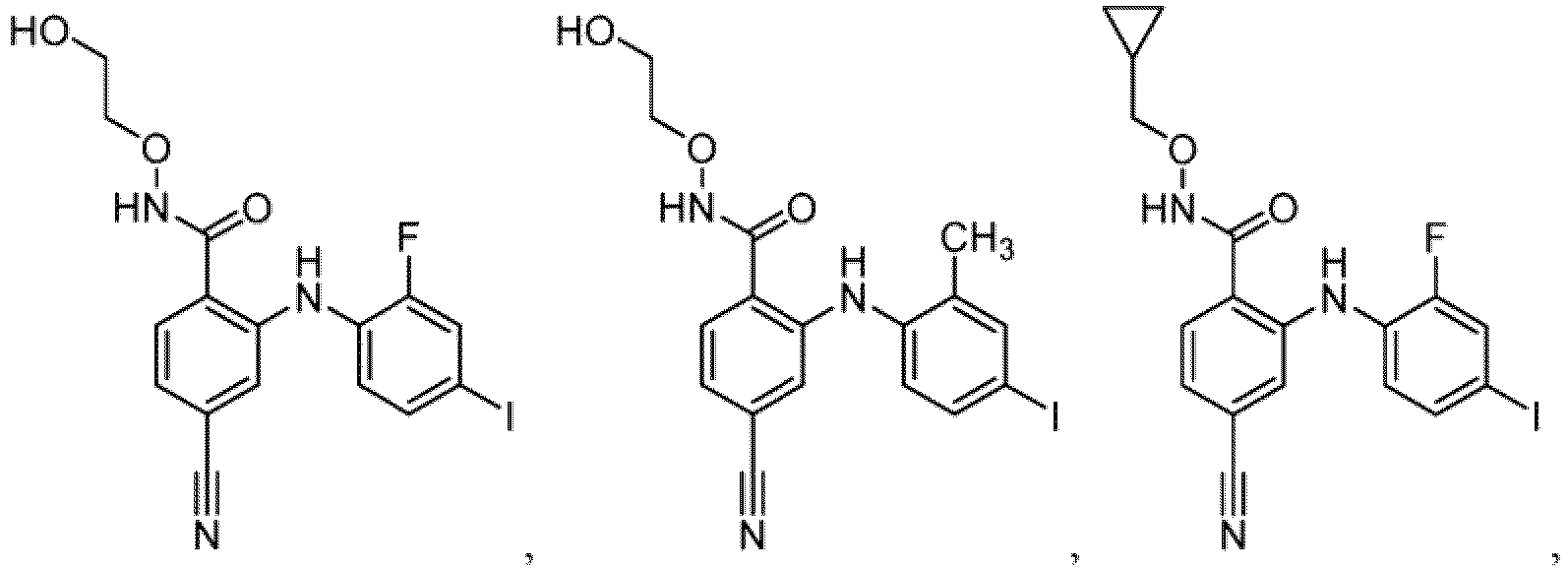
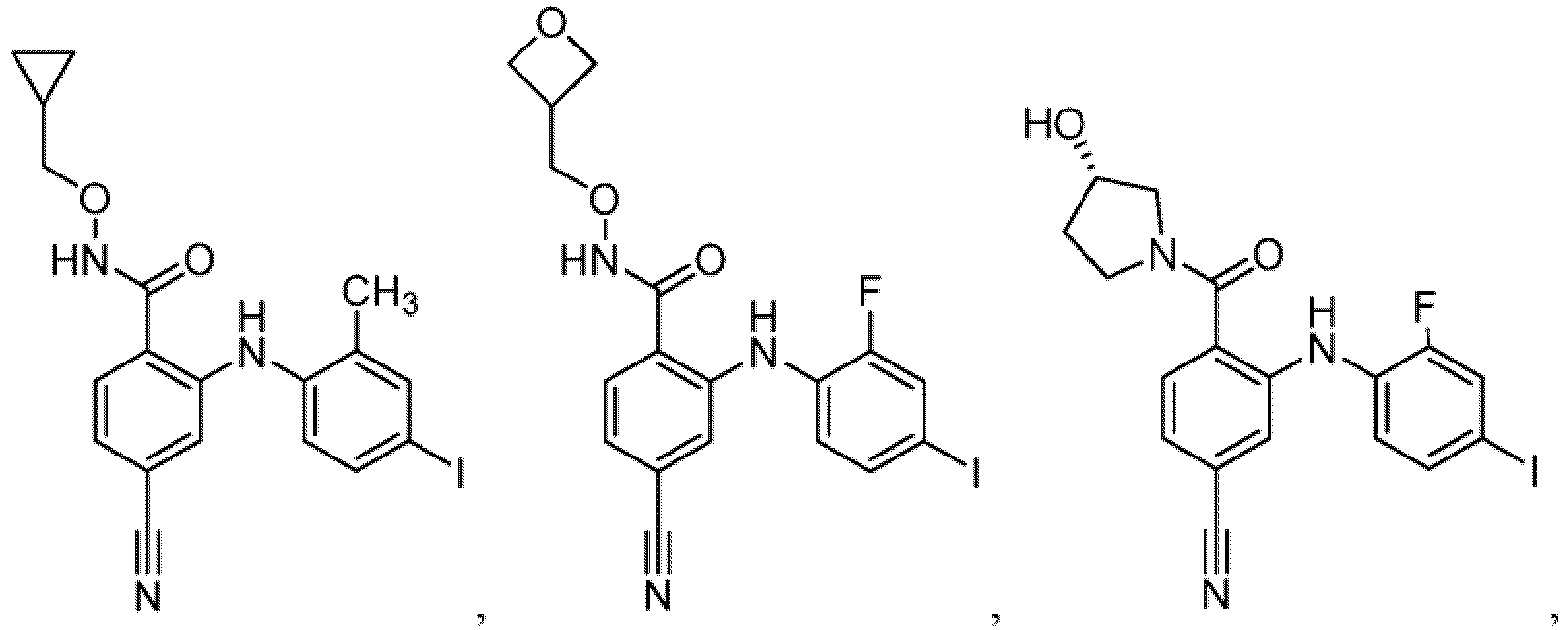
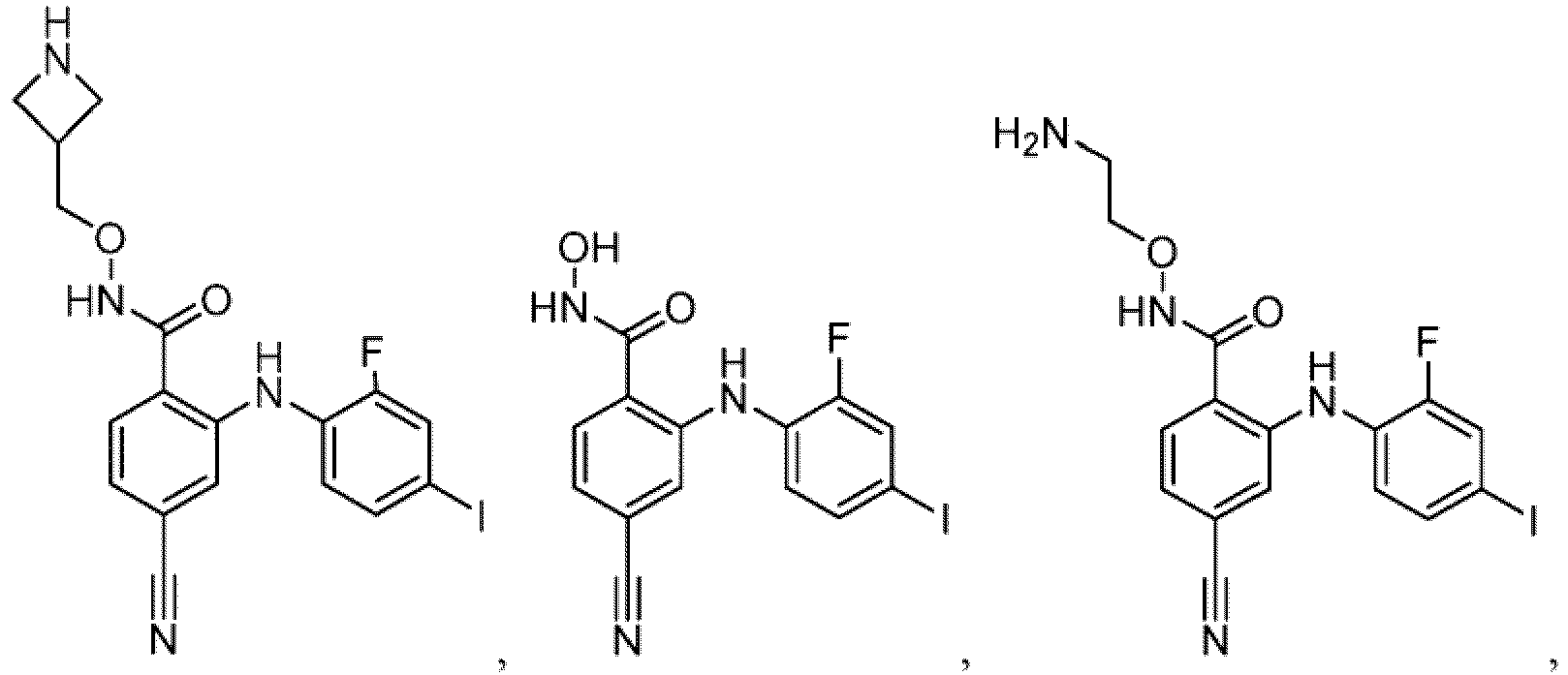


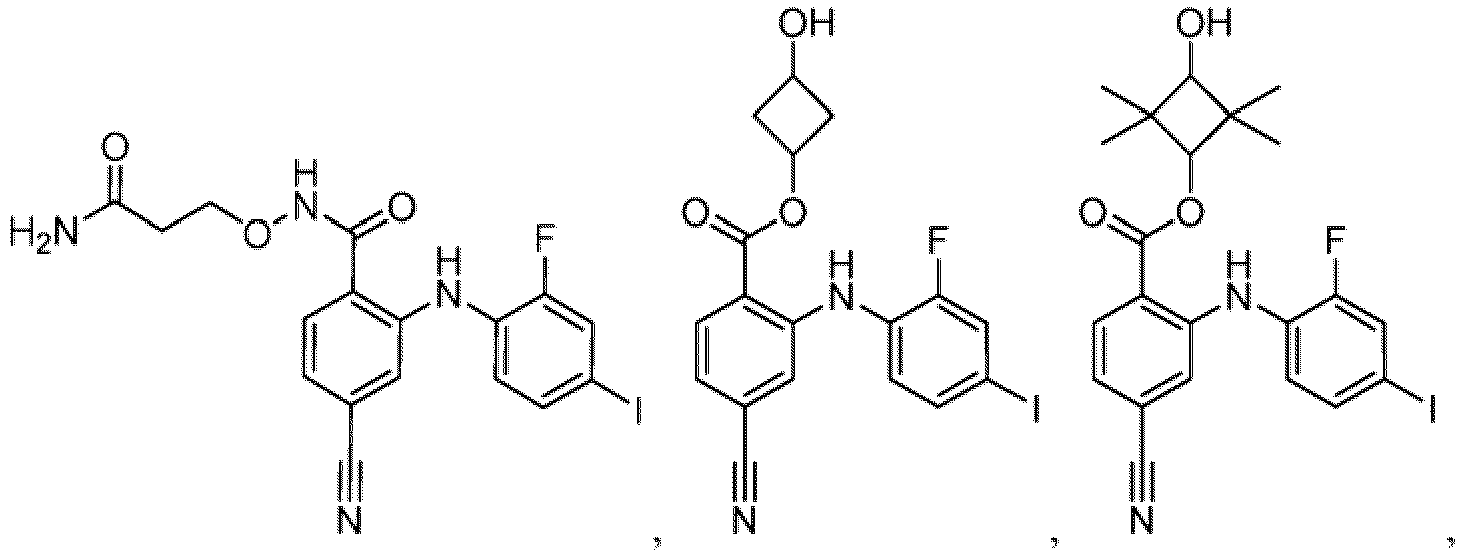

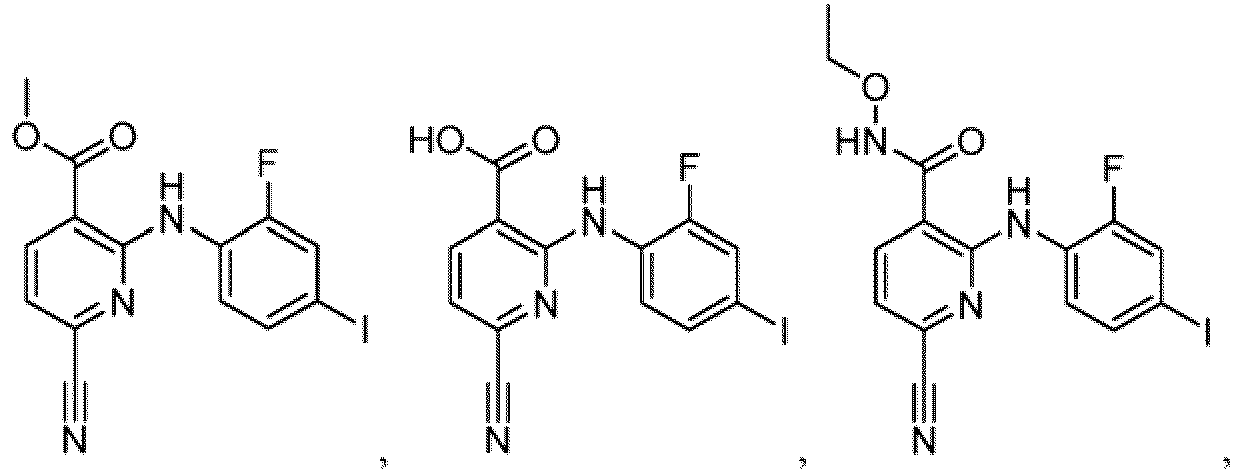

- Verbindung nach Anspruch 1, dargestellt durch die Formel:

- Verbindung nach Anspruch 1, dargestellt durch die Formel:

- Pharmazeutische Zusammensetzung, umfassend eine Verbindung nach einem der Ansprüche 1-12 und einen pharmazeutisch unbedenklichen Träger.
- Verbindung nach einem der Ansprüche 1-12 oder Zusammensetzung nach Anspruch 13 für die Verwendung in einem Verfahren zum Behandeln einer auf einen MEK-Inhibitor ansprechenden Erkrankung, einer auf einen MEK-Inhibitor ansprechenden Hauterkrankung, eine durch MEK vermittelte Erkrankung oder Krankheit oder eine durch MEK vermittelte Hauterkrankung, wobei das Verfahren das Verabreichen einer therapeutisch wirksamen Menge der Verbindung oder Zusammensetzung an einen Patienten umfasst, der dies benötigt, vorzugsweise wobei die auf einen MEK-Inhibitor ansprechende Hauterkrankung oder durch MEK vermittelte Hauterkrankung aus der Gruppe ausgewählt ist, bestehend aus dermaler RASopathie, Neurofibromatose Typ 1, dermalem Neurofibrom, subdermalem Neurofibrom und oberflächlichem plexiformen Neurofibrom, vorzugsweise wobei:(a) die auf MEK-Inhibitoren ansprechende Hauterkrankung oder durch MEK vermittelte Hauterkrankung Neurofibromatose Typ 1 ist, oder(b) die auf MEK-Inhibitoren ansprechende Hauterkrankung oder durch MEK vermittelte Hauterkrankung ein dermales Neurofibrom ist, oder(c) die auf MEK-Inhibitoren ansprechende Hauterkrankung oder durch MEK vermittelte Hauterkrankung ein subdermales Neurofibrom ist, oder(d) die auf MEK-Inhibitoren ansprechende Hauterkrankung oder durch MEK vermittelte Hauterkrankung ein oberflächliches plexiformes Neurofibrom, oder(e) die auf MEK-Inhibitoren ansprechende Hauterkrankung oder durch MEK vermittelte Hauterkrankung eine dermale RASopathie ist, wobei die dermale RASopathie vorzugsweise aus der Gruppe ausgewählt ist, bestehend aus Psoriasis, Keratokanthom (KA), Hyperkeratose, Papillom, Noonan-Syndrom (NS), kardio-fazio-kutanem Syndrom (CFC), Costello-Syndrom (fazio-kutano-skelettalem Syndrom oder FCS-Syndrom), oculoectodermalem Syndrom, Café-au-lait-Flecken und Multiples Lentigines-Syndrom (früher Leopard-Syndrom genannt).
- Verbindung oder Zusammensetzung für die Verwendung nach Anspruch 14, wobei die Verbindung oder Zusammensetzung für die topische, transdermale oder intraläsionale Verabreichung bestimmt ist.
Applications Claiming Priority (2)
| Application Number | Priority Date | Filing Date | Title |
|---|---|---|---|
| US201862769871P | 2018-11-20 | 2018-11-20 | |
| PCT/US2019/000068 WO2020106306A1 (en) | 2018-11-20 | 2019-11-20 | Cyanoaryl-aniline compounds for treatment of dermal disorders |
Publications (3)
| Publication Number | Publication Date |
|---|---|
| EP3883552A1 EP3883552A1 (de) | 2021-09-29 |
| EP3883552A4 EP3883552A4 (de) | 2022-08-17 |
| EP3883552B1 true EP3883552B1 (de) | 2025-04-09 |
Family
ID=70774496
Family Applications (1)
| Application Number | Title | Priority Date | Filing Date |
|---|---|---|---|
| EP19886174.2A Active EP3883552B1 (de) | 2018-11-20 | 2019-11-20 | Cyanoaryl-anilin-verbindungen zur behandlung von hauterkrankungen |
Country Status (8)
| Country | Link |
|---|---|
| US (1) | US11572344B2 (de) |
| EP (1) | EP3883552B1 (de) |
| JP (1) | JP7406264B2 (de) |
| CN (1) | CN113473978B (de) |
| AU (1) | AU2019383311B2 (de) |
| CA (1) | CA3120371A1 (de) |
| MA (1) | MA55141A (de) |
| WO (1) | WO2020106306A1 (de) |
Families Citing this family (4)
| Publication number | Priority date | Publication date | Assignee | Title |
|---|---|---|---|---|
| CA3120337A1 (en) | 2018-11-20 | 2020-05-28 | Nflection Therapeutics, Inc. | Naphthyridinone-aniline compounds for treatment of dermal disorders |
| JP7651101B2 (ja) * | 2018-11-20 | 2025-03-26 | エヌフレクション セラピューティクス インコーポレイテッド | あざの処置のためのアリールアニリンおよびヘテロアリールアニリン化合物 |
| WO2020106305A1 (en) | 2018-11-20 | 2020-05-28 | Nflection Therapeutics, Inc. | Thienyl-aniline compounds for treatment of dermal disorders |
| EP3883552B1 (de) | 2018-11-20 | 2025-04-09 | NFlection Therapeutics, Inc. | Cyanoaryl-anilin-verbindungen zur behandlung von hauterkrankungen |
Family Cites Families (88)
| Publication number | Priority date | Publication date | Assignee | Title |
|---|---|---|---|---|
| US3536809A (en) | 1969-02-17 | 1970-10-27 | Alza Corp | Medication method |
| US3598123A (en) | 1969-04-01 | 1971-08-10 | Alza Corp | Bandage for administering drugs |
| US3845770A (en) | 1972-06-05 | 1974-11-05 | Alza Corp | Osmatic dispensing device for releasing beneficial agent |
| US3916899A (en) | 1973-04-25 | 1975-11-04 | Alza Corp | Osmotic dispensing device with maximum and minimum sizes for the passageway |
| US4008719A (en) | 1976-02-02 | 1977-02-22 | Alza Corporation | Osmotic system having laminar arrangement for programming delivery of active agent |
| US4271164A (en) | 1979-04-16 | 1981-06-02 | Warner-Lambert Company | 6-Substituted-arylpyrido[2,3-d]pyrimidin-7-amines and derivatives |
| KR890002631B1 (ko) | 1984-10-04 | 1989-07-21 | 몬산토 캄파니 | 생물학적으로 활성인 소마토트로핀을 지속적으로 유리하는 조성물 |
| IE58110B1 (en) | 1984-10-30 | 1993-07-14 | Elan Corp Plc | Controlled release powder and process for its preparation |
| US5073543A (en) | 1988-07-21 | 1991-12-17 | G. D. Searle & Co. | Controlled release formulations of trophic factors in ganglioside-lipsome vehicle |
| IT1229203B (it) | 1989-03-22 | 1991-07-25 | Bioresearch Spa | Impiego di acido 5 metiltetraidrofolico, di acido 5 formiltetraidrofolico e dei loro sali farmaceuticamente accettabili per la preparazione di composizioni farmaceutiche in forma a rilascio controllato attive nella terapia dei disturbi mentali organici e composizioni farmaceutiche relative. |
| PH30995A (en) | 1989-07-07 | 1997-12-23 | Novartis Inc | Sustained release formulations of water soluble peptides. |
| US5120548A (en) | 1989-11-07 | 1992-06-09 | Merck & Co., Inc. | Swelling modulated polymeric drug delivery device |
| US5733566A (en) | 1990-05-15 | 1998-03-31 | Alkermes Controlled Therapeutics Inc. Ii | Controlled release of antiparasitic agents in animals |
| US5580578A (en) | 1992-01-27 | 1996-12-03 | Euro-Celtique, S.A. | Controlled release formulations coated with aqueous dispersions of acrylic polymers |
| TW333456B (en) | 1992-12-07 | 1998-06-11 | Takeda Pharm Ind Co Ltd | A pharmaceutical composition of sustained-release preparation the invention relates to a pharmaceutical composition of sustained-release preparation which comprises a physiologically active peptide. |
| US5591767A (en) | 1993-01-25 | 1997-01-07 | Pharmetrix Corporation | Liquid reservoir transdermal patch for the administration of ketorolac |
| US6087324A (en) | 1993-06-24 | 2000-07-11 | Takeda Chemical Industries, Ltd. | Sustained-release preparation |
| IT1270594B (it) | 1994-07-07 | 1997-05-07 | Recordati Chem Pharm | Composizione farmaceutica a rilascio controllato di moguisteina in sospensione liquida |
| GB9420168D0 (en) | 1994-10-06 | 1994-11-23 | Boots Co Plc | Therapeutic agents |
| DE69632684T2 (de) | 1995-06-27 | 2005-06-09 | Takeda Pharmaceutical Co. Ltd. | Verfahren zur herstellung von zubereitungen mit verzögerter freisetzung |
| TW448055B (en) | 1995-09-04 | 2001-08-01 | Takeda Chemical Industries Ltd | Method of production of sustained-release preparation |
| JP2909418B2 (ja) | 1995-09-18 | 1999-06-23 | 株式会社資生堂 | 薬物の遅延放出型マイクロスフイア |
| US5980945A (en) | 1996-01-16 | 1999-11-09 | Societe De Conseils De Recherches Et D'applications Scientifique S.A. | Sustained release drug formulations |
| US6264970B1 (en) | 1996-06-26 | 2001-07-24 | Takeda Chemical Industries, Ltd. | Sustained-release preparation |
| US6419961B1 (en) | 1996-08-29 | 2002-07-16 | Takeda Chemical Industries, Ltd. | Sustained release microcapsules of a bioactive substance and a biodegradable polymer |
| CA2217134A1 (en) | 1996-10-09 | 1998-04-09 | Sumitomo Pharmaceuticals Co., Ltd. | Sustained release formulation |
| ATE272394T1 (de) | 1996-10-31 | 2004-08-15 | Takeda Chemical Industries Ltd | Zubereitung mit verzögerter freisetzung |
| ZA9711385B (en) | 1996-12-20 | 1999-06-18 | Takeda Chemical Industries Ltd | Method of producing a sustained-release preparation |
| US5891474A (en) | 1997-01-29 | 1999-04-06 | Poli Industria Chimica, S.P.A. | Time-specific controlled release dosage formulations and method of preparing same |
| AU756586C (en) | 1997-07-01 | 2004-01-29 | Warner-Lambert Company | 2-(4-bromo or 4-iodo phenylamino) benzoic acid derivatives and their use as MEK inhibitors |
| JP2910748B2 (ja) | 1997-11-12 | 1999-06-23 | 日本電気株式会社 | 異質同軸部材の端面の球状加工装置及びその方法 |
| US6613358B2 (en) | 1998-03-18 | 2003-09-02 | Theodore W. Randolph | Sustained-release composition including amorphous polymer |
| KR19990085365A (ko) | 1998-05-16 | 1999-12-06 | 허영섭 | 지속적으로 약물 조절방출이 가능한 생분해성 고분자 미립구 및그 제조방법 |
| EP1144394B1 (de) | 1999-01-13 | 2005-08-24 | Warner-Lambert Company LLC | 1-heterozyklus-substituierte diarylaminen |
| US6248363B1 (en) | 1999-11-23 | 2001-06-19 | Lipocine, Inc. | Solid carriers for improved delivery of active ingredients in pharmaceutical compositions |
| SI2275102T1 (sl) | 2002-03-13 | 2015-12-31 | Array Biopharma, Inc. | N3 alkilirani benzimidazol derivati kot MEK inhibitorji |
| US20050202001A1 (en) | 2002-04-24 | 2005-09-15 | Han-Mo Koo | Enhancement of human epidermal melanogenesis |
| CA2492112A1 (en) | 2002-08-06 | 2004-02-19 | F. Hoffmann-La Roche Ag | 6-alkoxy-pyrido-pyrimidines as p-38 map kinase inhibitors |
| EP2251327B1 (de) * | 2003-11-19 | 2014-02-12 | Array Biopharma, Inc. | Heterozyklische inhibitoren von mek |
| CA2565965A1 (en) | 2004-05-06 | 2006-07-27 | Plexxikon, Inc. | Pde4b inhibitors and uses therefor |
| SI1761528T1 (sl) | 2004-06-11 | 2008-06-30 | Japan Tobacco Inc | 5-amino-2,4,7-triokso-3,4,7,8-tetrahidro-2H-pirido(2,3-D)pirimidinski derivati in sorodne spojine za zdravljenje raka |
| US7674907B2 (en) | 2004-07-23 | 2010-03-09 | Amgen Inc. | Furanopyridine derivatives and methods of use |
| PT1802579E (pt) * | 2004-10-20 | 2014-02-17 | Merck Serono Sa | Derivados da 3-arilaminopiridina |
| JP5710855B2 (ja) | 2005-02-02 | 2015-04-30 | ネクスジェニクス・ファーマシューティカルズ,リミテッド・ライアビリティ・カンパニー | 神経線維腫の局所治療 |
| MX2007016463A (es) | 2005-06-22 | 2008-03-04 | Plexxikon Inc | Derivados de pirrolo [2,3-b] piridina como inhibidores de proteina cinasa. |
| SI1934174T1 (sl) * | 2005-10-07 | 2011-08-31 | Exelixis Inc | Inhibitorji MEK in postopki za njihovo uporabo |
| JP2009520780A (ja) | 2005-12-21 | 2009-05-28 | アストラゼネカ アクチボラグ | 癌の治療において有用なmek阻害剤である6−(4−ブロモ−2−クロロフェニルアミノ)−7−フルオロ−n−(2−ヒドロキシエトキシ)−3−メチル−3h−ベンゾイミダゾール−5−カルボキシアミドのトシル酸塩 |
| GB0601962D0 (en) | 2006-01-31 | 2006-03-15 | Ucb Sa | Therapeutic agents |
| WO2007123939A2 (en) | 2006-04-19 | 2007-11-01 | Laboratoires Serono S.A. | Novel arylamino n-heteraryls as mek inhibitors |
| GB0616214D0 (en) | 2006-08-15 | 2006-09-27 | Ucb Sa | Therapeutic Agents |
| CA2658725A1 (en) * | 2006-08-16 | 2008-02-21 | Exelixis, Inc. | Using pi3k and mek modulators in treatments of cancer |
| JP5448818B2 (ja) | 2006-08-21 | 2014-03-19 | ジェネンテック, インコーポレイテッド | アザベンゾフラニル化合物および使用方法 |
| US7893085B2 (en) | 2006-08-21 | 2011-02-22 | Genentech, Inc | Aza-benzothiophenyl compounds and methods of use |
| CN104606126A (zh) | 2006-10-17 | 2015-05-13 | 纽沃研究股份有限公司 | 双氯芬酸凝胶 |
| EP2089359A2 (de) | 2006-10-31 | 2009-08-19 | Takeda Pharmaceutical Company Limited | Inhibitoren von mapk-erk-kinase |
| CL2007003444A1 (es) | 2006-11-30 | 2008-06-27 | Genentech Inc | Compuestos derivados de pirrolo[3,2-c]piridina; composicion farmaceutica; y uso en el tratamiento de un trastorno hiperproliferativo o una enfermedad inflamatoria. |
| AR066505A1 (es) | 2007-05-11 | 2009-08-26 | Bayer Schering Pharma Ag | Derivados de fenilaminobenceno sustituidos de utilidad para el tratamiento de trastornos y enfermedades hiperproliferativos asociados con actividad quinasa extracelular mediada por mitogenos |
| WO2008148034A1 (en) | 2007-05-25 | 2008-12-04 | Takeda Pharmaceutical Company Limited | Mapk/erk kinase inhibitors |
| CL2008003810A1 (es) * | 2007-12-19 | 2009-05-22 | Genentech Inc | Compuestos derivados de 5-anilino imidazol[1,5-a]piridina o pirazina, inhibidores de la actividad mek quinasa; composiciones farmaceuticas que los contienen; y su uso para tratar trastornos hiperproliferativos y una enfermedad inflamatoria. |
| BRPI0819505A2 (pt) | 2007-12-21 | 2017-04-04 | Genentech Inc | "composto, composição farmacêutica, método para inibir o crescimento celular anormal e método para tratar uma doença inflamatória" |
| GB0801080D0 (en) | 2008-01-21 | 2008-02-27 | Ucb Pharma Sa | Therapeutic agents |
| GB0801081D0 (en) | 2008-01-21 | 2008-02-27 | Ucb Pharma Sa | Therapeutic agents |
| WO2009093008A1 (en) | 2008-01-21 | 2009-07-30 | Ucb Pharma S.A. | Thieno-pyridine derivatives as mek inhibitors |
| GB0811304D0 (en) | 2008-06-19 | 2008-07-30 | Ucb Pharma Sa | Therapeutic agents |
| ES2444777T3 (es) * | 2009-06-12 | 2014-02-26 | Bristol-Myers Squibb Company | Compuestos de nicotinamida útiles como moduladores de quinasas |
| WO2012040636A2 (en) | 2010-09-24 | 2012-03-29 | The Broad Institute, Inc. | Compounds and methods for treating diseases mediated by protease activated receptors |
| ES2711973T3 (es) | 2010-11-05 | 2019-05-08 | Hoffmann La Roche | Uso de compuestos farmacéuticos activos para el tratamiento de afecciones del sistema nervioso central |
| WO2012099968A1 (en) | 2011-01-19 | 2012-07-26 | The Trustees Of The University Of Pennsylvania | Compositions and methods for treating skin cancer associated diseases |
| GB201104267D0 (en) | 2011-03-14 | 2011-04-27 | Cancer Rec Tech Ltd | Pyrrolopyridineamino derivatives |
| EP2757092A4 (de) * | 2011-06-17 | 2015-09-23 | Sinochem Corp | Substituierte cyananilinverbindungen, herstellungsverfahren dafür und verwendung davon |
| US9357781B2 (en) | 2013-05-03 | 2016-06-07 | Inscent, Inc. | Honeybee repellents and uses thereof |
| US9572828B2 (en) | 2013-07-18 | 2017-02-21 | The Board Of Regents Of The University Of Texas System | Treatment for melanoma |
| CN105384738B (zh) | 2014-08-21 | 2017-08-29 | 上海科州药物研发有限公司 | 作为蛋白激酶抑制剂的杂环类化合物及其制备方法和用途 |
| CN105384754B (zh) | 2014-09-02 | 2018-04-20 | 上海科州药物研发有限公司 | 作为蛋白激酶抑制剂的杂环类化合物及其制备方法和用途 |
| CN108495862A (zh) | 2015-11-30 | 2018-09-04 | 亚尼塔公司 | 局部制剂 |
| EP3301094A1 (de) | 2016-09-30 | 2018-04-04 | Mutabilis | Heterocyclische verbindungen und deren verwendung zur vorbeugung oder behandlung von bakteriellen infektionen |
| DE102016225694A1 (de) | 2016-12-21 | 2018-06-21 | Robert Bosch Gmbh | Verfahren zur Verstärkung der Bremskraft in einer elektronisch schlupfregelbaren Fahrzeugbremsanlage und elektronisch schlupfregelbare Fahrzeugbremsanlage |
| ES2913213T3 (es) | 2017-05-19 | 2022-06-01 | Nflection Therapeutics Inc | Compuestos heteroaromáticos de anilina condensados para el tratamiento de trastornos dérmicos |
| US11161845B2 (en) | 2017-05-19 | 2021-11-02 | Nflection Therapeutics, Inc. | Pyrrolopyridine-aniline compounds for treatment of dermal disorders |
| WO2019139970A1 (en) | 2018-01-09 | 2019-07-18 | Duke University | Topical administration of mek inhibiting agents for the treatment of skin disorders |
| CA3120337A1 (en) | 2018-11-20 | 2020-05-28 | Nflection Therapeutics, Inc. | Naphthyridinone-aniline compounds for treatment of dermal disorders |
| WO2020106305A1 (en) | 2018-11-20 | 2020-05-28 | Nflection Therapeutics, Inc. | Thienyl-aniline compounds for treatment of dermal disorders |
| EP3883553A4 (de) | 2018-11-20 | 2022-11-02 | NFlection Therapeutics, Inc. | Aryl-anilin- und heteroaryl-anilinverbindungen zur behandlung von hautkrebs |
| WO2020106304A1 (en) | 2018-11-20 | 2020-05-28 | Nflection Therapeutics, Inc. | Topical formulations |
| EP3883552B1 (de) | 2018-11-20 | 2025-04-09 | NFlection Therapeutics, Inc. | Cyanoaryl-anilin-verbindungen zur behandlung von hauterkrankungen |
| JP7651101B2 (ja) | 2018-11-20 | 2025-03-26 | エヌフレクション セラピューティクス インコーポレイテッド | あざの処置のためのアリールアニリンおよびヘテロアリールアニリン化合物 |
| CA3205523A1 (en) | 2021-01-21 | 2022-07-28 | Michael Houghton | Processes for preparing pyrrolopyridine-aniline compounds |
| AU2022211704A1 (en) | 2021-01-21 | 2023-09-07 | Nflection Therapeutics, Inc. | Crystalline forms of a pyrrolopyridine-aniline compound |
-
2019
- 2019-11-20 EP EP19886174.2A patent/EP3883552B1/de active Active
- 2019-11-20 CA CA3120371A patent/CA3120371A1/en active Pending
- 2019-11-20 AU AU2019383311A patent/AU2019383311B2/en active Active
- 2019-11-20 US US17/294,808 patent/US11572344B2/en active Active
- 2019-11-20 WO PCT/US2019/000068 patent/WO2020106306A1/en not_active Ceased
- 2019-11-20 MA MA055141A patent/MA55141A/fr unknown
- 2019-11-20 CN CN201980089593.4A patent/CN113473978B/zh active Active
- 2019-11-20 JP JP2021527847A patent/JP7406264B2/ja active Active
Also Published As
| Publication number | Publication date |
|---|---|
| CN113473978B (zh) | 2025-03-28 |
| JP7406264B2 (ja) | 2023-12-27 |
| AU2019383311A1 (en) | 2021-06-10 |
| CA3120371A1 (en) | 2020-05-28 |
| US20220009887A1 (en) | 2022-01-13 |
| CN113473978A (zh) | 2021-10-01 |
| JP2022511730A (ja) | 2022-02-01 |
| AU2019383311B2 (en) | 2024-12-05 |
| MA55141A (fr) | 2021-09-29 |
| WO2020106306A1 (en) | 2020-05-28 |
| US11572344B2 (en) | 2023-02-07 |
| EP3883552A1 (de) | 2021-09-29 |
| EP3883552A4 (de) | 2022-08-17 |
Similar Documents
| Publication | Publication Date | Title |
|---|---|---|
| US20250388580A1 (en) | Pyrrolopyridine-aniline compounds for treatment of dermal disorders | |
| US12466818B2 (en) | Thienyl-aniline compounds for treatment of dermal disorders | |
| US20250387379A1 (en) | Aryl-aniline and heteroaryl-aniline compounds for treatment of skin cancers | |
| EP3883552B1 (de) | Cyanoaryl-anilin-verbindungen zur behandlung von hauterkrankungen | |
| US11542271B2 (en) | Fused heteroaromatic-aniline compounds for treatment of dermal disorders | |
| EP3883567B1 (de) | Naphthyridinon-anilin-verbindungen zur behandlung von hauterkrankungen |
Legal Events
| Date | Code | Title | Description |
|---|---|---|---|
| STAA | Information on the status of an ep patent application or granted ep patent |
Free format text: STATUS: THE INTERNATIONAL PUBLICATION HAS BEEN MADE |
|
| PUAI | Public reference made under article 153(3) epc to a published international application that has entered the european phase |
Free format text: ORIGINAL CODE: 0009012 |
|
| STAA | Information on the status of an ep patent application or granted ep patent |
Free format text: STATUS: REQUEST FOR EXAMINATION WAS MADE |
|
| 17P | Request for examination filed |
Effective date: 20210608 |
|
| AK | Designated contracting states |
Kind code of ref document: A1 Designated state(s): AL AT BE BG CH CY CZ DE DK EE ES FI FR GB GR HR HU IE IS IT LI LT LU LV MC MK MT NL NO PL PT RO RS SE SI SK SM TR |
|
| A4 | Supplementary search report drawn up and despatched |
Effective date: 20220720 |
|
| RIC1 | Information provided on ipc code assigned before grant |
Ipc: C07D 213/00 20060101ALI20220714BHEP Ipc: C07C 255/58 20060101ALI20220714BHEP Ipc: A61P 17/00 20060101ALI20220714BHEP Ipc: A61K 31/44 20060101ALI20220714BHEP Ipc: A61K 31/166 20060101ALI20220714BHEP Ipc: A61K 31/136 20060101AFI20220714BHEP |
|
| GRAP | Despatch of communication of intention to grant a patent |
Free format text: ORIGINAL CODE: EPIDOSNIGR1 |
|
| STAA | Information on the status of an ep patent application or granted ep patent |
Free format text: STATUS: GRANT OF PATENT IS INTENDED |
|
| INTG | Intention to grant announced |
Effective date: 20230825 |
|
| GRAJ | Information related to disapproval of communication of intention to grant by the applicant or resumption of examination proceedings by the epo deleted |
Free format text: ORIGINAL CODE: EPIDOSDIGR1 |
|
| STAA | Information on the status of an ep patent application or granted ep patent |
Free format text: STATUS: REQUEST FOR EXAMINATION WAS MADE |
|
| GRAP | Despatch of communication of intention to grant a patent |
Free format text: ORIGINAL CODE: EPIDOSNIGR1 |
|
| STAA | Information on the status of an ep patent application or granted ep patent |
Free format text: STATUS: GRANT OF PATENT IS INTENDED |
|
| INTC | Intention to grant announced (deleted) | ||
| INTG | Intention to grant announced |
Effective date: 20240214 |
|
| GRAJ | Information related to disapproval of communication of intention to grant by the applicant or resumption of examination proceedings by the epo deleted |
Free format text: ORIGINAL CODE: EPIDOSDIGR1 |
|
| STAA | Information on the status of an ep patent application or granted ep patent |
Free format text: STATUS: REQUEST FOR EXAMINATION WAS MADE |
|
| INTC | Intention to grant announced (deleted) | ||
| RAP3 | Party data changed (applicant data changed or rights of an application transferred) |
Owner name: NFLECTION THERAPEUTICS, INC. |
|
| GRAP | Despatch of communication of intention to grant a patent |
Free format text: ORIGINAL CODE: EPIDOSNIGR1 |
|
| STAA | Information on the status of an ep patent application or granted ep patent |
Free format text: STATUS: GRANT OF PATENT IS INTENDED |
|
| INTG | Intention to grant announced |
Effective date: 20241031 |
|
| GRAS | Grant fee paid |
Free format text: ORIGINAL CODE: EPIDOSNIGR3 |
|
| GRAA | (expected) grant |
Free format text: ORIGINAL CODE: 0009210 |
|
| STAA | Information on the status of an ep patent application or granted ep patent |
Free format text: STATUS: THE PATENT HAS BEEN GRANTED |
|
| AK | Designated contracting states |
Kind code of ref document: B1 Designated state(s): AL AT BE BG CH CY CZ DE DK EE ES FI FR GB GR HR HU IE IS IT LI LT LU LV MC MK MT NL NO PL PT RO RS SE SI SK SM TR |
|
| REG | Reference to a national code |
Ref country code: GB Ref legal event code: FG4D |
|
| REG | Reference to a national code |
Ref country code: CH Ref legal event code: EP |
|
| REG | Reference to a national code |
Ref country code: DE Ref legal event code: R096 Ref document number: 602019068558 Country of ref document: DE |
|
| REG | Reference to a national code |
Ref country code: IE Ref legal event code: FG4D |
|
| REG | Reference to a national code |
Ref country code: NL Ref legal event code: MP Effective date: 20250409 |
|
| PG25 | Lapsed in a contracting state [announced via postgrant information from national office to epo] |
Ref country code: NL Free format text: LAPSE BECAUSE OF FAILURE TO SUBMIT A TRANSLATION OF THE DESCRIPTION OR TO PAY THE FEE WITHIN THE PRESCRIBED TIME-LIMIT Effective date: 20250409 |
|
| REG | Reference to a national code |
Ref country code: AT Ref legal event code: MK05 Ref document number: 1782932 Country of ref document: AT Kind code of ref document: T Effective date: 20250409 |
|
| PG25 | Lapsed in a contracting state [announced via postgrant information from national office to epo] |
Ref country code: FI Free format text: LAPSE BECAUSE OF FAILURE TO SUBMIT A TRANSLATION OF THE DESCRIPTION OR TO PAY THE FEE WITHIN THE PRESCRIBED TIME-LIMIT Effective date: 20250409 Ref country code: ES Free format text: LAPSE BECAUSE OF FAILURE TO SUBMIT A TRANSLATION OF THE DESCRIPTION OR TO PAY THE FEE WITHIN THE PRESCRIBED TIME-LIMIT Effective date: 20250409 Ref country code: PT Free format text: LAPSE BECAUSE OF FAILURE TO SUBMIT A TRANSLATION OF THE DESCRIPTION OR TO PAY THE FEE WITHIN THE PRESCRIBED TIME-LIMIT Effective date: 20250811 |
|
| REG | Reference to a national code |
Ref country code: LT Ref legal event code: MG9D |
|
| PG25 | Lapsed in a contracting state [announced via postgrant information from national office to epo] |
Ref country code: GR Free format text: LAPSE BECAUSE OF FAILURE TO SUBMIT A TRANSLATION OF THE DESCRIPTION OR TO PAY THE FEE WITHIN THE PRESCRIBED TIME-LIMIT Effective date: 20250710 Ref country code: NO Free format text: LAPSE BECAUSE OF FAILURE TO SUBMIT A TRANSLATION OF THE DESCRIPTION OR TO PAY THE FEE WITHIN THE PRESCRIBED TIME-LIMIT Effective date: 20250709 |
|
| PG25 | Lapsed in a contracting state [announced via postgrant information from national office to epo] |
Ref country code: PL Free format text: LAPSE BECAUSE OF FAILURE TO SUBMIT A TRANSLATION OF THE DESCRIPTION OR TO PAY THE FEE WITHIN THE PRESCRIBED TIME-LIMIT Effective date: 20250409 |
|
| PG25 | Lapsed in a contracting state [announced via postgrant information from national office to epo] |
Ref country code: BG Free format text: LAPSE BECAUSE OF FAILURE TO SUBMIT A TRANSLATION OF THE DESCRIPTION OR TO PAY THE FEE WITHIN THE PRESCRIBED TIME-LIMIT Effective date: 20250409 |
|
| PG25 | Lapsed in a contracting state [announced via postgrant information from national office to epo] |
Ref country code: HR Free format text: LAPSE BECAUSE OF FAILURE TO SUBMIT A TRANSLATION OF THE DESCRIPTION OR TO PAY THE FEE WITHIN THE PRESCRIBED TIME-LIMIT Effective date: 20250409 |
|
| PG25 | Lapsed in a contracting state [announced via postgrant information from national office to epo] |
Ref country code: AT Free format text: LAPSE BECAUSE OF FAILURE TO SUBMIT A TRANSLATION OF THE DESCRIPTION OR TO PAY THE FEE WITHIN THE PRESCRIBED TIME-LIMIT Effective date: 20250409 |
|
| PGFP | Annual fee paid to national office [announced via postgrant information from national office to epo] |
Ref country code: FR Payment date: 20250908 Year of fee payment: 7 |
|
| PG25 | Lapsed in a contracting state [announced via postgrant information from national office to epo] |
Ref country code: RS Free format text: LAPSE BECAUSE OF FAILURE TO SUBMIT A TRANSLATION OF THE DESCRIPTION OR TO PAY THE FEE WITHIN THE PRESCRIBED TIME-LIMIT Effective date: 20250709 |
|
| PG25 | Lapsed in a contracting state [announced via postgrant information from national office to epo] |
Ref country code: IS Free format text: LAPSE BECAUSE OF FAILURE TO SUBMIT A TRANSLATION OF THE DESCRIPTION OR TO PAY THE FEE WITHIN THE PRESCRIBED TIME-LIMIT Effective date: 20250809 |
|
| PG25 | Lapsed in a contracting state [announced via postgrant information from national office to epo] |
Ref country code: LV Free format text: LAPSE BECAUSE OF FAILURE TO SUBMIT A TRANSLATION OF THE DESCRIPTION OR TO PAY THE FEE WITHIN THE PRESCRIBED TIME-LIMIT Effective date: 20250409 |
|
| PGFP | Annual fee paid to national office [announced via postgrant information from national office to epo] |
Ref country code: DE Payment date: 20250923 Year of fee payment: 7 |
|
| PGFP | Annual fee paid to national office [announced via postgrant information from national office to epo] |
Ref country code: GB Payment date: 20251001 Year of fee payment: 7 |
|
| PG25 | Lapsed in a contracting state [announced via postgrant information from national office to epo] |
Ref country code: SM Free format text: LAPSE BECAUSE OF FAILURE TO SUBMIT A TRANSLATION OF THE DESCRIPTION OR TO PAY THE FEE WITHIN THE PRESCRIBED TIME-LIMIT Effective date: 20250409 Ref country code: DK Free format text: LAPSE BECAUSE OF FAILURE TO SUBMIT A TRANSLATION OF THE DESCRIPTION OR TO PAY THE FEE WITHIN THE PRESCRIBED TIME-LIMIT Effective date: 20250409 |
|
| VS25 | Lapsed in a validation state [announced via postgrant information from nat. office to epo] |
Ref country code: MD Free format text: LAPSE BECAUSE OF FAILURE TO SUBMIT A TRANSLATION OF THE DESCRIPTION OR TO PAY THE FEE WITHIN THE PRESCRIBED TIME-LIMIT Effective date: 20250409 |
|
| PG25 | Lapsed in a contracting state [announced via postgrant information from national office to epo] |
Ref country code: CZ Free format text: LAPSE BECAUSE OF FAILURE TO SUBMIT A TRANSLATION OF THE DESCRIPTION OR TO PAY THE FEE WITHIN THE PRESCRIBED TIME-LIMIT Effective date: 20250409 |
|
| PG25 | Lapsed in a contracting state [announced via postgrant information from national office to epo] |
Ref country code: EE Free format text: LAPSE BECAUSE OF FAILURE TO SUBMIT A TRANSLATION OF THE DESCRIPTION OR TO PAY THE FEE WITHIN THE PRESCRIBED TIME-LIMIT Effective date: 20250409 |
|
| PG25 | Lapsed in a contracting state [announced via postgrant information from national office to epo] |
Ref country code: SK Free format text: LAPSE BECAUSE OF FAILURE TO SUBMIT A TRANSLATION OF THE DESCRIPTION OR TO PAY THE FEE WITHIN THE PRESCRIBED TIME-LIMIT Effective date: 20250409 Ref country code: RO Free format text: LAPSE BECAUSE OF FAILURE TO SUBMIT A TRANSLATION OF THE DESCRIPTION OR TO PAY THE FEE WITHIN THE PRESCRIBED TIME-LIMIT Effective date: 20250409 |
|
| PG25 | Lapsed in a contracting state [announced via postgrant information from national office to epo] |
Ref country code: IT Free format text: LAPSE BECAUSE OF FAILURE TO SUBMIT A TRANSLATION OF THE DESCRIPTION OR TO PAY THE FEE WITHIN THE PRESCRIBED TIME-LIMIT Effective date: 20250409 |