EP3882286B1 - Harzzusammensetzung und glasfaser - Google Patents
Harzzusammensetzung und glasfaser Download PDFInfo
- Publication number
- EP3882286B1 EP3882286B1 EP19883978.9A EP19883978A EP3882286B1 EP 3882286 B1 EP3882286 B1 EP 3882286B1 EP 19883978 A EP19883978 A EP 19883978A EP 3882286 B1 EP3882286 B1 EP 3882286B1
- Authority
- EP
- European Patent Office
- Prior art keywords
- meth
- acrylate
- oxide particles
- inorganic oxide
- resin composition
- Prior art date
- Legal status (The legal status is an assumption and is not a legal conclusion. Google has not performed a legal analysis and makes no representation as to the accuracy of the status listed.)
- Active
Links
Images
Classifications
-
- C—CHEMISTRY; METALLURGY
- C08—ORGANIC MACROMOLECULAR COMPOUNDS; THEIR PREPARATION OR CHEMICAL WORKING-UP; COMPOSITIONS BASED THEREON
- C08F—MACROMOLECULAR COMPOUNDS OBTAINED BY REACTIONS ONLY INVOLVING CARBON-TO-CARBON UNSATURATED BONDS
- C08F290/00—Macromolecular compounds obtained by polymerising monomers on to polymers modified by introduction of aliphatic unsaturated end or side groups
- C08F290/02—Macromolecular compounds obtained by polymerising monomers on to polymers modified by introduction of aliphatic unsaturated end or side groups on to polymers modified by introduction of unsaturated end groups
- C08F290/06—Polymers provided for in subclass C08G
- C08F290/067—Polyurethanes; Polyureas
-
- C—CHEMISTRY; METALLURGY
- C03—GLASS; MINERAL OR SLAG WOOL
- C03C—CHEMICAL COMPOSITION OF GLASSES, GLAZES OR VITREOUS ENAMELS; SURFACE TREATMENT OF GLASS; SURFACE TREATMENT OF FIBRES OR FILAMENTS MADE FROM GLASS, MINERALS OR SLAGS; JOINING GLASS TO GLASS OR OTHER MATERIALS
- C03C25/00—Surface treatment of fibres or filaments made from glass, minerals or slags
- C03C25/10—Coating
- C03C25/104—Coating to obtain optical fibres
- C03C25/1065—Multiple coatings
-
- C—CHEMISTRY; METALLURGY
- C03—GLASS; MINERAL OR SLAG WOOL
- C03C—CHEMICAL COMPOSITION OF GLASSES, GLAZES OR VITREOUS ENAMELS; SURFACE TREATMENT OF GLASS; SURFACE TREATMENT OF FIBRES OR FILAMENTS MADE FROM GLASS, MINERALS OR SLAGS; JOINING GLASS TO GLASS OR OTHER MATERIALS
- C03C25/00—Surface treatment of fibres or filaments made from glass, minerals or slags
- C03C25/10—Coating
- C03C25/24—Coatings containing organic materials
- C03C25/26—Macromolecular compounds or prepolymers
- C03C25/28—Macromolecular compounds or prepolymers obtained by reactions involving only carbon-to-carbon unsaturated bonds
-
- C—CHEMISTRY; METALLURGY
- C03—GLASS; MINERAL OR SLAG WOOL
- C03C—CHEMICAL COMPOSITION OF GLASSES, GLAZES OR VITREOUS ENAMELS; SURFACE TREATMENT OF GLASS; SURFACE TREATMENT OF FIBRES OR FILAMENTS MADE FROM GLASS, MINERALS OR SLAGS; JOINING GLASS TO GLASS OR OTHER MATERIALS
- C03C25/00—Surface treatment of fibres or filaments made from glass, minerals or slags
- C03C25/10—Coating
- C03C25/48—Coating with two or more coatings having different compositions
-
- C—CHEMISTRY; METALLURGY
- C08—ORGANIC MACROMOLECULAR COMPOUNDS; THEIR PREPARATION OR CHEMICAL WORKING-UP; COMPOSITIONS BASED THEREON
- C08F—MACROMOLECULAR COMPOUNDS OBTAINED BY REACTIONS ONLY INVOLVING CARBON-TO-CARBON UNSATURATED BONDS
- C08F2/00—Processes of polymerisation
- C08F2/44—Polymerisation in the presence of compounding ingredients, e.g. plasticisers, dyestuffs, fillers
-
- C—CHEMISTRY; METALLURGY
- C08—ORGANIC MACROMOLECULAR COMPOUNDS; THEIR PREPARATION OR CHEMICAL WORKING-UP; COMPOSITIONS BASED THEREON
- C08F—MACROMOLECULAR COMPOUNDS OBTAINED BY REACTIONS ONLY INVOLVING CARBON-TO-CARBON UNSATURATED BONDS
- C08F2/00—Processes of polymerisation
- C08F2/46—Polymerisation initiated by wave energy or particle radiation
- C08F2/48—Polymerisation initiated by wave energy or particle radiation by ultraviolet or visible light
- C08F2/50—Polymerisation initiated by wave energy or particle radiation by ultraviolet or visible light with sensitising agents
-
- C—CHEMISTRY; METALLURGY
- C08—ORGANIC MACROMOLECULAR COMPOUNDS; THEIR PREPARATION OR CHEMICAL WORKING-UP; COMPOSITIONS BASED THEREON
- C08F—MACROMOLECULAR COMPOUNDS OBTAINED BY REACTIONS ONLY INVOLVING CARBON-TO-CARBON UNSATURATED BONDS
- C08F290/00—Macromolecular compounds obtained by polymerising monomers on to polymers modified by introduction of aliphatic unsaturated end or side groups
- C08F290/02—Macromolecular compounds obtained by polymerising monomers on to polymers modified by introduction of aliphatic unsaturated end or side groups on to polymers modified by introduction of unsaturated end groups
- C08F290/06—Polymers provided for in subclass C08G
-
- C—CHEMISTRY; METALLURGY
- C08—ORGANIC MACROMOLECULAR COMPOUNDS; THEIR PREPARATION OR CHEMICAL WORKING-UP; COMPOSITIONS BASED THEREON
- C08G—MACROMOLECULAR COMPOUNDS OBTAINED OTHERWISE THAN BY REACTIONS ONLY INVOLVING UNSATURATED CARBON-TO-CARBON BONDS
- C08G18/00—Polymeric products of isocyanates or isothiocyanates
- C08G18/06—Polymeric products of isocyanates or isothiocyanates with compounds having active hydrogen
- C08G18/08—Processes
- C08G18/10—Prepolymer processes involving reaction of isocyanates or isothiocyanates with compounds having active hydrogen in a first reaction step
-
- C—CHEMISTRY; METALLURGY
- C08—ORGANIC MACROMOLECULAR COMPOUNDS; THEIR PREPARATION OR CHEMICAL WORKING-UP; COMPOSITIONS BASED THEREON
- C08G—MACROMOLECULAR COMPOUNDS OBTAINED OTHERWISE THAN BY REACTIONS ONLY INVOLVING UNSATURATED CARBON-TO-CARBON BONDS
- C08G18/00—Polymeric products of isocyanates or isothiocyanates
- C08G18/06—Polymeric products of isocyanates or isothiocyanates with compounds having active hydrogen
- C08G18/28—Polymeric products of isocyanates or isothiocyanates with compounds having active hydrogen characterised by the compounds used containing active hydrogen
- C08G18/40—High-molecular-weight compounds
- C08G18/48—Polyethers
- C08G18/4825—Polyethers containing two hydroxy groups
-
- C—CHEMISTRY; METALLURGY
- C08—ORGANIC MACROMOLECULAR COMPOUNDS; THEIR PREPARATION OR CHEMICAL WORKING-UP; COMPOSITIONS BASED THEREON
- C08G—MACROMOLECULAR COMPOUNDS OBTAINED OTHERWISE THAN BY REACTIONS ONLY INVOLVING UNSATURATED CARBON-TO-CARBON BONDS
- C08G18/00—Polymeric products of isocyanates or isothiocyanates
- C08G18/06—Polymeric products of isocyanates or isothiocyanates with compounds having active hydrogen
- C08G18/28—Polymeric products of isocyanates or isothiocyanates with compounds having active hydrogen characterised by the compounds used containing active hydrogen
- C08G18/67—Unsaturated compounds having active hydrogen
- C08G18/671—Unsaturated compounds having only one group containing active hydrogen
- C08G18/672—Esters of acrylic or alkyl acrylic acid having only one group containing active hydrogen
-
- C—CHEMISTRY; METALLURGY
- C08—ORGANIC MACROMOLECULAR COMPOUNDS; THEIR PREPARATION OR CHEMICAL WORKING-UP; COMPOSITIONS BASED THEREON
- C08G—MACROMOLECULAR COMPOUNDS OBTAINED OTHERWISE THAN BY REACTIONS ONLY INVOLVING UNSATURATED CARBON-TO-CARBON BONDS
- C08G18/00—Polymeric products of isocyanates or isothiocyanates
- C08G18/06—Polymeric products of isocyanates or isothiocyanates with compounds having active hydrogen
- C08G18/70—Polymeric products of isocyanates or isothiocyanates with compounds having active hydrogen characterised by the isocyanates or isothiocyanates used
- C08G18/72—Polyisocyanates or polyisothiocyanates
- C08G18/74—Polyisocyanates or polyisothiocyanates cyclic
- C08G18/75—Polyisocyanates or polyisothiocyanates cyclic cycloaliphatic
- C08G18/751—Polyisocyanates or polyisothiocyanates cyclic cycloaliphatic containing only one cycloaliphatic ring
- C08G18/752—Polyisocyanates or polyisothiocyanates cyclic cycloaliphatic containing only one cycloaliphatic ring containing at least one isocyanate or isothiocyanate group linked to the cycloaliphatic ring by means of an aliphatic group
- C08G18/753—Polyisocyanates or polyisothiocyanates cyclic cycloaliphatic containing only one cycloaliphatic ring containing at least one isocyanate or isothiocyanate group linked to the cycloaliphatic ring by means of an aliphatic group containing one isocyanate or isothiocyanate group linked to the cycloaliphatic ring by means of an aliphatic group having a primary carbon atom next to the isocyanate or isothiocyanate group
- C08G18/755—Polyisocyanates or polyisothiocyanates cyclic cycloaliphatic containing only one cycloaliphatic ring containing at least one isocyanate or isothiocyanate group linked to the cycloaliphatic ring by means of an aliphatic group containing one isocyanate or isothiocyanate group linked to the cycloaliphatic ring by means of an aliphatic group having a primary carbon atom next to the isocyanate or isothiocyanate group and at least one isocyanate or isothiocyanate group linked to a secondary carbon atom of the cycloaliphatic ring, e.g. isophorone diisocyanate
-
- C—CHEMISTRY; METALLURGY
- C08—ORGANIC MACROMOLECULAR COMPOUNDS; THEIR PREPARATION OR CHEMICAL WORKING-UP; COMPOSITIONS BASED THEREON
- C08K—Use of inorganic or non-macromolecular organic substances as compounding ingredients
- C08K3/00—Use of inorganic substances as compounding ingredients
- C08K3/18—Oxygen-containing compounds, e.g. metal carbonyls
- C08K3/20—Oxides; Hydroxides
- C08K3/22—Oxides; Hydroxides of metals
-
- C—CHEMISTRY; METALLURGY
- C08—ORGANIC MACROMOLECULAR COMPOUNDS; THEIR PREPARATION OR CHEMICAL WORKING-UP; COMPOSITIONS BASED THEREON
- C08K—Use of inorganic or non-macromolecular organic substances as compounding ingredients
- C08K5/00—Use of organic ingredients
- C08K5/54—Silicon-containing compounds
-
- C—CHEMISTRY; METALLURGY
- C08—ORGANIC MACROMOLECULAR COMPOUNDS; THEIR PREPARATION OR CHEMICAL WORKING-UP; COMPOSITIONS BASED THEREON
- C08K—Use of inorganic or non-macromolecular organic substances as compounding ingredients
- C08K9/00—Use of pretreated ingredients
- C08K9/04—Ingredients treated with organic substances
-
- C—CHEMISTRY; METALLURGY
- C09—DYES; PAINTS; POLISHES; NATURAL RESINS; ADHESIVES; COMPOSITIONS NOT OTHERWISE PROVIDED FOR; APPLICATIONS OF MATERIALS NOT OTHERWISE PROVIDED FOR
- C09D—COATING COMPOSITIONS, e.g. PAINTS, VARNISHES OR LACQUERS; FILLING PASTES; CHEMICAL PAINT OR INK REMOVERS; INKS; CORRECTING FLUIDS; WOODSTAINS; PASTES OR SOLIDS FOR COLOURING OR PRINTING; USE OF MATERIALS THEREFOR
- C09D175/00—Coating compositions based on polyureas or polyurethanes; Coating compositions based on derivatives of such polymers
- C09D175/04—Polyurethanes
- C09D175/14—Polyurethanes having carbon-to-carbon unsaturated bonds
-
- C—CHEMISTRY; METALLURGY
- C09—DYES; PAINTS; POLISHES; NATURAL RESINS; ADHESIVES; COMPOSITIONS NOT OTHERWISE PROVIDED FOR; APPLICATIONS OF MATERIALS NOT OTHERWISE PROVIDED FOR
- C09D—COATING COMPOSITIONS, e.g. PAINTS, VARNISHES OR LACQUERS; FILLING PASTES; CHEMICAL PAINT OR INK REMOVERS; INKS; CORRECTING FLUIDS; WOODSTAINS; PASTES OR SOLIDS FOR COLOURING OR PRINTING; USE OF MATERIALS THEREFOR
- C09D175/00—Coating compositions based on polyureas or polyurethanes; Coating compositions based on derivatives of such polymers
- C09D175/04—Polyurethanes
- C09D175/14—Polyurethanes having carbon-to-carbon unsaturated bonds
- C09D175/16—Polyurethanes having carbon-to-carbon unsaturated bonds having terminal carbon-to-carbon unsaturated bonds
-
- C—CHEMISTRY; METALLURGY
- C09—DYES; PAINTS; POLISHES; NATURAL RESINS; ADHESIVES; COMPOSITIONS NOT OTHERWISE PROVIDED FOR; APPLICATIONS OF MATERIALS NOT OTHERWISE PROVIDED FOR
- C09D—COATING COMPOSITIONS, e.g. PAINTS, VARNISHES OR LACQUERS; FILLING PASTES; CHEMICAL PAINT OR INK REMOVERS; INKS; CORRECTING FLUIDS; WOODSTAINS; PASTES OR SOLIDS FOR COLOURING OR PRINTING; USE OF MATERIALS THEREFOR
- C09D5/00—Coating compositions, e.g. paints, varnishes or lacquers, characterised by their physical nature or the effects produced; Filling pastes
- C09D5/002—Priming paints
-
- C—CHEMISTRY; METALLURGY
- C09—DYES; PAINTS; POLISHES; NATURAL RESINS; ADHESIVES; COMPOSITIONS NOT OTHERWISE PROVIDED FOR; APPLICATIONS OF MATERIALS NOT OTHERWISE PROVIDED FOR
- C09D—COATING COMPOSITIONS, e.g. PAINTS, VARNISHES OR LACQUERS; FILLING PASTES; CHEMICAL PAINT OR INK REMOVERS; INKS; CORRECTING FLUIDS; WOODSTAINS; PASTES OR SOLIDS FOR COLOURING OR PRINTING; USE OF MATERIALS THEREFOR
- C09D7/00—Features of coating compositions, not provided for in group C09D5/00; Processes for incorporating ingredients in coating compositions
- C09D7/40—Additives
- C09D7/60—Additives non-macromolecular
- C09D7/61—Additives non-macromolecular inorganic
- C09D7/62—Additives non-macromolecular inorganic modified by treatment with other compounds
-
- C—CHEMISTRY; METALLURGY
- C09—DYES; PAINTS; POLISHES; NATURAL RESINS; ADHESIVES; COMPOSITIONS NOT OTHERWISE PROVIDED FOR; APPLICATIONS OF MATERIALS NOT OTHERWISE PROVIDED FOR
- C09D—COATING COMPOSITIONS, e.g. PAINTS, VARNISHES OR LACQUERS; FILLING PASTES; CHEMICAL PAINT OR INK REMOVERS; INKS; CORRECTING FLUIDS; WOODSTAINS; PASTES OR SOLIDS FOR COLOURING OR PRINTING; USE OF MATERIALS THEREFOR
- C09D7/00—Features of coating compositions, not provided for in group C09D5/00; Processes for incorporating ingredients in coating compositions
- C09D7/40—Additives
- C09D7/66—Additives characterised by particle size
- C09D7/68—Particle size between 100-1000 nm
-
- G—PHYSICS
- G02—OPTICS
- G02B—OPTICAL ELEMENTS, SYSTEMS OR APPARATUS
- G02B6/00—Light guides; Structural details of arrangements comprising light guides and other optical elements, e.g. couplings
- G02B6/02—Optical fibres with cladding with or without a coating
- G02B6/02395—Glass optical fibre with a protective coating, e.g. two layer polymer coating deposited directly on a silica cladding surface during fibre manufacture
-
- C—CHEMISTRY; METALLURGY
- C08—ORGANIC MACROMOLECULAR COMPOUNDS; THEIR PREPARATION OR CHEMICAL WORKING-UP; COMPOSITIONS BASED THEREON
- C08K—Use of inorganic or non-macromolecular organic substances as compounding ingredients
- C08K2201/00—Specific properties of additives
- C08K2201/002—Physical properties
- C08K2201/005—Additives being defined by their particle size in general
-
- C—CHEMISTRY; METALLURGY
- C08—ORGANIC MACROMOLECULAR COMPOUNDS; THEIR PREPARATION OR CHEMICAL WORKING-UP; COMPOSITIONS BASED THEREON
- C08K—Use of inorganic or non-macromolecular organic substances as compounding ingredients
- C08K3/00—Use of inorganic substances as compounding ingredients
- C08K3/34—Silicon-containing compounds
- C08K3/36—Silica
-
- C—CHEMISTRY; METALLURGY
- C08—ORGANIC MACROMOLECULAR COMPOUNDS; THEIR PREPARATION OR CHEMICAL WORKING-UP; COMPOSITIONS BASED THEREON
- C08K—Use of inorganic or non-macromolecular organic substances as compounding ingredients
- C08K5/00—Use of organic ingredients
- C08K5/54—Silicon-containing compounds
- C08K5/5403—Silicon-containing compounds containing no other elements than carbon or hydrogen
-
- C—CHEMISTRY; METALLURGY
- C08—ORGANIC MACROMOLECULAR COMPOUNDS; THEIR PREPARATION OR CHEMICAL WORKING-UP; COMPOSITIONS BASED THEREON
- C08K—Use of inorganic or non-macromolecular organic substances as compounding ingredients
- C08K5/00—Use of organic ingredients
- C08K5/54—Silicon-containing compounds
- C08K5/541—Silicon-containing compounds containing oxygen
- C08K5/5425—Silicon-containing compounds containing oxygen containing at least one C=C bond
-
- C—CHEMISTRY; METALLURGY
- C08—ORGANIC MACROMOLECULAR COMPOUNDS; THEIR PREPARATION OR CHEMICAL WORKING-UP; COMPOSITIONS BASED THEREON
- C08K—Use of inorganic or non-macromolecular organic substances as compounding ingredients
- C08K9/00—Use of pretreated ingredients
- C08K9/04—Ingredients treated with organic substances
- C08K9/06—Ingredients treated with organic substances with silicon-containing compounds
Definitions
- the present disclosure relates to a resin composition and an optical fiber.
- An optical fiber has generally a coating resin layer for protecting a glass fiber which is an optical transmission medium.
- the optical fiber has been required to have excellent lateral pressure characteristics in order to reduce an increase in transmission loss induced by micro-bend generated when lateral pressure is applied to the optical fiber.
- the coating resin layer includes, for example, a primary resin layer and a secondary resin layer.
- the primary resin layer is required to have a low Young's modulus and excellent flexibility (for example, refer to Patent Literature 1). It has been investigated to improve the lateral pressure characteristics of the optical fiber by forming a resin layer using an ultraviolet ray curable resin composition containing a filler made of synthetic silica (for example, refer to Patent Literature 2).
- Patent Literatures 3 and 4 relate to radiation curable compositions that can be used for various applications, e.g. as covering/ binding material or as an optical medium.
- Patent Literature 5 is concerned with a photocurable composition suitable as a primary coating material for an optical fiber.
- the resin composition for a primary resin layer of an optical fiber according to the present invention is defined in claim 1.
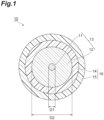
- FIG. 1 is a schematic cross-section diagram showing an example of the optical fiber according to the present embodiment.
- the strength of a primary resin layer is enhanced by forming the primary resin layer using a resin composition containing a filler.
- the resin composition used for the primary resin layer typically contains a silane coupling agent, and hence adding the filler tends to easily thicken the resin composition and tends to shorten pot life.
- An object of the present disclosure is to provide a resin composition having a long pot life and an optical fiber comprising a primary resin layer formed from the resin composition.
- the present disclosure can provide a resin composition having a long pot life for coating an optical fiber capable of forming a resin layer in which the generation of voids is suppressed and which improves the lateral pressure characteristics of an optical fiber, and an optical fiber comprising a primary resin layer formed from the resin composition.
- the resin composition for a primary resin layer of an optical fiber includes a base resin containing a urethane (meth)acrylate oligomer, a monomer, a photopolymerization initiator, and a silane coupling agent, and surface-modified inorganic oxide particles having an ultraviolet curable functional group, wherein the ultraviolet curable functional group is a methacryloyl group, and the amount of surface modification on the surface-modified inorganic oxide particles is 0.2 mg/m 2 or more and 2.8 mg/m 2 or less.
- a base resin containing a urethane (meth)acrylate oligomer, a monomer, a photopolymerization initiator, and a silane coupling agent, and surface-modified inorganic oxide particles having an ultraviolet curable functional group, wherein the ultraviolet curable functional group is a methacryloyl group, and the amount of surface modification on the surface-modified inorganic oxide particles is 0.2 mg/m 2 or more and 2.8 mg/m 2 or
- the resin composition When the resin composition is prepared, a base resin containing a silane coupling agent and a sol containing unmodified inorganic oxide particles are mixed, and as a result, the silane coupling agent is hydrolyzed and condensation reactions between the silane coupling agents and between the silane coupling agent and hydroxyl groups present on the surface of the inorganic oxide particles occur, and the stability of the resin composition may be impaired.
- the present inventors assume, on the contrary, that the resin composition of the present embodiment uses specific surface-modified inorganic oxide particles and thereby hydrolysis and condensation reactions are suppressed, allowing the pot life of the resin composition to be kept long.
- the amount of the surface modification on the surface-modified inorganic oxide particles is 0.2 mg/m 2 and more and 2.8 mg/m 2 or less.
- the above functional group is a methacryloyl group. This makes it easier to form a resin layer having sufficient strength.
- the average primary particle size of the inorganic oxide particles may be 650 nm or less.
- the primary coating material of the optical fiber according to one aspect of the present disclosure comprises the above resin composition.
- an optical fiber in which the generation of voids is suppressed and which is excellent in void resistance can be formed.
- An optical fiber according to one aspect of the present disclosure comprises a glass fiber comprising a core and cladding, a primary resin layer contacting with the glass fiber and coating the glass fiber, and a secondary resin layer coating the primary resin layer, and the primary resin layer comprises the cured product of the resin composition.
- Application of the resin composition according to the present embodiment to the primary resin layer can improve the void resistance of the optical fiber.
- the resin composition for a primary resin layer of an optical fiber includes a base resin containing a urethane (meth)acrylate oligomer, a monomer, a photopolymerization initiator, and a silane coupling agent, and surface-modified inorganic oxide particles having an ultraviolet curable functional group.
- (Meth)acrylate means an acrylate or a methacrylate corresponding to it. The same applies to (meth)acrylic acid.
- the surface of the inorganic oxide particles is treated with a silane compound having an ultraviolet curable functional group, and the ultraviolet curable functional group is introduced on the surface of the inorganic oxide particles. That is, the surface-modified inorganic oxide particles are composed of an inorganic component and an organic component.
- the functional group is a methacryloyl group. Having such a functional group makes it easy to form a resin layer having high void resistance.
- silane compound having an ultraviolet curable functional group examples include 3-methacryloxypropyltrimethoxysilane, 3-methacryloxypropyltriethoxysilane, and 8-methacryloxyoctyltrimethoxysilane,.
- the surface-modified inorganic oxide particles according to the present embodiment are dispersed in a dispersion medium.
- Using the surface-modified inorganic oxide particles dispersed in the dispersion medium allows for uniform dispersion of the surface-modified inorganic oxide particles in the resin composition and then improvement of the storage stability of the resin composition.
- the dispersion medium is not particularly limited as long as curing of the resin composition is not obstructed.
- the dispersion medium may be reactive or non-reactive.
- a monomer such as a (meth)acryloyl compound and an epoxy compound can be used as the reactive dispersion medium.
- the (meth)acryloyl compound include 1,6-hexanediol di(meth)acrylate, EO-modified bisphenol A di(meth)acrylate, polyethylene glycol di(meth)acrylate, PO-modified bisphenol A di(meth)acrylate, polypropylene glycol di(meth)acrylate, polytetramethylene glycol di(meth)acrylate, 2-hydroxy-3-phenoxypropyl (meth)acrylate, (meth)acrylic acid adduct of propylene glycol diglycidyl ether, (meth)acrylic acid adduct of tripropylene glycol diglycidyl ether, and (meth)acrylic acid adduct of glycerin diglycidyl ether.
- Compounds exemplified by monomers described above may be used as the (meth)acryl
- a ketone solvent such as methyl ethyl ketone (MEK), an alcohol solvent such as methanol (MeOH), propylene glycol monomethyl ether (PGME), or an ester solvent such as propylene glycol monomethyl ether acetate (PGMEA) can be used as the non-reactive dispersion medium.
- the resin composition may be prepared by mixing the base resin and the surface-modified inorganic oxide particles dispersed in the dispersion medium and removing a part of the dispersion medium. When the dispersion medium including surface-modified inorganic oxide particles is observed by an X-ray small angle scattering method and no aggregated particles are observed, it can be said that the surface-modified inorganic oxide particles are dispersed as primary particles.
- the surface-modified inorganic oxide particles are particles obtained by surface-treating at least one selected from the group consisting of silicon dioxide (silica), zirconium dioxide (zirconia), aluminum oxide (alumina), magnesium oxide (magnesia), titanium oxide (titania), tin oxide, and zinc oxide. From the view point of excellent inexpensiveness, easy surface treatment, permeability to ultraviolet ray, and easy provision of a resin layer with appropriate hardness, it is more preferable that the surface-modified silica particles be used as the surface-modified inorganic oxide particles according to the present embodiment.
- the average primary particle size of the surface-modified inorganic oxide particles may be 650 nm or less, preferably 600 nm or less, more preferably 500 nm or less, and still more preferably 400 nm or less. From the view point of provision of the strength of the primary resin layer, the average primary particle size of the surface-modified inorganic oxide particles is preferably 5 nm or more, and more preferably 10 nm or more. The average primary particle diameter can be measured with image analysis of electron microscope pictures, a light scattering method or a BET method, for example.
- the dispersion medium in which the primary particle of the inorganic oxide particles is dispersed appears to be visually transparent when the diameter of the primary particle is small.
- the diameter of the primary particle diameter is relatively large (40 nm or more)
- the dispersion medium in which the primary particle is dispersed appears to be clouded, but the precipitate is not observed.
- the content of the surface-modified inorganic oxide particles is preferably 1% by mass or more and 45% by mass or less, more preferably 2% by mass or more and 40% by mass or less, still more preferably 3% by mass or more and 35% by mass or less, and particularly preferably 5% by mass or more and 30% by mass or less, based on the total amount of the resin composition (total amount of the base resin and surface-modified inorganic oxide particles).
- the content of the surface-modified inorganic oxide particles is 1% by mass or more, allowing a tough resin layer to be easily formed.
- the content of the surface-modified inorganic oxide particles is 45% by mass or less, allowing a resin layer with a low Young's modulus to be easily formed.
- the total amount of the resin composition and the total amount of the cured product of the resin composition may be considered to be the same.
- the content of the surface-modified inorganic oxide particles is preferably 1% by mass or more and 45% by mass or less, more preferably 2% by mass or more and 40% by mass or less, still more preferably 3% by mass or more and 35% by mass or less, and particularly preferably 5% by mass or more and 30% by mass or less, based on the total amount of the primary resin layer (the total amount of the cured resin composition constituting the primary resin layer).
- the amount of surface modification on the surface-modified inorganic oxide particles is 0.2 mg/m 2 or more and 2.8 mg/m 2 or less, preferably 0.3 mg/m 2 or more and 2.6 mg/m 2 or less, more preferably 0.4 mg/m 2 or more and 2.4 mg/m 2 or less, and particularly preferably 0.6 mg/m 2 or more and 2.2 mg/m 2 or less.
- the amount of the surface modification is in the above range, allowing the viscosity of the resin composition to be easily adjusted.
- the amount of the surface modification in the present description can be calculated from the specific surface area of the surface-modified inorganic oxide particles and the ratio of the organic component.
- the organic component is a component derived from an ultraviolet curable functional group introduced into the inorganic oxide particles before surface modification.
- the specific surface area can be measured by a nitrogen adsorption BET method, and the ratio of the organic component can be measured by thermogravimetric/differential thermal analysis (TG/DTA).
- the amount of surface modification on the surface-modified inorganic oxide particles may be measured by isolating the particles from the dispersion medium before preparing the resin composition, and may be measured by isolating the particles from the resin composition after preparing the resin composition.
- the base resin according to the present embodiment contains a urethane (meth)acrylate oligomer, a monomer, a photopolymerization initiator, and a silane coupling agent.
- urethane (meth)acrylate oligomer an oligomer obtained by reacting a polyol compound, a polyisocyanate compound, and a hydroxyl group-containing (meth)acrylate compound can be used.
- polyol compound examples include polytetramethylene glycol, polypropylene glycol and bisphenol A-ethylene oxide addition diol.
- the number average molecular weight (Mn) of the polyol compound is preferably 1000 or more and 10000 or less, more preferably 1500 or more and 8000 or less, and still more preferably 2000 or more and 6000 or less.
- polyisocyanate compound includes 2,4-tolylene diisocyanate, 2,6-tolylene diisocyanate, isophorone diisocyanate, and dicyclohexylmethane 4,4'-diisocyanate.
- hydroxyl group-containing (meth)acrylate compound examples include 2-hydroxyethyl (meth)acrylate, 2-hydroxybutyl (meth)acrylate, 1,6-hexanediol mono(meth)acrylate, pentaerythritol tri(meth)acrylate, 2-hydroxypropyl (meth)acrylate, and tripropylene glycol mono(meth)acrylate.
- an organotin compound As a catalyst for synthesizing a urethane (meth)acrylate oligomer, an organotin compound is generally used.
- the organotin compound include dibutyltin dilaurate, dibutyltin diacetate, dibutyltin maleate, dibutyltin bis(2-ethylhexyl mercaptoacetate), dibutyltin bis(isooctyl mercaptoacetate), and dibutyltin oxide. From the view point of easy availability or catalyst performance, it is preferable that dibutyltin dilaurate or dibutyltin diacetate be used as catalyst.
- lower alcohols having 5 or less carbon atoms may be used.
- the lower alcohols include methanol, ethanol, 1-propanol, 2-propanol, 1-butanol, 2-butanol, 2-methyl-2-propanol, 1-pentanol, 2-pentanol, 3-pentanol, 2-methyl-1-butanol, 3-methyl-1-butanol, 2-methyl-2-butanol, 3-methyl-2-butanol, and 2,2-dimethyl-1-propanol.
- a silane coupling agent for example, 3-mercaptopropyltrimethoxysilane
- the addition of the silane coupling agent may be performed when synthesizing the urethane (meth)acrylate oligomer or when preparing the base resin.
- the base resin according to the present embodiment may further contain an epoxy (meth)acrylate oligomer as an oligomer.
- an epoxy (meth)acrylate oligomer an oligomer obtained by reacting a compound having a (meth)acryloyl group with an epoxy resin having two or more glycidyl groups can be used.
- a monofunctional monomer having one polymerizable group or a polyfunctional monomer having two or more polymerizable groups can be used as the monomer.
- the monomer may be used by mixing two or more monomers.
- a monomer having a phenoxy group may be used as the monomer.
- a (meth)acrylate compound having a phenoxy group can be used as the monomer having a phenoxy group.
- the (meth)acrylate compound having a phenoxy group include phenol EO-modified (meth)acrylate, nonylphenol EO-modified (meth)acrylate, phenol PO modified (meth)acrylate, nonylphenol PO modified (meth)acrylate, phenoxyethyl (meth)acrylate, 2-hydroxy-3-phenoxypropyl (meth)acrylate, and 3-phenoxybenzyl (meth)acrylate.
- EO modification means having an ethylene oxide group represented by (C 2 H 4 O) n
- PO modification means having a propylene oxide group represented by (C 3 H 6 O) n .
- n is an integer of 1 or more.
- the monomer having a phenoxy group may be at least one selected from the group consisting of phenol EO-modified acrylate, nonylphenol EO-modified acrylate, phenoxyethyl acrylate, 2-hydroxy-3-phenoxypropyl acrylate, and 3-phenoxybenzyl acrylate.
- the monomer having a phenoxy group may be used in combination of two or more.
- the content of the monomer having a phenoxy group is preferably 1% by mass or more and 60% by mass or less, more preferably 5% by mass or more and 50% by mass or less, and still more preferably 10% by mass or more and 40% by mass or less, based on the total amount of base resin.
- the resin composition includes a monomer having a phenoxy group in such a range, allowing a resin layer having an appropriate Young's modulus as a primary coating material for an optical fiber to be formed.
- a monomer having no phenoxy group may be used as the monomer.
- the monomer having no phenoxy group may be a monofunctional monomer or a polyfunctional monomer having two or more polymerizable groups.
- Examples of the monofunctional monomer having no phenoxy group include (meth)acrylate monomers such as methyl (meth)acrylate, ethyl (meth)acrylate, propyl (meth)acrylate, n-butyl (meth)acrylate, sec-butyl (meth)acrylate, tert-butyl (meth)acrylate, isobutyl (meth)acrylate, n-pentyl (meth)acrylate, isopentyl (meth)acrylate, hexyl (meth)acrylate, heptyl (meth)acrylate, isoamyl (meth)acrylate, 2-ethylhexyl (meth)acrylate, n-octyl (meth)acrylate, isooctyl (meth)acrylate, isodecyl (meth)acrylate, lauryl (meth)acrylate, 4-tert-butylcyclohexanol (meth)
- polyfunctional monomer having no phenoxy group examples include ethylene glycol di(meth)acrylate, polyethylene glycol di(meth)acrylate, polypropylene glycol di(meth)acrylate, neopentyl glycol di(meth)acrylate, tripropylene glycol di(meth)acrylate, di(meth)acrylate of alkylene oxide adduct of bisphenol A, tetraethylene glycol di(meth)acrylate, hydroxypivalic acid neopentyl glycol di(meth)acrylate, 1,4-butanediol di(meth)acrylate, 1,6-hexanediol di(meth)acrylate, 1,9-nonanediol di(meth)acrylate, 1,12-dodecanediol di(meth)acrylate, 1,14-tetradecanediol di(meth)acrylate, 1,16-hexadecanediol di(meth)
- the photopolymerization initiator can be appropriately selected from known radical photopolymerization initiators and used.
- the photopolymerization initiator include 1-hydroxycyclohexyl phenyl ketone (Omnirad 184 manufactured by IGM Resins), 2,2-dimethoxy-2-phenylacetophenone, 1-(4-isopropylphenyl)-2-hydroxy-2-methylpropan-1-one, bis(2,6-dimethoxybenzoyl)-2,4,4-trimethylpentylphosphine oxide, 2-methyl-1-[4-(methylthio)phenyl]-2-morpholino-propan-1-one (Omnirad 907 manufactured by IGM Resins), 2,4,6-trimethylbenzoyldiphenylphosphine oxide (Omnirad TPO manufactured by IGM Resins), and bis(2,4,6-trimethylbenzoyl) phenylphosphine oxide (Omnirad 819, manufactured by IGM Resin
- the silane coupling agent is not particularly limited as long as it does not disturb curing of the resin composition.
- examples of the silane coupling agent include tetramethyl silicate, tetraethyl silicate, mercaptopropyl trimethoxysilane, vinyltrichlorosilane, vinyltriethoxysilane, vinyltris(P-methoxy-ethoxy)silane, ⁇ -(3,4-epoxycyclohexyl)-ethyltrimethoxysilane, dimethoxydimethylsilane, diethoxydimethylsilane, 3-acryloxypropyltrimethoxysilane, ⁇ -glycidoxypropyltrimethoxysilane, ⁇ -glycidoxypropylmethyldiethoxysilane, ⁇ -methacryloxypropyltrimethoxysilane, N-( ⁇ -aminoethyl)- ⁇ -aminopropyltrimethoxysilane,
- the resin composition may further contain a leveling agent, an antifoaming agent, an antioxidant, and the like.
- the Young's modulus of the cured product of the above resin composition is preferably 4 MPa or less at 23 °C ⁇ 2°C, more preferably 0.05 MPa or more and 4.0 MPa or less, still more preferably 0.1 MPa or more and 3.5 MPa or less, and particularly preferably 0.3 MPa or more and 3.0 MPa or less.
- the resin composition according to the present embodiment can be suitably used as a primary coating material for an optical fiber.
- Using the resin composition according to the present embodiment for a primary resin layer can suppress the generation of voids while reducing a Young's modulus and produce an optical fiber being excellent in void resistance and lateral pressure characteristics.
- FIG. 1 is a schematic cross-section diagram showing an example of the optical fiber according to the present embodiment.
- the optical fiber 10 comprises the glass fiber 13 including the core 11 and the cladding 12, and the coating resin layer 16 including the primary resin layer 14 provided on the outer periphery of the glass fiber 13 and the secondary resin layer 15.
- the cladding 12 surrounds the core 11.
- the core 11 and the cladding 12 mainly include glass such as silica glass, germanium-added silica glass can be used, for example, in the core 11, and pure silica glass or fluorine-added silica glass can be used in the cladding 12.
- the outside diameter (D2) of the glass fiber 13 is about 125 ⁇ m, and the diameter (D1) of the core 11 constituting the glass fiber 13 is about 7 to 15 ⁇ m.
- the thickness of the coating resin layer 16 is typically about 60 to 70 ⁇ m.
- the thickness of each of the primary resin layer 14 and the secondary resin layer 15 may be about 10 to 50 ⁇ m, and for example, the thickness of the primary resin layer 14 may be 35 ⁇ m and the thickness of the secondary resin layer 15 may be 25 ⁇ m.
- the outside diameter of the optical fiber 10 may be about 245 to 265 ⁇ m.
- the thickness of the coating resin layer 16 may be about 27 to 48 ⁇ m.
- Each layer thickness of the primary resin layer 14 and the secondary resin layer 15 may be about 10 to 38 ⁇ m, and for example, the thickness of the primary resin layer 14 may be 25 ⁇ m and the thickness of the secondary resin layer 15 may be 10 ⁇ m.
- the outside diameter of the optical fiber 10 may be about 179 to 221 ⁇ m.
- the outside diameter (D2) of the glass fiber 13 may be about 100 ⁇ m, and the thickness of the coating resin layer 16 may be about 22 to 37 ⁇ m.
- Each layer thickness of the primary resin layer 14 and the secondary resin layer 15 may be about 5 to 32 ⁇ m, and for example, the thickness of the primary resin layer 14 may be 25 ⁇ m and the thickness of the secondary resin layer 15 may be 10 ⁇ m.
- the outside diameter of the optical fiber 10 may be about 144 to 174 ⁇ m.
- the Young's modulus of the secondary resin layer is preferably 1300 MPa or more at 23°C, more preferably 1300 MPa or more and 2600 MPa or less, and further preferably 1300 MPa or more and 2500 MPa or less.
- the Young's modulus of the secondary resin layer of 1300 MPa or more is easy to improve the lateral pressure characteristics, and the Young's modulus of 2600 MPa or less is hard to cause a crack or the like in the secondary resin layer due to provision of appropriate toughness with the secondary resin layer.
- the secondary layer can be formed by curing a resin composition including a urethane (meth)acrylate oligomer, a monomer, and a photopolymerization initiator.
- a resin composition for the secondary resin layer A urethane (meth)acrylate oligomer, a monomer and a photopolymerization initiator may be appropriately selected from compounds exemplified in the above base resin.
- the resin composition for the secondary resin layer may include hydrophobic inorganic oxide particles.
- the hydrophobic inorganic oxide particles may be the surface-modified inorganic oxide particles described above.
- the resin composition constituting the secondary resin layer has composition different from the resin composition forming the primary resin layer. From the view point of increasing the Young's modulus of the secondary resin layer, the Mn of the polyol compound used in synthesizing the urethane (meth)acrylate oligomer may be 400 or more and 2000 or less.
- a urethane acrylate oligomer obtained by reacting polypropylene glycol having a molecular weight of 4000, isophorone diisocyanate, hydroxyethyl acrylate, and methanol was prepared.
- nonylphenol EO-modified acrylate (trade name "Aronix M-113" of Toagosei Co., Ltd., n ⁇ 4), N-vinylcaprolactam and 1,6-hexanediol diacrylate were prepared.
- silane coupling agent 3-mercaptopropyltrimethoxysilane was prepared.
- urethane acrylate oligomer 60 parts by mass of a urethane acrylate oligomer, 22.8 parts by mass of a nonylphenol EO-modified acrylate, 4.8 parts by mass of N-vinylcaprolactam, 1.6 parts by mass of 1,6-hexanediol diacrylate, 2.7 parts by mass of 2,4,6-trimethylbenzoyldiphenylphosphine oxide, and 0.8 parts by mass of 3-mercaptopropyltrimethoxysilane were mixed to prepare a base resin.
- silica sol including silica particles surface-treated with 3-methacryloxypropyltrimethoxysilane (hereinafter, simply referred to as "silica particles") was prepared.
- a silica sol (MEK dispersion) including unmodified silica particles was prepared.
- Chloroform was added to a resin composition and centrifugation was performed to collect a precipitate.
- Acetone was added to the precipitate and centrifugation was performed to remove a supernatant, and then the operation of adding acetone to the precipitate again, centrifuging, and removing the supernatant was performed four times, and silica particles were taken out.
- the silica particles ground in a mortar were dried under reduced pressure at room temperature for 12 hours to remove volatile components. Centrifugation was performed in the condition of 30000 rpm for 120 minutes.
- the dried silica particles were subjected to a reduced pressure treatment at 80°C for 12 hours, and the specific surface area (m 2 /g) of the silica particles was measured by a nitrogen adsorption BET method using a pore distribution measuring device ("ASAP-2020" manufactured by Micromeritics).
- the ratio (% by mass) of an organic component included in the silica particles was measured by using a simultaneous differential thermogravimetric analyzer ("TG/DTA6300" manufactured by Hitachi High-Tech Science Corporation). Measurement was performed by heating the weighed silica particles from room temperature to 850°C under nitrogen (300 mL/min), then cooling from 850°C to 200°C, and heating from 200°C to 1000°C under air (100 mL/min) to measure the weight change. The ratio of the organic component was calculated from the weight change of the silica particles.
- TG/DTA6300 simultaneous differential thermogravimetric analyzer
- Each of the resin composition was applied onto a polyethylene terephthalate (PET) film by using a spin coater, and then cured using an electrodeless UV lamp system (D bulb) (manufactured by Heraeus) at a condition of 1000 ⁇ 100 mJ/cm 2 to form a resin layer having a thickness of 200 ⁇ 20 ⁇ m on the PET film.
- the resin layer was peeled off from the PET film to obtain a resin film.
- a resin film was punched into a dumbbell shape of JIS K 7127 type 5 and pulled under a condition of 23 ⁇ 2°C and 50 ⁇ 10% RH using a tensile tester at a tension speed of 1 mm/min and a gauge length of 25 mm, and a stress-strain curve was obtained. Young's modulus was determined by the tangent.
- 10 Optical fiber
- 11 Core
- 12 Cladding
- 13 Glass fiber
- 14 Primary resin layer
- 15 Secondary resin layer
- 16 Coating resin layer.
Landscapes
- Chemical & Material Sciences (AREA)
- Organic Chemistry (AREA)
- Chemical Kinetics & Catalysis (AREA)
- Life Sciences & Earth Sciences (AREA)
- Polymers & Plastics (AREA)
- Medicinal Chemistry (AREA)
- Health & Medical Sciences (AREA)
- Engineering & Computer Science (AREA)
- Materials Engineering (AREA)
- Physics & Mathematics (AREA)
- Wood Science & Technology (AREA)
- General Life Sciences & Earth Sciences (AREA)
- Geochemistry & Mineralogy (AREA)
- General Chemical & Material Sciences (AREA)
- Optics & Photonics (AREA)
- General Physics & Mathematics (AREA)
- Inorganic Chemistry (AREA)
- Nanotechnology (AREA)
- Macromonomer-Based Addition Polymer (AREA)
- Optical Fibers, Optical Fiber Cores, And Optical Fiber Bundles (AREA)
- Graft Or Block Polymers (AREA)
Claims (5)
- Harzzusammensetzung für eine Primärharzschicht (14) einer optischen Faser (10), wobei die optische Faser (10) eine Glasfaser (13) umfasst, die einen Kern (11) und Mantel (12), sowie die Primärharzschicht (14), die in Kontakt mit der Glasfaser (13) steht und die Glasfaser (13) beschichtet, umfasst, wobei die Harzzusammensetzung folgendes umfasst:ein Basisharz, das ein Urethan(meth)acrylat-Oligomer, ein Monomer, einen Fotopolymerisationsstarter und ein Silankupplungsmittel enthält; undoberflächenmodifizierte anorganische Oxidpartikel mit einer Ultraviolett-härtbaren funktionellen Gruppe, die anorganische Oxidpartikel sind, in deren Oberfläche eine Ultraviolett-härtbare funktionelle Gruppe eingeführt ist, indem die Oberfläche der anorganischen Oxidpartikel mit einer Silanverbindung mit einer Ultraviolett-härtbaren funktionellen Gruppe behandelt wird, so dass die oberflächenmodifizierten anorganischen Oxidpartikel aus einer organischen Komponente, die sich von der Ultraviolett-härtbaren funktionellen Gruppe ableitet, und einer anorganischen Komponente zusammengesetzt sind, wobeidie Ultraviolett-härtbare funktionelle Gruppe eine Methacryloyl-Gruppe ist unddas Maß der Oberflächenmodifizierung auf den oberflächenmodifizierten anorganischen Oxidpartikeln 0,2 mg/m2 oder mehr und 2,8 mg/m2 oder weniger ist, wobei das Maß der Oberflächenmodifikation berechnet wird aus der spezifischen Oberfläche der oberflächenmodifizierten anorganischen Oxidpartikel und dem Anteil der organischen Komponente und wie folgt definiert ist:
Maß der Oberflächenmodifizierung (mg/m2) = Anteil der organischen Komponente (Masse-%)/spezifische Oberfläche (m2/g) der oberflächenmodifizierten anorganischen Oxidpartikel,wobei der Anteil der organischen Komponente in Masse-% der organischen Komponente, die in die oberflächenmodifizierten anorganischen Oxidpartikel eingeschlossen ist, mittels Thermogravimetrie, Differenzthermoanalyse (TG/DTA) auf Basis der Gewichtsänderung der anorganischen Partikel bestimmt wird und die spezifische Oberfläche der oberflächenmodifizierten anorganischen Oxidpartikel mit einer Stickstoffabsorptions-BET-Methode gemessen wird. - Harzzusammensetzung gemäß Anspruch 1, in der ein mittlerer Primärpartikeldurchmesser der nichtaggregierten oberflächenmodifizierten anorganischen Oxidpartikel 650 nm oder weniger ist.
- Harzzusammensetzung gemäß Anspruch 1 oder 2, in der ein Gehalt der oberflächenmodifizierten anorganischen Oxidpartikel 1 Masse-% oder mehr und 45 Masse-% oder weniger, bezogen auf eine Gesamtmenge der Harzzusammensetzung, ist.
- Primärbeschichtungsmaterial für eine optische Faser (10), die die Harzzusammensetzung gemäß mindestens einem der Ansprüche 1 bis 3 umfasst.
- Optische Faser (10), die folgendes umfasst:eine Glasfaser (13), die einen Kern (11) und Mantel (12) umfasst;eine Primärharzschicht (14), die in Kontakt mit der Glasfaser (13) steht und die Glasfaser (13) beschichtet; undeine Sekundärharzschicht (15), die die Primärharzschicht (14) beschichtet,wobei die Primärharzschicht (14) ein gehärtetes Produkt der Harzzusammensetzung gemäß mindestens einem der Ansprüche 1 bis 3 umfasst.
Applications Claiming Priority (2)
| Application Number | Priority Date | Filing Date | Title |
|---|---|---|---|
| JP2018215711 | 2018-11-16 | ||
| PCT/JP2019/044951 WO2020101030A1 (ja) | 2018-11-16 | 2019-11-15 | 樹脂組成物及び光ファイバ |
Publications (3)
| Publication Number | Publication Date |
|---|---|
| EP3882286A1 EP3882286A1 (de) | 2021-09-22 |
| EP3882286A4 EP3882286A4 (de) | 2022-03-02 |
| EP3882286B1 true EP3882286B1 (de) | 2024-09-11 |
Family
ID=70730449
Family Applications (1)
| Application Number | Title | Priority Date | Filing Date |
|---|---|---|---|
| EP19883978.9A Active EP3882286B1 (de) | 2018-11-16 | 2019-11-15 | Harzzusammensetzung und glasfaser |
Country Status (7)
| Country | Link |
|---|---|
| US (1) | US20210009854A1 (de) |
| EP (1) | EP3882286B1 (de) |
| JP (1) | JP7367698B2 (de) |
| KR (1) | KR20210093279A (de) |
| CN (1) | CN113039225B (de) |
| TW (1) | TW202028383A (de) |
| WO (1) | WO2020101030A1 (de) |
Families Citing this family (10)
| Publication number | Priority date | Publication date | Assignee | Title |
|---|---|---|---|---|
| TWI814811B (zh) | 2018-04-16 | 2023-09-11 | 日商住友電氣工業股份有限公司 | 光纖 |
| WO2020101030A1 (ja) * | 2018-11-16 | 2020-05-22 | 住友電気工業株式会社 | 樹脂組成物及び光ファイバ |
| US20210053870A1 (en) * | 2018-11-16 | 2021-02-25 | Sumitomo Electric Industries, Ltd. | Resin composition, optical fiber and method for manufacturing optical fiber |
| JPWO2022130808A1 (de) * | 2020-12-16 | 2022-06-23 | ||
| WO2022130855A1 (ja) * | 2020-12-16 | 2022-06-23 | 住友電気工業株式会社 | 樹脂組成物、光ファイバのセカンダリ被覆材料、光ファイバ及び光ファイバの製造方法 |
| US20240302585A1 (en) * | 2021-03-11 | 2024-09-12 | Sumitomo Electric Industries, Ltd. | Optical fiber and optical fiber ribbon |
| WO2023281692A1 (ja) * | 2021-07-08 | 2023-01-12 | 昭和電工マテリアルズ株式会社 | 樹脂組成物、樹脂フィルム、多層プリント配線板及び半導体パッケージ |
| JP7780292B2 (ja) * | 2021-10-08 | 2025-12-04 | デンカ株式会社 | 組成物 |
| US20240392155A1 (en) * | 2021-10-26 | 2024-11-28 | Sumitomo Electric Industries, Ltd. | Resin composition for optical fiber coating, colored coating material for optical fiber, and optical fiber |
| WO2023074296A1 (ja) * | 2021-10-26 | 2023-05-04 | 住友電気工業株式会社 | 光ファイバ被覆用の樹脂組成物、光ファイバの着色被覆材料、及び光ファイバ |
Citations (1)
| Publication number | Priority date | Publication date | Assignee | Title |
|---|---|---|---|---|
| EP3882288A1 (de) * | 2018-11-16 | 2021-09-22 | Sumitomo Electric Industries, Ltd. | Harzzusammensetzung, optische faser und verfahren zur herstellung einer optischen faser |
Family Cites Families (18)
| Publication number | Priority date | Publication date | Assignee | Title |
|---|---|---|---|---|
| JPH08134156A (ja) * | 1994-11-02 | 1996-05-28 | Sumitomo Chem Co Ltd | 光硬化性樹脂組成物 |
| JP2004217836A (ja) * | 2003-01-16 | 2004-08-05 | Mitsubishi Chemicals Corp | 放射線硬化性組成物、放射線硬化性組成物の製造方法、硬化物及び光学材料 |
| US7297731B2 (en) * | 2003-03-11 | 2007-11-20 | 3M Innovative Properties Company | Coating dispersions for optical fibers |
| JP4249634B2 (ja) * | 2004-01-30 | 2009-04-02 | 三菱化学株式会社 | 放射線硬化性樹脂組成物及び放射線硬化性樹脂組成物の製造方法 |
| EP1740663A1 (de) * | 2004-04-22 | 2007-01-10 | JSR Corporation | Niedrig brechende beschichtungszusammensetzung |
| JP2006137795A (ja) * | 2004-11-10 | 2006-06-01 | Mitsubishi Chemicals Corp | 放射線硬化性組成物及びその硬化物、並びにその積層体 |
| JP2006188659A (ja) * | 2004-12-07 | 2006-07-20 | Mitsubishi Chemicals Corp | 放射線硬化性樹脂組成物およびその硬化物 |
| JP2007131698A (ja) * | 2005-10-11 | 2007-05-31 | Mitsubishi Chemicals Corp | 放射線硬化性組成物及びその硬化物、並びにその積層体 |
| EP2261289B1 (de) * | 2008-03-27 | 2012-08-15 | Fujikura Kasei Co., Ltd. | Zusammensetzung zur beschichtung eines kunststoffsubstrats, daraus geformter beschichtungsfilm und formkörper |
| CN102037035A (zh) * | 2008-05-23 | 2011-04-27 | 昭和电工株式会社 | 含有反应性(甲基)丙烯酸酯聚合物的固化性组合物及其固化物 |
| WO2011063838A1 (en) * | 2009-11-26 | 2011-06-03 | Prysmian S.P.A. | Optical fiber with double coating |
| JP5962094B2 (ja) | 2012-03-16 | 2016-08-03 | 凸版印刷株式会社 | 積層基板の製造方法 |
| JP2014219550A (ja) | 2013-05-08 | 2014-11-20 | 住友電気工業株式会社 | 光ファイバ心線 |
| WO2018003880A1 (ja) * | 2016-07-01 | 2018-01-04 | 三菱ケミカル株式会社 | 活性エネルギー線硬化性樹脂組成物、樹脂成形品および樹脂成形品の製造方法 |
| US11345606B2 (en) * | 2017-02-17 | 2022-05-31 | David Brown | Deposition particles and a method and apparatus for producing the same |
| CN107083159B (zh) * | 2017-05-16 | 2019-06-07 | 华中科技大学 | 一种光纤用高导热光固化涂料、及其制备与应用 |
| WO2020101030A1 (ja) * | 2018-11-16 | 2020-05-22 | 住友電気工業株式会社 | 樹脂組成物及び光ファイバ |
| TWI706012B (zh) * | 2019-09-12 | 2020-10-01 | 明基材料股份有限公司 | 高硬度可撓硬塗層膜 |
-
2019
- 2019-11-15 WO PCT/JP2019/044951 patent/WO2020101030A1/ja not_active Ceased
- 2019-11-15 EP EP19883978.9A patent/EP3882286B1/de active Active
- 2019-11-15 JP JP2020556199A patent/JP7367698B2/ja active Active
- 2019-11-15 TW TW108141673A patent/TW202028383A/zh unknown
- 2019-11-15 KR KR1020217017387A patent/KR20210093279A/ko not_active Withdrawn
- 2019-11-15 US US17/040,200 patent/US20210009854A1/en not_active Abandoned
- 2019-11-15 CN CN201980069815.6A patent/CN113039225B/zh active Active
Patent Citations (1)
| Publication number | Priority date | Publication date | Assignee | Title |
|---|---|---|---|---|
| EP3882288A1 (de) * | 2018-11-16 | 2021-09-22 | Sumitomo Electric Industries, Ltd. | Harzzusammensetzung, optische faser und verfahren zur herstellung einer optischen faser |
Also Published As
| Publication number | Publication date |
|---|---|
| WO2020101030A1 (ja) | 2020-05-22 |
| US20210009854A1 (en) | 2021-01-14 |
| JPWO2020101030A1 (ja) | 2021-10-07 |
| EP3882286A4 (de) | 2022-03-02 |
| CN113039225A (zh) | 2021-06-25 |
| JP7367698B2 (ja) | 2023-10-24 |
| TW202028383A (zh) | 2020-08-01 |
| EP3882286A1 (de) | 2021-09-22 |
| CN113039225B (zh) | 2023-08-29 |
| KR20210093279A (ko) | 2021-07-27 |
Similar Documents
| Publication | Publication Date | Title |
|---|---|---|
| EP3882286B1 (de) | Harzzusammensetzung und glasfaser | |
| EP3882287B1 (de) | Harzzusammensetzung, optische faser und verfahren zur herstellung einer optischen faser | |
| EP3778682B1 (de) | Harzzusammensetzung, sekundäres beschichtungsmaterial für glasfaser und glasfaser | |
| EP3783409B1 (de) | Optische faser | |
| EP3842395A1 (de) | Optische faser | |
| US11573367B2 (en) | Resin composition and optical fiber | |
| EP3862372A1 (de) | Harzzusammensetzung und glasfaser | |
| US11919804B2 (en) | Resin composition, secondary coating material for optical fiber, optical fiber, and method for manufacturing optical fiber | |
| EP4005993B1 (de) | Glasfaserband und glasfaserkabel | |
| EP3988590A1 (de) | Glasfaser | |
| EP3882288B1 (de) | Harzzusammensetzung, optische faser und verfahren zur herstellung einer optischen faser | |
| EP3950752B1 (de) | Harzzusammensetzung, optische faser und verfahren zur herstellung einer optischen faser | |
| US20220041501A1 (en) | Resin composition, secondary coating material for optical fiber, optical fiber, and method for producing optical fiber | |
| US11947161B2 (en) | Resin composition, optical fiber secondary coating material, optical fiber and manufacturing method of optical fiber | |
| EP4265659A1 (de) | Harzzusammensetzung, sekundäres beschichtungsmaterial für optische fasern, optische faser und verfahren zur herstellung optischer fasern | |
| US12528926B2 (en) | Resin composition, secondary coating material for optical fiber, optical fiber, and method for manufacturing optical fiber | |
| RU2773017C1 (ru) | Смоляная композиция, оптическое волокно и способ изготовления оптического волокна | |
| RU2788910C2 (ru) | Смоляная композиция, оптическое волокно и способ изготовления оптического волокна |
Legal Events
| Date | Code | Title | Description |
|---|---|---|---|
| STAA | Information on the status of an ep patent application or granted ep patent |
Free format text: STATUS: THE INTERNATIONAL PUBLICATION HAS BEEN MADE |
|
| PUAI | Public reference made under article 153(3) epc to a published international application that has entered the european phase |
Free format text: ORIGINAL CODE: 0009012 |
|
| STAA | Information on the status of an ep patent application or granted ep patent |
Free format text: STATUS: REQUEST FOR EXAMINATION WAS MADE |
|
| 17P | Request for examination filed |
Effective date: 20210419 |
|
| AK | Designated contracting states |
Kind code of ref document: A1 Designated state(s): AL AT BE BG CH CY CZ DE DK EE ES FI FR GB GR HR HU IE IS IT LI LT LU LV MC MK MT NL NO PL PT RO RS SE SI SK SM TR |
|
| DAV | Request for validation of the european patent (deleted) | ||
| DAX | Request for extension of the european patent (deleted) | ||
| A4 | Supplementary search report drawn up and despatched |
Effective date: 20220201 |
|
| RIC1 | Information provided on ipc code assigned before grant |
Ipc: G02B 6/02 20060101ALI20220126BHEP Ipc: C09D 175/16 20060101ALI20220126BHEP Ipc: C08K 9/06 20060101ALI20220126BHEP Ipc: C08G 18/67 20060101ALI20220126BHEP Ipc: C08K 5/5425 20060101ALI20220126BHEP Ipc: C08K 3/36 20060101ALI20220126BHEP Ipc: C08G 18/75 20060101ALI20220126BHEP Ipc: C08G 18/48 20060101ALI20220126BHEP Ipc: C08G 18/10 20060101ALI20220126BHEP Ipc: G02B 6/44 20060101ALI20220126BHEP Ipc: C08F 290/06 20060101AFI20220126BHEP |
|
| STAA | Information on the status of an ep patent application or granted ep patent |
Free format text: STATUS: EXAMINATION IS IN PROGRESS |
|
| 17Q | First examination report despatched |
Effective date: 20230215 |
|
| GRAP | Despatch of communication of intention to grant a patent |
Free format text: ORIGINAL CODE: EPIDOSNIGR1 |
|
| STAA | Information on the status of an ep patent application or granted ep patent |
Free format text: STATUS: GRANT OF PATENT IS INTENDED |
|
| INTG | Intention to grant announced |
Effective date: 20240522 |
|
| RIN1 | Information on inventor provided before grant (corrected) |
Inventor name: HAMAKUBO, KATSUSHI |
|
| P01 | Opt-out of the competence of the unified patent court (upc) registered |
Free format text: CASE NUMBER: APP_37166/2024 Effective date: 20240621 |
|
| GRAS | Grant fee paid |
Free format text: ORIGINAL CODE: EPIDOSNIGR3 |
|
| GRAA | (expected) grant |
Free format text: ORIGINAL CODE: 0009210 |
|
| STAA | Information on the status of an ep patent application or granted ep patent |
Free format text: STATUS: THE PATENT HAS BEEN GRANTED |
|
| AK | Designated contracting states |
Kind code of ref document: B1 Designated state(s): AL AT BE BG CH CY CZ DE DK EE ES FI FR GB GR HR HU IE IS IT LI LT LU LV MC MK MT NL NO PL PT RO RS SE SI SK SM TR |
|
| REG | Reference to a national code |
Ref country code: GB Ref legal event code: FG4D |
|
| REG | Reference to a national code |
Ref country code: CH Ref legal event code: EP |
|
| REG | Reference to a national code |
Ref country code: DE Ref legal event code: R096 Ref document number: 602019058903 Country of ref document: DE |
|
| REG | Reference to a national code |
Ref country code: NL Ref legal event code: FP Ref country code: IE Ref legal event code: FG4D |
|
| REG | Reference to a national code |
Ref country code: LT Ref legal event code: MG9D |
|
| PG25 | Lapsed in a contracting state [announced via postgrant information from national office to epo] |
Ref country code: NO Free format text: LAPSE BECAUSE OF FAILURE TO SUBMIT A TRANSLATION OF THE DESCRIPTION OR TO PAY THE FEE WITHIN THE PRESCRIBED TIME-LIMIT Effective date: 20241211 |
|
| PG25 | Lapsed in a contracting state [announced via postgrant information from national office to epo] |
Ref country code: GR Free format text: LAPSE BECAUSE OF FAILURE TO SUBMIT A TRANSLATION OF THE DESCRIPTION OR TO PAY THE FEE WITHIN THE PRESCRIBED TIME-LIMIT Effective date: 20241212 Ref country code: FI Free format text: LAPSE BECAUSE OF FAILURE TO SUBMIT A TRANSLATION OF THE DESCRIPTION OR TO PAY THE FEE WITHIN THE PRESCRIBED TIME-LIMIT Effective date: 20240911 |
|
| PG25 | Lapsed in a contracting state [announced via postgrant information from national office to epo] |
Ref country code: BG Free format text: LAPSE BECAUSE OF FAILURE TO SUBMIT A TRANSLATION OF THE DESCRIPTION OR TO PAY THE FEE WITHIN THE PRESCRIBED TIME-LIMIT Effective date: 20240911 |
|
| PG25 | Lapsed in a contracting state [announced via postgrant information from national office to epo] |
Ref country code: LV Free format text: LAPSE BECAUSE OF FAILURE TO SUBMIT A TRANSLATION OF THE DESCRIPTION OR TO PAY THE FEE WITHIN THE PRESCRIBED TIME-LIMIT Effective date: 20240911 |
|
| PG25 | Lapsed in a contracting state [announced via postgrant information from national office to epo] |
Ref country code: HR Free format text: LAPSE BECAUSE OF FAILURE TO SUBMIT A TRANSLATION OF THE DESCRIPTION OR TO PAY THE FEE WITHIN THE PRESCRIBED TIME-LIMIT Effective date: 20240911 |
|
| PG25 | Lapsed in a contracting state [announced via postgrant information from national office to epo] |
Ref country code: ES Free format text: LAPSE BECAUSE OF FAILURE TO SUBMIT A TRANSLATION OF THE DESCRIPTION OR TO PAY THE FEE WITHIN THE PRESCRIBED TIME-LIMIT Effective date: 20240911 Ref country code: RS Free format text: LAPSE BECAUSE OF FAILURE TO SUBMIT A TRANSLATION OF THE DESCRIPTION OR TO PAY THE FEE WITHIN THE PRESCRIBED TIME-LIMIT Effective date: 20241211 |
|
| PG25 | Lapsed in a contracting state [announced via postgrant information from national office to epo] |
Ref country code: RS Free format text: LAPSE BECAUSE OF FAILURE TO SUBMIT A TRANSLATION OF THE DESCRIPTION OR TO PAY THE FEE WITHIN THE PRESCRIBED TIME-LIMIT Effective date: 20241211 Ref country code: NO Free format text: LAPSE BECAUSE OF FAILURE TO SUBMIT A TRANSLATION OF THE DESCRIPTION OR TO PAY THE FEE WITHIN THE PRESCRIBED TIME-LIMIT Effective date: 20241211 Ref country code: LV Free format text: LAPSE BECAUSE OF FAILURE TO SUBMIT A TRANSLATION OF THE DESCRIPTION OR TO PAY THE FEE WITHIN THE PRESCRIBED TIME-LIMIT Effective date: 20240911 Ref country code: HR Free format text: LAPSE BECAUSE OF FAILURE TO SUBMIT A TRANSLATION OF THE DESCRIPTION OR TO PAY THE FEE WITHIN THE PRESCRIBED TIME-LIMIT Effective date: 20240911 Ref country code: GR Free format text: LAPSE BECAUSE OF FAILURE TO SUBMIT A TRANSLATION OF THE DESCRIPTION OR TO PAY THE FEE WITHIN THE PRESCRIBED TIME-LIMIT Effective date: 20241212 Ref country code: FI Free format text: LAPSE BECAUSE OF FAILURE TO SUBMIT A TRANSLATION OF THE DESCRIPTION OR TO PAY THE FEE WITHIN THE PRESCRIBED TIME-LIMIT Effective date: 20240911 Ref country code: ES Free format text: LAPSE BECAUSE OF FAILURE TO SUBMIT A TRANSLATION OF THE DESCRIPTION OR TO PAY THE FEE WITHIN THE PRESCRIBED TIME-LIMIT Effective date: 20240911 Ref country code: BG Free format text: LAPSE BECAUSE OF FAILURE TO SUBMIT A TRANSLATION OF THE DESCRIPTION OR TO PAY THE FEE WITHIN THE PRESCRIBED TIME-LIMIT Effective date: 20240911 |
|
| REG | Reference to a national code |
Ref country code: AT Ref legal event code: MK05 Ref document number: 1722628 Country of ref document: AT Kind code of ref document: T Effective date: 20240911 |
|
| PG25 | Lapsed in a contracting state [announced via postgrant information from national office to epo] |
Ref country code: PT Free format text: LAPSE BECAUSE OF FAILURE TO SUBMIT A TRANSLATION OF THE DESCRIPTION OR TO PAY THE FEE WITHIN THE PRESCRIBED TIME-LIMIT Effective date: 20250113 Ref country code: IS Free format text: LAPSE BECAUSE OF FAILURE TO SUBMIT A TRANSLATION OF THE DESCRIPTION OR TO PAY THE FEE WITHIN THE PRESCRIBED TIME-LIMIT Effective date: 20250111 |
|
| PG25 | Lapsed in a contracting state [announced via postgrant information from national office to epo] |
Ref country code: SM Free format text: LAPSE BECAUSE OF FAILURE TO SUBMIT A TRANSLATION OF THE DESCRIPTION OR TO PAY THE FEE WITHIN THE PRESCRIBED TIME-LIMIT Effective date: 20240911 Ref country code: RO Free format text: LAPSE BECAUSE OF FAILURE TO SUBMIT A TRANSLATION OF THE DESCRIPTION OR TO PAY THE FEE WITHIN THE PRESCRIBED TIME-LIMIT Effective date: 20240911 |
|
| PG25 | Lapsed in a contracting state [announced via postgrant information from national office to epo] |
Ref country code: AT Free format text: LAPSE BECAUSE OF FAILURE TO SUBMIT A TRANSLATION OF THE DESCRIPTION OR TO PAY THE FEE WITHIN THE PRESCRIBED TIME-LIMIT Effective date: 20240911 Ref country code: EE Free format text: LAPSE BECAUSE OF FAILURE TO SUBMIT A TRANSLATION OF THE DESCRIPTION OR TO PAY THE FEE WITHIN THE PRESCRIBED TIME-LIMIT Effective date: 20240911 |
|
| PG25 | Lapsed in a contracting state [announced via postgrant information from national office to epo] |
Ref country code: PL Free format text: LAPSE BECAUSE OF FAILURE TO SUBMIT A TRANSLATION OF THE DESCRIPTION OR TO PAY THE FEE WITHIN THE PRESCRIBED TIME-LIMIT Effective date: 20240911 Ref country code: CZ Free format text: LAPSE BECAUSE OF FAILURE TO SUBMIT A TRANSLATION OF THE DESCRIPTION OR TO PAY THE FEE WITHIN THE PRESCRIBED TIME-LIMIT Effective date: 20240911 |
|
| PG25 | Lapsed in a contracting state [announced via postgrant information from national office to epo] |
Ref country code: SK Free format text: LAPSE BECAUSE OF FAILURE TO SUBMIT A TRANSLATION OF THE DESCRIPTION OR TO PAY THE FEE WITHIN THE PRESCRIBED TIME-LIMIT Effective date: 20240911 Ref country code: IT Free format text: LAPSE BECAUSE OF FAILURE TO SUBMIT A TRANSLATION OF THE DESCRIPTION OR TO PAY THE FEE WITHIN THE PRESCRIBED TIME-LIMIT Effective date: 20240911 |
|
| REG | Reference to a national code |
Ref country code: DE Ref legal event code: R119 Ref document number: 602019058903 Country of ref document: DE |
|
| REG | Reference to a national code |
Ref country code: CH Ref legal event code: PL |
|
| PG25 | Lapsed in a contracting state [announced via postgrant information from national office to epo] |
Ref country code: MC Free format text: LAPSE BECAUSE OF FAILURE TO SUBMIT A TRANSLATION OF THE DESCRIPTION OR TO PAY THE FEE WITHIN THE PRESCRIBED TIME-LIMIT Effective date: 20240911 |
|
| PG25 | Lapsed in a contracting state [announced via postgrant information from national office to epo] |
Ref country code: DK Free format text: LAPSE BECAUSE OF FAILURE TO SUBMIT A TRANSLATION OF THE DESCRIPTION OR TO PAY THE FEE WITHIN THE PRESCRIBED TIME-LIMIT Effective date: 20240911 |
|
| PG25 | Lapsed in a contracting state [announced via postgrant information from national office to epo] |
Ref country code: LU Free format text: LAPSE BECAUSE OF NON-PAYMENT OF DUE FEES Effective date: 20241115 |
|
| REG | Reference to a national code |
Ref country code: CH Ref legal event code: PL |
|
| PLBE | No opposition filed within time limit |
Free format text: ORIGINAL CODE: 0009261 |
|
| STAA | Information on the status of an ep patent application or granted ep patent |
Free format text: STATUS: NO OPPOSITION FILED WITHIN TIME LIMIT |
|
| PG25 | Lapsed in a contracting state [announced via postgrant information from national office to epo] |
Ref country code: CH Free format text: LAPSE BECAUSE OF NON-PAYMENT OF DUE FEES Effective date: 20241130 |
|
| 26N | No opposition filed |
Effective date: 20250612 |
|
| REG | Reference to a national code |
Ref country code: BE Ref legal event code: MM Effective date: 20241130 |
|
| PG25 | Lapsed in a contracting state [announced via postgrant information from national office to epo] |
Ref country code: SE Free format text: LAPSE BECAUSE OF FAILURE TO SUBMIT A TRANSLATION OF THE DESCRIPTION OR TO PAY THE FEE WITHIN THE PRESCRIBED TIME-LIMIT Effective date: 20240911 |
|
| PG25 | Lapsed in a contracting state [announced via postgrant information from national office to epo] |
Ref country code: DE Free format text: LAPSE BECAUSE OF NON-PAYMENT OF DUE FEES Effective date: 20250603 |
|
| PG25 | Lapsed in a contracting state [announced via postgrant information from national office to epo] |
Ref country code: BE Free format text: LAPSE BECAUSE OF NON-PAYMENT OF DUE FEES Effective date: 20241130 |
|
| PGFP | Annual fee paid to national office [announced via postgrant information from national office to epo] |
Ref country code: FR Payment date: 20250930 Year of fee payment: 7 |
|
| PG25 | Lapsed in a contracting state [announced via postgrant information from national office to epo] |
Ref country code: IE Free format text: LAPSE BECAUSE OF NON-PAYMENT OF DUE FEES Effective date: 20241115 |
|
| PGFP | Annual fee paid to national office [announced via postgrant information from national office to epo] |
Ref country code: NL Payment date: 20251003 Year of fee payment: 7 |
|
| PGFP | Annual fee paid to national office [announced via postgrant information from national office to epo] |
Ref country code: GB Payment date: 20251001 Year of fee payment: 7 |
|
| PG25 | Lapsed in a contracting state [announced via postgrant information from national office to epo] |
Ref country code: HU Free format text: LAPSE BECAUSE OF FAILURE TO SUBMIT A TRANSLATION OF THE DESCRIPTION OR TO PAY THE FEE WITHIN THE PRESCRIBED TIME-LIMIT; INVALID AB INITIO Effective date: 20191115 |
|
| PG25 | Lapsed in a contracting state [announced via postgrant information from national office to epo] |
Ref country code: CY Free format text: LAPSE BECAUSE OF FAILURE TO SUBMIT A TRANSLATION OF THE DESCRIPTION OR TO PAY THE FEE WITHIN THE PRESCRIBED TIME-LIMIT; INVALID AB INITIO Effective date: 20191115 |